EP3227239B1 - Verfahren zur behandlung von abfallprodukten, insbesondere, reinigungsschlämmen - Google Patents
Verfahren zur behandlung von abfallprodukten, insbesondere, reinigungsschlämmen Download PDFInfo
- Publication number
- EP3227239B1 EP3227239B1 EP15823772.7A EP15823772A EP3227239B1 EP 3227239 B1 EP3227239 B1 EP 3227239B1 EP 15823772 A EP15823772 A EP 15823772A EP 3227239 B1 EP3227239 B1 EP 3227239B1
- Authority
- EP
- European Patent Office
- Prior art keywords
- charge
- acid
- process according
- oxidizing hydrolysis
- alkaline
- Prior art date
- Legal status (The legal status is an assumption and is not a legal conclusion. Google has not performed a legal analysis and makes no representation as to the accuracy of the status listed.)
- Active
Links
Images
Classifications
-
- C—CHEMISTRY; METALLURGY
- C02—TREATMENT OF WATER, WASTE WATER, SEWAGE, OR SLUDGE
- C02F—TREATMENT OF WATER, WASTE WATER, SEWAGE, OR SLUDGE
- C02F11/00—Treatment of sludge; Devices therefor
- C02F11/06—Treatment of sludge; Devices therefor by oxidation
-
- C—CHEMISTRY; METALLURGY
- C02—TREATMENT OF WATER, WASTE WATER, SEWAGE, OR SLUDGE
- C02F—TREATMENT OF WATER, WASTE WATER, SEWAGE, OR SLUDGE
- C02F1/00—Treatment of water, waste water, or sewage
- C02F1/66—Treatment of water, waste water, or sewage by neutralisation; pH adjustment
-
- C—CHEMISTRY; METALLURGY
- C02—TREATMENT OF WATER, WASTE WATER, SEWAGE, OR SLUDGE
- C02F—TREATMENT OF WATER, WASTE WATER, SEWAGE, OR SLUDGE
- C02F1/00—Treatment of water, waste water, or sewage
- C02F1/72—Treatment of water, waste water, or sewage by oxidation
- C02F1/727—Treatment of water, waste water, or sewage by oxidation using pure oxygen or oxygen rich gas
-
- C—CHEMISTRY; METALLURGY
- C02—TREATMENT OF WATER, WASTE WATER, SEWAGE, OR SLUDGE
- C02F—TREATMENT OF WATER, WASTE WATER, SEWAGE, OR SLUDGE
- C02F1/00—Treatment of water, waste water, or sewage
- C02F1/72—Treatment of water, waste water, or sewage by oxidation
- C02F1/78—Treatment of water, waste water, or sewage by oxidation with ozone
-
- C—CHEMISTRY; METALLURGY
- C02—TREATMENT OF WATER, WASTE WATER, SEWAGE, OR SLUDGE
- C02F—TREATMENT OF WATER, WASTE WATER, SEWAGE, OR SLUDGE
- C02F11/00—Treatment of sludge; Devices therefor
- C02F11/12—Treatment of sludge; Devices therefor by de-watering, drying or thickening
-
- C—CHEMISTRY; METALLURGY
- C02—TREATMENT OF WATER, WASTE WATER, SEWAGE, OR SLUDGE
- C02F—TREATMENT OF WATER, WASTE WATER, SEWAGE, OR SLUDGE
- C02F11/00—Treatment of sludge; Devices therefor
- C02F11/12—Treatment of sludge; Devices therefor by de-watering, drying or thickening
- C02F11/14—Treatment of sludge; Devices therefor by de-watering, drying or thickening with addition of chemical agents
-
- C—CHEMISTRY; METALLURGY
- C02—TREATMENT OF WATER, WASTE WATER, SEWAGE, OR SLUDGE
- C02F—TREATMENT OF WATER, WASTE WATER, SEWAGE, OR SLUDGE
- C02F1/00—Treatment of water, waste water, or sewage
- C02F1/72—Treatment of water, waste water, or sewage by oxidation
- C02F1/722—Oxidation by peroxides
-
- C—CHEMISTRY; METALLURGY
- C02—TREATMENT OF WATER, WASTE WATER, SEWAGE, OR SLUDGE
- C02F—TREATMENT OF WATER, WASTE WATER, SEWAGE, OR SLUDGE
- C02F1/00—Treatment of water, waste water, or sewage
- C02F1/72—Treatment of water, waste water, or sewage by oxidation
- C02F1/74—Treatment of water, waste water, or sewage by oxidation with air
-
- C—CHEMISTRY; METALLURGY
- C02—TREATMENT OF WATER, WASTE WATER, SEWAGE, OR SLUDGE
- C02F—TREATMENT OF WATER, WASTE WATER, SEWAGE, OR SLUDGE
- C02F11/00—Treatment of sludge; Devices therefor
- C02F11/12—Treatment of sludge; Devices therefor by de-watering, drying or thickening
- C02F11/14—Treatment of sludge; Devices therefor by de-watering, drying or thickening with addition of chemical agents
- C02F11/147—Treatment of sludge; Devices therefor by de-watering, drying or thickening with addition of chemical agents using organic substances
-
- C—CHEMISTRY; METALLURGY
- C02—TREATMENT OF WATER, WASTE WATER, SEWAGE, OR SLUDGE
- C02F—TREATMENT OF WATER, WASTE WATER, SEWAGE, OR SLUDGE
- C02F2209/00—Controlling or monitoring parameters in water treatment
- C02F2209/02—Temperature
-
- C—CHEMISTRY; METALLURGY
- C02—TREATMENT OF WATER, WASTE WATER, SEWAGE, OR SLUDGE
- C02F—TREATMENT OF WATER, WASTE WATER, SEWAGE, OR SLUDGE
- C02F2209/00—Controlling or monitoring parameters in water treatment
- C02F2209/06—Controlling or monitoring parameters in water treatment pH
-
- C—CHEMISTRY; METALLURGY
- C02—TREATMENT OF WATER, WASTE WATER, SEWAGE, OR SLUDGE
- C02F—TREATMENT OF WATER, WASTE WATER, SEWAGE, OR SLUDGE
- C02F2303/00—Specific treatment goals
- C02F2303/10—Energy recovery
-
- Y—GENERAL TAGGING OF NEW TECHNOLOGICAL DEVELOPMENTS; GENERAL TAGGING OF CROSS-SECTIONAL TECHNOLOGIES SPANNING OVER SEVERAL SECTIONS OF THE IPC; TECHNICAL SUBJECTS COVERED BY FORMER USPC CROSS-REFERENCE ART COLLECTIONS [XRACs] AND DIGESTS
- Y02—TECHNOLOGIES OR APPLICATIONS FOR MITIGATION OR ADAPTATION AGAINST CLIMATE CHANGE
- Y02W—CLIMATE CHANGE MITIGATION TECHNOLOGIES RELATED TO WASTEWATER TREATMENT OR WASTE MANAGEMENT
- Y02W10/00—Technologies for wastewater treatment
- Y02W10/30—Wastewater or sewage treatment systems using renewable energies
Definitions
- the present invention relates to a process for the treatment of waste products, in particular depuration sludges deriving from wastewater depuration processes through treatments of the mechanical, biological and/or physico-chemical type.
- wastewater of both the urban and industrial type, must be subjected to depuration processes in order to reduce as much as possible its environmental impact, by reducing the polluting charge of both the biological and physico-chemical type.
- depuration processes generally combine mechanical treatments and treatments of the biological type (for example the use of microorganisms capable of metabolizing the pollutants) and/or of the physico-chemical type (i.e. heat treatment with chemical agents that cause the decomposition of the pollutants, with the formation of products that are not environmentally hazardous).
- depuration sludges accumulate, which are essentially composed of primary sludges, i.e.
- depuration sludges refers to both depuration sludges in the true sense, i.e. primary and secondary sludges deriving from a wastewater depuration plant in which physico-chemical treatments are used, and the so-called "excess sludges", i.e. primary and secondary sludges deriving from a wastewater depuration plant in which biological treatments are used.
- depuration sludges can have a considerably variable composition.
- the depuration sludges obtained from physico-chemical processes can contain a considerable quantity of inorganic products, such as, for example, hydrated lime and flocculants, usually iron and/or aluminium salt-based, as well as organic polyelectrolyte-based coagulants, generally added to aid the flocculation and sedimentation of the particulate and to capture and separate any organic contaminants present in the wastewater to be depurated.
- inorganic products such as, for example, hydrated lime and flocculants, usually iron and/or aluminium salt-based, as well as organic polyelectrolyte-based coagulants, generally added to aid the flocculation and sedimentation of the particulate and to capture and separate any organic contaminants present in the wastewater to be depurated.
- depuration sludges essentially contain organic products having a complex structure, such as proteins, glycoproteins, lipids, carbohydrates, polysaccharides and the like.
- depuration sludges represent a considerable problem from the environmental and economic point of view, and significantly affect the operating costs of a wastewater depuration plant.
- Such sludges are normally disposed of via mechanical dehydration and subsequent incineration, alone or mixed with the organic fraction of the urban waste, or deposited in landfills with obvious costs and considerable environmental risks.
- sludges having a high content of organic matter these can be suitable for the production of fertilizers for agricultural use, usually after undergoing an adequate composting process, obviously only if their characteristics comply with the requirements of the law in force for this type of soil improvers.
- these sludges often have a content of polluting products, in particular heavy metals and/or other toxic products, which is too high to allow their reuse in agriculture.
- Processes are known for the treatment of various kinds of waste products, depuration sludges in particular, which lower the content of chemical and/or biological pollutants and lower to a significant extent the volume of the sludges themselves.
- the Applicant has now considered the problem of improving the process according to WO 2011/036550 , in particular with respect to the yields in terms of the reduction of the suspended solid products and the reduction in the consumption of chemical reagents, which can be high, especially in the chemical conditioning step of the outgoing charge from the alkaline oxidizing hydrolysis step.
- the pH must be lowered to substantially neutral values, so as to obtain, at the end of the process, a neutral product that can be easily disposed of.
- this neutralization step allows the treated fluid to be sent to a heat recovery step, useful for guaranteeing an advantageous energy balance for the economy of the overall process, which is advantageously carried out on a substantially neutral fluid in order to avoid corrosion problems of the heat exchangers.
- sending the acid liquid phase to the neutralization step allows a drastic reduction in the consumption of acid reagent required for the neutralization of the outgoing charge from the alkaline oxidizing hydrolysis step.
- the acid liquid phase can be sufficient for obtaining the desired neutralization, whereas in other cases, it may nevertheless be necessary to add a fresh acid reagent, the consumption of which is, in any case, considerably reduced.
- the present invention therefore relates to a process for the treatment of waste products, in particular depuration sludges, comprising:
- the outgoing charge from the neutralization step is sent to a heat-exchange step to recover the heat present in the charge itself, which can be used, for example, for preheating the ingoing charge to the acid oxidizing hydrolysis step.
- the process according to the present invention is preferably carried out for the treatment of depuration sludges, in particular depuration sludges obtained following a depuration process of wastewater, of an urban and/or industrial origin, where said depuration process can be carried out by means of physico-chemical and/or biological means.
- the process of the present invention is intended in particular for the treatment of depuration sludges, it can also be used for the treatment of other waste products, in particular waste products having a high content of organic matter, such as: organic residues deriving from the processing of plant products, for example processing scraps of the agro-food industry; leachate deriving from urban and/or industrial waste landfills; whey; the organic fraction of solid urban waste (SUW).
- waste products having a high content of organic matter such as: organic residues deriving from the processing of plant products, for example processing scraps of the agro-food industry; leachate deriving from urban and/or industrial waste landfills; whey; the organic fraction of solid urban waste (SUW).
- the waste products to be treated can be possibly subjected to a preliminary mechanical disintegration step, in which the waste products are chopped in order to pulp and tear any solids present and break up the flake-like structures formed by the microorganisms present in large quantity, especially if the waste products are depuration sludges of the biological type (i.e. excess sludges).
- This mechanical disintegregation step is advantageous as it allows a reduction in the duration of the subsequent acid and alkaline treatments, with an increase in the overall process yields.
- the acid oxidizing hydrolysis step allows to obtain an almost complete oxidation of the substances susceptible to oxidation at acid pH and to chemically modify the non-oxidized residual material so as to make it more easily attackable by the subsequent alkaline oxidizing treatment.
- the acid oxidizing hydrolysis step allows the oxidation of: polysaccharides, in particular cellulose and derivatives and polyglucosides; glycerides and other fatty acid esters; proteins, and in particular complex proteins such as glycoproteins, lipoproteins, phospholipids, sulfoproteins, sulfurated substances such as sulfonated, sulfitated, sulfatated compounds, thioderivatives, sulfones; phenolic and polyphenolic derivatives; etc.
- the acid oxidizing hydrolysis step is preferably carried out at a pH value ranging from 0.1 to 5.0, more preferably from 1.0 to 3.5.
- the temperature in such step is preferably comprised between 35°C and 100°C, more preferably between 50°C and 90°C.
- the mass to be treated is preferably kept in motion by means of mechanical stirring, while the duration of the treatment can vary within wide ranges depending on the characteristics of the specific waste product to be treated (generally a time ranging from 40 minutes to 360 minutes is sufficient).
- the charge of the incoming waste products is acidified to a desired pH value by the addition of an organic or inorganic acid compound.
- an organic or inorganic acid compound can be selected, for example, from: hydrohalic acids (for example HCl, HBr); oxygenated mineral acids of nitrogen, phosphorus, sulfur, halogens (for example H 2 SO 4 , HNO 3 , H 3 PO 4 , HClO 4 , etc.); acid sulfates and phosphates of alkali and/or alkaline earth metals; mono- and di-carboxylic acids (for example formic acid, acetic acid, chloroacetic acid, oxalic acid, malonic acid, succinic acid, glutaric acid, adipic acid, tartaric acid, maleic acid, fumaric acid); and the like.
- Such acid compounds are usually fed into the charge to be treated in the form of aqueous dispersions or solutions.
- the subsequent alkaline oxidizing hydrolysis step allows further degradation of the substances remaining after the acid oxidizing hydrolysis step through hydrolysis (saponification) and oxidation, at the same time allowing to obtain the precipitation of the heavy metals oxidized in the acid step, with the formation of the corresponding insoluble hydroxides in an aqueous environment.
- the aglycons released during the previous acid step the organic compounds containing amide bonds, complex cell proteins, peptones, triglycerides not hydrolyzed or only partially hydrolyzed in the acid phase, etc are oxidised.
- the alkaline oxidizing hydrolysis step is preferably carried out at a pH value ranging from 8.0 to 12.0, more preferably from 9.0 to 11.0.
- the temperature is preferably comprised between 35°C and 100°C, more preferably between 50°C and 90°C.
- the mass to be treated is preferably kept in motion by means of mechanical stirring, while the duration of the treatment can vary within wide ranges depending on the characteristics of the specific waste product to be treated (generally a time ranging from 40 to 360 minutes is sufficient).
- the charge obtained from the previous acid oxidizing hydrolysis step can be brought to the desired pH value by the addition of an organic or inorganic alkaline compound, selected for example from: hydroxides of alkali or alkaline-earth metals; basic reaction salts, such as carbonates, silicates, borates, phosphates; alcoholates or carboxylates of alkali or alkaline-earth metals; and the like.
- an organic or inorganic alkaline compound selected for example from: hydroxides of alkali or alkaline-earth metals; basic reaction salts, such as carbonates, silicates, borates, phosphates; alcoholates or carboxylates of alkali or alkaline-earth metals; and the like.
- Such alkaline compounds are generally fed into the charge to be treated in the form of aqueous dispersions or solutions.
- Both the acid and alkaline oxidation steps require the addition of an oxidizing agent to the ingoing charge, which can be the same for both steps or different, and can be preferably selected from:
- the outgoing charge from the acid oxidizing hydrolysis step is subjected to a separation step so as to obtain: (a) an acid liquid phase which is sent to the neutralization step of the outgoing charge from the alkaline oxidizing hydrolysis step; and (b) a solid phase which is sent as charge to the alkaline oxidizing hydrolysis step.
- An alkaline compound is therefore added to the solid phase (b) so as to obtain the desired pH value.
- the separation step carried out on the outgoing charge from the acid oxidizing hydrolysis step can be carried out by means of known devices, such as for example settlers, filters, dynamic thickeners, centrifuges or other devices.
- the separation step In order to improve the yield of the separation step, so as to obtain a substantially complete separation of the suspended solids, thus preventing these, by remaining in suspension, from being introduced into the neutralization step without being subjected to the alkaline oxidizing hydrolysis step, it may be advantageous to add at least one flocculant to the outgoing charge from the acid oxidizing hydrolysis step, which allows to entrain and aggregate the suspended solids so as to separate them in a substantially complete manner.
- the charge to be subjected to the separation step is strongly acidic, it is not possible to use commonly used flocculants such as lime, and it is therefore preferable to use cationic or anionic polyelectrolytes, products which are well-known in the art.
- the acid liquid phase obtained from the separation step is fed to the neutralization step of the outgoing charge from the alkaline oxidizing hydrolysis step, so as to obtain the conditioning of the charge until a pH value close to neutrality is obtained (generally from 5.5 to 7.5).
- the outgoing charge from the neutralization step is preferably sent to a heat exchange step in order to recover heat to be used for the previous oxidizing hydrolysis steps. It should be noted that the outgoing charge from the neutralization step is still warm owing to both the heat supplied in the previous oxidizing hydrolysis steps, and the heat developed during the neutralization step, given that the acid-base reaction is exothermic.
- the outgoing charge at the end of the treatment can be optionally subjected to a further separation step in order to separate any solid residue that may have remained after the treatment.
- the separation can be carried out, also in this case, by means of settlers, filters, dynamic thickeners, centrifuges or other devices.
- Any solid residue thus obtained can be subjected to pressing and/or other mechanical or thermal dehydration processes, and used for different purposes, depending on its composition, for example, as soil improver in agriculture.
- the outgoing liquid phase from the further separation step can be disposed of according to the regulations in force, without the need for any particular arrangements as its chemical and biological characteristics are not particularly critical.
- the above-mentioned liquid phase can also be re-used, for example through recycling to an optional depuration process that is carried out upstream of the treatment process according to the present invention, said liquid phase generally having such characteristics as not to significantly disturb the depuration process.
- this liquid phase requires suitable re-conditioning in order to eliminate any products present that can affect the depuration process, in particular when this is a depuration process of the biological type, which requires an extremely accurate control of the operating conditions of the microorganisms responsible for the depuration of the wastewater.
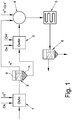
- Figure 1 is a schematic representation of the process according to the present invention.
- the incoming charge of waste products is fed to a first reactor (1) where the acid oxidizing hydrolysis step (OxAc) is carried out by introducing an acidic compound and an oxidizing agent, as described above, into the reactor, and maintaining the temperature at the pre-established value.
- OxAc acid oxidizing hydrolysis step
- the outgoing charge from the acid oxidizing hydrolysis step is then subjected to a separation step as described above, for example by introduction into a first settler (2) where the separation of an acid liquid phase (a) and a solid phase (b) takes place.
- the latter is fed to a second reactor (3) and subjected to the alkaline oxidizing hydrolysis step (OxAlk), by introducing an alkaline compound and an oxidizing agent, as described above, into the reactor, and maintaining the temperature at the pre-established value.
- the acid liquid phase (a) is fed to a neutralization reactor (4), situated downstream of the second reactor (3).
- a further acid compound can be optionally fed to the neutralization reactor (4), if the acid liquid phase (a) is not sufficient for obtaining the desired conditioning of the outgoing charge from the second reactor (3).
- an alkaline compound can be optionally fed to the neutralization reactor (4), if the acid liquid phase (a) is in excess with respect to the quantity of alkaline charge to be neutralized.
- the charge is then preferably subjected to a heat-exchange step in a heat exchanger (5), so as to recover the heat present in the charge, owing to both the heating deriving from the previous acid and alkaline oxidizing hydrolysis steps and also the neutralization heat developed during neutralization in the mixer (4).
- the outgoing charge from the heat exchanger (5) in the case where it still contains a significant quantity of solid residues, is sent to a further separation step carried out, for example, in a second settler (6).
- the solid residue is then discharged from the bottom of the settler (6) and sent to further transformation steps as illustrated above, while the supernatant liquid phase can be disposed of or re-used as already described, for example through pumping to a depuration process from which the treated waste product can derive.
Landscapes
- Chemical & Material Sciences (AREA)
- Life Sciences & Earth Sciences (AREA)
- Hydrology & Water Resources (AREA)
- Engineering & Computer Science (AREA)
- Environmental & Geological Engineering (AREA)
- Water Supply & Treatment (AREA)
- Organic Chemistry (AREA)
- Chemical Kinetics & Catalysis (AREA)
- General Chemical & Material Sciences (AREA)
- Treatment Of Sludge (AREA)
- Processing Of Solid Wastes (AREA)
Claims (13)
- Verfahren zur Behandlung von Abfallprodukten, umfassend:Durchführen einer sauren oxidierenden Hydrolyse einer eintreffenden Abfallcharge;Durchführen einer alkalischen oxidierenden Hydrolyse der aus dem Schritt der sauren oxidierenden Hydrolyse ausgehenden Charge;Neutralisieren der aus dem Schritt der alkalischen oxidierenden Hydrolyse ausgehenden Charge;Abtrennen eines ggf. nach dem Neutralisierungsschritt verbleibenden festen Rückstands;wobei die aus dem Schritt der sauren oxidierenden Hydrolyse ausgehende Charge einem Trennschritt unterzogen wird, um Folgendes zu erhalten: (a) eine saure flüssige Phase, die im Neutralisierungsschritt der aus dem Schritt der alkalischen oxidierenden Hydrolyse ausgehenden Charge zugeführt wird; und (b) eine feste Phase, die als Charge dem Schritt der alkalischen oxidierenden Hydrolyse zugeführt wird.
- Verfahren nach Anspruch 1, wobei die zu behandelnden Abfallprodukte Klärschlämme sind, die bei einem Abwasserreinigungsverfahren erhalten werden.
- Verfahren nach einem der vorstehenden Ansprüche, wobei die aus dem Neutralisierungsschritt ausgehende Charge einem Wärmeaustauschschritt zugeführt wird, um Wärme aus der Charge zurückzugewinnen.
- Verfahren nach einem der vorstehenden Ansprüche, wobei der Schritt der sauren oxidierenden Hydrolyse bei einem pH-Wert im Bereich von 0,1 bis 5,0, vorzugsweise von 1,0 bis 3,5 ausgeführt wird.
- Verfahren nach einem der vorstehenden Ansprüche, wobei der Schritt der sauren oxidierenden Hydrolyse bei einer Temperatur zwischen 35°C und 100°C, vorzugsweise zwischen 50°C und 90°C ausgeführt wird.
- Verfahren nach einem der vorstehenden Ansprüche, wobei der Schritt der alkalischen oxidierenden Hydrolyse bei einem pH-Wert im Bereich von 8,0 bis 12,0, vorzugsweise von 9,0 bis 11,0 ausgeführt wird.
- Verfahren nach einem der vorstehenden Ansprüche, wobei der Schritt der alkalischen oxidierenden Hydrolyse bei einer Temperatur zwischen 35°C und 100°C, vorzugsweise zwischen 50°C und 90°C ausgeführt wird.
- Verfahren nach einem der vorstehenden Ansprüche, wobei die Schritte der alkalischen und der sauren oxidierenden Hydrolyse das Hinzufügen eines für die genannten Schritte gleichen oder unterschiedlichen Oxidationsmittels in die ausgehende Charge umfassen.
- Verfahren nach einem der vorstehenden Ansprüche, wobei das Oxidationsmittel ausgewählt ist aus:(a) Luft oder sauerstoffangereicherter Luft oder in situ in den gasförmigen Zustand zurückversetztem Flüssigsauerstoff;(b) einem anorganischen Peroxid;(c) einem organischen Peroxid;(d) nicht-peroxidischen anorganischen oxidierenden Verbindungen.
- Verfahren nach einem der vorstehenden Ansprüche, wobei der Trennschritt, der an der aus dem Schritt der sauren oxidierenden Hydrolyse ausgehenden Charge vorgenommen wird, in einer Vorrichtung ausgeführt wird, die ausgewählt ist aus: Absetzvorrichtungen, Filtern, dynamischen Verdickungsvorrichtungen, Zentrifugen.
- Verfahren nach einem der vorstehenden Ansprüche, welches ferner das Hinzufügen eines Flockungsmittels in die aus dem Schritt der sauren oxidierenden Hydrolyse ausgehenden Charge umfasst.
- Verfahren nach einem der vorstehenden Ansprüche, wobei die im Trennschritt erhaltene saure flüssige Phase im Neutralisierungsschritt der aus dem Schritt der alkalischen oxidierenden Hydrolyse ausgehenden Charge zugeführt wird, damit die Aufbereitung der Charge bewirkt wird, um einen pH-Wert im Bereich von 5,5 bis 7,5 zu erhalten.
- Verfahren nach einem der vorstehenden Ansprüche, wobei die ausgehende Charge am Ende der Behandlung einem weiteren Trennschritt unterzogen wird, um alle festen Rückstände zu trennen, die nach der Behandlung zurückgeblieben sein könnten.
Priority Applications (1)
| Application Number | Priority Date | Filing Date | Title |
|---|---|---|---|
| PL15823772T PL3227239T3 (pl) | 2014-12-04 | 2015-12-03 | Sposób obróbki produktów odpadowych, w szczególności osadów z oczyszczania |
Applications Claiming Priority (2)
| Application Number | Priority Date | Filing Date | Title |
|---|---|---|---|
| ITMI20142086 | 2014-12-04 | ||
| PCT/IB2015/059320 WO2016088073A1 (en) | 2014-12-04 | 2015-12-03 | Process for the treatment of waste products, in particular, depuration sludges |
Publications (2)
| Publication Number | Publication Date |
|---|---|
| EP3227239A1 EP3227239A1 (de) | 2017-10-11 |
| EP3227239B1 true EP3227239B1 (de) | 2019-02-13 |
Family
ID=52444461
Family Applications (1)
| Application Number | Title | Priority Date | Filing Date |
|---|---|---|---|
| EP15823772.7A Active EP3227239B1 (de) | 2014-12-04 | 2015-12-03 | Verfahren zur behandlung von abfallprodukten, insbesondere, reinigungsschlämmen |
Country Status (9)
| Country | Link |
|---|---|
| EP (1) | EP3227239B1 (de) |
| CN (1) | CN107001084A (de) |
| CA (1) | CA2967220C (de) |
| ES (1) | ES2725436T3 (de) |
| HU (1) | HUE043183T2 (de) |
| PL (1) | PL3227239T3 (de) |
| PT (1) | PT3227239T (de) |
| TR (1) | TR201906724T4 (de) |
| WO (1) | WO2016088073A1 (de) |
Families Citing this family (4)
| Publication number | Priority date | Publication date | Assignee | Title |
|---|---|---|---|---|
| IT201600121031A1 (it) * | 2016-11-29 | 2018-05-29 | Newlisi S P A | Processo per la produzione di biogas tramite digestione anaerobica di fanghi di depurazione pretrattati chimicamente. |
| CN108947167A (zh) * | 2018-06-05 | 2018-12-07 | 上海爱丽更环境科技有限公司 | 利用类芬顿-碱氧化联用处理市政污泥的方法 |
| IT202000016144A1 (it) | 2020-07-03 | 2022-01-03 | Newlisi S P A | Processo per la produzione di biogas tramite digestione anaerobica di fanghi di depurazione pretrattati tramite idrolisi ossidativa termo-alcalina. |
| CN117185619B (zh) * | 2022-05-30 | 2025-11-25 | 上海交通大学 | 一种臭氧耦合过硼酸盐强化污泥调理效果的方法 |
Family Cites Families (9)
| Publication number | Priority date | Publication date | Assignee | Title |
|---|---|---|---|---|
| JPS555998B2 (de) * | 1975-01-22 | 1980-02-12 | ||
| JPS5479164A (en) * | 1977-12-07 | 1979-06-23 | Sato Kougiyou Kk | Sludge dehydrating method |
| JPS5787897A (en) * | 1980-11-21 | 1982-06-01 | Ebara Infilco Co Ltd | Treatment of purification plant sludge |
| JP2002126755A (ja) * | 2000-10-27 | 2002-05-08 | Ebara Corp | 凝集分離方法及び凝集分離処理装置 |
| CN100519451C (zh) * | 2007-03-05 | 2009-07-29 | 清华大学 | 城镇污水污泥的减量化、资源化方法 |
| CN102428044A (zh) * | 2009-03-18 | 2012-04-25 | 克莉雅沃特泰科有限公司 | 污泥水解设备、使用该设备的方法及在该污泥水解设备中提供的接触式热交换单元和蒸汽式热交换单元 |
| IT1396051B1 (it) | 2009-09-28 | 2012-11-09 | Montemurro | Procedimento di minimizzazione in sito dei fanghi di depurazione dei reflui e di altri rifiuti. |
| CN103626365B (zh) * | 2013-11-26 | 2016-01-06 | 华南理工大学 | 一种利用剩余污泥碱中和能力调节碱预处理污泥pH的方法 |
| CN103876165B (zh) * | 2014-03-19 | 2016-04-20 | 武汉轻工大学 | 黄豆壳皮转化为膳食纤维的工艺方法 |
-
2015
- 2015-12-03 ES ES15823772T patent/ES2725436T3/es active Active
- 2015-12-03 PL PL15823772T patent/PL3227239T3/pl unknown
- 2015-12-03 TR TR2019/06724T patent/TR201906724T4/tr unknown
- 2015-12-03 WO PCT/IB2015/059320 patent/WO2016088073A1/en not_active Ceased
- 2015-12-03 HU HUE15823772A patent/HUE043183T2/hu unknown
- 2015-12-03 EP EP15823772.7A patent/EP3227239B1/de active Active
- 2015-12-03 PT PT15823772T patent/PT3227239T/pt unknown
- 2015-12-03 CN CN201580065191.2A patent/CN107001084A/zh active Pending
- 2015-12-03 CA CA2967220A patent/CA2967220C/en active Active
Non-Patent Citations (1)
| Title |
|---|
| None * |
Also Published As
| Publication number | Publication date |
|---|---|
| ES2725436T3 (es) | 2019-09-24 |
| CA2967220A1 (en) | 2016-06-09 |
| EP3227239A1 (de) | 2017-10-11 |
| CN107001084A (zh) | 2017-08-01 |
| TR201906724T4 (tr) | 2019-05-21 |
| PT3227239T (pt) | 2019-05-28 |
| WO2016088073A1 (en) | 2016-06-09 |
| CA2967220C (en) | 2022-11-29 |
| PL3227239T3 (pl) | 2019-08-30 |
| HUE043183T2 (hu) | 2019-08-28 |
Similar Documents
| Publication | Publication Date | Title |
|---|---|---|
| EP3227239B1 (de) | Verfahren zur behandlung von abfallprodukten, insbesondere, reinigungsschlämmen | |
| CN104003602B (zh) | 一种氧化污泥有机质改善其脱水性能的方法 | |
| CA2349803C (en) | Treatment of sewage sludge | |
| CN101979350B (zh) | 物化污泥资源化及减量处理方法 | |
| CN103755061B (zh) | 一种磷酸、磷酸盐生产废水的综合利用方法 | |
| CN105776794A (zh) | 一种催化湿式氧化处理工业污泥的方法 | |
| CN218798139U (zh) | 一种垃圾焚烧飞灰与废硫酸协同处置利用设备 | |
| JPH0655320B2 (ja) | 汚物処理剤および汚物処理方法 | |
| SE1600196A1 (sv) | Metod för återvinning av koagulanter ur kemslam från vatten-och avloppsverk | |
| CN106396326A (zh) | 生物污泥减量方法 | |
| JP2008264764A (ja) | 含油廃水の処理方法 | |
| CN103086492A (zh) | 一种含酸废水处理剂 | |
| FI130365B (en) | A method for treating biosludge | |
| KR100849219B1 (ko) | 음식물 쓰레기의 폐수 처리장치 및 처리방법 | |
| CN105461132A (zh) | 一种废水处理方法及系统 | |
| KR960013617B1 (ko) | 폐절삭유의 처리방법 | |
| FI131180B1 (en) | Anaerobic digestion wastewater treatment system, water treatment system, use of dry lime composition, and fertilizer product | |
| JPS5910391A (ja) | 高濃度廃酸の処理方法 | |
| KR102906687B1 (ko) | 레드머드를 이용한 바이오슬러지 함수율 저감방법 | |
| CN223263825U (zh) | 一种用于废浓硫酸、磷酸、氢氟酸处置的反应装置 | |
| CN204803207U (zh) | 物化污泥洗涤资源化处理工艺的专用设备 | |
| JP3553454B2 (ja) | 汚染土壌の浄化処理方法 | |
| JP3267948B2 (ja) | 油分含有廃液の処理方法 | |
| JP2003277821A (ja) | 廃フッ化水素酸の水酸化カルシウム中和汚泥の再生方法 | |
| CN110272146A (zh) | 将水厂高铝铁污泥、工业废料耦合治理垃圾渗滤液的方法 |
Legal Events
| Date | Code | Title | Description |
|---|---|---|---|
| STAA | Information on the status of an ep patent application or granted ep patent |
Free format text: STATUS: THE INTERNATIONAL PUBLICATION HAS BEEN MADE |
|
| PUAI | Public reference made under article 153(3) epc to a published international application that has entered the european phase |
Free format text: ORIGINAL CODE: 0009012 |
|
| STAA | Information on the status of an ep patent application or granted ep patent |
Free format text: STATUS: REQUEST FOR EXAMINATION WAS MADE |
|
| 17P | Request for examination filed |
Effective date: 20170515 |
|
| AK | Designated contracting states |
Kind code of ref document: A1 Designated state(s): AL AT BE BG CH CY CZ DE DK EE ES FI FR GB GR HR HU IE IS IT LI LT LU LV MC MK MT NL NO PL PT RO RS SE SI SK SM TR |
|
| AX | Request for extension of the european patent |
Extension state: BA ME |
|
| DAV | Request for validation of the european patent (deleted) | ||
| DAX | Request for extension of the european patent (deleted) | ||
| GRAP | Despatch of communication of intention to grant a patent |
Free format text: ORIGINAL CODE: EPIDOSNIGR1 |
|
| STAA | Information on the status of an ep patent application or granted ep patent |
Free format text: STATUS: GRANT OF PATENT IS INTENDED |
|
| INTG | Intention to grant announced |
Effective date: 20180704 |
|
| GRAS | Grant fee paid |
Free format text: ORIGINAL CODE: EPIDOSNIGR3 |
|
| GRAA | (expected) grant |
Free format text: ORIGINAL CODE: 0009210 |
|
| STAA | Information on the status of an ep patent application or granted ep patent |
Free format text: STATUS: THE PATENT HAS BEEN GRANTED |
|
| AK | Designated contracting states |
Kind code of ref document: B1 Designated state(s): AL AT BE BG CH CY CZ DE DK EE ES FI FR GB GR HR HU IE IS IT LI LT LU LV MC MK MT NL NO PL PT RO RS SE SI SK SM TR |
|
| REG | Reference to a national code |
Ref country code: GB Ref legal event code: FG4D |
|
| REG | Reference to a national code |
Ref country code: CH Ref legal event code: EP Ref country code: AT Ref legal event code: REF Ref document number: 1096103 Country of ref document: AT Kind code of ref document: T Effective date: 20190215 |
|
| REG | Reference to a national code |
Ref country code: IE Ref legal event code: FG4D |
|
| REG | Reference to a national code |
Ref country code: DE Ref legal event code: R096 Ref document number: 602015024680 Country of ref document: DE |
|
| REG | Reference to a national code |
Ref country code: CH Ref legal event code: NV Representative=s name: VALIPAT S.A. C/O BOVARD SA NEUCHATEL, CH |
|
| REG | Reference to a national code |
Ref country code: NL Ref legal event code: FP |
|
| REG | Reference to a national code |
Ref country code: SE Ref legal event code: TRGR Ref country code: PT Ref legal event code: SC4A Ref document number: 3227239 Country of ref document: PT Date of ref document: 20190528 Kind code of ref document: T Free format text: AVAILABILITY OF NATIONAL TRANSLATION Effective date: 20190503 |
|
| REG | Reference to a national code |
Ref country code: LT Ref legal event code: MG4D |
|
| REG | Reference to a national code |
Ref country code: NO Ref legal event code: T2 Effective date: 20190213 |
|
| PG25 | Lapsed in a contracting state [announced via postgrant information from national office to epo] |
Ref country code: LT Free format text: LAPSE BECAUSE OF FAILURE TO SUBMIT A TRANSLATION OF THE DESCRIPTION OR TO PAY THE FEE WITHIN THE PRESCRIBED TIME-LIMIT Effective date: 20190213 |
|
| REG | Reference to a national code |
Ref country code: GR Ref legal event code: EP Ref document number: 20190401421 Country of ref document: GR Effective date: 20190708 |
|
| REG | Reference to a national code |
Ref country code: HU Ref legal event code: AG4A Ref document number: E043183 Country of ref document: HU |
|
| PG25 | Lapsed in a contracting state [announced via postgrant information from national office to epo] |
Ref country code: BG Free format text: LAPSE BECAUSE OF FAILURE TO SUBMIT A TRANSLATION OF THE DESCRIPTION OR TO PAY THE FEE WITHIN THE PRESCRIBED TIME-LIMIT Effective date: 20190513 Ref country code: HR Free format text: LAPSE BECAUSE OF FAILURE TO SUBMIT A TRANSLATION OF THE DESCRIPTION OR TO PAY THE FEE WITHIN THE PRESCRIBED TIME-LIMIT Effective date: 20190213 Ref country code: IS Free format text: LAPSE BECAUSE OF FAILURE TO SUBMIT A TRANSLATION OF THE DESCRIPTION OR TO PAY THE FEE WITHIN THE PRESCRIBED TIME-LIMIT Effective date: 20190613 Ref country code: LV Free format text: LAPSE BECAUSE OF FAILURE TO SUBMIT A TRANSLATION OF THE DESCRIPTION OR TO PAY THE FEE WITHIN THE PRESCRIBED TIME-LIMIT Effective date: 20190213 Ref country code: RS Free format text: LAPSE BECAUSE OF FAILURE TO SUBMIT A TRANSLATION OF THE DESCRIPTION OR TO PAY THE FEE WITHIN THE PRESCRIBED TIME-LIMIT Effective date: 20190213 |
|
| REG | Reference to a national code |
Ref country code: ES Ref legal event code: FG2A Ref document number: 2725436 Country of ref document: ES Kind code of ref document: T3 Effective date: 20190924 |
|
| PG25 | Lapsed in a contracting state [announced via postgrant information from national office to epo] |
Ref country code: AL Free format text: LAPSE BECAUSE OF FAILURE TO SUBMIT A TRANSLATION OF THE DESCRIPTION OR TO PAY THE FEE WITHIN THE PRESCRIBED TIME-LIMIT Effective date: 20190213 Ref country code: DK Free format text: LAPSE BECAUSE OF FAILURE TO SUBMIT A TRANSLATION OF THE DESCRIPTION OR TO PAY THE FEE WITHIN THE PRESCRIBED TIME-LIMIT Effective date: 20190213 Ref country code: EE Free format text: LAPSE BECAUSE OF FAILURE TO SUBMIT A TRANSLATION OF THE DESCRIPTION OR TO PAY THE FEE WITHIN THE PRESCRIBED TIME-LIMIT Effective date: 20190213 Ref country code: IT Free format text: LAPSE BECAUSE OF FAILURE TO SUBMIT A TRANSLATION OF THE DESCRIPTION OR TO PAY THE FEE WITHIN THE PRESCRIBED TIME-LIMIT Effective date: 20190213 Ref country code: SK Free format text: LAPSE BECAUSE OF FAILURE TO SUBMIT A TRANSLATION OF THE DESCRIPTION OR TO PAY THE FEE WITHIN THE PRESCRIBED TIME-LIMIT Effective date: 20190213 Ref country code: RO Free format text: LAPSE BECAUSE OF FAILURE TO SUBMIT A TRANSLATION OF THE DESCRIPTION OR TO PAY THE FEE WITHIN THE PRESCRIBED TIME-LIMIT Effective date: 20190213 Ref country code: CZ Free format text: LAPSE BECAUSE OF FAILURE TO SUBMIT A TRANSLATION OF THE DESCRIPTION OR TO PAY THE FEE WITHIN THE PRESCRIBED TIME-LIMIT Effective date: 20190213 |
|
| REG | Reference to a national code |
Ref country code: DE Ref legal event code: R097 Ref document number: 602015024680 Country of ref document: DE |
|
| PG25 | Lapsed in a contracting state [announced via postgrant information from national office to epo] |
Ref country code: SM Free format text: LAPSE BECAUSE OF FAILURE TO SUBMIT A TRANSLATION OF THE DESCRIPTION OR TO PAY THE FEE WITHIN THE PRESCRIBED TIME-LIMIT Effective date: 20190213 |
|
| PLBE | No opposition filed within time limit |
Free format text: ORIGINAL CODE: 0009261 |
|
| STAA | Information on the status of an ep patent application or granted ep patent |
Free format text: STATUS: NO OPPOSITION FILED WITHIN TIME LIMIT |
|
| 26N | No opposition filed |
Effective date: 20191114 |
|
| PG25 | Lapsed in a contracting state [announced via postgrant information from national office to epo] |
Ref country code: SI Free format text: LAPSE BECAUSE OF FAILURE TO SUBMIT A TRANSLATION OF THE DESCRIPTION OR TO PAY THE FEE WITHIN THE PRESCRIBED TIME-LIMIT Effective date: 20190213 |
|
| PG25 | Lapsed in a contracting state [announced via postgrant information from national office to epo] |
Ref country code: MC Free format text: LAPSE BECAUSE OF FAILURE TO SUBMIT A TRANSLATION OF THE DESCRIPTION OR TO PAY THE FEE WITHIN THE PRESCRIBED TIME-LIMIT Effective date: 20190213 |
|
| PG25 | Lapsed in a contracting state [announced via postgrant information from national office to epo] |
Ref country code: LU Free format text: LAPSE BECAUSE OF NON-PAYMENT OF DUE FEES Effective date: 20191203 Ref country code: IE Free format text: LAPSE BECAUSE OF NON-PAYMENT OF DUE FEES Effective date: 20191203 |
|
| REG | Reference to a national code |
Ref country code: AT Ref legal event code: UEP Ref document number: 1096103 Country of ref document: AT Kind code of ref document: T Effective date: 20190213 |
|
| PG25 | Lapsed in a contracting state [announced via postgrant information from national office to epo] |
Ref country code: CY Free format text: LAPSE BECAUSE OF FAILURE TO SUBMIT A TRANSLATION OF THE DESCRIPTION OR TO PAY THE FEE WITHIN THE PRESCRIBED TIME-LIMIT Effective date: 20190213 |
|
| PG25 | Lapsed in a contracting state [announced via postgrant information from national office to epo] |
Ref country code: MT Free format text: LAPSE BECAUSE OF FAILURE TO SUBMIT A TRANSLATION OF THE DESCRIPTION OR TO PAY THE FEE WITHIN THE PRESCRIBED TIME-LIMIT Effective date: 20190213 |
|
| PG25 | Lapsed in a contracting state [announced via postgrant information from national office to epo] |
Ref country code: MK Free format text: LAPSE BECAUSE OF FAILURE TO SUBMIT A TRANSLATION OF THE DESCRIPTION OR TO PAY THE FEE WITHIN THE PRESCRIBED TIME-LIMIT Effective date: 20190213 |
|
| P01 | Opt-out of the competence of the unified patent court (upc) registered |
Effective date: 20230510 |
|
| PGFP | Annual fee paid to national office [announced via postgrant information from national office to epo] |
Ref country code: DE Payment date: 20241219 Year of fee payment: 10 |
|
| PGFP | Annual fee paid to national office [announced via postgrant information from national office to epo] |
Ref country code: ES Payment date: 20250117 Year of fee payment: 10 |
|
| PGFP | Annual fee paid to national office [announced via postgrant information from national office to epo] |
Ref country code: CH Payment date: 20250101 Year of fee payment: 10 |
|
| PGFP | Annual fee paid to national office [announced via postgrant information from national office to epo] |
Ref country code: PT Payment date: 20251120 Year of fee payment: 11 |
|
| REG | Reference to a national code |
Ref country code: CH Ref legal event code: U11 Free format text: ST27 STATUS EVENT CODE: U-0-0-U10-U11 (AS PROVIDED BY THE NATIONAL OFFICE) Effective date: 20260101 |
|
| PGFP | Annual fee paid to national office [announced via postgrant information from national office to epo] |
Ref country code: GB Payment date: 20251229 Year of fee payment: 11 |
|
| PGFP | Annual fee paid to national office [announced via postgrant information from national office to epo] |
Ref country code: NO Payment date: 20251216 Year of fee payment: 11 |
|
| PGFP | Annual fee paid to national office [announced via postgrant information from national office to epo] |
Ref country code: AT Payment date: 20251215 Year of fee payment: 11 |
|
| PGFP | Annual fee paid to national office [announced via postgrant information from national office to epo] |
Ref country code: FI Payment date: 20251216 Year of fee payment: 11 |
|
| PGFP | Annual fee paid to national office [announced via postgrant information from national office to epo] |
Ref country code: HU Payment date: 20251202 Year of fee payment: 11 Ref country code: NL Payment date: 20251223 Year of fee payment: 11 Ref country code: FR Payment date: 20251222 Year of fee payment: 11 |
|
| PGFP | Annual fee paid to national office [announced via postgrant information from national office to epo] |
Ref country code: TR Payment date: 20251128 Year of fee payment: 11 Ref country code: BE Payment date: 20251224 Year of fee payment: 11 Ref country code: GR Payment date: 20251215 Year of fee payment: 11 |
|
| PGFP | Annual fee paid to national office [announced via postgrant information from national office to epo] |
Ref country code: SE Payment date: 20251217 Year of fee payment: 11 |
|
| PGFP | Annual fee paid to national office [announced via postgrant information from national office to epo] |
Ref country code: PL Payment date: 20251125 Year of fee payment: 11 |