EP3225707A1 - Bauteil für medienführende gas- oder wasserleitungen, das eine kupferlegierung enthält - Google Patents
Bauteil für medienführende gas- oder wasserleitungen, das eine kupferlegierung enthält Download PDFInfo
- Publication number
- EP3225707A1 EP3225707A1 EP17151949.9A EP17151949A EP3225707A1 EP 3225707 A1 EP3225707 A1 EP 3225707A1 EP 17151949 A EP17151949 A EP 17151949A EP 3225707 A1 EP3225707 A1 EP 3225707A1
- Authority
- EP
- European Patent Office
- Prior art keywords
- alloy
- component according
- lead
- component
- content
- Prior art date
- Legal status (The legal status is an assumption and is not a legal conclusion. Google has not performed a legal analysis and makes no representation as to the accuracy of the status listed.)
- Granted
Links
Images




Classifications
-
- C—CHEMISTRY; METALLURGY
- C22—METALLURGY; FERROUS OR NON-FERROUS ALLOYS; TREATMENT OF ALLOYS OR NON-FERROUS METALS
- C22C—ALLOYS
- C22C9/00—Alloys based on copper
- C22C9/02—Alloys based on copper with tin as the next major constituent
-
- C—CHEMISTRY; METALLURGY
- C22—METALLURGY; FERROUS OR NON-FERROUS ALLOYS; TREATMENT OF ALLOYS OR NON-FERROUS METALS
- C22C—ALLOYS
- C22C9/00—Alloys based on copper
- C22C9/04—Alloys based on copper with zinc as the next major constituent
-
- E—FIXED CONSTRUCTIONS
- E03—WATER SUPPLY; SEWERAGE
- E03B—INSTALLATIONS OR METHODS FOR OBTAINING, COLLECTING, OR DISTRIBUTING WATER
- E03B7/00—Water main or service pipe systems
Definitions
- the present invention relates to a component for media-carrying gas or water pipes, in particular fitting or fitting for drinking water pipes, wherein the component consists at least partially of a lead-free copper alloy.
- the materials used to protect consumers must comply with very narrow limits, which are regulated by the Drinking Water Ordinance.
- the in the EP 1 798 298 A1 described alloy shows a comparison with a conventional gunmetal improved migration behavior for lead, nickel, copper and zinc ions.
- the alloy can be subjected to a heat treatment after casting in order to achieve a high proportion of ⁇ -mixed crystal and thus a particularly favorable migration behavior of the alloy.
- Lead is practically insoluble in copper and has a low melting point. As a result, it is the last solidifying element in copper-tin alloys.
- This constitutional behavior leads to lead being present in the structure at the end of the solidification in the form of evenly distributed, small, drop-shaped particles between the dendrite arms.
- These fine, teardrop-shaped particles act as chipbreakers without affecting the original properties of the material. This is particularly evident in the corrosion resistance, since the lead particles are present as incoherent phases and thus can not interact with the surrounding matrix. Also, the uniform distribution of small, teardrop-shaped lead particles ensures that similar mechanical characteristics are consistently to be expected over a uniform cross section.
- Patent US 8,470,101 B2 a lead-free alloy is described, which in addition to copper and unavoidable impurities from 0.1 wt .-% to 0.7 wt .-% sulfur, up to 8 wt .-% tin and up to 4 wt .-% zinc, and in the task of the lead over sulfur phases in the form of sulfide particles are fulfilled.
- these sulfides do not have the property of forming themselves inevitably at the end of the solidification in the form of small, distributed phases.
- an unfavorably chosen composition of in Patent US 8,470,101 B2 Alloy described may lead to unfavorable sulfide formation in the structure.
- the object of the present invention is to provide a lead-free copper alloy for the production of components for media-carrying gas or water lines, which in comparison with a conventional gunmetal alloy, such as, for example, CuSn5Zn5Pb2, a corrosion-resistant matrix, good strength properties with good machining properties, high pressure tightness and improved migration behavior.
- a conventional gunmetal alloy such as, for example, CuSn5Zn5Pb2
- the lead-free copper alloy should have a good casting behavior, eg. In sand or continuous casting.
- the lead-free copper alloy shows no dezincification or similar selective corrosion attack. Therefore, the lead-free copper alloy has improved corrosion resistance over the entire frame prescribed by the Drinking Water Ordinance (hereinafter referred to as "TWVO"). Accordingly, the present invention preferably represents a component for media-carrying gas or water pipes, in particular a fitting or a fitting for drinking water pipes, wherein the component consists at least partially of the lead-free copper alloy according to the invention.
- the tin content has an influence on the strength, corrosion resistance and on the phase distribution and, in the claimed range from 3.5% by weight to ⁇ 4.8% by weight, achieves an optimally balanced, economical ratio of the properties described above.
- a tin content of more than 4.8% by weight the strength and corrosion resistance in the matrix continue to increase, but under normal cooling conditions in sand casting, the distribution of the sulfides becomes coarser and the size increases.
- At levels below 3.5% by weight of tin there is insufficient corrosion inhibition.
- a high tensile strength can be achieved at levels above 4.8% by weight of tin, the elongation values of the material are reduced. Contents of well over 4.8 wt .-% tin lead to the formation of a structure which embrittlement and unfavorable effect on the processing.
- the sulfur content of 0.25 wt .-% to 0.65 wt .-% determines the volume fraction of the sulfides with. From 0.25 wt .-% sulfur, an amount of sulfide particles is produced, which ensures sufficient machinability of the alloy. Sulfur content above 0.65 wt% sulfur can lead to the formation of undesirable coarse sulfide particles. In addition, due to the high content of sulfide particles, the load transmitted cross section, i. the cross-section of the component which receives voltages from the outside, reduce so much that it leads to a deterioration of the mechanical characteristics, such. Elongation at break and the like comes.
- the metal sulfides are present in such a sulfur content in the lead-free copper alloy as an incoherent, finely divided, disperse phase in the form of finely divided particles. This offers the advantage that any corrosion occurring only to a small extent locally on these particles and not along contiguous, larger, individual phases of the alloy structure takes place, as is the case for example with standard brass. Due to the small size of the particles no significant corrosive attack takes place.
- the proportion of phosphorus (P) in the lead-free copper alloy according to the invention is 0.015 wt .-% to 0.1 wt .-%. Below 0.015% by weight of phosphorus, there is no sufficient deoxidation of the melt, which has a negative effect on the phase formation of the alloy. On the other hand, if the phosphorus content exceeds 0.1 wt%, the lead-free copper alloy tends to have adverse effects on the mechanical properties such as reduced elongation at break. From these viewpoints, the weight proportion of phosphorus in the lead-free copper alloy is preferably in the range of 0.02 wt% to 0.08 wt%, more preferably in the range of 0.04 wt% to 0.06 wt%. -%.
- the term "lead-free copper alloy” means a copper alloy containing, in particular, lead as an unavoidable impurity in an amount of not more than 0.25 wt%, but preferably 0.09 wt%, more preferably not more than 0 , 05 wt .-% includes.
- the lead content is at most 0.25 wt .-%, preferably at most 0.09 wt .-% and particularly preferably at most less than or equal to 0.05 wt .-%.
- the alloy shows no signs of increased lead delivery in the first few weeks.
- the low lead content in the alloy used in the invention thus leads to a significant reduction of metal ion migration in drinking water, the low lead content has no negative effects on the chip breaking and thus on the machinability of the alloy used in the invention.
- the nickel content in the alloy used in the invention is at most 0.4 wt .-%, preferably, the nickel content is at most 0.3 wt .-%.
- the addition of nickel increases the corrosion resistance of the alloy, without being in conflict with hygienic safety. Similar to lead, the values of nickel migration are far below the legally required limit when tested according to DIN EN 15664-1.
- an antimony content of at most 0.1% by weight with respect to the properties of the drinking water migration is not critical.
- the alloy may furthermore have an iron content of at most 0.3% by weight.
- the lead-free copper alloy may also contain fractions of the elements iron (Fe), zirconium (Zr) and / or boron (B) alone or in a combination of at least two of said elements as grain refiner. It is preferred that iron in a weight fraction of up to 0.3 wt .-%, zirconium in a weight fraction of up to 0.01 wt .-% and / or boron in a weight fraction of up to 0.01 wt. -% are contained in the lead-free copper alloy.
- the grain finers avoid hot cracking and affect the mechanical properties, such as e.g. Tensile strength, material hardness and the like positive.
- the copper content of the lead-free copper alloy is at least 90% by weight, preferably more than 91% by weight.
- the sulfides of the lead-free copper alloy are homogeneously distributed in the structure.
- the number of sulfide particles should be high and their average size should be low in order to ensure uniform mechanical properties, good corrosion resistance, improved machinability and high pressure tightness over the entire microstructure.
- copper sulfide is preferable. because the presence of copper sulphide allows to substitute the volume of lead with a much lower content of sulfur.
- the component according to the invention at least partially has a wall thickness in the range of 0.5 mm to 6.0 mm, since the thin wall thickness leads to suitable for the formation of copper sulfides cooling rates. Furthermore, it is preferred if the entire component according to the invention has a wall thickness within the ranges of 0.5 mm to 4.0 mm, since a wall thickness in this range results in a particularly increased formation of the desired sulfide particles. A wall thickness below 0.5 mm could not have sufficient mechanical strength of the component according to the invention due to the small cross section. From these points of view, it is preferred that the component according to the invention at least in sections has a wall thickness in the range of 1.0 mm to 4.0 mm.
- At a wall thickness of less than 6 mm in the transverse section of the component according to the invention at least a proportion of 1.6 area percent sulfide particles and / or a surface area factor ASP% is less than 1000.
- Such values result in sulfur sulfides being present as an incoherent, finely divided, disperse phase. As a result, deep trough and / or hole-shaped attacks, in particular corrosion attacks, are avoided on the components according to the invention.
- the term "Area Property Code ASP%" is the mathematical description for the measure of the shape and location of a bell curve, which is a plot of the averages of the area classes (abscissa) in combination with the percent distribution of the sulfide particles in those area classes (ordinates ) yields (cf. Fig. 1 ).
- the value of the surface content index ASP% is obtained by measuring the area of the respective particles, for example from an enlarged image of a micrograph, the percentage allocation of the particles detectable in the image in classes, the multiplication of the percentage values of the allocation with the mean of the class and the formation of a large average from the resulting averages of the classes, with the large mean being taken as the "area key figure ASP%".
- the alloy used in the invention has the excellent property of forming a topcoat very rapidly on the inner, water-wetted surface.
- the cover layer has a thickness of preferably at least 2 ⁇ m, more preferably of at least 3 microns, on. This covering layer increases the corrosion resistance and ensures the longevity of the components made of this material, since further corrosion is prevented. Migration from the material to the drinking water can only take place if corrosion processes take place in the material.
- the top layer thus acts as a protective layer and limits the further metal delivery to the drinking water to a minimum.
- the copper content in the described alloy is higher than in conventional gunmetal alloys, such. As CuSnZn5Pb2, only a reduced copper metal release takes place.
- the term "component for media-carrying gas or drinking water pipes” is to be understood in particular as those components which come into contact with a domestic installation pipe system with water, in particular with drinking water, wherein fitting and fittings of such domestic installation pipe systems are preferred according to the invention.
- a fitting is in particular from the EP 2 250 421 A1 to call known connector.
- Fig. 2 shows a Turner diagram for the test waters used in the thermal aging test.
- the carbonate hardness (as a measure of water hardness) is plotted against the chloride ion content of the test water.
- the line labeled "Turner Classic” represents the corrosion characteristic of dezincification developed by Turner (" The Influence of Water Composition on the Dezincification of Duplex Brass Fittings ", 1965 ). According to the usual interpretation of the world of corrosion, there is no dezincification in the area below this line. Above this line, however, there is a very high risk that a damage due to dezincification of the relevant component occurs.
- the points shown give an overview of the different test waters that were used in the described hot swapping test.
- test specimens For the production of test specimens, half cylinders with a wall thickness of 5 mm were cast from the alloys 1 and 2. Thereafter, the test specimens were on the outside by means of a turning to a roughness Rz of max. Machined 25 ⁇ m and on the inside by means of a drilling with a through hole of roughness Rz of max. 40 ⁇ m provided. This special surface treatment is intended to allow comparability of the specimens with real manufactured components.
- test specimens The surface of the specimens was cleaned with acetone. Subsequently, the test specimens were placed freely hanging in a test container. The test containers were then placed in a 90 ° C oven for five months with the test medium changed at seven-day intervals.
- test media were each 21 different test water with different pH values and carbonate hardness (the carbonate hardness (KH) is that proportion of calcium and magnesium ions for which an equivalent concentration of bicarbonate ions is present in the unit volume), in addition, different levels of chloride ions and / or sulfate ions.
- KH carbonate hardness
- Table 2 ⁇ u> Table 2: ⁇ / u> water number PH value Carbonate hardness in ° dH Chloride in mg / l Sulfate in mg / l 1 8th 0.5 10 - 2 8th 0.5 100 - 3 8th 0.5 250 - 4 8th 0.5 1000 - 5 8th 1.5 15 - 6 8th 1.5 60 - 7 8th 1.5 140 - 8th 8th 3.0 30 - 9 8th 3.0 100 - 10 8th 5.5 80 - 11 8th 5.5 120 - 12 8th 5.5 250 - 13 7 9.0 100 - 14 7 9.0 160 - 15 7 14.0 140 - 16 7 18.0 40 - 17 7 18.0 100 - 18 7 18.0 250 - 19 8th 0.5 250 250 20 8th 5.5 250 250 21 7 18.0 250 250 250
- test containers After completion of the five-month test period, the test containers are removed from the oven, cooled to room temperature, taken the test specimens from the respective test containers, dried, cut open and the cut surface is examined by appropriate optical microscopy.
- Alloys 1 and 2 showed over the entire area of the drinking water ordinance tested in hot aging an outstanding formation of a protective, adherent, closed covering layer required for copper alloys which has a thickness of at least 2 ⁇ m in the hot aging test and thus an improved covering layer with respect to a conventional lead-containing copper alloy based on a CuSnZn alloy (eg CuSn5Zn5Pb). Furthermore, this layer is virtually free of defects or defects and thus unfolds their full protection by avoiding a deeper, local corrosion attack (see Fig. 4 and Fig. 6 ).
- Fig. 4 shows the behavior of the cover layer formation of a lead-free copper alloys (alloy 1 and alloy 2) used according to the invention after a five-month hot aging test for the respective test waters. It turns out that it only comes to the formation of a protective topcoat. There is no visible selective corrosion attack.
- the thickness of the formed, adherent, protective cover layer is at least 4 microns.
- FIG. 5 is a photograph of the standard brass (CuZn40Pb2) microstructure as a result of an exemplary corrosive attack after the 5 month hot aging test, based on Turner, with a chloride content of 250 mg / l and a carbonate hardness of 5.5 ° dH.
- a non-uniform, partially disturbed structure of the cover layer and the selective corrosion attack in the form of a dezincification is clearly visible.
- FIG. 6 a photograph of the microstructure of a result of the five-month hot aging test, based on Turner, with a chloride content of 250 mg / l and a carbonate hardness of 5.5 ° dH, on an inventive component of the alloy 2 (Alloy 1 shows an analogous behavior ) was carried out.
- microstructure shows in the component according to the invention after an identical heat aging test no selective corrosion attack, but a uniform, homogeneous structure of a protective, adherent cover layer with a thickness of 4 microns to 23 microns.
- the alloy in the hot aging test carried out here is free from selective corrosion attacks (eg dezincification and stress corrosion cracking) and almost all other corrosion phenomena.
- Fig. 7 represents a thermal analysis in a temperature-time diagram, which can be used to detect thermal effects on metals (for example, release of latent heat), which can occur in solid-to-liquid or phase-to-solid phase transformations.
- Plotted is the cooling temperature of the alloy and the first time derivative of the measurement signal against the time, which is described as the cooling rate.
- a change in the peak in the cooling rate curve corresponds to a thermal effect in the material.
- sulfide formation should be aimed for shortly before the end of solidification at low temperature, since in this way the sulfides, like the lead, are distributed more homogeneously in the microstructure.
- the cooling rate in Fig. 7 corresponds to the typical solidification process of a copper-tin alloy to 5 wt .-% tin in sand casting.
- alloy 3 at about 400 s, an early thermal effect occurs during the course of solidification, which is due to sulfide formation.
- the sulfide formation takes place delayed, shortly before the end of the solidification.
- the fact that both samples have been cooled under identical conditions is underpinned by the further cooling rate profile of the samples, which is identical after phase formation.
- the varying time of phase formation is thus due to the different zinc content in the alloys.
- Early sulfide formation affects the sulfide form and distribution in the microstructure.
- the early formation of sulfide in alloy 3 leads to a heterogeneous, partial phase distribution, which adversely affects the mechanical characteristics such as elongation.
- the material composition is adjusted in a way that avoids premature sulfide formation and promotes homogeneous distribution.
- Des shimmer was recognized that the cooling conditions of the melt to a component according to the invention, have an influence on the sulfide formation.
- a high cooling rate which is preferred for a thin wall, results in a fine-meshed dendritic network with fine residual melt areas, from which a globular formation of the sulfides is supported.
- rapid cooling is preferred according to the invention.
- Fig. 10 and Fig. 11 shows micrographs of components according to the invention of an identical melt which has been cooled under varying conditions. In a rapid cooling, the micrograph in Fig. 11 a structure that leads to higher mechanical characteristics, such as tensile strength, elongation at break and the like.
- the particles were examined and characterized by means of image analysis on microstructures of the test specimens.
- the volume of sulfides and the surface area can be determined by means of this image analysis.
- the alloys used in accordance with the invention can be characterized by a surface area factor ASP% of less than 1000.
Landscapes
- Chemical & Material Sciences (AREA)
- Engineering & Computer Science (AREA)
- Metallurgy (AREA)
- Materials Engineering (AREA)
- Mechanical Engineering (AREA)
- Organic Chemistry (AREA)
- Hydrology & Water Resources (AREA)
- Public Health (AREA)
- Water Supply & Treatment (AREA)
- Life Sciences & Earth Sciences (AREA)
- Health & Medical Sciences (AREA)
- Domestic Plumbing Installations (AREA)
- Preventing Corrosion Or Incrustation Of Metals (AREA)
- Contacts (AREA)
Abstract
3,5 Gew.-% ≤ Sn ≤ 4,8 Gew.-%;
1,5 Gew.-% ≤ Zn ≤ 3,5 Gew.-%;
0,25 Gew.-≤ S ≤ 0,65 Gew.-%;
0,015 Gew.-≤ P ≤ 0,1 Gew.-%;
unvermeidbare Verunreinigungen sowie
zum Rest Kupfer.
Description
- Die vorliegende Erfindung betrifft ein Bauteil für medienführende Gas- oder Wasserleitungen, insbesondere Fitting oder Armatur für Trinkwasserleitungen, wobei das Bauteil zumindest teilweise aus einer bleifreien Kupferlegierung besteht.
- An metallische Werkstoffe für den Einsatz in Bauteilen für wasserführende, insbesondere trinkwasserführende Gewerke, wie beispielsweise Fittings, Armaturen, Rohre, Pressverbinder, Dach- oder Ablaufrinnen, sind besondere Anforderungen zu stellen. Insbesondere im Falle von mit Trinkwasser in Kontakt stehenden Bauteilen ist dabei die Korrosionsbeständigkeit zu nennen. Speziell stark kupferhaltige Buntmetall-Legierungen wie Bronze, Messing oder Rotguss enthalten auch einen gewissen Anteil an Blei, weil Blei die Bearbeitbarkeit derartiger Legierungen verbessert. In der Praxis ist in solchen Legierungen auch Nickel vorhanden, um die Festigkeit und Korrosionsbeständigkeit der Legierungen zu erhöhen. Aufgrund der Toxizität dieser Metalle müssen solche Werkstoffe allerdings eine geringe Migrationsneigung von Metallionen in das Medium aufweisen, d.h. eine geringe Abgabe von Ionen der Legierungskomponenten an das Medium. Hierzu sind von den Werkstoffen zum Schutz der Verbraucher sehr enge Grenzen einzuhalten, die durch die Trinkwasserordnung geregelt sind. Dazu ist aus der
EP 1 798 298 A1 eine weitgehend blei- und nickelfreie Kupferlegierung bekannt, die neben Kupfer und unvermeidbaren Verunreinigungen 2 Gew.-% bis 4,5 Gew.-% Silizium, 1 Gew.-% bis 15 Gew.-% Zink, 0,05 Gew.-% bis 2 Gew.-% Mangan sowie optional 0,05 Gew.-% bis 0,4 Gew.-% Aluminium und 0,05 Gew.-% bis 2 Gew.-% Zinn umfasst. Die in derEP 1 798 298 A1 beschriebene Legierung zeigt ein gegenüber einem herkömmlichen Rotguss verbessertes Migrationsverhalten für Blei-, Nickel-, Kupfer- und Zinkionen. Die Legierung kann nach dem Gießen einer Wärmebehandlung unterzogen werden, um einen hohen Anteil an α-Mischkristall und damit ein besonders günstiges Migrationsverhalten der Legierung zu erzielen. - Für den Einsatz in der Trinkwasserinstallation findet derzeit die Rotgusslegierung CuSn5Zn5Pb2 mit Gehalten von etwa 5 Gew.-% Zinn und etwa 5 Gew.-% Zink eine breite Anwendung. Diese Kupferlegierung besitzt eine hervorragende Korrosionsbeständigkeit und ist daher in allen Wasserqualitäten innerhalb der Trinkwasserversorgung einsetzbar. Legierungen dieser Art sind üblicherweise im Gefüge einphasig ausgebildet und bieten daher eine hohe plastische Verformbarkeit. Jedoch bereitet gerade diese plastische Verformbarkeit bei der spanabhebenden mechanischen Bearbeitung Probleme. Einphasige Kupferwerkstoffe neigen zu einer Langspanbildung. Diese Spanart hemmt den Arbeitsablauf beim vollautomatisierten Drehen, bzw. Bohren, und führt zu einem starken Verschleiß an den Werkzeugschneiden. Um die Produkte dennoch wirtschaftlich bearbeiten zu können, werden den Legierungen Blei als spanbrechender Zusatz hinzugegeben. Blei ermöglicht eine wirtschaftliche, vollautomatisierte mechanische Bearbeitung.
- Blei ist in Kupfer praktisch unlöslich und besitzt einen niedrigen Schmelzpunkt. Infolgedessen handelt es sich um das zuletzt erstarrende Element in Kupfer-Zinn-Legierungen. Dieses Konstitutionsverhalten führt dazu, dass Blei am Ende der Erstarrung im Gefüge in Form von gleichmäßig verteilten, kleinen, tropfenförmigen Partikeln zwischen den Dendritenarmen vorliegt. Diese feinen, tropfenförmigen Partikel wirken als Spanbrecher, ohne dass die ursprünglichen Eigenschaften des Werkstoffs, beeinflusst werden. Dies ist besonders deutlich an der Korrosionsbeständigkeit erkenntlich, da die Bleipartikel als inkohärente Phasen vorliegen und somit nicht mit der umgebenden Matrix interagieren können. Auch wird durch die gleichmäßige Verteilung kleiner, tropfenförmiger Bleipartikel gewährleistet, dass über einen gleichmäßigen Querschnitt durchgehend ähnliche mechanische Kennwerte zu erwarten sind.
- In der
Patentschrift US 8,470,101 B2 wird eine bleifreie Legierung beschrieben, die neben Kupfer und unvermeidbaren Verunreinigungen aus 0,1 Gew.-% bis 0,7 Gew.-% Schwefel, bis zu 8 Gew.-% Zinn und bis zu 4 Gew.-% Zink besteht und in der die Aufgabe des Bleis über Schwefelphasen in Form von Sulfidpartikeln erfüllt werden. Im Gegensatz zum Element Blei besitzen diese Sulfide aber nicht die Eigenschaft, sich zwangsläufig am Ende der Erstarrung in Form von kleinen, verteilten Phasen auszubilden. Im Falle einer ungünstig gewählten Zusammensetzung der inPatentschrift US 8,470,101 B2 beschriebenen Legierung, kann es zu einer ungünstigen Sulfidausbildung im Gefüge kommen. Dadurch wird die Festigkeit reduziert und es kommt zu einer Absenkung der mechanischen Kennwerte. Weiterhin besitzen die in derPatentschrift US 8,470,101 B2 beschriebenen Sulfide keine hohe Korrosionsbeständigkeit. Jedoch gerade für einen Einsatz einer solchen schwefelhaltigen Kupferlegierung in einer Trinkwasserinstallation ist eine korrosionsbeständige Matrix notwendig, um die Langlebigkeit der Bauteile zu gewährleisten. - Nickel ist in Kupferlegierungen in der Lage, sowohl die Korrosionsbeständigkeit zu erhöhen als auch die Verteilung von Sulfidphasen im Gefüge zu verbessern. Hohe Nickelgehalte führen aber zu einer hohen Metallionenabgabe ins Trinkwasser und sind daher als hygienisch bedenklich eingestuft. Der vorgegebene Legierungsbereich in der
Patentschrift US 8,470,101 B2 kann nicht über den gesamten, darin beschriebenen Umfang gewährleisten, dass ausreichend hohe Korrosions-, Festigkeits-, Bearbeitungs- oder Hygieneeigenschaften vorliegen. Doch besonders diese Eigenschaften sind für dünnwandige trinkwasserführende Bauteile essenziell. - Vor diesem Hintergrund liegt der vorliegenden Erfindung die Aufgabe zugrunde, eine bleifreie Kupferlegierung zur Herstellung von Bauteilen für medienführende Gas- oder Wasserleitungen anzugeben, die im Vergleich zu einer konventionellen Rotgusslegierung, wie z.B. CuSn5Zn5Pb2, eine korrosionsbeständige Matrix, gute Festigkeitseigenschaften bei gleichzeitig guten Bearbeitungseigenschaften, eine hohe Druckdichtigkeit und ein verbessertes Migrationsverhalten aufweist. Darüber hinaus soll die bleifreie Kupferlegierung ein gutes Gießverhalten, bspw. im Sand- oder Strangguss, besitzen.
- Diese und andere Aufgaben werden durch ein Bauteil für medienführende Gas- oder Wasserleitungen mit den Merkmalen des Anspruchs 1 gelöst. Bevorzugte Ausführungsformen des erfindungsgemäßen Bauteils sind in den abhängigen Ansprüchen beschrieben.
- Gemäß der vorliegenden Erfindung wurde überaschenderweise erkannt, dass eine bleifreie Kupferlegierung, die als Legierungskomponenten in Gew.-% neben Kupfer (Cu) und unvermeidbaren Verunreinigungen noch 3,5 Gew.-% ≤ Zinn (Sn) ≤ 4,8 Gew.-%, 1,5 Gew.-% ≤ Zink (Zn) ≤ 3,5 Gew.-%, 0,25 Gew.-% ≤ Schwefel (S) ≤ 0,65 Gew.-% und 0,015 Gew.-% ≤ Phosphor (P) ≤ 0,1 Gew.-% umfasst, bei Kontakt mit Wassern verschiedener Wasserqualitäten eine gegenüber Standardmessing (CuZn40Pb2) und entzinkungsbeständigem Messing (CuZn36Pb2As) verbesserte Deckschichtbildung zeigt, was u.a. durch geeignete Warmauslagerungsversuche belegt wurde. Aufgrund dieser verbesserten Deckschichtbildung, zeigt die bleifreie Kupferlegierung keinerlei Entzinkung oder ähnliche selektive Korrosionsangriffe. Daher verfügt die bleifreie Kupferlegierung über eine verbesserte Korrosionsbeständigkeit über den gesamten, durch die Trinkwasserverordnung (nachstehend als "TWVO" bezeichnet) vorgegebenen Rahmen. Dementsprechend stellt die vorliegende Erfindung bevorzugt ein Bauteil für medienführende Gas- oder Wasserleitungen dar, insbesondere ein Fitting oder eine Armatur für Trinkwasserleitungen, wobei das Bauteil zumindest teilweise aus der erfindungsgemäßen bleifreien Kupferlegierung besteht.
- Es wurde festgestellt, dass sich in der erfindungsgemäß verwendeten Legierung zwei schwefelhaltige Phasen, Kupfersulfid und Zinksulfid, im Gefüge temperaturabhängig und versetzt voneinander ausbilden. Um durch Sulfidpartikel optimale Zerspanungseigenschaften zu erreichen, sollten diese möglichst rund, feinverteilt und klein vorliegen. Dieses Verhalten ist bevorzugt bei der Bildung von Kupfersulfiden zu beobachten. Zinksulfide hingegen neigen zu einer geometrisch ungünstigen Form. Es wurde erkannt, dass der Zeitpunkt der Phasenausbildung, die Art, die Anzahl und die Verteilung der schwefelhaltigen Partikel entscheidend für die Zerspanbarkeit und für die mechanischen Eigenschaften, wie etwa der Dehnung, des Bauteils sind. Die ausgebildeten Sulfide, bevorzugt als Kupfersulfid, bieten ähnlich den Bleipartikeln den Vorteil, als inkohärente Phasen vorzuliegen.
- Der Zinngehalt nimmt Einfluss auf die Festigkeit, Korrosionsbeständigkeit und auf die Phasenverteilung und erreicht im beanspruchten Bereich von 3,5 Gew.-% bis ≤ 4,8 Gew.-% ein optimal ausgewogenes, wirtschaftliches Verhältnis der davor beschriebenen Eigenschaften. Mit einem Zinngehalt von über 4,8 Gew.-% steigt zwar die Festigkeit und Korrosionsbeständigkeit in der Matrix weiter an, bei üblichen Abkühlungsbedingungen im Sandguss wird die Verteilung der Sulfide aber gröber und die Größe nimmt zu. Bei Gehalten unter 3,5 Gew.-% Zinn liegt keine ausreichende Korrosionsinhibierung vor. Auch werden wegen der schwachen Mischkristallverfestigung die für die Praxis notwendigen Eigenschaften nicht erreicht. Bei Gehalten über 4,8% Gew.-% Zinn kann zwar eine hohe Zugfestigkeit erreicht werden, wohingegen die Dehnungswerte des Materials reduziert werden. Gehalte von weit über 4,8 Gew.-% Zinn führen zur Ausbildung eines Gefüges, welches sich versprödend und ungünstig auf die Bearbeitung auswirkt.
- Es konnte festgestellt werden, dass bei gleichbleibenden Abkühlungsbedingungen mit steigendem Zinkgehalt der Anteil von Kupfersulfid abnimmt und der Anteil von Zinksulfid steigt. Mit einem Zinkgehalt von 1,5 Gew.-% bis 3,5 Gew.-%, besonders bevorzugt mit einem Zinkgehalt im Bereich von 1,8 Gew.-% bis 3,0 Gew.-%, kann gesichert werden, dass in Wänden von bis zu 6 mm eine homogene Verteilung kleinerer Sulfide begünstigt wird. Unter diesem Gesichtspunkt ist ein Zinkgehalt von 2,0 Gew-% bis 2,8 Gew-% besonders bevorzugt. Der Gehalt von max. 3,5 Gew.-% Zink sichert zusätzlich, dass partielle Korrosionserscheinungen vermieden und eine hohe Korrosionsbeständigkeit erreicht werden kann.
- Der Schwefelgehalt von 0,25 Gew.-% bis 0,65 Gew.-% bestimmt den Volumenanteil der Sulfide mit. Ab 0,25 Gew.-% Schwefel wird eine Menge an Sulfidpartikeln erzeugt, welche eine ausreichende Zerspanbarkeit der Legierung gewährleistet. Ein Schwefelgehalt über 0,65 Gew.-% Schwefel kann zur Ausbildung von unerwünschten, groben Sulfidpartikeln führen. Darüber hinaus kann sich durch den hohen Sulfidpartikelanteil der lastübertragene Querschnitt, d.h. der Querschnitt des Bauteiles, welcher Spannungen von außen aufnimmt, so stark reduzieren, dass es zu einer Verschlechterung der mechanischen Kennwerte, wie z.B. Bruchdehnung und dergleichen, kommt. Weiter verbesserte Eigenschaften wurden mit einer Legierung erzielt, deren Schwefelanteil im Bereich von 0,3 Gew.-% bis 0,6 Gew.-%, insbesondere im Bereich von 0,35 Gew.-% bis 0,55 Gew.-% liegt. Aufgrund der erfindungsgemäß verwendeten Legierungszusammensetzung liegen die Metallsulfide bei einem derartigen Schwefelgehalt in der bleifreien Kupferlegierung als inkohärente, fein verteilte, disperse Phase in Form von fein verteilten Partikeln vor. Dies bietet den Vorteil, dass eine eventuell auftretende Korrosion nur in einem geringem Umfang lokal an diesen Partikeln und nicht entlang zusammenhängender, größerer, einzelner Phasen des Legierungsgefüges stattfindet, wie dies beispielsweise bei Standardmessing der Fall ist. Bedingt durch die geringe Größe der Partikel findet kein signifikanter Korrosionsangriff statt.
- Der Anteil an Phosphor (P) in der bleifreien Kupferlegierung beträgt erfindungsgemäß 0,015 Gew.-% bis 0,1 Gew.-%. Unterhalb von 0,015 Gew.-% Phosphor erfolgt keine ausreichende Desoxidation der Schmelze, was sich auf die Phasenbildung der Legierung negativ auswirkt. Hingegen neigt die bleifreie Kupferlegierung bei einem Phosphoranteil von mehr als 0,1 Gew.-% zu ungünstigen Auswirkungen auf die mechanischen Eigenschaften, wie z.B reduzierter Bruchdehnung. Unter diesen Gesichtspunkten liegt der Gewichtsanteil an Phosphor in der bleifreien Kupferlegierung vorzugsweise im Bereich von 0,02 Gew.-% bis 0,08 Gew.-%, besonders bevorzugt im Bereich von 0,04 Gew.-% bis 0,06 Gew.-%.
- Wie hierin verwendet, bedeutet der Begriff "bleifreie Kupferlegierung" eine Kupferlegierung, die insbesondere Blei als unvermeidbare Verunreinigung in einer Menge von nicht mehr als 0,25 Gew.-% bevorzugt aber 0,09 Gew.-%, besonders bevorzugt nicht mehr als 0,05 Gew.-% umfasst. In der Legierung liegt der Bleianteil bei maximal 0,25 Gew.-%, vorzugsweise bei maximal 0,09 Gew.-% und besonders bevorzugt bei maximal kleiner gleich 0,05 Gew.-%. Bei einer Prüfung der Bleimigration nach Norm DIN EN 15664-1 zeigt die Legierung keine Anzeichen einer erhöhten Bleiabgabe in den ersten Wochen. Stattdessen lässt sich ab der achten Prüfwoche keine nennenswerte Bleimigration mehr ins Trinkwasser ermitteln oder liegt im Bereich der Messgenauigkeit des Verfahrens. Der niedrige Bleigehalt in der erfindungsgemäß verwendeten Legierung, führt somit zu einer deutlichen Reduzierung der Metallionenmigration im Trinkwasser, wobei der niedrige Bleigehalt keine negativen Auswirkungen auf den Spanbruch und somit auf die Zerspanbarkeit der erfindungsgemäß verwendeten Legierung besitzt.
- Der Nickelanteil in der erfindungsgemäß verwendeten Legierung beträgt maximal 0,4 Gew.-%, bevorzugt beträgt der Nickelanteil maximal 0,3 Gew.-%. Der Nickelzusatz erhöht die Korrosionsbeständigkeit der Legierung, ohne im Widerspruch zur hygienischen Unbedenklichkeit zu stehen. Ähnlich wie beim Blei, befinden sich die Werte der Nickelmigration bei einer Prüfung nach Norm DIN EN 15664-1 weit unter den gesetzlich geforderten Grenzwert.
- Des Weiteren konnte festgestellt werden, dass ein Antimongehalt von maximal 0,1 Gew.-% bzgl. der Eigenschaften der Trinkwassermigration unkritisch ist. Die Legierung kann weiterhin einen Eisengehalt von maximal 0,3 Gew.-% aufwiesen.
- In bevorzugten Ausführungsformen kann die bleifreie Kupferlegierung auch Anteile der Elemente Eisen (Fe), Zirconium (Zr) und/oder Bor (B) allein oder in einer Kombination von mindestens zwei der genannten Elemente als Kornfeiner enthalten. Dabei ist es bevorzugt, dass Eisen in einem Gewichtsanteil von bis zu 0,3 Gew.-%, Zirconium in einem Gewichtsanteil von bis zu 0,01 Gew.-% und/oder Bor in einem Gewichtsanteil von bis zu 0,01 Gew.-% in der bleifreien Kupferlegierung enthalten sind. Die Kornfeiner vermeiden Warmrissigkeit und beeinflussen die mechanischen Eigenschaften, wie z.B. Zugfestigkeit, Materialhärte und dergleichen positiv.
- Vorzugsweise beträgt der Kupfergehalt der bleifreien Kupferlegierung mindestens 90 Gew.-%, vorzugsweise mehr als 91 Gew.-%.
- Erfindungsgemäß ist es bevorzugt, wenn die Sulfide der bleifreien Kupferlegierung homogen im Gefüge verteilt vorliegen sind. Die Anzahl der Sulfidpartikel sollte hoch und deren mittlere Größe gering sein, um über das gesamte Gefüge gleichmäßige mechanische Kennwerte, eine gute Korrosionsbeständigkeit, eine verbesserte Spanbarkeit und eine hohe Druckdichtigkeit zu gewährleisten. Als Material der Sulfidpartikel ist Kupfersulfid bevorzugt, da das Auftreten von Kupfersulfid ermöglicht, mit einem deutlich geringeren Gehalt an Schwefel das Volumen von Blei zu substituieren.
- Darüber hinaus hat es sich als sehr vorteilhaft erwiesen, wenn das erfindungsgemäße Bauteil zumindest abschnittsweise eine Wandstärke im Bereich von 0,5 mm bis 6,0 mm aufweist, da die dünne Wandstärke zu für die Ausbildung der Kupfersulfide geeigneten Abkühlungsraten führt. Weiterhin ist es bevorzugt, wenn das gesamte erfindungsgemäße Bauteil eine Wandstärke innerhalb der genannten Bereiche von 0,5 mm bis 4,0 mm besitzt, da es bei einer Wandstärke in diesem Bereich zu einer besonders erhöhten Ausbildung der gewünschten Sulfidpartikel kommt. Eine Wandstärke unterhalb von 0,5 mm könnte aufgrund des geringen Querschnitts keine ausreichende mechanische Festigkeit des erfindungsgemäßen Bauteils aufweisen. Unter diesen Gesichtspunkten ist es bevorzugt, dass das erfindungsgemäße Bauteil zumindest abschnittsweise eine Wandstärke im Bereich von 1,0 mm bis 4,0 mm aufweist.
- Es kann auch von Vorteil sein, wenn bei einer Wandstärke unter 6 mm im Querschliff des erfindungsgemäßen Bauteiles mindestens ein Anteil von 1,6 Flächenprozent Sulfidpartikeln und/oder eine Flächeninhaltskennzahl ASP % kleiner als 1000 vorliegt. Derartige Werte führen dazu, dass Schwefelsulfide als inkohärente, fein verteilte, disperse Phase vorliegen. Dadurch werden tiefe mulden- und/oder lochförmige Angriffe, insbesondere Korrosionsangriffe, auf die erfindungsgemäßen Bauteile vermieden. Wie hierin verwendet ist der Begriff "Flächeninhaltskennzahl ASP %" die mathematische Beschreibung für das Maß der Form und der Lage einer Glockenkurve, welche sich aus einer Auftragung der Mittelwerte der Flächenklassen (Abszisse) in Kombination mit der prozentualen Verteilung der Sulfidpartikel in diesen Flächenklassen (Ordinate) ergibt (vgl.
Fig. 1 ). Der Wert der Flächeninhaltskennzahl ASP% ergibt sich durch ein Vermessen der Fläche der jeweiligen Partikel, beispielsweise aus einer vergrößerten Aufnahme eines Schliffbildes, der prozentualen Zuteilung der in der Aufnahme erkennbaren Partikel in Klassen, der Multiplikation der prozentualen Werte der Zuteilung mit dem Mittelwert der Klasse und der Bildung eines großen Mittelwerts aus den sich ergebenden Mittelwerten der Klassen, wobei der große Mittelwert als "Flächeninhaltskennzahl ASP %" angenommen wird. - Die erfindungsgemäß verwendete Legierung weist die hervorragende Eigenschaft auf, sehr schnell auf der inneren, trinkwasserbenetzten Oberfläche eine Deckschicht zu bilden. Die Deckschicht weist eine Dicke von vorzugsweise mindestens 2 µm, besonders bevorzugt von mindestens 3 µm, auf. Diese Deckschicht erhöht die Korrosionsbeständigkeit und sichert die Langlebigkeit der Bauteile aus diesem Werkstoff, da eine weitere Korrosion verhindert wird. Eine Migration aus dem Werkstoff an das Trinkwasser kann nur stattfinden, wenn Korrosionsvorgänge im Werkstoff ablaufen. Hier fungiert die Deckschicht also als Schutzschicht und begrenzt die weitere Metallabgabe an das Trinkwasser auf ein Minimum. Obwohl der Kupfergehalt in der beschriebenen Legierung höher liegt als in konventionellen Rotgusslegierungen, wie z. B. CuSnZn5Pb2, findet nur eine reduzierte Kupfermetallabgabe statt. Die guten Ergebnisse der Prüfung nach DIN EN 15664-1 beweisen, dass ohne weitgehende Einschränkungen in der Bearbeitbarkeit die Zusammensetzung der erfindungsgemäß verwendeten Legierung über den gesamten beanspruchten Bereich die Qualität des Trinkwassers nicht beeinträchtigt. Dabei weist die erfindungsgemäß verwendete Legierung im Vergleich zu konventionellen Rotguss-Legierungen, wie z.B. CuSnZn5Pb2, gleichzeitig ein verbessertes Migrationsverhalten in Kombination mit einer ausgezeichneten Korrosionsbeständigkeit auf.
- In Gussversuchen konnte belegt werden, das die erfindungsgemäßen Bauteile für medienführende Gas- oder Wasserleitungen mit den herkömmlichen Gussverfahren, wie Sand-, Kokillen-, oder Stranggussverfahren herstellbar sind. Das durch derartige Gussverfahren hergestellte Gussteil lässt sich gut spanhebend bearbeiten.
- Hierin verwendet sind unter dem Begriff "Bauteil für medienführende Gas- oder Trinkwasserleitungen" insbesondere solche Bauteile zu verstehen, die einem Hausinstallationsrohrsystem mit Wasser, insbesondere mit Trinkwasser in Verbindung kommen, wobei Fitting und Armaturen derartiger Hausinstallationsrohrsysteme erfindungsgemäß bevorzugt sind. Als Beispiel für ein derartiges Fitting ist insbesondere das aus der
EP 2 250 421 A1 bekannte Verbindungsstück zu nennen. - Nachstehend soll die vorliegende Erfindung unter Bezugnahme auf Ausführungsbeispiele und damit durchgeführte Tests sowie beigefügte Zeichnungen näher erläutert werden. Es versteht sich, dass diese Beispiele nicht als die Erfindung in irgendeiner Weise einschränkend zu betrachten sind. Sofern nichts Anderes angegeben ist, sind in der vorliegenden Anmeldung einschließlich der Ansprüche sämtliche Prozentangaben und Anteilsangaben auf das Gewicht bezogen.
- In den Zeichnungen zeigen
- Fig. 1
- exemplarische Auftragungen der Flächen der Partikel gegen die prozentuale Verteilung der Partikel in verschiedenen Größenklassen, welche als Basis zur Ermittlung der ASP% dienen ("Glockenkurve");
- Fig. 2
- eine Übersicht der Prüfwässer im Diagramm nach Turner;
- Fig. 3
- ein Diagramm, aus dem die Angriffstiefen der Entzinkung beim Standardmessing im durchgeführten Warmauslagerungstest nach 5 Monaten Auslagerungsdauer hervorgehen;
- Fig. 4
- ein Übersichtsdiagramm, dass die Bildung der Deckschicht bei der erfindungsgemäß verwendeten bleifreien Kupferlegierung im durchgeführten Warmauslagerungstest nach 5 Monaten Auslagerungsdauer zeigt;
- Fig. 5
- eine fotografische Aufnahme, die ein Beispiel eines Korrosionsangriffs von Standardmessing im Warmauslagerungstest (angelehnt an Turner mit einem Chloridgehalt von 250 mg/l und einer Karbonathärte von 5,5 °dH) zeigt;
- Fig. 6
- eine fotografische Aufnahme der erfindungsgemäß verwendeten Legierung 2, die ein Beispiel einer durchgängigen Deckschicht im Warmauslagerungstest (angelehnt an Turner mit einem Chloridgehalt von 250 mg/l und einer Karbonathärte von 5,5 °dH) zeigt;
- Fig. 7
- ein Diagramm der thermischen Analyse zweier Schmelzen mit unterschiedlichen Zinkgehalten, die unter gleichen Bedingungen vergossen wurden;
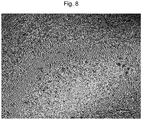
- Fig. 8
- ein Gefügeschliffbild eines Bauteiles aus einer Schmelze, die mit einem Zinkgehalt von ca. 3,9 Gew.-% vergossen wurde;
- Fig. 9
- ein Gefügeschliffbild eines erfindungsgemäßen Bauteiles aus einer Schmelze, die mit einem Zinkgehalt von ca. 2,4 Gew.-% vergossen wurde;
- Fig. 10
- ein Gefügeschliffbild eines erfindungsgemäßen Bauteiles aus einer Schmelze, die langsam abgekühlt wurde; und
- Fig. 11
- ein Gefügeschliffbild eines erfindungsgemäßen Bauteiles aus einer Schmelze, die schnell abgekühlt wurde.
- Zur Beurteilung der Korrosionsbeständigkeit von Kupferlegierungen wurde ein Warmauslagerungstest entwickelt, der das Langzeitkorrosionsverhalten von Legierungen in einem fünfmonatigen Versuchszeitraum simuliert. Aufbau und Durchführung des Tests lehnen sich an die seit Jahrzehnten etablierten Korrosionstest und das darauf basierende Diagramm von Turner ("The Influence of Water Composition on the Dezincification of Duplex Brass Fittings"; 1965) und die weiterführenden Untersuchungen durch Ladeburg ("Untersuchungen von Entzinkungserscheinungen an Fittings aus Kupferlegierungen"; 1966) an. In diesen Untersuchungen wurden Korrosionskurven für die Entzinkung der Werkstoffe aufgenommen. Dabei wurde die Oberfläche der Bauteile nach einem Monat Auslagerungszeit in verschiedenen Wässern beurteilt und daraus Rückschlüsse auf die Entzinkungsbeständigkeit der Legierung gezogen.
-
Fig. 2 zeigt ein Turner-Diagramm für die im Warmauslagerungstest eingesetzten Versuchswässer. In dem Diagramm ist die Karbonathärte (als Maß der Wasserhärte) gegen den Chloridionengehalt des Versuchswassers aufgetragen. Die mit "Turner klassisch" bezeichnete Linie stellt die durch Turner entwickelte Korrosionskennlinie für Entzinkung dar ("The Influence of Water Composition on the Dezincification of Duplex Brass Fittings"; 1965). Nach der gängigen Interpretation der Korrosionsfachwelt, findet im Bereich unterhalb dieser Linie keine Entzinkung statt, oberhalb dieser Line besteht dagegen ein sehr hohes Risiko, dass ein auf Entzinkung zurückzuführender Schaden des betreffenden Bauteils auftritt. Die eingezeichneten Punkte geben einen Überblick über die unterschiedlichen Versuchswässer, die im beschriebenen Warmauslagerungstest verwendet wurden. - Für die durchgeführten Warmauslagerungstests wurden unter anderem die folgenden bleifreien Kupferlegierungen eingesetzt, wobei die Anteile der Komponenten in nachstehender Tabelle 1 in Gew.-% angegeben sind:
Tabelle 1: Legierung Cu Sn Zn P S Pb 1 91,1 4,8 3,0 0,01 0,55 0,01 2 93,4 4,2 1,4 0,02 0,56 0,02 - Zur Herstellung von Prüfkörpern wurden, aus den Legierungen 1 und 2 Halbzylinder mit einer Wandstärke von 5 mm gegossen. Danach wurden die Prüfkörper an der Außenseite mittels einer Drehbearbeitung auf eine Rauigkeit Rz von max. 25µm bearbeitet und an der Innenseite mittels einer Bohrbearbeitung mit einer Durchgangsbohrung der Rauigkeit Rz von max. 40 µm versehen. Diese spezielle Oberflächenbehandlung soll eine Vergleichbarkeit der Probekörper mit real gefertigten Bauteilen ermöglichen.
- Die Oberfläche der Prüfkörper wurde mit Aceton gereinigt. Anschließend wurden die Prüfkörper frei hängend in ein Prüfbehältnis eingebracht. Die Prüfbehältnisse wurden dann für fünf Monate in einen Wärmeschrank bei 90°C eingestellt, wobei das Prüfmedium jeweils in Intervallen von sieben Tagen gewechselt wurde.
- Als Prüfmedien wurden jeweils 21 verschiedene Prüfwasser mit unterschiedlichen pH-Werten und Karbonathärten (Die Karbonathärte (KH) ist jener Anteil an Calcium- und Magnesiumionen, für den in der Volumeneinheit eine äquivalente Konzentration an Hydrogencarbonationen vorliegt) eingestellt, darüber hinaus wurden verschiedene Gehalte an Chloridionen und/oder Sulfationen eingestellt. Die Gehalte können aus Tabelle 2 entnommen werden:
Tabelle 2: Wassernummer pH-Wert Karbonathärte in °dH Chlorid in mg/l Sulfat in mg/l 1 8 0,5 10 - 2 8 0,5 100 - 3 8 0,5 250 - 4 8 0,5 1000 - 5 8 1,5 15 - 6 8 1,5 60 - 7 8 1,5 140 - 8 8 3,0 30 - 9 8 3,0 100 - 10 8 5,5 80 - 11 8 5,5 120 - 12 8 5,5 250 - 13 7 9,0 100 - 14 7 9,0 160 - 15 7 14,0 140 - 16 7 18,0 40 - 17 7 18,0 100 - 18 7 18,0 250 - 19 8 0,5 250 250 20 8 5,5 250 250 21 7 18,0 250 250 - Nach Abschluss des fünfmonatigen Testzeitraums werden die Prüfbehältnisse aus dem Wärmeschrank entnommen, auf Raumtemperatur abgekühlt, die Prüfkörper aus den jeweiligen Prüfbehältnissen entnommen, getrocknet, aufgeschnitten und die Schnittfläche wird jeweils nach entsprechender Aufarbeitung lichtmikroskopisch untersucht.
- Die Legierungen 1 und 2 zeigten über den gesamten in der Warmauslagerung geprüften Bereich der Trinkwasserverordnung eine herausragende Bildung einer für Kupferlegierungen notwendigen schützenden festhaftenden, geschlossenen Deckschicht, welche im Warmauslagerungstest eine Dicke von mindestens 2 µm besitzt und damit eine verbesserte Deckschicht im Bezug auf eine herkömmliche, bleihaltige Kupferlegierung auf Basis einer CuSnZn-Legierung (z.B. CuSn5Zn5Pb) aufweist. Des Weiteren ist diese Schicht nahezu frei von Störungen bzw. Defekten und entfaltet damit ihren vollständigen Schutz durch die Vermeidung eines tiefergehenden, lokalen Korrosionsangriffes (siehe
Fig. 4 undFig. 6 ). - Im Diagramm gemäß
Fig. 3 sind die Angriffstiefen bei Standardmessing (CuZn40Pb2) nach einem fünfmonatigen Warmauslagerungstest für die jeweiligen Prüfwässer dargestellt. Es zeigt sich jeweils eine selektive Korrosion in Form einer Entzinkung, vorwiegend einer Propfenentzinkung. Deutlich zu erkennen sind Angriffstiefen, die teilweise bis zu ca. 750 µm hinreichen und somit eine sehr schlechte Korrosionsbeständigkeit illustrieren. -
Fig. 4 zeigt dagegen das Verhalten der Deckschichtbildung einer erfindungsgemäß eingesetzten bleifreien Kupferlegierungen (Legierung 1 und Legierung 2) nach einem fünfmonatigen Warmauslagerungstest für die jeweiligen Prüfwässer. Es zeigt sich, dass es lediglich zur Bildung einer schützenden Deckschicht kommt. Es ist keinerlei selektiver Korrosionsangriff sichtbar. Die Dicke der gebildeten, festhaftenden, schützenden Deckschicht beträgt mindestens 4 µm. - In
Fig. 5 ist eine fotographische Aufnahme der Mikrostruktur bei Standardmessing (CuZn40Pb2) als Ergebnis eines exemplarischen Korrosionsangriffs nach dem fünfmonatigen Warmauslagerungstest, angelehnt an Turner, mit einem Chloridgehalt von 250 mg/l und einer Karbonathärte von 5,5 °dH gezeigt. Hierbei ist ein ungleichmäßiger, teilweise gestörter Aufbau der Deckschicht und der selektive Korrosionsangriff in Form einer Entzinkung deutlich erkennbar. - Im Vergleich dazu zeigt
Fig. 6 eine fotographische Aufnahme der Mikrostruktur eines Ergebnisses des fünfmonatigen Warmauslagerungstests, angelehnt an Turner, mit einem Chloridgehalt von 250 mg/l und einer Karbonathärte von 5,5 °dH, der an einem erfindungsgemäßen Bauteil aus der Legierung 2 (Legierung 1 zeigt ein dazu analoges Verhalten) durchgeführt wurde. Im Vergleich zu der inFig. 4 dargestellten Mikrostruktur zeigt sich bei dem erfindungsgemäßen Bauteil nach einem identischen Wärmeauslagerungstest keinerlei selektiver Korrosionsangriff, sondern ein einheitlicher, homogener Aufbau einer schützenden, festhaftenden Deckschicht mit einer Dicke von 4 µm bis 23 µm. - Im Vergleich zum Standardmessing zeigt sich die Legierung in dem hier durchgeführten Warmauslagerungstest in Anlehnung an Turner frei von selektiven Korrosionsangriffen (z.B. Entzinkung und Spannungsrisskorrosion) und nahezu allen anderen Korrosionserscheinungen.
- Die Versuche zeigen darüber hinaus, dass Schwefelsulfide als inkohärente, fein verteilte, disperse Phasen einen deutlichen korrosiven Vorteil zeigen. Dies resultiert aus der Vermeidung von tiefen mulden- und/oder lochförmigen Angriffen, welche durch ein mögliches Absinken des pH-Wertes und einer Aufkonzentration der kritischen Inhaltsstoffe des Mediums zu einer deutlich beschleunigten Korrosion führen könnten. Darüber hinaus werden keine korrosionstechnisch ungünstigen unedleren, flächenmäßig sehr großen Phasen gebildet, welche wie oben bereits beschrieben durch Korrosion angegriffen werden könnten und dann zu einem schnellen Ausfall des Bauteiles führen (vgl. β-Phase im Standardmessing).
- Es konnte aus Versuchen ermittelt werden, dass die Legierungszusammensetzung die Verteilung, die Form und den Zeitpunkt der Phasenausbildung entscheidend mitbeeinflusst und ungünstige Gehalte sich negativ auf die Phasen- und Gefügeausbildung auswirken.
- Zuerst wurden thermische Versuche durchgeführt, die anschließend mittels Bildanalyse verifiziert worden sind.
-
Fig. 7 stellt eine thermische Analyse in einem Temperatur-Zeit-Diagramm dar, durch das bei Metallen thermische Effekte (beispielweise Freigabe latenter Wärme) detektiert werden können, die bei Übergängen von fest nach flüssig oder bei Phasentransformationen im festen Zustand entstehen können. Aufgetragen ist die Abkühlungstemperatur der Legierung und die erste zeitliche Ableitung des Messsignals gegen die Zeit, die als Abkühlungsrate beschrieben ist. Eine Änderung des Peaks in der Abkühlungsratenkurve entspricht einem thermischen Effekt im Material. Bei der erfindungsgemäß verwendeten bleifreien Legierung ist eine Sulfidausbildung kurz vor Ende der Erstarrung bei niedriger Temperatur anzustreben, da hierdurch die Sulfide, ähnlich dem Blei, homogener im Gefüge verteilt werden.Tabelle 3 Legierung Cu Sn Zn S P Dehnung [A] 3 91,0 4,2 3,9 0,45 0,06 25% 4 92,6 4,1 2,5 0,45 0,06 31% - Die Abkühlungsrate in
Fig. 7 entspricht dem typischen Erstarrungsablauf einer Kupfer-ZinnLegierung bis 5 Gew.-% Zinn im Sandguss. Beim weiteren Vergleich der beiden Kurven wird deutlich, dass es in der Legierung 3 bei ca. 400s zu einem frühzeitigen thermischen Effekt während des ablaufenden Erstarrungsvorgangs kommt, der auf eine Sulfidausbildung zurückzuführen ist. Bei der erfindungsgemäßen Legierung 4 findet die Sulfidausbildung verzögert, kurz vor Ende der Erstarrung statt. Das beide Proben unter identischen Bedingungen abgekühlt worden sind, untermauert der weitere Abkühlungsratenverlauf der Proben, der nach der Phasenausbildung identisch vorliegt. Der variierende Zeitpunkt der Phasenausbildung ist somit auf den unterschiedlichen Zinkgehalt in den Legierungen zurückzuführen. Die frühzeitige Sulfidausbildung beeinflusst die Sulfidform und die Verteilung im Gefüge. Damit führt die frühzeitige Sulfidausbildung in der Legierung 3 zu einer heterogenen, partiellen Phasenverteilung, welche die mechanischen Kennwerte wie die Dehnung negativ beeinflusst. - In
Fig. 8 (Legierung 3) undFig. 9 (erfindungsgemäß verwendete Legierung 4) sind die Unterschiede im Gefüge von Bauteilen, welche aus Schmelzen gemäß Legierung 3 und 4 ausFig. 7 hergestellt worden sind, mit den unterschiedlichen Zinkgehalten zu sehen. Gemäß der vorliegenden Erfindung ist die Materialzusammensetzung auf eine Art eingestellt, die eine vorzeitige Sulfidausbildung vermeidet und eine homogene Verteilung fördert. - Desweiten wurde erkannt, dass die Abkühlungsbedingungen der Schmelze zu einem erfindungsgemäßen Bauteil, einen Einfluss auf die Sulfidausbildung besitzen. Durch eine hohe Abkühlrate wie sie bei einer dünnen Wand bevorzugt vorliegt entsteht ein feinmaschiges Dendritennetzwerk mit feinen Restschmelzegebieten, aus denen eine globulare Ausbildung der Sulfide unterstützt wird. Insofern ist ein schnelles Abkühlen erfindungsgemäß bevorzugt.
Fig. 10 undFig. 11 zeigt Gefügebilder erfindungsgemäßer Bauteile aus einer identischen Schmelze, die unter variierenden Bedingungen abgekühlt wurde. Bei einer schnellen Abkühlung zeigt das Gefügebild inFig. 11 eine Struktur, die zu höheren mechanischen Kennwerten, wie z.B. Zugfestigkeit, Bruchdehnung und dergleichen führt. - Zur Bestätigung dieser Charakteristik wurden die Partikel mittels Bildanalyse an Gefügeschliffen der Probekörper untersucht und charakterisiert.
- Dabei hat sich gezeigt, dass sich bei der Herstellung erfindungsgemäßer Bauteile unter den genannten Abkühlungsbedingungen einer Schmelze, einer erfindungsgemäß zusammengesetzten Legierung, erreicht werden kann, dass zumindest abschnittsweise in einem Gefügeschliff des Gussteiles mindestens 1,8 Flächenprozent der Gesamtfläche als Sulfidpartikel ausgebildet vorliegt.
- Unter anderem kann das Volumen der Sulfide und die Flächeninhalte mittels dieser Bildanalyse ermittelt werden.
- Zur näheren Bestimmung der Sulfidpartikel werden verschiedene Größenklassen eingeführt (vgl. Tabelle 4). Anschließend werden die Partikel vermessen und den Klassen prozentual zugerechnet. Nun werden die prozentualen Zurechnungen mit dem Mittelwert der Klasse multipliziert. Die sich ergebenden Mittelwerte der Klassen werden zu einem großen Mittelwert zusammengefasst. Der sich ergebende Wert stellt die Flächeninhaltskennzahl Sulfidpartikel ASP% dar.
- Die erfindungsgemäß verwendeten Legierungen lassen sich mit einer Flächeninhaltskennzahl ASP% kleiner als 1000 charakterisieren.
Tabelle 4: Nummer der Klasse Untergrenze der Klasse [µm2] Obergrenze der Klasse [µm2] Mittelwert der Klasse [µm2] 1 0 10 5 2 10 30 20 3 30 60 45 4 60 100 80 5 100 150 125 6 150 200 175 7 200 300 250 8 300 500 400 9 500 800 650 710 800 +Inf 950 - Voranstehend wurde die vorliegende Erfindung unter Bezugnahme auf Beispiele und Vergleichsbeispiele beschrieben. Für den Fachmann ist es jedoch ersichtlich, dass die Erfindung nicht auf diese Beispiele eingeschränkt ist, sondern sich der Umfang der vorliegenden Erfindung aus den beiliegenden Ansprüchen ergibt.
Claims (14)
- Bauteil für medienführende Gas- oder Wasserleitungen, insbesondere Fitting oder Armatur für Trinkwasserleitungen, wobei das Bauteil zumindest teilweise aus einer bleifreien Kupferlegierung besteht, die die folgenden Legierungskomponenten in Gew.-% aufweist:3,5 Gew.-% ≤ Sn ≤ 4,8 Gew.-%;1,5 Gew.-% ≤ Zn ≤ 3,5 Gew.-%;0,25 Gew.-% ≤ S ≤ 0,65 Gew.-%;0,015 Gew.-% ≤ P ≤ 0,1 Gew.-%;unvermeidbare Verunreinigungen sowie
zum Rest Kupfer. - Bauteil nach Anspruch 1, dadurch gekennzeichnet, dass der Schwefel-Anteil in der Legierung 0,3 Gew.-% ≤ S ≤ 0,60 Gew.-%, insbesondere 0,35 Gew.-% ≤ S ≤ 0,55 Gew.-%, beträgt.
- Bauteil nach Anspruch 1 oder Anspruch 2, dadurch gekennzeichnet, dass der Zink-Anteil in der Legierung 2,0 Gew.-% ≤ Zn ≤ 3,0 Gew.-% beträgt.
- Bauteil nach einem der vorherigen Ansprüche, dadurch gekennzeichnet, dass der Phospor-Anteil in der Legierung 0,02 Gew.-% ≤ P ≤ 0,08 Gew.-%, insbesondere 0,04 Gew.-% ≤ P ≤ 0,06 Gew.-%, beträgt.
- Bauteil nach einem der vorherigen Ansprüche, dadurch gekennzeichnet, dass der Gehalt an Blei nicht mehr als 0,25 Gew.-%, insbesondere nicht mehr als 0,09 Gew.-% und bevorzugt nicht mehr als 0,05 Gew.-%, beträgt.
- Bauteil nach einem der vorherigen Ansprüche, dadurch gekennzeichnet, dass der Gehalt an Nickel nicht mehr als 0,4 Gew.-% beträgt.
- Bauteil nach einem der vorherigen Ansprüche, dadurch gekennzeichnet, dass der Gehalt an Antimon nicht mehr als 0,1 Gew.-% beträgt.
- Bauteil nach einem der vorherigen Ansprüche, dadurch gekennzeichnet, dass der Gehalt an Eisen, Zirkonium und/oder Bor allein oder in Kombination von zwei oder mehr der genannten Elemente nicht mehr als 0,3 Gew.-% beträgt.
- Bauteil nach einem der vorherigen Ansprüche, dadurch gekennzeichnet, dass Kupfer in der bleifreien Kupferlegierung in einer Menge von mehr als 90 Gew.-% enthalten ist.
- Bauteil nach einem der vorherigen Ansprüche, dadurch gekennzeichnet, dass das Bauteil zumindest abschnittsweise eine Wandstärke im Bereich von 0,5 mm bis 6,0 mm, vorzugsweise im Bereich von 1,0 mm bis 4,0 mm aufweist.
- Bauteil nach einem der vorherigen Ansprüche, dadurch gekennzeichnet, dass bei einer Wandstärke unter 6 mm im Querschliff des Bauteiles mindestens ein Anteil von 1,6 Flächenprozent Sulfidpartikeln und/oder eine Flächeninhaltskennzahl ASP% kleiner als 1000 vorliegt.
- Bauteil nach einem der Ansprüche 1 bis 11, dadurch gekennzeichnet, dass es eine homogene, schützende Deckschicht von mindestens 2 µm aufweist.
- Bauteil nach einem der vorherigen Ansprüche, dadurch gekennzeichnet, dass Schwefelsulfide als inkohärente, fein verteilte, disperse Phase vorliegen und somit tiefe mulden- und/oder lochförmigen Angriffen, insbesondere Korrosionsangriffe, vermieden werden.
- Bauteil nach einem der vorherigen Ansprüche, dadurch gekennzeichnet, dass der Werkstoff nach DIN EN 15664-2 nach 16 Wochen keine erhöhten Blei- bzw. Nickelmigration aufweist und den Vorgaben der DIN EN 15664-2 entspricht.
Priority Applications (3)
| Application Number | Priority Date | Filing Date | Title |
|---|---|---|---|
| PL17151949T PL3225707T3 (pl) | 2016-03-29 | 2017-01-18 | Element konstrukcyjny do prowadzących media przewodów gazowych lub wodociągowych, zawierający stop miedzi |
| PCT/EP2017/000374 WO2017167441A2 (de) | 2016-03-29 | 2017-03-28 | Bauteil für medienführende gas- oder wasserleitungen |
| RU2018137812A RU2712161C1 (ru) | 2016-03-29 | 2017-03-28 | Конструктивный элемент для средопроводящих газо- или водопроводов |
Applications Claiming Priority (1)
| Application Number | Priority Date | Filing Date | Title |
|---|---|---|---|
| DE202016101661.4U DE202016101661U1 (de) | 2016-03-29 | 2016-03-29 | Bauteil für medienführende Gas- oder Wasserleitungen |
Publications (2)
| Publication Number | Publication Date |
|---|---|
| EP3225707A1 true EP3225707A1 (de) | 2017-10-04 |
| EP3225707B1 EP3225707B1 (de) | 2020-12-30 |
Family
ID=57838272
Family Applications (1)
| Application Number | Title | Priority Date | Filing Date |
|---|---|---|---|
| EP17151949.9A Active EP3225707B1 (de) | 2016-03-29 | 2017-01-18 | Bauteil für medienführende gas- oder wasserleitungen, das eine kupferlegierung enthält |
Country Status (6)
| Country | Link |
|---|---|
| EP (1) | EP3225707B1 (de) |
| DE (1) | DE202016101661U1 (de) |
| DK (1) | DK3225707T3 (de) |
| PL (1) | PL3225707T3 (de) |
| RU (1) | RU2712161C1 (de) |
| WO (1) | WO2017167441A2 (de) |
Cited By (3)
| Publication number | Priority date | Publication date | Assignee | Title |
|---|---|---|---|---|
| DE102018004702A1 (de) * | 2018-06-12 | 2019-12-12 | Gebr. Kemper Gmbh + Co. Kg Metallwerke | Formteile aus einer korrosionsbeständigen und zerspanbaren Kupferlegierung |
| US20220016693A1 (en) * | 2019-03-11 | 2022-01-20 | Rehau Ag + Co. | Method for producing metal components and metal component produced in this way |
| EP4603611A1 (de) | 2024-02-19 | 2025-08-20 | Gebr. Kemper GmbH + Co. KG | Verfahren zur herstellung metallischer bauteile aus einer kupferlegierung |
Families Citing this family (8)
| Publication number | Priority date | Publication date | Assignee | Title |
|---|---|---|---|---|
| AT520560B1 (de) * | 2018-01-29 | 2019-05-15 | Miba Gleitlager Austria Gmbh | Mehrschichtgleitlagerelement |
| DE102019106131A1 (de) * | 2019-03-11 | 2020-09-17 | M.G. Meccanica Srl | Verfahren zur Herstellung von Bauteilen für medienführende Gas- oder Wasserleitungen sowie dadurch hergestelltes Bauteil |
| AT522440B1 (de) | 2019-05-07 | 2020-11-15 | Miba Gleitlager Austria Gmbh | Mehrschichtgleitlagerelement |
| EP4264105B1 (de) | 2020-12-17 | 2026-05-20 | Rehau Industries Se & Co Kg | Verbindungselementsystem zur herstellung einer rohrverbindung, dieses umfassende rohrverbindung sowie verfahren zur herstellung einer solchen rohrverbindung |
| DE202020107328U1 (de) | 2020-12-17 | 2022-03-18 | REHAU Industries SE & Co. KG | Rohrverbindung und Verbindungselement zur Herstellung einer Rohrverbindung |
| DE102021106229A1 (de) | 2020-12-17 | 2022-06-23 | REHAU Industries SE & Co. KG | Verbindungselementsystem zur Herstellung einer Rohrverbindung, dieses umfassende Rohrverbindung sowie Verfahren zur Herstellung einer solchen Rohrverbindung |
| DE102021110302A1 (de) * | 2021-04-22 | 2022-10-27 | Ks Gleitlager Gmbh | Kupfer-Zinn-Stranggusslegierung |
| DE102023000334A1 (de) | 2023-02-03 | 2024-08-08 | Wieland-Werke Aktiengesellschaft | Kupferlegierung, Halbzeug und elektrisches Verbindungselement aus einer Kupferlegierung |
Citations (4)
| Publication number | Priority date | Publication date | Assignee | Title |
|---|---|---|---|---|
| EP1798298A1 (de) | 2005-12-14 | 2007-06-20 | Gebr. Kemper GmbH + Co. KG Metallwerke | Verwendung einer migrationsarmen Kupferlegierung sowie Bauteile aus dieser Legierung |
| EP2250421A1 (de) | 2008-03-07 | 2010-11-17 | Rehau AG + Co | Verbindungsstück für einen klemmverbinder |
| US20120082588A1 (en) * | 2009-05-26 | 2012-04-05 | Biwalite Co., Ltd. | Lead-free copper alloy for casting with excellent mechanical properties |
| JP2013199699A (ja) * | 2012-03-26 | 2013-10-03 | Furukawa Electric Co Ltd:The | 無鉛快削りん青銅展伸材、銅合金部品および無鉛快削りん青銅展伸材の製造方法 |
Family Cites Families (2)
| Publication number | Priority date | Publication date | Assignee | Title |
|---|---|---|---|---|
| SU1694676A1 (ru) * | 1989-03-01 | 1991-11-30 | Московский институт стали и сплавов | Сплав на основе меди |
| DE4404194C2 (de) * | 1994-02-10 | 1996-04-18 | Reinecke Alfred Gmbh & Co Kg | Trinkwasserführende Armatur aus Metall, insbesondere aus Kupfer und dessen Legierungen mit Anteilen an Zink und Blei |
-
2016
- 2016-03-29 DE DE202016101661.4U patent/DE202016101661U1/de not_active Expired - Lifetime
-
2017
- 2017-01-18 EP EP17151949.9A patent/EP3225707B1/de active Active
- 2017-01-18 PL PL17151949T patent/PL3225707T3/pl unknown
- 2017-01-18 DK DK17151949.9T patent/DK3225707T3/da active
- 2017-03-28 RU RU2018137812A patent/RU2712161C1/ru active
- 2017-03-28 WO PCT/EP2017/000374 patent/WO2017167441A2/de not_active Ceased
Patent Citations (5)
| Publication number | Priority date | Publication date | Assignee | Title |
|---|---|---|---|---|
| EP1798298A1 (de) | 2005-12-14 | 2007-06-20 | Gebr. Kemper GmbH + Co. KG Metallwerke | Verwendung einer migrationsarmen Kupferlegierung sowie Bauteile aus dieser Legierung |
| EP2250421A1 (de) | 2008-03-07 | 2010-11-17 | Rehau AG + Co | Verbindungsstück für einen klemmverbinder |
| US20120082588A1 (en) * | 2009-05-26 | 2012-04-05 | Biwalite Co., Ltd. | Lead-free copper alloy for casting with excellent mechanical properties |
| US8470101B2 (en) | 2009-05-26 | 2013-06-25 | Shiga Valve Cooperative | Lead-free copper alloy for casting with excellent mechanical properties |
| JP2013199699A (ja) * | 2012-03-26 | 2013-10-03 | Furukawa Electric Co Ltd:The | 無鉛快削りん青銅展伸材、銅合金部品および無鉛快削りん青銅展伸材の製造方法 |
Non-Patent Citations (5)
| Title |
|---|
| ABE HIROYUKI ET AL: "Castability and cutting conditions of sulfide dispersed lead free bronze castings", CHUZO KOGAKU - JOURNAL OF JAPAN FOUNDRY ENGINEERING SOC, NIHON CHUZO KOGAKUKAI, TOKYO, JP, vol. 81, no. 12, 1 January 2009 (2009-01-01), pages 661 - 666, XP009179260, ISSN: 1342-0429 * |
| MARUYAMA TORU ET AL: "Casting structure, mechanical properties and machinability with changes in amount of alloyed elements of sulfide dispersed lead free bronze castings", CHUZO KOGAKU - JOURNAL OF JAPAN FOUNDRY ENGINEERING SOC, NIHON CHUZO KOGAKUKAI, TOKYO, JP, vol. 81, no. 12, 1 January 2009 (2009-01-01), pages 667 - 673, XP009179259, ISSN: 1342-0429 * |
| THE INFLUENCE OF WATER COMPOSITION ON THE DEZINCIFICATION OF DUPLEX BRASS FITTINGS, 1965 |
| TURNER, THE INFLUENCE OF WATER COMPOSITION ON THE DEZINCIFICATION OF DUPLEX BRASS FITTINGS, 1965 |
| UNTERSUCHUNGEN VON ENTZINKUNGSERSCHEINUNGEN AN FITTINGS AUS KUPFERLEGIERUNGEN, 1966 |
Cited By (6)
| Publication number | Priority date | Publication date | Assignee | Title |
|---|---|---|---|---|
| DE102018004702A1 (de) * | 2018-06-12 | 2019-12-12 | Gebr. Kemper Gmbh + Co. Kg Metallwerke | Formteile aus einer korrosionsbeständigen und zerspanbaren Kupferlegierung |
| EP3581667A2 (de) | 2018-06-12 | 2019-12-18 | Gebr. Kemper GmbH + Co. KG Metallwerke | Formteile aus einer korrosionsbeständigen und zerspanbaren kupferlegierung |
| EP3581667A3 (de) * | 2018-06-12 | 2020-06-17 | Gebr. Kemper GmbH + Co. KG Metallwerke | Formteile aus einer korrosionsbeständigen und zerspanbaren kupferlegierung |
| US20220016693A1 (en) * | 2019-03-11 | 2022-01-20 | Rehau Ag + Co. | Method for producing metal components and metal component produced in this way |
| US12296374B2 (en) * | 2019-03-11 | 2025-05-13 | REHAU Industries SE & Co. KG | Method for producing metal components and metal component produced in this way |
| EP4603611A1 (de) | 2024-02-19 | 2025-08-20 | Gebr. Kemper GmbH + Co. KG | Verfahren zur herstellung metallischer bauteile aus einer kupferlegierung |
Also Published As
| Publication number | Publication date |
|---|---|
| DE202016101661U1 (de) | 2017-06-30 |
| RU2712161C1 (ru) | 2020-01-24 |
| WO2017167441A2 (de) | 2017-10-05 |
| EP3225707B1 (de) | 2020-12-30 |
| WO2017167441A3 (de) | 2018-03-01 |
| DK3225707T3 (da) | 2021-04-06 |
| PL3225707T3 (pl) | 2021-07-19 |
Similar Documents
| Publication | Publication Date | Title |
|---|---|---|
| EP3225707B1 (de) | Bauteil für medienführende gas- oder wasserleitungen, das eine kupferlegierung enthält | |
| DE69835912T2 (de) | Automatenlegierung auf Kupferbasis. | |
| DE69832097T2 (de) | Bleifreie automatenkupferlegierung | |
| DE69124835T2 (de) | Verfahren für gut zerspanbare bleifreie Knetlegierungen auf Kupferbasis | |
| EP2964798B1 (de) | Kupfer-zink-legierung für eine sanitärarmatur sowie verfahren zu deren herstellung | |
| EP2742161B1 (de) | Kupferzinklegierung | |
| DE10301552B3 (de) | Korrosionsbeständige Messinglegierung für Trinkwasserformteile | |
| WO2017084731A1 (de) | Kupfer-nickel-zink-legierung und deren verwendung | |
| EP3374533B1 (de) | Sondermessinglegierung sowie sondermessinglegierungsprodukt | |
| EP1817438B1 (de) | Migrationsarme kupferlegierung | |
| DE102012013817A1 (de) | Formteile aus korrosionsbeständigen Kupferlegierungen | |
| EP4481077A1 (de) | Bleifreie messinglegierung | |
| DE4121994A1 (de) | Kupfer-nickel-zinn-legierung, verfahren zu ihrer behandlung sowie ihre verwendung | |
| EP3938552B1 (de) | Verfahren zur herstellung von metallischen bauteilen sowie dadurch hergestelltes metallisches bauteil | |
| EP3581667B1 (de) | Formteile aus einer korrosionsbeständigen und zerspanbaren kupferlegierung | |
| DE4233668C2 (de) | Korrosionsfeste Legierung auf Kupferbasis | |
| WO1993024670A1 (de) | Messinglegierung | |
| EP3938550A1 (de) | Verfahren zur herstellung von metallischen bauteilen sowie dadurch hergestelltes metallisches bauteil | |
| EP3436615A2 (de) | Bauteil für medienführende gas- oder wasserleitungen, das eine kupferlegierung enthält | |
| EP0572959A1 (de) | Messinglegierung | |
| DE4318377C2 (de) | Messinglegierung | |
| EP3899073B1 (de) | Cu-zn-legierung | |
| DE102024002898A1 (de) | Werkstoff aus einer Kupfer-Zink-Silicium-Legierung und Verfahren zur Herstellung eines Bauteils | |
| WO1994024325A1 (de) | Messinglegierung | |
| DE2040031B2 (de) | Kupfer-zinklegierung fuer druckdichte gusstuecke |
Legal Events
| Date | Code | Title | Description |
|---|---|---|---|
| PUAI | Public reference made under article 153(3) epc to a published international application that has entered the european phase |
Free format text: ORIGINAL CODE: 0009012 |
|
| STAA | Information on the status of an ep patent application or granted ep patent |
Free format text: STATUS: THE APPLICATION HAS BEEN PUBLISHED |
|
| AK | Designated contracting states |
Kind code of ref document: A1 Designated state(s): AL AT BE BG CH CY CZ DE DK EE ES FI FR GB GR HR HU IE IS IT LI LT LU LV MC MK MT NL NO PL PT RO RS SE SI SK SM TR |
|
| AX | Request for extension of the european patent |
Extension state: BA ME |
|
| STAA | Information on the status of an ep patent application or granted ep patent |
Free format text: STATUS: REQUEST FOR EXAMINATION WAS MADE |
|
| 17P | Request for examination filed |
Effective date: 20180404 |
|
| RBV | Designated contracting states (corrected) |
Designated state(s): AL AT BE BG CH CY CZ DE DK EE ES FI FR GB GR HR HU IE IS IT LI LT LU LV MC MK MT NL NO PL PT RO RS SE SI SK SM TR |
|
| STAA | Information on the status of an ep patent application or granted ep patent |
Free format text: STATUS: EXAMINATION IS IN PROGRESS |
|
| 17Q | First examination report despatched |
Effective date: 20181128 |
|
| GRAP | Despatch of communication of intention to grant a patent |
Free format text: ORIGINAL CODE: EPIDOSNIGR1 |
|
| STAA | Information on the status of an ep patent application or granted ep patent |
Free format text: STATUS: GRANT OF PATENT IS INTENDED |
|
| INTG | Intention to grant announced |
Effective date: 20200121 |
|
| RAP1 | Party data changed (applicant data changed or rights of an application transferred) |
Owner name: GEBR. KEMPER GMBH + CO. KG, METALLWERKE Owner name: REHAU AG + CO Owner name: GEBERIT INTERNATIONAL AG |
|
| GRAS | Grant fee paid |
Free format text: ORIGINAL CODE: EPIDOSNIGR3 |
|
| GRAJ | Information related to disapproval of communication of intention to grant by the applicant or resumption of examination proceedings by the epo deleted |
Free format text: ORIGINAL CODE: EPIDOSDIGR1 |
|
| GRAL | Information related to payment of fee for publishing/printing deleted |
Free format text: ORIGINAL CODE: EPIDOSDIGR3 |
|
| STAA | Information on the status of an ep patent application or granted ep patent |
Free format text: STATUS: EXAMINATION IS IN PROGRESS |
|
| INTC | Intention to grant announced (deleted) | ||
| GRAP | Despatch of communication of intention to grant a patent |
Free format text: ORIGINAL CODE: EPIDOSNIGR1 |
|
| STAA | Information on the status of an ep patent application or granted ep patent |
Free format text: STATUS: GRANT OF PATENT IS INTENDED |
|
| INTG | Intention to grant announced |
Effective date: 20200721 |
|
| GRAS | Grant fee paid |
Free format text: ORIGINAL CODE: EPIDOSNIGR3 |
|
| RAP1 | Party data changed (applicant data changed or rights of an application transferred) |
Owner name: GEBR. KEMPER GMBH + CO. KG, METALLWERKE Owner name: REHAU AG + CO Owner name: GEBERIT INTERNATIONAL AG |
|
| GRAA | (expected) grant |
Free format text: ORIGINAL CODE: 0009210 |
|
| STAA | Information on the status of an ep patent application or granted ep patent |
Free format text: STATUS: THE PATENT HAS BEEN GRANTED |
|
| AK | Designated contracting states |
Kind code of ref document: B1 Designated state(s): AL AT BE BG CH CY CZ DE DK EE ES FI FR GB GR HR HU IE IS IT LI LT LU LV MC MK MT NL NO PL PT RO RS SE SI SK SM TR |
|
| REG | Reference to a national code |
Ref country code: GB Ref legal event code: FG4D Free format text: NOT ENGLISH |
|
| REG | Reference to a national code |
Ref country code: AT Ref legal event code: REF Ref document number: 1349974 Country of ref document: AT Kind code of ref document: T Effective date: 20210115 |
|
| REG | Reference to a national code |
Ref country code: DE Ref legal event code: R096 Ref document number: 502017008800 Country of ref document: DE |
|
| REG | Reference to a national code |
Ref country code: IE Ref legal event code: FG4D Free format text: LANGUAGE OF EP DOCUMENT: GERMAN |
|
| REG | Reference to a national code |
Ref country code: DK Ref legal event code: T3 Effective date: 20210330 |
|
| REG | Reference to a national code |
Ref country code: NL Ref legal event code: FP |
|
| REG | Reference to a national code |
Ref country code: SE Ref legal event code: TRGR |
|
| PG25 | Lapsed in a contracting state [announced via postgrant information from national office to epo] |
Ref country code: RS Free format text: LAPSE BECAUSE OF FAILURE TO SUBMIT A TRANSLATION OF THE DESCRIPTION OR TO PAY THE FEE WITHIN THE PRESCRIBED TIME-LIMIT Effective date: 20201230 Ref country code: NO Free format text: LAPSE BECAUSE OF FAILURE TO SUBMIT A TRANSLATION OF THE DESCRIPTION OR TO PAY THE FEE WITHIN THE PRESCRIBED TIME-LIMIT Effective date: 20210330 Ref country code: FI Free format text: LAPSE BECAUSE OF FAILURE TO SUBMIT A TRANSLATION OF THE DESCRIPTION OR TO PAY THE FEE WITHIN THE PRESCRIBED TIME-LIMIT Effective date: 20201230 Ref country code: GR Free format text: LAPSE BECAUSE OF FAILURE TO SUBMIT A TRANSLATION OF THE DESCRIPTION OR TO PAY THE FEE WITHIN THE PRESCRIBED TIME-LIMIT Effective date: 20210331 |
|
| PG25 | Lapsed in a contracting state [announced via postgrant information from national office to epo] |
Ref country code: BG Free format text: LAPSE BECAUSE OF FAILURE TO SUBMIT A TRANSLATION OF THE DESCRIPTION OR TO PAY THE FEE WITHIN THE PRESCRIBED TIME-LIMIT Effective date: 20210330 Ref country code: LV Free format text: LAPSE BECAUSE OF FAILURE TO SUBMIT A TRANSLATION OF THE DESCRIPTION OR TO PAY THE FEE WITHIN THE PRESCRIBED TIME-LIMIT Effective date: 20201230 |
|
| REG | Reference to a national code |
Ref country code: SK Ref legal event code: T3 Ref document number: E 37115 Country of ref document: SK |
|
| PG25 | Lapsed in a contracting state [announced via postgrant information from national office to epo] |
Ref country code: HR Free format text: LAPSE BECAUSE OF FAILURE TO SUBMIT A TRANSLATION OF THE DESCRIPTION OR TO PAY THE FEE WITHIN THE PRESCRIBED TIME-LIMIT Effective date: 20201230 |
|
| REG | Reference to a national code |
Ref country code: LT Ref legal event code: MG9D |
|
| PG25 | Lapsed in a contracting state [announced via postgrant information from national office to epo] |
Ref country code: RO Free format text: LAPSE BECAUSE OF FAILURE TO SUBMIT A TRANSLATION OF THE DESCRIPTION OR TO PAY THE FEE WITHIN THE PRESCRIBED TIME-LIMIT Effective date: 20201230 Ref country code: PT Free format text: LAPSE BECAUSE OF FAILURE TO SUBMIT A TRANSLATION OF THE DESCRIPTION OR TO PAY THE FEE WITHIN THE PRESCRIBED TIME-LIMIT Effective date: 20210430 Ref country code: EE Free format text: LAPSE BECAUSE OF FAILURE TO SUBMIT A TRANSLATION OF THE DESCRIPTION OR TO PAY THE FEE WITHIN THE PRESCRIBED TIME-LIMIT Effective date: 20201230 Ref country code: LT Free format text: LAPSE BECAUSE OF FAILURE TO SUBMIT A TRANSLATION OF THE DESCRIPTION OR TO PAY THE FEE WITHIN THE PRESCRIBED TIME-LIMIT Effective date: 20201230 |
|
| PG25 | Lapsed in a contracting state [announced via postgrant information from national office to epo] |
Ref country code: IS Free format text: LAPSE BECAUSE OF FAILURE TO SUBMIT A TRANSLATION OF THE DESCRIPTION OR TO PAY THE FEE WITHIN THE PRESCRIBED TIME-LIMIT Effective date: 20210430 |
|
| REG | Reference to a national code |
Ref country code: DE Ref legal event code: R097 Ref document number: 502017008800 Country of ref document: DE |
|
| PG25 | Lapsed in a contracting state [announced via postgrant information from national office to epo] |
Ref country code: AL Free format text: LAPSE BECAUSE OF FAILURE TO SUBMIT A TRANSLATION OF THE DESCRIPTION OR TO PAY THE FEE WITHIN THE PRESCRIBED TIME-LIMIT Effective date: 20201230 Ref country code: MC Free format text: LAPSE BECAUSE OF FAILURE TO SUBMIT A TRANSLATION OF THE DESCRIPTION OR TO PAY THE FEE WITHIN THE PRESCRIBED TIME-LIMIT Effective date: 20201230 |
|
| PLBE | No opposition filed within time limit |
Free format text: ORIGINAL CODE: 0009261 |
|
| STAA | Information on the status of an ep patent application or granted ep patent |
Free format text: STATUS: NO OPPOSITION FILED WITHIN TIME LIMIT |
|
| 26N | No opposition filed |
Effective date: 20211001 |
|
| PG25 | Lapsed in a contracting state [announced via postgrant information from national office to epo] |
Ref country code: ES Free format text: LAPSE BECAUSE OF FAILURE TO SUBMIT A TRANSLATION OF THE DESCRIPTION OR TO PAY THE FEE WITHIN THE PRESCRIBED TIME-LIMIT Effective date: 20201230 |
|
| PG25 | Lapsed in a contracting state [announced via postgrant information from national office to epo] |
Ref country code: SI Free format text: LAPSE BECAUSE OF FAILURE TO SUBMIT A TRANSLATION OF THE DESCRIPTION OR TO PAY THE FEE WITHIN THE PRESCRIBED TIME-LIMIT Effective date: 20201230 |
|
| REG | Reference to a national code |
Ref country code: DE Ref legal event code: R081 Ref document number: 502017008800 Country of ref document: DE Owner name: REHAU INDUSTRIES SE & CO. KG, DE Free format text: FORMER OWNERS: GEBERIT INTERNATIONAL AG, JONA, CH; GEBR. KEMPER GMBH + CO. KG, 57462 OLPE, DE; REHAU AG + CO, 95111 REHAU, DE Ref country code: DE Ref legal event code: R081 Ref document number: 502017008800 Country of ref document: DE Owner name: GEBR. KEMPER GMBH + CO. KG, DE Free format text: FORMER OWNERS: GEBERIT INTERNATIONAL AG, JONA, CH; GEBR. KEMPER GMBH + CO. KG, 57462 OLPE, DE; REHAU AG + CO, 95111 REHAU, DE Ref country code: DE Ref legal event code: R081 Ref document number: 502017008800 Country of ref document: DE Owner name: GEBERIT INTERNATIONAL AG, CH Free format text: FORMER OWNERS: GEBERIT INTERNATIONAL AG, JONA, CH; GEBR. KEMPER GMBH + CO. KG, 57462 OLPE, DE; REHAU AG + CO, 95111 REHAU, DE |
|
| REG | Reference to a national code |
Ref country code: LU Ref legal event code: PD Owner name: GEBERIT INTERNATIONAL AG; CH Free format text: FORMER OWNER: REHAU AG + CO Effective date: 20220329 |
|
| REG | Reference to a national code |
Ref country code: NL Ref legal event code: PD Owner name: GEBERIT INTERNATIONAL AG; CH Free format text: DETAILS ASSIGNMENT: CHANGE OF OWNER(S), ASSIGNMENT; FORMER OWNER NAME: REHAU AUTOMOTIVE SE & CO. KG Effective date: 20220425 Ref country code: NL Ref legal event code: HC Owner name: GEBERIT INTERNATIONAL AG; CH Free format text: DETAILS ASSIGNMENT: CHANGE OF OWNER(S), CHANGE OF OWNER(S) NAME; FORMER OWNER NAME: REHAU AG + CO Effective date: 20220425 |
|
| REG | Reference to a national code |
Ref country code: CH Ref legal event code: PK Free format text: BERICHTIGUNGEN |
|
| PG25 | Lapsed in a contracting state [announced via postgrant information from national office to epo] |
Ref country code: IS Free format text: LAPSE BECAUSE OF FAILURE TO SUBMIT A TRANSLATION OF THE DESCRIPTION OR TO PAY THE FEE WITHIN THE PRESCRIBED TIME-LIMIT Effective date: 20210430 |
|
| REG | Reference to a national code |
Ref country code: AT Ref legal event code: PC Ref document number: 1349974 Country of ref document: AT Kind code of ref document: T Owner name: GEBERIT INTERNATIONAL AG, CH Effective date: 20220419 Ref country code: AT Ref legal event code: PC Ref document number: 1349974 Country of ref document: AT Kind code of ref document: T Owner name: GEBR. KEMPER GMBH + CO. KG, METALLWERKE, DE Effective date: 20220419 Ref country code: AT Ref legal event code: PC Ref document number: 1349974 Country of ref document: AT Kind code of ref document: T Owner name: REHAU INDUSTRIES SE & CO. KG, DE Effective date: 20220419 |
|
| REG | Reference to a national code |
Ref country code: GB Ref legal event code: 732E Free format text: REGISTERED BETWEEN 20220526 AND 20220601 |
|
| REG | Reference to a national code |
Ref country code: BE Ref legal event code: PD Owner name: GEBERIT INTERNATIONAL AG; CH Free format text: DETAILS ASSIGNMENT: CHANGE OF OWNER(S), OTHER; FORMER OWNER NAME: GEBERIT INTERNATIONAL AG Effective date: 20220414 |
|
| REG | Reference to a national code |
Ref country code: SK Ref legal event code: TE4A Ref document number: E 37115 Country of ref document: SK Owner name: REHAU INDUSTRIES SE & CO. KG, REHAU, DE Effective date: 20230124 |
|
| PG25 | Lapsed in a contracting state [announced via postgrant information from national office to epo] |
Ref country code: HU Free format text: LAPSE BECAUSE OF FAILURE TO SUBMIT A TRANSLATION OF THE DESCRIPTION OR TO PAY THE FEE WITHIN THE PRESCRIBED TIME-LIMIT; INVALID AB INITIO Effective date: 20170118 |
|
| PG25 | Lapsed in a contracting state [announced via postgrant information from national office to epo] |
Ref country code: CY Free format text: LAPSE BECAUSE OF FAILURE TO SUBMIT A TRANSLATION OF THE DESCRIPTION OR TO PAY THE FEE WITHIN THE PRESCRIBED TIME-LIMIT Effective date: 20201230 |
|
| PG25 | Lapsed in a contracting state [announced via postgrant information from national office to epo] |
Ref country code: SM Free format text: LAPSE BECAUSE OF FAILURE TO SUBMIT A TRANSLATION OF THE DESCRIPTION OR TO PAY THE FEE WITHIN THE PRESCRIBED TIME-LIMIT Effective date: 20201230 |
|
| REG | Reference to a national code |
Ref country code: LU Ref legal event code: HC Owner name: GEBR. KEMPER GMBH + CO. KG, METALLWERKE; DE Free format text: FORMER OWNER: REHAU INDUSTRIES SE & CO. KG Effective date: 20230828 |
|
| PG25 | Lapsed in a contracting state [announced via postgrant information from national office to epo] |
Ref country code: MK Free format text: LAPSE BECAUSE OF FAILURE TO SUBMIT A TRANSLATION OF THE DESCRIPTION OR TO PAY THE FEE WITHIN THE PRESCRIBED TIME-LIMIT Effective date: 20201230 |
|
| PG25 | Lapsed in a contracting state [announced via postgrant information from national office to epo] |
Ref country code: TR Free format text: LAPSE BECAUSE OF FAILURE TO SUBMIT A TRANSLATION OF THE DESCRIPTION OR TO PAY THE FEE WITHIN THE PRESCRIBED TIME-LIMIT Effective date: 20201230 |
|
| PG25 | Lapsed in a contracting state [announced via postgrant information from national office to epo] |
Ref country code: MT Free format text: LAPSE BECAUSE OF FAILURE TO SUBMIT A TRANSLATION OF THE DESCRIPTION OR TO PAY THE FEE WITHIN THE PRESCRIBED TIME-LIMIT Effective date: 20201230 |
|
| PGFP | Annual fee paid to national office [announced via postgrant information from national office to epo] |
Ref country code: GB Payment date: 20251125 Year of fee payment: 10 |
|
| PGFP | Annual fee paid to national office [announced via postgrant information from national office to epo] |
Ref country code: DK Payment date: 20251211 Year of fee payment: 10 |
|
| PGFP | Annual fee paid to national office [announced via postgrant information from national office to epo] |
Ref country code: LU Payment date: 20251203 Year of fee payment: 10 Ref country code: FR Payment date: 20251125 Year of fee payment: 10 Ref country code: NL Payment date: 20251209 Year of fee payment: 10 |
|
| PGFP | Annual fee paid to national office [announced via postgrant information from national office to epo] |
Ref country code: BE Payment date: 20251209 Year of fee payment: 10 |
|
| PGFP | Annual fee paid to national office [announced via postgrant information from national office to epo] |
Ref country code: SE Payment date: 20251211 Year of fee payment: 10 |
|
| PGFP | Annual fee paid to national office [announced via postgrant information from national office to epo] |
Ref country code: IE Payment date: 20251209 Year of fee payment: 10 Ref country code: CZ Payment date: 20251118 Year of fee payment: 10 |
|
| PGFP | Annual fee paid to national office [announced via postgrant information from national office to epo] |
Ref country code: PL Payment date: 20251113 Year of fee payment: 10 |
|
| PGFP | Annual fee paid to national office [announced via postgrant information from national office to epo] |
Ref country code: SK Payment date: 20251118 Year of fee payment: 10 |
|
| REG | Reference to a national code |
Ref country code: CH Ref legal event code: U11 Free format text: ST27 STATUS EVENT CODE: U-0-0-U10-U11 (AS PROVIDED BY THE NATIONAL OFFICE) Effective date: 20260201 |
|
| PGFP | Annual fee paid to national office [announced via postgrant information from national office to epo] |
Ref country code: DE Payment date: 20260131 Year of fee payment: 10 |
|
| PGFP | Annual fee paid to national office [announced via postgrant information from national office to epo] |
Ref country code: AT Payment date: 20251209 Year of fee payment: 10 |
|
| PGFP | Annual fee paid to national office [announced via postgrant information from national office to epo] |
Ref country code: IT Payment date: 20260129 Year of fee payment: 10 |
|
| PGFP | Annual fee paid to national office [announced via postgrant information from national office to epo] |
Ref country code: CH Payment date: 20260201 Year of fee payment: 10 |