EP3222668A1 - Polyamide resin composition for molded product coming into contact with high-pressure hydrogen and molded product using same - Google Patents
Polyamide resin composition for molded product coming into contact with high-pressure hydrogen and molded product using same Download PDFInfo
- Publication number
- EP3222668A1 EP3222668A1 EP15860931.3A EP15860931A EP3222668A1 EP 3222668 A1 EP3222668 A1 EP 3222668A1 EP 15860931 A EP15860931 A EP 15860931A EP 3222668 A1 EP3222668 A1 EP 3222668A1
- Authority
- EP
- European Patent Office
- Prior art keywords
- polyamide resin
- pressure hydrogen
- resin composition
- acid
- molded article
- Prior art date
- Legal status (The legal status is an assumption and is not a legal conclusion. Google has not performed a legal analysis and makes no representation as to the accuracy of the status listed.)
- Granted
Links
Images
Classifications
-
- F—MECHANICAL ENGINEERING; LIGHTING; HEATING; WEAPONS; BLASTING
- F16—ENGINEERING ELEMENTS AND UNITS; GENERAL MEASURES FOR PRODUCING AND MAINTAINING EFFECTIVE FUNCTIONING OF MACHINES OR INSTALLATIONS; THERMAL INSULATION IN GENERAL
- F16L—PIPES; JOINTS OR FITTINGS FOR PIPES; SUPPORTS FOR PIPES, CABLES OR PROTECTIVE TUBING; MEANS FOR THERMAL INSULATION IN GENERAL
- F16L11/00—Hoses, i.e. flexible pipes
- F16L11/04—Hoses, i.e. flexible pipes made of rubber or flexible plastics
- F16L11/10—Hoses, i.e. flexible pipes made of rubber or flexible plastics with reinforcements not embedded in the wall
-
- C—CHEMISTRY; METALLURGY
- C08—ORGANIC MACROMOLECULAR COMPOUNDS; THEIR PREPARATION OR CHEMICAL WORKING-UP; COMPOSITIONS BASED THEREON
- C08L—COMPOSITIONS OF MACROMOLECULAR COMPOUNDS
- C08L77/00—Compositions of polyamides obtained by reactions forming a carboxylic amide link in the main chain; Compositions of derivatives of such polymers
- C08L77/06—Polyamides derived from polyamines and polycarboxylic acids
-
- B—PERFORMING OPERATIONS; TRANSPORTING
- B32—LAYERED PRODUCTS
- B32B—LAYERED PRODUCTS, i.e. PRODUCTS BUILT-UP OF STRATA OF FLAT OR NON-FLAT, e.g. CELLULAR OR HONEYCOMB, FORM
- B32B1/00—Layered products having a non-planar shape
- B32B1/08—Tubular products
-
- C—CHEMISTRY; METALLURGY
- C08—ORGANIC MACROMOLECULAR COMPOUNDS; THEIR PREPARATION OR CHEMICAL WORKING-UP; COMPOSITIONS BASED THEREON
- C08G—MACROMOLECULAR COMPOUNDS OBTAINED OTHERWISE THAN BY REACTIONS ONLY INVOLVING UNSATURATED CARBON-TO-CARBON BONDS
- C08G69/00—Macromolecular compounds obtained by reactions forming a carboxylic amide link in the main chain of the macromolecule
- C08G69/02—Polyamides derived from amino-carboxylic acids or from polyamines and polycarboxylic acids
- C08G69/26—Polyamides derived from amino-carboxylic acids or from polyamines and polycarboxylic acids derived from polyamines and polycarboxylic acids
-
- C—CHEMISTRY; METALLURGY
- C08—ORGANIC MACROMOLECULAR COMPOUNDS; THEIR PREPARATION OR CHEMICAL WORKING-UP; COMPOSITIONS BASED THEREON
- C08L—COMPOSITIONS OF MACROMOLECULAR COMPOUNDS
- C08L23/00—Compositions of homopolymers or copolymers of unsaturated aliphatic hydrocarbons having only one carbon-to-carbon double bond; Compositions of derivatives of such polymers
- C08L23/26—Compositions of homopolymers or copolymers of unsaturated aliphatic hydrocarbons having only one carbon-to-carbon double bond; Compositions of derivatives of such polymers modified by chemical after-treatment
-
- C—CHEMISTRY; METALLURGY
- C08—ORGANIC MACROMOLECULAR COMPOUNDS; THEIR PREPARATION OR CHEMICAL WORKING-UP; COMPOSITIONS BASED THEREON
- C08L—COMPOSITIONS OF MACROMOLECULAR COMPOUNDS
- C08L51/00—Compositions of graft polymers in which the grafted component is obtained by reactions only involving carbon-to-carbon unsaturated bonds; Compositions of derivatives of such polymers
- C08L51/06—Compositions of graft polymers in which the grafted component is obtained by reactions only involving carbon-to-carbon unsaturated bonds; Compositions of derivatives of such polymers grafted on to homopolymers or copolymers of aliphatic hydrocarbons containing only one carbon-to-carbon double bond
-
- F—MECHANICAL ENGINEERING; LIGHTING; HEATING; WEAPONS; BLASTING
- F16—ENGINEERING ELEMENTS AND UNITS; GENERAL MEASURES FOR PRODUCING AND MAINTAINING EFFECTIVE FUNCTIONING OF MACHINES OR INSTALLATIONS; THERMAL INSULATION IN GENERAL
- F16L—PIPES; JOINTS OR FITTINGS FOR PIPES; SUPPORTS FOR PIPES, CABLES OR PROTECTIVE TUBING; MEANS FOR THERMAL INSULATION IN GENERAL
- F16L57/00—Protection of pipes or objects of similar shape against external or internal damage or wear
- F16L57/06—Protection of pipes or objects of similar shape against external or internal damage or wear against wear
-
- H—ELECTRICITY
- H01—ELECTRIC ELEMENTS
- H01M—PROCESSES OR MEANS, e.g. BATTERIES, FOR THE DIRECT CONVERSION OF CHEMICAL ENERGY INTO ELECTRICAL ENERGY
- H01M8/00—Fuel cells; Manufacture thereof
- H01M8/04—Auxiliary arrangements, e.g. for control of pressure or for circulation of fluids
-
- C—CHEMISTRY; METALLURGY
- C08—ORGANIC MACROMOLECULAR COMPOUNDS; THEIR PREPARATION OR CHEMICAL WORKING-UP; COMPOSITIONS BASED THEREON
- C08L—COMPOSITIONS OF MACROMOLECULAR COMPOUNDS
- C08L2203/00—Applications
- C08L2203/18—Applications used for pipes
-
- C—CHEMISTRY; METALLURGY
- C08—ORGANIC MACROMOLECULAR COMPOUNDS; THEIR PREPARATION OR CHEMICAL WORKING-UP; COMPOSITIONS BASED THEREON
- C08L—COMPOSITIONS OF MACROMOLECULAR COMPOUNDS
- C08L2205/00—Polymer mixtures characterised by other features
- C08L2205/06—Polymer mixtures characterised by other features having improved processability or containing aids for moulding methods
-
- Y—GENERAL TAGGING OF NEW TECHNOLOGICAL DEVELOPMENTS; GENERAL TAGGING OF CROSS-SECTIONAL TECHNOLOGIES SPANNING OVER SEVERAL SECTIONS OF THE IPC; TECHNICAL SUBJECTS COVERED BY FORMER USPC CROSS-REFERENCE ART COLLECTIONS [XRACs] AND DIGESTS
- Y02—TECHNOLOGIES OR APPLICATIONS FOR MITIGATION OR ADAPTATION AGAINST CLIMATE CHANGE
- Y02E—REDUCTION OF GREENHOUSE GAS [GHG] EMISSIONS, RELATED TO ENERGY GENERATION, TRANSMISSION OR DISTRIBUTION
- Y02E60/00—Enabling technologies; Technologies with a potential or indirect contribution to GHG emissions mitigation
- Y02E60/30—Hydrogen technology
- Y02E60/50—Fuel cells
Definitions
- the present invention relates to a polyamide resin composition for a molded article exposed to high-pressure hydrogen and to a molded article made of the composition.
- Fuel-cell electric vehicles which are equipped with fuel cells that generate electricity by electrochemical reaction of hydrogen with oxygen in the air, the electricity generated by the fuel cells being supplied to motors and used as driving force, have recently been receiving attention as countermeasures against the depletion of petroleum fuel and the demand for reductions in toxic gas emission.
- Conventional resin tanks and hoses disadvantageously undergo deformation or breakage with repeated charging and discharging of high-pressure hydrogen. This is because hydrogen, for its small molecular size, readily permeates through the resins as compared, for example, to natural gas, which has a relatively large molecular size, and high-pressure hydrogen, as compared to hydrogen at atmospheric pressure, may be accumulated in the resins in larger amounts.
- a tank comprising a metallic end component, a polyamide resin liner surrounding the end component, and a layer for a structure of a fiber impregnated with a thermosetting resin that surrounds the liner is disclosed as a tank for storage of a gas such as hydrogen that is mounted on a fuel-cell electric vehicle (see Patent Document 1, for example).
- a hydrogen tank liner made of a hydrogen tank liner material comprising a polyamide resin composition containing a polyamide 6, a copolyamide, and an impact modifier is disclosed as a hydrogen tank liner having excellent gas barrier properties and high impact resistance at low temperatures (see Patent Document 2, for example).
- a hose for charging hydrogen comprising an inner layer made of nylon, polyacetal, ethylene-vinylalcohol copolymer, or the like is disclosed as a hose for charging a fuel-cell vehicle or the like with hydrogen from a hydrogen station (see Patent Document 3, for example).
- the tank disclosed in Patent Document 1 has insufficient heat cycle resistance, because, when it is subject to repeated temperature changes (heat cycles) from -40°C or lower to 90°C or higher due to charging and discharging of high-pressure hydrogen, cracks tend to occur at the joint between the resin portion and the metal portion.
- the hydrogen tank liner disclosed in Patent Document 2 although improved somewhat in heat cycle resistance, has still insufficient heat cycle resistance.
- the resin composition disclosed in Patent Document 2 has disadvantages in that permeation of hydrogen gas and absorption of hydrogen into the resin are likely to occur due to low crystalline property of the polyamide resin, and the hydrogen tank liner suffers failure points with repeated charging and discharging of high-pressure hydrogen.
- the hose for charging hydrogen disclosed in Patent Document 3 is described as a hose comprising an inner layer made of a nylon resin having a dry hydrogen gas permeation coefficient of 1 ⁇ 10 -8 cc ⁇ cm/cm 2 ⁇ sec. ⁇ cmHg or less at the temperature of 90°C.
- a nylon resin having a dry hydrogen gas permeation coefficient of 1 ⁇ 10 -8 cc ⁇ cm/cm 2 ⁇ sec. ⁇ cmHg or less at the temperature of 90°C.
- nylon resin there is no detailed description of what specifically the nylon resin is.
- common nylon resins were regarded to have insufficient flexibility and heat cycle resistance to use for a hose for charging hydrogen.
- a polyamide resin composition for a molded article exposed to high-pressure hydrogen comprising a polyamide resin (A) including a unit derived from hexamethylenediamine and a unit derived from an aliphatic dicarboxylic acid of 8 to 12 carbon atoms and an ethylene/ ⁇ -olefin copolymer (B) modified with an unsaturated carboxylic acid and/or a derivative thereof.
- a polyamide resin (A) including a unit derived from hexamethylenediamine and a unit derived from an aliphatic dicarboxylic acid of 8 to 12 carbon atoms and an ethylene/ ⁇ -olefin copolymer (B) modified with an unsaturated carboxylic acid and/or a derivative thereof.
- the present invention includes a molded article exposed to high-pressure hydrogen, the article comprising the above-described polyamide resin composition.
- the present invention includes a hose for high-pressure hydrogen exposed to high-pressure hydrogen, the hose comprising the above-described polyamide resin composition.
- the present invention includes a hose for high-pressure hydrogen, the hose comprising a reinforcement layer on the outside of an inner layer comprising the above-described polyamide resin composition.
- the polyamide resin composition for a molded article exposed to high-pressure hydrogen according to the present invention can provide a molded article having excellent flexibility and heat cycle resistance and less likely to suffer failure points despite repeated charging and discharging of high-pressure hydrogen.
- the molded article of the present invention for its excellent flexibility and heat cycle resistance and unlikeliness to suffer failure points despite repeated charging and discharging of high-pressure hydrogen, can be advantageously used as a molded article used in applications exposed to high-pressure hydrogen.
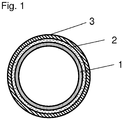
- FIG. 1 is a cross section view of a preferred aspect of the hose for high-pressure hydrogen of the present invention.
- the polyamide resin composition for a molded article exposed to high-pressure hydrogen according to the present invention comprises at least a polyamide resin (A) including a unit derived from hexamethylenediamine and a unit derived from an aliphatic dicarboxylic acid of 8 to 12 carbon atoms (hereinafter referred to as “the polyamide resin (A)”) and an ethylene/ ⁇ -olefin copolymer (B) modified with an unsaturated carboxylic acid and/or a derivative thereof (hereinafter referred to as "the ethylene/ ⁇ -olefin copolymer (B)").
- the polyamide resin composition comprises at least a polyamide resin (A) including a unit derived from hexamethylenediamine and a unit derived from an aliphatic dicarboxylic acid of 8 to 12 carbon atoms (hereinafter referred to as “the polyamide resin (A)”) and an ethylene/ ⁇ -olefin copolymer (B) modified with an unsaturated
- the polyamide resin (A) including a unit derived from hexamethylenediamine and a unit derived from an aliphatic dicarboxylic acid of 8 to 12 carbon atoms has excellent moldability and gas barrier property.
- the polyamide resin (A) also has excellent flexibility. This can relax strain of a molded article due to temperature changes, and thus the polyamide resin (A) has excellent heat cycle resistance.
- the polyamide resin (A) has high crystallinity, it can reduce permeation of hydrogen gas and absorption of hydrogen into the resin, and thus can provide a molded article in which failure points are unlikely to occur despite repeated charging and discharging of high-pressure hydrogen.
- Combining the polyamide resin (A) with the ethylene/ ⁇ -olefin copolymer (B) modified with an unsaturated carboxylic acid and/or a derivative thereof can improve the flexibility and heat cycle resistance. Molded articles used in applications exposed to high-pressure hydrogen are subject to repeated temperature changes (heat cycles) from - 40°C or lower to 90°C or higher due to charging and discharging of high-pressure hydrogen. Thus, for example, in the case that a molded article is a composite article having a resin portion and a metal portion, cracks tend to occur at the joint between the resin portion and the metal portion. Adding the ethylene/ ⁇ -olefin copolymer (B) modified with an unsaturated carboxylic acid and/or a derivative thereof can prevent such cracks that may occur at the joint between the resin portion and the metal portion due to repeated heat cycles.
- the polyamide resin (A) for use in the present invention is a polyamide resin composed mainly of a unit derived from hexamethylenediamine and a unit derived from an aliphatic dicarboxylic acid of 8 to 12 carbon atoms. Other monomers may be copolymerized to the extent that the object of the present invention is not adversely affected. "Composed mainly of” means that the unit derived from hexamethylenediamine and the unit derived from an aliphatic dicarboxylic acid of 8 to 12 carbon atoms are contained in a total amount of 50 mol% or more based on 100 mol% of total monomer units constituting the polyamide resin.
- the unit derived from hexamethylenediamine and the unit derived from an aliphatic dicarboxylic acid of 8 to 12 carbon atoms are more preferably contained in an amount of 70 mol% or more, still more preferably 90 mol% or more.
- Examples of an aliphatic dicarboxylic acid of 8 to 12 carbon atoms include sebacic acid, suberic acid, azelaic acid, undecanedioic acid, and dodecanedioic acid. Two or more of these may be used. Of these, sebacic acid or dodecanedioic acid, which can provide a polyamide resin composition having an excellent balance of crystalline property and strength, are preferred, and sebacic acid is particularly preferred.
- the monomers to be copolymerized include amino acids such as 6-aminocaproic acid, 11-aminoundecanoic acid, 12-aminododecanoic acid, and p-aminomethylbenzoic acid; lactams such as ⁇ -caprolactam and ⁇ -laurolactam; aliphatic diamines such as tetramethylenediamine, pentamethylenediamine, 2-methylpentamethylenediamine, undecamethylenediamine, dodecamethylenediamine, 2,2,4-/2,4,4-trimethylhexamethylenediamine, and 5-methylnonamethylenediamine; aromatic diamines such as m-xylenediamine and p-xylylenediamine; alicyclic diamines such as 1,3-bis(aminomethyl) cyclohexane, 1,4-bis(aminomethyl) cyclohexane, 1-amino-3-aminomethyl-3,5,5-trimine
- the polyamide resin (A) may have any degree of polymerization but preferably has a relative viscosity, as measured at 25°C in a 98% concentrated sulfuric acid solution at a resin concentration of 0.01 g/ml, in the range of 1.5 to 7.0.
- a relative viscosity of 1.5 or more leads to a moderately high viscosity of the polyamide resin composition, which can reduce air entrapment during molding to further improve the moldability.
- the relative viscosity is more preferably 1.8 or more.
- a relative viscosity of 7.0 or less leads to a moderately low viscosity of the polyamide resin composition, which can further improve the moldability.
- the amount of terminal amino group of the polyamide resin (A) is preferably, but not necessarily, in the range of 1.0 to 10.0 ⁇ 10 -5 mol/g.
- the amount of terminal amino group in the range of 1.0 to 10.0 ⁇ 10 -5 mol/g can provide a sufficient degree of polymerization and a molded article with improved mechanical strength.
- the amount of terminal amino group of the polyamide resin (A) can be determined by dissolving the polyamide resin (A) in a mixed solvent of phenol and ethanol (83.5:16.5 (volume ratio)) and titrating the resulting solution using a 0.02N aqueous hydrochloric acid solution.
- the ethylene/ ⁇ -olefin copolymer (B) for use in the present invention is an ethylene/ ⁇ -olefin copolymer modified with an unsaturated carboxylic acid and/or a derivative thereof.
- the derivative of an unsaturated carboxylic acid is an unsaturated carboxylic acid compound having a carboxyl group whose hydroxy moiety is substituted, and examples include metal salts, acid halides, esters, acid anhydrides, amides, and imides of unsaturated carboxylic acids.
- unsaturated carboxylic acids and/or derivatives thereof include acrylic acid, methacrylic acid, maleic acid, fumaric acid, itaconic acid, crotonic acid, methyl maleic acid, methyl fumaric acid, mesaconic acid, citraconic acid, glutaconic acid, and metal salts of these carboxylic acids; unsaturated carboxylates such as methyl hydrogen maleate, methyl hydrogen itaconate, methyl acrylate, ethyl acrylate, butyl acrylate, 2-ethylhexyl acrylate, hydroxyethyl acrylate, methyl methacrylate, 2-ethylhexyl methacrylate, hydroxyethyl methacrylate, aminoethyl methacrylate, dimethyl maleate, and dimethyl itaconate; acid anhydrides such as maleic anhydride, itaconic anhydride, citraconic anhydride, endo-bicyclo-(2,2,1)-5-heptene
- the ethylene/ ⁇ -olefin copolymer can be modified with these unsaturated carboxylic acids or derivatives thereof, for example, by copolymerization of an ethylene/ ⁇ -olefin copolymer and an unsaturated carboxylic acid and/or a derivative thereof or by graft incorporation of an unsaturated carboxylic acid and/or a derivative thereof into an unmodified ethylene/ ⁇ -olefin copolymer using a radical initiator.
- Preferred ethylene/ ⁇ -olefin copolymers are copolymers of ethylene and ⁇ -olefins of 3 to 20 carbon atoms.
- ⁇ -olefins of 3 to 20 carbon atoms include propylene, 1-butene, 1-pentene, 1-hexene, 1-heptene, 1-octene, 1-nonene, 1-decene, 1-undecene, 1-dodecene, 1-tridecene, 1-tetradecene, 1-pentadecene, 1-hexadecene, 1-heptadecene, 1-octadecene, 1-nonadecene, 1-eicosene, 3-methyl-1-butene, 3-methyl-1-pentene, 3-ethyl-1-pentene, 4-methyl-1-pentene, 4-methyl-1-hexene, 4,4-dimethyl-1-hexene, 4,4-dimethyl-1-penten
- ⁇ -olefins Two or more of these may be used. Of these ⁇ -olefins, ⁇ -olefins of 3 to 12 carbon atoms are preferred to improve mechanical strength. Furthermore, at least one of unconjugated dienes including 1,4-hexadiene, dicyclopentadiene, 2,5-norbornadiene, 5-ethylidenenorbornene, 5-ethyl-2,5-norbornadiene, and 5-(1'-propenyl)-2-norbornene may be copolymerized.
- unconjugated dienes including 1,4-hexadiene, dicyclopentadiene, 2,5-norbornadiene, 5-ethylidenenorbornene, 5-ethyl-2,5-norbornadiene, and 5-(1'-propenyl)-2-norbornene may be copolymerized.
- the ⁇ -olefin content of the ethylene/ ⁇ -olefin copolymer is preferably 1 to 30 mol%, more preferably 2 to 25 mol%, still more preferably 3 to 20 mol%.
- the ethylene/ ⁇ -olefin copolymer (B) may have any hardness. However, to further improve the heat cycle resistance of a molded article made of a polyamide resin composition, the ethylene/ ⁇ -olefin copolymer (B) preferably has a Shore A hardness determined according to ASTM D2240-05 of 90 A or less, more preferably 80 A or less.
- the amounts of the polyamide resin (A) and the ethylene/ ⁇ -olefin copolymer (B) in the polyamide resin composition of the present invention are not especially limited, but it is preferable that the polyamide resin composition contains 5 to 100 parts by weight of the ethylene/ ⁇ -olefin copolymer (B) per 100 parts by weight of the polyamide resin (A). Not less than 5 parts by weight of the ethylene/ ⁇ -olefin copolymer (B) can further improve the flexibility and the heat cycle resistance of the molded article. On the other hand, not more than 100 parts by weight of the ethylene/ ⁇ -olefin copolymer (B) can prevent failure points from occurring even if charging and discharging of higher-pressure hydrogen is repeated.
- the amount of the ethylene/ ⁇ -olefin copolymer (B) is more preferably not more than 80 parts by weight, still more preferably not more than 70 parts by weight, most preferably not more than 50 parts by weight.
- components (A) and (B) may optionally be added to the extent that the properties of the composition are not impaired.
- other components include fillers, thermoplastic resins other than the component (A), impact modifiers other than the component (B), and various additives.
- adding a filler can provide a molded article with improved properties such as strength and dimensional stability.
- the shape of the filler may be fibrous or non-fibrous, and a fibrous filler and a non-fibrous filler may be used in combination.
- fibrous fillers include glass fibers, glass milled fibers, carbon fibers, potassium titanate whiskers, zinc oxide whiskers, aluminum borate whiskers, aramid fibers, alumina fibers, silicon carbide fibers, ceramic fibers, asbestos fibers, gypsum fibers, and metal fibers.
- non-fibrous fillers examples include silicates such as wollastonite, zeolite, sericite, kaolin, mica, clay, pyrophyllite, bentonite, asbestos, talc, and alumina silicate; metal oxides such as alumina, silicon oxide, magnesium oxide, zirconium oxide, titanium oxide, and iron oxide; metal carbonates such as calcium carbonate, magnesium carbonate, and dolomite; metal sulfates such as calcium sulfate and barium sulfate; metal hydroxides such as magnesium hydroxide, calcium hydroxide, and aluminum hydroxide; and glass beads, ceramic beads, boron nitride, and silicon carbide. These fillers may be hollow.
- silicates such as wollastonite, zeolite, sericite, kaolin, mica, clay, pyrophyllite, bentonite, asbestos, talc, and alumina silicate
- metal oxides such as alumina, silicon oxide, magnesium oxide, zir
- These fibrous fillers and/or non-fibrous fillers are preferably pretreated with coupling agents before use to provide more excellent mechanical properties.
- coupling agents include isocyanate compounds, organic silane compounds, organic titanate compounds, organic borane compounds, and epoxy compounds.
- thermoplastic resins include polyamide resins other than the component (A), polyester resins, polyphenylene sulfide resins, polyphenylene oxide resins, polycarbonate resins, polylactic resins, polyacetal resins, polysulfone resins, polytetrafluoroethylene resins, polyetherimide resins, polyamide-imide resins, polyimide resins, polyethersulfone resins, polyether ketone resins, polythioether ketone resins, polyether ether ketone resins, styrene resins such as polystyrene resins and ABS resins, and polyalkylene oxide resins. Two or more of these thermoplastic resins may be added.
- a polyamide resin other than the component (A) when added, its amount is preferably not more than 4 parts by weight based on 100 parts by weight of the polyamide resin (A).
- the impact modifier examples include olefin resins other than the component (B), acrylic rubber, silicone rubber, fluorine rubber, styrene rubber, nitrile rubber, vinyl rubber, urethane rubber, polyamide elastomers, polyester elastomers, and ionomers. Two or more of these may be added.
- the impact modifier may be of any structure, for example, what is called a core-shell multilayer structure including at least one layer made of rubber and one or more layers made of polymers different from the rubber.
- the multilayer structure may be composed of two, three, or four or more layers and preferably has at least one inner rubber layer (core layer).
- Examples of the rubber constituting the rubber layer of the multilayer structure include, but are not limited to, rubbers obtained by polymerizing acrylic components, silicone components, styrene components, nitrile components, conjugated diene components, urethane components, ethylene components, propylene components, isobutene components, and other components.
- the different polymers constituting the layers other than the rubber layer of the multilayer structure may be any polymers having thermoplasticity and are preferably polymers having glass transition temperatures higher than that of the rubber layer.
- polymers having thermoplasticity include polymers containing unsaturated carboxylic acid alkyl ester units, unsaturated carboxylic acid units, unsaturated-glycidyl-containing units, unsaturated dicarboxylic anhydride units, aliphatic vinyl units, aromatic vinyl units, vinyl cyanide units, maleimide units, unsaturated dicarboxylic acid units, and other vinyl units.
- additives include anti-coloring agents, antioxidants, such as hindered phenols and hindered amines, release agents, such as ethylene bisstearyl amides and higher fatty acid esters, plasticizers, heat stabilizers, lubricants, ultraviolet absorbers, coloring agents, flame retardants, and blowing agents.
- copper compounds which can improve long-term heat resistance, are preferably added together with the polyamide resin (A).
- copper compounds include cuprous chloride, cupric chloride, cuprous bromide, cupric bromide, cuprous iodide, cupric iodide, cupric sulfate, cupric nitrate, cupric phosphate, cuprous acetate, cupric acetate, cupric salicylate, cupric stearate, cupric benzoate, and complex compounds of these copper inorganic halides with, for example, xylylenediamine, 2-mercaptobenzimidazole, and benzimidazole. Two or more of these may be added.
- the amount of copper compound is preferably 0.01 part by weight or more, more preferably 0.015 part by weight or more, based on 100 parts by weight of the polyamide resin (A).
- the amount of copper compound is preferably 2 parts by weight or less, more preferably 1 part by weight or less.
- alkali halides may also be added.
- alkali halide compounds include lithium chloride, lithium bromide, lithium iodide, potassium chloride, potassium bromide, potassium iodide, sodium bromide, and sodium iodide. Two or more of these may be added. Potassium iodide and sodium iodide are particularly preferred.
- thermoplastic polyamide resin composition of the present invention can be prepared by any method, such as kneading the polyamide resin (A), the ethylene/ ⁇ -olefin copolymer (B), and, optionally, other components in a batch. Any known kneading device, such as Banbury mixers, rolls, and extruders, can be employed. Other components such as various additives, when added to the polyamide resin composition of the present invention, can be added at any timing.
- the polyamide resin composition of the present invention when the polyamide resin composition of the present invention is prepared using a twin-screw extruder, other components may be added at the same time as the polyamide resin (A) and the ethylene/ ⁇ -olefin copolymer (B) are added; other components may be added, for example, by side feeding when the polyamide resin (A) and the ethylene/ ⁇ -olefin copolymer(B) are melt kneaded; other components may be added after the polyamide resin (A) and the ethylene/ ⁇ -olefin copolymer (B) are melt kneaded; or other components may be added to the polyamide resin (A) and melt kneaded before the ethylene/ ⁇ -olefin copolymer (B) is added.
- the polyamide resin composition of the present invention is suitable for use for a molded article exposed to high-pressure hydrogen.
- the molded article exposed to high-pressure hydrogen is a molded article exposed to hydrogen at a pressure above atmospheric pressure. Being less likely to suffer failure points despite repeated charging and discharging of high-pressure hydrogen, the molded article of the present invention is used, preferably, as a molded article exposed to hydrogen at 20 MPa or higher, more preferably, as a molded article exposed to hydrogen at 30 MPa or higher.
- the molded article of the present invention is used, preferably, as a molded article exposed to hydrogen at a 200 MPa or lower, more preferably, as a molded article exposed to hydrogen at 150 MPa or lower, still more preferably, as a molded article exposed to hydrogen at 100 MPa or lower.
- the polyamide resin composition of the present invention can be molded into molded articles by any method and the shape of molded articles can be an arbitrary shape.
- molding methods include extrusion molding, injection molding, hollow molding, calender molding, compression molding, vacuum molding, foam molding, blow molding, and rotational molding.
- the shape of molded articles may be, for example, pellet-like, plate-like, fibrous, strand-like, film- or sheet-like, pipe-like, hollow, or box-like.
- the molded article of the present invention for its excellent heat cycle resistance and unlikeliness to suffer failure points despite repeated charging and discharging of high-pressure hydrogen, is suitable for use for on-off valves for high-pressure hydrogen, check valves for high-pressure hydrogen, pressure-reducing valves for high-pressure hydrogen, pressure-regulating valves for high-pressure hydrogen, seals for high-pressure hydrogen, hoses for high-pressure hydrogen, tanks for high-pressure hydrogen, liners for high-pressure hydrogen, pipes for high-pressure hydrogen, packings for high-pressure hydrogen, pressure sensors for high-pressure hydrogen, pumps for high-pressure hydrogen, tubes for high-pressure hydrogen, regulators for high-pressure hydrogen, films for high-pressure hydrogen, sheets for high-pressure hydrogen, fibers for high-pressure hydrogen, joints for high-pressure hydrogen, or the like.
- the molded article of the present invention for its excellence in both flexibility and heat cycle resistance, is suitable for use for a hose for high-pressure hydrogen.
- the hose for high-pressure hydrogen is used as a hose for charging a fuel-cell vehicle or the like with hydrogen from a hydrogen station. Since the hose for high-pressure hydrogen is subject to repeated temperature changes (heat cycles) from -40°C or lower to 90°C or higher due to charging and discharging of high-pressure hydrogen, it is required to have high heat cycle resistance as well as flexibility.
- Preferred hose for high-pressure hydrogen is a hose having a reinforcement layer on the outside of an inner layer obtained by molding the polyamide resin composition of the present invention into a tubular form.
- the pressure resistance of the hose is improved while maintaining the flexibility of the hose by providing the reinforcement layer on the outside.
- More Preferred hose is a hose further having a weather-resistant layer as the outermost layer. Since the hydrogen station is often installed outdoor, the hose for high-pressure hydrogen can be prevented from being deteriorated by having the weather-resistant layer as the outermost layer.
- the cross section view of such hose is shown in FIG. 1 .
- a reinforcement layer 2 is provided outside a tubular inner layer 1 made of the polyamide resin composition of the present invention, and a weather-resistant layer 3 is further provided as the outermost layer.
- an aramid fiber or a poly-p-phenylene benzbisoxazole fiber is preferred as the material of the reinforcement layer, and a poly-p-phenylene benzbisoxazole fiber is more preferred to further improve the pressure resistance.
- the reinforcement layer is provided by concentrically coating around the inner layer with these fibers.
- the material of the weather-resistant layer examples include aramid fibers, polyester fibers, polyamide fibers, aramid resins, polyester resins, and polyamide resins.
- the reinforcement layer is provided by concentrically coating around the reinforcement layer with these resins.
- bending test pieces having a thickness of 1/8 inches and conforming to ASTM D-790 were injection molded with an "SE-75DUZ-C250" injection molding machine available from Sumitomo Heavy Industries, Ltd. under the following molding conditions: mold temperature, 80°C; injection speed, 100 mm/sec; cooling time, 20 seconds.
- the temperature of the injection molding machine was set at 230°C-235°C-240°C-240°C from the downward part of the hopper to the tip part, in order.
- the flexural moduluses of the molded articles obtained were evaluated according to ASTM D790:95 at 23°C.
- the flexural modulus was the average value obtained from three molded articles measured.
- each of the pellets obtained in Examples and Comparative Examples was overmolded at a thickness of 0.7 mm on a metal core of 48.6 mm ⁇ 48.6 mm ⁇ 28.6 mm using a "SE-75DUZ-C250" injection molding machine available from Sumitomo Heavy Industries, Ltd. under the following molding conditions: mold temperature, 80°C; injection speed, 100 mm/sec; cooling time, 20 seconds.
- the temperature of the injection molding machine was set at 250°C-255°C-260°C-260°C from the downward part of the hopper to the tip part, in order.
- prismatic test pieces of 63.5 mm ⁇ 12.6 mm ⁇ 12.6 mm were injection molded with an "SG-75H-MIV" injection molding machine available from Sumitomo Heavy Industries, Ltd. under the following molding conditions: mold temperature, 80°C; injection speed, 10 mm/sec; holding pressure, 10 MPa; pressure-holding time, 10 seconds; cooling time, 20 seconds.
- the temperature of the injection molding machine was set at 220°C-225°C-230°C-230°C from the downward part of the hopper to the tip part, in order.
- the prismatic test pieces obtained of 63.5 mm ⁇ 12.6 mm ⁇ 12.6 mm were processed into the cubes of 5 mm ⁇ 5 mm ⁇ 5 mm by milling.
- the test pieces processed were subjected to X-ray CT analysis using "TDM1000-IS” available from Yamato Scientific Co., Ltd. to check the presence of failure points.
- a test piece having no failure point was placed in an autoclave, and then hydrogen gas was fed into the autoclave over five minutes to a pressure of 20 MPa. The pressure was held for 1 hours and then reduced to atmospheric pressure over five minutes. This cycle was repeated 100 times.
- the test piece after 100 cycles was subjected to X-ray CT analysis using "TDM1000-IS” available from Yamato Scientific Co., Ltd. to check the presence of failure points of 1 ⁇ m or larger.
- the test pieces having no failure points were evaluated as "Yes", and the test pieces having failure points were evaluated as "No".
- the amount of terminal amino group of the pellet obtained was 3.5x 10 -5 mol/g, as determined by dissolving in a mixed solvent of phenol and ethanol (83.5:16.5 (volume ratio)) and titrating the resulting solution using a 0.02N aqueous hydrochloric acid solution.
- Raw materials shown in Table 1 were fed into the extruder and melt kneaded.
- a gut discharged through a die was rapidly cooled by being passed through a cooling bath filled with water conditioned at 5°C over 20 seconds, and then pelletized with a strand cutter to give pellets.
- the pellets obtained were evaluated by the above-described methods. The results are shown in Table 1.
- a molded article made of a polyamide resin composition comprising a polyamide resin (A) including a unit derived from hexamethylenediamine and a unit derived from an aliphatic dicarboxylic acid of 8 to 12 carbon atoms and an ethylene/ ⁇ -olefin copolymer (B) modified with an unsaturated carboxylic acid and/or a derivative thereof has excellent flexibility and heat cycle resistance and is less likely to suffer failure points despite repeated charging and discharging of high-pressure hydrogen.
- A polyamide resin
- B ethylene/ ⁇ -olefin copolymer
- the polyamide resin composition according to the present invention can provide a molded article having excellent flexibility and heat cycle resistance and less likely to suffer failure points despite repeated charging and discharging of high-pressure hydrogen. Having these properties, the molded article made of the polyamide resin composition of the present invention can be widely used as a molded article exposed to high-pressure hydrogen.
Landscapes
- Chemical & Material Sciences (AREA)
- Chemical Kinetics & Catalysis (AREA)
- Health & Medical Sciences (AREA)
- Medicinal Chemistry (AREA)
- Polymers & Plastics (AREA)
- Organic Chemistry (AREA)
- Engineering & Computer Science (AREA)
- General Chemical & Material Sciences (AREA)
- General Engineering & Computer Science (AREA)
- Mechanical Engineering (AREA)
- Life Sciences & Earth Sciences (AREA)
- Manufacturing & Machinery (AREA)
- Sustainable Development (AREA)
- Sustainable Energy (AREA)
- Electrochemistry (AREA)
- Compositions Of Macromolecular Compounds (AREA)
Abstract
Description
- The present invention relates to a polyamide resin composition for a molded article exposed to high-pressure hydrogen and to a molded article made of the composition.
- Fuel-cell electric vehicles, which are equipped with fuel cells that generate electricity by electrochemical reaction of hydrogen with oxygen in the air, the electricity generated by the fuel cells being supplied to motors and used as driving force, have recently been receiving attention as countermeasures against the depletion of petroleum fuel and the demand for reductions in toxic gas emission. Conventional resin tanks and hoses disadvantageously undergo deformation or breakage with repeated charging and discharging of high-pressure hydrogen. This is because hydrogen, for its small molecular size, readily permeates through the resins as compared, for example, to natural gas, which has a relatively large molecular size, and high-pressure hydrogen, as compared to hydrogen at atmospheric pressure, may be accumulated in the resins in larger amounts.
- For example, a tank comprising a metallic end component, a polyamide resin liner surrounding the end component, and a layer for a structure of a fiber impregnated with a thermosetting resin that surrounds the liner is disclosed as a tank for storage of a gas such as hydrogen that is mounted on a fuel-cell electric vehicle (see
Patent Document 1, for example). For example, a hydrogen tank liner made of a hydrogen tank liner material comprising a polyamide resin composition containing a polyamide 6, a copolyamide, and an impact modifier is disclosed as a hydrogen tank liner having excellent gas barrier properties and high impact resistance at low temperatures (seePatent Document 2, for example). - In addition, a hose for charging hydrogen comprising an inner layer made of nylon, polyacetal, ethylene-vinylalcohol copolymer, or the like is disclosed as a hose for charging a fuel-cell vehicle or the like with hydrogen from a hydrogen station (see
Patent Document 3, for example). -
- Patent Document 1:
JP 2011-505523 W - Patent Document 2:
JP 2009-191871 A - Patent Document 3:
JP 2010-031993 A - On the other hand, the tank disclosed in
Patent Document 1, however, has insufficient heat cycle resistance, because, when it is subject to repeated temperature changes (heat cycles) from -40°C or lower to 90°C or higher due to charging and discharging of high-pressure hydrogen, cracks tend to occur at the joint between the resin portion and the metal portion. The hydrogen tank liner disclosed inPatent Document 2, although improved somewhat in heat cycle resistance, has still insufficient heat cycle resistance. The resin composition disclosed inPatent Document 2 has disadvantages in that permeation of hydrogen gas and absorption of hydrogen into the resin are likely to occur due to low crystalline property of the polyamide resin, and the hydrogen tank liner suffers failure points with repeated charging and discharging of high-pressure hydrogen. - The hose for charging hydrogen disclosed in
Patent Document 3 is described as a hose comprising an inner layer made of a nylon resin having a dry hydrogen gas permeation coefficient of 1 × 10⁻⁸ cc·cm/cm2·sec.·cmHg or less at the temperature of 90°C. However, there is no detailed description of what specifically the nylon resin is. Furthermore, common nylon resins were regarded to have insufficient flexibility and heat cycle resistance to use for a hose for charging hydrogen. - In view of the above problems of the related art, it is an object of the present invention to provide a polyamide resin composition that can provide a molded article having excellent flexibility and heat cycle resistance and less likely to suffer failure points despite repeated charging and discharging of high-pressure hydrogen. Means for Solving the Problems
- To achieve the above object, the present invention has the following structure. A polyamide resin composition for a molded article exposed to high-pressure hydrogen, the composition comprising a polyamide resin (A) including a unit derived from hexamethylenediamine and a unit derived from an aliphatic dicarboxylic acid of 8 to 12 carbon atoms and an ethylene/α-olefin copolymer (B) modified with an unsaturated carboxylic acid and/or a derivative thereof.
- The present invention includes a molded article exposed to high-pressure hydrogen, the article comprising the above-described polyamide resin composition.
- The present invention includes a hose for high-pressure hydrogen exposed to high-pressure hydrogen, the hose comprising the above-described polyamide resin composition.
- The present invention includes a hose for high-pressure hydrogen, the hose comprising a reinforcement layer on the outside of an inner layer comprising the above-described polyamide resin composition.
- The polyamide resin composition for a molded article exposed to high-pressure hydrogen according to the present invention can provide a molded article having excellent flexibility and heat cycle resistance and less likely to suffer failure points despite repeated charging and discharging of high-pressure hydrogen. The molded article of the present invention, for its excellent flexibility and heat cycle resistance and unlikeliness to suffer failure points despite repeated charging and discharging of high-pressure hydrogen, can be advantageously used as a molded article used in applications exposed to high-pressure hydrogen.
-
FIG. 1 is a cross section view of a preferred aspect of the hose for high-pressure hydrogen of the present invention. - The present invention will now be described in more detail.
- The polyamide resin composition for a molded article exposed to high-pressure hydrogen according to the present invention (hereinafter referred to as "the polyamide resin composition") comprises at least a polyamide resin (A) including a unit derived from hexamethylenediamine and a unit derived from an aliphatic dicarboxylic acid of 8 to 12 carbon atoms (hereinafter referred to as "the polyamide resin (A)") and an ethylene/α-olefin copolymer (B) modified with an unsaturated carboxylic acid and/or a derivative thereof (hereinafter referred to as "the ethylene/α-olefin copolymer (B)"). The polyamide resin (A) including a unit derived from hexamethylenediamine and a unit derived from an aliphatic dicarboxylic acid of 8 to 12 carbon atoms has excellent moldability and gas barrier property. The polyamide resin (A) also has excellent flexibility. This can relax strain of a molded article due to temperature changes, and thus the polyamide resin (A) has excellent heat cycle resistance. Furthermore, since the polyamide resin (A) has high crystallinity, it can reduce permeation of hydrogen gas and absorption of hydrogen into the resin, and thus can provide a molded article in which failure points are unlikely to occur despite repeated charging and discharging of high-pressure hydrogen. Combining the polyamide resin (A) with the ethylene/α-olefin copolymer (B) modified with an unsaturated carboxylic acid and/or a derivative thereof can improve the flexibility and heat cycle resistance. Molded articles used in applications exposed to high-pressure hydrogen are subject to repeated temperature changes (heat cycles) from - 40°C or lower to 90°C or higher due to charging and discharging of high-pressure hydrogen. Thus, for example, in the case that a molded article is a composite article having a resin portion and a metal portion, cracks tend to occur at the joint between the resin portion and the metal portion. Adding the ethylene/α-olefin copolymer (B) modified with an unsaturated carboxylic acid and/or a derivative thereof can prevent such cracks that may occur at the joint between the resin portion and the metal portion due to repeated heat cycles.
- The polyamide resin (A) for use in the present invention is a polyamide resin composed mainly of a unit derived from hexamethylenediamine and a unit derived from an aliphatic dicarboxylic acid of 8 to 12 carbon atoms. Other monomers may be copolymerized to the extent that the object of the present invention is not adversely affected. "Composed mainly of" means that the unit derived from hexamethylenediamine and the unit derived from an aliphatic dicarboxylic acid of 8 to 12 carbon atoms are contained in a total amount of 50 mol% or more based on 100 mol% of total monomer units constituting the polyamide resin. The unit derived from hexamethylenediamine and the unit derived from an aliphatic dicarboxylic acid of 8 to 12 carbon atoms are more preferably contained in an amount of 70 mol% or more, still more preferably 90 mol% or more.
- Examples of an aliphatic dicarboxylic acid of 8 to 12 carbon atoms include sebacic acid, suberic acid, azelaic acid, undecanedioic acid, and dodecanedioic acid. Two or more of these may be used. Of these, sebacic acid or dodecanedioic acid, which can provide a polyamide resin composition having an excellent balance of crystalline property and strength, are preferred, and sebacic acid is particularly preferred.
- Another examples of the monomers to be copolymerized include amino acids such as 6-aminocaproic acid, 11-aminoundecanoic acid, 12-aminododecanoic acid, and p-aminomethylbenzoic acid; lactams such as ε-caprolactam and ω-laurolactam; aliphatic diamines such as tetramethylenediamine, pentamethylenediamine, 2-methylpentamethylenediamine, undecamethylenediamine, dodecamethylenediamine, 2,2,4-/2,4,4-trimethylhexamethylenediamine, and 5-methylnonamethylenediamine; aromatic diamines such as m-xylenediamine and p-xylylenediamine; alicyclic diamines such as 1,3-bis(aminomethyl) cyclohexane, 1,4-bis(aminomethyl) cyclohexane, 1-amino-3-aminomethyl-3,5,5-trimethylcyclohexane, bis(4-aminocyclohexyl) methane, bis(3-methyl-4-aminocyclohexyl) methane, 2,2-bis(4-aminocyclohexyl) propane, bis(aminopropyl) piperazine, and aminoethylpiperazine; aliphatic dicarboxylic acids such as adipic acid, malonic acid, succinic acid, glutaric acid, pimelic acid, tetradecanedioic acid, pentadecanedioic acid, and octadecanedioic acid; aromatic dicarboxylic acids such as terephthalic acid, isophthalic acid, 2-chloroterephthalic acid, 2-methylterephthalic acid, 5-methylisophthalic acid, 5-sodium sulfoisophthalic acid, hexahydroterephthalic acid, and hexahydroisophthalic acid; and alicyclic dicarboxylic acids such as 1,4-cyclohexanedicarboxylic acid, 1,3-cyclohexanedicarboxylic acid, 1,2-cyclohexanedicarboxylic acid, and 1,3-cyclopentanedicarboxylic acid. Two or more of these monomers may be copolymerized.
- The polyamide resin (A) may have any degree of polymerization but preferably has a relative viscosity, as measured at 25°C in a 98% concentrated sulfuric acid solution at a resin concentration of 0.01 g/ml, in the range of 1.5 to 7.0. A relative viscosity of 1.5 or more leads to a moderately high viscosity of the polyamide resin composition, which can reduce air entrapment during molding to further improve the moldability. The relative viscosity is more preferably 1.8 or more. On the other hand, a relative viscosity of 7.0 or less leads to a moderately low viscosity of the polyamide resin composition, which can further improve the moldability.
- The amount of terminal amino group of the polyamide resin (A) is preferably, but not necessarily, in the range of 1.0 to 10.0 × 10⁻⁵ mol/g. The amount of terminal amino group in the range of 1.0 to 10.0 × 10⁻⁵ mol/g can provide a sufficient degree of polymerization and a molded article with improved mechanical strength. The amount of terminal amino group of the polyamide resin (A) can be determined by dissolving the polyamide resin (A) in a mixed solvent of phenol and ethanol (83.5:16.5 (volume ratio)) and titrating the resulting solution using a 0.02N aqueous hydrochloric acid solution.
- The ethylene/α-olefin copolymer (B) for use in the present invention is an ethylene/α-olefin copolymer modified with an unsaturated carboxylic acid and/or a derivative thereof. The derivative of an unsaturated carboxylic acid is an unsaturated carboxylic acid compound having a carboxyl group whose hydroxy moiety is substituted, and examples include metal salts, acid halides, esters, acid anhydrides, amides, and imides of unsaturated carboxylic acids.
- Examples of unsaturated carboxylic acids and/or derivatives thereof include acrylic acid, methacrylic acid, maleic acid, fumaric acid, itaconic acid, crotonic acid, methyl maleic acid, methyl fumaric acid, mesaconic acid, citraconic acid, glutaconic acid, and metal salts of these carboxylic acids; unsaturated carboxylates such as methyl hydrogen maleate, methyl hydrogen itaconate, methyl acrylate, ethyl acrylate, butyl acrylate, 2-ethylhexyl acrylate, hydroxyethyl acrylate, methyl methacrylate, 2-ethylhexyl methacrylate, hydroxyethyl methacrylate, aminoethyl methacrylate, dimethyl maleate, and dimethyl itaconate; acid anhydrides such as maleic anhydride, itaconic anhydride, citraconic anhydride, endo-bicyclo-(2,2,1)-5-heptene-2,3-dicarboxylic acid, and endo-bicyclo-(2,2,1)-5-heptene-2,3-dicarboxylic anhydride; and maleimide, N-ethylmaleimide, N-butylmaleimide, N-phenylmaleimide, glycidyl acrylate, glycidyl methacrylate, glycidyl ethacrylate, glycidyl itaconate, glycidyl citraconate, and 5-norbornene-2,3-dicarboxylic acid. Of these, unsaturated dicarboxylic acids and acid anhydrides thereof are preferred, and maleic acid or maleic anhydride are particularly preferred.
- The ethylene/α-olefin copolymer can be modified with these unsaturated carboxylic acids or derivatives thereof, for example, by copolymerization of an ethylene/α-olefin copolymer and an unsaturated carboxylic acid and/or a derivative thereof or by graft incorporation of an unsaturated carboxylic acid and/or a derivative thereof into an unmodified ethylene/α-olefin copolymer using a radical initiator.
- Preferred ethylene/α-olefin copolymers are copolymers of ethylene and α-olefins of 3 to 20 carbon atoms. Specific examples of α-olefins of 3 to 20 carbon atoms include propylene, 1-butene, 1-pentene, 1-hexene, 1-heptene, 1-octene, 1-nonene, 1-decene, 1-undecene, 1-dodecene, 1-tridecene, 1-tetradecene, 1-pentadecene, 1-hexadecene, 1-heptadecene, 1-octadecene, 1-nonadecene, 1-eicosene, 3-methyl-1-butene, 3-methyl-1-pentene, 3-ethyl-1-pentene, 4-methyl-1-pentene, 4-methyl-1-hexene, 4,4-dimethyl-1-hexene, 4,4-dimethyl-1-pentene, 4-ethyl-1-hexene, 3-ethyl-1-hexene, 9-methyl-1-decene, 11-methyl-1-dodecene, and 12-methyl-1-tetradecene. Two or more of these may be used. Of these α-olefins, α-olefins of 3 to 12 carbon atoms are preferred to improve mechanical strength. Furthermore, at least one of unconjugated dienes including 1,4-hexadiene, dicyclopentadiene, 2,5-norbornadiene, 5-ethylidenenorbornene, 5-ethyl-2,5-norbornadiene, and 5-(1'-propenyl)-2-norbornene may be copolymerized.
- The α-olefin content of the ethylene/α-olefin copolymer is preferably 1 to 30 mol%, more preferably 2 to 25 mol%, still more preferably 3 to 20 mol%.
- The ethylene/α-olefin copolymer (B) may have any hardness. However, to further improve the heat cycle resistance of a molded article made of a polyamide resin composition, the ethylene/α-olefin copolymer (B) preferably has a Shore A hardness determined according to ASTM D2240-05 of 90 A or less, more preferably 80 A or less.
- The amounts of the polyamide resin (A) and the ethylene/α-olefin copolymer (B) in the polyamide resin composition of the present invention are not especially limited, but it is preferable that the polyamide resin composition contains 5 to 100 parts by weight of the ethylene/α-olefin copolymer (B) per 100 parts by weight of the polyamide resin (A). Not less than 5 parts by weight of the ethylene/α-olefin copolymer (B) can further improve the flexibility and the heat cycle resistance of the molded article. On the other hand, not more than 100 parts by weight of the ethylene/α-olefin copolymer (B) can prevent failure points from occurring even if charging and discharging of higher-pressure hydrogen is repeated. The amount of the ethylene/α-olefin copolymer (B) is more preferably not more than 80 parts by weight, still more preferably not more than 70 parts by weight, most preferably not more than 50 parts by weight.
- To the polyamide resin composition of the present invention, other components than the components (A) and (B) may optionally be added to the extent that the properties of the composition are not impaired. Examples of other components include fillers, thermoplastic resins other than the component (A), impact modifiers other than the component (B), and various additives.
- For example, adding a filler can provide a molded article with improved properties such as strength and dimensional stability. The shape of the filler may be fibrous or non-fibrous, and a fibrous filler and a non-fibrous filler may be used in combination. Examples of fibrous fillers include glass fibers, glass milled fibers, carbon fibers, potassium titanate whiskers, zinc oxide whiskers, aluminum borate whiskers, aramid fibers, alumina fibers, silicon carbide fibers, ceramic fibers, asbestos fibers, gypsum fibers, and metal fibers. Examples of non-fibrous fillers include silicates such as wollastonite, zeolite, sericite, kaolin, mica, clay, pyrophyllite, bentonite, asbestos, talc, and alumina silicate; metal oxides such as alumina, silicon oxide, magnesium oxide, zirconium oxide, titanium oxide, and iron oxide; metal carbonates such as calcium carbonate, magnesium carbonate, and dolomite; metal sulfates such as calcium sulfate and barium sulfate; metal hydroxides such as magnesium hydroxide, calcium hydroxide, and aluminum hydroxide; and glass beads, ceramic beads, boron nitride, and silicon carbide. These fillers may be hollow. These fibrous fillers and/or non-fibrous fillers are preferably pretreated with coupling agents before use to provide more excellent mechanical properties. Examples of coupling agents include isocyanate compounds, organic silane compounds, organic titanate compounds, organic borane compounds, and epoxy compounds.
- Examples of thermoplastic resins include polyamide resins other than the component (A), polyester resins, polyphenylene sulfide resins, polyphenylene oxide resins, polycarbonate resins, polylactic resins, polyacetal resins, polysulfone resins, polytetrafluoroethylene resins, polyetherimide resins, polyamide-imide resins, polyimide resins, polyethersulfone resins, polyether ketone resins, polythioether ketone resins, polyether ether ketone resins, styrene resins such as polystyrene resins and ABS resins, and polyalkylene oxide resins. Two or more of these thermoplastic resins may be added. In addition, when a polyamide resin other than the component (A) is added, its amount is preferably not more than 4 parts by weight based on 100 parts by weight of the polyamide resin (A).
- Examples of the impact modifier include olefin resins other than the component (B), acrylic rubber, silicone rubber, fluorine rubber, styrene rubber, nitrile rubber, vinyl rubber, urethane rubber, polyamide elastomers, polyester elastomers, and ionomers. Two or more of these may be added.
- The impact modifier may be of any structure, for example, what is called a core-shell multilayer structure including at least one layer made of rubber and one or more layers made of polymers different from the rubber. The multilayer structure may be composed of two, three, or four or more layers and preferably has at least one inner rubber layer (core layer). Examples of the rubber constituting the rubber layer of the multilayer structure include, but are not limited to, rubbers obtained by polymerizing acrylic components, silicone components, styrene components, nitrile components, conjugated diene components, urethane components, ethylene components, propylene components, isobutene components, and other components. The different polymers constituting the layers other than the rubber layer of the multilayer structure may be any polymers having thermoplasticity and are preferably polymers having glass transition temperatures higher than that of the rubber layer. Examples of polymers having thermoplasticity include polymers containing unsaturated carboxylic acid alkyl ester units, unsaturated carboxylic acid units, unsaturated-glycidyl-containing units, unsaturated dicarboxylic anhydride units, aliphatic vinyl units, aromatic vinyl units, vinyl cyanide units, maleimide units, unsaturated dicarboxylic acid units, and other vinyl units.
- Examples of various additives include anti-coloring agents, antioxidants, such as hindered phenols and hindered amines, release agents, such as ethylene bisstearyl amides and higher fatty acid esters, plasticizers, heat stabilizers, lubricants, ultraviolet absorbers, coloring agents, flame retardants, and blowing agents.
- To the polyamide resin composition of the present invention, copper compounds, which can improve long-term heat resistance, are preferably added together with the polyamide resin (A). Examples of copper compounds include cuprous chloride, cupric chloride, cuprous bromide, cupric bromide, cuprous iodide, cupric iodide, cupric sulfate, cupric nitrate, cupric phosphate, cuprous acetate, cupric acetate, cupric salicylate, cupric stearate, cupric benzoate, and complex compounds of these copper inorganic halides with, for example, xylylenediamine, 2-mercaptobenzimidazole, and benzimidazole. Two or more of these may be added. Of these, monovalent copper compounds, in particular, monohalogenated copper compounds are preferred, and, for example, cuprous acetate and cuprous iodide are preferred. The amount of copper compound is preferably 0.01 part by weight or more, more preferably 0.015 part by weight or more, based on 100 parts by weight of the polyamide resin (A). On the other hand, to prevent or reduce the coloring due to the release of metallic copper during molding, the amount of copper compound is preferably 2 parts by weight or less, more preferably 1 part by weight or less.
- Together with the copper compounds, alkali halides may also be added. Examples of alkali halide compounds include lithium chloride, lithium bromide, lithium iodide, potassium chloride, potassium bromide, potassium iodide, sodium bromide, and sodium iodide. Two or more of these may be added. Potassium iodide and sodium iodide are particularly preferred.
- A description will now be given of a method for preparing the polyamide resin composition of the present invention. The thermoplastic polyamide resin composition of the present invention can be prepared by any method, such as kneading the polyamide resin (A), the ethylene/α-olefin copolymer (B), and, optionally, other components in a batch. Any known kneading device, such as Banbury mixers, rolls, and extruders, can be employed. Other components such as various additives, when added to the polyamide resin composition of the present invention, can be added at any timing. For example, when the polyamide resin composition of the present invention is prepared using a twin-screw extruder, other components may be added at the same time as the polyamide resin (A) and the ethylene/α-olefin copolymer (B) are added; other components may be added, for example, by side feeding when the polyamide resin (A) and the ethylene/α-olefin copolymer(B) are melt kneaded; other components may be added after the polyamide resin (A) and the ethylene/α-olefin copolymer (B) are melt kneaded; or other components may be added to the polyamide resin (A) and melt kneaded before the ethylene/α-olefin copolymer (B) is added.
- The polyamide resin composition of the present invention is suitable for use for a molded article exposed to high-pressure hydrogen. The molded article exposed to high-pressure hydrogen is a molded article exposed to hydrogen at a pressure above atmospheric pressure. Being less likely to suffer failure points despite repeated charging and discharging of high-pressure hydrogen, the molded article of the present invention is used, preferably, as a molded article exposed to hydrogen at 20 MPa or higher, more preferably, as a molded article exposed to hydrogen at 30 MPa or higher. On the other hand, the molded article of the present invention is used, preferably, as a molded article exposed to hydrogen at a 200 MPa or lower, more preferably, as a molded article exposed to hydrogen at 150 MPa or lower, still more preferably, as a molded article exposed to hydrogen at 100 MPa or lower.
- The polyamide resin composition of the present invention can be molded into molded articles by any method and the shape of molded articles can be an arbitrary shape. Examples of molding methods include extrusion molding, injection molding, hollow molding, calender molding, compression molding, vacuum molding, foam molding, blow molding, and rotational molding. The shape of molded articles may be, for example, pellet-like, plate-like, fibrous, strand-like, film- or sheet-like, pipe-like, hollow, or box-like.
- The molded article of the present invention, for its excellent heat cycle resistance and unlikeliness to suffer failure points despite repeated charging and discharging of high-pressure hydrogen, is suitable for use for on-off valves for high-pressure hydrogen, check valves for high-pressure hydrogen, pressure-reducing valves for high-pressure hydrogen, pressure-regulating valves for high-pressure hydrogen, seals for high-pressure hydrogen, hoses for high-pressure hydrogen, tanks for high-pressure hydrogen, liners for high-pressure hydrogen, pipes for high-pressure hydrogen, packings for high-pressure hydrogen, pressure sensors for high-pressure hydrogen, pumps for high-pressure hydrogen, tubes for high-pressure hydrogen, regulators for high-pressure hydrogen, films for high-pressure hydrogen, sheets for high-pressure hydrogen, fibers for high-pressure hydrogen, joints for high-pressure hydrogen, or the like.
- Of these, the molded article of the present invention, for its excellence in both flexibility and heat cycle resistance, is suitable for use for a hose for high-pressure hydrogen. The hose for high-pressure hydrogen is used as a hose for charging a fuel-cell vehicle or the like with hydrogen from a hydrogen station. Since the hose for high-pressure hydrogen is subject to repeated temperature changes (heat cycles) from -40°C or lower to 90°C or higher due to charging and discharging of high-pressure hydrogen, it is required to have high heat cycle resistance as well as flexibility.
- Preferred hose for high-pressure hydrogen is a hose having a reinforcement layer on the outside of an inner layer obtained by molding the polyamide resin composition of the present invention into a tubular form. The pressure resistance of the hose is improved while maintaining the flexibility of the hose by providing the reinforcement layer on the outside. More Preferred hose is a hose further having a weather-resistant layer as the outermost layer. Since the hydrogen station is often installed outdoor, the hose for high-pressure hydrogen can be prevented from being deteriorated by having the weather-resistant layer as the outermost layer. The cross section view of such hose is shown in
FIG. 1 . Areinforcement layer 2 is provided outside a tubularinner layer 1 made of the polyamide resin composition of the present invention, and a weather-resistant layer 3 is further provided as the outermost layer. - In view of high pressure resistance and flexibility, an aramid fiber or a poly-p-phenylene benzbisoxazole fiber is preferred as the material of the reinforcement layer, and a poly-p-phenylene benzbisoxazole fiber is more preferred to further improve the pressure resistance. Preferably, the reinforcement layer is provided by concentrically coating around the inner layer with these fibers.
- Examples of the material of the weather-resistant layer include aramid fibers, polyester fibers, polyamide fibers, aramid resins, polyester resins, and polyamide resins. Preferably, the reinforcement layer is provided by concentrically coating around the reinforcement layer with these resins.
- The effects of the present invention will now be described in more detail with reference to examples. The examples below are not intended to limit the present invention. Evaluations in Examples and Comparative Examples were conducted by the following methods.
- Using each of the pellets obtained in Examples and Comparative Examples, bending test pieces having a thickness of 1/8 inches and conforming to ASTM D-790 were injection molded with an "SE-75DUZ-C250" injection molding machine available from Sumitomo Heavy Industries, Ltd. under the following molding conditions: mold temperature, 80°C; injection speed, 100 mm/sec; cooling time, 20 seconds. The temperature of the injection molding machine was set at 230°C-235°C-240°C-240°C from the downward part of the hopper to the tip part, in order.
- The flexural moduluses of the molded articles obtained were evaluated according to ASTM D790:95 at 23°C. The flexural modulus was the average value obtained from three molded articles measured.
- Each of the pellets obtained in Examples and Comparative Examples was overmolded at a thickness of 0.7 mm on a metal core of 48.6 mm × 48.6 mm × 28.6 mm using a "SE-75DUZ-C250" injection molding machine available from Sumitomo Heavy Industries, Ltd. under the following molding conditions: mold temperature, 80°C; injection speed, 100 mm/sec; cooling time, 20 seconds. The temperature of the injection molding machine was set at 250°C-255°C-260°C-260°C from the downward part of the hopper to the tip part, in order.
- Three of the metal/resin composite molded articles obtained were allowed to stand at -45°C for one hour and then at 90°C for one hour. The resulting composite molded articles were visually observed to check the presence of cracks. This cycle was repeated, and the number of cycles until all of the three composite molded articles were cracked was determined and evaluated as follows: 1500 cycles or more, A; 1200 to 1499 cycles, B; 1199 cycles or less, C.
- Using each of the pellets obtained in Examples and Comparative Examples, prismatic test pieces of 63.5 mm × 12.6 mm × 12.6 mm were injection molded with an "SG-75H-MIV" injection molding machine available from Sumitomo Heavy Industries, Ltd. under the following molding conditions: mold temperature, 80°C; injection speed, 10 mm/sec; holding pressure, 10 MPa; pressure-holding time, 10 seconds; cooling time, 20 seconds. The temperature of the injection molding machine was set at 220°C-225°C-230°C-230°C from the downward part of the hopper to the tip part, in order.
- The prismatic test pieces obtained of 63.5 mm × 12.6 mm × 12.6 mm were processed into the cubes of 5 mm × 5 mm × 5 mm by milling. The test pieces processed were subjected to X-ray CT analysis using "TDM1000-IS" available from Yamato Scientific Co., Ltd. to check the presence of failure points. A test piece having no failure point was placed in an autoclave, and then hydrogen gas was fed into the autoclave over five minutes to a pressure of 20 MPa. The pressure was held for 1 hours and then reduced to atmospheric pressure over five minutes. This cycle was repeated 100 times. The test piece after 100 cycles was subjected to X-ray CT analysis using "TDM1000-IS" available from Yamato Scientific Co., Ltd. to check the presence of failure points of 1 µm or larger. The test pieces having no failure points were evaluated as "Yes", and the test pieces having failure points were evaluated as "No".
- An equimolar salt of hexamethylenediamine and sebacic acid was put into a polymerization can, and pure water of the same amount as the amount of the equimolar salt was added, subsequently N2 substitution in the can was performed. The polymerization can was then heated with stirring to the final achieving temperature of 280°C while controlling so that the maximum internal pressure of the can was 1.96 MPa for the reaction. The reactant was discharged into a water bath and pelletized with a strand cutter to give a pellet of a polyamide 610 resin. The pellet obtained had a relative viscosity of 3.5, as measured at 25°C in a 98% concentrated sulfuric acid solution at a resin concentration of 0.01 g/ml. The amount of terminal amino group of the pellet obtained was 3.5x 10⁻⁵ mol/g, as determined by dissolving in a mixed solvent of phenol and ethanol (83.5:16.5 (volume ratio)) and titrating the resulting solution using a 0.02N aqueous hydrochloric acid solution.
- Materials used in Examples and Comparative Examples and abbreviations thereof are described below.
- PA6: polyamide 6 resin (melting point: 224°C, cooling crystallization temperature: 175°C, relative viscosity determined at 25°C in a 98% concentrated sulfuric acid solution at a resin concentration of 0.01 g/ml: 2.70)
- PA11: polyamide 11 resin "Rilsan" (registered trademark) BESN TL (ARKEMA)
- PA6/66: polyamide 6/66 resin "UBE Nylon" (registered trademark) 5034B (Ube Industries, Ltd.)
- Impact modifier 1 (an ethylene/α-olefin copolymer (B) modified with an unsaturated carboxylic acid and/or a derivative thereof): maleic anhydride-modified ethylene/1-butene copolymer "TAFMER" (registered trademark) MH7020 (Mitsui Chemicals, Inc.) (Shore A hardness: 70 A)
- Impact modifier 2: glycidyl methacrylate-modified polyethylene copolymer "BONDFAST" (registered trademark) 7L (Sumitomo Chemical Co., Ltd.) (Shore A hardness: 60 A)
- A twin-screw extruder (TEX30XSSST available from JSW) (L/D = 45.5, wherein L is a distance from a feed port to a discharge port and D is a screw diameter) was set to a cylinder temperature of 240°C, a screw arrangement including two kneading zone, and a screw speed of 200 rpm. Raw materials shown in Table 1 were fed into the extruder and melt kneaded. A gut discharged through a die was rapidly cooled by being passed through a cooling bath filled with water conditioned at 5°C over 20 seconds, and then pelletized with a strand cutter to give pellets. The pellets obtained were evaluated by the above-described methods. The results are shown in Table 1.
- The pellet of the polyamide 11 resin "Rilsan" (registered trademark) BESN TL (ARKEMA) was evaluated by the above-described methods. The result is shown in Table 1.
[Table 1] Example 1 Example 2 Comparative Example 1 Comparative Example 2 Comparative Example 3 Comparative Example 4 Comparative Example 5 Comparative Example 6 Composition PA610 Parts by weight 100 100 100 100 - - - - PA6 Parts by weight - - - - 100 - 100 87.5 PA11 Parts by weight - - - - - 100 - - PA6/66 Parts by weight - - - - - - - 12.5 Impact modifier 1Parts by weight 11 43 - - - - 11 11 Impact modifier 2Parts by weight - - 11 - - - - - Kneading condition Barrel setting temperature °C 240 240 240 240 240 - 240 240 Evaluation results Flexural modulus GPa 1.45 1.03 1.60 2.19 2.71 1.29 2.28 1.79 Heat cycle resistance - A A B C C C C C Failure point - No No No No No Yes No Yes - The results showed that a molded article made of a polyamide resin composition comprising a polyamide resin (A) including a unit derived from hexamethylenediamine and a unit derived from an aliphatic dicarboxylic acid of 8 to 12 carbon atoms and an ethylene/α-olefin copolymer (B) modified with an unsaturated carboxylic acid and/or a derivative thereof has excellent flexibility and heat cycle resistance and is less likely to suffer failure points despite repeated charging and discharging of high-pressure hydrogen.
- The polyamide resin composition according to the present invention can provide a molded article having excellent flexibility and heat cycle resistance and less likely to suffer failure points despite repeated charging and discharging of high-pressure hydrogen. Having these properties, the molded article made of the polyamide resin composition of the present invention can be widely used as a molded article exposed to high-pressure hydrogen.
-
- 1 : Inner layer
- 2: Reinforcement layer
- 3: Weather-resistant layer
Claims (6)
- A polyamide resin composition for a molded article exposed to high-pressure hydrogen, the composition comprising a polyamide resin (A) including a unit derived from hexamethylenediamine and a unit derived from an aliphatic dicarboxylic acid of 8 to 12 carbon atoms and an ethylene/α-olefin copolymer (B) modified with an unsaturated carboxylic acid and/or a derivative thereof.
- The polyamide resin composition according to claims 1, comprising 100 parts by weight of the polyamide resin (A) including a unit derived from hexamethylenediamine and a unit derived from an aliphatic dicarboxylic acid of 8 to 12 carbon atoms and 5 to 100 parts by weight of the ethylene/α-olefin copolymer (B) modified with an unsaturated carboxylic acid and/or a derivative thereof.
- A molded article exposed to high-pressure hydrogen, the molded article comprising the polyamide resin composition according to claim 1 or 2.
- A hose for high-pressure hydrogen exposed to high-pressure hydrogen, the hose comprising the polyamide resin composition according to claim 1 or 2.
- A hose for high-pressure hydrogen, the hose comprising a reinforcement layer on the outside of an inner layer comprising the polyamide resin composition according to claim 1 or 2.
- The hose for high-pressure hydrogen according to claim 5, further comprising a weather-resistant layer as the outermost layer.
Applications Claiming Priority (2)
| Application Number | Priority Date | Filing Date | Title |
|---|---|---|---|
| JP2014235139 | 2014-11-20 | ||
| PCT/JP2015/080094 WO2016080151A1 (en) | 2014-11-20 | 2015-10-26 | Polyamide resin composition for molded product coming into contact with high-pressure hydrogen and molded product using same |
Publications (3)
| Publication Number | Publication Date |
|---|---|
| EP3222668A1 true EP3222668A1 (en) | 2017-09-27 |
| EP3222668A4 EP3222668A4 (en) | 2018-07-25 |
| EP3222668B1 EP3222668B1 (en) | 2023-07-19 |
Family
ID=56013708
Family Applications (1)
| Application Number | Title | Priority Date | Filing Date |
|---|---|---|---|
| EP15860931.3A Active EP3222668B1 (en) | 2014-11-20 | 2015-10-26 | Use of a hose and use of a polyamide composition for preparing an inner layer of the hose coming into contact with high-pressure hydrogen |
Country Status (6)
| Country | Link |
|---|---|
| US (1) | US20170335999A1 (en) |
| EP (1) | EP3222668B1 (en) |
| JP (1) | JP5928668B1 (en) |
| KR (1) | KR102292165B1 (en) |
| CN (1) | CN107075251B (en) |
| WO (1) | WO2016080151A1 (en) |
Cited By (3)
| Publication number | Priority date | Publication date | Assignee | Title |
|---|---|---|---|---|
| FR3106646A1 (en) * | 2020-01-28 | 2021-07-30 | Arkema France | MULTI-LAYER STRUCTURE FOR TRANSPORT OR STORAGE OF HYDROGEN |
| EP3816230B1 (en) | 2018-07-31 | 2022-08-17 | Toray Industries, Inc. | Polyamide resin composition for extrusion molded products exposed to high-pressure hydrogen, and extrusion molded product |
| FR3124428A1 (en) | 2021-06-28 | 2022-12-30 | Arkema France | MULTILAYER STRUCTURE FOR TRANSPORT OR STORAGE OF HYDROGEN |
Families Citing this family (13)
| Publication number | Priority date | Publication date | Assignee | Title |
|---|---|---|---|---|
| JP7041663B2 (en) * | 2017-02-24 | 2022-03-24 | 株式会社ブリヂストン | Hydrogen transport parts |
| IT201700071472A1 (en) * | 2017-06-27 | 2018-12-27 | Fitt Spa | ULTRALIGHT REINFORCED HOSE |
| CN107940054B (en) * | 2017-12-22 | 2024-03-08 | 上海河图工程股份有限公司 | Application method of antiwear multi-stage depressurization mechanism for residual oil processing |
| CN111225929B (en) * | 2018-01-09 | 2023-01-24 | 电化株式会社 | Maleimide-based copolymer, method for producing same, and resin composition using maleimide-based copolymer |
| JP6780789B2 (en) * | 2018-07-31 | 2020-11-04 | 東レ株式会社 | Polyamide resin composition for blow molded products that come into contact with high-pressure hydrogen and blow molded products using it |
| MX2022004816A (en) * | 2019-10-24 | 2022-05-16 | Invista Textiles Uk Ltd | Polyamide compositions and articles made therefrom. |
| CN111207248A (en) * | 2019-12-19 | 2020-05-29 | 中裕软管科技股份有限公司 | Light heat-insulating hose and manufacturing method thereof |
| EP4101896A4 (en) | 2020-02-05 | 2024-03-13 | Ube Corporation | POLYAMIDE RESIN COMPOSITION |
| CN111645370B (en) * | 2020-05-26 | 2021-07-27 | 武汉理工大学 | A kind of fiber full-wound hydrogen storage bottle plastic liner and molding method thereof |
| CN114105660B (en) * | 2020-08-28 | 2023-11-24 | 上海市洁能科技有限公司 | Material composition for hydrogen storage structure, material for hydrogen storage structure, and hydrogen storage single tube |
| FR3114768B1 (en) * | 2020-10-01 | 2023-09-29 | Arkema France | MULTILAYER STRUCTURE FOR TRANSPORT OR STORAGE OF HYDROGEN |
| WO2023100065A1 (en) * | 2021-12-01 | 2023-06-08 | Inv Nylon Polymers Americas, Llc | Polyamide compositions and articles made therefrom |
| WO2025195942A1 (en) | 2024-03-18 | 2025-09-25 | Solvay Specialty Polymers Usa, Llc | Multilayer structure comprising semi-aromatic polyamide and its use for hydrogen storage and transportation |
Family Cites Families (22)
| Publication number | Priority date | Publication date | Assignee | Title |
|---|---|---|---|---|
| JP2815306B2 (en) * | 1993-08-31 | 1998-10-27 | 株式会社ニチリン | Composite flexible hose |
| WO2005102681A1 (en) * | 2004-04-27 | 2005-11-03 | Ube Industries, Ltd. | Multilayer hose for transporting high-temperature chemical and/or gas |
| DE102005061530A1 (en) * | 2005-12-22 | 2007-07-12 | Ems-Chemie Ag | Hollow body of thermoplastic multilayer composite, e.g. fuel line or tank, has polyamide inner layer, ethylene-vinyl alcohol copolymer or fluoropolymer barrier layer and homopolyamide-based outer layer |
| JP2007204674A (en) | 2006-02-03 | 2007-08-16 | Toray Ind Inc | Blow molding composition |
| JP2008031233A (en) * | 2006-07-27 | 2008-02-14 | Toray Ind Inc | Polyphenylene sulfide resin tubular body |
| JP4807175B2 (en) * | 2006-07-28 | 2011-11-02 | 東レ株式会社 | Hollow molded body made of polyphenylene sulfide resin |
| JP2008173881A (en) * | 2007-01-19 | 2008-07-31 | Toray Ind Inc | Multi-layer hollow molded body |
| BRPI0807964A8 (en) | 2007-03-07 | 2018-04-03 | Arkema France | USE OF A POLYAMIDE-BASED COMPOSITION FOR FLEXIBLE PIPING INTENDED FOR OIL OR VEHICLE GAS AND FLEXIBLE PIPING BASED ON SUCH COMPOSITION |
| FR2923575A1 (en) | 2007-11-13 | 2009-05-15 | Michelin Soc Tech | PRESSURIZED FLUID RESERVOIR, METHOD AND APPARATUS FOR MANUFACTURING SUCH A RESERVOIR. |
| JP4588078B2 (en) | 2008-02-12 | 2010-11-24 | 宇部興産株式会社 | Hydrogen tank liner material and hydrogen tank liner |
| JP5647392B2 (en) | 2008-07-30 | 2014-12-24 | 横浜ゴム株式会社 | Hydrogen filling hose |
| US20110139258A1 (en) * | 2009-12-16 | 2011-06-16 | E.I. Du Pont De Nemours And Company | Multilayer structures comprising a barrier layer and their use to convey fluids |
| CN102906164B (en) * | 2010-05-21 | 2014-12-10 | 旭化成化学株式会社 | Masterbatch pellets, process for producing same, and polyamide resin composition containing the masterbatch pellets |
| US8691911B2 (en) * | 2011-01-31 | 2014-04-08 | E I Du Pont De Nemours And Company | Melt-blended thermoplastic composition |
| JP2014513250A (en) * | 2011-04-01 | 2014-05-29 | ラクスファー カナダ リミテッド | Multi-layer liner for high pressure gas cylinder |
| US20130048136A1 (en) * | 2011-08-29 | 2013-02-28 | E I Du Pont De Nemours And Company | Copolyamide compositions derived from triacylglycerides |
| JP5963162B2 (en) * | 2012-01-30 | 2016-08-03 | 住友理工株式会社 | Resin hose and its manufacturing method |
| JP2013189526A (en) * | 2012-03-13 | 2013-09-26 | Yokohama Rubber Co Ltd:The | Thermoplastic elastomer composition |
| US20140065338A1 (en) * | 2012-08-28 | 2014-03-06 | E I Du Pont De Nemours And Company | Monolayer tubes comprising thermoplastic polyamide |
| WO2015033982A1 (en) * | 2013-09-04 | 2015-03-12 | 宇部興産株式会社 | Laminated tube |
| EP3069873B1 (en) * | 2015-03-17 | 2017-09-06 | Evonik Degussa GmbH | Multilayer composite with layers of partially aromatic polyamides |
| EP3069871B1 (en) * | 2015-03-17 | 2017-07-19 | Evonik Degussa GmbH | Multilayer composite with an evoh layer |
-
2015
- 2015-10-26 EP EP15860931.3A patent/EP3222668B1/en active Active
- 2015-10-26 WO PCT/JP2015/080094 patent/WO2016080151A1/en not_active Ceased
- 2015-10-26 KR KR1020177010457A patent/KR102292165B1/en active Active
- 2015-10-26 CN CN201580060780.1A patent/CN107075251B/en active Active
- 2015-10-26 JP JP2015553705A patent/JP5928668B1/en active Active
- 2015-10-26 US US15/526,822 patent/US20170335999A1/en not_active Abandoned
Cited By (6)
| Publication number | Priority date | Publication date | Assignee | Title |
|---|---|---|---|---|
| EP3816230B1 (en) | 2018-07-31 | 2022-08-17 | Toray Industries, Inc. | Polyamide resin composition for extrusion molded products exposed to high-pressure hydrogen, and extrusion molded product |
| FR3106646A1 (en) * | 2020-01-28 | 2021-07-30 | Arkema France | MULTI-LAYER STRUCTURE FOR TRANSPORT OR STORAGE OF HYDROGEN |
| WO2021152253A1 (en) | 2020-01-28 | 2021-08-05 | Arkema France | Multilayer structure for transporting or storing hydrogen |
| US12158239B2 (en) | 2020-01-28 | 2024-12-03 | Arkema France | Multilayer structure for transporting or storing hydrogen |
| FR3124428A1 (en) | 2021-06-28 | 2022-12-30 | Arkema France | MULTILAYER STRUCTURE FOR TRANSPORT OR STORAGE OF HYDROGEN |
| WO2023275465A1 (en) | 2021-06-28 | 2023-01-05 | Arkema France | Multilayer structure for transporting or storing hydrogen |
Also Published As
| Publication number | Publication date |
|---|---|
| KR20170085486A (en) | 2017-07-24 |
| JP5928668B1 (en) | 2016-06-01 |
| US20170335999A1 (en) | 2017-11-23 |
| CN107075251B (en) | 2020-07-14 |
| WO2016080151A1 (en) | 2016-05-26 |
| EP3222668B1 (en) | 2023-07-19 |
| CN107075251A (en) | 2017-08-18 |
| JPWO2016080151A1 (en) | 2017-04-27 |
| KR102292165B1 (en) | 2021-08-24 |
| EP3222668A4 (en) | 2018-07-25 |
Similar Documents
| Publication | Publication Date | Title |
|---|---|---|
| EP3222668B1 (en) | Use of a hose and use of a polyamide composition for preparing an inner layer of the hose coming into contact with high-pressure hydrogen | |
| US9850380B2 (en) | Polyamide resin composition for molded article exposed to high-pressure hydrogen and molded article made of the same | |
| CN109983079B (en) | Resin composition, molded article, and method for producing molded article | |
| JP6838428B2 (en) | Polyamide resin composition for molded products that come into contact with high-pressure hydrogen and molded products using it | |
| JP2020117637A (en) | Polyamide resin composition for molded product that comes into contact with high pressure hydrogen and molded product therewith | |
| CN104448810A (en) | Moulding material on the basis of a partially aromatic copolyamide | |
| EP3816231B1 (en) | Polyamide resin composition for blow-molded products exposed to high-pressure hydrogen, and blow-molded product | |
| JP2015212342A (en) | Polyamide resin composition for molded articles that come into contact with high-pressure hydrogen and molded articles using the same | |
| JPWO2019117072A1 (en) | Polyamide resin composition | |
| KR20150032812A (en) | Moulding compound based on a partially aromatic copolyamide | |
| JP7517031B2 (en) | Blow molded product exposed to high-pressure hydrogen and manufacturing method of blow molded product exposed to high-pressure hydrogen | |
| CA2953089C (en) | Polyamide resin composition for molded article exposed to high-pressure hydrogen and molded article made of the same | |
| WO2021085472A1 (en) | Polyamide resin composition | |
| EP3816230B1 (en) | Polyamide resin composition for extrusion molded products exposed to high-pressure hydrogen, and extrusion molded product | |
| JP7542933B2 (en) | Polyamide resin composition for welding and molded article using same | |
| US12559625B2 (en) | Polyamide resin composition | |
| JP2021066794A (en) | Polymer composition having amide bond for molding subjected to high-pressure hydrogen, and molding including the same | |
| JP2023012422A (en) | Polyamide resin composition for injection molding in contact with high-pressure hydrogen, injection molding and tank liner for high-pressure hydrogen using the same, and tank for high-pressure hydrogen | |
| KR20250026200A (en) | Polyamide resin composition for molded articles in contact with high-pressure hydrogen gas |
Legal Events
| Date | Code | Title | Description |
|---|---|---|---|
| STAA | Information on the status of an ep patent application or granted ep patent |
Free format text: STATUS: THE INTERNATIONAL PUBLICATION HAS BEEN MADE |
|
| PUAI | Public reference made under article 153(3) epc to a published international application that has entered the european phase |
Free format text: ORIGINAL CODE: 0009012 |
|
| STAA | Information on the status of an ep patent application or granted ep patent |
Free format text: STATUS: REQUEST FOR EXAMINATION WAS MADE |
|
| 17P | Request for examination filed |
Effective date: 20170413 |
|
| AK | Designated contracting states |
Kind code of ref document: A1 Designated state(s): AL AT BE BG CH CY CZ DE DK EE ES FI FR GB GR HR HU IE IS IT LI LT LU LV MC MK MT NL NO PL PT RO RS SE SI SK SM TR |
|
| AX | Request for extension of the european patent |
Extension state: BA ME |
|
| DAV | Request for validation of the european patent (deleted) | ||
| DAX | Request for extension of the european patent (deleted) | ||
| A4 | Supplementary search report drawn up and despatched |
Effective date: 20180621 |
|
| RIC1 | Information provided on ipc code assigned before grant |
Ipc: C08L 77/06 20060101AFI20180615BHEP Ipc: C08L 23/26 20060101ALI20180615BHEP Ipc: H01M 8/04 20160101ALI20180615BHEP Ipc: C08L 51/06 20060101ALI20180615BHEP |
|
| STAA | Information on the status of an ep patent application or granted ep patent |
Free format text: STATUS: EXAMINATION IS IN PROGRESS |
|
| 17Q | First examination report despatched |
Effective date: 20210804 |
|
| GRAP | Despatch of communication of intention to grant a patent |
Free format text: ORIGINAL CODE: EPIDOSNIGR1 |
|
| STAA | Information on the status of an ep patent application or granted ep patent |
Free format text: STATUS: GRANT OF PATENT IS INTENDED |
|
| INTG | Intention to grant announced |
Effective date: 20230317 |
|
| GRAS | Grant fee paid |
Free format text: ORIGINAL CODE: EPIDOSNIGR3 |
|
| P01 | Opt-out of the competence of the unified patent court (upc) registered |
Effective date: 20230509 |
|
| GRAA | (expected) grant |
Free format text: ORIGINAL CODE: 0009210 |
|
| STAA | Information on the status of an ep patent application or granted ep patent |
Free format text: STATUS: THE PATENT HAS BEEN GRANTED |
|
| AK | Designated contracting states |
Kind code of ref document: B1 Designated state(s): AL AT BE BG CH CY CZ DE DK EE ES FI FR GB GR HR HU IE IS IT LI LT LU LV MC MK MT NL NO PL PT RO RS SE SI SK SM TR |
|
| REG | Reference to a national code |
Ref country code: GB Ref legal event code: FG4D |
|
| REG | Reference to a national code |
Ref country code: CH Ref legal event code: EP |
|
| REG | Reference to a national code |
Ref country code: DE Ref legal event code: R096 Ref document number: 602015084696 Country of ref document: DE |
|
| REG | Reference to a national code |
Ref country code: IE Ref legal event code: FG4D |
|
| REG | Reference to a national code |
Ref country code: LT Ref legal event code: MG9D |
|
| REG | Reference to a national code |
Ref country code: NL Ref legal event code: MP Effective date: 20230719 |
|
| REG | Reference to a national code |
Ref country code: AT Ref legal event code: MK05 Ref document number: 1589455 Country of ref document: AT Kind code of ref document: T Effective date: 20230719 |
|
| PG25 | Lapsed in a contracting state [announced via postgrant information from national office to epo] |
Ref country code: NL Free format text: LAPSE BECAUSE OF FAILURE TO SUBMIT A TRANSLATION OF THE DESCRIPTION OR TO PAY THE FEE WITHIN THE PRESCRIBED TIME-LIMIT Effective date: 20230719 |
|
| PG25 | Lapsed in a contracting state [announced via postgrant information from national office to epo] |
Ref country code: GR Free format text: LAPSE BECAUSE OF FAILURE TO SUBMIT A TRANSLATION OF THE DESCRIPTION OR TO PAY THE FEE WITHIN THE PRESCRIBED TIME-LIMIT Effective date: 20231020 |
|
| PG25 | Lapsed in a contracting state [announced via postgrant information from national office to epo] |
Ref country code: IS Free format text: LAPSE BECAUSE OF FAILURE TO SUBMIT A TRANSLATION OF THE DESCRIPTION OR TO PAY THE FEE WITHIN THE PRESCRIBED TIME-LIMIT Effective date: 20231119 |
|
| PG25 | Lapsed in a contracting state [announced via postgrant information from national office to epo] |
Ref country code: SE Free format text: LAPSE BECAUSE OF FAILURE TO SUBMIT A TRANSLATION OF THE DESCRIPTION OR TO PAY THE FEE WITHIN THE PRESCRIBED TIME-LIMIT Effective date: 20230719 Ref country code: RS Free format text: LAPSE BECAUSE OF FAILURE TO SUBMIT A TRANSLATION OF THE DESCRIPTION OR TO PAY THE FEE WITHIN THE PRESCRIBED TIME-LIMIT Effective date: 20230719 Ref country code: PT Free format text: LAPSE BECAUSE OF FAILURE TO SUBMIT A TRANSLATION OF THE DESCRIPTION OR TO PAY THE FEE WITHIN THE PRESCRIBED TIME-LIMIT Effective date: 20231120 Ref country code: NO Free format text: LAPSE BECAUSE OF FAILURE TO SUBMIT A TRANSLATION OF THE DESCRIPTION OR TO PAY THE FEE WITHIN THE PRESCRIBED TIME-LIMIT Effective date: 20231019 Ref country code: LV Free format text: LAPSE BECAUSE OF FAILURE TO SUBMIT A TRANSLATION OF THE DESCRIPTION OR TO PAY THE FEE WITHIN THE PRESCRIBED TIME-LIMIT Effective date: 20230719 Ref country code: LT Free format text: LAPSE BECAUSE OF FAILURE TO SUBMIT A TRANSLATION OF THE DESCRIPTION OR TO PAY THE FEE WITHIN THE PRESCRIBED TIME-LIMIT Effective date: 20230719 Ref country code: IS Free format text: LAPSE BECAUSE OF FAILURE TO SUBMIT A TRANSLATION OF THE DESCRIPTION OR TO PAY THE FEE WITHIN THE PRESCRIBED TIME-LIMIT Effective date: 20231119 Ref country code: HR Free format text: LAPSE BECAUSE OF FAILURE TO SUBMIT A TRANSLATION OF THE DESCRIPTION OR TO PAY THE FEE WITHIN THE PRESCRIBED TIME-LIMIT Effective date: 20230719 Ref country code: GR Free format text: LAPSE BECAUSE OF FAILURE TO SUBMIT A TRANSLATION OF THE DESCRIPTION OR TO PAY THE FEE WITHIN THE PRESCRIBED TIME-LIMIT Effective date: 20231020 Ref country code: FI Free format text: LAPSE BECAUSE OF FAILURE TO SUBMIT A TRANSLATION OF THE DESCRIPTION OR TO PAY THE FEE WITHIN THE PRESCRIBED TIME-LIMIT Effective date: 20230719 Ref country code: AT Free format text: LAPSE BECAUSE OF FAILURE TO SUBMIT A TRANSLATION OF THE DESCRIPTION OR TO PAY THE FEE WITHIN THE PRESCRIBED TIME-LIMIT Effective date: 20230719 |
|
| PG25 | Lapsed in a contracting state [announced via postgrant information from national office to epo] |
Ref country code: PL Free format text: LAPSE BECAUSE OF FAILURE TO SUBMIT A TRANSLATION OF THE DESCRIPTION OR TO PAY THE FEE WITHIN THE PRESCRIBED TIME-LIMIT Effective date: 20230719 |
|
| REG | Reference to a national code |
Ref country code: DE Ref legal event code: R097 Ref document number: 602015084696 Country of ref document: DE |
|
| PG25 | Lapsed in a contracting state [announced via postgrant information from national office to epo] |
Ref country code: ES Free format text: LAPSE BECAUSE OF FAILURE TO SUBMIT A TRANSLATION OF THE DESCRIPTION OR TO PAY THE FEE WITHIN THE PRESCRIBED TIME-LIMIT Effective date: 20230719 |
|
| PG25 | Lapsed in a contracting state [announced via postgrant information from national office to epo] |
Ref country code: SM Free format text: LAPSE BECAUSE OF FAILURE TO SUBMIT A TRANSLATION OF THE DESCRIPTION OR TO PAY THE FEE WITHIN THE PRESCRIBED TIME-LIMIT Effective date: 20230719 Ref country code: RO Free format text: LAPSE BECAUSE OF FAILURE TO SUBMIT A TRANSLATION OF THE DESCRIPTION OR TO PAY THE FEE WITHIN THE PRESCRIBED TIME-LIMIT Effective date: 20230719 Ref country code: ES Free format text: LAPSE BECAUSE OF FAILURE TO SUBMIT A TRANSLATION OF THE DESCRIPTION OR TO PAY THE FEE WITHIN THE PRESCRIBED TIME-LIMIT Effective date: 20230719 Ref country code: EE Free format text: LAPSE BECAUSE OF FAILURE TO SUBMIT A TRANSLATION OF THE DESCRIPTION OR TO PAY THE FEE WITHIN THE PRESCRIBED TIME-LIMIT Effective date: 20230719 Ref country code: DK Free format text: LAPSE BECAUSE OF FAILURE TO SUBMIT A TRANSLATION OF THE DESCRIPTION OR TO PAY THE FEE WITHIN THE PRESCRIBED TIME-LIMIT Effective date: 20230719 Ref country code: CZ Free format text: LAPSE BECAUSE OF FAILURE TO SUBMIT A TRANSLATION OF THE DESCRIPTION OR TO PAY THE FEE WITHIN THE PRESCRIBED TIME-LIMIT Effective date: 20230719 Ref country code: SK Free format text: LAPSE BECAUSE OF FAILURE TO SUBMIT A TRANSLATION OF THE DESCRIPTION OR TO PAY THE FEE WITHIN THE PRESCRIBED TIME-LIMIT Effective date: 20230719 |
|
| PLBE | No opposition filed within time limit |
Free format text: ORIGINAL CODE: 0009261 |
|
| STAA | Information on the status of an ep patent application or granted ep patent |
Free format text: STATUS: NO OPPOSITION FILED WITHIN TIME LIMIT |
|
| PG25 | Lapsed in a contracting state [announced via postgrant information from national office to epo] |
Ref country code: MC Free format text: LAPSE BECAUSE OF FAILURE TO SUBMIT A TRANSLATION OF THE DESCRIPTION OR TO PAY THE FEE WITHIN THE PRESCRIBED TIME-LIMIT Effective date: 20230719 |
|
| REG | Reference to a national code |
Ref country code: CH Ref legal event code: PL |
|
| REG | Reference to a national code |
Ref country code: BE Ref legal event code: MM Effective date: 20231031 |
|
| PG25 | Lapsed in a contracting state [announced via postgrant information from national office to epo] |
Ref country code: LU Free format text: LAPSE BECAUSE OF NON-PAYMENT OF DUE FEES Effective date: 20231026 |
|
| 26N | No opposition filed |
Effective date: 20240422 |
|
| PG25 | Lapsed in a contracting state [announced via postgrant information from national office to epo] |
Ref country code: LU Free format text: LAPSE BECAUSE OF NON-PAYMENT OF DUE FEES Effective date: 20231026 |
|
| PG25 | Lapsed in a contracting state [announced via postgrant information from national office to epo] |
Ref country code: CH Free format text: LAPSE BECAUSE OF NON-PAYMENT OF DUE FEES Effective date: 20231031 |
|
| PG25 | Lapsed in a contracting state [announced via postgrant information from national office to epo] |
Ref country code: CH Free format text: LAPSE BECAUSE OF NON-PAYMENT OF DUE FEES Effective date: 20231031 Ref country code: SI Free format text: LAPSE BECAUSE OF FAILURE TO SUBMIT A TRANSLATION OF THE DESCRIPTION OR TO PAY THE FEE WITHIN THE PRESCRIBED TIME-LIMIT Effective date: 20230719 |
|
| PG25 | Lapsed in a contracting state [announced via postgrant information from national office to epo] |
Ref country code: BE Free format text: LAPSE BECAUSE OF NON-PAYMENT OF DUE FEES Effective date: 20231031 |
|
| PG25 | Lapsed in a contracting state [announced via postgrant information from national office to epo] |
Ref country code: IE Free format text: LAPSE BECAUSE OF NON-PAYMENT OF DUE FEES Effective date: 20231026 |
|
| PGFP | Annual fee paid to national office [announced via postgrant information from national office to epo] |
Ref country code: GB Payment date: 20240905 Year of fee payment: 10 |
|
| PG25 | Lapsed in a contracting state [announced via postgrant information from national office to epo] |
Ref country code: IE Free format text: LAPSE BECAUSE OF NON-PAYMENT OF DUE FEES Effective date: 20231026 |
|
| PGFP | Annual fee paid to national office [announced via postgrant information from national office to epo] |
Ref country code: IT Payment date: 20240910 Year of fee payment: 10 |
|
| PG25 | Lapsed in a contracting state [announced via postgrant information from national office to epo] |
Ref country code: BG Free format text: LAPSE BECAUSE OF FAILURE TO SUBMIT A TRANSLATION OF THE DESCRIPTION OR TO PAY THE FEE WITHIN THE PRESCRIBED TIME-LIMIT Effective date: 20230719 |
|
| PG25 | Lapsed in a contracting state [announced via postgrant information from national office to epo] |
Ref country code: BG Free format text: LAPSE BECAUSE OF FAILURE TO SUBMIT A TRANSLATION OF THE DESCRIPTION OR TO PAY THE FEE WITHIN THE PRESCRIBED TIME-LIMIT Effective date: 20230719 |
|
| PG25 | Lapsed in a contracting state [announced via postgrant information from national office to epo] |
Ref country code: CY Free format text: LAPSE BECAUSE OF FAILURE TO SUBMIT A TRANSLATION OF THE DESCRIPTION OR TO PAY THE FEE WITHIN THE PRESCRIBED TIME-LIMIT; INVALID AB INITIO Effective date: 20151026 |
|
| PG25 | Lapsed in a contracting state [announced via postgrant information from national office to epo] |
Ref country code: HU Free format text: LAPSE BECAUSE OF FAILURE TO SUBMIT A TRANSLATION OF THE DESCRIPTION OR TO PAY THE FEE WITHIN THE PRESCRIBED TIME-LIMIT; INVALID AB INITIO Effective date: 20151026 |
|
| PGFP | Annual fee paid to national office [announced via postgrant information from national office to epo] |
Ref country code: FR Payment date: 20250908 Year of fee payment: 11 |
|
| PG25 | Lapsed in a contracting state [announced via postgrant information from national office to epo] |
Ref country code: TR Free format text: LAPSE BECAUSE OF FAILURE TO SUBMIT A TRANSLATION OF THE DESCRIPTION OR TO PAY THE FEE WITHIN THE PRESCRIBED TIME-LIMIT Effective date: 20230719 |
|
| PGFP | Annual fee paid to national office [announced via postgrant information from national office to epo] |
Ref country code: DE Payment date: 20250902 Year of fee payment: 11 |