EP3221411B1 - Modifizierte schichtsilikate zur steuerung der abrollkraft von haftklebemassen und verbesserung der barriereeigenschaften von klebebändern - Google Patents
Modifizierte schichtsilikate zur steuerung der abrollkraft von haftklebemassen und verbesserung der barriereeigenschaften von klebebändern Download PDFInfo
- Publication number
- EP3221411B1 EP3221411B1 EP15786976.9A EP15786976A EP3221411B1 EP 3221411 B1 EP3221411 B1 EP 3221411B1 EP 15786976 A EP15786976 A EP 15786976A EP 3221411 B1 EP3221411 B1 EP 3221411B1
- Authority
- EP
- European Patent Office
- Prior art keywords
- acrylate
- weight
- adhesive
- dispersion
- ethylenically unsaturated
- Prior art date
- Legal status (The legal status is an assumption and is not a legal conclusion. Google has not performed a legal analysis and makes no representation as to the accuracy of the status listed.)
- Active
Links
Images


Classifications
-
- C—CHEMISTRY; METALLURGY
- C09—DYES; PAINTS; POLISHES; NATURAL RESINS; ADHESIVES; COMPOSITIONS NOT OTHERWISE PROVIDED FOR; APPLICATIONS OF MATERIALS NOT OTHERWISE PROVIDED FOR
- C09J—ADHESIVES; NON-MECHANICAL ASPECTS OF ADHESIVE PROCESSES IN GENERAL; ADHESIVE PROCESSES NOT PROVIDED FOR ELSEWHERE; USE OF MATERIALS AS ADHESIVES
- C09J11/00—Features of adhesives not provided for in group C09J9/00, e.g. additives
- C09J11/02—Non-macromolecular additives
- C09J11/04—Non-macromolecular additives inorganic
-
- C—CHEMISTRY; METALLURGY
- C09—DYES; PAINTS; POLISHES; NATURAL RESINS; ADHESIVES; COMPOSITIONS NOT OTHERWISE PROVIDED FOR; APPLICATIONS OF MATERIALS NOT OTHERWISE PROVIDED FOR
- C09J—ADHESIVES; NON-MECHANICAL ASPECTS OF ADHESIVE PROCESSES IN GENERAL; ADHESIVE PROCESSES NOT PROVIDED FOR ELSEWHERE; USE OF MATERIALS AS ADHESIVES
- C09J133/00—Adhesives based on homopolymers or copolymers of compounds having one or more unsaturated aliphatic radicals, each having only one carbon-to-carbon double bond, and at least one being terminated by only one carboxyl radical, or of salts, anhydrides, esters, amides, imides, or nitriles thereof; Adhesives based on derivatives of such polymers
- C09J133/04—Homopolymers or copolymers of esters
- C09J133/06—Homopolymers or copolymers of esters of esters containing only carbon, hydrogen and oxygen, the oxygen atom being present only as part of the carboxyl radical
-
- C—CHEMISTRY; METALLURGY
- C09—DYES; PAINTS; POLISHES; NATURAL RESINS; ADHESIVES; COMPOSITIONS NOT OTHERWISE PROVIDED FOR; APPLICATIONS OF MATERIALS NOT OTHERWISE PROVIDED FOR
- C09J—ADHESIVES; NON-MECHANICAL ASPECTS OF ADHESIVE PROCESSES IN GENERAL; ADHESIVE PROCESSES NOT PROVIDED FOR ELSEWHERE; USE OF MATERIALS AS ADHESIVES
- C09J7/00—Adhesives in the form of films or foils
- C09J7/20—Adhesives in the form of films or foils characterised by their carriers
- C09J7/21—Paper; Textile fabrics
-
- C—CHEMISTRY; METALLURGY
- C09—DYES; PAINTS; POLISHES; NATURAL RESINS; ADHESIVES; COMPOSITIONS NOT OTHERWISE PROVIDED FOR; APPLICATIONS OF MATERIALS NOT OTHERWISE PROVIDED FOR
- C09J—ADHESIVES; NON-MECHANICAL ASPECTS OF ADHESIVE PROCESSES IN GENERAL; ADHESIVE PROCESSES NOT PROVIDED FOR ELSEWHERE; USE OF MATERIALS AS ADHESIVES
- C09J7/00—Adhesives in the form of films or foils
- C09J7/30—Adhesives in the form of films or foils characterised by the adhesive composition
- C09J7/38—Pressure-sensitive adhesives [PSA]
-
- B—PERFORMING OPERATIONS; TRANSPORTING
- B60—VEHICLES IN GENERAL
- B60R—VEHICLES, VEHICLE FITTINGS, OR VEHICLE PARTS, NOT OTHERWISE PROVIDED FOR
- B60R16/00—Electric or fluid circuits specially adapted for vehicles and not otherwise provided for; Arrangement of elements of electric or fluid circuits specially adapted for vehicles and not otherwise provided for
- B60R16/02—Electric or fluid circuits specially adapted for vehicles and not otherwise provided for; Arrangement of elements of electric or fluid circuits specially adapted for vehicles and not otherwise provided for electric constitutive elements
- B60R16/0207—Wire harnesses
- B60R16/0215—Protecting, fastening and routing means therefor
-
- C—CHEMISTRY; METALLURGY
- C08—ORGANIC MACROMOLECULAR COMPOUNDS; THEIR PREPARATION OR CHEMICAL WORKING-UP; COMPOSITIONS BASED THEREON
- C08K—Use of inorganic or non-macromolecular organic substances as compounding ingredients
- C08K3/00—Use of inorganic substances as compounding ingredients
- C08K3/34—Silicon-containing compounds
-
- C—CHEMISTRY; METALLURGY
- C08—ORGANIC MACROMOLECULAR COMPOUNDS; THEIR PREPARATION OR CHEMICAL WORKING-UP; COMPOSITIONS BASED THEREON
- C08K—Use of inorganic or non-macromolecular organic substances as compounding ingredients
- C08K9/00—Use of pretreated ingredients
- C08K9/04—Ingredients treated with organic substances
-
- C—CHEMISTRY; METALLURGY
- C09—DYES; PAINTS; POLISHES; NATURAL RESINS; ADHESIVES; COMPOSITIONS NOT OTHERWISE PROVIDED FOR; APPLICATIONS OF MATERIALS NOT OTHERWISE PROVIDED FOR
- C09J—ADHESIVES; NON-MECHANICAL ASPECTS OF ADHESIVE PROCESSES IN GENERAL; ADHESIVE PROCESSES NOT PROVIDED FOR ELSEWHERE; USE OF MATERIALS AS ADHESIVES
- C09J133/00—Adhesives based on homopolymers or copolymers of compounds having one or more unsaturated aliphatic radicals, each having only one carbon-to-carbon double bond, and at least one being terminated by only one carboxyl radical, or of salts, anhydrides, esters, amides, imides, or nitriles thereof; Adhesives based on derivatives of such polymers
- C09J133/18—Homopolymers or copolymers of nitriles
- C09J133/20—Homopolymers or copolymers of acrylonitrile
-
- C—CHEMISTRY; METALLURGY
- C09—DYES; PAINTS; POLISHES; NATURAL RESINS; ADHESIVES; COMPOSITIONS NOT OTHERWISE PROVIDED FOR; APPLICATIONS OF MATERIALS NOT OTHERWISE PROVIDED FOR
- C09J—ADHESIVES; NON-MECHANICAL ASPECTS OF ADHESIVE PROCESSES IN GENERAL; ADHESIVE PROCESSES NOT PROVIDED FOR ELSEWHERE; USE OF MATERIALS AS ADHESIVES
- C09J2203/00—Applications of adhesives in processes or use of adhesives in the form of films or foils
- C09J2203/302—Applications of adhesives in processes or use of adhesives in the form of films or foils for bundling cables
-
- C—CHEMISTRY; METALLURGY
- C09—DYES; PAINTS; POLISHES; NATURAL RESINS; ADHESIVES; COMPOSITIONS NOT OTHERWISE PROVIDED FOR; APPLICATIONS OF MATERIALS NOT OTHERWISE PROVIDED FOR
- C09J—ADHESIVES; NON-MECHANICAL ASPECTS OF ADHESIVE PROCESSES IN GENERAL; ADHESIVE PROCESSES NOT PROVIDED FOR ELSEWHERE; USE OF MATERIALS AS ADHESIVES
- C09J2301/00—Additional features of adhesives in the form of films or foils
- C09J2301/10—Additional features of adhesives in the form of films or foils characterized by the structural features of the adhesive tape or sheet
- C09J2301/12—Additional features of adhesives in the form of films or foils characterized by the structural features of the adhesive tape or sheet by the arrangement of layers
- C09J2301/122—Additional features of adhesives in the form of films or foils characterized by the structural features of the adhesive tape or sheet by the arrangement of layers the adhesive layer being present only on one side of the carrier, e.g. single-sided adhesive tape
-
- C—CHEMISTRY; METALLURGY
- C09—DYES; PAINTS; POLISHES; NATURAL RESINS; ADHESIVES; COMPOSITIONS NOT OTHERWISE PROVIDED FOR; APPLICATIONS OF MATERIALS NOT OTHERWISE PROVIDED FOR
- C09J—ADHESIVES; NON-MECHANICAL ASPECTS OF ADHESIVE PROCESSES IN GENERAL; ADHESIVE PROCESSES NOT PROVIDED FOR ELSEWHERE; USE OF MATERIALS AS ADHESIVES
- C09J2301/00—Additional features of adhesives in the form of films or foils
- C09J2301/30—Additional features of adhesives in the form of films or foils characterized by the chemical, physicochemical or physical properties of the adhesive or the carrier
- C09J2301/302—Additional features of adhesives in the form of films or foils characterized by the chemical, physicochemical or physical properties of the adhesive or the carrier the adhesive being pressure-sensitive, i.e. tacky at temperatures inferior to 30°C
-
- C—CHEMISTRY; METALLURGY
- C09—DYES; PAINTS; POLISHES; NATURAL RESINS; ADHESIVES; COMPOSITIONS NOT OTHERWISE PROVIDED FOR; APPLICATIONS OF MATERIALS NOT OTHERWISE PROVIDED FOR
- C09J—ADHESIVES; NON-MECHANICAL ASPECTS OF ADHESIVE PROCESSES IN GENERAL; ADHESIVE PROCESSES NOT PROVIDED FOR ELSEWHERE; USE OF MATERIALS AS ADHESIVES
- C09J2301/00—Additional features of adhesives in the form of films or foils
- C09J2301/30—Additional features of adhesives in the form of films or foils characterized by the chemical, physicochemical or physical properties of the adhesive or the carrier
- C09J2301/314—Additional features of adhesives in the form of films or foils characterized by the chemical, physicochemical or physical properties of the adhesive or the carrier the adhesive layer and/or the carrier being conductive
-
- C—CHEMISTRY; METALLURGY
- C09—DYES; PAINTS; POLISHES; NATURAL RESINS; ADHESIVES; COMPOSITIONS NOT OTHERWISE PROVIDED FOR; APPLICATIONS OF MATERIALS NOT OTHERWISE PROVIDED FOR
- C09J—ADHESIVES; NON-MECHANICAL ASPECTS OF ADHESIVE PROCESSES IN GENERAL; ADHESIVE PROCESSES NOT PROVIDED FOR ELSEWHERE; USE OF MATERIALS AS ADHESIVES
- C09J2301/00—Additional features of adhesives in the form of films or foils
- C09J2301/40—Additional features of adhesives in the form of films or foils characterized by the presence of essential components
- C09J2301/408—Additional features of adhesives in the form of films or foils characterized by the presence of essential components additives as essential feature of the adhesive layer
-
- C—CHEMISTRY; METALLURGY
- C09—DYES; PAINTS; POLISHES; NATURAL RESINS; ADHESIVES; COMPOSITIONS NOT OTHERWISE PROVIDED FOR; APPLICATIONS OF MATERIALS NOT OTHERWISE PROVIDED FOR
- C09J—ADHESIVES; NON-MECHANICAL ASPECTS OF ADHESIVE PROCESSES IN GENERAL; ADHESIVE PROCESSES NOT PROVIDED FOR ELSEWHERE; USE OF MATERIALS AS ADHESIVES
- C09J2400/00—Presence of inorganic and organic materials
- C09J2400/20—Presence of organic materials
- C09J2400/26—Presence of textile or fabric
- C09J2400/263—Presence of textile or fabric in the substrate
-
- C—CHEMISTRY; METALLURGY
- C09—DYES; PAINTS; POLISHES; NATURAL RESINS; ADHESIVES; COMPOSITIONS NOT OTHERWISE PROVIDED FOR; APPLICATIONS OF MATERIALS NOT OTHERWISE PROVIDED FOR
- C09J—ADHESIVES; NON-MECHANICAL ASPECTS OF ADHESIVE PROCESSES IN GENERAL; ADHESIVE PROCESSES NOT PROVIDED FOR ELSEWHERE; USE OF MATERIALS AS ADHESIVES
- C09J2433/00—Presence of (meth)acrylic polymer
Definitions
- the invention relates to the use of adhesive tapes for sheathing elongated material, in particular cable harnesses in automobiles, the adhesive tape having a carrier and a pressure-sensitive adhesive applied to at least one side of the carrier.
- Adhesive tapes have long been used in the industry for the production of cable harnesses.
- the adhesive tapes are used to bundle a large number of electrical cables before installation or in an already assembled state, in order to reduce the space requirement of the cable bundle by means of bandaging and to achieve additional protective functions.
- LV 312-1 Protection systems for wiring harnesses in motor vehicles, adhesive tapes; Test Guideline “(10/2009) as a common standard of the companies Daimler, Audi, BMW and Hyundaiwag en or the Ford Specification ES-XU5T-1A303-aa (Revision 09/2009) "Harness Tape Performance Specification ).
- these standards are abbreviated LV 312 or Ford specification.
- the proof of the flagging resistance of WH cable winding tapes is carried out using the TFT method (Threshold Flagging Time).
- the adhesive tape layers are wound directly onto one another and the adhesive is glued to the back of the respective lower layer of tape.
- the highest demands are placed on a balanced ratio of cohesion and adhesion.
- cable wrapping tapes with pressure-sensitive adhesives based on natural rubber usually have a good resistance to flagging, but they show an unrolling force that increases over the storage period and with increasing temperatures. In addition, they only meet the lower temperature classes for cable compatibility.
- the WO 2006/015816 A1 discloses PSAs based on synthetic rubber with photoinitiators.
- EP 1 431 360 A2 discloses self-adhesive tapes with a thermally bonded fleece with a basis weight of 10 to 50 g / m 2 and UV-crosslinked acrylate adhesive.
- Tissue adhesive tapes are also known which are based on a crosslinked acrylate hotmelt mass, mostly on pure acrylate, and which are classified in temperature class D (150 ° C.) according to LV 312. These have a low mass anchoring and lead to mass rewinding on smooth carrier surfaces. Tissue adhesive tapes based on an acrylic dispersion composition and classified in temperature class D (150 ° C) according to LV 312 are also known. Nonwoven adhesive tapes are also known which are based on a crosslinked acrylate hotmelt composition, usually pure acrylate, and which are classified in temperature class C (125 ° C.) according to LV 312. All fabric products have the same adhesive, which is due to the application of mass and UV networking is adjusted to the respective needs.
- a disadvantage of their application on the cable set is the noticeably protruding tape ends if these tapes from the standard range are attached to critical windings such as branches, transitions, small diameters, etc.
- Your roll force level can be controlled well with the help of the selected mass application and above all UV crosslinking, but this goes hand in hand with the undesirable side effects of significantly reduced adhesive forces and an incalculable flagging risk.
- acrylic hotmelt adhesives can only be mixed under difficult conditions in order to incorporate resins or fillers.
- fillers in mass design is known.
- a well-known example from the field of layered silicates are kaolins, which are two-layered silicates.
- Arcylat hotmelt products such as acResin A260 UV
- Arcylat hotmelt products must be irradiated with at least 20 mJ / cm 3 UV dose in order to produce rollable products, but the optimum in adhesive technology is obtained at 10 mJ / cm 3 UV dose.
- the products then show too much side edge stickiness on the roll below a UV dose of 20 mJ / cm 3 . For this reason, these rolls must be separated from one another during packing by intermediate layers.
- Another disadvantage is that there is only a small process window in which the flagging behavior and the flow are sufficient due to the low crosslinking, which, however, easily leads to cohesive breaks due to the low crosslinking with relatively short polymer chains in acResin products with a low molecular weight. Additional networking is therefore necessary to ensure sufficient cohesion. If tension occurs, such as tensile or bending loads, the adhesive breaks easily and the ends of the tape stand out. Likewise, the relatively weak anchoring of the mass in hot melt coating with a smooth carrier surface can lead to mass rewinding on the back of the carrier.
- woven and non-woven adhesive tapes are also known which are based on a solvent-based rubber composition and are classified in temperature class B (105 ° C.) according to LV 312.
- temperature class B 105 ° C.
- pure acrylate hotmelt compositions - generally from the acResin (BASF) range - are used, which are adjusted to the respective requirements by mass application and UV crosslinking.
- BASF acResin
- tackifiers in the form of resins for example rosin esters
- rosin esters are often added, which, due to their limited temperature stability, additionally promote the radical degradation of both the adhesive tape and the cable insulation.
- the migration of the plasticizer (s) from the cable insulation into the adhesive of the adhesive tape is accelerated (see test results in Table 2).
- Acrylate adhesives generally have a very high affinity for the common PVC plasticizers, which in the case of the so-called monomer plasticizers such as DINP, DIDP or TOTM leads to a strong tendency to migrate. It is also known that when PVC-insulated cable lines are used, there is a strong migration of plasticizer over time and, above all, under temperature loads until an equilibrium is established between the insulation and the adhesive tape or adhesive. As a result, there is an undesirable embrittlement of the cable sheaths / cable silos. In combination with aging effects (oxidation, plasticizer release into the environment, degradation, mechanical loads, etc.), increased plasticizer migration leads to premature cable insulation failure due to embrittlement. This is also known as brittle gaps in soft PVC.
- the DE 10 2008 032 570 A1 discloses a pressure sensitive adhesive in the form of an acrylic dispersion.
- the addition of modified layered silicates to PSAs based on an acrylate dispersion is from the JP 2006 316 085 A , or the WO 2012/048128 A2 known.
- the present invention is based on the objects of providing a pressure-sensitive adhesive and an adhesive tape for a cable taping adhesive tape, in which the rolling forces can be set over a relatively wide range. Furthermore, the PSA and the adhesive tape should have good instant adhesive power.
- the adhesive tape is intended to enable permanent, flagging-free bonding, while at the same time preventing the PSA from flowing too heavily on rough substrates such as fabric or fleece backing of carriers or even penetrating into these substrates. It is therefore an object of the invention that with good resistance to flagging and good instant adhesive power, easy unwindability should nevertheless be obtained.
- the adhesive tapes should be easy to adjust to individual requirements such as special temperature conditions, high humidity and / or special mechanical stresses such as tight radii or constant bending.
- the adhesive tape is intended to enable particularly simple, inexpensive and quick sheathing of elongated goods such as cable sets in automobiles. Good cable compatibility across all of the temperature classes mentioned is preferably sought. Furthermore, it is an object to develop a PSA for these requirements, which is applied in particular to carriers and which thus leads to adhesive tapes with the properties mentioned.
- Another object of the present invention is the realization of high-temperature-resistant acrylic adhesive compositions for applications in the field of cable banding (wire harnessing applications (WH)), which have excellent compatibility with all common cable insulation, in particular those according to the reference spectrum of cables in LV 312.
- WH wire harnessing applications
- the adhesive is a pressure-sensitive adhesive, that is to say an adhesive which, even under relatively weak pressure, permits a permanent bond with almost all reasons for adhesion and can be detached from the basis of adhesion essentially without residue after use.
- a pressure-sensitive adhesive has a permanent pressure-sensitive adhesive at room temperature, ie it has a sufficiently low viscosity and high tack, so that it wets the surface of the adhesive base in question even with slight pressure.
- the adhesiveness of the adhesive is based on its adhesive properties and the releasability on its cohesive properties.
- the PSAs used in accordance with the invention are based on a basic PSA (without added modified layered silicates). The focus is particularly on the guarantee of permanently flagging-free products in the WH application area. Therefore, these PSAs have mass designs that are characterized by an exceptionally good instant adhesive strength coupled with good anchoring strength on the back of the carrier. Due to the relatively long molecular chains (high molecular weight) of the dispersions of the acrylate masses, an adhesive bond is guaranteed which also remains under the influence of stresses (tensile and bending stresses). Accordingly, such PSAs tend to behave somewhat more slowly when peeling them off the back than, for example, known hotmelt systems (see acResin) which have significantly lower molecular weights. As a further advantage, the PSAs used according to the invention have good barrier properties on the adhesive tapes against migration of plasticizers from covered cable insulation, which can be effectively prevented.
- a tightrope In order to expand the range of adjustable rolling forces, a tightrope must be walked, in which the mass is prevented from overflowing too roughly on rough surfaces (e.g. fabric or fleece backing) or even penetrating into these substrates, and in which the adhesive advantages such as Instant adhesive power and permanent, flagging-free bonding are retained.
- the production of rolled goods in the desired unwinding force range can be carried out via the winding tension during assembly / cutting, such as during bar winding, followed by Parting or influencing direct cutting and winding.
- the ambient temperature at which the rolls are stored can essentially be identified as an external influencing variable after the roll goods have been produced.
- PSAs comprising dried resin-mixed aqueous acrylate dispersions can be adapted individually to the respective requirements of the later application and to the carrier material used by defined mixing by means of modified layered silicates.
- modified layered silicates in particular three-layered silicates surface-modified with polar organic compounds, particularly preferably organically modified synthetic three-layered silicates, in which the surface is modified preferably by means of polar interactions or ionic bonds, physical crosslinking points are created in the PSA by this use of finely dispersed fillers , especially through organically modified layered silicates with an extremely good swellability in water and other polar media.
- layered silicates can be exfoliated using moderate shear forces.
- the three-dimensional crosslinking of the polymers or polymer chains of the acrylate dispersion created in this way via the attachment points on the filler are reversible, as a result of which the PSA maintains good adhesion, but does not absorb too strongly on rough substrates.
- the modified layered silicates are preferably not surface-modified via covalent bonds, but rather via intermolecular interactions.
- Organic modification is thus understood to mean an interaction of organic molecules such as, for example, surfactants and protective colloids with the surface charge of the bentonites.
- the interaction usually takes the form of polar and / or ionic interactions. As a rule, covalent bonds are not formed. It can be used to achieve all viscosities up to a stable gel.
- kaolins which also belong to the layered silicates, are not swellable because the layers do not diverge due to the high stratified charge.
- Smectites are swellable and can be exfoliated by moderate shear forces, that is, broken down into the individual layers.
- the three-layer structure of the three-layer silicates consists of a central layer coordinated by octahedra Cations sandwiched by two layers of [(Si, Al) O 4 ] tetrahedra. Examples of three-layer silicates are montmorillonites. Numerous substitutions take place in their octahedron layer.
- Al 3+ aluminum ions
- Mg 2+ in saponite, Fe 3+ in nontronite, cations such as Zn 2+ in sauconite, Ni 2+ in nickel-S and Li + in Hectrorit can also be contained
- silicon can also be partially replaced by aluminum (AL 3+ ), such as with beidellite or montmorillonite, and also by Fe 3+, such as with nontronite.
- a 3+ aluminum
- the resulting imbalances in the charge balance are usually exchanged between the individual layers by sodium, calcium, potassium or even magnesium ions.
- Suitable sheet silicates are naturally occurring clay minerals from the smectite group with a 3-layer structure, for example bentonite, the main part of which is montmorillonite.
- the diameter of the individual platelets of the naturally occurring clay minerals here is approximately 500 to 1000 nm, height approximately 1 nm, so that no transparent films of the PSAs can be produced.
- synthetic layered silicates such as hectorites; these contain lithium and generally have platelet diameters in the range from 25 to 50 nm at a height of approximately 1 nm. Therefore, optically transparent films can be produced with synthetic layered silicates.
- Three-layer silicates that can be used according to the invention are, in particular, colloidal and surface-modified, in particular they are surface-modified with surfactants and / or protective colloids.
- Laptonites are colloidal, synthetic layered silicates (hectorites, with lithium), the platelet diameter of which is between 20 to 30 nm, preferably around 25 nm, and the thickness of which is approximately 1 nm. Because of the small size of the platelets, it is possible to rebuild the card house structure very quickly, in which the edges of one platelet lie on the surface of an adjacent layered silicate platelet.
- the three-layer silicates can be easily stirred into water and form a clear, colorless dispersion. They can form a gel (highly viscous colloidal dispersion) or a sol (low viscosity, colloidal dispersion).
- the sol types contain a dispersant such as, for example, a content of tetrasodium pyrophosphate or phosphonates, in particular approximately greater than or equal to 5, in particular approximately greater than or equal to 6% by weight.
- the dispersant blocks the positively charged edges and thus the formation of the card house structure.
- the blocking can be removed by adding polymer or filler particles, because the Polyanions are preferentially absorbed.
- sols with a low viscosity can be adjusted, in particular at a content of 10 to 40% by weight, preferably around 30% by weight, of polymer or filler particles.
- two different types of sol can be distinguished, the temporary or the permanent sol types.
- the release of the blocking agent is very important for the thickening effect.
- a polymer or a filler can be selected. The filler can then be advantageous because it can be added as a better receptor with a lower dosage.
- the invention relates to an adhesive tape for wrapping cables, comprising a preferably textile backing and a PSA applied to at least one side of the backing comprising (i) a dried aqueous acrylate dispersion, preferably with a gel value of greater than or equal to 40%, determined by means of Soxhlet extraction , wherein the polymeric acrylate dispersion comprises polymers which are composed of a) monomeric acrylates and optionally b) ethylenically unsaturated comonomers which are not acrylates, and (ii) modified layered silicates.
- the acrylate dispersion preferably has a gel value greater than or equal to 45%.
- Aqueous acrylate dispersions i.e. a polyacrylic acid ester with PSA properties that is finely dispersed in water, are described, for example, in D. Satas' Handbook of Pressure Sensitive Technology.
- Pressure-sensitive adhesives according to the invention with a total composition of 100% by weight contain modified layered silicates, in particular modified three-layered silicates, preferably layered silicates modified with surfactants and / or protective colloids.
- the PSAs (based on the mass of the dried polymeric acrylate dispersion, ie ad 100% by weight) 0.1 to 5.0% by weight of layered silicates, in particular 0.1 to 3.5% by weight
- Layered silicates contain (based on the mass of the layered silicates or based on the solids content of the layered silicates in dispersions), 0.11 to 3.2% by weight being preferred, more preferably 0.5 to 2.8% by weight, particularly preferably 0.5 to 2.0% by weight.
- Pressure-sensitive adhesives used according to the invention with the total composition of 100% by weight contain modified layered silicates, 0.1 to 5% by weight of a dispersion of the layered silicates being added, based on the aqueous polymeric acrylic dispersion ad 100% by weight.
- the acrylate dispersion has a solids content of 50 to 60% by weight, based on the aqueous acrylate dispersion.
- the dispersions of the layered silicates have a content of layered silicates of 20 to 50% by weight, preferably they have a content of layered silicates of 42 to 46% by weight.
- the modified layered silicates used in the PSA are natural or synthetically produced three-layered layer silicates.
- Swellable modified sheet silicates are preferred, in particular the modified sheet silicates are swellable in polar media such as polar solvents and / or water.
- Preferred modified layered silicates are surface-modified, in particular the modified layered silicates are surface-modified with organic compounds, particularly preferably with polar organic compounds, the surface modification taking place essentially via polar and / or ionic interactions.
- the modified layered silicates can be used as powder, paste or as a dispersion.
- the invention further relates to an adhesive tape and the pressure-sensitive adhesive comprising modified sheet silicates with a surface area of 50 m 2 / g to 900 m 2 / g, preferably 100 to 600 m 2 / g, in particular around 300 m 2 / g.
- the surface of the particles and whether they are present as primary particles, that is to say not agglomerated or aggregated, can be determined by means of BET analysis (determined in accordance with DIN / ISO / 9277: 2003-05 (BET method)).
- the invention also relates to an adhesive tape and a pressure-sensitive adhesive comprising modified sheet silicates with a sheet silicate diameter of 10 to 1000 nm at a height of about 1 nm, with an alternative a) having a diameter of 500 to 1000 nm, in particular 500 nm to 700 nm, and according to a second alternative b) diameters of 25 to 50 nm are preferred, the height of the layered silicates being 100 angstroms to 5 nm, the height of the layered silicates preferably being 0.5 to 2 nm, preferably around 1 nm as modified layered silicates, the following can be selected individually or in any mixture: montmorrillonite, nontronite, hectorite, saponite, sauconite, beidellite, allevardite, IIIite, halloysite, attapulgite and / or sepiolite as well as disteardimonium, smectites and / or bentonite.
- the PSAs of the invention are electrically conductive and / or antistatic, in particular the PSA is an electrically conductive and / or antistatic coating, preferably on a carrier for forming an electrically conductive adhesive tape.
- the PSA can also be cross-linked with an electron beam (ESH).
- ESH electron beam
- a further advantage of the PSAs according to the invention is evident when the dispersions are applied, which is possible with a wide variety of coating units, such as a doctor knife, comma doctor, air knife, roller, Meyer Bar, nozzle, etc. This is made possible by the wide range of adjustable viscosities of the PSA.
- the PSAs of the invention preferably have a high rest viscosity of greater than or equal to 200 Pa * s (at 0.1 s -1 ), in particular greater than or equal to 400 Pa * s, preferably greater than or equal to 500 to greater than 1000 Pa * s (at 0.1 s -1 ).
- a very good anchoring of the PSA or of the dispersion compositions occurs on most substrates, since the composition is applied in liquid form and thus the substrate very can wet well.
- the side edge stickiness of the adhesive tapes on rolls is acceptable, even when uncrosslinked.
- the aqueous acrylic dispersions can be easily mixed with predispersed resins, fillers, anti-aging agents, etc.
- the modified sheet silicates used in aqueous acrylate dispersions according to the invention are the extremely simple mixing of the acrylate dispersions with predispersed sheet silicates.
- the layered silicates especially the organically modified, synthetic layered silicates
- the unwinding force of cable winding tapes can be set almost arbitrarily, and in contrast to common fillers, the instant adhesive strength is almost completely retained when finely dispersed layered silicates are added.
- the finely dispersed layered silicates can also be used to produce electrically conductive, antistatic coatings. This area of application is particularly interesting for electrically conductive adhesive tape applications (electromagnetic shielding).
- the systems according to the invention also offer high resistance to flagging.
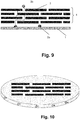
- An advantage of the PSAs used according to the invention comprising dried aqueous acrylate dispersions, and of the adhesive tapes which have a PSA on at least one side of the backing, is the formation of a layered silicate network which can act as a close-knit barrier layer (see Figure 9 ). It is assumed that the specific surface area of approx. 900 m 2 / g and the crystal form (see Figures 9 and 10 ) support this effect.
- the invention thus also relates to the use of modified layered silicates to form a close-knit barrier layer.
- the migration of plasticizer can thus be slowed down or almost prevented and the slipping of the plasticizer content in PVC, in particular in PVC cable insulation, into the area of the "brittle gaps" can be avoided.
- an anti-aging agent such as an antioxidant is preferably added to the PSA.
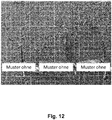
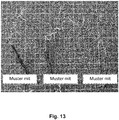
- adhesive resins are added to the PSA as explained above or below. In order to document the slowdown in the aging process, the color or the color stability of the cable insulation can be checked ( Figures 12 and 13 ).
- the cable color remains visible for a longer time (see Figure 13 ), which is to be regarded as a safety aspect and which also makes work significantly easier in the case of repairs.
- the gray color of the cable insulation can be clearly seen.
- the original yellow or light color of the cable insulation is still clearly visible.
- Plasticizers are added to plastics such as cable sheathing or sheathing in order to make them permanently flexible, supple and elastic.
- Plasticizers can be non-volatile resins, esters or oils.
- plasticizers include, for example, DINP, DIDP or TOTM.
- DOP dioctyl phthalate, di-2-ethylhexyl phthalate
- DINP diisononyl phthalate
- TOTM trioctyl trimellitate
- DINP diisodecyl phthalate
- External plasticizers are often used, which are not covalently bound into the polymer, but interact with the polymer via polar groups in order to enable the mobility of the polymer chains, for example Diethylhexyl phthalate (DEHP), dioctyl phthalate (DOP) as plasticizers for PVC and elastomers.
- DEHP Diethylhexyl phthalate
- DOP dioctyl phthalate
- Other plasticizers include citric acid based plasticizers such as citric acid triethyl ester or adipic acid based plasticizers such as diethylhexyl adipate and diethyl octyl adipate.
- the diffusion of these external plasticizers from the plastics of the cable insulation can be significantly reduced by the adhesive tapes according to the invention with PSAs.
- the internal plasticizers are understood to be those which are present during the copolymerization and are polymerized in and cannot subsequently diffuse out of the polymer.
- the organically modified, in particular nanodisperse, layered silicates as a finished dispersion to the PSAs or to the acrylate dispersions.
- the dispersions can be stirred into the PSA or adhesive dispersion without the action of high shear forces.
- the organically modified layered silicates can be added as solids.
- the organically modified layered silicates are present in the completely dried PSA as exfoliated, platelet-shaped crystals.
- Laponite SL25 as a barrier layer in the PSA means that the cable color remains visible for longer. This is considered a safety aspect because the embrittlement and aging of the cables is reduced. This also makes work much easier when it comes to repairs, as the cables have to be replaced less frequently and remain more flexible.
- Laponite SL25 also serves as a thickener for the aqueous dispersions and thus also acts as a processing aid.
- the dispersions produced in this way can therefore be applied to carrier materials using a wide variety of coating units, since the range of adjustable viscosities is large and the setting can be easily achieved by metering the modified layered silicates.
- Coating knives, comma squeegees, air squeegees, rollers, Meyer bars, nozzles, etc. can be used as coating units.
- the mixing of acrylic dispersions with predispersed layered silicates is very easy to do by stirring.
- the finely dispersed layered silicates can also be used to produce electrically conductive, antistatic coatings.
- This field of application is particularly interesting for electrically conductive adhesive tape applications, such as electromagnetic shielding.
- This property can be attributed to the large physical surface of the synthetic layered silicates, they can have surfaces of up to 1000 m 2 / g. Due to their crystal shape, these layered silicates can also perform a barrier function.
- the invention thus also relates to an adhesive tape and a pressure-sensitive adhesive comprising modified synthetic sheet silicates with a barrier function against plasticizers from cable insulation and a corresponding use.
- the acrylate dispersion used in the PSA in accordance with the invention contains polymers which are composed of monomeric acrylates and optionally ethylenically unsaturated comonomers which are not acrylates, the dried and non-ESH crosslinked acrylate dispersion preferably having a gel value of greater than or equal to 40%.
- Layered silicates or sheet or phyllosilicates are known as ion exchangers.
- Known layered silicates are clay minerals such as montmorrillonite, nontronite, hectorite, saponite, sauconite, beidellite, allevardite, IIIite, halloysite, attapulgite and / or sepiolite as well as disteardimonium hectorite.
- modified three-layer layered silicates or modified three-layer clay minerals used synonymously here, such as, for example, IIIite, smectite or vermiculite.
- modified layered silicates montmorillonite, hectorite or smectite are particularly preferably used in the PSAs of the invention.
- the unmodified layered silicates can be activated with polar additives and high shear forces to develop their full effectiveness (for example Product information for Tixogel ® VP-V (Quaternium-90 Bentonite) from Rockwood Additives Ltd. or to Bentone® 38 (organic derivative of a layered magnesium silicate (hectorite)) from Rheox Inc.
- polar additives and high shear forces for example, Product information for Tixogel ® VP-V (Quaternium-90 Bentonite) from Rockwood Additives Ltd. or to Bentone® 38 (organic derivative of a layered magnesium silicate (hectorite)) from Rheox Inc.
- Modified layered silicates can also be used under the names Laponite®, Optigel®, Laponite SL 25®, Laptonite S482®, Laptonite EP®, Laptonite RDS®, Optigel CK® from Rockwood.
- the natural and synthetic organically surface-modified three-layer layer silicates are preferred.
- the acrylate dispersions are characterized by the fact that to a certain extent there is still a separation of the polymer balls that result from the individual dispersion spheres (see, among others) BASF manual on painting technology, Artur Goldschmidt, Hans-Joachim Streitberger, 2002, chap. 3.1.2.1, Fig. 3.1.5, p. 337 ff .).
- the molecular weight cannot reasonably be determined due to the high gel content.
- the high gel content results from the chain transfer reactions in the dispersion particles.
- the likelihood of such a crosslinking is high, since there are only growing polymer chains and monomers in the dispersion particles, so that this crosslinking is greatly increased compared to solvent polymerization.
- the peculiarity of the acrylate dispersions, especially the aqueous acrylate dispersions, is that this type of crosslinking creates branched molecules with a high molecular weight in the confined space of the dispersion particles.
- the high gel value of the acrylate dispersions also describes well the situation that they can often be used as PSAs without further crosslinking. Unlike acrylate hotmelts or solvent-based acrylate adhesives, which generally have to be crosslinked. Typical acrylic hotmelt compositions have a low gel value of 10%.
- the polymeric acrylate dispersions used in the PSAs of the invention have a gel value of greater than or equal to 40%, which can be determined by means of Soxhlet extraction, in particular greater than or equal to 45%.
- Typical acrylate dispersions as can be used according to the invention, are described in DE 10 2011 075 156 A1 .
- DE 10 2011 075 152 A1 and DE10 2011 075 160 A1 described.
- reference is made in full to these documents. These acrylic old dispersions are also explained in more detail below.
- a particular advantage of the PSAs according to the invention comprising modified layered silicates and acrylate dispersions, optionally resin-mixed acrylate dispersions, lies in the simple and economical individual adaptability of the PSA over the amount and type of modified layered silicates as well as in the simple and economical individual adaptability of the acrylate dispersions to the respective requirements and the desired carrier material.
- a second advantage is that optionally a desired crosslinking of the resin-modified acrylate dispersions after drying in the coating process can easily be carried out from the mass side by means of ESH in order to set the optimum of cohesion and adhesion (see Figure 10 ).
- a major advantage, which is evident in the properties of the acrylate dispersions, is that the acrylate dispersions - in contrast to hotmelt and solvent adhesives - retain to a certain extent a separation of the polymer balls that result from the individual dispersion balls.
- the ESH radiation possible according to the invention results in a wide-meshed crosslinking within the polymer column and leads to an increase in the molecular weight in the polymer column.
- almost none Cross-linking takes place between the polymer balls, so that the mass remains free-flowing and allows good wetting of the primer. This phenomenon can be proven by means of rheological investigations (such as DMA, dynamic mechanical analysis).
- the pressure-sensitive adhesives according to the invention comprising (i) acrylate dispersions and (ii) modified phyllosilicates offer particular advantages through very simple miscibility with predispersed resins, auxiliaries, fillers, anti-aging agents, etc. It is even possible to adjust the pressure-sensitive adhesives to be used according to the invention such that they also contain acrylate dispersions without additional crosslinking (ESH crosslinking) but in the presence of the modified layered silicates they can provide sufficient cohesion and at the same time can be used with good values for the unwinding forces on finished adhesive tape rolls.
- ESH crosslinking additional crosslinking
- the invention likewise relates to an adhesive tape according to the aforementioned features, the TFT value (threshold flagging time) of which, after an optional electron beam crosslinking (ESH), is preferably greater than or equal to 1000 minutes, in particular greater than 1500, preferably greater than 1700, particularly preferably greater equal to 2000 minutes, preferably greater than or equal to 2500 minutes.
- the TFT value threshold flagging time of which, after an optional electron beam crosslinking (ESH) of which, after an optional electron beam crosslinking (ESH), is preferably greater than or equal to 1000 minutes, in particular greater than 1500, preferably greater than 1700, particularly preferably greater equal to 2000 minutes, preferably greater than or equal to 2500 minutes.
- PSAs comprising acrylate dispersions and modified phyllosilicates used according to the invention
- small suitable electron beam doses of 5 kGy to 10 kGy, particularly preferably 10 to 20 kGy, 20 to 30 kGy, 30 to 40 kGy, in particular 10 to 40 kGy, alternatively particularly preferably 35 to 45 kGy or greater than or equal to 40 to a maximum of 50 kGy, expediently up to 80 kGy.
- TFT values are sufficient, in particular as an ESH dose from the mass side, to have TFT values of greater than 1500 minutes, preferably greater than 2000 minutes, preferably greater than 2100, particularly preferably greater than 2200, preferably TFT, depending on the carrier material and the particular PSA. Achieve values greater than 2500 or even greater than 3000 and greater than 4000 minutes.
- Adhesive tapes according to the invention also have a flagging behavior, measured as the length of the protruding tape end according to LV 312, of less than or equal to 4 mm, preferably less than or equal to 3 mm, particularly preferably less than or equal to 2 mm, preferably less than or equal to 1 mm to no flagging, each with a fluctuation range of plus / minus 0.5 mm, preferably of plus / minus 0.2 mm.
- the invention also relates to an adhesive tape with pressure-sensitive adhesive applied to one side of the backing, the basis weight of which is less than or equal to 120 g / m 2 , in particular less than or equal to 100 g / m 2 , preferably less than or equal to 90 g / m 2 , particularly preferably less than 80 g / m 2 , preferably less than or equal to 70 g / m 2 and in alternatives also equal to or equal to 60 g / m 2 and less than or equal to 50 g / m 2 , each with a fluctuation range of plus / minus 2 g / m 2 , preferably with plus / minus 1 g / m 2 , preferably TFT values of 1000 minutes can already be achieved with the non-ESH crosslinked PSAs.
- Adhesive tapes according to the invention are advantageously distinguished in that the TFT value (threshold flagging time) after electron beam crosslinking is approximately a factor of 2 greater than the TFT value before electron beam crosslinking (ESH).
- Small ESH doses of less than or equal to 40 kGy, in particular less than or equal to 35 kGy, particularly preferably less than or equal to 30 kGy, preferably of less than or equal to 20 kGy, up to less than or equal to 10 kGy are preferably sufficient for this purpose.
- Another object of the invention is also adhesive tapes with a pressure-sensitive adhesive comprising modified layered silicates applied to one side of the carrier and a carrier which is impregnated with an additional acrylate dispersion, this acrylate dispersion not being included in the weight per unit area of the pressure-sensitive adhesive.
- the impregnation can be applied with a basis weight of less than or equal to 30 g / m 2 , in particular less than or equal to 25 g / m 2 , preferably less than or equal to 20 g / m 2 , particularly preferably less than or equal to 10 g / m 2 , each with a fluctuation range of plus / minus 5 g / m 2 .
- the acrylate dispersions used for the impregnation are distinguished by the fact that, when dried, they preferably have only very little or no pressure-sensitive properties. It is therefore possible to use acrylate dispersions or, optionally, also polyurethane, rubber-based or SBR impregnations which, when dried, preferably have only very little or no pressure-sensitive properties. This prevents the layers from blocking on the bale.
- acrylic dispersions according to the invention with little or no pressure-sensitive properties, that is to say without resins, can be used.
- PSAs used according to the invention comprising (i) dried acrylate dispersions and (ii) modified layered silicates and a tackifier content, even with carrier materials whose basis weight can be varied over a wide range, such as from 30 to 250 g / m 2 , preferably from 50 to 200 g / m 2 , particularly preferably from 60 to 150 g / m 2 and / or their bending stiffness vary in the range from 0 to 30 mN / 60 mm as raw support (MD, machine direction), optionally from 2 to 30 mN / 60 mm as raw support (MD ) vary, and thus their bending stiffness is very different, very good flagging-free products can be obtained with good unrollability with little surface application of acrylic dispersions.
- the adhesive tapes represent a combination of fabric carrier and PSA, the fabric carrier having a basis weight of 50 to 250 g / m 2 , preferably 60 to 150 g / m 2 and the PSA having a basis weight of 30 to 150 g / m 2 , preferably from 50 to 150 g / m 2 , the carrier being particularly preferably a PET fabric.
- adhesive tapes with a combination of fleece backing / PSA the fleece backing having a basis weight of 30 to 250 g / m 2 , preferably 60 to 150 g / m 2 and the PSA having a basis weight of 20 to 150 g / m 2 , preferred from 50 to 150 g / m 2 .
- a particular advantage of the adhesive tapes according to the invention is that the viscosity of the PSA remains essentially unchanged due to the electron-steel crosslinking (ESH) or the electron-beam crosslinking of polymers takes place essentially within the polymer column, the molecular weight of the polymers in the Polymer balls increased compared to the unirradiated polymer balls, in particular the electron beam crosslinking of the polymers between the polymer balls is lower than the electron beam crosslinking within the polymer ball, preferably negligible.
- ESH electron-steel crosslinking
- the electron beam crosslinking of the polymers between the polymer balls is lower than the electron beam crosslinking within the polymer ball, preferably negligible.
- the adhesive tape for wrapping cables comprises a carrier and a PSA applied to at least one side of the carrier, comprising (i) a dried acrylate dispersion and (ii) modified layered silicates, the acrylate dispersion, in particular the undried acrylate dispersion, comprising polymers, which are constructed or obtainable from a) monomeric acrylates, which are selected from alkyl (meth) acrylates, preferably C 1 - to C 20 -alkyl (meth) acrylates, C 1 - to C 10 -hydroxyalkyl (meth) acrylates such as, in particular, hydroxyethyl - or hydroxypropyl (meth) acrylate, acid amides such as acrylamide or methacrylamide, and also mixtures of two or more of the monomers, from b) monomeric comonomers which are selected from ethylene, aromatic vinyl monomers such as styrene, ⁇ -methylstyrene and vinylto
- the adhesive tape for wrapping cables comprises a carrier and a pressure-sensitive adhesive applied to at least one side of the carrier, comprising (i) a dried acrylate dispersion and (ii) modified layered silicates, the acrylate dispersion comprising polymers that are constructed or obtainable from a) monomeric acrylates which are selected from acrylic acid or methacrylic acid, n-butyl acrylate, ethyl acrylate such as 2-ethylhexyl acrylate and mixtures of two or more monomers and di- or multifunctional monomers are selected from alkyl diacrylates such as 1,2-ethylene glycol diacrylate, 1,4 -Butanediol diacrylate, 1,6-hexanediol diacrylate, 1,8-octanediol diacrylate or 1,12-dodecanediol diacrylate, and triacrylates such as trimethylolpropane triacrylate, and tetraacrylates such
- Ethyl acrylate is preferred as the monomer (a.2) or at least some of the monomers (a.3).
- Preferred as monomer (a.1) is 2-ethylhexyl acrylate.
- the monomer (a.1) consists of 2-ethylhexyl acrylate and at the same time the monomer (a.2) or at least some of the monomers (a.3) consists of ethyl acrylate.
- the polymer is very particularly preferably composed of (a.1) 40 to 60% by weight of 2-ethylhexyl acrylate, (a.2) 60 to 40% by weight of ethyl acrylate, (a.3) 0 to 0.5% by weight.
- % of a di- or polyfunctional monomer (b) 0 to 5% by weight of an ethylenically unsaturated monomer having an acid or acid anhydride function and / or (a.4) 0 to 5% by weight of an ethylenically unsaturated acrylate monomer with an acid or acid anhydride function.
- Suitable monomers (b.1) are, for example, itaconic acid, maleic acid, fumaric acid and / or maleic anhydride and / or as monomers (a.4) 0 to 5% by weight of an ethylenically unsaturated arcylate monomer with an acid or Acid anhydride function such as preferably acrylic acid, methacrylic acid. Acrylic acid or methacrylic acid, optionally the mixture of the two, are preferred.
- polyfunctional ethylenically unsaturated monomer (b.1) is divinylbenzene and of ethylenically unsaturated acrylate monomers with an acid or acid anhydride function (a.4) alkyl diacrylates such as 1,2-ethylene glycol diacrylate, 1,4-butanediol diacrylate, 1.6 -Hexanediol diacrylate, 1,8-octanediol diacrylate or 1,12-dodecanediol diacrylate, Triacrylates such as trimethylolpropane triacrylate and tetraacrylates such as pentaerythritol tetraacrylate.
- alkyl diacrylates such as 1,2-ethylene glycol diacrylate, 1,4-butanediol diacrylate, 1.6 -Hexanediol diacrylate, 1,8-octanediol diacrylate or 1,12-dodecanediol diacrylate
- Monomers (a.2) include alkyl (meth) acrylates, preferably C 1 to C 20 alkyl (meth) acrylates, C 1 to C 10 hydroxyalkyl (meth) acrylates such as, in particular, hydroxyethyl or hydroxypropyl (meth) acrylate , Acid amides such as acrylamide or methacrylamide with the exception of the (b) forming monomers, aromatic vinyl monomers such as styrene, ⁇ -methylstyrene and vinyl toluene, vinyl esters of carboxylic acids containing up to 20 carbon atoms such as vinyl acetate or vinyl laurate, vinyl ethers from alcohols containing up to 10 carbon atoms such as vinyl methyl ether or Vinyl isobutyl ether, vinyl halides such as vinyl chloride or vinylidene dichloride, and unsaturated hydrocarbons with 2 to 8 carbon atoms such as ethylene, propene, butadiene, isoprene, 1-he
- polyfunctional ethylenically unsaturated monomers are alkyl diacrylates such as 1,2-ethylene glycol diacrylate, 1,4-butanediol diacrylate, 1,6-hexanediol diacrylate, 1,8-octanediol diacrylate or 1,12-dodecanediol diacrylate, triacrylates such as trimethylolpropanetraacrylate pentaerythritol.
- the polymer dispersion is produced by the process of emulsion polymerization of the components mentioned. Descriptions of this process are given, for example, in “ Emulsion Polymerization and Emulsion Polymers "by Peter A. Lovell and Mohamed S. EI-Aasser - Wiley-VCH 1997 - ISBN 0-471-96746-7 or in EP 1 378 527 B1 ,
- Acrylate PSAs according to the invention can typically be free-radically polymerized copolymers of acrylic acid alkyl esters or methacrylic acid alkyl esters of C 1 to C 20 alcohols, for example as monomers a) methyl acrylate, ethyl (meth) acrylate, n-butyl (meth) acrylate, t-butyl (meth) acrylate, cyclohexyl (meth) acrylate, 2-ethylhexyl (meth) acrylate, n-octyl (meth) acrylate, iso-octyl (meth) acrylate, n-decyl (meth) acrylate, n-dodecyl (meth) acrylate, tetradecyl ( meth) acrylate, lauryl (meth) acrylate, oleyl (meth) acrylate, palmityl (meth) acrylate and steary
- the comonomers for the preparation of the acrylate dispersions further include b) esters of ethylenically unsaturated di- and tricarboxylic acids and anhydrides such as ethyl maleate, dimethyl fumarate and ethyl methyl itaconate as well as vinyl aromatic monomers such as styrene, vinyl toluene, methyl styrene, n-butyl styrene, decyl styrene.
- polyfunctional ethylenically unsaturated monomers b) are suitable as crosslinking monomers, for example divinylbenzene.
- monomers (b.1) to achieve the advantageous properties are vinyl esters from carboxylic acids containing up to 20 carbon atoms, such as vinyl acetate or vinyl laurate, vinyl ethers from alcohols containing up to 10 carbon atoms, such as vinyl methyl ether or vinyl isobutyl ether, vinyl halides, such as vinyl chloride or vinylidene dichloride, and nitriles, such as acrylonitrile or Methacrylonitrile and unsaturated hydrocarbons with 2 to 8 carbon atoms such as ethylene, propene, butadiene, isoprene, 1-hexene or 1-octene.
- vinyl esters from carboxylic acids containing up to 20 carbon atoms such as vinyl acetate or vinyl laurate
- vinyl ethers from alcohols containing up to 10 carbon atoms such as vinyl methyl ether or vinyl isobutyl ether
- vinyl halides such as vinyl chloride or vinylidene dichloride
- nitriles such
- polyfunctional ethylenically unsaturated acrylate monomers (a.4) in a) can be used as crosslinking monomers.
- examples include alkyl diacrylates such as 1,2-ethylene glycol diacrylate, 1,4-butanediol diacrylate, 1,6-hexanediol diacrylate, 1,8-octanediol diacrylate or 1,12-dodecanediol diacrylate, triacrylates such as trimethylolpropane triacrylate and tetraacrylates such as pentaerythritol tetraacrylate.
- the group of these multifunctional monomers also includes UV-crosslinkable monomers such as, for example, derivatives of benzophenone or benzoin functionalized with (meth) acrylate.
- acrylate monomers are those which generate a latent crosslinking potential in the polymer and spontaneously (often catalyzed) lead to a network structure after the adhesive has dried.
- a monomer is, for example, glycidymethyacrylate, whose oxirane ring with hydroxyl or in particular carboxylate functions leads to a covalent bond with ring opening. This reaction takes place accelerated in the presence of zinc ions or especially in the presence of carboxyl functions and / or amines.
- the processing temperature of the adhesive must be above its glass transition temperature so that it has viscoelastic properties.
- Typical particle sizes of the dispersed polymers according to the invention range from 20 nm to 10 ⁇ m.
- the polymer dispersion is produced by the process of emulsion polymerization of acrylate and possibly other ethylenically unsaturated monomers.
- Rheology additives also called thickeners, are generally used to achieve the necessary shear viscosity.
- organic thickeners in turn split into two main active principles: (i) the thickening of the aqueous phase, i.e. not associative, and (ii) association formation between thickener molecule and particles, partly with the inclusion of the stabilizers (emulsifiers).
- Representatives of the first (i) group of substances are water-soluble polyacrylic acids and polycoacrylic acids, which form polyelectrolytes with a large hydrodynamic volume in the basic medium.
- ASE alkali swellable emulsion
- They are characterized by high resting shear viscosities and strong shear thinning.
- Another class of substances are the modified polysaccharides, in particular cellulose ethers such as carboxymethyl cellulose, 2-hydroxyethyl cellulose, carboxymethyl-2-hydroxyethyl cellulose, methyl cellulose, 2-hydroxyethyl methyl cellulose, 2-hydroxyethyl ethyl cellulose, 2-hydroxypropyl cellulose, 2-hydroxypropyl methyl cellulose, 2-hydroxybutyl methyl cellulose.
- This class of substances also includes less common polysaccharides such as starch derivatives and special polyethers.
- the active group of the (ii) associative thickeners are in principle block copolymers with a water-soluble middle block and hydrophobic end blocks, the end blocks interacting with the particles or with themselves and thereby forming a spatial network including the particles.
- Typical representatives are familiar to the person skilled in the art as HASE (hydrophobically modified alkali swellable emulsion), HEUR (hydrophobically modified ethylene oxide urethane) or HMHEC (hydrophobically modified hydroxyethyl cellulose).
- HASE hydrophobically modified alkali swellable emulsion
- HEUR hydrophobically modified ethylene oxide urethane
- HMHEC hydrophobically modified hydroxyethyl cellulose
- Both The middle block of HASE thickeners is an ASE, the end blocks are mostly long, hydrophobic alkyl chains coupled via polyethylene oxide bridges.
- the water-soluble middle block is a polyurethane, in the HMHEC a 2-hydroxye
- the associative thickeners cause more or less Newtonian (shear rate independent) or pseudoplastic (shear liquefying) flow behavior. Sometimes they also show a thixotropic character, which means that they show not only a shear force dependence of the viscosity but also a time dependence.
- the inorganic thickeners are mostly layered silicates of natural or synthetic origin, examples are hectorites and smectites.
- the individual layers separate from each other in contact with water. Due to different charges on the surfaces and edges of the platelets, they calmly form a space-filling card house structure, which results in high resting shear viscosities up to flow limits.
- the card house structure collapses when sheared and a significant drop in shear viscosity can be observed.
- concentration and geometrical dimensions of the platelets the structure can take some time, so that thixotropy can also be achieved with such inorganic thickeners.
- thickeners can be stirred directly into the adhesive dispersion or some are advantageously prediluted or predispersed in water beforehand. Typical use concentrations are 0.1 to 5% by weight based on the solids. Providers of thickeners are, for example, OMG Borchers, Omya, Byk Chemie, Dow Chemical Company, Evonik, Rockwood or Münzing Chemie.
- aromatic vinyl monomers such as styrene, ⁇ -methylstyrene and vinyltoluene, vinyl esters from carboxylic acids containing up to 20 carbon atoms such as vinyl acetate or vinyl laurate, vinyl ethers from alcohols containing up to 10 carbon atoms such as vinyl methyl ether or vinyl isobutyl ether, vinyl halides such as vinyl chloride or vinylidene dichloride and unsaturated hydrocarbons with 2 to 8 carbon atoms such as ethylene, propene, butadiene, isoprene, 1-hexene or 1-octene.
- aromatic vinyl monomers such as styrene, ⁇ -methylstyrene and vinyltoluene
- vinyl esters from carboxylic acids containing up to 20 carbon atoms such as vinyl acetate or vinyl laurate
- vinyl ethers from alcohols containing up to 10 carbon atoms such as vinyl methyl ether or vinyl isobutyl ether
- the adhesive must be above its glass transition temperature at the processing temperature in order to have viscoelastic properties. Since the cable set winding takes place at normal ambient temperature (approximately between 15 ° C to 25 ° C), the glass transition temperature of the PSA formulation (polymer-tackifier mixture) is preferably below +15 ° C (determined with DSC (Differential Scanning Calorimetry) according to DIN 53 765 a heating rate of 10 K / min).
- Another particularly preferred embodiment of the invention thus comprises a mixture of 2-ethylhexyl acrylate as monomer (a.1) and ethyl acrylate as monomer (a.2) and terpene phenols and / or rosin esters with a softening point above 90 ° C. according to ASTM E28-99 (2009).
- compositions include, for example: Polymer 1 50% by weight 2-ethylhexyl acrylate 2% by weight acrylic acid 48% by weight ethyl acrylate Polymer 2 81% by weight 2-ethylhexyl acrylate 1% by weight acrylic acid 18% by weight methyl acrylate Polymer 3 84% by weight butyl acrylate 1% by weight acrylic acid 8% by weight methyl acrylate 7% by weight vinyl acrylate
- the listed PSAs were formulated from polymer 1 by mixing with adhesive resin dispersions.
- the number indicates the parts by weight of tackifier based on 100 parts by weight of polymer 1 (in each case based on solids).
- acrylonitrile and / or methacrylonitrile preferably form the monomer (b.2) or at least some of the monomers (b.2), particularly preferably acrylonitrile.
- 2-Ethylhexyl acrylate preferably forms monomer (a.1).
- the monomer (a.1) consists of 2-ethylhexyl acrylate and at the same time the monomer (b.2) or at least some of the monomers (b.2) consists of acrylonitrile and / or methacrylonitrile, preferably acrylonitrile.
- a particularly preferred embodiment of the invention thus comprises a mixture of 2-ethylhexyl acrylate as monomer (a.1) and acrylonitrile as monomer (b.2).
- Suitable monomers (a.4) are, for example, acrylic acid, methacrylic acid. Acrylic acid or methacrylic acid, optionally the mixture of the two, are preferred.
- the monomer (b.1) may advantageously be, for example, itaconic acid, maleic acid, fumaric acid and / or maleic anhydride.
- Monomers (a.2) include alkyl (meth) acrylates, preferably C 1 to C 20 alkyl (meth) acrylates, with the exception of the monomers forming (a.1), C 1 to C 10 hydroxyalkyl (meth) acrylates such as in particular hydroxyethyl or hydroxypropyl (meth) acrylate, acid amides such as acrylamide or methacrylamide. Acrylonitrile is particularly preferred according to the invention.
- Monomers (b.2) also include aromatic vinyl monomers such as styrene, ⁇ -methylstyrene and vinyltoluene, vinyl esters of carboxylic acids containing up to 20 carbon atoms such as vinyl acetate or vinyl laurate, vinyl ethers of alcohols containing up to 10 carbon atoms such as vinyl methyl ether or vinyl isobutyl ether, vinyl halides such as vinyl chloride or Vinylidene dichloride and unsaturated hydrocarbons with 2 to 8 carbon atoms such as ethylene, propene, butadiene, isoprene, 1-hexene or 1-octene, acrylonitrile and methacrylonitrile.
- aromatic vinyl monomers such as styrene, ⁇ -methylstyrene and vinyltoluene
- vinyl esters of carboxylic acids containing up to 20 carbon atoms such as vinyl acetate or vinyl laurate
- polyfunctional ethylenically unsaturated monomers (a.3) are, alkyl diacrylates such as 1,2-ethylene glycol diacrylate, 1,4-butanediol diacrylate, 1,6-hexanediol diacrylate, 1,8-octanediol diacrylate or 1,12-dodecanediol diacrylate, triacrylates such as trimethylolpropane tetraacrylate such as pentaerythritol tetraacrylate.
- alkyl diacrylates such as 1,2-ethylene glycol diacrylate, 1,4-butanediol diacrylate, 1,6-hexanediol diacrylate, 1,8-octanediol diacrylate or 1,12-dodecanediol diacrylate
- triacrylates such as trimethylolpropane tetraacrylate such as pentaerythritol tetraacrylate.
- compositions of the polymer dispersions are: Polymer 1 93% by weight 2-ethylhexyl acrylate 4% by weight acrylic acid 3% by weight acrylonitrile Polymer 2 92% by weight of 2-ethylhexyl acrylate 2% by weight acrylic acid 6% by weight methyl methacrylate Polymer 3 95% by weight of butyl acrylate 1% by weight acrylic acid 4% by weight vinyl acetate
- the monomer (a.1) is preferably n-butyl acrylate and / or 2-ethylhexyl acrylate.
- Monomers (a.2) include alkyl (meth) acrylates, preferably C 1 to C 20 alkyl (meth) acrylates, C 1 to C 10 hydroxyalkyl (meth) acrylates such as, in particular, hydroxyethyl or hydroxypropyl (meth) acrylate , Acid amides such as acrylamide and / or methacrylamide.
- Monomers (b.2) include (b) forming monomers such as aromatic vinyl monomers such as divinylbenzene, styrene, ⁇ -methylstyrene and vinyltoluene, vinyl esters from carboxylic acids containing up to 20 carbon atoms, such as vinyl laurate, vinyl ethers from alcohols containing up to 10 carbon atoms, such as vinyl methyl ether or vinyl isobutyl ether , Vinyl halides such as vinyl chloride or vinylidene dichloride and unsaturated hydrocarbons with 3 to 8 carbon atoms such as propene, butadiene, isoprene, 1-hexene or 1-octene or mixtures thereof. Divinylbenzene can be added at 0 to 1% by weight.
- aromatic vinyl monomers such as divinylbenzene, styrene, ⁇ -methylstyrene and vinyltoluene
- a di- or polyfunctional monomer can advantageously be added to the polymer as monomer (a.3), preferably 0 to 2% by weight and particularly preferably 0 to 1% by weight.
- polyfunctional ethylenically unsaturated acrylate monomers are alkyl diacrylates such as 1,2-ethylene glycol diacrylate, 1,4-butanediol diacrylate, 1,6-hexanediol diacrylate, 1,8-octanediol diacrylate or 1,12-dodecanediol diacrylate, triacrylates such as trimethylolpropane tetraacrylate tetracrylate tetraacrylate tetraacrylate tetraacrylate tetraacrylate tetraacrylate tetraacrylate tetraacrylate tetraacrylate tetraacrylate tetraacrylate tetraacrylate tetraacrylate tetraacrylate tetraacrylate
- the polymer dispersion is produced by the process of emulsion polymerization of the components mentioned.
- composition of further example polymer dispersion The example polymer dispersion was prepared according to example 1 of the EP 0 017 986 B1 made and contained accordingly Polymer 1 46.7% by weight of 2-ethylhexyl acrylate 31.1% by weight vinyl acetate 18% by weight of ethylene 2.6% by weight of acrylamide 1.6% by weight acrylic acid
- the pressure-sensitive adhesive In order to achieve pressure-sensitive adhesive properties, the pressure-sensitive adhesive must be above its glass transition temperature at the processing temperature in order to have viscoelastic properties. Since the cable harness winding takes place at normal ambient temperature (approximately between 15 ° C to 25 ° C), the glass transition temperature of the PSA (acrylic dispersion with tackifier mixture) is preferably below +15 ° C (determined with DSC (Differential Scanning Calorimetry) according to DIN 53 765 a heating rate of 10 K / min).
- DSC Different Scanning Calorimetry
- the glass transition temperature of the acrylate copolymers can be estimated according to the Fox equation from the glass transition temperatures of the homopolymers and their relative proportions (cf. TG Fox, Bull. Am. Phys. Soc. 1 (1956) 123 ).
- the tackifier inevitably increases the glass transition temperature by about 5 to 40 K, depending on the amount added, compatibility and softening temperature. Accordingly, only acrylate copolymers with a glass transition temperature of at most 0 ° C are suitable.
- the adhesive tape When winding a cable set, the adhesive tape is glued around the cable from not overlapping to completely overlapping, which generally has a small radius, so that the adhesive tape is very strongly curved. At the end of a winding section, the tape is usually wrapped predominantly on its own back, so that the degree of overlap is almost complete, similar to the usual form of administration as an adhesive tape roll, where the PSA is also glued to its own back.
- static forces such as those caused by the flexural rigidity of the carrier and the winding tension, which can lead to the open ends of the adhesive tape forming in an undesirable manner, are similar to those that begin automatic processing. The resistance to flagging is therefore the ability of the PSA to withstand this static force.
- tackifiers to increase the adhesive strength of PSAs is generally known. Therefore, the added tackifiers also contribute to the improved resistance to flagging. 10 to 75.9% by weight of tackifier are added to the PSA used in accordance with the invention.
- Tackifiers are, for example, hydrocarbon resins (for example polymers based on unsaturated C 5 or C 9 monomers), terpene phenol resins, polyterpene resins based on raw materials such as ⁇ - or ⁇ -pinene, aromatic resins such as coumarone-indene resins or resins based on Styrene or ⁇ -methylstyrene such as rosin and its secondary products such as disproportionated, dimerized or esterified rosin such as reaction products with glycol, glycerin or pentaerythritol, to name just a few.
- hydrocarbon resins for example polymers based on unsaturated C 5 or C 9 monomers
- terpene phenol resins for example polymers based on unsaturated C 5 or C 9 monomers
- polyterpene resins polyterpene resins based on raw materials such as ⁇ - or ⁇ -pinene
- aromatic resins such as coumarone-indene resins
- Resins without easily oxidizable double bonds such as terpene-phenol resins, aromatic resins and particularly preferably resins which are produced by hydrogenation, such as hydrogenated aromatic resins, hydrogenated polycyclopentadiene resins, hydrogenated rosin derivatives or hydrogenated polyterpene resins, are preferred. Resins based on terpene phenols and rosin esters are preferred. Also preferred are adhesive resins with a softening point above 80 ° C according to ASTM E28-99 (2009). Resins based on terpene phenols and rosin esters with a softening point above 90 ° C. according to ASTM E28-99 (2009) are particularly preferred.
- the resins are advantageously used in dispersion form. They can be mixed with the polymer dispersion in a finely divided manner. Rosin ester resins are particularly preferably added as tackifiers.
- a particularly preferred embodiment of the invention thus comprises a PSA comprising an acrylate dispersion of 2-ethylhexyl acrylate (monomer a.1) and ethyl acrylate (monomer a.2) and terpene phenols and / or rosin esters with a softening point above 90 ° C. according to ASTM E28-99 (2009).
- the adhesive formulation can optionally be mixed with light stabilizers or primary and / or secondary anti-aging agents.
- Products based on sterically hindered phenols, phosphites, thiosynergists, sterically hindered amines or UV absorbers can be used as anti-aging agents.
- Primary antioxidants such as Irganox 1010 or Irganox 254 are preferably used, alone or in combination with secondary antioxidants such as Irgafos TNPP or Irgafos 168.
- the anti-aging agents can be used in any combination with one another, mixtures of primary and secondary antioxidants in combination with light stabilizers such as Tinuvin 213 show particularly good anti-aging effects.
- Anti-aging agents have proven to be particularly advantageous, in which a primary antioxidant is combined with a secondary antioxidant in one molecule.
- These anti-aging agents are cresol derivatives, the aromatic ring of which is substituted at any two different positions, preferably in the ortho and meta position to the OH group, with thioalkyl chains, the sulfur atom also having one or more alkyl chains on the aromatic ring of the cresol component can be connected.
- the number of carbon atoms between the aromatic and the sulfur atom can be between 1 and 10, preferably between 1 and 4.
- the number of carbon atoms in the alkyl side chain can be between 1 and 25, preferably between 6 and 16.
- the amount of anti-aging agent or anti-aging agent package added should be in a range between 0.1 and 10% by weight, preferably in a range between 0.2 and 5% by weight, particularly preferably in a range between 0.5 and 3% by weight. -% based on the total solids content.
- the dosage form is preferred in the form of a dispersion for particularly simple miscibility with the adhesive dispersion.
- liquid anti-aging agents can also be incorporated directly into the dispersion, with the incorporation step being followed by a standing time of a few hours in order to enable homogeneous distribution in the dispersion or the inclusion of the anti-aging agent in the dispersion particles.
- Another alternative is to add an organic solution of the anti-aging agent to the dispersion. Suitable concentrations are in the range of 0.1 to 5 parts by weight based on the solids.
- rheology additives thickeners
- defoamers defoamers
- deaerators wetting agents
- leveling agents leveling agents
- Fillers such as silicon dioxide (spherical, needle-shaped, platelet-shaped or irregular like the pyrogenic silicas), glass as solid or hollow spheres, microballoons, calcium carbonates, zinc oxides, titanium dioxide, aluminum oxides or aluminum oxide hydroxides can both adjust the processability as well as serve technical adhesive properties. Suitable concentrations range from 0.1 to 20 parts by weight based on the solids.
- the PSA according to ASTM D3330 has an adhesive force on steel of greater than or equal to 4.5 N / cm with a basis weight of the PSA of 100 g / m 2 , preferably on a PET fabric as a carrier, particularly preferably with the mentioned Basis weights of the fabric.
- the PSA particularly preferably has an adhesive force of greater than or equal to or at least 4.5 N / cm (with a basis weight of the PSA of 90 g / m 2 on polyester fabric as a carrier, preferably already at 80 g / m 2 , particularly preferably at 70 g / m 2 on polyester fabric as a carrier).
- the pressure-sensitive adhesive according to ASTM D3330 particularly preferably has an adhesive force on steel of at least 5.0 N / cm (with a weight per unit area of the pressure-sensitive adhesive of 90 g / m 2 on polyester fabric as carrier), preferably greater than or equal to 5.2 N / cm, 5 , 3 N / cm, 5.4 N / cm, 5.5 N / cm, 5.6 N / cm or 5.7 N / cm, particularly preferably 5.7 to 6.0 N / cm.
- the invention also relates to an adhesive tape with a PSA and a PSA which, according to LV 312, preferably have a rolling force of 4.0 N / cm at 30 m / min, in particular less than or equal to 3.9 to 2.0, particularly preferably less than or equal to 3.8 N / cm to 2.0 N / cm, preferably also having an adhesive force on steel of at least 4.5 N / cm according to ASTM D3330 (with a weight per unit area of the pressure-sensitive adhesive of 100 g / m 2 on polyester fabric as carrier) becomes.
- the unwinding force of the adhesive tapes according to the invention can be set specifically and precisely. This is of particular interest for manually or mechanically attached adhesive tape tapes.
- the target size for machine-applied cable taping tapes is less than 4 N / cm at 30 m / min, for manual ones the values are 5 to 7 N / cm.
- the invention likewise relates to an adhesive tape with a pressure-sensitive adhesive or a pressure-sensitive adhesive which, according to ASTM D3330, has an adhesive force on the back of the backing of the adhesive tape of at least 3.0 N / cm (with a weight per unit area of the pressure-sensitive adhesive of 90 g / m 2 on polyester fabric as carrier).
- An adhesive force on the back of the backing of the adhesive tape is preferably greater than or equal to 2.0, in particular greater than or equal to 3.0 N / cm, preferably greater than or equal to 3.3 N / cm, particularly preferably greater than or equal to 3.5, or particularly preferably greater than obtained equal to 4.0 N / cm.
- the invention also relates to an adhesive tape with pressure-sensitive adhesive with a TFT value (threshold flagging time) of greater than or equal to 700 minutes, the pressure-sensitive adhesive comprising modified layered silicates, preferably greater than or equal to 800 minutes, particularly preferably greater than or equal to 1000 minutes.
- the content in% by weight of modified layered silicates is in the ranges mentioned, in particular the content of modified layered silicates in the PSA is between 0.1 to 5% by weight in the total PSA, based on the dried polymeric dispersion, are preferred 0.2 to 2.5% by weight
- the carrier is preferably a textile carrier, preferably a fabric, in particular a polyester fabric, a nonwoven or knitted fabric, it is further preferred if the support has a weight per unit area of 30 to 250 g / m 2 , preferably 50 to 200 g / m 2 , particularly preferably 60 to 150 g / m 2 .
- All known textile carriers such as knitted fabrics, scrims, ribbons, braids, needle pile textiles, felts, woven fabrics (including plain weave, twill and satin weave), knitted fabrics (including warp knitted fabrics and knitted fabrics) or nonwovens can be used, at least under "fleece” textile Sheets according to EN 29092 (1988) as well as stitchbonding fabrics and similar systems are to be understood.
- Spacer fabrics and knitted fabrics with lamination can also be used. Such spacer fabrics are used in the EP 0 071 212 B1 disclosed. Spacer fabrics are mat-shaped laminates with a cover layer made of a fiber or filament fleece, an underlayer and individual or tufts of holding fibers present between these layers, which are needled over the surface of the laminate and are needled through the particle layer and connect the cover layer and the underlayer to one another. As an additional, but not required, feature are according to EP 0 071 212 B1 Particles of inert rock particles such as sand, gravel or the like are present in the holding fibers. The holding fibers needled through the particle layer keep the cover layer and the underlay layer at a distance from one another and they are connected to the cover layer and the underlay layer.
- nonwovens are staple fiber nonwovens, but also filament, meltblown and spunbonded nonwovens, which usually have to be additionally consolidated.
- Mechanical, thermal and chemical bonding are known as possible bonding methods for nonwovens. If the fibers in mechanical strengthening are mostly held together mechanically by swirling the individual fibers, by meshing fiber bundles or by sewing in additional threads, then adhesive (with binder) or cohesive (binder-free) fiber-fiber can be used by thermal and chemical processes. Achieve bonds. With a suitable formulation and process control, these can be limited exclusively or at least predominantly to fiber nodes, so that a stable, three-dimensional network is nevertheless formed in the fleece while maintaining the loose, open structure.
- Nonwovens have proven to be particularly advantageous, in particular they are consolidated by sewing on with separate threads or by stitching.
- Solidified nonwovens of this type are produced, for example, on sewing-knitting machines of the "Malimo" type from Karl Mayer, formerly Malimo, and can be obtained from Techtex GmbH, among others.
- a Mali fleece is characterized in that a cross fiber fleece is consolidated by the formation of stitches from fibers of the fleece.
- a fleece of the Kunit or Multiknit type can also be used as the carrier.
- a synthetic fleece is characterized in that it results from the processing of a longitudinally oriented nonwoven fabric to form a flat structure which has meshes on one side and mesh webs or poly fiber folds on the other, but has neither threads nor prefabricated flat structures.
- Such a fleece has also been produced for a long time, for example, on sewing-knitting machines of the "Malimo" type from Karl Mayer. Another characteristic feature of this fleece is that it can absorb high tensile forces in the longitudinal direction as a longitudinal fiber fleece.
- a multi-knit fleece is characterized in comparison to the synthetic fleece in that the fleece is strengthened by both-sided piercing with needles on both the top and the bottom.
- the starting product for a Multiknit is usually one or two nonwoven fabrics with one-side mesh fabricated using the Kunit process. In the end product, both nonwoven tops are formed into a closed surface by fiber meshing and connected to one another by fibers standing almost vertically.
- nonwovens are also suitable as a preliminary product to form a carrier according to the invention and an adhesive tape according to the invention.
- a sewing fleece is formed from a fleece material with a plurality of seams running parallel to one another. These seams are created by sewing or sewing continuous textile threads. Sewing-knitting machines of the "Malimo" type from Karl Mayer are known for this type of fleece.
- Needle fleeces are also particularly suitable.
- a fibrous web becomes a flat structure with the help of barbed needles.
- the material is solidified on a needle bar, whereby the individual fibers intertwine to form a solid sheet.
- the number and design of the needling points determine the strength and strength of the fiber structures, which are usually light, breathable and elastic.
- a staple fiber nonwoven that is pre-consolidated by mechanical processing in the first step or that is a wet nonwoven that has been laid hydrodynamically, with between 2% and 50% by weight of the fibers of the nonwoven being melt fibers, in particular between 5 % By weight and 40% by weight of the fibers of the nonwoven.
- a fleece is characterized in that the fibers are laid wet or, for example, a staple fiber fleece is pre-consolidated by forming stitches from fibers of the fleece by needling, sewing, air and / or water jet processing.
- heat setting takes place, the strength of the fleece being increased again by melting or melting on the melt fibers.
- binders in solid, liquid, foamed or pasty form.
- binders in solid, liquid, foamed or pasty form.
- solid binders as powder for trickling in, as a film or as a mesh or in the form of binding fibers.
- Liquid binders can be applied in solution in water or organic solvents or as a dispersion.
- Binding dispersions are mainly chosen for adhesive bonding: thermosets in the form of phenol or melamine resin dispersions, elastomers as dispersions of natural or synthetic rubbers or mostly dispersions of thermoplastics such as acrylates, vinyl acetates, polyurethanes, styrene-butadiene systems, PVC and the like. and their copolymers. Normally, these are anionic or non-ionic stabilized dispersions, but in special cases, cationic dispersions can also be advantageous.
- binder can be applied according to the prior art and is, for example, in Standard works on coating or nonwoven technology such as “nonwovens” (Georg Thieme Verlag, Stuttgart, 1982 ) or “ Textile technology nonwovens production "(employers' group Automattextil, Eschborn, 1996 ) to read.
- one-sided spray application of a binder is ideal for changing surface properties in a targeted manner.
- the energy requirement for drying is also significantly reduced. Since no squeeze rollers are required and the dispersions predominantly remain in the upper area of the nonwoven, undesired hardening and stiffening of the nonwoven can be largely prevented.
- binders of the order of 1% to 50%, in particular 3% to 20%, based on the weight of the nonwoven are generally to be added.
- the binder can be added during the production of the fleece, during the mechanical pre-consolidation or in a separate process step, which can be carried out inline or off-line. After the binder has been added, a state must be temporarily created for the binder, in which it becomes sticky and adhesively bonds the fibers - this can be achieved during drying, for example, of dispersions, but also by heating, whereby further variations are possible via flat or partial application of pressure are.
- the activation of the binder can be carried out in known drying tunnels, but with suitable binder selection also by means of infrared radiation, UV radiation, ultrasound, high-frequency radiation or the like. For later end use, it makes sense, but not absolutely necessary, that the binder has lost its tack after the nonwoven manufacturing process.
- Another special form of adhesive bonding is that the binder is activated by dissolving or swelling.
- the fibers themselves or mixed special fibers can also take over the function of the binder.
- solvents are questionable or problematic in their handling for most polymeric fibers from an environmental point of view, this method is used rather rarely.
- the carrier has a surface that has been ground smooth on one or both sides, preferably in each case a surface that has been ground over the entire surface.
- the smooth surface may be chintoned, as in, for example the EP 1 448 744 A1 is explained. In this way, the repellency of dirt is improved.
- the starting materials for the carrier are in particular (chemical) fibers (staple or continuous filament) made of synthetic polymers, also called synthetic fibers, made of polyester, polyamide, polyimide, aramid, polyolefin, polyacrylonitrile or glass, (chemical) fibers made of natural polymers such as cellulosic fibers (Viscose, modal, lyocell, cupro, acetate, triacetate, cellulon), such as rubber fibers, such as vegetable protein fibers and / or such as animal protein fibers and / or natural fibers made of cotton, sisal, flax, silk, hemp, linen, coconut or wool.
- synthetic polymers also called synthetic fibers, made of polyester, polyamide, polyimide, aramid, polyolefin, polyacrylonitrile or glass
- (chemical) fibers made of natural polymers such as cellulosic fibers (Viscose, modal, lyocell, cupro, acetate, triacetate, cellulon), such as rubber
- the present invention is not limited to the materials mentioned; instead, a number of other fibers can be used for the production of the nonwoven, as can be recognized by the person skilled in the art without having to be inventive. Furthermore, yarns made from the aforementioned fiber materials are also suitable.
- individual threads can be made from a mixed yarn, i.e. they have synthetic and natural components.
- the warp threads and the weft threads are each designed in a type-specific manner.
- the warp threads and / or the weft threads can each consist only of synthetic threads or threads of natural raw materials.
- Polyester is preferred as the material for the carrier due to the excellent aging resistance and the excellent media resistance to chemicals and operating materials such as oil, petrol, antifreeze and the like.
- polyester has the advantages that it leads to a very abrasion-resistant and temperature-resistant carrier, which is of particular importance for the special application for bundling cables in automobiles and, for example, in the engine compartment.
- a carrier made of paper, a laminate, a film (for example PP, PE, PET, PA, PU), foam or a foamed film is also suitable for wrapping the elongated goods.
- non-textile sheet materials are particularly suitable when special requirements require such a modification of the invention.
- films are usually thinner than textiles, and offer a closed layer additional protection against the penetration of chemicals and operating materials such as oil, petrol, anti-freeze, etc. in the actual cable area and can be largely adapted to the requirements by suitable selection of the material: with polyurethanes, copolymers of polyolefins, for example, flexible and elastic sheaths can be produced, with polyester and polyamides good abrasion and temperature resistance are achieved.
- Foams or foamed foils contain the property of greater space filling and good noise insulation - if a cable harness is laid in a channel or tunnel-like area in the vehicle, for example, a rattling and vibrating that is suitable in terms of thickness and damping can be prevented from the outset.
- the adhesive tape can have a covering material with which the one or two layers of adhesive are covered until use. All materials detailed above are also suitable as covering materials.
- a lint-free material is preferably used, such as a plastic film or a well-glued, long-fiber paper.
- flame resistance of the adhesive tape described is desired, this can be achieved by adding flame retardants to the backing and / or the adhesive.
- flame retardants can be organic bromine compounds, if necessary with synergists such as antimony trioxide, but in view of the halogen-free nature of the adhesive tape red phosphorus, organophosphorus, mineral or intumescent compounds such as ammonium polyphosphate are preferably used alone or in conjunction with synergists.
- adheresive tape encompasses all sheetlike structures such as foils or foil sections extended in two dimensions, tapes with extended length and limited width, tape sections and the like, and ultimately also die-cuts or labels.
- the adhesive tape can be produced in the form of a roll, that is to say rolled up on itself in the form of an Archimedean spiral.
- a backside varnish can be applied to the back of the adhesive tape in order to improve the rolling properties of the Archimedes Spiral wound adhesive tape to influence favorably.
- this backside lacquer can be equipped with silicone or fluorosilicone compounds and with polyvinyl stearyl carbamate, polyethylene imine stearyl carbamide or organofluorine compounds as abhesive substances or for non-stick coating.
- the adhesive can be applied in the longitudinal direction of the adhesive tape in the form of a strip which has a smaller width than the carrier of the adhesive tape. Depending on the application, several parallel strips of the adhesive can also be coated on the carrier material. The position of the strip on the carrier is freely selectable, an arrangement directly on one of the edges of the carrier being preferred. The adhesive is preferably applied over the entire surface of the carrier.
- At least one strip of covering can be provided on the adhesive coating of the backing, which stripe extends in the longitudinal direction of the adhesive tape and which covers between 20% and 90% of the adhesive coating.
- the strip preferably covers a total of between 50% and 80% of the adhesive coating. The degree of coverage is selected depending on the application and the diameter of the cable set. The percentages given relate to the width of the covering strips in relation to the width of the support.
- exactly one strip of the covering is present on the adhesive coating.
- the position of the strip on the adhesive coating is freely selectable, an arrangement directly on one of the longitudinal edges of the carrier being preferred. This results in an adhesive strip extending in the longitudinal direction of the adhesive tape, which ends with the other longitudinal edge of the carrier. If the adhesive tape is used to sheath a cable harness by guiding the adhesive tape around the cable harness in a helical movement, the cable harness can be wrapped in such a way that the adhesive of the adhesive tape is only glued to the adhesive tape itself, while the material is not glued in Touch comes.
- the cable harness covered in this way is very flexible due to the lack of fixation of the cables by any adhesive. This significantly increases its bendability during installation - especially in narrow passageways or sharp bends.
- the sheathing can be carried out in such a way that the adhesive strip is partially glued to the adhesive tape itself and another part to the material.
- the strip is applied centrally to the adhesive coating, so that there are two adhesive strips extending on the longitudinal edges of the carrier in the longitudinal direction of the adhesive tape.
- the two adhesive strips present on the longitudinal edges of the adhesive tape are advantageous, particularly if one, which is usually narrower than the second strip, than Fixation aid and the second, wider strip serves as a closure.
- the adhesive tape is glued to the cable in such a way that the cable set is secured against slipping and yet is designed to be flexible.
- more than one strip of the covering is applied to the adhesive coating. If only one strip is mentioned, the expert reads in his mind that several strips can cover the adhesive coating at the same time.
- the PSA comprises modified layered silicates which are natural or synthetically produced three-layered layered silicates.
- Swellable modified sheet silicates are particularly preferably to be used, in particular they should be swellable in polar media, preferably in polar organic solvents, particularly preferably in water.
- the polar media are preferably water miscible polar solvents, such as protic or aprotic solvents. These can be ketones such as acetone, ethyl acetate, alcohols such as ethanol, THF or polar monomers of the acrylates.
- ESH electron beam crosslinking
- crosslinking takes place with 0.001 to 80 kGy, preferably with 5 to 80 kGy, particularly preferably with 10 to 50 kGy.
- crosslinking is carried out with 5 to 20 kGy or alternatively with 20 to 50 kGy, more preferably the side of the PSA which faces away from the carrier material is irradiated with electron beams (ESH), in particular the dose is 5 to 50 kGy, in particular 5 to 45 kGy , depending on the PSA 5 to 20 kGy or alternatively 20 to 50 kGy
- the PSA comprising (i) a polymeric acrylate dispersion and (ii) modified layered silicates, the PSA further contains between 15 and 100 parts by weight of a tackifier (based on the mass of the dried polymeric dispersion).
- the manufacturing process of the adhesive tape comprises coating the backing directly with the PSA in one or more successive operations.
- the untreated textile can be coated directly or using the transfer process.
- the textile can be pretreated with a coating or impregnation (with any film-forming substance from solution, dispersion, melt and / or radiation-curing) in order to then be provided with the PSA directly or in a transfer process in a subsequent step.
- the usual application units are: wire squeegees, coating bars, roller application, nozzle coating, double chamber doctor blade, multiple cascade nozzle.
- the PSA can additionally be crosslinked directly with electron beams, so that the PSA is not crosslinked by means of electron beams through the carrier side, but the electron beam source is directly facing the PSA which is not covered.
- the modified layered silicates are added in the form of a solution or dispersion.
- (iii) corresponds to 0.1 to 10% by weight of a solution of modified layered silicates, in particular a solution or dispersion with a content of approximately 25% by weight of modified layered silicates, 0.5 to 7.5% by weight being particularly preferred.
- % 1.0 to 7.0% by weight, 2.0 to 7.0% by weight, 2.0 to 5.0% by weight of the solution or dispersion. This means that even the smallest amounts of layered silicates are sufficient to build up a barrier layer.
- the solids content is independent of the mass of the dried polymeric dispersion or the dried solution.
- Pressure-sensitive adhesives or adhesive tapes used according to the invention are able to reduce the migration of plasticizers from cable sheaths of an elongated product, in particular they are able to reduce the plasticizer migration from an elongated product encased with PVC. As a result, the embrittlement of the cable insulation is suppressed and delayed in the long term.
- Another object of the invention is the use of electron beams for crosslinking PSAs used in accordance with the invention on carriers of adhesive tapes for wrapping cables, in particular for wrapping cables in the automotive sector, such as cable sets in motor vehicles, and generally cables that have special influences such as
- the invention therefore also relates to the use of electron beam (ESH) crosslinked adhesive tapes for wrapping cables, in particular cables which are exposed to elevated temperature and / or moisture. Due to the described positive properties, the adhesive tape can be used excellently for the insulation and winding of wires or cables.
- ESH electron beam
- the invention relates to the use of an adhesive tape according to the invention comprising modified layered silicates for sheathing elongated material, the adhesive tape being guided in a helical line around the elongated material or, alternatively, the elongated material being enveloped by the tape in the axial direction.
- the invention relates to an elongated product, such as in particular a cable set, encased with an adhesive tape according to the invention.
- the invention relates to the use of the adhesive tapes used according to the invention to reduce the migration of plasticizers from cable sheathing such as cable sheathing and cable insulation or to delay the embrittlement of cable sheathing, in particular to reduce plasticizer migration from PVC-sheathed cables.
- the use according to the invention makes it possible for the plasticizer content in% by weight in cable sheaths to be at least 60% of the original content in the cable sheath after at least 2000 h, in particular measured under or according to the conditions according to LV 312.
- the content is preferably of plasticizers in PVC cable sheaths, in particular the plasticizer TOTM comprising, DOP (dioctyl phthalate, di-2-ethylhexyl phthalate), DINP (diisononyl phthalate), TOTM (trioctyl trimellitate), DINP (di-isodecyl phthalate), citrate or adipic acid based plasticizers, such as adipate and Diethyloctyladipat ,
- the content of plasticizers in cable sheaths which are covered with the cable ties according to the invention is particularly preferably greater than or equal to 66% after 2000 h, preferably greater than or equal to 70%, particularly preferably greater than or equal to 80%, it being further preferred if the content after 2500 h or after 3000 h each independently at least 60% of the original plasticizer content. Contents greater than or equal to 66%, 70%, 75%, 80% or 85% are preferred.
- the adhesive tape can be used in a covering which consists of a covering, in which at least in one edge area of the covering there is the self-adhesive tape which is bonded to the covering in such a way that the adhesive tape covers one of the Longitudinal edges of the covering extends, and preferably in an edge region which is narrow compared to the width of the covering.
- a covering which consists of a covering, in which at least in one edge area of the covering there is the self-adhesive tape which is bonded to the covering in such a way that the adhesive tape covers one of the Longitudinal edges of the covering extends, and preferably in an edge region which is narrow compared to the width of the covering.
- the adhesive tape according to the invention can be used in a method such as the EP 1 367 608 A2 disclosed.
- the EP 1 315 781 A1 as well as the DE 103 29 994 A1 Embodiments of adhesive tapes, as are also possible for the adhesive tape according to the invention.
- the adhesive tape does not destroy the same when glued to cables with PVC sheathing and to cables with polyolefin sheathing if a composite of cables and adhesive tape according to LV 312 is stored at temperatures above 100 ° C. and up to 3000 h and then the Cables are bent around a mandrel.
- the adhesive tape according to the invention is outstandingly suitable for the wrapping of cables, can be easily unwound for simple processing, shows no or only slight flagging and shows no cable embrittlement even at the high temperature classes C and D over 3000 h.
- the cross-section shows the adhesive tape, which consists of a fabric carrier 1, to which a layer of a self-adhesive coating 2 is applied on one side.
- a section of a cable harness is shown, which is composed of a bundle of individual cables 7 and which is encased with the adhesive tape 11 according to the invention.
- the adhesive tape is guided around the wiring harness in a helical movement.
- the section of the wiring harness shown shows two windings I and II of the adhesive tape. Further windings would extend to the left, these are not shown here.
- two tapes 60, 70 according to the invention, equipped with an adhesive are mixed with one another (preferably by 50% each) with their adhesives, so that a product is produced as shown in Figure 3 is shown.
- a barrier layer 4 is shown schematically, which is composed of individual three-layer silicates 3 and prevent the migration of the plasticizer molecules 2a from the substrate 1, such as a cable insulation 1, to the outer surface of the adhesive tape, so that only small amounts of migrated plasticizer molecules 2b are present.
- Figure 10 shows schematically a single laptonite crystal with a diameter of approximately 25 nm and 0.92 nm thickness. There are partial charges on the outer edges.
- example adhesive tapes were produced according to the following scheme: the PSA dispersions were mixed from polymer and resin dispersion in accordance with the example formulations and were thoroughly homogenized with a stirrer. The pressure-sensitive adhesive dispersions were then adjusted to a viscosity of about 500 Pa * s at a shear rate of 0.1 s -1 by stirring in a modified layered silicate. A polyester fabric (according to the information in the examples) was coated with the thickened pressure-sensitive adhesive dispersion in such a way that after drying in a forced-air oven at 85 ° C. for 5 minutes, an adhesive weight per unit area of approximately 20 g / m 2 resulted.
- the fabric impregnated in this way was coated with the same dispersion in an analogous manner in a second working step, so that after drying in a forced-air oven at 85 ° C. for 10 minutes, a total adhesive weight of 90 g / m 2, or as specified in the examples, resulted.
- the criteria for an appropriate adhesive tape for wrapping cables is the adhesive strength on steel, the adhesive strength on the back in combination with the unwinding force at 30 m / min. Rolling power of rolls after storage at room temperature, approx. 23 ° C over 4 weeks and 50% humidity.
- a test is used in which an additional bending stress is generated by the application of the flat-prepared test specimens on a 11 ⁇ 2 "core.
- the combination of tensile load by a test weight and bending stress causes a flagging-like detachment of the adhesive tape from the glued upper end and a final failure due to the test specimens falling off (see Figure 4 , in which the schematic structure is also shown).
- the time in minutes before falling off is the result.
- the decisive parameters for the dwell time of the test specimens are weight and temperature, the weight being chosen so that values of at least 100 min result.
- the cylindrical test mandrel is 11 ⁇ 2 "cardboard core with an outside diameter of 42 ⁇ 2 mm, provided with a marking line 5 mm next to the apex line.
- the primer is the back of the tape.
- the hand roller has a weight of 2 kg.
- the test weight is 1 kg.
- the test climate is 23 ⁇ 1 ° C at 50 ⁇ 5% rel. Humidity or 40 ° C in the heating cabinet.
- test is carried out on strips of 19 mm wide adhesive tapes.
- a strip of 400 mm in length is glued to release paper and cut into three strips of 100 mm in length.
- a fresh cutter blade should be used.
- the back must not be touched.
- a cardboard card is glued under one of the ends of each strip and the composite is punched (see Figure 5 ).
- the test strips are now individually glued in the middle to strips of the wider adhesive base (adhesive tape 11 ⁇ 2 times the width of the adhesive tape to be tested), so that the cardboard card still overlaps by a little (2 to 3 mm) at the end (see Figure 6 ).
- the test specimens are rolled over with the 2 kg hand roller in 3 cycles at a speed of 10 m / min.
- the finished test samples i.e.
- test strips including the primer are now glued to the cardboard core so that the upper end of the test specimen overlaps the apex by 5 mm (see Figure 7 ). Only the primer and not the test specimen may be pressed on. The prepared specimens are left in a climate room at 40 ° C for 20 ⁇ 4 hours without any weight load.
- 0.5 to 1 g of a comminuted sample are extracted with 20 to 100 ml of toluene (n-toluene) in an ultrasonic bath for 60 minutes at 60 ° C.
- the plasticizer content is determined by GC-MS. With this method, plasticizer contents of 5 mg / kg can be detected.
- the gel value is determined by Soxhlet extraction, which is used to extract soluble ingredients from polymers in continuous extraction.
- the soluble fractions of a polymer - the so-called sol - are extracted from the insoluble fractions - the so-called gel - using a suitable solvent such as tetrahydrofuran.
- a suitable solvent such as tetrahydrofuran.
- smears of the adhesive compositions were first prepared.
- the dispersions were placed on a PET film (polyethylene terephthalate) with a thickness of 23 ⁇ m and knife-coated with a film-pulling device in such a way that after drying for 5 minutes at 105 ° C. in an air-circulating oven, an adhesive weight per unit area of 30 g / m 2 resulted.
- PET film polyethylene terephthalate
- Strips 20 mm wide and 25 cm long were cut out of this sheet with a cutter knife.
- smears on polyester fabric were used as described above and also with a cutter knife in strips 20 mm wide and 25 cm long cut.
- the bond strength to steel of the samples was measured according to ASTM D3330.
- the adhesive strength on the back was measured in accordance with ASTM D3330.
- the bending stiffness is determined with a KWS basic 2000mN softometer (Wolf Messtechnik GmbH). (MD) stands for machine direction, which means that the bending stiffness is determined in the machine direction.
- composition of a polymer dispersion according to the invention is a composition according to the invention.
- PSAs listed in Table 1 were formulated from polymer A by mixing with adhesive resin dispersions. The number indicates the parts by weight of tackifier based on 100 parts by weight of polymer A (in each case based on solids).
- Table 1 PSA comprising polymer ⁇ /b> Klebrigraumtyp softening Polymer A ° C 100 parts polymer A to 45 parts resin Rostack rosin ester resin 100G, Lawter 99 30% by weight
- the glass transition temperature of the PSA formulation was determined as dynamic Tg by means of rheological analysis (temperature sweep) at 7 to 8 ° C.
- Example 1 Carrier: PET fabric, 130 g / m 2 Warp: 48 threads / cm x 167 dtex Weft: 24 threads / cm x 167 dtex pressure-sensitive adhesive: Resin-modified acrylic dispersion, 90 g / m 2 (polymer A with 30% rosin ester resin) ⁇ b> ⁇ u> + addition of: ⁇ /u> ⁇ /b> 1.1 2.5% by weight (liquid on liquid) of a solution of a synthetic sheet silicate with a solids content of 25% by weight (Laponite SL 25, Rockwood).
- Carrier PET fabric, 130 g / m 2 Chain: 48 threads / cm x 167 dtex Shot: 24 threads / cm x 167 dtex pressure-sensitive adhesive: Resin-modified acrylic dispersion, 90 g / m 2 (Polymer A with 30% by weight rosin ester resin)
- Carrier PET fabric, 130 g / m 2 Chain: 48 threads / cm x 167 dtex Shot: 24 threads / cm x 167 dtex pressure-sensitive adhesive: Resin-modified acrylic dispersion, 90 g / m 2 (Polymer A with 30% by weight rosin ester resin) VG 1.1 5% by weight (solid on solid) of a fine kaolin type (Amazon Premium SD, Cadam company) VG 1.2 15% by weight (solid on solid) of a fine kaolin type (Amazon Premium SD, Cadam company) VG 1.3 25% by weight (solid on solid) of a fine kaolin type (Amazon Premium
- test series for example 1 shows impressively how the addition of an organically modified layered silicate can affect the unwinding forces of a PSA tape.
- a mass design already results which, in contrast to the original, unfilled mass (comparative example 1), is reduced by 3 N / cm in the rolling force , which corresponds to a percentage decrease of approx. 45%.
- the rolling force can be further reduced by adding larger amounts of the layered silicate. With a quantity of 5% by weight (liquid on liquid) the rolling force is already around 36% of the original value. Up to this point, the adhesive force on smooth surfaces (see KK steel) shows no significant drop. The slightly reduced flowability of the mass is more noticeable on the rough surface of the fabric back. The result is a decrease in the adhesive force on the back by approx. 1 N / cm compared to the unfilled mass.
- Comparative example 2 is used for comparison with a common filler based on kaolin. It is a very fine kaolin type with an average particle size of ⁇ 2 ⁇ m for the maximum diameter (at least 97% ⁇ 2 ⁇ m).
- the kaolin In contrast to the easily soluble organic modified layered silicate based on smectite, the kaolin is not so well distributed in the mass, which is why it is more likely to be present as a foreign body in the form of unintegrated phases. As a result, no three-dimensional network based on physical bonds between polymer chains and filler particles can form. As a result, a comparatively small decrease in the unwinding force can be observed even with high additions of 25% by weight (solid to solid) to the mass.
- the (instant) adhesive strength on rough substrates suffers enormously, however, since the coarse particles largely prevent rapid disintegration when the adhesive tape is pressed on.
- the adhesive strength on the back is accordingly reduced to a value of 40% of the initial value when the 25% by weight of kaolin is added.
- the effects on the flagging behavior are dramatic, since the adhesive tape is set up at the ends shortly after application in order to be able to compensate for the tensile and bending stresses that occur during the adhesive bonding.
- Comparative example 3 is used for comparison with the technical adhesive data of a commercially available fabric adhesive tape with an acrylate hotmelt coating.
- example adhesive tapes were produced according to the following scheme: the PSA dispersions were mixed from polymer and resin dispersion in accordance with the example formulations and were thoroughly homogenized with a stirrer. The pressure-sensitive adhesive dispersions were then adjusted to a viscosity of approximately 500 Pa * s at a shear rate of 0.01 s -1 by stirring in a polyurethane associative thickener (Borchigel 0625, OMG Borchers). A polyester fabric (according to the information in the examples) was coated with the thickened pressure-sensitive adhesive dispersion in such a way that after drying in a forced-air oven at 85 ° C. for 5 minutes, an adhesive weight per unit area of approximately 20 g / m 2 resulted.
- a polyurethane associative thickener Borchigel 0625, OMG Borchers
- the fabric impregnated in this way was coated with the same dispersion in a second step, so that after drying in a forced-air oven at 85 ° C for 10 minutes, a total adhesive weight of 60, 70 or 90 g / m 2 or according to the information in the examples resulted.
- Table 3 Samples SL 25 (Laptonite) - determination of viscosity (flow curve) at 25 ° C - rheology see Figure 11: sample name TV 416 mass 1 PS 34-468 + 30 wt .-% TR 602 + 1 wt .-% Borchigel 0625 TV 416 mass 2 PS 34-468 + 30 wt .-% TR 602 + 4.7 wt .-% SL 25 TV 416 mass 3 PS 34-468 + 30% by weight TR 602 + 1.51% by weight Evo Dot VD 2
- shear stress sweep (flow curve) at 25 ° C with a plate / cone measuring system, 1st shear stress sweep 25 ° C, with shear stress sweep ( Figure 11 ) the viscosity of the samples was shown.
- the values for the viscosity at 2 shear rates are shown in Table 4.
- Table 4 sample name Viscosity 0.1 s -1 Viscosity 1000 s -1 TV 416 mass 1 PS 34-468 + 30 wt .-% TR 602 + 1 wt .-% Borchigel 0625 (in Figure 11 labeled “1") 525 Pa s 0.61 Pa s TV 416 mass 2 PS 34-468 + 30 wt .-% TR 602 + 4.7 wt .-% SL 25 (in Figure 11 marked with “2”) 485 Pa s 0.33 Pa s TV 416 mass 3 PS 34
- the samples show the typical behavior of a thickened dispersion mass with pseudoplastic properties.
- A after aging, HS: kV test negative, R: cracks in the adhesive tape, W: line after winding around the mandrel not OK; K: Cable set burst; TS: Adhesive tape is no longer ticking; FL: color of insulation no longer recognizable; FT: discoloration of the adhesive tape (brown), ET: cable not OK when removing the adhesive tape; V: shifted cable band position; E: Line unraveling when untwisting.
- Example 1 with 5% by weight laponite:
Landscapes
- Chemical & Material Sciences (AREA)
- Organic Chemistry (AREA)
- Inorganic Chemistry (AREA)
- Adhesives Or Adhesive Processes (AREA)
- Adhesive Tapes (AREA)
Applications Claiming Priority (2)
| Application Number | Priority Date | Filing Date | Title |
|---|---|---|---|
| DE102014223451.4A DE102014223451A1 (de) | 2014-11-18 | 2014-11-18 | Modifizierte Schichtsilikate zur Steuerung der Abrollkraft von Haftklebemassen und Verbesserung der Barriereeigenschaften von Klebebändern |
| PCT/EP2015/075087 WO2016078888A1 (de) | 2014-11-18 | 2015-10-29 | Modifizierte schichtsilikate zur steuerung der abrollkraft von haftklebemassen und verbesserung der barriereeigenschaften von klebebändern |
Publications (2)
| Publication Number | Publication Date |
|---|---|
| EP3221411A1 EP3221411A1 (de) | 2017-09-27 |
| EP3221411B1 true EP3221411B1 (de) | 2020-01-08 |
Family
ID=54360476
Family Applications (1)
| Application Number | Title | Priority Date | Filing Date |
|---|---|---|---|
| EP15786976.9A Active EP3221411B1 (de) | 2014-11-18 | 2015-10-29 | Modifizierte schichtsilikate zur steuerung der abrollkraft von haftklebemassen und verbesserung der barriereeigenschaften von klebebändern |
Country Status (9)
| Country | Link |
|---|---|
| US (1) | US20170306187A1 (enExample) |
| EP (1) | EP3221411B1 (enExample) |
| JP (1) | JP6537609B2 (enExample) |
| CN (1) | CN107109157B (enExample) |
| BR (1) | BR112017009713A2 (enExample) |
| DE (1) | DE102014223451A1 (enExample) |
| ES (1) | ES2774383T3 (enExample) |
| MX (1) | MX2017006515A (enExample) |
| WO (1) | WO2016078888A1 (enExample) |
Cited By (1)
| Publication number | Priority date | Publication date | Assignee | Title |
|---|---|---|---|---|
| EP4349897A1 (en) * | 2022-10-07 | 2024-04-10 | Nexans | Cable with improved adsorption of chemical by-products |
Families Citing this family (13)
| Publication number | Priority date | Publication date | Assignee | Title |
|---|---|---|---|---|
| DE202017100009U1 (de) * | 2017-01-03 | 2017-01-20 | Certoplast Technische Klebebänder Gmbh | Klebeband, insbesondere Wickelband |
| DE102017114266B9 (de) * | 2017-06-27 | 2020-09-17 | Certoplast Technische Klebebänder Gmbh | Verfahren zur Herstellung eines Wickelbandes |
| PL3788112T3 (pl) * | 2018-05-02 | 2024-11-18 | Lohmann Gmbh & Co. Kg | Taśma klejąca możliwa do nawijania oraz wykrawania do selektywnej aktywacji promieniami UV |
| CN109375801B (zh) * | 2018-09-27 | 2021-06-22 | 广西中沛光电科技有限公司 | 一种触摸屏的贴合方法 |
| DE202018105611U1 (de) * | 2018-09-28 | 2018-10-15 | Certoplast Technische Klebebänder Gmbh | Technisches Klebeband insbesondere Kabelwickelband |
| CN113454151A (zh) | 2018-12-20 | 2021-09-28 | 艾利丹尼森公司 | 具有高填料含量的粘合剂 |
| DE202019100588U1 (de) * | 2019-01-31 | 2019-03-21 | Certoplast Technische Klebebänder Gmbh | Klebeband, insbesondere Wickelband |
| DE102019103121A1 (de) * | 2019-02-08 | 2020-08-13 | Tesa Se | Schrumpffolie und Verfahren zum Ummanteln von langgestrecktem Gut insbesondere Leitungen |
| CN114008157B (zh) * | 2019-08-07 | 2023-06-27 | 德莎欧洲股份公司 | 用于包护细长物品例如特别地电缆束的胶带以及包护方法 |
| CN114316836A (zh) * | 2020-09-29 | 2022-04-12 | 德莎欧洲股份公司 | 用于包护细长物品例如特别地电缆束的胶带及包护方法 |
| DE102020212233B4 (de) | 2020-09-29 | 2025-07-31 | Tesa Se | Klebeband zum Ummanteln von langgestrecktem Gut wie insbesondere Kabelsätzen und Verwendung des Klebebands zur Ummantelung |
| JP7114685B2 (ja) * | 2020-12-18 | 2022-08-08 | 日東電工株式会社 | 粘着シート |
| JP7176153B2 (ja) * | 2020-12-18 | 2022-11-21 | 日東電工株式会社 | 粘着シート |
Family Cites Families (38)
| Publication number | Priority date | Publication date | Assignee | Title |
|---|---|---|---|---|
| DE2915887A1 (de) | 1979-04-19 | 1980-11-06 | Wacker Chemie Gmbh | Copolymerisate auf der basis von acrylestern, vinylacetat und aethylen |
| IL66103A0 (en) | 1981-07-27 | 1982-09-30 | Tesch G H | Mat shaped composite body and its preparation |
| US5314944A (en) * | 1992-10-01 | 1994-05-24 | Moore Business Forms | Pressure sensitive adhesive |
| DE10036805A1 (de) | 2000-07-28 | 2002-02-07 | Tesa Ag | Verfahren zur Ummantelung von langgestrecktem Gut, wie insbesondere Kabelsätzen |
| DE10042732A1 (de) | 2000-08-31 | 2002-03-28 | Tesa Ag | Verfahren zur Ummantelung von langgestrecktem Gut, wie insbesondere Kabelsätzen mit einem Klebeband |
| WO2002024756A2 (en) * | 2000-09-21 | 2002-03-28 | Rohm And Haas Company | Hydrophobically modified clay polymer nanocomposites |
| US6617020B2 (en) * | 2001-04-04 | 2003-09-09 | 3M Innovative Properties Company | Hot melt processable pressure sensitive adhesive comprising organophilic clay plate-like particles, a method of making, and articles made therefrom |
| DE10149071A1 (de) | 2001-10-05 | 2003-04-17 | Tesa Ag | Verfahren zur Ummantelung von langgestrecktem Gut, wie insbesondere Kabelsätzen |
| MXPA04003523A (es) | 2001-10-16 | 2005-06-20 | Certoplast Vorwerk & Sohn Gmbh | Cinta adhesiva comprendiendo una superficie de soporte pulida. |
| DE10202454A1 (de) | 2002-01-22 | 2003-07-24 | Tesa Ag | Verfahren zum Ummanteln von langgestrecktem Gut, wie insbesondere Kabelsätzen, mit zwei streifenförmigen Eindeckungen, die das Gut schlauchartig umschließen |
| DE10208843A1 (de) | 2002-03-01 | 2003-09-11 | Basf Ag | UV-vernetzbare Schmelzhaftklebstoffe, enthaltend pyrogene Kieselsäuren |
| DE10229527A1 (de) | 2002-07-01 | 2004-01-15 | Tesa Ag | Band aus einer Reihe hintereinander und überlappend angeordneter einzelner Ummantelungsabschnitte zum Ummanteln von langgestrecktem Gut, wie insbesondere Kabelsätzen |
| DE10229733A1 (de) | 2002-07-02 | 2004-01-22 | Basf Ag | Haftklebstoffe für Träger aus Weich-PVC |
| DE10259616A1 (de) | 2002-12-18 | 2004-07-08 | Coroplast Fritz Müller Gmbh & Co. Kg | Auf sich selbst wickelbares Klebeband, seine Verwendung und Verfahren zu seiner Herstellung |
| DE10329994A1 (de) | 2003-07-02 | 2005-01-20 | Tesa Ag | Verfahren zur Ummantelung von langgestrecktem Gut, wie insbesondere Kabelsätzen, mit einem Klebeband |
| JP2005344008A (ja) * | 2004-06-03 | 2005-12-15 | Nitto Denko Corp | 剥離可能な感圧性接着シート |
| DE102004038776A1 (de) | 2004-08-09 | 2006-02-23 | Certoplast Vorwerk & Sohn Gmbh | Verwendung von vernetzter Kautschukmasse |
| DE102005017381A1 (de) | 2005-04-14 | 2006-10-19 | Tesa Ag | Verfahren zum Ummanteln von langgestrecktem Gut, wie insbesondere Kabelsätzen, mit einer Umhüllung |
| JP4732792B2 (ja) * | 2005-05-10 | 2011-07-27 | 日東電工株式会社 | 水分散型アクリル系粘着剤組成物と粘着シート |
| DE102005060156A1 (de) * | 2005-12-14 | 2007-06-21 | Tesa Ag | Wickelband aus einer TPU-Folie |
| JP2006315085A (ja) * | 2006-07-18 | 2006-11-24 | Sumitomo Heavy Ind Ltd | レーザ加工装置 |
| CN101191032A (zh) * | 2006-12-01 | 2008-06-04 | 3M创新有限公司 | 阻隔粘结涂层及其制备方法 |
| DE202007008003U1 (de) | 2007-06-05 | 2008-10-16 | Coroplast Fritz Müller Gmbh & Co. Kg | Gewebeklebeband |
| JP5250307B2 (ja) * | 2007-07-11 | 2013-07-31 | 日東電工株式会社 | 粘着型光学フィルムおよび画像表示装置 |
| DE102008032570A1 (de) * | 2008-07-11 | 2010-01-14 | Tesa Se | Haftklebemassen und Verfahren zu deren Herstellung |
| JP5534544B2 (ja) * | 2008-11-20 | 2014-07-02 | 住友電気工業株式会社 | 絶縁電線及び多層電線 |
| DE102009041898A1 (de) | 2009-09-18 | 2011-04-07 | Tesa Se | Abriebfestes Gewebeklebeband |
| DE202010001353U1 (de) | 2010-01-25 | 2010-04-01 | Basf Se | Klebstoffartikel, hergestellt mit einem aus Propylheptylacrylat aufgebautem Copolymer |
| US8664463B2 (en) * | 2010-10-06 | 2014-03-04 | Alfred E. Mann Institute For Biomedical Engineering At The University Of Southern California | Reversible adhesives |
| DE102011075160A1 (de) | 2011-05-03 | 2012-11-08 | Tesa Se | Verfahren zur Herstellung eines Klebebandes insbesondere zum Umwickeln von Kabeln aus einem offenen textilen Träger und einer darauf einseitig beschichteten Haftklebemasse |
| DE102011075152A1 (de) * | 2011-05-03 | 2012-11-08 | Tesa Se | Klebeband zum Ummanteln von langgestrecktem Gut wie insbesondere Kabelsätzen und Verfahren zur Ummantelung |
| DE102011075156A1 (de) | 2011-05-03 | 2012-11-08 | Tesa Se | Klebeband zum Ummanteln von langgestrecktem Gut wie insbesondere Kabelsätzen und Verfahren zur Ummantelung |
| DE102011075159A1 (de) | 2011-05-03 | 2012-11-08 | Tesa Se | Klebeband zum Ummanteln von langgestrecktem Gut wie insbesondere Kabelsätzen und Verfahren zur Ummantelung |
| DE102011089367A1 (de) * | 2011-12-21 | 2013-06-27 | Tesa Se | Haftklebemassen mit hohen Molmassen und enger Molmassenverteilung und Verfahren zu deren Herstellung |
| CN102732176B (zh) * | 2012-07-06 | 2014-04-09 | 中国航空工业集团公司北京航空材料研究院 | 一种剥离力可控的可剥离型聚丙烯酸酯压敏胶膜 |
| EP2695926A1 (de) * | 2012-08-07 | 2014-02-12 | tesa SE | ESH-vernetztes Klebeband zum Ummanteln von insbesondere Kabelsätzen und Verwendung zur Ummantelung |
| JP6002027B2 (ja) * | 2012-12-20 | 2016-10-05 | 住友電気工業株式会社 | 多層熱回復物品、ワイヤスプライス及びワイヤハーネス |
| EP2818527B1 (de) | 2013-06-24 | 2016-12-14 | Coroplast Fritz Müller GmbH & Co. KG | Klebeband, insbesondere doppelseitiges Klebeband, und dessen Verwendung zum Bekleben unpolarer Oberflächen |
-
2014
- 2014-11-18 DE DE102014223451.4A patent/DE102014223451A1/de not_active Withdrawn
-
2015
- 2015-10-29 US US15/526,119 patent/US20170306187A1/en not_active Abandoned
- 2015-10-29 EP EP15786976.9A patent/EP3221411B1/de active Active
- 2015-10-29 BR BR112017009713-3A patent/BR112017009713A2/pt not_active Application Discontinuation
- 2015-10-29 ES ES15786976T patent/ES2774383T3/es active Active
- 2015-10-29 WO PCT/EP2015/075087 patent/WO2016078888A1/de not_active Ceased
- 2015-10-29 JP JP2017526684A patent/JP6537609B2/ja active Active
- 2015-10-29 MX MX2017006515A patent/MX2017006515A/es unknown
- 2015-10-29 CN CN201580073606.0A patent/CN107109157B/zh active Active
Non-Patent Citations (1)
| Title |
|---|
| None * |
Cited By (1)
| Publication number | Priority date | Publication date | Assignee | Title |
|---|---|---|---|---|
| EP4349897A1 (en) * | 2022-10-07 | 2024-04-10 | Nexans | Cable with improved adsorption of chemical by-products |
Also Published As
| Publication number | Publication date |
|---|---|
| JP6537609B2 (ja) | 2019-07-03 |
| WO2016078888A1 (de) | 2016-05-26 |
| US20170306187A1 (en) | 2017-10-26 |
| CN107109157A (zh) | 2017-08-29 |
| EP3221411A1 (de) | 2017-09-27 |
| CN107109157B (zh) | 2021-03-23 |
| MX2017006515A (es) | 2017-08-10 |
| JP2017538810A (ja) | 2017-12-28 |
| ES2774383T3 (es) | 2020-07-20 |
| BR112017009713A2 (pt) | 2018-01-02 |
| DE102014223451A1 (de) | 2016-05-19 |
Similar Documents
| Publication | Publication Date | Title |
|---|---|---|
| EP2520628B1 (de) | Verwendung eines Klebebandes zum Ummanteln von langgestrecktem Gut wie insbesondere Kabelsätzen und langgestrecktes Gut umantelt mit dem Klebeband | |
| EP2522705B1 (de) | Verwendung eines Klebebandes zum Ummanteln von langgestrecktem Gut wie insbesondere Kabelsätzen und langestrecktes Gut ummantelt mit einem Klebeband | |
| EP2520629B1 (de) | Verfahren zur Herstellung eines Klebebandes zum Umwickeln von Kabeln aus einem offenen textilen Träger und einer darauf einseitig beschichteten Haftklebemasse | |
| EP2520627B1 (de) | Verwendung eines Klebebandes zum Ummanteln von langgestrecktem Gut wie insbesondere Kabelsätzen und langgestrecktes Gut umantelt mit dem Klebeband | |
| EP3433330B1 (de) | Klebeband zum ummanteln von langgestrecktem gut wie insbesondere kabelsätzen und verfahren zur ummantelung | |
| EP3221411A1 (de) | Modifizierte schichtsilikate zur steuerung der abrollkraft von haftklebemassen und verbesserung der barriereeigenschaften von klebebändern | |
| EP3540024B1 (de) | Klebeband zum ummanteln von langgestrecktem gut wie insbesondere kabelsätzen und verfahren zur ummantelung | |
| EP2695926A1 (de) | ESH-vernetztes Klebeband zum Ummanteln von insbesondere Kabelsätzen und Verwendung zur Ummantelung | |
| EP2826828B1 (de) | Verfahren zum Ummanteln von langgestrecktem Gut wie insbesondere Leitungen oder Kabelsätzen | |
| EP4092092B1 (de) | Klebeband zum ummanteln von langgestrecktem gut wie insbesondere kabelsätzen und verfahren zur ummantelung | |
| DE102008028427A1 (de) | Klebeband mit textilem Träger für die Kabelbandagierung | |
| DE102016212483A1 (de) | Gewebeklebeband | |
| EP2806005B1 (de) | UV-vernetzbare, harzmodifizierte Klebemasse | |
| DE102018213969A1 (de) | Klebeband zum Ummanteln von langgestrecktem Gut wie insbesondere Kabelsätzen und Verfahren zur Ummantelung | |
| DE102019211874B4 (de) | Klebeband zum Umwickeln von Kabeln und Verwendung | |
| DE102011005162A1 (de) | Klebeland für die Kabelbandagierung | |
| DE102017219658A1 (de) | Verfahren zur Herstellung eines Klebebandes | |
| DE102020212233B4 (de) | Klebeband zum Ummanteln von langgestrecktem Gut wie insbesondere Kabelsätzen und Verwendung des Klebebands zur Ummantelung | |
| WO2021023810A1 (de) | Klebeband zum ummanteln von langgestrecktem gut wie insbesondere kabelsätzen und verfahren zur ummantelung | |
| EP1418214A1 (de) | Selbstklebender Schutzartikel für mechanisch stark beanspruchte lackierte Automobilteile | |
| DE102019203489B3 (de) | Verwendung eines Klebebands zum Befestigen von Leitungen insbesondere auf Untergründen wie die Innenraum-Dekorteile eines Pkws, insbesondere Dachhimmel, Türseitenteil, Kofferraumdeckel | |
| EP4267688A1 (de) | Verfahren zur herstellung eines klebebandes |
Legal Events
| Date | Code | Title | Description |
|---|---|---|---|
| STAA | Information on the status of an ep patent application or granted ep patent |
Free format text: STATUS: THE INTERNATIONAL PUBLICATION HAS BEEN MADE |
|
| PUAI | Public reference made under article 153(3) epc to a published international application that has entered the european phase |
Free format text: ORIGINAL CODE: 0009012 |
|
| STAA | Information on the status of an ep patent application or granted ep patent |
Free format text: STATUS: REQUEST FOR EXAMINATION WAS MADE |
|
| 17P | Request for examination filed |
Effective date: 20170619 |
|
| AK | Designated contracting states |
Kind code of ref document: A1 Designated state(s): AL AT BE BG CH CY CZ DE DK EE ES FI FR GB GR HR HU IE IS IT LI LT LU LV MC MK MT NL NO PL PT RO RS SE SI SK SM TR |
|
| AX | Request for extension of the european patent |
Extension state: BA ME |
|
| RIN1 | Information on inventor provided before grant (corrected) |
Inventor name: MIES, MICHEL Inventor name: WIENKE, DANIEL Inventor name: SEITZER, DENNIS Inventor name: BOEHM, NICOLAI |
|
| DAV | Request for validation of the european patent (deleted) | ||
| DAX | Request for extension of the european patent (deleted) | ||
| TPAC | Observations filed by third parties |
Free format text: ORIGINAL CODE: EPIDOSNTIPA |
|
| TPAB | Information related to observations by third parties deleted |
Free format text: ORIGINAL CODE: EPIDOSDTIPA |
|
| STAA | Information on the status of an ep patent application or granted ep patent |
Free format text: STATUS: EXAMINATION IS IN PROGRESS |
|
| 17Q | First examination report despatched |
Effective date: 20180625 |
|
| TPAC | Observations filed by third parties |
Free format text: ORIGINAL CODE: EPIDOSNTIPA |
|
| REG | Reference to a national code |
Ref country code: DE Ref legal event code: R079 Ref document number: 502015011487 Country of ref document: DE Free format text: PREVIOUS MAIN CLASS: C09J0007020000 Ipc: C09J0007380000 |
|
| RIC1 | Information provided on ipc code assigned before grant |
Ipc: C09J 133/20 20060101ALI20190627BHEP Ipc: C09J 133/06 20060101ALI20190627BHEP Ipc: C09J 7/21 20180101ALI20190627BHEP Ipc: B60R 16/02 20060101ALN20190627BHEP Ipc: C09J 7/38 20180101AFI20190627BHEP Ipc: C09J 11/04 20060101ALI20190627BHEP |
|
| GRAP | Despatch of communication of intention to grant a patent |
Free format text: ORIGINAL CODE: EPIDOSNIGR1 |
|
| STAA | Information on the status of an ep patent application or granted ep patent |
Free format text: STATUS: GRANT OF PATENT IS INTENDED |
|
| INTG | Intention to grant announced |
Effective date: 20190802 |
|
| GRAS | Grant fee paid |
Free format text: ORIGINAL CODE: EPIDOSNIGR3 |
|
| GRAA | (expected) grant |
Free format text: ORIGINAL CODE: 0009210 |
|
| STAA | Information on the status of an ep patent application or granted ep patent |
Free format text: STATUS: THE PATENT HAS BEEN GRANTED |
|
| AK | Designated contracting states |
Kind code of ref document: B1 Designated state(s): AL AT BE BG CH CY CZ DE DK EE ES FI FR GB GR HR HU IE IS IT LI LT LU LV MC MK MT NL NO PL PT RO RS SE SI SK SM TR |
|
| REG | Reference to a national code |
Ref country code: GB Ref legal event code: FG4D Free format text: NOT ENGLISH |
|
| REG | Reference to a national code |
Ref country code: CH Ref legal event code: EP |
|
| REG | Reference to a national code |
Ref country code: DE Ref legal event code: R096 Ref document number: 502015011487 Country of ref document: DE |
|
| REG | Reference to a national code |
Ref country code: IE Ref legal event code: FG4D Free format text: LANGUAGE OF EP DOCUMENT: GERMAN |
|
| REG | Reference to a national code |
Ref country code: AT Ref legal event code: REF Ref document number: 1222689 Country of ref document: AT Kind code of ref document: T Effective date: 20200215 |
|
| REG | Reference to a national code |
Ref country code: NL Ref legal event code: MP Effective date: 20200108 |
|
| REG | Reference to a national code |
Ref country code: LT Ref legal event code: MG4D |
|
| REG | Reference to a national code |
Ref country code: ES Ref legal event code: FG2A Ref document number: 2774383 Country of ref document: ES Kind code of ref document: T3 Effective date: 20200720 |
|
| PG25 | Lapsed in a contracting state [announced via postgrant information from national office to epo] |
Ref country code: NL Free format text: LAPSE BECAUSE OF FAILURE TO SUBMIT A TRANSLATION OF THE DESCRIPTION OR TO PAY THE FEE WITHIN THE PRESCRIBED TIME-LIMIT Effective date: 20200108 Ref country code: RS Free format text: LAPSE BECAUSE OF FAILURE TO SUBMIT A TRANSLATION OF THE DESCRIPTION OR TO PAY THE FEE WITHIN THE PRESCRIBED TIME-LIMIT Effective date: 20200108 Ref country code: LT Free format text: LAPSE BECAUSE OF FAILURE TO SUBMIT A TRANSLATION OF THE DESCRIPTION OR TO PAY THE FEE WITHIN THE PRESCRIBED TIME-LIMIT Effective date: 20200108 Ref country code: NO Free format text: LAPSE BECAUSE OF FAILURE TO SUBMIT A TRANSLATION OF THE DESCRIPTION OR TO PAY THE FEE WITHIN THE PRESCRIBED TIME-LIMIT Effective date: 20200408 Ref country code: PT Free format text: LAPSE BECAUSE OF FAILURE TO SUBMIT A TRANSLATION OF THE DESCRIPTION OR TO PAY THE FEE WITHIN THE PRESCRIBED TIME-LIMIT Effective date: 20200531 Ref country code: FI Free format text: LAPSE BECAUSE OF FAILURE TO SUBMIT A TRANSLATION OF THE DESCRIPTION OR TO PAY THE FEE WITHIN THE PRESCRIBED TIME-LIMIT Effective date: 20200108 |
|
| PG25 | Lapsed in a contracting state [announced via postgrant information from national office to epo] |
Ref country code: SE Free format text: LAPSE BECAUSE OF FAILURE TO SUBMIT A TRANSLATION OF THE DESCRIPTION OR TO PAY THE FEE WITHIN THE PRESCRIBED TIME-LIMIT Effective date: 20200108 Ref country code: LV Free format text: LAPSE BECAUSE OF FAILURE TO SUBMIT A TRANSLATION OF THE DESCRIPTION OR TO PAY THE FEE WITHIN THE PRESCRIBED TIME-LIMIT Effective date: 20200108 Ref country code: HR Free format text: LAPSE BECAUSE OF FAILURE TO SUBMIT A TRANSLATION OF THE DESCRIPTION OR TO PAY THE FEE WITHIN THE PRESCRIBED TIME-LIMIT Effective date: 20200108 Ref country code: IS Free format text: LAPSE BECAUSE OF FAILURE TO SUBMIT A TRANSLATION OF THE DESCRIPTION OR TO PAY THE FEE WITHIN THE PRESCRIBED TIME-LIMIT Effective date: 20200508 Ref country code: GR Free format text: LAPSE BECAUSE OF FAILURE TO SUBMIT A TRANSLATION OF THE DESCRIPTION OR TO PAY THE FEE WITHIN THE PRESCRIBED TIME-LIMIT Effective date: 20200409 Ref country code: BG Free format text: LAPSE BECAUSE OF FAILURE TO SUBMIT A TRANSLATION OF THE DESCRIPTION OR TO PAY THE FEE WITHIN THE PRESCRIBED TIME-LIMIT Effective date: 20200408 |
|
| REG | Reference to a national code |
Ref country code: DE Ref legal event code: R097 Ref document number: 502015011487 Country of ref document: DE |
|
| PG25 | Lapsed in a contracting state [announced via postgrant information from national office to epo] |
Ref country code: SK Free format text: LAPSE BECAUSE OF FAILURE TO SUBMIT A TRANSLATION OF THE DESCRIPTION OR TO PAY THE FEE WITHIN THE PRESCRIBED TIME-LIMIT Effective date: 20200108 Ref country code: RO Free format text: LAPSE BECAUSE OF FAILURE TO SUBMIT A TRANSLATION OF THE DESCRIPTION OR TO PAY THE FEE WITHIN THE PRESCRIBED TIME-LIMIT Effective date: 20200108 Ref country code: CZ Free format text: LAPSE BECAUSE OF FAILURE TO SUBMIT A TRANSLATION OF THE DESCRIPTION OR TO PAY THE FEE WITHIN THE PRESCRIBED TIME-LIMIT Effective date: 20200108 Ref country code: EE Free format text: LAPSE BECAUSE OF FAILURE TO SUBMIT A TRANSLATION OF THE DESCRIPTION OR TO PAY THE FEE WITHIN THE PRESCRIBED TIME-LIMIT Effective date: 20200108 Ref country code: SM Free format text: LAPSE BECAUSE OF FAILURE TO SUBMIT A TRANSLATION OF THE DESCRIPTION OR TO PAY THE FEE WITHIN THE PRESCRIBED TIME-LIMIT Effective date: 20200108 Ref country code: DK Free format text: LAPSE BECAUSE OF FAILURE TO SUBMIT A TRANSLATION OF THE DESCRIPTION OR TO PAY THE FEE WITHIN THE PRESCRIBED TIME-LIMIT Effective date: 20200108 |
|
| PLBE | No opposition filed within time limit |
Free format text: ORIGINAL CODE: 0009261 |
|
| STAA | Information on the status of an ep patent application or granted ep patent |
Free format text: STATUS: NO OPPOSITION FILED WITHIN TIME LIMIT |
|
| 26N | No opposition filed |
Effective date: 20201009 |
|
| PG25 | Lapsed in a contracting state [announced via postgrant information from national office to epo] |
Ref country code: IT Free format text: LAPSE BECAUSE OF FAILURE TO SUBMIT A TRANSLATION OF THE DESCRIPTION OR TO PAY THE FEE WITHIN THE PRESCRIBED TIME-LIMIT Effective date: 20200108 |
|
| PG25 | Lapsed in a contracting state [announced via postgrant information from national office to epo] |
Ref country code: SI Free format text: LAPSE BECAUSE OF FAILURE TO SUBMIT A TRANSLATION OF THE DESCRIPTION OR TO PAY THE FEE WITHIN THE PRESCRIBED TIME-LIMIT Effective date: 20200108 Ref country code: PL Free format text: LAPSE BECAUSE OF FAILURE TO SUBMIT A TRANSLATION OF THE DESCRIPTION OR TO PAY THE FEE WITHIN THE PRESCRIBED TIME-LIMIT Effective date: 20200108 |
|
| REG | Reference to a national code |
Ref country code: CH Ref legal event code: PL |
|
| GBPC | Gb: european patent ceased through non-payment of renewal fee |
Effective date: 20201029 |
|
| PG25 | Lapsed in a contracting state [announced via postgrant information from national office to epo] |
Ref country code: LU Free format text: LAPSE BECAUSE OF NON-PAYMENT OF DUE FEES Effective date: 20201029 Ref country code: MC Free format text: LAPSE BECAUSE OF FAILURE TO SUBMIT A TRANSLATION OF THE DESCRIPTION OR TO PAY THE FEE WITHIN THE PRESCRIBED TIME-LIMIT Effective date: 20200108 |
|
| REG | Reference to a national code |
Ref country code: BE Ref legal event code: MM Effective date: 20201031 |
|
| PG25 | Lapsed in a contracting state [announced via postgrant information from national office to epo] |
Ref country code: GB Free format text: LAPSE BECAUSE OF NON-PAYMENT OF DUE FEES Effective date: 20201029 Ref country code: LI Free format text: LAPSE BECAUSE OF NON-PAYMENT OF DUE FEES Effective date: 20201031 Ref country code: CH Free format text: LAPSE BECAUSE OF NON-PAYMENT OF DUE FEES Effective date: 20201031 Ref country code: BE Free format text: LAPSE BECAUSE OF NON-PAYMENT OF DUE FEES Effective date: 20201031 |
|
| PG25 | Lapsed in a contracting state [announced via postgrant information from national office to epo] |
Ref country code: IE Free format text: LAPSE BECAUSE OF NON-PAYMENT OF DUE FEES Effective date: 20201029 |
|
| REG | Reference to a national code |
Ref country code: AT Ref legal event code: MM01 Ref document number: 1222689 Country of ref document: AT Kind code of ref document: T Effective date: 20201029 |
|
| PG25 | Lapsed in a contracting state [announced via postgrant information from national office to epo] |
Ref country code: AT Free format text: LAPSE BECAUSE OF NON-PAYMENT OF DUE FEES Effective date: 20201029 |
|
| PG25 | Lapsed in a contracting state [announced via postgrant information from national office to epo] |
Ref country code: TR Free format text: LAPSE BECAUSE OF FAILURE TO SUBMIT A TRANSLATION OF THE DESCRIPTION OR TO PAY THE FEE WITHIN THE PRESCRIBED TIME-LIMIT Effective date: 20200108 Ref country code: MT Free format text: LAPSE BECAUSE OF FAILURE TO SUBMIT A TRANSLATION OF THE DESCRIPTION OR TO PAY THE FEE WITHIN THE PRESCRIBED TIME-LIMIT Effective date: 20200108 Ref country code: CY Free format text: LAPSE BECAUSE OF FAILURE TO SUBMIT A TRANSLATION OF THE DESCRIPTION OR TO PAY THE FEE WITHIN THE PRESCRIBED TIME-LIMIT Effective date: 20200108 |
|
| PG25 | Lapsed in a contracting state [announced via postgrant information from national office to epo] |
Ref country code: MK Free format text: LAPSE BECAUSE OF FAILURE TO SUBMIT A TRANSLATION OF THE DESCRIPTION OR TO PAY THE FEE WITHIN THE PRESCRIBED TIME-LIMIT Effective date: 20200108 Ref country code: AL Free format text: LAPSE BECAUSE OF FAILURE TO SUBMIT A TRANSLATION OF THE DESCRIPTION OR TO PAY THE FEE WITHIN THE PRESCRIBED TIME-LIMIT Effective date: 20200108 |
|
| PGFP | Annual fee paid to national office [announced via postgrant information from national office to epo] |
Ref country code: ES Payment date: 20221222 Year of fee payment: 8 |
|
| REG | Reference to a national code |
Ref country code: ES Ref legal event code: FD2A Effective date: 20241216 |
|
| PG25 | Lapsed in a contracting state [announced via postgrant information from national office to epo] |
Ref country code: ES Free format text: LAPSE BECAUSE OF NON-PAYMENT OF DUE FEES Effective date: 20231030 |
|
| PG25 | Lapsed in a contracting state [announced via postgrant information from national office to epo] |
Ref country code: ES Free format text: LAPSE BECAUSE OF NON-PAYMENT OF DUE FEES Effective date: 20231030 |
|
| PGFP | Annual fee paid to national office [announced via postgrant information from national office to epo] |
Ref country code: DE Payment date: 20251021 Year of fee payment: 11 |
|
| PGFP | Annual fee paid to national office [announced via postgrant information from national office to epo] |
Ref country code: FR Payment date: 20251030 Year of fee payment: 11 |