EP3221293B1 - Ionizable cationic lipid for rna delivery - Google Patents
Ionizable cationic lipid for rna delivery Download PDFInfo
- Publication number
- EP3221293B1 EP3221293B1 EP15724466.6A EP15724466A EP3221293B1 EP 3221293 B1 EP3221293 B1 EP 3221293B1 EP 15724466 A EP15724466 A EP 15724466A EP 3221293 B1 EP3221293 B1 EP 3221293B1
- Authority
- EP
- European Patent Office
- Prior art keywords
- mol
- compound
- lipid
- consist
- atx
- Prior art date
- Legal status (The legal status is an assumption and is not a legal conclusion. Google has not performed a legal analysis and makes no representation as to the accuracy of the status listed.)
- Active
Links
Images


Classifications
-
- C—CHEMISTRY; METALLURGY
- C07—ORGANIC CHEMISTRY
- C07C—ACYCLIC OR CARBOCYCLIC COMPOUNDS
- C07C323/00—Thiols, sulfides, hydropolysulfides or polysulfides substituted by halogen, oxygen or nitrogen atoms, or by sulfur atoms not being part of thio groups
- C07C323/50—Thiols, sulfides, hydropolysulfides or polysulfides substituted by halogen, oxygen or nitrogen atoms, or by sulfur atoms not being part of thio groups containing thio groups and carboxyl groups bound to the same carbon skeleton
- C07C323/51—Thiols, sulfides, hydropolysulfides or polysulfides substituted by halogen, oxygen or nitrogen atoms, or by sulfur atoms not being part of thio groups containing thio groups and carboxyl groups bound to the same carbon skeleton having the sulfur atoms of the thio groups bound to acyclic carbon atoms of the carbon skeleton
- C07C323/60—Thiols, sulfides, hydropolysulfides or polysulfides substituted by halogen, oxygen or nitrogen atoms, or by sulfur atoms not being part of thio groups containing thio groups and carboxyl groups bound to the same carbon skeleton having the sulfur atoms of the thio groups bound to acyclic carbon atoms of the carbon skeleton with the carbon atom of at least one of the carboxyl groups bound to nitrogen atoms
-
- A—HUMAN NECESSITIES
- A61—MEDICAL OR VETERINARY SCIENCE; HYGIENE
- A61K—PREPARATIONS FOR MEDICAL, DENTAL OR TOILETRY PURPOSES
- A61K48/00—Medicinal preparations containing genetic material which is inserted into cells of the living body to treat genetic diseases; Gene therapy
- A61K48/0008—Medicinal preparations containing genetic material which is inserted into cells of the living body to treat genetic diseases; Gene therapy characterised by an aspect of the 'non-active' part of the composition delivered, e.g. wherein such 'non-active' part is not delivered simultaneously with the 'active' part of the composition
- A61K48/0025—Medicinal preparations containing genetic material which is inserted into cells of the living body to treat genetic diseases; Gene therapy characterised by an aspect of the 'non-active' part of the composition delivered, e.g. wherein such 'non-active' part is not delivered simultaneously with the 'active' part of the composition wherein the non-active part clearly interacts with the delivered nucleic acid
- A61K48/0033—Medicinal preparations containing genetic material which is inserted into cells of the living body to treat genetic diseases; Gene therapy characterised by an aspect of the 'non-active' part of the composition delivered, e.g. wherein such 'non-active' part is not delivered simultaneously with the 'active' part of the composition wherein the non-active part clearly interacts with the delivered nucleic acid the non-active part being non-polymeric
-
- A—HUMAN NECESSITIES
- A61—MEDICAL OR VETERINARY SCIENCE; HYGIENE
- A61K—PREPARATIONS FOR MEDICAL, DENTAL OR TOILETRY PURPOSES
- A61K9/00—Medicinal preparations characterised by special physical form
- A61K9/0012—Galenical forms characterised by the site of application
- A61K9/007—Pulmonary tract; Aromatherapy
- A61K9/0073—Sprays or powders for inhalation; Aerolised or nebulised preparations generated by other means than thermal energy
-
- A—HUMAN NECESSITIES
- A61—MEDICAL OR VETERINARY SCIENCE; HYGIENE
- A61K—PREPARATIONS FOR MEDICAL, DENTAL OR TOILETRY PURPOSES
- A61K9/00—Medicinal preparations characterised by special physical form
- A61K9/10—Dispersions; Emulsions
- A61K9/12—Aerosols; Foams
-
- A—HUMAN NECESSITIES
- A61—MEDICAL OR VETERINARY SCIENCE; HYGIENE
- A61K—PREPARATIONS FOR MEDICAL, DENTAL OR TOILETRY PURPOSES
- A61K9/00—Medicinal preparations characterised by special physical form
- A61K9/10—Dispersions; Emulsions
- A61K9/127—Synthetic bilayered vehicles, e.g. liposomes or liposomes with cholesterol as the only non-phosphatidyl surfactant
-
- A—HUMAN NECESSITIES
- A61—MEDICAL OR VETERINARY SCIENCE; HYGIENE
- A61K—PREPARATIONS FOR MEDICAL, DENTAL OR TOILETRY PURPOSES
- A61K9/00—Medicinal preparations characterised by special physical form
- A61K9/10—Dispersions; Emulsions
- A61K9/127—Synthetic bilayered vehicles, e.g. liposomes or liposomes with cholesterol as the only non-phosphatidyl surfactant
- A61K9/1271—Non-conventional liposomes, e.g. PEGylated liposomes or liposomes coated or grafted with polymers
- A61K9/1272—Non-conventional liposomes, e.g. PEGylated liposomes or liposomes coated or grafted with polymers comprising non-phosphatidyl surfactants as bilayer-forming substances, e.g. cationic lipids or non-phosphatidyl liposomes coated or grafted with polymers
-
- C—CHEMISTRY; METALLURGY
- C07—ORGANIC CHEMISTRY
- C07C—ACYCLIC OR CARBOCYCLIC COMPOUNDS
- C07C333/00—Derivatives of thiocarbamic acids, i.e. compounds containing any of the groups, the nitrogen atom not being part of nitro or nitroso groups
- C07C333/02—Monothiocarbamic acids; Derivatives thereof
- C07C333/04—Monothiocarbamic acids; Derivatives thereof having nitrogen atoms of thiocarbamic groups bound to hydrogen atoms or to acyclic carbon atoms
-
- C—CHEMISTRY; METALLURGY
- C07—ORGANIC CHEMISTRY
- C07C—ACYCLIC OR CARBOCYCLIC COMPOUNDS
- C07C333/00—Derivatives of thiocarbamic acids, i.e. compounds containing any of the groups, the nitrogen atom not being part of nitro or nitroso groups
- C07C333/02—Monothiocarbamic acids; Derivatives thereof
- C07C333/10—Monothiocarbamic acids; Derivatives thereof having nitrogen atoms of thiocarbamic groups being part of any of the groups, X being a hetero atom, Y being any atom, e.g., N-acyl-thiocarbamates
-
- C—CHEMISTRY; METALLURGY
- C07—ORGANIC CHEMISTRY
- C07J—STEROIDS
- C07J1/00—Normal steroids containing carbon, hydrogen, halogen or oxygen, not substituted in position 17 beta by a carbon atom, e.g. estrane, androstane
- C07J1/0003—Androstane derivatives
- C07J1/0007—Androstane derivatives not substituted in position 17
-
- C—CHEMISTRY; METALLURGY
- C07—ORGANIC CHEMISTRY
- C07J—STEROIDS
- C07J31/00—Normal steroids containing one or more sulfur atoms not belonging to a hetero ring
- C07J31/006—Normal steroids containing one or more sulfur atoms not belonging to a hetero ring not covered by C07J31/003
-
- C—CHEMISTRY; METALLURGY
- C07—ORGANIC CHEMISTRY
- C07J—STEROIDS
- C07J41/00—Normal steroids containing one or more nitrogen atoms not belonging to a hetero ring
- C07J41/0033—Normal steroids containing one or more nitrogen atoms not belonging to a hetero ring not covered by C07J41/0005
- C07J41/0055—Normal steroids containing one or more nitrogen atoms not belonging to a hetero ring not covered by C07J41/0005 the 17-beta position being substituted by an uninterrupted chain of at least three carbon atoms which may or may not be branched, e.g. cholane or cholestane derivatives, optionally cyclised, e.g. 17-beta-phenyl or 17-beta-furyl derivatives
-
- C—CHEMISTRY; METALLURGY
- C12—BIOCHEMISTRY; BEER; SPIRITS; WINE; VINEGAR; MICROBIOLOGY; ENZYMOLOGY; MUTATION OR GENETIC ENGINEERING
- C12N—MICROORGANISMS OR ENZYMES; COMPOSITIONS THEREOF; PROPAGATING, PRESERVING, OR MAINTAINING MICROORGANISMS; MUTATION OR GENETIC ENGINEERING; CULTURE MEDIA
- C12N15/00—Mutation or genetic engineering; DNA or RNA concerning genetic engineering, vectors, e.g. plasmids, or their isolation, preparation or purification; Use of hosts therefor
- C12N15/09—Recombinant DNA-technology
- C12N15/11—DNA or RNA fragments; Modified forms thereof; Non-coding nucleic acids having a biological activity
-
- A—HUMAN NECESSITIES
- A61—MEDICAL OR VETERINARY SCIENCE; HYGIENE
- A61K—PREPARATIONS FOR MEDICAL, DENTAL OR TOILETRY PURPOSES
- A61K9/00—Medicinal preparations characterised by special physical form
- A61K9/0012—Galenical forms characterised by the site of application
- A61K9/0043—Nose
-
- C—CHEMISTRY; METALLURGY
- C12—BIOCHEMISTRY; BEER; SPIRITS; WINE; VINEGAR; MICROBIOLOGY; ENZYMOLOGY; MUTATION OR GENETIC ENGINEERING
- C12N—MICROORGANISMS OR ENZYMES; COMPOSITIONS THEREOF; PROPAGATING, PRESERVING, OR MAINTAINING MICROORGANISMS; MUTATION OR GENETIC ENGINEERING; CULTURE MEDIA
- C12N15/00—Mutation or genetic engineering; DNA or RNA concerning genetic engineering, vectors, e.g. plasmids, or their isolation, preparation or purification; Use of hosts therefor
- C12N15/09—Recombinant DNA-technology
- C12N15/11—DNA or RNA fragments; Modified forms thereof; Non-coding nucleic acids having a biological activity
- C12N15/111—General methods applicable to biologically active non-coding nucleic acids
-
- C—CHEMISTRY; METALLURGY
- C12—BIOCHEMISTRY; BEER; SPIRITS; WINE; VINEGAR; MICROBIOLOGY; ENZYMOLOGY; MUTATION OR GENETIC ENGINEERING
- C12N—MICROORGANISMS OR ENZYMES; COMPOSITIONS THEREOF; PROPAGATING, PRESERVING, OR MAINTAINING MICROORGANISMS; MUTATION OR GENETIC ENGINEERING; CULTURE MEDIA
- C12N2310/00—Structure or type of the nucleic acid
- C12N2310/10—Type of nucleic acid
- C12N2310/14—Type of nucleic acid interfering nucleic acids [NA]
-
- C—CHEMISTRY; METALLURGY
- C12—BIOCHEMISTRY; BEER; SPIRITS; WINE; VINEGAR; MICROBIOLOGY; ENZYMOLOGY; MUTATION OR GENETIC ENGINEERING
- C12N—MICROORGANISMS OR ENZYMES; COMPOSITIONS THEREOF; PROPAGATING, PRESERVING, OR MAINTAINING MICROORGANISMS; MUTATION OR GENETIC ENGINEERING; CULTURE MEDIA
- C12N2320/00—Applications; Uses
- C12N2320/30—Special therapeutic applications
- C12N2320/32—Special delivery means, e.g. tissue-specific
Definitions
- nucleic acids A number of different types of nucleic acids are currently being developed as therapeutics for the treatment of a number of diseases. These nucleic acids include DNA in gene therapy, plasmids-based interfering nucleic acids, small interfering nucleic acids for use in RNA interference (RNAi), including siRNA, miRNA, antisense molecules, ribozymes and aptamers.
- RNAi RNA interference
- siRNA siRNA
- miRNA small interfering nucleic acids for use in RNA interference
- ribozymes aptamers.
- the present invention relates to novel lipid compositions that facilitate the intracellular delivery of biologically active and therapeutic molecules.
- the present invention relates also to pharmaceutical compositions that comprise such lipid compositions, and that are useful to deliver therapeutically effective amounts of biologically active molecules into the cells of patients.
- the delivery of a therapeutic compound to a subject is important for its therapeutic effects and usually it can be impeded by limited ability of the compound to reach targeted cells and tissues. Improvement of such compounds to enter the targeted cells of tissues by a variety of means of delivery is crucial.
- the present invention relates the novel lipids, in compositions and methods for preparation that facilitate the targeted intracellular delivery of biological active molecules.
- nucleic acids are currently being developed as therapeutics for the treatment of a number of diseases. These nucleic acids include DNA in gene therapy, plasmids, small interfering nucleic acids (siNA), siRNA, and microRNA (miRNA) for use in RNA interference (RNAi), antisense molecules, ribozymes, antagomirs, and aptamers.
- siNA small interfering nucleic acids
- miRNA microRNA
- RNAi RNA interference
- antisense molecules ribozymes
- antagomirs antagomirs
- aptamers RNA interference
- the claimed invention relates to compounds of formula III in which R 1 consists of a branched alkyl with 12 to 20 carbons; R 2 consists of a branched alkyl with 12 to 20 carbons; L 1 and L 2 each consist of a bond or a linear alkyl having 1 to 3 carbon atoms; X consists of S or O; L 3 consists of a bond; R 3 is selected from ethylene, n-propylene or isopropylene, and R 4 and R 5 are the same or different, each consisting of a linear or branched alkyl consisting of 1 to 6 carbons or a pharmaceutically acceptable salt thereof.
- X is S.
- R 3 is ethylene.
- R 3 is n-propylene or isopropylene.
- R 4 and R 5 are separately methyl, ethyl, or isopropyl.
- L 1 and L 2 each consist of a bond.
- L 1 and L 2 each consist of a methylene.
- R 1 and R 2 each consists of 19 or 20 carbon atoms.
- R 1 or R 2 each consists of 13 or 14 carbon atoms.
- L 3 consists of a bond
- R 3 is ethylene
- X is S
- R 4 and R 5 are each methyl.
- L 3 consists of a bond
- R 3 consists of n-propylene
- X consists of S
- R 4 and R 5 each consist of methyl.
- L 3 consists of a bond
- R 3 consists of isopropylene
- X consists of S
- R 4 and R 5 each consist of methyl.
- L 1 and L 2 may both consist of a linear alkylene consisting of five carbons.
- R 3 may be ethylene or propylene.
- R 4 and R 5 may be the same or different, each hydrogen, methyl, or ethyl.
- L 3 may be a bond.
- R 1 and R 2 may both consist of a linear alkenyl consisting of ten carbons.
- L 3 may consist of a bond.
- X may be S.
- R 3 may be ethylene.
- R 3 may be n-propylene or isopropylene.
- R 4 and R 5 may be separately methyl, ethyl, or isopropyl.
- L 1 and L 2 may each consist of a bond.
- L 1 and L 2 may each consist of a methylene.
- R 1 and R 2 may each consist of branched alkyl.
- R 2 may consist of an alkyl.
- R 1 and R 2 may each consist of 19 or 20 carbon atoms.
- R 1 or R 2 may each consist of 13 or 14 carbon atoms.
- L 2 may consist of methylene, R 3 may be ethylene, X 1 is -O-(CO)-, X 2 may be S, and R 4 and R 5 may both be methyl.
- L 2 may consist of a bond, R 3 may be ethylene, X 1 may be -O-(CO)-, X 2 may be S, and R 4 and R 5 may both be methyl.
- L 2 may consist of a bond
- R 3 may be n-propylene
- X 1 may be -O-(CO)-
- X 2 may be S
- R 4 and R 5 may both be methyl
- L 2 may consist of a bond
- R 3 may be isopropylene
- X 1 may be - O-(CO)-
- X 2 may be S
- R 4 and R 5 may both be methyl.
- compositions described herein are used in a method for treating cancer or inflammatory disease.
- the disease may be one selected from the group consisting of immune disorder, cancer, renal disease, fibrotic disease, genetic abnormality, inflammation, and cardiovascular disorder.
- At least one means one or more ( e.g., 1-3, 1-2, or 1).
- “Mammal” means a human or other mammal, or means a human being.
- Patient includes both human and other mammals, preferably human.
- Alkyl means a saturated straight or branched, hydrocarbon chain.
- the alkyl group has 1-18 carbon atoms, i.e. is a C 1 -C 18 group, or is a C 1 -C 12 group, a C 1 -C 6 group, or a C 1 -C 4 group.
- the alkyl group has zero branches ( i.e. , is a straight chain), one branch, two branches, or more than two branches.”
- Alkenyl means an unsaturated alkyl that may have one double bond, two double bonds, more than two double bonds.
- the substituents on an alkyl group are hydrocarbons, then the resulting group is simply referred to as a substituted alkyl.
- the alkyl group including substituents has less than 25, 24, 23, 22, 21, 20, 19, 18, 17, 16, 15, 14, 13, 12, 11, 10, 9, 8, or 7 carbons.
- “Lower alkyl” means a group having one to six carbon atoms in the chain which chain may be straight or branched.
- suitable alkyl groups include methyl, ethyl, n-propyl, isopropyl, n-butyl, t-butyl, n-pentyl, and hexyl.
- Alkoxyalkyl means an alkoxy-alkyl-group in which the alkoxy and alkyl are as previously described. Preferred alkoxyalkyl comprise a lower alkyl group. The bond to the parent moiety is through the alkyl.
- Alkylaryl means an alkyl-aryl-group in which the alkyl and aryl are as previously described. Preferred alkylaryls comprise a lower alkyl group. The bond to the parent moiety is through the aryl.
- Aminoalkyl means an NH 2 -alkyl-group, wherein alkyl is as defined above, bound to the parent moiety through the alkyl group.
- Carboxyalkyl means an HOOC-alkyl-group, wherein alkyl is as defined above, bound to the parent moiety through the alkyl group.
- “Commercially available chemicals” and the chemicals used in the Examples set forth herein may be obtained from standard commercial sources, where such sources include, for example, Acros Organics (Pittsburgh, Pa.), Sigma-Adrich Chemical (Milwaukee, Wis.), Avocado Research (Lancashire, U.K.), Bionet (Cornwall, U.K.), Boron Molecular (Research Triangle Park, N.C.), Combi-Blocks (San Diego, Calif.), Eastman Organic Chemicals, Eastman Kodak Company (Rochester, N.Y.), Fisher Scientific Co. (Pittsburgh, Pa.), Frontier Scientific (Logan, Utah), ICN Biomedicals, Inc.
- Halo means fluoro, chloro, bromo, or iodo groups. Preferred are fluoro, chloro or bromo, and more preferred are fluoro and chloro.
- Halogen means fluorine, chlorine, bromine, or iodine. Preferred are fluorine, chlorine and bromine.
- Heteroalkyl is a saturated or unsaturated, straight or branched, chain containing carbon and at least one heteroatom.
- the heteroalkyl group may, in various embodiments, have on heteroatom, or 1-2 heteroatoms, or 1-3 heteroatoms, or 1-4 heteroatoms.
- the heteroalkyl chain contains from 1 to 18 ( i.e., 1-18) member atoms (carbon and heteroatoms), and in various embodiments contain 1-12, or 1-6, or 1-4 member atoms.
- the heteroalkyl group has zero branches ( i.e ., is a straight chain), one branch, two branches, or more than two branches.
- the hetereoalkyl group is saturated.
- the heteroalkyl group is unsaturated.
- the unsaturated heterolkyl may have one double bond, two double bonds, more than two double bonds, and/or one triple bond, two triple bonds, or more than two triple bonds.
- Heteroalkyl chains may be substituted or unsubstituted. In one embodiment, the heteroalkyl chain is unsubstituted. In another embodiment, the heteroalkyl chain is substituted.
- a substituted heteroalkyl chain may have 1 substituent ( i.e ., by monosubstituted), or may have, e.g., 1-2 substituents, or 1-3 substituents, or 1-4 substituents.
- Exemplary heteroalkyl substituents include esters (-C(O)-O-R) and carbonyls (-C(O)-).
- Hydroxyalkyl means an HO-alkyl-group, in which alkyl is previously defined. Preferred hydroxyalkyls contain lower alkyl. Non-limiting examples of suitable hydroxyalkyl groups include hydroxymethyl and 2-hydroxyethyl.
- Lipid means an organic compound that comprises an ester of fatty acid and is characterized by being insoluble in water, but soluble in many organic solvents. Lipids are usually divided into at least three classes: (1) “simple lipids,” which include fats and oils as well as waxes; (2) “compound lipids,” which include phospholipids and glycolipids; and (3) “derived lipids” such as steroids.
- Solvate means a physical association of a compound of this disclosure with one or more solvent molecules. This physical association involves varying degrees of ionic and covalent bonding, including hydrogen bonding. In certain instances the solvate will be capable of isolation, for example when one or more solvent molecules are incorporated in the crystal lattice of the crystalline solid. "Solvate” encompasses both solution-phase and isolatable solvates. Non-limiting examples of suitable solvates include ethanolates, methanolates, and the like.
- Lipid conjugate means a conjugated lipid that inhibits aggregation of lipid particles.
- Such lipid conjugates include, but are not limited to, PEG-lipid conjugates such as, e.g., PEG coupled to dialkyloxypropyls ( e.g., PEG-DAA conjugates), PEG coupled to diacylglycerols ( e.g ., PEG-DAG conjugates), PEG coupled to cholesterol, PEG coupled to phosphatidylethanolamines, and PEG conjugated to ceramides, cationic PEG lipids, polyoxazoline (POZ)-lipid conjugates, polyamide oligomers (e.g ., ATTA-lipid conjugates), and mixtures thereof.
- PEG-lipid conjugates such as, e.g., PEG coupled to dialkyloxypropyls (e.g., PEG-DAA conjugates), PEG coupled to diacylglycerols ( e.g ., PEG-DA
- Amphipathic lipid means the material in which the hydrophobic portion of the lipid material orients into a hydrophobic phase, while the hydrophilic portion orients toward the aqueous phase. Hydrophilic characteristics derive from the presence of polar or charged groups such as carbohydrates, phosphate, carboxylic, sulfato, amino, sulfhydryl, nitro, hydroxyl, and other like groups. Hydrophobicity can be conferred by the inclusion of apolar groups that include, but are not limited to, long-chain saturated and unsaturated aliphatic hydrocarbon groups and such groups substituted by one or more aromatic, cycloaliphatic, or heterocyclic group(s). Examples of amphipathic compounds include, but are not limited to, phospholipids, arninolipids, and sphingolipids.
- phospholipids include, but are not limited to, phosphatidylcholine, phosphatidylethanolamine, phosphatidylserine, phosphatidylinositol, phosphatidic acid, palmitoyloleoyl phosphatidylcholine, lysophosphatidylcholine, lysophosphatidylethanolamine, dipalmitoylphosphatidylcholine, dioleoylphosphatidylcholine, distearoyl phosphatidylcholine, and dilinoleoylphosphatidylcholine.
- amphipathic lipids Other compounds lacking in phosphorus, such as sphingolipid, glycosphingolipid families, diacylglycerols, and ⁇ -acyloxyacids, are also within the group designated as amphipathic lipids. Additionally, the amphipathic lipids described above can be mixed with other lipids including triglycerides and sterols.
- Neutral lipid means a lipid species that exist either in an uncharged or neutral zwitterionic form at a selected pH. At physiological pH, such lipids include, for example, diacylphosphatidylcholine, diacylphosphatidylethanolamine, ceramide, sphingomyelin, cephalin, cholesterol, cerebrosides, and diacylglycerols.
- hydrophobic lipid means a compound having apolar groups that include, but are not limited to, long-chain saturated and unsaturated aliphatic hydrocarbon groups and such groups optionally substituted by one or more aromatic, cycloaliphatic, or heterocyclic group(s). Suitable examples include, but are not limited to, diacylglycerol, dialkylglycerol, N-N-dialkylamino, 1,2-diacyloxy-3-aminopropane, and 1,2-dialkyl-3-aminopropane.
- the cationic lipids comprise: a protonatable tertiary amine (e.g ., pH-titratable) head group; C 18 alkyl chains, wherein each alkyl chain independently has 0 to 3 ( e.g., 0, 1, 2, or 3) double bonds; and ether, ester, or ketal linkages between the head group and alkyl chains.
- a protonatable tertiary amine e.g ., pH-titratable
- C 18 alkyl chains wherein each alkyl chain independently has 0 to 3 ( e.g., 0, 1, 2, or 3) double bonds
- ether, ester, or ketal linkages between the head group and alkyl chains e.g., 1, 2, or 3
- substituted means substitution with specified groups other than hydrogen, or with one or more groups, moieties, or radicals which can be the same or different, with each, for example, being independently selected.
- an antisense molecule can bind to substrate such that the substrate molecule forms a loop, and/or an antisense molecule can bind such that the antisense molecule forms a loop.
- the antisense molecule can be complementary to two (or even more) non-contiguous substrate sequences or two (or even more) non-contiguous sequence portions of an antisense molecule can be complementary to a target sequence or both.
- antisense DNA can be used to target RNA by means of DNA-RNA interactions, thereby activating RNase H, which digests the target RNA in the duplex.
- Nucleic acid refers to deoxyribonucleotides or ribonucleotides and polymers thereof in single- or double-stranded form.
- the term encompasses nucleic acids containing known nucleotide analogs or modified backbone residues or linkages, which are synthetic, naturally occurring, and non-naturally occurring, which have similar binding properties as the reference nucleic acid, and which are metabolized in a manner similar to the reference nucleotides. Examples of such analogs include, without limitation, phosphorothioates, phosphoramidates, methyl phosphonates, chiral-methyl phosphonates, 2'-O-methyl I ribonucleotides, peptide-nucleic acids (PNAs).
- Such alterations can include addition of non-nucleotide material, such as to the end(s) of an interfering RNA or internally, for example at one or more nucleotides of the RNA.
- Nucleotides in RNA molecules can also comprise non-standard nucleotides, such as non-naturally occurring nucleotides or chemically synthesized nucleotides or deoxynucleotides. These altered RNAs can be referred to as analogs or analogs of naturally-occurring RNA.
- ribonucleic acid and "RNA” refer to a molecule containing at least one ribonucleotide residue, including siRNA, antisense RNA, single stranded RNA, microRNA, mRNA, noncoding RNA, and multivalent RNA.
- a ribonucleotide is a nucleotide with a hydroxyl group at the 2' position of a B-D-ribo-furanose moiety.
- dsRNA double-stranded RNA
- ssRNA single-stranded RNA
- isolated RNA such as partially purified RNA, essentially pure RNA, synthetic RNA, recombinantly produced RNA, as well as modified and altered RNA that differs from naturally occurring RNA by the addition, deletion, substitution, modification, and/or alteration of one or more nucleotides.
- Alterations of an RNA can include addition of non-nucleotide material, such as to the end(s) of an interfering RNA or internally, for example at one or more nucleotides of an RNA nucleotides in an RNA molecule include non-standard nucleotides, such as non-naturally occurring nucleotides or chemically synthesized nucleotides or deoxynucleotides. These altered RNAs can be referred to as analogs.
- nucleic acid bases There are several examples of modified nucleic acid bases known in the art as summarized by Limbach, et al, Nucleic Acids Res. 22:2183, 1994 .
- Some of the non-limiting examples of base modifications that can be introduced into nucleic acid molecules include: inosine, purine, pyridin-4-one, pyridin-2-one, phenyl, pseudouracil, 2,4,6-trimethoxy benzene, 3-methyl uracil, dihydrouridine, naphthyl, aminophenyl, 5-alkylcytidines ( e.g., 5-methylcytidine), 5-alkyluridines ( e.g ., ribothymidine), 5-halouridine ( e.g., 5-bromouridine) or 6-azapyrimidines or 6-alkylpyrimidines ( e.g ., 6-methyluridine), propyne, and others ( Burgin, et al., Biochemistry 35:
- complementary nucleotide bases are a pair of nucleotide bases that form hydrogen bonds with each other.
- complementary is meant that a nucleic acid can form hydrogen bond(s) with another nucleic acid sequence either by traditional Watson-Crick or by other non-traditional modes of binding.
- MicroRNAs are single-stranded RNA molecules of 21-23 nucleotides in length, which regulate gene expression miRNAs are encoded by genes that are transcribed from DNA but not translated into protein (non-coding RNA); instead they are processed from primary transcripts known as pri-miRNA to short stem-loop structures called pre-miRNA and finally to functional miRNA. Mature miRNA molecules are partially complementary to one or more messenger RNA (mRNA) molecules, and their main function is to downregulate gene expression
- mRNA messenger RNA
- siRNA small interfering RNA
- siRNA RNA interference pathway
- siRNAs also act in RNAi-related pathways, e.g., as an antiviral mechanism or in shaping the chromatin structure of a genome; the complexity of these pathways is only now being elucidated.
- the primary transcripts from such genes are first processed to form the characteristic stem-loop structure of pre-miRNA in the nucleus, then exported to the cytoplasm to be cleaved by Dicer.
- Dicer exported to the cytoplasm to be cleaved by Dicer.
- the active components of RISC, argonaute proteins cleave the target mRNA strand complementary to their bound siRNA or iNA.
- the fragments produced by Dicer are double-stranded, they could each in theory produce a functional siRNA or iNA.
- only one of the two strands, called the guide strand binds argonaute protein and directs gene silencing.
- the other anti-guide strand or passenger strand is degraded during RISC activation.
- L 1 and L 2 may both consist of a linear alkylene consisting of five carbons.
- R 3 is ethylene or propylene.
- R 4 and R 5 may be the same or different, each hydrogen, methyl, or ethyl.
- L 3 may be a bond.
- R 1 and R 2 may both consist of a linear alkenyl consisting of ten carbons.
- the compound may consist of a compound selected from any of the compounds listed in ATX-001 to ATX-017, ATX-021 to ATX-023, and ATX-026 to ATX-030 listed in Table 1, below, or formulas 1) to 12), or a pharmaceutically acceptable salt thereof.
- L 3 may consist of a bond.
- X may be S.
- R 3 may be ethylene.
- R 3 may be n-propylene or isopropylene.
- R 4 and R 5 may be separately methyl, ethyl, or isopropyl.
- L 1 and L 2 may both consist of a bond.
- L 1 and L 2 may both consist of a methylene.
- R 1 and R 2 may both consist of branched alkyl.
- R 2 may consist of an alkyl.
- R 1 and R 2 may both consist of 19 or 20 carbon atoms.
- R 1 and R 2 may both consist of 13 or 14 carbon atoms.
- L 3 may consist of methylene, R 3 consists of ethylene, X 2 may consist of S, and R 4 and R 5 may both consist of methyl.
- L 3 consists of a bond
- X may consist of S
- R 4 and R 5 may both consist of methyl.
- L 3 may consist of a bond
- R 3 may consist of n-propylene
- X may consist of S
- R 4 and R 5 may both consist of methyl
- L 3 may consist of a bond
- R 3 may consist of isopropylene
- X may consist of S
- R 4 and R 5 may both consist of methyl.
- a compound of the claimed invention is a compound of formula III in which R 1 consists of a branched alkyl with 12 to 20 carbons; R 2 consists of a branched alkyl with 12 to 20 carbons; L 1 and L 2 each consist of a bond or a linear alkyl having 1 to 3 carbon atoms; X consists of S or O; L 3 consists of a bond; R 3 is selected from ethylene, n-propylene or isopropylene, and R 4 and R 5 are the same or different, each consisting of a linear or branched alkyl consisting of 1 to 6 carbons or a pharmaceutically acceptable salt thereof.
- the compound of formula III or IV may be selected from the group consisting of a compound of formula ATX-B-1 to ATX-B-12 as follows.
- L 2 may consist of a bond.
- X 2 may consist of S.
- X 1 may be -O-(CO) --.
- R 3 may consist of ethylene.
- R 3 may consist of n-propylene or isopropylene.
- R 4 and R 5 may each consist of methyl, ethyl, or isopropyl.
- L 2 may consist of a methylene.
- R 1 and R 2 may each consist of branched alkyl.
- R 2 may consist of an alkyl.
- L 2 may consist of a bond
- R 3 may consist of n-propylene
- X 1 may consist of -O-(CO) --
- X 2 may consist of S
- R 4 and R 5 may both consist of methyl
- L 2 may consist of a bond
- R 3 may consist of isopropylene
- X 1 may consist of -O-(CO) --
- X 2 may consist of S
- R 4 and R 5 may both consist of methyl.
- the compound may be selected from the compounds of formula ATX-A-1 to ATX-A-22
- the compounds of formulas I, II, III, IV, and V may be a pharmaceutically acceptable salt thereof, in a lipid composition, comprising a nanoparticle or a bilayer of lipid molecules.
- the lipid bilayer preferably further comprises a neutral lipid or a polymer.
- the lipid composition preferably comprises a liquid medium.
- the composition preferably further encapsulates a nucleic acid.
- the nucleic acid preferably has an activity of suppressing the expression of the target gene by utilizing RNA interference (RNAi).
- RNAi RNA interference
- the lipid composition preferably further comprises a nucleic acid and a neutral lipid or a polymer.
- the lipid composition preferably encapsulates the nucleic acid
- salts that are also within the scope of this disclosure.
- Reference to a compound of formulas I, II, III, IV, or V herein is understood to include reference to salts thereof, unless otherwise indicated.
- salt(s) as employed herein denotes acidic salts formed with inorganic and/or organic acids, as well as basic salts formed with inorganic and/or organic bases.
- salts of a compound of formulas I, II, III, IV, or V may contains a basic moiety, such as, but not limited to, a pyridine or imidazole, or an acidic moiety, such as, but not limited to, a carboxylic acid, and zwitterions ("inner salts").
- the salts can be pharmaceutically acceptable (i.e., non-toxic, physiologically acceptable) salts, although other salts are also useful.
- Salts of the compounds of the formulas I, II, III, IV, or V may be formed, for example, by reacting a compound of formulas I, II, III, IV, or V with an amount of acid or base, such as an equivalent amount, in a medium such as one in which the salt precipitates or in an aqueous medium followed by lyophilization.
- Exemplary acid addition salts include acetates, adipates, alginates, ascorbates, aspartates, benzoates, benzenesulfonates, bisulfates, borates, butyrates, citrates, camphorates, camphorsulfonates, cyclopentanepropionates, digluconates, dodecylsulfates, ethanesulfonates, fumarates, glucoheptanoates, glycerophosphates, hemisulfates, heptanoates, hexanoates, hydrochlorides, hydrobromides, hydroiodides, 2-hydroxyethanesulfonates, lactates, maleates, methanesulfonates, 2-napthalenesulfonates, nicotinates, nitrates, oxalates, pectinates, persulfates, 3-phenylpropionates, phosphates,
- Exemplary basic salts include ammonium salts, alkali metal salts such as sodium, lithium, and potassium salts, alkaline earth metal salts such as calcium and magnesium salts, salts with organic bases (for example, organic amines) such as benzathines, dicyclohexylamines, hydrabamines (formed with N,N-bis(dehydroabietyl)ethylenediamine), N-methyl-D-glucamines, N-methyl-D-glucamides, t-butyl amines, and salts with amino acids such as arginine or lysine.
- organic bases for example, organic amines
- organic amines such as benzathines, dicyclohexylamines, hydrabamines (formed with N,N-bis(dehydroabietyl)ethylenediamine), N-methyl-D-glucamines, N-methyl-D-glucamides, t-butyl amines, and salts with amino acids such as
- Basic nitrogen-containing groups may be quartemized with agents such as lower alkyl halides (e.g., methyl, ethyl, propyl, and butyl chlorides, bromides, and iodides), dialkyl sulfates ( e.g., dimethyl, diethyl, dibutyl, and diamyl sulfates), long chain halides ( e.g., decyl, lauryl, myristyl, and stearyl chlorides, bromides, and iodides), arylalkyl halides (e.g., benzyl and phenethyl bromides), and others.
- lower alkyl halides e.g., methyl, ethyl, propyl, and butyl chlorides, bromides, and iodides
- dialkyl sulfates e.g., dimethyl, diethyl, dibutyl, and di
- polymorphs of the compounds of this disclosure i.e ., polymorphs of the compounds of formula I are within the scope of this disclosure.
- All stereoisomers (for example, geometric isomers, optical isomers, and the like) of the present compounds including those of the salts, solvates, and prodrugs of the compounds as well as the salts and solvates of the prodrugs), such as those which may exist due to asymmetric carbons on various substituents, including enantiomeric forms (which may exist even in the absence of asymmetric carbons), rotameric forms, atropisomers, and diastereomeric forms, are contemplated within the scope of this disclosure.
- Individual stereoisomers of the compounds of this disclosure may, for example, be substantially free of other isomers, or may be admixed, for example, as racemates or with all other, or other selected, stereoisomers.
- the chiral centers of the compounds herein can have the S or R configuration as defined by the IUPAC 1974 Recommendations.
- the use of the terms “salt”, “solvate”, and the like, is intended to equally apply to the salt and solvate of enantiomers, stereoisomers, rotamers, tautomers, racemates, or prodrugs of the disclosed compounds.
- chemotherapeutic agent examples include: alkylating agents, antimetabolites, natural products and their derivatives, hormones and steroids (including synthetic analogs), and synthetics. Examples of compounds within these classes are given below.
- the description provides lipid particles comprising one or more therapeutic mRNA molecules encapsulated within the lipid particles.
- the lipid particles also typically have a lipid:RNA ratio (mass/mass ratio) of from 1:1 to 100:1, from 1:1 to 50:1, from 2:1 to 25:1, from 3:1 to 20:1, from 5:1 to 15:1, or from 5:1 to 10:1, or from 10:1 to 14:1, or from 9:1 to 20:1.
- the lipid particles may have a lipid: RNA ratio (mass/mass ratio) of 12:1.
- the lipid particles may have a lipid: mRNA ratio (mass/mass ratio) of 13:1.
- the lipid particles may comprise an mRNA, a cationic lipid (e.g ., one or more cationic lipids or salts thereof described herein), a phospholipid, and a conjugated lipid that inhibits aggregation of the particles (e.g., one or more PEG-lipid conjugates).
- the lipid particles can also include cholesterol.
- the lipid particles may comprise at least 1, 2, 3, 4, 5, 6, 7, 8, 9, 10, or more mRNA that express one or more polypeptides.
- the mRNA may be fully encapsulated within the lipid portion of the particle, thereby protecting the nucleic acid from nuclease degradation.
- “Fully encapsulated” means that the nucleic acid (e.g ., mRNA) in the nucleic acid-lipid particle is not significantly degraded after exposure to serum or a nuclease assay that would significantly degrade free RNA.
- a nuclease assay that would significantly degrade free RNA.
- preferably less than 25% of the nucleic acid in the particle is degraded in a treatment that would normally degrade 100% of free nucleic acid, more preferably less than 10%, and most preferably less than 5% of the nucleic acid in the particle is degraded.
- “Fully encapsulated” also means that the nucleic acid-lipid particles do not rapidly decompose into their component parts upon in vivo administration.
- nucleic acid-lipid particle composition comprising a plurality of nucleic acid-lipid particles.
- the lipid particle comprises mRNA that is fully encapsulated within the lipid portion of the particles, such that from 30% to 100%, from 40% to 100%, from 50% to 100%, from 60% to 100%, from 70% to 100%, from 80% to 100%, from 90% to 100%, from 30% to 95%, from 40% to 95%, from 50% to 95%, from 60% to 95%, from 70% to 95%, from 80% to 95%, from 85% to 95%, from 90% to 95%, from 30% to 90%, from 40% to 90%, from 50% to 90%, from 60% to 90%, from 70% to 90%, from 80% to 90%, or at least 30%, 35%, 40%, 45%, 50%, 55%, 60%, 65%, 70%, 75%, 80%, 85%, 90%, 91%, 92%, 93%, 94%, 95%, 96%, 97%, 98%, or 99% (or any fraction thereof or range therein) of the particles have the mRNA encapsulated therein.
- the proportions of the components can be varied and the delivery efficiency of a particular formulation can be measured using assays know in the art
- the description includes synthesis of certain cationic lipid compounds.
- the compounds are particularly suitable for delivering polynucleotides to cells and tissues as demonstrated in subsequent sections.
- the lipomacrocycle compound described herein may be used for other purposes as well as, for example, recipients and additives.
- compositions and methods of the disclosure may be administered to subjects by a variety of mucosal administration modes, including by oral, rectal, vaginal, intranasal, intrapulmonary, or transdermal or dermal delivery, or by topical delivery to the eyes, ears, skin, or other mucosal surfaces.
- the mucosal tissue layer includes an epithelial cell layer.
- the epithelial cell can be pulmonary, tracheal, bronchial, alveolar, nasal, buccal, epidermal, or gastrointestinal.
- Compositions of this disclosure can be administered using conventional actuators such as mechanical spray devices, as well as pressurized, electrically activated, or other types of actuators.
- Nasal and pulmonary spray solutions of the present disclosure typically comprise the drug or drug to be delivered, optionally formulated with a surface active agent, such as a nonionic surfactant (e.g., polysorbate-80), and one or more buffers.
- a surface active agent such as a nonionic surfactant (e.g., polysorbate-80)
- the nasal spray solution further comprises a propellant.
- the pH of the nasal spray solution may be from pH 6.8 to 7.2.
- the pharmaceutical solvents employed can also be a slightly acidic aqueous buffer of pH 4-6.
- Other components may be added to enhance or maintain chemical stability, including preservatives, surfactants, dispersants, or gases.
- Table 1 Lipid ID Novel Lipid MW pKa KD @ 0.3 mg/kg ATX-001 695.1 8.9 ⁇ 0 ATX-002 681 8.7 98 ATX-003 695.1 9.3 ⁇ 0 ATX-004 709.13 9.4 ⁇ 0 ATX-005 709.13 8.0 ⁇ 0 ATX-006 723.15 9.8 - 0 ATX-007 723.15 9.5 n/a ATX-008 737.18 10.3 n/a ATX-009 695.1 8.8 ⁇ 0 ATX-010 709.13 9.6 30 ATX-011 709.13 9.4 n/a ATX-012 723.15 10.2 ⁇ 0 ATX-013 681.01 n/a ATX-014 695.1 n/a ATX-015 695.1 n/a ATX-016 709.13 15 ATX-017 695.1 n/a ATX-021 679.04
- Tables 2 and 3 Exemplary compounds of formula II and III are provided in Tables 2 and 3. Again, disclosure of compounds outside the scope of the claimed invention is provided for reference only. Table 2 1) 2) 3) 4) 5) 6) 7) 8) 9) 10) 11) 12)
- the reaction was monitored by thin layer chromatography until completed.
- the reaction product was cooled to room temperature and water was added.
- the compound was extracted with ethyl acetate.
- the water layer was re-extracted with ethyl acetate.
- the total organic layer was washed with water and finally with brine solution.
- the product was dried over anhydrous Na 2 SO 4 and concentrated.
- Dimethyl 8,8'-(benzanediyl)dioctanoate was transferred to hydrogenation glass vessel, and ethanol was added followed by 10% Pd/C.
- the reaction mixture was shaken in a Parr-shaker apparatus under 50 pounds per square inch [psi] H 2 atmosphere pressure for two hours at room temperature.
- reaction product was filtered through celite and washed with hot ethyl acetate. The filtrate was concentrated under vacuum.
- Dimethyl 8,8'-azanediyldioctanoate was transferred to DCM and Et 3 N to the reaction mass and cooled to 0°C.
- Boc anhydride diluted in DCM was added drop to the above reaction. After the addition was completed, the reaction mixture was stirred at room temperature for three hours.
- Reaction mass was evaporated under vacuum at 25°C to remove THF.
- the reaction product was acidified with 5N HCl.
- Ethyl acetate was added to the aqueous layer.
- the separated organic layer was washed with water and the water layer was re-extracted with ethyl acetate.
- the combined organic layers were washed with brine solution and dried over anhydrous Na 2 SO 4 . Concentration of the solution gave 18 gm of crude mass.
- the reaction product was cooled to 0° C, diluted with DCM (50 ml), and 2-((2-(dimethylamino)ethyl)thio) acetic acid (0.039 mol, 6.4g) and carbodiimide (EDC ⁇ HCl) (0.054 mol, 10.4 g).
- the reaction mixture was then stirred overnight at room temperature. Thin layer chromatography showed that the reaction was completed.
- the reaction product was diluted with 0.3M HCl solution (75 ml), and the organic layer was separated. The aqueous layer was re-extracted with DCM, and the combined organic layers were washed with 10% K 2 CO 3 aqueous solution (75ml) and dried over anhydrous Na 2 SO 4 . Concentration of the solvent gave a crude mass of 10 gram.
- the crude compound was purified by silica gel column (100-200 mesh) using 3% MeOH/DCM. The yield was 10.5 g (68%).
- the reaction product was diluted with 0.3M HCl solution (75 ml), and the organic layer was separated. The aqueous layer was re-extracted with DCM, and the combined organic layers were washed with 10% K 2 CO 3 aqueous solution (75 ml) and dried over anhydrous Na 2 SO 4 . Concentration of the solvent gave a crude mass of 10 gram. The crude compound was purified by silica gel column (100-200 mesh) using 3% MeOH/DCM. The yield was 3.1 gram.
- the reaction product was diluted with 0.3 M HCl aqueous solution (20 ml), and the organic layer was separated. The aqueous layer was re-extracted with DCM, and the combined organic layers were washed with 10% K 2 CO 3 aqueous solution (50 ml) and dried over anhydrous Na 2 SO 4 . Concentration of the solvent gave a crude mass of 5 gram. The crude compound was purified by silica gel column (100-200 mesh) using 3% MeOH/DCM. The yield was 0.9 gram.
- the aqueous layer was re-extracted with DCM, and the combined organic layers were washed with 10% K 2 CO 3 aqueous solution and dried over anhydrous Na 2 SO 4 .
- the crude compound was purified by silica gel column (100-200 mesh) using 3% MeOH/DCM. The yield was 1 gram (24.2%).
- the collected crude product was dissolved in dry DCM (85 ml) under nitrogen gas. Triphosgene were added and the reaction mixture was cooled to 0° C, and Et 3 N was added drop wise. The reaction mixture was stirred overnight at room temperature. Thin layer chromatography showed that the reaction was completed.
- the crude reaction product was dissolved in dry DMF under nitrogen atmosphere, and 2-((2-(diethylamino)ethyl)thio)acetic acid (3.93 mmol, 751 mg) and EDC ⁇ HCl (5.45 mmol, 1.0 g) were added. The reaction mixture was stirred overnight at room temperature. The reaction was quenched with water (3 ml) and excess DMF was removed under vacuum at 25° C.
- reaction product was diluted with water and aqueous layer was extracted thrice with DCM (20 ml). The combined organic layers were washed with brine solution and dried over anhydrous Na 2 SO 4 . Concentration of the solvent gave a crude mass of 2 gram. After purification by silica gel column (100-200 mesh) using 3% MeOH/DCM., the yield was 1.2 grams (76%).
- the reaction product was cooled to 0° C, diluted with DCM (20 ml), and 2-(dimethylamino)ethanethiol HCl (0.063 mol, 8.3 g) was added, followed by Et 3 N (dry). The reaction mixture was then stirred overnight at room temperature. Thin layer chromatography showed that the reaction was completed.
- the reaction product was diluted with 0.3 M HCl solution (20 ml), and the organic layer was separated. The aqueous layer was re-extracted with DCM, and the combined organic layers were washed with 10% K 2 CO 3 aqueous solution 20 ml) and dried over anhydrous Na 2 SO 4 . Concentration of the solvent gave a crude mass of 10 gram.
- the crude compound was purified by silica gel column (100-200 mesh) using 3% MeOH/DCM. The yield was 1.4 g (75%).
- Example 17 Synthesis of ATX-011 to ATX-017, ATX-021 to ATX-023, and ATX-026 to ATX-030 from Table 1, and the compounds of Tables 2, 3, and 4
- ATX-011 to ATX-017, ATX-021 to ATX-023, and ATX-026 to ATX-030, ATX-A-1 to ATX-A-22 and the compounds of Tables 2, 3, and 4 follows the synthesis of Examples 1-15, by substituting appropriate starting ingredients for synthetic reactions described therein. Disclosure relating to compounds outside the scope of the claimed invention is provided for reference only.
- Factor VII a blood clotting factor
- hepatocytes the cells comprising the liver parenchyma.
- Factor VII a blood clotting factor
- gene silencing indicates successful delivery to parenchyma, as opposed to delivery to the cells of the reticulo-endothelial system (e.g., Kupffer cells).
- Factor VII is a secreted protein that can be readily measured in serum, obviating the need to euthanize animals.
- Silencing at the mRNA level can be readily determined by measuring levels of protein. This is because the protein's short half-life (2-5 hour).
- C57BL/6 mice (Charles River Labs) received either saline or siRNA in liposome formulations via tail vein injection at a volume of 0.006 ml/g.
- animals were anesthetized by isofluorane inhalation and blood was collected into serum separator tubes by retroorbital bleed.
- Serum levels of Factor VII protein were determined in samples using a chromogenic assay (Biophen FVII, Aniara Corporation) according to manufacturers' protocols. A standard curve was generated using serum collected from saline-treated animals.
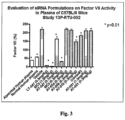
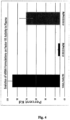
- the siRNA encapsulated MC3 (0.3 and 1.5 mg/kg), NC1 (0.3 mg/kg), ATX-547 (0.1 and 0.3 mg/kg), ATX-004 (0.3), ATX-006 (0.3 and 1.0 mg/kg), ATX-010 (0.3 mg/kg), and ATX-001 (0.3 and 1.5 mg/kg), was measured for Factor VII knockdown in mouse plasma following administration of the siRNA formulation to C57BL6 mice.
- the results showed that ATX-001 and ATX-010 were most effective ( Figs. 3 and 4 ).
- the knockdown activity of the exemplary compounds is shown for 0.3 mg/kg or at 0.05 mg/kg for ATX-018, ATX-019, and ATX-020 (Table 1). Disclosure relating to compounds outside the scope of the claimed invention is provided for reference only.
Landscapes
- Chemical & Material Sciences (AREA)
- Health & Medical Sciences (AREA)
- Organic Chemistry (AREA)
- Life Sciences & Earth Sciences (AREA)
- Engineering & Computer Science (AREA)
- General Health & Medical Sciences (AREA)
- Genetics & Genomics (AREA)
- Biomedical Technology (AREA)
- Public Health (AREA)
- Animal Behavior & Ethology (AREA)
- Epidemiology (AREA)
- Veterinary Medicine (AREA)
- Pharmacology & Pharmacy (AREA)
- Medicinal Chemistry (AREA)
- Molecular Biology (AREA)
- Biotechnology (AREA)
- Bioinformatics & Cheminformatics (AREA)
- Wood Science & Technology (AREA)
- General Engineering & Computer Science (AREA)
- Zoology (AREA)
- Biochemistry (AREA)
- Dispersion Chemistry (AREA)
- Biophysics (AREA)
- Otolaryngology (AREA)
- Physics & Mathematics (AREA)
- Plant Pathology (AREA)
- Microbiology (AREA)
- Pulmonology (AREA)
- Pharmaceuticals Containing Other Organic And Inorganic Compounds (AREA)
- Saccharide Compounds (AREA)
- Medicines That Contain Protein Lipid Enzymes And Other Medicines (AREA)
- Organic Low-Molecular-Weight Compounds And Preparation Thereof (AREA)
- Medicinal Preparation (AREA)
Priority Applications (3)
| Application Number | Priority Date | Filing Date | Title |
|---|---|---|---|
| HRP20230342TT HRP20230342T1 (hr) | 2014-11-18 | 2015-05-11 | Kationski lipid koji se može ionizirati za isporuku rna |
| RS20230231A RS64078B1 (sr) | 2014-11-18 | 2015-05-11 | Jonizujući katjonski lipid za isporuku rnk |
| SI201531935T SI3221293T1 (sl) | 2014-11-18 | 2015-05-11 | Kationski lipid, ki se ga da ionizirati, za dostavo RNA |
Applications Claiming Priority (4)
| Application Number | Priority Date | Filing Date | Title |
|---|---|---|---|
| US14/546,105 US9593077B2 (en) | 2013-11-18 | 2014-11-18 | Ionizable cationic lipid for RNA delivery |
| US14/707,876 US9365610B2 (en) | 2013-11-18 | 2015-05-08 | Asymmetric ionizable cationic lipid for RNA delivery |
| US14/707,796 US9567296B2 (en) | 2013-11-18 | 2015-05-08 | Ionizable cationic lipid for RNA delivery |
| PCT/US2015/030218 WO2016081029A1 (en) | 2014-11-18 | 2015-05-11 | Ionizable cationic lipid for rna delivery |
Publications (2)
| Publication Number | Publication Date |
|---|---|
| EP3221293A1 EP3221293A1 (en) | 2017-09-27 |
| EP3221293B1 true EP3221293B1 (en) | 2023-03-01 |
Family
ID=56014367
Family Applications (1)
| Application Number | Title | Priority Date | Filing Date |
|---|---|---|---|
| EP15724466.6A Active EP3221293B1 (en) | 2014-11-18 | 2015-05-11 | Ionizable cationic lipid for rna delivery |
Country Status (20)
| Country | Link |
|---|---|
| EP (1) | EP3221293B1 (enExample) |
| JP (1) | JP6637988B2 (enExample) |
| KR (1) | KR102380363B1 (enExample) |
| CN (1) | CN107207428A (enExample) |
| AU (1) | AU2015350561B2 (enExample) |
| CA (1) | CA2968060C (enExample) |
| DK (1) | DK3221293T3 (enExample) |
| ES (1) | ES2946110T3 (enExample) |
| FI (1) | FI3221293T3 (enExample) |
| HK (1) | HK1244479A1 (enExample) |
| HR (1) | HRP20230342T1 (enExample) |
| HU (1) | HUE062130T2 (enExample) |
| IL (1) | IL252291B (enExample) |
| LT (1) | LT3221293T (enExample) |
| NZ (1) | NZ732777A (enExample) |
| PL (1) | PL3221293T3 (enExample) |
| PT (1) | PT3221293T (enExample) |
| RS (1) | RS64078B1 (enExample) |
| SI (1) | SI3221293T1 (enExample) |
| WO (1) | WO2016081029A1 (enExample) |
Families Citing this family (71)
| Publication number | Priority date | Publication date | Assignee | Title |
|---|---|---|---|---|
| CN110003066B (zh) | 2013-11-18 | 2021-09-03 | 阿克丘勒斯治疗公司 | 用于rna递送的可电离的阳离子脂质 |
| US11028388B2 (en) | 2014-03-05 | 2021-06-08 | Editas Medicine, Inc. | CRISPR/Cas-related methods and compositions for treating Usher syndrome and retinitis pigmentosa |
| EP3540061A1 (en) | 2014-04-02 | 2019-09-18 | Editas Medicine, Inc. | Crispr/cas-related methods and compositions for treating primary open angle glaucoma |
| RU2019121801A (ru) | 2016-12-14 | 2021-01-15 | Лигандал, Инк. | Композиции и способы для доставки полезной нагрузки в виде нуклеиновой кислоты и/или белка |
| US10526284B2 (en) | 2016-12-21 | 2020-01-07 | Arcturus Therapeutics, Inc. | Ionizable cationic lipid for RNA delivery |
| WO2018119163A1 (en) * | 2016-12-21 | 2018-06-28 | Payne Joseph E | Ionizable cationic lipid for rna delivery |
| US10383952B2 (en) * | 2016-12-21 | 2019-08-20 | Arcturus Therapeutics, Inc. | Ionizable cationic lipid for RNA delivery |
| US20200046830A1 (en) | 2017-03-30 | 2020-02-13 | The Government Of The United States, As Represented By The Secretary Of The Army | Nucleic acid vaccine composition comprising a lipid formulation, and method of increasing the potency of nucleic acid vaccines |
| US11015204B2 (en) * | 2017-05-31 | 2021-05-25 | Arcturus Therapeutics, Inc. | Synthesis and structure of high potency RNA therapeutics |
| WO2019191780A1 (en) * | 2018-03-30 | 2019-10-03 | Arcturus Therapeutics, Inc. | Lipid particles for nucleic acid delivery |
| JP7256824B2 (ja) | 2018-04-25 | 2023-04-12 | エスリス ゲーエムベーハー | 粒子状製剤用の凍結保護剤 |
| KR20190127277A (ko) * | 2018-05-04 | 2019-11-13 | 주식회사 삼양바이오팜 | mRNA 전달용 고분자 나노입자 조성물 및 그 제조방법 |
| ES2964547T3 (es) | 2018-06-08 | 2024-04-08 | Fujifilm Corp | Compuesto, sal del mismo y partículas lipídicas |
| CA3122080A1 (en) | 2018-12-06 | 2020-06-11 | Arcturus Therapeutics, Inc. | Compositions and methods for treating ornithine transcarbamylase deficiency |
| EP3942050A4 (en) | 2019-03-19 | 2023-02-22 | Arcturus Therapeutics, Inc. | PROCEDURE FOR THE PRODUCTION OF LIPID-COATED RNA NANOPARTICLES |
| CA3143865A1 (en) | 2019-06-07 | 2020-12-10 | Fujifilm Corporation | Lipid composition |
| WO2021067598A1 (en) | 2019-10-04 | 2021-04-08 | Ultragenyx Pharmaceutical Inc. | Methods for improved therapeutic use of recombinant aav |
| EP4059505B1 (en) | 2019-11-15 | 2024-02-21 | FUJIFILM Corporation | Lipid composition |
| EP4114470A4 (en) | 2020-03-03 | 2024-04-17 | Arcturus Therapeutics, Inc. | COMPOSITIONS AND METHODS FOR TREATING ORNITHINE TRANSCARBAMYLASE DEFICIENCY |
| IL296660A (en) | 2020-03-24 | 2022-11-01 | Generation Bio Co | Non-viral DNA vectors and their use for therapeutic expression of factor ix |
| IL296662A (en) | 2020-03-24 | 2022-11-01 | Generation Bio Co | Non-viral dna vectors and uses thereof for expressing gaucher therapeutics |
| US20230227826A1 (en) * | 2020-06-18 | 2023-07-20 | Arcturus Therapeutics, Inc. | Una oligomers for the treatment of polyglutamine diseases |
| MX2023001109A (es) | 2020-07-27 | 2023-04-24 | Anjarium Biosciences Ag | Composiciones de moleculas de adn, metodos para elaborar las mismas, y metodos de usos de las mismas. |
| IL301253A (en) | 2020-09-13 | 2023-05-01 | Arcturus Therapeutics Inc | As a mass of large RNA lipid nanoparticles |
| TWI918825B (zh) | 2021-02-10 | 2026-03-21 | 美商艾勒維生技公司 | 化合物、組合物及其使用方法 |
| JP2024517427A (ja) | 2021-04-20 | 2024-04-22 | アンジャリウム バイオサイエンシズ エージー | アミロ-α-1,6-グルコシダーゼ、4-α-グルカノトランスフェラーゼをコードするDNA分子の組成物、その作製の方法、及びその使用の方法 |
| JP2024515788A (ja) | 2021-04-27 | 2024-04-10 | ジェネレーション バイオ カンパニー | 治療抗体を発現する非ウイルスdnaベクター及びその使用 |
| US20240216535A1 (en) | 2021-04-27 | 2024-07-04 | Generation Bio Co. | Non-viral dna vectors expressing anti-coronavirus antibodies and uses thereof |
| EP4763287A2 (en) | 2021-09-03 | 2026-06-24 | CureVac SE | Novel lipid nanoparticles for delivery of nucleic acids |
| EP4422698A1 (en) | 2021-10-29 | 2024-09-04 | CureVac SE | Improved circular rna for expressing therapeutic proteins |
| WO2023081526A1 (en) | 2021-11-08 | 2023-05-11 | Orna Therapeutics, Inc. | Lipid nanoparticle compositions for delivering circular polynucleotides |
| JP2024546431A (ja) | 2021-11-11 | 2024-12-24 | アークトゥラス・セラピューティクス・インコーポレイテッド | Rna送達のためのイオン化可能なカチオン性脂質 |
| WO2023135273A2 (en) | 2022-01-14 | 2023-07-20 | Anjarium Biosciences Ag | Compositions of dna molecules encoding factor viii, methods of making thereof, and methods of use thereof |
| EP4469091A1 (en) | 2022-01-28 | 2024-12-04 | CureVac SE | Nucleic acid encoded transcription factor inhibitors |
| CN114213295B (zh) * | 2022-02-22 | 2022-05-20 | 中国科学院基础医学与肿瘤研究所(筹) | 一种阳离子化合物、制备方法及其复合物和用途 |
| EP4493212A1 (en) | 2022-03-14 | 2025-01-22 | Generation Bio Co. | Heterologous prime boost vaccine compositions and methods of use |
| CA3248209A1 (en) | 2022-05-25 | 2023-11-30 | CureVac SE | Escherichia coli Antigenic Polypeptide-Based Nucleic Acid Vaccine (FIMH) |
| WO2023239756A1 (en) | 2022-06-07 | 2023-12-14 | Generation Bio Co. | Lipid nanoparticle compositions and uses thereof |
| WO2024040222A1 (en) | 2022-08-19 | 2024-02-22 | Generation Bio Co. | Cleavable closed-ended dna (cedna) and methods of use thereof |
| KR20250110209A (ko) | 2022-09-23 | 2025-07-18 | 엔크로마 바이오, 인크. | Hbv 유전자 발현의 에피제네틱 조절을 위한 조성물 및 방법 |
| WO2024089638A1 (en) | 2022-10-28 | 2024-05-02 | Glaxosmithkline Biologicals Sa | Nucleic acid based vaccine |
| WO2024102762A1 (en) | 2022-11-08 | 2024-05-16 | Orna Therapeutics, Inc. | Lipids and lipid nanoparticle compositions for delivering polynucleotides |
| WO2024102730A1 (en) | 2022-11-08 | 2024-05-16 | Orna Therapeutics, Inc. | Lipids and nanoparticle compositions for delivering polynucleotides |
| TW202428289A (zh) | 2022-11-08 | 2024-07-16 | 美商歐納醫療公司 | 環狀rna組合物 |
| JP2025541726A (ja) | 2022-12-01 | 2025-12-23 | ジェネレーション バイオ カンパニー | 細胞標的化のためのステルス脂質ナノ粒子組成物 |
| AU2023406321A1 (en) | 2022-12-01 | 2025-05-29 | Generation Bio Co. | Novel polyglycerol-conjugated lipids and lipid nanoparticle compositions comprising the same |
| EP4626402A1 (en) | 2022-12-01 | 2025-10-08 | Generation Bio Co. | Lipid nanoparticles comprising nucleic acids and lipid-anchored polymers |
| US20260207525A1 (en) | 2022-12-01 | 2026-07-23 | Generation Bio Co. | Lipid nanoparticles comprising nucleic acids, ionizable lipids, sterols, lipid anchored polymers and helper lipids, their uses |
| KR20250153298A (ko) | 2023-03-08 | 2025-10-24 | 큐어백 에스이 | 핵산 전달을 위한 신규의 지질 나노입자 제형 |
| WO2024205657A2 (en) | 2023-03-29 | 2024-10-03 | Orna Therapeutics, Inc. | Lipids and lipid nanoparticle compositions for delivering polynucleotides |
| WO2024233308A2 (en) | 2023-05-05 | 2024-11-14 | Orna Therapeutics, Inc. | Circular rna compositions and methods |
| WO2024230934A1 (en) | 2023-05-11 | 2024-11-14 | CureVac SE | Therapeutic nucleic acid for the treatment of ophthalmic diseases |
| JP2026523341A (ja) | 2023-05-15 | 2026-07-14 | エヌクロマ・バイオ,インコーポレーテッド | Hbv遺伝子発現のエピジェネティック調節のための組成物および方法 |
| CN116270543B (zh) * | 2023-05-19 | 2023-09-26 | 清华大学 | 脂质纳米颗粒在制备通过雾吸或鼻滴给药递送核酸的药物中的用途 |
| EP4719352A1 (en) | 2023-05-31 | 2026-04-08 | Capstan Therapeutics, Inc. | Lipid nanoparticle formulations and compositions |
| WO2025049690A1 (en) | 2023-08-29 | 2025-03-06 | Orna Therapeutics, Inc. | Circular polyethylene glycol lipids |
| CN117986153B (zh) | 2023-09-07 | 2026-06-19 | 晟迪生物医药(苏州)有限公司 | 一种可电离阳离子脂质化合物及其制备方法和应用 |
| WO2025052180A2 (en) | 2023-09-07 | 2025-03-13 | Axelyf ehf. | Lipids and lipid nanoparticles |
| EP4791878A1 (en) | 2023-10-13 | 2026-08-19 | Ultragenyx Pharmaceutical Inc. | Compositions and methods for treating conditions associated with cartilage oligomeric matrix protein (comp) mutations |
| CN122497525A (zh) | 2023-11-07 | 2026-07-31 | 欧纳医疗公司 | 环状rna组合物 |
| AU2024397279A1 (en) | 2023-12-13 | 2026-07-02 | Ultragenyx Pharmaceutical Inc. | Compositions and methods for treating conditions associated with ube3a overexpression |
| IL328626A (en) | 2023-12-15 | 2026-07-01 | Capstan Therapeutics Inc | Humanized anti-CD8 antibodies and their uses |
| AU2025217182A1 (en) | 2024-02-02 | 2026-08-06 | Editas Medicine, Inc. | MODIFIED GUIDE RNAs |
| US20250381150A1 (en) | 2024-03-08 | 2025-12-18 | Genzyme Corporation | Lipid nanoparticles |
| WO2025213138A1 (en) | 2024-04-05 | 2025-10-09 | Editas Medicine, Inc. | Crispr/rna-guided nuclease related methods and compositions for treating primary open angle glaucoma |
| WO2026003582A2 (en) | 2024-06-27 | 2026-01-02 | Axelyf ehf. | Lipids and lipid nanoparticles |
| WO2026030375A2 (en) | 2024-07-30 | 2026-02-05 | Genzyme Corporation | Lipid nanoparticles and methods of manufacture and use thereof |
| WO2026064512A1 (en) | 2024-09-18 | 2026-03-26 | Generation Bio Co. | Polyglycerol-conjugated lipids and lipid nanoparticle compositions comprising the same |
| WO2026085495A1 (en) | 2024-10-18 | 2026-04-23 | Generation Bio Co. | Synthetic partially single-stranded nucleic acid compositions and uses and methods therefor |
| WO2026102260A1 (en) | 2024-11-08 | 2026-05-15 | Editas Medicine, Inc. | Crispr-related methods and compositions targeting angiopoietin like 3 (angptl3) |
| WO2026142951A1 (en) | 2024-12-23 | 2026-07-02 | Genzyme Corporation | Pharmaceutical system |
Family Cites Families (10)
| Publication number | Priority date | Publication date | Assignee | Title |
|---|---|---|---|---|
| EP0079963B1 (en) | 1981-06-04 | 1986-08-27 | Delaware Chemicals Corporation | Pressurized container with dispensing pump |
| US4778810A (en) | 1987-01-08 | 1988-10-18 | Nastech Pharmaceutical Co., Inc. | Nasal delivery of caffeine |
| AU649074B2 (en) | 1990-10-12 | 1994-05-12 | Max-Planck-Gesellschaft Zur Forderung Der Wissenschaften E.V. | Modified ribozymes |
| US5652094A (en) | 1992-01-31 | 1997-07-29 | University Of Montreal | Nucleozymes |
| US5849902A (en) | 1996-09-26 | 1998-12-15 | Oligos Etc. Inc. | Three component chimeric antisense oligonucleotides |
| KR101773643B1 (ko) * | 2010-04-28 | 2017-08-31 | 교와 핫꼬 기린 가부시키가이샤 | 양이온성 지질 |
| CN107043334B (zh) * | 2011-06-08 | 2020-06-16 | 日东电工株式会社 | 用于定向药物输送和增强siRNA活性的化合物 |
| US20140308304A1 (en) * | 2011-12-07 | 2014-10-16 | Alnylam Pharmaceuticals, Inc. | Lipids for the delivery of active agents |
| TR201816986T4 (tr) * | 2012-06-08 | 2019-01-21 | Nitto Denko Corp | Terapötik ajan iletim formülasyonlarına yönelik lipitler. |
| CN110003066B (zh) * | 2013-11-18 | 2021-09-03 | 阿克丘勒斯治疗公司 | 用于rna递送的可电离的阳离子脂质 |
-
2015
- 2015-05-11 DK DK15724466.6T patent/DK3221293T3/da active
- 2015-05-11 CA CA2968060A patent/CA2968060C/en active Active
- 2015-05-11 NZ NZ732777A patent/NZ732777A/en unknown
- 2015-05-11 HU HUE15724466A patent/HUE062130T2/hu unknown
- 2015-05-11 CN CN201580073670.9A patent/CN107207428A/zh active Pending
- 2015-05-11 FI FIEP15724466.6T patent/FI3221293T3/fi active
- 2015-05-11 SI SI201531935T patent/SI3221293T1/sl unknown
- 2015-05-11 EP EP15724466.6A patent/EP3221293B1/en active Active
- 2015-05-11 HK HK18103903.0A patent/HK1244479A1/zh unknown
- 2015-05-11 WO PCT/US2015/030218 patent/WO2016081029A1/en not_active Ceased
- 2015-05-11 HR HRP20230342TT patent/HRP20230342T1/hr unknown
- 2015-05-11 LT LTEPPCT/US2015/030218T patent/LT3221293T/lt unknown
- 2015-05-11 RS RS20230231A patent/RS64078B1/sr unknown
- 2015-05-11 AU AU2015350561A patent/AU2015350561B2/en active Active
- 2015-05-11 ES ES15724466T patent/ES2946110T3/es active Active
- 2015-05-11 KR KR1020177016742A patent/KR102380363B1/ko active Active
- 2015-05-11 PT PT157244666T patent/PT3221293T/pt unknown
- 2015-05-11 JP JP2017545520A patent/JP6637988B2/ja active Active
- 2015-05-11 PL PL15724466.6T patent/PL3221293T3/pl unknown
-
2017
- 2017-05-15 IL IL252291A patent/IL252291B/en unknown
Also Published As
| Publication number | Publication date |
|---|---|
| AU2015350561B2 (en) | 2020-01-30 |
| EP3221293A1 (en) | 2017-09-27 |
| PL3221293T3 (pl) | 2023-07-10 |
| DK3221293T3 (da) | 2023-04-03 |
| RS64078B1 (sr) | 2023-04-28 |
| FI3221293T3 (fi) | 2023-04-05 |
| AU2015350561A1 (en) | 2017-07-06 |
| WO2016081029A1 (en) | 2016-05-26 |
| HUE062130T2 (hu) | 2023-09-28 |
| HK1244479A1 (zh) | 2018-08-10 |
| IL252291B (en) | 2021-08-31 |
| CN107207428A (zh) | 2017-09-26 |
| NZ732777A (en) | 2023-06-30 |
| JP2017535610A (ja) | 2017-11-30 |
| JP6637988B2 (ja) | 2020-01-29 |
| ES2946110T3 (es) | 2023-07-12 |
| CA2968060C (en) | 2023-06-20 |
| HRP20230342T1 (hr) | 2023-06-09 |
| KR102380363B1 (ko) | 2022-03-29 |
| PT3221293T (pt) | 2023-03-16 |
| IL252291A0 (en) | 2017-07-31 |
| SI3221293T1 (sl) | 2023-05-31 |
| CA2968060A1 (en) | 2016-05-26 |
| KR20170095241A (ko) | 2017-08-22 |
| LT3221293T (lt) | 2023-03-27 |
Similar Documents
| Publication | Publication Date | Title |
|---|---|---|
| US20260131020A1 (en) | Ionizable cationic lipid for rna delivery | |
| US10399937B2 (en) | Ionizable cationic lipid for RNA delivery | |
| US10961188B2 (en) | Ionizable cationic lipid for RNA delivery | |
| US9580711B2 (en) | Lipid particles with asymmetric cationic lipids for RNA delivery | |
| US10233148B2 (en) | Aromatic ionizable cationic lipid | |
| CA2968060C (en) | Ionizable cationic lipid for rna delivery | |
| WO2018119163A1 (en) | Ionizable cationic lipid for rna delivery |
Legal Events
| Date | Code | Title | Description |
|---|---|---|---|
| REG | Reference to a national code |
Ref country code: HR Ref legal event code: TUEP Ref document number: P20230342T Country of ref document: HR |
|
| STAA | Information on the status of an ep patent application or granted ep patent |
Free format text: STATUS: THE INTERNATIONAL PUBLICATION HAS BEEN MADE |
|
| PUAI | Public reference made under article 153(3) epc to a published international application that has entered the european phase |
Free format text: ORIGINAL CODE: 0009012 |
|
| STAA | Information on the status of an ep patent application or granted ep patent |
Free format text: STATUS: REQUEST FOR EXAMINATION WAS MADE |
|
| 17P | Request for examination filed |
Effective date: 20170616 |
|
| AK | Designated contracting states |
Kind code of ref document: A1 Designated state(s): AL AT BE BG CH CY CZ DE DK EE ES FI FR GB GR HR HU IE IS IT LI LT LU LV MC MK MT NL NO PL PT RO RS SE SI SK SM TR |
|
| AX | Request for extension of the european patent |
Extension state: BA ME |
|
| DAV | Request for validation of the european patent (deleted) | ||
| DAX | Request for extension of the european patent (deleted) | ||
| RAP1 | Party data changed (applicant data changed or rights of an application transferred) |
Owner name: ARCTURUS THERAPEUTICS, INC. |
|
| STAA | Information on the status of an ep patent application or granted ep patent |
Free format text: STATUS: EXAMINATION IS IN PROGRESS |
|
| 17Q | First examination report despatched |
Effective date: 20201117 |
|
| RIC1 | Information provided on ipc code assigned before grant |
Ipc: C07C 333/10 20060101ALI20220601BHEP Ipc: C07C 333/04 20060101ALI20220601BHEP Ipc: C07C 323/60 20060101AFI20220601BHEP |
|
| GRAP | Despatch of communication of intention to grant a patent |
Free format text: ORIGINAL CODE: EPIDOSNIGR1 |
|
| STAA | Information on the status of an ep patent application or granted ep patent |
Free format text: STATUS: GRANT OF PATENT IS INTENDED |
|
| INTG | Intention to grant announced |
Effective date: 20220914 |
|
| GRAS | Grant fee paid |
Free format text: ORIGINAL CODE: EPIDOSNIGR3 |
|
| GRAA | (expected) grant |
Free format text: ORIGINAL CODE: 0009210 |
|
| STAA | Information on the status of an ep patent application or granted ep patent |
Free format text: STATUS: THE PATENT HAS BEEN GRANTED |
|
| AK | Designated contracting states |
Kind code of ref document: B1 Designated state(s): AL AT BE BG CH CY CZ DE DK EE ES FI FR GB GR HR HU IE IS IT LI LT LU LV MC MK MT NL NO PL PT RO RS SE SI SK SM TR |
|
| REG | Reference to a national code |
Ref country code: GB Ref legal event code: FG4D |
|
| REG | Reference to a national code |
Ref country code: CH Ref legal event code: EP Ref country code: AT Ref legal event code: REF Ref document number: 1550887 Country of ref document: AT Kind code of ref document: T Effective date: 20230315 |
|
| REG | Reference to a national code |
Ref country code: PT Ref legal event code: SC4A Ref document number: 3221293 Country of ref document: PT Date of ref document: 20230316 Kind code of ref document: T Free format text: AVAILABILITY OF NATIONAL TRANSLATION Effective date: 20230309 Ref country code: DE Ref legal event code: R096 Ref document number: 602015082646 Country of ref document: DE |
|
| REG | Reference to a national code |
Ref country code: IE Ref legal event code: FG4D |
|
| REG | Reference to a national code |
Ref country code: DK Ref legal event code: T3 Effective date: 20230329 |
|
| REG | Reference to a national code |
Ref country code: SE Ref legal event code: TRGR |
|
| REG | Reference to a national code |
Ref country code: NO Ref legal event code: T2 Effective date: 20230301 Ref country code: EE Ref legal event code: FG4A Ref document number: E023176 Country of ref document: EE Effective date: 20230320 |
|
| REG | Reference to a national code |
Ref country code: HR Ref legal event code: ODRP Ref document number: P20230342T Country of ref document: HR Payment date: 20230419 Year of fee payment: 9 |
|
| REG | Reference to a national code |
Ref country code: HR Ref legal event code: T1PR Ref document number: P20230342 Country of ref document: HR |
|
| REG | Reference to a national code |
Ref country code: NL Ref legal event code: FP |
|
| P01 | Opt-out of the competence of the unified patent court (upc) registered |
Effective date: 20230518 |
|
| REG | Reference to a national code |
Ref country code: SK Ref legal event code: T3 Ref document number: E 41541 Country of ref document: SK |
|
| REG | Reference to a national code |
Ref country code: ES Ref legal event code: FG2A Ref document number: 2946110 Country of ref document: ES Kind code of ref document: T3 Effective date: 20230712 |
|
| REG | Reference to a national code |
Ref country code: GR Ref legal event code: EP Ref document number: 20230400705 Country of ref document: GR Effective date: 20230613 |
|
| REG | Reference to a national code |
Ref country code: HU Ref legal event code: AG4A Ref document number: E062130 Country of ref document: HU |
|
| PG25 | Lapsed in a contracting state [announced via postgrant information from national office to epo] |
Ref country code: SM Free format text: LAPSE BECAUSE OF FAILURE TO SUBMIT A TRANSLATION OF THE DESCRIPTION OR TO PAY THE FEE WITHIN THE PRESCRIBED TIME-LIMIT Effective date: 20230301 |
|
| PG25 | Lapsed in a contracting state [announced via postgrant information from national office to epo] |
Ref country code: IS Free format text: LAPSE BECAUSE OF FAILURE TO SUBMIT A TRANSLATION OF THE DESCRIPTION OR TO PAY THE FEE WITHIN THE PRESCRIBED TIME-LIMIT Effective date: 20230701 Ref country code: AL Free format text: LAPSE BECAUSE OF FAILURE TO SUBMIT A TRANSLATION OF THE DESCRIPTION OR TO PAY THE FEE WITHIN THE PRESCRIBED TIME-LIMIT Effective date: 20230301 |
|
| REG | Reference to a national code |
Ref country code: DE Ref legal event code: R097 Ref document number: 602015082646 Country of ref document: DE |
|
| PLBE | No opposition filed within time limit |
Free format text: ORIGINAL CODE: 0009261 |
|
| STAA | Information on the status of an ep patent application or granted ep patent |
Free format text: STATUS: NO OPPOSITION FILED WITHIN TIME LIMIT |
|
| PG25 | Lapsed in a contracting state [announced via postgrant information from national office to epo] |
Ref country code: MC Free format text: LAPSE BECAUSE OF FAILURE TO SUBMIT A TRANSLATION OF THE DESCRIPTION OR TO PAY THE FEE WITHIN THE PRESCRIBED TIME-LIMIT Effective date: 20230301 |
|
| PG25 | Lapsed in a contracting state [announced via postgrant information from national office to epo] |
Ref country code: MC Free format text: LAPSE BECAUSE OF FAILURE TO SUBMIT A TRANSLATION OF THE DESCRIPTION OR TO PAY THE FEE WITHIN THE PRESCRIBED TIME-LIMIT Effective date: 20230301 Ref country code: LU Free format text: LAPSE BECAUSE OF NON-PAYMENT OF DUE FEES Effective date: 20230511 |
|
| 26N | No opposition filed |
Effective date: 20231204 |
|
| REG | Reference to a national code |
Ref country code: HR Ref legal event code: ODRP Ref document number: P20230342 Country of ref document: HR Payment date: 20240419 Year of fee payment: 10 |
|
| REG | Reference to a national code |
Ref country code: AT Ref legal event code: UEP Ref document number: 1550887 Country of ref document: AT Kind code of ref document: T Effective date: 20230301 |
|
| REG | Reference to a national code |
Ref country code: HR Ref legal event code: ODRP Ref document number: P20230342 Country of ref document: HR Payment date: 20250425 Year of fee payment: 11 |
|
| PG25 | Lapsed in a contracting state [announced via postgrant information from national office to epo] |
Ref country code: CY Free format text: LAPSE BECAUSE OF FAILURE TO SUBMIT A TRANSLATION OF THE DESCRIPTION OR TO PAY THE FEE WITHIN THE PRESCRIBED TIME-LIMIT; INVALID AB INITIO Effective date: 20150511 |
|
| PG25 | Lapsed in a contracting state [announced via postgrant information from national office to epo] |
Ref country code: TR Free format text: LAPSE BECAUSE OF FAILURE TO SUBMIT A TRANSLATION OF THE DESCRIPTION OR TO PAY THE FEE WITHIN THE PRESCRIBED TIME-LIMIT Effective date: 20230301 |
|
| REG | Reference to a national code |
Ref country code: CH Ref legal event code: U11 Free format text: ST27 STATUS EVENT CODE: U-0-0-U10-U11 (AS PROVIDED BY THE NATIONAL OFFICE) Effective date: 20260601 |
|
| REG | Reference to a national code |
Ref country code: HR Ref legal event code: ODRP Ref document number: P20230342 Country of ref document: HR Payment date: 20260505 Year of fee payment: 12 |
|
| PGFP | Annual fee paid to national office [announced via postgrant information from national office to epo] |
Ref country code: NL Payment date: 20260526 Year of fee payment: 12 |
|
| PGFP | Annual fee paid to national office [announced via postgrant information from national office to epo] |
Ref country code: HU Payment date: 20260424 Year of fee payment: 12 |
|
| PGFP | Annual fee paid to national office [announced via postgrant information from national office to epo] |
Ref country code: ES Payment date: 20260601 Year of fee payment: 12 |
|
| PGFP | Annual fee paid to national office [announced via postgrant information from national office to epo] |
Ref country code: GB Payment date: 20260527 Year of fee payment: 12 Ref country code: RS Payment date: 20260420 Year of fee payment: 12 Ref country code: DK Payment date: 20260525 Year of fee payment: 12 Ref country code: PL Payment date: 20260424 Year of fee payment: 12 |
|
| PGFP | Annual fee paid to national office [announced via postgrant information from national office to epo] |
Ref country code: GR Payment date: 20260529 Year of fee payment: 12 Ref country code: IT Payment date: 20260520 Year of fee payment: 12 |
|
| PGFP | Annual fee paid to national office [announced via postgrant information from national office to epo] |
Ref country code: DE Payment date: 20260528 Year of fee payment: 12 Ref country code: LT Payment date: 20260420 Year of fee payment: 12 |
|
| PGFP | Annual fee paid to national office [announced via postgrant information from national office to epo] |
Ref country code: NO Payment date: 20260528 Year of fee payment: 12 |
|
| PGFP | Annual fee paid to national office [announced via postgrant information from national office to epo] |
Ref country code: SE Payment date: 20260527 Year of fee payment: 12 Ref country code: AT Payment date: 20260528 Year of fee payment: 12 Ref country code: FI Payment date: 20260525 Year of fee payment: 12 |
|
| PGFP | Annual fee paid to national office [announced via postgrant information from national office to epo] |
Ref country code: CH Payment date: 20260601 Year of fee payment: 12 Ref country code: RO Payment date: 20260428 Year of fee payment: 12 Ref country code: IE Payment date: 20260527 Year of fee payment: 12 Ref country code: BE Payment date: 20260527 Year of fee payment: 12 |
|
| PGFP | Annual fee paid to national office [announced via postgrant information from national office to epo] |
Ref country code: EE Payment date: 20260421 Year of fee payment: 12 Ref country code: HR Payment date: 20260505 Year of fee payment: 12 |
|
| PGFP | Annual fee paid to national office [announced via postgrant information from national office to epo] |
Ref country code: PT Payment date: 20260423 Year of fee payment: 12 |
|
| PGFP | Annual fee paid to national office [announced via postgrant information from national office to epo] |
Ref country code: CZ Payment date: 20260424 Year of fee payment: 12 |
|
| PGFP | Annual fee paid to national office [announced via postgrant information from national office to epo] |
Ref country code: FR Payment date: 20260525 Year of fee payment: 12 |
|
| PGFP | Annual fee paid to national office [announced via postgrant information from national office to epo] |
Ref country code: LV Payment date: 20260420 Year of fee payment: 12 |
|
| PGFP | Annual fee paid to national office [announced via postgrant information from national office to epo] |
Ref country code: SK Payment date: 20260420 Year of fee payment: 12 |
|
| PGFP | Annual fee paid to national office [announced via postgrant information from national office to epo] |
Ref country code: BG Payment date: 20260521 Year of fee payment: 12 |
|
| PGFP | Annual fee paid to national office [announced via postgrant information from national office to epo] |
Ref country code: SI Payment date: 20260417 Year of fee payment: 12 |