EP3215420B1 - Wasserlöslicher behälter und verfahren zur herstellung - Google Patents
Wasserlöslicher behälter und verfahren zur herstellung Download PDFInfo
- Publication number
- EP3215420B1 EP3215420B1 EP15790108.3A EP15790108A EP3215420B1 EP 3215420 B1 EP3215420 B1 EP 3215420B1 EP 15790108 A EP15790108 A EP 15790108A EP 3215420 B1 EP3215420 B1 EP 3215420B1
- Authority
- EP
- European Patent Office
- Prior art keywords
- container
- water
- filling
- temperature
- soluble
- Prior art date
- Legal status (The legal status is an assumption and is not a legal conclusion. Google has not performed a legal analysis and makes no representation as to the accuracy of the status listed.)
- Not-in-force
Links
Images


Classifications
-
- B—PERFORMING OPERATIONS; TRANSPORTING
- B65—CONVEYING; PACKING; STORING; HANDLING THIN OR FILAMENTARY MATERIAL
- B65D—CONTAINERS FOR STORAGE OR TRANSPORT OF ARTICLES OR MATERIALS, e.g. BAGS, BARRELS, BOTTLES, BOXES, CANS, CARTONS, CRATES, DRUMS, JARS, TANKS, HOPPERS, FORWARDING CONTAINERS; ACCESSORIES, CLOSURES, OR FITTINGS THEREFOR; PACKAGING ELEMENTS; PACKAGES
- B65D65/00—Wrappers or flexible covers; Packaging materials of special type or form
- B65D65/38—Packaging materials of special type or form
- B65D65/46—Applications of disintegrable, dissolvable or edible materials
-
- B—PERFORMING OPERATIONS; TRANSPORTING
- B29—WORKING OF PLASTICS; WORKING OF SUBSTANCES IN A PLASTIC STATE IN GENERAL
- B29C—SHAPING OR JOINING OF PLASTICS; SHAPING OF MATERIAL IN A PLASTIC STATE, NOT OTHERWISE PROVIDED FOR; AFTER-TREATMENT OF THE SHAPED PRODUCTS, e.g. REPAIRING
- B29C43/00—Compression moulding, i.e. applying external pressure to flow the moulding material; Apparatus therefor
- B29C43/02—Compression moulding, i.e. applying external pressure to flow the moulding material; Apparatus therefor of articles of definite length, i.e. discrete articles
- B29C43/04—Compression moulding, i.e. applying external pressure to flow the moulding material; Apparatus therefor of articles of definite length, i.e. discrete articles using movable moulds
- B29C43/06—Compression moulding, i.e. applying external pressure to flow the moulding material; Apparatus therefor of articles of definite length, i.e. discrete articles using movable moulds continuously movable in one direction, e.g. mounted on chains, belts
- B29C43/08—Compression moulding, i.e. applying external pressure to flow the moulding material; Apparatus therefor of articles of definite length, i.e. discrete articles using movable moulds continuously movable in one direction, e.g. mounted on chains, belts with circular movement, e.g. mounted on rolls, turntables
-
- B—PERFORMING OPERATIONS; TRANSPORTING
- B29—WORKING OF PLASTICS; WORKING OF SUBSTANCES IN A PLASTIC STATE IN GENERAL
- B29C—SHAPING OR JOINING OF PLASTICS; SHAPING OF MATERIAL IN A PLASTIC STATE, NOT OTHERWISE PROVIDED FOR; AFTER-TREATMENT OF THE SHAPED PRODUCTS, e.g. REPAIRING
- B29C43/00—Compression moulding, i.e. applying external pressure to flow the moulding material; Apparatus therefor
- B29C43/32—Component parts, details or accessories; Auxiliary operations
- B29C43/36—Moulds for making articles of definite length, i.e. discrete articles
- B29C43/361—Moulds for making articles of definite length, i.e. discrete articles with pressing members independently movable of the parts for opening or closing the mould, e.g. movable pistons
-
- B—PERFORMING OPERATIONS; TRANSPORTING
- B29—WORKING OF PLASTICS; WORKING OF SUBSTANCES IN A PLASTIC STATE IN GENERAL
- B29C—SHAPING OR JOINING OF PLASTICS; SHAPING OF MATERIAL IN A PLASTIC STATE, NOT OTHERWISE PROVIDED FOR; AFTER-TREATMENT OF THE SHAPED PRODUCTS, e.g. REPAIRING
- B29C45/00—Injection moulding, i.e. forcing the required volume of moulding material through a nozzle into a closed mould; Apparatus therefor
- B29C45/17—Component parts, details or accessories; Auxiliary operations
- B29C45/1703—Introducing an auxiliary fluid into the mould
- B29C45/1704—Introducing an auxiliary fluid into the mould the fluid being introduced into the interior of the injected material which is still in a molten state, e.g. for producing hollow articles
-
- B—PERFORMING OPERATIONS; TRANSPORTING
- B29—WORKING OF PLASTICS; WORKING OF SUBSTANCES IN A PLASTIC STATE IN GENERAL
- B29C—SHAPING OR JOINING OF PLASTICS; SHAPING OF MATERIAL IN A PLASTIC STATE, NOT OTHERWISE PROVIDED FOR; AFTER-TREATMENT OF THE SHAPED PRODUCTS, e.g. REPAIRING
- B29C45/00—Injection moulding, i.e. forcing the required volume of moulding material through a nozzle into a closed mould; Apparatus therefor
- B29C45/17—Component parts, details or accessories; Auxiliary operations
- B29C45/1703—Introducing an auxiliary fluid into the mould
- B29C45/1704—Introducing an auxiliary fluid into the mould the fluid being introduced into the interior of the injected material which is still in a molten state, e.g. for producing hollow articles
- B29C45/1706—Introducing an auxiliary fluid into the mould the fluid being introduced into the interior of the injected material which is still in a molten state, e.g. for producing hollow articles using particular fluids or fluid generating substances
-
- B—PERFORMING OPERATIONS; TRANSPORTING
- B65—CONVEYING; PACKING; STORING; HANDLING THIN OR FILAMENTARY MATERIAL
- B65B—MACHINES, APPARATUS OR DEVICES FOR, OR METHODS OF, PACKAGING ARTICLES OR MATERIALS; UNPACKING
- B65B1/00—Packaging fluent solid material, e.g. powders, granular or loose fibrous material, loose masses of small articles, in individual containers or receptacles, e.g. bags, sacks, boxes, cartons, cans, or jars
- B65B1/02—Machines characterised by the incorporation of means for making the containers or receptacles
-
- B—PERFORMING OPERATIONS; TRANSPORTING
- B65—CONVEYING; PACKING; STORING; HANDLING THIN OR FILAMENTARY MATERIAL
- B65B—MACHINES, APPARATUS OR DEVICES FOR, OR METHODS OF, PACKAGING ARTICLES OR MATERIALS; UNPACKING
- B65B3/00—Packaging plastic material, semiliquids, liquids or mixed solids and liquids, in individual containers or receptacles, e.g. bags, sacks, boxes, cartons, cans, or jars
- B65B3/02—Machines characterised by the incorporation of means for making the containers or receptacles
- B65B3/022—Making containers by moulding of a thermoplastic material
-
- B—PERFORMING OPERATIONS; TRANSPORTING
- B65—CONVEYING; PACKING; STORING; HANDLING THIN OR FILAMENTARY MATERIAL
- B65B—MACHINES, APPARATUS OR DEVICES FOR, OR METHODS OF, PACKAGING ARTICLES OR MATERIALS; UNPACKING
- B65B47/00—Apparatus or devices for forming pockets or receptacles in or from sheets, blanks, or webs, comprising essentially a die into which the material is pressed or a folding die through which the material is moved
- B65B47/02—Apparatus or devices for forming pockets or receptacles in or from sheets, blanks, or webs, comprising essentially a die into which the material is pressed or a folding die through which the material is moved with means for heating the material prior to forming
-
- B—PERFORMING OPERATIONS; TRANSPORTING
- B65—CONVEYING; PACKING; STORING; HANDLING THIN OR FILAMENTARY MATERIAL
- B65B—MACHINES, APPARATUS OR DEVICES FOR, OR METHODS OF, PACKAGING ARTICLES OR MATERIALS; UNPACKING
- B65B47/00—Apparatus or devices for forming pockets or receptacles in or from sheets, blanks, or webs, comprising essentially a die into which the material is pressed or a folding die through which the material is moved
- B65B47/04—Apparatus or devices for forming pockets or receptacles in or from sheets, blanks, or webs, comprising essentially a die into which the material is pressed or a folding die through which the material is moved by application of mechanical pressure
-
- B—PERFORMING OPERATIONS; TRANSPORTING
- B65—CONVEYING; PACKING; STORING; HANDLING THIN OR FILAMENTARY MATERIAL
- B65B—MACHINES, APPARATUS OR DEVICES FOR, OR METHODS OF, PACKAGING ARTICLES OR MATERIALS; UNPACKING
- B65B5/00—Packaging individual articles in containers or receptacles, e.g. bags, sacks, boxes, cartons, cans, jars
- B65B5/02—Machines characterised by incorporation of means for making the containers or receptacles
-
- B—PERFORMING OPERATIONS; TRANSPORTING
- B65—CONVEYING; PACKING; STORING; HANDLING THIN OR FILAMENTARY MATERIAL
- B65B—MACHINES, APPARATUS OR DEVICES FOR, OR METHODS OF, PACKAGING ARTICLES OR MATERIALS; UNPACKING
- B65B63/00—Auxiliary devices, not otherwise provided for, for operating on articles or materials to be packaged
- B65B63/08—Auxiliary devices, not otherwise provided for, for operating on articles or materials to be packaged for heating or cooling articles or materials to facilitate packaging
-
- B—PERFORMING OPERATIONS; TRANSPORTING
- B65—CONVEYING; PACKING; STORING; HANDLING THIN OR FILAMENTARY MATERIAL
- B65B—MACHINES, APPARATUS OR DEVICES FOR, OR METHODS OF, PACKAGING ARTICLES OR MATERIALS; UNPACKING
- B65B7/00—Closing containers or receptacles after filling
-
- B—PERFORMING OPERATIONS; TRANSPORTING
- B65—CONVEYING; PACKING; STORING; HANDLING THIN OR FILAMENTARY MATERIAL
- B65B—MACHINES, APPARATUS OR DEVICES FOR, OR METHODS OF, PACKAGING ARTICLES OR MATERIALS; UNPACKING
- B65B7/00—Closing containers or receptacles after filling
- B65B7/16—Closing semi-rigid or rigid containers or receptacles not deformed by, or not taking-up shape of, contents, e.g. boxes or cartons
- B65B7/162—Closing semi-rigid or rigid containers or receptacles not deformed by, or not taking-up shape of, contents, e.g. boxes or cartons by feeding web material to securing means
- B65B7/164—Securing by heat-sealing
-
- B—PERFORMING OPERATIONS; TRANSPORTING
- B65—CONVEYING; PACKING; STORING; HANDLING THIN OR FILAMENTARY MATERIAL
- B65D—CONTAINERS FOR STORAGE OR TRANSPORT OF ARTICLES OR MATERIALS, e.g. BAGS, BARRELS, BOTTLES, BOXES, CANS, CARTONS, CRATES, DRUMS, JARS, TANKS, HOPPERS, FORWARDING CONTAINERS; ACCESSORIES, CLOSURES, OR FITTINGS THEREFOR; PACKAGING ELEMENTS; PACKAGES
- B65D85/00—Containers, packaging elements or packages, specially adapted for particular articles or materials
- B65D85/70—Containers, packaging elements or packages, specially adapted for particular articles or materials for materials not otherwise provided for
- B65D85/804—Disposable containers or packages with contents which are mixed, infused or dissolved in situ, i.e. without having been previously removed from the package
- B65D85/808—Disposable containers or packages with contents which are mixed, infused or dissolved in situ, i.e. without having been previously removed from the package for immersion in the liquid to release part or all of their contents, e.g. tea bags
-
- C—CHEMISTRY; METALLURGY
- C11—ANIMAL OR VEGETABLE OILS, FATS, FATTY SUBSTANCES OR WAXES; FATTY ACIDS THEREFROM; DETERGENTS; CANDLES
- C11D—DETERGENT COMPOSITIONS; USE OF SINGLE SUBSTANCES AS DETERGENTS; SOAP OR SOAP-MAKING; RESIN SOAPS; RECOVERY OF GLYCEROL
- C11D17/00—Detergent materials or soaps characterised by their shape or physical properties
- C11D17/04—Detergent materials or soaps characterised by their shape or physical properties combined with or containing other objects
- C11D17/041—Compositions releasably affixed on a substrate or incorporated into a dispensing means
- C11D17/042—Water soluble or water disintegrable containers or substrates containing cleaning compositions or additives for cleaning compositions
-
- C—CHEMISTRY; METALLURGY
- C11—ANIMAL OR VEGETABLE OILS, FATS, FATTY SUBSTANCES OR WAXES; FATTY ACIDS THEREFROM; DETERGENTS; CANDLES
- C11D—DETERGENT COMPOSITIONS; USE OF SINGLE SUBSTANCES AS DETERGENTS; SOAP OR SOAP-MAKING; RESIN SOAPS; RECOVERY OF GLYCEROL
- C11D17/00—Detergent materials or soaps characterised by their shape or physical properties
- C11D17/04—Detergent materials or soaps characterised by their shape or physical properties combined with or containing other objects
- C11D17/041—Compositions releasably affixed on a substrate or incorporated into a dispensing means
- C11D17/042—Water soluble or water disintegrable containers or substrates containing cleaning compositions or additives for cleaning compositions
- C11D17/045—Multi-compartment
-
- B—PERFORMING OPERATIONS; TRANSPORTING
- B29—WORKING OF PLASTICS; WORKING OF SUBSTANCES IN A PLASTIC STATE IN GENERAL
- B29C—SHAPING OR JOINING OF PLASTICS; SHAPING OF MATERIAL IN A PLASTIC STATE, NOT OTHERWISE PROVIDED FOR; AFTER-TREATMENT OF THE SHAPED PRODUCTS, e.g. REPAIRING
- B29C43/00—Compression moulding, i.e. applying external pressure to flow the moulding material; Apparatus therefor
- B29C43/02—Compression moulding, i.e. applying external pressure to flow the moulding material; Apparatus therefor of articles of definite length, i.e. discrete articles
- B29C43/04—Compression moulding, i.e. applying external pressure to flow the moulding material; Apparatus therefor of articles of definite length, i.e. discrete articles using movable moulds
- B29C2043/046—Compression moulding, i.e. applying external pressure to flow the moulding material; Apparatus therefor of articles of definite length, i.e. discrete articles using movable moulds travelling between different stations, e.g. feeding, moulding, curing stations
-
- B—PERFORMING OPERATIONS; TRANSPORTING
- B29—WORKING OF PLASTICS; WORKING OF SUBSTANCES IN A PLASTIC STATE IN GENERAL
- B29C—SHAPING OR JOINING OF PLASTICS; SHAPING OF MATERIAL IN A PLASTIC STATE, NOT OTHERWISE PROVIDED FOR; AFTER-TREATMENT OF THE SHAPED PRODUCTS, e.g. REPAIRING
- B29C43/00—Compression moulding, i.e. applying external pressure to flow the moulding material; Apparatus therefor
- B29C43/32—Component parts, details or accessories; Auxiliary operations
- B29C43/36—Moulds for making articles of definite length, i.e. discrete articles
- B29C43/361—Moulds for making articles of definite length, i.e. discrete articles with pressing members independently movable of the parts for opening or closing the mould, e.g. movable pistons
- B29C2043/3615—Forming elements, e.g. mandrels or rams or stampers or pistons or plungers or punching devices
-
- B—PERFORMING OPERATIONS; TRANSPORTING
- B29—WORKING OF PLASTICS; WORKING OF SUBSTANCES IN A PLASTIC STATE IN GENERAL
- B29C—SHAPING OR JOINING OF PLASTICS; SHAPING OF MATERIAL IN A PLASTIC STATE, NOT OTHERWISE PROVIDED FOR; AFTER-TREATMENT OF THE SHAPED PRODUCTS, e.g. REPAIRING
- B29C45/00—Injection moulding, i.e. forcing the required volume of moulding material through a nozzle into a closed mould; Apparatus therefor
- B29C45/17—Component parts, details or accessories; Auxiliary operations
- B29C45/1703—Introducing an auxiliary fluid into the mould
- B29C45/1704—Introducing an auxiliary fluid into the mould the fluid being introduced into the interior of the injected material which is still in a molten state, e.g. for producing hollow articles
- B29C2045/1715—Filled hollows
-
- B—PERFORMING OPERATIONS; TRANSPORTING
- B29—WORKING OF PLASTICS; WORKING OF SUBSTANCES IN A PLASTIC STATE IN GENERAL
- B29K—INDEXING SCHEME ASSOCIATED WITH SUBCLASSES B29B, B29C OR B29D, RELATING TO MOULDING MATERIALS OR TO MATERIALS FOR MOULDS, REINFORCEMENTS, FILLERS OR PREFORMED PARTS, e.g. INSERTS
- B29K2029/00—Use of polyvinylalcohols, polyvinylethers, polyvinylaldehydes, polyvinylketones or polyvinylketals or derivatives thereof as moulding material
- B29K2029/04—PVOH, i.e. polyvinyl alcohol
-
- B—PERFORMING OPERATIONS; TRANSPORTING
- B29—WORKING OF PLASTICS; WORKING OF SUBSTANCES IN A PLASTIC STATE IN GENERAL
- B29K—INDEXING SCHEME ASSOCIATED WITH SUBCLASSES B29B, B29C OR B29D, RELATING TO MOULDING MATERIALS OR TO MATERIALS FOR MOULDS, REINFORCEMENTS, FILLERS OR PREFORMED PARTS, e.g. INSERTS
- B29K2995/00—Properties of moulding materials, reinforcements, fillers, preformed parts or moulds
- B29K2995/0037—Other properties
- B29K2995/0059—Degradable
- B29K2995/0062—Degradable water-soluble
-
- B—PERFORMING OPERATIONS; TRANSPORTING
- B29—WORKING OF PLASTICS; WORKING OF SUBSTANCES IN A PLASTIC STATE IN GENERAL
- B29L—INDEXING SCHEME ASSOCIATED WITH SUBCLASS B29C, RELATING TO PARTICULAR ARTICLES
- B29L2031/00—Other particular articles
- B29L2031/712—Containers; Packaging elements or accessories, Packages
-
- B—PERFORMING OPERATIONS; TRANSPORTING
- B65—CONVEYING; PACKING; STORING; HANDLING THIN OR FILAMENTARY MATERIAL
- B65B—MACHINES, APPARATUS OR DEVICES FOR, OR METHODS OF, PACKAGING ARTICLES OR MATERIALS; UNPACKING
- B65B2220/00—Specific aspects of the packaging operation
- B65B2220/14—Adding more than one type of material or article to the same package
-
- B—PERFORMING OPERATIONS; TRANSPORTING
- B65—CONVEYING; PACKING; STORING; HANDLING THIN OR FILAMENTARY MATERIAL
- B65B—MACHINES, APPARATUS OR DEVICES FOR, OR METHODS OF, PACKAGING ARTICLES OR MATERIALS; UNPACKING
- B65B2230/00—Aspects of the final package
- B65B2230/02—Containers having separate compartments isolated from one another
-
- B—PERFORMING OPERATIONS; TRANSPORTING
- B65—CONVEYING; PACKING; STORING; HANDLING THIN OR FILAMENTARY MATERIAL
- B65B—MACHINES, APPARATUS OR DEVICES FOR, OR METHODS OF, PACKAGING ARTICLES OR MATERIALS; UNPACKING
- B65B65/00—Details peculiar to packaging machines and not otherwise provided for; Arrangements of such details
- B65B65/003—Packaging lines, e.g. general layout
Definitions
- the present invention relates to a method for producing a container for detergents and / or cleaning agents from a water-soluble material and to a container obtained by the method according to the invention.
- detergents and / or cleaning agents are often provided in prefabricated containers. In this way, active ingredients can be packaged separately from one another. Furthermore, the dosage for a washing or cleaning cycle is optimal.
- the respective containers must be water-soluble. In the context of the present invention, water-soluble means that the material dissolves or disperses in water.
- EP 1 776 448 B1 deep drawing of a film
- EP 1 390 270 B1 describes the injection molding process as a possible manufacturing process.
- the injection molding process comprises the steps of liquefying the material, which is then introduced into a mold under pressure.
- the material returns to its solid state through cooling or a crosslinking reaction and can be removed as a finished part after opening the tool.
- molded parts can be produced inexpensively in large numbers.
- tools are required in which the actual material is injected. Changing a shape is always associated with changing the entire tool, which leads to high costs.
- this container can be filled as easily as possible with a filling material and in particular with detergents and / or cleaning agents.
- These washing and / or cleaning agents are usually in the form of liquids, gels, pastes or powders. These should be as easy as possible to insert into the container.
- the document WO 2007/057653 A1 discloses another method of manufacturing and spatial designing water-soluble packaging.
- the material from which the container is formed is thus first introduced into the lower part (C) of a tool (A).
- a tool (A) in the context of the present invention comprises an upper part (B) and a lower part (C). Between the upper part (B) and the lower part (C) is the closed state of the tool (A), as shown in Fig. 1 is shown schematically, a cavity (D). This cavity (D) determines the later shape of the container.
- the upper part (B) is separated from the lower part (C) so that the water-soluble material can be introduced into the lower part (C) without the upper part (B) spatially preventing it.
- the tool After the water-soluble material has been introduced into the lower part (C) of the tool (A), the tool is closed. This means that the upper part (B) is applied to the lower part (C) and by building up pressure the water-soluble material is brought into the form given by the cavity (D). It is possible that the tool (A ) consists of several individual components that can be exchanged independently of each other. However, it is also possible for the tool (A) to be designed in one piece, that is to say the upper part (B) and the lower part (C) are movably connected to one another.
- the water-soluble material can be in the form of granules or powder, for example. It can for example be plasticized in an extruder and then introduced into the lower part (C) of the tool (A) by means of this extruder.
- Tempering in the context of the present invention means keeping the temperature in a certain range. This can also mean the removal of excess heat. If the tool (A) is closed under pressure, the temperature increases. The resulting heat can be dissipated, for example, by controlling the temperature of the tool (A). By closing the tool (A) under pressure, the material takes on the shape of the cavity (D). Any structural configuration of the cavity (D) determines the shape and appearance of the container produced. This is schematically in Fig. 3 shown.
- the material which is introduced into the tool (A) is heated to such a temperature that it is flowable.
- Flowable in the context of the present invention means that the material can be brought into a defined 3-dimensional shape by means of compression molding.
- the material is heated to a temperature which is above the melting temperature of the water-soluble material.
- the material is heated to a temperature which exceeds the melting temperature of the water-soluble material by 20 ° C to 30 ° C.
- the material can be heated, for example by means of an extruder, to a temperature at which it is flowable. Shearing is induced by closing the cavity, which can lead to a further increase in temperature inside the tool (A). This additional amount of heat, but also the heat up to the solidification point, from which demoulding stability is achieved, can then be dissipated by the tool (A), which is to be understood as temperature control in the context of the present invention. Steps b) and c) of the method according to the invention can therefore also take place simultaneously.
- the temperatures required for shaping according to the invention are about 20 ° C. to 30 ° C. lower. On the one hand, this means that less energy is required for production. Furthermore, the choice of possible starting materials must be made more flexible.
- water-soluble material known in the art can be used as the water-soluble material.
- water-soluble polymers are those polymers which are more than 2.5% by weight soluble in water at room temperature.
- the water-soluble or water-dispersible material can comprise a polymer, a copolymer, or mixtures thereof.
- Preferred water-soluble materials preferably at least partially comprise at least one substance from the group consisting of (acetalized) polyvinyl alcohol, polyvinylpyrrolidone, polyethylene oxide, gelatin, sulfate, carbonate and / or citrate-substituted polyvinyl alcohols, polyvinylpyrrolidones, polyalkylene oxides, acrylamides, cellulose esters, cellulose ethers, cellulose amides, cellulose and their derivatives (such as hydroxypropylmethyl cellulose), polyvinyl acetates, polycarboxylic acids and their salts, polyamino acids or peptides, polyamides, polyacrylamides, copolymers of maleic acid and acrylic acid, copolymers of acrylamides and (meth) acrylic acid, polysaccharides such as starch or guar derivatives, gelatin
- the water-soluble material comprises mixtures of different substances. Such mixtures allow the mechanical properties of the container to be adjusted and can influence the degree of water solubility.
- Polyvinyl alcohols (abbreviation PVAL, occasionally also PVOH) is the designation for polymers with the general structure which in small proportions (approx. 2%) also have structural units of the type contain.
- polyvinyl alcohols which are offered as white-yellowish powders or granulates with degrees of polymerization in the range from approx. 100 to 2500 (molar masses from approx. 4000 to 100,000 g / mol), have degrees of hydrolysis of 98-99 or 87-89 mol%, thus still contain a residual content of acetyl groups.
- the manufacturers characterize the polyvinyl alcohols by specifying the degree of polymerization of the starting polymer, the degree of hydrolysis, the saponification number or the solution viscosity.
- polyvinyl alcohols are soluble in water and a few strongly polar organic solvents (formamide, dimethylformamide, dimethyl sulfoxide); They are not attacked by (chlorinated) hydrocarbons, esters, fats and oils.
- Polyvinyl alcohols are classified as toxicologically harmless and are at least partially biodegradable.
- the solubility in water can be reduced by post-treatment with aldehydes (acetalization), by complexing with Ni or Cu salts or by treatment with dichromates, boric acid or borax.
- the coatings made of polyvinyl alcohol are largely impervious to gases such as oxygen, nitrogen, helium, hydrogen and carbon dioxide, but allow water vapor to pass through.
- the water-soluble material at least partially comprises a polyvinyl alcohol whose degree of hydrolysis is 70 to 100 mol%, preferably 80 to 90 mol%, particularly preferably 81 to 89 mol% and in particular 82 to 88 mol -% is.
- the water-soluble material consists of at least 20% by weight, particularly preferably at least 40% by weight, very particularly preferably at least 60% by weight and in particular at least 80% by weight of a polyvinyl alcohol whose degree of hydrolysis is 70 to 100 mol%, preferably 80 to 90 mol%, particularly is preferably 81 to 89 mol% and in particular 82 to 88 mol%.
- polyvinyl alcohols described above are widely available commercially, for example under the trademark Mowiol® (Clariant).
- particularly suitable polyvinyl alcohols are, for example, Mowiole 3-83, Mowiol® 4-88, Mowiol® 5-88, Mowiol® 8-88 and L648, L734, Mowiflex LPTC 221 ex KSE and the compounds from Texas Polymers such as e.g. Vinex 2034.
- the water solubility of PVAL can be changed by post-treatment with aldehydes (acetalization) or ketones (ketalization).
- aldehydes acetalization
- ketones ketalization
- Polyvinyl alcohols which are acetalized or ketalized with the aldehyde or keto groups of saccharides or polysaccharides or mixtures thereof have proven to be particularly preferred and particularly advantageous because of their extremely good solubility in cold water.
- the reaction products of PVAL and starch are extremely advantageous to use.
- the water solubility can be changed by complexing with Ni or Cu salts or by treatment with dichromates, boric acid, borax and thus set to the desired values in a targeted manner.
- Films made of PVAL are largely impermeable to gases such as oxygen, nitrogen, helium, hydrogen and carbon dioxide, but allow water vapor to pass through.
- Preferred water-soluble materials are characterized in that they comprise hydroxypropylmethyl cellulose (HPMC) which has a degree of substitution (average number of methoxy groups per anhydroglucose unit of the cellulose) from 1.0 to 2.0, preferably from 1.4 to 1.9, and has a molar substitution (average number of hydroxypropoxyl groups per anhydroglucose unit of the cellulose) from 0.1 to 0.3, preferably from 0.15 to 0.25.
- HPMC hydroxypropylmethyl cellulose
- Polyvinylpyrrolidones known as PVP for short, are produced by the radical polymerization of 1-vinylpyrrolidone.
- PVPs have molar masses in the range from approx. 2,500 to 750,000 g / mol and are offered as white, hygroscopic powders or as aqueous solutions.
- Polyethylene oxides PEOX for short, are polyalkylene glycols of the general formula H- [O-CH 2 -CH 2 ] n -OH which are produced industrially by base-catalyzed polyaddition of ethylene oxide (oxirane) in systems containing mostly small amounts of water with ethylene glycol as the starter molecule. They usually have molar masses in the range from approx. 200 to 5,000,000 g / mol, corresponding to degrees of polymerization n from approx. 5 to> 100,000. Polyethylene oxides have an extremely low concentration of reactive hydroxyl end groups and only show weak glycol properties.
- Gelatine is a polypeptide (molar mass: approx. 15,000 to> 250,000 g / mol), which is primarily obtained by hydrolysis of the collagen contained in the skin and bones of animals under acidic or alkaline conditions.
- the amino acid composition of gelatine largely corresponds to that of the collagen from which it was obtained and varies depending on its provenance.
- the use of gelatin as a water-soluble shell material is extremely widespread, particularly in pharmacy in the form of hard or soft gelatin capsules. In the form of films, gelatin is only used to a limited extent because of its high price compared to the aforementioned polymers.
- water-soluble materials which comprise a polymer from the group consisting of starch and starch derivatives, cellulose and cellulose derivatives, in particular methyl cellulose and mixtures thereof.
- Starch is a homoglycan, the glucose units being linked ⁇ -glycosidically. Starch is made up of two components of different molecular weights (MW): from approx. 20 to 30% straight-chain amylose (MW approx. 50,000 to 150,000) and 70 to 80% branched-chain amylopectin (MW approx. 300,000 to 2,000,000). It also contains small amounts of lipids, phosphoric acid and cations.
- MW molecular weights
- amylose forms long, helical, intertwined chains with around 300 to 1,200 glucose molecules as a result of the bond in the 1,4-position
- the chain in amylopectin branches after an average of 25 glucose units through 1,6-bond to a branch-like structure with about 1,500 to 12,000 molecules of glucose.
- starch derivatives which can be obtained from starch by polymer-analogous reactions are also suitable for the production of water-soluble containers within the scope of the present invention.
- Such chemically modified starches include, for example, products from esterifications or etherifications in which hydroxy hydrogen atoms have been substituted.
- starches in which the hydroxyl groups have been replaced by functional groups that are not bound via an oxygen atom can also be used as starch derivatives.
- the group of starch derivatives includes, for example, alkali starches, carboxymethyl starch (CMS), starch esters and ethers, and amino starches.
- Pure cellulose has the formal gross composition (C 6 H 10 0 5 ) and, viewed formally, represents a ⁇ -1,4-polyacetal of cellobiose, which in turn is composed of two molecules of glucose.
- Suitable celluloses consist of approx. 500 to 5,000 glucose units and consequently have average molar masses of 50,000 to 500,000.
- Cellulose derivatives that can be obtained from cellulose by polymer-analogous reactions can also be used as cellulose-based disintegrants in the context of the present invention.
- Such chemically modified celluloses include, for example, products from esterifications or etherifications in which hydroxy hydrogen atoms have been substituted.
- Celluloses in which the hydroxyl groups have been replaced by functional groups that are not bound via an oxygen atom can also be used as cellulose derivatives.
- the group of cellulose derivatives includes, for example, alkali celluloses, carboxymethyl cellulose (CMC), cellulose esters and ethers, and aminocelluloses.
- the water-soluble material can have further additives. These are, for example, plasticizers such as dipropylene glycol, ethylene glycol or diethylene glycol, water or disintegrating agents.
- Polyvinyl alcohol is particularly preferably used as the water-soluble material. On the one hand, this is easy to process and inexpensive to obtain compared to other water-soluble materials. In addition, it is particularly well soluble in water and thus enables the manufactured container to be used in a variety of ways.
- the method according to the invention can be carried out on a rotary machine.
- the containers produced by the method according to the invention are already optimally aligned, so that the container can be filled directly afterwards.
- the method according to the invention comprises at least one step d) of filling the container with at least one filling material and preferably e) the subsequent sealing of the container.
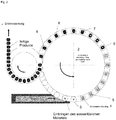
- a corresponding device is shown schematically.
- the water-soluble material is transported to the rotary machine (2) by means of an extruder (1).
- the type of transport depends on the choice of water-soluble material. If the material is in the form of powder or granules, for example, it can be transported to the rotary machine (2) with the aid of a screw, a downpipe or similar devices known to those skilled in the art.
- the material is preferably heated in an extruder and extruded continuously. If enough material has come out of the extruder, it can be scraped off and placed in the cavity.
- the rotary machine (2) there are tools (cavities) (3) into which the water-soluble material is introduced. As soon as one of the cavities is filled with the water-soluble material, it is heated and the water-soluble material is inserted into the with the help of a pressure piston desired container shape.
- at least one cooling station (5) directly adjoins this compression molding station (4) on the rotary machine (2).
- the containers produced in the compression molding station (4) can cool down, that is, they can release the heat that is necessary during compression molding to the environment. Active cooling is not necessarily required. However, it is also possible to actively cool the tools (cavities) (3) that are still warm due to the manufacturing process, for example with the aid of a gas flow, in particular an air flow.
- the container is preferably cooled to a temperature in the range from 20.degree. C. to 60.degree. C., in particular from 20.degree. C. to 40.degree.
- the container When the container has reached a temperature at which it is dimensionally stable, the container can be filled on the rotary machine (2) with a filling material in a filling station (6).
- the container has a temperature which is 20 ° C. above the temperature at which it is dimensionally stable; the container has a temperature in the range from 20 ° C. to 120 ° C., preferably from 30 ° C. to 100 ° C., during filling on.
- the container can be designed in such a way that it can have different filling materials in different areas which then do not come into contact with one another in the container. It is therefore possible according to the invention for the rotary machine to have further filling stations (7, 8) in which further filling materials are introduced into the container.
- Dimensionally stable in the context of the present invention means that the shape of the container is not changed by the filling.
- the container must have a temperature that is below the melting temperature of the water-soluble material. According to the invention, however, it is not necessary for the container to cool down completely to room temperature, that is to say a temperature of about 20 ° C.
- the container it is thus possible to fill the container when the material has not yet cooled down completely to room temperature.
- the advantage is that the molded part, i.e. the container, remains in the mold, i.e. the tool (A), and is thus supported by it.
- the container By filling the container at a temperature that is above room temperature, the container can be further cooled by the filling material (filling material). Active heat absorption and thus active cooling of the container can thus also take place through the filling material or filling material.
- the maximum temperature of the containers at which they can be filled depends on the one hand on the water-soluble material and its melting temperature.
- the material with which the container is filled is also important.
- the temperature of the container is below the boiling point of the liquid. If the container is filled with a solid, the temperature of the container is below the melting temperature of the solid.
- the boiling temperature or melting temperature are preferably at least 10 ° C., in particular at least 15 ° C. below.
- Filling material and filling material are used synonymously in the context of the present invention. These are detergents and / or cleaning agents that are in solid or liquid form.
- the container can only have one area into which the filler material is introduced. However, it is also possible for the container to have 2 or more areas which are separated from one another by the water-soluble material. According to the invention, different filling materials can be introduced into these areas. Solid and liquid filler materials can be introduced into one area. However, it is also possible that a solid filling material is introduced into one area and a liquid filling material is introduced into another area.
- the container can be sealed on the rotary machine (2). This is preferably done in a suitable sealing station (9).
- the filled container can then be removed from the rotary machine (2) and fed to a packaging station (10).
- the first filling station (6) and any further filling stations (7, 8) not to be on the same rotary machine (2) on which the shaping takes place.
- the container is preferably transported directly to a further rotary machine, at which the filling station and sealing station are then present.
- the transport takes place in such a way that the spatial arrangement of the containers is retained. Due to the method according to the invention, after cooling, the containers are in an orientation that enables them to be filled directly with one or more detergents or cleaning agents. According to the invention, this alignment is maintained during the transport to a further rotary machine in this embodiment.
- Rotary machines (2) within the meaning of the present invention can, for example, be turntables, turntables or other circularly rotating devices on which cavities can be attached.
- the containers produced in this preferred embodiment no longer have to be stored, but can be filled directly after production, the use of material can be reduced.
- the filled container has a high due to the content Stability on.
- a waste of containers, which is necessary due to the storage of the empty containers, is not required here.
- the method is therefore sustainable and efficient compared to the methods known in the prior art.
- the method according to the invention therefore enables optimal method integration and leads to an inline filling process from the primary packaging to the end product.
- a secondary packaging destacking can easily be connected. This reduces investment costs.
- the shape of the container can be adapted to the desired filling material by simply exchanging the upper part (B) and / or the lower part (C) of the tool (A).
- different tools (A) which can be quickly exchanged, can also be combined with one another, so that there is a multitude of possibilities for the spatial configuration of the container.
- the sealing of the containers after the filling can take place in such a way that areas provided in the container are connected to one another in such a way that the filling material contained in a closed cavity formed by the seal can no longer escape.
- the container it is also possible for the container to be closed with a further water-soluble material.
- the material of the seal is preferably the same as that of the container.
- the container which is produced by the method according to the invention is, in particular, dimensionally stable. This means that the container essentially retains its shape directly after the actual manufacturing process, even before it is filled. He's not brittle. If pressure is exerted on it, it will not break. If it is stored for a longer period of time, however, it is possible that it does not retain its shape completely and, for example, side walls that are oriented upwards do not remain in their full height.
- the method according to the invention enables the provision of a water-soluble container in any spatial configuration.
- Corresponding containers are used in particular as containers for detergents and / or cleaning agents.
Landscapes
- Engineering & Computer Science (AREA)
- Mechanical Engineering (AREA)
- Chemical & Material Sciences (AREA)
- Life Sciences & Earth Sciences (AREA)
- Chemical Kinetics & Catalysis (AREA)
- Oil, Petroleum & Natural Gas (AREA)
- Wood Science & Technology (AREA)
- Organic Chemistry (AREA)
- Manufacturing & Machinery (AREA)
- Wrappers (AREA)
Description
- Die vorliegende Erfindung betrifft ein Verfahren zur Herstellung eines Behälters für Wasch- und/oder Reinigungsmittel aus einem wasserlöslichen Material sowie ein Behälter, der nach dem erfindungsgemäßen Verfahren erhalten wurde.
- Heutzutage werden Wasch- und/oder Reinigungsmittel häufig in vorkonfektionierten Behältern bereitgestellt. Hierdurch können Wirkstoffe voneinander getrennt verpackt werden. Weiterhin ist die Dosierung für einen Wasch- oder Reinigungsgang optimal. Damit die enthaltenen Wasch- und/oder Reinigungsmittel dann auch wirksam mit den zu reinigenden Gegenständen in Kontakt kommen, müssen die jeweiligen Behälter wasserlöslich sein. Wasserlöslich im Sinne der vorliegenden Erfindung bedeutet, dass sich das Material in Wasser auflöst oder darin dispergiert.
- Zur Herstellung und räumlichen Ausgestaltung dieser wasserlöslichen Verpackungen werden unterschiedliche Verfahren vorgeschlagen. So offenbart
EP 1 776 448 B1 das Tiefziehen einer Folie, wohingegenEP 1 390 270 B1 das Spritzgussverfahren als mögliches Herstellungsverfahren beschreibt. - Das Spritzgussverfahren umfasst die Schritte des Verflüssigens des Materials, welches dann in eine Form unter Druck eingebracht wird. In dieser Form geht der Werkstoff durch Abkühlung oder eine Vernetzungsreaktion wieder in den festen Zustand über und kann nach dem Öffnen des Werkzeuges als Fertigteil entnommen werden. Mit diesem Verfahren lassen sich Formteile in großer Stückzahl kostengünstig herstellen. Es werden jedoch Werkzeuge benötigt, in welchen der eigentliche Werkstoff eingespritzt wird. Der Wechsel einer Form ist hier immer mit der Änderung des gesamten Werkzeuges verbunden, was zu einem hohen Kostenaufwand führt.
- Neben der eigentlichen Herstellung des Behälters ist auch von Interesse, dass dieser Behälter möglichst einfach mit einem Füllgut und insbesondere mit Wasch- und/oder Reinigungsmitteln befüllt werden kann. Diese Wasch- und/oder Reinigungsmittel liegen üblicherweise als Flüssigkeit, Gele, Pasten oder Pulver vor. Diese sollten möglichst unkompliziert in den Behälter eingefügt werden können. Insbesondere wäre wünschenswert, wenn das Herstellungsverfahren des Behälters mit dem des Einfüllens des Mittels unkompliziert miteinander verbunden werden könnter Das Dokument
WO 2007/057653 A1 offenbart ein weiteres Verfahren zur Herstellung und räumlichen Ausgestaltung einer wasserlöslichen Verpackung. - Überraschenderweise hat sich gezeigt, dass mittels Formpressen ("compression molding") die Nachteile aus dem Stand der Technik vermieden werden können. In einer ersten Ausführungsform wird daher die der vorliegenden Erfindung zugrundeliegende Aufgabe gelöst durch ein Verfahren zur Herstellung eines Behälters für ein Füllgut und insbesondere für Wasch- und/oder Reinigungsmittel aus einem wasserlöslichen Material umfassend
- a) Einbringen des wasserlöslichen Materials in ein Unterteil (C) eines Werkzeuges (A),
- b) gegebenenfalls Temperieren des Werkzeuges (A) und
- c) Schließen des Werkzeuges (A) durch Aufbringen eines Oberteils (B) des Werkzeuges (A) auf das Unterteil (C) und Aufbau von Druck zur Ausformung des Behälters, und
- d) Befüllen des Behälters mit wenigstens einem Füllgut,
- Im erfindungsgemäßen Verfahren wird somit zunächst das Material, aus dem der Behälter geformt wird, in das Unterteil (C) eines Werkzeuges (A) eingebracht. Ein Werkzeug (A) im Sinne der vorliegenden Erfindung umfasst ein Oberteil (B) und ein Unterteil (C). Zwischen Oberteil (B) und Unterteil (C) befindet sich im geschlossenen Zustand des Werkzeuges (A), wie er in
Fig. 1 schematisch dargestellt ist, ein Hohlraum (D). Dieser Hohlraum (D) bestimmt die spätere Form des Behälters. Zum Befüllen des Werkzeuges (A) wird das Oberteil (B) vom Unterteil (C) getrennt, so dass das wasserlösliche Material in das Unterteil (C) eingebracht werden kann, ohne dass das Oberteil (B) räumlich daran hindert. Nach dem Einbringen des wasserlöslichen Materials in das Unterteil (C) des Werkzeuges (A), wird das Werkzeug geschlossen. Das heißt, das Oberteil (B) wird auf das Unterteil (C) aufgebracht und durch Aufbau von Druck wird das wasserlösliche Material in die Form gebracht, die durch den Hohlraum (D) vorgegeben ist, Dabei ist es möglich, dass das Werkzeug (A) aus mehreren einzelnen Bestandteilen besteht, die unabhängig voneinander ausgetauscht werden können. Es ist jedoch auch möglich, dass das Werkzeug (A) einstückig ausgestaltet ist, also Oberteil (B) und Unterteil (C) beweglich miteinander verbunden sind. - Das wasserlösliche Material kann beispielsweise in Form von Granulat oder Pulver vorliegen. Es kann beispielsweise in einem Extruder plastifiziert und mittels dieses Extruders dann in das Unterteil (C) des Werkzeuges (A) eingebracht werden.
- Wenn das wasserlösliche Material in das Werkzeug (A) eingebracht wird, wird dieses gegebenenfalls temperiert. Temperieren im Sinne der vorliegenden Erfindung bedeutet das Halten der Temperatur in einem bestimmten Bereich. Dies kann auch die Abfuhr von überschüssiger Wärme bedeuten. Wird das Werkzeug (A) unter Druck geschlossen, kommt es zu einer Temperaturerhöhung. Die hierdurch entstehende Wärme kann beispielsweise durch das Temperieren des Werkzeuges (A) abgeführt werden.
Durch das Schließen des Werkzeuges (A) unter Druck nimmt das Material die Form des Hohlraumes (D) an. Jegliche strukturelle Ausgestaltung des Hohlraumes (D) bestimmt Form und Aussehen des hergestellten Behälters. Schematisch ist dies inFig. 3 dargestellt. - Das Material, welches in das Werkzeug (A) eingebracht wird, ist auf eine solche Temperatur erwärmt, dass es fließfähig ist. Fließfähig im Sinne der vorliegenden Erfindung bedeutet, dass das Material mittels Formpressen in eine definierte 3-dimensionale Form gebracht werden kann. Vorzugsweise wird das Material auf eine Temperatur erwärmt, die über der Schmelztemperatur des wasserlöslichen Materials liegt. Insbesondere wird das Material auf eine solche Temperatur erwärmt, die die Schmelztemperatur des wasserlöslichen Materials um 20 °C bis 30 °C überschreitet.
- Das Material kann beispielsweise mittels eines Extruders auf eine Temperatur erwärmt werden, bei welcher es fließfähig ist. Durch das Schließen der Kavität wird eine Scherung induziert, wodurch es zu einer weiteren Temperaturerhöhung im Inneren des Werkzeuges (A) kommen kann. Diese zusätzliche Wärmemenge, aber auch die Wärme bis zum Erstarrungspunkt, ab dem eine Entformungsstabilität erreicht wird, kann dann von dem Werkzeug (A) abgeführt werden, worunter eine Temperierung im Sinne der vorliegenden Erfindung zu verstehen ist. Die Schritte b) und c) des erfindungsgemäßen Verfahrens können daher auch gleichzeitig stattfinden.
- Gegenüber dem Spritzgussverfahren sind die erfindungsgemäß zur Formgebung notwendigen Temperaturen um etwa 20 °C bis 30 °C geringer. Dies bedeutet einerseits einen geringeren Energieaufwand bei der Herstellung. Weiterhin ist die Wahl der möglichen Ausgangsstoffe flexibler zu gestalten.
- Als wasserlösliches Material kann ein im Stand der Technik bekanntes wasserlösliches Material eingesetzt werden. Wasserlösliche Polymere im Sinne der Erfindung sind solche Polymere, die bei Raumtemperatur in Wasser zu mehr als 2,5 Gew.-% löslich sind.
- Das wasserlösliche oder wasserdispergierbare Material kann ein Polymer, ein Copolymer oder Mischungen dieser umfassen. Bevorzugte wasserlösliche Materialien umfassen vorzugsweise mindestens anteilsweise wenigstens eine Substanz aus der Gruppe bestehend aus (acetalisierter) Polyvinylalkohol, Polyvinylpyrrolidon, Polyethylenoxid, Gelatine, mit Sulfat, Carbonat und/oder Citrat substituierte Polyvinylalkohole, Polyvinylpyrrolidone, Polyalkylenoxide, Acrylamide, Celluloseester, Celluloseether, Celluloseamide, Cellulose und deren Derivate (wie beispielsweise Hydroxypropylmethylcellulose), Polyvinylacetate, Polycarbonsäuren und deren Salze, Polyaminosäuren oder Peptide, Polyamide, Polyacrylamide, Copolymere von Maleinsäure und Acrylsäure, Copolymere von Acrylamiden und (Meth)Acrylsäure, Polysaccharide, wie beispielsweise Stärke oder Guar-Derivate, Gelatine und die unter den INCI Bezeichnungen Polyquaternium 2, Polyquaternium 17, Polyquaternium 18 und Polyquaternium 27 bekannten Polymere. Besonders bevorzugt ist das wasserlösliche Material ein Polyvinylalkohol.
- In einer Ausführungsform der Erfindung umfasst das wasserlösliche Material Mischungen unterschiedlicher Substanzen. Solche Mischungen ermöglichen die Einstellung der mechanischen Eigenschaften des Behälters und können den Grad der Wasserlöslichkeit beeinflussen.
- "Polyvinylalkohole" (Kurzzeichen PVAL, gelegentlich auch PVOH) ist dabei die Bezeichnung für Polymere der allgemeinen Struktur


- Handelsübliche Polyvinylalkohole, die als weiß-gelbliche Pulver oder Granulate mit Polymerisationsgraden im Bereich von ca. 100 bis 2500 (Molmassen von ca. 4000 bis 100.000 g/mol) angeboten werden, haben Hydrolysegrade von 98-99 beziehungsweise 87-89 Mol-%, enthalten also noch einen Restgehalt an Acetyl-Gruppen. Charakterisiert werden die Polyvinylalkohole von Seiten der Hersteller durch Angabe des Polymerisationsgrades des Ausgangspolymeren, des Hydrolysegrades, der Verseifungszahl beziehungsweise der Lösungsviskosität.
- Polyvinylalkohole sind abhängig vom Hydrolysegrad löslich in Wasser und wenigen stark polaren organischen Lösungsmitteln (Formamid, Dimethylformamid, Dimethylsulfoxid); von (chlorierten) Kohlenwasserstoffen, Estern, Fetten und Ölen werden sie nicht angegriffen. Polyvinylalkohole werden als toxikologisch unbedenklich eingestuft und sind biologisch zumindest teilweise abbaubar. Die Wasserlöslichkeit kann man durch Nachbehandlung mit Aldehyden (Acetalisierung), durch Komplexierung mit Ni- oder Cu-Salzen oder durch Behandlung mit Dichromaten, Borsäure od. Borax verringern. Die Beschichtungen aus Polyvinylalkohol sind weitgehend undurchdringlich für Gase wie Sauerstoff, Stickstoff, Helium, Wasserstoff, Kohlendioxid, lassen jedoch Wasserdampf hindurchtreten.
- Im Rahmen der vorliegenden Erfindung ist es bevorzugt, dass das wasserlösliche Material wenigstens anteilsweise einen Polyvinylalkohol umfasst, dessen Hydrolysegrad 70 bis 100 Mol-%, vorzugsweise 80 bis 90 Mol-%, besonders bevorzugt 81 bis 89 Mol-% und insbesondere 82 bis 88 Mol-% beträgt. In einer bevorzugten Ausführungsform besteht das wasserlösliche Material zu mindestens 20 Gew.-%, besonders bevorzugt zu mindestens 40 Gew.-%, ganz besonders bevorzugt zu mindestens 60 Gew.-% und insbesondere zu mindestens 80 Gew.-% aus einem Polyvinylalkohol, dessen Hydrolysegrad 70 bis 100 Mol-%, vorzugsweise 80 bis 90 Mol%, besonders bevorzugt 81 bis 89 Mol-% und insbesondere 82 bis 88 Mol% beträgt.
- Die vorstehend beschriebenen Polyvinylalkohole sind kommerziell breit verfügbar, beispielsweise unter dem Warenzeichen Mowiol® (Clariant). Im Rahmen der vorliegenden Erfindung besonders geeignete Polyvinylalkohole sind beispielsweise Mowiole 3-83, Mowiol® 4-88, Mowiol® 5-88, Mowiol® 8-88 sowie L648, L734, Mowiflex LPTC 221 ex KSE sowie die Compounds der Firma Texas Polymers wie beispielsweise Vinex 2034.
- Die Wasserlöslichkeit von PVAL kann durch Nachbehandlung mit Aldehyden (Acetalisierung) oder Ketonen (Ketalisierung) verändert werden. Als besonders bevorzugt und aufgrund ihrer ausgesprochen guten Kaltwasserlöslichkeit besonders vorteilhaft haben sich hierbei Polyvinylalkohole herausgestellt, die mit den Aldehyd beziehungsweise Ketogruppen von Sacchariden oder Polysacchariden oder Mischungen hiervon acetalisiert beziehungsweise ketalisiert werden. Als äußerst vorteilhaft einzusetzen sind die Reaktionsprodukte aus PVAL und Stärke.
- Weiterhin lässt sich die Wasserlöslichkeit durch Komplexierung mit Ni- oder Cu-Salzen oder durch Behandlung mit Dichromaten, Borsäure, Borax verändern und so gezielt auf gewünschte Werte einstellen. Folien aus PVAL sind weitgehend undurchdringlich für Gase wie Sauerstoff, Stickstoff, Helium, Wasserstoff, Kohlendioxid, lassen jedoch Wasserdampf hindurchtreten.
- Bevorzugte wasserlösliche Materialien sind dadurch gekennzeichnet, dass sie Hydroxypropylmethylcellulose (HPMC) umfassen, die einen Substitutionsgrad (durchschnittliche Anzahl von Methoxygruppen pro Anhydroglucose-Einheit der Cellulose) von 1,0 bis 2,0, vorzugsweise von 1,4 bis 1,9, und eine molare Substitution (durchschnittliche Anzahl von Hydroxypropoxylgruppen pro Anhydroglucose-Einheit der Cellulose) von 0,1 bis 0,3, vorzugsweise von 0,15 bis 0,25, aufweist.
- Polyvinylpyrrolidone, kurz als PVP bezeichnet, werden durch radikalische Polymerisation von 1-Vinylpyrrolidon hergestellt. Handelsübliche PVP haben Molmassen im Bereich von ca. 2.500 bis 750.000 g/mol und werden als weiße, hygroskopische Pulver oder als wässrige Lösungen angeboten.
- Polyethylenoxide, kurz PEOX, sind Polyalkylenglykole der allgemeinen Formel
H-[O-CH2-CH2]n-OH
die technisch durch basisch katalysierte Polyaddition von Ethylenoxid (Oxiran) in meist geringe Mengen Wasser enthaltenden Systemen mit Ethylenglykol als Startmolekül hergestellt werden. Sie haben üblicherweise Molmassen im Bereich von ca. 200 bis 5.000.000 g/mol, entsprechend Polymerisationsgraden n von ca. 5 bis >100.000. Polyethylenoxide besitzen eine äußerst niedrige Konzentration an reaktiven Hydroxy-Endgruppen und zeigen nur noch schwache Glykol-Eigenschaften. - Gelatine ist ein Polypeptid (Molmasse: ca. 15.000 bis >250.000 g/mol), das vornehmlich durch Hydrolyse des in Haut und Knochen von Tieren enthaltenen Kollagens unter sauren oder alkalischen Bedingungen gewonnen wird. Die Aminosäuren-Zusammensetzung der Gelatine entspricht weitgehend der des Kollagens, aus dem sie gewonnen wurde, und variiert in Abhängigkeit von dessen Provenienz. Die Verwendung von Gelatine als wasserlösliches Hüllmaterial ist insbesondere in der Pharmazie in Form von Hart- oder Weichgelatinekapseln äußerst weit verbreitet. In Form von Folien findet Gelatine wegen ihres im Vergleich zu den vorstehend genannten Polymeren hohen Preises nur geringe Verwendung.
- Bevorzugt sind im Rahmen der vorliegenden Erfindung wasserlösliche Materialien, welche ein Polymer aus der Gruppe Stärke und Stärkederivate, Cellulose und Cellulosederivate, insbesondere Methylcellulose und Mischungen hieraus umfassen.
- Stärke ist ein Homoglykan, wobei die Glucose-Einheiten α-glykosidisch verknüpft sind. Stärke ist aus zwei Komponenten unterschiedlichen Molekulargewichts (MG) aufgebaut: aus ca. 20 bis 30% geradkettiger Amylose (MG ca. 50.000 bis 150.000) und 70 bis 80% verzweigtkettigem Amylopektin (MG. ca. 300.000 bis 2.000.000). Daneben sind noch geringe Mengen Lipide, Phosphorsäure und Kationen enthalten. Während die Amylose infolge der Bindung in 1,4-Stellung lange, schraubenförmige, verschlungene Ketten mit etwa 300 bis 1.200 Glucose-Molekülen bildet, verzweigt sich die Kette beim Amylopektin nach durchschnittlich 25 Glucose-Bausteinen durch 1,6-Bindung zu einem astähnlichen Gebilde mit etwa 1.500 bis 12.000 Molekülen Glucose. Neben reiner Stärke sind zur Herstellung wasserlöslicher Behälter im Rahmen der vorliegenden Erfindung auch Stärke-Derivate geeignet, die durch polymeranaloge Reaktionen aus Stärke erhältlich sind. Solche chemisch modifizierten Stärken umfassen dabei beispielsweise Produkte aus Veresterungen beziehungsweise Veretherungen, in denen Hydroxy-Wasserstoffatome substituiert wurden. Aber auch Stärken, in denen die Hydroxy-Gruppen gegen funktionelle Gruppen, die nicht über ein Sauerstoffatom gebunden sind, ersetzt wurden, lassen sich als Stärke-Derivate einsetzen. In die Gruppe der Stärke-Derivate fallen beispielsweise Alkalistärken, Carboxymethylstärke (CMS), Stärkeester und -ether sowie Aminostärken.
- Reine Cellulose weist die formale Bruttozusammensetzung (C6H1005), auf und stellt formal betrachtet ein β-1,4-Polyacetal von Cellobiose dar, die ihrerseits aus zwei Molekülen Glucose aufgebaut ist. Geeignete Cellulosen bestehen dabei aus ca. 500 bis 5.000 Glucose-Einheiten und haben demzufolge durchschnittliche Molmassen von 50.000 bis 500.000. Als Desintegrationsmittel auf Cellulosebasis verwendbar sind im Rahmen der vorliegenden Erfindung auch Cellulose-Derivate, die durch polymeranaloge Reaktionen aus Cellulose erhältlich sind. Solche chemisch modifizierten Cellulosen umfassen dabei beispielsweise Produkte aus Veresterungen beziehungsweise Veretherungen, in denen Hydroxy-Wasserstoffatome substituiert wurden. Aber auch Cellulosen, in denen die Hydroxy-Gruppen gegen funktionelle Gruppen, die nicht über ein Sauerstoffatom gebunden sind, ersetzt wurden, lassen sich als Cellulose-Derivate einsetzen. In die Gruppe der Cellulose-Derivate fallen beispielsweise Alkalicellulosen, Carboxymethylcellulose (CMC), Celluloseester und - ether sowie Aminocellulosen.
- Das wasserlösliche Material kann weitere Additive aufweisen. Hierbei handelt es sich beispielsweise um Weichmacher, wie beispielsweise Dipropylenglycol, Ethylenglycol oder Diethylenglycol, Wasser oder Aufschlussmittel.
- Besonders bevorzugt wird Polyvinylalkohol als wasserlösliches Material eingesetzt. Dieses ist einerseits leicht zu verarbeiten und kostengünstig im Vergleich zu anderen wasserlöslichen Materialen zu erhalten. Zudem ist es besonders gut in Wasser löslich und ermöglicht so vielfältige Einsatzmöglichkeiten des hergestellten Behälters.
- Das erfindungsgemäße Verfahren kann auf einem Rundläufer durchgeführt werden. Hierdurch sind die nach dem erfindungsgemäßen Verfahren hergestellten Behälter bereits optimal ausgerichtet, so dass eine Befüllung des Behälters direkt im Anschluss stattfinden kann. Das erfindungsgemäße Verfahren umfasst wenigstens einen Schritt d) des Befüllens des Behälters mit wenigstens einem Füllgut sowie vorzugsweise e) das anschließende Versiegeln des Behälters. In
Fig. 2 ist eine entsprechende Vorrichtung schematisch gezeigt. - In
Fig. 2 wird das wasserlösliche Material mittels eines Extruders (1) zum Rundläufer (2) transportiert. Die Art des Transportes ist von der Wahl des wasserlöslichen Materials abhängig. Liegt das Material beispielsweise als Pulver oder Granulat vor, so kann es beispielsweise mit Hilfe einer Schnecke, einem Fallrohr oder ähnlichen, dem Fachmann bekannten Vorrichtungen zum Rundläufer (2) hin transportiert werden. Bevorzugt wird das Material in einem Extruder erhitzt und kontinuierlich extrudiert. Ist ausreichend Material aus dem Extruder ausgetreten, kann dieses abgeschabt und in die Kavität gegeben werden. - Auf dem Rundläufer (2) befinden sich Werkzeuge (Kavitäten) (3), in welche das wasserlösliche Material eingebracht wird. Sobald eine der Kavitäten mit dem wasserlöslichen Material gefüllt ist, wird diese erwärmt und mit Hilfe eines Druckkolbens wird das wasserlösliche Material in die gewünscht Behälterform gebracht. Auf dem Rundläufer (2) schließt sich in einer bevorzugten Ausführungsform an diese Formpressstation (4) unmittelbar wenigsten eine Abkühlstation (5) an. Hier können die in der Formpressstation (4) hergestellten Behälter abkühlen, das heißt die Wärme, die beim Formpressen notwendig ist, an die Umgebung wieder abgeben. Eine aktive Kühlung ist nicht notwendigerweise erforderlich. Es ist aber auch möglich, die durch das Herstellungsverfahren noch warmen Werkzeuge (Kavitäten) (3) aktiv abzukühlen, beispielsweise mit Hilfe eines Gasstroms, insbesondere eines Luftstromes. Der Behälter wird dabei vorzugsweise auf eine Temperatur im Bereich von 20 °C bis 60 °C, insbesondere von 20°C bis 40 °C abgekühlt.
- Hat der Behälter eine Temperatur erreicht, in der er formstabil ist, kann der Behälter auf dem Rundläufer (2) mit einem Füllmaterial in einer Abfüllstation (6) gefüllt werden. Der Behälter weist dabei eine Temperatur auf, die 20 °C über der Temperatur liegt, bei der er formstabil ist, der Behälter weist beim Abfüllen eine Temperatur im Bereich von 20°C bis 120 °C, bevorzugt von 30 °c bis 100 °C auf. Der Behälter kann erfindungsgemäß derart ausgestaltet sein, dass er in unterschiedlichen Bereichen unterschiedliche Füllmaterialien aufweisen kann, die dann in dem Behälter nicht miteinander in Kontakt kommen. Daher ist es erfindungsgemäß möglich, dass der Rundläufer weitere Abfüllstationen (7, 8) aufweist, in welchen weitere Füllmaterialien in den Behälter eingebracht werden. Formstabil im Sinne der vorliegenden Erfindung bedeutet, dass der Behälter durch das Befüllen in seiner Form nicht verändert wird. Hierfür muss der Behälter eine Temperatur aufweisen, die unterhalb der Schmelztemperatur des wasserlöslichen Materials liegt. Es ist erfindungsgemäß jedoch nicht notwendig, dass der Behälter vollständig bis auf Raumtemperatur, also eine Temperatur von etwa 20°C abkühlt.
- Erfindungsgemäß ist es somit möglich, den Behälter bereits dann zu füllen, wenn das Material noch nicht vollständig auf Raumtemperatur abgekühlt ist. Der Vorteil ist, dass das Formteil, also der Behälter in der Form, also dem Werkzeug (A), verbleibt und somit von diesem unterstützt wird. Durch das Befüllen der Behälter bei einer Temperatur, die über der Raumtemperatur liegt, können die Behälter durch das Füllmaterial (Füllgut) weiter abgekühlt werden. Durch das Füllmaterial oder Füllgut kann so auch eine aktive Wärmeaufnahme und damit eine aktive Kühlung des Behälters erfolgen. Dies ermöglicht eine raschere Herstellung gefüllter Behälter. Dabei ist die maximale Temperatur der Behälter, bei welcher diese befüllt werden können, einerseits vom wasserlöslichen Material und dessen Schmelztemperatur abhängig. Von Bedeutung ist aber auch das Material, mit welchem der Behälter befüllt wird (Füllmaterial, Füllgut). Handelt es sich hierbei um eine Flüssigkeit, liegt die Temperatur des Behälters unterhalb der Siedetemperatur der Flüssigkeit. Wird der Behälter mit einem Feststoff gefüllt, liegt die Temperatur des Behälters unterhalb der Schmelztemperatur des Feststoffs. Siedetemperatur beziehungsweise Schmelztemperatur werden dabei bevorzugt um wenigstens 10 °C, insbesondere um wenigstens 15 °C unterschritten.
- Füllmaterial und Füllgut werden im Sinne der vorliegenden Erfindung synonym verwendet. Es handelt sich hierbei um Wasch- und/oder Reinigungsmittel, welche in fester oder flüssiger Form vorliegen. Der Behälter kann erfindungsgemäß nur einen Bereich aufweisen, in den das Füllmaterial eingebracht wird, Es ist aber auch möglich, dass der Behälter 2 oder mehrere Bereiche aufweist, die voneinander durch das wasserlösliche Material getrennt sind. In diese Bereiche können erfindungsgemäß unterschiedliche Füllmaterialien eingebracht werden. Dabei können in einem Bereich feste und flüssige Füllmaterialien eingebracht werden. Es ist jedoch auch möglich, dass in einen Bereich ein festes Füllmaterial und in einen anderen Bereich ein flüssiges Füllgut eingebracht wird.
- Nachdem das Füllgut in den Behälter eingebracht wurde, kann der Behälter auf dem Rundläufer (2) versiegelt werden. Dies erfolgt vorzugsweise in einer geeigneten Versiegelungsstation (9). Anschließend kann der gefüllte Behälter vom Rundläufer (2) entfernt und einer Verpackungsstation (10) zugeführt werden.
- Erfindungsgemäß ist es somit möglich, an einem Rundläufer (2) nicht nur Behälter herzustellen, sondern diese direkt zu befüllen und zu versiegeln. Dies ermöglicht kurze Zykluszeiten von weniger als 20 Sekunden, insbesondere von weniger als 8 Sekunden. Dabei können Zykluszeiten von 3 bis 8 Sekunden erreicht werden. Abhängig vom Produkt sind Zykluszeiten von 2 Sekunden realisierbar. Ein solches Inline-Abfüllen ist mit anderen, im Stand der Technik beschriebenen Verfahren nicht möglich.
- Erfindungsgemäß ist es auch möglich, dass die erste Abfüllstation (6) und die gegebenenfalls weiteren Abfüllstationen (7,8) nicht an demselben Rundläufer (2) sind, an dem auch die Formgebung erfolgt. In dieser Ausführungsform wird der Behälter nach der Abkühlung in der Abkühlstation (5) vorzugsweise unmittelbar zu einem weiteren Rundläufer transportiert, an dem dann Abfüllstation und Versiegelungsstation vorhanden sind. Dabei erfolgt der Transport derart, dass die räumliche Anordnung der Behälter erhalten bleibt. Auf Grund des erfindungsgemäßen Verfahrens befinden sich die Behälter nach dem Abkühlen in einer Ausrichtung, die die direkte Befüllung mit einem oder mehreren Wasch- oder Reinigungsmittel ermöglicht. Diese Ausrichtung wird erfindungsgemäß während des Transports zu einem weiteren Rundläufer in dieser Ausführungsform beibehalten.
- Rundläufer (2) im Sinne der vorliegenden Erfindung können beispielsweise Drehteller, Drehplatten oder andere sich kreisförmig drehende Vorrichtungen, auf welchen Kavitäten angebracht werden können, sein.
- Dadurch, dass die hergestellten Behälter in dieser bevorzugten Ausführungsform nicht mehr bevorratet werden müssen, sondern direkt im Anschluss an die Herstellung befüllt werden können, kann der Materialeinsatz verringert werden. Der befüllte Behälter weist durch den Inhalt eine hohe Stabilität auf. Ein Ausschuss an Behältern, der durch eine Lagerung der leeren Behälter notwendig ist, ist hier nicht erforderlich. Daher ist das Verfahren gegenüber den im Stand der Technik bekannten Verfahren nachhaltig und effizient.
- Neben der Integration der Abfüllstation ist auch eine Integration einer Versiegelstation (9) an demselben Rundläufer (2) oder an einer direkt folgenden Rundlaufstation möglich. Dies ermöglicht eine sehr effiziente und auch flexible Abfülllinien-Konfiguration.
- Das erfindungsgemäße Verfahren ermöglicht daher eine optimale Verfahrensintegration und führt zu einem Inline-Abfüllprozess von der Primärverpackung bis zum Endprodukt. Eine Sekundärverpackung-Abstapelung kann einfach angeschlossen werden. Hierdurch werden Investitionskosten reduziert.
- Im erfindungsgemäßen Verfahren kann durch einen einfachen Austausch des Oberteils (B) und/oder des Unterteils (C) des Werkzeuges (A) die Behälterform dem gewünschten Füllgut angepasst werden. Im erfindungsgemäßen Verfahren können auch unterschiedliche Werkzeuge (A), die schnell ausgetauscht werden können, miteinander kombiniert werden, so dass sich eine Vielzahl an Möglichkeiten für die räumliche Ausgestaltung des Behälters ergibt.
- Die Versiegelung der Behälter im Anschluss an die Befüllung kann derart erfolgen, dass im Behälter vorgesehene Bereiche miteinander derart verbunden werden, dass das in einem sich durch die Versiegelung bildenden geschlossenen Hohlraum enthaltene Füllgut nicht mehr austreten kann. Es ist jedoch auch möglich, dass der Behälter mit einem weiteren wasserlöslichen Material verschlossen wird. Vorzugsweise ist das Material der Versiegelung mit dem des Behälters gleich.
- Der Behälter, der nach dem erfindungsgemäßen Verfahren hergestellt wird, ist insbesondere formstabil. Dies bedeutet, dass der Behälter direkt nach dem eigentlichen Herstellungsverfahren noch vor dem Befüllen seine Form im Wesentlichen beibehält. Er ist nicht spröde. Wird Druck auf ihn ausgeübt, so zerbricht er nicht. Wird er über einen längeren Zeitraum gelagert, ist es jedoch möglich, dass er seine Form nicht vollständig behält und beispielsweise nach oben hin ausgerichtete Seitenwände nicht in ihrer vollständigen Höhe bestehen bleiben.
- Das erfindungsgemäße Verfahren ermöglicht die Bereitstellung eines wasserlöslichen Behälters in beliebiger räumlicher Ausgestaltung. Entsprechende Behälter werden insbesondere als Behälter für Wasch- und/oder Reinigungsmittel verwendet.
Claims (4)
- Verfahren zur Herstellung eines Behälters für Wasch- und/oder Reinigungsmittel aus einem wasserlöslichen Material umfassenda) Einbringen des wasserlöslichen Materials in ein Unterteil (C) eines Werkzeuges (A),b) gegebenenfalls Temperieren des Werkzeuges (A) undc) Schließen des Werkzeuges (A) durch Aufbringen eines Oberteils (B) des Werkzeuges (A) auf das Unterteil (C) und Aufbau von Druck zur Ausformung des Behälters, undd) Befüllen des Behälters mit wenigstens einem Füllgut,
wobei es sich um ein Verfahren auf dem Gebiet des Formpressens handelt und wobei es sich um einen Behälter handelt, welcher durch ein Befüllen in seiner Form nicht verändert wird, wobei der Behälter beim Befüllen im Werkzeug (A) verbleibt und das Verfahren dadurch gekennzeichnet ist, dass
der Behälter beim Abfüllen eine Temperatur im Bereich von 20 °C bis 120 °C, bevorzugt von 30 °c bis 100 °C aufweist, wobei die Temperatur 20 °C über der Temperatur liegt, bei der der Behälter durch das Befüllen in seiner Form nicht verändert wird. - Verfahren nach Anspruch 1, dadurch gekennzeichnet, dass man Polyvinylalkohol als wasserlösliches Material einsetzt.
- Verfahren nach Anspruch 1 oder 2, weiterhin umfassend Versiegeln des Behälters.
- Verfahren nach Anspruch 1, dadurch gekennzeichnet, dass das Füllgut ein Wasch- und/oder Reinigungsmittel umfasst insbesondere daraus besteht.
Applications Claiming Priority (2)
| Application Number | Priority Date | Filing Date | Title |
|---|---|---|---|
| DE102014222602.3A DE102014222602A1 (de) | 2014-11-05 | 2014-11-05 | Wasserlöslicher Behälter und Verfahren zur Herstellung |
| PCT/EP2015/075489 WO2016071294A1 (de) | 2014-11-05 | 2015-11-02 | Wasserlöslicher behälter und verfahren zur herstellung |
Publications (2)
| Publication Number | Publication Date |
|---|---|
| EP3215420A1 EP3215420A1 (de) | 2017-09-13 |
| EP3215420B1 true EP3215420B1 (de) | 2021-03-24 |
Family
ID=54396877
Family Applications (1)
| Application Number | Title | Priority Date | Filing Date |
|---|---|---|---|
| EP15790108.3A Not-in-force EP3215420B1 (de) | 2014-11-05 | 2015-11-02 | Wasserlöslicher behälter und verfahren zur herstellung |
Country Status (4)
| Country | Link |
|---|---|
| US (1) | US10486872B2 (de) |
| EP (1) | EP3215420B1 (de) |
| DE (1) | DE102014222602A1 (de) |
| WO (1) | WO2016071294A1 (de) |
Family Cites Families (10)
| Publication number | Priority date | Publication date | Assignee | Title |
|---|---|---|---|---|
| US5783541A (en) * | 1994-09-12 | 1998-07-21 | Procter & Gamble Company | Unit packaged detergent |
| US5928600A (en) * | 1995-11-17 | 1999-07-27 | Chiun Pao Enterprise Co., Ltd. | Manufacturing method of a container formed integrally |
| US7125828B2 (en) * | 2000-11-27 | 2006-10-24 | The Procter & Gamble Company | Detergent products, methods and manufacture |
| GB2374830A (en) * | 2001-04-20 | 2002-10-30 | Reckitt Benckiser | Improvements in or relating to compositions/components including a thermoforming step |
| GB2375542A (en) | 2001-05-17 | 2002-11-20 | Reckitt Benckiser | Water soluble container |
| DE10347908A1 (de) * | 2003-10-15 | 2005-05-19 | Bernd Hansen | Verfahren und Vorrichtung zur Herstellung mindestens eines mit einem Medium befüllten Behälters |
| DE502004010306D1 (de) * | 2003-10-31 | 2009-12-10 | Henkel Ag & Co Kgaa | Verpackungsverfahren |
| DE102004039472A1 (de) | 2004-08-14 | 2006-03-02 | Henkel Kgaa | Verfahren zur Herstellung portionierter Wasch- oder Reinigungsmittel |
| GB0523336D0 (en) | 2005-11-16 | 2005-12-28 | Reckitt Benckiser Uk Ltd | Injection moulding |
| US8962114B2 (en) * | 2010-10-30 | 2015-02-24 | Graham Packaging Company, L.P. | Compression molded preform for forming invertible base hot-fill container, and systems and methods thereof |
-
2014
- 2014-11-05 DE DE102014222602.3A patent/DE102014222602A1/de not_active Withdrawn
-
2015
- 2015-11-02 US US15/522,173 patent/US10486872B2/en active Active
- 2015-11-02 WO PCT/EP2015/075489 patent/WO2016071294A1/de not_active Ceased
- 2015-11-02 EP EP15790108.3A patent/EP3215420B1/de not_active Not-in-force
Non-Patent Citations (1)
| Title |
|---|
| None * |
Also Published As
| Publication number | Publication date |
|---|---|
| DE102014222602A1 (de) | 2016-05-12 |
| US20170313486A1 (en) | 2017-11-02 |
| EP3215420A1 (de) | 2017-09-13 |
| US10486872B2 (en) | 2019-11-26 |
| WO2016071294A1 (de) | 2016-05-12 |
Similar Documents
| Publication | Publication Date | Title |
|---|---|---|
| DE69724688T3 (de) | Thermoplastisches Harzprodukt und seine Herstellung | |
| AT413942B (de) | Verfahren zur herstellung von verpackungsmaterialsystemen für die technische und pharmazeutische einzeldosierung | |
| DE69915496T2 (de) | Pva enthaltende zusammensetzungen | |
| DE102006038448A1 (de) | Enzym-haltiges Reinigungsmittel | |
| JP2007530726A5 (de) | ||
| US2895880A (en) | Sustained release pharmaceutical product | |
| EP1979514A1 (de) | Polymergerüste zur herstellung künstlicher gewebe | |
| CN105025873A (zh) | 形成个人护理制品的方法 | |
| EP0039854B1 (de) | Polyvinylalkohol-Komposition, Verfahren zu ihrer Herstellung und ihre Verwendung | |
| EP3204309A1 (de) | Folienverpackte mittelportion | |
| EP1437129B1 (de) | Formkörper bestehend aus gelatinfreiem Material und gefüllt mit einer flüssigen Füllmasse | |
| DE19918325A1 (de) | Verfahren zur Herstellung von Arzneiformen mit regulierter Wirkstofffreisetzung mittels Extrusion | |
| EP3215420B1 (de) | Wasserlöslicher behälter und verfahren zur herstellung | |
| WO2011144727A1 (de) | ZUBEREITUNGEN BIOLOGISCH AKTIVER SUBSTANZEN MIT VERGRÖßERTER OBERFLÄCHE AUF BASIS VON AMPHIPHILEN COPOLYMEREN | |
| EP1242056B1 (de) | Zum schmieren von strängen, insbesondere bändern | |
| EP0488060A2 (de) | Plastifiziermittel und Spritzgussmassen aus metallischen und keramischen Pulverwerkstoffen | |
| US9649278B2 (en) | Injection-molded dosage form | |
| WO2001064040A1 (de) | Geraffte, schlauchförmige nahrungsmittelhülle auf basis von cellulose | |
| DE10241466B4 (de) | Inline Blenden und Formgeben wasserlöslicher Polymere | |
| DE69521513T2 (de) | Herstellung von keramischen artikeln | |
| JP4194068B2 (ja) | 回収ポリビニルアルコール系樹脂フィルムから得られる製膜用ペレットの製造方法 | |
| EP2027243A2 (de) | Umhüllte wasch- oder reinigungsmittelportionen | |
| EP4511344B1 (de) | Satz von chemikalien für die herstellung einer keramikdispersion oder eines keramikgels | |
| DE102014014767A1 (de) | Folienverpackte Mittelportion | |
| EP1586436B1 (de) | Verfahren zur Herstellung von Formkörpern aus Plastomeren |
Legal Events
| Date | Code | Title | Description |
|---|---|---|---|
| STAA | Information on the status of an ep patent application or granted ep patent |
Free format text: STATUS: THE INTERNATIONAL PUBLICATION HAS BEEN MADE |
|
| PUAI | Public reference made under article 153(3) epc to a published international application that has entered the european phase |
Free format text: ORIGINAL CODE: 0009012 |
|
| STAA | Information on the status of an ep patent application or granted ep patent |
Free format text: STATUS: REQUEST FOR EXAMINATION WAS MADE |
|
| 17P | Request for examination filed |
Effective date: 20170324 |
|
| AK | Designated contracting states |
Kind code of ref document: A1 Designated state(s): AL AT BE BG CH CY CZ DE DK EE ES FI FR GB GR HR HU IE IS IT LI LT LU LV MC MK MT NL NO PL PT RO RS SE SI SK SM TR |
|
| AX | Request for extension of the european patent |
Extension state: BA ME |
|
| DAV | Request for validation of the european patent (deleted) | ||
| DAX | Request for extension of the european patent (deleted) | ||
| STAA | Information on the status of an ep patent application or granted ep patent |
Free format text: STATUS: EXAMINATION IS IN PROGRESS |
|
| 17Q | First examination report despatched |
Effective date: 20180418 |
|
| RIN1 | Information on inventor provided before grant (corrected) |
Inventor name: HENNING, INGOMAR |
|
| GRAP | Despatch of communication of intention to grant a patent |
Free format text: ORIGINAL CODE: EPIDOSNIGR1 |
|
| STAA | Information on the status of an ep patent application or granted ep patent |
Free format text: STATUS: GRANT OF PATENT IS INTENDED |
|
| RIC1 | Information provided on ipc code assigned before grant |
Ipc: B65B 65/00 20060101ALI20200925BHEP Ipc: C11D 17/04 20060101ALI20200925BHEP Ipc: B65D 65/46 20060101ALI20200925BHEP Ipc: B65B 3/02 20060101ALI20200925BHEP Ipc: B29C 43/08 20060101ALI20200925BHEP Ipc: B65B 1/02 20060101AFI20200925BHEP Ipc: B65B 47/04 20060101ALI20200925BHEP Ipc: B29C 43/04 20060101ALI20200925BHEP Ipc: B65B 5/02 20060101ALI20200925BHEP Ipc: B65B 47/02 20060101ALI20200925BHEP Ipc: B65B 7/16 20060101ALI20200925BHEP Ipc: B29C 43/36 20060101ALI20200925BHEP |
|
| INTG | Intention to grant announced |
Effective date: 20201026 |
|
| GRAS | Grant fee paid |
Free format text: ORIGINAL CODE: EPIDOSNIGR3 |
|
| GRAA | (expected) grant |
Free format text: ORIGINAL CODE: 0009210 |
|
| STAA | Information on the status of an ep patent application or granted ep patent |
Free format text: STATUS: THE PATENT HAS BEEN GRANTED |
|
| AK | Designated contracting states |
Kind code of ref document: B1 Designated state(s): AL AT BE BG CH CY CZ DE DK EE ES FI FR GB GR HR HU IE IS IT LI LT LU LV MC MK MT NL NO PL PT RO RS SE SI SK SM TR |
|
| REG | Reference to a national code |
Ref country code: GB Ref legal event code: FG4D Free format text: NOT ENGLISH |
|
| REG | Reference to a national code |
Ref country code: CH Ref legal event code: EP |
|
| REG | Reference to a national code |
Ref country code: DE Ref legal event code: R096 Ref document number: 502015014443 Country of ref document: DE |
|
| REG | Reference to a national code |
Ref country code: IE Ref legal event code: FG4D Free format text: LANGUAGE OF EP DOCUMENT: GERMAN |
|
| REG | Reference to a national code |
Ref country code: AT Ref legal event code: REF Ref document number: 1374263 Country of ref document: AT Kind code of ref document: T Effective date: 20210415 |
|
| REG | Reference to a national code |
Ref country code: LT Ref legal event code: MG9D |
|
| PG25 | Lapsed in a contracting state [announced via postgrant information from national office to epo] |
Ref country code: GR Free format text: LAPSE BECAUSE OF FAILURE TO SUBMIT A TRANSLATION OF THE DESCRIPTION OR TO PAY THE FEE WITHIN THE PRESCRIBED TIME-LIMIT Effective date: 20210625 Ref country code: HR Free format text: LAPSE BECAUSE OF FAILURE TO SUBMIT A TRANSLATION OF THE DESCRIPTION OR TO PAY THE FEE WITHIN THE PRESCRIBED TIME-LIMIT Effective date: 20210324 Ref country code: FI Free format text: LAPSE BECAUSE OF FAILURE TO SUBMIT A TRANSLATION OF THE DESCRIPTION OR TO PAY THE FEE WITHIN THE PRESCRIBED TIME-LIMIT Effective date: 20210324 Ref country code: BG Free format text: LAPSE BECAUSE OF FAILURE TO SUBMIT A TRANSLATION OF THE DESCRIPTION OR TO PAY THE FEE WITHIN THE PRESCRIBED TIME-LIMIT Effective date: 20210624 Ref country code: NO Free format text: LAPSE BECAUSE OF FAILURE TO SUBMIT A TRANSLATION OF THE DESCRIPTION OR TO PAY THE FEE WITHIN THE PRESCRIBED TIME-LIMIT Effective date: 20210624 |
|
| PG25 | Lapsed in a contracting state [announced via postgrant information from national office to epo] |
Ref country code: SE Free format text: LAPSE BECAUSE OF FAILURE TO SUBMIT A TRANSLATION OF THE DESCRIPTION OR TO PAY THE FEE WITHIN THE PRESCRIBED TIME-LIMIT Effective date: 20210324 Ref country code: LV Free format text: LAPSE BECAUSE OF FAILURE TO SUBMIT A TRANSLATION OF THE DESCRIPTION OR TO PAY THE FEE WITHIN THE PRESCRIBED TIME-LIMIT Effective date: 20210324 Ref country code: RS Free format text: LAPSE BECAUSE OF FAILURE TO SUBMIT A TRANSLATION OF THE DESCRIPTION OR TO PAY THE FEE WITHIN THE PRESCRIBED TIME-LIMIT Effective date: 20210324 |
|
| REG | Reference to a national code |
Ref country code: NL Ref legal event code: MP Effective date: 20210324 |
|
| PG25 | Lapsed in a contracting state [announced via postgrant information from national office to epo] |
Ref country code: NL Free format text: LAPSE BECAUSE OF FAILURE TO SUBMIT A TRANSLATION OF THE DESCRIPTION OR TO PAY THE FEE WITHIN THE PRESCRIBED TIME-LIMIT Effective date: 20210324 |
|
| PG25 | Lapsed in a contracting state [announced via postgrant information from national office to epo] |
Ref country code: CZ Free format text: LAPSE BECAUSE OF FAILURE TO SUBMIT A TRANSLATION OF THE DESCRIPTION OR TO PAY THE FEE WITHIN THE PRESCRIBED TIME-LIMIT Effective date: 20210324 Ref country code: EE Free format text: LAPSE BECAUSE OF FAILURE TO SUBMIT A TRANSLATION OF THE DESCRIPTION OR TO PAY THE FEE WITHIN THE PRESCRIBED TIME-LIMIT Effective date: 20210324 Ref country code: LT Free format text: LAPSE BECAUSE OF FAILURE TO SUBMIT A TRANSLATION OF THE DESCRIPTION OR TO PAY THE FEE WITHIN THE PRESCRIBED TIME-LIMIT Effective date: 20210324 Ref country code: SM Free format text: LAPSE BECAUSE OF FAILURE TO SUBMIT A TRANSLATION OF THE DESCRIPTION OR TO PAY THE FEE WITHIN THE PRESCRIBED TIME-LIMIT Effective date: 20210324 |
|
| PG25 | Lapsed in a contracting state [announced via postgrant information from national office to epo] |
Ref country code: IS Free format text: LAPSE BECAUSE OF FAILURE TO SUBMIT A TRANSLATION OF THE DESCRIPTION OR TO PAY THE FEE WITHIN THE PRESCRIBED TIME-LIMIT Effective date: 20210724 Ref country code: PL Free format text: LAPSE BECAUSE OF FAILURE TO SUBMIT A TRANSLATION OF THE DESCRIPTION OR TO PAY THE FEE WITHIN THE PRESCRIBED TIME-LIMIT Effective date: 20210324 Ref country code: PT Free format text: LAPSE BECAUSE OF FAILURE TO SUBMIT A TRANSLATION OF THE DESCRIPTION OR TO PAY THE FEE WITHIN THE PRESCRIBED TIME-LIMIT Effective date: 20210726 Ref country code: SK Free format text: LAPSE BECAUSE OF FAILURE TO SUBMIT A TRANSLATION OF THE DESCRIPTION OR TO PAY THE FEE WITHIN THE PRESCRIBED TIME-LIMIT Effective date: 20210324 Ref country code: RO Free format text: LAPSE BECAUSE OF FAILURE TO SUBMIT A TRANSLATION OF THE DESCRIPTION OR TO PAY THE FEE WITHIN THE PRESCRIBED TIME-LIMIT Effective date: 20210324 |
|
| REG | Reference to a national code |
Ref country code: DE Ref legal event code: R097 Ref document number: 502015014443 Country of ref document: DE |
|
| PG25 | Lapsed in a contracting state [announced via postgrant information from national office to epo] |
Ref country code: DK Free format text: LAPSE BECAUSE OF FAILURE TO SUBMIT A TRANSLATION OF THE DESCRIPTION OR TO PAY THE FEE WITHIN THE PRESCRIBED TIME-LIMIT Effective date: 20210324 Ref country code: AL Free format text: LAPSE BECAUSE OF FAILURE TO SUBMIT A TRANSLATION OF THE DESCRIPTION OR TO PAY THE FEE WITHIN THE PRESCRIBED TIME-LIMIT Effective date: 20210324 Ref country code: ES Free format text: LAPSE BECAUSE OF FAILURE TO SUBMIT A TRANSLATION OF THE DESCRIPTION OR TO PAY THE FEE WITHIN THE PRESCRIBED TIME-LIMIT Effective date: 20210324 |
|
| PLBE | No opposition filed within time limit |
Free format text: ORIGINAL CODE: 0009261 |
|
| STAA | Information on the status of an ep patent application or granted ep patent |
Free format text: STATUS: NO OPPOSITION FILED WITHIN TIME LIMIT |
|
| PG25 | Lapsed in a contracting state [announced via postgrant information from national office to epo] |
Ref country code: SI Free format text: LAPSE BECAUSE OF FAILURE TO SUBMIT A TRANSLATION OF THE DESCRIPTION OR TO PAY THE FEE WITHIN THE PRESCRIBED TIME-LIMIT Effective date: 20210324 |
|
| 26N | No opposition filed |
Effective date: 20220104 |
|
| PG25 | Lapsed in a contracting state [announced via postgrant information from national office to epo] |
Ref country code: IS Free format text: LAPSE BECAUSE OF FAILURE TO SUBMIT A TRANSLATION OF THE DESCRIPTION OR TO PAY THE FEE WITHIN THE PRESCRIBED TIME-LIMIT Effective date: 20210724 |
|
| PG25 | Lapsed in a contracting state [announced via postgrant information from national office to epo] |
Ref country code: MC Free format text: LAPSE BECAUSE OF FAILURE TO SUBMIT A TRANSLATION OF THE DESCRIPTION OR TO PAY THE FEE WITHIN THE PRESCRIBED TIME-LIMIT Effective date: 20210324 |
|
| REG | Reference to a national code |
Ref country code: CH Ref legal event code: PL |
|
| PG25 | Lapsed in a contracting state [announced via postgrant information from national office to epo] |
Ref country code: LU Free format text: LAPSE BECAUSE OF NON-PAYMENT OF DUE FEES Effective date: 20211102 Ref country code: BE Free format text: LAPSE BECAUSE OF NON-PAYMENT OF DUE FEES Effective date: 20211130 |
|
| REG | Reference to a national code |
Ref country code: BE Ref legal event code: MM Effective date: 20211130 |
|
| PG25 | Lapsed in a contracting state [announced via postgrant information from national office to epo] |
Ref country code: IE Free format text: LAPSE BECAUSE OF NON-PAYMENT OF DUE FEES Effective date: 20211102 |
|
| REG | Reference to a national code |
Ref country code: AT Ref legal event code: MM01 Ref document number: 1374263 Country of ref document: AT Kind code of ref document: T Effective date: 20211102 |
|
| PG25 | Lapsed in a contracting state [announced via postgrant information from national office to epo] |
Ref country code: IT Free format text: LAPSE BECAUSE OF FAILURE TO SUBMIT A TRANSLATION OF THE DESCRIPTION OR TO PAY THE FEE WITHIN THE PRESCRIBED TIME-LIMIT Effective date: 20210324 Ref country code: AT Free format text: LAPSE BECAUSE OF NON-PAYMENT OF DUE FEES Effective date: 20211102 |
|
| PG25 | Lapsed in a contracting state [announced via postgrant information from national office to epo] |
Ref country code: HU Free format text: LAPSE BECAUSE OF FAILURE TO SUBMIT A TRANSLATION OF THE DESCRIPTION OR TO PAY THE FEE WITHIN THE PRESCRIBED TIME-LIMIT; INVALID AB INITIO Effective date: 20151102 |
|
| PG25 | Lapsed in a contracting state [announced via postgrant information from national office to epo] |
Ref country code: CY Free format text: LAPSE BECAUSE OF FAILURE TO SUBMIT A TRANSLATION OF THE DESCRIPTION OR TO PAY THE FEE WITHIN THE PRESCRIBED TIME-LIMIT Effective date: 20210324 |
|
| P01 | Opt-out of the competence of the unified patent court (upc) registered |
Effective date: 20230530 |
|
| PG25 | Lapsed in a contracting state [announced via postgrant information from national office to epo] |
Ref country code: LI Free format text: LAPSE BECAUSE OF NON-PAYMENT OF DUE FEES Effective date: 20220701 Ref country code: CH Free format text: LAPSE BECAUSE OF NON-PAYMENT OF DUE FEES Effective date: 20220701 |
|
| PGFP | Annual fee paid to national office [announced via postgrant information from national office to epo] |
Ref country code: GB Payment date: 20231123 Year of fee payment: 9 |
|
| PGFP | Annual fee paid to national office [announced via postgrant information from national office to epo] |
Ref country code: FR Payment date: 20231120 Year of fee payment: 9 Ref country code: DE Payment date: 20231121 Year of fee payment: 9 |
|
| PG25 | Lapsed in a contracting state [announced via postgrant information from national office to epo] |
Ref country code: MK Free format text: LAPSE BECAUSE OF FAILURE TO SUBMIT A TRANSLATION OF THE DESCRIPTION OR TO PAY THE FEE WITHIN THE PRESCRIBED TIME-LIMIT Effective date: 20210324 |
|
| PG25 | Lapsed in a contracting state [announced via postgrant information from national office to epo] |
Ref country code: MT Free format text: LAPSE BECAUSE OF FAILURE TO SUBMIT A TRANSLATION OF THE DESCRIPTION OR TO PAY THE FEE WITHIN THE PRESCRIBED TIME-LIMIT Effective date: 20210324 |
|
| REG | Reference to a national code |
Ref country code: DE Ref legal event code: R119 Ref document number: 502015014443 Country of ref document: DE |
|
| GBPC | Gb: european patent ceased through non-payment of renewal fee |
Effective date: 20241102 |
|
| PG25 | Lapsed in a contracting state [announced via postgrant information from national office to epo] |
Ref country code: DE Free format text: LAPSE BECAUSE OF NON-PAYMENT OF DUE FEES Effective date: 20250603 |
|
| PG25 | Lapsed in a contracting state [announced via postgrant information from national office to epo] |
Ref country code: GB Free format text: LAPSE BECAUSE OF NON-PAYMENT OF DUE FEES Effective date: 20241102 |
|
| PG25 | Lapsed in a contracting state [announced via postgrant information from national office to epo] |
Ref country code: FR Free format text: LAPSE BECAUSE OF NON-PAYMENT OF DUE FEES Effective date: 20241130 |
|
| PG25 | Lapsed in a contracting state [announced via postgrant information from national office to epo] |
Ref country code: TR Free format text: LAPSE BECAUSE OF FAILURE TO SUBMIT A TRANSLATION OF THE DESCRIPTION OR TO PAY THE FEE WITHIN THE PRESCRIBED TIME-LIMIT Effective date: 20210324 |