EP3212727B1 - Klebemassen mit aktivierbaren gettermaterialien - Google Patents
Klebemassen mit aktivierbaren gettermaterialien Download PDFInfo
- Publication number
- EP3212727B1 EP3212727B1 EP15786881.1A EP15786881A EP3212727B1 EP 3212727 B1 EP3212727 B1 EP 3212727B1 EP 15786881 A EP15786881 A EP 15786881A EP 3212727 B1 EP3212727 B1 EP 3212727B1
- Authority
- EP
- European Patent Office
- Prior art keywords
- adhesive
- adhesive tape
- electronic arrangement
- cover
- getter
- Prior art date
- Legal status (The legal status is an assumption and is not a legal conclusion. Google has not performed a legal analysis and makes no representation as to the accuracy of the status listed.)
- Active
Links
Images

Classifications
-
- C—CHEMISTRY; METALLURGY
- C08—ORGANIC MACROMOLECULAR COMPOUNDS; THEIR PREPARATION OR CHEMICAL WORKING-UP; COMPOSITIONS BASED THEREON
- C08G—MACROMOLECULAR COMPOUNDS OBTAINED OTHERWISE THAN BY REACTIONS ONLY INVOLVING UNSATURATED CARBON-TO-CARBON BONDS
- C08G59/00—Polycondensates containing more than one epoxy group per molecule; Macromolecules obtained by polymerising compounds containing more than one epoxy group per molecule using curing agents or catalysts which react with the epoxy groups
- C08G59/18—Macromolecules obtained by polymerising compounds containing more than one epoxy group per molecule using curing agents or catalysts which react with the epoxy groups ; e.g. general methods of curing
- C08G59/20—Macromolecules obtained by polymerising compounds containing more than one epoxy group per molecule using curing agents or catalysts which react with the epoxy groups ; e.g. general methods of curing characterised by the epoxy compounds used
- C08G59/22—Di-epoxy compounds
- C08G59/24—Di-epoxy compounds carbocyclic
-
- C—CHEMISTRY; METALLURGY
- C08—ORGANIC MACROMOLECULAR COMPOUNDS; THEIR PREPARATION OR CHEMICAL WORKING-UP; COMPOSITIONS BASED THEREON
- C08K—Use of inorganic or non-macromolecular organic substances as compounding ingredients
- C08K3/00—Use of inorganic substances as compounding ingredients
-
- C—CHEMISTRY; METALLURGY
- C08—ORGANIC MACROMOLECULAR COMPOUNDS; THEIR PREPARATION OR CHEMICAL WORKING-UP; COMPOSITIONS BASED THEREON
- C08K—Use of inorganic or non-macromolecular organic substances as compounding ingredients
- C08K5/00—Use of organic ingredients
- C08K5/54—Silicon-containing compounds
- C08K5/541—Silicon-containing compounds containing oxygen
- C08K5/5435—Silicon-containing compounds containing oxygen containing oxygen in a ring
-
- C—CHEMISTRY; METALLURGY
- C08—ORGANIC MACROMOLECULAR COMPOUNDS; THEIR PREPARATION OR CHEMICAL WORKING-UP; COMPOSITIONS BASED THEREON
- C08L—COMPOSITIONS OF MACROMOLECULAR COMPOUNDS
- C08L53/00—Compositions of block copolymers containing at least one sequence of a polymer obtained by reactions only involving carbon-to-carbon unsaturated bonds; Compositions of derivatives of such polymers
- C08L53/02—Compositions of block copolymers containing at least one sequence of a polymer obtained by reactions only involving carbon-to-carbon unsaturated bonds; Compositions of derivatives of such polymers of vinyl-aromatic monomers and conjugated dienes
-
- C—CHEMISTRY; METALLURGY
- C08—ORGANIC MACROMOLECULAR COMPOUNDS; THEIR PREPARATION OR CHEMICAL WORKING-UP; COMPOSITIONS BASED THEREON
- C08L—COMPOSITIONS OF MACROMOLECULAR COMPOUNDS
- C08L91/00—Compositions of oils, fats or waxes; Compositions of derivatives thereof
-
- C—CHEMISTRY; METALLURGY
- C09—DYES; PAINTS; POLISHES; NATURAL RESINS; ADHESIVES; COMPOSITIONS NOT OTHERWISE PROVIDED FOR; APPLICATIONS OF MATERIALS NOT OTHERWISE PROVIDED FOR
- C09D—COATING COMPOSITIONS, e.g. PAINTS, VARNISHES OR LACQUERS; FILLING PASTES; CHEMICAL PAINT OR INK REMOVERS; INKS; CORRECTING FLUIDS; WOODSTAINS; PASTES OR SOLIDS FOR COLOURING OR PRINTING; USE OF MATERIALS THEREFOR
- C09D163/00—Coating compositions based on epoxy resins; Coating compositions based on derivatives of epoxy resins
-
- C—CHEMISTRY; METALLURGY
- C09—DYES; PAINTS; POLISHES; NATURAL RESINS; ADHESIVES; COMPOSITIONS NOT OTHERWISE PROVIDED FOR; APPLICATIONS OF MATERIALS NOT OTHERWISE PROVIDED FOR
- C09J—ADHESIVES; NON-MECHANICAL ASPECTS OF ADHESIVE PROCESSES IN GENERAL; ADHESIVE PROCESSES NOT PROVIDED FOR ELSEWHERE; USE OF MATERIALS AS ADHESIVES
- C09J11/00—Features of adhesives not provided for in group C09J9/00, e.g. additives
- C09J11/02—Non-macromolecular additives
- C09J11/06—Non-macromolecular additives organic
-
- C—CHEMISTRY; METALLURGY
- C09—DYES; PAINTS; POLISHES; NATURAL RESINS; ADHESIVES; COMPOSITIONS NOT OTHERWISE PROVIDED FOR; APPLICATIONS OF MATERIALS NOT OTHERWISE PROVIDED FOR
- C09J—ADHESIVES; NON-MECHANICAL ASPECTS OF ADHESIVE PROCESSES IN GENERAL; ADHESIVE PROCESSES NOT PROVIDED FOR ELSEWHERE; USE OF MATERIALS AS ADHESIVES
- C09J153/00—Adhesives based on block copolymers containing at least one sequence of a polymer obtained by reactions only involving carbon-to-carbon unsaturated bonds; Adhesives based on derivatives of such polymers
- C09J153/02—Vinyl aromatic monomers and conjugated dienes
-
- C—CHEMISTRY; METALLURGY
- C09—DYES; PAINTS; POLISHES; NATURAL RESINS; ADHESIVES; COMPOSITIONS NOT OTHERWISE PROVIDED FOR; APPLICATIONS OF MATERIALS NOT OTHERWISE PROVIDED FOR
- C09J—ADHESIVES; NON-MECHANICAL ASPECTS OF ADHESIVE PROCESSES IN GENERAL; ADHESIVE PROCESSES NOT PROVIDED FOR ELSEWHERE; USE OF MATERIALS AS ADHESIVES
- C09J163/00—Adhesives based on epoxy resins; Adhesives based on derivatives of epoxy resins
-
- C—CHEMISTRY; METALLURGY
- C09—DYES; PAINTS; POLISHES; NATURAL RESINS; ADHESIVES; COMPOSITIONS NOT OTHERWISE PROVIDED FOR; APPLICATIONS OF MATERIALS NOT OTHERWISE PROVIDED FOR
- C09J—ADHESIVES; NON-MECHANICAL ASPECTS OF ADHESIVE PROCESSES IN GENERAL; ADHESIVE PROCESSES NOT PROVIDED FOR ELSEWHERE; USE OF MATERIALS AS ADHESIVES
- C09J5/00—Adhesive processes in general; Adhesive processes not provided for elsewhere, e.g. relating to primers
-
- C—CHEMISTRY; METALLURGY
- C09—DYES; PAINTS; POLISHES; NATURAL RESINS; ADHESIVES; COMPOSITIONS NOT OTHERWISE PROVIDED FOR; APPLICATIONS OF MATERIALS NOT OTHERWISE PROVIDED FOR
- C09J—ADHESIVES; NON-MECHANICAL ASPECTS OF ADHESIVE PROCESSES IN GENERAL; ADHESIVE PROCESSES NOT PROVIDED FOR ELSEWHERE; USE OF MATERIALS AS ADHESIVES
- C09J7/00—Adhesives in the form of films or foils
-
- C—CHEMISTRY; METALLURGY
- C09—DYES; PAINTS; POLISHES; NATURAL RESINS; ADHESIVES; COMPOSITIONS NOT OTHERWISE PROVIDED FOR; APPLICATIONS OF MATERIALS NOT OTHERWISE PROVIDED FOR
- C09J—ADHESIVES; NON-MECHANICAL ASPECTS OF ADHESIVE PROCESSES IN GENERAL; ADHESIVE PROCESSES NOT PROVIDED FOR ELSEWHERE; USE OF MATERIALS AS ADHESIVES
- C09J7/00—Adhesives in the form of films or foils
- C09J7/10—Adhesives in the form of films or foils without carriers
-
- C—CHEMISTRY; METALLURGY
- C09—DYES; PAINTS; POLISHES; NATURAL RESINS; ADHESIVES; COMPOSITIONS NOT OTHERWISE PROVIDED FOR; APPLICATIONS OF MATERIALS NOT OTHERWISE PROVIDED FOR
- C09J—ADHESIVES; NON-MECHANICAL ASPECTS OF ADHESIVE PROCESSES IN GENERAL; ADHESIVE PROCESSES NOT PROVIDED FOR ELSEWHERE; USE OF MATERIALS AS ADHESIVES
- C09J9/00—Adhesives characterised by their physical nature or the effects produced, e.g. glue sticks
-
- H—ELECTRICITY
- H10—SEMICONDUCTOR DEVICES; ELECTRIC SOLID-STATE DEVICES NOT OTHERWISE PROVIDED FOR
- H10K—ORGANIC ELECTRIC SOLID-STATE DEVICES
- H10K50/00—Organic light-emitting devices
- H10K50/80—Constructional details
- H10K50/84—Passivation; Containers; Encapsulations
- H10K50/842—Containers
- H10K50/8426—Peripheral sealing arrangements, e.g. adhesives, sealants
-
- H—ELECTRICITY
- H10—SEMICONDUCTOR DEVICES; ELECTRIC SOLID-STATE DEVICES NOT OTHERWISE PROVIDED FOR
- H10K—ORGANIC ELECTRIC SOLID-STATE DEVICES
- H10K50/00—Organic light-emitting devices
- H10K50/80—Constructional details
- H10K50/84—Passivation; Containers; Encapsulations
- H10K50/846—Passivation; Containers; Encapsulations comprising getter material or desiccants
-
- C—CHEMISTRY; METALLURGY
- C08—ORGANIC MACROMOLECULAR COMPOUNDS; THEIR PREPARATION OR CHEMICAL WORKING-UP; COMPOSITIONS BASED THEREON
- C08K—Use of inorganic or non-macromolecular organic substances as compounding ingredients
- C08K2201/00—Specific properties of additives
- C08K2201/008—Additives improving gas barrier properties
-
- C—CHEMISTRY; METALLURGY
- C08—ORGANIC MACROMOLECULAR COMPOUNDS; THEIR PREPARATION OR CHEMICAL WORKING-UP; COMPOSITIONS BASED THEREON
- C08K—Use of inorganic or non-macromolecular organic substances as compounding ingredients
- C08K5/00—Use of organic ingredients
- C08K5/54—Silicon-containing compounds
- C08K5/541—Silicon-containing compounds containing oxygen
- C08K5/5415—Silicon-containing compounds containing oxygen containing at least one Si—O bond
-
- C—CHEMISTRY; METALLURGY
- C08—ORGANIC MACROMOLECULAR COMPOUNDS; THEIR PREPARATION OR CHEMICAL WORKING-UP; COMPOSITIONS BASED THEREON
- C08K—Use of inorganic or non-macromolecular organic substances as compounding ingredients
- C08K5/00—Use of organic ingredients
- C08K5/54—Silicon-containing compounds
- C08K5/541—Silicon-containing compounds containing oxygen
- C08K5/5415—Silicon-containing compounds containing oxygen containing at least one Si—O bond
- C08K5/5419—Silicon-containing compounds containing oxygen containing at least one Si—O bond containing at least one Si—C bond
-
- C—CHEMISTRY; METALLURGY
- C09—DYES; PAINTS; POLISHES; NATURAL RESINS; ADHESIVES; COMPOSITIONS NOT OTHERWISE PROVIDED FOR; APPLICATIONS OF MATERIALS NOT OTHERWISE PROVIDED FOR
- C09J—ADHESIVES; NON-MECHANICAL ASPECTS OF ADHESIVE PROCESSES IN GENERAL; ADHESIVE PROCESSES NOT PROVIDED FOR ELSEWHERE; USE OF MATERIALS AS ADHESIVES
- C09J2203/00—Applications of adhesives in processes or use of adhesives in the form of films or foils
- C09J2203/318—Applications of adhesives in processes or use of adhesives in the form of films or foils for the production of liquid crystal displays
-
- C—CHEMISTRY; METALLURGY
- C09—DYES; PAINTS; POLISHES; NATURAL RESINS; ADHESIVES; COMPOSITIONS NOT OTHERWISE PROVIDED FOR; APPLICATIONS OF MATERIALS NOT OTHERWISE PROVIDED FOR
- C09J—ADHESIVES; NON-MECHANICAL ASPECTS OF ADHESIVE PROCESSES IN GENERAL; ADHESIVE PROCESSES NOT PROVIDED FOR ELSEWHERE; USE OF MATERIALS AS ADHESIVES
- C09J2203/00—Applications of adhesives in processes or use of adhesives in the form of films or foils
- C09J2203/322—Applications of adhesives in processes or use of adhesives in the form of films or foils for the production of solar panels
-
- C—CHEMISTRY; METALLURGY
- C09—DYES; PAINTS; POLISHES; NATURAL RESINS; ADHESIVES; COMPOSITIONS NOT OTHERWISE PROVIDED FOR; APPLICATIONS OF MATERIALS NOT OTHERWISE PROVIDED FOR
- C09J—ADHESIVES; NON-MECHANICAL ASPECTS OF ADHESIVE PROCESSES IN GENERAL; ADHESIVE PROCESSES NOT PROVIDED FOR ELSEWHERE; USE OF MATERIALS AS ADHESIVES
- C09J2203/00—Applications of adhesives in processes or use of adhesives in the form of films or foils
- C09J2203/326—Applications of adhesives in processes or use of adhesives in the form of films or foils for bonding electronic components such as wafers, chips or semiconductors
-
- C—CHEMISTRY; METALLURGY
- C09—DYES; PAINTS; POLISHES; NATURAL RESINS; ADHESIVES; COMPOSITIONS NOT OTHERWISE PROVIDED FOR; APPLICATIONS OF MATERIALS NOT OTHERWISE PROVIDED FOR
- C09J—ADHESIVES; NON-MECHANICAL ASPECTS OF ADHESIVE PROCESSES IN GENERAL; ADHESIVE PROCESSES NOT PROVIDED FOR ELSEWHERE; USE OF MATERIALS AS ADHESIVES
- C09J2203/00—Applications of adhesives in processes or use of adhesives in the form of films or foils
- C09J2203/33—Applications of adhesives in processes or use of adhesives in the form of films or foils for batteries or fuel cells
-
- C—CHEMISTRY; METALLURGY
- C09—DYES; PAINTS; POLISHES; NATURAL RESINS; ADHESIVES; COMPOSITIONS NOT OTHERWISE PROVIDED FOR; APPLICATIONS OF MATERIALS NOT OTHERWISE PROVIDED FOR
- C09J—ADHESIVES; NON-MECHANICAL ASPECTS OF ADHESIVE PROCESSES IN GENERAL; ADHESIVE PROCESSES NOT PROVIDED FOR ELSEWHERE; USE OF MATERIALS AS ADHESIVES
- C09J2301/00—Additional features of adhesives in the form of films or foils
- C09J2301/30—Additional features of adhesives in the form of films or foils characterized by the chemical, physicochemical or physical properties of the adhesive or the carrier
- C09J2301/302—Additional features of adhesives in the form of films or foils characterized by the chemical, physicochemical or physical properties of the adhesive or the carrier the adhesive being pressure-sensitive, i.e. tacky at temperatures inferior to 30°C
-
- C—CHEMISTRY; METALLURGY
- C09—DYES; PAINTS; POLISHES; NATURAL RESINS; ADHESIVES; COMPOSITIONS NOT OTHERWISE PROVIDED FOR; APPLICATIONS OF MATERIALS NOT OTHERWISE PROVIDED FOR
- C09J—ADHESIVES; NON-MECHANICAL ASPECTS OF ADHESIVE PROCESSES IN GENERAL; ADHESIVE PROCESSES NOT PROVIDED FOR ELSEWHERE; USE OF MATERIALS AS ADHESIVES
- C09J2301/00—Additional features of adhesives in the form of films or foils
- C09J2301/40—Additional features of adhesives in the form of films or foils characterized by the presence of essential components
- C09J2301/408—Additional features of adhesives in the form of films or foils characterized by the presence of essential components additives as essential feature of the adhesive layer
-
- C—CHEMISTRY; METALLURGY
- C09—DYES; PAINTS; POLISHES; NATURAL RESINS; ADHESIVES; COMPOSITIONS NOT OTHERWISE PROVIDED FOR; APPLICATIONS OF MATERIALS NOT OTHERWISE PROVIDED FOR
- C09J—ADHESIVES; NON-MECHANICAL ASPECTS OF ADHESIVE PROCESSES IN GENERAL; ADHESIVE PROCESSES NOT PROVIDED FOR ELSEWHERE; USE OF MATERIALS AS ADHESIVES
- C09J2453/00—Presence of block copolymer
-
- C—CHEMISTRY; METALLURGY
- C09—DYES; PAINTS; POLISHES; NATURAL RESINS; ADHESIVES; COMPOSITIONS NOT OTHERWISE PROVIDED FOR; APPLICATIONS OF MATERIALS NOT OTHERWISE PROVIDED FOR
- C09J—ADHESIVES; NON-MECHANICAL ASPECTS OF ADHESIVE PROCESSES IN GENERAL; ADHESIVE PROCESSES NOT PROVIDED FOR ELSEWHERE; USE OF MATERIALS AS ADHESIVES
- C09J2463/00—Presence of epoxy resin
Definitions
- the present invention relates to an adhesive containing a getter material and optionally a solvent, an adhesive tape with this adhesive, the use of such an adhesive and of such an adhesive tape, and a method for applying the adhesive or the adhesive tape.
- the invention further relates to an adhesive tape with this adhesive and the use of such an adhesive.
- US 2010/159238 describes a multilayer adhesive composition
- a multilayer adhesive composition comprising a first layer made from a first composition comprising a part A and a part B, wherein part a comprises a plasticizer, a crosslinking agent and an adhesion promoter, wherein part B comprises a moisture barrier and an abrasion barrier, and wherein the first layer is substantially sulfide-free.
- DE10 2012 211 335 relates to a method for protecting an electronic arrangement arranged on a substrate comprising organic components, wherein a cover is applied to the electronic arrangement in such a way that the electronic arrangement is at least partially covered by the cover, wherein the cover is glued at least partially to the substrate and/or to the electronic arrangement, wherein the bonding is effected by means of at least one layer of an adhesive in an adhesive tape, wherein the adhesive comprises a getter material capable of sorbing at least one permeable substance, wherein the getter material is present in the adhesive in a proportion of not more than 2 wt. % based on the adhesive with the getter material.
- US 5304419 discloses a hermetically sealed housing in which an electronic device is housed and the inner surface of which is at least partially provided with a coating of a pressure-sensitive adhesive containing 4 to 40 vol.% of a finely divided, solid desiccant with an average particle size of 0.2 to 100 ⁇ m, the coating having a thickness of 1 to 25 mm and being effective to provide a To keep the environment within the enclosure substantially free of moisture and substantially free of free solid particles.
- US 6121354 claims a hot-melt one-component sealant consisting of a styrene block copolymer, a moisture-curable silylated polyurethane prepolymer, an aromatic adhesive resin, a polar adhesive resin, a polyethylene wax and an organofunctional silane.
- WO 2004/009720 relates to a convertible pressure-sensitive adhesive composition consisting of 15 to 80 wt.% of a polymer having a softening point greater than 60°C, 20 to 85 wt.% of a polymerizable resin having a softening point less than 30°C and a latent initiator in an amount sufficient to cause the reaction between the polymer and the resin and optionally a crosslinking agent.
- WO 201515947 describes a translucent, multiphase adhesive containing at least one continuous phase and dispersely distributed domains, wherein the at least one continuous phase has a refractive index of more than 1.45 and a permeation rate for water vapor of less than 100 g/m 2 and the disperse domains are contained in the adhesive in a weight proportion of not more than 10 wt. %, wherein the disperse domains are polymeric in nature, have a WVTR of less than 100 g/m 2 and a refractive index of less than 1.45.
- WO 2005/118679 discloses an adhesive or sealant composition
- a crosslinkable polymer comprising a crosslinkable polymer, a crosslinking catalyst for the polymer, a rheology modifier and a water scavenger, wherein the crosslinkable polymer has silylic end groups and has an equivalent molecular weight between 10,000 and 20,000.
- the getter material contained in the adhesive is able to capture permeable substances such as water, oxygen, low molecular weight hydrocarbons or volatile organic compounds that penetrate the adhesive.
- permeable substances such as water, oxygen, low molecular weight hydrocarbons or volatile organic compounds that penetrate the adhesive.
- Such adhesives are used, for example, to encapsulate objects that need to be protected from water.
- the permeable substance is water.
- a particularly important area of application for such getters is (opto)electronic devices.
- (Opto-)electronic arrangements are increasingly used in commercial products. Such arrangements include inorganic or organic electronic structures, for example organic, organometallic or polymer semiconductors or combinations of these. These arrangements and products are designed to be rigid or flexible depending on the desired application, with an increasing demand for flexible arrangements.
- Such arrangements are produced, for example, using printing processes such as letterpress, gravure, screen printing, planographic printing or so-called “non-impact printing” such as thermal transfer printing, inkjet printing or digital printing.
- vacuum processes such as chemical vapor deposition (CVD), physical vapor deposition (PVD), plasma-assisted chemical or physical deposition processes (PECVD), sputtering, (plasma) etching or vapor deposition are also often used, with the structuring usually taking place using masks.
- Examples of (opto-)electronic applications that are already commercial or of interest in terms of their market potential include electrophoretic or electrochromic structures or displays, organic or polymer light-emitting diodes (OLEDs or PLEDs) in indicator and display devices or as lighting, electroluminescent lamps, light-emitting electrochemical cells (LEECs), organic solar cells, preferably dye or polymer solar cells, inorganic solar cells, preferably thin-film solar cells, in particular based on silicon, germanium, copper, indium and selenium, perovskite solar cells, organic field-effect transistors, organic switching elements, organic optical amplifiers, organic laser diodes, organic or inorganic sensors or organic or inorganic-based RFID transponders.
- OLEDs or PLEDs organic or polymer light-emitting diodes
- LEECs light-emitting electrochemical cells
- organic solar cells preferably dye or polymer solar cells
- inorganic solar cells preferably thin-film solar cells, in particular based on silicon, germanium, copper
- an organic (opto-)electronic arrangement is understood to mean an electronic arrangement which comprises at least one electronically functional, at least partially organic component - for example organometallic compounds - or whose electronically functional structure has a thickness of less than 20 ⁇ m.
- a technical challenge for the realization of sufficient service life and function of (opto-)electronic arrangements in the field of inorganic and/or organic (opto-)electronics, but especially in the field of organic (opto-)electronics, is to protect the components contained therein from permeates.
- Permeates can be a variety of low-molecular organic or inorganic compounds, in particular water vapor and oxygen.
- EL lamps electroluminescent lamps
- OLEDs organic light-emitting diodes
- EP displays electrophoretic displays
- barrier adhesives also known as water vapor barrier adhesives
- a good adhesive for sealing (opto-)electronic components has a low permeability to oxygen and especially to water vapor, has sufficient adhesion to the arrangement and can flow well onto it.
- the oxygen transmission rate (OTR) and the water vapor transmission rate (WVTR) are usually specified.
- the respective rate indicates the area- and time-related flow of oxygen or water vapor through a film under specific conditions of temperature and partial pressure and, if applicable, other measuring conditions such as relative humidity. The lower these values are, the better the respective material is suited for encapsulation.
- the specification of the permeation is not based solely on the values for WVTR or OTR, but always also includes information on the average path length of the permeation, such as the thickness of the material or a normalization to a specific path length.
- the permeability P is a measure of the permeability of a body to gases and/or liquids. A low P value indicates a good barrier effect.
- the permeability P is a specific value for a defined material and a defined permeate under stationary conditions at a certain permeation path length, partial pressure and temperature.
- the solubility term S primarily describes the affinity of the barrier adhesive to the permeate. In the case of water vapor, for example, a low value for S is achieved by hydrophobic materials.
- the diffusion term D is a measure of the mobility of the permeate in the barrier material and is directly dependent on properties such as molecular mobility or free volume. Often, relatively low values for D are achieved in highly cross-linked or highly crystalline materials. However, highly crystalline materials are generally less transparent, and stronger cross-linking leads to less flexibility.
- the permeability P usually increases with an increase in molecular mobility, for example when the temperature is increased or the glass transition point is exceeded.
- a low solubility term S alone is usually insufficient to achieve good barrier properties.
- a classic example of this is siloxane elastomers.
- the materials are extremely hydrophobic (small solubility term), but have a comparatively low barrier effect against water vapor and oxygen due to their freely rotating Si-O bond (large diffusion term).
- a good balance between the solubility term S and the diffusion term D is therefore necessary for a good barrier effect.
- barrier adhesives based on styrene block copolymers and preferably hydrogenated resins (see DE 10 2008 047 964 A1 ).
- Permeation values (WVTR) of widely used adhesive systems are also given here (measured at 37.5°C and 90% relative humidity).
- Typical acrylate-based PSAs are in the range between 100 g/m 2 d and 1000 g/m 2 d. Silicone PSAs have even higher water permeation values of over 1000 g/m 2 d due to the high mobility of the chains.
- WVTR values in the range of 50 - 100 g/m 2 d are achieved for non- or incompletely hydrogenated systems and values of under 50 g/m 2 d for hydrogenated systems (e.g. SEBS).
- Particularly low WVTR values of less than 15 g/m 2 d are achieved with pure poly(isobutylene) elastomers or block copolymers of styrene and isobutylene.
- One way to improve the barrier effect is to use substances that react with the penetrating substances, the so-called permeable substances, such as water or oxygen. Permeable substances that penetrate the (opto-)electronic arrangement, such as oxygen or water vapor, are then chemically or physically, preferably chemically, bound to these substances and thus increase the breakthrough time ("lag time"). These substances are referred to in the literature as “getters”, “scavengers”, “desiccants” or “absorbers”. The term getter is used below.
- a getter or getter material is a material that is capable of sorbing at least one permeable substance.
- Getter materials are, for example, salts such as cobalt chloride, calcium chloride, calcium bromide, lithium chloride, lithium bromide, magnesium chloride, barium perchlorate, magnesium perchlorate, zinc chloride, zinc bromide, silicic acids (for example silica gel), aluminum sulfate, calcium sulfate, copper sulfate, barium sulfate, magnesium sulfate, lithium sulfate, sodium sulfate, cobalt sulfate, titanium sulfate, sodium dithionite, sodium carbonate, potassium disulfite, potassium carbonate, magnesium carbonate, titanium dioxide, diatomaceous earth, zeolites, layered silicates such as montmorillonite and bentonite, metal oxides such as barium oxide, calcium oxide, iron oxide, magnesium oxide, sodium oxide, potassium oxide, strontium oxide, aluminum oxide (activated alumina); furthermore carbon nanotubes, activated carbon, phosphorus pentoxide and si
- the getter materials are preferably used as materials that are essentially free of permeates, for example anhydrous. This distinguishes getter materials from similar materials that are used as fillers.
- silica in the form of pyrogenic silica is often used as a filler. However, if this filler is stored under ambient conditions as usual, it absorbs water from the environment and is no longer functional as a getter material to a technically usable extent. Only silica that has been dried or kept dry can be used as a getter material.
- silicas are understood to mean compounds of the general formula (SiO 2 )m*nH 2 O. These are silicon dioxide produced by wet-chemical, thermal or pyrogenic processes.
- silica gels for example silica gels impregnated with cobalt compounds as a moisture indicator (blue gel), and pyrogenic silicas are suitable getter materials.
- “Sorption” is understood to mean the process of absorption of one or more substances by another substance - in this case by the getter material.
- the getter could therefore also be referred to as a "sorbent” or “sorbent agent”.
- the sorption of the permeable substance(s) by the getter material can take place, for example, by absorption or adsorption, whereby adsorption can occur in the form of both chemisorption and physisorption.
- a "permeable substance” is understood to mean a substance that can penetrate the adhesive to be protected as a gaseous or liquid, or possibly also as a solid substance, and subsequently penetrate it. Such substances were referred to above and are referred to below as “permeates".
- the permeates can come from the adhesive itself or from the environment, for example from the carrier material of an adhesive tape coated with the adhesive.
- the adhesive or the adhesive tape itself often contains low-molecular organic compounds such as solvent residues, residual monomers, oils, resin components, plasticizers and water. Water, volatile organic compounds (VOCs), low-molecular hydrocarbons and oxygen often come from the environment.
- the binding of the penetrating water occurs either physically by adsorption, typically on silica, molecular sieves, zeolites or sodium sulfate.
- water is bound via alkoxysilanes, oxazolidines, isocyanates, barium oxide, phosphorus pentoxide, alkali and alkaline earth oxides (such as calcium oxide), metallic calcium or metal hydrides ( WO 2004/009720 A2 ).
- getters in adhesives are mainly inorganic fillers such as calcium chloride or various oxides (see US 5,304,419 A , EP 2 380 930 A1 or US 6,936,131 A ).
- Organic getters are also described in adhesives, for example in the EP 2 597 697 A1 , in which polymeric alkoxysilanes are used as getters.
- Numerous different silanes as getters in adhesives are used in the WO 2014/001005 A1 From the large selection of alkoxysilanes, the expert would first select those that are easily hydrolyzable, such as methoxysilanes. However, particularly good activities are achieved in the encapsulation of organic electronic structures when the alkoxy group is an ethoxy group. Surprisingly, it has been shown that ethoxysilanes, which are less reactive than methoxysilanes, reduce the permeation of moisture significantly better, especially at high temperatures.
- the invention was therefore based on the object of providing an adhesive which tolerates short-term contact with permeates, such as moisture in particular, until application by the user, without the getter capacity being significantly impaired.
- the present invention is accordingly based on the finding that such an adhesive can be obtained if an adhesive of the type mentioned at the outset contains a catalyst for the reaction of the getter material from the group of ethoxysilanes with a permeate, which catalyst can be activated by means of an external stimulus.
- the present invention is particularly suitable for water as the permeate.
- the getter function can be activated when it is needed, that is, in particular when the adhesive is applied and is intended to seal an object against the permeate, for example water vapor.
- an adhesive can be described as "switchable”.
- Its permeate-binding function, in particular water-binding function can be "switched on” by an external stimulus or trigger, in that the catalyst is activated by the external stimulus or trigger.
- the catalyst and thus the getter function are not yet activated or switched on.
- the getter does not react or does not react significantly with the permeate, especially with water vapor, and is not consumed. Only when the adhesive is applied and is actually intended to seal an object against water vapor and protect it from the ingress of water vapor is the getter activated or "switched on” and begins its function.
- the catalyst changes the rate constant for the reaction of the getter with the permeate, in particular water (vapor).
- a change in the sense of the present invention is present when the rate constant is increased by at least a factor of 5, preferably 10, particularly preferably at least a factor of 50.
- the catalyst can be, for example, a latent acid or a latent base, i.e. the catalyst can, after activation, change the chemical environment in terms of acid-base properties and thus accelerate a reaction whose speed depends on this environment.
- the dependence of the reaction speed on the pH value is shown using the example of a silane in J. Org. Chem., Vol. 51, No. 20, 1986, pages 3827-3830
- Other pH-dependent reactions with water include the hydrolysis of anhydrides, carbodiimides, oxazolidones, esters or isocyanates.
- latent systems that can bring about a change in the environment are systems based on onium salts, especially sulfonium and iodonium, as well as on metallocene.
- the getter material has its lowest activity towards water preferably in a neutral or quasi-neutral environment.
- a “neutral environment” is understood to mean an environment that would correspond to a pH of 7 in aqueous solution.
- a “quasi-neutral environment” is understood to mean the range that would correspond to a pH between 6 and 8 in aqueous solution, preferably a pH of 6.5 to 7.5.
- the getter material has its lowest reaction rate for the reaction with water in a neutral environment. The reaction rate is so low that no significant reaction with water (vapor) takes place. If, on the other hand, the environment becomes acidic or basic, the reaction rate increases significantly.
- catalysts known to those skilled in the art are also suitable for the invention. This applies in particular to catalysts that are nano- or microencapsulated. These catalysts are activated by breaking the encapsulation.
- the amount of catalyst contained in the adhesive composition according to the invention is preferably less than 5% by weight, more preferably less than 2% by weight and in particular less than 1% by weight. Relatively small amounts are therefore sufficient to achieve the effect according to the invention.
- UV radiation a change in temperature
- microwave radiation or visible light with UV radiation being particularly preferred.
- UV radiation enables easy activation; on the other hand, it is unlikely that the adhesive will be accidentally exposed to UV radiation before the desired application, so unintentional activation can be avoided.
- the adhesive particularly preferably comprises an adhesive base made of at least one elastomer and at least one adhesive resin.
- a particularly suitable adhesive thus comprises an adhesive base, getter material, optionally a solvent and a catalyst for the reaction of the getter material with a permeate, which can be activated by means of an external stimulus.
- the adhesive according to the invention is preferably pressure-sensitive. This enables particularly good handling, since the adhesive already adheres to the area to be bonded before crosslinking.
- the adhesive composition according to the invention is particularly suitable if it also contains at least one reactive resin with at least one curable group.
- Such adhesive compositions can be applied, but are initially still deformable. Only after the curable group has reacted does the adhesive composition harden and develop its full adhesive effect.
- Cyclic ether, vinyl, acrylate, methacrylate, hydroxyl, amino and/or isocyanate are particularly suitable as curable groups.
- Several different curable groups can also be present in the reactive resin.
- the adhesive contains a reactive resin
- such systems are particularly easy to handle, in which the stimulus for the catalyst for the reaction of the getter material with water is simultaneously the initiator for the curing of the reactive resin.
- UV radiation in particular is particularly suitable as a stimulus here.
- the catalyst is then a photocatalyst.
- adhesives that do not contain reactive resin are also suitable. Such adhesives do not require the additional step of curing, so that in such a system no consideration needs to be given to any requirements for the curing of the reactive groups and the only thing that needs to be ensured is that the getter material is activated in the required manner.
- pressure-sensitive adhesives are particularly suitable as adhesives without reactive resin.
- the getter material is particularly preferably at least one compound selected from the group comprising alkoxysilanes and alkoxysiloxanes. These compounds ensure a neutral environment.
- the alkoxysilanes and alkoxysiloxanes can preferably be in the form of monomers or oligomers with 2 to 40 repeating SiR 2 groups.
- the compounds can be chain-shaped or ring-shaped.
- Silanes are understood to mean compounds of the general formula R a -Si-X 4-a or their partial condensation products.
- a is an integer from 0 to 3 and preferably 0 or 1.
- X is a hydrolyzable group, for example and preferably a halogen atom, in particular chlorine, an alkoxy group such as a methoxy, ethoxy, n-propoxy, iso-propoxy, n-butoxy, sec-butoxy or tert-butoxy group or an acetoxy group.
- Other examples of hydrolyzable groups known to the person skilled in the art can also be used in the context of the present invention. If several substituents X are present, they can be the same or different from one another.
- R represents an optionally substituted hydrocarbon radical, for example a methyl, ethyl, n-propyl, isopropyl, n-butyl, sec-butyl, tert-butyl group, a pentyl group and its branched isomers, a hexyl group and the branched isomers, a heptyl group and the branched isomers, an octyl group and the branched isomers, a nonyl group and the branched isomers, a decyl group and the branched isomers, an undecyl group and the branched isomers, a dodecyl group and the branched isomers, a tetradecyl group and the branched isomers, a hexadecyl group and the branched isomers, an octadecyl group and the branched isomers or an eicosyl
- the hydrocarbon radicals can also contain ring-shaped and/or aromatic components. Representative structures for this are cyclohexyl, phenyl and benzyl groups.
- the hydrocarbon radical(s) R may contain, for example, one or more heteroatom-containing substituents such as amino groups, aminoalkyl groups, glycidyloxy groups, (meth)acryloxy groups and the like. If several substituents R are present, these may be the same or different from one another.
- a silane that can be used as a getter material is preferably selected from the group comprising N-(2-aminoethyl)-3-aminopropyltrimethoxysilane, N-(2-aminoethyl)-3-aminopropyltriethoxysilane, 3-aminopropyltrimethoxysilane, 3-aminopropyltriethoxysilane, 3-aminopropyldiethoxymethylsilane, N-(2-aminoethyl)-3-aminopropyldimethoxymethylsilane, (N-butyl)-3-aminopropyltrimethoxysilane, 3-(N-ethylamino)-2-methylpropyltrimethoxysilane, 4-amino-3,3-dimethylbutyltrimethoxysilane, 4-amino-3,3-dimethylbutyldimethoxymethylsilane, (N-cyclohexyl
- Siloxanes in the sense of the invention are understood to be compounds which have at least two SiR 2 groups connected via an oxygen atom.
- at least one R radical is an alkoxy group.
- Examples of siloxanes which are particularly suitable according to the invention are oligomers or polymers of the silanes mentioned in the previous paragraph.
- the getter preferably has at least one curable group.
- curable groups are cyclic ether, vinyl, acrylate, methacrylate, hydroxyl, amino or isocyanate.
- the alkoxysiloxane preferably has one alkoxy group and one curable group per Si atom.
- the alkoxy group can be the same or different to neighboring Si alkoxy groups.
- the curable group of neighboring repeat units can be the same or different.
- the getter material has at least one ethoxysilane group and at least one curable group, the curable group being a cyclic ether group.
- An epoxy or an oxirane group is particularly suitable as a cyclic ether group, the silanes 2-(3,4-epoxycyclohexyl)ethyltrimethoxysilane and in particular 2-(3,4-epoxycyclohexyl)ethyltriethoxysilane and 2-(3,4-epoxycyclohexyl)ethylmethyldiethoxysilane being particularly preferred.
- the proportion of reactive resin in the adhesive is from 15 to 80% by weight, in particular from 20 to 70% by weight and particularly preferably from 25 to 65% by weight.
- a preferred reactive resin proportion is 15 to 35% by weight, in particular 20 to 30% by weight.
- reactive resin proportions of 65 to 80% by weight are preferred.
- Reactive resin proportions of 35 to 65% by weight are particularly balanced in terms of elasticity and degree of cross-linking.
- the reactive resin contains epoxy groups, in particular aliphatic and very particularly preferably cycloaliphatic epoxy groups.
- Reactive resins that contain glycidyl and/or epoxycyclohexyl groups as the curable group are very suitable.
- adhesives in which reactive resin and alkoxysilane or alkoxysiloxane have similar, in particular the same, curable groups.
- reactive resin and alkoxysilane or alkoxysiloxane can polymerize and crosslink with each other particularly well.
- Similar functional curable groups are understood to mean those that are chemically very similar to each other, such as cyclic ethers with different ring sizes or epoxy ethers whose cycloaliphatic frameworks have different ring sizes.
- the adhesive is cured cationically, thermally or radiation-induced. It is further preferred that the adhesive contains at least one type of photoinitiator for the cationic curing of the crosslinkable component.
- the adhesive contains a reactive resin and the steps of curing and activating the getter take place simultaneously and curing and activation are induced in the same way.
- the crosslinking reaction of the reactive resin can be initiated by UV-induced radiation.
- UV radiation can also cause a change in the environment from neutral to acidic, for example, which in turn results in the activation of the getter.
- Parallel curing and activation is particularly suitable because only one step is required after the adhesive or adhesive tape has been applied. Likewise, only one device, such as a UV radiation source, is required. Curing and getter activation can also be thermally induced.
- Pressure-sensitive adhesives are adhesives that allow a permanent bond to the substrate even under relatively light pressure and can be removed from the substrate after use without leaving any residue.
- Pressure-sensitive adhesives are permanently adhesive at room temperature, i.e. they have a sufficiently low viscosity and a high tackiness so that they wet the surface of the respective substrate even under light pressure.
- the bondability of corresponding adhesives is based on their adhesive properties and the removability on their cohesive properties.
- Various materials can be used as a basis for pressure-sensitive adhesives.
- the polymer can be one polymer, but also a mixture of two or more different polymers.
- the at least one polymer can in particular be an elastomer or a thermoplastic.
- the elastomers used are chemically constructed from at least one olefinic monomer or from polyurethane and are, for example, elastomers based on polyurethanes, natural rubbers, synthetic rubbers such as butyl, (iso)butyl, nitrile or butadiene rubbers, styrene block copolymers with an elastomer block made of unsaturated or partially or fully hydrogenated polydiene blocks (polybutadiene, polyisoprene, poly(iso)butylene, copolymers of these and other elastomer blocks familiar to the person skilled in the art), polyolefins, fluoropolymers and/or silicones.
- polyurethanes natural rubbers, synthetic rubbers such as butyl, (iso)butyl, nitrile or butadiene rubbers, styrene block copolymers with an elastomer block made of unsaturated or partially or fully hydrogenated polydiene
- the at least one elastomer is composed of at least one olefinic monomer and/or at least one polyurethane.
- the elastomer is particularly preferably at least one vinyl aromatic block copolymer.
- the natural rubber can basically be selected from all available qualities such as crepe, RSS, ADS, TSR or CV types, depending on the required purity and viscosity level
- the synthetic rubber or synthetic rubbers can be selected from the group of statistically copolymerized styrene-butadiene rubbers (SBR), butadiene rubbers (BR), synthetic polyisoprenes (IR), butyl rubbers (IIR), halogenated butyl rubbers (XIIR), acrylate rubbers (ACM), ethylene-vinyl acetate copolymers (EVA) or polyurethanes and/or their blends.
- thermoplastic Any type of thermoplastic known to the person skilled in the art can also be used as the at least one polymer, as described, for example, in the textbooks " Chemistry and physics of synthetic polymers” by JMG Cowie (Vieweg, Braunschweig ) and " Macromolecular Chemistry” by B. Tieke (VCH Weinheim, 1997 ).
- Poly(acrylate), poly(methacrylate) and poly(methyl methacrylate) (PMMA) are also possible as polymers, but are not preferred in the sense of the present invention.
- Sulfonium, iodonium and metallocene based systems can be used as latent catalysts for the catalysis of the hydrolysis of alkoxysilanes.
- Examples of sulfonium based cations are given in US 6,908,722 B1 (in particular columns 10 to 21).
- anions that serve as counterions for the above-mentioned cations are tetrafluoroborate, tetraphenylborate, hexafluorophosphate, perchlorate, tetrachloroferrate, hexafluoroarsenate, hexafluoroantimonate, pentafluorohydroxyantimonate, hexachloroantimonate, tetrakispentafluorophenylborate, tetrakis(pentafluoromethylphenyl)borate, bi(trifluoromethylsulfonyl)amides and tris(trifluoromethylsulfonyl)methides.
- chloride, bromide or iodide are also conceivable as anions, particularly for iodonium-based initiators, although initiators that are essentially free of chlorine and bromine are preferred.
- photolatent bases are discussed in the paper "Photolatent bases: new catalysts for UV-curing of coatings" by J. Studer et al., presented at the Radtech e5: UV & EB Technology Conference 2006 (RadTech International, NA, April 23-26, 2006, Lakeside Center at McCormick Place - Chicago, IL ) was presented.
- Examples of photolatent bases mentioned therein are ammonium salts of phenylglyoxylates, benzhydrylammonium salts, N-benzophenonemethyl-tri-N-alkylammonium salts, amine imide derivatives, ⁇ -ammonium acetophenone salts or N-methlynifedipine.
- photolatent bases can be found in " Coatings & Inks - Photoinitiators Part 3: What's New or May Be Coming" (Gordon Bradley, January 24, 2007 ) and the US patents cited therein US 6,489,374 , US 6,087,070 , US 20040242867 and US 20030212164 , such as 4-(ortho-nitrophenyl)dihydropyridine, quaternary organoboron photoinitiators, ⁇ -aminoacetophenones and tetra- or tri-arylalkyl borates of ⁇ -ammonium alkenes, iminium alkenes or amidinium alkenes as well as compounds releasing DBN (1,5-diazabicyclo[4.3.0]non-5-ene) under UV light.
- activatable catalysts are known through methods of nano- or microencapsulation known to the person skilled in the art and are described in detail in " Encapsulation Nanotechnologies” edited by Vikas Mittal, Wiley Typical release mechanisms are described there in Chapter 10.8.2.
- Suitable adhesive resins included as an option are adhesive resins such as those known to the expert from Satas, for example.
- the pressure-sensitive adhesive contains at least one type of preferably at least partially hydrogenated adhesive resin, advantageously those which are compatible with the elastomer component or, if a copolymer composed of hard and soft blocks is used, mainly with the soft block (soft resins).
- the corresponding adhesive resin has a softening temperature measured using the ring and ball method of greater than 25 °C. It is also advantageous if at least one type of adhesive resin with a softening temperature of less than 20 °C is used. This can be used to fine-tune the adhesive properties and the flow properties on the bonding substrate if necessary.
- partially or fully hydrogenated resins based on rosin and rosin derivatives hydrogenated polymers of dicyclopentadiene, partially, selectively or fully hydrogenated hydrocarbon resins based on C 5 , C 5 /C 9 or C 9 monomer streams, polyterpene resins based on ⁇ -pinene and/or ⁇ -pinene and/or ⁇ -limonene and/or ⁇ 3 -carene, hydrogenated polymers of preferably pure C 8 and C 9 aromatics can advantageously be used as resins in the pressure-sensitive adhesive.
- the aforementioned adhesive resins can be used alone or in a mixture.
- Both solid and liquid resins can be used at room temperature.
- hydrogenated resins with a degree of hydrogenation of at least 90%, preferably at least 95%, are preferred.
- reactive constituents known to the person skilled in the art in the field of pressure-sensitive adhesives or reactive adhesives that form crosslinking macromolecules in a build-up reaction can be used as optionally contained reactive resins, which are also referred to as crosslinkable components, as are used, for example, in Gerd Habenicht: Bonding - Basics, Technologies, Applications, 6th edition, Springer, 2009 , are described.
- reactive resins which are also referred to as crosslinkable components, as are used, for example, in Gerd Habenicht: Bonding - Basics, Technologies, Applications, 6th edition, Springer, 2009 , are described.
- These are, for example, constituents that form epoxides, polyesters, polyethers, polyurethanes, phenolic resin, cresol or novolak-based polymers, polysulfides or acrylic polymers (acrylic, methacrylic).
- crosslinkable components are not critical as long as they are at least partially miscible with the elastomer phase and the build-up reaction can be carried out under conditions, in particular with regard to the temperatures used, type of catalysts used and the like, which do not lead to any significant impairment and/or decomposition of the elastomer phase.
- the reactive resin preferably consists of a cyclic ether and is suitable for radiation-chemical and optionally thermal crosslinking with a softening temperature of less than 40 °C, preferably less than 20 °C.
- Reactive resins based on cyclic ethers are in particular epoxides, i.e. compounds that carry at least one oxirane group, or oxetanes. They can be aromatic or, in particular, aliphatic or cycloaliphatic in nature.
- Reactive resins that can be used can be monofunctional, difunctional, trifunctional, tetrafunctional or higher functional up to polyfunctional, where the functionality refers to the cyclic ether group.
- Reactive resins based on cyclohexyl epoxy such as 3,4-epoxycyclohexylmethyl-3',4'-epoxycyclohexanecarboxylate (EEC) and derivatives as well as bis-[(3,4-epoxycyclohexyl)methyl]-adipate and derivatives are particularly suitable for cationic curing.
- cyclohexyl epoxy such as 3,4-epoxycyclohexylmethyl-3',4'-epoxycyclohexanecarboxylate (EEC) and derivatives as well as bis-[(3,4-epoxycyclohexyl)methyl]-adipate and derivatives are particularly suitable for cationic curing.
- Reactive resins can be used in their monomeric or dimeric, trimeric, etc. up to their oligomeric form.
- the adhesive composition according to the invention is particularly preferably pressure-sensitive. This enables particularly good handling, since the adhesive composition adheres to the area to be bonded even before crosslinking.
- Pressure-sensitive adhesives are adhesives that allow a permanent bond to the substrate even under relatively light pressure and can be removed from the substrate after use without leaving any residue.
- Pressure-sensitive adhesives are permanently adhesive at room temperature, i.e. they have a sufficiently low viscosity and a high tackiness so that they wet the surface of the respective substrate even under light pressure.
- the bondability of corresponding adhesives is based on their adhesive properties and the removability on their cohesive properties.
- Various materials can be used as a basis for pressure-sensitive adhesives.
- the present invention further relates to an adhesive tape that is coated on one side or both sides with the adhesive composition according to the invention.
- the adhesive tape can also be a transfer adhesive tape.
- An adhesive tape enables particularly simple and precise bonding and is therefore particularly suitable.
- the present invention relates to the use of the adhesive composition according to the invention or the adhesive tape according to the invention as a sealing compound, in particular for encapsulating structures in organic electronics. As stated above, it is of utmost importance in organic electronics that the components must be protected from water (vapor). Due to their very good barrier properties, the adhesive compositions or adhesive tapes according to the invention are able to provide appropriate protection. Due to the high transparency and the low damage to the electronics to be encapsulated, the adhesive composition according to the invention and the adhesive tape according to the invention are suitable not only for edge encapsulation but also in particular for full-surface encapsulation of organic electronics.
- the general term "adhesive tape” includes a carrier material that is provided with an adhesive (pressure-sensitive) compound on one or both sides.
- the carrier material includes all flat structures, for example films or film sections extended in two dimensions, tapes with an extended length and a limited width, tape sections, die-cuts (for example in the form of borders or boundaries of an (opto-)electronic arrangement), multi-layer arrangements and the like.
- a wide variety of carriers such as films, fabrics, fleeces and papers can be combined with the adhesives for different applications.
- the term “adhesive tape” also includes so-called “transfer adhesive tapes", i.e. an adhesive tape without a carrier.
- the adhesive is applied between flexible liners before application, which are provided with a separating layer and/or have anti-adhesive properties.
- one liner is usually removed first, the adhesive is applied and then the second liner is removed.
- the adhesive can thus be used directly to connect two surfaces in (opto-)electronic arrangements.
- adhesive tapes are also possible that do not use two liners but a single liner with a double-sided separating feature.
- the adhesive tape strip is then covered on its upper side with one side of a liner with a double-sided separating feature, and its underside with the back of the liner with a double-sided separating feature, in particular an adjacent winding on a bale or roll.
- Polymer films, film composites or films or film composites provided with organic and/or inorganic layers are preferably used as the carrier material for an adhesive tape.
- Such films/film composites can consist of all common plastics used for film production, including, but not limited to: Polyethylene, polypropylene - in particular oriented polypropylene produced by mono- or biaxial stretching (OPP), cyclic olefin copolymers (COC), polyvinyl chloride (PVC), polyester - in particular polyethylene terephthalate (PET) and polyethylene naphthalate (PEN), ethylene vinyl alcohol (EVOH), polyvinylidene chloride (PVDC), polyvinylidene fluoride (PVDF), polyacrylonitrile (PAN), polycarbonate (PC), polyamide (PA), polyethersulfone (PES) or polyimide (PI).
- Polyester films have the advantage that they provide temperature stability and increased mechanical stability. It is therefore particularly preferred for a carrier layer in a liner according to the invention to consist of a polyester film, for example of biaxially stretched polyethylene terephthalate.
- the carrier material also contains a barrier function against one or more specific permeate(s), in particular against water vapor and oxygen.
- a barrier function can consist of organic or inorganic materials.
- Carrier materials with a barrier function are in EP 2 078 608 A1 presented in detail.
- the carrier material particularly preferably contains at least one inorganic barrier layer.
- Metals deposited in a vacuum for example by means of evaporation, CVD, PVD, PECVD) or under atmospheric pressure (for example by means of atmospheric plasma, reactive corona discharge or flame pyrolysis), such as aluminum, silver, gold, nickel or in particular metal compounds such as metal oxides, nitrides or hydronitrides, for example oxides or nitrides of silicon, boron, aluminum, zirconium, hafnium or tellurium or indium tin oxide (ITO), are particularly suitable as inorganic barrier layers. Layers of the variants mentioned above doped with other elements are also suitable.
- adhesives according to the invention of the same or different type and/or the same or different layer thickness can be used as the upper and lower layers.
- the carrier can be pretreated on one or both sides in accordance with the state of the art, so that, for example, the anchoring of the adhesive is improved.
- one or both sides can be equipped with a functional layer, which can be used, for example, as
- the pressure-sensitive adhesive layers can optionally be covered with release paper or release film.
- only one adhesive layer can be covered with a double-sided separating liner.
- an adhesive composition according to the invention is provided in the double-sided (self-)adhesive tape, as well as any other adhesive composition, for example one which adheres particularly well to a covering substrate or exhibits particularly good repositionability.
- the thickness of the pressure-sensitive adhesive is preferably between 1 ⁇ m and 2000 ⁇ m, more preferably between 5 ⁇ m and 500 ⁇ m and particularly preferably between about 12 ⁇ m and 250 ⁇ m.
- Layer thicknesses between 50 ⁇ m and 150 ⁇ m are used when improved adhesion to the substrate and/or a dampening effect is to be achieved.
- Layer thicknesses between 1 ⁇ m and 50 ⁇ m reduce the amount of material used. However, this reduces adhesion to the substrate.
- the thickness of the individual pressure-sensitive adhesive layer(s) is also preferably between 1 ⁇ m and 2000 ⁇ m, more preferably between 5 ⁇ m and 500 ⁇ m and particularly preferably between about 12 ⁇ m and 250 ⁇ m. If, in addition to the one adhesive according to the invention, another adhesive is used in double-sided adhesive tapes, it can also be advantageous if its thickness is above 150 ⁇ m.
- Adhesive tapes that are coated with adhesives on one or both sides are usually wound up into a roll in the form of an Archimedean spiral at the end of the manufacturing process.
- the adhesive tapes are covered with a covering material (also referred to as release material) before winding, which is wound up together with the adhesive tape.
- a covering material also referred to as release material
- Such Covering materials are known as liners or release liners.
- liners are also used to cover pure adhesive masses (transfer tape) and adhesive tape sections (e.g. labels).
- Another main claim relates to a method for protecting an organic electrical arrangement arranged on a substrate, wherein a cover is applied to the electronic arrangement in such a way that the electronic arrangement is at least partially covered by the cover, wherein the cover is furthermore glued at least partially to the substrate and/or to the electronic arrangement, wherein the bonding is effected by means of at least one layer of an adhesive.
- the adhesive layer is present in particular as a layer of an adhesive tape.
- the method according to the invention can advantageously be carried out in such a way that first the (pressure-sensitive) adhesive layer, optionally as a component of a double-sided adhesive tape comprising further layers, and in a subsequent step the cover is applied to the substrate and/or the electronic arrangement.
- the (pressure-sensitive) adhesive layer, optionally as a component of a double-sided adhesive tape comprising further layers, and the cover are applied together to the substrate and/or the electronic arrangement.
- the transfer adhesive tape can thus first be connected to the substrate or the electronic arrangement or first to the cover.
- the method according to the invention can be carried out in such a way that the cover and/or the (pressure-sensitive) adhesive layer, in particular as a transfer adhesive tape, completely cover the electronic arrangement, since the light-scattering effect then affects the entire surface of the arrangement.
- the cover and/or the (pressure-sensitive) adhesive layer in particular as a transfer adhesive tape
- the full-surface lamination of the transfer adhesive tape over the electronic arrangement also eliminates the effect of harmful permeates that may be trapped in the gas space of an arrangement that is only encapsulated at the edge, since there is no gas space.
- the method according to the invention is preferably carried out in such a way that an area of the substrate around the electronic arrangement is also completely or partially covered by the cover, wherein the adhesive tape for bonding can cover the electronic arrangement over its entire surface and preferably also covers an area of the substrate around the electronic arrangement, preferably the same area as the cover - or can be applied over part of the area, for example in a frame shape around the electrical arrangement - preferably in the area that is also covered by the cover - and optionally additionally in an edge area on the electronic arrangement.
- a further subject matter of the invention is an (opto-)electronic arrangement comprising at least one (opto-)electronic structure and a layer of an adhesive according to the invention, wherein the adhesive layer covers the (opto-)electronic structure over its entire surface.
- FIG. 3 a (opto-)electronic arrangement according to the state of the art in a schematic representation
- Fig. 4 a first (opto-)electronic arrangement according to the invention in a schematic representation
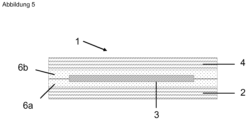
- Fig. 5 a second (opto-)electronic arrangement according to the invention in a schematic representation.
- Fig. 3 shows a first embodiment of an organic electronic device 1 according to the prior art.
- This device 1 has a substrate 2 on which an electronic Structure 3 is arranged.
- the substrate 2 itself is designed as a barrier for permeates and thus forms part of the encapsulation of the electronic structure 3.
- a further cover 4 designed as a barrier is arranged above the electronic structure 3, in this case also spatially spaced from it.
- an adhesive 5 is provided all the way around the electronic structure 3 on the substrate 2. It is irrelevant whether the adhesive was first connected to the substrate 2 or first to the cover 4.
- the adhesive 5 connects the cover 4 to the substrate 2. By being designed with a corresponding thickness, the adhesive 5 also enables the cover 4 to be spaced apart from the electronic structure 3.
- the adhesive 5 is a state-of-the-art adhesive, i.e. an adhesive with a high permeation barrier, which can also be filled to a high degree with getter material.
- the transparency of the adhesive is not relevant in this structure.
- a transfer adhesive tape would be provided in the form of a die-cut product, which is more difficult to handle due to its delicate geometry than a transfer adhesive tape that is essentially applied over the entire surface.
- Fig. 4 shows an inventive design of an (opto)electronic arrangement 1.
- an electronic structure 3 is shown, which is arranged on a substrate 2 and encapsulated from below by the substrate 2.
- the adhesive according to the invention is now arranged over the entire surface, for example in the form of transfer adhesive tape 6.
- the electronic structure 3 is thus completely encapsulated from above by the transfer adhesive tape 6.
- a cover 4 is then applied to the transfer adhesive tape 6.
- the transfer adhesive tape 6 is one based on the transfer adhesive tape according to the invention, as described above in general terms and explained in more detail below in exemplary embodiments.
- the transfer adhesive tape consists of only one layer of an adhesive according to the invention.
- the cover 4 does not necessarily have to meet the high barrier requirements, since when the electronic arrangement is completely covered by the transfer adhesive tape, the barrier is already provided by the adhesive.
- the cover 4 can, for example, only perform a mechanical protective function, but it can also be provided additionally as a permeation barrier.
- Fig. 5 shows an alternative embodiment of an (opto-)electronic arrangement 1.
- two transfer adhesive tapes 6a, b are now provided, which are identical in the present case, but can also be different.
- the first transfer adhesive tape 6a is arranged over the entire surface of the substrate 2.
- the electronic structure 3 is provided on the transfer adhesive tape 6a, which is fixed by the transfer adhesive tape 6a.
- the composite of transfer adhesive tape 6a and electronic structure 3 is then covered over its entire surface with the further transfer adhesive tape 6b, so that the electronic structure 3 is encapsulated on all sides by the transfer adhesive tapes 6a, b.
- the cover 4 is again provided above the transfer adhesive tape 6b.
- neither the substrate 2 nor the cover 4 necessarily have to have barrier properties. However, they can still be provided in order to further restrict the permeation of permeates to the electronic structure 3.
- the transfer adhesive tape here and preferably in each case has a homogeneous layer thickness.
- the transition to the electronic structure therefore, no sharp edge is formed, as it appears in the representation, but rather the transition is fluid and small unfilled or gas-filled areas can remain.
- an adaptation to the substrate can also be made, particularly if the application is carried out under vacuum.
- the adhesive is compressed locally to different degrees, so that a certain amount of the height difference at the edge structures can be compensated for by flow processes.
- the dimensions shown are also not to scale, but rather serve only to better illustrate.
- the electronic structure itself is usually relatively flat (often less than 1 ⁇ m thick).
- Direct contact between the adhesive and the electronic structure is not mandatory. Additional layers can also be arranged in between, such as a thin-film encapsulation of the electronic structure or barrier films.
- the thickness of the transfer adhesive tape can be any of the usual thicknesses, i.e. from 1 ⁇ m to 3000 ⁇ m. A thickness of between 25 and 100 ⁇ m is preferred, as the adhesive strength and handling properties are particularly good in this range. Another preferred range is a thickness of 3 to 25 ⁇ m, as the amount of substances permeating through the adhesive joint in an encapsulation application can be kept low in this range simply by the small cross-sectional area of the adhesive joint.
- the carrier of the adhesive tape or the liner is coated or printed on one side with the adhesive according to the invention from solution or dispersion or 100% (for example melt), or the adhesive tape is produced by (co-)extrusion.
- the adhesive layer can be crosslinked by heat or high-energy rays.
- This manufacturing process preferably takes place in an environment in which the specific permeate is present only in low concentrations or almost not at all.
- An example is a relative humidity of less than 30%, preferably less than 15%.
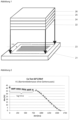
- a calcium test was used as a measure for determining the lifetime of an electronic structure. This is described in the Figure 1 shown.
- a thin calcium layer 23 measuring 10 ⁇ 10 mm 2 is deposited on a glass plate 21 in a vacuum and then stored under a nitrogen atmosphere. The thickness of the calcium layer 23 is approximately 100 nm.
- An adhesive tape (23 ⁇ 23 mm 2 ) with the adhesive 22 to be tested and a thin glass pane 24 (35 ⁇ m, Schott) as a carrier material.
- the thin glass pane was laminated with a 100 ⁇ m thick PET film 26 using a 50 ⁇ m thick transfer adhesive tape 25 of an optically highly transparent acrylic pressure-sensitive adhesive.
- the adhesive 22 is applied to the glass plate 21 in such a way that the adhesive 22 covers the calcium mirror 23 with an edge protruding on all sides of 6.5 mm (AA). Due to the impermeable glass carrier 24, only the permeation through the pressure-sensitive adhesive or along the interfaces is determined.
- the test is based on the reaction of calcium with water vapor and oxygen, as observed for example by AG Erlat et. al. in "47th Annual Technical Conference Proceedings-Society of Vacuum Coaters", 2004, pages 654 to 659 , and from ME Gross et al. in "46th Annual Technical Conference Proceedings-Society of Vacuum Coaters", 2003, pages 89 to 92 , described.
- the light transmission of the calcium layer is monitored, which increases due to the conversion into calcium hydroxide and calcium oxide. In the test setup described, this occurs from the edge, so that the visible surface of the calcium mirror is reduced.
- the time until the light absorption of the calcium mirror is halved is referred to as the service life.
- the method records both the degradation of the surface of the calcium mirror from the edge and through local degradation in the surface, as well as the homogeneous reduction in the layer thickness of the calcium mirror through full-surface degradation.
- the measurement conditions were 60 °C and 90% relative humidity.
- the samples were bonded over the entire surface and without bubbles using a layer of pressure-sensitive adhesive of 50 ⁇ m.
- the reduction in the Ca level is monitored using transmission measurements.
- the breakthrough time (lag time) is defined as the time required for moisture to travel the distance to the Ca (cf. Fig. 2 ). Until this time is reached at 60°C 90% RH, the transmission of the Ca level changes only marginally and at 85°C 85% RH a little.
- the determination of water vapor permeability is carried out according to ASTM F-1249.
- the pressure-sensitive adhesive is applied in a layer thickness of 50 ⁇ m to a highly permeable polysulfone membrane (available from Sartorius), which itself does not contain any Contribution to the permeation barrier.
- the water vapor permeability is determined at 37.5 °C and a relative humidity of 90% using a Mocon OX-Tran 2/21 measuring device.
- the molecular weight determinations of the number-average molecular weights M n and the weight-average molecular weights M w were carried out by means of gel permeation chromatography (GPC). THF (tetrahydrofuran) with 0.1 vol.% trifluoroacetic acid was used as the eluent. The measurement was carried out at 25 °C. The pre-column used was PSS-SDV, 5 ⁇ , 10 3 ⁇ , ID 8.0 mm ⁇ 50 mm. The columns PSS-SDV, 5 ⁇ , 10 3 and 10 5 and 10 6 , each with ID 8.0 mm x 300 mm, were used for separation. The sample concentration was 4 g/l, the flow rate was 1.0 ml per minute. The measurement was carried out against polystyrene standards.
- MMAP is the mixed methylcyclohexane-aniline cloud point determined using a modified ASTM C 611 method. Methylcyclohexane is substituted for the heptane used in the standard test method. The method uses resin/aniline/methylcyclohexane in a ratio of 1/2/1 (5 g/10 mL/5 mL) and the cloud point is determined by cooling a heated, clear mixture of the three components until complete turbidity just occurs.
- the DACP is the diacetone cloud point and is determined by cooling a heated solution of 5 g resin, 5 g xylene and 5 g diacetone alcohol to the point at which the solution becomes cloudy.
- the adhesive resin softening temperature is determined using the relevant methodology known as Ring and Ball, standardized to ASTM E28.
- a ring-ball machine HRB 754 from Herzog is used to determine the adhesive resin softening temperature of the resins. Resin samples are first finely ground. The resulting powder is filled into a brass cylinder with a bottom opening (inner diameter at the top of the cylinder 20 mm, diameter of the bottom opening of the cylinder 16 mm, height of the cylinder 6 mm) and melted on a heating table. The filling quantity is selected so that the resin completely fills the cylinder after melting without any overhang.
- the resulting test specimen is placed in the HRB 754 test holder together with the cylinder.
- Glycerine is used to fill the tempering bath if the adhesive resin softening temperature is between 50 °C and 150 °C. At lower adhesive resin softening temperatures, a water bath can also be used.
- the test balls have a diameter of 9.5 mm and weigh 3.5 g.
- the ball is placed above the test specimen in the tempering bath and placed on the test specimen. There is a collecting plate 25 mm below the cylinder base and a light barrier 2 mm above this. During the measurement process, the temperature is increased by 5 °C/min.
- the ball In the temperature range of the adhesive resin softening temperature, the ball begins to move through the bottom opening of the cylinder until it finally comes to a stop on the collecting plate. In this position, it is detected by the light barrier and the temperature of the tempering bath is recorded at this time. A double determination is carried out.
- the adhesive resin softening temperature is the average of the two individual measurements.
- various adhesives were applied from a solution to a conventional liner (siliconized polyester film) using a laboratory coating device and dried.
- the adhesive layer thickness after drying is 50 ⁇ 5 ⁇ m. Drying was initially carried out at RT for 10 minutes and then for 10 minutes at 120 °C in a laboratory drying cabinet. The dried adhesive layers were immediately laminated to the open side with a second liner (siliconized polyester film with lower release force) after drying.
- Sibstar 62M SiBS polystyrene-block-polyisobutylene block copolymer
- Kaneka 20% by weight block polystyrene content.
- the SBBS contained approx. 68% diblock content.
- a polystyrene-block-polyisobutylene block copolymer from Kaneka was selected as the copolymer.
- the proportion of styrene in the total polymer is 20% by weight.
- Sibstar 62M was used.
- the molecular weight M w is 60,000 g/mol.
- the glass transition temperature of the polystyrene blocks was 100 °C and that of the polyisobutylene blocks was -60 °C.
- the catalyst was present as a 50 wt. % solution in propylene carbonate.
- the photolatent catalyst has an absorption maximum in the range 320 nm to 360 nm.
- Table 1 The exact composition of the individual examples V1 and V2 or K1 and K2 can be found in Table 1.
- Table 1 Example: K1 K2 V1 V2 parts by weight parts by weight parts by weight parts by weight Sibstar 62M 37.5 HBE-100 20 20 Escorez 5600 100 100 Escorez 5300 37.5 Ondina G17 25 25 Tuftec P 1500 100 100 polyacrylate - 75 Glycidoxypropyltri-ethoxysilane 5 triethoxyoctylsilane 10 5 Titanium(IV) isopropoxide 0.3 [4-(2-hydroxytetradecyloxy)phenyl]phenyliodonium hexafluoroantimonate 0.3 0.1 0.1
- the samples were placed in a glove box. Some of the samples were laminated onto a Ca-vaporized glass substrate using a rubber roller to ensure that there were no bubbles. The second PET liner was then laid out and a layer of thin glass was laminated onto it. This sample was used for the durability test.
- a catalyst that is not in accordance with the invention i.e. one that cannot be switched, was used.
- the sample has a certain lag time that does not change when exposed to UV light.
- the getter cannot be switched.
- the lag time changes significantly.
- the lag time after activation of the catalyst and thus of the getter by UV radiation is 15 times higher than before activation.
- K2 is an example of a combined activation of the getter and curing of the reactive resin.
- the adhesive Before activation/curing, the adhesive has no lag time. A long lag time is achieved through activation/curing.
- the non-inventive sample V1 showed that the getter had been consumed and had already reacted with the water, so that the lag time had dropped to zero.
- the non-activated getter had not reacted with the water contained in the moist air during the one day.
- the lag time of the samples was essentially identical to that of a sample that had not been exposed to moist air. Although the samples were exposed to water vapor, this had no influence on their effectiveness as getters, since the getter function had not yet been activated.
- Comparative example V2 shows that a sample with a high WVTR value has no measurable lag time.
Landscapes
- Chemical & Material Sciences (AREA)
- Organic Chemistry (AREA)
- Chemical Kinetics & Catalysis (AREA)
- Health & Medical Sciences (AREA)
- Medicinal Chemistry (AREA)
- Polymers & Plastics (AREA)
- Materials Engineering (AREA)
- Engineering & Computer Science (AREA)
- Life Sciences & Earth Sciences (AREA)
- Wood Science & Technology (AREA)
- Oil, Petroleum & Natural Gas (AREA)
- Physics & Mathematics (AREA)
- Optics & Photonics (AREA)
- Adhesives Or Adhesive Processes (AREA)
- Adhesive Tapes (AREA)
- Electroluminescent Light Sources (AREA)
Applications Claiming Priority (2)
| Application Number | Priority Date | Filing Date | Title |
|---|---|---|---|
| DE102014222038 | 2014-10-29 | ||
| PCT/EP2015/073898 WO2016066435A1 (de) | 2014-10-29 | 2015-10-15 | Klebemassen mit aktivierbaren gettermaterialien |
Publications (3)
| Publication Number | Publication Date |
|---|---|
| EP3212727A1 EP3212727A1 (de) | 2017-09-06 |
| EP3212727B1 true EP3212727B1 (de) | 2025-03-05 |
| EP3212727C0 EP3212727C0 (de) | 2025-03-05 |
Family
ID=54360436
Family Applications (1)
| Application Number | Title | Priority Date | Filing Date |
|---|---|---|---|
| EP15786881.1A Active EP3212727B1 (de) | 2014-10-29 | 2015-10-15 | Klebemassen mit aktivierbaren gettermaterialien |
Country Status (7)
| Country | Link |
|---|---|
| US (2) | US20170327717A1 (enExample) |
| EP (1) | EP3212727B1 (enExample) |
| JP (1) | JP6474489B2 (enExample) |
| KR (1) | KR101994466B1 (enExample) |
| CN (1) | CN107148458A (enExample) |
| TW (1) | TWI681034B (enExample) |
| WO (1) | WO2016066435A1 (enExample) |
Families Citing this family (8)
| Publication number | Priority date | Publication date | Assignee | Title |
|---|---|---|---|---|
| EP3034548A1 (en) * | 2014-12-18 | 2016-06-22 | Nederlandse Organisatie voor toegepast- natuurwetenschappelijk onderzoek TNO | Barrier film laminate comprising submicron getter particles and electronic device comprising such a laminate |
| DE102015222028A1 (de) | 2015-11-09 | 2017-05-11 | Tesa Se | Kationisch polymerisierbare Polyacrylate enthaltend Alkoxysilangruppen und deren Verwendung |
| DE102017111519B4 (de) | 2017-05-26 | 2026-03-19 | Pictiva Displays International Limited | Organisches optoelektronisches Bauteil |
| CN108107619B (zh) * | 2017-12-26 | 2021-06-08 | 上海展扬通信技术有限公司 | 一种显示模组结构及终端设备 |
| DE102018202545A1 (de) * | 2018-02-20 | 2019-08-22 | Tesa Se | Zusammensetzung zur Erzeugung einer Klebemasse insbesondere zur Kapselung einer elektronischen Anordnung |
| DE102018208168A1 (de) | 2018-05-24 | 2019-11-28 | Tesa Se | Kombination einer transparenten vollflächigen Verkapselung mit einer (intransparenten) Randverkapselung mit hohem Gettergehalt |
| KR102897921B1 (ko) * | 2020-03-19 | 2025-12-09 | 삼성디스플레이 주식회사 | 전자 소자용 밀봉 또는 충전 조성물 및 전자 장치 |
| CN115518453A (zh) * | 2021-06-25 | 2022-12-27 | 江苏鲁汶仪器有限公司 | 一种减少银刻蚀副产物团聚的方法 |
Citations (2)
| Publication number | Priority date | Publication date | Assignee | Title |
|---|---|---|---|---|
| WO2005118679A2 (en) * | 2004-05-28 | 2005-12-15 | Bostik Sa | Novel adhesive composition |
| WO2015154947A1 (de) * | 2014-04-11 | 2015-10-15 | Tesa Se | Klebeband für die kapselung einer organischen elektronischen anordnung |
Family Cites Families (68)
| Publication number | Priority date | Publication date | Assignee | Title |
|---|---|---|---|---|
| US3729319A (en) | 1971-06-02 | 1973-04-24 | Ilford Ltd | Optical supersensitisation of silver halide emulsions with three cyanine dyes |
| US3741769A (en) | 1972-10-24 | 1973-06-26 | Minnesota Mining & Mfg | Novel photosensitive polymerizable systems and their use |
| JPS5145316B2 (enExample) * | 1973-08-06 | 1976-12-03 | ||
| AU497960B2 (en) | 1974-04-11 | 1979-01-25 | Minnesota Mining And Manufacturing Company | Photopolymerizable compositions |
| US4058401A (en) | 1974-05-02 | 1977-11-15 | General Electric Company | Photocurable compositions containing group via aromatic onium salts |
| US4256828A (en) | 1975-09-02 | 1981-03-17 | Minnesota Mining And Manufacturing Company | Photocopolymerizable compositions based on epoxy and hydroxyl-containing organic materials |
| US4138255A (en) | 1977-06-27 | 1979-02-06 | General Electric Company | Photo-curing method for epoxy resin using group VIa onium salt |
| US4231951A (en) | 1978-02-08 | 1980-11-04 | Minnesota Mining And Manufacturing Company | Complex salt photoinitiator |
| US4250053A (en) | 1979-05-21 | 1981-02-10 | Minnesota Mining And Manufacturing Company | Sensitized aromatic iodonium or aromatic sulfonium salt photoinitiator systems |
| JPS56163127A (en) | 1980-05-21 | 1981-12-15 | Japan Synthetic Rubber Co Ltd | Treatment of polymer |
| US5089536A (en) | 1982-11-22 | 1992-02-18 | Minnesota Mining And Manufacturing Company | Energy polmerizable compositions containing organometallic initiators |
| BR9106400A (pt) * | 1990-05-02 | 1993-05-18 | Zapata Industries Inc | Composicoes polimericas contendo compostos eliminadores de oxigenio |
| US5304419A (en) * | 1990-07-06 | 1994-04-19 | Alpha Fry Ltd | Moisture and particle getter for enclosures |
| DE69418826T2 (de) * | 1993-11-22 | 1999-10-21 | Ciba Specialty Chemicals Holding Inc., Basel | Zusammensetzungen zur Herstellung strukturierter Farbbilder und deren Anwendung |
| AU7376996A (en) * | 1995-09-28 | 1997-04-17 | Allied-Signal Inc. | Hydrogen and moisture getter and absorber for sealed devices |
| CN1128799C (zh) | 1997-03-18 | 2003-11-26 | 西巴特殊化学品控股有限公司 | 基于α-氨基烯烃的可被光活化的含氮碱 |
| US6489374B1 (en) | 1998-08-21 | 2002-12-03 | Ciba Specialty Chemicals Corporation | Photoactivatable bases containing nitrogen |
| US6121354A (en) * | 1998-11-19 | 2000-09-19 | Bostik, Inc. | High performance single-component sealant |
| JP2001039475A (ja) * | 1999-07-27 | 2001-02-13 | Toyo Seikan Kaisha Ltd | 樹脂組成物、積層体、容器及び容器蓋 |
| CN1187388C (zh) * | 2000-05-26 | 2005-02-02 | 阿克佐诺贝尔股份有限公司 | 光敏涂料组合物 |
| CN1916760B (zh) * | 2001-06-29 | 2010-10-13 | Jsr株式会社 | 酸发生剂、磺酸、磺酸衍生物及辐射敏感树脂组合物 |
| US7538104B2 (en) * | 2001-10-17 | 2009-05-26 | Ciba Specialty Chemicals Corporation | Photoactivable nitrogen bases |
| US6936131B2 (en) * | 2002-01-31 | 2005-08-30 | 3M Innovative Properties Company | Encapsulation of organic electronic devices using adsorbent loaded adhesives |
| US20060100299A1 (en) * | 2002-07-24 | 2006-05-11 | Ranjit Malik | Transformable pressure sensitive adhesive tape and use thereof in display screens |
| JP2005187793A (ja) | 2003-12-24 | 2005-07-14 | Rohm & Haas Electronic Materials Llc | 改良された接着剤 |
| US20060093844A1 (en) * | 2004-10-29 | 2006-05-04 | Conklin Jeanine A | Photochromic coating compositions, methods of making coated articles and articles thereof |
| US8551620B2 (en) * | 2005-06-08 | 2013-10-08 | Ppg Industries Ohio, Inc. | Multi-layer aircraft adhesive |
| US7875149B2 (en) * | 2005-06-08 | 2011-01-25 | Ppg Industries Ohio, Inc. | Aircraft adhesive |
| US20070193675A1 (en) * | 2006-02-22 | 2007-08-23 | Abhijit Gurav | Process of manufacturing a multilayer device and device manufactured thereby |
| US8040587B2 (en) * | 2006-05-17 | 2011-10-18 | Qualcomm Mems Technologies, Inc. | Desiccant in a MEMS device |
| WO2008003601A1 (en) * | 2006-07-04 | 2008-01-10 | Ciba Holding Inc. | Water based concentrated product forms of photoinitiators made by a heterophase polymerization technique |
| WO2008066116A1 (fr) * | 2006-12-01 | 2008-06-05 | Kaneka Corporation | Composition de polysiloxane |
| US9011794B2 (en) * | 2007-01-11 | 2015-04-21 | Freshpoint Quality Assurance Ltd. | Time temperature indicator |
| DE102007038458A1 (de) * | 2007-08-14 | 2009-02-19 | Tesa Ag | Verbundelement |
| DE102007045104A1 (de) * | 2007-09-20 | 2009-04-02 | Kömmerling Chemische Fabrik GmbH | Dichtungsmasse zur Herstellung von Zwei- oder Mehrscheiben-Isolierglas oder Solarmodulen |
| US20090159117A1 (en) * | 2007-12-20 | 2009-06-25 | Truseal Technologies, Inc. | Hot melt sealant containing desiccant for use in photovoltaic modules |
| DE102008003546A1 (de) | 2008-01-09 | 2009-07-16 | Tesa Ag | Liner mit einer Barriereschicht |
| US20110048513A1 (en) * | 2008-04-02 | 2011-03-03 | Adco Products, Inc. | Adhesive composition and method for attaching a component to a substrate |
| WO2009156285A1 (en) * | 2008-06-23 | 2009-12-30 | Freshpoint Holdings Sa | Time temperature indicator |
| DE102008047964A1 (de) * | 2008-09-18 | 2010-03-25 | Tesa Se | Verfahren zur Kapselung einer elektronischen Anordnung |
| ES2364725T3 (es) * | 2008-10-31 | 2011-09-13 | Sika Technology Ag | Composición de poliuretano que contiene organometoxisilano con propiedades de material anisotrópico. |
| ES2358719T3 (es) * | 2008-10-31 | 2011-05-13 | Sika Technology Ag | Composición de poliuretano que contiene alfa-silano con propiedades de material anisótropas. |
| JP5201347B2 (ja) * | 2008-11-28 | 2013-06-05 | 株式会社スリーボンド | 有機el素子封止用光硬化性樹脂組成物 |
| DE102008060113A1 (de) * | 2008-12-03 | 2010-07-29 | Tesa Se | Verfahren zur Kapselung einer elektronischen Anordnung |
| DE102008062130A1 (de) * | 2008-12-16 | 2010-06-17 | Tesa Se | Verfahren zur Kapselung einer elektronischen Anordnung |
| DE102009018518A1 (de) * | 2009-04-24 | 2010-10-28 | Tesa Se | Transparente Barrierelaminate |
| JP5356928B2 (ja) * | 2009-06-17 | 2013-12-04 | 旭化成ケミカルズ株式会社 | 感光性樹脂組成物、並びにそれを用いた感光性インクジェットインク、感光性接着剤、感光性コーティング剤、及び半導体封止材 |
| WO2011016451A1 (ja) * | 2009-08-04 | 2011-02-10 | シャープ株式会社 | 太陽電池モジュールの製造方法、および、その製造方法で製造された太陽電池モジュール |
| DE102009036970A1 (de) * | 2009-08-12 | 2011-02-17 | Tesa Se | Verfahren zur Kapselung einer elektronischen Anordnung |
| DE102009036968A1 (de) * | 2009-08-12 | 2011-02-17 | Tesa Se | Verfahren zur Kapselung einer elektronischen Anordnung |
| JP5719647B2 (ja) | 2010-04-09 | 2015-05-20 | 日東電工株式会社 | シーリング組成物、複層ガラスおよび太陽電池パネル |
| DE102010062823A1 (de) * | 2010-12-10 | 2012-06-21 | Tesa Se | Klebmasse und Verfahren zur Kapselung einer elektronischen Anordnung |
| DE102011002809A1 (de) * | 2011-01-18 | 2012-07-19 | Henkel Ag & Co. Kgaa | 2K-PU-Zusammensetzung mit verzögerter Vernetzung |
| US9068103B2 (en) * | 2011-02-03 | 2015-06-30 | Carroll Benford Dickens | Waterproof silane-endcapped adhesive mixture |
| JP2013025961A (ja) | 2011-07-19 | 2013-02-04 | Pioneer Electronic Corp | 有機elモジュール |
| DE102011085034A1 (de) * | 2011-10-21 | 2013-04-25 | Tesa Se | Klebemasse insbesondere zur Kapselung einer elektronischen Anordnung |
| CN103930503B (zh) * | 2011-11-14 | 2017-12-12 | Lg化学株式会社 | 粘合膜 |
| EP2597697A1 (en) * | 2011-11-28 | 2013-05-29 | Nederlandse Organisatie voor toegepast -natuurwetenschappelijk onderzoek TNO | Sealed thin-film device as well as method of repairing, system for repairing and computer program product |
| DE102011089565A1 (de) * | 2011-12-22 | 2013-06-27 | Tesa Se | Liner zum Schutz von Klebemassen |
| DE102011089566A1 (de) * | 2011-12-22 | 2013-06-27 | Tesa Se | Liner zum Schutz von Klebemassen |
| DE102012203623A1 (de) * | 2012-03-07 | 2013-09-12 | Tesa Se | Verbundsystem zur Verkapselung elektronischer Anordnungen |
| DE102012206273A1 (de) * | 2012-04-17 | 2013-10-17 | Tesa Se | Vernetzbare Klebmasse mit Hart- und Weichblöcken als Permeantenbarriere |
| DE102012211335A1 (de) | 2012-06-29 | 2014-01-02 | Tesa Se | Klebeband für die Kapselung einer organischen elektronischen Anordnung |
| DE102012219877A1 (de) * | 2012-08-24 | 2014-02-27 | Tesa Se | Haftklebemasse insbesondere zur Kapselung einer elektronischen Anordnung |
| TW201436855A (zh) * | 2012-12-21 | 2014-10-01 | Tesa Se | 從平面結構物移除滲透物的方法 |
| DE102012224310A1 (de) * | 2012-12-21 | 2014-06-26 | Tesa Se | Gettermaterial enthaltendes Klebeband |
| EP3212725B1 (de) | 2014-10-29 | 2024-03-06 | tesa SE | Oled kompatible klebemassen mit silanwasserfängern |
| US10696016B2 (en) * | 2015-07-31 | 2020-06-30 | Samsung Sdi Co., Ltd. | Window film and flexible display including the same |
-
2015
- 2015-10-15 US US15/520,003 patent/US20170327717A1/en not_active Abandoned
- 2015-10-15 JP JP2017523283A patent/JP6474489B2/ja not_active Expired - Fee Related
- 2015-10-15 CN CN201580058849.7A patent/CN107148458A/zh active Pending
- 2015-10-15 WO PCT/EP2015/073898 patent/WO2016066435A1/de not_active Ceased
- 2015-10-15 KR KR1020177013521A patent/KR101994466B1/ko active Active
- 2015-10-15 EP EP15786881.1A patent/EP3212727B1/de active Active
- 2015-10-26 TW TW104135079A patent/TWI681034B/zh active
-
2019
- 2019-06-03 US US16/429,831 patent/US11390783B2/en active Active
Patent Citations (2)
| Publication number | Priority date | Publication date | Assignee | Title |
|---|---|---|---|---|
| WO2005118679A2 (en) * | 2004-05-28 | 2005-12-15 | Bostik Sa | Novel adhesive composition |
| WO2015154947A1 (de) * | 2014-04-11 | 2015-10-15 | Tesa Se | Klebeband für die kapselung einer organischen elektronischen anordnung |
Also Published As
| Publication number | Publication date |
|---|---|
| JP2017537998A (ja) | 2017-12-21 |
| WO2016066435A1 (de) | 2016-05-06 |
| CN107148458A (zh) | 2017-09-08 |
| JP6474489B2 (ja) | 2019-02-27 |
| KR101994466B1 (ko) | 2019-06-28 |
| KR20170070223A (ko) | 2017-06-21 |
| US20170327717A1 (en) | 2017-11-16 |
| EP3212727A1 (de) | 2017-09-06 |
| US11390783B2 (en) | 2022-07-19 |
| US20190284450A1 (en) | 2019-09-19 |
| TW201634634A (zh) | 2016-10-01 |
| EP3212727C0 (de) | 2025-03-05 |
| TWI681034B (zh) | 2020-01-01 |
Similar Documents
| Publication | Publication Date | Title |
|---|---|---|
| EP3212725B1 (de) | Oled kompatible klebemassen mit silanwasserfängern | |
| WO2016066435A1 (de) | Klebemassen mit aktivierbaren gettermaterialien | |
| EP2794791B1 (de) | Verwendung eines liners zum schutz von klebemassen | |
| EP3129443B1 (de) | Klebeband für die kapselung einer organischen elektronischen anordnung | |
| EP3212728B1 (de) | Klebemassen mit multifunktionellen siloxanwasserfängern | |
| DE102012211335A1 (de) | Klebeband für die Kapselung einer organischen elektronischen Anordnung | |
| EP3313798B1 (de) | Klebemasse insbesondere zur kapselung einer elektronischen anordnung | |
| WO2014095387A1 (de) | Gettermaterial enthaltendes klebeband | |
| WO2012076262A1 (de) | Klebmasse und verfahren zur kapselung einer elektronischen anordnung | |
| EP3491088B1 (de) | Oled kompatible klebemassen mit cyclischen azasilanwasserfängern | |
| EP3374461B1 (de) | Barriereklebemasse mit polymerem gettermaterial | |
| WO2018019631A1 (de) | Klebeband zur verkapselung elektronischer aufbauten | |
| WO2016124744A1 (de) | Klebemasse mit reduziertem gelbwert |
Legal Events
| Date | Code | Title | Description |
|---|---|---|---|
| STAA | Information on the status of an ep patent application or granted ep patent |
Free format text: STATUS: THE INTERNATIONAL PUBLICATION HAS BEEN MADE |
|
| PUAI | Public reference made under article 153(3) epc to a published international application that has entered the european phase |
Free format text: ORIGINAL CODE: 0009012 |
|
| STAA | Information on the status of an ep patent application or granted ep patent |
Free format text: STATUS: REQUEST FOR EXAMINATION WAS MADE |
|
| 17P | Request for examination filed |
Effective date: 20170529 |
|
| AK | Designated contracting states |
Kind code of ref document: A1 Designated state(s): AL AT BE BG CH CY CZ DE DK EE ES FI FR GB GR HR HU IE IS IT LI LT LU LV MC MK MT NL NO PL PT RO RS SE SI SK SM TR |
|
| AX | Request for extension of the european patent |
Extension state: BA ME |
|
| DAV | Request for validation of the european patent (deleted) | ||
| DAX | Request for extension of the european patent (deleted) | ||
| STAA | Information on the status of an ep patent application or granted ep patent |
Free format text: STATUS: EXAMINATION IS IN PROGRESS |
|
| 17Q | First examination report despatched |
Effective date: 20180511 |
|
| GRAP | Despatch of communication of intention to grant a patent |
Free format text: ORIGINAL CODE: EPIDOSNIGR1 |
|
| STAA | Information on the status of an ep patent application or granted ep patent |
Free format text: STATUS: GRANT OF PATENT IS INTENDED |
|
| INTG | Intention to grant announced |
Effective date: 20241105 |
|
| RIC1 | Information provided on ipc code assigned before grant |
Ipc: C08G 59/24 20060101ALI20241025BHEP Ipc: C09J 11/06 20060101ALI20241025BHEP Ipc: C09J 7/10 20180101ALI20241025BHEP Ipc: C09J 163/00 20060101ALI20241025BHEP Ipc: C09J 11/04 20060101ALI20241025BHEP Ipc: H01L 23/26 20060101ALI20241025BHEP Ipc: C08L 53/02 20060101ALI20241025BHEP Ipc: C09J 153/02 20060101AFI20241025BHEP |
|
| GRAS | Grant fee paid |
Free format text: ORIGINAL CODE: EPIDOSNIGR3 |
|
| GRAA | (expected) grant |
Free format text: ORIGINAL CODE: 0009210 |
|
| STAA | Information on the status of an ep patent application or granted ep patent |
Free format text: STATUS: THE PATENT HAS BEEN GRANTED |
|
| AK | Designated contracting states |
Kind code of ref document: B1 Designated state(s): AL AT BE BG CH CY CZ DE DK EE ES FI FR GB GR HR HU IE IS IT LI LT LU LV MC MK MT NL NO PL PT RO RS SE SI SK SM TR |
|
| REG | Reference to a national code |
Ref country code: GB Ref legal event code: FG4D Free format text: NOT ENGLISH |
|
| REG | Reference to a national code |
Ref country code: CH Ref legal event code: EP |
|
| REG | Reference to a national code |
Ref country code: DE Ref legal event code: R096 Ref document number: 502015017036 Country of ref document: DE |
|
| REG | Reference to a national code |
Ref country code: IE Ref legal event code: FG4D Free format text: LANGUAGE OF EP DOCUMENT: GERMAN |
|
| U01 | Request for unitary effect filed |
Effective date: 20250307 |
|
| U07 | Unitary effect registered |
Designated state(s): AT BE BG DE DK EE FI FR IT LT LU LV MT NL PT RO SE SI Effective date: 20250314 |
|
| PG25 | Lapsed in a contracting state [announced via postgrant information from national office to epo] |
Ref country code: RS Free format text: LAPSE BECAUSE OF FAILURE TO SUBMIT A TRANSLATION OF THE DESCRIPTION OR TO PAY THE FEE WITHIN THE PRESCRIBED TIME-LIMIT Effective date: 20250605 |
|
| PG25 | Lapsed in a contracting state [announced via postgrant information from national office to epo] |
Ref country code: ES Free format text: LAPSE BECAUSE OF FAILURE TO SUBMIT A TRANSLATION OF THE DESCRIPTION OR TO PAY THE FEE WITHIN THE PRESCRIBED TIME-LIMIT Effective date: 20250305 |
|
| PG25 | Lapsed in a contracting state [announced via postgrant information from national office to epo] |
Ref country code: NO Free format text: LAPSE BECAUSE OF FAILURE TO SUBMIT A TRANSLATION OF THE DESCRIPTION OR TO PAY THE FEE WITHIN THE PRESCRIBED TIME-LIMIT Effective date: 20250605 |
|
| PG25 | Lapsed in a contracting state [announced via postgrant information from national office to epo] |
Ref country code: HR Free format text: LAPSE BECAUSE OF FAILURE TO SUBMIT A TRANSLATION OF THE DESCRIPTION OR TO PAY THE FEE WITHIN THE PRESCRIBED TIME-LIMIT Effective date: 20250305 |
|
| PG25 | Lapsed in a contracting state [announced via postgrant information from national office to epo] |
Ref country code: GR Free format text: LAPSE BECAUSE OF FAILURE TO SUBMIT A TRANSLATION OF THE DESCRIPTION OR TO PAY THE FEE WITHIN THE PRESCRIBED TIME-LIMIT Effective date: 20250606 |
|
| PG25 | Lapsed in a contracting state [announced via postgrant information from national office to epo] |
Ref country code: SM Free format text: LAPSE BECAUSE OF FAILURE TO SUBMIT A TRANSLATION OF THE DESCRIPTION OR TO PAY THE FEE WITHIN THE PRESCRIBED TIME-LIMIT Effective date: 20250305 |
|
| PG25 | Lapsed in a contracting state [announced via postgrant information from national office to epo] |
Ref country code: PL Free format text: LAPSE BECAUSE OF FAILURE TO SUBMIT A TRANSLATION OF THE DESCRIPTION OR TO PAY THE FEE WITHIN THE PRESCRIBED TIME-LIMIT Effective date: 20250305 |
|
| PG25 | Lapsed in a contracting state [announced via postgrant information from national office to epo] |
Ref country code: CZ Free format text: LAPSE BECAUSE OF FAILURE TO SUBMIT A TRANSLATION OF THE DESCRIPTION OR TO PAY THE FEE WITHIN THE PRESCRIBED TIME-LIMIT Effective date: 20250305 |
|
| PG25 | Lapsed in a contracting state [announced via postgrant information from national office to epo] |
Ref country code: SK Free format text: LAPSE BECAUSE OF FAILURE TO SUBMIT A TRANSLATION OF THE DESCRIPTION OR TO PAY THE FEE WITHIN THE PRESCRIBED TIME-LIMIT Effective date: 20250305 |
|
| PG25 | Lapsed in a contracting state [announced via postgrant information from national office to epo] |
Ref country code: IS Free format text: LAPSE BECAUSE OF FAILURE TO SUBMIT A TRANSLATION OF THE DESCRIPTION OR TO PAY THE FEE WITHIN THE PRESCRIBED TIME-LIMIT Effective date: 20250705 |
|
| U20 | Renewal fee for the european patent with unitary effect paid |
Year of fee payment: 11 Effective date: 20251028 |
|
| PGFP | Annual fee paid to national office [announced via postgrant information from national office to epo] |
Ref country code: GB Payment date: 20251024 Year of fee payment: 11 |
|
| PLBE | No opposition filed within time limit |
Free format text: ORIGINAL CODE: 0009261 |
|
| STAA | Information on the status of an ep patent application or granted ep patent |
Free format text: STATUS: NO OPPOSITION FILED WITHIN TIME LIMIT |
|
| REG | Reference to a national code |
Ref country code: CH Ref legal event code: L10 Free format text: ST27 STATUS EVENT CODE: U-0-0-L10-L00 (AS PROVIDED BY THE NATIONAL OFFICE) Effective date: 20260114 |
|
| 26N | No opposition filed |
Effective date: 20251208 |
|
| REG | Reference to a national code |
Ref country code: CH Ref legal event code: H13 Free format text: ST27 STATUS EVENT CODE: U-0-0-H10-H13 (AS PROVIDED BY THE NATIONAL OFFICE) Effective date: 20260527 |
|
| PG25 | Lapsed in a contracting state [announced via postgrant information from national office to epo] |
Ref country code: MC Free format text: LAPSE BECAUSE OF FAILURE TO SUBMIT A TRANSLATION OF THE DESCRIPTION OR TO PAY THE FEE WITHIN THE PRESCRIBED TIME-LIMIT Effective date: 20250305 |
|
| PG25 | Lapsed in a contracting state [announced via postgrant information from national office to epo] |
Ref country code: CH Free format text: LAPSE BECAUSE OF NON-PAYMENT OF DUE FEES Effective date: 20251031 |