EP3210774A1 - Copper clad laminate, printed circuit board thereof, and manufacturing method thereof - Google Patents
Copper clad laminate, printed circuit board thereof, and manufacturing method thereof Download PDFInfo
- Publication number
- EP3210774A1 EP3210774A1 EP16173249.0A EP16173249A EP3210774A1 EP 3210774 A1 EP3210774 A1 EP 3210774A1 EP 16173249 A EP16173249 A EP 16173249A EP 3210774 A1 EP3210774 A1 EP 3210774A1
- Authority
- EP
- European Patent Office
- Prior art keywords
- layer
- thermoplastic polyimide
- range
- total thickness
- copper foil
- Prior art date
- Legal status (The legal status is an assumption and is not a legal conclusion. Google has not performed a legal analysis and makes no representation as to the accuracy of the status listed.)
- Granted
Links
Images

Classifications
-
- B—PERFORMING OPERATIONS; TRANSPORTING
- B32—LAYERED PRODUCTS
- B32B—LAYERED PRODUCTS, i.e. PRODUCTS BUILT-UP OF STRATA OF FLAT OR NON-FLAT, e.g. CELLULAR OR HONEYCOMB, FORM
- B32B15/00—Layered products comprising a layer of metal
- B32B15/04—Layered products comprising a layer of metal comprising metal as the main or only constituent of a layer, which is next to another layer of the same or of a different material
- B32B15/08—Layered products comprising a layer of metal comprising metal as the main or only constituent of a layer, which is next to another layer of the same or of a different material of synthetic resin
-
- H—ELECTRICITY
- H05—ELECTRIC TECHNIQUES NOT OTHERWISE PROVIDED FOR
- H05K—PRINTED CIRCUITS; CASINGS OR CONSTRUCTIONAL DETAILS OF ELECTRIC APPARATUS; MANUFACTURE OF ASSEMBLAGES OF ELECTRICAL COMPONENTS
- H05K1/00—Printed circuits
- H05K1/02—Details
- H05K1/09—Use of materials for the conductive, e.g. metallic pattern
-
- B—PERFORMING OPERATIONS; TRANSPORTING
- B32—LAYERED PRODUCTS
- B32B—LAYERED PRODUCTS, i.e. PRODUCTS BUILT-UP OF STRATA OF FLAT OR NON-FLAT, e.g. CELLULAR OR HONEYCOMB, FORM
- B32B15/00—Layered products comprising a layer of metal
- B32B15/20—Layered products comprising a layer of metal comprising aluminium or copper
-
- B—PERFORMING OPERATIONS; TRANSPORTING
- B32—LAYERED PRODUCTS
- B32B—LAYERED PRODUCTS, i.e. PRODUCTS BUILT-UP OF STRATA OF FLAT OR NON-FLAT, e.g. CELLULAR OR HONEYCOMB, FORM
- B32B27/00—Layered products comprising a layer of synthetic resin
- B32B27/06—Layered products comprising a layer of synthetic resin as the main or only constituent of a layer, which is next to another layer of the same or of a different material
- B32B27/08—Layered products comprising a layer of synthetic resin as the main or only constituent of a layer, which is next to another layer of the same or of a different material of synthetic resin
-
- B—PERFORMING OPERATIONS; TRANSPORTING
- B32—LAYERED PRODUCTS
- B32B—LAYERED PRODUCTS, i.e. PRODUCTS BUILT-UP OF STRATA OF FLAT OR NON-FLAT, e.g. CELLULAR OR HONEYCOMB, FORM
- B32B27/00—Layered products comprising a layer of synthetic resin
- B32B27/28—Layered products comprising a layer of synthetic resin comprising synthetic resins not wholly covered by any one of the sub-groups B32B27/30 - B32B27/42
- B32B27/281—Layered products comprising a layer of synthetic resin comprising synthetic resins not wholly covered by any one of the sub-groups B32B27/30 - B32B27/42 comprising polyimides
-
- B—PERFORMING OPERATIONS; TRANSPORTING
- B32—LAYERED PRODUCTS
- B32B—LAYERED PRODUCTS, i.e. PRODUCTS BUILT-UP OF STRATA OF FLAT OR NON-FLAT, e.g. CELLULAR OR HONEYCOMB, FORM
- B32B37/00—Methods or apparatus for laminating, e.g. by curing or by ultrasonic bonding
-
- B—PERFORMING OPERATIONS; TRANSPORTING
- B32—LAYERED PRODUCTS
- B32B—LAYERED PRODUCTS, i.e. PRODUCTS BUILT-UP OF STRATA OF FLAT OR NON-FLAT, e.g. CELLULAR OR HONEYCOMB, FORM
- B32B7/00—Layered products characterised by the relation between layers; Layered products characterised by the relative orientation of features between layers, or by the relative values of a measurable parameter between layers, i.e. products comprising layers having different physical, chemical or physicochemical properties; Layered products characterised by the interconnection of layers
- B32B7/04—Interconnection of layers
-
- H—ELECTRICITY
- H05—ELECTRIC TECHNIQUES NOT OTHERWISE PROVIDED FOR
- H05K—PRINTED CIRCUITS; CASINGS OR CONSTRUCTIONAL DETAILS OF ELECTRIC APPARATUS; MANUFACTURE OF ASSEMBLAGES OF ELECTRICAL COMPONENTS
- H05K1/00—Printed circuits
- H05K1/02—Details
-
- H—ELECTRICITY
- H05—ELECTRIC TECHNIQUES NOT OTHERWISE PROVIDED FOR
- H05K—PRINTED CIRCUITS; CASINGS OR CONSTRUCTIONAL DETAILS OF ELECTRIC APPARATUS; MANUFACTURE OF ASSEMBLAGES OF ELECTRICAL COMPONENTS
- H05K1/00—Printed circuits
- H05K1/02—Details
- H05K1/0277—Bendability or stretchability details
- H05K1/028—Bending or folding regions of flexible printed circuits
-
- H—ELECTRICITY
- H05—ELECTRIC TECHNIQUES NOT OTHERWISE PROVIDED FOR
- H05K—PRINTED CIRCUITS; CASINGS OR CONSTRUCTIONAL DETAILS OF ELECTRIC APPARATUS; MANUFACTURE OF ASSEMBLAGES OF ELECTRICAL COMPONENTS
- H05K1/00—Printed circuits
- H05K1/02—Details
- H05K1/03—Use of materials for the substrate
- H05K1/0313—Organic insulating material
- H05K1/0353—Organic insulating material consisting of two or more materials, e.g. two or more polymers, polymer + filler, + reinforcement
-
- H—ELECTRICITY
- H05—ELECTRIC TECHNIQUES NOT OTHERWISE PROVIDED FOR
- H05K—PRINTED CIRCUITS; CASINGS OR CONSTRUCTIONAL DETAILS OF ELECTRIC APPARATUS; MANUFACTURE OF ASSEMBLAGES OF ELECTRICAL COMPONENTS
- H05K3/00—Apparatus or processes for manufacturing printed circuits
- H05K3/0011—Working of insulating substrates or insulating layers
- H05K3/0014—Shaping of the substrate, e.g. by moulding
-
- H—ELECTRICITY
- H05—ELECTRIC TECHNIQUES NOT OTHERWISE PROVIDED FOR
- H05K—PRINTED CIRCUITS; CASINGS OR CONSTRUCTIONAL DETAILS OF ELECTRIC APPARATUS; MANUFACTURE OF ASSEMBLAGES OF ELECTRICAL COMPONENTS
- H05K3/00—Apparatus or processes for manufacturing printed circuits
- H05K3/46—Manufacturing multilayer circuits
- H05K3/4611—Manufacturing multilayer circuits by laminating two or more circuit boards
-
- B—PERFORMING OPERATIONS; TRANSPORTING
- B32—LAYERED PRODUCTS
- B32B—LAYERED PRODUCTS, i.e. PRODUCTS BUILT-UP OF STRATA OF FLAT OR NON-FLAT, e.g. CELLULAR OR HONEYCOMB, FORM
- B32B2250/00—Layers arrangement
- B32B2250/03—3 layers
-
- B—PERFORMING OPERATIONS; TRANSPORTING
- B32—LAYERED PRODUCTS
- B32B—LAYERED PRODUCTS, i.e. PRODUCTS BUILT-UP OF STRATA OF FLAT OR NON-FLAT, e.g. CELLULAR OR HONEYCOMB, FORM
- B32B2250/00—Layers arrangement
- B32B2250/40—Symmetrical or sandwich layers, e.g. ABA, ABCBA, ABCCBA
-
- B—PERFORMING OPERATIONS; TRANSPORTING
- B32—LAYERED PRODUCTS
- B32B—LAYERED PRODUCTS, i.e. PRODUCTS BUILT-UP OF STRATA OF FLAT OR NON-FLAT, e.g. CELLULAR OR HONEYCOMB, FORM
- B32B2307/00—Properties of the layers or laminate
- B32B2307/30—Properties of the layers or laminate having particular thermal properties
-
- B—PERFORMING OPERATIONS; TRANSPORTING
- B32—LAYERED PRODUCTS
- B32B—LAYERED PRODUCTS, i.e. PRODUCTS BUILT-UP OF STRATA OF FLAT OR NON-FLAT, e.g. CELLULAR OR HONEYCOMB, FORM
- B32B2307/00—Properties of the layers or laminate
- B32B2307/30—Properties of the layers or laminate having particular thermal properties
- B32B2307/306—Resistant to heat
-
- B—PERFORMING OPERATIONS; TRANSPORTING
- B32—LAYERED PRODUCTS
- B32B—LAYERED PRODUCTS, i.e. PRODUCTS BUILT-UP OF STRATA OF FLAT OR NON-FLAT, e.g. CELLULAR OR HONEYCOMB, FORM
- B32B2307/00—Properties of the layers or laminate
- B32B2307/50—Properties of the layers or laminate having particular mechanical properties
- B32B2307/54—Yield strength; Tensile strength
-
- B—PERFORMING OPERATIONS; TRANSPORTING
- B32—LAYERED PRODUCTS
- B32B—LAYERED PRODUCTS, i.e. PRODUCTS BUILT-UP OF STRATA OF FLAT OR NON-FLAT, e.g. CELLULAR OR HONEYCOMB, FORM
- B32B2307/00—Properties of the layers or laminate
- B32B2307/50—Properties of the layers or laminate having particular mechanical properties
- B32B2307/546—Flexural strength; Flexion stiffness
-
- B—PERFORMING OPERATIONS; TRANSPORTING
- B32—LAYERED PRODUCTS
- B32B—LAYERED PRODUCTS, i.e. PRODUCTS BUILT-UP OF STRATA OF FLAT OR NON-FLAT, e.g. CELLULAR OR HONEYCOMB, FORM
- B32B2307/00—Properties of the layers or laminate
- B32B2307/70—Other properties
- B32B2307/732—Dimensional properties
-
- B—PERFORMING OPERATIONS; TRANSPORTING
- B32—LAYERED PRODUCTS
- B32B—LAYERED PRODUCTS, i.e. PRODUCTS BUILT-UP OF STRATA OF FLAT OR NON-FLAT, e.g. CELLULAR OR HONEYCOMB, FORM
- B32B2307/00—Properties of the layers or laminate
- B32B2307/70—Other properties
- B32B2307/732—Dimensional properties
- B32B2307/734—Dimensional stability
-
- B—PERFORMING OPERATIONS; TRANSPORTING
- B32—LAYERED PRODUCTS
- B32B—LAYERED PRODUCTS, i.e. PRODUCTS BUILT-UP OF STRATA OF FLAT OR NON-FLAT, e.g. CELLULAR OR HONEYCOMB, FORM
- B32B2307/00—Properties of the layers or laminate
- B32B2307/70—Other properties
- B32B2307/748—Releasability
-
- B—PERFORMING OPERATIONS; TRANSPORTING
- B32—LAYERED PRODUCTS
- B32B—LAYERED PRODUCTS, i.e. PRODUCTS BUILT-UP OF STRATA OF FLAT OR NON-FLAT, e.g. CELLULAR OR HONEYCOMB, FORM
- B32B2457/00—Electrical equipment
- B32B2457/08—PCBs, i.e. printed circuit boards
-
- B—PERFORMING OPERATIONS; TRANSPORTING
- B32—LAYERED PRODUCTS
- B32B—LAYERED PRODUCTS, i.e. PRODUCTS BUILT-UP OF STRATA OF FLAT OR NON-FLAT, e.g. CELLULAR OR HONEYCOMB, FORM
- B32B2605/00—Vehicles
-
- B—PERFORMING OPERATIONS; TRANSPORTING
- B32—LAYERED PRODUCTS
- B32B—LAYERED PRODUCTS, i.e. PRODUCTS BUILT-UP OF STRATA OF FLAT OR NON-FLAT, e.g. CELLULAR OR HONEYCOMB, FORM
- B32B2605/00—Vehicles
- B32B2605/08—Cars
-
- H—ELECTRICITY
- H05—ELECTRIC TECHNIQUES NOT OTHERWISE PROVIDED FOR
- H05K—PRINTED CIRCUITS; CASINGS OR CONSTRUCTIONAL DETAILS OF ELECTRIC APPARATUS; MANUFACTURE OF ASSEMBLAGES OF ELECTRICAL COMPONENTS
- H05K2201/00—Indexing scheme relating to printed circuits covered by H05K1/00
- H05K2201/01—Dielectrics
- H05K2201/0104—Properties and characteristics in general
- H05K2201/0129—Thermoplastic polymer, e.g. auto-adhesive layer; Shaping of thermoplastic polymer
-
- H—ELECTRICITY
- H05—ELECTRIC TECHNIQUES NOT OTHERWISE PROVIDED FOR
- H05K—PRINTED CIRCUITS; CASINGS OR CONSTRUCTIONAL DETAILS OF ELECTRIC APPARATUS; MANUFACTURE OF ASSEMBLAGES OF ELECTRICAL COMPONENTS
- H05K2201/00—Indexing scheme relating to printed circuits covered by H05K1/00
- H05K2201/05—Flexible printed circuits [FPCs]
-
- H—ELECTRICITY
- H05—ELECTRIC TECHNIQUES NOT OTHERWISE PROVIDED FOR
- H05K—PRINTED CIRCUITS; CASINGS OR CONSTRUCTIONAL DETAILS OF ELECTRIC APPARATUS; MANUFACTURE OF ASSEMBLAGES OF ELECTRICAL COMPONENTS
- H05K2201/00—Indexing scheme relating to printed circuits covered by H05K1/00
- H05K2201/06—Thermal details
- H05K2201/068—Thermal details wherein the coefficient of thermal expansion is important
Definitions
- the present invention relates to a copper clad laminate, a printed circuit board including the same, and a manufacturing method thereof.
- the vehicle can be a living space as well as a transportation means, introduction of more advanced and various convenience devices to ensure safety and improve performance has been carried out.
- an amount of wiring and a wire harness may be increased.
- the probability of failure may also be increased and the weight of the vehicle becomes heavy, thereby deteriorating fuel consumption.
- reliability and down-sizing may be suggested by replacing the conventional wiring harness by a flexible printed circuit board (FPCB) such that electrical equipment of the vehicle can be extensively used in and out the vehicle.
- FPCB flexible printed circuit board
- FCCL flexible copper clad laminate
- the present invention provides a copper clad laminate and a printed circuit board including the same.
- the copper clad laminate may be flexible, which may be provided by a substantially reduced thickness of components constituting the laminated structure, and thus prepared printed circuit board may also be flexible.
- the term "flexible” is meant by easily being bent, modified, altered, or adjustable by a force or pressure without breaking thereby providing suitably physical properties (e.g. dimensional stability and flex resistance).
- the flexible copper clad laminate in the present invention may not be easily breakable as being bent, modified, altered or adjusted by a force applied thereon.
- the copper clad laminate in the present invention may be flexible thereby indicating a flexible copper clad laminate.
- the present invention provides a flexible copper clad laminate having excellent dimensional stability, flex resistance, and adherence after oil contact, and a manufacturing method thereof.
- the present invention provides a flexible printed circuit board comprising the flexible copper clad laminate having the excellent dimensional stability, flex resistance, and adherence after the oil contact.
- a flexible copper clad laminate according to an exemplary embodiment of the present invention may comprise a first copper foil layer, a composite layer, and a second copper foil layer, and the first copper foil layer, the composite layer, and the second copper foil layer may be sequentially stacked.
- the composite layer may comprise a polyimide layer and a plurality of thermoplastic polyimide layers, and an outermost layer of the composite layer may be one of the plurality of the thermoplastic polyimide layers.
- a total thickness of the plurality of the thermoplastic polyimide layers may be in a range of from about 15 to about 50 % with respect to a total thickness of the composite layer, and a total thickness of the polyimide layer may be in a range of from about 50 to about 85 % with respect to the total thickness of the composite layer.
- the total thickness of the plurality of the thermoplastic polyimide layers may be in a range of from about 20 to about 40 % with respect to a total thickness of the composite layer, and the total thickness of the polyimide layer may be in a range of from about 60 to about 80 % with respect to the total thickness of the composite layer.
- the total thickness of the plurality of the thermoplastic polyimide layers may be in a range of from about 30 to about 40 % with respect to the total thickness of the composite layer, and accordingly the total thickness of the polyimide layer may be in a range of from about 60 to about 70 % with respect to the total thickness of the composite layer.
- Each thickness of the first copper foil layer and the second copper foil layer may be in a range of from about 30 to about 80 ⁇ m, and the total thickness of the composite layer may be in a range of from about 40 to about 60 ⁇ m.
- a tensile modulus of the composite layer may be in a range of from about 4.5 to about 5.5 GPa, and a linear coefficient of thermal expansion (CTE) may be in a range of from about 20 to about 30 ppm/°C.
- CTE linear coefficient of thermal expansion
- the polyimide layer and the plurality of thermoplastic polyimide layers may be alternately stacked.
- the polyimide layer suitably may be made of n layers
- the plurality of thermoplastic polyimide layers may be made of (n+1) layers
- n may be from 1 to 5.
- the polyamic acid solution according to an exemplary embodiment of the present invention suitably may be formed by mixing a dianhydride and a diamine in an organic solvent with a molar ratio from about 1:0.9 to about 1:1.1.
- the polyimide-based resin having a desired linear coefficient of thermal expansion (CTE) or modulus may be obtained by controlling a mixture ratio of the dianhydride and the diamine, or a mixture between the dianhydrides or between the diamines, or by adjusting a kind of the selected dianhydride and diamine.
- the dianhydride according to an exemplary embodiment of the present invention may include one or two or more selected from the group consisting of PMDA (pyromellitic dianhydride), BPDA (3,3',4,4'-biphenyl tetracarboxylic dianhydride), BTDA (3,3',4,4'-benzophenone tetracarboxylic dianhydride), ODPA (4,4'-oxydiphthalic anhydride), ODA (4,4'-diaminodiphenyl ether), BPADA (4,4'-(4,4'-isopropyl bi phenoxy)biphthalic anhydride), 6FDA (2,2'-bis-(3,4-dicarboxylic phenyl) hexafluoropropane dianhydride), and TMEG (ethylene glycol bis(anhydro-trimellitate).
- PMDA pyromellitic dianhydride
- BPDA 3,3',4,4'-
- the diamine according to an exemplary embodiment of the present invention may include one or two or more kinds selected from the group consisting of PDA (p-phenylene diamine), m-PDA (m-phenylene diamine), 4,4'-ODA (4,4'-oxydianiline), 3,4'-ODA (3,4'-oxydianiline), BAPP (2,2-bis(4-[4-aminophenoxy]-phenyl)propane), TPE-R (1,3-bis(4-aminophenoxy)benzene), BAPB (4,4'-bis(4-aminophenoxy)biphenyl), m-BAPS (2,2-bis(4-[3-aminophenoxy]phenyl)sulfone), HAB (3,3'-dihydroxy-4,4'-diaminobiphenyl), and DABA (4,4'-diamino-benzanilide).
- PDA p-phenylene diamine
- m-PDA m-pheny
- a manufacturing method of a flexible copper clad laminate may comprise steps of: preparing a first copper foil layer; casting and drying a first thermoplastic polyimide precursor resin on the first copper foil layer to form a first thermoplastic polyimide precursor layer; casting and drying a polyimide precursor resin on the first thermoplastic polyimide precursor layer to form a polyimide precursor layer; casting and drying a second thermoplastic polyimide precursor resin on the polyimide precursor layer to form a second thermoplastic polyimide precursor layer; curing, by a heat treatment, the first thermoplastic polyimide precursor layer, the polyimide precursor layer, and the second thermoplastic polyimide precursor layer to form a composite layer; and stacking a second copper foil layer on the second thermoplastic polyimide layer.
- a total thickness of the first thermoplastic polyimide layer and a thickness of the second thermoplastic polyimide layer may be in a range of from about 15 to about 50 % with respect to the total thickness of the composite layer, and a total thickness of the polyimide layer may be in a range of from about 50 to about 85 % with respect to the total thickness of the composite layer.
- the total thickness of the first thermoplastic polyimide layer and the thickness of the second thermoplastic polyimide layer may be in a range of from about 20 to about 40 % with respect to the total thickness of the composite layer, and the total thickness of the polyimide layer may be in a range of from 60 to 80 % with respect to the total thickness of the composite layer.
- the total thickness of the first and second thermoplastic polyimide layers may be in a range of from about 30 to about 40 % with respect to the total thickness of the composite layer, and accordingly the total thickness of the polyimide layer may be in a range of from about 60 to about 70 % with respect to the total thickness of the composite layer.
- Each of a thickness of the first copper foil layer and a thickness of the second copper foil layer thickness may be in a range of from about 30 to about 80 ⁇ m, and a thickness of the composite layer may be in a range of from about 40 to about 60 ⁇ m.
- a tensile modulus of the composite layer may be in a range of from about 4.5 to about 5.5 GPa, and a linear coefficient of thermal expansion (CTE) may be in a range of from about 20 to about 30 ppm/°C.
- CTE linear coefficient of thermal expansion
- the step forming the first thermoplastic polyimide precursor layer and the step forming the polyimide precursor layer may be suitably performed repeatedly 1 to 5 times.
- a flexible printed circuit board that may comprise the above-described flexible copper clad laminate. Additionally, the present invention provides a vehicle that may comprise the flexible printed circuit board as described above.
- the flexible printed circuit board according to an exemplary embodiment of the present invention suitably may be a flexible printed circuit board used for a vehicle transmission.
- the flexible copper clad laminate according to an exemplary embodiment of the present invention may have the excellent bending characteristic and the excellent dimensional stability, and a curl of the composite layer may be low.
- the outermost layer of the composite layer may be the thermoplastic polyimide layer such that the high adherence may be maintained in a long-term high temperature environment.
- the bending characteristic may be substantially improved such that a crack may be prevented in the circuit exposed to the severe vibration environment such as the transmission for the vehicle.
- the flexible printed circuit board according to an exemplary embodiment of the present invention may have substantially improved dimensional stability and adherence in long-term thermal resistance (for example, at a temperature of about 130 °C or greater), which is required for the vehicle electrical equipment mounted in an engine compartment, and thus, the bending may not be generated.
- vehicle or “vehicular” or other similar term as used herein is inclusive of motor vehicles in general such as passenger automobiles including sports utility vehicles (SUV), buses, trucks, various commercial vehicles, watercraft including a variety of boats and ships, aircraft, and the like, and includes hybrid vehicles, electric vehicles, plug-in hybrid electric vehicles, hydrogen-powered vehicles and other alternative fuel vehicles (e.g. fuels derived from resources other than petroleum).
- a hybrid vehicle is a vehicle that has two or more sources of power, for example both gasoline-powered and electric-powered vehicles.
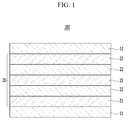
- FIG. 1 illustrates a structure of an exemplary flexible copper clad laminate according to an exemplary embodiment of the present invention.
- a first copper foil layer 11, a composite layer 20, and a second copper foil layer 12 may be sequentially stacked.
- the composite layer 20 may comprise a polyimide layer 22 and a plurality of thermoplastic polyimide layers 21, and an outermost layer of the composite layer 20 may be one of the plurality of the thermoplastic polyimide layers 21.
- productivity may be obtained by the multi-layered structure of the composite layer 20, and the outermost layer of the composite layer 20 may be coated to be the thermoplastic polyimide layer 21 to increase the adherence with the first copper foil layer 11 and the second copper foil layer 12.
- a low modulus may be required for the flexible copper clad laminate (FCCL) 100 having the excellent bending characteristic.
- FCCL flexible copper clad laminate
- PI polyimide
- a physical characteristic such as the dimensional stability (required level of ⁇ 0.1 %) required by the flexible copper clad laminate 100 may not be obtained and curl ( ⁇ 10 mm) of the composite layer 20 after etching a Cu layer due to a characteristic that a coefficient of thermal expansion (CTE) may be increased.
- the modulus of the entire composite layer 20 may be reduced.
- the tensile modulus of the composite layer 20 required for the flexible printed circuit board (FPCB) of the transmission may be in a range of from about 4.5 to about 5.5 GPa.
- the modulus is greater than about 5.5 GPa, bending characteristic thereof may be reduced.
- the tensile modulus of the composite layer 20 may be in a range of from about 4.7 to about 5.0 GPa.
- the total thickness of the plurality of the thermoplastic polyimide layers 21 may be in a range of from about 15 to about 50 %, and with respect to the total thickness of the composite layer 20, the thickness of the polyimide layer 22 may be in a range of from about 50 to about 85 %.
- the modulus may be decreased, however when the thickness ratio of the thermoplastic polyimide layer 21 is increased, the dimensional stability may not be obtained due to the high CTE.
- the modulus may increase substantially such excellent bending characteristic may not be obtained and the adherence of copper between the foil layers 11 and 12 and the composite layer 20 may be reduced at a high temperature.
- the linear coefficient of thermal expansion (CTE) of the composite layer 20 may be in a range of from about 20 to about 30 ppm/°C.
- the total thickness of the plurality of the thermoplastic polyimide layers 21 may be in a range of from about 20 to about 40 %, and the thickness of the polyimide layer 22 may be in a range of from about 60 to about 80 %.
- exemplary total thickness of the plurality of the thermoplastic polyimide layers may be in a range of from about 30 to about 40 % with respect to the total thickness of the composite layer, and accordingly exemplary total thickness of the polyimide layer may be in a range of from about 60 to about 70 % with respect to the total thickness of the composite layer.
- thermoplastic polyimide layer 21 having a low modulus and the polyimide layer 22 having a high modulus suitably may be alternately deposited.
- FIG. 1 shows an example in which the thermoplastic polyimide layer 21 and the polyimide layer 22 are alternately deposited.
- the polyimide layer 22 may suitably comprise n layers, the thermoplastic polyimide layer 21 may comprise of (n+1) layers, and n may be from 1 to 5, or particularly, n may be from 2 to 5.
- n 1, the thickness of the polyimide layer 22 coated one time may become thick such that an appearance defect such as a bubble (blister) generation in the polyimide layer 22 during the coating and the hardening may be generated and a process speed may be lowered during drying/hardening of the thick polyimide layer, thereby deteriorating the productivity.
- n is greater than the predetermined number, for example, greater than 5, the number of the coated polyimide layers may be excessively increased such that the productivity may be decreased.
- FIG. 1 shows the case that n is 2 as one example.
- the first copper foil layer 11 and the second copper foil layer 12 may include a rolled or electrolytic copper foil of many copper foil thicknesses and types, and other metal foils instead of the copper foil layer may be used.
- the first copper foil layer 11 and the second copper foil layer 12 may be the copper foil of the same components, a stress deformation that occurs because of different coefficients of thermal expansion may be avoided.
- Each thickness of the first copper foil layer 11 and the second copper foil layer 12 may be from about 30 to about 80 ⁇ m.
- the plurality of thermoplastic polyimide layers 21 and the polyimide layer 22 may be manufactured by forming and imidizing a polyamic acid solution having physical characteristics such as a targeted linear coefficient of thermal expansion or tensile modulus as the precursor layer.
- the used polyamic acid solution is not limited as long as it is a polyamic acid solution commonly used in the art within the technical category of the present invention.
- the polyamic acid solution according to an exemplary embodiment of the present invention may be manufactured by mixing a dianhydride and a diamine at a molar ratio of about 1:0.9 to 1:1.1 in an organic solvent.
- the polyimide-based resin having the desired linear coefficient of thermal expansion (CTE) or the tensile modulus may be obtained by controlling the mixture ratio of the dianhydride and the diamine, the mixture ratio between the dianhydrides and the diamines, or the kinds of the selected dianhydride and diamine.
- the dianhydride suitable for the exemplary embodiment of the present invention may include one or more selected from the group consisting of PMDA (pyromellitic dianhydride), BPDA (3,3',4,4'-biphenyl tetracarboxylic dianhydride), BTDA (3,3',4,4'-benzophenone tetracarboxylic dianhydride), ODPA (4,4'-oxydiphthalic anhydride), ODA (4,4'-diaminodiphenyl ether), BPADA (4,4'- (4,4'-isopropyl bi phenoxy)biphthalic anhydride), 6FDA (2,2'-bis-(3,4-dicarboxylic phenyl) hexafluoropropane dianhydride), and TMEG (ethylene glycol bis(anhydrotrimellitate).
- PMDA pyromellitic dianhydride
- BPDA 3,3',4,4'-biphen
- the diamine suitable to the exemplary embodiment of the present invention may include one or more selected from the group consisting of PDA (p-phenylene diamine), m-PDA (m-phenylene diamine), 4,4'-ODA (4,4'-oxydianiline), 3,4'-ODA (3,4'-oxydianiline), BAPP (2,2-bis(4-[4-aminophenoxy]-phenyl)propane), TPE-R (1,3-bis(4-aminophenoxy)benzene), BAPB (4,4'-bis(4-aminophenoxy)biphenyl), m-BAPS (2,2-bis(4-[3-aminophenoxy]phenyl)sulfone), HAB (3,3'-dihydroxy-4,4'-diaminobiphenyl), and DABA (4,4'-diamino-benzanilide).
- PDA p-phenylene diamine
- m-PDA m-phenylene diamine
- the total thickness of the composite layer 20 may be of about 40 to 60 ⁇ m.
- the bending characteristic and the dimensional stability may be obtained in the above-described range.
- a manufacturing method of a flexible copper clad laminate may comprise steps of: preparing a first copper foil layer; casting and drying a first thermoplastic polyimide precursor resin on the first copper foil layer to form a first thermoplastic polyimide precursor layer; casting and drying a polyimide precursor resin on the first thermoplastic polyimide precursor layer to form a polyimide precursor layer; casting and drying a second thermoplastic polyimide precursor resin on the polyimide precursor layer to form a second thermoplastic polyimide precursor layer; curing, by a heat treatment, the first thermoplastic polyimide precursor layer, the polyimide precursor layer, and the second thermoplastic polyimide precursor layer to form a composite layer; and stacking a second copper foil layer on the second thermoplastic polyimide layer.
- the first copper foil layer is prepared.
- the first copper foil layer is the same as those described above such that the repeated description thereof is omitted.
- the first thermoplastic polyimide precursor resin may be casted and dried on the first copper foil layer to form the first thermoplastic polyimide precursor layer.
- coating or casting method for the thermoplastic polyimide precursor layer may include a sputtering method, a lamination method, and a casting method.
- the sputtering method may cause expensive high process cost and adhesive strength with the polyimide layer may not be obtained while filming the copper foil layer with a uniform thickness.
- the exemplary embodiment of the present invention uses the casing method. In general, when thickly coating the liquid polyimide to the copper foil layer, the productivity may be reduced due to the low process speed.
- a curing degree may be reduced due to the thick thickness during heat curing such that the mechanical strength and the chemical resistance may be decreased, and removal of the solvent existing in the interior of the film may be difficult such that the appearance defect such as a foaming phenomenon may appear and the dimensional stability may be poor.
- the productivity may be ensured through the multi-layered structure of the composite layer.
- the polyimide precursor resin may be casted and dried to the first thermoplastic polyimide precursor layer to form the polyimide precursor layer.
- the step forming the first thermoplastic polyimide precursor layer and the step forming the polyimide precursor layer may be repeated several times. For example, when the steps is repeated two or more times, the step forming the secondary first thermoplastic polyimide precursor layer may not form the first thermoplastic polyimide precursor layer on the first copper foil layer, but the first thermoplastic polyimide precursor layer may be formed on the polyimide precursor layer.
- thermoplastic polyimide precursor resin may be casted and dried on the polyimide precursor layer to form the second thermoplastic polyimide precursor layer.
- the coating/coated composite precursor layer may be cured, by a heat treatment, into the composite precursor layer through the heat treatment.
- the second copper foil layer may be stacked on the second thermoplastic polyimide layer.
- the total thickness of the first thermoplastic polyimide layer and the second thermoplastic polyimide layer suitably may be in the range of from about 15 to about 50 % with respect to the total thickness of the composite layer and the total thickness of the polyimide layer may be in the range of from about 50 to about 85 % with respect to the total thickness of the composite layer.
- the total thickness of the first thermoplastic polyimide layer and the second thermoplastic polyimide layer may be in the range of from about 20 to about 40 % with respect to the total thickness of the composite layer, and the total thickness of the polyimide layer may be in the range of from about 60 to about 80 % with respect to the total thickness of the composite layer.
- the total thickness of the first and second thermoplastic polyimide layers may be in a range of from about 30 to about 40 % with respect to the total thickness of the composite layer, and accordingly the total thickness of the polyimide layer may be in a range of from about 60 to about 70 % with respect to the total thickness of the composite layer.
- the thicknesses of the first thermoplastic polyimide layer, the second thermoplastic polyimide layer, and the polyimide layer may be controlled by controlling the coating amount of the thermoplastic polyimide precursor resins and the polyimide precursor resins.
- the step forming the first thermoplastic polyimide precursor layer and the step forming the polyimide precursor layer may be repeatedly performed 1 to 5 times.
- n 1
- the thickness of the polyimide layer 22 coated one time becomes thick such that an appearance defect such as a bubble (blister) generation in the polyimide layer 22 during the coating and the hardening may be generated and a process speed may be reduced during drying/hardening of the thick polyimide layer, thereby deteriorating the productivity.
- the repeated number of times is greater than 5
- the number of coated polyimide layers may be excessively increased such that the productivity may be decreased.
- the flexible printed circuit board according to another exemplary embodiment of the present invention may include the above-described flexible copper clad laminate.
- the flexible copper clad laminate is described above such that the repeated description is omitted.
- the flexible printed circuit board according to an exemplary embodiment of the present invention may be the flexible printed circuit board used for the vehicle transmission.
- thermoplastic polyamic acid solution 110.51 g of the BAPP diamine was stirred in 1275 g of the DMAc solution to be completely dissolved under a nitrogen atmosphere, and 80.0 g of the BPDA was dividedly added as the dianhydride. Next, the stirring was continuously performed for about 24 h to manufacture the thermoplastic polyamic acid solution.
- the manufactured thermoplastic polyamic acid solution was casted into the film phase of a 20 ⁇ m thickness and the film was hardened while a temperature was increased up to at a temperature of 350 °C during 60 min and was maintained for 30 min, the measured linear coefficient of thermal expansion and the tensile modulus were 61 ppm/°C and 2.8 GPa, respectively.
- thermosetting polyamic acid solution As shown in Table 1 below, the diamine of 21.81 g of ODA and 47.12 g of PDA was stirred in 1264 g of the DMAc solution to be completely dissolved under the nitrogen atmosphere, and 120.0 g of the PMDA was dividedly added as the dianhydride. Next, the stirring was continuously performed for about 24 h to manufacture the thermosetting polyamic acid solution.
- the manufactured thermosetting polyamic acid solution was casted into the film phase of the 20 ⁇ m thickness and the film was hardened while the temperature was increased up to a temperature of 350 °C for 60 minutes and was maintained for 30 min, the measured linear coefficient of thermal expansion and the tensile modulus were 11 ppm/°C and 6.0 GPa, respectively.
- each thickness of both copper foil layers was about 35 ⁇ m, and the total thickness of the PI composite was about 50 ⁇ m.
- the total thickness of the TPI layer and the total thickness ratio of the PI layer were summarized in Table 2 below.
- the bending characteristic experiment (IPC TM 650): the FCCL with the size of 130 mm x 15 mm as the copper foil pattern size as shown in FIG. 2 was etched, and copper plating at 35 ⁇ m was performed. While the FCCL was fixed in the state of a curvature radius R of 4 mm, the FCCL was bent by using an equipment jig and a reciprocal motion was applied at a speed of 1500 rpm at a distance of 20 mm. A point that was 20 % or more compared to initial resistance was confirmed.
- the adherence estimation after the oil resistance (IPC TM 650): a pattern was formed for a circuit width of 3 mm to remain in the copper foil surface of the FCCL and the copper plating of 35 ⁇ m was performed, thereby forming the total thickness of the copper foil layer of 70 ⁇ m.
- the adhesion strength between the copper foil layer and the composite PI layer was determined. 180° adhesion strength was estimated at room temperature with a tensile speed of 50 mm/min for the copper foil layer and the composite PI layer by using a tensile tester (equipment regulated in ISO 527, Plastics - Determination of tensile properties). Peel strength when peeling the copper foil by 10 mm or greater at a minimum was applied as a result value.
- the dimensional stability A method B'of IPC-TM-650 (2.2.4) was applied. Position recognition holes were drilled at four corners of a square specimen of a mechanical direction (MD) and a width direction (TD) of 275 X 255 mm, the specimen was stored in a constant temperature and humidity chamber at a temperature of 23 °C and 50 %RH for 24 h, and then distances between the holes were repeatedly measured three times to calculate an average thereof.
- MD mechanical direction
- TD width direction
- a film of which a metal foil was etched was stored for 30 min in an oven at a temperature of 150 °C, was stored in the constant temperature and humidity chamber at a temperature of 23 °C and, 50 %RH for 24 h, and the distance between the holes was again measured to calculate a dimensional change rate.
- the bending degree a flexible copper clad laminate was cut to a 100 X 100 mm size and was dipped in an etching solution and then a copper foil was removed to obtain a polyimide film.
- the polyimide film was put on a flat table to measure a maximum height of a bent or twisted part.
- CTE coefficient of thermal expansion
- the FCCL manufactured in Exemplary Embodiment 1 and Exemplary Embodiment 2 had an excellent bending characteristic since the modulus of the entire composite PI layer was low, the manufacturing of the FCCL of which the dimensional stability and the product curl were low was possible, and process properties during manufacture as the circuit board were confirmed to be good.
- the TPI layer was coated on the outermost part of the composite PI layer such that the adherence with the copper foil layer was very much declined.
Landscapes
- Engineering & Computer Science (AREA)
- Microelectronics & Electronic Packaging (AREA)
- Manufacturing & Machinery (AREA)
- Laminated Bodies (AREA)
Abstract
Description
- This application claims priority to and the benefit of Korean Patent Application No.
10-2016-0022159 - The present invention relates to a copper clad laminate, a printed circuit board including the same, and a manufacturing method thereof.
- Currently, in a vehicle, various electrical/electronic elements have been applied in addition to conventional mechanical elements to implement a precise control system, and a role occupied by the electrical/electronic elements and devices of the vehicle has been recognized as being very important.
- Further, because the vehicle can be a living space as well as a transportation means, introduction of more advanced and various convenience devices to ensure safety and improve performance has been carried out. However, when the number of electronic control items of the vehicle is increased and the number of parts is increased, an amount of wiring and a wire harness may be increased. Thus, when the wiring and associated parts may be increased, the probability of failure may also be increased and the weight of the vehicle becomes heavy, thereby deteriorating fuel consumption. For this reason, reliability and down-sizing may be suggested by replacing the conventional wiring harness by a flexible printed circuit board (FPCB) such that electrical equipment of the vehicle can be extensively used in and out the vehicle.
- Recently, to ensure driving performance and fuel efficiency, an electrical control technique of the vehicle transmission has been developed, such that impact absorbing control during shifting and a control technique for driving torque improvement have mainly been developed. Thus, in order to ensure stability and provide many electrical functions in a very limited space of the transmission itself, a flexible printed circuit board may be applied, and thus, high reliability may be required for a flexible copper clad laminate (FCCL) that may be used as a base material of the flexible printed circuit board. Particularly, since the vehicle transmission is driven in a mixed environment of a high temperature of greater than about 150 °C and violent vibration, the FCCL may need dimensional stability in a long-term high-temperature condition, flex resistance against the severe vibration condition, and an adherence force after oil contact.
- The foregoing is intended merely to aid in the understanding of the background of the present invention, and is not intended to mean that the present invention falls within the purview of the related art that is already known to those skilled in the art.
- Thus, in preferred aspect, the present invention provides a copper clad laminate and a printed circuit board including the same. The copper clad laminate may be flexible, which may be provided by a substantially reduced thickness of components constituting the laminated structure, and thus prepared printed circuit board may also be flexible.
- The term "flexible" is meant by easily being bent, modified, altered, or adjustable by a force or pressure without breaking thereby providing suitably physical properties (e.g. dimensional stability and flex resistance). In certain embodiments, the flexible copper clad laminate in the present invention may not be easily breakable as being bent, modified, altered or adjusted by a force applied thereon. Unless otherwise indicated herein, the copper clad laminate in the present invention may be flexible thereby indicating a flexible copper clad laminate.
- In one aspect, the present invention provides a flexible copper clad laminate having excellent dimensional stability, flex resistance, and adherence after oil contact, and a manufacturing method thereof.
- In another aspect, the present invention provides a flexible printed circuit board comprising the flexible copper clad laminate having the excellent dimensional stability, flex resistance, and adherence after the oil contact.
- A flexible copper clad laminate according to an exemplary embodiment of the present invention may comprise a first copper foil layer, a composite layer, and a second copper foil layer, and the first copper foil layer, the composite layer, and the second copper foil layer may be sequentially stacked. The composite layer may comprise a polyimide layer and a plurality of thermoplastic polyimide layers, and an outermost layer of the composite layer may be one of the plurality of the thermoplastic polyimide layers.
- Preferably, a total thickness of the plurality of the thermoplastic polyimide layers may be in a range of from about 15 to about 50 % with respect to a total thickness of the composite layer, and a total thickness of the polyimide layer may be in a range of from about 50 to about 85 % with respect to the total thickness of the composite layer. In detail, the total thickness of the plurality of the thermoplastic polyimide layers may be in a range of from about 20 to about 40 % with respect to a total thickness of the composite layer, and the total thickness of the polyimide layer may be in a range of from about 60 to about 80 % with respect to the total thickness of the composite layer. Particularly, the total thickness of the plurality of the thermoplastic polyimide layers may be in a range of from about 30 to about 40 % with respect to the total thickness of the composite layer, and accordingly the total thickness of the polyimide layer may be in a range of from about 60 to about 70 % with respect to the total thickness of the composite layer.
- Each thickness of the first copper foil layer and the second copper foil layer may be in a range of from about 30 to about 80 µm, and the total thickness of the composite layer may be in a range of from about 40 to about 60 µm.
- A tensile modulus of the composite layer may be in a range of from about 4.5 to about 5.5 GPa, and a linear coefficient of thermal expansion (CTE) may be in a range of from about 20 to about 30 ppm/°C.
- In the composite layer, the polyimide layer and the plurality of thermoplastic polyimide layers may be alternately stacked. Further, the polyimide layer suitably may be made of n layers, the plurality of thermoplastic polyimide layers may be made of (n+1) layers, and n may be from 1 to 5.
- The polyamic acid solution according to an exemplary embodiment of the present invention suitably may be formed by mixing a dianhydride and a diamine in an organic solvent with a molar ratio from about 1:0.9 to about 1:1.1. When forming the polyamic acid solution of the present invention, the polyimide-based resin having a desired linear coefficient of thermal expansion (CTE) or modulus may be obtained by controlling a mixture ratio of the dianhydride and the diamine, or a mixture between the dianhydrides or between the diamines, or by adjusting a kind of the selected dianhydride and diamine.
- The dianhydride according to an exemplary embodiment of the present invention may include one or two or more selected from the group consisting of PMDA (pyromellitic dianhydride), BPDA (3,3',4,4'-biphenyl tetracarboxylic dianhydride), BTDA (3,3',4,4'-benzophenone tetracarboxylic dianhydride), ODPA (4,4'-oxydiphthalic anhydride), ODA (4,4'-diaminodiphenyl ether), BPADA (4,4'-(4,4'-isopropyl bi phenoxy)biphthalic anhydride), 6FDA (2,2'-bis-(3,4-dicarboxylic phenyl) hexafluoropropane dianhydride), and TMEG (ethylene glycol bis(anhydro-trimellitate).
- The diamine according to an exemplary embodiment of the present invention may include one or two or more kinds selected from the group consisting of PDA (p-phenylene diamine), m-PDA (m-phenylene diamine), 4,4'-ODA (4,4'-oxydianiline), 3,4'-ODA (3,4'-oxydianiline), BAPP (2,2-bis(4-[4-aminophenoxy]-phenyl)propane), TPE-R (1,3-bis(4-aminophenoxy)benzene), BAPB (4,4'-bis(4-aminophenoxy)biphenyl), m-BAPS (2,2-bis(4-[3-aminophenoxy]phenyl)sulfone), HAB (3,3'-dihydroxy-4,4'-diaminobiphenyl), and DABA (4,4'-diamino-benzanilide).
- In addition, an amount of other dianhydrides and diamines or other compounds may be further added with the compounds described above.
- A manufacturing method of a flexible copper clad laminate according to an exemplary embodiment of the present invention may comprise steps of: preparing a first copper foil layer; casting and drying a first thermoplastic polyimide precursor resin on the first copper foil layer to form a first thermoplastic polyimide precursor layer; casting and drying a polyimide precursor resin on the first thermoplastic polyimide precursor layer to form a polyimide precursor layer; casting and drying a second thermoplastic polyimide precursor resin on the polyimide precursor layer to form a second thermoplastic polyimide precursor layer; curing, by a heat treatment, the first thermoplastic polyimide precursor layer, the polyimide precursor layer, and the second thermoplastic polyimide precursor layer to form a composite layer; and stacking a second copper foil layer on the second thermoplastic polyimide layer.
- Preferably, a total thickness of the first thermoplastic polyimide layer and a thickness of the second thermoplastic polyimide layer may be in a range of from about 15 to about 50 % with respect to the total thickness of the composite layer, and a total thickness of the polyimide layer may be in a range of from about 50 to about 85 % with respect to the total thickness of the composite layer. In detail, the total thickness of the first thermoplastic polyimide layer and the thickness of the second thermoplastic polyimide layer may be in a range of from about 20 to about 40 % with respect to the total thickness of the composite layer, and the total thickness of the polyimide layer may be in a range of from 60 to 80 % with respect to the total thickness of the composite layer. Particularly, the total thickness of the first and second thermoplastic polyimide layers may be in a range of from about 30 to about 40 % with respect to the total thickness of the composite layer, and accordingly the total thickness of the polyimide layer may be in a range of from about 60 to about 70 % with respect to the total thickness of the composite layer.
- Each of a thickness of the first copper foil layer and a thickness of the second copper foil layer thickness may be in a range of from about 30 to about 80 µm, and a thickness of the composite layer may be in a range of from about 40 to about 60 µm.
- A tensile modulus of the composite layer may be in a range of from about 4.5 to about 5.5 GPa, and a linear coefficient of thermal expansion (CTE) may be in a range of from about 20 to about 30 ppm/°C.
- The step forming the first thermoplastic polyimide precursor layer and the step forming the polyimide precursor layer may be suitably performed repeatedly 1 to 5 times.
- Further provided is a flexible printed circuit board that may comprise the above-described flexible copper clad laminate. Additionally, the present invention provides a vehicle that may comprise the flexible printed circuit board as described above.
- The flexible printed circuit board according to an exemplary embodiment of the present invention suitably may be a flexible printed circuit board used for a vehicle transmission.
- The flexible copper clad laminate according to an exemplary embodiment of the present invention may have the excellent bending characteristic and the excellent dimensional stability, and a curl of the composite layer may be low.
- In the flexible copper clad laminate according to an exemplary embodiment of the present invention, the outermost layer of the composite layer may be the thermoplastic polyimide layer such that the high adherence may be maintained in a long-term high temperature environment.
- In the flexible printed circuit board according to an exemplary embodiment of the present invention, the bending characteristic may be substantially improved such that a crack may be prevented in the circuit exposed to the severe vibration environment such as the transmission for the vehicle.
- The flexible printed circuit board according to an exemplary embodiment of the present invention may have substantially improved dimensional stability and adherence in long-term thermal resistance (for example, at a temperature of about 130 °C or greater), which is required for the vehicle electrical equipment mounted in an engine compartment, and thus, the bending may not be generated.
- It should be understood that the accompanying drawings are not necessarily to scale, presenting a somewhat simplified representation of various features illustrative of the basic principles of the invention. The specific design features of the present invention as disclosed herein, including, for example, specific dimensions, orientations, locations, and shapes will be determined in part by the particular intended application and use environment. In the figures, reference numbers refer to the same or equivalent parts of the present invention throughout the several figures of the drawing.
-
FIG. 1 illustrates a structure of an exemplary flexible copper clad laminate according to an exemplary embodiment of the present invention. -
FIG. 2 shows an exemplary flexibility test method in an exemplary embodiment of the present invention. - The advantages and features of the present invention and the methods for accomplishing the same will be apparent from the exemplary embodiments described hereinafter with reference to the accompanying drawings. However, the present invention is not limited to the exemplary embodiments described hereinafter, but may be embodied in many different forms. The following exemplary embodiments are provided to make the invention of the present invention complete and to allow those skilled in the art to clearly understand the scope of the present invention, and the present invention is defined only by the scope of the appended claims. Throughout the specification, the same reference numerals denote the same elements.
- In some exemplary embodiments, detailed description of well-known technologies will be omitted to prevent the invention of the present invention from being interpreted ambiguously. Unless otherwise defined, all terms (including technical and scientific terms) used herein have the same meaning as commonly understood by one of ordinary skill in the art.
- The terminology used herein is for the purpose of describing particular exemplary embodiments only and is not intended to be limiting of the invention. As used herein, the singular forms "a", "an" and "the" are intended to include the plural forms as well, unless the context clearly indicates otherwise. It will be further understood that the terms "comprises" and/or "comprising," when used in this specification, specify the presence of stated features, integers, steps, operations, elements, and/or components, but do not preclude the presence or addition of one or more other features, integers, steps, operations, elements, components, and/or groups thereof. As used herein, the term "and/or" includes any and all combinations of one or more of the associated listed items.
- Unless specifically stated or obvious from context, as used herein, the term "about" is understood as within a range of normal tolerance in the art, for example within 2 standard deviations of the mean. "About" can be understood as within 10%, 9%, 8%, 7%, 6%, 5%, 4%, 3%, 2%, 1%, 0.5%, 0.1%, 0.05%, or 0.01% of the stated value. Unless otherwise clear from the context, all numerical values provided herein are modified by the term "about."
- It is understood that the term "vehicle" or "vehicular" or other similar term as used herein is inclusive of motor vehicles in general such as passenger automobiles including sports utility vehicles (SUV), buses, trucks, various commercial vehicles, watercraft including a variety of boats and ships, aircraft, and the like, and includes hybrid vehicles, electric vehicles, plug-in hybrid electric vehicles, hydrogen-powered vehicles and other alternative fuel vehicles (e.g. fuels derived from resources other than petroleum). As referred to herein, a hybrid vehicle is a vehicle that has two or more sources of power, for example both gasoline-powered and electric-powered vehicles.
-
FIG. 1 illustrates a structure of an exemplary flexible copper clad laminate according to an exemplary embodiment of the present invention. - In the flexible copper clad
laminate 100 according to an exemplary embodiment of the present invention, a firstcopper foil layer 11, acomposite layer 20, and a secondcopper foil layer 12 may be sequentially stacked. In particular, thecomposite layer 20 may comprise apolyimide layer 22 and a plurality of thermoplastic polyimide layers 21, and an outermost layer of thecomposite layer 20 may be one of the plurality of the thermoplastic polyimide layers 21. - In an exemplary embodiment of the present invention, productivity may be obtained by the multi-layered structure of the
composite layer 20, and the outermost layer of thecomposite layer 20 may be coated to be thethermoplastic polyimide layer 21 to increase the adherence with the firstcopper foil layer 11 and the secondcopper foil layer 12. - A low modulus may be required for the flexible copper clad laminate (FCCL) 100 having the excellent bending characteristic. For this, although the polyimide (PI) having a low modulus is coated, as the modulus is low, a physical characteristic such as the dimensional stability (required level of ±<0.1 %) required by the flexible copper clad
laminate 100 may not be obtained and curl (±< 10 mm) of thecomposite layer 20 after etching a Cu layer due to a characteristic that a coefficient of thermal expansion (CTE) may be increased. - In an exemplary embodiment of the present invention, by suitably adjusting a thickness ratio of the
thermoplastic polyimide layer 21 having a low modulus and thepolyimide layer 22 having a high modulus, the modulus of the entirecomposite layer 20 may be reduced. Preferably, the tensile modulus of thecomposite layer 20 required for the flexible printed circuit board (FPCB) of the transmission may be in a range of from about 4.5 to about 5.5 GPa. When the modulus is greater than about 5.5 GPa, bending characteristic thereof may be reduced. In detail, the tensile modulus of thecomposite layer 20 may be in a range of from about 4.7 to about 5.0 GPa. For this, with respect to the total thickness of thecomposite layer 20, the total thickness of the plurality of the thermoplastic polyimide layers 21 may be in a range of from about 15 to about 50 %, and with respect to the total thickness of thecomposite layer 20, the thickness of thepolyimide layer 22 may be in a range of from about 50 to about 85 %. In thecomposite layer 20, as the thickness ratio of thethermoplastic polyimide layer 21 is increased, the modulus may be decreased, however when the thickness ratio of thethermoplastic polyimide layer 21 is increased, the dimensional stability may not be obtained due to the high CTE. In contrast, in the entirecomposite layer 20, when the thickness ratio of thethermoplastic polyimide layer 21 is substantially reduced, the modulus may increase substantially such excellent bending characteristic may not be obtained and the adherence of copper between the foil layers 11 and 12 and thecomposite layer 20 may be reduced at a high temperature. The linear coefficient of thermal expansion (CTE) of thecomposite layer 20 may be in a range of from about 20 to about 30 ppm/°C. - In detail, with respect to the thickness of the
composite layer 20, the total thickness of the plurality of the thermoplastic polyimide layers 21 may be in a range of from about 20 to about 40 %, and the thickness of thepolyimide layer 22 may be in a range of from about 60 to about 80 %. Further, exemplary total thickness of the plurality of the thermoplastic polyimide layers may be in a range of from about 30 to about 40 % with respect to the total thickness of the composite layer, and accordingly exemplary total thickness of the polyimide layer may be in a range of from about 60 to about 70 % with respect to the total thickness of the composite layer. To obtain the excellent bending characteristic and dimensional stability, thethermoplastic polyimide layer 21 having a low modulus and thepolyimide layer 22 having a high modulus suitably may be alternately deposited.FIG. 1 shows an example in which thethermoplastic polyimide layer 21 and thepolyimide layer 22 are alternately deposited. - The
polyimide layer 22 may suitably comprise n layers, thethermoplastic polyimide layer 21 may comprise of (n+1) layers, and n may be from 1 to 5, or particularly, n may be from 2 to 5. However, when n is 1, the thickness of thepolyimide layer 22 coated one time may become thick such that an appearance defect such as a bubble (blister) generation in thepolyimide layer 22 during the coating and the hardening may be generated and a process speed may be lowered during drying/hardening of the thick polyimide layer, thereby deteriorating the productivity. When n is greater than the predetermined number, for example, greater than 5, the number of the coated polyimide layers may be excessively increased such that the productivity may be decreased.FIG. 1 shows the case that n is 2 as one example. - The first
copper foil layer 11 and the secondcopper foil layer 12 may include a rolled or electrolytic copper foil of many copper foil thicknesses and types, and other metal foils instead of the copper foil layer may be used. In this case, as the firstcopper foil layer 11 and the secondcopper foil layer 12 may be the copper foil of the same components, a stress deformation that occurs because of different coefficients of thermal expansion may be avoided. Each thickness of the firstcopper foil layer 11 and the secondcopper foil layer 12 may be from about 30 to about 80 µm. - According to an exemplary embodiment of the present invention, the plurality of thermoplastic polyimide layers 21 and the
polyimide layer 22 may be manufactured by forming and imidizing a polyamic acid solution having physical characteristics such as a targeted linear coefficient of thermal expansion or tensile modulus as the precursor layer. The used polyamic acid solution is not limited as long as it is a polyamic acid solution commonly used in the art within the technical category of the present invention. - The polyamic acid solution according to an exemplary embodiment of the present invention may be manufactured by mixing a dianhydride and a diamine at a molar ratio of about 1:0.9 to 1:1.1 in an organic solvent. When manufacturing the polyamic acid solution of the present invention, the polyimide-based resin having the desired linear coefficient of thermal expansion (CTE) or the tensile modulus may be obtained by controlling the mixture ratio of the dianhydride and the diamine, the mixture ratio between the dianhydrides and the diamines, or the kinds of the selected dianhydride and diamine.
- The dianhydride suitable for the exemplary embodiment of the present invention may include one or more selected from the group consisting of PMDA (pyromellitic dianhydride), BPDA (3,3',4,4'-biphenyl tetracarboxylic dianhydride), BTDA (3,3',4,4'-benzophenone tetracarboxylic dianhydride), ODPA (4,4'-oxydiphthalic anhydride), ODA (4,4'-diaminodiphenyl ether), BPADA (4,4'- (4,4'-isopropyl bi phenoxy)biphthalic anhydride), 6FDA (2,2'-bis-(3,4-dicarboxylic phenyl) hexafluoropropane dianhydride), and TMEG (ethylene glycol bis(anhydrotrimellitate).
- The diamine suitable to the exemplary embodiment of the present invention may include one or more selected from the group consisting of PDA (p-phenylene diamine), m-PDA (m-phenylene diamine), 4,4'-ODA (4,4'-oxydianiline), 3,4'-ODA (3,4'-oxydianiline), BAPP (2,2-bis(4-[4-aminophenoxy]-phenyl)propane), TPE-R (1,3-bis(4-aminophenoxy)benzene), BAPB (4,4'-bis(4-aminophenoxy)biphenyl), m-BAPS (2,2-bis(4-[3-aminophenoxy]phenyl)sulfone), HAB (3,3'-dihydroxy-4,4'-diaminobiphenyl), and DABA (4,4'-diamino-benzanilide).
- If necessary, small amounts of other dianhydrides and diamines or other compounds may be added to the compounds described above. The total thickness of the
composite layer 20 may be of about 40 to 60 µm. The bending characteristic and the dimensional stability may be obtained in the above-described range. - A manufacturing method of a flexible copper clad laminate according to an exemplary embodiment of the present invention may comprise steps of: preparing a first copper foil layer; casting and drying a first thermoplastic polyimide precursor resin on the first copper foil layer to form a first thermoplastic polyimide precursor layer; casting and drying a polyimide precursor resin on the first thermoplastic polyimide precursor layer to form a polyimide precursor layer; casting and drying a second thermoplastic polyimide precursor resin on the polyimide precursor layer to form a second thermoplastic polyimide precursor layer; curing, by a heat treatment, the first thermoplastic polyimide precursor layer, the polyimide precursor layer, and the second thermoplastic polyimide precursor layer to form a composite layer; and stacking a second copper foil layer on the second thermoplastic polyimide layer.
- Hereafter, each step will be described in detail.
- Firstly, the first copper foil layer is prepared. The first copper foil layer is the same as those described above such that the repeated description thereof is omitted.
- Next, the first thermoplastic polyimide precursor resin may be casted and dried on the first copper foil layer to form the first thermoplastic polyimide precursor layer. Without limiting to the particular manufacturing method, coating or casting method for the thermoplastic polyimide precursor layer may include a sputtering method, a lamination method, and a casting method. For example, the sputtering method may cause expensive high process cost and adhesive strength with the polyimide layer may not be obtained while filming the copper foil layer with a uniform thickness. The exemplary embodiment of the present invention uses the casing method. In general, when thickly coating the liquid polyimide to the copper foil layer, the productivity may be reduced due to the low process speed. Also, a curing degree may be reduced due to the thick thickness during heat curing such that the mechanical strength and the chemical resistance may be decreased, and removal of the solvent existing in the interior of the film may be difficult such that the appearance defect such as a foaming phenomenon may appear and the dimensional stability may be poor. In an exemplary embodiment of the present invention, the productivity may be ensured through the multi-layered structure of the composite layer.
- Next, the polyimide precursor resin may be casted and dried to the first thermoplastic polyimide precursor layer to form the polyimide precursor layer. The step forming the first thermoplastic polyimide precursor layer and the step forming the polyimide precursor layer may be repeated several times. For example, when the steps is repeated two or more times, the step forming the secondary first thermoplastic polyimide precursor layer may not form the first thermoplastic polyimide precursor layer on the first copper foil layer, but the first thermoplastic polyimide precursor layer may be formed on the polyimide precursor layer.
- Next, the thermoplastic polyimide precursor resin may be casted and dried on the polyimide precursor layer to form the second thermoplastic polyimide precursor layer.
- Next, the coating/coated composite precursor layer may be cured, by a heat treatment, into the composite precursor layer through the heat treatment.
- Next, the second copper foil layer may be stacked on the second thermoplastic polyimide layer.
- The total thickness of the first thermoplastic polyimide layer and the second thermoplastic polyimide layer suitably may be in the range of from about 15 to about 50 % with respect to the total thickness of the composite layer and the total thickness of the polyimide layer may be in the range of from about 50 to about 85 % with respect to the total thickness of the composite layer. Preferably, the total thickness of the first thermoplastic polyimide layer and the second thermoplastic polyimide layer may be in the range of from about 20 to about 40 % with respect to the total thickness of the composite layer, and the total thickness of the polyimide layer may be in the range of from about 60 to about 80 % with respect to the total thickness of the composite layer. Particularly, the total thickness of the first and second thermoplastic polyimide layers may be in a range of from about 30 to about 40 % with respect to the total thickness of the composite layer, and accordingly the total thickness of the polyimide layer may be in a range of from about 60 to about 70 % with respect to the total thickness of the composite layer.
- The thicknesses of the first thermoplastic polyimide layer, the second thermoplastic polyimide layer, and the polyimide layer may be controlled by controlling the coating amount of the thermoplastic polyimide precursor resins and the polyimide precursor resins.
- The step forming the first thermoplastic polyimide precursor layer and the step forming the polyimide precursor layer may be repeatedly performed 1 to 5 times. However, when n is 1, the thickness of the
polyimide layer 22 coated one time becomes thick such that an appearance defect such as a bubble (blister) generation in thepolyimide layer 22 during the coating and the hardening may be generated and a process speed may be reduced during drying/hardening of the thick polyimide layer, thereby deteriorating the productivity. When the repeated number of times is greater than 5, the number of coated polyimide layers may be excessively increased such that the productivity may be decreased. - The flexible printed circuit board according to another exemplary embodiment of the present invention may include the above-described flexible copper clad laminate. The flexible copper clad laminate is described above such that the repeated description is omitted.
- The flexible printed circuit board according to an exemplary embodiment of the present invention may be the flexible printed circuit board used for the vehicle transmission.
- The following examples illustrate the present invention in more detail. However, an exemplary embodiment below is only an exemplary embodiment of the present invention and the present invention is limited thereto.
- As shown in Table 1 below, 110.51 g of the BAPP diamine was stirred in 1275 g of the DMAc solution to be completely dissolved under a nitrogen atmosphere, and 80.0 g of the BPDA was dividedly added as the dianhydride. Next, the stirring was continuously performed for about 24 h to manufacture the thermoplastic polyamic acid solution. When the manufactured thermoplastic polyamic acid solution was casted into the film phase of a 20 µm thickness and the film was hardened while a temperature was increased up to at a temperature of 350 °C during 60 min and was maintained for 30 min, the measured linear coefficient of thermal expansion and the tensile modulus were 61 ppm/°C and 2.8 GPa, respectively.
- As shown in Table 1 below, the diamine of 21.81 g of ODA and 47.12 g of PDA was stirred in 1264 g of the DMAc solution to be completely dissolved under the nitrogen atmosphere, and 120.0 g of the PMDA was dividedly added as the dianhydride. Next, the stirring was continuously performed for about 24 h to manufacture the thermosetting polyamic acid solution. When the manufactured thermosetting polyamic acid solution was casted into the film phase of the 20 µm thickness and the film was hardened while the temperature was increased up to a temperature of 350 °C for 60 minutes and was maintained for 30 min, the measured linear coefficient of thermal expansion and the tensile modulus were 11 ppm/°C and 6.0 GPa, respectively.
(Table 1) Dianhydride 1 Diamine 1 Diamine 2 DMAc CTE (ppm/°C) Modulus (GPa) Synthesis Example 1 BPDA 80.0 g BAPP 110.51 g 1275 g 61 2.8 Synthesis Example 2 PMDA 120.0 g ODA 21.81 g PDA 47.12 g 1264 g 11 6.0 - The process of coating and drying the TPI precursor manufactured in Synthesis Example 1 to the copper foil through the casting method and then coating and drying the PI precursor manufactured in Synthesis Example 2 through the casting method was repeated and a composite PI layer of a TPI-PI-TPI-PI-TPI structure was formed through a heat treatment, and the foil was finally stacked to manufacture the flexible copper clad laminate (FCCL).
- Each thickness of both copper foil layers was about 35 µm, and the total thickness of the PI composite was about 50 µm. The total thickness of the TPI layer and the total thickness ratio of the PI layer were summarized in Table 2 below.
- The measuring methods of the CTE, the modulus, the bending characteristic experiment, the adherence test after the oil contact, the dimensional stability, the bending degree of the PI composite layer, and the coefficient of thermal expansion were measured through methods below and were summarized in Table 2.
- The bending characteristic experiment (IPC TM 650): the FCCL with the size of 130 mm x 15 mm as the copper foil pattern size as shown in
FIG. 2 was etched, and copper plating at 35 µm was performed. While the FCCL was fixed in the state of a curvature radius R of 4 mm, the FCCL was bent by using an equipment jig and a reciprocal motion was applied at a speed of 1500 rpm at a distance of 20 mm. A point that was 20 % or more compared to initial resistance was confirmed. - The adherence estimation after the oil resistance (IPC TM 650): a pattern was formed for a circuit width of 3 mm to remain in the copper foil surface of the FCCL and the copper plating of 35 µm was performed, thereby forming the total thickness of the copper foil layer of 70 µm. Next, after completely dipping the prepared pattern in transmission oil at a temperature of 160 °C for 70 h, the adhesion strength between the copper foil layer and the composite PI layer was determined. 180° adhesion strength was estimated at room temperature with a tensile speed of 50 mm/min for the copper foil layer and the composite PI layer by using a tensile tester (equipment regulated in ISO 527, Plastics - Determination of tensile properties). Peel strength when peeling the copper foil by 10 mm or greater at a minimum was applied as a result value.
- The dimensional stability: A method B'of IPC-TM-650 (2.2.4) was applied. Position recognition holes were drilled at four corners of a square specimen of a mechanical direction (MD) and a width direction (TD) of 275 X 255 mm, the specimen was stored in a constant temperature and humidity chamber at a temperature of 23 °C and 50 %RH for 24 h, and then distances between the holes were repeatedly measured three times to calculate an average thereof. Next, a film of which a metal foil was etched was stored for 30 min in an oven at a temperature of 150 °C, was stored in the constant temperature and humidity chamber at a temperature of 23 °C and, 50 %RH for 24 h, and the distance between the holes was again measured to calculate a dimensional change rate.
- The bending degree: a flexible copper clad laminate was cut to a 100 X 100 mm size and was dipped in an etching solution and then a copper foil was removed to obtain a polyimide film. The polyimide film was put on a flat table to measure a maximum height of a bent or twisted part.
- The coefficient of thermal expansion (CTE): the coefficient of thermal expansion was obtained by averaging values from a temperature of 100 °C to a temperature of 200 °C among thermal expansion values measured while the temperature was raised to a temperature of 400 °C at a speed of 10 °C per minute by using a thermomechanical analyzer (TMA).
- This was the same as Exemplary Embodiment 1, except for changing the total thickness of the TPI layer and the total thickness ratio of the PI layer as shown in Table 2.
- This was the same as Exemplary Embodiment 1, except for changing the total thickness of the TPI layer and the total thickness ratio of the PI layer as shown in Table 2.
- This was the same as Exemplary Embodiment 1, except for changing the total thickness of the TPI layer and the total thickness ratio of the PI layer as shown in Table 2.
- This was the same as Exemplary Embodiment 1, except for stacking the structure of the composite PI layer into the PI-TPI-PI-TPI-PI form.
- This was the same as Exemplary Embodiment 1, except for stacking the structure of the composite PI layer into the PI-TPI-PI form.
(Table 2) Division Among the composite PI layers Thickness ratio of the TPI layer CTE (ppm/°C) of the composite PI layer Modulus (GPa) of the composite PI layer Bending characte ristic Adhere nce (kgf/c m) after the oil contact Dimensio nal stability (absolute value % of a maximu m value) Bending degree (mm) after etching the copper foil Exemplary Embodiment 1 40% 30 4.7 12,000 times > 5.0 0.05 10 Exemplary Embodiment 2 30% 26 5.0 11,000 times > 5.0 0.04 0 Comparative Example 1 10% 16 5.7 7,000 times < 2.0 0.002 0 Comparative Example 2 60% 41 4.1 14,000 times > 5.0 > 0.1 30 Comparative Example 3 40% 30 4.7 12,000 times < 0.5 0.05 10 Comparative Example 4 40% 30 4.7 12,000 times < 0.5 >0.1 50 - As shown in Table 2, the FCCL manufactured in Exemplary Embodiment 1 and Exemplary Embodiment 2 had an excellent bending characteristic since the modulus of the entire composite PI layer was low, the manufacturing of the FCCL of which the dimensional stability and the product curl were low was possible, and process properties during manufacture as the circuit board were confirmed to be good.
- For Comparative Example 1, since the thickness ratio of the TPI layer was low, the CTE was low and the dimensional stability was good, however it could be confirmed that the modulus was high such that the bending characteristic was low and the adherence after the oil contact was low.
- For Comparative Example 2, since the thickness ratio of the TPI layer was high, the modulus of the composite PI layer was lowest, however the CTE was high such that the dimensional change rate was high, and the product curl as high such that the process properties were confirmed to be poor in the FCCL process and the manufacturing of the circuit board.
- For Comparative Example 3 and Comparative Example 4, the TPI layer was coated on the outermost part of the composite PI layer such that the adherence with the copper foil layer was very much declined.
- The present invention is not limited to the aforementioned exemplary embodiments, but may be manufactured in various different forms, and it will be apparent to those skilled in the art that various modifications and changes may be made thereto without departing from the scope and spirit of the invention. Therefore, it should be understood that the above exemplary embodiments are not limitative, but are illustrative in all aspects.
| 100: flexible copper clad laminate | 11: first copper foil layer |
| 12: second copper foil layer | 20: composite layer |
| 21: thermoplastic polyimide layer | 22: polyimide layer |
Claims (12)
- A copper clad laminate comprising
a first copper foil layer,
a composite layer,
a second copper foil layer,
wherein the first copper foil layer, the composite layer, and the second copper foil layer are sequentially stacked,
wherein the composite layer comprises a polyimide layer and a plurality of thermoplastic polyimide layers, and an outermost layer of the composite layer is one of the plurality of the thermoplastic polyimide layers,
wherein, a total thickness of the plurality of the thermoplastic polyimide layers is in a range of from about 15 to about 50 % with respect to a total thickness of the composite layer, and a thickness of the polyimide layer is in a range of from about 50 to about 85 % with respect to a total thickness of the composite layer, and
wherein each of a thickness of the first copper foil layer and a thickness of the second copper foil layer is in a range of from about 30 to about 80 µm, and a total thickness of the composite layer is in a range of from about 40 to about 60 µm. - The copper clad laminate of claim 1, wherein the total thickness of the plurality of thermoplastic polyimide layers is in a range of from about 20 to about 40 % with respect to the thickness of the composite layer, and the thickness of the polyimide layer is in a range of from about 60 to about 80 % with respect to the thickness of the composite layer.
- The copper clad laminate of claim 1, wherein a tensile modulus of the composite layer is in a range of from about 4.5 to about 5.5 GPa, and a linear coefficient of thermal expansion (CTE) is in a range of from about 20 to about 30 ppm/°C.
- The copper clad laminate of claim 1, wherein the polyimide layer and the plurality of thermoplastic polyimide layers are alternately stacked.
- The copper clad laminate of claim 1, wherein the polyimide layer is made of n layers, the plurality of thermoplastic polyimide layers are made of (n+1) layers, and n is from 1 to 5.
- A method for manufacturing a copper clad laminate, comprising steps of:preparing a first copper foil layer;casting and drying a first thermoplastic polyimide precursor resin on the first copper foil layer to form a first thermoplastic polyimide precursor layer;casting and drying a polyimide precursor resin on the first thermoplastic polyimide precursor layer to form a polyimide precursor layer;casting and drying a second thermoplastic polyimide precursor resin on the polyimide precursor layer to form a second thermoplastic polyimide precursor layer;curing, by a heat treatment, the first thermoplastic polyimide precursor layer, the polyimide precursor layer, and the second thermoplastic polyimide precursor layer to form a composite layer; andstacking a second copper foil layer on the second thermoplastic polyimide layer, wherein, a total thickness of the first thermoplastic polyimide layer and a thickness of the second thermoplastic polyimide layer is in a range of from about 15 to about 50 % with respect to the total thickness of the composite layer, a total thickness of the polyimide layer is in a range of from about 50 to about 85 % with respect to the total thickness of the composite layer,each thickness of the first copper foil layer and the second copper foil layer thickness is in a range of from about 30 to about 80 µm, and the total thickness of the composite layer is in a range of from about 40 to about 60 µm.
- The method of claim 6, wherein a tensile modulus of the composite layer is in a range of from about 4.5 to about 5.5 GPa, and a linear coefficient of thermal expansion (CTE) is in a range of from about 20 to about 30 ppm/°C.
- The method of claim 6, wherein the total thickness of the first thermoplastic polyimide layer and the second thermoplastic polyimide layer is in the range of from about 20 to about 40 % with respect to the total thickness of the composite layer, and the thickness of the polyimide layer is in the range of from about 60 to about 80 % with respect to the total thickness of the composite layer.
- The method of claim 6, wherein the step forming the first thermoplastic polyimide precursor layer and the step forming the polyimide precursor layer are performed repeatedly 1 to 5 times.
- A printed circuit board comprising a copper clad laminate of claim 1.
- The printed circuit board of claim 10, wherein the printed circuit board is applied to a vehicle transmission.
- A vehicle comprising a flexible printed circuit board of claim 10.
Applications Claiming Priority (1)
| Application Number | Priority Date | Filing Date | Title |
|---|---|---|---|
| KR1020160022159A KR101865723B1 (en) | 2016-02-24 | 2016-02-24 | Flexible copper clad laminate, flexible printed circuit board comprisisng the same and manufacturing method of the same |
Publications (2)
| Publication Number | Publication Date |
|---|---|
| EP3210774A1 true EP3210774A1 (en) | 2017-08-30 |
| EP3210774B1 EP3210774B1 (en) | 2019-03-13 |
Family
ID=56289291
Family Applications (1)
| Application Number | Title | Priority Date | Filing Date |
|---|---|---|---|
| EP16173249.0A Active EP3210774B1 (en) | 2016-02-24 | 2016-06-07 | Copper clad laminate, printed circuit board thereof, and manufacturing method thereof |
Country Status (6)
| Country | Link |
|---|---|
| US (1) | US9872385B2 (en) |
| EP (1) | EP3210774B1 (en) |
| JP (1) | JP6781576B2 (en) |
| KR (1) | KR101865723B1 (en) |
| CN (1) | CN107116862B (en) |
| ES (1) | ES2723481T3 (en) |
Families Citing this family (7)
| Publication number | Priority date | Publication date | Assignee | Title |
|---|---|---|---|---|
| CN108235603B (en) * | 2017-12-29 | 2019-07-26 | 广东生益科技股份有限公司 | A kind of pressing method of mixed plate |
| KR102879222B1 (en) * | 2018-09-28 | 2025-10-31 | 닛테츠 케미컬 앤드 머티리얼 가부시키가이샤 | Production method for metal clad laminate and production method for circuit board |
| TWI728521B (en) * | 2019-10-22 | 2021-05-21 | 新揚科技股份有限公司 | Method of forming copper clad laminate |
| KR102807539B1 (en) | 2020-02-25 | 2025-05-13 | 현대자동차주식회사 | Power module of double-faced cooling |
| JP7680242B2 (en) * | 2021-03-30 | 2025-05-20 | 日鉄ケミカル&マテリアル株式会社 | Flexible metal-clad laminate and flexible circuit board |
| JP2023097389A (en) | 2021-12-27 | 2023-07-07 | 日鉄ケミカル&マテリアル株式会社 | Resin laminates, metal-clad laminates, circuit boards, electronic devices and electronic equipment |
| CN115368566A (en) * | 2022-09-02 | 2022-11-22 | 中国科学技术大学先进技术研究院 | Polyimide composite membrane with low moisture absorption rate and low thermal expansion coefficient, preparation method thereof, thermosetting polyamic acid and thermosetting polyamic acid solution |
Citations (4)
| Publication number | Priority date | Publication date | Assignee | Title |
|---|---|---|---|---|
| US6251507B1 (en) * | 1998-09-29 | 2001-06-26 | Ube Industries, Ltd. | Flexible aromatic polymide film/metal film composite sheet |
| US20010055691A1 (en) * | 2000-03-28 | 2001-12-27 | Ube Industries, Ltd. | Roll of metal film/aromatic polyimide film composite web |
| US20100128459A1 (en) * | 2007-04-23 | 2010-05-27 | Continental Automotive Gmbh | Standardized support element with integrated interface |
| US20110229680A1 (en) * | 2010-03-19 | 2011-09-22 | E.I. Du Pont De Nemours And Company | Film based heating device and methods relating thereto |
Family Cites Families (12)
| Publication number | Priority date | Publication date | Assignee | Title |
|---|---|---|---|---|
| JP2783389B2 (en) * | 1988-12-22 | 1998-08-06 | 三井化学株式会社 | Method of manufacturing flexible metal foil laminate |
| JP3102622B2 (en) * | 1995-02-27 | 2000-10-23 | 宇部興産株式会社 | Metal foil laminated polyimide film |
| US6399426B1 (en) * | 1998-07-21 | 2002-06-04 | Miguel Albert Capote | Semiconductor flip-chip package and method for the fabrication thereof |
| US6379784B1 (en) * | 1999-09-28 | 2002-04-30 | Ube Industries, Ltd. | Aromatic polyimide laminate |
| KR20100048474A (en) * | 2008-10-31 | 2010-05-11 | 에스케이에너지 주식회사 | Flexible metal-clad laminate and a method of manufacturing the same |
| TWM377823U (en) * | 2009-11-17 | 2010-04-01 | Asia Electronic Material Co | Complex double-sided copper clad laminate and structure of flexible printed circuit board using the same |
| JP5556416B2 (en) * | 2010-06-22 | 2014-07-23 | 東洋紡株式会社 | Polyimide board, metal laminated polyimide board, and printed wiring board |
| KR101282170B1 (en) * | 2010-10-19 | 2013-07-04 | 에스케이이노베이션 주식회사 | Thick layer polyimide metal clad laminate |
| US9137903B2 (en) * | 2010-12-21 | 2015-09-15 | Tessera, Inc. | Semiconductor chip assembly and method for making same |
| KR20120134666A (en) * | 2011-06-03 | 2012-12-12 | 에스케이이노베이션 주식회사 | Manufacturing method of thick polyimide flexible metal clad laminate |
| JP6031396B2 (en) * | 2013-03-29 | 2016-11-24 | 新日鉄住金化学株式会社 | Manufacturing method of double-sided flexible metal-clad laminate |
| KR101962986B1 (en) | 2014-11-18 | 2019-03-27 | 셍기 테크놀로지 코. 엘티디. | Flexible metal laminate |
-
2016
- 2016-02-24 KR KR1020160022159A patent/KR101865723B1/en active Active
- 2016-06-07 EP EP16173249.0A patent/EP3210774B1/en active Active
- 2016-06-07 ES ES16173249T patent/ES2723481T3/en active Active
- 2016-06-13 US US15/180,472 patent/US9872385B2/en active Active
- 2016-06-17 JP JP2016120900A patent/JP6781576B2/en active Active
- 2016-06-24 CN CN201610473530.7A patent/CN107116862B/en active Active
Patent Citations (4)
| Publication number | Priority date | Publication date | Assignee | Title |
|---|---|---|---|---|
| US6251507B1 (en) * | 1998-09-29 | 2001-06-26 | Ube Industries, Ltd. | Flexible aromatic polymide film/metal film composite sheet |
| US20010055691A1 (en) * | 2000-03-28 | 2001-12-27 | Ube Industries, Ltd. | Roll of metal film/aromatic polyimide film composite web |
| US20100128459A1 (en) * | 2007-04-23 | 2010-05-27 | Continental Automotive Gmbh | Standardized support element with integrated interface |
| US20110229680A1 (en) * | 2010-03-19 | 2011-09-22 | E.I. Du Pont De Nemours And Company | Film based heating device and methods relating thereto |
Also Published As
| Publication number | Publication date |
|---|---|
| CN107116862A (en) | 2017-09-01 |
| CN107116862B (en) | 2021-03-30 |
| US20170245364A1 (en) | 2017-08-24 |
| ES2723481T3 (en) | 2019-08-28 |
| KR20170099725A (en) | 2017-09-01 |
| JP6781576B2 (en) | 2020-11-04 |
| EP3210774B1 (en) | 2019-03-13 |
| KR101865723B1 (en) | 2018-06-08 |
| JP2017149128A (en) | 2017-08-31 |
| US9872385B2 (en) | 2018-01-16 |
Similar Documents
| Publication | Publication Date | Title |
|---|---|---|
| EP3210774B1 (en) | Copper clad laminate, printed circuit board thereof, and manufacturing method thereof | |
| KR101514221B1 (en) | manufacturing method of multi layer polyimide flexible metal-clad laminate | |
| KR20250024859A (en) | Metal-cladded laminate plate, and circuit board | |
| JP6403460B2 (en) | Metal-clad laminate, circuit board and polyimide | |
| WO2007102691A1 (en) | Metallic laminate and method for preparing the same | |
| KR100668948B1 (en) | Metal Laminate and Method of Manufacturing the Same | |
| KR20150077317A (en) | Polyamic acid composition, polymide, resin film and metal-clad laminate | |
| JP2015127118A (en) | Metal-clad laminate and circuit board | |
| KR20190038383A (en) | Polyimide film, metal-clad laminate and circuit board | |
| KR20060050662A (en) | Manufacturing method of flexible copper foil polyimide laminated board | |
| JP6412012B2 (en) | Multilayer flexible metal-clad laminate and manufacturing method thereof | |
| US20080032103A1 (en) | Multilayer Printed Circuit Board | |
| JP2015193117A (en) | Metal-clad laminate and circuit board | |
| WO2007013758A1 (en) | Metallic laminate and method of manufacturing the same | |
| US9970617B2 (en) | Copper clad laminate for vehicle LED lamp, printed circuit board including the same, and manufacturing method thereof | |
| EP1667501A1 (en) | Substrate for flexible printed wiring board and method for manufacturing same | |
| JP5095142B2 (en) | Flexible printed wiring board substrate and manufacturing method thereof | |
| KR20240150439A (en) | Polyamide acid, polyimide, non-thermoplastic polyimide film, double-layer polyimide film and metal-clad laminate | |
| TWI909310B (en) | Polyesterimide resin composition, polyesterimide resin layer, flexible metal foil laminate, and methods of preparing the same | |
| KR20070090425A (en) | Metal laminate and its manufacturing method | |
| KR20250001927A (en) | Laminates, metal-clad laminates, circuit boards, electronic devices and equipment, adhesive resin compositions, manufacturing methods thereof, and adhesive films | |
| KR102160000B1 (en) | Thick polyimide metal-clad laminate and manufacturing method for thereof | |
| JP2007253384A (en) | Multilayered polyimide film | |
| KR20050089243A (en) | Flexible printed board and the manufacturing method thereof | |
| JP2007253385A (en) | Multilayered polyimide film |
Legal Events
| Date | Code | Title | Description |
|---|---|---|---|
| PUAI | Public reference made under article 153(3) epc to a published international application that has entered the european phase |
Free format text: ORIGINAL CODE: 0009012 |
|
| STAA | Information on the status of an ep patent application or granted ep patent |
Free format text: STATUS: REQUEST FOR EXAMINATION WAS MADE |
|
| 17P | Request for examination filed |
Effective date: 20170404 |
|
| AK | Designated contracting states |
Kind code of ref document: A1 Designated state(s): AL AT BE BG CH CY CZ DE DK EE ES FI FR GB GR HR HU IE IS IT LI LT LU LV MC MK MT NL NO PL PT RO RS SE SI SK SM TR |
|
| AX | Request for extension of the european patent |
Extension state: BA ME |
|
| GRAP | Despatch of communication of intention to grant a patent |
Free format text: ORIGINAL CODE: EPIDOSNIGR1 |
|
| STAA | Information on the status of an ep patent application or granted ep patent |
Free format text: STATUS: GRANT OF PATENT IS INTENDED |
|
| RIC1 | Information provided on ipc code assigned before grant |
Ipc: B32B 15/20 20060101ALI20181008BHEP Ipc: B32B 15/08 20060101AFI20181008BHEP |
|
| INTG | Intention to grant announced |
Effective date: 20181024 |
|
| GRAS | Grant fee paid |
Free format text: ORIGINAL CODE: EPIDOSNIGR3 |
|
| GRAA | (expected) grant |
Free format text: ORIGINAL CODE: 0009210 |
|
| STAA | Information on the status of an ep patent application or granted ep patent |
Free format text: STATUS: THE PATENT HAS BEEN GRANTED |
|
| AK | Designated contracting states |
Kind code of ref document: B1 Designated state(s): AL AT BE BG CH CY CZ DE DK EE ES FI FR GB GR HR HU IE IS IT LI LT LU LV MC MK MT NL NO PL PT RO RS SE SI SK SM TR |
|
| REG | Reference to a national code |
Ref country code: GB Ref legal event code: FG4D |
|
| REG | Reference to a national code |
Ref country code: CH Ref legal event code: EP Ref country code: AT Ref legal event code: REF Ref document number: 1107140 Country of ref document: AT Kind code of ref document: T Effective date: 20190315 |
|
| REG | Reference to a national code |
Ref country code: IE Ref legal event code: FG4D |
|
| REG | Reference to a national code |
Ref country code: DE Ref legal event code: R096 Ref document number: 602016010907 Country of ref document: DE |
|
| REG | Reference to a national code |
Ref country code: DE Ref legal event code: R081 Ref document number: 602016010907 Country of ref document: DE Owner name: HYUNDAI MOTOR COMPANY, KR Free format text: FORMER OWNER: HYUNDAI MOTOR COMPANY, SEOUL, KR Ref country code: DE Ref legal event code: R081 Ref document number: 602016010907 Country of ref document: DE Owner name: KIA MOTORS CORPORATION, KR Free format text: FORMER OWNER: HYUNDAI MOTOR COMPANY, SEOUL, KR |
|
| REG | Reference to a national code |
Ref country code: NL Ref legal event code: MP Effective date: 20190313 |
|
| REG | Reference to a national code |
Ref country code: LT Ref legal event code: MG4D |
|
| PG25 | Lapsed in a contracting state [announced via postgrant information from national office to epo] |
Ref country code: FI Free format text: LAPSE BECAUSE OF FAILURE TO SUBMIT A TRANSLATION OF THE DESCRIPTION OR TO PAY THE FEE WITHIN THE PRESCRIBED TIME-LIMIT Effective date: 20190313 Ref country code: NO Free format text: LAPSE BECAUSE OF FAILURE TO SUBMIT A TRANSLATION OF THE DESCRIPTION OR TO PAY THE FEE WITHIN THE PRESCRIBED TIME-LIMIT Effective date: 20190613 Ref country code: LT Free format text: LAPSE BECAUSE OF FAILURE TO SUBMIT A TRANSLATION OF THE DESCRIPTION OR TO PAY THE FEE WITHIN THE PRESCRIBED TIME-LIMIT Effective date: 20190313 Ref country code: SE Free format text: LAPSE BECAUSE OF FAILURE TO SUBMIT A TRANSLATION OF THE DESCRIPTION OR TO PAY THE FEE WITHIN THE PRESCRIBED TIME-LIMIT Effective date: 20190313 |
|
| REG | Reference to a national code |
Ref country code: ES Ref legal event code: FG2A Ref document number: 2723481 Country of ref document: ES Kind code of ref document: T3 Effective date: 20190828 |
|
| PG25 | Lapsed in a contracting state [announced via postgrant information from national office to epo] |
Ref country code: LV Free format text: LAPSE BECAUSE OF FAILURE TO SUBMIT A TRANSLATION OF THE DESCRIPTION OR TO PAY THE FEE WITHIN THE PRESCRIBED TIME-LIMIT Effective date: 20190313 Ref country code: RS Free format text: LAPSE BECAUSE OF FAILURE TO SUBMIT A TRANSLATION OF THE DESCRIPTION OR TO PAY THE FEE WITHIN THE PRESCRIBED TIME-LIMIT Effective date: 20190313 Ref country code: NL Free format text: LAPSE BECAUSE OF FAILURE TO SUBMIT A TRANSLATION OF THE DESCRIPTION OR TO PAY THE FEE WITHIN THE PRESCRIBED TIME-LIMIT Effective date: 20190313 Ref country code: BG Free format text: LAPSE BECAUSE OF FAILURE TO SUBMIT A TRANSLATION OF THE DESCRIPTION OR TO PAY THE FEE WITHIN THE PRESCRIBED TIME-LIMIT Effective date: 20190613 Ref country code: GR Free format text: LAPSE BECAUSE OF FAILURE TO SUBMIT A TRANSLATION OF THE DESCRIPTION OR TO PAY THE FEE WITHIN THE PRESCRIBED TIME-LIMIT Effective date: 20190614 Ref country code: HR Free format text: LAPSE BECAUSE OF FAILURE TO SUBMIT A TRANSLATION OF THE DESCRIPTION OR TO PAY THE FEE WITHIN THE PRESCRIBED TIME-LIMIT Effective date: 20190313 |
|
| REG | Reference to a national code |
Ref country code: AT Ref legal event code: MK05 Ref document number: 1107140 Country of ref document: AT Kind code of ref document: T Effective date: 20190313 |
|
| PG25 | Lapsed in a contracting state [announced via postgrant information from national office to epo] |
Ref country code: EE Free format text: LAPSE BECAUSE OF FAILURE TO SUBMIT A TRANSLATION OF THE DESCRIPTION OR TO PAY THE FEE WITHIN THE PRESCRIBED TIME-LIMIT Effective date: 20190313 Ref country code: SK Free format text: LAPSE BECAUSE OF FAILURE TO SUBMIT A TRANSLATION OF THE DESCRIPTION OR TO PAY THE FEE WITHIN THE PRESCRIBED TIME-LIMIT Effective date: 20190313 Ref country code: PT Free format text: LAPSE BECAUSE OF FAILURE TO SUBMIT A TRANSLATION OF THE DESCRIPTION OR TO PAY THE FEE WITHIN THE PRESCRIBED TIME-LIMIT Effective date: 20190713 Ref country code: AL Free format text: LAPSE BECAUSE OF FAILURE TO SUBMIT A TRANSLATION OF THE DESCRIPTION OR TO PAY THE FEE WITHIN THE PRESCRIBED TIME-LIMIT Effective date: 20190313 Ref country code: CZ Free format text: LAPSE BECAUSE OF FAILURE TO SUBMIT A TRANSLATION OF THE DESCRIPTION OR TO PAY THE FEE WITHIN THE PRESCRIBED TIME-LIMIT Effective date: 20190313 Ref country code: RO Free format text: LAPSE BECAUSE OF FAILURE TO SUBMIT A TRANSLATION OF THE DESCRIPTION OR TO PAY THE FEE WITHIN THE PRESCRIBED TIME-LIMIT Effective date: 20190313 |
|
| PG25 | Lapsed in a contracting state [announced via postgrant information from national office to epo] |
Ref country code: SM Free format text: LAPSE BECAUSE OF FAILURE TO SUBMIT A TRANSLATION OF THE DESCRIPTION OR TO PAY THE FEE WITHIN THE PRESCRIBED TIME-LIMIT Effective date: 20190313 Ref country code: PL Free format text: LAPSE BECAUSE OF FAILURE TO SUBMIT A TRANSLATION OF THE DESCRIPTION OR TO PAY THE FEE WITHIN THE PRESCRIBED TIME-LIMIT Effective date: 20190313 |
|
| REG | Reference to a national code |
Ref country code: DE Ref legal event code: R097 Ref document number: 602016010907 Country of ref document: DE |
|
| PG25 | Lapsed in a contracting state [announced via postgrant information from national office to epo] |
Ref country code: AT Free format text: LAPSE BECAUSE OF FAILURE TO SUBMIT A TRANSLATION OF THE DESCRIPTION OR TO PAY THE FEE WITHIN THE PRESCRIBED TIME-LIMIT Effective date: 20190313 Ref country code: IS Free format text: LAPSE BECAUSE OF FAILURE TO SUBMIT A TRANSLATION OF THE DESCRIPTION OR TO PAY THE FEE WITHIN THE PRESCRIBED TIME-LIMIT Effective date: 20190713 |
|
| PLBE | No opposition filed within time limit |
Free format text: ORIGINAL CODE: 0009261 |
|
| STAA | Information on the status of an ep patent application or granted ep patent |
Free format text: STATUS: NO OPPOSITION FILED WITHIN TIME LIMIT |
|
| PG25 | Lapsed in a contracting state [announced via postgrant information from national office to epo] |
Ref country code: DK Free format text: LAPSE BECAUSE OF FAILURE TO SUBMIT A TRANSLATION OF THE DESCRIPTION OR TO PAY THE FEE WITHIN THE PRESCRIBED TIME-LIMIT Effective date: 20190313 Ref country code: MC Free format text: LAPSE BECAUSE OF FAILURE TO SUBMIT A TRANSLATION OF THE DESCRIPTION OR TO PAY THE FEE WITHIN THE PRESCRIBED TIME-LIMIT Effective date: 20190313 |
|
| REG | Reference to a national code |
Ref country code: CH Ref legal event code: PL |
|
| 26N | No opposition filed |
Effective date: 20191216 |
|
| PG25 | Lapsed in a contracting state [announced via postgrant information from national office to epo] |
Ref country code: SI Free format text: LAPSE BECAUSE OF FAILURE TO SUBMIT A TRANSLATION OF THE DESCRIPTION OR TO PAY THE FEE WITHIN THE PRESCRIBED TIME-LIMIT Effective date: 20190313 |
|
| REG | Reference to a national code |
Ref country code: BE Ref legal event code: MM Effective date: 20190630 |
|
| PG25 | Lapsed in a contracting state [announced via postgrant information from national office to epo] |
Ref country code: TR Free format text: LAPSE BECAUSE OF FAILURE TO SUBMIT A TRANSLATION OF THE DESCRIPTION OR TO PAY THE FEE WITHIN THE PRESCRIBED TIME-LIMIT Effective date: 20190313 |
|
| PG25 | Lapsed in a contracting state [announced via postgrant information from national office to epo] |
Ref country code: IE Free format text: LAPSE BECAUSE OF NON-PAYMENT OF DUE FEES Effective date: 20190607 |
|
| PG25 | Lapsed in a contracting state [announced via postgrant information from national office to epo] |
Ref country code: LU Free format text: LAPSE BECAUSE OF NON-PAYMENT OF DUE FEES Effective date: 20190607 Ref country code: CH Free format text: LAPSE BECAUSE OF NON-PAYMENT OF DUE FEES Effective date: 20190630 Ref country code: LI Free format text: LAPSE BECAUSE OF NON-PAYMENT OF DUE FEES Effective date: 20190630 Ref country code: BE Free format text: LAPSE BECAUSE OF NON-PAYMENT OF DUE FEES Effective date: 20190630 |
|
| PG25 | Lapsed in a contracting state [announced via postgrant information from national office to epo] |
Ref country code: CY Free format text: LAPSE BECAUSE OF FAILURE TO SUBMIT A TRANSLATION OF THE DESCRIPTION OR TO PAY THE FEE WITHIN THE PRESCRIBED TIME-LIMIT Effective date: 20190313 |
|
| PG25 | Lapsed in a contracting state [announced via postgrant information from national office to epo] |
Ref country code: HU Free format text: LAPSE BECAUSE OF FAILURE TO SUBMIT A TRANSLATION OF THE DESCRIPTION OR TO PAY THE FEE WITHIN THE PRESCRIBED TIME-LIMIT; INVALID AB INITIO Effective date: 20160607 Ref country code: MT Free format text: LAPSE BECAUSE OF FAILURE TO SUBMIT A TRANSLATION OF THE DESCRIPTION OR TO PAY THE FEE WITHIN THE PRESCRIBED TIME-LIMIT Effective date: 20190313 |
|
| PG25 | Lapsed in a contracting state [announced via postgrant information from national office to epo] |
Ref country code: MK Free format text: LAPSE BECAUSE OF FAILURE TO SUBMIT A TRANSLATION OF THE DESCRIPTION OR TO PAY THE FEE WITHIN THE PRESCRIBED TIME-LIMIT Effective date: 20190313 |
|
| P01 | Opt-out of the competence of the unified patent court (upc) registered |
Effective date: 20230526 |
|
| PGFP | Annual fee paid to national office [announced via postgrant information from national office to epo] |
Ref country code: DE Payment date: 20250520 Year of fee payment: 10 |
|
| PGFP | Annual fee paid to national office [announced via postgrant information from national office to epo] |
Ref country code: GB Payment date: 20250520 Year of fee payment: 10 |
|
| PGFP | Annual fee paid to national office [announced via postgrant information from national office to epo] |
Ref country code: IT Payment date: 20250523 Year of fee payment: 10 |
|
| PGFP | Annual fee paid to national office [announced via postgrant information from national office to epo] |
Ref country code: FR Payment date: 20250521 Year of fee payment: 10 |
|
| PGFP | Annual fee paid to national office [announced via postgrant information from national office to epo] |
Ref country code: ES Payment date: 20250714 Year of fee payment: 10 |