EP3206318A1 - Nichtorthogonale mehrfache uplink-kommunikationen - Google Patents
Nichtorthogonale mehrfache uplink-kommunikationen Download PDFInfo
- Publication number
- EP3206318A1 EP3206318A1 EP16305163.4A EP16305163A EP3206318A1 EP 3206318 A1 EP3206318 A1 EP 3206318A1 EP 16305163 A EP16305163 A EP 16305163A EP 3206318 A1 EP3206318 A1 EP 3206318A1
- Authority
- EP
- European Patent Office
- Prior art keywords
- signal
- lattice
- user equipment
- weighting coefficient
- network node
- Prior art date
- Legal status (The legal status is an assumption and is not a legal conclusion. Google has not performed a legal analysis and makes no representation as to the accuracy of the status listed.)
- Granted
Links
Images


Classifications
-
- H—ELECTRICITY
- H04—ELECTRIC COMMUNICATION TECHNIQUE
- H04L—TRANSMISSION OF DIGITAL INFORMATION, e.g. TELEGRAPHIC COMMUNICATION
- H04L1/00—Arrangements for detecting or preventing errors in the information received
- H04L1/004—Arrangements for detecting or preventing errors in the information received by using forward error control
- H04L1/0041—Arrangements at the transmitter end
- H04L1/0042—Encoding specially adapted to other signal generation operation, e.g. in order to reduce transmit distortions, jitter, or to improve signal shape
-
- H—ELECTRICITY
- H04—ELECTRIC COMMUNICATION TECHNIQUE
- H04J—MULTIPLEX COMMUNICATION
- H04J11/00—Orthogonal multiplex systems, e.g. using WALSH codes
- H04J11/0023—Interference mitigation or co-ordination
- H04J11/0026—Interference mitigation or co-ordination of multi-user interference
- H04J11/0036—Interference mitigation or co-ordination of multi-user interference at the receiver
- H04J11/004—Interference mitigation or co-ordination of multi-user interference at the receiver using regenerative subtractive interference cancellation
-
- H—ELECTRICITY
- H04—ELECTRIC COMMUNICATION TECHNIQUE
- H04L—TRANSMISSION OF DIGITAL INFORMATION, e.g. TELEGRAPHIC COMMUNICATION
- H04L1/00—Arrangements for detecting or preventing errors in the information received
- H04L1/0001—Systems modifying transmission characteristics according to link quality, e.g. power backoff
- H04L1/0009—Systems modifying transmission characteristics according to link quality, e.g. power backoff by adapting the channel coding
-
- H—ELECTRICITY
- H04—ELECTRIC COMMUNICATION TECHNIQUE
- H04L—TRANSMISSION OF DIGITAL INFORMATION, e.g. TELEGRAPHIC COMMUNICATION
- H04L1/00—Arrangements for detecting or preventing errors in the information received
- H04L1/004—Arrangements for detecting or preventing errors in the information received by using forward error control
- H04L1/0045—Arrangements at the receiver end
- H04L1/0047—Decoding adapted to other signal detection operation
- H04L1/0048—Decoding adapted to other signal detection operation in conjunction with detection of multiuser or interfering signals, e.g. iteration between CDMA or MIMO detector and FEC decoder
-
- H—ELECTRICITY
- H04—ELECTRIC COMMUNICATION TECHNIQUE
- H04L—TRANSMISSION OF DIGITAL INFORMATION, e.g. TELEGRAPHIC COMMUNICATION
- H04L1/00—Arrangements for detecting or preventing errors in the information received
- H04L1/004—Arrangements for detecting or preventing errors in the information received by using forward error control
- H04L1/0056—Systems characterized by the type of code used
- H04L1/0057—Block codes
-
- H—ELECTRICITY
- H03—ELECTRONIC CIRCUITRY
- H03M—CODING; DECODING; CODE CONVERSION IN GENERAL
- H03M13/00—Coding, decoding or code conversion, for error detection or error correction; Coding theory basic assumptions; Coding bounds; Error probability evaluation methods; Channel models; Simulation or testing of codes
- H03M13/03—Error detection or forward error correction by redundancy in data representation, i.e. code words containing more digits than the source words
- H03M13/05—Error detection or forward error correction by redundancy in data representation, i.e. code words containing more digits than the source words using block codes, i.e. a predetermined number of check bits joined to a predetermined number of information bits
- H03M13/13—Linear codes
Definitions
- the field of the invention relates to the transmission of uplink signals from multiple users.
- the 3GPP standardization effort for fifth generation (5G) networks for mobile communication targets unprecedented capacity densities of up to 25 Gbit/s/km 2 .
- new multiple access technique must be developed because current 3G-4G solutions have not been designed to meet such demands.
- orthogonal multiple access FDMA
- TDMA time division multiple access
- CDMA code division multiple access
- OFDMA orthogonal frequency division multiple access
- NOMA single users are multiplexed in the power-domain at the transmitter side and multi-user signal separation on the receiver side is conducted based on successive interference cancellation (SIC).
- SIC successive interference cancellation
- a first aspect of the present invention provides a method performed at a user equipment comprising: linearly encoding a signal for transmission to a network node; mapping said linearly encoded signal to form a lattice code; determining a weighting coefficient to weight said lattice code, said weighting coefficient being one of a plurality of weighting coefficients that are each formed as a product of distinct primes, each weighting coefficient excluding a different one of said distinct primes; and outputting said weighted encoded signal.
- the inventor of the present invention recognised that signals transmitted by multiple user equipment to a base station can interfere. Although interference can be reduced by transmitting them in an orthogonal manner, this reduces spectral efficiency and as such the inventors sought a non-orthogonal transmission method which nevertheless allowed the base station to efficiently separate out the transmitted signals.
- This is achieved by user equipment that map a linear encoded signal to form a lattice code and use a weighting coefficient for that lattice code that is formed as a product of a plurality of primes, each weighting coefficient for each user equipment excluding a different one of said plurality of primes.
- weighting coefficients and lattice codes allows a base station receiving the signals to use the modulo lattice operation to extract each user equipment signal in a relatively simple yet efficient manner that thereby allows multiple users to transmit signals in a non-orthogonal way to a base station.
- n weighting coefficients are formed, these are formed from n distinct primes, each weighting coefficient being formed as a product of n- 1 of the n distinct primes and each weighting coefficient not comprising a different one of the n distinct primes.
- the method further comprises receiving an indication of said weighting coefficient from said network node.
- the network node may select weighting coefficients for each user equipment and transmit an indication to the user equipment indicating the weighting coefficient to use.
- the weighting coefficients used by each user equipment can be centrally controlled such that they are all different and each exclude a different prime, allowing different lattice modulo operations to extract individual signals.
- the indications may comprise the weighting coefficient themselves or they may comprise some other indicator which may indicate which weighting coefficient from a plurality of weighting coefficients, perhaps stored by the user equipment, the user equipment should select.
- the network node may select the weighting coefficients for a particular user equipment based on channel quality, as by providing a higher weighting coefficient for users with poorer channel quality the poor channel quality is to some extent mitigated.
- the user equipment receives an indication of the channel quality relative to the channel quality of other user equipment from the network node and determines the weighting coefficient in dependence on this.
- said indication of channel quality comprises a relative indication, indicating a channel quality of said user equipment in comparison to a channel quality of other user equipment communicating with said base station.
- the channel quality indication may be a relative indication, for example, it may simply be an index indicating the ranking of the channel quality of that user equipment compared to other user equipment communicating with the network node. This information is useful to the user equipment as it can then select the appropriate weighting coefficient in dependence upon its channel quality related to other user equipment. Provided the other user equipment select their channel coefficients in the same way, the signals can be transmitted efficiently allowing the base station to separate them out. In this regard, the poorer channel qualities are provided with larger coefficients which helps mitigate the interference effects felt by these poorer channels.
- said step of linearly encoding comprises generating a linear code over a finite field.
- the linear encoder generates a linear code over a finite field.
- the size of the finite field is linked to the size of the weighting coefficient, a higher weighting coefficient being linked to a smaller finite field.
- Encoders encoding over a finite field can be mapped to lattice codes.
- a smaller finite field transmits less information and is thus suitable for poorer channel quality where it makes sense to transmit less information.
- the higher weighting coefficient mitigates for the poorer channel quality.
- the size of the finite field provides the lattice partition operation, which can determine a distinct prime for each codeword (either the distinct prime and the size of finite field are equal or the absolute value of the square of this distinct prime equals the size of finite field) and in turn this may be used to construct the weighting coefficient for each code layer generated by the encoder, which is formed as a product of the distinct primes excluding the prime of that code layer
- the signal is normalised prior to output to provide a suitable power level prior to outputting the signal from the user equipment.
- a second aspect to the present invention provides user equipment comprising: a linear encoder for encoding a signal for transmission to a network node; mapping circuitry configured to map said linearly encoded signal to form a lattice code; determining circuitry operable to determine a weighting coefficient to weight said lattice code, said weighting coefficient being one of a plurality of weighting coefficients that are each formed as a product of distinct primes, each weighting coefficient excluding a different distinct prime; and output circuitry for outputting said weighted encoded signal.
- the user equipment comprises a receiver for receiving an indication of a weighting coefficient from said network node, said determining circuitry being operable to determine said weighting coefficient in dependence upon said indication of said weighting coefficient.
- the indication may be an indication of channel quality, a poorer channel quality indicating a larger coefficient.
- said indication of channel quality comprises a relative indication, indicating a channel quality of said user equipment in comparison to a channel quality of other user equipment communicating with said base station.
- said linear encoder comprises a finite field encoder configured to generate a linear code over a finite field.
- a size of said finite field is linked to a size of said coefficient, a higher coefficient indicating a smaller finite field.
- the user equipment comprises normalising circuitry for normalising a power level of said weighted signal prior to outputting said signal.
- a third aspect of the present invention provides a method performed at a network node comprising: receiving a signal comprising a plurality of weighted lattice coded signals from a plurality of user equipment, weighting coefficients of said lattice coded signals being formed as a product of distinct primes, each weighting coefficient excluding a different distinct prime; extracting at least one of said user equipment signals by performing a modulo lattice operation on said received signal; and decoding said extracted signal.
- user equipment transmitting lattice code signals with weighting coefficients that are formed of products of distinct primes each excluding a different prime provide combined signals where the individual elements can be extracted at the network node by using modulo lattice operations based on the excluded prime.
- the network node is a node via which the user equipment may communicate with a network, it may for example be a base station, an access point or a hub base station.
- the method further comprises determining a channel quality of each of a plurality of user equipment; and transmitting an indicator indicative of said weighting coefficient to each of said plurality of user equipment.
- the network node receives signals from multiple user equipment and can determine their channel quality. In some cases it may determine the channel quality of each user equipment compared to the channel quality experienced by the other user equipment communicating with the network node.
- the network node transmits an indication of the weighting coefficients to each of the multiple user equipment who can use it to determine their coefficient for weighting their signal and in some cases for selecting the order of the finite field used by the encoder. As the weighting coefficient is dependent on the channel quality the indication of the weighting coefficient may be an indication of the channel quality.
- the method comprises determining a modulo lattice operation to perform in order to extract each user equipment signal in dependence upon said weighting coefficient used by said user equipment.
- the channel quality will determine the weighting coefficient used by the user equipment and this weighting coefficient determines which modulo operation is required to extract that particular signal.
- the method comprises an initial step of scaling said received signal by a scale factor, said scale factor being selected so as to reduce noise by approximating said coefficients to integers and rounding said channels embedded in said signal into one of integers or complex integers where each rounded integer is relatively prime to a distinct prime associated with the corresponding user's codeword.
- the received signal can be scaled by a factor. This is done to compensate for the different losses that occur due to transmission through the different channels.
- the channel losses of each channel can be estimated from the strength of certain known signals received from the user equipment and the network node can estimate the expected effect of these channel losses on the signals received and can use this to help estimate the scale factor.
- the scale factor is chosen so that the coefficients of each user equipment's lattice codeword are close to integers.
- further scaling is performed to round the channels embedded in the signal into approximate integers or complex integers where each rounded integer is relatively prime to the distinct prime associated with the corresponding user's codeword, that is relatively prime to the distinct prime excluded from said corresponding weighting coefficient product.
- the method comprises extracting a plurality of said user equipment signals by performing a plurality of modulo lattice operations on said received signal; and decoding said extracted signals.
- a network node will need to decode all received user equipment signals.
- a plurality of modulo lattice operations can be performed on the received signal to extract each signal.
- these can be performed in parallel. However, performing them in parallel will have interference issues and the quality will be reduced.
- the method comprises performing at least some of said plurality of modulo lattice operations on said received signal in series; wherein prior to performing a subsequent modulo lattice operation in said series of modulo lattice operations, performing the steps of: reconstructing a weighted lattice coded signal from a previously extracted decoded signal; subtracting said reconstructed signal from said received signal to form a resultant signal; performing said subsequent modulo lattice operation on said resultant signal to extract a further weighted lattice coded signal; and decoding said extracted signal.
- the errors from the first extracted signal can be deducted from the overall signal and thus, the next signal will not suffer from those errors and in this way, one in effect gets successive interference cancellation and the output signals have an improved quality.
- the method comprises determining at least one of a required latency and quality requirement of said received signals and in dependence upon said determined at least one of said quality and latency, determining whether to extract said signals by performing said modulo lattice and decoding operations in parallel or in series.
- a fourth aspect of the present invention provides a network node comprising: a receiver for receiving a signal comprising a plurality of weighted lattice coded signals from a plurality of user equipment, said weighting coefficients being formed as a product of distinct primes and each excluding a different distinct prime from said product; a signal extractor for extracting at least one of said user equipment signals by performing a modulo lattice operation on said received signal; and a decoder for decoding said extracted signal
- said network node further comprises circuitry for generating an indicator indicative of a weighting coefficient to be used by each of said plurality of user equipment.
- the weighting coefficient may be generated in dependence upon a channel quality determined for each of said plurality of user equipment; transmitting circuitry being operable to transmit said indicator indicative of said weighting coefficient to each of said plurality of user equipment.
- the network node comprises determining circuitry for determining a modulo lattice operation to perform in order to extract each user equipment signal in dependence upon said weighting coefficient used by said user equipment.
- the network node comprises scaling circuitry for scaling said received signal by a scale factor, said scale factor being selected so as to reduce noise by approximating said coefficients to integers and rounding said channels embedded in said signal into one of integers or complex integers where each rounded integer is relatively prime to the distinct prime associated with the corresponding user's codeword.
- the network node comprises a plurality of signal extractors for extracting said user equipment signals by performing a plurality of modulo lattice operations on said received signal; and a plurality of decoders for decoding said extracted signals.
- said plurality of signal extractors and decoders are arranged in series, while in other embodiments they are arranged in parallel.
- said network node further comprises a plurality of signal reconstructors and subtractors arranged in series between said decoders and signal extractors, such that said signal reconstructors reconstruct a weighted lattice coded signal from a previously extracted decoded signal and a subsequent signal subtractor subtracts said reconstructed signal from a signal input to said previous signal extractor to form a resultant signal said resultant signal being routed to a subsequent signal extractor.
- the errors from the first extracted signal can be deducted from the overall signal and thus, the next signal will not suffer from those errors and in this way, one in effect gets successive interference cancellation and the output signals have an improved quality.
- the network node further comprises control circuitry for determining at least one of a required latency and quality requirement of said received signals and in dependence upon said determined at least one of said quality and latency, connecting said plurality of signal extractors and decoders in parallel or series.
- network node can in some embodiments be dynamically configured to extract the signals in parallel or in series depending on the required latency or quality.
- a fifth aspect of the present invention provide a computer program which when executed by a computer is operable to control said computer to performs steps in a method according to one of a first or third aspect of the present invention.
- embodiments seek to provide a new NOMA for the uplink 5G multiple access, which exploits the structural property of lattice codes for multiplexing the users.
- the proposed LPMA significantly enhances the performance in terms of spectral efficiency over the current uplink orthogonal multiple access schemes (TDMA/FDMA/CDMA/OFDMA).
- uplink lattice partition multiple access (uplink LPMA)
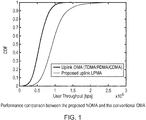
- Fig. 1 shows the comparison of user throughput between the proposed LPMA (uplink LPMA) and the conventional OMA (TMDA/FDMA/ CDMA/ OFDMA).
- the simulation parameters are given in the following table: Table 1: The parameters of simulation Cellular Layout: Hexagonal, wrapped around Topology 7 sites (no sectorization) Bandwidth 10Mhz Tx/Rx Antenna No. 1 (omni-directional) No. of UE per cell 2 (under the same resources) BS-to-BS distance 500m Channels i.i.d Rayleigh fading UE Tx power 23dBm Thermal noise density -174dBm/Hz Rx Noise figure 5dB Path loss model 21.5 + 36.7*log10( D ), D in km
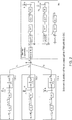
- Figure 2 shows each user equipment comprising a linear encoder C, mapping circuitry W, a multiplier for multiplying by a selected weighting coefficient and circuitry for applying a normalising function.
- the encoder C is a linear encoder which generates codewords over a particular finite field. The size of the finite field is selected in dependence upon the channel quality for that user equipment. In this regard, the user equipment will receive an indication from the base station which will rank its channel quality compared to other user equipment. From this it can select a coefficient for weighting the signal and a finite field size for the encoder. The finite field sizes are relatively prime with respect to each other.
- the user equipment stores a list of possible weighting coefficients and corresponding finite fields and the indication will indicate to the user equipment which one to select. In other embodiments the indicator will more directly provide information regarding the weighting coefficient.
- a signal that is to be transmitted is then encoded by the encoder over the particular finite field and is mapped to a lattice code by the mapping circuitry. This encoded signal is then weighted by the selected weighting coefficient and it is normalised such that the power is suitable for output. This encoded weighted signal is then output.
- User equipment with poorer channels will select larger weighting coefficients and smaller finite fields. An encoder encoding over a smaller finite field will transmit less information while a higher weighting coefficient will mitigate for losses due to the poorer channel.
- the base station comprises signal extractors for demultiplexing the combined signals and extracting each of the individual user equipment signals. These signal extractors extract individual signals by performing lattice modulo operations on a combined signal, the lattice modulo operation performed to extract a particular signal depending on the excluded prime of the weighting coefficient used to weight that signal.
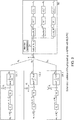
- the signal extractor circuitry can be arranged in parallel as is shown in Figure 3 and can extract the signals in parallel whereupon they can be mapped back to a linear code and decoded, or they can be arranged in series as is shown in Figure 2 . The series arrangement allows successive interference cancellation to be performed which reduces errors but increases latency.
- the signal extractor circuits are arranged in series, it is advantageous if the signal transmitted via the poorest channel is extracted first and once it has been decoded, it is then reconstructed to its lattice code form and subtracted from the signal. In this way, errors associated with the signal from the poorest channel are removed or at least reduced in the total signal and the resultant signal which has had this signal extracted from it along with the errors associated with it, can then have the signal with the next highest weighting coefficient extracted from it by using a lattice modulo operation appropriate for that weighting coefficient. In this way, there is successive interference cancellation and although there is increased latency, the signals that are decoded are of a higher quality.
- this combined signal is received from individual user equipment with different channel losses which are denoted in the figures as h.
- Channel losses from each user equipment can be estimated from known signals transmitted between the network node and the user equipment, and these estimated losses can be used to generate scale factors to reduce the noise by tending each weighting coefficient towards an integer.
- the channel signals embedded in the combined signal are then rounded integers or complex integers where each rounded integer is relatively prime to the distinct prime associated with the corresponding user's codeword, prior to be extracted by a modulo prime operation. Reduction of the noise is important as it allows the modulo lattice operation to be successfully performed.
- the proposed LPMA adopts a multi-dimensional lattice constellation.
- L UEs Based on the channel quality feedback from BS, L UEs transmit their weighted lattice codes over the finite fields F q 1 ,...,F q l ,...,F q L , respectively.
- the weighted coefficients assigned to UEs are the primes from some special algebraic structure, e.g., the integers, Gaussian or Eisenstein integers and each exclude a different prime. As such, by taking a simple modulo lattice operation, each lattice code can be extracted and decoded to obtain the UE's desired signal.
- the received signal is actually formed as the complex combination of lattice codewords due to the different losses over the different channels and hence cannot be used to separate the user signals using modulo lattice operation without some error.
- the received signal is scaled by a factor and the channels embedded in it are rounded into integers or complex integers where each rounded integer is relatively prime to the distinct prime associated with the corresponding user.
- a sum-rate optimization is implemented for selecting the appropriate scaling factor and primes (as seen in Figs. 2 and 3 ).
- each UE's desired signal can be separated. Based on this, it is implied that the SIC decoding paradigm can be adopted. That is, following modulo lattice operation (see Fig. 2 ) and lattice decoding, the decoded UE's signal is used to reconstruct the lattice codeword, which will be subtracted from the received signal before decoding the other UE's signals.
- decoding complexity is only bounded by the UE with the largest size of lattice partition (the decoding complexity of the proposed uplink LPMA does not exponentially increase with the number of UEs).
- MLO-PIC parallel interference cancellation
- PID principal ideal domain
- a lattice A has the following prosperities: if x, y ⁇ ⁇ , then x+y ⁇ ⁇ ; and if x ⁇ ⁇ , then -x ⁇ ⁇ .
- a subset A' of A is called a sub-lattice of A if it is a R-module.
- the above coding and modulation procedure can be seen in Fig. 4 .
- ⁇ l is the integer coefficient after rounding over channels and its selection criterion is given in the following paragraph
- z eff represents the effective noise which contains the fraction parts after rounding and the additive white Gaussian noise.
- a opt represents the returned optimal rounding coefficients.
- the above shortest vector problem can be easily solved by the conventional lattice reduction algorithm, e.g., Lenstra-Lenstra-Lovász lattice basis reduction algorithm.
- BS can implement the modulo lattice and SIC decoding.
- the order of channel conditions is: UE 1 ⁇ UE 2 ⁇ ... ⁇ UE L and hence based on the SIC decoding principle, BS will take the full SIC decoding for extracting the desired signals from UE 1 to UE L .
- the decoder then decodes the UE 1's signals from y (1) , denoted by v ⁇ 1 .
- the decoder then forms v ⁇ l , the output of the decoder at the l-th level, from y (l) .
- the above procedure will cause sub-optimality only in the low SNR regime.
- the decoding latency is a sensitive issue.
- MLO-PIC modulo lattice operation with parallel interference cancellation
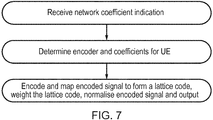
- Figure 7 shows a flow diagram illustrating steps in a method performed at a user equipment.
- a weighting coefficient indicator is received from the network node which indicates a weighting coefficient to be applied to a lattice coded signal. Form this indication the UE determines the actual weighting coefficient and the order of the finite field to be used in the encoder. It then encodes the signal, maps it to a lattice code, weights it with the coefficient and normalises the signal and outputs it.
- Figure 8 shows a flow diagram illustrating steps performed in a method at the network node.
- the network node determines the channel quality of multiple UEs communicating with it and from this it determines a channel quality ranking for the UEs and transmits an indication of the weighting coefficients that each UE should use.
- the UEs with the poorer channels have higher weighting coefficients. All weighting coefficients are different and each excludes a different distinct prime from the product that forms it.
- An order of the finite field encoder can be also deduced from this indicator as the weighting coefficients and finite field orders are related, lower order finite fields being used for poorer channels.
- the finite field order are relatively prime with respect to each other and in some embodiments the order of the finite field is the distinct prime excluded from the weighting coefficient.
- the network node then receives signals from each UE where the encoded signals are weighted with the weighting coefficients indicated by the network node.
- the next step (not shown) is to perform channel compensation to compensate for the different losses experienced by the signals transmitted down the different channels. These losses are estimated based on known signals received from the UEs on these channels and a scale factor is determined by sum-rate optimisation to tend the channel coefficients towards integers.
- the channels embedded in the signal are then rounded into integers or complex integers. Each rounded integer is relatively prime to the distinct prime of the codeword of the corresponding user.
- the network node determines whether to perform signal extraction in parallel or in series on this scaled signal. This is decided in dependence upon the required quality and/or latency, where low latency is required the signals are extracted and decoded in parallel, where when high quality is more important this extraction and decoding is performed in series, which allows successive interference cancellation.
- the signal is routed to multiple signal extractors and their decoders arranged in parallel.
- Each signal extractor performs a modulo lattice operation relevant to that signal, and the extracted signal is then reverse mapped from the lattice code domain and decoded.
- the signal is routed to a first signal extractor, extracted, mapped and then decoded and that signal is output.
- the decoded signal is also input to a lattice code signal reconstructor to reconstruct the lattice code for that signal with error correction having been performed and the reconstructed signal is subtracted from the combined received signal and the resultant signal is input to a subsequent, signal extractor and decoder and so on until all signals have been extracted and decoded.
- Embodiments propose a new non-orthogonal multiple access scheme, called lattice partition based non-orthogonal multiple access (LPMA). It adopts the Construction A based lattice as the basis for the data encoding and medium access and the UEs are multiplexed by different lattice partitions. The resulting solution significantly increases spectral efficiency while retaining a linear computational complexity scaling which does not grow exponentially with the number of UEs.
- LPMA lattice partition based non-orthogonal multiple access
- the proposed LPMA shows a significantly improved performance in terms of the spectral efficiency over the conventional uplink OMA such as TDMA/FDMA/CDMA/OFDMA.
- our proposed LPMA enhances the user throughput from 55Mbps to 91bps.
- program storage devices e.g., digital data storage media, which are machine or computer readable and encode machine-executable or computer-executable programs of instructions, wherein said instructions perform some or all of the steps of said above-described methods.
- the program storage devices may be, e.g., digital memories, magnetic storage media such as a magnetic disks and magnetic tapes, hard drives, or optically readable digital data storage media.
- the embodiments are also intended to cover computers programmed to perform said steps of the above-described methods.
- processors may be provided through the use of dedicated hardware as well as hardware capable of executing software in association with appropriate software.
- the functions may be provided by a single dedicated processor, by a single shared processor, or by a plurality of individual processors, some of which may be shared.
- processor or “controller” or “logic” should not be construed to refer exclusively to hardware capable of executing software, and may implicitly include, without limitation, digital signal processor (DSP) hardware, network processor, application specific integrated circuit (ASIC), field programmable gate array (FPGA), read only memory (ROM) for storing software, random access memory (RAM), and non-volatile storage. Other hardware, conventional and/or custom, may also be included.
- DSP digital signal processor
- ASIC application specific integrated circuit
- FPGA field programmable gate array
- ROM read only memory
- RAM random access memory
- non-volatile storage Other hardware, conventional and/or custom, may also be included.
- any switches shown in the Figures are conceptual only. Their function may be carried out through the operation of program logic, through dedicated logic, through the interaction of program control and dedicated logic, or even manually, the particular technique being selectable by the implementer as more specifically understood from the context.
- any block diagrams herein represent conceptual views of illustrative circuitry embodying the principles of the invention.
- any flow charts, flow diagrams, state transition diagrams, pseudo code, and the like represent various processes which may be substantially represented in computer readable medium and so executed by a computer or processor, whether or not such computer or processor is explicitly shown.
Landscapes
- Engineering & Computer Science (AREA)
- Computer Networks & Wireless Communication (AREA)
- Signal Processing (AREA)
- Quality & Reliability (AREA)
- Mobile Radio Communication Systems (AREA)
Priority Applications (1)
| Application Number | Priority Date | Filing Date | Title |
|---|---|---|---|
| EP16305163.4A EP3206318B1 (de) | 2016-02-12 | 2016-02-12 | Nichtorthogonale mehrfache uplink-kommunikationen |
Applications Claiming Priority (1)
| Application Number | Priority Date | Filing Date | Title |
|---|---|---|---|
| EP16305163.4A EP3206318B1 (de) | 2016-02-12 | 2016-02-12 | Nichtorthogonale mehrfache uplink-kommunikationen |
Publications (2)
| Publication Number | Publication Date |
|---|---|
| EP3206318A1 true EP3206318A1 (de) | 2017-08-16 |
| EP3206318B1 EP3206318B1 (de) | 2019-06-26 |
Family
ID=55411334
Family Applications (1)
| Application Number | Title | Priority Date | Filing Date |
|---|---|---|---|
| EP16305163.4A Active EP3206318B1 (de) | 2016-02-12 | 2016-02-12 | Nichtorthogonale mehrfache uplink-kommunikationen |
Country Status (1)
| Country | Link |
|---|---|
| EP (1) | EP3206318B1 (de) |
-
2016
- 2016-02-12 EP EP16305163.4A patent/EP3206318B1/de active Active
Non-Patent Citations (5)
| Title |
|---|
| BOBAK NAZER ET AL: "Compute-and-Forward: Harnessing Interference Through Structured Codes", IEEE TRANSACTIONS ON INFORMATION THEORY, IEEE PRESS, USA, vol. 57, no. 10, 1 October 2011 (2011-10-01), pages 6463 - 6486, XP011361363, ISSN: 0018-9448, DOI: 10.1109/TIT.2011.2165816 * |
| FORNEY G D ET AL: "SPHERE-BOUND-ACHIEVING COSET CODES AND MULTILEVEL COSET CODES", IEEE TRANSACTIONS ON INFORMATION THEORY, IEEE PRESS, USA, vol. 46, no. 3, 1 May 2000 (2000-05-01), pages 820 - 850, XP008036453, ISSN: 0018-9448, DOI: 10.1109/18.841165 * |
| NATARAJAN LAKSHMI ET AL: "Lattice Index Coding", IEEE TRANSACTIONS ON INFORMATION THEORY, IEEE PRESS, USA, vol. 61, no. 12, 1 December 2015 (2015-12-01), pages 6505 - 6525, XP011590106, ISSN: 0018-9448, [retrieved on 20151118], DOI: 10.1109/TIT.2015.2491924 * |
| ORDENTLICH OR ET AL: "The Approximate Sum Capacity of the Symmetric Gaussian $K$ -User Interference Channel", IEEE TRANSACTIONS ON INFORMATION THEORY, IEEE PRESS, USA, vol. 60, no. 6, 1 June 2014 (2014-06-01), pages 3450 - 3482, XP011548344, ISSN: 0018-9448, [retrieved on 20140515], DOI: 10.1109/TIT.2014.2316136 * |
| YU-CHIH HUANG ET AL: "Multistage Compute-and-Forward with Multilevel Lattice Codes Based on Product Constructions", ARXIV.ORG, CORNELL UNIVERSITY LIBRARY, 201 OLIN LIBRARY CORNELL UNIVERSITY ITHACA, NY 14853, 10 January 2014 (2014-01-10), XP080001268 * |
Also Published As
| Publication number | Publication date |
|---|---|
| EP3206318B1 (de) | 2019-06-26 |
Similar Documents
| Publication | Publication Date | Title |
|---|---|---|
| Fang et al. | Lattice partition multiple access: A new method of downlink non-orthogonal multiuser transmissions | |
| EP2369772B1 (de) | Übertragungsdiversität unter Verwendung räumlichen Multiplexings mit geringer Coderate | |
| EP2328670B1 (de) | System und verfahren für drahtlose kommunikation | |
| KR101658776B1 (ko) | 통신 장치 및 통신 방법 | |
| EP3276846B1 (de) | Mehrfach-antennen-mehrbenutzer-downlink-übertragung | |
| JP6280508B2 (ja) | 送信装置、受信装置および通信システム | |
| WO2012115232A1 (ja) | 受信装置、送信装置、受信方法、送信方法、プログラムおよび無線通信システム | |
| KR20120135333A (ko) | 단말 장치 및 수신 방법 | |
| US8913676B2 (en) | Methods of transmitting and receiving a multicarrier signal, and corresponding transmitter, receiver, return signal, and computer programs | |
| KR101904011B1 (ko) | 재귀적 서브 블록 디코딩 | |
| Feng et al. | Communication over finite-chain-ring matrix channels | |
| KR20170059412A (ko) | 매개변수화 순차 복호화 | |
| Thirunavukkarasu et al. | An Efficient Code Domain NOMA Scheme with Enhanced Spectral and Energy Efficiency for Networks Beyond 5G. | |
| US10230445B2 (en) | Data transmission method, data reception method, data transmission device and data reception device | |
| EP3206319B1 (de) | Nichtorthogonale downlink-signale für mehrere benutzer | |
| CN109660325B (zh) | 数据处理方法及装置 | |
| EP3206318B1 (de) | Nichtorthogonale mehrfache uplink-kommunikationen | |
| CN101488837B (zh) | 一种多播广播业务数据发射方法及无线发射装置 | |
| JP2015056690A (ja) | 端末装置および受信装置 | |
| US8824398B2 (en) | Radio communication system, radio communication device, and radio communication method | |
| EP3101855B1 (de) | Signalverarbeitungsverfahren und basisstation | |
| Aljohani et al. | Exit-chart-aided joint source coding, channel coding, and modulation design for two-way relaying | |
| KR101661676B1 (ko) | 네스티드 격자 코드를 이용한 더티 페이퍼 코딩 방법 | |
| KR20080042383A (ko) | 다중 안테나 시스템에서 수신장치 및 방법 | |
| WO2018228704A1 (en) | A network device, a user equipment and a method for wireless data transmission |
Legal Events
| Date | Code | Title | Description |
|---|---|---|---|
| PUAI | Public reference made under article 153(3) epc to a published international application that has entered the european phase |
Free format text: ORIGINAL CODE: 0009012 |
|
| STAA | Information on the status of an ep patent application or granted ep patent |
Free format text: STATUS: THE APPLICATION HAS BEEN PUBLISHED |
|
| AK | Designated contracting states |
Kind code of ref document: A1 Designated state(s): AL AT BE BG CH CY CZ DE DK EE ES FI FR GB GR HR HU IE IS IT LI LT LU LV MC MK MT NL NO PL PT RO RS SE SI SK SM TR |
|
| AX | Request for extension of the european patent |
Extension state: BA ME |
|
| STAA | Information on the status of an ep patent application or granted ep patent |
Free format text: STATUS: REQUEST FOR EXAMINATION WAS MADE |
|
| 17P | Request for examination filed |
Effective date: 20180216 |
|
| RBV | Designated contracting states (corrected) |
Designated state(s): AL AT BE BG CH CY CZ DE DK EE ES FI FR GB GR HR HU IE IS IT LI LT LU LV MC MK MT NL NO PL PT RO RS SE SI SK SM TR |
|
| STAA | Information on the status of an ep patent application or granted ep patent |
Free format text: STATUS: EXAMINATION IS IN PROGRESS |
|
| RAP1 | Party data changed (applicant data changed or rights of an application transferred) |
Owner name: ALCATEL LUCENT |
|
| 17Q | First examination report despatched |
Effective date: 20180416 |
|
| GRAP | Despatch of communication of intention to grant a patent |
Free format text: ORIGINAL CODE: EPIDOSNIGR1 |
|
| STAA | Information on the status of an ep patent application or granted ep patent |
Free format text: STATUS: GRANT OF PATENT IS INTENDED |
|
| INTG | Intention to grant announced |
Effective date: 20190201 |
|
| GRAS | Grant fee paid |
Free format text: ORIGINAL CODE: EPIDOSNIGR3 |
|
| GRAA | (expected) grant |
Free format text: ORIGINAL CODE: 0009210 |
|
| STAA | Information on the status of an ep patent application or granted ep patent |
Free format text: STATUS: THE PATENT HAS BEEN GRANTED |
|
| AK | Designated contracting states |
Kind code of ref document: B1 Designated state(s): AL AT BE BG CH CY CZ DE DK EE ES FI FR GB GR HR HU IE IS IT LI LT LU LV MC MK MT NL NO PL PT RO RS SE SI SK SM TR |
|
| REG | Reference to a national code |
Ref country code: GB Ref legal event code: FG4D |
|
| REG | Reference to a national code |
Ref country code: CH Ref legal event code: EP |
|
| REG | Reference to a national code |
Ref country code: AT Ref legal event code: REF Ref document number: 1149547 Country of ref document: AT Kind code of ref document: T Effective date: 20190715 |
|
| REG | Reference to a national code |
Ref country code: DE Ref legal event code: R096 Ref document number: 602016015863 Country of ref document: DE |
|
| REG | Reference to a national code |
Ref country code: IE Ref legal event code: FG4D |
|
| REG | Reference to a national code |
Ref country code: NL Ref legal event code: MP Effective date: 20190626 |
|
| PG25 | Lapsed in a contracting state [announced via postgrant information from national office to epo] |
Ref country code: HR Free format text: LAPSE BECAUSE OF FAILURE TO SUBMIT A TRANSLATION OF THE DESCRIPTION OR TO PAY THE FEE WITHIN THE PRESCRIBED TIME-LIMIT Effective date: 20190626 Ref country code: LT Free format text: LAPSE BECAUSE OF FAILURE TO SUBMIT A TRANSLATION OF THE DESCRIPTION OR TO PAY THE FEE WITHIN THE PRESCRIBED TIME-LIMIT Effective date: 20190626 Ref country code: NO Free format text: LAPSE BECAUSE OF FAILURE TO SUBMIT A TRANSLATION OF THE DESCRIPTION OR TO PAY THE FEE WITHIN THE PRESCRIBED TIME-LIMIT Effective date: 20190926 Ref country code: FI Free format text: LAPSE BECAUSE OF FAILURE TO SUBMIT A TRANSLATION OF THE DESCRIPTION OR TO PAY THE FEE WITHIN THE PRESCRIBED TIME-LIMIT Effective date: 20190626 Ref country code: SE Free format text: LAPSE BECAUSE OF FAILURE TO SUBMIT A TRANSLATION OF THE DESCRIPTION OR TO PAY THE FEE WITHIN THE PRESCRIBED TIME-LIMIT Effective date: 20190626 Ref country code: AL Free format text: LAPSE BECAUSE OF FAILURE TO SUBMIT A TRANSLATION OF THE DESCRIPTION OR TO PAY THE FEE WITHIN THE PRESCRIBED TIME-LIMIT Effective date: 20190626 |
|
| REG | Reference to a national code |
Ref country code: LT Ref legal event code: MG4D |
|
| PG25 | Lapsed in a contracting state [announced via postgrant information from national office to epo] |
Ref country code: GR Free format text: LAPSE BECAUSE OF FAILURE TO SUBMIT A TRANSLATION OF THE DESCRIPTION OR TO PAY THE FEE WITHIN THE PRESCRIBED TIME-LIMIT Effective date: 20190927 Ref country code: BG Free format text: LAPSE BECAUSE OF FAILURE TO SUBMIT A TRANSLATION OF THE DESCRIPTION OR TO PAY THE FEE WITHIN THE PRESCRIBED TIME-LIMIT Effective date: 20190926 Ref country code: RS Free format text: LAPSE BECAUSE OF FAILURE TO SUBMIT A TRANSLATION OF THE DESCRIPTION OR TO PAY THE FEE WITHIN THE PRESCRIBED TIME-LIMIT Effective date: 20190626 Ref country code: LV Free format text: LAPSE BECAUSE OF FAILURE TO SUBMIT A TRANSLATION OF THE DESCRIPTION OR TO PAY THE FEE WITHIN THE PRESCRIBED TIME-LIMIT Effective date: 20190626 |
|
| REG | Reference to a national code |
Ref country code: AT Ref legal event code: MK05 Ref document number: 1149547 Country of ref document: AT Kind code of ref document: T Effective date: 20190626 |
|
| PG25 | Lapsed in a contracting state [announced via postgrant information from national office to epo] |
Ref country code: NL Free format text: LAPSE BECAUSE OF FAILURE TO SUBMIT A TRANSLATION OF THE DESCRIPTION OR TO PAY THE FEE WITHIN THE PRESCRIBED TIME-LIMIT Effective date: 20190626 Ref country code: EE Free format text: LAPSE BECAUSE OF FAILURE TO SUBMIT A TRANSLATION OF THE DESCRIPTION OR TO PAY THE FEE WITHIN THE PRESCRIBED TIME-LIMIT Effective date: 20190626 Ref country code: AT Free format text: LAPSE BECAUSE OF FAILURE TO SUBMIT A TRANSLATION OF THE DESCRIPTION OR TO PAY THE FEE WITHIN THE PRESCRIBED TIME-LIMIT Effective date: 20190626 Ref country code: CZ Free format text: LAPSE BECAUSE OF FAILURE TO SUBMIT A TRANSLATION OF THE DESCRIPTION OR TO PAY THE FEE WITHIN THE PRESCRIBED TIME-LIMIT Effective date: 20190626 Ref country code: RO Free format text: LAPSE BECAUSE OF FAILURE TO SUBMIT A TRANSLATION OF THE DESCRIPTION OR TO PAY THE FEE WITHIN THE PRESCRIBED TIME-LIMIT Effective date: 20190626 Ref country code: SK Free format text: LAPSE BECAUSE OF FAILURE TO SUBMIT A TRANSLATION OF THE DESCRIPTION OR TO PAY THE FEE WITHIN THE PRESCRIBED TIME-LIMIT Effective date: 20190626 Ref country code: PT Free format text: LAPSE BECAUSE OF FAILURE TO SUBMIT A TRANSLATION OF THE DESCRIPTION OR TO PAY THE FEE WITHIN THE PRESCRIBED TIME-LIMIT Effective date: 20191028 |
|
| PG25 | Lapsed in a contracting state [announced via postgrant information from national office to epo] |
Ref country code: IS Free format text: LAPSE BECAUSE OF FAILURE TO SUBMIT A TRANSLATION OF THE DESCRIPTION OR TO PAY THE FEE WITHIN THE PRESCRIBED TIME-LIMIT Effective date: 20191026 Ref country code: SM Free format text: LAPSE BECAUSE OF FAILURE TO SUBMIT A TRANSLATION OF THE DESCRIPTION OR TO PAY THE FEE WITHIN THE PRESCRIBED TIME-LIMIT Effective date: 20190626 Ref country code: IT Free format text: LAPSE BECAUSE OF FAILURE TO SUBMIT A TRANSLATION OF THE DESCRIPTION OR TO PAY THE FEE WITHIN THE PRESCRIBED TIME-LIMIT Effective date: 20190626 Ref country code: ES Free format text: LAPSE BECAUSE OF FAILURE TO SUBMIT A TRANSLATION OF THE DESCRIPTION OR TO PAY THE FEE WITHIN THE PRESCRIBED TIME-LIMIT Effective date: 20190626 |
|
| PG25 | Lapsed in a contracting state [announced via postgrant information from national office to epo] |
Ref country code: TR Free format text: LAPSE BECAUSE OF FAILURE TO SUBMIT A TRANSLATION OF THE DESCRIPTION OR TO PAY THE FEE WITHIN THE PRESCRIBED TIME-LIMIT Effective date: 20190626 |
|
| PG25 | Lapsed in a contracting state [announced via postgrant information from national office to epo] |
Ref country code: DK Free format text: LAPSE BECAUSE OF FAILURE TO SUBMIT A TRANSLATION OF THE DESCRIPTION OR TO PAY THE FEE WITHIN THE PRESCRIBED TIME-LIMIT Effective date: 20190626 Ref country code: PL Free format text: LAPSE BECAUSE OF FAILURE TO SUBMIT A TRANSLATION OF THE DESCRIPTION OR TO PAY THE FEE WITHIN THE PRESCRIBED TIME-LIMIT Effective date: 20190626 |
|
| PG25 | Lapsed in a contracting state [announced via postgrant information from national office to epo] |
Ref country code: IS Free format text: LAPSE BECAUSE OF FAILURE TO SUBMIT A TRANSLATION OF THE DESCRIPTION OR TO PAY THE FEE WITHIN THE PRESCRIBED TIME-LIMIT Effective date: 20200224 |
|
| REG | Reference to a national code |
Ref country code: DE Ref legal event code: R097 Ref document number: 602016015863 Country of ref document: DE |
|
| PLBE | No opposition filed within time limit |
Free format text: ORIGINAL CODE: 0009261 |
|
| STAA | Information on the status of an ep patent application or granted ep patent |
Free format text: STATUS: NO OPPOSITION FILED WITHIN TIME LIMIT |
|
| PG2D | Information on lapse in contracting state deleted |
Ref country code: IS |
|
| 26N | No opposition filed |
Effective date: 20200603 |
|
| PG25 | Lapsed in a contracting state [announced via postgrant information from national office to epo] |
Ref country code: SI Free format text: LAPSE BECAUSE OF FAILURE TO SUBMIT A TRANSLATION OF THE DESCRIPTION OR TO PAY THE FEE WITHIN THE PRESCRIBED TIME-LIMIT Effective date: 20190626 |
|
| REG | Reference to a national code |
Ref country code: CH Ref legal event code: PL |
|
| REG | Reference to a national code |
Ref country code: BE Ref legal event code: MM Effective date: 20200229 |
|
| PG25 | Lapsed in a contracting state [announced via postgrant information from national office to epo] |
Ref country code: MC Free format text: LAPSE BECAUSE OF FAILURE TO SUBMIT A TRANSLATION OF THE DESCRIPTION OR TO PAY THE FEE WITHIN THE PRESCRIBED TIME-LIMIT Effective date: 20190626 Ref country code: LU Free format text: LAPSE BECAUSE OF NON-PAYMENT OF DUE FEES Effective date: 20200212 |
|
| PG25 | Lapsed in a contracting state [announced via postgrant information from national office to epo] |
Ref country code: CH Free format text: LAPSE BECAUSE OF NON-PAYMENT OF DUE FEES Effective date: 20200229 Ref country code: LI Free format text: LAPSE BECAUSE OF NON-PAYMENT OF DUE FEES Effective date: 20200229 |
|
| PG25 | Lapsed in a contracting state [announced via postgrant information from national office to epo] |
Ref country code: IE Free format text: LAPSE BECAUSE OF NON-PAYMENT OF DUE FEES Effective date: 20200212 |
|
| PG25 | Lapsed in a contracting state [announced via postgrant information from national office to epo] |
Ref country code: BE Free format text: LAPSE BECAUSE OF NON-PAYMENT OF DUE FEES Effective date: 20200229 |
|
| PG25 | Lapsed in a contracting state [announced via postgrant information from national office to epo] |
Ref country code: MT Free format text: LAPSE BECAUSE OF FAILURE TO SUBMIT A TRANSLATION OF THE DESCRIPTION OR TO PAY THE FEE WITHIN THE PRESCRIBED TIME-LIMIT Effective date: 20190626 Ref country code: CY Free format text: LAPSE BECAUSE OF FAILURE TO SUBMIT A TRANSLATION OF THE DESCRIPTION OR TO PAY THE FEE WITHIN THE PRESCRIBED TIME-LIMIT Effective date: 20190626 |
|
| PG25 | Lapsed in a contracting state [announced via postgrant information from national office to epo] |
Ref country code: MK Free format text: LAPSE BECAUSE OF FAILURE TO SUBMIT A TRANSLATION OF THE DESCRIPTION OR TO PAY THE FEE WITHIN THE PRESCRIBED TIME-LIMIT Effective date: 20190626 |
|
| PGFP | Annual fee paid to national office [announced via postgrant information from national office to epo] |
Ref country code: FR Payment date: 20251231 Year of fee payment: 11 |
|
| PGFP | Annual fee paid to national office [announced via postgrant information from national office to epo] |
Ref country code: GB Payment date: 20260106 Year of fee payment: 11 |
|
| PGFP | Annual fee paid to national office [announced via postgrant information from national office to epo] |
Ref country code: DE Payment date: 20251230 Year of fee payment: 11 |