EP3205372B1 - Neuromodulation device with coils comprising elastic members - Google Patents
Neuromodulation device with coils comprising elastic members Download PDFInfo
- Publication number
- EP3205372B1 EP3205372B1 EP17153587.5A EP17153587A EP3205372B1 EP 3205372 B1 EP3205372 B1 EP 3205372B1 EP 17153587 A EP17153587 A EP 17153587A EP 3205372 B1 EP3205372 B1 EP 3205372B1
- Authority
- EP
- European Patent Office
- Prior art keywords
- coils
- neuromodulation device
- neuromodulation
- patient
- array
- Prior art date
- Legal status (The legal status is an assumption and is not a legal conclusion. Google has not performed a legal analysis and makes no representation as to the accuracy of the status listed.)
- Not-in-force
Links
Images




Classifications
-
- A—HUMAN NECESSITIES
- A61—MEDICAL OR VETERINARY SCIENCE; HYGIENE
- A61N—ELECTROTHERAPY; MAGNETOTHERAPY; RADIATION THERAPY; ULTRASOUND THERAPY
- A61N2/00—Magnetotherapy
- A61N2/004—Magnetotherapy specially adapted for a specific therapy
- A61N2/006—Magnetotherapy specially adapted for a specific therapy for magnetic stimulation of nerve tissue
-
- A—HUMAN NECESSITIES
- A61—MEDICAL OR VETERINARY SCIENCE; HYGIENE
- A61N—ELECTROTHERAPY; MAGNETOTHERAPY; RADIATION THERAPY; ULTRASOUND THERAPY
- A61N2/00—Magnetotherapy
- A61N2/02—Magnetotherapy using magnetic fields produced by coils, including single turn loops or electromagnets
Definitions
- This disclosure relates generally to a device and a system for modulation of nerve circuits by focused magnetic stimulation.
- Neuromodulation is an evolving therapy that can involve various types of electromagnetic stimuli including the application of a strong magnetic field or a small electric current to nerve structures.
- the document US 2010/286470 A1 discloses a transcranial magnetic stimulation system with means for field shaping.
- the document US 2011/213195 A1 describes an apparatus with a coil arrangement for application of an electromagnetic field to stimulate a healing process.
- Some embodiments are directed to a neuromodulation device that includes electrically conductive coils arranged in an array and circuitry coupled to energize the coils in the array using current pulses that generate an electromagnetic field.
- the circuitry is configured to control one or more parameters of the current pulses, including at least amplitude and phase of the current pulses, such that the electromagnetic field undergoes constructive and destructive interference that focuses and/or steers a magnetic flux density within a region of interest of a patient characterised in that each of the coils comprises a plurality of stressed elastic members, wherein the plurality of stressed elastic members comprises: a first stressed elastic member comprising a first anchor portion and a first free portion; and a second stressed elastic member comprising a second anchor portion and a second free portion, wherein a stress profile in the first elastic member biases the first free portion away from the substrate and a stress profile in the second elastic member biases the second free portion away from the substrate and wherein the first free portion and the second free portion are connected together forming a loop winding.
- Some embodiments involve a neuromodulation system.
- the system includes a neuromodulation device comprising electrically conductive coils arranged in an array and circuitry coupled to energize the coils in the array with current pulses that generate an electromagnetic field.
- the circuitry is configured to control one or more parameters of the current pulses, including at least amplitude and phase of the current pulses, such that the electromagnetic field undergoes constructive and destructive interference that focuses and/or steers a magnetic flux density within a region of interest of a patient.
- Communications circuitry is configured to wirelessly transfer communication signals between the neuromodulation device and an external device.
- a patient information device is communicatively coupled to the neuromodulation device and is configured to monitor one or more biological signals of the patient and to transfer information about the biological signals to the neuromodulation device via the communication signals.
- the neuromodulation devices disclosed herein provide minimally-invasive and/or feedback-controlled neural modulation for regulating brain stimulation as well as regulating peripheral nerve circuits such as the vagus nerve.
- the ability to selectively stimulate nerve fascicles enables treatment of a wide-range of peripheral and central nervous system disorders with targeted therapies.
- the focused magnetic stimulation (FMS) neuromodulation approaches disclosed herein are underpinned by metamaterial coils as discussed below. These micro-engineered metamaterial structures allow for far greater control of electromagnetic fields over conventional transducer technologies.
- FMS can non-invasively target small bundles of nerve fibers, as well as provide tailored stimulus patterns.
- the use of an array of metamaterial coils combined with a current distribution algorithm enables more localized stimulations, deeper penetration, enhanced depth control, and complex stimulation patterns with the ability to target specific nerve fascicles.
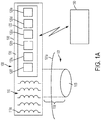
- FIG. 1 there is shown a neuromodulation device 100 configured to provide neuromodulation stimulation n.
- the neuromodulation device 100 may be useful for transcranial nerve stimulation as well as stimulation of the peripheral nerves, such as the vagus nerve, for example.
- the device 100 includes electrically conductive coils 110a arranged in an array 110 and circuitry 120.
- the circuitry 120 includes multiplexer circuitry 120a configured to allow access to individual coils of the array 110; a controller 120b configured to control the parameters of the current pulses provided to energize the coils 110a; power management circuitry 120c configured to provide power for the current pulses; and driver circuitry 120f configured to energize the coils 110a in the array 110.
- the circuitry 120 may include a battery and/or energy harvesting circuitry 120d that supplies energy to the power management circuitry 120c and communication circuitry configured to communicate with an external device 150.
- the controller 120b is configured to control one or more parameters of the current pulses, including at least amplitude and phase of the current pulses, such that the electromagnetic fields produced by the coils 110a in the array 110 undergo constructive and destructive interference that focuses and/or steers a magnetic flux density within a region of interest 105 of a patient 101.
- a neuromodulation device 100 may be an external therapy system that is placed on or above the skin 101a of the patient 101 as illustrated in FIG. 1A .
- the neuromodulation device 100 may be at least partially implantable.
- the coil array 110 and/or circuitry 120 may be implanted subcutaneously.
- the controller 120b may be configured to additionally additional parameters of the current pulses such as the duty cycle and/or frequency of the current pulses. Control of the current pulse parameters is used to focus and/or steer the magnetic flux density within the region of interest 105.
- the coils 110a of the array 110 may have a diameter in a range of greater than or equal to about 100 ⁇ m to about 500 ⁇ m, or in a range of greater than or equal to about 10 ⁇ m to about 100 ⁇ m, for example.
- the coils 110a are 2D planar coils and in some embodiments, the coils are 3D metamaterial coils made of one or more stressed elastic members as disclosed in commonly owned U.S. Patent 6,646,533 B2 .
- the resolution of the stimulation head comprising array 110 may be about three times the diameter of one of the coils 110a in the array 110.
- the neuromodulation device may comprise a 10 x 10 array of coils, each coil having a diameter of 150 ⁇ m, a coil pitch (center to center distance between coils) of 150 ⁇ m, a maximum stimulation area size of 3 mm 2 , and current injection in each coil of less than 100 mA.
- the magnetic flux density within the region of interest 105 is greater than about 0.1 Tesla
- an electric field gradient within the area of interest 105 may be about dEx/dx >500 V/m 2
- a maximum electric current pulse amplitude in each coil may be less than about 500 mA or even less than about 100 mA.
- the magnetic flux density, electric field strength and/or electric field gradient produced by the array 110 is sufficient to activate one or more neurons within the region of interest 105 to provide neuromodulation therapy.
- the magnetic flux density, electric field strength, and/or electric field gradient produced by the array 110 within the region of interest 105 may be sufficient to activate a nerve fascicle at a specified depth within a nerve bundle while not activating other nerve fascicles of the nerve bundle.
- the neuromodulation therapy may involve using the array 110 to provide a magnetic flux density, electric field strength, and/or electric field gradient at a sub threshold level that is below the activation threshold of the nerve fibers in the region of interest.
- the region of interest 105 is located at a specified depth within the patient 101 and the magnetic flux density, electric field strength, and/or electric field gradient produced by the neuromodulation device 100 in a region 106 between the region of interest 105 and the array 110 is to be less than the magnetic flux density, electric field strength, and/or electric field gradient in the region of interest 105.
- the neuromodulation device 100 includes a substrate 130, wherein the array 110 of coils 110a and the circuitry 120 are disposed on the substrate 130.
- the substrate 130 can be flexible.
- the substrate 130 may comprise an implantable nerve cuff or a dermal patch.
- the neuromodulation device can be printed on a flexible substrate.
- the neuromodulation device 100 includes power supply circuitry that optionally comprises a battery.
- the power management circuitry 120c obtains power from a power supply 120d such as a battery or energy harvesting circuit.
- the energy harvesting circuit is configured to harvest power from a radio frequency (RF) signal generated by an additional device 150 which may be a patient-external device.
- the power supply 120d provides power to the power management circuitry 120c which uses the harvested power to provide the current pulses to the coils 110a.
- RF radio frequency
- the neuromodulation device includes communications circuitry 120e configured to wirelessly transfer communication signals between the neuromodulation device 100 and an additional device 150.
- the device 150 may be configured to obtain biological information from the patient wherein the biological information is used to develop feedback information for the FMS.
- the communications signals passed between the device 150 and the communications circuitry 120e include the feedback information and the controller 120b uses the feedback information to control the current pulse parameters.
- the controller 120b includes a memory that stores one or more tables of current pulse parameter values for each coil in the array, each table corresponding to a particular profile of biological information that is consistent with the current physiological state of the patient.
- the current physiological state of the patient may be provided to the controller 120b by the external device 150 via the communications circuitry 120e.
- the controller 120b accesses the memory to retrieve the current pulse parameter values to be used for the stimulation, wherein the current pulse parameter correspond to the patient's physiological state.
- the current pulse parameter values utilized by the neuromodulation device are dynamically changeable in response to a change in the biological information obtained from the patient via device 150.
- the circuitry 120 may be implemented using a silicon based application specific integrated circuit (ASIC) and/or a thin-film-transistor (TFT) circuitry backplane. TFT implementation is particularly useful for flexible substrates.
- ASIC application specific integrated circuit
- TFT thin-film-transistor
- Each coil 110a in the array 110 may be individually addressable, e.g., using multiplexers 120a and the controller 230b, to implement an addressable array.
- Each coil 110a is coupled to driving circuitry 120f.
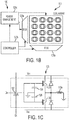
- the driving circuitry 120f may support bipolar currents by incorporating a pair of complementary transistors as shown in FIG. 1C .
- Driving circuitry 120f allows programming of a distinct current through each coil 110a before the entire array 110 is activated.
- FIG. 1B illustrates a portion of the circuitry 120 and coil array 110 in accordance with some embodiments.
- FIG. 1C illustrates the driver circuitry 120f for each coil 110a.
- circuitry 120 includes a controller 120b and row and column multiplexers 120a configured to access the array coils 110a.
- the circuitry 120 further includes power management circuitry 120c that operates in conjunction with the controller 120b and multiplexers 120a to implement the current pulse injection algorithm.
- the current pulse injection algorithm provides the current distribution in the coils 110a to enable high-precision targeting and/or to tailor stimulus patterns.
- the current pulse injection algorithm may implement a phased array stimulation wherein coils 110a are selectively energized by current pulses that are in phase and/or out of phase to provide constructive and/or destructive interference between the electric fields generated by at least some of the coils 110a of the array 110.
- the constructive and/or destructive interference in the electric fields generated by the coils allows more localized stimulations, deeper penetration, depth control, and complex nerve stimulation patterns.
- the controller 120b provides signals to the multiplexers 120a for selection of the column and row of the coil array 110.
- the controller 120b controls the power management circuitry 120c for providing a value for a particular coil driver circuitry 120f shown in FIG. 1C .
- the value of Dn determines the amplitude of the current pulse.
- the timing of the application of Vss and Vcc to a coil driver (see FIG. 1C ) by the power management circuitry 120c is also controlled by the controller 120b and determines the phase, duty cycle, and/or frequency of the current pulses provided by the driver circuitry 120f to the coil 110a.
- Vcc and Vss are set to zero.
- a particular column of the array 110 is activated by applying a voltage to Gn and a value Dn is applied to the transistor 127 to set the pulse amplitude value in the gate capacitors 126 for the coil 110a.
- the proper bias voltage is set on Dn for the appropriate amount of current that the coil requires, which may be positive or negative.
- Bipolar operation is enabled by connecting the pair of capacitors 126 to the complementary pair of transistors 128.
- the coils 110a in the array are addressed by a TFT backplane similarly to the way that liquid crystals are addressed by a TFT backplane in a display, utilizing gate and data line multiplexers.
- the onboard power supply is capable of providing the full range of positive and negative bias voltages for the array, and the controller provides the signals required for activating individual pixels in the array and for activating the supply rails.
- the current pulse through the coils 110a generates a magnetic field.
- FIG. 1D which shows a single loop coil, and Equation (1)
- the magnetic field created by each loop, H z LOOP increases with the radius of the loop, R, and the intensity of the current, i(t), and decreases with the distance, z, along the axis.
- H z LOOP z 1 2 R 2 i t R 2 + z 2 1 ⁇ 2
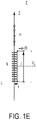
- the magnetic field of a coil depends on the number of turns, N, the length, 1, the pitch, ⁇ , and the amplitude of the current as indicated by FIG. IE, which shows a small radius coil, and Equation (2).
- N or the inductance of the coils
- Equation (2) we can considerably increase the resulting magnetic field even for a fixed low current and small radius coil, as deduced from Equation (1).
- arranging a large number of small coils in an array configuration, as shown in FIG. IE will yield an increase in the magnetic field intensity and penetration to specific regions.
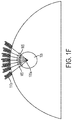
- FIG. IF is a schematic representation of beam focusing and beam steering within a region of interest 105.
- each coil 110a is driven by a coil current that is independent of other coil currents, it is possible to manipulate the field strength of the electric field at a selected location, such as the focal point 105a within region of interest 105, by approximately adding the linear vectors 165 of the individual fields.
- tailored stimulations can be obtained with appropriate coil array designs, by selecting the optimal number of elements, array configuration, driving circuits, and current distribution in the coils.
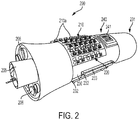
- FIG. 2 illustrates an embodiment of the neuromodulation device 200, wherein the device 200 is disposed on a flexible substrate 230 configured as an implantable nerve cuff.
- the flexible substrate 230 is configured to at least partially surround a nerve bundle 231 and is sutured in position around the nerve bundle 231 via sutures 233 attached to suture anchors 232 located on the flexible substrate 230.
- the device 200 includes electrically conductive coils 210a arranged in an array 210 and circuitry, e.g., as described in FIGS. 1A - IF, coupled to energize the coils 210a in the array 210 using current pulses that generate an electromagnetic field.
- the current pulses provided to the coils 110a by the circuitry activates the coils 110a and creates a tailored magnetic field 220 within the nerve bundle 230.
- the circuitry is configured to control one or more parameters of the current pulses, including at least amplitude and phase of the current pulses, such that the electromagnetic field undergoes constructive and destructive interference that focuses and/or steers the electric field within a region of interest of a patient.
- the region of interest includes the nerve fascicle 205 and does not include nerve fascicles 206.
- the magnetic flux density, electric field strength and/or electric field gradient produced by the array 210 is sufficient to activate one or more neurons within the region of interest to provide neuromodulation therapy.
- the magnetic flux density, electric field strength, and/or electric field gradient produced by the array 210 may be sufficient to activate the nerve fascicle 205 at a specified depth and/or location within the nerve bundle 231 while not activating other nerve fascicles 206 of the nerve bundle 230.
- the neuromodulation therapy may involve using the array 210 to provide a magnetic flux density, electric field strength, and/or electric field gradient to the nerve fascicle 205 at a sub threshold level that is below the activation threshold of the nerve fascicle while not providing the lower magnetic flux density, electric field strength, and/or electric field gradient to the other nerve fascicles 206 of the nerve bundle 230.
- the neuromodulation device 200 includes a power supply 240 that optionally includes a battery.
- the power supply 240 comprises at least one energy harvesting component, such as antenna 241, configured to harvest power from a radio frequency (RF) signal generated by an external device (not shown in FIG. 2 ).
- the power supply 240 provides power to the circuitry which uses the harvested power to provide the current pulses to the coils 210a.
- RF radio frequency
- the coils 210a shown in FIG. 2 are 3D coils.
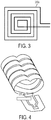
- the device may use coils that are flat planar coils 310a disposed on the substrate as shown in FIG. 3 .
- the coils 210a are three dimensional coils comprising an out-of-plane microstructure.
- the three dimensional coils shown in FIG. 4 can be used for the array and enable a magnetic field in a direction parallel to the substrate plane without requiring high aspect ratio processing.
- the scanning electron micrograph in FIG. 4 shows an out-of-plane micro-coil in accordance with some embodiments.
- the coil windings may be made using stress engineered thin films that are deposited by sputtering.
- the film is photolithographically patterned into strips of micro-springs or elastic members that are subsequently released from their underlying substrate. Upon release, a built-in stress gradient causes the elastic members to curl and form three-dimensional out-of-plane loops that make up the inductor coil.
- the free end each of each member contacts an adjacent member. This allows for the formation of a continuous inductor consisting of multiple turns without interruption of the spring metal.
- the loops can be enclosed in a molding compound. These coils can be mass-produced on prefabricated circuit wafers prior to dicing, bonding, and packaging.
- the coils are formed from stress-engineered molybdenum-chromium (MoCr) thin films.
- MoCr films are sputter-deposited with a built-in stress gradient so that, when patterned and released from their substrate, they curl into a designed radius of curvature.
- These micro-machined springs self-assemble 3D scaffolds that are then electroplated with copper to form highly conductive coil windings.
- the coil arrays can be integrated onto silicon die that also include other circuit elements. Many refractory metals have a common property of acquiring tensile stress when sputtered at high pressures and compressive stress when sputtered at low pressures. This results in a stress gradient that can be induced by changing the ambient pressure during film deposition.
- a film that is compressive at the bottom and tensile on the surface is, for example, realized by increasing the pressure during sputtering. Pressure control may be accomplished by flowing argon while widening or narrowing an orifice opening to the pump.
- FIG. 5A shows a measured stress versus sputter pressure plot for MoCr.
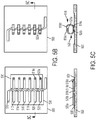
- FIGS. 5B and 5C show a process of forming an out-of-plane coil structure in which two half loops are closed in mid-air forming a loop winding in accordance with some embodiments.
- a layer of release material 530 is deposited on substrate 500 (for sequential release, two different release layers formed of different release materials may be deposited). Then a layer of an elastic material is deposited on top of the release layer 530.
- the elastic layer is photolithographically patterned into a series of individual elastic members 510-522.
- Each individual elastic member includes a first elastic member (e.g., 520 a-520 b), a contact portion or bridge for connecting between adjacent loop windings (e.g., 520 b-520 c) and a second elastic member (e.g., 520 c-520 d).
- a layer of solder e.g., 520 e is optionally formed on the tip of the second elastic member.
- the loop winding is formed by removing the release window under each first elastic member and each second elastic member. This can be done at the same time, or sequentially, by using a different release material under all the first elastic members than under all the second elastic members.
- release of the release layer under the first elastic member 520a-520b causes a first free portion 520a of the first elastic member to be released from the substrate 500.
- a first anchor portion 520b of the first elastic member remains fixed to the substrate.
- An intrinsic stress profile in the first elastic member biases the free portion 520a away from the substrate 500.
- release of the release layer under the second elastic member 518 c-518 d causes a free portion 518 d to be released from the substrate 500.
- An intrinsic stress profile in the second elastic member biases the free portion 518d away from the substrate 500.
- a second anchor portion 518 c remains fixed to the substrate 500. Pressing and heating causes the solder 518 e to reflow and join free end 520a to free end 518d.
- the free portions can be connected together by electroless plating.
- Immersion in a plating bath and depositing metal on accessible metal surfaces both thickens all metal lines and creates bridges between proximal surfaces (such as contact portion 520b-520c).
- the individual loop halves are shown in FIG. 5B as being of approximately the same length. However, the lengths can be varied to aid in the coil formation process.
- the first elastic members can be made shorter than the second elastic members to ensure that the second elastic members overlap the first elastic members.
- FIGS. 6A through 6D illustrate fabrication of the coil array in accordance with some embodiments.
- sputter pressures below 0.313 Pa (2.35 mTorr) produce compressive MoCr films, while higher deposition pressures produce tensile films.
- r h Y ⁇ ⁇ ⁇
- h the thickness
- Y the biaxial Young's modulus
- ⁇ the stress difference between the surface and bottom of the film.
- FIG. 6A is a cross sectional diagram of layers used to form the coils in the array and FIG. 6B is a more detailed view of some of the layers.
- fabrication of the coil array starts with the deposition of a metal layer 601, e.g., a Cu-plated or gold metal layer on top of the substrate 600.
- the metal layer 601 serves as a current return path for the coil after it is completed.
- a 12 to 15 ⁇ m-thick low-loss dielectric layer 602 is spin-coated to separate the coil from the substrate and to lower its parasitic capacitance. Vias 610 to the underlying metal layer 601 are then opened.
- a conductive release/sacrificial layer 603 (not shown in FIG. 6A but shown in FIG.
- This stack is about 1.5 ⁇ m thick and the layers 601 - 606 are deposited sequentially in a single pump down.
- An electrically conductive release layer 603 may be used which is also used as an electrode for electroplating the windings after coil assembly, as will be discussed.
- the release material has excellent adhesion properties and also functions as an adhesion layer for the stressed films deposited above it.
- the stress-engineered film 605 is a bi-layer with the first MoCr layer deposited at low pressure on the compressive side of the graph in FIG. 5A , and the second MoCr layer at a higher pressure on the tensile side of the graph.
- the resulting built-in stress gradient produces a well-defined mechanical moment on the film.
- the Au/MoCr/Au 604/605/606 metal stack is patterned into individual springs that ultimately make up the coil windings.
- the intrinsic stress of many sputtered thin films depends on the ambient pressure at which the material is deposited. By varying the pressure during sputtering, films can be obtained that are compressively stressed near the substrate-film interface and tensile stressed at the film surface.
- the stress graded film can be NiZr, MoCr, solder-wettable Ni, or other suitable material.
- the bottom gold layer 604 forms the outer skin of the coil when released and provides a high conductivity path for electrons at high frequencies.
- the top gold layer 606 passivates the surface.
- the metal stack is deposited above a suitable release layer 603 such as Ti, Si, or SiN.
- the release layer should be a material that can be quickly removed by selective dry or wet undercut etching. Possible etchants for a Si release layer include KOH (wet processing) and XeF2 (dry processing).
- the springs are released from the substrate by undercut etching the sacrificial layer. Perforations in the spring metal facilitate the undercut release process.
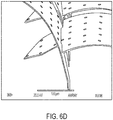
- the release mask is designed so that a piece of the photoresist 607 is retained on top of each spring after release. This resist material 607 acts as a relaxable load that retains the springs and prevents the coils from lifting fully during the release process. As shown in FIG. 6C , when heated, the load layer 607 softens and gradually yields to the built-in stress moment in the spring metal, allowing spring pairs to move in a designed trajectory while self assembling in the air.
- the coil structure features an interlocking spring tip that provides a mechanical block that prevents paired springs from curling further after they come together.
- the interlocking connection of the out-of-plane coil magnified in FIG. 6D ensures that the coil diameter is determined by mask design, rather than by the built-in stress. This is desirable because it relaxes the tolerance requirements on the stress profile in the stress- engineered film.
- the copper plating not only fills the spring perforations but also electro forms the interlocked seam, joining paired springs to a solid and permanent connection.
- the release mask is removed and all remaining release material is cleared.
- the completed devices are rugged and survive die drops on hard surfaces from heights of over 1 m.
- This four-mask coil process is compatible with wafer-scale processing and uses conventional sputter deposition techniques, standard photolithography, and simple wet etching techniques.
- the coils can be seamlessly integrated with other COMES circuitry from single or multiple foundry runs.
- the intrinsic stress profile in the elastic members discussed above can be designed into a thin film by varying the growth conditions appropriately during deposition to produce coil structures. By adding one or more conductive layers, a coil structure suitable for use as an inductor may be manufactured.
- the 3D coils discussed in connection with FIGS. 5 and 6 are metamaterial structures having an intrinsic stress profile. Such metamaterial micron-scale coils allow far greater control of electromagnetic fields as compared with conventional transducer technologies.
- the term "metamaterial structure” identifies an artificially engineered structure formed by two or more materials and multiple elements that collectively generate desired electromagnetic properties. A metamaterial structure achieves the desired properties not only from its composition, but also from the exactingly-designed configuration (e.g., the precise shape, geometry, size, orientation and arrangement) of the structural elements formed by the materials of the metamaterial structure.
- the current pulse injection algorithm used in conjunction with the coils optimizes the current distribution in the coils to enable high-precision targeting and/or to provide tailored stimulus patterns.
- the current pulse injection algorithm is implements a phased array stimulation wherein coils are selectively energized to provide constructive and/or destructive interference between the electric fields generated by at least some of the coils.
- the constructive and/or destructive interference in the electric fields allows more localized stimulations, deeper penetration, depth control, and complex nerve stimulation patterns.
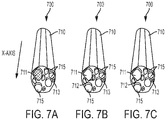
- FIGS. 7A through 7C illustrate focused magnetic stimulation that is enabled by the devices and systems described herein.
- FMS can be designed to target and activate nerve fascicles 711, 712, 713 in specific regions of a nerve bundle 710 without targeting other nerve fascicles 715 in the nerve bundle 710 demonstrating a level of control that is inaccessible to direct stimulation electrode technologies.
- nerve fascicles 711 - 715 have an average diameter of about 150 ⁇ m.
- the neuromodulation device 700 creates an electric field (E-field) such that nerve fascicle 711 experiences a spatial gradient of the E-field in the x-axis of greater than about 500 V/m 2 which activates nerve fascicle 711 while nerve fascicles 712, 713, 715 experience spatial gradient of the E-field in the x axis of less than 500 V/m 2 , e.g., about 0 V/m 2 and are not activated.
- E-field electric field
- the neuromodulation device 700 creates an electric field (E-field) such that nerve fascicle 712 experiences a spatial gradient of the E-field in the x-axis of greater than about 500 V/m 2 which activates nerve fascicle 712 while nerve fascicles 711, 713, 715 experience spatial gradient of the E-field in the x axis of less than 500 V/m 2 , e.g., about 0 V/m 2 and are not activated.
- E-field electric field
- the neuromodulation device 700 creates an electric field (E-field) such that nerve fascicle 713 experiences a spatial gradient of the E-field in the x-axis of greater than about 500 V/m 2 which activates nerve fascicle 713 while nerve fascicles 711, 712, 715 experience spatial gradient of the E-field in the x axis of less than 500 V/m 2 , e.g., about 0 V/m 2 and are not activated.
- E-field electric field
- the approaches described herein provide for steering and focusing the E-field (E) produced by coil array, e.g., a 4 x 1 or 2 x 2 coil array, in a region of interest using constructive and destructive interference.
- the E-field generated by each coil is controlled by the amplitude and phase of the current pulses that energize the coil.
- the E field generated by coils constructively interferes to create an area within the region of interest having an electric field that is greater than 200 V/m and less than about 50 V/m.
- the electric field distribution may have a spot size of about 400 ⁇ m.
- the resolution of the stimulation head of the neuromodulation device is dependent on the coil dimensions, e.g., the resolution is about equal to the diameter of coil x 3.
- the electric field manipulation is achieved by modifying the intensity and relative phase of the currents in each coil in the array.
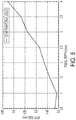
- the ability to stimulate various depths may be achieved, as shown in FIG. 8 .
- the algorithm optimizes the current distribution at each targeted focal depth to minimize the stimulation spot size.
- a spot size down to about 400 ⁇ m at a focal depth of about 1 mm is achievable using a phased array of 3D metamaterial coils as disclosed herein.
- the neuromodulation device disclosed herein may be used in a system that includes a patient information device configured to obtain information about patient conditions.
- the patient condition information may be obtained through sensors and/or may be input into the patient information device by the patient or other operator.
- both the neuromodulation device and the patient information device may be a patient-external devices.
- the neuromodulation device may be a dermal patch and the patient information device may be a patent-external device that communicates with the neuromodulation device through a wired or wired connection.
- both devices may be patient-internal, e.g., the neuromodulation device may be disposed on an implantable nerve cuff as illustrated in FIG. 2 and the patient information device be an implantable diagnostic or therapeutic device, such as a cardiac pacemaker, that wirelessly communicates with the neuromodulation device.
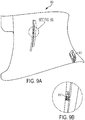
- the system may include a neuromodulation device 910 which is a patient-internal device and a patient-external patient information device 920 configured to wirelessly communicate with the neuromodulation device.
- the patient information device 920 may be attached to the patient's skin as shown.
- the neuromodulation device 910 may be installed using an endovascular approach on the patient's vagus nerve.
- the patient information device 920 may comprise a sensing/control module that monitors dynamically changing physiological patient conditions, e.g., heart rate, respiration rate, blood pressure, body temperature.
- the patient information device 920 may sense the physiological state of the patient and generate feedback control signals that are communicated wirelessly to the neuromodulation device 910.
- the neuromodulation device 910 alters one or more parameters of the current pulses that energize the coils.
- the feedback control of the patient information device 920 may synthesize and analyze both stimulation and sensing data by utilizing self-learning algorithms, and may be configured to adapt in real-time to enhance therapeutic efficacy.
- the patient information device measures biological signals such as heart rate (HR), blood pressure (BP), respiratory rate (RR), body temperature, etc., non-invasively.
- the patient information device develops a dynamic profile of biological signals in response to focused magnetic stimulation of the selected nerve.
- Spectral analysis of HR, BP, and RR may be performed to evaluate sympathetic and parasympathetic nervous system contributions.
- Optimal profiles of biological conditions that provide accurate feedback control for the stimulator function may be developed for each type of nerve stimulated. The optimal profiles may be based on data from a patient population or on individual patient responses to stimulation.
- the patient information device may be configured to adaptively regulate nerve circuits by continuously assessing the response to the stimulus provided by the stimulator module and reacting accordingly.
- the patient information device may be configured to use stimulation information, e.g., current pulse amplitude levels, duty cycle, frequency and/or phase along with patient information, e.g., sensed biological data, and/or biological data entered by the patient or other operator, e.g., mood or perception of psychological state.
- the patient information device may analyze the stimulation information and the patient information utilizing self-learning algorithms, e.g., neural algorithms that mimic human brain function, and may modify the stimulation parameters based on the analysis.
Landscapes
- Health & Medical Sciences (AREA)
- Engineering & Computer Science (AREA)
- Biomedical Technology (AREA)
- Nuclear Medicine, Radiotherapy & Molecular Imaging (AREA)
- Radiology & Medical Imaging (AREA)
- Life Sciences & Earth Sciences (AREA)
- Animal Behavior & Ethology (AREA)
- General Health & Medical Sciences (AREA)
- Public Health (AREA)
- Veterinary Medicine (AREA)
- Neurology (AREA)
- Magnetic Treatment Devices (AREA)
- Electrotherapy Devices (AREA)
Applications Claiming Priority (1)
| Application Number | Priority Date | Filing Date | Title |
|---|---|---|---|
| US15/019,702 US10307607B2 (en) | 2016-02-09 | 2016-02-09 | Focused magnetic stimulation for modulation of nerve circuits |
Publications (2)
| Publication Number | Publication Date |
|---|---|
| EP3205372A1 EP3205372A1 (en) | 2017-08-16 |
| EP3205372B1 true EP3205372B1 (en) | 2020-05-06 |
Family
ID=57909545
Family Applications (1)
| Application Number | Title | Priority Date | Filing Date |
|---|---|---|---|
| EP17153587.5A Not-in-force EP3205372B1 (en) | 2016-02-09 | 2017-01-27 | Neuromodulation device with coils comprising elastic members |
Country Status (3)
| Country | Link |
|---|---|
| US (1) | US10307607B2 (enExample) |
| EP (1) | EP3205372B1 (enExample) |
| JP (1) | JP2017140384A (enExample) |
Families Citing this family (12)
| Publication number | Priority date | Publication date | Assignee | Title |
|---|---|---|---|---|
| JP6994758B2 (ja) * | 2018-01-30 | 2022-01-14 | 国立大学法人北海道大学 | 磁気コイル装置、コイル群へ印加する電流の設定方法およびコイル群へ印加する電流を設定するプログラム |
| US11110289B2 (en) * | 2018-03-15 | 2021-09-07 | Palo Alto Research Center Incorporated | Micro coils suitable for magnetic neural stimulation |
| FR3080293A1 (fr) | 2018-04-23 | 2019-10-25 | Universite D'aix Marseille | Dispositif d'emission magnetique pour stimulation magnetique cerebrale non invasive et procede d'utilisation d'un tel dispositif |
| US11141585B2 (en) | 2018-12-28 | 2021-10-12 | Palo Alto Research Center Incorporated | Non-invasive neural interface |
| US11020603B2 (en) | 2019-05-06 | 2021-06-01 | Kamran Ansari | Systems and methods of modulating electrical impulses in an animal brain using arrays of planar coils configured to generate pulsed electromagnetic fields and integrated into clothing |
| AU2020267399A1 (en) * | 2019-05-06 | 2021-12-02 | Kamran Ansari | Therapeutic arrays of planar coils configured to generate pulsed electromagnetic fields and integrated into clothing |
| EP3756727A1 (en) * | 2019-06-25 | 2020-12-30 | Koninklijke Philips N.V. | Stimulation apparatus |
| US20230173293A1 (en) * | 2020-04-03 | 2023-06-08 | Regents Of The University Of Minnesota | Nanopatterned soft-magnetic material-based microcoil for highly focused, low-power, implantable magnetic stimulation |
| WO2021202834A1 (en) * | 2020-04-03 | 2021-10-07 | Regents Of The University Of Minnesota | Spintronic nanodevice for low-power, cellular-level, magnetic neurostimulation |
| KR102203696B1 (ko) * | 2020-09-03 | 2021-01-18 | (주)영인바이오텍 | 자기장 자극 장치 |
| US12296172B2 (en) * | 2022-02-01 | 2025-05-13 | The Alfred E. Mann Foundation For Scientific Research | Electrode leads having nerve contact elements with coil contacts and associated systems and methods |
| US12350497B2 (en) * | 2022-02-10 | 2025-07-08 | Ebr Systems, Inc. | Tissue stimulation systems and methods, such as for pacing cardiac tissue |
Family Cites Families (33)
| Publication number | Priority date | Publication date | Assignee | Title |
|---|---|---|---|---|
| US3951134A (en) | 1974-08-05 | 1976-04-20 | Dorne & Margolin Inc. | Apparatus and method for remotely monitoring and altering brain waves |
| US5284144A (en) | 1989-11-22 | 1994-02-08 | The United States Of America As Represented By The Secretary Of The Dept. Of Health & Human Services | Apparatus for hyperthermia treatment of cancer |
| US6392524B1 (en) | 2000-06-09 | 2002-05-21 | Xerox Corporation | Photolithographically-patterned out-of-plane coil structures and method of making |
| WO2004082759A2 (en) * | 2003-03-17 | 2004-09-30 | Trustees Of Boston University | Magnetic stimulator |
| US6904323B2 (en) | 2003-05-14 | 2005-06-07 | Duke University | Non-invasive apparatus and method for providing RF energy-induced localized hyperthermia |
| US8052591B2 (en) * | 2006-05-05 | 2011-11-08 | The Board Of Trustees Of The Leland Stanford Junior University | Trajectory-based deep-brain stereotactic transcranial magnetic stimulation |
| US7857746B2 (en) * | 2004-10-29 | 2010-12-28 | Nueronetics, Inc. | System and method to reduce discomfort using nerve stimulation |
| US8834341B2 (en) * | 2007-05-02 | 2014-09-16 | Kenneth Stephen Olree | Coil optimization for magnetic stimulation |
| US20090018384A1 (en) * | 2007-05-09 | 2009-01-15 | Massachusetts Institute Of Technology | Portable, Modular Transcranial Magnetic Stimulation Device |
| US20080284674A1 (en) | 2007-05-15 | 2008-11-20 | Hrl Laboratories, Llc | Digital control architecture for a tunable impedance surface |
| US8956274B2 (en) | 2007-08-05 | 2015-02-17 | Cervel Neurotech, Inc. | Transcranial magnetic stimulation field shaping |
| CA2694037A1 (en) * | 2007-08-20 | 2009-02-20 | Neostim, Inc. | Firing patterns for deep brain transcranial magnetic stimulation |
| DE102008021575A1 (de) | 2008-04-30 | 2009-11-05 | Neue Magnetodyn Gmbh | Vorrichtung zum Stimulieren eines Heilungsprozesses |
| DE202009000043U1 (de) | 2008-07-29 | 2009-05-20 | Ivoclar Vivadent Ag | Ausbrennbare, leicht fräsbare CAD Blöcke aus Schaumkunststoff |
| EP2174689A1 (en) | 2008-10-13 | 2010-04-14 | Oncotherm Kft. | Radiofrequency hyperthermia device with target feedback signal modulation |
| KR100994129B1 (ko) | 2008-10-27 | 2010-11-15 | 한국전자통신연구원 | 음의 유전율, 투자율 및 굴절률을 갖는 평판형 메타 물질, 그 메타 메질을 포함한 평판형 메타 물질 구조체 및 그 구조체를 포함한 안테나 시스템 |
| WO2010149164A2 (en) * | 2009-06-22 | 2010-12-29 | Re5 Aps | Apparatus and method for pulsed electrical field treatment |
| WO2011123548A2 (en) | 2010-04-02 | 2011-10-06 | Neostim, Inc | Neuromodulation of deep-brain targets by transcranial magnetic stimulation enhanced by transcranial direct current stimulation |
| US8306628B2 (en) | 2010-04-06 | 2012-11-06 | BDS Medical Corporation | Deep heating hyperthermia using phased arrays and patient positioning |
| US8581783B2 (en) | 2011-03-10 | 2013-11-12 | Teledyne Scientific & Imaging, Llc | Metamaterial-based direction-finding antenna systems |
| CN102784436B (zh) | 2011-05-16 | 2015-04-29 | 深圳光启高等理工研究院 | 微波热疗辐射器和微波热疗装置 |
| US9566426B2 (en) * | 2011-08-31 | 2017-02-14 | ElectroCore, LLC | Systems and methods for vagal nerve stimulation |
| WO2014164412A2 (en) * | 2013-03-11 | 2014-10-09 | The General Hospital Corporation | Electromagnetic cortical stimulation device |
| JP6348575B2 (ja) * | 2013-06-03 | 2018-06-27 | ネクスティム オーワイジェイ | オーバーラッピングするコイル巻き線を有するmTMSコイルデバイス |
| US20150080637A1 (en) * | 2013-09-16 | 2015-03-19 | The General Hospital Corporation | Microscopic magnetic coils for neural stimulation |
| EP3119473A1 (en) * | 2014-03-17 | 2017-01-25 | The United States of America, as represented by The Secretary, Department of Health and Human Services | System with an electromagnetic field generator with coils for treating tumors and a method for treating tissue |
| US20150283395A1 (en) | 2014-04-04 | 2015-10-08 | Wilkes University | Real time monitoring and stimulation of human brain using superdirective near field arrays for focused transcranial magnetic stimulation |
| WO2015175600A1 (en) * | 2014-05-13 | 2015-11-19 | The Cleveland Clinic Foundation | System and method for micromagnetic stimulation of the peripheral nervous system |
| US9972877B2 (en) | 2014-07-14 | 2018-05-15 | Palo Alto Research Center Incorporated | Metamaterial-based phase shifting element and phased array |
| US9545923B2 (en) | 2014-07-14 | 2017-01-17 | Palo Alto Research Center Incorporated | Metamaterial-based object-detection system |
| US10173061B2 (en) | 2014-10-08 | 2019-01-08 | Massachusetts Institute Of Technology | Methods and apparatus for stimulation of biological tissue |
| US20160166843A1 (en) | 2014-12-11 | 2016-06-16 | Palo Alto Research Center Incorporated | Metamaterial phased array for hyperthermia therapy |
| US10092769B2 (en) * | 2015-01-29 | 2018-10-09 | Aerotel Ltd. | Apparatus for non-invasive therapy of biological tissue using directed magnetic beams |
-
2016
- 2016-02-09 US US15/019,702 patent/US10307607B2/en active Active
-
2017
- 2017-01-27 JP JP2017013541A patent/JP2017140384A/ja active Pending
- 2017-01-27 EP EP17153587.5A patent/EP3205372B1/en not_active Not-in-force
Non-Patent Citations (1)
| Title |
|---|
| None * |
Also Published As
| Publication number | Publication date |
|---|---|
| US10307607B2 (en) | 2019-06-04 |
| EP3205372A1 (en) | 2017-08-16 |
| US20170225004A1 (en) | 2017-08-10 |
| JP2017140384A (ja) | 2017-08-17 |
Similar Documents
| Publication | Publication Date | Title |
|---|---|---|
| EP3205372B1 (en) | Neuromodulation device with coils comprising elastic members | |
| EP1723983B1 (en) | Probe device for electrical stimulation and recording of the activity of excitable cells | |
| US10603505B2 (en) | Implantable neural probe | |
| US8944985B2 (en) | Deep brain stimulation implant with microcoil array | |
| US10130274B2 (en) | PDMS-based stretchable multi-electrode and chemotrode array for epidural and subdural neuronal recording, electrical stimulation and drug delivery | |
| US8412332B2 (en) | Miniature wireless system for deep brain stimulation | |
| EP2211980B1 (en) | Neurostimulator and method for regulating the same | |
| US10426968B2 (en) | Neural modulation system | |
| US20100268055A1 (en) | Self-Anchoring MEMS Intrafascicular Neural Electrode | |
| JPH10502552A (ja) | 軟質人造神経板 | |
| JP2013512062A (ja) | 微細加工表面神経刺激デバイスならびにそれを作製および使用する方法 | |
| JP2014508581A (ja) | 脊髄刺激のためのパリレンベースのマイクロ電極アレイインプラント | |
| CN109475734A (zh) | 腔内神经调制设备及其使用方法 | |
| US10449382B2 (en) | Implantable neural modulation device | |
| US20110264178A1 (en) | Probe for Neural Stimulation | |
| US11007372B2 (en) | Selective activation of cortex using bent micro wires to magnetically stimulate neurons | |
| US11497913B1 (en) | Micro-fabricated electrode arrays with flexible substrate for highly charge-efficient and selective stimulation of nerve tissue | |
| US11833356B2 (en) | Extraneural cuff with flexible interconnects for stimulation and recording | |
| US10363128B2 (en) | Device and method for prosthetic rehabilitation of the retina | |
| US20210038896A1 (en) | Devices and methods for improving headache disorders | |
| JP4469926B2 (ja) | カフ型アクチュエータおよびカフ型インタフェース装置 | |
| US10512776B2 (en) | Body stimulating structure comprising coil embedded therein | |
| Wang et al. | Microelectrode array | |
| Hamilton et al. | Towards a low-power, minimally-invasive nerve regeneration | |
| Motta et al. | Micromachined probes for deep-brain stimulation |
Legal Events
| Date | Code | Title | Description |
|---|---|---|---|
| PUAI | Public reference made under article 153(3) epc to a published international application that has entered the european phase |
Free format text: ORIGINAL CODE: 0009012 |
|
| STAA | Information on the status of an ep patent application or granted ep patent |
Free format text: STATUS: THE APPLICATION HAS BEEN PUBLISHED |
|
| AK | Designated contracting states |
Kind code of ref document: A1 Designated state(s): AL AT BE BG CH CY CZ DE DK EE ES FI FR GB GR HR HU IE IS IT LI LT LU LV MC MK MT NL NO PL PT RO RS SE SI SK SM TR |
|
| AX | Request for extension of the european patent |
Extension state: BA ME |
|
| STAA | Information on the status of an ep patent application or granted ep patent |
Free format text: STATUS: REQUEST FOR EXAMINATION WAS MADE |
|
| 17P | Request for examination filed |
Effective date: 20180216 |
|
| RBV | Designated contracting states (corrected) |
Designated state(s): AL AT BE BG CH CY CZ DE DK EE ES FI FR GB GR HR HU IE IS IT LI LT LU LV MC MK MT NL NO PL PT RO RS SE SI SK SM TR |
|
| GRAP | Despatch of communication of intention to grant a patent |
Free format text: ORIGINAL CODE: EPIDOSNIGR1 |
|
| STAA | Information on the status of an ep patent application or granted ep patent |
Free format text: STATUS: GRANT OF PATENT IS INTENDED |
|
| INTG | Intention to grant announced |
Effective date: 20191209 |
|
| RAP1 | Party data changed (applicant data changed or rights of an application transferred) |
Owner name: PALO ALTO RESEARCH CENTER INCORPORATED |
|
| RIN1 | Information on inventor provided before grant (corrected) |
Inventor name: LIU, VICTOR Inventor name: CASSE, BERNARD D. |
|
| GRAS | Grant fee paid |
Free format text: ORIGINAL CODE: EPIDOSNIGR3 |
|
| GRAA | (expected) grant |
Free format text: ORIGINAL CODE: 0009210 |
|
| STAA | Information on the status of an ep patent application or granted ep patent |
Free format text: STATUS: THE PATENT HAS BEEN GRANTED |
|
| AK | Designated contracting states |
Kind code of ref document: B1 Designated state(s): AL AT BE BG CH CY CZ DE DK EE ES FI FR GB GR HR HU IE IS IT LI LT LU LV MC MK MT NL NO PL PT RO RS SE SI SK SM TR |
|
| REG | Reference to a national code |
Ref country code: GB Ref legal event code: FG4D |
|
| REG | Reference to a national code |
Ref country code: AT Ref legal event code: REF Ref document number: 1265824 Country of ref document: AT Kind code of ref document: T Effective date: 20200515 Ref country code: CH Ref legal event code: EP |
|
| REG | Reference to a national code |
Ref country code: IE Ref legal event code: FG4D |
|
| REG | Reference to a national code |
Ref country code: DE Ref legal event code: R096 Ref document number: 602017015921 Country of ref document: DE |
|
| REG | Reference to a national code |
Ref country code: LT Ref legal event code: MG4D |
|
| REG | Reference to a national code |
Ref country code: NL Ref legal event code: MP Effective date: 20200506 |
|
| PG25 | Lapsed in a contracting state [announced via postgrant information from national office to epo] |
Ref country code: LT Free format text: LAPSE BECAUSE OF FAILURE TO SUBMIT A TRANSLATION OF THE DESCRIPTION OR TO PAY THE FEE WITHIN THE PRESCRIBED TIME-LIMIT Effective date: 20200506 Ref country code: IS Free format text: LAPSE BECAUSE OF FAILURE TO SUBMIT A TRANSLATION OF THE DESCRIPTION OR TO PAY THE FEE WITHIN THE PRESCRIBED TIME-LIMIT Effective date: 20200906 Ref country code: SE Free format text: LAPSE BECAUSE OF FAILURE TO SUBMIT A TRANSLATION OF THE DESCRIPTION OR TO PAY THE FEE WITHIN THE PRESCRIBED TIME-LIMIT Effective date: 20200506 Ref country code: PT Free format text: LAPSE BECAUSE OF FAILURE TO SUBMIT A TRANSLATION OF THE DESCRIPTION OR TO PAY THE FEE WITHIN THE PRESCRIBED TIME-LIMIT Effective date: 20200907 Ref country code: NO Free format text: LAPSE BECAUSE OF FAILURE TO SUBMIT A TRANSLATION OF THE DESCRIPTION OR TO PAY THE FEE WITHIN THE PRESCRIBED TIME-LIMIT Effective date: 20200806 Ref country code: FI Free format text: LAPSE BECAUSE OF FAILURE TO SUBMIT A TRANSLATION OF THE DESCRIPTION OR TO PAY THE FEE WITHIN THE PRESCRIBED TIME-LIMIT Effective date: 20200506 Ref country code: GR Free format text: LAPSE BECAUSE OF FAILURE TO SUBMIT A TRANSLATION OF THE DESCRIPTION OR TO PAY THE FEE WITHIN THE PRESCRIBED TIME-LIMIT Effective date: 20200807 |
|
| PG25 | Lapsed in a contracting state [announced via postgrant information from national office to epo] |
Ref country code: RS Free format text: LAPSE BECAUSE OF FAILURE TO SUBMIT A TRANSLATION OF THE DESCRIPTION OR TO PAY THE FEE WITHIN THE PRESCRIBED TIME-LIMIT Effective date: 20200506 Ref country code: LV Free format text: LAPSE BECAUSE OF FAILURE TO SUBMIT A TRANSLATION OF THE DESCRIPTION OR TO PAY THE FEE WITHIN THE PRESCRIBED TIME-LIMIT Effective date: 20200506 Ref country code: HR Free format text: LAPSE BECAUSE OF FAILURE TO SUBMIT A TRANSLATION OF THE DESCRIPTION OR TO PAY THE FEE WITHIN THE PRESCRIBED TIME-LIMIT Effective date: 20200506 Ref country code: BG Free format text: LAPSE BECAUSE OF FAILURE TO SUBMIT A TRANSLATION OF THE DESCRIPTION OR TO PAY THE FEE WITHIN THE PRESCRIBED TIME-LIMIT Effective date: 20200806 |
|
| REG | Reference to a national code |
Ref country code: AT Ref legal event code: MK05 Ref document number: 1265824 Country of ref document: AT Kind code of ref document: T Effective date: 20200506 |
|
| PG25 | Lapsed in a contracting state [announced via postgrant information from national office to epo] |
Ref country code: AL Free format text: LAPSE BECAUSE OF FAILURE TO SUBMIT A TRANSLATION OF THE DESCRIPTION OR TO PAY THE FEE WITHIN THE PRESCRIBED TIME-LIMIT Effective date: 20200506 Ref country code: NL Free format text: LAPSE BECAUSE OF FAILURE TO SUBMIT A TRANSLATION OF THE DESCRIPTION OR TO PAY THE FEE WITHIN THE PRESCRIBED TIME-LIMIT Effective date: 20200506 |
|
| PG25 | Lapsed in a contracting state [announced via postgrant information from national office to epo] |
Ref country code: ES Free format text: LAPSE BECAUSE OF FAILURE TO SUBMIT A TRANSLATION OF THE DESCRIPTION OR TO PAY THE FEE WITHIN THE PRESCRIBED TIME-LIMIT Effective date: 20200506 Ref country code: CZ Free format text: LAPSE BECAUSE OF FAILURE TO SUBMIT A TRANSLATION OF THE DESCRIPTION OR TO PAY THE FEE WITHIN THE PRESCRIBED TIME-LIMIT Effective date: 20200506 Ref country code: EE Free format text: LAPSE BECAUSE OF FAILURE TO SUBMIT A TRANSLATION OF THE DESCRIPTION OR TO PAY THE FEE WITHIN THE PRESCRIBED TIME-LIMIT Effective date: 20200506 Ref country code: SM Free format text: LAPSE BECAUSE OF FAILURE TO SUBMIT A TRANSLATION OF THE DESCRIPTION OR TO PAY THE FEE WITHIN THE PRESCRIBED TIME-LIMIT Effective date: 20200506 Ref country code: IT Free format text: LAPSE BECAUSE OF FAILURE TO SUBMIT A TRANSLATION OF THE DESCRIPTION OR TO PAY THE FEE WITHIN THE PRESCRIBED TIME-LIMIT Effective date: 20200506 Ref country code: RO Free format text: LAPSE BECAUSE OF FAILURE TO SUBMIT A TRANSLATION OF THE DESCRIPTION OR TO PAY THE FEE WITHIN THE PRESCRIBED TIME-LIMIT Effective date: 20200506 Ref country code: DK Free format text: LAPSE BECAUSE OF FAILURE TO SUBMIT A TRANSLATION OF THE DESCRIPTION OR TO PAY THE FEE WITHIN THE PRESCRIBED TIME-LIMIT Effective date: 20200506 Ref country code: AT Free format text: LAPSE BECAUSE OF FAILURE TO SUBMIT A TRANSLATION OF THE DESCRIPTION OR TO PAY THE FEE WITHIN THE PRESCRIBED TIME-LIMIT Effective date: 20200506 |
|
| REG | Reference to a national code |
Ref country code: DE Ref legal event code: R097 Ref document number: 602017015921 Country of ref document: DE |
|
| PG25 | Lapsed in a contracting state [announced via postgrant information from national office to epo] |
Ref country code: SK Free format text: LAPSE BECAUSE OF FAILURE TO SUBMIT A TRANSLATION OF THE DESCRIPTION OR TO PAY THE FEE WITHIN THE PRESCRIBED TIME-LIMIT Effective date: 20200506 Ref country code: PL Free format text: LAPSE BECAUSE OF FAILURE TO SUBMIT A TRANSLATION OF THE DESCRIPTION OR TO PAY THE FEE WITHIN THE PRESCRIBED TIME-LIMIT Effective date: 20200506 |
|
| PLBE | No opposition filed within time limit |
Free format text: ORIGINAL CODE: 0009261 |
|
| STAA | Information on the status of an ep patent application or granted ep patent |
Free format text: STATUS: NO OPPOSITION FILED WITHIN TIME LIMIT |
|
| 26N | No opposition filed |
Effective date: 20210209 |
|
| PG25 | Lapsed in a contracting state [announced via postgrant information from national office to epo] |
Ref country code: SI Free format text: LAPSE BECAUSE OF FAILURE TO SUBMIT A TRANSLATION OF THE DESCRIPTION OR TO PAY THE FEE WITHIN THE PRESCRIBED TIME-LIMIT Effective date: 20200506 |
|
| PG25 | Lapsed in a contracting state [announced via postgrant information from national office to epo] |
Ref country code: MC Free format text: LAPSE BECAUSE OF FAILURE TO SUBMIT A TRANSLATION OF THE DESCRIPTION OR TO PAY THE FEE WITHIN THE PRESCRIBED TIME-LIMIT Effective date: 20200506 |
|
| REG | Reference to a national code |
Ref country code: CH Ref legal event code: PL |
|
| PG25 | Lapsed in a contracting state [announced via postgrant information from national office to epo] |
Ref country code: LU Free format text: LAPSE BECAUSE OF NON-PAYMENT OF DUE FEES Effective date: 20210127 |
|
| REG | Reference to a national code |
Ref country code: BE Ref legal event code: MM Effective date: 20210131 |
|
| PG25 | Lapsed in a contracting state [announced via postgrant information from national office to epo] |
Ref country code: CH Free format text: LAPSE BECAUSE OF NON-PAYMENT OF DUE FEES Effective date: 20210131 Ref country code: LI Free format text: LAPSE BECAUSE OF NON-PAYMENT OF DUE FEES Effective date: 20210131 |
|
| PG25 | Lapsed in a contracting state [announced via postgrant information from national office to epo] |
Ref country code: IE Free format text: LAPSE BECAUSE OF NON-PAYMENT OF DUE FEES Effective date: 20210127 |
|
| PG25 | Lapsed in a contracting state [announced via postgrant information from national office to epo] |
Ref country code: BE Free format text: LAPSE BECAUSE OF NON-PAYMENT OF DUE FEES Effective date: 20210131 |
|
| PG25 | Lapsed in a contracting state [announced via postgrant information from national office to epo] |
Ref country code: HU Free format text: LAPSE BECAUSE OF FAILURE TO SUBMIT A TRANSLATION OF THE DESCRIPTION OR TO PAY THE FEE WITHIN THE PRESCRIBED TIME-LIMIT; INVALID AB INITIO Effective date: 20170127 |
|
| PG25 | Lapsed in a contracting state [announced via postgrant information from national office to epo] |
Ref country code: CY Free format text: LAPSE BECAUSE OF FAILURE TO SUBMIT A TRANSLATION OF THE DESCRIPTION OR TO PAY THE FEE WITHIN THE PRESCRIBED TIME-LIMIT Effective date: 20200506 |
|
| PGFP | Annual fee paid to national office [announced via postgrant information from national office to epo] |
Ref country code: GB Payment date: 20231219 Year of fee payment: 8 |
|
| PGFP | Annual fee paid to national office [announced via postgrant information from national office to epo] |
Ref country code: FR Payment date: 20231219 Year of fee payment: 8 |
|
| PG25 | Lapsed in a contracting state [announced via postgrant information from national office to epo] |
Ref country code: MK Free format text: LAPSE BECAUSE OF FAILURE TO SUBMIT A TRANSLATION OF THE DESCRIPTION OR TO PAY THE FEE WITHIN THE PRESCRIBED TIME-LIMIT Effective date: 20200506 |
|
| PGFP | Annual fee paid to national office [announced via postgrant information from national office to epo] |
Ref country code: DE Payment date: 20231219 Year of fee payment: 8 |
|
| PG25 | Lapsed in a contracting state [announced via postgrant information from national office to epo] |
Ref country code: TR Free format text: LAPSE BECAUSE OF FAILURE TO SUBMIT A TRANSLATION OF THE DESCRIPTION OR TO PAY THE FEE WITHIN THE PRESCRIBED TIME-LIMIT Effective date: 20200506 |
|
| PG25 | Lapsed in a contracting state [announced via postgrant information from national office to epo] |
Ref country code: MT Free format text: LAPSE BECAUSE OF FAILURE TO SUBMIT A TRANSLATION OF THE DESCRIPTION OR TO PAY THE FEE WITHIN THE PRESCRIBED TIME-LIMIT Effective date: 20200506 |
|
| REG | Reference to a national code |
Ref country code: DE Ref legal event code: R119 Ref document number: 602017015921 Country of ref document: DE |
|
| GBPC | Gb: european patent ceased through non-payment of renewal fee |
Effective date: 20250127 |
|
| PG25 | Lapsed in a contracting state [announced via postgrant information from national office to epo] |
Ref country code: DE Free format text: LAPSE BECAUSE OF NON-PAYMENT OF DUE FEES Effective date: 20250801 |
|
| PG25 | Lapsed in a contracting state [announced via postgrant information from national office to epo] |
Ref country code: GB Free format text: LAPSE BECAUSE OF NON-PAYMENT OF DUE FEES Effective date: 20250127 |
|
| PG25 | Lapsed in a contracting state [announced via postgrant information from national office to epo] |
Ref country code: FR Free format text: LAPSE BECAUSE OF NON-PAYMENT OF DUE FEES Effective date: 20250131 |