EP3204972B1 - Carbonate precursors for lithium nickel manganese cobalt oxide cathode material and the method of making same - Google Patents
Carbonate precursors for lithium nickel manganese cobalt oxide cathode material and the method of making same Download PDFInfo
- Publication number
- EP3204972B1 EP3204972B1 EP15848741.3A EP15848741A EP3204972B1 EP 3204972 B1 EP3204972 B1 EP 3204972B1 EP 15848741 A EP15848741 A EP 15848741A EP 3204972 B1 EP3204972 B1 EP 3204972B1
- Authority
- EP
- European Patent Office
- Prior art keywords
- carbonate
- seeds
- solution
- feed
- precursor
- Prior art date
- Legal status (The legal status is an assumption and is not a legal conclusion. Google has not performed a legal analysis and makes no representation as to the accuracy of the status listed.)
- Active
Links
Images

Classifications
-
- C—CHEMISTRY; METALLURGY
- C01—INORGANIC CHEMISTRY
- C01G—COMPOUNDS CONTAINING METALS NOT COVERED BY SUBCLASSES C01D OR C01F
- C01G53/00—Compounds of nickel
- C01G53/80—Compounds containing nickel, with or without oxygen or hydrogen, and containing one or more other elements
- C01G53/82—Compounds containing nickel, with or without oxygen or hydrogen, and containing two or more other elements
-
- H—ELECTRICITY
- H01—ELECTRIC ELEMENTS
- H01M—PROCESSES OR MEANS, e.g. BATTERIES, FOR THE DIRECT CONVERSION OF CHEMICAL ENERGY INTO ELECTRICAL ENERGY
- H01M4/00—Electrodes
- H01M4/02—Electrodes composed of, or comprising, active material
- H01M4/13—Electrodes for accumulators with non-aqueous electrolyte, e.g. for lithium-accumulators; Processes of manufacture thereof
- H01M4/139—Processes of manufacture
- H01M4/1391—Processes of manufacture of electrodes based on mixed oxides or hydroxides, or on mixtures of oxides or hydroxides, e.g. LiCoOx
-
- C—CHEMISTRY; METALLURGY
- C01—INORGANIC CHEMISTRY
- C01G—COMPOUNDS CONTAINING METALS NOT COVERED BY SUBCLASSES C01D OR C01F
- C01G53/00—Compounds of nickel
- C01G53/06—Carbonates
-
- C—CHEMISTRY; METALLURGY
- C01—INORGANIC CHEMISTRY
- C01G—COMPOUNDS CONTAINING METALS NOT COVERED BY SUBCLASSES C01D OR C01F
- C01G53/00—Compounds of nickel
- C01G53/40—Complex oxides containing nickel and at least one other metal element
- C01G53/42—Complex oxides containing nickel and at least one other metal element containing alkali metals, e.g. LiNiO2
- C01G53/44—Complex oxides containing nickel and at least one other metal element containing alkali metals, e.g. LiNiO2 containing manganese
-
- H—ELECTRICITY
- H01—ELECTRIC ELEMENTS
- H01M—PROCESSES OR MEANS, e.g. BATTERIES, FOR THE DIRECT CONVERSION OF CHEMICAL ENERGY INTO ELECTRICAL ENERGY
- H01M10/00—Secondary cells; Manufacture thereof
- H01M10/05—Accumulators with non-aqueous electrolyte
- H01M10/052—Li-accumulators
-
- H—ELECTRICITY
- H01—ELECTRIC ELEMENTS
- H01M—PROCESSES OR MEANS, e.g. BATTERIES, FOR THE DIRECT CONVERSION OF CHEMICAL ENERGY INTO ELECTRICAL ENERGY
- H01M4/00—Electrodes
- H01M4/02—Electrodes composed of, or comprising, active material
- H01M4/04—Processes of manufacture in general
- H01M4/0471—Processes of manufacture in general involving thermal treatment, e.g. firing, sintering, backing particulate active material, thermal decomposition, pyrolysis
-
- H—ELECTRICITY
- H01—ELECTRIC ELEMENTS
- H01M—PROCESSES OR MEANS, e.g. BATTERIES, FOR THE DIRECT CONVERSION OF CHEMICAL ENERGY INTO ELECTRICAL ENERGY
- H01M4/00—Electrodes
- H01M4/02—Electrodes composed of, or comprising, active material
- H01M4/36—Selection of substances as active materials, active masses, active liquids
- H01M4/48—Selection of substances as active materials, active masses, active liquids of inorganic oxides or hydroxides
- H01M4/50—Selection of substances as active materials, active masses, active liquids of inorganic oxides or hydroxides of manganese
- H01M4/505—Selection of substances as active materials, active masses, active liquids of inorganic oxides or hydroxides of manganese of mixed oxides or hydroxides containing manganese for inserting or intercalating light metals, e.g. LiMn2O4 or LiMn2OxFy
-
- H—ELECTRICITY
- H01—ELECTRIC ELEMENTS
- H01M—PROCESSES OR MEANS, e.g. BATTERIES, FOR THE DIRECT CONVERSION OF CHEMICAL ENERGY INTO ELECTRICAL ENERGY
- H01M4/00—Electrodes
- H01M4/02—Electrodes composed of, or comprising, active material
- H01M4/36—Selection of substances as active materials, active masses, active liquids
- H01M4/48—Selection of substances as active materials, active masses, active liquids of inorganic oxides or hydroxides
- H01M4/52—Selection of substances as active materials, active masses, active liquids of inorganic oxides or hydroxides of nickel, cobalt or iron
- H01M4/525—Selection of substances as active materials, active masses, active liquids of inorganic oxides or hydroxides of nickel, cobalt or iron of mixed oxides or hydroxides containing iron, cobalt or nickel for inserting or intercalating light metals, e.g. LiNiO2, LiCoO2 or LiCoOxFy
-
- C—CHEMISTRY; METALLURGY
- C01—INORGANIC CHEMISTRY
- C01P—INDEXING SCHEME RELATING TO STRUCTURAL AND PHYSICAL ASPECTS OF SOLID INORGANIC COMPOUNDS
- C01P2002/00—Crystal-structural characteristics
- C01P2002/50—Solid solutions
- C01P2002/52—Solid solutions containing elements as dopants
-
- C—CHEMISTRY; METALLURGY
- C01—INORGANIC CHEMISTRY
- C01P—INDEXING SCHEME RELATING TO STRUCTURAL AND PHYSICAL ASPECTS OF SOLID INORGANIC COMPOUNDS
- C01P2002/00—Crystal-structural characteristics
- C01P2002/50—Solid solutions
- C01P2002/52—Solid solutions containing elements as dopants
- C01P2002/54—Solid solutions containing elements as dopants one element only
-
- C—CHEMISTRY; METALLURGY
- C01—INORGANIC CHEMISTRY
- C01P—INDEXING SCHEME RELATING TO STRUCTURAL AND PHYSICAL ASPECTS OF SOLID INORGANIC COMPOUNDS
- C01P2002/00—Crystal-structural characteristics
- C01P2002/70—Crystal-structural characteristics defined by measured X-ray, neutron or electron diffraction data
- C01P2002/72—Crystal-structural characteristics defined by measured X-ray, neutron or electron diffraction data by d-values or two theta-values, e.g. as X-ray diagram
-
- C—CHEMISTRY; METALLURGY
- C01—INORGANIC CHEMISTRY
- C01P—INDEXING SCHEME RELATING TO STRUCTURAL AND PHYSICAL ASPECTS OF SOLID INORGANIC COMPOUNDS
- C01P2004/00—Particle morphology
- C01P2004/30—Particle morphology extending in three dimensions
- C01P2004/32—Spheres
-
- C—CHEMISTRY; METALLURGY
- C01—INORGANIC CHEMISTRY
- C01P—INDEXING SCHEME RELATING TO STRUCTURAL AND PHYSICAL ASPECTS OF SOLID INORGANIC COMPOUNDS
- C01P2004/00—Particle morphology
- C01P2004/51—Particles with a specific particle size distribution
-
- C—CHEMISTRY; METALLURGY
- C01—INORGANIC CHEMISTRY
- C01P—INDEXING SCHEME RELATING TO STRUCTURAL AND PHYSICAL ASPECTS OF SOLID INORGANIC COMPOUNDS
- C01P2004/00—Particle morphology
- C01P2004/60—Particles characterised by their size
- C01P2004/61—Micrometer sized, i.e. from 1-100 micrometer
-
- C—CHEMISTRY; METALLURGY
- C01—INORGANIC CHEMISTRY
- C01P—INDEXING SCHEME RELATING TO STRUCTURAL AND PHYSICAL ASPECTS OF SOLID INORGANIC COMPOUNDS
- C01P2006/00—Physical properties of inorganic compounds
- C01P2006/11—Powder tap density
-
- C—CHEMISTRY; METALLURGY
- C01—INORGANIC CHEMISTRY
- C01P—INDEXING SCHEME RELATING TO STRUCTURAL AND PHYSICAL ASPECTS OF SOLID INORGANIC COMPOUNDS
- C01P2006/00—Physical properties of inorganic compounds
- C01P2006/12—Surface area
-
- C—CHEMISTRY; METALLURGY
- C01—INORGANIC CHEMISTRY
- C01P—INDEXING SCHEME RELATING TO STRUCTURAL AND PHYSICAL ASPECTS OF SOLID INORGANIC COMPOUNDS
- C01P2006/00—Physical properties of inorganic compounds
- C01P2006/40—Electric properties
-
- H—ELECTRICITY
- H01—ELECTRIC ELEMENTS
- H01M—PROCESSES OR MEANS, e.g. BATTERIES, FOR THE DIRECT CONVERSION OF CHEMICAL ENERGY INTO ELECTRICAL ENERGY
- H01M4/00—Electrodes
- H01M4/02—Electrodes composed of, or comprising, active material
- H01M4/36—Selection of substances as active materials, active masses, active liquids
- H01M4/48—Selection of substances as active materials, active masses, active liquids of inorganic oxides or hydroxides
- H01M4/485—Selection of substances as active materials, active masses, active liquids of inorganic oxides or hydroxides of mixed oxides or hydroxides for inserting or intercalating light metals, e.g. LiTi2O4 or LiTi2OxFy
-
- Y—GENERAL TAGGING OF NEW TECHNOLOGICAL DEVELOPMENTS; GENERAL TAGGING OF CROSS-SECTIONAL TECHNOLOGIES SPANNING OVER SEVERAL SECTIONS OF THE IPC; TECHNICAL SUBJECTS COVERED BY FORMER USPC CROSS-REFERENCE ART COLLECTIONS [XRACs] AND DIGESTS
- Y02—TECHNOLOGIES OR APPLICATIONS FOR MITIGATION OR ADAPTATION AGAINST CLIMATE CHANGE
- Y02E—REDUCTION OF GREENHOUSE GAS [GHG] EMISSIONS, RELATED TO ENERGY GENERATION, TRANSMISSION OR DISTRIBUTION
- Y02E60/00—Enabling technologies; Technologies with a potential or indirect contribution to GHG emissions mitigation
- Y02E60/10—Energy storage using batteries
-
- Y—GENERAL TAGGING OF NEW TECHNOLOGICAL DEVELOPMENTS; GENERAL TAGGING OF CROSS-SECTIONAL TECHNOLOGIES SPANNING OVER SEVERAL SECTIONS OF THE IPC; TECHNICAL SUBJECTS COVERED BY FORMER USPC CROSS-REFERENCE ART COLLECTIONS [XRACs] AND DIGESTS
- Y02—TECHNOLOGIES OR APPLICATIONS FOR MITIGATION OR ADAPTATION AGAINST CLIMATE CHANGE
- Y02T—CLIMATE CHANGE MITIGATION TECHNOLOGIES RELATED TO TRANSPORTATION
- Y02T10/00—Road transport of goods or passengers
- Y02T10/60—Other road transportation technologies with climate change mitigation effect
- Y02T10/70—Energy storage systems for electromobility, e.g. batteries
Definitions
- the invention relates to a carbonate precursor material for a lithium nickel manganese cobalt oxide, to be used as a cathode material for Li-ion batteries, and a method for producing the carbonate precursor.
- Li batteries with high energy density are needed.
- a high energy density can be achieved by cathodes having either one or (preferably) both of a high volumetric density and a high specific reversible discharge capacity.
- LiCoO 2 (or "LCO") was the dominating cathode material for rechargeable lithium batteries.
- LCO has a relatively high capacity (150 - 160 mAh/g when cycled at 3 - 4.3V) together with a high density (the true density is about 5.05 g/cm 3 ) and is relatively easy to produce. It has a relatively high Li diffusion, so it is possibly to utilize large and dense particles (10 - 20 ⁇ m size) with a small surface area (0.1 - 0.5 m 2 /g). All in all, commercial LCO is a robust and easy to manufacture cathode powder.
- LCO lithium nickel manganese cobalt oxide
- NMC lithium nickel manganese cobalt oxide
- the NMC has the advantages of lower cost, higher working voltage and Li-storage capacity than LCO, and has received increasing demands in the past few years. Additionally this composition can be modified by doping. It is known for example that elements like Al, Mg, Ti and sometimes Zr can partly replace Co, Ni or Mn. Within the complex ternary phase diagram there is a wide degree of freedom to prepare electrochemically active phases with different composition and quite different performance.
- cathode materials with complex compositions such as NMC cathode materials
- special precursors such as mixed transition metal hydroxides are used.
- high performance Li-M-O 2 needs well mixed transition metal cations.
- the cathode precursors need to contain the transition metal in a well-mixed form (at atomic level) as provided in mixed transition metal hydroxides.
- Mixed hydroxides are typically prepared by precipitation reactions, for example by the precipitation from a flow of M-SO 4 mixed with NaOH under controlled pH, allowing precursors of suitable morphology to be achieved.
- the NMC hydroxide raw material has the advantages of a low specific surface area and a relative high tap density (TD), and consequently, NMC obtained thereof also has a low specific surface area and relatively high TD.
- the high energy density of the Li-ion battery can be achieved by using such high TD cathode materials.
- Ni0.3Mn0.7CO3 precursor for high capacity Li-ion battery cathodes in “ Growth mechanism of Ni0.3Mn0.7CO3 precursor for high capacity Li-ion battery cathodes", by Dapeng Wang et al., in J. Mater. Chem., 2011, 21, 9290-9295 , nickel manganese cobalt carbonate precursors have been produced by pumping nickel-, manganese- and cobalt sulfates, sodium carbonate and an ammonium solution into a continuous stirred tank reactor (CSTR).
- CSTR continuous stirred tank reactor
- the particle size cannot be controlled in the carbonate precipitation process described in this article.
- the ammonium solution is also used as a chelating agent during precipitation, with the disadvantage of creating environmental issues and increasing cost.
- US patent US7767189 discloses a method for preparing lithium transitional metal oxides using carbonate precursors, and comprising the steps of: preparing a carbonate precursor using the following sub steps: forming a first aqueous solution containing a mixture of at least two of the ions of the following metal elements ("Me n+ ”): cobalt (Co), nickel (Ni), and manganese (Mn); forming a second aqueous solution containing ions of CO 3 2- ; and mixing and reacting the first solution with the second solution to produce the carbonate precursor, Ni 1-x-y Co x Mn y CO 3 ; and preparing the lithium transition metals oxide from the carbonate precursors using the following sub steps: evenly mixing Li 2 CO 3 and the carbonate precursor; calcinating the mixed material in high temperature; and cooling and pulverizing the calcinated material to obtain the lithium transition metal oxide, LiNi 1x-y Co x Mn y O 2 .
- Typical carbonate precipitation processes involve the use of ammonia.
- the ammonia is a so-called chelating agent, which is practically important to stabilize the precipitation process.
- ammonia present in a precipitation process always creates a certain safety risk.
- the ammonia remains in the filtered solution.
- the ammonia cannot be released to the environment. Therefore the waste water is treated to remove - preferably to recycle - the ammonia.
- These ammonia installations are expensive and increase significantly the capital investment, as well as the operating cost (energy) for the waste treatment. It would therefore be desired to devise an ammonia free precipitation method which supplies mixed precursors having a sufficient density and spherical morphology.
- An object of the present invention is to provide a method to solve the precipitation stability and particle size tunability issues of the carbonate precipitation process without sacrifying the spherical morphology of the precipitate, in a continuous process, and to provide a carbonate precursor having a high specific surface area and a relatively high tap density - even when working without the use of a chelating agent - making them suitable in the production of cathode materials for the batteries of electric vehicles (xEV) and power tools.
- the seeds have a median particle size D50 between 0.1 and 3 ⁇ m.
- the M'-ions are present in a water insoluble compound that is either one of M'CO 3 , M'(OH) 2 , M'-oxide and M'OOH. Examples of these are MnCO 3 and TiO 2 .
- the Ni-, Mn-, Co- and A-ions are present in a water soluble sulfate compound.
- A may be Ti.
- the present inventors diligently conducted a great deal of study, and consequently, perfected the present invention by conducting a precipitation reaction by pumping a feed solution that contains a nickel salt, a manganese salt and a cobalt salt and a hydroxide solution that contains a metal carbonate or metal bicarbonate and a slurry of seeds into a CSTR reactor.
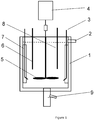
- the CSTR reactor is illustrated in Figure 1 .
- the molar ratio (M' seeds /M" feed ) of the metal content in the seed slurry to the metal content in the feed solution is between 0.001 and 0.05.
- the solid content in the slurry may be between 30 and 300 g/L.
- the as described carbonate precipitation process in this invention can be operated under low ammonium concentration (eg. less than 5.0 g/L), or even without ammonium.
- the reactor may be a continuous stirred tank reactor (CSTR). It is clear that further method embodiments according to the invention may be provided by combining features that are covered in each of the different method embodiments described before.
- the method according to the present invention delivers a carbonate precursor containing Ni, Mn and Co atoms, and having a median particle size of 3 - 20 ⁇ m, a BET specific surface area of 10-200 m 2 /g and a tap density of 1.0-2.0 g/cm 3 .
- the carbonate precursor obtained by the method according to the invention thus has a high specific surface area and a controllable particle size; and so too has the NMC cathode material obtained by firing the carbonate precursor with a lithium precursor.
- a Li-ion battery that uses these NMC cathode materials exhibits excellent battery performances and is especially suitable for high power or high rate applications.
- One reason for this is that during the sintering process of the carbonate precursor with e.g.
- the invention can provide a method for producing a lithium M-oxide cathode material for a rechargeable battery, comprising the steps of:
- WO2004/040677 describes a process for preparing powderous transition metal compounds, comprising at least one precipitation reaction, wherein at least one solution of dissolved transition metal salt and at least one solution of dissolved hydroxide of carbonate salts are added to particles acting as seeds; dissolved transition metal cations and dissolved hydroxide or carbonate anions form a solid precipitate; and the precipitate forms a layer covering the seed particles, the precipitate having a transition metal composition M2, which differs from the composition M1 of the seed particles by at least 10%.
- the total stoichiometric amount of precipitated M(OH) 2 or MCO 3 onto the seeds is between 11 and 25 mol%, meaning that the seeds represent a large part of the final precipitated product, and that the amount of seeds in the slurry needs to be very large to achieve this.
- our objective is using seeds to stabilize the precipitation process. It has been found that the quantity of seeds should be limited (which is expressed by 0.001 ⁇ M' seeds /M" feed ⁇ 0.1) and should represent only a very small molar amount of the precipitated product, as the increase of the amount of seeds leads to the formation of large amounts of fine particles and lowering of the tap density of the precipitated carbonate precursor, whereby the following problems occur in the final lithiated product:
- CSTR continuous stirred tank reactor
- A' is a dopant that may comprise one or more metals, such as Mg, Al, Ti and Zr.
- A' may be equal to A, but may also be different if A is composed of more than one metal.
- A may be either Mg, Ti or a MgTi composition, the latter may have the same composition as A but may also have a different composition.
- the feed solution contains a Ni salt, a Mn salt and a Co salt, and optionally an A salt.
- the kind of Ni salt in the feed solution is not particularly limited, as long as the Ni salt is water-soluble to yield a Ni ion-containing aqueous solution; examples of Ni salts include sulfate salt, chloride salt, nitrate salt and acetate salt of Ni.
- the kind of Mn salt in the feed solution is not particularly limited, as long as the Mn salt is water-soluble to yield a Mn ion-containing aqueous solution; examples of Mn salts include sulfate salt, chloride salt, nitrate salt and acetate salt of Mn.
- the kind of Co salt in the feed solution is not particularly limited, as long as the Co salt is water-soluble to yield a Co ion-containing aqueous solution;
- examples of Co salts include sulfate salt, chloride salt, nitrate salt and acetate salt of Co.
- A is a cation dopant different from Ni, Mn and Co, which may be one or more of Mg, Al, Ti, Zr, Ca, Ce, Cr, Nb, Sn, Zn and B.
- the doping element is dissolved in the feed solution.
- the corresponding dopant salt in the feed solution is not particularly limited; as long as it is water-soluble to yield a dopant ion-containing aqueous solution; examples of dopant salts include sulfate salt, chloride salt, nitrate salt and acetate salt.
- concentration of the dopant salt in the feed solution is determined by its desired content in the final carbonate precursor, and its (optional) presence in the seed slurry.
- the content of Ni ions expressed in Ni atoms is preferably 0.1 to 2.0 mol/L and particularly preferably 0.2 to 1.8 mol/L
- the content of Mn ions expressed in Mn atoms is preferably 0.1 to 2.0 mol/L and particularly preferably 0.2 to 1.8 mol/L
- the content of Co ions expressed in Co atoms is preferably 0.05 to 1.5 mol/L and particularly preferably 0.1 to 1.0 mol/L.
- the total concentration of the anions of Ni, Mn and Co in the feed solution is preferably 1.0 to 3.0 mol/L and particularly preferably 1.5 to 2.5 mol/L.
- the molar ratios in the feed solution between Ni, Mn and Co atom concentrations falling within the above-described ranges further enhance the electrochemical performance of the final lithium metal oxide.
- the aqueous carbonate solution contains any one or both of a metal carbonate and a metal bicarbonate.
- the carbonate solution is not particularly limited as long as the metal carbonate includes sodium carbonate and/or potassium carbonate, which is water-soluble to yield a carbonate ion contained aqueous solution.
- the bicarbonate solution is not particular limited as long as it includes sodium bicarbonate and/or potassium bicarbonate, which is water-soluble to yield a bicarbonate ion contained aqueous solution.
- the carbonate solution contains the cheap sodium carbonate, rendering the pH of the reaction solution nearly neutral.
- the concentration of carbonate or bicarbonate ions is preferably 1.0-4.0 mol/L and particularly preferably 1.5-3.0 mol/L. The concentration of the carbonate or bicarbonate ions falling in that range enables to produce good precursor and a final oxide with excellent electrochemical performances.
- hydroxide solution is an option in the carbonate precipitation process of this invention.
- Na 2 CO 3 replaced by a small percentage of NaOH can further increase the specific surface area of the obtained carbonate precursor, which will benefit the rate performance of the final NMC cathode material.
- It may be a metal hydroxide aqueous solution.
- the hydroxide solution is not particularly limited as long as the metal hydroxide is water-soluble to yield a caustic ion containing aqueous solution; examples of the metal hydroxide include: an alkaline metal hydroxide such as lithium, sodium and potassium hydroxide.
- the concentration of hydroxide ions is preferably 5-15 mol/L and particularly preferable 8-10 mol/L. The concentration of the hydroxide ions in that range enables to produce a good precursor and a final oxide with excellent electrochemical performances.
- the seeds can be commercial products of M'CO 3 , M'(OH) 2 , M'-oxide or M'OOH with small particle size, with a D50 of 0.1-2 ⁇ m .
- the seeds can also be produced by milling of M'CO 3 , M'(OH) 2 , M'-oxide and M'OOH big particles and decrease its particle size to 0.1-2 ⁇ m for D50.
- the milling technology includes jet mill, ball mill, beads mill or ring mill etc.; with or without a dispersion agent.
- the obtained small particles are re-dispersed in water to form a homogeneous seed slurry.
- the carbonate precursor of the present invention is produced in a continuously stirred tank reactor (CSTR, such as described in httr)://encyclopedia.che.engin.umich.edu/Pages/Reactors/CSTR/CSTR.html )under a certain temperature, pH value and stirring speed.
- CSTR continuously stirred tank reactor
- a typical structure and design of a 10 L CSTR reactor is shown in Fig. 1 , with a diameter of 200 mm and height of 420 mm.
- Four baffles are installed in the reactor and a pitched-blade impeller is equipped on 1/3 of the height from the bottom.
- the dosing tubes are fixed on the baffles at the same height of the impeller.
- the stirring speed of the impeller is controlled by a motor above the CSTR reactor.
- the different solutions and the seed slurry may be simultaneously or alternately pumped into the reactor; while its content is being maintained at 30 to 95°C, and preferably at 50 to 90°C.
- the solutions and seed slurry are pumped into a CSTR reactor with a certain flow rate, e.g. R feed , R carbonate , R hydroxide and R seeds , corresponding to the flow rate of feed solution, carbonate solution, hydroxide solution and seed slurry, respectively.
- the residence time Re can thus be tuned by adapting the flow rate of feed, carbonate and hydroxide solutions, and the flow rate of the seed slurry.
- the residence time Re of the present invention is set in the range of 1.5-6.0 hours, and preferably in the range of 2.0 to 4.0 hours.
- the reaction temperature T is set in the range of 30 to 95°C, and preferably at 50 to 90°C.
- the stirring speed in the CSTR reactor is set in the range of 500-2000 rpm, and preferably in the range of 800-1500 rpm.
- the amount of the feed and carbonate solution added into the reactor is such that the molar ratio (CO 3 /M) of the total number of the carbonate ions to the total number of moles (M) of Ni, Mn, Co and A ions added from the feed solution is preferably 0.9 to 1.2, and particularly preferably 0.95 to 1.15.
- the ratio (HCO 3 /M) of the total number of the moles (HCO 3 ) present in bicarbonate ions in the reaction to the total number of moles (M) of Ni, Mn and Co ions added from the feed solution is preferably 1.9 to 2.4, and particularly preferably 1.9 to 2.3.
- the amount of the seeds added into the reactor is such that the molar ratio (M' seeds /M" feed ) of the total number of moles (M' seeds ) of Ni, Mn, Co and A ions added in the seed slurry to the total number of moles (M" feed ) of Ni, Mn, Co and A ions added from the feed solution is 0.001 to 0.1, and particularly preferably 0.001 to 0.05.
- the amount of the carbonate/bicarbonate solution and hydroxide solution are such that the ratio OH/CO 3 of the total number of moles OH added in the hydroxide solution to the total number of the moles CO 3 present in the carbonate ion or bicarbonate ions in the reaction is preferably less than 0.1, and particularly preferably less than 0.05.
- OH/HCO 3 is preferably less than 0.1, and particularly preferably less than 0.05.
- the carbonate precipitation process is mainly controlled by the following parameters:
- the carbonate precursors according to the invention can be produced by tuning these parameters in the ranges as described above.
- the carbonate precursor slurry is collected from the overflow of a CSTR reactor and the precursor particles are obtained by a solid-liquid separation process, for example, press filtration or continuous centrifugal filtration.
- the solid-liquid separation process is considered to be finished when the conductivity of the filter/centrifuge waste water is lower than 20 ⁇ S/m.
- the thus obtained particles are dried at 150 °C, pulverized and classified to yield the carbonate precursor of the present invention.
- the typical scan electron microscopy (SEM) images and XRD pattern of the as-prepared carbonated precursor are shown in Fig. 2 and Fig. 3 , respectively.
- Fig. 2 shows the typical spherical morphology obtained by the method of the invention.
- the (doped) lithium nickel manganese cobalt oxide (NMC(A)) represented by the above-described general formula is produced by mixing the (bi-)carbonate precursor of the present invention with a lithium compound and by sintering the thus obtained mixture.
- the amount of the lithium compounds added is such that the ratio (Li/M) of the number of moles of the lithium atoms in the lithium compound to the total number of moles (M) of the Ni, Mn, Co and A atoms included in the carbonate precursor is preferably 0.95-1.60, and more preferably 1.00-1.50.
- the sintering atmosphere is not particularly limited; the sintering may be conducted under air or in an oxygen atmosphere, for example as a multiple stage sintering.
- the sintering conditions are such that the baking temperature is 600-1100°C, preferably 850 to 1000°C, and the sintering time is 5 hours or more, preferably 10 to 24 hours.
- a (doped) lithium nickel manganese cobalt oxide (NMC(A)) having a BET specific surface area up to 1 m 2 /g or more and a tap density up to 1.2 g/cm 3 or more.
- NMC(A) material is suitable for using as a cathode material in a high rate Li-ion battery for xEV applications.
- the feed and carbonate solution are pumped into a 10L CSTR reactor.
- the molar ratio of CO 3 : Metal 1.0 and the residence time is set at 3 hours.
- the feed solution and carbonate solution are continuously pumped into the CSTR reactor set at a precipitation temperature of 90°C, with an impeller stirring speed at 1000 rpm.
- the obtained carbonate precursor has a value for TD and D50 of 1.7 g/cm 3 and 23.5 ⁇ m, respectively.
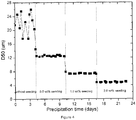
- This precursor has a BET value of 132 m 2 /g. But the carbonate precipitation process without seeding is unstable and the average particle size (D50) varies continuously during precipitation, which is shown in Fig. 4 - left part.
- the same precipitation conditions as in Comparative Example 1 are used, but with seeding.
- the seeds are re-dispersed into water to form a homogeneous slurry under stirring with a 200g/L solid load level.
- the feed, carbonate solution and the seed slurry are pumped into the 10L CSTR reactor.
- the molar ratio of CO 3 : Metal 1.0 and the molar ratio of M' seeds /M" feed is set at 0.005 (0.5 wt%), 0.01 (1.0wt%) and 0.02 (2.0 wt%) consecutively, and the residence time is set at 3 hours.
- the feed solution, carbonate solution and seed slurry are continuously pumped into the CSTR reactor set at a precipitation temperature of 90°C, with an impeller stirring speed at 1000 rpm.
- the carbonate precursor slurry is collected through the overflow of the reactor.
- the obtained precursor slurry is solid-liquid separated by a press filter, and washed with deionized water for several times until the conductivity of the filter water is lower than 20 ⁇ S/m.
- the thus obtained carbonate precursor wet cake is dried in an oven at 150°C for 24 hours.
- the final obtained carbonate precursor has a composition of (Ni 0.415 Mn 0.415 Co 0.16 Mg 0.005 )CO 3 .
- the TD, D50 and BET of these products are compared in Table 1 as shown below. Table 1: Comparison of TD, D50 and BET for precursors obtained in Comparative Example 1 and Example 1.
- Fig. 4 represents in the left part the situation of Comp. Ex.1, and with seeding starting after 4 days, the precipitation process is effectively stabilized and the particle size can be finely tuned by changing the weight ratio of the seed slurry, resulting in the situation shown to the right, corresponding to the data of Example 1.
- the nucleation speed is very fast for a typical carbonate precipitation process in a CSTR reactor. This is the reason why the carbon precipitation process is unstable, if seeding is not applied. After small seeds are added into the reactor, in principle, there is no nucleation process taking place in the reactor and the new metal carbonates will only grow on the surface of the seeds as a consequence.
- a chelating agent eg. NH 4 OH
- the particle size in the reactor after seeding is determined by the molar ratio between M' seeds /M" feed , and the quantity and size of the seeds that are added in the reactor. This is the mechanism permitting the seeding process to stabilize the carbonate precipitation process, and also enabling that the particle size after seeding can be tuned, i.e. by changing the quantity of seeds. For example, the particle size can be decreased by increasing the molar ratio M' seeds /M" feed . Because more seeds are added in the reactor, this results in less carbonate grow on each seed, and the particle size will decrease as a consequence.
- Table 2 Comparison of D50 and span for precursors obtained in Comparative Example 1 and Example 1, before and after drying of the slurry.
- NaOH is dissolved in deionized water and a 10 mol/L NaOH solution is obtained.
- the residence time is set at 3 hours.
- the feed and carbonate solution are continuously pumped into the CSTR reactor set at a precipitation temperature of 80°C, with an impeller stirring speed at 1000 rpm.
- the thus obtained carbonate precursor has a TD and D50 of 1.8 g/cm 3 and 13.4 ⁇ m, respectively.
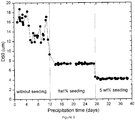
- This precursor has a BET value of 11.2 m 2 /g. But the carbonate precipitation process without seeding is unstable and the median particle size (D50) varies continously during precipitation, which is shown in Fig. 5 - left part.
- the residence time is set at 3 hours.
- the solutions are continuously pumped into the CSTR reactor at a precipitation temperature of 80°C, with an impeller stirring speed at 1000 rpm.
- the carbonate precursor slurry is collected through the overflow of the CSTR reactor. Then, the obtained precursor slurry is solid-liquid separated by a press filter and washed with deionized water for several times until the conductivity of the filter water is lower than 20 ⁇ S/m. The thus obtained carbonate precursor wet cake is dried in an oven at 150 °C for 24 hours.
- the TD, D50 and BET of the obtained carbonate precursor are compared in Table 2 as shown below. Table 3: Comparison of TD, D50 and BET for precursors obtained in Comparative Example 2 and Example 2.
- Fig. 5 represents in the left part the situation of Comp. Ex.2, and with seeding starting after 12 days, the precipitation process is effectively stabilized and the particle size can be finely tuned by changing the weight ratio of the seed slurry, resulting in the situation shown to the right, corresponding to the data of Example 2.
- Example 2' the span before and after drying is given as a function of seeding level, for a precursor product made in nearly the same conditions as the product in Example 2, referred to as Example 2'.
- the results show the same trend as for Example 1.
- Table 4 Comparison of D50 and span for a precursor product having the same composition as Example 2, before and after drying of the slurry.
- Na 2 CO 3 is dissolved in deionized water and a 1.65 mol/L Na 2 CO 3 solution is obtained.
- the MnCO 3 seeds are produced by ball milling commercially available MnCO 3 product to 0.5 ⁇ m and then dispersing it into water.
- the solid loading of the seeds slurry is 100 g/L.
- the particle size of the carbonate precursor in the reactor is continuously fluctuating and the D50 is 24.8 ⁇ m.
- the median particle size in the reactor is stabilized at 7.1 ⁇ m.
- the carbonate precursor slurry is collected through the overflow of the CSTR reactor.
- the obtained precursor slurry is solid-liquid separated by a press filter and washed with deionized water several times until the conductivity of the filter water is lower than 20 ⁇ S/m.
- the thus obtained carbonate precursor wet cake is dried in an oven at 150°C for 24 hours.
- the BET and TD of the obtained carbonate precursor are 240 m 2 /g and 1.1 g/cm 3 , respectively.
- Na 2 CO 3 is dissolved in deionized water and a 1.65 mol/L Na 2 CO 3 solution is obtained.
- the particle size of the carbonate precursor in the reactor is continuously fluctuating and the D50 is 20.1 ⁇ m.
- the median particle size in the reactor is stabilized at 6.8 ⁇ m.
- the carbonate precursor slurry is collected through the overflow of the CSTR reactor. Then, the obtained precursor slurry is solid-liquid separated by a press filter and washed with deionized water several times until the conductivity of the filter water is lower than 20 ⁇ S/m. The thus obtained carbonate precursor wet cake is dried in an oven at 150°C for 24 hours.
- the BET and TD of the obtained carbonate precursor are 93 m 2 /g and 1.3 g/cm 3 , respectively.
- the final obtained carbonate precursor has a composition of (Ni 0.33 Mn 0.33 Co 0.33 Ti 0.01 )CO 3 .
- NaHCO 3 is dissolved in deionized water and a 1.0 mol/L NaHCO 3 solution is obtained.
- Small seed particles (1.0 ⁇ m) are prepared by ball milling the big carbonate precursor particles collected under the same precipitation conditions without seeding from a CSTR reactor.
- the residence time is set at 3 hours.
- the solutions are continuously pumped into the CSTR reactor at a precipitation temperature of 90°C, with an impeller stirring speed at 1000 rpm.
- the particle size of the carbonate precursor in the reactor is continuously fluctuating and the D50 is 10.6 ⁇ m.
- the median particle size in the reactor is stabilized at 6.5 ⁇ m.
- the carbonate precursor slurry is collected through the overflow of the CSTR reactor. Then, the obtained precursor slurry is solid-liquid separated by a press filter and washed with deionized water several times until the conductivity of the filter water is lower than 20 ⁇ S/m.
- the thus obtained carbonate precursor wet cake is dried in an oven at 150°C for 24 hours.
- the BET and TD of the obtained carbonate precursor are 223 m 2 /g and 1.1 g/cm 3 , respectively.
Landscapes
- Chemical & Material Sciences (AREA)
- Chemical Kinetics & Catalysis (AREA)
- Electrochemistry (AREA)
- General Chemical & Material Sciences (AREA)
- Inorganic Chemistry (AREA)
- Organic Chemistry (AREA)
- Engineering & Computer Science (AREA)
- Manufacturing & Machinery (AREA)
- Materials Engineering (AREA)
- Battery Electrode And Active Subsutance (AREA)
- Inorganic Compounds Of Heavy Metals (AREA)
Description
- The invention relates to a carbonate precursor material for a lithium nickel manganese cobalt oxide, to be used as a cathode material for Li-ion batteries, and a method for producing the carbonate precursor.
- In present and future applications, Li batteries with high energy density are needed. A high energy density can be achieved by cathodes having either one or (preferably) both of a high volumetric density and a high specific reversible discharge capacity. For a long time, LiCoO2 (or "LCO") was the dominating cathode material for rechargeable lithium batteries. LCO has a relatively high capacity (150 - 160 mAh/g when cycled at 3 - 4.3V) together with a high density (the true density is about 5.05 g/cm3) and is relatively easy to produce. It has a relatively high Li diffusion, so it is possibly to utilize large and dense particles (10 - 20 µm size) with a small surface area (0.1 - 0.5 m2/g). All in all, commercial LCO is a robust and easy to manufacture cathode powder.
- LCO however also has serious drawbacks. A main drawback is the relative scarcity of Co resources related to the relatively high cost of cobalt metal. Still worse, historically the cobalt prize shows wild fluctuations, and these fluctuations possibly increased the need to find substitutes for LiCoO2. The main substitute for LCO, which has emerged commercially within the past years, is lithium nickel manganese cobalt oxide (also referred to as "NMC"). This material belongs to the ternary phase diagram of LiMnO2 - LiNiO2 - LiCoO2, with a general formula Li(1+m)(NixMnyCoz)1-mO2+δ, with x+y+z = 1, 0≤δ≤0.3, 0≤m≤0.5. The NMC has the advantages of lower cost, higher working voltage and Li-storage capacity than LCO, and has received increasing demands in the past few years. Additionally this composition can be modified by doping. It is known for example that elements like Al, Mg, Ti and sometimes Zr can partly replace Co, Ni or Mn. Within the complex ternary phase diagram there is a wide degree of freedom to prepare electrochemically active phases with different composition and quite different performance.
- Generally, for the production of cathode materials with complex compositions, such as NMC cathode materials, special precursors such as mixed transition metal hydroxides are used. The reason is that high performance Li-M-O2 needs well mixed transition metal cations. To achieve this without "oversintering" (which is high temperature sintering for a longer period with a typical Li-precursor such as Li2CO3) the cathode precursors need to contain the transition metal in a well-mixed form (at atomic level) as provided in mixed transition metal hydroxides. Mixed hydroxides are typically prepared by precipitation reactions, for example by the precipitation from a flow of M-SO4 mixed with NaOH under controlled pH, allowing precursors of suitable morphology to be achieved. The NMC hydroxide raw material has the advantages of a low specific surface area and a relative high tap density (TD), and consequently, NMC obtained thereof also has a low specific surface area and relatively high TD. The high energy density of the Li-ion battery can be achieved by using such high TD cathode materials.
- Recently, there is a demand for batteries that are excellent in rate performance and cycle life stability, to be used in electric vehicles (xEV) and power tools. By increasing the specific area of the positive electrode material demands for rapid charge and discharge of the battery (what is known as a good rate performance) can be coped with. Comparing nickel manganese cobalt hydroxide precursors with equivalent carbonate precursors, the latter have the advantage of a higher specific surface area and a spherical morphology providing a high tap density. However, the conventional carbonate precursor producing method is a precipitation method that has the disadvantage of being highly unstable. As a consequence, the particle size of the obtained carbonate precursor is fluctuating continuously during precipitation. It is also very difficult to tune the particle size of the carbonate precursor by changing the precipitation parameters during the precipitation process, which makes it not flexible for mass production purposes. The need for precipitation stability and particle size tunability is the main challenge for the carbonate precursor production process, and so far the practical application of carbonate precursors in NMC mass production is handicapped.
- Methods using as starting raw material nickel manganese cobalt carbonate precursors have already been proposed, for example in
US2011/0114900 . In this patent, a method to produce a nickel manganese cobalt carbonate precursor with a high specific surface area and high tap density has been demonstrated by conducting a precipitation in a batch reactor, by adding a solution A that contains a nickel salt, a manganese salt, a cobalt salt; and a solution B that contains a metal carbonate or a metal bicarbonate; to a solution C that contains the same anion as the anions of the nickel salt, the manganese salt and the cobalt salt in solution A and the same anion as the anions of the metal carbonate or the metal bicarbonate in solution B. - In "Growth mechanism of Ni0.3Mn0.7CO3 precursor for high capacity Li-ion battery cathodes", by Dapeng Wang et al., in J. Mater. Chem., 2011, 21, 9290-9295, nickel manganese cobalt carbonate precursors have been produced by pumping nickel-, manganese- and cobalt sulfates, sodium carbonate and an ammonium solution into a continuous stirred tank reactor (CSTR). However, the particle size cannot be controlled in the carbonate precipitation process described in this article. In addition, the ammonium solution is also used as a chelating agent during precipitation, with the disadvantage of creating environmental issues and increasing cost.
- US patent
US7767189 discloses a method for preparing lithium transitional metal oxides using carbonate precursors, and comprising the steps of: preparing a carbonate precursor using the following sub steps: forming a first aqueous solution containing a mixture of at least two of the ions of the following metal elements ("Men+"): cobalt (Co), nickel (Ni), and manganese (Mn); forming a second aqueous solution containing ions of CO3 2- ; and mixing and reacting the first solution with the second solution to produce the carbonate precursor, Ni1-x-yCoxMnyCO3; and preparing the lithium transition metals oxide from the carbonate precursors using the following sub steps: evenly mixing Li2CO3 and the carbonate precursor; calcinating the mixed material in high temperature; and cooling and pulverizing the calcinated material to obtain the lithium transition metal oxide, LiNi1x-yCoxMnyO2. - Typical carbonate precipitation processes involve the use of ammonia. The ammonia is a so-called chelating agent, which is practically important to stabilize the precipitation process. However, ammonia present in a precipitation process always creates a certain safety risk. In addition, after precipitation the ammonia remains in the filtered solution. The ammonia cannot be released to the environment. Therefore the waste water is treated to remove - preferably to recycle - the ammonia. These ammonia installations are expensive and increase significantly the capital investment, as well as the operating cost (energy) for the waste treatment. It would therefore be desired to devise an ammonia free precipitation method which supplies mixed precursors having a sufficient density and spherical morphology.
- An object of the present invention is to provide a method to solve the precipitation stability and particle size tunability issues of the carbonate precipitation process without sacrifying the spherical morphology of the precipitate, in a continuous process, and to provide a carbonate precursor having a high specific surface area and a relatively high tap density - even when working without the use of a chelating agent - making them suitable in the production of cathode materials for the batteries of electric vehicles (xEV) and power tools.
- Viewed from a first aspect, the invention can provide a method for producing a M-carbonate precursor of a Li-M oxide cathode material in a continuous reactor, wherein M=NixMnyCozAn, A being a dopant, with x>0, y>0, 0≤z≤0.35, 0≤n≤0.02 and x+y+z+n=1, the method comprising the steps of:
- providing a feed solution comprising Ni-, Mn-, Co- and A-ions, and having a molar metal content M"feed,
- providing an ionic solution comprising either one or both of a carbonate and a bicarbonate solution, the ionic solution further comprising either one or both of Na- and K-ions,
- providing a slurry comprising seeds comprising M'-ions and having a molar metal content M'seeds, wherein M'=Nix'Mny'Coz'A'n', A' being a dopant, with 0≤x'≤1, 0≤y'≤1, 0≤z'≤1, 0≤n'≤1 and x'+y'+z'+n'=1, and wherein the molar ratio M'seeds/M"feed is between 0.001 and 0.1,
- mixing the feed solution, the ionic solution and the slurry in the reactor, thereby obtaining a reactive liquid mixture,
- precipitating a carbonate onto the seeds in the reactive liquid mixture, thereby obtaining a reacted liquid mixture and the M-carbonate precursor, and
- separating the M-carbonate precursor from the reacted liquid mixture.
- In one embodiment, the seeds have a median particle size D50 between 0.1 and 3 µm. In another embodiment the M'-ions are present in a water insoluble compound that is either one of M'CO3, M'(OH)2, M'-oxide and M'OOH. Examples of these are MnCO3 and TiO2. In still another embodiment, the Ni-, Mn-, Co- and A-ions are present in a water soluble sulfate compound. A and A' may be either one or more of Mg, Al, Ti, Zr, Ca, Ce, Cr, Nb, Sn, Zn and B. In an embodiment M=M'. The composition M may for example be Ni:Mn:Co=42:42:16; or Ni:Mn:Co= 33:33:33; or Ni:Mn:Co= 60:20:20; or Ni:Mn:Co= 22:67:11. Hence in one embodiment M= NixMnyCozAn, with 20≤x≤80, 20≤y≤70, 10≤z≤0.35, 0≤n≤0.02 and x+y+z+n=1. In that embodiment A may be Ti.
- In view of the above-described circumstances, the present inventors diligently conducted a great deal of study, and consequently, perfected the present invention by conducting a precipitation reaction by pumping a feed solution that contains a nickel salt, a manganese salt and a cobalt salt and a hydroxide solution that contains a metal carbonate or metal bicarbonate and a slurry of seeds into a CSTR reactor. The CSTR reactor is illustrated in
Figure 1 . In the process according to the invention, there is no nucleation process taking place in the reactor and the M-carbonate precursor only grow on the surface of the seeds. - In a further method embodiment the molar ratio (M'seeds/M"feed) of the metal content in the seed slurry to the metal content in the feed solution is between 0.001 and 0.05. In the invention, it is possible to set the median particle size of the M-carbonate precursor by applying a certain ratio M'seeds/M"feed. In the embodiments, the solid content in the slurry may be between 30 and 300 g/L. In addition, the as described carbonate precipitation process in this invention can be operated under low ammonium concentration (eg. less than 5.0 g/L), or even without ammonium. The reactor may be a continuous stirred tank reactor (CSTR). It is clear that further method embodiments according to the invention may be provided by combining features that are covered in each of the different method embodiments described before.
- The method according to the present invention delivers a carbonate precursor containing Ni, Mn and Co atoms, and having a median particle size of 3 - 20 µm, a BET specific surface area of 10-200 m2/g and a tap density of 1.0-2.0 g/cm3. The carbonate precursor obtained by the method according to the invention thus has a high specific surface area and a controllable particle size; and so too has the NMC cathode material obtained by firing the carbonate precursor with a lithium precursor. A Li-ion battery that uses these NMC cathode materials exhibits excellent battery performances and is especially suitable for high power or high rate applications. One reason for this is that during the sintering process of the carbonate precursor with e.g. lithium carbonate, CO2 is released from the carbonate precursor particles. The release of CO2 from the core of the particles creates "chimneys" which ultimately result in an open porosity of the final cathode material. By applying a suitable firing profile the open porosity remains in the final cathode product.
- Viewed from a second aspect, the invention can provide a method for producing a lithium M-oxide cathode material for a rechargeable battery, comprising the steps of:
- providing a M-carbonate precursor according to the first aspect of the invention,
- providing a Li precursor compound,
- mixing the M-carbonate and the Li precursor, and
- firing the mixture at a temperature between 600 and 1100°C for at least 1 hr. The lithium precursor may for example be LiOH or Li2CO3.
- It should be mentioned here that in
WO2004/040677 describes a process for preparing powderous transition metal compounds, comprising at least one precipitation reaction, wherein at least one solution of dissolved transition metal salt and at least one solution of dissolved hydroxide of carbonate salts are added to particles acting as seeds; dissolved transition metal cations and dissolved hydroxide or carbonate anions form a solid precipitate; and the precipitate forms a layer covering the seed particles, the precipitate having a transition metal composition M2, which differs from the composition M1 of the seed particles by at least 10%. As it is the object to provide powderous materials which have a significantly different transition metal composition in the outer bulk and the inner bulk, in the examples, the total stoichiometric amount of precipitated M(OH)2 or MCO3 onto the seeds is between 11 and 25 mol%, meaning that the seeds represent a large part of the final precipitated product, and that the amount of seeds in the slurry needs to be very large to achieve this. This results in a M'seeds/M"feed ratio between 4 and 9.09, orders of magnitude than in the present invention. - In the present invention, our objective is using seeds to stabilize the precipitation process. It has been found that the quantity of seeds should be limited (which is expressed by 0.001 ≤ M'seeds/M"feed ≤0.1) and should represent only a very small molar amount of the precipitated product, as the increase of the amount of seeds leads to the formation of large amounts of fine particles and lowering of the tap density of the precipitated carbonate precursor, whereby the following problems occur in the final lithiated product:
- an inacceptable large span, as the span of the precipitated carbonate corresponds largely to the span of the sintered lithiated product made with that carbonate (the span being the value of (D90-D10)/D50 of the volumetric particle size distribution, where the D50 (µm) refers to the median particle size; D90 (µm) refers to the particle size where 90% of the distribution lies below; and D10 (µm) refers to the particle size where 10% of the distribution lies below),
- problems of brittleness,
- the excess quantity of fines causing safety problems in the Li-ion battery, and
- the lower tap density of the precursor yielding a lower tap density of the final product with a decrease of energy density in the battery as a consequence.
-
-
Figure 1 : design of a typical 10L CSTR reactor. -
Figure 2 : SEM images (500x magnification) of the carbonate precursor in Example 1 -
Figure 3 : XRD pattern of the carbonate precursor in Example 1 -
Figure 4 : The average particle size (D50) variation before (Comparative Example 1) and after 0.5 wt%, 1.0 wt% and 2 wt% of seeding (Example 1). -
Figure 5 : The average particle size (D50) variation before (Comparative Example 2) and after 1.0 wt% and 5.0 wt% of seeding (Example 2). - A method for producing a carbonate precursor according to the present invention is described. The composite carbonate may be obtained by conducting a coprecipitation reaction in a continuous stirred tank reactor (CSTR), by pumping into the reactor a feed solution that contains a Ni salt, a Mn salt and a Co salt and optionally an A salt, a carbonate solution that contains a metal carbonate or a metal bicarbonate further comprising either one or both of Na- and K-ions, a seed slurry that contains either one of M'CO3, M'(OH)2, M'-oxide or M'OOH small particles (M' = Nix'Mny'Coz'A'n', x'+y'+z'+n'=1, 0≤x'≤1, 0≤y'≤1, 0≤z'≤1 and 0≤n'≤1), and optionally a hydroxide solution that contains a metal hydroxide. The composition of M' is not necessary the same as that of M in this invention. A' is a dopant that may comprise one or more metals, such as Mg, Al, Ti and Zr. A' may be equal to A, but may also be different if A is composed of more than one metal. For example if A is a TiMg composition, then A' may be either Mg, Ti or a MgTi composition, the latter may have the same composition as A but may also have a different composition.
- The feed solution contains a Ni salt, a Mn salt and a Co salt, and optionally an A salt. The kind of Ni salt in the feed solution is not particularly limited, as long as the Ni salt is water-soluble to yield a Ni ion-containing aqueous solution; examples of Ni salts include sulfate salt, chloride salt, nitrate salt and acetate salt of Ni. Also, the kind of Mn salt in the feed solution is not particularly limited, as long as the Mn salt is water-soluble to yield a Mn ion-containing aqueous solution; examples of Mn salts include sulfate salt, chloride salt, nitrate salt and acetate salt of Mn. Similarly, the kind of Co salt in the feed solution is not particularly limited, as long as the Co salt is water-soluble to yield a Co ion-containing aqueous solution; examples of Co salts include sulfate salt, chloride salt, nitrate salt and acetate salt of Co.
- In the carbonate precursor of the present invention, A is a cation dopant different from Ni, Mn and Co, which may be one or more of Mg, Al, Ti, Zr, Ca, Ce, Cr, Nb, Sn, Zn and B. For cation doping (A element), the doping element is dissolved in the feed solution. The corresponding dopant salt in the feed solution is not particularly limited; as long as it is water-soluble to yield a dopant ion-containing aqueous solution; examples of dopant salts include sulfate salt, chloride salt, nitrate salt and acetate salt. The concentration of the dopant salt in the feed solution is determined by its desired content in the final carbonate precursor, and its (optional) presence in the seed slurry.
- In the aqueous feed solution, the content of Ni ions expressed in Ni atoms is preferably 0.1 to 2.0 mol/L and particularly preferably 0.2 to 1.8 mol/L, the content of Mn ions expressed in Mn atoms is preferably 0.1 to 2.0 mol/L and particularly preferably 0.2 to 1.8 mol/L, the content of Co ions expressed in Co atoms is preferably 0.05 to 1.5 mol/L and particularly preferably 0.1 to 1.0 mol/L. The concentration of the Ni ions, Mn ions and Co ion in the feed solution respectively falling within the above described ranges enables to get a balance between the product yield and the physiochemical properties of the obtained carbonate precursor. The total concentration of the anions of Ni, Mn and Co in the feed solution is preferably 1.0 to 3.0 mol/L and particularly preferably 1.5 to 2.5 mol/L. The molar ratios in the feed solution between Ni, Mn and Co atom concentrations falling within the above-described ranges further enhance the electrochemical performance of the final lithium metal oxide.
- The aqueous carbonate solution contains any one or both of a metal carbonate and a metal bicarbonate. The carbonate solution is not particularly limited as long as the metal carbonate includes sodium carbonate and/or potassium carbonate, which is water-soluble to yield a carbonate ion contained aqueous solution. The bicarbonate solution is not particular limited as long as it includes sodium bicarbonate and/or potassium bicarbonate, which is water-soluble to yield a bicarbonate ion contained aqueous solution. Preferably the carbonate solution contains the cheap sodium carbonate, rendering the pH of the reaction solution nearly neutral. In the carbonate solution, the concentration of carbonate or bicarbonate ions is preferably 1.0-4.0 mol/L and particularly preferably 1.5-3.0 mol/L. The concentration of the carbonate or bicarbonate ions falling in that range enables to produce good precursor and a final oxide with excellent electrochemical performances.
- The use of a hydroxide solution is an option in the carbonate precipitation process of this invention. Generally speaking, Na2CO3 replaced by a small percentage of NaOH (eg. 0-5wt%) can further increase the specific surface area of the obtained carbonate precursor, which will benefit the rate performance of the final NMC cathode material. It may be a metal hydroxide aqueous solution. The hydroxide solution is not particularly limited as long as the metal hydroxide is water-soluble to yield a caustic ion containing aqueous solution; examples of the metal hydroxide include: an alkaline metal hydroxide such as lithium, sodium and potassium hydroxide. Preferred among these are lithium hydroxide and sodium hydroxide, rendering the pH of the reaction solution nearly neutral, whilst both are also relatively cheap. In the hydroxide solution, the concentration of hydroxide ions is preferably 5-15 mol/L and particularly preferable 8-10 mol/L. The concentration of the hydroxide ions in that range enables to produce a good precursor and a final oxide with excellent electrochemical performances.
- The seeds of the present invention may be small particles of M'CO3, M'(OH)2, M'-oxide or M'OOH (M' = Nix'Mny'Coz'A'n', x'+y'+z'+n'=1, 0≤x'≤1, 0≤y'≤1, 0≤z'≤1 and 0≤n'≤1, M' can thus be a single metal, bimetal, ternary metal, or even quaternary metal composition). The seeds can be commercial products of M'CO3, M'(OH)2, M'-oxide or M'OOH with small particle size, with a D50 of 0.1-2 µm . The seeds can also be produced by milling of M'CO3, M'(OH)2, M'-oxide and M'OOH big particles and decrease its particle size to 0.1-2 µm for D50. The milling technology includes jet mill, ball mill, beads mill or ring mill etc.; with or without a dispersion agent. Then, the obtained small particles are re-dispersed in water to form a homogeneous seed slurry. The solid loading of the seed slurry is preferably in the range of 30-300 g/L, and particularly preferably in the range of 50-200 g/L. It should be emphasized here that the composition of M' is not necessarily the same as that of M in this invention. In the embodiment where M=M', a quantity of final product MCO3 is transformed into seed material. It is evident that the seeds used in this invention are water insoluble.
- In one embodiment, the carbonate precursor of the present invention is produced in a continuously stirred tank reactor (CSTR, such as described in httr)://encyclopedia.che.engin.umich.edu/Pages/Reactors/CSTR/CSTR.html)under a certain temperature, pH value and stirring speed. A typical structure and design of a 10 L CSTR reactor is shown in
Fig. 1 , with a diameter of 200 mm and height of 420 mm. Four baffles are installed in the reactor and a pitched-blade impeller is equipped on 1/3 of the height from the bottom. The dosing tubes are fixed on the baffles at the same height of the impeller. The stirring speed of the impeller is controlled by a motor above the CSTR reactor. - Legend for
Figure 1 :1 Water jacket 2 Overflow 3 Dosing tube 4 Motor 5 Impeller 6 pH senor 7 Baffle 8 Temperature sensor 9 Outlet valve - In the method for producing a carbonate precursor of the present invention, the different solutions and the seed slurry may be simultaneously or alternately pumped into the reactor; while its content is being maintained at 30 to 95°C, and preferably at 50 to 90°C. The solutions and seed slurry are pumped into a CSTR reactor with a certain flow rate, e.g. Rfeed, Rcarbonate, Rhydroxide and Rseeds, corresponding to the flow rate of feed solution, carbonate solution, hydroxide solution and seed slurry, respectively. The residence time Re is calculated by dividing the volume of the CSTR reactor (V) by the flow rate sum of the feed, carbonate, hydroxide solution and seed slurry;
Re = V/(Rfeed + Rcarbonate + Rhydroxide + Rseeds). The residence time Re can thus be tuned by adapting the flow rate of feed, carbonate and hydroxide solutions, and the flow rate of the seed slurry. The residence time Re of the present invention is set in the range of 1.5-6.0 hours, and preferably in the range of 2.0 to 4.0 hours. The reaction temperature T is set in the range of 30 to 95°C, and preferably at 50 to 90°C. The stirring speed in the CSTR reactor is set in the range of 500-2000 rpm, and preferably in the range of 800-1500 rpm. - The amount of the feed and carbonate solution added into the reactor is such that the molar ratio (CO3/M) of the total number of the carbonate ions to the total number of moles (M) of Ni, Mn, Co and A ions added from the feed solution is preferably 0.9 to 1.2, and particularly preferably 0.95 to 1.15. The ratio (HCO3/M) of the total number of the moles (HCO3) present in bicarbonate ions in the reaction to the total number of moles (M) of Ni, Mn and Co ions added from the feed solution is preferably 1.9 to 2.4, and particularly preferably 1.9 to 2.3. The amount of the seeds added into the reactor is such that the molar ratio (M'seeds/M"feed) of the total number of moles (M'seeds) of Ni, Mn, Co and A ions added in the seed slurry to the total number of moles (M"feed) of Ni, Mn, Co and A ions added from the feed solution is 0.001 to 0.1, and particularly preferably 0.001 to 0.05. When a hydroxide solution is added, the amount of the carbonate/bicarbonate solution and hydroxide solution are such that the ratio OH/CO3 of the total number of moles OH added in the hydroxide solution to the total number of the moles CO3 present in the carbonate ion or bicarbonate ions in the reaction is preferably less than 0.1, and particularly preferably less than 0.05. Similarly, OH/HCO3 is preferably less than 0.1, and particularly preferably less than 0.05.
- The carbonate precipitation process is mainly controlled by the following parameters:
- Stirring speed of impeller
- Temperature
- Residence time
- pH
- Metal M concentration
- CO3/M molar ratio
- OH/CO3 or OH/HCO3 molar ratio
- M'seeds/M"feed molar ratio.
- The carbonate precursors according to the invention can be produced by tuning these parameters in the ranges as described above.
- The carbonate precursor slurry is collected from the overflow of a CSTR reactor and the precursor particles are obtained by a solid-liquid separation process, for example, press filtration or continuous centrifugal filtration. The solid-liquid separation process is considered to be finished when the conductivity of the filter/centrifuge waste water is lower than 20 µS/m. The thus obtained particles are dried at 150 °C, pulverized and classified to yield the carbonate precursor of the present invention. The typical scan electron microscopy (SEM) images and XRD pattern of the as-prepared carbonated precursor are shown in
Fig. 2 and Fig. 3 , respectively.Fig. 2 shows the typical spherical morphology obtained by the method of the invention. - The (doped) lithium nickel manganese cobalt oxide (NMC(A)) represented by the above-described general formula is produced by mixing the (bi-)carbonate precursor of the present invention with a lithium compound and by sintering the thus obtained mixture. The amount of the lithium compounds added is such that the ratio (Li/M) of the number of moles of the lithium atoms in the lithium compound to the total number of moles (M) of the Ni, Mn, Co and A atoms included in the carbonate precursor is preferably 0.95-1.60, and more preferably 1.00-1.50. The sintering atmosphere is not particularly limited; the sintering may be conducted under air or in an oxygen atmosphere, for example as a multiple stage sintering. The sintering conditions are such that the baking temperature is 600-1100°C, preferably 850 to 1000°C, and the sintering time is 5 hours or more, preferably 10 to 24 hours. After sintering, by appropriately cooling and by pulverizing and classifying where necessary, there can be obtained a (doped) lithium nickel manganese cobalt oxide (NMC(A)) having a BET specific surface area up to 1 m2/g or more and a tap density up to 1.2 g/cm3 or more. Such a NMC(A) material is suitable for using as a cathode material in a high rate Li-ion battery for xEV applications.
- The invention is further illustrated in the following examples:
- Preparation of feed solution: NiSO4, MnSO4, CoSO4 and MgSO4 are dissolved in deionized water and a transition metal solution is prepared, with a concentration of Ni, Mn, Co and Mg of 0.835 mol/L, 0.835 mol/L, 0.32mol/L and 0.01 mol/L (Ni:Mn:Co:Mg=41.75:41.75:16:0.5), respectively. For preparing the carbonate solution, Na2CO3 is dissolved in deionized water and a 1.65 mol/L Na2CO3 solution is obtained. The feed and carbonate solution are pumped into a 10L CSTR reactor. The molar ratio of CO3: Metal = 1.0 and the residence time is set at 3 hours. The feed solution and carbonate solution are continuously pumped into the CSTR reactor set at a precipitation temperature of 90°C, with an impeller stirring speed at 1000 rpm. The obtained carbonate precursor has a value for TD and D50 of 1.7 g/cm3 and 23.5 µm, respectively. This precursor has a BET value of 132 m2/g. But the carbonate precipitation process without seeding is unstable and the average particle size (D50) varies continuously during precipitation, which is shown in
Fig. 4 - left part. - The same precipitation conditions as in Comparative Example 1 are used, but with seeding. For preparing the seed slurry, the seeds are re-dispersed into water to form a homogeneous slurry under stirring with a 200g/L solid load level. The seeds are prepared by bead milling the big carbonate particles which are produced from the carbonate process without seeding of Comp. Ex. 1 (and hence M = M'), to decrease the median particle size (D50) to 1.0 µm.
- The feed, carbonate solution and the seed slurry are pumped into the 10L CSTR reactor. The molar ratio of CO3: Metal = 1.0 and the molar ratio of M'seeds/M"feed is set at 0.005 (0.5 wt%), 0.01 (1.0wt%) and 0.02 (2.0 wt%) consecutively, and the residence time is set at 3 hours. The feed solution, carbonate solution and seed slurry are continuously pumped into the CSTR reactor set at a precipitation temperature of 90°C, with an impeller stirring speed at 1000 rpm. The carbonate precursor slurry is collected through the overflow of the reactor. Then, the obtained precursor slurry is solid-liquid separated by a press filter, and washed with deionized water for several times until the conductivity of the filter water is lower than 20 µS/m. The thus obtained carbonate precursor wet cake is dried in an oven at 150°C for 24 hours. The final obtained carbonate precursor has a composition of (Ni0.415Mn0.415Co0.16Mg0.005)CO3. The TD, D50 and BET of these products are compared in Table 1 as shown below.
Table 1: Comparison of TD, D50 and BET for precursors obtained in Comparative Example 1 and Example 1. Example Seeding wt% D50 (µm) TD (g/cm3 ) BET (m2/g) Particle size tunability Morphology Comparative Example 1 No 22.8 1.56 132 No Spherical Example 1 0.5 12.5 1.30 141 Yes Spherical Example 1 1.0 7.4 1.21 151 Yes Spherical Example 1 2.0 4.8 1.04 206 Yes Spherical -
Fig. 4 represents in the left part the situation of Comp. Ex.1, and with seeding starting after 4 days, the precipitation process is effectively stabilized and the particle size can be finely tuned by changing the weight ratio of the seed slurry, resulting in the situation shown to the right, corresponding to the data of Example 1. - Generally speaking, because a very low concentration (≤ 5g/L) of a chelating agent (eg. NH4OH), or even no chelating agent is used in this invention, the nucleation speed is very fast for a typical carbonate precipitation process in a CSTR reactor. This is the reason why the carbon precipitation process is unstable, if seeding is not applied. After small seeds are added into the reactor, in principle, there is no nucleation process taking place in the reactor and the new metal carbonates will only grow on the surface of the seeds as a consequence. Because the carbonate precipitation will only be carried out on the surface of seeds, in principle, the particle size in the reactor after seeding is determined by the molar ratio between M'seeds/M"feed, and the quantity and size of the seeds that are added in the reactor. This is the mechanism permitting the seeding process to stabilize the carbonate precipitation process, and also enabling that the particle size after seeding can be tuned, i.e. by changing the quantity of seeds. For example, the particle size can be decreased by increasing the molar ratio M'seeds/M"feed. Because more seeds are added in the reactor, this results in less carbonate grow on each seed, and the particle size will decrease as a consequence. However, when increasing the ratio M'seeds/M"feed, the span of the PSD of the particles in the slurry and especially in the dried precursor product increases, which is illustrated in Table 2. The data show that the D50 and span change after drying. If the D50 and span of the slurry and dry product are compared, both the D50 and span increase with higher seeding level. This is because the fines are agglomerated on the surface of coarse particles after drying, which results in D50 and span values increasing, especially at high seeding level (where there are more fines). Note that as the metal composition of the seeds and the feed is identical, the ratio M'seeds/M"feed corresponds to the weight percentage of the seeds.
Table 2: Comparison of D50 and span for precursors obtained in Comparative Example 1 and Example 1, before and after drying of the slurry. Example Seeding wt% M'seeds/ M "feed D50 in slurry (µm) Span in slurry D50 after drying (µm) Span after drying Comp. Ex. 1 No - 22.8 1.28 22.9 1.28 Ex. 1 0.5 0.005 12.5 1.70 11.7 1.67 Ex. 1 1.0 0.01 7.4 1.54 8.7 1.75 Ex. 1 2.0 0.02 4.8 1.88 5.9 4.24 - Preparation of feed solution: NiSO4, MnSO4 and CoSO4 are dissolved in deionized water and a transition metal solution is prepared, with a concentration of Ni, Mn, Co of 0.44 mol/L, 1.34 mol/L, 0.22mol/L, resp. (Ni:Mn:Co= 22:67:11). For preparing a carbonate solution Na2CO3 is dissolved in deionized water and a 1.65 mol/L Na2CO3 solution is obtained. For preparing a hydroxide solution NaOH is dissolved in deionized water and a 10 mol/L NaOH solution is obtained. The feed, hydorxide and carbonate solution are pumped into a 10L CSTR reactor, with flow rates of Rfeed = 25.7 ml/min, RNaOH = 0.2 ml/min and Rcarbonate = 29.7 ml/min, respectively. The molar ratio of CO3: Metal = 1.0, and the molar ratio of OH :CO3 = 0.04. The residence time is set at 3 hours. The feed and carbonate solution are continuously pumped into the CSTR reactor set at a precipitation temperature of 80°C, with an impeller stirring speed at 1000 rpm. The thus obtained carbonate precursor has a TD and D50 of 1.8 g/cm3 and 13.4 µm, respectively. This precursor has a BET value of 11.2 m2/g. But the carbonate precipitation process without seeding is unstable and the median particle size (D50) varies continously during precipitation, which is shown in
Fig. 5 - left part. - The same precipitation conditions as in Comparative Example 2 are used, but with seeding. Small seed particles (1.0 µm) are produced by ball milling the big carbonate precursor particles collected under the same precipitation conditions without seeding from a CSTR reactor (Comp. Ex. 2, hence M=M'). For preparing the seed slurry, small size MCO3 particles (Ni:Mn:Co= 22:67:11) are re-dispersed into water to form a homogeneous slurry under stirring with a 150g/L solid loading level.
- The feed, hydroxide and carbonate solution, and the seed slurry are pumped into the 10L CSTR reactor, with flow rates of Rfeed = 25.7 ml/min, RNaOH = 0.2 ml/min and Rcarbonate = 29.7 ml/min, respectively. The molar ratio of CO3: Metal = 1.0, the molar ratio of OH: CO3 = 0.04, and the molar ratio of M'seeds/M"feed is set at 0.01 (1 wt%) and 0.05 (5 wt%) consecutively. The residence time is set at 3 hours. The solutions are continuously pumped into the CSTR reactor at a precipitation temperature of 80°C, with an impeller stirring speed at 1000 rpm.
- The carbonate precursor slurry is collected through the overflow of the CSTR reactor. Then, the obtained precursor slurry is solid-liquid separated by a press filter and washed with deionized water for several times until the conductivity of the filter water is lower than 20 µS/m. The thus obtained carbonate precursor wet cake is dried in an oven at 150 °C for 24 hours. The TD, D50 and BET of the obtained carbonate precursor are compared in Table 2 as shown below.
Table 3: Comparison of TD, D50 and BET for precursors obtained in Comparative Example 2 and Example 2. Example Seeding wt% D50 (µm) TD (g/cm3) BET (m2/g) Particle size tunability Morphology Comparative Example 2 No 13.4 1.8 11.2 No Spherical Example 2 1.0 7.4 1.4 37 Yes Spherical Example 2 5.0 4.2 1.2 41 Yes Spherical -
Fig. 5 represents in the left part the situation of Comp. Ex.2, and with seeding starting after 12 days, the precipitation process is effectively stabilized and the particle size can be finely tuned by changing the weight ratio of the seed slurry, resulting in the situation shown to the right, corresponding to the data of Example 2. - In Table 4 below, the span before and after drying is given as a function of seeding level, for a precursor product made in nearly the same conditions as the product in Example 2, referred to as Example 2'. The results show the same trend as for Example 1.
Table 4: Comparison of D50 and span for a precursor product having the same composition as Example 2, before and after drying of the slurry. Example Seeding wt% M'seeds/ M "feed D50 in slurry (µm) Span in slurry D50 after drying (µm) Span after drying Comp. Ex. 2' No - 12.4 1.41 13.2 1.66 Ex. 2' 1.0 0.01 7.2 1.57 7.05 1.87 Ex. 2' 5.0 0.05 4.1 1.88 5.45 4.58 - Preparation of feed solution: NiSO4, MnSO4, CoSO4 are dissolved in deionized water and a transition metal solution is prepared, with a concentration of Ni, Mn, Co of 1.2 mol/L, 0.4 mol/L, 0.4 mol/L, respectively (Ni:Mn:Co= 60:20:20). For preparing the carbonate solution Na2CO3 is dissolved in deionized water and a 1.65 mol/L Na2CO3 solution is obtained.
- The same precipitation conditions as in Example 1 are used, but with M'seeds/M"feed = 0.04 and MnCO3 seeding (here Mn = M' ≠ M). The MnCO3 seeds are produced by ball milling commercially available MnCO3 product to 0.5 µm and then dispersing it into water. The solid loading of the seeds slurry is 100 g/L. Before seeding, the particle size of the carbonate precursor in the reactor is continuously fluctuating and the D50 is 24.8 µm. After seeding, the median particle size in the reactor is stabilized at 7.1 µm. The carbonate precursor slurry is collected through the overflow of the CSTR reactor. Then, the obtained precursor slurry is solid-liquid separated by a press filter and washed with deionized water several times until the conductivity of the filter water is lower than 20 µS/m. The thus obtained carbonate precursor wet cake is dried in an oven at 150°C for 24 hours.
- The BET and TD of the obtained carbonate precursor are 240 m2/g and 1.1 g/cm3, respectively.
- Preparation of feed solution: NiSO4, MnSO4, CoSO4 are dissolved in deionized water and a transition metal solution is prepared, with a concentration of Ni, Mn, Co of 0.67 mol/L, 0.67 mol/L, 0.67 mol/L, respectively (Ni:Mn:Co= 1:1:1). For preparing the carbonate solution Na2CO3 is dissolved in deionized water and a 1.65 mol/L Na2CO3 solution is obtained. The same precipitation conditions as in Example 1 are used, but with molar ratio of M'seeds/M"feed = 0.01 of TiO2 seeding (here M' ≠ M). TiO2 nano-particles (D50 = 250 nm) are dispersed into water to prepare a suspension with a solid loading of 50 g/L. Before seeding, the particle size of the carbonate precursor in the reactor is continuously fluctuating and the D50 is 20.1 µm. After seeding, the median particle size in the reactor is stabilized at 6.8 µm. The carbonate precursor slurry is collected through the overflow of the CSTR reactor. Then, the obtained precursor slurry is solid-liquid separated by a press filter and washed with deionized water several times until the conductivity of the filter water is lower than 20 µS/m. The thus obtained carbonate precursor wet cake is dried in an oven at 150°C for 24 hours. The BET and TD of the obtained carbonate precursor are 93 m2/g and 1.3 g/cm3, respectively. The final obtained carbonate precursor has a composition of (Ni0.33Mn0.33Co0.33Ti0.01)CO3.
- Preparation of feed solution: NiSO4, MnSO4, CoSO4 are dissolved in deionized water and a transition metal solution is prepared, with a concentration of Ni, Mn, Co of 1.2 mol/L, 0.4 mol/L, 0.4 mol/L, respectively (Ni:Mn:Co= 60:20:20). For preparing the soldium bicarbonate solution NaHCO3 is dissolved in deionized water and a 1.0 mol/L NaHCO3 solution is obtained. The same precipitation conditions as in Example 1 are used, but the molar ratio of CO3: Metal = 2.05. Small seed particles (1.0 µm) are prepared by ball milling the big carbonate precursor particles collected under the same precipitation conditions without seeding from a CSTR reactor. For preparing the seed slurry, small size MCO3 particles (Ni:Mn:Co= 60:20:20) are re-dispersed into water to form a homogeneous slurry under stirring with a 100g/L solid loading level. The molar ratio of M'seeds/M"feed is set at 0.004 (0.4 wt%) consecutively (here M' = M). The residence time is set at 3 hours. The solutions are continuously pumped into the CSTR reactor at a precipitation temperature of 90°C, with an impeller stirring speed at 1000 rpm. Before seeding, the particle size of the carbonate precursor in the reactor is continuously fluctuating and the D50 is 10.6 µm. After seeding, the median particle size in the reactor is stabilized at 6.5 µm. The carbonate precursor slurry is collected through the overflow of the CSTR reactor. Then, the obtained precursor slurry is solid-liquid separated by a press filter and washed with deionized water several times until the conductivity of the filter water is lower than 20 µS/m. The thus obtained carbonate precursor wet cake is dried in an oven at 150°C for 24 hours. The BET and TD of the obtained carbonate precursor are 223 m2/g and 1.1 g/cm3, respectively.
- In the Examples above no ammonia was added in the CSTR.
Claims (12)
- A method for producing a M-carbonate precursor of a Li-M oxide cathode material in a continuous reactor, wherein M=NixMnyCozAn, A being a dopant, with x>0, y>0, 0≤z≤0.35, 0≤n≤0.02 and x+y+z+n=1, the method comprising the steps of:- providing a feed solution comprising Ni-, Mn-, Co- and A-ions, and having a molar metal content M"feed,- providing an ionic solution comprising either one or both of a carbonate and a bicarbonate solution, the ionic solution further comprising either one or both of Na- and K-ions,- providing a slurry comprising seeds comprising M'-ions and having a molar metal content M'seeds, wherein M'=Nix'Mny'Coz'A'n', A' being a dopant, with 0≤x'≤1, 0≤y'≤1, 0≤z'≤1, 0≤n'≤1 and x'+y'+z'+n'=1, and wherein the molar ratio M'seeds/M"feed is between 0.001 and 0.1,- mixing the feed solution, the ionic solution and the slurry in the reactor, thereby obtaining a reactive liquid mixture,- precipitating a carbonate onto the seeds in the reactive liquid mixture, thereby obtaining a reacted liquid mixture and the M-carbonate precursor, and- separating the M-carbonate precursor from the reacted liquid mixture.
- The method according to claim 1, wherein the seeds have a median particle size D50 between 0.1 and 3 µm.
- The method according to claim 1 or 2, wherein the M'-ions are present in a water insoluble compound that is either one of M'CO3, M'(OH)2, M'-oxide and M'OOH.
- The method according to any one of claims 1 to 3, wherein the Ni-, Mn-, Co- and A-ions are present in a water soluble sulfate compound.
- The method according to any one of claims 1 to 4, wherein M'seeds/M"feed is between 0.001 and 0.05.
- The method according to any one of claims 1 to 5, wherein A and A' are either one or more elements of the group consisting of Mg, Al, Ti, Zr, Ca, Ce, Cr, Nb, Sn, Zn and B.
- The method according to any one of claims 1 to 6, wherein the concentration of NH3 in the reactor is less than 5.0 g/L.
- The method according to any one of claims 1 to 7, wherein M=M'.
- The method according to claim 5, wherein the median particle size of the M-carbonate precursor is determined by the ratio M'seeds/M"feed.
- The method according to any one of claims 1 to 9, wherein the ionic solution further comprises a hydroxide solution, and the ratio OH/CO3, or OH/HCO3, or both these ratios are less than 1/10.
- The method according to any one of claims 1 to 10, further comprising the final step of drying and pulverizing the separated M-carbonate precursor, and wherein the ratio M'seeds/M"feed is selected to obtain a span<2 of the dried and pulverized M-carbonate precursor.
- A method for producing a lithium M-oxide cathode material for a rechargeable battery, comprising the steps of:- providing a M-carbonate precursor by the method according to any one of claims 1 to 11,- providing a Li precursor compound,- mixing the M-carbonate and the Li precursor, and- firing the mixture at a temperature between 600 and 1100°C for at least 1 hr.
Priority Applications (1)
| Application Number | Priority Date | Filing Date | Title |
|---|---|---|---|
| PL15848741T PL3204972T3 (en) | 2014-10-08 | 2015-09-30 | CARBONATE PRECURSORS FOR THE PRODUCTION OF CODE MATERIAL FROM LITHIUM-NICKEL-MANGANESE COBALT OXIDE AND THE METHOD OF THEIR PRODUCTION |
Applications Claiming Priority (3)
| Application Number | Priority Date | Filing Date | Title |
|---|---|---|---|
| EP14188028 | 2014-10-08 | ||
| EP15164468 | 2015-04-21 | ||
| PCT/IB2015/057491 WO2016055910A1 (en) | 2014-10-08 | 2015-09-30 | Carbonate precursors for lithium nickel manganese cobalt oxide cathode material and the method of making same |
Publications (3)
| Publication Number | Publication Date |
|---|---|
| EP3204972A1 EP3204972A1 (en) | 2017-08-16 |
| EP3204972A4 EP3204972A4 (en) | 2018-06-06 |
| EP3204972B1 true EP3204972B1 (en) | 2021-05-12 |
Family
ID=55652660
Family Applications (1)
| Application Number | Title | Priority Date | Filing Date |
|---|---|---|---|
| EP15848741.3A Active EP3204972B1 (en) | 2014-10-08 | 2015-09-30 | Carbonate precursors for lithium nickel manganese cobalt oxide cathode material and the method of making same |
Country Status (9)
| Country | Link |
|---|---|
| US (1) | US11380882B2 (en) |
| EP (1) | EP3204972B1 (en) |
| JP (1) | JP6371912B2 (en) |
| KR (1) | KR101932365B1 (en) |
| CN (1) | CN106797016B (en) |
| HU (1) | HUE055519T2 (en) |
| PL (1) | PL3204972T3 (en) |
| TW (1) | TWI568678B (en) |
| WO (1) | WO2016055910A1 (en) |
Cited By (2)
| Publication number | Priority date | Publication date | Assignee | Title |
|---|---|---|---|---|
| GB2642817A (en) * | 2024-07-16 | 2026-01-28 | Dyson Technology Ltd | Method of manufacturing a particulate transition metalcarbonate material |
| GB2644629A (en) * | 2024-07-16 | 2026-04-29 | Dyson Technology Ltd | Method of manufacturing a particulate transition metal carbonate material |
Families Citing this family (25)
| Publication number | Priority date | Publication date | Assignee | Title |
|---|---|---|---|---|
| EP3487813A1 (en) * | 2016-07-20 | 2019-05-29 | Haldor Topsøe A/S | A method for upscalable precipitation synthesis of battery materials with tunable particle size distribution |
| KR102091214B1 (en) | 2016-09-12 | 2020-03-19 | 주식회사 엘지화학 | Positive Electrode Active Material for Lithium Secondary Battery Comprising High-voltage Lithium Cobalt Oxide Particle and Method of Manufacturing the Same |
| JP6985406B2 (en) * | 2017-03-14 | 2021-12-22 | ユミコア | Methods for Preparing Precursors and Precursors for Cathodic Materials with Improved Rechargeable Battery Performance |
| CN109128209A (en) * | 2017-06-16 | 2019-01-04 | 荆门市格林美新材料有限公司 | A kind of preparation method of chromium-doped cobalt powder |
| CN109133196A (en) * | 2017-06-16 | 2019-01-04 | 荆门市格林美新材料有限公司 | A kind of preparation method of chromium-doped cobalt carbonate |
| CN109128218A (en) * | 2017-06-16 | 2019-01-04 | 荆门市格林美新材料有限公司 | A kind of preparation method of the cobalt powder of doped lanthanum |
| EP3428124B1 (en) * | 2017-07-14 | 2020-08-19 | Umicore | Ni based cathode material for rechargeable lithium-ion batteries |
| KR102572417B1 (en) * | 2017-08-23 | 2023-08-30 | 토프쉐 에이/에스 | Homogeneous incorporation of titanium into solid materials |
| WO2019123306A1 (en) * | 2017-12-22 | 2019-06-27 | Umicore | A positive electrode material for rechargeable lithium ion batteries and methods of making thereof |
| RU2751079C1 (en) | 2018-06-11 | 2021-07-09 | Микроваст Пауэр Системс Ко., Лтд. | Method for production of precursor particles and precursor particle produced by this method |
| EP3825000A4 (en) * | 2018-11-05 | 2021-07-07 | LG Chem, Ltd. | APPARATUS AND METHOD FOR MANUFACTURING A POSITIVE ELECTRODE ACTIVE MATERIAL PRECURSOR |
| WO2020094482A1 (en) * | 2018-11-09 | 2020-05-14 | Basf Se | Process for making a nickel composite hydroxide |
| CN121651451A (en) | 2019-08-29 | 2026-03-13 | 诺沃尼克斯电池技术解决方案公司 | Improved micro-granulation process and product particles produced thereby |
| CN111435745B (en) * | 2019-12-26 | 2022-05-27 | 蜂巢能源科技有限公司 | Binary lithium-rich carbonate precursor, preparation method and application thereof |
| JP7506161B2 (en) * | 2019-12-30 | 2024-06-25 | ▲荊▼▲門▼市格林美新材料有限公司 | A method for preparing high-nickel ternary precursors with preferential growth of crystal faces regulated and controlled by the amount of added seed crystals |
| CN112366308B (en) * | 2020-11-11 | 2021-12-07 | 江西普瑞美新材料科技有限公司 | Method for rapidly synthesizing nickel-cobalt-manganese positive electrode material precursor |
| CN112919554B (en) * | 2021-05-11 | 2021-10-15 | 蜂巢能源科技有限公司 | Fluorine-doped lithium cathode material, preparation method and application thereof |
| CN113860394B (en) * | 2021-09-30 | 2023-12-26 | 中伟新材料股份有限公司 | A manganese-rich carbonate binary precursor and its preparation method, cathode material and lithium battery |
| CN114031126B (en) * | 2021-11-11 | 2022-10-25 | 中物院成都科学技术发展中心 | Manganese-rich carbonate precursor and preparation method thereof |
| CN114455648A (en) * | 2022-02-21 | 2022-05-10 | 浙江格派钴业新材料有限公司 | Preparation method of double-layer composite low-cost lithium-rich manganese-based precursor |
| CN114702081B (en) * | 2022-04-25 | 2024-01-09 | 广东邦普循环科技有限公司 | Preparation method and application of magnesium-titanium co-doped cobalt carbonate |
| CN114832751B (en) * | 2022-05-18 | 2023-08-29 | 江西纵横特种设备有限公司 | Lithium precipitation kettle for lithium battery material production and lithium precipitation process thereof |
| WO2023230661A1 (en) * | 2022-06-01 | 2023-12-07 | Srl Holding Company Pty Ltd | A solution and materials for a cathode and a battery |
| DE102023116756A1 (en) * | 2023-06-26 | 2025-01-02 | Zentrum für Sonnenenergie- und Wasserstoff-Forschung Baden-Württemberg, Stiftung des bürgerlichen Rechts | Process for the preparation of a transition metal carbonate in a continuously operated reactor |
| CN117985779A (en) * | 2024-02-06 | 2024-05-07 | 广东邦普循环科技有限公司 | Sodium ion battery positive electrode material precursor, preparation method and application |
Family Cites Families (21)
| Publication number | Priority date | Publication date | Assignee | Title |
|---|---|---|---|---|
| JPS59146943A (en) | 1983-02-14 | 1984-08-23 | Toho Aen Kk | Manufacture of manganese carbonate with high packing density |
| JPH11240721A (en) | 1997-05-07 | 1999-09-07 | Fuji Chem Ind Co Ltd | New production of spinel type lithium manganese compound oxide and positive electrode active substance for secondary battery |
| NZ520452A (en) | 2002-10-31 | 2005-03-24 | Lg Chemical Ltd | Anion containing mixed hydroxide and lithium transition metal oxide with gradient of metal composition |
| KR100809847B1 (en) * | 2002-10-31 | 2008-03-04 | 주식회사 엘지화학 | Lithium transition metal oxide with gradient of metal composition |
| CN100417595C (en) | 2002-11-19 | 2008-09-10 | 比亚迪股份有限公司 | Method for preparing lithium transition metal composite oxides from carbonate precursors |
| JP4305629B2 (en) | 2003-03-27 | 2009-07-29 | 戸田工業株式会社 | Trimanganese tetroxide powder and production method thereof, positive electrode active material for nonaqueous electrolyte secondary battery and production method thereof, and nonaqueous electrolyte secondary battery |
| JP5021892B2 (en) * | 2004-06-17 | 2012-09-12 | Jx日鉱日石金属株式会社 | Precursor for positive electrode material of lithium ion secondary battery, method for producing the same, and method for producing positive electrode material using the same |
| US7709149B2 (en) | 2004-09-24 | 2010-05-04 | Lg Chem, Ltd. | Composite precursor for aluminum-containing lithium transition metal oxide and process for preparation of the same |
| US20060073091A1 (en) | 2004-10-01 | 2006-04-06 | Feng Zou | Process for producing lithium transition metal oxides |
| KR100674287B1 (en) | 2005-04-01 | 2007-01-24 | 에스케이 주식회사 | Anode active material for lithium secondary battery having a nuclear / shell multilayer structure, method for manufacturing the same and lithium secondary battery using same |
| KR100822012B1 (en) * | 2006-03-30 | 2008-04-14 | 한양대학교 산학협력단 | Cathode active material for lithium battery, manufacturing method thereof, and lithium secondary battery comprising same |
| JP4968944B2 (en) | 2008-02-01 | 2012-07-04 | 日本化学工業株式会社 | Composite carbonate and method for producing the same |
| KR101217453B1 (en) | 2009-12-24 | 2013-01-02 | 제이에이치화학공업(주) | Method of producing Ni- composite metal hydroxide, Ni-composite metal hydroxide obtained thereby |
| US8591774B2 (en) * | 2010-09-30 | 2013-11-26 | Uchicago Argonne, Llc | Methods for preparing materials for lithium ion batteries |
| US20130202502A1 (en) | 2012-02-08 | 2013-08-08 | Martin Schulz-Dobrick | Process for preparing mixed carbonates which may comprise hydroxide(s) |
| WO2014012567A1 (en) | 2012-07-18 | 2014-01-23 | Unify Gmbh & Co. Kg | Method of conveying a location information representing a physical location of a communication device, a computer program product for executing the method, and the communication device for conveying the location information |
| JP5626382B2 (en) * | 2013-01-30 | 2014-11-19 | 住友金属鉱山株式会社 | Nickel-cobalt composite hydroxide and method for producing the same |
| JP6328096B2 (en) * | 2013-02-14 | 2018-05-23 | 住友化学株式会社 | Method for producing carbonate compound and positive electrode active material |
| CN103708561A (en) | 2013-12-02 | 2014-04-09 | 西安迈克森新材料有限公司 | Technology and device for manganese ion continuous-deposition |
| KR102004625B1 (en) | 2014-10-08 | 2019-07-26 | 유미코아 | Impurity containing cathode material with preferred morphology and method to prepare from impurity containing metal carbonate |
| JP6509581B2 (en) * | 2015-02-20 | 2019-05-08 | 住友化学株式会社 | Transition metal-containing carbonate compound, method for producing the same, method for producing positive electrode active material, and positive electrode for lithium ion secondary battery and lithium ion secondary battery |
-
2015
- 2015-09-30 KR KR1020177008526A patent/KR101932365B1/en active Active
- 2015-09-30 CN CN201580054243.6A patent/CN106797016B/en active Active
- 2015-09-30 EP EP15848741.3A patent/EP3204972B1/en active Active
- 2015-09-30 HU HUE15848741A patent/HUE055519T2/en unknown
- 2015-09-30 PL PL15848741T patent/PL3204972T3/en unknown
- 2015-09-30 JP JP2017535975A patent/JP6371912B2/en active Active
- 2015-09-30 US US15/517,276 patent/US11380882B2/en active Active
- 2015-09-30 WO PCT/IB2015/057491 patent/WO2016055910A1/en not_active Ceased
- 2015-10-05 TW TW104132708A patent/TWI568678B/en active
Non-Patent Citations (1)
| Title |
|---|
| None * |
Cited By (2)
| Publication number | Priority date | Publication date | Assignee | Title |
|---|---|---|---|---|
| GB2642817A (en) * | 2024-07-16 | 2026-01-28 | Dyson Technology Ltd | Method of manufacturing a particulate transition metalcarbonate material |
| GB2644629A (en) * | 2024-07-16 | 2026-04-29 | Dyson Technology Ltd | Method of manufacturing a particulate transition metal carbonate material |
Also Published As
| Publication number | Publication date |
|---|---|
| JP6371912B2 (en) | 2018-08-08 |
| CN106797016B (en) | 2020-05-01 |
| EP3204972A1 (en) | 2017-08-16 |
| EP3204972A4 (en) | 2018-06-06 |
| HUE055519T2 (en) | 2021-12-28 |
| KR101932365B1 (en) | 2018-12-24 |
| PL3204972T3 (en) | 2021-10-25 |
| TWI568678B (en) | 2017-02-01 |
| CN106797016A (en) | 2017-05-31 |
| WO2016055910A1 (en) | 2016-04-14 |
| JP2017530086A (en) | 2017-10-12 |
| US11380882B2 (en) | 2022-07-05 |
| KR20170048487A (en) | 2017-05-08 |
| TW201619061A (en) | 2016-06-01 |
| US20170309894A1 (en) | 2017-10-26 |
Similar Documents
| Publication | Publication Date | Title |
|---|---|---|
| US11380882B2 (en) | Carbonate precursors for lithium nickel manganese cobalt oxide cathode material and the method of making same | |
| EP3012889B1 (en) | Nickel-cobalt-manganese composite hydroxide, and production method therefor | |
| KR101810865B1 (en) | Mixed metal oxidized hydroxide and method for prodction | |
| EP3012227B1 (en) | Nickel-cobalt-manganese composite hydroxide and method for producing same | |
| JP5353239B2 (en) | Inorganic compounds | |
| EP3042409B1 (en) | Carbonate precursors for high lithium and manganese containing cathode materials | |
| CN110475752B (en) | Precursor for cathode material for rechargeable lithium ion batteries | |
| CA2694915A1 (en) | Powdered compounds, method for the production thereof, and use thereof in lithium secondary batteries | |
| WO2015008863A1 (en) | Nickel-manganese-based composite oxyhydroxide, production method therefor, and use therefor | |
| JP2016528707A (en) | Cathode composition for lithium ion battery | |
| KR101375704B1 (en) | Precursor of cathode active material for lithium secondary battery and preparation method thereof | |
| EP3596766A1 (en) | Precursors for cathode material with improved secondary battery performance and method to prepare the precursors | |
| KR20130059029A (en) | Process for producing composite metal oxide | |
| EP4333122A1 (en) | Positive active material, preparing method thereof and rechargeable lithium battery | |
| US20230212028A1 (en) | Process for making a particulate (oxy) hydroxide | |
| EP1210295B1 (en) | Process for making high density and large particle size cobalt hydroxide or cobalt mixed hydroxides and a product made by this process | |
| JP6546117B2 (en) | Method of manufacturing positive electrode active material for lithium ion battery | |
| US12024440B2 (en) | Introduction of titanium homogeneously into a solid material | |
| KR100668051B1 (en) | Manganese Oxide Using Coprecipitation Method, Lithium Secondary Battery Spinel Type Cathode Active Material Using the Same and Manufacturing Method Thereof | |
| EP4028363A1 (en) | Process to produce cathode materials for rechargeable li batteries | |
| KR102782584B1 (en) | Manufacturing method for positive electrode active material precursor | |
| JP6745742B2 (en) | Method for producing nickel-cobalt-aluminum composite hydroxide particles and method for producing positive electrode active material | |
| EP4626829A1 (en) | Method for treating positive electrode active material particles, and positive electrode active material and nonaqueous electrolyte secondary battery employing same | |
| CN121443557A (en) | Spherical mixed metal hydroxides and their preparation methods |
Legal Events
| Date | Code | Title | Description |
|---|---|---|---|
| STAA | Information on the status of an ep patent application or granted ep patent |
Free format text: STATUS: THE INTERNATIONAL PUBLICATION HAS BEEN MADE |
|
| PUAI | Public reference made under article 153(3) epc to a published international application that has entered the european phase |
Free format text: ORIGINAL CODE: 0009012 |
|
| STAA | Information on the status of an ep patent application or granted ep patent |
Free format text: STATUS: REQUEST FOR EXAMINATION WAS MADE |
|
| 17P | Request for examination filed |
Effective date: 20170508 |
|
| AK | Designated contracting states |
Kind code of ref document: A1 Designated state(s): AL AT BE BG CH CY CZ DE DK EE ES FI FR GB GR HR HU IE IS IT LI LT LU LV MC MK MT NL NO PL PT RO RS SE SI SK SM TR |
|
| AX | Request for extension of the european patent |
Extension state: BA ME |
|
| RIN1 | Information on inventor provided before grant (corrected) |
Inventor name: OH, JINDOO Inventor name: NELIS, DANIEL Inventor name: ROBERT, ERIC Inventor name: HU, JIN Inventor name: PAULSEN, JENS Inventor name: HONG, HEONPYO |
|
| RIN1 | Information on inventor provided before grant (corrected) |
Inventor name: OH, JINDOO Inventor name: HU, JIN Inventor name: NELIS, DANIEL Inventor name: PAULSEN, JENS Inventor name: HONG, HEONPYO Inventor name: ROBERT, ERIC |
|
| DAV | Request for validation of the european patent (deleted) | ||
| DAX | Request for extension of the european patent (deleted) | ||
| REG | Reference to a national code |
Ref country code: DE Ref legal event code: R079 Ref document number: 602015069310 Country of ref document: DE Free format text: PREVIOUS MAIN CLASS: H01M0004525000 Ipc: C01G0053000000 |
|
| A4 | Supplementary search report drawn up and despatched |
Effective date: 20180508 |
|
| RIC1 | Information provided on ipc code assigned before grant |
Ipc: H01M 4/485 20100101ALI20180502BHEP Ipc: H01M 10/052 20100101ALI20180502BHEP Ipc: H01M 4/505 20100101ALI20180502BHEP Ipc: H01M 4/1391 20100101ALI20180502BHEP Ipc: C01G 53/00 20060101AFI20180502BHEP Ipc: H01M 4/04 20060101ALI20180502BHEP Ipc: H01M 4/525 20100101ALI20180502BHEP |
|
| STAA | Information on the status of an ep patent application or granted ep patent |
Free format text: STATUS: EXAMINATION IS IN PROGRESS |
|
| 17Q | First examination report despatched |
Effective date: 20200131 |
|
| GRAP | Despatch of communication of intention to grant a patent |
Free format text: ORIGINAL CODE: EPIDOSNIGR1 |
|
| STAA | Information on the status of an ep patent application or granted ep patent |
Free format text: STATUS: GRANT OF PATENT IS INTENDED |
|
| GRAS | Grant fee paid |
Free format text: ORIGINAL CODE: EPIDOSNIGR3 |
|
| INTG | Intention to grant announced |
Effective date: 20210312 |
|
| GRAA | (expected) grant |
Free format text: ORIGINAL CODE: 0009210 |
|
| STAA | Information on the status of an ep patent application or granted ep patent |
Free format text: STATUS: THE PATENT HAS BEEN GRANTED |
|
| AK | Designated contracting states |
Kind code of ref document: B1 Designated state(s): AL AT BE BG CH CY CZ DE DK EE ES FI FR GB GR HR HU IE IS IT LI LT LU LV MC MK MT NL NO PL PT RO RS SE SI SK SM TR |
|
| REG | Reference to a national code |
Ref country code: GB Ref legal event code: FG4D |
|
| REG | Reference to a national code |
Ref country code: CH Ref legal event code: EP |
|
| REG | Reference to a national code |
Ref country code: DE Ref legal event code: R096 Ref document number: 602015069310 Country of ref document: DE |
|
| REG | Reference to a national code |
Ref country code: IE Ref legal event code: FG4D |
|
| REG | Reference to a national code |
Ref country code: AT Ref legal event code: REF Ref document number: 1392088 Country of ref document: AT Kind code of ref document: T Effective date: 20210615 |
|
| REG | Reference to a national code |
Ref country code: FI Ref legal event code: FGE |
|
| REG | Reference to a national code |
Ref country code: SE Ref legal event code: TRGR |
|
| REG | Reference to a national code |
Ref country code: LT Ref legal event code: MG9D |
|
| REG | Reference to a national code |
Ref country code: AT Ref legal event code: MK05 Ref document number: 1392088 Country of ref document: AT Kind code of ref document: T Effective date: 20210512 |
|
| REG | Reference to a national code |
Ref country code: NL Ref legal event code: MP Effective date: 20210512 |
|
| PG25 | Lapsed in a contracting state [announced via postgrant information from national office to epo] |
Ref country code: LT Free format text: LAPSE BECAUSE OF FAILURE TO SUBMIT A TRANSLATION OF THE DESCRIPTION OR TO PAY THE FEE WITHIN THE PRESCRIBED TIME-LIMIT Effective date: 20210512 Ref country code: HR Free format text: LAPSE BECAUSE OF FAILURE TO SUBMIT A TRANSLATION OF THE DESCRIPTION OR TO PAY THE FEE WITHIN THE PRESCRIBED TIME-LIMIT Effective date: 20210512 Ref country code: BG Free format text: LAPSE BECAUSE OF FAILURE TO SUBMIT A TRANSLATION OF THE DESCRIPTION OR TO PAY THE FEE WITHIN THE PRESCRIBED TIME-LIMIT Effective date: 20210812 Ref country code: AT Free format text: LAPSE BECAUSE OF FAILURE TO SUBMIT A TRANSLATION OF THE DESCRIPTION OR TO PAY THE FEE WITHIN THE PRESCRIBED TIME-LIMIT Effective date: 20210512 |
|
| PG25 | Lapsed in a contracting state [announced via postgrant information from national office to epo] |
Ref country code: LV Free format text: LAPSE BECAUSE OF FAILURE TO SUBMIT A TRANSLATION OF THE DESCRIPTION OR TO PAY THE FEE WITHIN THE PRESCRIBED TIME-LIMIT Effective date: 20210512 Ref country code: GR Free format text: LAPSE BECAUSE OF FAILURE TO SUBMIT A TRANSLATION OF THE DESCRIPTION OR TO PAY THE FEE WITHIN THE PRESCRIBED TIME-LIMIT Effective date: 20210813 Ref country code: IS Free format text: LAPSE BECAUSE OF FAILURE TO SUBMIT A TRANSLATION OF THE DESCRIPTION OR TO PAY THE FEE WITHIN THE PRESCRIBED TIME-LIMIT Effective date: 20210912 Ref country code: PT Free format text: LAPSE BECAUSE OF FAILURE TO SUBMIT A TRANSLATION OF THE DESCRIPTION OR TO PAY THE FEE WITHIN THE PRESCRIBED TIME-LIMIT Effective date: 20210913 Ref country code: NO Free format text: LAPSE BECAUSE OF FAILURE TO SUBMIT A TRANSLATION OF THE DESCRIPTION OR TO PAY THE FEE WITHIN THE PRESCRIBED TIME-LIMIT Effective date: 20210812 Ref country code: RS Free format text: LAPSE BECAUSE OF FAILURE TO SUBMIT A TRANSLATION OF THE DESCRIPTION OR TO PAY THE FEE WITHIN THE PRESCRIBED TIME-LIMIT Effective date: 20210512 |
|
| REG | Reference to a national code |
Ref country code: HU Ref legal event code: AG4A Ref document number: E055519 Country of ref document: HU |
|
| PG25 | Lapsed in a contracting state [announced via postgrant information from national office to epo] |
Ref country code: NL Free format text: LAPSE BECAUSE OF FAILURE TO SUBMIT A TRANSLATION OF THE DESCRIPTION OR TO PAY THE FEE WITHIN THE PRESCRIBED TIME-LIMIT Effective date: 20210512 |
|
| PG25 | Lapsed in a contracting state [announced via postgrant information from national office to epo] |
Ref country code: SM Free format text: LAPSE BECAUSE OF FAILURE TO SUBMIT A TRANSLATION OF THE DESCRIPTION OR TO PAY THE FEE WITHIN THE PRESCRIBED TIME-LIMIT Effective date: 20210512 Ref country code: SK Free format text: LAPSE BECAUSE OF FAILURE TO SUBMIT A TRANSLATION OF THE DESCRIPTION OR TO PAY THE FEE WITHIN THE PRESCRIBED TIME-LIMIT Effective date: 20210512 Ref country code: DK Free format text: LAPSE BECAUSE OF FAILURE TO SUBMIT A TRANSLATION OF THE DESCRIPTION OR TO PAY THE FEE WITHIN THE PRESCRIBED TIME-LIMIT Effective date: 20210512 Ref country code: CZ Free format text: LAPSE BECAUSE OF FAILURE TO SUBMIT A TRANSLATION OF THE DESCRIPTION OR TO PAY THE FEE WITHIN THE PRESCRIBED TIME-LIMIT Effective date: 20210512 Ref country code: EE Free format text: LAPSE BECAUSE OF FAILURE TO SUBMIT A TRANSLATION OF THE DESCRIPTION OR TO PAY THE FEE WITHIN THE PRESCRIBED TIME-LIMIT Effective date: 20210512 Ref country code: RO Free format text: LAPSE BECAUSE OF FAILURE TO SUBMIT A TRANSLATION OF THE DESCRIPTION OR TO PAY THE FEE WITHIN THE PRESCRIBED TIME-LIMIT Effective date: 20210512 Ref country code: ES Free format text: LAPSE BECAUSE OF FAILURE TO SUBMIT A TRANSLATION OF THE DESCRIPTION OR TO PAY THE FEE WITHIN THE PRESCRIBED TIME-LIMIT Effective date: 20210512 |
|
| REG | Reference to a national code |
Ref country code: DE Ref legal event code: R097 Ref document number: 602015069310 Country of ref document: DE |
|
| PLBE | No opposition filed within time limit |
Free format text: ORIGINAL CODE: 0009261 |
|
| STAA | Information on the status of an ep patent application or granted ep patent |
Free format text: STATUS: NO OPPOSITION FILED WITHIN TIME LIMIT |
|
| 26N | No opposition filed |
Effective date: 20220215 |
|
| REG | Reference to a national code |
Ref country code: CH Ref legal event code: PL |
|
| REG | Reference to a national code |
Ref country code: BE Ref legal event code: MM Effective date: 20210930 |
|
| PG25 | Lapsed in a contracting state [announced via postgrant information from national office to epo] |
Ref country code: IS Free format text: LAPSE BECAUSE OF FAILURE TO SUBMIT A TRANSLATION OF THE DESCRIPTION OR TO PAY THE FEE WITHIN THE PRESCRIBED TIME-LIMIT Effective date: 20210912 Ref country code: MC Free format text: LAPSE BECAUSE OF FAILURE TO SUBMIT A TRANSLATION OF THE DESCRIPTION OR TO PAY THE FEE WITHIN THE PRESCRIBED TIME-LIMIT Effective date: 20210512 Ref country code: AL Free format text: LAPSE BECAUSE OF FAILURE TO SUBMIT A TRANSLATION OF THE DESCRIPTION OR TO PAY THE FEE WITHIN THE PRESCRIBED TIME-LIMIT Effective date: 20210512 |
|
| PG25 | Lapsed in a contracting state [announced via postgrant information from national office to epo] |
Ref country code: LU Free format text: LAPSE BECAUSE OF NON-PAYMENT OF DUE FEES Effective date: 20210930 Ref country code: IT Free format text: LAPSE BECAUSE OF FAILURE TO SUBMIT A TRANSLATION OF THE DESCRIPTION OR TO PAY THE FEE WITHIN THE PRESCRIBED TIME-LIMIT Effective date: 20210512 Ref country code: IE Free format text: LAPSE BECAUSE OF NON-PAYMENT OF DUE FEES Effective date: 20210930 Ref country code: BE Free format text: LAPSE BECAUSE OF NON-PAYMENT OF DUE FEES Effective date: 20210930 |
|
| PG25 | Lapsed in a contracting state [announced via postgrant information from national office to epo] |
Ref country code: LI Free format text: LAPSE BECAUSE OF NON-PAYMENT OF DUE FEES Effective date: 20210930 Ref country code: CH Free format text: LAPSE BECAUSE OF NON-PAYMENT OF DUE FEES Effective date: 20210930 |
|
| PG25 | Lapsed in a contracting state [announced via postgrant information from national office to epo] |
Ref country code: CY Free format text: LAPSE BECAUSE OF FAILURE TO SUBMIT A TRANSLATION OF THE DESCRIPTION OR TO PAY THE FEE WITHIN THE PRESCRIBED TIME-LIMIT Effective date: 20210512 |
|
| P01 | Opt-out of the competence of the unified patent court (upc) registered |
Effective date: 20230626 |
|
| PG25 | Lapsed in a contracting state [announced via postgrant information from national office to epo] |
Ref country code: MK Free format text: LAPSE BECAUSE OF FAILURE TO SUBMIT A TRANSLATION OF THE DESCRIPTION OR TO PAY THE FEE WITHIN THE PRESCRIBED TIME-LIMIT Effective date: 20210512 |
|
| PG25 | Lapsed in a contracting state [announced via postgrant information from national office to epo] |
Ref country code: MT Free format text: LAPSE BECAUSE OF FAILURE TO SUBMIT A TRANSLATION OF THE DESCRIPTION OR TO PAY THE FEE WITHIN THE PRESCRIBED TIME-LIMIT Effective date: 20210512 |
|
| PGFP | Annual fee paid to national office [announced via postgrant information from national office to epo] |
Ref country code: FI Payment date: 20250912 Year of fee payment: 11 |
|
| PGFP | Annual fee paid to national office [announced via postgrant information from national office to epo] |
Ref country code: DE Payment date: 20250805 Year of fee payment: 11 |
|
| PGFP | Annual fee paid to national office [announced via postgrant information from national office to epo] |
Ref country code: PL Payment date: 20250714 Year of fee payment: 11 |
|
| PGFP | Annual fee paid to national office [announced via postgrant information from national office to epo] |
Ref country code: GB Payment date: 20250807 Year of fee payment: 11 Ref country code: HU Payment date: 20250828 Year of fee payment: 11 |
|
| PGFP | Annual fee paid to national office [announced via postgrant information from national office to epo] |
Ref country code: FR Payment date: 20250808 Year of fee payment: 11 |
|
| PGFP | Annual fee paid to national office [announced via postgrant information from national office to epo] |
Ref country code: SE Payment date: 20250812 Year of fee payment: 11 |
|
| PG25 | Lapsed in a contracting state [announced via postgrant information from national office to epo] |
Ref country code: TR Free format text: LAPSE BECAUSE OF FAILURE TO SUBMIT A TRANSLATION OF THE DESCRIPTION OR TO PAY THE FEE WITHIN THE PRESCRIBED TIME-LIMIT Effective date: 20210512 |