EP3200890B1 - Organisches gel- oder flüssigkeitschromatografieverfahren - Google Patents
Organisches gel- oder flüssigkeitschromatografieverfahren Download PDFInfo
- Publication number
- EP3200890B1 EP3200890B1 EP15771943.6A EP15771943A EP3200890B1 EP 3200890 B1 EP3200890 B1 EP 3200890B1 EP 15771943 A EP15771943 A EP 15771943A EP 3200890 B1 EP3200890 B1 EP 3200890B1
- Authority
- EP
- European Patent Office
- Prior art keywords
- packing
- conduits
- organic
- gel
- species
- Prior art date
- Legal status (The legal status is an assumption and is not a legal conclusion. Google has not performed a legal analysis and makes no representation as to the accuracy of the status listed.)
- Active
Links
Images




Classifications
-
- B—PERFORMING OPERATIONS; TRANSPORTING
- B01—PHYSICAL OR CHEMICAL PROCESSES OR APPARATUS IN GENERAL
- B01D—SEPARATION
- B01D15/00—Separating processes involving the treatment of liquids with solid sorbents; Apparatus therefor
- B01D15/08—Selective adsorption, e.g. chromatography
- B01D15/10—Selective adsorption, e.g. chromatography characterised by constructional or operational features
- B01D15/22—Selective adsorption, e.g. chromatography characterised by constructional or operational features relating to the construction of the column
-
- B—PERFORMING OPERATIONS; TRANSPORTING
- B01—PHYSICAL OR CHEMICAL PROCESSES OR APPARATUS IN GENERAL
- B01J—CHEMICAL OR PHYSICAL PROCESSES, e.g. CATALYSIS OR COLLOID CHEMISTRY; THEIR RELEVANT APPARATUS
- B01J20/00—Solid sorbent compositions or filter aid compositions; Sorbents for chromatography; Processes for preparing, regenerating or reactivating thereof
- B01J20/28—Solid sorbent compositions or filter aid compositions; Sorbents for chromatography; Processes for preparing, regenerating or reactivating thereof characterised by their form or physical properties
- B01J20/28014—Solid sorbent compositions or filter aid compositions; Sorbents for chromatography; Processes for preparing, regenerating or reactivating thereof characterised by their form or physical properties characterised by their form
- B01J20/28042—Shaped bodies; Monolithic structures
-
- B—PERFORMING OPERATIONS; TRANSPORTING
- B01—PHYSICAL OR CHEMICAL PROCESSES OR APPARATUS IN GENERAL
- B01J—CHEMICAL OR PHYSICAL PROCESSES, e.g. CATALYSIS OR COLLOID CHEMISTRY; THEIR RELEVANT APPARATUS
- B01J20/00—Solid sorbent compositions or filter aid compositions; Sorbents for chromatography; Processes for preparing, regenerating or reactivating thereof
- B01J20/28—Solid sorbent compositions or filter aid compositions; Sorbents for chromatography; Processes for preparing, regenerating or reactivating thereof characterised by their form or physical properties
- B01J20/28014—Solid sorbent compositions or filter aid compositions; Sorbents for chromatography; Processes for preparing, regenerating or reactivating thereof characterised by their form or physical properties characterised by their form
- B01J20/28047—Gels
-
- B—PERFORMING OPERATIONS; TRANSPORTING
- B01—PHYSICAL OR CHEMICAL PROCESSES OR APPARATUS IN GENERAL
- B01J—CHEMICAL OR PHYSICAL PROCESSES, e.g. CATALYSIS OR COLLOID CHEMISTRY; THEIR RELEVANT APPARATUS
- B01J20/00—Solid sorbent compositions or filter aid compositions; Sorbents for chromatography; Processes for preparing, regenerating or reactivating thereof
- B01J20/28—Solid sorbent compositions or filter aid compositions; Sorbents for chromatography; Processes for preparing, regenerating or reactivating thereof characterised by their form or physical properties
- B01J20/28014—Solid sorbent compositions or filter aid compositions; Sorbents for chromatography; Processes for preparing, regenerating or reactivating thereof characterised by their form or physical properties characterised by their form
- B01J20/2805—Sorbents inside a permeable or porous casing, e.g. inside a container, bag or membrane
-
- B—PERFORMING OPERATIONS; TRANSPORTING
- B01—PHYSICAL OR CHEMICAL PROCESSES OR APPARATUS IN GENERAL
- B01J—CHEMICAL OR PHYSICAL PROCESSES, e.g. CATALYSIS OR COLLOID CHEMISTRY; THEIR RELEVANT APPARATUS
- B01J20/00—Solid sorbent compositions or filter aid compositions; Sorbents for chromatography; Processes for preparing, regenerating or reactivating thereof
- B01J20/28—Solid sorbent compositions or filter aid compositions; Sorbents for chromatography; Processes for preparing, regenerating or reactivating thereof characterised by their form or physical properties
- B01J20/28054—Solid sorbent compositions or filter aid compositions; Sorbents for chromatography; Processes for preparing, regenerating or reactivating thereof characterised by their form or physical properties characterised by their surface properties or porosity
- B01J20/28078—Pore diameter
-
- B—PERFORMING OPERATIONS; TRANSPORTING
- B01—PHYSICAL OR CHEMICAL PROCESSES OR APPARATUS IN GENERAL
- B01J—CHEMICAL OR PHYSICAL PROCESSES, e.g. CATALYSIS OR COLLOID CHEMISTRY; THEIR RELEVANT APPARATUS
- B01J20/00—Solid sorbent compositions or filter aid compositions; Sorbents for chromatography; Processes for preparing, regenerating or reactivating thereof
- B01J20/281—Sorbents specially adapted for preparative, analytical or investigative chromatography
- B01J20/282—Porous sorbents
- B01J20/285—Porous sorbents based on polymers
-
- B—PERFORMING OPERATIONS; TRANSPORTING
- B01—PHYSICAL OR CHEMICAL PROCESSES OR APPARATUS IN GENERAL
- B01J—CHEMICAL OR PHYSICAL PROCESSES, e.g. CATALYSIS OR COLLOID CHEMISTRY; THEIR RELEVANT APPARATUS
- B01J20/00—Solid sorbent compositions or filter aid compositions; Sorbents for chromatography; Processes for preparing, regenerating or reactivating thereof
- B01J20/281—Sorbents specially adapted for preparative, analytical or investigative chromatography
- B01J20/291—Gel sorbents
-
- B—PERFORMING OPERATIONS; TRANSPORTING
- B01—PHYSICAL OR CHEMICAL PROCESSES OR APPARATUS IN GENERAL
- B01J—CHEMICAL OR PHYSICAL PROCESSES, e.g. CATALYSIS OR COLLOID CHEMISTRY; THEIR RELEVANT APPARATUS
- B01J20/00—Solid sorbent compositions or filter aid compositions; Sorbents for chromatography; Processes for preparing, regenerating or reactivating thereof
- B01J20/281—Sorbents specially adapted for preparative, analytical or investigative chromatography
- B01J20/292—Liquid sorbents
-
- B—PERFORMING OPERATIONS; TRANSPORTING
- B01—PHYSICAL OR CHEMICAL PROCESSES OR APPARATUS IN GENERAL
- B01J—CHEMICAL OR PHYSICAL PROCESSES, e.g. CATALYSIS OR COLLOID CHEMISTRY; THEIR RELEVANT APPARATUS
- B01J39/00—Cation exchange; Use of material as cation exchangers; Treatment of material for improving the cation exchange properties
- B01J39/04—Processes using organic exchangers
- B01J39/05—Processes using organic exchangers in the strongly acidic form
-
- B—PERFORMING OPERATIONS; TRANSPORTING
- B01—PHYSICAL OR CHEMICAL PROCESSES OR APPARATUS IN GENERAL
- B01J—CHEMICAL OR PHYSICAL PROCESSES, e.g. CATALYSIS OR COLLOID CHEMISTRY; THEIR RELEVANT APPARATUS
- B01J39/00—Cation exchange; Use of material as cation exchangers; Treatment of material for improving the cation exchange properties
- B01J39/08—Use of material as cation exchangers; Treatment of material for improving the cation exchange properties
- B01J39/16—Organic material
- B01J39/18—Macromolecular compounds
- B01J39/20—Macromolecular compounds obtained by reactions only involving unsaturated carbon-to-carbon bonds
-
- B—PERFORMING OPERATIONS; TRANSPORTING
- B01—PHYSICAL OR CHEMICAL PROCESSES OR APPARATUS IN GENERAL
- B01J—CHEMICAL OR PHYSICAL PROCESSES, e.g. CATALYSIS OR COLLOID CHEMISTRY; THEIR RELEVANT APPARATUS
- B01J39/00—Cation exchange; Use of material as cation exchangers; Treatment of material for improving the cation exchange properties
- B01J39/26—Cation exchangers for chromatographic processes
-
- B—PERFORMING OPERATIONS; TRANSPORTING
- B01—PHYSICAL OR CHEMICAL PROCESSES OR APPARATUS IN GENERAL
- B01J—CHEMICAL OR PHYSICAL PROCESSES, e.g. CATALYSIS OR COLLOID CHEMISTRY; THEIR RELEVANT APPARATUS
- B01J41/00—Anion exchange; Use of material as anion exchangers; Treatment of material for improving the anion exchange properties
- B01J41/04—Processes using organic exchangers
- B01J41/05—Processes using organic exchangers in the strongly basic form
-
- B—PERFORMING OPERATIONS; TRANSPORTING
- B01—PHYSICAL OR CHEMICAL PROCESSES OR APPARATUS IN GENERAL
- B01J—CHEMICAL OR PHYSICAL PROCESSES, e.g. CATALYSIS OR COLLOID CHEMISTRY; THEIR RELEVANT APPARATUS
- B01J41/00—Anion exchange; Use of material as anion exchangers; Treatment of material for improving the anion exchange properties
- B01J41/08—Use of material as anion exchangers; Treatment of material for improving the anion exchange properties
- B01J41/12—Macromolecular compounds
- B01J41/14—Macromolecular compounds obtained by reactions only involving unsaturated carbon-to-carbon bonds
-
- B—PERFORMING OPERATIONS; TRANSPORTING
- B01—PHYSICAL OR CHEMICAL PROCESSES OR APPARATUS IN GENERAL
- B01J—CHEMICAL OR PHYSICAL PROCESSES, e.g. CATALYSIS OR COLLOID CHEMISTRY; THEIR RELEVANT APPARATUS
- B01J41/00—Anion exchange; Use of material as anion exchangers; Treatment of material for improving the anion exchange properties
- B01J41/20—Anion exchangers for chromatographic processes
-
- B—PERFORMING OPERATIONS; TRANSPORTING
- B01—PHYSICAL OR CHEMICAL PROCESSES OR APPARATUS IN GENERAL
- B01D—SEPARATION
- B01D2253/00—Adsorbents used in seperation treatment of gases and vapours
- B01D2253/20—Organic adsorbents
- B01D2253/202—Polymeric adsorbents
-
- B—PERFORMING OPERATIONS; TRANSPORTING
- B01—PHYSICAL OR CHEMICAL PROCESSES OR APPARATUS IN GENERAL
- B01D—SEPARATION
- B01D2253/00—Adsorbents used in seperation treatment of gases and vapours
- B01D2253/30—Physical properties of adsorbents
- B01D2253/302—Dimensions
- B01D2253/308—Pore size
-
- B—PERFORMING OPERATIONS; TRANSPORTING
- B01—PHYSICAL OR CHEMICAL PROCESSES OR APPARATUS IN GENERAL
- B01D—SEPARATION
- B01D2253/00—Adsorbents used in seperation treatment of gases and vapours
- B01D2253/30—Physical properties of adsorbents
- B01D2253/302—Dimensions
- B01D2253/31—Pore size distribution
-
- B—PERFORMING OPERATIONS; TRANSPORTING
- B01—PHYSICAL OR CHEMICAL PROCESSES OR APPARATUS IN GENERAL
- B01D—SEPARATION
- B01D53/00—Separation of gases or vapours; Recovering vapours of volatile solvents from gases; Chemical or biological purification of waste gases, e.g. engine exhaust gases, smoke, fumes, flue gases, aerosols
- B01D53/02—Separation of gases or vapours; Recovering vapours of volatile solvents from gases; Chemical or biological purification of waste gases, e.g. engine exhaust gases, smoke, fumes, flue gases, aerosols by adsorption, e.g. preparative gas chromatography
- B01D53/025—Separation of gases or vapours; Recovering vapours of volatile solvents from gases; Chemical or biological purification of waste gases, e.g. engine exhaust gases, smoke, fumes, flue gases, aerosols by adsorption, e.g. preparative gas chromatography with wetted adsorbents; Chromatography
-
- B—PERFORMING OPERATIONS; TRANSPORTING
- B01—PHYSICAL OR CHEMICAL PROCESSES OR APPARATUS IN GENERAL
- B01J—CHEMICAL OR PHYSICAL PROCESSES, e.g. CATALYSIS OR COLLOID CHEMISTRY; THEIR RELEVANT APPARATUS
- B01J2220/00—Aspects relating to sorbent materials
- B01J2220/80—Aspects related to sorbents specially adapted for preparative, analytical or investigative chromatography
- B01J2220/84—Capillaries
Definitions
- the present invention relates to a method of chromatography on a gel or an organic liquid.
- Retention conditions depend on the chemical affinity between each species and the stationary phase.
- Chromatography is characterized by requiring high regularity of the stationary phase and its support and low characteristic diffusional distances.
- This diffusional distance is generally the size of the solid grains of a particulate bed or the diameter of an empty capillary tube. In practice this distance is always less than 0.5 mm. This results in a number of theoretical separation stages generally greater than 200.
- adsorption we seek to retain a compound from a fluid effluent on the surface of which it is adsorbed via an isotherm, or on which it reacts. We seek to purify the fluid. We need high specific surfaces. We need high capacity beds. The efficiency of the packing is not critical (number of theoretical plates) and we prefer to use beds of granules with a diameter of 1 to 2 mm. Indeed, efficiency has only a negligible influence on the sizing of the bed insofar as it will only affect the stiffness of the percolation front, which is good as soon as we reach about 20 theoretical plates.
- the adsorbent must then be regenerated by a combination of means, temperature or chemical reaction, which eliminates the adsorbed or combined impurities. The operation is therefore sequential but the cycle times are measured in days or weeks. We size on the mass of the bed. The pressure drops are low.
- Patent No. 7,473,367 from Xie S. describes processes for obtaining organic gels.
- Organic monoliths however, have many advantages over silica, particularly in terms of pore size and chemical stability at high pH and due to their total insolubility in water.
- the mobile phase penetrates the entire first population of connected pores so as to achieve a monophasic mobile phase continuum between the conduits.
- the packing comprises a stack of porous fibers each comprising a lumen forming a capillary conduit of the packing and a wall comprising a network of connected pores, said fibers being made joint by the porous organic gel or the organic liquid permeable to molecular diffusion.
- the wall of each fiber can be formed from said organic gel permeable to molecular diffusion.
- the pores of the wall of each fiber are filled with said gel or said organic liquid permeable to molecular diffusion.
- the matrix comprises a chemically inert material and said matrix is loaded with an organic gel.
- the precursor yarns of the capillary conduits are advantageously yarns which are fusible at a temperature below the degradation temperature of the matrix and the removal of said yarns comprises melting and draining said yarns from the packing.
- the organic gel is molded into a structure defining said capillary conduits.
- the packing comprises a monolith of a chemically inert porous material having a continuous network of pores, said pores being filled with said gel or said organic liquid permeable to molecular diffusion.
- the packing comprises a monolith of a chemically inert porous material having a continuous network of pores, the surface of said pores being covered with the organic gel permeable to molecular diffusion over a thickness chosen so as to preserve, in said network of pores, a free volume for the diffusion of the mobile phase, said organic gel forming a continuous network of pores between the conduits.
- the pores of the wall of each fiber are filled with said gel or said organic liquid permeable to molecular diffusion.
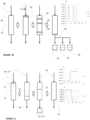
- FIG. 10 describes an elution chromatography method.
- a continuous flow of mobile phase 28 of composition and temperature possibly variable over time passes through the chromatography column 21 filled with a stationary phase 22.
- a volume of charge to be separated 23 is injected into the feed flow.
- the species migrate at different speeds along the column 21 and separate into elution bands or peaks 24, 25, 26, etc.
- FIG. 11 describes an affinity chromatography method for separating biomolecules.
- a continuous flow of solvent 30 containing the biomolecule to be separated 27 feeds the chromatography column 21 filled with a stationary phase 22 having a strong affinity for the biomolecule to be separated.
- the molecule binds to the stationary phase continuously until saturation of this one.
- This fixation is almost irreversible under the conditions of this first phase.
- the progression front 31 of the concentration in 27 is in this case a slot progressing towards the outlet.
- the column is saturated when the concentration in 27 becomes significant in the solvent at the outlet of the column.
- L is the length of the column
- Dh is the average hydraulic diameter (arithmetic mean) of the conduits
- e is the average thickness of the walls
- P is the void fraction of the walls.
- Chromatography is applied in liquid, gas and supercritical phases.
- the pore size of the continuous medium is greater than twice the molecular diameter of at least one species to be separated.
- the pore size is greater than twice the molecular diameter of at least two species to be eluted in sequence, or even of all the species to be separated.
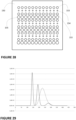
- FIG. 14 schematically represents a computer simulation of the separation of two chemical species on a multicapillary packing with porous walls whose diameter of communicating pores is greater than twice the molecular diameter of each of these species.
- the capillary conduits of the packing present a statistical variability on their diameter. These diameters are distributed on a Gaussian curve whose standard deviation is equal to 5% of their average diameter.
- These species are for example a mineral salt like sodium chloride 40 and a peptide 41 dissolved in water.
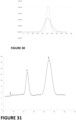
- FIG. 15 schematically represents a computer simulation of the separation of the same chemical species on a packing having identical dimensional characteristics but whose diameter of the connected pores is greater than twice the molecular diameter of species 40 and is less than twice the molecular diameter of species 41.
- the pore size of the continuous medium is greater than 2 times and less than 1000 times the molecular diameter of the species to be separated.
- the molecular diffusion of the mobile phase between the conduits takes place within said mobile phase continuum.
- the continuous and connected porous medium extending between the walls does not have any material interruption.
- the molar diffusion flow rate Phic between a conduit and the stationary phase that constitutes the packing is measured by imposing a uniform concentration on the wall Cs and by calculating the exchange with respect to the average concentration Ce of the fluid flowing through the conduit. This results in a Sherwood number equal to 3.66 in the case of a tube of circular section traversed by a fluid in laminar flow.
- said molar flow rate of transfer of matter of the species to be separated between the adjacent conduits between their walls is at least 0.01 times, advantageously at least 0.1 times and even more advantageously at least 0.5 times the term of said molar flow rate linked to the transfer of matter between the conduits and their stationary phase.
- the molecular diameter will be calculated in two ways depending on the molecular weight of the substance considered.
- hydrodynamic diameter measured by dynamic light scattering will be used.
- the mobile phase is, under the conditions of implementation of the process, in the gaseous, liquid or supercritical state.
- the mobile phase is, under the conditions of implementation of the process, in the liquid state.
- the efficiency of a packing increases proportionally to the density and diffusivity of the mobile phase passing through it.
- the density of the mobile phase passing through it is increased by working in the vicinity of the critical point of said mobile phase or in the liquid state.
- the filling has sufficient strength, rigidity and mechanical resistance to allow the filling to be handled.
- conduits can be seen as a set of anisotropic macropores distinct from the packing material which surrounds them and in which they are included, and in which the mobile phase flows convectively.
- conduits are rectilinear, pass through the monolith from one side to the other and open onto its upstream and downstream faces.
- the diameter does not vary by more than 50% over the length of the same conduit.
- conduits pass through the packing from one side to the other, thus minimizing the pressure loss within the packing during the chromatographic separation process.
- the volume of the capillary conduits represents more than 5% of the total volume of the packing, preferably more than 30% of said total volume and even more preferably more than 50% of the total volume of the packing.
- total volume of the packing means the volume occupied by the packing, including its porosity and its conduits; said total volume can therefore be calculated from the external dimensions of said packing.
- the volume of the conduits is measured in the following manner: number of conduits x average section of a conduit x average length of a conduit.
- the conduits preferably have a diameter of less than 80 ⁇ m, preferably less than 30 ⁇ m, and even more preferably less than 5 ⁇ m.
- the conduits preferably have a diameter of less than 500 ⁇ m, preferably less than 250 ⁇ m, and even more preferably less than 50 ⁇ m.
- the conduits are distributed in a single mode, that is to say around a single average diameter.
- the conduits may be arranged regularly in a regular square or triangular axial mesh. This means that the axes of the conduits are arranged at the vertices of closely stacked squares with substantially constant sides or closely stacked equilateral triangles with substantially constant sides.
- the packing when the packing comprises a porous monolithic organic gel acting as a stationary phase by adsorption on its porous surface, this surface will preferably be greater than 60 m 2 /g, and even more preferably between 80 and 600 m 2 /g.
- This surface may be raw or modified by a chemical surface treatment.
- the average pore size of the walls of the packing conduits will be between a few Angstroms and several hundred nanometers depending on the needs and the type of chromatography used.
- the pore volume of the walls of the packing will advantageously be between 0 cm 3 /g (this is the case when the walls of the packing are filled with a phase liquid stationary phases for example) and several cm 3 /g (case of current monolithic PS-DVB type polymeric stationary phases for example)
- the invention uses a packing which comprises a gel or an organic liquid permeable to molecular diffusion.
- This gel or organic liquid may be the constituent material of the lining, or form only a part of the lining, for example as an impregnation of the porosity of a porous material of a different nature or as a coating layer deposited on a porous material of a different nature so as to cover the pores of said material.
- the packing is a monolith formed of said organic gel.
- the organic gel forms a continuous skeleton defining a continuous network of pores extending between the conduits and open to the conduits.
- the packing is a monolith comprising a porous skeleton formed from a material other than an organic gel and the surface of the pores of which is covered with a film of organic gel, such that the pores of the material contain a residual volume free of organic gel, free for the diffusion of the mobile phase.
- the packing comprises a stack of porous and hollow fibers.
- Each fiber comprises a lumen forming a capillary conduit and a wall comprising a continuous network of pores.
- these fibers are stacked compactly so as to occupy more than 60% of the total volume of the filling, and preferably more than 80% of the total volume of the filling.
- each fiber is coated or impregnated with an organic gel.
- said fibers are made joint by means of the organic gel or liquid permeable to molecular diffusion.
- capillary ducts in the packing makes it possible to compensate for the relatively low mechanical strength of the organic gel packing by reducing the pressure drop and consequently obtaining stresses moderate mechanical forces exerted on the packing during the chromatography process.
- the capillary conduits are advantageously made mechanically integral by means of a continuous solid medium between the conduits and containing an organic gel or liquid permeable to molecular diffusion.
- This continuous medium creates a connection between the conduits which allows molecular diffusion to take place freely between adjacent conduits.
- dimensionally stable structure is meant a structure exhibiting little or no mechanical deformation under the conditions of use of the packing.
- this structure does not exhibit any notable swelling effect in the presence of the eluent solvents characteristic of a liquid or supercritical phase chromatographic process, said swelling advantageously remaining less than 10% of the total volume of the packing, and preferably less than 2% of said total volume.
- the dimensionally stable structure is a bundle of fibers made of a mineral or organic material.
- the multicapillary monoliths for carrying out the invention will advantageously be based on organic or mineral polymer networks.
- pore sizes mentioned in this text are measured using two different techniques depending on the nature of the material tested: when it is a mineral material and in particular silica, the technique used is mercury porosimetry for macro and mesoporosity, and nitrogen adsorption for microporosity; when it is a polymeric material or based on mineral matrices covered with organic gels, mercury porosimetry is used for macroporosity and nitrogen adsorption porosimetry for mesoporosity and microporosity.
- the volume of the mesopores and macropores is increased.
- organic gel or organic liquid support is used, bimodal silicas whose mesopore volume is between 10% and 40% of the total pore volume.
- organic liquids may be used, such as tributyl phospahate, trioctyl phosphate, trioctyl phosphine oxide, phosphonic acid esters, dimethyl phthalate, diethyl oxalate, aryl sulfonic acids, hydroxyoximes, oxime derivatives, beta diketones, alkylaryl sulfonamides, primary, secondary, tertiary, quaternary amines, etc.
- tributyl phospahate trioctyl phosphate
- trioctyl phosphine oxide phosphonic acid esters
- dimethyl phthalate diethyl oxalate
- aryl sulfonic acids hydroxyoximes
- oxime derivatives beta diketones
- alkylaryl sulfonamides primary, secondary, tertiary, quaternary amines, etc.
- the organic liquid preferably contains nanometric micelles of aqueous solution stabilized in the less polar phase by surfactants, called reverse micelles. These reverse micelles are endowed with a certain pH-dependent electrostatic charge that can solubilize a protein of opposite charge.
- the pH of the mobile phase is adjusted so that these reverse micelles solubilize a particular protein.
- the organic liquids which can be used to implement the invention will in particular be polysiloxanes, comprising methyl, benzyl, trifluoropropyl, cyanopropyl radicals, etc., polyethylene glycols, etc.
- the organic gel is sufficiently permeable to allow high diffusivity of the mobile phase species between the different neighboring conduits. This considerably increases the efficiency of a chromatographic process by leveling out the differences in behavior of capillary conduits slightly different in diameter, wall thickness, etc. thanks to molecular diffusions between neighboring conduits.
- the pore volume of the packing containing the organic gel is greater than 20%, preferably greater than 40% and even more preferably greater than 60% of the total volume of the packing excluding the volume of the conduits.
- the organic gel is made to contain macropores larger than 50 nanometers. These macropores allow the solvent molecules and some of the filler molecules to diffuse rapidly into the organic gel.
- the walls of the packing comprise an empty volume fraction of organic gel or liquid and, where appropriate, of stationary phase.
- This fraction makes it possible to serve as volume reserves with respect to the swelling phenomena undergone by the organic gel in contact with a solvent or solutes by releasing the induced mechanical stresses and by ensuring the integrity and dimensional permanence of the diameter of the conduits.
- the swelling phenomena of the organic gel are absorbed and compensated macroscopically by this empty volume in the internal volume of the walls of the conduits and have no effect on the volume offered to the flow of the mobile phase.
- the dimensionally stable structure ensures the constancy of the geometric dimensions of the packing and in particular of the diameter of the conduits, by supporting the mechanical constraints associated with the phenomena of swelling or shrinkage of the organic gel during its use cycles. These shrinkage and swelling phenomena are thus rejected entirely towards the pore volume of the organic gel.
- the increase or decrease in the volume of the organic gel linked to differences in solvation is fully reflected in a decrease or increase in its pore volume while keeping constant the dimensions of its macroscopic envelope and in particular the diameters of the conduits.
- the organic gel can be deposited in the form of a thin layer on a porous support.
- the organic gel is deposited in the form of a thin layer on the skeleton of a bimodal silica structure or an organic monolith.
- Said thin layer is of micrometric or submicrometric thickness.
- the deposition can take place throughout the entire mass of the structure or on only a part of it.
- it can consist of a layer of organic gel deposited on its surface as well as on the wall of the ducts.
- the polymerization can be carried out in the presence of a pore-forming agent that is subsequently removed.
- This pore-forming agent can be a solvent or a body that is subsequently removed by dissolution, evaporation or chemical attack, such as a macromolecule or a silica or alumina gel.
- a macromolecule When it is a solvent, it will lead to the precipitation of the organic gel during its polymerization.
- it When it is a macromolecule, it can in particular be used to aggregate or coacervate particles of polymeric organic gel together.
- the blowing agent may in particular be an organic solvent or water.
- organic solvents such as alcohols, esters, ethers, aliphatic and aromatic hydrocarbons, ketones, di- and tri-tetraethylene glycols, butane diols, glycerols, etc. may be used.
- Heavy blowing solvents include tetrahydronaphthalene, decahydronaphthalene, anthracene, biphenyl, paraffin oils, stearic, oleic, and palmitic acids, dialkyl phthalates, camphor and its esters, 1-dodecanol, 1-octanol, cyclohexanol, or a mixture thereof.
- the pore-forming agent influences the final pore size distribution.
- the pore size of the porous medium is greater than twice the molecular diameter of the species to be separated.
- the continuous and connected phase linking the conduits is a condensed phase.
- said molar flow rate of transfer of matter of the species to be separated between the walls of the adjacent conduits is at least 0.01 times, advantageously at least 0.1 times and even more advantageously at least 0.5 times the term of said molar flow rate linked to the transfer of matter between the conduits and their stationary phase.
- NETMax 1 , 6 * L / Dh + e * P
- the pore size of the continuous medium is greater than 10 times the molecular diameter of the species to be separated.
- the pore size of the continuous medium is greater than 2 times and less than 1000 times the molecular diameter of the species to be separated.
- R h is the molecular radius of the species molecule to be separated considered as a sphere and r 0 the pore radius (pore diameter d 0 ).
- K p is a factor taking into account a deviation of the equilibrium concentration between the pores and the infinite medium.
- the following table calculates the C ratio for different molecules and different pore sizes.
- the packing has a population of connected pores whose diameter is greater than the mean free path of the molecules to be separated under the process conditions.
- the porosity of a crosslinked organic gel may come from its swelling in an organic, mineral or aqueous solvent. This is the case, for example, of copolymers of styrene and 2 to 8% divinylbenzene.
- a porogenic solvent such as an aliphatic alcohol containing 8 to 12 carbon atoms in its molecule.
- Effective diffusion is measured by imposing on either side of a uniform thickness Eu and a surface S of material representative of the real material different concentrations C downstream and C upstream of a molecule dissolved in the phase stationary, and measuring the flow of matter ⁇ of this molecule through said resulting thickness.
- D eff ⁇ . Eu / C amont ⁇ C aval .
- the material exchange surface between a conduit and an adjacent conduit is advantageously greater than 2% of its periphery, more advantageously greater than 10% of its periphery, and even more advantageously greater than 20% of its periphery.
- conduits are advantageously linked by a continuum or diffusive bridge in the condensed state.
- the effective diffusivity of the species to be separated in the walls of the packing is advantageously greater than one thousandth of their diffusion coefficient in the free mobile phase, more advantageously greater than one hundredth of their diffusion coefficient in the free mobile phase, and even more advantageously greater than one tenth of their diffusion coefficient in the free mobile phase.
- the so-called steady-state conductivity cell method is preferably used.
- a comprehensive description of this method can be found in [3].
- effective diffusivity is measured after complete equilibration of the stationary phase contained in the cell and the species on which the measurement is carried out.
- affinity chromatography this generally means carrying out the measurement on a stationary phase saturated with adsorbate.
- the diffusion of the species of the mobile phase in the walls of the packing can be achieved in at least two ways, namely by diffusion in the mass of the gel or organic liquid or by diffusion outside the organic gel, in its porosity.
- Such diffusivity can be obtained by a combination of pore volume, crosslinking rate of the organic gel, elution solvent and operating temperature according to the knowledge of the person skilled in the art and the available data.
- the molecular diffusion-permeable organic gel used in the present invention can also be defined by the fact that its permittivity with respect to the species to be separated is greater than 5000 Barrer.
- the diffusivity of water is only significant for materials with a permittivity greater than 5000 Barrer (polyisoprene, Plexiglas) and preferably greater than 25000 Barrer (cellulose).
- a material such as unsaturated polyester has a permittivity comparable to that of polyethylene and polycarbonate, which are materials recognized as waterproof and non-porous since they are used to make impermeable containers or walls.
- the permittivity of the organic gel with respect to the species to be separated is greater than 10 5 Barrer, and even more preferably greater than 10 6 Barrer.
- the packing may comprise, as an organic gel permeable to molecular diffusion, a gel mainly composed of organic chemical species and therefore mainly composed of carbon and species usually linked to carbon in the context of organic chemistry.
- a gel mainly composed of organic chemical species and therefore mainly composed of carbon and species usually linked to carbon in the context of organic chemistry.
- it will mainly consist of a combination of a carbon atom skeleton and atoms of hydrogen, oxygen, nitrogen, phosphorus, sulfur, chlorine, fluorine, bromine, iodine.
- Examples include hydrocarbon, halocarbon, hydroxycarbon, oxycarbon, sulfocarbon, phosphorocarbon, nitrocarbon, etc. species of natural or artificial origin.
- this gel may be made up of organometallic species.
- organometallic species include silicon, tin, lead, boron, aluminum, gallium, indium, zinc, beryllium, magnesium, titanium, zirconium, arsenic, antimony, selenium, etc.
- the organic gel may comprise in its mass the products that can be obtained by co-condensation of orthosilicates and organosilanes.
- These silanes may comprise one, two or three Si-C or Si-R bonds.
- R may be any carbon radical, such as a propyl, butyl, octyl, octadecyl radical, a primary, secondary, tertiary or quaternary amine, an alcohol, an organic acid, a reactive group, etc.
- one or more mono-, bi- or trifunctional silanes may take part in the structure. Examples of such materials that can be used to carry out the invention will be found in document [4].
- an organic gel is an essentially macroscopic concept.
- Said gel is a material in its own right which can exist and be manipulated independently of its possible support.
- this organic gel is made of an organic polymer.
- the molecular weight of this polymer is greater than 1000 g/mol.
- the organic gel is a copolymer of styrene and divinylbenzene.
- Copolymers of styrene and divinylbenzene exhibit high diffusivity and permeability to molecules dissolved in a solvent. To increase this diffusivity, the styrene content is reduced. This reduction has the effect of making the mechanically more fragile polymer.
- the mechanical forces on the polymer are less significant than for a packing without conduits, which makes it possible to reduce the styrene content without degrading the mechanical strength of the packing compared to known packings without capillary conduits.
- the weight content of divinylbenzene in styrene is less than 20%, advantageously less than 8%, and even more advantageously less than 2%.
- the porosity of such gels develops by swelling with an elution solvent. They are used in particular in size exclusion chromatography.
- the weight content of divinylbenzene in the styrene is greater than 20%, advantageously greater than 40%, and the polymerization is carried out in the presence of a porogenic agent such as a solvent for the monomers in which the polymer is insoluble.
- a porogenic agent such as a solvent for the monomers in which the polymer is insoluble.
- the porosity of such gels is inherent in their structure in the dry state.
- polyvinyl alcohol gels polymethyl methacrylate, polyhydroxymethyl methacrylate, polyacrylamide, hydroxyethyl methacrylate copolymerized with glycidyl dimethacrylate (GMA-EDMA), etc.
- Polyacrylamides are advantageously made up of copolymers of acrylamide and N N' methylene bis acrylamide.
- Cellulose (a polyholoside) and its derivatives, including carboxymethyl celluloses and diethyl amino ethyl celluloses for ion exchange chromatography, may also be mentioned.
- organic polyholoside gels known in the state of the art using organic macromolecules such as dextrans crosslinked, for example by N,N methylene diacrylamides or epichlorohydrins. These gels are in particular known under the trade names Sephacryl TM and Sephadex TM , products of the company GE Healthcare.
- organic polyholoside gels can also be used, using organic macromolecules such as agaroses crosslinked, for example by epichlorohydrins. These gels are particularly known under the trade names Sepharose TM and Superdex TM , Superose TM , products of the company GE Healthcare.
- these organic gels can be made from mixtures of monofunctional monomers and multifunctional monomers.
- the multifunctional monomers crosslink the resulting polymer.
- these monomers may be chloromethyl styrene, 4-acetoxystyrene, methyl, ethyl, propyl, butyl, hexyl, lauryl, triphenylmethyl, pyridyl-2 diphenylmethyl, methyl, ethyl, propyl, butyl, hexyl, lauryl acrylate, glycidyl methacrylate, AMPS, 2-vinyl-4,4 dimethylazlactone, 2-3 epoxypropyl methacrylate, etc.
- These functional groups can be added before or after polymerization.
- the monofunctional monomer content can vary between 2% and 98% by weight of the total monomers.
- it is between 2% and 40% by weight of the total monomers.
- the bi- or multifunctional monomers may be monomers based on benzene, naphthalene, pyridine, alkyl ethylene, glycol, etc., having two or more vinyl or epoxy functional groups.
- these components are divinyl benzenes, divinyl naphthalene, alkyl diacrylates and dimethacrylates, diacrylamides, and dimethylacrylamides, divinyl pyridines, dimethacrylates or diacrylates of ethylene glycol, polyethylene glycol, dimethylolpropane, dimethylolpropane, trimethylolpropane, 1,3 butanediol diacrylate, di, tri or tetramethacrylates or acrylates of pentaerythrityl trimethylolpropane, or mixtures thereof.
- Di-, tri- or tetrahydroxylated siloxanes often generated from alkoxysilanes may be used.
- the rate of bi or multifunctional monomer can vary between 100% and 2% by weight of the total monomers.
- said rate is between 98% and 60% by weight of the total monomers.
- the initiators used for polymerization include all those included in the state of the art, such as azo compounds and peroxides. Typical examples are azobisisobutyronitrile, benzoyl peroxide. The typical amount of initiator generally varies from 0.4 to 2% by weight relative to the weight of the monomers.
- the quantity of pore-forming agent can vary between 10 and 90% and preferably between 20 and 60% by volume of the final mixture comprising the monomers.
- X-ray or gamma ray curing can be used for the homogeneous manufacture of large parts.
- these organic gels can be surface-treated to functionalize them by grafting, for example with silanes.
- They can be provided with sulfonated groups (sulfonation), quaternary ammoniums, octadecyl, octyl, butyl, phenyl, amine, diethylamino, ethyl, sulfopropyl, carboxymethyl radicals, hydrophilic polymers, alpha, beta, gamma cyclodextrins, methylated or not, L-amino acids or D-amino acids, proteins, etc.
- the organic gels usable for ion exchange or complexation chromatography comprise aminodiacetate, phosphonate, amidoxime, amidophosphonate, thiol, sulfonate, primary, secondary or tertiary amine, or quaternary, carboxylic, pyridile radicals, etc.
- the organic gels which can be used for the chromatography of electron donor-acceptor complexes comprise nitro or chloroaromatic radicals, or phenoxy, pyrene, quinazoline-2 radicals, such as dinitro-2,4,6 aminopropyl, trinitro 2,4,6 anilinopropyl, tetranitro-2,4,7 fluorenoiminopropyl, tetrachloro phthalimidopropyl, nitro-3 naphthalimido-1,8 propyl, naphthalene tetracarboxy-1,4,5,8-diimidopropyl, pyromellidiimidopropyl, pentafluorobenzamidopropyl, caffeine, phenoxy, quinazoline-2, quinolinol,-8, 2,2,2 trifluoro-1(10-methyl-9anthryl)ethanol, pyrenepropyl etc.
- quinazoline-2 radicals such as dinitro-2,4,6 aminopropyl
- organic gels usable for ligand exchange chromatography include bis dithiocarbamate, cyclam, oxine, dialkyldithiocarbamate radicals, etc.
- the organic gels that can be used for the separation of chiral molecules comprise chiral selectors generally chosen from Pirkle-type groups, cyclodextrins and crown ethers, natural and synthetic polymers, and proteins.
- Affinity chromatography separates biochemical molecules based on highly specific interactions such as antigen-antibody, enzyme-substrate, or receptor-ligand.
- Contact is achieved by circulating the mobile phase through the packing conduits, allowing the target molecules to be fixed to the organic gel.
- Bound compounds are eluted by a change in pH, pl, salt concentration, charge, or ionic strength in general. This is done in one step (slot) or by an elution gradient to recover the molecules of interest.
- affinity chromatography Different forms of affinity chromatography are usually considered: immunoaffinity, immobilized metal ions, recombinant proteins, lectins (see in particular the Wikipedia article on this technology).
- proteins are coupled to a substrate such as agarose in a covalent manner, and they are used for the purification of their antibodies.
- proteins are marked, so that they can be selected, by markers such as glutathione S transferase (GST), hexahistidine (Hs) and maltose (MSP). Histidine has a high affinity for Ni or Co by coordination or covalence. Elution is carried out by solutions containing an excess of solute capable of binding to the immobilizing metal, such as imidazole, or for example an excess of glutathione.
- GST glutathione S transferase
- Hs hexahistidine
- MSP maltose
- Ligands such as conconovalin A bind to the glucose chains of glycoproteins and allow them to be isolated.
- the packings containing organic gels according to the invention are suitable for affinity separations.
- the packings for affinity chromatography have a low volume of conduits compared to the total volume of the packing, preferably less than 40%, more preferably less than 20% and even more preferably less than 10% of the total volume of the packing.
- the distance between neighboring conduits is less than 0.5 mm, preferably less than 0.25 mm, and even more preferably less than 0.1 mm, in order to ensure sufficient speed of the diffusion processes.
- the propagation front of the retained molecule is thus steeper and short column lengths can be used, further reducing the packing volume.
- the organic gel represents a high fraction of the volume of the packing considered, excluding the volume of the conduits, advantageously greater than 40%, more preferably greater than 60% of it.
- packings are advantageously used for affinity chromatography in radial or axial continuous annular chromatography devices. This minimizes the amount of stationary phase required for a given production by reducing the amount of immobilized stationary phase without expensive devices using instruments operating under low pressure thanks to short cycle times.
- a porous polymeric organic gel may comprise in its porosity a third solid body.
- the packing comprising the polymeric organic gel and intended to serve as a support for a third solid body will have connected pores of large size, greater than 50 nm, preferably greater than 200 nm, and even more preferably greater than 500 nm.
- the filling comprising the polymeric organic gel and intended to serve as a support for a solid third body has a specific surface area of less than 20 m 2 /g.
- this solid third body can be any of the stationary phases previously listed.
- this solid third body can be a mineral or organometallic stationary phase.
- These include, but are not limited to, silicon, alumina, titanium and zirconium oxides.
- this solid third body can be a silica with a high specific surface area for chromatography.
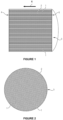
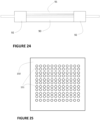
- FIG. 1 is a sectional view of a multicapillary packing 3 according to an embodiment of the invention in a plane parallel to the longitudinal axis of said packing.
- the packing is a porous monolith formed of an organic gel 2 crossed by capillary conduits 1 where a fluid or supercritical mobile phase passing through the packing 3 can circulate freely.
- monolith is meant a single-piece porous material, comprising a continuous skeleton, which can be made of one or more materials.
- the capillary conduits are straight, parallel, and spaced regularly.
- the different conduits have morphologies and diameters as identical as possible.
- Each conduit passes through the packing from one side to the other, that is to say that it advantageously has its ends open on each side 4 and 5 of the packing, allowing the circulation of the fluid from the inlet side 4 to the outlet side 5.
- Such packing can therefore be used in a chromatographic column.
- FIG. 2 is a top view of face 5 of the lining of the Figure 1 seen along direction 6.
- the openings of the individual capillary conduits 1 can be seen in the mass 2 of organic gel.
- the monolith comprises a porous skeleton made of a dimensionally stable material that is more resistant than the organic gel, and the pores of said skeleton are covered at least in part with the organic gel.
- FIG. 3 thus represents a skeleton 7 made of a dimensionally stable material, obtained for example by sintering a powder molded or extruded according to the shape of the packing, or obtained by a sol-gel or filler-binder process.
- the organic gel 8 is deposited in the form of a thin layer on the surface of the skeleton 7, and in particular on the surface of the pores.
- the packing has a continuous network of macropores 9 allowing molecules to diffuse rapidly throughout the thickness of the packing and between adjacent conduits.
- a multicapillary monolith obtained by extrusion and sintering can be coated with an organic gel.
- This monolith must be porous. It must therefore be prepared and sintered under conditions that allow significant porosity to be maintained.
- the diameter of the conduits obtained by such an extrusion process which is of the order of a millimeter, is generally too high for a chromatographic application.
- the matrix formed around the wires or conduits consists of a polymeric organic gel.
- the matrix formed around the wires or conduits is loaded with an organic gel.
- the precursor wires of the conduits are coated with a spacer prior to the formation of the bundle so as to ensure a minimum thickness of material between two adjacent conduits.
- threads made of a hydrolyzable polymer are assembled into a bundle, the bundle is immersed in a precursor solution of a porous organic gel, a solution which is caused to gel around the threads, and the threads are eliminated by hydrolysis into soluble species of low molecular weight by immersing the packing in an acidic or basic solution.
- precursor solution of an organic gel is meant a liquid of composition such that, by its evolution under the conditions of the manufacturing process, it leads to an organic gel.
- a multicapillary monolith is made of silica gel.
- the porous fraction external to the monolith conduits receives the organic gel.
- the silica skeleton is removed by dissolving in an aqueous solution at a pH greater than 11.0.
- the silica gel acts as a pore-forming agent.
- a metal alloy is chosen whose melting temperature is lower than the degradation temperature of the material constituting the organic gel.
- metals are chosen whose melting point is lower than 220°C, preferably lower than 150°C, and even more preferably lower than 100°C.
- all elements and components of the lining must be compatible with strict health constraints. In particular, it is important to avoid any pollution of the lining by toxic residues from the manufacturing process, and to avoid as much as possible the use of toxic manufacturing intermediates.
- the materials or constituents of the metal wires that are precursors of the conduits are part of these intermediates.
- residues of these metals can remain in the lining and pollute the species that will be treated there, or spread into nature after its destruction.
- Low-melting metals include mainly lead, tin, bismuth, gallium, mercury, silver, cadmium and indium. Since lead, cadmium and mercury are heavy metals that are harmful and detrimental to human and animal health and the environment, alloys that do not contain these elements and are based on tin, bismuth, indium, gallium, silver or any combination of these with each other or with other less meltable metals are preferably chosen.
- these may be indium-based metal alloys.
- these indium alloys an alloy of 52% indium and 48% tin by weight, melting at 118°C, is preferably used.
- It can also be a soil created in situ by a sol-gel process.
- the binder can also be a colloid such as albumin, dextran, gelatin, hydroxyethyl starches, etc.
- the binder will not penetrate into the pores of the filler. This can be achieved, for example, by choosing a binder divided into particles larger than the pores.
- the multi-capillary filling supporting the organic gel can be created by a sol-gel process.
- this sol-gel process could also be based on an aluminosilicate such as clay, for example.
- this sol-gel process may also be based on a zirconium oxide, a titanium oxide, a rare earth oxide such as yttrium, cerium or lanthanum, a boron oxide, an iron oxide, a magnesium, calcium, strontium or barium oxide, a germanium oxide, a phosphorus oxide, a lithium, potassium or sodium oxide, a niobium or copper oxide.
- a zirconium oxide such as yttrium, cerium or lanthanum
- a boron oxide such as yttrium, cerium or lanthanum
- an iron oxide a magnesium, calcium, strontium or barium oxide
- germanium oxide a phosphorus oxide
- lithium, potassium or sodium oxide such as sodium oxide
- zirconium oxide or titanium oxide gels can be used as a gel base.
- the sol-gel process leading to these single or multi-component gels will be based on the hydrolysis of organometallic compounds such as alcoholates of the metals considered, alone or in a mixture with other organometallics and possibly with metal salts such as nitrates or chlorides.
- organometallic compounds such as alcoholates of the metals considered, alone or in a mixture with other organometallics and possibly with metal salts such as nitrates or chlorides.
- Another method for producing the packing according to the invention comprises the use of bundles of hollow fibers with porous walls impregnated with organic gel by soaking and then drained so as to release the lumen of the fibers. It is thus possible to produce large-sized packings.
- Diffusive bridges are defined as a continuum of material permeable to molecular diffusion extending between fibers.
- Material connections between the hollow fibers advantageously provide effective diffusive bridges between the conduits.
- Hollow fibers are advantageously made integral with each other so as to strengthen their mechanical cohesion and to manipulate them collectively.
- they can be woven into a composite fabric or glued together jointly in the form of a sheet.
- the binder can be the organic gel itself.
- the volume outside the fibers at their periphery can be immersed in an organic liquid.
- a resin other than organic gel, a porous binding resin can be used as a binder for the fibers between them.
- This latter process can be combined with reinforcement using a structural fiber fabric.
- this molding is carried out in such a way as to obtain an organic gel film having a spacer like reliefs.
- the walls of the ducts can constitute this spacer.
- the molding can be carried out by stamping, extrusion, calendering of a pre-existing film. This process can be carried out alone or on a reinforcing film or fabric.
- the process may include polymerizing the organic gel in situ in the mold having the spacer preform and then demolding.
- the process involves casting the molten organic gel or its molten precursor into the mold and solidifying it, followed by demolding.
- the film is then stacked or rolled to obtain the final filling.
- Spacers allow fluid to pass freely through the structure.
- a porous polymeric organic gel contains a solid third body
- said third body can be created by deposition by dipping the multicapillary packing into a formulation containing the suspended third body or a precursor of the third body, or both simultaneously followed by drainage and then drying of the gel.
- the solid third body can be created on the surface of the polymer gel by impregnating it with a colloidal solution, possibly followed by its freezing and drying.
- a colloidal solution possibly followed by its freezing and drying.
- silica sols with a high specific surface area are particularly suitable.
- sol-gel process as described previously in this document may be used.
- it may be a bimodal silica obtained by a sol-gel process.
- this solid third body is silica for high specific surface chromatography bound by a silica sol.
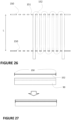
- FIGS. 5 and 6 represent, seen from above and seen in section, respectively an organic gel 10 traversed by conduits 11.
- This organic gel is in the form of a sheet obtained by molding on a preform. It can be attached to an underlying fabric 12 ensuring better mechanical resistance.
- the organic gel can contain a reinforcing filler.
- the sheets can be rolled or stacked to achieve any desired shape.
- the organic gel or third body that it supports is functionalized after the creation of the conduits.
- Functionalization means the addition of specific chemical groups that confer reactivity or selectivity to the raw packing. This particularly concerns the addition of reactive ion exchange groups, treatment with silanes, grafting of polyholosides, proteins and chiral molecules, etc.
- the packing can be in the form of a disc or a column with two flat straight sections, encapsulated in a contiguous envelope serving as mechanical protection.
- the sealing of the junction between the filling and the envelope can be ensured by glue, a polymer or a plastic film, in particular a heat-shrinkable film.
- the filling can be created directly in said envelope.
- a chromatographic process is generally characterized by the packing efficiency expressed in number of theoretical plates.
- the packing has an efficiency greater than 1000 theoretical plates per meter of packing, preferably more than 10000 theoretical plates per meter of packing and even more preferably more than 100000 theoretical plates per meter of packing.
- the x-axis represents the length of the packing expressed in micrometers.
- the y-axis represents the packing efficiency expressed in number of theoretical plates (NPT).
- the diameters of the conduits are distributed according to a Gaussian law.
- Curve (a) represents a lining made up of conduits of randomly variable diameter following a Gaussian statistical law around an average of 10 ⁇ m with a standard deviation of 0.5 ⁇ m, for non-porous walls.
- Curve (a) shows the efficiency of such a packing whose walls are non-porous and whose capillaries therefore behave independently of each other. This efficiency begins to increase then levels off to tend towards a limit independent of the packing length. This phenomenon is due to the fact that the diameters of the capillaries are not uniform but distributed according to a random Gaussian law.
- Curve (b) represents the same beam with porous walls having 55% pore volume, a wall thickness of 2 ⁇ m and a pore size ten times greater than the molecular diameter of the species to be separated.
- Curve (b) therefore shows the efficiency of a packing of the same dimensions as the previous one but with porous conduit walls and in which the adjacent capillary conduits communicate by molecular diffusion. In this case, the efficiency no longer levels off but increases proportionally to the length of the packing despite the same Gaussian distribution of diameters. The non-uniformity of behavior of these conduits is leveled by molecular diffusion between them.
- This phenomenon is specifically relevant for a chromatographic process, where high efficiencies are required. It should be noted that such properties are of secondary importance for an adsorption or catalysis process, and of no interest for a filtration process.
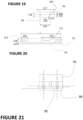
- the conduit 13 is assumed to have a concentration profile dictated by the hydrodynamic conditions of the flow resulting in an average concentration Ce.
- the adjacent conduits are assumed to have a concentration Cs lower here than Ce.
- the average molar diffusion flow rate Phip is constituted by the sum of the flows (15, 15', 15", 15"') leaving the periphery of the conduit 13 and passing through the packing 14.
- the medium 14 is constituted by porous organic gel, organic liquid and mobile phase, and a possible porous support thereof.
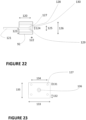
- FIG. 9 describes the average molar diffusion flow rate Phic between a conduit and the stationary phase constituted by the packing under the effect of the same difference in concentration of the species to be separated between the conduits and the wall of said conduits.
- the molar diffusion flow rate between a conduit 13 and the stationary phase constituted by the packing is measured through a peripheral zone of the conduit delimiting the empty capillary in which the fluid flows, under the effect of the same difference in concentration of the species to be separated.
- the exchange is calculated on the basis of an average concentration Ce of the eluent flow in the conduit.
- the periphery of the conduit is assumed to have a concentration Cs.
- the molar diffusion flow rate is constituted by the sum of the flows (16, 16', 16", 16"') passing from the central zone of the conduit 13 to the packing 14.
- FIG. 12 represents a packing consisting of an organic gel comprising in its mass the product of a co-condensation of orthosilicates and silanes.
- These silanes may comprise one, two or three Si-C or Si-R bonds.
- the conduits are in this case anisotropic macropores, the direction or morphology of which favors an axial flow of the eluting phase in the packing, and included in it.
- R may be any carbon radical, such as a propyl, butyl, octyl, octadecyl radical, a primary, secondary, tertiary or quaternary amine, an alcohol, etc. or, in a non-limiting manner, one or more mono-, bi- or trifunctional silanes among those cited previously in this text in the list of coupling agents.
- FIG 16 represents a sectional view along a direction parallel to its major axis of a variant of a packing for chromatography according to the invention in which the conduits 61, 61' are included in a porous monolithic mass 63 and are stacked and juxtaposed.
- the conduits open in an orderly or random manner into the material 62 permeable to the eluent.
- these conduits may have as precursors cut fibers, stacked and juxtaposed in a direction so as to give them an average direction parallel to the direction of flow of the fluid in the lining.
- the conduits are of homogeneous lengths and diameters, and as parallel as possible.
- Example 1 Fabrication of a multicapillary packing into an anion exchanger
- the starting material is a wire made of an alloy of tin and bismuth in proportions of 58%, 42% by weight respectively. It has a diameter of 15/100 mm.
- the wire is coated by dipping with a thin layer of a mixture of styrene, 8% by weight of divinylbenzene, 0.4% by weight of a polymerization activator (azobis isobutyronitrile) and glass powder ground to 10 ⁇ m (one volume of glass powder to one volume of the solution). It is placed for 24 hours at 70°C under nitrogen.
- the wire is cut into straight sections 200 mm long. They are then introduced in a bundle of about 4 mm in diameter into a previously prepared glass tube 160 mm long and 4 mm in internal diameter.
- a mixture of styrene, 8% by weight of divinylbenzene and 0.4% by weight of a polymerization activator (t-butyl hydroperoxide) is then poured into the tube through the interstices between the sections of wire so as to completely fill this empty space.
- the mixture is polymerized for 24 hours at 120°C.
- the composite thus produced is released by cutting the sections of wire on either side of the glass tube flush with its ends, perpendicular to said sections.
- the composite is heated in a furnace at 145°C until the wire sections melt, and the molten metal is removed by ultrasonic vibrations and under the action of gravity and pressurized air circulation.
- the monolith thus produced is converted into a basic ion exchanger by subjecting it to the action of a stream of a 15% by weight solution of tin tetrachloride in chlorodimethyl ether at 0°C for 6 hours.
- the packing is then washed with methanol and then with water and quaternized by the action of a stream of a 40% aqueous solution of trimethylamine for a period of ten hours.
- the packing is then washed to neutrality and the quaternary ammonium is converted into its hydroxylated form.
- Example 2 Fabrication of a multicapillary packing into a cation exchanger
- a 160 mm long porous walled alpha alumina monolith with 100 0.45 mm diameter conduits distributed in a 1.2 mm square mesh is produced by extrusion and sintering of an alpha alumina powder with an elemental diameter of 20 ⁇ m.
- a mixture of 49 g of styrene, 1 g of divinylbenzene, 200 mg of a polymerization activator (t-butyl hydroperoxide) and 150 ml of pentane is then poured into the monolith so as to completely fill the porosity of the wall.
- the core of the conduits is drained of the liquid phase it contains.
- the monolith is brought to 50 °C so as to evaporate the majority of the pentane, then briefly pulled under vacuum so as to complete this evaporation.
- the deposit of monomers and activator thus deposited in the form of a liquid film covering the wall of the alumina grains is polymerized for 24 hours at 120 °C under a nitrogen atmosphere.
- the resulting monolith is converted into an acidic ion exchanger by sulfonation.
- the monolith is treated with a stream of concentrated sulfuric acid containing 0.1% by weight of silver carbonate at 100°C for 3 hours.
- the sulfonated packing is then treated with progressively less concentrated sulfuric acid and finally with distilled water.
- Example 3 Production of a multicapillary packing with porosity
- a mixture containing 8 g of hydroxyethyl methacrylate, 32 g of divinylbenzene, 445 mg of azobisisobutyronitrile, 60 g of dodecanol is prepared and degassed under nitrogen for 20 minutes.
- This mixture is heated to 70°C for 24 hours. The mixture polymerizes.
- the monolith A thus produced is washed by percolating THF for 30 minutes and dried in an oven at 90°C.
- Monolith A is ground under liquid nitrogen until the desired grain diameter is obtained.
- the porosity of these grains is filled with a paraffin wax melting at 80°C by hot addition of the melted wax to the powder while stirring.
- the wire is covered by gluing on its surface using an aqueous solution of PVA (polyvinyl alcohol) with a monolayer of the grains of monolith A obtained in example 3 ground to 50 ⁇ m.
- PVA polyvinyl alcohol
- the wire is cut into straight sections 12 cm long and assembled into a bundle of approximately 4 mm in diameter in a previously prepared glass tube 100 mm long and 4 mm in internal diameter.
- a mixture containing 8 g of hydroxyethyl methacrylate, 32 g of divinylbenzene, 445 mg of azobisisobutyronitrile, 60 g of dodecanol is prepared in parallel and degassed under nitrogen for 20 minutes.
- the previously prepared bundle is filled with this mixture and heated to 70°C for 24 hours.
- the mixture polymerizes.
- the composite thus produced is released by cutting the sections of wire on either side of the glass tube flush with its ends, perpendicular to said sections.
- the composite is heated in an oven at 125°C until the wire sections melt, and the molten metal is easily removed by applying ultrasonic vibrations by gravity and under a slight circulation of pressurized air.
- the monolith thus produced is washed with a stream of n-octane at 120°C for 30 minutes, then with THF (tetrahydrofuran) at room temperature for 30 minutes.
- a mixture containing 8 g of hydroxyethyl methacrylate, 32 g of divinylbenzene, 445 mg of azobisisobutyronitrile, 60 g of dodecanol is prepared and degassed under nitrogen for 20 minutes.
- This mixture is heated to 70°C for 24 hours. The mixture polymerizes.
- the monolith B thus produced is washed by percolating THF for 30 minutes and dried in an oven at 90°C.
- Monolith B is ground under liquid nitrogen until a grain diameter of 50 ⁇ m is obtained.
- the porosity of these grains is filled with a paraffin wax melting at 80°C by hot addition of the melted wax to the powder while stirring.
- a polydioxanone wire is produced with a diameter of 0.25 mm.
- the wire is coated by dipping and bonding with an aqueous polyvinyl alcohol solution previously deposited with a thin layer of grains of monolith B ground to 50 ⁇ m. It is then cut into lengths of 120 mm and assembled into a bundle of approximately 4 mm in diameter in a previously prepared glass tube 100 mm long and 4 mm in internal diameter.
- a mixture containing 8 g of hydroxyethyl methacrylate, 32 g of divinylbenzene, 890 mg of azobisisobutyronitrile, 60 g of dodecanol is prepared in parallel and degassed under nitrogen for 20 minutes.
- the previously prepared bundle is filled with this mixture and heated to 70°C for 24 hours.
- the mixture polymerizes.
- the composite thus produced is released by cutting the sections of wire on either side of the glass tube flush with its ends, perpendicular to said sections.
- the monolith thus produced is washed with a stream of n-octane at 120°C for 30 minutes, then with THF (tetrahydrofuran) at room temperature for 30 minutes.
- the polydioxanone threads are dissolved by sodium hydroxide N at 90°C percolated through the packing for 1 hour, then the packing is washed with distilled water until neutral and dried at 105°C.
- the monolith is placed in an oven under high vacuum at 125°C, until melting and volatilization of the wax residues and light organics.
- Example 6 Production of a multicapillary packing in crosslinked agarose
- a mixture containing 8 g of hydroxyethyl methacrylate, 32 g of divinylbenzene, 445 mg of azobisisobutyronitrile, 60 g of dodecanol is prepared and degassed under nitrogen for 20 minutes.
- This mixture is heated to 70°C for 24 hours. The mixture polymerizes.
- the monolith C thus produced is washed by percolating THF for 30 minutes and dried in an oven at 90°C.
- Monolith C is ground under liquid nitrogen until a grain diameter of 50 ⁇ m is obtained.
- the porosity of these grains is filled with a paraffin wax melting at 80°C by hot addition of the melted wax to the powder while stirring.
- a polydioxanone wire is produced with a diameter of 0.25 mm.
- the wire is coated by dipping with a thin layer of grains of the C monolith ground to 50 ⁇ m. It is then cut into lengths of 120 mm and assembled into a bundle of approximately 4 mm in diameter in a previously prepared glass tube 100 mm long and 4 mm in internal diameter.
- a mixture containing 8 g of hydroxyethyl methacrylate, 32 g of divinylbenzene, 445 mg of azobisisobutyronitrile, 60 g of dodecanol is prepared in parallel and degassed under nitrogen for 20 minutes.
- the previously prepared bundle is filled with this mixture and heated to 70°C for 24 hours.
- the mixture polymerizes.
- the composite thus produced is released by cutting the sections of wire on either side of the glass tube flush with its ends, perpendicular to said sections.
- the monolith thus produced is washed with a stream of n-octane at 120°C for 30 minutes, then with THF (tetrahydrofuran) at room temperature for 30 minutes.
- the monolith is placed in an oven under high vacuum at 125°C, until melting and volatilization of wax residues and light organics.
- One deciliter of agarose beads are dissolved in one deciliter of demineralized water at 95°C.
- the porosity of the monolith is impregnated with this solution by soaking and draining at 95°C from the core of the conduits then cooling.
- Example 7 Fabrication of a multicapillary packing in crosslinked agarose
- a 300 mm long porous walled alpha alumina monolith with 100 0.45 mm diameter conduits distributed in a 1.2 mm square mesh is produced by extrusion and sintering of an alpha alumina powder with an elemental diameter of 20 ⁇ m
- the porosity of the monolith is impregnated with this solution by soaking and draining at 95°C from the core of the conduits then cooling.
- the occluded and frozen agarose is washed with distilled water.
- the resulting crosslinked gel is washed with hot water until neutral.
- Example 8 Production of a multicapillary packing in crosslinked agarose
- the porosity of the monolith is impregnated with this solution by soaking and draining the conduits at 95°C then cooling.
- the occluded and frozen agarose is washed with distilled water A deciliter of 1N NaOH solution containing 20 ml of epichlorohydrin and 5 g of NaBH4 is prepared.
- the monolith conduits are filled with it.
- the resulting crosslinked gel is washed with hot water until neutral.
- the gel is washed with hot, then cold 1 N NaOH containing 0.5% NaBH4.
- the monolith is quickly transferred to an ice bath buffered to pH 4 using a solution of acetic acid and sodium acetate.
- the monolith is washed by circulating hot distilled water, then iced water.
- Example 9 Production of a multicapillary packing in crosslinked and functionalized agarose
- a 150 mm long porous walled alpha alumina monolith with 100 0.45 mm diameter conduits distributed in a 1.2 mm square mesh is produced by extrusion and sintering of an alpha alumina powder of 20 ⁇ m elemental diameter
- the porosity of the monolith is impregnated with this solution by soaking and draining the conduits at 95°C then cooling.
- the occluded and frozen agarose is washed with distilled water
- 1N NaOH solution containing 1 ml of epichlorohydrin and 0.25 g of NaBH4 is prepared.
- the monolith conduits are filled with it.
- the resulting crosslinked gel is washed with hot water until neutral.
- the gel is washed with hot, then cold 1 N NaOH containing 0.5% NaBH4.
- the monolith is quickly transferred to an ice bath buffered to pH 4 using a solution of acetic acid and sodium acetate.
- the monolith is washed by circulating hot distilled water, then iced water.
- the monolith is freeze-dried and the dry gel is treated with 60 ml of a mixture of pyridine and acetic acid in equal volumes.
- Acetylation is carried out by adding 4 ml of acetyl chloride at 60°C for 75 min, circulating the mixture through the conduits.
- the monolith is transferred into 100 ml of dry dioxane. 1 g of LiAlH4 is added to the medium, circulating the mixture through the pipes. The temperature is slowly increased to 80°C and maintained for 2 hours.
- the reaction is stopped by adding ethyl acetate and then water.
- the monolith is cooled in an ice bath. 1M hydrochloric acid is circulated through the pipes. The monolith is briefly washed with 0.1M HCl and then with water.
- Deacetylation is carried out at 80°C for 15 minutes with NaOH M containing 0.1% NaBH4.
- Example 10 Production of a multi-capillary polymer gel filling by immersion of a hollow polypropylene fiber.
- CELGARD X30-240 microporous polypropylene fibers with an external diameter of 300 ⁇ m and an internal diameter of 240 ⁇ m and a length of 300 mm are aligned jointly in the form of a cylinder in a glass tube with an internal diameter of 8 mm.
- a mixture containing 16 g of hydroxyethyl methacrylate, 64 g of divinylbenzene, 890 mg of azobisisobutyronitrile, 120 g of dodecanol is prepared and degassed under nitrogen for 20 minutes.
- the wall, lumen and interstices of the hollow fiber bundle are impregnated with this mixture by vacuum immersion then returned to atmospheric pressure followed by drainage of the fiber lumen.
- the beam is heated to 70°C for 24 hours.
- the mixture polymerizes.
- the mixture freezes in the porous wall of the fibers under these conditions.
- the monolith thus produced is washed under THF for 30 minutes, then dried under a stream of dry air at 70°C.
- the resulting polymer is extruded into a 50 mm wide, 0.5 mm thick sheet with 100 equidistant grooves 0.4 mm wide and 0.4 mm deep.
- the resulting sheet is cut into 250 mm long sheets.
- the solvent present in these sheets is extracted with boiling methanol.
- 100 sheets are then stacked along their length into a square bundle constituting a packing for chromatography.
- Example 12 Manufacture of a multicapillary packing with colloidal silica support
- a monolith is obtained following the protocol given in example 5.
- the porosity of the monolith is impregnated with a solution of Ludox SM30 silica sol at 30% dry matter by percolating this sol and then draining it out of the lumen of the fibers.
- the silica sol is dried in situ by circulating dry air at 80°C.
- Example 13 Production of a multi-capillary cellulose filling
- a 300 mm long porous walled alpha alumina monolith with 100 0.45 mm diameter conduits distributed in a 1.2 mm square mesh is produced by extrusion and sintering of an alpha alumina powder with an elemental diameter of 20 ⁇ m.
- the resulting powder is gradually added to 50 ml of aqueous colloidal polystyrene of 0.35 ⁇ m particle size at 5% weight concentration (brand PolyScience Inc) until a thick suspension with a viscosity of approximately 1 Poiseuille is obtained.
- the resulting suspension is poured into the monolith through the conduits so as to fill the porosity of the walls, and the conduits are drained of the suspension they contain.
- the monolith is dried in an oven at 80°C.
- Example 14 Fabrication of a multicapillary packing with an organic liquid stationary phase
- An organic monolith is prepared by the protocol presented in Example 5.
- the packing is impregnated by immersion in cyclohexyl acetate followed by drainage of the lumen of the conduits.
- Example 15 Manufacture of a multicapillary packing by immersing a hollow polypropylene fiber in an organic liquid.
- CELGARD X30-240 microporous polypropylene fibers with an external diameter of 300 ⁇ m and an internal diameter of 240 ⁇ m and a length of 300 mm are aligned jointly in the form of a cylinder in a glass tube with an internal diameter of 8 mm.
- the wall, lumen and interstices of the hollow fiber bundle between the fibers are impregnated with cyclohexyl acetate by total immersion under vacuum and then returned to atmospheric pressure followed by drainage of the fiber lumen.
- Example 16 Fabrication of a multicapillary packing with an organic liquid stationary phase
- a 300 mm long porous walled pyrex glass monolith with 100 0.45 mm diameter conduits distributed in a 1.2 mm square mesh is produced by extrusion and sintering of a 20 ⁇ m diameter pyrex glass powder.
- the packing is immersed in hexamethyl disilazane and heated to 140°C under pressure in a closed container so as to hydrophobize the glass surface.
- the packing is impregnated by immersion in cyclohexyl acetate followed by drainage of the lumen of the conduits.
- Example 17 Production of a multicapillary packing in sepharose
- a 300 mm long porous walled alpha alumina monolith with 100 0.45 mm diameter conduits distributed in a 1.2 mm square mesh is produced by extrusion and sintering of an alpha alumina powder with an elemental diameter of 20 ⁇ m.
- Sepharose GE HealthCare
- aqueous colloidal polystyrene 0.80 ⁇ m particle size at 5% concentration weight (PolyScience Inc. brand) until a thick suspension with a viscosity of approximately 1 Poiseuille is obtained.
- the resulting suspension is poured into the monolith through the conduits so as to fill the porosity of the walls, and the conduits are drained of the suspension they contain.
- a mixture containing 8 g of ethylstyrene, 32 g of divinylbenzene, 445 mg of azobisisobutyronitrile, 120 g of dodecanol is prepared and degassed under nitrogen for 20 minutes.
- This mixture is heated to 70°C for 24 hours. The mixture polymerizes.
- the monolith A thus produced is washed by percolating THF for 30 minutes and dried in an oven at 90°C.
- Monolith A is ground under liquid nitrogen until a grain diameter of 25 ⁇ m is obtained.
- the porosity of these grains is filled with a paraffin wax melting at 80°C by hot addition of the melted wax to the powder while stirring.
- a polydioxanone wire is produced with a diameter of 0.05 mm.
- the wire is coated by dipping and bonding with an aqueous polyvinyl alcohol solution previously deposited with a thin layer of grains of monolith B ground to 25 ⁇ m. It is then cut into lengths of 120 mm and assembled into a bundle of approximately 4 mm in diameter in a previously prepared glass tube 75 mm long, 6.35 mm in external diameter and 4 mm in internal diameter.
- a mixture containing 8 g of ethylstyrene, 32 g of divinylbenzene, 890 mg of azobisisobutyronitrile, 120 g of dodecanol is prepared in parallel and degassed under nitrogen for 20 minutes.
- the previously prepared bundle is filled with this mixture and heated to 70°C for 24 hours.
- the mixture polymerizes.
- the composite thus produced is released by cutting the sections of wire on either side of the glass tube flush with its ends, perpendicular to said sections.
- the monolith thus produced is washed with a stream of n-octane at 120°C for 30 minutes, then with THF (tetrahydrofuran) at room temperature for 30 minutes.
- the polydioxanone threads are dissolved by N sodium hydroxide at 90°C percolated through the packing for 1 hour, then the packing is washed with distilled water until neutral and dried at 105°C.
- the monolith is placed in an oven under high vacuum at 125°C, until melting and volatilization of the wax residues and light organics.
- the monolith thus obtained can be used directly for liquid chromatography of molecules with molecular weights from 500 g/mol to 5000 g/mol.
- the x-axis is the time in min
- the y-axis is the detector response.
- a preform of the monolith channels is made by producing a bundle composed of three families of nylon 66 threads of 50, 60 and 70 ⁇ m in diameter respectively.
- the beam is made in a square beam of 12 wires on each side distributed in a square mesh with a pitch of 120 ⁇ m, using a support device of the type presented figure 30 .
- the wires of the three families are arranged alternately in successive layers of 12 wires of the same diameter following the sequence 50/60/70/60/50/60/70/6050/60/70/60.
- the beam is made with a length of 75 mm long.
- the needle bundle is then inserted into a square housing 1.5 mm on each side and 75 mm long, hollowed out of a 20x10x75 mm sheet of 316L stainless steel, and a flat cover in a 20x10x75 mm sheet of PTFE (Teflon trademark registered by DuPont de Nemours).
- PTFE Teflon trademark registered by DuPont de Nemours
- the powder is gradually suspended in 500 ml of a mixture of 200 ml of Grace's TM50 silica sol at 50% dry matter and 20 nm particle size and 300 ml of demineralized water.
- the nylon needle bundle in the stainless steel housing is impregnated with this mixture.
- the liquid must fill the entire bundle, which must be submerged in it.
- the mixture is maintained at 90°C under a humid saturated atmosphere until the soil freezes completely.
- the upper PTFE cover holding the bundle is removed from the gel, the ends of the gel are exposed, and the bundle in its stainless steel housing is gradually heated at a temperature rise of 5°C/min to 95°C in an oven. They are kept at this temperature for 5 hours.
- the dry beam in its stainless steel housing is gradually heated at a temperature rise of 1°C/min to 550°C in an oven under an air atmosphere. It is maintained at this temperature for 5 hours.
- a cover manufactured from a 20x10x75 mm sheet of 316L stainless steel is replaced to close the packing in place of the PTFE half-shell.
- the monolith is washed with deionized water percolated through the free conduits and dried at 105°C for two hours.
- the tips ( figures 22 23 ) are fixed ( figure 24 ) on the column and the whole is sealed with a film of two-component epoxy glue.
- the column is connected to the chromatograph.
- a characterization of the silicic material of this monolith by nitrogen adsorption shows a median mesopore diameter of 8 nm and a pore volume fraction of 55%.
- the x-axis is the time in min
- the y-axis is the detector response.
- Figure 33 polystyrene latex microsphere tracer (Applied Physics AP3100A) 100 nm in diameter, solution at 1000 ppm of dry matter. It is noted that the diffusion of acetic acid between the channels allows a chromatographic response in the form of a single peak. On the contrary, the diameter of the polystyrene particles prevents diffusive phenomena from occurring and each family of channels produces its own elution peak. It is no longer possible in the latter case to associate each peak with a unique species.
- a preform of the monolith channels is made by producing a bundle composed of 50 ⁇ m diameter polydioxanone wires.
- the bundle is made in a square bundle of 10 wires on each side distributed in a square mesh with a pitch of 100 ⁇ m, using a support device of the type presented figures 27 to 29
- the perforated screen is made by laser drilling 55 ⁇ m perforations into a 150 ⁇ m thick stainless steel sheet.
- the beam is made with a length of 75 mm long.
- the needle bundle is then inserted into the bottom of a 1.0 mm wide, 2 mm deep and 75 mm long housing hollowed out of a 20x10x75 mm sheet of 316L stainless steel ( figures 17 and 18 ) .
- a flat cover in a 20x10x75 mm sheet of stainless steel ( figures 19 and 20 ) is prepared.
- the resulting bar is washed with water and methanol, then percolated with N soda at 90°C for 24 hours until the wires dissolve.
- the tips ( figures 22 23 ) are fixed ( figure 24 ) on the column and the whole is sealed with a film of two-component epoxy glue.
- the column is connected to the chromatograph.
- the x-axis is the time in min
- the y-axis is the detector response.
- THE figures 17 to 24 represent views of the construction of a multicapillary chromatography column.
- THE figures 17-18 And 19-20 respectively represent two elements constituting the body of the column, namely a lower block 90 and an upper block 91.
- a housing or rectangular section channel 93 is dug into the lower block 90. This housing receives and molds the monolith.
- the synthesis of the monolith is carried out there.
- the Figure 17 is a side view of room 90
- the figure 18 is a view along its section.
- L represents the length of the part.
- the part is provided with threaded perforations allowing its assembly.
- FIG 19 is a view of the upper block 91 following its section, the figure 20 is a side view.
- Part 91 includes a male part 94 intended to fit into channel 93.
- FIG 21 represents a sectional view of the embedded parts 90 and 91. Their embedding provides a free channel 95 in which the monolith is housed.
- THE figures 22 and 23 represent respectively in profile view and in front view the end piece 92 of the column allowing it to be connected to the fluidics.
- the piece 92 comprises a tube 121 welded or glued in a sealed manner allowing the mobile phase to be brought or evacuated to the sintered filter 130 via an annular space 129.
- the filter is housed in an annular space 128.
- the perforations 127 allow the column to be assembled.
- FIG 24 schematically represents the geometry of the final assembly of elements 90, 91 and 92.
- the sealing of the assembly can be achieved simply by covering it with a film of two-component glue.
- THE figures 25 And 26 represent a method of assembling wires 152, precursors of the conduits of a monolith.
- a sheet 150 is perforated with regular holes 151. Very fine holes of the order of a few tens of micrometers can be made by laser drilling in stainless steel sheet, brass sheet or polymer.
- the wire 152 is passed between the perforations of two symmetrical opposite plates 150 spaced apart by the length L so as to produce a bundle of parallel wires.
- the wires can subsequently be welded or glued to the sheet 150 with a drop of glue.
- FIG 27 schematically represents the assembly of the wire bundle 152 in the part 90.
- the wire bundle 152 limited by the sheets 150 is inserted under slight tension at the bottom of the groove 93.
- the sheets 150 provide a temporary seal at both ends.
- the bundle can be filled with stationary phase, and subsequently pyrolyzed, dissolved, melted, or eliminated by any suitable means.
- FIG. 28 represents a perforated sheet 150 whose holes are distributed in layers of three different diameters 153, 154, 155. It is thus possible to obtain bundles in which wires of three different diameters are arranged in alternating layers.
- THE figures 29 And 30 represent chromatographic responses of the same column in cases where the eluted molecule has a molecular diameter less than half the pore diameter allowing diffusion between adjacent conduits (dotted curve), and in the case where its molecular diameter, greater than half the pore diameter, does not allow it (solid curve).
- the x-axis is time
- the y-axis is the detector response.
- the column contains three families of conduits of different diameters arranged in superimposed layers. An example of such an arrangement is shown in section on the figure 28 .
- the column contains conduits whose diameters are randomly distributed according to a Gaussian law whose standard deviation corresponds to 5% of the average diameter of the conduits.
Landscapes
- Chemical & Material Sciences (AREA)
- Analytical Chemistry (AREA)
- Chemical Kinetics & Catalysis (AREA)
- Organic Chemistry (AREA)
- Dispersion Chemistry (AREA)
- Treatment Of Liquids With Adsorbents In General (AREA)
- Solid-Sorbent Or Filter-Aiding Compositions (AREA)
Claims (11)
- Chromatographieverfahren, bei dem eine gasförmige, flüssige oder superkritische mobile Phase, die zu trennende Spezies enthält, durch eine Packung zirkuliert, die eine stationäre Phase bildet oder umfasst, wobei die Packung umfasst:- eine Vielzahl von Kapillarkanälen, die sich in der Packung zwischen einer als stromaufwärts bezeichnet gelegenen Seite, durch die die mobile Phase in die Packung eintritt, und einer als stromabwärts bezeichnet gelegenen Seite, durch die die mobile Phase die Packung verlässt, erstrecken, wobei die in der mobilen Phase vorhandenen zu trennenden Spezies, die in jedem Kanal zirkulieren, durch die stationäre Phase zurückgehalten werden, und- ein kontinuierliches Medium, das für die Molekulardiffusion durchlässig ist und sich zwischen den Kanälen erstreckt, ein poröses organisches Gel oder eine organische Flüssigkeit aufweist und mindestens ein Netz aus verbundenen Poren aufweist, in dem die Größe der Poren mehr als doppelt so groß ist wie der Moleküldurchmesser mindestens einer zu trennenden Spezies und zu den Kanälen hin offen ist, so dass für die mindestens eine Spezies ein Diffusionsweg zwischen den Kanälen bereitgestellt wird,wobei die Permittivität des kontinuierlichen Mediums gegenüber den zu trennenden Spezies größer als 5000 Barrer ist, das heißt größer als 5.10-7 (cm3 O2 cm)/(cm2 s cm Hg).
- Verfahren nach Anspruch 1, wobei der mittlere molare Diffusionsdurchsatz der zu trennenden Spezies zwischen den benachbarten Kanälen unter der Wirkung einer gegebenen Konzentrationsdifferenz der Spezies zwischen den Wänden der Kanälen größer ist als das 0,01-fache des mittleren molaren Diffusionsdurchsatzes der Spezies zwischen einem Kanal und der stationären Phase unter der Wirkung derselben Konzentrationsdifferenz der zu trennenden Spezies zwischen dem durch die Kanäle geleiteten Fluid und der Wand der Kanäle.
- Verfahren nach einem der Ansprüche 1 bis 2, wobei der Durchmesser der Kapillarkanäle der Packung kleiner oder gleich 500 µm, vorzugsweise kleiner oder gleich 150 µm und noch bevorzugter kleiner oder gleich 50 µm ist.
- Verfahren nach einem der Ansprüche 1 bis 3, wobei das kontinuierliche Medium aus einem organischen Gel gebildet wird, wobei das organische Gel ausgewählt ist aus:(a) einem Copolymer des Styrols und des Divinylbenzols,(b) Polymethylmethacrylat,(c) einem Copolymer des Hydroxyethylmethacrylats und des Divinylbenzols,(d) einem Polyholosid.
- Verfahren nach einem der Ansprüche 1 bis 3, wobei das kontinuierliche Medium aus einer organischen Flüssigkeit gebildet wird, die sich in dem Netz verbundener Poren erstreckt, wobei die organische Flüssigkeit ausgewählt ist aus:(a) einem aliphatischen oder aromatischen Kohlenwasserstoff,(b) einem aliphatischen oder aromatischen Alkohol,(c) einem aliphatischen oder aromatischen Keton,(d) einem aliphatischen oder aromatischen Amin,(d) einer halogenierten organischen Verbindung.
- Verfahren nach einem der Ansprüche 1 bis 4, wobei die Packung einen organischen Gelmonolithen umfasst, der für die molekulare Diffusion durchlässig ist und durch den sich die Kapillarkanäle erstrecken, wobei sich das Netz verbundener Poren innerhalb des organischen Gels erstreckt.
- Verfahren nach einem der Ansprüche 1 bis 5, wobei die Packung einen Monolithen aus einem porösen, chemisch inerten Material umfasst, der das Netz verbundener Poren enthält, wobei die Poren mit dem organischen Gel oder der organischen Flüssigkeit, die für die molekulare Diffusion durchlässig sind, gefüllt sind.
- Verfahren nach einem der Ansprüche 1 bis 7, wobei die Packung einen Monolith aus einem porösen chemisch inerten Material umfasst, der das kontinuierliche Porennetz enthält, wobei die Oberfläche der Poren mit dem organischen Gel, das für die molekulare Diffusion durchlässig ist, in einer Dicke bedeckt ist, die derart gewählt ist, dass in dem Porennetz ein freies Volumen für die Diffusion der mobilen Phase verbleibt, wobei das organische Gel ein kontinuierliches Porennetz zwischen den Kanälen bildet.
- Verfahren nach einem der Ansprüche 7 oder 8, wobei das chemisch inerte Material des Monolithen aus Siliciumdioxid, Aluminiumoxid oder einer Kombination aus Siliciumdioxid und Aluminiumoxid ausgewählt ist.
- Verfahren nach einem der Ansprüche 1 bis 5, wobei die Packung einen Stapel poröser Fasern umfasst, die jeweils ein Lumen, das einen Kapillarkanal der Packung bildet, und eine Wand, die ein Netz verbundener Poren umfasst, umfassen, wobei die Fasern durch das poröse organische Gel oder die organische Flüssigkeit, die für die molekulare Diffusion durchlässig sind, aneinandergefügt werden.
- Packung für die Durchführung eines Chromatographieverfahrens nach einem der Ansprüche 1 bis 10, umfassend:- eine Vielzahl von Kapillarkanälen, die die Packung zwischen einer als stromaufwärts bezeichneten Seite, die für den Eintritt der Phase in die Packung bestimmt ist, und einer als stromabwärts bezeichneten Seite, die für den Austritt der mobilen Phase aus der Packung bestimmt ist, durchqueren, und- ein kontinuierliches Medium, das für die Molekulardiffusion durchlässig ist und sich zwischen den Kanälen erstreckt, das ein poröses organisches Gel oder eine organische Flüssigkeit umfasst und mindestens eine Familie verbundener Poren aufweist, wobei die Permittivität des kontinuierlichen Mediums gegenüber den zu trennenden Spezies größer als 5000 Barrer ist, das heißt größer als 5.10-7(cm3 O2 cm)/(cm2 s cm Hg),wobei der Durchmesser der Kapillarkanäle der Packung kleiner oder gleich 500 µm, vorzugsweise kleiner oder gleich 150 µm und noch bevorzugter kleiner oder gleich 80 µm ist.
Applications Claiming Priority (2)
| Application Number | Priority Date | Filing Date | Title |
|---|---|---|---|
| FR1459175A FR3026312B1 (fr) | 2014-09-29 | 2014-09-29 | Procede de chromatographie sur un gel ou un liquide organique |
| PCT/EP2015/072466 WO2016050789A1 (fr) | 2014-09-29 | 2015-09-29 | Procede de chromatographie sur un gel ou un liquide organique |
Publications (3)
| Publication Number | Publication Date |
|---|---|
| EP3200890A1 EP3200890A1 (de) | 2017-08-09 |
| EP3200890C0 EP3200890C0 (de) | 2025-04-16 |
| EP3200890B1 true EP3200890B1 (de) | 2025-04-16 |
Family
ID=52824291
Family Applications (1)
| Application Number | Title | Priority Date | Filing Date |
|---|---|---|---|
| EP15771943.6A Active EP3200890B1 (de) | 2014-09-29 | 2015-09-29 | Organisches gel- oder flüssigkeitschromatografieverfahren |
Country Status (6)
| Country | Link |
|---|---|
| US (2) | US10864461B2 (de) |
| EP (1) | EP3200890B1 (de) |
| JP (1) | JP6858701B2 (de) |
| CN (2) | CN115837174A (de) |
| FR (1) | FR3026312B1 (de) |
| WO (1) | WO2016050789A1 (de) |
Families Citing this family (14)
| Publication number | Priority date | Publication date | Assignee | Title |
|---|---|---|---|---|
| FR3026312B1 (fr) * | 2014-09-29 | 2018-07-13 | Francois Parmentier | Procede de chromatographie sur un gel ou un liquide organique |
| FR3041547B1 (fr) | 2015-09-29 | 2019-09-20 | Francois Parmentier | Procede de chromatographie sur un garnissage poreux fabrique par etirage |
| FR3049874A1 (fr) * | 2016-04-06 | 2017-10-13 | Francois Parmentier | Procede de chromatographie |
| CN106731542B (zh) * | 2016-12-26 | 2024-03-26 | 浙江工商大学 | 一种磷化氢气体的电化学处理装置及方法 |
| US20200309745A1 (en) * | 2017-10-12 | 2020-10-01 | François PARMENTIER | Chromatography method |
| CN108951249B (zh) * | 2018-06-22 | 2020-11-24 | 洛阳师范学院 | 一种棕榈单纤维微管、毛细管气相色谱柱及其制备与应用 |
| FR3112083A1 (fr) * | 2020-07-03 | 2022-01-07 | François PARMENTIER | Procédé de fabrication d’un garnissage multicapillaire |
| GB202010885D0 (en) * | 2020-07-15 | 2020-08-26 | Johnson Matthey Plc | Methods for the separation and/or purification of metals |
| CN111830167B (zh) * | 2020-07-22 | 2022-12-16 | 福建中烟工业有限责任公司 | 前处理及测定磷化氢和二硫代氨基甲酸酯类化合物的方法 |
| WO2022112416A1 (en) * | 2020-11-25 | 2022-06-02 | Universität Für Bodenkultur Wien | Novel chromatography bed |
| FR3124743A1 (fr) * | 2021-07-05 | 2023-01-06 | Separative | Procédé de fabrication d’un garnissage multicapillaire |
| WO2025085658A1 (en) * | 2023-10-17 | 2025-04-24 | Northeastern University | System and method for proteomic analysis of limited samples |
| CN118491248B (zh) * | 2024-04-25 | 2024-10-18 | 江苏环保产业技术研究院股份公司 | 一种rt培司连续缩合工段尾气的处理方法 |
| CN119174932B (zh) * | 2024-09-06 | 2025-10-28 | 上海大学 | 一种可用于手性分离的基于金属有机框架材料的毛细管色谱柱的制备方法 |
Family Cites Families (18)
| Publication number | Priority date | Publication date | Assignee | Title |
|---|---|---|---|---|
| US4007138A (en) | 1972-05-25 | 1977-02-08 | Badische Anilin- & Soda-Fabrik Aktiengesellschaft | Manufacture of ion-exchanging shaped articles |
| JPH0734861B2 (ja) * | 1987-10-30 | 1995-04-19 | エフ・エム・シー・コーポレーション | 破砕されたヒドロゲルを内蔵するゲル含有マトリックス |
| US4957620A (en) | 1988-11-15 | 1990-09-18 | Hoechst Celanese Corporation | Liquid chromatography using microporous hollow fibers |
| WO2003014450A1 (en) | 2001-08-09 | 2003-02-20 | Waters Investments Limited | Porous inorganic/organic hybrid monolith materials for chromatographic separations and process for their preparation |
| US7473367B2 (en) | 2002-06-26 | 2009-01-06 | Dionex Corporation | Monolithic column |
| US6749749B2 (en) | 2002-06-26 | 2004-06-15 | Isco, Inc. | Separation system, components of a separation system and methods of making and using them |
| US20070017870A1 (en) * | 2003-09-30 | 2007-01-25 | Belov Yuri P | Multicapillary device for sample preparation |
| JP4314219B2 (ja) * | 2005-07-04 | 2009-08-12 | 株式会社東芝 | フィルタ回路及びこれを用いた無線通信装置 |
| AU2006348443A1 (en) * | 2006-09-20 | 2008-03-27 | Chromba, Inc. | Multicapillary device for sample preparation |
| US8017015B2 (en) * | 2006-10-20 | 2011-09-13 | Quest Diagnostics Investments Incorporated | Monolithic column chromatography |
| JP5290603B2 (ja) | 2007-05-28 | 2013-09-18 | オルガノ株式会社 | 粒子凝集型モノリス状有機多孔質体、その製造方法、粒子凝集型モノリス状有機多孔質イオン交換体及びケミカルフィルター |
| WO2009020649A1 (en) | 2007-08-08 | 2009-02-12 | Jordi Flp | Suspension homopolymerization of an isocyanurate |
| JP5525848B2 (ja) | 2009-03-18 | 2014-06-18 | オルガノ株式会社 | イオンクロマトグラフィー装置用カラム、サプレッサー及びイオンクロマトグラフィー装置 |
| FR2957276A1 (fr) * | 2010-03-15 | 2011-09-16 | Francois Parmentier | Monolithe multicapillaire |
| WO2012170755A1 (en) * | 2011-06-09 | 2012-12-13 | Waters Technologies Corporation | A porous material and devices for performing separations, filtrations, and catalysis and ek pumps, and methods of making and using the same |
| WO2013064754A1 (fr) * | 2011-09-15 | 2013-05-10 | Parmentier Francois | Monolithe multicapillaire en silice amorphe et/ou en alumine activee |
| FR3026312B1 (fr) * | 2014-09-29 | 2018-07-13 | Francois Parmentier | Procede de chromatographie sur un gel ou un liquide organique |
| FR3026313B1 (fr) * | 2014-09-29 | 2018-07-13 | Francois Parmentier | Procede de chromatographie sur un garnissage multicapillaire |
-
2014
- 2014-09-29 FR FR1459175A patent/FR3026312B1/fr active Active
-
2015
- 2015-09-29 US US15/515,082 patent/US10864461B2/en active Active
- 2015-09-29 CN CN202310042608.XA patent/CN115837174A/zh active Pending
- 2015-09-29 CN CN201580063426.4A patent/CN107107029A/zh active Pending
- 2015-09-29 JP JP2017535965A patent/JP6858701B2/ja not_active Expired - Fee Related
- 2015-09-29 WO PCT/EP2015/072466 patent/WO2016050789A1/fr not_active Ceased
- 2015-09-29 EP EP15771943.6A patent/EP3200890B1/de active Active
-
2020
- 2020-11-12 US US17/096,456 patent/US12172105B2/en active Active
Also Published As
| Publication number | Publication date |
|---|---|
| FR3026312A1 (fr) | 2016-04-01 |
| CN107107029A (zh) | 2017-08-29 |
| US12172105B2 (en) | 2024-12-24 |
| EP3200890C0 (de) | 2025-04-16 |
| FR3026312B1 (fr) | 2018-07-13 |
| WO2016050789A1 (fr) | 2016-04-07 |
| US10864461B2 (en) | 2020-12-15 |
| JP2017530375A (ja) | 2017-10-12 |
| JP6858701B2 (ja) | 2021-04-14 |
| US20210069613A1 (en) | 2021-03-11 |
| US20180229151A1 (en) | 2018-08-16 |
| EP3200890A1 (de) | 2017-08-09 |
| CN115837174A (zh) | 2023-03-24 |
Similar Documents
| Publication | Publication Date | Title |
|---|---|---|
| EP3200890B1 (de) | Organisches gel- oder flüssigkeitschromatografieverfahren | |
| EP2547440B1 (de) | Multikapillarer monolith | |
| EP2755751B1 (de) | Füllung für eine chromatographiesäule sowie herstellungsverfahren | |
| Qiu et al. | Ionic dendrimer based polyamide membranes for ion separation | |
| WO2016050797A1 (fr) | Procede de chromatographie sur un garnissage multicapillaire | |
| Li et al. | Gyroid nanoporous membranes with tunable permeability | |
| AU2011302277A1 (en) | Chromatography membranes for the purification of chiral compounds | |
| US20050211616A1 (en) | Porous adsorptive or chromatographic media | |
| CN110225792A (zh) | 水过滤 | |
| Lin et al. | Template-directed preparation of three-dimensionally ordered macroporous molecularly imprinted microspheres for selective recognition and separation of quinine from cinchona extract | |
| CN116600889A (zh) | 色谱材料及生产其的方法 | |
| EP4153338A1 (de) | Verfahren zur herstellung einer multikapillarpackung für einen materialaustausch | |
| Roncoª et al. | Clinical Application | |
| WO2019073124A1 (fr) | Procede de chromatographie | |
| Salam et al. | Effect of Surface Modification on the Synthesis of Pore‐Filling Polymeric Monoliths in Microfiltration Membranes Made from Poly (propylene) and Poly (ethylene terephthalate) | |
| FR3049875A1 (fr) | Procede de chromatographie. | |
| WO2025210187A1 (fr) | Materiau poreux a base de particules colloidales | |
| Di Vitantonio | Bijels for Continuous Reactive Separations | |
| JP2010254995A (ja) | 多孔質多糖誘導体の製造方法 |
Legal Events
| Date | Code | Title | Description |
|---|---|---|---|
| STAA | Information on the status of an ep patent application or granted ep patent |
Free format text: STATUS: THE INTERNATIONAL PUBLICATION HAS BEEN MADE |
|
| PUAI | Public reference made under article 153(3) epc to a published international application that has entered the european phase |
Free format text: ORIGINAL CODE: 0009012 |
|
| STAA | Information on the status of an ep patent application or granted ep patent |
Free format text: STATUS: REQUEST FOR EXAMINATION WAS MADE |
|
| 17P | Request for examination filed |
Effective date: 20170406 |
|
| AK | Designated contracting states |
Kind code of ref document: A1 Designated state(s): AL AT BE BG CH CY CZ DE DK EE ES FI FR GB GR HR HU IE IS IT LI LT LU LV MC MK MT NL NO PL PT RO RS SE SI SK SM TR |
|
| AX | Request for extension of the european patent |
Extension state: BA ME |
|
| DAV | Request for validation of the european patent (deleted) | ||
| DAX | Request for extension of the european patent (deleted) | ||
| STAA | Information on the status of an ep patent application or granted ep patent |
Free format text: STATUS: EXAMINATION IS IN PROGRESS |
|
| 17Q | First examination report despatched |
Effective date: 20210514 |
|
| GRAP | Despatch of communication of intention to grant a patent |
Free format text: ORIGINAL CODE: EPIDOSNIGR1 |
|
| STAA | Information on the status of an ep patent application or granted ep patent |
Free format text: STATUS: GRANT OF PATENT IS INTENDED |
|
| RIC1 | Information provided on ipc code assigned before grant |
Ipc: B01J 20/28 20060101ALI20241022BHEP Ipc: B01J 20/292 20060101ALI20241022BHEP Ipc: B01J 41/20 20060101ALI20241022BHEP Ipc: B01J 41/14 20060101ALI20241022BHEP Ipc: B01J 41/05 20170101ALI20241022BHEP Ipc: B01J 39/26 20060101ALI20241022BHEP Ipc: B01J 39/20 20060101ALI20241022BHEP Ipc: B01J 39/05 20170101ALI20241022BHEP Ipc: B01J 20/285 20060101ALI20241022BHEP Ipc: B01J 20/291 20060101ALI20241022BHEP Ipc: B01D 15/22 20060101AFI20241022BHEP |
|
| INTG | Intention to grant announced |
Effective date: 20241111 |
|
| GRAS | Grant fee paid |
Free format text: ORIGINAL CODE: EPIDOSNIGR3 |
|
| GRAA | (expected) grant |
Free format text: ORIGINAL CODE: 0009210 |
|
| STAA | Information on the status of an ep patent application or granted ep patent |
Free format text: STATUS: THE PATENT HAS BEEN GRANTED |
|
| AK | Designated contracting states |
Kind code of ref document: B1 Designated state(s): AL AT BE BG CH CY CZ DE DK EE ES FI FR GB GR HR HU IE IS IT LI LT LU LV MC MK MT NL NO PL PT RO RS SE SI SK SM TR |
|
| REG | Reference to a national code |
Ref country code: GB Ref legal event code: FG4D Free format text: NOT ENGLISH |
|
| REG | Reference to a national code |
Ref country code: CH Ref legal event code: EP Ref country code: DE Ref legal event code: R096 Ref document number: 602015091448 Country of ref document: DE |
|
| REG | Reference to a national code |
Ref country code: IE Ref legal event code: FG4D Free format text: LANGUAGE OF EP DOCUMENT: FRENCH |
|
| U01 | Request for unitary effect filed |
Effective date: 20250516 |
|
| U07 | Unitary effect registered |
Designated state(s): AT BE BG DE DK EE FI FR IT LT LU LV MT NL PT RO SE SI Effective date: 20250522 |
|
| PG25 | Lapsed in a contracting state [announced via postgrant information from national office to epo] |
Ref country code: ES Free format text: LAPSE BECAUSE OF FAILURE TO SUBMIT A TRANSLATION OF THE DESCRIPTION OR TO PAY THE FEE WITHIN THE PRESCRIBED TIME-LIMIT Effective date: 20250416 |
|
| PG25 | Lapsed in a contracting state [announced via postgrant information from national office to epo] |
Ref country code: NO Free format text: LAPSE BECAUSE OF FAILURE TO SUBMIT A TRANSLATION OF THE DESCRIPTION OR TO PAY THE FEE WITHIN THE PRESCRIBED TIME-LIMIT Effective date: 20250716 Ref country code: GR Free format text: LAPSE BECAUSE OF FAILURE TO SUBMIT A TRANSLATION OF THE DESCRIPTION OR TO PAY THE FEE WITHIN THE PRESCRIBED TIME-LIMIT Effective date: 20250717 |
|
| PG25 | Lapsed in a contracting state [announced via postgrant information from national office to epo] |
Ref country code: PL Free format text: LAPSE BECAUSE OF FAILURE TO SUBMIT A TRANSLATION OF THE DESCRIPTION OR TO PAY THE FEE WITHIN THE PRESCRIBED TIME-LIMIT Effective date: 20250416 |
|
| PG25 | Lapsed in a contracting state [announced via postgrant information from national office to epo] |
Ref country code: HR Free format text: LAPSE BECAUSE OF FAILURE TO SUBMIT A TRANSLATION OF THE DESCRIPTION OR TO PAY THE FEE WITHIN THE PRESCRIBED TIME-LIMIT Effective date: 20250416 |
|
| PG25 | Lapsed in a contracting state [announced via postgrant information from national office to epo] |
Ref country code: RS Free format text: LAPSE BECAUSE OF FAILURE TO SUBMIT A TRANSLATION OF THE DESCRIPTION OR TO PAY THE FEE WITHIN THE PRESCRIBED TIME-LIMIT Effective date: 20250716 |
|
| PG25 | Lapsed in a contracting state [announced via postgrant information from national office to epo] |
Ref country code: IS Free format text: LAPSE BECAUSE OF FAILURE TO SUBMIT A TRANSLATION OF THE DESCRIPTION OR TO PAY THE FEE WITHIN THE PRESCRIBED TIME-LIMIT Effective date: 20250816 |
|
| PG25 | Lapsed in a contracting state [announced via postgrant information from national office to epo] |
Ref country code: SM Free format text: LAPSE BECAUSE OF FAILURE TO SUBMIT A TRANSLATION OF THE DESCRIPTION OR TO PAY THE FEE WITHIN THE PRESCRIBED TIME-LIMIT Effective date: 20250416 |
|
| PG25 | Lapsed in a contracting state [announced via postgrant information from national office to epo] |
Ref country code: CZ Free format text: LAPSE BECAUSE OF FAILURE TO SUBMIT A TRANSLATION OF THE DESCRIPTION OR TO PAY THE FEE WITHIN THE PRESCRIBED TIME-LIMIT Effective date: 20250416 |
|
| PG25 | Lapsed in a contracting state [announced via postgrant information from national office to epo] |
Ref country code: SK Free format text: LAPSE BECAUSE OF FAILURE TO SUBMIT A TRANSLATION OF THE DESCRIPTION OR TO PAY THE FEE WITHIN THE PRESCRIBED TIME-LIMIT Effective date: 20250416 |
|
| PLBE | No opposition filed within time limit |
Free format text: ORIGINAL CODE: 0009261 |
|
| STAA | Information on the status of an ep patent application or granted ep patent |
Free format text: STATUS: NO OPPOSITION FILED WITHIN TIME LIMIT |
|
| REG | Reference to a national code |
Ref country code: CH Ref legal event code: L10 Free format text: ST27 STATUS EVENT CODE: U-0-0-L10-L00 (AS PROVIDED BY THE NATIONAL OFFICE) Effective date: 20260225 |
|
| 26N | No opposition filed |
Effective date: 20260119 |