EP3200725B1 - Verbesserte intraokularlinse - Google Patents
Verbesserte intraokularlinse Download PDFInfo
- Publication number
- EP3200725B1 EP3200725B1 EP15846415.6A EP15846415A EP3200725B1 EP 3200725 B1 EP3200725 B1 EP 3200725B1 EP 15846415 A EP15846415 A EP 15846415A EP 3200725 B1 EP3200725 B1 EP 3200725B1
- Authority
- EP
- European Patent Office
- Prior art keywords
- lens
- intraocular lens
- posterior chamber
- phakic intraocular
- haptic
- Prior art date
- Legal status (The legal status is an assumption and is not a legal conclusion. Google has not performed a legal analysis and makes no representation as to the accuracy of the status listed.)
- Active
Links
Images




Classifications
-
- A—HUMAN NECESSITIES
- A61—MEDICAL OR VETERINARY SCIENCE; HYGIENE
- A61F—FILTERS IMPLANTABLE INTO BLOOD VESSELS; PROSTHESES; DEVICES PROVIDING PATENCY TO, OR PREVENTING COLLAPSING OF, TUBULAR STRUCTURES OF THE BODY, e.g. STENTS; ORTHOPAEDIC, NURSING OR CONTRACEPTIVE DEVICES; FOMENTATION; TREATMENT OR PROTECTION OF EYES OR EARS; BANDAGES, DRESSINGS OR ABSORBENT PADS; FIRST-AID KITS
- A61F2/00—Filters implantable into blood vessels; Prostheses, i.e. artificial substitutes or replacements for parts of the body; Appliances for connecting them with the body; Devices providing patency to, or preventing collapsing of, tubular structures of the body, e.g. stents
- A61F2/02—Prostheses implantable into the body
- A61F2/14—Eye parts, e.g. lenses or corneal implants; Artificial eyes
- A61F2/16—Intraocular lenses
- A61F2/1601—Lens body having features to facilitate aqueous fluid flow across the intraocular lens, e.g. for pressure equalization or nutrient delivery
-
- A—HUMAN NECESSITIES
- A61—MEDICAL OR VETERINARY SCIENCE; HYGIENE
- A61F—FILTERS IMPLANTABLE INTO BLOOD VESSELS; PROSTHESES; DEVICES PROVIDING PATENCY TO, OR PREVENTING COLLAPSING OF, TUBULAR STRUCTURES OF THE BODY, e.g. STENTS; ORTHOPAEDIC, NURSING OR CONTRACEPTIVE DEVICES; FOMENTATION; TREATMENT OR PROTECTION OF EYES OR EARS; BANDAGES, DRESSINGS OR ABSORBENT PADS; FIRST-AID KITS
- A61F2/00—Filters implantable into blood vessels; Prostheses, i.e. artificial substitutes or replacements for parts of the body; Appliances for connecting them with the body; Devices providing patency to, or preventing collapsing of, tubular structures of the body, e.g. stents
- A61F2/02—Prostheses implantable into the body
- A61F2/14—Eye parts, e.g. lenses or corneal implants; Artificial eyes
- A61F2/16—Intraocular lenses
- A61F2/1602—Corrective lenses for use in addition to the natural lenses of the eyes or for pseudo-phakic eyes
- A61F2/161—Posterior chamber lenses for use in addition to the natural lenses of the eyes
-
- A—HUMAN NECESSITIES
- A61—MEDICAL OR VETERINARY SCIENCE; HYGIENE
- A61F—FILTERS IMPLANTABLE INTO BLOOD VESSELS; PROSTHESES; DEVICES PROVIDING PATENCY TO, OR PREVENTING COLLAPSING OF, TUBULAR STRUCTURES OF THE BODY, e.g. STENTS; ORTHOPAEDIC, NURSING OR CONTRACEPTIVE DEVICES; FOMENTATION; TREATMENT OR PROTECTION OF EYES OR EARS; BANDAGES, DRESSINGS OR ABSORBENT PADS; FIRST-AID KITS
- A61F2/00—Filters implantable into blood vessels; Prostheses, i.e. artificial substitutes or replacements for parts of the body; Appliances for connecting them with the body; Devices providing patency to, or preventing collapsing of, tubular structures of the body, e.g. stents
- A61F2/02—Prostheses implantable into the body
- A61F2/14—Eye parts, e.g. lenses or corneal implants; Artificial eyes
- A61F2/16—Intraocular lenses
- A61F2002/1681—Intraocular lenses having supporting structure for lens, e.g. haptics
- A61F2002/1689—Intraocular lenses having supporting structure for lens, e.g. haptics having plate-haptics
-
- A—HUMAN NECESSITIES
- A61—MEDICAL OR VETERINARY SCIENCE; HYGIENE
- A61F—FILTERS IMPLANTABLE INTO BLOOD VESSELS; PROSTHESES; DEVICES PROVIDING PATENCY TO, OR PREVENTING COLLAPSING OF, TUBULAR STRUCTURES OF THE BODY, e.g. STENTS; ORTHOPAEDIC, NURSING OR CONTRACEPTIVE DEVICES; FOMENTATION; TREATMENT OR PROTECTION OF EYES OR EARS; BANDAGES, DRESSINGS OR ABSORBENT PADS; FIRST-AID KITS
- A61F2250/00—Special features of prostheses classified in groups A61F2/00 - A61F2/26 or A61F2/82 or A61F9/00 or A61F11/00 or subgroups thereof
- A61F2250/0004—Special features of prostheses classified in groups A61F2/00 - A61F2/26 or A61F2/82 or A61F9/00 or A61F11/00 or subgroups thereof adjustable
Definitions
- aspects of the present disclosure relate generally to intraocular lenses, and more particularly to a posterior chamber phakic intraocular lens (PCP-IOL) which is implanted in surgeries for correcting ametropia and presbyopia in human beings.
- PCP-IOL posterior chamber phakic intraocular lens
- contact lenses were developed and marketed to be used on the external surface of the eye. Contact lenses were first manufactured using glass, although this was later substituted with biocompatible materials that minimize any reaction of the eye. Subsequently, the aphakic intraocular lens (“IOL”) was invented to replace the natural lens due to eye problems such as cataracts. Further development led to the posterior chamber phakic intraocular lens (“PCP-IOL”), which was particularly useful in younger patients having a functional natural lens.
- IOL aphakic intraocular lens
- PCP-IOL posterior chamber phakic intraocular lens
- PCP-IOLs suffer from a number of persistent drawbacks and shortcomings. In some instances, those drawbacks lead to serious complications for patients.
- One drawback relates to the sizing of a PCP-IOL for a patient's specific anatomy.
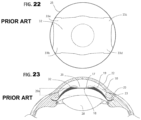
- the challenge in sizing PCP-IOLs is that the ciliary sulcus, where the PCP-IOL is to be positioned, is significantly different from person to person. In fact, the size of the ciliary sulcus typically ranges between 10.5 mm and 13 mm. If a physician implants an undersized PCP-IOL for the patient's anatomy ( Figures 20-21 ), the PCP-IOL may inadvertently contact the surface of the natural lens, thus affecting the precision of the lens system and possibly causing cataract formation. In addition, in cases involving PCP-IOLs for correcting astigmatism, an undersized lens can result in loss of corrective power of the PCP-IOL.
- an oversized PCP-IOL may result in complications as severe as glaucoma by pupillary blockage.
- an oversized PCP-IOL leads to other complications.
- implanting an oversized PCP-IOL can lead to pressure decompensation between the anterior and posterior chambers of the eye due to the pupillary blockage of the aqueous humor by the anterior part of the PCP-IOL, on the trabeculum.
- physicians often perform an iridectomy in connection with a PCP-IOL implantation.
- An iridectomy is a surgical puncture of the iris that establishes a passageway for the proper flow of aqueous between the anterior chamber and the posterior chamber.
- the iridectomy requires a highly skilled and experienced physician. Iridectomies are often times painful, or at least appreciably uncomfortable, for the patient.
- PCP-IOLs As an alternative to an iridectomy, certain PCP-IOLs have been created with a central hole in the lens that allows flow of aqueous between the anterior and posterior chambers, considerably improving the pressure compensation or equalization between the chambers. But such a hole in the lens seriously degrades lens quality because it causes light scattering and dazzling. This, in turn, results in positive and/or negative dysphotopsia.
- PCP-IOLs have an anterior surface or other parts that rasp or restrict movement of the iris during dilation of the pupil, thus causing depigmentation.
- Document US20070244560A1 discloses an intraocular lens with channels traversing through the surface of the lens optic for allowing flow of aqueous humor and then reducing the occurrence of pseudophakic pupillary block.
- Document US4547914A discloses an intraocular lens for implantation in an eye following cataract extraction, comprising flexible compressive loops attached to a lens, and a support structure at its rear face of the lens.
- Document WO2008051850A2 discloses a phakic intraocular lens comprising arms for holding the lens in proper position and orientation in an eye.
- Document WO2014108100A1 discloses an intraocular lens whose a front surface comprises support projections forming channels between the front surface and an eye's iris.
- Document EP0934038A1 discloses a phakic intraocular lens comprising an annular surface protruding from an anterior surface of the lens or surrounding the lens for making contact with an eye's iris.
- Document US4685920A discloses a lens implant for use as a replacement for a cataractic lens, the lens implant having a side with at least two arcuate ridges for an implantation in an eye with less irritation and less risk of infection.
- Document WO2014167425A1 discloses a lens device comprising an optical part, two generally flat haptic structures at radially opposite sides of the optical part, a vaulted section connecting the optical part and the haptic structures, and at least one opening for allowing liquid flow through the device.
- a defect of the above-mentioned intraocular lens is that they do not allow for a stable natural positioning of the lens in an eye's posterior chamber at a sufficient vaulted distance of a natural crystalline of this eye, while ensuring a permanent aqueous flow through the lens.
- Document WO2014167425A1 falls under Article 54(3) EPC.
- a PCP-IOL includes a haptic, adjustable struts, a collar, a lens, and a passageway that communicates between the front and back of the PCP-IOL.
- a PCP-IOL generally comprises: a smooth and continuous collar over a haptic, the collar having a steep inclination with smooth edges towards a lens zone.
- the collar creates a "tent" or pocket between the posterior face of the iris and the anterior surface of the PCP-IOL, allowing for natural positioning.
- the presence of one or more peripheral orifices, slits, passageways, or holes that connect an anterior surface and a posterior surface of the PCP-IOL may facilitate the passage of the aqueous humor.
- the positioning of such an orifice may eliminate or reduce dysphotopsic effects as set forth below.
- both the haptic and the lens zones form a substantially continuous surface, adjusting smoothly to the anterior surface of the crystalline lens.
- a haptic region includes two zones: proximal wings and distal adjustable struts that are partially separated from the wings.
- the shape and flexibility of the adjustable struts may allow for compression radially towards the lens, enhancing adaptation of PCP-IOL 10 to the ciliary sulcus.
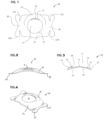
- FIGS 1-19 and 24-30 illustrate a posterior chamber phakic intraocular lens (“PCP-IOL”) 10 that adapts to an eye's anatomy to facilitate correction and treatment of ametropia and presbyopia, for example, or to ameliorate or minimize the effects of other eye disorders or vision deficiencies.
- PCP-IOL 10 has a haptic 12, a central lens 11 and an orifice 16 between an anterior surface and a posterior surface of PCP-IOL 10.
- haptic 12 comprises an elevated collar 14, wings 26, radially-elastic, adaptable struts 27a-d, and a central lens 11.
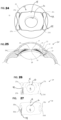
- a peripheral orifice 16 (defining an opening or passage between an anterior surface and a posterior surface of PCP-IOL 10) may be positioned proximate collar 14 and may be generally operative to allow aqueous flow either through lens 11 (e.g., Figures 1, 4 , and 15 ) or collar 14 itself (e.g., Figures 5, 6 , 24, 27 , 29 ).
- Lens 11 may be secured to the structure of haptic 12 in any of various ways generally known in the art; in that regard, the term "secured” in this context is intended to refer to any suitable technology or method operative to secure, fixedly attach, integrate, or otherwise to fuse or join lens 11 with haptic 12 consistent with their interoperability as are known in the art or developed in accordance with known principles.
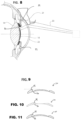
- orifice 16 may permit aqueous flow (depicted by arrows 32) between the anterior and posterior chambers of the eye, while collar 14 protects the opening of orifice 16 by deflecting iris 19 away from orifice 16. This deflection may serve to prevent iris 19 from occluding, obstructing, sealing or otherwise adhering to orifice 16 in a way that dangerously limits aqueous flow between the anterior and posterior chambers when the pupil is constricted.
- Struts 27 facilitate sizing of PCP-IOL 10 to the size of a patient's ciliary sulcus. Struts 27 may also function dynamically to position PCP-IOL 10, and in particular, to center lens 11, relative to a patient's natural lens.
- FIG. 1 illustrates one embodiment of haptic 12, which forms a platform for PCP-IOL 10.
- Haptic 12 is formed from any suitable flexible, biocompatible material (which has appropriate or desired optical qualities or lensing characteristics) that will be known to those of skill in the pertinent art.
- the surface of haptic 12 (and in particular, the surface of collar 14 that is in contact with iris 19) is preferably substantially smooth and curvilinear in order to preserve the pigmentation by avoiding a rough rubbing of iris 19 by haptic 12, in general, and collar 14, in particular.
- the shape and flexibility of PCP-IOL 10 allows it to be folded and unfolded by a physician to permit implantation in an eye.
- Haptic 12 includes lateral wings 26 and elastic struts 27a-d spaced apart from wings 26.
- Struts 27a-d of haptic 12 may be provided in different sizes, some being relatively shorter ( Figure 26 ) or relatively longer ( Figures 28 ) than others. Additionally or alternatively, struts 27a-d may be diverging ( Figure 26 ) or converging ( Figure 27 ). The radial elasticity of struts 27a-d permits flexing of the struts 27a-d in a way that reduces the exterior size of PCP-IOL 10, as shown in Figures 24 and 25 .
- struts 27a-d therefore provide significant tolerance or adaptability in use.
- struts 27a-d allow adjustment between about 5 microns and about 3000 microns.
- Such tolerance facilitates achieving a preferred 0.3mm-0.8mm space or gap (known as "vaulting") between lens 11 and an eye's natural lens even when there are differences between the predicted and actual size of the ciliary sulcus 25.
- Struts 27a-d also act to center and position lens 11 relative to the natural lens.
- Struts 27 can be provided at an angle between 0 degrees and 90 degrees relative to haptic 12. It is noted that the particular size, shape, orientation, and range of motion 44 of struts 27a-d may vary in accordance with eye anatomy, material selection, governmental or health code regulations, or a combination of these and other factors. The present disclosure is not intended to be limited by any particular configuration of struts 27a-d.
- haptic 12 may further include an elevated collar 14 forming a curved wall.
- the ends and surface of collar 14 may be smoothly sloped, curved, or graded into the structure of haptic 12, as illustrated in the embodiments of Figures 1 , 5 , and 9-11 .
- Such sloping allows collar 14 gently to bias or direct iris 19 away from orifice 16 without causing depigmentation.
- collar 14 protects orifice 16 from penetration by iris 19.
- iris 19 As the posterior surface of iris 19 slides over collar 14, the elevation of collar 14 (as compared to other portions of haptic 12) creates a natural chamber or tented region, allowing iris 19 to extend past orifice 16 without clogging, obstructing, occluding, or otherwise interfering with same. Because iris 19 passes over, but does not penetrate or directly obstruct orifice 16, it does not create a seal over orifice 16 or adhere to it. In some implementations, collar 14 also protects orifice 16 from obstruction when the pupil is dilated as shown in Figure 8 . This allows flow of aqueous at all times.
- Collar 14 may be a circumferential collar, or ring, that extends around all or substantially all of the circumference of lens 11 as shown in Figure 15 , for example.
- collar 14 may be implemented as a partial collar that extends around some portion of lens 11.
- Figure 1 illustrates an embodiment having an asymmetrical partial collar 14 in a superior portion of PCP-IOL 10.
- collar 14 may be formed as an elevation or bulge, as shown in Figure 18 .
- collar 14 may be positioned laterally beside lens 11.
- Orifice 16 may be provided through lens 11 as a slit, hole, or other suitable passageway; it is noted that it may be desirable in some embodiments to implement orifice 16 as a series or plurality of holes, slits, passageways, or perforations.
- Figures 1, 4 , 15 , and 27 illustrate orifice 16 as a slit or crescent or U-shaped opening through lens 11.
- orifice 16 may be provided through haptic 12, and more specifically, through a wall at the intersection of haptic 12 and lens 11 (see Figure 3 ).
- Figures 5 , 18 , and 24 show orifice 16 as a passageway through haptic 12.
- multiple orifices may be provided in lens 11; alternatively, an orifice 16 (or more than one) may be provided in both lens 11 and haptic 12.
- an orifice 16 (or more than one) may be provided in both lens 11 and haptic 12.
- Various configurations are contemplated, and the present disclosure is not intended to be limited to any particular location or configuration of a single instance or multiple instances of orifice 16.
- a superior location of orifice 16 may limit usual dysphotopsic effects because orifice 16 is concealed under the eyelid's shadow cone. That is, certain strategic positioning of orifice 16 may limit unwanted light scattering or dazzling effects in some instances because light rays 23 entering the eye are substantially or entirely blocked by the natural position of the open eyelid 21. Further, when the pupil is constricted, iris 19 may fully block light from entering orifice 16.
- Figure 3 shows that the elevation (or "height") 15 of a ridge associated with collar 14, in order to create a tent above an anterior surface 17 of lens 11 proximal to orifice 16, is such that it can create a greater unevenness 24 between a transition zone 13 and lens 11, depending on the dioptric power and shape of the lens 11.
- the unevenness 24 may be provided with smooth or rounded sides in order to achieve a soft rubbing with low friction against iris 19. In the foregoing manner, it is possible to enable aqueous humor to flow through orifice 16 in the tented region.
- Some embodiments may be adapted for use with a lens having a positive (+) meniscus.
- a periphery of lens 11 is positioned in a posterior plane 37. That is, lens 11 is "sunken” or recessed in haptic 12. This is because the pupil contracts and iris 19 gets closer to the highest elevation area of lens 11. This elevation area is preferably at the same or at a lower level of collar 14 to produce the tenting effect discussed above.
- PCP-IOL 10 is generally manufactured of biocompatible materials and comprises a lens component (lens 11), a two-zone haptic component (comprising haptic 12 and collar 14), and a transitional area between these two parts (such as represented by reference numerals 24 and 13 in Figure 3 ).
- Alternative embodiments may be adapted for use in connection with lenses having a negative (-) biconcave surface.
- the periphery of lens 11 may be located in a continuous mode regarding the anterior part of haptic 12.
Landscapes
- Health & Medical Sciences (AREA)
- Ophthalmology & Optometry (AREA)
- Cardiology (AREA)
- Oral & Maxillofacial Surgery (AREA)
- Transplantation (AREA)
- Engineering & Computer Science (AREA)
- Biomedical Technology (AREA)
- Heart & Thoracic Surgery (AREA)
- Vascular Medicine (AREA)
- Life Sciences & Earth Sciences (AREA)
- Animal Behavior & Ethology (AREA)
- General Health & Medical Sciences (AREA)
- Public Health (AREA)
- Veterinary Medicine (AREA)
- Physics & Mathematics (AREA)
- Fluid Mechanics (AREA)
- Prostheses (AREA)
Claims (14)
- Phake Hinterkammer-Intraokularlinse (10), die eine vordere Oberfläche und eine hintere Oberfläche aufweist und umfasst:eine Haptik (12); eine Linse (11), die an der Haptik (12) befestigt ist; undeinen Durchgang (16), der sich zwischen der vorderen Oberfläche und der hinteren Oberfläche erstreckt; wobei ein wässriger Strom durch den Durchgang (16) erlaubt wird, wobei die Haptik (12) umfasst:und dadurch, dass der Durchgang (16) neben dem erhöhten Bund (14) positioniert ist.- proximale Flügel (26);- distale Streben (27a-d), die teilweise von den proximalen Flügeln (26) getrennt sind und radial elastisch sind; unddadurch gekennzeichnet, dass die Haptik (12) weiter umfasst:- einen erhöhten Bund (14), der sich um mindestens einen Abschnitt der Linse (11) erstreckt und sich in Bezug auf die Linse (11) nach vorn erstreckt, wobei der erhöhte Bund eine steile Neigung mit glatten Kanten in Richtung der Linse (11) aufweist;
- Phake Hinterkammer-Intraokularlinse (10) nach dem vorstehenden Anspruch, dadurch gekennzeichnet, dass sich der Durchgang (16) durch die Linse (11) hindurch erstreckt.
- Phake Hinterkammer-Intraokularlinse (10) nach einem der vorstehenden Ansprüche, dadurch gekennzeichnet, dass der Durchgang (16) mindestens eines von einem Schlitz, einer Perforation, einer sichelförmigen Öffnung, einer U-förmigen Öffnung umfasst.
- Phake Hinterkammer-Intraokularlinse (10) nach einem der vorstehenden Ansprüche, dadurch gekennzeichnet, dass sich der Durchgang (16) durch eine Wand an dem Schnittpunkt der Haptik (12) und der Linse (11) hindurch erstreckt.
- Phake Hinterkammer-Intraokularlinse (10) nach einem der vorstehenden Ansprüche, dadurch gekennzeichnet, dass die phake Hinterkammer-Intraokularlinse (10) eine Vielzahl von Durchgängen umfasst, von denen einer der Durchgang (16) ist.
- Phake Hinterkammer-Intraokularlinse (10) nach dem vorstehenden Anspruch, dadurch gekennzeichnet, dass sich mindestens einer der Durchgänge (16) durch die Haptik (12) hindurch, bevorzugt durch den erhöhten Bund (14) hindurch erstreckt.
- Phake Hinterkammer-Intraokularlinse (10) nach einem der vorstehenden Ansprüche, dadurch gekennzeichnet, dass der erhöhte Bund (14) eine Sichel bildet, die verjüngte Enden aufweist.
- Phake Hinterkammer-Intraokularlinse (10) nach dem vorstehenden Anspruch, dadurch gekennzeichnet, dass der Durchgang (16) sichelförmig ist und im Wesentlichen entlang des Bunds (14) positioniert ist.
- Phake Hinterkammer-Intraokularlinse (10) nach einem der Ansprüche 1 bis 6, dadurch gekennzeichnet, dass der erhöhte Bund (14) ein Ring ist, der sich im Wesentlichen um einen gesamten Umfang der Linse (11) erstreckt.
- Phake Hinterkammer-Intraokularlinse (10) nach einem der Ansprüche 1 bis 6, dadurch gekennzeichnet, dass der erhöhte Bund (14) ein Teilbund ist, der sich um einen Abschnitt der Linse (11) erstreckt.
- Phake Hinterkammer-Intraokularlinse (10) nach dem vorstehenden Anspruch, dadurch gekennzeichnet, dass der erhöhte Bund (14) asymmetrisch ist.
- Phake Hinterkammer-Intraokularlinse (10) nach einem der vorstehenden Ansprüche, dadurch gekennzeichnet, dass Enden und eine Oberfläche des erhöhten Bunds (14) sanft geneigt, gekrümmt oder in eine Struktur der Haptik (12) übergehend sind.
- Phake Hinterkammer-Intraokularlinse (10) nach einem der vorstehenden Ansprüche, dadurch gekennzeichnet, dass die Linse (11) eine positive Meniskuslinse ist.
- Phake Hinterkammer-Intraokularlinse (10) nach einem der Ansprüche 1 bis 12, dadurch gekennzeichnet, dass die Linse (11) eine negative Meniskuslinse ist.
Applications Claiming Priority (2)
| Application Number | Priority Date | Filing Date | Title |
|---|---|---|---|
| US201462059546P | 2014-10-03 | 2014-10-03 | |
| PCT/US2015/053948 WO2016054624A1 (en) | 2014-10-03 | 2015-10-05 | Improved intraocular lens |
Publications (4)
| Publication Number | Publication Date |
|---|---|
| EP3200725A1 EP3200725A1 (de) | 2017-08-09 |
| EP3200725A4 EP3200725A4 (de) | 2018-08-08 |
| EP3200725C0 EP3200725C0 (de) | 2025-01-01 |
| EP3200725B1 true EP3200725B1 (de) | 2025-01-01 |
Family
ID=55631681
Family Applications (1)
| Application Number | Title | Priority Date | Filing Date |
|---|---|---|---|
| EP15846415.6A Active EP3200725B1 (de) | 2014-10-03 | 2015-10-05 | Verbesserte intraokularlinse |
Country Status (4)
| Country | Link |
|---|---|
| US (1) | US10085832B2 (de) |
| EP (1) | EP3200725B1 (de) |
| ES (1) | ES3008711T3 (de) |
| WO (1) | WO2016054624A1 (de) |
Families Citing this family (5)
| Publication number | Priority date | Publication date | Assignee | Title |
|---|---|---|---|---|
| ES2902601T3 (es) * | 2018-08-14 | 2022-03-29 | Physiol | Lente intraocular fáquica de cámara posterior |
| BE1027321B1 (fr) | 2019-05-29 | 2021-01-13 | Physiol | Implant phaque de chambre postérieure |
| US12023238B2 (en) | 2021-10-14 | 2024-07-02 | Physiol | Posterior chamber phakic intraocular lens |
| CN118555943A (zh) * | 2021-10-18 | 2024-08-27 | 安纽人工晶状体技术股份有限公司 | 三维人工晶状体支架和附加晶状体的组合以及植入方法 |
| DE102024139050B3 (de) * | 2024-12-19 | 2026-01-29 | Carl Zeiss Meditec Ag | Asymmetrische phake Intraokularlinse |
Family Cites Families (14)
| Publication number | Priority date | Publication date | Assignee | Title |
|---|---|---|---|---|
| US4547914A (en) * | 1982-09-02 | 1985-10-22 | Castleman Lawrence D | Intraocular posterior chamber lens |
| US4585456A (en) | 1984-03-12 | 1986-04-29 | Ioptex Inc. | Corrective lens for the natural lens of the eye |
| US4685920A (en) * | 1986-01-31 | 1987-08-11 | Fritch Charles D | Intraocular lens |
| US5258025A (en) | 1990-11-21 | 1993-11-02 | Fedorov Svjatoslav N | Corrective intraocular lens |
| RU2033114C1 (ru) | 1993-04-22 | 1995-04-20 | Межотраслевой научно-технический комплекс "Микрохирургия глаза" | Искусственный хрусталик глаза |
| NZ294525A (en) | 1994-10-06 | 1999-09-29 | Feingold Vladimir | Intraocular contact lens with smooth transition of outer surface between centre lens portion and lens body portion, and a groove |
| US6015435A (en) * | 1996-10-24 | 2000-01-18 | International Vision, Inc. | Self-centering phakic intraocular lens |
| US6506212B2 (en) | 2000-07-07 | 2003-01-14 | Medennium, Inc. | Anatomically compatible posterior chamber phakic refractive lenses |
| US7780729B2 (en) * | 2004-04-16 | 2010-08-24 | Visiogen, Inc. | Intraocular lens |
| US20120330415A1 (en) * | 2011-06-23 | 2012-12-27 | Anew Optics, Inc. | Haptic devices for intraocular lens |
| US20070244560A1 (en) * | 2006-04-12 | 2007-10-18 | Alexei Ossipov | Intraocular lens with distortion free valve |
| US20080109078A1 (en) * | 2006-10-20 | 2008-05-08 | Implantable Vision, Inc. | Posterior chamber phakic intraocular lens |
| CN103006351A (zh) * | 2013-01-14 | 2013-04-03 | 杭州百康医用技术有限公司 | 眼内透镜 |
| US20160058552A1 (en) * | 2013-04-10 | 2016-03-03 | Jagrat Natavar DAVE | Phakic lens device with openings and concentric annular zones |
-
2015
- 2015-10-05 EP EP15846415.6A patent/EP3200725B1/de active Active
- 2015-10-05 ES ES15846415T patent/ES3008711T3/es active Active
- 2015-10-05 WO PCT/US2015/053948 patent/WO2016054624A1/en not_active Ceased
- 2015-10-05 US US14/874,770 patent/US10085832B2/en active Active
Also Published As
| Publication number | Publication date |
|---|---|
| EP3200725A1 (de) | 2017-08-09 |
| ES3008711T3 (en) | 2025-03-24 |
| US20160095699A1 (en) | 2016-04-07 |
| EP3200725C0 (de) | 2025-01-01 |
| US10085832B2 (en) | 2018-10-02 |
| EP3200725A4 (de) | 2018-08-08 |
| WO2016054624A1 (en) | 2016-04-07 |
Similar Documents
| Publication | Publication Date | Title |
|---|---|---|
| JP7672732B2 (ja) | 水晶体嚢壁の前尖による固定機構を備えた眼内偽水晶体コンタクトレンズ及びそれに関連するシステムと方法 | |
| US5192319A (en) | Intraocular refractive lens | |
| US7186266B2 (en) | Bifocal intraocular telescope for low vision correction | |
| JP5793558B2 (ja) | 眼内インプラント虹彩絞り | |
| JP5705529B2 (ja) | 嚢内保持具 | |
| US10085832B2 (en) | Intraocular lens | |
| US10010405B2 (en) | Haptic devices for intraocular lens | |
| EP3171821B1 (de) | Haptische vorrichtungen für intraokularlinse | |
| JP2000504612A (ja) | 近視矯正用眼内インプラント | |
| CA2366818C (en) | Implant for correcting presbyopia in phakic eyes | |
| KR102950908B1 (ko) | 캡슐모양체 벽의 전방 리플릿에 의해 고정되기 위한 메카니즘을 갖는 안구 내 인공수정체 콘택트 렌즈, 관련 시스템 및 방법 | |
| US12036111B2 (en) | Method of implantation of an intraocular lens in a ciliary sulcus of an eye | |
| US10925721B2 (en) | Optical implantable member | |
| US10575943B2 (en) | Vision correction systems and methods for using an intraocular lens enclosed in an inner capsulated bag | |
| JP2008510575A (ja) | 適合可能なハプティックを備える折曲可能な眼内レンズ | |
| HK40056093B (en) | Intraocular pseudophakic contact lens with mechanism for securing by anterior leaflet of capsular wall and related system and method | |
| HK40055741B (en) | Intraocular pseudophakic contact lens with mechanism for securing by anterior leaflet of capsular wall and related system and method | |
| HK40056092B (en) | Intraocular pseudophakic contact lens with mechanism for securing by anterior leaflet of capsular wall and related system and method | |
| HK40078421B (zh) | 具有用於通过囊壁的前小叶固定的机构的人工假晶状体接触镜片及相关系统和方法 | |
| Ghiaroni et al. | The triangular suture | |
| Menapace | Cataract Surgical Problem: November consultation# 1 | |
| CZ20001271A3 (cs) | Oční protéza bělimy a její použití pro výrobu protézy bělimy pro léčbu presbyopie a jiných onemocnění oka |
Legal Events
| Date | Code | Title | Description |
|---|---|---|---|
| STAA | Information on the status of an ep patent application or granted ep patent |
Free format text: STATUS: THE INTERNATIONAL PUBLICATION HAS BEEN MADE |
|
| PUAI | Public reference made under article 153(3) epc to a published international application that has entered the european phase |
Free format text: ORIGINAL CODE: 0009012 |
|
| STAA | Information on the status of an ep patent application or granted ep patent |
Free format text: STATUS: REQUEST FOR EXAMINATION WAS MADE |
|
| 17P | Request for examination filed |
Effective date: 20170526 |
|
| AK | Designated contracting states |
Kind code of ref document: A1 Designated state(s): AL AT BE BG CH CY CZ DE DK EE ES FI FR GB GR HR HU IE IS IT LI LT LU LV MC MK MT NL NO PL PT RO RS SE SI SK SM TR |
|
| AX | Request for extension of the european patent |
Extension state: BA ME |
|
| DAV | Request for validation of the european patent (deleted) | ||
| DAX | Request for extension of the european patent (deleted) | ||
| RAP1 | Party data changed (applicant data changed or rights of an application transferred) |
Owner name: SMARTECH I LLC |
|
| RIC1 | Information provided on ipc code assigned before grant |
Ipc: A61F 2/16 20060101AFI20180626BHEP |
|
| A4 | Supplementary search report drawn up and despatched |
Effective date: 20180705 |
|
| STAA | Information on the status of an ep patent application or granted ep patent |
Free format text: STATUS: EXAMINATION IS IN PROGRESS |
|
| 17Q | First examination report despatched |
Effective date: 20210112 |
|
| GRAP | Despatch of communication of intention to grant a patent |
Free format text: ORIGINAL CODE: EPIDOSNIGR1 |
|
| STAA | Information on the status of an ep patent application or granted ep patent |
Free format text: STATUS: GRANT OF PATENT IS INTENDED |
|
| INTG | Intention to grant announced |
Effective date: 20240917 |
|
| GRAS | Grant fee paid |
Free format text: ORIGINAL CODE: EPIDOSNIGR3 |
|
| GRAA | (expected) grant |
Free format text: ORIGINAL CODE: 0009210 |
|
| STAA | Information on the status of an ep patent application or granted ep patent |
Free format text: STATUS: THE PATENT HAS BEEN GRANTED |
|
| AK | Designated contracting states |
Kind code of ref document: B1 Designated state(s): AL AT BE BG CH CY CZ DE DK EE ES FI FR GB GR HR HU IE IS IT LI LT LU LV MC MK MT NL NO PL PT RO RS SE SI SK SM TR |
|
| REG | Reference to a national code |
Ref country code: GB Ref legal event code: FG4D |
|
| REG | Reference to a national code |
Ref country code: CH Ref legal event code: EP |
|
| REG | Reference to a national code |
Ref country code: DE Ref legal event code: R096 Ref document number: 602015090776 Country of ref document: DE |
|
| REG | Reference to a national code |
Ref country code: IE Ref legal event code: FG4D |
|
| U01 | Request for unitary effect filed |
Effective date: 20250107 |
|
| U07 | Unitary effect registered |
Designated state(s): AT BE BG DE DK EE FI FR IT LT LU LV MT NL PT RO SE SI Effective date: 20250115 |
|
| REG | Reference to a national code |
Ref country code: ES Ref legal event code: FG2A Ref document number: 3008711 Country of ref document: ES Kind code of ref document: T3 Effective date: 20250324 |
|
| PG25 | Lapsed in a contracting state [announced via postgrant information from national office to epo] |
Ref country code: PL Free format text: LAPSE BECAUSE OF FAILURE TO SUBMIT A TRANSLATION OF THE DESCRIPTION OR TO PAY THE FEE WITHIN THE PRESCRIBED TIME-LIMIT Effective date: 20250101 |
|
| PG25 | Lapsed in a contracting state [announced via postgrant information from national office to epo] |
Ref country code: IS Free format text: LAPSE BECAUSE OF FAILURE TO SUBMIT A TRANSLATION OF THE DESCRIPTION OR TO PAY THE FEE WITHIN THE PRESCRIBED TIME-LIMIT Effective date: 20250501 Ref country code: NO Free format text: LAPSE BECAUSE OF FAILURE TO SUBMIT A TRANSLATION OF THE DESCRIPTION OR TO PAY THE FEE WITHIN THE PRESCRIBED TIME-LIMIT Effective date: 20250401 |
|
| PG25 | Lapsed in a contracting state [announced via postgrant information from national office to epo] |
Ref country code: HR Free format text: LAPSE BECAUSE OF FAILURE TO SUBMIT A TRANSLATION OF THE DESCRIPTION OR TO PAY THE FEE WITHIN THE PRESCRIBED TIME-LIMIT Effective date: 20250101 |
|
| PG25 | Lapsed in a contracting state [announced via postgrant information from national office to epo] |
Ref country code: GR Free format text: LAPSE BECAUSE OF FAILURE TO SUBMIT A TRANSLATION OF THE DESCRIPTION OR TO PAY THE FEE WITHIN THE PRESCRIBED TIME-LIMIT Effective date: 20250402 |
|
| PG25 | Lapsed in a contracting state [announced via postgrant information from national office to epo] |
Ref country code: CZ Free format text: LAPSE BECAUSE OF FAILURE TO SUBMIT A TRANSLATION OF THE DESCRIPTION OR TO PAY THE FEE WITHIN THE PRESCRIBED TIME-LIMIT Effective date: 20250101 |
|
| PG25 | Lapsed in a contracting state [announced via postgrant information from national office to epo] |
Ref country code: SM Free format text: LAPSE BECAUSE OF FAILURE TO SUBMIT A TRANSLATION OF THE DESCRIPTION OR TO PAY THE FEE WITHIN THE PRESCRIBED TIME-LIMIT Effective date: 20250101 |
|
| U20 | Renewal fee for the european patent with unitary effect paid |
Year of fee payment: 11 Effective date: 20250915 |
|
| PG25 | Lapsed in a contracting state [announced via postgrant information from national office to epo] |
Ref country code: SK Free format text: LAPSE BECAUSE OF FAILURE TO SUBMIT A TRANSLATION OF THE DESCRIPTION OR TO PAY THE FEE WITHIN THE PRESCRIBED TIME-LIMIT Effective date: 20250101 |
|
| PLBE | No opposition filed within time limit |
Free format text: ORIGINAL CODE: 0009261 |
|
| STAA | Information on the status of an ep patent application or granted ep patent |
Free format text: STATUS: NO OPPOSITION FILED WITHIN TIME LIMIT |
|
| REG | Reference to a national code |
Ref country code: CH Ref legal event code: L10 Free format text: ST27 STATUS EVENT CODE: U-0-0-L10-L00 (AS PROVIDED BY THE NATIONAL OFFICE) Effective date: 20251112 |
|
| 26N | No opposition filed |
Effective date: 20251002 |
|
| PGFP | Annual fee paid to national office [announced via postgrant information from national office to epo] |
Ref country code: GB Payment date: 20251023 Year of fee payment: 11 |
|
| PGFP | Annual fee paid to national office [announced via postgrant information from national office to epo] |
Ref country code: ES Payment date: 20251118 Year of fee payment: 11 |
|
| REG | Reference to a national code |
Ref country code: CH Ref legal event code: H13 Free format text: ST27 STATUS EVENT CODE: U-0-0-H10-H13 (AS PROVIDED BY THE NATIONAL OFFICE) Effective date: 20260527 |
|
| PG25 | Lapsed in a contracting state [announced via postgrant information from national office to epo] |
Ref country code: MC Free format text: LAPSE BECAUSE OF FAILURE TO SUBMIT A TRANSLATION OF THE DESCRIPTION OR TO PAY THE FEE WITHIN THE PRESCRIBED TIME-LIMIT Effective date: 20250101 |
|
| PG25 | Lapsed in a contracting state [announced via postgrant information from national office to epo] |
Ref country code: RS Free format text: LAPSE BECAUSE OF FAILURE TO SUBMIT A TRANSLATION OF THE DESCRIPTION OR TO PAY THE FEE WITHIN THE PRESCRIBED TIME-LIMIT Effective date: 20250101 |
|
| PG25 | Lapsed in a contracting state [announced via postgrant information from national office to epo] |
Ref country code: CH Free format text: LAPSE BECAUSE OF NON-PAYMENT OF DUE FEES Effective date: 20251031 |