EP3199144B1 - Pharmazeutische zusammensetzung zur behandlung parodontaler oder periimplantärer erkrankungen - Google Patents
Pharmazeutische zusammensetzung zur behandlung parodontaler oder periimplantärer erkrankungen Download PDFInfo
- Publication number
- EP3199144B1 EP3199144B1 EP17153191.6A EP17153191A EP3199144B1 EP 3199144 B1 EP3199144 B1 EP 3199144B1 EP 17153191 A EP17153191 A EP 17153191A EP 3199144 B1 EP3199144 B1 EP 3199144B1
- Authority
- EP
- European Patent Office
- Prior art keywords
- substance
- pharmaceutical composition
- capsules
- range
- mpas
- Prior art date
- Legal status (The legal status is an assumption and is not a legal conclusion. Google has not performed a legal analysis and makes no representation as to the accuracy of the status listed.)
- Active
Links
Images
Classifications
-
- A—HUMAN NECESSITIES
- A61—MEDICAL OR VETERINARY SCIENCE; HYGIENE
- A61K—PREPARATIONS FOR MEDICAL, DENTAL OR TOILETRY PURPOSES
- A61K9/00—Medicinal preparations characterised by special physical form
- A61K9/0012—Galenical forms characterised by the site of application
- A61K9/0053—Mouth and digestive tract, i.e. intraoral and peroral administration
- A61K9/0063—Periodont
-
- A—HUMAN NECESSITIES
- A61—MEDICAL OR VETERINARY SCIENCE; HYGIENE
- A61K—PREPARATIONS FOR MEDICAL, DENTAL OR TOILETRY PURPOSES
- A61K31/00—Medicinal preparations containing organic active ingredients
- A61K31/12—Ketones
- A61K31/122—Ketones having the oxygen directly attached to a ring, e.g. quinones, vitamin K1, anthralin
-
- A—HUMAN NECESSITIES
- A61—MEDICAL OR VETERINARY SCIENCE; HYGIENE
- A61K—PREPARATIONS FOR MEDICAL, DENTAL OR TOILETRY PURPOSES
- A61K33/00—Medicinal preparations containing inorganic active ingredients
- A61K33/18—Iodine; Compounds thereof
-
- A—HUMAN NECESSITIES
- A61—MEDICAL OR VETERINARY SCIENCE; HYGIENE
- A61K—PREPARATIONS FOR MEDICAL, DENTAL OR TOILETRY PURPOSES
- A61K33/00—Medicinal preparations containing inorganic active ingredients
- A61K33/24—Heavy metals; Compounds thereof
- A61K33/28—Mercury; Compounds thereof
-
- A—HUMAN NECESSITIES
- A61—MEDICAL OR VETERINARY SCIENCE; HYGIENE
- A61K—PREPARATIONS FOR MEDICAL, DENTAL OR TOILETRY PURPOSES
- A61K33/00—Medicinal preparations containing inorganic active ingredients
- A61K33/40—Peroxides
-
- A—HUMAN NECESSITIES
- A61—MEDICAL OR VETERINARY SCIENCE; HYGIENE
- A61K—PREPARATIONS FOR MEDICAL, DENTAL OR TOILETRY PURPOSES
- A61K47/00—Medicinal preparations characterised by the non-active ingredients used, e.g. carriers or inert additives; Targeting or modifying agents chemically bound to the active ingredient
- A61K47/06—Organic compounds, e.g. natural or synthetic hydrocarbons, polyolefins, mineral oil, petrolatum or ozokerite
- A61K47/08—Organic compounds, e.g. natural or synthetic hydrocarbons, polyolefins, mineral oil, petrolatum or ozokerite containing oxygen, e.g. ethers, acetals, ketones, quinones, aldehydes, peroxides
- A61K47/14—Esters of carboxylic acids, e.g. fatty acid monoglycerides, medium-chain triglycerides, parabens or PEG fatty acid esters
-
- A—HUMAN NECESSITIES
- A61—MEDICAL OR VETERINARY SCIENCE; HYGIENE
- A61K—PREPARATIONS FOR MEDICAL, DENTAL OR TOILETRY PURPOSES
- A61K47/00—Medicinal preparations characterised by the non-active ingredients used, e.g. carriers or inert additives; Targeting or modifying agents chemically bound to the active ingredient
- A61K47/30—Macromolecular organic or inorganic compounds, e.g. inorganic polyphosphates
- A61K47/36—Polysaccharides; Derivatives thereof, e.g. gums, starch, alginate, dextrin, hyaluronic acid, chitosan, inulin, agar or pectin
-
- A—HUMAN NECESSITIES
- A61—MEDICAL OR VETERINARY SCIENCE; HYGIENE
- A61K—PREPARATIONS FOR MEDICAL, DENTAL OR TOILETRY PURPOSES
- A61K9/00—Medicinal preparations characterised by special physical form
- A61K9/06—Ointments; Bases therefor; Other semi-solid forms, e.g. creams, sticks, gels
-
- A—HUMAN NECESSITIES
- A61—MEDICAL OR VETERINARY SCIENCE; HYGIENE
- A61K—PREPARATIONS FOR MEDICAL, DENTAL OR TOILETRY PURPOSES
- A61K9/00—Medicinal preparations characterised by special physical form
- A61K9/48—Preparations in capsules, e.g. of gelatin, of chocolate
- A61K9/50—Microcapsules having a gas, liquid or semi-solid filling; Solid microparticles or pellets surrounded by a distinct coating layer, e.g. coated microspheres, coated drug crystals
- A61K9/5005—Wall or coating material
- A61K9/5021—Organic macromolecular compounds
- A61K9/5036—Polysaccharides, e.g. gums, alginate; Cyclodextrin
-
- A—HUMAN NECESSITIES
- A61—MEDICAL OR VETERINARY SCIENCE; HYGIENE
- A61K—PREPARATIONS FOR MEDICAL, DENTAL OR TOILETRY PURPOSES
- A61K9/00—Medicinal preparations characterised by special physical form
- A61K9/48—Preparations in capsules, e.g. of gelatin, of chocolate
- A61K9/50—Microcapsules having a gas, liquid or semi-solid filling; Solid microparticles or pellets surrounded by a distinct coating layer, e.g. coated microspheres, coated drug crystals
- A61K9/51—Nanocapsules; Nanoparticles
- A61K9/5107—Excipients; Inactive ingredients
- A61K9/513—Organic macromolecular compounds; Dendrimers
- A61K9/5161—Polysaccharides, e.g. alginate, chitosan, cellulose derivatives; Cyclodextrin
-
- A—HUMAN NECESSITIES
- A61—MEDICAL OR VETERINARY SCIENCE; HYGIENE
- A61P—SPECIFIC THERAPEUTIC ACTIVITY OF CHEMICAL COMPOUNDS OR MEDICINAL PREPARATIONS
- A61P31/00—Antiinfectives, i.e. antibiotics, antiseptics, chemotherapeutics
Definitions
- the invention relates to a pharmaceutical composition for topical use in the treatment of periodontal and / or peri-implant diseases in humans or mammals.
- Periodontitis is an inflammatory degenerative disease of the periodontium (periodontium, attachment). Periodontitis is characterized not only by a bacterial infection, but as a concomitant occurrence of unphysio strig deep "pockets" (spaces between the teeth and the surrounding gums) and an alveolar bone loss, which can ultimately lead to tooth loss. Peri-implantitis manifests itself in a loss of hard-tissue (bony) support around a dental implant that functions as an artificial tooth root, combined with an inflammatory response of the peri-implant soft tissues (med. Mucositis). Essentially similar structured microbial biofilms are involved as in periodontitis.
- the main goal in the treatment of periodontitis and peri-implantitis is the reduction of bacterial load in the periodontium. Because the bacteria are located in said biofilm, thorough oral hygiene and mechanical removal of plaque is a major approach in the treatment of periodontal disease.
- the local drug treatment is state of the art: So is in the WO 92/00718 A Described a system for the controlled release of chemotherapeutic agents in certain areas of the mouth, for the treatment of periodontal diseases.
- the previously known method consists in the placement of a polymer delivery system directly in the gum tissue.
- the introduction of the pharmaceutically active substances should not take place in the alveolar pouch, ie the space between the infected alveolar tissue and the tooth.
- the aforementioned delivery system may, for example, microcapsules, but also microspheres, liposome fibers, rods, films and the like, in each of which the pharmaceutically active substance is housed.
- the capsule material either biodegradable or non-biodegradable polymer is mentioned, the former is preferred because a removal is omitted after the end of treatment.
- the drug to be released should either have antimicrobial properties or have an anti-inflammatory effect. Through a flow of serum from the gum tissue into the alveolar pouch sufficient drug levels to kill the bacteria in both the tissue and in the bag are created.
- advantages over delivery systems are described, which are arranged in the alveolar bag itself. But even the application in the gum tissue itself is advantageous because the normal dental hygiene procedures then unintentional removal of the active ingredients from the treatment site can not effect.
- WO 96/13253 A the use of a tetracycline-type antibiotic for the treatment of periodontal disease.
- a biodegradable delivery system for the release of the active ingredients is described. It consists of a core of a sodium alginate unit and the pharmaceutical agent. The surface should be coated with chitosan.
- microcapsules with polysaccharide is also mentioned.
- active ingredients are listed either various antibiotics, but alternatively also ibuprofen and fluriprofen.
- an oral composition with a biocompatible chelating agent in a minimum concentration of 0.1 wt .-% known contains a substance which is to improve the penetration.
- the known composition is to be combined with a delivery system in the form of a liposomal dispersion. Also called colloidal suspensions of microcapsules and nanocapsules. Due to the biofilm properties of the plaque, a fight against periodontitis or peri-implantitis causing bacteria is rejected with the help of antibiotic agents. Rather, a cross-reactivity between different functional constituents of the plaque should be controlled and destroyed, for which purpose the aforementioned complexing agents, in particular EDTA, should be used.
- compositions for topical use are a pharmaceutical composition for topical use, inter alia, in the treatment of dental diseases known.
- the previously known composition contains a carrier in which a plurality of microcapsules are embedded, wherein the microcapsules each have a core-shell structure respectively.
- Inside the microcapsules is at least one active ingredient that should be protected by microcapsule placement prior to topical application and controlled after initiation of application and released over a longer period of time at the treatment site.
- the main application of the previously known composition is the treatment of acne and for this purpose benzoyl peroxide is proposed as the preferred active ingredient to be incorporated into the microcapsules, which on the one hand would have insufficient stability without the encapsulation and, on the other hand, destroy other active ingredients in the composition because of its high reactivity or at least could harm.
- benzoyl peroxide is proposed as the preferred active ingredient to be incorporated into the microcapsules, which on the one hand would have insufficient stability without the encapsulation and, on the other hand, destroy other active ingredients in the composition because of its high reactivity or at least could harm.
- the use of the previously known microcapsules with benzoyl peroxide contained therein has also been proposed as an antibacterial and bleaching agent in toothpaste.
- WO 90/00048 A1 US 5500228 and US2013 / 0195953 A1 Delivery systems for active ingredients are known in which, in the case of topical application, a time-controlled release of the active ingredient from the delivery system is to be achieved.
- the delivery system should be embedded in a viscous carrier in the form of a thermogel.
- the sustained-release delivery system consists of microcapsules in the form of a semipermeable anisotopic salt film formed by a reaction of a Lewis acid or a salt thereof with a Lewis brine or a salt thereof.
- Within the carrier may be included another active ingredient which may be different from or identical to the microencapsulated agent.
- antibiotics are named as active ingredients.
- microcapsules that are not embedded in a separate carrier.
- the microencapsulated agents may be either an antibiotic or an antiseptic or other agents.
- the polymer forming the shell of the microcapsules is said to acquire a sticky property by contact with moisture and to adhere to the tissue with which it comes into contact and thus be protected from too rapid leaching.
- the microcapsules have the task, on the one hand to protect the active substance contained therein from external influences until the date of application and, secondly, to ensure a controlled release rate over time. Since no carrier is present around the microcapsules, no unencapsulated drug can be included in the previously known pharmaceutical composition.
- the document EP 0244118 discloses controlled release periodontal preparations comprising a) encapsulated drugs as microparticles and b) a suspending medium for the microparticles.
- US 2013/0195953 A1 another method for the treatment of inflammation in which microcapsules may be suspended in a carrier in the form of a gel.
- the topical application of the pharmaceutical composition should also be for the treatment of inflammation as a result of periodontal disease.
- an NSAID or resolvin should be used as active ingredients in the known composition.
- the use of antibiotics or antiseptics is in the US 2013/0195953 A1 not suggested. All previously known treatment methods and the active ingredients used have unfortunately proved to be only partially effective.
- the invention has for its object to provide a pharmaceutical composition with which the treatment success over the prior art can be improved.
- Another essential aspect of the invention is the realization of a sufficiently high viscosity, so that the applied composition as long as possible at the treatment site, i. especially within a periodontal pocket, remains and is not delivered too early by saliva, endogenous secretions, food or other influences.
- the consistency of the application proposed in the invention corresponds approximately to that of honey or syrup, thus allowing a certain distribution and a "tough flow" from an application instrument and distribution within the tooth pocket, but prevents unwanted and rapid escape from the same.
- the viscosity of the composition after application as a result of an interaction with body fluid and / or by increasing from room temperature to physiological body temperature (about 36 ° C. to 38 ° C.). After distribution in the periodontal or peri-implant pocket, such an increase in viscosity is helpful because the risk of undesirable leakage or washout is further reduced.
- the viscosity after completion of the hardening induced by the body fluid and / or temperature increase could be in the range of about 10 3 to 10 6 mPas, which corresponds to a "pasty" consistency.
- the realization of a viscosity in the aforementioned interval before application is unfavorable, since a uniform distribution in the tooth pocket can not then be ensured or the application is made difficult with conventional instruments.
- the subsequent increase in viscosity can be based on the fact that by increasing the temperature (of room temperature or cooling temperature when stored at body temperature) form precipitations, which change the carrier within the composition in its fluidity.
- the capsules may be nano- and / or microcapsules.
- One possible substance for the capsules is e.g. a polysaccharide.
- an outer coating may be applied to the capsules.
- a release of the contained at least one antibiotic substance takes place in a period between 1 day and 10 days from the application, whereas in a possible second proportion of the capsules a release in a period of time between 1 day and 20 days from the application. It is also possible to use more than two components with a different release characteristic. This can be useful especially for very long treatment periods. It may be useful to introduce into the capsules with the different release characteristics the same antibiotic substance, or different antibiotic substances. A combination is also conceivable, e.g. in the sense that a first antibiotic agent is contained in two or more capsule types having different release characteristics, and a second or even a third antibiotic agent is also housed respectively in two or more capsule types having different release characteristics.
- the carrier is a gel, alginate, a lipid composition or a mixture of the aforementioned substances.
- additives to the carrier natural resins can be used to increase the consistency in particular, to increase the viscosity.
- the fat composition may also be an emulsion, in particular one having a continuous water phase, in order to ensure patency for the at least one antibiotic substance and / or the at least one antiseptic substance.
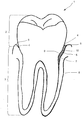
- the drawing shows a schematic section through a human jaw.
- a tooth 1 can be subdivided into a tooth crown 2 and a tooth root 3, wherein a border line 4 enclosing the tooth 1 in the circumferential direction delimits the tooth crown 2 from the tooth root 3.
- the dental crown 2 is therefore the part of the tooth 1 that is clinically visible in the oral cavity in the case of healthy, morphologically regular conditions.
- the gingiva 5 merges into the internal junctional epithelium 7.
- the connection between the tooth root 3 and the periodontal bone 8 is made by a holding apparatus made of fibers.
- the pharmaceutical composition according to the invention is introduced by means of a suitable application instrument (for example a cannula) into a periodontal or peri-implant pocket 10 located between a surface 9 of the tooth root 3 on the one hand and the gingiva 5 or the inner saphenous epithelium 7 on the other hand.
- a suitable application instrument for example a cannula
- a biofilm adhering to the surface 9 of the tooth root is removed mechanically and / or chemically destroyed in order to reduce the bacterial load on the pocket 10 and to create the best possible initial conditions for the subsequent drug treatment.
- the pharmaceutical composition comprises as carrier, as described above, a gel, alginate, a lipid composition or a mixture of the aforementioned substances.
- natural resins can be used to influence the consistency.
- Propylene glycol alginates [PGA] are particularly suitable from the substance class of alginates / alginate derivatives, since these are synthesizable and have long been successfully used as carriers for the controlled release of medicaments, for example in so-called sustained-release tablets.
- micro- or nanocapsules as independent carrier for the at least one antibiotic substance.
- These polysaccharide micro- or nanocapsules have a spherical or egg-shaped 3-dimensional shape of 100 to 10,000 nm in diameter.
- Microcapsules or nanocapsules can be synthesized and can be added to the carrier, which has to behave chemically neutrally with respect to the micro- or nanocapsules (no lysis of the micro- or nanocapsules by the carrier).
- an antiseptic substance in the form of hydrogen peroxide is present in the carrier.
- the dynamic viscosity of the composition before application at room temperature (20 ° C) is about 100 mPas.
- the treatment for peri-implantitis is analogous to the above-described procedure for periodontitis, except that the introduction into a peri-implant pocket between a no longer osseointegrated implant surface and the inflammatory altered peri-implant soft tissue occurs.
Landscapes
- Health & Medical Sciences (AREA)
- Chemical & Material Sciences (AREA)
- Pharmacology & Pharmacy (AREA)
- Veterinary Medicine (AREA)
- Public Health (AREA)
- General Health & Medical Sciences (AREA)
- Medicinal Chemistry (AREA)
- Animal Behavior & Ethology (AREA)
- Life Sciences & Earth Sciences (AREA)
- Epidemiology (AREA)
- Engineering & Computer Science (AREA)
- Inorganic Chemistry (AREA)
- Bioinformatics & Cheminformatics (AREA)
- General Chemical & Material Sciences (AREA)
- Chemical Kinetics & Catalysis (AREA)
- Biomedical Technology (AREA)
- Physics & Mathematics (AREA)
- Oncology (AREA)
- Organic Chemistry (AREA)
- Nanotechnology (AREA)
- Optics & Photonics (AREA)
- Communicable Diseases (AREA)
- Nutrition Science (AREA)
- Physiology (AREA)
- Nuclear Medicine, Radiotherapy & Molecular Imaging (AREA)
- Oil, Petroleum & Natural Gas (AREA)
- Medicinal Preparation (AREA)
- Pharmaceuticals Containing Other Organic And Inorganic Compounds (AREA)
Description
- Die Erfindung betrifft eine pharmazeutische Zusammensetzung zur topischen Anwendung bei der Behandlung parodontaler und/oder periimplantärer Erkrankungen bei Menschen oder Säugetieren.
- Bei Parodontitis handelt es sich um eine entzündlich-degenerative Erkrankung des Parodontiums (Zahnhalteapparat, Attachment). Parodontitis ist dabei nicht nur durch eine bakterielle Infektion gekennzeichnet, sondern als Begleiterscheinungen treten die Ausprägung unphysiologisch tiefer "Taschen" (Räume zwischen den Zähnen und dem umgebenden Zahnfleisch) sowie ein alveolärer Knochenabbau auf, der letztlich zu einem Zahnverlust führen kann. Periimplantitis manifestiert sich in einem Verlust der hartgewebigen (knöchernen) Abstützung um ein Zahnimplantat, welches als künstliche Zahnwurzel funktioniert, kombiniert mit einer entzündlichen Reaktion der periimplantären Weichgewebe (med.: Mukositis). Dabei sind im Wesentlichen ähnlich strukturierte mikrobielle Biofilme beteiligt wie die bei der Parodontitis.
- Auf festen Oberflächen innerhalb einer umgebenden Flüssigkeit angesiedelte Bakterien aggregieren sich zu einem so genannten Biofilm, der in einer Polysaccharidmatrix mit anderen organischen und anorganischen Materialien gebunden ist. Derartige Komplexe an Zahnoberflächen oder auch Implantatoberflächen werden oraler Biofilm oder Plaque genannt.
- Das Hauptziel bei der Behandlung von Parodontitis und Periimplantitis ist die Reduktion der bakteriellen Belastung im Parodontium. Da die Bakterien in besagtem Biofilm angeordnet sind, ist eine gründliche Mundhygiene sowie ein mechanisches Entfernen der Plaque ein Hauptansatz bei der Behandlung parodontaler Behandlungen. Darüber hinaus ist aber auch die lokale medikamentöse Behandlung Stand der Technik: So ist in der
WO 92/00718 A - Darüber hinaus offenbart die
WO 96/13253 A - Ferner ist aus der
WO 2013/166459 A eine orale Zusammensetzung mit einem biokompatiblen Chelatbildner in einer Mindestkonzentration von 0,1 Gew.-% bekannt. Darüber hinaus enthält die bekannte Zusammensetzung einen Stoff, der die Durchdringung verbessern soll. Die bekannte Zusammensetzung soll mit einem Liefersystem in Form einer liposomalen Dispersion kombiniert werden. Auch sind kolloidale Suspensionen von Mikrokapseln und Nanokapseln genannt. Aufgrund der Biofilmeigenschaften der Plaque wird eine Bekämpfung der die Parodontitis oder Periimplantitis verursachenden Bakterien mit Hilfe antibiotischer Wirkstoffe abgelehnt. Vielmehr soll eine Kreuzreaktivität zwischen unterschiedlichen funktionalen Bestandteilen der Plaque bekämpft und zerstört werden, wozu die vorgenannten Komplexbildner, insbesondere EDTA, verwendet werden sollen. - Aus der
US 8449918 B2 ist eine pharmazeutische Zusammensetzung zur topischen Anwendung unter anderem bei der Behandlung von Zahnkrankheiten bekannt. Die vorbekannte Zusammensetzung enthält einen Trägerstoff, in den eine Vielzahl von Mikrokapseln eingebettet sind, wobei die Mikrokapseln jeweils eine Kern-Mantel-Struktur aufweisen. Im Inneren der Mikrokapseln befindet sich mindestens ein Wirkstoff, der durch die Unterbringung in den Mikrokapseln vor der topischen Anwendung geschützt und nach Beginn der Anwendung kontrolliert und über einen längeren Zeitraum am Behandlungsort freigesetzt werden soll. Der Hauptanwendungsfall der vorbekannten Zusammensetzung ist die Behandlung von Akne und zu diesem Zweck wird als bevorzugter, in die Mikrokapseln einzubringender Wirkstoff Benzoyl-Peroxid vorgeschlagen, das ohne die Einkapselung einerseits eine unzureichende Stabilität besäße und andererseits weitere in der Zusammensetzung befindliche Wirkstoffe aufgrund seiner großen Reaktivität zerstören bzw. zumindest schädigen könnte. Neben der Behandlung von Akne ist die Verwendung der vorbekannten Mikrokapseln mit darin enthaltenem Benzoyl-Peroxid auch als antibakterielles und bleichendes Mittel in Zahnpasta vorgeschlagen. - Nach der Lehre der
US 8449918 B2 kann auch in dem Trägerstoff ein weiterer, d.h. nicht verkapselter, Wirkstoff enthalten sein. Dabei sollen der nicht verkapselte Wirkstoff und der in den Mikrokapseln enthaltene Wirkstoff miteinander chemisch reaktiv sein. In diesem Zusammenhang sind eine Vielzahl von möglichen Wirkstoffen benannt, die in den Mikrokapseln oder in unverkapselter Form in dem Trägerstoff vorhanden sein können. Antiseptisch wirkende Stoffe sind in derUS 8449918 nicht als solche benannt. Sofern Benzoyl-Peroxid als antiseptisch wirkender Stoff anzusehen ist, ist dessen Verwendung ausschließlich in verkapselter Form vorgesehen. Hierin ist gerade das Wesen der Lehre derUS 8449918 B2 zu sehen, um Interaktionen des Benzoyl-Peroxid mit eventuell weiteren, in dem Trägerstoff enthaltenen, Wirkstoffen vor der Anwendung sicher zu verhindern. - Darüber hinaus sind aus den Druckschriften
WO 90/00048 A1 US 5500228 undUS2013/0195953 A1 jeweils Liefersysteme für Wirkstoffe bekannt, bei denen für den Fall einer topischen Anwendung eine zeitlich gesteuerte Freisetzung des Wirkstoffs aus dem Liefersystem erreicht werden soll. Gemäß derWO 90/00048 A1 - Ferner sind in der
US 5500228 noch "trockene" Mikrokapseln offenbart, die nicht in einen gesonderten Trägerstoff eingebettet sind. Bei den mikroverkapselten Wirkstoffen kann es sich entweder um ein Antibiotikum oder ein Antiseptikum oder andere Wirkstoffe handeln. Das die Hülle der Mikrokapseln bildende Polymer soll durch Kontakt mit Feuchtigkeit eine klebrige Eigenschaft erhalten und an dem Gewebe, mit dem es in Kontakt kommt, anhaften und auf diese Weise vor zu schneller Auswaschung geschützt sein. Wiederum haben die Mikrokapseln die Aufgabe, einerseits den darin enthaltenen Wirkstoff vor äußeren Einflüssen bis zum Zeitpunkt der Anwendung zu schützen und zum anderen eine kontrollierte Freisetzungsrate über die Zeit zu gewährleisten. Da kein Trägerstoff um die Mikrokapseln herum vorhanden ist, kann auch kein unverkapselter Wirkstoff in der vorbekannten pharmazeutischen Zusammensetzung enthalten sein. Das DokumentEP 0244118 offenbart parodontale Zubereitungen mit kontrollierter Wirkstofffreigabe beinhaltend a) verkapselte Wirkstoffe als Mikropartikel und b) ein Suspendiermedium für die Mikropartikel. Schließlich offenbart dieUS 2013/0195953 A1 noch ein Verfahren zur Behandlung von Entzündungen, bei dem in Mikrokapseln in einem Trägerstoff in Form eines Gels suspendiert sein können. Bei dem vorbekannten Verfahren soll die topische Anwendung der pharmazeutischen Zusammensetzung auch zur Behandlung einer Entzündung in Folge von Parodontose erfolgen. Insbesondere sollen als Wirkstoffe in der bekannten Zusammensetzung ein NSAID oder Resolvin zur Anwendung kommen. Die Verwendung von Antibiotika oder Antiseptika ist in derUS 2013/0195953 A1 nicht vorgeschlagen.
Sämtliche vorbekannten Behandlungsmethoden und die dazu verwendeten Wirkstoffe haben sich leider als nur bedingt wirksam herausgestellt. - Der Erfindung liegt die Aufgabe zugrunde, eine pharmazeutische Zusammensetzung bereitzustellen, mit der der Behandlungserfolg gegenüber dem Stand der Technik verbessert werden kann.
- Die erfindungsgemäße Lösung der vorgenannten Aufgabe besteht in einer pharmazeutischen Zusammensetzung zur topischen Anwendung bei der Behandlung parodontaler und/oder periimplantärer Erkrankungen bei Menschen oder Säugetieren, umfassend
- mindestens einen antiseptisch wirkenden Stoff,
- mindestens einen antibiotisch wirkenden Stoff, der sich in Kapseln befindet, die nach der Applizierung den enthaltenen antibiotisch wirkenden Stoff zeitlich gesteuert freisetzen,
- mindestens einen Trägerstoff, in dem sich der mindestens eine antiseptisch wirkende Stoff und die den mindestens einen antibiotisch wirkenden Stoff enthaltenden Kapseln befinden,
- Ein weiterer wesentlicher Aspekt der Erfindung besteht in der Realisierung einer hinreichend großen Viskosität, damit die applizierte Zusammensetzung möglichst lange am Behandlungsort, d.h. insbesondere innerhalb einer Zahnfleischtasche, verbleibt und nicht durch Speichel, körpereigenes Sekret, Nahrung oder andere Einflüsse zu frühzeitig ausgetragen wird. Die erfindungsgemäß vorgeschlagene Konsistenz bei der Applizierung entspricht in etwa der von Honig oder Sirup, erlaubt also eine gewisse Verteilung und ein "zähes Fließen" aus einem Applikationsinstrument und Verteilen innerhalb der Zahntasche, unterbindet allerdings ein ungewolltes und rasches Austreten aus derselben.
- Erfindungsgemäß kann vorgesehen sein, dass sich die Viskosität der Zusammensetzung nach der Applizierung in Folge einer Wechselwirkung mit Körperflüssigkeit und/oder durch die Erhöhung von Raumtemperatur auf physiologische Körpertemperatur (ca. 36°C bis 38°C) weiter erhöht. Nach der Verteilung in der parodontalen oder periimplantären Tasche ist eine solche Viskositätssteigerung hilfreich, da die Gefahr eines unerwünschten Austritts oder Auswaschens weiter reduziert wird. Die Viskosität nach Abschluss der durch die Körperflüssigkeit und/oder Temperatursteigerung induzierten Verhärtung könnte im Bereich von etwa 103 bis 106 mPas liegen, was einer "pastösen" Konsistenz entspricht. Die Realisierung einer Viskosität in dem vorgenannten Intervall vor der Applikation ist ungünstig, da eine gleichmäßige Verteilung in der Zahntasche dann nicht sichergestellt werden kann bzw. die Applizierung mit gebräuchlichen Instrumenten erschwert wird.
- Die nachträgliche Viskositätssteigerung kann dabei darauf basieren, dass sich durch Erhöhung der Temperatur (von Raum- bzw. Kühltemperatur bei Lagerung auf Körpertemperatur) Ausfällungen bilden, welche den Trägerstoff innerhalb der Zusammensetzung in seiner Fließfähigkeit verändern.
- Im Zusammenhang mit der nachträglichen Viskositätssteigerung der Zusammensetzung ist es allerdings von Bedeutung, dass sowohl der Vorgang der zeitlich gesteuerten Freisetzung des antibiotisch wirkenden Stoffs als auch die Diffusion dieses Wirkstoffs aus der Zusammensetzung in das umgebende Gewebe möglichst nicht behindert, jedenfalls nicht gänzlich unterbunden wird.
- Gemäß einer Ausgestaltung der Erfindung kann der mindestens eine antiseptische Stoff einer der folgenden Stoffklassen zugehörig sein:
- Alkohole
- Peroxide
- Jod- oder chlorhaltige Verbindungen
- Chinolin-Derivate
- Benzochinon-Derivate
- Gemäß einer Ausgestaltung der erfindungsgemäßen Zusammensetzung können die Kapseln Nano- und/oder Mikrokapseln sein. Ein möglicher Stoff für die Kapseln ist z.B. ein Polysaccharid. Gegebenenfalls kann eine äußere Beschichtung auf die Kapseln aufgebracht sein.
- Es ist als vorteilhaft anzusehen, wenn bei einem ersten Teil der Kapseln eine Freisetzung des enthaltenen, mindestens einen antibiotisch wirkenden Stoffs in einem Zeitraum zwischen 1 Tag und 10 Tagen ab der Applikation erfolgt, wohingegen bei einem möglichen zweiten Anteil der Kapseln eine Freisetzung in einem Zeitraum zwischen 1 Tag und 20 Tagen ab der Applikation erfolgt. Es können auch mehr als zwei Anteile mit einer unterschiedlichen Freisetzungscharakteristik verwendet werden. Dies kann insbesondere bei sehr langen Behandlungsdauern sinnvoll sein. Es kann sinnvoll sein, in die Kapseln mit den unterschiedlichen Freisetzungscharakteristika denselben antibiotisch wirkenden Stoff einzubringen, oder aber verschiedene antibiotisch wirkende Stoffe. Auch eine Kombination ist denkbar, so z.B. in dem Sinne, dass ein erster antibiotisch wirkender Stoff in zwei oder mehr Kapselarten mit unterschiedlichen Freisetzungscharakteristika enthalten ist und ein zweiter oder auch dritter antibiotisch wirkender Stoff ebenfalls jeweils in zwei oder mehr Kapselarten mit unterschiedlichen Freisetzungscharakteristika untergebracht ist.
- Eine Weiterbildung der Erfindung besteht darin, dass der Trägerstoff ein Gel, Alginat, eine Lipidzusammensetzung oder eine Mischung aus den vorgenannten Stoffen ist. Als Zusatzstoffe zum Trägerstoff können Naturharze eingesetzt werden, um die Konsistenz zu beeinflussen, insbesondere die Viskosität zu erhöhen. Bei der Fettzusammensetzung kann es sich auch um eine Emulsion handeln, insbesondere eine solche mit durchgehender Wasserphase, um die Durchgängigkeit für den mindestens einen antibiotisch wirkenden Stoff und/oder dem mindestens einen antiseptisch wirkenden Stoff sicher zu stellen.
- Offenbart ist weiterhin ein Verfahren zur Behandlung parodontaler und/oder periimplantärer Erkrankungen bei Menschen oder Säugetieren unter Verwendung einer pharmazeutischen Zusammensetzung mit
- mindestens einen antiseptisch wirkenden Stoff,
- mindestens einen antibiotisch wirkenden Stoff, der sich in Kapseln befindet, die nach der Applizierung den enthaltenen antibiotisch wirkenden Stoff zeitlich gesteuert freisetzen, mindestens einen Trägerstoff, in dem sich der mindestens eine antiseptisch wirkende Stoff und die den mindestens einen antibiotisch wirkenden Stoff enthaltenden Kapseln befinden,
- a) Im Bereich einer parodontalen oder periimplantären Tasche wird ein Biofilm mit zumindest teilweise pathogenen Mikroorganismen zerstört und/oder entfernt
- b) In die parodontale oder periimplantäre Tasche wird die vorgenannte pharmazeutische Zusammensetzung eingebracht, so dass sie zumindest mit den gemäß a) gereinigten Bereichen der Oberfläche der Zahnwurzel oder des Implantats in Kontakt kommt.
- Die Erfindung wird nachfolgend anhand eines Ausführungsbeispiels einer pharmazeutischen Zusammensetzung und deren Applikation in eine Zahntasche, die in der Zeichnungsfigur schematisch dargestellt ist, näher erläutert.
- Die Zeichnung zeigt einen schematischen Schnitt durch einen menschlichen Kiefer. Ein Zahn 1 lässt sich unterteilen in eine Zahnkrone 2 und eine Zahnwurzel 3, wobei eine den Zahn 1 in Umfangsrichtung umschließende Grenzlinie 4 die Zahnkrone 2 von der Zahnwurzel 3 abgrenzt. Bei der Zahnkrone 2 handelt es sich somit um den - bei gesunden, morphologisch regulären Verhältnissen - im Mundraum klinisch sichtbaren Teil des Zahnes 1. An einer weiteren Grenzlinie 6 geht die Gingiva 5 in das innere Saumepithel 7 über. Die Verbindung zwischen der Zahnwurzel 3 und dem paradontalen Knochen 8 wird durch einen Halteapparat aus Fasern hergestellt.
- Die erfindungsgemäße pharmazeutische Zusammensetzung wird mittels eines geeigneten Applikationsinstruments (z.B. Kanüle) in eine zwischen einer Oberfläche 9 der Zahnwurzel 3 einerseits und der Gingiva 5 bzw. des inneren Saumepithels 7 andererseits befindliche parodontale oder periimplantäre Tasche 10 eingebracht. Vor der Einbringung wird ein an der Oberfläche 9 der Zahnwurzel anhaftender Biofilm mechanisch entfernt, und/oder chemisch zerstört um die Bakterienbeladung der Tasche 10 zu reduzieren und möglichst gute Anfangsbedingungen für die anschließende medikamentöse Behandlung zu schaffen.
- Die pharmazeutische Zusammensetzung weist als Trägerstoff, wie vorbeschrieben, ein Gel, Alginat, eine Lipidzusammensetzung oder eine Mischung aus den vorgenannten Stoffen auf. Als Zusatzstoffe im Trägerstoff können Naturharze eingesetzt werden, um die Konsistenz zu beeinflussen. Aus der Stoffklasse der Alginate/Alginatenderivate kommen insbesondere Propylenglycolalginate [PGA] in Betracht, da diese synthetisierbar sind und bereits seit langem erfolgreich als Trägersubstanzen zur kontrollierten Medikamentenfreisetzung, zum Beispiel bei sog. Retard-Tabletten, zum Einsatz kommen.
- In dem Trägerstoff befinden sich Mikro- oder Nanokapseln als eigenständige Träger für den mindestens einen antibiotisch wirkenden Stoff. Diese aus einem Polysaccharid bestehenden Mikro- oder Nanokapseln haben eine kugel- oder eiförmige 3-dimensionale Gestalt von 100 bis 10.000 nm Durchmesser. Mikro- oder Nanokapseln lassen sich synthetisieren und können dem Trägerstoff, welcher sich gegenüber den Mikro- oder Nanokapseln chemisch neutral zu verhalten hat (keine Lyse der Mikro- oder Nanokapseln durch den Trägerstoff), beigegeben werden. Darüber hinaus befindet sich in dem Trägerstoff ein antiseptisch wirkender Stoff in Form von Wasserstoffperoxid.
- Die dynamische Viskosität der Zusammensetzung beträgt vor Applikation bei Raumtemperatur (20°C) ca. 100 mPas. Infolge der Einwirkung von Körpertemperatur und/oder Köperserum auf den Trägerstoff kommt es innerhalb weniger Stunden nach der Applikation zu einer Viskositätssteigerung auf ca. 104 mPas bis 105 mPas
- Die Behandlung bei einer Periimplantitis erfolgt in analoger Weise zu der vorstehend erläuterten Vorgehensweise bei Parodontitis, nur dass die Einbringung in eine periimplantäre Tasche zwischen einer nicht mehr osseointegrierten Implantatoberfläche und dem entzündlich veränderten periimplantären Weichgewebe erfolgt.
-
- 1
- Zahn
- 2
- Zahnkrone
- 3
- Zahnwurzel
- 4
- Grenzlinie
- 5
- Gingiva
- 6
- Grenzlinie
- 7
- inneres Saumepithel
- 8
- Kieferknochen
- 9
- Oberfläche
- 10
- Parodontale Tasche
Ein wesentliches Merkmal der Erfindung wird von der Kombination eines antiseptisch wirkenden Stoffs mit einem antibiotisch wirkenden Stoff gebildet. Dabei hat der antiseptisch wirkende Stoff die Aufgabe, zu Beginn der Behandlung insbesondere nach einer vorangegangenen oder gleichzeitigen mechanischen Entfernung des Biofilms eine Desinfektion der zu behandelnden Stelle oder Bereiche zu bewirken und den Biofilm und die darin vorhandenen Bakterien am Behandlungsort zu inaktivieren oder zu zerstören. Diese Maßnahme stellt den ersten Schritt bei der Anwendung der erfindungsgemäßen Zusammensetzung dar. Deshalb darf sich der antiseptisch wirkende Stoff auch nicht ausschließlich in den Kapseln befinden, bzw. wenn sich ein Teil davon zusätzlich zu dem antibiotisch wirkenden Stoff darin befindet, muss ein weiterer Teil sich in dem Träger befinden, damit er an der zu behandelnden Stelle unmittelbar zu Behandlungsbeginn zur Verfügung steht. Die zweite wesentliche Komponente ist der antibiotisch wirkende Stoff, der auf die nach der Desinfektion verbliebenen Mikroorganismen einwirkt und deren Neuentwicklung unterbindet bzw. minimiert (med.: Bakterizidie, Bakteriostase). Im Hinblick auf den antibiotisch wirkenden Stoff ist insbesondere die zeitliche Komponente der Zurverfügungstellung entscheidend. So ist es nicht ausreichend, den antibiotisch wirkenden Stoff so zu applizieren, dass er einmalig vom Applikationszeitpunkt an sofort bzw. sehr kurzfristig in der gesamten Menge am Behandlungsort zur Verfügung steht. Vielmehr ist eine zeitlich verzögerte Freisetzung wichtig, die dafür sorgt, dass über einen längeren Zeitraum der Behandlung, typischerweise eine Mehrzahl von Tagen oder Wochen, eine möglichst gleichmäßige Freisetzung des mindestens einen antibiotisch wirkenden Stoffs gewährleistet ist. Dabei kommt es nicht auf eine exakt konstante Freisetzungsrate über einen bestimmten Zeitraum an, sondern eine intermittierende Freisetzung bestimmter (jeweils gleicher oder unterschiedlicher) Wirkstoffmengen ist gleichfalls denkbar und einem Behandlungserfolg nicht abträglich. Sinnvollerweise wird mit der Freisetzung des mindestens einen antibiotisch wirkenden Stoffs unmittelbar nach der Applikation der erfindungsgemäßen Zusammensetzung begonnen, es ist aber auch möglich, zunächst eine gewisse Initialphase ohne antibiotische Behandlung vorzusehen, um zunächst die Desinfektionsphase mit Hilfe des mindestens einen antiseptisch wirkenden Stoffs abzuschließen bzw. deren Erfolg eintreten zu lassen. So können Wechselwirkungen zwischen dem Antiseptikum und dem Antibiotikum bei Bedarf vermieden werden.
Claims (10)
- Pharmazeutische Zusammensetzung zur topischen Anwendung bei der Behandlung parodontaler oder periimplantärer Erkrankungen bei Menschen oder Säugetieren umfassend- mindestens einen antiseptisch wirkenden Stoff,- mindestens einen antibiotisch wirkenden Stoff, der sich in Kapseln befindet, die nach der Applizierung den enthaltenen antibiotisch wirkenden Stoff zeitlich gesteuert freisetzen,- mindestens einen Trägerstoff, in dem sich zumindest ein Teil des antiseptisch wirkenden Stoffs befindet.wobei die Zusammensetzung bei einer Raumtemperatur von 20°C eine dynamische Viskosität zwischen 5 und 105 mPas, vorzugsweise zwischen 50 und 104 mPas, weiter vorzugsweise zwischen 100 und 104 mPas aufweist.
- Pharmazeutische Zusammensetzung nach Anspruch 1, dadurch gekennzeichnet, dass der mindestens eine antiseptisch wirkende Stoff- ein Alkohol und/oder- eine quartäre Amoniumverbindung und/oder- eine jodhaltige Verbindung und/oder- eine halogenierte Verbindung und/oder- eine quecksilberhaltige Verbindungist.
- Pharmazeutische Zusammensetzung nach Anspruch 1 oder 2, dadurch gekennzeichnet, dass der mindestens eine antibiotisch wirkende Stoff mindestens eine der folgenden Wirkungsmechanismen aufweist:- Hemmung der Zellwandsynthese,- Hemmung der Proteinbiosynthese am Ribosom,- Wirkung auf bakterielle Nukleinsäuren
- Pharmazeutische Zusammensetzung nach einem der Ansprüche 1 bis 3, dadurch gekennzeichnet, dass die Kapseln Nano- und/oder Mikrokapseln sind.
- Pharmazeutische Zusammensetzung nach einem der Ansprüche 1 bis 4, dadurch gekennzeichnet, dass die Kapseln aus einem Polysaccharid bestehen.
- Pharmazeutische Zusammensetzung nach einem der Ansprüche 1 bis 5, dadurch gekennzeichnet, dass die Freisetzung des in den Kapseln enthaltenen, mindestens ein antibiotisch wirkenden Stoffs über einen Zeitraum von mindestens 5 Tagen, vorzugsweise mindestens 10 Tagen erfolgt.
- Pharmazeutische Zusammensetzung nach einem der Ansprüche 1 bis 6, dadurch gekennzeichnet, dass bei einem ersten Teil der Kapseln eine Freisetzung des enthaltenen mindestens einen antibiotisch wirkenden Stoffs in einem Zeitraum zwischen einem Tag und 10 Tagen ab der Applikation und/oder bei einem zweiten Anteil der Kapseln eine Freisetzung des enthaltenen mindestens einen antibiotisch wirkenden Stoffs in einem Zeitraum zwischen einem Tag und 20 Tagen und/oder bei einem dritten Anteil der Kapseln eine Freisetzung des enthaltenen mindestens einen antibiotisch wirkenden Stoffs in einem Zeitraum zwischen 10 Tagen und 20 Tagen, erfolgt.
- Pharmazeutische Zusammensetzung nach einem der Ansprüche 1 bis 7, dadurch gekennzeichnet, dass der Trägerstoff vorzugsweise ein Gel oder eine Fettzusammensetzung oder eine Mischung aus den vorgenannten Stoffen ist.
- Pharmazeutische Zusammensetzung nach einem der Ansprüche 1 bis 8, dadurch gekennzeichnet, dass die Viskosität der Zusammensetzung nach der Applizierung durch eine Wechselwirkung mit Körperflüssigkeit und/oder der Körpertemperatur ansteigt, wobei vorzugsweise die Viskosität nach Eintritt der Wechselwirkung mit der Körperflüssigkeit und/oder Körpertemperatur, vorzugsweise nach einem Zeitraum von einem Tag bis drei Tagen, zwischen 103 mPas und 106 mPas beträgt.
- Pharmazeutische Zusammensetzung nach Anspruch 9, dadurch gekennzeichnet, dass der Anstieg der Viskosität durch eine Versalzung im Anschluss an eine durch Körperflüssigkeit bedingte Hydrolisierung der Zusammensetzung, insbesondere des Trägerstoffs, insbesondere des als Gel ausgebildeten Trägerstoffs, erfolgt.
Applications Claiming Priority (1)
| Application Number | Priority Date | Filing Date | Title |
|---|---|---|---|
| DE102016101280.7A DE102016101280A1 (de) | 2016-01-26 | 2016-01-26 | Pharmazeutische Zusammensetzung |
Publications (2)
| Publication Number | Publication Date |
|---|---|
| EP3199144A1 EP3199144A1 (de) | 2017-08-02 |
| EP3199144B1 true EP3199144B1 (de) | 2019-02-27 |
Family
ID=57909490
Family Applications (1)
| Application Number | Title | Priority Date | Filing Date |
|---|---|---|---|
| EP17153191.6A Active EP3199144B1 (de) | 2016-01-26 | 2017-01-26 | Pharmazeutische zusammensetzung zur behandlung parodontaler oder periimplantärer erkrankungen |
Country Status (4)
| Country | Link |
|---|---|
| EP (1) | EP3199144B1 (de) |
| DE (1) | DE102016101280A1 (de) |
| ES (1) | ES2727561T3 (de) |
| TR (1) | TR201907496T4 (de) |
Family Cites Families (8)
| Publication number | Priority date | Publication date | Assignee | Title |
|---|---|---|---|---|
| US4780320A (en) * | 1986-04-29 | 1988-10-25 | Pharmetrix Corp. | Controlled release drug delivery system for the periodontal pocket |
| US5500228A (en) * | 1987-05-26 | 1996-03-19 | American Cyanamid Company | Phase separation-microencapsulated pharmaceuticals compositions useful for alleviating dental disease |
| US4917892A (en) * | 1988-06-28 | 1990-04-17 | Temple University | Encapsulated topical delivery system |
| WO1992000718A1 (en) | 1990-07-03 | 1992-01-23 | Vipont Pharmaceutical, Inc. | Intragingival delivery systems for treatment of periodontal disease |
| KR960016882A (ko) | 1994-11-01 | 1996-06-17 | 강재헌 | 치주염치료를 위한 서방출형 생분해성 제제 |
| US7758888B2 (en) * | 2000-04-21 | 2010-07-20 | Sol-Gel Technologies Ltd. | Composition exhibiting enhanced formulation stability and delivery of topical active ingredients |
| US8586073B2 (en) * | 2012-01-27 | 2013-11-19 | Warsaw Orthopedic, Inc. | Methods and formulations for administration of resolvin anti-inflammatory compounds |
| PT2844344T (pt) | 2012-05-03 | 2021-04-06 | Bhushan Rajiv | Tratamento de condições inflamatórias e melhoria da higiene oral usando moduladores metálicos com metilsulfonilmetano como melhoradores de transporte |
-
2016
- 2016-01-26 DE DE102016101280.7A patent/DE102016101280A1/de not_active Withdrawn
-
2017
- 2017-01-26 EP EP17153191.6A patent/EP3199144B1/de active Active
- 2017-01-26 TR TR2019/07496T patent/TR201907496T4/tr unknown
- 2017-01-26 ES ES17153191T patent/ES2727561T3/es active Active
Non-Patent Citations (1)
| Title |
|---|
| FRANKE ET AL: "Periimplantitis - eine neue Herausforderung", 2 January 2013 (2013-01-02), Internet: Research Gate, pages 69 - 75, XP055425438, Retrieved from the Internet <URL:file:///C:/Users/JK52031/Desktop/Franke_2013_paro_2013_01_s0069.pdf> [retrieved on 20171115] * |
Also Published As
| Publication number | Publication date |
|---|---|
| TR201907496T4 (tr) | 2019-06-21 |
| DE102016101280A1 (de) | 2017-07-27 |
| EP3199144A1 (de) | 2017-08-02 |
| ES2727561T3 (es) | 2019-10-17 |
Similar Documents
| Publication | Publication Date | Title |
|---|---|---|
| DE69015212T2 (de) | Verfahren und zusammensetzung zur verzögerten freigabe von biologisch wirksamen wirkstoffen. | |
| DE68915132T2 (de) | Verfahren zur Behandlung von Periodontitis durch protrahierte Wirkstoffabgabe von Arzneimitteln in der Zahnhöhle, Zusammensetzung davon und Vorrichtung zur Verabreichung. | |
| DE69309701T2 (de) | Zusammensetzungen mit verzögerter wirkstoffabgabe zur behandlung periodontaler erkrankungen | |
| DE69720453T2 (de) | Lokal verabreichbares biologisch abbaubares arzneimittel mit verzögerter frei-setzung für periodontitis und verfahren zu dessen herstellung | |
| DE69016755T2 (de) | Pharmazeutische Zubereitung mit verzögerter Freisetzung zur Behandlung periodontaler Erkrankungen. | |
| DE3787829T2 (de) | System für die Periodontaltasche zur kontrollierten Drogenfreisetzung. | |
| DE69111821T2 (de) | In einem nichtwässrigen perfluorierten trägermedium suspendierte wirkstoffabgabevehikel. | |
| DE69033994T2 (de) | Flüssige Polymerzusammensetzung und Verfahren zu ihrer Verwendung | |
| DE3882775T2 (de) | Zusammensetzung zur Behandlung von parodontaler Krankheit. | |
| DE602004009552T2 (de) | Orales abgabesystem mit einem antibakteriellen und einem entzündungshemmenden mittel | |
| Funk et al. | Efficacy and potential use of novel sustained release fillers as intracanal medicaments against Enterococcus faecalis biofilm in vitro | |
| AU2021203112B2 (en) | Composition for the prevention of microbial growth | |
| DE69924741T2 (de) | Verwendung einer zusammensetzung zur herstellung eines arzneimittels zur vorbeugung und behandlung von parodontitis | |
| Manzoor et al. | Obturating materials in pediatric dentistry: A review | |
| DD273977A5 (de) | Verfahren zur herstellung eines stomatologischen praeparates | |
| EP2283802B1 (de) | Medizinisches Präparat zur Behandlung von entzündlichen Prozessen | |
| CH672071A5 (de) | ||
| Shreya | Chlorhexidine as an irrigant in endodontics-A review | |
| EP3199144A1 (de) | Pharmazeutische zusammensetzung | |
| EP3439627B1 (de) | Mittel zur verwendung bei entzündlichen zuständen der schleimhäute | |
| DE68918419T2 (de) | Durch Phasentrennung microinkapsulierte Arzneimittelzusammensetzung zur Verminderung der Zahnkrankheit. | |
| EP1075253B1 (de) | Wirkstoff enthaltende orale oder mucosale zubereitung mit steuerbarer wirkstofffreisetzung und ihre verwendung | |
| WO2007025496A2 (de) | Werkstoff für den überwiegend medizinischen, langfristigen in-vivo einsatz | |
| DE69636254T2 (de) | Bismut enthaltende arzneimittel in topischen darreichungsformen | |
| EP3134075B1 (de) | Orales abgabesystem |
Legal Events
| Date | Code | Title | Description |
|---|---|---|---|
| PUAI | Public reference made under article 153(3) epc to a published international application that has entered the european phase |
Free format text: ORIGINAL CODE: 0009012 |
|
| STAA | Information on the status of an ep patent application or granted ep patent |
Free format text: STATUS: THE APPLICATION HAS BEEN PUBLISHED |
|
| AK | Designated contracting states |
Kind code of ref document: A1 Designated state(s): AL AT BE BG CH CY CZ DE DK EE ES FI FR GB GR HR HU IE IS IT LI LT LU LV MC MK MT NL NO PL PT RO RS SE SI SK SM TR |
|
| AX | Request for extension of the european patent |
Extension state: BA ME |
|
| STAA | Information on the status of an ep patent application or granted ep patent |
Free format text: STATUS: REQUEST FOR EXAMINATION WAS MADE |
|
| 17P | Request for examination filed |
Effective date: 20170918 |
|
| RBV | Designated contracting states (corrected) |
Designated state(s): AL AT BE BG CH CY CZ DE DK EE ES FI FR GB GR HR HU IE IS IT LI LT LU LV MC MK MT NL NO PL PT RO RS SE SI SK SM TR |
|
| STAA | Information on the status of an ep patent application or granted ep patent |
Free format text: STATUS: EXAMINATION IS IN PROGRESS |
|
| 17Q | First examination report despatched |
Effective date: 20171121 |
|
| GRAP | Despatch of communication of intention to grant a patent |
Free format text: ORIGINAL CODE: EPIDOSNIGR1 |
|
| STAA | Information on the status of an ep patent application or granted ep patent |
Free format text: STATUS: GRANT OF PATENT IS INTENDED |
|
| INTG | Intention to grant announced |
Effective date: 20180726 |
|
| GRAS | Grant fee paid |
Free format text: ORIGINAL CODE: EPIDOSNIGR3 |
|
| GRAA | (expected) grant |
Free format text: ORIGINAL CODE: 0009210 |
|
| STAA | Information on the status of an ep patent application or granted ep patent |
Free format text: STATUS: THE PATENT HAS BEEN GRANTED |
|
| AK | Designated contracting states |
Kind code of ref document: B1 Designated state(s): AL AT BE BG CH CY CZ DE DK EE ES FI FR GB GR HR HU IE IS IT LI LT LU LV MC MK MT NL NO PL PT RO RS SE SI SK SM TR |
|
| REG | Reference to a national code |
Ref country code: GB Ref legal event code: FG4D Free format text: NOT ENGLISH |
|
| REG | Reference to a national code |
Ref country code: CH Ref legal event code: EP |
|
| REG | Reference to a national code |
Ref country code: DE Ref legal event code: R096 Ref document number: 502017000801 Country of ref document: DE |
|
| REG | Reference to a national code |
Ref country code: AT Ref legal event code: REF Ref document number: 1100313 Country of ref document: AT Kind code of ref document: T Effective date: 20190315 |
|
| REG | Reference to a national code |
Ref country code: IE Ref legal event code: FG4D Free format text: LANGUAGE OF EP DOCUMENT: GERMAN |
|
| REG | Reference to a national code |
Ref country code: CH Ref legal event code: NV Representative=s name: VALIPAT S.A. C/O BOVARD SA NEUCHATEL, CH |
|
| REG | Reference to a national code |
Ref country code: SE Ref legal event code: TRGR |
|
| REG | Reference to a national code |
Ref country code: NL Ref legal event code: FP |
|
| REG | Reference to a national code |
Ref country code: LT Ref legal event code: MG4D |
|
| PG25 | Lapsed in a contracting state [announced via postgrant information from national office to epo] |
Ref country code: PT Free format text: LAPSE BECAUSE OF FAILURE TO SUBMIT A TRANSLATION OF THE DESCRIPTION OR TO PAY THE FEE WITHIN THE PRESCRIBED TIME-LIMIT Effective date: 20190627 Ref country code: NO Free format text: LAPSE BECAUSE OF FAILURE TO SUBMIT A TRANSLATION OF THE DESCRIPTION OR TO PAY THE FEE WITHIN THE PRESCRIBED TIME-LIMIT Effective date: 20190527 Ref country code: FI Free format text: LAPSE BECAUSE OF FAILURE TO SUBMIT A TRANSLATION OF THE DESCRIPTION OR TO PAY THE FEE WITHIN THE PRESCRIBED TIME-LIMIT Effective date: 20190227 Ref country code: LT Free format text: LAPSE BECAUSE OF FAILURE TO SUBMIT A TRANSLATION OF THE DESCRIPTION OR TO PAY THE FEE WITHIN THE PRESCRIBED TIME-LIMIT Effective date: 20190227 |
|
| PG25 | Lapsed in a contracting state [announced via postgrant information from national office to epo] |
Ref country code: RS Free format text: LAPSE BECAUSE OF FAILURE TO SUBMIT A TRANSLATION OF THE DESCRIPTION OR TO PAY THE FEE WITHIN THE PRESCRIBED TIME-LIMIT Effective date: 20190227 Ref country code: HR Free format text: LAPSE BECAUSE OF FAILURE TO SUBMIT A TRANSLATION OF THE DESCRIPTION OR TO PAY THE FEE WITHIN THE PRESCRIBED TIME-LIMIT Effective date: 20190227 Ref country code: BG Free format text: LAPSE BECAUSE OF FAILURE TO SUBMIT A TRANSLATION OF THE DESCRIPTION OR TO PAY THE FEE WITHIN THE PRESCRIBED TIME-LIMIT Effective date: 20190527 Ref country code: GR Free format text: LAPSE BECAUSE OF FAILURE TO SUBMIT A TRANSLATION OF THE DESCRIPTION OR TO PAY THE FEE WITHIN THE PRESCRIBED TIME-LIMIT Effective date: 20190528 Ref country code: LV Free format text: LAPSE BECAUSE OF FAILURE TO SUBMIT A TRANSLATION OF THE DESCRIPTION OR TO PAY THE FEE WITHIN THE PRESCRIBED TIME-LIMIT Effective date: 20190227 Ref country code: IS Free format text: LAPSE BECAUSE OF FAILURE TO SUBMIT A TRANSLATION OF THE DESCRIPTION OR TO PAY THE FEE WITHIN THE PRESCRIBED TIME-LIMIT Effective date: 20190627 |
|
| REG | Reference to a national code |
Ref country code: ES Ref legal event code: FG2A Ref document number: 2727561 Country of ref document: ES Kind code of ref document: T3 Effective date: 20191017 |
|
| PG25 | Lapsed in a contracting state [announced via postgrant information from national office to epo] |
Ref country code: SK Free format text: LAPSE BECAUSE OF FAILURE TO SUBMIT A TRANSLATION OF THE DESCRIPTION OR TO PAY THE FEE WITHIN THE PRESCRIBED TIME-LIMIT Effective date: 20190227 Ref country code: RO Free format text: LAPSE BECAUSE OF FAILURE TO SUBMIT A TRANSLATION OF THE DESCRIPTION OR TO PAY THE FEE WITHIN THE PRESCRIBED TIME-LIMIT Effective date: 20190227 Ref country code: DK Free format text: LAPSE BECAUSE OF FAILURE TO SUBMIT A TRANSLATION OF THE DESCRIPTION OR TO PAY THE FEE WITHIN THE PRESCRIBED TIME-LIMIT Effective date: 20190227 Ref country code: EE Free format text: LAPSE BECAUSE OF FAILURE TO SUBMIT A TRANSLATION OF THE DESCRIPTION OR TO PAY THE FEE WITHIN THE PRESCRIBED TIME-LIMIT Effective date: 20190227 Ref country code: CZ Free format text: LAPSE BECAUSE OF FAILURE TO SUBMIT A TRANSLATION OF THE DESCRIPTION OR TO PAY THE FEE WITHIN THE PRESCRIBED TIME-LIMIT Effective date: 20190227 Ref country code: AL Free format text: LAPSE BECAUSE OF FAILURE TO SUBMIT A TRANSLATION OF THE DESCRIPTION OR TO PAY THE FEE WITHIN THE PRESCRIBED TIME-LIMIT Effective date: 20190227 |
|
| REG | Reference to a national code |
Ref country code: DE Ref legal event code: R097 Ref document number: 502017000801 Country of ref document: DE |
|
| PG25 | Lapsed in a contracting state [announced via postgrant information from national office to epo] |
Ref country code: PL Free format text: LAPSE BECAUSE OF FAILURE TO SUBMIT A TRANSLATION OF THE DESCRIPTION OR TO PAY THE FEE WITHIN THE PRESCRIBED TIME-LIMIT Effective date: 20190227 Ref country code: SM Free format text: LAPSE BECAUSE OF FAILURE TO SUBMIT A TRANSLATION OF THE DESCRIPTION OR TO PAY THE FEE WITHIN THE PRESCRIBED TIME-LIMIT Effective date: 20190227 |
|
| PLBE | No opposition filed within time limit |
Free format text: ORIGINAL CODE: 0009261 |
|
| STAA | Information on the status of an ep patent application or granted ep patent |
Free format text: STATUS: NO OPPOSITION FILED WITHIN TIME LIMIT |
|
| 26N | No opposition filed |
Effective date: 20191128 |
|
| PG25 | Lapsed in a contracting state [announced via postgrant information from national office to epo] |
Ref country code: SI Free format text: LAPSE BECAUSE OF FAILURE TO SUBMIT A TRANSLATION OF THE DESCRIPTION OR TO PAY THE FEE WITHIN THE PRESCRIBED TIME-LIMIT Effective date: 20190227 |
|
| PG25 | Lapsed in a contracting state [announced via postgrant information from national office to epo] |
Ref country code: MC Free format text: LAPSE BECAUSE OF FAILURE TO SUBMIT A TRANSLATION OF THE DESCRIPTION OR TO PAY THE FEE WITHIN THE PRESCRIBED TIME-LIMIT Effective date: 20190227 |
|
| PG25 | Lapsed in a contracting state [announced via postgrant information from national office to epo] |
Ref country code: LU Free format text: LAPSE BECAUSE OF NON-PAYMENT OF DUE FEES Effective date: 20200126 |
|
| PG25 | Lapsed in a contracting state [announced via postgrant information from national office to epo] |
Ref country code: IE Free format text: LAPSE BECAUSE OF NON-PAYMENT OF DUE FEES Effective date: 20200126 |
|
| REG | Reference to a national code |
Ref country code: DE Ref legal event code: R082 Ref document number: 502017000801 Country of ref document: DE Representative=s name: BAUER WAGNER PELLENGAHR SROKA PATENT- & RECHTS, DE Ref country code: DE Ref legal event code: R082 Ref document number: 502017000801 Country of ref document: DE Representative=s name: BAUER PSU PARTG MBB, DE |
|
| PGFP | Annual fee paid to national office [announced via postgrant information from national office to epo] |
Ref country code: GB Payment date: 20220118 Year of fee payment: 6 |
|
| PG25 | Lapsed in a contracting state [announced via postgrant information from national office to epo] |
Ref country code: MT Free format text: LAPSE BECAUSE OF FAILURE TO SUBMIT A TRANSLATION OF THE DESCRIPTION OR TO PAY THE FEE WITHIN THE PRESCRIBED TIME-LIMIT Effective date: 20190227 Ref country code: CY Free format text: LAPSE BECAUSE OF FAILURE TO SUBMIT A TRANSLATION OF THE DESCRIPTION OR TO PAY THE FEE WITHIN THE PRESCRIBED TIME-LIMIT Effective date: 20190227 |
|
| PGFP | Annual fee paid to national office [announced via postgrant information from national office to epo] |
Ref country code: SE Payment date: 20220121 Year of fee payment: 6 Ref country code: BE Payment date: 20220126 Year of fee payment: 6 |
|
| PG25 | Lapsed in a contracting state [announced via postgrant information from national office to epo] |
Ref country code: MK Free format text: LAPSE BECAUSE OF FAILURE TO SUBMIT A TRANSLATION OF THE DESCRIPTION OR TO PAY THE FEE WITHIN THE PRESCRIBED TIME-LIMIT Effective date: 20190227 |
|
| REG | Reference to a national code |
Ref country code: AT Ref legal event code: MM01 Ref document number: 1100313 Country of ref document: AT Kind code of ref document: T Effective date: 20220126 |
|
| PG25 | Lapsed in a contracting state [announced via postgrant information from national office to epo] |
Ref country code: AT Free format text: LAPSE BECAUSE OF NON-PAYMENT OF DUE FEES Effective date: 20220126 |
|
| P01 | Opt-out of the competence of the unified patent court (upc) registered |
Effective date: 20230522 |
|
| REG | Reference to a national code |
Ref country code: SE Ref legal event code: EUG |
|
| GBPC | Gb: european patent ceased through non-payment of renewal fee |
Effective date: 20230126 |
|
| REG | Reference to a national code |
Ref country code: BE Ref legal event code: MM Effective date: 20230131 |
|
| PG25 | Lapsed in a contracting state [announced via postgrant information from national office to epo] |
Ref country code: SE Free format text: LAPSE BECAUSE OF NON-PAYMENT OF DUE FEES Effective date: 20230127 Ref country code: GB Free format text: LAPSE BECAUSE OF NON-PAYMENT OF DUE FEES Effective date: 20230126 |
|
| PG25 | Lapsed in a contracting state [announced via postgrant information from national office to epo] |
Ref country code: BE Free format text: LAPSE BECAUSE OF NON-PAYMENT OF DUE FEES Effective date: 20230131 |
|
| PGFP | Annual fee paid to national office [announced via postgrant information from national office to epo] |
Ref country code: NL Payment date: 20240125 Year of fee payment: 8 |
|
| PGFP | Annual fee paid to national office [announced via postgrant information from national office to epo] |
Ref country code: ES Payment date: 20240209 Year of fee payment: 8 |
|
| PGFP | Annual fee paid to national office [announced via postgrant information from national office to epo] |
Ref country code: TR Payment date: 20240110 Year of fee payment: 8 Ref country code: FR Payment date: 20240125 Year of fee payment: 8 |
|
| REG | Reference to a national code |
Ref country code: NL Ref legal event code: MM Effective date: 20250201 |
|
| PG25 | Lapsed in a contracting state [announced via postgrant information from national office to epo] |
Ref country code: NL Free format text: LAPSE BECAUSE OF NON-PAYMENT OF DUE FEES Effective date: 20250201 |
|
| PG25 | Lapsed in a contracting state [announced via postgrant information from national office to epo] |
Ref country code: FR Free format text: LAPSE BECAUSE OF NON-PAYMENT OF DUE FEES Effective date: 20250131 |
|
| REG | Reference to a national code |
Ref country code: CH Ref legal event code: U11 Free format text: ST27 STATUS EVENT CODE: U-0-0-U10-U11 (AS PROVIDED BY THE NATIONAL OFFICE) Effective date: 20260201 |
|
| REG | Reference to a national code |
Ref country code: ES Ref legal event code: FD2A Effective date: 20260304 |
|
| PG25 | Lapsed in a contracting state [announced via postgrant information from national office to epo] |
Ref country code: ES Free format text: LAPSE BECAUSE OF NON-PAYMENT OF DUE FEES Effective date: 20250127 |
|
| PGFP | Annual fee paid to national office [announced via postgrant information from national office to epo] |
Ref country code: DE Payment date: 20260131 Year of fee payment: 10 |
|
| PGFP | Annual fee paid to national office [announced via postgrant information from national office to epo] |
Ref country code: IT Payment date: 20260123 Year of fee payment: 10 |
|
| PGFP | Annual fee paid to national office [announced via postgrant information from national office to epo] |
Ref country code: CH Payment date: 20260201 Year of fee payment: 10 |