EP3197937B1 - Silicone compounds and compositions thereof for the treatment of amino acid based substrates - Google Patents
Silicone compounds and compositions thereof for the treatment of amino acid based substrates Download PDFInfo
- Publication number
- EP3197937B1 EP3197937B1 EP15771556.6A EP15771556A EP3197937B1 EP 3197937 B1 EP3197937 B1 EP 3197937B1 EP 15771556 A EP15771556 A EP 15771556A EP 3197937 B1 EP3197937 B1 EP 3197937B1
- Authority
- EP
- European Patent Office
- Prior art keywords
- group
- hair
- amino acid
- treatment
- groups
- Prior art date
- Legal status (The legal status is an assumption and is not a legal conclusion. Google has not performed a legal analysis and makes no representation as to the accuracy of the status listed.)
- Active
Links
Images

Classifications
-
- C—CHEMISTRY; METALLURGY
- C08—ORGANIC MACROMOLECULAR COMPOUNDS; THEIR PREPARATION OR CHEMICAL WORKING-UP; COMPOSITIONS BASED THEREON
- C08G—MACROMOLECULAR COMPOUNDS OBTAINED OTHERWISE THAN BY REACTIONS ONLY INVOLVING UNSATURATED CARBON-TO-CARBON BONDS
- C08G77/00—Macromolecular compounds obtained by reactions forming a linkage containing silicon with or without sulfur, nitrogen, oxygen or carbon in the main chain of the macromolecule
- C08G77/04—Polysiloxanes
- C08G77/38—Polysiloxanes modified by chemical after-treatment
- C08G77/382—Polysiloxanes modified by chemical after-treatment containing atoms other than carbon, hydrogen, oxygen or silicon
- C08G77/388—Polysiloxanes modified by chemical after-treatment containing atoms other than carbon, hydrogen, oxygen or silicon containing nitrogen
-
- C—CHEMISTRY; METALLURGY
- C08—ORGANIC MACROMOLECULAR COMPOUNDS; THEIR PREPARATION OR CHEMICAL WORKING-UP; COMPOSITIONS BASED THEREON
- C08G—MACROMOLECULAR COMPOUNDS OBTAINED OTHERWISE THAN BY REACTIONS ONLY INVOLVING UNSATURATED CARBON-TO-CARBON BONDS
- C08G77/00—Macromolecular compounds obtained by reactions forming a linkage containing silicon with or without sulfur, nitrogen, oxygen or carbon in the main chain of the macromolecule
- C08G77/04—Polysiloxanes
- C08G77/38—Polysiloxanes modified by chemical after-treatment
-
- A—HUMAN NECESSITIES
- A61—MEDICAL OR VETERINARY SCIENCE; HYGIENE
- A61K—PREPARATIONS FOR MEDICAL, DENTAL OR TOILETRY PURPOSES
- A61K8/00—Cosmetics or similar toiletry preparations
- A61K8/18—Cosmetics or similar toiletry preparations characterised by the composition
- A61K8/72—Cosmetics or similar toiletry preparations characterised by the composition containing organic macromolecular compounds
- A61K8/84—Cosmetics or similar toiletry preparations characterised by the composition containing organic macromolecular compounds obtained by reactions otherwise than those involving only carbon-carbon unsaturated bonds
- A61K8/89—Polysiloxanes
- A61K8/896—Polysiloxanes containing atoms other than silicon, carbon, oxygen and hydrogen, e.g. dimethicone copolyol phosphate
- A61K8/898—Polysiloxanes containing atoms other than silicon, carbon, oxygen and hydrogen, e.g. dimethicone copolyol phosphate containing nitrogen, e.g. amodimethicone, trimethyl silyl amodimethicone or dimethicone propyl PG-betaine
-
- A—HUMAN NECESSITIES
- A61—MEDICAL OR VETERINARY SCIENCE; HYGIENE
- A61K—PREPARATIONS FOR MEDICAL, DENTAL OR TOILETRY PURPOSES
- A61K8/00—Cosmetics or similar toiletry preparations
- A61K8/18—Cosmetics or similar toiletry preparations characterised by the composition
- A61K8/72—Cosmetics or similar toiletry preparations characterised by the composition containing organic macromolecular compounds
- A61K8/84—Cosmetics or similar toiletry preparations characterised by the composition containing organic macromolecular compounds obtained by reactions otherwise than those involving only carbon-carbon unsaturated bonds
- A61K8/89—Polysiloxanes
-
- A—HUMAN NECESSITIES
- A61—MEDICAL OR VETERINARY SCIENCE; HYGIENE
- A61K—PREPARATIONS FOR MEDICAL, DENTAL OR TOILETRY PURPOSES
- A61K8/00—Cosmetics or similar toiletry preparations
- A61K8/18—Cosmetics or similar toiletry preparations characterised by the composition
- A61K8/72—Cosmetics or similar toiletry preparations characterised by the composition containing organic macromolecular compounds
- A61K8/84—Cosmetics or similar toiletry preparations characterised by the composition containing organic macromolecular compounds obtained by reactions otherwise than those involving only carbon-carbon unsaturated bonds
- A61K8/89—Polysiloxanes
- A61K8/891—Polysiloxanes saturated, e.g. dimethicone, phenyl trimethicone, C24-C28 methicone or stearyl dimethicone
- A61K8/892—Polysiloxanes saturated, e.g. dimethicone, phenyl trimethicone, C24-C28 methicone or stearyl dimethicone modified by a hydroxy group, e.g. dimethiconol
-
- A—HUMAN NECESSITIES
- A61—MEDICAL OR VETERINARY SCIENCE; HYGIENE
- A61K—PREPARATIONS FOR MEDICAL, DENTAL OR TOILETRY PURPOSES
- A61K8/00—Cosmetics or similar toiletry preparations
- A61K8/18—Cosmetics or similar toiletry preparations characterised by the composition
- A61K8/72—Cosmetics or similar toiletry preparations characterised by the composition containing organic macromolecular compounds
- A61K8/84—Cosmetics or similar toiletry preparations characterised by the composition containing organic macromolecular compounds obtained by reactions otherwise than those involving only carbon-carbon unsaturated bonds
- A61K8/89—Polysiloxanes
- A61K8/896—Polysiloxanes containing atoms other than silicon, carbon, oxygen and hydrogen, e.g. dimethicone copolyol phosphate
- A61K8/899—Polysiloxanes containing atoms other than silicon, carbon, oxygen and hydrogen, e.g. dimethicone copolyol phosphate containing sulfur, e.g. sodium PG-propyldimethicone thiosulfate copolyol
-
- A—HUMAN NECESSITIES
- A61—MEDICAL OR VETERINARY SCIENCE; HYGIENE
- A61Q—SPECIFIC USE OF COSMETICS OR SIMILAR TOILETRY PREPARATIONS
- A61Q5/00—Preparations for care of the hair
- A61Q5/04—Preparations for permanent waving or straightening the hair
-
- A—HUMAN NECESSITIES
- A61—MEDICAL OR VETERINARY SCIENCE; HYGIENE
- A61Q—SPECIFIC USE OF COSMETICS OR SIMILAR TOILETRY PREPARATIONS
- A61Q5/00—Preparations for care of the hair
- A61Q5/12—Preparations containing hair conditioners
-
- C—CHEMISTRY; METALLURGY
- C08—ORGANIC MACROMOLECULAR COMPOUNDS; THEIR PREPARATION OR CHEMICAL WORKING-UP; COMPOSITIONS BASED THEREON
- C08G—MACROMOLECULAR COMPOUNDS OBTAINED OTHERWISE THAN BY REACTIONS ONLY INVOLVING UNSATURATED CARBON-TO-CARBON BONDS
- C08G77/00—Macromolecular compounds obtained by reactions forming a linkage containing silicon with or without sulfur, nitrogen, oxygen or carbon in the main chain of the macromolecule
- C08G77/04—Polysiloxanes
- C08G77/14—Polysiloxanes containing silicon bound to oxygen-containing groups
-
- C—CHEMISTRY; METALLURGY
- C08—ORGANIC MACROMOLECULAR COMPOUNDS; THEIR PREPARATION OR CHEMICAL WORKING-UP; COMPOSITIONS BASED THEREON
- C08G—MACROMOLECULAR COMPOUNDS OBTAINED OTHERWISE THAN BY REACTIONS ONLY INVOLVING UNSATURATED CARBON-TO-CARBON BONDS
- C08G77/00—Macromolecular compounds obtained by reactions forming a linkage containing silicon with or without sulfur, nitrogen, oxygen or carbon in the main chain of the macromolecule
- C08G77/04—Polysiloxanes
- C08G77/22—Polysiloxanes containing silicon bound to organic groups containing atoms other than carbon, hydrogen and oxygen
- C08G77/26—Polysiloxanes containing silicon bound to organic groups containing atoms other than carbon, hydrogen and oxygen nitrogen-containing groups
-
- C—CHEMISTRY; METALLURGY
- C08—ORGANIC MACROMOLECULAR COMPOUNDS; THEIR PREPARATION OR CHEMICAL WORKING-UP; COMPOSITIONS BASED THEREON
- C08G—MACROMOLECULAR COMPOUNDS OBTAINED OTHERWISE THAN BY REACTIONS ONLY INVOLVING UNSATURATED CARBON-TO-CARBON BONDS
- C08G77/00—Macromolecular compounds obtained by reactions forming a linkage containing silicon with or without sulfur, nitrogen, oxygen or carbon in the main chain of the macromolecule
- C08G77/04—Polysiloxanes
- C08G77/38—Polysiloxanes modified by chemical after-treatment
- C08G77/382—Polysiloxanes modified by chemical after-treatment containing atoms other than carbon, hydrogen, oxygen or silicon
- C08G77/392—Polysiloxanes modified by chemical after-treatment containing atoms other than carbon, hydrogen, oxygen or silicon containing sulfur
-
- C—CHEMISTRY; METALLURGY
- C08—ORGANIC MACROMOLECULAR COMPOUNDS; THEIR PREPARATION OR CHEMICAL WORKING-UP; COMPOSITIONS BASED THEREON
- C08L—COMPOSITIONS OF MACROMOLECULAR COMPOUNDS
- C08L83/00—Compositions of macromolecular compounds obtained by reactions forming in the main chain of the macromolecule a linkage containing silicon with or without sulfur, nitrogen, oxygen or carbon only; Compositions of derivatives of such polymers
- C08L83/04—Polysiloxanes
- C08L83/08—Polysiloxanes containing silicon bound to organic groups containing atoms other than carbon, hydrogen and oxygen
-
- A—HUMAN NECESSITIES
- A61—MEDICAL OR VETERINARY SCIENCE; HYGIENE
- A61K—PREPARATIONS FOR MEDICAL, DENTAL OR TOILETRY PURPOSES
- A61K2800/00—Properties of cosmetic compositions or active ingredients thereof or formulation aids used therein and process related aspects
- A61K2800/80—Process related aspects concerning the preparation of the cosmetic composition or the storage or application thereof
- A61K2800/94—Involves covalent bonding to the substrate
Definitions
- This invention relates to a method for treating amino acid based substrates.
- the silicone compounds used according to the invention comprise 2 to 1000 siloxy units and at least one functional group selected from di- or tri-hydroxyaromatic groups.
- the invention further relates to compositions for treating amino acid based substrates which comprise these functionalized silicones.
- the functionalized compounds used according to the present invention may be used in particular in hair care compositions.
- the present invention relates to a method for treating amino acid based substrates comprising the step of applying to such amino acid based substrate at least one polyorganosiloxane for treating amino acid based substrates.
- the amino acid based substrates can include, for example, proteinaceous materials such as keratin, as found in human and animal hair, animal fur, finger and toe nails, various animal body parts, such as horns, hooves and feathers, other naturally occurring protein containing materials, such as wool; and synthetic polymers.
- compositions which deliver and attach the silicone compounds to human hair for permanent shaping purposes.
- Hair generally can be straight, wavy, curly, kinky or twisted.
- a human hair includes three main morphological components, the cuticle (a thin, outer-most shell of several concentric layers), the cortex (the main body of the hair), and, in case of higher diameter hair, the medulla (a thin, central core).
- the cuticle and cortex provide the hair strand's mechanical properties, that is, its tendency to have a wave, curl, or kink.
- a straight hair strand can resemble a rod with a circular cross-section, a wavy hair strand can appear compressed into an oval cross-section, a curly strand can appear further compressed into an elongated ellipse cross-section, and a kinky hair strand cross-section can be flatter still.
- the primary component of hair is the cross-linked, ⁇ -helix protein keratin. Keratins are intermediate filament proteins found specifically in epithelial cells, e.g. human skin and hair, wool, feathers, and nails.
- the ⁇ -helical type I and II keratin intermediate filament proteins (KIFs) with molecular weights around 45-60 kDa are embedded in an amorphous matrix of keratin-associated proteins (KAPs) with molecular weights between 20 to 30 kDa ( M.A.Rogers, L.Langbein, S.Praetzel-Wunder, H.Winter, J.Schweizer, J. Int Rev Cytol. 2006; 251:209-6 ); both intra- and intermolecular disulfide bonds provided by cystines contribute to the cytoskeletal protein network maintaining the cellular scaffolding.
- disulfide cross-links ionic bonding or salt bridges which pair various amino acids found in the hair proteins contribute to the hair strand's outward shape.
- amino-acid based fibers can be treated with functionalized silicones which deliver one or more cosmetic benefits, such as conditioning, color retention, shine and UV protection.
- these silicones are physically deposited on the fiber surface (cuticle) and therefore responsible for the outward appearance of the hair. They can be removed partially or completely by repeated washing processes. While the deposited silicones considerably improve the surface properties of the amino acid based fibers, i.e. smoothness and friction, they do not substantially impact the mechanical properties and the shape of the fibers.
- EP 295780 , GB 1182939 and US 2012-0031420 propose to incorporate mercaptosilicones in this reduction/oxidation cycle.
- Target is a permanent conditioning effect.
- Disadvantages are the limited stability of the -SH moiety accompanied by an odor issue and the poor compatibility of these silicones with the aqueous carrier system.
- the US 5679619 proposes cystine modified silicones in combination with thioglycolates as reducing agent.
- the US 6544499 proposes silicones bearing protected -SH groups. Some of these protected systems are classified as being directly reactive towards -S-S- bonds whereas others need a reduction to -SH moieties. Disadvantage is the difficult synthesis of the protected structures.
- the US 5935560 describes thio and amino groups containing silicones which impart durable conditioning properties.
- Dialdehydes i.e. glyoxal, were proposed to replace formaldehyde ( US 2009-0165812 ).
- Silicones containing aldehyde functions are also proposed for personal care applications ( US 2009-0137764 ), as cosmetic additive ( US 2008-0161500 ) and more specifically for the permanent treatment of keratin fibers ( US 2007-0129520 ).
- a disadvantage is the difficult synthetic process.
- Methylol groups containing silicones were proposed for the treatment of cellulose based fibers ( US 3432536 ).
- the polymer has the structure silicone-spacer-C(O)-NH-CH 2 OH.
- Methylol groups containing silicones of the structure silicone-spacer-N(CH 2 OH)-C(O)-R are proposed for the treatment of proteinacious fibers, i.e. hair ( US 8110648 ).
- the US 2770631 describes gallic acid modified silicones for sun screen and paint formulations. Resorcinol modified silicones were proposed as additives for polycarbonates in EP 2032624 , EP 1951815 and as thermoplastic materials in GB 722822 . WO 2007-078735 discloses the use of thioesters in rubber compounds.
- DE 1111638 describes the synthesis of low molecular weight azetidinium compounds.
- Polymeric azetidinium derivatives are also known ( H.Keul et.al., Macromolecules, 46, 638-646 ).
- Hydrocarbon based azetidinium compounds are used for the finishing of wool in the so called Hercosett process ( EP 0236896 ).
- 2013/204006 A1 discloses formulations for skin and haircare based on an organopolysiloxane which bears 2-hydroxyphenyl benzotriazole substituents.
- the present invention provides a method for treating amino acid based substrates as defined in claims 1 to 7, 13 and 14, the use of polyorganosiloxanes as defined in claims 8 to 10, a composition for treating amino acid based substrates as defined in claims 11 to 13, and a kit including the composition for treating amino acid based substrates as defined in claim 15.
- the molar portion of the siloxanyl units which contain at least one radical R F4 to all siloxanyl units of the polyorganosiloxane is 3.33 to 100 mol%, more preferred 5 to 100 mol%, even more preferred 5 to 50 mol%, most preferred 10 to 50 mol%.
- the molar portion of the radicals R F5 is 0 to 100 mol%, preferred 0 to 50 mol%, more preferred 0 to 30 mol%, specifically 0 to 10 mol%, more specifically 0 mol% based on the number of the radicals R F4 .
- the portion of branching T and Q moieties is 0 to 50%, preferred 0 to 20%, more preferred 0 to 10%, specifically 0 to 5%, more specifically 0% based on the number of all siloxy units.
- the average number on siloxy units in the polysiloxanes according to the invention is 2 to 1000, preferred 2 to 300, more preferred 2 to 30, even more preferred 2 to 20, even more preferred 2 to 15, specifically 2 to 12, more specifically 2 to 7.
- the average number on siloxy units can be determined i.e. by GPC (Gel Permeation Chromatography) using a system calibration versus polystyrene standards.
- Bimodal mixtures having a bimodal distribution are preferred.
- One preferred embodiment of the invention is a mixture comprising short chained siloxanes bearing on average 2 to 15 siloxy units and longer chained siloxanes bearing on average 16 to 30 siloxy units.
- a mixture of this composition has the advantage that depending on the size of the molecules different locations within the hair structure can be modified with silicone polymers.
- the organic radicals R 1 are preferably selected from the a group consisting of straight-chain, cyclic or branched, saturated, unsaturated or aromatic hydrocarbon radical which has up to 100 carbon atoms which optionally contain one or more groups selected from -O-, and which are optionally substituted by one more groups selected from the group consisting of hydroxyl, halogen (like chlorine, fluorine), a polyether radical with up to 60 carbon atoms, or two radicals R 1 from different siloxy moieties form a straight-chain, cyclic or branched, saturated, unsaturated or aromatic alkandiyl hydrocarbon radical which 2 to 20 carbon atoms between two silicon atoms, which are optionally substituted by one or more hydroxyl groups or halogen atoms, and are linked to silicon by a carbon atom.
- R 1 is selected from the group consisting of n-, iso-, or tert.-C 1 -C 22 -alkyl, C 2 -C 22 -alkoxyalkyl, C 5 -C 30 -cycloalkyl, C 6 -C 30 -aryl, C 6 -C 30 -aryl(C 1 -C 6 )alkyl, C 6 -C 30 -alkylaryl, C 2 -C 22 -alkenyl, C 2 -C 22 -alkenyloxyalkyl, which optionally can be each substituted by hydoxyl and halogen, and which optionally can contain one or more ether groups.
- R 2 is hydrogen, a monovalent, straight-chain, cyclic or branched, saturated, unsaturated or aromatic hydrocarbon radical which has up to 60 carbon atoms and may contain one or more groups selected from -O-, -NH-, -C(O)- and -C(S)-, and which may optionally be substituted by one or more substituents selected from the group consisting of a hydroxyl group, an optionally substituted heterocyclic group preferably containing one or more nitrogen atoms, amino, alkylamino, dialkylamino, polyether radicals and polyetherester radicals.
- R 2 is hydrogen, a saturated hydrocarbon radical with up to 24 carbon atoms, optionally containing one or two groups selected from -O-, -S-, -NH-, -C(O)- und -C(S)- and which may substituted by one or two hydroxyl groups.
- R 3 is selected from divalent hydrocarbons radical which have up to 30 carbon atoms, and may contain optionally one or more groups selected from -O-, -NH-, -C(O)-, -C(S)-, tertiary amino groups and quaternary ammonium groups and wherein R 3 may optionally be substituted by one or more hydroxyl groups, with the proviso that R 3 is bound to the silicon atoms by a carbon atom, preferably, R 3 is a divalent saturated hydrocarbon radical with up to 20 carbon atoms, optionally containing one or two -O- groups, which may be substituted by hydroxyl and which is bound to silicon by a carbon atom.
- the radicals R 1 include: n-, iso-, or tert.-C 1 -C 22 -alkyl, C 2 -C 22 -alkoxyalkyl, C 5 -C 30 -cycloalkyl, C 6 -C 30 -aryl, C 6 -C 30 -aryl(C 1 -C 6 )alkyl, C 6 -C 30 -alkylaryl, C 2 -C 22 -alkenyl, C 2 -C 22 -alkenyloxyalkyl, which can be substituted by one or more, preferred up to five, groups selected from hydoxyl and halogen, preferred fluorine, and can contain one or more ether groups, i.e.
- H 3 C-, CH 3 CH 2 -, CH 3 CH 2 CH 2 -, (CH 3 ) 2 CH-, C 8 H 17 - and C 10 H 21 -, H 2 C CH-O-(CH 2 ) 1-6 , cycloaliphatic radicals, i.e. cyclohexylethyl, limonyl, norbonenyl, phenyl, tolyl, xylyl, benzyl and 2-Phenylethyl, halogen(C 1 -C 10 )alkyl, i.e. C f F fn+1 CH 2 CH 2 - wherein f is 1 to 8, i.e.
- R 1 is methyl, vinyl, phenyl, 3,3,3-trifluoropropyl, most preferred methyl.
- R F4 is selected from organic groups different from R 1 which contain at least one functional group F4 selected from
- di-, trihydroxy-substitued aromatic groups have the structure: wherein
- the optional functional group F5 further improve the solubility of the polysiloxanes and silanes in the preferred solvent water. Additionally, they may strengthen the interaction with the proteinacious substrate.
- Preferred optional radicals R F5 are selected from the group consisting of:
- the invention refers to a method for treating amino acid based substrates, preferably for the treatment of hair as defined in claim 1.
- the polyorganosiloxanes preferably have an average number of siloxy units of from 2 to 300.
- R 1 is as defined above.
- R F5 is preferably selected from hydrocarbon radicals which have up to 100 carbon atoms and may contain one or more groups selected from -O-, - S-, -NR 2 -, in which R 2 is hydrogen, a monovalent, straight-chain, cyclic or branched, saturated, unsaturated or aromatic hydrocarbon radical which has up to 60 carbon atoms and may contain one or more groups selected from -O-, -NH-, -C(O)- and -C(S)-, and which may optionally be substituted by one or more substituents selected from the group consisting of a hydroxyl group, an optionally substituted heterocyclic group preferably containing one or more nitrogen atoms, amino, alkylamino, dial
- the polyorganosiloxanes preferably contain at least one siloxy group of the formula M F : wherein R 1 is as defined above, and R F is R F3 as defined above with the proviso that at least one R F is R F4 .
- the polyorganosiloxanes are preferably selected from the formulas: wherein R is R 1 , and R F is R F3 as defined above, with the proviso that at least one R F is R F4 , and the sum of the average numbers n1 + n2 is 0 to 28, preferred 0 to 20, more preferred 0 to 15, even more preferred 5 to 15, wherein R is R 1 , and R F is R F3 as defined above, with the proviso that at least one R F is R F4 , and the sum of the average numbers n1 + n2 is 1 to 28, preferred 1 to 20, more preferred 1 to 15, even more preferred 5 to 15, with n2 ⁇ 1, preferred 1 to 28, more preferred 1 to 10, even more preferred 1 to 5, with n2 ⁇ 1,
- R is R 1 , and R F is R F3 as defined above, with the proviso that at least one R F is R F4 , and wherein the sum of the average numbers n1 + n2 is 3 to 7 with n2 ⁇ 1, preferred n1 + n2 is 1 to 7, more preferred 1 to 5, even more preferred 3 to 5.
- the polysiloxanes according to the invention have averaged molecular weights Mw ⁇ 2000g/mol, preferred ⁇ 1500g/mol, more preferred ⁇ 1000g/mol, as determined by GPC using polystyrene as standard.
- more than one type of polysiloxanes according to the invention is used simultaneously.
- polysiloxanes according to the invention with functional polysiloxanes having functional group selected from amino, quaternary ammonium, and quaternary phosphonium groups alone or optionally in combination with anionic polysiloxane compounds having functional group selected from carboxylic acid/carboxylate, sulphonic acid/sulphonate, sulfuric acid half ester/sulphate, phosphoric acid ester/phosphate, phosphonic acid ester/phosphonate, phosphorous acid ester/phosphite, and xanthogenate/xanthogenate ester. Examples for the above mentioned compounds are described in WO 2012/143371 .
- polysiloxanes according to the invention it is preferred to combine the polysiloxanes according to the invention with betaine functional polysiloxanes. Examples for these compounds are described in WO 2012/143371 . It is further preferred to combine the polysiloxanes according to the invention with di- and polycationic compounds of the ABA or block copolymer type. Examples for these compounds are described in WO 02/10257 , WO 02/10259 and DE 10036553 .
- SiH functional, epoxy functional and carbonate functional polysiloxanes are SiH functional, epoxy functional and carbonate functional polysiloxanes.
- the preparation of Si-functional polysiloxanes is described in the prior art ( Silicone, Chemie und Technologie, Vulkan Verlag Essen 1989, S. 4 ).
- these SiH functional polysiloxanes are reacted with olefinically or acetylenically unsaturated hydroxyaromatic compounds yielding the target molecules by hydrosilylation.
- epoxy functional polysiloxane and silane intermediates are described in the prior art (Silicone, Chemie und Technologie, Vulkan Verlag Essen 1989, S. 90).
- Preferred unsaturated epoxy precursors are allyl glycidyl ether, propargyl glycidyl ether and vinyl cyclohexene oxide.
- these epoxy intermediates are reacted with amino, carboxylic acid or thiol functional precursors yielding the different target compounds.
- epoxy functional intermediates are reacted simultaneously or sequentially with precursors which introduce the radicals R F2 and R F5 .
- the preparation of carbonate functional polysiloxane and silane intermediates is described in the prior art. They can be synthesized from SiH functionalized polysiloxanes or silanes and unsaturated carbonate precursors, i.e. allyl carbonate ( US 5672338 , US 5686547 ). Alternatively, they can be prepared from epoxy functionalized precursors by CO 2 insertion ( DE 19505892 ) or by reaction of aminosiloxanes or aminosilanes with bifunctional carbonate coupling agents ( WO 2005/058863 ). Preferrably, these carbonate intermediates are reacted with amino functional precursors yielding the different target compounds.
- Preferred hydrocarbon based precursors for the incorporation of hydroxyaromatic radicals R F4 are olefinically or acetylenically unsaturated derivatives, i.e. 1-allyl-3,4-dihydroxybenzene and 1-allyl-2,6-dihydroxybenzene. These hydrocarbon based precursors can be used in hydrosilylations with SiH functionalized polysiloxane or silane precursors. Other preferred hydrocarbon based precursors for the incorporation of hydroxyaromatic radicals R F4 contain carboxylic acid or amino groups. Preferred examples for carboxylic acid functionalized precursors are dihydroxy benzoic acids, i.e.
- carboxylic acid functionalized precursors are dihydroxy cinnamic acids or their partial esters, i.e. 3,4-dihydroxy cinnamic acid, trihydroxy cinnamic acids or their partial esters, i.e. 3,4,5-dihydroxy cinnamic acid.
- these carboxylic acid functionalized hydrocarbon precursors are reacted with epoxy functionalized polysiloxane or silane intermediates.
- a catalyst for example a tertiary amine, i.e triethylamine, is used ( US 2012/0289649 , example 1).
- Preferred amino groups containing precursors are for example 3,4-dihydroxyphenylethylamine.
- they are reacted with epoxy or carbonate functionalized polysiloxane ( DE 4318536 , example 9; US 2011/0033411 , example 4).
- carboxylic acid groups and amino groups containing precursors is tyrosine ( DE 10036532 , example 1).
- compositions for treating amino acid based substrates as defined in claims 11 to 13, preferably the permanent shaping of human hair comprising
- the formulations preferably the hair treating formulations comprise the following components: Ingredient Weight-% a) at least one polyorganosiloxane as defined in any of claims 1 to 7 0,05 to 30 b) diluents/solvents 5 to 99,95 c) protein, preferred keratin 0 to 15 d) surface active ingredients/emulsifiers 0 to 15 e) emollients/fatty substance 0 to 15 f) preservatives 0 to 5 g) skin protecting ingredients 0 to 10 h) conditioning agents 0 to 90 i) oxidizing agents agents 0 to 10 j) reducing agents 0 to 10 k) other auxiliary agents 0 to 10
- the hair treating or shaping respectively formulations comprise the silicone actives in a concentration range from 0.05 to 30 %, preferred 0.5 to 30 %, more preferred 1 to 30 %, even more preferred 1 to 20 %, specifically 1 to 10 %, wherein each percentage is per weight.
- the hair shaping formulations comprise the diluents/solvents in a concentration range from 5 to 99.95 %, preferred 20 to 99.95 %, more preferred 20 to 99 %, even more preferred 30 to 99 %, specifically 30 to 97 % wherein each percentage is per weight.
- the hair shaping formulations comprise the optional protein, preferred keratin in a concentration range from 0 to 15 %, preferred 0 to 10 %, more preferred 0 to 5 % wherein each percentage is per weight.
- the hair shaping formulations comprise the optional surface active ingredients in a concentration range from 0 to 15 %, preferred 0 to 10 %, more preferred 0 to 5 % wherein each percentage is per weight.
- the hair shaping formulations comprise the optional emollents/fatty substance in a concentration range from 0 to 15 %, preferred 0 to 10 %, more preferred 0 to 5 % wherein each percentage is per weight.
- the hair shaping formulations comprise the optional emulsifiers in a concentration range from 0 to 15 %, preferred 0 to 10 %, more preferred 0 to 5 % wherein each percentage is per weight.
- the hair shaping formulations comprise the optional preservatives in a concentration range from 0 to 15 %, preferred 0 to 10 %, more preferred 0 to 5 %, even more preferred 0 to 1 %, specifically 0 to 0.1 % wherein each percentage is per weight.
- the hair shaping formulations comprise the optional skin protecting ingredients in a concentration range from 0 to 15 %, preferred 0 to 10 %, more preferred 0 to 5 %, even more preferred 0 to 1 %, specifically 0 to 0.1 % wherein each percentage is per weight.
- the hair shaping formulations comprise the optional conditoning agents in a concentration range from 0 to 15 %, preferred 0 to 10 %, more preferred 0 to 5 %, even more preferred 0 to 1 %, specifically 0 to 0.1 % wherein each percentage is per weight.
- the hair shaping formulations comprise the optional oxidizing agents in a concentration range from 0 to 15 %, preferred 0 to 10 %, more preferred 0 to 5 %, even more preferred 0 to 2 % wherein each percentage is per weight.
- the hair shaping formulations comprise the optional reducing agents in a concentration range from 0 to 15 %, preferred 0 to 10 %, more preferred 0 to 5 %, even more preferred 0 to 2 % wherein each percentage is per weight.
- diluents/solvents refers to substances that may be used to dilute/solvatize the silicone active according to the invention and the other optional other ingredients.
- Water is the preferred diluent/solvent.
- Suitable organic solvents are i.e. 2-methyl-1,3-propanediol, mono and dialcohols or the ethers thereof, in particular mono-C1-C3-alkyl ether, ethanol, n-propanol, isopropyl alcohol, tert.
- butanol 1-methoxypropanol, 1-ethoxypropanol and ethoxydiglycol, diols and their esters 1,3- and 1,4-butanediol, pentylene glycol, hexylene glycol, diethyleneglycol and the monomethyl and monoethyl ether thereof, dipropylene glycol and the monomethyl and monoethyl ether thereof, glycerol, diglycerol, hexanetriol, sorbitol, ethyl carbitol, benzyl alcohol, benzyloxy ethanol, propylene carbonate, N-alkyl pyrrolidone.
- water/ethanol and water/isopropyl alcohol mixtures are used.
- the addition of certain amounts of short chained alcohols improves the homogeneity of the formulations and the penetration of the formulations into the hair.
- certain quantities on acids, bases and/or short chained alcohols are required in order to get transparent formulations.
- Suitable acids include inorganic or organic acids, like for example carboxyl acids, like acetic acid, hydrochloric acid, sulfuric acid, phosphoric acid.
- Suitable bases include aqueous ammonia, alkaline hydoxides, carbonates etc.
- the optional protein, preferred keratin protein fractions used comprise of hydrolyzed keratin produced by alkaline and/or enzymatic hydrolysis using methods known in the art.
- the keratin hydrolysate is about 1,000-3,000 molecular weight.
- the keratin may be derived from human or other mammalian sources such as goat hair ( US 2007-0048235 ), hoof or horn meals, ( US 6,555,505 ).
- "keratin protein fraction” is a purified form of keratin that contains predominantly, although not entirely, one distinct protein group as described in US 7,148,327 . Details on the keratin and keratin fractions are disclosed in US 2009-0165812 .
- Another optional ingredient which may be included in these hair shaping formulations are surface active materials/emulsifiers.
- Surface active materials/emulsifiers are able to reduce the surface tension of water and cause the product to slip across or onto the skin and help to compatibalize the ingredients of the formulation.
- the surfactants are amphoteric. Anionic or cationic surfactants may be used as well. Details on surface active ingredients/emulsifiers are disclosed in US 2009-0165812 . Surfactants also include detergents and soap. Details on soaps are disclosed in WO 2012/027369 .
- Emulsifiers selected from among amphoteric, anionic, cationic and nonionic emulsifiers, which are used alone or as a mixture.
- the emulsifiers are appropriately selected according to the emulsion to be obtained (W/O or O/W).
- the emulsions may also contain stabilizers of other types, for instance fillers, gelling polymers or thickeners.
- examples include sorbitan, glycerol or sugar alkyl esters or ethers; silicone surfactants, for instance dimethicone copolyols, such as the mixture of cyclomethicone and of dimethicone copolyol, marketed under the trademark DC 5225 C by Dow Corning, and alkyldimethicone copolyols such as laurylmethicone copolyol marketed under the trademark Dow Corning 5200 Formulation Aid by Dow Corning; cetyldimethicone copolyol, such as the product marketed under the trademark Abil EM 90R by Goldschmidt, and the mixture of cetyldimethicone copolyol, of polyglyceryl isostearate (4 mol) and of hexyl laurate, marketed under the trademark Abil WE O9 by Goldschmidt.
- silicone surfactants for instance dimethicone copolyols, such as the mixture of cyclomethicone and
- One or more co-emulsifiers may also be added thereto, which may be selected advantageously from the group comprising polyol alkyl esters.
- Polyol alkyl esters that are especially exemplary include polyethylene glycol esters, for instance PEG-30 dipolyhydroxystearate, such as the product marketed under the trademark Arlacel P135 by ICI.
- Glycerol and/or sorbitan esters that are especially exemplary include, for example, polyglyceryl isostearate, such as the product marketed under the trademark Isolan GI 34 by Goldschmidt, sorbitan isostearate, such as the product marketed under the trademark Arlacel 987 by ICI, sorbitan glyceryl isostearate, such as the product marketed under the trademark Arlacel 986 by ICI, and mixtures thereof.
- examples of emulsifiers include nonionic emulsifiers such as oxyalkylenated (more particularly polyoxyethylenated) fatty acid esters of glycerol; oxyalkylenated fatty acid esters of sorbitan; oxyalkylenated (oxyethylenated and/or oxypropylenated) fatty acid esters, for instance the mixture PEG-100 stearate/glyceryl stearate marketed, for example, by ICI under the trademark Arlacel 165; oxyalkylenated (oxyethylenated and/or oxypropylenated) fatty alkyl ethers; sugar esters, for instance sucrose stearate; fatty alkyl ethers of sugars, especially polyalkylglucosides (APG) such as decylglucoside and laurylglucoside marketed, for example, by Henkel under the respective names Planta
- APG polyalkylglu
- silicones emulsifiers suitable for O/W emulsions are the polyether siloxane copolymers under the trademarks, SF1188A, SF1288, Silsoft 880, Silsoft 860, Silsoft 440, Silsoft 895, Silsoft 900.
- emulsion stabilizers that will be used more particularly are isophthalic acid or sulfoisophthalic acid polymers, and in particular phthalate/sulfoisophthalate/glycol copolymers, for example the diethylene glycol/phthalate/isophthalate/1,4-cyclohexanedimethanol copolymer (INCI name: Polyester-5) marketed under the trademark Eastman AQ Polymer (AQ35S, AQ38S, AQ55S and AQ48 Ultra) by Eastman Chemical.
- isophthalic acid or sulfoisophthalic acid polymers and in particular phthalate/sulfoisophthalate/glycol copolymers, for example the diethylene glycol/phthalate/isophthalate/1,4-cyclohexanedimethanol copolymer (INCI name: Polyester-5) marketed under the trademark Eastman AQ Polymer (AQ35S, AQ38S, AQ55S and AQ48 Ultra) by Eastman Chemical.
- Suitable emulsifiers are the amino-based emulsifiers, such as sodium stearoyl glutamate and phospholipids such as lecithin, hydroxylated lecithin.
- a further optional ingredient of the hair shaping formulations are one or more emollients.
- An "emollient” is a material that protects against wetness or irritation, softens, soothes, supples, coats, lubricates, moisturizes, protects and/or cleanses the skin.
- Emollients used comprise one or more of: a silicone compound, i.e dimethicones, cyclomethicones, preferred D5 and D6 cyclosiloxanes, dimethicone copolyols or mixtures of cyclomethicones and dimethicone/vinyldimethicone cross polymer), polyols such as sorbitol, glycerin, propylene glycol, ethylene glycol, polyethylene glycol, caprylyl glycol, polypropylene glycol, 1,3-butane diol, hexylene glycol, isoprene glycol, xylitol; ethylhexyl palmitate; a triglyceride such as caprylic/capric triglyceride and fatty acid ester such as cetearyl isononanoate or cetyl palmitate. Details on emollients are disclosed in US 2009/0165812 .
- oils that can be used in the invention, mention may be made of: hydrocarbon-based oils of animal origin, such as perhydrosqualene; hydrocarbon-based plant oils, such as liquid triglycerides of fatty acids containing 4 to 10 carbon atoms, for instance heptanoic or octanoic acid triglycerides, or else sunflower oil, maize oil, soya oil, grapeseed oil, sesame oil, apricot oil, macadamia oil, castor oil, avocado oil, caprylic/capric acid triglycerides, jojoba oil, shea butter; linear or branched hydrocarbons of mineral or synthetic origin, such as liquid paraffins and derivatives thereof, petroleum jelly, polydecenes, hydrogenated polyisobutene such as sesam ® ; synthetic esters and ethers, in particular of fatty acids, for instance purcellin oil, isopropyl myristate, 2-
- one or more preservatives may be included in the hair shaping formulations.
- preservatives comprise one or more glycerin containing compound (e.g., glycerin or ethylhexylglycerin or phenoxyethanol), benzyl alcohol, EDTA, potassium sorbate and/or grapefruit seed extract.
- the hair straightening formulations are paraben free. Details on preservatives are disclosed in US 2009/0165812 . Further suitable traditional preservatives for compositions of this invention are alkyl esters of para-hydroxybenzoic acid.
- preservatives which have more recently come into use include hydantoin derivatives such as 1,3-bis(hydroxymethyl)-5,5-dimthylhydantoin, propionate salts, and a variety of quaternary ammonium compounds such as benzalkonium chloride, quaternium 15 (Dowicil 200), benzethonium chloride, and methylbenzethonium chloride.
- Cosmetic chemists are familiar with appropriate preservatives and routinely choose them to satisfy the preservative challenge test and to provide product stability.
- Suitable preservatives are benzyl alcohol, mixture of ethylhexylglycerin with benzyl alcohol, 2-bromo-2 nitropropane 1,3 diol, disodium EDTA, phenoxyethanol, mixture of phenoxyethanol and ethylhexylglycerin, methyl paraben, propyl paraben, imidazolidinyl urea (commercially available as Germall 1157), sodium dehydroacetate and benzyl alcohol.
- the preservatives should be selected having regard for the use of the composition and possible incompatibilities between the preservatives and other ingredients in the emulsion.
- Preservatives preferably are employed in amounts ranging from about 0% to about 5%, more preferably from about 0.01% to about 2.5%, and most preferably from about 0.01% to about 1%, by weight of the composition.
- the hair shaping formulations comprise one or more skin protecting agents.
- Skin protecting agents comprise one or more agents that prevent the undesired transmission of microbes or organic/inorganic chemicals. Details on skin protecting agents are disclosed in US 2009/0165812 .
- one or more conditioning agent may be included in the hair shaping formulations.
- silicone based conditioning agents are incorporated.
- Preferred materials are PDMS grades ranging from 10 to 1.000.000 mPa.s, C2 to C18-alkyl derivatized silicones, dimethiconols, polyether modified silicones, amino groups or quaternized ammonium groups containing silicones. They may be also selected from polyorganosiloxanes having functional groups F2 or F5 as defined above. These silicones can be incorporated as neat materials, organic solutions, emulsions or microemulsions. Examples for amino groups containing silicones are aminoethylaminopropyl substituted silicones and aminopropyl substituted silicones.
- a commercilally available example is the aminosilicone based emulsion SME 253 (Momentive Performance Materials). Details on quaternary ammonium groups containing silicones are i.e. disclosed in WO 02/10256 , WO 02/10257 and WO 02710259 . A commercially available example is the microemulsion Silsoft Q (Momentive Performance Materials). They impart a smooth and silky feel to hair. Alternatively, hydrocarbon based conditioning agents can be included. Details on these cationic type of material, containing amino and/or quaternary ammonium groups are disclosed in US 2009/0000638 and WO 2012/027369 . As used herein, "conditioning agent” is suitably understood to mean any agent whose function is to improve the cosmetic properties of the hair, for example, the softness, disentangling, feel, smoothness and static electricity.
- the at least one conditioning agent that may be used in the present disclosure may be in liquid, semi-solid or solid form, for example, oils, waxes and gums.
- the at least one conditioning agent may include synthetic oils such as polyolefins, plant oils, fluoro oils, perfluoro oils, natural and synthetic waxes, silicones, non-polysaccharide cationic polymers, compounds of ceramide type, cationic surfactants, fatty amines, saturated fatty acids and esters of fatty acids other than those of the disclosure, and mixtures thereof.
- synthetic oils such as polyolefins, plant oils, fluoro oils, perfluoro oils, natural and synthetic waxes, silicones, non-polysaccharide cationic polymers, compounds of ceramide type, cationic surfactants, fatty amines, saturated fatty acids and esters of fatty acids other than those of the disclosure, and mixtures thereof.
- the synthetic oils that may be used in the present disclosure may, in at least one embodiment, be chosen from polyolefins, for example, poly- ⁇ -olefins and further for example, hydrogenated or non-hydrogenated polybutene type, for instance, hydrogenated or non-hydrogenated polyisobutene type.
- isobutylene oligomers of molecular weight less than 1000 and mixtures thereof with polyisobutylenes of molecular weight greater than 1000, for example, ranging from 1000 to 15,000 are used.
- Such products are sold, for example, under the names Ethylflo by the company Ethyl Corp. and Arlamol PAO by the company ICI.
- the animal or plant oils which may be used in at least one embodiment of the present disclosure may be chosen from, by way of non-limiting example, sunflower oil, corn oil, soybean oil, avocado oil, jojoba oil, marrow oil, grapeseed oil, sesame oil, hazelnut oil, fish oils, glyceryl tricaprocaprylate, and plant or animal oils of formula R 9 COOR 10 wherein R 9 is a higher fatty acid residue comprising from 7 to 29 carbon atoms and R 10 is a linear or branched hydrocarbon-based chain comprising from 3 to 30 carbon atoms, for example, alkyl or alkenyl, and further for example, purcellin oil.
- Natural or synthetic essential oils such as eucalyptus oil, lavandin oil, lavender oil, vetiver oil, Litsea cubeba oil, lemon oil, sandalwood oil, rosemary oil, camomile oil, savory oil, nutmeg oil, cinnamon oil, hyssop oil, caraway oil, orange oil, geraniol oil, cade oil and bergamot oil may also be used.
- the waxes are natural (animal or plant) or synthetic substances that are solid at ambient temperature (20°-25° C.). They are insoluble in water, soluble in oils and are capable of forming a water-repellent film.
- waxes For the definition of waxes, reference may be made to the document, P. D. Dorgan, Drug and Cosmetic Industry, December 1983, pp. 30-33 .
- the wax or waxes which may be used in the context of the present disclosure may be chosen, by way of non-limiting example, from carnauba wax, candelilla wax, alfalfa wax, paraffin wax, ozokerite, plant waxes such as olive tree wax, rice wax, hydrogenated jojoba wax or the absolute waxes of flowers such as the essential wax of blackcurrant flower sold by the company Bertin (France), animal waxes such as beeswaxes, or modified beeswaxes (cerabellina); other waxes or waxy starting materials which may be used are, for instance, marine waxes such as those sold by the company Sophim under the reference M82, and polyethylene waxes or polyolefin waxes in general.
- the conditioning agent may be chosen from cationic polymers and silicones.
- non-saccharide cationic polymers that may be used in the context of the present disclosure may be chosen, by way of non-limiting example, from all those already known in the art to improve the cosmetic properties of hair treated with detergent compositions, for instance, those described in European Patent Application No. 0 337 354 and in French Patent Application Nos. 2 270 846 , 2 383 660 , 2 598 611 , 2 470 596 and 2 519 863 .
- cationic polymer is understood to mean any polymer comprising cationic groups and/or groups that may be ionized into cationic groups.
- cationic polymers that may be used in the present disclosure, non-limiting mention may be made of those which contain primary, secondary, tertiary and/or quaternary amine groups capable of forming part of the main polymer chain or of being borne by a side substituent directly bound to the latter.
- cationic polymers that may be used herein, have a number-average molecular mass ranging from 500 to 5 ⁇ 10 6 , for example, ranging from 10 3 to 3 ⁇ 10 6 .
- Suitable cationic polymers may include, by way of non-limiting example, polymers of the polyamine, polyamino amide and polyquaternary ammonium type.
- polymers of the polyamine, polyamino amide and polyquaternary ammonium type may be chosen, for example, from those described in French Patents Nos. 2 505 348 and 2 542 997 .
- these polymers the following may be cited:
- R 10 and R 11 independently of each other, may be chosen from C 1 -C 4 alkyl groups.
- polymers defined above non-limiting mention may be made, for example, of the dimethyldiallylammonium chloride homopolymer sold, for instance, under the name Merquat 100 by the company Nalco (and its homologues of low weight-average molecular mass) and the copolymers of diallyldimethylammonium chloride and of acrylamide, sold, for example, under the name Merquat 550.
- the quaternary diammonium polymer comprising repeating units chosen from those of formula: wherein:
- X - is an anion such as chloride or bromide.
- the polymers which may be used in the context of the present disclosure may have a number-average molecular mass ranging from 1000 and 100,000.
- polymers that comprise repeating units corresponding to the formula (a) may be used: wherein: R 18 , R 19 , R 20 and R 21 , which may be identical or different, are chosen from C 1 -C 4 alkyl groups or hydroxy(C 1 -C 4 )alkyl radicals;
- the cationic polysaccharides may, in at least one embodiment, be chosen from cellulose ether derivatives comprising quaternary ammonium groups, cationic cellulose copolymers or cellulose derivatives grafted with a water-soluble quaternary ammonium monomer and cationic galactomannan gums.
- cellulose ether derivatives comprising quaternary ammonium groups, are described in French Patent No. 1 492 597 . These polymers are also defined, for instance, in the CTFA dictionary as hydroxyethylcellulose quaternary ammoniums that have reacted with an epoxide substituted with a trimethylammonium group.
- cationic cellulose copolymers or cellulose derivatives grafted with a water-soluble quaternary ammonium monomer are described in U.S. Pat. No. 4,131,576 , such as hydroxyalkylcelluloses, for instance hydroxymethyl-, hydroxyethyl- or hydroxy-propylcelluloses grafted, for instance, with a methacryloylethyltrimethylammonium, methacrylamidopropyltrimethylammonium or dimethyldiallylammonium salt.
- cationic galactomannan gums are described in U.S. Pat. Nos. 3,589,578 and 4,031,307 , for example, guar gums comprising trialkylammonium cationic groups and guar gums modified with a salt, for instance, chloride of 2,3-epoxypropyl-trimethylammonium.
- cationic polymers are cationic proteins or cationic protein hydrolysates, polyalkyleneimines, for example, polyethyleneimines, polymers comprising vinylpyridine or vinylpyridinium units, condensates of polyamines and of epichlorohydrin, quaternary polyureylenes and chitin derivatives.
- the cationic polymers are chosen from cationic cyclopolymers, for example, the dimethyldiallylammonium chloride homopolymers or copolymers sold, for instance, under the names Merquat 100, Merquat 550 and Merquat S by the company Nalco, and quaternary vinylpyrrolidone and vinylimidazole polymers, cationic polysaccharides and mixtures thereof.
- Suitable silicones that may be used in at least one embodiment of the present disclosure are polyorganosiloxanes that are insoluble in the composition and that may be in the form of oils, waxes, resins or gums.
- organopolysiloxanes are defined, for instance, in Walter Noll's "Chemistry and Technology of Silicones” (1968) Academic Press . They may be volatile or non-volatile.
- the cationic proteins or cationic protein hydrolysates are, for example, chemically modified polypeptides bearing quaternary ammonium groups at the end of the chain or grafted thereto. Their molecular mass can range, for example, from 1,500 to 10,000 and further for example, from 2,000 to 5,000.
- suitable cationic proteins or cationic protein hydrolysates include, but are not limited to:
- protein hydrolysates sold by the company Croda, include, but are not limited to:
- the compounds of ceramide type are, for example, natural or synthetic ceramides, glycoceramides, pseudoceramides and neoceramides.
- Non-limiting examples of compounds of ceramide type are described, for example, in German Patent Application Nos. 4 424 530 , 4 424 533 , 4 402 929 , 4 420 736 , International Patent Application Nos. WO 95/23807 , WO 94/07844 , WO 94/24097 , WO 95/16665 , WO 94/10131 , European Patent Application Nos. 0 646 572 , 0 227 994 and French Patent Application No. 2 673 179 .
- Cationic surfactants that may also be used herein, include: optionally polyoxyalkylenated primary, secondary and tertiary fatty amine salts, quaternary ammonium salts, imidazoline derivatives, and amine oxides of cationic nature.
- Non-limiting examples of quaternary ammonium salts may include:
- the R 46 alkyl radicals may be linear or branched and in at least one embodiment, linear.
- R 46 may be a methyl, ethyl, hydroxyethyl or dihydroxypropyl radical and in at least one embodiment, a methyl or ethyl radical.
- the sum x+y+z is for example, from 1 to 10.
- R 47 is a hydrocarbon-based radical R 51 , it may be long and comprise 12 to 22 carbon atoms, or short and comprise 1 to 3 carbon atoms.
- R 49 is a hydrocarbon-based radical R 53 , it comprises 1 to 3 carbon atoms.
- R 48 , R 50 and R 52 which may be identical or different, are chosen from linear or branched, saturated or unsaturated C 11 -C 21 hydrocarbon-based radicals. In another embodiment R 48 , R 50 and R 52 may be chosen from linear or branched, saturated or unsaturated, C 11 -C 21 alkyl and alkenyl radicals.
- x and z which may be identical or different, are 0 or 1.
- y is 1.
- n, p and r which may be identical or different, are 2 or 3.
- the anion is, in at least one embodiment, chosen from a halide, for example, chloride, bromide and iodide, and an alkyl sulfate, for example, methyl sulfate.
- a halide for example, chloride, bromide and iodide
- an alkyl sulfate for example, methyl sulfate.
- methanesulfonate, phosphate, nitrate, tosylate, an anion derived from an organic acid, such as acetate or lactate, or any other anion that is compatible with the ammonium containing an ester functional group may be used.
- the anion X - is chosen, in at least one embodiment, from chloride or methyl sulfate.
- ammonium salts of formula (XVIII) may be used wherein
- the hydrocarbon-based radicals are linear.
- the compounds of formula (XVI) may be chosen from, for example, diacyloxyethyldimethylammonium, diacyloxyethylhydroxyethylmethylammonium, monoacyloxyethyldihydroxyethylmethylammonium, triacyloxyethylmethylammonium and monoacyloxyethylhydroxyethyldimethylammonium salts, for example, chloride or methyl sulfate, and mixtures thereof.
- the acyl radicals may comprise 14 to 18 carbon atoms and may be derived from a plant oil such as palm oil or sunflower oil. When the compound contains several acyl radicals, these radicals may be identical or different.
- This esterification is followed by a quaternization using an alkylating agent such as an alkyl halide, for example, methyl or ethyl halide, a dialkyl sulfate, for example, dimethyl or diethyl sulfate, methyl methanesulfonate, methyl para-toluenesulfonate, glycol chlorohydrin and glycerol chlorohydrin.
- an alkylating agent such as an alkyl halide, for example, methyl or ethyl halide, a dialkyl sulfate, for example, dimethyl or diethyl sulfate, methyl methanesulfonate, methyl para-toluenesulfonate, glycol chlorohydrin and glycerol chlorohydrin.
- Such compounds are sold, for example, under the names Dehyquart by the company Cognis, Stepanquat by the company Stepan, Noxamium by the company CECA or Rewoquat WE 18 by the company Degussa.
- ammonium salts which may comprise at least one ester functional group and may be used in the context of the present disclosure are further described in U.S. Pat. Nos. 4,874,554 and 4,137,180 .
- non-limiting examples of quaternary ammonium salts of formula (XV) that may be used herein are chosen from tetraalkylammonium chlorides such as, dialkyldimethylammonium chlorides and alkyltrimethylammonium chlorides, wherein the alkyl radical comprises 12 to 22 carbon atoms, for example, behenyltrimethylammonium chloride, distearyidimethylammonium chloride, cetyltrimethylammonium chloride, and benzyldimethylstearylammonium chloride, or stearamidopropyldimethyl(myristyl acetate)ammonium chloride sold, for instance, under the name Ceraphyl 70 by the company Van Dyk.
- tetraalkylammonium chlorides such as, dialkyldimethylammonium chlorides and alkyltrimethylammonium chlorides, wherein the alkyl radical comprises 12 to 22 carbon atoms, for example, behenyltrimethylammonium
- the saturated fatty acids are chosen from myristic acid, palmitic acid, stearic acid, behenic acid and isostearic acid.
- the fatty acid esters are chosen from carboxylic acid esters, for example, monocarboxylic esters, dicarboxylic esters, tricarboxylic esters and tetracarboxylic esters.
- the monocarboxylic acid esters may, in at least one embodiment, be chosen from linear or branched, saturated or unsaturated C 1 -C 26 aliphatic acid monoesters of linear or branched, saturated or unsaturated, C 1 -C 26 aliphatic alcohols, wherein the total carbon number of these esters is greater than or equal to 10.
- Suitable monoesters include, by way of non-limiting example, dihydroabietyl behenate, octyldodecyl behenate, isocetyl behenate; cetyl lactate, C 12 -C 15 alkyl lactate, isostearyl lactate, lauryl lactate, linoleyl lactate, oleyl lactate, (iso)stearyl octanoate, isocetyl octanoate, octyl octanoate, cetyl octanoate, decyl oleate, isocetyl isostearate, isocetyl laurate, isocetyl stearate, isodecyl octanoate, isodecyl oleate, isononyl isononanoate, isostearyl palmitate, methylacetyl ricinoleate, myristyl
- esters useful herein include, by way of non-limiting example, C 4 -C 22 di- or tricarboxylic acid esters of C 1 -C 22 alcohols and mono-, di- or tricarboxylic acid esters of C 2 -C 26 di-, tri-, tetra-or pentahydroxy alcohols.
- palmitates 2-ethylhexyl palmitate, 2-octyldecyl palmitate, alkyl myristates such as isopropyl, butyl, cetyl or 2-octyldodecyl myristate, hexyl stearate, butyl stearate, isobutyl stearate; dioctyl malate, hexyl laurate, 2-hexyldecyl laurate, isononyl isononanoate, cetyl octanoate, isostearyl neopentanoate, and isodecyl neopentanoate.
- alkyl myristates such as isopropyl, butyl, cetyl or 2-octyldodecyl myristate, hexyl stearate, butyl stearate, isobutyl stearate
- the fluorinated oils are, for example, the perfluoropolyethers described in European Patent Application No. 486 135 and the fluorohydrocarbon compounds described in International Patent Application No. WO 93/11103 .
- fluorohydrocarbon compounds is understood to mean compounds whose chemical structure comprises a carbon skeleton wherein certain hydrogen atoms have been replaced with fluorine atoms.
- the fluorinated oils can also be fluorocarbons such as fluoroamines, for example, perfluorotributylamine, and fluorohydrocarbons, for example, perfluorodecahydro-naphthalene, fluoro esters and fluoro ethers.
- fluorocarbons such as fluoroamines, for example, perfluorotributylamine, and fluorohydrocarbons, for example, perfluorodecahydro-naphthalene, fluoro esters and fluoro ethers.
- the perfluoropolyethers are sold, for example, under the trade names Fomblin, by the company Montefluos and Krytox, by the company Du Pont.
- fluorohydrocarbon compounds that may be mentioned, are the esters of fluorine-containing fatty acids such as the product sold, for example, under the name Nofable FO by the company Nippon Oil.
- composition of the present disclosure may also comprise at least one mixture of conditioning agents.
- one or more oxidizing agent may be included in the hair shaping formulations.
- Preferred oxidizing agents include organic oxidizers, i.e. benzoquinone, other quinone derivatives including hydroquinone and aminoquinones and suitable organic peroxides. Details on organic oxidizers are disclosed in US 2012/0031420 and WO 2012/027369 .
- Hydrogen peroxide is the preferred inorganic oxidizing agent.
- Persulfates in the form of their sodium potassium and ammonium salts, may also be used alone or in combination with the hydrogen peroxide just before use.
- Other possible oxidizing agents include sodium percarbonate, sodium perborate, magnesium perborate, magnesium dioxide and barium dioxide. Details on these oxidizing agents are disclosed in US 6544499 .
- one or more reducing agent may be included in the hair shaping formulations with the proviso that oxidizing agents and reducing agents are not present simulatenously in a given formulation.
- Preferred reducing agents are thioglycolic acid and thiolactic acid as well as the salts thereof, in particular the ammonium and ethanolamine salts.
- thio compounds are in particular cysteine or the hydrochloride thereof, homocysteine, cysteamine, N-acetyl cysteine, thioglycerol, ethanediol monothioglycollate, 1,2-propyleneglycol monothioglycollate (see also WO 93/1791 ), 1-3-propanediol monothioglycollate or the isomer mixture resulting therefrom, 1,3-butanediol and 1,4-butanediol monothioglycollate and the isomer mixtures therefrom, polyethylene glycol, such as di-, tri- and tetraethyleneglycol monothioglycollates, glycerol monothiolactate and further thio acids and the esters thereof, as well as mixtures thereof. Details on these organic reducing agents are disclosed in US 2009/0000638 .
- compositions include cosmetically acceptable salts (e.g., alkali metal (e.g., sodium and potassium) and ammonium salts), esters (e.g., lower alkyl) , amines (e.g., triethanolamine (TEA), monoethanolamine (MEA) and aminomethyl propanol (AMP) , of sulfite, disulfite, bisulfite, metabisulfite, hydrosulfite, hyposulfite and pyrosulfite.
- cosmetically acceptable salts e.g., alkali metal (e.g., sodium and potassium) and ammonium salts
- esters e.g., lower alkyl
- amines e.g., triethanolamine (TEA), monoethanolamine (MEA) and aminomethyl propanol (AMP)
- amines e.g., triethanolamine (TEA), monoethanolamine (MEA) and aminomethyl propanol (AMP)
- suitable reducing agents thus include sodium metabisulfite, potassium metabisulfite , sodium sulfite, potassium sulfite, sodium thiosulfate, potassium thiosulfate, ammonium bisulfite, ammonium sulfite, ammonium metabisulfite, MEA sulfite, MEA metabisulfite, potassium bisulfite, sodium bisulfite, ammonium bisulfite, sodium hydrosulfite, potassium hydrosulfite, ammonium hydrosulfite, anhydrous sodium sulfite, diammonium sulfite, dipotassium disulfite, dipotassium pyrosulfite, AMP sulfite, AMP metabisulfite, TEA sulfite, TEA metabisulfite, sodium acid sulfite, sodium hyposulfite, sodium pyrosulfite, and sodium thiosulfate pentahydrate.
- additional actives may be present in the compositions according to the invention.
- These additional active agents may be selected especially from among moisturizers, desquamating agents, agents for improving the skin barrier function, depigmenting agents, antioxidants, dermo-decontracting agents, anti-glycation agents, agents for stimulating the synthesis of dermal and/or epidermal macromolecules and/or for preventing their degradation, agents for stimulating fibroblast or keratinocyte proliferation and/or keratinocyte differentiation, agents for promoting the maturation of the horny envelope, NO-synthase inhibitors, peripheral benzodiazepine receptor (PBR) antagonists, agents for increasing the activity of the sebaceous glands, agents for stimulating the energy metabolism of cells, tensioning agents, lipo-restructuring agents, slimming agents, agents for promoting the cutaneous capillary circulation, calmatives and/or anti-irritants, sebo-regulators or anti-seborrhoeic agents, astringents, cic
- the composition may also comprise at least one ingredient such as fillers with a soft-focus effect or agents for promoting the natural coloration of the skin, useful for complementing the biological effects of these active agents or for providing an immediate visual anti-aging effect.
- At least one active agent selected from among desquamating agents, sebo-regulating agents or anti-seborrhoeic agents, and astringents.
- composition may also comprise at least one additional ingredient for complementing the biological effect of these active agents or for providing an immediate visual effect; especially exemplary are matting agents, fillers with a soft-focus effect, fluorescers, agents for promoting the naturally pinkish coloration of the skin, and abrasive fillers or exfoliants.
- composition of the present invention may have a low viscosity and can be used to formulate a wide variety of ingredients, such as fatty substances, humectants, solid particles, other silicones, organic or inorganic sunscreens, without the need of dispersants or emulsifiers.
- a personal care application comprising a composition described herein.
- a hair care or skin care application comprising a composition described herein.
- a coating application comprising a composition described herein.
- the formulations may also comprise one or more additional auxillaries, i.e. acids, bases and buffers to adjust the pH value, thickeners, structuring agents, fragrances and/or sunscreen agents, vitamines, pearlescent agents, gelling agents, trace elements, sequestering agents, antioxidants, anti-hair loss agents, antidandruff agents, propellants, ceramides, polymers, in particular film-forming polymers, and styling polymers; fillers, nacres, colorants and in particular pigments and dyes and also mixtures thereof.
- auxillaries i.e. acids, bases and buffers to adjust the pH value, thickeners, structuring agents, fragrances and/or sunscreen agents, vitamines, pearlescent agents, gelling agents, trace elements, sequestering agents, antioxidants, anti-hair loss agents, antidandruff agents, propellants, ceramides, polymers, in particular film-forming polymers, and styling polymers; fillers, nacres, colorants and in particular pigments and dyes and also mixtures thereof
- Thickeners examples include:
- Hydrophilic thickeners that are exemplary include carboxyvinyl polymers such as the Carbopol products (carbomers) and the Pemulen products (acrylate/C 10 -C 30 -alkylacrylate copolymer); polyacrylamides, for instance the crosslinked copolymers marketed under the trademarks Sepigel 305 (CTFA name: polyacrylamide/C 13-14 isoparaffin/Laureth 7) or Simulgel 600 (CTFA name: acrylamide/sodium acryloyldimethyltaurate copolymer/isohexadecane/polysorbate 80) by SEPPIC; 2-acrylamido-2-methylpropanesulfonic acid polymers and copolymers, which are optionally crosslinked and/or neutralized, for instance the poly(2-acrylamido-2-methylpropanesulfonic acid) marketed by Hoechst under the trademark Hostacerin AMPS (CTFA name: ammonium polyacryloyldimethyltaurate) or Sim
- Lipophilic thickeners that are exemplary include synthetic polymers such as poly(C10-C30 alkyl acrylates) marketed under the trademark Intelimer IPA 13-1 and Intelimer IPA 13-6 by Landec, or modified clays such as hectorite and its derivatives, for instance the products marketed under the trademark Bentone.
- synthetic polymers such as poly(C10-C30 alkyl acrylates) marketed under the trademark Intelimer IPA 13-1 and Intelimer IPA 13-6 by Landec, or modified clays such as hectorite and its derivatives, for instance the products marketed under the trademark Bentone.
- compositions according to the invention may be formulated according to techniques that are well known to one skilled in this art. They may be in particular in the form of a simple or complex emulsion (O/W, W/O, O/W/O or W/O/W emulsion) such as a cream, a milk or a cream-gel; in the form of an aqueous gel; in the form of a lotion. They may optionally be packaged as an aerosol and may be in the form of a mouse or a spray.
- compositions according to the invention are preferably in the form of an oil-in-water or water-in-oil emulsion.
- compositions may comprise at least one additional film-forming polymer.
- the term "film-forming polymer” means a polymer that is capable, by itself or in the presence of an auxiliary film-forming agent, of forming a macroscopically continuous deposit on keratin materials.
- the composition may comprise an aqueous phase, and the film-forming polymer may be present in this aqueous phase. In this case, it will preferably be a polymer in dispersion or an amphiphilic or associative polymer.
- polymer in dispersion means water-insoluble polymers present in the form of particles of variable size.
- the polymer may or may not be crosslinked.
- the size of the polymer particles is typically between 25 and 500 nanometers and preferably between 50 and 200 nanometers.
- the following polymers in aqueous dispersion may be used: Ultrasol 2075 from Ganz Chemical, Daitosol 5000 AD from Daito Kasei, Avalure UR 450 from Noveon, DynamX from National Starch, Syntran 5760 from Interpolymer, Acusol OP 301 from Roehm & Haas, and Neocryl A 1090 from Avecia.
- Neocryl XK-90 ® The acrylic dispersions sold under the names Neocryl XK-90 ® , Neocryl A-1070 ® , Neocryl A-1090 ® , Neocryl BT-62 ® , Neocryl A-1079 ® and Neocryl A-523 ® by the company Avecia-Neoresins, Dow Latex 432 ® by the company Dow Chemical, Daitosol 5000 AD ® or Daitosol 5000 SJ ® by the company Daito Kasey Kogyo; Syntran 5760 ® by the company Interpolymer, Soltex OPT by the company Roehm & Haas, aqueous dispersions of acrylic or styrene/acrylic polymers sold under the brand name Joncryl ® by the company Johnson polymer, or the aqueous dispersions of polyurethane sold under the names Neorez R-981 ® and Neorez R-974 ® by the company Avecia-Neoresins, Avalu
- amphiphilic or associative polymers means polymers comprising one or more hydrophilic parts that make them partially water-soluble and one or more hydrophobic parts via which the polymers associate or interact.
- the following associative polymers may be used: Nuvis FX 1100 from Elementis, Aculyn 22, Aculyn 44 and Aculyn 46 from Roehm & Haas, Viscophobe DB 1000 from Amerchol.
- Diblock copolymers formed from a hydrophilic block (polyacrylate or polyethylene glycol) and from a hydrophobic block (polystyrene or polysiloxane) may also be used.
- the composition may comprise an oily phase and the film-forming polymer may be present in this oily phase.
- the polymer may then be in dispersion or in solution.
- lipodispersible non-aqueous film-forming polymer dispersions in the form of non-aqueous dispersions of polymer particles in one or more silicone and/or hydrocarbon-based oils, which may be surface-stabilized with at least one stabilizer, especially a block, grafted or random polymer
- film-forming polymers that may be used in the composition of the present invention, mention may be made of synthetic polymers, of free-radical type or of polycondensate type, and polymers of natural origin, and mixtures thereof.
- free-radical film-forming polymer means a polymer obtained by polymerization of unsaturated and especially ethylenically unsaturated monomers, each monomer being capable of homopolymerizing (unlike polycondensates).
- the film-forming polymers of free-radical type may especially be vinyl polymers or copolymers, especially acrylic polymers.
- the vinyl film-forming polymers may result from the polymerization of ethylenically unsaturated monomers containing at least one acidic group and/or esters of these acidic monomers and/or amides of these acidic monomers.
- Monomers bearing an acidic group that may be used are ⁇ , ⁇ -ethylenic unsaturated carboxylic acids such as acrylic acid, methacrylic acid, crotonic acid, maleic acid or itaconic acid.
- (Meth)acrylic acid and crotonic acid are preferably used, and more preferably (meth)acrylic acid.
- the esters of acidic monomers are advantageously chosen from (meth)acrylic acid esters (also known as (meth)acrylates), especially (meth)acrylates of an alkyl, in particular of a C 1 -C 30 and preferably C 1 -C 20 alkyl, (meth)acrylates of an aryl, in particular of a C 6 -C 10 aryl, and (meth)acrylates of a hydroxyalkyl, in particular of a C 2 -C 6 hydroxyalkyl.
- the film-forming polymer may be chosen from block or random polymers and/or copolymers especially comprising polyurethanes, polyacrylics, silicones, fluoro polymers, butyl rubbers, ethylene copolymers, natural gums and polyvinyl alcohols, and mixtures thereof.
- the vinyl film-forming polymers may also result from the homopolymerization or copolymerization of monomers chosen from vinyl esters and styrene monomers.
- vinyl esters examples include vinyl acetate, vinyl neodecanoate, vinyl pivalate, vinyl benzoate and vinyl t-butylbenzoate.
- Styrene monomers that may be mentioned are styrene and ⁇ -methylstyrene.
- film-forming polycondensates that may be mentioned are polyurethanes, polyesteramides, polyamides, epoxyester resins, polyureas and polyesters.
- the polyurethanes may be chosen from anionic, cationic, nonionic and amphoteric polyurethanes, polyurethane-acrylics, polyurethane-polyvinylpyrrolidones, polyester-polyurethanes, polyether-polyurethanes, polyureas and polyurea-polyurethanes, and mixtures thereof.
- liposoluble polymers examples include copolymers of vinyl ester (the vinyl group being directly linked to the oxygen atom of the ester group and the vinyl ester containing a saturated, linear or branched hydrocarbon-based radical of 1 to 19 carbon atoms, linked to the carbonyl of the ester group) and of at least one other monomer which may be a vinyl ester (other than the vinyl ester already present), an ⁇ -olefin (containing from 8 to 28 carbon atoms), an alkyl vinyl ether (in which the alkyl group comprises from 2 to 18 carbon atoms) or an allylic or methallylic ester (containing a saturated, linear or branched hydrocarbon-based radical of 1 to 19 carbon atoms, linked to the carbonyl of the ester group).
- vinyl ester the vinyl group being directly linked to the oxygen atom of the ester group and the vinyl ester containing a saturated, linear or branched hydrocarbon-based radical of 1 to 19 carbon atoms, linked to the carbonyl of the ester
- copolymers may be crosslinked with the aid of crosslinking agents, which may be either of the vinyl type or of the allylic or methallylic type, such as tetraallyloxyethane, divinylbenzene, divinyl octanedioate, divinyl dodecanedioate and divinyl octadecanedioate.
- crosslinking agents may be either of the vinyl type or of the allylic or methallylic type, such as tetraallyloxyethane, divinylbenzene, divinyl octanedioate, divinyl dodecanedioate and divinyl octadecanedioate.
- liposoluble film-forming polymers examples include copolymers of a vinyl ester and of at least one other monomer that may be a vinyl ester, especially vinyl neodecanoate, vinyl benzoate and vinyl t-butylbenzoate, an ⁇ -olefin, an alkyl vinyl ether or an allylic or methallylic ester.
- liposoluble film-forming polymers examples include liposoluble copolymers, and in particular those resulting from the copolymerization of vinyl esters containing from 9 to 22 carbon atoms or of alkyl acrylates or methacrylates, and alkyl radicals containing from 10 to 20 carbon atoms.
- Such liposoluble copolymers may be chosen from copolymers of polyvinyl stearate, polyvinyl stearate crosslinked with the aid of divinylbenzene, of diallyl ether or of diallyl phthalate, polystearyl (meth)acrylate, polyvinyl laurate and polylauryl (meth)acrylate, it being possible for these poly(meth)acrylates to be crosslinked with the aid of ethylene glycol dimethacrylate or tetraethylene glycol dimethacrylate.
- the liposoluble copolymers defined above are known and are described in particular in patent application FR-A-2 232 303 ; they may have a weight-average molecular weight ranging from 2000 to 500 000 and preferably from 4000 to 200 000.
- liposoluble film-forming polymers that may be used in the invention, mention may also be made of polyalkylenes and in particular copolymers of C 2 -C 20 alkenes, such as polybutene, alkylcelluloses with a linear or branched, saturated or unsaturated C 1 -C 8 alkyl radical, for instance ethylcellulose and propylcellulose.
- a preferred at least one film forming polymer for use in the compositions of the present invention is chosen from copolymers of vinyl acetate and copolymers of vinylpyrrolidone such as allyl stearate/vinyl acetate copolymer, commercially available from Chimex under the trade name Mexomere PQ ® , VP/hexadecene copolymer, commercially available from International Specialty Products (ISP) under the trade names Antaron ® V 216 or Ganex ® V 216, and VP/eicosene copolymer, commercially available from ISP under the trade names Antaron ® V 220 or Ganex ® V 220.
- copolymers of vinyl acetate and copolymers of vinylpyrrolidone such as allyl stearate/vinyl acetate copolymer, commercially available from Chimex under the trade name Mexomere PQ ® , VP/hexadecene copoly
- the at least one film-forming polymer may be present in the composition of the present invention in an amount ranging from about 0.1% to about 30% by weight; such as from about 0.5% to about 20% by weight; such as from about 1% to about 10% by weight based on the total weight of the composition, including all ranges and subranges therebetween.
- the styling polymers may be chosen from nonionic, anionic, cationic, and amphoteric polymers and mixtures thereof.
- the styling polymer may additionally be halogenated, in particular fluorinated.
- the styling polymers can be used in solubilized form or else in the form of dispersions of solid polymer particles (latex or pseudo-latex).
- nonionic styling polymers useful according to the present invention are polyurethanes and N-vinylpyrrolidone polymers and copolymers.
- Nonionic polymers containing N-vinylpyrrolidone in various weight average molecular weights are available commercially from ISP Corporation-specific examples of such materials are homopolymers of N-vinylpyrrolidone having an average molecular weight of about 630,000 sold under the name PVP K-90 and are homopolymers of N-vinylpyrrolidone having an average molecular weight of about 1,000,000 sold under the name of PVP K-120.
- Particularly preferred styling polymers are polyvinylpyrrolidone, vinylpyrrolidone/vinyl acetate copolymer, AMP-acrylates/allyl methacrylate copolymer (commercially available from Noveon under the tradename, Fixate G-100), sodium polystyrene sulfonate (commercially available from National Starch under the tradename, Flexan II), Vinylpyrrolidone/acrylates/lauryl methacyrlate copolymer (commercially available from ISP under the tradename, Acrylidone LM), polyquaternium-6, and polyurethane-2 (commercially available from Noveon under the tradename, Avalure 405 or 410).
- the present invention further relates specifically to a method for treating amino acid based substrates, wherein the amino acid based substrates is hair.
- Air in the context of the present invention may include apart from natural hair, hair that has been subjected already to a prior treatment, such as bleaching treatment, coloring treatment or any other prior common hair treatments (perm treatment, straightening treatment etc.).
- Such method preferably, comprises the steps of
- the method comprises the steps of
- reducing formulations comprise substances which break and transform -S-S-disulfide bridges into -SH thiol structures as mentioned above. Details on the application are disclosed for example in WO 2012/027369 .
- Oxidizing formulations comprise substances which accelerate the transformation of -SH thiol structures into -S-S- disulfide bridges.
- Preferred oxidizing agents are disclosed in the section on oxidizing agents. Details on the application to the hair are disclosed in WO 2012/027369 .
- complexing formulation refers to formulations which comprise substances which may be used to form stable complexes betweeen the derivatized polysiloxane and silane molecules and the complexing agent. It is also possible that keratin moieties within the hair structure are included into these complexes.
- Preferred polysiloxane according to the invention which are capable of interacting with such complexing formulation comprise hydroxyaromatic groups as described above for F4, preferred dihydroxy and trihydroxy aromatic groups, i.e hydroxyaromatic groups based on allyl derivatives, i.e.
- dihydroxy benzoic acids i.e. 2,3-dihydroxy benzoic acid, 2,4-dihydroxy benzoic acid, 2,5-dihydroxy benzoic acid, 2,6-dihydroxy benzoic acid, 3,4-dihydroxy benzoic acid, 3,5-dihydroxy benzoic acid, and trihydroxy benzoic acids, i.e.
- 2,3,4-trihydroxy benzoic acid 2,3,5-trihydroxy benzoic acid, 2,3,6-trihydroxy benzoic acid, 2,4,5-trihydroxy benzoic acid, 2,4,6-trihydroxy benzoic acid, 3,4,5-trihydroxy benzoic acid, dihydroxy cinnamic acids, i.e. 3,4-dihydroxy cinnamic acid, trihydroxy cinnamic acids or their partial esters, i.e. 3,4,5-dihydroxy cinnamic acid.
- Preferred complexing formulations comprise metal ions, i.e. derived from Na, K, Mg, Ca, Al, Zn, Co, Ti, Zr, Hf, V, Nb, Ta, Cr, Mo, W, Mn, Fe, Ru, Os, Cu, Ag, Au, Ni, Pd, Pt, the lanthanides, more preferred Fe 2+ , Fe 3+ , Cu 2+ , Al 3+ .
- Basic aspects of the complexation behaviour of low molecular weight hydroxyaromatic molecules with metal ions are disclosed within the prior art ( Z. Xu, Nature, Science Reports, 3:2913, DOI 10.1038 ; R.I.L. Eggen et.al., Environm.
- the hair shaping formulations according to the invention are applied before the hot iron straightening of curly hair or the hot iron curling of straight hair and impart a long lasting shaping effect as well as a noticable smooth and silky feel to hair.
- the hair shaping formulations are allowed to stay on the hair for 5 to 60 minutes, preferred 10 to 50 minutes, more preferred 10 to 40 minutes.
- a hot iron is applied to the hair which permanently bonds to or incorporates the silicones according to the invention into the hair.
- the elevated temperature can result in chemical reactions of the silicones according to the invention with reactive moieties of the keratin or in the formation of silicone-complexing agent complexes.
- Preferred temperatures range from 175 °C to about 235 °C, more peferred from 180 °C to about 225 °C, even more preferred from 190 °C to about 215 °C.
- 2 to 10 rounds of hot ironing are applied in case of starightening or curling of the hair.
- the invention also provides a process for treating amino acid based substrates, preferably the permanent shaping of human hair comprising the steps
- the invention also provides the use of the polysiloxanes or silanes according to the invention in all kind of hair treatments in particular but not limited to hair straightening treatment, hair conditioning treatment, hair shine treatment, hair UV protecting treatment, hair washing treatment, hair coloring treatment, permanent shaping treatment of hairs, protecting dyed hair color treatment, e.g. after hair wash, hair color retention treatment, hair color enhancement treatment, and/or reduced color fading treatment of artificially colored hair, like methods of protecting dyed hair color from fading or wash-out during exposure to air, light (e.g. UV-light) and/or shampooing/hair washing, methods for increasing color intensity in hair coloring treatments, methods for improving color retention, in partiuclar after wash, methods for providing enhanced color retention and/or reduced color fading of hair artificially colored with compositions having pigments.
- hair straightening treatment e.g. after hair wash, hair color retention treatment, hair color enhancement treatment, and/or reduced color fading treatment of artificially colored hair
- hair coloring treatment e.g. after hair wash, hair color retention treatment, hair
- the polysiloxanes or silanes according to the invention are useful in all kind of hair coloring treatments, since they protect dyed hair color, e.g. after hair wash, improve the hair color retention, and in particular lead to hair color enhancement and reduced color fading of artificially colored hair.
- the polysiloxanes or silanes according to the invention are preferably applied before hair coloring treatment, but they can be also applied after hair coloring treatment.
- the present invention provides a method in hair coloring treatment, which comprises the steps of
- steps a) and/or b), preferably step b), are carried out before step c).
- an alkaline aqueous solution is used having a pH of more than 7, preferably more than 8, still preferably more than 9, like e.g. 9 to 11, for example a sodium hydroxide solution.
- Suitable solvents are, for example, water, esters or ester moieties comprising solvents, such as ethyl acetate, butyl acetate, methoxypropyl acetate, ethylene glycol monobutyl ether acetate, diethylene glycol monobutylether acetate, butyrolactone, acetic acid ester of dicyclopentadiene, triglycerides such as caprylic/capric triglyceride and fatty acid esters such as cetearyl isononanoate, ethylhexyl palmitate or cetyl palmitate, ether or ether moieties comprising solvents, such as dibutyl ether, methyl ether of dicyclopentadiene, ethylene glycol monobutyl ether, dipropylene glycol,
- a solvent and its required quantity are inter alia dependent on the solubility of the raw materials and target molecule in a given solvent as well as the intended application purpose.
- a solvent which is, for example, a component of the final hair treatment formulation.
- the reactions are preferably carried out in a temperature range between room temperature and 180 °C, preferably room temperature and 150 °C, most preferably 50 °C and 150 °C.
- the progress of the reactions can be i.e. monitored by means of suitable methods (IR, NMR, Titration).
- a set of deionized water based formulations was prepared.
- the method comprises the steps to cut e.g. the hair strands into two halves, testing the control end and the corresponding treated ends of hairs on a tensile tester.
- Figure 1 is showing an example of the different regions in a stress-strain curve of hairs.
- the resulting stress-strain curves show a region having a Hookean like behavior between A to B, wherby the yield process continues up to 30 % elongation (strain).
- the Post Yield Slope (PYS) is related to a rapidly increase of the stress in the region between C to D. In the article of Cannell above e.g. this PYS is described in detail.
- the curve 1 represents an untreated hair
- curve 2 represents a hair which is waved without any post-treatment.
- the graph shows that the post yield slope decreases after the waving treatment, indicating hair damage.
- the value of the post-yield slope of the treated ends of the hair is subtracted from the PYS-value of the control group.
- the difference expressed as percentage of the control value is a measure for the change of disulphide bonding situation after treatment.
- the post-yield slope is directly related to the disulphide bonding in the hair fibre.
- a bundle of 2 g of a Latin curly hair tress (Hair International Importers) was treated with a sodium hydroxide based commercial relaxer for 20 min to get relaxed, according to the protocol prescribed by the product manufacturer.
- the hair was rinsed, washed with the neutralizing shampoo sold with the commercial relaxing kit, and blow- dried in order to provide straightened relaxed hair.
- the prepared dry hair tress was immersed in 20 ml of the treatment solution TS1 for 30 min at room temperature (25°C). After removal of the excess liquid, the tress was immersed in 20 ml of a 0.65 wt.% aqueous solution of FeCl 3 for 30 min at 25 °C. Afterwards, the hair was immersed in 20 ml of aqueous buffer of pH 8 defined above for 30 min. The hair was blow-dried at high dial.
- 50 fibers were taken randomly from the control tress and 50 fibers from the treated tress treated as described before.
- control tress was the tress treated with the relaxer pretreatment, but not treated with solution TS1.
- Each of the 50 fibers were subjected to a continuous strain on a Diastron automated tensile tester.
- the stress or tensile strength of said single fibers were recorded as function of the strain (elongation) of the fiber.
- the post yield slope value was increased by 14 % for the 50 fibers after pre-treatment and post treatment with the TS1 solution compared to the control group only subjected to pre-treatment.
- the increase is significant for a p-value of ⁇ 0.05 (confidence level of 95 %) according to a Student t-test.
- the hair fibers after the post treatment of the invention was were straighter and less frizzy and provided a strength 8% higher than the control of the initial hair.
- a bundle of 2 g single bleached hair tress (bleached by Hair International Importers) was immersed in the treatment solution TS1 as described in example 10 for 30 min at room temperature (25 °C). After removal of the excess liquid, the tress was immersed in a 0.65 wt. % aqueous solution of FeCl 3 for 30 min. The hair was immersed in the aqueous buffer solution of pH 8 buffer for 30 min. The hair was then rinsed and blow-dried (hair drier or 50 °C in air). 50 fibers were taken randomly from the control tress and 50 fibers from the treated tress treated as described before.
- the increase is significant for a p-value of ⁇ 0.05 (confidence level of 95 %) according to a Student t-test.
- a bundle of 2 g Latin curly hair tress (Hair International Importers) was steamed with a handheld clothing steamer for 30 second, ironed for 3 passes with a flat iron at 230 °C, steamed again for 30 s and ironed for another 3 passes in order to provide straightened relaxed hair.
- the ironed dry hair tress was immersed in 20 ml of the treatment solution TS1 as described in example 10 at room temperature (25°C) for 30 min. After removal of the excess liquid, the tress was immersed in 20 ml of a 0.65 wt. % aqueous solution of FeCl 3 for 30 min. The hair was immersed in 20 ml of the aqueous buffer solution of pH 8 buffer solution for 30 min. The hair was then rinsed and dried as in example 10.
- the post yield slope value was increased by 26 % for the 50 fibers after pretreatment and post treatment with the TS1 solution compared to the control group only submitted to pre-treatment.
- the increase is significant for a p-value of ⁇ 0.05 (confidence level of 95 %) according to a Student t-test.
- the hair fibers were straighter and less frizzy after the post treatment of the invention.
Landscapes
- Health & Medical Sciences (AREA)
- Chemical & Material Sciences (AREA)
- Life Sciences & Earth Sciences (AREA)
- Veterinary Medicine (AREA)
- Public Health (AREA)
- General Health & Medical Sciences (AREA)
- Animal Behavior & Ethology (AREA)
- Medicinal Chemistry (AREA)
- Organic Chemistry (AREA)
- Polymers & Plastics (AREA)
- Chemical Kinetics & Catalysis (AREA)
- Birds (AREA)
- Epidemiology (AREA)
- General Chemical & Material Sciences (AREA)
- Dermatology (AREA)
- Silicon Polymers (AREA)
- Cosmetics (AREA)
- Epoxy Resins (AREA)
Description
- This invention relates to a method for treating amino acid based substrates. The silicone compounds used according to the invention comprise 2 to 1000 siloxy units and at least one functional group selected from di- or tri-hydroxyaromatic groups. The invention further relates to compositions for treating amino acid based substrates which comprise these functionalized silicones. The functionalized compounds used according to the present invention may be used in particular in hair care compositions.
- The present invention relates to a method for treating amino acid based substrates comprising the step of applying to such amino acid based substrate at least one polyorganosiloxane for treating amino acid based substrates. The amino acid based substrates can include, for example, proteinaceous materials such as keratin, as found in human and animal hair, animal fur, finger and toe nails, various animal body parts, such as horns, hooves and feathers, other naturally occurring protein containing materials, such as wool; and synthetic polymers. Of particular interest are compositions, which deliver and attach the silicone compounds to human hair for permanent shaping purposes.
- Hair generally can be straight, wavy, curly, kinky or twisted. A human hair includes three main morphological components, the cuticle (a thin, outer-most shell of several concentric layers), the cortex (the main body of the hair), and, in case of higher diameter hair, the medulla (a thin, central core). The cuticle and cortex provide the hair strand's mechanical properties, that is, its tendency to have a wave, curl, or kink. A straight hair strand can resemble a rod with a circular cross-section, a wavy hair strand can appear compressed into an oval cross-section, a curly strand can appear further compressed into an elongated ellipse cross-section, and a kinky hair strand cross-section can be flatter still. The primary component of hair is the cross-linked, α-helix protein keratin. Keratins are intermediate filament proteins found specifically in epithelial cells, e.g. human skin and hair, wool, feathers, and nails. The α-helical type I and II keratin intermediate filament proteins (KIFs) with molecular weights around 45-60 kDa are embedded in an amorphous matrix of keratin-associated proteins (KAPs) with molecular weights between 20 to 30 kDa (M.A.Rogers, L.Langbein, S.Praetzel-Wunder, H.Winter, J.Schweizer, J. Int Rev Cytol. 2006; 251:209-6); both intra- and intermolecular disulfide bonds provided by cystines contribute to the cytoskeletal protein network maintaining the cellular scaffolding. In addition to the disulfide cross-links ionic bonding or salt bridges which pair various amino acids found in the hair proteins contribute to the hair strand's outward shape.
- It is well known in the art that amino-acid based fibers, particularly hair, can be treated with functionalized silicones which deliver one or more cosmetic benefits, such as conditioning, color retention, shine and UV protection. Typically, these silicones are physically deposited on the fiber surface (cuticle) and therefore responsible for the outward appearance of the hair. They can be removed partially or completely by repeated washing processes. While the deposited silicones considerably improve the surface properties of the amino acid based fibers, i.e. smoothness and friction, they do not substantially impact the mechanical properties and the shape of the fibers.
- People with naturally wavy, curly, or kinky hair may desire to reduce fizz and to get more control and a smoother appearance of their hairs. Several hair treatments including straightening methods are available, but these often involve the use of harsh and regulated substances. Frequently used straightening preparations are based of sodium or potassium hydroxide blended with starch which are highly irritating to the scalp. Less irritating formulations are based on guanidine hydroxide or certain sulfites. Recent formulations are based on thio glycolic acid salts. The underlying principle is that under alkaline conditions disulfide bonds within the hair proteins undergo a reductive cleavage. The disulfide bonds are reduced to sulfhydryls and after shaping the desired hair configuration re-established by oxidation.
-
EP 295780 GB 1182939 US 2012-0031420 propose to incorporate mercaptosilicones in this reduction/oxidation cycle. Target is a permanent conditioning effect. Disadvantages are the limited stability of the -SH moiety accompanied by an odor issue and the poor compatibility of these silicones with the aqueous carrier system. - The
US 5679619 proposes cystine modified silicones in combination with thioglycolates as reducing agent. - The
US 6544499 proposes silicones bearing protected -SH groups. Some of these protected systems are classified as being directly reactive towards -S-S- bonds whereas others need a reduction to -SH moieties. Disadvantage is the difficult synthesis of the protected structures. TheUS 5935560 describes thio and amino groups containing silicones which impart durable conditioning properties. - The different processes for straightening hairs have the tendency to weaken the strength of the hair. Therefore it is desirable to find compositions which enable straightening and recover strength and elasticity of the hair. Traditionally, aldehyde based formulations for a permanent hair shaping were developed. Most frequently formaldehyde is used for this so called Brazilian keratin shaping method (
US 2012-0031420 ). The underlying principle is the crosslinking reaction between formaldehyde and keratin based amino and amido groups (H.Puchtler, Histochemistry, 82(1985), pp. 201-204) or between formaldehyde and -SH groups (US 2009-0211593 ) after straightening. - Dialdehydes, i.e. glyoxal, were proposed to replace formaldehyde (
US 2009-0165812 ). - Silicones containing aldehyde functions are also proposed for personal care applications (
US 2009-0137764 ), as cosmetic additive (US 2008-0161500 ) and more specifically for the permanent treatment of keratin fibers (US 2007-0129520 ). A disadvantage is the difficult synthetic process. - Methylol groups containing silicones were proposed for the treatment of cellulose based fibers (
US 3432536 ). In this case the polymer has the structure silicone-spacer-C(O)-NH-CH2OH. Methylol groups containing silicones of the structure silicone-spacer-N(CH2OH)-C(O)-R are proposed for the treatment of proteinacious fibers, i.e. hair (US 8110648 ). - The
US 2770631 describes gallic acid modified silicones for sun screen and paint formulations. Resorcinol modified silicones were proposed as additives for polycarbonates inEP 2032624 ,EP 1951815 and as thermoplastic materials inGB 722822 WO 2007-078735 discloses the use of thioesters in rubber compounds. -
DE 1111638 describes the synthesis of low molecular weight azetidinium compounds. Polymeric azetidinium derivatives are also known (H.Keul et.al., Macromolecules, 46, 638-646). Hydrocarbon based azetidinium compounds are used for the finishing of wool in the so called Hercosett process (EP 0236896 ). - None of the above prior art disclosures describes a straight forward synthetic methodology yielding stable and easy to formulate silicones which provide a benefit in a process for hair straightening with respect to a permanent hair shaping and hair strength without the usage of strongly irritating auxiliaries.
-
2013/204006 A1 - The present invention provides a method for treating amino acid based substrates as defined in claims 1 to 7, 13 and 14, the use of polyorganosiloxanes as defined in claims 8 to 10, a composition for treating amino acid based substrates as defined in claims 11 to 13, and a kit including the composition for treating amino acid based substrates as defined in claim 15.
- In a preferred embodiment of the polyorganosiloxane of the inventon the molar portion of the siloxanyl units which contain at least one radical RF4 to all siloxanyl units of the polyorganosiloxane is 3.33 to 100 mol%, more preferred 5 to 100 mol%, even more preferred 5 to 50 mol%, most preferred 10 to 50 mol%.
- In another preferred embodiment of the polyorganosiloxane of the invention the molar portion of the radicals RF5 is 0 to 100 mol%, preferred 0 to 50 mol%, more preferred 0 to 30 mol%, specifically 0 to 10 mol%, more specifically 0 mol% based on the number of the radicals RF4.
- In another preferred embodiment of the polyorganosiloxane of the invention the portion of branching T and Q moieties is 0 to 50%, preferred 0 to 20%, more preferred 0 to 10%, specifically 0 to 5%, more specifically 0% based on the number of all siloxy units.
- The average number on siloxy units in the polysiloxanes according to the invention is 2 to 1000, preferred 2 to 300, more preferred 2 to 30, even more preferred 2 to 20, even more preferred 2 to 15, specifically 2 to 12, more specifically 2 to 7. The average number on siloxy units can be determined i.e. by GPC (Gel Permeation Chromatography) using a system calibration versus polystyrene standards.
- It is within the scope of the invention to use mixtures of different siloxanes according to the invention, and mixtures of siloxanes and silanes according to the invention.
- Mixtures of polysiloxanes yield bi-, tri- and higher modal distributions. Bimodal mixtures having a bimodal distribution are preferred. One preferred embodiment of the invention is a mixture comprising short chained siloxanes bearing on average 2 to 15 siloxy units and longer chained siloxanes bearing on average 16 to 30 siloxy units. A mixture of this composition has the advantage that depending on the size of the molecules different locations within the hair structure can be modified with silicone polymers.
- The organic radicals R1 are preferably selected from the a group consisting of straight-chain, cyclic or branched, saturated, unsaturated or aromatic hydrocarbon radical which has up to 100 carbon atoms which optionally contain one or more groups selected from -O-, and which are optionally substituted by one more groups selected from the group consisting of hydroxyl, halogen (like chlorine, fluorine), a polyether radical with up to 60 carbon atoms, or two radicals R1 from different siloxy moieties form a straight-chain, cyclic or branched, saturated, unsaturated or aromatic alkandiyl hydrocarbon radical which 2 to 20 carbon atoms between two silicon atoms, which are optionally substituted by one or more hydroxyl groups or halogen atoms, and are linked to silicon by a carbon atom. More preferably R1 is selected from the group consisting of n-, iso-, or tert.-C1-C22-alkyl, C2-C22-alkoxyalkyl, C5-C30-cycloalkyl, C6-C30-aryl, C6-C30-aryl(C1-C6)alkyl, C6-C30-alkylaryl, C2-C22-alkenyl, C2-C22-alkenyloxyalkyl, which optionally can be each substituted by hydoxyl and halogen, and which optionally can contain one or more ether groups.
- R2 is hydrogen, a monovalent, straight-chain, cyclic or branched, saturated, unsaturated or aromatic hydrocarbon radical which has up to 60 carbon atoms and may contain one or more groups selected from -O-, -NH-, -C(O)- and -C(S)-, and which may optionally be substituted by one or more substituents selected from the group consisting of a hydroxyl group, an optionally substituted heterocyclic group preferably containing one or more nitrogen atoms, amino, alkylamino, dialkylamino, polyether radicals and polyetherester radicals. Preferably, R2 is hydrogen, a saturated hydrocarbon radical with up to 24 carbon atoms, optionally containing one or two groups selected from -O-, -S-, -NH-, -C(O)- und -C(S)- and which may substituted by one or two hydroxyl groups.
- R3 is selected from divalent hydrocarbons radical which have up to 30 carbon atoms, and may contain optionally one or more groups selected from -O-, -NH-, -C(O)-, -C(S)-, tertiary amino groups

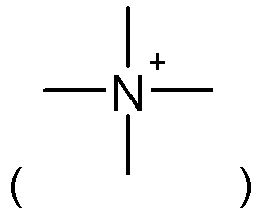
- Preferably, the radicals R1 include: n-, iso-, or tert.-C1-C22-alkyl, C2-C22-alkoxyalkyl, C5-C30-cycloalkyl, C6-C30-aryl, C6-C30-aryl(C1-C6)alkyl, C6-C30-alkylaryl, C2-C22-alkenyl, C2-C22-alkenyloxyalkyl, which can be substituted by one or more, preferred up to five, groups selected from hydoxyl and halogen, preferred fluorine, and can contain one or more ether groups, i.e. H3C-, CH3CH2-, CH3CH2CH2-, (CH3)2CH-, C8H17- and C10H21-, H2C=CH-O-(CH2)1-6, cycloaliphatic radicals, i.e. cyclohexylethyl, limonyl, norbonenyl, phenyl, tolyl, xylyl, benzyl and 2-Phenylethyl, halogen(C1-C10)alkyl, i.e. CfFfn+1CH2CH2- wherein f is 1 to 8, i.e. CF3CH2CH2-,
C4F9CH2CH2-, C6F13CH2CH2-,
C2F5-O(CF2-CF2-O)1-10CF2-,
F[CF(CF3)-CF2-O]1-5-(CF2)0-2-,
C3F7-OCF(CF3)- und
C3F7-OCF(CF3)-CF2-OCF(CF3)-.
- In a preferred embodiment R1 is methyl, vinyl, phenyl, 3,3,3-trifluoropropyl, most preferred methyl.
- RF4 is selected from organic groups different from R1 which contain at least one functional group F4 selected from
- a di-, or trihydroxy-substitued aromatic group,
- Preferably the di-, trihydroxy-substitued aromatic groups have the structure:

- R9 = R3 as defined above with an additional possibility of a substitution by nitrogen containing groups, preferred -NH2, -NHR2, -N(R2)2, therein R2 is as defined above.
- R10, R11, R12, R13, R14 = R2 as defined above with the proviso that 2 or 3 groups R10 to R14 are hydroxyl(-OH), preferably derived from allyl derivatives, 1-allyl-2,6-dihydroxybenzene , dihydroxy benzoic acids, i.e. 2,3-dihydroxy benzoic acid, 2,4-dihydroxy benzoic acid, 2,5-dihydroxy benzoic acid, 2,6-dihydroxy benzoic acid, 3,4-dihydroxy benzoic acid, 3,5-dihydroxy benzoic acid, dihydroxy cinnamic acids, i.e. 3,4-dihydroxy cinnamic acid, trihydroxy benzoic acids or their partial esters, i.e. 2,3,4-trihydroxy benzoic acid, 2,3,5-trihydroxy benzoic acid, 2,3,6-trihydroxy benzoic acid, 2,4,5-trihydroxy benzoic acid, 2,4,6-trihydroxy benzoic acid, 3,4,5-trihydroxy benzoic acid, trihydroxy cinnamic acids or their partial esters, i.e. 3,4,5-dihydroxy cinnamic acid.
- R2 is as defined above, preferably R2 is hydrogen, a monovalent, straight-chain, cyclic or branched, saturated, unsaturated or aromatic hydrocarbon radical which has up to 20 carbon atoms and may contain one or more groups selected from -O-, -NH-, -C(O)- and -C(S)-, and which may optionally be substituted by one or more substituents selected from the group consisting of a hydroxyl group, more preferred R2 is hydrogen, a monovalent, straight-chain, cyclic or branched, saturated, unsaturated or aromatic hydrocarbon radical which has up to 10 carbon atoms and may contain one or more groups selected from -O-, -NH-, -C(O)- and -C(S)-, and which may optionally be substituted by one or more substituents selected from the group consisting of a hydroxyl group, preferably selected from hydrogen, methyl, ethyl, n-propyl, i-propyl, n-butyl, cyclohexyl, morpholinyl, oligo ethylene oxide, oligo propylene oxide, oligo ethylene-propylene oxides, oligo ethylene-propylene-butylene oxides,
- Preferred R3 is a divalent, straight-chain, cyclic or branched, saturated, unsaturated or aromatic hydrocarbon radical which has up to 15 carbon atoms, and may contain one or more groups selected from -O-, -NH-, -C(O)- and -C(S)-, quaternary ammonium and which may optionally be substituted by one or more substituents selected from the group consisting of a hydroxyl group, and bound to the silicon atom by a carbon atom, more preferred R3 is a divalent, straight-chain, cyclic or branched, saturated, unsaturated or aromatic hydrocarbon radical which has up to 15 carbon atoms, and may contain one or more groups selected from -O-, -NH-, -C(O)- and -C(S)-, quaternary ammonium and which may optionally be substituted by one or more substituents selected from the group consisting of a hydroxyl group, and bound to the silicon atom by a carbon atom, even more preferred R3 is a divalent, straight-chain, cyclic or branched, saturated, unsaturated or aromatic hydrocarbon radical which has up to 15 carbon atoms, and may contain one or more groups selected from -O-, -C(O)-, quaternary ammonium and which may optionally be substituted by one or more substituents selected from the group consisting of a hydroxyl group, and bound to the silicon atom by a carbon atom, preferably derived from hydroxyl phenyl, melaminyl and urea, under the proviso that radical R3 does not comprise moieties of the structures -O-CH2OH, -NH-CH2OH and -N(CH2OH)2.
- Preferably, the optional functional group F5 further improve the solubility of the polysiloxanes and silanes in the preferred solvent water. Additionally, they may strengthen the interaction with the proteinacious substrate.
- The following functional groups F5 are especially preferred:
- amino group,
- ammonium group,
- epoxy group,
- carbonate group,
- isocyanate group, especially blocked isocyanate group,
- xanthogenate/ xanthogenate ester group,
- alkoxy silyl group
- thiosulfato group.
- Preferred optional radicals RF5 are selected from the group consisting of:
- quaternary phosphonium containing radicals of the formula
-R3-P+(R2)3
wherein
R3 as defined above and the P atom is bound to silicon by a carbon atom, radicals R2 are as defined above, can be identical or different and preferably at least one radical R2 is not hydrogen, - phosphine group containing radicals of the formula,
-R3-P(R2)2
wherein
R3 as defined above and the P atom is bound to silicon by a carbon atom, radicals R2 are as defined above, can be identical or different and preferably at least one radical R2 is not hydrogen, - epoxy groups containing radicals selected from:


- carbonate groups containing radicals selected from:

- urethane groups containing radicals selected from:
-R3-OC(O)NH-R2, wherein R2 and R3 as defined above, - urea groups containing radicals selected from:
-R3-NHC(O)NHR2, wherein R2 and R3 as defined above, - amide groups containing radicals selected from:
-R3-NHC(O)-R2 or-R3-C(O)NH-R2, wherein R2 and R3 as defined above, - enamine groups containing radicals selected from:

- enamine groups containing radicals selected from:

- aldehyde groups containing radicals selected from:

- zwitterionic groups containing radicals selected from:
carbobetaine groups containing radicals:

- sulphobetaine groups containing radicals:


- carboxylic acid or carboxylate groups containing radicals selected from:
-R3-COOR2, -R3-COO-
wherein R2 and R3 as defined above, - sulfonic acid or sulphonate groups containing radicals selected from:
-R3-SO3R2, -R3-SO3 -
wherein R2 and R3 as defined above, - sulfuric acid half ester/ sulfate groups containing radicals selected from:
-OSO3R2, -OSO3 -
wherein R2 as defined above, - phosphoric acid ester/ phosphate groups containing radicals selected from:

- fluoro phosphoric acid ester groups containing radicals selected from:

- phosphonic acid ester/ phosphonate groups containing radicals selected from:
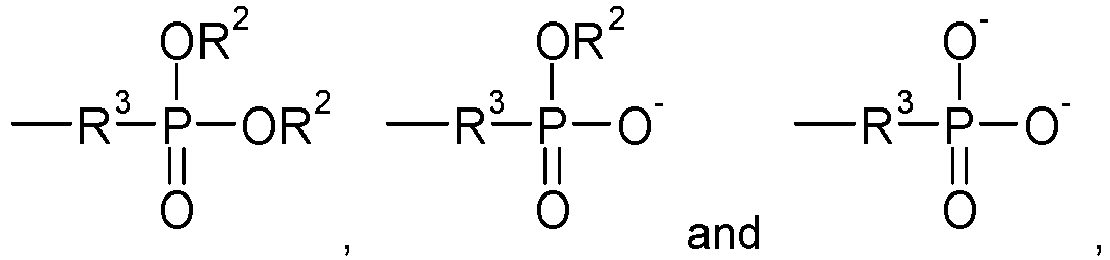
- or their protonated forms,
- wherein R2 and R3 as defined above and with R3 linked by a carbon atom to a P atom,
- phosphorous acid ester/ phosphite groups containing radicals selected from:

- xanthogenate/xanthogenate ester groups containing radicals selected from:

and the cations neutralizing the anionic functional groups, selected from:- ammonium groups (N+(R2)4, wherein R2 as defined above, phosphonium groups (P+(R2)4, wherein R2 as defined above, as well as one to trivalent metal cations,
- and the anions neutralizing the cationic functional groups, selected from:
- halogenide,
- hydroxide,
- borate,
- sulfate,
- phosphate,
- nitrate and
- carboxylate.
- Details on the incorporation of the radicals RF5 containing the groups F5 are described in
WO 2012/143371 . - The invention refers to a method for treating amino acid based substrates, preferably for the treatment of hair as defined in claim 1.
- In such method for treating amino acid based substrates the polyorganosiloxanes preferably have an average number of siloxy units of from 2 to 300. In such method for treating amino acid based substrates R1 is as defined above. In the method for treating the amino acid based substrates according to the invention RF5 is preferably selected from hydrocarbon radicals which have up to 100 carbon atoms and may contain one or more groups selected from -O-, - S-, -NR2-, in which R2 is hydrogen, a monovalent, straight-chain, cyclic or branched, saturated, unsaturated or aromatic hydrocarbon radical which has up to 60 carbon atoms and may contain one or more groups selected from -O-, -NH-, -C(O)- and -C(S)-, and which may optionally be substituted by one or more substituents selected from the group consisting of a hydroxyl group, an optionally substituted heterocyclic group preferably containing one or more nitrogen atoms, amino, alkylamino, dialkylamino, polyether radicals and polyetherester radicals, where, when a plurality of -NR2- groups is present, they may be the same or different, and wherein RF5 contains at least one functional group F5. In the method for treating amino acid based substrates according to the invention RF4 is selected from a di-, or trihydroxy-substitued aromatic group.
- In the method for treating amino acid based substrates according to the invention the polyorganosiloxanes preferably contain at least one siloxy group of the formula MF:


R is R1, and RF is RF3 as defined above, with the proviso that at least one RF is RF4, and the sum of the average numbers n1 + n2 is 0 to 28, preferred 0 to 20, more preferred 0 to 15, even more preferred 5 to 15,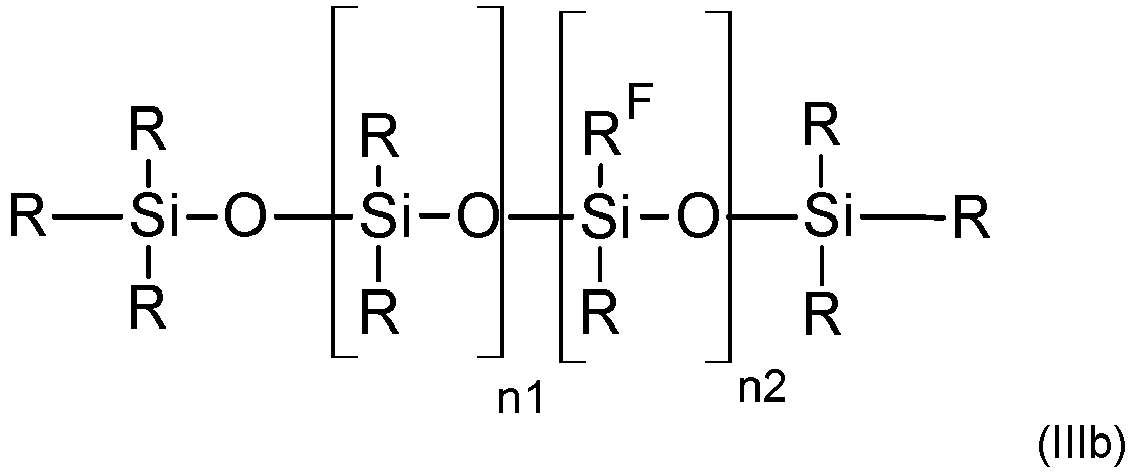
R is R1, and RF is RF3 as defined above, with the proviso that at least one RF is RF4, and the sum of the average numbers n1 + n2 is 1 to 28, preferred 1 to 20, more preferred 1 to 15, even more preferred 5 to 15, with n2 ≥ 1, preferred 1 to 28, more preferred 1 to 10, even more preferred 1 to 5, with n2 ≥ 1,
- R is R1, and RF is RF3 as defined above, with the proviso that at least one RF is RF4, and wherein the sum of the average numbers n1 + n2 is 3 to 7 with n2 ≥ 1, preferred n1 + n2 is 1 to 7, more preferred 1 to 5, even more preferred 3 to 5.
- In a preferred embodiment the polysiloxanes according to the invention have averaged molecular weights Mw < 2000g/mol, preferred < 1500g/mol, more preferred < 1000g/mol, as determined by GPC using polystyrene as standard.
- In a preferred embodiment of the invention more than one type of polysiloxanes according to the invention is used simultaneously.
- It is preferred to combine the polysiloxanes according to the invention with functional polysiloxanes having functional group selected from amino, quaternary ammonium, and quaternary phosphonium groups alone or optionally in combination with anionic polysiloxane compounds having functional group selected from carboxylic acid/carboxylate, sulphonic acid/sulphonate, sulfuric acid half ester/sulphate, phosphoric acid ester/phosphate, phosphonic acid ester/phosphonate, phosphorous acid ester/phosphite, and xanthogenate/xanthogenate ester. Examples for the above mentioned compounds are described in
WO 2012/143371 . It is preferred to combine the polysiloxanes according to the invention with betaine functional polysiloxanes. Examples for these compounds are described inWO 2012/143371 . It is further preferred to combine the polysiloxanes according to the invention with di- and polycationic compounds of the ABA or block copolymer type. Examples for these compounds are described inWO 02/10257 WO 02/10259 DE 10036553 . - Preferred precursors and intermediates are SiH functional, epoxy functional and carbonate functional polysiloxanes. The preparation of Si-functional polysiloxanes is described in the prior art (Silicone, Chemie und Technologie, Vulkan Verlag Essen 1989, S. 4). In one embodiment of the invention these SiH functional polysiloxanes are reacted with olefinically or acetylenically unsaturated hydroxyaromatic compounds yielding the target molecules by hydrosilylation.
- The preparation of epoxy functional polysiloxane and silane intermediates is described in the prior art (Silicone, Chemie und Technologie, Vulkan Verlag Essen 1989, S. 90). Preferred unsaturated epoxy precursors are allyl glycidyl ether, propargyl glycidyl ether and vinyl cyclohexene oxide. Preferrably, these epoxy intermediates are reacted with amino, carboxylic acid or thiol functional precursors yielding the different target compounds.
- In a preferred embodiment of the invention epoxy functional intermediates are reacted simultaneously or sequentially with precursors which introduce the radicals RF2 and RF5. The preparation of carbonate functional polysiloxane and silane intermediates is described in the prior art. They can be synthesized from SiH functionalized polysiloxanes or silanes and unsaturated carbonate precursors, i.e. allyl carbonate (
US 5672338 ,US 5686547 ). Alternatively, they can be prepared from epoxy functionalized precursors by CO2 insertion (DE 19505892 ) or by reaction of aminosiloxanes or aminosilanes with bifunctional carbonate coupling agents (WO 2005/058863 ). Preferrably, these carbonate intermediates are reacted with amino functional precursors yielding the different target compounds. - Preferred hydrocarbon based precursors for the incorporation of hydroxyaromatic radicals RF4 are olefinically or acetylenically unsaturated derivatives, i.e. 1-allyl-3,4-dihydroxybenzene and 1-allyl-2,6-dihydroxybenzene. These hydrocarbon based precursors can be used in hydrosilylations with SiH functionalized polysiloxane or silane precursors. Other preferred hydrocarbon based precursors for the incorporation of hydroxyaromatic radicals RF4 contain carboxylic acid or amino groups. Preferred examples for carboxylic acid functionalized precursors are dihydroxy benzoic acids, i.e. 2,3-dihydroxy benzoic acid, 2,4-dihydroxy benzoic acid, 2,5-dihydroxy benzoic acid, 2,6-dihydroxy benzoic acid, 3,4-dihydroxy benzoic acid, 3,5-dihydroxy benzoic acid, and trihydroxy benzoic acids, i.e. 2,3,4-trihydroxy benzoic acid, 2,3,5-trihydroxy benzoic acid, 2,3,6-trihydroxy benzoic acid, 2,4,5-trihydroxy benzoic acid, 2,4,6-trihydroxy benzoic acid, 3,4,5-trihydroxy benzoic acid.
- Other preferred examples for carboxylic acid functionalized precursors are dihydroxy cinnamic acids or their partial esters, i.e. 3,4-dihydroxy cinnamic acid, trihydroxy cinnamic acids or their partial esters, i.e. 3,4,5-dihydroxy cinnamic acid.
- In a preferred embodiment of the invention these carboxylic acid functionalized hydrocarbon precursors are reacted with epoxy functionalized polysiloxane or silane intermediates. Optionally, a catalyst, for example a tertiary amine, i.e triethylamine, is used (
US 2012/0289649 , example 1). - Preferred amino groups containing precursors are for example 3,4-dihydroxyphenylethylamine. Preferrably, they are reacted with epoxy or carbonate functionalized polysiloxane (
DE 4318536 , example 9;US 2011/0033411 , example 4). - An example for carboxylic acid groups and amino groups containing precursors is tyrosine (
DE 10036532 , example 1). - The invention also provides compositions for treating amino acid based substrates as defined in claims 11 to 13, preferably the permanent shaping of human hair comprising
- a) at least one polyorganosiloxane as defined in any of claims 1 to 7,
- b) at least one diluent/solvent
- c) optionally one or more protein, preferably keratin,
- d) optionally one or more surface active ingredient/emulsifier,
- e) optionally one or more emollient/fatty substance,
- f) optionally one or more preservative,
- g) optionally one or more skin protecting ingredient,
- h) optionally one or more conditioning agent,
- i) optionally one or more oxidizing agent,
- j) optionally one or more reducing agent,
- k) optionally one or more other auxiliary,
- Preferably, the formulations preferably the hair treating formulations comprise the following components:
Ingredient Weight-% a) at least one polyorganosiloxane as defined in any of claims 1 to 7 0,05 to 30 b) diluents/solvents 5 to 99,95 c) protein, preferred keratin 0 to 15 d) surface active ingredients/emulsifiers 0 to 15 e) emollients/fatty substance 0 to 15 f) preservatives 0 to 5 g) skin protecting ingredients 0 to 10 h) conditioning agents 0 to 90 i) oxidizing agents agents 0 to 10 j) reducing agents 0 to 10 k) other auxiliary agents 0 to 10 - In a preferred embodiment of the invention the hair treating or shaping respectively formulations comprise the silicone actives in a concentration range from 0.05 to 30 %, preferred 0.5 to 30 %, more preferred 1 to 30 %, even more preferred 1 to 20 %, specifically 1 to 10 %, wherein each percentage is per weight.
- In a preferred embodiment of the invention the hair shaping formulations comprise the diluents/solvents in a concentration range from 5 to 99.95 %, preferred 20 to 99.95 %, more preferred 20 to 99 %, even more preferred 30 to 99 %, specifically 30 to 97 % wherein each percentage is per weight.
- In a preferred embodiment of the invention the hair shaping formulations comprise the optional protein, preferred keratin in a concentration range from 0 to 15 %, preferred 0 to 10 %, more preferred 0 to 5 % wherein each percentage is per weight.
- In a preferred embodiment of the invention the hair shaping formulations comprise the optional surface active ingredients in a concentration range from 0 to 15 %, preferred 0 to 10 %, more preferred 0 to 5 % wherein each percentage is per weight.
- In a preferred embodiment of the invention the hair shaping formulations comprise the optional emollents/fatty substance in a concentration range from 0 to 15 %, preferred 0 to 10 %, more preferred 0 to 5 % wherein each percentage is per weight.
- In a preferred embodiment of the invention the hair shaping formulations comprise the optional emulsifiers in a concentration range from 0 to 15 %, preferred 0 to 10 %, more preferred 0 to 5 % wherein each percentage is per weight.
- In a preferred embodiment of the invention the hair shaping formulations comprise the optional preservatives in a concentration range from 0 to 15 %, preferred 0 to 10 %, more preferred 0 to 5 %, even more preferred 0 to 1 %, specifically 0 to 0.1 % wherein each percentage is per weight.
- In a preferred embodiment of the invention the hair shaping formulations comprise the optional skin protecting ingredients in a concentration range from 0 to 15 %, preferred 0 to 10 %, more preferred 0 to 5 %, even more preferred 0 to 1 %, specifically 0 to 0.1 % wherein each percentage is per weight.
- In a preferred embodiment of the invention the hair shaping formulations comprise the optional conditoning agents in a concentration range from 0 to 15 %, preferred 0 to 10 %, more preferred 0 to 5 %, even more preferred 0 to 1 %, specifically 0 to 0.1 % wherein each percentage is per weight.
- In a preferred embodiment of the invention the hair shaping formulations comprise the optional oxidizing agents in a concentration range from 0 to 15 %, preferred 0 to 10 %, more preferred 0 to 5 %, even more preferred 0 to 2 % wherein each percentage is per weight.
- In a preferred embodiment of the invention the hair shaping formulations comprise the optional reducing agents in a concentration range from 0 to 15 %, preferred 0 to 10 %, more preferred 0 to 5 %, even more preferred 0 to 2 % wherein each percentage is per weight.
- The term "diluents/solvents" refers to substances that may be used to dilute/solvatize the silicone active according to the invention and the other optional other ingredients. Water is the preferred diluent/solvent. Suitable organic solvents are i.e. 2-methyl-1,3-propanediol, mono and dialcohols or the ethers thereof, in particular mono-C1-C3-alkyl ether, ethanol, n-propanol, isopropyl alcohol, tert. butanol, 1-methoxypropanol, 1-ethoxypropanol and ethoxydiglycol, diols and their esters 1,3- and 1,4-butanediol, pentylene glycol, hexylene glycol, diethyleneglycol and the monomethyl and monoethyl ether thereof, dipropylene glycol and the monomethyl and monoethyl ether thereof, glycerol, diglycerol, hexanetriol, sorbitol, ethyl carbitol, benzyl alcohol, benzyloxy ethanol, propylene carbonate, N-alkyl pyrrolidone. In a preferred embodiment water/ethanol and water/isopropyl alcohol mixtures are used. Generally, the addition of certain amounts of short chained alcohols improves the homogeneity of the formulations and the penetration of the formulations into the hair. Depending on the polymer structure type and the application purpose certain quantities on acids, bases and/or short chained alcohols are required in order to get transparent formulations. Suitable acids include inorganic or organic acids, like for example carboxyl acids, like acetic acid, hydrochloric acid, sulfuric acid, phosphoric acid.
- Suitable bases include aqueous ammonia, alkaline hydoxides, carbonates etc.
- The optional protein, preferred keratin protein fractions used comprise of hydrolyzed keratin produced by alkaline and/or enzymatic hydrolysis using methods known in the art. The keratin hydrolysate is about 1,000-3,000 molecular weight. The keratin may be derived from human or other mammalian sources such as goat hair (
US 2007-0048235 ), hoof or horn meals, (US 6,555,505 ). Alternatively, "keratin protein fraction" is a purified form of keratin that contains predominantly, although not entirely, one distinct protein group as described inUS 7,148,327 . Details on the keratin and keratin fractions are disclosed inUS 2009-0165812 . - Another optional ingredient which may be included in these hair shaping formulations are surface active materials/emulsifiers. Surface active materials/emulsifiers are able to reduce the surface tension of water and cause the product to slip across or onto the skin and help to compatibalize the ingredients of the formulation. In one embodiment, the surfactants are amphoteric. Anionic or cationic surfactants may be used as well. Details on surface active ingredients/emulsifiers are disclosed in
US 2009-0165812 . Surfactants also include detergents and soap. Details on soaps are disclosed inWO 2012/027369 . - Further examples of emulsifiers include:
Emulsifiers selected from among amphoteric, anionic, cationic and nonionic emulsifiers, which are used alone or as a mixture. The emulsifiers are appropriately selected according to the emulsion to be obtained (W/O or O/W). The emulsions may also contain stabilizers of other types, for instance fillers, gelling polymers or thickeners. - As emulsifying surfactants that may be used for the preparation of the W/O emulsions, examples include sorbitan, glycerol or sugar alkyl esters or ethers; silicone surfactants, for instance dimethicone copolyols, such as the mixture of cyclomethicone and of dimethicone copolyol, marketed under the trademark DC 5225 C by Dow Corning, and alkyldimethicone copolyols such as laurylmethicone copolyol marketed under the trademark Dow Corning 5200 Formulation Aid by Dow Corning; cetyldimethicone copolyol, such as the product marketed under the trademark Abil EM 90R by Goldschmidt, and the mixture of cetyldimethicone copolyol, of polyglyceryl isostearate (4 mol) and of hexyl laurate, marketed under the trademark Abil WE O9 by Goldschmidt. Other examples are the silicone emulsifiers from Momentive under the trademarks SF1528, SF1540, Silform EOF, Silform 60-A.
- One or more co-emulsifiers may also be added thereto, which may be selected advantageously from the group comprising polyol alkyl esters.
- Polyol alkyl esters that are especially exemplary include polyethylene glycol esters, for instance PEG-30 dipolyhydroxystearate, such as the product marketed under the trademark Arlacel P135 by ICI.
- Glycerol and/or sorbitan esters that are especially exemplary include, for example, polyglyceryl isostearate, such as the product marketed under the trademark Isolan GI 34 by Goldschmidt, sorbitan isostearate, such as the product marketed under the trademark Arlacel 987 by ICI, sorbitan glyceryl isostearate, such as the product marketed under the trademark Arlacel 986 by ICI, and mixtures thereof.
- For O/W emulsions, examples of emulsifiers include nonionic emulsifiers such as oxyalkylenated (more particularly polyoxyethylenated) fatty acid esters of glycerol; oxyalkylenated fatty acid esters of sorbitan; oxyalkylenated (oxyethylenated and/or oxypropylenated) fatty acid esters, for instance the mixture PEG-100 stearate/glyceryl stearate marketed, for example, by ICI under the trademark Arlacel 165; oxyalkylenated (oxyethylenated and/or oxypropylenated) fatty alkyl ethers; sugar esters, for instance sucrose stearate; fatty alkyl ethers of sugars, especially polyalkylglucosides (APG) such as decylglucoside and laurylglucoside marketed, for example, by Henkel under the respective names Plantaren 2000 and Plantaren 1200, cetostearyl glucoside optionally as a mixture with cetostearyl alcohol, marketed, for example, under the trademark Montanov 68 by SEPPIC, under the trademark Tegocare CG90 by Goldschmidt and under the trademark Emulgade KE3302 by Henkel, and also arachidyl glucoside, for example in the form of a mixture of arachidyl alcohol, behenyl alcohol and arachidyl glucoside, marketed under the trademark Montanov 202 by SEPPIC. Examples of silicones emulsifiers, suitable for O/W emulsions are the polyether siloxane copolymers under the trademarks, SF1188A, SF1288, Silsoft 880, Silsoft 860, Silsoft 440, Silsoft 895, Silsoft 900.
- Further emulsion stabilizers that will be used more particularly are isophthalic acid or sulfoisophthalic acid polymers, and in particular phthalate/sulfoisophthalate/glycol copolymers, for example the diethylene glycol/phthalate/isophthalate/1,4-cyclohexanedimethanol copolymer (INCI name: Polyester-5) marketed under the trademark Eastman AQ Polymer (AQ35S, AQ38S, AQ55S and AQ48 Ultra) by Eastman Chemical.
- Other suitable emulsifiers are the amino-based emulsifiers, such as sodium stearoyl glutamate and phospholipids such as lecithin, hydroxylated lecithin.
- A further optional ingredient of the hair shaping formulations are one or more emollients. An "emollient" is a material that protects against wetness or irritation, softens, soothes, supples, coats, lubricates, moisturizes, protects and/or cleanses the skin. Emollients used comprise one or more of: a silicone compound, i.e dimethicones, cyclomethicones, preferred D5 and D6 cyclosiloxanes, dimethicone copolyols or mixtures of cyclomethicones and dimethicone/vinyldimethicone cross polymer), polyols such as sorbitol, glycerin, propylene glycol, ethylene glycol, polyethylene glycol, caprylyl glycol, polypropylene glycol, 1,3-butane diol, hexylene glycol, isoprene glycol, xylitol; ethylhexyl palmitate; a triglyceride such as caprylic/capric triglyceride and fatty acid ester such as cetearyl isononanoate or cetyl palmitate. Details on emollients are disclosed in
US 2009/0165812 . - As fatty substances that are liquid at ambient temperature, often referred to as oils, that can be used in the invention, mention may be made of: hydrocarbon-based oils of animal origin, such as perhydrosqualene; hydrocarbon-based plant oils, such as liquid triglycerides of fatty acids containing 4 to 10 carbon atoms, for instance heptanoic or octanoic acid triglycerides, or else sunflower oil, maize oil, soya oil, grapeseed oil, sesame oil, apricot oil, macadamia oil, castor oil, avocado oil, caprylic/capric acid triglycerides, jojoba oil, shea butter; linear or branched hydrocarbons of mineral or synthetic origin, such as liquid paraffins and derivatives thereof, petroleum jelly, polydecenes, hydrogenated polyisobutene such as parleam®; synthetic esters and ethers, in particular of fatty acids, for instance purcellin oil, isopropyl myristate, 2-ethylhexyl palmitate, 2-octyldodecyl stearate, 2-octyldodecyl erucate, isostearyl isostearate, hydroxylated esters, for instance isostearyl lactate, octyl hydroxystearate, octyldodecyl hydroxystearate, diisostearyl malate, triisocetyl citrate, fatty alcohol heptanoates, octanoates and decanoates; polyol esters, for instance propylene glycol dioctanoate, neopentyl glycol diheptanoate, diethylene glycol diisononanoate, pentaerythritol esters; fatty alcohols having 12 to 26 carbon atoms, for instance octyldodecanol, 2-butyloctanol, 2-hexyldecanol, 2-undecyl pentadecanol, oleyl alcohol; partially hydrocarbon-based and/or silicone-based fluoro oils; silicone oils, for instance volatile or non-volatile, linear or cyclic polydimethylsiloxanes (PDMS) which are liquid or pasty at ambient temperature (25 °C), such as cyclomethicones, dimethicones, optionally comprising a phenyl group, for instance phenyl trimethicones, phenyl trimethylsiloxydiphenylsiloxanes, diphenylmethyl- dimethyltrisiloxanes, diphenyl dimethicones, phenyl dimethicones , polymethylphenylsiloxanes; mixtures thereof. Details on suitable fatty substances are disclosed in
WO 2012-038334 . - Optionally, one or more preservatives may be included in the hair shaping formulations. Examples of such preservatives comprise one or more glycerin containing compound (e.g., glycerin or ethylhexylglycerin or phenoxyethanol), benzyl alcohol, EDTA, potassium sorbate and/or grapefruit seed extract. In a preferred embodiment, the hair straightening formulations are paraben free. Details on preservatives are disclosed in
US 2009/0165812 . Further suitable traditional preservatives for compositions of this invention are alkyl esters of para-hydroxybenzoic acid. Other preservatives which have more recently come into use include hydantoin derivatives such as 1,3-bis(hydroxymethyl)-5,5-dimthylhydantoin, propionate salts, and a variety of quaternary ammonium compounds such as benzalkonium chloride, quaternium 15 (Dowicil 200), benzethonium chloride, and methylbenzethonium chloride. Cosmetic chemists are familiar with appropriate preservatives and routinely choose them to satisfy the preservative challenge test and to provide product stability. Suitable preservatives are benzyl alcohol, mixture of ethylhexylglycerin with benzyl alcohol, 2-bromo-2 nitropropane 1,3 diol, disodium EDTA, phenoxyethanol, mixture of phenoxyethanol and ethylhexylglycerin, methyl paraben, propyl paraben, imidazolidinyl urea (commercially available as Germall 1157), sodium dehydroacetate and benzyl alcohol. The preservatives should be selected having regard for the use of the composition and possible incompatibilities between the preservatives and other ingredients in the emulsion. Preservatives preferably are employed in amounts ranging from about 0% to about 5%, more preferably from about 0.01% to about 2.5%, and most preferably from about 0.01% to about 1%, by weight of the composition. - Optionally, the hair shaping formulations comprise one or more skin protecting agents. Skin protecting agents comprise one or more agents that prevent the undesired transmission of microbes or organic/inorganic chemicals. Details on skin protecting agents are disclosed in
US 2009/0165812 . - Optionally, one or more conditioning agent may be included in the hair shaping formulations. In one preferred embodiment silicone based conditioning agents are incorporated. Preferred materials are PDMS grades ranging from 10 to 1.000.000 mPa.s, C2 to C18-alkyl derivatized silicones, dimethiconols, polyether modified silicones, amino groups or quaternized ammonium groups containing silicones. They may be also selected from polyorganosiloxanes having functional groups F2 or F5 as defined above. These silicones can be incorporated as neat materials, organic solutions, emulsions or microemulsions. Examples for amino groups containing silicones are aminoethylaminopropyl substituted silicones and aminopropyl substituted silicones. A commercilally available example is the aminosilicone based emulsion SME 253 (Momentive Performance Materials). Details on quaternary ammonium groups containing silicones are i.e. disclosed in
WO 02/10256 WO 02/10257 WO 02710259 US 2009/0000638 andWO 2012/027369 . As used herein, "conditioning agent" is suitably understood to mean any agent whose function is to improve the cosmetic properties of the hair, for example, the softness, disentangling, feel, smoothness and static electricity. - The at least one conditioning agent that may be used in the present disclosure may be in liquid, semi-solid or solid form, for example, oils, waxes and gums.
- Other useful non-limiting examples of the at least one conditioning agent may include synthetic oils such as polyolefins, plant oils, fluoro oils, perfluoro oils, natural and synthetic waxes, silicones, non-polysaccharide cationic polymers, compounds of ceramide type, cationic surfactants, fatty amines, saturated fatty acids and esters of fatty acids other than those of the disclosure, and mixtures thereof.
- The synthetic oils that may be used in the present disclosure may, in at least one embodiment, be chosen from polyolefins, for example, poly-α-olefins and further for example, hydrogenated or non-hydrogenated polybutene type, for instance, hydrogenated or non-hydrogenated polyisobutene type.
- In at least one embodiment, isobutylene oligomers of molecular weight less than 1000 and mixtures thereof with polyisobutylenes of molecular weight greater than 1000, for example, ranging from 1000 to 15,000 are used.
- Examples of poly-α-olefins include, but are not limited to those sold, for instance, under the name Permethyl 99 A, 101 A, 102 A, 104 A (n=16) and 106 A (n=38) by the company Presperse Inc., or alternatively the products sold, for example, under the name Arlamol HD (n=3) by the company ICI (n denoting the degree of polymerization), of hydrogenated or non-hydrogenated polydecene type.
- Such products are sold, for example, under the names Ethylflo by the company Ethyl Corp. and Arlamol PAO by the company ICI.
- The animal or plant oils which may be used in at least one embodiment of the present disclosure may be chosen from, by way of non-limiting example, sunflower oil, corn oil, soybean oil, avocado oil, jojoba oil, marrow oil, grapeseed oil, sesame oil, hazelnut oil, fish oils, glyceryl tricaprocaprylate, and plant or animal oils of formula R9COOR10 wherein R9 is a higher fatty acid residue comprising from 7 to 29 carbon atoms and R10 is a linear or branched hydrocarbon-based chain comprising from 3 to 30 carbon atoms, for example, alkyl or alkenyl, and further for example, purcellin oil.
- Natural or synthetic essential oils such as eucalyptus oil, lavandin oil, lavender oil, vetiver oil, Litsea cubeba oil, lemon oil, sandalwood oil, rosemary oil, camomile oil, savory oil, nutmeg oil, cinnamon oil, hyssop oil, caraway oil, orange oil, geraniol oil, cade oil and bergamot oil may also be used.
- According to at least one embodiment, the waxes are natural (animal or plant) or synthetic substances that are solid at ambient temperature (20°-25° C.). They are insoluble in water, soluble in oils and are capable of forming a water-repellent film.
- For the definition of waxes, reference may be made to the document, P. D. Dorgan, Drug and Cosmetic Industry, December 1983, pp. 30-33.
- The wax or waxes which may be used in the context of the present disclosure may be chosen, by way of non-limiting example, from carnauba wax, candelilla wax, alfalfa wax, paraffin wax, ozokerite, plant waxes such as olive tree wax, rice wax, hydrogenated jojoba wax or the absolute waxes of flowers such as the essential wax of blackcurrant flower sold by the company Bertin (France), animal waxes such as beeswaxes, or modified beeswaxes (cerabellina); other waxes or waxy starting materials which may be used are, for instance, marine waxes such as those sold by the company Sophim under the reference M82, and polyethylene waxes or polyolefin waxes in general.
- In at least one embodiment, the conditioning agent may be chosen from cationic polymers and silicones.
- Among the non-saccharide cationic polymers that may be used in the context of the present disclosure may be chosen, by way of non-limiting example, from all those already known in the art to improve the cosmetic properties of hair treated with detergent compositions, for instance, those described in
European Patent Application No. 0 337 354 and inFrench Patent Application Nos. 2 270 846 2 383 660 2 598 611 2 470 596 2 519 863 - As used herein, "cationic polymer" is understood to mean any polymer comprising cationic groups and/or groups that may be ionized into cationic groups.
- Among the cationic polymers that may be used in the present disclosure, non-limiting mention may be made of those which contain primary, secondary, tertiary and/or quaternary amine groups capable of forming part of the main polymer chain or of being borne by a side substituent directly bound to the latter.
- In at least one embodiment, cationic polymers that may be used herein, have a number-average molecular mass ranging from 500 to 5×10⁶, for example, ranging from 103 to 3×10⁶.
- Suitable cationic polymers may include, by way of non-limiting example, polymers of the polyamine, polyamino amide and polyquaternary ammonium type.
- These polymers of the polyamine, polyamino amide and polyquaternary ammonium type that may be used herein, may be chosen, for example, from those described in
French Patents Nos. 2 505 348 2 542 997 - (1) homopolymers or copolymers derived from acrylic or methacrylic esters or amides and comprising at least one unit of the following formulae:


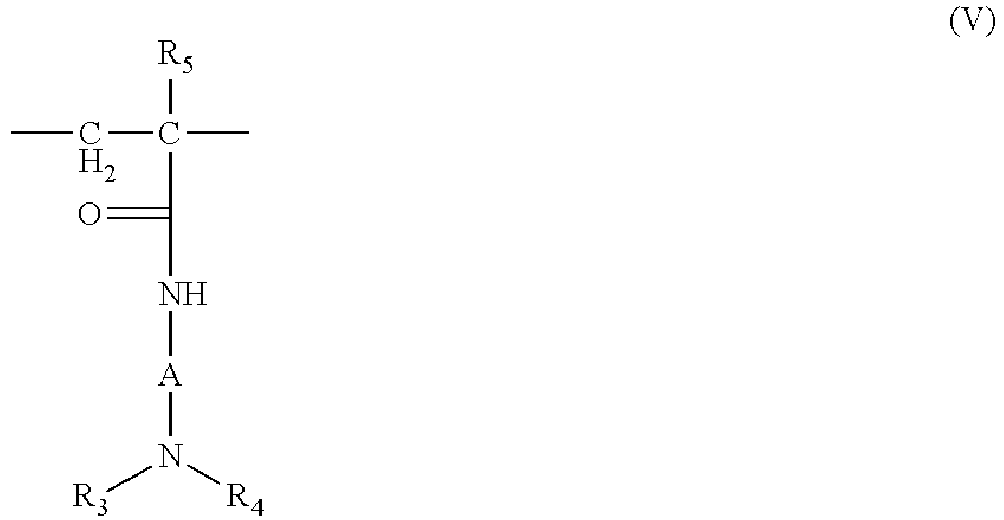

- R3 and R4, which may be identical or different, are chosen from hydrogen and C1-C6 alkyl groups, for example, methyl or ethyl;
- R5, which may be identical or different, is chosen from hydrogen and a CH3 radical;
- A, which may be identical or different, is chosen from linear and branched C1-C6 alkyl groups for example, ethyl or propyl or a hydroxy(C1-C4)alkyl group;
- R6, R7 and R8, which may be identical or different, are chosen from C1-C18 alkyl groups and a benzyl radical, for example, C1-C6 alkyl groups;
- X is chosen from an anion derived from a mineral or organic acid, such as a methosulfate anion and a halide, such as chloride or bromide.
The copolymers of family (1) can also contain at least one unit derived from comonomers which may be chosen from the family of acrylamides, methacrylamides, diacetone acrylamides, acrylamides and methacrylamides substituted on the nitrogen with lower (C1-C4) alkyls, acrylic or methacrylic acids or esters thereof, vinyllactams such as vinylpyrrolidone or vinylcaprolactam, and vinyl esters. Examples of copolymers of family (1) that are suitable for use in accordance with the present disclosure include, but are not limited to:- ∘ copolymers of acrylamide and of dimethylaminoethyl methacrylate quaternized with dimethyl sulfate or with a dimethyl halide, such as those sold, for instance, under the name Hercofloc by the company Hercules,
- ∘ the copolymers of acrylamide and of methacryloyloxyethyltrimethylammonium chloride described, for example, in
European Patent Application No. 0 80 976 - ∘ the copolymer of acrylamide and of methacryloyloxyethyltrimethylammonium methosulfate sold, for instance, under the name Reten by the company Hercules,
- ∘ quaternized or non-quaternized vinylpyrrolidone/dialkylaminoalkyl acrylate or methacrylate copolymers, such as the products sold under the name Gafquat by the company ISP, for example, Gafquat 734 or Gafquat 755, or alternatively the products Copolymer 845, 958 and 937. These polymers are described in detail in
French Patent Nos. 2 077 143 2 393 573 - ∘ dimethylaminoethyl methacrylate/vinylcaprolactam/vinylpyrrolidone terpolymers, such as the product sold, for instance, under the name Gaffix VC 713 by the company ISP,
- ∘ vinylpyrrolidone/methacrylamidopropyldimethylamine copolymers sold, for example, under the name Styleze CC 10 by ISP, and
- ∘ quaternized vinylpyrrolidone/dimethylaminopropylmethacrylamide copolymers, such as the product sold, for instance, under the name Gafquat HS 100 by the company ISP.
- (2) Polymers comprising piperazinyl units and divalent alkylene or hydroxyalkylene radicals comprising straight or branched chains, which may be interrupted by at least one atom chosen from oxygen, sulfur and nitrogen atoms or by aromatic or heterocyclic rings, as well as the oxidation and/or quaternization products of these polymers. These polymers are described in
French Patent Nos. 2 162 025 2 280 361 - (3) Water-soluble polyamino amides prepared, for example, by polycondensation of an acidic compound with a polyamine; these polyamino amides can be crosslinked with an epihalohydrin, a diepoxide, a dianhydride, an unsaturated dianhydride, a bis-unsaturated derivative, a bis-halohydrin, a bis-azetidinium, a bis-haloacyldiamine, a bis-alkyl halide or alternatively with an oligomer resulting from the reaction of a difunctional compound which is reactive with a bis-halohydrin, a bis-azetidinium, a bis-haloacyldiamine, a bis-alkyl halide, an epihalohydrin, a diepoxide or a bis-unsaturated derivative; the crosslinking agent being used in an amount ranging from 0.025 mol to 0.35 mol per amine group of the polyamino amide; these polyamino amides can be alkylated or, if they comprise at least one tertiary amine functional group, they can be quaternized. These polymers are described in
French Patent Nos. 2 252 840 2 368 508 - (4) The polyamino amide derivatives resulting from the condensation of polyalkylene polyamines with polycarboxylic acids followed by alkylation with difunctional agents, for example, adipic acid/dialkylaminohydroxyalkyldialkylenetriamine polymers wherein the alkyl radical comprise from 1 to 4 carbon atoms, for example, methyl, ethyl or propyl. These polymers are described in
French Patent No. 1 583 363
Among these derivatives, non-limiting mention may be made, for instance, of the adipic acid/dimethylaminohydroxypropyl/diethylenetriamine polymers sold, for example, under the name Cartaretine F, F4 or F8 by the company Sandoz. - (5) The polymers obtained by reaction of a polyalkylene polyamine comprising two primary amine groups and at least one secondary amine group with a dicarboxylic acid chosen from diglycolic acid and saturated aliphatic dicarboxylic acids having from 3 to 8 carbon atoms. The molar ratio between the polyalkylene polyamine and the dicarboxylic acid ranges from 0.8:1 to 1.4:1; the polyamino amide that results from reaction with epichlorohydrin in a molar ratio of epichlorohydrin relative to the secondary amine group of the polyamino amide ranges from 0.5:1 to 1.8:1. These polymers are described in
U.S. Pat. Nos. 3,227,615 and2,961,347 .
Polymers of this type are sold, for example, under the name Hercosett 57 by the company Hercules Inc. or alternatively under the name PD 170 or Delsette 101 by the company Hercules in the case of the adipic acid/epoxypropyl/diethylenetriamine copolymer. - (6) Cyclopolymers of alkyldiallylamine or of dialkyldiallylammonium, such as the homopolymers or copolymers comprising, as main constituent of the chain, units chosen from those of formulae (VII) and (VIII):


- ∘ k and t are 0 or 1;
- ∘ the sum of k+t is 1;
- ∘ R12 is chosen from hydrogen and a methyl radical;
- ∘ R10 and R11 are chosen from, independently of one another, C1-C6 alkyl groups, hydroxy (C1-C5) alkyl groups and a lower (C1-C4) amidoalkyl group, or R10 and R11 may form, together with the nitrogen atom to which they are attached, heterocyclic groups such as piperidyl or morpholinyl;
- ∘ Y- is chosen from anions such as bromide, chloride, acetate, borate, citrate, tartrate, bisulfate, bisulfite, sulfate and phosphate. These polymers are described in
French Patent No. 2 080 759 Addition 2 190 406
- According to at least one embodiment of the present disclosure, R10 and R11, independently of each other, may be chosen from C1-C4 alkyl groups.
- Among the polymers defined above, non-limiting mention may be made, for example, of the dimethyldiallylammonium chloride homopolymer sold, for instance, under the name Merquat 100 by the company Nalco (and its homologues of low weight-average molecular mass) and the copolymers of diallyldimethylammonium chloride and of acrylamide, sold, for example, under the name Merquat 550.
(7) The quaternary diammonium polymer comprising repeating units chosen from those of formula:
- R13, R14, R15, and R16, which may be identical or different, are chosen from aliphatic, alicyclic, arylaliphatic radicals comprising from 1 to 20 carbon atoms and lower hydroxyalkylaliphatic radicals, or alternatively R13, R14, R15 and R16, together or separately, form with the nitrogen atoms to which they are attached, heterocycles optionally comprising a second heteroatom other than nitrogen, or alternatively R13, R14, R15 and R16 are chosen from linear and branched C1-C6 alkyl radicals substituted with a nitrile, ester, acyl or amide group or a group -CO-O-R17-D or -CO-NH-R17-D wherein R17 is an alkylene and D is a quaternary ammonium group; A, and B1 are chosen from C2-C20 polymethylene groups which may be linear or branched, saturated or unsaturated, and which may comprise, linked to or intercalated in the main chain, at least one aromatic ring or at least one oxygen or sulfur atom or sulfoxide, sulfone, disulfide, amino, alkylamino, hydroxyl, quaternary ammonium, ureido, amide or ester groups, and
- X- is an anion derived from a mineral or organic acid;
- A1, R13 and R15 can form, with the two nitrogen atoms to which they are attached, a piperazine ring; in addition, if A1 is a linear or branched, saturated or unsaturated alkylene or hydroxyalkylene radical, B1 may comprise a group (CH2)np-CO-D-OC-(CH2)p-, wherein p is an integer ranging from 2 to 20,
- wherein D is chosen from:
- a) a glycol residue of formula: -O-Z-O-, wherein Z is chosen from linear and branched hydrocarbon-based radicals or a group corresponding to one of the following formulae:
-(CH2-CH2-O)X-CH2-CH2-
-[CH2-CH(CH3)-O]y-CH2-CH(CH3)-
wherein x and y are decimals or integers ranging from 1 to 4, representing a defined and unique degree of polymerization or any number from 1 to 4 representing an average degree of polymerization; - b) a bis-secondary diamine residue such as a piperazine derivative;
- c) a bis-primary diamine residue of formula: —NH—Y—NH—, wherein Y is chosen from linear and branched hydrocarbon-based radicals, or alternatively the divalent radical
-CH2-CH2-S-S-CH2-CH2-;
- d) a ureylene group of formula: —NH—CO—NH—.
- a) a glycol residue of formula: -O-Z-O-, wherein Z is chosen from linear and branched hydrocarbon-based radicals or a group corresponding to one of the following formulae:
- In at least one embodiment, X- is an anion such as chloride or bromide.
- The polymers which may be used in the context of the present disclosure may have a number-average molecular mass ranging from 1000 and 100,000.
- These polymers are further described in
French Patent Nos. 2 320 330 2 270 846 2 316 271 2 336 434 2 413 907 U.S. Pat. Nos. 2,273,780 ,2,375,853 ,2,388,614 ,2,454,547 ,3,206,462 ,2,261,002 ,2,271,378 ,3,874,870 ,4,001,432 ,3,929,990 ,3,966,904 ,4,005,193 ,4,025,617 ,4,025,627 ,4,025,653 ,4,026,945 and4,027,020 . - In at least one embodiment, polymers that comprise repeating units corresponding to the formula (a) may be used:

R18, R19, R20 and R21, which may be identical or different, are chosen from C1-C4 alkyl groups or hydroxy(C1-C4)alkyl radicals; - ∘ r and s are integers ranging from 2 to 20;
- ∘ X- is an anion derived from a mineral or organic acid.
- In another embodiment, a compound of formula (a) wherein R18, R19, R20 and R21 are methyl radicals and r is 3, s is 6 and X is CI, referred to as hexadimethrine chloride according to the INCI nomenclature (CTFA) may be used.
(8) Polyquaternary ammonium polymers comprising units of formula (X):
- R22, R23, R24 and R25, which may be identical or different, are chosen from a hydrogen atom, a methyl, ethyl, propyl, β-hydroxyethyl, β-hydroxypropyl and a -CH2CH2(OCH2CH2)pOH radical, wherein p is 0 or an integer ranging from 1 to 6, with the proviso that R22, R23, R24 and R25 are not simultaneously hydrogen,
- t and u, which may be identical or different, are integers ranging from 1 to 6,
- v is 0 or an integer ranging from 1 to 34,
- X- is an anion, for example, halide,
- A is chosen from a divalent radical and -CH2-CH2-O-CH2-CH2-.
- These compounds are described in
European Patent Application No. 122 324 - In at least one embodiment, non-limiting mention may be made, for example, of Mirapol® A 15, Mirapol® AD1, Mirapol® AZ1 and Mirapol® 175 sold by the company Miranol.
- (9) Quaternary polymers of vinylpyrrolidone and of vinylimidazole, such as, the products sold under the names Luviquat® FC 905, FC 550 and FC 370 by the company BASF.
- (10) Crosslinked methacryloyloxy(C1-C4)alkyltri(C1-C4)alkylammonium salt polymers such as the polymers obtained by homopolymerization of dimethylaminoethyl methacrylate quaternized with methyl chloride, or by copolymerization of acrylamide with dimethylaminoethyl methacrylate quaternized with methyl chloride, the homo- or copolymerization being followed by crosslinking with a compound containing olefinic unsaturation, for instance, methylenebisacrylamide. In at least one embodiment, the polymer may be a crosslinked acrylamide/methacryloyloxyethyltrimethylammonium chloride copolymer (20/80 by weight) in the form of a dispersion containing 50% by weight of the said copolymer in mineral oil. This dispersion is sold, for example, under the name Salcare® SC 92 by the company Ciba. In another embodiment, the polymer may be a crosslinked methacryloyloxyethyltrimethylammonium chloride homopolymer comprising about 50% by weight of the homopolymer in mineral oil or in a liquid ester. These dispersions are sold, for instance, under the names Salcare® SC 95 and Salcare® SC 96 by the company Ciba. (11) Cationic polysaccharides, for example, celluloses and cationic galactomannan gums.
- The cationic polysaccharides may, in at least one embodiment, be chosen from cellulose ether derivatives comprising quaternary ammonium groups, cationic cellulose copolymers or cellulose derivatives grafted with a water-soluble quaternary ammonium monomer and cationic galactomannan gums.
- The cellulose ether derivatives comprising quaternary ammonium groups, are described in
French Patent No. 1 492 597 - The cationic cellulose copolymers or cellulose derivatives grafted with a water-soluble quaternary ammonium monomer are described in
U.S. Pat. No. 4,131,576 , such as hydroxyalkylcelluloses, for instance hydroxymethyl-, hydroxyethyl- or hydroxy-propylcelluloses grafted, for instance, with a methacryloylethyltrimethylammonium, methacrylamidopropyltrimethylammonium or dimethyldiallylammonium salt. - The cationic galactomannan gums are described in
U.S. Pat. Nos. 3,589,578 and4,031,307 , for example, guar gums comprising trialkylammonium cationic groups and guar gums modified with a salt, for instance, chloride of 2,3-epoxypropyl-trimethylammonium. - Also suitable as cationic polymers are cationic proteins or cationic protein hydrolysates, polyalkyleneimines, for example, polyethyleneimines, polymers comprising vinylpyridine or vinylpyridinium units, condensates of polyamines and of epichlorohydrin, quaternary polyureylenes and chitin derivatives.
- In at least one embodiment, the cationic polymers are chosen from cationic cyclopolymers, for example, the dimethyldiallylammonium chloride homopolymers or copolymers sold, for instance, under the names Merquat 100, Merquat 550 and Merquat S by the company Nalco, and quaternary vinylpyrrolidone and vinylimidazole polymers, cationic polysaccharides and mixtures thereof.
- Suitable silicones that may be used in at least one embodiment of the present disclosure are polyorganosiloxanes that are insoluble in the composition and that may be in the form of oils, waxes, resins or gums.
- The organopolysiloxanes are defined, for instance, in Walter Noll's "Chemistry and Technology of Silicones" (1968) Academic Press. They may be volatile or non-volatile.
- In at least one embodiment, the cationic proteins or cationic protein hydrolysates are, for example, chemically modified polypeptides bearing quaternary ammonium groups at the end of the chain or grafted thereto. Their molecular mass can range, for example, from 1,500 to 10,000 and further for example, from 2,000 to 5,000. Examples of suitable cationic proteins or cationic protein hydrolysates include, but are not limited to:
- ∘ collagen hydrolysates bearing triethylammonium groups, such as the products sold for instance, under the name Quat-Pro E by the company Maybrook and referred to in the CTFA dictionary as "Triethonium Hydrolyzed Collagen Ethosulfate";
- ∘ collagen hydrolysates bearing trimethylammonium and trimethylstearylammonium chloride groups, sold, for example, under the name Quat-Pro S by the company Maybrook and referred to in the CTFA dictionary as "Steartrimonium Hydrolyzed Collagen";
- ∘ animal protein hydrolysates bearing trimethylbenzylammonium groups such as the products sold, for instance, under the name Crotein BTA by the company Croda and referred to in the CTFA dictionary as "Benzyltrimonium hydrolyzed animal protein";
- ∘ protein hydrolysates bearing, on the polypeptide chain, quaternary ammonium groups comprising at least one C1-C18 alkyl radical.
- Examples of protein hydrolysates, sold by the company Croda, include, but are not limited to:
- ∘ Croquat L wherein the quaternary ammonium groups comprise a C12 alkyl group;
- ∘ Croquat M wherein the quaternary ammonium groups comprise C10-C18 alkyl groups;
- ∘ Croquat S wherein the quaternary ammonium groups comprise a C18 alkyl group;
- ∘ Crotein Q wherein the quaternary ammonium groups comprise at least one C1-C18 alkyl group.
- Also useful herein are quaternized proteins or hydrolysates chosen from those of formula (XIV):

- ∘ X- is chosen from an organic anion of an organic acid or an anion of a mineral acid;
- ∘ A is a protein residue derived from hydrolysates of collagen protein;
- ∘ R29 is a lipophilic group comprising up to 30 carbon atoms; and
- ∘ R30 is a C1-C6 alkylene group. Non-limiting mention may be made, for example, of the products sold by the company Inolex under the name Lexein QX 3000, referred to in the CTFA dictionary as "Cocotrimonium Collagen Hydrolysate".
- Non-limiting mention may also be made of quaternized plant proteins such as wheat, corn or soybean proteins: as quaternized wheat proteins, or for example, quaternized plant proteins sold by the company Croda under the names Hydrotriticum WQ or QM, referred to in the CTFA dictionary as "Cocodimonium Hydrolysed Wheat Protein", Hydrotriticum QL, referred to in the CTFA dictionary as "Lauridimonium Hydrolysed Wheat Protein" or Hydrotriticum QS, referred to in the CTFA dictionary as "Steardimonium Hydrolysed Wheat Protein".
- According to at least one embodiment of the present disclosure, the compounds of ceramide type are, for example, natural or synthetic ceramides, glycoceramides, pseudoceramides and neoceramides.
- Non-limiting examples of compounds of ceramide type are described, for example, in
German Patent Application Nos. 4 424 530 ,4 424 533 ,4 402 929 ,4 420 736 , International Patent Application Nos.WO 95/23807 WO 94/07844 WO 94/24097 WO 95/16665 WO 94/10131 European Patent Application Nos. 0 646 572 ,0 227 994 andFrench Patent Application No. 2 673 179 - Compounds of ceramide type used in at least one embodiment of the present disclosure may include:
- ∘ 2-N-linoleoylaminooctadecane-1,3-diol,
- ∘ 2-N-oleoylaminooctadecane-1,3-diol,
- ∘ 2-N-palmitoylaminooctadecane-1,3-diol,
- ∘ 2-N-stearoylaminooctadecane-1,3-diol,
- ∘ 2-N-behenoylaminooctadecane-1,3-diol,
- ∘ 2-N-[2-hydroxypalmitoyl]aminooctadecane-1,3-diol,
- ∘ 2-N-stearoylaminooctadecane-1,3,4-triol, for example, N-stearoylphytosphingosine,
- ∘ 2-N-palmitoylaminohexadecane-1,3-diol,
- ∘ bis(N-hydroxyethyl-N-cetyl)malonamide,
- ∘ N-(2-hydroxyethyl)-N-(3-cetyloxy-2-hydroxypropyl)cetylamide,
- ∘ N-docosanoyl-N-methyl-D-glucamine,
and mixtures thereof. - Cationic surfactants that may also be used herein, include: optionally polyoxyalkylenated primary, secondary and tertiary fatty amine salts, quaternary ammonium salts, imidazoline derivatives, and amine oxides of cationic nature.
- Non-limiting examples of quaternary ammonium salts may include:
- ∘ those of general formula (XV):

- ∘ R31 to R34, which may be identical or different, are chosen from C1-C30 linear and branched aliphatic radicals and aromatic radicals such as aryl or alkylaryl. The aliphatic radicals may comprise heteroatoms such as oxygen, nitrogen, sulfur and halogens. The aliphatic radicals are chosen, for example, from alkyl, alkoxy, polyoxy(C2-C6)alkylene, alkylamide, (C12-C22)alkylamido(C2-C6)alkyl, (C12-C22)alkylacetate and hydroxyalkyl radicals, comprising from 1 to 30 carbon atoms;
- ∘ X- is an anion chosen from halides, phosphates, acetates, lactates, (C2-C6)alkyl sulfates, alkyl sulfonates and alkylaryl sulfonates;
- ∘ quaternary ammonium salts of imidazolinium, such as, the salt of formula (XVI):

- ∘ R36 may be chosen from a C8-C30 alkenyl and C8-C30 alkyl radicals, for example, tallow fatty acid derivatives;
- ∘ R37 may be chosen from a hydrogen atom, C1-C4 alkyl radicals, C8-C30 alkenyl radicals and C8-C30 alkyl radicals;
- ∘ R38 is a C1-C4 alkyl radical, for example, a methyl radical;
- ∘ R39 is chosen from a hydrogen atom and C1-C4 alkyl radicals;
- ∘ X- is an anion chosen from halides, phosphates, acetates, lactates, alkyl sulfates, alkyl sulfonates and alkylaryl sulfonates;
- ∘ R36 and R37 may be chosen from a mixture of C12-C21 alkenyl and C12-C21, alkyl radicals, for example, tallow fatty acid derivatives.
- ∘ A non-limiting example is the product sold, for example, under the name "Rewoquat W 75" by the company Degussa;
- ∘ diquaternary ammonium salts of formula (XVII):

- ∘ R40 is a C16-C30 aliphatic radical;
- ∘ R41, R42, R43, R44 and R45, which may be identical or different, are chosen from hydrogen or C1-C4 alkyl radicals; and
- ∘ X- is an anion chosen from halides, acetates, phosphates, nitrates and methyl sulfates. A non-limiting example of diquaternary ammonium salts includes propane tallow diammonium dichloride;
- ∘ According to at least one embodiment of the present disclosure, quaternary ammonium salts comprising at least one ester functional group that may be useful are, for example, those of formula (XVIII):

- ∘ R46 is chosen from C1-C6 alkyl radicals, C1-C6 hydroxyalkyl and dihydroxyalkyl radicals;
- ∘ R47 is chosen from:
- ∘ a radical

- ∘ linear or branched, saturated or unsaturated C1-C22 hydrocarbon-based radicals R51,
- ∘ a hydrogen atom,
- ∘ R49 is chosen from:
- ∘ a radical

- ∘ linear or branched, saturated or unsaturated C1-C6 hydrocarbon-based radicals R53,
- ∘ a hydrogen atom,
- ∘ R48, R50 and R52, which may be identical or different, are chosen from linear or branched, saturated or unsaturated C7-C21 hydrocarbon-based radicals;
- ∘ n, p and r, which may be identical or different, are integers ranging from 2 to 6;
- ∘ y is an integer ranging from 1 to 10;
- ∘ x and z, which may be identical or different, are integers ranging from 0 to 10;
- ∘ X- is a simple or complex organic or inorganic anion; and with the proviso that the sum x+y+z is from 1 to 15, that when x is 0, then R47 is R51 and that when z is 0, then R49 is R53.
- ∘ a radical
- The R46 alkyl radicals may be linear or branched and in at least one embodiment, linear.
- R46 may be a methyl, ethyl, hydroxyethyl or dihydroxypropyl radical and in at least one embodiment, a methyl or ethyl radical.
- In at least one embodiment, the sum x+y+z is for example, from 1 to 10.
- When R47 is a hydrocarbon-based radical R51, it may be long and comprise 12 to 22 carbon atoms, or short and comprise 1 to 3 carbon atoms.
- When R49 is a hydrocarbon-based radical R53, it comprises 1 to 3 carbon atoms.
- R48, R50 and R52, which may be identical or different, are chosen from linear or branched, saturated or unsaturated C11-C21 hydrocarbon-based radicals. In another embodiment R48, R50 and R52 may be chosen from linear or branched, saturated or unsaturated, C11-C21 alkyl and alkenyl radicals.
- In at least one embodiment, x and z, which may be identical or different, are 0 or 1.
- In another embodiment, y is 1.
- In at least one embodiment, n, p and r, which may be identical or different, are 2 or 3.
- The anion is, in at least one embodiment, chosen from a halide, for example, chloride, bromide and iodide, and an alkyl sulfate, for example, methyl sulfate. In another embodiment, methanesulfonate, phosphate, nitrate, tosylate, an anion derived from an organic acid, such as acetate or lactate, or any other anion that is compatible with the ammonium containing an ester functional group, may be used.
- The anion X- is chosen, in at least one embodiment, from chloride or methyl sulfate.
- In at least one embodiment, ammonium salts of formula (XVIII) may be used wherein
- ∘ R46 is a methyl or ethyl radical,
- ∘ x and y are 1;
- ∘ z is 0 or 1;
- ∘ n, p and r are 2;
- ∘ R47 is chosen from:
- ∘ a radical

- ∘ methyl, ethyl, C14-C22 hydrocarbon-based radicals;
- ∘ and a hydrogen atom;
- ∘ R49 is chosen from:
- ∘ a radical

- ∘ and a hydrogen atom;
- ∘ R48, R50 and R52, which may be identical or different, are chosen from linear or branched, saturated or unsaturated C13-C17 hydrocarbon-based radicals. In at least one embodiment, R48, R50 and R52 are chosen from linear or branched, saturated or unsaturated C13-C17 alkyl and alkenyl radicals.
- ∘ a radical
- ∘ a radical
- According to at least one embodiment, the hydrocarbon-based radicals are linear.
- According to the present disclosure, the compounds of formula (XVI) may be chosen from, for example, diacyloxyethyldimethylammonium, diacyloxyethylhydroxyethylmethylammonium, monoacyloxyethyldihydroxyethylmethylammonium, triacyloxyethylmethylammonium and monoacyloxyethylhydroxyethyldimethylammonium salts, for example, chloride or methyl sulfate, and mixtures thereof. The acyl radicals may comprise 14 to 18 carbon atoms and may be derived from a plant oil such as palm oil or sunflower oil. When the compound contains several acyl radicals, these radicals may be identical or different.
- These products are obtained, for example, by direct esterification of triethanolamine, triisopropanolamine, an alkyldiethanolamine or an alkyldiisopropanolamine, which may be oxyalkylenated, with fatty acids or with fatty acid mixtures of plant or animal origin, or by transesterification of the methyl esters thereof. This esterification is followed by a quaternization using an alkylating agent such as an alkyl halide, for example, methyl or ethyl halide, a dialkyl sulfate, for example, dimethyl or diethyl sulfate, methyl methanesulfonate, methyl para-toluenesulfonate, glycol chlorohydrin and glycerol chlorohydrin.
- Such compounds are sold, for example, under the names Dehyquart by the company Cognis, Stepanquat by the company Stepan, Noxamium by the company CECA or Rewoquat WE 18 by the company Degussa.
- The ammonium salts, which may comprise at least one ester functional group and may be used in the context of the present disclosure are further described in
U.S. Pat. Nos. 4,874,554 and4,137,180 . - According to the present disclosure, non-limiting examples of quaternary ammonium salts of formula (XV) that may be used herein are chosen from tetraalkylammonium chlorides such as, dialkyldimethylammonium chlorides and alkyltrimethylammonium chlorides, wherein the alkyl radical comprises 12 to 22 carbon atoms, for example, behenyltrimethylammonium chloride, distearyidimethylammonium chloride, cetyltrimethylammonium chloride, and benzyldimethylstearylammonium chloride, or stearamidopropyldimethyl(myristyl acetate)ammonium chloride sold, for instance, under the name Ceraphyl 70 by the company Van Dyk.
- The saturated fatty acids, in at least one embodiment, are chosen from myristic acid, palmitic acid, stearic acid, behenic acid and isostearic acid.
- In a further embodiment, the fatty acid esters are chosen from carboxylic acid esters, for example, monocarboxylic esters, dicarboxylic esters, tricarboxylic esters and tetracarboxylic esters.
- The monocarboxylic acid esters may, in at least one embodiment, be chosen from linear or branched, saturated or unsaturated C1-C26 aliphatic acid monoesters of linear or branched, saturated or unsaturated, C1-C26 aliphatic alcohols, wherein the total carbon number of these esters is greater than or equal to 10.
- Suitable monoesters include, by way of non-limiting example, dihydroabietyl behenate, octyldodecyl behenate, isocetyl behenate; cetyl lactate, C12-C15 alkyl lactate, isostearyl lactate, lauryl lactate, linoleyl lactate, oleyl lactate, (iso)stearyl octanoate, isocetyl octanoate, octyl octanoate, cetyl octanoate, decyl oleate, isocetyl isostearate, isocetyl laurate, isocetyl stearate, isodecyl octanoate, isodecyl oleate, isononyl isononanoate, isostearyl palmitate, methylacetyl ricinoleate, myristyl stearate, octyl isononanoate, 2-ethylhexyl isononate, octyl palmitate, octyl pelargonate, octyl stearate, octyldodecyl erucate, oleyl erucate, ethyl and isopropyl palmitates, 2-ethylhexyl palmitate, 2-octyldecyl palmitate, alkyl myristates such as isopropyl, butyl, cetyl or 2-octyldodecyl myristate, hexyl stearate, butyl stearate, isobutyl stearate; dioctyl malate, hexyl laurate, 2-hexyldecyl laurate, isostearyl neopentanoate, and isodecyl neopentanoate.
- Other esters useful herein include, by way of non-limiting example, C4-C22 di- or tricarboxylic acid esters of C1-C22 alcohols and mono-, di- or tricarboxylic acid esters of C2-C26 di-, tri-, tetra-or pentahydroxy alcohols.
- In at least one embodiment, non-limiting mention may also be made of diethyl sebacate, diisopropyl sebacate, adipate, di-n-propyl adipate, dioctyl adipate, diisostearyl adipate, dioctyl maleate, glyceryl undecylenate, octyldodecylstearoyl stearate, pentaerythrityl monoricinoleate, pentaerythrityl tetraisononanoate, pentaerythrityl tetrapelargonate, pentaerythrityl tetraisostearate, pentaerythrityl tetraoctanoate, propylene glycol dicaprylate dicaprate, tridecyl erucate, triisopropyl citrate, triisostearyl citrate, glyceryl trilactate, glyceryl trioctanoate, trioctyldodecyl citrate and trioleyl citrate.
- Among the esters mentioned above, in at least one embodiment, the following non-limiting examples may be used herein: palmitates, 2-ethylhexyl palmitate, 2-octyldecyl palmitate, alkyl myristates such as isopropyl, butyl, cetyl or 2-octyldodecyl myristate, hexyl stearate, butyl stearate, isobutyl stearate; dioctyl malate, hexyl laurate, 2-hexyldecyl laurate, isononyl isononanoate, cetyl octanoate, isostearyl neopentanoate, and isodecyl neopentanoate.
- The fluorinated oils are, for example, the perfluoropolyethers described in
European Patent Application No. 486 135 WO 93/11103 - As used herein, "fluorohydrocarbon compounds" is understood to mean compounds whose chemical structure comprises a carbon skeleton wherein certain hydrogen atoms have been replaced with fluorine atoms.
- The fluorinated oils can also be fluorocarbons such as fluoroamines, for example, perfluorotributylamine, and fluorohydrocarbons, for example, perfluorodecahydro-naphthalene, fluoro esters and fluoro ethers.
- The perfluoropolyethers are sold, for example, under the trade names Fomblin, by the company Montefluos and Krytox, by the company Du Pont.
- Among the fluorohydrocarbon compounds that may be mentioned, are the esters of fluorine-containing fatty acids such as the product sold, for example, under the name Nofable FO by the company Nippon Oil.
- The composition of the present disclosure may also comprise at least one mixture of conditioning agents.
- Optionally, one or more oxidizing agent may be included in the hair shaping formulations. Preferred oxidizing agents include organic oxidizers, i.e. benzoquinone, other quinone derivatives including hydroquinone and aminoquinones and suitable organic peroxides. Details on organic oxidizers are disclosed in
US 2012/0031420 andWO 2012/027369 . - Hydrogen peroxide is the preferred inorganic oxidizing agent. Persulfates, in the form of their sodium potassium and ammonium salts, may also be used alone or in combination with the hydrogen peroxide just before use. Other possible oxidizing agents include sodium percarbonate, sodium perborate, magnesium perborate, magnesium dioxide and barium dioxide. Details on these oxidizing agents are disclosed in
US 6544499 . - Optionally, one or more reducing agent may be included in the hair shaping formulations with the proviso that oxidizing agents and reducing agents are not present simulatenously in a given formulation. Preferred reducing agents are thioglycolic acid and thiolactic acid as well as the salts thereof, in particular the ammonium and ethanolamine salts. Further useful thio compounds are in particular cysteine or the hydrochloride thereof, homocysteine, cysteamine, N-acetyl cysteine, thioglycerol, ethanediol monothioglycollate, 1,2-propyleneglycol monothioglycollate (see also
WO 93/1791 US 2009/0000638 . - The usage of inorganic reducing sulfur compounds is basically also possible.
- Representative examples for use in the reducing compositions include cosmetically acceptable salts (e.g., alkali metal (e.g., sodium and potassium) and ammonium salts), esters (e.g., lower alkyl) , amines (e.g., triethanolamine (TEA), monoethanolamine (MEA) and aminomethyl propanol (AMP) , of sulfite, disulfite, bisulfite, metabisulfite, hydrosulfite, hyposulfite and pyrosulfite. Specific examples of suitable reducing agents thus include sodium metabisulfite, potassium metabisulfite , sodium sulfite, potassium sulfite, sodium thiosulfate, potassium thiosulfate, ammonium bisulfite, ammonium sulfite, ammonium metabisulfite, MEA sulfite, MEA metabisulfite, potassium bisulfite, sodium bisulfite, ammonium bisulfite, sodium hydrosulfite, potassium hydrosulfite, ammonium hydrosulfite, anhydrous sodium sulfite, diammonium sulfite, dipotassium disulfite, dipotassium pyrosulfite, AMP sulfite, AMP metabisulfite, TEA sulfite, TEA metabisulfite, sodium acid sulfite, sodium hyposulfite, sodium pyrosulfite, and sodium thiosulfate pentahydrate. Details on these inorganic reducing agents are disclosed in
WO 2012/027369 . - Alternatively, high temperature and alkali, wherein the keratin is heated to around 100°C or above, dithionites and certain hydrides can be used. Details on these reducing agents are disclosed in
US 6544499 . - Further, additional actives may be present in the compositions according to the invention. These additional active agents may be selected especially from among moisturizers, desquamating agents, agents for improving the skin barrier function, depigmenting agents, antioxidants, dermo-decontracting agents, anti-glycation agents, agents for stimulating the synthesis of dermal and/or epidermal macromolecules and/or for preventing their degradation, agents for stimulating fibroblast or keratinocyte proliferation and/or keratinocyte differentiation, agents for promoting the maturation of the horny envelope, NO-synthase inhibitors, peripheral benzodiazepine receptor (PBR) antagonists, agents for increasing the activity of the sebaceous glands, agents for stimulating the energy metabolism of cells, tensioning agents, lipo-restructuring agents, slimming agents, agents for promoting the cutaneous capillary circulation, calmatives and/or anti-irritants, sebo-regulators or anti-seborrhoeic agents, astringents, cicatrizing agents, anti-inflammatory agents and anti-acne agents.
- One skilled in this art will select the said active agent(s) as a function of the effect desired on the skin, the hair, the eyelashes, the eyebrows and the nails.
- For caring for and/or making up aged skin, one will preferably select at least one active agent selected from among moisturizers, desquamating agents, agents for improving the barrier function, depigmenting agents, antioxidants, dermo-decontracting agents, anti-glycation agents, agents for stimulating the synthesis of dermal and/or epidermal macromolecules and/or for preventing their degradation, agents for stimulating fibroblast or keratinocyte proliferation and/or keratinocyte differentiation, agents for promoting the maturation of the horny envelope, NO-synthase inhibitors, peripheral benzodiazepine receptor (PBR) antagonists, agents for increasing the activity of the sebaceous glands, agents for stimulating the energy metabolism of cells, and agents for promoting the cutaneous microcirculation for the area around the eyes. The composition may also comprise at least one ingredient such as fillers with a soft-focus effect or agents for promoting the natural coloration of the skin, useful for complementing the biological effects of these active agents or for providing an immediate visual anti-aging effect.
- For caring for and/or making up greasy skin, one skilled in this art will preferably select at least one active agent selected from among desquamating agents, sebo-regulating agents or anti-seborrhoeic agents, and astringents.
- The composition may also comprise at least one additional ingredient for complementing the biological effect of these active agents or for providing an immediate visual effect; especially exemplary are matting agents, fillers with a soft-focus effect, fluorescers, agents for promoting the naturally pinkish coloration of the skin, and abrasive fillers or exfoliants.
- The composition of the present invention may have a low viscosity and can be used to formulate a wide variety of ingredients, such as fatty substances, humectants, solid particles, other silicones, organic or inorganic sunscreens, without the need of dispersants or emulsifiers.
- In one embodiment there is provided a personal care application comprising a composition described herein.
- In one further embodiment there is provided a hair care or skin care application comprising a composition described herein.
- In one further embodiment there is provided a coating application, an oil extraction application, an agriculture application, or a lubrication application comprising a composition described herein.
- The formulations may also comprise one or more additional auxillaries, i.e. acids, bases and buffers to adjust the pH value, thickeners, structuring agents, fragrances and/or sunscreen agents, vitamines, pearlescent agents, gelling agents, trace elements, sequestering agents, antioxidants, anti-hair loss agents, antidandruff agents, propellants, ceramides, polymers, in particular film-forming polymers, and styling polymers; fillers, nacres, colorants and in particular pigments and dyes and also mixtures thereof.
- Hydrophilic thickeners that are exemplary include carboxyvinyl polymers such as the Carbopol products (carbomers) and the Pemulen products (acrylate/C10-C30-alkylacrylate copolymer); polyacrylamides, for instance the crosslinked copolymers marketed under the trademarks Sepigel 305 (CTFA name: polyacrylamide/C13-14 isoparaffin/Laureth 7) or Simulgel 600 (CTFA name: acrylamide/sodium acryloyldimethyltaurate copolymer/isohexadecane/polysorbate 80) by SEPPIC; 2-acrylamido-2-methylpropanesulfonic acid polymers and copolymers, which are optionally crosslinked and/or neutralized, for instance the poly(2-acrylamido-2-methylpropanesulfonic acid) marketed by Hoechst under the trademark Hostacerin AMPS (CTFA name: ammonium polyacryloyldimethyltaurate) or Simulgel 800 marketed by SEPPIC (CTFA name: sodium polyacryloyldimethyltaurate/polysorbate 80/sorbitan oleate); copolymers of 2-acrylamido-2-methylpropanesulfonic acid and of hydroxyethyl acrylate, for instance Simulgel NS and Sepinov EMT 10 marketed by SEPPIC; cellulose-based derivatives such as hydroxyethylcellulose; polysaccharides and especially gums such as xanthan gum; starch derivatives, associative thickeners and mixtures thereof.
- Lipophilic thickeners that are exemplary include synthetic polymers such as poly(C10-C30 alkyl acrylates) marketed under the trademark Intelimer IPA 13-1 and Intelimer IPA 13-6 by Landec, or modified clays such as hectorite and its derivatives, for instance the products marketed under the trademark Bentone.
- The compositions according to the invention may be formulated according to techniques that are well known to one skilled in this art. They may be in particular in the form of a simple or complex emulsion (O/W, W/O, O/W/O or W/O/W emulsion) such as a cream, a milk or a cream-gel; in the form of an aqueous gel; in the form of a lotion. They may optionally be packaged as an aerosol and may be in the form of a mouse or a spray.
- The compositions according to the invention are preferably in the form of an oil-in-water or water-in-oil emulsion.
- According to preferred embodiments of the present invention, the compositions may comprise at least one additional film-forming polymer.
- In the present invention, the term "film-forming polymer" means a polymer that is capable, by itself or in the presence of an auxiliary film-forming agent, of forming a macroscopically continuous deposit on keratin materials. The composition may comprise an aqueous phase, and the film-forming polymer may be present in this aqueous phase. In this case, it will preferably be a polymer in dispersion or an amphiphilic or associative polymer.
- The term polymer in dispersion means water-insoluble polymers present in the form of particles of variable size. The polymer may or may not be crosslinked. The size of the polymer particles is typically between 25 and 500 nanometers and preferably between 50 and 200 nanometers.
- The following polymers in aqueous dispersion may be used: Ultrasol 2075 from Ganz Chemical, Daitosol 5000 AD from Daito Kasei, Avalure UR 450 from Noveon, DynamX from National Starch, Syntran 5760 from Interpolymer, Acusol OP 301 from Roehm & Haas, and Neocryl A 1090 from Avecia.
- The acrylic dispersions sold under the names Neocryl XK-90®, Neocryl A-1070®, Neocryl A-1090®, Neocryl BT-62®, Neocryl A-1079® and Neocryl A-523® by the company Avecia-Neoresins, Dow Latex 432® by the company Dow Chemical, Daitosol 5000 AD® or Daitosol 5000 SJ® by the company Daito Kasey Kogyo; Syntran 5760® by the company Interpolymer, Soltex OPT by the company Roehm & Haas, aqueous dispersions of acrylic or styrene/acrylic polymers sold under the brand name Joncryl® by the company Johnson polymer, or the aqueous dispersions of polyurethane sold under the names Neorez R-981® and Neorez R-974® by the company Avecia-Neoresins, Avalure UR-405®, Avalure UR-410®, Avalure UR-425®, Avalure UR-450®, Sancure 875®, Sancure 861®, Sancure 878® and Sancure 2060® by the company Goodrich, Impranil 85® by the company Bayer and Aquamere H-1511® by the company Hydromer; the sulfopolyesters sold under the brand name Eastman AQ® by the company Eastman Chemical Products, and vinyl dispersions, for instance Mexomer PAM® from the company Chimex, and mixtures thereof, are other examples of aqueous dispersions of water-dispersible film-forming polymer particles.
- The term "amphiphilic or associative polymers" means polymers comprising one or more hydrophilic parts that make them partially water-soluble and one or more hydrophobic parts via which the polymers associate or interact. The following associative polymers may be used: Nuvis FX 1100 from Elementis, Aculyn 22, Aculyn 44 and Aculyn 46 from Roehm & Haas, Viscophobe DB 1000 from Amerchol. Diblock copolymers formed from a hydrophilic block (polyacrylate or polyethylene glycol) and from a hydrophobic block (polystyrene or polysiloxane) may also be used.
- The composition may comprise an oily phase and the film-forming polymer may be present in this oily phase. The polymer may then be in dispersion or in solution.
- As examples of lipodispersible non-aqueous film-forming polymer dispersions in the form of non-aqueous dispersions of polymer particles in one or more silicone and/or hydrocarbon-based oils, which may be surface-stabilized with at least one stabilizer, especially a block, grafted or random polymer, mention may be made of acrylic dispersions in isododecane, for instance Mexomer PAP® from the company Chimex, and dispersions of particles of a grafted ethylenic polymer, preferably an acrylic polymer, in a liquid fatty phase, the ethylenic polymer advantageously being dispersed in the absence of additional stabilizer at the surface of the particles as described especially in document
WO 04/055 081 - Among the film-forming polymers that may be used in the composition of the present invention, mention may be made of synthetic polymers, of free-radical type or of polycondensate type, and polymers of natural origin, and mixtures thereof.
- The expression "free-radical film-forming polymer" means a polymer obtained by polymerization of unsaturated and especially ethylenically unsaturated monomers, each monomer being capable of homopolymerizing (unlike polycondensates).
- The film-forming polymers of free-radical type may especially be vinyl polymers or copolymers, especially acrylic polymers.
- The vinyl film-forming polymers may result from the polymerization of ethylenically unsaturated monomers containing at least one acidic group and/or esters of these acidic monomers and/or amides of these acidic monomers.
- Monomers bearing an acidic group that may be used are α,β-ethylenic unsaturated carboxylic acids such as acrylic acid, methacrylic acid, crotonic acid, maleic acid or itaconic acid.
- (Meth)acrylic acid and crotonic acid are preferably used, and more preferably (meth)acrylic acid. The esters of acidic monomers are advantageously chosen from (meth)acrylic acid esters (also known as (meth)acrylates), especially (meth)acrylates of an alkyl, in particular of a C1-C30 and preferably C1-C20 alkyl, (meth)acrylates of an aryl, in particular of a C6-C10 aryl, and (meth)acrylates of a hydroxyalkyl, in particular of a C2-C6 hydroxyalkyl.
- The film-forming polymer may be chosen from block or random polymers and/or copolymers especially comprising polyurethanes, polyacrylics, silicones, fluoro polymers, butyl rubbers, ethylene copolymers, natural gums and polyvinyl alcohols, and mixtures thereof.
- The vinyl film-forming polymers may also result from the homopolymerization or copolymerization of monomers chosen from vinyl esters and styrene monomers.
- Examples of vinyl esters that may be mentioned are vinyl acetate, vinyl neodecanoate, vinyl pivalate, vinyl benzoate and vinyl t-butylbenzoate.
- Styrene monomers that may be mentioned are styrene and α-methylstyrene.
- Among the film-forming polycondensates that may be mentioned are polyurethanes, polyesteramides, polyamides, epoxyester resins, polyureas and polyesters.
- The polyurethanes may be chosen from anionic, cationic, nonionic and amphoteric polyurethanes, polyurethane-acrylics, polyurethane-polyvinylpyrrolidones, polyester-polyurethanes, polyether-polyurethanes, polyureas and polyurea-polyurethanes, and mixtures thereof.
- Examples of liposoluble polymers that may be mentioned are copolymers of vinyl ester (the vinyl group being directly linked to the oxygen atom of the ester group and the vinyl ester containing a saturated, linear or branched hydrocarbon-based radical of 1 to 19 carbon atoms, linked to the carbonyl of the ester group) and of at least one other monomer which may be a vinyl ester (other than the vinyl ester already present), an α-olefin (containing from 8 to 28 carbon atoms), an alkyl vinyl ether (in which the alkyl group comprises from 2 to 18 carbon atoms) or an allylic or methallylic ester (containing a saturated, linear or branched hydrocarbon-based radical of 1 to 19 carbon atoms, linked to the carbonyl of the ester group).
- These copolymers may be crosslinked with the aid of crosslinking agents, which may be either of the vinyl type or of the allylic or methallylic type, such as tetraallyloxyethane, divinylbenzene, divinyl octanedioate, divinyl dodecanedioate and divinyl octadecanedioate.
- Examples of liposoluble film-forming polymers that may be mentioned include copolymers of a vinyl ester and of at least one other monomer that may be a vinyl ester, especially vinyl neodecanoate, vinyl benzoate and vinyl t-butylbenzoate, an α-olefin, an alkyl vinyl ether or an allylic or methallylic ester.
- Examples of liposoluble film-forming polymers that may also be mentioned are liposoluble copolymers, and in particular those resulting from the copolymerization of vinyl esters containing from 9 to 22 carbon atoms or of alkyl acrylates or methacrylates, and alkyl radicals containing from 10 to 20 carbon atoms.
- Such liposoluble copolymers may be chosen from copolymers of polyvinyl stearate, polyvinyl stearate crosslinked with the aid of divinylbenzene, of diallyl ether or of diallyl phthalate, polystearyl (meth)acrylate, polyvinyl laurate and polylauryl (meth)acrylate, it being possible for these poly(meth)acrylates to be crosslinked with the aid of ethylene glycol dimethacrylate or tetraethylene glycol dimethacrylate.
- The liposoluble copolymers defined above are known and are described in particular in patent application
FR-A-2 232 303 - As liposoluble film-forming polymers that may be used in the invention, mention may also be made of polyalkylenes and in particular copolymers of C2-C20 alkenes, such as polybutene, alkylcelluloses with a linear or branched, saturated or unsaturated C1-C8 alkyl radical, for instance ethylcellulose and propylcellulose.
- A preferred at least one film forming polymer for use in the compositions of the present invention is chosen from copolymers of vinyl acetate and copolymers of vinylpyrrolidone such as allyl stearate/vinyl acetate copolymer, commercially available from Chimex under the trade name Mexomere PQ®, VP/hexadecene copolymer, commercially available from International Specialty Products (ISP) under the trade names Antaron® V 216 or Ganex® V 216, and VP/eicosene copolymer, commercially available from ISP under the trade names Antaron® V 220 or Ganex® V 220.
- The at least one film-forming polymer may be present in the composition of the present invention in an amount ranging from about 0.1% to about 30% by weight; such as from about 0.5% to about 20% by weight; such as from about 1% to about 10% by weight based on the total weight of the composition, including all ranges and subranges therebetween.
- The styling polymers may be chosen from nonionic, anionic, cationic, and amphoteric polymers and mixtures thereof. The styling polymer may additionally be halogenated, in particular fluorinated.
- The styling polymers can be used in solubilized form or else in the form of dispersions of solid polymer particles (latex or pseudo-latex).
- The nonionic styling polymers useful according to the present invention are polyurethanes and N-vinylpyrrolidone polymers and copolymers. Nonionic polymers containing N-vinylpyrrolidone in various weight average molecular weights are available commercially from ISP Corporation-specific examples of such materials are homopolymers of N-vinylpyrrolidone having an average molecular weight of about 630,000 sold under the name PVP K-90 and are homopolymers of N-vinylpyrrolidone having an average molecular weight of about 1,000,000 sold under the name of PVP K-120.
- Particularly preferred styling polymers are polyvinylpyrrolidone, vinylpyrrolidone/vinyl acetate copolymer, AMP-acrylates/allyl methacrylate copolymer (commercially available from Noveon under the tradename, Fixate G-100), sodium polystyrene sulfonate (commercially available from National Starch under the tradename, Flexan II), Vinylpyrrolidone/acrylates/lauryl methacyrlate copolymer (commercially available from ISP under the tradename, Acrylidone LM), polyquaternium-6, and polyurethane-2 (commercially available from Noveon under the tradename, Avalure 405 or 410).
- The present invention further relates specifically to a method for treating amino acid based substrates, wherein the amino acid based substrates is hair.
- (Hair in the context of the present invention may include apart from natural hair, hair that has been subjected already to a prior treatment, such as bleaching treatment, coloring treatment or any other prior common hair treatments (perm treatment, straightening treatment etc.).
- Such method preferably, comprises the steps of
- a) pretreatment of the hair with a reducing formulation comprising substances which break and transform -S-S-disulfide bridges into -SH thiol structures, (regarding the active ingredients of such reducing formulation it can be referred to the reducing agents indicated above)
- b) application of the polysiloxanes or silanes according to the invention as defined above or the compositions comprising the same to the hair,
- c) shaping of the hair,
- d) post-treatment of the hair after shaping with an oxidizing formulation comprising substances which accelerate the transformation of -SH thiol structures into -S-S-disulfide bridges (regarding the active ingredients of the oxidising agents it can be referred to the oxidising agents indicated above),
- e) optional post-treatment of the hair after shaping with a complexing formulation, optionally including a post-treatment with an aqueous solution having an alkaline pH (>7, preferably about 8),
- f) optional application of hair dyeing components.
- In an alternative method of treating hair, the method comprises the steps of
- a) hot ironing of the hair,
- b) application of the polysiloxanes or silanes according to the invention as defined above or compositions comprising the same to the hair,
- c) optional post-treatment of the hair after shaping with a complexing formulation, optionally including a post-treatment with an aqueous solution having an alkaline pH (>7, preferably about 8),
- f) optional application of hair dyeing components.
- In a further alternative method of treating hair it comprises the steps of
- a) application of the polysiloxanes or silanes according to the invention as defined above or compositions comprising the same to the hair,
- b) hot ironing of the hair,
- c) optional post treatment of the hair after shaping with a complexing formulation, optionally including a post-treatment with an aqueous solution having an alkaline pH (>7, preferably about 8),
- d) optional application of hair dyeing components.
- It is thus within the scope of the invention to pretreat the hair with the polysiloxanes or silanes according to the invention as defined above or compositions comprising the same before shaping it with a reducing formulation. These reducing formulations comprise substances which break and transform
-S-S-disulfide bridges into -SH thiol structures as mentioned above. Details on the application are disclosed for example inWO 2012/027369 . - It is also within the scope of the invention to posttreat the hair after shaping with an oxidizing formulation. Oxidizing formulations comprise substances which accelerate the transformation of -SH thiol structures into -S-S- disulfide bridges.
- Preferred oxidizing agents are disclosed in the section on oxidizing agents. Details on the application to the hair are disclosed in
WO 2012/027369 . - It is also within the scope of the invention to posttreat the hair after shaping with a complexing formulation. The term "complexing formulation" refers to formulations which comprise substances which may be used to form stable complexes betweeen the derivatized polysiloxane and silane molecules and the complexing agent. It is also possible that keratin moieties within the hair structure are included into these complexes. Preferred polysiloxane according to the invention which are capable of interacting with such complexing formulation comprise hydroxyaromatic groups as described above for F4, preferred dihydroxy and trihydroxy aromatic groups, i.e hydroxyaromatic groups based on allyl derivatives, i.e. 1-allyl-3,4-dihydroxybenzene, and 1-allyl-2,6-dihydroxybenzene, benzoic acid derivatives, i.e. dihydroxy benzoic acids, i.e. 2,3-dihydroxy benzoic acid, 2,4-dihydroxy benzoic acid, 2,5-dihydroxy benzoic acid, 2,6-dihydroxy benzoic acid, 3,4-dihydroxy benzoic acid, 3,5-dihydroxy benzoic acid, and trihydroxy benzoic acids, i.e. 2,3,4-trihydroxy benzoic acid, 2,3,5-trihydroxy benzoic acid, 2,3,6-trihydroxy benzoic acid, 2,4,5-trihydroxy benzoic acid, 2,4,6-trihydroxy benzoic acid, 3,4,5-trihydroxy benzoic acid, dihydroxy cinnamic acids, i.e. 3,4-dihydroxy cinnamic acid, trihydroxy cinnamic acids or their partial esters, i.e. 3,4,5-dihydroxy cinnamic acid.
- Preferred complexing formulations comprise metal ions, i.e. derived from Na, K, Mg, Ca, Al, Zn, Co, Ti, Zr, Hf, V, Nb, Ta, Cr, Mo, W, Mn, Fe, Ru, Os, Cu, Ag, Au, Ni, Pd, Pt, the lanthanides, more preferred Fe2+, Fe3+, Cu2+, Al3+. Basic aspects of the complexation behaviour of low molecular weight hydroxyaromatic molecules with metal ions are disclosed within the prior art (Z. Xu, Nature, Science Reports, 3:2913, DOI 10.1038; R.I.L. Eggen et.al., Environm. Biology, 2001, 3(2), 81-91, S. Hussain et.al., IJETCAS, 13-148, 276-279; M.Saqib Qureshi et.al., J. Chem. Soc. Pak., 1998 (20), 3, 175-178).
- In a preferred embodiment of the invention the hair shaping formulations according to the invention are applied before the hot iron straightening of curly hair or the hot iron curling of straight hair and impart a long lasting shaping effect as well as a noticable smooth and silky feel to hair. Typically, the hair shaping formulations are allowed to stay on the hair for 5 to 60 minutes, preferred 10 to 50 minutes, more preferred 10 to 40 minutes.
- Afterwards, a hot iron is applied to the hair which permanently bonds to or incorporates the silicones according to the invention into the hair. The elevated temperature can result in chemical reactions of the silicones according to the invention with reactive moieties of the keratin or in the formation of silicone-complexing agent complexes. Preferred temperatures range from 175 °C to about 235 °C, more peferred from 180 °C to about 225 °C, even more preferred from 190 °C to about 215 °C. Typically, 2 to 10 rounds of hot ironing are applied in case of starightening or curling of the hair.
- Based on the above said, the invention also provides a process for treating amino acid based substrates, preferably the permanent shaping of human hair comprising the steps
- a) optional pretreatment of the hair before shaping with a reducing formulation comprising substances which break and transform -S-S-disulfide bridges into -SH thiol structures,
- b) application of the formulations containing the polysiloxanes or silanes according to the invention,
- c) hot iron straightening of curly hair or the hot iron curling of straight hair
- d1) optional posttreatment of the hair after shaping with an oxidizing formulation comprising substances which accelerate the transformation of -SH thiol structures into -S-S- disulfide bridges or
- d2) optional posttreatment of the hair after shaping with a complexing formulation comprising substances which can be used to form stable complexes betweeen the derivatized polysiloxane and silane molecules and the complexing agent.
- The invention also provides the use of the polysiloxanes or silanes according to the invention in all kind of hair treatments in particular but not limited to hair straightening treatment, hair conditioning treatment, hair shine treatment, hair UV protecting treatment, hair washing treatment, hair coloring treatment, permanent shaping treatment of hairs, protecting dyed hair color treatment, e.g. after hair wash, hair color retention treatment, hair color enhancement treatment, and/or reduced color fading treatment of artificially colored hair, like methods of protecting dyed hair color from fading or wash-out during exposure to air, light (e.g. UV-light) and/or shampooing/hair washing, methods for increasing color intensity in hair coloring treatments, methods for improving color retention, in partiuclar after wash, methods for providing enhanced color retention and/or reduced color fading of hair artificially colored with compositions having pigments.
- In particular, it was found that the polysiloxanes or silanes according to the invention are useful in all kind of hair coloring treatments, since they protect dyed hair color, e.g. after hair wash, improve the hair color retention, and in particular lead to hair color enhancement and reduced color fading of artificially colored hair. In achieving these results the polysiloxanes or silanes according to the invention are preferably applied before hair coloring treatment, but they can be also applied after hair coloring treatment. In a preferred embodiment the present invention provides a method in hair coloring treatment, which comprises the steps of
- a) optionally pretreatment of the hair with an aqueous alkaline solution,
- b) application of the polysiloxanes or silanes as defined above or the compositions comprising the same to the hair, and thereafter
- c) the application of hair dyeing components to the hair.
- Preferably steps a) and/or b), preferably step b), are carried out before step c). Preferably in step a) an alkaline aqueous solution is used having a pH of more than 7, preferably more than 8, still preferably more than 9, like e.g. 9 to 11, for example a sodium hydroxide solution.
- It is within the scope of the invention to carry out the reactions for the production of the polysiloxane or silane compounds in accordance with the invention without solvents or in the presence of solvents. Suitable solvents are, for example, water, esters or ester moieties comprising solvents, such as ethyl acetate, butyl acetate, methoxypropyl acetate, ethylene glycol monobutyl ether acetate, diethylene glycol monobutylether acetate, butyrolactone, acetic acid ester of dicyclopentadiene, triglycerides such as caprylic/capric triglyceride and fatty acid esters such as cetearyl isononanoate, ethylhexyl palmitate or cetyl palmitate, ether or ether moieties comprising solvents, such as dibutyl ether, methyl ether of dicyclopentadiene, ethylene glycol monobutyl ether, dipropylene glycol, diethylene glycol, diethylene glycol monobutyl ether, propylene glycol monomethyl ether, dipropylene glycol monomethyl ether, dipropylene glycol monobutyl ether, dipropylene glycol dimethylether, tripropylene glycol dimethyl ether, alcohols, such as ethanol, 2-propanol, propylene glycol, 1,3-butane diol, hexylene glycol, caprylyl glycol, and glycerol, aromatic solvents, such as toluene, xylene, heteroelements containing solvents, such as N-methylpyrrolidone, N-octylpyrrolidone. The optional choice of a solvent and its required quantity are inter alia dependent on the solubility of the raw materials and target molecule in a given solvent as well as the intended application purpose. Thus, it can be advantageous to already perform the synthesis in a solvent, which is, for example, a component of the final hair treatment formulation.
- It is within the scope of the invention to run the reaction in a single solvent or in solvent mixtures.
- The reactions are preferably carried out in a temperature range between room temperature and 180 °C, preferably room temperature and 150 °C, most preferably 50 °C and 150 °C.
- The progress of the reactions can be i.e. monitored by means of suitable methods (IR, NMR, Titration).
- (The percentages usually refer to weight-%).
- 120.52 g propylene glycol mono methyl ether, 18.14 g (0.118 mol -COOH) 3,4-dihydroxy benzoic acid, 0.5 g triethylamine and 33.51g (0.107 mol epoxy groups) of an epoxy functionalized silicone of the structure

- The solvent was removed at 65 °C/20 mmHg. Afterwards, the material was washed twice with 25ml n-hexane. The solvent was removed at 65 °C/20 mmHg. A brownish opaque product of the structure

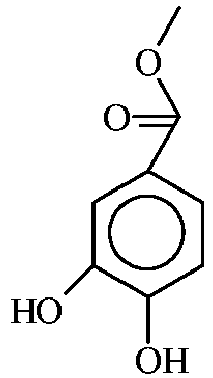
- 120.78 g propylene glycol mono methyl ether, 19.36 g (0.113 mol -COOH) 2,3,4-trihydroxy benzoic acid, 0.32 g triethylamine and 32.40 g (0.103 mol epoxy groups) of an epoxy functionalized silicone of the structure

- The solvent was removed at 65 °C/20 mmHg. Afterwards, the material was washed twice with 25 ml n-hexane. The solvent was removed at 65 °C/20 mmHg. A brownish opaque product of the structure


- A set of deionized water based formulations was prepared.
- All numbers are given in grams.
Formulation F1 F2 Example 1 2 Silicone polymers of the examples 1 and 2 0,5 0,5 De-ionized water 9,0 9,0 NH3 in water (25 %) 0,5 0,5 Appearance transparent brownish transparent brownish - The data show that water based formulations can be achieved. Depending on the polymer structure type and the application purpose certain quantities on acids, bases and/or short chained alcohols are required in order to get transparent formulations.
- Depending on the application purpose additional ingredients (the earlier outlined compoments b to j) can be added too.
- Test method for evaluation of the hair straightening is described in detail in "Chemical and Physical Behavior of human hair" Clarence R. Robbins, Springer-Verlag, New York, 1994 or in W. Cannell and L. E. Carothers, J. Soc. Cosmet. Chem. (1978) Vol. 29, pages 685-701.
- The method comprises the steps to cut e.g. the hair strands into two halves, testing the control end and the corresponding treated ends of hairs on a tensile tester.
Figure 1 is showing an example of the different regions in a stress-strain curve of hairs. The resulting stress-strain curves show a region having a Hookean like behavior between A to B, wherby the yield process continues up to 30 % elongation (strain). The Post Yield Slope (PYS) is related to a rapidly increase of the stress in the region between C to D. In the article of Cannell above e.g. this PYS is described in detail. The curve 1 represents an untreated hair,curve 2 represents a hair which is waved without any post-treatment. The graph shows that the post yield slope decreases after the waving treatment, indicating hair damage. The value of the post-yield slope of the treated ends of the hair is subtracted from the PYS-value of the control group. The difference expressed as percentage of the control value is a measure for the change of disulphide bonding situation after treatment. The higher the post yield slope after treatment, the least the hair damage is. The post-yield slope is directly related to the disulphide bonding in the hair fibre. The related formula of post yield slope (PYS) is:
- H = gradient of post-yield region (kg/m)
- g = 9.8 m/s2
- L = length of fiber (m)
- A = fiber cross-sectional area (m2)
- The following treatment solution (TS1) was prepared:
- Polymer from example 2 (5 wt.%), 2-propanol (76 wt.%), De-ionized (DI) water (19 %)
- The pH 8 buffer solution was composed of 100 g of 0.1 mol/L KH2PO4, 93.4 g of 0.1 mol/L NaOH and 6.6 g DI water.
- A bundle of 2 g of a Latin curly hair tress (Hair International Importers) was treated with a sodium hydroxide based commercial relaxer for 20 min to get relaxed, according to the protocol prescribed by the product manufacturer. The hair was rinsed, washed with the neutralizing shampoo sold with the commercial relaxing kit, and blow- dried in order to provide straightened relaxed hair.
- The prepared dry hair tress was immersed in 20 ml of the treatment solution TS1 for 30 min at room temperature (25°C). After removal of the excess liquid, the tress was immersed in 20 ml of a 0.65 wt.% aqueous solution of FeCl3 for 30 min at 25 °C. Afterwards, the hair was immersed in 20 ml of aqueous buffer of pH 8 defined above for 30 min. The hair was blow-dried at high dial.
- 50 fibers were taken randomly from the control tress and 50 fibers from the treated tress treated as described before.
- The control tress was the tress treated with the relaxer pretreatment, but not treated with solution TS1.
- Each of the 50 fibers were subjected to a continuous strain on a Diastron automated tensile tester. The stress or tensile strength of said single fibers were recorded as function of the strain (elongation) of the fiber.
- The average values of the post yield slope and strength at 50 % relative humidity (RH) at 25°C were calculated.
- It was found that the post yield slope value was increased by 14 % for the 50 fibers after pre-treatment and post treatment with the TS1 solution compared to the control group only subjected to pre-treatment. The increase is significant for a p-value of <0.05 (confidence level of 95 %) according to a Student t-test. The hair fibers after the post treatment of the invention was were straighter and less frizzy and provided a strength 8% higher than the control of the initial hair.
- A bundle of 2 g single bleached hair tress (bleached by Hair International Importers) was immersed in the treatment solution TS1 as described in example 10 for 30 min at room temperature (25 °C). After removal of the excess liquid, the tress was immersed in a 0.65 wt. % aqueous solution of FeCl3 for 30 min. The hair was immersed in the aqueous buffer solution of pH 8 buffer for 30 min. The hair was then rinsed and blow-dried (hair drier or 50 °C in air). 50 fibers were taken randomly from the control tress and 50 fibers from the treated tress treated as described before.
- It was found that the post yield slope value was increased by 19 % for the 50 fibers after pre-treatment and post treatment with the TS1 solution compared to the control group of the original bleached hair.
- The increase is significant for a p-value of <0.05 (confidence level of 95 %) according to a Student t-test.
- A bundle of 2 g Latin curly hair tress (Hair International Importers) was steamed with a handheld clothing steamer for 30 second, ironed for 3 passes with a flat iron at
230 °C, steamed again for 30 s and ironed for another 3 passes in order to provide straightened relaxed hair. - The ironed dry hair tress was immersed in 20 ml of the treatment solution TS1 as described in example 10 at room temperature (25°C) for 30 min. After removal of the excess liquid, the tress was immersed in 20 ml of a 0.65 wt. % aqueous solution of FeCl3 for 30 min. The hair was immersed in 20 ml of the aqueous buffer solution of pH 8 buffer solution for 30 min. The hair was then rinsed and dried as in example 10.
- The measurement of PYSd versus the control group was carried out as described in example 10.
- It was found that the post yield slope value was increased by 26 % for the 50 fibers after pretreatment and post treatment with the TS1 solution compared to the control group only submitted to pre-treatment. The increase is significant for a p-value of <0.05 (confidence level of 95 %) according to a Student t-test. The hair fibers were straighter and less frizzy after the post treatment of the invention.
Claims (15)
- A method for treating amino acid based substrates comprising the step of applying to such amino acid based substrate at least one polyorganosiloxane having an average number of 2 to 1000 siloxy units selected from the siloxy groups of the formulas:
 R is selected from R1 and RF3, whereinR1 is selected from organic groups,RF3 is selected from RF4 and RF5, whereinRF4 is selected from organic groups different from R1 which contain at least one functional group F4 selected from- a di-, or trihydroxy-substitued aromatic group,RF5 is selected from organic groups different from R1 which contain at least one functional group F5 selected from:- alkoxy silyl group,- amino group,- ammonium group,- phosphonium group,- epoxy group,- carbonate group,- urethane group,- isocyanate group, including blocked iscocyanate group,- urea group,- amido group,- aldehyde group,- acetale or half acetale group,- Schiff-Base or enamine group,- zwitterionic group,- carboxylic acid or carboxylate group,- sulfonic acid or sulfonate group,- sulfuric acid half ester or sulfate group,- phosphoric acid ester or phosphate group,- phosphonic acid ester or phosphonate group,- phosphorous acid ester or phosphite group,- xanthogenate/xanthogenate ester group,- thiosulfato group,- mercapto group,- saccharide group, and- polyether group with up to 60 carbon atoms,with the proviso that R comprises at least one group RF4.
 - A method for treating amino acid based substrates according to claim 1, wherein the polyorganosiloxanes have an average number of siloxy units of from 2 to 300.
- A method for treating amino acid based substrates according to claims 1 or 2, wherein in the polyorganosiloxanes R1 is selected from the group consisting of n-, iso-, or tert.-C1-C22-alkyl, C2-C22-alkoxyalkyl, C5-C30-cycloalkyl, C6-C30-aryl, C6-C30-aryl(C1-C6)alkyl, C6-C30-alkylaryl, C2-C22-alkenyl, C2-C22-alkenyloxyalkyl, which can be each substituted by hydoxyl and halogen, and which can contain one or more ether groups.
- A method for treating amino acid based substrates according to claims to any of claims 1 to 4, wherein in the polyorganosiloxanes RF5 is selected from hydrocarbon radicals which have up to 100 carbon atoms and may contain one or more groups selected from -O-, -S-, -NR2-, in which R2 is hydrogen, a monovalent, straight-chain, cyclic or branched, saturated, unsaturated or aromatic hydrocarbon radical which has up to 60 carbon atoms and may contain one or more groups selected from -O-, -NH-, -C(O)- and -C(S)-, and which may optionally be substituted by one or more substituents selected from the group consisting of a hydroxyl group, an optionally substituted heterocyclic group preferably containing one or more nitrogen atoms, amino, alkylamino, dialkylamino, polyether radicals and polyetherester radicals, where, when a plurality of -NR2- groups is present, they may be the same or different, and wherein RF5 contains at least one functional group F5.
- A method for treating amino acid based substrates according to any of claims 1 to 4, wherein the polyorganosiloxanes contain at least one siloxy group of the formula MF:

- A method for treating amino acid based substrates according to any of claims 1 to 5, wherein the polyorganosiloxanes are selected from the formulas:
 R is R1, and RF is RF3 as defined above, with the proviso that at least one RF is RF4, and the sum of the average numbers n1 + n2 is 0 to 28,
 whereinR is R1, and RF is RF3 as defined above, with the proviso that at least one RF is RF4, and the sum of the average numbers n1 + n2 is 1 to 28, with n2 ≥ 1,
 R is R1, and RF is RF3 as defined above, with the proviso that at least one RF is RF4, and wherein the sum of the average numbers n1 + n2 is 3 to 7 with n2 ≥ 1.
 - A method for treating amino acid based substrates according to any of claims 1 to 6, wherein the amino acid based substrates is hair.
- Use of a polyorganosiloxane having an average number of 2 to 1000 siloxy units selected from the siloxy groups of the formulas:
 R is selected from R1 and RF3, whereinR1 is selected from organic groups,RF3 is selected from RF4 and RF5, whereinRF4 is selected from organic groups different from R1 which contain at least one functional group F4 selected from- a di-, or trihydroxy-substitued aromatic group,RF5 is selected from organic groups different from R1 which contain at least one functional group F5 selected from:- alkoxy silyl group,- amino group,- ammonium group,- phosphonium group,- epoxy group,- carbonate group,- urethane group,- isocyanate group, including blocked iscocyanate group,- urea group,- amido group,- aldehyde group,- acetale or half acetale group,- Schiff-Base or enamine group,- zwitterionic group,- carboxylic acid or carboxylate group,- sulfonic acid or sulfonate group,- sulfuric acid half ester or sulfate group,- phosphoric acid ester or phosphate group,- phosphonic acid ester or phosphonate group,- phosphorous acid ester or phosphite group,- xanthogenate/xanthogenate ester group,- thiosulfato group,- mercapto group,- saccharide group, and- polyether group with up to 60 carbon atoms,with the proviso that R comprises at least one group RF4,for the treatment of amino acid based substrates.
 - Use according to claim 8, wherein the amino acid based substrates are selected from keratinous substrates, preferably human hair.
- Use according to any of claims 8 to 9, in hair treatments, selected from hair straightening treatment, hair conditioning treatment, hair shine treatment, hair UV protecting treatment, hair washing treatment, hair coloring treatment, permanent shaping treatment of hairs, protecting dyed hair color treatment, e.g. after hair wash, hair color retention treatment, hair color enhancement treatment, and/or reduced color fading treatment of artificially colored hair.
- A composition for treating amino acid based substrates, comprisinga) at least one polyorganosiloxane as defined in any of claims 1 to 7 ,b) at least one diluent/solventc) optionally one or more protein, preferably keratin,d) optionally one or more surface active ingredient/emulsifier,e) optionally one or more emollient/fatty substance,f) optionally one or more preservative,g) optionally one or more skin protecting ingredient,h) optionally one or more conditioning agent,i) optionally one or more oxidizing agent,j) optionally one or more reducing agent,k) optionally one or more other auxiliary,with the proviso that oxidizing agents and reducing agents are not present simultaneously in a given formulation.
- A composition for treating amino acid based substrates according to claim 11, comprising the components in the following weight portions:
Ingredient weight % a) at least one polyorganosiloxane as defined in any of claims 1 to 7 0,05 to 30 b) diluents/solvents 5 to 99,95 c) protein, preferred keratin 0 to 15 d) surface active ingredients/emulsifiers 0 to 15 e) emollients/fatty substance 0 to 15 f) Preservatives 0 to 5 g) skin protecting ingredients 0 to 10 h) conditioning agents 0 to 90 i) oxidizing agents agents 0 to 10 j) reducing agents 0 to 10 k) other auxiliary agents 0 to 10 - A composition for treating amino acid based substrates according to claims 11 or 12, comprising an additional polyorganosiloxane compound different from component a).
- A method for treating amino acid based substrates comprising the step of applying at least one composition according to any of claims 11 to 13 to such amino acid based substrate.
- A kit including at least two containers wherein at least one container comprises a composition according to any of the claims 11 to 13, and wherein at least one other container comprises an aqueous solution of a metal salt.
Applications Claiming Priority (2)
| Application Number | Priority Date | Filing Date | Title |
|---|---|---|---|
| US201462053870P | 2014-09-23 | 2014-09-23 | |
| PCT/EP2015/071678 WO2016046178A1 (en) | 2014-09-23 | 2015-09-22 | Silicone compounds and compositions thereof for the treatment of amino acid based substrates |
Publications (2)
| Publication Number | Publication Date |
|---|---|
| EP3197937A1 EP3197937A1 (en) | 2017-08-02 |
| EP3197937B1 true EP3197937B1 (en) | 2024-04-24 |
Family
ID=54207486
Family Applications (1)
| Application Number | Title | Priority Date | Filing Date |
|---|---|---|---|
| EP15771556.6A Active EP3197937B1 (en) | 2014-09-23 | 2015-09-22 | Silicone compounds and compositions thereof for the treatment of amino acid based substrates |
Country Status (6)
| Country | Link |
|---|---|
| US (1) | US10266656B2 (en) |
| EP (1) | EP3197937B1 (en) |
| JP (1) | JP2017536468A (en) |
| CN (1) | CN107001637B (en) |
| BR (1) | BR112017006015B1 (en) |
| WO (1) | WO2016046178A1 (en) |
Families Citing this family (10)
| Publication number | Priority date | Publication date | Assignee | Title |
|---|---|---|---|---|
| US10982051B2 (en) * | 2017-06-05 | 2021-04-20 | Momentive Performance Materials Inc. | Aqueous compositions for hair treatment comprising polyorganosiloxanes with polyhydroxyaromatic moieties |
| US11179312B2 (en) * | 2017-06-05 | 2021-11-23 | Momentive Performance Materials Inc. | Aqueous compositions for the treatment of hair |
| CN107595668A (en) * | 2017-11-08 | 2018-01-19 | 向明 | High temperature plastic hair film and preparation method thereof |
| EP3501488B1 (en) | 2017-12-21 | 2021-04-14 | Momentive Performance Materials GmbH | Aqueous silicone polymer compositions |
| US20200163850A1 (en) * | 2018-11-24 | 2020-05-28 | Momentive Performance Materials Gmbh | Use of polyhydroxyaromatic compounds for the treatment of fibrous amino acid based substrates |
| US11090255B2 (en) | 2018-12-04 | 2021-08-17 | Momentive Performance Materials Inc. | Use of polycarboxylic acid compounds for the treatment of fibrious amino acid based substrates, especially hair |
| WO2021160575A1 (en) * | 2020-02-14 | 2021-08-19 | Evonik Operations Gmbh | Stabilized silane composition |
| KR20230073178A (en) | 2020-07-21 | 2023-05-25 | 켐보 엘엘씨 | Diester cosmetic preparations and uses thereof |
| CN119836426A (en) * | 2022-09-22 | 2025-04-15 | 陶氏东丽株式会社 | Curable branched organopolysiloxane, high-energy radiation curable composition containing same, and use thereof |
| CN121443262A (en) * | 2023-06-30 | 2026-01-30 | 迈图高新材料日本有限责任公司 | Oil-based compositions and hair conditioning formulations containing them |
Family Cites Families (32)
| Publication number | Priority date | Publication date | Assignee | Title |
|---|---|---|---|---|
| US2032624A (en) | 1934-11-28 | 1936-03-03 | Bird Machine Co | Processing of moist plastic bodies |
| GB722822A (en) | 1952-01-14 | 1955-02-02 | Dow Corning Ltd | Organosilicon resins |
| US2770631A (en) | 1954-05-20 | 1956-11-13 | Dow Corning | Hydroxyester substituted siloxanes |
| US3432536A (en) | 1965-05-27 | 1969-03-11 | Gen Electric | Organopolysiloxane fluids substituted with methylolated amidoalkyl groups |
| NL6702766A (en) | 1966-07-01 | 1968-01-02 | ||
| BE791682A (en) * | 1971-11-22 | 1973-05-21 | Dow Corning | ORGANOSILICIC AND COPOLYMER CINNAMATES |
| DE3607963A1 (en) | 1986-03-11 | 1987-09-17 | Bayer Ag | CONDENSATION PRODUCTS AND METHOD FOR TREATING DYED POLYAMIDES |
| US5679619A (en) | 1986-05-23 | 1997-10-21 | American Cyanamid Company | Aqueous suspension concentrate compositions of pendimethalin |
| GB8713879D0 (en) | 1987-06-13 | 1987-07-15 | Dow Corning Ltd | Treating hair |
| DE69424100T2 (en) * | 1993-08-10 | 2000-10-12 | Kao Corp | Organopolysiloxanes and a method of setting hair using the same |
| US5935560A (en) | 1996-09-13 | 1999-08-10 | Helene Curtis, Inc. | Composition and methods of imparting durable conditioning properties to hair |
| BR0007437A (en) | 1999-01-08 | 2001-11-20 | Procter & Gamble | Topical compositions comprising protected functional thiols |
| US6506371B1 (en) * | 2000-07-14 | 2003-01-14 | General Electric Company | Silicone compositions for personal care products and method for making |
| US20040156806A1 (en) * | 2003-02-11 | 2004-08-12 | Patil Anjali Abhimanyu | Cosmetic compositions containing siloxane resins |
| DE10354259A1 (en) | 2003-11-20 | 2005-06-09 | Wacker-Chemie Gmbh | Process for the preparation of carbonyl radicals containing organosilicon compounds |
| DE102005023404A1 (en) | 2005-05-20 | 2006-12-21 | Wacker Chemie Ag | Process for the preparation of silicone-containing polymers |
| EP1904557B2 (en) | 2005-07-18 | 2016-02-17 | Dow Corning Corporation | Aldehyde functional siloxanes |
| US7652107B2 (en) | 2005-10-31 | 2010-01-26 | Sabic Innovative Plastics Ip B.V. | Flame resistant polymer blends |
| US7652162B2 (en) | 2005-12-16 | 2010-01-26 | Momentive Performance Materials Inc. | Polyorganosiloxane composition, and associated method |
| BRPI0806825A2 (en) * | 2007-02-06 | 2011-09-13 | Ciba Holding Inc | polysiloxane block copolymers |
| DE102007016990A1 (en) | 2007-04-11 | 2008-10-16 | Wacker Chemie Ag | Methylol-containing siloxanes |
| US8414872B2 (en) | 2007-09-10 | 2013-04-09 | Liquid Keratin, Inc. | Hair straightening formulations, methods and systems |
| US8785370B2 (en) | 2007-10-05 | 2014-07-22 | Keratin Complex Holdings, Inc. | Reactive keratin protein formulations and methods of using for revitalizing hair |
| EP1972330B1 (en) * | 2008-06-13 | 2012-09-12 | Clariant Finance (BVI) Limited | Cosmetic or pharmaceutical compositions comprising modified polysiloxanes with at least one carbamate group |
| ES2980213T3 (en) * | 2010-07-30 | 2024-09-30 | Alcon Inc | Silicone hydrogel lenses with water-rich surfaces |
| US8673276B2 (en) | 2010-08-05 | 2014-03-18 | Grant Industries, Inc. | Composition and method for thermally activated hair treatment |
| ES2545254T3 (en) * | 2010-10-25 | 2015-09-09 | L'oréal | Procedure for the preparation of 2-hydroxyphenylbenzotriazole and siloxane compounds |
| RU2013130746A (en) * | 2011-01-28 | 2015-01-10 | Моументив Перформенс Матириалз Гмбх | UV PHOTO PROTECTIVE COSMETIC COMPOSITION |
| WO2012143371A1 (en) * | 2011-04-18 | 2012-10-26 | Momentive Performance Materials Gmbh | Functionalized polyorganosiloxanes or silanes for treating lignocellulose materials |
| WO2013034705A1 (en) * | 2011-09-09 | 2013-03-14 | Momentive Performance Materials Gmbh | Use of ionic polysiloxanes as a solvent in organic reactions |
| JP5795231B2 (en) * | 2011-10-11 | 2015-10-14 | 信越化学工業株式会社 | Glycerol group-containing organopolysiloxane, cosmetic and method for producing glycerol group-containing organopolysiloxane |
| JP6690116B2 (en) * | 2014-10-30 | 2020-04-28 | 出光興産株式会社 | Branched polycarbonate resin and method for producing the same |
-
2015
- 2015-09-22 BR BR112017006015-9A patent/BR112017006015B1/en active IP Right Grant
- 2015-09-22 WO PCT/EP2015/071678 patent/WO2016046178A1/en not_active Ceased
- 2015-09-22 JP JP2017535138A patent/JP2017536468A/en active Pending
- 2015-09-22 US US15/512,623 patent/US10266656B2/en active Active
- 2015-09-22 CN CN201580051489.8A patent/CN107001637B/en active Active
- 2015-09-22 EP EP15771556.6A patent/EP3197937B1/en active Active
Also Published As
| Publication number | Publication date |
|---|---|
| WO2016046178A1 (en) | 2016-03-31 |
| EP3197937A1 (en) | 2017-08-02 |
| JP2017536468A (en) | 2017-12-07 |
| US20170291994A1 (en) | 2017-10-12 |
| CN107001637B (en) | 2021-06-15 |
| CN107001637A (en) | 2017-08-01 |
| BR112017006015B1 (en) | 2021-09-14 |
| BR112017006015A2 (en) | 2018-01-30 |
| US10266656B2 (en) | 2019-04-23 |
Similar Documents
| Publication | Publication Date | Title |
|---|---|---|
| US10266656B2 (en) | Silicone compounds and compositions thereof for the treatment of amino acid based substrates | |
| AU2002223756B2 (en) | Composition for treating keratinous materials comprising a cationic associative polyurethane polymer and a protecting or conditioning agent | |
| EP2914239B1 (en) | Composition comprising conditioning and/or styling polymer | |
| CA2330469C (en) | Cosmetic compounds containing an amphoteric starch and a cationic conditioning agent and their uses | |
| US8771657B2 (en) | Personal care compositions with ethylene acrylic acid copolymer aqueous dispersions | |
| JP4527354B2 (en) | Compositions for treating keratin materials containing cationic poly (alkyl) vinyl lactam polymers and protective or conditioning agents | |
| US20140044762A1 (en) | Wash Resistant Compositions Containing Aminosilicone | |
| EP1312336A2 (en) | Cosmetic compositions containing aminosilicone and a conditioning agent and their use | |
| WO2016100885A1 (en) | Hair cosmetic composition | |
| US20110305653A1 (en) | Personal care compositions with ethylene acrylic acid copolymer aqueous dispersions | |
| KR20030022746A (en) | Cosmetic compositions containing a methacrylic acid copolymer, a dimethicone and a cationic polymer, and uses thereof | |
| EP1093808A1 (en) | Cosmetic compositions containing a vinyldimethicone/dimethicone copolymer and a cationic polymer, and their uses | |
| FR3029110A1 (en) | COSMETIC COMPOSITION COMPRISING AN ORGANOSILANE, A CATIONIC SURFACTANT AND A CATIONIC POLYMER HAVING A CHARGE DENSITY OF MORE THAN 4 MEQ / G | |
| WO2006013271A1 (en) | Cosmetic compositions containing at least one conditioning agent and at least one ethylene polymer with polyethylene glycol grafts | |
| EP1462088A1 (en) | Composition for treating keratin fibers containing a hydroxycarboxylic acid and a protecting or conditionning agent | |
| FR2795953A1 (en) | COSMETIC COMPOSITIONS CONTAINING A CATIONIC FRUCTAN AND A CONDITIONING AGENT AND THEIR USES | |
| WO2012110608A2 (en) | Process for treating keratin fibres using a silicone elastomer in combination with heat | |
| FR2852823A1 (en) | The use of specified polycarboxylic acids and their salts in compositions for the treatment of hair such as shampoos and conditioners to improve the effectiveness of protective agents and/or conditioners used in such compositions | |
| FR2852825A1 (en) | COMPOSITION FOR TREATING KERATINIC MATERIALS COMPRISING A POLYCARBOXYLIC ACID AND A PROTECTIVE AGENT OR CONDITIONER | |
| FR2831799A1 (en) | COSMETIC COMPOSITIONS CONTAINING AN AMINO SILICONE AND A SOLUBLE CONDITIONING AGENT AND THEIR USES | |
| FR2831798A1 (en) | Cosmetic composition, useful for washing or care of keratinic materials, comprises a water-insoluble conditioner and an aminoethylaminopropyl silicone |
Legal Events
| Date | Code | Title | Description |
|---|---|---|---|
| STAA | Information on the status of an ep patent application or granted ep patent |
Free format text: STATUS: THE INTERNATIONAL PUBLICATION HAS BEEN MADE |
|
| PUAI | Public reference made under article 153(3) epc to a published international application that has entered the european phase |
Free format text: ORIGINAL CODE: 0009012 |
|
| STAA | Information on the status of an ep patent application or granted ep patent |
Free format text: STATUS: REQUEST FOR EXAMINATION WAS MADE |
|
| 17P | Request for examination filed |
Effective date: 20170223 |
|
| AK | Designated contracting states |
Kind code of ref document: A1 Designated state(s): AL AT BE BG CH CY CZ DE DK EE ES FI FR GB GR HR HU IE IS IT LI LT LU LV MC MK MT NL NO PL PT RO RS SE SI SK SM TR |
|
| AX | Request for extension of the european patent |
Extension state: BA ME |
|
| DAV | Request for validation of the european patent (deleted) | ||
| DAX | Request for extension of the european patent (deleted) | ||
| RIN1 | Information on inventor provided before grant (corrected) |
Inventor name: KOERNER, ANDREA Inventor name: WENSKE, CHRISTIAN Inventor name: MOELLER, MARTIN Inventor name: WAGNER, ROLAND Inventor name: STREICHER, KATHARINA Inventor name: DITTRICH, BARBARA Inventor name: KEUL, HELMUT Inventor name: ER-RAFIK, MERIEM Inventor name: HEEDFELD, ROBIN Inventor name: SUN, KUNSHAN Inventor name: POPESCU, CRISAN Inventor name: ZHU, XIAOMIN Inventor name: DUSSAUD, ANNE Inventor name: STACHULLA, KARL-HEINZ |
|
| STAA | Information on the status of an ep patent application or granted ep patent |
Free format text: STATUS: EXAMINATION IS IN PROGRESS |
|
| 17Q | First examination report despatched |
Effective date: 20211216 |
|
| GRAP | Despatch of communication of intention to grant a patent |
Free format text: ORIGINAL CODE: EPIDOSNIGR1 |
|
| STAA | Information on the status of an ep patent application or granted ep patent |
Free format text: STATUS: GRANT OF PATENT IS INTENDED |
|
| INTG | Intention to grant announced |
Effective date: 20231201 |
|
| GRAS | Grant fee paid |
Free format text: ORIGINAL CODE: EPIDOSNIGR3 |
|
| GRAA | (expected) grant |
Free format text: ORIGINAL CODE: 0009210 |
|
| STAA | Information on the status of an ep patent application or granted ep patent |
Free format text: STATUS: THE PATENT HAS BEEN GRANTED |
|
| AK | Designated contracting states |
Kind code of ref document: B1 Designated state(s): AL AT BE BG CH CY CZ DE DK EE ES FI FR GB GR HR HU IE IS IT LI LT LU LV MC MK MT NL NO PL PT RO RS SE SI SK SM TR |
|
| REG | Reference to a national code |
Ref country code: GB Ref legal event code: FG4D |
|
| REG | Reference to a national code |
Ref country code: CH Ref legal event code: EP |
|
| REG | Reference to a national code |
Ref country code: DE Ref legal event code: R096 Ref document number: 602015088438 Country of ref document: DE |
|
| P01 | Opt-out of the competence of the unified patent court (upc) registered |
Effective date: 20240405 |
|
| REG | Reference to a national code |
Ref country code: IE Ref legal event code: FG4D |
|
| REG | Reference to a national code |
Ref country code: LT Ref legal event code: MG9D |
|
| REG | Reference to a national code |
Ref country code: NL Ref legal event code: MP Effective date: 20240424 |
|
| REG | Reference to a national code |
Ref country code: AT Ref legal event code: MK05 Ref document number: 1679541 Country of ref document: AT Kind code of ref document: T Effective date: 20240424 |
|
| PG25 | Lapsed in a contracting state [announced via postgrant information from national office to epo] |
Ref country code: NL Free format text: LAPSE BECAUSE OF FAILURE TO SUBMIT A TRANSLATION OF THE DESCRIPTION OR TO PAY THE FEE WITHIN THE PRESCRIBED TIME-LIMIT Effective date: 20240424 |
|
| PG25 | Lapsed in a contracting state [announced via postgrant information from national office to epo] |
Ref country code: NL Free format text: LAPSE BECAUSE OF FAILURE TO SUBMIT A TRANSLATION OF THE DESCRIPTION OR TO PAY THE FEE WITHIN THE PRESCRIBED TIME-LIMIT Effective date: 20240424 |
|
| PG25 | Lapsed in a contracting state [announced via postgrant information from national office to epo] |
Ref country code: IS Free format text: LAPSE BECAUSE OF FAILURE TO SUBMIT A TRANSLATION OF THE DESCRIPTION OR TO PAY THE FEE WITHIN THE PRESCRIBED TIME-LIMIT Effective date: 20240824 |
|
| PG25 | Lapsed in a contracting state [announced via postgrant information from national office to epo] |
Ref country code: BG Free format text: LAPSE BECAUSE OF FAILURE TO SUBMIT A TRANSLATION OF THE DESCRIPTION OR TO PAY THE FEE WITHIN THE PRESCRIBED TIME-LIMIT Effective date: 20240424 |
|
| PG25 | Lapsed in a contracting state [announced via postgrant information from national office to epo] |
Ref country code: HR Free format text: LAPSE BECAUSE OF FAILURE TO SUBMIT A TRANSLATION OF THE DESCRIPTION OR TO PAY THE FEE WITHIN THE PRESCRIBED TIME-LIMIT Effective date: 20240424 Ref country code: FI Free format text: LAPSE BECAUSE OF FAILURE TO SUBMIT A TRANSLATION OF THE DESCRIPTION OR TO PAY THE FEE WITHIN THE PRESCRIBED TIME-LIMIT Effective date: 20240424 |
|
| PG25 | Lapsed in a contracting state [announced via postgrant information from national office to epo] |
Ref country code: GR Free format text: LAPSE BECAUSE OF FAILURE TO SUBMIT A TRANSLATION OF THE DESCRIPTION OR TO PAY THE FEE WITHIN THE PRESCRIBED TIME-LIMIT Effective date: 20240725 |
|
| PG25 | Lapsed in a contracting state [announced via postgrant information from national office to epo] |
Ref country code: PT Free format text: LAPSE BECAUSE OF FAILURE TO SUBMIT A TRANSLATION OF THE DESCRIPTION OR TO PAY THE FEE WITHIN THE PRESCRIBED TIME-LIMIT Effective date: 20240826 |
|
| PG25 | Lapsed in a contracting state [announced via postgrant information from national office to epo] |
Ref country code: ES Free format text: LAPSE BECAUSE OF FAILURE TO SUBMIT A TRANSLATION OF THE DESCRIPTION OR TO PAY THE FEE WITHIN THE PRESCRIBED TIME-LIMIT Effective date: 20240424 |
|
| PG25 | Lapsed in a contracting state [announced via postgrant information from national office to epo] |
Ref country code: AT Free format text: LAPSE BECAUSE OF FAILURE TO SUBMIT A TRANSLATION OF THE DESCRIPTION OR TO PAY THE FEE WITHIN THE PRESCRIBED TIME-LIMIT Effective date: 20240424 |
|
| PG25 | Lapsed in a contracting state [announced via postgrant information from national office to epo] |
Ref country code: PL Free format text: LAPSE BECAUSE OF FAILURE TO SUBMIT A TRANSLATION OF THE DESCRIPTION OR TO PAY THE FEE WITHIN THE PRESCRIBED TIME-LIMIT Effective date: 20240424 |
|
| PG25 | Lapsed in a contracting state [announced via postgrant information from national office to epo] |
Ref country code: LV Free format text: LAPSE BECAUSE OF FAILURE TO SUBMIT A TRANSLATION OF THE DESCRIPTION OR TO PAY THE FEE WITHIN THE PRESCRIBED TIME-LIMIT Effective date: 20240424 |
|
| PG25 | Lapsed in a contracting state [announced via postgrant information from national office to epo] |
Ref country code: PT Free format text: LAPSE BECAUSE OF FAILURE TO SUBMIT A TRANSLATION OF THE DESCRIPTION OR TO PAY THE FEE WITHIN THE PRESCRIBED TIME-LIMIT Effective date: 20240826 Ref country code: PL Free format text: LAPSE BECAUSE OF FAILURE TO SUBMIT A TRANSLATION OF THE DESCRIPTION OR TO PAY THE FEE WITHIN THE PRESCRIBED TIME-LIMIT Effective date: 20240424 Ref country code: NO Free format text: LAPSE BECAUSE OF FAILURE TO SUBMIT A TRANSLATION OF THE DESCRIPTION OR TO PAY THE FEE WITHIN THE PRESCRIBED TIME-LIMIT Effective date: 20240724 Ref country code: LV Free format text: LAPSE BECAUSE OF FAILURE TO SUBMIT A TRANSLATION OF THE DESCRIPTION OR TO PAY THE FEE WITHIN THE PRESCRIBED TIME-LIMIT Effective date: 20240424 Ref country code: IS Free format text: LAPSE BECAUSE OF FAILURE TO SUBMIT A TRANSLATION OF THE DESCRIPTION OR TO PAY THE FEE WITHIN THE PRESCRIBED TIME-LIMIT Effective date: 20240824 Ref country code: HR Free format text: LAPSE BECAUSE OF FAILURE TO SUBMIT A TRANSLATION OF THE DESCRIPTION OR TO PAY THE FEE WITHIN THE PRESCRIBED TIME-LIMIT Effective date: 20240424 Ref country code: GR Free format text: LAPSE BECAUSE OF FAILURE TO SUBMIT A TRANSLATION OF THE DESCRIPTION OR TO PAY THE FEE WITHIN THE PRESCRIBED TIME-LIMIT Effective date: 20240725 Ref country code: FI Free format text: LAPSE BECAUSE OF FAILURE TO SUBMIT A TRANSLATION OF THE DESCRIPTION OR TO PAY THE FEE WITHIN THE PRESCRIBED TIME-LIMIT Effective date: 20240424 Ref country code: ES Free format text: LAPSE BECAUSE OF FAILURE TO SUBMIT A TRANSLATION OF THE DESCRIPTION OR TO PAY THE FEE WITHIN THE PRESCRIBED TIME-LIMIT Effective date: 20240424 Ref country code: BG Free format text: LAPSE BECAUSE OF FAILURE TO SUBMIT A TRANSLATION OF THE DESCRIPTION OR TO PAY THE FEE WITHIN THE PRESCRIBED TIME-LIMIT Effective date: 20240424 Ref country code: AT Free format text: LAPSE BECAUSE OF FAILURE TO SUBMIT A TRANSLATION OF THE DESCRIPTION OR TO PAY THE FEE WITHIN THE PRESCRIBED TIME-LIMIT Effective date: 20240424 Ref country code: RS Free format text: LAPSE BECAUSE OF FAILURE TO SUBMIT A TRANSLATION OF THE DESCRIPTION OR TO PAY THE FEE WITHIN THE PRESCRIBED TIME-LIMIT Effective date: 20240724 |
|
| PG25 | Lapsed in a contracting state [announced via postgrant information from national office to epo] |
Ref country code: DK Free format text: LAPSE BECAUSE OF FAILURE TO SUBMIT A TRANSLATION OF THE DESCRIPTION OR TO PAY THE FEE WITHIN THE PRESCRIBED TIME-LIMIT Effective date: 20240424 |
|
| PG25 | Lapsed in a contracting state [announced via postgrant information from national office to epo] |
Ref country code: EE Free format text: LAPSE BECAUSE OF FAILURE TO SUBMIT A TRANSLATION OF THE DESCRIPTION OR TO PAY THE FEE WITHIN THE PRESCRIBED TIME-LIMIT Effective date: 20240424 |
|
| PG25 | Lapsed in a contracting state [announced via postgrant information from national office to epo] |
Ref country code: CZ Free format text: LAPSE BECAUSE OF FAILURE TO SUBMIT A TRANSLATION OF THE DESCRIPTION OR TO PAY THE FEE WITHIN THE PRESCRIBED TIME-LIMIT Effective date: 20240424 |
|
| PG25 | Lapsed in a contracting state [announced via postgrant information from national office to epo] |
Ref country code: SK Free format text: LAPSE BECAUSE OF FAILURE TO SUBMIT A TRANSLATION OF THE DESCRIPTION OR TO PAY THE FEE WITHIN THE PRESCRIBED TIME-LIMIT Effective date: 20240424 Ref country code: RO Free format text: LAPSE BECAUSE OF FAILURE TO SUBMIT A TRANSLATION OF THE DESCRIPTION OR TO PAY THE FEE WITHIN THE PRESCRIBED TIME-LIMIT Effective date: 20240424 |
|
| REG | Reference to a national code |
Ref country code: DE Ref legal event code: R097 Ref document number: 602015088438 Country of ref document: DE |
|
| PG25 | Lapsed in a contracting state [announced via postgrant information from national office to epo] |
Ref country code: SM Free format text: LAPSE BECAUSE OF FAILURE TO SUBMIT A TRANSLATION OF THE DESCRIPTION OR TO PAY THE FEE WITHIN THE PRESCRIBED TIME-LIMIT Effective date: 20240424 |
|
| PG25 | Lapsed in a contracting state [announced via postgrant information from national office to epo] |
Ref country code: SM Free format text: LAPSE BECAUSE OF FAILURE TO SUBMIT A TRANSLATION OF THE DESCRIPTION OR TO PAY THE FEE WITHIN THE PRESCRIBED TIME-LIMIT Effective date: 20240424 Ref country code: SK Free format text: LAPSE BECAUSE OF FAILURE TO SUBMIT A TRANSLATION OF THE DESCRIPTION OR TO PAY THE FEE WITHIN THE PRESCRIBED TIME-LIMIT Effective date: 20240424 Ref country code: RO Free format text: LAPSE BECAUSE OF FAILURE TO SUBMIT A TRANSLATION OF THE DESCRIPTION OR TO PAY THE FEE WITHIN THE PRESCRIBED TIME-LIMIT Effective date: 20240424 Ref country code: EE Free format text: LAPSE BECAUSE OF FAILURE TO SUBMIT A TRANSLATION OF THE DESCRIPTION OR TO PAY THE FEE WITHIN THE PRESCRIBED TIME-LIMIT Effective date: 20240424 Ref country code: DK Free format text: LAPSE BECAUSE OF FAILURE TO SUBMIT A TRANSLATION OF THE DESCRIPTION OR TO PAY THE FEE WITHIN THE PRESCRIBED TIME-LIMIT Effective date: 20240424 Ref country code: CZ Free format text: LAPSE BECAUSE OF FAILURE TO SUBMIT A TRANSLATION OF THE DESCRIPTION OR TO PAY THE FEE WITHIN THE PRESCRIBED TIME-LIMIT Effective date: 20240424 |
|
| PLBE | No opposition filed within time limit |
Free format text: ORIGINAL CODE: 0009261 |
|
| STAA | Information on the status of an ep patent application or granted ep patent |
Free format text: STATUS: NO OPPOSITION FILED WITHIN TIME LIMIT |
|
| 26N | No opposition filed |
Effective date: 20250127 |
|
| PG25 | Lapsed in a contracting state [announced via postgrant information from national office to epo] |
Ref country code: SI Free format text: LAPSE BECAUSE OF FAILURE TO SUBMIT A TRANSLATION OF THE DESCRIPTION OR TO PAY THE FEE WITHIN THE PRESCRIBED TIME-LIMIT Effective date: 20240424 Ref country code: MC Free format text: LAPSE BECAUSE OF FAILURE TO SUBMIT A TRANSLATION OF THE DESCRIPTION OR TO PAY THE FEE WITHIN THE PRESCRIBED TIME-LIMIT Effective date: 20240424 |
|
| REG | Reference to a national code |
Ref country code: CH Ref legal event code: PL |
|
| PG25 | Lapsed in a contracting state [announced via postgrant information from national office to epo] |
Ref country code: LU Free format text: LAPSE BECAUSE OF NON-PAYMENT OF DUE FEES Effective date: 20240922 |
|
| GBPC | Gb: european patent ceased through non-payment of renewal fee |
Effective date: 20240922 |
|
| PG25 | Lapsed in a contracting state [announced via postgrant information from national office to epo] |
Ref country code: GB Free format text: LAPSE BECAUSE OF NON-PAYMENT OF DUE FEES Effective date: 20240922 |
|
| REG | Reference to a national code |
Ref country code: BE Ref legal event code: MM Effective date: 20240930 |
|
| PG25 | Lapsed in a contracting state [announced via postgrant information from national office to epo] |
Ref country code: BE Free format text: LAPSE BECAUSE OF NON-PAYMENT OF DUE FEES Effective date: 20240930 |
|
| PG25 | Lapsed in a contracting state [announced via postgrant information from national office to epo] |
Ref country code: CH Free format text: LAPSE BECAUSE OF NON-PAYMENT OF DUE FEES Effective date: 20240930 |
|
| PG25 | Lapsed in a contracting state [announced via postgrant information from national office to epo] |
Ref country code: IE Free format text: LAPSE BECAUSE OF NON-PAYMENT OF DUE FEES Effective date: 20240922 |
|
| PG25 | Lapsed in a contracting state [announced via postgrant information from national office to epo] |
Ref country code: SE Free format text: LAPSE BECAUSE OF FAILURE TO SUBMIT A TRANSLATION OF THE DESCRIPTION OR TO PAY THE FEE WITHIN THE PRESCRIBED TIME-LIMIT Effective date: 20240424 |
|
| PGFP | Annual fee paid to national office [announced via postgrant information from national office to epo] |
Ref country code: DE Payment date: 20250926 Year of fee payment: 11 |
|
| PGFP | Annual fee paid to national office [announced via postgrant information from national office to epo] |
Ref country code: FR Payment date: 20250925 Year of fee payment: 11 |
|
| PG25 | Lapsed in a contracting state [announced via postgrant information from national office to epo] |
Ref country code: IT Free format text: LAPSE BECAUSE OF FAILURE TO SUBMIT A TRANSLATION OF THE DESCRIPTION OR TO PAY THE FEE WITHIN THE PRESCRIBED TIME-LIMIT Effective date: 20240424 Ref country code: CY Free format text: LAPSE BECAUSE OF FAILURE TO SUBMIT A TRANSLATION OF THE DESCRIPTION OR TO PAY THE FEE WITHIN THE PRESCRIBED TIME-LIMIT; INVALID AB INITIO Effective date: 20150922 |
|
| PG25 | Lapsed in a contracting state [announced via postgrant information from national office to epo] |
Ref country code: HU Free format text: LAPSE BECAUSE OF FAILURE TO SUBMIT A TRANSLATION OF THE DESCRIPTION OR TO PAY THE FEE WITHIN THE PRESCRIBED TIME-LIMIT; INVALID AB INITIO Effective date: 20150922 |