EP3196867A2 - Vorrichtung und verfahren zur anzeige von inhalt - Google Patents
Vorrichtung und verfahren zur anzeige von inhalt Download PDFInfo
- Publication number
- EP3196867A2 EP3196867A2 EP15841148.8A EP15841148A EP3196867A2 EP 3196867 A2 EP3196867 A2 EP 3196867A2 EP 15841148 A EP15841148 A EP 15841148A EP 3196867 A2 EP3196867 A2 EP 3196867A2
- Authority
- EP
- European Patent Office
- Prior art keywords
- content
- electronic device
- pixels
- display
- display brightness
- Prior art date
- Legal status (The legal status is an assumption and is not a legal conclusion. Google has not performed a legal analysis and makes no representation as to the accuracy of the status listed.)
- Withdrawn
Links
Images








Classifications
-
- G—PHYSICS
- G09—EDUCATION; CRYPTOGRAPHY; DISPLAY; ADVERTISING; SEALS
- G09G—ARRANGEMENTS OR CIRCUITS FOR CONTROL OF INDICATING DEVICES USING STATIC MEANS TO PRESENT VARIABLE INFORMATION
- G09G3/00—Control arrangements or circuits, of interest only in connection with visual indicators other than cathode-ray tubes
- G09G3/20—Control arrangements or circuits, of interest only in connection with visual indicators other than cathode-ray tubes for presentation of an assembly of a number of characters, e.g. a page, by composing the assembly by combination of individual elements arranged in a matrix no fixed position being assigned to or needed to be assigned to the individual characters or partial characters
-
- G—PHYSICS
- G09—EDUCATION; CRYPTOGRAPHY; DISPLAY; ADVERTISING; SEALS
- G09G—ARRANGEMENTS OR CIRCUITS FOR CONTROL OF INDICATING DEVICES USING STATIC MEANS TO PRESENT VARIABLE INFORMATION
- G09G3/00—Control arrangements or circuits, of interest only in connection with visual indicators other than cathode-ray tubes
- G09G3/20—Control arrangements or circuits, of interest only in connection with visual indicators other than cathode-ray tubes for presentation of an assembly of a number of characters, e.g. a page, by composing the assembly by combination of individual elements arranged in a matrix no fixed position being assigned to or needed to be assigned to the individual characters or partial characters
- G09G3/2007—Display of intermediate tones
-
- G—PHYSICS
- G09—EDUCATION; CRYPTOGRAPHY; DISPLAY; ADVERTISING; SEALS
- G09G—ARRANGEMENTS OR CIRCUITS FOR CONTROL OF INDICATING DEVICES USING STATIC MEANS TO PRESENT VARIABLE INFORMATION
- G09G5/00—Control arrangements or circuits for visual indicators common to cathode-ray tube indicators and other visual indicators
- G09G5/10—Intensity circuits
-
- G—PHYSICS
- G06—COMPUTING OR CALCULATING; COUNTING
- G06F—ELECTRIC DIGITAL DATA PROCESSING
- G06F3/00—Input arrangements for transferring data to be processed into a form capable of being handled by the computer; Output arrangements for transferring data from processing unit to output unit, e.g. interface arrangements
- G06F3/01—Input arrangements or combined input and output arrangements for interaction between user and computer
- G06F3/011—Arrangements for interaction with the human body, e.g. for user immersion in virtual reality
- G06F3/013—Eye tracking input arrangements
-
- G—PHYSICS
- G06—COMPUTING OR CALCULATING; COUNTING
- G06F—ELECTRIC DIGITAL DATA PROCESSING
- G06F3/00—Input arrangements for transferring data to be processed into a form capable of being handled by the computer; Output arrangements for transferring data from processing unit to output unit, e.g. interface arrangements
- G06F3/01—Input arrangements or combined input and output arrangements for interaction between user and computer
- G06F3/03—Arrangements for converting the position or the displacement of a member into a coded form
- G06F3/041—Digitisers, e.g. for touch screens or touch pads, characterised by the transducing means
-
- G—PHYSICS
- G09—EDUCATION; CRYPTOGRAPHY; DISPLAY; ADVERTISING; SEALS
- G09G—ARRANGEMENTS OR CIRCUITS FOR CONTROL OF INDICATING DEVICES USING STATIC MEANS TO PRESENT VARIABLE INFORMATION
- G09G2320/00—Control of display operating conditions
- G09G2320/02—Improving the quality of display appearance
- G09G2320/0261—Improving the quality of display appearance in the context of movement of objects on the screen or movement of the observer relative to the screen
-
- G—PHYSICS
- G09—EDUCATION; CRYPTOGRAPHY; DISPLAY; ADVERTISING; SEALS
- G09G—ARRANGEMENTS OR CIRCUITS FOR CONTROL OF INDICATING DEVICES USING STATIC MEANS TO PRESENT VARIABLE INFORMATION
- G09G2320/00—Control of display operating conditions
- G09G2320/02—Improving the quality of display appearance
- G09G2320/0271—Adjustment of the gradation levels within the range of the gradation scale, e.g. by redistribution or clipping
-
- G—PHYSICS
- G09—EDUCATION; CRYPTOGRAPHY; DISPLAY; ADVERTISING; SEALS
- G09G—ARRANGEMENTS OR CIRCUITS FOR CONTROL OF INDICATING DEVICES USING STATIC MEANS TO PRESENT VARIABLE INFORMATION
- G09G2320/00—Control of display operating conditions
- G09G2320/04—Maintaining the quality of display appearance
-
- G—PHYSICS
- G09—EDUCATION; CRYPTOGRAPHY; DISPLAY; ADVERTISING; SEALS
- G09G—ARRANGEMENTS OR CIRCUITS FOR CONTROL OF INDICATING DEVICES USING STATIC MEANS TO PRESENT VARIABLE INFORMATION
- G09G2320/00—Control of display operating conditions
- G09G2320/06—Adjustment of display parameters
- G09G2320/0613—The adjustment depending on the type of the information to be displayed
-
- G—PHYSICS
- G09—EDUCATION; CRYPTOGRAPHY; DISPLAY; ADVERTISING; SEALS
- G09G—ARRANGEMENTS OR CIRCUITS FOR CONTROL OF INDICATING DEVICES USING STATIC MEANS TO PRESENT VARIABLE INFORMATION
- G09G2320/00—Control of display operating conditions
- G09G2320/06—Adjustment of display parameters
- G09G2320/0613—The adjustment depending on the type of the information to be displayed
- G09G2320/062—Adjustment of illumination source parameters
-
- G—PHYSICS
- G09—EDUCATION; CRYPTOGRAPHY; DISPLAY; ADVERTISING; SEALS
- G09G—ARRANGEMENTS OR CIRCUITS FOR CONTROL OF INDICATING DEVICES USING STATIC MEANS TO PRESENT VARIABLE INFORMATION
- G09G2320/00—Control of display operating conditions
- G09G2320/06—Adjustment of display parameters
- G09G2320/066—Adjustment of display parameters for control of contrast
-
- G—PHYSICS
- G09—EDUCATION; CRYPTOGRAPHY; DISPLAY; ADVERTISING; SEALS
- G09G—ARRANGEMENTS OR CIRCUITS FOR CONTROL OF INDICATING DEVICES USING STATIC MEANS TO PRESENT VARIABLE INFORMATION
- G09G2330/00—Aspects of power supply; Aspects of display protection and defect management
- G09G2330/02—Details of power systems and of start or stop of display operation
- G09G2330/021—Power management, e.g. power saving
-
- G—PHYSICS
- G09—EDUCATION; CRYPTOGRAPHY; DISPLAY; ADVERTISING; SEALS
- G09G—ARRANGEMENTS OR CIRCUITS FOR CONTROL OF INDICATING DEVICES USING STATIC MEANS TO PRESENT VARIABLE INFORMATION
- G09G2330/00—Aspects of power supply; Aspects of display protection and defect management
- G09G2330/02—Details of power systems and of start or stop of display operation
- G09G2330/021—Power management, e.g. power saving
- G09G2330/023—Power management, e.g. power saving using energy recovery or conservation
-
- G—PHYSICS
- G09—EDUCATION; CRYPTOGRAPHY; DISPLAY; ADVERTISING; SEALS
- G09G—ARRANGEMENTS OR CIRCUITS FOR CONTROL OF INDICATING DEVICES USING STATIC MEANS TO PRESENT VARIABLE INFORMATION
- G09G2340/00—Aspects of display data processing
- G09G2340/12—Overlay of images, i.e. displayed pixel being the result of switching between the corresponding input pixels
-
- G—PHYSICS
- G09—EDUCATION; CRYPTOGRAPHY; DISPLAY; ADVERTISING; SEALS
- G09G—ARRANGEMENTS OR CIRCUITS FOR CONTROL OF INDICATING DEVICES USING STATIC MEANS TO PRESENT VARIABLE INFORMATION
- G09G2354/00—Aspects of interface with display user
-
- G—PHYSICS
- G09—EDUCATION; CRYPTOGRAPHY; DISPLAY; ADVERTISING; SEALS
- G09G—ARRANGEMENTS OR CIRCUITS FOR CONTROL OF INDICATING DEVICES USING STATIC MEANS TO PRESENT VARIABLE INFORMATION
- G09G2360/00—Aspects of the architecture of display systems
- G09G2360/14—Detecting light within display terminals, e.g. using a single or a plurality of photosensors
- G09G2360/144—Detecting light within display terminals, e.g. using a single or a plurality of photosensors the light being ambient light
-
- G—PHYSICS
- G09—EDUCATION; CRYPTOGRAPHY; DISPLAY; ADVERTISING; SEALS
- G09G—ARRANGEMENTS OR CIRCUITS FOR CONTROL OF INDICATING DEVICES USING STATIC MEANS TO PRESENT VARIABLE INFORMATION
- G09G2360/00—Aspects of the architecture of display systems
- G09G2360/16—Calculation or use of calculated indices related to luminance levels in display data
Definitions
- the present disclosure relates to a device and method for displaying content, and more particularly, to a content display device and method capable of saving power.
- Display devices have advanced from cathode ray tubes, which are the first-generation of display technology, to liquid crystal displays (LCDs), which are the second-generation of the display technology, to organic light-emitting diodes (OLEDs), which are the third-generation of the display technology.
- LCDs liquid crystal displays
- OLEDs organic light-emitting diodes
- General electronic devices including a display device like smartphones, portable phones, tablet computers, and e-book readers use most power for driving the display device. Therefore, it is required to reduce the power consumption of display devices so as to increase the portability of the electronic devices. That is, the power consumed by a display device is inversely proportional to a battery operating time of an electronic device.
- a user that carries an electronic device may use the electronic device for a longer time.
- a device and method capable of reducing power consumption of a display device.
- a device and method capable of reducing power consumption of a display device without decreasing the visibility of content displayed on the display device.
- a device and method capable of enhancing the visibility of content displayed on a display device and reducing power consumption of the display device.
- an electronic device includes a controller configured to reduce display brightness of some of a plurality of pixels constituting content, based on pixel information of the plurality of pixels; and a display that displays the content, based on the reduced display brightness.
- power consumption of a display device may be reduced.
- power consumption of a display device without decreasing the visibility of content displayed on the display device may be reduced.
- the visibility of content displayed on a display device and reducing power consumption of the display device may be enhanced.
- an electronic device includes a controller configured to reduce display brightness of some of a plurality of pixels constituting content, based on pixel information of the plurality of pixels; and a display that displays the content, based on the reduced display brightness.
- the some pixels may include at least one pixel included in a first pixel group and at least one pixel included in a second pixel group, and display brightness of the first pixel group may be reduced more than display brightness of the second pixel group, based on pixel information of each of the first and second pixel groups.
- the pixel information may include saliency information of the plurality of pixels, and a saliency value of the first pixel group may be lower than a saliency value of the second pixel group.
- a type of the content may be image or video, and the saliency information of the plurality of pixels may be acquired by performing bilateral filtering on the plurality of pixels.
- B(I) p denotes a gray value which is obtained by bilateral filtering on a pixel "p" among the plurality of pixels
- N(p) is a set of peripheral pixels of the pixel "p”
- a pixel "q" is one of the peripheral pixels
- W p denotes a normalization weight of the peripheral pixels and is expressed as ⁇ W p ⁇ q ⁇ N p G ⁇ s ⁇ p ⁇ q ⁇ G ⁇ r ⁇ I p ⁇ I q ⁇ ⁇ when image energy of content is conserved through the bilateral filtering
- G ⁇ s a Gaussian function where a standard deviation is ⁇ s and an average value is 0,
- G ⁇ r denote
- the pixel information may include a correction gray value of each of the plurality of pixels, and the correction gray value of each of the plurality of pixels may be acquired based on at least one of saliency information of the plurality of pixels, a detail display level, residual power of the electronic device, and ambient light of the electronic device.
- the content may include a text and a background of the text, and the some pixels may correspond to the background.
- the pixel information may include saliency information of the plurality of pixels, and saliency values of the some pixels corresponding to the background may be less than a certain value.
- the pixel information may include saliency information of pixels corresponding to the text.
- the controller may be configured to reduce display brightness of the content based on a type of the content.
- the type of the content may be identified based on at least one of an image analysis of the content and a transmission flow of the content.
- the type of the content may be text, and the display brightness of the content may be reduced more than in a case where the type of the content is image.
- the content may be first content
- the display may display second content overlapping at least a portion of the first content, on the first content
- the controller may be configured to reduce display brightness of the first content more than display brightness of the second content that is displayed on the first content.
- the content may be first content
- the display may display second content
- the controller may be configured to reduce display brightness of the first content more than display brightness of the second content according to a focus position of a user acquired based on an eye-gaze of the user.
- the content may be first content
- the display may display second content
- the controller may be configured to receive a touch input of a user, and reduce display brightness of the first content more than display brightness of the second content, based on a position of the received touch input.
- a display method includes: reducing display brightness of some of a plurality of pixels corresponding to content displayed by a display of an electronic device, based on pixel information of the plurality of pixels; and displaying, by the display, the content based on the reduced display brightness.
- the some pixels may include at least one pixel included in a first pixel group and at least one pixel included in a second pixel group, the pixel information may include saliency information of the plurality of pixels, and display brightness of the first pixel group may be reduced more than display brightness of the second pixel group, based on pixel information of each of the first and second pixel groups.
- the pixel information may include saliency information of the plurality of pixels, and a saliency value of the first pixel group is lower than a saliency value of the second pixel group.
- the pixel information may include correction gray value of each of the plurality of pixels, and the correction gray value of each of the plurality of pixels may be acquired based on at least one of saliency information of the plurality of pixels, a detail display level, residual power of the electronic device, and ambient light of the electronic device.
- the content may include a text and a background of the text, and the some pixels may correspond to the background.
- non-transitory computer-readable storage medium storing a program for executing the display method in a computer.
- the term such as 'unit', 'module', etc. should be understood as a unit in which at least one function or operation is processed and may be embodied as hardware, software, or a combination of hardware and software. It will be understood that, although the terms 'first', 'second', 'third', etc., may be used herein to describe various elements, components, regions, layers and/or sections, these elements, components, regions, layers and/or sections should not be limited by these terms. These terms are only used to distinguish one element, component, region, layer or section from another region, layer or section. Thus, a first element, component, region, layer or section discussed below could be termed a second element, component, region, layer or section without departing from the teachings of the inventive concept.
- the term 'electronic device' should be understood to include smartphones, tablet computers, mobile phones, personal digital assistants (PDAs), media players, portable multimedia players (PMPs), e-book terminals, digital broadcasting terminals, electronic bulletin boards, personal computers (PCs), laptop computers, micro-servers, global positioning system (GPS) devices, navigation devices, kiosks, MP3 players, analog televisions (TVs), digital TVs, three-dimensional (3D) TV, smart TVs, light-emitting diode (LED) TVs, organic light-emitting diode (OLED) TVs, plasma TVs, monitors, curved TVs including screen having a fixed curvature, flexible TVs including screen having a fixed curvature, bended TVs including screen having a fixed curvature, curvature-variable TVs where a curvature of a current screen is adjustable according to a received user input, digital cameras, wearable devices and other mobile devices capable of being worn on a body of a user, non-
- the term 'wearable device' should be understood to include watches, bracelets, rings, glasses, and hair bands having a communication function and a data processing function but is not limited thereto.
- Content described herein may be data that is created in an electronic form by an information processing system and transmitted, received, or stored, or may denote an object that is obtained by visualizing data with a display device.
- the content may include a text, an image, video, and a background.
- the content may be distributed or shared in the electronic form over a network or the like.
- the content may be created as web-based content and may be displayed through the Internet web browser or the like, or may be created as application-based content and may be displayed through an application.
- the content is not limited thereto. In other embodiments, the content may be manufactured and displayed in various forms.
- an electronic device is assumed as a smartphone.
- FIG. 1A illustrates an example of reducing display brightness of an electronic device according to an example embodiment.
- An electronic device 1000 may display various pieces of content. For example, as illustrated in FIG. 1A , the electronic device 1000 may display a map image 10.
- display brightness of the electronic device 1000 or display brightness of content displayed by the electronic device 1000 may be set to low brightness.
- display brightness of the electronic device 1000 or display brightness of content displayed by the electronic device 1000 may be adaptively reduced based on a user setting, a residual power amount of the electronic device 1000, the amount of external light, and/or the like.
- a user may use the electronic device1000 in a power saving mode, and display brightness of pieces of content displayed in the power saving mode may be reduced more than that in a normal mode.
- a display included in the electronic device1000 may display a dimmed map image 14a.
- FIG. 1B illustrates another example of reducing display brightness of an electronic device according to an example embodiment.
- the electronic device1000 may display a dimmed map image 14b.
- power consumption of the electronic device1000 is reduced, and visibility of content is enhanced despite of reduction of the display brightness.
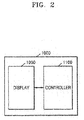
- FIGS. 2 and 3 are diagrams of an electronic device according to an example embodiment.
- the electronic device1000 may reduce display brightness of content and may display the content based on the reduced display brightness.
- the electronic device1000 may reduce display brightness of some of a plurality of pixels constituting the content and may display the content based on the reduced display brightness.
- the electronic device 1000 may include a controller 1100 and a display 1900.
- the controller 1100 may control an overall operation of the electronic device 1000.
- the controller 1100 may reduce display brightness of some of a plurality of pixels constituting content and may display the content, based on pixel information of the pixels constituting the content.
- the pixel information may include an RGB value, a gray value, a saliency, a correction gray value, and/or the like of each of the pixels constituting the content.
- the controller 1100 may reduce display brightness of some of the pixels constituting the content, based on the gray value of each of the pixels constituting the content.
- the controller 1100 may reduce display brightness of a pixel having a gray value that is equal to or less than a predetermined value, or may reduce display brightness of a pixel having a gray value within a predetermined range.
- the pixel information of the pixels may denote pixel information of a pixel group including a plurality of pixels.
- content may be divided into a plurality of blocks, and a plurality of pixels included in one block may be grouped as one pixel group.
- the controller 1100 may further reduce display brightness of a plurality of pixels included in a first pixel group than display brightness of a plurality of pixels included in a second pixel group.
- the pixel information of the pixels may be determined based on pixel information of a plurality of pixels included in a pixel group.
- a gray value of a pixel group may be an average value of gray values of a plurality of pixels included in the pixel group, or may be determined as a gray value of one pixel included in the pixel group.
- the controller 1100 may perform bilateral filtering on a plurality of pixels constituting content to acquire saliency information of the pixels and may reduce display brightness of some of the pixels, based on the acquired saliency information.
- the controller 1100 may reduce display brightness of pixels having saliency values which are lower than a predetermined value, or may reduce display brightness of pixels having no saliency information.
- the controller 1100 may perform bilateral filtering on a pixel group to acquire saliency information of the pixel group and may reduce display brightness of a plurality of pixels included in the pixel group.
- the controller 1100 may acquire a correction gray value of each of pixels, based on at least one of saliency information of the pixels, a detail display level, residual power of the electronic device 1000, and ambient light of the electronic device 1000.
- the controller 1100 may reduce display brightness of some of pixels constituting content, based on the acquired correction gray value.
- the controller 1100 may further reduce display brightness of the pixel, or as a correction gray value of a pixel is higher, the controller 1100 may reduce less display brightness of the pixel.
- the controller 1100 may reduce display brightness of a pixel having a correction gray value that is equal to or less than a predetermined value, or may reduce display brightness of a pixel having a gray value within a predetermined range.
- controller 1100 may further reduce display brightness of the plurality of pixels included in the first pixel group than display brightness of the plurality of pixels included in the second pixel group.
- the controller 1100 may determine display brightness of content depending on a type of the content. For example, the controller 1100 may further reduce display brightness of the content in a case, where the type of the content is text, than in a case where the type of the content is image.
- the controller 1100 may determine priorities of the pieces of content depending on a content type and may determine display brightness of the pieces of content. For example, the controller 1100 may the most reduce display brightness of content, whose a content type is background, among the pieces of content and may the least reduce display brightness of content whose a content type is video.
- the controller 1100 may identify a content type based on an image analysis of content or a transmission flow of the content.
- the controller 1100 may determine display luminance of pieces of content depending on an overlap relationship between the pieces of content. For example, when first content is displayed and second content overlapping at least a portion of the first content is displayed on the first content, the controller 1100 may further reduce display brightness of the first content than that of the second content.
- a camera 1500 may photograph a face of a user, and the controller 1100 may analyze a position corresponding to an eye-gaze of the user in the display 1900 by using a captured image to acquire a focus positon of the user.
- the controller 1100 may determine display brightness of pieces of content, based on the acquired focus position of the user. For example, when the display 1900 displays pieces of content, the controller 1900 may further reduce display brightness of content, which becomes farther away from the acquired focus position of the user, among the displayed pieces of content.
- the controller 1100 may determine display brightness of pieces of content, based on a position of the received touch input. For example, when the display 1900 displays pieces of content, the controller 1900 may further reduce display brightness of content, which becomes farther away from a position of a received touch input, among the displayed pieces of content.
- the display 1900 may display information obtained through processing by the controller 1900.
- the display 1900 may display content.
- the display 1900 may display content, based on display brightness reduced by the controller 1100.
- the electronic device 1000 may include less elements than the number of the elements illustrated in FIG. 2 , or may include more elements than the number of the elements illustrated in FIG. 2 .
- the electronic device 1000 may further include a communicator 1300, a multimedia unit 1400, a camera 1500, an input/output unit 1600, a sensor 1700, and a storage unit 1750, in addition to the above-described controller 1100 and display 1900.
- the controller 1100 may perform functions of the electronic device 1000 by controlling overall operations of the electronic device 1000.
- the controller 1100 may execute programs stored in the storage unit 1750 to control the communicator 1300, the multimedia unit 1400, the camera 1500, the input/output unit 1600, the sensor 1700, the storage unit 1750, and the display 1900.
- the controller 1900 may include a processor 1110.
- the controller 1100 may include read-only memory (ROM) 1120 that stores a control program for controlling the electronic device 1000. Also, the controller 1100 may store a signal or data inputted from the outside (for example, a server 300) of the electronic device 1000 or may include random access memory (RAM) 1130 that is used as a storage area for various operations performed by the electronic device 1000.
- ROM read-only memory
- RAM random access memory
- the processor 1110 may include a graphic processing unit (GPU, not shown) for graphic processing.
- the processor 1110 may be of a system-on chip (SoC) type that includes a core (not shown) and the GPU (not shown).
- SoC system-on chip
- the processor 1110 may include a single core, a dual core, a triple core, a quad core, or a core corresponding to a multiple thereof.
- the processor 1110, the ROM 1120, and the RAM 1130 may be connected to each other through a bus.
- the electronic device 1000 may communicate with an external device (for example, the server 300) through the communicator 1300.
- an external device for example, the server 300
- the communicator 1300 may include at least one of a wireless LAN 1310, a short-range wireless communicator 1320, and a mobile communicator 1340.
- the communicator 1300 may include one of the wireless LAN 1310, the short-range wireless communicator 1320, and the mobile communicator 1340, or may include a combination thereof.
- the electronic device 1000 may be wirelessly connected to an access point (AP) through the wireless LAN 1310 at a place where the AP is installed.
- the wireless LAN 1310 may include, for example, Wi-Fi.
- the wireless LAN 1310 may support IEEE802.11x of IEEE.
- the short-range wireless communicator 1320 may wirelessly perform short-range communication with an external device according to control by the controller 1100 without the AP.
- the short-range wireless communicator 1320 may include a Bluetooth communicator, a Bluetooth low-energy (BLE) communicator, a near-field communication (NFC) unit, a Wi-Fi communicator, a Zigbee communicator, an infrared data association (IrDA) communicator, a Wi-Fi Direct (WFD) communicator, a ultra wideband (UWB) communicator, an Ant+ communicator, and/or the like, but is not limited thereto.
- BLE Bluetooth low-energy
- NFC near-field communication
- Wi-Fi communicator a Zigbee communicator
- IrDA infrared data association
- WFD Wi-Fi Direct
- UWB ultra wideband
- the mobile communicator 1340 may transmit or receive a radio signal to or from at least one from among a base station, an external terminal, and the server 300 via a mobile communication network.
- the mobile communicator 1340 may transmit or receive the radio signal, which is used to perform voice call, video call, short message service (SMS), multimedia message (MMS), and data communication, to or from a mobile phone (not shown), a smartphone (not shown), a tablet PC (not shown), and/or the like having a contactable phone number.
- the radio signal may include various types of data generated when a voice call signal, a video call signal, or a text/multimedia message is transmitted or received.
- the multimedia unit 1400 may include a broadcast receiver 1410, an audio playing unit 1420, or a video playing unit 1430.
- the broadcast receiver 1410 may receive, through an antenna, a broadcasting signal (for example, a TV broadcasting signal, a radio broadcasting signal, or a data broadcasting signal) and additional broadcasting information (for example, electronic program guide (EPS) or electronic service guide (ESG)) transmitted from a broadcasting station according to control by the controller 1100.
- the controller 1100 may play the received broadcasting signal and additional broadcasting information through the display 1900 by using a video codec (not shown) and an audio codec (not shown).
- the audio playing unit 1420 may play, according to control by the controller 1100, an audio source (for example, an audio file having a file extension that is mp3, wma, ogg, or wav) stored in the storage unit 1750 of the electronic device 1000 or received from the outside by using the audio codec.
- an audio source for example, an audio file having a file extension that is mp3, wma, ogg, or wav
- the audio playing unit 1420 may play, according to control by the controller 1100, an acoustic feedback (for example, an output of the audio source stored in the storage unit 1750, or the like), corresponding to an input received through the input/output unit 1600 by using the audio codec.
- an acoustic feedback for example, an output of the audio source stored in the storage unit 1750, or the like
- the video playing unit 1430 may play video data (for example, a video file having a file extension that is mpeg, mpg, mp4, avi, mov, or mkv) stored in the storage unit 1750 of the electronic device 1000 or received from the outside by using the video codec.
- An application executed in the electronic device 1000 may play audio data or video data by using the audio codec and/or the video codec.
- a multimedia application executed in the electronic device 1000 may play the audio data and/or the video data by using a hardware codec (not shown) and/or a software codec (not shown).
- a still image or a video may be photographed by the camera 1500.
- the camera 1500 may obtain an image frame of the still image or the video by using an image sensor (not shown).
- the image frame photographed by the image sensor (not shown) may be processed by the controller 1100 or a separate image processor (not shown).
- the processed image frame may be stored in the storage unit 1750 or may be transmitted to the outside through the communicator 1300.
- the camera 1500 may photograph a face of a user, and the controller 1100 may analyze a position corresponding to an eye-gaze of the user in the display 1900 by using a captured image to acquire a focus positon of the user.
- the controller 1100 may determine display brightness of pieces of content, based on the acquired focus position of the user. For example, when the display 1900 displays pieces of content, the controller 1900 may further reduce display brightness of content, which becomes farther away from the acquired focus position of the user, among the displayed pieces of content.
- the camera 1500 may include a first camera 1510 and a second camera 1520 which are located at different positions in the electronic device 1000.
- the first camera 1510 may be located on a front surface of the electronic device 1000
- the second camera 1520 may be located on a rear surface of the electronic device 1000.
- the first camera 1510 and the second camera 1520 may be located adjacent to each other on one surface of the electronic device 1000.
- a 3D still image or a 3D video may be photographed by using the first camera 1510 and the second camera 1520.
- the camera 1500 may further include a number of cameras in addition to first camera 1510 and the second camera 1520.
- the camera 1500 may include a flashlight 1530 that provides an amount of light necessary for photographing. Also, the camera 1500 may further include an additional lens (not shown), which is detachably attached to a separate adaptor (not shown), for a wide angle photograph, telephoto photograph, and/or close-up photograph.
- a flashlight 1530 that provides an amount of light necessary for photographing.
- the camera 1500 may further include an additional lens (not shown), which is detachably attached to a separate adaptor (not shown), for a wide angle photograph, telephoto photograph, and/or close-up photograph.
- Data may be inputted to the electronic device 1000 through the input/output unit 1600, and data processed by the electronic device 1000 may be outputted through the input/output unit 1600.
- the input/output unit 1600 may include at least one of a button 1610, a microphone 1620, a speaker 1630, and a vibration motor 1640, but is not limited thereto. In other example embodiments, the input/output unit 1600 may include various input/output devices.
- the button 1610 may be located on a front surface, a rear surface, or a side surface of the electronic device 1000.
- the button 1610 may be a home button, a menu button, a return button, and/or the like located on a lower portion of the front surface of the electronic device 1000.
- the button 1610 may be a lock button, a volume button, and/or the like located on the side surface of the electronic device 1000.
- the button 1610 may be implemented as touch buttons located on a bezel on the exterior of a touch screen.
- the button 1610 may be a crown of the smartwatch.
- An electrical signal may be generated based on a sound signal which is inputted through the microphone 1620 from the outside.
- the electrical signal generated by the microphone 1620 may be converted by the audio codec to be stored in the storage unit 1750 or to be outputted through the speaker 1630.
- the microphone 1620 may be located at any position such as the front surface, the side surface, the rear surface, or the like of the electronic device 1000.
- the electronic device 1000 may include a plurality of microphones. Various noise removal algorithms for removing noise occurring while an external sound signal is being received may be used.
- a sound corresponding to various signals may be outputted to the outside of the electronic device 1000 through the speaker 1630.
- signals for example, a radio signal, a broadcasting signal, an audio source, a video file, photographing, and/or the like
- the speaker 1630 may output a sound (for example, a touch sound corresponding to a phone number input or a photographing button sound) corresponding to a function performed by the electronic device 1000.
- the speaker 1630 may be located at any position such as the front surface, the side surface, the rear surface, or the like of the electronic device 1000.
- the electronic device 1000 may include a plurality of speakers.
- the vibration motor 1640 may convert an electrical signal into a mechanical vibration.
- the vibration motor 1640 may include a linear vibration motor, a bar type vibration motor, a coin type vibration motor, or a piezoelectric vibration motor.
- the vibration motor 1640 may generate a vibration corresponding to an output of an audio source or a video source.
- the vibration motor 1640 may generate a vibration corresponding to various signals received by the communicator 1300, the multimedia unit 1400, the camera 1500, the input/output unit 1600, or the sensor 1700.
- the vibration motor 1640 may vibrate the whole electronic device 1000 or may vibrate a portion of the electronic device 1000.
- the electronic device 1000 may include a plurality of vibration motors.
- the input/output unit 1600 may further include a touch pad (not shown), a connector (not shown), a keypad (not shown), a jog wheel (not shown), a jog switch (not shown), an input pen (not shown), and/or the like.
- the touch pad may be implemented in a capacitive type, a resistive type, an infrared sensing type, an acoustic wave conductive type, an integration tension measurement type, a piezo effect type, an electromagnetic resonance (EMR)) type, or the like.
- the touch pad may configure a layer structure along with the display 1900, or may be directly located in the display 1900 itself, thereby implementing a touch screen.
- the controller 1100 may determine display brightness of pieces of content, based on a position of the received touch input. For example, when the display 1900 displays pieces of content, the controller 1900 may further reduce display brightness of content, which becomes farther away from a position of a received touch input, among the displayed pieces of content.
- the touch pad may detect a proximity touch as well as a real touch.
- a proximity touch as well as a real touch.
- both of the real touch and the proximity touch may be referred to as a touch.
- the real touch denotes an input that is made when a pointer physically touches the touch pad (not shown), and the proximity touch denotes an input that is made when the pointer does not physically touch the screen but approaches a position separated from the screen by a certain distance.
- the pointer denotes a touch instrument for real touch or proximity-touch on the touch pad (not shown). Examples of the pointer include a stylus pen, a finger, etc.
- the electronic device 1000 may further include a tactile sensor (not shown) or a force touch sensor (not shown) which is located inside or near the touch pad (not shown), for more precisely sensing a touch inputted.
- a tactile sensor not shown
- a force touch sensor not shown
- Various pieces of information such as a roughness of a touched surface, a stiffness of a touched object, a temperature of a touched point, etc. may be sensed by using the tactile sensor (not shown).
- the pressure of touch input touched on the touch pad may be sensed through the force touch sensor (not shown). According to the pressure of touch input, different functions may be performed in the electronic device 1000 so that a variety of gesture inputs may be embodied.
- a gesture input may be implemented in various types. For example, a tap may be applied when a pointer touches the touch pad (not shown) once and then separates from the touch pan (not shown), a double tap may be applied by touching the touch pad (not shown) twice within a certain time, and a multiple tap may be applied by touching the touch pad (not shown) three times or more within a certain time. A long tap may be applied by maintaining the pointer touched on the touch pad (not shown) for a certain time or more or until a certain event occurs.
- a drag may be applied when a pointer moves from one position from another position of the touch pad (not shown) while maintaining the pointer touched on the touch pad (not shown).
- a swipe may denote an input whose a moving speed of a pointer is relatively faster than a drag.
- Pinch-out may be applied by moving two fingers from an inner side to an outer side on the touch pad (not shown), and pinch-in may be applied by moving two fingers from an outer side to an inner side like pinching.
- a connector may be used as an interface for the electronic device 1000 and a power source (not shown) connected each other.
- the electronic device 1000 may, according to control by the controller 1100, transmit data stored in the storage unit 1750 to the outside or receive data from the outside through a cable connected to the connector (not shown). Power may be applied to the electronic device 1000 through the cable connected to the connector (not shown), and a battery of the electronic device 1000 may be charged with the power.
- the electronic device 1000 may be connected to an external accessory (for example, a speaker (not shown), a keyboard dock (not shown), and/or the like) through the connector (not shown).
- a key input may be received from a user through a keypad (not shown).
- the keypad may include a virtual keypad (not shown) displayed on a touch screen (not shown), a physical keypad (not shown) which is connectable by wire or wirelessly, a physical keypad (not shown) that is located on the front surface of the electronic device 1000, and/or the like.
- the sensor 1700 may include at least one sensor for detecting a state of the electronic device 1000.
- the sensor 1700 may include a proximity sensor 1710 that detects whether an object approaches to the electronic device 1000, an illuminance sensor 1720 that detects the amount of ambient light, and a gyro sensor 1730 that measures an angular speed with respect to each of the X axis, the Y axis, and the Z axis to measure a changed angle, but is not limited thereto.
- the sensor 1700 may further include a GPS (not shown) for detecting a position of the electronic device 1000. In an outdoor place, a position of the electronic device 1000 may be calculated by the GPS (not shown).
- a position of the electronic device 1000 may be calculated by a wireless AP (not shown).
- a position of the electronic device 1000 may be calculated by a cell-ID method using an identifier (ID) of a wireless AP, an enhanced cell-ID method using the ID of the wireless AP and received signal strength (RSS), an angle of arrival (AoA) method using an angle at which a signal transmitted from an AP is received by the electronic device 1000, and/or the like.
- the position of the electronic device 1000 may be calculated by a wireless beacon (not shown).
- the sensor 1700 may include a magnetic sensor (not shown) that detects azimuth by using an earth's magnetic field, an acceleration sensor (not shown) that measures an angular speed (an acceleration of gravity and an acceleration of a motion) with respect to each of the X axis, the Y axis, and the Z axis, a gravity sensor (not shown) that detects a direction where gravity acts, an RGB sensor (not shown) that measures a concentration of red, green, blue, and white (RGBW) of lights, a hall sensor (not shown) that senses a magnetic field, a magnetometer (not shown) that measures an intensity of a magnetic field, an infrared (IR) sensor (not shown) that senses a motion of a user's hands by using IR light, an altimeter that recognizes a gradient and measures atmospheric pressure to detect an elevation, a finger scan sensor (not shown), a heart rate sensor (not shown), a pressure sensor (not shown), ultraviolet (UV) sensor (not shown), a temperature humidity sensor
- the storage unit 1750 may store various types of data and control programs for controlling the electronic device 1000 according to control by the controller 1100.
- the storage unit 1750 may store a signal or data inputted/outputted and corresponded to controlling of the communicator 1300, the input/output unit 1600, and the display 1900.
- the storage unit 1750 may store a graphic user interface (GUI) associated with control programs for controlling the electronic device 1000 and an application which is provided from a manufacturer or is downloaded from the outside, images for providing the GUI, user information, documents, databases, relevant data, and/or the like.
- GUI graphic user interface
- the storage unit 1750 may include a non-volatile memory, a volatile memory, a hard disk drive (HDD), a solid state drive (SSD), and/or the like.
- the storage unit 1750 may be referred to as a memory.
- the display 1900 may include a plurality of pixels, and information processed by the electronic device 1000 may be displayed through the plurality of pixels. For example, an execution screen of an operating system (OS) driven by the electronic device 1000, an execution screen of an application driven by the OS, and/or the like may be displayed on the display 1900.
- the controller 1100 may control display of a GUI corresponding to various functions such as voice call, video call, data transmission, broadcasting reception, photographing, video view, application execution, and/or the like displayed through the display 1900.
- the display 1900 may include at least one of a liquid crystal display, a thin-film transistor-liquid crystal display, an organic light-emitting display, a plasma display panel, a flexible display, a 3D display, an electrophoretic display, a vacuum fluorescent display, etc.
- the electronic device 1000 may include a plurality of the displays 1900 depending on an implementation type thereof.
- the plurality of displays 1900 may be disposed to face each other by using a hinge.
- FIG. 4 is a diagram for describing a method of reducing display brightness of content by using saliency information of pixels, according to an example embodiment.
- the electronic device 1000 may reduce display brightness of some of a plurality of pixels constituting content, based on pixel information of the pixels.
- the pixel information may include saliency information of the pixels.
- the saliency information of the pixels constituting the content may be used to identify a region of the content on which an eye-gaze of a person focuses.
- the saliency information of the pixels may be acquired by modeling a region, where a brightness difference, a color difference, or a gray value difference is larger than a peripheral region, or a point on which an eye-gaze of a person focuses because a clear contour line is clear.
- the electronic device 1000 may perform the bilateral filtering on a plurality of pixels constituting the content to acquire gray values of the pixels and may use the acquired gray values as saliency information of the pixels.
- the bilateral filtering may be performed based on the following Equation (1): B(I) p denotes a gray value which is obtained by bilateral filtering on a pixel "p" among the pixels, N(p) is a set of peripheral pixels of the pixel "p", a pixel "q" is one of the peripheral pixels, W p denotes a normalization weight of the peripheral pixels and is expressed as ⁇ W p ⁇ q ⁇ N p G ⁇ s ⁇ p ⁇ q ⁇ G ⁇ r ⁇ I p ⁇ I q ⁇ ⁇ when image energy of content is
- a result value of the bilateral filtering may be used as saliency information as-is, or an inversion of the result value may be used as the saliency information.
- Saliency information of a pixel may be acquired by a smoothing filtering algorithm (for example, Guided Filter proposed by Kaiming He, and Domain Transform Filter proposed by Eduardo S. L. Gastal) ensuring edge characteristic.
- saliency information of pixels constituting content 40 may be mapped to a saliency map 42.
- the saliency map 42 may be expressed as a gray scale.
- a pixel having a color closer to white in the saliency map 42 may be high in saliency, and a pixel having a color closer to black may be low in saliency.
- a mapping method for saliency information is not limited thereto. In other embodiments, the mapping method may be implemented as various methods.
- the electronic device 1000 may determine display brightness of a pixel, based on a saliency value of the pixel. For example, referring to a graph 46 shown in FIG. 4 , the electronic device 1000 may be further reduce display brightness of a pixel having a low saliency value than that of a pixel having a high saliency value.
- display brightness of a pixel having a low saliency value may be reduced more than that of pixel having high saliency, and thus, power of the electronic device 1000 is saved, and visibility of dimmed content 44 is enhanced.
- FIG. 5A illustrates content where display brightness is reduced, in a related art method.
- FIG. 5B illustrates content where display brightness is reduced, according to an example embodiment.
- Input content 50 may be displayed.
- display brightness of the content 50 is reduced according to the related art method, visibility of dimmed content 54a is also reduced together.
- a shadow of a tree is not clear seen in an enlarged portion 56a of the dimmed content 54a.
- FIG. 6A illustrates content where display brightness is reduced, in a related art method.
- FIG. 6B illustrates content where display brightness is reduced, according to an example embodiment.
- Input content 60 may be displayed.
- display brightness of the content 60 is reduced according to the related art method, waves of a lake are not clear seen in an enlarged portion 66a of dimmed content 64a.
- waves of a lake are clear seen in an enlarged portion 66b of dimmed content 64b.
- the bilateral filtering may be used as a pre-filtering method.
- a processing time of the bilateral filtering may be about 3 ms.
- power consumption in an image processing operation may be about 8% to about 9% of total power consumption.
- power consumption of a display screen may be about 38% to about 50% of total power consumption of a smartphone.
- FIGS. 5A and 6A respectively illustrate dimmed content 54a and dimmed content 64a obtained through dimming by a related art dimming method
- FIGS. 5B and 6B respectively illustrate dimmed content 54b and dimmed content 64b obtained through dimming by a content display method according to an example embodiment.
- the dimmed content 54b and the dimmed content 64b obtained through dimming by the content display method according to an example embodiment are wholly brighter and clearer displayed than the dimmed content 54a and the dimmed content 64a obtained through dimming by the related art dimming method. That is, a better display effect is obtained when the same power is consumed.
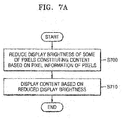
- FIG. 7A is a flowchart of a method of reducing display brightness of content in the electronic device 1000, according to an example embodiment.
- the electronic device 1000 may reduce display brightness of some of a plurality of pixels constituting content, based on pixel information of the pixels.
- the pixel information may include an RGB value, a gray value, a saliency, a correction gray value, and/or the like of each of the pixels.
- the electronic device 1000 may reduce display brightness of some of a plurality of pixels, based on saliency information of the plurality of pixels.
- the electronic device 1000 may further reduce display brightness of first pixels of the some pixels than those of second pixels of the some pixels.
- the electronic device 1000 may reduce display brightness of pixels having saliency values which are lower than a predetermined value, or may reduce display brightness of pixels having no saliency information.
- the content may include a background of the text.
- a user may have more interest in the text than the background of the text. Therefore, saliencies of pixels corresponding to the text may have a value which is higher than those of pixels corresponding to the background of the text.
- saliencies of the pixels corresponding to the background of the text may have a value "0" or the pixels corresponding to the background of the text may not have saliency information.
- the electronic device 1000 may reduce display brightness of the pixels corresponding to the background of the text.
- the electronic device 1000 may reduce display brightness of the pixels corresponding to the background of the text more than that of the pixels corresponding to the text. Since display brightness is determined by separately using text and a text background, power consumption of the electronic device 1000 is reduced, and visibility of the text is prevented from being reduced or is enhanced.
- text may be extracted based on input information in an operation of transmitting the text content, or may be extracted by recognizing a region where the text content is displayed.
- the electronic device 1000 may display content, based on display brightness which is reduced in operation S700.
- a reduction rate of display brightness of content may be differently implemented based on a type of the content and other parameters.
- An example embodiment where a reduction rate of display brightness of content is differently implemented based on a type of the content and other parameters will be described with reference to FIG. 7B .
- FIG. 7B is a flowchart of a method of reducing display brightness of content in an electronic device depending on a type of the content and other parameters, according to an example embodiment.
- the electronic device 1000 may reduce display brightness of some of a plurality of pixels constituting content, based on pixel information of the pixels.
- the electronic device 1000 may identify the content.
- a content type may be identified based on an image analysis of content or a transmission flow of the content.
- a content type may be directly identified from an input transmission flow.
- multi-flow division content transmission technology may be MPEG media transport (MMT) standard.
- a content type may be directly identified by performing image analysis on the content.
- Content may include pieces of sub-content.
- complex content composed of an image and a text may include image content and text content.
- Sub-content may be treated as content, and the electronic device 1000 may reduce display brightness of some of a plurality of pixels constituting sub-content, based on pixel information of the pixels.
- the pixel information may include saliency information of the pixels.
- the complex content may include various pieces of sub-content such as a text, video, an image, and/or the like.
- the complex content may be transmitted according to the MMT standard, which may include an area division transmission method based on a content type. According to the MMT standard, content may be transmitted and encoded based on a content type thereof.
- the electronic device 1000 may perform the bilateral filtering on the content to acquire a saliency value of each of the pixels in operation S702.
- the electronic device 1000 may acquire saliency values from the text except a background in the content in operation S703.
- the electronic device 1000 may identify a type of each of pieces of sub-content included in the complex content. For example, when the content is complex content composed of an image and a text, the electronic device 1000 may perform bilateral filtering on image content to acquire a saliency value of each of a plurality of pixels constituting the image content and may acquire saliency values from a text except a background in text content.
- the electronic device 1000 may perform the bilateral filtering on a plurality of pixels constituting the content to acquire gray values of the pixels and may use the acquired gray values as saliency information of the pixels.
- a result value of the bilateral filtering may be used as saliency information as-is, or an inversion of the result value may be used as the saliency information.
- the electronic device 1000 may acquire saliency information of only pixels corresponding to the text.
- saliencies of the pixels corresponding to the text may have a value which is equal to or higher than a predetermined value
- saliencies of the pixels corresponding to the background of the text may have a value, which is equal to or less than the predetermined value, or a value "0".
- the electronic device 1000 may acquire a correction gray value of each of pixels, based on the acquired saliency information.
- the electronic device 1000 may acquire the correction gray value further based on a detail display level, residual power of the electronic device 1000, and ambient light of the electronic device 1000.
- I*(p) denotes a correction gray value of a pixel "p" among a plurality of pixels
- ⁇ denotes a parameter for a detail display level and has a range of 0 ⁇ 1.
- ⁇ denotes a parameter for a brightness level which is determined based on residual power and ambient light, and has a range of 0 ⁇ 1, and 1 [0,1) ( ⁇ ) denotes an indication function.
- ⁇ is within a range of [0, 1), 1 [0,1) ( ⁇ ) may be 1, and when ⁇ is not within the range of [0, 1), 1 [0,1) ( ⁇ ) may be 0.
- S(p) denotes a saliency value of the pixel "p" or denotes a saliency map mapped to saliency.
- 1 [0,1) ( ⁇ -1) denotes an indication function.
- 1 [0,1) ( ⁇ -1) When ⁇ -1 is within a range of [0, 1), 1 [0,1) ( ⁇ -1) may be 1, and when ⁇ -1 is not within the range of [0,1), 1 [0,1) ( ⁇ -1) may be 0.
- I(p) denotes a gray value of the pixel "p"
- ⁇ ( p ) denotes a result value obtained by performing the bilateral filtering on the pixel "p".
- the detail display level " ⁇ " may be set by a user.
- the electronic device 1000 may display, to the user, an original image and example images based on a detail display level of the original image.
- the user may select one image from among the displayed images, and thus, a detail display level corresponding to the selected image may be set.
- Y ( ⁇ , ⁇ ,p ) and I*(p) may be determined based on a gray value "I(p)" of each of pixels and a result value " ⁇ ( p ) " obtained by performing the bilateral filtering on each of the pixels irrespective of saliencies of the pixels.
- Y ( ⁇ , ⁇ ,p ) and I*(p) may be determined based on a saliency value"S(p) of each of pixels, a gray value "I(p)” of each of the pixels, and a result value " ⁇ ( p ) " obtained by performing the bilateral filtering each of the pixels.
- the electronic device 1000 may reduce display brightness of the pixels, based on the correction gray value which is acquired in operation S704.
- the electronic device 1000 may display content, based on the display brightness which is reduced in operation S705.
- FIG. 8 is a diagram for describing a method of determining priorities of pieces of content depending on the content types of the pieces of content, according to an example embodiment.
- the electronic device 1000 may reduce display brightness of content depending on a type of the content. For example, the electronic device 1000 may further reduce display brightness of content in a case, where a type of the content is a text, than a case where the type of the content is an image.
- pieces of content such as background content 80, video content 81, image content 82, and pieces of text content 83 and 84 may be displayed on a display screen of the electronic device 1000.
- the electronic device 1000 may determine a priority, based on a content type and may further reduce display brightness of content having a low priority. For example, as illustrated in FIG. 8 , the background content 80 may have the lowest priority, and the pieces of text content 83 and 84, the image content 82, and the video content 81 may have respective priorities in ascending order of priority. Based on priorities, the electronic device 1000 may the most reduce display brightness of the background content 80, may the second most reduce display brightness of the pieces of text content 83 and 84, may the third most reduce display brightness of the image content 82, and may the least reduce display brightness of the video content 81.
- Priorities of pieces of content based on a content type may be expressed as type factors.
- a type factor of the video content 81 may be expressed as T1
- a type factor of the image content 82 may be expressed as T2
- a type factor of each of the pieces of text content 83 and 84 may be expressed as T3
- a type factor of the background content 80 may be expressed as Tn.
- the type factors may have a relationship "T1>T2>T3>Tn", but is not limited thereto.
- the type factor "Tn" of the background content 80 may be less than the type factor "T3" of each of the pieces of text content 83 and 84, and the type factor "T1" of the video content 81 may be the same as the type factor "T2" of the image content 82.
- Identification of a content type may be performed based on an image analysis of content or a transmission flow of the content.
- a display brightness reduction rate may be adjusted based on a type of content. Power of the electronic device 1000 is effectively saved according to the characteristic of content, and visibility of content is more enhanced than a related art dimming method.
- FIG. 9 is a diagram for describing a method of determining priorities of pieces of content depending on an overlap relationship of the pieces of content, according to an example embodiment.
- a user may have more interest in content displayed on an uppermost layer (a layer factor) among pieces of content.
- the second content on the first content may generally cover at least a portion of the first content. That is, as content is activated later, the content may be displayed on a higher layer and may cover content displayed on a layer thereunder, and as content is displayed on a lower layer, a user may have less interest in the content. Therefore, the electronic device 1000 may determine display brightness of pieces of content, based on an overlap relationship between the pieces of content. For example, as content is displayed on a lower layer, display brightness of the content may be further reduced.
- background content may be displayed on a background layer 90 through a display screen of the electronic device 1000, and a plurality of layers 91 to 94 may be arranged on the background layer 90.
- the electronic device 1000 may determine a priority of content depending on a layer on which the content is displayed, and as content becomes lower in priority, the electronic device 1000 may further reduce display brightness of the content. For example, as illustrated in FIG. 9 , pieces of content located on uppermost layers 91 and 94 may have the highest priority, and background content displayed on the background layer 90 may have the lowest priority.
- Priorities of pieces of content based on a layer on which content is displayed may be expressed as layer factors "L".
- L1 a layer factor of each of pieces of content located on the uppermost layers 91 and 94
- L2 a layer factor of content located on a layer 92 just under the uppermost layers 91 and 94
- L3 a layer factor of content located on a layer 93 just under the layer 92
- Ln a layer factor of the background content
- the display brightness reduction rate may be adjusted based on an overlap relationship between pieces of content. Therefore, display brightness of content covered by other content may be reduced more than content covering the other content. Accordingly, power of the electronic device 1000 is effectively saved, and visibility of content is more enhanced than the related art dimming method.
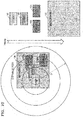
- FIG. 10 is a diagram for describing a method of determining priorities of pieces of content depending on a focus position of a user, according to an example embodiment.
- a user may have more interest in a position, which faces an eye-gaze of a user or receives a touch input of the user, than other positions in a display screen of the electronic device 1000. Therefore, the electronic device 1000 may adjust a display brightness reduction rate of each of pieces of content depending on a focus position of the user which is acquired based on an eye-gaze of the user or a touch input.
- background content 100 may be displayed on the display screen of the electronic device 1000, and various pieces of content 101 to 104 may be displayed on the background content 100.
- the electronic device 1000 may further reduce display brightness of content, which is lower in priority, depending on a focus position of a user acquired based on an eye-gaze of the user. For example, as illustrated in FIG. 10 , the content 101 closest to the focus position of the user which is acquired based on the eye-gaze of the user may have a highest priority, and as a distance D from content to the focus position of the user increases, the content may become lower in priority.
- Priorities of pieces of content based on the focus position of the user may be expressed as focus factors.
- a focus factor of the content 101 closest to the focus position of the user may be expressed as F1
- a focus factor of the content 102 next closest to the focus position of the user after the content 101 may be expressed as F2
- a focus factor of each of the pieces of content 103 and 104 next closest to the focus position of the user after the content 102 may be expressed as F3.
- a focus factor of the background content 100 may be expressed as Fn in order for the background content 100 to have a lowest priority.
- the display brightness reduction rate may be adjusted based on a position which faces an eye-gaze of a user or receives a touch input. Display brightness of content in which the user has actually less interest may be reduced more than that of content in which the user has actually more interest. Accordingly, power of the electronic device 1000 is effectively saved, and visibility of content is more enhanced than the related art dimming method.
- Display brightness of content may be reduced based on at least one of the type factor, the layer factor, and the focus factor respectively described above with reference to FIGS. 8 to 10 , and the content may be displayed based on the reduced display brightness.
- Lum n_initial denotes before-reduction display brightness.
- FIG. 11 illustrates an example of reducing display brightness depending on a type of the content and other parameters, according to an example embodiment.
- the electronic device 1000 may display pieces of content 110a, 111 a and 113a such as background content 110a, image content 111 a, and text content 113a.
- the electronic device 1000 may reduce display brightness of the pieces of content 110a, 111 a and 113a, based on content types of the pieces of content 110a, 111 a and 113a. For example, as illustrated in FIG. 11 , the electronic device 1000 may reduce display brightness of the background content 110a by 35%, reduce display brightness of the image content 111 a by 40%, and reduce display brightness of the text content 113a by 80%.
- Pieces of dimmed content 110b, 111 b and 113b whose display brightness has been reduced by the content display method according to an example embodiment may be further reduced in display brightness than the pieces of content 110a, 111 a and 113a whose display brightness is not yet reduced. Accordingly, power consumption of the electronic device 1000 is effectively saved, and visibility of content is enhanced.
- a pixel corresponding to a text of the dimmed text content 113b may be displayed in white, and a pixel corresponding to a background of the text may be displayed in black.
- the pixel corresponding to the text of the dimmed text content 113b and the pixel corresponding to the background of the text may be displayed in violet.
- FIG. 12A is a flowchart of a method of reducing display brightness of content depending on priorities of pieces of content, according to an example embodiment.
- the electronic device 1000 may determine priorities of pieces of content.
- the priorities of the pieces of content may be determined according to at least one of the methods described above with reference to FIGS. 8 to 10 .
- the electronic device 1000 may reduce display brightness of the pieces of content, based on the priorities which are determined in operation S1200.
- the electronic device 1000 may further reduce display brightness of the content.
- the electronic device 1000 may display the pieces of content, based on the display brightness which is reduced in operation S1210.
- FIG. 12B is a flowchart of a method of reducing display brightness based on priorities of pieces of content and pixel information of pixels constituting each of the pieces of content, according to an example embodiment.
- the electronic device 1000 may determine priorities of pieces of content.
- the electronic device 1000 may determine a first priority of the priorities of the pieces of content, based on a content type.
- the electronic device 1000 may determine a second priority of the priorities of the pieces of content, based on an overlap relationship between the pieces of content.
- the electronic device 1000 may determine a third priority of the priorities of the pieces of content, based on a user focus position.
- the first priority of the priorities of the pieces of content determined based on the content type may correspond to the type factor described above with reference to FIG. 8
- the second priority of the priorities of the pieces of content determined based on the overlap relationship between the pieces of content may correspond to the layer factor described above with reference to FIG. 9
- the third priority of the priorities of the pieces of content determined based on the user focus position may correspond to the focus factor described above with reference to FIG. 10 .
- the electronic device 1000 may reduce display brightness of the pieces of content, based on the priorities which are determined in operation S1200. In detail, in operation S1211, the electronic device 1000 may determine average display brightness of each of the pieces of content based on the first to third priorities.
- a type of content may be video, and when the content is closest to a user focus position among pieces of content and is displayed on an uppermost layer, average display brightness of the content may be determined as having a relatively higher value than that of other content. That is, display brightness of the content may be relatively less reduced than that of the other content.
- the electronic device 1000 may adjust display brightness, based on pixel information of a plurality of pixels constituting each of the pieces of content.
- a method of adjusting display brightness of content based on pixel information of a plurality of pixels constituting the content is as described above with reference to FIGS. 4 to 7B .
- the electronic device 1000 may display the pieces of content, based on the reduced display brightness.
- average display brightness may be first determined based on the characteristic of content displayed by the electronic device 1000, and display brightness of the content may be adjusted based on pixel information of a plurality of pixels constituting the content, thereby incrementally reducing display brightness. Accordingly, a power saving mode suitable for a user is provided.
- FIGS. 13A to 13C illustrate examples of reducing display brightness based on priorities of pieces of content and pixel information of pixels constituting each of the pieces of content, according to an example embodiment.
- the electronic device 1000 may display image content 130 and background content 131.
- the content 130 and 131 may be displayed by the above-described content display method according to an example embodiment.
- the electronic device 1000 may determine average display brightness of content, based on a type of the content. For example, as illustrated in FIG. 13A , average display brightness of the background content 131 may be reduced more than that of the image content 130.
- the electronic device 1000 may adjust display brightness of content, based on pixel information of a plurality of pixels constituting the content. For example, as illustrated in FIG. 13A , the electronic device 1000 may acquire a saliency map 132 for the image content 130 and may adjust display brightness of the image content 130, based on the saliency map 132.
- the electronic device 1000 may reduce display brightness of the content 130 and 131, based on saliency information of the pixels constituting the content, a detail display level, residual power of the electronic device 1000, and ambient light of the electronic device 1000.
- FIG. 13B illustrates pieces of dimmed content 134b and 135b when a parameter " ⁇ " for a detail display level is 0.55 and a parameter " ⁇ " for a brightness level determined based on residual power and ambient light is 0.75.
- FIG. 13C illustrates the pieces of dimmed content 134b and 135b when the parameter " ⁇ " for the detail display level is 0.85 and the parameter " ⁇ " for the brightness level determined based on the residual power and the ambient light is 0.75.
- the content display method may adjust a detail display level, and thus, power consumption of the electronic device 1000 is saved, and content is displayed in a style preferred by a user.
- Embodiments may be implemented through non-transitory computer-readable recording media having recorded thereon computer-executable instructions such as program modules that are executed by a computer.
- the non-transitory computer-readable recording media may be any available media that can be accessed by a computer and include both volatile and nonvolatile media and both detachable and non-detachable media.
- the non-transitory computer-readable recording media may include computer storage media and communication media.
- the computer storage media include both volatile and nonvolatile and both detachable and non-detachable media implemented by any method or technique for storing information such as computer-readable instructions, data structures, program modules, or other data.
- the communication media typically embody computer-readable instructions, data structures, program modules, other data of a modulated data signal, or other transmission mechanism, and may include any information transmission media
- Embodiments may be represented using functional block components and various operations. Such functional blocks may be realized by any number of hardware and/or software components configured to perform specified functions.
- the inventive concept may employ various integrated circuit components, e.g., memory, processing elements, logic elements, look-up tables, and the like, which may carry out a variety of functions under control of at least one microprocessor or other control devices.
- the inventive concept may be implemented using software programming or software elements, the inventive concept may be implemented with any programming or scripting language such as C, C++, Java, assembler, or the like, including various algorithms that are any combination of data structures, processes, routines or other programming elements.
- Functional aspects may be realized as an algorithm executed by at least one processor.
- inventive concept may employ conventional techniques for electronics configuration, signal processing and/or data processing.
- the terms 'mechanism', 'element', 'means', 'configuration', etc. are used broadly and are not limited to mechanical or physical embodiments. These terms should be understood as including software routines in conjunction with processors, etc.
Landscapes
- Engineering & Computer Science (AREA)
- Theoretical Computer Science (AREA)
- Physics & Mathematics (AREA)
- General Physics & Mathematics (AREA)
- Computer Hardware Design (AREA)
- General Engineering & Computer Science (AREA)
- Controls And Circuits For Display Device (AREA)
- Human Computer Interaction (AREA)
- Control Of Indicators Other Than Cathode Ray Tubes (AREA)
Applications Claiming Priority (3)
| Application Number | Priority Date | Filing Date | Title |
|---|---|---|---|
| CN201410479637.3A CN105489191A (zh) | 2014-09-18 | 2014-09-18 | 一种显示设备及其显示方法 |
| KR1020150126452A KR20160033605A (ko) | 2014-09-18 | 2015-09-07 | 콘텐트를 디스플레이하기 위한 장치 및 방법 |
| PCT/KR2015/009520 WO2016043472A2 (ko) | 2014-09-18 | 2015-09-10 | 콘텐트를 디스플레이하기 위한 장치 및 방법 |
Publications (2)
| Publication Number | Publication Date |
|---|---|
| EP3196867A2 true EP3196867A2 (de) | 2017-07-26 |
| EP3196867A4 EP3196867A4 (de) | 2017-10-04 |
Family
ID=55676142
Family Applications (1)
| Application Number | Title | Priority Date | Filing Date |
|---|---|---|---|
| EP15841148.8A Withdrawn EP3196867A4 (de) | 2014-09-18 | 2015-09-10 | Vorrichtung und verfahren zur anzeige von inhalt |
Country Status (4)
| Country | Link |
|---|---|
| US (1) | US20170309216A1 (de) |
| EP (1) | EP3196867A4 (de) |
| KR (1) | KR20160033605A (de) |
| CN (1) | CN105489191A (de) |
Cited By (1)
| Publication number | Priority date | Publication date | Assignee | Title |
|---|---|---|---|---|
| EP3623933A1 (de) * | 2018-09-12 | 2020-03-18 | Samsung Electronics Co., Ltd. | Anzeigevorrichtung, verfahren zur steuerung davon und aufzeichnungsmedium dafür |
Families Citing this family (16)
| Publication number | Priority date | Publication date | Assignee | Title |
|---|---|---|---|---|
| CN106531123A (zh) * | 2016-11-16 | 2017-03-22 | 武汉华星光电技术有限公司 | 画面亮度调整方法及画面亮度调整装置 |
| CN106598388A (zh) * | 2016-12-08 | 2017-04-26 | 上海摩软通讯技术有限公司 | 移动终端及其屏幕显示方法和系统 |
| CN106683614A (zh) * | 2017-02-17 | 2017-05-17 | 广东欧珀移动通信有限公司 | 有机发光二极管oled的显示控制方法及移动终端 |
| CN106941625B (zh) * | 2017-03-10 | 2019-08-02 | Oppo广东移动通信有限公司 | 一种移动终端的播放控制方法、装置及移动终端 |
| CN109427317A (zh) * | 2017-08-31 | 2019-03-05 | 中兴通讯股份有限公司 | 屏幕亮度控制方法、装置、终端及计算机可读存储介质 |
| KR102579125B1 (ko) * | 2017-11-09 | 2023-09-14 | 가부시키가이샤 한도오따이 에네루기 켄큐쇼 | 표시 장치, 그 동작 방법, 및 전자 기기 |
| KR102558472B1 (ko) * | 2018-02-07 | 2023-07-25 | 삼성전자주식회사 | 밝기 정보에 기반하여 콘텐트의 표시를 제어하는 전자 장치 및 그의 동작 방법 |
| TWI647690B (zh) * | 2018-03-16 | 2019-01-11 | 香港商冠捷投資有限公司 | 顯示器的能源效率測試方法 |
| KR102535037B1 (ko) * | 2018-09-12 | 2023-05-22 | 삼성전자주식회사 | 디스플레이장치, 그 제어방법 및 기록매체 |
| CN110010062A (zh) * | 2019-04-02 | 2019-07-12 | 福建华佳彩有限公司 | 一种降低oled显示画面功率的方法及终端 |
| CN111783402B (zh) * | 2019-04-02 | 2023-08-08 | 珠海金山办公软件有限公司 | 一种文档视觉效果的获取方法和装置 |
| US10921130B1 (en) * | 2019-09-18 | 2021-02-16 | Here Global B.V. | Method and apparatus for providing an indoor pedestrian origin-destination matrix and flow analytics |
| CN111240628A (zh) * | 2020-01-15 | 2020-06-05 | Oppo广东移动通信有限公司 | 内容显示方法、装置、移动终端及存储介质 |
| CN111601058A (zh) * | 2020-05-28 | 2020-08-28 | 深圳康佳电子科技有限公司 | 一种显示屏的保护方法、存储介质及智能电视 |
| KR102900284B1 (ko) * | 2020-08-14 | 2025-12-15 | 엘지디스플레이 주식회사 | 표시장치와 그 휘도 제어 방법 및 이를 이용한 모바일 단말기 |
| KR20240023335A (ko) * | 2022-08-12 | 2024-02-21 | 삼성디스플레이 주식회사 | 표시 장치 및 이의 구동 방법 |
Family Cites Families (10)
| Publication number | Priority date | Publication date | Assignee | Title |
|---|---|---|---|---|
| US7614011B2 (en) * | 2004-10-21 | 2009-11-03 | International Business Machines Corporation | Apparatus and method for display power saving |
| EP1964103A4 (de) * | 2005-12-22 | 2009-02-25 | Research In Motion Ltd | Verfahren und vorrichtung zum verringern des stromverbrauchs in einem display für ein elektronisches gerät |
| US8358273B2 (en) * | 2006-05-23 | 2013-01-22 | Apple Inc. | Portable media device with power-managed display |
| US20110069089A1 (en) * | 2009-09-23 | 2011-03-24 | Microsoft Corporation | Power management for organic light-emitting diode (oled) displays |
| JP2011095614A (ja) * | 2009-10-30 | 2011-05-12 | Aisin Aw Co Ltd | 表示制御装置、ナビゲーション装置及び表示制御方法 |
| US20110115815A1 (en) * | 2009-11-18 | 2011-05-19 | Xinyu Xu | Methods and Systems for Image Enhancement |
| US8957886B2 (en) * | 2010-01-27 | 2015-02-17 | Industrial Technology Research Institute | Power-saving and context-showing display information converting system and corresponding apparatus |
| TR201001776A2 (tr) * | 2010-03-09 | 2011-09-21 | Vestel Elektroni̇k Sanayi̇ Ve Ti̇caret A.Ş. | Belirgin öznitelikler kullanılarak bölgesel ışik kontrolü yöntemi. |
| KR101221096B1 (ko) * | 2010-09-17 | 2013-01-11 | 주식회사 다음커뮤니케이션 | 스팸 관리 장치 및 스팸 관리 방법 |
| KR102070365B1 (ko) * | 2012-07-10 | 2020-01-29 | 엘지디스플레이 주식회사 | 액정 디스플레이 장치와 이의 구동방법 |
-
2014
- 2014-09-18 CN CN201410479637.3A patent/CN105489191A/zh active Pending
-
2015
- 2015-09-07 KR KR1020150126452A patent/KR20160033605A/ko not_active Withdrawn
- 2015-09-10 EP EP15841148.8A patent/EP3196867A4/de not_active Withdrawn
- 2015-09-10 US US15/512,280 patent/US20170309216A1/en not_active Abandoned
Cited By (2)
| Publication number | Priority date | Publication date | Assignee | Title |
|---|---|---|---|---|
| EP3623933A1 (de) * | 2018-09-12 | 2020-03-18 | Samsung Electronics Co., Ltd. | Anzeigevorrichtung, verfahren zur steuerung davon und aufzeichnungsmedium dafür |
| US11204734B2 (en) | 2018-09-12 | 2021-12-21 | Samsung Electronics Co., Ltd. | Display apparatus, method of controlling the same and recording medium thereof |
Also Published As
| Publication number | Publication date |
|---|---|
| KR20160033605A (ko) | 2016-03-28 |
| CN105489191A (zh) | 2016-04-13 |
| EP3196867A4 (de) | 2017-10-04 |
| US20170309216A1 (en) | 2017-10-26 |
Similar Documents
| Publication | Publication Date | Title |
|---|---|---|
| EP3196867A2 (de) | Vorrichtung und verfahren zur anzeige von inhalt | |
| CN112835503B (zh) | 用于控制显示器尺寸的电子装置及其控制方法 | |
| US12055981B2 (en) | Electronic device including display changing in size and control method therefor | |
| CN113778177B (zh) | 具有孔区域的电子设备及控制其孔区域的方法 | |
| US10564675B2 (en) | Mobile terminal and control method therefor | |
| EP3018561B1 (de) | Virtuelle umgebung zur gemeinsamen nutzung von informationen | |
| CN110476189B (zh) | 用于在电子装置中提供增强现实功能的方法和设备 | |
| EP3483714A1 (de) | Elektronische vorrichtung und betriebsverfahren dafür | |
| US20150348453A1 (en) | Method and apparatus for processing images | |
| EP3104265B1 (de) | Tragbare vorrichtung und verfahren zum austauschen des bildschirms einer tragbaren vorrichtung | |
| CN105980976A (zh) | 用于控制显示器的电子装置和方法 | |
| KR20140103003A (ko) | 보청기를 제어하는 휴대 단말 및 방법 | |
| KR20150129423A (ko) | 전자 장치 및 전자 장치의 제스처 인식 방법 및 전자 장치 | |
| CN111754386B (zh) | 图像区域屏蔽方法、装置、设备及存储介质 | |
| US10423223B2 (en) | Method and device for displaying content | |
| CN110070143B (zh) | 获取训练数据的方法、装置、设备及存储介质 | |
| US12333974B2 (en) | Electronic device including expandable display and content provision method | |
| WO2023142915A1 (zh) | 图像处理方法、装置、设备及存储介质 | |
| CN105874505B (zh) | 图像处理方法和实现该图像处理方法的电子装置 | |
| CN108196810A (zh) | 一种分屏显示方法、终端及计算机可读存储介质 | |
| US10170099B2 (en) | Electronic device and method for representing web content for the electronic device | |
| CN115330610A (zh) | 图像处理方法、装置、电子设备以及存储介质 | |
| KR20150109992A (ko) | 플렉서블 디스플레이 장치 및 플렉서블 디스플레이 장치의 제어 방법. | |
| WO2022134691A1 (zh) | 一种终端设备中啸叫处理方法及装置、终端 | |
| CN103959224A (zh) | 基于环境条件修正色度 |
Legal Events
| Date | Code | Title | Description |
|---|---|---|---|
| STAA | Information on the status of an ep patent application or granted ep patent |
Free format text: STATUS: THE INTERNATIONAL PUBLICATION HAS BEEN MADE |
|
| PUAI | Public reference made under article 153(3) epc to a published international application that has entered the european phase |
Free format text: ORIGINAL CODE: 0009012 |
|
| STAA | Information on the status of an ep patent application or granted ep patent |
Free format text: STATUS: REQUEST FOR EXAMINATION WAS MADE |
|
| 17P | Request for examination filed |
Effective date: 20170324 |
|
| AK | Designated contracting states |
Kind code of ref document: A2 Designated state(s): AL AT BE BG CH CY CZ DE DK EE ES FI FR GB GR HR HU IE IS IT LI LT LU LV MC MK MT NL NO PL PT RO RS SE SI SK SM TR |
|
| AX | Request for extension of the european patent |
Extension state: BA ME |
|
| A4 | Supplementary search report drawn up and despatched |
Effective date: 20170904 |
|
| RIC1 | Information provided on ipc code assigned before grant |
Ipc: G09G 3/20 20060101AFI20170829BHEP |
|
| DAV | Request for validation of the european patent (deleted) | ||
| DAX | Request for extension of the european patent (deleted) | ||
| STAA | Information on the status of an ep patent application or granted ep patent |
Free format text: STATUS: EXAMINATION IS IN PROGRESS |
|
| 17Q | First examination report despatched |
Effective date: 20200513 |
|
| STAA | Information on the status of an ep patent application or granted ep patent |
Free format text: STATUS: THE APPLICATION HAS BEEN WITHDRAWN |
|
| 18W | Application withdrawn |
Effective date: 20200911 |