EP3196291A1 - Vorrichtung zur ausgabe von prüfmitteilungen, verfahren zur ausgabe von prüfmitteilungen, programm zur ausgabe von prüfmitteilungen und prüfsystem für genchromosomen - Google Patents
Vorrichtung zur ausgabe von prüfmitteilungen, verfahren zur ausgabe von prüfmitteilungen, programm zur ausgabe von prüfmitteilungen und prüfsystem für genchromosomen Download PDFInfo
- Publication number
- EP3196291A1 EP3196291A1 EP15835463.9A EP15835463A EP3196291A1 EP 3196291 A1 EP3196291 A1 EP 3196291A1 EP 15835463 A EP15835463 A EP 15835463A EP 3196291 A1 EP3196291 A1 EP 3196291A1
- Authority
- EP
- European Patent Office
- Prior art keywords
- examination
- notification
- information
- case
- output device
- Prior art date
- Legal status (The legal status is an assumption and is not a legal conclusion. Google has not performed a legal analysis and makes no representation as to the accuracy of the status listed.)
- Withdrawn
Links
Images








Classifications
-
- C—CHEMISTRY; METALLURGY
- C12—BIOCHEMISTRY; BEER; SPIRITS; WINE; VINEGAR; MICROBIOLOGY; ENZYMOLOGY; MUTATION OR GENETIC ENGINEERING
- C12Q—MEASURING OR TESTING PROCESSES INVOLVING ENZYMES, NUCLEIC ACIDS OR MICROORGANISMS; COMPOSITIONS OR TEST PAPERS THEREFOR; PROCESSES OF PREPARING SUCH COMPOSITIONS; CONDITION-RESPONSIVE CONTROL IN MICROBIOLOGICAL OR ENZYMOLOGICAL PROCESSES
- C12Q1/00—Measuring or testing processes involving enzymes, nucleic acids or microorganisms; Compositions therefor; Processes of preparing such compositions
- C12Q1/68—Measuring or testing processes involving enzymes, nucleic acids or microorganisms; Compositions therefor; Processes of preparing such compositions involving nucleic acids
- C12Q1/6876—Nucleic acid products used in the analysis of nucleic acids, e.g. primers or probes
- C12Q1/6883—Nucleic acid products used in the analysis of nucleic acids, e.g. primers or probes for diseases caused by alterations of genetic material
-
- G—PHYSICS
- G16—INFORMATION AND COMMUNICATION TECHNOLOGY [ICT] SPECIALLY ADAPTED FOR SPECIFIC APPLICATION FIELDS
- G16B—BIOINFORMATICS, i.e. INFORMATION AND COMMUNICATION TECHNOLOGY [ICT] SPECIALLY ADAPTED FOR GENETIC OR PROTEIN-RELATED DATA PROCESSING IN COMPUTATIONAL MOLECULAR BIOLOGY
- G16B20/00—ICT specially adapted for functional genomics or proteomics, e.g. genotype-phenotype associations
- G16B20/20—Allele or variant detection, e.g. single nucleotide polymorphism [SNP] detection
-
- C—CHEMISTRY; METALLURGY
- C12—BIOCHEMISTRY; BEER; SPIRITS; WINE; VINEGAR; MICROBIOLOGY; ENZYMOLOGY; MUTATION OR GENETIC ENGINEERING
- C12M—APPARATUS FOR ENZYMOLOGY OR MICROBIOLOGY; APPARATUS FOR CULTURING MICROORGANISMS FOR PRODUCING BIOMASS, FOR GROWING CELLS OR FOR OBTAINING FERMENTATION OR METABOLIC PRODUCTS, i.e. BIOREACTORS OR FERMENTERS
- C12M1/00—Apparatus for enzymology or microbiology
- C12M1/34—Measuring or testing with condition measuring or sensing means, e.g. colony counters
-
- C—CHEMISTRY; METALLURGY
- C12—BIOCHEMISTRY; BEER; SPIRITS; WINE; VINEGAR; MICROBIOLOGY; ENZYMOLOGY; MUTATION OR GENETIC ENGINEERING
- C12Q—MEASURING OR TESTING PROCESSES INVOLVING ENZYMES, NUCLEIC ACIDS OR MICROORGANISMS; COMPOSITIONS OR TEST PAPERS THEREFOR; PROCESSES OF PREPARING SUCH COMPOSITIONS; CONDITION-RESPONSIVE CONTROL IN MICROBIOLOGICAL OR ENZYMOLOGICAL PROCESSES
- C12Q1/00—Measuring or testing processes involving enzymes, nucleic acids or microorganisms; Compositions therefor; Processes of preparing such compositions
- C12Q1/68—Measuring or testing processes involving enzymes, nucleic acids or microorganisms; Compositions therefor; Processes of preparing such compositions involving nucleic acids
-
- G—PHYSICS
- G01—MEASURING; TESTING
- G01N—INVESTIGATING OR ANALYSING MATERIALS BY DETERMINING THEIR CHEMICAL OR PHYSICAL PROPERTIES
- G01N33/00—Investigating or analysing materials by specific methods not covered by groups G01N1/00 - G01N31/00
- G01N33/48—Biological material, e.g. blood, urine; Haemocytometers
- G01N33/50—Chemical analysis of biological material, e.g. blood, urine; Testing involving biospecific ligand binding methods; Immunological testing
-
- G—PHYSICS
- G16—INFORMATION AND COMMUNICATION TECHNOLOGY [ICT] SPECIALLY ADAPTED FOR SPECIFIC APPLICATION FIELDS
- G16B—BIOINFORMATICS, i.e. INFORMATION AND COMMUNICATION TECHNOLOGY [ICT] SPECIALLY ADAPTED FOR GENETIC OR PROTEIN-RELATED DATA PROCESSING IN COMPUTATIONAL MOLECULAR BIOLOGY
- G16B20/00—ICT specially adapted for functional genomics or proteomics, e.g. genotype-phenotype associations
-
- G—PHYSICS
- G16—INFORMATION AND COMMUNICATION TECHNOLOGY [ICT] SPECIALLY ADAPTED FOR SPECIFIC APPLICATION FIELDS
- G16B—BIOINFORMATICS, i.e. INFORMATION AND COMMUNICATION TECHNOLOGY [ICT] SPECIALLY ADAPTED FOR GENETIC OR PROTEIN-RELATED DATA PROCESSING IN COMPUTATIONAL MOLECULAR BIOLOGY
- G16B20/00—ICT specially adapted for functional genomics or proteomics, e.g. genotype-phenotype associations
- G16B20/10—Ploidy or copy number detection
-
- G—PHYSICS
- G16—INFORMATION AND COMMUNICATION TECHNOLOGY [ICT] SPECIALLY ADAPTED FOR SPECIFIC APPLICATION FIELDS
- G16B—BIOINFORMATICS, i.e. INFORMATION AND COMMUNICATION TECHNOLOGY [ICT] SPECIALLY ADAPTED FOR GENETIC OR PROTEIN-RELATED DATA PROCESSING IN COMPUTATIONAL MOLECULAR BIOLOGY
- G16B40/00—ICT specially adapted for biostatistics; ICT specially adapted for bioinformatics-related machine learning or data mining, e.g. knowledge discovery or pattern finding
-
- G—PHYSICS
- G16—INFORMATION AND COMMUNICATION TECHNOLOGY [ICT] SPECIALLY ADAPTED FOR SPECIFIC APPLICATION FIELDS
- G16H—HEALTHCARE INFORMATICS, i.e. INFORMATION AND COMMUNICATION TECHNOLOGY [ICT] SPECIALLY ADAPTED FOR THE HANDLING OR PROCESSING OF MEDICAL OR HEALTHCARE DATA
- G16H10/00—ICT specially adapted for the handling or processing of patient-related medical or healthcare data
- G16H10/60—ICT specially adapted for the handling or processing of patient-related medical or healthcare data for patient-specific data, e.g. for electronic patient records
-
- C—CHEMISTRY; METALLURGY
- C12—BIOCHEMISTRY; BEER; SPIRITS; WINE; VINEGAR; MICROBIOLOGY; ENZYMOLOGY; MUTATION OR GENETIC ENGINEERING
- C12Q—MEASURING OR TESTING PROCESSES INVOLVING ENZYMES, NUCLEIC ACIDS OR MICROORGANISMS; COMPOSITIONS OR TEST PAPERS THEREFOR; PROCESSES OF PREPARING SUCH COMPOSITIONS; CONDITION-RESPONSIVE CONTROL IN MICROBIOLOGICAL OR ENZYMOLOGICAL PROCESSES
- C12Q2600/00—Oligonucleotides characterized by their use
- C12Q2600/156—Polymorphic or mutational markers
Definitions
- the present invention relates to an examination notification output device, an examination notification output method, an examination notification output program, and a gene chromosome examination system, and in particular to a technique of outputting a biological information analysis result, which is performed by isolating cells obtained from a body.
- DNA is an abbreviation of deoxyribonucleic acid.
- JP2010-525832A discloses a non-invasive prenatal diagnostic method.
- JP2010-525832A discloses a gene chromosome examination of acquiring a cell population including at least one type of fetal nucleated cells from maternal blood, concentrating the acquired cell population, identifying the fetal nucleated cells by labeling using specific antibodies against the fetal nucleated cells, isolating the labeled fetal nucleated cells, extracting DNA from the isolated fetal nucleated cells, amplifying the DNA, and analyzing the presence or absence of chromosome aneuploidy.
- fetal nucleated cells and the term “chromosome aneuploidy” disclosed in JP2010-525832A correspond to a term “embryonic cells” and a term “numerical aberration of a specific chromosome” in this specification, respectively.
- Fetal-derived cells in maternal blood are rare. For this reason, target embryonic cells may not be able to be obtained, or a sufficient gene analysis result to determine the presence or absence of numerical aberration of a specific chromosome may not be able to be obtained even if the target embryonic cells can be obtained. Accordingly, it may be necessary to perform gene analysis or blood collection again.
- the present invention has been made in view of the aforementioned situation, and it is an object of the present invention to provide an examination notification output device, an examination notification output method, an examination notification output program, and a gene chromosome examination system capable of outputting information, which is an indicator for determining whether or not a re-examination is required, in a case where it is determined that a re-examination is required for a gene chromosome examination.
- an examination notification output device that outputs an examination notification of a gene chromosome examination for examining abnormalities of chromosomes included in embryonic cells.
- the examination notification output device comprises: an information acquisition unit that acquires information including an examination result of a gene chromosome examination; an examination notification generation unit that generates an examination notification by adding re-examination necessity determination information, which is used in determining whether or not a re-examination is required, to the examination result; and an examination notification output unit that outputs the generated examination notification.
- an examination notification is generated by adding the re-examination necessity determination information, which is used in determining whether or not a re-examination is required, to the examination result, and the examination notification is output. Therefore, in the determination regarding whether or not to perform re-examination, it is possible to use the re-examination necessity determination information as an indicator.
- the information acquisition unit acquires information including at least one of a number of used cells indicating a number of cells used in the gene chromosome examination, a gestational age of a mother at the time of the gene chromosome examination, a number of candidate cells indicating a number of cells as candidates that are used in the gene chromosome examination, an amount of blood collection, an amount of DNA, an amount of chromosomes, or a gene dosage, and the examination notification generation unit adds at least one of the pieces of information acquired, as the re-examination necessity determination information, to the examination notification.
- the information of at least one of the number of used cells, the gestational age of the mother at the time of gene chromosome examination, the number of candidate cells, the amount of blood collection, the amount of DNA, the amount of chromosomes, or the gene dosage can be used as an indicator for determining whether or not a re-examination is required.
- the examination notification generation unit adds re-examination success possibility information indicating a possibility that re-examination will be successful, as the re-examination necessity determination information, to the examination notification.
- the examination notification including the re-examination success possibility information as re-examination necessity determination information is output, whether or not the possibility of success of re-examination is high can be grasped at a glance from the re-examination success possibility information.
- the information acquisition unit acquires reason information indicating a determination reason for the re-examination success possibility information
- the examination notification generation unit adds the acquired reason information to the examination notification.
- the reason information indicating the reason for the re-examination success possibility information is used as an indicator for determining whether or not to perform a re-examination.
- the information acquisition unit acquires information of a gestational age of the mother at the time of examination notification output
- the examination notification generation unit adds the acquired gestational age of the mother at the time of examination notification output to the examination notification.
- the gestational age at the time of examination notification output can be used as an indicator for determining whether or not a re-examination is required.
- the time of examination notification output may be a point in time when an examination result is displayed for a person to be examined.
- the time of examination notification output may be a point in time when the examination notification is acquired when displaying the examination notification for the person to be examined, a point in time when the examination notification is generated by the examination notification generation unit, or a point in time when the examination result is output by the examination result output unit.
- the information acquisition unit acquires information of a period required for a re-examination in a case where the re-examination is performed, and the examination notification generation unit adds the acquired period, which is required for the re-examination in a case where the re-examination is performed, to the examination notification.
- the information of a period required for a re-examination can be used as an indicator when determining the conditions of the re-examination, such as performing the re-examination early.
- the information acquisition unit acquires information that is an indicator for setting conditions of a re-examination in a case where the re-examination is performed, and the examination notification generation unit adds the acquired information, which is an indicator for setting the conditions of the re-examination, to the examination notification.
- the seventh aspect in a case where a re-examination is performed, it is possible to set the conditions of the re-examination, such as performing a re-examination preferentially or changing the conditions in the previous examination when performing a re-examination.
- the information acquisition unit acquires information regarding a charge in a case where a re-examination is performed, and the examination notification generation unit adds the acquired information regarding a charge to the examination notification.
- a response such as making no additional charge at the time of re-examination, is possible.
- the information acquisition unit acquires information of a step of the gene chromosome examination, in which it has been determined that an examination result indicating that a re-examination is required has been obtained, and the examination notification generation unit adds the acquired information of the step of the gene chromosome examination, in which it has been determined that an examination result indicating that a re-examination is required has been obtained, to the examination notification.
- the ninth aspect since it is possible to determine whether or not to perform a re-examination more early, it is possible to perform a re-examination more early in a case where the re-examination is performed.
- the information acquisition unit acquires information of a step of the gene chromosome examination, from which a re-examination is started in a case where the re-examination is performed, and the examination notification generation unit adds the acquired information of the step of the gene chromosome examination, from which a re-examination is started, to the examination notification.
- the tenth aspect in a case where a re-examination is performed, it is possible to start the re-examination from the intermediate step in the gene chromosome examination.
- an examination notification including the re-examination necessity determination information is generated.
- an examination notification is generated by adding the re-examination necessity determination information to the examination result in a case where a re-examination is required, and the examination notification is output. Therefore, in the determination regarding whether or not to perform re-examination in a case where a re-examination is required, it is possible to use the re-examination necessity determination information as an indicator.
- the examination notification generation unit in a case where the acquired examination result corresponds to neither a normal range nor an abnormal range or in a case where the acquired examination result does not correspond to an examination result in embryonic cells, the examination notification generation unit generates an examination notification including re-examination necessity determination information, which is used in determining whether or not a re-examination is required, in a case where it is determined that a re-examination is required based on the acquired examination result.
- the case where the acquired examination result corresponds to neither the normal range nor the abnormal range or the case where the acquired examination result does not correspond to the examination result in embryonic cells can be treated as a case where a re-examination is required.
- the information acquisition unit acquires information indicating a case where it has been determined that a re-examination is required (information indicating that it has been determined that a re-examination is required).
- an examination notification can be generated by adding the re-examination necessity determination information to the examination result.
- the examination notification output device further comprises a determination unit that determines whether or not a re-examination is required based on the acquired information.
- whether or not a re-examination is required can be automatically determined based on the acquired information.
- an examination notification output method for outputting an examination notification of a gene chromosome examination for examining abnormalities of chromosomes included in embryonic cells.
- the examination notification output method includes: an information acquisition step of acquiring information including an examination result of a gene chromosome examination; an examination notification generation step of generating an examination notification by adding re-examination necessity determination information, which is used in determining whether or not a re-examination is required, to the examination result; and an examination notification output step of outputting the generated examination notification.
- information acquisition step information including at least one of the number of used cells indicating the number of cells used in the gene chromosome examination, a gestational age of a mother at the time of the gene chromosome examination, the number of candidate cells indicating the number of cells as candidates that are used in the gene chromosome examination, an amount of blood collection, an amount of DNA, an amount of chromosomes, or a gene dosage is acquired.
- the acquired information is added to the examination notification as the re-examination necessity determination information.
- re-examination success possibility information indicating a possibility that re-examination will be successful is added to the examination notification as the re-examination necessity determination information.
- reason information indicating a determination reason for the re-examination success possibility information is acquired.
- the acquired reason information is added to the examination notification.
- the information acquisition step information of a gestational age of the mother at the time of examination notification output is acquired.
- the acquired gestational age of the mother at the time of examination notification output is added to the examination notification.
- the information acquisition step information of a period required for a re-examination in a case where the re-examination is performed is acquired.
- the acquired period required for the re-examination in a case where the re-examination is performed is added to the examination notification.
- the information acquisition step information that is an indicator for setting conditions of a re-examination in a case where the re-examination is performed is acquired.
- the acquired information which is an indicator for setting the conditions of the re-examination, is added to the examination notification.
- the information acquisition step information regarding a charge in a case where a re-examination is performed is acquired.
- the acquired information regarding a charge is added to the examination notification.
- the examination notification generation unit adds the acquired information of the step of the gene chromosome examination, in which it has been determined that an examination result indicating that a re-examination is required has been obtained, to the examination notification.
- the information acquisition step information of a step of the gene chromosome examination, from which a re-examination is started in a case where the re-examination is performed, is acquired.
- the examination notification generation step the acquired information of the step of the gene chromosome examination from which a re-examination is started is added to the examination notification.
- an examination notification including the re-examination necessity determination information is generated.
- an examination notification including re-examination necessity determination information which is used in determining whether or not a re-examination is required, is generated in a case where it is determined that a re-examination is required based on the acquired examination result.
- the information acquisition step information indicating a case where it has been determined that a re-examination is required is acquired.
- an examination notification output program for outputting an examination notification of a gene chromosome examination for examining abnormalities of chromosomes included in embryonic cells.
- the program causes a computer to function as: information acquisition means for acquiring information including an examination result of a gene chromosome examination; examination notification generation means for generating an examination notification by adding re-examination necessity determination information, which is used in determining whether or not a re-examination is required, to the examination result; and examination notification output means for outputting the generated examination notification.
- a gene chromosome examination system for examining abnormalities of chromosomes included in embryonic cells.
- the gene chromosome examination system comprises: an examination unit that performs a gene chromosome examination of acquiring a blood sample collected from a mother, recovering candidate cells, which are candidates for embryonic cells, from the acquired blood sample, and performing gene analysis using the recovered candidate cells; and an examination notification output device that outputs an examination notification of the gene chromosome examination performed by the examination unit.
- the examination notification output device comprises: an information acquisition unit that acquires information including an examination result of a gene chromosome examination; an examination notification generation unit that generates an examination notification by adding re-examination necessity determination information, which is used in determining whether or not a re-examination is required, to the examination result; and an examination notification output unit that outputs the generated examination notification.
- the examination notification output device includes the examination notification output device according to any one of the second to fourteenth aspects.
- the examination notification is generated by adding the re-examination necessity determination information, which is used in determining whether or not a re-examination is required, to the examination result, and the examination notification is output, it is possible to use the re-examination necessity determination information as an indicator in the determination regarding whether or not to perform re-examination.
- Fig. 1 is a flowchart showing the examination procedure of a gene chromosome examination.
- the gene chromosome examination which will be described below, is intended to examine the abnormalities of chromosomes contained in embryonic cells.
- embryonic nucleated red blood cells are exemplified as embryonic cells.
- a cell a part of a cell that can be a target to be examined, for example, a cell debris, may be applied.
- the gene chromosome examination whose examination procedure is shown in Fig. 1 includes a blood collection step S1, a transportation step S2, a cell isolation step S3, a gene analysis step S4, and an examination notification output step S5.
- the blood collection step S1 is a step of collecting blood from the mother, and can be understood as a sample collection step of collecting a blood sample.
- a nurse or the like in the obstetrics and gynecology department of the hospital collects blood directly from the mother.
- the transportation step S2 is a step of transporting a blood sample collected in the hospital to the laboratory.
- the term "laboratory" is used as a general term of a location, a facility, an institution, a company, and the like where sample examination is performed.
- an examination agency, an examination center, an examination company, and a medical institute specializing in the business of sample examination in response to outsourcing from medical institutions, such as hospitals, are assumed.
- the laboratory may be provided within the hospital.
- the cell isolation step S3 is a step of isolating nucleated red blood cells from a blood sample to recover the nucleated red blood cells as candidate cells.
- nucleated red blood cells recovered in the cell isolation step S3 embryonic nucleated red blood cells and maternally derived nucleated red blood cells are mixed, and the embryonic nucleated red blood cells and the maternally derived nucleated red blood cells are not distinguished.
- the gene analysis step S4 is an analysis step of analyzing the numerical aberration of a specific chromosome from the nucleated red blood cells recovered by isolation. In the gene analysis step S4, it is determined whether or not embryonic nucleated red blood cells have been recovered. In addition, in the gene analysis step S4, analysis to detect the numerical aberration of a specific chromosome is performed. As an example of a specific chromosome, a chromosome 18 or a chromosome 21 can be mentioned. As the numerical aberration of a specific chromosome, the presence or absence of at least one of monosomy, trisomy, or tetrasomy is checked.
- Trisomy is a karyotype with three chromosomes (normally, two chromosomes make a pair). As targets of prenatal genetic examination, in the present circumstances, three chromosomes of a chromosome 13, a chromosome 18, and a chromosome 21 are assumed. Monosomy is a karyotype with one chromosome (normally, two chromosomes make a pair). Tetrasomy is a karyotype with four chromosomes (normally, two chromosomes make a pair).
- the examination notification output step S5 is a step of generating an examination notification based on the examination result of the gene chromosome examination and outputting the generated examination notification.
- the examination notification is output in the form of electronic data or in a printed form.
- the examination notification output in the form of electronic data is visualized by being displayed on a display device or by being printed by a printing device.
- information indicating whether embryonic nucleated red blood cells have been recovered and information indicating the presence or absence of numerical aberration of a specific chromosome are included in the examination result of a gene chromosome examination.
- the amount of DNA is applied as information indicating the presence or absence of the numerical aberration of a specific chromosome.
- a quantitative value of DNA obtained by quantifying the amount of DNA is applied as the amount of DNA.
- the amount of chromosomes obtained by calculating the number of chromosomes as an evaluated value and the amount of genes obtained by calculating a gene dosage as an evaluated value can be applied.
- a quantitative value obtained by quantification can be mentioned.
- a re-examination is performed as required.
- Fig. 1 shows a transition to step in which a re-examination is started using a dotted arrow line.
- Fig. 2 is a flowchart showing the work flow of the cell isolation step.
- the cell isolation step shown in Fig. 2 is the cell isolation step S3 shown in Fig. 1 .
- the cell isolation step shown in Fig. 2 includes a concentration step S32, a sample preparation step S34, an image processing step S36, and an isolation recovery step S38.
- the concentration step S32 is a step of concentrating nucleated red blood cells in a blood sample.
- a concentration method there is a density gradient centrifugation method, a removal method based on a magnetic separation method of leucocytes, or the like.
- the sample preparation step S34 is a step of preparing a smear of the concentrated blood sample.
- a blood sample having passed through the concentration step S32 is spread on the slide glass, dried, fixed, and stained, so that a smear as a microscopic sample is prepared.
- sample preparation step S34 is divided more finely, a collection step, a smear step, a first drying step, a staining step, and a second drying step are included in the sample preparation step S34.
- the collection step is a step of collecting a blood sample having passed through the concentration step.
- the smear step is a step of spreading the collected blood sample on the slide glass thinly and uniformly.
- the first drying step is a step of drying the blood sample smeared on the slide glass before staining.
- the staining step is a step of staining the blood sample dried in the first drying step. As a staining method, it is possible to use Giemsa staining.
- the second drying step is a step of drying the blood sample after staining.
- a smear is obtained through the collection step, the smear step, the first drying step, the staining step, and the second drying step.
- the term "smear" may be referred to as a slide sample or may be simply referred to as a slide.
- the image processing step S36 is a step of acquiring a scan image of the smear using a slide scanner, analyzing the obtained scan image, and detecting nucleated red blood cells.
- a method of detecting the shape of nucleated red blood cells from an image or the like is used.
- the isolation recovery step S38 is a step of detecting the position of the nucleated red blood cells on the slide glass of the smear based on the image analysis result of the scan image and isolating and recovering the nucleated red blood cells whose position has been detected.
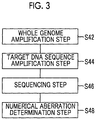
- Fig. 3 is a flowchart showing the work flow of the gene analysis step.
- the gene analysis step shown in Fig. 3 is the gene analysis step S4 shown in Fig. 1 .
- the gene analysis step includes a whole genome amplification step S42, a target DNA sequence amplification step S44, a sequencing step S46, and a numerical aberration determination step S48.
- the whole genome amplification step S42 is a step of performing a process of amplifying a whole genome from a single cell. Since one cell to several cells are not sufficient for analysis, DNA information is copied in the order of 10,000 times to a few million times.
- the target DNA sequence amplification step S44 processing for amplifying only the specific chromosome information from DNA, which needs to be amplified, using polymerase chain reaction is performed.
- the polymerase chain reaction may be referred to as PCR.
- the PCR is an abbreviation of polymerase chain reaction.
- the sequencing step S46 is a step of identifying the nucleotide sequence of the mother and the nucleotide sequence of the fetus by specifying the attribution of a chromosome using a next-generation sequencer. That is, in the sequencing step S46, quantification of DNA amplified in the target DNA sequence amplification step S44 and determination of attribution are performed.
- embryonic nucleated red blood cells that are target cells have been recovered. That is, it is determined that embryonic nucleated red blood cells have been recovered in a case where two types of nucleated red blood cells derived differently have been recovered, and it is determined that embryonic nucleated red blood cells have not been recovered in a case where only one type of nucleated red blood cells have been recovered.
- the fetus is a male in the case where only one type of nucleated red blood cells have been recovered, or in a case where the numerical aberration of a chromosome is recognized in the case where the fetus is a female, it can be determined that embryonic nucleated red blood cells have been recovered. In a case where embryonic nucleated red blood cells have not been recovered, it is determined that a re-examination is required.
- Whether or not embryonic nucleated red blood cells have been recovered may be determined by preparing the information of maternally derived cells as reference cell information in advance and performing comparison with the reference cell information.
- the numerical aberration determination step S48 is a step of determining whether or not there is a numerical aberration of a specific chromosome.
- the presence or absence of numerical aberrations of chromosome 18 and chromosome 21 is determined by quantifying the amount of DNA belonging to the chromosome 18 and the amount of DNA belonging to the chromosome 21 and comparing the results with those in the normal case.
- a case where the quantitative value of the amount of DNA in the chromosome 21 corresponds to neither a normal range indicating normal nor an abnormal range indicating numerical aberrations is a case where a target result cannot be obtained. Accordingly, it is determined that a re-examination is required.
- the quantitative value of the amount of DNA in the chromosome 21 is 1.5 times that in the normal case. In the case of monosomy of the chromosome 21, the quantitative value of the amount of DNA in the chromosome 21 is 0.5 times that in the normal case.
- a range indicating normal and a range showing abnormal are determined in consideration of an error or the like in the derivation of quantitative values.
- the range indicating normal in the case of considering an error of 5% is equal to or greater than 0.95 times the normal value and equal to or less than 1.05 times the normal value.
- the range indicating abnormal in the case of considering an error of 5% is equal to or greater than 1.43 times the normal value and equal to or less than 1.58 times the normal value.
- the quantitative value of the amount of DNA in the chromosome 21 is 1.2 times that in the normal case, the quantitative value of the amount of DNA in the chromosome 21 corresponds to neither the normal range indicating normal nor the abnormal range indicating numerical aberrations. Accordingly, it is determined that a re-examination is required.
- Whether the examination result corresponds to the normal range and the abnormal range or does not correspond thereto may be automatically determined from the numerical values included in the examination result, or the operator may input the result of determination regarding whether the examination result corresponds to the normal range and the abnormal range or does not correspond thereto.
- Whether or not embryonic nucleated red blood cells have been recovered may also be automatically determined based on determination reference information determined in advance, or the operator may input the determination result.
- re-examination necessity determination information used in determining whether or not a re-examination is required is generated.
- the re-examination necessity determination information also functions as information indicating that a re-examination is required.
- As a form of the re-examination necessity determination information character information indicating that the possibility of success of re-examination is high or character information indicating that the possibility of success of re-examination is low can be mentioned.
- the re-examination necessity determination information may always be generated regardless of whether or not a re-examination is required.
- a form is possible in which information of at least one of the number of used nucleated red blood cells that is the number of used cells, a gestational age, the number of candidate nucleated red blood cells that is the number of candidate cells, the amount of blood collection, the amount of DNA, the amount of chromosomes, or a gene dosage is included as the re-examination necessity determination information.
- a form is preferable in which at least one of the number of used nucleated red blood cells and the gestational age is included in the re-examination necessity determination information.
- the gestational age may be the number of weeks obtained by adding the date and time taken for the examination to the blood sampling date and time.
- the number of used nucleated red blood cells is the number of used nucleated red blood cells used in the gene analysis step S4.
- the gestational age is the number of weeks of pregnancy at the time of examination.
- the number of candidate nucleated red blood cells is the number of nucleated red blood cells as candidates used in the gene analysis step S4 or the number of nucleated red blood cells as candidates actually used in the gene analysis step S4.
- re-examination necessity determination information generated in the sequencing step S46 and the numerical aberration determination step S48 shown in Fig. 3 is acquired together with the examination result, an examination notification reflecting the re-examination necessity determination information in the examination result is generated, and the generated examination notification is output.
- the details of the generation of an examination notification will be described later.
- the items of the steps or the step classification method described in Figs. 1 to 3 is an example, and a method of distinguishing steps in a series of examination processes, that is, a step definition method regarding how to define each step, is arbitrary. Also for the examination process itself, it is possible to adopt other various methods.
- the step definition method according to the examination process is also arbitrary similarly. This is the same for a gene chromosome examination system shown below, and the definition of each unit is arbitrary and subdivision and integration of each unit can be appropriately performed.
- FIG. 4 is an overall configuration diagram showing the schematic configuration of a gene chromosome examination system to which the examination notification output device according to the embodiment of the present invention is applied.
- a gene chromosome examination system 10 shown in Fig. 4 is configured to include a hospital 20 and a laboratory 30.
- the hospital 20 is configured to include a blood collection unit 22 for collecting a blood sample and an examination notification acquisition unit 24 that is an output destination of the examination notification of a gene chromosome examination.
- the blood sample of the mother collected by the blood collection unit 22 is sent to the laboratory 30.
- Hospital information specifying the hospital 20 and maternal information specifying the mother, from whom the blood sample has been collected, are given to the blood sample of the mother sent to the laboratory 30 from the hospital 20.
- the hospital information and the maternal information include a form called an ID.
- the ID is an abbreviation of identification.
- hospital information a hospital name and blood collection date and time can be mentioned.
- maternal information name, age, gestational age at the time of blood collection, and a fetal gender can be mentioned.
- forms of hospital information and maternal information a form printed on the recording paper and a form of electronic data can be mentioned.
- a form converted into a format suitable for data communication or a form stored in a storage medium is included in the form of electronic data.
- a form of compression of the amount of data is included in the form converted into a format suitable for data communication.
- the blood sample of the mother sent to the laboratory 30 from the blood collection unit 22 is quickly and safely transported under the temperature control and in a state of being protected against shock.
- the transportation step S2 shown in Fig. 1 is applied for the transportation of the blood sample of the mother from the blood collection unit 22 to the laboratory 30.
- the examination notification acquisition unit 24 shown in Fig. 4 acquires an examination notification indicating the examination result of the gene chromosome examination sent from the laboratory 30, and displays the examination notification for a person to be examined.
- an examination notification a form of acquiring a printed matter by printing an examination result on the recording paper or a form of acquiring an examination notification as electronic data can be mentioned.
- a form to visualize electronic data printing and display using a display device can be mentioned.
- the laboratory 30 is configured to include an examination reception unit 32, a cell isolation unit 34, a gene analysis unit 36, and an examination notification output unit 38.
- the examination reception unit 32 receives the blood sample of the mother transported from the blood collection unit 22 or the hospital 20, and acquires the hospital information and the maternal information given to the received blood sample.
- the hospital information and the maternal information may be sent to the laboratory 30 separately from the blood sample using a method of data communication or the like in a state in which the hospital information and the maternal information is associated with the blood sample.
- the cell isolation unit 34 performs the cell isolation step S3 shown in Fig. 1 .
- the gene analysis unit 36 shown in Fig. 4 performs the gene analysis step S4 shown in Fig. 1 .
- the cell isolation unit 34 and the gene analysis unit 36 shown in Fig. 4 function as an examination unit 37 that performs a gene chromosome examination.
- the examination notification output unit 38 shown in Fig. 4 performs the examination notification output step S5 shown in Fig. 1 .
- the examination notification generated by the examination notification output unit 38 shown in Fig. 4 is sent to the examination notification acquisition unit 24 belonging to the hospital 20.
- the examination notification output unit 38 can also belong to the examination unit 37.
- examination notification output unit 38 and the examination notification acquisition unit 24 can be integrated and placed in the hospital 20.
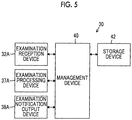
- Fig. 5 is a block diagram showing the configuration of an information processing system in the laboratory 30 shown in Fig. 4 .
- the laboratory 30 includes an examination reception device 32A, an examination processing device 37A, an examination notification output device 38A, s management device 40, and a storage device 42. Overall control of each device is performed by the management device 40.
- the management device 40 shown in Fig. 5 can be configured as a server device disposed in the laboratory 30.
- the examination reception device 32A performs a process of receiving an examination request.
- a process of receiving an examination request generation of an examination job that is a management unit of an examination in the laboratory 30, acquisition of hospital information given to a blood sample to be examined, and acquisition of maternal information given to a blood sample to be examined can be mentioned.
- the hospital information and the maternal information that have been acquired are associated with the examination job, and are stored in the storage device 42 through the management device 40.
- an examination job is associated with an electronic medical record managed in the hospital 20 shown in Fig. 4 .
- an identification number or an identification mark in the electronic medical record of the mother, from whom a blood sample to be examined has been collected, may be acquired as hospital information.
- a terminal device disposed in the examination reception unit 32 that functions as a processing device of the examination reception unit 32 shown in Fig. 4 is applied.
- Data communication may be wireless or wired.
- RFID is an abbreviation of radio frequency identifier
- IC is an abbreviation of integrated circuit
- the examination processing device 37A performs information processing in the examination unit 37 shown in Fig. 4 .
- the examination processing device 37A includes a terminal device disposed in the cell isolation unit 34 shown in Fig. 4 and a terminal device disposed in the gene analysis unit 36.
- the examination processing device 37A shown in Fig. 5 associates the examination result obtained by the cell isolation step S3 and the gene analysis step S4 in Fig. 1 and examination-related information, which is obtained in association with the examination, with the examination job, and stores the result in the storage device 42 through the management device 40.
- the re-examination necessity information and the re-examination necessity determination information that have been described previously can be mentioned.
- information regarding the state of a blood sample such as the contamination of a blood sample
- information regarding the type of numerical aberration of a specific chromosome such as mosaic chromosomal abnormalities, partial trisomy, or chimera, can be mentioned.
- the examination notification output device 38A performs the examination notification output step S5 shown in Fig. 1 .
- the examination notification output device 38A acquires the examination result and the re-examination necessity determination information or the examination-related information stored in the storage device 42, generates an examination notification based on the examination result, and outputs the generated examination notification.
- the examination reception device 32A, the examination processing device 37A, or the examination notification output device 38A accesses the storage device 42 to store and read the various kinds of information.
- Access of the examination reception device 32A, the examination processing device 37A, or the examination notification output device 38A to the storage device 42 is managed by the management device 40.
- the management device 40 may set the access permission for the examination reception device 32A, the examination processing device 37A, or the examination notification output device 38A, so that it is possible to access only a region determined for each device or only information determined for each device.
- the configuration of the information processing system of the laboratory 30 shown in Fig. 5 is an example, and the functions of the respective devices can be appropriately integrated and the functions of each device can be appropriately divided.
- the examination notification output device 38A may be made to have some of the functions of the examination processing device 37A.
- any of the examination reception device 32A, the examination processing device 37A, and the examination notification output device 38A may also be combined with the management device 40.
- the gene chromosome examination system 10 shown in Fig. 4 may be constructed as a client server type computer system, or may be configured as a system of a client that does not use a server.
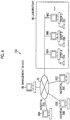
- Fig. 6 is a block diagram of a gene chromosome examination system 10A to which a client server type computer system is applied.
- the gene chromosome examination system 10A shown in Fig. 6 is configured to include a management device 68, a hospital terminal device 62A installed in a hospital 20A, a hospital terminal device 62B installed in a hospital 20B, a hospital terminal device 62C installed in a hospital 20C, and a laboratory terminal device 66 installed in the laboratory 30.
- the management device 68 shown in Fig. 6 has a function of the management device 40 shown in Fig. 5 .
- the hospital terminal devices 62A, 62B, and 62C shown in Fig. 6 can be made to function as the terminal device of the blood collection unit 22 and the terminal device of the examination notification acquisition unit 24 shown in Fig. 4 .
- a laboratory terminal device installed in each unit of the laboratory 30 is included in the laboratory terminal device 66.
- a laboratory terminal device 66A applied to a process A a laboratory terminal device 66B applied to a process B, and a laboratory terminal device 66C applied to a process C are shown as the laboratory terminal device 66.
- the laboratory terminal devices 66A, 66B, and 66C shown in Fig. 6 can be made to function as the examination reception device 32A, the examination processing device 37A, and the examination notification output device 38A shown in Fig. 5 , respectively.
- the management device 68 that functions as a server device is communicably connected to the hospital terminal devices 62A, 62B, and 62C, which function as client devices, and the laboratory terminal devices 66A, 66B, and 66C through electrical communication lines.
- the hospital terminal devices 62A, 62B, and 62C shown in Fig. 6 may function as the examination notification output device 38A shown in Fig. 5 .
- the hospital terminal device that functions as the examination notification output device 38A receives only an examination result from the laboratory terminal device that functions as the examination processing device 37A.
- the hospital terminal device that functions as the examination notification output device 38A may receive an examination result from the laboratory terminal device, which functions as the examination processing device 37A, through the examination reception device 32A.
- An electrical communication line 70 may be a local area network, or may be a wide area network, or may be a combination thereof.
- the local area network may be expressed as a LAN using the first letters of local area network of English notation.
- the wide area network may be expressed as a WAN using the first letters of wide area network of English notation.
- the electrical communication line 70 is not limited to a cable communication line. A part or all of the electrical communication line 70 can be formed as a wireless communication line.
- connection in this specification indicates a state of devices between which transmission and reception of a signal are possible. As a form of connection, any of wired connection and wireless connection can be applied.
- the hospital terminal device 62A installed in the hospital A the hospital terminal device 62B installed in the hospital B, and the hospital terminal device 62C installed in the hospital C are shown in Fig. 6 , there is no particular limitation on the number of hospital terminals when implementing the invention, and any number (1 or more) of hospital terminals can be set. In addition, it is also possible to adopt a configuration in which a plurality of hospital terminals are installed in the same hospital.
- the management device 68 manages each of the plurality of laboratories 30 separately.
- Bar code readers 72A, 72B, and 72C are connected to the laboratory terminal devices 66A, 66B, and 66C, respectively. Although not shown in Fig. 6 , a bar code including identification information for identifying a sample is attached to a container or slide glass to receive a blood sample. The bar code is read by the bar code readers 72A, 72B, and 72C when starting the work or processing of each step or when ending the work or processing of each step or at the timing of each of the start and the end.
- a bar code reader is exemplified as means for reading hospital information and maternal information from the information storage medium in which the hospital information and the maternal information in a blood sample to be examined are stored.
- means for reading hospital information and maternal information corresponding to the configuration of an information storage medium is provided.
- the gene chromosome examination system 10A shown in Fig. 6 is an example in a case where the client server type computer system is applied, and addition of a configuration, change of a configuration, and deletion of a configuration can be appropriately performed.
- Fig. 7 is a block diagram showing the configuration of the examination notification output device 38A shown in Fig. 5 .
- the examination notification output device 38A shown in Fig. 7 is configured to include a control unit 102, an information acquisition unit 104 that functions as information acquisition means, a storage unit 106, an examination notification generation unit 108 that functions as examination notification generation means, a determination unit 109, a processing unit 110, and an examination notification output unit 112 that functions as an examination notification output means.
- the control unit 102 performs overall control of each unit of the examination notification output device 38A.
- the control unit 102 functions as a memory controller that controls the writing of data into the storage unit 106 and the reading of data from the storage unit 106.
- the information acquisition unit 104 acquires at least an examination result.
- the information acquisition unit 104 may acquire information required for the processing of the examination notification output device 38A including information indicating that a re-examination is required, for example, re-examination necessity determination information, or a second information acquisition unit that acquires information other than an examination result may be provided.
- information required for processing may be read from the storage device 42 by accessing the storage device 42 through the management device 40 shown in Fig. 5 .
- Information such as the re-examination necessity determination information and the examination result acquired by the information acquisition unit 104, is stored in the storage unit 106.
- the examination notification generation unit 108 generates an examination notification based on the information that has been acquired by the information acquisition unit 104 and is stored in the storage unit 106. In a case where it is determined that a re-examination is required, the examination notification generation unit 108 generates an examination result including the re-examination necessity determination information. The examination notification generated by the examination notification generation unit 108 is sent to the examination notification output unit 112 through the control unit 102.
- the determination unit 109 performs processing for determining whether or not a re-examination is required from the examination result acquired by the information acquisition unit 104. In a case where information indicating whether or not a re-examination is required is acquired by the information acquisition unit 104, the determination unit 109 may be removed.
- the processing unit 110 performs information processing when generating the examination notification from the information acquired by the information acquisition unit 104.
- the processing unit 110 and the determination unit 109 can also be integrated.
- the examination notification output unit 112 outputs the examination notification generated by the examination notification generation unit 108.
- the output form of the examination notification electronic data, a printed material, and the like can be mentioned.
- the examination notification output from the examination notification output unit 112 is sent to the examination notification acquisition unit 24 belonging to the hospital 20 shown in Fig. 4 .
- the examination notification output device 38A shown in Fig. 7 is an example, and addition of a configuration, change of a configuration, and deletion of a configuration can be appropriately performed.
- the examination notifications shown in Figs. 8 to 10 are sent in a case where the examination result corresponds to neither the normal range nor the abnormal range, which is an example in a case where it is determined that a re-examination is required.
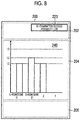
- Fig. 8 is an explanatory diagram showing an example of the examination notification sent in a case where the examination result corresponds to neither the normal range nor the abnormal range.
- An examination notification 200 is configured to include a first region 202, a second region 204, and a third region 206. In the first region 202, re-examination success possibility information 220 is displayed.
- re-examination success possibility information 220 shown in Fig. 8 character information expressing the possibility of success of re-examination in two stages is applied.
- any expression form can be applied if the re-examination success possibility information 220 is information indicating the possibility of success of re-examination.
- Quantitative value information 240 indicating the quantitative value of the amount of DNA in a specific chromosome is displayed in the second region 204.
- the quantitative value of the amount of DNA of the chromosome 18 as a specific chromosome, the quantitative value of the amount of DNA of the chromosome 21, and the quantitative value of the amount of DNA of sex chromosome are displayed in a graph form.
- the horizontal series of the quantitative value information 240 indicates a chromosome number and the type of sex chromosome.
- the vertical series of the quantitative value information 240 is a quantitative value of the amount of DNA.
- the quantitative value of the amount of DNA a relative value when the quantitative value of the amount of DNA in a normal case where there is no numerical aberration of a chromosome is assumed to be 1.0 is applied.
- the quantitative value information 240 indicating the quantitative value of the amount of DNA in a specific chromosome is applied as information indicating the presence or absence of numerical aberration of a specific chromosome that is included in the examination result.
- examination execution conditions information indicating the examination execution conditions in the gene analysis step S4 shown in Fig. 1 is displayed.
- the examination execution conditions information is shown by reference numerals 260 and 262 in Fig. 10 .
- the re-examination success possibility information 220 displayed in the first region 202, the quantitative value information 240 displayed in the second region 204, and the examination execution conditions information displayed in the third region 206 function as re-examination necessity determination information used in determining whether or not a re-examination is required.
- the quantitative value of the amount of DNA in the chromosome 21 is 1.2 times that in the normal case. If numerical aberration occurs in the chromosome 21, the quantitative value of the amount of DNA in the chromosome 21 becomes 0.5 times or 1.5 times that in the normal case.
- the quantitative value of the amount of DNA of the chromosome 21 shown in Fig. 8 corresponds to neither 0.5 times nor 1.5 times that in the normal case. That is, since the examination result corresponds to neither the normal range nor the abnormal range, it is difficult to determine whether or not numerical aberration of the chromosome 21 has occurred from the content of the quantitative value information 240.
- Fig. 9 is an explanatory diagram showing another example of the examination notification sent in a case where the examination result corresponds to neither the normal range nor the abnormal range.
- the examination notification 201 shown in Fig. 9 includes re-examination success possibility information 221 indicating that the possibility of success of re-examination is high, instead of the re-examination success possibility information 220 shown in Fig. 8 indicating that the possibility of success of re-examination is low.
- an examination notification including the re-examination necessity determination information is output. Accordingly, the re-examination necessity determination information can be used as an indicator when determining whether or not to perform re-examination.
- At least the re-examination success possibility information 220 may be given to the examination notification 200 shown in Fig. 8 by omitting the quantitative value information 240.
- at least the re-examination success possibility information 221 may be given to the examination notification 201 shown in Fig. 9 by omitting the quantitative value information 240.
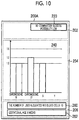
- Fig. 10 is an explanatory diagram showing another example of the examination notification in a case where the examination result corresponds to neither the normal range nor the abnormal range.
- the same or similar components as in Fig. 8 are denoted by the same reference numerals, and the explanation thereof will be appropriately omitted.
- the examination execution conditions information 260 and 262 that functions as re-examination necessity determination information is added to the examination notification 200 shown in Fig. 8 .
- the number of used nucleated red blood cells that is the number of used cells is displayed as the examination execution conditions information 260, and the gestational age is displayed as the examination execution conditions information 262.
- the value of the number of used nucleated red blood cells and the value of the gestational age shown in Fig. 10 are arbitrary values. This is the same in the following diagrams.
- the examination execution conditions information 262 itself can also be displayed in the first region 202 as the re-examination success possibility information 220.
- the examination execution conditions information 262 itself is displayed in the first region 202 as the re-examination success possibility information 220, character information expressing the possibility of success of re-examination in two stages may be omitted.
- a doctor can determine the possibility of success of the re-examination just by checking the examination execution conditions information 262.
- the number of used nucleated red blood cells is the number of nucleated red blood cells that have been used to quantify the amount of DNA in the gene chromosome examination by which the examination result has been acquired.
- the gestational age is the number of weeks of pregnancy at the time of gene chromosome examination.
- the number of candidate nucleated red blood cells is the number of nucleated red blood cells as candidates for nucleated red blood cells used in the gene chromosome examination.
- the number of nucleated red blood cells relative to the amount of blood collection is small compared with a standard range, it can be determined that the possibility of success of re-examination is low even if the re-examination is performed without increasing the amount of blood collection. Accordingly, it is possible to perform determination, such as increasing the amount of blood collection in the re-examination from the previous examination.
- the mosaic chromosomal abnormalities are a state in which normal cells and abnormal cells are mixed.
- the partial trisomy is trisomy in which chromosomes partially overlap each other.
- the contamination is a state in which other blood components are mixed to the collected blood sample.
- the chimera is a state in which cells with different pieces of genetic information are mixed.
- the chimera occurs in a case where two fertilized eggs are fused in the womb or in a case where hematopoietic tube cells have moved in twins, for example.
- the former occurs very rarely.
- the latter is referred to as a blood chimera, and occurs in about 8% of the dizygotic twins pair.
- the number of used nucleated red blood cells can be used as an indicator for determining whether or not a re-examination is required in a case where the influence of measurement error and mosaic chromosomal abnormalities are suspected. For example, in a case where the number of used nucleated red blood cells shown as the examination execution conditions information 260 is insufficient compared with the standard number of the number of used nucleated red blood cells determined in advance, it can be determined that the possibility of success of re-examination is high on the condition that the number of nucleated red blood cells is increased in the re-examination.
- the gestational age, the amount of blood collection, and the number of candidate nucleated red blood cells can be used as indicators. For example, since the number of nucleated red blood cells tends to increase with the passage of gestation from the fifth week to the tenth week of pregnancy, the gestational age can be used as an indicator for determining whether or not it is possible to increase the number of used nucleated red blood cells.
- the number of used nucleated red blood cells serves as an indicator when determining the possibility of success of re-examination. That is, if it is possible to adjust a period up to the re-examination, it can be determined that the possibility of success of the re-examination is high.
- the amount of blood collection or the number of candidate nucleated red blood cells can be used as an indicator for determining whether or not it is possible to increase the number of used nucleated red blood cells.
- the gestational age can be used as an indicator when determining the necessity of re-examination in consideration of time limitation of abortion.
- a form is exemplified in which the examination execution conditions information 260 and 262 is displayed.
- the pieces of examination execution conditions information 260 and 262 may be included.
- the examination execution conditions information at least one of the amount of blood collection and the number of candidate nucleated red blood cells may be added.
- the arrangement and sizes of the first region 202, the second region 204, and the third region 206 shown in Figs. 8 to 10 can be appropriately changed.
- Figs. 11 and 12 are explanatory diagrams showing examples of the notification of an examination result in a case where a re-examination is not required, that is, in a case where an examination result, from which the presence or absence of numerical aberration of a specific chromosome can be determined, is obtained and the examination is successful.
- An examination notification 200B shown in Fig. 11 is a case where the fetus is a female
- an examination notification 200C shown in Fig. 12 is a case where the fetus is a male.
- the amount of DNA in the sex chromosome displayed as the quantitative value information 240 has only a quantitative value of the amount of DNA in the X chromosome.
- the amount of DNA in the sex chromosome displayed as the quantitative value information 240A has a quantitative value of the amount of DNA in the X chromosome and a quantitative value of the amount of DNA in the Y chromosome.
- the amount of DNA in the X chromosome and the amount of DNA in the Y chromosome are half of the amount of DNA in the X chromosome in a case where the fetus shown in Fig. 11 is a female.
- determination result information 222 indicating the presence or absence of numerical aberration of a specific chromosome is given to the first region 202.
- character information indicating that the quantitative value of the amount of DNA in the chromosome 21 is a value indicating positive is displayed.
- the examination execution conditions information 260 shown in Fig. 10 may be displayed in the first region 202 or the third region 206 as the re-examination success possibility information 220.
- the doctor may determine that re-examination is to be performed for relief depending on the numerical value of the quantitative value information 240.
- Fig. 13 is a flowchart showing the control procedure of an examination notification output method.
- information acquisition step S12 is performed.
- information acquisition step S12 information including at least an examination result is acquired.
- a re-examination is required, for example, in a case where an examination result indicating that the examination result of a gene chromosome examination corresponds to neither the normal range nor the abnormal range is obtained, information including re-examination necessity determination information, for example, the re-examination success possibility information 220 shown in Fig. 8 , is acquired together with the examination result.
- the process proceeds to examination notification selection step S14.
- the examination notification selection step S 14 it is checked whether or not re-examination necessity determination information is included in the information acquired in the information acquisition step S12, and the type of examination notification is selected according to whether or not the re-examination necessity determination information is included.
- the examination result may be acquired in the information acquisition step S12, and it may be determined whether or not the examination result corresponds to neither the normal range nor the abnormal range and the type of examination notification may be selected in the examination notification selection step S14.
- re-examination necessity determination information is included in various kinds of information acquired in the information acquisition step S12 and Yes is determined in the examination notification selection step S14, an examination notification including the re-examination necessity determination information is selected, and the process proceeds to a first examination notification generation step S16.
- an examination notification including re-examination necessity determination information such as the examination notification 200 shown in Fig. 8
- an examination notification including no re-examination necessity determination information such as the examination notification 200B shown in Fig. 11 , is generated.
- the process proceeds to an examination notification output step S20.
- the examination notification is output.
- the process proceeds to end step S22 to end the examination notification output method.
- an examination notification output program causing a computer to function as information acquisition means for acquiring information including the examination result of a gene chromosome examination, examination notification generation means for generating an examination notification by adding re-examination necessity determination information, which is used in determining whether or not a re-examination is required, to the examination result, and examination notification output means for outputting the generated examination notification.
- an examination notification is generated by adding the re-examination necessity determination information, which is used in determining whether or not a re-examination is required, to the examination result, and the examination notification is output. Therefore, in the determination regarding whether or not to perform re-examination, it is possible to use the re-examination necessity determination information as an indicator.
- region-examination which is a case where an examination result indicating that the examination result of a gene chromosome examination corresponds to neither the normal range nor the abnormal range is obtained
- an examination notification is generated by adding re-examination necessity determination information to the examination result, and the examination notification is output. Therefore, in particular, in the determination regarding whether or not to perform re-examination in a case where a re-examination is required, it is possible to use the re-examination necessity determination information as an indicator.
- Fig. 14 is an explanatory diagram of an examination notification including reason information indicating the determination reason for re-examination success determination.
- reason information 270 is given to the fourth region 207.
- the determination reason contamination shown in Fig. 14 or partial trisomym, chimera, and the like that are not shown in Fig. 14 , can be mentioned.
- non-recovery of embryonic nucleated red blood cells can be mentioned.
- reason information 270 By adding the reason information 270 to the examination notification 200D, it is possible to use the reason information 270 as an indicator for determining whether or not a re-examination is required.
- the quantitative value information 240B of the examination notification 200D shown in Fig. 14 is reduced in size compared with the quantitative value information 240 of the examination notification 200 shown in Fig. 8 .
- the fourth region 207 is added on the side of the third region 206 opposite to the second region 204.
- the re-examination success possibility information 220 may be omitted.
- the layout of the examination notification may be appropriately changed according to items displayed on the examination notification.
- Fig. 15 is an explanatory diagram of an examination notification including supplementary information that supplements the re-examination necessity determination information.
- information of the current gestational age is given to the fourth region 207 as first supplementary information 280, and information of a period required for a re-examination is given as second supplementary information 282.
- the gestational age displayed as examination execution conditions information 262 shown in Fig. 15 is the gestational age at the time of blood collection that is when blood has been collected from the mother, that is, the gestational age when the examination has been performed.
- the current gestational age is the gestational age of the mother at the time of examination notification output when the examination notification is displayed by the examination notification acquisition unit 24 shown in Fig. 4 .
- the gestational age of the mother at the time of examination notification output is calculated by acquiring the current date and time when the examination result is displayed, calculating the elapsed time from the date and time when the examination has been performed, and converting the calculated elapsed time into the number of weeks.
- the gestational age when the examination notification is acquired by the examination notification acquisition unit 24, when the examination notification is generated by the examination notification output unit 38, or when the examination notification is output may be given.
- the doctor can determine whether or not to perform re-examination, for example, even in a case where the possibility of success of re-examination is high in terms of the number of nucleated red blood cells.
- the doctor can perform determination taking into consideration what kind of determination can be made at the timing of acquiring the examination notification of re-examination.
- a form is exemplified in which two kinds of supplementary information of the first supplementary information 280 and the second supplementary information 282 are given.
- the number of supplementary information, the content of supplementary information, and the like can be appropriately changed, added, or deleted.
- the re-examination success possibility information 221 indicating that the possibility of success of re-examination is high is given as the re-examination necessity determination information.
- the supplementary information By adding the supplementary information to the examination notification, it is possible to use the supplementary information as an indicator for determining whether or not a re-examination is required. In addition, it is possible to use the supplementary information as an indicator for determining the conditions of a re-examination, such as performing re-examination early.
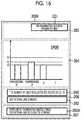
- Fig. 16 is an explanatory diagram of another example of supplementary information.
- character information indicating the quick execution of re-examination is given as supplementary information 280A.
- the character information functions as information that is an indicator for setting the conditions of a re-examination in a case where the re-examination is performed.
- the re-examination success possibility information 221 indicating the possibility of success of re-examination is high is given as the re-examination necessity determination information.
- the re-examination success possibility information 220 indicating the possibility of success of re-examination is low may be given as the re-examination necessity determination information, and character information indicating that re-examination is not performed may be given as the supplementary information 280A.
- the supplementary information can be used as the conditions of a re-examination based on the examination result, for example, an indicator for determining the priority of re-examination. Specifically, it is possible to urge to perform blood collection for re-examination on the same day.
- Fig. 17 is an explanatory diagram of another example of supplementary information.
- An examination notification 200G shown in Fig. 17 includes information regarding a charge in the case of performing re-examination. That is, supplementary information 280B indicates no charge when performing re-examination.
- the re-examination success possibility information 221 indicating the possibility of success of re-examination is high is given as the re-examination necessity determination information.
- a response such as making no additional charge, is possible at the time of re-examination.
- a response such as making no additional charge for a predetermined number of re-examinations, is possible.
- Fig. 18 is an explanatory diagram of another example of supplementary information.
- character information indicating the step of a gene chromosome examination from which a re-examination is started is given as supplementary information 280C.
- the blood collection step S1 or the gene analysis step S4 shown in Fig. 1 can be mentioned.
- the re-examination success possibility information 221 indicating the possibility of success of re-examination is high is given as the re-examination necessity determination information.
- mosaic chromosomal abnormalities can be mentioned.
- re-examination may be performed from the blood collection step S1 in order to increase the number of candidate nucleated red blood cells in the re-examination.
- Fig. 19 is an explanatory diagram of another example of supplementary information.
- character information indicating the step of a gene chromosome examination in which it has been determined that an examination result indicating that the examination result corresponds to neither the normal range nor the abnormal range has been obtained, is given as supplementary information 280D.
- the re-examination success possibility information 221 indicating the possibility of success of re-examination is high is given as the re-examination necessity determination information.
- the examination is stopped at the point in time when it has been determined that a re-examination is required, and the examination notification 200I shown in Fig. 19 is generated and output.
- the pieces of supplementary information shown in Figs. 15 to 19 can be appropriately combined.
- the size of each character used for the supplementary information may be changed, or the size of the fourth region 207 may be changed.
- Color display can be applied to the examination notifications shown in Figs. 8 to 12 and 14 to 19 .
- the information that needs to be distinguished visually can be emphasized more than other pieces of information.
- one examination notification may be configured using a plurality of pages.
- the examination notification acquisition unit 24 shown in Fig. 4 acquires the examination notification sent from the examination notification output unit 38.
- the determination result information 222 indicating the presence or absence of numerical aberration of a specific chromosome is given.
- the examination execution conditions information 260 and 262 of the examination notification 200A shown in Fig. 10 can be used.
- an option such as increasing the amount of blood collection in the re-examination compared with that in the previous examination.
- the gestational age is close to 12 weeks, for example, in a case where the gestational age is 11 weeks, it is possible to propose an option of performing no re-examination or to propose an option of performing re-examination preferentially.
- the supplementary information 280B shown in Fig. 17 is an indicator for determining a charge in the re-examination.
- the supplementary information 280C shown in Fig. 18 and the supplementary information 280D shown in Fig. 19 are indicators for determining the step from which a re-examination is started.
- a blood sample arrives at the laboratory 30 through the blood collection step S1 and the transportation step S2 shown in Fig. 1 .
- Information that indicates a re-examination and that is associated with the previous examination is added to the hospital information or the maternal information given to a blood sample.
- the hospital information and the maternal information may be anonymized, it is difficult to check to which examination job the re-examination corresponds in the laboratory 30.
- the re-examination By adding the information from which it is possible to understand that the re-examination is associated with the previous examination, it is possible to perform the examination preferentially by reason of re-examination. Therefore, it is possible to use information acquired in the previous examination.
- the gene chromosome examination using a blood sample has been described with the non-invasive prenatal diagnosis as an example.
- the output device and the like according to the present embodiment can also be applied to a genetic examination using a sample other than blood samples, such as a mucosal cell.
- the examination notification output device the examination notification output method, the examination notification output program, and the gene chromosome examination system described above
- appropriate changes, addition, and deletion are possible without departing from the spirit and scope of the present invention.
- the embodiments described above can also be appropriately combined.
Landscapes
- Life Sciences & Earth Sciences (AREA)
- Health & Medical Sciences (AREA)
- Engineering & Computer Science (AREA)
- Chemical & Material Sciences (AREA)
- Bioinformatics & Cheminformatics (AREA)
- Physics & Mathematics (AREA)
- General Health & Medical Sciences (AREA)
- Biotechnology (AREA)
- Analytical Chemistry (AREA)
- Proteomics, Peptides & Aminoacids (AREA)
- Organic Chemistry (AREA)
- Molecular Biology (AREA)
- Genetics & Genomics (AREA)
- Medical Informatics (AREA)
- Biophysics (AREA)
- Wood Science & Technology (AREA)
- Zoology (AREA)
- Bioinformatics & Computational Biology (AREA)
- Spectroscopy & Molecular Physics (AREA)
- Theoretical Computer Science (AREA)
- Evolutionary Biology (AREA)
- Immunology (AREA)
- Biochemistry (AREA)
- Microbiology (AREA)
- Biomedical Technology (AREA)
- General Engineering & Computer Science (AREA)
- Public Health (AREA)
- Urology & Nephrology (AREA)
- Hematology (AREA)
- Medicinal Chemistry (AREA)
- Epidemiology (AREA)
- Pathology (AREA)
- Computer Vision & Pattern Recognition (AREA)
- Cell Biology (AREA)
- Software Systems (AREA)
- Primary Health Care (AREA)
- Databases & Information Systems (AREA)
- Data Mining & Analysis (AREA)
- Sustainable Development (AREA)
- Evolutionary Computation (AREA)
Applications Claiming Priority (2)
| Application Number | Priority Date | Filing Date | Title |
|---|---|---|---|
| JP2014170238A JP2016042836A (ja) | 2014-08-25 | 2014-08-25 | 検査通知出力装置、検査通知出力方法、検査通知出力プログラム、及び遺伝子染色体検査システム |
| PCT/JP2015/068857 WO2016031385A1 (ja) | 2014-08-25 | 2015-06-30 | 検査通知出力装置、検査通知出力方法、検査通知出力プログラム、及び遺伝子染色体検査システム |
Publications (2)
| Publication Number | Publication Date |
|---|---|
| EP3196291A1 true EP3196291A1 (de) | 2017-07-26 |
| EP3196291A4 EP3196291A4 (de) | 2017-07-26 |
Family
ID=55399289
Family Applications (1)
| Application Number | Title | Priority Date | Filing Date |
|---|---|---|---|
| EP15835463.9A Withdrawn EP3196291A4 (de) | 2014-08-25 | 2015-06-30 | Vorrichtung zur ausgabe von prüfmitteilungen, verfahren zur ausgabe von prüfmitteilungen, programm zur ausgabe von prüfmitteilungen und prüfsystem für genchromosomen |
Country Status (4)
| Country | Link |
|---|---|
| US (1) | US20170159124A1 (de) |
| EP (1) | EP3196291A4 (de) |
| JP (1) | JP2016042836A (de) |
| WO (1) | WO2016031385A1 (de) |
Families Citing this family (2)
| Publication number | Priority date | Publication date | Assignee | Title |
|---|---|---|---|---|
| JP6785068B2 (ja) * | 2016-05-31 | 2020-11-18 | 富士フイルム株式会社 | 生物情報解析方法 |
| CN107085665A (zh) * | 2017-05-24 | 2017-08-22 | 洛阳瀍盛科技有限公司 | 医疗实验室检验报告智能分析及危急值自动传递系统 |
Family Cites Families (13)
| Publication number | Priority date | Publication date | Assignee | Title |
|---|---|---|---|---|
| JP2001091519A (ja) * | 1999-09-24 | 2001-04-06 | Olympus Optical Co Ltd | 自動分析装置 |
| JP2006031264A (ja) * | 2004-07-14 | 2006-02-02 | A & T Corp | 臨床検査情報管理装置、臨床検査情報管理方法、および臨床検査情報管理プログラム |
| FR2880897B1 (fr) * | 2005-01-18 | 2010-12-17 | Inst Nat Sante Rech Med | Methode de detection, non invasive, prenatale, in vitro de l'etat sain normal, de l'etat de porteur sain ou de l'etat de porteur malade de la mucoviscidose |
| JP2007108136A (ja) * | 2005-10-17 | 2007-04-26 | Mitsubishi Kagaku Bio-Clinical Laboratories Inc | 分析精度管理システム |
| ITTO20070307A1 (it) * | 2007-05-04 | 2008-11-05 | Silicon Biosystems Spa | Metodo e dispositivo per la diagnosi prenatale non-invasiva |
| JP2011007686A (ja) * | 2009-06-26 | 2011-01-13 | Hitachi High-Technologies Corp | 臨床検査結果の分析装置及び分析方法 |
| JP2011174844A (ja) * | 2010-02-25 | 2011-09-08 | Sysmex Corp | 臨床検査情報管理装置、臨床検査情報管理システム、及びコンピュータプログラム |
| JP2011191204A (ja) * | 2010-03-15 | 2011-09-29 | Sysmex Corp | 臨床検査装置、臨床検査情報管理システム、及びコンピュータプログラム |
| JP2012211804A (ja) * | 2011-03-31 | 2012-11-01 | Fujifilm Corp | 生化学検査装置および生化学検査方法 |
| WO2014127379A1 (en) * | 2013-02-18 | 2014-08-21 | Theranos, Inc. | Systems and methods for multi-analysis |
| JP6073902B2 (ja) * | 2011-10-06 | 2017-02-01 | セクエノム, インコーポレイテッド | 遺伝的変異の非侵襲的評価のための方法およびプロセス |
| CA2861856C (en) * | 2012-01-20 | 2020-06-02 | Sequenom, Inc. | Diagnostic processes that factor experimental conditions |
| CA2901016A1 (en) * | 2013-02-18 | 2014-08-21 | Theranos, Inc. | Systems and methods for collecting and transmitting assay results |
-
2014
- 2014-08-25 JP JP2014170238A patent/JP2016042836A/ja not_active Abandoned
-
2015
- 2015-06-30 EP EP15835463.9A patent/EP3196291A4/de not_active Withdrawn
- 2015-06-30 WO PCT/JP2015/068857 patent/WO2016031385A1/ja not_active Ceased
-
2017
- 2017-02-15 US US15/433,113 patent/US20170159124A1/en not_active Abandoned
Also Published As
| Publication number | Publication date |
|---|---|
| US20170159124A1 (en) | 2017-06-08 |
| JP2016042836A (ja) | 2016-04-04 |
| WO2016031385A1 (ja) | 2016-03-03 |
| EP3196291A4 (de) | 2017-07-26 |
Similar Documents
| Publication | Publication Date | Title |
|---|---|---|
| Kahraman et al. | The birth of a baby with mosaicism resulting from a known mosaic embryo transfer: a case report | |
| Clausen et al. | Report of the first nationally implemented clinical routine screening for fetal RHD in D− pregnant women to ascertain the requirement for antenatal RhD prophylaxis | |
| US8676510B2 (en) | Clinical-result confirming device, clinical-result confirming method, and computer program therefor | |
| Rafi et al. | Cell-free fetal DNA and non-invasive prenatal diagnosis | |
| Wang et al. | Identification of copy number variations among fetuses with ultrasound soft markers using next-generation sequencing | |
| Ferreira et al. | Frequency of fetal karyotype abnormalities in women undergoing invasive testing in the absence of ultrasound and other high‐risk indications | |
| US20160378954A1 (en) | Genetic chromosome test management system, test management server, client terminal, genetic chromosome test management method, and program | |
| US20160378953A1 (en) | Genetic chromosome test management system, test management server, client terminal, genetic chromosome test management method, and program | |
| Jenkins et al. | Prenatal genetic testing 2: diagnostic tests | |
| Maslow et al. | Single-nucleotide polymorphism–microarray ploidy analysis of paraffin-embedded products of conception in recurrent pregnancy loss evaluations | |
| Clausen | Cell‐free fetal DNA and fetal blood group genotyping: non‐invasive prenatal testing | |
| US20170159124A1 (en) | Examination notification output device, examination notification output method, examination notification output program, and gene chromosome examination system | |
| Joyce et al. | Morphology combined with HER2 D-DISH ploidy analysis to diagnose partial hydatidiform mole: an evaluation audit using molecular genotyping | |
| Buchovecky et al. | Assessment of maternal cell contamination in prenatal samples by quantitative fluorescent PCR (QF-PCR) | |
| Meng et al. | Application of short tandem repeat (STR) genotyping in partial hydatidiform mole | |
| Mayo et al. | Noninvasive prenatal testing: How far can we reach detecting fetal copy number variations | |
| Biron-Shental et al. | Endoreduplication in cervical trophoblast cells from normal pregnancies | |
| US20050288867A1 (en) | Cell tissue culture management method and system | |
| JP2016066219A (ja) | 検査通知提供装置、検査通知提供方法、検査通知提供プログラム、及び染色体検査システム | |
| Winsor et al. | The role of molecular microsatellite identity testing to detect sampling errors in prenatal diagnosis | |
| Kubendran et al. | Implementing a protocol to optimize detection of chromosome abnormalities in cases of miscarriage or stillbirth at a Midwestern teaching hospital | |
| Gergely et al. | Double trisomy 16 and 22 clinically mimic partial hydatidiform mole in a case of subsequent pregnancy loss | |
| Khawajkie et al. | Microsatellite DNA genotyping and flow cytometry ploidy analyses of formalin-fixed paraffin-embedded hydatidiform molar tissues | |
| Kovac et al. | Male infertility biomarkers and genomic aberrations in azoospermia | |
| Hastings | Quality control in FISH as part of a laboratory’s quality management system |
Legal Events
| Date | Code | Title | Description |
|---|---|---|---|
| STAA | Information on the status of an ep patent application or granted ep patent |
Free format text: STATUS: THE INTERNATIONAL PUBLICATION HAS BEEN MADE |
|
| PUAI | Public reference made under article 153(3) epc to a published international application that has entered the european phase |
Free format text: ORIGINAL CODE: 0009012 |
|
| STAA | Information on the status of an ep patent application or granted ep patent |
Free format text: STATUS: REQUEST FOR EXAMINATION WAS MADE |
|
| 17P | Request for examination filed |
Effective date: 20170223 |
|
| A4 | Supplementary search report drawn up and despatched |
Effective date: 20170626 |
|
| AK | Designated contracting states |
Kind code of ref document: A1 Designated state(s): AL AT BE BG CH CY CZ DE DK EE ES FI FR GB GR HR HU IE IS IT LI LT LU LV MC MK MT NL NO PL PT RO RS SE SI SK SM TR |
|
| AX | Request for extension of the european patent |
Extension state: BA ME |
|
| DAV | Request for validation of the european patent (deleted) | ||
| DAX | Request for extension of the european patent (deleted) | ||
| STAA | Information on the status of an ep patent application or granted ep patent |
Free format text: STATUS: EXAMINATION IS IN PROGRESS |
|
| 17Q | First examination report despatched |
Effective date: 20180423 |
|
| STAA | Information on the status of an ep patent application or granted ep patent |
Free format text: STATUS: THE APPLICATION HAS BEEN WITHDRAWN |
|
| 18W | Application withdrawn |
Effective date: 20180814 |