EP3192188B1 - Datenunterstützte chromatische dispersionsschätzung - Google Patents
Datenunterstützte chromatische dispersionsschätzung Download PDFInfo
- Publication number
- EP3192188B1 EP3192188B1 EP15736464.7A EP15736464A EP3192188B1 EP 3192188 B1 EP3192188 B1 EP 3192188B1 EP 15736464 A EP15736464 A EP 15736464A EP 3192188 B1 EP3192188 B1 EP 3192188B1
- Authority
- EP
- European Patent Office
- Prior art keywords
- correlation
- signal
- equalized
- equalizer
- frame
- Prior art date
- Legal status (The legal status is an assumption and is not a legal conclusion. Google has not performed a legal analysis and makes no representation as to the accuracy of the status listed.)
- Active
Links
Images

Classifications
-
- H—ELECTRICITY
- H04—ELECTRIC COMMUNICATION TECHNIQUE
- H04B—TRANSMISSION
- H04B10/00—Transmission systems employing electromagnetic waves other than radio-waves, e.g. infrared, visible or ultraviolet light, or employing corpuscular radiation, e.g. quantum communication
- H04B10/25—Arrangements specific to fibre transmission
- H04B10/2507—Arrangements specific to fibre transmission for the reduction or elimination of distortion or dispersion
- H04B10/25073—Arrangements specific to fibre transmission for the reduction or elimination of distortion or dispersion using spectral equalisation, e.g. spectral filtering
-
- H—ELECTRICITY
- H04—ELECTRIC COMMUNICATION TECHNIQUE
- H04B—TRANSMISSION
- H04B10/00—Transmission systems employing electromagnetic waves other than radio-waves, e.g. infrared, visible or ultraviolet light, or employing corpuscular radiation, e.g. quantum communication
- H04B10/25—Arrangements specific to fibre transmission
- H04B10/2507—Arrangements specific to fibre transmission for the reduction or elimination of distortion or dispersion
- H04B10/2513—Arrangements specific to fibre transmission for the reduction or elimination of distortion or dispersion due to chromatic dispersion
- H04B10/25133—Arrangements specific to fibre transmission for the reduction or elimination of distortion or dispersion due to chromatic dispersion including a lumped electrical or optical dispersion compensator
-
- H—ELECTRICITY
- H04—ELECTRIC COMMUNICATION TECHNIQUE
- H04B—TRANSMISSION
- H04B10/00—Transmission systems employing electromagnetic waves other than radio-waves, e.g. infrared, visible or ultraviolet light, or employing corpuscular radiation, e.g. quantum communication
- H04B10/60—Receivers
- H04B10/66—Non-coherent receivers, e.g. using direct detection
- H04B10/69—Electrical arrangements in the receiver
- H04B10/697—Arrangements for reducing noise and distortion
- H04B10/6971—Arrangements for reducing noise and distortion using equalisation
Definitions
- the present invention is in the area of coherent fiber optical communication and relates to a receiver and a method of performing chromatic dispersion estimation in an optical communication system.
- QPSK quadrature phase shift keying
- 16QAM 16 quadrature amplitude modulation
- the symbol rate is lower than the bit rate, leading to a higher spectral efficiency than provided by serial on-off keying transmission, and the spectral efficiency can be additionally doubled by performing polarization-division multiplexing (PDM).
- PDM polarization-division multiplexing
- Such advanced modulation formats combined with PDM require coherent detection, as all dimensions of the optical field must be analyzed for proper signal demodulation.
- coherent detection has two additional benefits: increased receiver sensitivity and possibility of digital impairment compensation.
- Digital compensation of transmission impairments such as chromatic dispersion (CD) and polarization-mode dispersion (PMD) has been extensively investigated and has been applied in commercially available transponders.
- An effective compensation of the respective impairments requires precise impairment estimation, commonly referred to as channel estimation.
- Different algorithms for channel estimation in coherent optical transceivers have been proposed and implemented using for example digital signal processing (DSP) architectures.
- DSP digital signal processing
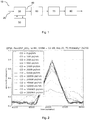
- Fig. 1 illustrates a corresponding digital signal processing (DSP) architecture of a channel estimator 10.
- a digitalized optical signal 20 is processed by a bulk chromatic dispersion (CD) equalizer 30.
- CD chromatic dispersion
- this type of equalizer is implemented in the frequency domain and is then referred to as Frequency Domain Equalizer (FDE) 30.
- the Frequency Domain Equalizer (FDE) 30 coarsely compensates the chromatic dispersion (CD), leaving the resulting signal 40 with a residual chromatic dispersion (CD).
- the resulting signal 40 should have sufficiently low residual chromatic dispersion (CD) in order to enable the subsequent steps of frame detection 60, frequency offset correction 70, and finally MIMO equalization 80 to be performed in a robust manner.
- a chromatic dispersion estimator 50 receives information from the Frequency Domain Equalizer (FDE) 30, and based on this information, the chromatic dispersion estimator 50 configures the Frequency Domain Equalizer (FDE) 30.
- the amount of residual chromatic dispersion CD left by the Frequency Domain Equalizer (FDE) 30 largely depends on the performance of the chromatic dispersion estimator 50.
- the chromatic dispersion estimator 50 is conventionally located immediately before or after the Frequency Domain Equalizer (FDE) 30 for improved performance.
- a conventional chromatic dispersion estimator 50 is based on the constant-modulus algorithm (CMA), as for example described in Kuschnerov, Maxim, et al. "Adaptive chromatic dispersion equalization for non-dispersion managed coherent systems. " Optical Fiber Communication Conference. Optical Society of America, 2009 .
- the constant-modulus algorithm (CMA) assumes that all constellation symbols of the received signal 20 have identical amplitudes, such as for example QPSK modulation symbols, since all symbols of the QPSK constellation have identical amplitudes. In other words, the constant-modulus algorithm (CMA) considers the amplitude (modulus) of such a signal to be constant as long as it is not subject to any impairment.
- the constant-modulus algorithm based chromatic dispersion (CMA-based CD) estimator 50 applies different chromatic dispersion test values to the Frequency Domain Equalizer (FDE) 30, and analyses the Frequency Domain Equalizer (FDE) output signal 40.
- FDE Frequency Domain Equalizer
- the amplitude of the output signal is constant. In ideal conditions, this corresponds exactly to the opposite value of the chromatic dispersion imposed by the link and thus provides an optical equalization of the signal.
- the accuracy of the CMA-based CD estimator is affected by different factors.
- the CMA-based algorithm is not agnostic to the modulation format, as it assumes that all constellation symbols have identical amplitudes. This assumption does not apply for many modulation schemes, such as for example Quadrature Amplitude Modulation (QAM) symbols having different amplitudes and phases.
- QAM Quadrature Amplitude Modulation
- the Frequency Domain Equalizer FDE
- PMD polarization-mode dispersion
- PDL polarization-dependent loss
- this algorithm does not account for polarization-division multiplexing (PDM).
- a problem related to the CMA-based chromatic dispersion estimator is that the modulation format must define constellation symbols with identical amplitudes. Furthermore, the CMA-based chromatic dispersion estimator lacks robustness against polarization-mode dispersion (PMD) and polarization-dependent loss (PDL) and does not provide for polarization-division multiplexing (PDM), which can only be compensated with high implementation complexity.
- PMD polarization-mode dispersion
- PDL polarization-dependent loss
- US6798500 relates to a method for estimation of chromatic dispersion in a multichannel optical network.
- the disclosed estimator is based on eye-diagram analysis, wherein the chromatic dispersion distorts the eye diagram of an on-off-keying signal from its original shape.
- the method is limited to on-off-keying signals and can only cope with minor chromatic dispersions.
- US2013/0045004 relates to a histogram-based chromatic dispersion estimator and is based on the effect that the power waveform of an optical signal subject to chromatic dispersion has a Gaussian-shaped statistical distribution.
- the histogram of the amplitude of the optical field is determined, and if the histogram is Gaussian, then it is concluded that the chromatic dispersion has not been properly compensated.
- the chromatic dispersion compensator is tuned until the histogram is no longer Gaussian.
- this estimator is applicable only to minor chromatic dispersions.
- US20120128376 refers to a method of chromatic dispersion estimation for coherent receivers which is insensitive to polarization-mode dispersion (PMD).
- the disclosed estimator obtains two frequency parts of the signal at frequencies ⁇ f from the center frequency.
- the chromatic dispersion is estimated by comparing the phase shift between the frequency parts, which should be zero if no chromatic dispersion is present in the signal.
- this estimator is implicitly sensitive to PMD and PDL, although such influences may be reduced by averaging.
- the above conventional chromatic dispersion estimators are based on time-domain signals (e.g., CMA) or frequency-domain signals (e.g., spectral analysis, clock-tone analysis) and may or may not use signals from the compensation path.
- the above conventional chromatic dispersion estimators are unsuitable or require significant complexity for coping with a modulation format with constellation symbols having unequal amplitudes, especially when the estimator is to additionally provide robustness against polarization-mode dispersion (PMD) and polarization-dependent loss (PDL) and to also account for polarization-division multiplexing (PDM).
- PMD polarization-mode dispersion
- PDL polarization-dependent loss
- PDM polarization-division multiplexing
- EP 2 639 977 A1 discloses a coherent optical receiver comprising an optical-to-digital converter adapted to convert the received optical signal into a digital signal comprising two polarization components; a synchronization unit adapted to extract a sequence of received training symbols from the digital signal; a channel estimation unit adapted to determine an indication of a transfer function of the transmission channel, based on the sequence of received training symbols and based on the sequence of transmitted training symbols; and a polarization demultiplexing unit adapted to rotate the digital signal, based on the indication of the transfer function of the transmission channel, thereby yielding a polarization de-multiplexed digital signal.
- An adaption unit is adapted to determine a first plurality of sets of filter coefficients based on an indication of the transfer function of the transmission channel and a second plurality of sets of filter coefficients based on a second indication of the transfer function of the transmission channel.
- the adaption determines a plurality of sets of filter coefficients based on a newly received sequence of training symbols.
- the adaption unit determines the plurality of sets of filter coefficients based on a smooth transition from the first plurality of sets of filter coefficients to the second plurality of sets of filter coefficients.
- a frame structure is recovered by a synchronization unit based on synchronization data, that may in a special embodiment be identical with the training symbol data.
- the training symbol comprises two identical sub-sequences A of M/2, i.e. the time domain symbol of M samples may be written as a sequence [A, A] of the two identical sub-sequences A.
- the time-domain symbol comprises two identical halves.
- the synchronization unit can determine the correlation of two succeeding sub-sequences of M/2 samples of the digital signal.
- the correlation is determined for a plurality of succeeding sub-sequences of M/2 samples of the digital signal, wherein the sub-sequences are shifted by one sample at a time.
- the synchronization unit can determine a sequence of correlation values.
- the synchronization unit determines the presence of the training symbol data by determining that the correlation of the two succeeding sub-sequences of M/2 samples exceeds a correlation threshold.
- the fact that the training symbol comprises two identical sub-sequences is not exploited in the adaption of filter coefficients.
- EP 2 709 328 A2 discloses a coefficient determining apparatus, equalizer, receiver and transmitter.
- the coefficient determining apparatus comprises: a synchronizer configured to find a position of a training sequence from signals containing the training sequence received by a transmitter; and a first processor configured to set an initial tap coefficient of an equalizer according to the received signals and the training sequence.
- the training sequence comprises n pairs of training symbols, in the n pairs of training symbols, the training symbols of the same pair being identical, the training symbols of the different pair being different, a cyclic prefix and a cyclic postfix being respectively inserted before and after each pair of training symbols, wherein n is an integer greater than 1.
- a problem underlying the invention is to provide improved devices and methods for performing chromatic dispersion estimation in optical communication systems, in particular improved devices and methods for coping with modulation format constellation symbols having unequal amplitudes. It is further desired that the respective devices and methods provide robustness against polarization-mode dispersion (PMD) and polarization-dependent loss (PDL) and can account for polarization-division multiplexing (PDM).
- PMD polarization-mode dispersion
- PDL polarization-dependent loss
- PDM polarization-division multiplexing
- the method of performing chromatic dispersion estimation in a receiver of an optical communication system comprises the steps of:
- the present invention provides a method of performing chromatic dispersion estimation in a receiver, wherein the receiver receives a signal including frames.
- Each of the frames comprises a training portion and a data portion, and the training portion comprises a plurality of identical pattern sequences.
- the respective pattern sequences are used for estimating the chromatic dispersion of the signal, but may also relate to other tasks, such as for example frame synchronization (also called frame detection), frequency offset estimation and channel estimation.
- frame synchronization also called frame detection
- frequency offset estimation frequency offset estimation
- channel estimation channel estimation
- signal processing units applied for other purposes such as for example frame detection can be reused for performing chromatic dispersion estimation.
- correlators for the purpose of frame detection and chromatic dispersion estimation.
- common signal processing units are reused for lower implementation complexity, which may for example comprise Digital Signal Processors (DSPs) or ASICs.
- DSPs Digital Signal Processors
- the received signal is equalized such as to generate a plurality of equalized signals, wherein each of the equalized signals comprises at least one frame.
- an equalizer is applied using different settings to the received signal such as to generate a plurality of equalized signals spanning at least one frame.
- the equalizer may represent a frequency domain equalizer, in particular a chromatic dispersion (CD) equalizer.
- CD chromatic dispersion
- a plurality of correlation values are determined, wherein at least one correlation value is calculated for each of the respective frames.
- each of the correlation values is obtained by calculating the correlation between a first pattern sequence and a second pattern sequence of the corresponding frame.
- the respective pattern sequences are comprised by the training portion and represent identical pattern sequences.
- the chromatic dispersion estimation is performed according to the present invention by calculating the correlation between two identical pattern sequences of the equalized signals.
- the correlation between two repetitions of a symbol pattern embedded in the transmit stream is affected by distortions, and thus also by the chromatic dispersion.
- an increase of the absolute chromatic dispersion leads to an increased intersymbol interference (ISI), which in turn decreases the calculated correlation, in particular the correlation output power.
- ISI intersymbol interference
- the method according to the present invention obtains a final correlation value for each of the equalized signals by averaging the plurality of correlation values determined for each of the equalized signals. Then, after calculating the final correlation value for each of the equalized signals, the setting of the equalizer corresponding to the equalized signal providing the highest final correlation value is selected as the optimal setting for compensating the chromatic dispersion of the signal.
- the received signal comprises a frame including a training portion and a data portion which are arranged such that the training portion comprises non-contiguous portions separated by parts of the data portion.
- the frames of the received signal may comprise a training portion and/or a data portion including symbols having different amplitudes and phases, in particular QAM modulated symbols.
- the respective correlation approach can also cope with polarization-division multiplexed (PDM) signals, as explained further below.
- the step of determining the at least one correlation value for each of the equalized signals may comprise the additional steps of delaying each equalized signal by a time-offset to generate a delayed version of each of the equalized signals, and then calculating the correlation between a first pattern sequence of the delayed equalized signal and a second pattern sequence of the non-delayed equalized signal.
- the delay of the equalized signal may for example be set to correspond to a single or a multiple of the length of a pattern sequence in the training portion of a frame.
- the respective at least one correlation value is determined for each frame by calculating the correlation between the delayed and non-delayed versions of each of the equalized signals.
- the step of determining the at least one correlation value for each of the equalized signals may comprise multiplying samples of the non-delayed equalized signal with samples of the delayed equalized signal and calculating a moving average of the multiplied samples.
- the respective correlation value may for example be determined as the peak power value of a portion of the sequence of power values.
- the present invention further relates to a receiver for an optical communication system adapted to perform above method steps.
- the receiver according to the present invention comprises:
- the frames of the received signal may comprise a training portion and/or a data portion including symbols having different amplitudes and phases, in particular QAM modulated symbols.
- the receiver can further comprise a demodulator adapted to demodulate the equalized signal or a signal derived from the equalized signal, in particular a QAM demodulator for demodulating symbols having different amplitudes and phases.
- the equalizer is preferably adapted to compensate chromatic dispersion (CD) wherein the received signal may represent a polarization-division multiplexed (PDM) signal.
- the receiver according to the present invention comprises a frame detection unit configured to receive the equalized signal provided by the equalizer.
- the frame detection unit may be adapted to detect a training portion, calculate the correlation between the training portion and a delayed version of the training portion to determine power values, and may be further adapted to determine the correlation value corresponding to the peak power value of the determined power values and to output the determined correlation value to the selection unit. Since the frame detection unit calculates correlations too, the aforementioned correlation unit as employed for the estimation of chromatic dispersion and the frame detection unit may share signal processing units or calculation units, thereby lowering the implementation complexity.
- a “unit” as used in “correlation unit”, “frame detection unit” or “frequency offset estimation unit” shall be understood in a broad sense and can have a purely functional meaning.
- a “unit” may or may not be a discrete or separated entity.
- a “unit” may be broadly represented by certain functionalities provided by a digital signal processor under corresponding program control, which at the same time may provide other functionalities and hence represent other "units”.
- the receiver according to the present invention comprises a frequency offset estimation unit configured to receive the equalized signal provided by frame detection unit.
- a frequency offset estimation unit configured to receive the equalized signal provided by frame detection unit.
- the receiver may comprise computing circuits which are shared between the correlation unit and the frequency offset estimation unit, wherein the frequency offset estimation unit is adapted to calculate a correlation between the training portion and a delayed version of the training portion to determine the phase of peak values, and wherein the frequency offset estimation unit is further adapted to determine the correlation value corresponding to the power of the determined peak value and to output the determined correlation value to the selection unit.
- both the method and receiver according to the present invention are advantageous, in particular for providing transparency to the modulation format, low implementation complexity, insensitivity to polarization-mode dispersion (PMD) and polarization-dependent loss (PDL), and in order to account for polarization-division multiplexing (PDM).
- the method and receiver according to the present invention allow to trade-off estimation range for estimation accuracy. More specifically, a larger estimation range is obtained for a longer correlation length, whereas better accuracy is obtained for a shorter correlation length.
- the chromatic dispersion estimation according to the present invention is obtained by calculating the correlation between two identical pattern sequences of signals which have been received and equalized.
- the correlation between two repetitions of a symbol pattern embedded in the transmit stream is affected by distortions, and thus also by the chromatic dispersion.
- an increase of the chromatic dispersion leads to an increased intersymbol interference (ISI), which in turn decreases the calculated correlation, in particular the correlation output power.
- ISI intersymbol interference
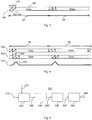
- Fig. 2 provides a graphical presentation of triangular correlation peaks which are obtained by calculating the correlation between two identical pattern sequences which are affected by different levels of chromatic dispersion. It is clear from Fig. 2 that the maximum amplitude of the triangular correlation peaks (representing the correlation output power) gets smaller for higher levels of chromatic dispersion. In other words, the level of chromatic dispersion present in a signal can be estimated by performing a correlation between two identical pattern sequences included in the signal.
- Fig. 3 illustrates a corresponding signal 120 being received by a receiver in accordance with the present invention.
- the signal 120 is divided into frames 90 each comprising a training portion 100 and a data portion 110.
- the training portion 100 includes two identical pattern sequences 105, each with L samples.
- the pattern sequences 105 could also be used for frame synchronization and frequency offset estimation, among other tasks.
- ISI intersymbol interference
- Fig. 4 illustrates a scheme for calculating the correlation between the two identical pattern sequences shown in Fig. 3 .
- a correlation value is determined for each frame 90 by calculating the correlation between a first pattern sequence of a delayed version of the signal 130 and a second pattern sequence of a non-delayed version of the same signal 120.
- the delayed version of the signal 130 has been delayed by L samples with respect to the non-delayed version of the same signal 120, corresponding to the length of one of the pattern sequences. Consequently, the overlapping samples 140 in the training portion 100 shown in Fig. 4 represent the above two identical pattern sequences included in each of the frames 90.
- correlation values 150 are obtained by calculating the correlation between the first pattern sequence of a delayed version of the signal 130 and the second pattern sequence of a non-delayed version of the same signal 120.
- the correlation is performed using a receding time-horizon, wherein the corresponding samples of the delayed and non-delayed signals 120, 130 are multiplied and added to perform a moving average in a receding time-horizon.
- the receding time-horizon and thus the moving average has the length of L samples. Since data is essentially a random signal, correlated samples do not add-up constructively in the moving average, but average out instead during the data portions 110. However, this is not the case for the training portion 100.
- the correlator outputs L samples in the overlapping portion 140 which show that the respective multiplied samples of the delayed and non-delayed signals add-up constructively. It follows that a triangular peak 160 with length 2L is obtained at the output of the moving average. As discussed above with reference to Fig. 2 , the magnitude of the triangular peak 160 represents the correlation output power and thus serves as an indicator for the level of chromatic dispersion included in the signal 120.
- Fig. 5 illustrates how this correlation scheme can be used in a receiver 200 according to an embodiment of the present invention. More specifically, Fig. 5 is a schematic illustration of a receiver 200 comprising an input port 210, equalizer 220, correlation unit 230, averaging unit 240 and a selection unit 250. As discussed above, the signal received at the input port 210 is divided into frames 90, each comprising a training portion 100 and a data portion 110. In this example, the training portion 100 comprises two identical pattern sequences. Then, different settings 270 are applied to the equalizer 220 to generate a plurality of equalized signals 280.
- the plurality of equalized signals 280 is forwarded in parallel or sequentially to a correlation unit 230, which as described above determines correlation values for each of the equalized signals by calculating correlation values 290 between the first and second pattern sequences of each frame 90.
- the averaging unit 240 receives the correlation values 290 from the correlation unit 230 and provides a final correlation value 300 for each of the equalizer settings 270 by averaging the peaks 160 of correlation values 290 calculated for each of the equalized signals 280.
- the selection unit 250 receives the final correlation values 300 for each of the equalizer settings 270 and selects the setting 260 of the equalizer 220 corresponding to the equalized signal 280 providing the highest final correlation value 300.
- the selected equalizer setting 270 minimizes the chromatic dispersion of the signal 280 output by the equalizer 220 and thus provides a chromatic dispersion estimation in the receiver.
- the chromatic dispersion estimate can be performed in accordance with the present invention by observing the maximum power of the triangular peak 160 for a given set of CD test values representing different equalizer settings 270 and choosing the value corresponding to the maximum peak amplitude.
- the amplitude of the triangular peak 160 illustrated in Fig. 2 does not only depend on the chromatic dispersion, but also on other parameters, such as the power of the input signal, optical signal-to-noise ratio (OSNR), phase noise, PMD. Nevertheless, although an undistorted, noiseless signal leads to maximized peak power, these additional affects can be shown to be constant or to have a negligible effect. For example:
- the chromatic dispersion estimation according to the present invention allows to trade-off estimation range for estimation accuracy. In other words, a larger estimation range is obtained for a longer correlation length, whereas better accuracy is obtained for a shorter correlation length. It follows that the accuracy of the chromatic dispersion estimation algorithm depends on the correlation length. A shorter correlation length leads to a higher sensitivity with respect to the chromatic dispersion. However, a shorter correlation length also results in reduced robustness to noise. With this in mind, the training portion or preamble should allow a short correlation length, have a sufficient number of symbols suitable for correlation for a matter of noise robustness, and still consist of two identical segments as required by e.g. the frame detector.
- All these specifications can be accomplished by subdividing the training portion into a higher number of identical pattern sequences.
- the training portion can be subdivided into eight identical pattern sequences, wherein each of the identical pattern sequences may comprise e.g. 64 symbols. In this way, the correlation length can be adjusted as required.
- Fig. 6 illustrates the respective triangular correlation peaks as a function of different correlation lengths. It is clear from the figure that the correlation of length 4 has the highest sensitivity with respect to identifying the correct chromatic dispersion value. However, as mentioned above, a shorter correlation length also results in reduced robustness to noise.
- the chromatic dispersion estimation according to the present invention can be provided with negligible implementation complexity, as the estimation can be based on sharing resources with other units of the receiver, such as for example frame detector modules already used in a DSP architecture.
- modules for performing correlations may be available in e.g. frame detection and data-aided frequency offset estimation units, and may thus be efficiently reused for implementing the above chromatic dispersion estimation scheme.
Landscapes
- Physics & Mathematics (AREA)
- Electromagnetism (AREA)
- Engineering & Computer Science (AREA)
- Computer Networks & Wireless Communication (AREA)
- Signal Processing (AREA)
- Spectroscopy & Molecular Physics (AREA)
- Optical Communication System (AREA)
Claims (15)
- Verfahren zum Durchführen einer Schätzung der chromatischen Dispersion in einem Empfänger (200) eines optischen Kommunikationssystems, das die folgendenSchritte umfasst:- Empfangen eines Signals (120), welches in Rahmen (90) unterteilt ist, wobei ein jeder Rahmen (90) einen Trainingsabschnitt (100) und einen Datenabschnitt (110) umfasst, und wobei der Trainingsabschnitt (100) mindestens zwei identische Mustersequenzen umfasst.- Entzerren ("equalizing") des empfangenen Signals (120), um eine Mehrzahl von entzerrten ("equalized") Signalen (40, 280) zu erzeugen, die jeweils einer unterschiedlichen Einstellung (270) eines Equalizers (30) entsprechen, wobei ein jedes der entzerrten ("equalized") Signale (40, 280) mindestens einen Rahmen (90) umfasst,- Ermitteln einer Mehrzahl von Korrelationswerten (290), wobei mindestens ein Korrelationswert (270) für einen jeden Rahmen (90), der in dem entzerrten Signal (40, 280) enthalten ist, berechnet wird, und wobei eine jede Korrelation zwischen einer ersten Mustersequenz und einer zweiten Mustersequenz des entsprechenden Rahmens (90) berechnet wird,- Ermitteln eines finalen Korrelationswertes (300) für ein jedes der entzerrten ("equalized") Signale (40, 280), indem die Mehrzahl der Korrelationswerte (290), die für ein jedes der entzerrten ("equalized") Signale (40, 280) bestimmt wurden, gemittelt werden, und- Auswählen der Einstellung des Equalizers (270), die dem entzerrten ("equalized") Signal (40, 280) entspricht, die den höchsten finalen Korrelationswert (300) liefert.
- Verfahren nach Anspruch 1, wobei das Ermitteln des mindestens einen Korrelationswertes (290) für ein jedes der entzerrten Signale (40, 280) Folgendes umfasst:- Erzeugen einer verzögerten Version (130) eines jeden der entzerrten Signale (40, 280), indem ein jedes entzerrtes Signal (40, 280) durch ein Zeit-Offset verzögert wird,- Ermitteln mindestens eines Korrelationswertes (290) für einen jeden Rahmen (90) der verzögerten und nicht verzögerten Versionen eines jeden entzerrten Signals (120, 130), indem die Korrelation zwischen einer ersten Mustersequenz des verzögerten entzerrten Signals (130) und eine zweite Mustersequenz des nichtverzögerten verzerrten Signals (120) berechnet wird.
- Verfahren nach Anspruch 2, wobei das Ermitteln des mindestens einen Korrelationswerts (290) für ein jedes der entzerrten Signale (40, 280) es umfasst, Sample des nichtverzögerten entzerrten Signals (120) mit Samplen des verzögerten entzerrten Signals (130) zu multiplizieren und einen gleitenden Durchschnitt ("moving average") der multiplizierten Sample zu berechnen.
- Verfahren nach Anspruch 3, wobei das Berechnen des gleitenden Durchschnitts eine Sequenz von Leistungswerten liefert, und wobei ein Korrelationswert (290) als der Spitzen-Leistungswert (160) eines Abschnitts der Sequenz von Leistungswerten ermittelt wird.
- Verfahren nach einem der Ansprüche 2 bis 4, wobei der Zeit-Offset, der verwendet wird, um das entzerrte Signal (40, 280) zu verzögern, einer mehrfachen Länge der Mustersequenz im dem Trainingsabschnitt (100) eines Rahmens (90) entspricht.
- Verfahren nach einem der vorhergehenden Ansprüche, wobei die Mustersequenzen, die in dem Trainingsabschnitt (100) eines Rahmen (90) enthalten sind, Trainingssequenzen repräsentieren, die für eine Kanalabschätzung ("channel estimation") und/oder für die Detektion eines Rahmens und/oder für eine Frequenz-Offset-Schätzung verwendet werden.
- Verfahren nach einem der vorhergehenden Ansprüche, wobei der Equalizer (30) ein Frequenz-Domänen-Equalizer, insbesondere ein Chromatische-Dispersion-Equalizer ist.
- Verfahren nach einem der vorhergehenden Ansprüche, wobei die Rahmen (90) des empfangenen Signals (120) einen Trainingsabschnitt (100) und/oder einen Datenabschnitt (110) umfassen, der Symbole mit unterschiedlichen Amplituden und Phasen enthält, insbesondere QAM-modulierte Symbole; oder wobei das empfangene Signal (120) ein Polarisations-Multiplex (polarization-division multiplexed, PDM)-Signal repräsentiert.
- Verfahren nach einem der vorhergehenden Ansprüche, ferner umfassend einen Schritt, in dem die Korrelationswerte (290) durch eine Rahmen-Detektionseinheit berechnet werden.
- Verfahren nach einem der Ansprüche 1 bis 8, das ferner einen Schritt umfasst, in dem die Korrelationswerte (290) durch eine Frequenz-Offset-Abschätzungseinheit berechnet werden.
- Verfahren nach einem der vorhergehenden Ansprüche, wobei das empfangene Signal (120) einen Rahmen (90) umfasst, der einen Trainingsabschnitt (100) und einen Datenabschnitt (110) enthält, die so angeordnet sind, dass der Trainingsabschnitt (100) nicht zusammenhängende Abschnitte umfasst, die durch Teile des Datenabschnitts (110) getrennt sind.
- Empfänger (200) für ein optisches Kommunikationssystem, der Folgendes umfasst:- einen Eingangsport (210), der geeignet ist, ein Signal (20) zu empfangen, welches in Rahmen (90) unterteilt ist, wobei ein jeder Rahmen (90) einen Trainingsabschnitt (100) und einen Datenabschnitt (110) umfasst, und wobei der Trainingsabschnitt (100) mindestens zwei identische Mustersequenzen umfasst,- einen Equalizer (220), der geeignet ist, das empfangene Signal (20) zu entzerren ("equalize"), um eine Mehrzahl von entzerrten ("equalized") Signalen (280) zu erzeugen, die jeweils einer unterschiedlichen Einstellung (270) des Equalizers (220) entsprechen,- eine Korrelationseinheit (230), die geeignet ist, Korrelationswerte (290) für ein jedes der entzerrten ("equalized") Signale (280) zu bestimmen, indem ein jeder Korrelationswert (290) zwischen einer ersten Mustersequenz und einer zweiten Mustersequenz eines jeden Rahmens (90) berechnet wird, der in dem entzerrten ("euqalized") Signals (280) enthalten ist,- eine Mittelungseinheit (240), die dazu geeignet ist, einen finalen Korrelationswert (300) bereitzustellen, indem die Korrelationswerte (290), die für ein jedes der entzerrten ("equalized") Signale (280) berechnet wurden, gemittelt werden, und- eine Auswahleinheit (250), die geeignet ist, die Einstellung (270) des Equalizers (220) auszuwählen, die dem entzerrten ("equalized") Signal (280) entspricht, das den höchsten finalen Korrelationswert (300) liefert.
- Empfänger (200) nach Anspruch 11, der ferner eine Rahmen-Detektionseinheit umfasst, die dazu konfiguriert ist, das entzerrte Signal (280), welches von dem Equalizer (220) bereitgestellt wird, zu empfangen, wobei die Rahmen-Detektionseinheit vorzugsweise dazu geeignet ist, den Trainingsabschnitt (100) zu detektieren, die Korrelation zwischen dem Trainingsabschnitt (100) und einer verzögerten Version des Trainingsabschnitts (100) zu berechnen, um Leistungswerte zu bestimmen, und wobei die Rahmen-Detektionseinheit ferner geeignet ist, den Korrelationswert (290) zu bestimmen, der dem Spitzen-Leistungswert der bestimmten Leistungswerte (160) entspricht, und den ermittelten Korrelationswert an die Auswahleinheit (250) auszugeben.
- Empfänger (200) nach Anspruch 12, der ferner Berechnungsschaltkreise umfasst, die zwischen der Korrelationseinheit (230) und einer Rahmen-Detektionseinheit oder einer Frequenz-Offset-Abschätzungseinheit geteilt werden.
- Empfänger (100) nach einem der Ansprüche 12 bis 14, wobei der Equalizer (220) dazu geeignet ist, eine chromatische Dispersion (CD) in einem empfangenen Polarisations-Multiplex (polarization-division multiplexed, PDM)-Signal zu kompensieren.
Applications Claiming Priority (2)
| Application Number | Priority Date | Filing Date | Title |
|---|---|---|---|
| EP14184617.0A EP2996264A1 (de) | 2014-09-12 | 2014-09-12 | Datenunterstützte chromatische Dispersionsschätzung |
| PCT/EP2015/065666 WO2016037729A1 (en) | 2014-09-12 | 2015-07-09 | Data-aided chromatic dispersion estimation |
Publications (2)
| Publication Number | Publication Date |
|---|---|
| EP3192188A1 EP3192188A1 (de) | 2017-07-19 |
| EP3192188B1 true EP3192188B1 (de) | 2019-10-09 |
Family
ID=51609904
Family Applications (2)
| Application Number | Title | Priority Date | Filing Date |
|---|---|---|---|
| EP14184617.0A Withdrawn EP2996264A1 (de) | 2014-09-12 | 2014-09-12 | Datenunterstützte chromatische Dispersionsschätzung |
| EP15736464.7A Active EP3192188B1 (de) | 2014-09-12 | 2015-07-09 | Datenunterstützte chromatische dispersionsschätzung |
Family Applications Before (1)
| Application Number | Title | Priority Date | Filing Date |
|---|---|---|---|
| EP14184617.0A Withdrawn EP2996264A1 (de) | 2014-09-12 | 2014-09-12 | Datenunterstützte chromatische Dispersionsschätzung |
Country Status (4)
| Country | Link |
|---|---|
| US (1) | US10181904B2 (de) |
| EP (2) | EP2996264A1 (de) |
| CN (1) | CN106688199B (de) |
| WO (1) | WO2016037729A1 (de) |
Families Citing this family (10)
| Publication number | Priority date | Publication date | Assignee | Title |
|---|---|---|---|---|
| EP3121976A1 (de) * | 2015-07-23 | 2017-01-25 | Xieon Networks S.à r.l. | Signalverarbeitung in einem optischen empfänger |
| EP3367579B1 (de) | 2017-02-24 | 2023-06-07 | NEOSAT GmbH | Orthogonale korrelationssignale für die erkennung und synchronisation bei niedrigem signal-zu-rausch-verhältnis |
| EP3952152A1 (de) * | 2017-03-24 | 2022-02-09 | Cable Television Laboratories, Inc. | System und verfahren für kohärente pon-architektur und burst-modus-empfang |
| CN111713083B (zh) * | 2018-02-13 | 2022-02-25 | 日立能源瑞士股份公司 | 用于电网控制的无线通信网络中的频率估计 |
| CN109039472B (zh) * | 2018-07-11 | 2021-05-07 | 南通智大信息技术有限公司 | 一种基于深度学习的数据中心光通信色散估计与管理方法 |
| WO2020052740A1 (en) | 2018-09-11 | 2020-03-19 | Huawei Technologies Co., Ltd. | Equalizing device for compensating rapid state of polarization changes of an optical signal |
| CN113676254B (zh) * | 2020-05-15 | 2022-06-28 | 华为技术有限公司 | 色散估计方法及装置 |
| CN114079486B (zh) * | 2020-08-21 | 2024-11-12 | 中兴通讯股份有限公司 | 空分复用光纤的特征参数监测方法、装置、设备和存储介质 |
| EP4047893A1 (de) * | 2021-02-23 | 2022-08-24 | Nokia Solutions and Networks Oy | Entzerrer und entzerrertrainingseinheit zur datenabhängigen verzerrungskompensation |
| WO2023004567A1 (en) * | 2021-07-27 | 2023-02-02 | Huawei Technologies Co., Ltd. | Device and methods for real-time polarization-dependent loss monitoring at coherent transceivers |
Family Cites Families (10)
| Publication number | Priority date | Publication date | Assignee | Title |
|---|---|---|---|---|
| US6798500B2 (en) | 2002-03-05 | 2004-09-28 | Jds Uniphase Corporation | Method for estimation of chromatic dispersion in multichannel optical network spans and chromatic dispersion monitor therefore |
| CN101753217B (zh) * | 2008-11-28 | 2012-11-21 | 富士通株式会社 | 色散监控装置和方法、色散补偿装置 |
| US8971702B2 (en) | 2010-01-05 | 2015-03-03 | Nec Corporation | Method and apparatus for detecting chromatic dispersion, and method and apparatus for compensating chromatic dispersion |
| US8705986B2 (en) | 2010-11-23 | 2014-04-22 | Infinera Corporation | PMD-insensitive method of chromatic dispersion estimation for a coherent receiver |
| CN102511136B (zh) | 2011-02-17 | 2015-04-15 | 华为技术有限公司 | 色散评估器和评估色散的方法 |
| US8750726B2 (en) | 2011-08-16 | 2014-06-10 | Cisco Technology, Inc. | Histogram-based chromatic dispersion estimation |
| CN103430003B (zh) * | 2012-02-01 | 2016-03-30 | 华为技术有限公司 | 用于估计接收到的光信号的色散的方法 |
| EP2639977B1 (de) * | 2012-03-16 | 2017-11-29 | Alcatel Lucent | Hochgeschwindigkeits-Algorithmen für optische Kommunikationssysteme mit 400G |
| CN103684601B (zh) * | 2012-09-14 | 2016-04-20 | 富士通株式会社 | 系数确定装置、均衡器、接收机和发射机 |
| CN103763037B (zh) * | 2013-12-17 | 2017-02-22 | 记忆科技(深圳)有限公司 | 一种动态补偿接收器及动态补偿接收方法 |
-
2014
- 2014-09-12 EP EP14184617.0A patent/EP2996264A1/de not_active Withdrawn
-
2015
- 2015-07-09 WO PCT/EP2015/065666 patent/WO2016037729A1/en not_active Ceased
- 2015-07-09 EP EP15736464.7A patent/EP3192188B1/de active Active
- 2015-07-09 CN CN201580049085.5A patent/CN106688199B/zh active Active
- 2015-07-09 US US15/507,120 patent/US10181904B2/en active Active
Non-Patent Citations (1)
| Title |
|---|
| None * |
Also Published As
| Publication number | Publication date |
|---|---|
| US20170279531A1 (en) | 2017-09-28 |
| EP2996264A1 (de) | 2016-03-16 |
| WO2016037729A1 (en) | 2016-03-17 |
| CN106688199A (zh) | 2017-05-17 |
| EP3192188A1 (de) | 2017-07-19 |
| US10181904B2 (en) | 2019-01-15 |
| CN106688199B (zh) | 2019-10-11 |
Similar Documents
| Publication | Publication Date | Title |
|---|---|---|
| EP3192188B1 (de) | Datenunterstützte chromatische dispersionsschätzung | |
| EP3432488B1 (de) | Vorrichtung zur kompensation einer übertragungseigenschaft, verfahren zur kompensation einer übertragungseigenschaft und kommunikationsvorrichtung | |
| JP5159953B2 (ja) | 波長分散量算出装置、光信号受信装置、光信号送信装置及び波長分散量算出方法 | |
| CN102656824B (zh) | 用于相干光系统中非线性损害监视和减轻的载波相位估计器 | |
| US10594406B2 (en) | Pilot-aided digital signal processing for reception of coherent optical communication | |
| EP2613452B1 (de) | Digitale filtervorrichtung, digitales filterverfahren und steuerprogramm für die digitale filtervorrichtung | |
| US20150078762A1 (en) | Signal generating circuit, optical signal transmitting apparatus, signal receiving circuit, method for establishing optical signal synchronization, and optical signal synchronization system | |
| EP2084875B1 (de) | Zellen-ID-Detektion in einem OFDM-Kommunikationssystem | |
| EP3176964A1 (de) | Kohärentes kommunikationssystem, kommunikationsverfahren und übertragungsverfahren | |
| US20100119241A1 (en) | Adaptive frequency domain equalization without cyclic prefixes | |
| US9584250B2 (en) | Symbol timing estimation for coherent polarization multiplex optical receivers | |
| CN102461035A (zh) | 用于对偏振分集复用信号进行盲解复用的方法和装置 | |
| WO2012119402A1 (en) | Method for phase and oscillator frequency estimation | |
| EP3326306A1 (de) | Signalverarbeitung in einem optischen empfänger | |
| EP2639977B1 (de) | Hochgeschwindigkeits-Algorithmen für optische Kommunikationssysteme mit 400G | |
| US9819419B2 (en) | Maximum likelihood sequence estimation of Quadrature Amplitude Modulated signals | |
| EP4169180A1 (de) | Verfahren und vorrichtung zur frequenzbereichsentzerrung mit niedriger komplexität und schleifenverzögerung | |
| Do et al. | Chromatic dispersion estimation based on complementary Golay sequences for 80 Gb/s QPSK single-carrier system with frequency domain equalization | |
| EP2362557B1 (de) | MLSE bei kohärentem optischen Empfänger für optische Filtertoleranz | |
| Stojanović et al. | Chromatic dispersion estimation method for Nyquist and faster than Nyquist coherent optical systems | |
| EP3158677A1 (de) | Vorrichtung zum synchronisieren eines abtastsignals auf einem kommunikationssignal | |
| KR20100036681A (ko) | 왜곡 파일럿 복구를 통해 채널을 추정하는 채널 추정기, 그채널 추정기를 포함한 ofdm 수신장치, 및 왜곡 파일럿보상을 통한 채널추정방법 |
Legal Events
| Date | Code | Title | Description |
|---|---|---|---|
| STAA | Information on the status of an ep patent application or granted ep patent |
Free format text: STATUS: THE INTERNATIONAL PUBLICATION HAS BEEN MADE |
|
| PUAI | Public reference made under article 153(3) epc to a published international application that has entered the european phase |
Free format text: ORIGINAL CODE: 0009012 |
|
| STAA | Information on the status of an ep patent application or granted ep patent |
Free format text: STATUS: REQUEST FOR EXAMINATION WAS MADE |
|
| 17P | Request for examination filed |
Effective date: 20170309 |
|
| AK | Designated contracting states |
Kind code of ref document: A1 Designated state(s): AL AT BE BG CH CY CZ DE DK EE ES FI FR GB GR HR HU IE IS IT LI LT LU LV MC MK MT NL NO PL PT RO RS SE SI SK SM TR |
|
| AX | Request for extension of the european patent |
Extension state: BA ME |
|
| DAV | Request for validation of the european patent (deleted) | ||
| DAX | Request for extension of the european patent (deleted) | ||
| GRAP | Despatch of communication of intention to grant a patent |
Free format text: ORIGINAL CODE: EPIDOSNIGR1 |
|
| STAA | Information on the status of an ep patent application or granted ep patent |
Free format text: STATUS: GRANT OF PATENT IS INTENDED |
|
| INTG | Intention to grant announced |
Effective date: 20190212 |
|
| RIN1 | Information on inventor provided before grant (corrected) |
Inventor name: CALABRO, STEFANO Inventor name: DRUMMOND, MIGUEL Inventor name: SPINNLER, BERNHARD |
|
| GRAJ | Information related to disapproval of communication of intention to grant by the applicant or resumption of examination proceedings by the epo deleted |
Free format text: ORIGINAL CODE: EPIDOSDIGR1 |
|
| STAA | Information on the status of an ep patent application or granted ep patent |
Free format text: STATUS: REQUEST FOR EXAMINATION WAS MADE |
|
| INTC | Intention to grant announced (deleted) | ||
| RAP1 | Party data changed (applicant data changed or rights of an application transferred) |
Owner name: XIEON NETWORKS S.A R.L. |
|
| GRAR | Information related to intention to grant a patent recorded |
Free format text: ORIGINAL CODE: EPIDOSNIGR71 |
|
| GRAS | Grant fee paid |
Free format text: ORIGINAL CODE: EPIDOSNIGR3 |
|
| STAA | Information on the status of an ep patent application or granted ep patent |
Free format text: STATUS: GRANT OF PATENT IS INTENDED |
|
| GRAA | (expected) grant |
Free format text: ORIGINAL CODE: 0009210 |
|
| STAA | Information on the status of an ep patent application or granted ep patent |
Free format text: STATUS: THE PATENT HAS BEEN GRANTED |
|
| AK | Designated contracting states |
Kind code of ref document: B1 Designated state(s): AL AT BE BG CH CY CZ DE DK EE ES FI FR GB GR HR HU IE IS IT LI LT LU LV MC MK MT NL NO PL PT RO RS SE SI SK SM TR |
|
| INTG | Intention to grant announced |
Effective date: 20190830 |
|
| REG | Reference to a national code |
Ref country code: GB Ref legal event code: FG4D |
|
| REG | Reference to a national code |
Ref country code: CH Ref legal event code: EP |
|
| REG | Reference to a national code |
Ref country code: IE Ref legal event code: FG4D |
|
| REG | Reference to a national code |
Ref country code: DE Ref legal event code: R096 Ref document number: 602015039460 Country of ref document: DE |
|
| REG | Reference to a national code |
Ref country code: AT Ref legal event code: REF Ref document number: 1190041 Country of ref document: AT Kind code of ref document: T Effective date: 20191115 |
|
| REG | Reference to a national code |
Ref country code: NL Ref legal event code: MP Effective date: 20191009 |
|
| REG | Reference to a national code |
Ref country code: LT Ref legal event code: MG4D |
|
| REG | Reference to a national code |
Ref country code: AT Ref legal event code: MK05 Ref document number: 1190041 Country of ref document: AT Kind code of ref document: T Effective date: 20191009 |
|
| PG25 | Lapsed in a contracting state [announced via postgrant information from national office to epo] |
Ref country code: PL Free format text: LAPSE BECAUSE OF FAILURE TO SUBMIT A TRANSLATION OF THE DESCRIPTION OR TO PAY THE FEE WITHIN THE PRESCRIBED TIME-LIMIT Effective date: 20191009 Ref country code: SE Free format text: LAPSE BECAUSE OF FAILURE TO SUBMIT A TRANSLATION OF THE DESCRIPTION OR TO PAY THE FEE WITHIN THE PRESCRIBED TIME-LIMIT Effective date: 20191009 Ref country code: NO Free format text: LAPSE BECAUSE OF FAILURE TO SUBMIT A TRANSLATION OF THE DESCRIPTION OR TO PAY THE FEE WITHIN THE PRESCRIBED TIME-LIMIT Effective date: 20200109 Ref country code: LV Free format text: LAPSE BECAUSE OF FAILURE TO SUBMIT A TRANSLATION OF THE DESCRIPTION OR TO PAY THE FEE WITHIN THE PRESCRIBED TIME-LIMIT Effective date: 20191009 Ref country code: AT Free format text: LAPSE BECAUSE OF FAILURE TO SUBMIT A TRANSLATION OF THE DESCRIPTION OR TO PAY THE FEE WITHIN THE PRESCRIBED TIME-LIMIT Effective date: 20191009 Ref country code: PT Free format text: LAPSE BECAUSE OF FAILURE TO SUBMIT A TRANSLATION OF THE DESCRIPTION OR TO PAY THE FEE WITHIN THE PRESCRIBED TIME-LIMIT Effective date: 20200210 Ref country code: ES Free format text: LAPSE BECAUSE OF FAILURE TO SUBMIT A TRANSLATION OF THE DESCRIPTION OR TO PAY THE FEE WITHIN THE PRESCRIBED TIME-LIMIT Effective date: 20191009 Ref country code: NL Free format text: LAPSE BECAUSE OF FAILURE TO SUBMIT A TRANSLATION OF THE DESCRIPTION OR TO PAY THE FEE WITHIN THE PRESCRIBED TIME-LIMIT Effective date: 20191009 Ref country code: LT Free format text: LAPSE BECAUSE OF FAILURE TO SUBMIT A TRANSLATION OF THE DESCRIPTION OR TO PAY THE FEE WITHIN THE PRESCRIBED TIME-LIMIT Effective date: 20191009 Ref country code: GR Free format text: LAPSE BECAUSE OF FAILURE TO SUBMIT A TRANSLATION OF THE DESCRIPTION OR TO PAY THE FEE WITHIN THE PRESCRIBED TIME-LIMIT Effective date: 20200110 Ref country code: FI Free format text: LAPSE BECAUSE OF FAILURE TO SUBMIT A TRANSLATION OF THE DESCRIPTION OR TO PAY THE FEE WITHIN THE PRESCRIBED TIME-LIMIT Effective date: 20191009 Ref country code: BG Free format text: LAPSE BECAUSE OF FAILURE TO SUBMIT A TRANSLATION OF THE DESCRIPTION OR TO PAY THE FEE WITHIN THE PRESCRIBED TIME-LIMIT Effective date: 20200109 |
|
| PG25 | Lapsed in a contracting state [announced via postgrant information from national office to epo] |
Ref country code: RS Free format text: LAPSE BECAUSE OF FAILURE TO SUBMIT A TRANSLATION OF THE DESCRIPTION OR TO PAY THE FEE WITHIN THE PRESCRIBED TIME-LIMIT Effective date: 20191009 Ref country code: IS Free format text: LAPSE BECAUSE OF FAILURE TO SUBMIT A TRANSLATION OF THE DESCRIPTION OR TO PAY THE FEE WITHIN THE PRESCRIBED TIME-LIMIT Effective date: 20200224 Ref country code: HR Free format text: LAPSE BECAUSE OF FAILURE TO SUBMIT A TRANSLATION OF THE DESCRIPTION OR TO PAY THE FEE WITHIN THE PRESCRIBED TIME-LIMIT Effective date: 20191009 |
|
| PG25 | Lapsed in a contracting state [announced via postgrant information from national office to epo] |
Ref country code: AL Free format text: LAPSE BECAUSE OF FAILURE TO SUBMIT A TRANSLATION OF THE DESCRIPTION OR TO PAY THE FEE WITHIN THE PRESCRIBED TIME-LIMIT Effective date: 20191009 |
|
| REG | Reference to a national code |
Ref country code: DE Ref legal event code: R097 Ref document number: 602015039460 Country of ref document: DE |
|
| PG2D | Information on lapse in contracting state deleted |
Ref country code: IS |
|
| PG25 | Lapsed in a contracting state [announced via postgrant information from national office to epo] |
Ref country code: EE Free format text: LAPSE BECAUSE OF FAILURE TO SUBMIT A TRANSLATION OF THE DESCRIPTION OR TO PAY THE FEE WITHIN THE PRESCRIBED TIME-LIMIT Effective date: 20191009 Ref country code: DK Free format text: LAPSE BECAUSE OF FAILURE TO SUBMIT A TRANSLATION OF THE DESCRIPTION OR TO PAY THE FEE WITHIN THE PRESCRIBED TIME-LIMIT Effective date: 20191009 Ref country code: CZ Free format text: LAPSE BECAUSE OF FAILURE TO SUBMIT A TRANSLATION OF THE DESCRIPTION OR TO PAY THE FEE WITHIN THE PRESCRIBED TIME-LIMIT Effective date: 20191009 Ref country code: RO Free format text: LAPSE BECAUSE OF FAILURE TO SUBMIT A TRANSLATION OF THE DESCRIPTION OR TO PAY THE FEE WITHIN THE PRESCRIBED TIME-LIMIT Effective date: 20191009 Ref country code: IS Free format text: LAPSE BECAUSE OF FAILURE TO SUBMIT A TRANSLATION OF THE DESCRIPTION OR TO PAY THE FEE WITHIN THE PRESCRIBED TIME-LIMIT Effective date: 20200209 |
|
| PLBE | No opposition filed within time limit |
Free format text: ORIGINAL CODE: 0009261 |
|
| STAA | Information on the status of an ep patent application or granted ep patent |
Free format text: STATUS: NO OPPOSITION FILED WITHIN TIME LIMIT |
|
| PG25 | Lapsed in a contracting state [announced via postgrant information from national office to epo] |
Ref country code: IT Free format text: LAPSE BECAUSE OF FAILURE TO SUBMIT A TRANSLATION OF THE DESCRIPTION OR TO PAY THE FEE WITHIN THE PRESCRIBED TIME-LIMIT Effective date: 20191009 Ref country code: SK Free format text: LAPSE BECAUSE OF FAILURE TO SUBMIT A TRANSLATION OF THE DESCRIPTION OR TO PAY THE FEE WITHIN THE PRESCRIBED TIME-LIMIT Effective date: 20191009 Ref country code: SM Free format text: LAPSE BECAUSE OF FAILURE TO SUBMIT A TRANSLATION OF THE DESCRIPTION OR TO PAY THE FEE WITHIN THE PRESCRIBED TIME-LIMIT Effective date: 20191009 |
|
| 26N | No opposition filed |
Effective date: 20200710 |
|
| PGFP | Annual fee paid to national office [announced via postgrant information from national office to epo] |
Ref country code: FR Payment date: 20200723 Year of fee payment: 6 Ref country code: GB Payment date: 20200727 Year of fee payment: 6 |
|
| PG25 | Lapsed in a contracting state [announced via postgrant information from national office to epo] |
Ref country code: SI Free format text: LAPSE BECAUSE OF FAILURE TO SUBMIT A TRANSLATION OF THE DESCRIPTION OR TO PAY THE FEE WITHIN THE PRESCRIBED TIME-LIMIT Effective date: 20191009 |
|
| PG25 | Lapsed in a contracting state [announced via postgrant information from national office to epo] |
Ref country code: MC Free format text: LAPSE BECAUSE OF FAILURE TO SUBMIT A TRANSLATION OF THE DESCRIPTION OR TO PAY THE FEE WITHIN THE PRESCRIBED TIME-LIMIT Effective date: 20191009 |
|
| REG | Reference to a national code |
Ref country code: CH Ref legal event code: PL |
|
| REG | Reference to a national code |
Ref country code: BE Ref legal event code: MM Effective date: 20200731 |
|
| PG25 | Lapsed in a contracting state [announced via postgrant information from national office to epo] |
Ref country code: LI Free format text: LAPSE BECAUSE OF NON-PAYMENT OF DUE FEES Effective date: 20200731 Ref country code: LU Free format text: LAPSE BECAUSE OF NON-PAYMENT OF DUE FEES Effective date: 20200709 Ref country code: CH Free format text: LAPSE BECAUSE OF NON-PAYMENT OF DUE FEES Effective date: 20200731 |
|
| PG25 | Lapsed in a contracting state [announced via postgrant information from national office to epo] |
Ref country code: BE Free format text: LAPSE BECAUSE OF NON-PAYMENT OF DUE FEES Effective date: 20200731 |
|
| PG25 | Lapsed in a contracting state [announced via postgrant information from national office to epo] |
Ref country code: IE Free format text: LAPSE BECAUSE OF NON-PAYMENT OF DUE FEES Effective date: 20200709 |
|
| GBPC | Gb: european patent ceased through non-payment of renewal fee |
Effective date: 20210709 |
|
| PG25 | Lapsed in a contracting state [announced via postgrant information from national office to epo] |
Ref country code: GB Free format text: LAPSE BECAUSE OF NON-PAYMENT OF DUE FEES Effective date: 20210709 |
|
| PG25 | Lapsed in a contracting state [announced via postgrant information from national office to epo] |
Ref country code: TR Free format text: LAPSE BECAUSE OF FAILURE TO SUBMIT A TRANSLATION OF THE DESCRIPTION OR TO PAY THE FEE WITHIN THE PRESCRIBED TIME-LIMIT Effective date: 20191009 Ref country code: MT Free format text: LAPSE BECAUSE OF FAILURE TO SUBMIT A TRANSLATION OF THE DESCRIPTION OR TO PAY THE FEE WITHIN THE PRESCRIBED TIME-LIMIT Effective date: 20191009 Ref country code: FR Free format text: LAPSE BECAUSE OF NON-PAYMENT OF DUE FEES Effective date: 20210731 Ref country code: CY Free format text: LAPSE BECAUSE OF FAILURE TO SUBMIT A TRANSLATION OF THE DESCRIPTION OR TO PAY THE FEE WITHIN THE PRESCRIBED TIME-LIMIT Effective date: 20191009 |
|
| PG25 | Lapsed in a contracting state [announced via postgrant information from national office to epo] |
Ref country code: MK Free format text: LAPSE BECAUSE OF FAILURE TO SUBMIT A TRANSLATION OF THE DESCRIPTION OR TO PAY THE FEE WITHIN THE PRESCRIBED TIME-LIMIT Effective date: 20191009 |
|
| PGFP | Annual fee paid to national office [announced via postgrant information from national office to epo] |
Ref country code: DE Payment date: 20250722 Year of fee payment: 11 |