EP3179214B1 - Induktive positionsmesseinrichtung - Google Patents
Induktive positionsmesseinrichtung Download PDFInfo
- Publication number
- EP3179214B1 EP3179214B1 EP16187795.6A EP16187795A EP3179214B1 EP 3179214 B1 EP3179214 B1 EP 3179214B1 EP 16187795 A EP16187795 A EP 16187795A EP 3179214 B1 EP3179214 B1 EP 3179214B1
- Authority
- EP
- European Patent Office
- Prior art keywords
- graduation
- position measurement
- measuring
- measurement device
- scanning
- Prior art date
- Legal status (The legal status is an assumption and is not a legal conclusion. Google has not performed a legal analysis and makes no representation as to the accuracy of the status listed.)
- Active
Links
Images


Classifications
-
- G—PHYSICS
- G01—MEASURING; TESTING
- G01D—MEASURING NOT SPECIALLY ADAPTED FOR A SPECIFIC VARIABLE; ARRANGEMENTS FOR MEASURING TWO OR MORE VARIABLES NOT COVERED IN A SINGLE OTHER SUBCLASS; TARIFF METERING APPARATUS; MEASURING OR TESTING NOT OTHERWISE PROVIDED FOR
- G01D5/00—Mechanical means for transferring the output of a sensing member; Means for converting the output of a sensing member to another variable where the form or nature of the sensing member does not constrain the means for converting; Transducers not specially adapted for a specific variable
- G01D5/12—Mechanical means for transferring the output of a sensing member; Means for converting the output of a sensing member to another variable where the form or nature of the sensing member does not constrain the means for converting; Transducers not specially adapted for a specific variable using electric or magnetic means
- G01D5/14—Mechanical means for transferring the output of a sensing member; Means for converting the output of a sensing member to another variable where the form or nature of the sensing member does not constrain the means for converting; Transducers not specially adapted for a specific variable using electric or magnetic means influencing the magnitude of a current or voltage
- G01D5/20—Mechanical means for transferring the output of a sensing member; Means for converting the output of a sensing member to another variable where the form or nature of the sensing member does not constrain the means for converting; Transducers not specially adapted for a specific variable using electric or magnetic means influencing the magnitude of a current or voltage by varying inductance, e.g. by a movable armature
- G01D5/2006—Mechanical means for transferring the output of a sensing member; Means for converting the output of a sensing member to another variable where the form or nature of the sensing member does not constrain the means for converting; Transducers not specially adapted for a specific variable using electric or magnetic means influencing the magnitude of a current or voltage by varying inductance, e.g. by a movable armature by influencing the self-induction of one or more coils
- G01D5/2013—Mechanical means for transferring the output of a sensing member; Means for converting the output of a sensing member to another variable where the form or nature of the sensing member does not constrain the means for converting; Transducers not specially adapted for a specific variable using electric or magnetic means influencing the magnitude of a current or voltage by varying inductance, e.g. by a movable armature by influencing the self-induction of one or more coils by a movable ferromagnetic element, e.g. a core
-
- G—PHYSICS
- G01—MEASURING; TESTING
- G01B—MEASURING LENGTH, THICKNESS OR SIMILAR LINEAR DIMENSIONS; MEASURING ANGLES; MEASURING AREAS; MEASURING IRREGULARITIES OF SURFACES OR CONTOURS
- G01B7/00—Measuring arrangements characterised by the use of electric or magnetic techniques
- G01B7/003—Measuring arrangements characterised by the use of electric or magnetic techniques for measuring position, not involving coordinate determination
-
- G—PHYSICS
- G01—MEASURING; TESTING
- G01D—MEASURING NOT SPECIALLY ADAPTED FOR A SPECIFIC VARIABLE; ARRANGEMENTS FOR MEASURING TWO OR MORE VARIABLES NOT COVERED IN A SINGLE OTHER SUBCLASS; TARIFF METERING APPARATUS; MEASURING OR TESTING NOT OTHERWISE PROVIDED FOR
- G01D5/00—Mechanical means for transferring the output of a sensing member; Means for converting the output of a sensing member to another variable where the form or nature of the sensing member does not constrain the means for converting; Transducers not specially adapted for a specific variable
- G01D5/12—Mechanical means for transferring the output of a sensing member; Means for converting the output of a sensing member to another variable where the form or nature of the sensing member does not constrain the means for converting; Transducers not specially adapted for a specific variable using electric or magnetic means
- G01D5/14—Mechanical means for transferring the output of a sensing member; Means for converting the output of a sensing member to another variable where the form or nature of the sensing member does not constrain the means for converting; Transducers not specially adapted for a specific variable using electric or magnetic means influencing the magnitude of a current or voltage
- G01D5/20—Mechanical means for transferring the output of a sensing member; Means for converting the output of a sensing member to another variable where the form or nature of the sensing member does not constrain the means for converting; Transducers not specially adapted for a specific variable using electric or magnetic means influencing the magnitude of a current or voltage by varying inductance, e.g. by a movable armature
- G01D5/204—Mechanical means for transferring the output of a sensing member; Means for converting the output of a sensing member to another variable where the form or nature of the sensing member does not constrain the means for converting; Transducers not specially adapted for a specific variable using electric or magnetic means influencing the magnitude of a current or voltage by varying inductance, e.g. by a movable armature by influencing the mutual induction between two or more coils
- G01D5/2053—Mechanical means for transferring the output of a sensing member; Means for converting the output of a sensing member to another variable where the form or nature of the sensing member does not constrain the means for converting; Transducers not specially adapted for a specific variable using electric or magnetic means influencing the magnitude of a current or voltage by varying inductance, e.g. by a movable armature by influencing the mutual induction between two or more coils by a movable non-ferromagnetic conductive element
-
- G—PHYSICS
- G01—MEASURING; TESTING
- G01B—MEASURING LENGTH, THICKNESS OR SIMILAR LINEAR DIMENSIONS; MEASURING ANGLES; MEASURING AREAS; MEASURING IRREGULARITIES OF SURFACES OR CONTOURS
- G01B7/00—Measuring arrangements characterised by the use of electric or magnetic techniques
- G01B7/02—Measuring arrangements characterised by the use of electric or magnetic techniques for measuring length, width or thickness
-
- G—PHYSICS
- G01—MEASURING; TESTING
- G01B—MEASURING LENGTH, THICKNESS OR SIMILAR LINEAR DIMENSIONS; MEASURING ANGLES; MEASURING AREAS; MEASURING IRREGULARITIES OF SURFACES OR CONTOURS
- G01B7/00—Measuring arrangements characterised by the use of electric or magnetic techniques
- G01B7/30—Measuring arrangements characterised by the use of electric or magnetic techniques for measuring angles or tapers; for testing the alignment of axes
-
- G—PHYSICS
- G01—MEASURING; TESTING
- G01D—MEASURING NOT SPECIALLY ADAPTED FOR A SPECIFIC VARIABLE; ARRANGEMENTS FOR MEASURING TWO OR MORE VARIABLES NOT COVERED IN A SINGLE OTHER SUBCLASS; TARIFF METERING APPARATUS; MEASURING OR TESTING NOT OTHERWISE PROVIDED FOR
- G01D5/00—Mechanical means for transferring the output of a sensing member; Means for converting the output of a sensing member to another variable where the form or nature of the sensing member does not constrain the means for converting; Transducers not specially adapted for a specific variable
- G01D5/12—Mechanical means for transferring the output of a sensing member; Means for converting the output of a sensing member to another variable where the form or nature of the sensing member does not constrain the means for converting; Transducers not specially adapted for a specific variable using electric or magnetic means
- G01D5/244—Mechanical means for transferring the output of a sensing member; Means for converting the output of a sensing member to another variable where the form or nature of the sensing member does not constrain the means for converting; Transducers not specially adapted for a specific variable using electric or magnetic means influencing characteristics of pulses or pulse trains; generating pulses or pulse trains
- G01D5/245—Mechanical means for transferring the output of a sensing member; Means for converting the output of a sensing member to another variable where the form or nature of the sensing member does not constrain the means for converting; Transducers not specially adapted for a specific variable using electric or magnetic means influencing characteristics of pulses or pulse trains; generating pulses or pulse trains using a variable number of pulses in a train
- G01D5/2451—Incremental encoders
- G01D5/2452—Incremental encoders incorporating two or more tracks having an (n, n+1, ...) relationship
Definitions
- Inductive position-measuring devices are used to determine the position of two mutually movable components. They are used for example as a rotary encoder for determining the angular position of two relatively rotatable machine parts or as a length measuring system for the direct measurement of longitudinal displacements along an axis.
- Such inductive position measuring devices are used as measuring devices for electric drives for determining the relative movement or the relative position of corresponding machine parts.
- the generated position values are fed to subsequent electronics for controlling the drives via a corresponding interface arrangement.
- incremental position-measuring devices and absolute position-measuring devices.
- absolute position measuring devices are required.
- a generic absolute inductive position measuring device is from the EP 1081454 B1 known.
- the absolute position is obtained by inductive scanning of two measuring graduations with slightly different periodic measuring graduations (vernier principle), which in each case the Effectively influence the strength of the inductive coupling between a field winding and a Abtastwindung position.
- the coil arrangements for scanning the two measuring graduations are arranged in the intermediate space or in the gap between the measuring graduations.
- the EP 2581711 A2 discloses a further absolute inductive position measuring device, in which the absolute position is determined by inductive scanning of two measuring graduations according to the vernier principle.
- the two measuring graduations are arranged on both sides of a carrier, which is displaceable in the gap between two Abtastwindungen.
- a metal level may be incorporated to avoid crosstalk between the two sensors.
- the invention has for its object to provide an inductive position measuring device with a precise absolute position can be determined and has a compact and robust design.
- Soft magnetic material is ferromagnetic materials that can be easily magnetized in a magnetic field.
- the magnetic polarization in the material enhances an external magnetic field around the material permeability.
- the soft magnetic material may be in the form of a solid metal, as a bonded metal powder, in the form of ceramic materials, so-called ferrites, or as a plastic-bonded ferrite powder.
- the soft magnetic material as an intermediate layer has the function of leading out of the first coil arrangement field lines of the alternating magnetic field in the layer of the material of the intermediate layer and thus to form a closed and spatially limited magnetic circuit, and emanating from the second coil array field lines of the alternating magnetic field to conduct in the layer of the material of the intermediate layer and thus to form a closed and spatially limited magnetic circuit.
- the intermediate layer thereby separates the field lines starting from the first coil arrangement from the field lines starting from the second coil arrangement.
- an intermediate layer is a sandwichartigiger structure consisting of a core and a layer of soft magnetic material disposed thereon on both sides, which has a large electrical resistance, eg in the order of 1 x 10 6 ⁇ in alternating fields in the order of 2 MHz, ie is virtually electrically non-conductive.
- a material is FFD material (Flux Field Directional Material) and is commercially available in the form of a film as a "sintered ferrite sheet". Due to the poor electrical conductivity no eddy currents can occur in this material, which dampen the field of excitation of the respective coil arrangement.
- the core preferably also consists of a soft magnetic material.
- the permeability of the material of the core is significantly greater, preferably by a multiple, than the permeability of the layers arranged on both sides.
- the core absorbs the disturbing flux emanating from an external magnetic field and the layers do not saturate. In fact, if the position-measuring device is exposed to an external magnetic field, it must be prevented that this external magnetic field saturates the functional layers, since otherwise the flux-enhancing effect is no longer present.
- Soft magnetic steel is particularly suitable as material for the core.
- the metal interlayer can also be mu-metal, ie a metal with a very high permeability of over 10,000.
- This soft magnetic material is well electrically conductive, due to the extremely high permeability in alternating fields of the order of 2 MHz, the Endringtiefe the alternating fields is very low and they spread only in a few microns depth, so that the effective electrical resistance is very large and therefore in turn no or only negligible eddy currents arise, which counteract the exciter field of the respective coil arrangement and can dampen it.
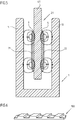
- FIG. 1 shows a scale unit 1 with two extending in the measuring direction X measuring divisions 11 and 12, which are arranged opposite to each other and form a gap between them.
- the first measuring graduation 11 has graduation elements with a first graduation period P1
- the second graduation 12 has dividing elements with a second graduation period P2.
- the periodically arranged dividing elements of the two measuring graduations 11, 12 are designed to be inductive scannable.
- the measuring graduations 11, 12 each consist of a periodic sequence of electrically spaced apart in the measuring direction X electrically conductive dividing elements. In the illustrated embodiment, these dividing elements are flat rectangles.
- the dividing elements may also have other shapes, for example, a curved outer contour or triangular.
- the dividing elements form inductive coupling elements, which modulate the strength of the inductive coupling between an excitation winding 210, 220 and a Abtastwindung 211, 212, 221, 222 depending on the position by eddy currents form in a dividing element, which against the exciter field Act.
- FIG. 4 are schematically illustrated in the dividing elements of the measuring graduation 11 eddy currents.
- the pitch period P1 of the first measurement pitch 11 and the pitch period P2 of the second measurement pitch 12 differ only slightly from one another, so that an absolute position AP can be derived therefrom over a plurality of these pitch periods P1, P2.
- the absolute position measurement is therefore based on the vernier principle.
- the inductive position measuring device further comprises a scanning unit 2 for scanning the two measuring graduations 11 and 12 of the scale unit 1, which is arranged in the gap between the first measuring graduation 11 and the second measuring graduation 12.
- the scanning unit 2 is displaceable in the measuring direction X relative to the scale unit 1.
- the scanning unit 2 includes a first coil arrangement 21 for scanning the first measuring graduation 11 and for generating at least one first position-dependent scanning signal S1.
- the scanning unit 2 includes a second coil arrangement 22 for scanning the second measuring graduation 12 and for generating at least one second position-dependent scanning signal S2.
- the first coil arrangement 21 has a first excitation winding 210 and a plurality of first phase-shifted periodic sampling windings 211, 212, which are phase-shifted relative to one another.
- the second coil arrangement 22 for sampling the second measuring graduation 12 has a second excitation winding 220 and a plurality of second phase-shifted periodic sampling windings 221, 222, which are phase-shifted relative to one another.
- the first Abtastwindeptept 211, 212 each comprise a plurality of extending in the measuring direction X periodic windings for simultaneously scanning a plurality of arranged in the measuring direction X division elements of the first measuring graduation 11 and for forming a plurality of mutually phase-shifted first sampling signals S1, S11 with the signal period P1.
- the second Abtastwindened 221, 222 each comprise a plurality of extending in the measuring direction X periodic windings for the simultaneous scanning of several arranged in the measuring direction X. Division elements of the second measuring graduation 12 and for forming a plurality of mutually phase-shifted second sampling signals S2, S21 with the signal period P2.
- the scanning unit 2 is in FIG. 3 schematically illustrated to explain the function of the inductive scanning in cooperation with the scale unit 1 in more detail.
- the planar excitation winding 210 is supplied with an exciter current such that a time-varying electromagnetic exciter field in the region of the division elements of the first measurement graduation 11 is generated.
- This excitation current has a frequency of 100 kHz to 10 MHz.
- the excitation winding 210 is spatially arranged in such a way that, in the opposite sequence of the dividing elements of the first measuring graduation 11, it forms an electromagnetic field that is as homogeneous as possible.
- the Abtastwindened 211, 212 are located within the excitation winding 210.
- the exciter field generated by the excitation winding 210 generated in the division elements eddy currents, which act as an opposing field against the exciter field.
- a voltage is induced due to their associated exciter field, which is dependent on the relative position to the electrically conductive dividing elements.
- the excitation winding 210 is thus inductively coupled to the Abtastwindept 211, 212 in dependence on the relative position of the dividing elements in the measuring direction X.
- the electromagnetic alternating field is modulated position-dependent by the dividing elements in the measuring direction X.
- the voltage induced in the sampling windings 211, 212 also varies in a position-dependent manner.
- the respectively induced voltage in the Abtastwindungen 211, 212 is supplied to an evaluation unit 3 in the form of the sampling signals S1, S11.
- the planar excitation winding 220 is also supplied with an exciter current such that a time-varying electromagnetic excitation field in the region of the division elements of the second measurement graduation 12 is generated.
- This excitation current has a frequency of a few MHz.
- the excitation winding 220 is spatially arranged in such a way that it forms an electromagnetic field that is as homogeneous as possible in the opposite sequence of the dividing elements.
- the Abtastwindened 221, 222 are located within the excitation winding 220.
- the excitation field generated by the excitation winding 220 generates eddy currents in the division elements, which act as an opposing field against the exciter field.
- a voltage is induced due to their associated excitation field, which is dependent on the relative position to the electrically conductive dividing elements.
- the exciter winding 220 is thus inductively coupled to the Abtastwindept 221, 222 in dependence on the relative position of the dividing elements in the measuring direction X.
- the alternating electromagnetic field is modulated position-dependent by the division elements in the measuring direction X, thereby varying the voltage induced in the Abtastwindened 221, 222 voltage depending on the position.
- the voltage induced in each of the sampling windings 221, 222 is supplied to an evaluation unit 3 in the form of the sampling signals S2, S21.
- the scanning signals S1, S11, S2, S21 are applied to the evaluation unit 3 of the scanning unit 2, which is configured to generate from the comparison of the phase positions in a known manner a beat signal indicating the unique absolute position AP of the scanning unit 2 relative to the scale unit 1.
- the measuring range to be coded absolutely depends in a known way on the chosen difference between the two graduation periods P1, P2. It is particularly advantageous if the number of graduation periods P1 and the number of graduation periods P2 differ by 1 over the entire measuring range to be coded absolutely.
- the absolute position AP is provided as a digital data word at the output of the scanning unit 2, the output preferably being in serial form.
- the structure of the scanning unit 2 is based on the sectional view FIG. 2 explained in more detail.
- the first coil assembly 21, comprising the Excitation winding 210 and the Abtastwindungen 211, 212, is disposed on a first circuit board 4 at a small sampling distance to the first measuring graduation 11.
- the second coil arrangement 22, comprising the excitation winding 220 and the sampling windings 221, 222, is arranged on a second printed circuit board 5 at a small scanning distance from the second measuring graduation 12. Between the first coil arrangement 21 and the second coil arrangement 22, an intermediate layer 6 of soft magnetic material is arranged.
- the soft magnetic material as an intermediate layer 6 has the function of leading out of the first coil assembly 21 field lines of the alternating magnetic field in a layer of the material of the intermediate layer 6 and thus to form a closed and spatially limited magnetic circuit, and emanating from the second coil assembly 22nd To conduct field lines of the alternating magnetic field in a layer of the material of the intermediate layer 6 and thus to form a closed and spatially limited magnetic circuit.
- the intermediate layer 6 thereby separates the field lines starting from the first coil arrangement 21 from the field lines starting from the second coil arrangement 22.
- the intermediate layer consists of a soft magnetic core 7, which is provided on both sides with a respective layer 8, 9 of an electrically non-conductive soft magnetic material. Due to the poor electrical conductivity at a frequency of alternating magnetic fields of a few MHz (about 2 MHz) no eddy currents can be generated in the layers 8, 9, which attenuate the exciting field of the respective coil arrangement 21, 22. Due to the relatively high permeability (much greater than 1) of the layers 8, 9, the excitation field is conducted in the layers 8, 9 and thus reinforced. This prevents that too much magnetic flux reaches the core 7, so that there can be no eddy currents that could dampen the excitation field.
- the thickness of the layers 8, 9 is preferably in each case 100 ⁇ m to 1000 ⁇ m.
- the core 7 consists of a soft magnetic electrically conductive metal. The material used for the core is particularly soft magnetic steel. The thickness of the core 7 is a few mm.
- the permeability of the core 7 is preferably greater than the permeability of the two layers 8, 9. This ensures that the flux density in the core 7 is greater than in the layers 8, 9. External magnetic fields (interference fields) are therefore largely in the core 7 and the layers 8, 9 are not so easy to saturation.
- the permeability of the core 7 is in particular many times greater than the permeability of the layers 8, 9. If the permeability of the core is of the order of 300, the permeability of the layers should be of the order of 100 or less, at frequencies of 100 kHz to 10 MHz.
- electrically nonconductive matrix material in which soft magnetic particles are embedded is particularly suitable for the layers 8, 9.
- the layers 8, 9 can therefore be formed by a film of Flux Field Directional material.
- a matrix material is plastic, in particular epoxy resin, in which the soft magnetic particles are mixed in powder form.
- the centrally located core 7, the layers 8, 9 disposed thereon on both sides, the printed circuit boards 4, 5 applied thereon, and the planar coil assemblies 21, 22 applied thereto form a sandwich-type stack. This results in a compact construction and by the metal core 7, a mechanically stable construction is achieved.
- the layers 8, 9 and the circuit boards 4, 5 can also be produced together in the form of prepregs, which comprise fibers, matrix material and soft magnetic particles.
- the core 7, the layers 8, 9 and the printed circuit boards 4, 5 may form a multilayer structure, wherein the individual layers are pressed together under the influence of heat. The result is a rigid and compact sandwich-like structure.
- the soft magnetic intermediate layer 6.1 in this case consists of a mu-metal.
- the layers 8, 9 are not imperative, so that the circuit boards 4, 5 can be applied with the coil assemblies 21, 22 directly on the Mu metal.
- the intermediate layer 6.1 in the form of a mu-metal is electrically conductive, but due to the extremely high permeability in alternating fields in the order of 2 MHz, the Endringtiefe the alternating fields is very low and propagate only in a few microns depth, so that the effective electrical resistance is very large and therefore again no or only negligible eddy currents arise, which counteract the excitation field of the respective coil assembly and can dampen it.
- the scale unit 1 is formed of a U-profile, in or on the two mutually parallel legs, the measuring divisions 11, 12 are formed.
- the first measuring graduation 11 is formed in one of the two legs and the second measuring graduation 12 is formed in the opposite and parallel thereto extending further leg of the U-profile.
- the scale unit 1 encompasses, as it were, the scanning unit 2 or 2.1.
- the dividing elements form in the exemplary embodiment inductive coupling elements, which modulate the strength of the inductive coupling between the excitation winding 210, 220 and the Abtastwindung 211, 212, 221, 222 depending on the position by each form eddy currents in a dividing element, which act against the exciter field.
- a material for the scale unit 1 is particularly suitable in this case, highly electrically conductive and non-magnetic material, such as aluminum.
- FIG. 1 shows a particularly advantageous embodiment of the scale unit 1 in the form of a U-profile, wherein the first measuring graduation 11 and the second measuring graduation 12 each consist of a sequence of teeth and tooth spaces.
- the scale unit 1 is particularly resistant to bending if the tooth gaps do not reach the bottom of the U-profile, ie, two webs extending on both sides adjacent to the bottom of the U-profile still extend in the measuring direction X.
- the embodiment of the scale unit 1 as a U-profile has the advantage that the scale unit 1 is made in one piece and the measuring divisions 11, 12 can be introduced aligned with each other in the required accuracy.
- the first measuring graduation 11 and the second measuring graduation 12 can be introduced by punching, cutting by means of laser or water jet in a metal strip, which is then bent to the U-profile.
- the U-profile, especially for use as a linear scale unit 1 has the advantage of high bending stiffness and is self-supporting and therefore easy to handle as a scale unit 1.
- the dividing elements of the scale unit 100 may also be in accordance with FIG. 6 be executed.
- the tooth spaces are each replaced by a material weakening, and the dividing elements are designed as elevations pointing in the direction of the scanning unit 2.
- This alternative embodiment can also be provided in the two opposing legs of a U-profile, resulting in a particularly rigid structure.
- the pitch period P1 of the first measurement pitch 11 coincides with the pitch period P1 of the associated sampling windings 211, 212 and the pitch period P2 of the second measurement pitch 12 coincides with the pitch period P2 of the associated sampling windings 221, 222 P1 are slightly different from P2.
- the pitch period of the sample turns for sampling the first measurement pitch 11 and the pitch period of the sample turns for sampling the second measurement pitch 12 may be identical, as in FIG EP 2 851 655 A1 explained.
- the dividing elements form inductive coupling elements which modulate the strength of the inductive coupling between the excitation winding 210, 220 and the Abtastwindung 211, 212, 221, 222 depending on the position by each forming eddy currents in a dividing element, which against the exciter field - so flow-damping - act.
- the scale unit can also be designed so that the dividing elements act to increase the flow.
- the scale unit made of plastic, which is filled with soft magnetic material or ferrite, for example in the form of powder. The scale unit can then be designed as an injection molded part.
- the first measuring graduation of the scale unit may be a chain code.
- the chain code consists in a known manner of a sequence of bits, several of which are scanned in succession in the measuring direction simultaneously and form the absolute position uniquely determining code word as a coarse absolute position.
- the second measuring graduation may be a periodic incremental division, which further subdivides, by interpolation, the absolute position measured by the chain code and forms a fine position.
- the evaluation unit combines the coarse absolute position of the chain code and the fine position of the incremental graduation into a resulting absolute position.
- a measurement graduation may also comprise a plurality of tracks each having a periodic incremental graduation.
- the scale unit can be assigned in a manner not shown for position measurement and multiple scanning units. This can be used for redundant position measurement, or even to ensure uninterrupted position measurement across a burst, in the scan of a plurality of consecutively arranged abutted scale units, switching at the impact of one scanning unit to another scanning unit.
- the invention By the invention, a thickness of the entire position measuring device of a few mm is possible.
- the structure is mechanically very stable and largely immune to interference.
- An absolute position measurement is possible in the smallest of spaces.
- the position measuring device according to the invention is particularly suitable for transport systems and in automation technology in conjunction with linear drives.
- the inductive position measuring device according to the invention can be designed as a length measuring device or as an angle measuring device.
Landscapes
- Physics & Mathematics (AREA)
- General Physics & Mathematics (AREA)
- Transmission And Conversion Of Sensor Element Output (AREA)
- Measurement Of Length, Angles, Or The Like Using Electric Or Magnetic Means (AREA)
Applications Claiming Priority (1)
| Application Number | Priority Date | Filing Date | Title |
|---|---|---|---|
| DE102015224589.6A DE102015224589A1 (de) | 2015-12-08 | 2015-12-08 | Induktive Positionsmesseinrichtung |
Publications (2)
| Publication Number | Publication Date |
|---|---|
| EP3179214A1 EP3179214A1 (de) | 2017-06-14 |
| EP3179214B1 true EP3179214B1 (de) | 2018-08-01 |
Family
ID=56888996
Family Applications (1)
| Application Number | Title | Priority Date | Filing Date |
|---|---|---|---|
| EP16187795.6A Active EP3179214B1 (de) | 2015-12-08 | 2016-09-08 | Induktive positionsmesseinrichtung |
Country Status (6)
| Country | Link |
|---|---|
| US (1) | US9958296B2 (enExample) |
| EP (1) | EP3179214B1 (enExample) |
| JP (1) | JP6333345B2 (enExample) |
| CN (1) | CN106969695B (enExample) |
| DE (1) | DE102015224589A1 (enExample) |
| ES (1) | ES2683650T3 (enExample) |
Families Citing this family (12)
| Publication number | Priority date | Publication date | Assignee | Title |
|---|---|---|---|---|
| EP3255384B1 (de) * | 2016-06-07 | 2018-11-28 | Dr. Johannes Heidenhain GmbH | Massverkörperung sowie positionsmesseinrichtung |
| US20190111800A1 (en) | 2017-10-16 | 2019-04-18 | Neapco Intellectual Property Holdings, Llc | High coverage battery usage monitor |
| DE102017222063A1 (de) * | 2017-12-06 | 2019-06-06 | Dr. Johannes Heidenhain Gmbh | Induktive Positionsmesseinrichtung |
| DE102018102698A1 (de) * | 2018-02-19 | 2019-08-22 | HELLA GmbH & Co. KGaA | Induktiver Positionssensor |
| JP7431032B2 (ja) * | 2019-12-23 | 2024-02-14 | 株式会社ミツトヨ | 電磁誘導式エンコーダ |
| CN116710733A (zh) * | 2021-01-21 | 2023-09-05 | 海拉有限双合股份公司 | 用于车辆的车辆系统的具有指示器带的长形的主体 |
| WO2022156931A1 (de) * | 2021-01-21 | 2022-07-28 | HELLA GmbH & Co. KGaA | Induktiver linearwegsensor |
| WO2022156930A1 (de) * | 2021-01-21 | 2022-07-28 | HELLA GmbH & Co. KGaA | Länglicher körper mit cursorband für ein fahrzeugsystem eines fahrzeugs |
| WO2023227481A1 (de) * | 2022-05-21 | 2023-11-30 | Flux Gmbh | Mehrspuranordnung für linear- und winkelmesssysteme |
| US11940470B2 (en) | 2022-05-31 | 2024-03-26 | Allegro Microsystems, Llc | Current sensor system |
| US12352607B2 (en) * | 2022-06-28 | 2025-07-08 | Allegro Microsystems, Llc | Position sensing method |
| US12455178B2 (en) | 2023-12-22 | 2025-10-28 | Allegro Microsystems, Llc | Inductive linear stroke sensor using dual tracks with different periodicity |
Family Cites Families (6)
| Publication number | Priority date | Publication date | Assignee | Title |
|---|---|---|---|---|
| DE19941464A1 (de) | 1999-09-01 | 2001-03-15 | Hella Kg Hueck & Co | Induktiver Positionssensor |
| DE10244234A1 (de) * | 2002-09-23 | 2004-03-25 | Dr. Johannes Heidenhain Gmbh | Positionsmesseinrichtung |
| US20130090890A1 (en) * | 2011-10-10 | 2013-04-11 | Advanced Sensor Technology Limited | Absolute position measuring device and method |
| DE102012223037A1 (de) * | 2012-12-13 | 2014-06-18 | Dr. Johannes Heidenhain Gmbh | Induktive Positionsmesseinrichtung |
| CN103206912A (zh) * | 2013-04-24 | 2013-07-17 | 四川大学 | 一种磁致伸缩位移传感器测量装置 |
| DE102013218768A1 (de) * | 2013-09-19 | 2015-03-19 | Dr. Johannes Heidenhain Gmbh | Induktive Positionsmesseinrichtung |
-
2015
- 2015-12-08 DE DE102015224589.6A patent/DE102015224589A1/de not_active Withdrawn
-
2016
- 2016-09-08 EP EP16187795.6A patent/EP3179214B1/de active Active
- 2016-09-08 ES ES16187795.6T patent/ES2683650T3/es active Active
- 2016-11-21 US US15/356,698 patent/US9958296B2/en active Active
- 2016-11-30 CN CN201611078139.3A patent/CN106969695B/zh active Active
- 2016-12-07 JP JP2016237422A patent/JP6333345B2/ja active Active
Also Published As
| Publication number | Publication date |
|---|---|
| EP3179214A1 (de) | 2017-06-14 |
| US20170160102A1 (en) | 2017-06-08 |
| JP6333345B2 (ja) | 2018-05-30 |
| ES2683650T3 (es) | 2018-09-27 |
| CN106969695A (zh) | 2017-07-21 |
| US9958296B2 (en) | 2018-05-01 |
| DE102015224589A1 (de) | 2017-06-08 |
| CN106969695B (zh) | 2019-03-08 |
| JP2017106920A (ja) | 2017-06-15 |
Similar Documents
| Publication | Publication Date | Title |
|---|---|---|
| EP3179214B1 (de) | Induktive positionsmesseinrichtung | |
| EP2851655B1 (de) | Induktive Positionsmesseinrichtung | |
| DE102005030358B4 (de) | Mit elektromagnetischer Induktion arbeitender Positionssensor | |
| DE69122297T2 (de) | Induktiver Näherungsmessaufnehmer und Stellungsgeber mit einer passiven Skala | |
| EP2743649B1 (de) | Induktive Positionsmesseinrichtung | |
| AT509101B1 (de) | Induktive messeinrichtung für längen- und winkelerfassung | |
| EP3255384B1 (de) | Massverkörperung sowie positionsmesseinrichtung | |
| DE102022208112A1 (de) | Induktive winkelmesseinrichtung | |
| DE10044839B4 (de) | Induktiver Positionssensor | |
| DE102017222063A1 (de) | Induktive Positionsmesseinrichtung | |
| EP2834601B1 (de) | Verfahren und anordnung zur positionsbestimmung eines bauteils | |
| EP0620416A1 (de) | Magnetisches Messsystem | |
| EP2869031B1 (de) | Positionsmesseinrichtung | |
| DE202008013715U1 (de) | Vorrichtung zur Bestimmung der relativen Position zweier zueinander bewegbarer Objekte | |
| EP1685365A2 (de) | Berührungslos arbeitendes wegmesssystem | |
| EP1321743B1 (de) | Absolutlängenmesssystem, bei dem ein Massstab relativ zur Position von beabstandeten Längesensoren bewegt wird | |
| DE19701319C2 (de) | Positionsmeßeinrichtung | |
| EP3904836B1 (de) | Induktive positionsmesseinrichtung | |
| DE102023201024A1 (de) | Abtastelement und induktive Positionsmesseinrichtung mit diesem Abtastelement | |
| EP4279874A1 (de) | Induktive positionsmesseinrichtung | |
| DE102017123772B4 (de) | Elektromagnetisches Messsystem für die Erfassung von Länge und Winkel basierend auf dem Magnetoimpedanzeffekt | |
| EP4336148B1 (de) | Abtastelement und induktive positionsmesseinrichtung mit diesem abtastelement | |
| DE102023209159A1 (de) | Induktives positionsbestimmungssystem mit variierender spulengeometrie und entsprechendes verfahren zur positionsbestimmung | |
| DE102022208616A1 (de) | Induktive Sensoranordnung zur Ermittlung eines Drehwinkels oder eines Differenzwinkels | |
| DE102024003858A1 (de) | Induktive positionsmesseinrichtung |
Legal Events
| Date | Code | Title | Description |
|---|---|---|---|
| PUAI | Public reference made under article 153(3) epc to a published international application that has entered the european phase |
Free format text: ORIGINAL CODE: 0009012 |
|
| 17P | Request for examination filed |
Effective date: 20160908 |
|
| AK | Designated contracting states |
Kind code of ref document: A1 Designated state(s): AL AT BE BG CH CY CZ DE DK EE ES FI FR GB GR HR HU IE IS IT LI LT LU LV MC MK MT NL NO PL PT RO RS SE SI SK SM TR |
|
| AX | Request for extension of the european patent |
Extension state: BA ME |
|
| RBV | Designated contracting states (corrected) |
Designated state(s): AL AT BE BG CH CY CZ DE DK EE ES FI FR GB GR HR HU IE IS IT LI LT LU LV MC MK MT NL NO PL PT RO RS SE SI SK SM TR |
|
| GRAP | Despatch of communication of intention to grant a patent |
Free format text: ORIGINAL CODE: EPIDOSNIGR1 |
|
| INTG | Intention to grant announced |
Effective date: 20180220 |
|
| GRAS | Grant fee paid |
Free format text: ORIGINAL CODE: EPIDOSNIGR3 |
|
| GRAA | (expected) grant |
Free format text: ORIGINAL CODE: 0009210 |
|
| AK | Designated contracting states |
Kind code of ref document: B1 Designated state(s): AL AT BE BG CH CY CZ DE DK EE ES FI FR GB GR HR HU IE IS IT LI LT LU LV MC MK MT NL NO PL PT RO RS SE SI SK SM TR |
|
| REG | Reference to a national code |
Ref country code: GB Ref legal event code: FG4D Free format text: NOT ENGLISH |
|
| REG | Reference to a national code |
Ref country code: CH Ref legal event code: EP Ref country code: CH Ref legal event code: NV Representative=s name: ICB INGENIEURS CONSEILS EN BREVETS SA, CH Ref country code: AT Ref legal event code: REF Ref document number: 1024833 Country of ref document: AT Kind code of ref document: T Effective date: 20180815 |
|
| REG | Reference to a national code |
Ref country code: IE Ref legal event code: FG4D Free format text: LANGUAGE OF EP DOCUMENT: GERMAN |
|
| REG | Reference to a national code |
Ref country code: DE Ref legal event code: R096 Ref document number: 502016001584 Country of ref document: DE |
|
| REG | Reference to a national code |
Ref country code: ES Ref legal event code: FG2A Ref document number: 2683650 Country of ref document: ES Kind code of ref document: T3 Effective date: 20180927 |
|
| REG | Reference to a national code |
Ref country code: NL Ref legal event code: MP Effective date: 20180801 |
|
| REG | Reference to a national code |
Ref country code: LT Ref legal event code: MG4D |
|
| PG25 | Lapsed in a contracting state [announced via postgrant information from national office to epo] |
Ref country code: BG Free format text: LAPSE BECAUSE OF FAILURE TO SUBMIT A TRANSLATION OF THE DESCRIPTION OR TO PAY THE FEE WITHIN THE PRESCRIBED TIME-LIMIT Effective date: 20181101 Ref country code: NL Free format text: LAPSE BECAUSE OF FAILURE TO SUBMIT A TRANSLATION OF THE DESCRIPTION OR TO PAY THE FEE WITHIN THE PRESCRIBED TIME-LIMIT Effective date: 20180801 Ref country code: LT Free format text: LAPSE BECAUSE OF FAILURE TO SUBMIT A TRANSLATION OF THE DESCRIPTION OR TO PAY THE FEE WITHIN THE PRESCRIBED TIME-LIMIT Effective date: 20180801 Ref country code: IS Free format text: LAPSE BECAUSE OF FAILURE TO SUBMIT A TRANSLATION OF THE DESCRIPTION OR TO PAY THE FEE WITHIN THE PRESCRIBED TIME-LIMIT Effective date: 20181201 Ref country code: RS Free format text: LAPSE BECAUSE OF FAILURE TO SUBMIT A TRANSLATION OF THE DESCRIPTION OR TO PAY THE FEE WITHIN THE PRESCRIBED TIME-LIMIT Effective date: 20180801 Ref country code: PL Free format text: LAPSE BECAUSE OF FAILURE TO SUBMIT A TRANSLATION OF THE DESCRIPTION OR TO PAY THE FEE WITHIN THE PRESCRIBED TIME-LIMIT Effective date: 20180801 Ref country code: SE Free format text: LAPSE BECAUSE OF FAILURE TO SUBMIT A TRANSLATION OF THE DESCRIPTION OR TO PAY THE FEE WITHIN THE PRESCRIBED TIME-LIMIT Effective date: 20180801 Ref country code: FI Free format text: LAPSE BECAUSE OF FAILURE TO SUBMIT A TRANSLATION OF THE DESCRIPTION OR TO PAY THE FEE WITHIN THE PRESCRIBED TIME-LIMIT Effective date: 20180801 Ref country code: GR Free format text: LAPSE BECAUSE OF FAILURE TO SUBMIT A TRANSLATION OF THE DESCRIPTION OR TO PAY THE FEE WITHIN THE PRESCRIBED TIME-LIMIT Effective date: 20181102 Ref country code: NO Free format text: LAPSE BECAUSE OF FAILURE TO SUBMIT A TRANSLATION OF THE DESCRIPTION OR TO PAY THE FEE WITHIN THE PRESCRIBED TIME-LIMIT Effective date: 20181101 |
|
| PG25 | Lapsed in a contracting state [announced via postgrant information from national office to epo] |
Ref country code: HR Free format text: LAPSE BECAUSE OF FAILURE TO SUBMIT A TRANSLATION OF THE DESCRIPTION OR TO PAY THE FEE WITHIN THE PRESCRIBED TIME-LIMIT Effective date: 20180801 Ref country code: AL Free format text: LAPSE BECAUSE OF FAILURE TO SUBMIT A TRANSLATION OF THE DESCRIPTION OR TO PAY THE FEE WITHIN THE PRESCRIBED TIME-LIMIT Effective date: 20180801 Ref country code: LV Free format text: LAPSE BECAUSE OF FAILURE TO SUBMIT A TRANSLATION OF THE DESCRIPTION OR TO PAY THE FEE WITHIN THE PRESCRIBED TIME-LIMIT Effective date: 20180801 |
|
| PG25 | Lapsed in a contracting state [announced via postgrant information from national office to epo] |
Ref country code: MC Free format text: LAPSE BECAUSE OF FAILURE TO SUBMIT A TRANSLATION OF THE DESCRIPTION OR TO PAY THE FEE WITHIN THE PRESCRIBED TIME-LIMIT Effective date: 20180801 Ref country code: EE Free format text: LAPSE BECAUSE OF FAILURE TO SUBMIT A TRANSLATION OF THE DESCRIPTION OR TO PAY THE FEE WITHIN THE PRESCRIBED TIME-LIMIT Effective date: 20180801 Ref country code: RO Free format text: LAPSE BECAUSE OF FAILURE TO SUBMIT A TRANSLATION OF THE DESCRIPTION OR TO PAY THE FEE WITHIN THE PRESCRIBED TIME-LIMIT Effective date: 20180801 Ref country code: CZ Free format text: LAPSE BECAUSE OF FAILURE TO SUBMIT A TRANSLATION OF THE DESCRIPTION OR TO PAY THE FEE WITHIN THE PRESCRIBED TIME-LIMIT Effective date: 20180801 |
|
| REG | Reference to a national code |
Ref country code: DE Ref legal event code: R097 Ref document number: 502016001584 Country of ref document: DE |
|
| PG25 | Lapsed in a contracting state [announced via postgrant information from national office to epo] |
Ref country code: SM Free format text: LAPSE BECAUSE OF FAILURE TO SUBMIT A TRANSLATION OF THE DESCRIPTION OR TO PAY THE FEE WITHIN THE PRESCRIBED TIME-LIMIT Effective date: 20180801 Ref country code: SK Free format text: LAPSE BECAUSE OF FAILURE TO SUBMIT A TRANSLATION OF THE DESCRIPTION OR TO PAY THE FEE WITHIN THE PRESCRIBED TIME-LIMIT Effective date: 20180801 Ref country code: DK Free format text: LAPSE BECAUSE OF FAILURE TO SUBMIT A TRANSLATION OF THE DESCRIPTION OR TO PAY THE FEE WITHIN THE PRESCRIBED TIME-LIMIT Effective date: 20180801 |
|
| PLBE | No opposition filed within time limit |
Free format text: ORIGINAL CODE: 0009261 |
|
| STAA | Information on the status of an ep patent application or granted ep patent |
Free format text: STATUS: NO OPPOSITION FILED WITHIN TIME LIMIT |
|
| REG | Reference to a national code |
Ref country code: BE Ref legal event code: MM Effective date: 20180930 |
|
| REG | Reference to a national code |
Ref country code: IE Ref legal event code: MM4A |
|
| PG25 | Lapsed in a contracting state [announced via postgrant information from national office to epo] |
Ref country code: LU Free format text: LAPSE BECAUSE OF NON-PAYMENT OF DUE FEES Effective date: 20180908 |
|
| 26N | No opposition filed |
Effective date: 20190503 |
|
| PG25 | Lapsed in a contracting state [announced via postgrant information from national office to epo] |
Ref country code: IE Free format text: LAPSE BECAUSE OF NON-PAYMENT OF DUE FEES Effective date: 20180908 |
|
| PG25 | Lapsed in a contracting state [announced via postgrant information from national office to epo] |
Ref country code: SI Free format text: LAPSE BECAUSE OF FAILURE TO SUBMIT A TRANSLATION OF THE DESCRIPTION OR TO PAY THE FEE WITHIN THE PRESCRIBED TIME-LIMIT Effective date: 20180801 Ref country code: FR Free format text: LAPSE BECAUSE OF NON-PAYMENT OF DUE FEES Effective date: 20181001 Ref country code: BE Free format text: LAPSE BECAUSE OF NON-PAYMENT OF DUE FEES Effective date: 20180930 |
|
| PG25 | Lapsed in a contracting state [announced via postgrant information from national office to epo] |
Ref country code: MT Free format text: LAPSE BECAUSE OF FAILURE TO SUBMIT A TRANSLATION OF THE DESCRIPTION OR TO PAY THE FEE WITHIN THE PRESCRIBED TIME-LIMIT Effective date: 20180801 |
|
| PG25 | Lapsed in a contracting state [announced via postgrant information from national office to epo] |
Ref country code: TR Free format text: LAPSE BECAUSE OF FAILURE TO SUBMIT A TRANSLATION OF THE DESCRIPTION OR TO PAY THE FEE WITHIN THE PRESCRIBED TIME-LIMIT Effective date: 20180801 |
|
| PG25 | Lapsed in a contracting state [announced via postgrant information from national office to epo] |
Ref country code: PT Free format text: LAPSE BECAUSE OF FAILURE TO SUBMIT A TRANSLATION OF THE DESCRIPTION OR TO PAY THE FEE WITHIN THE PRESCRIBED TIME-LIMIT Effective date: 20180801 |
|
| PG25 | Lapsed in a contracting state [announced via postgrant information from national office to epo] |
Ref country code: MK Free format text: LAPSE BECAUSE OF NON-PAYMENT OF DUE FEES Effective date: 20180801 Ref country code: CY Free format text: LAPSE BECAUSE OF FAILURE TO SUBMIT A TRANSLATION OF THE DESCRIPTION OR TO PAY THE FEE WITHIN THE PRESCRIBED TIME-LIMIT Effective date: 20180801 Ref country code: HU Free format text: LAPSE BECAUSE OF FAILURE TO SUBMIT A TRANSLATION OF THE DESCRIPTION OR TO PAY THE FEE WITHIN THE PRESCRIBED TIME-LIMIT; INVALID AB INITIO Effective date: 20160908 |
|
| REG | Reference to a national code |
Ref country code: AT Ref legal event code: MM01 Ref document number: 1024833 Country of ref document: AT Kind code of ref document: T Effective date: 20210908 |
|
| PG25 | Lapsed in a contracting state [announced via postgrant information from national office to epo] |
Ref country code: AT Free format text: LAPSE BECAUSE OF NON-PAYMENT OF DUE FEES Effective date: 20210908 |
|
| PGFP | Annual fee paid to national office [announced via postgrant information from national office to epo] |
Ref country code: ES Payment date: 20241025 Year of fee payment: 9 |
|
| PGFP | Annual fee paid to national office [announced via postgrant information from national office to epo] |
Ref country code: CH Payment date: 20241001 Year of fee payment: 9 |
|
| REG | Reference to a national code |
Ref country code: CH Ref legal event code: U11 Free format text: ST27 STATUS EVENT CODE: U-0-0-U10-U11 (AS PROVIDED BY THE NATIONAL OFFICE) Effective date: 20251001 |
|
| PGFP | Annual fee paid to national office [announced via postgrant information from national office to epo] |
Ref country code: DE Payment date: 20250919 Year of fee payment: 10 |
|
| PGFP | Annual fee paid to national office [announced via postgrant information from national office to epo] |
Ref country code: IT Payment date: 20250923 Year of fee payment: 10 |
|
| PGFP | Annual fee paid to national office [announced via postgrant information from national office to epo] |
Ref country code: GB Payment date: 20250919 Year of fee payment: 10 |