EP3165330A1 - Polishing device - Google Patents
Polishing device Download PDFInfo
- Publication number
- EP3165330A1 EP3165330A1 EP15814434.5A EP15814434A EP3165330A1 EP 3165330 A1 EP3165330 A1 EP 3165330A1 EP 15814434 A EP15814434 A EP 15814434A EP 3165330 A1 EP3165330 A1 EP 3165330A1
- Authority
- EP
- European Patent Office
- Prior art keywords
- polishing
- polishing member
- diamond
- pressing
- polished
- Prior art date
- Legal status (The legal status is an assumption and is not a legal conclusion. Google has not performed a legal analysis and makes no representation as to the accuracy of the status listed.)
- Withdrawn
Links
Images


Classifications
-
- B—PERFORMING OPERATIONS; TRANSPORTING
- B24—GRINDING; POLISHING
- B24B—MACHINES, DEVICES, OR PROCESSES FOR GRINDING OR POLISHING; DRESSING OR CONDITIONING OF ABRADING SURFACES; FEEDING OF GRINDING, POLISHING, OR LAPPING AGENTS
- B24B37/00—Lapping machines or devices; Accessories
- B24B37/11—Lapping tools
- B24B37/20—Lapping pads for working plane surfaces
-
- B—PERFORMING OPERATIONS; TRANSPORTING
- B24—GRINDING; POLISHING
- B24B—MACHINES, DEVICES, OR PROCESSES FOR GRINDING OR POLISHING; DRESSING OR CONDITIONING OF ABRADING SURFACES; FEEDING OF GRINDING, POLISHING, OR LAPPING AGENTS
- B24B21/00—Machines or devices using grinding or polishing belts; Accessories therefor
- B24B21/04—Machines or devices using grinding or polishing belts; Accessories therefor for grinding plane surfaces
- B24B21/12—Machines or devices using grinding or polishing belts; Accessories therefor for grinding plane surfaces involving a contact wheel or roller pressing the belt against the work
- B24B21/14—Contact wheels; Contact rollers; Belt supporting rolls
-
- B—PERFORMING OPERATIONS; TRANSPORTING
- B24—GRINDING; POLISHING
- B24B—MACHINES, DEVICES, OR PROCESSES FOR GRINDING OR POLISHING; DRESSING OR CONDITIONING OF ABRADING SURFACES; FEEDING OF GRINDING, POLISHING, OR LAPPING AGENTS
- B24B21/00—Machines or devices using grinding or polishing belts; Accessories therefor
- B24B21/006—Machines or devices using grinding or polishing belts; Accessories therefor for special purposes, e.g. for television tubes, car bumpers
-
- B—PERFORMING OPERATIONS; TRANSPORTING
- B24—GRINDING; POLISHING
- B24B—MACHINES, DEVICES, OR PROCESSES FOR GRINDING OR POLISHING; DRESSING OR CONDITIONING OF ABRADING SURFACES; FEEDING OF GRINDING, POLISHING, OR LAPPING AGENTS
- B24B21/00—Machines or devices using grinding or polishing belts; Accessories therefor
- B24B21/16—Machines or devices using grinding or polishing belts; Accessories therefor for grinding other surfaces of particular shape
-
- B—PERFORMING OPERATIONS; TRANSPORTING
- B24—GRINDING; POLISHING
- B24B—MACHINES, DEVICES, OR PROCESSES FOR GRINDING OR POLISHING; DRESSING OR CONDITIONING OF ABRADING SURFACES; FEEDING OF GRINDING, POLISHING, OR LAPPING AGENTS
- B24B21/00—Machines or devices using grinding or polishing belts; Accessories therefor
- B24B21/18—Accessories
- B24B21/22—Accessories for producing a reciprocation of the grinding belt normal to its direction of movement
-
- B—PERFORMING OPERATIONS; TRANSPORTING
- B24—GRINDING; POLISHING
- B24B—MACHINES, DEVICES, OR PROCESSES FOR GRINDING OR POLISHING; DRESSING OR CONDITIONING OF ABRADING SURFACES; FEEDING OF GRINDING, POLISHING, OR LAPPING AGENTS
- B24B37/00—Lapping machines or devices; Accessories
- B24B37/34—Accessories
-
- B—PERFORMING OPERATIONS; TRANSPORTING
- B24—GRINDING; POLISHING
- B24B—MACHINES, DEVICES, OR PROCESSES FOR GRINDING OR POLISHING; DRESSING OR CONDITIONING OF ABRADING SURFACES; FEEDING OF GRINDING, POLISHING, OR LAPPING AGENTS
- B24B9/00—Machines or devices designed for grinding edges or bevels on work or for removing burrs; Accessories therefor
- B24B9/02—Machines or devices designed for grinding edges or bevels on work or for removing burrs; Accessories therefor characterised by a special design with respect to properties of materials specific to articles to be ground
- B24B9/06—Machines or devices designed for grinding edges or bevels on work or for removing burrs; Accessories therefor characterised by a special design with respect to properties of materials specific to articles to be ground of non-metallic inorganic material, e.g. stone, ceramics, porcelain
- B24B9/16—Machines or devices designed for grinding edges or bevels on work or for removing burrs; Accessories therefor characterised by a special design with respect to properties of materials specific to articles to be ground of non-metallic inorganic material, e.g. stone, ceramics, porcelain of diamonds; of jewels or the like; Diamond grinders' dops; Dop holders or tongs
Definitions
- the present invention relates to a polishing device for a diamond surface and, more particularly, to a device that polishes the surfaces of various diamond products.
- Diamond which is a carbon crystal, has extremely high hardness, excellent abrasion resistance, slipperiness and thermal conductivity, and a high refractive index, as physical properties. Because of such physical properties, the diamond is used in, for example, cutting tools such as a turning tool, an end mill, and a file, plastic working dies such as a punch and a die, sliding members such as a valve lifter and a bearing, heat dissipation members such as a heat sink, and optical components such as an electronic board, a lens, and a window. Such diamond products are machined according to the application. However, in general, it is often required to polish the surfaces of the diamond products into smooth surfaces.
- the polishing method is a polishing method including a step of, first, setting a machining portion to a high temperature state, rubbing a diamond surface with highly reactive metal or metal oxide, and causing the diamond surface to react and removing the diamond surface.
- Patent Literature 1 discloses a polishing method for using a polishing member configured from metal easily reacting with carbon in a diamond crystal, applying ultrasound to the polishing member, heating the polishing member while vibrating the polishing member with the ultrasound, and pressing the polishing member against the diamond surface to perform polishing.
- a polishing member configured from metal easily reacting with carbon in a diamond crystal
- applying ultrasound to the polishing member heating the polishing member while vibrating the polishing member with the ultrasound, and pressing the polishing member against the diamond surface to perform polishing.
- the metal easily reacting with the carbon functioning as the polishing member stainless steel including ⁇ -Fe, titanium (Ti), zirconium (Zr), and tantalum (Ta) are illustrated.
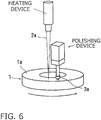
- the polishing device focuses, with heating means 2, a laser beam 2a near a machining surface 1a of a member to be machined 1 having a diamond surface to heat the machining surface 1a and rotates the member to be machined 1 to perform polishing while pressing a fixed polishing member 3a against a machining surface of the member to be machined 1.
- heating efficiency is improved, since the polishing member is fixed, there still remains the disadvantage that wear of the polishing member is marked and the life is short.
- An invention disclosed in Patent Literature 2 is an invention for adopting a prior heating method by laser radiation and causing metal configuring a polishing member to chemically react with carbon of a diamond surface to perform polishing.
- an object of the invention is to provide a polishing method for a diamond surface with which the life of the polishing member is long and control of the polishing member is easy and that can obtain a surface with high smoothness and can be easily applied to polishing of a three-dimensional surface having unevenness and to provide a polishing method for a diamond surface that is capable of performing polishing by using a polishing member formed of inexpensive metal alone without using an expensive material obtained by a special manufacturing method such as an intermetallic compound.
- the invention provides a polishing method for a diamond surface for, as shown in B and C of Fig. 5 , prior to polishing by a polishing member, heating the polishing member 3 or the surface to be machined (the diamond surface) 1a with a laser beam or the like, using, as the polishing member 3, a material that has shapes of a linear shape 3b or a belt shape 3c and at least a surface of which is made of metal easily reactive with carbon or carburizing metal and moving the member to be polished 1 to perform polishing while winding the polishing member 3 on a polishing member support 4 such as a pulley 4a or a roller 4b and pressing a polishing surface against the diamond surface via the polishing member support 4 while continuously or intermittently displacing the polishing surface.
- a polishing member support 4 such as a pulley 4a or a roller 4b
- the polishing member formed of the metal material and having the shape of the linear shape or the belt shape is used and a contact section of the polishing member is displaced to rub the diamond surface. Therefore, the worn polishing member is sequentially updated. Reaction of the easily reactive metal and the carbon of the diamond surface or diffusion and permeation of the carbon do not reach a saturated state or a surface pressure is not changed by wear. The polishing always stably advances. As a result, there is an effect that it is possible to continuously perform stable polishing for a long period. As shown in A of Fig.
- the polishing member 3 wound on the polishing member support 4 is pressed toward the surface to be machined (the diamond surface) 1a from the outer side to perform polishing while sequentially delivering and winding the polishing member 3 around on the polishing member support 4. Therefore, a large polishing device including delivering and winding means 6 for delivering and winding the polishing member and pressing means 7 is opposed to the polishing member support 4 such as a pulley or a roller wound with the polishing member 3 on the outer side of the machining surface. Therefore, the machining surface 1a of the member to be polished 1 needs to be opened in structure. A semi-closed space such as an inner circumferential surface of a cylinder member or a ring member cannot be polished by the polishing device having such a mechanism.
- An object of the present invention is to provide a diamond polishing device that uses a polishing member having a long shape such as a linear shape or a belt shape and performs polishing while winding the polishing member on a polishing member support and pressing a polishing surface against a surface of a member to be polished via the polishing member support while continuously or intermittently displacing the polishing surface, the diamond polishing device having a function capable of performing polishing even a surface of a semi-closed space such as an inner circumferential surface of a cylinder member or a ring member.
- a polishing device of the present invention includes: a polishing member having a long shape; means for delivering and winding the polishing member; a polishing member support that enable the polishing member to be wound and displaced; a base to which the polishing member support is attached; and pressing means for pressing the base to a machining surface of a member to be polished.
- the base includes an extending section that extends in a direction different from the pressing direction.
- the polishing member support is disposed at a distal end portion of the extending section.
- the means for delivering and winding the polishing member is attached on the base.
- the direction in which the polishing member is pressed toward the machining surface of the member to be polished is horizontal.
- the polishing member has a surface made of metal easily reactive with carbon, carburizing metal, or metal oxide.
- the polishing device is used for polishing of diamond or a diamond film.
- a configuration is adopted in which the polishing device includes heating means for heating the polishing member and/or the member to be polished.
- the base of the polishing device includes the extending section that extends in the direction different from the pressing direction on the surface to be machined.
- the polishing member support is disposed at the distal end portion of the extending section. Therefore, there are special effects that it is possible to shift a machining position where the polishing member support is disposed and positions of a main body section of the base and the pressing means and it is possible to prevent the main body section of the base and the pressing means from interfering with the member to be polished and polish a semi-closed space such as an inner circumferential surface of a cylinder member or a ring member.
- the polishing member support and the means for delivering and winding the polishing member are attached on the same base. Therefore, a change does not occur in tension of the polishing member laid over between the polishing member support and the means even during operation. A pressing force on the machining surface stabilizes.
- the polishing device of the present invention having the form in which the direction in which the polishing member is pressed toward the machining surface of the member to be polished is horizontal, the pressing direction of the machining surface is orthogonal to the gravity direction. Therefore, it is possible to perform polishing without being affected by gravity applied to the members of the device.
- the polishing device of the present invention adopting, as the polishing member, the polishing member having the surface made of metal easily reactive with carbon, carburizing metal, or metal oxide, when the polishing device is used for polishing of diamond or a diamond film, it is possible to perform effective polishing through chemical treatment rather than mechanical machining.
- the chemical treatment is facilitated and a machining time is reduced.
- a diamond polishing device having a form for performing polishing while winding a polishing member having a long shape on a polishing member support and pressing a polishing surface against a surface of a member to be polished via the polishing member support while continuously or intermittently displacing the polishing surface has a function capable of performing polishing even a surface of a semi-closed space such as an inner circumferential surface of a cylinder member or a ring member.
- a basic characteristic adopted by the present invention resides in a configuration in which the polishing member support wound with the polishing member is attached to an extending section of a base extending in a direction different from the pressing direction by pressurizing means such that the presence of delivering and winding means for the long polishing member, which is an accessory member of the diamond polishing device of this type, and pressing means for pressing the polishing surface toward a machining surface of the member to be polished does not interfere with the structure of the member to be machined.
- the configuration is adopted in which the base of the present invention includes the extending section extending in the direction different from the pressing direction on the surface to be machined and the polishing member support is disposed at the distal end portion of the extending section.
- a form for polishing an inner circumferential surface of a ring member is explained according to a representative embodiment example of the present invention with reference to Fig. 1 .
- delivering and winding means 6 for delivering and winding a polishing member 3 is attached to a base 5 and pressurizing means 7 for pressing the base 5 toward a surface to be machined 1a is attached.
- An extending section 5a extending in a direction orthogonal to a direction of a pressing force for biasing the base 5 in a position on the opposite side of an attached position of the pressurizing means 7 is provided in the base 5.
- a polishing member support 4 such as a pulley or a roller is attached near a distal end portion of the extending section 5a.
- the polishing member 3 having a long shape such as a linear shape or a belt shape is laid over between the polishing member support 4 and the delivering and winding means 6 to be wound on the polishing member support 4.
- the polishing device of the present invention has a structure in which the polishing member support 4 is attached to the extending section extending in the direction orthogonal to the direction of the pressing force for biasing the base 5 in the position on the opposite side of the attached position of the pressurizing means and the surface of a member to be polished 1 is polished by the polishing member 3 wound on the polishing member support 4. Therefore, it is possible to shift the positions of the delivering and winding means 6 and the pressurizing means 7, which form a large device, from a polishing section.
- the polishing device of the present invention is not limited to the embodiment example explained above. Various modifications are possible.
- the form is adopted in which the delivering and winding means 6 for delivering and winding the polishing member 3 is attached to the base 5.
- the configuration explained above is not always an essential requirement for the object of the present invention to provide a polishing device having a function capable of polishing even a surface of a semi-closed space such as an inner circumferential surface of a cylinder member or a ring member. As shown in A of Fig.
- a form may be adopted in which the extending section 5a is provided in the base 5 in a direction different from the pressing direction, the polishing member support 4 is attached near the distal end of the extending section 5a, and the delivering and winding means 6 for delivering and winding the polishing member 3 is not attached to the base 5.
- the delivering and winding means 6 is attached to the base 5 as shown in Fig. 1 , the positions of the polishing member support 4 and the delivering and winding means 6 are in a fixed relation. Therefore, tension applied to the polishing member does not change according to relative displacement of both the members during operation and affect polishing. Therefore, the form shown in Fig. 1 is considered to be a more desirable form.
- a pressing force of the polishing member applied to the surface of the member to be polished in the polishing greatly affects a polishing state and a heating state. Therefore, the pressing force is an important requirement.
- the extending section 5a of the base does not always need to extend in the direction orthogonal to the direction of the pressing force for biasing the base 5 in the position on the opposite side of the attached position of the pressurizing means 7.
- the extending section 5a only has to extend in the direction different from the pressing direction by the pressurizing means.
- the position of the polishing member support wound with the polishing member only has to be capable of being shifted from the positions of the delivering and winding means 6 and the pressurizing means 7, which form the large device.
- a form shown in B of Fig. 2 may be adopted.
- the direction of the pressing force is set in the horizontal direction by the pressurizing means 7 to prevent the sections of the device from being affected by the gravity acting thereon. It is possible to remove the influence of the gravity using a balancing device using a weight, air pressure, or the like. However, this is undesirable because complication of the device is caused, for example, the number of components increases and the device needs to be controlled with respect to a weight change due to wear of the polishing member.
- the machining surface 1a of the member to be polished 1 is set in the vertical direction.
- the pressing force of the polishing member 3 acts in the horizontal direction.
- the machining surface to be polished is not affected.
- the pressing force of the polishing member applied to the surface of the member to be polished in the polishing greatly affects a polishing state and a heating state. Therefore, the pressing force also has an important meaning.
- a heating means 2 focuses a laser beam 2a on a machining section with a laser oscillator to heat the machining section. Since the laser beam is radiated on the machining section, reaction between diamond, which is a material to be polished, and metal easily reactive with carbon, carburizing metal, or metal oxide, which is the material of the polishing member, is facilitated. It is possible to reduce a polishing time. Further, if a heater is also provided as heating means at the distal end portion of the extending section 5a of the base where the polishing member support 4 is disposed, a heating effect is further improved. It is possible to further reduce the polishing time.
- the polishing member of the present invention is explained as having, on the surface thereof, metal easily reactive with carbon or carburizing metal and performing the chemical polishing.
- the present invention is not limited to this.
- the present invention can also be applied to a polishing device of a mechanical polishing system including a diamond polishing paper, a belt polishing material, or a diamond wire as long as a long polishing member is continuously or intermittently delivered and wound.
Landscapes
- Engineering & Computer Science (AREA)
- Mechanical Engineering (AREA)
- Chemical & Material Sciences (AREA)
- Ceramic Engineering (AREA)
- Inorganic Chemistry (AREA)
- Finish Polishing, Edge Sharpening, And Grinding By Specific Grinding Devices (AREA)
- Polishing Bodies And Polishing Tools (AREA)
Abstract
Description
- The present invention relates to a polishing device for a diamond surface and, more particularly, to a device that polishes the surfaces of various diamond products.
- Diamond, which is a carbon crystal, has extremely high hardness, excellent abrasion resistance, slipperiness and thermal conductivity, and a high refractive index, as physical properties. Because of such physical properties, the diamond is used in, for example, cutting tools such as a turning tool, an end mill, and a file, plastic working dies such as a punch and a die, sliding members such as a valve lifter and a bearing, heat dissipation members such as a heat sink, and optical components such as an electronic board, a lens, and a window. Such diamond products are machined according to the application. However, in general, it is often required to polish the surfaces of the diamond products into smooth surfaces.
- For polishing of a diamond surface, a mechanical polishing method in which an abrasive grain or a grind stone made of diamond is used has been adopted also as polishing means. However, since the polishing takes time and the diamond surface and the polishing means shave each other, there is a problem in that tool life is short. There is also a problem in that the mechanical polishing is unsuitable when a diamond surface to be polished is a three-dimensional surface having unevenness rather than a plane. Therefore, currently, a polishing method by chemical treatment rather than mechanical polishing is proposed. The polishing method is a polishing method including a step of, first, setting a machining portion to a high temperature state, rubbing a diamond surface with highly reactive metal or metal oxide, and causing the diamond surface to react and removing the diamond surface.
-
Patent Literature 1 discloses a polishing method for using a polishing member configured from metal easily reacting with carbon in a diamond crystal, applying ultrasound to the polishing member, heating the polishing member while vibrating the polishing member with the ultrasound, and pressing the polishing member against the diamond surface to perform polishing. As the metal easily reacting with the carbon functioning as the polishing member, stainless steel including γ-Fe, titanium (Ti), zirconium (Zr), and tantalum (Ta) are illustrated. - When frictional heat by the ultrasound vibration is used in the heating method described above, temperature control has to be performed according to the number of vibrations and a pressing force. The control is extremely difficult and it is difficult to stably perform the polishing with constant efficiency. Since the frictional heat is used, energy efficiency of the frictional heat is low. To increase temperature, the polishing member needs to be pressed against the diamond surface with a considerable pressing force. The hardness of the metal configuring the polishing member is considerably low compared with the diamond. Therefore, there is a disadvantage that wear of the polishingmember is marked and the life of the polishing member is short. In view of this point, as the heating method, there has also been proposed a method of radiating a laser beam to be focused on a diamond surface to polish the diamond surface.
Fig. 6 shows a polishing device of this type. The polishing device focuses, with heating means 2, alaser beam 2a near amachining surface 1a of a member to be machined 1 having a diamond surface to heat themachining surface 1a and rotates the member to be machined 1 to perform polishing while pressing a fixedpolishing member 3a against a machining surface of the member to be machined 1. Although heating efficiency is improved, since the polishing member is fixed, there still remains the disadvantage that wear of the polishing member is marked and the life is short. - An invention disclosed in
Patent Literature 2 is an invention for adopting a prior heating method by laser radiation and causing metal configuring a polishing member to chemically react with carbon of a diamond surface to perform polishing. However, an object of the invention is to provide a polishing method for a diamond surface with which the life of the polishing member is long and control of the polishing member is easy and that can obtain a surface with high smoothness and can be easily applied to polishing of a three-dimensional surface having unevenness and to provide a polishing method for a diamond surface that is capable of performing polishing by using a polishing member formed of inexpensive metal alone without using an expensive material obtained by a special manufacturing method such as an intermetallic compound. Therefore, the invention provides a polishing method for a diamond surface for, as shown in B and C ofFig. 5 , prior to polishing by a polishing member, heating thepolishing member 3 or the surface to be machined (the diamond surface) 1a with a laser beam or the like, using, as thepolishing member 3, a material that has shapes of alinear shape 3b or abelt shape 3c and at least a surface of which is made of metal easily reactive with carbon or carburizing metal and moving the member to be polished 1 to perform polishing while winding thepolishing member 3 on apolishing member support 4 such as apulley 4a or aroller 4b and pressing a polishing surface against the diamond surface via thepolishing member support 4 while continuously or intermittently displacing the polishing surface. - In the polishing method, the polishing member formed of the metal material and having the shape of the linear shape or the belt shape is used and a contact section of the polishing member is displaced to rub the diamond surface. Therefore, the worn polishing member is sequentially updated. Reaction of the easily reactive metal and the carbon of the diamond surface or diffusion and permeation of the carbon do not reach a saturated state or a surface pressure is not changed by wear. The polishing always stably advances. As a result, there is an effect that it is possible to continuously perform stable polishing for a long period. As shown in A of
Fig. 5 , the polishingmember 3 wound on thepolishing member support 4 is pressed toward the surface to be machined (the diamond surface) 1a from the outer side to perform polishing while sequentially delivering and winding the polishingmember 3 around on thepolishing member support 4. Therefore, a large polishing device including delivering and winding means 6 for delivering and winding the polishing member and pressingmeans 7 is opposed to thepolishing member support 4 such as a pulley or a roller wound with thepolishing member 3 on the outer side of the machining surface. Therefore, themachining surface 1a of the member to be polished 1 needs to be opened in structure. A semi-closed space such as an inner circumferential surface of a cylinder member or a ring member cannot be polished by the polishing device having such a mechanism. -
- Patent Literature 1: Japanese Patent Application Laid-open No.
2005-231022 - Patent Literature 2: Japanese Patent Application Laid-open No.
2011-177883 - An object of the present invention is to provide a diamond polishing device that uses a polishing member having a long shape such as a linear shape or a belt shape and performs polishing while winding the polishing member on a polishing member support and pressing a polishing surface against a surface of a member to be polished via the polishing member support while continuously or intermittently displacing the polishing surface, the diamond polishing device having a function capable of performing polishing even a surface of a semi-closed space such as an inner circumferential surface of a cylinder member or a ring member. Solution to Problem
- A polishing device of the present invention includes: a polishing member having a long shape; means for delivering and winding the polishing member; a polishing member support that enable the polishing member to be wound and displaced; a base to which the polishing member support is attached; and pressing means for pressing the base to a machining surface of a member to be polished. The base includes an extending section that extends in a direction different from the pressing direction. The polishing member support is disposed at a distal end portion of the extending section.
- In one embodiment of the present invention, the means for delivering and winding the polishing member is attached on the base.
- In another embodiment of the present invention, the direction in which the polishing member is pressed toward the machining surface of the member to be polished is horizontal.
- In still another embodiment of the present invention, the polishing member has a surface made of metal easily reactive with carbon, carburizing metal, or metal oxide. In still another embodiment, the polishing device is used for polishing of diamond or a diamond film. In still another embodiment, a configuration is adopted in which the polishing device includes heating means for heating the polishing member and/or the member to be polished. Advantageous Effects of Invention
- The base of the polishing device according to the present invention includes the extending section that extends in the direction different from the pressing direction on the surface to be machined. The polishing member support is disposed at the distal end portion of the extending section. Therefore, there are special effects that it is possible to shift a machining position where the polishing member support is disposed and positions of a main body section of the base and the pressing means and it is possible to prevent the main body section of the base and the pressing means from interfering with the member to be polished and polish a semi-closed space such as an inner circumferential surface of a cylinder member or a ring member.
- In the polishing device of the present invention adopting the configuration in which the means for delivering and winding the polishing member is attached on the base, the polishing member support and the means for delivering and winding the polishing member are attached on the same base. Therefore, a change does not occur in tension of the polishing member laid over between the polishing member support and the means even during operation. A pressing force on the machining surface stabilizes.
- In the polishing device of the present invention having the form in which the direction in which the polishing member is pressed toward the machining surface of the member to be polished is horizontal, the pressing direction of the machining surface is orthogonal to the gravity direction. Therefore, it is possible to perform polishing without being affected by gravity applied to the members of the device.
- In the polishing device of the present invention adopting, as the polishing member, the polishing member having the surface made of metal easily reactive with carbon, carburizing metal, or metal oxide, when the polishing device is used for polishing of diamond or a diamond film, it is possible to perform effective polishing through chemical treatment rather than mechanical machining.
- In the polishing device of the present invention added with the heating means for heating the polishing member and/or the member to be polished, the chemical treatment is facilitated and a machining time is reduced.
-
- [
Fig. 1 ]
Fig. 1 is a diagram showing a form in which an inner circumferential surface of a ring member is machined by a polishing device according to the present invention. - [
Fig. 2 ]
Fig. 2 is a diagram showing two embodiments of the polishing device according to the present invention. - [
Fig. 3 ]
Fig. 3 is a diagram for explaining a form in which, when the inner circumferential surface of the ring member is machined by the polishing device according to the present invention, the machining is not affected by the gravity. - [
Fig. 4 ]
Fig. 4 is a diagram showing an embodiment of the polishing device according to the present invention added with a heating device. - [
Fig. 5 ]
Fig. 5 is a diagram for explaining a conventional polishing device that delivers a polishing member. - [
Fig. 6 ]
Fig. 6 is a diagram showing a basic configuration of a conventional polishing device of a chemical polishing system. -
- 1
- member to be polished (machined)
- 1a
- surface to be machined (diamond surface)
- 2
- heating means
- 2a
- laser beam
- 3
- polishing member
- 3a
- fixed polishing member
- 3b
- linear polishing member
- 3c
- belt-like polishing member
- 4
- polishing member support
- 4a
- pulley
- 4b
- roller
- 5
- base
- 5a
- extending section
- 6
- delivering and winding means
- 7
- pressing means
- Embodiments of the present invention are explained below in detail.
- A diamond polishing device having a form for performing polishing while winding a polishing member having a long shape on a polishing member support and pressing a polishing surface against a surface of a member to be polished via the polishing member support while continuously or intermittently displacing the polishing surface has a function capable of performing polishing even a surface of a semi-closed space such as an inner circumferential surface of a cylinder member or a ring member. Therefore, a basic characteristic adopted by the present invention resides in a configuration in which the polishing member support wound with the polishing member is attached to an extending section of a base extending in a direction different from the pressing direction by pressurizing means such that the presence of delivering and winding means for the long polishing member, which is an accessory member of the diamond polishing device of this type, and pressing means for pressing the polishing surface toward a machining surface of the member to be polished does not interfere with the structure of the member to be machined. The configuration is adopted in which the base of the present invention includes the extending section extending in the direction different from the pressing direction on the surface to be machined and the polishing member support is disposed at the distal end portion of the extending section. Therefore, it is possible to shift a machining position where the polishing member support is disposed and positions of a main body section of the base and the pressing means and it is possible to prevent the main body section of the base and the pressing means from interfering with the member to be polished and polish a semi-closed space such as an inner circumferential surface of a cylinder member or a ring member.
- A form for polishing an inner circumferential surface of a ring member is explained according to a representative embodiment example of the present invention with reference to
Fig. 1 . In a device of this embodiment, delivering and windingmeans 6 for delivering and winding a polishingmember 3 is attached to abase 5 and pressurizing means 7 for pressing thebase 5 toward a surface to be machined 1a is attached. An extendingsection 5a extending in a direction orthogonal to a direction of a pressing force for biasing thebase 5 in a position on the opposite side of an attached position of the pressurizing means 7 is provided in thebase 5. A polishingmember support 4 such as a pulley or a roller is attached near a distal end portion of the extendingsection 5a. Further, in the polishingmember support 4, the polishingmember 3 having a long shape such as a linear shape or a belt shape is laid over between the polishingmember support 4 and the delivering and windingmeans 6 to be wound on the polishingmember support 4. The polishing device of the present invention has a structure in which the polishingmember support 4 is attached to the extending section extending in the direction orthogonal to the direction of the pressing force for biasing thebase 5 in the position on the opposite side of the attached position of the pressurizing means and the surface of a member to be polished 1 is polished by the polishingmember 3 wound on the polishingmember support 4. Therefore, it is possible to shift the positions of the delivering and windingmeans 6 and the pressurizing means 7, which form a large device, from a polishing section. It is possible to avoid interference with the member to be machined 1. Therefore, as shown inFig. 1 , even if the member to be machined 1 has a ring shape, it is possible to bring the polishingmember support 4 into contact with an inner circumferential surface of the member to be machined 1. It is possible to perform polishing. - The polishing device of the present invention is not limited to the embodiment example explained above. Various modifications are possible. In the example shown in
Fig. 1 , the form is adopted in which the delivering and windingmeans 6 for delivering and winding the polishingmember 3 is attached to thebase 5. However, the configuration explained above is not always an essential requirement for the object of the present invention to provide a polishing device having a function capable of polishing even a surface of a semi-closed space such as an inner circumferential surface of a cylinder member or a ring member. As shown in A ofFig. 2 , a form may be adopted in which the extendingsection 5a is provided in thebase 5 in a direction different from the pressing direction, the polishingmember support 4 is attached near the distal end of the extendingsection 5a, and the delivering and windingmeans 6 for delivering and winding the polishingmember 3 is not attached to thebase 5. However, when the delivering and windingmeans 6 is attached to thebase 5 as shown inFig. 1 , the positions of the polishingmember support 4 and the delivering and windingmeans 6 are in a fixed relation. Therefore, tension applied to the polishing member does not change according to relative displacement of both the members during operation and affect polishing. Therefore, the form shown inFig. 1 is considered to be a more desirable form. A pressing force of the polishing member applied to the surface of the member to be polished in the polishing greatly affects a polishing state and a heating state. Therefore, the pressing force is an important requirement. - The extending
section 5a of the base does not always need to extend in the direction orthogonal to the direction of the pressing force for biasing thebase 5 in the position on the opposite side of the attached position of the pressurizing means 7. The extendingsection 5a only has to extend in the direction different from the pressing direction by the pressurizing means. In short, the position of the polishing member support wound with the polishing member only has to be capable of being shifted from the positions of the delivering and windingmeans 6 and the pressurizing means 7, which form the large device. A form shown in B ofFig. 2 may be adopted. - Another preferred form of the polishing device of the present invention is explained with reference to
Fig. 3 . In this embodiment, the direction of the pressing force is set in the horizontal direction by the pressurizing means 7 to prevent the sections of the device from being affected by the gravity acting thereon. It is possible to remove the influence of the gravity using a balancing device using a weight, air pressure, or the like. However, this is undesirable because complication of the device is caused, for example, the number of components increases and the device needs to be controlled with respect to a weight change due to wear of the polishing member. Themachining surface 1a of the member to be polished 1 is set in the vertical direction. The pressing force of the polishingmember 3 acts in the horizontal direction. Therefore, since it is possible to remove the influence of the gravity acting in the vertical direction with a simple structure and irrespective of a wear amount of the polishing member, the machining surface to be polished is not affected. As explained above, the pressing force of the polishing member applied to the surface of the member to be polished in the polishing greatly affects a polishing state and a heating state. Therefore, the pressing force also has an important meaning. - Further, still another preferred form of the present invention added with heating means is explained with reference to
Fig. 4 . A heating means 2 focuses alaser beam 2a on a machining section with a laser oscillator to heat the machining section. Since the laser beam is radiated on the machining section, reaction between diamond, which is a material to be polished, and metal easily reactive with carbon, carburizing metal, or metal oxide, which is the material of the polishing member, is facilitated. It is possible to reduce a polishing time. Further, if a heater is also provided as heating means at the distal end portion of the extendingsection 5a of the base where the polishingmember support 4 is disposed, a heating effect is further improved. It is possible to further reduce the polishing time. - In this specification, the polishing member of the present invention is explained as having, on the surface thereof, metal easily reactive with carbon or carburizing metal and performing the chemical polishing. However, the present invention is not limited to this. The present invention can also be applied to a polishing device of a mechanical polishing system including a diamond polishing paper, a belt polishing material, or a diamond wire as long as a long polishing member is continuously or intermittently delivered and wound.
Claims (6)
- A polishing device comprising:a polishing member having a linear shape or a belt shape;means for delivering and winding the polishing member;a polishing member support that holds the polishing member to be capable of being wound and displaced;a base to which the polishing member support is attached; andpressing means for pressing the base toward a machining surface of a member to be polished, whereinthe base includes an extending section that extends in a direction different from the pressing direction, andthe polishing member support is disposed at a distal end portion of the extending section.
- The polishing device according to claim 1, wherein the means for delivering and winding the polishing member is attached on the base.
- The polishing device according to claim 1 or 2, wherein the direction in which the polishing member is pressed toward the machining surface of the member to be polished is horizontal.
- The polishing device according to any one of claims 1 to 3, wherein the polishing device is used for polishing of diamond or a diamond film.
- The polishing device according to claim 4, wherein the polishing member has a surface made of metal easily reactive with carbon, carburizing metal, or metal oxide.
- The polishing device according to claim 5, further comprising heating means for heating the polishing member and/or the member to be polished.
Applications Claiming Priority (2)
| Application Number | Priority Date | Filing Date | Title |
|---|---|---|---|
| JP2014137169A JP6487644B2 (en) | 2014-07-02 | 2014-07-02 | Polishing equipment |
| PCT/JP2015/067681 WO2016002537A1 (en) | 2014-07-02 | 2015-06-19 | Polishing device |
Publications (2)
| Publication Number | Publication Date |
|---|---|
| EP3165330A1 true EP3165330A1 (en) | 2017-05-10 |
| EP3165330A4 EP3165330A4 (en) | 2018-03-14 |
Family
ID=55019082
Family Applications (1)
| Application Number | Title | Priority Date | Filing Date |
|---|---|---|---|
| EP15814434.5A Withdrawn EP3165330A4 (en) | 2014-07-02 | 2015-06-19 | Polishing device |
Country Status (7)
| Country | Link |
|---|---|
| US (1) | US20170106494A1 (en) |
| EP (1) | EP3165330A4 (en) |
| JP (1) | JP6487644B2 (en) |
| KR (1) | KR20170021299A (en) |
| CN (1) | CN106457504A (en) |
| BR (1) | BR112016030826A2 (en) |
| WO (1) | WO2016002537A1 (en) |
Families Citing this family (3)
| Publication number | Priority date | Publication date | Assignee | Title |
|---|---|---|---|---|
| CN106994640B (en) * | 2017-04-18 | 2022-12-20 | 天津大学 | Movable type line belt grinding device |
| CN106965062B (en) * | 2017-04-18 | 2022-12-20 | 天津大学 | A contact type wire belt grinding device |
| CN111979548B (en) * | 2020-09-30 | 2025-01-14 | 久钻科技(成都)有限公司 | Thermochemical polishing device for diamond coated wire drawing dies |
Family Cites Families (9)
| Publication number | Priority date | Publication date | Assignee | Title |
|---|---|---|---|---|
| US4532737A (en) * | 1982-12-16 | 1985-08-06 | Rca Corporation | Method for lapping diamond |
| JP2657908B2 (en) * | 1995-04-27 | 1997-09-30 | 株式会社松田精機 | Inner diameter polishing machine using film abrasive |
| JP3660056B2 (en) * | 1996-05-27 | 2005-06-15 | 日野自動車株式会社 | Polishing equipment |
| JP2001205549A (en) * | 2000-01-25 | 2001-07-31 | Speedfam Co Ltd | One side polishing method and device for substrate edge portion |
| US6629875B2 (en) * | 2000-01-28 | 2003-10-07 | Accretech Usa, Inc. | Machine for grinding-polishing of a water edge |
| JP4222515B2 (en) | 2004-01-22 | 2009-02-12 | 地方独立行政法人 東京都立産業技術研究センター | Diamond polishing method and apparatus |
| DE102007044077A1 (en) * | 2007-09-14 | 2009-03-19 | Strecon A/S | polisher |
| JP5817116B2 (en) * | 2010-02-03 | 2015-11-18 | 東洋製罐株式会社 | Diamond surface polishing method |
| JP5753268B2 (en) * | 2011-08-31 | 2015-07-22 | 高知Fel株式会社 | Diamond polishing equipment |
-
2014
- 2014-07-02 JP JP2014137169A patent/JP6487644B2/en not_active Expired - Fee Related
-
2015
- 2015-06-19 EP EP15814434.5A patent/EP3165330A4/en not_active Withdrawn
- 2015-06-19 BR BR112016030826A patent/BR112016030826A2/en not_active Application Discontinuation
- 2015-06-19 CN CN201580035426.3A patent/CN106457504A/en active Pending
- 2015-06-19 KR KR1020177001497A patent/KR20170021299A/en not_active Ceased
- 2015-06-19 WO PCT/JP2015/067681 patent/WO2016002537A1/en not_active Ceased
-
2016
- 2016-12-30 US US15/395,168 patent/US20170106494A1/en not_active Abandoned
Also Published As
| Publication number | Publication date |
|---|---|
| JP2016013599A (en) | 2016-01-28 |
| WO2016002537A1 (en) | 2016-01-07 |
| EP3165330A4 (en) | 2018-03-14 |
| JP6487644B2 (en) | 2019-03-20 |
| CN106457504A (en) | 2017-02-22 |
| BR112016030826A2 (en) | 2017-08-22 |
| US20170106494A1 (en) | 2017-04-20 |
| KR20170021299A (en) | 2017-02-27 |
Similar Documents
| Publication | Publication Date | Title |
|---|---|---|
| JP5817116B2 (en) | Diamond surface polishing method | |
| KR101785183B1 (en) | Method of polishing the diamond-surface | |
| JP5476432B2 (en) | Apparatus for processing both sides of a flat workpiece and method for simultaneously cutting a plurality of semiconductor wafers on both sides | |
| US20170106494A1 (en) | Polishing device | |
| WO2010001529A1 (en) | Method for cutting work | |
| KR102341025B1 (en) | Pressing device | |
| EP3135431A1 (en) | Lens-centering method for spherical center-type processing machine, lens-processing method, and spherical center-type processing machine | |
| JP4222515B2 (en) | Diamond polishing method and apparatus | |
| JP6753390B2 (en) | Wire saw equipment and wafer manufacturing method | |
| US10155293B2 (en) | Diamond surface polishing method and apparatus for implementing same | |
| JP5706069B2 (en) | Diamond polishing apparatus and diamond polishing method | |
| JP2015100861A (en) | Diamond surface polishing method | |
| KR20160067107A (en) | Polishing device, processing method of polishing member, modification method of polishing member, shape processing cutting tool, and surface modification tool | |
| JP4687285B2 (en) | Polishing processing method and polishing processing apparatus | |
| JP2001054849A (en) | Polishing device | |
| JP5165460B2 (en) | Work holder and work processing method | |
| JP2016097466A (en) | Hard surface polishing method | |
| JP2016150415A (en) | Processing device, processing method and manufacturing method of component | |
| JP5404107B2 (en) | Polishing tool | |
| RU92827U1 (en) | GRINDING DEVICE USING THE INSIDE SURFACE OF THE DEEP HOLE IN THE PARTS | |
| JP2005278336A (en) | Vibrating body, sliding surface polishing apparatus, and sliding surface polishing method | |
| KR20140142385A (en) | Method for improving surface hardness of work roll | |
| JP2007222969A (en) | Centerless grinding method | |
| JP2008142830A (en) | Method and device for dressing grinding wheel for internal grinding | |
| JP2002370147A (en) | Polishing tool |
Legal Events
| Date | Code | Title | Description |
|---|---|---|---|
| STAA | Information on the status of an ep patent application or granted ep patent |
Free format text: STATUS: THE INTERNATIONAL PUBLICATION HAS BEEN MADE |
|
| PUAI | Public reference made under article 153(3) epc to a published international application that has entered the european phase |
Free format text: ORIGINAL CODE: 0009012 |
|
| STAA | Information on the status of an ep patent application or granted ep patent |
Free format text: STATUS: REQUEST FOR EXAMINATION WAS MADE |
|
| 17P | Request for examination filed |
Effective date: 20170124 |
|
| AK | Designated contracting states |
Kind code of ref document: A1 Designated state(s): AL AT BE BG CH CY CZ DE DK EE ES FI FR GB GR HR HU IE IS IT LI LT LU LV MC MK MT NL NO PL PT RO RS SE SI SK SM TR |
|
| AX | Request for extension of the european patent |
Extension state: BA ME |
|
| DAV | Request for validation of the european patent (deleted) | ||
| DAX | Request for extension of the european patent (deleted) | ||
| A4 | Supplementary search report drawn up and despatched |
Effective date: 20180209 |
|
| RIC1 | Information provided on ipc code assigned before grant |
Ipc: B24B 21/00 20060101AFI20180205BHEP Ipc: B24B 21/16 20060101ALI20180205BHEP |
|
| STAA | Information on the status of an ep patent application or granted ep patent |
Free format text: STATUS: THE APPLICATION HAS BEEN WITHDRAWN |
|
| 18W | Application withdrawn |
Effective date: 20181218 |