EP3162926A1 - Filament web type precursor fabric for activated carbon fiber fabric and method for preparing same - Google Patents
Filament web type precursor fabric for activated carbon fiber fabric and method for preparing same Download PDFInfo
- Publication number
- EP3162926A1 EP3162926A1 EP15811098.1A EP15811098A EP3162926A1 EP 3162926 A1 EP3162926 A1 EP 3162926A1 EP 15811098 A EP15811098 A EP 15811098A EP 3162926 A1 EP3162926 A1 EP 3162926A1
- Authority
- EP
- European Patent Office
- Prior art keywords
- activated carbon
- carbon fiber
- fabric
- precursor
- filament
- Prior art date
- Legal status (The legal status is an assumption and is not a legal conclusion. Google has not performed a legal analysis and makes no representation as to the accuracy of the status listed.)
- Withdrawn
Links
- 239000004744 fabric Substances 0.000 title claims abstract description 108
- 239000002243 precursor Substances 0.000 title claims abstract description 98
- VNWKTOKETHGBQD-UHFFFAOYSA-N methane Chemical class C VNWKTOKETHGBQD-UHFFFAOYSA-N 0.000 title claims abstract description 88
- 238000000034 method Methods 0.000 title claims abstract description 34
- 230000008569 process Effects 0.000 claims abstract description 18
- 238000004080 punching Methods 0.000 claims abstract description 18
- 238000003892 spreading Methods 0.000 claims abstract description 13
- 230000007480 spreading Effects 0.000 claims abstract description 13
- 230000003247 decreasing effect Effects 0.000 claims description 2
- 238000004519 manufacturing process Methods 0.000 abstract description 10
- UFHFLCQGNIYNRP-UHFFFAOYSA-N Hydrogen Chemical compound [H][H] UFHFLCQGNIYNRP-UHFFFAOYSA-N 0.000 abstract description 7
- 229910052739 hydrogen Inorganic materials 0.000 abstract description 7
- 239000001257 hydrogen Substances 0.000 abstract description 7
- 230000035699 permeability Effects 0.000 abstract description 7
- 238000003860 storage Methods 0.000 abstract description 7
- 239000011148 porous material Substances 0.000 abstract description 6
- 239000000809 air pollutant Substances 0.000 abstract description 4
- 231100001243 air pollutant Toxicity 0.000 abstract description 4
- 230000003213 activating effect Effects 0.000 abstract description 3
- 238000002360 preparation method Methods 0.000 abstract description 3
- 238000003763 carbonization Methods 0.000 description 13
- OKTJSMMVPCPJKN-UHFFFAOYSA-N Carbon Chemical compound [C] OKTJSMMVPCPJKN-UHFFFAOYSA-N 0.000 description 10
- 230000004913 activation Effects 0.000 description 10
- 229920002239 polyacrylonitrile Polymers 0.000 description 9
- 229920000049 Carbon (fiber) Polymers 0.000 description 8
- 230000000052 comparative effect Effects 0.000 description 5
- 238000009941 weaving Methods 0.000 description 5
- 239000004917 carbon fiber Substances 0.000 description 4
- 239000000463 material Substances 0.000 description 4
- 230000004523 agglutinating effect Effects 0.000 description 3
- 238000004887 air purification Methods 0.000 description 3
- 238000007796 conventional method Methods 0.000 description 3
- 239000004745 nonwoven fabric Substances 0.000 description 3
- 239000004760 aramid Substances 0.000 description 2
- 229920003235 aromatic polyamide Polymers 0.000 description 2
- 229920002678 cellulose Polymers 0.000 description 2
- 239000001913 cellulose Substances 0.000 description 2
- 230000000694 effects Effects 0.000 description 2
- 238000004260 weight control Methods 0.000 description 2
- 230000000274 adsorptive effect Effects 0.000 description 1
- 229910052799 carbon Inorganic materials 0.000 description 1
- 230000001276 controlling effect Effects 0.000 description 1
- 238000002788 crimping Methods 0.000 description 1
- 230000009467 reduction Effects 0.000 description 1
- 230000001105 regulatory effect Effects 0.000 description 1
Images
Classifications
-
- B—PERFORMING OPERATIONS; TRANSPORTING
- B01—PHYSICAL OR CHEMICAL PROCESSES OR APPARATUS IN GENERAL
- B01J—CHEMICAL OR PHYSICAL PROCESSES, e.g. CATALYSIS OR COLLOID CHEMISTRY; THEIR RELEVANT APPARATUS
- B01J20/00—Solid sorbent compositions or filter aid compositions; Sorbents for chromatography; Processes for preparing, regenerating or reactivating thereof
- B01J20/02—Solid sorbent compositions or filter aid compositions; Sorbents for chromatography; Processes for preparing, regenerating or reactivating thereof comprising inorganic material
- B01J20/20—Solid sorbent compositions or filter aid compositions; Sorbents for chromatography; Processes for preparing, regenerating or reactivating thereof comprising inorganic material comprising free carbon; comprising carbon obtained by carbonising processes
-
- B—PERFORMING OPERATIONS; TRANSPORTING
- B01—PHYSICAL OR CHEMICAL PROCESSES OR APPARATUS IN GENERAL
- B01D—SEPARATION
- B01D39/00—Filtering material for liquid or gaseous fluids
- B01D39/14—Other self-supporting filtering material ; Other filtering material
- B01D39/20—Other self-supporting filtering material ; Other filtering material of inorganic material, e.g. asbestos paper, metallic filtering material of non-woven wires
-
- B—PERFORMING OPERATIONS; TRANSPORTING
- B01—PHYSICAL OR CHEMICAL PROCESSES OR APPARATUS IN GENERAL
- B01D—SEPARATION
- B01D53/00—Separation of gases or vapours; Recovering vapours of volatile solvents from gases; Chemical or biological purification of waste gases, e.g. engine exhaust gases, smoke, fumes, flue gases, aerosols
- B01D53/02—Separation of gases or vapours; Recovering vapours of volatile solvents from gases; Chemical or biological purification of waste gases, e.g. engine exhaust gases, smoke, fumes, flue gases, aerosols by adsorption, e.g. preparative gas chromatography
-
- B—PERFORMING OPERATIONS; TRANSPORTING
- B01—PHYSICAL OR CHEMICAL PROCESSES OR APPARATUS IN GENERAL
- B01J—CHEMICAL OR PHYSICAL PROCESSES, e.g. CATALYSIS OR COLLOID CHEMISTRY; THEIR RELEVANT APPARATUS
- B01J20/00—Solid sorbent compositions or filter aid compositions; Sorbents for chromatography; Processes for preparing, regenerating or reactivating thereof
- B01J20/28—Solid sorbent compositions or filter aid compositions; Sorbents for chromatography; Processes for preparing, regenerating or reactivating thereof characterised by their form or physical properties
- B01J20/28014—Solid sorbent compositions or filter aid compositions; Sorbents for chromatography; Processes for preparing, regenerating or reactivating thereof characterised by their form or physical properties characterised by their form
- B01J20/28023—Fibres or filaments
-
- D—TEXTILES; PAPER
- D01—NATURAL OR MAN-MADE THREADS OR FIBRES; SPINNING
- D01D—MECHANICAL METHODS OR APPARATUS IN THE MANUFACTURE OF ARTIFICIAL FILAMENTS, THREADS, FIBRES, BRISTLES OR RIBBONS
- D01D11/00—Other features of manufacture
- D01D11/02—Opening bundles to space the threads or filaments from one another
-
- D—TEXTILES; PAPER
- D01—NATURAL OR MAN-MADE THREADS OR FIBRES; SPINNING
- D01F—CHEMICAL FEATURES IN THE MANUFACTURE OF ARTIFICIAL FILAMENTS, THREADS, FIBRES, BRISTLES OR RIBBONS; APPARATUS SPECIALLY ADAPTED FOR THE MANUFACTURE OF CARBON FILAMENTS
- D01F9/00—Artificial filaments or the like of other substances; Manufacture thereof; Apparatus specially adapted for the manufacture of carbon filaments
- D01F9/08—Artificial filaments or the like of other substances; Manufacture thereof; Apparatus specially adapted for the manufacture of carbon filaments of inorganic material
- D01F9/12—Carbon filaments; Apparatus specially adapted for the manufacture thereof
-
- D—TEXTILES; PAPER
- D01—NATURAL OR MAN-MADE THREADS OR FIBRES; SPINNING
- D01F—CHEMICAL FEATURES IN THE MANUFACTURE OF ARTIFICIAL FILAMENTS, THREADS, FIBRES, BRISTLES OR RIBBONS; APPARATUS SPECIALLY ADAPTED FOR THE MANUFACTURE OF CARBON FILAMENTS
- D01F9/00—Artificial filaments or the like of other substances; Manufacture thereof; Apparatus specially adapted for the manufacture of carbon filaments
- D01F9/08—Artificial filaments or the like of other substances; Manufacture thereof; Apparatus specially adapted for the manufacture of carbon filaments of inorganic material
- D01F9/12—Carbon filaments; Apparatus specially adapted for the manufacture thereof
- D01F9/14—Carbon filaments; Apparatus specially adapted for the manufacture thereof by decomposition of organic filaments
-
- D—TEXTILES; PAPER
- D02—YARNS; MECHANICAL FINISHING OF YARNS OR ROPES; WARPING OR BEAMING
- D02J—FINISHING OR DRESSING OF FILAMENTS, YARNS, THREADS, CORDS, ROPES OR THE LIKE
- D02J1/00—Modifying the structure or properties resulting from a particular structure; Modifying, retaining, or restoring the physical form or cross-sectional shape, e.g. by use of dies or squeeze rollers
- D02J1/18—Separating or spreading
-
- D—TEXTILES; PAPER
- D04—BRAIDING; LACE-MAKING; KNITTING; TRIMMINGS; NON-WOVEN FABRICS
- D04H—MAKING TEXTILE FABRICS, e.g. FROM FIBRES OR FILAMENTARY MATERIAL; FABRICS MADE BY SUCH PROCESSES OR APPARATUS, e.g. FELTS, NON-WOVEN FABRICS; COTTON-WOOL; WADDING ; NON-WOVEN FABRICS FROM STAPLE FIBRES, FILAMENTS OR YARNS, BONDED WITH AT LEAST ONE WEB-LIKE MATERIAL DURING THEIR CONSOLIDATION
- D04H3/00—Non-woven fabrics formed wholly or mainly of yarns or like filamentary material of substantial length
- D04H3/005—Synthetic yarns or filaments
-
- B—PERFORMING OPERATIONS; TRANSPORTING
- B01—PHYSICAL OR CHEMICAL PROCESSES OR APPARATUS IN GENERAL
- B01D—SEPARATION
- B01D2253/00—Adsorbents used in seperation treatment of gases and vapours
- B01D2253/10—Inorganic adsorbents
- B01D2253/102—Carbon
-
- D—TEXTILES; PAPER
- D04—BRAIDING; LACE-MAKING; KNITTING; TRIMMINGS; NON-WOVEN FABRICS
- D04H—MAKING TEXTILE FABRICS, e.g. FROM FIBRES OR FILAMENTARY MATERIAL; FABRICS MADE BY SUCH PROCESSES OR APPARATUS, e.g. FELTS, NON-WOVEN FABRICS; COTTON-WOOL; WADDING ; NON-WOVEN FABRICS FROM STAPLE FIBRES, FILAMENTS OR YARNS, BONDED WITH AT LEAST ONE WEB-LIKE MATERIAL DURING THEIR CONSOLIDATION
- D04H3/00—Non-woven fabrics formed wholly or mainly of yarns or like filamentary material of substantial length
- D04H3/08—Non-woven fabrics formed wholly or mainly of yarns or like filamentary material of substantial length characterised by the method of strengthening or consolidating
- D04H3/10—Non-woven fabrics formed wholly or mainly of yarns or like filamentary material of substantial length characterised by the method of strengthening or consolidating with bonds between yarns or filaments made mechanically
- D04H3/105—Non-woven fabrics formed wholly or mainly of yarns or like filamentary material of substantial length characterised by the method of strengthening or consolidating with bonds between yarns or filaments made mechanically by needling
-
- D—TEXTILES; PAPER
- D04—BRAIDING; LACE-MAKING; KNITTING; TRIMMINGS; NON-WOVEN FABRICS
- D04H—MAKING TEXTILE FABRICS, e.g. FROM FIBRES OR FILAMENTARY MATERIAL; FABRICS MADE BY SUCH PROCESSES OR APPARATUS, e.g. FELTS, NON-WOVEN FABRICS; COTTON-WOOL; WADDING ; NON-WOVEN FABRICS FROM STAPLE FIBRES, FILAMENTS OR YARNS, BONDED WITH AT LEAST ONE WEB-LIKE MATERIAL DURING THEIR CONSOLIDATION
- D04H3/00—Non-woven fabrics formed wholly or mainly of yarns or like filamentary material of substantial length
- D04H3/08—Non-woven fabrics formed wholly or mainly of yarns or like filamentary material of substantial length characterised by the method of strengthening or consolidating
- D04H3/10—Non-woven fabrics formed wholly or mainly of yarns or like filamentary material of substantial length characterised by the method of strengthening or consolidating with bonds between yarns or filaments made mechanically
- D04H3/11—Non-woven fabrics formed wholly or mainly of yarns or like filamentary material of substantial length characterised by the method of strengthening or consolidating with bonds between yarns or filaments made mechanically by fluid jet
Definitions
- the present invention relates to a filament web type precursor fabric for an activated carbon fiber fabric and a method for preparing the same, and more particularly, to a filament web type precursor fabric for an activated carbon fiber fabric, having advantages of low manufacturing costs, easy weight control of the precursor fabric and improved permeability of the precursor fabric, as well as a method for preparing the same.
- a fabric composed of activated carbon fiber (hereinafter, referred to as an "activated carbon fiber fabric") is a porous and high adsorptive material which is widely used as a material for air purification and hydrogen storage.
- the activated carbon fiber forming the activated carbon fiber fabric may contain microfine pores having a diameter of 1 to 2 nm suitable for air purification and hydrogen storage in at least 90% of an entire area thereof.
- the activated carbon fiber fabric may be prepared by subjecting a precursor fabric for an activated carbon fiber fabric to flame-proof treatment, low-temperature carbonization at a temperature of 200 to 350°C and high-temperature activation at 600 to 1,100°C, in order.
- any conventional method for preparing an activated carbon fiber fabric has been conducted by using a non-woven fabric type precursor fabric as a precursor fabric for the activated carbon fiber fabric (hereinafter referred to as the "precursor fabric"), wherein precursor staples are entangled with each other, and subjecting the same to flame-proof treatment, low-temperature treatment and high-temperature activation, so as to manufacture the activated carbon fiber fabric.
- precursor fabric a non-woven fabric type precursor fabric
- the precursor fabric is composed of staples, and these staples have some drawbacks such as low durability, low crystallinity, non-uniformity, low performance of forming microfine pores having a diameter of 1 to 2 nm, which are useful for hydrogen storage and removal of air pollutants.
- an alternative conventional art includes using a fabric type precursor fabric woven with precursor filaments for activated carbon fiber, and subjecting the same to flame-proof treatment, low-temperature carbonization and high-temperature activation, so as to manufacture the activated carbon fiber fabric.
- the above-described method has some problems of: a difficulty in regulating the weight of fabrics during weaving since the precursor filament forming the precursor fabric has a high weight of 1,000 deniers or more; an increase in manufacturing costs since warping and weaving processes are required; and a reduction in permeability of the precursor fabric due to weaving.
- An object of the present invention is to provide a method for preparing a filament web type precursor fabric for an activated carbon fiber fabric, having advantages of low manufacturing costs, easy weight control of the precursor fabric and improved permeability of the precursor fabric.
- Another object of the present invention is to provide a filament web type precursor fabric for an activated carbon fiber fabric, prepared by the above method.
- the present invention provides a method for preparing a filament web type precursor fabric for an activated carbon fiber fabric, including: (i) spreading precursor filaments for preparing activated carbon fiber in a web state; and (ii) punching the precursor filaments for preparing activated carbon fiber, which are spread in a web state, to entangle the precursor filaments for preparing activated carbon fiber with each other, thereby forming the filament web type precursor fabric for an activated carbon fiber fabric.
- the present invention it is possible to reduce manufacturing costs, easily control a weight of the precursor fabric, and increase a permeability of the precursor fabric to thus improve a performance of the filament fabric, in the preparation of the filament web type precursor fabric for an activated carbon fiber fabric.
- the activated carbon fiber fabric is manufactured by activating the filament web type precursor fabric for an activated carbon fiber fabric of the present invention
- durability and crystallinity of yarns forming the precursor fabric may become higher and uniform while improving a performance of forming microfine pores having a diameter of 1 to 2 nm, which are easy for hydrogen storage and removal of air pollutants.
- the method for preparing a filament web type precursor fabric for an activated carbon fiber fabric may include: (i) spreading precursor filaments for preparing activated carbon fiber in a web state; and (ii) punching the precursor filaments for preparing activated carbon fiber, which are spread in a web state, to entangle the precursor filaments for preparing activated carbon fiber with each other.
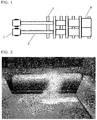
- the spreading process may be executed by passing a bundle form of the precursor filaments for preparing activated carbon fiber 1 between a plurality of tension bars 3, and repeatedly increasing and decreasing a tension applied to the precursor filaments for preparing activated carbon fiber 1.
- the overfeed rate is less than 1.2 fold, it is impossible to conduct agglutinating in the punching process, hence causing such a problem that the precursor filaments for preparing activated carbon fiber may burst. If the overfeed rate exceeds 5.0 fold, the web before the punching may become too thick, causing a difficulty in agglutinating the filaments with each other.
- FIG. 1 is a schematic view illustrating a spreading process to spread a bundle form of the precursor filaments for preparing activated carbon fiber in a filament web state by means of the tension bars.
- the spreading process may be executed by injecting the bundle form of the precursor filaments for preparing activated carbon fiber in a filament web form through an air-ejector.
- an overfeed rate of 1.2 to 1.5 fold to the filament web before punching the filament web, so as to improve processing effects.
- FIG. 2 is a schematic view illustrating a spreading process to spread a bundle form of the precursor filaments for preparing activated carbon fiber in a filament web state by means of an air-ejector.
- the punching process may include needle-punching the precursor filaments for preparing activated carbon fiber spread in a web state to entangle these precursor filaments with each other, as described in the first embodiment.
- the punching process may include air-punching the precursor filaments for preparing activated carbon fiber spread in a web state to entangle the precursor filaments for preparing activated carbon fiber with each other, as described in the second embodiment.
- the reason of agglutinating the precursor filaments for preparing activated carbon fiber with each other, which are spread in a web state, by the punching process is that the filament web type precursor fabric for an activated carbon fiber fabric according to the present invention should make the activated carbon fibers to be entangled with each other even without alternative processes such as weaving after low-temperature carbonization and high-temperature activation, thereby directly forming the activated carbon fiber fabric in a complete fabric form.
- the precursor filaments for preparing activated carbon fiber spread in a web state through the spreading process is not punched but directly subjected to low-temperature carbonization and high-temperature activation in the present invention, these activated carbon fibers may not be entangled with each other, hence not resulting in a form of activated carbon fiber fabric.
- the filament web precursor fabric for an activated carbon fiber fabric according to the present invention prepared by the above method may have a structure in which the precursor filaments for preparing activated carbon fiber are entangled with each other while being spread in a web form, and may have a weight per unit area in a range of 50-500 g/m 2 .
- the present invention may achieve advantages of: reducing manufacturing costs; easily controlling a weight of the precursor fabric; and increasing a permeability of the precursor fabric to thus improve a performance thereof, in the preparation of filament web type precursor fabric for an activated carbon fiber fabric.
- the activated carbon fiber precursor filament used herein may include, for example, a cellulose filament, polyacrylonitrile filament or aramid filament.
- the filament When the activated carbon precursor filament is a cellulose filament, the filament may be activated by low-temperature carbonization at 200-350°C. Likewise, in a case of a polyacrylonitrile filament, the filament may be activated by flame-proof treatment at 200-300°C, low-temperature carbonization at 400-800°C and activated carbonization at 600-1,000°C. Further, in a case of an aramid filament, the filament may be activated by low-temperature carbonization at 400-800°C, then activated carbonization at 600-1,000°C.
- yarns forming the above fabric may have high durability and crystallinity, become uniform, and improve a performance of forming microfine pores having a diameter of 1 to 2 nm, which are easy for hydrogen storage and removal of air pollutants.
- a bundle of polyacrylonitrile multi-filament having 12,000 monofilaments at 1.3 denier per filament (DPF) (a carbon fiber precursor filament bundle) was passed between 8 tension bars in order while altering the tension applied to each of the polyacrylonitrile multi-filaments and endowing 1.3 fold overfeed rate thereto simultaneously, thereby preparing a filament web including the polyacrylonitrile multi-filaments spread in a web state.
- DPF denier per filament
- the filament web was needle-punched to prepare a filament web type precursor fabric for an activated carbon fiber fabric.
- the filament web type precursor fabric was subjected to flame-proof treatment at 200°C for 30 minutes, followed by low-temperature carbonization at 600°C for 2 minutes and high-temperature activation at 800°C for 40 minutes, thereby producing an activated carbon fiber fabric.
- a bundle of polyacrylonitrile multi-filament having 12,000 monofilaments at 1.3 DPF (a carbon fiber precursor filament bundle) was injected through an air-ejector, thereby preparing a filament web including the polyacrylonitrile multi-filaments spread in a web state.
- the filament web was subjected to crimping to endow 1.3 fold overfeed rate thereto.
- the crimped filament web was air-punched to prepare a filament web type precursor fabric for an activated carbon fiber fabric.
- the filament web type precursor fabric was subjected to flame-proof treatment at 200°C for 30 minutes, followed by low-temperature carbonization at 600°C for 2 minutes and high-temperature activation at 800°C for 40 minutes, thereby producing an activated carbon fiber fabric.
- a bundle of polyacrylonitrile multi-filament having 12,000 monofilaments at 1.5 DPF (a carbon fiber precursor filament bundle) was used as warp and weft yarns and woven in a weaving machine, thereby preparing a fabric type precursor fabric for an activated carbon fiber fabric.
- the filament web type precursor fabric was subjected to flame-proof treatment at 200°C for 30 minutes, followed by low-temperature carbonization at 250°C for 2 hours and high-temperature activation at 800°C for 40 minutes, thereby producing an activated carbon fiber fabric.
- the filament web type precursor non-woven cloth was subjected to flame-proof treatment at 200°C for 30 minutes, followed by low-temperature carbonization at 250°C for 2 hours and high-temperature activation at 800°C for 40 minutes, thereby producing an activated carbon fiber fabric.
- the filament web type precursor fabrics for an activated carbon fiber fabric prepared in Example 1 and Example 2 were easier to control a weight of fabric, had a higher permeability of the fabric, and reduced manufacturing costs.
- the filament web type precursor fabrics for an activated carbon fiber fabric prepared in Example 1 and Example 2 respectively, showed higher durability and crystallinity of yarns forming the precursor fabric, and excellent performance of forming microfine pores having a diameter of 1 to 2 nm in the activation treatment.
- the present invention may be applicable for production of activated carbon fiber fabric which is a porous and high-adsorptive material and widely used as a material for air purification and hydrogen storage.
Landscapes
- Chemical & Material Sciences (AREA)
- Engineering & Computer Science (AREA)
- Chemical Kinetics & Catalysis (AREA)
- Textile Engineering (AREA)
- Analytical Chemistry (AREA)
- General Chemical & Material Sciences (AREA)
- Organic Chemistry (AREA)
- Life Sciences & Earth Sciences (AREA)
- Geology (AREA)
- Inorganic Chemistry (AREA)
- Mechanical Engineering (AREA)
- Oil, Petroleum & Natural Gas (AREA)
- Nonwoven Fabrics (AREA)
- Inorganic Fibers (AREA)
- Woven Fabrics (AREA)
Abstract
Description
- The present invention relates to a filament web type precursor fabric for an activated carbon fiber fabric and a method for preparing the same, and more particularly, to a filament web type precursor fabric for an activated carbon fiber fabric, having advantages of low manufacturing costs, easy weight control of the precursor fabric and improved permeability of the precursor fabric, as well as a method for preparing the same.
- A fabric composed of activated carbon fiber (hereinafter, referred to as an "activated carbon fiber fabric") is a porous and high adsorptive material which is widely used as a material for air purification and hydrogen storage.
- The activated carbon fiber forming the activated carbon fiber fabric may contain microfine pores having a diameter of 1 to 2 nm suitable for air purification and hydrogen storage in at least 90% of an entire area thereof.
- The activated carbon fiber fabric may be prepared by subjecting a precursor fabric for an activated carbon fiber fabric to flame-proof treatment, low-temperature carbonization at a temperature of 200 to 350°C and high-temperature activation at 600 to 1,100°C, in order.
- Any conventional method for preparing an activated carbon fiber fabric has been conducted by using a non-woven fabric type precursor fabric as a precursor fabric for the activated carbon fiber fabric (hereinafter referred to as the "precursor fabric"), wherein precursor staples are entangled with each other, and subjecting the same to flame-proof treatment, low-temperature treatment and high-temperature activation, so as to manufacture the activated carbon fiber fabric.
- However, in the above-described conventional method, the precursor fabric is composed of staples, and these staples have some drawbacks such as low durability, low crystallinity, non-uniformity, low performance of forming microfine pores having a diameter of 1 to 2 nm, which are useful for hydrogen storage and removal of air pollutants.
- In order to improve the problems entailed in the conventional method, an alternative conventional art includes using a fabric type precursor fabric woven with precursor filaments for activated carbon fiber, and subjecting the same to flame-proof treatment, low-temperature carbonization and high-temperature activation, so as to manufacture the activated carbon fiber fabric.
- However, the above-described method has some problems of: a difficulty in regulating the weight of fabrics during weaving since the precursor filament forming the precursor fabric has a high weight of 1,000 deniers or more; an increase in manufacturing costs since warping and weaving processes are required; and a reduction in permeability of the precursor fabric due to weaving.
- An object of the present invention is to provide a method for preparing a filament web type precursor fabric for an activated carbon fiber fabric, having advantages of low manufacturing costs, easy weight control of the precursor fabric and improved permeability of the precursor fabric.
- Another object of the present invention is to provide a filament web type precursor fabric for an activated carbon fiber fabric, prepared by the above method.
- The present invention provides a method for preparing a filament web type precursor fabric for an activated carbon fiber fabric, including: (i) spreading precursor filaments for preparing activated carbon fiber in a web state; and (ii) punching the precursor filaments for preparing activated carbon fiber, which are spread in a web state, to entangle the precursor filaments for preparing activated carbon fiber with each other, thereby forming the filament web type precursor fabric for an activated carbon fiber fabric.
- According to the present invention, it is possible to reduce manufacturing costs, easily control a weight of the precursor fabric, and increase a permeability of the precursor fabric to thus improve a performance of the filament fabric, in the preparation of the filament web type precursor fabric for an activated carbon fiber fabric.
- When the activated carbon fiber fabric is manufactured by activating the filament web type precursor fabric for an activated carbon fiber fabric of the present invention, durability and crystallinity of yarns forming the precursor fabric may become higher and uniform while improving a performance of forming microfine pores having a diameter of 1 to 2 nm, which are easy for hydrogen storage and removal of air pollutants.
-
-
FIG. 1 is a schematic view illustrating a spreading process to spread a bundle form of the precursor filaments for preparing activated carbon fiber in a filament web state by means of tension bars. -
FIG. 2 is a schematic view illustrating a spreading process to spread a bundle form of the precursor filaments for preparing activated carbon fiber in a filament web state by means of an air-ejector. - Hereinafter, the present invention will be described in detail with reference to the accompanying drawings.
- The method for preparing a filament web type precursor fabric for an activated carbon fiber fabric according to the present invention may include: (i) spreading precursor filaments for preparing activated carbon fiber in a web state; and (ii) punching the precursor filaments for preparing activated carbon fiber, which are spread in a web state, to entangle the precursor filaments for preparing activated carbon fiber with each other.
- As illustrated in
FIG. 1 for a first embodiment, the spreading process may be executed by passing a bundle form of the precursor filaments for preparing activatedcarbon fiber 1 between a plurality oftension bars 3, and repeatedly increasing and decreasing a tension applied to the precursor filaments for preparing activatedcarbon fiber 1. In this case, it is preferable to endow 1.2 to 5.0 fold overfeed rate to the precursor filaments for preparing activated carbon fiber passing between thetension bars 3, so as to spread the bundle form of the precursor filaments for preparing activatedcarbon fiber 1 in a filament web state. - If the overfeed rate is less than 1.2 fold, it is impossible to conduct agglutinating in the punching process, hence causing such a problem that the precursor filaments for preparing activated carbon fiber may burst. If the overfeed rate exceeds 5.0 fold, the web before the punching may become too thick, causing a difficulty in agglutinating the filaments with each other.
-
FIG. 1 is a schematic view illustrating a spreading process to spread a bundle form of the precursor filaments for preparing activated carbon fiber in a filament web state by means of the tension bars. - As illustrated in
FIG. 2 for a second embodiment, the spreading process may be executed by injecting the bundle form of the precursor filaments for preparing activated carbon fiber in a filament web form through an air-ejector. In this case, it is preferable to endow an overfeed rate of 1.2 to 1.5 fold to the filament web before punching the filament web, so as to improve processing effects. -
FIG. 2 is a schematic view illustrating a spreading process to spread a bundle form of the precursor filaments for preparing activated carbon fiber in a filament web state by means of an air-ejector. - Meanwhile, the punching process may include needle-punching the precursor filaments for preparing activated carbon fiber spread in a web state to entangle these precursor filaments with each other, as described in the first embodiment.
- The punching process may include air-punching the precursor filaments for preparing activated carbon fiber spread in a web state to entangle the precursor filaments for preparing activated carbon fiber with each other, as described in the second embodiment.
- In the present invention, the reason of agglutinating the precursor filaments for preparing activated carbon fiber with each other, which are spread in a web state, by the punching process, is that the filament web type precursor fabric for an activated carbon fiber fabric according to the present invention should make the activated carbon fibers to be entangled with each other even without alternative processes such as weaving after low-temperature carbonization and high-temperature activation, thereby directly forming the activated carbon fiber fabric in a complete fabric form.
- If the precursor filaments for preparing activated carbon fiber spread in a web state through the spreading process is not punched but directly subjected to low-temperature carbonization and high-temperature activation in the present invention, these activated carbon fibers may not be entangled with each other, hence not resulting in a form of activated carbon fiber fabric.
- The filament web precursor fabric for an activated carbon fiber fabric according to the present invention prepared by the above method may have a structure in which the precursor filaments for preparing activated carbon fiber are entangled with each other while being spread in a web form, and may have a weight per unit area in a range of 50-500 g/m2.
- The present invention may achieve advantages of: reducing manufacturing costs; easily controlling a weight of the precursor fabric; and increasing a permeability of the precursor fabric to thus improve a performance thereof, in the preparation of filament web type precursor fabric for an activated carbon fiber fabric.
- The activated carbon fiber precursor filament used herein may include, for example, a cellulose filament, polyacrylonitrile filament or aramid filament.
- When the activated carbon precursor filament is a cellulose filament, the filament may be activated by low-temperature carbonization at 200-350°C. Likewise, in a case of a polyacrylonitrile filament, the filament may be activated by flame-proof treatment at 200-300°C, low-temperature carbonization at 400-800°C and activated carbonization at 600-1,000°C. Further, in a case of an aramid filament, the filament may be activated by low-temperature carbonization at 400-800°C, then activated carbonization at 600-1,000°C.
- When the activated carbon fiber fabric is prepared by activating the filament web type precursor fabric for an activated carbon fiber fabric of the present invention, yarns forming the above fabric may have high durability and crystallinity, become uniform, and improve a performance of forming microfine pores having a diameter of 1 to 2 nm, which are easy for hydrogen storage and removal of air pollutants.
- Hereinafter, the present invention will be in more detail with reference to examples and comparative examples.
- However, the following examples are proposed for illustrative purpose only, but not limiting the scope of the present invention to be protected.
- A bundle of polyacrylonitrile multi-filament having 12,000 monofilaments at 1.3 denier per filament (DPF) (a carbon fiber precursor filament bundle) was passed between 8 tension bars in order while altering the tension applied to each of the polyacrylonitrile multi-filaments and endowing 1.3 fold overfeed rate thereto simultaneously, thereby preparing a filament web including the polyacrylonitrile multi-filaments spread in a web state.
- Next, the filament web was needle-punched to prepare a filament web type precursor fabric for an activated carbon fiber fabric.
- Following this, the filament web type precursor fabric was subjected to flame-proof treatment at 200°C for 30 minutes, followed by low-temperature carbonization at 600°C for 2 minutes and high-temperature activation at 800°C for 40 minutes, thereby producing an activated carbon fiber fabric.
- A bundle of polyacrylonitrile multi-filament having 12,000 monofilaments at 1.3 DPF (a carbon fiber precursor filament bundle) was injected through an air-ejector, thereby preparing a filament web including the polyacrylonitrile multi-filaments spread in a web state.
- Next, the filament web was subjected to crimping to endow 1.3 fold overfeed rate thereto.
- Following this, the crimped filament web was air-punched to prepare a filament web type precursor fabric for an activated carbon fiber fabric.
- Further, the filament web type precursor fabric was subjected to flame-proof treatment at 200°C for 30 minutes, followed by low-temperature carbonization at 600°C for 2 minutes and high-temperature activation at 800°C for 40 minutes, thereby producing an activated carbon fiber fabric.
- A bundle of polyacrylonitrile multi-filament having 12,000 monofilaments at 1.5 DPF (a carbon fiber precursor filament bundle) was used as warp and weft yarns and woven in a weaving machine, thereby preparing a fabric type precursor fabric for an activated carbon fiber fabric.
- Following this, the filament web type precursor fabric was subjected to flame-proof treatment at 200°C for 30 minutes, followed by low-temperature carbonization at 250°C for 2 hours and high-temperature activation at 800°C for 40 minutes, thereby producing an activated carbon fiber fabric.
- After aligning polyacrylonitrile staples (carbon fiber precursor staples) in a web state, needle-punching was conducted to prepare a non-woven fabric type precursor non-woven cloth for an activated carbon fiber fabric.
- Following this, the filament web type precursor non-woven cloth was subjected to flame-proof treatment at 200°C for 30 minutes, followed by low-temperature carbonization at 250°C for 2 hours and high-temperature activation at 800°C for 40 minutes, thereby producing an activated carbon fiber fabric.
- Compared to the fabric type precursor fabric for an activated carbon fiber fabric prepared in Comparative Example 1, the filament web type precursor fabrics for an activated carbon fiber fabric prepared in Example 1 and Example 2, respectively, were easier to control a weight of fabric, had a higher permeability of the fabric, and reduced manufacturing costs.
- Meanwhile, compared to the non-woven fabric type precursor for an activated carbon fiber fabric prepared in Comparative Example 2, the filament web type precursor fabrics for an activated carbon fiber fabric prepared in Example 1 and Example 2, respectively, showed higher durability and crystallinity of yarns forming the precursor fabric, and excellent performance of forming microfine pores having a diameter of 1 to 2 nm in the activation treatment.
-
- 1: Feeding device of precursor filament bundle for activated carbon fibers in a bundle form
- 2: Precursor filament bundle for activated carbon fibers in a bundle form
- 3: Tension bar
- 4: Filament web
- The present invention may be applicable for production of activated carbon fiber fabric which is a porous and high-adsorptive material and widely used as a material for air purification and hydrogen storage.
Claims (8)
- A method for preparing a filament web type precursor fabric for an activated carbon fiber fabric, comprising:(i) spreading precursor filaments for preparing activated carbon fiber in a web state; and(ii) punching the precursor filaments for preparing activated carbon fiber spread in a web state to entangle the precursor filaments for preparing activated carbon fiber with each other.
- The method according to claim 1, wherein the spreading process is executed by passing a bundle form of the precursor filaments for preparing activated carbon fiber between tension bars and repeatedly increasing and decreasing a tension applied to the precursor filaments for preparing activated carbon fiber.
- The method according to claim 2, wherein 1.2 to 5.0 fold overfeed rate is endowed to the precursor filaments for preparing activated carbon fiber passing between the tension bars.
- The method according to claim 1, wherein the spreading process is executed by injecting a bundle form of the precursor filaments for preparing activated carbon fiber in a filament web form through an air-ejector.
- The method according to claim 4, wherein 1.2 to 5.0 fold overfeed rate is endowed to the filament web before punching the filament web.
- The method according to claim 1, wherein the punching process is executed in a needle-punching mode.
- The method according to claim 1, wherein the punching process is executed in an air-punching mode.
- A filament web type precursor fabric for an activated carbon fiber fabric, wherein precursor filaments for preparing activated carbon fiber are spread in a web form while being entangled with each other, and have a weight per unit area ranging from 50 to 500 g/m2.
Applications Claiming Priority (2)
| Application Number | Priority Date | Filing Date | Title |
|---|---|---|---|
| KR1020140077009A KR101975886B1 (en) | 2014-06-24 | 2014-06-24 | Filament web typed precursor fabric for activated carbon fiber fabric and method of manufacturing the same |
| PCT/KR2015/005862 WO2015199364A1 (en) | 2014-06-24 | 2015-06-11 | Filament web type precursor fabric for activated carbon fiber fabric and method for preparing same |
Publications (2)
| Publication Number | Publication Date |
|---|---|
| EP3162926A1 true EP3162926A1 (en) | 2017-05-03 |
| EP3162926A4 EP3162926A4 (en) | 2018-01-03 |
Family
ID=54938398
Family Applications (1)
| Application Number | Title | Priority Date | Filing Date |
|---|---|---|---|
| EP15811098.1A Withdrawn EP3162926A4 (en) | 2014-06-24 | 2015-06-11 | Filament web type precursor fabric for activated carbon fiber fabric and method for preparing same |
Country Status (5)
| Country | Link |
|---|---|
| US (1) | US10596545B2 (en) |
| EP (1) | EP3162926A4 (en) |
| KR (1) | KR101975886B1 (en) |
| CN (1) | CN106536798A (en) |
| WO (1) | WO2015199364A1 (en) |
Families Citing this family (4)
| Publication number | Priority date | Publication date | Assignee | Title |
|---|---|---|---|---|
| KR101787554B1 (en) | 2016-07-22 | 2017-10-19 | 삼영기계 (주) | Carbon material wicks for candles and candles containing thereof |
| CN110626010B (en) * | 2019-08-01 | 2025-04-01 | 天津工业大学 | Activated carbon fiber felt and its preparation method and application |
| TWI746379B (en) * | 2021-02-20 | 2021-11-11 | 吳浩嘉 | Carbon fiber splitting method |
| CN114427108B (en) * | 2021-10-12 | 2023-10-27 | 江西省纳米技术研究院 | A method and system for continuous metal plating on the surface of carbon fiber |
Family Cites Families (20)
| Publication number | Priority date | Publication date | Assignee | Title |
|---|---|---|---|---|
| US3523059A (en) * | 1963-11-21 | 1970-08-04 | Celanese Corp | Needled fibrous batting and method of making the same |
| US4902561A (en) | 1988-03-04 | 1990-02-20 | The Dow Chemical Company | Lock set structure |
| DE69727637T2 (en) | 1996-05-01 | 2005-01-05 | Fukui Prefecture, Fukui | MULTIFILAMENT SPRAYING FILM AND METHOD AND DEVICE FOR THE PRODUCTION THEREOF |
| US5922300A (en) * | 1997-01-23 | 1999-07-13 | Oji Paper Co., Ltd. | Process for producing silicon carbide fibers |
| JP3722323B2 (en) * | 1997-02-14 | 2005-11-30 | 東レ株式会社 | Carbon fiber, manufacturing method and manufacturing apparatus thereof |
| KR100337536B1 (en) * | 2000-05-31 | 2002-05-22 | 김용민 | A process of preparing for the composite nonwoven fabric with activated carbon fiber |
| KR100549140B1 (en) | 2002-03-26 | 2006-02-03 | 이 아이 듀폰 디 네모아 앤드 캄파니 | Ultra-fine nanofiber web manufacturing method by electro-blowing |
| CN100500969C (en) * | 2002-10-08 | 2009-06-17 | 三菱丽阳工程株式会社 | Pressurized steam-jetting nozzle, and method and apparatus for producing nonwoven fabric using the nozzle |
| GB0303295D0 (en) | 2003-02-13 | 2003-03-19 | Lohmann Gmbh & Co Kg | Filamentary nonwoven bandage fabric |
| JP5267760B2 (en) | 2007-03-07 | 2013-08-21 | 東洋紡株式会社 | Carbon nanofiber sheet |
| DE202009000573U1 (en) | 2009-01-14 | 2009-07-16 | Sommer, Klaus | Carbonized surface and carbon fiber reinforced plastic |
| TWI392781B (en) * | 2009-12-31 | 2013-04-11 | Preparation of Natural Cellulose Nonwoven by Wet Spunbond Method | |
| US20130192434A1 (en) * | 2010-12-24 | 2013-08-01 | Toray Industries, Inc | Method for producing carbon fiber aggregate, and method for producing carbon fiber-reinforced plastic |
| CN102433687A (en) | 2011-09-14 | 2012-05-02 | 博睿思科技(大连)有限公司 | Carbon fiber felt production process |
| TWI541400B (en) | 2011-11-30 | 2016-07-11 | 東洋紡股份有限公司 | Activated carbon fiber nonwoven fabric and element using the nonwoven fabric |
| JP5912809B2 (en) * | 2012-04-25 | 2016-04-27 | 株式会社Aikiリオテック | Apparatus and method for opening reinforcing fibers |
| JP6018450B2 (en) * | 2012-07-31 | 2016-11-02 | 東邦テナックス株式会社 | Carbon fiber felt, method for producing the same, and electrode |
| EP2913170A4 (en) | 2012-10-25 | 2016-04-20 | Toray Industries | Stampable sheet |
| CN103320968B (en) | 2013-07-12 | 2015-10-14 | 天津工业大学 | A kind of manufacture method of filament non-woven fabric |
| US9719199B2 (en) | 2014-05-23 | 2017-08-01 | Goodrich Corporation | System and method for transport of fibers to/from a circular needle-punching loom |
-
2014
- 2014-06-24 KR KR1020140077009A patent/KR101975886B1/en active Active
-
2015
- 2015-06-11 US US15/321,258 patent/US10596545B2/en active Active
- 2015-06-11 WO PCT/KR2015/005862 patent/WO2015199364A1/en not_active Ceased
- 2015-06-11 EP EP15811098.1A patent/EP3162926A4/en not_active Withdrawn
- 2015-06-11 CN CN201580034687.3A patent/CN106536798A/en active Pending
Also Published As
| Publication number | Publication date |
|---|---|
| US10596545B2 (en) | 2020-03-24 |
| EP3162926A4 (en) | 2018-01-03 |
| KR101975886B1 (en) | 2019-05-07 |
| CN106536798A (en) | 2017-03-22 |
| WO2015199364A1 (en) | 2015-12-30 |
| KR20160000112A (en) | 2016-01-04 |
| US20170136443A1 (en) | 2017-05-18 |
Similar Documents
| Publication | Publication Date | Title |
|---|---|---|
| EP2930259B1 (en) | Carbon-fiber nonwoven cloth and gas diffusion electrode for polymer electrolyte fuel cell using same, polymer electrolyte fuel cell, method for manufacturing carbon-fiber nonwoven cloth, and composite sheet | |
| US10596545B2 (en) | Filament web type precursor fabric for activated carbon fiber fabric and method for preparing same | |
| JP6470750B2 (en) | Activated carbon fiber and method for producing the same | |
| JP2009256860A5 (en) | ||
| CN107475789A (en) | A kind of film splits the method that method rapid batch prepares auxetic fiber | |
| CN113474835B (en) | Nonwoven fabric for sound absorbing material, and method for producing nonwoven fabric for sound absorbing material | |
| HK1052890A1 (en) | Filtering component in the form of activated carbon fibres | |
| CN211417196U (en) | Vehicle Airbag Door Hinges | |
| RU2008376C1 (en) | Carbonic twisted thread and method for production thereof | |
| JP5230923B2 (en) | Manufacturing method of reinforcing fiber cord and reinforcing fiber cord | |
| CN102181988A (en) | Method for producing organosilicon canvas | |
| JP2002235247A (en) | Knitted fabric of fibrous activated carbon | |
| JPH09273050A (en) | Cushioning knitted fabric | |
| KR20150145395A (en) | Precursor fabric for activated carbon fiber fabric and method of manufacturing the same | |
| JP2009150008A (en) | Long and short composite spun yarn and fabric | |
| JP2010090506A (en) | Tire cord fabric, and method for producing fibrous cord | |
| JP3879901B2 (en) | Low pressure loss nonwoven activated carbon fiber and method for producing the same | |
| CN208104642U (en) | A kind of yarn for being not easy to be cut off | |
| KR101930408B1 (en) | Process Of Producing Latent Crimped Yarn Having Excellent Elastic Recovery Property | |
| US20050284560A1 (en) | Method for producing a fabric having low modulus of elasticity and high stretchability | |
| RU2224057C2 (en) | Carbon textured thread and method for manufacturing the same | |
| CN206465541U (en) | Ventilating mildew-resistant type warp-knitted face fabric | |
| JP2023132942A (en) | Fibrous activated carbon knitted fabric | |
| CN116476476A (en) | A kind of integrated knitting four-layer structure stab-proof fabric and its weaving method | |
| CN121853271A (en) | Seven-zone warp knitting spacer fabric containing functional fibers and preparation method thereof |
Legal Events
| Date | Code | Title | Description |
|---|---|---|---|
| PUAI | Public reference made under article 153(3) epc to a published international application that has entered the european phase |
Free format text: ORIGINAL CODE: 0009012 |
|
| 17P | Request for examination filed |
Effective date: 20161216 |
|
| AK | Designated contracting states |
Kind code of ref document: A1 Designated state(s): AL AT BE BG CH CY CZ DE DK EE ES FI FR GB GR HR HU IE IS IT LI LT LU LV MC MK MT NL NO PL PT RO RS SE SI SK SM TR |
|
| AX | Request for extension of the european patent |
Extension state: BA ME |
|
| DAV | Request for validation of the european patent (deleted) | ||
| DAX | Request for extension of the european patent (deleted) | ||
| A4 | Supplementary search report drawn up and despatched |
Effective date: 20171201 |
|
| RIC1 | Information provided on ipc code assigned before grant |
Ipc: D01F 9/16 20060101ALI20171128BHEP Ipc: B01D 39/20 20060101ALI20171128BHEP Ipc: D04H 3/005 20120101ALI20171128BHEP Ipc: B01J 20/28 20060101ALI20171128BHEP Ipc: B01D 53/02 20060101ALI20171128BHEP Ipc: D01F 9/22 20060101ALI20171128BHEP Ipc: D04H 3/105 20120101ALI20171128BHEP Ipc: B01J 20/20 20060101ALI20171128BHEP Ipc: D02J 1/18 20060101ALI20171128BHEP Ipc: D04H 3/11 20120101ALI20171128BHEP Ipc: D01F 9/28 20060101ALI20171128BHEP Ipc: D01F 9/12 20060101AFI20171128BHEP |
|
| STAA | Information on the status of an ep patent application or granted ep patent |
Free format text: STATUS: THE APPLICATION IS DEEMED TO BE WITHDRAWN |
|
| 18D | Application deemed to be withdrawn |
Effective date: 20180703 |