EP3160523B1 - Antimicrobial compositions utilizing silver and oxygen, process for making, and method of using the same - Google Patents
Antimicrobial compositions utilizing silver and oxygen, process for making, and method of using the same Download PDFInfo
- Publication number
- EP3160523B1 EP3160523B1 EP15731475.8A EP15731475A EP3160523B1 EP 3160523 B1 EP3160523 B1 EP 3160523B1 EP 15731475 A EP15731475 A EP 15731475A EP 3160523 B1 EP3160523 B1 EP 3160523B1
- Authority
- EP
- European Patent Office
- Prior art keywords
- silver
- oxygen
- antimicrobial
- antimicrobial silver
- matrix
- Prior art date
- Legal status (The legal status is an assumption and is not a legal conclusion. Google has not performed a legal analysis and makes no representation as to the accuracy of the status listed.)
- Active
Links
- 229910052709 silver Inorganic materials 0.000 title claims description 285
- 239000004332 silver Substances 0.000 title claims description 285
- 230000000845 anti-microbial effect Effects 0.000 title claims description 192
- QVGXLLKOCUKJST-UHFFFAOYSA-N atomic oxygen Chemical compound [O] QVGXLLKOCUKJST-UHFFFAOYSA-N 0.000 title claims description 94
- 239000001301 oxygen Substances 0.000 title claims description 94
- 229910052760 oxygen Inorganic materials 0.000 title claims description 94
- 238000000034 method Methods 0.000 title claims description 51
- 239000000203 mixture Substances 0.000 title description 36
- 230000008569 process Effects 0.000 title description 15
- BQCADISMDOOEFD-UHFFFAOYSA-N Silver Chemical compound [Ag] BQCADISMDOOEFD-UHFFFAOYSA-N 0.000 claims description 278
- 239000000463 material Substances 0.000 claims description 152
- 239000011159 matrix material Substances 0.000 claims description 86
- 206010052428 Wound Diseases 0.000 claims description 82
- 208000027418 Wounds and injury Diseases 0.000 claims description 82
- 239000003054 catalyst Substances 0.000 claims description 35
- FOIXSVOLVBLSDH-UHFFFAOYSA-N Silver ion Chemical compound [Ag+] FOIXSVOLVBLSDH-UHFFFAOYSA-N 0.000 claims description 33
- -1 ammonium peroxide Chemical class 0.000 claims description 31
- MHAJPDPJQMAIIY-UHFFFAOYSA-N Hydrogen peroxide Chemical compound OO MHAJPDPJQMAIIY-UHFFFAOYSA-N 0.000 claims description 29
- 230000000813 microbial effect Effects 0.000 claims description 26
- 229920000642 polymer Polymers 0.000 claims description 18
- 230000003389 potentiating effect Effects 0.000 claims description 18
- 239000004599 antimicrobial Substances 0.000 claims description 13
- 244000052769 pathogen Species 0.000 claims description 13
- CDBYLPFSWZWCQE-UHFFFAOYSA-L Sodium Carbonate Chemical compound [Na+].[Na+].[O-]C([O-])=O CDBYLPFSWZWCQE-UHFFFAOYSA-L 0.000 claims description 12
- FVAUCKIRQBBSSJ-UHFFFAOYSA-M sodium iodide Chemical compound [Na+].[I-] FVAUCKIRQBBSSJ-UHFFFAOYSA-M 0.000 claims description 12
- GGCZERPQGJTIQP-UHFFFAOYSA-N sodium;9,10-dioxoanthracene-2-sulfonic acid Chemical compound [Na+].C1=CC=C2C(=O)C3=CC(S(=O)(=O)O)=CC=C3C(=O)C2=C1 GGCZERPQGJTIQP-UHFFFAOYSA-N 0.000 claims description 10
- 150000002978 peroxides Chemical class 0.000 claims description 9
- ORTQZVOHEJQUHG-UHFFFAOYSA-L copper(II) chloride Chemical compound Cl[Cu]Cl ORTQZVOHEJQUHG-UHFFFAOYSA-L 0.000 claims description 8
- AMWRITDGCCNYAT-UHFFFAOYSA-L hydroxy(oxo)manganese;manganese Chemical compound [Mn].O[Mn]=O.O[Mn]=O AMWRITDGCCNYAT-UHFFFAOYSA-L 0.000 claims description 8
- 230000029663 wound healing Effects 0.000 claims description 8
- 229910000029 sodium carbonate Inorganic materials 0.000 claims description 6
- 108010053835 Catalase Proteins 0.000 claims description 4
- 229910021578 Iron(III) chloride Inorganic materials 0.000 claims description 4
- 108010023244 Lactoperoxidase Proteins 0.000 claims description 4
- 229960003280 cupric chloride Drugs 0.000 claims description 4
- RBTARNINKXHZNM-UHFFFAOYSA-K iron trichloride Chemical compound Cl[Fe](Cl)Cl RBTARNINKXHZNM-UHFFFAOYSA-K 0.000 claims description 4
- 229940057428 lactoperoxidase Drugs 0.000 claims description 4
- 235000009518 sodium iodide Nutrition 0.000 claims description 4
- PFUVRDFDKPNGAV-UHFFFAOYSA-N sodium peroxide Chemical compound [Na+].[Na+].[O-][O-] PFUVRDFDKPNGAV-UHFFFAOYSA-N 0.000 claims description 4
- 230000002708 enhancing effect Effects 0.000 claims description 3
- 208000015181 infectious disease Diseases 0.000 claims description 3
- 208000035143 Bacterial infection Diseases 0.000 claims description 2
- 208000022362 bacterial infectious disease Diseases 0.000 claims description 2
- 102100035882 Catalase Human genes 0.000 claims 1
- 102100038609 Lactoperoxidase Human genes 0.000 claims 1
- 238000002560 therapeutic procedure Methods 0.000 claims 1
- SQGYOTSLMSWVJD-UHFFFAOYSA-N silver(1+) nitrate Chemical compound [Ag+].[O-]N(=O)=O SQGYOTSLMSWVJD-UHFFFAOYSA-N 0.000 description 46
- 210000004027 cell Anatomy 0.000 description 38
- PEDCQBHIVMGVHV-UHFFFAOYSA-N Glycerine Chemical compound OCC(O)CO PEDCQBHIVMGVHV-UHFFFAOYSA-N 0.000 description 28
- 239000000376 reactant Substances 0.000 description 28
- XLYOFNOQVPJJNP-UHFFFAOYSA-N water Substances O XLYOFNOQVPJJNP-UHFFFAOYSA-N 0.000 description 26
- 229920000249 biocompatible polymer Polymers 0.000 description 24
- 230000009467 reduction Effects 0.000 description 24
- 150000003378 silver Chemical class 0.000 description 24
- 239000006260 foam Substances 0.000 description 23
- 238000012360 testing method Methods 0.000 description 23
- MYMOFIZGZYHOMD-UHFFFAOYSA-N Dioxygen Chemical compound O=O MYMOFIZGZYHOMD-UHFFFAOYSA-N 0.000 description 20
- 229910001882 dioxygen Inorganic materials 0.000 description 20
- 239000000499 gel Substances 0.000 description 19
- 239000007789 gas Substances 0.000 description 18
- KFZMGEQAYNKOFK-UHFFFAOYSA-N Isopropanol Chemical compound CC(C)O KFZMGEQAYNKOFK-UHFFFAOYSA-N 0.000 description 16
- 239000003795 chemical substances by application Substances 0.000 description 16
- DNIAPMSPPWPWGF-UHFFFAOYSA-N Propylene glycol Chemical compound CC(O)CO DNIAPMSPPWPWGF-UHFFFAOYSA-N 0.000 description 12
- 241000894006 Bacteria Species 0.000 description 11
- 102000004169 proteins and genes Human genes 0.000 description 11
- 108090000623 proteins and genes Proteins 0.000 description 11
- 229910001961 silver nitrate Inorganic materials 0.000 description 11
- 239000000243 solution Substances 0.000 description 11
- 239000001974 tryptic soy broth Substances 0.000 description 11
- 108010050327 trypticase-soy broth Proteins 0.000 description 11
- 235000011187 glycerol Nutrition 0.000 description 10
- 239000011248 coating agent Substances 0.000 description 9
- 238000000576 coating method Methods 0.000 description 9
- 239000002105 nanoparticle Substances 0.000 description 9
- 239000003642 reactive oxygen metabolite Substances 0.000 description 9
- LRHPLDYGYMQRHN-UHFFFAOYSA-N N-Butanol Chemical compound CCCCO LRHPLDYGYMQRHN-UHFFFAOYSA-N 0.000 description 8
- 238000003556 assay Methods 0.000 description 8
- 230000036571 hydration Effects 0.000 description 8
- 238000006703 hydration reaction Methods 0.000 description 8
- 150000003573 thiols Chemical class 0.000 description 8
- 229920002907 Guar gum Polymers 0.000 description 7
- 229910021607 Silver chloride Inorganic materials 0.000 description 7
- 238000010494 dissociation reaction Methods 0.000 description 7
- 230000005593 dissociations Effects 0.000 description 7
- 239000000665 guar gum Substances 0.000 description 7
- 235000010417 guar gum Nutrition 0.000 description 7
- 229960002154 guar gum Drugs 0.000 description 7
- 229920001282 polysaccharide Polymers 0.000 description 7
- 239000005017 polysaccharide Substances 0.000 description 7
- 150000004804 polysaccharides Chemical class 0.000 description 7
- HKZLPVFGJNLROG-UHFFFAOYSA-M silver monochloride Chemical compound [Cl-].[Ag+] HKZLPVFGJNLROG-UHFFFAOYSA-M 0.000 description 7
- LFQSCWFLJHTTHZ-UHFFFAOYSA-N Ethanol Chemical compound CCO LFQSCWFLJHTTHZ-UHFFFAOYSA-N 0.000 description 6
- 239000000047 product Substances 0.000 description 6
- 238000005507 spraying Methods 0.000 description 6
- 239000000126 substance Substances 0.000 description 6
- 210000001519 tissue Anatomy 0.000 description 6
- 206010041925 Staphylococcal infections Diseases 0.000 description 5
- 229910052783 alkali metal Inorganic materials 0.000 description 5
- 150000001340 alkali metals Chemical class 0.000 description 5
- 229910052784 alkaline earth metal Chemical class 0.000 description 5
- 150000001875 compounds Chemical class 0.000 description 5
- 230000001010 compromised effect Effects 0.000 description 5
- 231100000433 cytotoxic Toxicity 0.000 description 5
- 230000001472 cytotoxic effect Effects 0.000 description 5
- 238000007598 dipping method Methods 0.000 description 5
- 238000001035 drying Methods 0.000 description 5
- 230000000694 effects Effects 0.000 description 5
- 239000012530 fluid Substances 0.000 description 5
- 230000007246 mechanism Effects 0.000 description 5
- 208000015688 methicillin-resistant staphylococcus aureus infectious disease Diseases 0.000 description 5
- CURLTUGMZLYLDI-UHFFFAOYSA-N Carbon dioxide Chemical compound O=C=O CURLTUGMZLYLDI-UHFFFAOYSA-N 0.000 description 4
- BVKZGUZCCUSVTD-UHFFFAOYSA-L Carbonate Chemical compound [O-]C([O-])=O BVKZGUZCCUSVTD-UHFFFAOYSA-L 0.000 description 4
- 102000004190 Enzymes Human genes 0.000 description 4
- 108090000790 Enzymes Proteins 0.000 description 4
- 241000192125 Firmicutes Species 0.000 description 4
- 229920000161 Locust bean gum Polymers 0.000 description 4
- 241000589517 Pseudomonas aeruginosa Species 0.000 description 4
- FAPWRFPIFSIZLT-UHFFFAOYSA-M Sodium chloride Chemical compound [Na+].[Cl-] FAPWRFPIFSIZLT-UHFFFAOYSA-M 0.000 description 4
- 238000010521 absorption reaction Methods 0.000 description 4
- 239000003513 alkali Substances 0.000 description 4
- 230000008901 benefit Effects 0.000 description 4
- 230000015572 biosynthetic process Effects 0.000 description 4
- 238000006243 chemical reaction Methods 0.000 description 4
- 238000013329 compounding Methods 0.000 description 4
- 229920006037 cross link polymer Polymers 0.000 description 4
- 238000004132 cross linking Methods 0.000 description 4
- 150000002019 disulfides Chemical class 0.000 description 4
- 239000000975 dye Substances 0.000 description 4
- 235000013399 edible fruits Nutrition 0.000 description 4
- 229940088598 enzyme Drugs 0.000 description 4
- 239000004615 ingredient Substances 0.000 description 4
- 239000000711 locust bean gum Substances 0.000 description 4
- 239000002245 particle Substances 0.000 description 4
- 239000004014 plasticizer Substances 0.000 description 4
- 150000003839 salts Chemical class 0.000 description 4
- 235000017550 sodium carbonate Nutrition 0.000 description 4
- 239000006150 trypticase soy agar Substances 0.000 description 4
- 102000016938 Catalase Human genes 0.000 description 3
- 229920002307 Dextran Polymers 0.000 description 3
- 102000045576 Lactoperoxidases Human genes 0.000 description 3
- RJQXTJLFIWVMTO-TYNCELHUSA-N Methicillin Chemical compound COC1=CC=CC(OC)=C1C(=O)N[C@@H]1C(=O)N2[C@@H](C(O)=O)C(C)(C)S[C@@H]21 RJQXTJLFIWVMTO-TYNCELHUSA-N 0.000 description 3
- 241000191967 Staphylococcus aureus Species 0.000 description 3
- 230000000844 anti-bacterial effect Effects 0.000 description 3
- 230000001580 bacterial effect Effects 0.000 description 3
- KRKNYBCHXYNGOX-UHFFFAOYSA-N citric acid Chemical compound OC(=O)CC(O)(C(O)=O)CC(O)=O KRKNYBCHXYNGOX-UHFFFAOYSA-N 0.000 description 3
- 239000003431 cross linking reagent Substances 0.000 description 3
- 231100000135 cytotoxicity Toxicity 0.000 description 3
- 229960003085 meticillin Drugs 0.000 description 3
- 239000012466 permeate Substances 0.000 description 3
- 125000000864 peroxy group Chemical group O(O*)* 0.000 description 3
- 230000002195 synergetic effect Effects 0.000 description 3
- AQLJVWUFPCUVLO-UHFFFAOYSA-N urea hydrogen peroxide Chemical compound OO.NC(N)=O AQLJVWUFPCUVLO-UHFFFAOYSA-N 0.000 description 3
- HRPVXLWXLXDGHG-UHFFFAOYSA-N Acrylamide Chemical compound NC(=O)C=C HRPVXLWXLXDGHG-UHFFFAOYSA-N 0.000 description 2
- 240000008886 Ceratonia siliqua Species 0.000 description 2
- 235000013912 Ceratonia siliqua Nutrition 0.000 description 2
- 241000588724 Escherichia coli Species 0.000 description 2
- 244000230012 Gleditsia triacanthos Species 0.000 description 2
- 235000013813 Gleditsia triacanthos Nutrition 0.000 description 2
- AEMRFAOFKBGASW-UHFFFAOYSA-N Glycolic acid Chemical compound OCC(O)=O AEMRFAOFKBGASW-UHFFFAOYSA-N 0.000 description 2
- 206010061218 Inflammation Diseases 0.000 description 2
- 241000124008 Mammalia Species 0.000 description 2
- 240000004658 Medicago sativa Species 0.000 description 2
- 235000010624 Medicago sativa Nutrition 0.000 description 2
- KWYHDKDOAIKMQN-UHFFFAOYSA-N N,N,N',N'-tetramethylethylenediamine Chemical compound CN(C)CCN(C)C KWYHDKDOAIKMQN-UHFFFAOYSA-N 0.000 description 2
- IMNFDUFMRHMDMM-UHFFFAOYSA-N N-Heptane Chemical compound CCCCCCC IMNFDUFMRHMDMM-UHFFFAOYSA-N 0.000 description 2
- 206010034133 Pathogen resistance Diseases 0.000 description 2
- 244000046052 Phaseolus vulgaris Species 0.000 description 2
- 235000010627 Phaseolus vulgaris Nutrition 0.000 description 2
- NINIDFKCEFEMDL-UHFFFAOYSA-N Sulfur Chemical compound [S] NINIDFKCEFEMDL-UHFFFAOYSA-N 0.000 description 2
- 244000042324 Trifolium repens Species 0.000 description 2
- 235000013540 Trifolium repens var repens Nutrition 0.000 description 2
- 244000250129 Trigonella foenum graecum Species 0.000 description 2
- 235000001484 Trigonella foenum graecum Nutrition 0.000 description 2
- 239000003377 acid catalyst Substances 0.000 description 2
- 230000003213 activating effect Effects 0.000 description 2
- ROOXNKNUYICQNP-UHFFFAOYSA-N ammonium peroxydisulfate Substances [NH4+].[NH4+].[O-]S(=O)(=O)OOS([O-])(=O)=O ROOXNKNUYICQNP-UHFFFAOYSA-N 0.000 description 2
- VAZSKTXWXKYQJF-UHFFFAOYSA-N ammonium persulfate Chemical compound [NH4+].[NH4+].[O-]S(=O)OOS([O-])=O VAZSKTXWXKYQJF-UHFFFAOYSA-N 0.000 description 2
- 229910001870 ammonium persulfate Inorganic materials 0.000 description 2
- 239000007864 aqueous solution Substances 0.000 description 2
- 239000007853 buffer solution Substances 0.000 description 2
- 239000001569 carbon dioxide Substances 0.000 description 2
- 229910002092 carbon dioxide Inorganic materials 0.000 description 2
- 239000005018 casein Substances 0.000 description 2
- 238000003421 catalytic decomposition reaction Methods 0.000 description 2
- 210000002421 cell wall Anatomy 0.000 description 2
- HVYWMOMLDIMFJA-DPAQBDIFSA-N cholesterol Chemical compound C1C=C2C[C@@H](O)CC[C@]2(C)[C@@H]2[C@@H]1[C@@H]1CC[C@H]([C@H](C)CCCC(C)C)[C@@]1(C)CC2 HVYWMOMLDIMFJA-DPAQBDIFSA-N 0.000 description 2
- 230000001684 chronic effect Effects 0.000 description 2
- 238000012258 culturing Methods 0.000 description 2
- 230000003013 cytotoxicity Effects 0.000 description 2
- 230000018044 dehydration Effects 0.000 description 2
- 238000006297 dehydration reaction Methods 0.000 description 2
- 230000009699 differential effect Effects 0.000 description 2
- 239000012895 dilution Substances 0.000 description 2
- 238000010790 dilution Methods 0.000 description 2
- 125000002228 disulfide group Chemical group 0.000 description 2
- 238000002474 experimental method Methods 0.000 description 2
- 210000000416 exudates and transudate Anatomy 0.000 description 2
- 210000002950 fibroblast Anatomy 0.000 description 2
- 238000005187 foaming Methods 0.000 description 2
- 125000000524 functional group Chemical group 0.000 description 2
- 230000006872 improvement Effects 0.000 description 2
- 238000011065 in-situ storage Methods 0.000 description 2
- 230000004054 inflammatory process Effects 0.000 description 2
- 150000002500 ions Chemical class 0.000 description 2
- JVTAAEKCZFNVCJ-UHFFFAOYSA-N lactic acid Chemical compound CC(O)C(O)=O JVTAAEKCZFNVCJ-UHFFFAOYSA-N 0.000 description 2
- 239000010985 leather Substances 0.000 description 2
- 239000003446 ligand Substances 0.000 description 2
- 235000010420 locust bean gum Nutrition 0.000 description 2
- 210000004962 mammalian cell Anatomy 0.000 description 2
- 230000004048 modification Effects 0.000 description 2
- 238000012986 modification Methods 0.000 description 2
- ZIUHHBKFKCYYJD-UHFFFAOYSA-N n,n'-methylenebisacrylamide Chemical compound C=CC(=O)NCNC(=O)C=C ZIUHHBKFKCYYJD-UHFFFAOYSA-N 0.000 description 2
- 229920005615 natural polymer Polymers 0.000 description 2
- 210000003463 organelle Anatomy 0.000 description 2
- 230000010412 perfusion Effects 0.000 description 2
- 230000035699 permeability Effects 0.000 description 2
- 238000007747 plating Methods 0.000 description 2
- 238000002360 preparation method Methods 0.000 description 2
- 239000001044 red dye Substances 0.000 description 2
- 239000011780 sodium chloride Substances 0.000 description 2
- 239000002904 solvent Substances 0.000 description 2
- PGWMQVQLSMAHHO-UHFFFAOYSA-N sulfanylidenesilver Chemical class [Ag]=S PGWMQVQLSMAHHO-UHFFFAOYSA-N 0.000 description 2
- 229910052717 sulfur Inorganic materials 0.000 description 2
- 239000011593 sulfur Substances 0.000 description 2
- 229920001059 synthetic polymer Polymers 0.000 description 2
- 238000012956 testing procedure Methods 0.000 description 2
- 230000000699 topical effect Effects 0.000 description 2
- 235000001019 trigonella foenum-graecum Nutrition 0.000 description 2
- KIUKXJAPPMFGSW-DNGZLQJQSA-N (2S,3S,4S,5R,6R)-6-[(2S,3R,4R,5S,6R)-3-Acetamido-2-[(2S,3S,4R,5R,6R)-6-[(2R,3R,4R,5S,6R)-3-acetamido-2,5-dihydroxy-6-(hydroxymethyl)oxan-4-yl]oxy-2-carboxy-4,5-dihydroxyoxan-3-yl]oxy-5-hydroxy-6-(hydroxymethyl)oxan-4-yl]oxy-3,4,5-trihydroxyoxane-2-carboxylic acid Chemical compound CC(=O)N[C@H]1[C@H](O)O[C@H](CO)[C@@H](O)[C@@H]1O[C@H]1[C@H](O)[C@@H](O)[C@H](O[C@H]2[C@@H]([C@@H](O[C@H]3[C@@H]([C@@H](O)[C@H](O)[C@H](O3)C(O)=O)O)[C@H](O)[C@@H](CO)O2)NC(C)=O)[C@@H](C(O)=O)O1 KIUKXJAPPMFGSW-DNGZLQJQSA-N 0.000 description 1
- OMDQUFIYNPYJFM-XKDAHURESA-N (2r,3r,4s,5r,6s)-2-(hydroxymethyl)-6-[[(2r,3s,4r,5s,6r)-4,5,6-trihydroxy-3-[(2s,3s,4s,5s,6r)-3,4,5-trihydroxy-6-(hydroxymethyl)oxan-2-yl]oxyoxan-2-yl]methoxy]oxane-3,4,5-triol Chemical compound O[C@@H]1[C@@H](O)[C@@H](O)[C@@H](CO)O[C@@H]1OC[C@@H]1[C@@H](O[C@H]2[C@H]([C@@H](O)[C@H](O)[C@@H](CO)O2)O)[C@H](O)[C@H](O)[C@H](O)O1 OMDQUFIYNPYJFM-XKDAHURESA-N 0.000 description 1
- 241000588626 Acinetobacter baumannii Species 0.000 description 1
- 229920001817 Agar Polymers 0.000 description 1
- 229920002101 Chitin Polymers 0.000 description 1
- 229920001661 Chitosan Polymers 0.000 description 1
- 102000008186 Collagen Human genes 0.000 description 1
- 108010035532 Collagen Proteins 0.000 description 1
- 206010011409 Cross infection Diseases 0.000 description 1
- 241000588697 Enterobacter cloacae Species 0.000 description 1
- 229920000926 Galactomannan Polymers 0.000 description 1
- 229930186217 Glycolipid Natural products 0.000 description 1
- 241001465754 Metazoa Species 0.000 description 1
- 229920000881 Modified starch Polymers 0.000 description 1
- 239000004677 Nylon Substances 0.000 description 1
- 229920002732 Polyanhydride Polymers 0.000 description 1
- 239000004698 Polyethylene Substances 0.000 description 1
- 108010039918 Polylysine Proteins 0.000 description 1
- 229920001710 Polyorthoester Polymers 0.000 description 1
- 239000004721 Polyphenylene oxide Substances 0.000 description 1
- 229920005830 Polyurethane Foam Polymers 0.000 description 1
- 241000293869 Salmonella enterica subsp. enterica serovar Typhimurium Species 0.000 description 1
- 241000607715 Serratia marcescens Species 0.000 description 1
- OUUQCZGPVNCOIJ-UHFFFAOYSA-M Superoxide Chemical compound [O-][O] OUUQCZGPVNCOIJ-UHFFFAOYSA-M 0.000 description 1
- 239000013543 active substance Substances 0.000 description 1
- 230000001154 acute effect Effects 0.000 description 1
- 239000008272 agar Substances 0.000 description 1
- 235000010443 alginic acid Nutrition 0.000 description 1
- 239000000783 alginic acid Substances 0.000 description 1
- 229920000615 alginic acid Polymers 0.000 description 1
- 229960001126 alginic acid Drugs 0.000 description 1
- 150000004781 alginic acids Chemical class 0.000 description 1
- 239000012080 ambient air Substances 0.000 description 1
- 239000003242 anti bacterial agent Substances 0.000 description 1
- 229940088710 antibiotic agent Drugs 0.000 description 1
- 239000003139 biocide Substances 0.000 description 1
- 230000001680 brushing effect Effects 0.000 description 1
- 230000001413 cellular effect Effects 0.000 description 1
- 230000008614 cellular interaction Effects 0.000 description 1
- 229940106189 ceramide Drugs 0.000 description 1
- 150000001783 ceramides Chemical class 0.000 description 1
- 239000003153 chemical reaction reagent Substances 0.000 description 1
- 235000012000 cholesterol Nutrition 0.000 description 1
- BHYOQNUELFTYRT-DPAQBDIFSA-N cholesterol sulfate Chemical compound C1C=C2C[C@@H](OS(O)(=O)=O)CC[C@]2(C)[C@@H]2[C@@H]1[C@@H]1CC[C@H]([C@H](C)CCCC(C)C)[C@@]1(C)CC2 BHYOQNUELFTYRT-DPAQBDIFSA-N 0.000 description 1
- 229940080277 cholesteryl sulfate Drugs 0.000 description 1
- 229960004106 citric acid Drugs 0.000 description 1
- 235000015165 citric acid Nutrition 0.000 description 1
- 229920001436 collagen Polymers 0.000 description 1
- 239000000084 colloidal system Substances 0.000 description 1
- 230000001332 colony forming effect Effects 0.000 description 1
- 230000002301 combined effect Effects 0.000 description 1
- 238000007796 conventional method Methods 0.000 description 1
- 230000001419 dependent effect Effects 0.000 description 1
- 238000005137 deposition process Methods 0.000 description 1
- 238000013461 design Methods 0.000 description 1
- 238000009792 diffusion process Methods 0.000 description 1
- 238000002845 discoloration Methods 0.000 description 1
- 239000012153 distilled water Substances 0.000 description 1
- 229920001971 elastomer Polymers 0.000 description 1
- 230000005670 electromagnetic radiation Effects 0.000 description 1
- 230000003628 erosive effect Effects 0.000 description 1
- 125000004494 ethyl ester group Chemical group 0.000 description 1
- 239000010408 film Substances 0.000 description 1
- 238000009501 film coating Methods 0.000 description 1
- 238000009472 formulation Methods 0.000 description 1
- 235000021588 free fatty acids Nutrition 0.000 description 1
- 229910052736 halogen Inorganic materials 0.000 description 1
- 150000002367 halogens Chemical class 0.000 description 1
- 238000010438 heat treatment Methods 0.000 description 1
- 229920002674 hyaluronan Polymers 0.000 description 1
- 229960003160 hyaluronic acid Drugs 0.000 description 1
- 239000000017 hydrogel Substances 0.000 description 1
- 238000007654 immersion Methods 0.000 description 1
- 238000001727 in vivo Methods 0.000 description 1
- 238000010348 incorporation Methods 0.000 description 1
- 230000003993 interaction Effects 0.000 description 1
- 230000003834 intracellular effect Effects 0.000 description 1
- PNDPGZBMCMUPRI-UHFFFAOYSA-N iodine Chemical compound II PNDPGZBMCMUPRI-UHFFFAOYSA-N 0.000 description 1
- 239000004310 lactic acid Substances 0.000 description 1
- 235000014655 lactic acid Nutrition 0.000 description 1
- 229920002521 macromolecule Polymers 0.000 description 1
- 230000001404 mediated effect Effects 0.000 description 1
- 239000012528 membrane Substances 0.000 description 1
- 230000004060 metabolic process Effects 0.000 description 1
- 239000002082 metal nanoparticle Substances 0.000 description 1
- 235000019426 modified starch Nutrition 0.000 description 1
- 230000000474 nursing effect Effects 0.000 description 1
- 229920001778 nylon Polymers 0.000 description 1
- 239000002674 ointment Substances 0.000 description 1
- 239000003960 organic solvent Substances 0.000 description 1
- 230000001590 oxidative effect Effects 0.000 description 1
- 230000036542 oxidative stress Effects 0.000 description 1
- 239000003495 polar organic solvent Substances 0.000 description 1
- 229920002627 poly(phosphazenes) Polymers 0.000 description 1
- 229920002401 polyacrylamide Polymers 0.000 description 1
- 229920000058 polyacrylate Polymers 0.000 description 1
- 229920001515 polyalkylene glycol Polymers 0.000 description 1
- 229920000570 polyether Polymers 0.000 description 1
- 229920000573 polyethylene Polymers 0.000 description 1
- 229920000656 polylysine Polymers 0.000 description 1
- 238000006116 polymerization reaction Methods 0.000 description 1
- 229920000193 polymethacrylate Polymers 0.000 description 1
- 239000011496 polyurethane foam Substances 0.000 description 1
- 239000002244 precipitate Substances 0.000 description 1
- 230000005855 radiation Effects 0.000 description 1
- 238000009877 rendering Methods 0.000 description 1
- 238000011160 research Methods 0.000 description 1
- 230000004044 response Effects 0.000 description 1
- 239000005060 rubber Substances 0.000 description 1
- 229920000260 silastic Polymers 0.000 description 1
- 229920002545 silicone oil Polymers 0.000 description 1
- 229920002379 silicone rubber Polymers 0.000 description 1
- 229910000108 silver(I,III) oxide Inorganic materials 0.000 description 1
- 238000002791 soaking Methods 0.000 description 1
- GNBVPFITFYNRCN-UHFFFAOYSA-M sodium thioglycolate Chemical compound [Na+].[O-]C(=O)CS GNBVPFITFYNRCN-UHFFFAOYSA-M 0.000 description 1
- 229940046307 sodium thioglycolate Drugs 0.000 description 1
- 239000007787 solid Substances 0.000 description 1
- 239000000758 substrate Substances 0.000 description 1
- 230000008961 swelling Effects 0.000 description 1
- 230000001225 therapeutic effect Effects 0.000 description 1
- 239000010409 thin film Substances 0.000 description 1
- 125000003396 thiol group Chemical group [H]S* 0.000 description 1
- 230000001988 toxicity Effects 0.000 description 1
- 231100000419 toxicity Toxicity 0.000 description 1
- 150000003626 triacylglycerols Chemical class 0.000 description 1
- 241001148471 unidentified anaerobic bacterium Species 0.000 description 1
- 125000000391 vinyl group Chemical group [H]C([*])=C([H])[H] 0.000 description 1
- 229920002554 vinyl polymer Polymers 0.000 description 1
- 229920001285 xanthan gum Polymers 0.000 description 1
- 239000000230 xanthan gum Substances 0.000 description 1
- 235000010493 xanthan gum Nutrition 0.000 description 1
- 229940082509 xanthan gum Drugs 0.000 description 1
Images

Classifications
-
- A—HUMAN NECESSITIES
- A61—MEDICAL OR VETERINARY SCIENCE; HYGIENE
- A61L—METHODS OR APPARATUS FOR STERILISING MATERIALS OR OBJECTS IN GENERAL; DISINFECTION, STERILISATION OR DEODORISATION OF AIR; CHEMICAL ASPECTS OF BANDAGES, DRESSINGS, ABSORBENT PADS OR SURGICAL ARTICLES; MATERIALS FOR BANDAGES, DRESSINGS, ABSORBENT PADS OR SURGICAL ARTICLES
- A61L15/00—Chemical aspects of, or use of materials for, bandages, dressings or absorbent pads
- A61L15/16—Bandages, dressings or absorbent pads for physiological fluids such as urine or blood, e.g. sanitary towels, tampons
- A61L15/22—Bandages, dressings or absorbent pads for physiological fluids such as urine or blood, e.g. sanitary towels, tampons containing macromolecular materials
- A61L15/24—Macromolecular compounds obtained by reactions only involving carbon-to-carbon unsaturated bonds; Derivatives thereof
-
- A—HUMAN NECESSITIES
- A61—MEDICAL OR VETERINARY SCIENCE; HYGIENE
- A61L—METHODS OR APPARATUS FOR STERILISING MATERIALS OR OBJECTS IN GENERAL; DISINFECTION, STERILISATION OR DEODORISATION OF AIR; CHEMICAL ASPECTS OF BANDAGES, DRESSINGS, ABSORBENT PADS OR SURGICAL ARTICLES; MATERIALS FOR BANDAGES, DRESSINGS, ABSORBENT PADS OR SURGICAL ARTICLES
- A61L15/00—Chemical aspects of, or use of materials for, bandages, dressings or absorbent pads
- A61L15/16—Bandages, dressings or absorbent pads for physiological fluids such as urine or blood, e.g. sanitary towels, tampons
- A61L15/18—Bandages, dressings or absorbent pads for physiological fluids such as urine or blood, e.g. sanitary towels, tampons containing inorganic materials
-
- A—HUMAN NECESSITIES
- A61—MEDICAL OR VETERINARY SCIENCE; HYGIENE
- A61L—METHODS OR APPARATUS FOR STERILISING MATERIALS OR OBJECTS IN GENERAL; DISINFECTION, STERILISATION OR DEODORISATION OF AIR; CHEMICAL ASPECTS OF BANDAGES, DRESSINGS, ABSORBENT PADS OR SURGICAL ARTICLES; MATERIALS FOR BANDAGES, DRESSINGS, ABSORBENT PADS OR SURGICAL ARTICLES
- A61L15/00—Chemical aspects of, or use of materials for, bandages, dressings or absorbent pads
- A61L15/16—Bandages, dressings or absorbent pads for physiological fluids such as urine or blood, e.g. sanitary towels, tampons
- A61L15/22—Bandages, dressings or absorbent pads for physiological fluids such as urine or blood, e.g. sanitary towels, tampons containing macromolecular materials
- A61L15/28—Polysaccharides or their derivatives
-
- A—HUMAN NECESSITIES
- A61—MEDICAL OR VETERINARY SCIENCE; HYGIENE
- A61L—METHODS OR APPARATUS FOR STERILISING MATERIALS OR OBJECTS IN GENERAL; DISINFECTION, STERILISATION OR DEODORISATION OF AIR; CHEMICAL ASPECTS OF BANDAGES, DRESSINGS, ABSORBENT PADS OR SURGICAL ARTICLES; MATERIALS FOR BANDAGES, DRESSINGS, ABSORBENT PADS OR SURGICAL ARTICLES
- A61L15/00—Chemical aspects of, or use of materials for, bandages, dressings or absorbent pads
- A61L15/16—Bandages, dressings or absorbent pads for physiological fluids such as urine or blood, e.g. sanitary towels, tampons
- A61L15/42—Use of materials characterised by their function or physical properties
- A61L15/425—Porous materials, e.g. foams or sponges
-
- A—HUMAN NECESSITIES
- A61—MEDICAL OR VETERINARY SCIENCE; HYGIENE
- A61L—METHODS OR APPARATUS FOR STERILISING MATERIALS OR OBJECTS IN GENERAL; DISINFECTION, STERILISATION OR DEODORISATION OF AIR; CHEMICAL ASPECTS OF BANDAGES, DRESSINGS, ABSORBENT PADS OR SURGICAL ARTICLES; MATERIALS FOR BANDAGES, DRESSINGS, ABSORBENT PADS OR SURGICAL ARTICLES
- A61L15/00—Chemical aspects of, or use of materials for, bandages, dressings or absorbent pads
- A61L15/16—Bandages, dressings or absorbent pads for physiological fluids such as urine or blood, e.g. sanitary towels, tampons
- A61L15/42—Use of materials characterised by their function or physical properties
- A61L15/46—Deodorants or malodour counteractants, e.g. to inhibit the formation of ammonia or bacteria
-
- A—HUMAN NECESSITIES
- A61—MEDICAL OR VETERINARY SCIENCE; HYGIENE
- A61P—SPECIFIC THERAPEUTIC ACTIVITY OF CHEMICAL COMPOUNDS OR MEDICINAL PREPARATIONS
- A61P17/00—Drugs for dermatological disorders
-
- A—HUMAN NECESSITIES
- A61—MEDICAL OR VETERINARY SCIENCE; HYGIENE
- A61P—SPECIFIC THERAPEUTIC ACTIVITY OF CHEMICAL COMPOUNDS OR MEDICINAL PREPARATIONS
- A61P17/00—Drugs for dermatological disorders
- A61P17/02—Drugs for dermatological disorders for treating wounds, ulcers, burns, scars, keloids, or the like
-
- A—HUMAN NECESSITIES
- A61—MEDICAL OR VETERINARY SCIENCE; HYGIENE
- A61P—SPECIFIC THERAPEUTIC ACTIVITY OF CHEMICAL COMPOUNDS OR MEDICINAL PREPARATIONS
- A61P31/00—Antiinfectives, i.e. antibiotics, antiseptics, chemotherapeutics
-
- A—HUMAN NECESSITIES
- A61—MEDICAL OR VETERINARY SCIENCE; HYGIENE
- A61P—SPECIFIC THERAPEUTIC ACTIVITY OF CHEMICAL COMPOUNDS OR MEDICINAL PREPARATIONS
- A61P31/00—Antiinfectives, i.e. antibiotics, antiseptics, chemotherapeutics
- A61P31/04—Antibacterial agents
-
- A—HUMAN NECESSITIES
- A61—MEDICAL OR VETERINARY SCIENCE; HYGIENE
- A61L—METHODS OR APPARATUS FOR STERILISING MATERIALS OR OBJECTS IN GENERAL; DISINFECTION, STERILISATION OR DEODORISATION OF AIR; CHEMICAL ASPECTS OF BANDAGES, DRESSINGS, ABSORBENT PADS OR SURGICAL ARTICLES; MATERIALS FOR BANDAGES, DRESSINGS, ABSORBENT PADS OR SURGICAL ARTICLES
- A61L2300/00—Biologically active materials used in bandages, wound dressings, absorbent pads or medical devices
- A61L2300/10—Biologically active materials used in bandages, wound dressings, absorbent pads or medical devices containing or releasing inorganic materials
- A61L2300/102—Metals or metal compounds, e.g. salts such as bicarbonates, carbonates, oxides, zeolites, silicates
- A61L2300/104—Silver, e.g. silver sulfadiazine
-
- A—HUMAN NECESSITIES
- A61—MEDICAL OR VETERINARY SCIENCE; HYGIENE
- A61L—METHODS OR APPARATUS FOR STERILISING MATERIALS OR OBJECTS IN GENERAL; DISINFECTION, STERILISATION OR DEODORISATION OF AIR; CHEMICAL ASPECTS OF BANDAGES, DRESSINGS, ABSORBENT PADS OR SURGICAL ARTICLES; MATERIALS FOR BANDAGES, DRESSINGS, ABSORBENT PADS OR SURGICAL ARTICLES
- A61L2300/00—Biologically active materials used in bandages, wound dressings, absorbent pads or medical devices
- A61L2300/40—Biologically active materials used in bandages, wound dressings, absorbent pads or medical devices characterised by a specific therapeutic activity or mode of action
- A61L2300/404—Biocides, antimicrobial agents, antiseptic agents
-
- A—HUMAN NECESSITIES
- A61—MEDICAL OR VETERINARY SCIENCE; HYGIENE
- A61L—METHODS OR APPARATUS FOR STERILISING MATERIALS OR OBJECTS IN GENERAL; DISINFECTION, STERILISATION OR DEODORISATION OF AIR; CHEMICAL ASPECTS OF BANDAGES, DRESSINGS, ABSORBENT PADS OR SURGICAL ARTICLES; MATERIALS FOR BANDAGES, DRESSINGS, ABSORBENT PADS OR SURGICAL ARTICLES
- A61L2300/00—Biologically active materials used in bandages, wound dressings, absorbent pads or medical devices
- A61L2300/60—Biologically active materials used in bandages, wound dressings, absorbent pads or medical devices characterised by a special physical form
- A61L2300/606—Coatings
Definitions
- the present invention relates to generally to the field of wound treatment devices for the delivery of gases and other agents to compromised tissues.
- Silver is commonly used as a topical antimicrobial agent for chronic and acute wounds. It is incorporated into various formulations such as ointments, hydrogels, and polymers and then applied topically to wounds. Silver is also used in various wound treatment devices.
- One of the drawbacks with the use of silver is that, at high levels, it can be cytotoxic to healthy mammalian cells, and cause inflammation that will inhibit wound healing.
- Ionic silver was found to be cytotoxic to human fibroblasts at a concentration of1 part per million see Kvitek, A, et al, Antibacterial activity and toxicity of silver - nanosilver versus ionic silver. Journal of Physics: Conference Series 304 (2011) 012029 . Similar results were found by Hidalgo E., et. al. (1998, Silver Nitrate: antimicrobial activity related to cytotoxicity in cultured human fibroblasts. Skin Pharmacol Appl Skin Physiol ) wherein they found silver nitrate to be cytotoxic down to 0.7 parts per million. There are numerous silver containing wound care products that may release much higher levels of silver than this. This cytotoxicity could potentially slow the wound healing process.
- Silver salts and other silver containing compounds act by releasing small amount of silver ions; typically these ions are released by dissociation of the silver salt.
- Silver nanoparticles have a slightly different mechanism; the nanoparticles at their core are made up of zero valent silver metal which is insoluble in water, the surface of these particles must first oxidize to form Ag 2 O, which then can dissociate to give off silver ions. See S.L. Percivala, P.G. Bowlera, D. Russell, Bacterial resistance to silver in wound care.
- Silver containing compounds with extremely low dissociation constants tend to show very little if any antimicrobial activity since there is such a low level of dissociation of silver ions. This is especially true of silver when it forms complexes with certain halogens, like iodine, or when it forms complexes with molecules that possess functional groups containing sulfur, like thiols or disulfides.
- One theory of how silver might exert its antimicrobial efficacy is that it binds with thiols found in proteins from bacterial cell walls and internal organelles, disrupting the proteins' tertiary structure and rendering them unable to function.
- Wound beds are typically protein rich environments. These proteins can come from the patient's own wound exudate and/or microbial biofilms and typically contain numerous thiol groups and disulfide groups. When these thiols or disulfides interact with silver ions to form silver-sulfide complexes, the silver ions becomes highly insoluble before they can reach the target bacteria and are rendered much less effective as an antimicrobial agent.
- the present invention provides methods, devices and compositions for potentiating antimicrobial silver materials against pathogens.
- the present invention provides a wound dressing, as claimed in claim 1.
- the present invention provides a method of potentiating antimicrobial silver material against pathogens, as claimed in claim 9.
- the present invention may encompass a wound treatment device for potentiating antimicrobial silver materials against pathogens, the device including: a) a formed biocompatible polymeric matrix, wherein the matrix includes closed cells and walls; b) gaseous oxygen, wherein the gaseous oxygen is contained in the closed cells; and c) an antimicrobial silver material present on at least a skin-contacting portion of the matrix.
- a wound treatment device for potentiating antimicrobial silver materials against pathogens
- the device including: a) a formed biocompatible polymeric matrix, wherein the matrix includes closed cells and walls; b) gaseous oxygen, wherein the gaseous oxygen is contained in the closed cells; and c) an antimicrobial silver material present on at least a skin-contacting portion of the matrix.
- the antimicrobial silver material may provide at least a 3 log increase in microbial kill than just the antimicrobial silver material alone as measured by antimicrobial challenge assays.
- the antimicrobial silver material may provide at least a 3 log increase in microbial kill for gram-positive bacteria within three hours of treatment than just the antimicrobial silver material alone as measured by antimicrobial challenge assays.
- the antimicrobial silver material may provide at least a 1 log increase in microbial kill for gram-negative bacteria within three hours of treatment than just the antimicrobial silver material alone as measured by antimicrobial challenge assays.
- the antimicrobial silver material may be a silver salt, a silver complex, elemental silver, or a combination thereof.
- the antimicrobial silver may be a silver salt and a silver complex.
- the antimicrobial silver may be elemental silver by itself or in combination with a silver salt and/or a silver complex.
- the elemental silver may be an elemental silver material selected from silver powder and silver nanoparticles.
- the antimicrobial silver material may be present in a concentration of from about 0.001 weight percent to less than 0.5 weight percent.
- the antimicrobial silver material may be present in a concentration of from about 0.0025 weight percent to less than 0.5 weight percent.
- the antimicrobial silver material may be present in a concentration of from about 0.005 weight percent to less than 0.5 weight percent.
- the antimicrobial silver material may be present in a concentration of from about 0.0075 weight percent to about 0.25 weight percent.
- the antimicrobial silver material may be present at a concentration of from about 0.05 weight percent to about 0.0025 weight percent. It is contemplated that the antimicrobial silver material may be present at levels less than 0.0025 weight percent. For example, in some cases the antimicrobial silver material may be present at a level of from about 0.000001 to about 0.001 weight percent.
- the biocompatible polymeric matrix may comprise a polymer and a catalyst, and gaseous oxygen is produced when a peroxide is reacted with the catalyst so that dissolved oxygen is present in moisture in the walls.
- the catalyst used in the wound treatment device may be sodium carbonate.
- other catalysts for example, salts of alkali metals and alkali earth metals may be used provided they are consistent with the product being biocompatible.
- more than one catalyst may be used.
- one catalyst may be derived from a group consisting of salts of alkali metals and alkali earth metals and the second catalyst may include, but are not limited to, organic and inorganic chemicals such as cupric chloride, ferric chloride, manganese oxide, sodium iodide and their equivalents.
- Other catalysts include, but are not limited to enzymes such as lactoperoxidase and catalase or a combination thereof.
- the peroxide used in the wound treatment device is desirably hydrogen peroxide.
- other peroxides including, but not limited to, ammonium peroxide, urea peroxide, sodium peroxide, and other peroxy compounds or a combination thereof can be used provided they leave no residue that would be inconsistent with biocompatibility and/or bioabsorption.
- the present invention contemplates use of components that can generate a gaseous element within the matrix and that are safe and effective for use.
- an acid catalyst can be incorporated in the matrix followed by perfusion of the matrix with a carbonate to generate carbon dioxide gas within the matrix. Such materials are then used to buffer solutions or environments.
- the devices of the present invention may take many physical forms, depending on uses of the devices.
- a preferred shape is a gel sheet that can be cut or molded into any two dimensional shape.
- Other preferred embodiments are primarily constructed of thin strands of matrix suitable for placement into the wound bed or cavity.
- the biocompatible matrix of the device may also be a biosorbable matrix.
- the present invention further encompasses a method of potentiating antimicrobial silver material against pathogens.
- the method includes the steps of: providing an antimicrobial silver material to a surface or article to be treated; providing oxygen at the surface or article at greater than atmospheric concentration in the presence of the antimicrobial silver so the antimicrobial silver material provides greater microbial kill than antimicrobial silver material alone. It is to be understood that such a surface or article to be treated can be an inanimate article or surface.
- the method encompasses the steps of providing an antimicrobial silver material and providing oxygen at greater than atmospheric concentration to a wound.
- the antimicrobial silver material may be elemental silver such as silver nanoparticles.
- the antimicrobial silver material may be silver salts and/or silver complexes or the like. Desirably, these silver salts and/or silver complexes are present at a concentration of from about 0.001 weight percent to less than 0.5 weight percent. More desirably, the antimicrobial silver material is present in a concentration of from about 0.01 weight percent to less than 0.5 weight percent. For example, the antimicrobial silver material is present in a concentration of from about 0.01 weight percent to about 0.25 weight percent. According to the invention, a portion of the antimicrobial silver material may be present in the wound as silver complexes having very low dissociation constants. The low dissociation constant is used to reduce the cytoxicity issues caused by high concentrations of silver while still providing enough silver ion to be antimicrobial.
- the oxygen may be provided from a formed matrix that includes closed cells and walls, wherein gaseous oxygen may be contained in the closed cells and dissolved oxygen may be present in moisture in the walls, and the antimicrobial silver material may be provided from antimicrobial silver material present on a portion of the matrix.
- antimicrobial challenge assays refers to conventional antimicrobial effectiveness tests and includes tests based on ASTM E-2315 "Guide for Assessment of Antimicrobial Activity Using a Time-Kill Procedure".
- antimicrobial silver As used herein, the terms “antimicrobial silver”, “antimicrobial silver materials”, “silver” and “silver materials” are used interchangeably and refer to materials that elute silver ions in an appropriate form and sufficient quantity to have a measurable microbial kill as determined by antimicrobial challenge assays.
- these materials may be silver salts, silver complexes, and elemental silver in the form of silver nanoparticles or silver powder.
- gram-negative bacteria refers to bacteria identified utilizing a gram stain technique (also called “Gram's method”) in which a violet dye is applied, followed by a decolorizing agent, and then a red dye. The gram-negative bacteria lose the first dye and appear red.
- gram-positive bacteria refers to bacteria identified utilizing a gram stain technique (also called “Gram's method”) in which a violet dye is applied, followed by a decolorizing agent, and then a red dye. The gram-positive bacteria retain the first dye and appear violet.
- potentiate and “potentiating” refer to the enhancement of one agent by another so the combined effect is greater than the sum of the effects of each one alone.
- the present invention provides methods, devices and compositions for potentiating antimicrobial silver materials against pathogens.
- the present invention encompasses a wound treatment device for potentiating antimicrobial silver materials against pathogens.
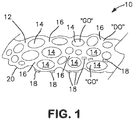
- FIG. 1 there is illustrated in cross-section a portion of an exemplary wound treatment device 10 (not necessarily to scale).
- the device includes a formed biocompatible polymeric matrix 12.
- the biocompatible polymeric matrix 12 is used for the delivery of oxygen.
- the matrix may include a water swellable, cross-linked biocompatible polymer network.
- Exemplary biocompatible matrices and techniques to form the same are disclosed by U.S. Patent No. 8,679,523 issued March 25, 2014 to Gibbins et al.
- the matrix 12 includes closed cells 14 and walls 16. That is, a plurality of gas-permeable, elastic, closed cells is defined by the cross-linked biocompatible polymer network.
- the biocompatible matrix may be a biocompatible polymeric matrix that includes a polymer and a catalyst and the closed cells may be produced from a reaction between a catalyst and a second reactant (e.g., a peroxide).
- Deliverable oxygen is contained within the elastic closed cells such that when the device is used to treat a wound, oxygen is delivered from the closed cells.
- gaseous oxygen "GO” is contained in the closed cells 14 and dissolved oxygen "DO" is present in moisture in the walls 16.
- the biocompatible polymer network is formed from a biocompatible polymer that can be cross-linked into a water-swellable polymer network.
- the cross-linked polymer network should be flexible such that it can define elastic, closed cells that are also gas permeable.
- a variety of polymers either naturally derived or synthetic may be used to prepare polymer network. Polymers that are cross-linkable and biocompatible are preferred.
- Exemplary polymers include, but are not limited to, hyaluronic acid and its derivatives, alginic acid and its derivatives, collagen, chitosan, chitin, starch derivatives, gums such guar gum, xanthan gum, citric acid based polymers, lactic acid and glycolic acid based polymers, poly(aspartates), poly(orthoesters), poly (phosphazenes), poly(anhydrides), poly(phosphoesters) and polyalkylene glycol based polymers.
- exemplary polymers include, but are not limited to polylysine, polyacrylamide, polymethacrylate, polyethylene, polyacrylate, polybuterate, polyurethane foam, polyether, silastic, silicone elastomer, rubber, nylon, vinyl or cross-linked dextran. If cross-linked dextran is used, it is preferred that the molecular weight of the dextran polymer is between 50,000 and 500,000. Additionally, the matrix material can be made from a combination of natural and synthetic polymers, or mixtures of synthetic polymers or mixtures of natural polymers.
- the second reactant is desirably hydrogen peroxide.
- peroxides including, but not limited to, urea peroxide, sodium peroxide and other peroxy compounds can be used provided they leave no residue that would be inconsistent with biocompatibility and/or bioabsorption.
- the present invention contemplates use of components that can generate a gaseous element within the matrix and that are safe and effective for use.
- an acid catalyst can be incorporated in the matrix followed by perfusion of the matrix with a carbonate to generate carbon dioxide gas within the matrix. Such materials are then used to buffer solutions or environments.
- the catalyst may be sodium carbonate.
- other catalysts such as other alkali and alkali earth compounds may be used provided they are consistent with the product being biocompatible.
- more than one catalyst may be used.
- one catalyst may be derived from a group consisting of salts of alkali metals and alkali earth metals and the second catalyst may include, but are not limited to, organic and inorganic chemicals such as cupric chloride, ferric chloride, manganese oxide, sodium iodide and their equivalents.
- Other catalysts include, but are not limited to enzymes such as lactoperoxidase and catalase.
- the biocompatible matrix may include a non-gellable polysaccharide.
- suitable non-gellable polysaccharides include guar gum, guar gum, lucerne, fenugreek, honey locust bean gum, white clover bean gum, or carob locust bean gum.
- the biocompatible matrix may further include a plasticizer.
- the plasticizers may be glycerol and/or water, however, propylene glycol and/or butanol and combinations thereof may also be used. If glycerol is used, a range of between approximately 0.25 to 25% w/w, preferably between 0.5 to 12% w/w.
- the biocompatible matrix may further include a hydration control agent.
- the hydration control agent may be an isopropyl alcohol; however, ethanol, glycerol, butanol, and/or propylene glycol and combinations thereof may also be used.
- the degree of water-swelling may be increased by adding a non-gellable polysaccharide such as guar gum and by adding a hydration control agent such as glycerol.
- the second reactant e.g., hydrogen peroxide
- the second reactant may be absorbed into the cross-linked biocompatible polymer network.
- water absorption capacity expressed as "water absorption capacity" at 25 degrees Centigrade after an immersion or soak time in distilled water after 3 to 4 hours.
- Useful levels of water absorption capacity may range from about 2 to about 8 grams of water per gram of biocompatible polymer network.
- the level of water absorption capacity may range from about 3 to about 7 grams of water per gram of biocompatible polymer network.
- the level of water absorption capacity may range from about 4 to about 6 grams of water per gram of biocompatible polymer network.
- the biocompatible matrix may further include a water loss control agent.
- water loss control agents may be applied to a surface of the device. Application of water loss control agents may be useful since a decrease in the permeability of the device controls the loss of fluids. Suitable water loss control agents include glycolipids, ceramides, free fatty acids, cholesterol, triglycerides, sterylesters, cholesteryl sulfate, linoleic ethyl ester, and silicone oil. Additionally, the compositions and devices may have an impermeable sheet covering one or more surfaces to aid in control of moisture.
- the biocompatible polymeric matrix may be in the form of one or more gas reservoirs having one or more types of gas contained therein such as generally described in U.S. Patent No. 8,075,537 issued December 13, 2011 to Franklin et al. for a "Multiple Cell Therapeutic Diffusion Device".
- the gas reservoir may be made of a gas permeable polymeric film or may incorporate portions made of such materials.
- the gas reservoir may also be in the form of a "bubble wrap" type materials containing oxygen gas wherein at least a portion of the individual cells is permeable to oxygen gas.
- the gas reservoir may be in the form of a chamber or bag used to administer hyperbaric treatment gas to a region of the skin as described in U.S. Patent No. 4,224,941 issued September 30, 1980 to Stivala for "Hyperbaric Treatment Apparatus".
- One or more antimicrobial silver material(s) 18 is present on at least a skin-contacting portion 20 of the matrix 12.
- the antimicrobial silver material 18 may be incorporated throughout the matrix 12 as a result of inclusion in the matrix 12 during compounding.
- the antimicrobial silver material 18 may be applied to the matrix 12 utilizing dipping, coating, deposition processes, spraying processes or similar techniques.
- the one or more antimicrobial silver material 18 may be a silver salt, a silver complex, elemental silver, or a combination thereof.
- the antimicrobial silver may be a silver salt and a silver complex.
- the antimicrobial silver may be elemental silver by itself or in combination with a silver salt and/or a silver complex.
- the elemental silver may be an elemental silver material selected from silver powder and silver nanoparticles. Exemplary antimicrobial silver nanoparticle materials are disclosed in U.S. Patent No. 8,361,553 issued January 29, 2013 to Karandikar et al. for "Methods and Compositions for Metal Nanoparticle Treated Surfaces".
- the antimicrobial silver material 18 is not necessarily shown to scale and may be a thin film coating that is residue of a silver salt or silver complex sol or solution and/or may be particles including nano-scale particles (i.e., nanoparticles).
- the antimicrobial silver material may be present in a concentration of from about 0.001 weight percent to less than 0.5 weight percent.
- the antimicrobial silver material may be present in a concentration of from about 0.0025 weight percent to less than 0.5 weight percent.
- the antimicrobial silver material may be present in a concentration of from about 0.005 weight percent to less than 0.5 weight percent.
- the antimicrobial silver material may be present in a concentration of from about 0.0075 weight percent to about 0.25 weight percent.
- the antimicrobial silver material may be present in relatively low concentrations such as from about 0.025 to about 0.05 weight percent. It is believed that the present invention potentiates antimicrobial silver materials when such materials are present at levels less than 0.0025 or even 0.001 weight percent.
- the antimicrobial silver materials may be present at levels from about 0.000001 to about 0.001 weight percent.
- the devices of the present invention may take many physical forms, depending on uses of the devices. These devices may be left in place and then removed. If the devices are biosorbable, they may be resorbed by the body, instead of being removed.
- a preferred shape is a gel sheet that can be cut or molded into any two dimensional shape. Other preferred embodiments are primarily constructed of thin strands of matrix suitable for placement into the wound bed or cavity.
- the devices may be placed in their entirety into a wound, placed in combination with additional bundles of the same design into the wound, or cut through the bridge between strands to reduce the size or number of strands present in the wound.
- Exemplary structures include, but are not limited to, those described in U.S. Patent No. 5,928,174 for "Wound Dressing Device” issued July 27, 1999 to Gibbins.
- the antimicrobial silver material when the device is used to treat a wound, oxygen is delivered from the closed cells in the presence of the antimicrobial silver material such that the antimicrobial silver material provides greater microbial kill than antimicrobial silver material alone.
- the antimicrobial silver material may provide at least a 3 log increase in microbial kill than just the antimicrobial silver material alone as measured by antimicrobial challenge assays.
- the antimicrobial silver material may provide at least a 3 log increase in microbial kill for gram-positive bacteria within three hours of treatment than just the antimicrobial silver material alone as measured by antimicrobial challenge assays.
- the antimicrobial silver material may provide at least a 1 log increase in microbial kill for gram-negative bacteria within three hours of treatment than just the antimicrobial silver material alone as measured by antimicrobial challenge assays.
- oxygen when supplied for the purposes of wound healing, it is known to help with some metabolic processes that rely on oxygen during wound healing.
- oxygen by itself is not known to be antimicrobial except in the case of certain types of anaerobic bacteria (obligate anaerobes) and is not typically understood as lowering bio-burden in the wound.
- silver and molecular oxygen provides a synergistic effect on both aerobic ( Psuedomonas aeruginosa ) and anaerobic ( Methicillin-resistant Staphylococcus aureus - MRSA) bacteria. While it might not be entirely surprising to observe that oxygen and silver may be more effective against an obligate anaerobe than silver alone, the inventors believe that the boost in efficacy against a facultative anaerobe (e.g., MRSA ), which does metabolize oxygen, provided by the combination of oxygen and silver is surprising and unexpected. Similarly it also surprising and unexpected to see the same increase in efficacy provided by oxygen and silver against a fully aerobic organism like Psuedomonas aeruginosa. Moreover, It can also be shown that silver is more effective at lower concentrations in the presence of dissolved oxygen than just silver alone.
- MRSA Methicillin-resistant Staphylococcus aureus - MRSA
- silver containing compounds with extremely low dissociation constants tend to show very little if any antimicrobial activity since there is such a low level of dissociation of silver ions. This is especially true of silver when it forms complexes with molecules that possess functional groups containing sulfur, like thiols or disulfides. It is believed that the antimicrobial efficacy of silver may be related to silver binding with thiols found in proteins from bacterial cell walls and internal organelles. This is thought to disrupt the proteins' tertiary structure and renders them unable to function. Many of the proteins found in wounds come from the patient's own wound exudate and/or microbial biofilms.
- the inventors have found that the presence of oxygen (e.g., oxygen topically available at a wound or tissue surface) in combination with antimicrobial silver materials in the wound environment appears to mitigate this effect and increase the antimicrobial effectiveness of the silver in the wound environment. This increase in antimicrobial effectiveness of the silver in the wound environment is thought to take place even in spite of reduced silver ion concentrations.
- oxygen e.g., oxygen topically available at a wound or tissue surface
- the present invention further encompasses a method of potentiating antimicrobial silver material against pathogens.
- the method includes the steps of: providing an antimicrobial silver material to a surface or article to be treated; providing oxygen at the surface or article at greater than atmospheric concentration in the presence of the antimicrobial silver so the antimicrobial silver material provides greater microbial kill than antimicrobial silver material alone.
- the surface can be the skin or a wound.
- the article or surface can be an inanimate surface (i.e., a surface that is not the surface of a human or animal body). Any suitable inanimate article or surface can be treated, such as a medical device; a piece of medical equipment; industrial or household surfaces such as countertops, shelves, etc.; consumer products; etc.
- the method can further encompass providing an antimicrobial silver material and providing oxygen at greater than atmospheric concentration to a wound.
- the antimicrobial silver materials may be silver nanoparticles or silver powder.
- the antimicrobial silver materials may be silver salts or silver complexes.
- the concentration of these antimicrobial silver materials may be present in a concentration of from about 0.001 weight percent to less than 0.5 weight percent, but desirably are present at concentrations of less than 0.5 weight percent.
- the antimicrobial silver material may be present in a concentration of from about 0.0025 weight percent to less than 0.5 weight percent.
- the antimicrobial silver material may be present in a concentration of from about 0.005 weight percent to about 0.4 weight percent.
- the antimicrobial silver material may be present in a concentration of from about 0.0075 weight percent to about 0.25 weight percent.
- the antimicrobial silver material when carrying out the method of the present invention in connection with wounds, may be present in relatively low concentrations such as from about 0.025 to about 0.05 weight percent. It is believed that the present invention potentiates antimicrobial silver materials when such materials are present at levels less than 0.0025 or even 0.001 weight percent. For example, the antimicrobial silver materials may be present at levels from about 0.000001 to about 0.001 weight percent.
- the oxygen may be provided from a formed matrix that includes closed cells and walls, wherein gaseous oxygen is contained in the closed cells and dissolved oxygen is present in moisture in the walls, and the antimicrobial silver material may be provided from antimicrobial silver material present on a portion of the matrix.
- the present invention also encompasses a wound dressing that includes an oxygen delivery component and an antimicrobial silver material, such that when the wound dressing is used to treat a wound, oxygen is delivered in the presence of the antimicrobial silver material so the antimicrobial silver material provides greater microbial kill than antimicrobial silver material alone.
- the antimicrobial silver material may be silver nanoparticles and/or silver power. Alternatively and/or additionally, the antimicrobial silver material may be silver salts and/or silver complexes.
- embodiments not in accordance with the present invention may utilize higher concentrations of antimicrobial silver material (e.g., up to 2 weight percent, up to 1 weight percent), it is believed that the potentiating presence of oxygen allows the antimicrobial silver material to be present and effective in relatively low concentrations such as from about 0.025 to less than 0.05 weight percent. It is believed that the present invention potentiates antimicrobial silver materials when such materials are present at levels less than 0.0025 or even 0.001 weight percent. For example, the antimicrobial silver materials may be present at levels from about 0.000001 to about 0.001 weight percent.
- An exemplary method of treating or preventing microbial infection in a mammal which is not encompassed by the claimed invention administering an antimicrobial silver material to a site to be treated and providing oxygen at the site at greater than atmospheric concentration in the presence of the antimicrobial silver so the antimicrobial silver material provides greater microbial kill than antimicrobial silver material alone.
- Another exemplary method comprises treating a bacterial infection by administering an antimicrobial silver material and providing oxygen at greater than atmospheric concentration in the presence of the antimicrobial silver so the antimicrobial silver material provides greater microbial kill than antimicrobial silver material alone.
- Another exemplary method comprises enhancing wound healing by administering an antimicrobial silver material to a wound and providing oxygen to the wound at greater than atmospheric concentration in the presence of the antimicrobial silver so the antimicrobial silver material provides greater microbial kill than antimicrobial silver material alone.
- the antimicrobial silver material may be silver nanoparticles and/or silver power. Alternatively and/or additionally, the antimicrobial silver material may be silver salts and/or silver complexes. While embodiments not in accordance with the present invention, may utilize higher concentrations of antimicrobial silver material (e.g., up to 2 weight percent, up to 1 weight percent), it is believed that the potentiating presence of oxygen allows the antimicrobial silver material to be effectively administered in relatively low concentrations such as from about 0.025 to less than 0.05 weight percent. It is believed that the present invention potentiates antimicrobial silver materials when such materials are administered at levels less than 0.0025 or even 0.001 weight percent. For example, the antimicrobial silver materials may be administered at levels from about 0.000001 to about 0.001 weight percent.
- the antimicrobial silver and the oxygen may be provided utilizing the above-described matrix structures and/or the compositions.
- the process generally involves at least the steps of: providing a gelling mixture of at least one cross-linkable biocompatible polymer and a catalyst; cross-linking the biocompatible polymer of the gelling mixture to form a water swellable, cross-linked biocompatible polymer network; drying the gelling mixture to a gel sheet; adding a second reactant to the gel sheet; and generating a plurality of closed cells (i.e., closed cells and walls) containing oxygen in the gel sheet by reacting the catalyst and the second reactant.
- closed cells i.e., closed cells and walls
- the antimicrobial silver material may be added to the mixture during compounding (e.g., added to the gelling mixture) or may be applied after the gel sheet is formed or after the plurality of closed cells containing oxygen is formed in the gel sheet.
- the antimicrobial silver material may be added to the gel sheet by dipping, coating, spraying or similar processes.
- the antimicrobial silver can be incorporated directly into small cavities of the formed matrix of the wound treatment device by spraying or coating or by incorporation during the polymerization of the matrix. It is thought that the release of the antimicrobial silver ions may be controlled by manipulation of antimicrobial silver concentration, movement of water through the matrix, and the degree of cross linking in the matrix. In some instances, the release of the antimicrobial silver ions may be controlled by the erosion rate of the matrix in vivo.
- the process for making an exemplary wound treatment device of the present invention generates a biocompatible matrix for delivering oxygen and for providing antimicrobial silver.
- a feature of the biocompatible matrix is the formation of the foam or array of bubbles that entrap the gas.
- the foam or bubbles are formed by the permeation of the second reactant added to the formed matrix that includes a reactant. When the two reactants interact, a reaction occurs that liberates gas which is entrapped within the matrix.
- a matrix has a carbonate catalyst (a reactant) incorporated within it.
- the formed matrix is then placed in the presence of the second reactant (e.g., a peroxide compound such as, for example, hydrogen peroxide).
- a catalytic decomposition of hydrogen peroxide occurs resulting in the liberation of oxygen gas which becomes entrapped as bubbles formed in situ.
- the hydrogen peroxide reactant is not part of the compounding of the matrix, but it is in the treatment after the formation of the matrix stock.
- a gelling mixture of at least one cross-linkable biocompatible polymer is prepared. This may be accomplished by creating a solution of a cross-linkable biocompatible polymer or a solution composed of a mixture of cross-linkable biocompatible polymers.
- the solution is desirably an aqueous solution or a solution where water component is the major component.
- antimicrobial silver material may be added to the gelling mixture.
- silver salts, silver complexes, silver nanoparticles and/or silver powder may be added to the gelling mixture.
- a catalyst may be introduced into the gelling mixture.
- the catalyst may be sodium carbonate.
- other catalysts such as other alkali and alkali earth compounds may be used provided they are consistent with the product being biocompatible.
- more than one catalyst may be used.
- one catalyst may be derived from a group consisting of salts of alkali metals and alkali earth metals and the second catalyst may include, but are not limited to, organic and inorganic chemicals such as cupric chloride, ferric chloride, manganese oxide, sodium iodide and their equivalents.
- Other catalysts include, but are not limited to enzymes such as lactoperoxidase and catalase.
- the catalyst is a material that interacts with the second reactant.
- a non-gellable polysaccharide, plasticizer and/or a hydration control agent may be added to the gelling mixture.
- the non-gellable polysaccharide is a non-gellable galactomannan macromolecule such a guar gum.
- a concentration range of guar gum between approximately 0.005 to 53% w/w, preferably between approximately 0.05 to 5% w/w, and most preferably between approximately 0.25 to 1% w/w is generally sufficient.
- suitable non-gellable polysaccharides include lucerne, fenugreek, honey locust bean gum, white clover bean gum, or carob locust bean gum.
- the plasticizer(s) may be glycerol and/or water, however, propylene glycol and/or butanol and combinations thereof may also be used. If glycerol is used, a range of between approximately 0.25 to 25% w/w, preferably between 0.5 to 12% w/w, and most preferably between approximately 2.5 to 8% w/w is generally sufficient.
- the biocompatible matrix may further include a hydration control agent.
- the hydration control agent may be an isopropyl alcohol; however, ethanol, glycerol, butanol, and/or propylene glycol and combinations thereof may also be used.
- the cross-linkable biocompatible polymer of the gelling mixture is then cross-linked to form a water swellable, cross-linked biocompatible polymer network.
- This may be accomplished by activating a cross-linking agent already present in the gelling mixture, adding or applying a cross-linking agent to the gelling mixture, dehydrating or removing solvent from the gelling mixture, and/or otherwise creating conditions in the gelling mixture that causes cross-linking (e.g., pH, heat, various forms of radiation including electromagnetic radiation and x-rays, ultrasonic energy, microwave energy and the like).
- the gelling mixture may be cross-linked by activating a cross-linking agent and dehydrating the gelling mixture to a flexible substrate (i.e., a gel sheet) that can be readily handled.
- a flexible substrate i.e., a gel sheet
- the gel sheet may range in thickness from a few millimeters to 20 millimeters or more.
- the gelling mixture may be cross-linked by pouring into a flat open container to maximize surface area and placing the open contain in a conventional oven at an elevated temperature (e.g., 45 to 65°C) and dehydrating for 2 to 6 hours until the sheet reaches a consistency similar to "fruit leather" or "fruit roll-up".
- Fruit leather or fruit roll-up has a gravimetric or weight-based moisture content of about 10 to about 20 percent.
- the matrix is flexible and elastic, and may be a semi-solid scaffold that is permeable to substances such as aqueous fluids, silver salts, and dissolved gaseous agents including oxygen.
- substances such as aqueous fluids, silver salts, and dissolved gaseous agents including oxygen.
- Antimicrobial silver material may be added to the gel sheet at this point in the process.
- silver salts, silver complexes, silver nanoparticles and/or silver powder may be added by spraying, dipping or coating.
- a second reactant is then added to the gel sheet. This may be accomplished by immersing the gel sheet in the second reactant, or by spraying, brushing, coating or applying the second reactant.
- the second reactant is hydrogen peroxide.
- the hydrogen peroxide may be from 5% wt. to 20% or more.
- Other peroxides may be substituted, including, but not limited to, urea peroxide, sodium peroxide or other peroxy compounds of alkali metal or alkali earth metals.
- the second reactant preferably is present in aqueous solution or a solution wherein water is major component.
- the second reactant is absorbed into the gel sheet and permeates the swellable, (e.g., water-swellable) cross-linked biocompatible polymer matrix.
- the degree of swelling may be increased by adding a non-gellable polysaccharide such as guar gum and by adding a hydration control agent such as glycerol.
- the second reactant e.g., hydrogen peroxide
- the cross-linked biocompatible polymer network sufficiently water-swellable, the second reactant (e.g., hydrogen peroxide) may be adequately absorbed into the cross-linked biocompatible polymer network.
- a gas is generated when the catalyst (i.e., the first reactant) reacts with the second reactant.
- the resulting gas is desirably oxygen gas.
- the matrix of the present invention forms a foam or array of bubbles that entrap the gas. That is, a plurality of closed cells containing oxygen is generated in the gel sheet by reaction between the catalyst (i.e., the first reactant) and the second reactant.
- a cross-linked biocompatible polymer matrix may have a carbonate catalyst (i.e., a first reactant) incorporated within it.
- the cross-linked biocompatible polymer matrix is then placed in the presence of the second reactant, hydrogen peroxide.
- a catalytic decomposition of hydrogen peroxide occurs resulting in the liberation of oxygen gas which becomes entrapped as bubbles formed in situ.
- the hydrogen peroxide reactant is not part of the compounding of the matrix, but it is added after the formation of the matrix stock.
- the gel sheet transforms into a foam sheet.
- Antimicrobial silver material may be added to the gel sheet at this point in the process.
- silver salts, silver complexes, silver nanoparticles and/or silver powder may be added by spraying, dipping or coating.
- the process may further include the step of heating or adding energy to the gel sheet and second reactant to speed up the reaction or to enhance incorporating of antimicrobial silver material.
- one or more antimicrobial silver materials e.g., silver salts, silver complexes, silver nanoparticles and/or silver powder
- antimicrobial silver materials may be incorporated at any suitable step in the method.
- antimicrobial silver materials may be added to the gelling mixture prior to cross-linking
- antimicrobial silver materials may be added to the cross-linked polymer matrix prior to dehydration or after dehydration
- antimicrobial silver materials may be added to the cross-linked polymer matrix after the closed cells are formed.
- a polymer matrix containing oxygen gas was produced as an exemplary wound treatment device to deliver oxygen and antimicrobial silver material.
- the device was a closed cell foam sheet with oxygen gas contained in the cells of the foam.
- the closed cell foam sheet was made in accordance with the process described in the Detailed Description above and U.S. Patent No. 7,160,553 issued January 9, 2007 to Gibbins et al. for "Matrix For Oxygen Delivery To Compromised Tissues" and U.S. Patent No. 8,679,523 issued Mary 25, 2014 to Gibbins et al. for "Oxygen-Delivery Closed Cell Foam Matrix For Wound Treatment".
- the ingredients and their concentrations are listed in Table 1 below.
- the closed cell foam sheet was sprayed or dip coated with a silver nanoparticle solution in a non-polar organic solvent to impart a coating of silver nanoparticles on the surface of the sheet.
- the wound treatment device would be placed on a wound where it would then release the oxygen into the wound fluid.
- the silver would also be released such that the combination of silver and oxygen would yield the synergistic benefit described in the previous section.
- the silver nanoparticle coating resulted in an overall silver concentration of approximately 2000ppm (about 0.2 weight percent).
- the coating was applied by dipping the foamed dressing in an organic solvent containing silver nanoparticles.
- the sliver nanoparticle solvent was heptane which has the advantage of having a high vapor pressure which can be easily evaporated leaving behind only silver nanoparticles.
- a polymer matrix containing oxygen gas was produced as an exemplary wound treatment device to deliver oxygen and antimicrobial silver material.
- the device was a closed cell foam sheet with oxygen gas contained in the cells of the foam.
- the closed cell foam sheet was made in accordance with the process described in the Detailed Description above and U.S. Patent No. 7,160,553 issued January 9, 2007 to Gibbins et al. for "Matrix For Oxygen Delivery To Compromised Tissues" and U.S. Patent No. 8,679,523 issued Mary 25, 2014 to Gibbins et al. for "Oxygen-Delivery Closed Cell Foam Matrix For Wound Treatment".
- the ingredients and their concentrations are listed in Table 2 below.
- the wound treatment device In use, the wound treatment device would be placed on a wound where it would then release the oxygen into the wound fluid. The silver would also be released such that the combination of silver and oxygen would yield the synergistic benefit described in the previous section.
- the silver chloride was incorporated into the gel sheet by adding sodium chloride and silver nitrate as solutions into the pre-polymerized mixture. Once the two are combined, silver chloride precipitates and is present generally throughout the closed cell foam sheet. The addition of silver chloride into the polymer mix solution resulted in an overall silver concentration of approximately 1000ppm (about 0.1 weight percent). The raw stock had a very slight darkening due to discoloration by the silver chloride. It was observed that the closed cell foam sheet did not disintegrate even after soaking overnight in deionized H 2 O. No residual HOOH was detected.
- samples containing silver nitrate were compared to samples containing both silver nitrate and oxygen gas in an antimicrobial challenge test to demonstrate the synergy between oxygen and silver.
- TTB tryptic soy broth
- ATC 9027 Pseudomonas aeruginosa
- the second sample was prepared similarly to sample 1 with the silver nitrate except that the headspace of the test tube was flooded with 100% oxygen gas (O 2 ) and then sealed.
- Sample 1 which contained only silver, showed a 2 log reduction in the number of CFU after 3 hours and a 3 log reduction in the number of CFU after 6 hours.
- Sample 2 the silver and oxygen samples, showed a 3.2 log reduction in the number of CFU after 3 hours and a 4.5 log reduction in the number of CFU after 6 hours.
- FIG. 2 is an illustration of a graph depicting the log reduction in CFU on the y-axis and time (hours) on the x-axis.
- this example demonstrates the potentiating effect of gaseous oxygen on relatively low concentrations of antimicrobial silver. That is, the antimicrobial silver was present at 0.03 ppm silver (approximately 0.000003 weight percent).
- TSB tryptic soy broth
- MRSA Methicillin-resistant Staphylococcus aureus - MRSA (Clinical isolate).
- the second sample was prepared similarly using another 10ml of 95% TSB that was inoculated to the same 10 5 CFU but then spiked with silver nitrate until the final the final concentration was 3000 ppm silver (approximately 0.3 weight percent).
- the third sample was prepared similarly to Sample 2 with the silver nitrate except that the headspace of the test tube was flooded with 100% oxygen gas (O 2 ) and then sealed.).
- the fourth sample was prepared similarly to Sample 1 except that the headspace of the test tube was flooded with 100% oxygen gas (O 2 ) and then sealed.
- the oxygen in the headspace diffused in to the TSB in order to simulate the effect of an oxygen-delivering wound dressing as described in Examples 1 and 2.
- Each test sample was then incubated at 37°C; the level of surviving organisms was tested after 3 hours and 6 hours for each.
- FIG. 3 is an illustration of a graph depicting the log reduction in CFU on the y-axis and time (hours) on the x-axis. These results show a clear improvement in the log reduction for MRSA when silver is used in conjunction with oxygen (Sample 3). At 3 hours the silver samples show a 2.12 log reduction while the silver + oxygen samples show a 5.32 log reduction. After only 3 hours, the silver + oxygen samples provide more than a 3.2 log reduction in the number of CFU (i.e., a reduction by a factor of 1500) over the silver alone.
- the silver + oxygen (Sample 3) samples show a 6.26 total log reduction versus a 2.5 log reduction from silver alone (Sample 2).
- the silver + oxygen samples provide more than a 3.76 log reduction in the number of CFU (i.e., a reduction by a factor of 5700) over the silver alone.
- Controls were run in which contained oxygen gas alone (with no silver - Sample 4) and media only (no silver or O 2 - Sample 1). These are represented by the negative bars in the graph above which indicates that there was an increase (as expected) in the amount of colony forming units throughout the duration of the testing.
Landscapes
- Health & Medical Sciences (AREA)
- Chemical & Material Sciences (AREA)
- Veterinary Medicine (AREA)
- Life Sciences & Earth Sciences (AREA)
- Animal Behavior & Ethology (AREA)
- General Health & Medical Sciences (AREA)
- Public Health (AREA)
- Engineering & Computer Science (AREA)
- Hematology (AREA)
- Materials Engineering (AREA)
- Epidemiology (AREA)
- Chemical Kinetics & Catalysis (AREA)
- General Chemical & Material Sciences (AREA)
- Medicinal Chemistry (AREA)
- Nuclear Medicine, Radiotherapy & Molecular Imaging (AREA)
- Organic Chemistry (AREA)
- Pharmacology & Pharmacy (AREA)
- Dispersion Chemistry (AREA)
- Dermatology (AREA)
- Oncology (AREA)
- Communicable Diseases (AREA)
- Bioinformatics & Cheminformatics (AREA)
- Inorganic Chemistry (AREA)
- Materials For Medical Uses (AREA)
- Pharmaceuticals Containing Other Organic And Inorganic Compounds (AREA)
- Medicinal Preparation (AREA)
- Agricultural Chemicals And Associated Chemicals (AREA)
- Apparatus For Disinfection Or Sterilisation (AREA)
Applications Claiming Priority (2)
| Application Number | Priority Date | Filing Date | Title |
|---|---|---|---|
| US201462017350P | 2014-06-26 | 2014-06-26 | |
| PCT/US2015/035977 WO2015200037A1 (en) | 2014-06-26 | 2015-06-16 | Antimicrobial compositions utilizing silver and oxygen, process for making, and method of using the same |
Publications (2)
| Publication Number | Publication Date |
|---|---|
| EP3160523A1 EP3160523A1 (en) | 2017-05-03 |
| EP3160523B1 true EP3160523B1 (en) | 2020-04-01 |
Family
ID=53487460
Family Applications (1)
| Application Number | Title | Priority Date | Filing Date |
|---|---|---|---|
| EP15731475.8A Active EP3160523B1 (en) | 2014-06-26 | 2015-06-16 | Antimicrobial compositions utilizing silver and oxygen, process for making, and method of using the same |
Country Status (7)
| Country | Link |
|---|---|
| US (1) | US20170136140A1 (enExample) |
| EP (1) | EP3160523B1 (enExample) |
| JP (1) | JP2017529113A (enExample) |
| AU (1) | AU2015280400B2 (enExample) |
| CA (1) | CA2951934A1 (enExample) |
| MX (1) | MX2016015804A (enExample) |
| WO (1) | WO2015200037A1 (enExample) |
Families Citing this family (6)
| Publication number | Priority date | Publication date | Assignee | Title |
|---|---|---|---|---|
| US20170127740A1 (en) * | 2015-04-08 | 2017-05-11 | The Sneeve Llc | Antimicrobial Arm Sleeve |
| US10633590B2 (en) * | 2015-09-04 | 2020-04-28 | Dic Corporation | Liquid crystal composition and liquid crystal display device including the same |
| MX2018009575A (es) * | 2016-02-16 | 2018-09-06 | Avent Inc | Sistema y metodo para conservar y suministrar un gas terapeutico a una herida. |
| WO2020040781A1 (en) * | 2018-08-24 | 2020-02-27 | Avent, Inc. | Polymeric hydroperoxides as oxygen delivery agents |
| US20230372581A1 (en) * | 2022-05-19 | 2023-11-23 | The Board Of Trustees Of The University Of Illinois | Nano-hyperbaric wound healing therapeutic |
| CN117447674B (zh) * | 2023-12-22 | 2024-04-09 | 万华化学集团股份有限公司 | 一种聚氨酯弹性体组合物、聚氨酯弹性体及其制备方法 |
Citations (1)
| Publication number | Priority date | Publication date | Assignee | Title |
|---|---|---|---|---|
| US20080306183A1 (en) * | 2007-06-11 | 2008-12-11 | Joerg Leukel | Antimicrobial polyolefin and polyester compositions |
Family Cites Families (8)
| Publication number | Priority date | Publication date | Assignee | Title |
|---|---|---|---|---|
| US4224941A (en) | 1978-11-15 | 1980-09-30 | Stivala Oscar G | Hyperbaric treatment apparatus |
| US5928174A (en) | 1997-11-14 | 1999-07-27 | Acrymed | Wound dressing device |
| DE60028415T2 (de) | 1999-12-30 | 2007-06-06 | Acrymed, Portland | Methode und zusammensetzungen für verbesserte abgabevorrichtungen |
| US8361553B2 (en) * | 2004-07-30 | 2013-01-29 | Kimberly-Clark Worldwide, Inc. | Methods and compositions for metal nanoparticle treated surfaces |
| AU2007215443C1 (en) * | 2006-02-08 | 2014-06-12 | Avent, Inc. | Methods and compositions for metal nanoparticle treated surfaces |
| US20080147019A1 (en) * | 2006-12-19 | 2008-06-19 | Kimberly-Clark Worldwide, Inc. | Antimicrobial component system containing metallic nanoparticles and chitosan and/or its derivatives |
| US8075537B2 (en) | 2008-08-15 | 2011-12-13 | Oxyband Technologies, Inc. | Multiple cell therapeutic diffusion device |
| US9381269B2 (en) * | 2011-04-13 | 2016-07-05 | Avent, Inc. | Biosorbable wound treatment device, process for making, and method of using the same |
-
2015
- 2015-06-16 US US15/315,540 patent/US20170136140A1/en not_active Abandoned
- 2015-06-16 CA CA2951934A patent/CA2951934A1/en not_active Abandoned
- 2015-06-16 JP JP2016575204A patent/JP2017529113A/ja active Pending
- 2015-06-16 WO PCT/US2015/035977 patent/WO2015200037A1/en not_active Ceased
- 2015-06-16 AU AU2015280400A patent/AU2015280400B2/en not_active Ceased
- 2015-06-16 EP EP15731475.8A patent/EP3160523B1/en active Active
- 2015-06-16 MX MX2016015804A patent/MX2016015804A/es unknown
Patent Citations (1)
| Publication number | Priority date | Publication date | Assignee | Title |
|---|---|---|---|---|
| US20080306183A1 (en) * | 2007-06-11 | 2008-12-11 | Joerg Leukel | Antimicrobial polyolefin and polyester compositions |
Also Published As
| Publication number | Publication date |
|---|---|
| AU2015280400B2 (en) | 2019-01-31 |
| MX2016015804A (es) | 2017-04-25 |
| JP2017529113A (ja) | 2017-10-05 |
| AU2015280400A1 (en) | 2016-12-08 |
| CA2951934A1 (en) | 2015-12-30 |
| EP3160523A1 (en) | 2017-05-03 |
| WO2015200037A1 (en) | 2015-12-30 |
| US20170136140A1 (en) | 2017-05-18 |
Similar Documents
| Publication | Publication Date | Title |
|---|---|---|
| EP3160523B1 (en) | Antimicrobial compositions utilizing silver and oxygen, process for making, and method of using the same | |
| Ghobashy et al. | Radiation synthesis of pH-sensitive 2-(dimethylamino) ethyl methacrylate/polyethylene oxide/ZnS nanocomposite hydrogel membrane for wound dressing application | |
| EP1216065B1 (en) | Silver-containing compositions, devices and methods for making | |
| EP3451829B1 (en) | Anti-microbial compositions | |
| US11641856B2 (en) | Synergistic antibacterial activity of medium polarity oils in combination with antibacterial agents on bacterial biofilms | |
| Ma et al. | A photo-modulated nitric oxide delivering hydrogel for the accelerated healing of biofilm infected chronic wounds | |
| Ferreres et al. | Cobalt-phenolic nanoparticles-driven self-assembly of hyaluronic acid hydrogels providing a multifactorial approach for chronic wound management | |
| US20100087769A1 (en) | Biocidic medical devices, implants and wound dressings | |
| CN111068103B (zh) | 一种手术伤口用长效抑菌凝胶敷料及其制备方法 | |
| CA2692094C (en) | Antimicrobial compositions | |
| Chaudhary et al. | Smart Materials Design for Antibacterial Application | |
| RU2426525C1 (ru) | Профилактическая мазь для диабетической стопы | |
| Sousa et al. | Nanotechnology applied to medical biofilms control | |
| Zanoaga et al. | Antimicrobial Reagents as Functional Finishing for Textiles Intended for Biomedical Applications. III. Other Metals and Metallic Compounds | |
| KR20230060724A (ko) | 바이오 복합체 및 이의 제조방법 | |
| RU2427379C1 (ru) | Состав для профилактики и ухода за диабетической стопой | |
| ES2364672T3 (es) | Sustancias antimicrobianas. | |
| HK40005577B (en) | Anti-microbial compositions | |
| HK40005577A (en) | Anti-microbial compositions |
Legal Events
| Date | Code | Title | Description |
|---|---|---|---|
| STAA | Information on the status of an ep patent application or granted ep patent |
Free format text: STATUS: THE INTERNATIONAL PUBLICATION HAS BEEN MADE |
|
| PUAI | Public reference made under article 153(3) epc to a published international application that has entered the european phase |
Free format text: ORIGINAL CODE: 0009012 |
|
| STAA | Information on the status of an ep patent application or granted ep patent |
Free format text: STATUS: REQUEST FOR EXAMINATION WAS MADE |
|
| 17P | Request for examination filed |
Effective date: 20161221 |
|
| AK | Designated contracting states |
Kind code of ref document: A1 Designated state(s): AL AT BE BG CH CY CZ DE DK EE ES FI FR GB GR HR HU IE IS IT LI LT LU LV MC MK MT NL NO PL PT RO RS SE SI SK SM TR |
|
| AX | Request for extension of the european patent |
Extension state: BA ME |
|
| DAV | Request for validation of the european patent (deleted) | ||
| DAX | Request for extension of the european patent (deleted) | ||
| STAA | Information on the status of an ep patent application or granted ep patent |
Free format text: STATUS: EXAMINATION IS IN PROGRESS |
|
| 17Q | First examination report despatched |
Effective date: 20180530 |
|
| GRAP | Despatch of communication of intention to grant a patent |
Free format text: ORIGINAL CODE: EPIDOSNIGR1 |
|
| STAA | Information on the status of an ep patent application or granted ep patent |
Free format text: STATUS: GRANT OF PATENT IS INTENDED |
|
| INTG | Intention to grant announced |
Effective date: 20191014 |
|
| GRAS | Grant fee paid |
Free format text: ORIGINAL CODE: EPIDOSNIGR3 |
|
| GRAA | (expected) grant |
Free format text: ORIGINAL CODE: 0009210 |
|
| STAA | Information on the status of an ep patent application or granted ep patent |
Free format text: STATUS: THE PATENT HAS BEEN GRANTED |
|
| AK | Designated contracting states |
Kind code of ref document: B1 Designated state(s): AL AT BE BG CH CY CZ DE DK EE ES FI FR GB GR HR HU IE IS IT LI LT LU LV MC MK MT NL NO PL PT RO RS SE SI SK SM TR |
|
| REG | Reference to a national code |
Ref country code: GB Ref legal event code: FG4D |
|
| REG | Reference to a national code |
Ref country code: CH Ref legal event code: EP Ref country code: AT Ref legal event code: REF Ref document number: 1250520 Country of ref document: AT Kind code of ref document: T Effective date: 20200415 |
|
| REG | Reference to a national code |
Ref country code: DE Ref legal event code: R096 Ref document number: 602015049817 Country of ref document: DE |
|
| REG | Reference to a national code |
Ref country code: IE Ref legal event code: FG4D |
|
| PG25 | Lapsed in a contracting state [announced via postgrant information from national office to epo] |
Ref country code: BG Free format text: LAPSE BECAUSE OF FAILURE TO SUBMIT A TRANSLATION OF THE DESCRIPTION OR TO PAY THE FEE WITHIN THE PRESCRIBED TIME-LIMIT Effective date: 20200701 |
|
| REG | Reference to a national code |
Ref country code: NL Ref legal event code: MP Effective date: 20200401 |
|
| REG | Reference to a national code |
Ref country code: LT Ref legal event code: MG4D |
|
| PG25 | Lapsed in a contracting state [announced via postgrant information from national office to epo] |
Ref country code: SE Free format text: LAPSE BECAUSE OF FAILURE TO SUBMIT A TRANSLATION OF THE DESCRIPTION OR TO PAY THE FEE WITHIN THE PRESCRIBED TIME-LIMIT Effective date: 20200401 Ref country code: NL Free format text: LAPSE BECAUSE OF FAILURE TO SUBMIT A TRANSLATION OF THE DESCRIPTION OR TO PAY THE FEE WITHIN THE PRESCRIBED TIME-LIMIT Effective date: 20200401 Ref country code: LT Free format text: LAPSE BECAUSE OF FAILURE TO SUBMIT A TRANSLATION OF THE DESCRIPTION OR TO PAY THE FEE WITHIN THE PRESCRIBED TIME-LIMIT Effective date: 20200401 Ref country code: NO Free format text: LAPSE BECAUSE OF FAILURE TO SUBMIT A TRANSLATION OF THE DESCRIPTION OR TO PAY THE FEE WITHIN THE PRESCRIBED TIME-LIMIT Effective date: 20200701 Ref country code: GR Free format text: LAPSE BECAUSE OF FAILURE TO SUBMIT A TRANSLATION OF THE DESCRIPTION OR TO PAY THE FEE WITHIN THE PRESCRIBED TIME-LIMIT Effective date: 20200702 Ref country code: IS Free format text: LAPSE BECAUSE OF FAILURE TO SUBMIT A TRANSLATION OF THE DESCRIPTION OR TO PAY THE FEE WITHIN THE PRESCRIBED TIME-LIMIT Effective date: 20200801 Ref country code: CZ Free format text: LAPSE BECAUSE OF FAILURE TO SUBMIT A TRANSLATION OF THE DESCRIPTION OR TO PAY THE FEE WITHIN THE PRESCRIBED TIME-LIMIT Effective date: 20200401 Ref country code: FI Free format text: LAPSE BECAUSE OF FAILURE TO SUBMIT A TRANSLATION OF THE DESCRIPTION OR TO PAY THE FEE WITHIN THE PRESCRIBED TIME-LIMIT Effective date: 20200401 Ref country code: PT Free format text: LAPSE BECAUSE OF FAILURE TO SUBMIT A TRANSLATION OF THE DESCRIPTION OR TO PAY THE FEE WITHIN THE PRESCRIBED TIME-LIMIT Effective date: 20200817 |
|
| REG | Reference to a national code |
Ref country code: AT Ref legal event code: MK05 Ref document number: 1250520 Country of ref document: AT Kind code of ref document: T Effective date: 20200401 |
|
| PG25 | Lapsed in a contracting state [announced via postgrant information from national office to epo] |
Ref country code: HR Free format text: LAPSE BECAUSE OF FAILURE TO SUBMIT A TRANSLATION OF THE DESCRIPTION OR TO PAY THE FEE WITHIN THE PRESCRIBED TIME-LIMIT Effective date: 20200401 Ref country code: LV Free format text: LAPSE BECAUSE OF FAILURE TO SUBMIT A TRANSLATION OF THE DESCRIPTION OR TO PAY THE FEE WITHIN THE PRESCRIBED TIME-LIMIT Effective date: 20200401 Ref country code: RS Free format text: LAPSE BECAUSE OF FAILURE TO SUBMIT A TRANSLATION OF THE DESCRIPTION OR TO PAY THE FEE WITHIN THE PRESCRIBED TIME-LIMIT Effective date: 20200401 |
|
| PG25 | Lapsed in a contracting state [announced via postgrant information from national office to epo] |
Ref country code: AL Free format text: LAPSE BECAUSE OF FAILURE TO SUBMIT A TRANSLATION OF THE DESCRIPTION OR TO PAY THE FEE WITHIN THE PRESCRIBED TIME-LIMIT Effective date: 20200401 |
|
| REG | Reference to a national code |
Ref country code: DE Ref legal event code: R119 Ref document number: 602015049817 Country of ref document: DE |
|
| PG25 | Lapsed in a contracting state [announced via postgrant information from national office to epo] |
Ref country code: IT Free format text: LAPSE BECAUSE OF FAILURE TO SUBMIT A TRANSLATION OF THE DESCRIPTION OR TO PAY THE FEE WITHIN THE PRESCRIBED TIME-LIMIT Effective date: 20200401 Ref country code: RO Free format text: LAPSE BECAUSE OF FAILURE TO SUBMIT A TRANSLATION OF THE DESCRIPTION OR TO PAY THE FEE WITHIN THE PRESCRIBED TIME-LIMIT Effective date: 20200401 Ref country code: MC Free format text: LAPSE BECAUSE OF FAILURE TO SUBMIT A TRANSLATION OF THE DESCRIPTION OR TO PAY THE FEE WITHIN THE PRESCRIBED TIME-LIMIT Effective date: 20200401 Ref country code: AT Free format text: LAPSE BECAUSE OF FAILURE TO SUBMIT A TRANSLATION OF THE DESCRIPTION OR TO PAY THE FEE WITHIN THE PRESCRIBED TIME-LIMIT Effective date: 20200401 Ref country code: DK Free format text: LAPSE BECAUSE OF FAILURE TO SUBMIT A TRANSLATION OF THE DESCRIPTION OR TO PAY THE FEE WITHIN THE PRESCRIBED TIME-LIMIT Effective date: 20200401 Ref country code: ES Free format text: LAPSE BECAUSE OF FAILURE TO SUBMIT A TRANSLATION OF THE DESCRIPTION OR TO PAY THE FEE WITHIN THE PRESCRIBED TIME-LIMIT Effective date: 20200401 Ref country code: EE Free format text: LAPSE BECAUSE OF FAILURE TO SUBMIT A TRANSLATION OF THE DESCRIPTION OR TO PAY THE FEE WITHIN THE PRESCRIBED TIME-LIMIT Effective date: 20200401 Ref country code: SM Free format text: LAPSE BECAUSE OF FAILURE TO SUBMIT A TRANSLATION OF THE DESCRIPTION OR TO PAY THE FEE WITHIN THE PRESCRIBED TIME-LIMIT Effective date: 20200401 |
|
| REG | Reference to a national code |
Ref country code: CH Ref legal event code: PL |
|
| PLBE | No opposition filed within time limit |
Free format text: ORIGINAL CODE: 0009261 |
|
| STAA | Information on the status of an ep patent application or granted ep patent |
Free format text: STATUS: NO OPPOSITION FILED WITHIN TIME LIMIT |
|
| PG25 | Lapsed in a contracting state [announced via postgrant information from national office to epo] |
Ref country code: PL Free format text: LAPSE BECAUSE OF FAILURE TO SUBMIT A TRANSLATION OF THE DESCRIPTION OR TO PAY THE FEE WITHIN THE PRESCRIBED TIME-LIMIT Effective date: 20200401 Ref country code: SK Free format text: LAPSE BECAUSE OF FAILURE TO SUBMIT A TRANSLATION OF THE DESCRIPTION OR TO PAY THE FEE WITHIN THE PRESCRIBED TIME-LIMIT Effective date: 20200401 |
|
| 26N | No opposition filed |
Effective date: 20210112 |
|
| GBPC | Gb: european patent ceased through non-payment of renewal fee |
Effective date: 20200701 |
|
| PG25 | Lapsed in a contracting state [announced via postgrant information from national office to epo] |
Ref country code: LU Free format text: LAPSE BECAUSE OF NON-PAYMENT OF DUE FEES Effective date: 20200616 |
|
| REG | Reference to a national code |
Ref country code: BE Ref legal event code: MM Effective date: 20200630 |
|
| PG25 | Lapsed in a contracting state [announced via postgrant information from national office to epo] |
Ref country code: IE Free format text: LAPSE BECAUSE OF NON-PAYMENT OF DUE FEES Effective date: 20200616 Ref country code: GB Free format text: LAPSE BECAUSE OF NON-PAYMENT OF DUE FEES Effective date: 20200701 Ref country code: CH Free format text: LAPSE BECAUSE OF NON-PAYMENT OF DUE FEES Effective date: 20200630 Ref country code: FR Free format text: LAPSE BECAUSE OF NON-PAYMENT OF DUE FEES Effective date: 20200630 Ref country code: LI Free format text: LAPSE BECAUSE OF NON-PAYMENT OF DUE FEES Effective date: 20200630 |
|
| PG25 | Lapsed in a contracting state [announced via postgrant information from national office to epo] |
Ref country code: DE Free format text: LAPSE BECAUSE OF NON-PAYMENT OF DUE FEES Effective date: 20210101 Ref country code: BE Free format text: LAPSE BECAUSE OF NON-PAYMENT OF DUE FEES Effective date: 20200630 Ref country code: SI Free format text: LAPSE BECAUSE OF FAILURE TO SUBMIT A TRANSLATION OF THE DESCRIPTION OR TO PAY THE FEE WITHIN THE PRESCRIBED TIME-LIMIT Effective date: 20200401 |
|
| PG25 | Lapsed in a contracting state [announced via postgrant information from national office to epo] |
Ref country code: TR Free format text: LAPSE BECAUSE OF FAILURE TO SUBMIT A TRANSLATION OF THE DESCRIPTION OR TO PAY THE FEE WITHIN THE PRESCRIBED TIME-LIMIT Effective date: 20200401 Ref country code: MT Free format text: LAPSE BECAUSE OF FAILURE TO SUBMIT A TRANSLATION OF THE DESCRIPTION OR TO PAY THE FEE WITHIN THE PRESCRIBED TIME-LIMIT Effective date: 20200401 Ref country code: CY Free format text: LAPSE BECAUSE OF FAILURE TO SUBMIT A TRANSLATION OF THE DESCRIPTION OR TO PAY THE FEE WITHIN THE PRESCRIBED TIME-LIMIT Effective date: 20200401 |
|
| PG25 | Lapsed in a contracting state [announced via postgrant information from national office to epo] |
Ref country code: MK Free format text: LAPSE BECAUSE OF FAILURE TO SUBMIT A TRANSLATION OF THE DESCRIPTION OR TO PAY THE FEE WITHIN THE PRESCRIBED TIME-LIMIT Effective date: 20200401 |