EP3145476B1 - Gebrauchsartikel - Google Patents
Gebrauchsartikel Download PDFInfo
- Publication number
- EP3145476B1 EP3145476B1 EP15722870.1A EP15722870A EP3145476B1 EP 3145476 B1 EP3145476 B1 EP 3145476B1 EP 15722870 A EP15722870 A EP 15722870A EP 3145476 B1 EP3145476 B1 EP 3145476B1
- Authority
- EP
- European Patent Office
- Prior art keywords
- hydrophobic coating
- viscosity
- consumer product
- solid structure
- dissolvable solid
- Prior art date
- Legal status (The legal status is an assumption and is not a legal conclusion. Google has not performed a legal analysis and makes no representation as to the accuracy of the status listed.)
- Active
Links
Images

Classifications
-
- A—HUMAN NECESSITIES
- A61—MEDICAL OR VETERINARY SCIENCE; HYGIENE
- A61K—PREPARATIONS FOR MEDICAL, DENTAL OR TOILETRY PURPOSES
- A61K8/00—Cosmetics or similar toiletry preparations
- A61K8/02—Cosmetics or similar toiletry preparations characterised by special physical form
- A61K8/04—Dispersions; Emulsions
- A61K8/046—Aerosols; Foams
-
- A—HUMAN NECESSITIES
- A61—MEDICAL OR VETERINARY SCIENCE; HYGIENE
- A61K—PREPARATIONS FOR MEDICAL, DENTAL OR TOILETRY PURPOSES
- A61K8/00—Cosmetics or similar toiletry preparations
- A61K8/18—Cosmetics or similar toiletry preparations characterised by the composition
- A61K8/92—Oils, fats or waxes; Derivatives thereof, e.g. hydrogenation products thereof
-
- A—HUMAN NECESSITIES
- A61—MEDICAL OR VETERINARY SCIENCE; HYGIENE
- A61K—PREPARATIONS FOR MEDICAL, DENTAL OR TOILETRY PURPOSES
- A61K8/00—Cosmetics or similar toiletry preparations
- A61K8/02—Cosmetics or similar toiletry preparations characterised by special physical form
-
- A—HUMAN NECESSITIES
- A61—MEDICAL OR VETERINARY SCIENCE; HYGIENE
- A61K—PREPARATIONS FOR MEDICAL, DENTAL OR TOILETRY PURPOSES
- A61K8/00—Cosmetics or similar toiletry preparations
- A61K8/02—Cosmetics or similar toiletry preparations characterised by special physical form
- A61K8/0216—Solid or semisolid forms
-
- A—HUMAN NECESSITIES
- A61—MEDICAL OR VETERINARY SCIENCE; HYGIENE
- A61K—PREPARATIONS FOR MEDICAL, DENTAL OR TOILETRY PURPOSES
- A61K8/00—Cosmetics or similar toiletry preparations
- A61K8/02—Cosmetics or similar toiletry preparations characterised by special physical form
- A61K8/0241—Containing particulates characterized by their shape and/or structure
- A61K8/0279—Porous; Hollow
-
- A—HUMAN NECESSITIES
- A61—MEDICAL OR VETERINARY SCIENCE; HYGIENE
- A61K—PREPARATIONS FOR MEDICAL, DENTAL OR TOILETRY PURPOSES
- A61K8/00—Cosmetics or similar toiletry preparations
- A61K8/18—Cosmetics or similar toiletry preparations characterised by the composition
- A61K8/30—Cosmetics or similar toiletry preparations characterised by the composition containing organic compounds
- A61K8/31—Hydrocarbons
-
- A—HUMAN NECESSITIES
- A61—MEDICAL OR VETERINARY SCIENCE; HYGIENE
- A61K—PREPARATIONS FOR MEDICAL, DENTAL OR TOILETRY PURPOSES
- A61K8/00—Cosmetics or similar toiletry preparations
- A61K8/18—Cosmetics or similar toiletry preparations characterised by the composition
- A61K8/30—Cosmetics or similar toiletry preparations characterised by the composition containing organic compounds
- A61K8/33—Cosmetics or similar toiletry preparations characterised by the composition containing organic compounds containing oxygen
- A61K8/34—Alcohols
-
- A—HUMAN NECESSITIES
- A61—MEDICAL OR VETERINARY SCIENCE; HYGIENE
- A61K—PREPARATIONS FOR MEDICAL, DENTAL OR TOILETRY PURPOSES
- A61K8/00—Cosmetics or similar toiletry preparations
- A61K8/18—Cosmetics or similar toiletry preparations characterised by the composition
- A61K8/30—Cosmetics or similar toiletry preparations characterised by the composition containing organic compounds
- A61K8/33—Cosmetics or similar toiletry preparations characterised by the composition containing organic compounds containing oxygen
- A61K8/37—Esters of carboxylic acids
-
- A—HUMAN NECESSITIES
- A61—MEDICAL OR VETERINARY SCIENCE; HYGIENE
- A61K—PREPARATIONS FOR MEDICAL, DENTAL OR TOILETRY PURPOSES
- A61K8/00—Cosmetics or similar toiletry preparations
- A61K8/18—Cosmetics or similar toiletry preparations characterised by the composition
- A61K8/30—Cosmetics or similar toiletry preparations characterised by the composition containing organic compounds
- A61K8/33—Cosmetics or similar toiletry preparations characterised by the composition containing organic compounds containing oxygen
- A61K8/37—Esters of carboxylic acids
- A61K8/375—Esters of carboxylic acids the alcohol moiety containing more than one hydroxy group
-
- A—HUMAN NECESSITIES
- A61—MEDICAL OR VETERINARY SCIENCE; HYGIENE
- A61K—PREPARATIONS FOR MEDICAL, DENTAL OR TOILETRY PURPOSES
- A61K8/00—Cosmetics or similar toiletry preparations
- A61K8/18—Cosmetics or similar toiletry preparations characterised by the composition
- A61K8/30—Cosmetics or similar toiletry preparations characterised by the composition containing organic compounds
- A61K8/58—Cosmetics or similar toiletry preparations characterised by the composition containing organic compounds containing atoms other than carbon, hydrogen, halogen, oxygen, nitrogen, sulfur or phosphorus
- A61K8/585—Organosilicon compounds
-
- A—HUMAN NECESSITIES
- A61—MEDICAL OR VETERINARY SCIENCE; HYGIENE
- A61K—PREPARATIONS FOR MEDICAL, DENTAL OR TOILETRY PURPOSES
- A61K8/00—Cosmetics or similar toiletry preparations
- A61K8/18—Cosmetics or similar toiletry preparations characterised by the composition
- A61K8/72—Cosmetics or similar toiletry preparations characterised by the composition containing organic macromolecular compounds
- A61K8/81—Cosmetics or similar toiletry preparations characterised by the composition containing organic macromolecular compounds obtained by reactions involving only carbon-to-carbon unsaturated bonds
-
- A—HUMAN NECESSITIES
- A61—MEDICAL OR VETERINARY SCIENCE; HYGIENE
- A61K—PREPARATIONS FOR MEDICAL, DENTAL OR TOILETRY PURPOSES
- A61K8/00—Cosmetics or similar toiletry preparations
- A61K8/18—Cosmetics or similar toiletry preparations characterised by the composition
- A61K8/72—Cosmetics or similar toiletry preparations characterised by the composition containing organic macromolecular compounds
- A61K8/84—Cosmetics or similar toiletry preparations characterised by the composition containing organic macromolecular compounds obtained by reactions otherwise than those involving only carbon-carbon unsaturated bonds
- A61K8/89—Polysiloxanes
-
- A—HUMAN NECESSITIES
- A61—MEDICAL OR VETERINARY SCIENCE; HYGIENE
- A61K—PREPARATIONS FOR MEDICAL, DENTAL OR TOILETRY PURPOSES
- A61K8/00—Cosmetics or similar toiletry preparations
- A61K8/18—Cosmetics or similar toiletry preparations characterised by the composition
- A61K8/72—Cosmetics or similar toiletry preparations characterised by the composition containing organic macromolecular compounds
- A61K8/84—Cosmetics or similar toiletry preparations characterised by the composition containing organic macromolecular compounds obtained by reactions otherwise than those involving only carbon-carbon unsaturated bonds
- A61K8/89—Polysiloxanes
- A61K8/891—Polysiloxanes saturated, e.g. dimethicone, phenyl trimethicone, C24-C28 methicone or stearyl dimethicone
-
- A—HUMAN NECESSITIES
- A61—MEDICAL OR VETERINARY SCIENCE; HYGIENE
- A61K—PREPARATIONS FOR MEDICAL, DENTAL OR TOILETRY PURPOSES
- A61K8/00—Cosmetics or similar toiletry preparations
- A61K8/18—Cosmetics or similar toiletry preparations characterised by the composition
- A61K8/72—Cosmetics or similar toiletry preparations characterised by the composition containing organic macromolecular compounds
- A61K8/84—Cosmetics or similar toiletry preparations characterised by the composition containing organic macromolecular compounds obtained by reactions otherwise than those involving only carbon-carbon unsaturated bonds
- A61K8/89—Polysiloxanes
- A61K8/896—Polysiloxanes containing atoms other than silicon, carbon, oxygen and hydrogen, e.g. dimethicone copolyol phosphate
- A61K8/898—Polysiloxanes containing atoms other than silicon, carbon, oxygen and hydrogen, e.g. dimethicone copolyol phosphate containing nitrogen, e.g. amodimethicone, trimethyl silyl amodimethicone or dimethicone propyl PG-betaine
-
- A—HUMAN NECESSITIES
- A61—MEDICAL OR VETERINARY SCIENCE; HYGIENE
- A61Q—SPECIFIC USE OF COSMETICS OR SIMILAR TOILETRY PREPARATIONS
- A61Q1/00—Make-up preparations; Body powders; Preparations for removing make-up
-
- A—HUMAN NECESSITIES
- A61—MEDICAL OR VETERINARY SCIENCE; HYGIENE
- A61Q—SPECIFIC USE OF COSMETICS OR SIMILAR TOILETRY PREPARATIONS
- A61Q15/00—Anti-perspirants or body deodorants
-
- A—HUMAN NECESSITIES
- A61—MEDICAL OR VETERINARY SCIENCE; HYGIENE
- A61Q—SPECIFIC USE OF COSMETICS OR SIMILAR TOILETRY PREPARATIONS
- A61Q19/00—Preparations for care of the skin
-
- A—HUMAN NECESSITIES
- A61—MEDICAL OR VETERINARY SCIENCE; HYGIENE
- A61Q—SPECIFIC USE OF COSMETICS OR SIMILAR TOILETRY PREPARATIONS
- A61Q5/00—Preparations for care of the hair
-
- A—HUMAN NECESSITIES
- A61—MEDICAL OR VETERINARY SCIENCE; HYGIENE
- A61Q—SPECIFIC USE OF COSMETICS OR SIMILAR TOILETRY PREPARATIONS
- A61Q5/00—Preparations for care of the hair
- A61Q5/02—Preparations for cleaning the hair
-
- A—HUMAN NECESSITIES
- A61—MEDICAL OR VETERINARY SCIENCE; HYGIENE
- A61Q—SPECIFIC USE OF COSMETICS OR SIMILAR TOILETRY PREPARATIONS
- A61Q5/00—Preparations for care of the hair
- A61Q5/12—Preparations containing hair conditioners
-
- A—HUMAN NECESSITIES
- A61—MEDICAL OR VETERINARY SCIENCE; HYGIENE
- A61Q—SPECIFIC USE OF COSMETICS OR SIMILAR TOILETRY PREPARATIONS
- A61Q7/00—Preparations for affecting hair growth
-
- A—HUMAN NECESSITIES
- A61—MEDICAL OR VETERINARY SCIENCE; HYGIENE
- A61K—PREPARATIONS FOR MEDICAL, DENTAL OR TOILETRY PURPOSES
- A61K2800/00—Properties of cosmetic compositions or active ingredients thereof or formulation aids used therein and process related aspects
- A61K2800/40—Chemical, physico-chemical or functional or structural properties of particular ingredients
- A61K2800/41—Particular ingredients further characterized by their size
- A61K2800/412—Microsized, i.e. having sizes between 0.1 and 100 microns
-
- A—HUMAN NECESSITIES
- A61—MEDICAL OR VETERINARY SCIENCE; HYGIENE
- A61K—PREPARATIONS FOR MEDICAL, DENTAL OR TOILETRY PURPOSES
- A61K2800/00—Properties of cosmetic compositions or active ingredients thereof or formulation aids used therein and process related aspects
- A61K2800/40—Chemical, physico-chemical or functional or structural properties of particular ingredients
- A61K2800/54—Polymers characterized by specific structures/properties
-
- A—HUMAN NECESSITIES
- A61—MEDICAL OR VETERINARY SCIENCE; HYGIENE
- A61K—PREPARATIONS FOR MEDICAL, DENTAL OR TOILETRY PURPOSES
- A61K2800/00—Properties of cosmetic compositions or active ingredients thereof or formulation aids used therein and process related aspects
- A61K2800/40—Chemical, physico-chemical or functional or structural properties of particular ingredients
- A61K2800/60—Particulates further characterized by their structure or composition
- A61K2800/61—Surface treated
- A61K2800/62—Coated
Definitions
- the present disclosure relates to a consumer product comprising a porous dissolvable solid structure and a hydrophobic coating applied thereto.
- Consumer products often contain benefit agents, such as conditioning agents or perfume, to provide enhancements to surfaces treated with the consumer product such as improved hand feel benefits (e.g. soft, silky feel), odor control benefits, and the like.
- benefit agents such as conditioning agents or perfume
- Such benefits are desired by consumers of products such as hair care products, like shampoo or hair conditioners, and fabric care products, such as laundry detergents or fabric softeners.
- Such consumer products are typically provided in the form of aqueous liquid products. Since many desirable benefit agents are hydrophobic in nature, it can be a challenge to create a stable aqueous liquid formulation containing hydrophobic benefit agents. As a result, such benefit agents are typically incorporated in aqueous liquid compositions in the form of emulsions or other systems comprising emulsion droplets/particles having relatively small particle size benefits agents.
- One drawback of having small particle size benefit agents is that it can be difficult to deposit and retain small particle size benefit agents on the treated surface, especially if the surfaces are being treated in the context of an aqueous treatment liquor such as a detergent treatment liquor in a washing machine or a treatment liquor that a consumer uses in the shower when shampooing and/or conditioning her hair. As a result, the small particle size benefit agents can be easily washed down the drain and therefore wasted, as opposed to being deposited and retained on surfaces to enhance the surface.
- WO 2010/ 077653 A2 is related to personal care compositions, especially those personal care compositions in the form of an article that is a porous, dissolvable solid structure.
- the article has a hydrophobic surface-resident coating that can provide enhanced deposition efficiency of hydrophobic actives contained therein.
- a consumer product comprises (a) a porous dissolvable solid structure, and (b) a hydrophobic coating comprising a benefit agent comprising a conditioning agent.
- the hydrophobic coating is applied to the porous dissolvable solid structure and the hydrophobic coating has a viscosity of less than 14.5 Pa ⁇ s, the viscosity being determined according to the viscosity test method of the description.
- Said benefit agent of said hydrophobic coating is a silicone conditioning agent; preferably said silicone is selected from the group consisting of siloxanes, silicone gums, aminosilicones, terminal aminosilicones, alkyl siloxane polymers, cationic organopolysiloxanes, and mixtures thereof; preferably said silicone is terminal aminosilicone.
- the consumer product can be dissolved in an aqueous solution to form an aqueous treatment liquor.
- the hydrophobic coating can be transformed from a liquid film coating into large discrete particles by action on (via dissolution and/or shear) the solid structure supporting the hydrophobic coating dissolving in the aqueous solution.
- the relatively large particles of benefit agent can be more effectively deposited on the treated surfaces and therefore provide enhanced consumer benefits, as compared to products which provide smaller particle size benefit agents.
- a method of forming an aqueous treatment liquor comprises a benefit agent, the method comprising the steps of: (a) providing a consumer product comprising: (i) a porous dissolvable solid structure, and (ii) a hydrophobic coating comprising a benefit agent comprising a conditioning agent, said hydrophobic coating applied to said porous dissolvable solid structure; (b) providing an aqueous solution; and (c) dissolving said consumer product in said aqueous solution to form an aqueous treatment liquor comprising a hydrophobic portion and an aqueous portion, wherein said hydrophobic portion of said an aqueous treatment liquor has a viscosity of less than 14.5Pa ⁇ s, the viscosity being determined according to the viscosity test method of the description.
- Said benefit agent of said hydrophobic coating is a silicone conditioning agent; preferably said silicone is selected from the group consisting of siloxanes, silicone gums, aminosilicones, terminal aminosilicones, alkyl siloxane polymers, cationic organopolysiloxanes, and mixtures thereof; preferably said silicone is terminal aminosilicone.
- a method of forming an aqueous treatment liquor comprises a benefit agent, the method comprising the steps of: (a) providing a consumer product comprising: (i) a porous dissolvable solid structure, and (ii) a hydrophobic coating comprising a benefit agent that the benefit agent comprises a conditioning agent, said hydrophobic coating applied to said porous dissolvable solid structure; (b) providing an aqueous solution; and (c) dissolving said consumer product in said aqueous solution to form an aqueous treatment liquor.
- Said aqueous treatment liquor comprises particles, preferably benefit agent particles, having a particle size of from 10 microns to 500 microns, preferably from 30 microns to 200 microns, preferably from 50 microns to 150 microns, and preferably from 50 microns to 100 microns.
- Said benefit agent of said hydrophobic coating is a silicone conditioning agent; preferably said silicone is selected from the group consisting of siloxanes, silicone gums, aminosilicones, terminal aminosilicones, alkyl siloxane polymers, cationic organopolysiloxanes, and mixtures thereof; preferably said silicone is terminal aminosilicone.
- the present disclosure relates to a consumer product comprising (a) a porous dissolvable solid structure, and (b) a hydrophobic coating comprising a benefit agent.
- the hydrophobic coating is applied to the porous dissolvable solid structure and the hydrophobic coating has a viscosity of less than 14.5 Pa ⁇ s.
- consumer product compositions encompass beauty care compositions, fabric and home care compositions, and health care compositions.
- Beauty care compositions generally include compositions for treating hair, including, bleaching, coloring, dyeing, conditioning, growing, removing, retarding growth, shampooing, styling; deodorants and antiperspirants; personal cleansing; color cosmetics; products, and/or methods relating to treating skin, including application of creams, lotions, and other topically applied products for consumer use; and products and/or methods relating to orally administered materials for enhancing the appearance of hair, skin, and/or nails ; and shaving.
- Fabric and home care compositions generally include compositions for treating fabrics, hard surfaces and any other surfaces in the area of fabric and home care, such as car care, dishwashing, fabric conditioning (including softening), laundry detergency, laundry and rinse additive and/or care, hard surface cleaning and/or treatment, and other cleaning for consumer or institutional use.
- Oral care compositions generally include compositions for use with any soft and/or hard tissue of the oral cavity or conditions associated therewith, e.g., anti-caries compositions, anti-microbial compositions, anti-plaque chewing gum, compositions, breath compositions, confectionaries, dentifrices/toothpastes, denture compositions, lozenges, rinses, and tooth whitening compositions.
- Other potential consumer products include over-the-counter or pharmaceutical medicaments, or products for treatment of mucosal tissue.
- Suitable consumer products are selected from the group consisting of beauty care products, hand washing products, body wash products, shampoo products, conditioner products, cosmetic products, hair removal products, laundry products, laundry rinse additive products, laundry detergent products, hard surface cleaning products, hand dishwashing products, automatic dishwashing products, and unit dose form automatic dishwashing or laundry products.
- the porous dissolvable solid structure as disclosed herein is intended to serve as a support structure for the hydrophobic coating.
- the porous dissolvable solid structure is capable of dissolving in aqueous solution to form an aqueous treatment liquor.
- the dissolution of the porous dissolvable solid structure facilitates break-up of the hydrophobic coating and thereby form relatively large particles of benefit agent, which can more effectively deposit and remain on surfaces treated with the aqueous treatment liquor.
- porous dissolvable solid structure as disclosed herein can comprise components selected from the group consisting of surfactants, water-soluble polymer structurants, plasticizers, rheology modifiers, other optional ingredients, and mixtures thereof.
- the porous dissolvable solid structures as disclosed herein may be lathering or non-lathering under consumer relevant usage instructions.
- the porous dissolvable structures may include at least one surfactant as a processing aid.
- the surfactant may also serve other functions as a foaming and/or cleansing agent.
- Lathering porous dissolvable solid structures for the purposes of lathering and/or cleaning comprise from 10% to 75%, in one aspect from 30% to 70%, and in another aspect from 40% to 65% by weight of the consumer product of surfactant; wherein the surfactant comprises one or more surfactants from Group I, wherein Group I includes anionic surfactants which are suitable for use in hair care or other personal care compositions, and optionally one or more surfactants from Group II, wherein Group II includes a surfactant selected from the group consisting of amphoteric, zwitterionic and combinations thereof suitable for use in hair care or other personal care compositions; wherein the ratio of Group I to Group II surfactants is from 100:0 to 30:70. In another aspect, the ratio of Group I to Group II surfactants is from 85:15 to 40:60. In yet another aspect, the ratio of Group I to Group II surfactants is from 70:30 to 55:45.
- anionic surfactants are described in U.S. Pat. Nos. 2,486,921 ; 2,486,922 ; and 2,396,278 .
- the anionic surfactant can be selected from the group consisting of alkyl and alkyl ether sulfates, sulfated monoglycerides, sulfonated olefins, alkyl aryl sulfonates, primary or secondary alkane sulfonates, alkyl sulfosuccinates, acid taurates, acid isethionates, alkyl glycerylether sulfonate, sulfonated methyl esters, sulfonated fatty acids, alkyl phosphates, acyl glutamates, acyl sarcosinates, alkyl lactylates, anionic fluorosurfactants, sodium lauroyl glutamate, and combinations thereof.
- Group I and Group II surfactants include those disclosed in U.S. Patent Application No. 61/120,765 and those surfactants disclosed in McCutcheon's Detergents and Emulsifiers, North American Edition (1986), Allured Publishing Corp. ; McCutcheon's, Functional Materials, North American Edition (1992), Allured Publishing Corp. ; and U.S. Patent 3,929,678 (Laughlin et al. ).
- suitable surfactants are included in U.S. Serial No. 61/120,790 .
- the porous dissolvable solid structure as disclosed herein can also take the form of a dissolvable fibrous web structure.
- the non-lathering porous dissolvable solid structures comprise from 10% to 75%, in another aspect from 15% to 60%, and in another aspect from 20% to 50% by weight of the consumer product of surfactant; wherein the surfactant comprises one or more of the surfactants described below.
- the structure may comprise a maximum level of 10% (or less than 10%) of anionic surfactants to be used primarily as a process aid in making a stable foam solid.
- cationic surfactants are included as a process aid in making a stable porous dissolvable solid structure.
- Suitable cationic surfactants for use herein include those described in McCutcheon's Detergents and Emulsifiers, North American edition (1986), Allured Publishing Corp. , and McCutcheon's Functional Materials, North American edition (1992 ).
- Suitable quaternary ammonium cationic conditioner actives can include cetyltrimethylammonium chloride, behenyltrimethylammonium chloride (BTAC), stearyltrimethylammonium chloride, cetylpyridinium chloride, octadecyltrimethylammonium chloride, hexadecyltrimethylammonium chloride, octyldimethylbenzylammonium chloride, decyldimethylbenzylammonium chloride, stearyldimethylbenzylammonium chloride, didodecyldimethylammonium chloride, dioctadecyldimethylammonium chloride, distearyldimethylammonium chloride, tallowtrimethylammonium chloride, cocotrimethylammonium chloride, dipalmitoylethyldimethylammonium chloride, PEG-2 oleylammonium chloride and salts of these, where the chloride
- the quaternary ammonium cationic conditioner actives for use herein are cetyltrimethylammonium chloride, available commercially, for example as GENAMIN CTAC by Clariant and Arquad 16/29 supplied by Akzo Nobel, behenyltrimethylammonium chloride (BTMAC) such as GENAMIN KDMP supplied by Clariant, and distearyldimethylammonium chloride such as GENAMIN DSAP supplied by Clariant. Mixtures of any of the foregoing materials may also be suitable.
- the quaternary ammonium cationic conditioner active is behenyltrimethylammonium chloride (BTMAC).
- non-ionic surfactants are included as a process aid in making a stable porous dissolvable solid structure.
- Suitable nonionic surfactants for use herein include those described in McCutcheon's Detergents and Emulsifiers, North American edition (1986), Allured Publishing Corp., and McCutcheon's Functional Materials, North American edition (1992).
- Polymeric surfactants can also be surfactants to be employed as a process aid in making the porous dissolvable solid structure as disclosed herein, either alone or in combination with ionic and/or nonionic surfactants.
- Suitable polymeric surfactants for use in the personal care compositions as disclosed herein include, but are not limited to, block copolymers of ethylene oxide and fatty alkyl residues, block copolymers of ethylene oxide and propylene oxide, hydrophobically modified polyacrylates, hydrophobically modified celluloses, silicone polyethers, silicone copolyol esters, diquaternary polydimethylsiloxanes, and co-modified amino/polyether silicones.
- the porous dissolvable solid structure may comprise at least one water-soluble polymer that functions as a structurant.
- water-soluble polymer is broad enough to include both water-soluble and water-dispersible polymers, and is defined as a polymer with a solubility in water, measured at 25°C, of at least 0.1 gram/liter (g/L). In some aspects, the polymers have solubility in water, measured at 25°C, of from 0.1 gram/liter (g/L) to 500 grams/liter (g/L). (This indicates production of a macroscopically isotropic or transparent, colored or colorless solution).
- the polymers for making these solids may be of synthetic or natural origin and may be modified by means of chemical reactions. They may or may not be film-forming. If the surface to be treated is a physiological surface, such as hair or skin, these polymers should be physiologically acceptable, i.e., they should be compatible with the skin, mucous membranes, the hair and the scalp.
- the one or more water-soluble polymers may be present from 10% to 50% by weight of the porous dissolvable solid structure, in one aspect from 15% to 40% by weight of the porous dissolvable solid structure, and in yet another aspect from 20% to 30% by weight of the porous dissolvable solid structure.
- the one or more water-soluble polymers as disclosed herein are selected such that their weighted average molecular weight is from 40,000 to 500,000, in one aspect from 50,000 to 400,000, in yet another aspect from 60,000 to 300,000, and in still another aspect from 70,000 to 200,000.
- the weighted average molecular weight is computed by summing the average molecular weights of each polymer raw material multiplied by their respective relative weight percentages by weight of the total weight of polymers present within the porous dissolvable solid structure.
- the water-soluble polymer(s) as disclosed herein can include, but are not limited to, synthetic polymers as described in U.S. Serial No. 61/120,786 including polymers derived from acrylic monomers such as the ethylenically unsaturated carboxylic monomers and ethylenically unsaturated monomers as described in US 5,582,786 and EP-A-397410 .
- the water-soluble polymer(s) which are suitable may also be selected from naturally sourced polymers including those of plant origin examples which are described in U.S. Serial No. 61/120,786 .
- Modified natural polymers are also useful as water-soluble polymer(s) in the present disclosure and are included in U.S. Serial No. 61/120,786 .
- water-soluble polymers as disclosed herein include polyvinyl alcohols, polyacrylates, polymethacrylates, copolymers of acrylic acid and methyl acrylate, polyvinylpyrrolidones, polyalkylene oxides, starch and starch derivatives, pullulan, gelatin, hydroxypropylmethylcelluloses, methylcelluloses, and carboxymethycelluloses.
- water-soluble polymers as disclosed herein include polyvinyl alcohols, and hydroxypropylmethylcelluloses. Suitable polyvinyl alcohols include those available from Celanese Corporation (Dallas, TX) under the CELVOL ® trade name. Suitable hydroxypropylmethylcelluloses include those available from the Dow Chemical Company (Midland, MI) under the METHOCEL ® trade name.
- the porous dissolvable solid structure as disclosed herein may comprise a water soluble plasticizing agent suitable for use in personal care compositions.
- the one or more plasticizers may be present from 0.1% to 30% by weight of the porous dissolvable solid structure; in another aspect from 3% to 25%; in another aspect from 5% to 20%, and in yet another aspect, from 8% to 15%.
- suitable plasticizing agents include polyols, copolyols, polycarboxylic acids, polyesters and dimethicone copolyols.
- polyols examples include, but are not limited to, glycerin, diglycerin, propylene glycol, ethylene glycol, butylene glycol, pentylene glycol, cyclohexane dimethanol, hexane diol, polyethylene glycol (200-600), sugar alcohols such as sorbitol, mannitol, lactitol and other mono- and polyhydric low molecular weight alcohols (e.g., C2-C8 alcohols); mono di- and oligo-saccharides such as fructose, glucose, sucrose, maltose, lactose, and high fructose com syrup solids and ascorbic acid.
- sugar alcohols such as sorbitol, mannitol, lactitol and other mono- and polyhydric low molecular weight alcohols (e.g., C2-C8 alcohols); mono di- and oligo-saccharides such as fructose, glucose, sucrose, mal
- the plasticizers include glycerin or propylene glycol and combinations thereof.
- European Patent Number EP283165B1 discloses other suitable plasticizers, including glycerol derivatives such as propoxylated glycerol.
- the porous dissolvable solid structure may comprise a rheology modifier.
- the rheology modifier may be combined with the aforementioned water soluble polymeric structurants.
- the weight-average molecular weight of the rheology modifier may be from 500,000 to 10,000,000, in one aspect from 1,000,000 to 8,000,000, and in another aspect from 2,000,000 to 6,000,000.
- the rheology modifier may be present from 0 wt% to 5 wt%, by weight of the porous dissolvable solid structure of an rheology modifier, alternatively from 0.1 wt% to 4 wt%, in one aspect from 0.25 wt% to 3 wt%, and in another aspect from 0.5 wt% to 2 wt% by weight of the porous dissolvable solid structure of an rheology modifier.
- the weight percentage of the rheology modifier may be less than 10%, in another aspect less than 5%, and in yet another aspect less 2% by weight of the processing mixture forming the porous dissolvable solid structure.
- two or more rheology modifiers of differing molecular weights may be combined in various ratios in an aspect to get a desired weight-average molecular weight and overall molecular weight distribution suitable for forming fibers, provided that each of the individually sourced polymers has a weight-average molecular weight of from 500,000 to 10,000,000.
- a high weight-average molecular weight polymer may be combined with a low weight-average molecular weight polymer to obtain rheological properties, such as shear viscosity, elongational viscosity, and elasticity of the processing mixture desirable for fiber formation.
- rheological properties such as shear viscosity, elongational viscosity, and elasticity of the processing mixture desirable for fiber formation.
- fiber forming may be able to optimize the ratio of the high and low weight-average molecular weight polyethylene oxide to obtain desirable rheological properties.
- the rheology modifiers may be selected from polyvinyl alcohols, polyvinylpyrrolidones, polyalkylene oxides, polyacrylates, caprolactams, polymethacrylates, polymethylmethacrylates, polyacrylamides, polymethylacrylamides, polydimethylacrylamides, polyethylene glycol monomethacrylates, polyurethanes, polycarboxylic acids, polyvinyl acetates, polyesters, polyamides, polyamines, polyethyleneimines, maleic/(acrylate or methacrylate) copolymers, copolymers of methylvinyl ether and of maleic anhydride, copolymers of vinyl acetate and crotonic acid, copolymers of vinylpyrrolidone and of vinyl acetate, copolymers of vinylpyrrolidone and of caprolactam, vinyl pyrollidone/vinyl acetate copolymers, copolymers of anionic, cationic and amphoteric monomers, ka
- the rheology modifiers include polyethylene oxides.
- an 8,000,000 weight-average molecular weight polyethylene oxide may be combined with an 1,000,000 weight-average molecular weight polyethylene oxide in ratios ranging from 5:95 to 95:5 by weight.
- an 6,000,000 weight-average molecular weight polyethylene oxide may be combined with an 2,000,000 weight-average molecular weight polyethylene oxide in ratios ranging from 5:95 to 95:5 by weight.
- an 10,000,000 weight-average molecular weight polyethylene oxide may be combined with an 1,000,000 weight-average molecular weight polyethylene oxide in ratios ranging from 1:99 to 99:1 by weight.
- the porous dissolvable solid structure may optionally further comprise active agents typically utilized in consumer product compositions, such as beauty care compositions, fabric care compositions, and the like, provided that such active agents are compatible with the selected materials of the porous dissolvable solid structure described herein, or do not otherwise unduly impair the performance of the porous dissolvable solid structure.
- active agents typically utilized in consumer product compositions, such as beauty care compositions, fabric care compositions, and the like, provided that such active agents are compatible with the selected materials of the porous dissolvable solid structure described herein, or do not otherwise unduly impair the performance of the porous dissolvable solid structure.
- Suitable active agents for incorporation in the porous dissolvable solid structure include personal cleansing and/or conditioning agents such as hair care agents such as shampoo agents and/or hair colorant agents, hair conditioning agents, skin care agents, sunscreen agents, and skin conditioning agents; laundry care and/or conditioning agents such as fabric care agents, fabric conditioning agents, fabric softening agents, fabric anti-wrinkling agents, fabric care anti-static agents, fabric care stain removal agents, soil release agents, dispersing agents, suds suppressing agents, suds boosting agents, anti-foam agents, and fabric refreshing agents; liquid and/or powder dishwashing agents (for hand dishwashing and/or automatic dishwashing machine applications), hard surface care agents, and/or conditioning agents and/or polishing agents; other cleaning and/or conditioning agents such as antimicrobial agents, perfume, bleaching agents (such as oxygen bleaching agents, hydrogen peroxide, percarbonate bleaching agents, perborate bleaching agents, chlorine bleaching agents), bleach
- Suitable active agents are described in detail in US 2012/0052037 A1 .
- optional ingredients include organic solvents, especially water miscible solvents and co-solvents useful as solubilizing agents for polymeric structurants and as drying accelerators. Examples of suitable organic solvents are disclosed in U.S. Serial No. 12/361,634 .
- Other optional ingredients include: latex or emulsion polymers, thickeners such as water soluble polymers, clays, silicas, ethylene glycol distearate, deposition aids, including coacervate forming components.
- Additional optional ingredients include anti-dandruff actives including but not limited to zinc pyrithione, selenium sulfide and those actives disclosed in US Publication 2003/0215522A1 .
- porous dissolvable solid structure as disclosed herein can be provided in the form of a foam (preferably an open-cell foam), a fibrous structure, and the like.
- the porous dissolvable solid structure can be in the form of a foam, which can be an open-cell foam, a closed-cell foam, or combinations thereof.
- the foam preferably comprises a surfactant, a water-soluble polymer, and a plasticizer.
- the porous dissolvable solid structure can be prepared such that it can be conveniently and quickly dissolved in an aqueous solution to form an aqueous treatment liquor.
- the aqueous treatment liquor can then be used to treat surfaces, such as hair, skin, or fabrics.
- the porous dissolvable solid structure in the form of a foam can have a basis weight of from 125 grams/m 2 to 3,000 grams/m 2 , from 300 grams/m 2 to 2,500 grams/m 2 , from 400 grams/m 2 to 2,000 grams/m 2 , from 500 grams/m 2 to 1,500 grams/m 2 , from 600 grams/m 2 to 1,200 grams/m 2 , or from 700 to 1,000 grams/m 2 .
- the porous dissolvable solid structure in the form of a foam can have a solid density of from 0.03 g/cm 3 to 0.40 g/cm 3 , from 0.05 g/cm 3 to 0.35 g/cm 3 , from 0.08 g/cm 3 to 0.30 g/cm 3 , from 0.10 g/cm 3 to 0.25 g/cm 3 , or from 0.12 g/cm 3 to 0.20 g/cm 3 .
- Suitable porous dissolvable solid structures in the form of a foam are described in detail in US 2010/0291165 A1 and US Application Serial No. 61/982,736 .
- a process of making a porous dissolvable solid structure in the form of a foam, in particular an open-cell foam comprises the steps of:
- the porous dissolvable solid structure as disclosed herein can also take the form of a fibrous web structure.
- the porous dissolvable solid structure can comprise a single fibrous web structure or multiple fibrous web structures that are optionally bonded together via a bonding means (e.g. heat, moisture, ultrasonic, pressure, and the like).
- Fibrous structures as porous dissolvable solid structures as disclosed herein will typically have a basis weight of from 30 g/m 2 to 1,000 g/m 2 , from 60 g/m 2 to 800 g/m 2 , from 90 g/m 2 to 700 g/m 2 , or from 120 g/m 2 to 650 g/m 2 . Fibrous structures herein will typically have a thickness of from 0.25 mm to 10 mm, from 0.5 mm to 7 mm, or from 0.75 mm to 6 mm.
- Suitable porous dissolvable solid structures in the form of fibrous web structures are described in detail in US 2012/0021026 A1 , US Application Serial No. 61/982,469 , and US Application Serial No. 61/982,736 .
- a process of making a porous dissolvable solid structure in the form of a fibrous structure comprises the steps of:
- the porous dissolvable solid structure may take any shape including three-dimensional shapes with a plurality of outer-facing surfaces. Any of said outer-facing surfaces may be flat or curved or otherwise contoured. Said outer-facing surfaces may be opposing surfaces thereby comprising a top surface and a bottom surface, a front surface and a back surface, and/or a left surface and a right surface of said porous dissolvable solid structure. As used herein, the average distance between opposing outer-facing surfaces having highest surface area will be termed the "average thickness" of the porous dissolvable solid substrate.
- Each outer-facing surface of the porous dissolvable solid structure may be in the form of a two-dimensional shape.
- Said two-dimensional shape may be any geometric shape including square, triangular, oval, circular, star-shapes or any other irregular shape including symmetric shapes and asymmetric shapes.
- opposing outer-facing surfaces are of similar shape.
- opposing outer-facing surfaces are ovals.
- the average thickness of the porous dissolvable solid structure will be less than 0.5mm. In another aspect, the average thickness of the porous dissolvable solid structure is from 0.5mm to 10mm. In another aspect, the average thickness of the porous dissolvable solid structure is greater than 10mm.
- the porous dissolvable solid structure may be cut into individual portions or may be in the form of a continuous strip including delivered on a tape-like or toilet paper-like roll dispenser with individual portions dispensed via perforations and or a cutting mechanism.
- the dissolvable porous solids as disclosed herein may take the form of one or more cylindrical objects, spherical objects, tubular objects or any other shaped object.
- the thickness is taken as the maximum distance of the shortest dimension, e.g., the diameter of a sphere or cylinder.
- the benefit agent of the hydrophobic coating is a silicone conditioning agent. Several benefit agents suitable for use herein are described below.
- the benefit agent is generally liquid in form at 25°C.
- the silicone conditioning agents for use in the compositions as disclosed herein can have a viscosity, as measured at 25°C, of from 20 to 2,000,000 centipoise ("cPs"), in one aspect from 1,000 to 1,800,000 cPs, in other aspects from 50,000 to 1,500,000 cPs, and in particular aspects from 100,000 to 1,500,000 cPs.
- cPs centipoise
- Suitable Z 8 groups include hydroxy, methyl, methoxy, ethoxy, propoxy, and aryloxy.
- the two R 93 groups on the silicon atom may represent the same group or different groups. Preferably, the two R 93 groups represent the same group. Suitable R 93 groups include methyl, ethyl, propyl, phenyl, methylphenyl and phenylmethyl.
- the preferred silicone compounds are polydimethylsiloxane, polydiethylsiloxane, and polymethylphenylsiloxane. Polydimethylsiloxane, which is also known as dimethicone, is especially preferred.
- Commercially available silicone compounds useful herein include, for example, those available from the General Electric Company in their TSF451 series, and those available from Dow Corning in their Dow Corning SH200 series.
- the silicone compounds that can be used herein can also include a silicone gum.
- silicone gum means a polyorganosiloxane material having a viscosity at 25°C of greater than or equal to 1,000,000mPa ⁇ s. It is recognized that the silicone gums described herein can also have some overlap with the above-disclosed silicone compounds. This overlap is not intended as a limitation on any of these materials.
- the "silicone gums” will typically have a mass molecular weight in excess of 165,000, generally between 165,000 and 1,000,000.
- silicone gums useful herein include, for example, TSE200A and CF330M available from the General Electric Company.
- Preferred lower molecular weight silicone compounds useful herein include polyalkyl or polyaryl siloxanes with the following structure: wherein R 93 is alkyl or aryl, and p is an integer from 7 to 850, more preferably from 7 to 665.
- Z 8 represents groups which block the ends of the silicone chains.
- the alkyl or aryl groups substituted on the siloxane chain (R 93 ) or at the ends of the siloxane chains Z 8 can have any structure as long as the resulting silicone remains fluid at room temperature, is dispersible, is neither irritating, toxic nor otherwise harmful when applied to the hair, is compatible with the other components of the composition, is chemically stable under normal use and storage conditions, and is capable of being deposited on and conditions the hair.
- the active agent as disclosed herein includes one or more aminosilicones.
- Aminosilicones are silicones containing at least one primary amine, secondary amine, tertiary amine, or a quaternary ammonium group.
- Preferred aminosilicones may have less than 0.5% nitrogen by weight of the aminosilicone, more preferably less than 0.2%, more preferably still, less than 0.1%.
- Higher levels of nitrogen (amine functional groups) in the amino silicone tend to result in less friction reduction, and consequently less conditioning benefit from the aminosilicone. It should be understood that in some product forms, higher levels of nitrogen are acceptable.
- the aminosilicone can be contained in the composition as disclosed herein at a level by weight of from 0.5% to 30%, in an alternate aspect from 1.0% to 24%, in another aspect from 2.0% to 16%, and in yet another aspect from 3.0% to 8%.
- These aminosilicones can be called as terminal aminosilicones, as one or both ends of the silicone chain are terminated by nitrogen containing group.
- An exemplary aminosilicone corresponding to formula (I) is the polymer known as "trimethylsilylamodimethicone", which is shown below in formula (II): wherein n is a number from 1 to 1,999 and m is a number from 1 to 1,999.
- the silicone may also be a terminal aminosilicone.
- Terminal aminosilicone as defined herein means a silicone polymer comprising one or more amino groups at one or both ends of the silicone backbone.
- the hydrophobic coating is substantially free of any silicone compound other than terminal aminosilicones.
- the amino group at least one terminus of the silicone backbone of the terminal aminosilicone is selected from the group consisting of: primary amines, secondary amines and tertiary amines.
- the terminal aminosilicone may conform to Formula III: (R 1 ) a G 3-a -Si-(-OSiG 2 ) n -O-SiG 3-a (R 1 ) a III wherein G is hydrogen, phenyl, hydroxy, or C 1 -C 8 alkyl, preferably methyl; a is an integer having a value from 1 to 3, or is 1; b is 0, 1 or 2, or is 1; n is a number from 0 to 1,999; R 1 is a monovalent radical conforming to the general formula CqH 2q L, wherein q is an integer having a value from 2 to 8 and L is selected from the following groups: -N(R 2 )CH 2 -CH 2 -N(R 2 ) 2 ; -N(R 2 )
- R 2 is an alkyl radical having from 1 to 20 carbon atoms, or from 2 to 18 carbon atoms, or from 4 to 12 carbon atoms.
- the terminal aminosilicone is selected from the group consisting of bis-aminomethyl dimethicone, bis-aminoethyl dimethicone, bis-aminopropyl dimethicone, bis-aminobutyl dimethicone, and mixtures thereof.
- Suitable terminal aminosilicones include aminopropyl terminated polydimethylsiloxane (e.g. having a viscosity of 4,000-6,000 cSt (4-6 Pa ⁇ s); available under the tradename DMS-A35 from Gelest, Inc.), polydimethylsiloxane, trimethylsiloxy terminated (e.g. having a viscosity of 5,000 cSt (5 Pa ⁇ s); available under the tradename DMS-T35 from Gelest, Inc.), polydimethylsiloxane, trimethylsiloxy terminated (e.g.
- Suitable conditioning agents as benefit agents of the hydrophobic coating further include alkyl siloxane polymers, as described in detail in US 2011/0243874 A1 , US 2011/0243875 A1 , US 2011/0240065 A1 , US 2011/0243878A1 , US 2011/0243871 A1 , and US 2011/0243876 A1 .
- alkyl siloxane polymers as described in detail in US 2011/0243874 A1 , US 2011/0243875 A1 , US 2011/0240065 A1 , US 2011/0243878A1 , US 2011/0243871 A1 , and US 2011/0243876 A1 .
- Suitable conditioning agents as benefit agents of the hydrophobic coating further include cationic organopolysiloxanes, as described in detail in US 2014/0030206 A1 , WO 2014/018985 A1 , WO 2014/018986 A1 , WO 2014/018987 A1 , WO 2014/018988 A1 , and WO 2014/018989 A1 .VISCOSITY MODIFIER
- the hydrophobic coating as disclosed herein may comprise at least one viscosity modifier.
- a viscosity modifier is any material which may be incorporated into the hydrophobic coating that alters its rheological properties.
- Non-limiting examples of rheological properties that may be modified by the viscosity modifier include but are not limited to decreasing or increasing the viscosity of the hydrophobic coating and/or increasing or decreasing one or more yield-points of the hydrophobic coating and/or otherwise altering the shear characteristics of the hydrophobic coating.
- the viscosity modifier may be miscible in the hydrophobic coating.
- manipulating the viscosity of the hydrophobic coating is one means to manipulate the in-use requirements of the consumer product as disclosed herein and/or the particle size of the dispersed hydrophobic coating in the aqueous liquor resulting from the dispersion of the consumer product as disclosed herein in an aqueous system. Further, it is separately believed that increasing the particle size of the hydrophobic coating in said aqueous liquor may increase deposition of the benefit agent comprising said hydrophobic coating during use. As such, it is believed that manipulating the viscosity of the hydrophobic coating allows that the aqueous liquor resulting from the dispersion of the consumer product as disclosed herein in an aqueous system may be, on the one hand, more easily formed (e.g. decreased viscosity) or, on the other hand, more effectively deposited from said aqueous liquor during use (e.g. increased viscosity).
- the viscosity modifier include, but are not limited to, the group consisting of vegetable oil, castor oil, petroleum distillates, hydrocarbon compounds, silicone compounds, esters of C 6 -C 18 alkyl acetates, esters of C 1 -C 4 carboxylic acid and C 6 -C 18 alcohols, C 6 -C 18 alkyl carbonates, C 6 -C 18 diols, sterically hindered C 6 -C 18 N-alkyl pyrrolidones and a-C 1 -C 4 alkyl derivatives thereof, and mixtures thereof.
- the viscosity modifier may a volatile or nonvolatile silicone compound, a volatile or nonvolatile hydrocarbon compound, or mixtures thereof.
- the volatile silicone compounds can be a linear or cyclic polydimethylsiloxane, such as hexamethylsiloxane or a cyclomethicone, available commercially under the trade names such as DOW CORNING 200 FLUID, DOW CORNING 244 FLUID, DOW CORNING 245 FLUID, DOW CORNING 344 FLUID, and DOW CORNING 345 FLUID from Dow Corning Corporation, Midland, Mich., and SILICONE SF-1173 and SILICONE SF-1202 from General Electric, Waterford, N.Y.
- Volatile hydrocarbon compounds include hydrocarbons having 10 to 30 carbon atoms, for example, isododecane and isohexadecane, i.e., PERMETHYL 99A, PERMETHYL 101A, and PERMETHYL 102A, available from Presperse, Inc., South Plainfield, N.J..
- the volatile hydrocarbon compounds can also include aliphatic hydrocarbon having 12 to 24 carbon atoms, and having a boiling point of 90°C to 250°C, i.e., ISOPAR C, ISOPAR E, ISOPAR G, and ISOPAR M, available from Exxon Chemical Co., Baytown, Texas.
- Other exemplary volatile hydrocarbon compounds are depicted in general structure (I): where n ranges from 2 to 5.
- Additional viscosity modifiers include propylene carbonate, available commercially as ARCONATE PROPYLENE CARBONATE, available from ARCO Chemical Company, and hydrofluoroethers, available commercially as HFE-7100, HFE-71DE, HFE-71DA, HFE-71IPA, and HFE-7200, available from 3M Chemicals.
- Nonvolatile hydrocarbon-based viscosity modifiers include mineral oil, a pheyltrimethicone, isopropyl myristate, castor oil, or branched hydrocarbons according to structure I where n is 5-250 including PERMETHYL 104A, PERMETHYL 106A, and PERMETHYL 108A, available from Presperse, Inc., South Plainfield, N.J.
- Nonvolatile viscosity modifiers also include polydimethylsiloxanes having a viscosity at 25°C of 6 to 400 centipoise, such as DOW CORNING 556 FLUID, or DOW CORNING 200 FLUID, respectively, available from Dow Corning Corp., Midland, Mich.
- Suitable viscosity modifiers that can be incorporated into the hydrophobic coating include, but are not limited to, branched 1-decene oligomers, like 1-decene dimer or polydecene; and esters having at least 10 carbon atoms, and preferably 10 to 32 carbon atoms.
- Suitable esters include those comprising an aliphatic alcohol having eight to twenty carbon atoms, and an aliphatic or aromatic carboxylic acid including from two to twelve carbon atoms, or conversely, an aliphatic alcohol having two to twelve carbon atoms with an aliphatic or aromatic carboxylic acid including eight to twenty carbon atoms.
- the ester is either straight-chained or branched.
- the ester has a molecular weight of less than 500.
- Suitable esters include, but are not limited to, a) aliphatic monohydric alcohol esters, including, but not limited to, myristyl propionate, isopropyl isostearate, isopropyl myristate, isopropyl palmitate, cetyl acetate, cetyl propionate, cetyl stearate, isodecyl neopentonoate, cetyl octanoate, isocetyl stearate; b) aliphatic di- and tri-esters of polycarboxylic acids, including, but not limited to, diisopropyl adipate, diisostearyl fumarate, dioctyl adipate, and triisostearyl citrate; c) aliphatic polyhydric alcohol esters, including, but not limited to, propylene glycol dipelargonate; d) alipha
- the viscosity modifier is generally at least partially miscible with at least one component of the hydrophobic coating.
- amphoterics may be those of the dialkyl type including either phospholipids, i.e., based on glycerol and sphingosine, or glycolipid, i.e. based on sphingosine.
- Phospholipids are preferred with phosphatidyl choline (lecithin) being the preferred phospholipid.
- phosphatidyl choline lecithin
- alcohol moieties which comprise the phosphoglycerides serine, choline and ethanolamine are particularly preferred, and of the fatty chains, those having a chain length of C 14 to C 24 are preferred.
- Gemini surfactants are also described further in the book: Surfactants and Polymers in Aqueous Solution, by Bo Jonsson, Bjorn Lindman, Krister Holmberg and Bengt Kronberg, pages 4-5, John Wiley and Sons, copyright 1998 .
- the hydrophobic coating as disclosed herein is preferably applied to the porous dissolvable solid structure in a manner such that the average thickness and/or maximum thickness of the hydrophobic coating of the consumer product is less than 1,000 micron, less than 500 microns, less than 100 microns, or less than 50 microns.
- the term "thickness" with respect to the hydrophobic coating means the distance between the solid structure outer-facing surface and the hydrophobic coating outer-facing surface.
- the hydrophobic coating is preferably applied to the porous dissolvable solid structure in an amount and manner to provide an area density of application of the applied hydrophobic coating of less than 250 micrograms ( ⁇ g) per square millimeter (mm 2 ), preferably less than 150 ⁇ g per mm 2 , preferably less than 120 ⁇ g per mm 2 , preferably less than 100 ⁇ g per mm 2 , of porous dissolvable solid structure.
- the area density of application of the hydrophobic coating is the weight of all materials in the hydrophobic coating(s), relative to the surface area of the porous dissolvable solid structure in the zone which is directly supporting that weight of hydrophobic coating.
- the viscosity reported is the viscosity value as measured by the following method, which generally represents the zero-shear viscosity (or zero-rate viscosity) of the component.
- Viscosity measurements are made with an AR2000 Controlled-Stress Rheometer (TA Instruments, New Castle, Delaware, U.S.A.), and accompanying software version 5.7.0.
- the instrument is outfitted with a 40 mm stainless steel parallel plate (TA Instruments catalog no. 511400.901) and Peltier plate (TA Instruments catalog no. 533230.901). The calibration is done in accordance with manufacturer recommendations.
- a refrigerated, circulating water bath set to 25 °C is attached to the Peltier plate.
- the consumer product is cut with a sharp razor blade and mounted such that the interior of the consumer product is observed in cross-sectional view (i.e., transverse view).
- the mounted sample of consumer product Prior to imaging, the mounted sample of consumer product is covered with a thin conducting layer of gold and palladium via sputter deposition.
- the thickness of a hydrophobic coating of the consumer product is defined as the distance (in micrometers) between the outer-facing surface of the hydrophobic coating and the outer-facing surface of the porous dissolvable solid structure underneath the hydrophobic coating. Areas which appear to be uncoated are not to be measured, nor included in the average thickness value reported.
- the coating thickness is measured in at least 25 coated locations which are selected such that they are evenly distributed over the coated surface of the article.
- test method excludes air pockets/bubbles and solid particles such as encapsulated materials (e.g. perfume microcapsules), particle pigments, and the like.
- image analysis software such as Image-Pro Premier 64-bit, Ver.9.0.4 Build5139, 64-bit Media Cybernetics, Rockville, Maryland, USA, or equivalent
- image analysis software such as Image-Pro Premier 64-bit, Ver.9.0.4 Build5139, 64-bit Media Cybernetics, Rockville, Maryland, USA, or equivalent
- particles which appear distinctly non-circular (non-spherical) objects determine the cross-sectional area of each particle in the image via image analysis software.
- For each area measurement calculate the equivalent radius (which is the radius possessed by a circle having the same area as the particle's area). Calculate the mean of all measured radii and all calculated equivalent radii, to produce a single mean radius value across all the particles photographed in the sample, and report this radius in micrometers as the particle size of the hydrophobic portion of the aqueous treatment liquor.
- Interfacial tension (IFT) measurements are conducted between a hydrophobic portion of the aqueous treatment liquor and the aqueous portion of the aqueous treatment liquor using the pendant drop method. If it is impossible to create a drop in the pendant drop instrument (because the interfacial tension is too low), the measurements are then conducted by the spinning drop method.
- IFT Interfacial tension
- the aqueous treatment liquor is generated according to the method hereinbefore.
- the aqueous portion and hydrophobic portion(s) of the aqueous treatment liquor are isolated according to the centrifugation method hereinbefore.
- interfacial tension measurements are made by analyzing the shape of a pendant drop of a higher-density portion of the aqueous treatment liquor (e.g. typically a hydrophobic portion), suspended at the end of a capillary tube immersed in a lower-density portion of the aqueous treatment liquor (e.g. typically the aqueous portion).
- the pendant drop (hanging from a capillary tube) deforms under its own weight and an image of the drop is captured and analyzed. Comparison of the local curvature associated with the drop shape at different points along the curve provides a measure of the interfacial tension.
- a suitable instrument for these IFT includes the Krüss Drop Shape Analysis System DSA100 (Krüss, Hamburg, Germany).
- the lower-density portion of the aqueous treatment liquor is brought to 22°C inside the drop-shape analysis instrument reservoir.
- the higher-density portion of the aqueous treatment liquor is placed in instrument's capillary tube, and a small drop of the higher-density portion is extruded from the capillary tube into the reservoir.
- IFT measurements are obtained from images of the drop when its size is 90% of its weight at detachment (as determined by the continuous addition of more fluid). An image is captured of the drop in silhouette. Three hundred points along the outline of the drop's silhouette are utilized by the instrument software as locations for data collection. At each point, the local pressure is determined from the local curvature.
- a hydrophobic portion of the aqueous treatment liquor fails to form a pendant droplet at the end of the instrument's capillary tube, and instead forms a stream of fluid, then the interfacial tension measurements are conducted via the spinning drop method.
- One instrument suitable for these spinning drop IFT measurements is the Krüss SITE04 Instrument (Krüss, Hamburg, Germany).
- a small drop of the lower-density portion of the aqueous treatment liquor is placed inside a barrel (or column) of the higher-density portion of the aqueous treatment liquor (or 'continuous phase').
- the barrel is spun causing the drop to elongate along the axis of rotation.
- the resulting cross-sectional radius (normal to the axis of rotation) is linked to the interfacial tension as being proportional to the square of the rotation rate and the cube of the resulting radius.
- the higher-density portion (continuous phase) is brought to 22°C in the barrel, and 3 ⁇ L of the lower-density portion is introduced into the barrel.
- the barrel is rotated at between 1,000 - 10,000 RPM.
- a minimum of five rotation speeds are selected that deform the drop such that 0.9 > R/R o > 0.75, where R is the short radius orthogonal to rotational axis at the rotational speed and R o is the radius of the drop at rest.
- the spinning is held for 10 minutes to equilibrate, the radius is measured and the interfacial tension is calculated.
- the reported interfacial tension value is the average of all values calculated at the different rotational speeds, and is expressed in units of N ⁇ m -1 .
- the Capillary Number is a dimensionless, calculated ratio which reflects the balance of viscous force to interfacial tension as related to the deformation and break up of drops in a sheared fluid.
- the test methods for determining Viscosity ( ⁇ ) and Interfacial Tension (y) are described hereinabove.
- the test method for determining the Radius of the Sheared Hydrophobic Portion Droplets (r) is described herein below.
- the Shear Rate ( ⁇ ) is a fixed constant as denoted above (100 s -1 , which originates from the operating conditions of the Linkam CSS450 optical shear stage rheometer, as used to measure the Radius of Sheared Hydrophobic Portion Droplets).
- the Capillary Number is then calculated from the equation above.
- the Radius of Sheared Hydrophobic Portion Droplets (r) is determined as follows.
- Linkam CSS450 optical shear stage rheometer (Linkam Scientific Instruments Ltd., Tadworth, Surrey, U.K.) by aligning the shear stage on a brightfield light microscope, such as an Nikon Eclipse LV100 POL Microscope (Nikon Instruments Inc., Melville, New York, U.S.A.) outfitted with a digital camera and a 10X objective lens, in accordance with all manufacturer manuals. Adjust the gap to 1.0 mm.
- Consumer product examples are prepared using the example hydrophobic coating and open cell foam porous dissolvable solid structure according to the table below.
- 0.06 grams of the specified example hydrophobic coating are applied to the specified example open cell foam, wherein the open cell foam has an oval shape, a thickness of 5 mm, a weight of 1.5 grams, and an outer-facing surface having a surface area of 14.5 cm 2 .
- Examples 32-33 relate to open-cell foam consumer products whereas Examples 34-35 relate to fibrous web consumer products.
- the resulting consumer products have an oval shape and weight 1.5 grams.
- the consumer products are useful as hair shampoo products.
- a comparative example of a consumer product comprising porous dissolvable solid structure in the form of a open-cell foam coated with dimethicone having a viscosity of 346,500 cPs (346 Pas) (available under the tradename CF330M from Momentive Performance Materials Inc.) is prepared according to Example 2 as described in US 2010/0291165 A1 at pages 17-18.
- a comparative example of consumer product is prepared as in Comparative Example A except that dimethicone is substituted with aminosilicone having a viscosity of 14,500 cPs and an amine content of 0.050 meq/g (Product Code 65850 Y-14945 available from Momentive Performance Materials Inc.).
- a comparative example of a consumer product comprising a porous dissolvable solid structure in the form of an open-cell foam coated with dimethicone having a viscosity of 346,500 cPs (346 Pas) (available under the tradename CF330M from Momentive Performance Materials Inc.) is prepared according to Example 4 as described in US 2010/0291165 A1 at pages 18-19.
- a comparative example of consumer product is prepared as in Comparative Example C except that dimethicone is substituted with aminosilicone having a viscosity of 14,500 cPs and an amine content of 0.050 meq/g (Product Code 65850 Y-14945 available from Momentive Performance Materials Inc.).
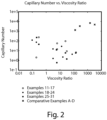
- the consumer products of Examples 11-31 and the Comparative Examples A-D are each dissolved in aqueous solution to form aqueous treatment liquors according to the test method described hereinbefore.
- Each aqueous treatment liquor is tested according to the test methods and CAPILLARY NUMBER CALCULATION description above and the Capillary Number of each is reported.
- the viscosity of the hydrophobic portion and the viscosity of the aqueous portion of each aqueous treatment liquor is measured according to the VISCOSITY TEST METHOD described hereinbefore.
- a Viscosity Ratio of the hydrophobic portion viscosity to the aqueous portion viscosity is calculated for each aqueous treatment liquor. The following data is plotted in FIG.
- the aqueous treatment liquors formed from Examples 11-31 exhbit preferred Capillary Numbers and Viscosity Ratios (and combinations thereof) relative to the aqueous treatment liquors formed from Comparative Examples A-D.
- These preferred Capillary Numbers and Viscosity Ratios result in relatively larger particle size particles (e.g. benefit agent particles) in the aqueous treatment liquor, which tend to deposit much more effectively on the treat surfaces, thereby enhancing the consumer benefits provided by the benefit agents.
Landscapes
- Health & Medical Sciences (AREA)
- Life Sciences & Earth Sciences (AREA)
- General Health & Medical Sciences (AREA)
- Veterinary Medicine (AREA)
- Public Health (AREA)
- Animal Behavior & Ethology (AREA)
- Epidemiology (AREA)
- Birds (AREA)
- Emergency Medicine (AREA)
- Dermatology (AREA)
- Chemical & Material Sciences (AREA)
- Dispersion Chemistry (AREA)
- Oil, Petroleum & Natural Gas (AREA)
- Cosmetics (AREA)
- Detergent Compositions (AREA)
- Treatments For Attaching Organic Compounds To Fibrous Goods (AREA)
Claims (19)
- Endprodukt, umfassend:(a) eine poröse in wässriger Lösung auflösbare Feststoffstruktur und(b) eine hydrophobe Beschichtung, umfassend einen Wirkstoff, umfassend ein Konditioniermittel, wobei die hydrophobe Beschichtung auf die poröse auflösbare Feststoffstruktur aufgebracht ist,wobei die hydrophobe Beschichtung eine Viskosität von weniger als 14,5 Pa·s aufweist, wobei die Viskosität gemäß dem Viskositätsprüfungsverfahren der Beschreibung bestimmt wird; undwobei der Wirkstoff der hydrophoben Beschichtung ein Silikon-Konditioniermittel ist; vorzugsweise wobei das Silikon aus der Gruppe ausgewählt ist, bestehend aus Siloxanen, Silikonkautschuken, Aminosiliconen, endständigen Aminosiliconen, Alkylsiloxanpolymeren, kationischen Organopolysiloxanen und Mischungen davon; vorzugsweise wobei das Silikon endständiges Aminosilicon ist.
- Endprodukt nach Anspruch 1, wobei die hydrophobe Beschichtung eine Viskosität von weniger als 12 Pa·s, vorzugsweise weniger als 11 Pa·s, vorzugsweise weniger als 10 Pa·s, vorzugsweise weniger als 5 Pa·s und vorzugsweise weniger als 1 Pa·s, aufweist.
- Endprodukt nach einem der vorstehenden Ansprüche, wobei das Endprodukt aus der Gruppe ausgewählt ist, bestehend aus einem Schönheitspflegeprodukt, einem Handwaschprodukt, einem Körperwaschprodukt, einem Shampooprodukt, einem Conditionerprodukt, einem Kosmetikprodukt, einem Haarentfernungsprodukt, einem Wäscheprodukt, einem Spülzusatzsprodukt, einem Wäschewaschmittelprodukt, einem Reinigungsprodukt für harte Oberflächen, einem Produkt zum manuellen Geschirrspülen, einem Produkt zum automatischen Geschirrspülen und einem Produkt zum automatischen Geschirrspülen oder Wäschewaschen in Einheitsdosierungsform.
- Endprodukt nach einem der vorstehenden Ansprüche, wobei es die hydrophobe Beschichtung, die auf die poröse in wässriger Lösung auflösbare Feststoffstruktur aufgebracht ist, in einer Menge von zu 1 Gew.-% bis 70 Gew.-%, vorzugsweise von zu 4 Gew.-% bis 70 Gew.-%, vorzugsweise von zu 5 Gew.-% bis 50 Gew.-%, vorzugsweise von zu 5 Gew.-% bis 30 Gew.-% und vorzugsweise von zu 5 Gew.-% bis 20 Gew.-%, des Endprodukts umfasst.
- Endprodukt nach einem der vorstehenden Ansprüche, wobei die hydrophobe Beschichtung des Endprodukts eine durchschnittliche Dicke und/oder maximale Dicke von weniger als 1000 Mikrometern, vorzugsweise weniger als 500 Mikrometern, vorzugsweise weniger als 100 Mikrometern und vorzugsweise weniger als 50 Mikrometern, aufweist.
- Endprodukt nach einem der vorstehenden Ansprüche, wobei die hydrophobe Beschichtung eine Flächenaufbringungsdichte von weniger als 250 µg pro mm2, vorzugsweise weniger als 150 µg pro mm2, vorzugsweise weniger als 120 µg pro mm2, vorzugsweise weniger als 100 µg pro mm2, der porösen auflösbaren Feststoffstruktur aufweist.
- Endprodukt nach einem der vorstehenden Ansprüche, wobei die poröse auflösbare Feststoffstruktur in der Form eines Schaumstoffs vorliegt.
- Endprodukt nach einem der Ansprüche 1 bis 6, wobei die poröse auflösbare Feststoffstruktur in der Form einer Fasergewebestruktur vorliegt.
- Endprodukt nach einem der vorstehenden Ansprüche, wobei die hydrophobe Beschichtung zwei oder mehr Wirkstoffe umfasst, wobei ein erster Wirkstoff und ein zweiter Wirkstoff vorgemischt werden, um die hydrophobe Beschichtung zu bilden, bevor die hydrophobe Beschichtung auf die poröse auflösbare Feststoffstruktur aufgebracht wird.
- Endprodukt nach einem der vorstehenden Ansprüche, wobei das Endprodukt zwei oder mehr hydrophobe Beschichtungen umfasst, wobei eine erste hydrophobe Beschichtung einen ersten Wirkstoff umfasst und eine zweite hydrophobe Beschichtung einen zweiten Wirkstoff umfasst, wobei die erste hydrophobe Beschichtung und die zweite hydrophobe Beschichtung auf die poröse auflösbare Feststoffstruktur separat aufgebracht werden.
- Endprodukt nach einem der Ansprüche 9 bis 10, wobei der zweite Wirkstoff Duftstoff ist.
- Endprodukt nach einem der vorstehenden Ansprüche, wobei die hydrophobe Beschichtung ferner ein Viskositätsmodifikationsmittel, ein Tensid oder Mischungen davon umfasst.
- Verfahren zum Bilden einer wässrigen Behandlungsflotte, umfassend einen Wirkstoff, das Verfahren umfassend die Schritte:(a) Bereitstellen eines Endprodukts, umfassend:(i) eine poröse auflösbare Feststoffstruktur und(ii) eine hydrophobe Beschichtung, umfassend einen Wirkstoff, umfassend ein Konditioniermittel, wobei die hydrophobe Beschichtung auf die poröse auflösbare Feststoffstruktur aufgebracht ist;(b) Bereitstellen einer wässrigen Lösung; und(c) Auflösen des Endprodukts in der wässrigen Lösung, um eine wässrige Behandlungsflotte zu bilden, umfassend einen hydrophoben Abschnitt und einen wässrigen Abschnitt,wobei der hydrophobe Abschnitt der wässrigen Behandlungsflotte eine Viskosität von weniger als 14,5 Pa s aufweist, wobei die Viskosität gemäß dem Viskositätsprüfungsverfahren der Beschreibung bestimmt wird; undwobei der Wirkstoff der hydrophoben Beschichtung ein Silikon-Konditioniermittel ist; vorzugsweise wobei das Silikon aus der Gruppe ausgewählt ist, bestehend aus Siloxanen, Silikonkautschuken, Aminosiliconen, endständigen Aminosiliconen, Alkylsiloxanpolymeren, kationischen Organopolysiloxanen und Mischungen davon; vorzugsweise wobei das Silikon endständiges Aminosilicon ist.
- Verfahren nach Anspruch 13, wobei der hydrophobe Abschnitt der wässrigen Behandlungsflotte eine Viskosität von weniger als 12 Pa·s, vorzugsweise weniger als 11 Pa·s, vorzugsweise weniger als 10 Pa·s, vorzugsweise weniger als 5 Pa s und vorzugsweise weniger als 1 Pa·s, aufweist.
- Verfahren nach einem der Ansprüche 13 bis 14, wobei das Verfahren eine Kapillarzahl von weniger als 1000 bereitstellt.
- Verfahren nach einem der Ansprüche 13 bis 15, wobei die hydrophobe Beschichtung des Endprodukts eine erste Viskosität aufweist und der wässrige Abschnitt der wässrigen Behandlungsflotte eine zweite Viskosität aufweist, wobei ein Verhältnis der ersten Viskosität zu der zweiten Viskosität weniger als 100 : 1 ist.
- Verfahren nach einem der Ansprüche 13 bis 16, wobei das Endprodukt ein Endprodukt nach einem der Ansprüche 1 bis 12 ist.
- Verfahren zum Bilden einer wässrigen Behandlungsflotte, umfassend einen Wirkstoff, das Verfahren umfassend die Schritte:(a) Bereitstellen eines Endprodukts, umfassend:(i) eine poröse auflösbare Feststoffstruktur und(ii) eine hydrophobe Beschichtung, umfassend einen Wirkstoff, dass der Wirkstoff ein Konditioniermittel umfasst, wobei die hydrophobe Beschichtung auf die poröse auflösbare Feststoffstruktur aufgebracht ist;(b) Bereitstellen einer wässrigen Lösung; und(c) Auflösen des Endprodukts in der wässrigen Lösung, um eine wässrige Behandlungsflotte zu bilden,wobei die wässrige Behandlungsflotte Partikel, vorzugsweise Wirkstoffpartikel, die eine Partikelgröße von 10 Mikrometern bis 500 Mikrometern, vorzugsweise von 30 Mikrometern bis 200 Mikrometern, vorzugsweise von 50 Mikrometern bis 150 Mikrometern und vorzugsweise von 50 Mikrometern bis 100 Mikrometern, aufweisen, umfasst; undwobei der Wirkstoff der hydrophoben Beschichtung ein Silikon-Konditioniermittel ist; vorzugsweise wobei das Silikon aus der Gruppe ausgewählt ist, bestehend aus Siloxanen, Silikonkautschuken, Aminosiliconen, endständigen Aminosiliconen, Alkylsiloxanpolymeren, kationischen Organopolysiloxanen und Mischungen davon; vorzugsweise wobei das Silikon endständiges Aminosilicon ist.
- Verfahren nach 18, wobei das Endprodukt ein Endprodukt nach einem der Ansprüche 1 bis 12 ist.
Applications Claiming Priority (2)
| Application Number | Priority Date | Filing Date | Title |
|---|---|---|---|
| US201461988430P | 2014-05-05 | 2014-05-05 | |
| PCT/US2015/029124 WO2015171531A1 (en) | 2014-05-05 | 2015-05-05 | Consumer products |
Publications (2)
| Publication Number | Publication Date |
|---|---|
| EP3145476A1 EP3145476A1 (de) | 2017-03-29 |
| EP3145476B1 true EP3145476B1 (de) | 2025-07-09 |
Family
ID=53180859
Family Applications (1)
| Application Number | Title | Priority Date | Filing Date |
|---|---|---|---|
| EP15722870.1A Active EP3145476B1 (de) | 2014-05-05 | 2015-05-05 | Gebrauchsartikel |
Country Status (8)
| Country | Link |
|---|---|
| US (1) | US9867762B2 (de) |
| EP (1) | EP3145476B1 (de) |
| JP (1) | JP2017520615A (de) |
| CN (2) | CN106255494A (de) |
| CA (1) | CA2946215A1 (de) |
| MX (1) | MX2016014439A (de) |
| RU (1) | RU2016140405A (de) |
| WO (1) | WO2015171531A1 (de) |
Families Citing this family (47)
| Publication number | Priority date | Publication date | Assignee | Title |
|---|---|---|---|---|
| WO2012003351A2 (en) | 2010-07-02 | 2012-01-05 | The Procter & Gamble Company | Web material and method for making same |
| JP5859526B2 (ja) | 2010-07-02 | 2016-02-10 | ザ プロクター アンド ギャンブルカンパニー | 活性剤不織布ウェブを含むフィラメント及びその製造方法 |
| US20180163325A1 (en) | 2016-12-09 | 2018-06-14 | Robert Wayne Glenn, Jr. | Dissolvable fibrous web structure article comprising active agents |
| CA2803382C (en) | 2010-07-02 | 2015-03-31 | The Procter & Gamble Company | Method for delivering an active agent |
| WO2015164227A2 (en) | 2014-04-22 | 2015-10-29 | The Procter & Gamble Company | Compositions in the form of dissolvable solid structures |
| US9877899B2 (en) * | 2014-05-05 | 2018-01-30 | The Procter & Gamble Company | Consumer product comprising a fibrous web structure with a silicone conditioning agent coating |
| US9861558B2 (en) | 2014-05-05 | 2018-01-09 | The Procter & Gamble Company | Methods of forming an aqueous treatment liquor by dissolving a porous solid with a benefit agent coating |
| US9861559B2 (en) | 2014-05-05 | 2018-01-09 | The Procter & Gamble Company | Consumer product comprising a porous, dissolvable, fibrous web solid structure with a silicone coating |
| US9827173B2 (en) | 2014-05-05 | 2017-11-28 | The Procter & Gamble Company | Porous dissolvable solid structure with two benefit agents and methods of forming an aqueous treatment liquor therefrom |
| US9937111B2 (en) * | 2014-05-05 | 2018-04-10 | The Procter & Gamble Company | Consumer product comprising a fibrous web solid structure with a silicone conditioning agent coating |
| US20150313805A1 (en) * | 2014-05-05 | 2015-11-05 | The Procter & Gamble Company | Consumer Products |
| US9867762B2 (en) | 2014-05-05 | 2018-01-16 | The Procter & Gamble Company | Consumer product comprising a porous dissolvable solid structure and silicone conditioning agent coating |
| US20150320613A1 (en) | 2014-05-08 | 2015-11-12 | The Procter & Gamble Company | Waist-to-side silhouettes of adult disposable absorbent articles and arrays |
| MX380727B (es) | 2017-01-27 | 2025-03-12 | Procter & Gamble | Composiciones en la forma de estructuras sólidas solubles que comprenden partículas aglomeradas efervescentes. |
| MX380853B (es) | 2017-01-27 | 2025-03-12 | Procter & Gamble | Composiciones en la forma de estructuras solidas solubles |
| CN110650723A (zh) | 2017-05-16 | 2020-01-03 | 宝洁公司 | 可溶性固体结构形式的调理毛发护理组合物 |
| CN108004764B (zh) * | 2017-11-13 | 2020-05-19 | 欣龙控股(集团)股份有限公司 | 一种拒水整理液、局部拒水面料及制备方法 |
| JP1639110S (de) | 2018-07-16 | 2019-08-13 | ||
| US11666514B2 (en) | 2018-09-21 | 2023-06-06 | The Procter & Gamble Company | Fibrous structures containing polymer matrix particles with perfume ingredients |
| WO2020264574A1 (en) | 2019-06-28 | 2020-12-30 | The Procter & Gamble Company | Dissolvable solid fibrous articles containing anionic surfactants |
| MX2021015391A (es) | 2019-07-03 | 2022-01-24 | Procter & Gamble | Estructuras fibrosas que contienen surfactantes cationicos y acidos solubles. |
| USD939359S1 (en) | 2019-10-01 | 2021-12-28 | The Procter And Gamble Plaza | Packaging for a single dose personal care product |
| KR102788921B1 (ko) | 2019-10-14 | 2025-04-02 | 더 프록터 앤드 갬블 캄파니 | 고체 물품을 함유하는 생분해성 및/또는 가정 퇴비화가능 사셰 |
| CN114727933B (zh) | 2019-11-20 | 2024-03-08 | 宝洁公司 | 多孔可溶性固体结构体 |
| EP4065068A1 (de) | 2019-12-01 | 2022-10-05 | The Procter & Gamble Company | Haarkonditionierungsmittel mit einem konservierungssystem, das natriumbenzoat und glykole und/oder glycerylester enthält |
| USD941051S1 (en) | 2020-03-20 | 2022-01-18 | The Procter And Gamble Company | Shower hanger |
| USD962050S1 (en) | 2020-03-20 | 2022-08-30 | The Procter And Gamble Company | Primary package for a solid, single dose beauty care composition |
| EP4132476A1 (de) | 2020-04-10 | 2023-02-15 | The Procter & Gamble Company | Rheologische feste orale zusammensetzung |
| US12122979B2 (en) | 2020-04-10 | 2024-10-22 | The Procter & Gamble Company | Cleaning article with preferential rheological solid composition |
| US11812909B2 (en) * | 2020-04-10 | 2023-11-14 | The Procter & Gamble Company | Cleaning implement with a rheological solid composition |
| EP4132454A1 (de) | 2020-04-10 | 2023-02-15 | The Procter & Gamble Company | Mundpflegeprodukt mit einer rheologischen festen zusammensetzung |
| WO2021207440A1 (en) | 2020-04-10 | 2021-10-14 | The Procter & Gamble Company | Rheological solid composition |
| CN115443120A (zh) | 2020-04-10 | 2022-12-06 | 宝洁公司 | 流变固体组合物 |
| USD965440S1 (en) | 2020-06-29 | 2022-10-04 | The Procter And Gamble Company | Package |
| US11925698B2 (en) | 2020-07-31 | 2024-03-12 | The Procter & Gamble Company | Water-soluble fibrous pouch containing prills for hair care |
| JP7513835B2 (ja) | 2020-08-11 | 2024-07-09 | ザ プロクター アンド ギャンブル カンパニー | ブラシシルバリネートエシレートを含有する低粘度ヘアコンディショナー組成物 |
| MX2023001043A (es) | 2020-08-11 | 2023-02-16 | Procter & Gamble | Composiciones acondicionadoras de enjuague limpio para el cabello que contienen esilato de valinato de brassicilo. |
| US11633338B2 (en) | 2020-08-11 | 2023-04-25 | The Procter & Gamble Company | Moisturizing hair conditioner compositions containing brassicyl valinate esylate |
| JP7614333B2 (ja) | 2020-09-10 | 2025-01-15 | ザ プロクター アンド ギャンブル カンパニー | 抗細菌活性物質を含有する溶解性固体物品 |
| CA3201309A1 (en) | 2020-12-01 | 2022-06-09 | The Procter & Gamble Company | Aqueous hair conditioner compositions containing solubilized anti-dandruff actives |
| USD1045064S1 (en) | 2020-12-17 | 2024-10-01 | The Procter & Gamble Company | Single-dose dissolvable personal care unit |
| WO2022159368A1 (en) | 2021-01-21 | 2022-07-28 | The Procter & Gamble Company | Dissolvable solid article containing preservatives |
| US11833237B2 (en) | 2021-03-09 | 2023-12-05 | The Procter & Gamble Company | Method for enhancing scalp active deposition |
| CN117835951A (zh) | 2021-08-20 | 2024-04-05 | 宝洁公司 | 含有有机硅的可溶性固体制品 |
| EP4395730A1 (de) | 2021-08-30 | 2024-07-10 | The Procter & Gamble Company | Lösliche feste struktur mit ersten und zweiten polymerstrukturierungsmitteln |
| EP4447893A1 (de) | 2021-12-17 | 2024-10-23 | The Procter & Gamble Company | Lösliche feste faserige shampooartikel mit salzen |
| WO2023173048A1 (en) | 2022-03-10 | 2023-09-14 | The Procter & Gamble Company | Dissolvable solid structure having first and second layers |
Family Cites Families (73)
| Publication number | Priority date | Publication date | Assignee | Title |
|---|---|---|---|---|
| BE406221A (de) | 1933-11-15 | |||
| BE498391A (de) | 1944-10-16 | |||
| BE498392A (de) | 1945-11-09 | |||
| US4217914A (en) | 1974-05-16 | 1980-08-19 | L'oreal | Quaternized polymer for use as a cosmetic agent in cosmetic compositions for the hair and skin |
| US4422853A (en) | 1974-05-16 | 1983-12-27 | L'oreal | Hair dyeing compositions containing quaternized polymer |
| US3929678A (en) | 1974-08-01 | 1975-12-30 | Procter & Gamble | Detergent composition having enhanced particulate soil removal performance |
| AT365448B (de) | 1975-07-04 | 1982-01-11 | Oreal | Kosmetische zubereitung |
| US4197865A (en) | 1975-07-04 | 1980-04-15 | L'oreal | Treating hair with quaternized polymers |
| US4663158A (en) | 1979-07-02 | 1987-05-05 | Clairol Incorporated | Hair conditioning composition containing cationic polymer and amphoteric surfactant and method for use |
| US4507280A (en) | 1979-07-02 | 1985-03-26 | Clairol Incorporated | Hair conditioning composition and method for use |
| US4529586A (en) | 1980-07-11 | 1985-07-16 | Clairol Incorporated | Hair conditioning composition and process |
| WO1983001943A1 (en) | 1981-11-27 | 1983-06-09 | Torobin, Leonard, B. | Method and apparatus for producing microfilaments |
| USRE34584E (en) | 1984-11-09 | 1994-04-12 | The Procter & Gamble Company | Shampoo compositions |
| GB8910788D0 (en) | 1989-05-10 | 1989-06-28 | Allied Colloids Ltd | Absorbent products and their manufacture |
| US4976953A (en) | 1987-03-06 | 1990-12-11 | The Procter & Gamble Company | Skin conditioning/cleansing compositions containing propoxylated glycerol derivatives |
| US5106609A (en) | 1990-05-01 | 1992-04-21 | The Procter & Gamble Company | Vehicle systems for use in cosmetic compositions |
| US5104646A (en) | 1989-08-07 | 1992-04-14 | The Procter & Gamble Company | Vehicle systems for use in cosmetic compositions |
| DE3927254A1 (de) | 1989-08-18 | 1991-02-21 | Reifenhaeuser Masch | Verfahren und spinnduesenaggregat fuer die herstellung von kunststoff-faeden und/oder kunststoff-fasern im zuge der herstellung von einem spinnvlies aus thermoplastischem kunststoff |
| GB2270030B (en) | 1992-08-19 | 1996-06-19 | Courtaulds Plc | Method of producing fibre or film |
| US5750122A (en) | 1996-01-16 | 1998-05-12 | The Procter & Gamble Company | Compositions for treating hair or skin |
| US5674478A (en) | 1996-01-12 | 1997-10-07 | The Procter & Gamble Company | Hair conditioning compositions |
| US6382526B1 (en) | 1998-10-01 | 2002-05-07 | The University Of Akron | Process and apparatus for the production of nanofibers |
| DE60019994T2 (de) | 1999-03-08 | 2006-01-19 | The Procter & Gamble Company, Cincinnati | Absorbierende und flexible Struktur mit Stärkefasern |
| US6187728B1 (en) * | 1999-05-06 | 2001-02-13 | Dragoco Gerberding & Co. Ag | Solid personal care composition having foamed polymer skin and shape of a fruit or vegetable |
| US6329353B1 (en) | 1999-05-12 | 2001-12-11 | Goldschmidt Chemical Corporation | Clear personal care formulations containing quaternary ammonium compounds and other nitrogen-containing compounds |
| JP2003521493A (ja) | 2000-01-28 | 2003-07-15 | スミスクライン・ビーチャム・コーポレイション | 電気紡糸された医薬組成物 |
| AU2001256248A1 (en) * | 2000-04-14 | 2001-10-30 | Unilever Plc | Water soluble package and liquid contents thereof |
| US20030104969A1 (en) * | 2000-05-11 | 2003-06-05 | Caswell Debra Sue | Laundry system having unitized dosing |
| GB2365440A (en) | 2000-08-04 | 2002-02-20 | Mcbride Robert Ltd | Method of constituting detergent products |
| US20030180242A1 (en) | 2001-11-01 | 2003-09-25 | The Procter & Gamble Company | Personal care compositions containing a water-disintegratable polymeric foam |
| JP3851312B2 (ja) | 2002-04-22 | 2006-11-29 | ザ プロクター アンド ギャンブル カンパニー | 水性界面活性剤組成物中に亜鉛含有物質を含むパーソナルケア組成物 |
| US6825161B2 (en) | 2002-04-26 | 2004-11-30 | Salvona Llc | Multi component controlled delivery system for soap bars |
| TW200410714A (en) | 2002-08-07 | 2004-07-01 | Smithkline Beecham Corp | Electrospun amorphous pharmaceutical compositions |
| US6800295B2 (en) | 2002-10-09 | 2004-10-05 | The Dial Corporation | Water soluble sheet composition |
| US8877316B2 (en) | 2002-12-20 | 2014-11-04 | The Procter & Gamble Company | Cloth-like personal care articles |
| MX296137B (es) | 2003-06-30 | 2012-02-13 | Procter & Gamble | Tramas de nanofibras recubiertas. |
| US20060228319A1 (en) | 2005-04-11 | 2006-10-12 | Vona Samuel A Jr | Personal cleansing and shaving films |
| US7901696B2 (en) | 2005-10-31 | 2011-03-08 | J&J Consumer Companies, Inc. | Cosmetic device comprising discrete elements |
| FR2894136B1 (fr) | 2005-12-07 | 2008-01-18 | Oreal | Article cosmetique soluble moussant |
| BRPI0708675B1 (pt) | 2006-03-07 | 2017-04-04 | Elevance Renewable Sciences | composições compreendendo poliol ésteres insaturados que sofreram metátese e artigos para cuidados pessoais compreendendo as referidas composições |
| KR100937625B1 (ko) | 2007-08-10 | 2010-01-20 | 주식회사 제닉 | 가용성 웹 공극필름 및 이의 제조방법 |
| WO2009031620A1 (ja) * | 2007-09-05 | 2009-03-12 | Taiyokagaku Co., Ltd. | 水溶性電界紡糸シート |
| US8765170B2 (en) | 2008-01-30 | 2014-07-01 | The Procter & Gamble Company | Personal care composition in the form of an article |
| EP2666457B1 (de) * | 2008-04-16 | 2020-06-17 | The Procter & Gamble Company | Verfahren zur Herstellung einer nichtschäumenden Körperpflegezusammensetzung in Form eines löslichen festen Schaums |
| US20100052037A1 (en) | 2008-08-28 | 2010-03-04 | Albert Chin | Charge-trapping engineered flash non-volatile memory |
| BRPI0922333B1 (pt) * | 2008-12-08 | 2019-01-29 | Procter & Gamble | processo de produção de um artigo para dissolução mediante o uso da aplicação de tensoativos |
| BRPI0922379B1 (pt) * | 2008-12-08 | 2021-08-03 | The Procter & Gamble Company | Composição para cuidados pessoais na forma de um artigo que tem um revestimento hidrofóbico residente de superfície |
| CA2746317C (en) * | 2008-12-08 | 2013-10-29 | The Procter & Gamble Company | Porous, dissolvable solid substrates and surface resident cyclodextrin perfume complexes |
| CN102245155B (zh) | 2008-12-08 | 2015-11-25 | 宝洁公司 | 具有可溶性多孔固体结构的制品形式的个人护理组合物 |
| US8461090B2 (en) | 2008-12-08 | 2013-06-11 | The Procter & Gamble Company | Personal care composition in the form of an article having a porous, dissolvable solid structure |
| US8309505B2 (en) | 2009-07-30 | 2012-11-13 | The Procter & Gamble Company | Hand dish composition in the form of an article |
| MX2012006247A (es) * | 2009-12-08 | 2012-06-19 | Procter & Gamble | Un sustrato solido soluble poroso y un recubrimiento fijo de superficie de acondicionador de surfactante cationico. |
| WO2011072009A1 (en) * | 2009-12-08 | 2011-06-16 | The Procter & Gamble Company | A porous, dissolvable solid substrate and surface resident coating comprising matrix microspheres |
| US20110132387A1 (en) | 2009-12-08 | 2011-06-09 | Ali Abdelaziz Alwattari | Porous, Dissolvable Solid Substrate And Surface Resident Coating Comprising A Skin Treatment Active |
| CN102917683B (zh) * | 2009-12-08 | 2015-08-05 | 宝洁公司 | 可溶性多孔固体基质和包含水敏活性物质的表面驻留涂层 |
| CN102647974B (zh) * | 2009-12-08 | 2014-03-12 | 宝洁公司 | 可溶性多孔固体基质和阳离子表面活性剂调理剂材料 |
| WO2011103152A1 (en) | 2010-02-16 | 2011-08-25 | The Procter & Gamble Company | A porous, dissolvable solid substrate and surface resident coating comprising a zync pyrithione |
| WO2011123737A1 (en) | 2010-04-01 | 2011-10-06 | The Procter & Gamble Company | Care polymers |
| US9186642B2 (en) * | 2010-04-28 | 2015-11-17 | The Procter & Gamble Company | Delivery particle |
| WO2012003351A2 (en) * | 2010-07-02 | 2012-01-05 | The Procter & Gamble Company | Web material and method for making same |
| MX360481B (es) | 2010-07-02 | 2018-11-05 | Procter & Gamble | Articulo con estructura soluble de trama fibrosa que comprende agentes activos. |
| CN104508012B (zh) | 2012-07-27 | 2017-05-24 | 宝洁公司 | 有机聚硅氧烷聚合物 |
| JP6158935B2 (ja) * | 2012-10-12 | 2017-07-05 | ザ プロクター アンド ギャンブル カンパニー | 溶解性物品の形態にあるパーソナルケア組成物 |
| US9827173B2 (en) | 2014-05-05 | 2017-11-28 | The Procter & Gamble Company | Porous dissolvable solid structure with two benefit agents and methods of forming an aqueous treatment liquor therefrom |
| US9877899B2 (en) | 2014-05-05 | 2018-01-30 | The Procter & Gamble Company | Consumer product comprising a fibrous web structure with a silicone conditioning agent coating |
| US9937111B2 (en) * | 2014-05-05 | 2018-04-10 | The Procter & Gamble Company | Consumer product comprising a fibrous web solid structure with a silicone conditioning agent coating |
| US9867762B2 (en) | 2014-05-05 | 2018-01-16 | The Procter & Gamble Company | Consumer product comprising a porous dissolvable solid structure and silicone conditioning agent coating |
| US20150313805A1 (en) | 2014-05-05 | 2015-11-05 | The Procter & Gamble Company | Consumer Products |
| US9861558B2 (en) | 2014-05-05 | 2018-01-09 | The Procter & Gamble Company | Methods of forming an aqueous treatment liquor by dissolving a porous solid with a benefit agent coating |
| US9861559B2 (en) | 2014-05-05 | 2018-01-09 | The Procter & Gamble Company | Consumer product comprising a porous, dissolvable, fibrous web solid structure with a silicone coating |
| US10698421B1 (en) | 2017-09-25 | 2020-06-30 | State Farm Mutual Automobile Insurance Company | Dynamic autonomous vehicle train |
| JP7232440B2 (ja) | 2018-10-22 | 2023-03-03 | 株式会社ハイレックスコーポレーション | 固定装置 |
| TWI790802B (zh) | 2021-11-02 | 2023-01-21 | 宏碁股份有限公司 | 在進水時具備保護功能的電源供應裝置 |
-
2015
- 2015-05-04 US US14/702,786 patent/US9867762B2/en active Active
- 2015-05-05 RU RU2016140405A patent/RU2016140405A/ru unknown
- 2015-05-05 EP EP15722870.1A patent/EP3145476B1/de active Active
- 2015-05-05 WO PCT/US2015/029124 patent/WO2015171531A1/en not_active Ceased
- 2015-05-05 MX MX2016014439A patent/MX2016014439A/es unknown
- 2015-05-05 JP JP2017510463A patent/JP2017520615A/ja active Pending
- 2015-05-05 CA CA2946215A patent/CA2946215A1/en not_active Abandoned
- 2015-05-05 CN CN201580023661.9A patent/CN106255494A/zh active Pending
- 2015-05-05 CN CN202111182839.8A patent/CN113813187A/zh active Pending
Also Published As
| Publication number | Publication date |
|---|---|
| CA2946215A1 (en) | 2015-11-12 |
| JP2017520615A (ja) | 2017-07-27 |
| WO2015171531A1 (en) | 2015-11-12 |
| EP3145476A1 (de) | 2017-03-29 |
| US9867762B2 (en) | 2018-01-16 |
| RU2016140405A3 (de) | 2018-06-06 |
| RU2016140405A (ru) | 2018-06-06 |
| MX2016014439A (es) | 2017-02-23 |
| US20150313803A1 (en) | 2015-11-05 |
| CN106255494A (zh) | 2016-12-21 |
| CN113813187A (zh) | 2021-12-21 |
Similar Documents
| Publication | Publication Date | Title |
|---|---|---|
| US9861558B2 (en) | Methods of forming an aqueous treatment liquor by dissolving a porous solid with a benefit agent coating | |
| US9827173B2 (en) | Porous dissolvable solid structure with two benefit agents and methods of forming an aqueous treatment liquor therefrom | |
| US9861559B2 (en) | Consumer product comprising a porous, dissolvable, fibrous web solid structure with a silicone coating | |
| US9937111B2 (en) | Consumer product comprising a fibrous web solid structure with a silicone conditioning agent coating | |
| US9877899B2 (en) | Consumer product comprising a fibrous web structure with a silicone conditioning agent coating | |
| US9867762B2 (en) | Consumer product comprising a porous dissolvable solid structure and silicone conditioning agent coating | |
| US20150313805A1 (en) | Consumer Products | |
| EP2262470B1 (de) | Nichtschäumende körperpflegezusammensetzung in form eines artikels |
Legal Events
| Date | Code | Title | Description |
|---|---|---|---|
| STAA | Information on the status of an ep patent application or granted ep patent |
Free format text: STATUS: THE INTERNATIONAL PUBLICATION HAS BEEN MADE |
|
| PUAI | Public reference made under article 153(3) epc to a published international application that has entered the european phase |
Free format text: ORIGINAL CODE: 0009012 |
|
| STAA | Information on the status of an ep patent application or granted ep patent |
Free format text: STATUS: REQUEST FOR EXAMINATION WAS MADE |
|
| 17P | Request for examination filed |
Effective date: 20161031 |
|
| AK | Designated contracting states |
Kind code of ref document: A1 Designated state(s): AL AT BE BG CH CY CZ DE DK EE ES FI FR GB GR HR HU IE IS IT LI LT LU LV MC MK MT NL NO PL PT RO RS SE SI SK SM TR |
|
| AX | Request for extension of the european patent |
Extension state: BA ME |
|
| DAV | Request for validation of the european patent (deleted) | ||
| DAX | Request for extension of the european patent (deleted) | ||
| STAA | Information on the status of an ep patent application or granted ep patent |
Free format text: STATUS: EXAMINATION IS IN PROGRESS |
|
| 17Q | First examination report despatched |
Effective date: 20180622 |
|
| P01 | Opt-out of the competence of the unified patent court (upc) registered |
Effective date: 20230429 |
|
| GRAP | Despatch of communication of intention to grant a patent |
Free format text: ORIGINAL CODE: EPIDOSNIGR1 |
|
| STAA | Information on the status of an ep patent application or granted ep patent |
Free format text: STATUS: GRANT OF PATENT IS INTENDED |
|
| INTG | Intention to grant announced |
Effective date: 20250225 |
|
| GRAS | Grant fee paid |
Free format text: ORIGINAL CODE: EPIDOSNIGR3 |
|
| GRAA | (expected) grant |
Free format text: ORIGINAL CODE: 0009210 |
|
| STAA | Information on the status of an ep patent application or granted ep patent |
Free format text: STATUS: THE PATENT HAS BEEN GRANTED |
|
| AK | Designated contracting states |
Kind code of ref document: B1 Designated state(s): AL AT BE BG CH CY CZ DE DK EE ES FI FR GB GR HR HU IE IS IT LI LT LU LV MC MK MT NL NO PL PT RO RS SE SI SK SM TR |
|
| REG | Reference to a national code |
Ref country code: GB Ref legal event code: FG4D |
|
| REG | Reference to a national code |
Ref country code: CH Ref legal event code: EP |
|
| REG | Reference to a national code |
Ref country code: IE Ref legal event code: FG4D |
|
| REG | Reference to a national code |
Ref country code: DE Ref legal event code: R096 Ref document number: 602015091968 Country of ref document: DE |
|
| REG | Reference to a national code |
Ref country code: NL Ref legal event code: MP Effective date: 20250709 |
|
| PG25 | Lapsed in a contracting state [announced via postgrant information from national office to epo] |
Ref country code: PT Free format text: LAPSE BECAUSE OF FAILURE TO SUBMIT A TRANSLATION OF THE DESCRIPTION OR TO PAY THE FEE WITHIN THE PRESCRIBED TIME-LIMIT Effective date: 20251110 |
|
| PG25 | Lapsed in a contracting state [announced via postgrant information from national office to epo] |
Ref country code: NL Free format text: LAPSE BECAUSE OF FAILURE TO SUBMIT A TRANSLATION OF THE DESCRIPTION OR TO PAY THE FEE WITHIN THE PRESCRIBED TIME-LIMIT Effective date: 20250709 |
|
| REG | Reference to a national code |
Ref country code: AT Ref legal event code: MK05 Ref document number: 1811168 Country of ref document: AT Kind code of ref document: T Effective date: 20250709 |
|
| PG25 | Lapsed in a contracting state [announced via postgrant information from national office to epo] |
Ref country code: IS Free format text: LAPSE BECAUSE OF FAILURE TO SUBMIT A TRANSLATION OF THE DESCRIPTION OR TO PAY THE FEE WITHIN THE PRESCRIBED TIME-LIMIT Effective date: 20251109 |
|
| PG25 | Lapsed in a contracting state [announced via postgrant information from national office to epo] |
Ref country code: NO Free format text: LAPSE BECAUSE OF FAILURE TO SUBMIT A TRANSLATION OF THE DESCRIPTION OR TO PAY THE FEE WITHIN THE PRESCRIBED TIME-LIMIT Effective date: 20251009 |
|
| REG | Reference to a national code |
Ref country code: LT Ref legal event code: MG9D |
|
| PG25 | Lapsed in a contracting state [announced via postgrant information from national office to epo] |
Ref country code: AT Free format text: LAPSE BECAUSE OF FAILURE TO SUBMIT A TRANSLATION OF THE DESCRIPTION OR TO PAY THE FEE WITHIN THE PRESCRIBED TIME-LIMIT Effective date: 20250709 |
|
| PG25 | Lapsed in a contracting state [announced via postgrant information from national office to epo] |
Ref country code: FI Free format text: LAPSE BECAUSE OF FAILURE TO SUBMIT A TRANSLATION OF THE DESCRIPTION OR TO PAY THE FEE WITHIN THE PRESCRIBED TIME-LIMIT Effective date: 20250709 |
|
| PG25 | Lapsed in a contracting state [announced via postgrant information from national office to epo] |
Ref country code: HR Free format text: LAPSE BECAUSE OF FAILURE TO SUBMIT A TRANSLATION OF THE DESCRIPTION OR TO PAY THE FEE WITHIN THE PRESCRIBED TIME-LIMIT Effective date: 20250709 |
|
| PG25 | Lapsed in a contracting state [announced via postgrant information from national office to epo] |
Ref country code: GR Free format text: LAPSE BECAUSE OF FAILURE TO SUBMIT A TRANSLATION OF THE DESCRIPTION OR TO PAY THE FEE WITHIN THE PRESCRIBED TIME-LIMIT Effective date: 20251010 |
|
| PG25 | Lapsed in a contracting state [announced via postgrant information from national office to epo] |
Ref country code: SE Free format text: LAPSE BECAUSE OF FAILURE TO SUBMIT A TRANSLATION OF THE DESCRIPTION OR TO PAY THE FEE WITHIN THE PRESCRIBED TIME-LIMIT Effective date: 20250709 |
|
| PG25 | Lapsed in a contracting state [announced via postgrant information from national office to epo] |
Ref country code: LV Free format text: LAPSE BECAUSE OF FAILURE TO SUBMIT A TRANSLATION OF THE DESCRIPTION OR TO PAY THE FEE WITHIN THE PRESCRIBED TIME-LIMIT Effective date: 20250709 |
|
| PG25 | Lapsed in a contracting state [announced via postgrant information from national office to epo] |
Ref country code: BG Free format text: LAPSE BECAUSE OF FAILURE TO SUBMIT A TRANSLATION OF THE DESCRIPTION OR TO PAY THE FEE WITHIN THE PRESCRIBED TIME-LIMIT Effective date: 20250709 Ref country code: PL Free format text: LAPSE BECAUSE OF FAILURE TO SUBMIT A TRANSLATION OF THE DESCRIPTION OR TO PAY THE FEE WITHIN THE PRESCRIBED TIME-LIMIT Effective date: 20250709 |
|
| PG25 | Lapsed in a contracting state [announced via postgrant information from national office to epo] |
Ref country code: RS Free format text: LAPSE BECAUSE OF FAILURE TO SUBMIT A TRANSLATION OF THE DESCRIPTION OR TO PAY THE FEE WITHIN THE PRESCRIBED TIME-LIMIT Effective date: 20251009 |
|
| PG25 | Lapsed in a contracting state [announced via postgrant information from national office to epo] |
Ref country code: ES Free format text: LAPSE BECAUSE OF FAILURE TO SUBMIT A TRANSLATION OF THE DESCRIPTION OR TO PAY THE FEE WITHIN THE PRESCRIBED TIME-LIMIT Effective date: 20250709 |
|
| PG25 | Lapsed in a contracting state [announced via postgrant information from national office to epo] |
Ref country code: SM Free format text: LAPSE BECAUSE OF FAILURE TO SUBMIT A TRANSLATION OF THE DESCRIPTION OR TO PAY THE FEE WITHIN THE PRESCRIBED TIME-LIMIT Effective date: 20250709 |
|
| PGFP | Annual fee paid to national office [announced via postgrant information from national office to epo] |
Ref country code: GB Payment date: 20260313 Year of fee payment: 12 |
|
| PG25 | Lapsed in a contracting state [announced via postgrant information from national office to epo] |
Ref country code: DK Free format text: LAPSE BECAUSE OF FAILURE TO SUBMIT A TRANSLATION OF THE DESCRIPTION OR TO PAY THE FEE WITHIN THE PRESCRIBED TIME-LIMIT Effective date: 20250709 |
|
| PG25 | Lapsed in a contracting state [announced via postgrant information from national office to epo] |
Ref country code: IT Free format text: LAPSE BECAUSE OF FAILURE TO SUBMIT A TRANSLATION OF THE DESCRIPTION OR TO PAY THE FEE WITHIN THE PRESCRIBED TIME-LIMIT Effective date: 20250709 |
|
| PG25 | Lapsed in a contracting state [announced via postgrant information from national office to epo] |
Ref country code: CZ Free format text: LAPSE BECAUSE OF FAILURE TO SUBMIT A TRANSLATION OF THE DESCRIPTION OR TO PAY THE FEE WITHIN THE PRESCRIBED TIME-LIMIT Effective date: 20250709 |
|
| PG25 | Lapsed in a contracting state [announced via postgrant information from national office to epo] |
Ref country code: SK Free format text: LAPSE BECAUSE OF FAILURE TO SUBMIT A TRANSLATION OF THE DESCRIPTION OR TO PAY THE FEE WITHIN THE PRESCRIBED TIME-LIMIT Effective date: 20250709 Ref country code: EE Free format text: LAPSE BECAUSE OF FAILURE TO SUBMIT A TRANSLATION OF THE DESCRIPTION OR TO PAY THE FEE WITHIN THE PRESCRIBED TIME-LIMIT Effective date: 20250709 |
|
| PLBE | No opposition filed within time limit |
Free format text: ORIGINAL CODE: 0009261 |
|
| STAA | Information on the status of an ep patent application or granted ep patent |
Free format text: STATUS: NO OPPOSITION FILED WITHIN TIME LIMIT |