EP3139195B1 - Remote target identification using laser doppler vibrometry - Google Patents
Remote target identification using laser doppler vibrometry Download PDFInfo
- Publication number
- EP3139195B1 EP3139195B1 EP16186868.2A EP16186868A EP3139195B1 EP 3139195 B1 EP3139195 B1 EP 3139195B1 EP 16186868 A EP16186868 A EP 16186868A EP 3139195 B1 EP3139195 B1 EP 3139195B1
- Authority
- EP
- European Patent Office
- Prior art keywords
- interferometer
- optical circulator
- telescope
- target
- laser device
- Prior art date
- Legal status (The legal status is an assumption and is not a legal conclusion. Google has not performed a legal analysis and makes no representation as to the accuracy of the status listed.)
- Active
Links
Images



Classifications
-
- G—PHYSICS
- G01—MEASURING; TESTING
- G01H—MEASUREMENT OF MECHANICAL VIBRATIONS OR ULTRASONIC, SONIC OR INFRASONIC WAVES
- G01H9/00—Measuring mechanical vibrations or ultrasonic, sonic or infrasonic waves by using radiation-sensitive means, e.g. optical means
-
- G—PHYSICS
- G01—MEASURING; TESTING
- G01H—MEASUREMENT OF MECHANICAL VIBRATIONS OR ULTRASONIC, SONIC OR INFRASONIC WAVES
- G01H13/00—Measuring resonant frequency
-
- G—PHYSICS
- G01—MEASURING; TESTING
- G01P—MEASURING LINEAR OR ANGULAR SPEED, ACCELERATION, DECELERATION, OR SHOCK; INDICATING PRESENCE, ABSENCE, OR DIRECTION, OF MOVEMENT
- G01P3/00—Measuring linear or angular speed; Measuring differences of linear or angular speeds
- G01P3/36—Devices characterised by the use of optical means, e.g. using infrared, visible, or ultraviolet light
-
- G—PHYSICS
- G01—MEASURING; TESTING
- G01S—RADIO DIRECTION-FINDING; RADIO NAVIGATION; DETERMINING DISTANCE OR VELOCITY BY USE OF RADIO WAVES; LOCATING OR PRESENCE-DETECTING BY USE OF THE REFLECTION OR RERADIATION OF RADIO WAVES; ANALOGOUS ARRANGEMENTS USING OTHER WAVES
- G01S17/00—Systems using the reflection or reradiation of electromagnetic waves other than radio waves, e.g. lidar systems
- G01S17/02—Systems using the reflection of electromagnetic waves other than radio waves
- G01S17/50—Systems of measurement based on relative movement of target
- G01S17/58—Velocity or trajectory determination systems; Sense-of-movement determination systems
-
- G—PHYSICS
- G01—MEASURING; TESTING
- G01S—RADIO DIRECTION-FINDING; RADIO NAVIGATION; DETERMINING DISTANCE OR VELOCITY BY USE OF RADIO WAVES; LOCATING OR PRESENCE-DETECTING BY USE OF THE REFLECTION OR RERADIATION OF RADIO WAVES; ANALOGOUS ARRANGEMENTS USING OTHER WAVES
- G01S7/00—Details of systems according to groups G01S13/00, G01S15/00, G01S17/00
- G01S7/48—Details of systems according to groups G01S13/00, G01S15/00, G01S17/00 of systems according to group G01S17/00
- G01S7/4802—Details of systems according to groups G01S13/00, G01S15/00, G01S17/00 of systems according to group G01S17/00 using analysis of echo signal for target characterisation; Target signature; Target cross-section
-
- G—PHYSICS
- G01—MEASURING; TESTING
- G01S—RADIO DIRECTION-FINDING; RADIO NAVIGATION; DETERMINING DISTANCE OR VELOCITY BY USE OF RADIO WAVES; LOCATING OR PRESENCE-DETECTING BY USE OF THE REFLECTION OR RERADIATION OF RADIO WAVES; ANALOGOUS ARRANGEMENTS USING OTHER WAVES
- G01S7/00—Details of systems according to groups G01S13/00, G01S15/00, G01S17/00
- G01S7/48—Details of systems according to groups G01S13/00, G01S15/00, G01S17/00 of systems according to group G01S17/00
- G01S7/481—Constructional features, e.g. arrangements of optical elements
- G01S7/4811—Constructional features, e.g. arrangements of optical elements common to transmitter and receiver
- G01S7/4812—Constructional features, e.g. arrangements of optical elements common to transmitter and receiver transmitted and received beams following a coaxial path
Definitions
- This disclosure generally relates to systems and methods for identifying a moving target at a remote location.
- this disclosure relates to measuring vibrations of a moving target for the purpose of target identification.
- radar devices To track a moving target, radar devices typically detect the motion of the target based upon Doppler information provided by the radar signals that are reflected off the moving target.
- the movement of the target in a radial direction, relative to the radar device causes the radar signals that reflect off the moving target to return to the radar device with a frequency that is different than the frequency that was transmitted by the radar device.
- the radial movement of the target changes the frequency of the radar signal an amount that is proportional to the relative velocity of the target such that the change in frequency of the radar signal may be used to determine the location and speed of the moving target and to accordingly track the moving target.
- a laser Doppler vibrometer can be used to make noncontact vibration measurements of a surface.
- the laser beam from the LDV is directed at the surface of interest, and the vibration amplitude and frequency are extracted from the laser light reflected from the surface by detecting the Doppler shift due to the motion of that surface.
- the output of an LDV is generally a continuous analog voltage that is directly proportional to the target velocity component along the direction of the laser beam.
- a typical vibrometer comprises a two-beam laser interferometer that measures the frequency (or phase) difference between an internal reference beam and a test beam.
- the test beam is directed at the target, and scattered light from the target is collected and interfered with the reference beam on a photodetector, typically a photodiode.
- a photodetector typically a photodiode.
- Most commercial vibrometers work in a heterodyne regime by adding a known frequency shift (typically 30-40 MHz) to one of the beams. This frequency shift is usually generated by a Bragg cell, or an acousto-optic modulator.
- the beam from the laser which has a frequency f o , is divided into a reference beam and a test beam using a beamsplitter.
- the test beam then passes through the Bragg cell, which adds a frequency shift f b .
- This frequency shifted beam is then directed toward the target.
- the initial frequency of the laser is very high (>10 14 Hz), which is higher than the response of the detector.
- the detector does respond, however, to the beat frequency between the two beams, which is at f b + f d (typically in the tens of MHz range).
- the output of the photodetector is a standard frequency-modulated signal, with the Bragg cell frequency as the carrier frequency, and the Doppler shift as the modulation frequency. This signal can be demodulated to derive the velocity versus time of the vibrating target.
- the LDV described in the previous paragraph has at least the following limitations:
- the subject matter disclosed in detail below is directed to an LDV architecture and detection technique that can remotely identify targets based on their natural vibration frequencies using a scanning (i.e., tunable) Fabry-Perot interferometer.
- the proposed systems and methods can have stand-off distances longer than the coherence length of the laser by using spectroscopic detection methods instead of coherent heterodyne detection using a local oscillator. Pulsed lasers can be used which have high power output.
- the speed of the detectable target is not limited. Also the mixing efficiency of the return signal can be improved.
- the systems and methods disclosed herein can be used in surveillance of remote targets.
- the surveillance can be from ground-based, airborne, or space-based platforms.
- the system could be directed at military, industrial (including hazardous environments), urban, commercial, and other targets of opportunity.
- FIG. 1 is a block diagram identifying some components of and showing an architecture of a laser Doppler vibrometer in accordance with one embodiment.
- the system depicted in FIG. 1 comprises: a laser device 2; an optical circulator 6 having a Port P1 optically coupled to the laser device 2 by means of an optical coupler 4; a telescope 8 optically coupled to a Port P2 of the optical circulator 6; a scanning (i.e., tunable) Fabry-Perot interferometer 12 optically coupled to a Port P3 of the optical circulator 6; a photodetector 14 (e.g., a photodiode) optically coupled to the Fabry-Perot interferometer 12; and a signal processor 16 electrically coupled to the photodetector 14.
- a laser device 2 an optical circulator 6 having a Port P1 optically coupled to the laser device 2 by means of an optical coupler 4
- a telescope 8 optically coupled to a Port P2 of the optical circulator 6
- the telescope can be used to direct laser light toward a target 10 and then recapture returning laser light reflected or scattered by target 10. That recaptured laser light enters Port P2 and then exits Port P3 of the optical circulator 6.
- the laser light exiting Port P3 of the optical circulator 6 enters the Fabry-Perot interferometer 12.
- some of the laser light emitted by the laser source 2 is directed by the optical circulator 6 to the Fabry-Perot interferometer 12.
- the Fabry-Perot interferometer 12 typically comprises an optically transparent medium (e.g., air or optical fiber) in a cavity 22 partly defined by two parallel highly reflecting mirrors 14 and 16.
- a length of single-mode optical fiber, placed in the cavity 22 may extend between the mirrors 14 and 16.
- the mirrors 14 and 16 are configured so that some incident light is reflected and some incident light is transmitted.
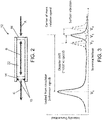
- the arrow A in FIG. 2 represents laser light from the optical circulator 6 (see FIG. 1 ) which is impinging on the mirror 14 (the portion of that incident light which is reflected by mirror 14 is not indicated in FIG. 2 ).
- the double-headed arrow B in FIG. 2 represents internally reflected laser light inside the cavity 22.
- the arrow C in FIG. 2 represents laser light transmitted by the Fabry-Perot interferometer 12 to the photodetector 14.
- the transmission spectrum of the Fabry-Perot interferometer 12 as a function of wavelength exhibits peaks of large transmission corresponding to resonances of the interferometer.
- the transmission function of the Fabry-Pérot interferometer 12 is caused by interference between the multiple reflections of light between the two reflecting mirrors 12 and 14. Constructive interference occurs if the transmitted beams are in phase, and this corresponds to a high-transmission peak of the interferometer. If the transmitted beams are out-of-phase, destructive interference occurs and this corresponds to a transmission minimum. Maximum transmission occurs when the optical path length difference between each transmitted beam is an integer multiple of the wavelength. The wavelength separation between adjacent transmission peaks is called the free spectral range of the interferometer.
- the Fabry-Pérot interferometer 12 passes wavelengths that are equal to integer fractions of the cavity length; all other wavelengths are attenuated.
- the Fabry-Perot interferometer 12 further comprises a plurality of piezoelectric transducers 18, which can be employed to change the length of the cavity 22 between mirrors 14 and 16, and thereby tune the wavelength of the Fabry-Pérot interferometer 12 so that it acts as a filter.
- the lengths of the piezoelectric transducers 18 are typically changed by application of a positive variable voltage to the piezoelectric transducers 18.
- the distance between the mirrors 14 and 16 can be tuned in order to change the wavelengths which will be passed by the scanning Fabry-Perot interferometer 12.
- the scanning Fabry-Pérot interferometer 12 is controlled to have a pass band which corresponds to the wavelengths that are used in the measurement. More specifically, the distance between the mirrors 14 and 16 is controlled by the signal processor 16, which supplies varying scanning voltages to the piezoelectric transducers 18 via a voltage supply line 20. In this manner the Fabry-Perot interferometer 12 is controlled to scan its pass band through a required wavelength range, such as the wavelength range depicted in FIG. 3 ,
- FIG. 3 is a graph showing the detection voltages (vertical axis) produced by the photodetector 14 in dependence on the intensity of laser light passed through the Fabry-Pérot interferometer 12 as the scanning voltage (horizontal axis) is varied.
- the laser light leaked to the Fabry-Pérot interferometer 12 from the laser source 2 by the optical circulator 6 produces a transmission peak centered at scanning voltage V 1 .
- This transmission peak at scanning voltage V 1 is treated as the reference signal by the signal processor 16.
- the rest of the laser light from laser source 2 is passed by the optical circulator 6 to the telescope 8, which directs the resulting laser beam toward the target 10.
- the laser light returned to the telescope 8 from the target 10 is then passed via the optical circulator 6 to the Fabry-Pérot interferometer 12, which scans the incoming laser light as the cavity length is being changed.
- the resulting output from the Fabry-Pérot interferometer 12 causes the photodetector 14 to produce transmission peaks at scanning voltages V 2 , V 3 , and V 4 .
- the difference between the scanning voltages V 1 and V 3 is a measure of the Doppler shift produced by the velocity component of the center of mass of the target 10 along the line of sight of the telescope 8, whereas the transmission peaks (indicated by dashed lines in FIG. 3 ) centered at scanning voltages V 2 and V 4 are caused by surface vibrations of the target 10.
- the scanning speed is controlled by the signal processor 16 in such a way that during the scan, a predetermined total amount of transmitted light is received after the Fabry-Pérot interferometer 12 at each wavelength of radiation.
- FIG. 4 is a flowchart identifying steps of a method for identifying a remote target using a tunable interferometer in accordance with one embodiment.
- the operation of the laser Doppler vibrometer starts with a monochromatic, low noise, high spectral purity laser.
- the laser light emitted by laser source 2 is directed toward and propagates into Port P1 of the optical circulator (step 24). Some of the laser light entering the optical circulator via Port P1 exits Port P2 and is sent to the telescope 8; other laser light is leaked via Port P3 to the Fabry-Pérot interferometer 12 (step 26).
- the propagation could be in optical fiber or air/vacuum.
- the leakage light from Port P1 to Port P3 is used as the reference signal by the signal processor 16.
- Light exiting Port P2 is coupled into the telescope and propagates to the target (step 28). Laser light reflecting from the target is Doppler shifted and re-captured by the telescope (step 30). The recaptured laser light enters Port P2 and exits through Port P3 of the optical circulator 6 and is sent to the Fabry-Pérot interferometer 12 (step 32).
- the Fabry-Pérot interferometer 12 is tuned by applying a voltage (scanning voltage) to the piezoelectric transducers (step 34).
- the scanning voltage changes the length of the piezoelectric transducers, hence changing the distance between the two mirrors 14 and 16 inside the Fabry-Perot interferometer 12.
- the distance between the two mirrors determines the wavelength of light that gets through.
- Any laser light that is not filtered out by the Fabry-Pérot interferometer 12 is detected by the photodetector 14 (e.g., a photodiode), which converts the light intensity into a voltage (detection voltage) (step 36).
- the photodetector 14 e.g., a photodiode
- the signal processor 16 monitors the detection voltage as a function of the scanning voltage (step 38). It identifies the scanning voltages where the peak detection voltages occur (step 40). The differences in scanning voltages where the peaks occur are then compared to a calibration table to determine the relative speed of the target as well as the resonant vibration frequency of the target (step 42). Based on the detected resonant frequency the target can be identified (step 44).
- FIG. 5 is a graph showing the laser Doppler shift (in MHz) as a function of the surface vibration frequency (Hz) and the associated surface speed (m/s). Assuming for the sake of illustration that the system detects a surface vibration on a target having a vibration frequency of 1 kHz and a peak displacement of 1 mm, the resulting peak surface speed will be 1 m/s, as indicated by the vertical dashed line in FIG. 5 . A surface speed of 1 m/s would produce a Doppler shift of approximately 1 MHz, as indicated by the horizontal dashed line in FIG. 5 . A properly designed scanning Fabry-Pérot interferometer can easily detect this 1-MHz shift.
- the system disclosed above can be used at distances of tens or hundreds of kilometers to identify and differentiate targets based on their natural vibration frequencies. Recent advances in laser power output and spectral purity could enable new applications.
- a commercially available fiber laser at 1.55- ⁇ m, 10-W continuous wave output, and spectral width ⁇ 1 kHz provides a coherence length of at least 100 km.
- Using the laser radar equation (10-cm aperture) one can calculate that a 50-km distance separation (100-km round trip) would result in a shot noise limited signal-to-noise ratio (SNR) of ⁇ 300X or 25 dB. This is better than the 20-dB SNR typically required for standard optical signal processing methods.
- One proposed application of this technology is to detect decoy warheads on intercontinental ballistic missiles (ICBM).
- ICBM intercontinental ballistic missiles
- the detection modality assumption is that the actual warheads have different masses from the decoy ones, hence different natural vibration frequencies.
- the excitation energy comes from the rocket engines or aerodynamic forces coupling during reentry.
- the biggest challenge is that at Mach 10, a 50-km standoff gives the defender only 15 seconds to track, identify, and target.
- Another proposed application is to use laser Doppler vibrometry for persistent surveillance from ground-based, airborne, or space-based platforms.
- the system could be directed at military and industrial targets of opportunities. For example, the vibration frequency of a missile silo lid could be monitored to determine if it is occupied.
- spectroscopic detection techniques such as Fabry-Pérot and laser comb spectroscopy are required. Atmospheric turbulence could be corrected using adaptive optics, or alternatively considered as part of the random noise floor in the signal processing of long duration data.
Landscapes
- Physics & Mathematics (AREA)
- Engineering & Computer Science (AREA)
- General Physics & Mathematics (AREA)
- Computer Networks & Wireless Communication (AREA)
- Radar, Positioning & Navigation (AREA)
- Remote Sensing (AREA)
- Electromagnetism (AREA)
- Power Engineering (AREA)
- Measurement Of Mechanical Vibrations Or Ultrasonic Waves (AREA)
- Optical Radar Systems And Details Thereof (AREA)
Applications Claiming Priority (1)
| Application Number | Priority Date | Filing Date | Title |
|---|---|---|---|
| US14/843,685 US10156473B2 (en) | 2015-09-02 | 2015-09-02 | Remote target identification using laser Doppler vibrometry |
Publications (2)
| Publication Number | Publication Date |
|---|---|
| EP3139195A1 EP3139195A1 (en) | 2017-03-08 |
| EP3139195B1 true EP3139195B1 (en) | 2022-04-13 |
Family
ID=56852207
Family Applications (1)
| Application Number | Title | Priority Date | Filing Date |
|---|---|---|---|
| EP16186868.2A Active EP3139195B1 (en) | 2015-09-02 | 2016-09-01 | Remote target identification using laser doppler vibrometry |
Country Status (3)
| Country | Link |
|---|---|
| US (1) | US10156473B2 (enExample) |
| EP (1) | EP3139195B1 (enExample) |
| JP (1) | JP6674353B2 (enExample) |
Cited By (1)
| Publication number | Priority date | Publication date | Assignee | Title |
|---|---|---|---|---|
| US20220299642A1 (en) * | 2019-08-28 | 2022-09-22 | Bae Systems Plc | Active modulating element detection |
Families Citing this family (15)
| Publication number | Priority date | Publication date | Assignee | Title |
|---|---|---|---|---|
| KR20180062463A (ko) * | 2015-10-02 | 2018-06-08 | 하마마츠 포토닉스 가부시키가이샤 | 광 검출 장치 |
| CN107479046B (zh) * | 2017-07-06 | 2019-09-06 | 北京空间机电研究所 | 一种星载可调谐多通道法布里-珀罗鉴频模块 |
| US11650294B2 (en) * | 2018-03-28 | 2023-05-16 | Murata Manufacturing Co., Ltd. | Fabry-pérot element in lidar device |
| WO2019236108A1 (en) * | 2018-06-08 | 2019-12-12 | Hewlett-Packard Development Company, L.P. | Selective laser melting (slm) additive manufacturing |
| CN109374914A (zh) * | 2018-09-18 | 2019-02-22 | 西安工业大学 | 大动态测量范围全光纤多普勒测速装置 |
| EP4446779A3 (en) | 2018-10-22 | 2025-01-01 | DRS Network & Imaging Systems, LLC | Integrated optics quantum weak measurement amplification sensor for remote sensing |
| CN110108349B (zh) * | 2019-05-23 | 2022-04-22 | 中国科学院光电研究院 | 一种激光测振仪 |
| CN110440899B (zh) * | 2019-08-09 | 2024-02-06 | 大连理工大学 | 一种共路双波长正交相位解调系统 |
| CN113138012A (zh) * | 2020-01-17 | 2021-07-20 | 中国海洋大学 | 一种风力发电机振动的激光雷达遥测检测方法 |
| JP7324980B2 (ja) * | 2020-01-20 | 2023-08-14 | 日本電信電話株式会社 | 測定装置および測定方法 |
| CN111721968B (zh) * | 2020-06-03 | 2022-06-28 | 华东师范大学 | 一种基于双光梳系统测定气体流速的方法 |
| WO2022093815A1 (en) | 2020-10-27 | 2022-05-05 | Drs Network & Imaging Systems, Llc | Optical gyroscope with weak measurement amplification readout |
| CN114838803B (zh) * | 2022-04-29 | 2023-11-10 | 北京杏林睿光科技有限公司 | 一种振动测量装置以及振动测量方法 |
| CN115979263B (zh) * | 2023-03-21 | 2023-06-02 | 中国人民解放军国防科技大学 | 一种低空飞行载体导航方法及系统 |
| CN119595081A (zh) * | 2024-10-30 | 2025-03-11 | 中国航空工业集团公司北京长城计量测试技术研究所 | 一种激光测振仪串联往复式光频调制校准方法及装置 |
Family Cites Families (16)
| Publication number | Priority date | Publication date | Assignee | Title |
|---|---|---|---|---|
| US3968362A (en) | 1975-08-11 | 1976-07-06 | Honeywell Inc. | Optical system for laser doppler homodyne detection |
| US5192979A (en) | 1984-09-26 | 1993-03-09 | Siemens Aktiengesellschaft | Method and apparatus for recognizing and identifying targets |
| JPH049687A (ja) * | 1990-04-27 | 1992-01-14 | Nippon Steel Corp | レーザドップラ速度計 |
| US5434668A (en) | 1992-04-01 | 1995-07-18 | Electronics & Space Corp. | Laser vibrometer identification friend-or-foe (IFF) system |
| CN1089443C (zh) * | 1998-04-24 | 2002-08-21 | 中国科学院上海光学精密机械研究所 | 探测大气的非相干激光雷达系统 |
| JP3513432B2 (ja) * | 1999-07-27 | 2004-03-31 | 三菱重工業株式会社 | 光周波数領域反射測定装置および光周波数領域反射測定方法 |
| US6657732B2 (en) | 2001-05-04 | 2003-12-02 | Hrl Laboratories, Llc | Vibrometer system using a two input beam phase conjugate mirror |
| US6728645B1 (en) | 2003-01-07 | 2004-04-27 | Electro-Optics Research & Development Ltd. | Method and system for automatic identification of objects type according to their characteristic spectrum of vibration frequencies |
| US7477398B2 (en) | 2003-03-31 | 2009-01-13 | Metrolaser, Inc. | Multi-beam heterodyne laser doppler vibrometer |
| EP1879015B1 (en) | 2005-03-02 | 2018-08-01 | Japan Science and Technology Agency | Heterodyne laser doppler probe and measurement system using the same |
| US7554670B2 (en) | 2006-01-18 | 2009-06-30 | Seagate Technology Llc | Surface inspection by double pass laser doppler vibrometry |
| IE20080795A1 (en) | 2007-10-03 | 2009-07-08 | Univ Limerick | A multipoint laser doppler vibrometer |
| JP2012184967A (ja) * | 2011-03-03 | 2012-09-27 | Canon Inc | 波長走査干渉計 |
| CN103344947A (zh) | 2013-06-04 | 2013-10-09 | 四川大学 | 基于微多普勒效应的微动目标特征提取方法 |
| CN103499820B (zh) | 2013-09-27 | 2015-09-09 | 中国科学技术大学 | 一种全光纤直接探测测风激光雷达的闭环控制方法 |
| CN103605124B (zh) | 2013-11-05 | 2015-11-25 | 中国科学技术大学 | 一种直接探测多普勒激光雷达的快速校准系统和方法 |
-
2015
- 2015-09-02 US US14/843,685 patent/US10156473B2/en active Active
-
2016
- 2016-08-23 JP JP2016162739A patent/JP6674353B2/ja active Active
- 2016-09-01 EP EP16186868.2A patent/EP3139195B1/en active Active
Cited By (2)
| Publication number | Priority date | Publication date | Assignee | Title |
|---|---|---|---|---|
| US20220299642A1 (en) * | 2019-08-28 | 2022-09-22 | Bae Systems Plc | Active modulating element detection |
| US12481062B2 (en) * | 2019-08-28 | 2025-11-25 | Bae Systems Plc | Active modulating element detection |
Also Published As
| Publication number | Publication date |
|---|---|
| US10156473B2 (en) | 2018-12-18 |
| JP2017049243A (ja) | 2017-03-09 |
| US20170059392A1 (en) | 2017-03-02 |
| EP3139195A1 (en) | 2017-03-08 |
| JP6674353B2 (ja) | 2020-04-01 |
Similar Documents
| Publication | Publication Date | Title |
|---|---|---|
| EP3139195B1 (en) | Remote target identification using laser doppler vibrometry | |
| US11714169B2 (en) | System for scanning a transmitted beam through a 360° field-of-view | |
| US9702975B2 (en) | Lidar measuring system and lidar measuring method | |
| US10598769B2 (en) | Coaxial direct-detection LIDAR-system | |
| US6388739B1 (en) | Self-referencing microdoppler ladar receiver and associated detection method | |
| CA2800267C (en) | Method and apparatus for a pulsed coherent laser range finder | |
| US11531111B2 (en) | 360 degrees field of view scanning lidar with no movable parts | |
| EP3218741B1 (en) | System and method for measuring doppler effect utilizing elastic and inelastic light scattering | |
| US11906665B2 (en) | Method for scanning a transmitted beam through a 360° field-of-view (FOV) | |
| JP7329995B2 (ja) | レーザドップラーレーダ装置及び風速算出方法 | |
| IL286820A (en) | A method and system for mapping and measuring distance | |
| Kameyama et al. | Intensity-modulated direct-detection doppler LiDAR using pseudo-random code and optical direct down-conversion of modulation frequency for range and speed measurement of a hard target | |
| Renhorn et al. | Coherent laser radar for vibrometry: robust design and adaptive signal processing | |
| US11768291B1 (en) | High dynamic range ranging interferometer | |
| Chen et al. | Dual-Frequency Doppler LiDAR Using Periodic Window with Period-6 Based on External Optical Feedback Effect in a Laser Diode | |
| US20220404472A1 (en) | Lidar system comprising two diffractive components | |
| Sturm et al. | A technique for removing platform vibration noise from a pulsed ladar vibration sensor | |
| Onori et al. | A dual-frequency coherent noise lidar for robust range-Doppler measurements | |
| JP2025529022A (ja) | 流体の速度を測定するためのライダ・システム |
Legal Events
| Date | Code | Title | Description |
|---|---|---|---|
| PUAI | Public reference made under article 153(3) epc to a published international application that has entered the european phase |
Free format text: ORIGINAL CODE: 0009012 |
|
| STAA | Information on the status of an ep patent application or granted ep patent |
Free format text: STATUS: REQUEST FOR EXAMINATION WAS MADE |
|
| 17P | Request for examination filed |
Effective date: 20160901 |
|
| AK | Designated contracting states |
Kind code of ref document: A1 Designated state(s): AL AT BE BG CH CY CZ DE DK EE ES FI FR GB GR HR HU IE IS IT LI LT LU LV MC MK MT NL NO PL PT RO RS SE SI SK SM TR |
|
| AX | Request for extension of the european patent |
Extension state: BA ME |
|
| STAA | Information on the status of an ep patent application or granted ep patent |
Free format text: STATUS: EXAMINATION IS IN PROGRESS |
|
| 17Q | First examination report despatched |
Effective date: 20200130 |
|
| REG | Reference to a national code |
Ref country code: DE Ref legal event code: R079 Ref document number: 602016071001 Country of ref document: DE Free format text: PREVIOUS MAIN CLASS: G01S0007481000 Ipc: G01S0017580000 |
|
| GRAP | Despatch of communication of intention to grant a patent |
Free format text: ORIGINAL CODE: EPIDOSNIGR1 |
|
| STAA | Information on the status of an ep patent application or granted ep patent |
Free format text: STATUS: GRANT OF PATENT IS INTENDED |
|
| GRAJ | Information related to disapproval of communication of intention to grant by the applicant or resumption of examination proceedings by the epo deleted |
Free format text: ORIGINAL CODE: EPIDOSDIGR1 |
|
| GRAP | Despatch of communication of intention to grant a patent |
Free format text: ORIGINAL CODE: EPIDOSNIGR1 |
|
| RIC1 | Information provided on ipc code assigned before grant |
Ipc: G01H 9/00 20060101ALI20210927BHEP Ipc: G01H 13/00 20060101ALI20210927BHEP Ipc: G01S 7/48 20060101ALI20210927BHEP Ipc: G01S 7/481 20060101ALI20210927BHEP Ipc: G01S 17/58 20060101AFI20210927BHEP |
|
| INTG | Intention to grant announced |
Effective date: 20211013 |
|
| INTG | Intention to grant announced |
Effective date: 20211104 |
|
| GRAS | Grant fee paid |
Free format text: ORIGINAL CODE: EPIDOSNIGR3 |
|
| GRAA | (expected) grant |
Free format text: ORIGINAL CODE: 0009210 |
|
| STAA | Information on the status of an ep patent application or granted ep patent |
Free format text: STATUS: THE PATENT HAS BEEN GRANTED |
|
| AK | Designated contracting states |
Kind code of ref document: B1 Designated state(s): AL AT BE BG CH CY CZ DE DK EE ES FI FR GB GR HR HU IE IS IT LI LT LU LV MC MK MT NL NO PL PT RO RS SE SI SK SM TR |
|
| REG | Reference to a national code |
Ref country code: GB Ref legal event code: FG4D |
|
| REG | Reference to a national code |
Ref country code: CH Ref legal event code: EP |
|
| REG | Reference to a national code |
Ref country code: DE Ref legal event code: R096 Ref document number: 602016071001 Country of ref document: DE |
|
| REG | Reference to a national code |
Ref country code: IE Ref legal event code: FG4D |
|
| REG | Reference to a national code |
Ref country code: AT Ref legal event code: REF Ref document number: 1483817 Country of ref document: AT Kind code of ref document: T Effective date: 20220515 |
|
| REG | Reference to a national code |
Ref country code: LT Ref legal event code: MG9D |
|
| REG | Reference to a national code |
Ref country code: NL Ref legal event code: MP Effective date: 20220413 |
|
| REG | Reference to a national code |
Ref country code: AT Ref legal event code: MK05 Ref document number: 1483817 Country of ref document: AT Kind code of ref document: T Effective date: 20220413 |
|
| PG25 | Lapsed in a contracting state [announced via postgrant information from national office to epo] |
Ref country code: NL Free format text: LAPSE BECAUSE OF FAILURE TO SUBMIT A TRANSLATION OF THE DESCRIPTION OR TO PAY THE FEE WITHIN THE PRESCRIBED TIME-LIMIT Effective date: 20220413 |
|
| PG25 | Lapsed in a contracting state [announced via postgrant information from national office to epo] |
Ref country code: SE Free format text: LAPSE BECAUSE OF FAILURE TO SUBMIT A TRANSLATION OF THE DESCRIPTION OR TO PAY THE FEE WITHIN THE PRESCRIBED TIME-LIMIT Effective date: 20220413 Ref country code: PT Free format text: LAPSE BECAUSE OF FAILURE TO SUBMIT A TRANSLATION OF THE DESCRIPTION OR TO PAY THE FEE WITHIN THE PRESCRIBED TIME-LIMIT Effective date: 20220816 Ref country code: NO Free format text: LAPSE BECAUSE OF FAILURE TO SUBMIT A TRANSLATION OF THE DESCRIPTION OR TO PAY THE FEE WITHIN THE PRESCRIBED TIME-LIMIT Effective date: 20220713 Ref country code: LT Free format text: LAPSE BECAUSE OF FAILURE TO SUBMIT A TRANSLATION OF THE DESCRIPTION OR TO PAY THE FEE WITHIN THE PRESCRIBED TIME-LIMIT Effective date: 20220413 Ref country code: HR Free format text: LAPSE BECAUSE OF FAILURE TO SUBMIT A TRANSLATION OF THE DESCRIPTION OR TO PAY THE FEE WITHIN THE PRESCRIBED TIME-LIMIT Effective date: 20220413 Ref country code: GR Free format text: LAPSE BECAUSE OF FAILURE TO SUBMIT A TRANSLATION OF THE DESCRIPTION OR TO PAY THE FEE WITHIN THE PRESCRIBED TIME-LIMIT Effective date: 20220714 Ref country code: FI Free format text: LAPSE BECAUSE OF FAILURE TO SUBMIT A TRANSLATION OF THE DESCRIPTION OR TO PAY THE FEE WITHIN THE PRESCRIBED TIME-LIMIT Effective date: 20220413 Ref country code: ES Free format text: LAPSE BECAUSE OF FAILURE TO SUBMIT A TRANSLATION OF THE DESCRIPTION OR TO PAY THE FEE WITHIN THE PRESCRIBED TIME-LIMIT Effective date: 20220413 Ref country code: BG Free format text: LAPSE BECAUSE OF FAILURE TO SUBMIT A TRANSLATION OF THE DESCRIPTION OR TO PAY THE FEE WITHIN THE PRESCRIBED TIME-LIMIT Effective date: 20220713 Ref country code: AT Free format text: LAPSE BECAUSE OF FAILURE TO SUBMIT A TRANSLATION OF THE DESCRIPTION OR TO PAY THE FEE WITHIN THE PRESCRIBED TIME-LIMIT Effective date: 20220413 |
|
| PG25 | Lapsed in a contracting state [announced via postgrant information from national office to epo] |
Ref country code: RS Free format text: LAPSE BECAUSE OF FAILURE TO SUBMIT A TRANSLATION OF THE DESCRIPTION OR TO PAY THE FEE WITHIN THE PRESCRIBED TIME-LIMIT Effective date: 20220413 Ref country code: PL Free format text: LAPSE BECAUSE OF FAILURE TO SUBMIT A TRANSLATION OF THE DESCRIPTION OR TO PAY THE FEE WITHIN THE PRESCRIBED TIME-LIMIT Effective date: 20220413 Ref country code: LV Free format text: LAPSE BECAUSE OF FAILURE TO SUBMIT A TRANSLATION OF THE DESCRIPTION OR TO PAY THE FEE WITHIN THE PRESCRIBED TIME-LIMIT Effective date: 20220413 Ref country code: IS Free format text: LAPSE BECAUSE OF FAILURE TO SUBMIT A TRANSLATION OF THE DESCRIPTION OR TO PAY THE FEE WITHIN THE PRESCRIBED TIME-LIMIT Effective date: 20220813 |
|
| REG | Reference to a national code |
Ref country code: DE Ref legal event code: R097 Ref document number: 602016071001 Country of ref document: DE |
|
| PG25 | Lapsed in a contracting state [announced via postgrant information from national office to epo] |
Ref country code: SM Free format text: LAPSE BECAUSE OF FAILURE TO SUBMIT A TRANSLATION OF THE DESCRIPTION OR TO PAY THE FEE WITHIN THE PRESCRIBED TIME-LIMIT Effective date: 20220413 Ref country code: SK Free format text: LAPSE BECAUSE OF FAILURE TO SUBMIT A TRANSLATION OF THE DESCRIPTION OR TO PAY THE FEE WITHIN THE PRESCRIBED TIME-LIMIT Effective date: 20220413 Ref country code: RO Free format text: LAPSE BECAUSE OF FAILURE TO SUBMIT A TRANSLATION OF THE DESCRIPTION OR TO PAY THE FEE WITHIN THE PRESCRIBED TIME-LIMIT Effective date: 20220413 Ref country code: EE Free format text: LAPSE BECAUSE OF FAILURE TO SUBMIT A TRANSLATION OF THE DESCRIPTION OR TO PAY THE FEE WITHIN THE PRESCRIBED TIME-LIMIT Effective date: 20220413 Ref country code: DK Free format text: LAPSE BECAUSE OF FAILURE TO SUBMIT A TRANSLATION OF THE DESCRIPTION OR TO PAY THE FEE WITHIN THE PRESCRIBED TIME-LIMIT Effective date: 20220413 Ref country code: CZ Free format text: LAPSE BECAUSE OF FAILURE TO SUBMIT A TRANSLATION OF THE DESCRIPTION OR TO PAY THE FEE WITHIN THE PRESCRIBED TIME-LIMIT Effective date: 20220413 |
|
| PLBE | No opposition filed within time limit |
Free format text: ORIGINAL CODE: 0009261 |
|
| STAA | Information on the status of an ep patent application or granted ep patent |
Free format text: STATUS: NO OPPOSITION FILED WITHIN TIME LIMIT |
|
| 26N | No opposition filed |
Effective date: 20230116 |
|
| PG25 | Lapsed in a contracting state [announced via postgrant information from national office to epo] |
Ref country code: AL Free format text: LAPSE BECAUSE OF FAILURE TO SUBMIT A TRANSLATION OF THE DESCRIPTION OR TO PAY THE FEE WITHIN THE PRESCRIBED TIME-LIMIT Effective date: 20220413 |
|
| PG25 | Lapsed in a contracting state [announced via postgrant information from national office to epo] |
Ref country code: MC Free format text: LAPSE BECAUSE OF FAILURE TO SUBMIT A TRANSLATION OF THE DESCRIPTION OR TO PAY THE FEE WITHIN THE PRESCRIBED TIME-LIMIT Effective date: 20220413 |
|
| REG | Reference to a national code |
Ref country code: CH Ref legal event code: PL |
|
| REG | Reference to a national code |
Ref country code: BE Ref legal event code: MM Effective date: 20220930 |
|
| PG25 | Lapsed in a contracting state [announced via postgrant information from national office to epo] |
Ref country code: SI Free format text: LAPSE BECAUSE OF FAILURE TO SUBMIT A TRANSLATION OF THE DESCRIPTION OR TO PAY THE FEE WITHIN THE PRESCRIBED TIME-LIMIT Effective date: 20220413 |
|
| P01 | Opt-out of the competence of the unified patent court (upc) registered |
Effective date: 20230516 |
|
| PG25 | Lapsed in a contracting state [announced via postgrant information from national office to epo] |
Ref country code: LU Free format text: LAPSE BECAUSE OF NON-PAYMENT OF DUE FEES Effective date: 20220901 |
|
| PG25 | Lapsed in a contracting state [announced via postgrant information from national office to epo] |
Ref country code: LI Free format text: LAPSE BECAUSE OF NON-PAYMENT OF DUE FEES Effective date: 20220930 Ref country code: IE Free format text: LAPSE BECAUSE OF NON-PAYMENT OF DUE FEES Effective date: 20220901 Ref country code: CH Free format text: LAPSE BECAUSE OF NON-PAYMENT OF DUE FEES Effective date: 20220930 |
|
| PG25 | Lapsed in a contracting state [announced via postgrant information from national office to epo] |
Ref country code: BE Free format text: LAPSE BECAUSE OF NON-PAYMENT OF DUE FEES Effective date: 20220930 |
|
| PG25 | Lapsed in a contracting state [announced via postgrant information from national office to epo] |
Ref country code: IT Free format text: LAPSE BECAUSE OF FAILURE TO SUBMIT A TRANSLATION OF THE DESCRIPTION OR TO PAY THE FEE WITHIN THE PRESCRIBED TIME-LIMIT Effective date: 20220413 |
|
| PG25 | Lapsed in a contracting state [announced via postgrant information from national office to epo] |
Ref country code: HU Free format text: LAPSE BECAUSE OF FAILURE TO SUBMIT A TRANSLATION OF THE DESCRIPTION OR TO PAY THE FEE WITHIN THE PRESCRIBED TIME-LIMIT; INVALID AB INITIO Effective date: 20160901 |
|
| PG25 | Lapsed in a contracting state [announced via postgrant information from national office to epo] |
Ref country code: CY Free format text: LAPSE BECAUSE OF FAILURE TO SUBMIT A TRANSLATION OF THE DESCRIPTION OR TO PAY THE FEE WITHIN THE PRESCRIBED TIME-LIMIT Effective date: 20220413 |
|
| PG25 | Lapsed in a contracting state [announced via postgrant information from national office to epo] |
Ref country code: MK Free format text: LAPSE BECAUSE OF FAILURE TO SUBMIT A TRANSLATION OF THE DESCRIPTION OR TO PAY THE FEE WITHIN THE PRESCRIBED TIME-LIMIT Effective date: 20220413 |
|
| PG25 | Lapsed in a contracting state [announced via postgrant information from national office to epo] |
Ref country code: TR Free format text: LAPSE BECAUSE OF FAILURE TO SUBMIT A TRANSLATION OF THE DESCRIPTION OR TO PAY THE FEE WITHIN THE PRESCRIBED TIME-LIMIT Effective date: 20220413 |
|
| PG25 | Lapsed in a contracting state [announced via postgrant information from national office to epo] |
Ref country code: MT Free format text: LAPSE BECAUSE OF FAILURE TO SUBMIT A TRANSLATION OF THE DESCRIPTION OR TO PAY THE FEE WITHIN THE PRESCRIBED TIME-LIMIT Effective date: 20220413 |
|
| PG25 | Lapsed in a contracting state [announced via postgrant information from national office to epo] |
Ref country code: BG Free format text: LAPSE BECAUSE OF FAILURE TO SUBMIT A TRANSLATION OF THE DESCRIPTION OR TO PAY THE FEE WITHIN THE PRESCRIBED TIME-LIMIT Effective date: 20220413 |
|
| PG25 | Lapsed in a contracting state [announced via postgrant information from national office to epo] |
Ref country code: BG Free format text: LAPSE BECAUSE OF FAILURE TO SUBMIT A TRANSLATION OF THE DESCRIPTION OR TO PAY THE FEE WITHIN THE PRESCRIBED TIME-LIMIT Effective date: 20220413 |
|
| PGFP | Annual fee paid to national office [announced via postgrant information from national office to epo] |
Ref country code: DE Payment date: 20250929 Year of fee payment: 10 |
|
| PGFP | Annual fee paid to national office [announced via postgrant information from national office to epo] |
Ref country code: GB Payment date: 20250929 Year of fee payment: 10 |
|
| PGFP | Annual fee paid to national office [announced via postgrant information from national office to epo] |
Ref country code: FR Payment date: 20250925 Year of fee payment: 10 |