EP3138902A1 - Procede et dispositif de traitement et de fabrication d'un mout lors de la fabrication de boissons ou de biere et utilisation correspondante - Google Patents
Procede et dispositif de traitement et de fabrication d'un mout lors de la fabrication de boissons ou de biere et utilisation correspondante Download PDFInfo
- Publication number
- EP3138902A1 EP3138902A1 EP16187077.9A EP16187077A EP3138902A1 EP 3138902 A1 EP3138902 A1 EP 3138902A1 EP 16187077 A EP16187077 A EP 16187077A EP 3138902 A1 EP3138902 A1 EP 3138902A1
- Authority
- EP
- European Patent Office
- Prior art keywords
- wort
- temperature
- mash
- pvw
- enzyme
- Prior art date
- Legal status (The legal status is an assumption and is not a legal conclusion. Google has not performed a legal analysis and makes no representation as to the accuracy of the status listed.)
- Granted
Links
Images

Classifications
-
- C—CHEMISTRY; METALLURGY
- C12—BIOCHEMISTRY; BEER; SPIRITS; WINE; VINEGAR; MICROBIOLOGY; ENZYMOLOGY; MUTATION OR GENETIC ENGINEERING
- C12C—BEER; PREPARATION OF BEER BY FERMENTATION; PREPARATION OF MALT FOR MAKING BEER; PREPARATION OF HOPS FOR MAKING BEER
- C12C7/00—Preparation of wort
- C12C7/24—Clarifying beerwort between hop boiling and cooling
-
- C—CHEMISTRY; METALLURGY
- C12—BIOCHEMISTRY; BEER; SPIRITS; WINE; VINEGAR; MICROBIOLOGY; ENZYMOLOGY; MUTATION OR GENETIC ENGINEERING
- C12C—BEER; PREPARATION OF BEER BY FERMENTATION; PREPARATION OF MALT FOR MAKING BEER; PREPARATION OF HOPS FOR MAKING BEER
- C12C5/00—Other raw materials for the preparation of beer
- C12C5/004—Enzymes
-
- C—CHEMISTRY; METALLURGY
- C12—BIOCHEMISTRY; BEER; SPIRITS; WINE; VINEGAR; MICROBIOLOGY; ENZYMOLOGY; MUTATION OR GENETIC ENGINEERING
- C12C—BEER; PREPARATION OF BEER BY FERMENTATION; PREPARATION OF MALT FOR MAKING BEER; PREPARATION OF HOPS FOR MAKING BEER
- C12C5/00—Other raw materials for the preparation of beer
- C12C5/004—Enzymes
- C12C5/006—Beta-glucanase or functionally equivalent enzymes
Definitions
- the invention relates to a method for treating or preparing a wort in the beer or beverage production according to claim 1, a device for treating a wort in the beer or beverage production according to claim 9, and a corresponding use according to claim 14.
- Too high an iodine value may, for example, lead to problems in the filtration of the stored beer, in particular when using membrane filters, or to quality losses (taste stability, aging resistance, susceptibility to microbiological attack) in the finished beer.
- Untreated starch leads to yield losses, which entail a cost disadvantage.
- novel refining technologies which are not based on the principle of depth filtration, as used for example in the conventional lauter tun, but are based essentially on the principle of surface filtration, sometimes have the problem of non-iodine normal seasoning, so not sufficiently degraded starch.
- thermostable enzymes it has often been necessary in the past to add elaborately isolated and purified, artificial and mostly thermostable enzymes to the wort or the beer.
- the wort can be obtained according to the invention by rinsing a mash with a mashing temperature in the range of 60 to 70 ° C, preferably 62 to 68 ° C, in particular 63 to 65 ° C.
- a mashing temperature in the range of 60 to 70 ° C, preferably 62 to 68 ° C, in particular 63 to 65 ° C.
- the present invention preferably relates to gelatinised seasonings with unsweetened starch components, in particular a high proportion of unsweetened starch components.
- gelatinized seasoning due to the ⁇ -amylase activity are characterized by a relatively low viscosity.
- the enzyme-containing substrate preferably mash / mash extract / second wort, preferably at a temperature corresponding to the first temperature or at most 10 ° C, preferably at most 8 ° C, preferably at most 6 ° C, in particular at most 4 ° C, below the first temperature.
- the enzyme-containing substrate is a filtered substrate, in particular a filtered mash, for example a wort.
- the enzyme-containing substrate is not heated to a temperature above the first temperature or above 85 ° C, preferably above 80 ° C, preferably above 78 ° C, preferably above 76 ° C, preferably above 75 ° C, preferably above 74 ° C, preferably above 72 ° C, preferably above 70 ° C, preferably above 68 ° C, preferably above 66 ° C, preferably above 65 ° C, in particular above 62 ° C.
- the wort is after the conventional holding or cooking, and preferably before clarifying, d. H. the partial or complete separation of hot trub or other solids, for example in the whirlpool or other separating device (decanter, settling vat, etc.), to a predetermined first temperature of at most 85 ° C, preferably at most 84 ° C, in particular 80 ° C set, in particular cooled.
- the term "after the hot-holding or cooking of the wort” can be understood to mean in particular "after completion of the hot-holding or boiling of the wort".
- the enzyme-containing substrate is added only when the process of the actual heat treatment of the wort in terms of classic Wort boiling / hot keeping is completed in the brewing kettle and is no longer continued.
- the enzymatic treatment according to the invention after the end of the heat treatment step of the wort has the advantage that all starch components released until the end of the heat treatment are accessible to enzymatic degradation. A further release of starch constituents by a continuation of the heat treatment in the sense of a renewed heating to the boiling or holding temperature can thus be avoided according to the invention.
- step (a) the wort is adjusted to a temperature of at most 80 ° C, in particular to a temperature between 70 and 80 ° C, it will for the first time possible that the wort is present at a temperature at which at least a portion of the enzyme-containing substrate, preferably in a mash portion and / or in a portion of not more than 80 ° C heated, second wort, in particular a portion of wort, naturally existing enzymes is active and not denatured due to temperature.
- the wort can be adjusted to a temperature of at most 55 ° C (for example 40 to 55 ° C, especially 45 to 50 ° C).
- step (a) the wort on the other hand to a temperature in the range of 80 to 85 ° C or at least to a temperature above the usual range of application of the considered enzyme (at most up to the temperature of the largest conversion per unit time, ie the temperature or optimum of action) is set, although the optimum effect of the enzymes may be exceeded in the enzyme-containing substrate. Nevertheless, the inventors have found a sufficiently high enzyme activity to ensure a quantitatively sufficient enzymatic degradation before the enzyme activity comes to a standstill due to the progressing, thermally induced enzyme inactivation.
- step (a) of the method according to the invention it is therefore possible, the temperature of the wort to a temperature of 2 to 20 ° C, preferably 5 to 15 ° C, above the temperature optimum of a substance relevant for the degradation enzyme, as for example in the set forth on page 23 below.
- the particular advantage of this approach is that a targeted inactivation of the respective considered enzyme or enzymes considered quasi at the same time or following the degradation is achieved without a re-heating of the wort for targeted inactivation would be required. As a result, the procedure is simplified, and a renewed heating of the wort is eliminated.
- the between the media used, such as wort and heat transfer medium or refrigerant to be transferred heat flow over a reduced cooling of the wort on or in particular below the temperature optimum of the considered enzyme, thereby simplifying the handling of the process. Furthermore, this results in a lower complexity of the process for the recovery of heat from the previously heat-treated wort and the device used for this purpose.
- an enzyme-containing substrate preferably the mash, the mash extract or the second wort not heated above 80 ° C., in particular a portion of a wort that has been added to the first temperature, in particular precooled, wort
- the enzymes naturally contained in the added substrate in the already heat-treated and thus enzyme-inactive wort act to further promote the degradation of high molecular weight substances such as starch, and possibly complete. This can advantageously be counteracted insufficient digestion and / or insufficient degradation during mashing.
- the possible effects of fine or fine turbidity which may have been problematic in the further process of beer or beverage production, during the further clarification of the wort may be at least partially avoided.
- the disadvantages of a barely dissolved malt can be compensated for at least to a certain extent.
- a mash extract over a mash as an addition to the wort is advantageous because of the reduced solids content of the mash extract over the mash.
- the enzymes contained therein are still in the addition of the invention according to the portion the above-described setting of the temperature, in particular precooling, to at most 85 ° C, preferably at most 80 ° C, following the heat treatment of the wort active and remain sufficiently active in such a tempered / pre-cooled wort, without being denatured due to temperature.
- the added portion of the enzyme-containing substrate should not be heated or otherwise treated in such a way from its recovery until it is added that a more than insignificant inactivation (for example> 25%). ) takes place which each considered to be relevant enzymes.
- the added portion of the enzyme-containing substrate is not heated to a temperature higher than the first temperature, at least not above 80 ° C, heated.
- the enzymes added after the wort heating / precooling by the addition of the portion of the enzyme-containing substrate can act on their target substances in the wort for a predetermined period of time and, for example, reduce the degradation in the Extract seasoning starch to iodine normality.
- the advantage of the enzyme addition according to the invention to wort already cooked or kept hot and then tempered / cooled to a certain temperature in the form of a portion of the enzyme-containing substrate (eg mash / mash extract / wort) not heat-treated above 80 ° C. lies in the comparatively fast enzymatic conversion the target substances in the wort due to the relatively high temperature, in particular in the range of the temperature optimum of each considered enzyme.
- the first temperature can preferably be set to the optimum temperature of the respectively considered enzyme (cf., for example, the table on page 23 of this application). This leads advantageously to a shortening of the previous refining time, since this is no longer needed as enzyme reaction time.
- the method of the invention it is also possible to add not only a single portion of the enzyme-containing substrate (for example a mash or a mash extract or a second wort / wort which has not been heated above 80 ° C.) to the wort.
- a single portion of the enzyme-containing substrate for example a mash or a mash extract or a second wort / wort which has not been heated above 80 ° C.
- different portions of the enzyme-containing substrate for example the mash, which were drawn from the mash at different temperatures, or mash portions, which may originate from different mash batches, are added to the wort according to the invention.
- This makes it possible to use mash fractions with defined amounts of active enzymes with different temperature optima for the treatment of pre-cooled or tempered wort.
- the portions or fractions can be added separately or as a mixture of the wort.
- the process according to the invention makes it possible to advance the degradation of raw materials or processing-problematic condiments which hitherto were not iodine-normal, for example, to obtain the desired degree of degradation, for example the iodine normality.
- the addition of expensive, artificially isolated and purified enzyme preparations is unnecessary.
- the wort retains its natural character due to the improved utilization of exclusively malignant enzymes, since the addition of non-malt enzyme preparations can be completely dispensed with.
- Another advantage of the method according to the invention is that not only iodine-normal seasoning can be achieved, but also the yield of fermentable sugars, such as, for example, maltose, can be increased, ie an extract yield can be achieved.
- the yield of fermentable extract can be increased by at least 4 to 12% by the method according to the invention. hereby the brewhouse yield is increased overall and the amount of raw materials or raw material costs to be used is reduced.
- the method may further comprise the step of at least partially clarifying the wort.
- the addition according to step (b) may preferably take place before the at least partial clarification of the wort.
- the duration of the hot trub separation that is, for example, the residence time of the wort in the whirlpool, which conventionally takes place anyway, be used to complete the enzymatic degradation.
- a further enzymatic reaction can take place even after the wort temperature control / cooling to, for example, annealing temperature, however, the rate of this reaction is considerably reduced due to the wort temperature which is usually much lower than that of the hot-bath step, so that the reaction may be incomplete.
- the method is not limited to this.
- the addition may take place alternatively or additionally during and / or after the at least partial clarification of the wort.
- the method according to the invention may further comprise at least one of the following steps: providing a mash; Separating the mash to obtain the wort, containing a wort or a mixture of the wort and at least one infusion; and keeping or cooking the wort.
- the separation of the mash in particular by a conventional device such as a lauter tun, a mash filter, a Strainmaster, a drum filter, disc filter or plate filter, a belt filter, or another fining device, preferably one which predominantly or completely on the principle of surface filtration (sieve effect ) and not or substantially not based on the principle of depth filtration (filter bed containing filter means), in particular a sieve filter.
- the separation of the mash is preferably carried out by means of a filtration, in particular by means of a surface filtration or sieve filtration.
- the filter effect can be predominantly, essentially or completely based on a sieving effect.
- the method may further comprise the step of cooling the wort to a second temperature between the first temperature and 0 ° C.
- the inventive method can be easily integrated into a conventional process for wort production. It is particularly advantageous if the added portion or added portions can be obtained in carrying out the same wort-making process, so that no separate source for the added portions is required.
- the first temperature may be in a range of 40 to 85 ° C, preferably 40 to 84 ° C, preferably 40 to 80 ° C, preferably 40 to 55 ° C; preferably 45 to 50 ° C; preferably 50 to 80 ° C, preferably 70 to 85 ° C, preferably 80 to 85 ° C; preferably 70 to 80 ° C, preferably 70 to 78 ° C, preferably 72 to 78 ° C, preferably 72 to 76 ° C, preferably 73 to 75 ° C, especially at about 74 ° C, or in the range of 78 to 85 ° C, preferably 78 to 84 ° C, preferably 80 to 85 ° C, in particular 80 to 83 ° C, are.
- a thermally induced deactivation is, for example of the portion-containing enzyme ⁇ -amylase avoided.
- the selected range contains the temperature optimum of the ⁇ -amylase, so that a high rate of the enzymatic reaction is achieved in the degradation of existing starch. This additional ⁇ -amylase activity promotes degradation of the starch and ultimately achieves iodine normality.
- the temperature optima of other enzymes present in the enzymatic substrate may also be taken into account for the determination of the first temperature (see also overview in the table below on page 23).
- the method may further comprise the step of, after the addition of step (b) and allowing a predetermined period of time, the wort to a third temperature between 82 and 99 ° C, preferably between 82 and 95 ° C, preferably between 82 and 90 ° C, in particular between 82 and 85 ° C, is heated.
- Both the composition of the starting material, wort, and the respective enzyme and further boundary conditions determine the minimum required and optimum exposure time.
- the activity of the enzymes added with the addition can be effectively terminated or at least reduced by thermal inactivation. This further improves the control of the enzymatic activities.
- the heating is preferably carried out after the clarification of the wort.
- the time during the clarification for example in the whirlpool, can advantageously be used for the action of the enzymes, for example for a further reduction in starch. Maintaining the elevated third temperature of the wort is necessary only until the enzyme species in question has been inactivated completely or to a sufficient degree.
- the duration of action of the enzymes or predetermined period of time may preferably be selected to be up to 60 minutes, preferably 3 to 30 minutes, in particular 5 to 25 minutes. On the one hand, such a duration of action ensures essentially complete enzymatic conversion or its completion, on the other hand is limited by the limitation of the duration of a possible thermal load on the wort.
- the ratio of the volume of the added, at least one portion of an enzyme-containing substrate, a mash portion and / or mash extract portion and / or portion of the second wort or a mixture of at least two of the mash portion, the mash extract portion and the portion of the second wort to the pan-full-volume of the present before step (a) according to claim 1 wort in a range of 0.1 to 30%, preferably 0.5 to 20%, preferably from 1 to 5%, preferably from 1 to 3%, in particular about 2%.
- an addition of a second wort, preferably a wort, not heated above 80 ° C., in a volume ratio to the ladle-full-volume of the wort ranges from 1 to 5%
- a sufficient effect of the ⁇ -amylase contained therein and after no more than 15 to 20 minutes exposure time (at a first temperature of 74 ° C) to reach the iodine normality of the wort see investigation results discussed below.
- the at least one portion of the mash and / or the at least one portion of the mash extract and / or the at least one portion of the not heated above 80 ° C, the second wort, preferably the wort, or a mixture of at least two of these portions can / before Admit to be stored.
- the intermediate storage makes it possible to use the enzyme-containing portion of the mash, the mash extract and / or the second wort / wort at any time later for the treatment of a wort, for example, before, during and / or after a Whirlpool break or other separation step.
- This increases the temporal flexibility in the application of the method according to the invention.
- the intermediate storage in, for example, a single storage vessel also makes it possible to easily and inexpensively produce a mixture of different mash and / or seasoning / wort portions and store for later use. By providing a plurality of storage vessels, the flexibility of handling is advantageously further improved.
- the setting of the temperature, in particular cooling, the wort to the first temperature and / or the cooling of the wort to the second temperature and / or the heating of the wort to the third temperature can be carried out in the same heat exchanger.
- a device for treating or producing a wort in the beer or beverage production preferably for carrying out the method claimed claimed at least comprising means for adjusting the temperature, in particular cooling, the wort to a first temperature between 0 and 85 ° C, preferably between 0 and 80 ° C, after keeping hot or boiling the wort; and a device for adding a portion of an enzyme-containing substrate, preferably at least one portion of a mash and / or at least one portion of at least one mash extract and / or portion containing a not heated above 80 ° C, second wort, preferably a portion of a wort the wort obtained after adjustment, in particular cooling, to the first temperature.
- the device for tempering or cooling is arranged downstream of a device for keeping the wort hot or boiling.
- the device for adding is downstream to the device for Adjusting the temperature, in particular cooling, the wort arranged at the first temperature.
- the advantages of the method according to the invention apply analogously to the device according to the invention.
- conventional device components such as plate coolers, for example, can be used as heat exchangers for wort cooling or heating.
- the invention can thus be realized with minimal additional equipment, in particular in the retrofitting of existing brewing systems.
- the means for adding the at least one portion upstream to a means for clarifying the wort may be arranged.
- the device can also be arranged downstream of or in the region of the device for clarifying the wort.
- "in the region of a means for clarifying the wort” means that the means for adding is arranged in, at or at the means for clarifying that addition of the portion or portions of the enzyme-containing substrate, preferably the mash, of the mash extract, the seasoning / wort, for tempered or pre-cooled wort is possible while the tempered to the first temperature or pre-cooled wort is in the clarifier and / or flows into this or out of this.
- the device according to the invention may further comprise at least one of the following devices: a device for producing a mash; a device for separating the mash to obtain a wort, containing a wort or a mixture of the wort and at least one infusion; a device for keeping or cooking the in the separator produced wort; a device for clarifying the wort; means for cooling the wort treated in the clarifier to a second temperature between the first temperature and 0 ° C.
- the device for adding may be arranged upstream of the clarifier.
- the device for separating the mash may be a conventional device, such as a lauter tun, a mash filter, a strainmaster, a drum filter, disc filter or disc filter or a sieve belt press.
- the separation can also be carried out by any other fining device, preferably one which predominantly or completely is based on the principle of surface filtration (sieving effect) and not or substantially not on the principle of depth filtration (filter bed containing filter medium), in particular a sieve filter.
- the device may further comprise means for heating the wort to a third temperature between 82 and 99 ° C, preferably between 82 and 95 ° C, preferably between 82 to 90 ° C, in particular between 82 to 85 ° C.
- the heating device is arranged downstream of the means for adding and preferably downstream of the means for clarifying.
- the means for heating allows controlled inactivation of the enzymes added with the at least one portion.
- the device for heating can advantageously be integrated into the device for adjusting the temperature, in particular cooling, of the wort (for example, a one-piece design), as a result of which the outlay on equipment is minimized. Or it can be a separate device.
- the duration of the clarification can be advantageously used for enzyme action before a targeted thermal inactivation takes place.
- the heating device can also upstream to or in the area of the device for clarifying the
- the device according to the invention may further comprise at least one device for withdrawing and / or storing the at least one portion of an enzyme-containing substrate, preferably the at least one portion of the mash and / or the at least one portion of the at least one mash extract and / or the portion containing one 80 ° C heated, second wort, preferably the portion of the wort.
- a reservoir may preferably be designed such that it supports the sedimentation of solid particles present in the mash and optionally in the wort.
- the memory is preferably insulated and / or heated.
- a cylindroconical shape of the storage vessel or the storage vessels is advantageous.
- the use according to the invention comprises a use of a device for adjusting the temperature, in particular cooling, of wort to a first temperature between 0 and 85 ° C., preferably between 0 and 80 ° C., preferably between 40 and 85 ° C., preferably between 40 and 84 ° C, preferably between 40 and 80 ° C, preferably between 40 and 55 ° C, preferably between 45 and 50 ° C, preferably between 50 and 80 ° C, preferably between 70 and 85 ° C, preferably between 70 and 80 ° C.
- the wort when adding at most the first temperature.
- the use according to the invention preferably takes place in a process for treating or preparing the wort in beer or beverage production.
- adding for the reasons mentioned above is preferably carried out before the at least partial clarification of the wort.
- the invention is not limited thereto.
- the addition may also take place during or after the at least partial clarification of the wort.
- a considerable increase in yield in particular in the case of non-iodine-normal seasonings, can also be achieved by the method according to the invention or the device according to the invention or its corresponding use.
- a wort was prepared, wherein a conventional mash was freed by means of a sieve filter of coarse particles.
- the resulting wort had a fine turbidity which was clearly perceptible to the eye and sedimented as sediment.
- 200 ml were removed from the clear supernatant as well as from the turbid sediment and adjusted to a first temperature of 74 ° C. (temperature optimum of the ⁇ -amylase).
- the wort with an iodine value of 1.28 obtained as described above is not iodine-normal (standard for iodine normality is an absorbance (E) of the photometric assay of ⁇ 0.45).
- the addition according to the invention of the congress mash sample to the wort to a volume of 2.5% by volume at a temperature of 74 ° C. and an exposure time of 10 minutes causes a lowering of the iodine value to 0.3 (turbid wort with sediment) or 0.1 (wort of clear supernatant). Consequently, the use of the invention makes it possible to convert non-iodine-normal seasonings into iodine-normal seasonings.
- the inventors were able to ascertain an increase in extract compared with the untreated wort by at least 7% in the wort from turbid sediment and even by 11% in the wort obtained from the clear supernatant.
- This significant increase in extract which is due to the treatment according to the invention, is probably due to the improved degradation of the transferred into the wort in their recovery starch molecules, which are responsible for the lack of iodine normality. These are believed to be converted into fermentable sugars, so that on the one hand the iodine normality is achieved and at the same time the extract content increases, whereby the brewhouse yield increases and the production costs decrease.
- the enzyme-containing substrate according to the invention is not limited to a mash, a mash extract or a wort (not heated above 80 ° C.). Rather, it is also part of the invention to use a technically or commercially available or otherwise obtained preparation as an enzyme-containing substrate in the context of the invention, provided that this or parts thereof is or are the respective desired enzymatic reaction, as described for example in the following Table to effect.
- the device according to the invention may have a first device for adjusting the temperature, in particular cooling, of the wort after the hot-holding / boiling step, which is suitable for directing the inflowing, hot wort to the first temperature in countercurrent or direct current to the cooler, from the clarifier. Facility to cool escaping wort.
- the latter wort which has the temperature or a temperature slightly below it, heats up to a third temperature which is approximately between 82 and 99.degree. C., preferably between 82 and 95.degree. C., preferably between 82 and 90.degree. C., in particular between 82.degree to 85 ° C, lies. This re-heating the enzymes are inactivated controlled.
- the wort can then be cooled to the second temperature, for example, to an annealing temperature.
- the wort obtained after the clarification step can also be advantageously used for precooling the wort obtained from the hot-holding / boiling step according to the invention.
- the heat-absorbing wort is heated to the third temperature for enzyme inactivation.
- the inventive method and / or the device according to the invention can be designed such that the tempered to the first temperature, in particular pre-cooled, wort (as a heat transfer medium) for adjusting the temperature, in particular cooling the warmer, after holding hot or cooking incurred Seasoning (eg Ausschlagschulze) can be used.
- the latter wort is adjusted to the first temperature, in particular cooled, while the already pre-cooled wort is preferably heated to the third temperature for enzyme inactivation, before it is then cooled after the lapse of a predetermined period of time to the second temperature, eg the pitch temperature.
- a storage vessel for the wort can be provided in the wort path after the clarifier.
- the device for adjusting the temperature, in particular cooling, the wort to the first and / or second temperature and / or for heating the wort may be formed as a single heat exchanger or two heat exchangers.
- the device according to the invention consists of only one heat exchanger, the expenditure on equipment for implementing the invention is minimal. It is particularly advantageous if the already existing wort cooler can be used in an existing plant to implement the invention. If the device for adjusting the temperature, in particular cooling, of the wort consists of two heat exchangers, then the flexibility is higher and the respective heat exchanger can be designed and arranged spatially for the task at hand.
- the term “adding” includes the mixing of two or more fluids or suspensions. However, according to the invention, the term “adding” need not be limited thereto. It may also include mixing and homogenizing two or more fluids or suspensions.
- the mash extract described above may be prepared, for example, by the following steps: (aa) during mashing (for example, in step (a) of the method of claim 2), withdrawing a portion of the mash, wherein the Mash has a predetermined temperature; (bb) at least partially separating solid particles from the portion of the mash obtained in step (aa), preferably by sedimentation thereof, whereby the mash extract is obtained.
- the mash extract can also consist of a mixture of mash extracts, which were taken at different, predetermined temperatures or in different, predetermined temperature ranges of the mash and as described, at least partially freed from solid particles.
- the temperature ranges are preferably the following: temperature range Optimal for enzyme activity of Action / improvement about 35 to 40 ° C maltase final fermentation; sugar degradation about 40 to 45 ° C Endo- ⁇ -1,4-glucanase Filterability / viscosity of the beer about 50 to 60 ° C Endo- ⁇ -1,3-glucanase Filterability / viscosity of the beer about 50 to 65 ° C, esp.
- the setting of the temperature, in particular cooling, of the wort is preferably carried out taking into account the temperature ranges given in the table above to the first temperature between 0 and 85 ° C, preferably 0 and 80 ° C, preferably between 70 and 85 ° C, preferably 30 to 80 ° C, preferably 40 to 80 ° C, preferably 40 to 55 ° C, preferably 45 to 50 ° C, preferably 50 to 78 ° C, preferably 60 to 78 ° C, preferably 70 to 76 ° C, especially 73 to 75 ° C or in the range of 78 to 85 ° C, preferably 78 to 84 ° C, preferably 80 to 85 ° C, in particular 80 to 83 ° C.
- the temperature ranges given in the above table can therefore also be used as temperature ranges for the first temperature. That is, on the basis of the temperature ranges given in the above table, the first temperature when adjusting the temperature, in particular cooling, the wort after holding hot or cooking can also be selected.
- the portion of the mash added to the tempered, in particular pre-cooled, wort and the mash extract and / or containing a second wort, preferably the first wort, not heated above 80 ° C. can come from the same brew (mash / wort batch).
- the invention is not necessarily limited thereto.
- the portion or portions added to the pre-cooled wort may also originate from another (earlier or later) brew.
- an enzyme-rich mash or second wort such as, for example, a malt mash
- a seasoning derived from low-enzyme raw materials, such as raw fruit-based seasoning.
- the invention is not necessarily limited to adding the portion of the mash, the mash extract and / or the portion containing a not heated above 80 ° C, second seasoning, preferably the wort, a tempered after holding hot / cooking, in particular pre-cooled, seasoning. Rather, such a portion can also be supplied to another mash batch to support the enzyme potential, especially if it is, as above described, is low-enzyme, such as raw fruit-based mash.
- At least one portion of a mash, a mash extract or at least one portion containing a not heated above 80 ° C, second wort, preferably a wort, and a mash at any time during mashing or after mashing be added or presented in the mash vessel before mashing.
- all further embodiments, properties and advantages of this variant of the invention are indicated for the addition of the at least one portion to the tempered, in particular pre-cooled, wort as described above.
- solid particles refers in particular to malt, malt meal and grain particles.
- the wort in step (a) can be adjusted to a temperature of at most 55 ° C. (for example 40 to 55 ° C., in particular 45 to 50 ° C.). It is advantageous if the enzyme-containing substrate added in step (b) reaches at most a temperature of 55 ° C. if a maximum of enzyme activity of the corresponding peptidases is to be achieved.
- the first temperature to which the wort is adjusted and / or the temperature which the enzyme-containing substrate at least temporarily reaches until the addition according to step (b) is slightly above (eg +2 to + 10 ° C) of the enzyme optimum temperature of, for example, 55 ° C.
- the wort may be heated to a third temperature of, for example, 85 ° C.
- portion of a mash is understood in particular to mean a portion of material which consists of a mash.
- the term is not limited thereto, but according to the invention may also include a cloth portion containing mash.
- portion of a mash according to the invention may also include mixtures of mash and water or of mash and mash extracts or of mash and wort or the like.
- the term also includes concentrates of a mash.
- portion of a mash also includes mixtures of at least two mash portions, wherein the mash portions of the same or different south can originate.
- portion of a mash extract and "portion containing a not heated above 80 ° C, second wort, preferably a portion of the wort before” and the mixtures of the invention the portions.
- a second wort not heated above 80 ° C may include a first wort and also an aqueous diluent or a concentrate of a wort first and, in particular, a wort diluted with infusion, ie a conventional seasoning or ladle full seasoning, as long as the wort was not so heated, in particular not above 80 ° C., that the enzymes contained therein, relevant for the particular application and the effect to be achieved, were completely inactivated or their enzymatic function significantly impaired (in particular, slowing down of the metabolic rate or the reaction rate to ⁇ 50% compared to the state of the portion without heating).
- portion containing a not heated above 80 ° C, second wort also not above 80 ° C heated wort, not heated above 80 ° C mixture of wort and a Nachguss or more infusions, each also in diluted or concentrated form, a not over 80 ° C heated pan-full seasoning.
- a corresponding design applies to other temperatures according to the invention.
- mash mash extract
- wort wort
- wort wort
- the present invention need not be limited thereto, but may include the production of other beverages such as malt-based drinks, mixed beer drinks, whiskey, and other drinks that can be prepared using a mash and / or seasoning.
- pan-full-volume of the wort is assigned the meaning customary in brewery, in particular the total volume of the wort batch immediately before or at the beginning of the thermal treatment of the wort, for example by keeping hot or boiling.
- holding the wort is understood to mean holding the wort at a temperature in the range from greater than 85 ° C. to the boiling temperature, for example 100 ° C.
- the temperature data given in this application need not be limited to the exact respective temperatures.
- the temperatures given in each case may also include temperatures which deviate from the stated value by at most 2 ° C., preferably at most 1 ° C.
- a value of 80 ° C may also include a range of 78 to 82 ° C, preferably 79 to 81 ° C include.
- the content of "solids” or “solid particles” according to the method MEBAK Volume II, 2002, 2.6.2, can be determined.
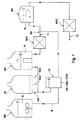
- the device is a device for treating, preferably for producing, a wort W in the beer or beverage production.
- a device MB for producing the mash M
- the device further comprises a device LB for separating the mash M produced in the device MB, for example a lauter tun, a mash filter, a strainmaster, a drum filter, disc filter or plate filter, a sieve belt press or another fining device for obtaining a wort W, containing one Vorschulze VW or Vorschulze VW and at least one Nachguss NG1, NG2, NG3, ....
- the device further comprises means WP for keeping hot or boiling the wort W obtained in the separation step, for example, a wort kettle with indoor or outdoor cooker.
- it has a device AD for adding at least one portion PM of the mash M and / or at least one portion PMA of at least one mash extract MA and / or a portion of PVW not heated above 80 ° C, second wort W2, in particular the wort VW, too the wort W obtained after keeping hot or boiling in the device WP, ie, the wort.
- the apparatus further comprises means WH for clarifying the wort W obtained after the addition step, for example a whirlpool.
- a special feature of the device according to the invention is that it has a first means WK1 for cooling the wort W, here the Ausschlagschulze, to a first temperature T1 between 0 and 80 ° C, for example a plate heat exchanger.
- this first wort cooler device WK1 is arranged downstream of the hot-holding or cooking device WP and upstream of the feed device AD.
- the feed device AD is arranged upstream of the clarifier WH.
- the apparatus further provides downstream of the clarifier WH a second means WK2 for cooling the clarified wort W withdrawn from the clarifier WH.
- the second device WK2 is preferably designed as a plate heat exchanger.
- the wort W which has the first temperature T1 or a temperature slightly lower than that due to intermittent radiation losses, is cooled to a second temperature T2 suitable for further processing, for example to a tempering temperature in the range from 5 to 20.degree.
- Fig. 1 illustrated embodiment of the device according to the invention further comprises a device SP for storing a portion PM of mash M withdrawn from device MB and / or a portion PMA of a mash extract MA and / or a portion of PVW obtained from the separator LB, one not over 80 ° C heated, second wort W2, especially the wort VW.
- a mash M is produced in a conventional method using conventional raw materials.
- a decoction or infusion method is used.
- a portion PM of the mash M is removed at a predetermined temperature of the mash batch and stored in the storage device SP.
- the mash sample can be drawn at a temperature which lies within the corresponding range of the temperature optimum according to the above table. If, for example, a sufficient ⁇ -glucan degradation is to be ensured, then a mash portion PM can be drawn at a temperature of the mash of, for example, 48 ° C. at which the ⁇ -glucanases have not yet been inactivated.
- a first wort portion of PVW may be drawn during the clarification, wherein the temperature of the first wort preferably does not exceed 76 ° C.
- the wort wort portion PVW is also stored in the storage device SP, for example, separate from the mash portion PM.
- the wort preparation is continued according to the conventional method with rinsing and holding / boiling wort.
- the wort W is cooled to a first temperature T1 before the clarification step by means of the first device WK1, which, if a sufficient iodine normality of the wort is to be achieved, preferably 74 ° C.
- This pre-cooled Wort W which has been pre-cooled to 74 ° C, is added to the pre-seasoning portion PVW which has been stored in the meantime.
- the volume ratio of added wort wort portion PVW to the pan-full volume of the wort batch is for example 2.5%.
- this enzyme can continue its activity in the subsequent clarification step, ie in the separation of the hot trub in the whirlpool, so that the time
- the Whirlpoolrast advantageous for the additional starch degradation by the introduced with the Vorffle-Portion PVW, active ⁇ -amylase can be used at its optimum temperature.
- the clarified wort W is then cooled in a second device WK2, preferably a second plate heat exchanger, for further use to the second temperature T2, for example to the tempering temperature of 15 ° C.
- the sample no. 1 shows a conventionally produced, non-iodine-normal wort with an iodine value of 9.44. In brewhouse decreases, iodine values in buffered systems are considered acceptable, which are in the 0.45 range.
- Sample no. 2 is a wort W prepared according to the invention, which has been produced according to the first exemplary embodiment described above and a portion of wort PRE PVW in a volume fraction of 2.5% of the precooled wort W has been added.
- Sample no. 3 is also a Wort W prepared according to the invention, this was added after precooling 7.5% wort.
- Sample no. 4 is the conventional wort like sample no. 1, to which was added a commercially available thermostable ⁇ -amylase.
- thermostable ⁇ -amylase The comparison of the seasoning with the wort prepared according to the invention, to which a thermostable ⁇ -amylase has been added, shows that the process according to the invention leads to a comparable starch degradation as can be achieved by the addition of a commercial, thermostable ⁇ -amylase.
- An exposure time of 15 minutes is already sufficient to achieve an acceptable iodine value. Even lower iodine values are achieved with an exposure time of about 20 minutes.
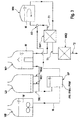
- second embodiment of the device according to the invention has basically the same structure as the above-described first embodiment. Therefore, only the differences from the first embodiment will be described below.
- the first means WK1 for cooling the wort W after the heat holding / boiling step and the second means WK2 for cooling the wort W after the whirlpool step are combined into a single device WK, for example a single or multi-stage plate heat exchanger.
- the same wort condenser WK can be used for the pre-cooling of the wort W as well as for the further cooling of the wort W to tempering temperature.
- the purchase of a second cooling device is advantageously avoided and reduces costs.
- the functions of the first device WK1 and of the second device WK2 in the common device WK are usually carried out with a time delay. But it is also a simultaneous execution of both functions feasible.
- third embodiment of the device according to the invention basically has the same structure as the second embodiment described above. Therefore, only the differences from the first embodiment will be described below.
- the third embodiment is particularly intended for the realization of a continuous process according to the invention.
- This embodiment also has a first means WK1 for cooling the wort W after the heat holding / boiling step in the device WP.
- the wort W is cooled to the temperature T1 in countercurrent or direct current with the wort emerging from the clarification device WH, which has the temperature T1 or a temperature slightly below it.
- the countercurrent wort flow W is heated to a third temperature T3, which is approximately between 82 and 95 ° C, preferably 82 to 90 ° C, in particular 82 to 85 ° C. This re-heating the enzymes are inactivated controlled. Consequently, the first device WK1 simultaneously serves as a device WE for heating the wort W.
- a storage vessel for the wort W may be provided in the wort path (not shown).
Landscapes
- Chemical & Material Sciences (AREA)
- Organic Chemistry (AREA)
- Engineering & Computer Science (AREA)
- Bioinformatics & Cheminformatics (AREA)
- Life Sciences & Earth Sciences (AREA)
- Biochemistry (AREA)
- Health & Medical Sciences (AREA)
- General Engineering & Computer Science (AREA)
- General Health & Medical Sciences (AREA)
- Genetics & Genomics (AREA)
- Food Science & Technology (AREA)
- Wood Science & Technology (AREA)
- Zoology (AREA)
- Distillation Of Fermentation Liquor, Processing Of Alcohols, Vinegar And Beer (AREA)
Applications Claiming Priority (2)
| Application Number | Priority Date | Filing Date | Title |
|---|---|---|---|
| DE102015114892 | 2015-09-04 | ||
| DE102015117577 | 2015-10-15 |
Publications (2)
| Publication Number | Publication Date |
|---|---|
| EP3138902A1 true EP3138902A1 (fr) | 2017-03-08 |
| EP3138902B1 EP3138902B1 (fr) | 2022-11-30 |
Family
ID=56853538
Family Applications (1)
| Application Number | Title | Priority Date | Filing Date |
|---|---|---|---|
| EP16187077.9A Active EP3138902B1 (fr) | 2015-09-04 | 2016-09-02 | Procede et dispositif de traitement et de fabrication d'un mout lors de la fabrication de boissons ou de biere et utilisation correspondante |
Country Status (1)
| Country | Link |
|---|---|
| EP (1) | EP3138902B1 (fr) |
Cited By (3)
| Publication number | Priority date | Publication date | Assignee | Title |
|---|---|---|---|---|
| WO2018083168A1 (fr) * | 2016-11-03 | 2018-05-11 | ZIEMANN HOLVRIEKA GmbH | Installation de brassage et procédé pour l'obtention et le traitement d'un moût dans une brasserie ou dans l'industrie des boissons et utilisations correspondantes |
| CN115044428A (zh) * | 2022-06-23 | 2022-09-13 | 华润雪花啤酒(中国)有限公司 | 一种啤酒糖化的系统装置及其控制方法 |
| CN115479698A (zh) * | 2021-06-14 | 2022-12-16 | 齐曼霍夫利卡有限公司 | 确定啤酒厂中麦芽汁热处理的麦芽汁目标温度的方法和装置及其用途 |
Citations (6)
| Publication number | Priority date | Publication date | Assignee | Title |
|---|---|---|---|---|
| DE1903400A1 (de) * | 1968-01-19 | 1969-08-28 | Naarden Chem Fab | Verfahren zum Zubereiten eines konzentrierten oder trockenen Rohstoffes fuer Brauzwecke |
| DE1911571A1 (de) * | 1968-03-15 | 1970-01-02 | Forsch Die Gaerungsindustrie E | Verfahren zur Gewinnung von Wuerze aus Gerstenrohfrucht mit oder ohne Zusatz von Malz,insbesondere fuer Bier |
| DE4234392A1 (de) * | 1992-10-08 | 1994-04-14 | Gerolf Dr Annemueller | Verfahren zur Gewinnung von Malzenzymen und deren Einsatz bei der Bierherstellung |
| DE19602167C1 (de) * | 1996-01-22 | 1997-01-09 | Steinecker Maschf Anton | Verfahren zur Würzegewinnung für die Bierherstellung |
| DE102011050441A1 (de) * | 2011-05-17 | 2012-12-06 | Gerhard Kamil | Verfahren zur Herstellung von Maische zum Brauen von Bier |
| WO2014060474A1 (fr) * | 2012-10-17 | 2014-04-24 | Novozymes A/S | Procédé de production de moût |
Family Cites Families (1)
| Publication number | Priority date | Publication date | Assignee | Title |
|---|---|---|---|---|
| DE181581C (fr) * |
-
2016
- 2016-09-02 EP EP16187077.9A patent/EP3138902B1/fr active Active
Patent Citations (6)
| Publication number | Priority date | Publication date | Assignee | Title |
|---|---|---|---|---|
| DE1903400A1 (de) * | 1968-01-19 | 1969-08-28 | Naarden Chem Fab | Verfahren zum Zubereiten eines konzentrierten oder trockenen Rohstoffes fuer Brauzwecke |
| DE1911571A1 (de) * | 1968-03-15 | 1970-01-02 | Forsch Die Gaerungsindustrie E | Verfahren zur Gewinnung von Wuerze aus Gerstenrohfrucht mit oder ohne Zusatz von Malz,insbesondere fuer Bier |
| DE4234392A1 (de) * | 1992-10-08 | 1994-04-14 | Gerolf Dr Annemueller | Verfahren zur Gewinnung von Malzenzymen und deren Einsatz bei der Bierherstellung |
| DE19602167C1 (de) * | 1996-01-22 | 1997-01-09 | Steinecker Maschf Anton | Verfahren zur Würzegewinnung für die Bierherstellung |
| DE102011050441A1 (de) * | 2011-05-17 | 2012-12-06 | Gerhard Kamil | Verfahren zur Herstellung von Maische zum Brauen von Bier |
| WO2014060474A1 (fr) * | 2012-10-17 | 2014-04-24 | Novozymes A/S | Procédé de production de moût |
Non-Patent Citations (1)
| Title |
|---|
| "Methode MEBAK", vol. II, 2002, article "Feststoffen'' oder Feststoffpartikeln" |
Cited By (5)
| Publication number | Priority date | Publication date | Assignee | Title |
|---|---|---|---|---|
| WO2018083168A1 (fr) * | 2016-11-03 | 2018-05-11 | ZIEMANN HOLVRIEKA GmbH | Installation de brassage et procédé pour l'obtention et le traitement d'un moût dans une brasserie ou dans l'industrie des boissons et utilisations correspondantes |
| US11976258B2 (en) | 2016-11-03 | 2024-05-07 | ZIEMANN HOLVRIEKA GmbH | Brewing system and method for obtaining and treating a wort in beer brewing or in the beverage industry, and corresponding applications |
| CN115479698A (zh) * | 2021-06-14 | 2022-12-16 | 齐曼霍夫利卡有限公司 | 确定啤酒厂中麦芽汁热处理的麦芽汁目标温度的方法和装置及其用途 |
| CN115044428A (zh) * | 2022-06-23 | 2022-09-13 | 华润雪花啤酒(中国)有限公司 | 一种啤酒糖化的系统装置及其控制方法 |
| CN115044428B (zh) * | 2022-06-23 | 2024-06-11 | 华润雪花啤酒(中国)有限公司 | 一种啤酒糖化的系统装置及其控制方法 |
Also Published As
| Publication number | Publication date |
|---|---|
| EP3138902B1 (fr) | 2022-11-30 |
Similar Documents
| Publication | Publication Date | Title |
|---|---|---|
| EP0677097B1 (fr) | Procede de production de biere | |
| EP2427064B1 (fr) | Procédé de trempage pour la fabrication de moût de kvas | |
| EP3138902B1 (fr) | Procede et dispositif de traitement et de fabrication d'un mout lors de la fabrication de boissons ou de biere et utilisation correspondante | |
| WO2013030082A1 (fr) | Procédé de brassage de la bière | |
| EP1385931A1 (fr) | Application du lit fluidise en brasserie | |
| DE10003155B4 (de) | Verfahren und Brauanlage zur Schnellherstellung von Bier | |
| EP0360007B1 (fr) | Bière avec arôme de seigle et son procédé de fabrication | |
| CH675813A5 (fr) | ||
| EP0213220B1 (fr) | Procédé de production de boissons non alcoolisées | |
| EP2412251B1 (fr) | Procédé de fabrication d'une boisson de rafraîchissement sans alcool | |
| DE2052963B1 (de) | Verfahren zur Herstellung eines Diätbieres | |
| EP3611249A1 (fr) | Amélioration / optimisation du houblonnage dans un processus de préparation d'épices ou de bière | |
| DE10256166B4 (de) | Verfahren zur Herstellung eines xanthohumolhaltigen Getränkes aus Malz- und/oder Rohfruchtwürze sowie derart hergestelltes Getränk | |
| EP1453946A1 (fr) | Production de mout/d'extrait de malt et/ou de granules de mout/granules d'extrait de malt par stabilisation de malt vert | |
| EP0319726B1 (fr) | Extrait aqueux buvable contenant les substances actives du blé germé et/ou de légumineuses et/ou d'autres graines | |
| DE2334914A1 (de) | Neues praeparat als zusatz zum brauen und verfahren zu seiner herstellung | |
| DE102019005340A1 (de) | Verfahren zum Erhöhen der Zinkkonzentration einer Bierwürze im Brauprozess | |
| EP3535380B1 (fr) | Installation de brassage et procédé pour l'obtention et le traitement d'un moût dans une brasserie ou dans l'industrie des boissons et utilisations correspondantes | |
| DE291219C (fr) | ||
| EP3992272B1 (fr) | Procédé et appareil de fabrication ou de traitement d'un moût et application correspondante | |
| DE102024120869B3 (de) | Verfahren zum Herstellen von Bierwürze | |
| DE10320250B4 (de) | Verfahren zur Herstellung eines Getränkes | |
| DE563545C (de) | Verfahren zur Herstellung eines Faerbemittels fuer Wuerze oder Bier | |
| EP4166640B1 (fr) | Procede de production de malt | |
| DE69321972T2 (de) | Verbesserte braumethode |
Legal Events
| Date | Code | Title | Description |
|---|---|---|---|
| PUAI | Public reference made under article 153(3) epc to a published international application that has entered the european phase |
Free format text: ORIGINAL CODE: 0009012 |
|
| STAA | Information on the status of an ep patent application or granted ep patent |
Free format text: STATUS: THE APPLICATION HAS BEEN PUBLISHED |
|
| AK | Designated contracting states |
Kind code of ref document: A1 Designated state(s): AL AT BE BG CH CY CZ DE DK EE ES FI FR GB GR HR HU IE IS IT LI LT LU LV MC MK MT NL NO PL PT RO RS SE SI SK SM TR |
|
| AX | Request for extension of the european patent |
Extension state: BA ME |
|
| STAA | Information on the status of an ep patent application or granted ep patent |
Free format text: STATUS: REQUEST FOR EXAMINATION WAS MADE |
|
| 17P | Request for examination filed |
Effective date: 20170612 |
|
| RBV | Designated contracting states (corrected) |
Designated state(s): AL AT BE BG CH CY CZ DE DK EE ES FI FR GB GR HR HU IE IS IT LI LT LU LV MC MK MT NL NO PL PT RO RS SE SI SK SM TR |
|
| STAA | Information on the status of an ep patent application or granted ep patent |
Free format text: STATUS: EXAMINATION IS IN PROGRESS |
|
| 17Q | First examination report despatched |
Effective date: 20181019 |
|
| GRAP | Despatch of communication of intention to grant a patent |
Free format text: ORIGINAL CODE: EPIDOSNIGR1 |
|
| STAA | Information on the status of an ep patent application or granted ep patent |
Free format text: STATUS: GRANT OF PATENT IS INTENDED |
|
| INTG | Intention to grant announced |
Effective date: 20220617 |
|
| GRAS | Grant fee paid |
Free format text: ORIGINAL CODE: EPIDOSNIGR3 |
|
| GRAA | (expected) grant |
Free format text: ORIGINAL CODE: 0009210 |
|
| STAA | Information on the status of an ep patent application or granted ep patent |
Free format text: STATUS: THE PATENT HAS BEEN GRANTED |
|
| AK | Designated contracting states |
Kind code of ref document: B1 Designated state(s): AL AT BE BG CH CY CZ DE DK EE ES FI FR GB GR HR HU IE IS IT LI LT LU LV MC MK MT NL NO PL PT RO RS SE SI SK SM TR |
|
| REG | Reference to a national code |
Ref country code: CH Ref legal event code: EP Ref country code: GB Ref legal event code: FG4D Free format text: NOT ENGLISH |
|
| REG | Reference to a national code |
Ref country code: AT Ref legal event code: REF Ref document number: 1534699 Country of ref document: AT Kind code of ref document: T Effective date: 20221215 Ref country code: DE Ref legal event code: R096 Ref document number: 502016015444 Country of ref document: DE |
|
| REG | Reference to a national code |
Ref country code: IE Ref legal event code: FG4D Free format text: LANGUAGE OF EP DOCUMENT: GERMAN |
|
| REG | Reference to a national code |
Ref country code: LT Ref legal event code: MG9D |
|
| REG | Reference to a national code |
Ref country code: NL Ref legal event code: MP Effective date: 20221130 |
|
| PG25 | Lapsed in a contracting state [announced via postgrant information from national office to epo] |
Ref country code: SE Free format text: LAPSE BECAUSE OF FAILURE TO SUBMIT A TRANSLATION OF THE DESCRIPTION OR TO PAY THE FEE WITHIN THE PRESCRIBED TIME-LIMIT Effective date: 20221130 Ref country code: PT Free format text: LAPSE BECAUSE OF FAILURE TO SUBMIT A TRANSLATION OF THE DESCRIPTION OR TO PAY THE FEE WITHIN THE PRESCRIBED TIME-LIMIT Effective date: 20230331 Ref country code: NO Free format text: LAPSE BECAUSE OF FAILURE TO SUBMIT A TRANSLATION OF THE DESCRIPTION OR TO PAY THE FEE WITHIN THE PRESCRIBED TIME-LIMIT Effective date: 20230228 Ref country code: LT Free format text: LAPSE BECAUSE OF FAILURE TO SUBMIT A TRANSLATION OF THE DESCRIPTION OR TO PAY THE FEE WITHIN THE PRESCRIBED TIME-LIMIT Effective date: 20221130 Ref country code: FI Free format text: LAPSE BECAUSE OF FAILURE TO SUBMIT A TRANSLATION OF THE DESCRIPTION OR TO PAY THE FEE WITHIN THE PRESCRIBED TIME-LIMIT Effective date: 20221130 Ref country code: ES Free format text: LAPSE BECAUSE OF FAILURE TO SUBMIT A TRANSLATION OF THE DESCRIPTION OR TO PAY THE FEE WITHIN THE PRESCRIBED TIME-LIMIT Effective date: 20221130 |
|
| PG25 | Lapsed in a contracting state [announced via postgrant information from national office to epo] |
Ref country code: RS Free format text: LAPSE BECAUSE OF FAILURE TO SUBMIT A TRANSLATION OF THE DESCRIPTION OR TO PAY THE FEE WITHIN THE PRESCRIBED TIME-LIMIT Effective date: 20221130 Ref country code: PL Free format text: LAPSE BECAUSE OF FAILURE TO SUBMIT A TRANSLATION OF THE DESCRIPTION OR TO PAY THE FEE WITHIN THE PRESCRIBED TIME-LIMIT Effective date: 20221130 Ref country code: LV Free format text: LAPSE BECAUSE OF FAILURE TO SUBMIT A TRANSLATION OF THE DESCRIPTION OR TO PAY THE FEE WITHIN THE PRESCRIBED TIME-LIMIT Effective date: 20221130 Ref country code: IS Free format text: LAPSE BECAUSE OF FAILURE TO SUBMIT A TRANSLATION OF THE DESCRIPTION OR TO PAY THE FEE WITHIN THE PRESCRIBED TIME-LIMIT Effective date: 20230330 Ref country code: HR Free format text: LAPSE BECAUSE OF FAILURE TO SUBMIT A TRANSLATION OF THE DESCRIPTION OR TO PAY THE FEE WITHIN THE PRESCRIBED TIME-LIMIT Effective date: 20221130 Ref country code: GR Free format text: LAPSE BECAUSE OF FAILURE TO SUBMIT A TRANSLATION OF THE DESCRIPTION OR TO PAY THE FEE WITHIN THE PRESCRIBED TIME-LIMIT Effective date: 20230301 |
|
| P01 | Opt-out of the competence of the unified patent court (upc) registered |
Effective date: 20230524 |
|
| PG25 | Lapsed in a contracting state [announced via postgrant information from national office to epo] |
Ref country code: NL Free format text: LAPSE BECAUSE OF FAILURE TO SUBMIT A TRANSLATION OF THE DESCRIPTION OR TO PAY THE FEE WITHIN THE PRESCRIBED TIME-LIMIT Effective date: 20221130 |
|
| PG25 | Lapsed in a contracting state [announced via postgrant information from national office to epo] |
Ref country code: SM Free format text: LAPSE BECAUSE OF FAILURE TO SUBMIT A TRANSLATION OF THE DESCRIPTION OR TO PAY THE FEE WITHIN THE PRESCRIBED TIME-LIMIT Effective date: 20221130 Ref country code: RO Free format text: LAPSE BECAUSE OF FAILURE TO SUBMIT A TRANSLATION OF THE DESCRIPTION OR TO PAY THE FEE WITHIN THE PRESCRIBED TIME-LIMIT Effective date: 20221130 Ref country code: EE Free format text: LAPSE BECAUSE OF FAILURE TO SUBMIT A TRANSLATION OF THE DESCRIPTION OR TO PAY THE FEE WITHIN THE PRESCRIBED TIME-LIMIT Effective date: 20221130 Ref country code: DK Free format text: LAPSE BECAUSE OF FAILURE TO SUBMIT A TRANSLATION OF THE DESCRIPTION OR TO PAY THE FEE WITHIN THE PRESCRIBED TIME-LIMIT Effective date: 20221130 Ref country code: CZ Free format text: LAPSE BECAUSE OF FAILURE TO SUBMIT A TRANSLATION OF THE DESCRIPTION OR TO PAY THE FEE WITHIN THE PRESCRIBED TIME-LIMIT Effective date: 20221130 |
|
| PG25 | Lapsed in a contracting state [announced via postgrant information from national office to epo] |
Ref country code: SK Free format text: LAPSE BECAUSE OF FAILURE TO SUBMIT A TRANSLATION OF THE DESCRIPTION OR TO PAY THE FEE WITHIN THE PRESCRIBED TIME-LIMIT Effective date: 20221130 Ref country code: AL Free format text: LAPSE BECAUSE OF FAILURE TO SUBMIT A TRANSLATION OF THE DESCRIPTION OR TO PAY THE FEE WITHIN THE PRESCRIBED TIME-LIMIT Effective date: 20221130 |
|
| REG | Reference to a national code |
Ref country code: DE Ref legal event code: R097 Ref document number: 502016015444 Country of ref document: DE |
|
| PLBE | No opposition filed within time limit |
Free format text: ORIGINAL CODE: 0009261 |
|
| STAA | Information on the status of an ep patent application or granted ep patent |
Free format text: STATUS: NO OPPOSITION FILED WITHIN TIME LIMIT |
|
| 26N | No opposition filed |
Effective date: 20230831 |
|
| PG25 | Lapsed in a contracting state [announced via postgrant information from national office to epo] |
Ref country code: SI Free format text: LAPSE BECAUSE OF FAILURE TO SUBMIT A TRANSLATION OF THE DESCRIPTION OR TO PAY THE FEE WITHIN THE PRESCRIBED TIME-LIMIT Effective date: 20221130 |
|
| REG | Reference to a national code |
Ref country code: CH Ref legal event code: PL |
|
| REG | Reference to a national code |
Ref country code: DE Ref legal event code: R081 Ref document number: 502016015444 Country of ref document: DE Owner name: ZIEMANN HOLVRIEKA GMBH, DE Free format text: FORMER OWNER: ZIEMANN HOLVRIEKA GMBH, 71636 LUDWIGSBURG, DE Ref country code: DE Ref legal event code: R081 Ref document number: 502016015444 Country of ref document: DE Owner name: CIMC LIQUID PROCESS TECHNOLOGY CO., LTD., NANT, CN Free format text: FORMER OWNER: ZIEMANN HOLVRIEKA GMBH, 71636 LUDWIGSBURG, DE |
|
| PG25 | Lapsed in a contracting state [announced via postgrant information from national office to epo] |
Ref country code: LU Free format text: LAPSE BECAUSE OF NON-PAYMENT OF DUE FEES Effective date: 20230902 |
|
| REG | Reference to a national code |
Ref country code: BE Ref legal event code: MM Effective date: 20230930 |
|
| GBPC | Gb: european patent ceased through non-payment of renewal fee |
Effective date: 20230902 |
|
| PG25 | Lapsed in a contracting state [announced via postgrant information from national office to epo] |
Ref country code: LU Free format text: LAPSE BECAUSE OF NON-PAYMENT OF DUE FEES Effective date: 20230902 Ref country code: IT Free format text: LAPSE BECAUSE OF FAILURE TO SUBMIT A TRANSLATION OF THE DESCRIPTION OR TO PAY THE FEE WITHIN THE PRESCRIBED TIME-LIMIT Effective date: 20221130 Ref country code: MC Free format text: LAPSE BECAUSE OF FAILURE TO SUBMIT A TRANSLATION OF THE DESCRIPTION OR TO PAY THE FEE WITHIN THE PRESCRIBED TIME-LIMIT Effective date: 20221130 |
|
| REG | Reference to a national code |
Ref country code: IE Ref legal event code: MM4A |
|
| PG25 | Lapsed in a contracting state [announced via postgrant information from national office to epo] |
Ref country code: IE Free format text: LAPSE BECAUSE OF NON-PAYMENT OF DUE FEES Effective date: 20230902 |
|
| PG25 | Lapsed in a contracting state [announced via postgrant information from national office to epo] |
Ref country code: GB Free format text: LAPSE BECAUSE OF NON-PAYMENT OF DUE FEES Effective date: 20230902 |
|
| PG25 | Lapsed in a contracting state [announced via postgrant information from national office to epo] |
Ref country code: CH Free format text: LAPSE BECAUSE OF NON-PAYMENT OF DUE FEES Effective date: 20230930 |
|
| PG25 | Lapsed in a contracting state [announced via postgrant information from national office to epo] |
Ref country code: IE Free format text: LAPSE BECAUSE OF NON-PAYMENT OF DUE FEES Effective date: 20230902 Ref country code: GB Free format text: LAPSE BECAUSE OF NON-PAYMENT OF DUE FEES Effective date: 20230902 Ref country code: FR Free format text: LAPSE BECAUSE OF NON-PAYMENT OF DUE FEES Effective date: 20230930 Ref country code: CH Free format text: LAPSE BECAUSE OF NON-PAYMENT OF DUE FEES Effective date: 20230930 |
|
| PG25 | Lapsed in a contracting state [announced via postgrant information from national office to epo] |
Ref country code: BE Free format text: LAPSE BECAUSE OF NON-PAYMENT OF DUE FEES Effective date: 20230930 |
|
| PG25 | Lapsed in a contracting state [announced via postgrant information from national office to epo] |
Ref country code: BG Free format text: LAPSE BECAUSE OF FAILURE TO SUBMIT A TRANSLATION OF THE DESCRIPTION OR TO PAY THE FEE WITHIN THE PRESCRIBED TIME-LIMIT Effective date: 20221130 |
|
| REG | Reference to a national code |
Ref country code: AT Ref legal event code: MM01 Ref document number: 1534699 Country of ref document: AT Kind code of ref document: T Effective date: 20230902 |
|
| PG25 | Lapsed in a contracting state [announced via postgrant information from national office to epo] |
Ref country code: BG Free format text: LAPSE BECAUSE OF FAILURE TO SUBMIT A TRANSLATION OF THE DESCRIPTION OR TO PAY THE FEE WITHIN THE PRESCRIBED TIME-LIMIT Effective date: 20221130 |
|
| PG25 | Lapsed in a contracting state [announced via postgrant information from national office to epo] |
Ref country code: AT Free format text: LAPSE BECAUSE OF NON-PAYMENT OF DUE FEES Effective date: 20230902 |
|
| PG25 | Lapsed in a contracting state [announced via postgrant information from national office to epo] |
Ref country code: AT Free format text: LAPSE BECAUSE OF NON-PAYMENT OF DUE FEES Effective date: 20230902 |
|
| PG25 | Lapsed in a contracting state [announced via postgrant information from national office to epo] |
Ref country code: CY Free format text: LAPSE BECAUSE OF FAILURE TO SUBMIT A TRANSLATION OF THE DESCRIPTION OR TO PAY THE FEE WITHIN THE PRESCRIBED TIME-LIMIT; INVALID AB INITIO Effective date: 20160902 |
|
| PG25 | Lapsed in a contracting state [announced via postgrant information from national office to epo] |
Ref country code: HU Free format text: LAPSE BECAUSE OF FAILURE TO SUBMIT A TRANSLATION OF THE DESCRIPTION OR TO PAY THE FEE WITHIN THE PRESCRIBED TIME-LIMIT; INVALID AB INITIO Effective date: 20160902 |
|
| PGFP | Annual fee paid to national office [announced via postgrant information from national office to epo] |
Ref country code: DE Payment date: 20250813 Year of fee payment: 10 |
|
| PG25 | Lapsed in a contracting state [announced via postgrant information from national office to epo] |
Ref country code: TR Free format text: LAPSE BECAUSE OF FAILURE TO SUBMIT A TRANSLATION OF THE DESCRIPTION OR TO PAY THE FEE WITHIN THE PRESCRIBED TIME-LIMIT Effective date: 20221130 |