EP3138902A1 - Method and device for treating or producing a wort in beer or beverage manufacture and corresponding use - Google Patents
Method and device for treating or producing a wort in beer or beverage manufacture and corresponding use Download PDFInfo
- Publication number
- EP3138902A1 EP3138902A1 EP16187077.9A EP16187077A EP3138902A1 EP 3138902 A1 EP3138902 A1 EP 3138902A1 EP 16187077 A EP16187077 A EP 16187077A EP 3138902 A1 EP3138902 A1 EP 3138902A1
- Authority
- EP
- European Patent Office
- Prior art keywords
- wort
- temperature
- mash
- pvw
- enzyme
- Prior art date
- Legal status (The legal status is an assumption and is not a legal conclusion. Google has not performed a legal analysis and makes no representation as to the accuracy of the status listed.)
- Granted
Links
Images

Classifications
-
- C—CHEMISTRY; METALLURGY
- C12—BIOCHEMISTRY; BEER; SPIRITS; WINE; VINEGAR; MICROBIOLOGY; ENZYMOLOGY; MUTATION OR GENETIC ENGINEERING
- C12C—BEER; PREPARATION OF BEER BY FERMENTATION; PREPARATION OF MALT FOR MAKING BEER; PREPARATION OF HOPS FOR MAKING BEER
- C12C7/00—Preparation of wort
- C12C7/24—Clarifying beerwort between hop boiling and cooling
-
- C—CHEMISTRY; METALLURGY
- C12—BIOCHEMISTRY; BEER; SPIRITS; WINE; VINEGAR; MICROBIOLOGY; ENZYMOLOGY; MUTATION OR GENETIC ENGINEERING
- C12C—BEER; PREPARATION OF BEER BY FERMENTATION; PREPARATION OF MALT FOR MAKING BEER; PREPARATION OF HOPS FOR MAKING BEER
- C12C5/00—Other raw materials for the preparation of beer
- C12C5/004—Enzymes
-
- C—CHEMISTRY; METALLURGY
- C12—BIOCHEMISTRY; BEER; SPIRITS; WINE; VINEGAR; MICROBIOLOGY; ENZYMOLOGY; MUTATION OR GENETIC ENGINEERING
- C12C—BEER; PREPARATION OF BEER BY FERMENTATION; PREPARATION OF MALT FOR MAKING BEER; PREPARATION OF HOPS FOR MAKING BEER
- C12C5/00—Other raw materials for the preparation of beer
- C12C5/004—Enzymes
- C12C5/006—Beta-glucanase or functionally equivalent enzymes
Definitions
- the invention relates to a method for treating or preparing a wort in the beer or beverage production according to claim 1, a device for treating a wort in the beer or beverage production according to claim 9, and a corresponding use according to claim 14.
- Too high an iodine value may, for example, lead to problems in the filtration of the stored beer, in particular when using membrane filters, or to quality losses (taste stability, aging resistance, susceptibility to microbiological attack) in the finished beer.
- Untreated starch leads to yield losses, which entail a cost disadvantage.
- novel refining technologies which are not based on the principle of depth filtration, as used for example in the conventional lauter tun, but are based essentially on the principle of surface filtration, sometimes have the problem of non-iodine normal seasoning, so not sufficiently degraded starch.
- thermostable enzymes it has often been necessary in the past to add elaborately isolated and purified, artificial and mostly thermostable enzymes to the wort or the beer.
- the wort can be obtained according to the invention by rinsing a mash with a mashing temperature in the range of 60 to 70 ° C, preferably 62 to 68 ° C, in particular 63 to 65 ° C.
- a mashing temperature in the range of 60 to 70 ° C, preferably 62 to 68 ° C, in particular 63 to 65 ° C.
- the present invention preferably relates to gelatinised seasonings with unsweetened starch components, in particular a high proportion of unsweetened starch components.
- gelatinized seasoning due to the ⁇ -amylase activity are characterized by a relatively low viscosity.
- the enzyme-containing substrate preferably mash / mash extract / second wort, preferably at a temperature corresponding to the first temperature or at most 10 ° C, preferably at most 8 ° C, preferably at most 6 ° C, in particular at most 4 ° C, below the first temperature.
- the enzyme-containing substrate is a filtered substrate, in particular a filtered mash, for example a wort.
- the enzyme-containing substrate is not heated to a temperature above the first temperature or above 85 ° C, preferably above 80 ° C, preferably above 78 ° C, preferably above 76 ° C, preferably above 75 ° C, preferably above 74 ° C, preferably above 72 ° C, preferably above 70 ° C, preferably above 68 ° C, preferably above 66 ° C, preferably above 65 ° C, in particular above 62 ° C.
- the wort is after the conventional holding or cooking, and preferably before clarifying, d. H. the partial or complete separation of hot trub or other solids, for example in the whirlpool or other separating device (decanter, settling vat, etc.), to a predetermined first temperature of at most 85 ° C, preferably at most 84 ° C, in particular 80 ° C set, in particular cooled.
- the term "after the hot-holding or cooking of the wort” can be understood to mean in particular "after completion of the hot-holding or boiling of the wort".
- the enzyme-containing substrate is added only when the process of the actual heat treatment of the wort in terms of classic Wort boiling / hot keeping is completed in the brewing kettle and is no longer continued.
- the enzymatic treatment according to the invention after the end of the heat treatment step of the wort has the advantage that all starch components released until the end of the heat treatment are accessible to enzymatic degradation. A further release of starch constituents by a continuation of the heat treatment in the sense of a renewed heating to the boiling or holding temperature can thus be avoided according to the invention.
- step (a) the wort is adjusted to a temperature of at most 80 ° C, in particular to a temperature between 70 and 80 ° C, it will for the first time possible that the wort is present at a temperature at which at least a portion of the enzyme-containing substrate, preferably in a mash portion and / or in a portion of not more than 80 ° C heated, second wort, in particular a portion of wort, naturally existing enzymes is active and not denatured due to temperature.
- the wort can be adjusted to a temperature of at most 55 ° C (for example 40 to 55 ° C, especially 45 to 50 ° C).
- step (a) the wort on the other hand to a temperature in the range of 80 to 85 ° C or at least to a temperature above the usual range of application of the considered enzyme (at most up to the temperature of the largest conversion per unit time, ie the temperature or optimum of action) is set, although the optimum effect of the enzymes may be exceeded in the enzyme-containing substrate. Nevertheless, the inventors have found a sufficiently high enzyme activity to ensure a quantitatively sufficient enzymatic degradation before the enzyme activity comes to a standstill due to the progressing, thermally induced enzyme inactivation.
- step (a) of the method according to the invention it is therefore possible, the temperature of the wort to a temperature of 2 to 20 ° C, preferably 5 to 15 ° C, above the temperature optimum of a substance relevant for the degradation enzyme, as for example in the set forth on page 23 below.
- the particular advantage of this approach is that a targeted inactivation of the respective considered enzyme or enzymes considered quasi at the same time or following the degradation is achieved without a re-heating of the wort for targeted inactivation would be required. As a result, the procedure is simplified, and a renewed heating of the wort is eliminated.
- the between the media used, such as wort and heat transfer medium or refrigerant to be transferred heat flow over a reduced cooling of the wort on or in particular below the temperature optimum of the considered enzyme, thereby simplifying the handling of the process. Furthermore, this results in a lower complexity of the process for the recovery of heat from the previously heat-treated wort and the device used for this purpose.
- an enzyme-containing substrate preferably the mash, the mash extract or the second wort not heated above 80 ° C., in particular a portion of a wort that has been added to the first temperature, in particular precooled, wort
- the enzymes naturally contained in the added substrate in the already heat-treated and thus enzyme-inactive wort act to further promote the degradation of high molecular weight substances such as starch, and possibly complete. This can advantageously be counteracted insufficient digestion and / or insufficient degradation during mashing.
- the possible effects of fine or fine turbidity which may have been problematic in the further process of beer or beverage production, during the further clarification of the wort may be at least partially avoided.
- the disadvantages of a barely dissolved malt can be compensated for at least to a certain extent.
- a mash extract over a mash as an addition to the wort is advantageous because of the reduced solids content of the mash extract over the mash.
- the enzymes contained therein are still in the addition of the invention according to the portion the above-described setting of the temperature, in particular precooling, to at most 85 ° C, preferably at most 80 ° C, following the heat treatment of the wort active and remain sufficiently active in such a tempered / pre-cooled wort, without being denatured due to temperature.
- the added portion of the enzyme-containing substrate should not be heated or otherwise treated in such a way from its recovery until it is added that a more than insignificant inactivation (for example> 25%). ) takes place which each considered to be relevant enzymes.
- the added portion of the enzyme-containing substrate is not heated to a temperature higher than the first temperature, at least not above 80 ° C, heated.
- the enzymes added after the wort heating / precooling by the addition of the portion of the enzyme-containing substrate can act on their target substances in the wort for a predetermined period of time and, for example, reduce the degradation in the Extract seasoning starch to iodine normality.
- the advantage of the enzyme addition according to the invention to wort already cooked or kept hot and then tempered / cooled to a certain temperature in the form of a portion of the enzyme-containing substrate (eg mash / mash extract / wort) not heat-treated above 80 ° C. lies in the comparatively fast enzymatic conversion the target substances in the wort due to the relatively high temperature, in particular in the range of the temperature optimum of each considered enzyme.
- the first temperature can preferably be set to the optimum temperature of the respectively considered enzyme (cf., for example, the table on page 23 of this application). This leads advantageously to a shortening of the previous refining time, since this is no longer needed as enzyme reaction time.
- the method of the invention it is also possible to add not only a single portion of the enzyme-containing substrate (for example a mash or a mash extract or a second wort / wort which has not been heated above 80 ° C.) to the wort.
- a single portion of the enzyme-containing substrate for example a mash or a mash extract or a second wort / wort which has not been heated above 80 ° C.
- different portions of the enzyme-containing substrate for example the mash, which were drawn from the mash at different temperatures, or mash portions, which may originate from different mash batches, are added to the wort according to the invention.
- This makes it possible to use mash fractions with defined amounts of active enzymes with different temperature optima for the treatment of pre-cooled or tempered wort.
- the portions or fractions can be added separately or as a mixture of the wort.
- the process according to the invention makes it possible to advance the degradation of raw materials or processing-problematic condiments which hitherto were not iodine-normal, for example, to obtain the desired degree of degradation, for example the iodine normality.
- the addition of expensive, artificially isolated and purified enzyme preparations is unnecessary.
- the wort retains its natural character due to the improved utilization of exclusively malignant enzymes, since the addition of non-malt enzyme preparations can be completely dispensed with.
- Another advantage of the method according to the invention is that not only iodine-normal seasoning can be achieved, but also the yield of fermentable sugars, such as, for example, maltose, can be increased, ie an extract yield can be achieved.
- the yield of fermentable extract can be increased by at least 4 to 12% by the method according to the invention. hereby the brewhouse yield is increased overall and the amount of raw materials or raw material costs to be used is reduced.
- the method may further comprise the step of at least partially clarifying the wort.
- the addition according to step (b) may preferably take place before the at least partial clarification of the wort.
- the duration of the hot trub separation that is, for example, the residence time of the wort in the whirlpool, which conventionally takes place anyway, be used to complete the enzymatic degradation.
- a further enzymatic reaction can take place even after the wort temperature control / cooling to, for example, annealing temperature, however, the rate of this reaction is considerably reduced due to the wort temperature which is usually much lower than that of the hot-bath step, so that the reaction may be incomplete.
- the method is not limited to this.
- the addition may take place alternatively or additionally during and / or after the at least partial clarification of the wort.
- the method according to the invention may further comprise at least one of the following steps: providing a mash; Separating the mash to obtain the wort, containing a wort or a mixture of the wort and at least one infusion; and keeping or cooking the wort.
- the separation of the mash in particular by a conventional device such as a lauter tun, a mash filter, a Strainmaster, a drum filter, disc filter or plate filter, a belt filter, or another fining device, preferably one which predominantly or completely on the principle of surface filtration (sieve effect ) and not or substantially not based on the principle of depth filtration (filter bed containing filter means), in particular a sieve filter.
- the separation of the mash is preferably carried out by means of a filtration, in particular by means of a surface filtration or sieve filtration.
- the filter effect can be predominantly, essentially or completely based on a sieving effect.
- the method may further comprise the step of cooling the wort to a second temperature between the first temperature and 0 ° C.
- the inventive method can be easily integrated into a conventional process for wort production. It is particularly advantageous if the added portion or added portions can be obtained in carrying out the same wort-making process, so that no separate source for the added portions is required.
- the first temperature may be in a range of 40 to 85 ° C, preferably 40 to 84 ° C, preferably 40 to 80 ° C, preferably 40 to 55 ° C; preferably 45 to 50 ° C; preferably 50 to 80 ° C, preferably 70 to 85 ° C, preferably 80 to 85 ° C; preferably 70 to 80 ° C, preferably 70 to 78 ° C, preferably 72 to 78 ° C, preferably 72 to 76 ° C, preferably 73 to 75 ° C, especially at about 74 ° C, or in the range of 78 to 85 ° C, preferably 78 to 84 ° C, preferably 80 to 85 ° C, in particular 80 to 83 ° C, are.
- a thermally induced deactivation is, for example of the portion-containing enzyme ⁇ -amylase avoided.
- the selected range contains the temperature optimum of the ⁇ -amylase, so that a high rate of the enzymatic reaction is achieved in the degradation of existing starch. This additional ⁇ -amylase activity promotes degradation of the starch and ultimately achieves iodine normality.
- the temperature optima of other enzymes present in the enzymatic substrate may also be taken into account for the determination of the first temperature (see also overview in the table below on page 23).
- the method may further comprise the step of, after the addition of step (b) and allowing a predetermined period of time, the wort to a third temperature between 82 and 99 ° C, preferably between 82 and 95 ° C, preferably between 82 and 90 ° C, in particular between 82 and 85 ° C, is heated.
- Both the composition of the starting material, wort, and the respective enzyme and further boundary conditions determine the minimum required and optimum exposure time.
- the activity of the enzymes added with the addition can be effectively terminated or at least reduced by thermal inactivation. This further improves the control of the enzymatic activities.
- the heating is preferably carried out after the clarification of the wort.
- the time during the clarification for example in the whirlpool, can advantageously be used for the action of the enzymes, for example for a further reduction in starch. Maintaining the elevated third temperature of the wort is necessary only until the enzyme species in question has been inactivated completely or to a sufficient degree.
- the duration of action of the enzymes or predetermined period of time may preferably be selected to be up to 60 minutes, preferably 3 to 30 minutes, in particular 5 to 25 minutes. On the one hand, such a duration of action ensures essentially complete enzymatic conversion or its completion, on the other hand is limited by the limitation of the duration of a possible thermal load on the wort.
- the ratio of the volume of the added, at least one portion of an enzyme-containing substrate, a mash portion and / or mash extract portion and / or portion of the second wort or a mixture of at least two of the mash portion, the mash extract portion and the portion of the second wort to the pan-full-volume of the present before step (a) according to claim 1 wort in a range of 0.1 to 30%, preferably 0.5 to 20%, preferably from 1 to 5%, preferably from 1 to 3%, in particular about 2%.
- an addition of a second wort, preferably a wort, not heated above 80 ° C., in a volume ratio to the ladle-full-volume of the wort ranges from 1 to 5%
- a sufficient effect of the ⁇ -amylase contained therein and after no more than 15 to 20 minutes exposure time (at a first temperature of 74 ° C) to reach the iodine normality of the wort see investigation results discussed below.
- the at least one portion of the mash and / or the at least one portion of the mash extract and / or the at least one portion of the not heated above 80 ° C, the second wort, preferably the wort, or a mixture of at least two of these portions can / before Admit to be stored.
- the intermediate storage makes it possible to use the enzyme-containing portion of the mash, the mash extract and / or the second wort / wort at any time later for the treatment of a wort, for example, before, during and / or after a Whirlpool break or other separation step.
- This increases the temporal flexibility in the application of the method according to the invention.
- the intermediate storage in, for example, a single storage vessel also makes it possible to easily and inexpensively produce a mixture of different mash and / or seasoning / wort portions and store for later use. By providing a plurality of storage vessels, the flexibility of handling is advantageously further improved.
- the setting of the temperature, in particular cooling, the wort to the first temperature and / or the cooling of the wort to the second temperature and / or the heating of the wort to the third temperature can be carried out in the same heat exchanger.
- a device for treating or producing a wort in the beer or beverage production preferably for carrying out the method claimed claimed at least comprising means for adjusting the temperature, in particular cooling, the wort to a first temperature between 0 and 85 ° C, preferably between 0 and 80 ° C, after keeping hot or boiling the wort; and a device for adding a portion of an enzyme-containing substrate, preferably at least one portion of a mash and / or at least one portion of at least one mash extract and / or portion containing a not heated above 80 ° C, second wort, preferably a portion of a wort the wort obtained after adjustment, in particular cooling, to the first temperature.
- the device for tempering or cooling is arranged downstream of a device for keeping the wort hot or boiling.
- the device for adding is downstream to the device for Adjusting the temperature, in particular cooling, the wort arranged at the first temperature.
- the advantages of the method according to the invention apply analogously to the device according to the invention.
- conventional device components such as plate coolers, for example, can be used as heat exchangers for wort cooling or heating.
- the invention can thus be realized with minimal additional equipment, in particular in the retrofitting of existing brewing systems.
- the means for adding the at least one portion upstream to a means for clarifying the wort may be arranged.
- the device can also be arranged downstream of or in the region of the device for clarifying the wort.
- "in the region of a means for clarifying the wort” means that the means for adding is arranged in, at or at the means for clarifying that addition of the portion or portions of the enzyme-containing substrate, preferably the mash, of the mash extract, the seasoning / wort, for tempered or pre-cooled wort is possible while the tempered to the first temperature or pre-cooled wort is in the clarifier and / or flows into this or out of this.
- the device according to the invention may further comprise at least one of the following devices: a device for producing a mash; a device for separating the mash to obtain a wort, containing a wort or a mixture of the wort and at least one infusion; a device for keeping or cooking the in the separator produced wort; a device for clarifying the wort; means for cooling the wort treated in the clarifier to a second temperature between the first temperature and 0 ° C.
- the device for adding may be arranged upstream of the clarifier.
- the device for separating the mash may be a conventional device, such as a lauter tun, a mash filter, a strainmaster, a drum filter, disc filter or disc filter or a sieve belt press.
- the separation can also be carried out by any other fining device, preferably one which predominantly or completely is based on the principle of surface filtration (sieving effect) and not or substantially not on the principle of depth filtration (filter bed containing filter medium), in particular a sieve filter.
- the device may further comprise means for heating the wort to a third temperature between 82 and 99 ° C, preferably between 82 and 95 ° C, preferably between 82 to 90 ° C, in particular between 82 to 85 ° C.
- the heating device is arranged downstream of the means for adding and preferably downstream of the means for clarifying.
- the means for heating allows controlled inactivation of the enzymes added with the at least one portion.
- the device for heating can advantageously be integrated into the device for adjusting the temperature, in particular cooling, of the wort (for example, a one-piece design), as a result of which the outlay on equipment is minimized. Or it can be a separate device.
- the duration of the clarification can be advantageously used for enzyme action before a targeted thermal inactivation takes place.
- the heating device can also upstream to or in the area of the device for clarifying the
- the device according to the invention may further comprise at least one device for withdrawing and / or storing the at least one portion of an enzyme-containing substrate, preferably the at least one portion of the mash and / or the at least one portion of the at least one mash extract and / or the portion containing one 80 ° C heated, second wort, preferably the portion of the wort.
- a reservoir may preferably be designed such that it supports the sedimentation of solid particles present in the mash and optionally in the wort.
- the memory is preferably insulated and / or heated.
- a cylindroconical shape of the storage vessel or the storage vessels is advantageous.
- the use according to the invention comprises a use of a device for adjusting the temperature, in particular cooling, of wort to a first temperature between 0 and 85 ° C., preferably between 0 and 80 ° C., preferably between 40 and 85 ° C., preferably between 40 and 84 ° C, preferably between 40 and 80 ° C, preferably between 40 and 55 ° C, preferably between 45 and 50 ° C, preferably between 50 and 80 ° C, preferably between 70 and 85 ° C, preferably between 70 and 80 ° C.
- the wort when adding at most the first temperature.
- the use according to the invention preferably takes place in a process for treating or preparing the wort in beer or beverage production.
- adding for the reasons mentioned above is preferably carried out before the at least partial clarification of the wort.
- the invention is not limited thereto.
- the addition may also take place during or after the at least partial clarification of the wort.
- a considerable increase in yield in particular in the case of non-iodine-normal seasonings, can also be achieved by the method according to the invention or the device according to the invention or its corresponding use.
- a wort was prepared, wherein a conventional mash was freed by means of a sieve filter of coarse particles.
- the resulting wort had a fine turbidity which was clearly perceptible to the eye and sedimented as sediment.
- 200 ml were removed from the clear supernatant as well as from the turbid sediment and adjusted to a first temperature of 74 ° C. (temperature optimum of the ⁇ -amylase).
- the wort with an iodine value of 1.28 obtained as described above is not iodine-normal (standard for iodine normality is an absorbance (E) of the photometric assay of ⁇ 0.45).
- the addition according to the invention of the congress mash sample to the wort to a volume of 2.5% by volume at a temperature of 74 ° C. and an exposure time of 10 minutes causes a lowering of the iodine value to 0.3 (turbid wort with sediment) or 0.1 (wort of clear supernatant). Consequently, the use of the invention makes it possible to convert non-iodine-normal seasonings into iodine-normal seasonings.
- the inventors were able to ascertain an increase in extract compared with the untreated wort by at least 7% in the wort from turbid sediment and even by 11% in the wort obtained from the clear supernatant.
- This significant increase in extract which is due to the treatment according to the invention, is probably due to the improved degradation of the transferred into the wort in their recovery starch molecules, which are responsible for the lack of iodine normality. These are believed to be converted into fermentable sugars, so that on the one hand the iodine normality is achieved and at the same time the extract content increases, whereby the brewhouse yield increases and the production costs decrease.
- the enzyme-containing substrate according to the invention is not limited to a mash, a mash extract or a wort (not heated above 80 ° C.). Rather, it is also part of the invention to use a technically or commercially available or otherwise obtained preparation as an enzyme-containing substrate in the context of the invention, provided that this or parts thereof is or are the respective desired enzymatic reaction, as described for example in the following Table to effect.
- the device according to the invention may have a first device for adjusting the temperature, in particular cooling, of the wort after the hot-holding / boiling step, which is suitable for directing the inflowing, hot wort to the first temperature in countercurrent or direct current to the cooler, from the clarifier. Facility to cool escaping wort.
- the latter wort which has the temperature or a temperature slightly below it, heats up to a third temperature which is approximately between 82 and 99.degree. C., preferably between 82 and 95.degree. C., preferably between 82 and 90.degree. C., in particular between 82.degree to 85 ° C, lies. This re-heating the enzymes are inactivated controlled.
- the wort can then be cooled to the second temperature, for example, to an annealing temperature.
- the wort obtained after the clarification step can also be advantageously used for precooling the wort obtained from the hot-holding / boiling step according to the invention.
- the heat-absorbing wort is heated to the third temperature for enzyme inactivation.
- the inventive method and / or the device according to the invention can be designed such that the tempered to the first temperature, in particular pre-cooled, wort (as a heat transfer medium) for adjusting the temperature, in particular cooling the warmer, after holding hot or cooking incurred Seasoning (eg Ausschlagschulze) can be used.
- the latter wort is adjusted to the first temperature, in particular cooled, while the already pre-cooled wort is preferably heated to the third temperature for enzyme inactivation, before it is then cooled after the lapse of a predetermined period of time to the second temperature, eg the pitch temperature.
- a storage vessel for the wort can be provided in the wort path after the clarifier.
- the device for adjusting the temperature, in particular cooling, the wort to the first and / or second temperature and / or for heating the wort may be formed as a single heat exchanger or two heat exchangers.
- the device according to the invention consists of only one heat exchanger, the expenditure on equipment for implementing the invention is minimal. It is particularly advantageous if the already existing wort cooler can be used in an existing plant to implement the invention. If the device for adjusting the temperature, in particular cooling, of the wort consists of two heat exchangers, then the flexibility is higher and the respective heat exchanger can be designed and arranged spatially for the task at hand.
- the term “adding” includes the mixing of two or more fluids or suspensions. However, according to the invention, the term “adding” need not be limited thereto. It may also include mixing and homogenizing two or more fluids or suspensions.
- the mash extract described above may be prepared, for example, by the following steps: (aa) during mashing (for example, in step (a) of the method of claim 2), withdrawing a portion of the mash, wherein the Mash has a predetermined temperature; (bb) at least partially separating solid particles from the portion of the mash obtained in step (aa), preferably by sedimentation thereof, whereby the mash extract is obtained.
- the mash extract can also consist of a mixture of mash extracts, which were taken at different, predetermined temperatures or in different, predetermined temperature ranges of the mash and as described, at least partially freed from solid particles.
- the temperature ranges are preferably the following: temperature range Optimal for enzyme activity of Action / improvement about 35 to 40 ° C maltase final fermentation; sugar degradation about 40 to 45 ° C Endo- ⁇ -1,4-glucanase Filterability / viscosity of the beer about 50 to 60 ° C Endo- ⁇ -1,3-glucanase Filterability / viscosity of the beer about 50 to 65 ° C, esp.
- the setting of the temperature, in particular cooling, of the wort is preferably carried out taking into account the temperature ranges given in the table above to the first temperature between 0 and 85 ° C, preferably 0 and 80 ° C, preferably between 70 and 85 ° C, preferably 30 to 80 ° C, preferably 40 to 80 ° C, preferably 40 to 55 ° C, preferably 45 to 50 ° C, preferably 50 to 78 ° C, preferably 60 to 78 ° C, preferably 70 to 76 ° C, especially 73 to 75 ° C or in the range of 78 to 85 ° C, preferably 78 to 84 ° C, preferably 80 to 85 ° C, in particular 80 to 83 ° C.
- the temperature ranges given in the above table can therefore also be used as temperature ranges for the first temperature. That is, on the basis of the temperature ranges given in the above table, the first temperature when adjusting the temperature, in particular cooling, the wort after holding hot or cooking can also be selected.
- the portion of the mash added to the tempered, in particular pre-cooled, wort and the mash extract and / or containing a second wort, preferably the first wort, not heated above 80 ° C. can come from the same brew (mash / wort batch).
- the invention is not necessarily limited thereto.
- the portion or portions added to the pre-cooled wort may also originate from another (earlier or later) brew.
- an enzyme-rich mash or second wort such as, for example, a malt mash
- a seasoning derived from low-enzyme raw materials, such as raw fruit-based seasoning.
- the invention is not necessarily limited to adding the portion of the mash, the mash extract and / or the portion containing a not heated above 80 ° C, second seasoning, preferably the wort, a tempered after holding hot / cooking, in particular pre-cooled, seasoning. Rather, such a portion can also be supplied to another mash batch to support the enzyme potential, especially if it is, as above described, is low-enzyme, such as raw fruit-based mash.
- At least one portion of a mash, a mash extract or at least one portion containing a not heated above 80 ° C, second wort, preferably a wort, and a mash at any time during mashing or after mashing be added or presented in the mash vessel before mashing.
- all further embodiments, properties and advantages of this variant of the invention are indicated for the addition of the at least one portion to the tempered, in particular pre-cooled, wort as described above.
- solid particles refers in particular to malt, malt meal and grain particles.
- the wort in step (a) can be adjusted to a temperature of at most 55 ° C. (for example 40 to 55 ° C., in particular 45 to 50 ° C.). It is advantageous if the enzyme-containing substrate added in step (b) reaches at most a temperature of 55 ° C. if a maximum of enzyme activity of the corresponding peptidases is to be achieved.
- the first temperature to which the wort is adjusted and / or the temperature which the enzyme-containing substrate at least temporarily reaches until the addition according to step (b) is slightly above (eg +2 to + 10 ° C) of the enzyme optimum temperature of, for example, 55 ° C.
- the wort may be heated to a third temperature of, for example, 85 ° C.
- portion of a mash is understood in particular to mean a portion of material which consists of a mash.
- the term is not limited thereto, but according to the invention may also include a cloth portion containing mash.
- portion of a mash according to the invention may also include mixtures of mash and water or of mash and mash extracts or of mash and wort or the like.
- the term also includes concentrates of a mash.
- portion of a mash also includes mixtures of at least two mash portions, wherein the mash portions of the same or different south can originate.
- portion of a mash extract and "portion containing a not heated above 80 ° C, second wort, preferably a portion of the wort before” and the mixtures of the invention the portions.
- a second wort not heated above 80 ° C may include a first wort and also an aqueous diluent or a concentrate of a wort first and, in particular, a wort diluted with infusion, ie a conventional seasoning or ladle full seasoning, as long as the wort was not so heated, in particular not above 80 ° C., that the enzymes contained therein, relevant for the particular application and the effect to be achieved, were completely inactivated or their enzymatic function significantly impaired (in particular, slowing down of the metabolic rate or the reaction rate to ⁇ 50% compared to the state of the portion without heating).
- portion containing a not heated above 80 ° C, second wort also not above 80 ° C heated wort, not heated above 80 ° C mixture of wort and a Nachguss or more infusions, each also in diluted or concentrated form, a not over 80 ° C heated pan-full seasoning.
- a corresponding design applies to other temperatures according to the invention.
- mash mash extract
- wort wort
- wort wort
- the present invention need not be limited thereto, but may include the production of other beverages such as malt-based drinks, mixed beer drinks, whiskey, and other drinks that can be prepared using a mash and / or seasoning.
- pan-full-volume of the wort is assigned the meaning customary in brewery, in particular the total volume of the wort batch immediately before or at the beginning of the thermal treatment of the wort, for example by keeping hot or boiling.
- holding the wort is understood to mean holding the wort at a temperature in the range from greater than 85 ° C. to the boiling temperature, for example 100 ° C.
- the temperature data given in this application need not be limited to the exact respective temperatures.
- the temperatures given in each case may also include temperatures which deviate from the stated value by at most 2 ° C., preferably at most 1 ° C.
- a value of 80 ° C may also include a range of 78 to 82 ° C, preferably 79 to 81 ° C include.
- the content of "solids” or “solid particles” according to the method MEBAK Volume II, 2002, 2.6.2, can be determined.
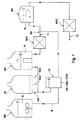
- the device is a device for treating, preferably for producing, a wort W in the beer or beverage production.
- a device MB for producing the mash M
- the device further comprises a device LB for separating the mash M produced in the device MB, for example a lauter tun, a mash filter, a strainmaster, a drum filter, disc filter or plate filter, a sieve belt press or another fining device for obtaining a wort W, containing one Vorschulze VW or Vorschulze VW and at least one Nachguss NG1, NG2, NG3, ....
- the device further comprises means WP for keeping hot or boiling the wort W obtained in the separation step, for example, a wort kettle with indoor or outdoor cooker.
- it has a device AD for adding at least one portion PM of the mash M and / or at least one portion PMA of at least one mash extract MA and / or a portion of PVW not heated above 80 ° C, second wort W2, in particular the wort VW, too the wort W obtained after keeping hot or boiling in the device WP, ie, the wort.
- the apparatus further comprises means WH for clarifying the wort W obtained after the addition step, for example a whirlpool.
- a special feature of the device according to the invention is that it has a first means WK1 for cooling the wort W, here the Ausschlagschulze, to a first temperature T1 between 0 and 80 ° C, for example a plate heat exchanger.
- this first wort cooler device WK1 is arranged downstream of the hot-holding or cooking device WP and upstream of the feed device AD.
- the feed device AD is arranged upstream of the clarifier WH.
- the apparatus further provides downstream of the clarifier WH a second means WK2 for cooling the clarified wort W withdrawn from the clarifier WH.
- the second device WK2 is preferably designed as a plate heat exchanger.
- the wort W which has the first temperature T1 or a temperature slightly lower than that due to intermittent radiation losses, is cooled to a second temperature T2 suitable for further processing, for example to a tempering temperature in the range from 5 to 20.degree.
- Fig. 1 illustrated embodiment of the device according to the invention further comprises a device SP for storing a portion PM of mash M withdrawn from device MB and / or a portion PMA of a mash extract MA and / or a portion of PVW obtained from the separator LB, one not over 80 ° C heated, second wort W2, especially the wort VW.
- a mash M is produced in a conventional method using conventional raw materials.
- a decoction or infusion method is used.
- a portion PM of the mash M is removed at a predetermined temperature of the mash batch and stored in the storage device SP.
- the mash sample can be drawn at a temperature which lies within the corresponding range of the temperature optimum according to the above table. If, for example, a sufficient ⁇ -glucan degradation is to be ensured, then a mash portion PM can be drawn at a temperature of the mash of, for example, 48 ° C. at which the ⁇ -glucanases have not yet been inactivated.
- a first wort portion of PVW may be drawn during the clarification, wherein the temperature of the first wort preferably does not exceed 76 ° C.
- the wort wort portion PVW is also stored in the storage device SP, for example, separate from the mash portion PM.
- the wort preparation is continued according to the conventional method with rinsing and holding / boiling wort.
- the wort W is cooled to a first temperature T1 before the clarification step by means of the first device WK1, which, if a sufficient iodine normality of the wort is to be achieved, preferably 74 ° C.
- This pre-cooled Wort W which has been pre-cooled to 74 ° C, is added to the pre-seasoning portion PVW which has been stored in the meantime.
- the volume ratio of added wort wort portion PVW to the pan-full volume of the wort batch is for example 2.5%.
- this enzyme can continue its activity in the subsequent clarification step, ie in the separation of the hot trub in the whirlpool, so that the time
- the Whirlpoolrast advantageous for the additional starch degradation by the introduced with the Vorffle-Portion PVW, active ⁇ -amylase can be used at its optimum temperature.
- the clarified wort W is then cooled in a second device WK2, preferably a second plate heat exchanger, for further use to the second temperature T2, for example to the tempering temperature of 15 ° C.
- the sample no. 1 shows a conventionally produced, non-iodine-normal wort with an iodine value of 9.44. In brewhouse decreases, iodine values in buffered systems are considered acceptable, which are in the 0.45 range.
- Sample no. 2 is a wort W prepared according to the invention, which has been produced according to the first exemplary embodiment described above and a portion of wort PRE PVW in a volume fraction of 2.5% of the precooled wort W has been added.
- Sample no. 3 is also a Wort W prepared according to the invention, this was added after precooling 7.5% wort.
- Sample no. 4 is the conventional wort like sample no. 1, to which was added a commercially available thermostable ⁇ -amylase.
- thermostable ⁇ -amylase The comparison of the seasoning with the wort prepared according to the invention, to which a thermostable ⁇ -amylase has been added, shows that the process according to the invention leads to a comparable starch degradation as can be achieved by the addition of a commercial, thermostable ⁇ -amylase.
- An exposure time of 15 minutes is already sufficient to achieve an acceptable iodine value. Even lower iodine values are achieved with an exposure time of about 20 minutes.
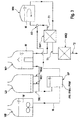
- second embodiment of the device according to the invention has basically the same structure as the above-described first embodiment. Therefore, only the differences from the first embodiment will be described below.
- the first means WK1 for cooling the wort W after the heat holding / boiling step and the second means WK2 for cooling the wort W after the whirlpool step are combined into a single device WK, for example a single or multi-stage plate heat exchanger.
- the same wort condenser WK can be used for the pre-cooling of the wort W as well as for the further cooling of the wort W to tempering temperature.
- the purchase of a second cooling device is advantageously avoided and reduces costs.
- the functions of the first device WK1 and of the second device WK2 in the common device WK are usually carried out with a time delay. But it is also a simultaneous execution of both functions feasible.
- third embodiment of the device according to the invention basically has the same structure as the second embodiment described above. Therefore, only the differences from the first embodiment will be described below.
- the third embodiment is particularly intended for the realization of a continuous process according to the invention.
- This embodiment also has a first means WK1 for cooling the wort W after the heat holding / boiling step in the device WP.
- the wort W is cooled to the temperature T1 in countercurrent or direct current with the wort emerging from the clarification device WH, which has the temperature T1 or a temperature slightly below it.
- the countercurrent wort flow W is heated to a third temperature T3, which is approximately between 82 and 95 ° C, preferably 82 to 90 ° C, in particular 82 to 85 ° C. This re-heating the enzymes are inactivated controlled. Consequently, the first device WK1 simultaneously serves as a device WE for heating the wort W.
- a storage vessel for the wort W may be provided in the wort path (not shown).
Landscapes
- Chemical & Material Sciences (AREA)
- Organic Chemistry (AREA)
- Engineering & Computer Science (AREA)
- Bioinformatics & Cheminformatics (AREA)
- Life Sciences & Earth Sciences (AREA)
- Biochemistry (AREA)
- Health & Medical Sciences (AREA)
- General Engineering & Computer Science (AREA)
- General Health & Medical Sciences (AREA)
- Genetics & Genomics (AREA)
- Food Science & Technology (AREA)
- Wood Science & Technology (AREA)
- Zoology (AREA)
- Distillation Of Fermentation Liquor, Processing Of Alcohols, Vinegar And Beer (AREA)
Abstract
Die Erfindung betrifft ein Verfahren zum Behandeln oder Herstellen einer Würze bei der Bier- oder Getränkeherstellung, wenigstens mit den Schritten: (a) nach einem Heißhalten oder Kochen der Würze (W), Einstellen der Temperatur, insbesondere Kühlen, der Würze (W) auf eine erste Temperatur (T1) zwischen 0 und 85 °C; und (b) Zugeben wenigstens einer Portion (PES) eines enzymhaltigen Substrats (ES), vorzugsweise wenigstens einer Portion (PM) einer Maische (M) und/oder wenigstens einer Portion (PMA) eines Maischeauszugs (MA) und/oder einer Portion (PVW) enthaltend eine nicht über 80 °C erwärmte, zweite Würze (W2), oder vorzugsweise eines Gemischs aus wenigstens zwei der Portion (PM), der Portion (PMA) und der Portion (PVW), zur Würze (W). Dabei weist die Würze (W) beim Zugeben höchstens die erste Temperatur (T1) auf. Die Erfindung betrifft ferner eine entsprechende Vorrichtung und eine entsprechende Verwendung.The invention relates to a method for treating or preparing a wort in beer or beverage production, at least with the steps: (a) after a hot holding or boiling of the wort (W), adjusting the temperature, in particular cooling, of the wort (W) a first temperature (T1) between 0 and 85 ° C; and (b) adding at least one portion (PES) of an enzyme-containing substrate (ES), preferably at least one portion (PM) of a mash (M) and / or at least one portion (PMA) of a mash extract (MA) and / or portion ( PVW) containing a second wort (W2) not heated above 80 ° C, or preferably a mixture of at least two of the portion (PM), the portion (PMA) and the portion (PVW), to the wort (W). In this case, the wort (W) when adding at most the first temperature (T1). The invention further relates to a corresponding device and a corresponding use.
Description
Die Erfindung betrifft ein Verfahren zum Behandeln oder Herstellen einer Würze bei der Bier- oder Getränkeherstellung nach Anspruch 1, eine Vorrichtung zum Behandeln einer Würze bei der Bier- oder Getränkeherstellung nach Anspruch 9, und eine entsprechende Verwendung nach Anspruch 14.The invention relates to a method for treating or preparing a wort in the beer or beverage production according to claim 1, a device for treating a wort in the beer or beverage production according to claim 9, and a corresponding use according to claim 14.
In der Vergangenheit sind bei der Herstellung von Würzen im Rahmen der Bier- oder Getränkeherstellung bisweilen nicht vollständig aufgeschlossene, insbesondere nicht iodnormale, Würzen aufgetreten. Die Ursachen hierfür werden in problematischen Rohstoffen, die während des Maischens nicht vollständig aufgeschlossen worden sind oder in dem Vorhandensein einer zu hohen Trübung, insbesondere einer Feintrübung, beim Abläutern der Würze vermutet. Hierbei scheinen Trübungen mit Partikelgrößenbereich von > 5 µm, insbesondere > 20 µm, eine hohe Durchgängigkeit durch beispielsweise die herkömmlichen Maischefilter zu haben und folglich nicht iodnormale Würzen zu verursachen. Ein zu hoher Iodwert kann beispielsweise zu Problemen bei der Filtration des gelagerten Bieres, insbesondere beim Einsatz von Membranfiltern, oder zu Qualitätseinbußen (Geschmacksstabilität, Alterungsbeständigkeit, Anfälligkeit auf mikrobiologischen Befall) beim fertigen Bier führen. Nicht aufgeschlossene Stärke führt zu Ausbeuteverlusten, welche einen Kostennachteil nach sich ziehen. Gerade neuartige Läutertechnologien, welche nicht auf dem Prinzip der Tiefenfiltration, wie sie bspw. beim herkömmlichen Läuterbottich Verwendung findet, sondern im Wesentlichen auf dem Prinzip der Oberflächenfiltration basieren, haben bisweilen das Problem von nicht iodnormalen Würzen, also nicht hinreichend abgebauter Stärke.In the past, in the production of condiments in the context of beer or beverage production sometimes not fully digested, in particular non-iodine normal, seasonings have occurred. The causes for this are in problematic raw materials that have not been fully digested during mashing or in the presence of too high turbidity, in particular a fine turbidity, suspected in the washing of the wort. Turbidity with a particle size range of> 5 .mu.m, in particular> 20 .mu.m, seem to have a high patency through, for example, the conventional mash filters and consequently not to cause iodine-normal seasoning. Too high an iodine value may, for example, lead to problems in the filtration of the stored beer, in particular when using membrane filters, or to quality losses (taste stability, aging resistance, susceptibility to microbiological attack) in the finished beer. Untreated starch leads to yield losses, which entail a cost disadvantage. Especially novel refining technologies, which are not based on the principle of depth filtration, as used for example in the conventional lauter tun, but are based essentially on the principle of surface filtration, sometimes have the problem of non-iodine normal seasoning, so not sufficiently degraded starch.
Zur Überwindung dieses Problems war man in der Vergangenheit oft gezwungen, aufwändig isolierte und gereinigte, künstliche und zumeist thermostabile Enzyme der Würze oder dem Bier zuzusetzen.To overcome this problem, it has often been necessary in the past to add elaborately isolated and purified, artificial and mostly thermostable enzymes to the wort or the beer.
Nachteil dieser Praxis ist, dass die Verwendung der künstlichen Enzyme nicht dem natürlichen Charakter des Bieres entspricht und zudem nicht reinheitsgebotskonform ist. Darüber hinaus sind die Kosten für den Einsatz künstlicher Enzyme hoch, wodurch sich die Würzeherstellung verteuert. Darüber hinaus lassen sich mittels thermostabiler Enzyme nicht alle im Bereich der Würze- und Bierbereitung erforderlichen oder gewünschten Abbaureaktionen darstellen.Disadvantage of this practice is that the use of artificial enzymes does not correspond to the natural character of the beer and is also not purity requirement compliant. In addition, the cost of using artificial enzymes is high, making the wort production more expensive. In addition, thermostable enzymes can not be used to produce all the necessary or desired degradation reactions in the wort and beer preparation sector.
Es ist daher eine Aufgabe der Erfindung, ein Verfahren und eine Vorrichtung bereitzustellen, mittels welchem bzw. welcher die Qualität der Würzen, insbesondere nicht iodnormaler oder im Wesentlichen nicht iodnormaler Würzen, verbessert wird und/oder die Sudhausausbeute gesteigert wird.It is therefore an object of the invention to provide a method and a device by means of which or which the quality of the seasoning, in particular non-iodine-normal or essentially non-iodine-normal seasoning, is improved and / or the brewhouse yield is increased.
Die vorstehend definierte Aufgabe wird durch das Verfahren gemäß Anspruch 1 gelöst.The above-defined object is achieved by the method according to claim 1.
Dabei umfasst das Verfahren zum Behandeln oder Herstellen einer Würze bei der Bier- oder Getränkeherstellung, wenigstens die Schritte:
- (a) nach einem Heißhalten oder Kochen der Würze, Einstellen der Temperatur, insbesondere Kühlen, der Würze auf eine erste Temperatur zwischen 0 und 85 °C, vorzugsweise zwischen 0 und 80 °C, vorzugsweise zwischen 70 und 85 °C; vorzugsweise zwischen 72 und 83 °C; vorzugsweise zwischen 80 und 85 °C; vorzugsweise zwischen 80 und 82 °C; vorzugsweise zwischen 72 und 78 °C; vorzugsweise zwischen 40 und 55 °C; vorzugsweise zwischen 45 und 50 °C; und
- (b) Zugeben wenigstens einer Portion eines enzymhaltigen Substrats, vorzugsweise wenigstens einer Portion einer Maische und/oder wenigstens einer Portion eines Maischeauszugs und/oder einer Portion enthaltend eine nicht über 80 °C, vorzugsweise nicht über 78 °C, vorzugsweise nicht über 76 °C, vorzugsweise nicht über 74 °C, vorzugsweise nicht über 72 °C, vorzugsweise nicht über 70 °C, vorzugsweise nicht über 68 °C, insbesondere nicht über 66 °C, erwärmte, zweite Würze, insbesondere einer Portion einer Vorderwürze, oder vorzugsweise eines Gemischs aus wenigstens zwei der Portion der Maische, der Portion des Maischeauszugs oder der Portion der zweiten Würze, zur Würze. Die Würze weist beim Zugeben höchstens die erste Temperatur auf.
- (a) after keeping the wort hot or boiling, adjusting the temperature, in particular cooling, the wort to a first temperature between 0 and 85 ° C, preferably between 0 and 80 ° C, preferably between 70 and 85 ° C; preferably between 72 and 83 ° C; preferably between 80 and 85 ° C; preferably between 80 and 82 ° C; preferably between 72 and 78 ° C; preferably between 40 and 55 ° C; preferably between 45 and 50 ° C; and
- (B) adding at least one portion of an enzyme-containing substrate, preferably at least one portion of a mash and / or at least one portion of a mash extract and / or a portion containing not more than 80 ° C, preferably not more than 78 ° C, preferably not more than 76 ° C, preferably not more than 74 ° C, preferably not more than 72 ° C, preferably not more than 70 ° C, preferably not more than 68 ° C, in particular not more than 66 ° C, heated, second wort, in particular a portion of a wort, or preferably a mixture of at least two of the portion of the mash, the portion of the mash extract or the portion of the second wort, to the wort. The wort has at the time of adding at most the first temperature.
Vorzugsweise kann die Würze erfindungsgemäß durch Abläutern einer Maische mit einer Abmaischtemperatur im Bereich von 60 bis 70 °C, vorzugsweise 62 bis 68 °C, insbesondere 63 bis 65 °C, gewonnen werden. Durch die β-Amylaseaktivität ist dabei die Verkleisterung weitgehend oder vollständig abgeschlossen, weshalb eine weitgehend oder vollständig verkleisterte Würze mit hohem Anteil an unverzuckerten Stärkebestandteilen vorliegt. Damit betrifft die vorliegende Erfindung vorzugsweise verkleisterte Würzen mit unverzuckerten Stärkebestandteilen, insbesondere einem hohen Anteil an unverzuckerten Stärkebestandteilen. Im Vergleich zu unverkleisterten Würzen sind verkleisterte Würzen aufgrund der β-Amylaseaktivität durch eine relativ geringe Viskosität gekennzeichnet.Preferably, the wort can be obtained according to the invention by rinsing a mash with a mashing temperature in the range of 60 to 70 ° C, preferably 62 to 68 ° C, in particular 63 to 65 ° C. By β-amylase activity while the gelatinization is largely or completely completed, which is why a largely or completely gelatinized wort is present with a high proportion of unsweetened starch components. Thus, the present invention preferably relates to gelatinised seasonings with unsweetened starch components, in particular a high proportion of unsweetened starch components. In comparison to unverkleisterten condiments gelatinized seasoning due to the β-amylase activity are characterized by a relatively low viscosity.
Beim erfindungsgemäßen Verfahren erfolgt das Zugeben der wenigstens einen Portion des enzymhaltigen Substrats, vorzugsweise Maische/Maischeauszug/zweite Würze, vorzugsweise bei einer Temperatur, welche der ersten Temperatur entspricht oder höchstens 10 °C, vorzugsweise höchstens 8 °C, vorzugsweise höchstens 6 °C, insbesondere höchstens 4 °C, unter der ersten Temperatur liegt. Vorzugsweise ist das enzymhaltige Substrat ein filtriertes Substrat, insbesondere eine filtrierte Maische, zum Beispiel eine Vorderwürze.In the method according to the invention, adding the at least one portion of the enzyme-containing substrate, preferably mash / mash extract / second wort, preferably at a temperature corresponding to the first temperature or at most 10 ° C, preferably at most 8 ° C, preferably at most 6 ° C, in particular at most 4 ° C, below the first temperature. Preferably, the enzyme-containing substrate is a filtered substrate, in particular a filtered mash, for example a wort.
Erfindungsgemäß wird ein derartiges Erwärmen des enzymhaltigen Substrats, das zu einer Inaktivierung einer relevanten Menge (beispielsweise > 25 %) desjenigen Enzyms oder derjenigen Enzyme führen würde, dessen bzw. deren katalytische Wirkung genutzt werden soll, vorzugsweise vermieden. Insbesondere wird das enzymhaltige Substrat nicht auf eine Temperatur erwärmt, die oberhalb der ersten Temperatur oder oberhalb 85 °C, vorzugsweise oberhalb 80 °C, vorzugsweise oberhalb 78 °C, vorzugsweise oberhalb 76 °C, vorzugsweise oberhalb 75 °C, vorzugsweise oberhalb 74 °C, vorzugsweise oberhalb 72 °C, vorzugsweise oberhalb 70 °C, vorzugsweise oberhalb 68 °C, vorzugsweise oberhalb 66 °C, vorzugsweise oberhalb 65 °C, insbesondere oberhalb 62 °C, liegt. Im Zuge der Erhaltung einer möglichst weitgehenden oder zumindest ausreichenden Enzymaktivität im enzymhaltigen Substrat kann es zudem besonders vorteilhaft sein, wenn eine Erwärmung desselben auf eine Temperatur oberhalb der ersten Temperatur vermieden wird.According to the invention, such heating of the enzyme-containing substrate results in inactivating a relevant amount (for example> 25%) of that Enzyme or those enzymes would lead, whose or their catalytic effect to be used, preferably avoided. In particular, the enzyme-containing substrate is not heated to a temperature above the first temperature or above 85 ° C, preferably above 80 ° C, preferably above 78 ° C, preferably above 76 ° C, preferably above 75 ° C, preferably above 74 ° C, preferably above 72 ° C, preferably above 70 ° C, preferably above 68 ° C, preferably above 66 ° C, preferably above 65 ° C, in particular above 62 ° C. In the course of preserving as far as possible or at least sufficient enzyme activity in the enzyme-containing substrate, it may also be particularly advantageous if heating thereof to a temperature above the first temperature is avoided.
Beim erfindungsgemäßen Verfahren wird die Würze nach dem herkömmlichen Heißhalten oder Kochen und vorzugsweise noch vor dem Klären, d. h. dem teilweisen oder vollständigen Abtrennen von Heißtrub oder anderen Feststoffen, beispielsweise im Whirlpool oder einer anderen Trenneinrichtung (Dekanter, Setzbottich usw.), auf eine vorbestimmte erste Temperatur von höchstens 85 °C, vorzugsweise höchstens 84 °C, insbesondere 80 °C, eingestellt, insbesondere gekühlt. Erfindungsgemäß kann unter dem Begriff "nach dem Heißhalten oder Kochen der Würze" insbesondere "nach Abschluss des Heißhaltens oder Kochens der Würze" verstanden werden. Dies bedeutet, dass erfindungsgemäß das enzymhaltige Substrat erst zugegeben wird, wenn der Vorgang der eigentlichen Wärmebehandlung der Würze im Sinne der klassischen Würzekochung/-heißhaltung in der Sudpfanne abgeschlossen ist und nicht mehr fortgesetzt wird. Die erfindungsgemäße enzymatische Behandlung nach dem Abschluss des Wärmebehandlungsschritts der Würze hat den Vorteil, dass alle bis zum Ende der Wärmebehandlung freigesetzten Stärkebestandteile dem enzymatischen Abbau zugänglich sind. Eine weitere Freisetzung von Stärkebestandteilen durch eine Fortsetzung der Wärmebehandlung im Sinne eines erneuten Erwärmens auf die Koch- oder Heißhaltetemperatur kann somit erfindungsgemäß vermieden werden.In the process according to the invention, the wort is after the conventional holding or cooking, and preferably before clarifying, d. H. the partial or complete separation of hot trub or other solids, for example in the whirlpool or other separating device (decanter, settling vat, etc.), to a predetermined first temperature of at most 85 ° C, preferably at most 84 ° C, in particular 80 ° C set, in particular cooled. According to the invention, the term "after the hot-holding or cooking of the wort" can be understood to mean in particular "after completion of the hot-holding or boiling of the wort". This means that according to the invention, the enzyme-containing substrate is added only when the process of the actual heat treatment of the wort in terms of classic Wort boiling / hot keeping is completed in the brewing kettle and is no longer continued. The enzymatic treatment according to the invention after the end of the heat treatment step of the wort has the advantage that all starch components released until the end of the heat treatment are accessible to enzymatic degradation. A further release of starch constituents by a continuation of the heat treatment in the sense of a renewed heating to the boiling or holding temperature can thus be avoided according to the invention.
Wenn im Schritt (a) die Würze auf eine Temperatur von höchstens 80 °C, insbesondere auf eine Temperatur zwischen 70 und 80 °C, eingestellt wird, wird es erstmals möglich, dass die Würze bei einer Temperatur vorliegt, bei der wenigstens ein Teil der im enzymhaltigen Substrat, vorzugsweise in einer Maische-Portion und/oder in einer Portion einer nicht über 80 °C erwärmten, zweiten Würze, insbesondere einer Portion Vorderwürze, natürlicherweise vorhandenen Enzyme aktiv und nicht temperaturbedingt denaturiert ist. So kann im Schritt (a) die Würze auf eine Temperatur von höchstens 55 °C (beispielsweise 40 bis 55 °C, insbesondere 45 bis 50 °C) eingestellt werden. Besonders vorteilhaft es hierdurch möglich, die Aktivität einer oder mehrerer Peptidasen zum Abbau von Gluten zu nutzen, um beispielsweise glutenfreie Getränke auf einfache und kostengünstig Weise zu erzeugen. Dabei kann es zudem vorteilhaft sein, wenn eine Erwärmung des enzymhaltigen Substrats auf eine Temperatur oberhalb der Temperatur von 55 °C, vorzugsweise 50 °C, vorzugsweise 45 °C, insbesondere 40 °C, vermieden wird.If in step (a) the wort is adjusted to a temperature of at most 80 ° C, in particular to a temperature between 70 and 80 ° C, it will for the first time possible that the wort is present at a temperature at which at least a portion of the enzyme-containing substrate, preferably in a mash portion and / or in a portion of not more than 80 ° C heated, second wort, in particular a portion of wort, naturally existing enzymes is active and not denatured due to temperature. Thus, in step (a) the wort can be adjusted to a temperature of at most 55 ° C (for example 40 to 55 ° C, especially 45 to 50 ° C). In this way, it is particularly advantageous to utilize the activity of one or more peptidases for the degradation of gluten in order to produce, for example, gluten-free drinks in a simple and cost-effective manner. It may also be advantageous if heating of the enzyme-containing substrate to a temperature above the temperature of 55 ° C, preferably 50 ° C, preferably 45 ° C, especially 40 ° C, is avoided.
Wenn im Schritt (a) die Würze dagegen auf eine Temperatur im Bereich von 80 bis 85 °C oder zumindest auf eine Temperatur oberhalb des üblichen Einsatzbereiches des betrachteten Enzyms (höchstens bis zur Temperatur des größten Stoffumsatzes pro Zeiteinheit, d.h. dem Temperatur- oder Wirkoptimum) eingestellt wird, kann zwar das Wirkoptimum der Enzyme im enzymhaltigen Substrat überschritten sein. Die Erfinder haben dennoch eine ausreichend hohe Enzymaktivität festgestellt, um einen quantitativ hinreichenden enzymatischen Abbau sicherzustellen, bevor die Enzymaktivität aufgrund der voranschreitenden, wärmebedingten Enzyminaktivierung zum Erliegen kommt. In Schritt (a) des erfindungsgemäßen Verfahrens besteht somit die Möglichkeit, die Temperatur der Würze auf eine Temperatur von 2 bis 20 °C, vorzugsweise 5 bis 15 °C, oberhalb des Temperaturoptimums eines für den Stoffabbau relevanten Enzyms, wie es bspw. in der weiter unten auf Seite 23 aufgeführten Tabelle genannt ist, einzustellen. Der besondere Vorteil dieser Vorgehensweise ist, dass eine gezielte Inaktivierung des jeweils betrachteten Enzyms oder der betrachteten Enzyme quasi zugleich oder im Anschluss an den Abbau erzielt wird, ohne dass ein nochmaliges Erwärmen der Würze zur gezielten Inaktivierung erforderlich wäre. Hierdurch wird der Verfahrensablauf vereinfacht, und ein nochmaliges Erwärmen der Würze entfällt. Zudem wird bei dieser Vorgehensweise der zwischen den eingesetzten Medien, wie beispielsweise Würze und Wärmeträger bzw. Kälteträger, zu übertragende Wärmestrom gegenüber einer weitergehenden Abkühlung der Würze auf oder insbesondere unterhalb des Temperaturoptimums des betrachteten Enzyms verringert, wodurch sich die Handhabung des Verfahrens vereinfacht. Weiter resultiert hieraus eine geringere Komplexität des Verfahrens zur Rückgewinnung von Wärme aus der zuvor wärmebehandelten Würze und der hierzu eingesetzten Vorrichtung.If in step (a) the wort on the other hand to a temperature in the range of 80 to 85 ° C or at least to a temperature above the usual range of application of the considered enzyme (at most up to the temperature of the largest conversion per unit time, ie the temperature or optimum of action) is set, although the optimum effect of the enzymes may be exceeded in the enzyme-containing substrate. Nevertheless, the inventors have found a sufficiently high enzyme activity to ensure a quantitatively sufficient enzymatic degradation before the enzyme activity comes to a standstill due to the progressing, thermally induced enzyme inactivation. In step (a) of the method according to the invention, it is therefore possible, the temperature of the wort to a temperature of 2 to 20 ° C, preferably 5 to 15 ° C, above the temperature optimum of a substance relevant for the degradation enzyme, as for example in the set forth on page 23 below. The particular advantage of this approach is that a targeted inactivation of the respective considered enzyme or enzymes considered quasi at the same time or following the degradation is achieved without a re-heating of the wort for targeted inactivation would be required. As a result, the procedure is simplified, and a renewed heating of the wort is eliminated. In addition, in this procedure, the between the media used, such as wort and heat transfer medium or refrigerant to be transferred heat flow over a reduced cooling of the wort on or in particular below the temperature optimum of the considered enzyme, thereby simplifying the handling of the process. Furthermore, this results in a lower complexity of the process for the recovery of heat from the previously heat-treated wort and the device used for this purpose.
Ferner wird erfindungsgemäß wenigstens eine Portion eines enzymhaltigen Substrats, vorzugsweise der Maische, des Maischeauszugs oder der nicht über 80 °C erwärmten, zweiten Würze, insbesondere einer Portion einer Vorderwürze, der auf diese Weise auf die erste Temperatur eingestellten, insbesondere vorgekühlten, Würze zugegeben. Hierdurch können die natürlicherweise im zugegebenen Substrat enthaltenen Enzyme in der bereits wärmebehandelten und damit enzyminaktiven Würze wirken, um den Abbau von hochmolekularen Substanzen, wie beispielsweise der Stärke, weiter voranzutreiben und möglichst zu vervollständigen. Hierdurch kann vorteilhaft einem unzureichenden Aufschluss und/oder unzureichenden Abbau beim Maischen entgegengewirkt werden. Ferner können die möglichen Wirkungen einer beim Abläutern in die Würze übergegangenen Fein- oder Feinstrübung, welche im weiteren Verfahren der Bier- oder Getränkeerzeugung problematisch sein kann, wenigstens teilweise vermieden werden. Darüber hinaus können vorteilhaft die Nachteile eines knapp gelösten Malzes zumindest zu einem gewissen Grad ausgeglichen werden.Furthermore, according to the invention, at least one portion of an enzyme-containing substrate, preferably the mash, the mash extract or the second wort not heated above 80 ° C., in particular a portion of a wort that has been added to the first temperature, in particular precooled, wort, is added. As a result, the enzymes naturally contained in the added substrate in the already heat-treated and thus enzyme-inactive wort act to further promote the degradation of high molecular weight substances such as starch, and possibly complete. This can advantageously be counteracted insufficient digestion and / or insufficient degradation during mashing. Furthermore, the possible effects of fine or fine turbidity, which may have been problematic in the further process of beer or beverage production, during the further clarification of the wort may be at least partially avoided. In addition, advantageously, the disadvantages of a barely dissolved malt can be compensated for at least to a certain extent.
Die Verwendung eines Maischeauszugs gegenüber einer Maische als Zugabe zur Würze ist aufgrund des verringerten Feststoffgehalts des Maischeauszugs gegenüber der Maische vorteilhaft.The use of a mash extract over a mash as an addition to the wort is advantageous because of the reduced solids content of the mash extract over the mash.
Indem eine Maischeportion (oder ein daraus hergestellter Maischeauszug) bei einer vorgegebenen Temperatur während des Maischverfahrens gezogen wird, kann auf einfache Weise gesteuert werden, welche Arten von Enzyme in der Maische aktiv sind. Da die gezogene Portion der Maische gerade nicht den hohen Temperaturen bei der Behandlung der Würze, d. h. Kochung oder wenigstens Heißhaltung, ausgesetzt wird, sind die darin enthaltenen Enzyme noch beim erfindungsgemäßen Zugeben der Portion nach dem vorstehend beschriebenen Einstellen der Temperatur, insbesondere Vorkühlen, auf höchstens 85 °C, vorzugsweise höchstens 80 °C, im Anschluss an die Wärmebehandlung der Würze aktiv und bleiben auch in einer derart temperierten/vorgekühlten Würze hinreichend lange aktiv, ohne temperaturbedingt denaturiert zu werden. Entsprechendes gilt für den Maischeauszug und die nicht über 80 °C erwärmte, zweite Würze, insbesondere für die Vorderwürze. Dabei ist dem Fachmann klar, dass die zugegebene Portion des enzymhaltigen Substrats (bspw. Maische, Maischeauszug und Würze oder Vorderwürze) von deren Gewinnung bis zur Zugabe nicht derart erwärmt oder anderweitig behandelt werden sollte, dass eine mehr als unwesentliche Inaktivierung (beispielsweise > 25 %) der jeweils als relevant erachteten Enzyme stattfindet. Vorzugsweise wird die zugegebene Portion des enzymhaltigen Substrats nicht auf eine Temperatur höher als die erste Temperatur, jedenfalls nicht über 80 °C, erwärmt.By pulling a mash portion (or a mash extract produced therefrom) at a given temperature during the mashing process, it is easy to control which types of enzymes are active in the mash. Since the drawn portion of the mash is just not exposed to the high temperatures in the treatment of the wort, ie cooking or at least heat retention, the enzymes contained therein are still in the addition of the invention according to the portion the above-described setting of the temperature, in particular precooling, to at most 85 ° C, preferably at most 80 ° C, following the heat treatment of the wort active and remain sufficiently active in such a tempered / pre-cooled wort, without being denatured due to temperature. The same applies to the mash extract and not over 80 ° C heated, second wort, especially for the wort. It is clear to the person skilled in the art that the added portion of the enzyme-containing substrate (for example mash, mash extract and seasoning or wort) should not be heated or otherwise treated in such a way from its recovery until it is added that a more than insignificant inactivation (for example> 25%). ) takes place which each considered to be relevant enzymes. Preferably, the added portion of the enzyme-containing substrate is not heated to a temperature higher than the first temperature, at least not above 80 ° C, heated.
So können die mit der nach der Würze-Temperierung/Vorkühlung durch die Zugabe der Portion des enzymhaltigen Substrats (bspw. Maische/Maischeauszug/zweite Würze) zugegebenen Enzyme für eine vorbestimmte Zeitspanne auf deren Zielsubstanzen in der Würze einwirken und beispielsweise den Abbau von in der Würze vorhandenen Stärkeresten bis zur Iodnormalität vorantreiben.Thus, the enzymes added after the wort heating / precooling by the addition of the portion of the enzyme-containing substrate (for example mash / mash extract / second wort) can act on their target substances in the wort for a predetermined period of time and, for example, reduce the degradation in the Extract seasoning starch to iodine normality.
Der Vorteil der erfindungsgemäßen Enzymzusetzung zur bereits gekochten oder heiß gehaltenen und anschließend auf eine bestimmte Temperatur temperierten/vorgekühlten Würze in Gestalt einer nicht über 80 °C wärmebehandelten Portion des enzymhaltigen Substrats (bspw. Maische/Maischeauszug/Würze) liegt in der vergleichbar schnellen enzymatischen Umsetzung der Zielsubstanzen in der Würze aufgrund der verhältnismäßig hohen Temperatur, insbesondere im Bereich des Temperaturoptimums des jeweils betrachteten Enzyms. Hierzu kann die erste Temperatur vorzugsweise auf das Temperaturoptimum des jeweils betrachteten Enzyms einstellt werden (vgl. bspw. Tabelle auf Seite 23 dieser Anmeldung). Dies führt vorteilhaft zu einer Verkürzung der bisherigen Läuterzeit, da diese nicht mehr als Enzymeinwirkungszeit benötigt wird.The advantage of the enzyme addition according to the invention to wort already cooked or kept hot and then tempered / cooled to a certain temperature in the form of a portion of the enzyme-containing substrate (eg mash / mash extract / wort) not heat-treated above 80 ° C. lies in the comparatively fast enzymatic conversion the target substances in the wort due to the relatively high temperature, in particular in the range of the temperature optimum of each considered enzyme. For this purpose, the first temperature can preferably be set to the optimum temperature of the respectively considered enzyme (cf., for example, the table on page 23 of this application). This leads advantageously to a shortening of the previous refining time, since this is no longer needed as enzyme reaction time.
Nach dem erfindungsgemäßen Verfahren ist es zudem möglich, nicht nur eine einzige Portion des enzymhaltigen Substrats (bspw. einer Maische oder eines Maischeauszugs oder einer nicht über 80 °C erwärmten, zweiten Würze/Vorderwürze) der Würze zuzugeben. So können vorteilhaft unterschiedliche Portionen des enzymhaltigen Substrats, beispielsweise der Maische, welche bei verschiedenen Temperaturen aus der Maische gezogen wurden, oder Maischeportionen, welche aus unterschiedlichen Maischechargen stammen können, der Würze erfindungsgemäß zugegeben werden. Hierdurch gelingt es, Maischefraktionen mit definierten Mengen an aktiven Enzymen mit unterschiedlichen Temperaturoptima für die Behandlung der vorgekühlten bzw. temperierten Würze einzusetzen. Dabei können die Portionen oder Fraktionen separat oder als Gemisch der Würze zugegeben werden. Das vorstehend beschriebene gilt analog auch für die Verwendung von mehreren Maischeauszügen, nicht über 80 °C erwärmter, zweiter Würzen, insbesondere Vorderwürzen, oder Gemischen derselben. Die erste Temperatur kann unter Berücksichtigung der Temperaturoptima des ausgewählten Enzyms oder der ausgewählten Enzyme eingestellt werden.According to the method of the invention, it is also possible to add not only a single portion of the enzyme-containing substrate (for example a mash or a mash extract or a second wort / wort which has not been heated above 80 ° C.) to the wort. Thus, advantageously, different portions of the enzyme-containing substrate, for example the mash, which were drawn from the mash at different temperatures, or mash portions, which may originate from different mash batches, are added to the wort according to the invention. This makes it possible to use mash fractions with defined amounts of active enzymes with different temperature optima for the treatment of pre-cooled or tempered wort. The portions or fractions can be added separately or as a mixture of the wort. The same applies as described above for the use of several mash extracts, not more than 80 ° C warmed, second seasoning, in particular wort, or mixtures thereof. The first temperature may be adjusted taking into account the temperature optima of the selected enzyme or enzymes.
Mit dem erfindungsgemäßen Verfahren gelingt es dank der zusätzlichen Einwirkung der vorzugsweise malz- oder rohstoffeigenen Enzyme, den Abbau rohstoff oder verarbeitungsbedingt problematischer Würzen, die bisher beispielsweise nicht iodnormal waren, problemlos bis zur Erzielung des gewünschten Abbaugrades, beispielsweise der Iodnormalität, voranzutreiben. Damit erübrigt sich einerseits die Zugabe teurer, auf künstlichem Wege isolierter und aufgereinigter Enzympräparate. Andererseits behält die Würze durch die verbesserte Ausnutzung ausschließlich malzeigner Enzyme ihren natürlichen Charakter, da auf die Zugabe malzfremder Enzympräparate vollständig verzichtet werden kann.Thanks to the additional effect of the preferably malt or raw material enzymes, the process according to the invention makes it possible to advance the degradation of raw materials or processing-problematic condiments which hitherto were not iodine-normal, for example, to obtain the desired degree of degradation, for example the iodine normality. Thus, on the one hand, the addition of expensive, artificially isolated and purified enzyme preparations is unnecessary. On the other hand, the wort retains its natural character due to the improved utilization of exclusively malignant enzymes, since the addition of non-malt enzyme preparations can be completely dispensed with.
Ein weiterer Vorteil des erfindungsgemäßen Verfahrens ist, dass nicht nur iodnormale Würzen erzielt werden können, sondern auch die Ausbeute an vergärbaren Zuckern, wie bspw. Maltose, gesteigert werden kann, also ein Extraktgewinn erzielbar ist. So haben die Erfinder festgestellt, dass die Ausbeute an vergärbarem Extrakt um wenigstens 4 bis 12 % durch das erfindungsgemäße Verfahren steigern lässt. Hierdurch wird die Sudhausausbeute insgesamt gesteigert und die einzusetzende Rohstoffmenge bzw. die Rohstoffkosten gesenkt.Another advantage of the method according to the invention is that not only iodine-normal seasoning can be achieved, but also the yield of fermentable sugars, such as, for example, maltose, can be increased, ie an extract yield can be achieved. Thus, the inventors have found that the yield of fermentable extract can be increased by at least 4 to 12% by the method according to the invention. hereby the brewhouse yield is increased overall and the amount of raw materials or raw material costs to be used is reduced.
Vorteilhafte Weiterbildungen des erfindungsgemäßen Verfahrens sind Gegenstand der abhängigen Ansprüche 2 bis 8.Advantageous developments of the method according to the invention are the subject of the dependent claims 2 to 8.
Das Verfahren kann ferner den Schritt des wenigstens teilweisen Klärens der Würze umfassen. Dabei kann das Zugeben gemäß Schritt (b) bevorzugt vor dem wenigstens teilweisen Klären der Würze erfolgen.The method may further comprise the step of at least partially clarifying the wort. In this case, the addition according to step (b) may preferably take place before the at least partial clarification of the wort.
Folglich kann die Dauer der Heißtrubabtrennung, also beispielsweise die Aufenthaltszeit der Würze im Whirlpool, welche herkömmlich ohnehin stattfindet, für die Vervollständigung des enzymatischen Abbaus genutzt werden. Zwar kann eine weitere enzymatische Umsetzung auch noch nach der Würzetemperierung/-kühlung auf beispielsweise Anstelltemperatur stattfinden, jedoch ist die Geschwindigkeit dieser Umsetzung aufgrund der gegenüber dem Whirlpoolschritt gewöhnlich wesentlich niedrigeren Temperatur der Würze erheblich verringert, so dass die Umsetzung ggf. nur unvollständig ist.Consequently, the duration of the hot trub separation, that is, for example, the residence time of the wort in the whirlpool, which conventionally takes place anyway, be used to complete the enzymatic degradation. Although a further enzymatic reaction can take place even after the wort temperature control / cooling to, for example, annealing temperature, however, the rate of this reaction is considerably reduced due to the wort temperature which is usually much lower than that of the hot-bath step, so that the reaction may be incomplete.
Das Verfahren ist jedoch nicht hierauf beschränkt. So kann das Zugeben alternativ oder zusätzlich während und/oder nach dem wenigstens teilweisen Klären der Würze erfolgen.However, the method is not limited to this. Thus, the addition may take place alternatively or additionally during and / or after the at least partial clarification of the wort.
Das erfindungsgemäße Verfahren kann vor dem Einstellen, insbesondere Kühlen, der Würze auf die erste Temperatur ferner wenigstens einen der nachfolgenden Schritte umfassen: Bereitstellen einer Maische; Trennen der Maische zur Gewinnung der Würze, enthaltend eine Vorderwürze oder ein Gemisch aus der Vorderwürze und wenigstens einem Nachguss; und Heißhalten oder Kochen der Würze. Dabei kann das Trennen der Maische insbesondere durch eine herkömmliche Vorrichtung wie ein Läuterbottich, ein Maischefilter, ein Strainmaster, ein Trommelfilter, Scheibenfilter oder Tellerfilter, eine Siebbandpresse, oder eine anderes Läutergerät, vorzugsweise eines, welche überwiegend oder vollständig auf dem Prinzip der Oberflächenfiltration (Siebeffekt) und nicht oder im Wesentlichen nicht auf dem Prinzip der Tiefenfiltration (Filterbett enthaltend Filtermittel) beruht, wie insbesondere ein Siebfilter, erfolgen. Das Trennen der Maische erfolgt vorzugsweise mittels einer Filtration, insbesondere mittels einer Oberflächenfiltration oder Siebfiltration. Dabei kann die Filterwirkung überwiegend, im Wesentlichen oder vollständig auf einem Siebeffekt beruhen.Before setting, in particular cooling, the wort to the first temperature, the method according to the invention may further comprise at least one of the following steps: providing a mash; Separating the mash to obtain the wort, containing a wort or a mixture of the wort and at least one infusion; and keeping or cooking the wort. In this case, the separation of the mash in particular by a conventional device such as a lauter tun, a mash filter, a Strainmaster, a drum filter, disc filter or plate filter, a belt filter, or another fining device, preferably one which predominantly or completely on the principle of surface filtration (sieve effect ) and not or substantially not based on the principle of depth filtration (filter bed containing filter means), in particular a sieve filter. The separation of the mash is preferably carried out by means of a filtration, in particular by means of a surface filtration or sieve filtration. The filter effect can be predominantly, essentially or completely based on a sieving effect.
Nach dem Zugeben gemäß Schritt (b) und/oder Klären kann das Verfahren ferner den Schritt des Kühlens der Würze auf eine zweite Temperatur zwischen der ersten Temperatur und 0 °C aufweisen.After adding according to step (b) and / or clarifying, the method may further comprise the step of cooling the wort to a second temperature between the first temperature and 0 ° C.
Damit lässt sich das erfindungsgemäße Verfahren problemlos in ein herkömmliches Verfahren zur Würzeerzeugung integrieren. Besonders vorteilhaft ist dabei, wenn die zugegebene Portion oder zugegebenen Portionen bei der Durchführung desselben Würzeherstellungsverfahrens gewonnen werden können, so daß keine gesonderte Quelle für die zugegebenen Portionen erforderlich ist.Thus, the inventive method can be easily integrated into a conventional process for wort production. It is particularly advantageous if the added portion or added portions can be obtained in carrying out the same wort-making process, so that no separate source for the added portions is required.
Ferner kann die erste Temperatur in einem Bereich von 40 bis 85 °C, vorzugsweise 40 bis 84 °C, vorzugsweise 40 bis 80 °C, vorzugsweise 40 bis 55 °C; vorzugsweise 45 bis 50 °C; vorzugsweise 50 bis 80 °C, vorzugsweise 70 bis 85 °C, vorzugsweise 80 bis 85 °C; vorzugsweise 70 bis 80 °C, vorzugsweise 70 bis 78 °C, vorzugsweise 72 bis 78 °C, vorzugsweise 72 bis 76 °C, vorzugsweise 73 bis 75 °C, insbesondere bei etwa 74 °C, oder im Bereich von 78 bis 85 °C, vorzugsweise 78 bis 84 °C, vorzugsweise 80 bis 85 °C, insbesondere 80 bis 83 °C, liegen.Further, the first temperature may be in a range of 40 to 85 ° C, preferably 40 to 84 ° C, preferably 40 to 80 ° C, preferably 40 to 55 ° C; preferably 45 to 50 ° C; preferably 50 to 80 ° C, preferably 70 to 85 ° C, preferably 80 to 85 ° C; preferably 70 to 80 ° C, preferably 70 to 78 ° C, preferably 72 to 78 ° C, preferably 72 to 76 ° C, preferably 73 to 75 ° C, especially at about 74 ° C, or in the range of 78 to 85 ° C, preferably 78 to 84 ° C, preferably 80 to 85 ° C, in particular 80 to 83 ° C, are.
Durch eine Temperierung oder Kühlung der Würze auf eine Temperatur in einem Bereich von 50 bis 80 °C, insbesondere 70 bis 80 °C, vor der Zugabe der Portion des enzymatischen Substrats (bspw. Maische/Maischeauszug/Würze) wird eine thermisch bedingte Deaktivierung beispielsweise des in der Portion enthaltenden Enzyms α-Amylase vermieden. Gleichzeitig enthält der gewählte Bereich das Temperaturoptimum der α-Amylase, so dass eine hohe Geschwindigkeit der enzymatischen Reaktion beim Abbau vorhandener Stärke erzielt wird. Durch diese zusätzliche α-Amylase-Aktivität wird der Abbau der Stärke vorangetrieben und letztlich die Iodnormalität erzielt.By tempering or cooling the wort to a temperature in a range from 50 to 80 ° C., in particular from 70 to 80 ° C., before the addition of the portion of the enzymatic substrate (for example mash / mash extract / wort), a thermally induced deactivation is, for example of the portion-containing enzyme α-amylase avoided. At the same time, the selected range contains the temperature optimum of the α-amylase, so that a high rate of the enzymatic reaction is achieved in the degradation of existing starch. This additional α-amylase activity promotes degradation of the starch and ultimately achieves iodine normality.
In entsprechender Weise können je nach Problemstellung auch die Temperaturoptima anderer im enzymatischen Substrat (bspw. Maische, Würze oder Vorderwürze) enthaltenen Enzyme für die Bestimmung der ersten Temperatur berücksichtigt werden (vgl. auch Übersicht in nachstehender Tabelle auf Seite 23). Hierdurch ist es erfindungsgemäß möglich, auch die Aktivität anderer Enzyme für einen optimalen Abbau von hochmolekularer Substanz in der Würze auszunutzen.In a corresponding manner, depending on the problem, the temperature optima of other enzymes present in the enzymatic substrate (for example mash, wort or wort) may also be taken into account for the determination of the first temperature (see also overview in the table below on page 23). This makes it possible according to the invention to exploit the activity of other enzymes for optimal degradation of high molecular weight substance in the wort.
Zudem kann das Verfahren ferner den Schritt umfassen, dass nach der Zugabe gemäß Schritt (b) und Verstreichenlassen einer vorgegebenen Zeitspanne die Würze auf eine dritte Temperatur zwischen 82 und 99 °C, vorzugsweise zwischen 82 und 95 °C, vorzugsweise zwischen 82 und 90 °C, insbesondere zwischen 82 und 85 °C, erwärmt wird.In addition, the method may further comprise the step of, after the addition of step (b) and allowing a predetermined period of time, the wort to a third temperature between 82 and 99 ° C, preferably between 82 and 95 ° C, preferably between 82 and 90 ° C, in particular between 82 and 85 ° C, is heated.
Mit dem Verstreichenlassen einer vorgegebenen Zeitspanne wird sichergestellt, dass ausreichend Zeit für die enzymatische Umsetzung gegeben ist. Dabei bestimmen sowohl die Zusammensetzung des Ausgangsmaterials Würze als auch das jeweilige Enzym und weitere Randbedingungen, wie beispielsweise die Temperatur der Würze, die minimal erforderliche und optimale Einwirkzeit. Durch den zusätzlichen Erwärmungsschritt kann die Aktivität der mit der Zugabe hinzugefügten Enzyme durch thermische Inaktivierung definiert beendet oder zumindest verringert werden. Hierdurch wird die Steuerung der enzymatischen Aktivitäten weiter verbessert. Dabei erfolgt das Erwärmen vorzugsweise nach der Klärung der Würze. Hierbei kann die Zeit während des Klärens, beispielsweise im Whirlpool, vorteilhaft zur Einwirkung der Enzyme, beispielsweise für einen weitergehenden Stärkeabbau, genutzt werden. Das Halten der erhöhten dritten Temperatur der Würze ist nur solange erforderlich, bis die betreffende Enzymart in der Würze vollständig oder zu einem ausreichenden Grad inaktiviert wurde.By letting a predetermined period of time pass, it is ensured that there is sufficient time for the enzymatic reaction. Both the composition of the starting material, wort, and the respective enzyme and further boundary conditions, such as, for example, the temperature of the wort, determine the minimum required and optimum exposure time. Through the additional heating step, the activity of the enzymes added with the addition can be effectively terminated or at least reduced by thermal inactivation. This further improves the control of the enzymatic activities. The heating is preferably carried out after the clarification of the wort. In this case, the time during the clarification, for example in the whirlpool, can advantageously be used for the action of the enzymes, for example for a further reduction in starch. Maintaining the elevated third temperature of the wort is necessary only until the enzyme species in question has been inactivated completely or to a sufficient degree.
Als Einwirkdauer für die Enzyme bzw. vorgegebene Zeitspanne kann vorzugsweise eine Dauer von bis zu 60 min, vorzugweise 3 bis 30 min, insbesondere 5 bis 25 min, gewählt werden. Eine derartige Einwirkdauer sichert einerseits eine im Wesentlichen vollständige enzymatische Umsetzung bzw. deren Komplettierung, andererseits wird durch die Beschränkung der Dauer eine mögliche thermische Belastung der Würze verkleinert.The duration of action of the enzymes or predetermined period of time may preferably be selected to be up to 60 minutes, preferably 3 to 30 minutes, in particular 5 to 25 minutes. On the one hand, such a duration of action ensures essentially complete enzymatic conversion or its completion, on the other hand is limited by the limitation of the duration of a possible thermal load on the wort.
Des Weiteren kann das Verhältnis des Volumens der zugegebenen, wenigstens einen Portion eines enzymhaltigen Substrats, einen Maische-Portion und/oder Maischeauszugs-Portion und/oder Portion der zweiten Würze oder eines Gemisches aus wenigstens zwei der Maische-Portion, der Maischeauszugs-Portion und der Portion der zweiten Würze zum Pfanne-voll-Volumen der vor Schritt (a) nach Anspruch 1 vorhandenen Würze in einem Bereich von 0,1 bis 30 %, vorzugsweise 0,5 bis 20 %, vorzugsweise von 1 bis 5 %, vorzugsweise von 1 bis 3 %, insbesondere bei etwa 2 %, liegen.Furthermore, the ratio of the volume of the added, at least one portion of an enzyme-containing substrate, a mash portion and / or mash extract portion and / or portion of the second wort or a mixture of at least two of the mash portion, the mash extract portion and the portion of the second wort to the pan-full-volume of the present before step (a) according to claim 1 wort in a range of 0.1 to 30%, preferably 0.5 to 20%, preferably from 1 to 5%, preferably from 1 to 3%, in particular about 2%.
Wie beispielhafte Untersuchungen der Erfinder zur Erzielung einer iodnormalen Würze gezeigt haben, reicht eine Zugabe einer nicht über 80 °C erwärmten, zweiten Würze, vorzugsweise einer Vorderwürze, in einem Volumenverhältnis zum Pfanne-voll-Volumen der Würze im Bereich von 1 bis 5 % aus, um eine hinreichende Wirkung der darin enthaltenen α-Amylase zu erzielen und nach spätestens 15 bis 20 Minuten Einwirkzeit (bei einer ersten Temperatur von 74 °C) die Iodnormalität der Würze zu erreichen (vgl. nachstehend diskutierte Untersuchungsergebnisse).As the inventors have shown to obtain an iodine-normal wort, an addition of a second wort, preferably a wort, not heated above 80 ° C., in a volume ratio to the ladle-full-volume of the wort ranges from 1 to 5% In order to achieve a sufficient effect of the α-amylase contained therein and after no more than 15 to 20 minutes exposure time (at a first temperature of 74 ° C) to reach the iodine normality of the wort (see investigation results discussed below).
Die wenigstens eine Portion der Maische und/oder die wenigstens eine Portion des Maischeauszugs und/oder die wenigstens eine Portion der nicht über 80 °C erwärmten, zweiten Würze, vorzugsweise der Vorderwürze, oder ein Gemisch aus wenigstens zwei dieser Portionen kann/können vor dem Zugeben zwischengelagert werden.The at least one portion of the mash and / or the at least one portion of the mash extract and / or the at least one portion of the not heated above 80 ° C, the second wort, preferably the wort, or a mixture of at least two of these portions can / before Admit to be stored.
Das Zwischenlagern ermöglicht es, die enzymhaltige Portion der Maische, des Maischeauszugs und/oder der zweiten Würze/Vorderwürze zu einem beliebigen Zeitpunkt später zur Behandlung einer Würze einzusetzen, beispielsweise vor, während und/oder nach einer Whirlpoolrast oder eines anderen Trennschritts. Hierdurch steigt die zeitliche Flexibilität bei der Anwendung des erfindungsgemäßen Verfahrens. Das Zwischenlagern in beispielsweise einem einzigen Speichergefäß macht es zudem möglich, auf einfache Weise und kostengünstig ein Gemisch von verschiedenen Maisch- und/oder Würze-/Vorderwürzeportionen zu erzeugen und für die spätere Verwendung zu lagern. Bei Vorsehen mehrerer Speichergefäße wird die Flexibilität der Handhabung vorteilhaft weiter verbessert.The intermediate storage makes it possible to use the enzyme-containing portion of the mash, the mash extract and / or the second wort / wort at any time later for the treatment of a wort, for example, before, during and / or after a Whirlpool break or other separation step. This increases the temporal flexibility in the application of the method according to the invention. The intermediate storage in, for example, a single storage vessel also makes it possible to easily and inexpensively produce a mixture of different mash and / or seasoning / wort portions and store for later use. By providing a plurality of storage vessels, the flexibility of handling is advantageously further improved.
Das Einstellen der Temperatur, insbesondere Kühlen, der Würze auf die erste Temperatur und/oder das Kühlen der Würze auf die zweite Temperatur und/oder das Erwärmen der Würze auf die dritte Temperatur können in demselben Wärmeüberträger durchgeführt werden.The setting of the temperature, in particular cooling, the wort to the first temperature and / or the cooling of the wort to the second temperature and / or the heating of the wort to the third temperature can be carried out in the same heat exchanger.
Indem möglichst alle Kühl- und ggf. Erwärmungsschritte in demselben Wärmeüberträger durchgeführt werden, wird der apparative Aufwand bei der Verwirklichung des erfindungsgemäßen Verfahrens und damit die erforderliche Anlageninvestitionen minimiert.By as far as possible all cooling and possibly heating steps are carried out in the same heat exchanger, the expenditure on equipment in the implementation of the method according to the invention and thus the required investment in equipment is minimized.
Vorrichtungstechnisch wird die erfindungsgemäße Aufgabe durch die Vorrichtung nach Anspruch 9 gelöst.In terms of apparatus, the object according to the invention is achieved by the apparatus according to claim 9.
Dabei wird eine Vorrichtung zum Behandeln oder Herstellen einer Würze bei der Bier- oder Getränkeherstellung, vorzugsweise zur Durchführung des erfindungsgemäßen Verfahrens, beansprucht, welche wenigstens aufweist: eine Einrichtung zum Einstellen der Temperatur, insbesondere Kühlen, der Würze auf eine erste Temperatur zwischen 0 und 85 °C, vorzugsweise zwischen 0 und 80 °C, nach dem Heißhalten oder Kochen der Würze; und eine Einrichtung zum Zugeben einer Portion eines enzymhaltige Substrats, vorzugsweise wenigstens einer Portion einer Maische und/oder wenigstens einer Portion wenigstens eines Maischeauszugs und/oder einer Portion enthaltend eine nicht über 80 °C erwärmte, zweite Würze, vorzugsweise einer Portion einer Vorderwürze, zu der nach dem Einstellen, insbesondere Kühlen, auf die erste Temperatur erhaltene Würze. Dabei ist die Einrichtung zum Temperieren oder Kühlen stromabwärts zu einer Einrichtung zum Heißhalten oder Kochen der Würze angeordnet. Die Einrichtung zum Zugeben ist stromabwärts zur Einrichtung zum Einstellen der Temperatur, insbesondere Kühlen, der Würze auf die erste Temperatur angeordnet.In this case, a device for treating or producing a wort in the beer or beverage production, preferably for carrying out the method claimed claimed at least comprising means for adjusting the temperature, in particular cooling, the wort to a first temperature between 0 and 85 ° C, preferably between 0 and 80 ° C, after keeping hot or boiling the wort; and a device for adding a portion of an enzyme-containing substrate, preferably at least one portion of a mash and / or at least one portion of at least one mash extract and / or portion containing a not heated above 80 ° C, second wort, preferably a portion of a wort the wort obtained after adjustment, in particular cooling, to the first temperature. In this case, the device for tempering or cooling is arranged downstream of a device for keeping the wort hot or boiling. The device for adding is downstream to the device for Adjusting the temperature, in particular cooling, the wort arranged at the first temperature.
Die Vorteile des erfindungsgemäßen Verfahrens gelten analog für die erfindungsgemäße Vorrichtung. Dabei kann vorteilhaft auf herkömmliche Vorrichtungskomponenten, wie beispielsweise Plattenkühler als Wärmeüberträger für die Würzekühlung oder - erwärmung zurückgegriffen werden. Insgesamt kann die Erfindung damit mit einem minimalen apparativen Zusatzaufwand, insbesondere bei der Nachrüstung von bereits bestehenden Sudanlagen, verwirklicht werden.The advantages of the method according to the invention apply analogously to the device according to the invention. In this case, conventional device components, such as plate coolers, for example, can be used as heat exchangers for wort cooling or heating. Overall, the invention can thus be realized with minimal additional equipment, in particular in the retrofitting of existing brewing systems.
Vorteilhafte Ausführungsformen der erfindungsgemäßen Vorrichtung sind Gegenstand der abhängigen Ansprüche 10 bis 13. Die Vorteile entsprechen denen der korrespondierenden Verfahrensmerkmale.Advantageous embodiments of the device according to the invention are the subject of the dependent claims 10 to 13. The advantages correspond to those of the corresponding process characteristics.
So kann die Einrichtung zum Zugeben der wenigstens einen Portion stromaufwärts zu einer Einrichtung zum Klären der Würze angeordnet sein.Thus, the means for adding the at least one portion upstream to a means for clarifying the wort may be arranged.
Die Erfindung ist aber nicht hierauf beschränkt. Die Einrichtung kann auch stromabwärts zu oder im Bereich der Einrichtung zum Klären der Würze angeordnet sein. Hierbei bedeutet "im Bereich einer Einrichtung zum Klären der Würze", dass die Einrichtung zum Zugeben derart in, an oder bei der Einrichtung zum Klären angeordnet ist, dass eine Zugabe der Portion oder der Portionen des enzymhaltigen Substrats, vorzugsweise der Maische, des Maischeauszugs, der Würze/Vorderwürze, zur temperierten oder vorgekühlten Würze möglich ist, während sich die auf die erste Temperatur temperierte oder vorgekühlte Würze in der Kläreinrichtung befindet und/oder in diese ein- oder aus dieser ausströmt.However, the invention is not limited thereto. The device can also be arranged downstream of or in the region of the device for clarifying the wort. Herein, "in the region of a means for clarifying the wort" means that the means for adding is arranged in, at or at the means for clarifying that addition of the portion or portions of the enzyme-containing substrate, preferably the mash, of the mash extract, the seasoning / wort, for tempered or pre-cooled wort is possible while the tempered to the first temperature or pre-cooled wort is in the clarifier and / or flows into this or out of this.
In einer vorteilhaften Ausführungsform kann die erfindungsgemäße Vorrichtung ferner wenigstens eine der nachfolgenden Einrichtungen aufweisen: eine Einrichtung zum Herstellen einer Maische; eine Einrichtung zum Trennen der Maische zur Gewinnung einer Würze, enthaltend eine Vorderwürze oder ein Gemisch aus der Vorderwürze und wenigstens einem Nachguss; eine Einrichtung zum Heißhalten oder Kochen der in der Trenn-Einrichtung erzeugten Würze; eine Einrichtung zum Klären der Würze; eine Einrichtung zum Kühlen der in der Klär-Einrichtung behandelten Würze auf eine zweite Temperatur zwischen der ersten Temperatur und 0 °C. Dabei kann die Einrichtung zum Zugeben stromaufwärts zur Klär-Einrichtung angeordnet sein. Ferner kann dabei die Einrichtung zum Trennen der Maische eine herkömmliche Vorrichtung sein, wie bspw. ein Läuterbottich, ein Maischefilter, ein Strainmaster, ein Trommelfilter, Scheibenfilter oder Tellerfilter oder eine Siebbandpresse. Alternativ kann das Trennen auch durch jedes andere Läutergerät, vorzugsweise eines, welche überwiegend oder vollständig auf dem Prinzip der Oberflächenfiltration (Siebeffekt) und nicht oder im Wesentlichen nicht auf dem Prinzip der Tiefenfiltration (Filterbett enthaltend Filtermittel) beruht, wie insbesondere ein Siebfilter, erfolgen.In an advantageous embodiment, the device according to the invention may further comprise at least one of the following devices: a device for producing a mash; a device for separating the mash to obtain a wort, containing a wort or a mixture of the wort and at least one infusion; a device for keeping or cooking the in the separator produced wort; a device for clarifying the wort; means for cooling the wort treated in the clarifier to a second temperature between the first temperature and 0 ° C. In this case, the device for adding may be arranged upstream of the clarifier. Furthermore, the device for separating the mash may be a conventional device, such as a lauter tun, a mash filter, a strainmaster, a drum filter, disc filter or disc filter or a sieve belt press. Alternatively, the separation can also be carried out by any other fining device, preferably one which predominantly or completely is based on the principle of surface filtration (sieving effect) and not or substantially not on the principle of depth filtration (filter bed containing filter medium), in particular a sieve filter.
Darüber hinaus kann die Vorrichtung ferner eine Einrichtung zum Erwärmen der Würze auf eine dritte Temperatur zwischen 82 und 99 °C, vorzugsweise zwischen 82 und 95 °C, vorzugsweise zwischen 82 bis 90 °C, insbesondere zwischen 82 bis 85 °C, aufweisen. Dabei kann die Erwärmungs-Einrichtung stromabwärts zur Einrichtung zum Zugeben und vorzugsweise stromabwärts zur Einrichtung zum Klären angeordnet ist.In addition, the device may further comprise means for heating the wort to a third temperature between 82 and 99 ° C, preferably between 82 and 95 ° C, preferably between 82 to 90 ° C, in particular between 82 to 85 ° C. In this case, the heating device is arranged downstream of the means for adding and preferably downstream of the means for clarifying.
Die Einrichtung zum Erwärmen erlaubt eine kontrollierte Inaktivierung der mit der wenigstens einen Portion zugegebenen Enzyme. Die Einrichtung zum Erwärmen kann vorteilhaft in die Einrichtung zum Einstellen der Temperatur, insbesondere Kühlen, der Würze integriert sein (z. B. einstückige Ausführung), wodurch der apparative Aufwand minimiert wird. Oder sie kann eine davon separate Einrichtung sein.The means for heating allows controlled inactivation of the enzymes added with the at least one portion. The device for heating can advantageously be integrated into the device for adjusting the temperature, in particular cooling, of the wort (for example, a one-piece design), as a result of which the outlay on equipment is minimized. Or it can be a separate device.
Bei der Anordnung der Einrichtung zum Erwärmen der Würze auf die dritte Temperatur stromabwärts zur Klär-Einrichtung kann die Dauer des Klärens vorteilhaft zur Enzymeinwirkung genutzt werden, bevor eine gezielte thermische Inaktivierung erfolgt.In the arrangement of the means for heating the wort to the third temperature downstream of the clarifier, the duration of the clarification can be advantageously used for enzyme action before a targeted thermal inactivation takes place.
Die Vorrichtung ist jedoch nicht hierauf beschränkt. So kann die Erwärmungs-Einrichtung auch stromaufwärts zur oder im Bereich der Einrichtung zum Klären derHowever, the device is not limited to this. Thus, the heating device can also upstream to or in the area of the device for clarifying the
Würze angeordnet sein, wobei hier die vorstehende Erklärung zum Begriff "im Bereich" analog gilt.Wort be arranged, in which case the above explanation to the term "in the field" analog applies.
Zudem kann die erfindungsgemäße Vorrichtung ferner wenigstens eine Einrichtung zum Abziehen und/oder Speichern der wenigstens einen Portion eines enzymhaltigen Substrats, vorzugsweise der wenigstens einen Portion der Maische und/oder der wenigstens einen Portion des wenigstens einen Maischeauszugs und/oder der Portion enthaltend eine nicht über 80 °C erwärmte, zweite Würze, vorzugsweise der Portion der Vorderwürze, aufweisen.In addition, the device according to the invention may further comprise at least one device for withdrawing and / or storing the at least one portion of an enzyme-containing substrate, preferably the at least one portion of the mash and / or the at least one portion of the at least one mash extract and / or the portion containing one 80 ° C heated, second wort, preferably the portion of the wort.
Der Vorteil einer Speicher- oder Lagermöglichkeit wurde bereits vorstehend bei dem analogen Verfahrensmerkmal diskutiert. Dabei kann ein Speicher vorzugsweise so ausgebildet sein, dass er die Sedimentation von in der Maische und ggf. in der Würze vorhandenen Feststoffpartikel unterstützt. Weiterhin ist der Speicher vorzugsweise isoliert und/oder beheizbar. Hier ist beispielsweise eine zylindrokonische Gestalt des Speichergefäßes oder der Speichergefäße vorteilhaft.The advantage of a storage or storage option has already been discussed above in the analogous method feature. In this case, a reservoir may preferably be designed such that it supports the sedimentation of solid particles present in the mash and optionally in the wort. Furthermore, the memory is preferably insulated and / or heated. Here, for example, a cylindroconical shape of the storage vessel or the storage vessels is advantageous.
Schließlich wird die erfindungsgemäße Aufgabe auch durch die erfindungsgemäße Verwendung nach Anspruch 14 gelöst. Die Vorteile des erfindungsgemäßen Verfahrens und der erfindungsgemäßen Vorrichtung gelten analog für die erfindungsgemäße Verwendung.Finally, the object according to the invention is also achieved by the use according to the invention as claimed in claim 14. The advantages of the method according to the invention and of the device according to the invention apply analogously to the use according to the invention.
Die erfindungsgemäße Verwendung umfasst eine Verwendung einer Einrichtung zum Einstellen der Temperatur, insbesondere Kühlen, einer Würze auf eine erste Temperatur zwischen 0 und 85 °C, vorzugsweise zwischen 0 und 80 °C, vorzugsweise zwischen 40 und 85 °C, vorzugsweise zwischen 40 und 84 °C, vorzugsweise zwischen 40 und 80 °C, vorzugsweise zwischen 40 und 55 °C, vorzugsweise zwischen 45 und 50 °C, vorzugsweise zwischen 50 und 80 °C, vorzugsweise zwischen 70 und 85 °C, vorzugsweise zwischen 70 und 80 °C, vorzugsweise zwischen 70 und 78 °C, vorzugsweise zwischen 72 und 78 °C, vorzugsweise zwischen 72 und 76 °C, vorzugsweise zwischen 73 und 75 °C, insbesondere bei etwa 74 °C, oder zwischen 78 und 85 °C, vorzugsweise zwischen 78 und 84 °C, vorzugsweise zwischen 80 und 85 °C, insbesondere zwischen 80 und 83 °C, nach dem Heißhalten oder Kochen der Würze; und einer Einrichtung zum Zugeben wenigstens einer Portion eines enzymhaltigen Substrats, vorzugsweise wenigstens einer Portion einer Maische und/oder wenigstens einer Portion wenigstens eines Maischeauszugs und/oder einer Portion enthaltend eine nicht über 80 °C erwärmte, zweite Würze, insbesondere einer Portion einer Vorderwürze, zur Würze nach dem Einstellen der Temperatur, insbesondere Kühlen, der Würze auf die erste Temperatur. Dabei weist die Würze beim Zugeben höchstens die erste Temperatur auf.The use according to the invention comprises a use of a device for adjusting the temperature, in particular cooling, of wort to a first temperature between 0 and 85 ° C., preferably between 0 and 80 ° C., preferably between 40 and 85 ° C., preferably between 40 and 84 ° C, preferably between 40 and 80 ° C, preferably between 40 and 55 ° C, preferably between 45 and 50 ° C, preferably between 50 and 80 ° C, preferably between 70 and 85 ° C, preferably between 70 and 80 ° C. , preferably between 70 and 78 ° C, preferably between 72 and 78 ° C, preferably between 72 and 76 ° C, preferably between 73 and 75 ° C, in particular at about 74 ° C, or between 78 and 85 ° C, preferably between 78 and 84 ° C, preferably between 80 and 85 ° C, especially between 80 and 83 ° C, after keeping hot or boiling the wort; and a device for adding at least one portion of an enzyme-containing substrate, preferably at least one portion of a mash and / or at least one portion of at least one mash extract and / or one portion containing a second wort not heated above 80 ° C, in particular a portion of a first wort, for wort after adjusting the temperature, in particular cooling, the wort to the first temperature. In this case, the wort when adding at most the first temperature.
Bevorzugt findet die erfindungsgemäße Verwendung in einem Verfahren zum Behandeln oder Herstellen der Würze bei der Bier- oder Getränkeherstellung statt.The use according to the invention preferably takes place in a process for treating or preparing the wort in beer or beverage production.
In einer bevorzugten Ausführungsform erfolgt das Zugeben aus den vorstehend gennannten Gründen bevorzugt vor dem wenigstens teilweisen Klären der Würze. Die Erfindung ist jedoch nicht hierauf beschränkt. So kann alternativ oder zusätzlich das Zugeben auch während oder nach dem wenigstens teilweisen Klären der Würze erfolgen.In a preferred embodiment, adding for the reasons mentioned above is preferably carried out before the at least partial clarification of the wort. However, the invention is not limited thereto. Thus, alternatively or additionally, the addition may also take place during or after the at least partial clarification of the wort.
Die Erfinder haben ferner in Laborversuchen festgestellt, dass sich durch das erfindungsgemäße Verfahren oder die erfindungsgemäße Vorrichtung bzw. deren entsprechende Verwendung zudem eine beträchtliche Ausbeuteerhöhung, insbesondere bei nicht iodnormalen Würzen, erzielt werden kann. Hierzu wurde eine Würze hergestellt, wobei eine herkömmliche Maische mittels eines Siebfilters von Grobpartikeln befreit wurde. Die resultierende Würze wies eine mit dem Auge deutlich wahrnehmbare Feintrübung auf, welche als Bodensatz sedimentierte. Vom klaren Überstand wie auch vom trüben Bodensatz wurden je 200 ml entnommen und auf eine erste Temperatur von 74 °C (Temperaturoptimum der α-Amylase) eingestellt. Zu diesen Würzeproben wurden je 5 ml einer Kongressmaische (2,5 Vol.-%) zugegeben und homogenisiert. Die Kongressmaische wurde zuvor im Labormaßstab nach dem üblichen Verfahren hergestellt. Nach einer Einwirkzeit von 10 min bei 74 °C wurden der Extraktgehalt (°P) und der Iodwert (E) mittels Routineverfahren bestimmt. Die Ergebnisse der Untersuchung sind in nachfolgender Tabelle zusammengestellt:
Wie der vorstehenden Tabelle zu entnehmen ist, ist die wie vorstehend beschrieben gewonnene Würze mit einem Iodwert von 1,28 nicht iodnormal (Richtwert für Iodnormalität ist eine Extinktion (E) der photometrischen Untersuchung von < 0,45). Dagegen bewirkt die erfindungsgemäße Zugabe der Kongressmaischeprobe zur Würze in einem Umfang von 2,5 Vol.-% bei einer Temperatur von 74 °C und eine Einwirkzeit von 10 min eine Herabsetzung des Iodwerts auf 0,3 (trübe Würze mit Bodensatz) bzw. auf 0,1 (Würze aus klarem Überstand). Folglich gelingt es durch die Anwendung der Erfindung, nicht iodnormale Würzen in iodnormale Würzen zu überführen.As can be seen from the above table, the wort with an iodine value of 1.28 obtained as described above is not iodine-normal (standard for iodine normality is an absorbance (E) of the photometric assay of <0.45). In contrast, the addition according to the invention of the congress mash sample to the wort to a volume of 2.5% by volume at a temperature of 74 ° C. and an exposure time of 10 minutes causes a lowering of the iodine value to 0.3 (turbid wort with sediment) or 0.1 (wort of clear supernatant). Consequently, the use of the invention makes it possible to convert non-iodine-normal seasonings into iodine-normal seasonings.
Darüber hinaus konnten die Erfinder bei den erfindungsgemäß behandelten Würzen einen Zugewinn an Extrakt gegenüber der unbehandelten Würze um wenigstens 7 % bei der Würze aus trüben Bodensatz und sogar um 11 % bei der Würze, welche aus dem klaren Überstand gewonnen wurde, feststellen. Diese erhebliche Zunahme an Extrakt, welche auf die erfindungsgemäße Behandlung zurückzuführen ist, liegt vermutlich an dem verbesserten Abbau der in die Würze bei deren Gewinnung übergegangen Stärkemoleküle, welche für die mangelnde Iodnormalität verantwortlich sind. Diese werden vermutlich in vergärbare Zucker überführt, sodass einerseits die Iodnormalität erzielt wird und gleichzeitig der Extraktgehalt steigt, wodurch die Sudhausausbeute steigt und die Herstellungskosten sinken.Moreover, in the seasonings treated according to the invention, the inventors were able to ascertain an increase in extract compared with the untreated wort by at least 7% in the wort from turbid sediment and even by 11% in the wort obtained from the clear supernatant. This significant increase in extract, which is due to the treatment according to the invention, is probably due to the improved degradation of the transferred into the wort in their recovery starch molecules, which are responsible for the lack of iodine normality. These are believed to be converted into fermentable sugars, so that on the one hand the iodine normality is achieved and at the same time the extract content increases, whereby the brewhouse yield increases and the production costs decrease.
Das enzymhaltige Substrat ist erfindungsgemäß nicht auf eine Maische, einen Maischeauszug oder eine (nicht über 80 °C erwärmte) Würze/Vorderwürze beschränkt. Vielmehr ist es auch Teil der Erfindung, ein technisches oder kommerziell erhältliches oder auf sonstige Weise gewonnenes Präparat als enzymhaltiges Substrat im Rahmen der Erfindung einzusetzen, sofern dieses oder Teile desselben geeignet ist bzw. sind, die jeweils angestrebte enzymatische Reaktion, wie sie beispielsweise in nachstehender Tabelle angegeben sind, zu bewirken.The enzyme-containing substrate according to the invention is not limited to a mash, a mash extract or a wort (not heated above 80 ° C.). Rather, it is also part of the invention to use a technically or commercially available or otherwise obtained preparation as an enzyme-containing substrate in the context of the invention, provided that this or parts thereof is or are the respective desired enzymatic reaction, as described for example in the following Table to effect.
Alle in dieser Anmeldung in Zusammenhang mit dem erfindungsgemäßen Verfahren bzw. der erfindungsgemäßen Vorrichtung offenbarten Merkmale und spezifischen Beschränkungen sind miteinander beliebig kombinierbar, soweit technisch realisierbar. Insbesondere sind die offenbarten Merkmale und spezifischen Beschränkungen auch mit den nachfolgend beschriebenen Verfahren bzw. Vorrichtungen kombinierbar.All features disclosed in this application in connection with the method and the device according to the invention features and specific limitations can be combined with each other, as far as technically feasible. In particular, the disclosed features and specific limitations can also be combined with the methods and devices described below.
Das erfindungsgemäße Verfahren kann als ein Verfahren zum Behandeln, vorzugsweise zum Herstellen, einer Würze bei der Bier- oder Getränkeherstellung, ausgebildet sein, wenigstens mit den Schritten:
- (a) Herstellen einer Maische;
- (b) Trennen der in Schritt (a) hergestellten Maische zur Gewinnung einer Würze, enthaltend eine Vorderwürze oder ein Gemisch aus der Vorderwürze und wenigstens einem Nachguss;
- (c) Heißhalten oder Kochen der in Schritt (b) erhaltenen Würze;
- (d) Einstellen der Temperatur, insbesondere Kühlen der in Schritt (c) erhaltenen Würze auf eine erste Temperatur zwischen 0 und 85 °C;
- (e) Zugeben wenigstens einer Portion eines enzymhaltigen Substrats, vorzugsweise wenigstens einer Portion einer Maische, vorzugsweise der in Schritt (a) hergestellten Maische, und/oder wenigstens einer Portion wenigstens eines Maischeauszugs, vorzugsweise wenigstens eines Maischeauszugs hergestellt aus der in Schritt (a) hergestellten Maische, und/oder einer Portion enthaltend eine nicht über 80 °C erwärmte, zweite Würze, vorzugsweise einer Portion einer Vorderwürze, vorzugsweise der in Schritt (b) erhaltenen Vorderwürze, oder vorzugsweise eines Gemischs aus wenigstens zwei dieser Portionen, zu der nach Schritt (d) erhaltenen Würze,
wobei die Würze beim Zugeben höchstens die erste Temperatur aufweist; - (f) wenigstens teilweises Klären der Würze; und
- (g) Kühlen der Würze auf eine zweite Temperatur zwischen der ersten Temperatur und 0 °C;
- (a) making a mash;
- (b) separating the mash produced in step (a) to obtain a wort containing a wort or a mixture of the wort and at least one infusion;
- (c) keeping or boiling the wort obtained in step (b);
- (d) adjusting the temperature, in particular cooling the wort obtained in step (c) to a first temperature between 0 and 85 ° C;
- (e) adding at least one portion of an enzyme-containing substrate, preferably at least one portion of a mash, preferably the mash produced in step (a), and / or at least one portion of at least one mash extract, preferably at least one mash extract prepared from the in step (a) produced mash, and / or a portion containing a not heated above 80 ° C, second wort, preferably a portion of a Wort, preferably the wort obtained in step (b), or preferably a mixture of at least two of these portions, with the wort obtained after step (d),
wherein the wort when added has at most the first temperature; - (f) at least partially clarifying the wort; and
- (g) cooling the wort to a second temperature between the first temperature and 0 ° C;
Die erfindungsgemäße Vorrichtung kann als eine Vorrichtung zum Behandeln, vorzugsweise zum Herstellen, einer Würze, bei der Bier- oder Getränkeherstellung, vorzugsweise zur Durchführung des erfindungsgemäßen Verfahrens, ausgebildet sein, wenigstens mit:
- einer Einrichtung zum Herstellen einer Maische;
- einer Einrichtung zum Trennen der Maische zur Gewinnung einer Würze, enthaltend eine Vorderwürze oder ein Gemisch aus der Vorderwürze und wenigstens einem Nachguss;
- einer Einrichtung zum Heißhalten oder Kochen der in der Trenn-Einrichtung erzeugten Würze;
- einer Einrichtung zum Klären der Würze;
- wenigstens einer Einrichtung zum Einstellen der Temperatur bzw. Temperieren, insbesondere Kühlen, der in der Heißhalte- oder Koch-Einrichtung behandelten Würze auf eine erste Temperatur zwischen 0 und 85 °C; und/oder zum Kühlen der in der Klär-Einrichtung behandelten Würze auf eine zweite Temperatur zwischen der ersten Temperatur und 0 °C; und/oder zum Erwärmen der Würze vor oder nach dem Behandeln der Würze in der Klär-Einrichtung auf eine dritte Temperatur zwischen 82 und 95 °C, vorzugsweise 82 bis 90 °C, insbesondere 82 bis 85 °C; und
- einer Einrichtung zum Zugeben wenigstens einer Portion der Maische und/oder wenigstens einer Portion wenigstens eines Maischeauszugs basierend auf der Maische und/oder einer Portion der Vorderwürze, zu der in der Temperier-/KühlEinrichtung temperierten, insbesondere gekühlten Würze;
- wobei die Zugabe-Einrichtung stromabwärts zur Einrichtung zum Einstellen der Temperatur bzw. Temperieren, insbesondere Kühlen, der in der Heißhalte- oder Koch-Einrichtung behandelten Würze auf die erste Temperatur angeordnet ist; und
- wobei die Zugabe-Einrichtung stromaufwärts oder stromabwärts zur Klär-Einrichtung angeordnet ist.
- a device for producing a mash;
- a device for separating the mash to obtain a wort, containing a wort or a mixture of the wort and at least one infusion;
- means for holding or boiling the wort produced in the separator;
- a device for clarifying the wort;
- at least one device for adjusting the temperature or tempering, in particular cooling, of the wort treated in the hot-holding or cooking device to a first temperature between 0 and 85 ° C; and / or for cooling the wort treated in the clarifier to a second temperature between the first temperature and 0 ° C; and / or for heating the wort before or after treating the wort in the clarifier to a third temperature between 82 and 95 ° C, preferably 82 to 90 ° C, especially 82 to 85 ° C; and
- a device for adding at least one portion of the mash and / or at least one portion of at least one mash extract based on the mash and / or a portion of the wort, to the tempered in the tempering / cooling device, in particular cooled wort;
- wherein the adding means is disposed downstream of the means for adjusting the temperature, in particular cooling, of the wort treated in the hot-holding or cooking device to the first temperature; and
- wherein the addition means is located upstream or downstream of the clarifier.
Die erfindungsgemäße Vorrichtung kann eine erste Einrichtung zum Einstellen der Temperatur, insbesondere Kühlen, der Würze nach dem Heißhalte-/Kochschritt aufweisen, welche geeignet ist, die einströmende, heiße Würze auf die erste Temperatur im Gegenstrom oder Gleichstrom zu der kühleren, aus der Klär-Einrichtung austretenden Würze zu kühlen. Letztere Würze, welche die Temperatur oder eine Temperatur geringfügig darunter aufweist, erwärmt sich dabei auf eine dritte Temperatur, welche in etwa zwischen 82 und 99 °C, vorzugsweise zwischen 82 und 95 °C, vorzugsweise zwischen 82 bis 90 °C, insbesondere zwischen 82 bis 85 °C, liegt. Durch diese erneute Erwärmung werden die Enzyme kontrolliert inaktiviert. In einem weiter stromabwärts angeordneten Würzekühler kann die Würze dann auf die zweite Temperatur, beispielsweise auf eine Anstelltemperatur gekühlt werden. Damit kann erfindungsgemäß auch die nach dem Klär-Schritt anfallende Würze vorteilhaft zur erfindungsgemäßen Vorkühlung der aus dem Heißhalte-/Kochschritt erhaltenen Würze verwendet werden. Gleichzeitig wird die die Wärme aufnehmende Würze auf die dritte Temperatur zur Enzyminaktivierung erwärmt. Durch diese Vorgehensweise bzw. diesen Aufbau wir eine energieeffiziente Verwirklichung des erfindungsgemäßen Verfahrens einschließlich einer kontrollierten Inaktivierung der zugegebenen Enzyme erzielt. Dabei kann die zur erneuten "Inaktivierungserwärmung" erforderliche Wärme vollständig aus der heißen Ausschlagwürze gewonnen werden.The device according to the invention may have a first device for adjusting the temperature, in particular cooling, of the wort after the hot-holding / boiling step, which is suitable for directing the inflowing, hot wort to the first temperature in countercurrent or direct current to the cooler, from the clarifier. Facility to cool escaping wort. The latter wort, which has the temperature or a temperature slightly below it, heats up to a third temperature which is approximately between 82 and 99.degree. C., preferably between 82 and 95.degree. C., preferably between 82 and 90.degree. C., in particular between 82.degree to 85 ° C, lies. This re-heating the enzymes are inactivated controlled. In a more downstream arranged wort cooler, the wort can then be cooled to the second temperature, for example, to an annealing temperature. Thus, according to the invention, the wort obtained after the clarification step can also be advantageously used for precooling the wort obtained from the hot-holding / boiling step according to the invention. At the same time, the heat-absorbing wort is heated to the third temperature for enzyme inactivation. By this procedure or this construction, we achieved an energy-efficient realization of the method according to the invention including a controlled inactivation of the added enzymes. In this case, the heat required for renewed "Inaktivierungserwärmung" can be completely recovered from the hot Ausschlagwürze.
Damit kann das erfindungsgemäße Verfahren und/oder die erfindungsgemäße Vorrichtung derart ausgebildet sein, dass die auf die erste Temperatur temperierte, insbesondere vorgekühlte, Würze (als Wärmeträger) zum Einstellen der Temperatur, insbesondere Kühlen der wärmeren, nach dem Heißhalten oder Kochen anfallenden Würze (z.B. Ausschlagwürze) verwendet werden kann. Dabei wird letztere Würze auf die erste Temperatur eingestellt, insbesondere abgekühlt, während die bereits früher vorgekühlte Würze vorzugsweise auf die dritte Temperatur zur Enzyminaktivierung erwärmt wird, bevor diese dann nach Verstreichen einer vorbestimmten Zeitspanne auf die zweite Temperatur, z.B. die Anstelltemperatur gekühlt wird.Thus, the inventive method and / or the device according to the invention can be designed such that the tempered to the first temperature, in particular pre-cooled, wort (as a heat transfer medium) for adjusting the temperature, in particular cooling the warmer, after holding hot or cooking incurred Seasoning (eg Ausschlagwürze) can be used. In this case, the latter wort is adjusted to the first temperature, in particular cooled, while the already pre-cooled wort is preferably heated to the third temperature for enzyme inactivation, before it is then cooled after the lapse of a predetermined period of time to the second temperature, eg the pitch temperature.
Zur Steigerung der zeitlichen Flexibilität und bei diskontinuierlicher Fahrweise kann auch ein Speichergefäß für die Würze im Würzeweg nach der Klär-Einrichtung vorgesehen werden.To increase the temporal flexibility and discontinuous mode of operation, a storage vessel for the wort can be provided in the wort path after the clarifier.
Bei der erfindungsgemäßen Vorrichtung kann die Einrichtung zum Einstellen der Temperatur, insbesondere Kühlen, der Würze auf die erste und/oder zweite Temperatur und/oder zum Erwärmen der Würze als ein einziger Wärmeüberträger oder zwei Wärmeüberträger ausgebildet sein.In the device according to the invention, the device for adjusting the temperature, in particular cooling, the wort to the first and / or second temperature and / or for heating the wort may be formed as a single heat exchanger or two heat exchangers.
Besteht die Einrichtung erfindungsgemäß aus nur einem Wärmeüberträger, ist der apparative Aufwand zur Umsetzung der Erfindung minimal. Besonders vorteilhaft ist es, wenn in einer bestehenden Anlage auf den bereits vorhandenen Würzekühler bei der Verwirklichung der Erfindung zurückgegriffen werden kann. Besteht die Einrichtung zum Einstellen der Temperatur, insbesondere Kühlen, der Würze aus zwei Wärmeüberträgern, so ist die Flexibilität höher und der jeweilige Wärmeüberträger kann individuell für die ihm zukommende Aufgabe ausgelegt und räumlich angeordnet werden.If the device according to the invention consists of only one heat exchanger, the expenditure on equipment for implementing the invention is minimal. It is particularly advantageous if the already existing wort cooler can be used in an existing plant to implement the invention. If the device for adjusting the temperature, in particular cooling, of the wort consists of two heat exchangers, then the flexibility is higher and the respective heat exchanger can be designed and arranged spatially for the task at hand.
Erfindungsgemäß umfasst der Begriff "Zugeben" das Mischen zweier oder mehr Fluide oder Suspensionen. Erfindungsgemäß muss der Begriff "Zugeben" jedoch nicht hierauf beschränkt sein. Er kann auch das Mischen und Homogenisieren zweier oder mehr Fluide oder Suspensionen umfassen.According to the invention, the term "adding" includes the mixing of two or more fluids or suspensions. However, according to the invention, the term "adding" need not be limited thereto. It may also include mixing and homogenizing two or more fluids or suspensions.
Der vorstehend beschriebene Maischeauszug kann beispielsweise mit den folgenden Schritten hergestellt werden: (aa) während des Maischens (beispielsweise in Schritt (a) des Verfahrens nach Anspruch 2) Entnehmen einer Portion der Maische, wobei die Maische eine vorgegebene Temperatur aufweist; (bb) wenigstens teilweises Abtrennen von Feststoffpartikeln aus der in Schritt (aa) erhaltenen Portion der Maische, vorzugsweise durch Sedimentieren derselben, wodurch der Maischeauszug erhalten wird.The mash extract described above may be prepared, for example, by the following steps: (aa) during mashing (for example, in step (a) of the method of claim 2), withdrawing a portion of the mash, wherein the Mash has a predetermined temperature; (bb) at least partially separating solid particles from the portion of the mash obtained in step (aa), preferably by sedimentation thereof, whereby the mash extract is obtained.
Dabei kann der Maischeauszug auch aus einem Gemisch von Maischeauszügen bestehen, welche bei unterschiedlichen, vorgegebenen Temperaturen oder in unterschiedlichen, vorgegebenen Temperaturbereichen der Maische entnommen wurden und wie beschrieben, wenigstens teilweise von Feststoffpartikeln befreit wurden. Dabei sind die Temperaturbereiche vorzugsweise folgende:
Auf Basis der in vorstehender Tabelle angegebenen Temperaturbereiche kann auch die Temperatur bei Ziehen der Portion der Maische gewählt werden.Based on the temperature ranges given in the table above, it is also possible to choose the temperature when the portion of the mash is drawn.
Beim erfindungsgemäßen Verfahren erfolgt das Einstellen der Temperatur, insbesondere Kühlen, der Würze vorzugsweise unter Berücksichtigung der in vorstehender Tabelle wiedergegebenen Temperaturbereiche auf die erste Temperatur zwischen 0 und 85 °C, vorzugsweise 0 und 80 °C, vorzugsweise zwischen 70 und 85 °C, vorzugsweise 30 bis 80 °C, vorzugsweise 40 bis 80 °C, vorzugsweise 40 bis 55 °C, vorzugsweise 45 bis 50 °C, vorzugsweise 50 bis 78 °C, vorzugsweise 60 bis 78 °C, vorzugsweise 70 bis 76 °C, insbesondere 73 bis 75 °C oder im Bereich von 78 bis 85 °C, vorzugsweise 78 bis 84 °C, vorzugsweise 80 bis 85 °C, insbesondere 80 bis 83 °C. Die in vorstehender Tabelle wiedergegebenen Temperaturbereiche können daher ebenfalls als Temperaturbereiche für die erste Temperatur verwendet werden. D.h., auf der Basis der in vorstehender Tabelle angegebenen Temperaturbereiche kann auch die erste Temperatur beim Einstellen der Temperatur, insbesondere Kühlen, der Würze nach dem Heißhalten oder Kochen gewählt werden.In the method according to the invention, the setting of the temperature, in particular cooling, of the wort is preferably carried out taking into account the temperature ranges given in the table above to the first temperature between 0 and 85 ° C, preferably 0 and 80 ° C, preferably between 70 and 85 ° C, preferably 30 to 80 ° C, preferably 40 to 80 ° C, preferably 40 to 55 ° C, preferably 45 to 50 ° C, preferably 50 to 78 ° C, preferably 60 to 78 ° C, preferably 70 to 76 ° C, especially 73 to 75 ° C or in the range of 78 to 85 ° C, preferably 78 to 84 ° C, preferably 80 to 85 ° C, in particular 80 to 83 ° C. The temperature ranges given in the above table can therefore also be used as temperature ranges for the first temperature. That is, on the basis of the temperature ranges given in the above table, the first temperature when adjusting the temperature, in particular cooling, the wort after holding hot or cooking can also be selected.
Beim erfindungsgemäßen Verfahren kann die der temperierten, insbesondere vorgekühlten, Würze zugegebene Portion der Maische, des Maischeauszugs und/oder enthaltend eine nicht über 80 °C erwärmte, zweite Würze, vorzugsweise der Vorderwürze, demselben Sud (Maische-/Würzecharge) entstammen. Die Erfindung ist jedoch nicht notwendigerweise hierauf beschränkt. So können auch die der vorgekühlten Würze zugegebene Portion oder Portionen einem anderen (früheren oder späteren) Sud entstammen. Besonders vorteilhaft ist es dabei, wenn die zugegebene Portion einer enzymreichen Maische oder zweiten Würze, wie beispielsweise einer Allmalzmaische entstand, erfindungsgemäß einer Würze zugegeben wird, welche aus enzymarmen Rohstoffen, wie beispielsweise rohfruchtbasierte Würzen, stammt.In the process according to the invention, the portion of the mash added to the tempered, in particular pre-cooled, wort and the mash extract and / or containing a second wort, preferably the first wort, not heated above 80 ° C., can come from the same brew (mash / wort batch). However, the invention is not necessarily limited thereto. Thus, the portion or portions added to the pre-cooled wort may also originate from another (earlier or later) brew. In this case, it is particularly advantageous if the added portion of an enzyme-rich mash or second wort, such as, for example, a malt mash, is added to a seasoning derived from low-enzyme raw materials, such as raw fruit-based seasoning.
Die Erfindung ist nicht notwendigerweise darauf beschränkt, die Portion der Maische, des Maischeauszugs und/oder der Portion enthaltend eine nicht über 80 °C erwärmte, zweite Würze, vorzugsweise der Vorderwürze, einer nach dem Heißhalten/Kochen temperierten, insbesondere vorgekühlten, Würze zuzugeben. Vielmehr kann eine solche Portion auch einer anderen Maischecharge zur Unterstützung des Enzympotenzials zugeführt werden, insbesondere, wenn es sich, wie vorstehend beschrieben, um enzymarme, beispielsweise rohfruchtbasierte Maischen handelt. Dabei kann wie hierin beschrieben, wenigstens eine Portion einer Maische, eines Maischeauszugs oder wenigstens eine Portion enthaltend eine nicht über 80 °C erwärmte, zweite Würze, vorzugsweise einer Vorderwürze, gewonnen werden und einer Maische zu einem beliebigen Zeitpunkt während des Maischens oder nach dem Maischen zugegeben werden oder in das Maischgefäß vor dem Einmaischen vorgelegt werden. Ansonsten ergeben sich alle weiteren Ausführungen, Eigenschaften und Vorteile dieser Variante der Erfindung anlog zur Zugabe der wenigstens einen Portion zur temperierten, insbesondere vorgekühlten, Würze wie vorstehend beschrieben. Damit lassen sich dieselben Beschränkungen in verfahrens- und vorrichtungstechnischer Sicht, wie sie für die Zugabe der Portion(en) zur temperierten, insbesondere vorgekühlten, Würze in dieser Anmeldung beschrieben sind, auch mit der vorstehend beschriebenen Zugabe der Portion(en) zu einer Maische einer anderen Maischecharge kombinieren.The invention is not necessarily limited to adding the portion of the mash, the mash extract and / or the portion containing a not heated above 80 ° C, second seasoning, preferably the wort, a tempered after holding hot / cooking, in particular pre-cooled, seasoning. Rather, such a portion can also be supplied to another mash batch to support the enzyme potential, especially if it is, as above described, is low-enzyme, such as raw fruit-based mash. In this case, as described herein, at least one portion of a mash, a mash extract or at least one portion containing a not heated above 80 ° C, second wort, preferably a wort, and a mash at any time during mashing or after mashing be added or presented in the mash vessel before mashing. Otherwise, all further embodiments, properties and advantages of this variant of the invention are indicated for the addition of the at least one portion to the tempered, in particular pre-cooled, wort as described above. Thus, the same limitations in process and device technical view, as described for the addition of the portion (s) to the tempered, in particular pre-cooled, wort in this application, also with the above-described addition of the portion (s) to a mash one combine other mash.
Durch eine wenigstens teilweise Befreiung der Maische- oder Würzeportion von Feststoffpartikeln noch vor der Zugabe, wie dies beispielsweise bei der Erzeugung eines Maischeauszugs der Fall ist, wird nach Erkenntnis der Erfinder die Wirksamkeit des erfindungsgemäßen Verfahrens bezüglich einer Verbesserung der technologischen Eigenschaften der resultierenden Würze, zum Beispiel der Iodnormalität, erhöht. Hierbei bezieht sich Feststoffpartikeln insbesondere auf Malz-, Malzschrot- und Getreidepartikel.By at least partially exempting the mash or wort portion of solid particles before the addition, as is the case for example in the production of a mash extract, according to the inventors, the effectiveness of the inventive method with respect to improving the technological properties of the resulting wort, the Example of iodine normality, increased. Here, solid particles refers in particular to malt, malt meal and grain particles.
In einer vorteilhaften Ausführungsform, beispielsweise zur Erzeugung glutenfreier Getränke, kann im Schritt (a) die Würze auf eine Temperatur von höchstens 55 °C (beispielsweise 40 bis 55 °C, insbesondere 45 bis 50 °C) eingestellt werden. Dabei ist es vorteilhaft, wenn das im Schritt (b) zugegebene enzymhaltige Substrat höchstens eine Temperatur von 55 °C erreicht, wenn ein Maximum an Enzymaktivität der entsprechenden Peptidasen erreicht werden soll. Möglich und erfindungsgemäß ist jedoch auch, dass die erste Temperatur, auf welche die Würze eingestellt wird, und/oder die Temperatur, welche das enzymhaltige Substrat bis zur Zugabe gemäß Schritt (b) zumindest vorrübergehend erreicht, geringfügig oberhalb (bspw. +2 bis +10 °C) der Enzymoptimumtemperatur von z.B. 55 °C liegen. Trotz der hierbei eintretenden, temperaturbedingten Enzyminaktivierung kann - vermutlich aufgrund der beschleunigten Umsetzung aufgrund der erhöhten Temperatur - dennoch ein ausreichender Abbau von Gluten erzielt werden. Um bei diesem Verfahren ein definiertes Ende der Enzymaktivität zu erzielen, kann nach dem Zugeben des enzymhaltigen Substrats und Verstreichenlassen einer vorgegebenen Zeitspanne die Würze auf eine dritte Temperatur von beispielsweise 85 °C erwärmt werden.In an advantageous embodiment, for example for producing gluten-free drinks, in step (a) the wort can be adjusted to a temperature of at most 55 ° C. (for example 40 to 55 ° C., in particular 45 to 50 ° C.). It is advantageous if the enzyme-containing substrate added in step (b) reaches at most a temperature of 55 ° C. if a maximum of enzyme activity of the corresponding peptidases is to be achieved. However, it is also possible and according to the invention that the first temperature to which the wort is adjusted and / or the temperature which the enzyme-containing substrate at least temporarily reaches until the addition according to step (b) is slightly above (eg +2 to + 10 ° C) of the enzyme optimum temperature of, for example, 55 ° C. Despite the occurring, temperature-induced enzyme inactivation can - probably due to the accelerated implementation due to the elevated temperature - yet sufficient degradation of gluten can be achieved. In order to achieve a defined end of enzyme activity in this process, after adding the enzyme-containing substrate and allowing a predetermined period of time to elapse, the wort may be heated to a third temperature of, for example, 85 ° C.
Erfindungsgemäß wird unter dem Begriff "Portion einer Maische" insbesondere eine Stoffportion verstanden, welche aus einer Maische besteht. Der Begriff ist jedoch nicht hierauf beschränkt, sondern kann erfindungsgemäß auch eine Stoffportion einschließen, welche Maische enthält. Insbesondere kann der erfindungsgemäße Begriff "Portion einer Maische" auch Gemische aus Maische und Wasser oder aus Maische und Maischeauszügen oder aus Maische und Würze oder dergleichen umfassen. Darüber hinaus umfasst der Begriff auch Konzentrate einer Maische. Zudem umfasst der Begriff "Portion einer Maische" auch Gemische von wenigstens zwei Maischeportionen, wobei die Maischeportionen demselben oder unterschiedlichen Suden entstammen können.According to the invention, the term "portion of a mash" is understood in particular to mean a portion of material which consists of a mash. However, the term is not limited thereto, but according to the invention may also include a cloth portion containing mash. In particular, the term "portion of a mash" according to the invention may also include mixtures of mash and water or of mash and mash extracts or of mash and wort or the like. In addition, the term also includes concentrates of a mash. In addition, the term "portion of a mash" also includes mixtures of at least two mash portions, wherein the mash portions of the same or different south can originate.
Im Lichte der vorstehenden Definition des Begriffs "Portion einer Maische" gilt Entsprechendes auch für die erfindungsgemäßen Begriffe "Portion eines Maischeauszugs" und "Portion enthaltend eine nicht über 80 °C erwärmte, zweite Würze, vorzugsweise eine Portion der Vorderwürze" und den erfindungsgemäßen Gemischen aus den Portionen. Dabei kann der Begriff "eine nicht über 80 °C erwärmte, zweite Würze" eine Vorderwürze und auch eine wässerige Verdünnung oder ein Konzentrat einer Vorderwürze und insbesondere eine mit Nachguss verdünnte Vorderwürze, also eine herkömmliche Würze oder Pfanne-voll-Würze, einschließen, solange die Würze nicht derart erwärmt wurde, insbesondere nicht über 80 °C, dass die darin enthaltenen, für den jeweiligen Anwendungsfall und für die zu erzielende Wirkung relevanten Enzyme vollständig inaktiviert oder ihre enzymatische Funktion wesentlich beeinträchtigt wurde (insbesondere Verlangsamung des Stoffumsatzes oder der Reaktionsgeschwindigkeit auf < 50 % im Vergleich zu dem Zustand der Portion ohne Erwärmung). Folglich kann erfindungsgemäß der Begriff "Portion enthaltend eine nicht über 80 °C erwärmte, zweite Würze" auch eine nicht über 80 °C erwärmte Vorderwürze, ein nicht über 80 °C erwärmtes Gemisch aus Vorderwürze und einem Nachguss oder mehreren Nachgüssen, jeweils auch in verdünnter oder konzentrierter Form, eine nicht über 80 °C erwärmte Pfanne-voll-Würze umfassen. Eine entsprechende Auslegung gilt für andere erfindungsgemäße Temperaturen.In the light of the above definition of the term "serving of a mash", the same applies to the terms according to the invention "portion of a mash extract" and "portion containing a not heated above 80 ° C, second wort, preferably a portion of the wort before" and the mixtures of the invention the portions. The term "a second wort not heated above 80 ° C" may include a first wort and also an aqueous diluent or a concentrate of a wort first and, in particular, a wort diluted with infusion, ie a conventional seasoning or ladle full seasoning, as long as the wort was not so heated, in particular not above 80 ° C., that the enzymes contained therein, relevant for the particular application and the effect to be achieved, were completely inactivated or their enzymatic function significantly impaired (in particular, slowing down of the metabolic rate or the reaction rate to < 50% compared to the state of the portion without heating). Consequently, according to the invention, the term "portion containing a not heated above 80 ° C, second wort" also not above 80 ° C heated wort, not heated above 80 ° C mixture of wort and a Nachguss or more infusions, each also in diluted or concentrated form, a not over 80 ° C heated pan-full seasoning. A corresponding design applies to other temperatures according to the invention.
Die Begriffe "Maische", "Maischeauszug" und "Würze" bzw. "Vorderwürze" beziehen sich erfindungsgemäß in erster Linie auf die Herstellung von Bier. Die vorliegende Erfindung muss jedoch nicht hierauf beschränkt sein, sondern kann auch die Herstellung von anderen Getränken einschließen, wie beispielsweise malzbasierte Getränke, Biermischgetränke, Whisky und sonstige Getränke, die unter Verwendung einer Maische und/oder Würze hergestellt werden können.The terms "mash", "mash extract" and "wort" or "wort" refer inventively primarily to the production of beer. However, the present invention need not be limited thereto, but may include the production of other beverages such as malt-based drinks, mixed beer drinks, whiskey, and other drinks that can be prepared using a mash and / or seasoning.
Dem Begriff "Pfanne-voll-Volumen" der Würze wird die brauereiübliche Bedeutung zugeordnet, insbesondere das Gesamtvolumen der Würzecharge unmittelbar vor dem oder beim Beginn der thermischen Behandlung der Würze, bspw. durch Heißhalten oder Kochen.The term "pan-full-volume" of the wort is assigned the meaning customary in brewery, in particular the total volume of the wort batch immediately before or at the beginning of the thermal treatment of the wort, for example by keeping hot or boiling.
Erfindungsgemäß wird unter "Heißhalten" der Würze das Halten der Würze bei einer Temperatur im Bereich von größer 85 °C bis zur Kochtemperatur, beispielsweise 100 °C, verstanden.According to the invention, "holding" the wort is understood to mean holding the wort at a temperature in the range from greater than 85 ° C. to the boiling temperature, for example 100 ° C.
Die in dieser Anmeldung angegebenen Temperaturangaben müssen nicht auf die exakten jeweiligen Temperaturen beschränkt sein. Die jeweils angegebenen Temperaturen können auch Temperaturen umfassen, welche um höchstens 2 °C, vorzugsweise höchstens 1 °C, von dem angegebenen Wert abweichen. So kann beispielsweise ein Wert von 80 °C auch einen Bereich von 78 bis 82 °C, vorzugsweise 79 bis 81 °C, umfassen.The temperature data given in this application need not be limited to the exact respective temperatures. The temperatures given in each case may also include temperatures which deviate from the stated value by at most 2 ° C., preferably at most 1 ° C. For example, a value of 80 ° C may also include a range of 78 to 82 ° C, preferably 79 to 81 ° C include.
Erfindungsgemäß kann der Gehalt an "Feststoffen" oder "Feststoffpartikeln" gemäß der Methode MEBAK Band II, 2002, 2.6.2, bestimmt werden.According to the invention, the content of "solids" or "solid particles" according to the method MEBAK Volume II, 2002, 2.6.2, can be determined.
Vorteilhafte Ausführungsformen der Erfindung sind Gegenstand der nicht maßstäblichen Zeichnung. Darin zeigt
- Fig. 1
- eine schematische Darstellung einer ersten Ausfiihrungsform der erfindungsgemäßen Vorrichtung und des erfindungsgemäßen Verfahrens;
- Fig. 2
- eine schematische Darstellung einer zweiten Ausfiihrungsform der erfindungsgemäßen Vorrichtung und des erfindungsgemäßen Verfahrens; und
- Fig. 3
- eine schematische Darstellung einer dritten Ausführungsform der erfindungsgemäßen Vorrichtung und des erfindungsgemäßen Verfahrens.
- Fig. 1
- a schematic representation of a first embodiment of the device according to the invention and the method according to the invention;
- Fig. 2
- a schematic representation of a second embodiment of the device according to the invention and the method according to the invention; and
- Fig. 3
- a schematic representation of a third embodiment of the device according to the invention and the method according to the invention.
Die in
Ein besonderes Merkmal der erfindungsgemäßen Vorrichtung ist, dass sie eine erste Einrichtung WK1 zum Kühlen der Würze W, hier der Ausschlagwürze, auf eine erste Temperatur T1 zwischen 0 und 80 °C aufweist, beispielsweise einen Plattenwärmeüberträger. Dabei ist diese erste Würzekühler-Einrichtung WK1 stromabwärts zur Heißhalte- oder Kocheinrichtung WP und stromaufwärts zur Zugabeeinrichtung AD angeordnet. Ferner ist die Zugabeeinrichtung AD stromaufwärts zur Klärreinrichtung WH angeordnet. Die Vorrichtung sieht ferner stromabwärts zur Klär-Einrichtung WH eine zweite Einrichtung WK2 zum Kühlen der aus der Klär-Einrichtung WH abgezogenen, geklärten Würze W vor. Die zweite Einrichtung WK2 ist vorzugsweise als Plattenwärmeüberträger ausgebildet. Darin wird die Würze W, welche die erste Temperatur T1 oder eine wegen zwischenzeitlichen Strahlungsverlusten geringfügig darunterliegende Temperatur aufweist, auf eine zur Weiterverarbeitung geeignete, zweite Temperatur T2 gekühlt, beispielsweise auf eine Anstelltemperatur im Bereich von 5 bis 20 °C.A special feature of the device according to the invention is that it has a first means WK1 for cooling the wort W, here the Ausschlagwürze, to a first temperature T1 between 0 and 80 ° C, for example a plate heat exchanger. In this case, this first wort cooler device WK1 is arranged downstream of the hot-holding or cooking device WP and upstream of the feed device AD. Furthermore, the feed device AD is arranged upstream of the clarifier WH. The apparatus further provides downstream of the clarifier WH a second means WK2 for cooling the clarified wort W withdrawn from the clarifier WH. The second device WK2 is preferably designed as a plate heat exchanger. Therein, the wort W, which has the first temperature T1 or a temperature slightly lower than that due to intermittent radiation losses, is cooled to a second temperature T2 suitable for further processing, for example to a tempering temperature in the range from 5 to 20.degree.
Die in
Nachfolgend wird eine Ausführungsform des erfindungsgemäßen Verfahrens anhand der in
In der Maischeinrichtung MB wird in einem üblichen Verfahren unter Verwendung herkömmlicher Rohstoffe eine Maische M erzeugt. Hierzu wird beispielsweise ein Dekoktions- oder Infusionsverfahren eingesetzt. Dabei wird eine Portion PM der Maische M bei einer vorgegebenen Temperatur der Maischecharge entnommen und in der Speichereinrichtung SP gelagert. Dabei kann - je nach zu erzielender Wirkung - die Maischeprobe bei einer Temperatur gezogen werden, welche innerhalb des entsprechenden Bereichs des Temperaturoptimums gemäß der vorstehenden Tabelle liegt. Wenn beispielweise ein hinreichender β-Glucanabbau sichergestellt werden soll, so kann eine Maischeportion PM bei einer Temperatur der Maische von beispielsweise 48 °C gezogen werden, bei der die β-Glucanasen noch nicht inaktiviert sind.In the mashing device MB, a mash M is produced in a conventional method using conventional raw materials. For this purpose, for example, a decoction or infusion method is used. In this case, a portion PM of the mash M is removed at a predetermined temperature of the mash batch and stored in the storage device SP. Depending on the effect to be achieved, the mash sample can be drawn at a temperature which lies within the corresponding range of the temperature optimum according to the above table. If, for example, a sufficient β-glucan degradation is to be ensured, then a mash portion PM can be drawn at a temperature of the mash of, for example, 48 ° C. at which the β-glucanases have not yet been inactivated.
Wenn beispielsweise eine hinreichende Iodnormalität erzielt werden soll, kann zusätzlich oder alternativ beispielsweise eine Vorderwürze-Portion PVW beim Abläutern gezogen werden, wobei die Temperatur der Vorderwürze vorzugsweise 76 °C nicht überschreitet. Auch die Vorderwürze-Portion PVW wird in der Speichereinrichtung SP gespeichert, beispielsweise getrennt von der Maische-Portion PM.If, for example, a sufficient iodine normality is to be achieved, additionally or alternatively, for example, a first wort portion of PVW may be drawn during the clarification, wherein the temperature of the first wort preferably does not exceed 76 ° C. The wort wort portion PVW is also stored in the storage device SP, for example, separate from the mash portion PM.
Die Würzebereitung wird gemäß dem herkömmlichen Verfahren mit Abläutern und Heißhalten/Kochen der Würze W fortgesetzt. Nach dem Schritt des Heißhaltens/Kochens wird die Ausschlagwürze W noch vor dem Klärschritt mittels der ersten Einrichtung WK1 auf eine erste Temperatur T1 gekühlt, die, wenn eine hinreichende Iodnormalität der Würze erzielt werden soll, vorzugsweise 74 °C beträgt. Dieser auf 74 °C vorgekühlten Würze W wird die in der Zwischenzeit gespeicherte Vorderwürze-Portion PVW zugegeben. Dabei beträgt das Volumenverhältnis von zugebener Vorderwürze-Portion PVW zum Pfanne-voll-Volumen der Würzecharge beispielsweise 2,5 %. Da die Temperatur der resultierenden Würze W, welcher die Vorderwürze-Portion PVW zugesetzt worden ist, in Temperaturoptimum der α-Amylase liegt, kann dieses Enzym seine Aktivität im anschließenden Klärschritt, d.h., bei der Abtrennung des Heißtrubs im Whirlpool, fortsetzen, sodass die Zeit der Whirlpoolrast vorteilhaft für den ergänzenden Stärkeabbau durch die mit der Vorderwürze-Portion PVW eingebrachte, aktive α-Amylase, bei dessen Temperaturoptimum genutzt werden kann.The wort preparation is continued according to the conventional method with rinsing and holding / boiling wort. After the step of keeping hot / boiling, the wort W is cooled to a first temperature T1 before the clarification step by means of the first device WK1, which, if a sufficient iodine normality of the wort is to be achieved, preferably 74 ° C. This pre-cooled Wort W, which has been pre-cooled to 74 ° C, is added to the pre-seasoning portion PVW which has been stored in the meantime. In this case, the volume ratio of added wort wort portion PVW to the pan-full volume of the wort batch is for example 2.5%. Since the temperature of the resulting wort W, to which the first wort portion PVW has been added, is in temperature optimum of the α-amylase, this enzyme can continue its activity in the subsequent clarification step, ie in the separation of the hot trub in the whirlpool, so that the time The Whirlpoolrast advantageous for the additional starch degradation by the introduced with the Vorwürze-Portion PVW, active α-amylase, can be used at its optimum temperature.
Schon nach kurzer Einwirkzeit, beispielsweise nach 15 bis 20 Minuten, kann die Iodnormalität einer nach herkömmlichen Verfahren nicht iodnormalen Würze durch Anwendung des erfindungsgemäßen Verfahrens sichergestellt werden. Nach dem Whirlpoolschritt wird die geklärte Würze W dann in einer zweiten Einrichtung WK2, vorzugsweise ein zweiter Plattenwärmeüberträger, zur weiteren Verwendung auf die zweite Temperatur T2, beispielsweise auf die Anstelltemperatur von 15 °C, gekühlt.After just a short reaction time, for example after 15 to 20 minutes, the iodine normality of wort which is not normally iodine-free by conventional methods can be ensured by using the method according to the invention. After the whirlpool step, the clarified wort W is then cooled in a second device WK2, preferably a second plate heat exchanger, for further use to the second temperature T2, for example to the tempering temperature of 15 ° C.
Die nachfolgende Tabelle gibt einen Überblick über die erfindungsgemäße Wirkung der Erzielung der Iodnormalität durch Anwendung des erfindungsgemäßen Verfahrens wieder.
Dabei ist die Probe-Nr. 1 eine herkömmlich hergestellte, nicht iodnormale Würze mit einem Iodwert von 9,44 auf. Bei Sudhausabnahmen werden Iodwerte in gepufferten Systemen als akzeptabel angesehen, welche im Bereich von 0,45 liegen.The sample no. 1 shows a conventionally produced, non-iodine-normal wort with an iodine value of 9.44. In brewhouse decreases, iodine values in buffered systems are considered acceptable, which are in the 0.45 range.
Probe-Nr. 2 ist eine erfindungsgemäß hergestellte Würze W, welche gemäß dem vorstehend beschriebenen ersten Ausführungsbeispiel hergestellt wurde und eine Portion Vorderwürze PVW in einem Volumenanteil von 2,5 % der vorgekühlten Würze W zugegeben wurde. Probe-Nr. 3 ist ebenfalls eine erfindungsgemäß hergestellte Würze W, dieser wurde nach Vorkühlung 7,5 % Vorderwürze zugegeben. Probe-Nr. 4 ist die herkömmliche Würze wie Probe-Nr. 1, welcher eine kommerziell erhältliche, thermostabile α-Amylase zugesetzt wurde.Sample no. 2 is a wort W prepared according to the invention, which has been produced according to the first exemplary embodiment described above and a portion of wort PRE PVW in a volume fraction of 2.5% of the precooled wort W has been added. Sample no. 3 is also a Wort W prepared according to the invention, this was added after precooling 7.5% wort. Sample no. 4 is the conventional wort like sample no. 1, to which was added a commercially available thermostable α-amylase.
Der Vergleich der erfindungsgemäß hergestellten Würzen mit der Würze, welche eine thermostabile α-Amylase zugegeben wurde, zeigt, dass das erfindungsgemäße Verfahren zu einem vergleichbaren Stärkeabbau führt, wie sie durch die Zugabe einer kommerziellen, thermostabilen α-Amylase erzielt werden kann. Dabei ist eine Einwirkzeit von 15 Minuten bereits ausreichend, um einen akzeptablen Iodwert zu erreichen. Noch geringere Iodwerte werden bei einer Einwirkzeit von etwa 20 Minuten erzielt.The comparison of the seasoning with the wort prepared according to the invention, to which a thermostable α-amylase has been added, shows that the process according to the invention leads to a comparable starch degradation as can be achieved by the addition of a commercial, thermostable α-amylase. An exposure time of 15 minutes is already sufficient to achieve an acceptable iodine value. Even lower iodine values are achieved with an exposure time of about 20 minutes.
Die in
Gemäß der zweiten Ausführungsform sind die erste Einrichtung WK1 zum Kühlen der Würze W nach dem Heißhalte-/Kochschritt und die zweite Einrichtung WK2 zum Kühlen der Würze W nach den Whirlpoolschritt zu einer einzigen Einrichtung WK, beispielsweise ein ein- oder mehrstufiger Plattenwärmeüberträger, zusammengefasst. Anders gesagt, kann für die Vorkühlung der Würze W wie auch für die weitere Kühlung der Würze W auf Anstelltemperatur derselbe Würzekühler WK verwendet werden. Hierdurch wird die Anschaffung einer zweiten Kühleinrichtung vorteilhaft vermieden und die Kosten reduziert. Dabei werden die Funktionen der ersten Einrichtung WK1 und der zweite Einrichtung WK2 in der gemeinsamen Einrichtung WK zumeist zeitversetzt ausgeführt. Es ist aber auch eine zeitgleiche Ausführung beider Funktionen realisierbar.According to the second embodiment, the first means WK1 for cooling the wort W after the heat holding / boiling step and the second means WK2 for cooling the wort W after the whirlpool step are combined into a single device WK, for example a single or multi-stage plate heat exchanger. In other words, the same wort condenser WK can be used for the pre-cooling of the wort W as well as for the further cooling of the wort W to tempering temperature. As a result, the purchase of a second cooling device is advantageously avoided and reduces costs. In this case, the functions of the first device WK1 and of the second device WK2 in the common device WK are usually carried out with a time delay. But it is also a simultaneous execution of both functions feasible.
Die in
Diese Ausführungsform weist ebenfalls eine erste Einrichtung WK1 zum Kühlen der Würze W nach dem Heißhalte-/Kochschritt in der Einrichtung WP auf. Dabei wird die Würze W auf die Temperatur T1 im Gegen- oder Gleichstrom mit der aus der KlärEinrichtung WH austretenden Würze, welche die Temperatur T1 oder eine Temperatur geringfügig darunter aufweist, abgekühlt. Dabei erwärmt sich der entgegenströmende Würzestrom W auf eine dritte Temperatur T3, welche in etwa zwischen 82 und 95 °C, vorzugsweise 82 bis 90 °C, insbesondere 82 bis 85 °C, liegt. Durch diese erneute Erwärmung werden die Enzyme kontrolliert inaktiviert. Folglich dient die erste Einrichtung WK1 gleichzeitig als eine Einrichtung WE zum Erwärmen der Würze W.This embodiment also has a first means WK1 for cooling the wort W after the heat holding / boiling step in the device WP. In this case, the wort W is cooled to the temperature T1 in countercurrent or direct current with the wort emerging from the clarification device WH, which has the temperature T1 or a temperature slightly below it. In this case, the countercurrent wort flow W is heated to a third temperature T3, which is approximately between 82 and 95 ° C, preferably 82 to 90 ° C, in particular 82 to 85 ° C. This re-heating the enzymes are inactivated controlled. Consequently, the first device WK1 simultaneously serves as a device WE for heating the wort W.
Im stromabwärts angeordneten Würzekühler WK2 wird dann die Würze, wie zuvor beschreiben, auf die zweite Temperatur T2, beispielsweise auf die Anstelltemperatur von 15 °C, gekühlt. Durch diesen Aufbau wir eine energieeffiziente Verwirklichung des erfindungsgemäßen Verfahrens möglich.In the downstream arranged Wort cooler WK2 then the wort, as described above, to the second temperature T2, for example, to the annealing temperature of 15 ° C, cooled. By this construction, we make an energy-efficient realization of the method according to the invention possible.
Zur Steigerung der zeitlichen Flexibilität und bei diskontinuierlicher Fahrweise kann auch ein Speichergefäß für die Würze W im Würzeweg vorgesehen sein (nicht dargestellt).To increase the temporal flexibility and discontinuous mode of operation, a storage vessel for the wort W may be provided in the wort path (not shown).
Claims (15)
wobei die Einrichtung (WE) stromabwärts zur Einrichtung (AD) zum Zugeben und vorzugsweise stromabwärts zur Einrichtung (WH) zum Klären angeordnet ist.Device according to one of claims 9 to 11, characterized in that the device further comprises means (WE) for heating the wort (W) to a third temperature (T3) between 82 and 99 ° C, preferably between 82 and 95 ° C, preferably between 82 to 90 ° C, in particular between 82 to 85 ° C, having;
wherein the device (WE) is arranged downstream of the device (AD) for adding and preferably downstream of the device (WH) for clarification.
einer Einrichtung (AD) zum Zugeben wenigstens einer Portion (PES) eines enzymhaltigen Substrats (ES), vorzugsweise wenigstens einer Portion (PM) einer Maische (M) und/oder wenigstens einer Portion (PMA) wenigstens eines Maischeauszugs (MA) und/oder einer Portion (PVW) enthaltend eine nicht über 80 °C erwärmte, zweite Würze (W2), insbesondere einer Portion (PVW) einer Vorderwürze (VW), zur Würze (W) nach dem Einstellen der Temperatur, insbesondere Kühlen, der Würze (W) auf die erste Temperatur (T1);
wobei die Würze (W) beim Zugeben höchstens die erste Temperatur (T1) aufweist;
vorzugsweise in einem Verfahren zum Behandeln oder Herstellen einer Würze (W) bei der Bier- oder Getränkeherstellung.Use of a device (WK) for adjusting the temperature, in particular cooling, a wort (W) to a first temperature (T1) between 0 and 85 ° C after keeping hot or boiling the wort (W); and
a device (AD) for adding at least one portion (PES) of an enzyme-containing substrate (ES), preferably at least one portion (PM) of a mash (M) and / or at least one portion (PMA) of at least one mash extract (MA) and / or a portion (PVW) containing a not heated above 80 ° C, second wort (W2), in particular a portion (PVW) of a Vorwürze (VW), the wort (W) after adjusting the temperature, in particular cooling, the wort (W ) to the first temperature (T1);
wherein the wort (W) when added has at most the first temperature (T1);
preferably in a process for treating or preparing a wort (W) in beer or beverage production.
Applications Claiming Priority (2)
| Application Number | Priority Date | Filing Date | Title |
|---|---|---|---|
| DE102015114892 | 2015-09-04 | ||
| DE102015117577 | 2015-10-15 |
Publications (2)
| Publication Number | Publication Date |
|---|---|
| EP3138902A1 true EP3138902A1 (en) | 2017-03-08 |
| EP3138902B1 EP3138902B1 (en) | 2022-11-30 |
Family
ID=56853538
Family Applications (1)
| Application Number | Title | Priority Date | Filing Date |
|---|---|---|---|
| EP16187077.9A Active EP3138902B1 (en) | 2015-09-04 | 2016-09-02 | Method and device for treating or producing a wort in beer or beverage manufacture and corresponding use |
Country Status (1)
| Country | Link |
|---|---|
| EP (1) | EP3138902B1 (en) |
Cited By (3)
| Publication number | Priority date | Publication date | Assignee | Title |
|---|---|---|---|---|
| WO2018083168A1 (en) * | 2016-11-03 | 2018-05-11 | ZIEMANN HOLVRIEKA GmbH | Brewing system and method for obtaining and treating a wort in beer brewing or in the beverage industry, and corresponding applications |
| CN115044428A (en) * | 2022-06-23 | 2022-09-13 | 华润雪花啤酒(中国)有限公司 | Beer saccharification system device and control method thereof |
| CN115479698A (en) * | 2021-06-14 | 2022-12-16 | 齐曼霍夫利卡有限公司 | Method and device for determining the target temperature of wort for the heat treatment of wort in brewery and use thereof |
Citations (6)
| Publication number | Priority date | Publication date | Assignee | Title |
|---|---|---|---|---|
| DE1903400A1 (en) * | 1968-01-19 | 1969-08-28 | Naarden Chem Fab | Process for preparing a concentrated or dry raw material for brewing purposes |
| DE1911571A1 (en) * | 1968-03-15 | 1970-01-02 | Forsch Die Gaerungsindustrie E | Wort prodn |
| DE4234392A1 (en) * | 1992-10-08 | 1994-04-14 | Gerolf Dr Annemueller | Recovering malt enzymes for use in beer prodn. - by passage of partial stream of mash through cross-flow micro-filtration unit, with recycling of retentate and concn. of filtrate in cross-flow ultra-filtration unit |
| DE19602167C1 (en) * | 1996-01-22 | 1997-01-09 | Steinecker Maschf Anton | Process for extracting wort for beer production |
| DE102011050441A1 (en) * | 2011-05-17 | 2012-12-06 | Gerhard Kamil | Producing mash for brewing beer, comprises producing mash comprising starch carrier, water and enzyme for splitting starch and/or protein, heating mash, and precipitating enzyme present in mash or adding precipitated enzyme to mash |
| WO2014060474A1 (en) * | 2012-10-17 | 2014-04-24 | Novozymes A/S | Method for production of brewers wort |
Family Cites Families (1)
| Publication number | Priority date | Publication date | Assignee | Title |
|---|---|---|---|---|
| DE181581C (en) * |
-
2016
- 2016-09-02 EP EP16187077.9A patent/EP3138902B1/en active Active
Patent Citations (6)
| Publication number | Priority date | Publication date | Assignee | Title |
|---|---|---|---|---|
| DE1903400A1 (en) * | 1968-01-19 | 1969-08-28 | Naarden Chem Fab | Process for preparing a concentrated or dry raw material for brewing purposes |
| DE1911571A1 (en) * | 1968-03-15 | 1970-01-02 | Forsch Die Gaerungsindustrie E | Wort prodn |
| DE4234392A1 (en) * | 1992-10-08 | 1994-04-14 | Gerolf Dr Annemueller | Recovering malt enzymes for use in beer prodn. - by passage of partial stream of mash through cross-flow micro-filtration unit, with recycling of retentate and concn. of filtrate in cross-flow ultra-filtration unit |
| DE19602167C1 (en) * | 1996-01-22 | 1997-01-09 | Steinecker Maschf Anton | Process for extracting wort for beer production |
| DE102011050441A1 (en) * | 2011-05-17 | 2012-12-06 | Gerhard Kamil | Producing mash for brewing beer, comprises producing mash comprising starch carrier, water and enzyme for splitting starch and/or protein, heating mash, and precipitating enzyme present in mash or adding precipitated enzyme to mash |
| WO2014060474A1 (en) * | 2012-10-17 | 2014-04-24 | Novozymes A/S | Method for production of brewers wort |
Non-Patent Citations (1)
| Title |
|---|
| "Methode MEBAK", vol. II, 2002, article "Feststoffen'' oder Feststoffpartikeln" |
Cited By (5)
| Publication number | Priority date | Publication date | Assignee | Title |
|---|---|---|---|---|
| WO2018083168A1 (en) * | 2016-11-03 | 2018-05-11 | ZIEMANN HOLVRIEKA GmbH | Brewing system and method for obtaining and treating a wort in beer brewing or in the beverage industry, and corresponding applications |
| US11976258B2 (en) | 2016-11-03 | 2024-05-07 | ZIEMANN HOLVRIEKA GmbH | Brewing system and method for obtaining and treating a wort in beer brewing or in the beverage industry, and corresponding applications |
| CN115479698A (en) * | 2021-06-14 | 2022-12-16 | 齐曼霍夫利卡有限公司 | Method and device for determining the target temperature of wort for the heat treatment of wort in brewery and use thereof |
| CN115044428A (en) * | 2022-06-23 | 2022-09-13 | 华润雪花啤酒(中国)有限公司 | Beer saccharification system device and control method thereof |
| CN115044428B (en) * | 2022-06-23 | 2024-06-11 | 华润雪花啤酒(中国)有限公司 | System device for saccharification of beer and control method thereof |
Also Published As
| Publication number | Publication date |
|---|---|
| EP3138902B1 (en) | 2022-11-30 |
Similar Documents
| Publication | Publication Date | Title |
|---|---|---|
| EP0677097B1 (en) | Beer production process | |
| EP2427064B1 (en) | Mashing method for the production of kvass wort | |
| EP1385931B1 (en) | Application of fluid bed technology in brewing | |
| EP3138902B1 (en) | Method and device for treating or producing a wort in beer or beverage manufacture and corresponding use | |
| WO2013030082A1 (en) | Beer brewing method | |
| DE10003155B4 (en) | Process and brewing system for the rapid production of beer | |
| EP0360007B1 (en) | Beer with rye-aroma and process for manufacturing the same | |
| CH675813A5 (en) | ||
| EP0213220B1 (en) | Process for the production of alcohol-free beverages | |
| DE2052963B1 (en) | Process for the production of a diet beer | |
| EP3611249A1 (en) | Enhancement/optimisation of hopping in a wort or beer preparation process | |
| DE10256166B4 (en) | Process for the preparation of a drink containing xanthohumol from malt and / or raw fruit wort and drink produced in this way | |
| EP1453946A1 (en) | Production of wort/malt extract or wort granulates/malt extract granulates through stabilized green malt | |
| EP0319726B1 (en) | Potable aqueous extract containing the active substance of sprouted wheat and/or legumes and/or other grains | |
| DE2334914A1 (en) | NEW PREPARATION AS AN ADDITIONAL TO BREWING AND PROCESS FOR ITS PRODUCTION | |
| DE102019005340A1 (en) | Method for increasing the zinc concentration of a beer wort in the brewing process | |
| EP3535380B1 (en) | Brewing system and method for obtaining and treating a wort in beer brewing or in the beverage industry, and corresponding applications | |
| DE291219C (en) | ||
| EP3992272B1 (en) | Method and equipment for the production or treatment of a wort and corresponding use | |
| DE10320250B4 (en) | Process for the preparation of a beverage | |
| DE766591C (en) | Process for vitaminizing beers | |
| DE563545C (en) | Process for the production of a coloring agent for wort or beer | |
| EP4166640B1 (en) | Process for producing malt | |
| DE69321972T2 (en) | IMPROVED BREWING METHOD | |
| DE559162C (en) | Laeuterverfahren |
Legal Events
| Date | Code | Title | Description |
|---|---|---|---|
| PUAI | Public reference made under article 153(3) epc to a published international application that has entered the european phase |
Free format text: ORIGINAL CODE: 0009012 |
|
| STAA | Information on the status of an ep patent application or granted ep patent |
Free format text: STATUS: THE APPLICATION HAS BEEN PUBLISHED |
|
| AK | Designated contracting states |
Kind code of ref document: A1 Designated state(s): AL AT BE BG CH CY CZ DE DK EE ES FI FR GB GR HR HU IE IS IT LI LT LU LV MC MK MT NL NO PL PT RO RS SE SI SK SM TR |
|
| AX | Request for extension of the european patent |
Extension state: BA ME |
|
| STAA | Information on the status of an ep patent application or granted ep patent |
Free format text: STATUS: REQUEST FOR EXAMINATION WAS MADE |
|
| 17P | Request for examination filed |
Effective date: 20170612 |
|
| RBV | Designated contracting states (corrected) |
Designated state(s): AL AT BE BG CH CY CZ DE DK EE ES FI FR GB GR HR HU IE IS IT LI LT LU LV MC MK MT NL NO PL PT RO RS SE SI SK SM TR |
|
| STAA | Information on the status of an ep patent application or granted ep patent |
Free format text: STATUS: EXAMINATION IS IN PROGRESS |
|
| 17Q | First examination report despatched |
Effective date: 20181019 |
|
| GRAP | Despatch of communication of intention to grant a patent |
Free format text: ORIGINAL CODE: EPIDOSNIGR1 |
|
| STAA | Information on the status of an ep patent application or granted ep patent |
Free format text: STATUS: GRANT OF PATENT IS INTENDED |
|
| INTG | Intention to grant announced |
Effective date: 20220617 |
|
| GRAS | Grant fee paid |
Free format text: ORIGINAL CODE: EPIDOSNIGR3 |
|
| GRAA | (expected) grant |
Free format text: ORIGINAL CODE: 0009210 |
|
| STAA | Information on the status of an ep patent application or granted ep patent |
Free format text: STATUS: THE PATENT HAS BEEN GRANTED |
|
| AK | Designated contracting states |
Kind code of ref document: B1 Designated state(s): AL AT BE BG CH CY CZ DE DK EE ES FI FR GB GR HR HU IE IS IT LI LT LU LV MC MK MT NL NO PL PT RO RS SE SI SK SM TR |
|
| REG | Reference to a national code |
Ref country code: CH Ref legal event code: EP Ref country code: GB Ref legal event code: FG4D Free format text: NOT ENGLISH |
|
| REG | Reference to a national code |
Ref country code: AT Ref legal event code: REF Ref document number: 1534699 Country of ref document: AT Kind code of ref document: T Effective date: 20221215 Ref country code: DE Ref legal event code: R096 Ref document number: 502016015444 Country of ref document: DE |
|
| REG | Reference to a national code |
Ref country code: IE Ref legal event code: FG4D Free format text: LANGUAGE OF EP DOCUMENT: GERMAN |
|
| REG | Reference to a national code |
Ref country code: LT Ref legal event code: MG9D |
|
| REG | Reference to a national code |
Ref country code: NL Ref legal event code: MP Effective date: 20221130 |
|
| PG25 | Lapsed in a contracting state [announced via postgrant information from national office to epo] |
Ref country code: SE Free format text: LAPSE BECAUSE OF FAILURE TO SUBMIT A TRANSLATION OF THE DESCRIPTION OR TO PAY THE FEE WITHIN THE PRESCRIBED TIME-LIMIT Effective date: 20221130 Ref country code: PT Free format text: LAPSE BECAUSE OF FAILURE TO SUBMIT A TRANSLATION OF THE DESCRIPTION OR TO PAY THE FEE WITHIN THE PRESCRIBED TIME-LIMIT Effective date: 20230331 Ref country code: NO Free format text: LAPSE BECAUSE OF FAILURE TO SUBMIT A TRANSLATION OF THE DESCRIPTION OR TO PAY THE FEE WITHIN THE PRESCRIBED TIME-LIMIT Effective date: 20230228 Ref country code: LT Free format text: LAPSE BECAUSE OF FAILURE TO SUBMIT A TRANSLATION OF THE DESCRIPTION OR TO PAY THE FEE WITHIN THE PRESCRIBED TIME-LIMIT Effective date: 20221130 Ref country code: FI Free format text: LAPSE BECAUSE OF FAILURE TO SUBMIT A TRANSLATION OF THE DESCRIPTION OR TO PAY THE FEE WITHIN THE PRESCRIBED TIME-LIMIT Effective date: 20221130 Ref country code: ES Free format text: LAPSE BECAUSE OF FAILURE TO SUBMIT A TRANSLATION OF THE DESCRIPTION OR TO PAY THE FEE WITHIN THE PRESCRIBED TIME-LIMIT Effective date: 20221130 |
|
| PG25 | Lapsed in a contracting state [announced via postgrant information from national office to epo] |
Ref country code: RS Free format text: LAPSE BECAUSE OF FAILURE TO SUBMIT A TRANSLATION OF THE DESCRIPTION OR TO PAY THE FEE WITHIN THE PRESCRIBED TIME-LIMIT Effective date: 20221130 Ref country code: PL Free format text: LAPSE BECAUSE OF FAILURE TO SUBMIT A TRANSLATION OF THE DESCRIPTION OR TO PAY THE FEE WITHIN THE PRESCRIBED TIME-LIMIT Effective date: 20221130 Ref country code: LV Free format text: LAPSE BECAUSE OF FAILURE TO SUBMIT A TRANSLATION OF THE DESCRIPTION OR TO PAY THE FEE WITHIN THE PRESCRIBED TIME-LIMIT Effective date: 20221130 Ref country code: IS Free format text: LAPSE BECAUSE OF FAILURE TO SUBMIT A TRANSLATION OF THE DESCRIPTION OR TO PAY THE FEE WITHIN THE PRESCRIBED TIME-LIMIT Effective date: 20230330 Ref country code: HR Free format text: LAPSE BECAUSE OF FAILURE TO SUBMIT A TRANSLATION OF THE DESCRIPTION OR TO PAY THE FEE WITHIN THE PRESCRIBED TIME-LIMIT Effective date: 20221130 Ref country code: GR Free format text: LAPSE BECAUSE OF FAILURE TO SUBMIT A TRANSLATION OF THE DESCRIPTION OR TO PAY THE FEE WITHIN THE PRESCRIBED TIME-LIMIT Effective date: 20230301 |
|
| P01 | Opt-out of the competence of the unified patent court (upc) registered |
Effective date: 20230524 |
|
| PG25 | Lapsed in a contracting state [announced via postgrant information from national office to epo] |
Ref country code: NL Free format text: LAPSE BECAUSE OF FAILURE TO SUBMIT A TRANSLATION OF THE DESCRIPTION OR TO PAY THE FEE WITHIN THE PRESCRIBED TIME-LIMIT Effective date: 20221130 |
|
| PG25 | Lapsed in a contracting state [announced via postgrant information from national office to epo] |
Ref country code: SM Free format text: LAPSE BECAUSE OF FAILURE TO SUBMIT A TRANSLATION OF THE DESCRIPTION OR TO PAY THE FEE WITHIN THE PRESCRIBED TIME-LIMIT Effective date: 20221130 Ref country code: RO Free format text: LAPSE BECAUSE OF FAILURE TO SUBMIT A TRANSLATION OF THE DESCRIPTION OR TO PAY THE FEE WITHIN THE PRESCRIBED TIME-LIMIT Effective date: 20221130 Ref country code: EE Free format text: LAPSE BECAUSE OF FAILURE TO SUBMIT A TRANSLATION OF THE DESCRIPTION OR TO PAY THE FEE WITHIN THE PRESCRIBED TIME-LIMIT Effective date: 20221130 Ref country code: DK Free format text: LAPSE BECAUSE OF FAILURE TO SUBMIT A TRANSLATION OF THE DESCRIPTION OR TO PAY THE FEE WITHIN THE PRESCRIBED TIME-LIMIT Effective date: 20221130 Ref country code: CZ Free format text: LAPSE BECAUSE OF FAILURE TO SUBMIT A TRANSLATION OF THE DESCRIPTION OR TO PAY THE FEE WITHIN THE PRESCRIBED TIME-LIMIT Effective date: 20221130 |
|
| PG25 | Lapsed in a contracting state [announced via postgrant information from national office to epo] |
Ref country code: SK Free format text: LAPSE BECAUSE OF FAILURE TO SUBMIT A TRANSLATION OF THE DESCRIPTION OR TO PAY THE FEE WITHIN THE PRESCRIBED TIME-LIMIT Effective date: 20221130 Ref country code: AL Free format text: LAPSE BECAUSE OF FAILURE TO SUBMIT A TRANSLATION OF THE DESCRIPTION OR TO PAY THE FEE WITHIN THE PRESCRIBED TIME-LIMIT Effective date: 20221130 |
|
| REG | Reference to a national code |
Ref country code: DE Ref legal event code: R097 Ref document number: 502016015444 Country of ref document: DE |
|
| PLBE | No opposition filed within time limit |
Free format text: ORIGINAL CODE: 0009261 |
|
| STAA | Information on the status of an ep patent application or granted ep patent |
Free format text: STATUS: NO OPPOSITION FILED WITHIN TIME LIMIT |
|
| 26N | No opposition filed |
Effective date: 20230831 |
|
| PG25 | Lapsed in a contracting state [announced via postgrant information from national office to epo] |
Ref country code: SI Free format text: LAPSE BECAUSE OF FAILURE TO SUBMIT A TRANSLATION OF THE DESCRIPTION OR TO PAY THE FEE WITHIN THE PRESCRIBED TIME-LIMIT Effective date: 20221130 |
|
| REG | Reference to a national code |
Ref country code: CH Ref legal event code: PL |
|
| REG | Reference to a national code |
Ref country code: DE Ref legal event code: R081 Ref document number: 502016015444 Country of ref document: DE Owner name: ZIEMANN HOLVRIEKA GMBH, DE Free format text: FORMER OWNER: ZIEMANN HOLVRIEKA GMBH, 71636 LUDWIGSBURG, DE Ref country code: DE Ref legal event code: R081 Ref document number: 502016015444 Country of ref document: DE Owner name: CIMC LIQUID PROCESS TECHNOLOGY CO., LTD., NANT, CN Free format text: FORMER OWNER: ZIEMANN HOLVRIEKA GMBH, 71636 LUDWIGSBURG, DE |
|
| PG25 | Lapsed in a contracting state [announced via postgrant information from national office to epo] |
Ref country code: LU Free format text: LAPSE BECAUSE OF NON-PAYMENT OF DUE FEES Effective date: 20230902 |
|
| REG | Reference to a national code |
Ref country code: BE Ref legal event code: MM Effective date: 20230930 |
|
| GBPC | Gb: european patent ceased through non-payment of renewal fee |
Effective date: 20230902 |
|
| PG25 | Lapsed in a contracting state [announced via postgrant information from national office to epo] |
Ref country code: LU Free format text: LAPSE BECAUSE OF NON-PAYMENT OF DUE FEES Effective date: 20230902 Ref country code: IT Free format text: LAPSE BECAUSE OF FAILURE TO SUBMIT A TRANSLATION OF THE DESCRIPTION OR TO PAY THE FEE WITHIN THE PRESCRIBED TIME-LIMIT Effective date: 20221130 Ref country code: MC Free format text: LAPSE BECAUSE OF FAILURE TO SUBMIT A TRANSLATION OF THE DESCRIPTION OR TO PAY THE FEE WITHIN THE PRESCRIBED TIME-LIMIT Effective date: 20221130 |
|
| REG | Reference to a national code |
Ref country code: IE Ref legal event code: MM4A |
|
| PG25 | Lapsed in a contracting state [announced via postgrant information from national office to epo] |
Ref country code: IE Free format text: LAPSE BECAUSE OF NON-PAYMENT OF DUE FEES Effective date: 20230902 |
|
| PG25 | Lapsed in a contracting state [announced via postgrant information from national office to epo] |
Ref country code: GB Free format text: LAPSE BECAUSE OF NON-PAYMENT OF DUE FEES Effective date: 20230902 |
|
| PG25 | Lapsed in a contracting state [announced via postgrant information from national office to epo] |
Ref country code: CH Free format text: LAPSE BECAUSE OF NON-PAYMENT OF DUE FEES Effective date: 20230930 |
|
| PG25 | Lapsed in a contracting state [announced via postgrant information from national office to epo] |
Ref country code: IE Free format text: LAPSE BECAUSE OF NON-PAYMENT OF DUE FEES Effective date: 20230902 Ref country code: GB Free format text: LAPSE BECAUSE OF NON-PAYMENT OF DUE FEES Effective date: 20230902 Ref country code: FR Free format text: LAPSE BECAUSE OF NON-PAYMENT OF DUE FEES Effective date: 20230930 Ref country code: CH Free format text: LAPSE BECAUSE OF NON-PAYMENT OF DUE FEES Effective date: 20230930 |
|
| PG25 | Lapsed in a contracting state [announced via postgrant information from national office to epo] |
Ref country code: BE Free format text: LAPSE BECAUSE OF NON-PAYMENT OF DUE FEES Effective date: 20230930 |
|
| PG25 | Lapsed in a contracting state [announced via postgrant information from national office to epo] |
Ref country code: BG Free format text: LAPSE BECAUSE OF FAILURE TO SUBMIT A TRANSLATION OF THE DESCRIPTION OR TO PAY THE FEE WITHIN THE PRESCRIBED TIME-LIMIT Effective date: 20221130 |
|
| REG | Reference to a national code |
Ref country code: AT Ref legal event code: MM01 Ref document number: 1534699 Country of ref document: AT Kind code of ref document: T Effective date: 20230902 |
|
| PG25 | Lapsed in a contracting state [announced via postgrant information from national office to epo] |
Ref country code: BG Free format text: LAPSE BECAUSE OF FAILURE TO SUBMIT A TRANSLATION OF THE DESCRIPTION OR TO PAY THE FEE WITHIN THE PRESCRIBED TIME-LIMIT Effective date: 20221130 |
|
| PG25 | Lapsed in a contracting state [announced via postgrant information from national office to epo] |
Ref country code: AT Free format text: LAPSE BECAUSE OF NON-PAYMENT OF DUE FEES Effective date: 20230902 |
|
| PG25 | Lapsed in a contracting state [announced via postgrant information from national office to epo] |
Ref country code: AT Free format text: LAPSE BECAUSE OF NON-PAYMENT OF DUE FEES Effective date: 20230902 |
|
| PG25 | Lapsed in a contracting state [announced via postgrant information from national office to epo] |
Ref country code: CY Free format text: LAPSE BECAUSE OF FAILURE TO SUBMIT A TRANSLATION OF THE DESCRIPTION OR TO PAY THE FEE WITHIN THE PRESCRIBED TIME-LIMIT; INVALID AB INITIO Effective date: 20160902 |
|
| PG25 | Lapsed in a contracting state [announced via postgrant information from national office to epo] |
Ref country code: HU Free format text: LAPSE BECAUSE OF FAILURE TO SUBMIT A TRANSLATION OF THE DESCRIPTION OR TO PAY THE FEE WITHIN THE PRESCRIBED TIME-LIMIT; INVALID AB INITIO Effective date: 20160902 |
|
| PGFP | Annual fee paid to national office [announced via postgrant information from national office to epo] |
Ref country code: DE Payment date: 20250813 Year of fee payment: 10 |
|
| PG25 | Lapsed in a contracting state [announced via postgrant information from national office to epo] |
Ref country code: TR Free format text: LAPSE BECAUSE OF FAILURE TO SUBMIT A TRANSLATION OF THE DESCRIPTION OR TO PAY THE FEE WITHIN THE PRESCRIBED TIME-LIMIT Effective date: 20221130 |