EP3138868B1 - Organisches/heterometallisches hybridpolymer, verfahren zur herstellung davon, film aus organischem/heterometallischem hybridpolymer, organisches/multimetallisches hybridpolymer, verfahren zur herstellung davon und film aus organischem/multimetallischem hybridpolymer - Google Patents
Organisches/heterometallisches hybridpolymer, verfahren zur herstellung davon, film aus organischem/heterometallischem hybridpolymer, organisches/multimetallisches hybridpolymer, verfahren zur herstellung davon und film aus organischem/multimetallischem hybridpolymer Download PDFInfo
- Publication number
- EP3138868B1 EP3138868B1 EP15786456.2A EP15786456A EP3138868B1 EP 3138868 B1 EP3138868 B1 EP 3138868B1 EP 15786456 A EP15786456 A EP 15786456A EP 3138868 B1 EP3138868 B1 EP 3138868B1
- Authority
- EP
- European Patent Office
- Prior art keywords
- organic
- hybrid polymer
- multimetallic
- film
- branched
- Prior art date
- Legal status (The legal status is an assumption and is not a legal conclusion. Google has not performed a legal analysis and makes no representation as to the accuracy of the status listed.)
- Active
Links
- 0 CC(*N=O)C(C)(*)I* Chemical compound CC(*N=O)C(C)(*)I* 0.000 description 1
Images














Classifications
-
- C—CHEMISTRY; METALLURGY
- C08—ORGANIC MACROMOLECULAR COMPOUNDS; THEIR PREPARATION OR CHEMICAL WORKING-UP; COMPOSITIONS BASED THEREON
- C08G—MACROMOLECULAR COMPOUNDS OBTAINED OTHERWISE THAN BY REACTIONS ONLY INVOLVING UNSATURATED CARBON-TO-CARBON BONDS
- C08G79/00—Macromolecular compounds obtained by reactions forming a linkage containing atoms other than silicon, sulfur, nitrogen, oxygen, and carbon with or without the latter elements in the main chain of the macromolecule
- C08G79/14—Macromolecular compounds obtained by reactions forming a linkage containing atoms other than silicon, sulfur, nitrogen, oxygen, and carbon with or without the latter elements in the main chain of the macromolecule a linkage containing two or more elements other than carbon, oxygen, nitrogen, sulfur and silicon
-
- C—CHEMISTRY; METALLURGY
- C07—ORGANIC CHEMISTRY
- C07D—HETEROCYCLIC COMPOUNDS
- C07D213/00—Heterocyclic compounds containing six-membered rings, not condensed with other rings, with one nitrogen atom as the only ring hetero atom and three or more double bonds between ring members or between ring members and non-ring members
- C07D213/02—Heterocyclic compounds containing six-membered rings, not condensed with other rings, with one nitrogen atom as the only ring hetero atom and three or more double bonds between ring members or between ring members and non-ring members having three double bonds between ring members or between ring members and non-ring members
- C07D213/04—Heterocyclic compounds containing six-membered rings, not condensed with other rings, with one nitrogen atom as the only ring hetero atom and three or more double bonds between ring members or between ring members and non-ring members having three double bonds between ring members or between ring members and non-ring members having no bond between the ring nitrogen atom and a non-ring member or having only hydrogen or carbon atoms directly attached to the ring nitrogen atom
- C07D213/06—Heterocyclic compounds containing six-membered rings, not condensed with other rings, with one nitrogen atom as the only ring hetero atom and three or more double bonds between ring members or between ring members and non-ring members having three double bonds between ring members or between ring members and non-ring members having no bond between the ring nitrogen atom and a non-ring member or having only hydrogen or carbon atoms directly attached to the ring nitrogen atom containing only hydrogen and carbon atoms in addition to the ring nitrogen atom
- C07D213/22—Heterocyclic compounds containing six-membered rings, not condensed with other rings, with one nitrogen atom as the only ring hetero atom and three or more double bonds between ring members or between ring members and non-ring members having three double bonds between ring members or between ring members and non-ring members having no bond between the ring nitrogen atom and a non-ring member or having only hydrogen or carbon atoms directly attached to the ring nitrogen atom containing only hydrogen and carbon atoms in addition to the ring nitrogen atom containing two or more pyridine rings directly linked together, e.g. bipyridyl
-
- C—CHEMISTRY; METALLURGY
- C07—ORGANIC CHEMISTRY
- C07D—HETEROCYCLIC COMPOUNDS
- C07D401/00—Heterocyclic compounds containing two or more hetero rings, having nitrogen atoms as the only ring hetero atoms, at least one ring being a six-membered ring with only one nitrogen atom
- C07D401/14—Heterocyclic compounds containing two or more hetero rings, having nitrogen atoms as the only ring hetero atoms, at least one ring being a six-membered ring with only one nitrogen atom containing three or more hetero rings
-
- C—CHEMISTRY; METALLURGY
- C08—ORGANIC MACROMOLECULAR COMPOUNDS; THEIR PREPARATION OR CHEMICAL WORKING-UP; COMPOSITIONS BASED THEREON
- C08G—MACROMOLECULAR COMPOUNDS OBTAINED OTHERWISE THAN BY REACTIONS ONLY INVOLVING UNSATURATED CARBON-TO-CARBON BONDS
- C08G73/00—Macromolecular compounds obtained by reactions forming a linkage containing nitrogen with or without oxygen or carbon in the main chain of the macromolecule, not provided for in groups C08G12/00 - C08G71/00
-
- C—CHEMISTRY; METALLURGY
- C08—ORGANIC MACROMOLECULAR COMPOUNDS; THEIR PREPARATION OR CHEMICAL WORKING-UP; COMPOSITIONS BASED THEREON
- C08G—MACROMOLECULAR COMPOUNDS OBTAINED OTHERWISE THAN BY REACTIONS ONLY INVOLVING UNSATURATED CARBON-TO-CARBON BONDS
- C08G79/00—Macromolecular compounds obtained by reactions forming a linkage containing atoms other than silicon, sulfur, nitrogen, oxygen, and carbon with or without the latter elements in the main chain of the macromolecule
-
- C—CHEMISTRY; METALLURGY
- C08—ORGANIC MACROMOLECULAR COMPOUNDS; THEIR PREPARATION OR CHEMICAL WORKING-UP; COMPOSITIONS BASED THEREON
- C08J—WORKING-UP; GENERAL PROCESSES OF COMPOUNDING; AFTER-TREATMENT NOT COVERED BY SUBCLASSES C08B, C08C, C08F, C08G or C08H
- C08J5/00—Manufacture of articles or shaped materials containing macromolecular substances
- C08J5/18—Manufacture of films or sheets
-
- G—PHYSICS
- G01—MEASURING; TESTING
- G01N—INVESTIGATING OR ANALYSING MATERIALS BY DETERMINING THEIR CHEMICAL OR PHYSICAL PROPERTIES
- G01N27/00—Investigating or analysing materials by the use of electric, electrochemical, or magnetic means
- G01N27/02—Investigating or analysing materials by the use of electric, electrochemical, or magnetic means by investigating impedance
- G01N27/04—Investigating or analysing materials by the use of electric, electrochemical, or magnetic means by investigating impedance by investigating resistance
-
- G—PHYSICS
- G02—OPTICS
- G02F—OPTICAL DEVICES OR ARRANGEMENTS FOR THE CONTROL OF LIGHT BY MODIFICATION OF THE OPTICAL PROPERTIES OF THE MEDIA OF THE ELEMENTS INVOLVED THEREIN; NON-LINEAR OPTICS; FREQUENCY-CHANGING OF LIGHT; OPTICAL LOGIC ELEMENTS; OPTICAL ANALOGUE/DIGITAL CONVERTERS
- G02F1/00—Devices or arrangements for the control of the intensity, colour, phase, polarisation or direction of light arriving from an independent light source, e.g. switching, gating or modulating; Non-linear optics
- G02F1/01—Devices or arrangements for the control of the intensity, colour, phase, polarisation or direction of light arriving from an independent light source, e.g. switching, gating or modulating; Non-linear optics for the control of the intensity, phase, polarisation or colour
- G02F1/15—Devices or arrangements for the control of the intensity, colour, phase, polarisation or direction of light arriving from an independent light source, e.g. switching, gating or modulating; Non-linear optics for the control of the intensity, phase, polarisation or colour based on an electrochromic effect
- G02F1/1514—Devices or arrangements for the control of the intensity, colour, phase, polarisation or direction of light arriving from an independent light source, e.g. switching, gating or modulating; Non-linear optics for the control of the intensity, phase, polarisation or colour based on an electrochromic effect characterised by the electrochromic material, e.g. by the electrodeposited material
- G02F1/1516—Devices or arrangements for the control of the intensity, colour, phase, polarisation or direction of light arriving from an independent light source, e.g. switching, gating or modulating; Non-linear optics for the control of the intensity, phase, polarisation or colour based on an electrochromic effect characterised by the electrochromic material, e.g. by the electrodeposited material comprising organic material
- G02F1/15165—Polymers
-
- H—ELECTRICITY
- H01—ELECTRIC ELEMENTS
- H01B—CABLES; CONDUCTORS; INSULATORS; SELECTION OF MATERIALS FOR THEIR CONDUCTIVE, INSULATING OR DIELECTRIC PROPERTIES
- H01B1/00—Conductors or conductive bodies characterised by the conductive materials; Selection of materials as conductors
- H01B1/06—Conductors or conductive bodies characterised by the conductive materials; Selection of materials as conductors mainly consisting of other non-metallic substances
-
- H—ELECTRICITY
- H01—ELECTRIC ELEMENTS
- H01M—PROCESSES OR MEANS, e.g. BATTERIES, FOR THE DIRECT CONVERSION OF CHEMICAL ENERGY INTO ELECTRICAL ENERGY
- H01M8/00—Fuel cells; Manufacture thereof
- H01M8/02—Details
-
- C—CHEMISTRY; METALLURGY
- C08—ORGANIC MACROMOLECULAR COMPOUNDS; THEIR PREPARATION OR CHEMICAL WORKING-UP; COMPOSITIONS BASED THEREON
- C08J—WORKING-UP; GENERAL PROCESSES OF COMPOUNDING; AFTER-TREATMENT NOT COVERED BY SUBCLASSES C08B, C08C, C08F, C08G or C08H
- C08J2385/00—Characterised by the use of macromolecular compounds obtained by reactions forming in the main chain of the macromolecule a linkage containing atoms other than silicon, sulfur, nitrogen, oxygen, and carbon; Derivatives of such polymers
-
- Y—GENERAL TAGGING OF NEW TECHNOLOGICAL DEVELOPMENTS; GENERAL TAGGING OF CROSS-SECTIONAL TECHNOLOGIES SPANNING OVER SEVERAL SECTIONS OF THE IPC; TECHNICAL SUBJECTS COVERED BY FORMER USPC CROSS-REFERENCE ART COLLECTIONS [XRACs] AND DIGESTS
- Y02—TECHNOLOGIES OR APPLICATIONS FOR MITIGATION OR ADAPTATION AGAINST CLIMATE CHANGE
- Y02E—REDUCTION OF GREENHOUSE GAS [GHG] EMISSIONS, RELATED TO ENERGY GENERATION, TRANSMISSION OR DISTRIBUTION
- Y02E60/00—Enabling technologies; Technologies with a potential or indirect contribution to GHG emissions mitigation
- Y02E60/30—Hydrogen technology
- Y02E60/50—Fuel cells
Definitions
- the present invention relates to an organic/heterometallic hybrid polymer, a method for producing the same, an organic/heterometallic hybrid polymer film, an organic/multimetallic hybrid polymer, a method for producing the same and an organic/multimetallic hybrid polymer film.
- Organic/metallic hybrid polymers are supramolecular polymers in which metals are arranged precisely in a polymer main chain structure, and are known to exhibit electrical and optical functions by the electronic interaction between the organic ligand and the metal, or by the electronic interaction between adjacent metals.
- Non-Patent Document 1 organic/metallic hybrid polymers containing a transition metal such as iron (Fe) or ruthenium (Ru) exhibit electrochromic properties in the visible region, and have been studied as display device materials (Non-Patent Document 1). It should be noted that the electrochromic property refers to a property to change its color by applying a charge to the material.
- Non-Patent Document 2 organic/heterometallic hybrid polymers into which europium (Eu) and Fe are precisely introduced alternately using asymmetric organic ligands have been reported to function as display devices of the luminescence switching of Eu corresponding to the electrochromic properties by the oxidation-reduction of Fe.
- Patent Documents 1 and 2 describe organic/metallic hybrid polymers having electrochromic properties.
- electrochromic materials in the visible light region have advanced as described above, the research and development of electrochromic materials in the ultraviolet region or infrared region have not advanced much.
- the electrochromic materials in the infrared region can be developed, they can be applied to a near infrared light-shielding electrochromic window which can freely shield near infrared light of sunlight entering inside the room, thereby enhancing the cooling effect of the room and saving energy.
- near infrared light used in optical communications development of products in the form of an optical device for a near infrared optical shutter may also be possible.
- the inventors of the present invention have newly synthesized an organic/heterometallic hybrid polymer in which hetero metals are closely arranged within the polymer via a ⁇ -conjugated organic portion, aimed at electrochromism in the near infrared region using the electronic interaction between the metals.
- the organic/heterometallic hybrid polymer exhibited an intervalence charge transfer (IVCT) absorption between hetero metals (zinc (Zn)-Ru) in the near infrared region by the application of a voltage. Since the absorbance of the absorption changes in a reversible manner by the ON/OFF of the voltage application, the potential as an optical device material was shown.
- the absorption wavelength is limited to the near infrared region from 900 nm to 1,500 nm. Therefore, it is difficult to realize electrochromism in the infrared region with a wavelength longer than 1,500 nm.
- the electrochromism itself is a simple ON/OFF of the absorption, switching of a plurality of absorption wavelengths required in the optical device of the near infrared optical shutter is difficult.
- An object of the present invention is to provide a linear and stable organic/heterometallic hybrid polymer having electrochromic properties (in particular, electrochromic properties in the near infrared region), a method for producing the same, and an organic/heterometallic hybrid polymer film.
- the present invention also has an object of providing an organic/multimetallic hybrid polymer exhibiting electrochromism in the infrared region with a wavelength equal to or longer than 1,500 nm, which has a light blocking function by switching ON/OFF at least two wavelengths within a range from the near infrared region to the infrared region, and forms a film exhibiting high durability against repetitive electrochromic changes, a method for producing the same and an organic/multimetallic hybrid polymer film.
- the inventors of the present invention have synthesized a novel organic/heterometallic hybrid polymer and a film thereof by trial and error in view of the above circumstances.
- materials in which hetero metals are closely arranged within a conductive polymer can be converted to a structure that exhibits an intervalence charge transfer (IVCT) between hetero metals by the application of a voltage, and can freely convert the optical absorption spectrum from the visible light region to the near infrared light region.
- IVCT intervalence charge transfer
- the present inventors have completed the present invention by discovering that the above organic/heterometallic hybrid polymer can be used as a near infrared light-blocking electrochromic window or a near infrared optical shutter.
- the organic/multimetallic hybrid polymer refers to a supramolecular polymer in which an organic compound and two or more different kinds of metals or a metal having two or more different coordination states are linked.
- one aspect of the organic/multimetallic hybrid polymer is a supramolecular polymer in which a plurality of organic compounds containing at least two ligands and at least one metal in a molecule are linked by forming a complex with a transition metal outside the aforementioned organic compound.
- organic/multimetallic hybrid polymer at least two metals in the aforementioned organic compound are included.
- the organic/heterometallic hybrid polymer refers to a supramolecular polymer in which the aforementioned metal and the transition metal outside the organic compound are different.
- the present inventors have formed a film of the organic/multimetallic hybrid polymer on a glass substrate and an ITO substrate.
- the film of the organic/multimetallic hybrid polymer containing Zn and two Ru in the unit structure exhibited not only an IVCT absorption between hetero metals (Zn-Ru) but also an IVCT absorption between the same metal (Ru-Ru) within the near infrared to infrared regions by changing the applied voltage. That is, from an initial state having no absorption within the near infrared to infrared regions, by applying an oxidation potential, an IVCT absorption between the same metal (Ru-Ru) was exhibited.
- a branched organic/multimetallic hybrid polymer having a three-dimensional network structure was synthesized by introducing a branched portion into the polymer using a branched-type organic ligand that can be linked in three directions, when causing the organic metal ligand having two organic metals to form a complex with another metal.
- these were deposited on a glass substrate and an ITO substrate.
- Films of these organic/multimetallic hybrid polymers stably exhibited reversible electrochromic changes for at least 50 repetitions of ON/OFF of the voltage application. Further, when the mixing ratio of the branched-type organic ligand that can be linked in three directions was increased, compared to the IVCT absorption by the film of the linear organic/multimetallic hybrid polymer having no branched portion, the absorption intensity increased, and it was possible to increase the absorbance difference (contrast) in the electrochromism.
- the inventors of the present invention have synthesized a novel organic metal ligand and used it to synthesize a novel organic/multimetallic hybrid polymer.
- the present inventors have completed the present invention by discovering that the film of the organic/multimetallic hybrid polymer exhibits electrochromic properties in the infrared region, has a light blocking function by switching ON/OFF at two wavelengths within the near infrared to infrared region, and stably exhibits reversible electrochromic changes even when ON/OFF of the voltage application is repeated if the branched portion is introduced to the polymer by using a branched organic ligand.
- the present invention includes the following configurations.
- the present invention includes the following aspects.
- the organic/heterometallic hybrid polymer of the present invention is composed of a plurality of organic metal complexes and a plurality of transition metals.
- the plurality of organic metal complexes are linked linearly by sandwiching each transition metal of the plurality of transition metals therebetween.
- the aforementioned organic metal complexes include two ligands each having a terpyridyl group and one connector having Ru(dppe) 2 and two ethynylene groups, and are formed by linking the two ligands by the connector, so that a nitrogen atom at position 1' of the aforementioned terpyridyl group is directed toward the terminal side of the molecule of the organic metal complex.
- the terpyridyl groups of at least two different organic metal complexes of the plurality of organic metal complexes are bound to one transition metal through a coordinate bond, thereby linking the plurality of organic metal complexes while alternately and respectively sandwiching the plurality of transition metals therebetween. Therefore, it is possible to prepare a linear supramolecular polymer that links the organic metal complexes and the transition metals alternately and is capable of causing an electrochromic reaction.
- the method of producing an organic/heterometallic hybrid polymer according to the present invention is configured to include a step of synthesizing an organic metal complex having a terpyridyl group at the terminal by reacting a terpyridine compound having an ethynyl group and a terpyridyl group with a compound containing Ru(dppe) 2 in an organic solvent, and a step of synthesizing the organic/heterometallic hybrid polymer by reacting the aforementioned organic metal complex and a transition metal compound in an organic solvent. Therefore, it is possible to synthesize a linear supramolecular polymer with high yield that links the organic metal complexes and the transition metals alternately and is capable of causing an electrochromic reaction.
- the organic/heterometallic hybrid polymer film according to the present invention is configured to include the organic/heterometallic hybrid polymer described earlier. Therefore, it can be made into a film capable of causing an electrochromic reaction and can be applied to an optical device.
- a transition metal contained in the aforementioned organic/heterometallic hybrid polymer is Fe or Zn, it can be made into a film capable of causing an electrochromic reaction in the near infrared light region and can be applied to an optical device.
- the organic/multimetallic hybrid polymer of the present invention includes a plurality of organic metal ligands and a plurality of transition metals.
- the organic/multimetallic hybrid polymer of the present invention has a linear portion in which the plurality of organic metal ligands are linked in a linear manner by sandwiching each transition metal of the plurality of transition metals therebetween, and the aforementioned organic metal ligands are formed by linking two ligands to one connector.
- the aforementioned connector is formed with a benzene ring at the center by linking two Ru[1,2-bis(diphenylphosphino)ethane] 2 (sometimes abbreviated as Ru(dppe) 2 in the present description) via two ethynylene groups bonded to the benzene ring, while connecting two phenyl groups to the aforementioned two Ru(dppe) 2 via other ethynylene groups.
- the aforementioned ligands are terpyridyl groups and are connected respectively to the phenyl groups of the aforementioned connector.
- the method of synthesizing an organic/multimetallic hybrid polymer according to the present invention is configured to include a step of synthesizing a binuclear organometallic site containing two Ru(dppe) 2 by reacting 1 equivalent of diethynylbenzene and 2 equivalents of Ru(dppe) 2 Cl(OTf) in an organic solvent, a step of synthesizing an organic metal ligand having a terpyridyl group at the terminal and two Ru(dppe) 2 by reacting 2 equivalents of a terpyridine compound having an ethynyl group and a terpyridyl group with 1 equivalent of a binuclear organometallic site in an organic solvent, and a step of synthesizing a linear organic/multimetallic hybrid polymer by reacting the aforementioned organic metal ligand and a transition metal compound in an organic solvent. For this reason, it is possible to synthesize an organic/multimetallic hybrid polymer exhibiting electrochromic properties in the infrare
- the organic/multimetallic hybrid polymer film of the present invention is configured to include the organic/multimetallic hybrid polymer described earlier, it is possible to form a film exhibiting electrochromic properties in the infrared light region and high repetition stability. As a result, it can be applied to an optical device capable of light blocking by switching ON/OFF at two wavelengths within the near infrared to infrared region.
- FIG. 1 is a diagram showing an example of a structural formula of the organic/heterometallic hybrid polymer according to the first embodiment of the present invention.
- n is an integer of 2 or more.
- an organic/heterometallic hybrid polymer 20 is a supramolecular polymer having a plurality of organic metal complexes 10 are linked in a linear manner while sandwiching a transition metal M therebetween.
- the terpyridyl groups of at least two different organic metal complexes of the plurality of organic metal complexes 10 are bound to one transition metal M through a coordinate bond, thereby linking the plurality of organic metal complexes via the transition metal M.
- the organic/heterometallic hybrid polymer 20 has a unit structure containing the organic metal complex 10 and the transition metal M (a structure enclosed in parentheses).
- the transition metal M is any one of Ru, Fe or Zn. As a result, it is possible to efficiently link the organic metal complexes 10 and to form the organic/heterometallic hybrid polymer 20 which is linear.
- a molecular weight M W of the organic/heterometallic hybrid polymer 20 is preferably at least 10.5 ⁇ 10 4 and not more than 29.2 ⁇ 10 4 . As a result, it is possible to form a stable film.
- the molecular weight of the supramolecular polymer refers to the average molecular weight per one polymer chain. The molecular weight can be measured by a SEC-RALLS-Viscometry method.
- FIG. 2 is a diagram showing an example of an organic metal complex.
- two ligands 11A and 11B having a terpyridyl group are linked by a single connector 13 having Ru(dppe) 2 and an ethynylene group, so that a nitrogen atom at position 1' of the aforementioned terpyridyl group is directed toward the terminal side of the molecule of the organic metal complex.
- the ligand is a 4-(2,2':6',2"-terpyridin-4'-yl) phenyl group.
- the phenyl groups in the ligands 11A and 11B and the ethynylene groups in the connector 13 are connected.
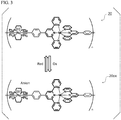
- FIG. 3 is a diagram showing an example of a redox reaction of the organic/heterometallic hybrid polymer according to an embodiment of the present invention.
- Ru(II) is oxidized to Ru(III) to form an oxidized organic/heterometallic hybrid polymer 20OX in which anions in the electrolyte are in close proximity.
- the method for producing an organic/heterometallic hybrid polymer according to the embodiment of the present invention includes an organic metal complex synthesis step S1 and an organic/heterometallic hybrid polymer synthesis step S2.
- a terpyridine compound having an ethynyl group and a terpyridyl group is reacted with a compound containing Ru(dppe) 2 in an organic solvent, thereby synthesizing an organic metal complex having Ru(dppe) 2 and a terpyridyl group at the terminal.
- stirring and mixing can be employed as a reaction method.
- Examples of the compound containing Ru(dppe) 2 include Ru(dppe) 2 Cl(OTf).
- organic solvent examples include methylene chloride.
- Examples of the additive include sodium hexafluorophosphate and triethylamine.
- the reaction temperature is preferably from 10 to 40°C.
- the reaction time is preferably from 2 to 36 hours.
- examples of the terpyridine compound include 4'-(4-ethynylphenyl)-2,2':6',2"-terpyridine.
- the organic metal complex and a transition metal compound are reacted in an organic solvent, thereby synthesizing the organic/heterometallic hybrid polymer.
- organic solvent examples include ethylene glycol, ethanol, methanol, chloroform, NMP, dimethylformamide and dimethyl sulfoxide.
- the reaction temperature is preferably from 60 to 140°C.
- FIG. 4 is a chemical reaction formula in the organic/heterometallic hybrid polymer synthesis step.
- the terpyridyl groups in the ligand form a complex with the transition metal M, thereby linking a plurality of organic metal complexes via the transition metal M in a linear manner.
- the transition metal compound in an amount from 1.0 molar equivalent or more to 1.1 molar equivalent or less, with respect to the aforementioned organic metal complex.
- the organic/heterometallic hybrid polymer can be synthesized with high yield.
- the aforementioned transition metal compound is preferably any one of RuCl 2 , Fe(BF 4 ) 2 , or Zn(NTf 2 ) 2 . As a result, it is possible to synthesize a polymer having a corresponding transition metal.
- Zn(NTf 2 ) 2 is zinc di[bis(trifluoromethanesulfonyl)imide] (zinc di[(trifluoromethylsulfonyl)imide)]).
- the reaction time of the organic metal complex and the transition metal compound is preferably at least 12 hours and not more than 36 hours.
- the organic/heterometallic hybrid polymer can be synthesized with an increased yield of 90% or higher.
- the organic/heterometallic hybrid polymer film according to an embodiment of the present invention is made of the organic/heterometallic hybrid polymer according to an embodiment of the present invention. As a result, it can be made into a film capable of causing an electrochromic reaction and can be applied to an optical device.
- the film thickness is preferably at least 100 nm and not more than 1 mm, and more preferably at least 100 nm and not more than 400 nm. By ensuring that the film thickness is equal to or more than 100 nm, it is possible to stably retain the film. In addition, by ensuring that the film thickness is equal to or less than 1 mm, when used by being connected to the electrode, it is possible to increase the response speed of the electrochromic reaction with respect to the voltage control. It should be noted that the film thickness can be measured by observing the cross section with a scanning electron microscope.
- the transition metal contained in the organic/heterometallic hybrid polymer is Fe or Zn. As a result, it is possible to cause an electrochromic reaction in the near infrared light region.
- a counter anion may be included as an optional component.
- the counter anion include a chloride ion, a tetrafluoroborate anion, a hexafluorophosphate anion, a bis(trifluoromethanesulfonyl)imide anion, a perchlorate ion, and an acetate ion.
- the organic/heterometallic hybrid polymer film can be produced by dissolving an organic/heterometallic hybrid polymer in an organic solvent, and applying, and drying, the resultant onto a transparent electrode substrate.
- organic solvent examples include methanol, acetonitrile, dimethyl sulfoxide and dimethylformamide.
- the organic/heterometallic hybrid polymer according to an embodiment of the present invention is a polymer in which a plurality of organic metal complexes are linked in a linear manner by sandwiching the transition metal therebetween.
- the aforementioned organic metal complex is formed by linking two ligands having a terpyridyl group by one connector having Ru(dppe) 2 and two ethynylene groups, so that a nitrogen atom at position 1' of the aforementioned terpyridyl group is directed toward the terminal side of the molecule of the organic metal complex.
- the terpyridyl groups of at least two different organic metal complexes of the plurality of organic metal complexes are bound to one transition metal through a coordinate bond, thereby linking the plurality of organic metal complexes by alternately sandwiching a plurality of transition metals therebetween. Therefore, it is possible to prepare a linear supramolecular polymer that links the organic metal complexes and the transition metals alternately and is capable of causing an electrochromic reaction.
- the organic/heterometallic hybrid polymer according to an embodiment of the present invention may be configured so that the aforementioned transition metal is any one of Ru, Fe or Zn. As a result, it is possible to prepare a linear supramolecular polymer that links the organic metal complexes and the transition metals alternately and is capable of causing an electrochromic reaction.
- the organic/heterometallic hybrid polymer according to an embodiment of the present invention may be configured so as to have a molecular weight M W of at least 10.5 ⁇ 10 4 and not more than 29.2 ⁇ 10 4 . As a result, it is possible to form a stable film capable of causing an electrochromic reaction.
- the method of producing an organic/heterometallic hybrid polymer is configured to include a step of synthesizing an organic metal complex having a terpyridyl group at the terminal by reacting a terpyridine compound having an ethynyl group and a terpyridyl group with a compound containing Ru(dppe) 2 in an organic solvent, and a step of synthesizing the organic/heterometallic hybrid polymer by reacting the aforementioned organic metal complex and a transition metal compound in an organic solvent. Therefore, it is possible to synthesize a linear supramolecular polymer with high yield that links the organic metal complexes and the transition metals alternately and is capable of causing an electrochromic reaction.
- the method of producing an organic/heterometallic hybrid polymer according to an embodiment of the present invention may be configured so as to react 1.0 equivalent or more transition metal compound with respect to the aforementioned organic metal complex.
- the method of producing an organic/heterometallic hybrid polymer according to an embodiment of the present invention may be configured so that the aforementioned transition metal compound is any one of RuCl 2 , Fe(BF 4 ) 2 , or Zn(NTf 2 ) 2 .
- the aforementioned transition metal compound is any one of RuCl 2 , Fe(BF 4 ) 2 , or Zn(NTf 2 ) 2 .
- the method of producing an organic/heterometallic hybrid polymer according to an embodiment of the present invention may be configured so that a reaction time of the organic metal complex and the transition metal compound is equal to or more than 12 hours. As a result, it is possible to synthesize a linear supramolecular polymer with high yield that links the organic metal complexes and the transition metals alternately and is capable of causing an electrochromic reaction.
- the organic/heterometallic hybrid polymer film according to an embodiment of the present invention is configured to include the organic/heterometallic hybrid polymer described earlier. Therefore, it can be made into a film capable of causing an electrochromic reaction and can be applied to an optical device.
- the organic/heterometallic hybrid polymer film according to an embodiment of the present invention may be configured so that the film thickness is at least 100 nm and not more than 1 mm. As a result, it is possible to stably retain the film and increase the response speed of the electrochromic reaction.
- the organic/heterometallic hybrid polymer film according to an embodiment of the present invention may be configured so that a transition metal contained in the aforementioned organic/heterometallic hybrid polymer is a transition metal of Fe or Zn. As a result, it can be made into a film capable of causing an electrochromic reaction in the near infrared light region and can be applied to an optical device.
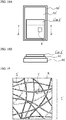
- FIGS. 18A and 18B are diagrams showing an example of a linear organic/multimetallic hybrid polymer film according to a second embodiment of the present invention.
- a linear organic/multimetallic hybrid polymer film 1' according to the second embodiment of the present invention is formed in a substantially rectangular shape in plan view on a transparent conductive film 51' of a glass substrate 50'.
- the plan view shape is not limited thereto. Also, it is not limited to the above embodiment to be formed on the transparent conductive film 51'.
- an ITO film or the like can be used as the transparent conductive film 51'.
- the thickness of the linear organic/multimetallic hybrid polymer film is preferably at least 100 nm and not more than 1 mm, and more preferably at least 100 nm and not more than 400 nm. By ensuring that the film thickness is equal to or more than 100 nm, it is possible to stably retain the film. In addition, by ensuring that the film thickness is equal to or less than 1 mm, when used by being connected to the electrode, it is possible to increase the response speed of the electrochromic reaction with respect to the voltage control.
- FIG. 19 is a diagram showing an example of an enlarged view of a portion B in FIG. 18A .
- a film 1' of a linear organic/multimetallic hybrid polymer according to an embodiment of the present invention is formed by mixing the linear organic/multimetallic hybrid polymer 5' according to an embodiment of the present invention in a mesh shape.
- the film of the linear organic/multimetallic hybrid polymer film can be produced by dissolving a linear organic/multimetallic hybrid polymer in an organic solvent, and applying, and drying, the resultant onto a transparent electrode substrate.
- organic solvent examples include methanol, acetonitrile, dimethyl sulfoxide and dimethylformamide.
- FIG. 20 is a diagram showing an example of a structural formula of a linear organic/multimetallic hybrid polymer constituting a portion C in FIG. 19 .
- the linear organic/multimetallic hybrid polymer 5' according to an embodiment of the present invention is a linear supramolecular polymer. More specifically, the linear organic/multimetallic hybrid polymer 5' according to an embodiment of the present invention is schematically configured to include only a linear portion 31' in which organic metal ligands 21' are linearly linked while sandwiching the transition metals M' therebetween.
- the organic metal ligand 21' is formed by linking a connector 13' with ligands 11'A and 11'B.
- the connector 13' is formed with a benzene ring at the center by linking two Ru(dppe) 2 via two ethynylene groups bonded to the benzene ring, while respectively connecting other ethynylene groups to each Ru(dppe) 2 and connecting phenyl groups to the ethynylene groups.
- the ligands 11'A and 11'B are terpyridyl groups and are formed by connecting 4' position of the terpyridyl group to the para position of the phenyl group at both ends of the terminal of the connector 13'.
- the aforementioned terpyridyl group forms a coordinate bond with the transition metal M' to connect a plurality of organic metal ligands 21'.
- FIG. 21 is a chemical formula showing an example of a linear organic/multimetallic hybrid polymer 5' according to an embodiment of the present invention.
- the linear organic/multimetallic hybrid polymer 5' is denoted as a plurality of organic metals poly(Ru 2 Zn)X.
- X represents the proportion of linear portions (mol%) when the sum of the linear portions and branched portions constituting the organic/multimetallic hybrid polymer is defined as 100 mol%.
- X 100.
- n is a natural number of 2 or more.
- the linear organic/multimetallic hybrid polymer 5' includes a unit structure derived from the linear portion, i.e., a unit structure containing the organic metal ligand 21' and the transition metal M' (a structure enclosed in parentheses).
- Ru(II) is oxidized to Ru(III) to form an oxidized organic/multimetallic hybrid polymer in which anions in the electrolyte are in close proximity.
- transition metal M' examples include Fe, Zn, Co, or Ru.
- IVCT intervalence charge transfer
- the linear organic/multimetallic hybrid polymer 5' is configured so that not only hetero transition metals Zn and Ru are closely arranged, but also the same transition metals Ru and Ru are closely arranged, for example, not only the absorption of IVCT between hetero metals Zn-Ru, but also the absorption of IVCT between the same metals Ru-Ru are observed.
- it can be made into a film capable of causing an electrochromic reaction at two wavelengths within the near infrared to infrared region.
- the method for producing a linear organic/multimetallic hybrid polymer according to an embodiment of the present invention includes a binuclear organometallic site synthesis step S1, an organic metal ligand synthesis step S2 and a linear organic/multimetallic hybrid polymer synthesis step S3.
- FIG. 22 represents a chemical reaction formula for the synthesis of a binuclear organometallic site.
- organic solvent examples include methylene chloride, chloroform, carbon tetrachloride and chlorobenzene. Among them, methylene chloride and chloroform are preferred.
- the reaction temperature is preferably from room temperature to 80°C, and more preferably from room temperature to 40°C.
- the reaction time is preferably from 24 to 72 hours, and more preferably from 24 to 48 hours.
- FIG. 23 represents a chemical reaction formula for the synthesis of an organic metal ligand.
- examples of the terpyridine compound include 4'-(4-ethynylphenyl)-2,2' :6',2"-terpyridine.
- organic solvent examples include methylene chloride, chloroform, carbon tetrachloride and chlorobenzene. Among them, methylene chloride and chloroform are preferred.
- Examples of the base include triethylamine, tripropylamine, tributylamine, trihexylamine and dimethylaniline. Among them, triethylamine is preferred.
- the inorganic salt examples include sodium hexafluorophosphate, lithium hexafluorophosphate, ammonium hexafluorophosphate, sodium tetrafluoroborate, sodium perchlorate, and ammonium perchlorate. Among them, sodium hexafluorophosphate is preferred.
- the reaction time is preferably from 1 to 14 days, and more preferably from 5 to 9 days.
- the reaction temperature is preferably from 10 to 60°C, and more preferably from room temperature to 40°C.
- Examples of the poor solvent include diethyl ether and acetone. Among them, diethyl ether is preferred.
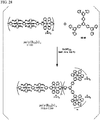
- FIG. 24 represents a chemical reaction formula for the synthesis of a linear organic/multimetallic hybrid polymer.
- the linear organic/multimetallic hybrid polymer can be synthesized with high yield.
- the degree of polymerization (the number of n) can be adjusted by changing the number of molar equivalents of the transition metal compound to be added, with respect to the organic metal ligand. That is, when 1.0 molar equivalent of the transition metal compound is reacted with respect to the aforementioned organic metal ligand, the degree of polymerization (n) is increased, and the degree of polymerization (n) becomes smaller as the number of molar equivalents of the transition metal compound to be reacted is increased.
- Zn(NTf 2 ) 2 in addition to Zn(NTf 2 ) 2 , Zn(BF 4 ) 2 , Zn(OAc) 2 , ZnCl 2 , and the like can be employed. Among them, Zn(NTf 2 ) 2 is preferred.
- Zn(NTf 2 ) 2 is zinc di[bis(trifluoromethanesulfonyl)imide] (zinc di[(trifluoromethylsulfonyl)imide)]).
- Fe(BF 4 ) 2 Fe(OAc) 2 , and FeCl 2 can also be used. As a result, it is possible to synthesize a polymer containing Fe.
- the reaction time of the organic metal ligand and the transition metal compound is preferably from 3 to 24 hours, and more preferably from 6 to 12 hours.
- the linear organic/multimetallic hybrid polymer can be synthesized with an increased yield of 80% or higher.
- NMP dimethylformamide
- dimethyl sulfoxide dimethyl sulfoxide
- chlorobenzene and propylene carbonate are preferred, and among these, NMP and dimethylformamide are more preferred.
- the reaction temperature is preferably from 80 to 160°C, and more preferably from 100 to 120°C.
- Examples of the poor solvent include diethyl ether, acetone, methylene chloride, chloroform and water. Among them, diethyl ether, chloroform and water are preferred.
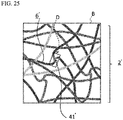
- FIG. 25 is a diagram showing another example of an enlarged view of a portion B in FIG. 18A .
- a film 2' of a branched organic/multimetallic hybrid polymer according to an embodiment of the present invention may be configured so as to be formed by mixing the branched organic/multimetallic hybrid polymer 6' according to an embodiment of the present invention in a mesh shape.
- the branched organic/multimetallic hybrid polymer 6' has a branched portion 41' linking the linear portion with 2 or more different linear portions and branching into three or more directions, and can form a mesh structure more firmly. As a result, the heat resistance improves, and the stability of the film is increased.
- the film of the branched organic/multimetallic hybrid polymer can be produced by dissolving a branched organic/multimetallic hybrid polymer in an organic solvent, and applying, and drying, the resultant onto a transparent electrode substrate.
- organic solvent examples include heated dimethyl sulfoxide, heated dimethylformamide, and heated chlorobenzene.
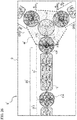
- FIG. 26 is a diagram showing an example of a structural formula of a branched organic/multimetallic hybrid polymer constituting a portion D in FIG. 25 .
- the branched organic/multimetallic hybrid polymer 6' according to an embodiment of the present invention is a branched supramolecular polymer. More specifically, the branched organic/multimetallic hybrid polymer 6' according to an embodiment of the present invention is schematically configured to include not only a linear portion 31' in which organic metal ligands 21' are linearly linked while sandwiching the transition metals M' therebetween, but also a branched portion 41' which connects the linear portion 31' with two different linear portions (31'), (31').
- the branched portion 41' is formed by linking a ligand 11'C to a branch element (triphenylbenzene) 15', has a structure branched into three or more directions with the branch element at the center, and has ligands at the branched ends.
- a branch element triphenylbenzene
- the organic metal ligand 21' is configured to have the same configuration as shown in the description of the linear organic/multimetallic hybrid polymer according to an embodiment of the present invention. That is, the organic metal ligand is formed by linking one connector 13' with two ligands 11'A and 11'B.
- the connector 13' is formed with a benzene ring at the center by linking two Ru(dppe) 2 via two ethynylene groups bonded to the benzene ring, while respectively coupling other ethynylene groups to each Ru(dppe) 2 and respectively connecting phenyl groups to the ethynylene groups.
- the ligands 11'A and 11'B are terpyridyl groups and 4' position of the terpyridyl group is connected to the para position of the phenyl group at both ends of the terminal of the connector 13'.
- the aforementioned terpyridyl groups of at least two different organic metal ligands 21' of the plurality of organic metal ligands 21' are bound to one transition metal M' through a coordinate bond, thereby linearly linking the plurality of organic metal ligands 21' by alternately sandwiching the plurality of transition metals M' therebetween.
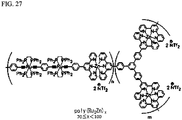
- FIG. 27 is a chemical formula showing an example of a branched organic/multimetallic hybrid polymer 6' according to an embodiment of the present invention.
- the branched organic/multimetallic hybrid polymer 6' is denoted as poly(Ru 2 Zn)X, where X is 70 ⁇ X ⁇ 100.
- the branched organic/multimetallic hybrid polymer 6' includes a unit structure derived from the linear portion, (i.e., a unit structure containing the organic metal ligand 21' and the transition metal M'), and a unit structure derived from the branched portion.
- Ru(II) is oxidized to Ru(III) to form an oxidized organic/multimetallic hybrid polymer in which anions in the electrolyte are in close proximity.
- transition metal M examples include Fe or Zn.
- IVCT intervalence charge transfer
- the branched organic/multimetallic hybrid polymer 6' is configured so that not only hetero transition metals Zn and Ru are closely arranged, but also the same transition metals Ru and Ru are closely arranged, for example, not only the absorption of IVCT between hetero metals Zn-Ru, but also the absorption of IVCT between the same metals Ru-Ru are observed. As a result, it can be made into a film capable of causing an electrochromic reaction at two wavelengths within the near infrared to infrared region.
- the method for producing a branched organic/multimetallic hybrid polymer includes a binuclear organometallic site synthesis step S1, an organic metal ligand synthesis step S2, a linear organic/multimetallic hybrid polymer synthesis step S3, and a branched organic/multimetallic hybrid polymer synthesis step S4.
- a binuclear organometallic site is synthesized in the same manner as in the binuclear organometallic site synthesis step S1 described in the method for producing a linear organic/multimetallic hybrid polymer according to an embodiment of the present invention.
- An organic metal ligand is synthesized in the same manner as in the organic metal ligand synthesis step S2 described in the method for producing a linear organic/multimetallic hybrid polymer according to an embodiment of the present invention.
- a linear organic/multimetallic hybrid polymer is synthesized in the same manner as in the linear organic/multimetallic hybrid polymer synthesis step S3 of the method for producing a linear organic/multimetallic hybrid polymer according to an embodiment of the present invention.
- FIG. 28 is a chemical reaction formula in a step of synthesizing the branched organic/multimetallic hybrid polymer.
- the branched organic/multimetallic hybrid polymer is synthesized by reacting the linear organic/multimetallic hybrid polymer 5', a transition metal compound (for example, Zn(NTf 2 ) 2 ) and a branched compound connectable in three directions (for example, 1,3,5-Tris[4-(2,2':6',2"-terpyridin-4'-yl)phenyl]benzene) in an organic solvent (for example, NMP).
- a transition metal compound for example, Zn(NTf 2 ) 2
- a branched compound connectable in three directions for example, 1,3,5-Tris[4-(2,2':6',2"-terpyridin-4'-yl)phenyl]benzene
- the mixing amount of the transition metal compound (for example, Zn(NTf 2 ) 2 ) may be at least 10 molar parts and not more than 60 molar parts, with respect to the combined total of 100 molar parts of the same type of the transition metal constituting the linear organic/multimetallic hybrid polymer (for example, refers to Zn in the case of mixing Zn(NTf 2 ) 2 ) and the transition metal to be mixed (for example, refers to Zn in the case of mixing Zn(NTf 2 ) 2 ).
- the mixing amount is preferably at least 10 molar parts and not more than 30 molar parts.
- Zn(NTf 2 ) 2 in addition to Zn(NTf 2 ) 2 , Zn(BF 4 ) 2 , Zn(OAc) 2 , ZnCl 2 , and the like can be employed. Among them, Zn(NTf 2 ) 2 is preferred.
- Fe(BF 4 ) 2 Fe(OAc) 2 , and FeCl 2 can also be used. As a result, it is possible to synthesize a polymer containing Fe in the branched portion.
- the reaction time of the organic metal ligand and the transition metal compound is preferably from 6 to 48 hours, and more preferably from 12 to 24 hours.
- the branched organic/multimetallic hybrid polymer can be synthesized with an increased yield of 80% or higher.
- organic solvent examples include NMP: N-Methyl-pyrrolidone, dimethylformamide, dimethyl sulfoxide, chlorobenzene and propylene carbonate. Among them, NMP and dimethylformamide are preferred.
- the reaction temperature is preferably from 80 to 150°C, and more preferably from 100 to 120°C.
- the branched compound is branched into three or more directions with the branch element at the center, and has ligands at the ends of the branched molecule.
- Examples of the branched compound include 1,3,5-Tris[4-(2,2':6',2"-terpyridin-4'-yl)phenyl]benzene (hereinafter, sometimes referred to as "3D-M”), and the like.
- triphenylmethane can be used other than triphenyl benzene.
- tetraphenylmethane which is a branched compound branched in four or more directions may also be used.
- the mixing amount of the branched compound is preferably at least 10 molar parts and not more than 30 molar parts, relative to the combined total of 100 molar parts of the linear portion and the branched compound constituting the linear organic/multimetallic hybrid polymer.
- the linear organic/multimetallic hybrid polymer 5' or branched organic/multimetallic hybrid polymer 6' includes a linear portion 31' in which organic metal ligands 21' are linearly linked while sandwiching the transition metals M' therebetween.
- the organic metal ligand 21' is formed by linking a connector 13' with ligands 11'A and 11'B.
- two Ru(dppe) 2 are linked via two ethynylene groups bonded to the benzene ring, other ethynylene groups are respectively bonded to each Ru(dppe) 2 , and phenyl groups are respectively connected to the ethynylene groups.
- the ligands 11'A and 11'B are terpyridyl groups and connected to the phenyl groups of the connector 13'. It is configured so that the aforementioned terpyridyl groups of at least two different organic metal ligands 21' of the plurality of organic metal ligands 21' are bound to one transition metal M' through a coordinate bond, thereby linking the plurality of organic metal ligands 21' by alternately sandwiching the plurality of transition metals M' therebetween. For this reason, it is possible to prepare a linear or branched polymer, enhance the film stability, provide electrochromic properties in the infrared light region and increase the repetition stability.
- the linear organic/multimetallic hybrid polymer 5' or branched organic/multimetallic hybrid polymer 6' may be configured so that the transition metal M is Fe, Zn, Co or Ru.
- the transition metal M is Fe, Zn, Co or Ru.
- the linear organic/multimetallic hybrid polymer 5' may be configured so as to be linear. As a result, it is possible to provide electrochromic properties in the infrared light region and increase the repetition stability.
- the branched organic/multimetallic hybrid polymer 6' according to an embodiment of the present invention may be configured so as to be branched. As a result, it is possible to increase the film stability and increase the repetition stability.
- the branched organic/multimetallic hybrid polymer 6' may be configured to have a branched portion 41' composed of 1,3,5-Tris[4-(2,2':6',2"-terpyridin-4'-yl)phenyl]benzene.
- a branched portion 41' composed of 1,3,5-Tris[4-(2,2':6',2"-terpyridin-4'-yl)phenyl]benzene.
- the branched organic/multimetallic hybrid polymer 6' may be configured so that the content of the branched portion 41' is at least 10 molar parts and not more than 30 molar parts, relative to the total number of moles of the linear portions and branched portions constituting the organic/multimetallic hybrid polymer. As a result, it is possible to increase the film stability and increase the repetition stability.
- the method of synthesizing the linear organic/multimetallic hybrid polymer 5' or branched organic/multimetallic hybrid polymer 6' is configured to include a step S1 of synthesizing a binuclear organometallic site containing two Ru(dppe) 2 by reacting 1 equivalent of diethynylbenzene and 2 equivalents of Ru(dppe) 2 Cl(OTf) in an organic solvent, a step S2 of synthesizing an organic metal ligand having a terpyridyl group at the terminal and two Ru(dppe) 2 by reacting 2 equivalents of a terpyridine compound having an ethynyl group and a terpyridyl group with 1 equivalent of a binuclear organometallic site in an organic solvent, and a step S3 of synthesizing a linear organic/multimetallic hybrid polymer by reacting the aforementioned organic metal ligand and a transition metal compound in an organic solvent.
- the method of synthesizing the branched organic/multimetallic hybrid polymer 6' is configured to synthesize a branched organic/multimetallic hybrid polymer by reacting the aforementioned linear organic/multimetallic hybrid polymer, a branched compound branched into three or more directions with a branch element at the center and having a ligand at the end of the branched molecule, and a transition metal compound. For this reason, it is possible to synthesize a branched organic/multimetallic hybrid polymer exhibiting electrochromic properties in the infrared light region and high repetition stability with high yield.
- the method of synthesizing the branched organic/multimetallic hybrid polymer 6' may be configured so that the aforementioned branched compound is 1,3,5-Tris[4-(2,2':6',2"-terpyridin-4'-yl)phenyl]benzene.
- the aforementioned branched compound is 1,3,5-Tris[4-(2,2':6',2"-terpyridin-4'-yl)phenyl]benzene.
- the method of synthesizing the branched organic/multimetallic hybrid polymer 6' according to an embodiment of the present invention may be configured so that a mixing amount of the aforementioned branched compound is at least 10 molar parts and not more than 30 molar parts, relative to the combined total of 100 molar parts of the linear portions constituting the linear organic/multimetallic hybrid polymer.
- a mixing amount of the aforementioned branched compound is at least 10 molar parts and not more than 30 molar parts, relative to the combined total of 100 molar parts of the linear portions constituting the linear organic/multimetallic hybrid polymer.
- the method of synthesizing the linear organic/multimetallic hybrid polymer 5' or branched organic/multimetallic hybrid polymer 6' according to an embodiment of the present invention may be configured so as to react 1.0 equivalent or more transition metal compound with respect to the aforementioned organic metal ligand. As a result, it is possible to synthesize an organic/multimetallic hybrid polymer exhibiting electrochromic properties in the infrared light region and high repetition stability with high yield.
- the method of synthesizing the linear organic/multimetallic hybrid polymer 5' or branched organic/multimetallic hybrid polymer 6' according to an embodiment of the present invention may be configured so that the aforementioned transition metal compound is Fe(BF 4 ) 2 or Zn(NTf 2 ) 2 .
- the aforementioned transition metal compound is Fe(BF 4 ) 2 or Zn(NTf 2 ) 2 .
- the method of synthesizing the linear organic/multimetallic hybrid polymer 5' or branched organic/multimetallic hybrid polymer 6' according to an embodiment of the present invention may be configured so that a reaction time of the organic metal ligand and the transition metal compound is equal to or more than 6 hours. As a result, it is possible to synthesize an organic/multimetallic hybrid polymer exhibiting electrochromic properties in the infrared light region and high repetition stability with high yield.
- a film 1' of a linear organic/multimetallic hybrid polymer or film 2' of a branched organic/multimetallic hybrid polymer according to an embodiment of the present invention is configured to include the linear organic/multimetallic hybrid polymer 5' or branched organic/multimetallic hybrid polymer 6'. For this reason, it is possible to form a film exhibiting electrochromic properties in the infrared light region and high repetition stability. As a result, it can be applied to an optical device capable of light blocking by switching ON/OFF at two wavelengths within the near infrared to infrared region.
- the film 1' of a linear organic/multimetallic hybrid polymer or film 2' of a branched organic/multimetallic hybrid polymer according to an embodiment of the present invention may be configured so that the film thickness is at least 100 nm and not more than 1 mm.
- the film thickness is at least 100 nm and not more than 1 mm.
- An organic/heterometallic hybrid polymer, a method for producing the same, and an organic/heterometallic hybrid polymer film according to embodiments of the present invention are not limited to the above embodiments, and can be implemented with various modifications within the technical scope of the present invention. Specific examples of the present invention are shown in the following Examples. However, the present invention is not limited to these Examples.
- An organic/multimetallic hybrid polymer, a method for producing the same, and an organic/multimetallic hybrid polymer film according to embodiments of the present invention are not limited to the above embodiments, and can be implemented with various modifications within the technical scope of the present invention. Specific examples of the present invention are shown in the following Examples. However, the present invention is not limited to these Examples.
- a terpyridine compound having an ethynyl group and a terpyridyl group (4'-(4-ethynylphenyl)-2,2':6',2"-terpyridine) (100 mg) and Ru(dppe) 2 Cl(OTf) (153.6 mg) were stirred for 24 hours at room temperature in methylene chloride (20 mL) in the presence of sodium hexafluorophosphate (126 mg) and triethylamine (110 ⁇ L). After completion of the reaction, the resultant was filtered, and the resulting filtrate was concentrated.
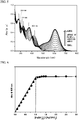
- FIG. 5 is a graph showing the titration test result in the ultraviolet and visible absorption spectrum. Further, FIG. 6 is a graph showing the relationship between the absorbance change at 605 nm and the added amount in FIG. 5 .
- An organic/heterometallic hybrid polymer (polyRuZn) was obtained in the same manner as in Example 1 at a yield of 92%, with the exception that 1.0 molar equivalent of Zn(NTf 2 ) 2 was added to an NMP (N-Methyl-pyrrolidone) solution of the organic metal complex 10, and the resulting mixture was stirred for 24 hours at 100°C.
- polyRuZn organic/heterometallic hybrid polymer
- the obtained polyRuZn was dissolved in dimethyl sulfoxide and dimethylformamide, but was insoluble in acetonitrile and methylene chloride.
- FIG. 7 is a diagram comparing the 1 H-NMR spectrum of the organic metal complex 10 (here, represented as Ru(II)-M) in chloroform and the 1 H-NMR spectrum of polyRuZn in dimethyl sulfoxide.
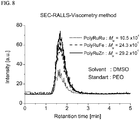
- the molecular weight of each polymer was calculated by the SEC-RALLS-Viscometry method.
- FIG. 8 shows a measurement result of SEC-RALLS-Viscometry.
- the molecular weight M w of the polymer was 10.5 ⁇ 10 4 for polyRuRu, 24.3 ⁇ 10 4 for polyRuFe, and 29.2 ⁇ 10 4 for polyRuZn, respectively.
- Each organic/heterometallic hybrid polymer solution was prepared, and the cyclic voltammetry (CV) measurement and differential pulse voltammetry (DPV) measurement were conducted.
- CV cyclic voltammetry
- DUV differential pulse voltammetry
- the measurement conditions were set as follows: working electrode: Pt mesh electrode; counter electrode: Pt wire electrode; reference electrode: Ag/Ag + ; in a 0.1 M dimethylformamide solution of tetrabutylammonium perchlorate (TBAP). The solution was saturated with nitrogen before measurement. The scan rate was 100 mVs -1 .
- FIG. 9A is a graph showing an electrochemical measurement result in a solution state by the CV measurement.
- FIG. 9B is a graph showing an electrochemical measurement results in a solution state by the DPV measurement.
- Each polymer exhibited a reversible oxidation-reduction wave of Ru in the organic metal complex 10 around 0.25 V.
- polyRuRu showed a reversible oxidation-reduction wave of Ru forming a complex with the terpyridine site at 0.72 V.
- polyRuFe showed a reversible oxidation-reduction wave of Fe forming a complex with the terpyridine site at 0.70 V.
- the solution before and after the voltage application was placed in a quartz cell having a thickness of 1 mm, and UV/visible/near infrared absorption spectrum of the solution were measured while applying a voltage.
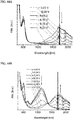
- FIG. 10A is a graph showing the applied voltage dependence of the ultraviolet/visible/near infrared absorption spectrum of polyRuRu in a solution state.
- FIG. 10B is a graph showing the applied voltage dependence of the ultraviolet/visible/near infrared absorption spectrum of polyRuFe in a solution state.
- FIG. 10C is a graph showing the applied voltage dependence of the ultraviolet/visible/near infrared absorption spectrum of polyRuZn in a solution state.
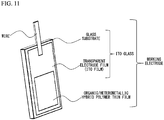
- FIG. 11 is a perspective view showing an example of the working electrode.
- a polyRuFe working electrode and a polyRuZn working electrode were prepared in the same manner, with the exception that the type of the organic/heterometallic hybrid polymer was changed.
- the measurement conditions were set as follows: working electrode: ITO glass + organic/heterometallic hybrid polymer thin film; counter electrode: ITO glass; reference electrode: Ag/Ag + ; in a 0.1 M acetonitrile solution of tetrabutylammonium perchlorate (TBAP).
- working electrode ITO glass + organic/heterometallic hybrid polymer thin film
- counter electrode ITO glass
- reference electrode Ag/Ag +
- TBAP tetrabutylammonium perchlorate
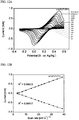
- FIG. 12A is a graph showing measurement data of the scan rate dependence of the CV measurement result of the polyRuZn film.
- FIG. 12B is a graph showing the relationship between the scan rate and the current value.
- the scan rate was set to 10, 20, 50, 100, 200, 300, 400, 500, 600, 800, 1,000, 1,200 or 1,500 mVs -1 . As the rate increased, the value of the flowing current increased.
- FIG. 13 is a graph showing the electrical spectroscopy measurement result of polyRuZn in the film state, which shows the change in absorbance (Abs) before and after the application of a voltage.
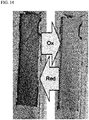
- FIG. 14 is a photograph showing the outer appearance of polyRuZn in the film state at the time when no voltage was applied (0 V) and when a voltage of 0.5 V was applied.
- the film had a transparent red purple color when no voltage was applied (0 V), whereas the film had a transparent thin yellow color when a voltage of 0.5 V was applied.
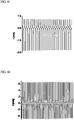
- FIG. 15A is a graph showing a change in the physical property values of polyRuZn in a film state due to the on/off of a voltage, which is a change in the current value due to the on/off of a voltage.
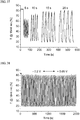
- FIG. 15B shows a change in the light transmittance at a wavelength of 1,147 nm. The transmittance changed in response to the current value. The change in the current value and the change in the light transmittance at a wavelength of 1,147 nm corresponded with high reproducibility.
- FIG. 16 is a graph showing a change in the light transmittance of polyRuZn in a film state at a wavelength of 1,147 nm due to the on/off of a voltage, when intervals for changing the voltage between 0 V and 0.5 V are set to 20 seconds.
- the transmittance changed from 80% to 20% at a high speed of about 3 seconds, and the change from 20% to 89% also occurred at a comparably high speed.
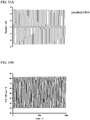
- FIG. 17 is a graph showing a change in the transmittance when the voltage was changed 600 times between 0 V and 0.5 V during 3,000 s, for a film of an organic/heterometallic hybrid polymer (polyRuZn).
- the change in the transmittance was reversible and stable, and the transmittance (absolute value) gradually attenuated.
- the change ⁇ T in the transmittance was substantially constant, and the change ⁇ T in the transmittance in the near infrared (NIR) region was equal to or more than 60% even after 3,000 seconds.
- NIR near infrared
- an NMP (N-Methyl-pyrrolidone) solution obtained by dispersing an equimolar amount of Zn(NTf 2 ) 2 was added to an NMP solution of the organic metal ligand (L-Ru(II) 2 -L) in a stepwise manner, and the resulting mixture was stirred for 6 hours under reflux at about 120°C, thereby obtaining a linear organic/multimetallic hybrid polymer (poly(Ru 2 Zn) 100 ) in the form of a dark red solid with an yield of 82%.
- the linear organic/multimetallic hybrid polymer was dissolved in dimethyl sulfoxide to produce a solution having a concentration of 0.5 mg/mL, and a film of the linear organic/multimetallic hybrid polymer (poly(Ru 2 Zn) 100 ) was formed on a glass slide by the drop-coating method.
- the film thickness was 25 ⁇ m.
- Zn(NTf 2 ) 2 was mixed in an equimolar amount relative to 3D-M, and the resulting mixture was stirred for 18 hours under reflux at about 120°C, precipitated in diethyl ether, and washed with chloroform, water, and diethyl ether, followed by drying, thereby obtaining a branched organic/multimetallic hybrid polymer (poly(Ru 2 Zn) 90 ) in the form of a dark red solid with an yield of 85%.
- the obtained poly(Ru 2 Zn) 90 dissolved in heated dimethyl sulfoxide. However, it was insoluble in dimethylformamide and dimethyl sulfoxide at room temperature. It was speculated that the heat resistance was improved by the 3D network structure.
- the branched organic/multimetallic hybrid polymer was dissolved in dimethyl sulfoxide to produce a solution having a concentration of 0.5 mg/mL, and a film of the branched organic/multimetallic hybrid polymer (poly(Ru 2 Zn) 90 ) was formed on a glass slide by the drop-coating method.
- branched organic/multimetallic hybrid polymer 2.5 mg was dissolved in dimethyl sulfoxide to produce a solution having a concentration of 0.5 mg/mL, and a film of the branched organic/multimetallic hybrid polymer (poly(Ru 2 Zn) 90 ) was formed on an ITO glass (active area: 0.8 ⁇ 2.5 cm 2 ) by the drop-coating method, thereby producing a working electrode.
- the film thickness was 25 ⁇ m.
- Zn(NTf 2 ) 2 was mixed in an equivalent amount relative to 3D-M, and the resulting mixture was stirred for 18 hours under reflux at about 120°C, precipitated in diethyl ether, and washed with chloroform, water, and diethyl ether, followed by drying, thereby obtaining a branched organic/multimetallic hybrid polymer (poly(Ru 2 Zn) 80 ) in the form of a dark red solid with an yield of 80%.
- the obtained poly(Ru 2 Zn) 80 dissolved in heated dimethyl sulfoxide. However, it was insoluble in dimethylformamide and dimethyl sulfoxide at room temperature. It was speculated that the heat resistance was improved by the 3D network structure.
- the branched organic/multimetallic hybrid polymer was dissolved in dimethyl sulfoxide to produce a solution having a concentration of 0.5 mg/mL, and a film of the branched organic/multimetallic hybrid polymer (poly(Ru 2 Zn) 80 ) was formed on a glass slide by the drop-coating method.
- branched organic/multimetallic hybrid polymer 2.5 mg was dissolved in dimethyl sulfoxide to produce a solution having a concentration of 0.5 mg/mL, and a film of the branched organic/multimetallic hybrid polymer (poly(Ru 2 Zn) 80 ) was formed on an ITO glass (active area: 0.8 ⁇ 2.5 cm 2 ) by the drop-coating method, thereby producing a working electrode.
- the film thickness was 25 ⁇ m.
- Zn(NTf 2 ) 2 was mixed in an equivalent amount relative to 3D-M, and the resulting mixture was stirred for 18 hours under reflux at about 120°C, precipitated in diethyl ether, and washed with chloroform, water, and diethyl ether, followed by drying, thereby obtaining a branched organic/multimetallic hybrid polymer (poly(Ru 2 Zn) 70 ) in the form of a dark red solid with a high yield of 81%.
- the obtained pOly(Ru 2 Zn) 70 dissolved in heated dimethyl sulfoxide. However, it was insoluble in dimethylformamide and dimethyl sulfoxide at room temperature. It was speculated that the heat resistance was improved by the 3D network structure.
- the branched organic/multimetallic hybrid polymer was dissolved in dimethyl sulfoxide to produce a solution having a concentration of 0.5 mg/mL, and a film of the branched organic/multimetallic hybrid polymer (poly(Ru 2 Zn) 70 ) was formed on a glass slide by the drop-coating method.
- branched organic/multimetallic hybrid polymer 2.5 mg was dissolved in dimethyl sulfoxide to produce a solution having a concentration of 0.5 mg/mL, and a film of the branched organic/multimetallic hybrid polymer (poly(Ru 2 Zn) 70 ) was formed on an ITO glass (active area: 0.8 ⁇ 2.5 cm 2 ) by the drop-coating method, thereby producing a working electrode.
- the film thickness was 25 ⁇ m.
- FIG. 29 is a graph showing a TGA measurement result of poly(Ru 2 Zn) 100 , poly(Ru 2 Zn) 90 , poly(Ru 2 Zn) 80 and poly(Ru 2 Zn) 70 .
- T d10 is a heating temperature at which the mass is reduced by 10%.
- T d10 of poly(Ru 2 Zn) 100 was 321.5°C, which was the lowest.
- T d10 values increased as the proportion of Zn increased, and T d10 of poly(Ru 2 Zn) 70 was 372.4°C, which was the highest.
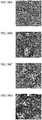
- FIG. 30A is an AFM image of a poly(Ru 2 Zn) 100 film.
- FIG. 30B is an AFM image of a poly(Ru 2 Zn) 90 film.
- FIG. 30C is an AFM image of a poly(Ru 2 Zn) 80 film.
- FIG. 30D is an AFM image of a poly(Ru 2 Zn) 70 film.
- the poly(Ru 2 Zn) 100 film was a porous film.
- the root-mean square roughness (R rms ) was as small as 1.1 nm.
- Films from the poly(Ru 2 Zn) 90 film to the poly(Ru 2 Zn) 70 film were completely different from the poly(Ru 2 Zn) 100 film, and were rough films.
- R rms of the poly(Ru 2 Zn) 90 film was 1.3 nm
- R rms of the poly(Ru 2 Zn) 80 film was 1.4 nm
- R rms of the poly(Ru 2 Zn) 70 film was 4.3 nm.
- the poly(Ru 2 Zn) 70 film was the most porous film.
- the measurement conditions were set as follows: working electrode: poly(Ru 2 Zn) 70 /ITO electrode; counter electrode: ITO electrode; reference electrode: Ag/Ag + ; in a 0.1 M CH 3 CN solution of LiClO 4 . The solution was saturated with nitrogen before measurement. The scan rate was 20 mVs -1 .
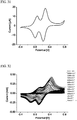
- FIG. 31 is a CV spectrum showing an electrochemical measurement result of the poly(Ru 2 Zn) 70 film. Reversible peaks were observed at 21 mV and 255 mV. These are due to the oxidation-reduction between Ru(II)/(III) in the Ru-acetylide complex.
- FIG. 32 is a CV spectrum showing the scan rate dependence of the poly(Ru 2 Zn) 70 film.
- the peak current value increased as the scan rate increased.
- FIG. 33 is a graph showing the relationship between the scan rate and the current value.
- Each current value of the First oxidize current, Second oxidize current, First reduced current and Second reduced current was obtained from the first order linear relationship with the one-half power of the scan rate.
- the square root R 2 of the scan rate was 0.99791, 0.99717, 0.99926 and 0.99839.
- the oxidation-reduction reaction of Ru is not limited by the electron transfer between the polymer and the electrodes, but is controlled by the diffusion limitation due to the process in which negative ions in the solution come into contact with Ru(II) in the polymer.
- the films of other polymers showed no electrochemical properties. This is because they were readily dissolved in an electrolytic solution containing an electrolyte such as LiClO 4 .
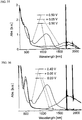
- FIG. 34 is a graph showing the spectroelectrochemical measurements of the poly(Ru 2 Zn) 100 film, which shows the change in the ultraviolet/visible/near infrared absorption spectrum before and after the voltage application.
- 0.50 V an absorption in the vicinity of 1,174 nm was observed, although almost no absorption appeared in the vicinity of 1,844 nm.
- voltages of 0.05 V and -0.50 V were applied, the absorption at 1,174 nm reduced, and the absorption at 1,844 nm slightly increased.
- FIG. 35 is a graph showing the spectroelectrochemical measurements of the poly(Ru 2 Zn) 90 film, which shows the change in the ultraviolet/visible/near infrared absorption spectrum before and after the voltage application.
- 0.50 V an absorption in the vicinity of 1,174 nm was observed, although almost no absorption appeared in the vicinity of 1,844 nm.
- a voltage of 0.05 V was applied, the absorption at 1,174 nm reduced, and the absorption at 1,844 nm rose slightly.
- a voltage of -0.50 V was applied, the absorption at 1,174 nm greatly reduced, and the absorption at 1,844 nm increased greatly.
- FIG. 36 is a graph showing the spectroelectrochemical measurements of the poly(Ru 2 Zn) 70 film, which shows the change in the ultraviolet/visible/near infrared absorption spectrum before and after the voltage application.
- 0.40 V an absorption in the vicinity of 1,174 nm was observed, although almost no absorption appeared in the vicinity of 1,844 nm.
- a voltage of 0.05 V was applied, the absorption at 1,174 nm reduced, and the absorption at 1,844 nm increased slightly.
- a voltage of -0.20 V was applied, the absorption at 1,174 nm greatly reduced, and the absorption at 1,844 nm increased greatly.
- FIG. 37 is a graph showing the applied voltage dependence of the light transmittance change at 1,844 nm of the poly(Ru 2 Zn) 70 film due to the on/off of voltage.
- FIG. 38 is a graph showing the repetition characteristics of the light transmittance change at 1,844 nm of the poly(Ru 2 Zn) 70 film due to the on/off of voltage.
- the coloration efficiency ⁇ is defined by the following equation (1).
- the coloration efficiency ⁇ is an index indicating the extent of area in which the absorbance can be varied.
- ⁇ OD represents a change in optical density
- Q d represents a change in the injected/ejected electrons
- Tb is (81.5)
- Tc is (19.5).
- FIG. 39 is a graph showing the applied voltage dependence of the light transmittance change at 1,174 nm of the poly(Ru 2 Zn) 70 film due to the on/off of voltage.
- FIG. 40 is a graph showing the repetition characteristics of the light transmittance change at 1,174 nm of the poly(Ru 2 Zn) 70 film due to the on/off of voltage.
- FIG. 41 is a graph showing the change in the current value of the poly(Ru 2 Zn) 70 film due to the on/off of voltage by the change in the optical absorption at 1,844 nm.
- FIG. 42 is a graph showing the change in the current value of the poly(Ru 2 Zn) 70 film due to the on/off of voltage by the change in the optical absorption at 1,174 nm.
- FIG. 43A is a graph showing the applied voltage dependence of the ultraviolet/visible/near infrared absorption spectrum of the film of the branched organic/multimetallic hybrid polymer (poly(Ru 2 Zn) 70 ), when the applied voltage was changed from -0.20 V to 0.05 V in a stepwise manner.
- FIG. 43B is a graph showing the applied voltage dependence of the ultraviolet/visible/near infrared absorption spectrum of the film of the branched organic/multimetallic hybrid polymer (poly(Ru 2 Zn) 70 ), when the applied voltage was changed from 0.10 V to 0.40 V in a stepwise manner.
- FIG. 44A is a graph showing the applied voltage dependence of the ultraviolet/visible/ near infrared absorption spectrum of the film of the branched organic/multimetallic hybrid polymer (poly(Ru 2 Zn) 70 ), when the applied voltage was changed from 0.05 V to -0.20 V in a stepwise manner.
- FIG. 44B is a graph showing the applied voltage dependence of the ultraviolet/visible/ near infrared absorption spectrum of the film of the branched organic/multimetallic hybrid polymer (poly(Ru 2 Zn) 70 ), when the applied voltage was changed from 0.40 V to 0.10 V in a stepwise manner.
- Table 1 shows electrochemical properties of the organic/multimetallic hybrid polymer (poly(Ru 2 Zn) 70 ) film in a 0.1 M acetonitrile solution of LiClO 4 .
- An organic/heterometallic hybrid polymer, a method for producing the same, and an organic/heterometallic hybrid polymer film according to the present invention exhibit electrochromic properties and relate to a linear and stable organic/heterometallic hybrid polymer.
- the organic/multimetallic hybrid polymer of the present invention is a newly synthesized compound, which is an organic/multimetallic hybrid polymer constituted of an organic metal ligand obtained by linking two Ru(dppe) 2 , exhibiting electrochromic properties in the infrared light region, and highly stable to repetitive oxidation-reduction of metals.
- it can be used as an optical communication device capable of blocking light by switching at two wavelengths of 1,310 nm and 1,550 nm that are used in optical communication. For this reason, it is industrially applicable in the optical communication industry, optical device industry, smart window industry, and the like.
- the method for producing the same and the film of the organic/multimetallic hybrid polymer are also industrially applicable in the above industries and the like.
Landscapes
- Chemical & Material Sciences (AREA)
- Organic Chemistry (AREA)
- Chemical Kinetics & Catalysis (AREA)
- Health & Medical Sciences (AREA)
- Polymers & Plastics (AREA)
- Medicinal Chemistry (AREA)
- Physics & Mathematics (AREA)
- Engineering & Computer Science (AREA)
- Manufacturing & Machinery (AREA)
- Life Sciences & Earth Sciences (AREA)
- General Physics & Mathematics (AREA)
- Nonlinear Science (AREA)
- Electrochemistry (AREA)
- Materials Engineering (AREA)
- Optics & Photonics (AREA)
- Analytical Chemistry (AREA)
- Biochemistry (AREA)
- General Health & Medical Sciences (AREA)
- Immunology (AREA)
- Pathology (AREA)
- Sustainable Development (AREA)
- Sustainable Energy (AREA)
- General Chemical & Material Sciences (AREA)
- Polymers With Sulfur, Phosphorus Or Metals In The Main Chain (AREA)
Claims (25)
- Organisches/ heterometallisches Hybridpolymer, umfassend eine Vielzahl von organischen Metallkomplexen und eine Vielzahl von Übergangsmetallen,
wobei die Vielzahl von organischen Metallkomplexen in einer linearen Weise durch Einbetten jede der Vielzahl von Übergangsmetallen dazwischen verbunden sind,
die organischen Metallkomplexe zwei Liganden mit jeweils einer Terpyridylgruppe und einem Konnektor mit Ru(dppe)2 und zwei Ethinylengruppen einschließen, und die zwei Liganden durch den Konnektor verbunden sind, sodass ein Stickstoffatom an Position 1' der Terpyridylgruppe zu einer terminalen Seite eines Moleküls des organischen Metallkomplexs hin gerichtet ist, und
die Terpyridylgruppen von mindestens zwei verschiedenen organischen Metallkomplexen von der Vielzahl von organischen Metallkomplexen an eines der Übergangsmetalle durch eine koordinative Bindung gebunden sind, dadurch Verknüpfen der Vielzahl von organischen Metallkomplexen, während die Vielzahl von Übergangsmetallen alternierend dazwischen eingebettet wird. - Organisches/ heterometallisches Hybridpolymer gemäß Anspruch 1, wobei das Übergangsmetall irgendeines von Ru, Fe oder Zn ist.
- Organisches/ heterometallisches Hybridpolymer gemäß Anspruch 1 oder 2, wobei ein Molekulargewicht Mw mindestens 10,5 × 10⁴ und nicht mehr als 29,2 × 10⁴ ist.
- Verfahren zur Herstellung eines organischen/ heterometallischen Hybridpolymers, das Verfahren umfassend:einen Schritt des Synthetisierens eines organischen Metallkomplexes mit Ru(dppe)2 und einer terminalen Terpyridylgruppe durch Umsetzen einer Terpyridinverbindung mit einer Ethinylgruppe und einer Terpyridylgruppe mit einer Verbindung enthaltend Ru(dppe)2 in einem organischen Lösungsmittel; undeinen Schritt des Synthetisierens des organischen/ heterometallischen Hybridpolymers durch Umsetzen des organischen Metallkomplexes und einer Übergangsmetallverbindung in einem organischen Lösungsmittel.
- Verfahren zur Herstellung eines organischen/ heterometallischen Hybridpolymers gemäß Anspruch 4, wobei 1,0 Moläquivalent oder mehr der Übergangsmetallverbindung in Bezug auf den organischen Metallkomplex umgesetzt wird.
- Verfahren zur Herstellung eines organischen/ heterometallischen Hybridpolymers gemäß Anspruch 4 oder 5, wobei die Übergangsmetallverbindung irgendeine von RuCl2, Fe(BF4)2, oder Zn(NTf2)2 ist.
- Verfahren zur Herstellung eines organischen/ heterometallischen Hybridpolymers gemäß einem der Ansprüche 4 bis 6, wobei eine Reaktionszeit des organischen Metallkomplexes und der Übergangsmetallverbindung gleich oder mehr als 12 Stunden ist.
- Organischer/ heterometallischer Hybridpolymerfilm, umfassend das organische/ heterometallische Hybridpolymer gemäß einem der Ansprüche 1 bis 3.
- Organischer/ heterometallischer Hybridpolymerfilm gemäß Anspruch 8, wobei eine Filmdicke mindestens 100 nm und nicht mehr als 1 mm beträgt.
- Organischer/ heterometallischer Hybridpolymerfilm gemäß Anspruch 8 oder 9, wobei ein in dem organischen/ heterometallischen Hybridpolymer enthaltenes Übergangsmetall entweder Fe oder Zn ist.
- Organisches/ multimetallisches Hybridpolymer, umfassend eine Vielzahl von organischen Metallliganden und eine Vielzahl von Übergangsmetallen,
wobei ein linearer Abschnitt eingeschlossen ist, in welchem die Vielzahl von organischen Metallliganden in einer linearen Weise, durch Einbetten jede der Vielzahl von Übergangsmetallen dazwischen, verbunden sind,
der organische Metallligand durch Verknüpfen zweier Liganden an einen Konnektor gebildet wird,
der Konnektor mit einem Benzolring in der Mitte durch Verknüpfen zweier Ru(dppe)2 durch zwei Ethinylengruppen, gebunden an den Benzolring, gebildet wird, während zwei Phenylgruppen an die zwei Ru(dppe)2 durch andere zwei Ethinylengruppen verbunden werden,
die Liganden Terpyridylgruppen sind und durch jeweiliges Verbinden an die zwei Phenylgruppen des Konnektors gebildet werden, und
die Terpyridylgruppen von mindestens zwei verschiedenen organischen Metallliganden von der Vielzahl von organischen Metallliganden an eines der Übergangsmetalle durch eine koordinative Bindung gebunden sind,
dadurch Verknüpfen der Vielzahl von organischen Metallliganden, während die Vielzahl von Übergangsmetallen alternierend dazwischen eingebettet wird. - Organisches/ multimetallisches Hybridpolymer gemäß Anspruch 11, wobei das Übergangsmetall Fe, Zn, Co oder Ru ist.
- Organisches/ multimetallisches Hybridpolymer gemäß Anspruch 11 oder 12, welches linear ist.
- Organisches/ multimetallisches Hybridpolymer gemäß Anspruch 11 oder 12, welches verzweigt ist.
- Organisches/ multimetallisches Hybridpolymer gemäß Anspruch 14, umfassend einen verzweigten Abschnitt, gebildet aus 1,3,5-Tris[4-(2,2':6',2"-terpyridin-4'-yl)phenyl]benzol.
- Organisches/ multimetallisches Hybridpolymer gemäß Anspruch 14 oder 15, wobei ein Gehalt des verzweigten Abschnitts mindestens 10 Molteile und nicht mehr als 30 Molteile, bezogen auf die Gesamtmolzahl von linearen Abschnitten und verzweigten Abschnitten, bildend das organische/multimetallische Hybridpolymer, beträgt.
- Verfahren zum Synthetisieren eines organischen/ multimetallischen Hybridpolymers, das Verfahren umfassend:einen Schritt des Synthetisierens einer zweikernigen organometallischen Stelle, umfassend zwei Ru(dppe)2 durch Umsetzen von 1 Moläquivalent von Diethinylbenzol und 2 Moläquivalenten von Ru(dppe)2Cl(OTf) in einem organischen Lösungsmittel;einen Schritt des Synthetisierens eines organischen Metallliganden mit einer Terpyridylgruppe an dem Terminus und zwei Ru(dppe)2 durch Umsetzen von 2 Moläquivalenten von einer Terpyridinverbindung mit einer Ethinylgruppe und einer Terpyridylgruppe mit einem Moläquivalent einer zweikernigen organometallischen Stelle in einem organischen Lösungsmittel; undeinen Schritt des Synthetisierens eines linearen organischen/ multimetallischen Hybridpolymers durch Umsetzen des organischen Metallliganden und einer Übergangsmetallverbindung in einem organischen Lösungsmittel.
- Verfahren zum Synthetisieren eines organischen/ multimetallischen Hybridpolymers gemäß Anspruch 17, wobei ein verzweigtes organisches/ multimetallisches Hybridpolymer durch Umsetzen des linearen organischen/ multimetallischen Hybridpolymers, einer verzweigten Verbindung, verzweigt in drei oder mehrere Richtungen mit einem Abzweigungselement in der Mitte und mit einem Liganden an einem verzweigten Molekülende, und einer Übergangsmetallverbindung synthetisiert wird.
- Verfahren zum Synthetisieren eines organischen/ multimetallischen Hybridpolymers gemäß Anspruch 18, wobei die verzweigte Verbindung 1,3,5-Tris[4-(2,2':6',2"-terpyridin-4'-yl)phenyl]benzol ist.
- Verfahren zum Synthetisieren eines organischen/ multimetallischen Hybridpolymers gemäß Anspruch 18 oder 19, wobei eine Mischmenge der verzweigten Verbindung mindestens 10 Molteile und nicht mehr als 30 Molteile, bezogen auf die Gesamtheit von 100 Molteilen von linearen Abschnitten, die das lineare organische/ multimetallische Hybridpolymer bilden, beträgt.
- Verfahren zum Synthetisieren eines organischen/ multimetallischen Hybridpolymers gemäß Anspruch 17, wobei 1,0 Moläquivalent oder mehr der Übergangsmetallverbindung in Bezug auf den organischen Metallliganden umgesetzt wird.
- Verfahren zum Synthetisieren eines organischen/ multimetallischen Hybridpolymers gemäß einem der Ansprüche 17 bis 21, wobei die Übergangsmetallverbindung Fe(BF4)2 oder Zn(NTf2)2 ist.
- Verfahren zum Synthetisieren eines organischen/ multimetallischen Hybridpolymers gemäß einem der Ansprüche 17 bis 22, wobei eine Reaktionszeit des organischen Metallliganden und der Übergangsmetallverbindung gleich oder mehr als 6 Stunden ist.
- Organischer/ multimetallischer Hybridpolymerfilm, umfassend das organische/ multimetallische Hybridpolymer gemäß einem der Ansprüche 11 bis 16.
- Organischer/ multimetallischer Hybridpolymerfilm gemäß Anspruch 24, wobei eine Filmdicke mindestens 100 nm und nicht mehr als 1 mm beträgt.
Applications Claiming Priority (3)
| Application Number | Priority Date | Filing Date | Title |
|---|---|---|---|
| JP2014095275 | 2014-05-02 | ||
| JP2015012448 | 2015-01-26 | ||
| PCT/JP2015/063084 WO2015167010A1 (ja) | 2014-05-02 | 2015-05-01 | 有機/ヘテロ金属ハイブリットポリマー、その製造方法、有機/ヘテロ金属ハイブリットポリマーの膜、有機/マルチ金属ハイブリットポリマー、その製造方法、及び有機/マルチ金属ハイブリットポリマーの膜 |
Publications (3)
| Publication Number | Publication Date |
|---|---|
| EP3138868A1 EP3138868A1 (de) | 2017-03-08 |
| EP3138868A4 EP3138868A4 (de) | 2017-09-27 |
| EP3138868B1 true EP3138868B1 (de) | 2018-03-07 |
Family
ID=54358731
Family Applications (1)
| Application Number | Title | Priority Date | Filing Date |
|---|---|---|---|
| EP15786456.2A Active EP3138868B1 (de) | 2014-05-02 | 2015-05-01 | Organisches/heterometallisches hybridpolymer, verfahren zur herstellung davon, film aus organischem/heterometallischem hybridpolymer, organisches/multimetallisches hybridpolymer, verfahren zur herstellung davon und film aus organischem/multimetallischem hybridpolymer |
Country Status (4)
| Country | Link |
|---|---|
| US (1) | US10118995B2 (de) |
| EP (1) | EP3138868B1 (de) |
| JP (1) | JP6183763B2 (de) |
| WO (1) | WO2015167010A1 (de) |
Families Citing this family (7)
| Publication number | Priority date | Publication date | Assignee | Title |
|---|---|---|---|---|
| EP3623865B1 (de) * | 2017-05-10 | 2021-10-20 | National Institute for Materials Science | Elektrochrome vorrichtung mit organischem metallhybridpolymer und herstellungsverfahren dafür |
| US11712426B2 (en) | 2018-04-04 | 2023-08-01 | Synthonics, Inc. | Metallo-liothyronine |
| CN111073007A (zh) * | 2018-10-22 | 2020-04-28 | 北京工商大学 | 一种有机聚合物与钌配位聚合物杂化薄膜的制备及其光电性能 |
| CN113831513B (zh) * | 2021-09-27 | 2023-09-26 | 广州大学 | 一种有机聚合物及其制备方法和应用 |
| CN116063693B (zh) * | 2023-04-06 | 2023-07-28 | 深圳大学 | 超分子化合物、二维稀土含氧酸盐材料及其制备方法 |
| CN117074487B (zh) * | 2023-10-16 | 2023-12-26 | 深圳豪威显示科技有限公司 | 光电性能检测分析设备和方法 |
| CN117402106B (zh) * | 2023-10-18 | 2026-05-12 | 吉林大学 | 一种含三苯胺-三联吡啶结构的多齿有机配体、金属超分子聚合物、聚合物薄膜及制备方法 |
Family Cites Families (7)
| Publication number | Priority date | Publication date | Assignee | Title |
|---|---|---|---|---|
| WO2007049371A1 (ja) | 2005-10-24 | 2007-05-03 | National Institute For Materials Science | ビスターピリジン型モノマーとその製造方法、および、該モノマーから誘導された高分子材料とその製造方法、および、エレクトロクロミック素子 |
| JP2009265437A (ja) | 2008-04-25 | 2009-11-12 | Hitachi Chem Co Ltd | 調光フィルム |
| EP2444839A4 (de) | 2009-06-18 | 2013-03-27 | Nat Inst For Materials Science | Anzeigeelement und elektronisches farbpapier damit |
| EP2535767A1 (de) * | 2010-02-08 | 2012-12-19 | National Institute for Materials Science | Intelligentes glas mit einem organometallischen hybridpolymer, verfahren zur herstellung des intelligenten glases und system für das intelligente glas |
| JP5757615B2 (ja) | 2011-03-10 | 2015-07-29 | 国立研究開発法人物質・材料研究機構 | 配位数4の金属及びビスフェナントロリン誘導体を含む有機/金属ハイブリッドポリマー、その配位子、及びその製造方法 |
| JP5376547B2 (ja) * | 2012-04-25 | 2013-12-25 | 独立行政法人物質・材料研究機構 | ターピリジン型モノマー、および、その製造方法 |
| EP2796488A4 (de) | 2012-08-01 | 2014-11-26 | Nat Inst For Materials Science | In hohem masse protonenleitfähiger polymerfilm, herstellungsverfahren dafür und feuchtigkeitssensor |
-
2015
- 2015-05-01 EP EP15786456.2A patent/EP3138868B1/de active Active
- 2015-05-01 JP JP2016516422A patent/JP6183763B2/ja active Active
- 2015-05-01 US US15/307,037 patent/US10118995B2/en active Active
- 2015-05-01 WO PCT/JP2015/063084 patent/WO2015167010A1/ja not_active Ceased
Non-Patent Citations (1)
| Title |
|---|
| None * |
Also Published As
| Publication number | Publication date |
|---|---|
| JP6183763B2 (ja) | 2017-08-23 |
| WO2015167010A1 (ja) | 2015-11-05 |
| US10118995B2 (en) | 2018-11-06 |
| JPWO2015167010A1 (ja) | 2017-04-20 |
| US20170044325A1 (en) | 2017-02-16 |
| EP3138868A4 (de) | 2017-09-27 |
| EP3138868A1 (de) | 2017-03-08 |
Similar Documents
| Publication | Publication Date | Title |
|---|---|---|
| US10118995B2 (en) | Organic/heterometallic hybrid polymer, process for producing same, film of organic/heterometallic hybrid polymer, organic/multimetallic hybrid polymer, process for producing same, and film of organic/multimetallic hybrid polymer | |
| Hu et al. | Multi-colour electrochromic properties of Fe/Ru-based bimetallo-supramolecular polymers | |
| Yao et al. | Five-stage near-infrared electrochromism in electropolymerized films composed of alternating cyclometalated bisruthenium and bis-triarylamine segments | |
| Chakraborty et al. | Geometrically isomeric Pt (II)/Fe (II)-based heterometallo-supramolecular polymers with organometallic ligands for electrochromism and the electrochemical switching of Raman scattering | |
| EP3765898B1 (de) | Elektrochrome vorrichtung auf metallkomplexbasis | |
| Pai et al. | A study of the effect of pyridine linkers on the viscosity and electrochromic properties of metallo-supramolecular coordination polymers | |
| Hossain et al. | A green copper-based metallo-supramolecular polymer: Synthesis, structure, and electrochromic properties | |
| Odabaş et al. | Synthesis and electrochemical, in situ spectroelectrochemical, electrical and gas sensing properties of ball-type homo-and hetero-dinuclear phthalocyanines with four [1a, 8b-dihydronaphtho [b] naphthofuro [3, 2-d] furan-7, 10-diyl] bridges | |
| US20110213154A1 (en) | Bis-terpyridine monomer | |
| Tang et al. | Multistate redox switching and near-infrared electrochromism based on a star-shaped triruthenium complex with a triarylamine core | |
| Cai et al. | Ruthenium (ii)-polypyridyl doped zirconium (iv) metal–organic frameworks for solid-state electrochemiluminescence | |
| Xing et al. | Molecular engineering of head-tail terpyridine-Fe (II) coordination polymers employing alkyl chain linkers toward enhanced electrochromic performance | |
| Halder et al. | Fe (II)–Pt (II) based metallo-supramolecular macrocycle nanoarchitectonics for high-performance gel-state electrochromic device | |
| Napierała et al. | Electropolymerization of [2× 2] grid-type cobalt (II) complex with thiophene substituted dihydrazone ligand | |
| Wu et al. | Multicolored electrochromic metallopolymers based on triphenylamine-substituted terpyridine coordination with transition metal ions | |
| Cong et al. | Mixed-valence system with near-infrared electrochromism of Fe (II)-based metal-organic coordination polymers | |
| Holze | Fundamentals and applications of near infrared spectroscopy in spectroelectrochemistry | |
| Soganci et al. | Synthesis of a carbazole substituted unusual cobalt (ii) dioxime complex to design conducting polymers with caged metal centers for enhanced optical and electrical properties | |
| Shao et al. | Organic soluble linear metallo-supramolecular polymer based on iron (II) and terpyridyl ligand with high electrochromic performance | |
| Li et al. | Versatile control of the optical bandgap in heterobimetallic polymers through complexation of bithiazole-containing polyplatinynes with ReCl (CO) 5 | |
| Tuncer et al. | Synthesis, characterization, electrochemistry and spectroelectrochemistry of novel soluble porphyrazines bearing unsaturated functional groups | |
| ÖMEROĞLU et al. | Synthesis and electrochemistry of phthalocyanines bearing [(3, 4-dimethoxybenzyl) oxy] groups | |
| Collomb et al. | Chemical and electrochemical generation of [Fe (bpy) 2 (S) 2] 2+(bpy= 2, 2′-bipyridine, S= H2O or CH3CN). A route for synthesis of coordinatively dissymmetrical iron (ii) polypyridine complexes and supramolecular structures containing a Fe (bpy) 32+ moiety | |
| Das et al. | Multistimuli-Responsive Molecular Photoswitches Based on Bimetallic Ru (II) and Os (II) Terpyridine Complexes | |
| JP2023001927A (ja) | エレクトロフルオロクロミックシート、エレクトロフルオロクロミックデバイス、及び、メタロ超分子ポリマー |
Legal Events
| Date | Code | Title | Description |
|---|---|---|---|
| PUAI | Public reference made under article 153(3) epc to a published international application that has entered the european phase |
Free format text: ORIGINAL CODE: 0009012 |
|
| 17P | Request for examination filed |
Effective date: 20161027 |
|
| AK | Designated contracting states |
Kind code of ref document: A1 Designated state(s): AL AT BE BG CH CY CZ DE DK EE ES FI FR GB GR HR HU IE IS IT LI LT LU LV MC MK MT NL NO PL PT RO RS SE SI SK SM TR |
|
| AX | Request for extension of the european patent |
Extension state: BA ME |
|
| DAV | Request for validation of the european patent (deleted) | ||
| DAX | Request for extension of the european patent (deleted) | ||
| A4 | Supplementary search report drawn up and despatched |
Effective date: 20170825 |
|
| RIC1 | Information provided on ipc code assigned before grant |
Ipc: G02F 1/15 20060101ALI20170821BHEP Ipc: C08G 73/00 20060101ALI20170821BHEP Ipc: C08J 5/18 20060101ALI20170821BHEP Ipc: C08G 79/00 20060101ALI20170821BHEP Ipc: C07D 401/14 20060101ALI20170821BHEP Ipc: H01M 8/02 20160101ALI20170821BHEP Ipc: G01N 27/04 20060101ALI20170821BHEP Ipc: C07D 213/22 20060101ALI20170821BHEP Ipc: C08G 79/14 20060101AFI20170821BHEP Ipc: H01B 1/06 20060101ALI20170821BHEP |
|
| GRAP | Despatch of communication of intention to grant a patent |
Free format text: ORIGINAL CODE: EPIDOSNIGR1 |
|
| INTG | Intention to grant announced |
Effective date: 20171116 |
|
| GRAS | Grant fee paid |
Free format text: ORIGINAL CODE: EPIDOSNIGR3 |
|
| GRAA | (expected) grant |
Free format text: ORIGINAL CODE: 0009210 |
|
| AK | Designated contracting states |
Kind code of ref document: B1 Designated state(s): AL AT BE BG CH CY CZ DE DK EE ES FI FR GB GR HR HU IE IS IT LI LT LU LV MC MK MT NL NO PL PT RO RS SE SI SK SM TR |
|
| REG | Reference to a national code |
Ref country code: GB Ref legal event code: FG4D |
|
| REG | Reference to a national code |
Ref country code: CH Ref legal event code: EP Ref country code: AT Ref legal event code: REF Ref document number: 976497 Country of ref document: AT Kind code of ref document: T Effective date: 20180315 |
|
| REG | Reference to a national code |
Ref country code: IE Ref legal event code: FG4D |
|
| REG | Reference to a national code |
Ref country code: DE Ref legal event code: R096 Ref document number: 602015008612 Country of ref document: DE |
|
| REG | Reference to a national code |
Ref country code: FR Ref legal event code: PLFP Year of fee payment: 4 |
|
| REG | Reference to a national code |
Ref country code: NL Ref legal event code: MP Effective date: 20180307 |
|
| REG | Reference to a national code |
Ref country code: LT Ref legal event code: MG4D |
|
| PG25 | Lapsed in a contracting state [announced via postgrant information from national office to epo] |
Ref country code: ES Free format text: LAPSE BECAUSE OF FAILURE TO SUBMIT A TRANSLATION OF THE DESCRIPTION OR TO PAY THE FEE WITHIN THE PRESCRIBED TIME-LIMIT Effective date: 20180307 Ref country code: LT Free format text: LAPSE BECAUSE OF FAILURE TO SUBMIT A TRANSLATION OF THE DESCRIPTION OR TO PAY THE FEE WITHIN THE PRESCRIBED TIME-LIMIT Effective date: 20180307 Ref country code: CY Free format text: LAPSE BECAUSE OF FAILURE TO SUBMIT A TRANSLATION OF THE DESCRIPTION OR TO PAY THE FEE WITHIN THE PRESCRIBED TIME-LIMIT Effective date: 20180307 Ref country code: FI Free format text: LAPSE BECAUSE OF FAILURE TO SUBMIT A TRANSLATION OF THE DESCRIPTION OR TO PAY THE FEE WITHIN THE PRESCRIBED TIME-LIMIT Effective date: 20180307 Ref country code: NO Free format text: LAPSE BECAUSE OF FAILURE TO SUBMIT A TRANSLATION OF THE DESCRIPTION OR TO PAY THE FEE WITHIN THE PRESCRIBED TIME-LIMIT Effective date: 20180607 Ref country code: HR Free format text: LAPSE BECAUSE OF FAILURE TO SUBMIT A TRANSLATION OF THE DESCRIPTION OR TO PAY THE FEE WITHIN THE PRESCRIBED TIME-LIMIT Effective date: 20180307 |
|
| REG | Reference to a national code |
Ref country code: AT Ref legal event code: MK05 Ref document number: 976497 Country of ref document: AT Kind code of ref document: T Effective date: 20180307 |
|
| PG25 | Lapsed in a contracting state [announced via postgrant information from national office to epo] |
Ref country code: RS Free format text: LAPSE BECAUSE OF FAILURE TO SUBMIT A TRANSLATION OF THE DESCRIPTION OR TO PAY THE FEE WITHIN THE PRESCRIBED TIME-LIMIT Effective date: 20180307 Ref country code: GR Free format text: LAPSE BECAUSE OF FAILURE TO SUBMIT A TRANSLATION OF THE DESCRIPTION OR TO PAY THE FEE WITHIN THE PRESCRIBED TIME-LIMIT Effective date: 20180608 Ref country code: BG Free format text: LAPSE BECAUSE OF FAILURE TO SUBMIT A TRANSLATION OF THE DESCRIPTION OR TO PAY THE FEE WITHIN THE PRESCRIBED TIME-LIMIT Effective date: 20180607 Ref country code: SE Free format text: LAPSE BECAUSE OF FAILURE TO SUBMIT A TRANSLATION OF THE DESCRIPTION OR TO PAY THE FEE WITHIN THE PRESCRIBED TIME-LIMIT Effective date: 20180307 Ref country code: LV Free format text: LAPSE BECAUSE OF FAILURE TO SUBMIT A TRANSLATION OF THE DESCRIPTION OR TO PAY THE FEE WITHIN THE PRESCRIBED TIME-LIMIT Effective date: 20180307 |
|
| PG25 | Lapsed in a contracting state [announced via postgrant information from national office to epo] |
Ref country code: RO Free format text: LAPSE BECAUSE OF FAILURE TO SUBMIT A TRANSLATION OF THE DESCRIPTION OR TO PAY THE FEE WITHIN THE PRESCRIBED TIME-LIMIT Effective date: 20180307 Ref country code: AL Free format text: LAPSE BECAUSE OF FAILURE TO SUBMIT A TRANSLATION OF THE DESCRIPTION OR TO PAY THE FEE WITHIN THE PRESCRIBED TIME-LIMIT Effective date: 20180307 Ref country code: PL Free format text: LAPSE BECAUSE OF FAILURE TO SUBMIT A TRANSLATION OF THE DESCRIPTION OR TO PAY THE FEE WITHIN THE PRESCRIBED TIME-LIMIT Effective date: 20180307 Ref country code: EE Free format text: LAPSE BECAUSE OF FAILURE TO SUBMIT A TRANSLATION OF THE DESCRIPTION OR TO PAY THE FEE WITHIN THE PRESCRIBED TIME-LIMIT Effective date: 20180307 Ref country code: NL Free format text: LAPSE BECAUSE OF FAILURE TO SUBMIT A TRANSLATION OF THE DESCRIPTION OR TO PAY THE FEE WITHIN THE PRESCRIBED TIME-LIMIT Effective date: 20180307 Ref country code: IT Free format text: LAPSE BECAUSE OF FAILURE TO SUBMIT A TRANSLATION OF THE DESCRIPTION OR TO PAY THE FEE WITHIN THE PRESCRIBED TIME-LIMIT Effective date: 20180307 |
|
| PG25 | Lapsed in a contracting state [announced via postgrant information from national office to epo] |
Ref country code: SM Free format text: LAPSE BECAUSE OF FAILURE TO SUBMIT A TRANSLATION OF THE DESCRIPTION OR TO PAY THE FEE WITHIN THE PRESCRIBED TIME-LIMIT Effective date: 20180307 Ref country code: SK Free format text: LAPSE BECAUSE OF FAILURE TO SUBMIT A TRANSLATION OF THE DESCRIPTION OR TO PAY THE FEE WITHIN THE PRESCRIBED TIME-LIMIT Effective date: 20180307 Ref country code: AT Free format text: LAPSE BECAUSE OF FAILURE TO SUBMIT A TRANSLATION OF THE DESCRIPTION OR TO PAY THE FEE WITHIN THE PRESCRIBED TIME-LIMIT Effective date: 20180307 Ref country code: CZ Free format text: LAPSE BECAUSE OF FAILURE TO SUBMIT A TRANSLATION OF THE DESCRIPTION OR TO PAY THE FEE WITHIN THE PRESCRIBED TIME-LIMIT Effective date: 20180307 |
|
| REG | Reference to a national code |
Ref country code: DE Ref legal event code: R097 Ref document number: 602015008612 Country of ref document: DE |
|
| REG | Reference to a national code |
Ref country code: CH Ref legal event code: PL |
|
| PG25 | Lapsed in a contracting state [announced via postgrant information from national office to epo] |
Ref country code: PT Free format text: LAPSE BECAUSE OF FAILURE TO SUBMIT A TRANSLATION OF THE DESCRIPTION OR TO PAY THE FEE WITHIN THE PRESCRIBED TIME-LIMIT Effective date: 20180709 |
|
| PLBE | No opposition filed within time limit |
Free format text: ORIGINAL CODE: 0009261 |
|
| STAA | Information on the status of an ep patent application or granted ep patent |
Free format text: STATUS: NO OPPOSITION FILED WITHIN TIME LIMIT |
|
| REG | Reference to a national code |
Ref country code: BE Ref legal event code: MM Effective date: 20180531 |
|
| PG25 | Lapsed in a contracting state [announced via postgrant information from national office to epo] |
Ref country code: MC Free format text: LAPSE BECAUSE OF FAILURE TO SUBMIT A TRANSLATION OF THE DESCRIPTION OR TO PAY THE FEE WITHIN THE PRESCRIBED TIME-LIMIT Effective date: 20180307 Ref country code: DK Free format text: LAPSE BECAUSE OF FAILURE TO SUBMIT A TRANSLATION OF THE DESCRIPTION OR TO PAY THE FEE WITHIN THE PRESCRIBED TIME-LIMIT Effective date: 20180307 |
|
| 26N | No opposition filed |
Effective date: 20181210 |
|
| REG | Reference to a national code |
Ref country code: IE Ref legal event code: MM4A |
|
| PG25 | Lapsed in a contracting state [announced via postgrant information from national office to epo] |
Ref country code: SI Free format text: LAPSE BECAUSE OF FAILURE TO SUBMIT A TRANSLATION OF THE DESCRIPTION OR TO PAY THE FEE WITHIN THE PRESCRIBED TIME-LIMIT Effective date: 20180307 Ref country code: CH Free format text: LAPSE BECAUSE OF NON-PAYMENT OF DUE FEES Effective date: 20180531 Ref country code: LI Free format text: LAPSE BECAUSE OF NON-PAYMENT OF DUE FEES Effective date: 20180531 |
|
| PG25 | Lapsed in a contracting state [announced via postgrant information from national office to epo] |
Ref country code: LU Free format text: LAPSE BECAUSE OF NON-PAYMENT OF DUE FEES Effective date: 20180501 |
|
| PG25 | Lapsed in a contracting state [announced via postgrant information from national office to epo] |
Ref country code: IE Free format text: LAPSE BECAUSE OF NON-PAYMENT OF DUE FEES Effective date: 20180501 |
|
| PG25 | Lapsed in a contracting state [announced via postgrant information from national office to epo] |
Ref country code: BE Free format text: LAPSE BECAUSE OF NON-PAYMENT OF DUE FEES Effective date: 20180531 |
|
| GBPC | Gb: european patent ceased through non-payment of renewal fee |
Effective date: 20190501 |
|
| PG25 | Lapsed in a contracting state [announced via postgrant information from national office to epo] |
Ref country code: MT Free format text: LAPSE BECAUSE OF NON-PAYMENT OF DUE FEES Effective date: 20180501 |
|
| PG25 | Lapsed in a contracting state [announced via postgrant information from national office to epo] |
Ref country code: TR Free format text: LAPSE BECAUSE OF FAILURE TO SUBMIT A TRANSLATION OF THE DESCRIPTION OR TO PAY THE FEE WITHIN THE PRESCRIBED TIME-LIMIT Effective date: 20180307 |
|
| PG25 | Lapsed in a contracting state [announced via postgrant information from national office to epo] |
Ref country code: GB Free format text: LAPSE BECAUSE OF NON-PAYMENT OF DUE FEES Effective date: 20190501 |
|
| PG25 | Lapsed in a contracting state [announced via postgrant information from national office to epo] |
Ref country code: HU Free format text: LAPSE BECAUSE OF FAILURE TO SUBMIT A TRANSLATION OF THE DESCRIPTION OR TO PAY THE FEE WITHIN THE PRESCRIBED TIME-LIMIT; INVALID AB INITIO Effective date: 20150501 Ref country code: MK Free format text: LAPSE BECAUSE OF NON-PAYMENT OF DUE FEES Effective date: 20180307 |
|
| PG25 | Lapsed in a contracting state [announced via postgrant information from national office to epo] |
Ref country code: IS Free format text: LAPSE BECAUSE OF FAILURE TO SUBMIT A TRANSLATION OF THE DESCRIPTION OR TO PAY THE FEE WITHIN THE PRESCRIBED TIME-LIMIT Effective date: 20180707 |
|
| P01 | Opt-out of the competence of the unified patent court (upc) registered |
Effective date: 20230526 |
|
| PGFP | Annual fee paid to national office [announced via postgrant information from national office to epo] |
Ref country code: DE Payment date: 20260522 Year of fee payment: 12 |
|
| PGFP | Annual fee paid to national office [announced via postgrant information from national office to epo] |
Ref country code: FR Payment date: 20260526 Year of fee payment: 12 |