EP3137585B1 - Apparatus for conversion of solid waste into synthetic oil, gas and fertilizer - Google Patents
Apparatus for conversion of solid waste into synthetic oil, gas and fertilizer Download PDFInfo
- Publication number
- EP3137585B1 EP3137585B1 EP14758198.7A EP14758198A EP3137585B1 EP 3137585 B1 EP3137585 B1 EP 3137585B1 EP 14758198 A EP14758198 A EP 14758198A EP 3137585 B1 EP3137585 B1 EP 3137585B1
- Authority
- EP
- European Patent Office
- Prior art keywords
- percent
- weight
- ash
- feedstock
- gas
- Prior art date
- Legal status (The legal status is an assumption and is not a legal conclusion. Google has not performed a legal analysis and makes no representation as to the accuracy of the status listed.)
- Active
Links
Images



Classifications
-
- C—CHEMISTRY; METALLURGY
- C10—PETROLEUM, GAS OR COKE INDUSTRIES; TECHNICAL GASES CONTAINING CARBON MONOXIDE; FUELS; LUBRICANTS; PEAT
- C10J—PRODUCTION OF PRODUCER GAS, WATER-GAS, SYNTHESIS GAS FROM SOLID CARBONACEOUS MATERIAL, OR MIXTURES CONTAINING THESE GASES; CARBURETTING AIR OR OTHER GASES
- C10J3/00—Production of combustible gases containing carbon monoxide from solid carbonaceous fuels
- C10J3/02—Fixed-bed gasification of lump fuel
- C10J3/20—Apparatus; Plants
- C10J3/30—Fuel charging devices
-
- C—CHEMISTRY; METALLURGY
- C05—FERTILISERS; MANUFACTURE THEREOF
- C05C—NITROGENOUS FERTILISERS
- C05C11/00—Other nitrogenous fertilisers
-
- C—CHEMISTRY; METALLURGY
- C01—INORGANIC CHEMISTRY
- C01B—NON-METALLIC ELEMENTS; COMPOUNDS THEREOF; METALLOIDS OR COMPOUNDS THEREOF NOT COVERED BY SUBCLASS C01C
- C01B3/00—Hydrogen; Gaseous mixtures containing hydrogen; Separation of hydrogen from mixtures containing it; Purification of hydrogen
- C01B3/02—Production of hydrogen or of gaseous mixtures containing a substantial proportion of hydrogen
-
- C—CHEMISTRY; METALLURGY
- C05—FERTILISERS; MANUFACTURE THEREOF
- C05F—ORGANIC FERTILISERS NOT COVERED BY SUBCLASSES C05B, C05C, e.g. FERTILISERS FROM WASTE OR REFUSE
- C05F3/00—Fertilisers from human or animal excrements, e.g. manure
-
- C—CHEMISTRY; METALLURGY
- C05—FERTILISERS; MANUFACTURE THEREOF
- C05F—ORGANIC FERTILISERS NOT COVERED BY SUBCLASSES C05B, C05C, e.g. FERTILISERS FROM WASTE OR REFUSE
- C05F3/00—Fertilisers from human or animal excrements, e.g. manure
- C05F3/02—Guano
-
- C—CHEMISTRY; METALLURGY
- C05—FERTILISERS; MANUFACTURE THEREOF
- C05F—ORGANIC FERTILISERS NOT COVERED BY SUBCLASSES C05B, C05C, e.g. FERTILISERS FROM WASTE OR REFUSE
- C05F3/00—Fertilisers from human or animal excrements, e.g. manure
- C05F3/06—Apparatus for the manufacture
-
- C—CHEMISTRY; METALLURGY
- C10—PETROLEUM, GAS OR COKE INDUSTRIES; TECHNICAL GASES CONTAINING CARBON MONOXIDE; FUELS; LUBRICANTS; PEAT
- C10B—DESTRUCTIVE DISTILLATION OF CARBONACEOUS MATERIALS FOR PRODUCTION OF GAS, COKE, TAR, OR SIMILAR MATERIALS
- C10B3/00—Coke ovens with vertical chambers
- C10B3/02—Coke ovens with vertical chambers with heat-exchange devices
-
- C—CHEMISTRY; METALLURGY
- C10—PETROLEUM, GAS OR COKE INDUSTRIES; TECHNICAL GASES CONTAINING CARBON MONOXIDE; FUELS; LUBRICANTS; PEAT
- C10B—DESTRUCTIVE DISTILLATION OF CARBONACEOUS MATERIALS FOR PRODUCTION OF GAS, COKE, TAR, OR SIMILAR MATERIALS
- C10B49/00—Destructive distillation of solid carbonaceous materials by direct heating with heat-carrying agents including the partial combustion of the solid material to be treated
- C10B49/02—Destructive distillation of solid carbonaceous materials by direct heating with heat-carrying agents including the partial combustion of the solid material to be treated with hot gases or vapours, e.g. hot gases obtained by partial combustion of the charge
- C10B49/04—Destructive distillation of solid carbonaceous materials by direct heating with heat-carrying agents including the partial combustion of the solid material to be treated with hot gases or vapours, e.g. hot gases obtained by partial combustion of the charge while moving the solid material to be treated
-
- C—CHEMISTRY; METALLURGY
- C10—PETROLEUM, GAS OR COKE INDUSTRIES; TECHNICAL GASES CONTAINING CARBON MONOXIDE; FUELS; LUBRICANTS; PEAT
- C10B—DESTRUCTIVE DISTILLATION OF CARBONACEOUS MATERIALS FOR PRODUCTION OF GAS, COKE, TAR, OR SIMILAR MATERIALS
- C10B53/00—Destructive distillation, specially adapted for particular solid raw materials or solid raw materials in special form
-
- C—CHEMISTRY; METALLURGY
- C10—PETROLEUM, GAS OR COKE INDUSTRIES; TECHNICAL GASES CONTAINING CARBON MONOXIDE; FUELS; LUBRICANTS; PEAT
- C10G—CRACKING HYDROCARBON OILS; PRODUCTION OF LIQUID HYDROCARBON MIXTURES, e.g. BY DESTRUCTIVE HYDROGENATION, OLIGOMERISATION, POLYMERISATION; RECOVERY OF HYDROCARBON OILS FROM OIL-SHALE, OIL-SAND, OR GASES; REFINING MIXTURES MAINLY CONSISTING OF HYDROCARBONS; REFORMING OF NAPHTHA; MINERAL WAXES
- C10G1/00—Production of liquid hydrocarbon mixtures from oil-shale, oil-sand, or non-melting solid carbonaceous or similar materials, e.g. wood, coal
-
- C—CHEMISTRY; METALLURGY
- C10—PETROLEUM, GAS OR COKE INDUSTRIES; TECHNICAL GASES CONTAINING CARBON MONOXIDE; FUELS; LUBRICANTS; PEAT
- C10J—PRODUCTION OF PRODUCER GAS, WATER-GAS, SYNTHESIS GAS FROM SOLID CARBONACEOUS MATERIAL, OR MIXTURES CONTAINING THESE GASES; CARBURETTING AIR OR OTHER GASES
- C10J3/00—Production of combustible gases containing carbon monoxide from solid carbonaceous fuels
- C10J3/02—Fixed-bed gasification of lump fuel
- C10J3/20—Apparatus; Plants
- C10J3/22—Arrangements or dispositions of valves or flues
- C10J3/24—Arrangements or dispositions of valves or flues to permit flow of gases or vapours other than upwardly through the fuel bed
- C10J3/26—Arrangements or dispositions of valves or flues to permit flow of gases or vapours other than upwardly through the fuel bed downwardly
-
- C—CHEMISTRY; METALLURGY
- C10—PETROLEUM, GAS OR COKE INDUSTRIES; TECHNICAL GASES CONTAINING CARBON MONOXIDE; FUELS; LUBRICANTS; PEAT
- C10J—PRODUCTION OF PRODUCER GAS, WATER-GAS, SYNTHESIS GAS FROM SOLID CARBONACEOUS MATERIAL, OR MIXTURES CONTAINING THESE GASES; CARBURETTING AIR OR OTHER GASES
- C10J3/00—Production of combustible gases containing carbon monoxide from solid carbonaceous fuels
- C10J3/02—Fixed-bed gasification of lump fuel
- C10J3/20—Apparatus; Plants
- C10J3/32—Devices for distributing fuel evenly over the bed or for stirring up the fuel bed
-
- C—CHEMISTRY; METALLURGY
- C10—PETROLEUM, GAS OR COKE INDUSTRIES; TECHNICAL GASES CONTAINING CARBON MONOXIDE; FUELS; LUBRICANTS; PEAT
- C10J—PRODUCTION OF PRODUCER GAS, WATER-GAS, SYNTHESIS GAS FROM SOLID CARBONACEOUS MATERIAL, OR MIXTURES CONTAINING THESE GASES; CARBURETTING AIR OR OTHER GASES
- C10J3/00—Production of combustible gases containing carbon monoxide from solid carbonaceous fuels
- C10J3/02—Fixed-bed gasification of lump fuel
- C10J3/20—Apparatus; Plants
- C10J3/34—Grates; Mechanical ash-removing devices
-
- C—CHEMISTRY; METALLURGY
- C10—PETROLEUM, GAS OR COKE INDUSTRIES; TECHNICAL GASES CONTAINING CARBON MONOXIDE; FUELS; LUBRICANTS; PEAT
- C10J—PRODUCTION OF PRODUCER GAS, WATER-GAS, SYNTHESIS GAS FROM SOLID CARBONACEOUS MATERIAL, OR MIXTURES CONTAINING THESE GASES; CARBURETTING AIR OR OTHER GASES
- C10J3/00—Production of combustible gases containing carbon monoxide from solid carbonaceous fuels
- C10J3/72—Other features
- C10J3/723—Controlling or regulating the gasification process
-
- C—CHEMISTRY; METALLURGY
- C25—ELECTROLYTIC OR ELECTROPHORETIC PROCESSES; APPARATUS THEREFOR
- C25B—ELECTROLYTIC OR ELECTROPHORETIC PROCESSES FOR THE PRODUCTION OF COMPOUNDS OR NON-METALS; APPARATUS THEREFOR
- C25B1/00—Electrolytic production of inorganic compounds or non-metals
-
- C—CHEMISTRY; METALLURGY
- C25—ELECTROLYTIC OR ELECTROPHORETIC PROCESSES; APPARATUS THEREFOR
- C25B—ELECTROLYTIC OR ELECTROPHORETIC PROCESSES FOR THE PRODUCTION OF COMPOUNDS OR NON-METALS; APPARATUS THEREFOR
- C25B1/00—Electrolytic production of inorganic compounds or non-metals
- C25B1/01—Products
- C25B1/02—Hydrogen or oxygen
-
- C—CHEMISTRY; METALLURGY
- C25—ELECTROLYTIC OR ELECTROPHORETIC PROCESSES; APPARATUS THEREFOR
- C25B—ELECTROLYTIC OR ELECTROPHORETIC PROCESSES FOR THE PRODUCTION OF COMPOUNDS OR NON-METALS; APPARATUS THEREFOR
- C25B3/00—Electrolytic production of organic compounds
-
- C—CHEMISTRY; METALLURGY
- C25—ELECTROLYTIC OR ELECTROPHORETIC PROCESSES; APPARATUS THEREFOR
- C25B—ELECTROLYTIC OR ELECTROPHORETIC PROCESSES FOR THE PRODUCTION OF COMPOUNDS OR NON-METALS; APPARATUS THEREFOR
- C25B3/00—Electrolytic production of organic compounds
- C25B3/20—Processes
- C25B3/23—Oxidation
-
- C—CHEMISTRY; METALLURGY
- C25—ELECTROLYTIC OR ELECTROPHORETIC PROCESSES; APPARATUS THEREFOR
- C25B—ELECTROLYTIC OR ELECTROPHORETIC PROCESSES FOR THE PRODUCTION OF COMPOUNDS OR NON-METALS; APPARATUS THEREFOR
- C25B3/00—Electrolytic production of organic compounds
- C25B3/20—Processes
- C25B3/29—Coupling reactions
-
- C—CHEMISTRY; METALLURGY
- C25—ELECTROLYTIC OR ELECTROPHORETIC PROCESSES; APPARATUS THEREFOR
- C25B—ELECTROLYTIC OR ELECTROPHORETIC PROCESSES FOR THE PRODUCTION OF COMPOUNDS OR NON-METALS; APPARATUS THEREFOR
- C25B9/00—Cells or assemblies of cells; Constructional parts of cells; Assemblies of constructional parts, e.g. electrode-diaphragm assemblies; Process-related cell features
-
- H—ELECTRICITY
- H01—ELECTRIC ELEMENTS
- H01M—PROCESSES OR MEANS, e.g. BATTERIES, FOR THE DIRECT CONVERSION OF CHEMICAL ENERGY INTO ELECTRICAL ENERGY
- H01M8/00—Fuel cells; Manufacture thereof
- H01M8/06—Combination of fuel cells with means for production of reactants or for treatment of residues
- H01M8/0606—Combination of fuel cells with means for production of reactants or for treatment of residues with means for production of gaseous reactants
- H01M8/0612—Combination of fuel cells with means for production of reactants or for treatment of residues with means for production of gaseous reactants from carbon-containing material
- H01M8/0625—Combination of fuel cells with means for production of reactants or for treatment of residues with means for production of gaseous reactants from carbon-containing material in a modular combined reactor/fuel cell structure
- H01M8/0631—Reactor construction specially adapted for combination reactor/fuel cell
-
- H—ELECTRICITY
- H01—ELECTRIC ELEMENTS
- H01M—PROCESSES OR MEANS, e.g. BATTERIES, FOR THE DIRECT CONVERSION OF CHEMICAL ENERGY INTO ELECTRICAL ENERGY
- H01M8/00—Fuel cells; Manufacture thereof
- H01M8/22—Fuel cells in which the fuel is based on materials comprising carbon or oxygen or hydrogen and other elements; Fuel cells in which the fuel is based on materials comprising only elements other than carbon, oxygen or hydrogen
- H01M8/225—Fuel cells in which the fuel is based on materials comprising particulate active material in the form of a suspension, a dispersion, a fluidised bed or a paste
-
- C—CHEMISTRY; METALLURGY
- C10—PETROLEUM, GAS OR COKE INDUSTRIES; TECHNICAL GASES CONTAINING CARBON MONOXIDE; FUELS; LUBRICANTS; PEAT
- C10G—CRACKING HYDROCARBON OILS; PRODUCTION OF LIQUID HYDROCARBON MIXTURES, e.g. BY DESTRUCTIVE HYDROGENATION, OLIGOMERISATION, POLYMERISATION; RECOVERY OF HYDROCARBON OILS FROM OIL-SHALE, OIL-SAND, OR GASES; REFINING MIXTURES MAINLY CONSISTING OF HYDROCARBONS; REFORMING OF NAPHTHA; MINERAL WAXES
- C10G2400/00—Products obtained by processes covered by groups C10G9/00 - C10G69/14
- C10G2400/30—Aromatics
-
- C—CHEMISTRY; METALLURGY
- C10—PETROLEUM, GAS OR COKE INDUSTRIES; TECHNICAL GASES CONTAINING CARBON MONOXIDE; FUELS; LUBRICANTS; PEAT
- C10J—PRODUCTION OF PRODUCER GAS, WATER-GAS, SYNTHESIS GAS FROM SOLID CARBONACEOUS MATERIAL, OR MIXTURES CONTAINING THESE GASES; CARBURETTING AIR OR OTHER GASES
- C10J2300/00—Details of gasification processes
- C10J2300/09—Details of the feed, e.g. feeding of spent catalyst, inert gas or halogens
- C10J2300/0913—Carbonaceous raw material
- C10J2300/0916—Biomass
-
- Y—GENERAL TAGGING OF NEW TECHNOLOGICAL DEVELOPMENTS; GENERAL TAGGING OF CROSS-SECTIONAL TECHNOLOGIES SPANNING OVER SEVERAL SECTIONS OF THE IPC; TECHNICAL SUBJECTS COVERED BY FORMER USPC CROSS-REFERENCE ART COLLECTIONS [XRACs] AND DIGESTS
- Y02—TECHNOLOGIES OR APPLICATIONS FOR MITIGATION OR ADAPTATION AGAINST CLIMATE CHANGE
- Y02A—TECHNOLOGIES FOR ADAPTATION TO CLIMATE CHANGE
- Y02A40/00—Adaptation technologies in agriculture, forestry, livestock or agroalimentary production
- Y02A40/10—Adaptation technologies in agriculture, forestry, livestock or agroalimentary production in agriculture
- Y02A40/20—Fertilizers of biological origin, e.g. guano or fertilizers made from animal corpses
-
- Y—GENERAL TAGGING OF NEW TECHNOLOGICAL DEVELOPMENTS; GENERAL TAGGING OF CROSS-SECTIONAL TECHNOLOGIES SPANNING OVER SEVERAL SECTIONS OF THE IPC; TECHNICAL SUBJECTS COVERED BY FORMER USPC CROSS-REFERENCE ART COLLECTIONS [XRACs] AND DIGESTS
- Y02—TECHNOLOGIES OR APPLICATIONS FOR MITIGATION OR ADAPTATION AGAINST CLIMATE CHANGE
- Y02E—REDUCTION OF GREENHOUSE GAS [GHG] EMISSIONS, RELATED TO ENERGY GENERATION, TRANSMISSION OR DISTRIBUTION
- Y02E50/00—Technologies for the production of fuel of non-fossil origin
- Y02E50/30—Fuel from waste, e.g. synthetic alcohol or diesel
-
- Y—GENERAL TAGGING OF NEW TECHNOLOGICAL DEVELOPMENTS; GENERAL TAGGING OF CROSS-SECTIONAL TECHNOLOGIES SPANNING OVER SEVERAL SECTIONS OF THE IPC; TECHNICAL SUBJECTS COVERED BY FORMER USPC CROSS-REFERENCE ART COLLECTIONS [XRACs] AND DIGESTS
- Y02—TECHNOLOGIES OR APPLICATIONS FOR MITIGATION OR ADAPTATION AGAINST CLIMATE CHANGE
- Y02E—REDUCTION OF GREENHOUSE GAS [GHG] EMISSIONS, RELATED TO ENERGY GENERATION, TRANSMISSION OR DISTRIBUTION
- Y02E60/00—Enabling technologies; Technologies with a potential or indirect contribution to GHG emissions mitigation
- Y02E60/30—Hydrogen technology
- Y02E60/50—Fuel cells
-
- Y—GENERAL TAGGING OF NEW TECHNOLOGICAL DEVELOPMENTS; GENERAL TAGGING OF CROSS-SECTIONAL TECHNOLOGIES SPANNING OVER SEVERAL SECTIONS OF THE IPC; TECHNICAL SUBJECTS COVERED BY FORMER USPC CROSS-REFERENCE ART COLLECTIONS [XRACs] AND DIGESTS
- Y02—TECHNOLOGIES OR APPLICATIONS FOR MITIGATION OR ADAPTATION AGAINST CLIMATE CHANGE
- Y02P—CLIMATE CHANGE MITIGATION TECHNOLOGIES IN THE PRODUCTION OR PROCESSING OF GOODS
- Y02P20/00—Technologies relating to chemical industry
- Y02P20/141—Feedstock
- Y02P20/145—Feedstock the feedstock being materials of biological origin
Definitions
- the present invention relates to an apparatus, whereby carbon-based wastes may be converted into (i) high-grade synthetic crude oil, (ii) synthetic gas (SynGas), and (iii) nitrogen-rich ash fertilizer, and to compositions made thereby.
- the invention relates to the conversion of animal wastes, such as chicken litter, into the above-noted products in a process that is eco-friendly, can use feedstock with up to 75% water content, produces essentially no harmful fugitive emissions, operates at low pressure and at skin temperatures below 140 degrees Fahrenheit (no risk of explosion), requires no heating, cooling, or drying of feedstock, and the reaction is self-sustaining after initial ignition.
- chicken is a very popular meal in American homes and restaurants. Increasing sales of chicken products have led to the wide-spread industrial production and processing of chicken stock. In 2013, it was estimated that there were more than one billion chickens in each of Georgia, Arkansas, and Alabama; with Mississippi, North Carolina, Texas, and Kentucky not far behind. Of course, such vast numbers of chickens mean vast amounts of solid waste, termed “chicken litter", from the bedding material and from the chickens themselves. It is estimated that one billion chickens will produce 5500 tons of chicken litter per day. This is a prodigious amount of solid/liquid waste which is currently causing severe environmental problems, such as water-table pollution, methane-gas production, pollution of streams and rivers, etc. The U.S. Environmental Protection Agency has taken steps to ameliorate the disadvantageous environmental effects of chicken litter. See, for example, EPA Notice EPA 305-F-03-002, April 2003, "Poultry Production and Environmental Stewardship .”
- Waste in all forms is an inevitable product and dilemma of modern urban and rural life.
- Animal waste poses a serious threat to the World's watersheds and serious health risks.
- Animal waste - chickens, hogs or cattle - is one of the world's greatest threats to natural habitats, water tables, and the health of the environment. It has been estimated that there are approximately 17 billion chickens, 1 billion cattle, and 1 billion pigs worldwide that produce 13 billion tons of waste each day that must be disposed of.
- the growth of industrial farming has concentrated thousands of animals on increasingly fewer farms resulting in enormous amounts of animal waste on relatively small plots of land increasing the risk of run-off and watershed damage.
- Raw animal waste is commonly used as a fertilizer with a drying or curing process that releases methane gas into the atmosphere.
- Factory farms crowd animals into relatively small areas where waste accumulates in massive waste piles or fetid lagoons that can threaten the health of livestock as well as leak or overflow, sending dangerous bacteria, phosphorous, and nitrate pollution into water supplies.
- Animal waste emits methane that has 25 times the Global Warming Potential (GWP) of carbon dioxide
- the dependent claims refer to preferred embodiments of the invention.
- the present invention differentiates from the prior art through, inter alia, the generation of an electric current within the reaction chamber by means of a fuel cell-type action. Because of the separation of the ash plate from the inner wall section, the addition of cross members to the inner wall section, and the separate control of the (preferably) three (3) stirring or agitating members, the reaction chamber can be controlled to produce electric current to enhance the chemical reactions.
- the ability to control where the carbonate layer is disposed within the reaction chamber, with respect to the fuel stirring device(s) allows current to be produced and flow from the chamber inner wall to the stirring shaft through the wetted feedstock between the cross members and the multiple stirring arms, making them act as electrodes.
- the prior art '026 Patent could not accomplish this, and the feed stocks were thus subject to combustion reactions only.
- the fuel stirrer needed to move more frequently and would remove ash as it moved, not allowing time for the formation of a beneficial carbonate electrolyte layer.
- the ash layer height can be controlled independently in the present invention, and with the physical detachment of the ash plate from the inner wall, the present invention functions as a fuel cell in the lower portion of the inner wall section of the reaction chamber. This generates the electricity needed for much more fruitful chemical reactions to be described below.
- feedstock for the present invention can come from any organic source to include, at least: poultry litter, horse manure, cow manure, shredded tires (with metal), wood waste, switch grass, cafeteria waste, rice hulls, MDF sanding dust (with water added), lignite, gasifier ash and municipal solid waste.
- feedstocks can contain up to 75 percent by weight of water, thus making available a very wide array of materials for use in the present invention.
- the present invention also produces gas, which can be used for, e.g., electricity-generation and/or the production of marketable hydrocarbons, while the remaining matter is converted into sellable crude oil and nitrogen-containing ash fertilizer.
- apparatus converting chicken liter into oil, combustible gas, and ash fertilizer has a feed stock input configured to receive the chicken liter.
- a reformer is coupled to the feed stock input and is configured to provide oil, combustible gas, and ash fertilizer outputs.
- the reformer has (i) an outer wall, (ii) a reaction chamber with an inner wall unconnected to the outer wall at an upper portion of the reaction chamber, (iii) a combustible gas input, (iv) a scrubbing liquid input, (v) a fuel stirrer, (vi) an ash stirrer, (vii) an ash plate, (viii) an igniter, and (ix) a combined liquid/gas output.
- the ash plate is electrically isolated from the inner wall.
- An ash output is configured to output ash from a bottom of the reformer.
- At least one liquid/gas pump is preferably configured to carry the combined liquid/gas from the reformer liquid/gas output.
- At least one gas/liquid separator is preferably configured to receive the liquid/gas output from the at least one liquid/gas pump, and provide a substantially gas output and a substantially liquid output.
- At least one oil/water separator is preferably configured to receive the substantially liquid output from the at least one gas/liquid separator and to provide a substantially water output and a substantially oil output.
- At least one processor is configured to control at least the feed stock input, a temperature of the reformer, the at least one liquid/gas pump, the at least one gas/liquid separator, and the at least one oil/water separator. The at least one processor controls the temperature of the reformer so as to cause an electric current to flow upward along the inner wall and inward toward heated reaction products within the reaction chamber.
- a novel combination of structure and/or steps is provided whereby a fuel cell-like structure is formed from the operation and configuration of the ash plate and the inner wall of the reaction chamber.
- This causes current flow through the ash layer, under the carbonate electrolyte layer, and arcs due to the size and crystalline structure of the ash.
- This arcing causes dissociation of incoming molecules, such as nitrogen, hydrogen, etc., into their atomic species.
- hydrogen is naturally H 2 , a molecule, and by contact with the induced electric arc become 2H, an atom.
- Atoms can have at least a 10 fold increase in the reaction energies over the naturally occurring molecule; this is seen in the potential energy of output products.
- a charcoal produced by the heat generated by the less than 100% efficiency of the fuel cell to cause pyrolysis of the feedstock.
- the pyrolysis oils and water then rise back up through the section of fuel stirrer arms and inner wall cross members (being electrodes) for the electrolysis of the pyrolysis oil, water, and injected sludge and water from the oil/water separator, to produce gas, including ammonia, and hydrocarbon liquids.
- a novel combination of features is provided whereby non-transitory computer-readable media is used with at least one processor to control the pumps, valves, and motors for the flow of gases, liquids, ash, and feedstock into and out of the system; to control the frequency and speed of the feedstock leveler and feed auger to maintain proper levels in the system; to control of the fuel stirrer(s) to maintain the consistency of the feedstock and maximize surface exposure for continuous electrolysis of the water and pyrolysis oils; to control the ash stirrer(s) to maintain the carbonate electrolyte layer for the generation of electricity for the other proceses; to control the injection of sludge and water onto the feedstock to control the temperature and maintain the layers appropriately for the processes to occur; and to control the quality of the outputs.
- the at least one processor also controls the valves for the ash output which, in turn, control the amount of air input to the system through the ash auger.
- organic feedstock such as chicken litter
- refinable oil such as combustible gas
- ash fertilizer using a very small carbon footprint process and apparatus.
- the preferred embodiments of the present invention provide an apparatus whereby feedstock, such as chicken litter, is converted into oil, gas, and fertilizer, solving environmental and energy problems at once.
- the present invention may be practiced by implementing process steps in different orders than as specifically set forth herein. All references to a "step” may include multiple steps (or substeps) within the meaning of a step. Likewise, all references to “steps” in plural form may also be construed as a single process step or various combinations of steps. The present invention may be practiced by implementing process units in different orders than as specifically set forth herein. All references to a "unit” may include multiple units (or subunits) within the meaning of a unit. Likewise, all references to "units” in plural form may also be construed as a single process unit or various combinations of units.
- processor and "processing structure” as used herein means processing devices, apparatus, programs, circuits, components, systems, and subsystems, whether implemented in hardware, tangibly-embodied software or both, and whether or not programmable.
- processor includes, but is not limited to, one or more computers, personal computers, CPUs, ASICS, PLC's, hardwired circuits, signal modifying devices and systems, devices, and machines for controlling systems, central processing units, programmable devices, and systems, field-programmable gate arrays, application-specific integrated circuits, systems on a chip, systems comprised of discrete elements and/or circuits, state machines, virtual machines, data processors, processing facilities, and combinations of any of the foregoing.
- storage and “data storage” and “memory” as used herein mean one or more non-transitory data storage devices, apparatus, programs, circuits, components, systems, subsystems, locations, and storage media serving to retain data, whether on a temporary or permanent basis, and to provide such retained data.
- storage and “data storage” as used herein include, but are not limited to, hard disks, solid state drives, flash memory, DRAM, RAM, ROM, tape cartridges, and any other medium capable of storing computer-readable data.
- feedstock shall mean any type of organic material capable of being reduced by the present process to include, but not limited to, materials such as poultry litter, horse manure, cow manure, any type of animal waste, shredded tires (with metal), wood waste, switch grass, cafeteria waste, rice hulls, bagasse MDF sanding dust (with water added), lignite, gasifier ash, and municipal solid waste.
- Biomass for the purposes of the present invention, is any material not derived from fossil resources and comprising at least carbon, hydrogen, and oxygen. Biomass includes, for example, plant and plant-derived material, vegetation, agricultural waste, forestry waste, wood waste, paper waste, animal-derived waste, and poultry-derived waste.
- the present invention may also be used for carbon-containing feedstocks other than biomass, such as a fossil fuel (e.g., coal, petroleum, oil, and tar sands) and municipal solid waste.
- a fossil fuel e.g., coal, petroleum, oil, and tar sands
- any method, apparatus, or system described herein in reference to biomass can alternatively be used with any other feedstock.
- various mixtures may be utilized, such as mixtures of biomass and coal.
- the biomass feedstock can include one or more materials selected from timber harvesting residues, softwood chips, hardwood chips, tree branches, tree stumps, leaves, bark, sawdust, off-spec paper pulp, corn, corn stover, wheat straw, rice straw, soybean straw, sugarcane bagasse, switch grass, miscanthus, commercial waste, grape pumice, almond shells, pecan shells, coconut shells, coffee grounds, grass pellets, hay pellets, wood pellets, cardboard, paper, algae, or the torrified version of any biomass materials listed above.
- the reformer apparatus 100 includes a reformer chamber 110 having a top section 101, a middle section 102, and a lower section 103.
- feedstock is introduced into the top of section 102 through, e.g., a feed stock auger 1
- the feedstock is reaction-processed in the section 102 in a manner to be described in greater detail below
- certain gravity-fed reaction byproducts such as ash fertilizer
- certain liquid-entrained reaction byproducts are extracted though pipe 10 for production of syngas and oils.
- the current reformer is scalable and may be produced in embodiments/units of two ton per day, ten ton per day, fifty ton per day, one hundred ton per day, etc.
- the reformer chamber 110 has an outer wall 13 that is preferably made of 304 stainless steel or better, and is preferably approximately 4 feet in diameter, 1 ⁇ 4" inches thick walls, and 7 1 ⁇ 2 feet tall.
- the reformer section 101 preferably intakes scrubbing liquid via a line/pipe 6; and recirculated waters, oils, and sludge through a line/pipe 11, in processes to be described further below.
- the input feedstock and liquids in the section 101 are preferably gravity-fed to an upper plate 31, which is preferably supported by a donut shaped plate 33 (which may be made of an electrically and/or thermally insulating material) coupled to an outer cylindrical wall 13.
- the upper plate 31 is preferably perforated (in a manner generally similar to the ash plate 12 depicted in Fig.
- the holes may be larger to act as a filter and a former for the input feedstock.
- the upper plate 31 may have approximately 100 holes, each approximately three-quarters of an inch in diameter.
- the flanges on the sections 101 and 102 ( Fig. 1B ) support the upper plate 31, and are separated by silicon gaskets 312 to effect the desired insulation.
- the upper plate 31 and the donut shaped plate 33 hold and combine the feedstock and liquids so that they are properly formed and filtered before they fall into the inner reaction chamber 9 of the section 102, helped by at least one rotating leveling arm 2, preferably disposed above the upper plate 31 (but at least one such leveling arm 2 could be disposed below the plate 31).
- the upper plate 31 is not necessary, and the donut shaped plate 33 and the leveling arm 2 can provide acceptable dispersal of the feedstock into the reaction chamber. In this configuration, input liquid from line 11 would be mixed with the feedstock on the donut shaped plate 33.
- the reformer 110 has an inner cylindrical wall 3, which forms a reaction chamber 9 in conjunction with the upper plate 31 at the top, and an ash plate 12 at the bottom thereof.
- the inner wall 3 is made of a 310 or better stainless steel, is 3.6 feet in diameter, 0.5 inch thick, and 1.5 feet tall.
- the ash plate 12 is supported by another donut-shaped plate 66 (which may be segmented in sections and which is supported an electrical and/or thermal insulator, such as a silicon gasket 612 - also segmented).
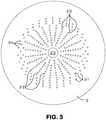
- the ash plate 12 ( Fig. 3 ) can be of the same design as the upper plate 31, or a different design, depending on the particular type of feedstock being used.
- the ash plate 12 has approximately 200 holes, each approximately one half inch in diameter.
- the ash plate 12 is preferably supported by the donut-shaped plate 66 or by brackets within the outer wall, and preferably is separated from the inner wall 3, so that ash can spill over its entire circumference, through the segments in plate 66 and gasket 612.
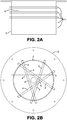
- cross members 4 Within the reaction chamber 9 are disposed plural cross members 4 (see Figs. 2A and 2B ), which act to break up any feedstock, ash, and/or partially-combusted products, to provide complete reaction pyrolysis, and to produce a fine ash.
- Cross members 4 are preferably attached across the inner wall 3 above and below each arm of the fuel stirrer arms 7, making sure there is no contact with the fuel stirrer arms 7.
- the cross members 4 are welded to the outside and to the inside of the inner wall 3 where they pass therethrough, to prevent gas leakage.
- These cross members 4 are preferably made of chrome alloy steel and preferably are chrome-plated. Additionally, the cross members 4 are preferably staggered around the circumference so no two members are in alignment. See Figs. 2A and 2B .
- the reaction chamber 9 Also within the reaction chamber 9, and interlaced with the cross members 4 (see Fig. 1B ), are (i) at least one (for chicken litter, preferably five) one-arm, rotating fuel stirrer arms 7, and (ii) at least one one-arm, rotating ash stirrer arm 5.
- These stirrers also act to keep the feedstock and pyrolysis reaction products agitated for better surface contact ignition and more efficient production of the oil, gas, and ash.
- the multiple fuel stirrer arms 7 are evenly staggered about their axis of rotation, when viewed from above.
- the leveling arm 2, the fuel arms 7, and the ash arm 5 may each comprise one or more arms, which may rotate, vibrate, and/or reciprocate, as desired. While these arms may be driven by a common motor, in the preferred embodiment each is driven by its own separate motor and may be driven to move in multiple directions.
- the reformer (inner) reaction chamber 9 also has a gas input line 20, which may come from a propane tank 22, and/or be coupled to a synthetic gas line 325.
- An igniter 24 e.g., a spark plug
- the burner 217 may comprise a simple two-arm burner with twenty-four gas holes in each arm, or a circular burner with a similar number of holes.
- the ignited gas is distributed upward into the reaction chamber through holes 212 in the lower ash plate 12 ( Fig. 3 ).
- the input gas line 20 is then fed with the recirculated synthetic gas produced by the reaction/reformation process to be described below, via line 325; and propane from the tank 22 is turned off, for example with valve 201.
- a predetermined target such as 150 degrees F (as detected by a thermostat inside the reaction chamber 9 coupled to one or more control processors 410)
- the input gas line 20 is then fed with the recirculated synthetic gas produced by the reaction/reformation process to be described below, via line 325; and propane from the tank 22 is turned off, for example with valve 201.
- the ash produced by the process to be described below falls through the reaction chamber 9, is agitated by the ash stirrer 5, and then falls over the circumference of the ash plate 12 (and/or through holes/slots therein), through to a bottom ash plate 8, which is preferably the bottom of the lower section 103 where the ash auger 15 is preferably mounted.
- the ash is then swept into the ash auger 15 with at least one lower ash stirrer 81 ( Fig. 1B ) which may be disposed above or below the bottom ash plate 8; and the ash is then exhausted through an ash output 151 into, preferably, a barrel or other receptacle.
- the at least one lower ash stirrer 81 preferably has four stirring arms, and the bottom ash plate 8 is preferably at least equal in diameter to the outer wall 13.
- the bottom ash plate 8 preferably is circular-shaped and has a generally rectangular shaped slot therein disposed over the top of ash auger 15. The top and bottom edges of the rectangular slot are preferably curved with a similar diameter as the outside of the ash plate 8, to enhance movement of the ash into the ash auger 15.
- the other usable (combustible) products are preferably extracted from the reformer 110 as a gas/liquid mixture via exit piping 10 from the top section 101, after being mixed with scrubbing water introduced via the scrubbing water input line 6.
- the scrubbing line 6 is disposed directly above the intake of the output line 10.
- two gas/liquid blowers or pumps 14 take the liquid/gas output from the output piping 10 and provide it to the gas/liquid separator 17.
- each blower comprises a 25 GPM, 800 CFM @ 50 ft. of head gas/liquid pump. These blowers thus form a vacuum or low pressure volume inside the top section 101 of the reformer 110, which aids in the formation of beneficial hydrocarbon gasses/liquids, as will be described in greater detail below.
- the gas/liquid separator 17 then separates the gas products from the liquid products, and provides some of the liquid via line 321 to the scrubbing liquid line 6, for reintroduction into the top section 101 of the reformer 110.
- Gas products from the gas/liquid separator 17 are preferably output via the synthetic gas line 32, which gas may be (i) re-used via the gas input line 325, and/or (ii) be used as an energy source for other processes such as electricity generation, heating, conversions to liquid carbons (Gas To Liquids), etc., and/or (iii) merely flamed as waste.
- Liquid from the bottom of the gas/liquid separator 17 is extracted via a liquid line 322, preferably boosted by a pump 323, and provided to the oil/water separator 16 via line 324.
- the oil/water separator 16 separates the oil from the water and provides the refinable oil through oil output line 444.
- Water is preferably output from the side of the oil/water separator 16 via line 161 (which may have a floating output valve) to a scrubbing liquid pump 162 for transmission to the scrubbing liquid line 6.
- Heavier separated oils, tars, sludge, etc. are preferably taken from the bottom of the oil/water separator 16 via line 169 via pump 163, and sent back to the reformer 110 via line 11.
- Control of the process is preferably achieved by at least one processor 410 connected to the various components via wires (some of which are shown in Fig. 1A ) and/or wireless means.
- the at least one processor may comprise a personal computer, one or more special purpose processors, hardware, and/or firmware, etc.
- the at least one processor 410 preferably contains program code which, when loaded into and run by the at least one processor, causes the at least one processor to execute the functions described herein and those typical functions necessary or convenient to support the described functions.
- the at least one processor 410 preferably controls the entire process by controlling the various motors, pumps, augers, valves, etc. to be described below.
- the feedstock auger 1 introduces feedstock into the reformer at a rate controlled by a feedstock auger motor 111, as controlled by the at least one processor 410.
- the one or more fuel stirrers 7, the one or more ash stirrers 5, and one or more leveling arms 2 are controlled by a common motor (or individual motors) 711, as controlled by the at least one processor 410.
- the igniter 24 and an input gas line valve 201 are also controlled by the at least one processor 410, as is the ash auger 15 via ash auger motor 152.
- the rate at which the gas/liquid reaction products are removed from the reformer is controlled, inter alia, by the speed and torque of the respective motors of blowers 14.
- each of lines/pipes depicted and described herein may have one or more valves a, b, c, d, e, f, g, h, i, j, k, l, m and n to control flow in their respective lines, as either on/off, multiple outputs, and/or restricted flow, depending on the needs of the process, as controlled by the at least one processor 410.
- the connections from the at least one processor to the above-noted valves are not depicted in Fig. 1A for clarity, although those connections may be wired or wireless, depending on the installation.
- process parameters which have been successfully tested with the preferred embodiment include: control of the syngas out of system to control the flow of synthesis gas back to the reformer through the flow control valve a, preferably controlled by one or more oxygen sensors Q in the syngas output line 32.
- the scrubbing liquid 6 and bottoms return 11 are preferably controlled by variable speed motors in pumps 162 and 163, preferably controlled by one or more emulsion level control devices 168 in the oil/water separator 16.
- Figs. 2A and 2B depict a preferred structure of cross members 4 disposed in the reaction chamber 9.
- Fig. 2A is a plan view of the cross members 4, which are, preferably, interspersed with respect to the one or more fuel stirrers 7 and the one or more ash stirrers 5.
- Fig. 2B is a top view of the cross members 4, showing the preferred crossing patterns designed to break up and homogenize the various layers of pyrolysis reaction products within the reaction chamber 9.
- each cross member 4 is made of 4140 chrome plated steel or better, and is 3.6 feet long, 1 inch wide, and 1 inch thick.
- Fig. 3 is a top plan view of the ash plate 12, showing an outer pattern of through-holes 211, and a different inner pattern of through-holes 212.
- a central hole 213 allows for passage of the support shaft of the fuel and ash stirrers.
- the ash plate 12 is made of 304 stainless steel or better, is 448 inches in diameter, and is 5/8 inches thick.
- the bottom ash plate 8 may be of a similar design, or different design, as deemed appropriate for each application. As noted above, the bottom ash plate 8 preferably has a 12 inch by 3 inch opening on one side of the central hole 213, above where the ash auger 15 is mounted. The ash stirrer 8 sweeps ash that has fallen by gravity into ash auger 15.
- Fig. 4 is a schematic functional block diagram of the various layers and processes which take place inside the reaction chamber 9 of the reformer 110. These layers are preferably formed as a single stack of layers which may or may not have clearly defined boundaries between the layers. As described above, feedstock 511 (wetted to perhaps 50 percent with recirculated sludge, and/or scrubber liquid, and/or its own compounds) is preferably introduced into reformer section 101 at ambient temperature or the temperature of the oil/water separator 16 (e.g., 125-130 degrees F).
- feedstock 511 wetted to perhaps 50 percent with recirculated sludge, and/or scrubber liquid, and/or its own compounds
- the feedstock 511 is preferably combusted/processed in the electrolysis layer 611 (to cause pyrolysis), in the charcoal layer 712, in the carbonate plasma layer 811, and in the ash layer 911, in a manner to be described below.
- solid mineral carbons migrate downward due to the force of gravity, as assisted by the stirrers, to the ash plate 12 where they will exit the reaction chamber 9 as ash.
- useful oils and gasses migrate upward through the layers to the reformer upper section 101, where at least some of the oils boil off under the vacuum (or partial vacuum) created by blowers 14.
- the remaining oils, the migrated gasses, and the boiled-off-oil gasses are the useful hydrocarbon products which are then mixed with scrubbing water as described above, and they are then evacuated via reformer output piping 10.
- the scrubbing water thus entrains certain of the useful gasses and oils, and also acts to keep the feedstock at a desired wetting level.
- the above described reaction pyrolysis takes place in the reaction chamber 9 using either input gas (such as propane) via piping 20, or recirculated synthetic gas produced by the reformer itself via piping 325.
- input gas such as propane
- recirculated synthetic gas produced by the reformer itself via piping 325.
- the electrolysis layer 611 the heat from the inefficiencies of a fuel cell process in the carbonate layer reaction causes the feedstock 511 to produce pyrolysis oils.
- the electrolysis layer 611 also produces useful hydrocarbons, paraffins, olefins, alcohols, and/or carbon dioxide which are products of a process known as Kolbe Electrolysis. These products are produced at the anode while hydrogen is evolved at the cathode, as will be described below. Decane and pentane, for example, are the predominant products from caproic acid, a common pyrolysis product.
- the electrolysis layer 611 typically ranges from about 350 degrees F at the top thereof to about 900 degrees F at the charcoal layer 712.
- the electrolysis layer 611 comprises oils, water, and wetted feedstock (from the pyrolysis oils typically produced at temperatures of 730 degrees F and higher near the charcoal layer), and water and oils injected at line 6 and the water content of the feedstock itself, where some of the oils are from the lower layers.
- the carbonate plasma layer 811 is where the hottest temperatures occur, producing a plasma at about 3500 degrees F.
- minerals migrate downward as they react to form crystalline solids, while useful oils and gasses migrate upward.
- This electrolyte (the natural mineral carbonates of the feedstock, or one or more catalysts that may be added to the feedstock) causes the transfer of electrons from incoming gases (e.g., syn gas), making it act like a fuel cell and providing the electric current used in the arcing in ash layer 911 below and in the charcoal layer 712 above and in the electrolysis layer 611.
- the current generated would be about 600 amperes or higher, at a voltage of 8000 VDC or higher.
- ash layer 911 which is perhaps 140 degrees F, and is eventually evacuated from the reformer through the bottom ash plate 8 using gravity and the ash auger 15, as described above.
- the incoming gases air from below and gas from input line 20 and/or 325) are heated and dissociated in this layer as described below.
- the ash stirrer 5 helps keep the ash crushed to cause (i) the interstitial spaces preferable for arcing and (ii) movement of the ash over the outer perimeter of the ash plate 12. Note that while the temperatures inside the reaction chamber 9 may be quite high, the outer skin temperature of outer wall 13 rarely exceeds 140 degrees F.
- the vacuum (or low pressure) space between the inner wall 3 and the outer wall 13 insulates against the hotter inner chamber temperatures.
- a preferred feature of the present invention is the "arcing and sparking" which preferably takes place predominantly in the carbonate plasma layer 811 and in the ash layer 911.
- This arcing and/or sparking causes the disassociation of hydrogen, nitrogen, and oxygen molecules into atoms, thus releasing much more energy, as will be described in greater detail below. See, for example, U.S. Patent No. 4,472,172 to Sheer, et al .
- the present invention preferably makes use of an electrical current flow set in the reaction chamber 9 to cause this arcing and/or sparking.
- the source of electrical energy is mostly in the carbonate plasma layer where carbon is separated from oxygen, producing electrons from the oxygen (see also Fig.
- the current is attracted downward through the layers 712 and 811 to the ash layer 911 and the metal ash plate 12. It is this potential difference within the layers that causes the arcing and sparking which provides the increased energy by disassociation of hydrogen and oxygen molecules, aided by the fact that the ash plate 12 is preferably not electrically coupled to the inner wall 3 (or has a relatively low conductance). Furthermore, the current flow may cause pyrolysis oils (which are produced in the electrolysis layer 611 as described above) to also produce hydrocarbons from the top of the charcoal layer 712 via the process of Kolbe Electrolysis as they move up through the electrolysis layer 611.
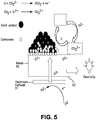
- Fig. 5 schematically depicts the electro-chemical processes of a direct carbon fuel cell, formed in the present invention.
- the electrolyte includes at least the carbonate from the mineral content of the feedstock.
- the cathode includes at least the fuel stirrer(s) 7, the ash plate 12, and the ash layer 911.
- the anode includes at least the inner wall 3 and the cross members 4.
- the oxygen gives up two (2) electrons at the electrolyte, i.e. the naturally occurring carbonates, which pass to the inner wall 3 and return to the cathode. This makes the reaction of carbon and oxygen result in carbon dioxide found in the gas. The same reaction may occur with hydrogen and nitrogen resulting in hydrocarbons as well as ammonia and amines, for example.
- Fig. 5 schematically depicts the electro-chemical processes of a direct carbon fuel cell, formed in the present invention.
- the electrolyte includes at least the carbonate from the mineral content of the feedstock.
- the cathode includes at least the fuel stirrer
- the electrolyte is a carbonate or molten carbonate.
- the electrolyte layer 611 preferably being a portion of the load, and into the fuel stirrers 7.
- Current then moves down through fuel stirrer 7, to the ash layer 911, and ash plate 12, and back to the beginning of the electrolyte layer to complete the circuit.
- the current flow through the ash layer 911 causes the arcing and sparking described above, which can also be referred to as short circuiting.
- the oxygen ions now pass through the electrolyte layer to chemically react with the carbon to produce carbon dioxide, for example.
- Oxygen from the air that enters through ash auger 15 reacts with carbon to form carbon dioxide. When this reaction occurs, heat is produced, e.g., a fire in the fire place. However, in this and other fuel cell arrangements, the oxygen is separated from the carbon by an electrolyte. Oxygen has to give off two electrons to react with carbon, see Fig. 5 . In a fire place, these electrons cause heat. In the reaction chamber 9, the electrons are in-part transferred by the electrolyte to the inner wall 3 producing some electric current rather than all heat. Electrons that do not get conducted as current cause the heat that produces the pyrolysis at the charcoal layer 712.
- the oxygen/carbon reaction is one example of a reaction that can occur in this layer.
- the cathode 51 (including the fuel stirrer(s)) is extended through the anode 52 (including the inner wall 3).
- the current is produced, in part, by air introduced by induced draft through the ash auger 15, caused by the blowers 14 bringing in air through the ash auger 15 to provide oxygen from that air and around the outside edge of the ash plate 12 and to the carbonate electrolyte layer 811, to produce the current by the oxygen chemical reaction described above and illustrated in Fig. 5 .
- electrolyte 53 being carbonates and other material in the feedstock in the carbonate plasma layer 811
- electrolyte materials may include, but are not limited to, sodium, potassium, and other transition metal hydroxides, carbonates, and salts that naturally occur in biomass.
- ash layer 911 As the ash layer 911 is cooled into a crystalline structure by incoming synthesis gas and air (from, e.g., the ash outlet 151), it is referred to as ash and can be part of the cathode 51, along with the ash plate 12.
- Incoming air and synthesis gas are kept somewhat separate by filling the center portion of the ash plate 12 with gas, causing the air, in large part, to move up the outer wall 13 and through the gap between the inner wall 3 and the ash plate 12. Any ash that fuses or bonds together above or below the electrolyte 53 zone is broken and/or crushed by the stirring arms of the ash stirrer 5 and/or the fuel stirrers 7.
- the top arm of the ash stirrer 5 is preferably disposed above the ash plate 12, and is preferably operated in conjunction with another ash arm 81 ( Fig. 1 ) disposed below the ash plate 8 to remove ash, as needed, to control the position of electrolyte 53 within the inner wall 3 of section 102 of the reformer.
- the ash plate 12 and the ash stirrer 5 are isolated from the inner wall 3, creating an electrical potential difference between the inner wall 3 and the fuel stirrers 7, and completing the electrical circuit through the feedstock material 511 and its constituents as it is reduced. Due to the higher resistance of the metal in the inner wall 3, the outer wall 13, and the fuel stirrer 7, the current will flow through the carbon, ash, and wet materials (layers 511, 611, 712, 811, and 911 of Fig. 4 ), is the path of least resistance.
- the ash plate 12 is preferably supported by the outer wall 13 from below via the donut-shaped porous plate 66 or brackets (which may be electrically and/or thermally insulated from the outer wall) to allow ash to be removed over the entire periphery of the plate 12.
- the ash plate 12 is preferably larger in diameter than the inner wall 3 to maintain the ash level to a controlled depth so that ash is removed as needed rather than falling in an uncontrolled fashion.
- the circumferential gap between the ash plate 12 and the inner wall 3, and the inner wall cross members 4 act together to crush and/or break any fused ash or ash stuck together by other means, thus keeping the ash size appropriate in optimizing the arcing preferably used in the ionization of incoming synthesis gas.
- the gas-to-liquids conversion being a reaction between hydrogen and carbon, or hydrogen and nitrogen, for example, in the lower portion of section 102 preferably uses the conductivity, size, consistency, and movement of the ash to cause arcing, also referred to as sparks, between pieces of ash as they move.
- arcing also referred to as sparks
- These arcs ionize components of the synthesis gas, known as dissociation from molecules into atoms.
- Arcing is considered the most efficient means of molecular dissociation but may not be the only means.
- MHD magnetohydrodynamics
- pyroelectric electric piezoelectric electric and ferroelectric electric effects
- MHD is the flow of electrically conductive gases such as, but not limited to, hydrogen through a magnetic field in the inner wall 3 of section 102.
- the current flow in the inner wall 3 from other electrical effects of the ash from heat, pressure of the stirring arms, and/or the weight of material above the ash produces a magnetic field.
- the gas flow would be seeded by the carbonates, salts, and other electrically conductive materials in the ash.
- Other possible means of current flow in the inner wall could be, but are not limited to, the Seebeck Effect.
- phenol Another compound found in the output oil is phenol, also found by chemical analysis (discussed below).
- the process for making phenols begins with aromatic hydrocarbons such as isopropyl benzene which is reacted with an alkaline such as caustic, carbonate or bicarbonate.
- the product of this reaction is phenol and acetone, which appear in the oil analysis as well.
- the combined electrical effects, the inefficiencies, and the alternating frequency caused by current arcing in the ash produce direct heat as well as induction heating in section 102 for the purpose of pyrolysis of the incoming feedstock.
- the products of the pyrolysis undergo Kolbe electrolysis, the electro-chemical conversion of organic acids to hydrocarbons. See, for example, U.S. Patent No. 6,238,543, to Law, Jr .
- Various factors such as temperature, current density, electrode material, and electrolyte material affect the hydrocarbon production distribution. Studies indicate that low temperature and low current density with nickel or nickel alloy metal cathodes with platinum or chromium anodes (preferably used in the present invention) have better yield percentages.
- the reformer construction according to the present invention preferably uses nickel alloy, or better, in the fuel stirrer arms 7; having multiple arms attached to a central rotatable shaft and staggered around the center shaft as they move down; making sure that no part of the stirrer assembly comes into contact with the inner wall 3.
- Electrolysis of acids to produce hydrocarbons has been studied for more than 200 years with many questions as to the exact mechanism or operating conditions. Rheinold and Erman were the first to investigate electricity as a potential oxidizing or reducing agent in aqueous solutions of alcohol. In 1830, Ludersdorff undertook the first detailed studies of products using various electrode materials. Kolbe made his breakthrough studies in 1845. To make the most of the conditions necessary for electrolysis, all of the conditions are at least partially controllable in the preferred embodiments. Temperature may be controlled by injection of liquid from the oil/water separation tank 16 and/or the amount and velocity of the feed gas.
- the bottom layers in tank 16 may be pumped back into the top of section 101 onto the feedstock 511, via line 11. Such tank-bottom sludge may be pumped back not only for temperature control, but for the reforming of those components as well.
- the output from tank 16 to line 161 may be made height-adjustable for different feed stocks and/or process speeds. Liquid from the tank 16 layer above the bottom layers is preferably pumped back to section 101 via line 6 for both temperature control and scrubbing as the gas/liquid output from the reactor passes through the piping 10 and the blowers 14, as it is moved to the gas/liquid separator/scrubber 17.
- Electrode material has already been discussed above. Electrolyte material is a natural component of the feedstock, but could be altered by addition of other catalytic materials, if needed.
- the pyrolysis of the feedstock mostly occurs near the charcoal layer 712 lower in the inner wall section above ash plate 12 and the ash layer 911 (the fuel cell area).
- Production of organic acids, acetic acid, and other acidic material is well known in pyrolysis.
- a vacuum (or partial-vacuum) pyrolysis process is set up.
- temperatures of 730 degrees F to 932 degrees F are required for the reaction to occur.
- the top third of the inner wall section (reaction chamber 9) is preferably controlled to be around 350 degrees F to around 425 degrees F. Because of this temperature control, the produced pyrolysis oils rise up through the electrolysis section 611 of the reaction chamber 9.
- wetting of the feedstock is an advantageous feature according to the preferred embodiments, allowing for a broader range of feedstock materials, and producing more useful products.
- the wetting is preferably an internal process.
- At the top of the carbon layer, where the fuel cell process occurs, is where the pyrolysis preferably occurs.
- the pyrolysis oils rise back through the feedstock causing some of the wetting.
- Acetic acid is used to wet material for pyrolysis and is a natural component of pyrolysis. The acetic acid is broken down in the electrolysis.
- pumping of the bottoms from the oil/water separator 16 is a wetting process, and providing these to the feedstock through pipes 6 and 11 assists in controlling the wetness of the feedstock.
- Supplemental wetting of the feedstock may be used outside the reformer to add moisture if the material is too dry. For example, some kiln dried materials may have water added to bring the feedstock moisture content up to 50% or so.
- the leveling arm 2 is used in section 101 to sweep the feedstock material from under the feed auger 1 to bring the material into the reformation chamber and to maintain an even bed height.
- the auger 1 is preferably fed through an airlock system 113 ( Fig. 1B ) to prevent substantial amounts of air from entering the section 101 and damaging the vacuum (or partial vacuum) therein; and air trapped in the chambers of the air lock 113 is preferably removed using the vacuum of the lower section 103 below the ash support 8, which is connected to the outer wall 13 of the reformer.
- the at least one processor 410 controls the various augers, valves, blowers, pumps, and motors as described below.
- the structures are controlled to feed approximately 0.25 to 10 tons of chicken litter per day into the reformer. This will typically produce approximately: 2 to 100 pounds per hour of ash fertilizer (depending on the mineral content of the feedstock; e.g., pine is 0.25%, rice straw is 12%); 3 to 150 gallons of oil per hour; and 1,200 to 48,000 cubic feet of syngas per hour.
- the propane flow is kept at a level where the fire preferably stays toward the bottom of the inner reaction chamber 9.
- the temperature of the outer wall 13 is monitored (e.g., with one or more thermocouples), and when the return synthetic gas becomes combustible (e.g., the combustion reaches a threshold such as, 150 degrees F) the burner is turned off, the air inlet on the burner is closed, and the return synthetic gas flow to the burner tube is opened.
- the hydrogen rich syngas flowing upward through the ash produces first a pyroelectric charge which will discharge as an electric arc in hydrogen which has a conductivity of 187 mW/m-K compared to air at 26.2 mW/m-K.
- This arcing between the pieces of ash causes the hydrogen to dissociate, leading to the reaction example 8H + 3C ⁇ C 3 H 8 , thermodynamically resulting in 1848 KJ of energy release compared to a gasification reaction of the same amount of carbon (3C + 2O2 ⁇ 2CO + CO 2 ) at 614.5 KJ.
- the hydrogen conversion rate is about 60% to 70%.
- thermal and kinetic energy conversion methods may include piezoelectric, ferroelectric, and MHD power generation produced by the flow of the conductive hydrogen through an electric field produced by current flow through the chamber walls.
- Another consideration would be a fuel cell, solid oxide to be specific. The combustion of hydrogen and oxygen in the ash, or oxide, would produce electric charge, and just like a fuel cell, would arc between pieces like cracks and fissures (one of the inefficiencies).
- These same inefficiencies are problems in fuel cells, MHD, and would be in pyroelectric generators. But it is this inefficiency that is taken advantage of in the reformer according to the present invention.
- the arcing dissociates nitrogen, oxygen, and most any diatomic molecule from the air.
- the disassociation of nitrogen is a strong indication of the nitrogen found in the ash according to the present invention.
- These same arcs comprise plasma electrolysis which has been reported in hydrogen production from water at 80 times that of the Faraday current prediction. The most accepted explanation is thermal decomposition. All of the thermoelectric conversion methods, as well as kinetic conversion methods, have the conditions to produce current and voltage at varying degrees. It is this combination that is most likely providing the beneficial results according to the present invention.
- charcoal 712 or carbonate 811 would be the more likely zone(s) for the magneto-hydrodynamic conversion of the kinetic motion of synthesis gas (primarily hydrogen for the conversion) within a magnetic field to produce the electricity.
- Charge produced in the ash, once the ash has reached the bottom of the inner reactor 9, would travel up the reactor wall 3 and produce the magnetic field, as noted above. Though it is not considered to be highly energetic, it is expected to be occurring. Current produced by this MHD generator would also travel predominantly through the carbon, causing electrolysis to occur, with carbon being one electrode and minerals in the biomass feedstock being the other.
- Hydrogen itself could act as the negative electrode and reduce both free water and hygroscopic water. This process occurs, producing synthesis gas, until the carbonate layer 811 moves high enough so that the current can move through the inner wall 3 and ash layer 911 to begin the other processes.
- a process for the catalytic reaction of organic compounds in which the organic compounds are contacted with a catalyst comprising an interstitial metal hydride (having a reaction surface) to produce a catalyst-organic compound mixture; energy is applied, monatomic hydrogen is produced at the reaction surface of the interstitial metal hydride, and the organic compounds are reacted with the monatomic hydrogen.
- Reactions accomplished by this process include petroleum hydrocracking and hydrotreating processes.
- Interstitial means the small spaces within the material, and metal hydrides are materials that can form from the mineral content of the feedstock. When steam reacts with carbon, it will form carbon monoxide and hydrogen. Momentarily, hydrogen will exist as monatomic, i.e. an atom, while it is produced in the presence organic compounds produced within the process, this reaction can occur.
- the present invention provides 10 X waste matter conversion efficiency vs. existing technology of gasification or pyrolysis.
- the present invention tolerates water content in the feedstock of up to 75 percent by weight vs. 15 percent by weight maximum water content for existing technologies. Feedstock with a water content of 15 to 50 percent is presently preferred for use in the present invention. This means that most contemplated feed stocks do not have to undergo a pre-process drying step.
- the present invention may process any carbon-based wet waste, such as animal waste, biomass, municipal solid waste, etc.
- the process outputs are (i) semi-refined petroleum high in aromatics with little or no sulfur, (ii) synthesis gas having a hydrogen to CO Ratio of about 2.2:1, and (iii) fertilizer ash high in nutritional value for agriculture.
- the present process generates very little or no harmful fugitive emissions.
- the present invention is quite green in that it helps the environment. It is well known that animal waste emits methane with 25 X the global warming potential of CO 2 . For example, 100 tons of chicken litter per day has the same yearly global warming potential impact as burning > 30,000,000 gallons of gasoline. Thus, the present invention removes harmful substances from the environment. Further, the ash fertilizer according to the present invention may be stored and transported more economically, and provides nutritional value with none of the chemical or biological risks associated with using raw chicken litter as fertilizer.
- the present invention is thus an internally-regenerated, high-energy, sustained reaction process that converts carbon based feed stocks into refinable hydrocarbons and other compounds that can be used to produce valuable fuel, chemical byproducts, and energetic gas.
- An externally generated high-temperature plasma field converts the feed stocks into their simplest molecules - hydrogen, carbon monoxide, and other compounds, forming a synthetic gaseous mixture that may be used to generate electricity and/or produce valuable fuel and chemical byproducts.
- Pyrolysis preferably heats the waste in an oxygen-deprived environment, where material combusts to produce heat, carbon dioxide, and a variety of oleo chemicals.
- a 10-15 tons of chicken litter feedstock per day reformer produces 60 barrels of semi-refined petroleum per day (24,000 barrels per year); 0.33 tons of ash fertilizer per day (100 tons per year); and 633,600 cubic feet of synthetic gas per day (215,424,0000 cubic feet per year) with recirculation of the gas and based on 340 days per year operation. This removes much harmful material from the environment, provides large quantities of diverse energy, and causes little or no pollution by the process.
- ARK GASTM A comparison of the synthetic gas provided by the present invention (termed ARK GASTM) with gas produced by typical gasifiers reveals that the syn gas according to the present invention has a unique chemical signature having, for example, over 2 X more hydrogen, which may be used to generate electrical power and/or in high value chemicals via catalysts or bio-digesters. See Tables 1 and 2 below. Table 1 Comparison of Typical Syngas with ARK GASTM Gasifier Mole% Present Invention Mole% Hydrogen 22.32 47.68 Nitrogen 25.98 Methane 0.90 Carbon Monoxide 40.81 18.35 Ethane 0.18 Water 24.29 0.44
- the syn gas according to the present invention has high hydrogen content (preferably above 35 mole percent, more preferably above 40 mole percent, even more preferably above 45 mole percent), it can be used for a wide variety of applications. It can be used in a boiler to generate electricity, and/or in a power generator to power a gas turbine and/or fuel cells.
- the hydrogen may be extracted to be used in refinery hydrotreating, transportation fuels, and/or fertilizers.
- methanol may be extracted and used to produce formaldehyde, methyl acetate, acetic anhydride, acetic acid, vinyl acetate monomer, polyvinyl acetate, ketene, diketeme and derivatives, ethylene propolene, polyolefins, oxy chemicals, dimethyl ether, gasoline, Fischer-Tropsh materials, wax, diesel/kerosene, naptha, and/or ethanol.
- the reforming apparatus according to the present invention uses a geographic footprint of only 12 feet long, 8 feet wide, 7 feet high, which is much, much less that the footprint of a typical multi-acre gasification plant.
- the syngas according to the present invention has very low amounts of methane (preferably less than about 5 mole percent, more preferably less than about 3 mole percent, even more preferably less than about 1 mole percent).
- the Hydrogen will preferably be in the range of 30 to 80 mole percent, more preferably, 35 to 70 mole percent, even more preferably, 40 to 60 mole percent, yet more preferably, 43 to 55 mole percent, even more preferably, 45 to 50 mole percent, most preferably, 47.69 mole percent.
- the Nitrogen will preferably be in the range of 4 to 40 mole percent, more preferably, 10 to 37 mole percent, even more preferably, 15 to 34 mole percent, yet more preferably, 20 to 32 mole percent, even more preferably, 23 to 30 mole percent, most preferably, 25.98 mole percent.
- the Methane will preferably be in the range of 0.1 to 2 mole percent, more preferably, 0.2 to 1.8 mole percent, even more preferably, 0.3 to 1.5 mole percent, yet more preferably, 0.6 to 1.2 mole percent, even more preferably, 0.8 to 1.0 mole percent, most preferably, 0.9 mole percent.
- the Carbon Monoxide will preferably be in the range of 6 to 25 mole percent, more preferably, 10 to 23 mole percent, even more preferably, 13 to 21 mole percent, yet more preferably, 15 to 20 mole percent, even more preferably, 17 to 19 mole percent, most preferably, 18.35 mole percent.
- the Ethane will preferably be in the range of 0 to 1 mole percent, more preferably, 0.03 to 0.7 mole percent, even more preferably, 0.05 to 0.5 mole percent, yet more preferably, 0.07 to 0.4 mole percent, even more preferably, 0.1 to 0.3 mole percent, most preferably, 0.18 mole percent.
- the water will preferably be in the range of 0 to 1 mole percent, more preferably, 0.1 to 0.8 mole percent, even more preferably, 0.2 to 0.7 mole percent, yet more preferably, 0.3 to 0.6 mole percent, even more preferably, 0.4 to 0.5 mole percent, most preferably, 0.44 mole percent.
- ARK OILTM The oil produced by the present invention (termed ARK OILTM) is an engineered petroleum product valuable as produced (semi-refined) or with further refining. This oil has a unique signature making it suitable for a wide variety of useful applications.
- a Composition Breakdown Gas Chromatography/Mass Spectrometry, per ASTM 05739 was conducted on the chicken-litter oil product in January 2014. The sample was analyzed on a gas chromatograph/ mass spectrometer. A library search was performed on the collected data using the Wiley 138 Library and the NIST 98 Library. Together the libraries contain approximately 200,000 compounds. The top layer of the sample was analyzed as received. These data are based on the chromatographable components found.
- Table 10 Compounds Percent By Weight isoparaffins 0.2 to 15.0 naphthenics 0.1 to 15.0 mono-aromatics 3.0 to 75.0 di-aromatics 0 to 40.0 poly-aromatics 0 to 15.0 acids 0.1 to 3.0 alcohols 0 to 15.0 aldehydes 0.1 to 3.0 amines 0.1 to 7.0 esters 0.1 to 3.0 indenes 0.1 to 7.0 ketones 0.1 to 7.0 olefins 0.1 to 30.0 low level organic compounds 0.1 to 11.0
- the preferred embodiments can provide an oil made of pyrolysis compounds that have undergone electrolysis, and compounds made in an electric arc gas to liquids process.
- the composition of the feedstock is believed to be the principle driver (not exclusive) to the paraffin and olefins content. Inefficiencies in this electrolysis process may yield alcohols, acids, phenols, and nitriles.
- the gas-to-liquids operation of the electric arc process described above produces aromatics, amines, amides, ketones, indenes; the composition of each depends on the amount of gas converted in electric arc gas to liquids.
- the isoparaffins will preferably be in the range of 0.2 to 15 percent by weight, more preferably, 0.3 to 10 percent by weight, even more preferably, 0.4 to 7 percent by weight, yet more preferably, 0.5 to 4 percent by weight, even more preferably, 0.6 to 1 percent by weight, most preferably, 0.7 percent by weight.
- the naphthenics will preferably be in the range of 0.1 to 15 percent by weight, more preferably, 0.2 to 10 percent by weight, even more preferably, 0.3 to 5 percent by weight, yet more preferably, 0.4 to 1 percent by weight, most preferably, 0.5 percent by weight.
- the mono-aromatics will preferably be in the range of 3 to 75 percent by weight, more preferably, 10 to 73 percent by weight, even more preferably, 30 to 71 percent by weight, yet more preferably, 50 to 69 percent by weight, even more preferably, 60 to 67 percent by weight, most preferably, 65 percent by weight.
- the di-aromatics will preferably be in the range of 0 to 40 percent by weight, more preferably, 5 to 35 percent by weight, even more preferably, 10 to 30 percent by weight, yet more preferably, 12 to 25 percent by weight, even more preferably, 14 to 20 percent by weight, most preferably, 18 percent by weight.
- the poly-aromatics will preferably be in the range of 0 to 15 percent by weight, more preferably, 0.5 to 10 percent by weight, even more preferably, 1 to 7 percent by weight, yet more preferably, 1.5 to 4 percent by weight, even more preferably, 2 to 3 percent by weight, most preferably, 2.4 percent by weight.
- the alcohols will preferably be in the range of 0 to 15 percent by weight, more preferably, 0.1 to 10 percent by weight, even more preferably, 0.2 to 5 percent by weight, yet more preferably, 0.3 to 2 percent by weight, most preferably, 0.4 percent by weight.
- the aldehydes will preferably be in the range of 0.1 to 3 percent by weight, more preferably, 0.3 to 10 percent by weight, even more preferably, 0.4 to 7 percent by weight, yet more preferably, 0.5 to 4 percent by weight, even more preferably, 0.6 to 1 percent by weight, most preferably, 0.7 percent by weight.
- the amines will preferably be in the range of 0.1 to 7 percent by weight, more preferably, 0.4 to 5 percent by weight, even more preferably, 0.7 to 3 percent by weight, yet more preferably, 1.0 to 2 percent by weight, even more preferably, 1.1 to 1.5 percent by weight, most preferably, 1.3 percent by weight.
- the esters will preferably be in the range of 0.1 to 3 percent by weight, more preferably, 0.3 to 2.5 percent by weight, even more preferably, 0.5 to 2 percent by weight, yet more preferably, 0.6 to 1.5 percent by weight, even more preferably, 0.7 to 1 percent by weight, most preferably, 0.8 percent by weight.
- the indenes will preferably be in the range of 0.1 to 7 percent by weight, more preferably, 0.5 to 6 percent by weight, even more preferably, 1 to 5 percent by weight, yet more preferably, 1.5 to 4.5 percent by weight, even more preferably, 2 to 4 percent by weight, most preferably, 3.2 percent by weight.
- the ketones will preferably be in the range of 0.1 to 7 percent by weight, more preferably, 0.2 to 6 percent by weight, even more preferably, 0.3 to 5 percent by weight, yet more preferably, 0.4 to 3 percent by weight, even more preferably, 0.5 to 1 percent by weight, most preferably, 0.7 percent by weight.
- the olefins will preferably be in the range of 0.1 to 30 percent by weight, more preferably, 0.4 to 20 percent by weight, even more preferably, 0.6 to 10 percent by weight, yet more preferably, 0.8 to 5 percent by weight, even more preferably, 0.9 to 2 percent by weight, most preferably, 1.1 percent by weight.
- the oil according to the preferred embodiments thus shows a unique mixture of highly complex compounds not typically found in natural crude oil or products such as Fischer-Tropsch oils, but has compounds that are commonly man-made. Notably missing from the analysis, or only in small quantities, are organic acids seen in pyrolysis oils, such as levoglucasan and acetic acid, and xylan.
- the properties of the thus-produced ARK OILTM may be adjusted by adding certain additives to the waste litter before pyrolysis.
- Additives include Arnosoak, a proprietary litter amending agent, and/or wood shavings.
- the amount of Arnosoak incorporated into litter may be from about 0.1% to about 40% by weight of the dry litter, more preferably from about 1% to about 20% by weight of the dry litter.
- Arnosoak may be used to control the pH of the oil.
- the pH of the untreated oil may range from 6 to 8, but with the addition of Arnosoak, the pH range of the oil can reduced to as low as 4 depending on the amount of Arnosoak added to the litter before the pyrolysis. Adding a solvent to the oil may be provided for better storage.
- the solvent added to the oil is ethanol, methanol, acetone, or water.
- the solvents may be added at a concentration of about 1% to about 10% by weight of the oil, with a preferred concentration of 10% by weight of the oil.
- ARK SOILTM The ash fertilizer produced in accordance with the present invention (termed ARK SOILTM) also has a unique signature making it attractive as an all-purpose organic fertilizer. This ash fertilizer will reduce the transported volume and transportation costs associated with animal waste used as fertilizer.
- the ash fertilizer according to the present invention contains similar nutritional value for agricultural crops without any biological and chemical threats posed by the raw waste. An analysis of the fertilizer was conducted by the Agricultural Diagnostics Laboratory of the University of Arkansas at Fayetteville, with results shown below in Table 11. Other analyses of ARK SOILTM have shown carbon content of 46 percent.
- the fertilizer according to the present invention will have a high Nitrogen content, in the range of 0.1 to 3 percent by weight, more preferably, 0.3 to 5 percent by weight, even more preferably, 0.6 to 4 percent by weight, yet more preferably, 0.8 to 3 percent by weight, even more preferably, 1 to 2 percent by weight, most preferably, 1.2 percent by weight.
- the reformer of the present invention may provide output as follows: 2000 pounds of feedstock (1 ton) will produce approximately 6.4 barrels of oil plus approximately 63,000 Cubic feet of synthesis gas plus approximately 60 pounds of ash fertilizer. Essentially, one 5 gallon bucket of chicken litter will produce one 5 gallon bucket of oil (in addition to the gas and fertilizer).
- the present reformer technology reforms any carbon-based waste material at the atomic level to produce a high volume of partially refined petroleum (with little or no sulfur), a hydrogen rich synthesis gas, and a solid ash that is classified as a fertilizer by the US Department of Agriculture. There are little to no harmful fugitive emissions.
- the technology is a fraction of the size and cost of existing waste-to-energy or waste-to-fuel technologies, and produces a much higher volume of valuable energy commodities.
- the subject reformer technology provides a low pressure, low-heat, continuous process that separates and reforms basic organic elements found in waste material into high value partially refined petroleum.
- the oil production facilities according to the present invention have intrinsically low operating costs, low capital costs, and high efficiency.
- Each reformer can provide the most economical method of transforming common organic material into valuable hydrocarbons that are refinery ready, have a hydrogen to carbon monoxide ratio of about 2.2 : 1, and have minimal or no sulfur.
- Feedstock conversion efficiency for 100 tons of feedstock produces more value than 1000 tons processed by existing gasification or pyrolysis technologies.
- Poultry litter, horse manure, cow manure, shredded tires, wood waste, switch grass, cafeteria waste, rice hulls, Medium-density fibreboard (MDF) sanding dust (with water added), lignite, gasifier ash, and municipal solid waste can be used as a feedstock for the reformer of the present invention successfully.
- MDF Medium-density fibreboard
- various feedstocks may be combined in various percentages in order to provide even more engineered oils, gasses, and fertilizers. It is estimated that the cost of producing a barrel of oil according to the present invention will be about $20-25 dollars US, which compares very favorably with other forms of oil production.
- the present invention produces hydrocarbons, such as aliphatics, paraffins, aromatics, specialty chemicals, fuel, and fuel & oil additives.
- the synthetic crude oil according to the preferred embodiments contains virtually no sulfur.
Landscapes
- Chemical & Material Sciences (AREA)
- Engineering & Computer Science (AREA)
- Organic Chemistry (AREA)
- Oil, Petroleum & Natural Gas (AREA)
- Chemical Kinetics & Catalysis (AREA)
- Materials Engineering (AREA)
- Combustion & Propulsion (AREA)
- Electrochemistry (AREA)
- Metallurgy (AREA)
- General Chemical & Material Sciences (AREA)
- Manufacturing & Machinery (AREA)
- Inorganic Chemistry (AREA)
- Life Sciences & Earth Sciences (AREA)
- Sustainable Development (AREA)
- Sustainable Energy (AREA)
- Mechanical Engineering (AREA)
- Wood Science & Technology (AREA)
- Dispersion Chemistry (AREA)
- Processing Of Solid Wastes (AREA)
- Fuel Cell (AREA)
- Production Of Liquid Hydrocarbon Mixture For Refining Petroleum (AREA)
Priority Applications (1)
| Application Number | Priority Date | Filing Date | Title |
|---|---|---|---|
| PL14758198T PL3137585T3 (pl) | 2014-05-01 | 2014-08-07 | Urządzenie do przekształcania odpadów stałych na olej syntetyczny, gaz i nawóz |
Applications Claiming Priority (2)
| Application Number | Priority Date | Filing Date | Title |
|---|---|---|---|
| US201461986997P | 2014-05-01 | 2014-05-01 | |
| PCT/US2014/050126 WO2015167596A1 (en) | 2014-05-01 | 2014-08-07 | Apparatus and method for conversion of solid waste into synthetic oil, gas and fertilizer |
Publications (2)
| Publication Number | Publication Date |
|---|---|
| EP3137585A1 EP3137585A1 (en) | 2017-03-08 |
| EP3137585B1 true EP3137585B1 (en) | 2020-07-01 |
Family
ID=51453842
Family Applications (1)
| Application Number | Title | Priority Date | Filing Date |
|---|---|---|---|
| EP14758198.7A Active EP3137585B1 (en) | 2014-05-01 | 2014-08-07 | Apparatus for conversion of solid waste into synthetic oil, gas and fertilizer |
Country Status (7)
| Country | Link |
|---|---|
| US (4) | US9005536B1 (pl) |
| EP (1) | EP3137585B1 (pl) |
| CN (1) | CN107075384A (pl) |
| DK (1) | DK3137585T3 (pl) |
| ES (1) | ES2821385T3 (pl) |
| PL (1) | PL3137585T3 (pl) |
| WO (1) | WO2015167596A1 (pl) |
Families Citing this family (20)
| Publication number | Priority date | Publication date | Assignee | Title |
|---|---|---|---|---|
| US9409828B1 (en) * | 2014-02-07 | 2016-08-09 | Leo Byford | Method for treating animal waste and other waste streams |
| US11566211B2 (en) * | 2014-10-22 | 2023-01-31 | Gsr Solutions, Llc | Systems and methods of producing compositions from the nutrients recovered from waste streams |
| EP3334805B1 (en) * | 2015-08-13 | 2019-05-15 | Shell International Research Maatschappij B.V. | Process for fuel formulation |
| US10787362B2 (en) * | 2016-05-16 | 2020-09-29 | Christopher L. de Graffenried, SR. | Hydrogen co-firing with carbon pre-capture for higher carbon ratio fossil fuels |
| CN106000990A (zh) * | 2016-06-13 | 2016-10-12 | 安庆市凯立金刚石科技有限公司 | 一种气流冲洗式金刚石用的酸洗装置 |
| CN105880210A (zh) * | 2016-06-13 | 2016-08-24 | 安庆市凯立金刚石科技有限公司 | 一种气流冲洗防沉淀酸洗装置 |
| CN105950223A (zh) * | 2016-06-29 | 2016-09-21 | 姚姝 | 气化炉排灰机构 |
| WO2018081060A1 (en) * | 2016-10-24 | 2018-05-03 | Rogers Michael W | Method, apparatus, and computer-readable media for vortex arc reactor |
| CN108335978B (zh) * | 2017-01-20 | 2022-08-26 | 东京毅力科创株式会社 | 等离子体处理装置 |
| JPWO2019151461A1 (ja) * | 2018-02-05 | 2021-02-12 | 三菱瓦斯化学株式会社 | バイオマスガス化発電システム及び発電方法 |
| CN110846080A (zh) * | 2019-11-25 | 2020-02-28 | 大唐东北电力试验研究院有限公司 | 一种生物质正压循环流化床气化炉飞灰冷却系统 |
| WO2021222126A1 (en) | 2020-04-26 | 2021-11-04 | Nitricity Inc. | Systems and processes for producing fixed-nitrogen compounds |
| CN112178912B (zh) * | 2020-10-09 | 2021-12-14 | 北京绿洲德瀚环境保护中心有限责任公司 | 一种余热回收节能锅炉 |
| CN112178911B (zh) * | 2020-10-09 | 2022-06-07 | 丰宁满族自治县万泰能源科技有限公司 | 一种生物质颗粒取暖炉 |
| CN112178913B (zh) * | 2020-10-09 | 2022-05-31 | 薄涛 | 生物质燃烧炉供暖系统 |
| RU2760216C1 (ru) * | 2021-02-09 | 2021-11-22 | Федеральное государственное бюджетное образовательное учреждение высшего образования "Южно-Уральский государственный аграрный университет" (ФГБОУ ВО Южно-Уральский ГАУ) | Способ глубокой переработки птичьего помета |
| US12419332B2 (en) | 2021-06-11 | 2025-09-23 | Strategic Resource Optimization, Inc. | Electrolytic methods and systems for generating temper fluid |
| CN116239081A (zh) * | 2021-12-07 | 2023-06-09 | 中国科学院大连化学物理研究所 | 一种用于水煤气变换反应的反应器及应用 |
| CN116349609B (zh) * | 2023-04-10 | 2024-12-06 | 青岛美今生物科技有限公司 | 一种植物猫砂及其制备方法 |
| CN116611614B (zh) * | 2023-05-17 | 2023-10-13 | 南京邮电大学 | 一种基于大数据平台的商户出餐管理方法及系统 |
Family Cites Families (40)
| Publication number | Priority date | Publication date | Assignee | Title |
|---|---|---|---|---|
| US3333927A (en) | 1963-07-22 | 1967-08-01 | Avco Corp | Electrothermal process for producing acetylene and carbon black |
| US4472172A (en) | 1979-12-03 | 1984-09-18 | Charles Sheer | Arc gasification of coal |
| IN159676B (pl) | 1982-04-29 | 1987-05-30 | British Petroleum Co Plc | |
| US4583992A (en) | 1984-12-04 | 1986-04-22 | Buck Rogers Mfg. Co., Inc. | Biomass gasifier and charcoal producer |
| US5417817A (en) * | 1994-06-15 | 1995-05-23 | Dammann; Wilbur A. | Biomass gasification process and apparatus |
| US6238543B1 (en) | 1997-10-17 | 2001-05-29 | E. I. Du Pont De Nemours And Company | Kolbe electrolysis in a polymer electrolyte membrane reactor |
| US6130260A (en) | 1998-11-25 | 2000-10-10 | The Texas A&M University Systems | Method for converting natural gas to liquid hydrocarbons |
| AUPQ314399A0 (en) * | 1999-09-29 | 1999-10-21 | World Oasis Australia Pty Ltd | Process for recovering energy from carbon-containing materials |
| CA2404029A1 (en) | 2000-03-23 | 2001-09-27 | Richard W. Russell | Method of converting agricultural waste to liquid fuel and associated apparatus |
| US7387712B2 (en) | 2002-10-17 | 2008-06-17 | Carnegie Mellon University | Catalytic process for the treatment of organic compounds |
| US6903259B2 (en) * | 2002-12-06 | 2005-06-07 | Arvin Technologies, Inc. | Thermoelectric device for use with fuel reformer and associated method |
| US8877992B2 (en) | 2003-03-28 | 2014-11-04 | Ab-Cwt Llc | Methods and apparatus for converting waste materials into fuels and other useful products |
| US7301060B2 (en) | 2003-03-28 | 2007-11-27 | Ab-Cwt, Llc | Process for conversion of organic, waste, or low-value materials into useful products |
| BRPI0408894A (pt) | 2003-03-28 | 2006-06-13 | Ctw Llc Ab | processo para converter uma carga de alimentação em pelo menos um material útil, óleo combustìvel, aparelho para converter uma carga de alimentação em pelo menos um material útil, aparelho e processo para converter um licor orgánico em uma mistura de hidrocarbonetos, e sólidos de carbono, e, aparelho para separar particulados de um fluido em uma suspensão |
| US7438987B2 (en) | 2003-05-15 | 2008-10-21 | Lawrence Livermore National Security, Llc | Carbon fuel particles used in direct carbon conversion fuel cells |
| US7964026B2 (en) | 2003-08-04 | 2011-06-21 | Power Reclamation, Inc. | Gasification apparatus |
| US20050268556A1 (en) | 2003-08-04 | 2005-12-08 | Power Reclamation, Inc. | Gasification apparatus and method |
| KR101419756B1 (ko) | 2005-10-17 | 2014-07-15 | 에이비-씨더블유티, 엘엘씨 | 유기 및 비-유기 폐기 물질을 유용한 제품으로 변환시키는방법 |
| CA2586311A1 (en) | 2006-04-28 | 2007-10-28 | Thermalco Inc. | Apparatus and method for conversion of animal litter biomass into useful energy |
| US8529646B2 (en) | 2006-05-01 | 2013-09-10 | Lpp Combustion Llc | Integrated system and method for production and vaporization of liquid hydrocarbon fuels for combustion |
| US7808227B2 (en) * | 2006-07-07 | 2010-10-05 | Univation Technologies, Llc | Systems and methods for detecting impurities in reactor systems |
| WO2008104088A1 (en) * | 2007-02-27 | 2008-09-04 | Plasco Energy Group Inc. | A multi-zone carbon conversion system with plasma melting |
| US20140011104A1 (en) * | 2007-06-26 | 2014-01-09 | The Board Of Trustees Of The Leland Stanford Junior University | Integrated Dry Gasification Fuel Cell System for Conversion of Solid Carbonaceous Fuels |
| WO2009018543A1 (en) | 2007-08-01 | 2009-02-05 | Virginia Tech Intellectual Properties, Inc. | Thermochemical method for conversion of poultry litter |
| US7981563B2 (en) | 2007-11-26 | 2011-07-19 | Gas Technology Institute | Direct carbon fuel cell with pre-wetted carbon particles |
| EP2243815A4 (en) * | 2008-02-05 | 2012-12-05 | Central Res Inst Elect | FUEL PURIFYING APPARATUS, ENERGY GENERATING SYSTEM, AND FUEL SYNTHESIS SYSTEM |
| DE102009023457B4 (de) * | 2009-06-02 | 2011-05-19 | Lurgi Gmbh | Verfahren und Vorrichtung zum Vergasen von backender Steinkohle |
| US8669013B2 (en) | 2010-02-23 | 2014-03-11 | Greatpoint Energy, Inc. | Integrated hydromethanation fuel cell power generation |
| US8652696B2 (en) | 2010-03-08 | 2014-02-18 | Greatpoint Energy, Inc. | Integrated hydromethanation fuel cell power generation |
| US8372251B2 (en) * | 2010-05-21 | 2013-02-12 | General Electric Company | System for protecting gasifier surfaces from corrosion |
| AU2011286470A1 (en) * | 2010-08-03 | 2013-03-21 | Xiaodi Huang | Method and apparatus for coproduction of pig iron and high quality syngas |
| GB201014304D0 (en) * | 2010-08-27 | 2010-10-13 | Akay Galip | Intensified integrated biomass-to-energy carrier conversion process |
| US20120061618A1 (en) * | 2010-09-11 | 2012-03-15 | James Santoianni | Plasma gasification reactors with modified carbon beds and reduced coke requirements |
| FR2965816B1 (fr) | 2010-10-12 | 2014-04-25 | S3D | Dispositif pour la transformation d'un combustible |
| US9321640B2 (en) * | 2010-10-29 | 2016-04-26 | Plasco Energy Group Inc. | Gasification system with processed feedstock/char conversion and gas reformulation |
| US20120197050A1 (en) | 2011-02-01 | 2012-08-02 | Joshi Chandrashekhar H | Production of hydrocarbon fuels from plant oil and animal fat |
| TW201241367A (en) | 2011-04-01 | 2012-10-16 | Suncue Co Ltd | Material poking control method for combustion apparatus and device thereof |
| US8100990B2 (en) | 2011-05-15 | 2012-01-24 | Avello Bioenery, Inc. | Methods for integrated fast pyrolysis processing of biomass |
| EP2773723B1 (en) | 2011-11-04 | 2018-05-16 | ThermoChem Recovery International, Inc. | System and method for flexible conversion of feedstock to oil and gas |
| US9074151B2 (en) * | 2012-09-28 | 2015-07-07 | Adaptivearc, Inc. | Plasma assisted gasification system with an indirect vacuum system |
-
2014
- 2014-08-07 CN CN201480080330.4A patent/CN107075384A/zh active Pending
- 2014-08-07 EP EP14758198.7A patent/EP3137585B1/en active Active
- 2014-08-07 US US14/454,414 patent/US9005536B1/en active Active
- 2014-08-07 PL PL14758198T patent/PL3137585T3/pl unknown
- 2014-08-07 WO PCT/US2014/050126 patent/WO2015167596A1/en not_active Ceased
- 2014-08-07 DK DK14758198.7T patent/DK3137585T3/da active
- 2014-08-07 ES ES14758198T patent/ES2821385T3/es active Active
-
2015
- 2015-02-12 US US14/620,774 patent/US9057029B1/en active Active
- 2015-05-07 US US14/706,504 patent/US9765268B2/en active Active
-
2017
- 2017-09-12 US US15/701,899 patent/US10808190B2/en active Active
Non-Patent Citations (1)
| Title |
|---|
| None * |
Also Published As
| Publication number | Publication date |
|---|---|
| EP3137585A1 (en) | 2017-03-08 |
| US9765268B2 (en) | 2017-09-19 |
| US10808190B2 (en) | 2020-10-20 |
| ES2821385T3 (es) | 2021-04-26 |
| DK3137585T3 (da) | 2020-09-28 |
| US20150315475A1 (en) | 2015-11-05 |
| WO2015167596A1 (en) | 2015-11-05 |
| US20180086993A1 (en) | 2018-03-29 |
| PL3137585T3 (pl) | 2021-04-19 |
| US9005536B1 (en) | 2015-04-14 |
| CN107075384A (zh) | 2017-08-18 |
| US9057029B1 (en) | 2015-06-16 |
Similar Documents
| Publication | Publication Date | Title |
|---|---|---|
| US10808190B2 (en) | Apparatus and method for conversion of solid waste into synthetic oil, gas, and fertilizer | |
| Arun et al. | Hydrothermal liquefaction of Scenedesmus obliquus using a novel catalyst derived from clam shells: Solid residue as catalyst for hydrogen production | |
| Gupta et al. | Gasoline, diesel, and ethanol biofuels from grasses and plants | |
| Lian et al. | Progress on upgrading methods of bio‐oil: a review | |
| Demirbas | Methane gas hydrate | |
| Mishra et al. | Pyrolysis of Manilkara zapota seeds over ZSM-5 to produce high-quality bio-oil and chemicals | |
| Vamvuka | Bio‐oil, solid and gaseous biofuels from biomass pyrolysis processes—an overview | |
| Mohammad et al. | Pyrolysis of Napier grass in a fixed bed reactor: effect of operating conditions on product yields and characteristics | |
| US8916735B2 (en) | Carbon-based durable goods and renewable fuel from biomass waste dissociation for transportation and storage | |
| CN103890146B (zh) | 用于制造负碳燃料的方法 | |
| US20090000184A1 (en) | Method of processing bio-mass matter into renewable fluid fuels (synthetic diesel) | |
| He et al. | Co-pyrolysis behavior and char structure evolution of raw/torrefied rice straw and coal blends | |
| BR112013029457B1 (pt) | Método de fracionamento e pirólise rápida de biomassa integrada | |
| Furutani et al. | Current situation and future scope of biomass gasification in Japan | |
| Sarker et al. | Catalytic hydrothermal gasification of aqueous effluents obtained from microwave torrefaction of agricultural residue | |
| Koskin et al. | Conversion of rice husk and nutshells into gaseous, liquid, and solid biofuels | |
| WO2012060963A1 (en) | Process for generation of synthetic fuel from various carbonaceous substances | |
| EP3090037A1 (en) | Method for reducing the carbon footprint of a conversion process | |
| Ordonez-Loza et al. | Self-energized pyrolysis process for sustainable biochar production | |
| Thiagarajan et al. | A review of thermo-chemical energy conversion process of non-edible seed cakes | |
| Sakthivel et al. | Waste to liquid fuels: potency, progress and challenges | |
| Nanda et al. | Hydrothermal events occurring during gasification in supercritical water | |
| Dabas et al. | A review on biofuels and chemicals production by co-pyrolysis of solid biomass feedstocks and non-degradable plastics | |
| Upadhyay et al. | Application of Various Thermal Treatment Methodologies for Conversion of Agrobiomass into Value-Added Products | |
| Murray | Improving the Process of Supercritical Carbon-Dioxide-Assisted Liquefaction of Biomass for the Production of Biofuels |
Legal Events
| Date | Code | Title | Description |
|---|---|---|---|
| STAA | Information on the status of an ep patent application or granted ep patent |
Free format text: STATUS: THE INTERNATIONAL PUBLICATION HAS BEEN MADE |
|
| PUAI | Public reference made under article 153(3) epc to a published international application that has entered the european phase |
Free format text: ORIGINAL CODE: 0009012 |
|
| STAA | Information on the status of an ep patent application or granted ep patent |
Free format text: STATUS: REQUEST FOR EXAMINATION WAS MADE |
|
| 17P | Request for examination filed |
Effective date: 20161128 |
|
| AK | Designated contracting states |
Kind code of ref document: A1 Designated state(s): AL AT BE BG CH CY CZ DE DK EE ES FI FR GB GR HR HU IE IS IT LI LT LU LV MC MK MT NL NO PL PT RO RS SE SI SK SM TR |
|
| AX | Request for extension of the european patent |
Extension state: BA ME |
|
| DAX | Request for extension of the european patent (deleted) | ||
| STAA | Information on the status of an ep patent application or granted ep patent |
Free format text: STATUS: EXAMINATION IS IN PROGRESS |
|
| 17Q | First examination report despatched |
Effective date: 20180301 |
|
| GRAP | Despatch of communication of intention to grant a patent |
Free format text: ORIGINAL CODE: EPIDOSNIGR1 |
|
| STAA | Information on the status of an ep patent application or granted ep patent |
Free format text: STATUS: GRANT OF PATENT IS INTENDED |
|
| INTG | Intention to grant announced |
Effective date: 20200123 |
|
| GRAS | Grant fee paid |
Free format text: ORIGINAL CODE: EPIDOSNIGR3 |
|
| GRAA | (expected) grant |
Free format text: ORIGINAL CODE: 0009210 |
|
| STAA | Information on the status of an ep patent application or granted ep patent |
Free format text: STATUS: THE PATENT HAS BEEN GRANTED |
|
| AK | Designated contracting states |
Kind code of ref document: B1 Designated state(s): AL AT BE BG CH CY CZ DE DK EE ES FI FR GB GR HR HU IE IS IT LI LT LU LV MC MK MT NL NO PL PT RO RS SE SI SK SM TR |
|
| REG | Reference to a national code |
Ref country code: AT Ref legal event code: REF Ref document number: 1286188 Country of ref document: AT Kind code of ref document: T Effective date: 20200715 Ref country code: CH Ref legal event code: EP |
|
| REG | Reference to a national code |
Ref country code: IE Ref legal event code: FG4D |
|
| REG | Reference to a national code |
Ref country code: DE Ref legal event code: R096 Ref document number: 602014067248 Country of ref document: DE |
|
| REG | Reference to a national code |
Ref country code: DK Ref legal event code: T3 Effective date: 20200921 |
|
| REG | Reference to a national code |
Ref country code: SE Ref legal event code: TRGR |
|
| REG | Reference to a national code |
Ref country code: NO Ref legal event code: T2 Effective date: 20200701 Ref country code: FI Ref legal event code: FGE |
|
| REG | Reference to a national code |
Ref country code: NL Ref legal event code: FP |
|
| REG | Reference to a national code |
Ref country code: LT Ref legal event code: MG4D |
|
| PG25 | Lapsed in a contracting state [announced via postgrant information from national office to epo] |
Ref country code: BG Free format text: LAPSE BECAUSE OF FAILURE TO SUBMIT A TRANSLATION OF THE DESCRIPTION OR TO PAY THE FEE WITHIN THE PRESCRIBED TIME-LIMIT Effective date: 20201001 |
|
| PG25 | Lapsed in a contracting state [announced via postgrant information from national office to epo] |
Ref country code: PT Free format text: LAPSE BECAUSE OF FAILURE TO SUBMIT A TRANSLATION OF THE DESCRIPTION OR TO PAY THE FEE WITHIN THE PRESCRIBED TIME-LIMIT Effective date: 20201102 Ref country code: HR Free format text: LAPSE BECAUSE OF FAILURE TO SUBMIT A TRANSLATION OF THE DESCRIPTION OR TO PAY THE FEE WITHIN THE PRESCRIBED TIME-LIMIT Effective date: 20200701 Ref country code: LT Free format text: LAPSE BECAUSE OF FAILURE TO SUBMIT A TRANSLATION OF THE DESCRIPTION OR TO PAY THE FEE WITHIN THE PRESCRIBED TIME-LIMIT Effective date: 20200701 Ref country code: GR Free format text: LAPSE BECAUSE OF FAILURE TO SUBMIT A TRANSLATION OF THE DESCRIPTION OR TO PAY THE FEE WITHIN THE PRESCRIBED TIME-LIMIT Effective date: 20201002 |
|
| PG25 | Lapsed in a contracting state [announced via postgrant information from national office to epo] |
Ref country code: IS Free format text: LAPSE BECAUSE OF FAILURE TO SUBMIT A TRANSLATION OF THE DESCRIPTION OR TO PAY THE FEE WITHIN THE PRESCRIBED TIME-LIMIT Effective date: 20201101 Ref country code: RS Free format text: LAPSE BECAUSE OF FAILURE TO SUBMIT A TRANSLATION OF THE DESCRIPTION OR TO PAY THE FEE WITHIN THE PRESCRIBED TIME-LIMIT Effective date: 20200701 Ref country code: LV Free format text: LAPSE BECAUSE OF FAILURE TO SUBMIT A TRANSLATION OF THE DESCRIPTION OR TO PAY THE FEE WITHIN THE PRESCRIBED TIME-LIMIT Effective date: 20200701 |
|
| PG25 | Lapsed in a contracting state [announced via postgrant information from national office to epo] |
Ref country code: MC Free format text: LAPSE BECAUSE OF FAILURE TO SUBMIT A TRANSLATION OF THE DESCRIPTION OR TO PAY THE FEE WITHIN THE PRESCRIBED TIME-LIMIT Effective date: 20200701 |
|
| REG | Reference to a national code |
Ref country code: DE Ref legal event code: R097 Ref document number: 602014067248 Country of ref document: DE |
|
| REG | Reference to a national code |
Ref country code: ES Ref legal event code: FG2A Ref document number: 2821385 Country of ref document: ES Kind code of ref document: T3 Effective date: 20210426 |
|
| PG25 | Lapsed in a contracting state [announced via postgrant information from national office to epo] |
Ref country code: LU Free format text: LAPSE BECAUSE OF NON-PAYMENT OF DUE FEES Effective date: 20200807 Ref country code: SM Free format text: LAPSE BECAUSE OF FAILURE TO SUBMIT A TRANSLATION OF THE DESCRIPTION OR TO PAY THE FEE WITHIN THE PRESCRIBED TIME-LIMIT Effective date: 20200701 Ref country code: RO Free format text: LAPSE BECAUSE OF FAILURE TO SUBMIT A TRANSLATION OF THE DESCRIPTION OR TO PAY THE FEE WITHIN THE PRESCRIBED TIME-LIMIT Effective date: 20200701 Ref country code: EE Free format text: LAPSE BECAUSE OF FAILURE TO SUBMIT A TRANSLATION OF THE DESCRIPTION OR TO PAY THE FEE WITHIN THE PRESCRIBED TIME-LIMIT Effective date: 20200701 |
|
| PLBE | No opposition filed within time limit |
Free format text: ORIGINAL CODE: 0009261 |
|
| STAA | Information on the status of an ep patent application or granted ep patent |
Free format text: STATUS: NO OPPOSITION FILED WITHIN TIME LIMIT |
|
| PG25 | Lapsed in a contracting state [announced via postgrant information from national office to epo] |
Ref country code: AL Free format text: LAPSE BECAUSE OF FAILURE TO SUBMIT A TRANSLATION OF THE DESCRIPTION OR TO PAY THE FEE WITHIN THE PRESCRIBED TIME-LIMIT Effective date: 20200701 |
|
| 26N | No opposition filed |
Effective date: 20210406 |
|
| PG25 | Lapsed in a contracting state [announced via postgrant information from national office to epo] |
Ref country code: SK Free format text: LAPSE BECAUSE OF FAILURE TO SUBMIT A TRANSLATION OF THE DESCRIPTION OR TO PAY THE FEE WITHIN THE PRESCRIBED TIME-LIMIT Effective date: 20200701 |
|
| PG25 | Lapsed in a contracting state [announced via postgrant information from national office to epo] |
Ref country code: SI Free format text: LAPSE BECAUSE OF FAILURE TO SUBMIT A TRANSLATION OF THE DESCRIPTION OR TO PAY THE FEE WITHIN THE PRESCRIBED TIME-LIMIT Effective date: 20200701 |
|
| PG25 | Lapsed in a contracting state [announced via postgrant information from national office to epo] |
Ref country code: MT Free format text: LAPSE BECAUSE OF FAILURE TO SUBMIT A TRANSLATION OF THE DESCRIPTION OR TO PAY THE FEE WITHIN THE PRESCRIBED TIME-LIMIT Effective date: 20200701 Ref country code: CY Free format text: LAPSE BECAUSE OF FAILURE TO SUBMIT A TRANSLATION OF THE DESCRIPTION OR TO PAY THE FEE WITHIN THE PRESCRIBED TIME-LIMIT Effective date: 20200701 |
|
| PG25 | Lapsed in a contracting state [announced via postgrant information from national office to epo] |
Ref country code: MK Free format text: LAPSE BECAUSE OF FAILURE TO SUBMIT A TRANSLATION OF THE DESCRIPTION OR TO PAY THE FEE WITHIN THE PRESCRIBED TIME-LIMIT Effective date: 20200701 |
|
| P01 | Opt-out of the competence of the unified patent court (upc) registered |
Effective date: 20230518 |
|
| REG | Reference to a national code |
Ref country code: AT Ref legal event code: UEP Ref document number: 1286188 Country of ref document: AT Kind code of ref document: T Effective date: 20200701 |
|
| PGFP | Annual fee paid to national office [announced via postgrant information from national office to epo] |
Ref country code: PL Payment date: 20250529 Year of fee payment: 12 |
|
| PGFP | Annual fee paid to national office [announced via postgrant information from national office to epo] |
Ref country code: GB Payment date: 20250619 Year of fee payment: 12 |
|
| PGFP | Annual fee paid to national office [announced via postgrant information from national office to epo] |
Ref country code: NL Payment date: 20250613 Year of fee payment: 12 |
|
| PGFP | Annual fee paid to national office [announced via postgrant information from national office to epo] |
Ref country code: FR Payment date: 20250610 Year of fee payment: 12 |
|
| PGFP | Annual fee paid to national office [announced via postgrant information from national office to epo] |
Ref country code: IE Payment date: 20250610 Year of fee payment: 12 |
|
| PGFP | Annual fee paid to national office [announced via postgrant information from national office to epo] |
Ref country code: SE Payment date: 20250610 Year of fee payment: 12 |
|
| PGFP | Annual fee paid to national office [announced via postgrant information from national office to epo] |
Ref country code: ES Payment date: 20250902 Year of fee payment: 12 Ref country code: FI Payment date: 20250814 Year of fee payment: 12 |
|
| PGFP | Annual fee paid to national office [announced via postgrant information from national office to epo] |
Ref country code: DE Payment date: 20250611 Year of fee payment: 12 Ref country code: DK Payment date: 20250814 Year of fee payment: 12 |
|
| PGFP | Annual fee paid to national office [announced via postgrant information from national office to epo] |
Ref country code: NO Payment date: 20250808 Year of fee payment: 12 |
|
| PGFP | Annual fee paid to national office [announced via postgrant information from national office to epo] |
Ref country code: TR Payment date: 20250725 Year of fee payment: 12 Ref country code: IT Payment date: 20250722 Year of fee payment: 12 |
|
| PGFP | Annual fee paid to national office [announced via postgrant information from national office to epo] |
Ref country code: BE Payment date: 20250703 Year of fee payment: 12 |
|
| PGFP | Annual fee paid to national office [announced via postgrant information from national office to epo] |
Ref country code: AT Payment date: 20250725 Year of fee payment: 12 |
|
| PGFP | Annual fee paid to national office [announced via postgrant information from national office to epo] |
Ref country code: CH Payment date: 20250901 Year of fee payment: 12 |
|
| PGFP | Annual fee paid to national office [announced via postgrant information from national office to epo] |
Ref country code: CZ Payment date: 20250723 Year of fee payment: 12 |