EP3137439B1 - Verbundreaktivmaterial zur verwendung in einer munition - Google Patents
Verbundreaktivmaterial zur verwendung in einer munition Download PDFInfo
- Publication number
- EP3137439B1 EP3137439B1 EP15721797.7A EP15721797A EP3137439B1 EP 3137439 B1 EP3137439 B1 EP 3137439B1 EP 15721797 A EP15721797 A EP 15721797A EP 3137439 B1 EP3137439 B1 EP 3137439B1
- Authority
- EP
- European Patent Office
- Prior art keywords
- powder
- reactive material
- composite reactive
- metal
- interstitial spaces
- Prior art date
- Legal status (The legal status is an assumption and is not a legal conclusion. Google has not performed a legal analysis and makes no representation as to the accuracy of the status listed.)
- Active
Links
Images



Classifications
-
- C—CHEMISTRY; METALLURGY
- C06—EXPLOSIVES; MATCHES
- C06B—EXPLOSIVES OR THERMIC COMPOSITIONS; MANUFACTURE THEREOF; USE OF SINGLE SUBSTANCES AS EXPLOSIVES
- C06B45/00—Compositions or products which are defined by structure or arrangement of component of product
-
- C—CHEMISTRY; METALLURGY
- C06—EXPLOSIVES; MATCHES
- C06B—EXPLOSIVES OR THERMIC COMPOSITIONS; MANUFACTURE THEREOF; USE OF SINGLE SUBSTANCES AS EXPLOSIVES
- C06B27/00—Compositions containing a metal, boron, silicon, selenium or tellurium or mixtures, intercompounds or hydrides thereof, and hydrocarbons or halogenated hydrocarbons
-
- C—CHEMISTRY; METALLURGY
- C06—EXPLOSIVES; MATCHES
- C06B—EXPLOSIVES OR THERMIC COMPOSITIONS; MANUFACTURE THEREOF; USE OF SINGLE SUBSTANCES AS EXPLOSIVES
- C06B33/00—Compositions containing particulate metal, alloy, boron, silicon, selenium or tellurium with at least one oxygen supplying material which is either a metal oxide or a salt, organic or inorganic, capable of yielding a metal oxide
-
- C—CHEMISTRY; METALLURGY
- C06—EXPLOSIVES; MATCHES
- C06B—EXPLOSIVES OR THERMIC COMPOSITIONS; MANUFACTURE THEREOF; USE OF SINGLE SUBSTANCES AS EXPLOSIVES
- C06B45/00—Compositions or products which are defined by structure or arrangement of component of product
- C06B45/04—Compositions or products which are defined by structure or arrangement of component of product comprising solid particles dispersed in solid solution or matrix not used for explosives where the matrix consists essentially of nitrated carbohydrates or a low molecular organic explosive
-
- F—MECHANICAL ENGINEERING; LIGHTING; HEATING; WEAPONS; BLASTING
- F42—AMMUNITION; BLASTING
- F42B—EXPLOSIVE CHARGES, e.g. FOR BLASTING, FIREWORKS, AMMUNITION
- F42B12/00—Projectiles, missiles or mines characterised by the warhead, the intended effect, or the material
- F42B12/02—Projectiles, missiles or mines characterised by the warhead, the intended effect, or the material characterised by the warhead or the intended effect
- F42B12/20—Projectiles, missiles or mines characterised by the warhead, the intended effect, or the material characterised by the warhead or the intended effect of high-explosive type
- F42B12/207—Projectiles, missiles or mines characterised by the warhead, the intended effect, or the material characterised by the warhead or the intended effect of high-explosive type characterised by the explosive material or the construction of the high explosive warhead, e.g. insensitive ammunition
-
- F—MECHANICAL ENGINEERING; LIGHTING; HEATING; WEAPONS; BLASTING
- F42—AMMUNITION; BLASTING
- F42B—EXPLOSIVE CHARGES, e.g. FOR BLASTING, FIREWORKS, AMMUNITION
- F42B12/00—Projectiles, missiles or mines characterised by the warhead, the intended effect, or the material
- F42B12/02—Projectiles, missiles or mines characterised by the warhead, the intended effect, or the material characterised by the warhead or the intended effect
- F42B12/20—Projectiles, missiles or mines characterised by the warhead, the intended effect, or the material characterised by the warhead or the intended effect of high-explosive type
- F42B12/22—Projectiles, missiles or mines characterised by the warhead, the intended effect, or the material characterised by the warhead or the intended effect of high-explosive type with fragmentation-hull construction
-
- F—MECHANICAL ENGINEERING; LIGHTING; HEATING; WEAPONS; BLASTING
- F42—AMMUNITION; BLASTING
- F42B—EXPLOSIVE CHARGES, e.g. FOR BLASTING, FIREWORKS, AMMUNITION
- F42B12/00—Projectiles, missiles or mines characterised by the warhead, the intended effect, or the material
- F42B12/02—Projectiles, missiles or mines characterised by the warhead, the intended effect, or the material characterised by the warhead or the intended effect
- F42B12/20—Projectiles, missiles or mines characterised by the warhead, the intended effect, or the material characterised by the warhead or the intended effect of high-explosive type
- F42B12/22—Projectiles, missiles or mines characterised by the warhead, the intended effect, or the material characterised by the warhead or the intended effect of high-explosive type with fragmentation-hull construction
- F42B12/32—Projectiles, missiles or mines characterised by the warhead, the intended effect, or the material characterised by the warhead or the intended effect of high-explosive type with fragmentation-hull construction the hull or case comprising a plurality of discrete bodies, e.g. steel balls, embedded therein or disposed around the explosive charge
-
- F—MECHANICAL ENGINEERING; LIGHTING; HEATING; WEAPONS; BLASTING
- F42—AMMUNITION; BLASTING
- F42B—EXPLOSIVE CHARGES, e.g. FOR BLASTING, FIREWORKS, AMMUNITION
- F42B12/00—Projectiles, missiles or mines characterised by the warhead, the intended effect, or the material
- F42B12/02—Projectiles, missiles or mines characterised by the warhead, the intended effect, or the material characterised by the warhead or the intended effect
- F42B12/36—Projectiles, missiles or mines characterised by the warhead, the intended effect, or the material characterised by the warhead or the intended effect for dispensing materials; for producing chemical or physical reaction; for signalling ; for transmitting information
-
- F—MECHANICAL ENGINEERING; LIGHTING; HEATING; WEAPONS; BLASTING
- F42—AMMUNITION; BLASTING
- F42B—EXPLOSIVE CHARGES, e.g. FOR BLASTING, FIREWORKS, AMMUNITION
- F42B12/00—Projectiles, missiles or mines characterised by the warhead, the intended effect, or the material
- F42B12/02—Projectiles, missiles or mines characterised by the warhead, the intended effect, or the material characterised by the warhead or the intended effect
- F42B12/36—Projectiles, missiles or mines characterised by the warhead, the intended effect, or the material characterised by the warhead or the intended effect for dispensing materials; for producing chemical or physical reaction; for signalling ; for transmitting information
- F42B12/44—Projectiles, missiles or mines characterised by the warhead, the intended effect, or the material characterised by the warhead or the intended effect for dispensing materials; for producing chemical or physical reaction; for signalling ; for transmitting information of incendiary type
-
- F—MECHANICAL ENGINEERING; LIGHTING; HEATING; WEAPONS; BLASTING
- F42—AMMUNITION; BLASTING
- F42B—EXPLOSIVE CHARGES, e.g. FOR BLASTING, FIREWORKS, AMMUNITION
- F42B12/00—Projectiles, missiles or mines characterised by the warhead, the intended effect, or the material
- F42B12/72—Projectiles, missiles or mines characterised by the warhead, the intended effect, or the material characterised by the material
- F42B12/74—Projectiles, missiles or mines characterised by the warhead, the intended effect, or the material characterised by the material of the core or solid body
-
- F—MECHANICAL ENGINEERING; LIGHTING; HEATING; WEAPONS; BLASTING
- F42—AMMUNITION; BLASTING
- F42B—EXPLOSIVE CHARGES, e.g. FOR BLASTING, FIREWORKS, AMMUNITION
- F42B12/00—Projectiles, missiles or mines characterised by the warhead, the intended effect, or the material
- F42B12/72—Projectiles, missiles or mines characterised by the warhead, the intended effect, or the material characterised by the material
- F42B12/74—Projectiles, missiles or mines characterised by the warhead, the intended effect, or the material characterised by the material of the core or solid body
- F42B12/745—Projectiles, missiles or mines characterised by the warhead, the intended effect, or the material characterised by the material of the core or solid body the core being made of plastics; Compounds or blends of plastics and other materials, e.g. fillers
Definitions
- This invention relates to the field of reactive materials for use in munitions. More particularly, but not exclusively, this invention concerns reactive materials for use in charge liners, casings and preformed fragments in warheads and other conventional munitions such as bombs and gun ammunition.
- Reactive materials comprising an oxidising agent, such as a fluoropolymer, and a metal have been used to make parts, for example liners or fragments in warheads. Such parts of the warhead would previously have been made from inert materials.
- reactive materials By using reactive materials in such parts, the energy available during detonation of the warhead can be increased. The energy may be released either as a result of shock induced reaction of the reactive material in the detonation fireball or as a result of impact induced reaction of the reactive material at the target.
- the use of reactive materials can increase lethality or reduce warhead weight and volume whilst maintaining lethality. In order to be useful, such materials must have sufficient strength to replace at least some of the inert materials in the warhead.
- US2003/0096897 discloses a sintered reactive material made by blending fuel particles with a polymer matrix comprising at least one fluoropolymer in an inert organic media to disperse the fuel particles in the polymer matrix.
- the material is sintered in an inert atmosphere so as to include reactive metals and/or metalloids in a non-oxidised state.
- US2004/0020397 discloses a reactive material for use as a reactive liner in penetrating warheads and for use in reactive fragments in fragmenting warheads.
- the reactive material comprises an oxidising agent and a metal filler or metal/metal oxide filler.
- US 2005/067072 discloses a reactive material including a metal foam.
- US 4815386 discloses a crushable metal skeleton filled with pyrophoric powder.
- US 7383775 disclose a reactive munition having a metal housing with a reactive filler.
- US 2005/235862 discloses a warhead structure fabricated using direct manufacturing techniques.
- a first aspect of the invention provides a composite reactive material for use in a munition, the composite reactive material comprising a metal lattice structure having interstitial spaces and a powder in the interstitial spaces, characterized in that the metal lattice structure provides a multilayered mesh framework having legs which have a thickness of less than 500 micron, the mesh providing a plurality of interlinked interstitial spaces which have a width greater than two times the powder size, and wherein the powder is consolidated in the interstitial spaces, the powder comprising at least one metal powder and/or at least one halogen-containing polymer powder.
- the munition may be a warhead, a bomb or ammunition (for example, gun ammunition).
- the munition is a warhead.
- Such a composite combines the high strength of the metal lattice structure with the high surface area, and hence rapid energy release, of the powder. While the metal lattice structure may be sintered, for example as a result of it being made using selective laser melting, the powder is held in the lattice by virtue of consolidation and there is thus no need to use processing in inert environments to avoid oxidisation of the reactive material.
- the metal lattice structure is made from titanium, aluminium, zirconium, hafnium, tantalum, molybdenum, tungsten, iron or alloys thereof.
- the metal lattice structure is made using selective laser melting (SLM).
- SLM is a known technique for the production of metals structures. In this case, SLM has the advantage that a finely meshed metal lattice structure can be formed which can then hold the powder in the interstitial spaces of the lattice structure.
- the porosity of the metal lattice structure is in the range 15%-85% by volume, more preferably in the range 25% - 75% by volume and even more preferably in the range 45%-55% by volume.
- Such porosities may provide the desirable balance between strength and quantity of powder, which is the more reactive part of the composite material.
- the mesh size of the metal lattice structure is in the range 0.5-5 mm, more preferably in the range 0.5-4 mm, for example in the range 1-4 mm. It may be that the mesh is as fine as possible within the constraints of the manufacture process and strength properties. A mesh size of less than 0.5 mm may be preferable. Such mesh sizes may provide the desirable balance between strength and quantity of powder in the composite material and may be suited to holding the powder within the lattice.
- the metal powder comprises at least one of tantalum, aluminium, aluminium alloys, iron, zirconium, titanium, hafnium or tungsten.
- the metal powder may comprise alloys of those materials.
- Such metal powders advantageously have high density and high reactivity.
- the halogen-containing polymer is a fluoropolymer, more preferably a thermoplastic fluoropolymer.
- the fluoropolymer comprises at least one of PFA, PTFE, THV, Viton, Fluore or Kel.
- Such fluoropolymers advantageously have low melt temperature and high mechanical strength.
- the powder comprises at least one metal powder and at least one halogen-containing polymer powder.
- the powder comprises at least two metal powders and at least two halogen-containing polymer powders. Such powders may enhance reactivity.
- the powder has an average grain size of less than 15 micrometres. Such a grain size may aid consolidation and may also ensure a sufficiently large surface area for fast reaction.
- the powder comprises from 40% to 60% by weight metal powder, with the remaining 60% to 40% by weight being halogen-containing polymer powder.
- a ratio may give the optimum quantities of fuel and oxidant for reaction.
- the powder is consolidated in the interstitial spaces.
- a consolidated powder may be advantageous in that a consolidated powder may remain securely packed within the interstitial spaces. Consolidation may also increase the mass of powder within the interstitial spaces, thus increasing the available energy release. Consolidation may be advantageous in that the consolidation process may avoid the oxidisation of the components of the powder. It will be appreciated that non-oxidised components advantageously provide greater energy release than would be provided by oxidised components. Thus it may be that manufacture, including consolidation, takes place in an inert atmosphere.
- the porosity of the composite reactive material is in the range 0%-20% by volume, more preferably in the range 5% - 20% by volume.
- the porosity of the composite reactive material is less than 0.5%.
- porosities of up to 50% may be preferred to enhance reactivity.
- the powder may be consolidated in the interstitial spaces by cold isostatic pressing (CIP) or hot isostatic pressing (HIP).
- CIP cold isostatic pressing
- HIP hot isostatic pressing
- the metal lattice structure comprises a multilayered mesh framework. Such a framework may be particularly suited to holding the powder.
- the metal lattice structure comprises a uniform mesh.
- the mesh comprises legs having a thickness of less than 500 micron, preferably less than 300 micron, more preferably from 50 to 300 micron, for example around 250 micron. Such legs may increase surface area and hence reactivity.
- the mesh comprises a plurality of interlinked interstitial spaces.
- the interlinked interstitial spaces are wider greater than two times the powder size, or preferably greater than 10 times the powder size. Such interlinked interstitial spaces may aid infiltration of the powder.
- the metal lattice structure may be produced to be near-netshape using SLM but is preferably produced to be netshape using SLM.
- a second aspect of the invention provides a method of producing a composite reactive material according to the invention in its first aspect, the method comprising:
- Such a method may result in a composite that combines the high strength of the metal lattice structure with the high surface area, and hence high reactivity of the powder.
- the composite reactive material can therefore be used to replace inert materials in a munition and provides sufficient strength whilst increasing the energy available for lethality from those parts of the munition.
- the munition may be a warhead, a bomb or ammunition (for example, gun ammunition).
- the munition is a warhead.
- cold isostatic pressing or hot isostatic pressing is used to aid infiltration of the powder into the interstitial spaces. That is, the powder may be infiltrated into the interstitial spaces while the composite material being formed is undergoing hot or cold isostatic pressing.
- Cold isostatic pressing or hot isostatic pressing may increase the efficiency with which the powder infiltrates the interstitial spaces and hence result in reduced porosity.
- Cold isostatic pressing may be particularly advantageous in that it does not involve heating and there is therefore reduced possibility for oxidisation.
- Hot isostatic pressing may aid powder flow into the interstitial spaces during infiltration, for example by softening the polymer. Hot isostatic pressing may also help avoid the formation of microcracks in polymer powders.
- cold isostatic pressing or hot isostatic pressing is used to consolidate the powder in the interstitial spaces.
- the metal lattice structure comprises a multilayered mesh framework. Such a framework may be particularly suited to holding the powder.
- the metal lattice structure comprises a uniform mesh.
- the mesh comprises legs having a thickness of less than 500 micron, preferably less than 300 micron, more preferably from 50 to 300 micron, for example around 250 micron. Such legs may increase surface area and hence reactivity.
- the mesh comprises a plurality of interlinked interstitial spaces.
- the interlinked interstitial spaces are wider greater than two times the powder size, or for example greater than 10 times the powder size. Such interlinked interstitial spaces may aid infiltration of the powder.
- the porosity of the metal lattice structure is in the range 15%-85% by volume, more preferably in the range 25% - 75% by volume and even more preferably in the range 45%-55% by volume.
- Such porosities may provide the desirable balance between strength and quantity of powder, which is the main source of energy, in the composite material.
- the mesh size of the metal lattice structure is in the range 0.5- 5 mm, more preferably in the range 0.5-4 mm, for example in the range 1-4 mm. It may be that the mesh is as fine as possible within the constraints of the manufacture process and strength properties. A mesh size of less than 0.5 mm may be preferable. Such mesh sizes may provide the desirable balance between strength and quantity of powder in the composite material and may be suited to holding the powder within the lattice.
- the metal powder comprises at least one of tantalum, aluminium, aluminium alloys, iron, zirconium, titanium, hafnium or tungsten.
- the metal powder may comprise alloys of those materials.
- the halogen-containing polymer is a fluoropolymer.
- the fluoropolymer comprises at least one of PFA, PTFE, THV, Viton, Fluore or Kel.
- the powder comprises two metal powders and two halogen-containing polymer powders.
- the porosity of the composite reactive material is in the range 0%-20% by volume, more preferably in the range 5% - 20% by volume.
- the porosity of the composite reactive material is less than 0.5%.
- porosities of up to 50% may be preferred to enhance reactivity.
- the powder may be consolidated in the interstitial spaces by cold isostatic pressing (CIP) or hot isostatic pressing (HIP).
- CIP cold isostatic pressing
- HIP hot isostatic pressing
- the consolidation may take place by CIP at 100- 200 MPa and room temperature.
- the consolidation may take place by HIP at 100-200 MPa and 320- 360°C.
- a third aspect of the invention provides a munition, for example a bomb ammunition or a warhead, comprising a composite reactive material according to the first aspect of the invention or a composite material manufactured according to the second aspect of the invention.
- the munition comprises a liner comprising the composite reactive material.
- the munition comprises a casing comprising the composite reactive material.
- the munition comprises pre-formed fragments comprising the composite reactive material.
- the composite reactive material is used in the manufacture of a part or parts of the munition that would previously have been made using a non-reactive material.
- the munition is a warhead.
- the warhead comprises a liner, for example a Buxton liner, comprising the composite reactive material.
- the Buxton liner preferably comprises a dense metal (i.e. a solid section of metal, not a metal lattice) base and top to prevent warping.
- the warhead comprises a casing comprising the composite reactive material.
- the warhead comprises pre-formed fragments comprising the composite reactive material.
- the composite reactive material is used in the manufacture of a part or parts of the warhead that would previously have been made using a non-reactive material.
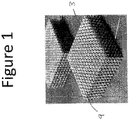
- a metal lattice structure 3 has been produced by selective laser melting (SLM).
- SLM selective laser melting
- the metal lattice structure 3 is a multi-layered mesh structure made from a Titanium alloy.
- the metal lattice structure 3 comprises interstitial spaces 9 into which a powder can be infiltrated.
- a composite reactive material 11 is formed from a metal lattice structure 13 and a powder 15 infiltrated into the interstitial spaces 19 and consolidated.
- the powder 15 comprises titanium powder and PTFE powder and has been cold isostatic pressed.
- the metal lattice structure 13 is made from a titanium alloy.
- a composite reactive material 21 is formed from a metal lattice structure 23 and a powder 25 infiltrated into the interstitial spaces 29 and consolidated.
- the powder 25 comprises titanium powder and PTFE powder and has been hot isostatic pressed at 150MPa and 340°C.
- the metal lattice structure 23 is made from titanium.
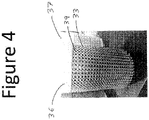
- a metal lattice structure 33 in the form of a warhead casing 37 has been produced by SLM.
- the metal lattice structure 33 is a multi-layered mesh structure made from a titanium alloy.
- the metal lattice structure 33 comprises interstitial spaces 39 into which a powder can be infiltrated.
- the metal lattice structure 33 has a porosity of 75% by volume with a mesh size of 4 mm.
- the warhead casing 37 has a dense metal top 36 to provide dimensional stability.
- a lattice 41 is formed from a metal powder 42 by SLM 43.
- a metal powder 44 and a fluoropolymer powder 45 are mixed, blended and milled 46 and infiltrated into the lattice 41 using hot or cold isostatic pressing 47.
- the resulting composite is finished by machining 48 to produce a warhead component 49.
- the metal lattice structure may have a porosity of 50% by volume with a mesh size of 3 mm or a porosity of 25% by volume with a mesh size of 2 mm.
- integers or features of the invention that are described as preferable, advantageous, convenient or the like are optional and do not limit the scope of the independent claims.
- such optional integers or features whilst of possible benefit in some embodiments of the invention, may be absent in other embodiments.
Landscapes
- Engineering & Computer Science (AREA)
- Chemical & Material Sciences (AREA)
- Combustion & Propulsion (AREA)
- General Engineering & Computer Science (AREA)
- Organic Chemistry (AREA)
- Physics & Mathematics (AREA)
- Thermal Sciences (AREA)
- Crystallography & Structural Chemistry (AREA)
- Dispersion Chemistry (AREA)
- Molecular Biology (AREA)
- Life Sciences & Earth Sciences (AREA)
- Health & Medical Sciences (AREA)
- Materials Engineering (AREA)
- Metallurgy (AREA)
- Powder Metallurgy (AREA)
- Compositions Of Macromolecular Compounds (AREA)
Claims (15)
- Reaktives Verbundmaterial (11, 21) zur Verwendung in einer Munition, wobei das reaktive Verbundmaterial eine Metallgitterstruktur (3, 13, 23, 33, 41) umfasst, die Zwischenräume (9, 19, 29, 39) und ein Pulver (15, 25, 44, 45) in den Zwischenräumen (9, 19, 29, 39) aufweist,
dadurch gekennzeichnet, dass die Metallgitterstruktur (3, 13, 23, 33, 41) ein mehrschichtiges Netzgerüst bereitstellt, das Schenkel aufweist, die eine Dicke von weniger als 500 Mikrometer aufweisen, wobei das Netz mehrere miteinander verbundene Zwischenräume (9, 19, 29, 39) bereitstellt, die eine Breite aufweisen, die größer als das Zweifache der Pulvergröße ist, und wobei sich das Pulver (15, 25, 44, 45) in den Zwischenräumen (9, 19, 29, 39) verfestigt, wobei das Pulver (15, 25, 44, 45) wenigstens ein Metallpulver und/oder wenigstens ein halogenhaltiges Polymerpulver umfasst. - Reaktives Verbundmaterial (11, 21) nach Anspruch 1, wobei die Metallgitterstruktur (3, 13, 23, 33, 41) aus Titan, Aluminium, Zirkonium, Hafnium, Tantal, Molybdän, Wolfram, Eisen oder Legierungen davon gefertigt ist.
- Reaktives Verbundmaterial (11, 21) nach Anspruch 1 oder 2, wobei die Porosität der Metallgitterstruktur (3, 13, 23, 33, 41) in dem Bereich von 15-85 Vol.-% liegt.
- Reaktives Verbundmaterial (11, 21) nach einem der vorhergehenden Ansprüche, wobei die Netzgröße der Metallgitterstruktur (3, 13, 23, 33, 41) in dem Bereich von 0,5-5 mm liegt.
- Reaktives Verbundmaterial (11, 21) nach einem der vorhergehenden Ansprüche, wobei das Metallpulver Titan, Aluminium, Zirkonium, Hafnium, Tantal, Molybdän, Wolfram, Eisen und/oder Legierungen davon umfasst.
- Reaktives Verbundmaterial (11, 21) nach einem der vorhergehenden Ansprüche, wobei das halogenhaltige Polymer ein Fluorpolymer ist.
- Reaktives Verbundmaterial (11, 21) nach Anspruch 6, wobei das Fluorpolymer PFA, PTFE und/oder THV umfasst.
- Reaktives Verbundmaterial (11, 21) nach einem der vorhergehenden Ansprüche, wobei das Pulver (15, 25, 44, 45) wenigstens ein Metallpulver und wenigstens ein halogenhaltiges Polymerpulver umfasst.
- Reaktives Verbundmaterial (11, 21) nach Anspruch 8, wobei das Pulver (15, 25, 44, 45) von 40 Gew.-% bis 60 Gew.-% Metallpulver umfasst, wobei die restlichen 60 Gew.-% bis 40 Gew.-% halogenhaltiges Polymerpulver sind.
- Reaktives Verbundmaterial (11, 21) nach entweder Anspruch 8 oder 9, wobei das Pulver (15, 25, 44, 45) zwei Metallpulver und zwei halogenhaltige Polymerpulver umfasst.
- Reaktives Verbundmaterial (11, 21) nach einem der vorhergehenden Ansprüche, wobei die Porosität des reaktiven Verbundmaterials 0 bis 20 % beträgt.
- Verfahren zum Herstellen eines reaktiven Verbundmaterials (11, 21) nach einem der vorhergehenden Ansprüche zur Verwendung in einer Munition, dadurch gekennzeichnet, dass das Verfahren Folgendes umfasst:a. Verwenden von selektivem Laserschmelzen, um die Metallgitterstruktur (3, 13, 23, 33, 41) zu erzeugenb. Infiltrieren eines Pulvers (15, 25, 44, 45), das wenigstens ein Metallpulver oder wenigstens ein halogenhaltiges Polymerpulver umfasst, in die Zwischenräume (9, 19, 29, 39); undc. Verfestigenlassen des Pulvers (15, 25, 44, 45) in den Zwischenräumen (9, 19, 29, 39).
- Verfahren nach Anspruch 12, wobei isostatisches Kaltpressen oder isostatisches Heißpressen verwendet wird, um das Infiltrieren des Pulvers (15, 25, 44, 45) in die Zwischenräume (9, 19, 29, 39) zu unterstützen.
- Verfahren nach Anspruch 12 oder 13, wobei isostatisches Kaltpressen oder isostatisches Heißpressen verwendet wird, um das Pulvers (15, 25, 44, 45) in den Zwischenräumen (9, 19, 29, 39) verfestigen zu lassen.
- Munition, die ein reaktives Verbundmaterial (11, 21) nach einem der Ansprüche 1 bis 11 oder ein reaktives Verbundmaterial (11, 21) umfasst, das nach einem Verfahren nach einem der Ansprüche 12 bis 13 produziert wird.
Applications Claiming Priority (2)
| Application Number | Priority Date | Filing Date | Title |
|---|---|---|---|
| GB1407775.4A GB2526262B (en) | 2014-05-02 | 2014-05-02 | Composite reactive material for use in a munition |
| PCT/GB2015/051275 WO2015166261A1 (en) | 2014-05-02 | 2015-05-01 | Composite reactive material for use in a munition |
Publications (2)
| Publication Number | Publication Date |
|---|---|
| EP3137439A1 EP3137439A1 (de) | 2017-03-08 |
| EP3137439B1 true EP3137439B1 (de) | 2022-04-13 |
Family
ID=52013031
Family Applications (1)
| Application Number | Title | Priority Date | Filing Date |
|---|---|---|---|
| EP15721797.7A Active EP3137439B1 (de) | 2014-05-02 | 2015-05-01 | Verbundreaktivmaterial zur verwendung in einer munition |
Country Status (6)
| Country | Link |
|---|---|
| US (1) | US10584075B2 (de) |
| EP (1) | EP3137439B1 (de) |
| AU (1) | AU2015255003B9 (de) |
| ES (1) | ES2913065T3 (de) |
| GB (1) | GB2526262B (de) |
| WO (1) | WO2015166261A1 (de) |
Families Citing this family (9)
| Publication number | Priority date | Publication date | Assignee | Title |
|---|---|---|---|---|
| US11041704B1 (en) * | 2017-07-25 | 2021-06-22 | The United States Of America As Represented By The Secretary Of The Army | Method of manufacturing composite projectile body embedded with preformed fragments |
| CN108038293A (zh) * | 2017-12-06 | 2018-05-15 | 首都航天机械公司 | 一种轻质多功能点阵结构及其激光增材制造方法 |
| US10712137B1 (en) * | 2019-04-26 | 2020-07-14 | The United States Of America As Represented By The Secretary Of The Army | Method for making a composite fragmentation cap that is integrally formed onto a projectile body |
| SE544578C2 (sv) * | 2020-02-28 | 2022-07-26 | Bae Systems Bofors Ab | Metod för framställning av en komponent för en stridsdel |
| DE102020113411A1 (de) | 2020-05-18 | 2021-11-18 | Rheinmetall Waffe Munition Gmbh | Vorrichtung eines wehrtechnischen Effektors |
| IT202000021898A1 (it) | 2020-09-17 | 2022-03-17 | Mbda italia spa | Metodo per produrre un materiale reattivo composito |
| EP4163584B1 (de) | 2021-10-05 | 2024-12-04 | TDW Gesellschaft für verteidigungstechnische Wirksysteme mbH | Verfahren zur nachbearbeitung einer basiskomponente und bauteil mit einer derart nachbearbeiteten basiskomponente |
| DE102022003489A1 (de) * | 2022-09-22 | 2024-03-28 | Diehl Defence Gmbh & Co. Kg | PELE-Geschoss mit Reaktivmaterial |
| CN117207516A (zh) * | 2023-09-12 | 2023-12-12 | 中国工程物理研究院材料研究所 | 一种复合型反应结构材料及其制备方法和应用 |
Family Cites Families (15)
| Publication number | Priority date | Publication date | Assignee | Title |
|---|---|---|---|---|
| US3811358A (en) * | 1961-10-10 | 1974-05-21 | Rockwell International Corp | Solid propellants containing reinforcing filament and process of making |
| US3830673A (en) * | 1973-02-02 | 1974-08-20 | G Simmons | Preparing oxidizer coated metal fuel particles |
| US4815386A (en) * | 1984-07-17 | 1989-03-28 | Alloy Surfaces Company, Inc. | Pyrophoric material with metal skeleton |
| FR2584393B3 (fr) * | 1985-07-05 | 1987-11-06 | Alsetex | Procede de fabrication d'explosifs en couche mince, explosif ainsi obtenu, et moule pour sa fabrication |
| US5062365A (en) * | 1986-08-18 | 1991-11-05 | Thiokol Corporation | Rapid burning propellent charge for automobile air bag inflators, rocket motors, and igniters therefor |
| CN1059400A (zh) * | 1991-05-03 | 1992-03-11 | 浏阳县沿溪鞭炮烟花公司花炮厂 | 无烟烟花及制造方法 |
| US6962634B2 (en) | 2002-03-28 | 2005-11-08 | Alliant Techsystems Inc. | Low temperature, extrudable, high density reactive materials |
| US6593410B2 (en) | 2000-02-23 | 2003-07-15 | Alliant Techsystems Inc. | High strength reactive materials |
| US20050067072A1 (en) * | 2003-09-09 | 2005-03-31 | Government Of The United States Of America. | Reinforced reactive material |
| US7093542B2 (en) * | 2004-04-22 | 2006-08-22 | Lockheed Martin Corporation | Warhead with integral, direct-manufactured features |
| US7383775B1 (en) * | 2005-09-06 | 2008-06-10 | The United States Of America As Represented By The Secretary Of The Navy | Reactive munition in a three-dimensionally rigid state |
| US7972453B2 (en) * | 2006-06-13 | 2011-07-05 | Lockheed Martin Corporation | Enhanced blast explosive |
| DE602007013788D1 (de) * | 2007-12-18 | 2011-05-19 | Saab Ab | Verbessertes Gehäuse für einen Gefechtskopf |
| GB0806855D0 (en) * | 2008-04-16 | 2008-05-14 | Secr Defence | Pyrophoric material |
| CH705662A1 (de) | 2011-11-04 | 2013-05-15 | Alstom Technology Ltd | Prozess zur Herstellung von Gegenständen aus einer durch Gamma-Prime-Ausscheidung verfestigten Superlegierung auf Nickelbasis durch selektives Laserschmelzen (SLM). |
-
2014
- 2014-05-02 GB GB1407775.4A patent/GB2526262B/en active Active
-
2015
- 2015-05-01 WO PCT/GB2015/051275 patent/WO2015166261A1/en not_active Ceased
- 2015-05-01 AU AU2015255003A patent/AU2015255003B9/en active Active
- 2015-05-01 ES ES15721797T patent/ES2913065T3/es active Active
- 2015-05-01 US US15/308,483 patent/US10584075B2/en active Active
- 2015-05-01 EP EP15721797.7A patent/EP3137439B1/de active Active
Also Published As
| Publication number | Publication date |
|---|---|
| US10584075B2 (en) | 2020-03-10 |
| ES2913065T3 (es) | 2022-05-31 |
| US20170073281A1 (en) | 2017-03-16 |
| EP3137439A1 (de) | 2017-03-08 |
| GB201407775D0 (en) | 2014-12-03 |
| AU2015255003B2 (en) | 2019-12-12 |
| AU2015255003B9 (en) | 2020-01-02 |
| GB2526262B (en) | 2021-04-28 |
| AU2015255003A1 (en) | 2016-11-24 |
| GB2526262A (en) | 2015-11-25 |
| WO2015166261A1 (en) | 2015-11-05 |
| AU2015255003A8 (en) | 2016-12-08 |
Similar Documents
| Publication | Publication Date | Title |
|---|---|---|
| US10584075B2 (en) | Composite reactive material for use in a munition | |
| CN105377479B (zh) | 玻璃-金属复合材料和制造方法 | |
| US11491538B2 (en) | Multifunctional high strength metal composite materials | |
| US7845282B2 (en) | Selectable effect warhead | |
| US8468947B2 (en) | Frangible, ceramic-metal composite objects and methods of making the same | |
| CA2786331C (en) | Frangible, ceramic-metal composite objects and methods of making the same | |
| US20070277914A1 (en) | Metal matrix composite energetic structures | |
| US20110064600A1 (en) | Co-sintered multi-system tungsten alloy composite | |
| JP6348963B2 (ja) | 破片/反応物質アセンブリの製造 | |
| CN106854718A (zh) | 含能结构材料及其制备方法和应用 | |
| US20200025540A1 (en) | High strength munitions structures with inherent chemical energy | |
| EP3250539A1 (de) | Reaktive materialien | |
| US10557695B2 (en) | Composite material having an internal skeleton structure | |
| US20090151591A1 (en) | Warhead casing | |
| Peiris et al. | Applications of reactive materials in munitions | |
| EP2947164A1 (de) | Zusammensetzung für ein reaktives material | |
| KR101742495B1 (ko) | 강화 텅스텐 중합금 복합재료 | |
| JP2015178676A (ja) | Ni3Al基Ti−Ni−Al系金属間化合物及びその製造方法 | |
| JP5176197B2 (ja) | アルミニウム液体を利用した硬質材料の作製方法及びその成形体 | |
| Yang et al. | Electron beam technology | |
| Chen et al. | A High-Plasticity Mo-Ce-Cu Impact-Induced Energy-Releasing Structural Material Prepared via Powder Metallurgy | |
| JP5896394B2 (ja) | 複合構造の硬質材料およびその作製方法 | |
| DOMASCHIO et al. | THERMITE-FOR-DEMISE (T4D): MANUFACTURING AND CHARACTERIZATION OF SINTERED THERMITE PELLETS | |
| Froes | Advances in powder metallurgy: 8. Powder metallurgy of titanium alloys |
Legal Events
| Date | Code | Title | Description |
|---|---|---|---|
| STAA | Information on the status of an ep patent application or granted ep patent |
Free format text: STATUS: THE INTERNATIONAL PUBLICATION HAS BEEN MADE |
|
| PUAI | Public reference made under article 153(3) epc to a published international application that has entered the european phase |
Free format text: ORIGINAL CODE: 0009012 |
|
| STAA | Information on the status of an ep patent application or granted ep patent |
Free format text: STATUS: REQUEST FOR EXAMINATION WAS MADE |
|
| 17P | Request for examination filed |
Effective date: 20161125 |
|
| AK | Designated contracting states |
Kind code of ref document: A1 Designated state(s): AL AT BE BG CH CY CZ DE DK EE ES FI FR GB GR HR HU IE IS IT LI LT LU LV MC MK MT NL NO PL PT RO RS SE SI SK SM TR |
|
| AX | Request for extension of the european patent |
Extension state: BA ME |
|
| DAV | Request for validation of the european patent (deleted) | ||
| DAX | Request for extension of the european patent (deleted) | ||
| STAA | Information on the status of an ep patent application or granted ep patent |
Free format text: STATUS: EXAMINATION IS IN PROGRESS |
|
| 17Q | First examination report despatched |
Effective date: 20190412 |
|
| RIC1 | Information provided on ipc code assigned before grant |
Ipc: C06B 45/04 20060101ALI20210901BHEP Ipc: F42B 12/74 20060101ALI20210901BHEP Ipc: F42B 12/44 20060101ALI20210901BHEP Ipc: F42B 12/36 20060101ALI20210901BHEP Ipc: F42B 12/32 20060101ALI20210901BHEP Ipc: F42B 12/22 20060101ALI20210901BHEP Ipc: F42B 12/20 20060101ALI20210901BHEP Ipc: C06B 27/00 20060101AFI20210901BHEP |
|
| GRAP | Despatch of communication of intention to grant a patent |
Free format text: ORIGINAL CODE: EPIDOSNIGR1 |
|
| STAA | Information on the status of an ep patent application or granted ep patent |
Free format text: STATUS: GRANT OF PATENT IS INTENDED |
|
| INTG | Intention to grant announced |
Effective date: 20211115 |
|
| GRAS | Grant fee paid |
Free format text: ORIGINAL CODE: EPIDOSNIGR3 |
|
| GRAA | (expected) grant |
Free format text: ORIGINAL CODE: 0009210 |
|
| STAA | Information on the status of an ep patent application or granted ep patent |
Free format text: STATUS: THE PATENT HAS BEEN GRANTED |
|
| AK | Designated contracting states |
Kind code of ref document: B1 Designated state(s): AL AT BE BG CH CY CZ DE DK EE ES FI FR GB GR HR HU IE IS IT LI LT LU LV MC MK MT NL NO PL PT RO RS SE SI SK SM TR |
|
| REG | Reference to a national code |
Ref country code: GB Ref legal event code: FG4D |
|
| REG | Reference to a national code |
Ref country code: CH Ref legal event code: EP |
|
| REG | Reference to a national code |
Ref country code: DE Ref legal event code: R096 Ref document number: 602015078194 Country of ref document: DE |
|
| REG | Reference to a national code |
Ref country code: IE Ref legal event code: FG4D |
|
| REG | Reference to a national code |
Ref country code: AT Ref legal event code: REF Ref document number: 1483315 Country of ref document: AT Kind code of ref document: T Effective date: 20220515 |
|
| REG | Reference to a national code |
Ref country code: SE Ref legal event code: TRGR |
|
| REG | Reference to a national code |
Ref country code: ES Ref legal event code: FG2A Ref document number: 2913065 Country of ref document: ES Kind code of ref document: T3 Effective date: 20220531 |
|
| REG | Reference to a national code |
Ref country code: NO Ref legal event code: T2 Effective date: 20220413 |
|
| REG | Reference to a national code |
Ref country code: LT Ref legal event code: MG9D |
|
| REG | Reference to a national code |
Ref country code: NL Ref legal event code: MP Effective date: 20220413 |
|
| REG | Reference to a national code |
Ref country code: AT Ref legal event code: MK05 Ref document number: 1483315 Country of ref document: AT Kind code of ref document: T Effective date: 20220413 |
|
| PG25 | Lapsed in a contracting state [announced via postgrant information from national office to epo] |
Ref country code: NL Free format text: LAPSE BECAUSE OF FAILURE TO SUBMIT A TRANSLATION OF THE DESCRIPTION OR TO PAY THE FEE WITHIN THE PRESCRIBED TIME-LIMIT Effective date: 20220413 |
|
| PG25 | Lapsed in a contracting state [announced via postgrant information from national office to epo] |
Ref country code: PT Free format text: LAPSE BECAUSE OF FAILURE TO SUBMIT A TRANSLATION OF THE DESCRIPTION OR TO PAY THE FEE WITHIN THE PRESCRIBED TIME-LIMIT Effective date: 20220816 Ref country code: LT Free format text: LAPSE BECAUSE OF FAILURE TO SUBMIT A TRANSLATION OF THE DESCRIPTION OR TO PAY THE FEE WITHIN THE PRESCRIBED TIME-LIMIT Effective date: 20220413 Ref country code: HR Free format text: LAPSE BECAUSE OF FAILURE TO SUBMIT A TRANSLATION OF THE DESCRIPTION OR TO PAY THE FEE WITHIN THE PRESCRIBED TIME-LIMIT Effective date: 20220413 Ref country code: GR Free format text: LAPSE BECAUSE OF FAILURE TO SUBMIT A TRANSLATION OF THE DESCRIPTION OR TO PAY THE FEE WITHIN THE PRESCRIBED TIME-LIMIT Effective date: 20220714 Ref country code: FI Free format text: LAPSE BECAUSE OF FAILURE TO SUBMIT A TRANSLATION OF THE DESCRIPTION OR TO PAY THE FEE WITHIN THE PRESCRIBED TIME-LIMIT Effective date: 20220413 Ref country code: BG Free format text: LAPSE BECAUSE OF FAILURE TO SUBMIT A TRANSLATION OF THE DESCRIPTION OR TO PAY THE FEE WITHIN THE PRESCRIBED TIME-LIMIT Effective date: 20220713 Ref country code: AT Free format text: LAPSE BECAUSE OF FAILURE TO SUBMIT A TRANSLATION OF THE DESCRIPTION OR TO PAY THE FEE WITHIN THE PRESCRIBED TIME-LIMIT Effective date: 20220413 |
|
| PG25 | Lapsed in a contracting state [announced via postgrant information from national office to epo] |
Ref country code: RS Free format text: LAPSE BECAUSE OF FAILURE TO SUBMIT A TRANSLATION OF THE DESCRIPTION OR TO PAY THE FEE WITHIN THE PRESCRIBED TIME-LIMIT Effective date: 20220413 Ref country code: PL Free format text: LAPSE BECAUSE OF FAILURE TO SUBMIT A TRANSLATION OF THE DESCRIPTION OR TO PAY THE FEE WITHIN THE PRESCRIBED TIME-LIMIT Effective date: 20220413 Ref country code: LV Free format text: LAPSE BECAUSE OF FAILURE TO SUBMIT A TRANSLATION OF THE DESCRIPTION OR TO PAY THE FEE WITHIN THE PRESCRIBED TIME-LIMIT Effective date: 20220413 Ref country code: IS Free format text: LAPSE BECAUSE OF FAILURE TO SUBMIT A TRANSLATION OF THE DESCRIPTION OR TO PAY THE FEE WITHIN THE PRESCRIBED TIME-LIMIT Effective date: 20220813 |
|
| REG | Reference to a national code |
Ref country code: DE Ref legal event code: R097 Ref document number: 602015078194 Country of ref document: DE |
|
| REG | Reference to a national code |
Ref country code: BE Ref legal event code: MM Effective date: 20220531 |
|
| PG25 | Lapsed in a contracting state [announced via postgrant information from national office to epo] |
Ref country code: SM Free format text: LAPSE BECAUSE OF FAILURE TO SUBMIT A TRANSLATION OF THE DESCRIPTION OR TO PAY THE FEE WITHIN THE PRESCRIBED TIME-LIMIT Effective date: 20220413 Ref country code: SK Free format text: LAPSE BECAUSE OF FAILURE TO SUBMIT A TRANSLATION OF THE DESCRIPTION OR TO PAY THE FEE WITHIN THE PRESCRIBED TIME-LIMIT Effective date: 20220413 Ref country code: RO Free format text: LAPSE BECAUSE OF FAILURE TO SUBMIT A TRANSLATION OF THE DESCRIPTION OR TO PAY THE FEE WITHIN THE PRESCRIBED TIME-LIMIT Effective date: 20220413 Ref country code: MC Free format text: LAPSE BECAUSE OF FAILURE TO SUBMIT A TRANSLATION OF THE DESCRIPTION OR TO PAY THE FEE WITHIN THE PRESCRIBED TIME-LIMIT Effective date: 20220413 Ref country code: LU Free format text: LAPSE BECAUSE OF NON-PAYMENT OF DUE FEES Effective date: 20220501 Ref country code: EE Free format text: LAPSE BECAUSE OF FAILURE TO SUBMIT A TRANSLATION OF THE DESCRIPTION OR TO PAY THE FEE WITHIN THE PRESCRIBED TIME-LIMIT Effective date: 20220413 Ref country code: DK Free format text: LAPSE BECAUSE OF FAILURE TO SUBMIT A TRANSLATION OF THE DESCRIPTION OR TO PAY THE FEE WITHIN THE PRESCRIBED TIME-LIMIT Effective date: 20220413 Ref country code: CZ Free format text: LAPSE BECAUSE OF FAILURE TO SUBMIT A TRANSLATION OF THE DESCRIPTION OR TO PAY THE FEE WITHIN THE PRESCRIBED TIME-LIMIT Effective date: 20220413 |
|
| PLBE | No opposition filed within time limit |
Free format text: ORIGINAL CODE: 0009261 |
|
| STAA | Information on the status of an ep patent application or granted ep patent |
Free format text: STATUS: NO OPPOSITION FILED WITHIN TIME LIMIT |
|
| 26N | No opposition filed |
Effective date: 20230116 |
|
| PG25 | Lapsed in a contracting state [announced via postgrant information from national office to epo] |
Ref country code: AL Free format text: LAPSE BECAUSE OF FAILURE TO SUBMIT A TRANSLATION OF THE DESCRIPTION OR TO PAY THE FEE WITHIN THE PRESCRIBED TIME-LIMIT Effective date: 20220413 |
|
| PG25 | Lapsed in a contracting state [announced via postgrant information from national office to epo] |
Ref country code: IE Free format text: LAPSE BECAUSE OF NON-PAYMENT OF DUE FEES Effective date: 20220501 |
|
| PG25 | Lapsed in a contracting state [announced via postgrant information from national office to epo] |
Ref country code: SI Free format text: LAPSE BECAUSE OF FAILURE TO SUBMIT A TRANSLATION OF THE DESCRIPTION OR TO PAY THE FEE WITHIN THE PRESCRIBED TIME-LIMIT Effective date: 20220413 Ref country code: BE Free format text: LAPSE BECAUSE OF NON-PAYMENT OF DUE FEES Effective date: 20220531 |
|
| PG25 | Lapsed in a contracting state [announced via postgrant information from national office to epo] |
Ref country code: HU Free format text: LAPSE BECAUSE OF FAILURE TO SUBMIT A TRANSLATION OF THE DESCRIPTION OR TO PAY THE FEE WITHIN THE PRESCRIBED TIME-LIMIT; INVALID AB INITIO Effective date: 20150501 |
|
| PG25 | Lapsed in a contracting state [announced via postgrant information from national office to epo] |
Ref country code: MK Free format text: LAPSE BECAUSE OF FAILURE TO SUBMIT A TRANSLATION OF THE DESCRIPTION OR TO PAY THE FEE WITHIN THE PRESCRIBED TIME-LIMIT Effective date: 20220413 Ref country code: CY Free format text: LAPSE BECAUSE OF FAILURE TO SUBMIT A TRANSLATION OF THE DESCRIPTION OR TO PAY THE FEE WITHIN THE PRESCRIBED TIME-LIMIT Effective date: 20220413 |
|
| PG25 | Lapsed in a contracting state [announced via postgrant information from national office to epo] |
Ref country code: TR Free format text: LAPSE BECAUSE OF FAILURE TO SUBMIT A TRANSLATION OF THE DESCRIPTION OR TO PAY THE FEE WITHIN THE PRESCRIBED TIME-LIMIT Effective date: 20220413 |
|
| PG25 | Lapsed in a contracting state [announced via postgrant information from national office to epo] |
Ref country code: MT Free format text: LAPSE BECAUSE OF FAILURE TO SUBMIT A TRANSLATION OF THE DESCRIPTION OR TO PAY THE FEE WITHIN THE PRESCRIBED TIME-LIMIT Effective date: 20220413 |
|
| PG25 | Lapsed in a contracting state [announced via postgrant information from national office to epo] |
Ref country code: BG Free format text: LAPSE BECAUSE OF FAILURE TO SUBMIT A TRANSLATION OF THE DESCRIPTION OR TO PAY THE FEE WITHIN THE PRESCRIBED TIME-LIMIT Effective date: 20220413 |
|
| PG25 | Lapsed in a contracting state [announced via postgrant information from national office to epo] |
Ref country code: BG Free format text: LAPSE BECAUSE OF FAILURE TO SUBMIT A TRANSLATION OF THE DESCRIPTION OR TO PAY THE FEE WITHIN THE PRESCRIBED TIME-LIMIT Effective date: 20220413 |
|
| PGFP | Annual fee paid to national office [announced via postgrant information from national office to epo] |
Ref country code: DE Payment date: 20250423 Year of fee payment: 11 |
|
| PGFP | Annual fee paid to national office [announced via postgrant information from national office to epo] |
Ref country code: ES Payment date: 20250602 Year of fee payment: 11 |
|
| PGFP | Annual fee paid to national office [announced via postgrant information from national office to epo] |
Ref country code: NO Payment date: 20250424 Year of fee payment: 11 |
|
| PGFP | Annual fee paid to national office [announced via postgrant information from national office to epo] |
Ref country code: IT Payment date: 20250423 Year of fee payment: 11 |
|
| PGFP | Annual fee paid to national office [announced via postgrant information from national office to epo] |
Ref country code: FR Payment date: 20250423 Year of fee payment: 11 |
|
| PGFP | Annual fee paid to national office [announced via postgrant information from national office to epo] |
Ref country code: CH Payment date: 20250601 Year of fee payment: 11 |
|
| PGFP | Annual fee paid to national office [announced via postgrant information from national office to epo] |
Ref country code: SE Payment date: 20250423 Year of fee payment: 11 |
|
| PGFP | Annual fee paid to national office [announced via postgrant information from national office to epo] |
Ref country code: GB Payment date: 20260312 Year of fee payment: 12 |