EP3133189A1 - Verfahren zur herstellung von unsymmetrischen oco-pincerliganden aus der gruppe der m-terphenylverbindungen - Google Patents
Verfahren zur herstellung von unsymmetrischen oco-pincerliganden aus der gruppe der m-terphenylverbindungen Download PDFInfo
- Publication number
- EP3133189A1 EP3133189A1 EP16182787.8A EP16182787A EP3133189A1 EP 3133189 A1 EP3133189 A1 EP 3133189A1 EP 16182787 A EP16182787 A EP 16182787A EP 3133189 A1 EP3133189 A1 EP 3133189A1
- Authority
- EP
- European Patent Office
- Prior art keywords
- alkyl
- phenol
- substituted
- group
- arene
- Prior art date
- Legal status (The legal status is an assumption and is not a legal conclusion. Google has not performed a legal analysis and makes no representation as to the accuracy of the status listed.)
- Withdrawn
Links
- 0 *c(cc1*)cc(*)c1O* Chemical compound *c(cc1*)cc(*)c1O* 0.000 description 2
Images


Classifications
-
- C—CHEMISTRY; METALLURGY
- C07—ORGANIC CHEMISTRY
- C07C—ACYCLIC OR CARBOCYCLIC COMPOUNDS
- C07C43/00—Ethers; Compounds having groups, groups or groups
- C07C43/02—Ethers
- C07C43/20—Ethers having an ether-oxygen atom bound to a carbon atom of a six-membered aromatic ring
- C07C43/23—Ethers having an ether-oxygen atom bound to a carbon atom of a six-membered aromatic ring containing hydroxy or O-metal groups
-
- C—CHEMISTRY; METALLURGY
- C07—ORGANIC CHEMISTRY
- C07C—ACYCLIC OR CARBOCYCLIC COMPOUNDS
- C07C41/00—Preparation of ethers; Preparation of compounds having groups, groups or groups
- C07C41/01—Preparation of ethers
- C07C41/18—Preparation of ethers by reactions not forming ether-oxygen bonds
- C07C41/30—Preparation of ethers by reactions not forming ether-oxygen bonds by increasing the number of carbon atoms, e.g. by oligomerisation
-
- B—PERFORMING OPERATIONS; TRANSPORTING
- B01—PHYSICAL OR CHEMICAL PROCESSES OR APPARATUS IN GENERAL
- B01J—CHEMICAL OR PHYSICAL PROCESSES, e.g. CATALYSIS OR COLLOID CHEMISTRY; THEIR RELEVANT APPARATUS
- B01J31/00—Catalysts comprising hydrides, coordination complexes or organic compounds
- B01J31/02—Catalysts comprising hydrides, coordination complexes or organic compounds containing organic compounds or metal hydrides
- B01J31/0201—Oxygen-containing compounds
- B01J31/0204—Ethers
-
- C—CHEMISTRY; METALLURGY
- C25—ELECTROLYTIC OR ELECTROPHORETIC PROCESSES; APPARATUS THEREFOR
- C25B—ELECTROLYTIC OR ELECTROPHORETIC PROCESSES FOR THE PRODUCTION OF COMPOUNDS OR NON-METALS; APPARATUS THEREFOR
- C25B3/00—Electrolytic production of organic compounds
- C25B3/01—Products
- C25B3/07—Oxygen containing compounds
-
- C—CHEMISTRY; METALLURGY
- C25—ELECTROLYTIC OR ELECTROPHORETIC PROCESSES; APPARATUS THEREFOR
- C25B—ELECTROLYTIC OR ELECTROPHORETIC PROCESSES FOR THE PRODUCTION OF COMPOUNDS OR NON-METALS; APPARATUS THEREFOR
- C25B3/00—Electrolytic production of organic compounds
- C25B3/01—Products
- C25B3/11—Halogen containing compounds
-
- C—CHEMISTRY; METALLURGY
- C25—ELECTROLYTIC OR ELECTROPHORETIC PROCESSES; APPARATUS THEREFOR
- C25B—ELECTROLYTIC OR ELECTROPHORETIC PROCESSES FOR THE PRODUCTION OF COMPOUNDS OR NON-METALS; APPARATUS THEREFOR
- C25B3/00—Electrolytic production of organic compounds
- C25B3/20—Processes
- C25B3/29—Coupling reactions
-
- Y—GENERAL TAGGING OF NEW TECHNOLOGICAL DEVELOPMENTS; GENERAL TAGGING OF CROSS-SECTIONAL TECHNOLOGIES SPANNING OVER SEVERAL SECTIONS OF THE IPC; TECHNICAL SUBJECTS COVERED BY FORMER USPC CROSS-REFERENCE ART COLLECTIONS [XRACs] AND DIGESTS
- Y02—TECHNOLOGIES OR APPLICATIONS FOR MITIGATION OR ADAPTATION AGAINST CLIMATE CHANGE
- Y02P—CLIMATE CHANGE MITIGATION TECHNOLOGIES IN THE PRODUCTION OR PROCESSING OF GOODS
- Y02P20/00—Technologies relating to chemical industry
- Y02P20/50—Improvements relating to the production of bulk chemicals
- Y02P20/55—Design of synthesis routes, e.g. reducing the use of auxiliary or protecting groups
Definitions
- the present invention relates to a process for the preparation of unsymmetrical compounds from the group of m-terphenyls (hereinafter optionally also called m-terphenyl or unsymmetrical OCO-Pincerliganden) comprising the process steps a) reacting a first substituted or unsubstituted phenol with a 1,3-disubstituted Arene which may also be substituted in 2 and 5 positions to give a phenol-arene coupling product; b) optionally protecting the OH group of the phenol-arene coupling product with a protecting group to give a protected phenol-arene coupling product; and c ) Reacting the phenol-arene coupling product of a) or b) with a second substituted or unsubstituted phenol to give an unsymmetrical m-terphenyl, with the proviso that the first phenol and the second phenol are substituted differently, characterized that at least one of the method steps a) or
- m-terphenylene usually 1,3-diphenylbenzenes be referred to.
- compounds from the group of m-terphenyls contain a 1,3-diphenylbenzylite structure.
- unsymmetrical OCO-pincer ligands are understood as meaning compounds which have a 1,3-diphenylbenzene unit, the two outer rings being not arenes but phenols.
- the OH groups of the two phenolic units are each substituted ortho to the arene component.
- unsymmetrical OCO pinene ligands are understood as meaning compounds in which the two phenols differ structurally, ie are different.
- the arene components interposed between the two different phenolic components need not necessarily be symmetrical, i. it is not necessary to place one side of the arena on the other side, if one places a mirror plane in the arene molecule.
- R 9 is defined as a substituent on C atom 1 of the benzene ring, R 10 as a substituent on C atom 2, R 11 as a substituent on C atom 3, R 12 as a substituent on C atom 5.
- substituted phenols are understood as meaning those in which the hydrogen atoms have been substituted on one or more ring carbon atoms.
- a major disadvantage of the known methods of cross-coupling phenolic derivatives with arenes is the need for dry solvents and exclusion of air during the coupling reaction.
- protection of the hydroxy functionality is necessary in most cases.
- leaving functionalities are introduced into the substrates used, which are generated after the actual coupling reaction as environmentally problematic reaction waste (see Scheme 1).
- the tolerance of functional groups is often limited by the reagents used, so that in particular less substituted derivatives can be used.
- toxic by-products such as bromine compounds
- the reaction must be made over many stages, which is also very unfavorable. Dwindling resources make the preparation of ligand systems by palladium-catalyzed cross-coupling or chemical oxidants very expensive.
- the object of the present invention was therefore to provide a simple process for the preparation of unsymmetrical OCO-Pincerliganden from the group of m-terphenyl, which avoids one or more disadvantages of the prior art.
- this object can be achieved by carrying out at least one of the process steps as an electrochemical process step in a process which comprises two process steps of the reaction.
- the present invention is the use of the compounds of the invention as a ligand for the preparation of metal-ligand catalyst systems.
- the inventive method has the advantage that the partial or complete implementation by means of electrochemical process steps, the production of unsymmetrical m-terphenyl compounds is substantially simplified, since a moisture exclusion or compliance with anaerobic reaction conditions need not be guaranteed. Among other things, this leads to less effort in carrying out the method.
- electrochemical cross-coupling eliminates the use of expensive and toxic catalysts, such as the introduction of activating leaving functionalities before the phenol-arene coupling reaction (inventive step a)).
- the method allows for the first time the direct synthesis of asymmetric compounds with low synthetic effort and high tolerance of functional groups in the substrates used.
- the use of chemical oxidizing agents can be dispensed with, in part or preferably completely. In this way, the risk of formation of by-products or the impurity the compounds avoided by residues of the oxidizing agent.
- the inventive method also has the advantage that a large variety of different m-TerphenylENSen can be represented, which were not accessible or only with great effort by the known from the prior art methods.
- the process according to the invention has the advantage that it can be used to prepare the m-terphenyl compounds (m-terphenyls) according to the invention.
- the process according to the invention for the preparation of unsymmetrical compounds from the group of m-terphenyls comprising the process steps a) reacting a first substituted or unsubstituted phenol with a 1,3-disubstituted arene, which may also be substituted in 2 and 5 position, to give a phenol Arene coupling product, b) optionally protecting the OH group of the phenol-arene coupling product with a protecting group to give a protected phenol-arene coupling product, and c) reacting the phenol-arene coupling product of a) or b) with a second substituted or unsubstituted phenol to give an unsymmetrical m-terphenyl, with the proviso that the first phenol and the second phenol are substituted differently, is characterized in that at least one of the process steps a) or c), preferably process step c ), preferably both process steps a) and c) is carried out as an electrochemical process step
- the electrochemical process steps may, for. Based on that of a.) A. Kirste, B. Elsler, G. Schnakenburg, SR Waldvogel, J. Am. Chem. Soc. 2012, 134, 3571-3576 , b.) A. Kirste, S. Hayashi, G. Schnakenburg, IM Malkowsky, F. Stecker, A. Fischer, T. Fuchigami, SR Waldvogel, Chem. Eur. J. 2011, 17, 14164-14169 , c.) Elsler, D. Schollmeyer, KM Dyballa, R. Franke, SR Waldvogel, Angew. Chem. Int. Ed. 2014, 53, 5210-5213 , and d.) A. Kirste, M. Nieger, IM Malkowsky, F. Stecker, A. Fischer, SR Waldvogel, Chem. Eur. J. 2009, 15, 2273-2277 described method for electrochemical coupling of carbon-carbon bonds.
- the electrochemical process steps can be carried out in all suitable, known from the prior art electrolysis cells.
- a flange cell, a beaker cell or a screening cell is preferably used.
- Such cells are described in the literature and the first two glass cells can, e.g. under this name at HWS Labortechnik Mainz.
- the cell has at least two electrodes.
- Commercially available electrodes can be used as electrodes.
- As anodes can preferably z. B. BDD (0.015 mm boron-doped diamond on silicon or 0.05 mm boron-doped diamond on niobium), platinum, isostatic graphite or glassy carbon electrodes can be used.
- the cathodes used are preferably BDD, nickel mesh or glassy carbon electrodes.
- BDD electrodes boron-doped diamond on a support, such as niobium or silicon
- DIACHEM at the company Condias GmbH Itzehoe available.
- the remaining electrodes are from common chemical and material suppliers, e.g. Goodfellow or Aldrich available.
- the electrochemical process step or the electrochemical process steps are preferably carried out in the presence of a solvent.
- the solvent used is preferably a solvent from the group of acetonitrile, propylene carbonate, methyl carbonate, nitromethane, ethylene glycol dimethyl ether, methanesulfonic acid, benzene, toluene, water, methanol, ethanol, propanol, isopropanol, halogenated solvents or halogenated or non-halogenated acids or mixtures thereof.
- the preferred solvents are a carboxylic acid, preferably formic acid, a fluorinated carboxylic acid or a fluorinated alcohol, preferably trifluoroacetic acid or 1,1,1,3,3,3-hexafluoro-2-propanol (HFIP), preferably 1,1,1 , 3,3,3-hexafluoro-2-propanol used.
- a carboxylic acid preferably formic acid
- a fluorinated carboxylic acid or a fluorinated alcohol preferably trifluoroacetic acid or 1,1,1,3,3,3-hexafluoro-2-propanol (HFIP), preferably 1,1,1 , 3,3,3-hexafluoro-2-propanol used.
- HFIP 1,1,1,3,3,3-hexafluoro-2-propanol
- Particularly preferred solvents are methanol, formic acid trifluoroacetic acid, hexafluoroisopropanol or mixtures of these, preferably methanol, Hexafluoroisopropanol or mixtures thereof, and more preferably hexafluoroisopropanol (1,1,1,3,3,3-hexafluoro-2-propanol).
- the electrochemical process step or the electrochemical process steps are preferably carried out in the presence of at least one conducting salt, preference being given to using as guide salts those which are selected from the group of tetra (C 1 -C 6 -alkyl) -ammonium or 1,3- Di (C 1 -C 6 alkyl) imidazolium salts, with the proviso that the alkyl groups may be halogen-substituted, in particular with fluorine-substituted.
- such conductive salts are used which have counterions which are selected from the group comprising arsenate, sulfate, hydrogen sulfate, alkyl sulfate, alkyl phosphate, perchlorate, fluoride, aryl sulfate, hexafluorophosphate and tetrafluoroborate.
- Preferred conducting salts are those from the group of quaternary ammonium borates, Ammoniumfluoralkylphosphate, Ammoniumfluoralkylarsenate, Ammoniumtrifluor-methylsulfonates, ammonium bis (fluoromethansulfon) imides, Ammoniumtris- (fluoromethansulfonyl) methides, methyltributylammonium methylsulfate, methyltriethylammonium methylsulfate, tetrabutylammonium hexafluorophosphate, tetraethylammonium tetrafluoroborate, tetraethylammonium tetrafluoroborate or lithium hexafluorophosphate.
- methyltriethylammonium methylsulfate or Bu 3 NMe + MeOSO 3 - methyltributylammonium methylsulfate
- methyltributylammonium methylsulfate very particularly preferably methyltributylammonium methylsulfate
- the conductive salt is preferably used in a concentration of 0.001 to 10 mol / L, preferably 0.01 to 1 mol / L, particularly preferably from 0.075 to 0.125 mol / L and most preferably from 0.09 mol / L based on the reaction mixture ,
- first or second substituted phenol preference is given in each case to using so much first or second substituted phenol that the concentration is from 0.001 to 5 mol / l, preferably from 0.05 to 0.5 mol / l, preferably from 0.1 to 0, 3 mol / L and more preferably 0.15 mol / L.
- the electrochemical process step or the electrochemical process steps are preferably carried out at room temperature or elevated temperature.
- the electrochemical process step or the electrochemical process steps at a temperature in the electrolysis cell in the range from 25 to 80 are preferred ° C, preferably from 35 to 70 ° C and preferably from 45 to 55 ° C.
- the electrochemical process step or the electrochemical process steps are preferably carried out galvanostatically.
- the current intensity is preferably selected such that the current density is from 1 to 10 mA / cm 2 , preferably from 2 to 5.5 mA / cm 2 , preferably from 2.5 to 3 mA / cm 2 and preferably 2.8 mA / cm 2 .
- a (clamping) voltage is preferably applied between the electrodes in the range from 2 to 10 V, preferably 2.5 to 7.5 V and preferably from 3 to 6 V.
- the molar ratio of the 1,3-disubstituted arene to the first substituted or unsubstituted phenol is in the range of 1.5: 1 to 6: 1, preferably in the range 2: 1 to 3: 1.
- the molar ratio of the phenol-arene coupling product to the second substituted or unsubstituted phenol is preferably in the range of 1.5: 1 to 6: 1, preferably in the range of 2: 1 to 3: 1.
- the proportions are chosen so that in step a) the molar ratio of the 1,3-disubstituted arene to the first substituted or unsubstituted phenol in the range of 1.5 to 1 to 6: 1, preferably in the range 2: 1 to 3 1 and in step b) the molar ratio of the phenol-arene coupling product to the second substituted or unsubstituted phenol is in the range of 1.5: 1 to 6: 1, preferably in the range of 2: 1 to 3: 1.
- halogen is understood to mean fluorine, chlorine, bromine or iodine, in particular fluorine, chlorine and bromine.
- alkyl is understood to mean a linear or branched hydrocarbon radical in which optionally one or more hydrogen atoms, preferably by halogen atoms or hydroxyl or alk (yl) oxy groups, may be substituted.
- Aryl means in the context of the present invention, aromatic hydrocarbon radicals, such as.
- Phenyl (C 6 H 5 -), naphthyl (C 10 H 7 -), anthryl (C 14 H 9 -), preferably phenyl, in which optionally one or more hydrogen atoms, preferably by alkyl or alk ( yl) oxy groups, may be substituted.
- - (C 1 -C 12 ) -alkyl comprises straight-chain and branched alkyl groups. Preferably, these are unsubstituted straight-chain or branched - (C 1 -C 8 ) -alkyl and most preferably - (C 1 -C 6 ) -alkyl groups.
- Examples of - (C 1 -C 12 ) -alkyl groups are, in particular, methyl, ethyl, propyl, isopropyl, n-butyl, isobutyl, sec-butyl, tert-butyl, n-pentyl, 2-pentyl, 2- Methylbutyl, 3-methylbutyl, 1,2-dimethylpropyl, 1,1-dimethylpropyl, 2,2-dimethylpropyl, 1-ethylpropyl, n-hexyl, 2-hexyl, 2-methylpentyl, 3 Methylpentyl, 4-methylpentyl, 1,1-dimethylbutyl, 1,2-dimethylbutyl, 2,2-dimethylbutyl, 1,3-dimethylbutyl, 2,3-dimethylbutyl, 3,3-dimethylbutyl, 1,1,2-trimethylpropyl, 1,2,2-trimethylpropyl, 1-ethy
- radicals "(C 1 -C 12 ) -alkyl and O- (C 1 -C 12 ) -alkyl” may each be unsubstituted or substituted by one or more identical or different radicals selected from (C 3 -C 12 ) -Cycloalkyl, (C 3 -C 12 ) -heterocycloalkyl, (C 6 -C 20 ) -aryl, fluorine, chlorine, cyano, formyl, acyl or alkoxycarbonyl.
- - (C 6 -C 20 ) -aryl comprises in the context of the present invention mono- or polycyclic aromatic hydrocarbon radicals. These have 6 to 20 ring atoms, particularly preferably 6 to 14 ring atoms, in particular 6 to 10 ring atoms, on.
- Aryl is preferably - (C 6 -C 10 ) -aryl and - (C 6 -C 10 ) -aryl (C 6 -C 10 ) -aryl.
- Aryl is in particular phenyl, naphthyl, indenyl, fluorenyl, anthracenyl, phenanthrenyl, Naphthacenyl, chrysenyl, pyrenyl, coronenyl.
- aryl is phenyl, naphthyl and antracenyl.
- Substituted - (C 6 -C 20 ) -aryl groups may, depending on the ring size, have one or more (eg 1, 2, 3, 4 or 5) substituents. These substituents are preferably independently selected from -H, - (C 1 -C 12 ) -alkyl, -O- (C 1 -C 12 ) -alkyl, -O- (C 6 -C 20 ) -aryl, - ( C 6 -C 20 ) -aryl, -halogen (such as Cl, F, Br, I), -COO- (C 1 -C 12 ) -alkyl, -CONH- (C 1 -C 12 ) -alkyl, - ( C 6 -C 20 ) -aryl-CON [(C 1 -C 12 ) -alkyl] 2 , -CO- (C 1 -C 12 ) -alkyl, -CO- (C 6 -C 20
- the phenol-arene coupling product (AB) is reacted with another substituted or unsubstituted phenol (A ') to give the compound ABA' and thus converted into an unsymmetrical OCO-pincer ligand (Scheme 3).
- a process step b) is carried out in which the hydroxyl group of the phenol-arene coupling product is protected by a suitable protective group.
- Such a method step is particularly advantageous if both method steps a) and c) are carried out as electrochemical process steps.
- protected phenol-arene coupling products preferably those of the formula (A "B), are therefore protected in process step c).
- Process step b) can be carried out such that the phenol-arene coupling product from process step a) is reacted with a suitable compound before or after a work-up.
- a silyl protecting group is included. Particular preference is given to using (1,1-dimethylethyl) -dimethylsilyl chloride and tri (methylethyl) silyl chloride as the compound.
- Silyl protecting groups and their introduction are known in the art and can be taken from the usual literature (see also: PGM Wuts, TW Greene “Green's Protective Groups in Organic Synthesis", fourth edition, 2007, John Wiley and Sons; Hoboken, New Jersey )
- the inventors have found that when using a phenol-arene coupling product which has a protected hydroxyl group, in particular a hydroxyl group protected by reaction with silyl group, in process step c), if this is carried out as an electrochemical process step, the protective group is eliminated again, such that an m-terphenyl compound is obtained which again has two OH groups.
- the inventors have also found that by introducing a protective group, in particular a silyl group, into the phenol-arene coupling product in the subsequent coupling in the electrochemically performed process step c) the yield of m-terphenyl compound, which again has two OH groups, can be increased. Thus, the efficiency of the overall process can be significantly improved again.
- a protective group in particular a silyl group
- the process according to the invention is preferably carried out in such a way that the reaction in the electrochemical process steps, preferably the entire reaction, is carried out without the use of organic oxidizing agents.
- the radicals R 13 , R 14 , R 15 , R 16 , R 19 , R 20 , R 21 and R 22 are independently selected from the group consisting of hydrogen, (C 1 -C 12 ) -alkyl, O- ( C 1 -C 12 ) -alkyl, halogen, and the radicals R 17 and R 18 independently of one another are selected from the group consisting of (C 1 -C 12 ) -alkyl, O- (C 1 -C 12 ) -alkyl or halogen.
- the radicals R 13 R 14 , R 15 , R 16 , R 19 , R 20 , R 21 and R 22 are independently selected from the group consisting of hydrogen, (C 1 -C 12 ) alkyl, O- (C C 1 -C 12 ) -alkyl, and the radicals R 17 and R 18 are independently selected from the group consisting of (C 1 -C 12 ) -alkyl, O- (C 1 -C 12 ) -alkyl.
- Very particularly preferred compounds according to the invention are those which correspond to the formulas (1), (2) or (3) suffice.
- the compounds of the invention can be used as a ligand for the preparation of metal-ligand catalyst systems.
- Preparative liquid chromatography for the separation of mixtures was carried out using silica gel 60 M (0.040-0.063 mm) from MACHERY-NAGEL GMBH & CO. KG. KG, Düren at a maximum pressure of 2 bar. All eluents used (ethyl acetate, technical grade, cyclohexane, technical grade) were previously purified by distillation on a rotary evaporator. Thin-layer chromatography (TLC) was carried out on PSC precast plates Kieselgel 60 F 254 from MERCK KGaA, Darmstadt.
- TLC Thin-layer chromatography
- Detection of the various substances was initially carried out under UV light and then by staining using cerium-Molybdatophosphorklare reagent (5.6 g of molybdophosphoric acid, 2.2 g of cerium (IV) sulfate tetrahydrate and 13.3 g of concentrated sulfuric acid to 200 mL of water) and then heated by a H exertluftfön.
- cerium-Molybdatophosphorklare reagent 5.6 g of molybdophosphoric acid, 2.2 g of cerium (IV) sulfate tetrahydrate and 13.3 g of concentrated sulfuric acid to 200 mL of water
- GCMS Gas chromatographic mass spectra
- gas chromatograph GC-2010 combined with the mass detector GCMS-QP2010 from Shimadzu, Japan. It is attached to a quartz capillary column HP-1 from Agilent Technologies, USA (length: 30 m, inner diameter: 0.25 mm, film thickness of the covalently bonded stationary phase: 0.25 ⁇ m, carrier gas: hydrogen, injector temperature: 250 ° C, detector temperature : 310 ° C, program: "hard” method: 50 ° C start temperature for 1 min, heating rate: 15 ° C / min, 290 ° C final temperature for 8 min, GCMS: temperature of ion source: 200 ° C).
- EI + electrospray ionization
- the NMR spectroscopic investigations were carried out on multicore resonance spectrometers of the type AC 300 or AV II 400 from Bruker, Analytical Messtechnik, Düsseldorf.
- the solvent used was CDCl 3.
- the 1 H and 13 C spectra were calibrated according to the residual content of non-deuterated solvent according to the NMR Solvent Data Chart from Cambridge Isotopes Laboratories, USA.
- the assignment of the 1 H and 13 C signals was carried out in part by means of H, H-COZY, H, H-NOESY, H, C-HSQC and H, C-HMBC spectra.
- the chemical shifts are given as ⁇ values in ppm.
- the single-crystal structure analyzes were carried out at the Institute of Organic Chemistry of the Johannes Gutenberg University Mainz on a device of the type IPDS 2T of the company STOE & Cie GmbH, Darmstadt.
- the relevant melting points were measured with the aid of the melting point determination device SG 2000 from HW5, Mainz and were taken over uncorrected.
- AAV1 Electrochemical cross-coupling in L cells
- the outer jacket of the electrolysis cell was tempered via a thermostat to about 10 ° C, while the reaction mixture was stirred and heated to 50 ° C by means of an oil bath. After the end of the electrolysis, the cell contents were transferred to a 50 ml round-bottomed flask and the solvent was removed under reduced pressure on a rotary evaporator at 50 ° C., 200-70 mbar. Mineralization products and the conductive salt contained was separated by elution with ethyl acetate (300 mL) over 50 g of silica gel 60. Unreacted starting material was recovered by short path distillation at Kugelrohrdestille (100 ° C, 10 -3 mbar). The resulting reaction products were separated by column chromatography as indicated.
- Electrode material ⁇ / u> Anode: BDD (15 ⁇ m diamond layer) on silicon substrate
- AAV2 Electrochemical cross-coupling in a beaker cell with stacked electrode arrangement
- Evaporating HFIP was redistilled by means of a Dimroth condenser and fed to electrolysis while the reaction mixture was stirred and heated to 50 ° C with an oil bath. After the end of the electrolysis, the cell contents were transferred to a 1 L round-bottomed flask and the solvent was removed under reduced pressure on a rotary evaporator at 50 ° C., 200-70 mbar. Mineralization products and the conductive salt contained were separated by elution with ethyl acetate (2 L) over 300 g of silica gel 60. Unreacted starting material was recovered by short path distillation at Kugelrohrdestille (100 ° C, 10 -3 mbar).
- Electrode material ⁇ / u> Anode: 5 times BDD on niobium Cathode: 5 times BDD on niobium Temperature: 50 ° C Current density: 2.8 mA / cm 2 Amount of charge: 2 - 4 F based on the deficit component Clamping voltage: 3-6V
- AAV3 Electrochemical cross-coupling in a beaker cell
- the cell contents were transferred to a 100 ml round-bottomed flask and the solvent was removed under reduced pressure on a rotary evaporator at 50 ° C., 200-70 mbar.
- Mineralization products and the conductive salt contained were separated by elution with ethyl acetate (300 mL) over 50 g of silica gel 60. Unreacted starting material was recovered by short path distillation at Kugelrohrdestille (100 ° C, 10 -3 mbar).
- Electrode material ⁇ / u> Anode: Glassy carbon Cathode: Glassy carbon Temperature: 50 ° C Current density: 2.8 mA / cm 2 Amount of charge: 2 - 4 F based on the deficit component Clamping voltage: 3-6V
- AAV4 Electrochemical cross-coupling in a screening cell
- the cell contents were transferred to a 50 ml round-bottomed flask and the solvent was removed under reduced pressure on a rotary evaporator at 50 ° C., 200-70 mbar.
- Mineralization products and the conductive salt contained were separated by elution with ethyl acetate (150 mL) over 20 g of silica gel 60. Unreacted starting material was recovered by short path distillation at Kugelrohrdestille (100 ° C, 10 -3 mbar).
- Electrode material ⁇ / u> Anode: BDD (50 ⁇ m) on niobium Cathode: BDD (50 ⁇ m) on niobium Temperature: 50 ° C Current density: 2.8 mA / cm 2 Amount of charge: 2 - 4 F based on the deficit component Clamping voltage: 3-6V
- the electrolysis was carried out according to AAV1, except that 1.45 g (10.5 mmol, 2.0 equiv.) Of 4-methyl guaiacol and 639 mg (5.23 mmol, 1.0 equiv.) Of 3-methylanisole were used were.
- the product mixture was purified by column chromatography on silica gel 60 with an eluent of 9: 1 by volume ratio (CH (cyclohexane): EA (ethyl acetate)). The products were obtained as yellowish, oily substances.
- the yield of m-terphenyl compound by the introduction of a protective group (silyl group) in the phenol-arene coupling product in the subsequent coupling in the electrochemical process step c) could be further increased (double to three times increased yield) , In this way, thus, the efficiency of the overall process can be significantly improved.
Landscapes
- Chemical & Material Sciences (AREA)
- Organic Chemistry (AREA)
- Chemical Kinetics & Catalysis (AREA)
- Engineering & Computer Science (AREA)
- Materials Engineering (AREA)
- Electrochemistry (AREA)
- Metallurgy (AREA)
- Organic Low-Molecular-Weight Compounds And Preparation Thereof (AREA)
- Electrolytic Production Of Non-Metals, Compounds, Apparatuses Therefor (AREA)
Abstract
Description
- Die vorliegende Erfindung betrifft ein Verfahren zur Herstellung unsymmetrischer Verbindungen aus der Gruppe der m-Terphenyle (nachfolgend gegebenenfalls auch m-Terphenylverbindungen oder unsymmetrische OCO-Pincerliganden genannt) umfassend die Verfahrensschritte a) Umsetzen eines ersten substituierten oder unsubstituierten Phenols mit einem 1,3-disubstituierten Aren, welches in 2 und 5 Stellung ebenfalls substituiert sein kann, unter Erhalt eines Phenol-Aren-Kupplungsprodukts, b) optional Schützen der OH-Gruppe des Phenol-Aren-Kupplungsprodukts mit einer Schutzgruppe unter Erhalt eines geschützten Phenol-Aren-Kupplungsprodukts und c) Umsetzen des Phenol-Aren-Kupplungsprodukts aus a) oder b) mit einem zweiten substituierten oder unsubstituierten Phenol unter Erhalt eines unsymmetrischen m-Terphenyls, mit der Maßgabe, dass das erste Phenol und das zweite Phenol unterschiedlich substituiert sind, welches dadurch gekennzeichnet ist, dass mindestens einer der Verfahrensschritte a) oder c) als elektrochemischer Verfahrensschritt durchgeführt wird.
- Als m-Terphenylen werden üblicherweise 1,3-Diphenylbenzole bezeichnet. Verbindungen aus der Gruppe der m-Terphenyle enthalten folglich eine 1,3-Diphenylbenzolleitstruktur. Im Rahmen der vorliegenden Erfindung versteht man unter unsymmetrischen OCO-Pincerliganden Verbindungen, die eine 1,3-Diphenylbenzoleinheit aufweisen, wobei die beiden äußeren Ringe keine Arene, sondern Phenole sind. Die OH-Gruppen der beiden Phenolbausteine sind jeweils ortho zu der Arenkomponente substituiert.
- Unter unsymmetrischen OCO-Pincerliganden versteht man im Rahmen der vorliegenden Erfindung Verbindungen, bei denen sich die beiden Phenole strukturell unterscheiden, also verschieden sind. Im Rahmen der Anmeldung muss die Arenkomponenten, die zwischen den beiden verschiedenen Phenolkomponenten angeordnet ist, nicht zwingend symmetrisch sein, d.h. es ist nicht notwendig, dass man, wenn man eine Spiegelebene in das Arenmolekül legt, die eine Seite auf die andere Seite abbildbar ist.
- Weiterhin wird im Rahmen der vorliegenden Erfindung folgende Nummerierung der Stellungen in der Arenkomponente (B) vorgenommen:

- R9 ist definiert als Substituent am C-Atom 1 des Benzolringes, R10 als Substituent am C-Atom 2, R11 als Substituent am C-Atom 3, R12 als Substituent am C-Atom 5.
- Im Rahmen der vorliegenden Erfindung werden unter substituierten Phenolen solche verstanden, bei denen die Wasserstoffatome an einem oder mehreren Ringkohlenstoffatomen substituiert wurden.
- Die klassische Synthese von OCO-Pincerliganden ist bisher auf symmetrische Derivate beschränkt. Die bekannten Verfahren ermöglichen die CAr-CAr-Bindungsknüpfung beispielsweise durch Ullmann-Kupplung (B. G. Pring, Acta Chem. Scand. 1973, 27, 3873-3880), Grignard-Wurtz-Kupplung (R. S. Grewal, H. Hart, T. K. Vinod, J. Org. Chem. 1992, 57, 2721-2726.), oder Palladium-katalysierten Kupplungsreaktionen (S. Sarkar, A. R. Carlson, M. K. Veige, J. M. Falkowski, K. A. Abboud, A. S. Veige, J. Am. Chem. Soc. 2008, 130, 1116-1117). Vor den eigentlichen Kupplungsreaktionen ist der Schutz der Hydroxyfunktion notwendig, welche in den meisten Fällen mittels Methylierung erreicht wird. In allen bekannten Fällen ist die Durchführung der Reaktion unter Feuchtigkeitsausschluss und anaeroben Bedingungen notwendig.

- Ein großer Nachteil der bekannten Methoden zur Kreuzkupplung von Phenolderivaten mit Arenen ist die Notwendigkeit trockener Lösungsmittel und eines Luftausschlusses während der Kupplungsreaktion. Bei klassischen Kreuzkupplungsmethoden ist der Schutz der Hydroxyfunktionalität in den meisten Fällen notwendig. Weiterhin werden für eine regioselektive Kreuzkupplung Abgangsfunktionalitäten in den eingesetzten Substraten eingeführt, die nach der eigentlichen Kupplungsreaktion als umweltproblematische Reaktionsabfälle anfallen (siehe Schema 1). Die Toleranz funktioneller Gruppen wird durch die eingesetzten Reagenzien oft eingeschränkt, so dass vor allem wenig substituierte Derivate eingesetzt werden können. Während der Reaktion treten oft toxische Nebenprodukte auf (wie beispielsweise Bromverbindungen), die vom gewünschten Produkt aufwendig abgetrennt und teuer entsorgt werden müssen. Ferner muss die Reaktion über sehr viele Stufen hergestellt werden, was ebenfalls sehr unvorteilhaft ist. Knapper werdende Rohstoffe machen die Darstellung von Ligandensystemen durch Palladium katalysierte Kreuzkupplungen oder chemische Oxidationsmittel sehr kostspielig.
- Die Darstellung unsymmetrischer Pincerliganden ist bisher klassisch nicht möglich. Auch elektrochemische Verfahren zur Kreuzkupplung von Phenolen zu unsymmetrischen m-Terphenylverbindungen sind bisher nicht bekannt.
- Aufgabe der vorliegenden Erfindung war deshalb die Bereitstellung eines einfachen Verfahrens zur Herstellung von unsymmetrischen OCO-Pincerliganden aus der Gruppe der m-Terphenylverbindungen bereitzustellen, welches einen oder mehrere Nachteile des Standes der Technik vermeidet.
- Überraschenderweise wurde gefunden, dass diese Aufgabe dadurch gelöst werden kann, dass in einem Verfahren, welches zwei Verfahrensschritte der Umsetzung aufweist, mindestens einer der Verfahrensschritte als elektrochemischer Verfahrensschritt durchgeführt wird.
- Gegenstand der vorliegenden Erfindung ist deshalb ein Verfahren zur Herstellung unsymmetrischer Verbindungen aus der Gruppe der m-Terphenyle, so genannte unsymmetrische OCO-Pincerliganden, umfassend die Verfahrensschritte
- a) Umsetzen eines ersten substituierten oder unsubstituierten Phenols mit einem 1,3-disubstituierten Aren, welches in 2 und 5 Stellung ebenfalls substituiert sein kann, unter Erhalt eines Phenol-Aren-Kupplungsprodukts und
- b) optional Schützen der OH-Gruppe des Phenol-Aren-Kupplungsprodukts mit einer Schutzgruppe unter Erhalt eines geschützten Phenol-Aren-Kupplungsprodukts
- c) Umsetzen des Phenol-Aren-Kupplungsprodukts aus a) oder b) mit einem zweiten substituierten oder unsubstituierten Phenol unter Erhalt eines unsymmetrischen m-Terphenyls,
- Ebenfalls Gegenstand der vorliegenden Erfindung sind Verbindungen der Formel (CDC')

- Außerdem ist Gegenstand der vorliegenden Erfindung die Verwendung der erfindungsgemäßen Verbindungen als Ligand zur Herstellung von Metall-Ligand-Katalysatorsystemen.
- Das erfindungsgemäße Verfahren hat den Vorteil, dass durch die teilweise oder vollständige Umsetzung mittels elektrochemischer Verfahrensschritte die Herstellung von unsymmetrische m-Terphenylverbindungen wesentlich vereinfacht wird, da ein Feuchtigkeitsausschluss oder die Einhaltung von anaerobe Reaktionsbedingungen nicht gewährleistet werden muss. Dies führt unter anderem zu einem geringeren Aufwand bei der Durchführung des Verfahrens.
- Die Durchführung eines Verfahrensschritt oder mehrerer Verfahrensschritte als elektrochemische Verfahrensschritte hat außerdem den Vorteil, dass die Bildung von unerwünschten Nebenprodukten deutlich reduziert werden kann.
- Durch die elektrochemische Kreuzkupplung entfällt der Einsatz teurer und giftiger Katalysatoren, so wie die Einführung aktivierender Abgangsfunktionalitäten vor der Phenol-Aren-Kupplungsreaktion (erfindungsgemäßer Verfahrensschritt a)).
- Je nach Ausführungsart des erfindungsgemäßen Verfahrens erlaubt das Verfahren erstmals die direkte Synthese unsymmetrischer Verbindungen bei geringem synthetischem Aufwand und gleichzeitig hoher Toleranz funktioneller Gruppen in den eingesetzten Substraten.
- Des Weiteren kann bei dem erfindungsgemäßen Verfahren teilweise oder vorzugsweise vollständig auf den Einsatz von chemischen Oxidationsmitteln verzichtet werden. Auf diese Weise wird die Gefahr der Bildung von Nebenprodukten bzw. der Verunreinigung der Verbindungen durch Rückstände der Oxidationsmittel vermieden.
- Das erfindungsgemäße Verfahren hat außerdem den Vorteil, dass eine große Vielfalt unterschiedlicher m-Terphenylverbindungen dargestellt werden können, die nach den aus dem Stand der Technik bekannten Verfahren nicht oder nur unter großem Aufwand zugänglich waren.
- Insbesondere hat das erfindungsgemäße Verfahren den Vorteil, dass mit ihm die erfindungsgemäßen m-Terphenylverbindungen (m-Terphenyle) hergestellt werden können.
- Das erfindungsgemäße Verfahren, die erfindungsgemäßen Verbindungen sowie deren Verwendung werden nachfolgend beispielhaft beschrieben, ohne dass die Erfindung auf diese beispielhaften Ausführungsformen beschränkt sein soll. Sind nachfolgend Bereiche, allgemeine Formeln oder Verbindungsklassen angegeben, so sollen diese nicht nur die entsprechenden Bereiche oder Gruppen von Verbindungen umfassen, die explizit erwähnt sind, sondern auch alle Teilbereiche und Teilgruppen von Verbindungen, die durch Herausnahme von einzelnen Werten (Bereichen) oder Verbindungen erhalten werden können. Werden im Rahmen der vorliegenden Beschreibung Dokumente zitiert, so soll deren Inhalt, insbesondere bezüglich der in Bezug genommenen Sachverhalte vollständig zum Offenbarungsgehalt der vorliegenden Erfindung gehören. Werden nachfolgend Angaben in Prozent gemacht, so handelt es sich, wenn nicht anders angegeben um Angaben in Vol-%. Werden nachfolgend Mittelwerte angegeben, so handelt es sich, wenn nicht anders angegeben, um das Zahlenmittel. Werden nachfolgend Stoffeigenschaften, wie z. B. Viskositäten oder ähnliches angegeben, so handelt es sich, wenn nicht anders angegeben, um die Stoffeigenschaften bei 25 °C.
- Das erfindungsgemäße Verfahren zur Herstellung unsymmetrischer Verbindungen aus der Gruppe der m-Terphenyle umfassend die Verfahrensschritte a) Umsetzen eines ersten substituierten oder unsustituierten Phenols mit einem 1,3-disubstituierten Aren, welches in 2 und 5 Stellung ebenfalls substituiert sein kann, unter Erhalt eines Phenol-Aren-Kupplungsprodukts, b) optional Schützen der OH-Gruppe des Phenol-Aren-Kupplungsprodukts mit einer Schutzgruppe unter Erhalt eines geschützten Phenol-Aren-Kupplungsprodukts und c) Umsetzen des Phenol-Aren-Kupplungsprodukts aus a) oder b) mit einem zweiten substituierten oder unsubstituierten Phenol unter Erhalt eines unsymmetrischen m-Terphenyls, mit der Maßgabe, dass das erste Phenol und das zweite Phenol unterschiedlich substituiert sind, zeichnet sich dadurch aus, dass mindestens einer der Verfahrensschritte a) oder c), vorzugsweise Verfahrensschritt c), bevorzugt beide Verfahrensschritte a) und c) als elektrochemischer Verfahrensschritt durchgeführt wird.
- Vorzugsweise werden in dem erfindungsgemäßen Verfahren sowohl als erstes Phenol als auch als zweites Phenol, substituierte Phenole eingesetzt.
- Es kann vorteilhaft sein, das Phenol-Aren-Kupplungsprodukt aus dem Schritt a) zu isolieren, bevor es dem Verfahrensschritt c) zugeführt wird.
- Es ist erfindungsgemäß bevorzugt, in den Verfahrensschritten a), b) und c) nicht umgesetzte Edukte zurückzugewinnen, was vorzugsweise destillativ erfolgt. Die Zurückgewonnen Edukte können den entsprechenden Verfahrensschritten a), b) bzw. c) wieder als Einsatzstoff zugeführt werden.
- Vorzugsweise wird der elektrochemische Verfahrensschritt/werden die elektrochemischen Verfahrensschritte so durchgeführt, dass
- aa) eine Mischung mindestens eines Lösemittels und mindestens eines Leitsalzes erzeugt wird,
- bb) zu dieser Mischung die umzusetzenden Verbindungen gegeben werden, wobei das substituierte Phenol (erstes oder zweites substituiertes Phenol) im molaren Unterschuss bezogen auf die andere umzusetzende Komponente (disubstituiertes Aren bzw. Phenol-Aren Kupplungsprodukt) zugegeben wird,
- cc) mindestens zwei Elektroden in die unter bb) erhaltene Reaktionslösung eingebracht und eine Spannung an die Elektroden angelegt wird,
- dd) die Komponenten zu dem entsprechenden Kupplungsprodukt (Phenol-Aren- oder m-Terphenyl-Kupplungsprodukt) umgesetzt werden,
- ee) Abschalten der Spannung, sowie gegebenenfalls,
- ff) Isolierung und/oder Aufreinigung des Umsetzungsproduktes.
- Werden beide Verfahrensschritte a) und c) als elektrochemische Verfahrensschritte durchgeführt, so wird das erfindungsgemäße Verfahren vorzugsweise so durchgeführt, dass es die Verfahrensschritte:
- a1) Mischen mindestens eines Lösemittels und eines Leitsalzes,
- a2) Zugabe eines ersten substituierten oder unsubstituierten Phenols und eines 1,3-disubstituierten Arens, welches in 2 und 5 Stellung ebenfalls substituiert sein kann, in die Mischung aus a1), wobei das 1,3-disubstituierten Aren in einem molaren Überschuss bezogen auf das erste substituierte oder unsubstituierten Phenol zugegeben wird,
- a3) Einbringen von mindestens zwei Elektroden in die Reaktionslösung und Anlegen einer Spannung an die Elektroden
- a4) Kupplung des ersten substituierten oder unsubstituierten Phenols an das 1,3-disubstituierten Aren zu einem Phenol-Aren-Kupplungsprodukt,
- a5) Abschalten der Spannung, Abtrennen und ggf. Aufreinigung des Phenol-Aren-Kupplungsproduktes,
- b1) optional Schützen der OH-Gruppe des Phenol-Aren-Kupplungsprodukts mit einer Schutzgruppe unter Erhalt eines geschützten Phenol-Aren-Kupplungsprodukts und
- c1) Mischen des Phenol-Aren-Kupplungsproduktes aus Schritt a5) oder des geschützten Phenol-Aren-Kupplungsprodukts aus Schritt b1) mit einer Reaktionslösung aus mindestens einem Lösemittel und einem darin enthaltenen Leitsalz,
- c2) Zugabe eines zweiten substituierten oder unsubstituierten Phenols, das unterschiedlich zum ersten substituierten oder unsubstituierten Phenol substituiert ist, wobei das Phenol-Aren-Kupplungsprodukt in einem molaren Überschuss bezogen auf das zweite substituierte oder unsubstituierten Phenol in der Reaktionslösung vorliegt,
- c3) Einbringen von mindestens zwei Elektroden in die Reaktionslösung und Anlegen einer Spannung an die Elektroden,
- c4) Kupplung des zweiten substituierten oder unsubstituierten Phenols an das Phenol-Aren-Kupplungsprodukt zu einem unsymmetrischen m-Terphenyl,
- c5) Abschalten der Spannung und ggf.
- c6) Isolierung und/oder Aufarbeitung des unsymmetrischen m-Terphenyls.
- Die elektrochemischen Verfahrensschritte können z. B. in Anlehnung an die von a.) A. Kirste, B. Elsler, G. Schnakenburg, S. R. Waldvogel, J. Am. Chem. Soc. 2012, 134, 3571-3576, b.) A. Kirste, S. Hayashi, G. Schnakenburg, I. M. Malkowsky, F. Stecker, A. Fischer, T. Fuchigami, S. R. Waldvogel, Chem. Eur. J. 2011, 17, 14164-14169, c.) B. Elsler, D. Schollmeyer, K. M. Dyballa, R. Franke, S. R. Waldvogel, Angew. Chem. Int. Ed. 2014, 53, 5210-5213, und d.) A. Kirste, M. Nieger, I. M. Malkowsky, F. Stecker, A. Fischer, S. R. Waldvogel, Chem. Eur. J. 2009, 15, 2273-2277 beschriebenen Verfahren zur elektrochemischen Kupplung von Kohlenstoff-Kohlenstoff-Bindungen, durchgeführt werden.
- Die elektochemischen Verfahrenschritte können in allen geeigneten, aus dem Stand der Technik bekannten Elektrolysezellen durchgeführt werden. Bevorzugt wird in dem erfindungsgemäßen Verfahren eine Flanschzelle, eine Becherglaszelle oder eine Screeningzelle eingesetzt. Solche Zellen sind literaturbeschrieben und die ersten beiden Glaszellen können, z.B. unter dieser Bezeichnung bei HWS Labortechnik Mainz bezogen werden.
- Die Zelle weist mindestens zwei Elektroden auf. Als Elektroden können handelsübliche Elektroden eingesetzt werden. Als Anoden können vorzugsweise z. B. BDD (0,015 mm bor-dotierter Diamant auf Silizium oder 0,05 mm bor-dotiertem Diamant auf Niob), Platin-, isostatische Graphit- oder Glaskohlenstoffelektroden eingesetzt werden. Als Kathoden werden vorzugsweise BDD-, Nickelnetz- oder Glaskohlenstoffelektroden eingesetzt. Solche BDD-Elektroden (bor-dotierter Diamant auf einem Träger, wie z.B. Niob oder Silizium) sind z. B. unter der Bezeichnung DIACHEM bei der Firma Condias GmbH Itzehoe erhältlich. Die restlichen Elektroden sind von gängigen Chemikalien- und Materiallieferanten, wie z.B. Goodfellow oder Aldrich erhältlich.
- Der elektrochemische Verfahrensschritt oder die elektrochemischen Verfahrensschritte werden vorzugsweise in Gegenwart eines Lösemittels durchgeführt. Als Lösemittel wird vorzugsweise ein Lösemittel aus der Gruppe von Acetonitril, Propylencarbonat, Methylcarbonat, Nitromethan, Ethylenglycoldimethylether, Methansulfonsäure, Benzol, Toluol, Wasser, Methanol, Ethanol, Propanol, Isopropanol, halogenierte Lösemittel oder halogenierte oder nicht halogenierte Säuren oder Mischungen dieser eingesetzt.
- Bevorzugt werden als Lösemittel eine Carbonsäure, vorzugsweise Ameisensäure, zugegeben, eine fluorierte Carbonsäure oder ein fluorierter Alkohol, vorzugsweise Trifluoressigsäure oder 1,1,1,3,3,3-Hexafluor-2-propanol (HFIP), bevorzugt 1,1,1,3,3,3-Hexafluor-2-propanol eingesetzt.
- Besonders bevorzugt wird als Lösemittel Methanol, Ameisensäure Trifluoressigsäure, Hexafluorisopropanol oder Mischungen dieser, vorzugsweise Methanol, Hexafluorisopropanol oder Mischungen dieser, und besonders bevorzugt Hexafluorisopropanol (1,1,1,3,3,3-Hexafluor-2-propanol) verwendet.
- Der elektrochemische Verfahrensschritt oder die elektrochemischen Verfahrensschritte werden vorzugsweise in Gegenwart mindestens eines Leitsalzes durchgeführt wird, wobei als Leitsalze bevorzugt solche eingesetzte werden, die ausgewählt sind aus der Gruppe von Tetra(C1-C6-alkyl)-ammonium- oder 1,3-Di(C1-C6-alkyl)imidazoliumsalzen, mit der Maßgabe, dass die Alkylgruppen Halogen-substituiert, insbesondere mit Fluor-substituiert sein können. Vorzugsweise werden solche Leitsalze eingesetzt, die Gegenionen aufweisen, die ausgewählt sind aus der Gruppe umfassend Arsenat, Sulfat, Hydrogensulfat, Alkylsulfat, Alkylphosphat, Perchlorat, Fluorid, Arylsulfat, Hexafluorphosphat und Tetrafluorborat. Bevorzugte Leitsalze sind solche aus der Gruppe von quaternären Ammoniumborate, Ammoniumfluoralkylphosphate, Ammoniumfluoralkylarsenate, Ammoniumtrifluor-methylsulfonate, Ammoniumbis(fluoromethansulfon)imide, Ammoniumtris- (fluoromethansulfonyl)methide, Methyltributylammoniummethylsulfat, Methyltriethylammoniummethylsulfat, Tetrabutyl-ammoniumhexafluorophosphat, Tetraethylammoniumtetrafluoroborat, Lithiumhexafluorophosphat oder Tetraethylammoniumtetrafluoroborat. Besonders bevorzugt wird Methyltriethylammoniummethylsulfat oder Bu3NMe+MeOSO3 - (Methyltributylammoniummethylsulfat), ganz besonders bevorzugt Methyltributylammoniummethylsulfat als Leitsalz eingesetzt.
- Das Leitsalz wird vorzugsweise in einer Konzentration von 0,001 bis 10 mol/L, bevorzugt 0,01 bis 1 mol/L, besonders bevorzugt von 0,075 bis 0,125 mol/L und ganz besonders bevorzugt von 0,09 mol/L bezogen auf die Reaktionsmischung eingesetzt.
- Vorzugsweise wird in dem erfindungsgemäßen Verfahren jeweils so viel an erstem bzw. zweitem substituierten Phenol eingesetzt, dass die Konzentration von 0,001 bis 5 mol/L, vorzugsweise von 0,05 bis 0,5 mol/L, bevorzugt von 0,1 bis 0,3 mol/L und besonders bevorzugt 0,15 mol/L beträgt.
- Der elektrochemische Verfahrensschritt oder die elektrochemischen Verfahrensschritte werden vorzugsweise bei Raumtemperatur oder erhöhter Temperatur durchgeführt. Bevorzugt werden der elektrochemische Verfahrensschritt oder die elektrochemischen Verfahrensschritte bei einer Temperatur in der Elektrolysezelle im Bereich von 25 bis 80 °C, bevorzugt von 35 bis 70 °C und bevorzugt von 45 bis 55 °C durchgeführt.
- Der elektrochemische Verfahrensschritt oder die elektrochemischen Verfahrensschritte werden vorzugsweise galvanostatisch durchgeführt.
- Bei der Durchführung des elektrochemischen Verfahrensschritts oder der elektrochemischen Verfahrensschritte wird die Stromstärke vorzugsweise so gewählt, dass die Stromdichte von 1 bis 10 mA/cm2, vorzugsweise von 2 bis 5,5 mA/cm2, vorzugsweise von 2,5 bis 3 mA/cm2 und bevorzugt 2,8 mA/cm2 beträgt. Zur Durchführung des elektrochemischen Verfahrensschritts oder der elektrochemischen Verfahrensschritte wird vorzugsweise eine (Klemm-)Spannung zwischen den Elektroden im Bereich von 2 bis 10 V, bevorzugt 2,5 bis 7,5 V und bevorzugt von 3 bis 6 V angelegt.
- Es kann vorteilhaft sein, wenn so viel an 1,3-disubstituiertem Aren und erstem substituierten oder unsubstituierten Phenol eingesetzt wird, dass das molare Verhältnis des 1,3-disubstituierten Arens zum ersten substituierten oder unsubstituierten Phenol im Bereich von 1,5 : 1 bis 6 : 1, bevorzugt im Bereich 2 : 1 bis 3 : 1 liegt.
- Das molare Verhältnis des Phenol-Aren Kupplungsproduktes zum zweiten substituierten oder unsubstituierten Phenol liegt vorzugsweise im Bereich von 1,5 : 1 bis 6 : 1, bevorzugt im Bereich von 2 : 1 bis 3 : 1.
- Besonders bevorzugt werden die Mengenverhältnisse so gewählt, dass in Schritt a) das molare Verhältnis des 1,3-disubstituierten Arens zum ersten substituierten oder unsubstituierten Phenol im Bereich von 1,5 zu 1 bis 6 : 1, bevorzugt im Bereich 2 : 1 bis 3 : 1 und in Schritt b) das molare Verhältnis des Phenol-Aren Kupplungsproduktes zum zweiten substituierten oder unsubstituierten Phenol im Bereich von 1,5 : 1 bis 6 : 1, bevorzugt im Bereich von 2 : 1 bis 3 : 1 liegt.
- In dem erfindungsgemäßen Verfahren werden als erste substituierte oder unsubstituierte Phenole vorzugsweise solche der Formel (A)


- und R1, R2, R3, R4, R5, R6, R7, R8, R10 und R12 unabhängig voneinander ausgewählt sind aus der Gruppe bestehend aus Wasserstoff, (C1-C12)-Alkyl, O-(C1-C12)-Alkyl, (C6-C20)-Aryl, O-(C6-C20)-Aryl und Halogen, vorzugsweise bestehend aus Wasserstoff, (C1-C12)-Alkyl, O-(C1-C12)-Alkyl und Halogen, besonders bevorzugt bestehend aus Wasserstoff, (C1-C12)-Alkyl, O-(C1-C12)-Alkyl,
- worin R9 und R11 unabhängig voneinander ausgewählt sind aus der Gruppe bestehende aus (C1-C12)-Alkyl, O-(C1-C12)-Alkyl, (C6-C20)-Aryl, O-(C6-C20)-Aryl und, Halogen, vorzugsweise bestehend aus (C1-C12)-Alkyl, O-(C1-C12)-Alkyl und Halogen, besonders bevorzugt bestehend aus (C1-C12)-Alkyl, O-(C1-C12)-Alkyl,
- und worin innerhalb der Paare R1/ R5, R2/R6, R3/R7 oder R4/R8 mindestens ein Paar aus verschiedenen Resten besteht.
- Im Rahmen der vorliegenden Erfindung wird unter Halogen Fluor, Chlor, Brom oder Iod verstanden, insbesondere Fluor, Chlor und Brom. Unter dem Begriff Alkyl wird im Rahmen der vorliegenden Erfindung ein linearer oder verzweigter Kohlenwasserstoffrest verstanden, bei dem gegebenenfalls ein oder mehrere Wasserstoffatome, vorzugsweise durch Halogenatome oder Hydroxyl- oder Alk(yl)oxy-Gruppen, substituiert sein können. Aryl bedeutet im Rahmen der vorliegenden Erfindung aromatische Kohlenwasserstoffreste, wie z. B. Phenyl- (C6H5-), Naphthyl- (C10H7-), Anthryl- (C14H9-), vorzugsweise Phenyl, bei denen gegebenenfalls ein oder mehrere Wasserstoffatome, vorzugsweise durch Alkyl- oder Alk(yl)oxy-Gruppen, substituiert sein können.
- Im Rahmen der Erfindung umfasst der Ausdruck -(C1-C12)-Alkyl geradkettige und verzweigte Alkylgruppen. Vorzugsweise handelt es sich dabei um unsubstituierte geradkettige oder verzweigte -(C1-C8)-Alkyl- und ganz bevorzugt -(C1-C6)-Alkylgruppen. Beispiele für -(C1-C12)-Alkylgruppen sind insbesondere Methyl, Ethyl, Propyl, Isopropyl, n-Butyl, iso-Butyl, sec.-Butyl, tert.-Butyl, n-Pentyl, 2-Pentyl, 2-Methylbutyl-, 3-Methylbutyl-, 1,2-Dimethylpropyl-, 1,1-Dimethylpropyl, 2,2-Dimethylpropyl-, 1-Ethylpropyl-, n-Hexyl-, 2-Hexyl-, 2-Methylpentyl-, 3-Methylpentyl-, 4-Methylpentyl-, 1,1-Dimethylbutyl-, 1,2-Diemthylbutyl-, 2,2-Dimethylbutyl-, 1,3-Dimethylbutyl-, 2,3-Dimethylbutyl-, 3,3-Dimethylbutyl-, 1,1,2-Trimethylpropyl-, 1,2,2-Trimethylpropyl-, 1-Ethylbutyl-, 1-Ethyl-2-methylpropyl-, n-Heptyl-, 2-Heptyl-, 3-Heptyl-, 2-Ethylpentyl-, 1-Propylbutyl-, n-Octyl-, 2-Ethylhexyl-, 2-Propylheptyl-, Nonyl-, Decyl-,oder Dodecyl-. Die Reste "(C1-C12)-Alkyl und O-(C1-C12)-Alkyl" können jeweils unsubstituiert oder durch einen oder mehrere gleiche oder verschiedene Reste substituiert sein, die ausgewählt sind unter (C3-C12)-Cycloalkyl, (C3-C12)-Heterocycloalkyl, (C6-C20)-Aryl, Fluor, Chlor, Cyano, Formyl, Acyl oder Alkoxycarbonyl.
- Die Erläuterungen zum Ausdruck -(C1-C12)-Alkyl gelten auch für die Alkylgruppen in -O-(C1-C12)-Alkyl, also in -(C1-C12)-Alkoxy. Vorzugsweise handelt es sich dabei um unsubstituierte geradkettige oder verzweigte -(C1-C6)-Alkoxygruppen
- Der Ausdruck -(C6-C20)-Aryl umfasst im Sinne der vorliegenden Erfindung mono- oder polycyclische aromatische Kohlenwasserstoffreste. Diese weisen 6 bis 20 Ringatome, besonders bevorzugt 6 bis 14 Ringatome, insbesondere 6 bis 10 Ringatome, auf. Aryl steht vorzugsweise für -(C6-C10)-Aryl und -(C6-C10)-Aryl-(C6-C10)-Aryl-. Aryl steht insbesondere für Phenyl, Naphthyl, Indenyl, Fluorenyl, Anthracenyl, Phenanthrenyl, Naphthacenyl, Chrysenyl, Pyrenyl, Coronenyl. Insbesondere steht Aryl für Phenyl, Naphthyl und Antracenyl.
- Substituierte -(C6-C20)-Arylgruppen können, in Abhängigkeit von der Ringgröße, einen oder mehrere (z.B. 1, 2, 3, 4 oder 5) Substituenten aufweisen. Diese Substituenten sind vorzugsweise unabhängig voneinander ausgewählt unter -H, -(C1-C12)-Alkyl, -O-(C1-C12)-Alkyl, -O-(C6-C20)-Aryl, -(C6-C20)-Aryl, -Halogen (wie Cl, F, Br, I), -COO-(C1-C12)-Alkyl, -CONH-(C1-C12)-Alkyl, -(C6-C20)-Aryl-CON[(C1-C12)-Alkyl]2, -CO-(C1-C12)-Alkyl,-CO-(C6-C20)-Aryl, -COOH, -OH, -SO3H; -SO3Na, -NO2, -CN, -NH2, -N[(C1-C12)-Alkyl] Nachfolgend wird durch zwei Reaktionsschemen beispielhaft die Durchführung des erfindungsgemäßen Verfahrens aufgezeigt, wobei hierbei beide Verfahrensschritte a) und c) als elektrochemische Verfahrensschritte durchgeführt werden. Die in den Schemen verwendeten Reste R1 bis R12 sind wie oben definiert. Die Kupplung eines substituierten oder unsubstituierten Phenols an ein 1,3-disubstituiertes Aren, das in 2- und 5-Stellung ebenfalls substituiert sein kann, im ersten Verfahrensschritt a) (Schema 2) führt zum Phenol-Aren Kupplungsprodukt (AB).

- Im zweiten Verfahrensschritt c) wird das Phenol-Aren Kupplungsprodukt (AB) mit einem weiteren substituierten oder unsubstituierten Phenol (A') zur Verbindung ABA' umgesetzt und so in einen unsymmetrischen OCO-Pincerliganden überführt (Schema 3).

- Solche Verbindungen sind auf klassischem Wege bisher nicht beschrieben bzw. nur mit hohem synthetischen Aufwand zugänglich.
- Es kann vorteilhaft sein, wenn zwischen Verfahrensschritt a) und Verfahrensschritt c) ein Verfahrensschritt b) durchgeführt wird, bei dem die Hydroxygruppe des Phenol-Aren-Kupplungsprodukts durch eine geeignete Schutzgruppe geschützt wird. Ein solcher Verfahrensschritt ist insbesondere dann vorteilhaft, wenn beide Verfahrensschritte a) und c) als elektrochemische Verfahrensschritte durchgeführt werden.
- In einer Variante des erfindungsgemäßen Verfahrens werden deshalb in Verfahrensschritt c) geschützte Phenol-Aren-Kupplungsprodukte, vorzugsweise solche der Formel (A"B)


worin innerhalb der Paare R1/ R5, R2/R6, R3/R7 oder R4/R8 mindestens ein Paar aus verschiedenen Resten besteht. - Der Verfahrensschritt b) kann so durchgeführt werden, dass das Phenol-Aren-Kupplungsprodukts aus Verfahrensschritt a) vor oder nach einer Aufarbeitung mit einer geeigneten Verbindung umgesetzt wird. Vorzugsweise wird eine Silyl-Schutzgruppe eingefügt. Besonders bevorzugt wird als Verbindung (1,1-Dimethylethyl)-dimethylsilylchlorid und Tri(methylethyl)-silylchlorid eingesetzt.
- Silyl-Schutzgruppen und deren Einführung sind dem Fachmann bekannt und kann der gängigen Fachliteratur entnommen werden (siehe hierzu auch: P. G. M. Wuts, T. W. Greene "Greenes's Protective Groups in Organic Synthesis", fourth edition, 2007, John Wiley and Sons; Hoboken, New Jersey)
- Überraschenderweise haben die Erfinder gefunden, dass bei Einsatz eines Phenol-Aren-Kupplungsprodukts, welches eine geschützte Hydroxylgruppe, insbesondere eine durch Umsetzung mit Silylgruppe geschützte Hydroxylgruppe aufweist, in Verfahrensschritt c), wenn dieser als elektrochemischer Verfahrensschritt durchgeführt wird, die Schutzgruppe wieder eliminiert wird, so dass eine m-Terphenylverbindung erhalten wird, die wieder zwei OH-Gruppen aufweist.
- Überraschenderweise haben die Erfinder außerdem gefunden, dass durch das Einführen einer Schutzgruppe, insbesondere einer Silylgruppe, in das Phenol-Aren-Kupplungsprodukt bei der anschließenden Kupplung im elektrochemisch durchgeführten Verfahrensschritt c) die Ausbeute an m-Terphenylverbindung, die wieder zwei OH-Gruppen aufweist, gesteigert werden kann. Somit kann die Effizienz des Gesamtverfahrens nochmals deutlich verbessert werden.
- Das erfindungsgemäße Verfahren wird vorzugsweise so durchgeführt, dass die Umsetzung in den elektrochemischen Verfahrensschritten, bevorzugt die gesamte Umsetzung ohne die Verwendung von organischen Oxidationsmitteln durchgeführt wird.
- Mit Hilfe des erfindungsgemäßen Verfahrens kann eine große Vielfalt unterschiedlicher m-Terphenylverbindungen, insbesondere solche der Formel (ABA')


- worin die Reste R13, R14, R15, R16, R19, R20, R21 und R22 unabhängig voneinander ausgewählt sind aus der Gruppe bestehende aus Wasserstoff, (C1-C12)-Alkyl, O-(C1-C12)-Alkyl, (C6-C20)-Aryl, O-(C6-C20)-Aryl, Halogen, vorzugsweise bestehend aus Wasserstoff, (C1-C12)-Alkyl, O-(C1-C12)-Alkyl, Halogen, besonders bevorzugt bestehend aus Wasserstoff, (C1-C12)-Alkyl und O-(C1-C12)-Alkyl,
- worin R17 und R18 unabhängig voneinander ausgewählt sind aus der Gruppe bestehende aus (C1-C12)-Alkyl, O-(C1-C12)-Alkyl, (C6-C20)-Aryl, O-(C6-C20)-Aryl und Halogen, vorzugsweise bestehend aus (C1-C12)-Alkyl, O-(C1-C12)-Alkyl und Halogen, besonders bevorzugt bestehend aus (C1-C12)-Alkyl und O-(C1-C12)-Alkyl, und
- worin innerhalb der Paare R13/R22, R14/R21, R15/R20oder R16/R19 mindestens ein Paar aus verschiedenen Resten besteht.
- Vorzugsweise sind die Reste R13, R14, R15, R16, R19, R20, R21 und R22 unabhängig voneinander ausgewählt aus der Gruppe bestehend aus Wasserstoff, (C1-C12)-Alkyl, O-(C1-C12)-Alkyl, Halogen,
und die Reste R17 und R18 unabhängig voneinander ausgewählt aus der Gruppe bestehend aus (C1-C12)-Alkyl, O-(C1-C12)-Alkyl oder Halogen. - Bevorzugt sind die Reste R13 R14, R15, R16, R19, R20, R21 und R22 unabhängig voneinander ausgewählt aus der Gruppe bestehend aus Wasserstoff, (C1-C12)-Alkyl, O-(C1-C12)-Alkyl, und die Reste R17 und R18 unabhängig voneinander ausgewählt aus der Gruppe bestehend aus (C1-C12)-Alkyl, O-(C1-C12)-Alkyl.
- Ganz besonders bevorzugte erfindungsgemäße Verbindungen sind solche, die den Formeln (1), (2) oder (3)

- Die erfindungsgemäßen Verbindungen können als Ligand zur Herstellung von Metall-Ligand-Katalysatorsystemen verwendet werden.
- Die vorliegende Erfindung wird an Hand der
Figuren 1 bis 4 beispielhaft beschrieben, ohne dass die Erfindung, deren Anwendungsbreite sich aus der gesamten Beschreibung und den Ansprüchen ergibt, auf die in den Figuren abgebildeten Ausführungsformen beschränkt sein soll. In denFiguren 1 bis 4 sind schematische Zeichnungen von Zellen, wie sie im erfindungsgemäßen Verfahren eingesetzt werden können und wie sie insbesondere in den nachfolgenden Beispielen verwendet wurden, abgebildet. -
Fig. 1 zeigt schematisch eine Screening-Zelle. InFig. 2 sind mit 1 die BDD-Elektroden, mit 2 ein Teflon-Deckel, mit 3 ein Teflon-Becher und mit 4 ein Rührmagnet gekennzeichnet. -
Fig. 2 zeigt schematisch eine Flanschzelle (Glas). InFig. 2 sind mit 1 ein Edelstahl-Stab mit befestigter Nickel-Netz-Kathode, mit 2 ein Teflon-Stopfen, mit 3 ein Kühlmantel (Glas), mit 4 eine Schraubzwinge, mit 5 eine BDD-Elektrode, mit 6 eine EPDM Dichtung und mit 7 ein Rührmagnet gekennzeichnet. -
Fig. 3 zeigt schematisch eine Becherglas-Zelle klein (Glas). InFig. 3 sind mit 1 ein Edelstahl-Stab zur Kontaktierung, mit 2 ein Teflon-Stopfen, mit 3 ein Zellen-Auslass/Anschluss, z. B. für einen Dimroth-Kühler, mit 4 Elektrodenhalterungen (Edelstahl), mit 5 Glaskohlenstoff-Elektroden und mit 6 ein Rührmagnet gekennzeichnet. -
Fig. 4 zeigt schematisch eine Becherglaszelle groß (Glas). InFig. 4 sind mit 1 die BDD-Elektroden, mit 2 die Anschlüsse zur Kontaktierung, mit 3 der Glasmantel, mit 4 ein Rührmagnet, mit 5 ein Zellen-Auslass/Anschluss, z.B. für einen Dimroth-Kühler und mit 6 ein elektrisch leitender Kontakt (Edelstahlfolie) bezeichnet. - In den nachfolgend aufgeführten Beispielen wird die vorliegende Erfindung beispielhaft beschrieben, ohne dass die Erfindung, deren Anwendungsbreite sich aus der gesamten Beschreibung und den Ansprüchen ergibt, auf die in den Beispielen genannten Ausführungsformen beschränkt sein soll.
- Präparative Flüssigchromatographie zur Auftrennung von Stoffgemischen wurde unter Verwendung von Kieselgel 60 M (0,040-0,063 mm) der Firma MACHERY-NAGEL GMBH & CO. KG, Düren bei einem Maximaldruck von 2 bar durchgeführt. Alle verwendeten Eluenten (Essigsäureethylester, technische Qualität; Cyclohexan, technische Qualität) wurden vorab destillativ am Rotationsverdampfer gereinigt.
Dünnschichtchromatographie (DC) wurde an PSC-Fertigplatten Kieselgel 60 F254 der Firma MERCK KGaA, Darmstadt durchgeführt. Detektion der verschiedenen Substanzen erfolgte zunächst unter UV-Licht und anschließend durch Anfärben mittels Cer-Molybdatophosphorsäure-Reagenz (5,6 g Molybdatophosphorsäure, 2,2 g Cer(IV)-sulfat-Tetrahydrat und 13,3 g konz. Schwefelsäure auf 200 mL Wasser) und anschließendem Erhitzen durch einen Heißluftfön. - Die gaschromatographischen Untersuchungen (GC) von Produktgemischen und Reinsubstanzen erfolgte mit Hilfe des Gaschromatographen GC-2010 der Firma Shimadzu, Japan. Es wird an einer Quarzkapillarsäule HP-5 der Firma Agilent Technologies, USA (Länge: 30 m; Innendurchmesser: 0,25 mm; Filmdicke der kovalent gebundenen stationären Phase: 0,25 µm; Trägergas: Wasserstoff; Injektortemperatur: 250 °C; Detektortemperatur: 310 °C; Programm: Methode "hart": 50 °C Starttemperatur für 1 min, Heizrate: 15 °C/min, 290 °C Endtemperatur für 8 min) gemessen. Gaschromatographische Massenspektren (GCMS) von Produktgemischen und Reinsubstanzen wurden mit Hilfe des Gaschromatographen GC-2010 kombiniert mit dem Massendetektor GCMS-QP2010 der Firma Shimadzu, Japan aufgenommen. Es wird an einer Quarzkapillarsäule HP-1 der Firma Agilent Technologies, USA (Länge: 30 m; Innendurchmesser: 0,25 mm; Filmdicke der kovalent gebundenen stationären Phase: 0,25 µm; Trägergas: Wasserstoff; Injektortemperatur: 250 °C; Detektortemperatur: 310 °C; Programm: Methode "hart": 50 °C Starttemperatur für 1 min, Heizrate: 15 °C/min, 290 °C Endtemperatur für 8 min; GCMS: Temperatur der lonenquelle: 200 °C) gemessen.
- Alle Elektrosprayionisation-Messungen (ESI+) wurden an einem QTof Ultima 3 der Firma Waters Micromasses, Milford, Massachusetts durchgeführt. EI-Massenspektren sowie die hochaufgelösten EI-Spektren wurden an einem Gerät des Typs MAT 95 XL Sektorfeldgerät der Firma Thermo Finnigan, Bremen, gemessen.
- Die NMR-spektroskopischen Untersuchungen wurden an Multikernresonanzspektrometern des Typs AC 300 oder AV II 400 der Firma Bruker, Analytische Messtechnik, Karlsruhe, durchgeführt. Als Lösungsmittel wurde CDCI3 verwendet. Die 1H- und 13C-Spektren wurden gemäß dem Restgehalt an nicht deuteriertem Lösungsmittel nach der NMR Solvent Data Chart der Fa. Cambridge Isotopes Laboratories, USA, kalibriert. Die Zuordnung der 1H- und 13C-Signale erfolgte teilweise mit Hilfe von H,H-COSY, H,H-NOESY, H,C-HSQC und H,C-HMBC-Spektren. Die chemischen Verschiebungen sind als δ-Werte in ppm angegeben. Für die Multiplizitäten der NMR-Signale wurden folgende Abkürzungen verwendet: s (Singulett), bs (breites Singulett), d (Dublett), t (Triplett), q (Quartett), m (Multiplett), dd (Dublett von Dublett), dt (Dublett von Triplett), tq (Triplett von Quartett). Alle Kopplungskonstanten J wurden mit der Anzahl der eingeschlossenen Bindungen in Hertz (Hz) angegeben. Die bei der Signalzuordnung angegebene Nummerierung entspricht der in den Formelschemata angegebenen Bezifferung, die nicht zwingend mit der IUPAC-Nomenklatur übereinstimmen muss.
- Die Einkristallstrukturanalysen wurden im Institut für Organische Chemie der Johannes Gutenberg-Universität Mainz an einem Gerät des Typs IPDS 2T der Firma STOE & Cie GmbH, Darmstadt durchgeführt.
- Die relevanten Schmelzpunkte wurden mit Hilfe des Schmelzpunktbestimmungsgerätes SG 2000 der Firma HW5, Mainz gemessen und wurden unkorrigiert übernommen.
- 5 mmol der zu oxidierenden Spezies A bzw. A' (Unterschusskomponente) wurden mit einem 2-3 fachen Überschuss (10-15 mmol) des Kupplungspartners B bzw. AB in 33 mL 1,1,1,3,3,3-Hexafluorisopropanol (HFIP) bzw. 33 mL (HFIP mit 18 Vol% Methanol (MeOH) bezogen auf die Summe aus HFIP und MeOH) in einer ungeteilten Flanschzelle mit BDD-Anode und Nickelnetzkathode umgesetzt. Als Leitsalz verwendete man Bu3NMe+MeOSO3 - (MTBS) mit einer Konzentration von 0.09 M. Die Elektrolyse erfolgte galvanostatisch. Der Außenmantel der Elektrolysezelle temperierte man über einen Thermostaten auf etwa 10 °C, während die Reaktionsmischung gerührt und mit Hilfe eines Ölbades auf 50 °C erhitzt wurde. Nach Ende der Elektrolyse wurde der Zellinhalt in einen 50 mL Rundhalskolben überführt und das Lösungsmittel unter vermindertem Druck am Rotationsverdampfer bei 50 °C, 200 - 70 mbar entfernt. Mineralisationsprodukte sowie das enthaltene Leitsalz trennte man durch Elution mittels Essigsäureethylester (300 mL) über 50 g Kieselgel 60 ab. Nicht umgesetztes Edukt wurde mittels Kurzwegdestillation an der Kugelrohrdestille zurückerhalten (100 °C, 10-3 mbar). Die entstandenen Reaktionsprodukte wurden wie jeweils angegeben säulenchromatographisch getrennt.
Elektrodenmaterial: Anode: BDD (15 µm Diamantschicht) auf Siliciumträger Kathode: Nickelnetz Elektrolysebedingungen: Temperatur: 50 °C Stromdichte: 2,8 mA/cm2 Ladungsmenge: 2 - 4 F bezogen auf die Unterschusskomponente Klemmspannung: 3-6V - 120 mmol der zu oxidierenden Spezies A (Unterschusskomponente) wurden mit einem 2 - 3 fachen Überschuss (240 - 360 mmol) des Kupplungspartners B in 750 mL 1,1,1,3,3,3-Hexafluorisopropanol bzw. 750 mL (HFIP mit 18vol% MeOH, bezogen auf die Summe aus HFIP und MeOH) in einer Becherglaszelle mit einer gestapelten Anordnung von 10 BDD-Elektroden (5 mal Anode, 5 mal Kathode) umgesetzt. Als Leitsalz verwendete man MTBS mit einer Konzentration von 0,09 M. Die Elektrolyse erfolgte galvanostatisch. Verdampfendes HFIP wurde mit Hilfe eines Dimrothkühlers redestilliert und der Elektrolyse zugeführt, während die Reaktionsmischung gerührt und mit Hilfe eines Ölbades auf 50 °C erhitzt wurde. Nach Ende der Elektrolyse überführte man den Zellinhalt in einen 1 L Rundhalskolben und entfernte das Lösemittel unter vermindertem Druck am Rotationsverdampfer bei 50 °C, 200-70 mbar. Mineralisationsprodukte sowie das enthaltene Leitsalz wurden durch Elution mittels Essigsäureethylester (2 L) über 300 g Kieselgel 60 abgetrennt. Nicht umgesetztes Edukt wurde mittels Kurzwegdestillation an der Kugelrohrdestille zurückerhalten (100 °C, 10-3 mbar).
Elektrodenmaterial: Anode: 5 mal BDD auf Niob Kathode: 5 mal BDD auf Niob Elektrolysebedingungen: Temperatur: 50 °C Stromdichte: 2,8 mA/cm2 Ladungsmenge: 2 - 4 F bezogen auf die Unterschusskomponente Klemmspannung: 3-6V - 3,8 mmol der zu oxidierenden Spezies A (Unterschusskomponente) wurden mit einem 2 - 3 fachen Überschuss (7,6 - 11 mmol) des Kupplungspartners B in 25 mL 1,1,1,3,3,3-Hexafluorisopropanol bzw. 25 mL (HFIP mit 18vol% MeOH, bezogen auf die Summe aus HFIP und MeOH) in einer Becherglaszelle an Glaskohlenstoff Elektroden umgesetzt. Als Leitsalz verwendete man MTBS mit einer Konzentration von 0,09 M. Die Elektrolyse erfolgte galvanostatisch. Verdampfendes HFIP wurde mit Hilfe eines Dimrothkühlers redestilliert und der Elektrolyse zugeführt, während die Reaktionsmischung gerührt und mit Hilfe eines Ölbades auf 50 °C erhitzt wurde. Nach Ende der Elektrolyse überführte man den Zellinhalt in einen 100 mL Rundhalskolben und entfernte das Lösungsmittel unter vermindertem Druck am Rotationsverdampfer bei 50 °C, 200-70 mbar. Mineralisationsprodukte sowie das enthaltene Leitsalz wurden durch Elution mittels Essigsäureethylester (300 mL) über 50 g Kieselgel 60 abgetrennt. Nicht umgesetztes Edukt wurde mittels Kurzwegdestillation an der Kugelrohrdestille zurückerhalten (100 °C, 10-3 mbar).
Elektrodenmaterial: Anode: Glaskohlenstoff Kathode: Glaskohlenstoff Elektrolysebedingungen: Temperatur: 50 °C Stromdichte: 2,8 mA/cm2 Ladungsmenge: 2 - 4 F bezogen auf die Unterschusskomponente Klemmspannung: 3-6V - 0,76 mmol der zu oxidierenden Spezies A (Unterschusskomponente) wurden mit einem 2 - 3 fachen Überschuss (1,52 - 2,28 mmol) des Kupplungspartners B in 5 mL 1,1,1,3,3,3-Hexafluorisopropanol bzw. 5 mL (HFIP mit 18 vol% MeOH bezogen auf die Summe aus HFIP und MeOH) in einer Becherglaszelle an Glaskohlenstoff Elektroden umgesetzt. Als Leitsalz verwendete man MTBS mit einer Konzentration von 0,09 M. Die Elektrolyse erfolgte galvanostatisch. Die Reaktionsmischung wurde in einem Edelstahlblock platziert, mit Hilfe eines Heizrührers gerührt und auf 50 °C gehalten. Nach Ende der Elektrolyse überführte man den Zellinhalt in einen 50 mL Rundhalskolben und entfernte das Lösungsmittel unter vermindertem Druck am Rotationsverdampfer bei 50 °C, 200-70 mbar. Mineralisationsprodukte sowie das enthaltene Leitsalz wurden durch Elution mittels Essigsäureethylester (150 mL) über 20 g Kieselgel 60 abgetrennt. Nicht umgesetztes Edukt wurde mittels Kurzwegdestillation an der Kugelrohrdestille zurückerhalten (100 °C, 10-3 mbar).
Elektrodenmaterial: Anode: BDD (50 µm) auf Niob Kathode: BDD (50 µm) auf Niob Elektrolysebedingungen: Temperatur: 50 °C Stromdichte: 2,8 mA/cm2 Ladungsmenge: 2 - 4 F bezogen auf die Unterschusskomponente Klemmspannung: 3-6V - Die Elektrolyse wurde gemäß AAV1 durchgeführt, mit dem Unterschied, dass 1,45 g (10,5 mmol, 2,0 Äquiv.) 4-Methylguajakol und 639 mg (5,23 mmol, 1,0 Äquiv.) 3-Methylanisol eingesetzt wurden. Die Stromdichte betrug 2.8 mA/cm2, die Ladungsmenge 4 F pro 3-Methylanisol (Q = 2018 C). Nach Abtrennung des Lösungsmittels wurden die Produktmischung säulenchromatographisch an Kieselgel 60 mit einem Eluenten von 9:1 Volumenverhältnis (CH (Cyclohexan):EE (Ethylacetat)) aufgereinigt. Die Produkte wurden als gelbliche, ölartige Substanzen erhalten.
-

- Ausbeute: 206mg (0,8mmol, 15%)
- GC (Methode hart, HP-5): tR = 13,45 min
- Rf (Cy:EE = 4:1) = 0,44
- 1H-NMR (400 MHz, CDCl3) δ [ppm] = 2.20 (s, 3H, H-9), 2.32 (2, 3H, H-8), 3.83 (s, 3H, H-10), 3.92 (s, 3H, H-7), 5.44 (bs, 1 H, H-11), 6.57 (m, 1 H, H-4, 4J4,6 = 1.8 Hz), 6.70 (dd, 1 H, H-6, 4J4,6 = 1.8 Hz), 6.78-6.82 (dd, 1 H, H-5', 4J3',5' = 2.7 Hz, 4J2',3' = 8.3 Hz), 6.84 (d, 1 H, H-3', 4J3',5' = 2.7 Hz), 7.15 (d, 1 H, H-6', 4J2',3' = 8.3 Hz).
- 13C-NMR (101 MHz, CDCl3) δ [ppm] = 21.14 (C-8), 21.57 (C-9), 55.86 (C-10), 55.95 (C-7), 110.73 (C-5'), 111.21 (C-4), 112.17 (C-3'), 121.85 (C-6), 123.53 (C-1), 125.38 (C-6'), 129.09 (C-5), 131.53 (C-1'), 139.08 (C-2'), 140.93 (C-2), 147.25 (C-3), 155.98 (C-4').
- HRMS (ESI, pos. mode): m/z für C16H19O3 [M+H+]: berechnet: 259.1334 gefunden: 259.1332
-

- Ausbeute: 225 mg (0,88mmol, 17%)
- GC (Methode hart, HP-5): tR = 13,32 min
- Rf (Cy:EE = 4:1) = 0,57
- 1H-NMR (400 MHz, CDCl3) δ [ppm] = 2.33 (s, 3H, H-10), 2.41 (s, 3H, H-8), 3.84 (s, 3H, H-9), 3.91 (s, 3H, H-7), 5.86 (bs, 1 H, H-11), 6.68 (m, 1 H, H-6'), 6.71 (d, 1 H, H-4, 4J4,6 = 1.7 Hz), 6.84 (m, 1 H, H-3'), 6.86-6.90 (m, 1 H, H-5'), 7.19-7.22 (d, 1 H, H-6', 3J5',6' =7.6 Hz).
- 13C-NMR (101 MHz, CDCl3) δ [ppm] = 21.14 (C-8), 21.56 (C-10), 55.87 (C-7), 55.95 (C-9), 111.21 (C-1), 112.17 (C-3'), 121.85 (C-4), 123.53 (C-1'), 123.99 (C-5'), 125.38 (C-6'), 129.09 (C-5), 131.53 (C-6), 139.08 (C-4'), 140.86 (C-2), 147.26 (C-3), 155.98 (C-2').
- HRMS (ESI, pos. mode): m/z für C16H18O3Na [M+Na+]: berechnet: 281.1154; gefunden: 281.1165
- Die Elektrolyse wurde gemäß AAV2 mit 16,58 g (120 mmol, 1,0 Äquiv.) 4-Methylguajakol und 49,74 g (360 mmol, 3,0 Äquiv.) 1,3-Dimethoxybenzol durchgeführt. Die Stromdichte betrug 2,8 mA/cm2, die Ladungsmenge 2 F pro 4-Methylguajakol (Q = 23156 C). Nach Abtrennung des Lösungsmittels und des Leitsalzes wurde das Produkt durch Kurzwegdestillation an der Kugelrohrdestille als gelbes Öl erhalten (140 °C, 10-3 mbar).

- Ausbeute: 9,218 g (33,6 mmol, 28%)
- GC (Methode hart, HP-5): tR = 14.27 min
- Rf (Cy:EE=9:1) = 0.42
- 1H-NMR (400 MHz, CDCl3) δ [ppm] = 2.33 (s, 3H, 9-H), 3.83 (s, 3H, 8-H), 3.85 (s, 3H, 10-H), 3.91 (s, 3H, 11-H), 5.76 (bs, 1 H, 7-H), 6.59-6.61 (m, 2H, 5'-H, 6'-H), 6.67 (s, 1 H, 6-H), 6.70 (s, 1 H, 4-H), 7.23 (s, 1 H, 3'-H).
- 13C-NMR (101 MHz, CDCl3) δ [ppm] = 21.29 (C-7), 55.56 (C-10), 56.02 (C-9), 56.11 (C-8), 99.12, 105.19 (C-5', C-6'), 111.22 (C-4), 119.65 (C-1'), 123.83 (C-6), 125.18 (C-1), 129.14 (C-5), 132.30 (C-3'), 141.04 (C-2), 147.28 (C-3), 157.40 (C-2'), 160.68 (C-4').
- HRMS (ESI, pos. mode): m/zfür C16H18O4 (M+Na+): berechnet: 297.1103, gefunden: 297.1096
- Die Elektrolyse wurde gemäß AAV1 mit 325 mg (1,81 mmol, 1,0 Äquiv.) 2-(1,1-Dimethylethyl)-4-methoxyphenol und 1,40 g (5.42 mmol, 3,0 Äquiv.) 2',3-Dimethoxy-4',5-dimethyl-2-hydroxybiphenyl durchgeführt. Die Stromdichte betrug 2.8 mA/cm2, die Ladungsmenge 2 F pro 2-(1,1-Dimethylethyl)-4-methoxyphenol (Q = 350 C). Nach Abtrennung des Lösungsmittels wurde das Reaktionsprodukt säulenchromatographisch an Kieselgel 60 mit einem Laufmittelgemisch 9:1 (CH:EE) durchgeführt. Das Produkt wurde als gelbes Öl erhalten.

- Ausbeute: 126 mg (0,29 mmol, 8%)
- GC (Methode hart, HP-5): tR = 22,69 min
- Rf (Cy:EE= 9:1) = 0,51
- 1H-NMR (400 MHz, CDCl3) δ [ppm] = 1.45 (s, 9H, 7-H), 2.30 (s, 3H, 12-H), 2.31 (s, 3H, 10-H), 3.75 (s, 3H, 13-H), 3.91 (s, 3H, 11-H), 3.92 (s, 3H, 9-H), 5.58, 6.06 (bs, 2H, 8-H/14-H), 6.61 (d, 1 H, 6"-H, 4J6",4" = 1.2 Hz), 6.69 (d, 1 H, 6-H, 4J6,4 = 4 Hz), 6.71 (d, 1 H, 4"-H, 4J4",6" = 1.2 Hz), 9.91 (d, 1 H, 4-H, 4J4,6 = 4 Hz), 6.95 (s, 1 H, 3'-H), 7.22 (s, 1 H, 6'-H).
- 13C-NMR (101 MHz, CDCl3) δ [ppm] = 20.38 (C-12), 21.24 (C-10), 29.84 (C-7), 35.30 (C-15), 55.82 (C-13), 56.15 (C-9), 56.35 (C-11), 110.75 (C-4"), 112.80 (C-6), 113.14 (C-3'), 113.98 (C-4), 123.70 (C-6"), 124.90 (C-1'), 126.98 (C-1), 127.36 (C-1 "), 129.07 (C-5"), 131.60 (C-5'), 134.27 (C-6'), 138.41 (C-2'), 139.03 (C-3), 140.64 (C-2"), 146.35 (C-5), 146.64 (C-3"), 152.88 (C-2), 154.85 (C-4').
- HRMS (ESI, pos. mode): m/z für C27H32O5 (M+Na+): berechnet: 459.2147; gefunden: 459.2147
- Die Elektrolyse wurde gemäß AAV1 mit 250 mg (1.8 mmol, 1.0 Äquiv.) 4-Methoxy-3-methylphenol und 1.49 g (5.4 mmol, 3.0 Äquiv.) 2-Hydroxy-5-methyl-2',3,4'-trimethoxybiphenyl durchgeführt. Die Stromdichte betrug 2.8 mA/cm2, die Ladungsmenge 2 F pro 4-Methoxy-3-methylphenol (Q = 350 C). Erste Aufreinigung erfolgte durch Abtrennung der Edukte an der Kugelrohrdestille (120 °C, 10-3 mbar). Das Produkt wurde säulenchromatographisch über Kieselgel 60 mit einem Gradienten 4:1, dann 7:3, dann 2:1 (CH:EE) aufgereinigt. Die Terphenylverbindung wurde als gelblicher Feststoff erhalten.

- Ausbeute: 126 mg (0,3 mmol, 17%)
- GC (Methode hart, HP-5): tR = 23,54 min
- Rf (Cy:EE=2:1)=0,14
- 1H-NMR (400 MHz, CDCl3) δ [ppm] = 2.25 (s, 3H), 2.34 (s, 3H), 3.79 (s, 3H), 3.93 (s, 3H), 3.93 (s, 3H), 3.97 (s, 3H), 5.57 (bs, 2H), 6.76 - 6.70 (m, 4H), 6.87 (s, 1 H), 7.35 (s, 1 H).
- 13C-NMR (101 MHz, CDCl3) δ [ppm] = 16.06, 21.22, 56.06, 56.09, 56.37, 56.66, 77.36, 96.56, 111.26, 112.87, 119.82, 119.93, 120.96, 123.04, 123.75, 124.46, 127.65, 129.24, 135.01, 141.03, 147.08, 152.09, 156.00, 157.29.
- MS (ESI, pos. mode): m/z für C24H26O6 (M+Na+): berechnet: 433.16
- gefunden: 433.16
- Anhand der erfindungsgemäßen Beispiele konnte gezeigt werden, dass die unsymmetrischen OCO-Pincerliganden in zufriedenstellenden Ausbeuten nach dem erfindungsgemäßen Verfahren hergestellt werden können.
-

- In einem Rundkolben mit Trockenrohr wurden 2,26 g Imidazol (33,2 mmol, 1,1 Äqu.) vorgelegt. 8,29 g (30,2 mmol, 1,0 Äqu.) der AB-Verbindung aus Beispiel 2 (2-Hydroxy-5-methyl-2',3,4'-trimethoxybiphenyl) wurden in ca. 50 mL trockenem Dichlormethan gelöst und in den Kolben überführt. Anschließend wurden 5,92 g (39,3 mmol, 1,3 Äqu.) TBDMS-Chlorid ebenfalls in ca. 50 mL trockenem Dichlormethan gelöst und in Kolben überführt. Weitere 100 mL Dichlormethan wurden hinzugegeben. Der Ansatz wurde dann für 24 h bei Raumtemperatur gerührt. Während der Reaktionszeit entstand ein farbloser, flockiger Niederschlag. Die Isolierung des Produktes erfolgte mittels dreimaliger Extraktion mit je 100 mL Wasser, um das entstandene Salz abzutrennen. Nach Trocknung mittels Natriumsulfat und Entfernung des Dichlormethans am Rotationsverdampfer wurde das überschüssige Silylchlorid destillativ entfernt (50 °C, 10-3 mbar), wobei das Produkt als farbloser Feststoff ausfiel.
- Ausbeute: 98% (11,5 g, 29,6 mmol)
- GC (Methode hart, HP-5): t R = 14.5 min
- R f (CH:EE = 5:1): 0,68
- HRMS (ESI, pos.mode): m/z für CHO [M+Na+]:
- Berechnet: 411,1968
- Gefunden: 411,1960
- Schmelzpunkt: 67,8 °C
- 1H-NMR (400 MHz, CDCl3): δ [ppm] = -0.12 (s, 6H, 9, 10-H), 0.69 (s, 9H, 11-H, 12-H, 13-H), 2.30 (s, 3H, 8-H), 3.73 (s, 3H, 8'-H), 3.80 (s, 3H, 7'-H), 3.83 (s, 3H, 7-H), 6.50-6.53 (m, 2H, 3'-H, 5'-H), 6.65-6.68 (m, 1H, 4-H), 7.11-7.14 (m, 2H, 6-H, 6'-H)
- 13C-NMR (101 MHz, CDCl3): δ [ppm] = -4.51 (C-9,C-10), 18.47 (C-14), 21.35 (C-8), 25.68 (C-11, C-12, C-13), 55.12 (C-8'), 55.55 (C-7'), 55.62 (C-7), 98.70 (C-3'), 103.95 (C-5'), 111.59 (C-4), 121.38 (C-1'), 124.12 (C-6), 129.91 (C-6'), 130.51 (C-1), 132.39 (C-5), 140.53 (C-2), 150.41 (C-3), 158.18 (C-4'), 160.31 (C-2')
-

- In einem Rundkolben mit Trockenrohr wurden 5,27 g Imidazol (27,3 mmol, 2,5 Äqu.) vorgelegt. 8,50 g (31,0 mmol, 1,0 Äqu.) der AB-Verbindung aus Beispiel 2 (2-Hydroxy-5-methyl-2',3,4'-trimethoxybiphenyl wurden in ca. 60 mL trockenem Dichlormethan gelöst und in den Kolben überführt. Anschließend wurden 11,57 g (62,0 mmol, 2,0 Äqu.) TIPS-Chlorid ebenfalls in den Ansatz hinzugegeben, wobei eine orange, gelbliche Lösung entstand. Der Ansatz wurde für 24 h bei RT gerührt. Anschließend wurden weitere 0.5 Äqu. TIPS-Chlorid hinzugegeben und der Ansatz für weitere 48 h bei Raumtemperatur gerührt. Während der Reaktionszeit entstand ein farbloser, flockiger Niederschlag. Die Isolierung des Produktes erfolgte mittels dreimaliger Extraktion mit je 100 mL Wasser, um das entstandene Salz abzutrennen. Nach Trocknung mittels Natriumsulfat und Entfernung des Dichlormethans am Rotationsverdampfer wurde das überschüssige Silylchlorid destillativ entfernt (50 °C, 10-3 mbar), wobei das Produkt als farbloser Feststoff ausfiel.
- Ausbeute: 92% (13,3 g, 30,9 mmol)
- GC (Methode hart, HP-5): t R = 15,8 min
- R f (CH:EE = 5:1): 0,73
- HRMS (ESI, pos.mode): m/z für CHO [M+Na+]:
- Berechnet: 453,2437
- Gefunden: 453,2423
- Schmelzpunkt: 78,4 °C
- 1H-NMR (400 MHz, CDCl3): δ [ppm] = 0.87 (d, 18 H, 9-H, 11-H, 12-H, 14-H, 15-H, 17-H), 1.56 (q, 3H, 10-H, 13-H, 16-H), 2.29 (s, 3H, 8-H), 3.70 (s, 3H, 8'-H), 3.78 (s, 3H,7'-H), 3.83 (s, 3H, 7-H), 6.59-6.61 (m, 2H, 3'-H, 5'-H), 6.62-6.65 (m, 1H, 4-H), 7.09-7.12 (m, 2H, 6-H, 6'-H)
- 13C-NMR (101 MHz, CDCl3): δ [ppm] = 13.69 (C-8), 17.73 (C-9, C-11, C-12, C-14, C-15, C-17), 21.00 (C-10, C-13, C-16), 54.47 (C-8'), 55.08 (C-7'), 55.32 (C-7), 98.23 (C-3'), 103.48 (C-5'), 110.87 (C-4), 121.39 (C-1'), 123.61 (C-6), 128.81 (C-6'), 129.70 (C-1), 131.53 (C-5), 141.02 (C-2), 149.23 (C-3), 157.86 (C-4'), 159.93 (C-2')
-

- Die Elektrolyse wurde gemäß der allgemeinen Vorschrift AAV1 in einer Flansch-Zelle durchgeführt. Dafür wurde ein Elektrolytvolumen von 33 mL HFIP mit 1,03 g MTBS als Leitsalz verwendet (0,09 M). Zur elektrochemischen Kreuzkupplung wurden 0,90 g (5,0 mmol, 1.0 Äqu.) 2-(1,1-Dimethylethyl)-4-methoxyphenol und 6,45 g (15 mmol, 3,0 Äqu.) des geschützten Phenol-Aren-Kupplungsproduktes aus Beispiel 6 eingesetzt. Die Elektrolyse wurde galvanostatisch durchgeführt, wobei eine tiefgefärbte Lösung entstand. Nach beendeter Elektrolyse wurde das Lösemittel unter vermindertem Druck am Rotationsverdampfer entfernt und der braune Rückstand mit ca. 300 mL Ethylacetat über Kieselgel 60 filtriert. Die abschließende säulenchromatographische Auftrennung (Säulenabmessung: 50x3 cm) des Produktgemisches über Kieselgel 60 als Flashchromatographie wurde zweimal mit folgendem Gradienten im Laufmittelgemisch durchgeführt: 95:5 zu 9:1 zu 5:1 zu 2:1 (CH:EE, ca. 3 L CH und 2 L EE je Säule verwendet). Dabei wurde das entsprechende Produkt mit entfernter Schutzgruppe als tiefroter Feststoff erhalten.
- Ausbeute: 0,91 g an ungeschützten Pincerliganden, (40%, 2,01 mmol)
- GC (Methode hart, HP-5): t R = 22,34 min
- R f (CH:EE = 5:1): 0,10
- HRMS (ESI, pos.mode): m/z für CHO [M+Na+]:
- Berechnet: 475,2097
- Gefunden: 475,2103
- 1H-NMR (400 MHz, CDCl3): δ [ppm] = 1.44 (s, 9H, 8"-H, 9"-H, 10"-H), 2.31 (s, 3H, 8-H), 3.75 (s, 3H, 11"-H), 3.91 (s, 3H, 8'-H), 3.91 (s, 3H, 7'-H) 3.93 (s, 3H, 7-H), 5.79 (s, 1 H, 2"-H), 5.89 (s, 1 H, 2-H), 6.65 (d, 1 H, 3'-H), 6.67-6.72 (m, 3H, 4-H, 6-H, 6"-H), 6.91 (d, 1 H, 4"-H), 7.30 (s, 1 H, 6'-H)
- 13C-NMR (101 MHz, CDCl3): δ [ppm] = 20.90 (C-8), 29.51 (C-8", C-9", C-10"), 34.98 (C-7"), 55.50 (C-11 "), 55.86 (C-8'), 56.16 (C-7'), 56.32 (C-7), 96.27 (C-3'), 111.04 (C-6"), 112.42 (C-4"), 113.59 (C-4), 119.79 (C-5'), 120.65 (C-1'), 123.49 (C-6), 124.20 (C-1), 126.59 (C-1"), 129.02 (C-6'), 135.15 (C-5), 138.61 (C-3"), 140.72 (C-2"), 146.22 (C-3), 146.84 (C-2), 152.55 (C-5"), 156.03 (C-2'), 157.13 (C-4')
-
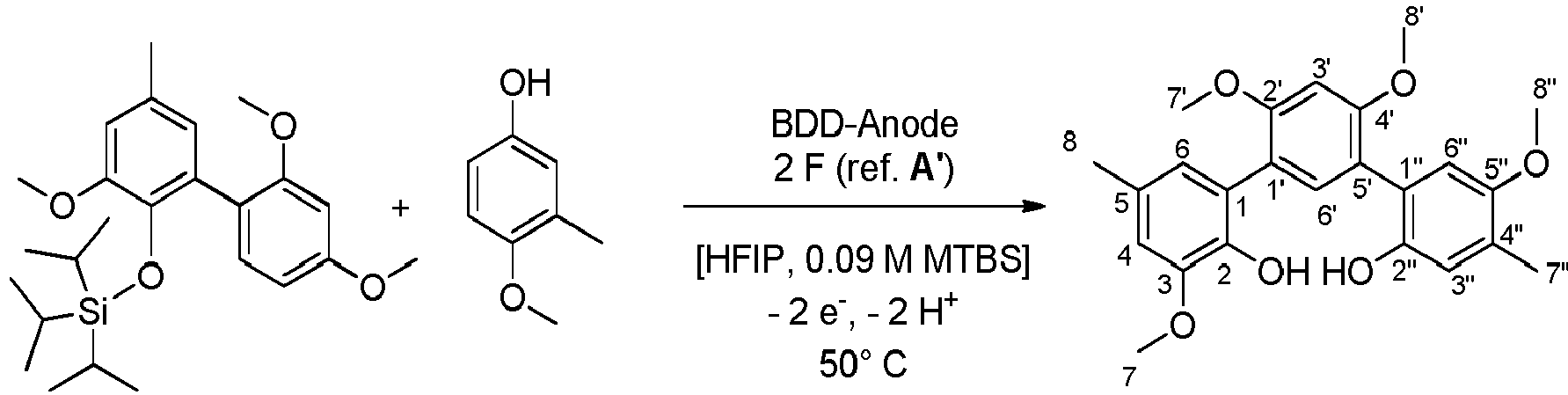
- Die Elektrolyse wurde gemäß der allgemeinen Vorschrift AAV1 in einer Flansch-Zelle durchgeführt. Dafür wurde ein Elektrolytvolumen von 33 mL HFIP mit 1,03 g MTBS als Leitsalz verwendet (0,09 M). Zur elektrochemischen Kreuzkupplung wurden 0,69 g (5,0 mmol, 1,0 Äqu.) des 4-Methoxy-3-methylphenols und 6,45 g (15 mmol, 3,0 Äqu.) des geschützten Phenol-Aren-Kupplungsprodukts aus Beispiel 6 eingesetzt. Die Elektrolyse erfolgte galvanostatisch, wobei eine schwarze Lösung entstand. Nach beendeter Elektrolyse wurde das Lösemittel unter vermindertem Druck am Rotationsverdampfer entfernt und die zurückbleibende braune Lösung mit ca. 300 mL Ethylacetat über Kieselgel 60 filtriert. Die abschließende säulenchromatographische Auftrennung (Säulenabmessung: 50x3 cm) des Produktgemisches über Kieselgel 60 als Flashchromatographie wurde zweimal mit folgendem Gradienten im Laufmittelgemisch durchgeführt: 95:5 zu 9:1 zu 5:1 zu 2:1 (CH:EE, ca. 3 L CH und 2 L EE je Säule verwendet). Dabei wurde das entsprechende Produkt mit entfernter Schutzgruppe als tiefroter Feststoff erhalten.
- Ausbeute: 0,88 g an ungeschützten Pincerliganden, (43%, 2,15 mmol)
- GC (Methode hart, HP-5): t R = 20,3 min
- R f (CH:EE = 5:1): 0,1
- HRMS (ESI, pos.mode): m/z für CHO [M+H+]:
- Berechnet: 411,1802
- Gefunden: 411,1797
- 1H-NMR (400 MHz, CDCl3): δ [ppm] = 2.22 (s, 3H, 7'-H'), 2.31 (s, 3H, 8-H), 3.76 (s, 3H, 8"-H), 3.91 (s, 3H, 8'-H), 3.91 (s, 3H, 7'-H), 3.96 (s, 3H, 7-H), 5.79 (s, 1 H, 2"-H), 5.93 (bs, 1 H, 2-H), 6.67-6.74 (m, 3'-H, 4-H, 6-H, 6"-H), 6.83 (s, 1 H, 3"-H), 7.31 (s, 1 H, 6'-H)
- 13C-NMR (101 MHz, CDCl3): δ [ppm] = 15.79 (C-7"), 20.99 (C-8), 55.83 (C-8"), 55.85 (C-8'), 56.15 (C-2'), 56.44 (C-7), 96.26 (C-3'), 110.99 (C-4), 112.62 (C-6"), 119.62 (C-3"), 120.69 (C-4"), 122.17 (C-5'), 123.37 (C-1'), 124.15 (C-6), 127.43 (C-1"), 129.03 (C-1), 134.79 (C-6'), 140.77 (C-5), 146.84 (C-2"), 151.88 (C-5"), 155.75 (C-3), 157.05 (C-2), 158.29 (C-4'), 158.43 (C-2')
- Wie die Beispiele 7 und 8 zeigen, konnte die Ausbeute an m-Terphenylverbindung durch das Einführen einer Schutzgruppe (Silygruppe) in das Phenol-Aren-Kupplungsprodukt bei der anschließenden Kupplung im elektrochemisch durchgeführten Verfahrensschritt c) weiter erhöht werden (doppelt bis dreifach erhöhte Ausbeute). Auf diese Weise kann somit die Effizienz des Gesamtverfahrens deutlich verbessert werden.
dadurch gekennzeichnet,
dass mindestens einer der Verfahrensschritte a) oder c) als elektrochemischer Verfahrensschritt durchgeführt wird.
Claims (16)
- Verfahren zur Herstellung unsymmetrischer Verbindungen aus der Gruppe der m-Terphenyle umfassend die Verfahrensschrittea) Umsetzen eines ersten substituierten oder unsubstituierten Phenols mit einem 1,3-disubstituierten Aren, welches in 2 und 5 Stellung ebenfalls substituiert sein kann, unter Erhalt eines Phenol-Aren-Kupplungsprodukts undb) optional Schützen der OH-Gruppe des Phenol-Aren-Kupplungsprodukts mit einer Schutzgruppe unter Erhalt eines geschützten Phenol-Aren-Kupplungsproduktsc) Umsetzen des Phenol-Aren-Kupplungsprodukts aus a) oder b) mit einem zweiten substituierten oder unsubstituierten Phenol unter Erhalt eines unsymmetrischen m-Terphenyls,mit der Maßgabe, dass das erste Phenol und das zweite Phenol unterschiedlich substituiert sind,
dadurch gekennzeichnet,
dass mindestens einer der Verfahrensschritte a) oder c) als elektrochemischer Verfahrensschritt durchgeführt wird. - Verfahren nach Anspruch 1,
dadurch gekennzeichnet,
dass beide Verfahrensschritte a) und c) als elektrochemische Verfahrensschritte durchgeführt werden. - Verfahren nach Anspruch 1 oder 2,
dadurch gekennzeichnet,
dass der elektrochemische Verfahrensschritt so durchgeführt wird, dassaa) eine Mischung mindestens eines Lösemittels und mindestens eines Leitsalzes erzeugt wird,bb) zu dieser Mischung die umzusetzenden Verbindungen gegeben werden, wobei das Phenol im molaren Unterschuss bezogen auf die andere umzusetzende Komponente zugegeben wird,cc) Einbringen von mindestens zwei Elektroden in die unter bb) erhaltene Reaktionslösung und Anlegen einer Spannung an die Elektroden,dd) Umsetzen der Komponenten zu den entsprechenden Kupplungsprodukten,ee) Abschalten der Spannung, und ggf.ff) Isolierung und/oder Aufreinigung des Umsetzungsproduktes. - Verfahren nach einem der Ansprüche 1 bis 3,
dadurch gekennzeichnet,
dass das molare Verhältnis des 1,3-disubstituierten Arens, welches in 2 und 5 Stellung ebenfalls substituiert sein kann, zum ersten substituierten oder unsubstituierten Phenol im Bereich von 1,5 : 1 bis 6 : 1, bevorzugt von 2 : 1 bis 3 : 1 liegt. - Verfahren nach einem der Ansprüche 1 bis 4,
dadurch gekennzeichnet,
dass das molare Verhältnis des Phenol-Aren Kupplungsproduktes zum zweiten Phenol im Bereich von 1,5 : 1 bis 6 : 1, bevorzugt von 2 : 1 bis 3 : 1 liegt. - Verfahren nach einem der Ansprüche 1 bis 5,
dadurch gekennzeichnet,
dass das erste substituierte oder unsubstituierte Phenol der Formel (A)

 und R1, R2, R3, R4, R5, R6, R7, R8, R10 und R12 unabhängig voneinander ausgewählt sind aus der Gruppe bestehend aus Wasserstoff, (C1-C12)-Alkyl, O-(C1-C12)-Alkyl, (C6-C20)-Aryl, O-(C6-C20)-Aryl und Halogen, vorzugsweise bestehend aus Wasserstoff, (C1-C12)-Alkyl, O-(C1-C12)-Alkyl und Halogen, besonders bevorzugt bestehend aus Wasserstoff, (C1-C12)-Alkyl, O-(C1-C12)-Alkyl,worin R9 und R11 unabhängig voneinander ausgewählt sind aus der Gruppe bestehende aus (C1-C12)-Alkyl, O-(C1-C12)-Alkyl, (C6-C20)-Aryl, O-(C6-C20)-Aryl und, Halogen, vorzugsweise bestehend aus (C1-C12)-Alkyl, O-(C1-C12)-Alkyl und Halogen, besonders bevorzugt bestehend aus (C1-C12)-Alkyl, O-(C1-C12)-Alkyl, und worin innerhalb der Paare R1/ R5, R2/R6, R3/R7 oder R4/R8 mindestens ein Paar aus verschiedenen Resten besteht.
 - Verfahren nach Anspruch 6,
wobei R10 und R12 identisch sind und vorzugsweise Wasserstoff bedeuten. - Verfahren nach einem der Ansprüche 1 bis 7,
dadurch gekennzeichnet,
dass der elektrochemische Verfahrensschritt in Gegenwart eines Lösemittels durchgeführt wird und als Lösemittel ein Lösemittel aus der Gruppe von Acetonitril, Propylencarbonat, Methylcarbonat, Nitromethan, Ethylenglycoldimethylether, Methansulfonsäure, Benzol, Toluol, Wasser, Methanol, Ethanol, Propanol, Isopropanol, halogenierte Lösemittel oder halogenierte oder nicht halogenierte Säuren oder Mischungen dieser eingesetzt wird. - Verfahren nach Anspruch 8,
dadurch gekennzeichnet,
dass als Lösemittel Methanol, Ameisensäure Trifluoressigsäure, Hexafluorisopropanol oder Mischungen dieser, vorzugsweise Methanol, Hexafluorisopropanol oder Mischungen dieser, und bevorzugt Hexafluorisopropanol verwendet wird. - Verfahren nach einem der Ansprüche 1 bis 9,
dadurch gekennzeichnet,
dass die Umsetzung ohne die Verwendung von organischen Oxidationsmitteln durchgeführt wird. - Verfahren nach einem der Ansprüche 1 bis 10,
dadurch gekennzeichnet,
dass der elektrochemische Verfahrensschritt in Gegenwart mindestens eines Leitsalzes durchgeführt wird, wobei als Leitsalze solche eingesetzte werden, die ausgewählt sind aus der Gruppe von Tetra(C1-C6-alkyl)-ammonium- oder (1,3-Di(C1-C6-alkyl)imidazoliumsalzen, mit der Maßgabe, dass die alkyl-Gruppen Halogen-substituiert sein können. - Verfahren nach Anspruch 11,
dadurch gekennzeichnet,
dass die Gegenionen der Leitsalze ausgewählt sind aus der Gruppe umfassend Arsenat, Sulfat, Hydrogensulfat, Alkylsulfat, Alkylphosphat, Perchlorat, Fluorid, Arylsulfat, Hexafluorphosphat und Tetrafluorborat. - Verfahren nach einem der Ansprüche 1 bis 12,
wobei als Leitsalz ein Salz aus der Gruppe umfassend quaternäre Ammoniumborate, Ammoniumfluoralkylphosphate, Ammoniumfluoralkylarsenate, Ammoniumtrifluor-methylsulfonate, Ammoniumbis(fluoromethansulfon)imide, Ammoniumtris- (fluoromethansulfonyl)methide, Methyltributylammoniummethylsulfat, Methyltriethylammoniummethylsulfat, Tetrabutyl-ammoniumhexafluorophosphat, Tetraethylammoniumtetrafluoroborat, Lithiumhexafluorophosphat oder Tetraethylammoniumtetrafluoroborat, bevorzugt Methyltriethylammoniummethylsulfat oder Bu3NMe+MeOSO3-(Methyltributylammoniummethylsulfat) und besonders bevorzugt Methyltributylammoniummethylsulfat eingesetzt wird. - Verbindungen der Formel (CDC')
 worin die Reste R13, R14, R15, R16, R19, R20, R21 und R22 unabhängig voneinander ausgewählt sind aus der Gruppe bestehende aus Wasserstoff, (C1-C12)-Alkyl, O-(C1-C12)-Alkyl, (C6-C20)-Aryl, O-(C6-C20)-Aryl, Halogen, vorzugsweise bestehend aus Wasserstoff, (C1-C12)-Alkyl, O-(C1-C12)-Alkyl, Halogen, besonders bevorzugt bestehend aus Wasserstoff, (C1-C12)-Alkyl und O-(C1-C12)-Alkyl,worin R17 und R18 unabhängig voneinander ausgewählt sind aus der Gruppe bestehende aus (C1-C12)-Alkyl, O-(C1-C12)-Alkyl, (C6-C20)-Aryl, O-(C6-C20)-Aryl und Halogen, vorzugsweise bestehend aus (C1-C12)-Alkyl, O-(C1-C12)-Alkyl und Halogen, besonders bevorzugt bestehend aus (C1-C12)-Alkyl und O-(C1-C12)-Alkyl, undworin innerhalb der Paare R13/R22, R14/R21, R15/R20 oder R16/R19 mindestens ein Paar aus verschiedenen Resten besteht.
 - Verbindungen gemäß Anspruch 14,
dadurch gekennzeichnet,
dass sie den Formeln (1), (2) oder (3)
- Verwendung einer Verbindung gemäß Anspruch 14 oder 15 als Ligand zur Herstellung von Metall-Ligand-Katalysatorsystemen.
Applications Claiming Priority (1)
| Application Number | Priority Date | Filing Date | Title |
|---|---|---|---|
| DE102015216001.7A DE102015216001A1 (de) | 2015-08-21 | 2015-08-21 | Verfahren zur Herstellung von unsymmetrischen OCO-Pincerliganden aus der Gruppe der m-Terphenylverbindungen |
Publications (1)
| Publication Number | Publication Date |
|---|---|
| EP3133189A1 true EP3133189A1 (de) | 2017-02-22 |
Family
ID=56609710
Family Applications (1)
| Application Number | Title | Priority Date | Filing Date |
|---|---|---|---|
| EP16182787.8A Withdrawn EP3133189A1 (de) | 2015-08-21 | 2016-08-04 | Verfahren zur herstellung von unsymmetrischen oco-pincerliganden aus der gruppe der m-terphenylverbindungen |
Country Status (4)
| Country | Link |
|---|---|
| US (1) | US10131607B2 (de) |
| EP (1) | EP3133189A1 (de) |
| CN (1) | CN106467455A (de) |
| DE (1) | DE102015216001A1 (de) |
Cited By (1)
| Publication number | Priority date | Publication date | Assignee | Title |
|---|---|---|---|---|
| CN111910206A (zh) * | 2019-05-07 | 2020-11-10 | 中国科学技术大学 | 一种合成3-氰基取代的咪唑并[1,5-a]喹啉类化合物的方法 |
Families Citing this family (1)
| Publication number | Priority date | Publication date | Assignee | Title |
|---|---|---|---|---|
| DE102015216000A1 (de) * | 2015-08-21 | 2017-02-23 | Evonik Degussa Gmbh | Verfahren zur Herstellung von symmetrischen Pincerliganden aus der Gruppe der m-Terphenylverbindungen |
Family Cites Families (3)
| Publication number | Priority date | Publication date | Assignee | Title |
|---|---|---|---|---|
| JP5705216B2 (ja) * | 2009-06-05 | 2015-04-22 | ビーエーエスエフ ソシエタス・ヨーロピアBasf Se | アレーンの陽極クロス脱水素二量化法 |
| DE102013203865A1 (de) * | 2013-03-07 | 2014-09-11 | Evonik Industries Ag | Elektrochemische Kupplung zweier Phenole, welche sich in ihrem Oxidationspotential unterscheiden |
| DE102013203867A1 (de) * | 2013-03-07 | 2014-09-11 | Evonik Industries Ag | Elektrochemische Kupplung von Anilinen |
-
2015
- 2015-08-21 DE DE102015216001.7A patent/DE102015216001A1/de not_active Withdrawn
-
2016
- 2016-08-04 EP EP16182787.8A patent/EP3133189A1/de not_active Withdrawn
- 2016-08-18 US US15/239,998 patent/US10131607B2/en not_active Expired - Fee Related
- 2016-08-19 CN CN201610688657.0A patent/CN106467455A/zh active Pending
Non-Patent Citations (13)
| Title |
|---|
| A. KIRSTE, ET AL.: "Efficient anodic and direct phenol-arene C,C cross-coupling: the benign role of water or methanol", JOURNAL OF THE AMERICAN CHEMICAL SOCIETY, vol. 134, no. 7, 16 January 2012 (2012-01-16), American Chemical Society, Washington, DC, US, pages 3571 - 3576, XP055114642, ISSN: 0002-7863, DOI: 10.1021/ja211005g * |
| A. KIRSTE; B. ELSLER; G. SCHNAKENBURG; S. R. WALDVOGEL, J. AM. CHEM. SOC., vol. 134, 2012, pages 3571 - 3576 |
| A. KIRSTE; M. NIEGER; I. M. MALKOWSKY; F. STECKER; A. FISCHER; S. R. WALDVOGEL, CHEM. EUR. J., vol. 15, 2009, pages 2273 - 2277 |
| A. KIRSTE; S. HAYASHI; G. SCHNAKENBURG; I. M. MALKOWSKY; F. STECKER; A. FISCHER; T. FUCHIGAMI; S. R. WALDVOGEL, CHEM. EUR. J., vol. 17, 2011, pages 14164 - 14169 |
| B. ELSLER; D. SCHOLLMEYER; K. M. DYBALLA; R. FRANKE; S. R. WALDVOGEL, ANGEW. CHEM. INT. ED., vol. 53, 2014, pages 5210 - 5213 |
| B. G. PRING, ACTA CHEM. SCAND., vol. 27, 1973, pages 3873 - 3880 |
| M.M. GRUZA, ET AL.: "Synthesis and stereochemical properties of "extended" biphenols bridged by ortho-, meta- and para-phenylene spacers", EUROPEAN JOURNAL OF ORGANIC CHEMISTRY, no. 36, 11 November 2009 (2009-11-11), Wiley-VCH Verlag, Weinheim, DE, pages 6318 - 6327, XP055164083, ISSN: 1434-193X, DOI: 10.1002/ejoc.200900837 * |
| P. G. M. WUTS; T. W. GREENE: "Greenes's Protective Groups in Organic Synthesis", 2007, JOHN WILEY AND SONS |
| R. S. GREWAL; H. HART; T. K. VINOD, J. ORG. CHEM., vol. 57, 1992, pages 2721 - 2726 |
| S. SARKAR, ET AL.: "Synthesis, characterisation and reactivity of a d2, Mo(IV) complex supported by a new OCO-trianionic pincer ligand", JOURNAL OF THE AMERICAN CHEMICAL SOCIETY, vol. 130, no. 4, 9 January 2008 (2008-01-09), pages 1116 - 1117, XP055076010, ISSN: 0002-7863, DOI: 10.1021/ja074901k * |
| S. SARKAR; A. R. CARLSON; M. K. VEIGE; J. M. FALKOWSKI; K. A. ABBOUD; A. S. VEIGE, J. AM. CHEM. SOC., vol. 130, 2008, pages 1116 - 1117 |
| T. AGAPIE, ET AL.: "Cyclometalated tantalum diphenolate pincer complexes: intramolecular C-H/M-CH3 sigma-bond metathesis may be faster than O-H/M-CH3 protonolysis - supporting information", ORGANOMETALLICS, vol. 26, no. 12, 3 May 2007 (2007-05-03), American Chemical Society, Washington, DC, US, pages 1 - 42, XP055328474, ISSN: 0276-7333, DOI: 10.1021/om700284c * |
| T. AGAPIE, ET AL.: "Cyclometalated tantalum diphenolate pincer complexes: intramolecular C-H/M-CH3 sigma-bond metathesis may be faster than O-H/M-CH3 protonolysis", ORGANOMETALLICS, vol. 26, no. 12, 3 May 2007 (2007-05-03), American Chemical Soceity, Washingtom, DCUS, pages 2957 - 2959, XP055328469, ISSN: 0276-7333, DOI: 10.1021/om700284c * |
Cited By (2)
| Publication number | Priority date | Publication date | Assignee | Title |
|---|---|---|---|---|
| CN111910206A (zh) * | 2019-05-07 | 2020-11-10 | 中国科学技术大学 | 一种合成3-氰基取代的咪唑并[1,5-a]喹啉类化合物的方法 |
| CN111910206B (zh) * | 2019-05-07 | 2023-03-10 | 中国科学技术大学 | 一种合成3-氰基取代的咪唑并[1,5-a]喹啉类化合物的方法 |
Also Published As
| Publication number | Publication date |
|---|---|
| US10131607B2 (en) | 2018-11-20 |
| DE102015216001A1 (de) | 2017-02-23 |
| CN106467455A (zh) | 2017-03-01 |
| US20170050910A1 (en) | 2017-02-23 |
Similar Documents
| Publication | Publication Date | Title |
|---|---|---|
| EP2964811B1 (de) | Elektrochemische kupplung von anilinen | |
| DE102013203865A1 (de) | Elektrochemische Kupplung zweier Phenole, welche sich in ihrem Oxidationspotential unterscheiden | |
| EP2964810B1 (de) | Elektrochemisches verfahren zur kupplung von phenol mit anilin | |
| EP3029056B1 (de) | Bisphosphite die einen unsymmetrischen biaryl-zentral-baustein aufweisen | |
| EP2438215A1 (de) | Verfahren zur herstellung von unsymmetrischen biarylalkoholen | |
| EP2318569A1 (de) | Verfahren zur anodischen dehydrodimerisierung von substituierten arylalkoholen | |
| EP3029048B1 (de) | Bisphosphite die einen unsymmetrischen Biphenol-Flügel-Baustein aufweisen | |
| EP3133189A1 (de) | Verfahren zur herstellung von unsymmetrischen oco-pincerliganden aus der gruppe der m-terphenylverbindungen | |
| EP2964812B1 (de) | Elektrochemische kupplung eines phenols mit einem naphthol | |
| DE102015215997A1 (de) | Phenol-Aren-Kupplungsprodukt | |
| EP3029050B1 (de) | Bisphosphite die eine Naphthyl-Phenyl-Einheit als Flügel-Baustein aufweisen | |
| EP3252033B1 (de) | Zweistufige synthese von n-biarylverbindungen | |
| EP3133054B1 (de) | Verfahren zur herstellung von symmetrischen pincerliganden aus der gruppe der m-terphenylverbindungen | |
| EP3189034A1 (de) | 2,2'-diaminobiaryle mit phthaloyl-gruppe oder succinoyl-gruppe | |
| EP3189031A1 (de) | 2,2-diaminobiaryle mit einem primären und einem sekundären amin und deren herstellung durch elektrochemische kupplung | |
| DE102014217537A1 (de) | 2,2‘-Diaminobiaryle mit zwei sekundären Aminen | |
| DE102015215998A1 (de) | Verfahren zur Herstellung von OCN-Pincerliganden aus der Gruppe der m-Terphenylverbindungen | |
| DE102015215996A1 (de) | Verfahren zur Herstellung von symmetrischen Pincerliganden aus der Gruppe der m-Terphenylverbindungen | |
| EP3029055A1 (de) | Monophosphite die einen unsymmetrischen Biaryl-Baustein aufweisen | |
| DE102015215995A1 (de) | Verfahren zur Herstellung von unsymmetrischen NCN-Pincerliganden aus der Gruppe der m-Terphenylverbindungen | |
| EP3029051A1 (de) | Bisphosphite die eine Naphthyl-Phenyl-Einheit als Flügel-Baustein und eine 2,3'-Bisphenol-Einheit als Zentral-Baustein aufweisen | |
| EP3489390A1 (de) | Elektrochemisches verfahren zur o-c-kupplung von ungeschützten phenolen mit optisch reinen arylaminen | |
| Trutschel et al. | Electrochemical conversion of 4-alkyloxytoluenes to cyclic and non-cyclic 4-alkyloxybenzaldehyde acetals. A new approach to liquid-crystalline 1, 3-dioxanes |
Legal Events
| Date | Code | Title | Description |
|---|---|---|---|
| PUAI | Public reference made under article 153(3) epc to a published international application that has entered the european phase |
Free format text: ORIGINAL CODE: 0009012 |
|
| 17P | Request for examination filed |
Effective date: 20160804 |
|
| AK | Designated contracting states |
Kind code of ref document: A1 Designated state(s): AL AT BE BG CH CY CZ DE DK EE ES FI FR GB GR HR HU IE IS IT LI LT LU LV MC MK MT NL NO PL PT RO RS SE SI SK SM TR |
|
| AX | Request for extension of the european patent |
Extension state: BA ME |
|
| GRAP | Despatch of communication of intention to grant a patent |
Free format text: ORIGINAL CODE: EPIDOSNIGR1 |
|
| RIC1 | Information provided on ipc code assigned before grant |
Ipc: C07C 43/23 20060101ALI20180321BHEP Ipc: C25B 3/10 20060101AFI20180321BHEP |
|
| INTG | Intention to grant announced |
Effective date: 20180413 |
|
| STAA | Information on the status of an ep patent application or granted ep patent |
Free format text: STATUS: THE APPLICATION IS DEEMED TO BE WITHDRAWN |
|
| 18D | Application deemed to be withdrawn |
Effective date: 20180824 |