EP3132206B1 - An air conditioning method using a staged process using a liquid desiccant - Google Patents
An air conditioning method using a staged process using a liquid desiccant Download PDFInfo
- Publication number
- EP3132206B1 EP3132206B1 EP15779439.7A EP15779439A EP3132206B1 EP 3132206 B1 EP3132206 B1 EP 3132206B1 EP 15779439 A EP15779439 A EP 15779439A EP 3132206 B1 EP3132206 B1 EP 3132206B1
- Authority
- EP
- European Patent Office
- Prior art keywords
- desiccant
- airstream
- heat
- liquid desiccant
- flow
- Prior art date
- Legal status (The legal status is an assumption and is not a legal conclusion. Google has not performed a legal analysis and makes no representation as to the accuracy of the status listed.)
- Active
Links
Images

Classifications
-
- F—MECHANICAL ENGINEERING; LIGHTING; HEATING; WEAPONS; BLASTING
- F24—HEATING; RANGES; VENTILATING
- F24F—AIR-CONDITIONING; AIR-HUMIDIFICATION; VENTILATION; USE OF AIR CURRENTS FOR SCREENING
- F24F3/00—Air-conditioning systems in which conditioned primary air is supplied from one or more central stations to distributing units in the rooms or spaces where it may receive secondary treatment; Apparatus specially designed for such systems
- F24F3/12—Air-conditioning systems in which conditioned primary air is supplied from one or more central stations to distributing units in the rooms or spaces where it may receive secondary treatment; Apparatus specially designed for such systems characterised by the treatment of the air otherwise than by heating and cooling
- F24F3/14—Air-conditioning systems in which conditioned primary air is supplied from one or more central stations to distributing units in the rooms or spaces where it may receive secondary treatment; Apparatus specially designed for such systems characterised by the treatment of the air otherwise than by heating and cooling by humidification; by dehumidification
- F24F3/1411—Air-conditioning systems in which conditioned primary air is supplied from one or more central stations to distributing units in the rooms or spaces where it may receive secondary treatment; Apparatus specially designed for such systems characterised by the treatment of the air otherwise than by heating and cooling by humidification; by dehumidification by absorbing or adsorbing water, e.g. using an hygroscopic desiccant
- F24F3/1417—Air-conditioning systems in which conditioned primary air is supplied from one or more central stations to distributing units in the rooms or spaces where it may receive secondary treatment; Apparatus specially designed for such systems characterised by the treatment of the air otherwise than by heating and cooling by humidification; by dehumidification by absorbing or adsorbing water, e.g. using an hygroscopic desiccant with liquid hygroscopic desiccants
-
- F—MECHANICAL ENGINEERING; LIGHTING; HEATING; WEAPONS; BLASTING
- F24—HEATING; RANGES; VENTILATING
- F24F—AIR-CONDITIONING; AIR-HUMIDIFICATION; VENTILATION; USE OF AIR CURRENTS FOR SCREENING
- F24F11/00—Control or safety arrangements
- F24F11/30—Control or safety arrangements for purposes related to the operation of the system, e.g. for safety or monitoring
-
- F—MECHANICAL ENGINEERING; LIGHTING; HEATING; WEAPONS; BLASTING
- F24—HEATING; RANGES; VENTILATING
- F24F—AIR-CONDITIONING; AIR-HUMIDIFICATION; VENTILATION; USE OF AIR CURRENTS FOR SCREENING
- F24F11/00—Control or safety arrangements
- F24F11/70—Control systems characterised by their outputs; Constructional details thereof
- F24F11/80—Control systems characterised by their outputs; Constructional details thereof for controlling the temperature of the supplied air
- F24F11/83—Control systems characterised by their outputs; Constructional details thereof for controlling the temperature of the supplied air by controlling the supply of heat-exchange fluids to heat-exchangers
-
- F—MECHANICAL ENGINEERING; LIGHTING; HEATING; WEAPONS; BLASTING
- F24—HEATING; RANGES; VENTILATING
- F24F—AIR-CONDITIONING; AIR-HUMIDIFICATION; VENTILATION; USE OF AIR CURRENTS FOR SCREENING
- F24F3/00—Air-conditioning systems in which conditioned primary air is supplied from one or more central stations to distributing units in the rooms or spaces where it may receive secondary treatment; Apparatus specially designed for such systems
- F24F3/12—Air-conditioning systems in which conditioned primary air is supplied from one or more central stations to distributing units in the rooms or spaces where it may receive secondary treatment; Apparatus specially designed for such systems characterised by the treatment of the air otherwise than by heating and cooling
- F24F3/14—Air-conditioning systems in which conditioned primary air is supplied from one or more central stations to distributing units in the rooms or spaces where it may receive secondary treatment; Apparatus specially designed for such systems characterised by the treatment of the air otherwise than by heating and cooling by humidification; by dehumidification
- F24F2003/144—Air-conditioning systems in which conditioned primary air is supplied from one or more central stations to distributing units in the rooms or spaces where it may receive secondary treatment; Apparatus specially designed for such systems characterised by the treatment of the air otherwise than by heating and cooling by humidification; by dehumidification by dehumidification only
-
- F—MECHANICAL ENGINEERING; LIGHTING; HEATING; WEAPONS; BLASTING
- F24—HEATING; RANGES; VENTILATING
- F24F—AIR-CONDITIONING; AIR-HUMIDIFICATION; VENTILATION; USE OF AIR CURRENTS FOR SCREENING
- F24F3/00—Air-conditioning systems in which conditioned primary air is supplied from one or more central stations to distributing units in the rooms or spaces where it may receive secondary treatment; Apparatus specially designed for such systems
- F24F3/12—Air-conditioning systems in which conditioned primary air is supplied from one or more central stations to distributing units in the rooms or spaces where it may receive secondary treatment; Apparatus specially designed for such systems characterised by the treatment of the air otherwise than by heating and cooling
- F24F3/14—Air-conditioning systems in which conditioned primary air is supplied from one or more central stations to distributing units in the rooms or spaces where it may receive secondary treatment; Apparatus specially designed for such systems characterised by the treatment of the air otherwise than by heating and cooling by humidification; by dehumidification
- F24F2003/1458—Air-conditioning systems in which conditioned primary air is supplied from one or more central stations to distributing units in the rooms or spaces where it may receive secondary treatment; Apparatus specially designed for such systems characterised by the treatment of the air otherwise than by heating and cooling by humidification; by dehumidification using regenerators
-
- F—MECHANICAL ENGINEERING; LIGHTING; HEATING; WEAPONS; BLASTING
- F24—HEATING; RANGES; VENTILATING
- F24F—AIR-CONDITIONING; AIR-HUMIDIFICATION; VENTILATION; USE OF AIR CURRENTS FOR SCREENING
- F24F2110/00—Control inputs relating to air properties
- F24F2110/10—Temperature
-
- F—MECHANICAL ENGINEERING; LIGHTING; HEATING; WEAPONS; BLASTING
- F24—HEATING; RANGES; VENTILATING
- F24F—AIR-CONDITIONING; AIR-HUMIDIFICATION; VENTILATION; USE OF AIR CURRENTS FOR SCREENING
- F24F2110/00—Control inputs relating to air properties
- F24F2110/20—Humidity
Definitions
- the invention relates to air conditioning, humidification, and dehumidification.
- a major deficiency of most existing air conditioning systems is their inability to remove high levels of humidity such as those associated with the significant quantities of outside air that are required by the American Society of Heating, Refrigerating, and Air-Conditioning Engineers (ASHRAE) standards (mandatory in the U.S.) and for health reasons.
- ASHRAE Heating, Refrigerating, and Air-Conditioning Engineers
- a number of desiccant systems have been tried in order to solve this problem economically but none has achieved high market penetration.
- the energy used in buildings for heating and cooling comprises more than 30% of all energy used in the USA. Much of this energy is from fossil fuel sources, and the level of usage of fossil fuels is currently causing much concern.
- air conditioning is almost entirely powered by electricity, most of which is from fossil fuels. Electricity used for air conditioning also contributes to a large peak of electrical consumption that requires a high level of expensive peak power generation plant capacity. It would therefore be desirable if air conditioning were much more efficient in its use of electric power or were powered by non-electric or non-fossil fuel sources.
- Air conditioning by compressors can remove only a fraction of the humidity from the air in humid climates. This leads to a provision of excess capacity and low refrigeration temperatures for humidity removal and the need to re-heat the air supplied to buildings. Both of these factors require considerable power usage and energy wastage. U. S. Department of Energy sources indicate that this could be as high as 60% of energy used in air conditioning. A large quantity (about 31% globally) of primary energy supplied results in waste heat that could be collected and used for low temperature energy use such as the air conditioner described below.
- Desiccant-based dehumidifiers and air conditioners have been introduced to the market on a number of occasions over the past 75 years but they have not been well received for a number of reasons. Firstly, they have been expensive to buy and any energy savings from their use have not been sufficient to pay back the capital cost on a time-scale considered economic to most building owners and operators. Secondly, some liquid desiccant systems were prone to allow droplets of the liquid desiccant to carry over into the conditioned space, which is highly undesirable.
- U.S. Patent No. 5,123,481 to Albers et al. describes a process of air-cooling and dehumidification.
- Albers, et al. use sectors in an air stream and partitions or heat exchangers to transfer the heat to an airstream in a second chamber in which water is evaporated as a heat sink.
- Lowenstein US Patent No. 5,351,497 uses a low flow desiccant system that does not use turbulent heat exchange nor multiple sectors.
- Hargis US 8268060 B2 discloses a device using liquid desiccant and a compressor and heat exchangers. Hargis splits the desiccant streams into two components only one of which is passed through a heat exchanger. Thus Hargis is exposing the air streams to two (or more) desiccant stages that are at different temperatures rather than different relative humidities. Hargis also regenerates the desiccant using an outside airstream rather than the drier exhaust air from the building.
- Forkosh has US patents Nos. 6487872 , 6494053 , 6575228 and 6976365 that use a liquid desiccant and usually a compressor to provide the heat sink and source.
- Forkosh uses a single sump in either the dehumidifier or regenerator and the desiccant therefore mixes to a single concentration.
- the "stages" described by Forkosh do not enable the separation of the desiccant into differing concentrations.
- US 2013/305752 A1 discloses a multi stage liquid desiccant air conditioner where the temperature of the desiccant for each said stage is adjusted using an external source of heat transfer supplied with a common heat transferring fluid connected to each stage in series.
- the invention consists of a method of heat and moisture exchange according to claim 1 and an apparatus for exchange of heat and moisture between an airstream forced through the apparatus according to claim 14.
- an air stream which may be 100% outside air, is humidity controlled by contact with a liquid desiccant of progressively changing concentration in a number of sectors. If the air is more humid than desired, it is dehumidified by contact with concentrated liquid desiccant distributed on a medium with a large wetted surface area in a number of sectors. If the air is less humid than desired (in winter mode) water is added to the desiccant in the air conditioner. The concentration of the desiccant supplied to the device determines the humidity content of the air supplied to the conditioned space. Passing a cooling fluid through heat exchangers cools the air by contact with the cooled desiccant. Thus, in all seasons the air humidity and temperature may be controlled by supplying the air conditioner with a suitable heating or cooling fluid and a suitable desiccant concentration.
- the cooling fluids are supplied in parallel to each heat exchanger in each sector of the air conditioner and at essentially the same temperature to maximize the heat transfer out of the desiccant and thus from the treated air. This maximizes the enthalpy change in each sector and enables a lower source temperature to be used than if the cooling fluid is supplied in series to each heat exchanger.
- the enthalpy required in each sector may differ because of differing loads due to unequal latent heat loads. A higher load increases the temperature of the desiccant in that sector, and therefore increases the heat transfer rate into the cooling fluid in that sector through the heat exchanger.
- a similar argument applies to the effectiveness of using a common heating source for each sector in the desiccant regenerator.
- a contributing feature to the effectiveness of certain of the described apparatus and methods is separation of the desiccant by concentration into multiple sectors in which the air is first treated by the most dilute desiccant. This causes a temperature rise in that sector.
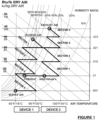
- the amount of dehumidification of the air in that sector is limited by the concentration of the desiccant and by the amount of heat that can be removed by the cooling fluid, as can be seen on the psychrometric chart, FIG. 1 .
- the air moves to the next sector where the desiccant is more concentrated and the air is further dried as far as the desiccant concentration and heat removal allows.
- Some of the previously proposed air conditioners mentioned above use heat transfer partitions or other heat exchangers that do not allow the creation of full turbulent flow (a Reynolds number of at least 300 and preferably 500 or more) and thus limit the rate of heat transfer between the fluids.
- a Reynolds number of at least 300 and preferably 500 or more a Reynolds number of at least 300 and preferably 500 or more
- pumping the fluids at the designed rate to cause turbulent flow gives a high heat transfer coefficient and thus minimizes the size and cost of the heat exchangers.
- the method proposed can generally use components that are relatively easy to obtain at a reasonable cost rather than requiring highly specialized components that would make the cost of the apparatus high.
- the method proposed enables the supply to the conditioned space of an airstream that has a relative humidity close to the equilibrium level of the air in contact with the concentrated liquid desiccant while using a cooling fluid that is fairly close in temperature to the supply air (for example 9 degrees F (5 °C) cooler).
- the method also enables the reconcentration of the liquid desiccant by an airstream that is heated minimally above ambient temperature (for example, 30 degrees F (17 °C) warmer) compared with most other methods that require either a large and expensive apparatus or high temperatures to achieve the same result.
- a simple control device is provided to control the concentration of the desiccant.
- the method proposed also allows the humidification of the supply air in winter mode by diluting the desiccant. Diluting the desiccant increases its volume and thus would require the provision of surplus volume in one or more of the desiccant sumps.
- a separate inexpensive reservoir may be provided. This serves three purposes: 1. Ability to accommodate changing desiccant volumes; 2. Separation of concentrated and dilute desiccant within a single or multiple containers; 3. Storage of desiccant so that the air conditioner may be operated for a period of time when the heating sources are not available (so long as auxiliary power to operate pumps and fans is still available).
- the appropriate increase in concentration of the desiccant when required or desired, may be carried out by a regenerator that is configured similarly to the air conditioner but used to evaporate water from the desiccant.
- the regenerator uses an airflow to reconcentrate the desiccant where the air is preferably taken from the conditioned space or another source that is drier than outside air. Since building exhaust air is typically lower in volume than the supply air because of losses due to leakage and extract fans in bathrooms, for example, from which the air cannot be economically collected, the regenerator may be designed so that it may use a lower flow than the airflow of the air conditioner by applying greater heating to remove the required mass of moisture from the desiccant.
- the building exhaust air is first heated in the regenerator using a heating fluid (such as the exhaust air) passed through a heat exchanger to recover waste heat.
- a heating fluid such as the exhaust air
- the air is then heated at each stage by contact with the desiccant heated in the heat exchanger at each stage, thus lowering the relative humidity of the exhaust air, and enabling it to evaporate water from the desiccant in a step-wise manner with progressively lower relative humidity air at each step.
- the maximum concentration of the desiccant obtained is directly related to the minimum relative humidity of the air and the equilibrium relative humidity of the desiccant should be within 2 to 5% of the relative humidity of the air and in a preferred embodiment be within 2% of the relative humidity of the air.
- the liquid desiccant is reused in the air conditioner to remove humidity from outside air.
- some of the energy and moisture in the air leaving the building is recovered in the regenerator using the desiccant to absorb heat and humidity that is then reused in the air conditioner to add to the incoming air.
- the air conditioner and the regenerator are modular in construction and the modules in the air conditioner and the regenerator may be identical, or similar but with altered dimensions to suit the air flow in each device.
- the number of modules comprising the sectors and the contained desiccant pads may be varied to suit the climate and operating requirements for which the whole apparatus is built. Having more modules in the air conditioner enables the relative humidity of the air to more closely match the relative humidity of the desiccant supplied to the air conditioner. Having more modules in the regenerator enables the relative humidity obtained by the liquid desiccant to approach more closely the minimum relative humidity of the air used for regeneration.
- An embodiment of a complete air conditioner comprises a system including: an air conditioner; a desiccant regenerator; optionally, a desiccant storage device with spare capacity to accommodate the volume of water added to the system when operated in humidification mode; and when the system is in use sufficient liquid desiccant to fill the system to the required levels.
- that embodiment of a system also includes: a source of cooling fluid to remove sensible and latent energy from the system in the cooling season; a source of heating fluid to heat and humidify the outside air in the heating season; a source of heating fluid to evaporate moisture from the desiccant; a supply of electricity or other motive power to drive the pumps and fans and operate the controls; and a source of water treated to remove most of the salts to provide humidification when required.
- a method of cooling and dehumidifying an outside airstream that comprises: contacting the air stream with a liquid desiccant absorber in each of at least two stages; cooling the desiccant for each said stage externally to the absorber using an external source of cooling supplied with a common cooling fluid at each stage; causing the desiccant to flow between the stages counter-current to the flow of the airstream such that at each step the humidity of the air is reduced by contact with the desiccant and the concentration in each stage is distinctly higher than the concentration of the desiccant in the previous stages.
- a method of heating and humidifying an outside airstream that comprises: contacting the airstream in at least two distinct stages of contact with dilute liquid desiccant evaporators; during each of said stages, heating the desiccant externally to the evaporator using a common external source of heating at each stage; causing the desiccant to flow between the stages counter-current to the flow of the airstream such that at each step the humidity of the air is increased by contact with the dilute desiccant.
- a method of reconcentrating a liquid desiccant that comprises: contacting an airstream with liquid desiccant evaporators in each of at least two stages; heating the desiccant at each said stage externally to the absorber using an external source of heating supplied with a common heating fluid at each stage; and causing the desiccant to flow between the stages counter-current to the airstream, such that at each stage the concentration of the desiccant is distinctly higher than the concentration of the desiccant in the other stages.
- an apparatus for exchange of heat and moisture between an airstream forced through the apparatus, an external energy fluid source, and a liquid desiccant flow that comprises: at least two separate but connected modules that are essentially identical, each module comprising: an absorber/evaporator for contacting liquid desiccant with air, a liquid desiccant distributor for distributing liquid desiccant over the absorber/evaporator, a heat exchanger external to the absorber/evaporator to cool/heat the liquid desiccant with fluid from the external energy fluid source, a pump operative to recirculate the liquid desiccant between the absorber/evaporator and the heat exchanger; an outer shell to direct the airstream through the absorber/evaporator; and a sump below the absorber/evaporator to collect the liquid desiccant distributed over the absorber/evaporator.
- a first device indicated generally by the reference numeral 1, and referred to as “Device 1” is used to condition the incoming airstream 3.
- Device 1 can be used to cool and dehumidify the incoming airstream.
- Device 1 can be used to warm and humidify the incoming airstream.
- a second device indicated generally by the reference numeral 2, and referred to as “Device 2,” is used to concentrate the liquid desiccant using airstream 4.
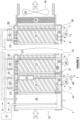
- each device is modular where one module, 54, 55, 56, 58, 59, or 60, comprises an air enclosure 20 with media pad 21, desiccant distributor 23 and desiccant basin or sump 30 that together make up one sector, plus a heat exchanger 22 and a pump 24 that complete the module.
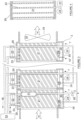
- Devices 1 and 2 are shown in FIGS. 2 and 3 with three modules drawn in detail.
- Device 1 comprises a first module 54, an intermediate module 55, and a last module 56, in order of the direction of air flow.
- Device 2 comprises a first module 58, an intermediate module 59, and a last module 60, in order of the direction of air flow.
- Either device may have no intermediate module 55, 59, or more than one intermediate module, so there may be only two or there may be more than three modules in total in each of Device 1 and Device 2.
- Desiccant flow between modules may be effected by tubes 27 shown in FIG. 2 .
- the tubes 27 provide throttled flow between the sumps 30 of adjacent modules.
- desiccant flow between the modules may be achieved by other means such as a side-flow from the desiccant pump 24 to the next sector as shown in FIG. 3 where the level of desiccant in each sector is controlled by a device 28 that may be similar to a toilet float valve provided that the materials used in its manufacture are resistant to the desiccant such as most plastics.
- FIGS. 5 and 6 a further embodiment of the apparatus is the same as that shown in FIGS. 3 and 4 except as described below.
- the same reference numerals are used for components that are the same, and in the interests of conciseness the description of those components is not repeated.
- the side-flow that is fed to the next sector is taken at the outlet from the heat exchanger 22 and delivered to the trailing side of the upstream pad 21 via a separate tube shown in Figure 5 .
- the float 28 in each sector senses the level of liquid in the sump 30 as previously described, and operates a valve 29 that controls flow entering that sector in the separate tube.
- the nozzles in desiccant distributor 23 that distribute onto the pad 21 the desiccant from the pump 24 in the same sector may be arranged not to extend to the trailing side of the pad 21 where the side-flow from the adjacent sector is supplied.
- the air conditioner (Device 1) the more concentrated desiccant is used to dehumidify the air before it is mixed with the less concentrated desiccant in the adjacent sector.
- a further improvement in performance may be obtained by separating the pad 21 into two parts, a main part and the trailing side, to avoid any dilution before the stronger desiccant reaches the sump 30, as shown by the dividing lines in FIG. 5 and FIG. 6 on pad 21.
- FIG. 7 shows a single container reservoir that comprises container 40.
- a mid-density float 41 reduces stirring and serves to separate the more dilute from the more concentrated desiccant.
- a float 42 on the surface of the liquid body allows the dilute desiccant 9 to be delivered to the reservoir at the top of the liquid body and allows the dilute desiccant 10 to be withdrawn from the reservoir by pump 43 at the top of the liquid body.
- Flexible tubes 49 allow the float 42 to rise and fall without restriction.
- a tube delivers concentrated desiccant 11 to the bottom of the reservoir.
- a pump 44 withdraws concentrated desiccant from the bottom of the container as flow 8.
- An optional calibrated wand 47 attached to mid-density float 41 indicates the amount of concentrated desiccant in the container.
- FIG. 8 shows a two container reservoir that more completely separates the dilute desiccant in one container from the concentrated desiccant in the other and comprises similar components as shown in FIG. 7 and in addition a tube 45 that connects the dilute desiccant container with the concentrated desiccant container.
- Tube 45 is connected to the bottom of the dilute desiccant container, and is attached to a mid-density float 41 in the concentrated desiccant container by a flexible tube 49, and opens out through the top of mid-density float 41 as shown, so that dilute desiccant is able to flow to the concentrated desiccant container if needed but only above the float 41.
- either a single reservoir or two reservoirs or other similar embodiments may be used to receive flow 9 or 11 from Device 1 or 2, respectively, and may return flow 8 or 10 to Device 1 or 2, respectively.
- either of Devices 1 and 2 may operate independently for a time provided there is sufficient concentrated or dilute desiccant available in the reservoir.
- FIG. 1 shows on a psychrometric chart an example of the temperature and humidity changes that are caused to take place in the airstreams 3 and 4 in cooling season operating mode at high moisture removal for devices that each have four sectors.
- the adiabatic dehumidification and sensible cooling lines are illustrative of the overall aggregate process and are not intended to model the process in precise detail.
- an ambient air stream 3 is caused by a fan or other air movement device 34 to flow first through an optional cooled coil 36 that partially removes moisture from airstream 3 by condensation, and then through a number of modules each comprising a sector of the apparatus that are connected together in an airtight fashion from the air inlet 25 to an outlet 39 that may optionally contain a demister 26.
- the sector nearest inlet 25 is here called Sector 1 and shown in FIG. 2 as within module 54.
- the air movement device may be situated at any convenient and effective position in the device or connected to it at either end and causes the air stream 3 to exit the device to the conditioned space.
- Each module of the device contains a media pad 21 that allows air to pass through without undue resistance (about 0.1 inches water gauge or 25 Pascals maximum per pad).
- Each pad is wetted evenly by a distribution device 23 with desiccant pumped to the pad 21 by a pump 24 from a basin 30 via a heat exchanger 22 that either cools or heats the desiccant depending on the desired temperature of the supply airstream 3, i.e. whether the apparatus is in cooling or heating mode.
- the flow 7 from pump 24 should be determined in conjunction with performance data for the heat exchangers 22 used in the device and the general guideline in the next paragraph.
- the cooling fluid 5 is supplied to the Device 1 from an external source 51 and may be returned to that source via flow 6 for re-cooling or used for some other purpose.
- the cooling fluid to optional coil 36 may be from the same source and may flow either in parallel or serially following the flows to the heat exchangers.
- the heat exchanger 22 is a plate heat exchanger made of a material resistant to the desiccant but other devices than a plate heat exchanger may be used to cool the desiccant.
- a geo-exchange loop or other forms of heat exchanger such as used for refrigerants or absorbing fluids when the apparatus is used in conjunction with a heat pump as the cooling source 51.
- Typical sources of cooling for fluids 5 going to the heat exchangers may be for example, a geo-exchange loop, a return cold-water stream from a chiller, or cold refrigerant from a compressor, so long as the source fluid is, say, 9 degrees F (5 °C) cooler than the desired supply airflow 3 to the conditioned space.
- a flow of desiccant through Device 1 is caused by the removal of a flow 9 that is part of the output of pump 24 in Sector 1.
- the flow 9 of desiccant causes a fall in the level of desiccant in Device 1.
- a float switch, or switches, 28 activates a flow of desiccant 8 into Device 1 into the sector furthest from Sector 1 shown in FIG. 2 as module 56.
- the concentrated desiccant 8 may optionally be delivered to the trailing side of the pad in module 56 as has been described above in describing FIGS. 5 and 6 .
- Desiccant then flows through the device to each of the sectors as described above via tubes 27 or by a partial flow from each pump 24 controlled by a level controller 28 in the adjacent sector or other alternatives described above.
- the rate of flow 9 out of the first sector, module 54 is determined by a mechanism 37 and valve 48 that measure and control the desiccant concentration and increase or decrease the flow so that the dilution of the desiccant is suitable for the regenerator, Device 2.
- the desired flow through valve 48 may be calculated from the change in humidity of the airflow 3 through Device 1.
- an air stream 4 is caused by a fan or other air movement device 32 to flow through a number of modular sectors that are connected together in an airtight fashion from the air inlet 29 to an outlet 33 as airstream 4 where it is discharged to atmosphere away from the inlet of airstream 3.
- the air movement device may be situated at any convenient and effective position in the device or connected to it at either end in such a way as to cause the air stream 4 to flow through the device.
- the air stream 4 will be taken from the building exhaust air because this is the air with the lowest humidity ratio available and will thus better concentrate the desiccant.
- the airstream 4 may be optionally pre-heated using the sensible heat from airstream 4 leaving Device 2 by means of heat recovery coils or an air-to-air plate heat exchanger (not shown here and which are standard HVAC practices).
- Device 2 is essentially the same as Device 1 if the optional items 26 and 36 are omitted.
- the operation of the sectors in Device 2 is essentially the same as Device 1 except that in Device 1 the action of the liquid desiccant on the air is generally to cool and dehumidify and in Device 2 it is to heat and humidify the air thus reconcentrating the liquid desiccant.
- the pump 24 causes a flow of the liquid desiccant 7 over the media pad at a rate of, say, 1.5 to 2 gallons per minute per square foot (60-80 liters per minute per square meter) of horizontal surface area. This is a satisfactory flow rate for a horizontal airstreams 3 and 4 rate of around 6 feet (2 meters) per second. If higher airstream rates are desired but still less than 10 feet (3 meters) per second, then the liquid flow rate 7 may have to be reduced to prevent the formation of droplets of desiccant that could carry over into the airstream. For best performance the airstream velocities should be as uniform as possible across the face of the pads to prevent localized carryover.
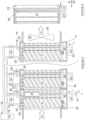
- the distribution of desiccant onto the top of the media pad 21 should be uniform, and this may be effected by a distributor 23 consisting of an array of tubes with holes at intervals such that there are 20 to 30 holes per square foot (200-300 per square meter) evenly spaced across the media pad horizontal surface.
- a distributor 23 consisting of an array of tubes with holes at intervals such that there are 20 to 30 holes per square foot (200-300 per square meter) evenly spaced across the media pad horizontal surface.
- Such a device 23 is shown in FIG. 4 for a single sector, but other means of distributing the liquid desiccant evenly onto the pad 23 may be used.
- the material of the media pads 21 in either device 1 or 2 is such that it is resistant to the desiccant and that the pads remain un-deformed at the temperatures that may be used.
- Such media may be evaporative cooler media, for example, those sold under the Trade Mark CELDEK by Munters AB of Kista, Sweden, and higher temperature versions of such media, for example, those sold under the Trade Mark GLASDEK by Munters AB, and as used in chemical towers, such as those sold by Lantec Products Incorporated, of Agoura Hills, California, where needed.
- the heat exchangers in Device 2 receive flows of heated fluid 15, shown in FIG. 3 , that heat the liquid desiccant in each sector in a similar manner to that described for Device 1 and flow 5.
- the heating fluid may return to the external heating source 52 via flow 16 for reheating or some other purpose.
- the outer surface of the sector enclosures 20 and heat exchangers 22 should be insulated, as is good practice with most HVAC devices, to reduce the loss of heat to atmosphere.
- the insulation may be conventional and, in the interests of conciseness and clarity, is not further illustrated or described.
- the liquid desiccant may be a concentrated solution in water of either Lithium Bromide or Lithium Chloride or a mixture of the two or another liquid desiccant capable of producing a low relative humidity when in contact with an airstream.
- Lithium Bromide enables a lower relative humidity to be achieved in the airstream 3 than does Lithium Chloride although either can produce when in equilibrium a relative humidity in the air of 12%.
- the liquid desiccant must be suitable to remove the moisture from the airstream 3 to the level required for the particular application.
- Other liquid desiccants are possible such as Calcium Chloride but some others have disadvantages of toxicity and/or insufficient temperature and humidity range.
- Device 1 also serves as an air-cleaning device for fine particles, pollens and spores that can bypass a normal air filter. Material removed from the air is washed into the desiccant and collected by a cartridge filter 31 in the recirculating line (flow 7) from pump 24 to heat exchanger 22.
- concentrated desiccant flow 11 from Device 2 flows to a reservoir as shown in FIG. 7 , from which it is pumped to Device 1 when required as flow 8.
- the desiccant flow 9 from Device 1 flows to a different part of the storage device and when required in Device 2 is pumped as flow 10.
- Device 1 is acting as a dehumidifier
- Device 2 is acting as a regenerator
- flow 9 from Device 1 is dilute desiccant solution, and is delivered to the top of the reservoir.
- Flow 11 from Device 2 is concentrated desiccant solution, and is delivered to the bottom of the reservoir.
- Flow 8 to Device 1 is concentrated desiccant solution, and is taken from the bottom of the reservoir.
- Flow 10 to Device 2 is dilute desiccant solution, and is taken from the top of the reservoir.
- Device 1 In winter, when Device 1 is acting as a humidifier, there will be normally no flow 9 because all the water added as flow 12 will evaporate into airstream 3 and thence pass into the conditioned space as desired.
- Device 2 may in winter be used as an enthalpy recovery device in which case flow 11 is switched to go directly to Device 1 as flow 13 and flow 9 goes directly to Device 2 as flow 10. The switching is achieved by standard procedures using plumbing T-valves activated when the mode of operation is changed, and is not shown here.
- the desiccant reservoir may be omitted and the desiccant flow 9 may go directly to Device 2 as flow 10 and desiccant flow 11 may go directly to Device 1 as flow 8 provided that minimum and maximum working levels of desiccant are maintained in the sumps 30 of each sector of each device as required to maintain the flow of desiccant through the heat exchangers 22 and over the pads 21 in each sector.
- Increasing or decreasing the flow 11 controls the desiccant concentration from Device 2 via sensor 35 or by calculation from the difference in the humidity of airflow 4 entering and leaving Device 2.
- part of the concentrated desiccant in Sector 1 of Device 2 flows from the pad 21 into a small basin that overflows into the sump 30.
- the desiccant in the sensor basin is a sample of the most concentrated desiccant being produced by Device 2.
- Sensor 35 contains a mechanism such as a float connected to a pressure sensitive device calibrated to read the specific gravity and therefore the concentration of the desiccant.
- Valve 50 operates with sensor 35 or by calculation to maintain the concentration of the desiccant at a level consistent with the relative humidity required in airstream 3 and the temperature of heating source 15.
- valve 48 In Device 1, a similar sensor 37 or calculation method described is used with valve 48 to ensure that desiccant flow 9 has been sufficiently diluted since the flow of desiccant to the reservoir and to Device 2 should be dilute for proper and economic operation of the regenerator.
- the apparatus functions as follows: In cooling/dehumidification mode, which is defined as when the airstream 3 is required to be dehumidified by Device 1, heat source fluid 5 is cool and when the system is in operation, i.e. the pumps and air movement devices are functioning as described above, the airstream 3 is cooled and partially dehumidified by contact with the optional cold coil 36, then dehumidified and cooled by passage through the desiccant modules 54, 55 and 56 of Device 1 and flows to its required application of conditioning a space.
- the desiccant flow 8 will normally be required to be concentrated in order for the Device 1 to simultaneously cool and remove humidity from the air. This process progressively dilutes the desiccant in the sectors as described above and the dilute desiccant exits Device 1 via flow 9.
- Device 2 receives diluted desiccant either from a reservoir or directly from Device 1 via flow 10 which flows into the sector of Device 2 nearest the airflow outlet 33 shown in FIG. 3 as part of module 60.
- the desiccant flows by gravity through a connecting tube 27, or by a partial flow from pump 24 in the adjacent sector as described for Device 1.
- Sector 1 shown as module 58
- a partial flow 11 of the concentrated desiccant is pumped by pump 24 either to a storage device or directly to Device 1 and is controlled by sensor 35 or by calculation, and by valve 50.
- each device comprises 4 sectors.
- Sector 1 of Device 1 outside airstream 3 undergoes a combination of two processes - adiabatic dehumidification and cooling - by the cooled desiccant.
- Two lines for each sector (adiabatic dehumidification, represented by a diagonal line at constant enthalpy, and cooling, represented by a horizontal line at constant humidity) in FIG. 1 show these two processes separately although they take place more or less simultaneously as the desiccant is pumped by pump 24 at a rate several times the rate at which the desiccant flows to the next sector.
- the amount of dehumidification and cooling of the airstream is limited by vapor pressure of the desiccant (which is a function of its concentration) in that sector and the amount of heat transferred to the desiccant via the heat exchanger 22 in that module.
- the desiccant that the air is in contact with in Sector 1 has already passed through the other sectors and so is relatively dilute but the rate of flow of desiccant between the sectors is such that the desiccant is sufficiently concentrated to remove a fraction of the moisture in the airstream 3.
- the air enters Sector 2 and is treated in the same way by desiccant that enters Sector 2 more concentrated than that in Sector 1.
- the cooling fluid 5 in this example is at about 60 degrees F (15.5 °C) and there is approximately a 5 degrees F (3 °C) temperature differential across the heat exchangers.
- the incoming desiccant flow 8 should be sufficiently concentrated to produce the desired relative humidity of the supply airstream 3.
- the reconcentration of the desiccant in Device 2 is also shown in FIG. 1 on the higher temperature portion of the psychrometric chart.
- the airstream 4 may be optionally preheated as described previously and then enters Sector 1 of Device 2 where it removes humidity in order to concentrate the desiccant that has been heated by exchangers 22.
- the horizontal lines for heating and the equal enthalpy line for adiabatic humidification represent this in FIG. 1 although both processes actually take place more or less simultaneously.
- the air then passes through Sector 2 of Device 2, shown in FIG. 3 as module 59, downstream in the direction of air flow, where it is further heated and the desiccant is concentrated by evaporation into the air.
- FIG. 1 four sectors are shown for each of Devices 1 and 2, with the air passing through them in numerical order (Sector 1, then Sector 2, then Sector 3, then Sector 4, corresponding to modules 54, 55, 55, 56 in FIG. 2 and 58, 59, 59, 60 in FIG. 3 ).
- the desiccant flows in the opposite direction to the air as already described. There may be two sectors or more depending on the operating conditions as described earlier. If more dilute desiccant is sufficient for the maximum dehumidification required then fewer sectors are required, whereas for a very concentrated desiccant more sectors will be required.
- the temperature of the heating fluid 15 that is used to heat the desiccant in a heat exchanger 22 in each sector also affects the number of sectors needed.
- a major advantage of the multiple-sector process described is the ability to use relatively low temperatures that are readily available from low-cost heat sources such as waste heat, solar-heated water and hot water available from chillers all of which are inexpensively available at around 130 to 140 degrees F (54 to 60 °C).
- Operation in winter mode which is when the building controls are calling for heating of the incoming air, need not involve the use of Device 2 to alter the desiccant concentration although Device 2 may be used to recover heat and humidity from the building exhaust air.
- the incoming air has low humidity and so humidification is desirable, which can be accomplished by a flow of water 12 into Device 1.
- This dilutes the desiccant in the last sector (in module 56) to the point where it humidifies airstream 3. Since water evaporates from the diluted desiccant under these circumstances, water flow 12 will operate as needed by level sensor 28 in module 56 to maintain the diluted desiccant level.
- the desiccant in Sector 1 of Device 1 will still remain sufficiently active as a biocide despite becoming partially diluted.
- a standard water treatment plant (not shown) is used where necessary to treat the flow of water 12 to remove impurities that could either affect the action of the desiccant or give rise to buildup of residue.
- Heat and moisture recovery in winter mode using Device 2 may be accomplished by using Device 2 and Sector 1 of Device 1 as the two parts of an enthalpy run-around loop.
- Device 2 operates as in summer mode but without added heat from flow 15, which is shut off.
- the desiccant flow 10 enters as in summer mode and the desiccant picks up heat and moisture from the exhaust air from the building.
- the desiccant flow 11 exits Device 2 and valve 50 is fully open.
- the difference from summer mode operation is that flow 11 is routed to Sector 1 of Device 1 as flow 13, is pumped over the pad 21 and serves to pre-heat and pre-humidify the outdoor air flow 3.
- Switching between summer and winter mode is achieved as above and by changing the flow into Device 1 from desiccant (flow 8) to water (flow 12), and the reverse switching involves changing back to desiccant and also reactivating Device 2. After activation of the winter mode and the desiccant has been diluted, flow 11 is switched to connect with flow 13 instead of going to the storage device.
- the desiccant level may be controlled by turning the desiccant inflows 8 or 10 on or off according to a level sensor 28 that may be situated in a convenient location in one or more of the basins 30. Activation of the flows may be achieved either by turning on pump 43 or 44, or alternatively by opening a flow valve (not shown) in place of the pump if there is sufficient pressure to cause the flows 10 or 8.
- the level control 28 is a float activated control valve that serves to directly control the inflow of desiccant except in the last sector where 28 controls a pump 43 or 44 in the reservoir.
Landscapes
- Engineering & Computer Science (AREA)
- Chemical & Material Sciences (AREA)
- Combustion & Propulsion (AREA)
- Mechanical Engineering (AREA)
- General Engineering & Computer Science (AREA)
- Central Air Conditioning (AREA)
- Drying Of Gases (AREA)
- Air Conditioning Control Device (AREA)
Applications Claiming Priority (2)
| Application Number | Priority Date | Filing Date | Title |
|---|---|---|---|
| US201461979882P | 2014-04-15 | 2014-04-15 | |
| PCT/US2015/024831 WO2015160580A1 (en) | 2014-04-15 | 2015-04-08 | An air conditioning method using a staged process using a liquid desiccant |
Publications (4)
| Publication Number | Publication Date |
|---|---|
| EP3132206A1 EP3132206A1 (en) | 2017-02-22 |
| EP3132206A4 EP3132206A4 (en) | 2018-01-03 |
| EP3132206B1 true EP3132206B1 (en) | 2025-03-12 |
| EP3132206C0 EP3132206C0 (en) | 2025-03-12 |
Family
ID=54264795
Family Applications (1)
| Application Number | Title | Priority Date | Filing Date |
|---|---|---|---|
| EP15779439.7A Active EP3132206B1 (en) | 2014-04-15 | 2015-04-08 | An air conditioning method using a staged process using a liquid desiccant |
Country Status (8)
| Country | Link |
|---|---|
| US (2) | US9982901B2 (https=) |
| EP (1) | EP3132206B1 (https=) |
| JP (1) | JP6728130B2 (https=) |
| KR (1) | KR102396679B1 (https=) |
| CN (1) | CN106461245B (https=) |
| CA (1) | CA2945998C (https=) |
| MX (1) | MX382064B (https=) |
| WO (1) | WO2015160580A1 (https=) |
Families Citing this family (42)
| Publication number | Priority date | Publication date | Assignee | Title |
|---|---|---|---|---|
| US10808948B2 (en) | 2010-05-18 | 2020-10-20 | Energy & Environmental Research Center | Heat dissipation systems with hygroscopic working fluid |
| US10260761B2 (en) | 2010-05-18 | 2019-04-16 | Energy & Environmental Research Center Foundation | Heat dissipation systems with hygroscopic working fluid |
| US10845067B2 (en) | 2010-05-18 | 2020-11-24 | Energy & Enviornmental Research Center | Hygroscopic cooling tower for waste water disposal |
| EP2585784A4 (en) | 2010-06-24 | 2016-02-24 | Venmar Ces Inc | ENERGY EXCHANGER FOR A LIQUID AIR MEMBRANE |
| US8915092B2 (en) | 2011-01-19 | 2014-12-23 | Venmar Ces, Inc. | Heat pump system having a pre-processing module |
| US9810439B2 (en) | 2011-09-02 | 2017-11-07 | Nortek Air Solutions Canada, Inc. | Energy exchange system for conditioning air in an enclosed structure |
| US9816760B2 (en) | 2012-08-24 | 2017-11-14 | Nortek Air Solutions Canada, Inc. | Liquid panel assembly |
| US9772124B2 (en) | 2013-03-13 | 2017-09-26 | Nortek Air Solutions Canada, Inc. | Heat pump defrosting system and method |
| US9109808B2 (en) | 2013-03-13 | 2015-08-18 | Venmar Ces, Inc. | Variable desiccant control energy exchange system and method |
| US10352628B2 (en) | 2013-03-14 | 2019-07-16 | Nortek Air Solutions Canada, Inc. | Membrane-integrated energy exchange assembly |
| US11408681B2 (en) | 2013-03-15 | 2022-08-09 | Nortek Air Solations Canada, Iac. | Evaporative cooling system with liquid-to-air membrane energy exchanger |
| US10584884B2 (en) | 2013-03-15 | 2020-03-10 | Nortek Air Solutions Canada, Inc. | Control system and method for a liquid desiccant air delivery system |
| DK3183051T3 (da) | 2014-08-19 | 2020-06-02 | Nortek Air Solutions Canada Inc | Væske-til-luftmembranenergivekslere |
| US10767561B2 (en) | 2014-10-10 | 2020-09-08 | Stellar Energy Americas, Inc. | Method and apparatus for cooling the ambient air at the inlet of gas combustion turbine generators |
| US10808951B2 (en) | 2015-05-15 | 2020-10-20 | Nortek Air Solutions Canada, Inc. | Systems and methods for providing cooling to a heat load |
| US11092349B2 (en) | 2015-05-15 | 2021-08-17 | Nortek Air Solutions Canada, Inc. | Systems and methods for providing cooling to a heat load |
| US11143430B2 (en) | 2015-05-15 | 2021-10-12 | Nortek Air Solutions Canada, Inc. | Using liquid to air membrane energy exchanger for liquid cooling |
| EP3314188B1 (en) | 2015-06-26 | 2021-05-12 | Nortek Air Solutions Canada, Inc. | Three-fluid liquid to air membrane energy exchanger |
| KR101754129B1 (ko) | 2015-12-17 | 2017-07-06 | (주)가교테크 | 증발냉각식 배기열 회수장치의 성능 예측 방법 |
| SE541002C2 (en) * | 2016-07-06 | 2019-02-26 | Airwatergreen Group Ab | Device for continuous water absorption and an air cooler |
| AU2017410556A1 (en) | 2017-04-18 | 2019-12-05 | Nortek Air Solutions Canada, Inc. | Systems and methods for managing conditions in enclosed space |
| AU2017410557A1 (en) | 2017-04-18 | 2019-12-05 | Nortek Air Solutions Canada, Inc. | Desiccant enhanced evaporative cooling systems and methods |
| US10845109B2 (en) * | 2017-06-22 | 2020-11-24 | CoVAP LLC | Modular adiabatic pre-cooling cassette with method of retrofit for horizontal air-cooled commercial refrigeration condensers |
| US10527303B2 (en) * | 2017-11-16 | 2020-01-07 | Grahame Ernest Maisey | Load follower and load anticipator for a liquid desiccant air conditioning system |
| US10760797B2 (en) * | 2017-11-30 | 2020-09-01 | Grahame Ernest Maisey | Air or spray washer for air conditioning units |
| WO2020026084A2 (en) | 2018-07-30 | 2020-02-06 | King Abdullah University Of Science And Technology | Liquid desiccant based humidity pump, evaporative cooler, and air purification systems |
| US11117090B2 (en) | 2018-11-26 | 2021-09-14 | Palo Alto Research Center Incorporated | Electrodialytic liquid desiccant dehumidifying system |
| CN109999622B (zh) * | 2019-02-24 | 2024-08-30 | 无锡山宁机械有限公司 | 一种湿帘溶液脱水器及其脱水方法 |
| US11879663B2 (en) * | 2019-09-03 | 2024-01-23 | Etr Llc | HVAC condensate evaporation and aerobic dispersion systems |
| CN110779110B (zh) * | 2019-11-18 | 2021-02-05 | 珠海格力电器股份有限公司 | 空调装置及其控制方法 |
| US20220243932A1 (en) * | 2021-01-29 | 2022-08-04 | Palo Alto Research Center Incorporated | Electrochemical dehumidifier with multiple air contactors |
| US12085293B2 (en) * | 2021-03-17 | 2024-09-10 | Mojave Energy Systems, Inc. | Staged regenerated liquid desiccant dehumidification systems |
| WO2022231536A1 (en) * | 2021-04-30 | 2022-11-03 | Enerama Çevre Teknoloji̇leri̇ Sanayi̇ Ve Ti̇caret Anoni̇m Şi̇rketi̇ | Liquid desiccant dehumidification system with multiple regeneration towers and multiple absorbers |
| US11944934B2 (en) | 2021-12-22 | 2024-04-02 | Mojave Energy Systems, Inc. | Electrochemically regenerated liquid desiccant dehumidification system using a secondary heat pump |
| US12510257B2 (en) | 2021-12-22 | 2025-12-30 | Mojave Energy Systems, Inc. | Electrochemically regenerated liquid desiccant dehumidification system using a secondary heat pump |
| US12571546B2 (en) | 2022-04-13 | 2026-03-10 | Mojave Energy Systems, Inc. | Liquid desiccant air conditioning using air as heat transfer medium |
| CN120604082A (zh) | 2022-12-12 | 2025-09-05 | 莫哈维能源系统公司 | 液体干燥剂空调系统和控制方法 |
| CN121038880A (zh) | 2023-04-07 | 2025-11-28 | 莫哈维能源系统公司 | 超低流量干燥剂空气调节系统装置和方法 |
| WO2024211820A2 (en) * | 2023-04-07 | 2024-10-10 | Mojave Energy Systems, Inc. | Ultra low flow desiccant air conditioning systems devices and methods |
| WO2025029955A2 (en) * | 2023-08-02 | 2025-02-06 | Airgreen, Inc. | Apparatuses, systems, and methods to measure desiccant concentration in air conditioning systems |
| WO2025042829A1 (en) * | 2023-08-23 | 2025-02-27 | Airgreen, Inc. | Desiccant air conditioning system using refrigerant |
| TWI912877B (zh) * | 2024-08-09 | 2026-01-21 | 財團法人工業技術研究院 | 液態除濕系統 |
Family Cites Families (41)
| Publication number | Priority date | Publication date | Assignee | Title |
|---|---|---|---|---|
| US4164125A (en) | 1977-10-17 | 1979-08-14 | Midland-Ross Corporation | Solar energy assisted air-conditioning apparatus and method |
| SE440275B (sv) | 1979-03-21 | 1985-07-22 | Svante Thunberg | Vermevexlare till anleggningar for ventilering av lokaler |
| US4982782A (en) | 1986-07-09 | 1991-01-08 | Walter F. Albers | Method and apparatus for simultaneous heat and mass transfer |
| US5020335A (en) | 1986-07-09 | 1991-06-04 | Walter F. Albers | Method and apparatus for simultaneous heat and mass transfer |
| US5123481A (en) | 1986-07-09 | 1992-06-23 | Walter F. Albers | Method and apparatus for simultaneous heat and mass transfer |
| SE464853B (sv) * | 1988-08-01 | 1991-06-24 | Ahlstroem Foeretagen | Foerfarande foer avfuktning av en gas, speciellt luft |
| US5020588A (en) | 1989-05-03 | 1991-06-04 | Walter F. Albers | Method and apparatus for simultaneous heat and mass transfer utilizing a plurality of gas streams |
| US4941324A (en) * | 1989-09-12 | 1990-07-17 | Peterson John L | Hybrid vapor-compression/liquid desiccant air conditioner |
| US5146978A (en) | 1990-10-30 | 1992-09-15 | Walter F. Albers | Method and apparatus for monochannel simultaneous heat and mass transfer |
| US5351497A (en) | 1992-12-17 | 1994-10-04 | Gas Research Institute | Low-flow internally-cooled liquid-desiccant absorber |
| US5426953A (en) * | 1993-02-05 | 1995-06-27 | Meckler; Milton | Co-sorption air dehumidifying and pollutant removal system |
| US5460004A (en) | 1993-04-09 | 1995-10-24 | Ari-Tec Marketing, Inc. | Desiccant cooling system with evaporative cooling |
| US6138470A (en) * | 1997-12-04 | 2000-10-31 | Fedders Corporation | Portable liquid desiccant dehumidifier |
| US6216489B1 (en) | 1997-12-04 | 2001-04-17 | Fedders Corporation | Liquid desiccant air conditioner |
| US6513339B1 (en) | 1999-04-16 | 2003-02-04 | Work Smart Energy Enterprises, Inc. | Solar air conditioner |
| IL158536A0 (en) | 2001-04-23 | 2004-05-12 | Drykor Ltd | Apparatus for air-conditioning |
| WO2003056249A1 (en) | 2001-12-27 | 2003-07-10 | Drykor Ltd. | High efficiency dehumidifiers and combined dehumidifying/air-conditioning systems |
| KR20040026242A (ko) * | 2002-09-23 | 2004-03-31 | 주식회사 에어필 | 열펌프를 이용한 액체 제습식 냉방장치 |
| CN1200228C (zh) * | 2002-12-09 | 2005-05-04 | 清华大学 | 一种利用吸湿溶液为循环工质的全热交换方法及其装置 |
| AU2003303998A1 (en) | 2003-03-12 | 2004-09-30 | Milind V. Rane | Air conditioning method using liquid desiccant |
| US6854279B1 (en) | 2003-06-09 | 2005-02-15 | The United States Of America As Represented By The Secretary Of The Navy | Dynamic desiccation cooling system for ships |
| AU2003304208A1 (en) | 2003-06-12 | 2005-01-04 | Milind V. Rane | Multiutility vapor compression system |
| US20050109052A1 (en) | 2003-09-30 | 2005-05-26 | Albers Walter F. | Systems and methods for conditioning air and transferring heat and mass between airflows |
| TWI404897B (zh) * | 2006-08-25 | 2013-08-11 | Ducool Ltd | 用以管理流體中之水含量的系統及方法 |
| US8268060B2 (en) | 2007-10-15 | 2012-09-18 | Green Comfort Systems, Inc. | Dehumidifier system |
| US8241399B2 (en) * | 2008-05-16 | 2012-08-14 | Walter Albers | Thermo-chemical heat pump and methods of generating heat from a gas stream |
| US20100000247A1 (en) | 2008-07-07 | 2010-01-07 | Bhatti Mohinder S | Solar-assisted climate control system |
| WO2010016040A1 (en) | 2008-08-08 | 2010-02-11 | Technion Research And Development Foundation Ltd. | Liquid desiccant dehumidification system and heat /mass exchanger therefor |
| US20100175394A1 (en) * | 2009-01-09 | 2010-07-15 | Albers Walter F | Air energy reduction method and apparatus using waste heat from condensers or other low grade heat |
| US8196907B2 (en) | 2009-08-18 | 2012-06-12 | General Electric Company | System for conditioning the airflow entering a turbomachine |
| US10260761B2 (en) * | 2010-05-18 | 2019-04-16 | Energy & Environmental Research Center Foundation | Heat dissipation systems with hygroscopic working fluid |
| US9377207B2 (en) * | 2010-05-25 | 2016-06-28 | 7Ac Technologies, Inc. | Water recovery methods and systems |
| EP2585784A4 (en) * | 2010-06-24 | 2016-02-24 | Venmar Ces Inc | ENERGY EXCHANGER FOR A LIQUID AIR MEMBRANE |
| JP5554454B2 (ja) * | 2010-11-23 | 2014-07-23 | ディーユークール リミテッド | 空調システム |
| US8141379B2 (en) | 2010-12-02 | 2012-03-27 | King Fahd University Of Petroleum & Minerals | Hybrid solar air-conditioning system |
| US10012401B2 (en) | 2010-12-13 | 2018-07-03 | Ducool Ltd. | Method and apparatus for conditioning air |
| BR112014004412B1 (pt) | 2011-08-26 | 2021-09-08 | Ducool, Ltd | Sistema para condicionamento de ar e método para condicionamento de ar |
| SG11201405212UA (en) | 2012-05-16 | 2014-09-26 | Univ Nanyang Tech | A dehumidifying system, a method of dehumidifying and a cooling system |
| US8876956B2 (en) | 2012-06-04 | 2014-11-04 | Z124 | System for water recovery including multiple power sources |
| US20130340449A1 (en) | 2012-06-20 | 2013-12-26 | Alliance For Sustainable Energy, Llc | Indirect evaporative cooler using membrane-contained liquid desiccant for dehumidification and flocked surfaces to provide coolant flow |
| CN203132011U (zh) | 2012-12-14 | 2013-08-14 | 东南大学常州研究院 | 溶液除湿再生热湿独立处理空调装置 |
-
2015
- 2015-04-08 WO PCT/US2015/024831 patent/WO2015160580A1/en not_active Ceased
- 2015-04-08 US US14/681,448 patent/US9982901B2/en active Active
- 2015-04-08 CN CN201580025807.3A patent/CN106461245B/zh active Active
- 2015-04-08 CA CA2945998A patent/CA2945998C/en active Active
- 2015-04-08 KR KR1020167031433A patent/KR102396679B1/ko active Active
- 2015-04-08 JP JP2017506252A patent/JP6728130B2/ja active Active
- 2015-04-08 EP EP15779439.7A patent/EP3132206B1/en active Active
- 2015-04-08 MX MX2016013587A patent/MX382064B/es unknown
-
2018
- 2018-04-25 US US15/962,462 patent/US10823436B2/en active Active
Also Published As
| Publication number | Publication date |
|---|---|
| CA2945998A1 (en) | 2015-10-22 |
| KR102396679B1 (ko) | 2022-05-11 |
| JP6728130B2 (ja) | 2020-07-22 |
| EP3132206C0 (en) | 2025-03-12 |
| US20180238568A1 (en) | 2018-08-23 |
| EP3132206A4 (en) | 2018-01-03 |
| CN106461245B (zh) | 2020-08-18 |
| MX2016013587A (es) | 2017-06-07 |
| JP2017517395A (ja) | 2017-06-29 |
| WO2015160580A1 (en) | 2015-10-22 |
| US10823436B2 (en) | 2020-11-03 |
| EP3132206A1 (en) | 2017-02-22 |
| US20150292754A1 (en) | 2015-10-15 |
| KR20160143806A (ko) | 2016-12-14 |
| MX382064B (es) | 2025-03-11 |
| US9982901B2 (en) | 2018-05-29 |
| CN106461245A (zh) | 2017-02-22 |
| CA2945998C (en) | 2021-03-02 |
Similar Documents
| Publication | Publication Date | Title |
|---|---|---|
| US10823436B2 (en) | Air conditioning method using a staged process using a liquid desiccant | |
| JP6718871B2 (ja) | 液体乾燥剤空調システム | |
| US10619868B2 (en) | In-ceiling liquid desiccant air conditioning system | |
| KR102099693B1 (ko) | 소형-분할형 액체 흡수제 공조 방법 및 시스템 | |
| CN110594883B (zh) | 组合热交换器和注水系统 | |
| US9140460B2 (en) | Control methods and systems for indirect evaporative coolers | |
| CA3019410A1 (en) | Air conditioning via multi-phase plate heat exchanger | |
| US20130340449A1 (en) | Indirect evaporative cooler using membrane-contained liquid desiccant for dehumidification and flocked surfaces to provide coolant flow | |
| EP2770266B1 (en) | Regeneration air mixing for a membrane based hygroscopic material dehumidification system | |
| CN105121966A (zh) | 用于液体干燥剂空气调节系统改造的方法和系统 | |
| US20140251581A1 (en) | High efficiency air cooling apparatus | |
| AU708106B2 (en) | Method and apparatus for cooling fluid and dehumidifying and cooling gas | |
| CN102165267A (zh) | 用于周期性加湿和除湿室内空气的带有全热交换器的吸附空调系统的操作方法 | |
| HK40003907B (en) | Air-conditioning via multi-phase plate heat exchanger | |
| HK40003907A (en) | Air-conditioning via multi-phase plate heat exchanger |
Legal Events
| Date | Code | Title | Description |
|---|---|---|---|
| STAA | Information on the status of an ep patent application or granted ep patent |
Free format text: STATUS: THE INTERNATIONAL PUBLICATION HAS BEEN MADE |
|
| PUAI | Public reference made under article 153(3) epc to a published international application that has entered the european phase |
Free format text: ORIGINAL CODE: 0009012 |
|
| STAA | Information on the status of an ep patent application or granted ep patent |
Free format text: STATUS: REQUEST FOR EXAMINATION WAS MADE |
|
| 17P | Request for examination filed |
Effective date: 20161110 |
|
| AK | Designated contracting states |
Kind code of ref document: A1 Designated state(s): AL AT BE BG CH CY CZ DE DK EE ES FI FR GB GR HR HU IE IS IT LI LT LU LV MC MK MT NL NO PL PT RO RS SE SI SK SM TR |
|
| AX | Request for extension of the european patent |
Extension state: BA ME |
|
| DAV | Request for validation of the european patent (deleted) | ||
| DAX | Request for extension of the european patent (deleted) | ||
| A4 | Supplementary search report drawn up and despatched |
Effective date: 20171206 |
|
| RIC1 | Information provided on ipc code assigned before grant |
Ipc: F24F 3/14 20060101AFI20171130BHEP Ipc: F24F 11/00 20180101ALI20171130BHEP |
|
| RAP1 | Party data changed (applicant data changed or rights of an application transferred) |
Owner name: AIRGREEN, INC. |
|
| RIN1 | Information on inventor provided before grant (corrected) |
Inventor name: MONGAR, ANDREW |
|
| STAA | Information on the status of an ep patent application or granted ep patent |
Free format text: STATUS: EXAMINATION IS IN PROGRESS |
|
| 17Q | First examination report despatched |
Effective date: 20191009 |
|
| GRAP | Despatch of communication of intention to grant a patent |
Free format text: ORIGINAL CODE: EPIDOSNIGR1 |
|
| STAA | Information on the status of an ep patent application or granted ep patent |
Free format text: STATUS: GRANT OF PATENT IS INTENDED |
|
| INTG | Intention to grant announced |
Effective date: 20241010 |
|
| GRAS | Grant fee paid |
Free format text: ORIGINAL CODE: EPIDOSNIGR3 |
|
| GRAA | (expected) grant |
Free format text: ORIGINAL CODE: 0009210 |
|
| STAA | Information on the status of an ep patent application or granted ep patent |
Free format text: STATUS: THE PATENT HAS BEEN GRANTED |
|
| AK | Designated contracting states |
Kind code of ref document: B1 Designated state(s): AL AT BE BG CH CY CZ DE DK EE ES FI FR GB GR HR HU IE IS IT LI LT LU LV MC MK MT NL NO PL PT RO RS SE SI SK SM TR |
|
| REG | Reference to a national code |
Ref country code: GB Ref legal event code: FG4D |
|
| REG | Reference to a national code |
Ref country code: CH Ref legal event code: EP |
|
| REG | Reference to a national code |
Ref country code: DE Ref legal event code: R096 Ref document number: 602015091194 Country of ref document: DE |
|
| REG | Reference to a national code |
Ref country code: IE Ref legal event code: FG4D |
|
| U01 | Request for unitary effect filed |
Effective date: 20250324 |
|
| U07 | Unitary effect registered |
Designated state(s): AT BE BG DE DK EE FI FR IT LT LU LV MT NL PT RO SE SI Effective date: 20250331 |
|
| U20 | Renewal fee for the european patent with unitary effect paid |
Year of fee payment: 11 Effective date: 20250528 |
|
| PG25 | Lapsed in a contracting state [announced via postgrant information from national office to epo] |
Ref country code: RS Free format text: LAPSE BECAUSE OF FAILURE TO SUBMIT A TRANSLATION OF THE DESCRIPTION OR TO PAY THE FEE WITHIN THE PRESCRIBED TIME-LIMIT Effective date: 20250612 |
|
| PG25 | Lapsed in a contracting state [announced via postgrant information from national office to epo] |
Ref country code: ES Free format text: LAPSE BECAUSE OF FAILURE TO SUBMIT A TRANSLATION OF THE DESCRIPTION OR TO PAY THE FEE WITHIN THE PRESCRIBED TIME-LIMIT Effective date: 20250312 |
|
| PGFP | Annual fee paid to national office [announced via postgrant information from national office to epo] |
Ref country code: GB Payment date: 20250429 Year of fee payment: 11 |
|
| PG25 | Lapsed in a contracting state [announced via postgrant information from national office to epo] |
Ref country code: NO Free format text: LAPSE BECAUSE OF FAILURE TO SUBMIT A TRANSLATION OF THE DESCRIPTION OR TO PAY THE FEE WITHIN THE PRESCRIBED TIME-LIMIT Effective date: 20250612 |
|
| PG25 | Lapsed in a contracting state [announced via postgrant information from national office to epo] |
Ref country code: HR Free format text: LAPSE BECAUSE OF FAILURE TO SUBMIT A TRANSLATION OF THE DESCRIPTION OR TO PAY THE FEE WITHIN THE PRESCRIBED TIME-LIMIT Effective date: 20250312 |
|
| PG25 | Lapsed in a contracting state [announced via postgrant information from national office to epo] |
Ref country code: GR Free format text: LAPSE BECAUSE OF FAILURE TO SUBMIT A TRANSLATION OF THE DESCRIPTION OR TO PAY THE FEE WITHIN THE PRESCRIBED TIME-LIMIT Effective date: 20250613 |
|
| PG25 | Lapsed in a contracting state [announced via postgrant information from national office to epo] |
Ref country code: SM Free format text: LAPSE BECAUSE OF FAILURE TO SUBMIT A TRANSLATION OF THE DESCRIPTION OR TO PAY THE FEE WITHIN THE PRESCRIBED TIME-LIMIT Effective date: 20250312 |
|
| PG25 | Lapsed in a contracting state [announced via postgrant information from national office to epo] |
Ref country code: PL Free format text: LAPSE BECAUSE OF FAILURE TO SUBMIT A TRANSLATION OF THE DESCRIPTION OR TO PAY THE FEE WITHIN THE PRESCRIBED TIME-LIMIT Effective date: 20250312 |
|
| PG25 | Lapsed in a contracting state [announced via postgrant information from national office to epo] |
Ref country code: CZ Free format text: LAPSE BECAUSE OF FAILURE TO SUBMIT A TRANSLATION OF THE DESCRIPTION OR TO PAY THE FEE WITHIN THE PRESCRIBED TIME-LIMIT Effective date: 20250312 |
|
| PG25 | Lapsed in a contracting state [announced via postgrant information from national office to epo] |
Ref country code: SK Free format text: LAPSE BECAUSE OF FAILURE TO SUBMIT A TRANSLATION OF THE DESCRIPTION OR TO PAY THE FEE WITHIN THE PRESCRIBED TIME-LIMIT Effective date: 20250312 |
|
| PG25 | Lapsed in a contracting state [announced via postgrant information from national office to epo] |
Ref country code: IS Free format text: LAPSE BECAUSE OF FAILURE TO SUBMIT A TRANSLATION OF THE DESCRIPTION OR TO PAY THE FEE WITHIN THE PRESCRIBED TIME-LIMIT Effective date: 20250712 |
|
| REG | Reference to a national code |
Ref country code: CH Ref legal event code: H13 Free format text: ST27 STATUS EVENT CODE: U-0-0-H10-H13 (AS PROVIDED BY THE NATIONAL OFFICE) Effective date: 20251125 |
|
| PG25 | Lapsed in a contracting state [announced via postgrant information from national office to epo] |
Ref country code: MC Free format text: LAPSE BECAUSE OF FAILURE TO SUBMIT A TRANSLATION OF THE DESCRIPTION OR TO PAY THE FEE WITHIN THE PRESCRIBED TIME-LIMIT Effective date: 20250312 |
|
| PLBE | No opposition filed within time limit |
Free format text: ORIGINAL CODE: 0009261 |
|
| STAA | Information on the status of an ep patent application or granted ep patent |
Free format text: STATUS: NO OPPOSITION FILED WITHIN TIME LIMIT |
|
| PG25 | Lapsed in a contracting state [announced via postgrant information from national office to epo] |
Ref country code: CH Free format text: LAPSE BECAUSE OF NON-PAYMENT OF DUE FEES Effective date: 20250430 |
|
| REG | Reference to a national code |
Ref country code: CH Ref legal event code: L10 Free format text: ST27 STATUS EVENT CODE: U-0-0-L10-L00 (AS PROVIDED BY THE NATIONAL OFFICE) Effective date: 20260121 |
|
| 26N | No opposition filed |
Effective date: 20251215 |
|
| PG25 | Lapsed in a contracting state [announced via postgrant information from national office to epo] |
Ref country code: IE Free format text: LAPSE BECAUSE OF NON-PAYMENT OF DUE FEES Effective date: 20250408 |