EP3127097B1 - Système et procédé de génération d'affichage de sortie d'après des conditions ambiantes - Google Patents
Système et procédé de génération d'affichage de sortie d'après des conditions ambiantes Download PDFInfo
- Publication number
- EP3127097B1 EP3127097B1 EP15774309.7A EP15774309A EP3127097B1 EP 3127097 B1 EP3127097 B1 EP 3127097B1 EP 15774309 A EP15774309 A EP 15774309A EP 3127097 B1 EP3127097 B1 EP 3127097B1
- Authority
- EP
- European Patent Office
- Prior art keywords
- content
- display
- ambient
- factors
- sensor
- Prior art date
- Legal status (The legal status is an assumption and is not a legal conclusion. Google has not performed a legal analysis and makes no representation as to the accuracy of the status listed.)
- Active
Links
Images




Classifications
-
- G—PHYSICS
- G06—COMPUTING OR CALCULATING; COUNTING
- G06F—ELECTRIC DIGITAL DATA PROCESSING
- G06F3/00—Input arrangements for transferring data to be processed into a form capable of being handled by the computer; Output arrangements for transferring data from processing unit to output unit, e.g. interface arrangements
- G06F3/14—Digital output to display device ; Cooperation and interconnection of the display device with other functional units
-
- G—PHYSICS
- G09—EDUCATION; CRYPTOGRAPHY; DISPLAY; ADVERTISING; SEALS
- G09G—ARRANGEMENTS OR CIRCUITS FOR CONTROL OF INDICATING DEVICES USING STATIC MEANS TO PRESENT VARIABLE INFORMATION
- G09G5/00—Control arrangements or circuits for visual indicators common to cathode-ray tube indicators and other visual indicators
- G09G5/10—Intensity circuits
-
- H—ELECTRICITY
- H04—ELECTRIC COMMUNICATION TECHNIQUE
- H04N—PICTORIAL COMMUNICATION, e.g. TELEVISION
- H04N1/00—Scanning, transmission or reproduction of documents or the like, e.g. facsimile transmission; Details thereof
- H04N1/00835—Detecting external or ambient light
-
- G—PHYSICS
- G09—EDUCATION; CRYPTOGRAPHY; DISPLAY; ADVERTISING; SEALS
- G09G—ARRANGEMENTS OR CIRCUITS FOR CONTROL OF INDICATING DEVICES USING STATIC MEANS TO PRESENT VARIABLE INFORMATION
- G09G2320/00—Control of display operating conditions
- G09G2320/06—Adjustment of display parameters
- G09G2320/0626—Adjustment of display parameters for control of overall brightness
-
- G—PHYSICS
- G09—EDUCATION; CRYPTOGRAPHY; DISPLAY; ADVERTISING; SEALS
- G09G—ARRANGEMENTS OR CIRCUITS FOR CONTROL OF INDICATING DEVICES USING STATIC MEANS TO PRESENT VARIABLE INFORMATION
- G09G2360/00—Aspects of the architecture of display systems
- G09G2360/14—Detecting light within display terminals, e.g. using a single or a plurality of photosensors
-
- G—PHYSICS
- G09—EDUCATION; CRYPTOGRAPHY; DISPLAY; ADVERTISING; SEALS
- G09G—ARRANGEMENTS OR CIRCUITS FOR CONTROL OF INDICATING DEVICES USING STATIC MEANS TO PRESENT VARIABLE INFORMATION
- G09G2360/00—Aspects of the architecture of display systems
- G09G2360/14—Detecting light within display terminals, e.g. using a single or a plurality of photosensors
- G09G2360/144—Detecting light within display terminals, e.g. using a single or a plurality of photosensors the light being ambient light
-
- G—PHYSICS
- G09—EDUCATION; CRYPTOGRAPHY; DISPLAY; ADVERTISING; SEALS
- G09G—ARRANGEMENTS OR CIRCUITS FOR CONTROL OF INDICATING DEVICES USING STATIC MEANS TO PRESENT VARIABLE INFORMATION
- G09G2370/00—Aspects of data communication
- G09G2370/02—Networking aspects
- G09G2370/022—Centralised management of display operation, e.g. in a server instead of locally
-
- G—PHYSICS
- G09—EDUCATION; CRYPTOGRAPHY; DISPLAY; ADVERTISING; SEALS
- G09G—ARRANGEMENTS OR CIRCUITS FOR CONTROL OF INDICATING DEVICES USING STATIC MEANS TO PRESENT VARIABLE INFORMATION
- G09G2370/00—Aspects of data communication
- G09G2370/16—Use of wireless transmission of display information
Definitions
- the disclosed technology relates generally to graphical display technology and more specifically to determining environmental factors and generating an output display based on the environmental factors.
- Digital picture frames looping electronic images. These digital picture frames include a small microprocessor with limited processing technology and a memory device.
- the microprocessor includes functionality for advancing and transitioning between images.
- Advancements in the digital picture frame technology include improvements in loading images into the local memory.
- current techniques allow for wireless connectivity, such as a Bluetooth connection, for the uploading of images.
- the connectivity may allow for the streaming of content onto the screen using an active network connection.
- a flat screen television is more commonly available.
- Flat screen televisions when idle, can serve as an electronic canvas such as using screensaver technology.
- smart television technology further enhances the ability to stream and provide content to an idle television screen.
- This technology may be embedded within processing technology of the television itself or can be enhanced or supplemented by a connected device.
- a smart television includes functionality for wireless connectivity to the Internet, this allows for a user to access Internet-based content for display on the screen.
- connected technology allows for the importation of content for display on the screen.
- One example is an AppleTV ® available from Apple, Inc. of Cupertino CA. This product connects via a USB connection and receives content via either a local computer or direct connection to the Internet. Via the USB-connected device, the user can load content onto the screen.
- Adaptive brightness systems determine the brightness of a particular room and automatically adjust the brightness level of the television display. This adjustment does not relate to type of content, but makes existing content more visible.
- US 2011/0309946 A1 describes a media-reproduction device, such as a mobile radio communication device or a digital photo frame.
- the media-reproduction device identifies at least one person in proximity thereto by recognition of short-range radio device(s) and/or by a presence service.
- a media selection function selects at least one media object for reproduction based upon a social context.
- CN101840715B describes a digital photo frame and a playing method therefor.
- the method includes acquiring environmental parameter information in surrounding environmental events, extracting a playback strategy according to the environmental parameter information, and extracting a file according to the playback strategy.
- the system and method disclosed herein provide for generating an output display on a display device based on at least one ambient condition.
- the ambient condition is detected using one or more environmental sensors.
- the method and system further includes analyzing the ambient condition to determine ambient condition factors, and retrieving visual display content (images) from at least one visual content database using the ambient condition factors. Therein, the method and system provides the visual display content to the display device so the output display complements the ambient condition.
- the content and analysis of the ambient condition factors may be performed in a local processing environment.
- visual content may be locally stored, or the visual content may be stored in a networked environment, for example on a content server accessible via the Internet.
- the latter includes using network communication with the visual content database and downloading the visual display content to a local memory device for providing the visual display content to the output display.
- the environmental sensor includes a light sensor for detecting a brightness level as an ambient condition.
- the adjustment of the visual display content reflects the brightness level.
- a darkly lit room suggests the visual display to be darker-toned images such as an example of a starry night and the example of a bright-lit room suggests a bright visual display such as a beach drenched in sunlight.
- the environmental sensor may further include an audio sensor.
- the audio sensor detects ambient noise, including recognition of types of noises, e.g. a particular song, movie, etc.
- Another type of ambient noise may be a general recognition of noise level, such that a high noise level can indicate a large number of individuals and output display is adjusted to reflect the congregation of individuals in a social setting.
- the output may also be an audio output, e.g. a song or other music complimentary to the ambient conditions.
- the environmental sensor may further include a motion detector.
- the motion detector is operative to detect motion relative to the display device.
- the motion provides for a related commotion level, for example if there is a high degree of commotion this can represent party or gathering of individuals, the method and system in this embodiment retrieving the visual display content based at least in part on the commotion level.
- the claimed invention includes the detection of connected devices, e.g. computing devices such as a smartphone by way of example.
- the number of connected (or connectable) devices can indicate an approximate number of individuals in proximity to the display device.
- interactivity with the connected devices further allows for access to user-specific content. For example, detecting a user is present based on the connected device may therein allow for access to social media content and based on access privileges of the social media content, such content may then be made available for display on the display device.
- the system includes one or more light sensors for detecting brightness and, optionally, light sources and/or light consistency within the environment of the hardware display device. Based on light factors, the system may leverage local and/or server-stored software to adjust the brightness, contrast, and other display factors in the entire display section or in multiple sections of the display. These stimuli may also determine whether the display entire display section turns on or off - i.e. whether any content is displayed. Based on light factors, the system leverages local and/or server-stored software to display environmentally relevant content - e.g. a more soothing and calm image if the room is darkened, a more vibrant and action-filled image if the room is bright with multiple light sources, etc.
- environmentally relevant content e.g. a more soothing and calm image if the room is darkened, a more vibrant and action-filled image if the room is bright with multiple light sources, etc.
- the system includes one or more sound sensors/microphones for detecting loudness, sound sources (e.g. human voice vs. speakers), and/or distinct sound content (e.g. particular songs, television shows, mood of the voices, etc.) within the environment of the hardware display device. Based on sound factors, the system leverages local and/or server-stored software to adjust the brightness, contrast, and other display factors in the entire display section or in multiple sections of the display. These stimuli may also determine whether the entire display section turns on or off - i.e. whether any content is displayed. The system may display environmentally relevant content - e.g. a more soothing and calm image if the room is quiet, a more vibrant and action-filled image if the room is full of multiple human voices, a contextually relevant image if a particular song in playing on the stereo, etc.
- sound sources e.g. human voice vs. speakers
- distinct sound content e.g. particular songs, television shows, mood of the voices, etc.
- the system leverages local and/or
- the system includes one or more motion sensors for detecting motion, shape, and/or size of objects within the environment of the hardware display device. Based on motion factors, the system leverages local and/or server-stored software to adjust the brightness, contrast, and other display factors in the entire display section or in multiple sections of the display. These stimuli may also determine whether the entire display section turns on or off - i.e. whether any content is displayed. Based on motion factors, the system leverages local and/or server-stored software to display environmentally relevant content - e.g. a more soothing and calm image if the environment has little or no motion, a more vibrant and action-filled image if the room is full of multiple motion sources, etc.
- environmentally relevant content e.g. a more soothing and calm image if the environment has little or no motion, a more vibrant and action-filled image if the room is full of multiple motion sources, etc.
- the system may include one or more heat sensors for detecting heat sources and temperature within the environment of the hardware display device. Based on heat factors, the system leverages local and/or server-stored software to adjust the brightness, contrast, and other display factors in the entire display section or in multiple sections of the display. These stimuli may also determine whether the entire display section turns on or off - i.e. whether any content is displayed. Based on heat factors, the system leverages local and/or server-stored software to display environmentally relevant content - e.g. a more soothing and calm image if the environment is cold, a more vibrant and action-filled image if the room is warm, etc.
- environmentally relevant content e.g. a more soothing and calm image if the environment is cold, a more vibrant and action-filled image if the room is warm, etc.
- the system may include capability to collect and interpret mood, emotion, sentiment, intent, and other personal characteristics based on the internet-connected applications utilized by the viewer. Based on social factors, the system leverages local and/or server-stored software to adjust the brightness, contrast, and other display factors in the entire display section or in multiple sections of the display. These stimuli may also determine whether the entire display section turns on or off - i.e. whether any content is displayed. The system may also display environmentally relevant content - e.g. a more soothing and calm image if the viewer is expressing anxiety, a more uplifting and positive image if the viewer is expressing sadness, etc.
- environmentally relevant content e.g. a more soothing and calm image if the viewer is expressing anxiety, a more uplifting and positive image if the viewer is expressing sadness, etc.
- the system may include capability to recognize and count the number of connected devices within the environment of the hardware display device. Based on device factors, the system leverages local and/or server-stored software to adjust the brightness, contrast, and other display factors in the entire display section or in multiple sections of the display. These stimuli may also determine whether the entire display section turns on or off - i.e. whether any content is displayed.
- the system may also display environmentally relevant content - e.g. a more soothing and calm image if only one device is present within the environment, a more vibrant and action-filled image if the room contains multiple devices, etc.
- the system and method creates a new platform for presenting images, videos, etc. based on external stimuli. It converts local physical and digital information in order to present a better device for artistic, decorative, informational, and other important purposes. It combines both hardware and software in order to create an integrated and seamless experience.
- Embodiments of the disclosed technology provide for detecting ambient conditions relative to a display device, determining an output complementary to the ambient conditions and generating an output on the display device based thereon.
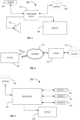
- Fig. 1 illustrates a system 100 including a processing device 102, an environmental sensor 104, database 106, a display 108 and a speaker 110. It is recognized by one skilled in the art, numerous elements known in the art have been omitted for clarity purposes only, for example a power source or connectivity components.
- the processing device 102 may be any suitable type of processing device operative to perform processing operations, such as in response to executable instructions.
- the executable instructions may be stored on a computer readable medium, not expressly illustrated herein.
- the processing device may be a stand-alone processing component, or operations may be performed in a distributed processing environment.
- the illustrated processing device 102 represents one or more physical components for performing processing operations as described herein.
- the sensor 104 may be any suitable type of sensor allowing for detecting of ambient conditions. As described in further detail below, different sensors provide for detection of different ambient conditions.
- the environmental sensor includes a light sensor for detecting a brightness level.
- the environmental sensor may further include, but is not limited to, a camera, a motion detector, an audio detector and/or microphone, a heat sensor, a wireless signal detector, a Bluetooth signal detector, an electric field sensor for proximity detection and/or gesture-based control, an infrared-based sensor for ambient light detection and/or proximity detection and/or gesture-based control, an ultrasonic transducer sensor for proximity detection and/or gesture- based control, geospatial and/or global positioning sensor.
- the database 106 may be any suitable memory storage device or devices capable of storing content therein. Illustrated in Fig. 1 , the database 106 is directly connected to the processing device 102, such as being embedded or mounted in a processing system. Such illustration is not expressly limiting as the database 106 may be connected via alternative means, such as via a wired or wireless connection, such as a memory device connected via a portal or peripheral connection outlet, a local data storage device accessible via wired or wireless connectivity, or in another embodiment a storage device associated with or internal to another processing device, e.g. smart phone, tablet computer, laptop computer, capable of communication with the processing device 102.
- the storage 106 may include content such as images, audio files, movies files, etc., stored on a person's mobile device such that the processing device can access and retrieve the content therefrom.
- the display device 108 is an electronic picture frame.
- the speaker 110 may be any suitable speaker and or audio output system recognized by one skilled in the art.
- the speaker 110 may be part of an audio system or can be an embedded speaker associated with the display 108.
- the system 100 may include a central housing having the various elements disposed therein.
- different components including the sensor 104, database 106, processor 102, speaker 110 and/or display 108 may be external to the system 100 and engaged via a wired or wireless connection.
- the functionality of the processing device 102 may be disposed in a remote processor with output functionality to the display 108 via a wireless peripheral-connection device.
- Ambient conditions generally relate to conditions of the environment relative to the sensor and/or display 108.
- Ambient conditions can include any relevant conditions that can be measured by one or more sensors.
- an ambient condition may be the number of people within a room and the activity level of those people. This can be determined using a camera or a camera in combination with a motion detector. This can also be determined using a microphone or other audio detection device to determine a number of different voices.
- the processing device 102 Based on the detection of ambient conditions, the processing device 102 therein performs processing operations to determine ambient condition factors. These ambient condition factors represent estimations of activities or conditions relative to the display 108.
- Environmental sensor(s) 104 provide inputs for determining ambient factors based on detecting ambient conditions.
- ambient condition factors include but are not limited to quantity of viewers, identity of viewers, viewer proximity, viewer motion, viewer gesture, viewer mood, human sounds, ambient sounds, musical sounds, light quantity, light source, light direction, local temperature, geographic location, etc.
- Each ambient condition factor can be informed by one or more of the above specified sensors detecting ambient conditions.
- the determination of an ambient condition factor can be based on the analysis of the ambient condition.
- an ambient condition factor may possess a range of output values that determine the definition of ambient conditions.
- An example value range for the quantity of viewers may include '1', '2', (3), '4', '5', '6', '7', '8', and '9-or-more' output values.
- An example value range for the identity of viewers may include 'owner #1', 'owner #2', 'owner #3', 'owner #4', 'owner #5', 'owner #6', 'owner #n + #n', 'multiple owners', 'guest #1', 'guest #2', 'multiple guests', and 'owners + guests' output values.
- An example value range for the viewer motion ambient factor may include 'none', 'light', 'medium', and 'heavy motion' output values.
- An example value range for the light quantity ambient factor may include 'none', 'very low', 'low', 'medium', 'high', and 'very high' output values.
- An example value range for the musical sounds may include 'none', and 'unknown', 'recognized song match' output values.
- the processing device therein estimates an ambient condition.
- Each ambient condition may be informed by one or more ambient factor value ranges.
- An example of ambient condition 'owner default interacting' would be informed by ambient factors (quantity of viewers', 'identity of viewers', 'viewer proximity', 'viewer gesture', and potentially more ambient factors.
- An example of ambient condition 'mixed default party active' would be informed by ambient factors 'quantity of viewers', 'identity of viewers', 'viewer proximity', 'viewer motion', 'viewer gesture', and potentially more ambient factors.
- ambient condition 'owner mood positive' would be informed by ambient factors 'quantity of viewers', 'identity of viewers', 'viewer proximity', 'viewer gesture', 'viewer mood', and potentially more ambient factors.
- ambient condition 'two owners recognized song' would be informed by ambient factors 'quantity of viewers', 'identity of viewers', 'viewer proximity', 'viewer gesture', 'musical sounds', and potentially more ambient factors.
- ambient condition 'mixed owner winter night in New York' would be informed by ambient factors 'quantity of viewers', 'identity of viewers', 'viewer proximity', 'viewer gesture', 'light quantity', 'light source', 'local temperature', 'geographic location' and potentially more ambient factors.
- ambient factors 'quantity of viewers', 'identity of viewers', 'viewer proximity', 'viewer gesture', 'light quantity', 'light source', 'local temperature', 'geographic location' and potentially more ambient factors.
- the processing device via its operating routine, retrieves video display content consistent with the estimated ambient condition, which in this case may be a selection of images stored in the database 106.
- the processing device via its operating routine, retrieves video display content consistent with the estimated ambient condition, which in this case may be a selection of images stored in the database 106.
- a user may preload images within the database 106 including tags or other identifiers usable for selection based on determined ambient conditions.
- Fig. 1 illustrates an inclusive system 100
- Fig. 2 illustrates the system 100 having networked connection.
- the system 100 includes a wireless transmitter 120 for communication with a server 122 via a networked connection 124, such as the Internet.
- the server 122 is connected to a network database 126.
- the connectivity of Fig. 2 is illustrated as wireless via transmitter/receiver 120, but it is recognized that wired connectivity to a router is within the scope of the system and method. Furthermore, the connectivity of Fig. 2 is not expressly restricted to a direct connection from the system 100, as routing of Internet-based connectivity may be between a local wireless router, a base station, a private network or any other suitable means.
- the server 122 may be any suitable network-based processing system accessible via a networked connection. Such connectivity may include login or authentication operations, consistent with techniques recognized by those skilled in the art.
- the server 122 may include functionality described above regarding processing device 102, such that the processing operations are offloaded to a processor associated with the server 122.
- the server 122 may include one or more processing devices in a centralized or distributed processing environment.
- the database 126 may be one or more data storage devices accessible via the networked connection.
- the database 126 may include data storage associated with a particular user, or in another embodiment may be a generalized content database or databases. Whereas in Fig. 1 the content for output via the display 108 and/or speaker 110 is retrieved from the local storage 106, the network storage 126 may include a larger library of content. Such content may be user-specific or may be sponsored or directed content. For example, if the ambient conditions indicate a social gathering, the display content may include advertisements for an upcoming festival, concert, event, etc.
- the content may also be from public sources, such as content retrieved via tags or metadata associated with the content.
- the content may be images retrieved from a photo-sharing website or network, audio may be retrieved from a streaming audio service.
- Fig. 2 illustrates the implementation wherein the display system 100 utilizes network interactivity to expand on the content selected and available for display on the display 108 of Fig. 1 .
- Fig. 3 illustrates another implementation having N number of sensors, where N is an integer value.
- the system 140 of Fig. 3 includes the processor 102, database 106, display 108, speaker 110 and sensors 142, 144 and 146.
- the senor 142, 144 and/or 146 may be any suitable sensor usable to detect ambient conditions.
- the processor 102, having multiple sensors 142-146 further operates to compile the sensor data to enhance the accuracy of the ambient condition detection.
- the sensor 142 may be a camera detecting five separate individuals in the room and sensor 144 may be a microphone to detect the volume level.
- sensor 146 is a wireless sensor and may detect a number of connected devices and determine identity information of people in the room based on the connected device.
- the connected device (it may be a smartphone) has a social networking application accessible via the device.
- the sensor 146 detects the presence of the device based on the device generating a Bluetooth signal or the device seeking wireless connectivity with a local wireless router. Based on proper permissions, the sensor 146 therein determines the user's identity on a social networking site and access information may available on the social network site.
- One example may be accessing photos or status updates the user has shared on the site.
- Another example may be detecting a mood of the user based on any recent posts, including these as ambient conditions.
- Fig. 4 illustrates one implementation of a system for accessing content via a social network.
- Fig. 4 includes a social network 160 having a content database 162 associated therewith.
- the social network 160 may be any suitable web-based social networking or content distribution system.
- the network 160 may include social websites where users post images and/or status updates in a news feed, may include a system where users distribute short messages, may include a system where users submit and distribute images only, where users distribute blogs or other content, by way of example.
- the network 160 includes a database 162 having content associated therewith, typically associated with a user or tagged content. For example, where a user has a profile on a network site, the database 162 includes the content associated with the profile.
- the system 100 accesses and retrieves content for display.
- the system 100 having knowledge of a user based on one or more sensors, may use the social network content as another form of to determine ambient condition factors. For example, if a camera as a sensor employs facial recognition and recognizes a user, such as the owner of the system 100, and includes permissions for accessing a social network, the processing device 102 may acquire status information as an ambient condition factor. For example, if the user updates a status to indicate as being recently engaged, this can be an ambient condition whereby the visual display content may include content relating to wedding interests.
- the processing 102 of the system 100 including functionality performed by one or more processing devices.
- Fig. 5 illustrates the steps of one embodiment of the methodology, as performed by the physical electronic processing devices of Figs. 1-4 .
- a first step, step 180 is detecting an ambient condition using an environmental sensor.
- an environmental sensor may include sensors 104 as described above.
- the environmental sensor may include processing operations performed by the processor 102 in acquiring information via available sources, such as the networked communication of Fig. 4 .
- a next step, step 182 is analyzing the ambient condition to determine ambient condition factors.
- ambient factors include but are not limited to quantity of viewers, identity of viewers, viewer proximity, viewer motion, viewer gesture, viewer mood, human sounds, ambient sounds, musical sounds, light quantity, light source, light direction, local temperature, geographic location, etc.
- Each ambient factor can be informed by one or more of the above specified sensors.
- the processing device therein estimates an ambient condition.
- Each ambient condition may be informed by one or more ambient factor value ranges.
- Step 184 is, using the ambient condition factors, retrieving visual display content from at least one visual content database.
- the visual content database may be a local database 106 or can be a network- accessible database 126.
- the content can be images, videos, advertisements, text, audio or any other suitable content.
- Content is either automatically or manually tagged with appropriate ambient condition tags. Content is selected for display based on the matching of ambient condition tags with the determined ambient condition.
- Step 186 is providing the visual display content to the display device so that the output display compliments the ambient condition.
- the output is displayed on the display 108, which may include audio via the speaker 110. If the ambient conditions detect a single person in the room, the room being dark and no or little movement, the output display may be soothing image with soft music associated with the image, as an example.
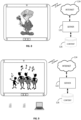
- Fig. 6 illustrates a graphical display of a display device including multiple sensors, such as noted sensors 142, 144 and 146. Further sensors are within the scope of the display device.
- the device further includes a wireless connector for connecting to the server 122 via the Internet 124.
- the server 122 performs processing operations for determining content from database 126 based on the sensor 142, 144 and/or 146 input.
- the sensors may detect little movement, thus proposing a soothing image of a mountain scene.
- Another embodiment is using a light sensor, such as detecting brightness, light sources, and/or light consistency from stimuli within the environment of the hardware. Based on light factors, the system leverages local and/or server-stored software to adjust the brightness, contrast, and other display factors in the entire display.
- a light sensor such as detecting brightness, light sources, and/or light consistency from stimuli within the environment of the hardware. Based on light factors, the system leverages local and/or server-stored software to adjust the brightness, contrast, and other display factors in the entire display.
- Another embodiment of the sensor data relates to motion detection for detecting motion, shape, and/or size of objects within the environment. Based on motion factors, the system leverages local and/or server-stored software to display environmentally relevant content, e.g. a more soothing and calm image if the environment has little or no motion, a more vibrant and action-filled image if the room is full of multiple motion sources, etc.
- environmentally relevant content e.g. a more soothing and calm image if the environment has little or no motion, a more vibrant and action-filled image if the room is full of multiple motion sources, etc.
- Fig. 7 is a visual representation of the intelligent system for displaying digital visual content responding to heat-based environmental stimuli.
- the system includes one or more heat sensors for detecting heat sources and temperature within the environment of the hardware. Based on heat factors, the system leverages local and/or server-stored software to adjust the brightness, contrast, and other display factors in the entire display.
- Fig. 6 is a visual representation of the intelligent system for displaying digital visual content responding to mood-based environmental stimuli - i.e. the digital footprint associated with viewer.
- the system includes capability to collect and interpret mood, emotion, sentiment, intent, and other personal characteristics based on the internet-connected applications utilized by the viewer - e.g. social media software as described above.
- the system leverages local and/or server-stored software to adjust the brightness, contrast, and other display factors in the entire display.
- the system is further operative to, based on social factors, the leverage local and/or server-stored software to display environmentally relevant content- e.g. a more soothing and calm image if the viewer is expressing anxiety, a more uplifting and positive image if the viewer is expressing sadness, etc.
- the system may acquire content for display based on the social media content available.
- Fig. 9 is a visual representation of the intelligent system for displaying digital visual content responding to multiple devices - i.e. internet- connected stimuli.
- the system includes capability to recognize and count the number of connected devices within the environment. Based on these devices, the system can determine environmental conditions, such as the number of individuals in the environment, the mood of the users such as via social media, or other factors usable for selecting content.
- Fig. 10 is a data flow diagram illustrating visual display content selection based on ambient condition factors determined by ambient conditions detected by environmental sensors.
- the data flow diagram illustrates multiple embodiments, wherein it is recognized these embodiments are illustrative in nature and not limiting in scope.
- Other examples of sensors include, but are not limited to: light sensor; infrared, ultrasonic, geospatial, and Internet sensors.
- the environmental sensors 202 detect ambient conditions using the sensor technology.
- the data flow diagram of Fig. 10 shows multiple embodiments of the ambient conditions 204 relating to ambient condition factors 206.
- Fig. 10 illustrates exemplary ambient conditions 204: quantity of viewers; identity of viewers; viewer proximity; viewer motion; viewer mood; and ambient sounds.
- Other examples ambient conditions include, but are not limited to: viewer gestures; human sounds; musical sounds; light quantity; light source; light direction; local temperature; and geographic location.
- Ambient condition factors 206 include, but are not limited to: owner default; owner default interacting; two owner default; mixed owner default; mixed default small gathering; mixed default party active. Other examples include, but not limited to: default condition; owner mood positive; owner mood negative; two owners recognized song; mixed owner winter night in New York, etc.
- One example illustrated in Fig. 10 includes a motion sensor detecting four ambient conditions: (a) a quantity of viewers; (b) the identity of viewers; (c) proximity of viewers; and (d) the motion of viewers.
- the electric field sensor detects: (a) quantity of viewers; and (b) the identity of viewers.
- the ambient conditions are then usable for the determination of the ambient condition factor, such as the ambient condition factor of "two owner default" is based on the ambient conditions of: (a) quantity of viewers; (b) identity of viewers; and (c) viewer proximity.
- Fig. 11 illustrates one example of the content selection algorithm 208 of Fig. 10 .
- the content selection algorithm operates with a content database 220, the content database including a plurality of content items 222, 224 and 226 by way of example.
- the content items can include audio and/or video output for display on the display device.
- the content items may be images and music to compliment the ambient condition of the room as noted by the sensors.
- the content itself includes tagging information usable for content selection.
- content 1 222 includes ambient condition tagging 1, 2, and 3.
- the tags relate to the ambient conditions 206 of Fig. 5 , such that the content 222 is usable for designated ambient condition factors.
- content 1 222 may be designated usable for owner default, two owner default and mixed default small gathering.
- a content selection operator 230 received ambient condition factors 206 that are based on the ambient conditions 204.
- the content selection operator 230 uses the factors 206 in coordination with the content database 220 to retrieve the appropriate content 222, 224 and/or 226. Once this content is received, the ambient complimentary content 232 is therein provided as an output to the display device noted above.
- the system for intelligently receiving and displaying digital visual content has the capability to combine the information presented via one or more of the hardware sensors and software sources in any permutation and combination in order to present digital visual content in an environmentally optimized and relevant manner.
- the system for intelligently receiving and displaying digital visual content presents digital visual content in an environmentally optimized and relevant manner. It creates a new platform for presenting images, videos, etc. based on external stimuli. It converts local physical and digital information in order to present a better device for artistic, decorative, informational, and other important purposes.
Landscapes
- Engineering & Computer Science (AREA)
- Theoretical Computer Science (AREA)
- General Physics & Mathematics (AREA)
- Physics & Mathematics (AREA)
- General Engineering & Computer Science (AREA)
- Human Computer Interaction (AREA)
- Computer Hardware Design (AREA)
- Signal Processing (AREA)
- Multimedia (AREA)
- User Interface Of Digital Computer (AREA)
- Two-Way Televisions, Distribution Of Moving Picture Or The Like (AREA)
- Health & Medical Sciences (AREA)
- Audiology, Speech & Language Pathology (AREA)
- General Health & Medical Sciences (AREA)
- Computer Graphics (AREA)
- Software Systems (AREA)
Claims (6)
- Procédé pour générer un affichage de sortie sur un dispositif d'affichage (108) étant un cadre d'image électronique, le procédé comprenant :la détection, par un capteur sans fil (146), de la présence d'un dispositif informatique sur la base de la génération, par le dispositif informatique, d'un signal Bluetooth ou d'une recherche d'une connectivité sans fil avec un routeur local sans fil, dans lequel le dispositif informatique est associé à un utilisateur et comportant une application de réseautage social accessible via le dispositif informatique ;la détermination, par le capteur sans fil (146), dans l'application de réseautage social et à partir du dispositif informatique, de l'identité de l'utilisateur sur un site de réseautage social ;dans lequel le réseau social inclut une base de données de contenu (162), dans lequel la base de données de contenu (162) comporte une pluralité d'images stockées dans celle-ci comprenant des images associées à l'utilisateur à partir du dispositif informatique connecté ;l'engagement dans une communication de réseau avec la base de données de contenu (162) ;la détection (180) d'une ou de plusieurs conditions ambiantes à l'aide d'un capteur environnemental (104), le capteur environnemental incluant un capteur de lumière pour détecter un niveau de luminosité en tant qu'une des une ou plusieurs conditions ambiantes ;l'analyse (182) des une ou plusieurs conditions ambiantes pour déterminer des facteurs de condition ambiante comprenant une plage de valeurs qui définissent les une ou plusieurs conditions ambiantes ;la récupération (184) d'au moins une de la pluralité d'images de la base de données de contenu et le téléchargement des images vers un dispositif de mémoire local associé au dispositif d'affichage (108) sur la base des facteurs de condition ambiante déterminés ;la sélection d'images à afficher à partir de la mémoire locale sur la base des facteurs de condition ambiante ; etla génération de l'affichage de sortie des images sélectionnées sur le cadre d'image électronique, l'affichage de sortie reflétant le niveau de luminosité.
- Procédé selon la revendication 1, dans lequel le capteur environnemental (104) inclut un capteur audio détectant du bruit ambiant.
- Procédé selon la revendication 2, comprenant en outre :
la fourniture d'une sortie audio via au moins un dispositif audio (110), la sortie audio étant basée sur le bruit ambiant détecté. - Procédé selon la revendication 3, comprenant en outre :l'analyse du bruit ambiant pour détecter au moins une condition ambiante ;l'accès à une base de données audio présentant un contenu audio stocké dans celle-ci et la sélection d'un contenu audio sur la base l'au moins une condition ambiante ; etla fourniture du contenu audio pour la sortie audio.
- Procédé selon la revendication 1, dans lequel le capteur environnemental (104) inclut un détecteur de mouvement détectant un mouvement autour du dispositif d' affichage (108), le procédé comprenant en outre :la détection d'un niveau d'agitation à l'aide du détecteur de mouvement, etla récupération du contenu d'affichage visuel sur la base au moins en partie du niveau d'agitation.
- Système pour générer un affichage de sortie selon le procédé selon l'une quelconque des revendications 1 à 5.
Applications Claiming Priority (2)
| Application Number | Priority Date | Filing Date | Title |
|---|---|---|---|
| US201461972643P | 2014-03-31 | 2014-03-31 | |
| PCT/US2015/023458 WO2015153532A2 (fr) | 2014-03-31 | 2015-03-31 | Système et procédé de génération d'affichage de sortie d'après des conditions ambiantes |
Publications (4)
| Publication Number | Publication Date |
|---|---|
| EP3127097A2 EP3127097A2 (fr) | 2017-02-08 |
| EP3127097A4 EP3127097A4 (fr) | 2017-12-06 |
| EP3127097C0 EP3127097C0 (fr) | 2024-08-07 |
| EP3127097B1 true EP3127097B1 (fr) | 2024-08-07 |
Family
ID=54191149
Family Applications (1)
| Application Number | Title | Priority Date | Filing Date |
|---|---|---|---|
| EP15774309.7A Active EP3127097B1 (fr) | 2014-03-31 | 2015-03-31 | Système et procédé de génération d'affichage de sortie d'après des conditions ambiantes |
Country Status (8)
| Country | Link |
|---|---|
| US (2) | US11222613B2 (fr) |
| EP (1) | EP3127097B1 (fr) |
| JP (1) | JP6698544B2 (fr) |
| KR (1) | KR102354952B1 (fr) |
| CN (2) | CN106415682A (fr) |
| AU (2) | AU2015240971A1 (fr) |
| CA (1) | CA2944458C (fr) |
| WO (1) | WO2015153532A2 (fr) |
Families Citing this family (24)
| Publication number | Priority date | Publication date | Assignee | Title |
|---|---|---|---|---|
| US9998863B2 (en) | 2013-08-19 | 2018-06-12 | Estimote Polska Sp. Z O. O. | System and method for providing content using beacon systems |
| WO2015026862A1 (fr) | 2013-08-19 | 2015-02-26 | Estimote, Inc. | Balise sans fil et procédés |
| WO2017040690A1 (fr) | 2015-09-02 | 2017-03-09 | Estimote, Inc. | Système et procédés de suivi d'objet avec des balises sans fil |
| US10136250B2 (en) | 2015-09-02 | 2018-11-20 | Estimote Polska Sp. Z O. O. | System and method for lower power data routing |
| US9826351B2 (en) | 2015-09-02 | 2017-11-21 | Estimote Polska Sp. Z O. O. | System and method for beacon fleet management |
| WO2017143281A1 (fr) * | 2016-02-17 | 2017-08-24 | Estimote, Inc. | Système et procédé de fourniture de contenu à l'aide de systèmes de balise |
| US9872146B2 (en) | 2016-03-22 | 2018-01-16 | Estimote Polska Sp. Z O. O. | System and method for multi-beacon interaction and management |
| KR102620138B1 (ko) * | 2016-06-02 | 2024-01-03 | 삼성전자주식회사 | 화면 출력 방법 및 이를 지원하는 전자 장치 |
| WO2018009878A1 (fr) | 2016-07-07 | 2018-01-11 | Estimote Polska Sp. Z O. O. | Procédé et système destinés à la distribution de contenu avec une balise |
| CA3069506A1 (fr) * | 2017-07-26 | 2019-01-31 | Rovi Guides, Inc. | Procedes et systemes de lecture de conversations indexees en fonction de la presence d'autres personnes |
| US10817553B2 (en) | 2017-07-26 | 2020-10-27 | Rovi Guides, Inc. | Methods and systems for playing back indexed conversations based on the presence of other people |
| WO2020039252A1 (fr) | 2018-08-22 | 2020-02-27 | Estimote Polska Sp Z.O.O. | Système et procédé pour vérifier la sécurité d'un dispositif |
| WO2020039251A2 (fr) | 2018-08-24 | 2020-02-27 | Estimote Polska Sp z o.o. | Procédé et système de gestion d'actifs |
| KR102604170B1 (ko) | 2018-09-27 | 2023-11-20 | 삼성전자주식회사 | 전자 장치 및 그 제어 방법 |
| KR102580344B1 (ko) * | 2019-01-02 | 2023-09-19 | 삼성전자주식회사 | 여러 타입의 컨텐츠를 출력하기 위한 디스플레이 장치 |
| CN111522615B (zh) * | 2020-04-23 | 2023-08-15 | 深圳赛安特技术服务有限公司 | 命令行界面的更新方法、装置、设备及存储介质 |
| US11087700B1 (en) * | 2020-05-18 | 2021-08-10 | Palacio Inc. | System and method for image enhancement on a digital display device |
| US11317137B2 (en) * | 2020-06-18 | 2022-04-26 | Disney Enterprises, Inc. | Supplementing entertainment content with ambient lighting |
| CN111722564A (zh) * | 2020-06-19 | 2020-09-29 | 无锡太湖学院 | 一种智能画框控制系统及其控制方法 |
| KR102959040B1 (ko) * | 2021-01-07 | 2026-04-28 | 엘지전자 주식회사 | 영상표시장치 및 그 동작방법 |
| CN218071873U (zh) * | 2021-01-19 | 2022-12-16 | 深圳市品茂电子科技有限公司 | 一种环境特征主动传感控制模组 |
| JP7815837B2 (ja) * | 2022-02-21 | 2026-02-18 | 株式会社Jvcケンウッド | 選曲装置、選曲システム、選曲方法及びプログラム |
| WO2024153528A1 (fr) * | 2023-01-17 | 2024-07-25 | Signify Holding B.V. | Sélection, génération et/ou modification d'une image sur la base de positions et de réglages de lumière |
| CN115830171B (zh) * | 2023-02-17 | 2023-05-09 | 深圳前海深蕾半导体有限公司 | 基于人工智能绘画的图像生成方法、显示设备及存储介质 |
Citations (5)
| Publication number | Priority date | Publication date | Assignee | Title |
|---|---|---|---|---|
| US20100005062A1 (en) * | 2006-07-17 | 2010-01-07 | Koninklijke Philips Electronics N.V. | Determining an ambient parameter set |
| US20100265265A1 (en) * | 2007-12-20 | 2010-10-21 | Koninklijke Philips Electronics N.V. | System and method for automatically selecting electronic images depending on an input |
| US20110093100A1 (en) * | 2009-10-16 | 2011-04-21 | Immersion Corporation | Systems and Methods for Output of Content Based on Sensing an Environmental Factor |
| US20110309946A1 (en) * | 2010-05-26 | 2011-12-22 | Sony Ericsson Mobile Communications Ab | Adaptive media object reproduction based on social context |
| CN101840715B (zh) * | 2009-03-17 | 2013-04-17 | 华为技术有限公司 | 一种数码相框及其播放方法 |
Family Cites Families (51)
| Publication number | Priority date | Publication date | Assignee | Title |
|---|---|---|---|---|
| US4754271A (en) | 1987-03-10 | 1988-06-28 | Willie Edwards | Liquid crystal photograph |
| US5966698A (en) | 1992-10-15 | 1999-10-12 | Pollin; Robert E. | Automated payment system and method |
| US5760760A (en) | 1995-07-17 | 1998-06-02 | Dell Usa, L.P. | Intelligent LCD brightness control system |
| JPH11225443A (ja) * | 1998-02-04 | 1999-08-17 | Pfu Ltd | 小型携帯情報機および記録媒体 |
| US5966696A (en) | 1998-04-14 | 1999-10-12 | Infovation | System for tracking consumer exposure and for exposing consumers to different advertisements |
| US7155679B2 (en) | 1998-11-18 | 2006-12-26 | Eastman Kodak Company | Digital media frame |
| US6975308B1 (en) * | 1999-04-30 | 2005-12-13 | Bitetto Frank W | Digital picture display frame |
| JP4537546B2 (ja) * | 2000-07-18 | 2010-09-01 | ソネットエンタテインメント株式会社 | データ配信システム及びデータ配信方法 |
| JP2002215663A (ja) * | 2001-01-12 | 2002-08-02 | Canon Inc | 著作物管理システム、ネットワーク端末装置、著作物管理装置、著作物管理方法及び記録媒体 |
| US20110029584A1 (en) * | 2001-02-08 | 2011-02-03 | The Boeing Company | Apparatus, method and computer program product for transferring an electronic file |
| JP2002244606A (ja) * | 2001-02-14 | 2002-08-30 | Sony Corp | 広告表示装置及び方法 |
| US7117256B1 (en) | 2001-11-29 | 2006-10-03 | Microsoft Corporation | Method and system for transferring and sharing images between devices and locations |
| AU2003278708A1 (en) | 2002-08-12 | 2004-02-25 | Walker Digital, Llc | Digital picture frame and method for editing related applications |
| US20040032400A1 (en) | 2002-08-14 | 2004-02-19 | Freeman Mark T. | Method and systems for managing the display of digital content |
| GB0229632D0 (en) | 2002-12-19 | 2003-01-22 | Sleepydog Ltd | Improvements relating to digital picture frames |
| US8965460B1 (en) * | 2004-01-30 | 2015-02-24 | Ip Holdings, Inc. | Image and augmented reality based networks using mobile devices and intelligent electronic glasses |
| JP2006146630A (ja) * | 2004-11-22 | 2006-06-08 | Sony Corp | コンテンツ選択再生装置、コンテンツ選択再生方法、コンテンツ配信システムおよびコンテンツ検索システム |
| US20070115247A1 (en) | 2005-09-07 | 2007-05-24 | Zhan Chen | Programmable picture frame |
| US20070081643A1 (en) | 2005-10-07 | 2007-04-12 | Sbc Knowledge Ventures, L.P. | Digital photographic display device |
| JP2007161145A (ja) * | 2005-12-15 | 2007-06-28 | Fujitsu Ten Ltd | コンテンツ再生装置 |
| US20070150916A1 (en) | 2005-12-28 | 2007-06-28 | James Begole | Using sensors to provide feedback on the access of digital content |
| US8791994B2 (en) * | 2006-06-29 | 2014-07-29 | Nikon Corporation | Replay device, replay system, and television set |
| JP4891691B2 (ja) * | 2006-07-31 | 2012-03-07 | ヤフー株式会社 | 位置情報を付加されたデータを検索する方法およびシステム |
| JP4844355B2 (ja) * | 2006-11-09 | 2011-12-28 | 日本電気株式会社 | ポータブルコンテンツ再生装置、再生システム、コンテンツ再生方法 |
| US20080143890A1 (en) | 2006-11-30 | 2008-06-19 | Aris Displays, Inc. | Digital picture frame device and system |
| KR101351818B1 (ko) * | 2007-06-05 | 2014-01-16 | 에스케이플래닛 주식회사 | 이동통신 단말기의 현재 상황에 적합한 컨텐츠를 재생하는방법 |
| US8335404B2 (en) * | 2007-07-20 | 2012-12-18 | Vision Louis Winter | Dynamically varying classified image display system |
| KR101687942B1 (ko) * | 2008-01-16 | 2017-01-02 | 코닌클리케 필립스 엔.브이. | 환경 내의 사교적 설정 및 무드에 적합한 분위기를 자동 생성하기 위한 시스템 및 방법 |
| US9286027B2 (en) | 2008-04-11 | 2016-03-15 | T-Mobile Usa, Inc. | Digital picture frame having communication capabilities |
| JP2010004118A (ja) * | 2008-06-18 | 2010-01-07 | Olympus Corp | デジタルフォトフレーム、情報処理システム、制御方法、プログラム及び情報記憶媒体 |
| US9015627B2 (en) | 2009-03-30 | 2015-04-21 | Sony Corporation | User interface for digital photo frame |
| TWM366948U (en) | 2009-04-06 | 2009-10-21 | Chicony Electronics Co Ltd | Wireless digital photo frame with video streaming function |
| JP2011013453A (ja) * | 2009-07-02 | 2011-01-20 | Nikon Systems Inc | 画像表示装置 |
| US20110102980A1 (en) | 2009-11-05 | 2011-05-05 | Audiovox Corporation | Digital photo frame to picture frame adapter |
| JP2011223169A (ja) * | 2010-04-06 | 2011-11-04 | Sharp Corp | 電気機器システム |
| US20110295843A1 (en) * | 2010-05-26 | 2011-12-01 | Apple Inc. | Dynamic generation of contextually aware playlists |
| CN101915448A (zh) * | 2010-07-30 | 2010-12-15 | 中山大学 | 智能家居气氛调节方法及系统 |
| US8896613B2 (en) | 2010-10-26 | 2014-11-25 | Bby Solutions, Inc. | Stored value digital picture frame |
| US8928671B2 (en) * | 2010-11-24 | 2015-01-06 | Fujitsu Limited | Recording and analyzing data on a 3D avatar |
| JP2012128154A (ja) * | 2010-12-15 | 2012-07-05 | Jvc Kenwood Corp | 情報提供装置および情報提供方法 |
| US20120221687A1 (en) | 2011-02-27 | 2012-08-30 | Broadcastr, Inc. | Systems, Methods and Apparatus for Providing a Geotagged Media Experience |
| JP5790094B2 (ja) * | 2011-03-31 | 2015-10-07 | フリュー株式会社 | 画像管理システム、画像管理システムの制御方法、制御プログラム、および記録媒体 |
| US8595264B2 (en) | 2011-06-30 | 2013-11-26 | Bm Software, Inc. | Event processing based on meta-relationship definition |
| US20130038756A1 (en) * | 2011-08-08 | 2013-02-14 | Samsung Electronics Co., Ltd. | Life-logging and memory sharing |
| JP5755168B2 (ja) * | 2012-03-09 | 2015-07-29 | Kddi株式会社 | レコメンド装置、レコメンド方法、およびプログラム |
| JP6103813B2 (ja) * | 2012-04-06 | 2017-03-29 | サターン ライセンシング エルエルシーSaturn Licensing LLC | 情報処理装置、情報処理方法およびプログラム |
| JP5510494B2 (ja) * | 2012-05-23 | 2014-06-04 | 株式会社デンソー | 移動端末、車両用装置、携帯通信端末 |
| JP5829180B2 (ja) * | 2012-05-29 | 2015-12-09 | Kddi株式会社 | グループ内のメンバオブジェクト全体における各クラス種別の比率を推定するクラス種別推定装置、プログラム及び方法 |
| JP6030865B2 (ja) * | 2012-06-13 | 2016-11-24 | ユニ・チャーム株式会社 | 推奨製品提示システム |
| US9699485B2 (en) * | 2012-08-31 | 2017-07-04 | Facebook, Inc. | Sharing television and video programming through social networking |
| US20140081760A1 (en) * | 2012-09-17 | 2014-03-20 | Nokia Corporation | Method and apparatus for determining content to present one or more users of a location-based grouping |
-
2015
- 2015-03-31 AU AU2015240971A patent/AU2015240971A1/en not_active Abandoned
- 2015-03-31 CA CA2944458A patent/CA2944458C/fr active Active
- 2015-03-31 JP JP2016560776A patent/JP6698544B2/ja active Active
- 2015-03-31 CN CN201580022413.2A patent/CN106415682A/zh active Pending
- 2015-03-31 CN CN202210493721.5A patent/CN114741043A/zh active Pending
- 2015-03-31 KR KR1020167030122A patent/KR102354952B1/ko active Active
- 2015-03-31 WO PCT/US2015/023458 patent/WO2015153532A2/fr not_active Ceased
- 2015-03-31 EP EP15774309.7A patent/EP3127097B1/fr active Active
- 2015-03-31 US US14/673,927 patent/US11222613B2/en active Active
-
2017
- 2017-12-08 US US15/836,209 patent/US10049644B2/en active Active
-
2020
- 2020-01-21 AU AU2020200421A patent/AU2020200421B2/en active Active
Patent Citations (5)
| Publication number | Priority date | Publication date | Assignee | Title |
|---|---|---|---|---|
| US20100005062A1 (en) * | 2006-07-17 | 2010-01-07 | Koninklijke Philips Electronics N.V. | Determining an ambient parameter set |
| US20100265265A1 (en) * | 2007-12-20 | 2010-10-21 | Koninklijke Philips Electronics N.V. | System and method for automatically selecting electronic images depending on an input |
| CN101840715B (zh) * | 2009-03-17 | 2013-04-17 | 华为技术有限公司 | 一种数码相框及其播放方法 |
| US20110093100A1 (en) * | 2009-10-16 | 2011-04-21 | Immersion Corporation | Systems and Methods for Output of Content Based on Sensing an Environmental Factor |
| US20110309946A1 (en) * | 2010-05-26 | 2011-12-22 | Sony Ericsson Mobile Communications Ab | Adaptive media object reproduction based on social context |
Non-Patent Citations (1)
| Title |
|---|
| ADITI GUPTA ET AL: "PeerSense: Who is near you?", PERVASIVE COMPUTING AND COMMUNICATIONS WORKSHOPS (PERCOM WORKSHOPS), 2012 IEEE INTERNATIONAL CONFERENCE ON, IEEE, 19 March 2012 (2012-03-19), pages 516 - 518, XP032180027, ISBN: 978-1-4673-0905-9, DOI: 10.1109/PERCOMW.2012.6197553 * |
Also Published As
| Publication number | Publication date |
|---|---|
| WO2015153532A2 (fr) | 2015-10-08 |
| AU2020200421A1 (en) | 2020-02-13 |
| AU2015240971A1 (en) | 2016-10-20 |
| CA2944458A1 (fr) | 2015-10-08 |
| KR102354952B1 (ko) | 2022-01-24 |
| EP3127097A4 (fr) | 2017-12-06 |
| KR20160144400A (ko) | 2016-12-16 |
| US20180108329A1 (en) | 2018-04-19 |
| JP6698544B2 (ja) | 2020-05-27 |
| EP3127097C0 (fr) | 2024-08-07 |
| WO2015153532A3 (fr) | 2016-01-28 |
| CN114741043A (zh) | 2022-07-12 |
| AU2020200421B2 (en) | 2021-12-09 |
| CA2944458C (fr) | 2022-09-27 |
| EP3127097A2 (fr) | 2017-02-08 |
| US10049644B2 (en) | 2018-08-14 |
| US11222613B2 (en) | 2022-01-11 |
| CN106415682A (zh) | 2017-02-15 |
| JP2017516369A (ja) | 2017-06-15 |
| US20150279115A1 (en) | 2015-10-01 |
Similar Documents
| Publication | Publication Date | Title |
|---|---|---|
| AU2020200421B2 (en) | System and method for output display generation based on ambient conditions | |
| US12038964B2 (en) | Behavioral curation of media assets | |
| US11622150B2 (en) | TV mode change in accordance with number of viewers present | |
| US20220027638A1 (en) | Systems and Methods for Locating Image Data for Selected Regions of Interest | |
| KR102042152B1 (ko) | 오디오를 재생하기 위한 제어 방법 및 장치 | |
| US10945018B2 (en) | System and method for display adjustments based on content characteristics | |
| KR101757870B1 (ko) | 이동 단말기 및 그 제어방법 | |
| US10671338B2 (en) | Systems and methods of associating media content with contexts | |
| US11494055B2 (en) | System and method for interfacing with a display device | |
| WO2023001152A1 (fr) | Procédé de recommandation de clip vidéo, dispositif électronique et serveur | |
| CN111027037A (zh) | 验证用户身份的方法以及电子设备 | |
| CN106063231A (zh) | 信息发送方法、信息接收方法、装置及系统 | |
| JP2014225061A (ja) | 情報提供装置、情報提供システム、情報提供方法及びプログラム |
Legal Events
| Date | Code | Title | Description |
|---|---|---|---|
| STAA | Information on the status of an ep patent application or granted ep patent |
Free format text: STATUS: THE INTERNATIONAL PUBLICATION HAS BEEN MADE |
|
| PUAI | Public reference made under article 153(3) epc to a published international application that has entered the european phase |
Free format text: ORIGINAL CODE: 0009012 |
|
| STAA | Information on the status of an ep patent application or granted ep patent |
Free format text: STATUS: REQUEST FOR EXAMINATION WAS MADE |
|
| 17P | Request for examination filed |
Effective date: 20161028 |
|
| AK | Designated contracting states |
Kind code of ref document: A2 Designated state(s): AL AT BE BG CH CY CZ DE DK EE ES FI FR GB GR HR HU IE IS IT LI LT LU LV MC MK MT NL NO PL PT RO RS SE SI SK SM TR |
|
| AX | Request for extension of the european patent |
Extension state: BA ME |
|
| DAV | Request for validation of the european patent (deleted) | ||
| DAX | Request for extension of the european patent (deleted) | ||
| A4 | Supplementary search report drawn up and despatched |
Effective date: 20171107 |
|
| RIC1 | Information provided on ipc code assigned before grant |
Ipc: G06F 17/30 20060101AFI20171030BHEP Ipc: G06F 3/14 20060101ALI20171030BHEP |
|
| STAA | Information on the status of an ep patent application or granted ep patent |
Free format text: STATUS: EXAMINATION IS IN PROGRESS |
|
| 17Q | First examination report despatched |
Effective date: 20191205 |
|
| REG | Reference to a national code |
Ref country code: DE Ref legal event code: R079 Free format text: PREVIOUS MAIN CLASS: G08B0021000000 Ipc: G06F0016580000 Ref country code: DE Ref legal event code: R079 Ref document number: 602015089455 Country of ref document: DE Free format text: PREVIOUS MAIN CLASS: G08B0021000000 Ipc: G06F0016580000 |
|
| GRAP | Despatch of communication of intention to grant a patent |
Free format text: ORIGINAL CODE: EPIDOSNIGR1 |
|
| STAA | Information on the status of an ep patent application or granted ep patent |
Free format text: STATUS: GRANT OF PATENT IS INTENDED |
|
| RIC1 | Information provided on ipc code assigned before grant |
Ipc: G06F 3/14 20060101ALI20230927BHEP Ipc: G06F 16/58 20190101AFI20230927BHEP |
|
| INTG | Intention to grant announced |
Effective date: 20231016 |
|
| GRAJ | Information related to disapproval of communication of intention to grant by the applicant or resumption of examination proceedings by the epo deleted |
Free format text: ORIGINAL CODE: EPIDOSDIGR1 |
|
| STAA | Information on the status of an ep patent application or granted ep patent |
Free format text: STATUS: EXAMINATION IS IN PROGRESS |
|
| GRAP | Despatch of communication of intention to grant a patent |
Free format text: ORIGINAL CODE: EPIDOSNIGR1 |
|
| STAA | Information on the status of an ep patent application or granted ep patent |
Free format text: STATUS: GRANT OF PATENT IS INTENDED |
|
| INTC | Intention to grant announced (deleted) | ||
| INTG | Intention to grant announced |
Effective date: 20240306 |
|
| GRAS | Grant fee paid |
Free format text: ORIGINAL CODE: EPIDOSNIGR3 |
|
| GRAA | (expected) grant |
Free format text: ORIGINAL CODE: 0009210 |
|
| STAA | Information on the status of an ep patent application or granted ep patent |
Free format text: STATUS: THE PATENT HAS BEEN GRANTED |
|
| AK | Designated contracting states |
Kind code of ref document: B1 Designated state(s): AL AT BE BG CH CY CZ DE DK EE ES FI FR GB GR HR HU IE IS IT LI LT LU LV MC MK MT NL NO PL PT RO RS SE SI SK SM TR |
|
| REG | Reference to a national code |
Ref country code: GB Ref legal event code: FG4D |
|
| REG | Reference to a national code |
Ref country code: CH Ref legal event code: EP |
|
| REG | Reference to a national code |
Ref country code: DE Ref legal event code: R096 Ref document number: 602015089455 Country of ref document: DE |
|
| REG | Reference to a national code |
Ref country code: IE Ref legal event code: FG4D |
|
| U01 | Request for unitary effect filed |
Effective date: 20240906 |
|
| U07 | Unitary effect registered |
Designated state(s): AT BE BG DE DK EE FI FR IT LT LU LV MT NL PT RO SE SI Effective date: 20240923 |
|
| PG25 | Lapsed in a contracting state [announced via postgrant information from national office to epo] |
Ref country code: NO Free format text: LAPSE BECAUSE OF FAILURE TO SUBMIT A TRANSLATION OF THE DESCRIPTION OR TO PAY THE FEE WITHIN THE PRESCRIBED TIME-LIMIT Effective date: 20241107 |
|
| PG25 | Lapsed in a contracting state [announced via postgrant information from national office to epo] |
Ref country code: PL Free format text: LAPSE BECAUSE OF FAILURE TO SUBMIT A TRANSLATION OF THE DESCRIPTION OR TO PAY THE FEE WITHIN THE PRESCRIBED TIME-LIMIT Effective date: 20240807 Ref country code: GR Free format text: LAPSE BECAUSE OF FAILURE TO SUBMIT A TRANSLATION OF THE DESCRIPTION OR TO PAY THE FEE WITHIN THE PRESCRIBED TIME-LIMIT Effective date: 20241108 |
|
| PG25 | Lapsed in a contracting state [announced via postgrant information from national office to epo] |
Ref country code: IS Free format text: LAPSE BECAUSE OF FAILURE TO SUBMIT A TRANSLATION OF THE DESCRIPTION OR TO PAY THE FEE WITHIN THE PRESCRIBED TIME-LIMIT Effective date: 20241207 |
|
| PG25 | Lapsed in a contracting state [announced via postgrant information from national office to epo] |
Ref country code: HR Free format text: LAPSE BECAUSE OF FAILURE TO SUBMIT A TRANSLATION OF THE DESCRIPTION OR TO PAY THE FEE WITHIN THE PRESCRIBED TIME-LIMIT Effective date: 20240807 |
|
| PG25 | Lapsed in a contracting state [announced via postgrant information from national office to epo] |
Ref country code: RS Free format text: LAPSE BECAUSE OF FAILURE TO SUBMIT A TRANSLATION OF THE DESCRIPTION OR TO PAY THE FEE WITHIN THE PRESCRIBED TIME-LIMIT Effective date: 20241107 Ref country code: ES Free format text: LAPSE BECAUSE OF FAILURE TO SUBMIT A TRANSLATION OF THE DESCRIPTION OR TO PAY THE FEE WITHIN THE PRESCRIBED TIME-LIMIT Effective date: 20240807 |
|
| PG25 | Lapsed in a contracting state [announced via postgrant information from national office to epo] |
Ref country code: RS Free format text: LAPSE BECAUSE OF FAILURE TO SUBMIT A TRANSLATION OF THE DESCRIPTION OR TO PAY THE FEE WITHIN THE PRESCRIBED TIME-LIMIT Effective date: 20241107 Ref country code: PL Free format text: LAPSE BECAUSE OF FAILURE TO SUBMIT A TRANSLATION OF THE DESCRIPTION OR TO PAY THE FEE WITHIN THE PRESCRIBED TIME-LIMIT Effective date: 20240807 Ref country code: NO Free format text: LAPSE BECAUSE OF FAILURE TO SUBMIT A TRANSLATION OF THE DESCRIPTION OR TO PAY THE FEE WITHIN THE PRESCRIBED TIME-LIMIT Effective date: 20241107 Ref country code: IS Free format text: LAPSE BECAUSE OF FAILURE TO SUBMIT A TRANSLATION OF THE DESCRIPTION OR TO PAY THE FEE WITHIN THE PRESCRIBED TIME-LIMIT Effective date: 20241207 Ref country code: HR Free format text: LAPSE BECAUSE OF FAILURE TO SUBMIT A TRANSLATION OF THE DESCRIPTION OR TO PAY THE FEE WITHIN THE PRESCRIBED TIME-LIMIT Effective date: 20240807 Ref country code: GR Free format text: LAPSE BECAUSE OF FAILURE TO SUBMIT A TRANSLATION OF THE DESCRIPTION OR TO PAY THE FEE WITHIN THE PRESCRIBED TIME-LIMIT Effective date: 20241108 Ref country code: ES Free format text: LAPSE BECAUSE OF FAILURE TO SUBMIT A TRANSLATION OF THE DESCRIPTION OR TO PAY THE FEE WITHIN THE PRESCRIBED TIME-LIMIT Effective date: 20240807 |
|
| PG25 | Lapsed in a contracting state [announced via postgrant information from national office to epo] |
Ref country code: SM Free format text: LAPSE BECAUSE OF FAILURE TO SUBMIT A TRANSLATION OF THE DESCRIPTION OR TO PAY THE FEE WITHIN THE PRESCRIBED TIME-LIMIT Effective date: 20240807 |
|
| PG25 | Lapsed in a contracting state [announced via postgrant information from national office to epo] |
Ref country code: CZ Free format text: LAPSE BECAUSE OF FAILURE TO SUBMIT A TRANSLATION OF THE DESCRIPTION OR TO PAY THE FEE WITHIN THE PRESCRIBED TIME-LIMIT Effective date: 20240807 |
|
| PG25 | Lapsed in a contracting state [announced via postgrant information from national office to epo] |
Ref country code: SK Free format text: LAPSE BECAUSE OF FAILURE TO SUBMIT A TRANSLATION OF THE DESCRIPTION OR TO PAY THE FEE WITHIN THE PRESCRIBED TIME-LIMIT Effective date: 20240807 |
|
| U21 | Renewal fee for the european patent with unitary effect paid with additional fee |
Year of fee payment: 11 Effective date: 20250424 |
|
| PLBE | No opposition filed within time limit |
Free format text: ORIGINAL CODE: 0009261 |
|
| STAA | Information on the status of an ep patent application or granted ep patent |
Free format text: STATUS: NO OPPOSITION FILED WITHIN TIME LIMIT |
|
| 26N | No opposition filed |
Effective date: 20250508 |
|
| PG25 | Lapsed in a contracting state [announced via postgrant information from national office to epo] |
Ref country code: MC Free format text: LAPSE BECAUSE OF FAILURE TO SUBMIT A TRANSLATION OF THE DESCRIPTION OR TO PAY THE FEE WITHIN THE PRESCRIBED TIME-LIMIT Effective date: 20240807 |
|
| REG | Reference to a national code |
Ref country code: CH Ref legal event code: H13 Free format text: ST27 STATUS EVENT CODE: U-0-0-H10-H13 (AS PROVIDED BY THE NATIONAL OFFICE) Effective date: 20251023 |
|
| GBPC | Gb: european patent ceased through non-payment of renewal fee |
Effective date: 20250331 |
|
| PG25 | Lapsed in a contracting state [announced via postgrant information from national office to epo] |
Ref country code: GB Free format text: LAPSE BECAUSE OF NON-PAYMENT OF DUE FEES Effective date: 20250331 |
|
| PG25 | Lapsed in a contracting state [announced via postgrant information from national office to epo] |
Ref country code: CH Free format text: LAPSE BECAUSE OF NON-PAYMENT OF DUE FEES Effective date: 20250331 |
|
| PG25 | Lapsed in a contracting state [announced via postgrant information from national office to epo] |
Ref country code: IE Free format text: LAPSE BECAUSE OF NON-PAYMENT OF DUE FEES Effective date: 20250331 |
|
| U1N | Appointed representative for the unitary patent procedure changed after the registration of the unitary effect |
Representative=s name: MARKS & CLERK LLP; GB |
|
| U20 | Renewal fee for the european patent with unitary effect paid |
Year of fee payment: 12 Effective date: 20260319 |
|
| PG25 | Lapsed in a contracting state [announced via postgrant information from national office to epo] |
Ref country code: CY Free format text: LAPSE BECAUSE OF FAILURE TO SUBMIT A TRANSLATION OF THE DESCRIPTION OR TO PAY THE FEE WITHIN THE PRESCRIBED TIME-LIMIT Effective date: 20240807 |