EP3125806B1 - Quantitative three-dimensional imaging of surgical scenes - Google Patents
Quantitative three-dimensional imaging of surgical scenes Download PDFInfo
- Publication number
- EP3125806B1 EP3125806B1 EP15768409.3A EP15768409A EP3125806B1 EP 3125806 B1 EP3125806 B1 EP 3125806B1 EP 15768409 A EP15768409 A EP 15768409A EP 3125806 B1 EP3125806 B1 EP 3125806B1
- Authority
- EP
- European Patent Office
- Prior art keywords
- sensors
- image
- fov
- pixels
- view
- Prior art date
- Legal status (The legal status is an assumption and is not a legal conclusion. Google has not performed a legal analysis and makes no representation as to the accuracy of the status listed.)
- Active
Links
Images










Classifications
-
- H—ELECTRICITY
- H04—ELECTRIC COMMUNICATION TECHNIQUE
- H04N—PICTORIAL COMMUNICATION, e.g. TELEVISION
- H04N13/00—Stereoscopic video systems; Multi-view video systems; Details thereof
- H04N13/20—Image signal generators
- H04N13/204—Image signal generators using stereoscopic image cameras
- H04N13/25—Image signal generators using stereoscopic image cameras using two or more image sensors with different characteristics other than in their location or field of view, e.g. having different resolutions or colour pickup characteristics; using image signals from one sensor to control the characteristics of another sensor
-
- A—HUMAN NECESSITIES
- A61—MEDICAL OR VETERINARY SCIENCE; HYGIENE
- A61B—DIAGNOSIS; SURGERY; IDENTIFICATION
- A61B1/00—Instruments for performing medical examinations of the interior of cavities or tubes of the body by visual or photographical inspection, e.g. endoscopes; Illuminating arrangements therefor
- A61B1/00002—Operational features of endoscopes
- A61B1/00004—Operational features of endoscopes characterised by electronic signal processing
- A61B1/00009—Operational features of endoscopes characterised by electronic signal processing of image signals during a use of endoscope
-
- A—HUMAN NECESSITIES
- A61—MEDICAL OR VETERINARY SCIENCE; HYGIENE
- A61B—DIAGNOSIS; SURGERY; IDENTIFICATION
- A61B1/00—Instruments for performing medical examinations of the interior of cavities or tubes of the body by visual or photographical inspection, e.g. endoscopes; Illuminating arrangements therefor
- A61B1/00163—Optical arrangements
- A61B1/00194—Optical arrangements adapted for three-dimensional imaging
-
- A—HUMAN NECESSITIES
- A61—MEDICAL OR VETERINARY SCIENCE; HYGIENE
- A61B—DIAGNOSIS; SURGERY; IDENTIFICATION
- A61B1/00—Instruments for performing medical examinations of the interior of cavities or tubes of the body by visual or photographical inspection, e.g. endoscopes; Illuminating arrangements therefor
- A61B1/04—Instruments for performing medical examinations of the interior of cavities or tubes of the body by visual or photographical inspection, e.g. endoscopes; Illuminating arrangements therefor combined with photographic or television appliances
- A61B1/05—Instruments for performing medical examinations of the interior of cavities or tubes of the body by visual or photographical inspection, e.g. endoscopes; Illuminating arrangements therefor combined with photographic or television appliances characterised by the image sensor, e.g. camera, being in the distal end portion
- A61B1/051—Details of CCD assembly
-
- A—HUMAN NECESSITIES
- A61—MEDICAL OR VETERINARY SCIENCE; HYGIENE
- A61B—DIAGNOSIS; SURGERY; IDENTIFICATION
- A61B1/00—Instruments for performing medical examinations of the interior of cavities or tubes of the body by visual or photographical inspection, e.g. endoscopes; Illuminating arrangements therefor
- A61B1/06—Instruments for performing medical examinations of the interior of cavities or tubes of the body by visual or photographical inspection, e.g. endoscopes; Illuminating arrangements therefor with illuminating arrangements
-
- A—HUMAN NECESSITIES
- A61—MEDICAL OR VETERINARY SCIENCE; HYGIENE
- A61B—DIAGNOSIS; SURGERY; IDENTIFICATION
- A61B34/00—Computer-aided surgery; Manipulators or robots specially adapted for use in surgery
- A61B34/30—Surgical robots
-
- G—PHYSICS
- G06—COMPUTING OR CALCULATING; COUNTING
- G06T—IMAGE DATA PROCESSING OR GENERATION, IN GENERAL
- G06T19/00—Manipulating three-dimensional [3D] models or images for computer graphics
- G06T19/20—Editing of three-dimensional [3D] images, e.g. changing shapes or colours, aligning objects or positioning parts
-
- G—PHYSICS
- G06—COMPUTING OR CALCULATING; COUNTING
- G06T—IMAGE DATA PROCESSING OR GENERATION, IN GENERAL
- G06T7/00—Image analysis
- G06T7/0002—Inspection of images, e.g. flaw detection
- G06T7/0012—Biomedical image inspection
- G06T7/0014—Biomedical image inspection using an image reference approach
-
- G—PHYSICS
- G06—COMPUTING OR CALCULATING; COUNTING
- G06T—IMAGE DATA PROCESSING OR GENERATION, IN GENERAL
- G06T7/00—Image analysis
- G06T7/70—Determining position or orientation of objects or cameras
- G06T7/73—Determining position or orientation of objects or cameras using feature-based methods
- G06T7/74—Determining position or orientation of objects or cameras using feature-based methods involving reference images or patches
-
- H—ELECTRICITY
- H04—ELECTRIC COMMUNICATION TECHNIQUE
- H04N—PICTORIAL COMMUNICATION, e.g. TELEVISION
- H04N13/00—Stereoscopic video systems; Multi-view video systems; Details thereof
- H04N13/20—Image signal generators
- H04N13/204—Image signal generators using stereoscopic image cameras
- H04N13/254—Image signal generators using stereoscopic image cameras in combination with electromagnetic radiation sources for illuminating objects
-
- H—ELECTRICITY
- H04—ELECTRIC COMMUNICATION TECHNIQUE
- H04N—PICTORIAL COMMUNICATION, e.g. TELEVISION
- H04N13/00—Stereoscopic video systems; Multi-view video systems; Details thereof
- H04N13/20—Image signal generators
- H04N13/275—Image signal generators from three-dimensional [3D] object models, e.g. computer-generated stereoscopic image signals
-
- H—ELECTRICITY
- H04—ELECTRIC COMMUNICATION TECHNIQUE
- H04N—PICTORIAL COMMUNICATION, e.g. TELEVISION
- H04N13/00—Stereoscopic video systems; Multi-view video systems; Details thereof
- H04N13/30—Image reproducers
- H04N13/302—Image reproducers for viewing without the aid of special glasses, i.e. using autostereoscopic displays
-
- A—HUMAN NECESSITIES
- A61—MEDICAL OR VETERINARY SCIENCE; HYGIENE
- A61B—DIAGNOSIS; SURGERY; IDENTIFICATION
- A61B34/00—Computer-aided surgery; Manipulators or robots specially adapted for use in surgery
- A61B34/30—Surgical robots
- A61B34/37—Leader-follower robots
-
- G—PHYSICS
- G06—COMPUTING OR CALCULATING; COUNTING
- G06T—IMAGE DATA PROCESSING OR GENERATION, IN GENERAL
- G06T2200/00—Indexing scheme for image data processing or generation, in general
- G06T2200/04—Indexing scheme for image data processing or generation, in general involving 3D image data
-
- G—PHYSICS
- G06—COMPUTING OR CALCULATING; COUNTING
- G06T—IMAGE DATA PROCESSING OR GENERATION, IN GENERAL
- G06T2200/00—Indexing scheme for image data processing or generation, in general
- G06T2200/24—Indexing scheme for image data processing or generation, in general involving graphical user interfaces [GUIs]
-
- G—PHYSICS
- G06—COMPUTING OR CALCULATING; COUNTING
- G06T—IMAGE DATA PROCESSING OR GENERATION, IN GENERAL
- G06T2207/00—Indexing scheme for image analysis or image enhancement
- G06T2207/10—Image acquisition modality
- G06T2207/10068—Endoscopic image
-
- G—PHYSICS
- G06—COMPUTING OR CALCULATING; COUNTING
- G06T—IMAGE DATA PROCESSING OR GENERATION, IN GENERAL
- G06T2219/00—Indexing scheme for manipulating 3D models or images for computer graphics
- G06T2219/20—Indexing scheme for editing of 3D models
- G06T2219/2016—Rotation, translation, scaling
-
- H—ELECTRICITY
- H04—ELECTRIC COMMUNICATION TECHNIQUE
- H04N—PICTORIAL COMMUNICATION, e.g. TELEVISION
- H04N13/00—Stereoscopic video systems; Multi-view video systems; Details thereof
- H04N13/20—Image signal generators
- H04N13/204—Image signal generators using stereoscopic image cameras
- H04N13/207—Image signal generators using stereoscopic image cameras using a single two-dimensional [2D] image sensor
-
- H—ELECTRICITY
- H04—ELECTRIC COMMUNICATION TECHNIQUE
- H04N—PICTORIAL COMMUNICATION, e.g. TELEVISION
- H04N2213/00—Details of stereoscopic systems
- H04N2213/001—Constructional or mechanical details
Definitions
- the invention relates in general to surgical endoscopy systems having associated image sensors, and more particularly, to determining three-dimensional coordinates of physical structures displayed in surgical images.
- Quantitative three-dimensional (Q3D) vision provides numerical information about the actual physical (x, y, z) 3D coordinates of target points in a real world scene.
- Q3D vision provides numerical information about the actual physical (x, y, z) 3D coordinates of target points in a real world scene.
- quantitative 3D vision a person not only can obtain a three-dimensional perception of a real world scene, but also can obtain numerical information about physical dimensions of objects in the scene and physical distances between objects in the scene.
- some Q3D systems have been proposed that use time-of-flight related information or phase information to determine 3D information about a scene.
- Other Q3D systems have used structured light to determine 3D information about a scene.
- CMOS-compatible three-dimensional image sensor IC discloses a three-dimensional imaging system that includes a two-dimensional array of pixel light sensing detectors fabricated on a common IC using CMOS fabrication techniques. Each detector has an associated high speed counter that accumulates clock pulses in number directly proportional to time-of flight (TOF) for a system-emitted pulse to reflect from an object point and be detected by a pixel detector focused upon that point.
- TOF data provides a direct digital measure of distance from the particular pixel to a point on the object reflecting the emitted light pulse.
- each pixel detector is provided with a charge accumulator and an electronic shutter.
- the shutters are opened when a light pulse is emitted and closed thereafter such that each pixel detector accumulates charge as a function of return photon energy falling upon the associated pixel detector.
- the amount of accumulated charge provides a direct measure of round-trip TOF.
- time delay information is disclosed in U.S. Patent No. 8,262,559 , entitled, "Apparatus and method for endoscopic 3D data collection", which discloses a modulated measuring beam, a light-transmitting mechanism for conducting the measuring beam onto an area to be observed, where the light-transmitting mechanism includes an illuminating lens, in addition to a light-imaging mechanism for imaging a signal beam from the area to be observed at least onto a phase-sensitive image sensor.
- Time delays which may correspond to differences in depth in the mm range, result in phase information that makes possible the production of an image that depicts depth and distance information.
- An imager array camera has been built that includes a plurality of pixel arrays that can be used to compute scene depth information for pixels in the array.
- High resolution (HR) images are generated from multiple low resolution (LR) images.
- a reference viewpoint is selected and an HR image is generated as seen by that viewpoint.
- a parallax processing technique utilizes the effects of aliasing to determine pixel correspondences for non-reference images with respect to the reference image pixels. Fusion and superresolution are utilized to produce the HR image from the multiple LR images. See, U.S. Patent No. 8, 514, 491 , entitled “Capturing and Processing Images using Monolithic Camera Array with Heterogeneous Imager"; U.S. Pat. App. Pub. No.
- 2013/0070060 entitled, Systems and Methods for Determining Depth from multiple Views of a Scene that Include Aliasing using Hypothesized Fusion”; and K. Venkataraman et al., PiCam: An ultra-Thin high Performance Monolithic Camera Array .
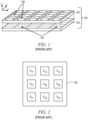
- FIG. 1 is an illustrative drawing showing details of a known imager sensor 180 in accordance with some embodiments.
- the image sensor 180 includes an optic array of lens stacks 182 and an array of sensors 184.
- Each sensor in the array includes a two dimensional arrangement of pixels having at least two pixels in each dimension.
- Each sensor includes a lens stack 186 that creates a separate optical channel that resolves an image onto a corresponding arrangement of pixels disposed in a focal 188 plane of the lens stack.
- the pixels act as light sensors and each focal plane 188 with its multiple pixels acts as an image sensor.
- Each sensor with its focal plane 182 occupies a region of the sensor array different from regions of the sensor array occupied by other sensors and focal planes.
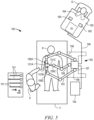
- FIG 2 is an illustrative drawing showing a simplified plan view of the known imager sensor array 180 of Figure 1 that includes sensors S 11 through S 33 .
- the imager sensor array 180 is fabricated on a semiconductor chip to include a plurality of sensors S 11 through S 33 Each of the sensors S 11 through S 33 includes a plurality of pixels (e.g., 0.32 Mega pixels) and is coupled to peripheral circuitry (not shown) that includes independent read-out control and pixel digitization.
- the sensors S 11 through S 33 are arranged into a grid format as illustrated in Figure 2 .
- the sensors are arranged in a non-grid format.
- the imagers may be arranged in a circular pattern, zigzagged pattern or scattered pattern or an irregular pattern including sub-pixel offsets.
- Each sensor pixel includes a microlens pixel stack.
- Figure 3 is an illustrative drawing of a known microlens pixel stack of the sensors of Figures 1-2 .
- the pixel stack 800 includes a microlens 802, which sits atop an oxide layer 804, which is typically beneath the oxide layer 804 there may be a color filter 806, which is disposed above a nitride layer 808, which is disposed above a second oxide layer 810, which and sits atop a silicon 812 that layer includes the active area 814 of the sensor (typically a photodiode).
- the primary role of a microlens 802 is to gather the light incident on its surface and to focus that light onto the small active area 814.
- the pixel aperture 816 is determined by the spread of the microlens, which collects the light and focuses it on the active area 814.
- US 2013/0038689 discloses an image capture unit which includes a prism assembly and sensor assembly.
- the prism assembly includes a beam splitter, while the sensor assembly includes coplanar image capture sensors.
- Each of the coplanar image capture sensors has a common front end optical structure, e.g., the optical structure distal to the image capture unit is the same for each of the sensors.
- a controller enhances images acquired by the coplanar image capture sensors.
- the enhanced images may include (a) visible images with enhanced feature definition, in which a particular feature in the scene is emphasized to the operator of minimally invasive surgical system; (b) images having increased image apparent resolution; (c) images having increased dynamic range; (d) images displayed in a way based on a pixel color component vector having three or more color components; and (e) images having extended depth of field.
- US 2013/0035583 discloses a synthesis image in which medical images captured using different medical image capturing apparatuses are registered is generated by mapping the medical images to each other.
- the synthesis image may be used for image guidance while a diagnosis or a robotic surgery of a patient is being performed.
- JP 2006 305332 A discloses an image processor which is equipped with an image pickup means for picking up two-dimensional images and an image forming means forming a three-dimensional image from a plurality of two-dimensional images. Since the image forming means is equipped with units U each comprising a plurality of lenses disposed in a matrix, the image forming means can acquire two-dimensional images corresponding to the number of the units U.
- a calibration assembly includes: a target surface extends in three dimensions with calibration markers and a body with an interface that engages an endoscope so the markers are within the field of view.
- a first calibration marker extends along a first plane of the target surface and a second marker extends along a second plane of the target surface. The planes are different and asymmetric relative to the field of view as seen through the endoscope.
- WO 2013/156893 A1 discloses systems and methods for guided endoscope navigation which include a registration module configured to, using a processor, register a first set of images with a second set of images of an endoscope.
- a selection module is configured to receive selected areas of interest on the first set of images and transform the selected areas of interest to an endoscope coordinate frame.
- a guidance module is configured to overlay guidance tools onto the second set of images to permit a user of the endoscope to navigate to the selected areas of interest.
- an image sensor array that includes an imager sensor array is associated with an endoscope.
- the image sensor array includes multiple sensors and each sensor includes an array of pixels.
- a portion of the endoscope is inserted into a human body cavity and a target object in a field of view of the image sensor array is illuminated using a light source.
- a physical location and/or dimensions of the target object is determined based upon projected images of the object onto individual sensors of the array.
- Figure 4 is an illustrative drawing showing a perspective view of a surgical scene through a viewer 312 in accordance with some embodiments.
- a viewing system having two imaging elements 206R, 206L can provide a good 3D viewing perspective.
- Numerical values representing physical dimension and/or location information for physical structures in the surgical scene are shown overlaid onto the surgical scene image. For example, a numerical distance value "d_Instr Trgt" is shown displayed within the scene between instrument 400 and target 410.
- Teleoperation refers to operation of a machine at a distance.
- a surgeon may use a camera mounted on an endoscope to view a surgical site within a patient's body. Three-dimensional images have been generated to provide high resolution view during surgery.
- a camera system which is mounted on an endoscope and which includes an imager sensor array, provides quantitative three-dimensional information plus color and illumination data that can be used to generate three-dimensional images in accordance with some embodiments.
- FIG. 5 is an illustrative block diagram of a teleoperation surgery system 100 to perform minimally invasive surgical procedures using one or more mechanical arms 158 in accordance with some embodiments.
- system 100 includes telerobotic and autonomously operating features. These mechanical arms often support an instrument.
- a mechanical surgical arm e.g., the center mechanical surgical arm 158C
- the mechanical surgical arm 158C may include a sterile adapter, or a clamp, clip, screw, slot/groove or other fastener mechanism to mechanically secure the image capture device 101C to the mechanical arm.
- the image capture device 101C may include physical contours and/or structures complementary to those of the mechanical surgical arm 158C so as to securely interfit with them.
- a user or operator O performs a minimally invasive surgical procedure on patient P by manipulating control input devices 160 at a master control console 150.
- the operator can view video frames of images of a surgical site inside a patient's body through a stereo display device 164, which includes the viewer 312 described above with reference to Figure 4 .
- a computer 151 of the console 150 directs movement of teleoperationally controlled endoscopic surgical instruments 101A-101C via control lines 159, effecting movement of the instruments using a patient-side system 152 (also referred to as a patient-side cart).
- the patient-side system 152 includes one or more mechanical arms 158.
- the patient-side system 152 includes at least three mechanical surgical arms 158A-158C (generally referred to as mechanical surgical arms 158) supported by corresponding positioning set-up arms 156.
- the central mechanical surgical arm 158C may support an endoscopic camera 101C suitable for capture of Q3D information for images within a field of view of the camera.
- the mechanical surgical arms 158A and 158B to the left and right of center may support instruments 101A and 101B, respectively, which may manipulate tissue.
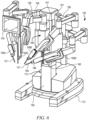
- FIG. 6 is an illustrative perspective view of the patient-side system 152 in accordance with some embodiments.
- the patient-side system 152 comprises a cart column 170 supported by a base 172.
- One or more mechanical surgical arms 158 are respectively attached to one or more set-up arms 156 that are a part of the positioning portion of the patient-side system 152.
- the cart column 170 includes a protective cover 180 that protects components of a counterbalance subsystem and a braking subsystem from contaminants.
- each mechanical surgical arm 158 is used to control instruments 101A-101C. Moreover, each mechanical surgical arm 158 is coupled to a set-up arm 156 that is in turn coupled to a carriage housing 190 in one embodiment of the invention. The one or more mechanical surgical arms 158 are each supported by their respective set-up arm 156, as is illustrated in Figure 6 .
- the mechanical surgical arms 158A-158D may each include one or more displacement transducers, orientational sensors, and/or positional sensors 185 to generate raw uncorrected kinematics data, kinematics datum, and/or kinematics information to assist in acquisition and tracking of instruments.
- the instruments may also include a displacement transducer, a positional sensor, and/or orientation sensor 186 in some embodiments of the invention.
- one or more instruments may include a marker 189 to assist in acquisition and tracking of the instruments.
- FIG. 7A is an illustrative drawing of a first image capture system 101C in accordance with some embodiments.
- the image capture system 101C includes an endoscope that includes elongated portion 202, which includes a first end portion 204 and a second end portion 206 and a tip portion 208 of the first end portion 204.
- the first end portion 202 is dimensioned to be inserted into a human body cavity.
- An imager sensor array 210 which includes multiple image sensors (not shown), is to the tip portion 208 of the first end portion 204.
- the elongated portion 202 has a length sufficient to position the tip portion 208 close enough to a target object within the body cavity that the object can be imaged by the imager sensor 210.
- the second end portion 206 may include physical contours and/or structures (not shown), as generally described above, so as to securely interfit with a mechanical arm (not shown).
- the elongated portion 202 also one or more electronic signal paths 212 to electronically communicate information with the imager sensor array 210.
- a light source 214 is disposed to illuminate the object to be imaged.
- the light source 214 can be unstructured light, white light, color filtered light or light at some selected wavelength, for example.
- FIG. 7B is an illustrative drawing of a second image capture system 101C', in accordance with some embodiments. Aspects of the second image capture system 101C' that are essentially the same as those of the first image capture system 101C are indicated by identical reference numerals and are not described again.
- An input to a light pipe input such as a rod lens, is disposed at the tip portion 208 of the first end portion 204.
- a light pipe body extends within the elongate portion 202 so as to transmit an image received as the light pipe input to the imager sensor array 210, which is physically displaced from the tip portion 208.
- the imager sensor is displaced far enough from the tip portion 208 that the sensor array 210 is located outside the body cavity during observation of objects within the cavity.
- FIG 8 is illustrative block diagram showing control blocks associated with the first image capture system 101C of Figure 7A and showing the system 101C in operation, in accordance with some embodiments.
- Images captured by the imager sensor array 210 are sent over a data bus 212 to a video processor 104, which communicates via bus 105 with a controller 106.
- the video processor 104 may comprise a camera control unit (CCU) and a video signal detector (VSD) board.
- the CCU programs or controls various settings of the imaging sensor 210, such as brightness, color scheme, white balance, etc.
- the VSD processes the video signal received from the imaging sensor.
- a processor system that includes one or more than one processor is configured to perform processor functions.
- the processor system includes multiple processors configured to operate together to perform the processor functions described herein.
- reference herein to at least one processor configured to perform one or more functions includes a processor system in which the functions may be performed by one processor alone or by multiple processors working together.
- the CCU and VSD could be integrated into one functional block.
- the controller 106 which includes a processor and a storage device (not shown) computes the physical quantitative 3D coordinates of the points in a scene adjacent the tip 208 of the elongated portion and drives both the video processor 104 and a 3D display driver 109 to compose 3D scenes, which then can be displayed on a 3D display 110.
- Data buses 107 and 108 exchange information and control signals among the video processor 104, the controller 106 and the display driver 109.
- these elements can be integrated with the image sensor array 210 inside the body of endoscope 202. Alternatively, they can be distributed internally and/or externally to the endoscope.
- the endoscope 202 is shown positioned, via a cannula 140, to penetrate body tissue 130 in order to provide visualize access to a surgical scene that includes a target 120.
- the target 120 can be an anatomic target, another surgical instrument or any other aspect of the surgical scene inside a patient's body.
- FIG. 4 is an illustrative drawing showing a perspective view of a viewer 312 of the master control console 150 of Figure 5 in accordance with some embodiments.
- the viewer 312 includes stereo images for each eye including a left image 400L and a right image 400R of the surgical site including any instruments 400 and a target 410 respectively in a left viewfinder 401L and a right viewfinder 401R.
- the images 400L and 400R in the viewfinders may be provided by a left display device 402L and a right display device 402R, respectively.
- the display devices 402L,402R may optionally be pairs of cathode ray tube (CRT) monitors, liquid crystal displays (LCDs), or other type of image display devices (e.g., plasma, digital light projection, etc.).
- the images are provided in color by a pair of color display devices 402L, 402R; such as color CRTs or color LCDs.
- stereoscopic display devices 402L and 402R may be used with a Q3D system.
- the Q3D imaging system can be connected to 3D monitors, 3D TVs, or to autostereoscopic displays, such as a display that does not require use of 3D effect eye glasses.
- a viewing system having two imaging elements 206R, 206L can provide a good 3D viewing perspective.
- the Q3D imaging system supplements this viewing perspective with physical dimension information for physical structures in the surgical scene.
- the stereo viewer 312 used in conjunction with a Q3D endoscopy system can display Q3D information overlayed onto the stereo image of the surgical scene. For example, as shown in Figure 4 , the numerical Q3D distance value "d_Instr_Trgt" between instrument 400 and target 410 can be displayed within stereo viewer 312.
- FIG 9 is an illustrative flow diagram representing a process to determine a quantitative three dimensional location of a physical target in accordance with some embodiments.
- the process is described with reference to the Q3D system 101C of the embodiment of Figure 8
- Module 401 configures the controller 106 to acquire video data from imaging sensors S ij .
- the video data may include color and light intensity data.
- Each pixel of each sensor may provide one or more signals indicative of the color and intensity of an image projected onto it.
- Module 402 configures the controller to systematically select targets from a selected region of interest in a physical world view.
- Module 403 configures the controller to commence the computation of the target 3D coordinates (x, y, z) with an initial (x 0 , y 0 , z 0 ) set. The algorithm then checks the coordinates for consistency, by using image diversity data from all sensors Sij that see the target. The coordinate computation is refined at step 404 until an acceptable accuracy is reached.
- Decision module 404 configures the controller to determine whether the currently computed physical location is sufficiently accurate. In response to a determination that the currently computed location is not accurate enough, control flows back to module 403 to try a different possible physical location.
- module 405 configures the controller to determine whether the entire region of interest has been scanned. In response to a determination that the entire region of interest has not been scanned, control flows back to module 402 and a different target is selected. In response to a determination that the entire region of interest has been scanned, control flows module 406 configures the controller to assemble a three-dimensional model of the imaging module of interest. Assembly of a 3D image of a target based upon from three-dimensional information indicating the physical position of structures of the target is known to persons of ordinary skill in the art and need not be described herein. Module 407 configures the controller to store the 3D model developed using the physical position information determined for multiple targets for further review and manipulation.
- the 3D model could be used at a later time for surgical applications such as sizing an implant for the particular dimensions of a patient's organ.
- Module 408 configures the controller to use the physical position information determined for multiple targets to display a quantitative 3D view.
- An example of a Q3D view is the distance value "d_Instr_Trgt" shown in Figure 4 .
- FIG 10 is an illustrative flow diagram showing certain details of a process generally corresponding to module 402 of Figure 9 in accordance with some embodiments.
- Module 402.1 configures the controller to capture images of a physical world scene from all sensors in the sensor array 210.
- Module 402.2 configures the controller to specify a region of interest from within the captured scene.
- Module 402.3 configures the controller to search for a best match as between scene images within the region of interest so as to identify pixel locations in different sensors that are illuminated by projections of the same target. As explained later, the best matching may be achieved, without limitation, by shifting the individual images from sensors S ij until maximizing two-dimensional cross-correlation function between the shifted image and a reference image.
- the reference image may be the scene image received from sensor S 11 .
- Module 402.4 configures the controller to identify candidate pixels illuminated by projections from the same target.
- Module 402.5 configures the controller to compute two or more pixel coordinates (N x , N y ) coordinates for the selected target to determine whether the candidate pixels are illuminated by a projection from the same target.
- Decision module 402.6 determines whether the computed 2D pixel coordinate values indicate that the candidate pixels are illuminated by a projection from the same target.
- the image diversity caused by viewing the same scene with multiple sensors S ij plays a role in correctly identifying (N x , N y ) associated with a specific target in the various individual images S ij .
- ⁇ 12 and ⁇ 13 should be equal if pixel coordinates (Nx 11 , Ny 11 ), (Nx 12 , Ny 12 ), (Nx 13 , Ny 13 ) come from projections of the same target.
- y ⁇ 12 Ny 11 Ny 11 ⁇ Ny 12
- y ⁇ 13 2 ⁇ Ny 11 Ny 11 ⁇ Ny 13
- the norm of the difference between ⁇ i,j and ⁇ ij+1 should be less than an acceptable tolerance ⁇ in order for module 402 to complete its iterations.
- a similar restriction should be met for the corresponding estimates for the x axis, x i,j and x i , j +1 .
- each pixel directly captures color and intensity information from a world scene. Moreover, in accordance with the above process, each pixel is associated with the (x, y, z) coordinates of the physical object in the world view that is projected onto the pixel. Thus, color information, illumination intensity information and physical location information, i.e. the location of the physical object that projected the color and illumination, can be associated with a pixel in a non-transitory computer readable storage device.
- Table 1 illustrates this association. Table 1 Pixel Identifier Color Value Intensity Value Location (x, y, z)
- FIG 11 is an illustrative drawing of an example sensor imager array 210 that includes multiple sensors S 11 -S 33 that is disposed to have a field of view that encompasses an illustrative three dimensional physical world scene that includes three illustrative objects in accordance with some embodiments.
- Each sensor in the array includes a two dimensional arrangement of pixels having at least two pixels in each dimension.
- Each sensor includes a lens stack that creates a separate optical channel that resolves an image onto a corresponding arrangement of pixels disposed in a focal plane of the lens stack.
- Each pixels act as a light sensor and each focal plane with its multiple pixels acts as an image sensor.
- Each sensor S 11 -S 33 with its focal plane occupies a region of the sensor array different from regions of the sensor array occupied by other sensors and focal planes.
- Suitable known image sensor arrays are disclosed in U.S. Patent No. 8,514,491 and in U.S. Patent Application Pub. No. 20013/0070060 , which are described above.
- the sensors are characterized by a N x and N y , their total number of pixels in the x and y directions, and by field of view angles, ⁇ x and ⁇ y .
- the sensor characteristics for the x and y axes are expected to be the same.
- the sensors have asymmetric x and y axes characteristics.
- all sensors will have the same total number of pixels and the same field of view angle.
- the sensors are distributed across the array 210 in a well-controlled manner.
- the sensors may be at ⁇ distance apart on the two-dimensional grid shown.
- the sensor placement pitch ⁇ may be symmetric or asymmetric across such grid.
- the sensors are arranged in a rectangular grid in which sensors S 11 -S 13 occupy a top row, sensors S 21 -S 23 occupy a middle row, and sensors S 31 -S 33 occupy a bottom row.
- Each sensor includes N rows of pixels and N columns of pixels.
- Light rays, indicated by dashed lines, produced by a light source are reflected from each of a triangle shaped first object, a spherical shaped second object and a rectangular shaped third object, to each sensor of the imager array. For illustration purposes, only rays to sensors S 11 , S 12 and S 13 in the top row are shown.
- the light source may be non-structured white light or ambient light, for example.
- the light source may provide light at a selected wavelength such as infrared, or may be filtered or split to provide a selected color or range of colors, for example. It will be appreciated that light rays are similarly reflected from each of the objects to sensors S 21 -S 33 . However, in order to simplify the explanation, these other light rays are not shown.
- sensors of the array separately capture images from a world view, and in accordance with module 402.1.
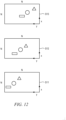
- Figure 12 is an illustrative drawing representing projections of the three objects of Figure 11 onto the sensors S ij (only S 11 , S 12 and S 13 shown) in accordance with some embodiments.
- the reflected light rays incident upon that sensors project images of the objects that are in the field of view. More specifically, the rays of light reflected from the objects in the field of view that are incident upon multiple different image sensors of the imager array produce multiple perspective projections of the objects from three-dimensions to two dimensions, i.e. a different projection in each sensor that receives the reflected rays.
- the relative location of projections of the objects is shifted from left to right when progressing from S 11 to S 12 to S 13 .
- Image sensor pixels that are illuminated by incident light rays produce electrical signals in response to the incident light. Accordingly, for each image sensor, a pattern of electrical signals is produced by its pixels in response to the reflected rays that indicates the shape and location of the image projection within that image sensor.
- a region of interest is selected from the world scene.
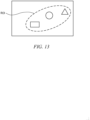
- Figure 13 is an illustrative drawing indicating selection of a region of interest from within the scene.
- the triangle shaped first object, spherical shaped second object and rectangular shaped third object all are in the selected region of interest.
- This step can be achieved by accepting input from an operator, or it can be automatically performed using a computer configured by software in a prescribed manner, or by combination of operator inputs and automatic software-controlled selection.
- the world scene may show an internal cavity of the human anatomy and the objects may be internal body organs or surgical instruments or portions thereof.
- a surgeon may receive real time visual imagery from within the internal cavity and may have within her field of view tissue regions of the human anatomy and a portion of the surgical instruments projecting within the body cavity.
- the surgeon may specify those objects within the field of view for which location information is to be determined through well-known techniques such as a video marker such as telestration, for example.
- a video marker such as telestration
- an automated process such as an edge detection algorithm can be used to specify a region of interest (ROI).
- ROI region of interest
- a best match is determined as between scene images within the region of interest so as to identify pixel locations in different sensors that are illuminated by projections of the same target.
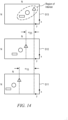
- Figure 14 is an illustrative drawing showing additional detail as to relative geometric offset of the projected images in sensors S 11 , S 12 and S 13 in accordance with some embodiments.
- an image from sensor S 13 is considered to be reference image
- the projections of the objects in the selected ROI are offset to the right by an amount ⁇ 23 pixels in sensor S 12 relative to their location in sensor S 13 .
- the projections of the objects in the selected ROI are offset to the right by an amount ⁇ 13 pixels in sensor S 11 relative to their location in sensor S 13 .
- Figure 15 is an illustrative drawing showing the projected images in sensors S 11 and S 12 within the ROI shifted to the right to align with the projected images in sensor S 13 within the ROI in accordance with some embodiments.
- sensor S 13 is designated to act as a reference sensor. It will be appreciated that other sensors can be chosen for use in determining alignment and geometric dimensions. Projections of the objects within the selected ROI are identified in the designated sensor, e.g., sensor S 13 , and projections in the other sensors, e.g., in sensors S 11 and S 12 , are shifted until they align with the projection in the designated sensor. In this manner, the corresponding projections of objects within the selected ROI can be identified within the other sensors, together with their offsets relative to the location of the projections in the designated sensor.
- the projections of the three example objects are shifted to the right by an amount ⁇ 23 pixels in sensor S 12
- the projections of the three example objects are shifted to the right by an amount ⁇ 13 pixels in sensor S 13 .
- the projections are offset in the y direction only and not in the x direction, although the same principles apply for x direction projection offsets as between sensors.
- this example shows a linear offsets, a person of ordinary skill in the art can apply other transformations such as rotation, for example, to align projections that have relative offsets in different sensors.
- two-dimensional (2D) cross-correlation techniques or principal component analysis (PCA) can be used to align the projections within the ROI in S 13 with the projections within the ROI in S 12 and to align the projections within the ROI in S 13 with the projections within the ROI in S 11 .
- the intent is to best match or align the images from sensors S ij with respect to the image from the sensor designated as reference. More specifically, the projected images within the ROI in S 12 are shifted and cross-correlated with the projected images within the ROI in S 13 until a highest correlation coefficient is achieved. Likewise, the projected images within the ROI in S 11 are shifted and cross-correlated with the projected images within the ROI in S 13 until a highest correlation coefficient is achieved.
- alignment of the projections of the ROI is used to identify the locations of the projections of the ROI in sensors S 11 and S 12 by determining the offset between the projection of the ROI in S 13 and the projection of the ROI in S 12 and by determining the offset between the projection of the ROI in S 13 and the projection of the ROI in S 11 .
- candidate pixels are identified within different sensors, which according to the best match process, are illuminated by projections from the same target.
- the physical (x, y, z) projections of individual target points within the ROI can be determined relative to the imager array.
- one or more pixels within each of multiple sensors is identified that is illuminated by a projection from the target point.
- a physical (x, y, z) target point location is determined based at least in part upon the geometric relationships among pixels disposed in different sensors that are determined to be illuminated by projections from the target point.
- a sequence of target points can be chosen automatically by systematically traversing the ROI (e.g., right to left with a certain step size and up to down with a step size), and a physical (x, y, z) target point location can be determined for each selected target point. Since S 11 and S 12 are best matched to S 13 , the traversing is performed inside the shifted regions of interest. Selecting a target involves identifying a pixel in each of sensors S 11 , S 12 and S 13 that is illuminated by a projection of the target. Thus, candidate pixels in each of S 11 , S 12 and S 13 are identified as being the ones illuminated by a projection of the selected target point.
- a pixel is selected in each of the sensors S 11 , S 12 and S 13 that is illuminated by a projection of the target point T.
- the (x, y, z) physical location of the target T is unknown at the moment of its selection.
- inaccuracy of the above-described alignment process can result in inaccuracy in the determination of which pixels in each sensor are illuminated by the projection of a selected target T.
- a further determination is made as to the accuracy of the determination as to the pixels in each of S 11 , S 12 and S 13 that are illuminated by the projection of a currently selected target T.
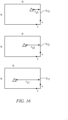
- Figure 16 is an illustrative drawing showing projections of the selected triangle shaped target point onto sensors S 11 , S 12 and S 13 in accordance with some embodiments. From these projections, the 2D pixel coordinates for target T are determined, [(Nx 11 , Ny 11 ), (Nx 12 , Ny 12 ), (Nx 13 , Ny 13 )]. For simplification, Figure 16 shows only the y-axis pixel coordinates. Using these 2D pixel coordinates, expressions (402.5 - 1) and (402.5 - 2) are applied and ⁇ 12 and ⁇ 13 computed as part of module 402.5.
- module 402.6 Part of module 402.6, the norm
- FIG. 17 there is shown a portion of an imager array that includes sensors S 11 , S 12 and S 13 and the selected triangle shaped first object target point T disposed at location (x, y, z) in physical space.
- Sensors within an imager array have a known spacing between them, ⁇ ij .
- the physical position spacing between S 11 and S 12 is ⁇ 12
- the physical position spacing between S 12 and S 13 is ⁇ 23 .
- these spacing between all sensors S ij is identical, equal to ⁇ , a constructional specification.
- Sensors S ij also have a known field of view angle ⁇ .
- each sensor is constructed as a 2D imaging element with pixels arranged in a rectangular pattern of rows and columns.
- pixels can be arranged in a circular pattern, zigzagged pattern or scattered pattern or an irregular pattern including sub-pixel offsets, for example.
- the angle and the pixel characteristics of these elements may be identical or, alternatively, may be different from sensor to sensor. However, these characteristics are assumed to be known. In order to simplify the explanation, it is assumed that the sensors are identical, although they may, however, be different.
- the N-pixel width of the sensor expands out to a y-dimension field of view of S 11 indicated by FOV 1 .
- the y-dimension field of view of sensor S 12 is indicated by FOV 2 .
- the y-dimension field of view of sensor S 13 is indicated by length FOV 3 .
- the lengths FOV 1 , FOV 2 and FOV 3 overlap each other, signifying that sensors S 11 , S 12 and S 13 achieve a 3-way sampling diversity of target T physically located at some (unknown) distance z.
- FIG. 18 there is shown an illustrative elevation view of the projection of the currently selected target point T onto the image sensors S 11 , S 12 and S 13 .
- the sensors include geometrically rectangular pixel arrays of size NxN pixels.
- the x coordinates of the target T projections are all equal.
- a person of skill in the art would know how to modify the process presented below so that to compute the x, y and z physical coordinates of target T if any of the above assumptions would change.
- An image of the target T is projected to a physical point within sensor S 11 at geometric coordinates (n x1 , n y1 ), in the plane of the image sensor S 11 . More specifically, the projection of target point T onto sensor S 11 is located n y1 pixels along the y axis, and nx1 pixel along the x axis, taken from the origin. An image of the target T is projected to a physical point within sensor S 12 at geometric coordinates (n x2 , n y2 ), in the plane of the image sensor S 12 . An image of the target T is projected to a physical point within sensor S 13 at geometric coordinates (n x3 , n y3 ), in the plane of the image sensor S 13 .
- pixel locations (n xi , n yi ) within each sensor are determined relative to origin (0, 0,) reference coordinates provided for the sensor.
- a global system of coordinates (x, y, z) is defined and used to reference the target.
- the origin of such system of coordinates may be placed, without limitations, at the geometrical center of sensor S 11 .
- the y pixel distance of the projection of the target is different in each sensor.
- the projection of a currently selected target T is disposed n y1 pixels to the left of the origin in S 11 .
- the projection of the selected target T is disposed n y2 pixels to the left of the origin in S 12 .
- the projection of the selected target T is disposed n y3 pixels to the left of the origin in S 13 .
- FIG. 19 there is shown the disposition of the currently selected target T relative to sensors S 11 , S 12 and S 13 as described above with reference to Figure 17 and also showing y-direction pixel offsets for the candidate pixel in each of the sensors.
- the drawings of Figure 19 present physical structures and an analytical framework for determining the (x, y, z) physical coordinates of the selected target point T.
- FOV i This length, FOV i , corresponds to the maximum pixel width of the sensor, which is N pixels, in some embodiments. Given that the working assumption was that the sensor has a field of view that is symmetric in the x and y directions, the length would also be FOV i vertically, along the x axis.
- the candidate pixel selections are made based at least in part upon a correlation process that can have a level of uncertainty than can result in inaccuracy in determination of the physical location of the selected target.
- a further check of the accuracy of the target projection candidate selections is made as follows.
- two or more two-dimensional (N x , N y ) coordinate values are computed for the selected target to determine whether the candidate pixels actually are illuminated by a projection from the same target.
- determination of the physical x coordinate of the selected target T can be determined based upon expressions (3) or (6).
- a determination of the physical y coordinate of the selected target T can be determined based upon expressions (2) or (5).
- a determination of the physical z coordinate of the selected target T can be determined based upon equations (1) or (4).
- the y coordinate for the target T can be determined using both formulations (2) and (5). If the resulting y coordinate values computed using the two formulations differ by more than some acceptable tolerance value, ⁇ y , then a determination can be made that the matching process failed to resolve the offset between projections in the different sensors with sufficient accuracy, and as result that the candidate pixels do not correspond in that they do not receive projections from the same target T.
- an initial estimate for the z coordinate, z 0 is used to initiate the computation process.
- This initial value is defined automatically, according to the medical application.
- the medical application defines the intended world view to be visualized.
- the initial value z 0 starts at the edge of the field of view closest to the endoscope.
- z 0 can be 1 - 5 mm off the distal end 208 of the Q3D endoscope 202, for example.
- Such initial estimate generally is sufficient for this application as it is unlikely to have any tissues or surgical instruments reside in such close proximity to the Q3D endoscope.
- value z 0 is plugged into formulations (3) and (6). Given that the x coordinate of the target is unique, if z 0 were the true and correct z coordinate of the target then formulations (3) and (6) would yield identical values, or approximately equal, within an acceptable level of tolerance, ⁇ x . x 3 ⁇ x 6 ⁇ ⁇ x
- z 1 z 0 + ⁇
- ⁇ is the size of the iteration step.
- z k z k-1 + ⁇ .
- the iterative process stops when condition (7) is met.
- a smaller ⁇ yields increased accuracy in determining the correct target coordinates, but would also require more computational time to complete the process, hence an increased latency.
- An increased latency may results in delays between surgical instrument movement and its visualization by the operating surgeon. In other words, the surgeon may perceive the system as lagging behind his commands. For a surgical viewing space of 20 - 30 cm of depth, a ⁇ of 0.1 - 0.3 mm may be sufficient.
- a person skilled in the art would know to balance the size of ⁇ against the computational required to complete the iterative process.
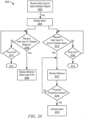
- Figure 20 is an illustrative flow diagram representing a first process 2000 to use Q3D information during a surgical procedure in accordance with some embodiments.
- Computer program code configures the computer 151 to perform the process 2000.
- Module 2002 configures the computer to receive user input to select at least two objects within a surgeon's field of view when looking in to the viewer 312.
- Module 2004 configures the computer to display a menu on a computer console in response to receipt of a user selection.
- Decision module 2006 configures the computer to determine whether user input to the menu is received to display a distance.
- module 2008 configures the computer to display a numerical distance within the video image in the surgeon's field of view.
- Decision module 2010 configures the computer to wait for a prescribed time interval for receipt of user input to select distance display and to end operation of decision module 2006 in response to no receipt of user input within a ⁇ time out' interval.
- Decision module 2012 configures the computer to determine whether user input to the menu is received to enter a proximity alarm limit.
- module 2014 configures the computer to use Q3D information to monitor proximity between two or more objects within the surgeon's field of view.
- Decision module 2016 determines whether the proximity threshold has been crossed.
- module 2018 configures the computer to activate an alarm.
- the alarm may include a sound, a visual queue such as a blinking light or locking of instrument movement to avoid collision.
- control flows back to monitoring module 2014.
- Decision module 2020 configures the computer to wait for the prescribed time interval for receipt of user input to enter the proximity threshold and to end operation of decision module 2012 in response to no receipt of user input within the 'time out' interval.
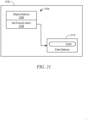
- Figures 21 is an illustrative drawing showing menu selections displayed on a display screen 2102 in accordance with the process of Figure 20 in accordance with some embodiments.
- the display screen 2102 includes a viewing monitor associated with the computer 151.
- the display screen 2102 may include a region of the imaging elements 206R, 206L of the viewer 312.
- module 2004 causes the display of a menu 2104 that includes a first menu item ⁇ Display Distance' 2106 and a second menu item ⁇ Set Proximity Alarm' 2108.
- module 2008 causes a display of Q3D distance between two or more objects.
- an ⁇ Enter Distance' UI input 2110 is displayed that includes a field in which a user can enter a proximity distance threshold value, e.g., "xxxx millimeters".
- a proximity distance threshold value e.g., "xxxx millimeters”.
- a default proximity threshold may be set in advance for all instruments, and a user may change the proximity threshold using the menu of Figure 21 , for example.
- a user can choose to elect the default threshold value rather than enter a threshold value.
- a user can select both to display the distance and set a proximity alert.
- Figures 22A-22B are illustrative drawings representing certain details of receiving user input in accordance with the process of Figure 20 in accordance with some embodiments.
- Figure 22A shows example first highlighting 2202L, 2202R of a target 410L, 410R, such as body tissue, which can be created using video marker tool, such as telestration, or using the surgeon console manipulating control input devices 160 of Figure 4 .
- Figure 22B shows example second highlighting 2206L, 2206R of an instrument tip 400L, 400R, which can be created using the video marker tool.
- a user creates the first highlighting 2202L, 2202R.
- the user creates second highlighting 2206L, 2206R of the instrument tip 400L, 400R using video marker tool. It will be understood that the order in which items are highlighted is unimportant.
- the user then actuates a selector (not shown) (e.g., press the ENTER key) to enter the selection.
- Module 2002 interprets the received user input as selection of the target image 410L, 410R and the instrument image 400L, 400R.
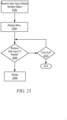
- Figure 23 is an illustrative flow diagram representing a second process 2300 to use Q3D information during a surgical procedure in accordance with some embodiments.
- Computer program code configures the computer 151 to perform the process 2300.
- Module 2302 configures the computer to receive user input to select an object within a surgeon's field of view when looking in to the viewer 312. For example, referring again to Figure 22A , user input is shown received to create the second highlighting 2206L, 2206R of the instrument tip 400L, 400R using the video marker tool.
- User input (not shown) is received to actuate a selector (not shown) (e.g., press the ENTER key) to enter the selection of the image of the instrument tip 400L, 400R.
- a selector not shown
- module 2304 configures the computer to display a menu on a computer console.
- Decision module 2306 configures the computer to determine whether user input to the menu is received to rotate an image of a selected object.
- module 2308 configures the computer to display rotate the image to show a different three-dimensional perspective of the object.
- Decision module 2310 configures the computer to wait for a prescribed time interval for receipt of user input to rotate an image and to end operation of decision module 2306 in response to no receipt of user input within a 'time out' interval.
- Figure 24 is an illustrative drawing showing menu selections displayed on a display screen 2402 in accordance with the process of Figure 23 in accordance with some embodiments.
- the display screen 2402 includes a viewing monitor associated with the computer 151.
- the display screen 2402 may include a region of the imaging elements 206R, 206L of the viewer 312.
- module 2304 causes the display of a menu 2404 that includes a third menu item ⁇ Rotate Left' 2406 and a fourth menu item ⁇ Rotate Right' 2408.
- module 2308 uses the causes a rotation of the 3D model created and stored pursuant to module 407 of Figure 9 . It will be appreciated that the amount of rotation may be limited to a few degrees, less than 30 degrees for example, since the sensor imager array 210 has a limited overall field of view.
Landscapes
- Engineering & Computer Science (AREA)
- Health & Medical Sciences (AREA)
- Life Sciences & Earth Sciences (AREA)
- Surgery (AREA)
- Physics & Mathematics (AREA)
- Signal Processing (AREA)
- General Health & Medical Sciences (AREA)
- Medical Informatics (AREA)
- Nuclear Medicine, Radiotherapy & Molecular Imaging (AREA)
- Multimedia (AREA)
- Molecular Biology (AREA)
- Veterinary Medicine (AREA)
- Public Health (AREA)
- Animal Behavior & Ethology (AREA)
- Heart & Thoracic Surgery (AREA)
- Biomedical Technology (AREA)
- Radiology & Medical Imaging (AREA)
- Optics & Photonics (AREA)
- Biophysics (AREA)
- Pathology (AREA)
- Theoretical Computer Science (AREA)
- General Physics & Mathematics (AREA)
- Computer Vision & Pattern Recognition (AREA)
- Robotics (AREA)
- Electromagnetism (AREA)
- Architecture (AREA)
- Software Systems (AREA)
- Computer Graphics (AREA)
- Quality & Reliability (AREA)
- Computer Hardware Design (AREA)
- General Engineering & Computer Science (AREA)
- Endoscopes (AREA)
- Instruments For Viewing The Inside Of Hollow Bodies (AREA)
- Closed-Circuit Television Systems (AREA)
- Testing, Inspecting, Measuring Of Stereoscopic Televisions And Televisions (AREA)
Applications Claiming Priority (2)
| Application Number | Priority Date | Filing Date | Title |
|---|---|---|---|
| US201461971749P | 2014-03-28 | 2014-03-28 | |
| PCT/US2015/023210 WO2015149040A1 (en) | 2014-03-28 | 2015-03-28 | Quantitative three-dimensional imaging of surgical scenes |
Publications (3)
| Publication Number | Publication Date |
|---|---|
| EP3125806A1 EP3125806A1 (en) | 2017-02-08 |
| EP3125806A4 EP3125806A4 (en) | 2018-03-28 |
| EP3125806B1 true EP3125806B1 (en) | 2023-06-14 |
Family
ID=54196482
Family Applications (1)
| Application Number | Title | Priority Date | Filing Date |
|---|---|---|---|
| EP15768409.3A Active EP3125806B1 (en) | 2014-03-28 | 2015-03-28 | Quantitative three-dimensional imaging of surgical scenes |
Country Status (6)
| Country | Link |
|---|---|
| US (1) | US10368054B2 (https=) |
| EP (1) | EP3125806B1 (https=) |
| JP (2) | JP2017518147A (https=) |
| KR (1) | KR102397254B1 (https=) |
| CN (1) | CN106456252B (https=) |
| WO (1) | WO2015149040A1 (https=) |
Families Citing this family (67)
| Publication number | Priority date | Publication date | Assignee | Title |
|---|---|---|---|---|
| US11792538B2 (en) | 2008-05-20 | 2023-10-17 | Adeia Imaging Llc | Capturing and processing of images including occlusions focused on an image sensor by a lens stack array |
| US8866920B2 (en) | 2008-05-20 | 2014-10-21 | Pelican Imaging Corporation | Capturing and processing of images using monolithic camera array with heterogeneous imagers |
| EP2502115A4 (en) | 2009-11-20 | 2013-11-06 | Pelican Imaging Corp | RECORDING AND PROCESSING IMAGES THROUGH A MONOLITHIC CAMERA ARRAY WITH HETEROGENIC IMAGE CONVERTER |
| US8878950B2 (en) | 2010-12-14 | 2014-11-04 | Pelican Imaging Corporation | Systems and methods for synthesizing high resolution images using super-resolution processes |
| WO2013043751A1 (en) * | 2011-09-19 | 2013-03-28 | Pelican Imaging Corporation | Systems and methods for controlling aliasing in images captured by an array camera for use in super resolution processing using pixel apertures |
| CN104081414B (zh) | 2011-09-28 | 2017-08-01 | Fotonation开曼有限公司 | 用于编码和解码光场图像文件的系统及方法 |
| US20140002674A1 (en) | 2012-06-30 | 2014-01-02 | Pelican Imaging Corporation | Systems and Methods for Manufacturing Camera Modules Using Active Alignment of Lens Stack Arrays and Sensors |
| CN107346061B (zh) | 2012-08-21 | 2020-04-24 | 快图有限公司 | 用于使用阵列照相机捕捉的图像中的视差检测和校正的系统和方法 |
| EP2888698A4 (en) | 2012-08-23 | 2016-06-29 | Pelican Imaging Corp | PROPERTY-BASED HIGH-RESOLUTION MOTION ESTIMATION FROM LOW-RESOLUTION IMAGES RECORDED WITH AN ARRAY SOURCE |
| US8866912B2 (en) | 2013-03-10 | 2014-10-21 | Pelican Imaging Corporation | System and methods for calibration of an array camera using a single captured image |
| WO2014159779A1 (en) | 2013-03-14 | 2014-10-02 | Pelican Imaging Corporation | Systems and methods for reducing motion blur in images or video in ultra low light with array cameras |
| EP4604059A3 (en) | 2013-03-15 | 2025-09-17 | Adeia Imaging LLC | Systems and methods for stereo imaging with camera arrays |
| US10122993B2 (en) | 2013-03-15 | 2018-11-06 | Fotonation Limited | Autofocus system for a conventional camera that uses depth information from an array camera |
| US9497429B2 (en) | 2013-03-15 | 2016-11-15 | Pelican Imaging Corporation | Extended color processing on pelican array cameras |
| WO2015048694A2 (en) | 2013-09-27 | 2015-04-02 | Pelican Imaging Corporation | Systems and methods for depth-assisted perspective distortion correction |
| US10119808B2 (en) | 2013-11-18 | 2018-11-06 | Fotonation Limited | Systems and methods for estimating depth from projected texture using camera arrays |
| EP3075140B1 (en) | 2013-11-26 | 2018-06-13 | FotoNation Cayman Limited | Array camera configurations incorporating multiple constituent array cameras |
| US10089740B2 (en) | 2014-03-07 | 2018-10-02 | Fotonation Limited | System and methods for depth regularization and semiautomatic interactive matting using RGB-D images |
| KR102397670B1 (ko) | 2014-03-28 | 2022-05-16 | 인튜어티브 서지컬 오퍼레이션즈 인코포레이티드 | 정량적 3차원 영상화에 기초한 햅틱 피드백을 갖는 수술 시스템 |
| US10334227B2 (en) | 2014-03-28 | 2019-06-25 | Intuitive Surgical Operations, Inc. | Quantitative three-dimensional imaging of surgical scenes from multiport perspectives |
| KR102387096B1 (ko) | 2014-03-28 | 2022-04-15 | 인튜어티브 서지컬 오퍼레이션즈 인코포레이티드 | 시계 내의 기기들의 정량적 3차원 시각화 |
| CN110251047B (zh) | 2014-03-28 | 2022-01-18 | 直观外科手术操作公司 | 手术植入物的定量三维成像和打印 |
| WO2015151098A2 (en) * | 2014-04-02 | 2015-10-08 | M.S.T. Medical Surgery Technologies Ltd. | An articulated structured light based-laparoscope |
| CN113256730B (zh) | 2014-09-29 | 2023-09-05 | 快图有限公司 | 用于阵列相机的动态校准的系统和方法 |
| JP2017099616A (ja) * | 2015-12-01 | 2017-06-08 | ソニー株式会社 | 手術用制御装置、手術用制御方法、およびプログラム、並びに手術システム |
| US20170280970A1 (en) * | 2016-03-31 | 2017-10-05 | Covidien Lp | Thoracic endoscope for surface scanning |
| US10052163B2 (en) * | 2016-07-19 | 2018-08-21 | Hcl Technologies Limited | Assisting a surgeon to operate a surgical device |
| CN110192390A (zh) | 2016-11-24 | 2019-08-30 | 华盛顿大学 | 头戴式显示器的光场捕获和渲染 |
| CN116777901B (zh) * | 2017-12-29 | 2026-03-03 | 上海联影医疗科技股份有限公司 | 一种用于医学成像中的生成对象的三维模型的系统 |
| CN111542827B (zh) | 2017-12-29 | 2021-09-28 | 上海联影医疗科技股份有限公司 | 一种患者定位的系统和方法 |
| US11705238B2 (en) | 2018-07-26 | 2023-07-18 | Covidien Lp | Systems and methods for providing assistance during surgery |
| US11071591B2 (en) | 2018-07-26 | 2021-07-27 | Covidien Lp | Modeling a collapsed lung using CT data |
| CN112584741B (zh) * | 2018-08-20 | 2024-10-29 | 富士胶片株式会社 | 医疗图像处理系统 |
| US11197728B2 (en) * | 2018-09-17 | 2021-12-14 | Auris Health, Inc. | Systems and methods for concomitant medical procedures |
| US10623660B1 (en) | 2018-09-27 | 2020-04-14 | Eloupes, Inc. | Camera array for a mediated-reality system |
| CN112839608B (zh) | 2018-10-15 | 2025-07-04 | 马佐尔机器人有限公司 | 多功能多臂机器人手术系统 |
| US11801113B2 (en) | 2018-12-13 | 2023-10-31 | Covidien Lp | Thoracic imaging, distance measuring, and notification system and method |
| US11617493B2 (en) | 2018-12-13 | 2023-04-04 | Covidien Lp | Thoracic imaging, distance measuring, surgical awareness, and notification system and method |
| US11172184B2 (en) | 2018-12-13 | 2021-11-09 | Covidien Lp | Systems and methods for imaging a patient |
| WO2020236814A1 (en) | 2019-05-23 | 2020-11-26 | Intuitive Surgical Operations, Inc. | Systems and methods for generating workspace volumes and identifying reachable workspaces of surgical instruments |
| US12089902B2 (en) | 2019-07-30 | 2024-09-17 | Coviden Lp | Cone beam and 3D fluoroscope lung navigation |
| WO2021055585A1 (en) | 2019-09-17 | 2021-03-25 | Boston Polarimetrics, Inc. | Systems and methods for surface modeling using polarization cues |
| WO2021071995A1 (en) | 2019-10-07 | 2021-04-15 | Boston Polarimetrics, Inc. | Systems and methods for surface normals sensing with polarization |
| JP7735265B2 (ja) | 2019-11-14 | 2025-09-08 | アセンサス・サージカル・ユーエス,インコーポレイテッド | 手術部位測定を提供する方法及びシステム |
| EP4066001B1 (en) | 2019-11-30 | 2026-03-04 | Intrinsic Innovation LLC | Systems and methods for transparent object segmentation using polarization cues |
| US12002571B2 (en) * | 2019-12-30 | 2024-06-04 | Cilag Gmbh International | Dynamic surgical visualization systems |
| JP7462769B2 (ja) | 2020-01-29 | 2024-04-05 | イントリンジック イノベーション エルエルシー | 物体の姿勢の検出および測定システムを特徴付けるためのシステムおよび方法 |
| US11797863B2 (en) | 2020-01-30 | 2023-10-24 | Intrinsic Innovation Llc | Systems and methods for synthesizing data for training statistical models on different imaging modalities including polarized images |
| US10949986B1 (en) | 2020-05-12 | 2021-03-16 | Proprio, Inc. | Methods and systems for imaging a scene, such as a medical scene, and tracking objects within the scene |
| WO2021243088A1 (en) | 2020-05-27 | 2021-12-02 | Boston Polarimetrics, Inc. | Multi-aperture polarization optical systems using beam splitters |
| US12426964B2 (en) | 2020-06-30 | 2025-09-30 | Mazor Robotics Ltd. | Time-spaced robotic reference frames |
| JP7535587B2 (ja) * | 2020-09-10 | 2024-08-16 | オリンパス株式会社 | 医療システムおよび医療システムの作動方法 |
| US12274525B2 (en) | 2020-09-29 | 2025-04-15 | Mazor Robotics Ltd. | Systems and methods for tracking anatomical motion |
| US12465441B2 (en) | 2021-02-01 | 2025-11-11 | Mazor Robotics Ltd. | Multi-arm robotic systems and methods for identifying a target |
| US12508085B2 (en) | 2021-02-04 | 2025-12-30 | Mazor Robotics Ltd. | Systems, methods, and devices for verifying mechanical coupling between anatomical elements |
| US12020455B2 (en) | 2021-03-10 | 2024-06-25 | Intrinsic Innovation Llc | Systems and methods for high dynamic range image reconstruction |
| US12069227B2 (en) | 2021-03-10 | 2024-08-20 | Intrinsic Innovation Llc | Multi-modal and multi-spectral stereo camera arrays |
| US11954886B2 (en) | 2021-04-15 | 2024-04-09 | Intrinsic Innovation Llc | Systems and methods for six-degree of freedom pose estimation of deformable objects |
| US11290658B1 (en) | 2021-04-15 | 2022-03-29 | Boston Polarimetrics, Inc. | Systems and methods for camera exposure control |
| US12067746B2 (en) | 2021-05-07 | 2024-08-20 | Intrinsic Innovation Llc | Systems and methods for using computer vision to pick up small objects |
| US12175741B2 (en) | 2021-06-22 | 2024-12-24 | Intrinsic Innovation Llc | Systems and methods for a vision guided end effector |
| US12340538B2 (en) | 2021-06-25 | 2025-06-24 | Intrinsic Innovation Llc | Systems and methods for generating and using visual datasets for training computer vision models |
| US12172310B2 (en) | 2021-06-29 | 2024-12-24 | Intrinsic Innovation Llc | Systems and methods for picking objects using 3-D geometry and segmentation |
| US11689813B2 (en) | 2021-07-01 | 2023-06-27 | Intrinsic Innovation Llc | Systems and methods for high dynamic range imaging using crossed polarizers |
| US12293535B2 (en) | 2021-08-03 | 2025-05-06 | Intrinsic Innovation Llc | Systems and methods for training pose estimators in computer vision |
| US12128571B2 (en) * | 2021-10-15 | 2024-10-29 | eBots Inc. | 3D computer-vision system with variable spatial resolution |
| US12261988B2 (en) | 2021-11-08 | 2025-03-25 | Proprio, Inc. | Methods for generating stereoscopic views in multicamera systems, and associated devices and systems |
Citations (3)
| Publication number | Priority date | Publication date | Assignee | Title |
|---|---|---|---|---|
| JP2006305332A (ja) * | 2005-03-28 | 2006-11-09 | Hiroshima Industrial Promotion Organization | 画像処理装置およびそれを用いた内視鏡 |
| US20130085329A1 (en) * | 2009-03-31 | 2013-04-04 | Intuitive Surgical Operations, Inc. | Three-dimensional target devices, assemblies and methods for calibrating an endoscopic camera |
| WO2013156893A1 (en) * | 2012-04-19 | 2013-10-24 | Koninklijke Philips N.V. | Guidance tools to manually steer endoscope using pre-operative and intra-operative 3d images |
Family Cites Families (156)
| Publication number | Priority date | Publication date | Assignee | Title |
|---|---|---|---|---|
| US1005215A (en) | 1911-05-16 | 1911-10-10 | Anton Hofacker | Sleigh attachment for vehicles. |
| JPH04176429A (ja) | 1990-11-09 | 1992-06-24 | Olympus Optical Co Ltd | 内視鏡 |
| JP3217386B2 (ja) | 1991-04-24 | 2001-10-09 | オリンパス光学工業株式会社 | 診断システム |
| US5417210A (en) | 1992-05-27 | 1995-05-23 | International Business Machines Corporation | System and method for augmentation of endoscopic surgery |
| US5603318A (en) | 1992-04-21 | 1997-02-18 | University Of Utah Research Foundation | Apparatus and method for photogrammetric surgical localization |
| AT399647B (de) | 1992-07-31 | 1995-06-26 | Truppe Michael | Anordnung zur darstellung des inneren von körpern |
| JPH06160087A (ja) | 1992-11-20 | 1994-06-07 | Matsushita Electric Ind Co Ltd | 画像を用いた距離測定方法及びその装置 |
| US5860934A (en) | 1992-12-21 | 1999-01-19 | Artann Corporation | Method and device for mechanical imaging of breast |
| JPH07240945A (ja) | 1994-02-25 | 1995-09-12 | Matsushita Electric Ind Co Ltd | 仮想空間生成提示装置 |
| JP3599854B2 (ja) | 1995-10-09 | 2004-12-08 | オリンパス株式会社 | 医療用顔面装着型映像表示装置 |
| US6346940B1 (en) | 1997-02-27 | 2002-02-12 | Kabushiki Kaisha Toshiba | Virtualized endoscope system |
| JPH11309A (ja) | 1997-06-12 | 1999-01-06 | Hitachi Ltd | 画像処理装置 |
| JP2958458B1 (ja) | 1998-08-26 | 1999-10-06 | 防衛庁技術研究本部長 | 多眼画像センサ |
| JP2000149017A (ja) | 1998-11-17 | 2000-05-30 | Sony Corp | 画像処理装置および画像処理方法、並びに提供媒体 |
| US6659939B2 (en) | 1998-11-20 | 2003-12-09 | Intuitive Surgical, Inc. | Cooperative minimally invasive telesurgical system |
| US6522906B1 (en) | 1998-12-08 | 2003-02-18 | Intuitive Surgical, Inc. | Devices and methods for presenting and regulating auxiliary information on an image display of a telesurgical system to assist an operator in performing a surgical procedure |
| US7343195B2 (en) | 1999-05-18 | 2008-03-11 | Mediguide Ltd. | Method and apparatus for real time quantitative three-dimensional image reconstruction of a moving organ and intra-body navigation |
| US6503195B1 (en) | 1999-05-24 | 2003-01-07 | University Of North Carolina At Chapel Hill | Methods and systems for real-time structured light depth extraction and endoscope using real-time structured light depth extraction |
| US6517478B2 (en) | 2000-03-30 | 2003-02-11 | Cbyon, Inc. | Apparatus and method for calibrating an endoscope |
| US6468203B2 (en) | 2000-04-03 | 2002-10-22 | Neoguide Systems, Inc. | Steerable endoscope and improved method of insertion |
| JP2002024807A (ja) | 2000-07-07 | 2002-01-25 | National Institute Of Advanced Industrial & Technology | 物体運動追跡手法及び記録媒体 |
| JP4451968B2 (ja) | 2000-07-11 | 2010-04-14 | Hoya株式会社 | 3次元画像入力装置 |
| US6650927B1 (en) | 2000-08-18 | 2003-11-18 | Biosense, Inc. | Rendering of diagnostic imaging data on a three-dimensional map |
| JP2002171537A (ja) * | 2000-11-30 | 2002-06-14 | Canon Inc | 複眼撮像系、撮像装置および電子機器 |
| DE10138537B4 (de) | 2001-08-06 | 2006-07-06 | Siemens Ag | Taktiles Feedback zur Darstellung von Gewebeelastizität |
| US8175680B2 (en) | 2001-11-09 | 2012-05-08 | Boston Scientific Scimed, Inc. | Systems and methods for guiding catheters using registered images |
| JP3751568B2 (ja) | 2002-02-21 | 2006-03-01 | 株式会社サタケ | 内視鏡における空気噴流診断装置 |
| US9155544B2 (en) | 2002-03-20 | 2015-10-13 | P Tech, Llc | Robotic systems and methods |
| JP3927487B2 (ja) | 2002-12-02 | 2007-06-06 | 株式会社大野興業 | 人工骨モデルの製造方法 |
| FR2855292B1 (fr) | 2003-05-22 | 2005-12-09 | Inst Nat Rech Inf Automat | Dispositif et procede de recalage en temps reel de motifs sur des images, notamment pour le guidage par localisation |
| JP4414682B2 (ja) | 2003-06-06 | 2010-02-10 | オリンパス株式会社 | 超音波内視鏡装置 |
| DE10340546B4 (de) | 2003-09-01 | 2006-04-20 | Siemens Ag | Verfahren und Vorrichtung zur visuellen Unterstützung einer elektrophysiologischen Katheteranwendung im Herzen |
| JP2005087468A (ja) | 2003-09-17 | 2005-04-07 | Shoji Kawahito | 距離画像計測機能を有する撮像装置及び内視鏡装置 |
| JP4229791B2 (ja) | 2003-09-19 | 2009-02-25 | 真 金子 | 内視鏡装置 |
| US7746377B2 (en) | 2003-11-28 | 2010-06-29 | Topcon Corporation | Three-dimensional image display apparatus and method |
| EP1691666B1 (en) | 2003-12-12 | 2012-05-30 | University of Washington | Catheterscope 3d guidance and interface system |
| DE102004008164B3 (de) | 2004-02-11 | 2005-10-13 | Karl Storz Gmbh & Co. Kg | Verfahren und Vorrichtung zum Erstellen zumindest eines Ausschnitts eines virtuellen 3D-Modells eines Körperinnenraums |
| US7289106B2 (en) | 2004-04-01 | 2007-10-30 | Immersion Medical, Inc. | Methods and apparatus for palpation simulation |
| US20050254720A1 (en) | 2004-05-17 | 2005-11-17 | Kar-Han Tan | Enhanced surgical visualizations with multi-flash imaging |
| JP2006109939A (ja) | 2004-10-12 | 2006-04-27 | Chinontec Kk | 内視鏡装置 |
| WO2006070669A1 (ja) | 2004-12-27 | 2006-07-06 | Olympus Corporation | 医療画像処理装置及び医療画像処理方法 |
| US20100312129A1 (en) | 2005-01-26 | 2010-12-09 | Schecter Stuart O | Cardiovascular haptic handle system |
| JP4625964B2 (ja) | 2005-01-28 | 2011-02-02 | 国立大学法人佐賀大学 | 三次元画像検出装置 |
| US7752920B2 (en) | 2005-12-30 | 2010-07-13 | Intuitive Surgical Operations, Inc. | Modular force sensor |
| KR101352360B1 (ko) * | 2005-04-27 | 2014-01-15 | 오브듀캇 아베 | 물체에 패턴을 전사하기 위한 수단 |
| US9492240B2 (en) | 2009-06-16 | 2016-11-15 | Intuitive Surgical Operations, Inc. | Virtual measurement tool for minimally invasive surgery |
| US8108072B2 (en) | 2007-09-30 | 2012-01-31 | Intuitive Surgical Operations, Inc. | Methods and systems for robotic instrument tool tracking with adaptive fusion of kinematics information and image information |
| US8073528B2 (en) * | 2007-09-30 | 2011-12-06 | Intuitive Surgical Operations, Inc. | Tool tracking systems, methods and computer products for image guided surgery |
| US9789608B2 (en) | 2006-06-29 | 2017-10-17 | Intuitive Surgical Operations, Inc. | Synthetic representation of a surgical robot |
| US9289267B2 (en) | 2005-06-14 | 2016-03-22 | Siemens Medical Solutions Usa, Inc. | Method and apparatus for minimally invasive surgery using endoscopes |
| EP1924197B1 (en) | 2005-08-24 | 2017-10-11 | Philips Electronics LTD | System for navigated flexible endoscopy |
| WO2007033379A2 (en) | 2005-09-14 | 2007-03-22 | Neoguide Systems, Inc. | Methods and apparatus for performing transluminal and other procedures |
| US8079950B2 (en) | 2005-09-29 | 2011-12-20 | Intuitive Surgical Operations, Inc. | Autofocus and/or autoscaling in telesurgery |
| CN101291635B (zh) | 2005-10-20 | 2013-03-27 | 直观外科手术操作公司 | 医用机器人系统中的计算机显示屏上的辅助图像显示和操纵 |
| US7907166B2 (en) | 2005-12-30 | 2011-03-15 | Intuitive Surgical Operations, Inc. | Stereo telestration for robotic surgery |
| DE102006002001B4 (de) | 2006-01-16 | 2009-07-23 | Sensomotoric Instruments Gmbh | Verfahren zur Bestimmung der räumlichen Relation eines Auges einer Person bezüglich einer Kameravorrichtung |
| IL181470A (en) * | 2006-02-24 | 2012-04-30 | Visionsense Ltd | Method and system for navigation within a flexible organ in the human body |
| US20070236514A1 (en) | 2006-03-29 | 2007-10-11 | Bracco Imaging Spa | Methods and Apparatuses for Stereoscopic Image Guided Surgical Navigation |
| EP2029059A2 (en) | 2006-05-25 | 2009-03-04 | Spinemedica Corporation | Patient-specific spinal implants and related systems and methods |
| US9718190B2 (en) | 2006-06-29 | 2017-08-01 | Intuitive Surgical Operations, Inc. | Tool position and identification indicator displayed in a boundary area of a computer display screen |
| GB0613576D0 (en) * | 2006-07-10 | 2006-08-16 | Leuven K U Res & Dev | Endoscopic vision system |
| US7728868B2 (en) | 2006-08-02 | 2010-06-01 | Inneroptic Technology, Inc. | System and method of providing real-time dynamic imagery of a medical procedure site using multiple modalities |
| ATE472141T1 (de) | 2006-08-21 | 2010-07-15 | Sti Medical Systems Llc | Computergestützte analyse mit hilfe von videodaten aus endoskopen |
| US7824328B2 (en) | 2006-09-18 | 2010-11-02 | Stryker Corporation | Method and apparatus for tracking a surgical instrument during surgery |
| US8496575B2 (en) | 2006-11-14 | 2013-07-30 | Olympus Corporation | Measuring endoscope apparatus, program and recording medium |
| WO2008063856A2 (en) | 2006-11-17 | 2008-05-29 | Salada Mark A | Haptic interface device and method for using such |
| WO2008076910A1 (en) | 2006-12-15 | 2008-06-26 | The Board Of Trustees Of The Leland Stanford Junior University | Image mosaicing systems and methods |
| ATE493082T1 (de) | 2006-12-15 | 2011-01-15 | Ao Technology Ag | Vorrichtung für die computergestützte distale arretierung von marknägeln |
| EP1952752B2 (de) | 2007-01-31 | 2019-10-16 | Richard Wolf GmbH | Endoskopsystem |
| US8672836B2 (en) | 2007-01-31 | 2014-03-18 | The Penn State Research Foundation | Method and apparatus for continuous guidance of endoscopy |
| EP2164424B1 (en) | 2007-06-29 | 2019-02-27 | 3M Innovative Properties Company | Graphical user interface for computer-assisted margin marking on dentition |
| US20090076476A1 (en) | 2007-08-15 | 2009-03-19 | Hansen Medical, Inc. | Systems and methods employing force sensing for mapping intra-body tissue |
| FR2920085B1 (fr) | 2007-08-24 | 2012-06-15 | Univ Grenoble 1 | Systeme d'imagerie pour l'observation tridimensionnelle d'un champ operatoire |
| US20090133260A1 (en) | 2007-11-26 | 2009-05-28 | Ios Technologies, Inc | 3D dental shade matching and apparatus |
| US20100111389A1 (en) | 2007-12-06 | 2010-05-06 | Siemens Medical Solutions Usa, Inc. | System and method for planning and guiding percutaneous procedures |
| US20090157059A1 (en) | 2007-12-14 | 2009-06-18 | Searete Llc, A Limited Liability Corporation Of The State Of Delaware | Surgical instrument navigation system |
| JP2009204991A (ja) * | 2008-02-28 | 2009-09-10 | Funai Electric Co Ltd | 複眼撮像装置 |
| US20090221908A1 (en) | 2008-03-01 | 2009-09-03 | Neil David Glossop | System and Method for Alignment of Instrumentation in Image-Guided Intervention |
| DE102008018636B4 (de) * | 2008-04-11 | 2011-01-05 | Storz Endoskop Produktions Gmbh | Vorrichtung und Verfahren zur endoskopischen 3D-Datenerfassung |
| EP3328048B1 (en) | 2008-05-20 | 2021-04-21 | FotoNation Limited | Capturing and processing of images using monolithic camera array with heterogeneous imagers |
| US8866920B2 (en) | 2008-05-20 | 2014-10-21 | Pelican Imaging Corporation | Capturing and processing of images using monolithic camera array with heterogeneous imagers |
| US8636653B2 (en) * | 2008-06-09 | 2014-01-28 | Capso Vision, Inc. | In vivo camera with multiple sources to illuminate tissue at different distances |
| EP2145575A1 (en) | 2008-07-17 | 2010-01-20 | Nederlandse Organisatie voor toegepast-natuurwetenschappelijk Onderzoek TNO | A system, a method and a computer program for inspection of a three-dimensional environment by a user |
| US8334900B2 (en) | 2008-07-21 | 2012-12-18 | The Hong Kong University Of Science And Technology | Apparatus and method of optical imaging for medical diagnosis |
| JP5435916B2 (ja) * | 2008-09-18 | 2014-03-05 | 富士フイルム株式会社 | 電子内視鏡システム |
| JP4702569B2 (ja) | 2008-09-30 | 2011-06-15 | マツダ株式会社 | 車両用画像処理装置 |
| RU2011120186A (ru) | 2008-10-20 | 2012-11-27 | Конинклейке Филипс Электроникс, Н.В. | Способ и система локализации на основе изображений |
| US8594841B2 (en) | 2008-12-31 | 2013-11-26 | Intuitive Surgical Operations, Inc. | Visual force feedback in a minimally invasive surgical procedure |
| WO2010093780A2 (en) | 2009-02-13 | 2010-08-19 | University Of Florida Research Foundation, Inc. | Communication and skills training using interactive virtual humans |
| US8690776B2 (en) | 2009-02-17 | 2014-04-08 | Inneroptic Technology, Inc. | Systems, methods, apparatuses, and computer-readable media for image guided surgery |
| US9017334B2 (en) | 2009-02-24 | 2015-04-28 | Microport Orthopedics Holdings Inc. | Patient specific surgical guide locator and mount |
| US10004387B2 (en) | 2009-03-26 | 2018-06-26 | Intuitive Surgical Operations, Inc. | Method and system for assisting an operator in endoscopic navigation |
| US9060713B2 (en) | 2009-04-07 | 2015-06-23 | Regents Of The University Of Minnesota | Sensing tissue properties |
| JP5611324B2 (ja) | 2009-04-25 | 2014-10-22 | シーメンス アクチエンゲゼルシヤフトSiemens Aktiengesellschaft | インプラントと生物の骨との相対位置を評価するシステム |
| CA2761844C (en) | 2009-05-14 | 2017-11-28 | University Health Network | Quantitative endoscopy |
| EP2437676A1 (en) | 2009-06-01 | 2012-04-11 | Koninklijke Philips Electronics N.V. | Distance-based position tracking method and system |
| US9259290B2 (en) | 2009-06-08 | 2016-02-16 | MRI Interventions, Inc. | MRI-guided surgical systems with proximity alerts |
| WO2010148083A2 (en) | 2009-06-16 | 2010-12-23 | Surgivision, Inc. | Mri-guided devices and mri-guided interventional systems that can track and generate dynamic visualizations of the devices in near real time |
| US10026016B2 (en) | 2009-06-26 | 2018-07-17 | Regents Of The University Of Minnesota | Tracking and representation of multi-dimensional organs |
| ES2353099B1 (es) | 2009-07-30 | 2012-01-02 | Fundacion Para Progreso Soft Computing | Método y sistema de identificación forense por superposición craneofacial basado en soft computing. |
| JP5094930B2 (ja) | 2009-08-10 | 2012-12-12 | 韓國電子通信研究院 | イメージに触覚情報を符号化する方法、イメージから触覚情報を復号化する方法、およびこのための触覚情報処理装置 |
| EP2502115A4 (en) | 2009-11-20 | 2013-11-06 | Pelican Imaging Corp | RECORDING AND PROCESSING IMAGES THROUGH A MONOLITHIC CAMERA ARRAY WITH HETEROGENIC IMAGE CONVERTER |
| US11699247B2 (en) * | 2009-12-24 | 2023-07-11 | Cognex Corporation | System and method for runtime determination of camera miscalibration |
| US9436280B2 (en) | 2010-01-07 | 2016-09-06 | Qualcomm Incorporated | Simulation of three-dimensional touch sensation using haptics |
| CN102711650B (zh) | 2010-01-13 | 2015-04-01 | 皇家飞利浦电子股份有限公司 | 用于内窥镜手术的基于图像整合的配准和导航 |
| US20120316392A1 (en) | 2010-02-01 | 2012-12-13 | Itoua Seraphin Nicaise | Spherical capsule video endoscopy |
| DE102010006741A1 (de) | 2010-02-03 | 2011-08-04 | Friedrich-Alexander-Universität Erlangen-Nürnberg, 91054 | Verfahren zum Verarbeiten eines Endoskopiebildes |
| JP5421828B2 (ja) | 2010-03-17 | 2014-02-19 | 富士フイルム株式会社 | 内視鏡観察支援システム、並びに、内視鏡観察支援装置、その作動方法およびプログラム |
| JP2011200515A (ja) | 2010-03-26 | 2011-10-13 | Hoya Corp | 触覚センサを備える電子内視鏡及び電子内視鏡システム |
| JP5432793B2 (ja) | 2010-03-29 | 2014-03-05 | オリンパス株式会社 | 蛍光内視鏡装置 |
| NZ604320A (en) * | 2010-06-11 | 2014-07-25 | Ethicon Llc | Suture delivery tools for endoscopic and robot-assisted surgery and methods |
| EP2613727A4 (en) | 2010-09-10 | 2014-09-10 | Univ Johns Hopkins | VISUALIZING A RECORDED UNDERGROUND ANATOMY WITH REFERENCE TO RELATED APPLICATIONS |
| US9615886B2 (en) | 2010-09-15 | 2017-04-11 | Koninklijke Philips N.V. | Robotic control of an endoscope from blood vessel tree images |
| DE102010050227A1 (de) | 2010-11-04 | 2012-05-10 | Siemens Aktiengesellschaft | Endoskop mit 3D-Funktionalität |
| CN106264659B (zh) | 2011-04-07 | 2019-02-22 | 3形状股份有限公司 | 用于引导对象的3d系统和方法 |
| US9138148B2 (en) | 2011-04-13 | 2015-09-22 | St. Jude Medical, Inc. | High speed elastographic property mapping of lumens utilizing micropalpation delivered from an OCT-equipped catheter tip |
| CA2835870A1 (en) * | 2011-05-12 | 2012-11-15 | Olive Medical Corporation | Pixel array area optimization using stacking scheme for hybrid image sensor with minimal vertical interconnects |
| US8900131B2 (en) | 2011-05-13 | 2014-12-02 | Intuitive Surgical Operations, Inc. | Medical system providing dynamic registration of a model of an anatomical structure for image-guided surgery |
| JP5830270B2 (ja) | 2011-05-24 | 2015-12-09 | オリンパス株式会社 | 内視鏡装置および計測方法 |
| KR20130015146A (ko) | 2011-08-02 | 2013-02-13 | 삼성전자주식회사 | 의료 영상 처리 방법 및 장치, 영상 유도를 이용한 로봇 수술 시스템 |
| US8784301B2 (en) | 2011-08-12 | 2014-07-22 | Intuitive Surgical Operations, Inc. | Image capture unit and method with an extended depth of field |
| US9204939B2 (en) | 2011-08-21 | 2015-12-08 | M.S.T. Medical Surgery Technologies Ltd. | Device and method for assisting laparoscopic surgery—rule based approach |
| WO2013027201A2 (en) | 2011-08-21 | 2013-02-28 | M.S.T. Medical Surgery Technologies.Ltd. | Device and method for asissting laparoscopic surgery- rule based approach |
| US10866783B2 (en) | 2011-08-21 | 2020-12-15 | Transenterix Europe S.A.R.L. | Vocally activated surgical control system |
| WO2013038403A2 (en) | 2011-09-13 | 2013-03-21 | Visionsense Ltd. | Proximal high definition endoscope |
| WO2013073061A1 (ja) * | 2011-11-15 | 2013-05-23 | Suzuki Naoki | 撮影装置及び撮影システム |
| DE102011119608B4 (de) | 2011-11-29 | 2021-07-29 | Karl Storz Se & Co. Kg | Vorrichtung und Verfahren zur endoskopischen 3D-Datenerfassung |
| US20150011894A1 (en) | 2011-12-19 | 2015-01-08 | The Regents Of The University Of California | System for and method of quantifying on-body palpitation for improved medical diagnosis |
| CA2857636C (en) | 2011-12-22 | 2020-06-23 | Mimedx Group Inc. | Cross-linked dehydrated placental tissue grafts and methods for making and using the same |
| JP5918548B2 (ja) | 2012-01-24 | 2016-05-18 | 富士フイルム株式会社 | 内視鏡画像診断支援装置およびその作動方法並びに内視鏡画像診断支援プログラム |
| US20130211244A1 (en) | 2012-01-25 | 2013-08-15 | Surgix Ltd. | Methods, Devices, Systems, Circuits and Associated Computer Executable Code for Detecting and Predicting the Position, Orientation and Trajectory of Surgical Tools |
| WO2013116240A1 (en) | 2012-01-30 | 2013-08-08 | Inneroptic Technology, Inc. | Multiple medical device guidance |
| US9092996B2 (en) | 2012-03-01 | 2015-07-28 | Simquest Llc | Microsurgery simulator |
| US10758209B2 (en) | 2012-03-09 | 2020-09-01 | The Johns Hopkins University | Photoacoustic tracking and registration in interventional ultrasound |
| US20130250081A1 (en) | 2012-03-21 | 2013-09-26 | Covidien Lp | System and method for determining camera angles by using virtual planes derived from actual images |
| WO2013160893A1 (en) | 2012-04-23 | 2013-10-31 | Yissum Research Development Company Of The Hebrew University Of Jerusalem Ltd. | A device for rehabilitating brain mechanism of visual perception using complementary sensual stimulations |
| CA2872398C (en) | 2012-05-03 | 2020-06-16 | DePuy Synthes Products, Inc. | Surgical guide with cut resistant inserts |
| US10013082B2 (en) | 2012-06-05 | 2018-07-03 | Stuart Schecter, LLC | Operating system with haptic interface for minimally invasive, hand-held surgical instrument |
| WO2014002849A1 (ja) | 2012-06-29 | 2014-01-03 | 富士フイルム株式会社 | 3次元測定方法、装置及びシステム、並びに画像処理装置 |
| US9220570B2 (en) | 2012-06-29 | 2015-12-29 | Children's National Medical Center | Automated surgical and interventional procedures |
| EP2868256A4 (en) | 2013-03-06 | 2016-08-10 | Olympus Corp | ENDOSCOPY SYSTEM AND OPERATING PROCESS FOR THE ENDOSCOPE SYSTEM |
| WO2014160510A2 (en) | 2013-03-13 | 2014-10-02 | Massachusetts Institute Of Technology | Photometric stereo endoscopy |
| US9456752B2 (en) | 2013-03-14 | 2016-10-04 | Aperture Diagnostics Ltd. | Full-field three-dimensional surface measurement |
| CN103269430A (zh) | 2013-04-16 | 2013-08-28 | 上海上安机电设计事务所有限公司 | 基于bim的三维场景生成方法 |
| US20150062299A1 (en) | 2013-08-30 | 2015-03-05 | The Regents Of The University Of California | Quantitative 3d-endoscopy using stereo cmos-camera pairs |
| US10022914B2 (en) | 2013-11-12 | 2018-07-17 | Adobe Systems Incorporated | Method and apparatus for automatically adding utility holes to printable 3-dimensional models |
| JP6644466B2 (ja) | 2013-12-31 | 2020-02-12 | イマージョン コーポレーションImmersion Corporation | 触覚通知を提供するシステム及び方法 |
| WO2015106118A1 (en) | 2014-01-09 | 2015-07-16 | Sonitec Llc | Systems and methods using ultrasound for treatment |
| US10130329B2 (en) | 2014-01-28 | 2018-11-20 | General Electric Company | Distinct needle display in ultrasonic image |
| KR102237597B1 (ko) | 2014-02-18 | 2021-04-07 | 삼성전자주식회사 | 수술 로봇용 마스터 장치 및 그 제어 방법 |
| US9197885B2 (en) | 2014-03-20 | 2015-11-24 | Gopro, Inc. | Target-less auto-alignment of image sensors in a multi-camera system |
| US10334227B2 (en) | 2014-03-28 | 2019-06-25 | Intuitive Surgical Operations, Inc. | Quantitative three-dimensional imaging of surgical scenes from multiport perspectives |
| KR102387096B1 (ko) | 2014-03-28 | 2022-04-15 | 인튜어티브 서지컬 오퍼레이션즈 인코포레이티드 | 시계 내의 기기들의 정량적 3차원 시각화 |
| CN110251047B (zh) | 2014-03-28 | 2022-01-18 | 直观外科手术操作公司 | 手术植入物的定量三维成像和打印 |
| EP3122232B1 (en) | 2014-03-28 | 2020-10-21 | Intuitive Surgical Operations Inc. | Alignment of q3d models with 3d images |
| KR102397670B1 (ko) | 2014-03-28 | 2022-05-16 | 인튜어티브 서지컬 오퍼레이션즈 인코포레이티드 | 정량적 3차원 영상화에 기초한 햅틱 피드백을 갖는 수술 시스템 |
-
2015
- 2015-03-28 JP JP2017502948A patent/JP2017518147A/ja active Pending
- 2015-03-28 WO PCT/US2015/023210 patent/WO2015149040A1/en not_active Ceased
- 2015-03-28 EP EP15768409.3A patent/EP3125806B1/en active Active
- 2015-03-28 KR KR1020167029885A patent/KR102397254B1/ko active Active
- 2015-03-28 US US15/300,255 patent/US10368054B2/en active Active
- 2015-03-28 CN CN201580024437.1A patent/CN106456252B/zh active Active
-
2019
- 2019-12-16 JP JP2019226104A patent/JP7321916B2/ja active Active
Patent Citations (3)
| Publication number | Priority date | Publication date | Assignee | Title |
|---|---|---|---|---|
| JP2006305332A (ja) * | 2005-03-28 | 2006-11-09 | Hiroshima Industrial Promotion Organization | 画像処理装置およびそれを用いた内視鏡 |
| US20130085329A1 (en) * | 2009-03-31 | 2013-04-04 | Intuitive Surgical Operations, Inc. | Three-dimensional target devices, assemblies and methods for calibrating an endoscopic camera |
| WO2013156893A1 (en) * | 2012-04-19 | 2013-10-24 | Koninklijke Philips N.V. | Guidance tools to manually steer endoscope using pre-operative and intra-operative 3d images |
Also Published As
| Publication number | Publication date |
|---|---|
| CN106456252B (zh) | 2020-05-08 |
| EP3125806A4 (en) | 2018-03-28 |
| JP7321916B2 (ja) | 2023-08-07 |
| KR102397254B1 (ko) | 2022-05-12 |
| EP3125806A1 (en) | 2017-02-08 |
| KR20160138232A (ko) | 2016-12-02 |
| JP2020054832A (ja) | 2020-04-09 |
| CN106456252A (zh) | 2017-02-22 |
| US20170188011A1 (en) | 2017-06-29 |
| WO2015149040A1 (en) | 2015-10-01 |
| JP2017518147A (ja) | 2017-07-06 |
| US10368054B2 (en) | 2019-07-30 |
Similar Documents
| Publication | Publication Date | Title |
|---|---|---|
| EP3125806B1 (en) | Quantitative three-dimensional imaging of surgical scenes | |
| US10334227B2 (en) | Quantitative three-dimensional imaging of surgical scenes from multiport perspectives | |
| EP3122232B1 (en) | Alignment of q3d models with 3d images | |
| US12262951B2 (en) | Quantitative three-dimensional visualization of instruments in a field of view | |
| US11304771B2 (en) | Surgical system with haptic feedback based upon quantitative three-dimensional imaging | |
| US20260114931A1 (en) | Methods and systems for calibrating instruments within an imaging system, such as a surgical imaging system |
Legal Events
| Date | Code | Title | Description |
|---|---|---|---|
| STAA | Information on the status of an ep patent application or granted ep patent |
Free format text: STATUS: THE INTERNATIONAL PUBLICATION HAS BEEN MADE |
|
| PUAI | Public reference made under article 153(3) epc to a published international application that has entered the european phase |
Free format text: ORIGINAL CODE: 0009012 |
|
| STAA | Information on the status of an ep patent application or granted ep patent |
Free format text: STATUS: REQUEST FOR EXAMINATION WAS MADE |
|
| 17P | Request for examination filed |
Effective date: 20161026 |
|
| AK | Designated contracting states |
Kind code of ref document: A1 Designated state(s): AL AT BE BG CH CY CZ DE DK EE ES FI FR GB GR HR HU IE IS IT LI LT LU LV MC MK MT NL NO PL PT RO RS SE SI SK SM TR |
|
| AX | Request for extension of the european patent |
Extension state: BA ME |
|
| DAV | Request for validation of the european patent (deleted) | ||
| DAX | Request for extension of the european patent (deleted) | ||
| A4 | Supplementary search report drawn up and despatched |
Effective date: 20180226 |
|
| RIC1 | Information provided on ipc code assigned before grant |
Ipc: A61B 1/06 20060101ALI20180220BHEP Ipc: A61B 34/30 20160101ALI20180220BHEP Ipc: A61B 34/00 20160101ALI20180220BHEP Ipc: A61B 1/00 20060101ALI20180220BHEP Ipc: A61B 17/00 20060101ALI20180220BHEP Ipc: A61B 34/10 20160101ALI20180220BHEP Ipc: A61B 90/00 20160101AFI20180220BHEP Ipc: A61B 34/37 20160101ALI20180220BHEP Ipc: A61B 34/20 20160101ALI20180220BHEP Ipc: A61B 34/35 20160101ALI20180220BHEP Ipc: A61B 1/05 20060101ALI20180220BHEP Ipc: A61B 1/04 20060101ALI20180220BHEP |
|
| STAA | Information on the status of an ep patent application or granted ep patent |
Free format text: STATUS: EXAMINATION IS IN PROGRESS |
|
| 17Q | First examination report despatched |
Effective date: 20190424 |
|
| REG | Reference to a national code |
Ref country code: DE Ref legal event code: R079 Ref document number: 602015084199 Country of ref document: DE Free format text: PREVIOUS MAIN CLASS: A61B0090000000 Ipc: H04N0013250000 |
|
| GRAP | Despatch of communication of intention to grant a patent |
Free format text: ORIGINAL CODE: EPIDOSNIGR1 |
|
| STAA | Information on the status of an ep patent application or granted ep patent |
Free format text: STATUS: GRANT OF PATENT IS INTENDED |
|
| RIC1 | Information provided on ipc code assigned before grant |
Ipc: A61B 1/05 20060101ALI20221130BHEP Ipc: A61B 1/00 20060101ALI20221130BHEP Ipc: H04N 13/302 20180101ALI20221130BHEP Ipc: H04N 13/275 20180101ALI20221130BHEP Ipc: H04N 13/254 20180101ALI20221130BHEP Ipc: H04N 13/25 20180101AFI20221130BHEP |
|
| INTG | Intention to grant announced |
Effective date: 20230104 |
|
| GRAS | Grant fee paid |
Free format text: ORIGINAL CODE: EPIDOSNIGR3 |
|
| GRAA | (expected) grant |
Free format text: ORIGINAL CODE: 0009210 |
|
| STAA | Information on the status of an ep patent application or granted ep patent |
Free format text: STATUS: THE PATENT HAS BEEN GRANTED |
|
| AK | Designated contracting states |
Kind code of ref document: B1 Designated state(s): AL AT BE BG CH CY CZ DE DK EE ES FI FR GB GR HR HU IE IS IT LI LT LU LV MC MK MT NL NO PL PT RO RS SE SI SK SM TR |
|
| P01 | Opt-out of the competence of the unified patent court (upc) registered |
Effective date: 20230510 |
|
| REG | Reference to a national code |
Ref country code: CH Ref legal event code: EP |
|
| REG | Reference to a national code |
Ref country code: DE Ref legal event code: R096 Ref document number: 602015084199 Country of ref document: DE |
|
| REG | Reference to a national code |
Ref country code: AT Ref legal event code: REF Ref document number: 1580085 Country of ref document: AT Kind code of ref document: T Effective date: 20230715 |
|
| REG | Reference to a national code |
Ref country code: LT Ref legal event code: MG9D |
|
| REG | Reference to a national code |
Ref country code: NL Ref legal event code: MP Effective date: 20230614 |
|
| PG25 | Lapsed in a contracting state [announced via postgrant information from national office to epo] |
Ref country code: SE Free format text: LAPSE BECAUSE OF FAILURE TO SUBMIT A TRANSLATION OF THE DESCRIPTION OR TO PAY THE FEE WITHIN THE PRESCRIBED TIME-LIMIT Effective date: 20230614 Ref country code: NO Free format text: LAPSE BECAUSE OF FAILURE TO SUBMIT A TRANSLATION OF THE DESCRIPTION OR TO PAY THE FEE WITHIN THE PRESCRIBED TIME-LIMIT Effective date: 20230914 Ref country code: ES Free format text: LAPSE BECAUSE OF FAILURE TO SUBMIT A TRANSLATION OF THE DESCRIPTION OR TO PAY THE FEE WITHIN THE PRESCRIBED TIME-LIMIT Effective date: 20230614 |
|
| REG | Reference to a national code |
Ref country code: AT Ref legal event code: MK05 Ref document number: 1580085 Country of ref document: AT Kind code of ref document: T Effective date: 20230614 |
|
| PG25 | Lapsed in a contracting state [announced via postgrant information from national office to epo] |
Ref country code: RS Free format text: LAPSE BECAUSE OF FAILURE TO SUBMIT A TRANSLATION OF THE DESCRIPTION OR TO PAY THE FEE WITHIN THE PRESCRIBED TIME-LIMIT Effective date: 20230614 Ref country code: NL Free format text: LAPSE BECAUSE OF FAILURE TO SUBMIT A TRANSLATION OF THE DESCRIPTION OR TO PAY THE FEE WITHIN THE PRESCRIBED TIME-LIMIT Effective date: 20230614 Ref country code: LV Free format text: LAPSE BECAUSE OF FAILURE TO SUBMIT A TRANSLATION OF THE DESCRIPTION OR TO PAY THE FEE WITHIN THE PRESCRIBED TIME-LIMIT Effective date: 20230614 Ref country code: LT Free format text: LAPSE BECAUSE OF FAILURE TO SUBMIT A TRANSLATION OF THE DESCRIPTION OR TO PAY THE FEE WITHIN THE PRESCRIBED TIME-LIMIT Effective date: 20230614 Ref country code: HR Free format text: LAPSE BECAUSE OF FAILURE TO SUBMIT A TRANSLATION OF THE DESCRIPTION OR TO PAY THE FEE WITHIN THE PRESCRIBED TIME-LIMIT Effective date: 20230614 Ref country code: GR Free format text: LAPSE BECAUSE OF FAILURE TO SUBMIT A TRANSLATION OF THE DESCRIPTION OR TO PAY THE FEE WITHIN THE PRESCRIBED TIME-LIMIT Effective date: 20230915 |
|
| PG25 | Lapsed in a contracting state [announced via postgrant information from national office to epo] |
Ref country code: FI Free format text: LAPSE BECAUSE OF FAILURE TO SUBMIT A TRANSLATION OF THE DESCRIPTION OR TO PAY THE FEE WITHIN THE PRESCRIBED TIME-LIMIT Effective date: 20230614 |
|
| PG25 | Lapsed in a contracting state [announced via postgrant information from national office to epo] |
Ref country code: SK Free format text: LAPSE BECAUSE OF FAILURE TO SUBMIT A TRANSLATION OF THE DESCRIPTION OR TO PAY THE FEE WITHIN THE PRESCRIBED TIME-LIMIT Effective date: 20230614 |
|
| PG25 | Lapsed in a contracting state [announced via postgrant information from national office to epo] |
Ref country code: IS Free format text: LAPSE BECAUSE OF FAILURE TO SUBMIT A TRANSLATION OF THE DESCRIPTION OR TO PAY THE FEE WITHIN THE PRESCRIBED TIME-LIMIT Effective date: 20231014 |
|
| PG25 | Lapsed in a contracting state [announced via postgrant information from national office to epo] |
Ref country code: SM Free format text: LAPSE BECAUSE OF FAILURE TO SUBMIT A TRANSLATION OF THE DESCRIPTION OR TO PAY THE FEE WITHIN THE PRESCRIBED TIME-LIMIT Effective date: 20230614 Ref country code: SK Free format text: LAPSE BECAUSE OF FAILURE TO SUBMIT A TRANSLATION OF THE DESCRIPTION OR TO PAY THE FEE WITHIN THE PRESCRIBED TIME-LIMIT Effective date: 20230614 Ref country code: RO Free format text: LAPSE BECAUSE OF FAILURE TO SUBMIT A TRANSLATION OF THE DESCRIPTION OR TO PAY THE FEE WITHIN THE PRESCRIBED TIME-LIMIT Effective date: 20230614 Ref country code: PT Free format text: LAPSE BECAUSE OF FAILURE TO SUBMIT A TRANSLATION OF THE DESCRIPTION OR TO PAY THE FEE WITHIN THE PRESCRIBED TIME-LIMIT Effective date: 20231016 Ref country code: IS Free format text: LAPSE BECAUSE OF FAILURE TO SUBMIT A TRANSLATION OF THE DESCRIPTION OR TO PAY THE FEE WITHIN THE PRESCRIBED TIME-LIMIT Effective date: 20231014 Ref country code: EE Free format text: LAPSE BECAUSE OF FAILURE TO SUBMIT A TRANSLATION OF THE DESCRIPTION OR TO PAY THE FEE WITHIN THE PRESCRIBED TIME-LIMIT Effective date: 20230614 Ref country code: CZ Free format text: LAPSE BECAUSE OF FAILURE TO SUBMIT A TRANSLATION OF THE DESCRIPTION OR TO PAY THE FEE WITHIN THE PRESCRIBED TIME-LIMIT Effective date: 20230614 Ref country code: AT Free format text: LAPSE BECAUSE OF FAILURE TO SUBMIT A TRANSLATION OF THE DESCRIPTION OR TO PAY THE FEE WITHIN THE PRESCRIBED TIME-LIMIT Effective date: 20230614 |
|
| PG25 | Lapsed in a contracting state [announced via postgrant information from national office to epo] |
Ref country code: PL Free format text: LAPSE BECAUSE OF FAILURE TO SUBMIT A TRANSLATION OF THE DESCRIPTION OR TO PAY THE FEE WITHIN THE PRESCRIBED TIME-LIMIT Effective date: 20230614 |
|
| REG | Reference to a national code |
Ref country code: DE Ref legal event code: R097 Ref document number: 602015084199 Country of ref document: DE |
|
| PLBE | No opposition filed within time limit |
Free format text: ORIGINAL CODE: 0009261 |
|
| STAA | Information on the status of an ep patent application or granted ep patent |
Free format text: STATUS: NO OPPOSITION FILED WITHIN TIME LIMIT |
|
| PG25 | Lapsed in a contracting state [announced via postgrant information from national office to epo] |
Ref country code: DK Free format text: LAPSE BECAUSE OF FAILURE TO SUBMIT A TRANSLATION OF THE DESCRIPTION OR TO PAY THE FEE WITHIN THE PRESCRIBED TIME-LIMIT Effective date: 20230614 |
|
| PG25 | Lapsed in a contracting state [announced via postgrant information from national office to epo] |
Ref country code: SI Free format text: LAPSE BECAUSE OF FAILURE TO SUBMIT A TRANSLATION OF THE DESCRIPTION OR TO PAY THE FEE WITHIN THE PRESCRIBED TIME-LIMIT Effective date: 20230614 |
|
| 26N | No opposition filed |
Effective date: 20240315 |
|
| PG25 | Lapsed in a contracting state [announced via postgrant information from national office to epo] |
Ref country code: SI Free format text: LAPSE BECAUSE OF FAILURE TO SUBMIT A TRANSLATION OF THE DESCRIPTION OR TO PAY THE FEE WITHIN THE PRESCRIBED TIME-LIMIT Effective date: 20230614 Ref country code: IT Free format text: LAPSE BECAUSE OF FAILURE TO SUBMIT A TRANSLATION OF THE DESCRIPTION OR TO PAY THE FEE WITHIN THE PRESCRIBED TIME-LIMIT Effective date: 20230614 |
|
| REG | Reference to a national code |
Ref country code: CH Ref legal event code: PL |
|
| PG25 | Lapsed in a contracting state [announced via postgrant information from national office to epo] |
Ref country code: BG Free format text: LAPSE BECAUSE OF FAILURE TO SUBMIT A TRANSLATION OF THE DESCRIPTION OR TO PAY THE FEE WITHIN THE PRESCRIBED TIME-LIMIT Effective date: 20230614 |
|
| PG25 | Lapsed in a contracting state [announced via postgrant information from national office to epo] |
Ref country code: LU Free format text: LAPSE BECAUSE OF NON-PAYMENT OF DUE FEES Effective date: 20240328 |
|
| PG25 | Lapsed in a contracting state [announced via postgrant information from national office to epo] |
Ref country code: MC Free format text: LAPSE BECAUSE OF FAILURE TO SUBMIT A TRANSLATION OF THE DESCRIPTION OR TO PAY THE FEE WITHIN THE PRESCRIBED TIME-LIMIT Effective date: 20230614 |
|
| GBPC | Gb: european patent ceased through non-payment of renewal fee |
Effective date: 20240328 |
|
| PG25 | Lapsed in a contracting state [announced via postgrant information from national office to epo] |
Ref country code: MC Free format text: LAPSE BECAUSE OF FAILURE TO SUBMIT A TRANSLATION OF THE DESCRIPTION OR TO PAY THE FEE WITHIN THE PRESCRIBED TIME-LIMIT Effective date: 20230614 Ref country code: LU Free format text: LAPSE BECAUSE OF NON-PAYMENT OF DUE FEES Effective date: 20240328 Ref country code: BG Free format text: LAPSE BECAUSE OF FAILURE TO SUBMIT A TRANSLATION OF THE DESCRIPTION OR TO PAY THE FEE WITHIN THE PRESCRIBED TIME-LIMIT Effective date: 20230614 |
|
| REG | Reference to a national code |
Ref country code: BE Ref legal event code: MM Effective date: 20240331 |
|
| PG25 | Lapsed in a contracting state [announced via postgrant information from national office to epo] |
Ref country code: BE Free format text: LAPSE BECAUSE OF NON-PAYMENT OF DUE FEES Effective date: 20240331 |
|
| PG25 | Lapsed in a contracting state [announced via postgrant information from national office to epo] |
Ref country code: GB Free format text: LAPSE BECAUSE OF NON-PAYMENT OF DUE FEES Effective date: 20240328 |
|
| PG25 | Lapsed in a contracting state [announced via postgrant information from national office to epo] |
Ref country code: FR Free format text: LAPSE BECAUSE OF NON-PAYMENT OF DUE FEES Effective date: 20240331 |
|
| PG25 | Lapsed in a contracting state [announced via postgrant information from national office to epo] |
Ref country code: IE Free format text: LAPSE BECAUSE OF NON-PAYMENT OF DUE FEES Effective date: 20240328 |
|
| PG25 | Lapsed in a contracting state [announced via postgrant information from national office to epo] |
Ref country code: IE Free format text: LAPSE BECAUSE OF NON-PAYMENT OF DUE FEES Effective date: 20240328 Ref country code: GB Free format text: LAPSE BECAUSE OF NON-PAYMENT OF DUE FEES Effective date: 20240328 Ref country code: FR Free format text: LAPSE BECAUSE OF NON-PAYMENT OF DUE FEES Effective date: 20240331 Ref country code: BE Free format text: LAPSE BECAUSE OF NON-PAYMENT OF DUE FEES Effective date: 20240331 Ref country code: CH Free format text: LAPSE BECAUSE OF NON-PAYMENT OF DUE FEES Effective date: 20240331 |
|
| PG25 | Lapsed in a contracting state [announced via postgrant information from national office to epo] |
Ref country code: CY Free format text: LAPSE BECAUSE OF FAILURE TO SUBMIT A TRANSLATION OF THE DESCRIPTION OR TO PAY THE FEE WITHIN THE PRESCRIBED TIME-LIMIT; INVALID AB INITIO Effective date: 20150328 |
|
| PG25 | Lapsed in a contracting state [announced via postgrant information from national office to epo] |
Ref country code: HU Free format text: LAPSE BECAUSE OF FAILURE TO SUBMIT A TRANSLATION OF THE DESCRIPTION OR TO PAY THE FEE WITHIN THE PRESCRIBED TIME-LIMIT; INVALID AB INITIO Effective date: 20150328 |
|
| PG25 | Lapsed in a contracting state [announced via postgrant information from national office to epo] |
Ref country code: TR Free format text: LAPSE BECAUSE OF FAILURE TO SUBMIT A TRANSLATION OF THE DESCRIPTION OR TO PAY THE FEE WITHIN THE PRESCRIBED TIME-LIMIT Effective date: 20230614 |
|
| PGFP | Annual fee paid to national office [announced via postgrant information from national office to epo] |
Ref country code: DE Payment date: 20260320 Year of fee payment: 12 |