EP3116645B1 - Separation matrices for purification of biological particles - Google Patents
Separation matrices for purification of biological particles Download PDFInfo
- Publication number
- EP3116645B1 EP3116645B1 EP15761376.1A EP15761376A EP3116645B1 EP 3116645 B1 EP3116645 B1 EP 3116645B1 EP 15761376 A EP15761376 A EP 15761376A EP 3116645 B1 EP3116645 B1 EP 3116645B1
- Authority
- EP
- European Patent Office
- Prior art keywords
- particles
- matrix
- entity
- ligands
- liquid
- Prior art date
- Legal status (The legal status is an assumption and is not a legal conclusion. Google has not performed a legal analysis and makes no representation as to the accuracy of the status listed.)
- Active
Links
Images

Classifications
-
- B—PERFORMING OPERATIONS; TRANSPORTING
- B01—PHYSICAL OR CHEMICAL PROCESSES OR APPARATUS IN GENERAL
- B01J—CHEMICAL OR PHYSICAL PROCESSES, e.g. CATALYSIS OR COLLOID CHEMISTRY; THEIR RELEVANT APPARATUS
- B01J20/00—Solid sorbent compositions or filter aid compositions; Sorbents for chromatography; Processes for preparing, regenerating or reactivating thereof
- B01J20/30—Processes for preparing, regenerating, or reactivating
- B01J20/32—Impregnating or coating ; Solid sorbent compositions obtained from processes involving impregnating or coating
- B01J20/3291—Characterised by the shape of the carrier, the coating or the obtained coated product
- B01J20/3293—Coatings on a core, the core being particle or fiber shaped, e.g. encapsulated particles, coated fibers
-
- B—PERFORMING OPERATIONS; TRANSPORTING
- B01—PHYSICAL OR CHEMICAL PROCESSES OR APPARATUS IN GENERAL
- B01D—SEPARATION
- B01D15/00—Separating processes involving the treatment of liquids with solid sorbents; Apparatus therefor
- B01D15/08—Selective adsorption, e.g. chromatography
- B01D15/10—Selective adsorption, e.g. chromatography characterised by constructional or operational features
- B01D15/12—Selective adsorption, e.g. chromatography characterised by constructional or operational features relating to the preparation of the feed
- B01D15/125—Pre-filtration
-
- B—PERFORMING OPERATIONS; TRANSPORTING
- B01—PHYSICAL OR CHEMICAL PROCESSES OR APPARATUS IN GENERAL
- B01D—SEPARATION
- B01D15/00—Separating processes involving the treatment of liquids with solid sorbents; Apparatus therefor
- B01D15/08—Selective adsorption, e.g. chromatography
- B01D15/10—Selective adsorption, e.g. chromatography characterised by constructional or operational features
- B01D15/20—Selective adsorption, e.g. chromatography characterised by constructional or operational features relating to the conditioning of the sorbent material
- B01D15/203—Equilibration or regeneration
-
- B—PERFORMING OPERATIONS; TRANSPORTING
- B01—PHYSICAL OR CHEMICAL PROCESSES OR APPARATUS IN GENERAL
- B01D—SEPARATION
- B01D15/00—Separating processes involving the treatment of liquids with solid sorbents; Apparatus therefor
- B01D15/08—Selective adsorption, e.g. chromatography
- B01D15/26—Selective adsorption, e.g. chromatography characterised by the separation mechanism
- B01D15/30—Partition chromatography
- B01D15/305—Hydrophilic interaction chromatography [HILIC]
-
- B—PERFORMING OPERATIONS; TRANSPORTING
- B01—PHYSICAL OR CHEMICAL PROCESSES OR APPARATUS IN GENERAL
- B01D—SEPARATION
- B01D15/00—Separating processes involving the treatment of liquids with solid sorbents; Apparatus therefor
- B01D15/08—Selective adsorption, e.g. chromatography
- B01D15/26—Selective adsorption, e.g. chromatography characterised by the separation mechanism
- B01D15/36—Selective adsorption, e.g. chromatography characterised by the separation mechanism involving ionic interaction, e.g. ion-exchange, ion-pair, ion-suppression or ion-exclusion
- B01D15/361—Ion-exchange
- B01D15/363—Anion-exchange
-
- B—PERFORMING OPERATIONS; TRANSPORTING
- B01—PHYSICAL OR CHEMICAL PROCESSES OR APPARATUS IN GENERAL
- B01J—CHEMICAL OR PHYSICAL PROCESSES, e.g. CATALYSIS OR COLLOID CHEMISTRY; THEIR RELEVANT APPARATUS
- B01J20/00—Solid sorbent compositions or filter aid compositions; Sorbents for chromatography; Processes for preparing, regenerating or reactivating thereof
- B01J20/28—Solid sorbent compositions or filter aid compositions; Sorbents for chromatography; Processes for preparing, regenerating or reactivating thereof characterised by their form or physical properties
- B01J20/28014—Solid sorbent compositions or filter aid compositions; Sorbents for chromatography; Processes for preparing, regenerating or reactivating thereof characterised by their form or physical properties characterised by their form
- B01J20/28016—Particle form
- B01J20/28019—Spherical, ellipsoidal or cylindrical
-
- B—PERFORMING OPERATIONS; TRANSPORTING
- B01—PHYSICAL OR CHEMICAL PROCESSES OR APPARATUS IN GENERAL
- B01J—CHEMICAL OR PHYSICAL PROCESSES, e.g. CATALYSIS OR COLLOID CHEMISTRY; THEIR RELEVANT APPARATUS
- B01J20/00—Solid sorbent compositions or filter aid compositions; Sorbents for chromatography; Processes for preparing, regenerating or reactivating thereof
- B01J20/281—Sorbents specially adapted for preparative, analytical or investigative chromatography
- B01J20/286—Phases chemically bonded to a substrate, e.g. to silica or to polymers
-
- B—PERFORMING OPERATIONS; TRANSPORTING
- B01—PHYSICAL OR CHEMICAL PROCESSES OR APPARATUS IN GENERAL
- B01J—CHEMICAL OR PHYSICAL PROCESSES, e.g. CATALYSIS OR COLLOID CHEMISTRY; THEIR RELEVANT APPARATUS
- B01J20/00—Solid sorbent compositions or filter aid compositions; Sorbents for chromatography; Processes for preparing, regenerating or reactivating thereof
- B01J20/30—Processes for preparing, regenerating, or reactivating
- B01J20/32—Impregnating or coating ; Solid sorbent compositions obtained from processes involving impregnating or coating
- B01J20/3202—Impregnating or coating ; Solid sorbent compositions obtained from processes involving impregnating or coating characterised by the carrier, support or substrate used for impregnation or coating
- B01J20/3206—Organic carriers, supports or substrates
- B01J20/3208—Polymeric carriers, supports or substrates
- B01J20/3212—Polymeric carriers, supports or substrates consisting of a polymer obtained by reactions otherwise than involving only carbon to carbon unsaturated bonds
-
- B—PERFORMING OPERATIONS; TRANSPORTING
- B01—PHYSICAL OR CHEMICAL PROCESSES OR APPARATUS IN GENERAL
- B01J—CHEMICAL OR PHYSICAL PROCESSES, e.g. CATALYSIS OR COLLOID CHEMISTRY; THEIR RELEVANT APPARATUS
- B01J20/00—Solid sorbent compositions or filter aid compositions; Sorbents for chromatography; Processes for preparing, regenerating or reactivating thereof
- B01J20/30—Processes for preparing, regenerating, or reactivating
- B01J20/32—Impregnating or coating ; Solid sorbent compositions obtained from processes involving impregnating or coating
- B01J20/3214—Impregnating or coating ; Solid sorbent compositions obtained from processes involving impregnating or coating characterised by the method for obtaining this coating or impregnating
- B01J20/3217—Resulting in a chemical bond between the coating or impregnating layer and the carrier, support or substrate, e.g. a covalent bond
- B01J20/3219—Resulting in a chemical bond between the coating or impregnating layer and the carrier, support or substrate, e.g. a covalent bond involving a particular spacer or linking group, e.g. for attaching an active group
-
- B—PERFORMING OPERATIONS; TRANSPORTING
- B01—PHYSICAL OR CHEMICAL PROCESSES OR APPARATUS IN GENERAL
- B01J—CHEMICAL OR PHYSICAL PROCESSES, e.g. CATALYSIS OR COLLOID CHEMISTRY; THEIR RELEVANT APPARATUS
- B01J20/00—Solid sorbent compositions or filter aid compositions; Sorbents for chromatography; Processes for preparing, regenerating or reactivating thereof
- B01J20/30—Processes for preparing, regenerating, or reactivating
- B01J20/32—Impregnating or coating ; Solid sorbent compositions obtained from processes involving impregnating or coating
- B01J20/3231—Impregnating or coating ; Solid sorbent compositions obtained from processes involving impregnating or coating characterised by the coating or impregnating layer
- B01J20/3242—Layers with a functional group, e.g. an affinity material, a ligand, a reactant or a complexing group
- B01J20/3244—Non-macromolecular compounds
- B01J20/3246—Non-macromolecular compounds having a well defined chemical structure
- B01J20/3248—Non-macromolecular compounds having a well defined chemical structure the functional group or the linking, spacer or anchoring group as a whole comprising at least one type of heteroatom selected from a nitrogen, oxygen or sulfur, these atoms not being part of the carrier as such
-
- B—PERFORMING OPERATIONS; TRANSPORTING
- B01—PHYSICAL OR CHEMICAL PROCESSES OR APPARATUS IN GENERAL
- B01J—CHEMICAL OR PHYSICAL PROCESSES, e.g. CATALYSIS OR COLLOID CHEMISTRY; THEIR RELEVANT APPARATUS
- B01J20/00—Solid sorbent compositions or filter aid compositions; Sorbents for chromatography; Processes for preparing, regenerating or reactivating thereof
- B01J20/30—Processes for preparing, regenerating, or reactivating
- B01J20/32—Impregnating or coating ; Solid sorbent compositions obtained from processes involving impregnating or coating
- B01J20/3231—Impregnating or coating ; Solid sorbent compositions obtained from processes involving impregnating or coating characterised by the coating or impregnating layer
- B01J20/3242—Layers with a functional group, e.g. an affinity material, a ligand, a reactant or a complexing group
- B01J20/3268—Macromolecular compounds
- B01J20/327—Polymers obtained by reactions involving only carbon to carbon unsaturated bonds
-
- B—PERFORMING OPERATIONS; TRANSPORTING
- B01—PHYSICAL OR CHEMICAL PROCESSES OR APPARATUS IN GENERAL
- B01J—CHEMICAL OR PHYSICAL PROCESSES, e.g. CATALYSIS OR COLLOID CHEMISTRY; THEIR RELEVANT APPARATUS
- B01J20/00—Solid sorbent compositions or filter aid compositions; Sorbents for chromatography; Processes for preparing, regenerating or reactivating thereof
- B01J20/30—Processes for preparing, regenerating, or reactivating
- B01J20/32—Impregnating or coating ; Solid sorbent compositions obtained from processes involving impregnating or coating
- B01J20/3231—Impregnating or coating ; Solid sorbent compositions obtained from processes involving impregnating or coating characterised by the coating or impregnating layer
- B01J20/3242—Layers with a functional group, e.g. an affinity material, a ligand, a reactant or a complexing group
- B01J20/3268—Macromolecular compounds
- B01J20/3278—Polymers being grafted on the carrier
-
- C—CHEMISTRY; METALLURGY
- C07—ORGANIC CHEMISTRY
- C07K—PEPTIDES
- C07K1/00—General methods for the preparation of peptides, i.e. processes for the organic chemical preparation of peptides or proteins of any length
- C07K1/14—Extraction; Separation; Purification
- C07K1/16—Extraction; Separation; Purification by chromatography
- C07K1/22—Affinity chromatography or related techniques based upon selective absorption processes
-
- C—CHEMISTRY; METALLURGY
- C07—ORGANIC CHEMISTRY
- C07K—PEPTIDES
- C07K14/00—Peptides having more than 20 amino acids; Gastrins; Somatostatins; Melanotropins; Derivatives thereof
- C07K14/435—Peptides having more than 20 amino acids; Gastrins; Somatostatins; Melanotropins; Derivatives thereof from animals; from humans
- C07K14/76—Albumins
- C07K14/765—Serum albumin, e.g. HSA
-
- C—CHEMISTRY; METALLURGY
- C07—ORGANIC CHEMISTRY
- C07K—PEPTIDES
- C07K14/00—Peptides having more than 20 amino acids; Gastrins; Somatostatins; Melanotropins; Derivatives thereof
- C07K14/435—Peptides having more than 20 amino acids; Gastrins; Somatostatins; Melanotropins; Derivatives thereof from animals; from humans
- C07K14/76—Albumins
- C07K14/77—Ovalbumin
-
- C—CHEMISTRY; METALLURGY
- C12—BIOCHEMISTRY; BEER; SPIRITS; WINE; VINEGAR; MICROBIOLOGY; ENZYMOLOGY; MUTATION OR GENETIC ENGINEERING
- C12N—MICROORGANISMS OR ENZYMES; COMPOSITIONS THEREOF; PROPAGATING, PRESERVING, OR MAINTAINING MICROORGANISMS; MUTATION OR GENETIC ENGINEERING; CULTURE MEDIA
- C12N1/00—Microorganisms; Compositions thereof; Processes of propagating, maintaining or preserving microorganisms or compositions thereof; Processes of preparing or isolating a composition containing a microorganism; Culture media therefor
- C12N1/20—Bacteria; Culture media therefor
Definitions
- the present invention relates to separation matrices for purification of biological particles, and more particularly to separation matrices for purification of vaccine antigens, e.g. virus particles.
- the invention also relates to use of separation matrices for purification of biological particles, to methods for purification of biological particles and to methods of manufacturing separation matrices.
- the antigen is composed of particles having a size considerably larger than protein molecules. This is the case for e.g. viruses, virus-like particles, bacteria and plasmid antigens. In the manufacturing process of these antigens they are produced together with proteins and other contaminating species of considerably smaller size than the antigens. These species can be e.g. egg proteins for egg-derived antigens and host cell proteins as well as culture media components for antigens produced in cell cultures. These proteins are present in high amounts and have to be removed during processing of the antigen, as they can e.g. give rise to allergic reactions.
- Size exclusion chromatography has traditionally been used for size-based separation of antigens and contaminating proteins, but increasing demands on throughput and process economics have prompted the search for alternative methods.
- a class of chromatography media has been made available where an inner core of chromatography beads is functionalized with ligands having both a positive charge and a hydrophobic moiety, while an outer shell is inert and has a pore size smaller than a virus antigen.
- the contaminating proteins can penetrate through the shell into the core where they are strongly bound by the ligands and the virus particles will pass through the column without binding and can be collected in the flowthrough.
- Such media are commercially available from GE Healthcare Bio-Sciences AB under the name of CaptoTM Core 700. Similar media have also been described in WO9839364 , WO2009131526 and US7208093 B2 .
- WO 2012/005664 A1 also defines ion exchange media based on beads with an inner porous core and an outer shell.
- One aspect of the invention is to provide a regeneratable separation matrix capable of binding high amounts of proteins at high ionic strengths and allowing biological particles to be retrieved in a flowthrough fraction. This is achieved with a separation matrix as defined in claim 1.
- the matrix still has a high binding capacity for common contaminating proteins at ionic strengths of 100-200 mM and higher. Further advantages are that the matrix does not bind virus particles or virus-like particles and that a wide range of tenaciously adsorbed contaminating proteins can be easily removed by the application of solvent-free regenerating solutions, allowing convenient reuse of the matrix.
- a second aspect of the invention is to provide a method for separation of biological particles. This is achieved with a method as defined in the claims. Advantages of this method include the possibility to bind high amounts of contaminating proteins at high ionic strengths and the ease of regeneration of the matrix.
- a third aspect of the invention is to provide a use of a separation matrix for purification of biological particles. This is achieved with a method as defined in the claims.
- a fourth aspect of the invention is to provide a method of manufacturing a separation matrix suitable for purification of biological particles. This is achieved with a method as defined in the claims.
- the present invention discloses a separation matrix for purification of biological particles, which comprises a plurality of particles 100 having a porous core entity 101 and a porous shell entity 102 covering the core entity.
- each particle 100 within the plurality can have a porous core entity 101 covered by a porous shell entity 102.
- the core entity comprises at least 50 micromole/ml primary amines present on covalently attached ligands displaying at least two primary amines per ligand and the shell entity comprises less than 20 micromole/ml primary amines, such as less than 10 or less than 1 micromole/ml.
- the term displaying means that the ligands have at least two primary amines per ligand when the ligand is in the attached state.
- the presence of a shell entity with a lower ligand content than the core entity can e.g. be detected by microscopy.
- the particles can be contacted with an acidic fluorescent dye (e.g. fluorescein), or a fluorescent dye reactive towards primary amines (e.g. 5-carboxyfluorescein succinimidyl ester), and the spatial distribution of the fluorescence can be measured in a confocal microscope.
- the particles can be dyed, embedded in a resin, sectioned with a microtome and observed in a conventional microscope.
- the relative ligand concentrations in the two regions can be assessed by densitometry and absolute concentrations calculated by multiplication with the total ligand content for the matrix as determined e.g. by titration methods or spectroscopic methods well known in the art.
- the matrix is capable of binding at least 20 mg ovalbumin per ml matrix, such as at least 30 or at least 40 mg ovalbumin, in an aqueous buffer having a conductivity of at least 10 mS/cm, such as at least 20 mS/cm.
- 10 mS/cm corresponds to about 0.1 M NaCl and 20 mS/cm to about 0.2 M NaCl.
- the matrix can also be capable of binding at even higher conductivities such as e.g.
- the test for binding capacity can suitably be carried out in a Tris buffer at pH 7.5, using a static capacity test with 60 min contact time as described in the Examples.
- said ligands display at least two, such as at least three or at least four primary amines per ligand. It appears that the number of available primary amines per ligand is advantageous for the binding capacity at high ionic strengths and that it should be at least two. It can further be advantageous if the primary amines are bound to primary carbon atoms with only one bond to another carbon, such as in aminomethyl- or aminoethyl groups, H 2 N-CH 2 - and H 2 N-CH 2 -CH 2 - respectively. This provides better accessibility to proteins compared to primary amines bound to secondary or tertiary carbons.
- the ligands can be of different molecular weight, monomeric or polymeric and may form part of larger structures.
- the ligands are attached to the core entity via secondary or tertiary amine links.
- Amine links are chemically stable and easy to achieve by coupling between an amine on a ligand precursor and an electrophilic group on a support material, such as e.g. an epoxide or a halohydrin.
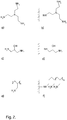
- the ligand precursor can suitably be a species with at least three primary amines, such that one primary amine is consumed to make the attachment link and at least two remaining primary amines per ligand are displayed in the coupled matrix.
- the combined content of nitrogen and oxygen atoms in said ligands is at least 20 wt %.
- the content of primary amine nitrogen in the attached ligands can advantageously be at least 18 wt%.
- the ratio of displayed primary amines to the total amount of nitrogen atoms is at least 0.5, such as at least 0.7 or at least 0.9. With these ratios the ligands are hydrophilic, i.e. they do not bind proteins irreversibly, and the primary amine content is high enough to give high binding at high ionic strengths.
- the ligands are selected from the group consisting of tris(2-aminoethyl)amine and polyallylamine. These ligands are hydrophilic and display a plurality of primary amines even when attached via an amine.
- the ligands can e.g. comprise polyallylamine of molecular weight at least 1 kDa, such as at least 5 kDa or at least 10 kDa.
- the polyallylamine can suitably be non-crosslinked to provide mobility and access to proteins.
- the attachment can be in a single point or by multipoint attachment. Single point attachment can e.g. be achieved by graft polymerization or by coupling via a reactive end-group on the polyallylamine. Multipoint attachment can be achieved by coupling the polyallylamine via the amines to electrophilic groups or aldehydes on the core entities according to methods known in the art.
- the shell entity has an average thickness of 1 to 10 micrometers, such as 1 to 6 micrometers.
- a minimum shell thickness ensures that ligands are not available for binding to the biological particles on the outside of the separation matrix particles, while the shell thickness should suitably not be too high, in order to maximize the binding capacity for proteins in the core entity.
- the particles can be substantially spherical, e.g. with a volume-weighted average diameter of 15 - 400 micrometers, and in this case the shell entity can have an average thickness of 0.5 to 6 % of the volume-weighted average diameter of the particles. If the particles are non-spherical, the shell entity can have an average thickness of 0.5 to 6 % of the sphere-equivalent diameter of the particles.
- the average sphericity of the particles is at least 0.9, or such as at least 0.97.
- the shell thickness can be determined microscopically on dyed particles, as discussed above.
- the separation matrix particles can e.g. be manufactured according to the method disclosed below, in which case the thickness of the shell can be controlled by a partial deactivation process.
- the shell entity has a molecular weight cutoff for globular proteins of 60 to 1000 kDa, such as 100-1000 or 400-800 kDa. This is advantageous to allow rapid mass transport of contaminating proteins into and out of the particles, while preventing the biological particles from reaching the core entity.
- the cutoff can e.g. be measured by comparing binding capacities for proteins of different molecular weight under conditions where they bind to the ligands.
- the present invention discloses a method for purification of biological particles, comprising the steps of
- the liquid can be e.g. an allantoic fluid from eggs, a cell culture supernatant, a cell lysate etc and it can e.g. have a conductivity of at least 10 mS/cm or even at least 15 mS/cm, which means that the liquid does not have to be extensively diluted.
- contaminant protein(s) also other contaminants such as e.g. DNA and/or endotoxins may be bound to the matrix and thus removed.
- the method may be a chromatographic method, where the matrix is packed into a column, but it may also be a batch adsorption method (e.g. using a magnetic matrix) or e.g. an expanded bed adsorption method (e.g.
- the column may have a bed height of 1 mm - 1 m, such as 1 cm to 30 cm or 1 cm to 10 cm.
- the packed bed may comprise only the matrix of the invention but mixed beds with other matrices are also contemplated.
- the regeneration solution comprises alkali, such as NaOH, of e.g. 0.1-2 M concentration, such as 0.5-2 M.
- alkali such as NaOH
- Alkali, and in particular NaOH is a useful cleaning agent in that it hydrolyses proteins and in that after washing and neutralization it does not leave any potentially toxic residuals.
- the residual protein content in the matrix after step d) is less than 100 micrograms/ml matrix.
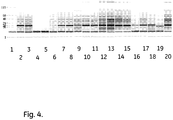
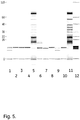
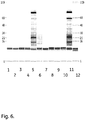
- the residual protein amount can be determined by a total extraction by boiling in a 0.5% SDS + 28 mM DTT extraction solution and detection of the extracted proteins by chip electrophoresis, as described in the Examples.
- the biological particles are selected from the group consisting of viruses, virus-like particles, cells, organelles and plasmids.
- At least 40 mg/ml, such as at least 60 mg/ml, of said contaminant protein binds to the matrix. It is advantageous if the matrix can be loaded with a large amount of liquid, which is possible with the new matrix. As is well known, the loading should not exceed the binding capacity of the matrix as this would lead to breakthrough and consequently poor removal.
- the liquid comprises a buffering substance.
- This buffering substance may e.g. comprise buffering cations, such as Tris, Bis-Tris, Tricine or piperazine, and/or monovalent buffering anions, such as acetate, lactate etc. It can be advantageous if the liquid does not comprise polyvalent anions, e.g. phosphate, as they may interact too strongly with the ligands under some conditions.
- the pH of the liquid is 6.0-8.5, in certain embodiments such as 6.5-8.5 or 6.5-8.0.
- live/viable biological particles are to be purified, they are highly sensitive to pH, which in these cases limits the usable range.
- the contaminant protein is an albumin, such as ovalbumin or serum albumin.
- Albumins are common contaminant proteins both in egg-derived feeds and in cell cultures.
- the biological particles comprise an influenza virus.
- the liquid can e.g. comprise allantoic fluid derived from fertilized eggs or alternatively it can comprise a cell culture supernatant or a cell lysate.
- the method can further comprise, before step b), a step a') of conditioning said liquid by crossflow filtration, such as ultrafiltration and/or microfiltration.
- crossflow filtration such as ultrafiltration and/or microfiltration.
- Microfiltration e.g. in hollow fibers, can be used to remove particulates which may otherwise clog the chromatography column.
- the liquid may also be subjected to ultrafiltration to increase the concentration of biological particles before applying the liquid to the matrix.
- the method can further comprise, after step c), a step c') of ion exchange chromatography, such as cation exchange chromatography. Any remaining positively charged contaminants can be removed with a subsequent cation exchange step. Subsequent steps may also comprise further flowthrough purification on matrices with functional core entitites and inert shell entitites.
- the present invention discloses the use of a separation matrix as disclosed above for purification of biological particles.
- the biological particles can e.g. be selected from the group consisting of viruses, virus-like particles, cells, organelles and plasmids.
- the use can e.g. be in a method as disclosed above.
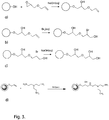
- the invention discloses a method for manufacturing a separation matrix as disclosed above, comprising the steps of:
- the allylation reagent can be e.g. allyl glycidyl ether or an allyl halide, such as allyl bromide.
- the halogen is suitably bromine and can be applied in an aqueous solution.
- step b) allyl groups are introduced uniformly throughout the particles, while in step b), the short contact time with the bromine only allows reaction between the allyl groups in the outermost part of each particle and the bromine.
- the reaction with bromine causes the formation of bromohydrins, which in aqueous alkali are converted to hydrophilic, non-reactive diols, thus causing the formation of an inert shell entity.
- the polyol may react with the bromohydrins and be immobilized as hydrophilic non-reactive moieties. Such methods can also be used to fine-tune the pore structure of the shell entity. The allyl groups in the interior are left unreacted and can then be used to couple ligands in what becomes the core entity.
- the thickness of the shell entity can be controlled primarily by the contact time with the halogen and by the amount of halogen used in step c).
- the support particles have an average sphericity of at least 0.9 with a volume average diameter of 15-400 micrometers, such as 30-100 micrometers.
- the support particles can e.g. be made from dextran, agarose, agar, carrageenan, alginate, cellulose, konjac or other suitable polysaccharides.
- Agarose, agarose derivatives (e.g. hydroxyethyl agarose), agar and cellulose can be particularly suitable as they can conveniently be prepared with suitable porosity and rigidity.
- the support particles can also be crosslinked, either by straight forward crosslinking with a crosslinking agent such as epichlorohydrin or a diepoxide or by two-stage crosslinking such as described in US Pat. 6,602,990 .
- a crosslinking agent such as epichlorohydrin or a diepoxide
- two-stage crosslinking such as described in US Pat. 6,602,990 .
- the latter method provides an improved rigidity.
- the ligand precursor has at least three primary amines per molecule and is coupled to the allyl groups by first reacting the allyl groups with an aqueous halogen, e.g. bromine, and then under alkaline conditions with the ligand precursor.
- an aqueous halogen e.g. bromine
- the ligand precursor is selected from the group consisting of tris(2-aminoethyl)amine and polyallylamine, e.g. polyallylamine of Mw at least 5 kDa, such as at least 10 kDa.
- the support particles used were highly crosslinked agarose beads, prepared according to the methods described in US Pat. 6.602,990 .
- the beads had a volume-weighted average diameter (D50,v) of 88 micrometers and a pore size distribution such that 69 % of the pore volume was available to dextran molecules of Mw 110 kDa. This can also be expressed such that Kd for dextran 110 kDa on the beads was 0.69, when measured according to the methods described in " Handbook of Process Chromatography, A Guide to Optimization, Scale-Up and validation” (1997) Academic Press, San Diego. Gail Sofer & Lars Hagel eds.ISBN 0-12-654266-X, p. 368 .
- 256 mL(g) support particles were washed with distilled water and with 50% aqueous NaOH on a glass filter. The gel was then sucked dry and transferred to a 1 L round bottom flask. 200 mL of 50% aqueous NaOH was added, mechanical propeller stirring was applied and the flask was immersed into a water bath at 50°C. After 30 minutes 200 mL of AGE was added and the reaction progressed for 17 h. The gel was washed with distilled water, ethanol and distilled water.
- the partially activated gel was transferred drained into a 1 L round bottomed flask. 250 mL 2 M aqueous NaOH were added and mechanical stirring was applied. The flask was immersed into a water bath at 50 °C and the reaction progressed for 17 h. The gel was then washed with distilled water. 2x1 mL was titrated for remaining allyl content.
- Unbound protein is analyzed by absorbance at 280 nm and the concentration calculated from a calibration curve.
- the amount of bound protein is calculated from the difference between the added protein and the amount of unbound protein.
- the maximum capacity is expressed as g/L, this is based on calculations preparing the protein solution for each experiment not through UV-measurements in cuvette.
- Binding capacity results for BSA and Ovalbumin on PAA Prototype Polyallylamine Ion capacity: 210 ⁇ mol/ml Protein 1: BSA 2g/l, IP ⁇ 4.7 Protein 1: Ovalbumin 2g/l, IP ⁇ 4.7 Buffer system 1: 40mM Tris pH 7.2-8.2 Buffer system 2: 20mM Piperazine pH 6 Salt: NaCl Table 4. Binding capacity (g/L) for BSA on Polyallylamine prototype. NaCl (mM) 0 250 500 750 1000 1250 pH 7,2 40mM Tris 32 62 33 11 1 0 pH 7,7 40mM Tris 32 62 44 3 0 pH 8,2 40mM Tris 44 61 40 14 3 0
- the polyallylamine prototype had the highest binding capacity for BSA at 250mM NaCl. At 1250mM NaCl the polyalylamine prototype has no capacity for BSA which indicates good possibilities for salt elution of BSA. Table 5. Binding capacity (g/L) for BSA and Ovalbumin on Polyallylamine prototype.
- BSA A pH6 20mM Piperazine 63 B pH6 20mM Piperazine 250mM NaCl 49 C pH6 20mM Piperazine 500mM NaCl 17 Ovalbumin E pH6 20mM Piperazine 65 F pH6 20mM Piperazine 250mM NaCl 41 G pH6 20mM Piperazine 500mM NaCl 18
- polyallylamine When using Piperazine as a buffer system polyallylamine has the best binding capacity for both BSA and Ovalbumin at no salt, rows A and E in Table 5. However the capacity is still good with 250 mM NaCl.
- Prototype Polyallylamine Ion capacity: 210 ⁇ mol/ml Protein: Ovalbumin 2g/l, IP ⁇ 4.7 Buffer system : 20-40mM Phosphate pH 7-7.5 Salt: NaCl Table 6. Binding capacity (g/L) for Ovalbumin on the polyallylamine prototype.
- Ovalbumin 20mM Phosphate + 0mM NaCl, pH 7.0 20 20mM Phosphate + 0mM NaCl, pH 7.5 21 20mM Phosphate + 150mM NaCl, pH 7.0 13 20mM Phosphate + 150mM NaCl, pH 7.5 15 40mM Phosphate + 300mM NaCl, pH 7.0 5 40mM Phosphate + 300mM NaCl, pH 7.5 8 40mM Phosphate + 500mM NaCl, pH 7.0 7 40mM Phosphate + 500mM NaCl, pH 7.5 8
- Prototype Polyallylamine Ion capacity: 210 ⁇ mol/ml Protein 1: Ovalbumin 4g/l, IP ⁇ 4.7 Protein 2: BSA 4g/L, IP ⁇ 4.7 Buffer system: 40mM Tris pH7.2-8.2 Salt: NaCl Table 7. Binding capacity (g/L) for Ovalbumin and BSA on Polyallylamine prototype.
- Ovalbumin BSA 40mM Tris pH 7.2 + 250 mM NaCl 73 73 40mM Tris pH 7.7 + 250 mM NaCl 65 70 40mM Tris pH 8.2 + 250 mM NaCl 52 63
- polyallylamine shows the highest binding capacity for Ovalbumin when no salt is added, an influence by pH cannot be seen in the phosphate system.
- Prototype Polyallyl amine Ion capacity:210 ⁇ mol/ml Protein: Ovalbumin 2g/l, IP ⁇ 4.7 Buffer system : 40mM Tris pH7.2-7.5 Salt: NaCl Table 8. Binding capacity (g/L) for Ovalbumin on the polyallylamine prototype pH 7.2 7.5 A 40mM Tris + 0mM NaCl 66 66 B 40mM Tris + 150mM NaCl 57 57 C 40mM Tris + 300mM NaCl 45 44
- CaptoTM Core 700 (Ge Healthcare Bio-Sciences AB) is a commercially available product, based on highly crosslinked agarose beads of 85-90 micrometer volume-weighted average diameter, an inert shell with Mw cutoff 700 kDa and a core derivatised with octylamine ligands coupled via the amine nitrogen.
- the shell structure is very similar to the currently prepared prototypes and is known to give virtually zero interaction with e.g. virus particles.
- IP isoelectric point
- Tris(2-aminoethyl)amine bind at high salt concentrations, as can be seen in row A.
- Tris(2-aminoethyl)amine has a higher binding capacity for Ovalbumin and both prototypes favor Tris for binding of Ovalbumin.
- E.coli homogenate was used to foul the media E.coli homogenate. Frozen E.coli homogenate was thawed and clarified through a glass fiber filter, followed by a 0.45 ⁇ m membrane filter.
- the media plugs were transferred to a collection plate by connecting the collection plate on top of the filter plate and securing them together with rubber bands.
- the tower of plates was turned to have the filter plate on top and centrifuged for 5 min (972xg).
- 200 ⁇ l Caliper sample buffer was then added to all wells in the collection plate.
- the wells were covered with micro foil seal and put on a microplate shaker for 2 minutes.
- the plate was put in a heat chamber (104°C) for 5 minutes. After heating the samples were additionally shaken for 2 minutes and centrifuged for 2 minutes (500xg) to sediment the gel particles. 40 ⁇ l of the supernatant was carefully transferred to a PCR plate (conical bottom).
- the chip, buffer strip and the molecular weight ladder was prepared according to the HT Protein LabChipTM Kit user guide (Caliper Life Sciences Inc.,Nov. 2010). The HT Protein Express 200 High Sensitivity program was run.
Landscapes
- Chemical & Material Sciences (AREA)
- Analytical Chemistry (AREA)
- Organic Chemistry (AREA)
- Chemical Kinetics & Catalysis (AREA)
- Health & Medical Sciences (AREA)
- Life Sciences & Earth Sciences (AREA)
- Genetics & Genomics (AREA)
- Zoology (AREA)
- Biochemistry (AREA)
- General Health & Medical Sciences (AREA)
- Medicinal Chemistry (AREA)
- Biophysics (AREA)
- Molecular Biology (AREA)
- Engineering & Computer Science (AREA)
- Proteomics, Peptides & Aminoacids (AREA)
- Gastroenterology & Hepatology (AREA)
- Wood Science & Technology (AREA)
- Bioinformatics & Cheminformatics (AREA)
- Biotechnology (AREA)
- Toxicology (AREA)
- General Engineering & Computer Science (AREA)
- Tropical Medicine & Parasitology (AREA)
- Virology (AREA)
- Microbiology (AREA)
- Biomedical Technology (AREA)
- Peptides Or Proteins (AREA)
- Solid-Sorbent Or Filter-Aiding Compositions (AREA)
- Measuring Or Testing Involving Enzymes Or Micro-Organisms (AREA)
- Micro-Organisms Or Cultivation Processes Thereof (AREA)
- Treatment Of Liquids With Adsorbents In General (AREA)
Applications Claiming Priority (2)
| Application Number | Priority Date | Filing Date | Title |
|---|---|---|---|
| SE1450290 | 2014-03-14 | ||
| PCT/SE2015/050186 WO2015137860A1 (en) | 2014-03-14 | 2015-02-18 | Separation matrices for purification of biological particles |
Publications (3)
| Publication Number | Publication Date |
|---|---|
| EP3116645A1 EP3116645A1 (en) | 2017-01-18 |
| EP3116645A4 EP3116645A4 (en) | 2017-04-05 |
| EP3116645B1 true EP3116645B1 (en) | 2019-04-10 |
Family
ID=54072158
Family Applications (1)
| Application Number | Title | Priority Date | Filing Date |
|---|---|---|---|
| EP15761376.1A Active EP3116645B1 (en) | 2014-03-14 | 2015-02-18 | Separation matrices for purification of biological particles |
Country Status (5)
| Country | Link |
|---|---|
| US (1) | US11285460B2 (https=) |
| EP (1) | EP3116645B1 (https=) |
| JP (1) | JP6702587B2 (https=) |
| CN (2) | CN114917884A (https=) |
| WO (1) | WO2015137860A1 (https=) |
Families Citing this family (12)
| Publication number | Priority date | Publication date | Assignee | Title |
|---|---|---|---|---|
| JP6702587B2 (ja) | 2014-03-14 | 2020-06-03 | ジーイー・ヘルスケア・バイオプロセス・アールアンドディ・アクチボラグ | 生物粒子の精製用分離マトリックス |
| GB201515339D0 (en) * | 2015-08-28 | 2015-10-14 | Ge Healthcare Bio Sciences Ab | A seperation matrix and a method of seperating antibodies |
| WO2017083286A1 (en) | 2015-11-09 | 2017-05-18 | University Of Notre Dame | Particle size purification method and devices |
| US10934366B2 (en) | 2016-09-29 | 2021-03-02 | Bio-Rad Laboratories, Inc. | Protein-nanoparticle conjugate purification methods |
| US10814305B2 (en) | 2016-09-29 | 2020-10-27 | Bio-Rad Laboratories, Inc. | Agarose-filled ceramic apatite |
| WO2019170634A1 (en) * | 2018-03-05 | 2019-09-12 | Chiral Technologies Europe Sas | Composite material for bioseparations |
| US10737259B2 (en) | 2018-08-31 | 2020-08-11 | Pall Corporation | Salt tolerant anion exchange medium |
| US11045773B2 (en) | 2018-08-31 | 2021-06-29 | Pall Corporation | Salt tolerant porous medium |
| WO2021061790A1 (en) | 2019-09-24 | 2021-04-01 | Regeneron Pharmaceuticals, Inc. | Systems and methods for chromatography use and regeneration |
| EP4106897A4 (en) | 2020-02-19 | 2023-10-25 | Bio-Rad Laboratories, Inc. | Method of preparing polymer-filled chromatography resin |
| CN119730953A (zh) * | 2022-08-03 | 2025-03-28 | 皮尔斯生物科技有限公司 | 用于分离分子的组分及其制备和使用方法 |
| EP4385618A1 (en) | 2022-12-16 | 2024-06-19 | Chiral Technologies Europe SAS | Composite material for bioseparations |
Family Cites Families (27)
| Publication number | Priority date | Publication date | Assignee | Title |
|---|---|---|---|---|
| SE9600590D0 (sv) * | 1996-02-19 | 1996-02-19 | Pharmacia Biotech Ab | Sätt för kromatografisk separation av peptider och nukleinsyra samt ny högaffin jonbytesmatris |
| US6072101A (en) * | 1997-11-19 | 2000-06-06 | Amcol International Corporation | Multicomponent superabsorbent gel particles |
| SE9904197D0 (sv) * | 1999-11-22 | 1999-11-22 | Amersham Pharm Biotech Ab | A method for anion exchange adsorption on matrices carrying mixed mode ligands |
| AU2002352017A1 (en) * | 2001-11-21 | 2003-06-10 | Basf Aktiengesellschaft | Superabsorbent polymer particles |
| SE0202551D0 (sv) * | 2002-08-27 | 2002-08-27 | Amersham Biosciences Ab | Chromatographic two-layer particles |
| SE0302911D0 (sv) * | 2003-10-31 | 2003-10-31 | Amersham Biosciences Ab | Novel separation matrix |
| SE0303532D0 (sv) | 2003-12-23 | 2003-12-23 | Amersham Biosciences Ab | Purification of immunoglobulins |
| US20050181378A1 (en) * | 2004-02-18 | 2005-08-18 | Applera Corporation | Polyelectrolyte-coated size-exclusion ion-exchange particles |
| KR101150050B1 (ko) * | 2004-02-27 | 2012-07-05 | 지이 헬스케어 바이오-사이언시스 에이비 | 항체 정제 방법 |
| SE0401665D0 (sv) * | 2004-06-24 | 2004-06-24 | Amersham Biosciences Ab | Purification of immunoglobulins |
| US7332101B2 (en) * | 2004-06-25 | 2008-02-19 | Massachusetts Institute Of Technology | Permanently linked, rigid, magnetic chains |
| US9266041B2 (en) * | 2004-10-21 | 2016-02-23 | Ge Healthcare Bio-Sciences Ab | Chromatography ligand |
| AU2007294455A1 (en) * | 2006-09-05 | 2008-03-13 | Innovative Purification Technologies Pty Ltd | Affinity separation methods and systems |
| GB2445579A (en) * | 2007-01-11 | 2008-07-16 | Secr Defence | An encoded microsphere |
| US9433922B2 (en) | 2007-08-14 | 2016-09-06 | Emd Millipore Corporation | Media for membrane ion exchange chromatography based on polymeric primary amines, sorption device containing that media, and chromatography scheme and purification method using the same |
| CN102015094B (zh) * | 2008-04-22 | 2016-11-09 | 通用电气医疗集团生物工艺研发股份公司 | 层析介质 |
| US9005436B2 (en) * | 2008-05-10 | 2015-04-14 | Brigham Young University | Porous composite particulate materials, methods of making and using same, and related apparatuses |
| US20110065900A1 (en) * | 2008-05-30 | 2011-03-17 | Ge Healthcare Bio-Science Ab | Separation method utilizing polyallylamine ligands |
| IN2012DN06243A (https=) * | 2010-02-19 | 2015-09-25 | Ge Healthcare Bio Sciences Ab | |
| US20120077249A1 (en) * | 2010-04-20 | 2012-03-29 | Millipore Corporation | Separation Of Virus And/Or Protein From Nucleic Acids By Primary Amines |
| US20120006752A1 (en) * | 2010-05-07 | 2012-01-12 | Millipore Corporation | Enhanced Clarification Media |
| JP2013530406A (ja) * | 2010-07-09 | 2013-07-25 | ジーイー・ヘルスケア・バイオサイエンス・アクチボラグ | クロマトグラフィー方法及びそれに使用される媒体 |
| US20130244229A1 (en) * | 2010-11-30 | 2013-09-19 | Jan Bergstrom | Buffering compositions enclosed in a size exclusion matrix |
| US9272246B2 (en) * | 2011-03-28 | 2016-03-01 | 3M Innovative Properties Company | Ligand functional substrates |
| US9096648B2 (en) | 2011-08-19 | 2015-08-04 | Emd Millipore Corporation | Methods of reducing level of one or more impurities in a sample during protein purification |
| US9580692B2 (en) * | 2012-02-29 | 2017-02-28 | Ge Healthcare Bioprocess R&D Ab | Method for endotoxin removal |
| JP6702587B2 (ja) | 2014-03-14 | 2020-06-03 | ジーイー・ヘルスケア・バイオプロセス・アールアンドディ・アクチボラグ | 生物粒子の精製用分離マトリックス |
-
2015
- 2015-02-18 JP JP2016555958A patent/JP6702587B2/ja active Active
- 2015-02-18 CN CN202210695588.1A patent/CN114917884A/zh active Pending
- 2015-02-18 WO PCT/SE2015/050186 patent/WO2015137860A1/en not_active Ceased
- 2015-02-18 CN CN201580013843.8A patent/CN106102903A/zh active Pending
- 2015-02-18 US US15/120,845 patent/US11285460B2/en active Active
- 2015-02-18 EP EP15761376.1A patent/EP3116645B1/en active Active
Non-Patent Citations (1)
| Title |
|---|
| None * |
Also Published As
| Publication number | Publication date |
|---|---|
| US20160367966A1 (en) | 2016-12-22 |
| WO2015137860A9 (en) | 2016-08-18 |
| JP2017515099A (ja) | 2017-06-08 |
| EP3116645A1 (en) | 2017-01-18 |
| EP3116645A4 (en) | 2017-04-05 |
| JP6702587B2 (ja) | 2020-06-03 |
| WO2015137860A1 (en) | 2015-09-17 |
| US11285460B2 (en) | 2022-03-29 |
| CN106102903A (zh) | 2016-11-09 |
| CN114917884A (zh) | 2022-08-19 |
Similar Documents
| Publication | Publication Date | Title |
|---|---|---|
| EP3116645B1 (en) | Separation matrices for purification of biological particles | |
| JP7497891B2 (ja) | 大孔径アガロース | |
| KR102624853B1 (ko) | 내독소 흡착제 | |
| JP5643747B2 (ja) | クロマトグラフィー媒体 | |
| CN101765458B (zh) | 分离基质 | |
| US20110065900A1 (en) | Separation method utilizing polyallylamine ligands | |
| EP2919902A1 (en) | Multimodal anion exchange matrices | |
| US11992825B2 (en) | Adsorption medium, method for production thereof, and use thereof for purification of biomolecules | |
| JP5095386B2 (ja) | プラスミド精製 | |
| CN113416235B (zh) | 用于纯化分离病毒类抗原的液相色谱法 | |
| EP3512866B1 (en) | The use of a polymeric mesh for the purification of macromolecules | |
| US9580692B2 (en) | Method for endotoxin removal | |
| Kadoi et al. | Fabrication and characterization of a cellulose monolith-like particle for virus purification | |
| US20050267295A1 (en) | Method for selective removal of a substance from samples containing compounds having nucleic acid structure | |
| WO2015197338A1 (en) | Chromatography method | |
| US20120156757A1 (en) | Purification of immunogens using a non-polysaccharide matrix | |
| JP6064402B2 (ja) | 抗体単量体の分離用分離剤及び分離方法 | |
| US10041050B2 (en) | Method for endotoxin removal | |
| Alves | Production, concentration and purification strategies for Bluetongue virus |
Legal Events
| Date | Code | Title | Description |
|---|---|---|---|
| STAA | Information on the status of an ep patent application or granted ep patent |
Free format text: STATUS: THE INTERNATIONAL PUBLICATION HAS BEEN MADE |
|
| PUAI | Public reference made under article 153(3) epc to a published international application that has entered the european phase |
Free format text: ORIGINAL CODE: 0009012 |
|
| STAA | Information on the status of an ep patent application or granted ep patent |
Free format text: STATUS: REQUEST FOR EXAMINATION WAS MADE |
|
| 17P | Request for examination filed |
Effective date: 20160909 |
|
| AK | Designated contracting states |
Kind code of ref document: A1 Designated state(s): AL AT BE BG CH CY CZ DE DK EE ES FI FR GB GR HR HU IE IS IT LI LT LU LV MC MK MT NL NO PL PT RO RS SE SI SK SM TR |
|
| AX | Request for extension of the european patent |
Extension state: BA ME |
|
| A4 | Supplementary search report drawn up and despatched |
Effective date: 20170307 |
|
| RIC1 | Information provided on ipc code assigned before grant |
Ipc: C08J 7/00 20060101ALI20170228BHEP Ipc: B01J 20/281 20060101ALI20170228BHEP Ipc: B01D 15/32 20060101ALI20170228BHEP Ipc: B01D 15/38 20060101ALI20170228BHEP Ipc: B01J 20/32 20060101AFI20170228BHEP Ipc: B01D 15/34 20060101ALI20170228BHEP |
|
| DAX | Request for extension of the european patent (deleted) | ||
| GRAP | Despatch of communication of intention to grant a patent |
Free format text: ORIGINAL CODE: EPIDOSNIGR1 |
|
| STAA | Information on the status of an ep patent application or granted ep patent |
Free format text: STATUS: GRANT OF PATENT IS INTENDED |
|
| INTG | Intention to grant announced |
Effective date: 20181017 |
|
| GRAS | Grant fee paid |
Free format text: ORIGINAL CODE: EPIDOSNIGR3 |
|
| GRAA | (expected) grant |
Free format text: ORIGINAL CODE: 0009210 |
|
| STAA | Information on the status of an ep patent application or granted ep patent |
Free format text: STATUS: THE PATENT HAS BEEN GRANTED |
|
| AK | Designated contracting states |
Kind code of ref document: B1 Designated state(s): AL AT BE BG CH CY CZ DE DK EE ES FI FR GB GR HR HU IE IS IT LI LT LU LV MC MK MT NL NO PL PT RO RS SE SI SK SM TR |
|
| REG | Reference to a national code |
Ref country code: GB Ref legal event code: FG4D |
|
| REG | Reference to a national code |
Ref country code: CH Ref legal event code: EP Ref country code: AT Ref legal event code: REF Ref document number: 1117941 Country of ref document: AT Kind code of ref document: T Effective date: 20190415 |
|
| REG | Reference to a national code |
Ref country code: IE Ref legal event code: FG4D |
|
| REG | Reference to a national code |
Ref country code: DE Ref legal event code: R096 Ref document number: 602015028102 Country of ref document: DE |
|
| REG | Reference to a national code |
Ref country code: SE Ref legal event code: TRGR |
|
| REG | Reference to a national code |
Ref country code: NL Ref legal event code: MP Effective date: 20190410 |
|
| REG | Reference to a national code |
Ref country code: LT Ref legal event code: MG4D |
|
| REG | Reference to a national code |
Ref country code: AT Ref legal event code: MK05 Ref document number: 1117941 Country of ref document: AT Kind code of ref document: T Effective date: 20190410 |
|
| PG25 | Lapsed in a contracting state [announced via postgrant information from national office to epo] |
Ref country code: NL Free format text: LAPSE BECAUSE OF FAILURE TO SUBMIT A TRANSLATION OF THE DESCRIPTION OR TO PAY THE FEE WITHIN THE PRESCRIBED TIME-LIMIT Effective date: 20190410 |
|
| PG25 | Lapsed in a contracting state [announced via postgrant information from national office to epo] |
Ref country code: ES Free format text: LAPSE BECAUSE OF FAILURE TO SUBMIT A TRANSLATION OF THE DESCRIPTION OR TO PAY THE FEE WITHIN THE PRESCRIBED TIME-LIMIT Effective date: 20190410 Ref country code: PT Free format text: LAPSE BECAUSE OF FAILURE TO SUBMIT A TRANSLATION OF THE DESCRIPTION OR TO PAY THE FEE WITHIN THE PRESCRIBED TIME-LIMIT Effective date: 20190910 Ref country code: HR Free format text: LAPSE BECAUSE OF FAILURE TO SUBMIT A TRANSLATION OF THE DESCRIPTION OR TO PAY THE FEE WITHIN THE PRESCRIBED TIME-LIMIT Effective date: 20190410 Ref country code: AL Free format text: LAPSE BECAUSE OF FAILURE TO SUBMIT A TRANSLATION OF THE DESCRIPTION OR TO PAY THE FEE WITHIN THE PRESCRIBED TIME-LIMIT Effective date: 20190410 Ref country code: NO Free format text: LAPSE BECAUSE OF FAILURE TO SUBMIT A TRANSLATION OF THE DESCRIPTION OR TO PAY THE FEE WITHIN THE PRESCRIBED TIME-LIMIT Effective date: 20190710 Ref country code: FI Free format text: LAPSE BECAUSE OF FAILURE TO SUBMIT A TRANSLATION OF THE DESCRIPTION OR TO PAY THE FEE WITHIN THE PRESCRIBED TIME-LIMIT Effective date: 20190410 Ref country code: LT Free format text: LAPSE BECAUSE OF FAILURE TO SUBMIT A TRANSLATION OF THE DESCRIPTION OR TO PAY THE FEE WITHIN THE PRESCRIBED TIME-LIMIT Effective date: 20190410 |
|
| PG25 | Lapsed in a contracting state [announced via postgrant information from national office to epo] |
Ref country code: GR Free format text: LAPSE BECAUSE OF FAILURE TO SUBMIT A TRANSLATION OF THE DESCRIPTION OR TO PAY THE FEE WITHIN THE PRESCRIBED TIME-LIMIT Effective date: 20190711 Ref country code: RS Free format text: LAPSE BECAUSE OF FAILURE TO SUBMIT A TRANSLATION OF THE DESCRIPTION OR TO PAY THE FEE WITHIN THE PRESCRIBED TIME-LIMIT Effective date: 20190410 Ref country code: BG Free format text: LAPSE BECAUSE OF FAILURE TO SUBMIT A TRANSLATION OF THE DESCRIPTION OR TO PAY THE FEE WITHIN THE PRESCRIBED TIME-LIMIT Effective date: 20190710 Ref country code: LV Free format text: LAPSE BECAUSE OF FAILURE TO SUBMIT A TRANSLATION OF THE DESCRIPTION OR TO PAY THE FEE WITHIN THE PRESCRIBED TIME-LIMIT Effective date: 20190410 Ref country code: PL Free format text: LAPSE BECAUSE OF FAILURE TO SUBMIT A TRANSLATION OF THE DESCRIPTION OR TO PAY THE FEE WITHIN THE PRESCRIBED TIME-LIMIT Effective date: 20190410 |
|
| PG25 | Lapsed in a contracting state [announced via postgrant information from national office to epo] |
Ref country code: IS Free format text: LAPSE BECAUSE OF FAILURE TO SUBMIT A TRANSLATION OF THE DESCRIPTION OR TO PAY THE FEE WITHIN THE PRESCRIBED TIME-LIMIT Effective date: 20190810 Ref country code: AT Free format text: LAPSE BECAUSE OF FAILURE TO SUBMIT A TRANSLATION OF THE DESCRIPTION OR TO PAY THE FEE WITHIN THE PRESCRIBED TIME-LIMIT Effective date: 20190410 |
|
| REG | Reference to a national code |
Ref country code: DE Ref legal event code: R097 Ref document number: 602015028102 Country of ref document: DE |
|
| PG25 | Lapsed in a contracting state [announced via postgrant information from national office to epo] |
Ref country code: DK Free format text: LAPSE BECAUSE OF FAILURE TO SUBMIT A TRANSLATION OF THE DESCRIPTION OR TO PAY THE FEE WITHIN THE PRESCRIBED TIME-LIMIT Effective date: 20190410 Ref country code: EE Free format text: LAPSE BECAUSE OF FAILURE TO SUBMIT A TRANSLATION OF THE DESCRIPTION OR TO PAY THE FEE WITHIN THE PRESCRIBED TIME-LIMIT Effective date: 20190410 Ref country code: CZ Free format text: LAPSE BECAUSE OF FAILURE TO SUBMIT A TRANSLATION OF THE DESCRIPTION OR TO PAY THE FEE WITHIN THE PRESCRIBED TIME-LIMIT Effective date: 20190410 Ref country code: RO Free format text: LAPSE BECAUSE OF FAILURE TO SUBMIT A TRANSLATION OF THE DESCRIPTION OR TO PAY THE FEE WITHIN THE PRESCRIBED TIME-LIMIT Effective date: 20190410 Ref country code: SK Free format text: LAPSE BECAUSE OF FAILURE TO SUBMIT A TRANSLATION OF THE DESCRIPTION OR TO PAY THE FEE WITHIN THE PRESCRIBED TIME-LIMIT Effective date: 20190410 |
|
| PLBE | No opposition filed within time limit |
Free format text: ORIGINAL CODE: 0009261 |
|
| STAA | Information on the status of an ep patent application or granted ep patent |
Free format text: STATUS: NO OPPOSITION FILED WITHIN TIME LIMIT |
|
| PG25 | Lapsed in a contracting state [announced via postgrant information from national office to epo] |
Ref country code: IT Free format text: LAPSE BECAUSE OF FAILURE TO SUBMIT A TRANSLATION OF THE DESCRIPTION OR TO PAY THE FEE WITHIN THE PRESCRIBED TIME-LIMIT Effective date: 20190410 Ref country code: SM Free format text: LAPSE BECAUSE OF FAILURE TO SUBMIT A TRANSLATION OF THE DESCRIPTION OR TO PAY THE FEE WITHIN THE PRESCRIBED TIME-LIMIT Effective date: 20190410 |
|
| 26N | No opposition filed |
Effective date: 20200113 |
|
| PG25 | Lapsed in a contracting state [announced via postgrant information from national office to epo] |
Ref country code: TR Free format text: LAPSE BECAUSE OF FAILURE TO SUBMIT A TRANSLATION OF THE DESCRIPTION OR TO PAY THE FEE WITHIN THE PRESCRIBED TIME-LIMIT Effective date: 20190410 |
|
| PG25 | Lapsed in a contracting state [announced via postgrant information from national office to epo] |
Ref country code: SI Free format text: LAPSE BECAUSE OF FAILURE TO SUBMIT A TRANSLATION OF THE DESCRIPTION OR TO PAY THE FEE WITHIN THE PRESCRIBED TIME-LIMIT Effective date: 20190410 |
|
| REG | Reference to a national code |
Ref country code: CH Ref legal event code: PL |
|
| REG | Reference to a national code |
Ref country code: BE Ref legal event code: MM Effective date: 20200229 |
|
| PG25 | Lapsed in a contracting state [announced via postgrant information from national office to epo] |
Ref country code: MC Free format text: LAPSE BECAUSE OF FAILURE TO SUBMIT A TRANSLATION OF THE DESCRIPTION OR TO PAY THE FEE WITHIN THE PRESCRIBED TIME-LIMIT Effective date: 20190410 Ref country code: LU Free format text: LAPSE BECAUSE OF NON-PAYMENT OF DUE FEES Effective date: 20200218 |
|
| PG25 | Lapsed in a contracting state [announced via postgrant information from national office to epo] |
Ref country code: CH Free format text: LAPSE BECAUSE OF NON-PAYMENT OF DUE FEES Effective date: 20200229 Ref country code: LI Free format text: LAPSE BECAUSE OF NON-PAYMENT OF DUE FEES Effective date: 20200229 |
|
| REG | Reference to a national code |
Ref country code: DE Ref legal event code: R081 Ref document number: 602015028102 Country of ref document: DE Owner name: CYTIVA BIOPROCESS R&D AB, SE Free format text: FORMER OWNER: GE HEALTHCARE BIOPROCESS R&D AB, UPPSALA, SE |
|
| PG25 | Lapsed in a contracting state [announced via postgrant information from national office to epo] |
Ref country code: IE Free format text: LAPSE BECAUSE OF NON-PAYMENT OF DUE FEES Effective date: 20200218 |
|
| PG25 | Lapsed in a contracting state [announced via postgrant information from national office to epo] |
Ref country code: BE Free format text: LAPSE BECAUSE OF NON-PAYMENT OF DUE FEES Effective date: 20200229 |
|
| PG25 | Lapsed in a contracting state [announced via postgrant information from national office to epo] |
Ref country code: MT Free format text: LAPSE BECAUSE OF FAILURE TO SUBMIT A TRANSLATION OF THE DESCRIPTION OR TO PAY THE FEE WITHIN THE PRESCRIBED TIME-LIMIT Effective date: 20190410 Ref country code: CY Free format text: LAPSE BECAUSE OF FAILURE TO SUBMIT A TRANSLATION OF THE DESCRIPTION OR TO PAY THE FEE WITHIN THE PRESCRIBED TIME-LIMIT Effective date: 20190410 |
|
| PG25 | Lapsed in a contracting state [announced via postgrant information from national office to epo] |
Ref country code: MK Free format text: LAPSE BECAUSE OF FAILURE TO SUBMIT A TRANSLATION OF THE DESCRIPTION OR TO PAY THE FEE WITHIN THE PRESCRIBED TIME-LIMIT Effective date: 20190410 |
|
| P01 | Opt-out of the competence of the unified patent court (upc) registered |
Effective date: 20230526 |
|
| PGFP | Annual fee paid to national office [announced via postgrant information from national office to epo] |
Ref country code: SE Payment date: 20260223 Year of fee payment: 12 |
|
| PGFP | Annual fee paid to national office [announced via postgrant information from national office to epo] |
Ref country code: GB Payment date: 20260223 Year of fee payment: 12 |
|
| PGFP | Annual fee paid to national office [announced via postgrant information from national office to epo] |
Ref country code: DE Payment date: 20260220 Year of fee payment: 12 |
|
| PGFP | Annual fee paid to national office [announced via postgrant information from national office to epo] |
Ref country code: FR Payment date: 20260227 Year of fee payment: 12 |