EP3115768B1 - Method and apparatus for determining diffusion properties of a sample - Google Patents
Method and apparatus for determining diffusion properties of a sample Download PDFInfo
- Publication number
- EP3115768B1 EP3115768B1 EP15175747.3A EP15175747A EP3115768B1 EP 3115768 B1 EP3115768 B1 EP 3115768B1 EP 15175747 A EP15175747 A EP 15175747A EP 3115768 B1 EP3115768 B1 EP 3115768B1
- Authority
- EP
- European Patent Office
- Prior art keywords
- concentration
- taylorgram
- relationship
- mutual diffusion
- solute
- Prior art date
- Legal status (The legal status is an assumption and is not a legal conclusion. Google has not performed a legal analysis and makes no representation as to the accuracy of the status listed.)
- Active
Links
Images


Classifications
-
- G—PHYSICS
- G01—MEASURING; TESTING
- G01N—INVESTIGATING OR ANALYSING MATERIALS BY DETERMINING THEIR CHEMICAL OR PHYSICAL PROPERTIES
- G01N13/00—Investigating surface or boundary effects, e.g. wetting power; Investigating diffusion effects; Analysing materials by determining surface, boundary, or diffusion effects
-
- G—PHYSICS
- G01—MEASURING; TESTING
- G01N—INVESTIGATING OR ANALYSING MATERIALS BY DETERMINING THEIR CHEMICAL OR PHYSICAL PROPERTIES
- G01N15/00—Investigating characteristics of particles; Investigating permeability, pore-volume or surface-area of porous materials
- G01N15/06—Investigating concentration of particle suspensions
-
- G—PHYSICS
- G01—MEASURING; TESTING
- G01N—INVESTIGATING OR ANALYSING MATERIALS BY DETERMINING THEIR CHEMICAL OR PHYSICAL PROPERTIES
- G01N13/00—Investigating surface or boundary effects, e.g. wetting power; Investigating diffusion effects; Analysing materials by determining surface, boundary, or diffusion effects
- G01N2013/003—Diffusion; diffusivity between liquids
Definitions
- the invention relates to a method of determining diffusion properties of a sample, and more particularly doing so from a Taylorgram.
- the diffusion interaction parameter (k D ) is one metric that describes the interactive forces between solute molecules in a given medium and a growing body of evidence has shown that it can successfully predict the aggregation propensity of formulations ( Sagnaca et al, 2010, Diffusion and sedimentation interaction parameters for measuring the second virial coefficient and their utility as predictors of protein aggregation, Biophysical Journal, 99: 2657-2665 ).
- the most widely used technique for determining k D is Dynamic Light Scattering (DLS) because it allows the relatively trivial measurement of the mutual diffusion coefficient ( D m ); a critical parameter in k D elucidation.
- DLS Dynamic Light Scattering
- k D determination by DLS may be made more difficult by methodological problems.
- the first such difficulty relates to the biased scattering intensities exhibited by differently sized particles; whereby the scattering intensity is approximately proportional to the sixth power of the molecular radius ( r 6 ). Since it is the average diffusion coefficients that are reported, the resulting values may be susceptible to skew by larger particles. At worst, results can be rendered unusable in the presence of high-order aggregates or dust. In practice, this means that samples must be relatively pure and stable over the duration of the measurement. This may require clean-up procedures, such as filtering, which may be neither desirable nor appropriate for some types of sample.
- Nuclear magnetic resonance (NMR) is a second technique that can be used to determine the k D ; however, such determinations are non-trivial.
- the use of specialised solvents or sample constructs may introduce complexities into sample preparation and the conditions of measurement may be different from those in final formulations.
- NMR measurements molecular diffusion must also happen within a specific relaxation regime and, in particular, this makes obtaining accurate diffusion coefficients for larger molecules is more challenging. Consideration must also be given to possible misinterpretation due to presence of contamination, and to overly complicated spectra that may require dedicated personnel to make meaningful analyses.
- using NMR to determine diffusion coefficients is extremely time-consuming, as well as financially costly, and thus not applicable to large scale screening.
- Sedimentation velocity ultracentrifugation (SV-AUC) and self-interaction chromatography (SIC) cannot directly measure k D but can measure analogous parameters such as the sedimentation interaction parameter (k S ) and second virial coefficient (A 2 ), respectively.
- Taylor dispersion analysis can be used to infer a mutual diffusion coefficient.
- the width of a Gaussian distribution found from a best fit to a pulse Taylorgram can be used to determine a mutual diffusion coefficient for the injected sample.
- the concentration corresponding with such a single value of mutual diffusion coefficient is generally assumed to be the concentration of the sample at injection, without taking account of any reduction in concentration due to dispersion. A sequence of such measurements at different sample injection concentrations would be required to determine a relationship between concentration and mutual diffusion coefficient.
- a method for investigating diffusion properties of a sample for example the variation in mutual diffusion coefficient with solute concentration, and the diffusion interaction parameter would therefore be desirable.
- a method of determining a relationship between a mutual diffusion co-efficient D m and the concentration c of a solute within a solvent comprises obtaining a Taylorgram comprising a plurality of measurements of solute concentration c; and deriving from the Taylorgram a plurality of mutual diffusion coefficient values D m corresponding with a plurality of different concentrations c of solute in the solvent.
- the method may further comprise fitting a function to the Taylorgram.
- the method may further comprise differentiating the Taylorgram to determine a rate of change of concentration with respect to time dc dt .
- the mutual diffusion coefficient values D m may be derived from the function that is fitted to the Taylorgram and from the rate of change of concentration with respect to time.
- the method may further comprise:
- the method may further comprise determining a diffusion interaction parameter k D of the solute in the solvent from the relationship D m ( c ) between the mutual diffusion coefficient values D m and the corresponding concentrations c.
- the method may further comprise determining the second virial coefficient A 2 from the diffusion interaction parameter k D and an estimate of the coefficient of friction k f and an estimate of the partial specific volume v 2 of the solute.
- the method may further comprise estimating a measure of aggregation of solute particles from the values of the mutual diffusion coefficient over the duration of the Taylorgram.
- an apparatus comprising a processor, configured to perform the method of the first aspect.
- the apparatus may further comprise an instrument for performing a Taylor dispersion analysis, so as to obtain a Taylorgram.
- a machine readable medium comprising instructions for configuring a processor to perform the method according to the first aspect.
- Taylor dispersion is a process by which shear flow is used to enhance the effective diffusivity of a sample.
- Laminar flow in a capillary results in a variation in flow velocity with radial location. Near the walls, the flow is substantially stationary, and flow velocity is at a maximum at the centre. This results in shearing of the adjacent lamina, which acts to enhance dispersion of a sample.
- Taylor dispersion analysis can be used to analyse properties of species within a sample.
- a plug of the sample may be injected into a microbore capillary and subsequently disperse as it traverses along the capillary within a laminar flow regime.
- the injected plug of the sample may be narrow (having a short duration) this being referred to as a pulse of the sample, resulting in a pulse Taylorgram.
- the injected plug of the sample may be long (i.e. having a longer duration) this may be referred to as a slug of the sample, resulting in a frontal Taylorgram.
- the degree of dispersion exhibited by the plug is dependent on the diffusivity of the molecules within the plug and can be measured at one or multiple points downstream of the injection site.
- a concentration detector responsive to the species of the sample, may be positioned at one or more locations downstream of the injection location.
- the concentration detectors e.g. a UV-Visible spectrometer
- the resultant signal from the detector typically referred to as a Taylorgram, corresponds to a temporally-resolved distribution of molecular concentration whose width is related to the hydrodynamic radius of the sample species.
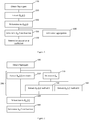
- a method comprises obtaining a Taylorgram at step 100, and then extracting (or determining) from the Taylorgram a relationship D m ( c ) between the mutual diffusion coefficient D m and the concentration c, at step 200, for example by calculating a plurality of values of mutual diffusion coefficient at a corresponding plurality of different concentration values.
- the methods disclosed more fully hereinafter can determine the relationship between mutual diffusion coefficient and concentration from a single Taylorgram.
- the Taylorgram obtained at 100 may be generated from a plug or pulse injection, and may comprise a single detection point or multiple detection points.
- a function may be fitted to D m ( c ), for example by plotting D m ( c ) and fitting a straight line to the relationship.
- the parameters of the function may then be extracted and used to determine the diffusion interaction parameter, k D .
- the relationship D m ( c ) between the mutual diffusion coefficient and concentration may be used to determine an aggregation % over the course of the Taylorgram. For example, aggregation will result in a change in the mutual diffusion coefficient, so a discontinuity in the mutual diffusion coefficient D m ( c ) may indicate aggregation of particles.
- the diffusion interaction parameter k D may in turn be used to determine the second virial coefficient A 2 , for instance using estimates of the molecular weight, coefficient of friction and the partial specific volume of the solute.
- Step 200 in which D m ( c ) is extracted, is expanded into three different methods.
- the first of these methods 210 is different from the second method 230 and third method 240.
- Both of the second and third method 230, 240 involve determining an interface ⁇ M , at step 220.
- the present invention is suitable for determining the diffusion in interaction parameter k D from a Taylorgram generated from a single measurement.
- the sample may be injected in a slug, so as to create a frontal Taylorgram, or in a pulse, to create a pulse Taylorgram.
- the mathematics in the example methods deal with a frontal Taylorgram, but the skilled person will appreciate that it is straightforward to adapt the method for a pulse Taylorgram.
- the method uses the inherent variation in concentration over the course of a Taylorgram to provide a concentration series in which the state of interaction between the molecules is determined with reference to the concentration dependence of the mutual diffusion coefficient D m .
- UV absorption is typically used to determine concentration in a Taylorgram
- the method will also work with any detection method that produces signals in which the concentration and signal from a particle can be rationally correlated, for example, based on any of: refractive index, fluorescence via an extinction coefficient).
- Each point in a Taylorgram represents a concentration, so a single Taylorgram provides a plurality of solute concentrations.
- step 211 a function is fitted to the Talorgram.
- t is the measurement time
- t M is a parameter to be determined from the fit. Plus or minus signs in the t ⁇ t M term are used to designate analyses for the leading and trailing edges of a frontal Taylorgram, respectively. Note, that although y is estimated, it may be redundant in this method.
- step 212 the Taylorgram (or the function fitted to the Taylorgram) is differentiated, for instance using Savitzy-Golay differentiation (or the difference method), to obtain dc dt .
- h ′ C ⁇ 4 dc ⁇ t 3 2 e u 2 dt t + t M t M
- a value of h' can be determined for each datapoint in the Taylorgram. Note that the determination of h' is not an essential step, but merely provides for a more elegant description of the calculation. In some embodiments the expression for h' may be substituted into Eq. 5 below, and D m ( c )
- Both the second and third example methods share the steps 220 for determining a reference value, ⁇ M , as shown in Figures 2 , 4 and 5 .
- ⁇ m defines a reference point, which must be properly determined for the mutual diffusion coefficients to be physically representative.
- the values of k as a function of c can be determined. This can be achieved via either of the second or third methods.
- This method considers the concentration profile c as a function of ⁇ , as shown in Figure 6 .
- c 0.5 C 0 erfc u is evaluated to obtain a value of u for each value c of the Taylorgram.
- the Boltzmann transformation (defined by equation 7) is used to determine a relationship between ⁇ and concentration c. Via the concentration c a relationship can subsequently be determined between u and ⁇ .
- This method can be performed numerically or graphically, and involves the estimation of evaluation of the integral ⁇ 0 c ⁇ ⁇ ⁇ m dc and the differential d ⁇ dc in equation 9 directly from the transformed concentration profile c ( ⁇ ).
- the skilled person will be aware that a wide range of techniques exist for approximating differentials and integrals from such data, either numerically or graphically from a plot. Smoothing or filtering of the data may be performed before, or after performing the transform, for instance using a moving average, or by a Savitzky-Golay filter.
- a 2 Another, closely related, parameter suitable for measuring protein-protein interactions is the second virial coefficient, A 2 - also known as the osmotic virial coefficient (B 22 or B 2 ).
- the second virial coefficient is linked to k D by the following expression (Eq. 15); where M W is the molecular weight of the protein, k f is the coefficient of friction and v 2 is the partial specific volume.
- k D 2 M w A 2 ⁇ k f ⁇ 2 v 2
- the A 2 parameter can also be extracted using k D .
- the mutual diffusion coefficient D m ( c ) provides a measure of the average size of the species under analysis. As the species transition through the capillary they are spatially distributed within the plug. With this knowledge and with the measurement of the diffusion coefficient at every data point collected over a certain time period a measure of aggregation can be estimated (e.g. a proportion or % aggregation) from the change in diffusion coefficient D m ( c ) over the Taylorgram.
- the apparatus 40 comprises an instrument 50, processor 51, output means 52 and input means 53.
- the instrument 50 is operable to perform a Taylor dispersion analysis on a sample, so as to produce Taylorgram data 71.
- the processor 51 is configured to estimate parameters for fitting a multi-component Gaussian model to the Taylorgram data 71, in accordance with an embodiment (for instance as described above).
- the processor 51 may provide an output 72 to the output means 52, which may comprise a display or printer.
- the output 72 may comprise model parameter estimates, and/or estimates of the properties of the sample analysed by the instrument 50, based on a model fitted to the data 71 by the processor 51.
- the processor 51 may be configured to use estimated model parameters (determined according to an embodiment) as a starting point for a numerical search for a best fit to the Taylorgram data 71 (for instance via regression analysis based on least squares).
- An input means 53 may be provided for controlling the processor 51 and/or instrument.
- the input means 53 may comprise a keyboard, mouse or other suitable user interface device.
- the instrument 50 comprises a capillary 2 linking two containers V1 and V2. Liquid is driven (e.g. at constant pressure) from V1 to V2.
- Container V1 contains a run (or carrier) solution S so that the capillary 2 is initially filled with the run solution.
- Container V1 is then disconnected from the capillary 2, and a third container V3 is connected that contains a sample solution, A.
- the sample A may be a pharmaceutical or biopharmaceutical species dissolved either in the run/carrier solution S, or in a different medium SI .
- SI may differ from S in having an excipient, e.g. a salt or a sugar, dissolved at a different concentration than in S. This is may be appropriate in formulations which are designed to stabilise active drug species.
- Windows W1, W2 are spaced apart along the length of the capillary 2 between the containers V1, V2.
- the capillary 2 may be formed in a loop so that both windows W1, W2 may be imaged using a single optical assembly, for instance by arranging for them to be adjacent to one another in an area imaged by the pixel array of an area imaging detector 6.
- a single window may be used, or the detector 6 may comprise a single element, rather than a pixel array.
- the third container V3 may be connected to the capillary 2 and then disconnected after a suitable volume of the sample A has been injected under pressure.
- the second container V2 is connected the capillary when the third container V3 is disconnected from the capillary 2.
- the detector 6 captures a frame sequence comprising measures of the received light intensity at the detector 6 as the pulse of sample solution 4 or the flow front passes through each window W1, W2. The detector output thereby provides data on absorbance versus time: a Taylorgram.
- Table 1 Summary of results. Determination of the self-diffusion coefficient and interaction parameter using the first, second and third example methods. Comparison with the traditional DLS method is also shown.
- Method Buffer Parameter 1 2 3 DLS Iodide Do ( ⁇ m 2 /s) 54.55 54.67 56.16 59.3 k D 0.016 0.016 0.012 0.016 Sulfate Do ( ⁇ m 2 /s) 54.68 54.70 54.94 58.4 k D 0.009 0.009 0.009 0.009 0.009 0.009
Landscapes
- Chemical & Material Sciences (AREA)
- Biochemistry (AREA)
- Physics & Mathematics (AREA)
- Health & Medical Sciences (AREA)
- Life Sciences & Earth Sciences (AREA)
- Analytical Chemistry (AREA)
- General Health & Medical Sciences (AREA)
- General Physics & Mathematics (AREA)
- Immunology (AREA)
- Pathology (AREA)
- Dispersion Chemistry (AREA)
- Investigating Or Analysing Materials By Optical Means (AREA)
- Investigating Or Analysing Biological Materials (AREA)
- Investigating, Analyzing Materials By Fluorescence Or Luminescence (AREA)
Priority Applications (5)
| Application Number | Priority Date | Filing Date | Title |
|---|---|---|---|
| EP15175747.3A EP3115768B1 (en) | 2015-07-07 | 2015-07-07 | Method and apparatus for determining diffusion properties of a sample |
| CN201680040098.0A CN107850524B (zh) | 2015-07-07 | 2016-07-05 | 确定样品扩散特性的方法和装置 |
| PCT/GB2016/052025 WO2017006107A1 (en) | 2015-07-07 | 2016-07-05 | Method and apparatus for determining diffusion properties of a sample |
| JP2018500625A JP6835812B2 (ja) | 2015-07-07 | 2016-07-05 | 試料の拡散特性を決定するための方法及び装置 |
| US15/740,650 US11067491B2 (en) | 2015-07-07 | 2016-07-05 | Method and apparatus for determining diffusion properties of a sample |
Applications Claiming Priority (1)
| Application Number | Priority Date | Filing Date | Title |
|---|---|---|---|
| EP15175747.3A EP3115768B1 (en) | 2015-07-07 | 2015-07-07 | Method and apparatus for determining diffusion properties of a sample |
Publications (2)
| Publication Number | Publication Date |
|---|---|
| EP3115768A1 EP3115768A1 (en) | 2017-01-11 |
| EP3115768B1 true EP3115768B1 (en) | 2017-12-27 |
Family
ID=53793959
Family Applications (1)
| Application Number | Title | Priority Date | Filing Date |
|---|---|---|---|
| EP15175747.3A Active EP3115768B1 (en) | 2015-07-07 | 2015-07-07 | Method and apparatus for determining diffusion properties of a sample |
Country Status (5)
| Country | Link |
|---|---|
| US (1) | US11067491B2 (enExample) |
| EP (1) | EP3115768B1 (enExample) |
| JP (1) | JP6835812B2 (enExample) |
| CN (1) | CN107850524B (enExample) |
| WO (1) | WO2017006107A1 (enExample) |
Families Citing this family (6)
| Publication number | Priority date | Publication date | Assignee | Title |
|---|---|---|---|---|
| US12551883B2 (en) | 2018-04-06 | 2026-02-17 | Redbud Labs, Inc. | Magnetic-based actuation mechanisms for and methods of actuating magnetically responsive microposts in a reaction chamber |
| CN109358023B (zh) * | 2018-10-25 | 2021-01-05 | 云南大学 | 一种快速测量随溶液浓度变化的液相扩散系数的平台及方法 |
| CN110794070B (zh) * | 2019-11-14 | 2021-01-05 | 福特斯(北京)科技有限公司 | 泰勒扩散分析装置和测定溶液中物质尺寸方法 |
| CN111999231A (zh) * | 2020-08-24 | 2020-11-27 | 河海大学 | 混凝土近表面抗氯离子渗透性的试验方法 |
| CN113654952B (zh) * | 2021-06-28 | 2022-07-19 | 中山大学 | 一种基于直角三角液槽的扩散系数测量装置与方法 |
| CN122374631A (zh) * | 2023-10-13 | 2026-07-10 | 飞达生物系统公司 | 确定第一粒子和第二粒子之间的结合参数的方法 |
Family Cites Families (17)
| Publication number | Priority date | Publication date | Assignee | Title |
|---|---|---|---|---|
| JP3203337B2 (ja) * | 1992-08-10 | 2001-08-27 | 株式会社日本製鋼所 | 傾斜機能材料の製造法 |
| JPH0681117U (ja) | 1993-04-21 | 1994-11-15 | 株式会社富士通ゼネラル | アンテナ駆動装置の調整機構 |
| WO2001002850A1 (en) | 1999-07-06 | 2001-01-11 | Caliper Technologies Corp. | Microfluidic systems and methods for determining modulator kinetics |
| CA2430578A1 (en) | 2002-05-31 | 2003-11-30 | The University Of Western Ontario | Method and apparatus for the detection of noncovalent interactions by mass spectrometry-based diffusion measurements |
| JP4395133B2 (ja) * | 2002-12-20 | 2010-01-06 | カリパー・ライフ・サイエンシズ・インク. | Dnaの単一分子増幅および検出 |
| WO2005033672A1 (en) * | 2003-10-01 | 2005-04-14 | Caliper Life Sciences, Inc. | Method for measuring diffusivities of compounds using microfluidic devices |
| US20110161062A1 (en) * | 2008-09-05 | 2011-06-30 | Comm.A L'ener. Atom. Et Aux Energies Alt | Method and device for decontaminating a metallic surface |
| WO2011042509A2 (en) * | 2009-10-08 | 2011-04-14 | Universite De Strasbourg | Apparatus and processes for generating variable concentration of solutes in microdroplets |
| US9658156B2 (en) * | 2010-03-03 | 2017-05-23 | Wyatt Technology Corporation | Method of characterizing interactions and screening for effectors |
| CN101793902A (zh) | 2010-03-29 | 2010-08-04 | 河海大学 | 一种流动注射快速分析水质余氯的装置及其分析方法 |
| CN101907549B (zh) * | 2010-07-06 | 2013-03-13 | 南京工业大学 | 一种同时获取固体溶质在液相中饱和溶解度和扩散系数的测试方法及测试装置 |
| GB201016992D0 (en) * | 2010-10-08 | 2010-11-24 | Paraytec Ltd | Viscosity measurement apparatus and method |
| US20130273564A1 (en) | 2010-12-23 | 2013-10-17 | John Gerard Quinn | Dispersion injection methods for biosensing |
| CN103620410B (zh) * | 2011-06-30 | 2016-07-13 | 通用电气健康护理生物科学股份公司 | 通过免校正分析法确定活性浓度的方法 |
| JP2014533581A (ja) | 2011-11-23 | 2014-12-15 | ザ ジェネラル ホスピタル コーポレイション | 注入ポンプによる薬剤送達の予測、視覚化、および制御 |
| FR2992423B1 (fr) * | 2012-06-26 | 2014-07-18 | Centre Nat Rech Scient | Procede de determination de la distribution en taille d'un melange de particules par mise en oeuvre de la dispersion de taylor et systeme associe |
| GB201219014D0 (en) * | 2012-10-23 | 2012-12-05 | Cambridge Entpr Ltd | Fluidic device |
-
2015
- 2015-07-07 EP EP15175747.3A patent/EP3115768B1/en active Active
-
2016
- 2016-07-05 JP JP2018500625A patent/JP6835812B2/ja active Active
- 2016-07-05 WO PCT/GB2016/052025 patent/WO2017006107A1/en not_active Ceased
- 2016-07-05 CN CN201680040098.0A patent/CN107850524B/zh active Active
- 2016-07-05 US US15/740,650 patent/US11067491B2/en active Active
Non-Patent Citations (1)
| Title |
|---|
| None * |
Also Published As
| Publication number | Publication date |
|---|---|
| US11067491B2 (en) | 2021-07-20 |
| EP3115768A1 (en) | 2017-01-11 |
| JP6835812B2 (ja) | 2021-02-24 |
| WO2017006107A1 (en) | 2017-01-12 |
| CN107850524B (zh) | 2021-03-12 |
| JP2018527556A (ja) | 2018-09-20 |
| CN107850524A (zh) | 2018-03-27 |
| US20180188147A1 (en) | 2018-07-05 |
Similar Documents
| Publication | Publication Date | Title |
|---|---|---|
| US11067491B2 (en) | Method and apparatus for determining diffusion properties of a sample | |
| Provencher et al. | Global analysis of dynamic light scattering autocorrelation functions | |
| DE69626960T2 (de) | Verfahren und vorrichtung zur urinanalyse, verfahren zur messung optischer rotation und polarimeter | |
| Wang et al. | Computer-assisted tomography for the observation of oil displacement in porous media | |
| EP2625503B1 (en) | Viscosity measurement apparatus and method | |
| Renshaw et al. | Measuring fracture apertures: A comparison of methods | |
| Harding et al. | Light scattering | |
| CN107430593B (zh) | 多元模型参数化 | |
| US10444170B2 (en) | System and method for analysis of fluids flowing in a conduit | |
| EP1517143B1 (en) | Method for correcting the effects of interdetector band broadening | |
| US20220050223A1 (en) | Nmr characterization and monitoring of drilling fluids | |
| Gabrielson et al. | Common excipients impair detection of protein aggregates during sedimentation velocity analytical ultracentrifugation | |
| Yang et al. | Determination of alkali and alkaline earth metals in real samples by capillary ion analysis | |
| DE3688887T2 (de) | Verfahren zur verbesserung der analysenzeit in kinetischer nefelometrie. | |
| CN102565256B (zh) | 色谱显示方法、数据处理装置、分析装置及色谱显示装置 | |
| Herrmann et al. | Three-dimensional imaging of pore water diffusion and motion in porous media by nuclear magnetic resonance imaging | |
| DE3787706T2 (de) | Verfahren zur quantitativen Bestimmung der Antigene und Antikörper. | |
| EP2131197B1 (de) | Verfahren zum Bestimmen eines Analyten in einer Flüssigkeitsprobe und Analysevorrichtung | |
| EP3211398A1 (en) | Method and apparatus for determining diffusion properties of a sample | |
| Horst et al. | Translational diffusion measurements by microcoil NMR in aqueous solutions of the Fos-10 detergent-solubilized membrane protein OmpX | |
| Phillies et al. | Glass temperature effects on probe diffusion in dextran solutions | |
| Berkowitz et al. | Challenges in the determination of protein aggregates. Part II | |
| Singh | Particulate matter in sterile parenteral products | |
| Hollingsworth et al. | Spatially resolved emulsion droplet sizing using inverse Abel transforms | |
| DE3439761A1 (de) | Verfahren zur bestimmung von endotoxinkonzentrationen |
Legal Events
| Date | Code | Title | Description |
|---|---|---|---|
| PUAI | Public reference made under article 153(3) epc to a published international application that has entered the european phase |
Free format text: ORIGINAL CODE: 0009012 |
|
| AK | Designated contracting states |
Kind code of ref document: A1 Designated state(s): AL AT BE BG CH CY CZ DE DK EE ES FI FR GB GR HR HU IE IS IT LI LT LU LV MC MK MT NL NO PL PT RO RS SE SI SK SM TR |
|
| AX | Request for extension of the european patent |
Extension state: BA ME |
|
| 17P | Request for examination filed |
Effective date: 20170711 |
|
| RBV | Designated contracting states (corrected) |
Designated state(s): AL AT BE BG CH CY CZ DE DK EE ES FI FR GB GR HR HU IE IS IT LI LT LU LV MC MK MT NL NO PL PT RO RS SE SI SK SM TR |
|
| GRAP | Despatch of communication of intention to grant a patent |
Free format text: ORIGINAL CODE: EPIDOSNIGR1 |
|
| INTG | Intention to grant announced |
Effective date: 20171012 |
|
| GRAA | (expected) grant |
Free format text: ORIGINAL CODE: 0009210 |
|
| GRAS | Grant fee paid |
Free format text: ORIGINAL CODE: EPIDOSNIGR3 |
|
| AK | Designated contracting states |
Kind code of ref document: B1 Designated state(s): AL AT BE BG CH CY CZ DE DK EE ES FI FR GB GR HR HU IE IS IT LI LT LU LV MC MK MT NL NO PL PT RO RS SE SI SK SM TR |
|
| REG | Reference to a national code |
Ref country code: GB Ref legal event code: FG4D |
|
| REG | Reference to a national code |
Ref country code: CH Ref legal event code: EP |
|
| REG | Reference to a national code |
Ref country code: AT Ref legal event code: REF Ref document number: 958708 Country of ref document: AT Kind code of ref document: T Effective date: 20180115 |
|
| REG | Reference to a national code |
Ref country code: IE Ref legal event code: FG4D |
|
| REG | Reference to a national code |
Ref country code: DE Ref legal event code: R096 Ref document number: 602015006961 Country of ref document: DE |
|
| PG25 | Lapsed in a contracting state [announced via postgrant information from national office to epo] |
Ref country code: FI Free format text: LAPSE BECAUSE OF FAILURE TO SUBMIT A TRANSLATION OF THE DESCRIPTION OR TO PAY THE FEE WITHIN THE PRESCRIBED TIME-LIMIT Effective date: 20171227 Ref country code: LT Free format text: LAPSE BECAUSE OF FAILURE TO SUBMIT A TRANSLATION OF THE DESCRIPTION OR TO PAY THE FEE WITHIN THE PRESCRIBED TIME-LIMIT Effective date: 20171227 Ref country code: NO Free format text: LAPSE BECAUSE OF FAILURE TO SUBMIT A TRANSLATION OF THE DESCRIPTION OR TO PAY THE FEE WITHIN THE PRESCRIBED TIME-LIMIT Effective date: 20180327 |
|
| REG | Reference to a national code |
Ref country code: NL Ref legal event code: MP Effective date: 20171227 |
|
| REG | Reference to a national code |
Ref country code: LT Ref legal event code: MG4D |
|
| REG | Reference to a national code |
Ref country code: AT Ref legal event code: MK05 Ref document number: 958708 Country of ref document: AT Kind code of ref document: T Effective date: 20171227 |
|
| PG25 | Lapsed in a contracting state [announced via postgrant information from national office to epo] |
Ref country code: LV Free format text: LAPSE BECAUSE OF FAILURE TO SUBMIT A TRANSLATION OF THE DESCRIPTION OR TO PAY THE FEE WITHIN THE PRESCRIBED TIME-LIMIT Effective date: 20171227 Ref country code: HR Free format text: LAPSE BECAUSE OF FAILURE TO SUBMIT A TRANSLATION OF THE DESCRIPTION OR TO PAY THE FEE WITHIN THE PRESCRIBED TIME-LIMIT Effective date: 20171227 Ref country code: RS Free format text: LAPSE BECAUSE OF FAILURE TO SUBMIT A TRANSLATION OF THE DESCRIPTION OR TO PAY THE FEE WITHIN THE PRESCRIBED TIME-LIMIT Effective date: 20171227 Ref country code: BG Free format text: LAPSE BECAUSE OF FAILURE TO SUBMIT A TRANSLATION OF THE DESCRIPTION OR TO PAY THE FEE WITHIN THE PRESCRIBED TIME-LIMIT Effective date: 20180327 Ref country code: GR Free format text: LAPSE BECAUSE OF FAILURE TO SUBMIT A TRANSLATION OF THE DESCRIPTION OR TO PAY THE FEE WITHIN THE PRESCRIBED TIME-LIMIT Effective date: 20180328 |
|
| REG | Reference to a national code |
Ref country code: FR Ref legal event code: PLFP Year of fee payment: 4 |
|
| PG25 | Lapsed in a contracting state [announced via postgrant information from national office to epo] |
Ref country code: NL Free format text: LAPSE BECAUSE OF FAILURE TO SUBMIT A TRANSLATION OF THE DESCRIPTION OR TO PAY THE FEE WITHIN THE PRESCRIBED TIME-LIMIT Effective date: 20171227 |
|
| PG25 | Lapsed in a contracting state [announced via postgrant information from national office to epo] |
Ref country code: EE Free format text: LAPSE BECAUSE OF FAILURE TO SUBMIT A TRANSLATION OF THE DESCRIPTION OR TO PAY THE FEE WITHIN THE PRESCRIBED TIME-LIMIT Effective date: 20171227 Ref country code: CY Free format text: LAPSE BECAUSE OF FAILURE TO SUBMIT A TRANSLATION OF THE DESCRIPTION OR TO PAY THE FEE WITHIN THE PRESCRIBED TIME-LIMIT Effective date: 20171227 Ref country code: SK Free format text: LAPSE BECAUSE OF FAILURE TO SUBMIT A TRANSLATION OF THE DESCRIPTION OR TO PAY THE FEE WITHIN THE PRESCRIBED TIME-LIMIT Effective date: 20171227 Ref country code: CZ Free format text: LAPSE BECAUSE OF FAILURE TO SUBMIT A TRANSLATION OF THE DESCRIPTION OR TO PAY THE FEE WITHIN THE PRESCRIBED TIME-LIMIT Effective date: 20171227 Ref country code: ES Free format text: LAPSE BECAUSE OF FAILURE TO SUBMIT A TRANSLATION OF THE DESCRIPTION OR TO PAY THE FEE WITHIN THE PRESCRIBED TIME-LIMIT Effective date: 20171227 |
|
| RAP2 | Party data changed (patent owner data changed or rights of a patent transferred) |
Owner name: MALVERN PANALYTICAL LIMITED |
|
| PG25 | Lapsed in a contracting state [announced via postgrant information from national office to epo] |
Ref country code: AT Free format text: LAPSE BECAUSE OF FAILURE TO SUBMIT A TRANSLATION OF THE DESCRIPTION OR TO PAY THE FEE WITHIN THE PRESCRIBED TIME-LIMIT Effective date: 20171227 Ref country code: SM Free format text: LAPSE BECAUSE OF FAILURE TO SUBMIT A TRANSLATION OF THE DESCRIPTION OR TO PAY THE FEE WITHIN THE PRESCRIBED TIME-LIMIT Effective date: 20171227 Ref country code: RO Free format text: LAPSE BECAUSE OF FAILURE TO SUBMIT A TRANSLATION OF THE DESCRIPTION OR TO PAY THE FEE WITHIN THE PRESCRIBED TIME-LIMIT Effective date: 20171227 Ref country code: IT Free format text: LAPSE BECAUSE OF FAILURE TO SUBMIT A TRANSLATION OF THE DESCRIPTION OR TO PAY THE FEE WITHIN THE PRESCRIBED TIME-LIMIT Effective date: 20171227 Ref country code: IS Free format text: LAPSE BECAUSE OF FAILURE TO SUBMIT A TRANSLATION OF THE DESCRIPTION OR TO PAY THE FEE WITHIN THE PRESCRIBED TIME-LIMIT Effective date: 20180427 Ref country code: PL Free format text: LAPSE BECAUSE OF FAILURE TO SUBMIT A TRANSLATION OF THE DESCRIPTION OR TO PAY THE FEE WITHIN THE PRESCRIBED TIME-LIMIT Effective date: 20171227 |
|
| REG | Reference to a national code |
Ref country code: DE Ref legal event code: R097 Ref document number: 602015006961 Country of ref document: DE |
|
| PLBE | No opposition filed within time limit |
Free format text: ORIGINAL CODE: 0009261 |
|
| STAA | Information on the status of an ep patent application or granted ep patent |
Free format text: STATUS: NO OPPOSITION FILED WITHIN TIME LIMIT |
|
| PG25 | Lapsed in a contracting state [announced via postgrant information from national office to epo] |
Ref country code: DK Free format text: LAPSE BECAUSE OF FAILURE TO SUBMIT A TRANSLATION OF THE DESCRIPTION OR TO PAY THE FEE WITHIN THE PRESCRIBED TIME-LIMIT Effective date: 20171227 |
|
| 26N | No opposition filed |
Effective date: 20180928 |
|
| PG25 | Lapsed in a contracting state [announced via postgrant information from national office to epo] |
Ref country code: SI Free format text: LAPSE BECAUSE OF FAILURE TO SUBMIT A TRANSLATION OF THE DESCRIPTION OR TO PAY THE FEE WITHIN THE PRESCRIBED TIME-LIMIT Effective date: 20171227 |
|
| REG | Reference to a national code |
Ref country code: CH Ref legal event code: PL |
|
| PG25 | Lapsed in a contracting state [announced via postgrant information from national office to epo] |
Ref country code: MC Free format text: LAPSE BECAUSE OF FAILURE TO SUBMIT A TRANSLATION OF THE DESCRIPTION OR TO PAY THE FEE WITHIN THE PRESCRIBED TIME-LIMIT Effective date: 20171227 Ref country code: LU Free format text: LAPSE BECAUSE OF NON-PAYMENT OF DUE FEES Effective date: 20180707 |
|
| REG | Reference to a national code |
Ref country code: BE Ref legal event code: MM Effective date: 20180731 |
|
| REG | Reference to a national code |
Ref country code: IE Ref legal event code: MM4A |
|
| PG25 | Lapsed in a contracting state [announced via postgrant information from national office to epo] |
Ref country code: IE Free format text: LAPSE BECAUSE OF NON-PAYMENT OF DUE FEES Effective date: 20180707 Ref country code: CH Free format text: LAPSE BECAUSE OF NON-PAYMENT OF DUE FEES Effective date: 20180731 Ref country code: LI Free format text: LAPSE BECAUSE OF NON-PAYMENT OF DUE FEES Effective date: 20180731 |
|
| PG25 | Lapsed in a contracting state [announced via postgrant information from national office to epo] |
Ref country code: BE Free format text: LAPSE BECAUSE OF NON-PAYMENT OF DUE FEES Effective date: 20180731 |
|
| PG25 | Lapsed in a contracting state [announced via postgrant information from national office to epo] |
Ref country code: MT Free format text: LAPSE BECAUSE OF NON-PAYMENT OF DUE FEES Effective date: 20180707 |
|
| PG25 | Lapsed in a contracting state [announced via postgrant information from national office to epo] |
Ref country code: TR Free format text: LAPSE BECAUSE OF FAILURE TO SUBMIT A TRANSLATION OF THE DESCRIPTION OR TO PAY THE FEE WITHIN THE PRESCRIBED TIME-LIMIT Effective date: 20171227 |
|
| PG25 | Lapsed in a contracting state [announced via postgrant information from national office to epo] |
Ref country code: PT Free format text: LAPSE BECAUSE OF FAILURE TO SUBMIT A TRANSLATION OF THE DESCRIPTION OR TO PAY THE FEE WITHIN THE PRESCRIBED TIME-LIMIT Effective date: 20171227 |
|
| PG25 | Lapsed in a contracting state [announced via postgrant information from national office to epo] |
Ref country code: SE Free format text: LAPSE BECAUSE OF FAILURE TO SUBMIT A TRANSLATION OF THE DESCRIPTION OR TO PAY THE FEE WITHIN THE PRESCRIBED TIME-LIMIT Effective date: 20171227 Ref country code: HU Free format text: LAPSE BECAUSE OF FAILURE TO SUBMIT A TRANSLATION OF THE DESCRIPTION OR TO PAY THE FEE WITHIN THE PRESCRIBED TIME-LIMIT; INVALID AB INITIO Effective date: 20150707 Ref country code: MK Free format text: LAPSE BECAUSE OF NON-PAYMENT OF DUE FEES Effective date: 20171227 |
|
| PG25 | Lapsed in a contracting state [announced via postgrant information from national office to epo] |
Ref country code: AL Free format text: LAPSE BECAUSE OF FAILURE TO SUBMIT A TRANSLATION OF THE DESCRIPTION OR TO PAY THE FEE WITHIN THE PRESCRIBED TIME-LIMIT Effective date: 20171227 |
|
| P01 | Opt-out of the competence of the unified patent court (upc) registered |
Effective date: 20230727 |
|
| PGFP | Annual fee paid to national office [announced via postgrant information from national office to epo] |
Ref country code: DE Payment date: 20250620 Year of fee payment: 11 |
|
| PGFP | Annual fee paid to national office [announced via postgrant information from national office to epo] |
Ref country code: GB Payment date: 20260618 Year of fee payment: 12 |
|
| PGFP | Annual fee paid to national office [announced via postgrant information from national office to epo] |
Ref country code: FR Payment date: 20260619 Year of fee payment: 12 |