EP3113801B1 - Recombinant herpes simplex virus 2 (hsv-2) vaccine vectors - Google Patents
Recombinant herpes simplex virus 2 (hsv-2) vaccine vectors Download PDFInfo
- Publication number
- EP3113801B1 EP3113801B1 EP15758673.6A EP15758673A EP3113801B1 EP 3113801 B1 EP3113801 B1 EP 3113801B1 EP 15758673 A EP15758673 A EP 15758673A EP 3113801 B1 EP3113801 B1 EP 3113801B1
- Authority
- EP
- European Patent Office
- Prior art keywords
- hsv
- infection
- glycoprotein
- recombinant
- subject
- Prior art date
- Legal status (The legal status is an assumption and is not a legal conclusion. Google has not performed a legal analysis and makes no representation as to the accuracy of the status listed.)
- Active
Links
Images



Classifications
-
- A—HUMAN NECESSITIES
- A61—MEDICAL OR VETERINARY SCIENCE; HYGIENE
- A61K—PREPARATIONS FOR MEDICAL, DENTAL OR TOILETRY PURPOSES
- A61K39/00—Medicinal preparations containing antigens or antibodies
- A61K39/12—Viral antigens
- A61K39/245—Herpetoviridae, e.g. herpes simplex virus
-
- C—CHEMISTRY; METALLURGY
- C07—ORGANIC CHEMISTRY
- C07K—PEPTIDES
- C07K16/00—Immunoglobulins [IG], e.g. monoclonal or polyclonal antibodies
- C07K16/08—Immunoglobulins [IG], e.g. monoclonal or polyclonal antibodies against material from viruses
- C07K16/081—DNA viruses
- C07K16/085—Orthoherpesviridae (F), e.g. pseudorabies virus or Epstein-Barr virus
- C07K16/087—Herpes simplex virus
-
- A—HUMAN NECESSITIES
- A61—MEDICAL OR VETERINARY SCIENCE; HYGIENE
- A61K—PREPARATIONS FOR MEDICAL, DENTAL OR TOILETRY PURPOSES
- A61K39/00—Medicinal preparations containing antigens or antibodies
- A61K39/12—Viral antigens
-
- A—HUMAN NECESSITIES
- A61—MEDICAL OR VETERINARY SCIENCE; HYGIENE
- A61P—SPECIFIC THERAPEUTIC ACTIVITY OF CHEMICAL COMPOUNDS OR MEDICINAL PREPARATIONS
- A61P17/00—Drugs for dermatological disorders
- A61P17/02—Drugs for dermatological disorders for treating wounds, ulcers, burns, scars, keloids, or the like
-
- A—HUMAN NECESSITIES
- A61—MEDICAL OR VETERINARY SCIENCE; HYGIENE
- A61P—SPECIFIC THERAPEUTIC ACTIVITY OF CHEMICAL COMPOUNDS OR MEDICINAL PREPARATIONS
- A61P31/00—Antiinfectives, i.e. antibiotics, antiseptics, chemotherapeutics
- A61P31/12—Antivirals
- A61P31/20—Antivirals for DNA viruses
- A61P31/22—Antivirals for DNA viruses for herpes viruses
-
- A—HUMAN NECESSITIES
- A61—MEDICAL OR VETERINARY SCIENCE; HYGIENE
- A61P—SPECIFIC THERAPEUTIC ACTIVITY OF CHEMICAL COMPOUNDS OR MEDICINAL PREPARATIONS
- A61P37/00—Drugs for immunological or allergic disorders
- A61P37/02—Immunomodulators
- A61P37/04—Immunostimulants
-
- C—CHEMISTRY; METALLURGY
- C07—ORGANIC CHEMISTRY
- C07K—PEPTIDES
- C07K14/00—Peptides having more than 20 amino acids; Gastrins; Somatostatins; Melanotropins; Derivatives thereof
- C07K14/005—Peptides having more than 20 amino acids; Gastrins; Somatostatins; Melanotropins; Derivatives thereof from viruses
-
- C—CHEMISTRY; METALLURGY
- C12—BIOCHEMISTRY; BEER; SPIRITS; WINE; VINEGAR; MICROBIOLOGY; ENZYMOLOGY; MUTATION OR GENETIC ENGINEERING
- C12N—MICROORGANISMS OR ENZYMES; COMPOSITIONS THEREOF; PROPAGATING, PRESERVING, OR MAINTAINING MICROORGANISMS; MUTATION OR GENETIC ENGINEERING; CULTURE MEDIA
- C12N7/00—Viruses; Bacteriophages; Compositions thereof; Preparation or purification thereof
-
- A—HUMAN NECESSITIES
- A61—MEDICAL OR VETERINARY SCIENCE; HYGIENE
- A61K—PREPARATIONS FOR MEDICAL, DENTAL OR TOILETRY PURPOSES
- A61K39/00—Medicinal preparations containing antigens or antibodies
- A61K2039/51—Medicinal preparations containing antigens or antibodies comprising whole cells, viruses or DNA/RNA
- A61K2039/525—Virus
-
- A—HUMAN NECESSITIES
- A61—MEDICAL OR VETERINARY SCIENCE; HYGIENE
- A61K—PREPARATIONS FOR MEDICAL, DENTAL OR TOILETRY PURPOSES
- A61K39/00—Medicinal preparations containing antigens or antibodies
- A61K2039/51—Medicinal preparations containing antigens or antibodies comprising whole cells, viruses or DNA/RNA
- A61K2039/525—Virus
- A61K2039/5254—Virus avirulent or attenuated
-
- A—HUMAN NECESSITIES
- A61—MEDICAL OR VETERINARY SCIENCE; HYGIENE
- A61K—PREPARATIONS FOR MEDICAL, DENTAL OR TOILETRY PURPOSES
- A61K39/00—Medicinal preparations containing antigens or antibodies
- A61K2039/51—Medicinal preparations containing antigens or antibodies comprising whole cells, viruses or DNA/RNA
- A61K2039/525—Virus
- A61K2039/5256—Virus expressing foreign proteins
-
- A—HUMAN NECESSITIES
- A61—MEDICAL OR VETERINARY SCIENCE; HYGIENE
- A61K—PREPARATIONS FOR MEDICAL, DENTAL OR TOILETRY PURPOSES
- A61K39/00—Medicinal preparations containing antigens or antibodies
- A61K2039/54—Medicinal preparations containing antigens or antibodies characterised by the route of administration
-
- A—HUMAN NECESSITIES
- A61—MEDICAL OR VETERINARY SCIENCE; HYGIENE
- A61K—PREPARATIONS FOR MEDICAL, DENTAL OR TOILETRY PURPOSES
- A61K39/00—Medicinal preparations containing antigens or antibodies
- A61K2039/57—Medicinal preparations containing antigens or antibodies characterised by the type of response, e.g. Th1, Th2
- A61K2039/572—Medicinal preparations containing antigens or antibodies characterised by the type of response, e.g. Th1, Th2 cytotoxic response
-
- C—CHEMISTRY; METALLURGY
- C12—BIOCHEMISTRY; BEER; SPIRITS; WINE; VINEGAR; MICROBIOLOGY; ENZYMOLOGY; MUTATION OR GENETIC ENGINEERING
- C12N—MICROORGANISMS OR ENZYMES; COMPOSITIONS THEREOF; PROPAGATING, PRESERVING, OR MAINTAINING MICROORGANISMS; MUTATION OR GENETIC ENGINEERING; CULTURE MEDIA
- C12N2710/00—MICROORGANISMS OR ENZYMES; COMPOSITIONS THEREOF; PROPAGATING, PRESERVING, OR MAINTAINING MICROORGANISMS; MUTATION OR GENETIC ENGINEERING; CULTURE MEDIA dsDNA viruses
- C12N2710/00011—Details
- C12N2710/16011—Herpesviridae
- C12N2710/16611—Simplexvirus, e.g. human herpesvirus 1, 2
- C12N2710/16621—Viruses as such, e.g. new isolates, mutants or their genomic sequences
-
- C—CHEMISTRY; METALLURGY
- C12—BIOCHEMISTRY; BEER; SPIRITS; WINE; VINEGAR; MICROBIOLOGY; ENZYMOLOGY; MUTATION OR GENETIC ENGINEERING
- C12N—MICROORGANISMS OR ENZYMES; COMPOSITIONS THEREOF; PROPAGATING, PRESERVING, OR MAINTAINING MICROORGANISMS; MUTATION OR GENETIC ENGINEERING; CULTURE MEDIA
- C12N2710/00—MICROORGANISMS OR ENZYMES; COMPOSITIONS THEREOF; PROPAGATING, PRESERVING, OR MAINTAINING MICROORGANISMS; MUTATION OR GENETIC ENGINEERING; CULTURE MEDIA dsDNA viruses
- C12N2710/00011—Details
- C12N2710/16011—Herpesviridae
- C12N2710/16611—Simplexvirus, e.g. human herpesvirus 1, 2
- C12N2710/16622—New viral proteins or individual genes, new structural or functional aspects of known viral proteins or genes
-
- C—CHEMISTRY; METALLURGY
- C12—BIOCHEMISTRY; BEER; SPIRITS; WINE; VINEGAR; MICROBIOLOGY; ENZYMOLOGY; MUTATION OR GENETIC ENGINEERING
- C12N—MICROORGANISMS OR ENZYMES; COMPOSITIONS THEREOF; PROPAGATING, PRESERVING, OR MAINTAINING MICROORGANISMS; MUTATION OR GENETIC ENGINEERING; CULTURE MEDIA
- C12N2710/00—MICROORGANISMS OR ENZYMES; COMPOSITIONS THEREOF; PROPAGATING, PRESERVING, OR MAINTAINING MICROORGANISMS; MUTATION OR GENETIC ENGINEERING; CULTURE MEDIA dsDNA viruses
- C12N2710/00011—Details
- C12N2710/16011—Herpesviridae
- C12N2710/16611—Simplexvirus, e.g. human herpesvirus 1, 2
- C12N2710/16634—Use of virus or viral component as vaccine, e.g. live-attenuated or inactivated virus, VLP, viral protein
-
- C—CHEMISTRY; METALLURGY
- C12—BIOCHEMISTRY; BEER; SPIRITS; WINE; VINEGAR; MICROBIOLOGY; ENZYMOLOGY; MUTATION OR GENETIC ENGINEERING
- C12N—MICROORGANISMS OR ENZYMES; COMPOSITIONS THEREOF; PROPAGATING, PRESERVING, OR MAINTAINING MICROORGANISMS; MUTATION OR GENETIC ENGINEERING; CULTURE MEDIA
- C12N2710/00—MICROORGANISMS OR ENZYMES; COMPOSITIONS THEREOF; PROPAGATING, PRESERVING, OR MAINTAINING MICROORGANISMS; MUTATION OR GENETIC ENGINEERING; CULTURE MEDIA dsDNA viruses
- C12N2710/00011—Details
- C12N2710/16011—Herpesviridae
- C12N2710/16611—Simplexvirus, e.g. human herpesvirus 1, 2
- C12N2710/16641—Use of virus, viral particle or viral elements as a vector
- C12N2710/16643—Use of virus, viral particle or viral elements as a vector viral genome or elements thereof as genetic vector
-
- C—CHEMISTRY; METALLURGY
- C12—BIOCHEMISTRY; BEER; SPIRITS; WINE; VINEGAR; MICROBIOLOGY; ENZYMOLOGY; MUTATION OR GENETIC ENGINEERING
- C12N—MICROORGANISMS OR ENZYMES; COMPOSITIONS THEREOF; PROPAGATING, PRESERVING, OR MAINTAINING MICROORGANISMS; MUTATION OR GENETIC ENGINEERING; CULTURE MEDIA
- C12N2710/00—MICROORGANISMS OR ENZYMES; COMPOSITIONS THEREOF; PROPAGATING, PRESERVING, OR MAINTAINING MICROORGANISMS; MUTATION OR GENETIC ENGINEERING; CULTURE MEDIA dsDNA viruses
- C12N2710/00011—Details
- C12N2710/16011—Herpesviridae
- C12N2710/16611—Simplexvirus, e.g. human herpesvirus 1, 2
- C12N2710/16661—Methods of inactivation or attenuation
- C12N2710/16662—Methods of inactivation or attenuation by genetic engineering
-
- C—CHEMISTRY; METALLURGY
- C12—BIOCHEMISTRY; BEER; SPIRITS; WINE; VINEGAR; MICROBIOLOGY; ENZYMOLOGY; MUTATION OR GENETIC ENGINEERING
- C12N—MICROORGANISMS OR ENZYMES; COMPOSITIONS THEREOF; PROPAGATING, PRESERVING, OR MAINTAINING MICROORGANISMS; MUTATION OR GENETIC ENGINEERING; CULTURE MEDIA
- C12N2710/00—MICROORGANISMS OR ENZYMES; COMPOSITIONS THEREOF; PROPAGATING, PRESERVING, OR MAINTAINING MICROORGANISMS; MUTATION OR GENETIC ENGINEERING; CULTURE MEDIA dsDNA viruses
- C12N2710/00011—Details
- C12N2710/16011—Herpesviridae
- C12N2710/16611—Simplexvirus, e.g. human herpesvirus 1, 2
- C12N2710/16671—Demonstrated in vivo effect
Definitions
- Herpes simplex virus types 1 and 2 persist as significant health problems globally, disproportionally impacting developing countries and poor communities around the world and fueling the HIV epidemic. Vaccines are urgently needed for these infections as currently there is no effective vaccine for HSV-1, HSV-2 or HIV.
- HSV-1 is the primary cause of infectious blindness
- HSV-2 is the primary cause of genital ulcers globally, although HSV-1 is now more commonly identified in association with genital tract disease in developed countries.
- Genital herpes is a recurrent, lifelong disease that can stigmatize and psychologically impacts those affected. Infection with HSV-2 significantly increases the likelihood of acquiring and transmitting HIV, while vertical transmission of either serotype often leads to severe infant morbidity or death.
- HSV-2 vaccines based on sub-unit formulations using viral glycoproteins D alone or in combination with glycoprotein B (gD and gB) have failed, despite inducing systemic neutralizing antibodies.
- an HSV-2 gD subunit (gD-2) vaccine provided partial protection against HSV-1, but no protection against HSV-2.
- gD-2 gD subunit (gD-2) vaccine provided partial protection against HSV-1, but no protection against HSV-2.
- gD-2 gD subunit (gD-2) vaccine provided partial protection against HSV-1, but no protection against HSV-2.
- Several attenuated viruses been evaluated pre-clinically, but clinical studies to date have been limited to therapeutic applications (reducing frequency of recurrences) and have also failed to show efficacy.
- US2009/246227 relates to HSV-1 and HSV-2 vaccines, comprising mutant HSV strains containing inactivating mutations in a us8 or us6 gene encoding glycoprotein E or D.
- the present invention addresses this need for new and improved HSV-1 and HSV-2 vaccines.
- a recombinant herpes simplex virus-2 (HSV-2) having a deletion of an HSV-2 glycoprotein D-encoding gene ( U s6 ) in the genome thereof and comprising a herpes simplex virus-1 (HSV-1) glycoprotein D on a lipid bilayer thereof for use in the treatment or prevention of an HSV-1 infection or an HSV-2 infection in a subject.
- the HSV-1 glycoprotein D is present on the lipid bilayer thereof by way of infecting a cell with the recombinant HSV-2 having the deletion of the HSV-2 U S 6 gene, wherein the cell is or has been transfected to express the HSV-1 glycoprotein D on a cell membrane thereof, and wherein the recombinant HSV-2 comprising the HSV-1 glycoprotein D present on the lipid bilayer thereof is produced from the cell.
- said HSV-1 infection or said HSV-2 infection is an HSV-1 and HSV-2 coinfection in said subject.
- the HSV-2 infection causes a genital ulcer.
- the recombinant HSV-2 is provided in a composition formulated for subcutaneous administration to a human subject. In particular embodiments, the recombinant HSV-2 is provided in a composition formulated for intravaginal administration to a human subject. In particular embodiments, the recombinant HSV-2 is provided in a composition formulated for intramuscular administration to a human subject. In particular embodiments, the subject is a human.
- composition comprising a recombinant HSV-2 and a pharmaceutically acceptable carrier for use in the treatment or prevention of an HSV-1 infection, an HSV-2 infection or an HSV-1 and HSV-2 coinfection in a subject, wherein the recombinant HSV-2 is recombinant HSV-2 having a deletion of an HSV-2 U s6 gene in the genome thereof and comprising a herpes simplex virus-1 (HSV-1) glycoprotein D on a lipid bilayer thereof.
- HSV-1 herpes simplex virus-1
- the HSV-1 glycoprotein D is present on the lipid bilayer thereof by way of infecting a cell with the recombinant HSV-2 having the deletion of the HSV-2 U S 6 gene, wherein the cell is or has been transfected to express the HSV-1 glycoprotein D on a cell membrane thereof, and wherein the recombinant HSV-2 comprising the HSV-1 glycoprotein D present on the lipid bilayer thereof is produced from the cell.
- the HSV-1 infection or said HSV-2 infection is an HSV-1 and HSV-2 coinfection in said subject.
- he HSV-2 infection causes a genital ulcer.
- the pharmaceutical composition is formulated for subcutaneous administration to a human subject.
- the pharmaceutical composition is formulated for intravaginal administration to a human subject.
- the pharmaceutical composition is formulated for intramuscular, intranasal, or mucosal administration to a human subject.
- the subject is a human.
- a recombinant herpes simplex virus-2 (HSV-2) having a deletion of an HSV-2 glycoprotein D-encoding gene ( U s6 ) in the genome thereof and comprising a herpes simplex virus-1 (HSV-1) glycoprotein D on a lipid bilayer thereof for use in the treatment or prevention of an HSV-1 infection or an HSV-2 infection in a subject.
- the HSV-2 glycoprotein D comprises the amino acid sequence set forth in SEQ ID NO:1: MGRLTSGVGTAALLVVAVGLRVVCAKYALADPSLKMADPNRFRGKNLPVLDQLT DPPGVKRVYHIQPSLEDPFQPPSIPITVYYAVLERACRSVLLHAPSEAPQIVRGASDE ARKHTYNLTIAWYRMGDNCAIPITVMEYTECPYNKSLGVCPIRTQPRWSYYDSFSA VSEDNLGFLMHAPAFETAGTYLRLVKINDWTEITQFILEHRARASCKYALPLRIPPA ACLTSKAYQQGVTVDSIGMLPRFIPENQRTVALYSLKIAGWHGPKPPYTSTLLPPEL SDTTNATQPELVPEDPEDSALLEDPAGTVSSQIPPNWHIPSIQDVAPHHAPAAPSNPG LIIGALAGSTLAVLVIGGIAFWVRRRAQMAPKRLRLPHIRDDDAPPSHQPLFY(HSV-2 reference strain HG52)
- the HSV-1 glycoprotein D comprises the amino acid sequence set forth in SEQ ID NO:2: (HSV-1 reference strain F)
- the HSV-2 glycoprotein D-encoding gene is an HSV-2 U S6 gene.
- PMCID PMC109494
- the Genome Sequence of Herpes Simplex Virus Type 2 for HSV-2 genome and U S6 gene.
- a virion of an isolated, recombinant HSV-2 having a deletion of an HSV-2 glycoprotein D-encoding gene in the genome thereof and comprising an HSV-1 glycoprotein D on a lipid bilayer thereof.
- the HSV-2 glycoprotein D-encoding gene is an HSV-2 U S6 gene.
- An isolated cell comprising therein a recombinant HSV-2 genome which does not comprise an HSV-2 U S6 gene.
- the cell may be a complementing cell which provides expressed HSV 1 or 2 glycoprotein not encoded for by the recombinant HSV-2 genome.
- the complementing cell may comprise a heterologous nucleic acid encoding a HSV-1 or HSV-2 glycoprotein D.
- the cell may express HSV-1 glycoprotein D on a membrane thereof.
- the HSV-1 glycoprotein D may be encoded by the heterologous nucleic acid, which heterologous nucleic acid is a HSV-1 or HSV-2 glycoprotein D gene, or is a nucleic acid having a sequence identical to a HSV-1 or HSV-2 glycoprotein D gene.
- compositions or pharmaceutical compositions described herein comprising a recombinant HSV-2, the HSV-2 may be live.
- composition comprising the recombinant HSV-2 virus as described herein, or the virion as described herein, wherein the genome of the virus or virion comprises at least a deletion of a second gene, wherein the second gene is necessary for HSV-2 viral replication or virulence.
- An aspect relates to a pharmaceutical composition
- a pharmaceutical composition comprising a recombinant HSV-2 virus, and a pharmaceutically acceptable carrier for use in the treatment or prevention of an HSV-1 infection, an HSV-2 infection or an HSV-1 and HSV-2 coinfection in a subject, wherein the recombinant HSV-2 is recombinant HSV-2 having a deletion of an HSV-2 U S6 gene in the genome thereof and comprising a herpes simplex virus-1 (HSV-1) glycoprotein D on a lipid bilayer thereof.
- HSV-1 herpes simplex virus-1
- the pharmaceutical composition is formulated so that it is suitable for subcutaneous administration to a human subject. In an embodiment, the pharmaceutical composition is formulated so that it is suitable for intravaginal administration to a human subject. In an embodiment, the pharmaceutical composition is formulated so that it is suitable for intra-muscular, intra-nasal, or mucosal administration to a human subject.
- Also disclosed herein is a method of eliciting an immune response in a subject comprising administering to the subject an amount of (i) the recombinant HSV-2 virus as described herein; (ii) a virion thereof as described herein, (iii) the vaccine as described herein; (iv) a composition as described herein; or (v) a pharmaceutical composition as described herein, in an amount effective to elicit an immune response in a subject.
- Also disclosed is a method of treating an HSV-2 infection in a subject or treating a disease caused by an HSV-1, HSV-2 or co-infection in a subject comprising administering to the subject an amount of (i) the recombinant HSV-2 virus as described herein; (ii) a virion thereof as described herein, (iii) the vaccine as described herein; (iv) a composition as described herein; or (v) a pharmaceutical composition as described herein, in an amount effective to treat an HSV-1, HSV-2 or co-infection or treat a disease caused by an HSV-1, HSV-2 or co-infection in a subject.
- the methods may comprise treating an HSV-1 or HSV-2 pathology caused by an HSV-1, HSV-2 or co-infection.
- the disease caused by an HSV-2 infection may be a genital ulcer.
- the disease caused by an HSV-1, HSV-2 or co-infection may be herpes, oral herpes, herpes whitlow, genital herpes, eczema herpeticum, herpes gladiatorum, HSV keratitis, HSV retinitis, HSV encephalitis or HSV meningitis.
- treating, or vaccinating for, an HSV-1, HSV-2 or co-infection i.e. infection with both HSV-1 and HSV-2
- co-infection i.e. infection with both HSV-1 and HSV-2
- separate, individual, treating an HSV-1 infection, treating an HSV-2 infection, treating a co-infection, vaccinating against an HSV-1 infection, vaccinating against an HSV-2 infection, and vaccinating against a co-infection are each disclosed.
- Also disclosed is a method of vaccinating a subject for HSV-1, HSV-2 or co-infection comprising administering to the subject an amount of (i) the recombinant HSV-2 virus as described herein; (ii) a virion thereof as described herein, (iii) the vaccine as described herein; (iv) a composition as described herein; or (v) a pharmaceutical composition as described herein, in an amount effective to vaccinate a subject for HSV-1, HSV-2 or co-infection.
- Also disclosed is a method of immunizing a subject against HSV-1, HSV-2 or co-infection comprising administering to the subject an amount of (i) the recombinant HSV-2 virus as described herein; (ii) a virion thereof as described herein, (iii) the vaccine as described herein; (iv) a composition as described herein; or (v) a pharmaceutical composition as described herein, in an amount effective to immunize a subject against HSV-1, HSV-2 or co-infection.
- the subject may be administered a subcutaneous or intravaginal priming dose and may be administered a second dose subcutaneously or intravaginally.
- the subject may be administered as many subcutaneous or intravaginal priming doses to elicit anti-HSV antibodies and T cells.
- HSV-2 herpes simplex virus-2
- the cell may express HSV-1 glycoprotein D on a membrane thereof.
- a recombinant nucleic acid having the same sequence as a genome of a wild-type HSV-2 except that the recombinant nucleic acid does not comprise a sequence encoding an HSV-2 glycoprotein D.
- the recombinant nucleic acid may be a DNA or an RNA.
- HSV-2 glycoprotein D-encoding gene is an HSV-2 U S6 gene.
- the HSV-2 infection causes a genital ulcer.
- HSV-2 herpes simplex virus-2 having a deletion of an HSV-2 glycoprotein D-encoding gene in the genome thereof and further comprising a surface glycoprotein on a lipid bilayer thereof which is an HSV-1 glycoprotein D.
- the isolated, recombinant HSV-2 may further comprise a non-HSV-2 viral surface glycoprotein on a lipid bilayer thereof.
- the isolated, recombinant HSV-2 may further comprise a bacterial surface glycoprotein on a lipid bilayer thereof.
- the isolated, recombinant HSV-2 may further comprise a parasitic surface glycoprotein on a lipid bilayer thereof, wherein the parasite is a parasite of a mammal.
- the HSV-2 glycoprotein D-encoding gene is an HSV-2 US6 gene.
- the surface glycoprotein may be encoded by a transgene that has been inserted into the genome of the recombinant HSV-2.
- the surface glycoprotein may be present on a lipid bilayer thereof by way of infecting a cell with a recombinant HSV-2 having a deletion of an HSV-2 glycoprotein D-encoding gene, wherein the cell is or has been transfected to express the surface glycoprotein on a cell membrane thereof, and wherein the recombinant HSV-2 comprising the surface glycoprotein present on a lipid bilayer is produced from the cell.
- the viral glycoprotein may be from a HIV, an enterovirus, a RSV, an influenza virus, a parainfluenza virus, Pig corona respiratory virus, a rabies virus, a Lassa virus, a bunyavirus, a CMV, or a filovirus.
- the glycoprotein may be an HIV gp120.
- the filovirus may be an ebola virus.
- the virus may be HIV, a M. tuberculosis, a chlamydia, Mycobacterium ulcerans, M. marinum, M. leprae, M. absenscens, Neisseria gonnorhea, or a Treponeme.
- the Treponeme may be Treponeme palidum.
- HSV-2 herpes simplex virus-1 (HSV-1) glycoprotein D.
- the virion of the isolated, recombinant HSV-2 may further comprise a non-HSV-2 viral surface glycoprotein on a lipid bilayer thereof.
- the virion of the isolated, recombinant HSV-2 may further comprises a bacterial surface glycoprotein on a lipid bilayer thereof.
- the virion of the isolated, recombinant HSV-2 may further comprise a parasitic surface glycoprotein on a lipid bilayer thereof, wherein the parasite is a parasite of a mammal.
- the HSV-2 glycoprotein D-encoding gene is an HSV-2 U S6 gene.
- the surface glycoprotein may be encoded by a transgene that has been inserted into the genome of the recombinant HSV-2 of the virion.
- the surface glycoprotein may be present on a lipid bilayer thereof by way of infecting a cell with a recombinant HSV-2 having a deletion of an HSV-2 glycoprotein D-encoding gene, wherein the cell is or has been transfected to express the surface glycoprotein on a cell membrane thereof, and wherein the recombinant HSV-2 comprising the surface glycoprotein present on a lipid bilayer is produced from the cell.
- the virion may have been recovered from such.
- the viral glycoprotein may be from a HIV, an enterovirus, a RSV, an influenza virus, a parainfluenza virus, Pig corona respiratory virus, a rabies virus, a Lassa virus, a bunyavirus, a CMV, or a filovirus.
- the glycoprotein may be an HIV gp120.
- the filovirus may be an ebola virus.
- the virus may be HIV, a M tuberculosis, a chlamydia, Mycobacterium ulcerans, M. marinum, M. leprae, M. absenscens, Neisseria gonnorhea, or a Treponeme.
- the Treponeme may be Treponeme palidum.
- an isolated cell comprising therein a virus as described herein or a virion as described herein, wherein the cell is not present in a human being.
- the cell may comprise a heterologous nucleic acid encoding a HSV-1 glycoprotein D.
- the cell may express HSV-1 glycoprotein D on a membrane thereof.
- the HSV-1 glycoprotein D may be encoded by the heterologous nucleic acid, which heterologous nucleic acid is a HSV-1 glycoprotein D gene, or is a nucleic acid having a sequence identical to a HSV-1 glycoprotein D gene.
- a vaccine composition comprising a virus as described herein, or a virion as described herein is disclosed herein.
- the vaccine composition may comprises an immunological adjuvant.
- compositions comprising a virus as described herein, or a virion as described herein, wherein the genome of the virus or virion comprises at least a deletion of a second gene, wherein the second gene is necessary for HSV-2 viral replication.
- the composition may comprise serum from, or is derived from serum from, a mammal into which the virus or virion has been previously introduced so as to elicit an immune response.
- composition comprising a virus as described herein, or a virion as described herein, and a pharmaceutically acceptable carrier.
- Also disclosed is a method of eliciting an immune response in a subject comprising administering to the subject an amount of (i) a virus as described herein; (ii) a virion as described herein, (iii) a vaccine as described herein; (iv) a composition as described herein; or (v) a pharmaceutical composition as described herein, in an amount effective to elicit an immune response in a subject.
- Also disclosed is a method of treating an HSV-2 infection in a subject or treating a disease caused by an HSV-2 infection in a subject comprising administering to the subject an amount of (i) a virus as described herein; (ii) a virion as described herein, (iii) a vaccine as described herein; (iv) a composition as described herein; or (v) a pharmaceutical composition as described herein, in an amount effective to treat an HSV-2 infection or treat a disease caused by an HSV-2 infection in a subject.
- Also disclosed is a method of vaccinating a subject for HSV-2 infection comprising administering to the subject an amount of (i) a virus as described herein; (ii) a virion as described herein, (iii) a vaccine as described herein; (iv) a composition as described herein; or (v) a pharmaceutical composition as described herein, in an amount effective to vaccinate a subject for HSV-2.
- Also disclosed is a method of immunizing a subject against HSV-2 infection comprising administering to the subject an amount of (i) a virus as described herein; (ii) a virion as described herein, (iii) a vaccine as described herein; (iv) a composition as described herein; or (v) a pharmaceutical composition as described herein, in an amount effective to immunize a subject against HSV-2.
- HSV-2 and HSV-1 diseases are known in the art, and are also described herein. Both treatment and prevention of HSV-2 and HSV-1 diseases are each separately encompassed. Also treatment or prevention of a HSV-2 and HSV-1 co-infection are covered. Prevention is understood to mean amelioration of the extent of development of the relevant disease or infection in a subject treated with the virus, virion, vaccine or compositions described herein, as compared to an untreated subject.
- HSV-2 herpes simplex virus-2
- HSV-2 herpes simplex virus-2
- Also disclosed is a method of treating an HSV-1 infection, or HSV-1 and HSV-2 co-infection, in a subject, or treating a disease caused by an HSV-2 infection or HSV-1 and HSV-2 co-infection in a subject comprising administering to the subject an amount of (i) a virus as described herein; (ii) a virion as described herein, (iii) a vaccine as described herein; (iv) a composition as described herein; or (v) a pharmaceutical composition as described herein, in an amount effective to treat an HSV-2 infection or treat a disease caused by an HSV-2 infection in a subject or an amount effective to treat an HSV-1 and HSV-2 co-infection or treat a disease caused by an HSV-1 and HSV-2 co-infection in a subject.
- Also disclosed is a method of vaccinating a subject for an HSV-1 infection, or HSV-1 and HSV-2 co-infection comprising administering to the subject an amount of (i) a virus as described herein; (ii) a virion as described herein, (iii) a vaccine as described herein; (iv) a composition as described herein; or (v) a pharmaceutical composition as described herein, in an amount effective to vaccinate a subject for an HSV-1 infection, or HSV-1 and HSV-2 co-infection.
- Also disclosed is a method of immunizing a subject against an HSV-1 infection, or HSV-1 and HSV-2 co-infection comprising administering to the subject an amount of (i) a virus as described herein; (ii) a virion as described herein, (iii) a vaccine as described herein; (iv) a composition as described herein; or (v) a pharmaceutical composition as described herein, in an amount effective to immunize a subject against an HSV-1 infection, or HSV-1 and HSV-2 co-infection.
- the subject is a mammalian subject.
- the mammalian subject may be a human subject.
- HSV-2 herpes simplex virus-2
- the heterogenous antigen may be a protein, peptide, polypeptide or glycoprotein.
- the heterogenous antigen heterogenous antigen with respect to HSV-2 but is an antigen found on or in the relevant "pathogen.”
- Pathogens, viral and bacterial are described herein.
- the pathogen may be a bacterial pathogen of a mammal or a viral pathogen of a mammal.
- the antigen or the transgene encoding the pathogen may be not actually taken or physically removed from the pathogen, but nevertheless has the same sequence as the pathogen antigen or encoding nucleic acid sequence.
- the isolated, recombinant HSV-2 may comprise a heterogenous antigen of a pathogen on a lipid bilayer thereof.
- the pathogen may be bacterial or viral.
- the pathogen may be a parasite of a mammal.
- the HSV-2 glycoprotein D-encoding gene is an HSV-2 U S6 gene.
- the heterogenous antigen may be encoded by a transgene that has been inserted into the genome of the recombinant HSV-2.
- Also disclosed is a method of inducing antibody dependent cell mediated cytotoxicity (ADCC) against an antigenic target in a subject comprising administering to the subject an isolated, recombinant herpes simplex virus-2 (HSV-2) having a deletion of an HSV-2 glycoprotein D-encoding gene in the genome thereof and further comprising a heterogenous antigen on a lipid bilayer thereof in an amount effective to induce antibody dependent cell mediated cytotoxicity (ADCC) against an antigenic target.
- HSV-2 herpes simplex virus-2
- Recombinant HSV-2 ⁇ gD -/+ gD- /+ expressing the appropriate transgenes will selectively induce antibodies and cellular immune responses that protect against skin or mucosal infections by pathogens.
- the heterogenous antigen may be a surface antigen.
- the transgene may encode an antigen from an HIV, a M. tuberculosis, a chlamydia, Mycobacterium ulcerans, M. marinum, M. leprae, M. absenscens, Neisseria gonnorhea, or a Treponeme.
- the Treponeme is Treponeme palidum.
- the transgene may be a M. tuberculosis biofilm-encoding gene.
- the transgene may be an HIV gp120-encoding gene.
- the heterogenous antigen may be a surface antigen of the antigenic target.
- the heterogenous antigen may be a parasite antigen.
- the heterogenous antigen may be a bacterial antigen or a viral antigen.
- the antigenic target may be a virus and may be a Lassa virus, a human immunodeficiency virus, an RSV, an enterovirus, an influenza virus, a parainfluenza virus, pig corona respiratory virus, a lyssavirus, a bunyavirus, or a filovirus.
- the antigenic target may be a bacteria and may be Mycobaterium tuberculosis, M. ulcerans, M. marinum, M. leprae, M. absenscens, Chlamydia trachomatis, Neisseria gonorrhoeae or Treponema pallidum.
- the isolated, recombinant HSV-2 transgene may be a M. tuberculosis biofilm-encoding gene or wherein the transgene may be an HIV gp120-encoding gene.
- the subject may be a human.
- the subject may not have yet been infected with HSV-1, HSV-2 or co-infection. or the subject may have been infected with HSV-1, HSV-2 or co-infection.
- a co-infection means a co-infection with HSV-1 and HSV-2.
- gD Us 6
- gD60 cells Vero cells expressing HSV-1 gD
- Intravaginal challenge of wild-type or SCID mice with 10 7 pfu/mouse of the complemented gD-null virus revealed no virulence, whereas doses as low as 10 4 pfu/mouse of parental wild-type virus were 100% lethal.
- immunization of mice with HSV-2 ⁇ gD -/+ yielded complete protection against intravaginal challenge with a clinical isolate of HSV-2.
- HSV-2 ⁇ gD -/+ Robust humoral and cellular immunity elicited by HSV-2 ⁇ gD -/+ was measured and it is concluded that gD is required for productive infection in vivo and that an attenuated strain deleted in this essential glycoprotein elicits protective immunity against HSV-2.
- HSV-2 ⁇ gD -/+ is a promising vaccine for prevention or treatment of genital herpes.
- HSV-2 ⁇ gD-/+ Mechanisms and correlates of protection elicited by HSV-2 ⁇ gD-/+.
- a gD-2 null virus was generated, and it was demonstrated that it is highly attenuated in both immunocompetent and immunocompromised mice and when tested as a vaccine candidate, induced a protective immune response against intravaginal challenge with HSV-2.
- Subcutaneous immunizations with HSV-2 ⁇ gD-/+ will induce humoral and cellular immune responses that are required for protection against intravaginal challenge with both serotypes of HSV (HSV-2 and HSV-1).
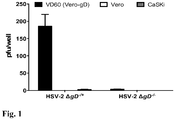
- HSV-2 ⁇ gD-/+ initiates an abortive infection: An HSV-2 strain that is deleted for U S 6 was constructed to assess its contribution in in early signaling events occurring during cell infection [41]. This virus is incapable of infecting host cells, unless it is grown on a gD-complementing cell line (e.g. VD60 cells encoding gD-1 [40, 41]) that encodes U S 6 under the control of its endogenous promoter (for example, the gD -1 promoter). Indeed, HSV-2 ⁇ gD particles isolated from non-complementing cells do not infect epithelial ( Fig. 1 ) or neuronal cells (SK-N-SH, not shown).
- a gD-complementing cell line e.g. VD60 cells encoding gD-1 [40, 41]
- endogenous promoter for example, the gD -1 promoter
- ⁇ gD-/+ phenotypically complemented virus
- pfu infectious particles or viral plaques
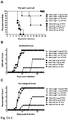
- HSV-2 ⁇ gD-/+ is safe in the murine infection model: ⁇ gD-/+ was evaluated for safety in vivo in wild-type and severe combined immunodeficiency (SCID) mice by inoculating high doses subcutaneously or intravaginally. Mice inoculated intravaginally with 10 7 pfu of ⁇ gD-/+ (titered on complementing cells) did not manifest any signs of virus-induced pathology throughout the experiments, whereas animals inoculated with 1,000-fold less wild-type virus (10 4 pfu) succumbed to HSV-2 disease and died starting Day 8 after inoculation ( Fig. 2A ).
- mice inoculated intravaginally with 10 7 pfu of ⁇ gD-/+ did not manifest any signs of virus-induced epithelial or neurological disease throughout the experiments ( Fig. 2B and 2C ).
- No infectious virus was recovered from genital tract tissue or DRGs, as determined by plaque assay or co-cultivation of DRGs with Vero cells (not shown).
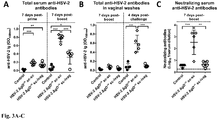
- HSV-2 ⁇ gD-/+ elicits systemic and mucosal antibodies to HSV-2: Mice inoculated and boosted subcutaneously (sc.-sc.) with ⁇ gD-/+ or inoculated subcutaneously and boosted intravaginally (sc.-i.vag.) with this candidate vaccine strain (10 6 pfu/mouse) elicited a humoral immune response to HSV-2 as evidenced by an increase in serum and vaginal washes anti-HSV-2 antibodies ( Fig. 3A and 3B ). The control animals were immunized with an uninfected VD60 cell lysate (referred to as Control).
- Control uninfected VD60 cell lysate
- the antibodies were measured by ELISA using infected cell lysates as the antigen (response to uninfected cell lysates subtracted as background). Noteworthy, the magnitude of the antibody response differs depending on the route of immunization. Indeed, s.c.-s.c. immunization elicited significantly more serum and vaginal wash antibodies to HSV-2 than s.c.-i.vag. immunization. This finding suggests that the vaginal wash antibodies likely represent transudate of IgG from the blood and suggest that sc.-sc. is a more appropriate route for eliciting high levels of systemic and local IgG antibodies to HSV-2.
- HSV-2 ⁇ gD-/+ elicits HSV-2-specific T cell activation: gB498-505-specific transgenic CD8+ T cells (gBT-I) were transferred into C57BL/6 mice prior to vaccination. Vaccinated mice were inoculated with 10 6 pfu ⁇ gD-/+ or with VD60 cell lysates (Control). Spleens were harvested on Day 14 after the boost and quantified by flow cytometry using counting beads (CountBrightTM, Lifetechnologies) ( Fig. 4A ). At the same day, spleens were stained for memory surface markers and analyzed by flow cytometry ( Fig. 4B ).
- splenocytes harvested the same day were re-stimulated in vitro for 6 hours with the agonist gB498-505-peptide and intracellular cytokine staining was performed to measure IFN- ⁇ production by these cells.
- Immunization with ⁇ gD-/+ increased the IFN- ⁇ production in the vaccinated compared to control mice ( Fig. 4C ).
- the response in control mice presumably reflects the persistence of the gBT-I T cells in na ⁇ ve mice after transfer.
- Similar results were obtained using multiplex cytokine analyses for supernatants of splenocytes re-stimulated in vitro with gB498-505-peptide (not shown).
- mice immunized with HSV-2 ⁇ gD-/+ are protected against intravaginal HSV-2 lethal challenge: Animals vaccinated with HSV-2 ⁇ gD-/+ either sc.-sc. or sc.-i.vag. suffer less body weight after intravaginal lethal dose challenges equivalent to LD 90 (5x10 4 pfu/mouse) and survive challenges, whereas mice immunized with the VD60 control lysate succumbed to disease by Day 10 ( Fig. 5A and 5B ). The vaccines also provided complete protection against 10 times the LD 90 (5x10 5 pfu/mouse, data not shown). This protection was associated with significantly reduced epithelial disease scores ( Fig.
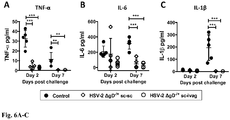
- Immunization with HSV-2 ⁇ gD-/+ prevents inflammation at the infection site after challenge with virulent HSV-2: Mice vaccinated with HSV-2 ⁇ gD-/+ and intravaginally challenged with virulent HSV-2 display significantly less inflammatory cytokines at the infection site as compared to animals inoculated with VD60 lysates (Control). Indeed, vaccinated mice secreted significantly less TNF- ⁇ ( Fig. 6A ), IL-6 ( Fig. 6B ) and IL-1 ⁇ ( Fig. 6C ) in vaginal washes at Day 2 and 7 post-infection than Control mice. Noteworthy, increased levels of inflammatory cytokines are associated with increased HIV replication and shedding at the genitalia in the co-infected with HSV-2 and HIV [45, 46]. A similar phenomenon is also observed in vitro [47].
- Immunization with HSV-2 ⁇ gD-/+ recruits T cells to the infection site and associated LNs.
- Mice immunized sc.-sc. with ⁇ gD-/+ displayed increased percentages of activated anti-HSV-2 gBT-I CD8+ ( Fig. 7A ) and CD4+ T cells ( Fig. 7B ) in sacral lymph nodes (LNs) after challenge with virulent HSV-2.
- Mice immunized sc.-i.vag. with ⁇ gD-/+ displayed increased numbers of anti-HSV-2 gBT-I CD8+ ( Fig. 7C ) and CD4+ T cells ( Fig.
- HSV-2- ⁇ gD -/+gD-1 was found to confer protection in C57BL/6 and Balb/C to vaginal challenge with virulent HSV-2.
- intravaginal HSV-2 challenged ⁇ gD -/+gD-1 immunized mice had no detectable HSV-2 in vaginal or neural tissue at 5 days post-challenge.
- HSV-2 ⁇ gD-/+gD-1 sc.sc. antibodies were found to recognize numerous HSV-2 proteins (both gD and gB) unlike HSV-2 morbid-bound mice. Serum antibodies from vaccinated animals showed neutralization of HSV-1 and HSV-2 in vitro.
- eerum from ⁇ gD-/+gD-1 vaccinated mice elicited Antibody Dependent Cellular Cytotoxicity (ADCC) of HSV-2 infected cells in vitro.
- ADCC Antibody Dependent Cellular Cytotoxicity
- HSV-2 ⁇ gD-/+gD-1 is attenuated and completely safe in wt and SCID mice.
- Recombinant HSV-2 ⁇ gD-/+gD-1 protected against lethal HSV-2 intravaginal and HSV-2/HSV-1 skin infection. Protection was observed in two different mouse strains. There was no detectable infection, and sterilizing immunity. Also observed was induction of HSV-2 specific CD8+ T cells and systemic and mucosal HSV Abs. IgG2a and IgG2b were the predominant anti-HSV isotype. Also observed was FcyRIII/II-dependent ADCC. Surprisingly, passive transfer of immune serum protects na ⁇ ve mice, and FcRn and FcyR knockout mice were not protected with immune sera.
- HSV-2 herpes simplex virus type 2
- Infection risk increases with age and because the virus establishes latency with frequent subclinical or clinical reactivation, the impact of infection is lifelong.
- HSV-2 significantly increases the risk of acquiring and transmitting HIV [2-4].
- the prevalence of HSV-2 varies among global regions, fluctuating from 8.4% for Japan up to 70% for sub-Saharan Africa, a region where HIV prevalence is epidemic [5, 6]. In the US the prevalence of HSV-2 is ⁇ 16% and that of HSV-1 has declined to ⁇ 54%.
- HSV-1 glycoprotein D subunit vaccine trial in which the majority of cases of genital herpes disease were caused by HSV-1 [7-9].
- HSV-1 is associated with fewer recurrences and less genital tract viral shedding compared to HSV-2, both serotypes are transmitted perinataly and cause neonatal disease; neonatal disease is associated with high morbidity and mortality even with acyclovir treatment [10-12].
- HSV-2 gD subunit vaccine provided protection against genital HSV-1, but not HSV-2 [8, 20].
- serum HSV-2 gD antibody levels correlated with protection against HSV-1, suggesting that the antibody titers required for HSV-2 protection may be higher than those needed to protect against HSV-1 [21].
- CD4 + and CD8 + T cells were identified surrounding neurons and, while there was heterogenity in the viral proteins targeted, the tegument protein, virion protein 16 (VP16), was recognized by multiple trigeminal ganglia T cells in the context of diverse HLA-A and -B alleles; these findings suggest that tegument proteins may be important immunogens [33]. Similarly, cytotoxic T cells directed at tegument proteins were also identified in studies of humans latently infected with HSV-2 [34]. CD8 + T cells (including CD8 ⁇ + T cells) persist in genital skin and mucosa at the dermal-epidermal junction following HSV reactivation suggesting that they play a role in immune control [35].
- HSV-2 virus genetically deleted for native HSV-2 gD.
- the HSV-2 gD gene encodes an envelope glycoprotein essential for viral entry and cell-to-cell spread. Glycoprotein D also binds to tumor necrosis factor receptor superfamily member 14 (TNFRSF14 ) , an immune-regulatory switch also known as herpesvirus entry mediator (HVEM). Because HVEM harbors docking sites for more than one ligand and signaling differs depending on whether these molecules bind to HVEM in cis or in trans , gD may have modulatory effects on immune cells [36, 37].
- TNFRSF14 tumor necrosis factor receptor superfamily member 14
- HVEM herpesvirus entry mediator
- gD competes with the natural ligands for this receptor and modulates the cytokine response to the virus [38, 39].
- the gD gene was replaced with a DNA fragment encoding the green fluorescent protein ( gfp ) and transformed complementing Vero cells expressing HSV-1 gD (VD60 cells [40]) (e.g. gD-1 under gD-1 promoter)with this construct were screened for homologous recombinant virus that formed green plaques.
- the mutant virus replicates in the complementing Vero cell line to high titers (designated HSV-2 ⁇ gD -/+ when passaged on complementing cells), but is noninfectious in non-complementing cells (designated HSV-2 ⁇ g D - / - when isolated from non-complementing cells).
- This virus was purified and characterized in vitro [41].
- Intravaginal or subcutaneous inoculation of immunocompetent or immunocompromised (SCID) mice revealed no virulence compared to the lethal infection caused by parental wild-type virus. Immunization (subcutaneous prime followed by a single boost administered either subcutaneously or intravaginally) was 100% protective against intravaginal challenge with virulent HSV-2.
Landscapes
- Health & Medical Sciences (AREA)
- Life Sciences & Earth Sciences (AREA)
- Chemical & Material Sciences (AREA)
- Virology (AREA)
- Organic Chemistry (AREA)
- General Health & Medical Sciences (AREA)
- Medicinal Chemistry (AREA)
- Immunology (AREA)
- Public Health (AREA)
- Animal Behavior & Ethology (AREA)
- Veterinary Medicine (AREA)
- Pharmacology & Pharmacy (AREA)
- Engineering & Computer Science (AREA)
- Genetics & Genomics (AREA)
- Microbiology (AREA)
- Bioinformatics & Cheminformatics (AREA)
- Biochemistry (AREA)
- Epidemiology (AREA)
- Mycology (AREA)
- Molecular Biology (AREA)
- Nuclear Medicine, Radiotherapy & Molecular Imaging (AREA)
- General Chemical & Material Sciences (AREA)
- Chemical Kinetics & Catalysis (AREA)
- Zoology (AREA)
- Wood Science & Technology (AREA)
- Biotechnology (AREA)
- Biophysics (AREA)
- Proteomics, Peptides & Aminoacids (AREA)
- Biomedical Technology (AREA)
- General Engineering & Computer Science (AREA)
- Gastroenterology & Hepatology (AREA)
- Tropical Medicine & Parasitology (AREA)
- Communicable Diseases (AREA)
- Oncology (AREA)
- Dermatology (AREA)
- Medicines Containing Antibodies Or Antigens For Use As Internal Diagnostic Agents (AREA)
- Micro-Organisms Or Cultivation Processes Thereof (AREA)
- Medicines Containing Material From Animals Or Micro-Organisms (AREA)
Priority Applications (1)
| Application Number | Priority Date | Filing Date | Title |
|---|---|---|---|
| EP20195405.4A EP3943106A1 (en) | 2014-03-03 | 2015-03-02 | Recombinant herpes simplex virus 2 (hsv-2) vaccine vectors |
Applications Claiming Priority (3)
| Application Number | Priority Date | Filing Date | Title |
|---|---|---|---|
| US201461946965P | 2014-03-03 | 2014-03-03 | |
| US201462080663P | 2014-11-17 | 2014-11-17 | |
| PCT/US2015/018272 WO2015134368A2 (en) | 2014-03-03 | 2015-03-02 | Recombinant herpes simplex virus 2 (hsv-2) vaccine vectors |
Related Child Applications (1)
| Application Number | Title | Priority Date | Filing Date |
|---|---|---|---|
| EP20195405.4A Division EP3943106A1 (en) | 2014-03-03 | 2015-03-02 | Recombinant herpes simplex virus 2 (hsv-2) vaccine vectors |
Publications (3)
| Publication Number | Publication Date |
|---|---|
| EP3113801A2 EP3113801A2 (en) | 2017-01-11 |
| EP3113801A4 EP3113801A4 (en) | 2017-10-25 |
| EP3113801B1 true EP3113801B1 (en) | 2020-10-07 |
Family
ID=54055977
Family Applications (2)
| Application Number | Title | Priority Date | Filing Date |
|---|---|---|---|
| EP15758673.6A Active EP3113801B1 (en) | 2014-03-03 | 2015-03-02 | Recombinant herpes simplex virus 2 (hsv-2) vaccine vectors |
| EP20195405.4A Pending EP3943106A1 (en) | 2014-03-03 | 2015-03-02 | Recombinant herpes simplex virus 2 (hsv-2) vaccine vectors |
Family Applications After (1)
| Application Number | Title | Priority Date | Filing Date |
|---|---|---|---|
| EP20195405.4A Pending EP3943106A1 (en) | 2014-03-03 | 2015-03-02 | Recombinant herpes simplex virus 2 (hsv-2) vaccine vectors |
Country Status (6)
| Country | Link |
|---|---|
| US (5) | US9999665B2 (enExample) |
| EP (2) | EP3113801B1 (enExample) |
| JP (3) | JP6652497B2 (enExample) |
| CN (2) | CN106456805B (enExample) |
| AU (2) | AU2015225499B2 (enExample) |
| WO (1) | WO2015134368A2 (enExample) |
Families Citing this family (15)
| Publication number | Priority date | Publication date | Assignee | Title |
|---|---|---|---|---|
| CN106456805B (zh) | 2014-03-03 | 2020-01-10 | 阿尔伯特爱因斯坦医学院公司 | 重组单纯疱疹病毒2(hsv-2)疫苗载体 |
| US10918712B2 (en) * | 2014-03-03 | 2021-02-16 | Albert Einstein College Of Medicine | Passive transfer of immunity using recombinant herpes simplex virus 2 (HSV-2) vaccine vectors |
| MX2020011257A (es) | 2018-04-27 | 2021-01-15 | Krystal Biotech Inc | Ácidos nucleicos recombinantes que codifican una o más proteínas cosméticas para usos estéticos. |
| WO2019213305A1 (en) * | 2018-05-01 | 2019-11-07 | Albert Einstein College Of Medicine | HSV-2-DELTA-gD VACCINES AND METHODS FOR THEIR PRODUCTION AND USE |
| WO2020056411A1 (en) * | 2018-09-14 | 2020-03-19 | Excell Biotech, Llc | Recombinant herpes simplex virus 1 (hsv-1) |
| EP3856914A1 (en) | 2018-09-26 | 2021-08-04 | Krystal Biotech, Inc. | Compositions and methods for the treatment of skin diseases |
| JP2022512747A (ja) * | 2018-10-17 | 2022-02-07 | アルベルト・アインシュタイン・カレッジ・オブ・メディシン | 抗体依存性細胞傷害(adcc)を増強する方法 |
| KR20240116556A (ko) * | 2019-01-03 | 2024-07-29 | 앨버트 아인슈타인 컬리지 오브 메디신 | 재조합 단순 헤르페스 바이러스 2 (hsv-2) 백신 벡터를 사용한 면역의 수동 전달 |
| WO2021207348A1 (en) * | 2020-04-07 | 2021-10-14 | Albert Einstein College Of Medicine | Method of treating and preventing ocular disease with hsv-2 delta gd |
| IL298288B2 (en) * | 2020-05-29 | 2025-03-01 | Albert Einstein College Medicine | Methods for using Delta-gD of single-stranded HSV-2 virus and recombinant HSV-2 glycoprotein D |
| US11987805B2 (en) | 2020-09-24 | 2024-05-21 | Albert Einstein College Of Medicine | Attb cell line, transgenic cell lines derived therefrom, and methods of making the same |
| WO2023245159A1 (en) * | 2022-06-16 | 2023-12-21 | Albert Einstein College Of Medicine | Recombinant herpes simplex virus 2 (hsv-2) vectors and engineered transgenic vero cell lines |
| AU2023319760A1 (en) * | 2022-08-05 | 2025-02-13 | Immvira Co., Limited | Replication incompetent herpes simplex virus type 1 viral vaccine |
| US20250222112A1 (en) * | 2022-10-14 | 2025-07-10 | Arizona Board Of Regents On Behalf Of Arizona State University | Recombinant immune complexes targeting herpes simplex virus |
| WO2025231288A2 (en) | 2024-05-01 | 2025-11-06 | Viradigm, Inc. | Hsv vectors having improved safety profiles |
Family Cites Families (21)
| Publication number | Priority date | Publication date | Assignee | Title |
|---|---|---|---|---|
| PT77014B (en) * | 1982-07-20 | 1986-01-24 | Molecular Genetics Inc | Production of herpes simplex viral proteins |
| NZ209308A (en) * | 1983-08-30 | 1991-08-27 | Genentech Inc | Vaccine against hsv involving a truncated membrane-free derivative of a membrane-bound protein |
| EP0231209B1 (en) * | 1985-07-29 | 1991-02-06 | The Upjohn Company | Virus vaccine |
| US5646041A (en) * | 1987-02-12 | 1997-07-08 | Harfeldt; Elisabeth | Monoclonal antibody to herpes simplex virus and cell line producing same |
| EP0689603A1 (en) * | 1993-03-19 | 1996-01-03 | Cantab Pharmaceuticals Research Limited | Defective mutant non-retroviral virus (e.g. hsv) as vaccine |
| US20030083289A1 (en) * | 1995-10-19 | 2003-05-01 | Boursnell Michael Edward Griffith | Herpesvirus vectors and their uses |
| CN1120238C (zh) * | 1998-05-04 | 2003-09-03 | 本元正阳基因技术股份有限公司 | 以粘粒为基础构建重组单纯疱疹病毒及其用途 |
| EP1238086B1 (en) | 1999-12-17 | 2006-03-08 | Wyeth Holdings Corporation | Vaccine for enhancing immune responses to herpes simplex virus |
| WO2005005637A2 (en) * | 2003-05-09 | 2005-01-20 | Medigene, Inc. | Herpes simplex virus comprising a genetically modified glycoprotein d |
| US6984492B2 (en) * | 2003-09-05 | 2006-01-10 | Talecris Biotherapeutics, Inc. | Methods and compositions for treating herpes infections |
| US20080089910A1 (en) | 2004-06-29 | 2008-04-17 | Visalli Et Al | Attenuated Herpes Simplex Virus Type-2, Vectors Thereof and Immunogenic Compositions Thereof |
| JP2008507784A (ja) | 2004-07-26 | 2008-03-13 | コーニンクレッカ フィリップス エレクトロニクス エヌ ヴィ | 実行可能医療ガイドラインの実行をシミュレートするための意思決定支援システム |
| US8865185B2 (en) * | 2006-09-08 | 2014-10-21 | The Trustees Of The University Of Pennsylvania | Methods of use for HSV-1 and HSV-2 vaccines |
| EP2059255A4 (en) * | 2006-09-08 | 2011-08-31 | Univ Pennsylvania | HSV-1 AND HSV-2 VACCINES AND METHOD FOR THEIR USE |
| US9284355B2 (en) * | 2006-12-28 | 2016-03-15 | The Trustees Of The University Of Pennsylvania | Herpes simplex virus combined subunit vaccines and methods of use thereof |
| WO2009089154A2 (en) * | 2008-01-03 | 2009-07-16 | Cornell Research Foundation, Inc. | Glycosylated protein expression in prokaryotes |
| CN101288770A (zh) * | 2008-03-14 | 2008-10-22 | 浙江省医学科学院 | 新型单纯疱疹病毒ⅱ型dna疫苗 |
| RU2585961C9 (ru) * | 2009-05-22 | 2016-12-27 | Дженосеа Биосайенсиз Инк. | Вакцины против вируса простого герпеса 2 типа: композиции и способы запуска иммунного ответа |
| WO2011035004A1 (en) * | 2009-09-18 | 2011-03-24 | Fraunhofer Usa Inc. | Virus like particles comprising target proteins fused to plant viral coat proteins |
| CN106456805B (zh) * | 2014-03-03 | 2020-01-10 | 阿尔伯特爱因斯坦医学院公司 | 重组单纯疱疹病毒2(hsv-2)疫苗载体 |
| US10918712B2 (en) | 2014-03-03 | 2021-02-16 | Albert Einstein College Of Medicine | Passive transfer of immunity using recombinant herpes simplex virus 2 (HSV-2) vaccine vectors |
-
2015
- 2015-03-02 CN CN201580022222.6A patent/CN106456805B/zh active Active
- 2015-03-02 AU AU2015225499A patent/AU2015225499B2/en active Active
- 2015-03-02 CN CN201911344961.3A patent/CN110938604B/zh active Active
- 2015-03-02 EP EP15758673.6A patent/EP3113801B1/en active Active
- 2015-03-02 EP EP20195405.4A patent/EP3943106A1/en active Pending
- 2015-03-02 JP JP2016555659A patent/JP6652497B2/ja active Active
- 2015-03-02 WO PCT/US2015/018272 patent/WO2015134368A2/en not_active Ceased
-
2016
- 2016-02-04 US US15/015,322 patent/US9999665B2/en active Active
-
2017
- 2017-03-10 US US15/455,495 patent/US10076568B2/en active Active
-
2018
- 2018-06-01 US US15/995,471 patent/US10391165B2/en active Active
-
2019
- 2019-07-30 US US16/526,056 patent/US10751411B2/en active Active
-
2020
- 2020-01-23 JP JP2020009043A patent/JP6844045B2/ja active Active
- 2020-08-10 AU AU2020217310A patent/AU2020217310B2/en active Active
- 2020-08-18 US US16/995,926 patent/US10980874B2/en active Active
-
2021
- 2021-02-24 JP JP2021026943A patent/JP7050193B2/ja active Active
Non-Patent Citations (1)
| Title |
|---|
| None * |
Also Published As
| Publication number | Publication date |
|---|---|
| AU2015225499A1 (en) | 2016-10-20 |
| EP3943106A1 (en) | 2022-01-26 |
| AU2020217310A1 (en) | 2020-08-27 |
| US10980874B2 (en) | 2021-04-20 |
| CN106456805A (zh) | 2017-02-22 |
| US20170202952A1 (en) | 2017-07-20 |
| JP6652497B2 (ja) | 2020-02-26 |
| US20190111127A1 (en) | 2019-04-18 |
| JP2017510262A (ja) | 2017-04-13 |
| JP2020079245A (ja) | 2020-05-28 |
| CA2942166A1 (en) | 2015-09-11 |
| JP6844045B2 (ja) | 2021-03-17 |
| US10076568B2 (en) | 2018-09-18 |
| CN110938604B (zh) | 2024-04-05 |
| AU2020217310B2 (en) | 2023-07-13 |
| CN110938604A (zh) | 2020-03-31 |
| US10391165B2 (en) | 2019-08-27 |
| US20160158343A1 (en) | 2016-06-09 |
| AU2015225499B2 (en) | 2020-05-14 |
| EP3113801A4 (en) | 2017-10-25 |
| JP7050193B2 (ja) | 2022-04-07 |
| US20200023058A1 (en) | 2020-01-23 |
| EP3113801A2 (en) | 2017-01-11 |
| WO2015134368A2 (en) | 2015-09-11 |
| JP2021088590A (ja) | 2021-06-10 |
| US10751411B2 (en) | 2020-08-25 |
| US9999665B2 (en) | 2018-06-19 |
| US20200376114A1 (en) | 2020-12-03 |
| WO2015134368A3 (en) | 2015-11-26 |
| CN106456805B (zh) | 2020-01-10 |
Similar Documents
| Publication | Publication Date | Title |
|---|---|---|
| AU2020217310B2 (en) | Recombinant herpes simplex virus 2 (hsv-2) vaccine vectors | |
| US10918712B2 (en) | Passive transfer of immunity using recombinant herpes simplex virus 2 (HSV-2) vaccine vectors | |
| JP2024016032A (ja) | 組み換え単純ヘルペスウイルス2(hsv-2)ワクチンベクターを使用する免疫の受動伝達 | |
| US20220088185A1 (en) | Passive transfer of immunity using recombinant herpes simplex virus 2 (hsv-2) vaccine vectors | |
| CA2942166C (en) | Recombinant herpes simplex virus 2 (hsv-2) vaccine vectors | |
| HK40022690B (en) | Recombinant herpes simplex virus 2 (hsv-2) vaccine vectors | |
| HK1229721B (en) | Recombinant herpes simplex virus 2 (hsv-2) vaccine vectors | |
| WO2023245159A1 (en) | Recombinant herpes simplex virus 2 (hsv-2) vectors and engineered transgenic vero cell lines | |
| AU2021281314A1 (en) | Methods of using HSV-2 single cycle virus delta-gD and HSV-2 recombinant glycoprotein D | |
| HK40022690A (en) | Recombinant herpes simplex virus 2 (hsv-2) vaccine vectors | |
| HK1229721A1 (en) | Recombinant herpes simplex virus 2 (hsv-2) vaccine vectors |
Legal Events
| Date | Code | Title | Description |
|---|---|---|---|
| STAA | Information on the status of an ep patent application or granted ep patent |
Free format text: STATUS: THE INTERNATIONAL PUBLICATION HAS BEEN MADE |
|
| PUAI | Public reference made under article 153(3) epc to a published international application that has entered the european phase |
Free format text: ORIGINAL CODE: 0009012 |
|
| STAA | Information on the status of an ep patent application or granted ep patent |
Free format text: STATUS: REQUEST FOR EXAMINATION WAS MADE |
|
| 17P | Request for examination filed |
Effective date: 20161003 |
|
| AK | Designated contracting states |
Kind code of ref document: A2 Designated state(s): AL AT BE BG CH CY CZ DE DK EE ES FI FR GB GR HR HU IE IS IT LI LT LU LV MC MK MT NL NO PL PT RO RS SE SI SK SM TR |
|
| AX | Request for extension of the european patent |
Extension state: BA ME |
|
| DAV | Request for validation of the european patent (deleted) | ||
| A4 | Supplementary search report drawn up and despatched |
Effective date: 20170927 |
|
| RIC1 | Information provided on ipc code assigned before grant |
Ipc: A61K 39/00 20060101ALN20170921BHEP Ipc: A61K 49/00 20060101ALI20170921BHEP Ipc: A01N 63/00 20060101ALI20170921BHEP Ipc: A61K 39/12 20060101AFI20170921BHEP Ipc: C12N 15/74 20060101ALI20170921BHEP Ipc: C12N 7/00 20060101ALI20170921BHEP |
|
| STAA | Information on the status of an ep patent application or granted ep patent |
Free format text: STATUS: EXAMINATION IS IN PROGRESS |
|
| 17Q | First examination report despatched |
Effective date: 20190731 |
|
| REG | Reference to a national code |
Ref country code: DE Ref legal event code: R079 Ref document number: 602015060160 Country of ref document: DE Free format text: PREVIOUS MAIN CLASS: A61K0049000000 Ipc: A61K0039120000 |
|
| GRAP | Despatch of communication of intention to grant a patent |
Free format text: ORIGINAL CODE: EPIDOSNIGR1 |
|
| STAA | Information on the status of an ep patent application or granted ep patent |
Free format text: STATUS: GRANT OF PATENT IS INTENDED |
|
| RIC1 | Information provided on ipc code assigned before grant |
Ipc: C12N 15/74 20060101ALI20200323BHEP Ipc: A61K 39/12 20060101AFI20200323BHEP Ipc: A01N 63/00 20200101ALI20200323BHEP Ipc: C12N 7/00 20060101ALI20200323BHEP Ipc: A61K 39/00 20060101ALN20200323BHEP Ipc: A61K 49/00 20060101ALI20200323BHEP |
|
| INTG | Intention to grant announced |
Effective date: 20200407 |
|
| GRAS | Grant fee paid |
Free format text: ORIGINAL CODE: EPIDOSNIGR3 |
|
| GRAA | (expected) grant |
Free format text: ORIGINAL CODE: 0009210 |
|
| STAA | Information on the status of an ep patent application or granted ep patent |
Free format text: STATUS: THE PATENT HAS BEEN GRANTED |
|
| RAP1 | Party data changed (applicant data changed or rights of an application transferred) |
Owner name: ALBERT EINSTEIN COLLEGE OF MEDICINE |
|
| AK | Designated contracting states |
Kind code of ref document: B1 Designated state(s): AL AT BE BG CH CY CZ DE DK EE ES FI FR GB GR HR HU IE IS IT LI LT LU LV MC MK MT NL NO PL PT RO RS SE SI SK SM TR |
|
| AX | Request for extension of the european patent |
Extension state: BA ME |
|
| REG | Reference to a national code |
Ref country code: GB Ref legal event code: FG4D |
|
| REG | Reference to a national code |
Ref country code: CH Ref legal event code: EP Ref country code: AT Ref legal event code: REF Ref document number: 1320445 Country of ref document: AT Kind code of ref document: T Effective date: 20201015 |
|
| REG | Reference to a national code |
Ref country code: DE Ref legal event code: R096 Ref document number: 602015060160 Country of ref document: DE |
|
| REG | Reference to a national code |
Ref country code: IE Ref legal event code: FG4D |
|
| REG | Reference to a national code |
Ref country code: CH Ref legal event code: NV Representative=s name: ISLER AND PEDRAZZINI AG, CH |
|
| REG | Reference to a national code |
Ref country code: NL Ref legal event code: FP |
|
| REG | Reference to a national code |
Ref country code: AT Ref legal event code: MK05 Ref document number: 1320445 Country of ref document: AT Kind code of ref document: T Effective date: 20201007 |
|
| PG25 | Lapsed in a contracting state [announced via postgrant information from national office to epo] |
Ref country code: GR Free format text: LAPSE BECAUSE OF FAILURE TO SUBMIT A TRANSLATION OF THE DESCRIPTION OR TO PAY THE FEE WITHIN THE PRESCRIBED TIME-LIMIT Effective date: 20210108 Ref country code: NO Free format text: LAPSE BECAUSE OF FAILURE TO SUBMIT A TRANSLATION OF THE DESCRIPTION OR TO PAY THE FEE WITHIN THE PRESCRIBED TIME-LIMIT Effective date: 20210107 Ref country code: RS Free format text: LAPSE BECAUSE OF FAILURE TO SUBMIT A TRANSLATION OF THE DESCRIPTION OR TO PAY THE FEE WITHIN THE PRESCRIBED TIME-LIMIT Effective date: 20201007 Ref country code: PT Free format text: LAPSE BECAUSE OF FAILURE TO SUBMIT A TRANSLATION OF THE DESCRIPTION OR TO PAY THE FEE WITHIN THE PRESCRIBED TIME-LIMIT Effective date: 20210208 Ref country code: FI Free format text: LAPSE BECAUSE OF FAILURE TO SUBMIT A TRANSLATION OF THE DESCRIPTION OR TO PAY THE FEE WITHIN THE PRESCRIBED TIME-LIMIT Effective date: 20201007 |
|
| REG | Reference to a national code |
Ref country code: LT Ref legal event code: MG4D |
|
| PG25 | Lapsed in a contracting state [announced via postgrant information from national office to epo] |
Ref country code: BG Free format text: LAPSE BECAUSE OF FAILURE TO SUBMIT A TRANSLATION OF THE DESCRIPTION OR TO PAY THE FEE WITHIN THE PRESCRIBED TIME-LIMIT Effective date: 20210107 Ref country code: AT Free format text: LAPSE BECAUSE OF FAILURE TO SUBMIT A TRANSLATION OF THE DESCRIPTION OR TO PAY THE FEE WITHIN THE PRESCRIBED TIME-LIMIT Effective date: 20201007 Ref country code: ES Free format text: LAPSE BECAUSE OF FAILURE TO SUBMIT A TRANSLATION OF THE DESCRIPTION OR TO PAY THE FEE WITHIN THE PRESCRIBED TIME-LIMIT Effective date: 20201007 Ref country code: LV Free format text: LAPSE BECAUSE OF FAILURE TO SUBMIT A TRANSLATION OF THE DESCRIPTION OR TO PAY THE FEE WITHIN THE PRESCRIBED TIME-LIMIT Effective date: 20201007 Ref country code: IS Free format text: LAPSE BECAUSE OF FAILURE TO SUBMIT A TRANSLATION OF THE DESCRIPTION OR TO PAY THE FEE WITHIN THE PRESCRIBED TIME-LIMIT Effective date: 20210207 Ref country code: PL Free format text: LAPSE BECAUSE OF FAILURE TO SUBMIT A TRANSLATION OF THE DESCRIPTION OR TO PAY THE FEE WITHIN THE PRESCRIBED TIME-LIMIT Effective date: 20201007 |
|
| PG25 | Lapsed in a contracting state [announced via postgrant information from national office to epo] |
Ref country code: HR Free format text: LAPSE BECAUSE OF FAILURE TO SUBMIT A TRANSLATION OF THE DESCRIPTION OR TO PAY THE FEE WITHIN THE PRESCRIBED TIME-LIMIT Effective date: 20201007 |
|
| REG | Reference to a national code |
Ref country code: DE Ref legal event code: R097 Ref document number: 602015060160 Country of ref document: DE |
|
| PG25 | Lapsed in a contracting state [announced via postgrant information from national office to epo] |
Ref country code: SK Free format text: LAPSE BECAUSE OF FAILURE TO SUBMIT A TRANSLATION OF THE DESCRIPTION OR TO PAY THE FEE WITHIN THE PRESCRIBED TIME-LIMIT Effective date: 20201007 Ref country code: RO Free format text: LAPSE BECAUSE OF FAILURE TO SUBMIT A TRANSLATION OF THE DESCRIPTION OR TO PAY THE FEE WITHIN THE PRESCRIBED TIME-LIMIT Effective date: 20201007 Ref country code: LT Free format text: LAPSE BECAUSE OF FAILURE TO SUBMIT A TRANSLATION OF THE DESCRIPTION OR TO PAY THE FEE WITHIN THE PRESCRIBED TIME-LIMIT Effective date: 20201007 Ref country code: SM Free format text: LAPSE BECAUSE OF FAILURE TO SUBMIT A TRANSLATION OF THE DESCRIPTION OR TO PAY THE FEE WITHIN THE PRESCRIBED TIME-LIMIT Effective date: 20201007 Ref country code: CZ Free format text: LAPSE BECAUSE OF FAILURE TO SUBMIT A TRANSLATION OF THE DESCRIPTION OR TO PAY THE FEE WITHIN THE PRESCRIBED TIME-LIMIT Effective date: 20201007 Ref country code: EE Free format text: LAPSE BECAUSE OF FAILURE TO SUBMIT A TRANSLATION OF THE DESCRIPTION OR TO PAY THE FEE WITHIN THE PRESCRIBED TIME-LIMIT Effective date: 20201007 |
|
| PLBE | No opposition filed within time limit |
Free format text: ORIGINAL CODE: 0009261 |
|
| STAA | Information on the status of an ep patent application or granted ep patent |
Free format text: STATUS: NO OPPOSITION FILED WITHIN TIME LIMIT |
|
| PG25 | Lapsed in a contracting state [announced via postgrant information from national office to epo] |
Ref country code: DK Free format text: LAPSE BECAUSE OF FAILURE TO SUBMIT A TRANSLATION OF THE DESCRIPTION OR TO PAY THE FEE WITHIN THE PRESCRIBED TIME-LIMIT Effective date: 20201007 |
|
| 26N | No opposition filed |
Effective date: 20210708 |
|
| PG25 | Lapsed in a contracting state [announced via postgrant information from national office to epo] |
Ref country code: AL Free format text: LAPSE BECAUSE OF FAILURE TO SUBMIT A TRANSLATION OF THE DESCRIPTION OR TO PAY THE FEE WITHIN THE PRESCRIBED TIME-LIMIT Effective date: 20201007 Ref country code: IT Free format text: LAPSE BECAUSE OF FAILURE TO SUBMIT A TRANSLATION OF THE DESCRIPTION OR TO PAY THE FEE WITHIN THE PRESCRIBED TIME-LIMIT Effective date: 20201007 Ref country code: MC Free format text: LAPSE BECAUSE OF FAILURE TO SUBMIT A TRANSLATION OF THE DESCRIPTION OR TO PAY THE FEE WITHIN THE PRESCRIBED TIME-LIMIT Effective date: 20201007 |
|
| PG25 | Lapsed in a contracting state [announced via postgrant information from national office to epo] |
Ref country code: SI Free format text: LAPSE BECAUSE OF FAILURE TO SUBMIT A TRANSLATION OF THE DESCRIPTION OR TO PAY THE FEE WITHIN THE PRESCRIBED TIME-LIMIT Effective date: 20201007 |
|
| REG | Reference to a national code |
Ref country code: BE Ref legal event code: MM Effective date: 20210331 |
|
| PG25 | Lapsed in a contracting state [announced via postgrant information from national office to epo] |
Ref country code: LU Free format text: LAPSE BECAUSE OF NON-PAYMENT OF DUE FEES Effective date: 20210302 Ref country code: IE Free format text: LAPSE BECAUSE OF NON-PAYMENT OF DUE FEES Effective date: 20210302 |
|
| PG25 | Lapsed in a contracting state [announced via postgrant information from national office to epo] |
Ref country code: IS Free format text: LAPSE BECAUSE OF FAILURE TO SUBMIT A TRANSLATION OF THE DESCRIPTION OR TO PAY THE FEE WITHIN THE PRESCRIBED TIME-LIMIT Effective date: 20210207 |
|
| PG25 | Lapsed in a contracting state [announced via postgrant information from national office to epo] |
Ref country code: BE Free format text: LAPSE BECAUSE OF NON-PAYMENT OF DUE FEES Effective date: 20210331 |
|
| PG25 | Lapsed in a contracting state [announced via postgrant information from national office to epo] |
Ref country code: HU Free format text: LAPSE BECAUSE OF FAILURE TO SUBMIT A TRANSLATION OF THE DESCRIPTION OR TO PAY THE FEE WITHIN THE PRESCRIBED TIME-LIMIT; INVALID AB INITIO Effective date: 20150302 |
|
| PG25 | Lapsed in a contracting state [announced via postgrant information from national office to epo] |
Ref country code: CY Free format text: LAPSE BECAUSE OF FAILURE TO SUBMIT A TRANSLATION OF THE DESCRIPTION OR TO PAY THE FEE WITHIN THE PRESCRIBED TIME-LIMIT Effective date: 20201007 |
|
| P01 | Opt-out of the competence of the unified patent court (upc) registered |
Effective date: 20230608 |
|
| PG25 | Lapsed in a contracting state [announced via postgrant information from national office to epo] |
Ref country code: MK Free format text: LAPSE BECAUSE OF FAILURE TO SUBMIT A TRANSLATION OF THE DESCRIPTION OR TO PAY THE FEE WITHIN THE PRESCRIBED TIME-LIMIT Effective date: 20201007 |
|
| PG25 | Lapsed in a contracting state [announced via postgrant information from national office to epo] |
Ref country code: TR Free format text: LAPSE BECAUSE OF FAILURE TO SUBMIT A TRANSLATION OF THE DESCRIPTION OR TO PAY THE FEE WITHIN THE PRESCRIBED TIME-LIMIT Effective date: 20201007 |
|
| PG25 | Lapsed in a contracting state [announced via postgrant information from national office to epo] |
Ref country code: MT Free format text: LAPSE BECAUSE OF FAILURE TO SUBMIT A TRANSLATION OF THE DESCRIPTION OR TO PAY THE FEE WITHIN THE PRESCRIBED TIME-LIMIT Effective date: 20201007 |
|
| REG | Reference to a national code |
Ref country code: CH Ref legal event code: U11 Free format text: ST27 STATUS EVENT CODE: U-0-0-U10-U11 (AS PROVIDED BY THE NATIONAL OFFICE) Effective date: 20260401 |
|
| PGFP | Annual fee paid to national office [announced via postgrant information from national office to epo] |
Ref country code: SE Payment date: 20260327 Year of fee payment: 12 |
|
| PGFP | Annual fee paid to national office [announced via postgrant information from national office to epo] |
Ref country code: GB Payment date: 20260327 Year of fee payment: 12 |
|
| PGFP | Annual fee paid to national office [announced via postgrant information from national office to epo] |
Ref country code: DE Payment date: 20260327 Year of fee payment: 12 |
|
| PGFP | Annual fee paid to national office [announced via postgrant information from national office to epo] |
Ref country code: NL Payment date: 20260326 Year of fee payment: 12 |
|
| PGFP | Annual fee paid to national office [announced via postgrant information from national office to epo] |
Ref country code: FR Payment date: 20260325 Year of fee payment: 12 |
|
| PGFP | Annual fee paid to national office [announced via postgrant information from national office to epo] |
Ref country code: CH Payment date: 20260401 Year of fee payment: 12 |