EP3112448A1 - Derivate des 1-(4-methylcyclohexyl)-ethanols - Google Patents
Derivate des 1-(4-methylcyclohexyl)-ethanols Download PDFInfo
- Publication number
- EP3112448A1 EP3112448A1 EP15174508.0A EP15174508A EP3112448A1 EP 3112448 A1 EP3112448 A1 EP 3112448A1 EP 15174508 A EP15174508 A EP 15174508A EP 3112448 A1 EP3112448 A1 EP 3112448A1
- Authority
- EP
- European Patent Office
- Prior art keywords
- oil
- methyl
- ethyl
- formula
- methylcyclohexyl
- Prior art date
- Legal status (The legal status is an assumption and is not a legal conclusion. Google has not performed a legal analysis and makes no representation as to the accuracy of the status listed.)
- Granted
Links
Classifications
-
- C—CHEMISTRY; METALLURGY
- C11—ANIMAL OR VEGETABLE OILS, FATS, FATTY SUBSTANCES OR WAXES; FATTY ACIDS THEREFROM; DETERGENTS; CANDLES
- C11B—PRODUCING, e.g. BY PRESSING RAW MATERIALS OR BY EXTRACTION FROM WASTE MATERIALS, REFINING OR PRESERVING FATS, FATTY SUBSTANCES, e.g. LANOLIN, FATTY OILS OR WAXES; ESSENTIAL OILS; PERFUMES
- C11B9/00—Essential oils; Perfumes
- C11B9/0026—Essential oils; Perfumes compounds containing an alicyclic ring not condensed with another ring
- C11B9/0034—Essential oils; Perfumes compounds containing an alicyclic ring not condensed with another ring the ring containing six carbon atoms
-
- A—HUMAN NECESSITIES
- A61—MEDICAL OR VETERINARY SCIENCE; HYGIENE
- A61K—PREPARATIONS FOR MEDICAL, DENTAL OR TOILETRY PURPOSES
- A61K8/00—Cosmetics or similar toiletry preparations
- A61K8/02—Cosmetics or similar toiletry preparations characterised by special physical form
- A61K8/04—Dispersions; Emulsions
- A61K8/042—Gels
-
- A—HUMAN NECESSITIES
- A61—MEDICAL OR VETERINARY SCIENCE; HYGIENE
- A61K—PREPARATIONS FOR MEDICAL, DENTAL OR TOILETRY PURPOSES
- A61K8/00—Cosmetics or similar toiletry preparations
- A61K8/18—Cosmetics or similar toiletry preparations characterised by the composition
- A61K8/30—Cosmetics or similar toiletry preparations characterised by the composition containing organic compounds
- A61K8/33—Cosmetics or similar toiletry preparations characterised by the composition containing organic compounds containing oxygen
-
- A—HUMAN NECESSITIES
- A61—MEDICAL OR VETERINARY SCIENCE; HYGIENE
- A61K—PREPARATIONS FOR MEDICAL, DENTAL OR TOILETRY PURPOSES
- A61K8/00—Cosmetics or similar toiletry preparations
- A61K8/18—Cosmetics or similar toiletry preparations characterised by the composition
- A61K8/30—Cosmetics or similar toiletry preparations characterised by the composition containing organic compounds
- A61K8/33—Cosmetics or similar toiletry preparations characterised by the composition containing organic compounds containing oxygen
- A61K8/37—Esters of carboxylic acids
-
- A—HUMAN NECESSITIES
- A61—MEDICAL OR VETERINARY SCIENCE; HYGIENE
- A61Q—SPECIFIC USE OF COSMETICS OR SIMILAR TOILETRY PREPARATIONS
- A61Q19/00—Preparations for care of the skin
- A61Q19/10—Washing or bathing preparations
-
- C—CHEMISTRY; METALLURGY
- C07—ORGANIC CHEMISTRY
- C07C—ACYCLIC OR CARBOCYCLIC COMPOUNDS
- C07C43/00—Ethers; Compounds having groups, groups or groups
- C07C43/02—Ethers
- C07C43/03—Ethers having all ether-oxygen atoms bound to acyclic carbon atoms
- C07C43/04—Saturated ethers
- C07C43/115—Saturated ethers containing carbocyclic rings
-
- C—CHEMISTRY; METALLURGY
- C07—ORGANIC CHEMISTRY
- C07C—ACYCLIC OR CARBOCYCLIC COMPOUNDS
- C07C43/00—Ethers; Compounds having groups, groups or groups
- C07C43/02—Ethers
- C07C43/03—Ethers having all ether-oxygen atoms bound to acyclic carbon atoms
- C07C43/14—Unsaturated ethers
- C07C43/162—Unsaturated ethers containing rings other than six-membered aromatic rings
-
- C—CHEMISTRY; METALLURGY
- C07—ORGANIC CHEMISTRY
- C07C—ACYCLIC OR CARBOCYCLIC COMPOUNDS
- C07C69/00—Esters of carboxylic acids; Esters of carbonic or haloformic acids
- C07C69/02—Esters of acyclic saturated monocarboxylic acids having the carboxyl group bound to an acyclic carbon atom or to hydrogen
-
- C—CHEMISTRY; METALLURGY
- C07—ORGANIC CHEMISTRY
- C07C—ACYCLIC OR CARBOCYCLIC COMPOUNDS
- C07C69/00—Esters of carboxylic acids; Esters of carbonic or haloformic acids
- C07C69/02—Esters of acyclic saturated monocarboxylic acids having the carboxyl group bound to an acyclic carbon atom or to hydrogen
- C07C69/22—Esters of acyclic saturated monocarboxylic acids having the carboxyl group bound to an acyclic carbon atom or to hydrogen having three or more carbon atoms in the acid moiety
- C07C69/24—Esters of acyclic saturated monocarboxylic acids having the carboxyl group bound to an acyclic carbon atom or to hydrogen having three or more carbon atoms in the acid moiety esterified with monohydroxylic compounds
-
- C—CHEMISTRY; METALLURGY
- C07—ORGANIC CHEMISTRY
- C07C—ACYCLIC OR CARBOCYCLIC COMPOUNDS
- C07C69/00—Esters of carboxylic acids; Esters of carbonic or haloformic acids
- C07C69/66—Esters of carboxylic acids having esterified carboxylic groups bound to acyclic carbon atoms and having any of the groups OH, O—metal, —CHO, keto, ether, acyloxy, groups, groups, or in the acid moiety
- C07C69/67—Esters of carboxylic acids having esterified carboxylic groups bound to acyclic carbon atoms and having any of the groups OH, O—metal, —CHO, keto, ether, acyloxy, groups, groups, or in the acid moiety of saturated acids
- C07C69/675—Esters of carboxylic acids having esterified carboxylic groups bound to acyclic carbon atoms and having any of the groups OH, O—metal, —CHO, keto, ether, acyloxy, groups, groups, or in the acid moiety of saturated acids of saturated hydroxy-carboxylic acids
-
- C—CHEMISTRY; METALLURGY
- C07—ORGANIC CHEMISTRY
- C07C—ACYCLIC OR CARBOCYCLIC COMPOUNDS
- C07C69/00—Esters of carboxylic acids; Esters of carbonic or haloformic acids
- C07C69/66—Esters of carboxylic acids having esterified carboxylic groups bound to acyclic carbon atoms and having any of the groups OH, O—metal, —CHO, keto, ether, acyloxy, groups, groups, or in the acid moiety
- C07C69/67—Esters of carboxylic acids having esterified carboxylic groups bound to acyclic carbon atoms and having any of the groups OH, O—metal, —CHO, keto, ether, acyloxy, groups, groups, or in the acid moiety of saturated acids
- C07C69/675—Esters of carboxylic acids having esterified carboxylic groups bound to acyclic carbon atoms and having any of the groups OH, O—metal, —CHO, keto, ether, acyloxy, groups, groups, or in the acid moiety of saturated acids of saturated hydroxy-carboxylic acids
- C07C69/68—Lactic acid esters
-
- C—CHEMISTRY; METALLURGY
- C07—ORGANIC CHEMISTRY
- C07C—ACYCLIC OR CARBOCYCLIC COMPOUNDS
- C07C2601/00—Systems containing only non-condensed rings
- C07C2601/12—Systems containing only non-condensed rings with a six-membered ring
- C07C2601/14—The ring being saturated
Definitions
- DE2650602 A1 discloses a structural space comprising derivatives of 1- (4-methylcyclohexyl) ethanol in addition to derivatives of many other compounds wherein compounds within the structural space are used against unpleasant odors (deodorants).
- the compounds alleviate the obnoxious effect of a foul-smelling or offensive odor on the human sense of smell without this effect being related to a particular mechanism.
- no odor is given for the explicitly mentioned derivatives of 1- (4-methylcyclohexyl) -ethanol from Examples 25 and 26, no odor is given.
- the compounds 25 and 26 can reduce the odor of bad odors, to a pure smell.
- the compounds of the formula (I) may contain, in particular as the radical R 1, a propanoyl, butanoyl, 2-methylpropanoyl, 2-hydroxypropanoyl, methoxyethyl or 2-methylbut-2-enyl radical.
- the mixture may contain at least two fragrances of formula (I).
- the compounds of the formula (I) may be one or more of the compounds listed below in Table 1.
- the fragrances mentioned in Table 1 themselves have predominantly flowery and fruity odor properties and can therefore themselves be used as fragrances, in particular for producing floral and fruity odor notes.
- the fragrances can enhance fragrances, in particular, the fragrances floral or / and fruity are enhanced.
- the enhancement of the fragrances, in particular the flowery and / or fruity fragrances, can take place in a synergistic manner.
- Examples of the further at least one fragrance (component b) can be found, for example, in FIG S. Arctander, Perfume and Flavor Materials, Vol. I and II, Montclair, NJ, 1969, self-published or H. Surburg and J. Panten, Common Fragrance and Flavor Materials, 5th ed., Wiley-VCH, Weinheim 2006 ,
- the further at least one perfume (component b) may be, for example:
- One or more extracts of natural raw materials such as essential oils, concretes, absolues, resines, resinoids, balsams, tinctures such.
- hydrocarbons such as. 3-carene; ⁇ -pinene; ⁇ -pinene; ⁇ -terpinene; ⁇ -terpinene; p-cymene; bisabolene; camphene; caryophyllene; cedrene; farnesene; limonene; longifolene; myrcene; ocimene; valencene; (E, Z) -1,3,5-undecatriene; styrene; diphenylmethane; the aliphatic alcohols such.
- hydrocarbons such as. 3-carene; ⁇ -pinene; ⁇ -pinene; ⁇ -terpinene; ⁇ -terpinene; p-cymene; bisabolene; camphene; caryophyllene; cedrene; farnesene; limonene; longifolene; myrcene; ocimene; valencene; (E,
- the aliphatic nitriles such as; 2-nonenoic acid nitrile; 2-Tridecen Acid nitrile; 2-Tridecen Acid Acid nitrile; 2,12-Tridecadien Aciditril; 3,7-dimethyl-2,6-octadienklarenitril; 3,7-dimethyl-6-octen Aciditril; the aliphatic carboxylic acids and their esters such as (E) - and (Z) -3-hexenylformate; ethylacetoacetate; isoamyl; hexyl acetate; 3,5,5-trimethylhexyl acetate; 3-methyl-2-butenyl acetate; (E) -2-hexenyl acetate; (E) - and (Z) -3-hexenylacetate; octyl acetate; 3-octyl acetate; 1-octen-3-yl acetate; ethyl
- Citronellol Citronellol; geraniol; nerol; linalool; Lavadulol; nerolidol; farnesol; tetrahydrolinalool; tetrahydrogeraniol; 2,6-dimethyl-7-octene-2-ol; 2,6-dimethyl octane-2-ol; 2-methyl-6-methylene-7-octen-2-ol; 2,6-dimethyl-5,7-octadiene-2-ol; 2,6-dimethyl-3,5-octadiene-2-ol; 3,7-dimethyl-4,6-octadiene-3-ol; 3,7-dimethyl-1,5,7-octatrien-3-ol 2,6-dimethyl-2,5,7-octatrien-1-ol; as well as their formates, acetates, propionates, isobutyrates, butyrate
- the cyclic terpene alcohols such. Menthol; isopulegol; alpha-terpineol; Terpinenol-4; Menthane-8-ol; Menthane-1-ol; Menthane-7-ol; borneol; soborneol; linalool; monopoly; cedrol; ambrinol; Vetyverol; guaiol; as well as their formates, acetates, propionates, isobutyrates, butyrates, isovalerates, pentanoates, hexanoates, crotonates, tiglinates, 3-methyl-2-butenoates; the cyclic terpene aldehydes and ketones such.
- B menthone; Isomenthone; 8-mercaptomenthan-3-one; carvone; camphor; fenchon; alpha-ionone; beta-ionone; alpha-n-methylionone; beta-n-methylionone; alpha-isomethylionone; beta-isomethylionone; alpha-irone; alpha-damascone; beta-damascone; beta-damascenone; delta-damascone; gamma-damascone; 1- (2,4,4-trimethyl-2-cyclohexen-1-yl) -2-buten-1-one; 1,3,4,6,7,8a-hexahydro-1,1,5,5-tetramethyl-2H-2,4a-methanonaphthalen-8 (5H) -one; nootkatone; Dihydronootkaton; alpha-sinensal; beta-sinensal; Acetylated cedarwood oil (
- cyclic alcohols e.g. 4-tert-butylcyclohexanol; 3,3,5-trimethylcyclohexanol; 3-isocamphylcyclohexanol; 2,6,9-trimethyl-Z2, Z5, E9-cyclododecatrien-1-ol; 2-isobutyl-4-methyl tetrahydro-2H-pyran-4-ol;
- cycloaliphatic alcohols e.g. alpha, 3,3-trimethylcyclohexylmethanol; 2-methyl-4- (2,2,3-trimethyl-3-cyclopent-1-yl) butanol; 2-methyl-4- (2,2,3-trimethyl-3-cyclopent-1-yl) -2-buten-1-ol; 2-ethyl-4- (2,2,3-trimethyl-3-cyclopent-1-yl) -2-buten-1-ol; 3-methyl-5- (2,2,3-trimethyl-3-cyclopent-1-yl) pentan-2-ol; 3-methyl-5- (2,2,3-trimethyl-3-cyclopent-1-yl) -4-penten-2-ol; 3,3-Dimethyl-5- (2,2,3-trimethyl-3-cyclopent-1-yl) -4-penten-2-ol; 1- (2,2,6-trimethylcyclohexyl) pentan-3-ol; 1- (2,2,6-trimethylcyclohexyl)
- cyclic and cycloaliphatic ethers such as cineole; cedryl methyl ether; cyclododecyl; (Ethoxymethoxy) cyclododecane; alpha-Cedrenepoxid; 3a, 6,6,9a-tetramethyl-dodecahydronaphtho [2,1-b] furan; 3a-ethyl-6,6,9a-trimethyldodecahydronaphtho [2,1-b] furan; 1,5,9-trimethyl-13-oxabicyclo [10.1.0] trideca-4,8-diene; rose oxide; 2- (2,4-dimethyl-3-cyclohexen-1-yl) -5-methyl-5- (1-methylpropyl) -1,3-dioxane;
- cyclic and macrocyclic ketones such as e.g. ; 4-tert.-butylcyclohexanone; 2,2,5-trimethyl-5-pentylcyclopentanone; 2-heptylcyclopentanone; 2-pentylcyclopentanone; 2-hydroxy-3-methyl-2-cyclopenten-1-one; 3-methyl-cis-2-penten-1-yl-2-cyclopenten-1-one; 3-methyl-2-pentyl-2-cyclopenten-1-one; 3-methyl-4-cyclopentadecenone; 3-methyl-5-cyclopentadecenone; 3-methylcyclopentadecanone; 4- (1-ethoxyvinyl) -3,3,5,5-tetramethylcyclohexanone; 4-tert.-pentylcyclohexanone; 5-cyclohexadecen-1-one; 6,7-Dihydro-1,1,2,3,3-pentamethyl-4 (5H) -indanon; 8-cyclohexa
- cycloaliphatic aldehydes e.g. ; 2,4-dimethyl-3-cyclohexene carbaldehyde; 2-methyl-4- (2,2,6-trimethyl-cyclohexen-1-yl) -2-butenal; 4- (4-hydroxy-4-methylpentyl) -3-cyclohexene carbaldehyde; 4- (4-methyl-3-penten-1-yl) -3-cyclohexene carbaldehyde;
- cycloaliphatic ketones such as 1- (3,3-dimethylcyclohexyl) -4-penten-1-one; 1- (5,5-dimethyl-1-cyclohexen-1-yl) -4-penten-1-one; 2,3,8,8-tetramethyl-1,2,3,4,5,6,7,8-octahydro-2-naphtalenylmethylketon; Methyl-2,6,10-trimethyl-2,5,9-cyclododecatrienylketon; tert-butyl (2,4-dimethyl-3-cyclohexen-1-yl) ketone;
- ester of cyclic alcohols such as; 2-tert-butylcyclohexyl acetate; 4-tert-butylcyclohexyl acetate; 2-tert-pentylcyclohexyl acetate; 4-tert-pentylcyclohexyl acetate; Decahydro-2-naphthyl acetate; 3-pentyltetrahydro-2H-pyran-4-yl acetate; Decahydro-2,5,5,8a-tetramethyl-2-naphthyl acetate; 4,7-methano-3a, 4,5,6,7,7a-hexahydro-5, and 6-indenyl acetate, respectively; 4,7-methano-3a, 4,5,6,7,7a-hexahydro-5, and 6-indenylpropionate, respectively; 4,7-methano-3a, 4,5,6,7,7a-hexahydro-5, and 6-indenyl
- esters of cycloaliphatic carboxylic acids such as.
- Allyl 3-cyclohexylpropionate Allylcyclohexyloxyacetat; cis- and trans-methyldihydrojasmonate; cis- and trans-methyl jasmonate
- Methyl-2-hexyl-3-oxocyclopentanecarboxylate Ethyl 2-ethyl-6,6-dimethyl-2-cyclohexenecarboxylate; Ethyl 2,3,6,6-tetramethyl-2-cyclohexenecarboxylate; Ethyl-2-methyl-1,3-dioxolan-2-acetate;
- the araliphatic alcohols such as e.g. ; benzyl alcohol; 1-phenylethyl; 2-phenylethyl; 3-phenylpropanol; 2-phenylpropanol; 2-phenoxyethanol; 2,2-dimethyl-3-phenylpropanol; 2,2-dimethyl-3- (3-methylphenyl) propanol; 1,1-dimethyl-2-phenylethyl; 1,1-dimethyl-3-phenylpropanol; 1-ethyl-1-methyl-3-phenylpropanol; 2-methyl-5-phenylpentanol; 3-methyl-5-phenylpentanol; 3-phenyl-2-propen-l-ol; 4-methoxybenzyl; 1- (4-isopropylphenyl) ethanol;
- ester of araliphatic alcohols and aliphatic carboxylic acids such as; benzyl acetate; benzylpropionate; benzyl isobutyrate; Benzylisovalerianat; 2-phenylethyl acetate; 2-phenylethyl propionate; 2-Phenylethylisobutyrat; 2-Phenylethylisovalerianat; 1-phenylethyl acetate; alpha-Trichlormethylbenzylacetat; alpha, alpha-Dimethylphenylethylacetat; alpha, alpha-Dimethylphenylethylbutyrat; cinnamyl; 2-phenoxyethyl isobutyrate; 4-methoxybenzyl acetate;
- the araliphatic ethers such as e.g. 2-phenylethyl; 2-Phenylethylisoamylether; 2-phenylethyl-1-ethoxyethyl ether; phenylacetaldehyde; phenylacetaldehyde; Hydratropaaldehyddimethylacetal; Phenylacetaldehydglycerinacetal; 2,4,6-trimethyl-4-phenyl-1,3-dioxane; 4,4a, 5,9b-tetrahydroindeno [1,2-d] -m-dioxin; 4,4a, 5,9b-tetrahydro-2,4-dimethylindeno [1,2-d] -m-dioxin; the aromatic and araliphatic aldehydes such.
- aromatic and araliphatic ketones such as e.g. acetophenone; 4-methylacetophenone; 4-methoxyacetophenone; 4-tert-butyl-2,6-dimethylacetophenone; 4-phenyl-2-butanone; 4- (4-hydroxyphenyl) -2-butanone; 1- (2-naphthalenyl) ethanone; benzophenone; 1,1,2,3,3,6-hexamethyl-5-indanyl methyl ketone; 6-tert-butyl-1,1-dimethyl-4-indanyl methyl ketone; 1- [2,3-dihydro-1,1,2,6-tetramethyl-3- (1-methylethyl) -1H-5-indenyl] ethanone; 8'-hexamethyl-2-acetonaphthone, 5 ', 6', 7 ', 8'-tetrahydro-3', 5 ', 5', 6 ', 8';
- aromatic and araliphatic carboxylic acids and their esters e.g. benzoic acid; phenylacetic acid; methylbenzoate; ethyl benzoate; hexyl benzoate; Benzyl benzoate; methyl phenylacetate; ethyl phenylacetate; geranyl phenylacetate; Phenylethyl phenylacetate; Methylcinnmat; ethylcinnamate; Benzyl; Phenylethylcinnamat; cinnamyl cinnamate; allyl phenoxyacetate; methyl salicylate; isoamyl; hexyl salicylate; cyclohexyl; Cis-3-hexenyl salicylate; benzyl; phenylethyl; Methyl-2,4-dihydroxy-3,6-dimethylbenzoate; Ethyl 3-phenylglycidate;
- the nitrogen-containing aromatic compounds such as 2,4,6-trinitro-1,3-dimethyl-5-tert-butylbenzene; 3,5-dinitro-2,6-dimethyl-4-tert.-butylacetophenone; cinnamic acid; 5-phenyl-3-methyl-2-penten Aciditril; 5-phenyl-3-methylpentan Aciditril; methyl anthranilate; Methyl N-methylanthranilate; Schiff bases of methyl anthranilate with 7-hydroxy-3,7-dimethyloctanal, 2-methyl-3- (4-tert-butylphenyl) propanal or 2,4-dimethyl-3-cyclohexene carbaldehyde; 6-Isopropyl; 6-Isobutylchinolin; 6-sec.-butylquinoline; indole; skatol; 2-methoxy-3-isopropylpyrazine; 2-isobutyl-3-methoxypyra
- the phenols, phenyl ethers and phenyl esters e.g. estragole; anethole; eugenol; Eugenylmethylether; isoeugenol; Isoeugenylmethylether; thymol; carvacrol; diphenyl ether; beta-naphthyl methyl ether; beta-Naphthylethylether; beta-Naphthylisobutylether; 1,4-dimethoxybenzene; Eugenylacetat; 2-methoxy-4-methyl phenol; 2-ethoxy-5- (1-propenyl) phenol; p-Kresylphenylacetat;
- heterocyclic compounds such as e.g. 2,5-dimethyl-4-hydroxy-2H-furan-3-one; 2-ethyl-4-hydroxy-5-methyl-2H-furan-3-one; 3-hydroxy-2-methyl-4H-pyran-4-one; 2-ethyl-3-hydroxy-4H-pyran-4-one;
- the lactones e.g. 1,4-octanolide; 3-methyl-1,4-octanolide; 1,4-nonanolide; 1,4-decanolide; 8-decen-1,4-olide; 1,4-undecanolide; 1,4-dodecanolide; 1,5-decanolide; 1,5-dodecanolide; 1.15 pentadecanolide; cis- and trans-11-pentadecene-1,15-olide; cis and trans-12-pentadecene-1,15-olide; 1,16-hexadecanolide; 9-hexadecene-1,16-olide; 10-oxa-1,16-hexadecanolide; 11-oxa-1,16-hexadecanolide; 12-oxa-1,16-hexadecanolide; Ethylene-1,12-dodecanedioate; Ethylene-1,13-tridec
- Mixtures or compounds of the formula (I) according to the invention can be used in liquid form, neat or diluted with a solvent.
- Suitable solvents for this are e.g. Ethanol, isopropanol, diethylene glycol monoethyl ether, glycerol, propylene glycol, 1,2-butylene glycol, dipropylene glycol, diethyl phthalate, triethyl citrate, isopropyl myristate.
- the solvents mentioned are very suitable for dissolving the mixtures according to the invention or the compounds of the formula (I).
- the mixtures or compounds of the formula I according to the invention can be adsorbed on a carrier, which ensures both a fine distribution of the fragrances in the product and a controlled release in the application.
- a carrier may be porous inorganic materials such as light sulfate, silica gels, zeolites, gypsum, clays, clay granules, aerated concrete, etc., or organic materials such as woods and cellulose based materials.
- mixtures or compounds of the formula I according to the invention can also be microencapsulated, spray-dried, present as inclusion complexes or as extruded products and added in this form to the product to be perfumed. If necessary, the properties of these dosage forms of the mixtures or compounds of the formula (I) according to the invention are further optimized by so-called "coats" with suitable materials with a view to a more targeted release of fragrance, to which end waxy plastics such as polyvinyl alcohol are preferably used.
- microencapsulation can be achieved, for example, by the so-called coacervation method with the aid of capsule materials, e.g. made of polyurethane-like substances or soft gelatin.
- Spray-dried products can be prepared, for example, by spray-drying an emulsion or dispersion, it being possible to use as excipients modified starches, proteins, dextrin and vegetable gums.
- Inclusion complexes can e.g. by mixing the mixtures or compounds of the formula I according to the invention with cyclodextrins or urea derivatives in a suitable solvent, e.g. Water, to be produced.
- Extrusion products may be prepared by fusing the mixtures or compounds of the formula I according to the invention together with a suitable waxy substance and by extrusion followed by solidification, if appropriate in a suitable solvent, e.g. Isopropanol, done.
- a suitable solvent e.g. Isopropanol
- Consumer goods include perfumes, personal care products such as soaps, shower gels, shampoos, bath products, skin creams, body lotions and deodorants, and household or household cleaning or care products such as laundry detergents, fabric softeners, air fresheners and cleaners. Further examples of consumer goods are mentioned below.
- the mixtures according to the invention or the compounds of the formula (I) are very suitable for use in a large number of consumer goods and can be used, for example, in concentrated form, in solutions or in the modified form described above. They are suitable for the production of various consumer goods, such as perfume extra, Eau de perfume, Eau de Toilettes, shaving, Eau de Colognes, pre-shave products, splash colognes and perfumed Tissue towels and the perfuming of acidic, alkaline and neutral Cleaning agents, such as floor cleaners, window glass cleaners, dishwashing detergents, bath and sanitary cleaners, scouring cream, solid and liquid toilet cleaners, powder and foam carpet cleaners, liquid detergents, powdered detergents, laundry pre-treatment agents such as bleach, soak and stain removers, fabric softeners, laundry soap, washing tablets, Disinfectants, surface disinfectants and air fresheners in liquid, gel or applied on a solid support form, aerosol sprays, waxes and polishes such as furniture polishes, floor waxes, shoe
- the advantage of using the mixtures according to the invention or the compounds of the formula (I) is that they are compatible with a large number of ingredients of consumer goods, for example with surfactants, acids, bases, preservatives fragrances, ie that the functions of a variety of ingredients not is impaired.
- Another advantage is the very good biodegradability of the compounds of the formula (I) and the high stability in consumer goods containing water.
- Another advantage of the compounds of the formula (I) is that they can be used in very low concentrations.
- the odor-enhancing effect occurs in the mixtures according to the invention already at a ratio of all components a to all components b of 1:10 to 1: 10,000.
- the above-mentioned positive effects occur even at very low concentrations, in particular if the concentration of the at least one compound of the formula (I), based on the total weight of the consumer product, 0, 0001 to 0.03 wt .-% is.
- the present invention therefore relates to the use of the mixtures according to the invention or of the compounds of the formula (I) for enhancing an odor, in particular floral or / and fruity notes.
- Compounds of the formula (I) are also suitable for use as fragrances, in particular for producing a fruity and / or floral fragrance.
- the compounds of the formula (I) can be prepared by synthesis methods of organic chemistry known per se, for example in Organikum, Deutscher Verlag der Sciences, 18th edition, described.
- the 1- (4-methylcyclohexyl) ethanol used as starting material is commercially available or can also be obtained by hydrogenation of the corresponding acetophenone.
- the stereoisomeric compounds of the formula (A) and (B) were separated from one another by means of high pressure liquid chromatography on a Phenomenex Luna C18 250 * 10 mm, 5 ⁇ with the eluent water / methanol.
- the compound of formula (A) was obtained with a purity of 99.3% and the compound of formula (B) with a purity of 94.2%.
- Example 7 Preparation of a perfume oil with a floral-fruity-green-woody note.
- the following fragrances are mixed in the stated amounts (parts by weight): acetoacetate 6 CITROXAL 50% IN BB 10% DPG 4 HEXENOL CIS-3 1 HEXENYL ACETATE CIS-3 10% DPG 7 allyl amyl 1 GALBEX TYPE BASE 10 Linalylacetat 20 CITRAL FF 1.5 ORANGE OIL BRAS.
- the perfume oils and a solution of compound 1 are each applied to a Reich strip and subjected to a sensory examination.
- the odor intensity of flowering and fruitiness are evaluated on a scale from 0 (no flowery or fruity) to 10 (very strong flowery or fruity). The results are shown in the following table.
- Example 8 Preparation of a perfume oil with a floral-fruity-rosy wood note.
- the following fragrances are mixed in the stated amounts (parts by weight): HEXENYL ACETATE CIS, TRANS-3 10% DPG 4 VERTOCITRAL 0.5 MAGNOLAN 20 Linalylacetat 25 CITRONENOEL WINTER ITALY 10 MANDARINOEL ITAL.
- Example 8 The fragrance composition given in Example 8, including the added 20 parts by weight of 1- (4-methylcyclohexyl) ethyl-propionate (from Example 1) is incorporated in a shower gel at a concentration of 1% by weight and subjected to a stability test (4 Weeks storage at 40 ° C) subjected, with no loss of intensity of the peony note, the naturalness and fruitiness occurs.
- Example 10 Preparation of a perfume oil with a floral-fruity-green-woody note.
- the following fragrances are mixed in the stated amounts (parts by weight): acetoacetate 7 HEXENOL CIS-3 1 HEXENYL ACETATE CIS-3 10% DPG 7 allyl amyl 1 GALBEX TYPE BASE 10 BERGAMOTTOEL BERGAPTENFREI 20 CITRONENOEL ITAL. 20 ORANGE OIL BRAS.
Landscapes
- Chemical & Material Sciences (AREA)
- Organic Chemistry (AREA)
- Health & Medical Sciences (AREA)
- Life Sciences & Earth Sciences (AREA)
- General Health & Medical Sciences (AREA)
- Veterinary Medicine (AREA)
- Public Health (AREA)
- Animal Behavior & Ethology (AREA)
- Birds (AREA)
- Epidemiology (AREA)
- Emergency Medicine (AREA)
- Engineering & Computer Science (AREA)
- Chemical Kinetics & Catalysis (AREA)
- Oil, Petroleum & Natural Gas (AREA)
- Wood Science & Technology (AREA)
- Dispersion Chemistry (AREA)
- Dermatology (AREA)
- Fats And Perfumes (AREA)
- Cosmetics (AREA)
- Detergent Compositions (AREA)
- Organic Low-Molecular-Weight Compounds And Preparation Thereof (AREA)
Abstract
Description
-
DE2650602 A1 offenbart einen Strukturraum, der Derivate des 1-(4-Methylcyclohexyl)-ethanols neben Derivaten vieler weiterer Verbindungen umfasst, wobei Verbindungen innerhalb des Strukturraumes gegen unangenehme Gerüche (Desodorierungsmittel) verwendet werden. Die Verbindungen lindern die widerwärtige Wirkung eines übelriechenden Stoffs oder eines üblen Geruchs auf den menschlichen Geruchssinn, ohne dass sich diese Wirkung auf einen besonderen Mechanismus bezieht. Für die explizit genannten Derivate des 1-(4-Methylcyclohexyl)-ethanols aus den Beispielen 25 und 26 wird keinerlei Geruch angegeben. Außerdem wird in den Beispielen gezeigt, dass die Verbindungen 25 und 26 den Geruch von Schlechtgerüchen vermindern können, bis hin zu einem reinen Geruch. - Es ist eine Aufgabe der Erfindung, Mittel zur Verstärkung von Wohlgerüchen bereitzustellen.
- Die Aufgabe wird gelöst durch eine Mischung, enthaltend
mindestens einen Duftstoff der Formel (I)
R1 = OC-R2, CH2OR3, C1-C8-offenkettiger oder verzweigten aliphatischen Rest, gegebenenfalls substituiert und/oder ungesättigt,
mit R2 = einen offenkettigen oder verzweigten aliphatischen Rest, gegebenenfalls substituiert und/oder ungesättigt, mit 2-10 C-Atomen,
mit R3 = einen offenkettigen oder verzweigten aliphatischen Rest, gegebenenfalls substituiert und/oder ungesättigt, mit 1-8 C-Atomen bedeuten und
b) mindestens einen Duftstoff, verschieden von den Duftstoffen der Komponente a, dadurch gekennzeichnet, dass das Gewichtsverhältnis aller Komponenten a zu allen Komponenten b von 1:10 bis 1:10000 beträgt. - Anhand des zitierten Standes der Technik ist es überraschend, dass diese Mischungen Wohlgerüche verstärken können, da die Verbindungen des allgemeinen Strukturraums aus
DE2650602 A1 verwendet werden, um Gerüche zu vermindern, also genau das Gegenteil der erfindungsgemäßen Aufgabe bewirken. - Die Verbindungen der Formel (I) können insbesondere als Rest R1 einen Propanoyl-, Butanoyl-, 2-Methylpropanoyl-, 2-Hydroxypropanoyl-, Methoxyethyl- oder 2-Methylbut-2-enyl-Rest enthalten.
- Die Mischung kann mindestens zwei Duftstoffe der Formel (I) enthalten.
- Insbesondere kann es sich bei den Verbindungen der Formel (I) um eine oder mehrere der nachfolgend in der Tabelle 1 aufgelisteten Verbindungen handeln.
- Die in Tabelle 1 genannten Duftstoffe selbst besitzen überwiegend blumige und fruchtige Geruchseigenschaften und können daher auch selbst als Duftstoffe, insbesondere zum Erzeugen blumiger und fruchtiger Geruchsnoten verwendet werden. Neben ihrem Eigengeruch können die Duftstoffe Wohlgerüche verstärken, wobei insbesondere die Wohlgerüche blumig oder/ und fruchtig verstärkt werden. Die Verstärkung der Wohlgerüche, insbesondere der blumigen oder/ und fruchtigen Wohlgerüche, kann in einer synergistischen Weise erfolgen.
- Einige Verbindungen der Formel (I) sind neu, es wird angenommen, dass die Verbindungen 1, 4, 5 und 6 aus Tabelle 1 neu sind.
Tabelle 1 Formel Name Geruchliche Beschreibung 1 
1-(4-Methylcyclohexyl)ethyl-propionat Rose, Geranyl Neryl Litschi 2 
1-(4-Methylcyclohexyl)ethyl-butyrat Rose Blüte Carbinol Pfirsich 3 
1-(4-Methylcyclohexyl)ethyl-isobutyrat Rose Blüte 4 
1-(4-Methylcyclohexyl)ethyl-2-hydroxypropionat Veilchen Lilie Grün 5 
1-[1-Ethoxymethoxy]ethyl]-4-methylcyclohexan Grüner Apfel Maiglöckchen 6 
1-Methyl-4-[1-(3-Methylbut-2-enoxy)-ethyl]-cyclohexan blumig, fruchtig - Beispiele für den weiteren mindestens einen Duftstoff (Komponente b) finden sich z.B. in S. Arctander, Perfume and Flavor Materials, Vol. I und II, Montclair, N. J., 1969, Selbstverlag oder H. Surburg und J. Panten, Common Fragrance and Flavor Materials, 5th Ed., Wiley-VCH, Weinheim 2006.
- Der weitere mindestens eine Duftstoff (Komponente b) kann beispielsweise sein:
- Ein oder mehrere Extrakte aus natürlichen Rohstoffen, wie Etherische Öle, Concretes, Absolues, Resine, Resinoide, Balsame, Tinkturen wie z. B.
- Ambratinktur; Amyrisöl; Angelicasamenöl; Angelicawurzelöl; Anisöl; Baldrianöl; Basilikumöl; Baummoos -Absolue; Bayöl; Beifußöl; Benzoeresin; Bergamotteöl; Bienenwachs-Absolue; Birkenteeröl; Bittermandelöl; Bohnenkrautöl; Buccoblätteröl; Cabreuvaöl; Cadeöl; Calmusöl; Campheröl; Canangaöl; Cardamomenöl; Cascarillaöl; Cassiaöl; Cassie-Absolue; Castoreum-absolue; Cedernblätteröl; Cedernholzöl; Cistusöl; Citronellöl; Citronenöl; Copaivabalsam ; Copaivabalsamöl; Corianderöl; Costuswurzelöl; Cuminöl; Cypressenöl; Davanaöl; Dillkrautöl; Dillsamenöl; Eau de brouts-Absolue; Eichenmoos-Absolue; Elemiöl; Estragonöl; Eucalyptuscitriodora-Öl; Eucalyptusöl; Fenchelöl ; Fichtennadelöl; Galbanumöl; Galbanumresin; Geraniumöl; Grapefruitöl; Guajakholzöl; Gurjunbalsam; Gurjunbalsamöl; Helichrysum-Absolue; Helichrysumöl; Ingweröl; Iriswurzel-Absolue; Iriswurzelöl; Jasmin-Absolue; Kalmusöl; Kamillenöl blau; Kamillenöl römisch; Karottensamenöl; Kaskarillaöl; Kiefernadelöl; Krauseminzöl; Kümmelöl; Labdanumöl; Labdanum-Absolue; Labdanumresin; Lavandin-Absolue; Lavandinöl; Lavendel-Absolue; Lavendelöl; Lemongrasöl; Liebstocköl; Limetteöl destilliert; Limetteöl gepreßt; Linaloeöl; Litsea-cubeba-ÖI; Lorbeerblätteröl; Macisöl; Majoranöl; Mandarinenöl; Massoirindenöl; Mimosa-Absolue; Moschuskörneröl; Moschustinktur; Muskateller-Salbei-Öl; Muskatnußöl; Myrrhen-Absolue; Myrrhenöl; Myrtenöl; Nelkenblätteröl; Nelkenblütenöl; Neroliöl; Olibanum-Absolue; Olibanumöl; Opopanaxöl; Orangenblüten-Absolue; Orangenöl; Origanumöl; Palmarosaöl; Patchouliöl; Perillaöl; Perubalsamöl; Petersilienblätteröl; Petersiliensamenöl; Petitgrainöl; Pfefferminzöl; Pfefferöl; Pimentöl; Pineöl; Poleyöl; Rosen-Absolue; Rosenholzöl; Rosenöl; Rosmarinöl; Salbeiöl dalmatinisch; Salbeiöl spanisch; Sandelholzöl; Selleriesamenöl; Spiklavendelöl; Sternanisöl; Styraxöl; Tagetesöl; Tannennadelöl; Tea-tree-Öl; Terpentinöl; Thymianöl; Tolubalsam; Tonka-Absolue; Tuberosen-Absolue; Vanilleextrakt; Veilchenblätter-Absolue; Verbenaöl; Vetiveröl; Wacholderbeeröl; Weinhefenöl; Wermutöl; Wintergrünöl; Ylangöl; Ysopöl; Zibet-Absolue; Zimtblätteröl; Zimtrindenöl, sowie Fraktionen davon, bzw. daraus isolierten Inhaltsstoffen;
- Einzel-Riechstoffe oder/und Mischungen aus den folgenden Gruppen:
- Gruppe der Kohlenwasserstoffe, wie z. B. 3-Caren; α- Pinen; β-Pinen; α-Terpinen; γ-Terpinen; p-Cymol; Bisabolen; Camphen; Caryophyllen; Cedren; Farnesen; Limonen; Longifolen; Myrcen; Ocimen; Valencen; (E,Z)-1,3,5-Undecatrien; Styrol; Diphenylmethan; der aliphatischen Alkohole wie z. B.
- Hexanol; Octanol; 3-Octanol; 2,6-Dimethylheptanol; 2-Methyl-2-heptanol; 2-Methyl-2-octanol; (E)-2-Hexenol; (E)- und (Z)-3-Hexenol; 1-Octen-3-ol; Gemisch von 3,4,5,6,6-Pentamethyl-3/4-hepten-2-ol und 3,5,6,6-Tetramethyl-4-methyleneheptan-2-ol; (E,Z)-2,6-Nonadienol; 3,7-Dimethyl-7-methoxyoctan-2-ol; 9-Decenol; 10-Undecenol; 4-Methyl-3-decen-5-ol; der aliphatischen Aldehyde und deren Acetale wie z. B.
- Hexanal; Heptanal; Octanal; Nonanal; Decanal; Undecanal; Dodecanal; Tridecanal; 2-Methyloctanal; 2-Methylnonanal; (E)-2-Hexenal; (Z)-4-Heptenal; 2,6-Dimethyl-5-heptenal; 10-Undecenal; (E)-4-Decenal; 2-Dodecenal; 2,6,10-Trimethyl-5,9-undecadienal; Heptanaldiethylacetal; 1,1-Dimethoxy-2,2,5-trimethyl-4-hexen; Citronellyloxyacetaldehyd;
- der aliphatischen Ketone und deren Oxime wie z. B. 2-Heptanon; 2-Octanon; 3-Octanon; 2-Nonanon; 5-Methyl-3-heptanon ; 5-Methyl-3-heptanonoxim; 2,4,4,7-Tetramethyl-6-octen-3-on; 6-Methyl-5-hepten-2-on;
- der aliphatischen schwefelhaltigen Verbindungen wie z. B.; 3-Methylthiohexanol; 3-Methylthiohexylacetat; 3-Mercaptohexanol; 3-Mercaptohexylacetat; 3-Mercaptohexylbutyrat; 3-Acetylthiohexylacetat; 1-Menthen-8-thiol;
- der aliphatischen Nitrile wie z.B.; 2-Nonensäurenitril; 2-Tridecensäurenitril; 2,12-Tridecadiensäurenitril; 3,7-Dimethyl-2,6-octadiensäurenitril; 3,7-Dimethyl-6-octensäurenitril; der aliphatischen Carbonsäuren und deren Ester wie z.B. (E)- und (Z)-3-Hexenylformiat; Ethylacetoacetat; Isoamylacetat; Hexylacetat; 3,5,5-Trimethylhexylacetat; 3-Methyl-2-butenylacetat; (E)-2-Hexenylacetat; (E)- und (Z)-3-Hexenylacetat; Octylacetat; 3-Octylacetat; 1-Octen-3-ylacetat; Ethylbutyrat; Butylbutyrat, ; Isoamylbutyrat; Hexylbutyrat; (E)- und (Z)-3-Hexenylisobutyrat; Hexylcrotonat; Ethylisovalerianat; Ethyl-2-methylpentanoat; Ethylhexanoat; Allylhexanoat; Ethylheptanoat; Allylheptanoat; Ethyloctanoat; Ethyl-(E,Z)-2,4-decadienoat; Methyl-2-octinat; Methyl-2-noninat; Allyl-2-isoamyloxyacetat; Methyl-3,7-dimethyl-2,6-octadienoat;
- der acyclischen Terpenalkohole wie z. B. Citronellol; Geraniol; Nerol; Linalool; Lavadulol; Nerolidol; Farnesol; Tetrahydrolinalool; Tetrahydrogeraniol; 2,6-Dimethyl-7-octen-2-ol; 2,6-Dimethyloctan-2-ol; 2-Methyl-6-methylen-7-octen-2-ol; 2,6-Dimethyl-5,7-octadien-2-ol; 2,6-Dimethyl-3,5-octadien-2-ol; 3,7-Dimethyl-4,6-octadien-3-ol; 3,7-Dimethyl-1,5,7-octatrien-3-ol 2,6-Dimethyl-2,5,7-octatrien-1-ol; sowie deren Formiate, Acetate, Propionate, Isobutyrate, Butyrate, Isovalerianate, Pentanoate, Hexanoate, Crotonate, Tiglinate, 3-Methyl-2-butenoate; der acyclischen Terpenaldehyde und -ketone wie z. B.; Geranial; Neral; Citronellal; 7-Hydroxy-3,7-dimethyloctanal; 7-Methoxy-3,7-dimethyloctanal; 2,6,10-Trimethyl-9-undecenal; Geranylaceton; sowie die Dimethyl- und Diethylacetale von Geranial, Neral, 7-Hydroxy-3,7-dimethyloctanal;
- der cyclischen Terpenalkohole wie z. B. Menthol; Isopulegol; alpha-Terpineol; Terpinenol-4; Menthan-8-ol; Menthan-1-ol; Menthan-7-ol; Borneol; Isoborneol; Linalooloxid; Nopol; Cedrol; Ambrinol; Vetiverol; Guajol; sowie deren Formiate, Acetate, Propionate, Isobutyrate, Butyrate, Isovalerianate, Pentanoate, Hexanoate, Crotonate, Tiglinate, 3-Methyl-2-butenoate; der cyclischen Terpenaldehyde und -ketone wie z. B.:; Menthon; Isomenthon ; 8-Mercaptomenthan-3-on ; Carvon; Campher; Fenchon; alpha-Ionon; beta-Ionon; alpha-n-Methylionon; beta-n-Methylionon; alpha-Isomethylionon; beta-Isomethylionon; alpha-Iron; alpha-Damascon; beta-Damascon; beta-Damascenon; delta-Damascon; gamma-Damascon; 1-(2,4,4-Trimethyl-2-cyclohexen-1-yl)-2-buten-1-on; 1,3,4,6,7,8a-Hexahydro-1,1,5,5-tetramethyl-2H-2,4a-methanonaphthalen-8(5H)-on; Nootkaton; Dihydronootkaton; alpha-Sinensal; beta-Sinensal; Acetyliertes Cedernholzöl (Methylcedrylketon);
- der cyclischen Alkohole wie z.B. 4-tert.-Butylcyclohexanol ; 3,3,5-Trimethylcyclohexanol; 3-Isocamphylcyclohexanol; 2,6,9-Trimethyl-Z2,Z5,E9-cyclododecatrien-1-ol; 2-Isobutyl-4-methyltetrahydro-2H-pyran-4-ol;
- der cycloaliphatischen Alkohole wie z.B. alpha,3,3-Trimethylcyclohexylmethanol; 2-Methyl-4-(2,2,3-trimethyl-3-cyclopent-1-yl)butanol; 2-Methyl-4-(2,2,3-trimethyl-3-cyclopent-1-yl)-2-buten-1-ol; 2-Ethyl-4-(2,2,3-trimethyl-3-cyclopent-1-yl)-2-buten-1-ol; 3-Methyl-5-(2,2,3-trimethyl-3-cyclopent-1-yl)-pentan-2-ol; 3-Methyl-5-(2,2,3-trimethyl-3-cyclopent-1-yl)-4-penten-2-ol; 3,3-Dimethyl-5-(2,2,3-trimethyl-3-cyclopent-1-yl)-4-penten-2-ol; 1-(2,2,6-Trimethylcyclohexyl)pentan-3-ol; 1-(2,2,6-Trimethylcyclohexyl)hexan-3-ol;
- der cyclischen und cycloaliphatischen Ether wie z.B. Cineol; Cedrylmethylether; Cyclododecylmethylether; (Ethoxymethoxy)cyclododecan; alpha-Cedrenepoxid; 3a,6,6,9a-Tetramethyldodecahydronaphtho[2,1-b]furan; 3a-Ethyl-6,6,9a-trimethyldodecahydronaphtho[2,1-b]furan; 1,5,9-Trimethyl-13-oxabicyclo[10.1.0]trideca-4,8-dien; Rosenoxid; 2-(2,4-Dimethyl-3-cyclohexen-1-yl)-5-methyl-5-(1-methylpropyl)-1,3-dioxan;
- der cyclischen und makrocyclischen Ketone wie z.B. ; 4-tert.-Butylcyclohexanon; 2,2,5-Trimethyl-5-pentylcyclopentanon; 2-Heptylcyclopentanon; 2-Pentylcyclopentanon; 2-Hydroxy-3-methyl-2-cyclopenten-1-on; 3-Methyl-cis-2-penten-1-yl-2-cyclopenten-1-on; 3-Methyl-2-pentyl-2-cyclopenten-1-on; 3-Methyl-4-cyclopentadecenon; 3-Methyl-5-cyclopentadecenon; 3-Methylcyclopentadecanon; 4-(1-Ethoxyvinyl)-3,3,5,5-tetramethylcyclohexanon; 4-tert.-Pentylcyclohexanon; 5-Cyclohexadecen-1-on; 6,7-Dihydro-1,1,2,3,3-pentamethyl-4(5H)-indanon; 8-Cyclohexadecen-1-on; 9-Cycloheptadecen-1-on; Cyclopentadecanon; Cyclohexadecanon;
- der cycloaliphatischen Aldehyde wie z.B. ; 2,4-Dimethyl-3-cyclohexencarbaldehyd; 2-Methyl-4-(2,2,6-trimethyl-cyclohexen-1-yl)-2-butenal; 4-(4-Hydroxy-4-methylpentyl)-3-cyclohexencarbaldehyd; 4-(4-Methyl-3-penten-1-yl)-3-cyclohexencarbaldehyd;
- der cycloaliphatischen Ketone wie z. B. ; 1-(3,3-Dimethylcyclohexyl)-4-penten-1-on; 1-(5,5-Dimethyl-1-cyclohexen-1-yl)-4-penten-1-on; 2,3,8,8-Tetramethyl-1,2,3,4,5,6,7,8-octahydro-2-naphtalenylmethylketon; Methyl-2,6,10-trimethyl-2,5,9-cyclododecatrienylketon; tert.-Butyl-(2,4-dimethyl-3-cyclohexen-1-yl)keton;
- der Ester cyclischer Alkohole wie z.B.; 2-tert-Butylcyclohexylacetat; 4-tert-Butylcyclohexylacetat; 2-tert-Pentylcyclohexylacetat; 4-tert-Pentylcyclohexylacetat; Decahydro-2-naphthylacetat; 3-Pentyltetrahydro-2H-pyran-4-ylacetat; Decahydro-2,5,5,8a-tetramethyl-2-naphthylacetat; 4,7-Methano-3a,4,5,6,7,7a-hexahydro-5, bzw. 6-indenylacetat; 4,7-Methano-3a,4,5,6,7,7a-hexahydro-5, bzw. 6-indenylpropionat; 4,7-Methano-3a,4,5,6,7,7a-hexahydro-5, bzw. 6-indenylisobutyrat; 4,7-Methanooctahydro-5, bzw. 6-indenylacetat;
- der Ester cycloaliphatischer Carbonsäuren wie z. B. ; Allyl-3-cyclohexylpropionat; Allylcyclohexyloxyacetat; cis- und trans-Methyldihydrojasmonat; cis- und trans-Methyljasmonat; Methyl-2-hexyl-3-oxocyclopentancarboxylat; Ethyl-2-ethyl-6,6-dimethyl-2-cyclohexencarboxylat; Ethyl-2,3,6,6-tetramethyl-2-cyclohexencarboxylat; Ethyl-2-methyl-1,3-dioxolan-2-acetat;
- der araliphatischen Alkohole wie z.B. ; Benzylalkohol; 1-Phenylethylalkohol; 2-Phenylethylalkohol; 3-Phenylpropanol; 2-Phenylpropanol; 2-Phenoxyethanol; 2,2-Dimethyl-3-phenylpropanol; 2,2-Dimethyl-3-(3-methylphenyl)propanol; 1,1-Dimethyl-2-phenylethylalkohol; 1,1-Dimethyl-3-phenylpropanol; 1-Ethyl-1-methyl-3-phenylpropanol; 2-Methyl-5-phenylpentanol; 3-Methyl-5-phenylpentanol; 3-Phenyl-2-propen-l-ol; 4-Methoxybenzylalkohol; 1-(4-Isopropylphenyl)ethanol;
- der Ester von araliphatischen Alkoholen und aliphatischen Carbonsäuren wie z.B. ; Benzylacetat; Benzylpropionat; Benzylisobutyrat; Benzylisovalerianat; 2-Phenylethylacetat; 2-Phenylethylpropionat; 2-Phenylethylisobutyrat; 2-Phenylethylisovalerianat; 1-Phenylethylacetat; alpha-Trichlormethylbenzylacetat; alpha,alpha-Dimethylphenylethylacetat; alpha,alpha-Dimethylphenylethylbutyrat; Cinnamylacetat; 2-Phenoxyethylisobutyrat; 4-Methoxybenzylacetat;
- der araliphatischen Ether wie z.B. 2-Phenylethylmethylether; 2-Phenylethylisoamylether; 2-Phenylethyl-1-ethoxyethylether; Phenylacetaldehyddimethylacetal; Phenylacetaldehyddiethylacetal; Hydratropaaldehyddimethylacetal; Phenylacetaldehydglycerinacetal; 2,4,6-Trimethyl-4-phenyl-1,3-dioxane; 4,4a,5,9b-Tetrahydroindeno[1,2-d]-m-dioxin; 4,4a,5,9b-Tetrahydro-2,4-dimethylindeno[1,2-d]-m-dioxin; der aromatischen und araliphatischen Aldehyde wie z. B. Benzaldehyd; Phenylacetaldehyd; 3-Phenylpropanal; Hydratropaaldehyd; 4-Methylbenzaldehyd; 4-Methylphenylacetaldehyd; 3-(4-Ethylphenyl)-2,2-dimethylpropanal; 2-Methyl-3-(4-isopropylphenyl)propanal; 2-Methyl-3-(4-tert.-butylphenyl)propanal; 3-(4-tert.-Butylphenyl)propanal; Zimtaldehyd; alpha-Butylzimtaldehyd; alpha-Amylzimtaldehyd; alpha-Hexylzimtaldehyd; 3-Methyl-5-phenylpentanal; 4-Methoxybenzaldehyd; 4-Hydroxy-3-methoxybenzaldehyd; 4-Hydroxy-3-ethoxybenzaldehyd; 3,4-Methylendioxybenzaldehyd; 3,4-Dimethoxybenzaldehyd; 2-Methyl-3-(4-methoxyphenyl)propanal; 2-Methyl-3-(4-methylendioxyphenyl)propanal;
- der aromatischen und araliphatischen Ketone wie z.B. Acetophenon; 4-Methylacetophenon; 4-Methoxyacetophenon; 4-tert.-Butyl-2,6-dimethylacetophenon; 4-Phenyl-2-butanon; 4-(4-Hydroxyphenyl)-2-butanon; 1-(2-Naphthalenyl)ethanon; Benzophenon; 1,1,2,3,3,6-Hexamethyl-5-indanylmethylketon; 6-tert.-Butyl-1,1-dimethyl-4-indanylmethylketon; 1-[2,3-dihydro-1,1,2,6-tetramethyl-3-(1-methylethyl)-1H-5-indenyl]ethanon; 5',6',7',8'-Tetrahydro-3',5',5',6',8',8'-hexamethyl-2-acetonaphthon;
- der aromatischen und araliphatischen Carbonsäuren und deren Ester wie z.B. Benzoesäure; Phenylessigsäure; Methylbenzoat; Ethylbenzoat; Hexylbenzoat; Benzyl-benzoat; Methylphenylacetat; Ethylphenylacetat; Geranylphenylacetat; Phenylethyl-phenylacetat; Methylcinnmat; Ethylcinnamat; Benzylcinnamat; Phenylethylcinnamat; Cinnamylcinnamat; Allylphenoxyacetat; Methylsalicylat; Isoamylsalicylat; Hexylsalicylat; Cyclohexylsalicylat; Cis-3-Hexenylsalicylat; Benzylsalicylat; Phenylethylsalicylat; Methyl-2,4-dihydroxy-3,6-dimethylbenzoat; Ethyl-3-phenylglycidat; Ethyl-3-methyl-3-phenylglycidat;
- der stickstoffhaltigen aromatischen Verbindungen wie z.B. 2,4,6-Trinitro-1,3-dimethyl-5-tert.-butylbenzol; 3,5-Dinitro-2,6-dimethyl-4-tert.-butylacetophenon; Zimtsäurenitril; 5-Phenyl-3-methyl-2-pentensäurenitril; 5-Phenyl-3-methylpentansäurenitril; Methylanthranilat; Methy-N-methylanthranilat; Schiff'sche Basen von Methylanthranilat mit 7-Hydroxy-3,7-dimethyloctanal, 2-Methyl-3-(4-tert.-butylphenyl)propanal oder 2,4-Dimethyl-3-cyclohexencarbaldehyd; 6-Isopropylchinolin; 6-Isobutylchinolin; 6-sec.-Butylchinolin; Indol; Skatol; 2-Methoxy-3-isopropylpyrazin; 2-Isobutyl-3-methoxypyrazin;
- der Phenole, Phenylether und Phenylester wie z.B. Estragol; Anethol; Eugenol; Eugenylmethylether; Isoeugenol; Isoeugenylmethylether; Thymol; Carvacrol; Diphenylether; beta-Naphthylmethylether; beta-Naphthylethylether; beta-Naphthylisobutylether; 1,4-Dimethoxybenzol; Eugenylacetat; 2-Methoxy-4-methylphenol; 2-Ethoxy-5-(1-propenyl)phenol; p-Kresylphenylacetat;
- der heterocyclischen Verbindungen wie z.B. 2,5-Dimethyl-4-hydroxy-2H-furan-3-on; 2-Ethyl-4-hydroxy-5-methyl-2H-furan-3-on; 3-Hydroxy-2-methyl-4H-pyran-4-on; 2-Ethyl-3-hydroxy-4H-pyran-4-on;
- der Lactone wie z.B. 1,4-Octanolid; 3-Methyl-1,4-octanolid; 1,4-Nonanolid; 1,4-Decanolid; 8-Decen-1,4-olid; 1,4-Undecanolid; 1,4-Dodecanolid; 1,5-Decanolid; 1,5-Dodecanolid; 1,15-Pentadecanolid; cis- und trans-11-Pentadecen-1,15-olid; cis- und trans-12-Pentadecen-1,15-olid; 1,16-Hexadecanolid; 9-Hexadecen-1,16-olid; 10-Oxa-1,16-hexadecanolid; 11-Oxa-1,16-hexadecanolid; 12-Oxa-1,16-hexadecanolid; Ethylen-1,12-dodecandioat; Ethylen-1,13-tridecandioat; Cumarin; 2,3-Dihydrocumarin; Octahydrocumarin.
- Erfindungsgemäße Mischungen oder Verbindungen der Formel (I) können in flüssiger Form, unverdünnt oder mit einem Lösungmittel verdünnt eingesetzt werden. Geeignete Lösungsmittel hierfür sind z.B. Ethanol, Isopropanol, Diethylenglycolmonoethylether, Glycerin, Propylenglycol, 1,2-Butylenglycol, Dipropylenglycol, Diethylphthalat, Triethylcitrat, Isopropylmyristat. Die genannten Lösungsmittel sind sehr gut geeignet, um die erfindungsgemäßen Mischungen oder die Verbindungen der Formel (I) zu lösen.
- Des Weiteren können die erfindungsgemäßen Mischungen oder Verbindungen der Formel I an einem Trägerstoff adsorbiert sein, der sowohl für eine feine Verteilung der Riechstoffe im Produkt als auch für eine kontrollierte Freisetzung bei der Anwendung sorgt. Derartige Träger können poröse anorganische Materialien wie Leichtsulfat, Kieselgele, Zeolithe, Gipse, Tone, Tongranulate, Gasbeton usw. oder organische Materialien wie Hölzer und Cellulosebasierende Stoffe sein.
- Die erfindungsgemäßen Mischungen oder Verbindungen der Formel I können auch mikroverkapselt, sprühgetrocknet, als Einschluß-Komplexe oder als Extrusions-Produkte vorliegen und in dieser Form dem zu parfümierenden Produkt hinzugefügt werden. Gegebenenfalls können die Eigenschaften dieser Darreichungsformen der erfindungsgemäßen Mischungen oder Verbindungen der Formel (I) durch sog "Coaten" mit geeigneten Materialien im Hinblick auf eine gezieltere Duftfreisetzung weiter optimiert werden, wozu vorzugsweise wachsartige Kunststoffe wie z.B. Polyvinylalkohol eingesetzt werden.
- Die Mikroverkapselung kann beispielsweise durch das sogenannte Koazervationsverfahren mit Hilfe von Kapselmaterialien z.B. aus polyurethan-artigen Stoffen oder Weichgelatine, erfolgen. Sprühgetrocknete Produkte können beispielsweise durch Sprühtrocknung einer Emulsion, bzw. Dispersion hergestellt werden, wobei als Trägerstoffe modifizierte Stärken, Proteine, Dextrin und pflanzliche Gummen verwendet werden können. Einschluß-Komplexe können z.B. durch Mischen der erfindungsgemäßen Mischungen oder Verbindungen der Formel I mit Cyclodextrinen oder Harnstoffderivaten in einem geeigneten Lösungsmittel, z.B. Wasser, hergestellt werden. Extrusions-Produkte können durch Verschmelzen der erfindungsgemäßen Mischungen oder Verbindungen der Formel I mit einem geeigneten wachsartigen Stoff und durch Extrusion mit nachfolgender Erstarrung, ggf. in einem geeigneten Lösungsmittel, z.B. Isopropanol, erfolgen.
- Konsumgüter sind beispielsweise Parfüms, Körperpflegeprodukte, wie Seifen, Duschgele, Shampoos, Badezusätze, Hautcremes, Körperlotionen und Deodorantien, und im Haushalt zu verwendende Reinigungs- oder Pflegeprodukte, wie Waschmittel, Wäscheweichspüler, Raumluftverbesserer und Reiniger. Weitere Beispiele für Konsumgüter werden nachfolgend genannt.
- Die erfindungsgemäßen Mischungen oder die Verbindungen der Formel (I) sind sehr gut geeignet für den Einsatz in einer Vielzahl von Konsumgütern und können zum Beispiel in konzentrierter Form, in Lösungen oder in oben beschriebener modifizierter Form verwendet werden. Sie eignen sich für die Herstellung verschiedenster Konsumgüter, z.B. von Parfüm-Extraits, Eau de Parfums, Eau de Toilettes, Rasierwässer, Eau de Colognes, Pre-shave-Produkte, Splash-Colognes und parfümierten Erfrischungstüchern sowie die Parfümierung von sauren, alkalischen und neutralen Reinigungsmitteln, wie z.B. Fußbodenreinigern, Fensterglasreinigern, Geschirrspülmittel, Bad- und Sanitärreinigern, Scheuermilch, festen und flüssigen WC-Reinigern, pulver- und schaumförmigen Teppichreinigern, flüssigen Waschmitteln, pulverförmigen Waschmitteln, Wäschevorbehandlungsmitteln wie Bleichmittel, Einweichmittel und Fleckenentfernern, Wäscheweichspülern, Waschseifen, Waschtabletten, Desinfektionsmitteln, Oberflächendesinfektionsmitteln sowie von Luftverbesserern in flüssiger, gelartiger oder auf einem festen Träger aufgebrachter Form, Aerosolsprays, Wachsen und Polituren wie Möbelpolituren, Fußbodenwachsen, Schuhcremes sowie Körperpflegemitteln wie z.B. festen und flüssigen Seifen, Duschgelen, Shampoos, Rasierseifen, Rasierschäumen, Badeölen, kosmetischen Emulsionen vom Öl-in-Wasser-, vom Wasser-in-Öl- und vom Wasser-in-Öl-in-Wasser-Typ wie z.B. Hautcremes- und-lotionen, Gesichtscremes und -lotionen, Sonnenschutzcremes-und -lotionen, After-suncremes und -lotionen, Handcremes und -lotionen, Fußcremes und -lotionen, Enthaarungscremes und -lotionen, After-shave-Cremes und -lotionen, Bräunungscremes und -lotionen, Haarpflegeprodukten wie z.B. Haarsprays, Haargelen, festigen Haarlotionen, Haarspülungen, permanenten und semipermanenten Haarfärbemitteln, Haarverformungsmitteln wie kaltwellen und Haarglättungsmitteln, Haarwässern, Haarcremes und -lotionen, Deodorantien und Antiperspirantien wie z.B. Achselsprays, Roll-ons, Deosticks, Deocremes, Produkten der dekorativen Kosmetik wie z.B. Lidschatten, Nagellacke, Make-ups, Lippenstifte, Mascara sowie von Kerzen, Lampenölen, Räucherstäbchen, Insektiziden, Repellentien, Treibstoffen. Der Vorteil des Einsatzes der erfindungsgemäßen Mischungen oder der Verbindungen der Formel (I) liegt darin, dass diese kompatibel mit einer Vielzahl von Inhaltstoffen der Konsumgüter sind, beispielsweise mit Tensiden, Säuren, Basen, Konservierungsmitteln Duftstoffen, d.h. dass die Funktionen einer Vielzahl von Inhaltsstoffen nicht beeinträchtigt wird. Ein weiterer Vorteil besteht in der sehr guten Bioabbaubarkeit der Verbindungen der Formel (I) und in der hohen Stabilität in Konsumgütern, die Wasser enthalten.
- Ein weiterer Vorteil der Verbindungen der Formel (I) ist, dass diese in sehr geringen Konzentrationen eingesetzt werden können. Der geruchsverstärkende Effekt tritt in den erfindungsgemäßen Mischungen bereits bei einem Verhältnis aller Komponenten a zu allen Komponenten b von 1:10 bis 1:10000 ein. Beim Einsatz der erfindungsgemäßen Mischungen oder der Verbindungen der Formel (I) in Konsumgütern treten die genannten positiven Effekte bereits bei sehr geringen Konzentrationen auf, insbesondere wenn die Konzentration der mindestens einen Verbindung der Formel (I), bezogen auf das Gesamtgewicht des Konsumguts, 0,0001 bis 0,03 Gew.-% beträgt.
- In einem weiteren Aspekt betrifft die vorliegende Erfindung daher die Verwendung der erfindungsgemäßen Mischungen oder der Verbindungen der Formel (I) zum Verstärken eines Geruchs, insbesondere von blumigen oder/und fruchtigen Noten.
- Verbindungen der Formel (I) eignen sich auch zur Verwendung als Duftstoffe, insbesondere zur Erzeugung eines fruchtigen oder / und blumigen Dufts.
- Die Verbindungen der Formel (I) lassen sich nach an sich bekannten Syntheseverfahren der organischen Chemie, wie zum Beispiel im Organikum, Deutscher Verlag der Wissenschaften, 18. Auflage, beschrieben, erhalten. Das als Edukt verwendete 1-(4-Methylcyclohexyl)-ethanol ist kommerziell erhältlich oder kann auch durch Hydrierung des entsprechenden Acetophenons erhalten werden.
- Die nachfolgenden Beispiele sollen die Erfindung näher erläutern. Sofern nicht anders angegeben, beziehen sich alle Angaben auf das Gewicht. Die Reinigung der hergestellten Verbindungen erfolgte mittels Destillation oder präparativer Flüssigkeitschromatographie an Kieselgel.
- 142 g (1 Mol) 1-(4-Methylcyclohexyl)-ethanol, 88,8 g (1,2 Mol) Propionsäure und 1,2 g konzentrierte Schwefelsäure werden in einer 1L-Dreihalskolbenrührapparatur mit 400 ml Toluol 3 Stunden am Wasserabscheider erhitzt. Es wird zweimal mit 10%-iger Natriumcarbonat-Lösung und einmal mit 200 g Wasser gewaschen, getrocknet und eingeengt. Der verbleibende Rückstand wird über eine 10cm-Füllkörperkolonne destilliert. Man erhält 170 g Produkt mit einem GC-Gehalt (Summe der Isomeren) von 97,5% (Ausb.: 84% d. Th.).
- Für analytische Untersuchungen wurden aus dem Rohprodukt die stereoisomeren Verbindungen der Formel (A) und (B) mittels Hochdruckflüssigkeitschromatographie an einer Phenomenex Luna C18 250*10mmm, 5µ mit dem Elutionsmittel Wasser/Methanol voneinander getrennt. Die Verbindung der Formel (A) wurde mit einer Reinheit von 99,3% und die Verbindung der Formel (B) mit einer Reinheit von 94,2% erhalten.
- Verbindung der Formel (A):

6.7, 4.1 Hz, 1 H), 1.56 - 1.47 (m, 1 H), 1.49 - 1.40 (m, 2H), 1.46 - 1.39 (m, 4H), 1.39 - 1.25 (m, 2H), 1.18
(d, J = 6.3 Hz, 3H), 1.14 (t, J = 7.6 Hz, 3H), 0.91 (d, J = 7.0 Hz, 3H). - 13C NMR (101 MHz, CDCl3) δ = 174.20, 77.35, 77.03, 76.71, 72.75, 41.22, 30.88, 30.82, 29.04, 28.00, 24.37, 23.95, 19.24, 17.74, 9.30, -0.00.
- Verbindung der Formel (B):

1.76 - 1.67 (m, 2H), 1.65 (dt, J = 5.6, 3.2 Hz, 1H), 1.38 (dddp, J = 14.9, 12.8, 6.4, 3.2 Hz, 1H), 1.27
(dddd, J = 16.3, 9.9, 5.7, 2.5 Hz, 1H), 1.18 - 1.14 (m, 3H), 1.13 (d, J = 7.6 Hz, 3H), 1.01 (dddd, J = 24.3,
14.9, 12.3, 2.8 Hz, 2H), 0.97 - 0.87 (m, 2H), 0.87 (d, J = 6.5 Hz, 3H). - 13C NMR (101 MHz, CDCl3) δ = 174.18, 77.33, 77.02, 76.70, 74.40, 42.34, 34.81, 34.76, 32.64, 28.45, 28.39, 27.98, 22.59, 17.25, 9.29, 0.00.
- 29,8 g (0,21 Mol) 1-(4-Methylcyclohexyl)-ethanol, 103 g (0,65 Mol) Buttersäureanhydrid, 2,35 g (0,02 Mol) 4-Dimethylaminopyridin und 0,67 g (0,008 Mol) Pyridin werden in einer 250 ml-Dreihalskolbenrührapparatur 2 Stunden bei 120°C gerührt. Das Rohprodukt wird in eiskalte 5%-ige Salzsäure gegeben. Nach Extraktion mit
- tert.-Butyl-methylether, Neutralwaschen und Trocknung wird am Rotationsverdampfer eingeengt. Anschließend wird über eine 10cm-Füllkörperkolonne destilliert. Man erhält 32,6 g Produkt mit einem GC-Gehalt (Summe der Isomeren) von 98,8% (Ausb.: 73% d. Th.).
- 50,0 g (0,35 Mol) 1-(4-Methylcyclohexyl)-ethanol, 37,2 g (0,42 Mol) 2-Methylpropionsäure und 0,5 g p-Toluolsulfonsäure werden in einer 250 ml-Dreihalskolbenrührapparatur mit 100 ml Toluol 4 Stunden am Wasserabscheider erhitzt. Nach Wäsche und Einengen am Rotationsverdampfer wird an einer 10cm-Füllkörperkolonne destilliert. Man erhält 30 g Produkt mit einem GC-Gehalt (Summe der Isomeren) von 98% (Ausb.: 40% d. Th.).
- 40,0 g (0,28 Mol) 1-(4-Methylcyclohexyl)-ethanol, 28,0 g (0,28 Mol) Milchsäure und 2,8 g p-Toluolsulfonsäure werden in einer 250 ml-Dreihalskolbenrührapparatur mit 100 ml Toluol 2 Stunden unter Rückfluss erhitzt. Das Rohprodukt wird mit Natriumhydrogencarbonat-Lösung und Wasser neutral gewaschen, getrocknet und am Rotationverdampfer eingeengt. Nach Destillation an einer 10cm-Füllkörperkolonne erhält man 33,8 g Produkt mit einem GC-Gehalt (Summe der Isomeren) von 97% (Ausb.: 55% d. Th.).
- 35,5 g (0,25 Mol) 1-(4-Methylcyclohexyl)-ethanol, 130 g (1,25 Mol) Formaldehyddiethylacetal, 1 g Lewatit K2641 und 100 g n-Hexan werden 10 Stunden bei 74°C gerührt. Während der Reaktionszeit werden 54 g einer Mischung aus Ethanol und n-Hexan abdestilliert. Nach Beendigung der Reaktion wird vom Lewatit abfiltriert. Das Filtrat wird eingeengt und anschließend über eine 10cm-Füllkörperkolonne destilliert. Man erhält 29,1 g Produkt mit einem GC-Gehalt (Summe der Isomeren) von 97% (Ausb.: 58% d. Th.).
- 7,5 g Natriumhydrid, 250 g Toluol und 17,8 g (0,125 Mol) 1-(4-Methylcyclohexyl)-ethanol werden bei 100°C 1 Stunde (Beendigung der Wasserstoffentwicklung) erhitzt. Danach werden 30 g (0,25 Mol) Prenylchlorid zudosiert und weitere 2 Stunden bei 100°C gerührt. Nach Beendigung der Reaktion wird auf Eiswasser gegeben, tert.-Butyl-methylether zugefügt und die Phasen getrennt. Die organische Phase wird mit Kochsalzlösung und Wasser gewaschen, getrocknet und eingeengt. Das Produkt wird über eine 10cm-Füllkörperkolonne destilliert. Man erhält 20,7 g Produkt mit einem GC-Gehalt (Summe der Isomeren) von 95% (Ausb.: 75% d. Th.).
- Beispiel 7: Herstellung eines Parfümöles mit einer blumig-fruchtig-grün-holzigen Note. Es werden die folgenden Riechstoffe in den angegebenen Mengen (Gewichtsteile) vermischt:
ACETESSIGSAEUREETHYLESTER 6 CITROXAL 50% IN BB 10% DPG 4 HEXENOL CIS-3 1 HEXENYLACETAT CIS-3 10% DPG 7 ALLYLAMYLGLYCOLAT 1 GALBEX TYPE BASE 10 LINALYLACETAT 20 CITRAL FF 1,5 ORANGENOEL BRAS. 9 ALDEHYD C14 SOG 6 MALTOL 1,5 LILIAL REPLACER BODYWASH 2 8 HELIONAL 15 FLOROSA BM / PYRANOL 40 TETRAHYDROLI NALOOL 20 PHENYLETHYLALKOHOL 70 CITRONELLOL 950 9 NEROL 900 15 ROSAPHEN® 20 DAMASCONE DELTA 10% DPG 8 BENZYLACETAT 12 HEDION 280 JASMON CIS 1 VELOUTONE 10% DPG 3 AMYLSALICYLAT N 4 HEXENYLSALICYLAT CIS-3 12 H EXYLSALI CYLAT 25 ISORALDEIN 70 12 CUMARIN 10% DPG 5 ISO E SUPER 120 TRIMOFIX O 8 VETIVAL® 3 VETIVERYLIA BASE 5 ISOBORNYLCYCLOHEXANOL 40 SANDRANOL® 25 EVERNYL 3 DIPROPYLENGLYCOL 170 Summe 1000 - In einem Duschgel wird mit der angegebenen Riechstoffkomposition nach Zugabe von 40 Gewichtsteilen 1-(4-Methylcyclohexyl)ethyl-propionat (Verbindung 1) und entsprechender Reduktion von 40 Gewichtsteilen des Lösungsmittels Dipropylenglycol die weiche blumige und fruchtige Note verstärkt (Boosting) und abgerundet. Außerdem wird ein citronellolartiger Rosengeruch erzeugt.
- Die Parfümöle und eine Lösung der Verbindung 1 werden jeweils auf einen Reichstreifen aufgebracht und einer sensorischen Prüfung unterzogen. Dabei werden die Geruchsintensität der Blumigkeit und der Fruchtigkeit sensorisch auf einer Skala von 0 (keine Blumigkeit oder Fruchtigkeit) bis 10 (sehr starke Blumigkeit oder Fruchtigkeit) bewertet. Die Ergebnisse sind in der folgenden Tabelle dargestellt.
Beispiel Nr. Geruchsintensität der Blumigkeit Geruchsintensität der Fruchtigkeit 7 ohne Verbindung 1 4 2 Lösung der Verbindung 1 * 3 3 7 mit Verbindung 1 9 8 *40 Gewichtsteile der Verbindung 1 gelöst in 960 Gewichtsteilen des praktisch geruchsfreien Lösungsmittels Dipropylenglycol - Beispiel 8: Herstellung eines Parfümöles mit einer blumig-fruchtig-rosigen-Holznote. Es werden die folgenden Riechstoffe in den angegebenen Mengen (Gewichtsteile) vermischt:
HEXENYLACETAT CIS,TRANS-3 10% DPG 4 VERTOCITRAL 0,5 MAGNOLAN 20 LINALYLACETAT 25 CITRONENOEL WINTER ITALIE 10 MANDARINENOEL ITAL. 5 RED BERRIES EXTRACT 10% DPG 2 CASSIS 345B TYPE BASE W/O MYRCENE 8 HELIONAL 4 FLOROSA 15 LINALOOL 5 PHENYLETHYLALKOHOL 20 CITRONELLOL 950 10 GERANIOL 60 20 DAMASCENON TOTAL 10% DPG 5 DAMASCON ALPHA 10% DPG 1 ROSE DE MAI-BASE 8 HEDION 140 HEXYLZIMTALDEHYD ALPHA 20 METHYLOCTINCARBONAT 1% DPG 5 IONON BETA 8 TABANON 1% DPG 5 CEDERNHOLZOEL VIRGINIA 1,5 AMBERWOOD® F 5 TIMBERSILK 100 VETIKOLACETAT® 0,5 AMBRA CORE 3 AMBROXIDE 7 AMBRETTOLIDE 2 GALAXOLID 50% IN IPM 400 INDOL FF 10% DPG 1 DIPROPYLENGLYCOL 139,5 Summe 1000 - Durch die Zugabe von 20 Gewichtsteilen 1-(4-Methylcyclohexyl)ethyl-propionat (aus Beispiel 1) und entsprechender Reduktion von 20 Gewichtsteilen des Lösungsmittels Dipropylenglycol wird in einem Eau de Toilette (EDT) eine interessante Pfingstrosennote hervorgerufen, die Natürlichkeit betont und die Fruchtigkeit verstärkt.
- Die in Beispiel 8 angegebene Riechstoffkomposition einschließlich der hinzugefügten 20 Gewichtsteile 1-(4-Methylcyclohexyl)ethyl-propionat (aus Beispiel 1) wird mit einer Konzentration von 1 Gew.-% in ein Duschgel eingearbeitet und einem Stabilitätstest (4 Wochen Lagerung bei 40°C) unterzogen, wobei kein Verlust der Intensität der Pfingstrosennote, der Natürlichkeit und Fruchtigkeit eintritt.
- Beispiel 10: Herstellung eines Parfümöles mit einer blumig-fruchtig-grün-holzigen Note. Es werden die folgenden Riechstoffe in den angegebenen Mengen (Gewichtsteile) vermischt:
ACETESSIGSAEUREETHYLESTER 7 HEXENOL CIS-3 1 HEXENYLACETAT CIS-3 10% DPG 7 ALLYLAMYLGLYCOLAT 1 GALBEX TYPE BASE 10 BERGAMOTTOEL BERGAPTENFREI 20 CITRONENOEL ITAL. 20 ORANGENOEL BRAS. 12 ALDEHYD C14 SOG 6 CASSIS 345B TYPE BASE 3 MALTOL 1 HELIONAL 15 FLOROSA BM / PYRANOL 38 HYDROXYCITRONELLAL GERANIUMOEL BOURBON 10% 28 DPG 3 PHENYLETHYLALKOHOL 70 DAMASCENON 10% DPG 3 BENZYLACETAT 12 HEDION 155 HEDION HC/30 185 JASMON CIS 1 VELOUTONE 10% DPG 2 HEXENYLSALICYLAT CIS-3 33 ISORALDEIN 95 17 ETHYLVANILLIN 10% DPG 0,5 CUMARIN 10% DPG 5 ISO E SUPER NON DISCOLORING 180 TRIMOFIX O 15 ISOBORNYLCYCLOHEXANOL 60 SANDRANOL® 40 EVERNYL 3 AMBRETTOLIDE 5 EXALTENONE 942008 1,5 GALAXOLID 50% IN IPM 30 DIPROPYLENGLYCOL 10 Summe 1000 - Die Zugabe von 10 Gewichtsteilen 1-(4-Methylcyclohexyl)ethyl-propionat (aus Beispiel 1) und entsprechende Reduktion von 10 Gewichtsteilen des Lösungsmittels Dipropylenglycol verleiht einem Eau de Toilette (EDT) mehr Lebendigkeit, Volumen, Blumigkeit und Fruchtigkeit.
Claims (12)
- Mischung, enthaltenda) mindestens einen Duftstoff der Formel (I)
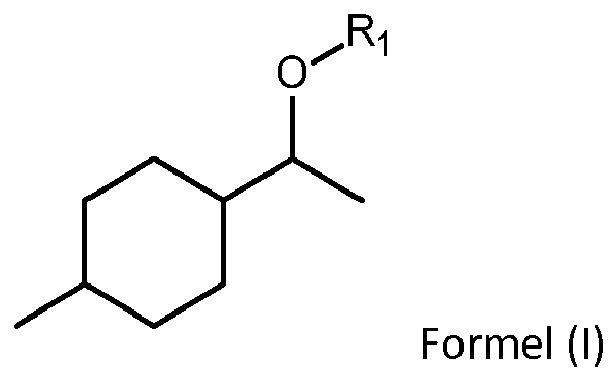
R1 = OC-R2, CH2OR3, C1-C8-offenkettiger oder verzweigten aliphatischen Rest, gegebenenfalls substituiert und/oder ungesättigt,
mit R2 = einen offenkettigen oder verzweigten aliphatischen Rest, gegebenenfalls substituiert und/oder ungesättigt, mit 2-10 C-Atomen
mit R3 = einen offenkettigen oder verzweigten aliphatischen Rest, gegebenenfalls substituiert und/oder ungesättigt, mit 1-8 C-Atomen
bedeuten.b) mindestens einen Duftstoff, verschieden von den Duftstoffen der Komponente a,dadurch gekennzeichnet, dass das Gewichtsverhältnis aller Komponenten a zu allen Komponenten b von 1:10 bis 1:10000 beträgt. - Mischung nach Anspruch 1, dadurch gekennzeichnet, dass R1 ein Propanoyl-, Butanoyl-, 2-Methylpropanoyl-, 2-Hydroxypropanoyl-, Methoxyethyl- oder 2-Methylbut-2-enyl- Rest ist.
- Mischung nach Anspruch 1, dadurch gekennzeichnet, dass der Duftstoff (Komponente a) ausgewählt ist aus 1-(4-Methylcyclo-hexyl)ethyl-propionat, 1-(4-Methylcyclo-hexyl)ethyl-butyrat, 1-(4-Methylcyclo-hexyl)ethyl-isobutyrat, 1-(4-Methylcyclo-hexyl)ethyl-2-hydroxy-propionat, 1-[1-Ethoxy-methoxy]ethyl]-4-methyl-cyclohexan und 1-Methyl-4-[1-(3-Methylbut-2-enoxy)-ethyl]-cyclohexan.
- Duftstoffmischung enthaltend mindestens zwei Duftstoffe der Formel (I).
- Verbindung der Formel

- Verbindung der Formel

- Verbindung der Formel

- Verbindung der Formel

- Konsumgut enthaltend eine Mischung nach Anspruch 1 oder mindestens eine Verbindung nach den Ansprüchen 5 bis 8.
- Konsumgut nach Anspruch 9 enthaltend Wasser.
- Konsumgut nach Anspruch 10, dadurch gekennzeichnet, dass der Anteil des Wassers in dem Konsumgut 5,0 bis 99,0 Gew.-% beträgt.
- Verwendung einer Verbindung nach einem der Ansprüche 1, 2, 3, 5, 6, 7 oder als Duftstoff, zum Verstärken positiver Geruchseindrücke oder / und zum Verstärken von blumigen und fruchtigen Geruchseindrücken.
Priority Applications (2)
| Application Number | Priority Date | Filing Date | Title |
|---|---|---|---|
| EP15174508.0A EP3112448B1 (de) | 2015-06-30 | 2015-06-30 | Derivate des 1-(4-methylcyclohexyl)-ethanols |
| US15/197,199 US10415001B2 (en) | 2015-06-30 | 2016-06-29 | Derivatives of 1-(4-methylcyclohexyl)-ethanols |
Applications Claiming Priority (1)
| Application Number | Priority Date | Filing Date | Title |
|---|---|---|---|
| EP15174508.0A EP3112448B1 (de) | 2015-06-30 | 2015-06-30 | Derivate des 1-(4-methylcyclohexyl)-ethanols |
Publications (2)
| Publication Number | Publication Date |
|---|---|
| EP3112448A1 true EP3112448A1 (de) | 2017-01-04 |
| EP3112448B1 EP3112448B1 (de) | 2018-03-21 |
Family
ID=53502514
Family Applications (1)
| Application Number | Title | Priority Date | Filing Date |
|---|---|---|---|
| EP15174508.0A Active EP3112448B1 (de) | 2015-06-30 | 2015-06-30 | Derivate des 1-(4-methylcyclohexyl)-ethanols |
Country Status (2)
| Country | Link |
|---|---|
| US (1) | US10415001B2 (de) |
| EP (1) | EP3112448B1 (de) |
Families Citing this family (1)
| Publication number | Priority date | Publication date | Assignee | Title |
|---|---|---|---|---|
| IL280076B2 (en) | 2018-07-10 | 2024-03-01 | Resorcix Ltd | Composition for inactivation of gram-positive bacteria and bacterial spores and methods of making and using same |
Citations (2)
| Publication number | Priority date | Publication date | Assignee | Title |
|---|---|---|---|---|
| DE2650602A1 (de) | 1975-11-05 | 1977-05-12 | Monsanto Co | Mittel gegen unangenehme gerueche (desodorierungsmittel) |
| EP2281581A1 (de) * | 2009-07-16 | 2011-02-09 | International Flavors & Fragrances Inc. | Zyklohexylethyl-Carboxyl-Säureesterzusammensetzungen und Verfahren zur ihrer Verwendung zur Reduktion von schlechten Gerüchen |
Family Cites Families (1)
| Publication number | Priority date | Publication date | Assignee | Title |
|---|---|---|---|---|
| US4622221A (en) * | 1975-11-05 | 1986-11-11 | Bush Boake Allen Inc. | Method, compositions and compounds, useful in room fresheners employing cyclohexyl alcohol and ester derivatives |
-
2015
- 2015-06-30 EP EP15174508.0A patent/EP3112448B1/de active Active
-
2016
- 2016-06-29 US US15/197,199 patent/US10415001B2/en active Active
Patent Citations (2)
| Publication number | Priority date | Publication date | Assignee | Title |
|---|---|---|---|---|
| DE2650602A1 (de) | 1975-11-05 | 1977-05-12 | Monsanto Co | Mittel gegen unangenehme gerueche (desodorierungsmittel) |
| EP2281581A1 (de) * | 2009-07-16 | 2011-02-09 | International Flavors & Fragrances Inc. | Zyklohexylethyl-Carboxyl-Säureesterzusammensetzungen und Verfahren zur ihrer Verwendung zur Reduktion von schlechten Gerüchen |
Non-Patent Citations (2)
| Title |
|---|
| H. SURBURG; J. PANTEN: "Common Fragrance and Flavor Materials", 2006, WILEY-VCH |
| S. ARCTANDER: "Perfume and Flavor Materials", vol. I, 1969, SELBSTVERLAG |
Also Published As
| Publication number | Publication date |
|---|---|
| US20170002294A1 (en) | 2017-01-05 |
| US10415001B2 (en) | 2019-09-17 |
| EP3112448B1 (de) | 2018-03-21 |
Similar Documents
| Publication | Publication Date | Title |
|---|---|---|
| EP1914231A2 (de) | 2-Methyl-2-alkenyl-substituierte 1,3-Dioxane als Riechstoffe | |
| DE10330865A1 (de) | 4,8-Dimethyl-7-nonen-2-on und 4,8-Dimethylnonan-2-on als Riechstoffe | |
| EP2848611B1 (de) | Octahydrobenzofurane und Octahydrochromene - Verfahren zur Herstellung und ihre Verwendung als Duftstoffe | |
| EP1747186B1 (de) | Riechstoffmischung umfassend 3-Methylbenzylisobutyrat | |
| WO2018233804A1 (de) | Neue ambra- und/oder indolartige riechstoffkompositionen | |
| EP1654246B1 (de) | Acetale, ihre verwendung als riechstoffe und verfahren zu ihrer herstellung | |
| EP1599434B1 (de) | 4-cyclohexyl-2-butanol als riechstoff | |
| EP1067126B1 (de) | Tetracyclische Acetale | |
| EP1797025B1 (de) | 4-isoamylcyclohexanol als riechstoff | |
| EP3112448B1 (de) | Derivate des 1-(4-methylcyclohexyl)-ethanols | |
| EP1992606A1 (de) | Alkenacetale und ihre Verwendung als Riechstoffe | |
| EP1761618B1 (de) | Verwendung eines gemisches von cis- und trans-3-methyl-g-decalacton sowie riechstoffkompositionen und parfümierte artikel umfassend ein solches gemisch | |
| EP2966159B1 (de) | Mischungen mit angereichten E-Isomeren von ungesättigten makrocyclischen Moschusverbindungen | |
| EP1648526B1 (de) | Cis-3,3,5-trimethylcyclohexylester | |
| WO2016083372A1 (de) | Hexahydrobenzofurane und hexahydrochromene - verfahren zur herstellung und ihre verwendung als duftstoffe | |
| DE10229474A1 (de) | Neue Riechstoffe und Verfahren zu ihrer Herstellung | |
| DE102005033642A1 (de) | 4-Isomaylcyclohexanon als Riechstoff | |
| DE10222025A1 (de) | Neue ungesättigte makrocyclische Oxalactone | |
| DE10325628A1 (de) | 2-Methyl-5-phenylpentanal als Rosenriechstoff | |
| DE10324018A1 (de) | 2-Methyl-5-phenylpentanal als Rosenriechstoff | |
| DE102005002010A1 (de) | Verwendung von 2,2-Dimethyl-3-cyclohexyl-1-propanol als Riechstoff |
Legal Events
| Date | Code | Title | Description |
|---|---|---|---|
| PUAI | Public reference made under article 153(3) epc to a published international application that has entered the european phase |
Free format text: ORIGINAL CODE: 0009012 |
|
| AK | Designated contracting states |
Kind code of ref document: A1 Designated state(s): AL AT BE BG CH CY CZ DE DK EE ES FI FR GB GR HR HU IE IS IT LI LT LU LV MC MK MT NL NO PL PT RO RS SE SI SK SM TR |
|
| AX | Request for extension of the european patent |
Extension state: BA ME |
|
| 17P | Request for examination filed |
Effective date: 20170704 |
|
| RBV | Designated contracting states (corrected) |
Designated state(s): AL AT BE BG CH CY CZ DE DK EE ES FI FR GB GR HR HU IE IS IT LI LT LU LV MC MK MT NL NO PL PT RO RS SE SI SK SM TR |
|
| GRAP | Despatch of communication of intention to grant a patent |
Free format text: ORIGINAL CODE: EPIDOSNIGR1 |
|
| RIC1 | Information provided on ipc code assigned before grant |
Ipc: C11B 9/00 20060101AFI20170905BHEP Ipc: C07C 69/68 20060101ALI20170905BHEP Ipc: C07C 69/24 20060101ALI20170905BHEP |
|
| INTG | Intention to grant announced |
Effective date: 20171009 |
|
| GRAS | Grant fee paid |
Free format text: ORIGINAL CODE: EPIDOSNIGR3 |
|
| GRAA | (expected) grant |
Free format text: ORIGINAL CODE: 0009210 |
|
| AK | Designated contracting states |
Kind code of ref document: B1 Designated state(s): AL AT BE BG CH CY CZ DE DK EE ES FI FR GB GR HR HU IE IS IT LI LT LU LV MC MK MT NL NO PL PT RO RS SE SI SK SM TR |
|
| REG | Reference to a national code |
Ref country code: GB Ref legal event code: FG4D Free format text: NOT ENGLISH |
|
| REG | Reference to a national code |
Ref country code: CH Ref legal event code: EP |
|
| REG | Reference to a national code |
Ref country code: AT Ref legal event code: REF Ref document number: 981091 Country of ref document: AT Kind code of ref document: T Effective date: 20180415 |
|
| REG | Reference to a national code |
Ref country code: IE Ref legal event code: FG4D Free format text: LANGUAGE OF EP DOCUMENT: GERMAN |
|
| REG | Reference to a national code |
Ref country code: DE Ref legal event code: R096 Ref document number: 502015003501 Country of ref document: DE |
|
| REG | Reference to a national code |
Ref country code: FR Ref legal event code: PLFP Year of fee payment: 4 |
|
| REG | Reference to a national code |
Ref country code: NL Ref legal event code: MP Effective date: 20180321 |
|
| PG25 | Lapsed in a contracting state [announced via postgrant information from national office to epo] |
Ref country code: CY Free format text: LAPSE BECAUSE OF FAILURE TO SUBMIT A TRANSLATION OF THE DESCRIPTION OR TO PAY THE FEE WITHIN THE PRESCRIBED TIME-LIMIT Effective date: 20180321 Ref country code: NO Free format text: LAPSE BECAUSE OF FAILURE TO SUBMIT A TRANSLATION OF THE DESCRIPTION OR TO PAY THE FEE WITHIN THE PRESCRIBED TIME-LIMIT Effective date: 20180621 Ref country code: FI Free format text: LAPSE BECAUSE OF FAILURE TO SUBMIT A TRANSLATION OF THE DESCRIPTION OR TO PAY THE FEE WITHIN THE PRESCRIBED TIME-LIMIT Effective date: 20180321 Ref country code: LT Free format text: LAPSE BECAUSE OF FAILURE TO SUBMIT A TRANSLATION OF THE DESCRIPTION OR TO PAY THE FEE WITHIN THE PRESCRIBED TIME-LIMIT Effective date: 20180321 Ref country code: HR Free format text: LAPSE BECAUSE OF FAILURE TO SUBMIT A TRANSLATION OF THE DESCRIPTION OR TO PAY THE FEE WITHIN THE PRESCRIBED TIME-LIMIT Effective date: 20180321 |
|
| REG | Reference to a national code |
Ref country code: LT Ref legal event code: MG4D |
|
| PG25 | Lapsed in a contracting state [announced via postgrant information from national office to epo] |
Ref country code: BG Free format text: LAPSE BECAUSE OF FAILURE TO SUBMIT A TRANSLATION OF THE DESCRIPTION OR TO PAY THE FEE WITHIN THE PRESCRIBED TIME-LIMIT Effective date: 20180621 Ref country code: RS Free format text: LAPSE BECAUSE OF FAILURE TO SUBMIT A TRANSLATION OF THE DESCRIPTION OR TO PAY THE FEE WITHIN THE PRESCRIBED TIME-LIMIT Effective date: 20180321 Ref country code: LV Free format text: LAPSE BECAUSE OF FAILURE TO SUBMIT A TRANSLATION OF THE DESCRIPTION OR TO PAY THE FEE WITHIN THE PRESCRIBED TIME-LIMIT Effective date: 20180321 Ref country code: SE Free format text: LAPSE BECAUSE OF FAILURE TO SUBMIT A TRANSLATION OF THE DESCRIPTION OR TO PAY THE FEE WITHIN THE PRESCRIBED TIME-LIMIT Effective date: 20180321 Ref country code: GR Free format text: LAPSE BECAUSE OF FAILURE TO SUBMIT A TRANSLATION OF THE DESCRIPTION OR TO PAY THE FEE WITHIN THE PRESCRIBED TIME-LIMIT Effective date: 20180622 |
|
| PG25 | Lapsed in a contracting state [announced via postgrant information from national office to epo] |
Ref country code: MT Free format text: LAPSE BECAUSE OF FAILURE TO SUBMIT A TRANSLATION OF THE DESCRIPTION OR TO PAY THE FEE WITHIN THE PRESCRIBED TIME-LIMIT Effective date: 20180321 |
|
| PG25 | Lapsed in a contracting state [announced via postgrant information from national office to epo] |
Ref country code: RO Free format text: LAPSE BECAUSE OF FAILURE TO SUBMIT A TRANSLATION OF THE DESCRIPTION OR TO PAY THE FEE WITHIN THE PRESCRIBED TIME-LIMIT Effective date: 20180321 Ref country code: IT Free format text: LAPSE BECAUSE OF FAILURE TO SUBMIT A TRANSLATION OF THE DESCRIPTION OR TO PAY THE FEE WITHIN THE PRESCRIBED TIME-LIMIT Effective date: 20180321 Ref country code: PL Free format text: LAPSE BECAUSE OF FAILURE TO SUBMIT A TRANSLATION OF THE DESCRIPTION OR TO PAY THE FEE WITHIN THE PRESCRIBED TIME-LIMIT Effective date: 20180321 Ref country code: NL Free format text: LAPSE BECAUSE OF FAILURE TO SUBMIT A TRANSLATION OF THE DESCRIPTION OR TO PAY THE FEE WITHIN THE PRESCRIBED TIME-LIMIT Effective date: 20180321 Ref country code: ES Free format text: LAPSE BECAUSE OF FAILURE TO SUBMIT A TRANSLATION OF THE DESCRIPTION OR TO PAY THE FEE WITHIN THE PRESCRIBED TIME-LIMIT Effective date: 20180321 Ref country code: EE Free format text: LAPSE BECAUSE OF FAILURE TO SUBMIT A TRANSLATION OF THE DESCRIPTION OR TO PAY THE FEE WITHIN THE PRESCRIBED TIME-LIMIT Effective date: 20180321 Ref country code: AL Free format text: LAPSE BECAUSE OF FAILURE TO SUBMIT A TRANSLATION OF THE DESCRIPTION OR TO PAY THE FEE WITHIN THE PRESCRIBED TIME-LIMIT Effective date: 20180321 |
|
| PG25 | Lapsed in a contracting state [announced via postgrant information from national office to epo] |
Ref country code: SM Free format text: LAPSE BECAUSE OF FAILURE TO SUBMIT A TRANSLATION OF THE DESCRIPTION OR TO PAY THE FEE WITHIN THE PRESCRIBED TIME-LIMIT Effective date: 20180321 Ref country code: SK Free format text: LAPSE BECAUSE OF FAILURE TO SUBMIT A TRANSLATION OF THE DESCRIPTION OR TO PAY THE FEE WITHIN THE PRESCRIBED TIME-LIMIT Effective date: 20180321 Ref country code: CZ Free format text: LAPSE BECAUSE OF FAILURE TO SUBMIT A TRANSLATION OF THE DESCRIPTION OR TO PAY THE FEE WITHIN THE PRESCRIBED TIME-LIMIT Effective date: 20180321 |
|
| PG25 | Lapsed in a contracting state [announced via postgrant information from national office to epo] |
Ref country code: PT Free format text: LAPSE BECAUSE OF FAILURE TO SUBMIT A TRANSLATION OF THE DESCRIPTION OR TO PAY THE FEE WITHIN THE PRESCRIBED TIME-LIMIT Effective date: 20180723 |
|
| REG | Reference to a national code |
Ref country code: DE Ref legal event code: R097 Ref document number: 502015003501 Country of ref document: DE |
|
| PLBE | No opposition filed within time limit |
Free format text: ORIGINAL CODE: 0009261 |
|
| STAA | Information on the status of an ep patent application or granted ep patent |
Free format text: STATUS: NO OPPOSITION FILED WITHIN TIME LIMIT |
|
| PG25 | Lapsed in a contracting state [announced via postgrant information from national office to epo] |
Ref country code: DK Free format text: LAPSE BECAUSE OF FAILURE TO SUBMIT A TRANSLATION OF THE DESCRIPTION OR TO PAY THE FEE WITHIN THE PRESCRIBED TIME-LIMIT Effective date: 20180321 |
|
| REG | Reference to a national code |
Ref country code: CH Ref legal event code: PL |
|
| 26N | No opposition filed |
Effective date: 20190102 |
|
| REG | Reference to a national code |
Ref country code: BE Ref legal event code: MM Effective date: 20180630 |
|
| PG25 | Lapsed in a contracting state [announced via postgrant information from national office to epo] |
Ref country code: LU Free format text: LAPSE BECAUSE OF NON-PAYMENT OF DUE FEES Effective date: 20180630 Ref country code: MC Free format text: LAPSE BECAUSE OF FAILURE TO SUBMIT A TRANSLATION OF THE DESCRIPTION OR TO PAY THE FEE WITHIN THE PRESCRIBED TIME-LIMIT Effective date: 20180321 |
|
| REG | Reference to a national code |
Ref country code: IE Ref legal event code: MM4A |
|
| PG25 | Lapsed in a contracting state [announced via postgrant information from national office to epo] |
Ref country code: IE Free format text: LAPSE BECAUSE OF NON-PAYMENT OF DUE FEES Effective date: 20180630 Ref country code: CH Free format text: LAPSE BECAUSE OF NON-PAYMENT OF DUE FEES Effective date: 20180630 Ref country code: LI Free format text: LAPSE BECAUSE OF NON-PAYMENT OF DUE FEES Effective date: 20180630 |
|
| PG25 | Lapsed in a contracting state [announced via postgrant information from national office to epo] |
Ref country code: BE Free format text: LAPSE BECAUSE OF NON-PAYMENT OF DUE FEES Effective date: 20180630 Ref country code: SI Free format text: LAPSE BECAUSE OF FAILURE TO SUBMIT A TRANSLATION OF THE DESCRIPTION OR TO PAY THE FEE WITHIN THE PRESCRIBED TIME-LIMIT Effective date: 20180321 |
|
| PG25 | Lapsed in a contracting state [announced via postgrant information from national office to epo] |
Ref country code: TR Free format text: LAPSE BECAUSE OF FAILURE TO SUBMIT A TRANSLATION OF THE DESCRIPTION OR TO PAY THE FEE WITHIN THE PRESCRIBED TIME-LIMIT Effective date: 20180321 |
|
| PG25 | Lapsed in a contracting state [announced via postgrant information from national office to epo] |
Ref country code: HU Free format text: LAPSE BECAUSE OF FAILURE TO SUBMIT A TRANSLATION OF THE DESCRIPTION OR TO PAY THE FEE WITHIN THE PRESCRIBED TIME-LIMIT; INVALID AB INITIO Effective date: 20150630 Ref country code: MK Free format text: LAPSE BECAUSE OF NON-PAYMENT OF DUE FEES Effective date: 20180321 |
|
| PG25 | Lapsed in a contracting state [announced via postgrant information from national office to epo] |
Ref country code: IS Free format text: LAPSE BECAUSE OF FAILURE TO SUBMIT A TRANSLATION OF THE DESCRIPTION OR TO PAY THE FEE WITHIN THE PRESCRIBED TIME-LIMIT Effective date: 20180721 |
|
| REG | Reference to a national code |
Ref country code: AT Ref legal event code: MM01 Ref document number: 981091 Country of ref document: AT Kind code of ref document: T Effective date: 20200630 |
|
| PG25 | Lapsed in a contracting state [announced via postgrant information from national office to epo] |
Ref country code: AT Free format text: LAPSE BECAUSE OF NON-PAYMENT OF DUE FEES Effective date: 20200630 |
|
| PGFP | Annual fee paid to national office [announced via postgrant information from national office to epo] |
Ref country code: DE Payment date: 20250618 Year of fee payment: 11 |
|
| PGFP | Annual fee paid to national office [announced via postgrant information from national office to epo] |
Ref country code: GB Payment date: 20250620 Year of fee payment: 11 |
|
| PGFP | Annual fee paid to national office [announced via postgrant information from national office to epo] |
Ref country code: FR Payment date: 20250626 Year of fee payment: 11 |