EP3100282B1 - Electrical insulation material and transformer - Google Patents
Electrical insulation material and transformer Download PDFInfo
- Publication number
- EP3100282B1 EP3100282B1 EP15740827.9A EP15740827A EP3100282B1 EP 3100282 B1 EP3100282 B1 EP 3100282B1 EP 15740827 A EP15740827 A EP 15740827A EP 3100282 B1 EP3100282 B1 EP 3100282B1
- Authority
- EP
- European Patent Office
- Prior art keywords
- article
- paper
- kaolin clay
- transformer
- oil
- Prior art date
- Legal status (The legal status is an assumption and is not a legal conclusion. Google has not performed a legal analysis and makes no representation as to the accuracy of the status listed.)
- Active
Links
Images
Classifications
-
- H—ELECTRICITY
- H01—ELECTRIC ELEMENTS
- H01B—CABLES; CONDUCTORS; INSULATORS; SELECTION OF MATERIALS FOR THEIR CONDUCTIVE, INSULATING OR DIELECTRIC PROPERTIES
- H01B3/00—Insulators or insulating bodies characterised by the insulating materials; Selection of materials for their insulating or dielectric properties
- H01B3/002—Inhomogeneous material in general
-
- D—TEXTILES; PAPER
- D21—PAPER-MAKING; PRODUCTION OF CELLULOSE
- D21H—PULP COMPOSITIONS; PREPARATION THEREOF NOT COVERED BY SUBCLASSES D21C OR D21D; IMPREGNATING OR COATING OF PAPER; TREATMENT OF FINISHED PAPER NOT COVERED BY CLASS B31 OR SUBCLASS D21G; PAPER NOT OTHERWISE PROVIDED FOR
- D21H13/00—Pulp or paper, comprising synthetic cellulose or non-cellulose fibres or web-forming material
- D21H13/10—Organic non-cellulose fibres
-
- D—TEXTILES; PAPER
- D21—PAPER-MAKING; PRODUCTION OF CELLULOSE
- D21H—PULP COMPOSITIONS; PREPARATION THEREOF NOT COVERED BY SUBCLASSES D21C OR D21D; IMPREGNATING OR COATING OF PAPER; TREATMENT OF FINISHED PAPER NOT COVERED BY CLASS B31 OR SUBCLASS D21G; PAPER NOT OTHERWISE PROVIDED FOR
- D21H13/00—Pulp or paper, comprising synthetic cellulose or non-cellulose fibres or web-forming material
- D21H13/10—Organic non-cellulose fibres
- D21H13/12—Organic non-cellulose fibres from macromolecular compounds obtained by reactions only involving carbon-to-carbon unsaturated bonds
- D21H13/16—Polyalkenylalcohols; Polyalkenylethers; Polyalkenylesters
-
- D—TEXTILES; PAPER
- D21—PAPER-MAKING; PRODUCTION OF CELLULOSE
- D21H—PULP COMPOSITIONS; PREPARATION THEREOF NOT COVERED BY SUBCLASSES D21C OR D21D; IMPREGNATING OR COATING OF PAPER; TREATMENT OF FINISHED PAPER NOT COVERED BY CLASS B31 OR SUBCLASS D21G; PAPER NOT OTHERWISE PROVIDED FOR
- D21H13/00—Pulp or paper, comprising synthetic cellulose or non-cellulose fibres or web-forming material
- D21H13/36—Inorganic fibres or flakes
- D21H13/38—Inorganic fibres or flakes siliceous
- D21H13/40—Inorganic fibres or flakes siliceous vitreous, e.g. mineral wool, glass fibres
-
- D—TEXTILES; PAPER
- D21—PAPER-MAKING; PRODUCTION OF CELLULOSE
- D21H—PULP COMPOSITIONS; PREPARATION THEREOF NOT COVERED BY SUBCLASSES D21C OR D21D; IMPREGNATING OR COATING OF PAPER; TREATMENT OF FINISHED PAPER NOT COVERED BY CLASS B31 OR SUBCLASS D21G; PAPER NOT OTHERWISE PROVIDED FOR
- D21H17/00—Non-fibrous material added to the pulp, characterised by its constitution; Paper-impregnating material characterised by its constitution
- D21H17/63—Inorganic compounds
- D21H17/67—Water-insoluble compounds, e.g. fillers, pigments
-
- D—TEXTILES; PAPER
- D21—PAPER-MAKING; PRODUCTION OF CELLULOSE
- D21H—PULP COMPOSITIONS; PREPARATION THEREOF NOT COVERED BY SUBCLASSES D21C OR D21D; IMPREGNATING OR COATING OF PAPER; TREATMENT OF FINISHED PAPER NOT COVERED BY CLASS B31 OR SUBCLASS D21G; PAPER NOT OTHERWISE PROVIDED FOR
- D21H21/00—Non-fibrous material added to the pulp, characterised by its function, form or properties; Paper-impregnating or coating material, characterised by its function, form or properties
- D21H21/14—Non-fibrous material added to the pulp, characterised by its function, form or properties; Paper-impregnating or coating material, characterised by its function, form or properties characterised by function or properties in or on the paper
- D21H21/18—Reinforcing agents
-
- H—ELECTRICITY
- H01—ELECTRIC ELEMENTS
- H01B—CABLES; CONDUCTORS; INSULATORS; SELECTION OF MATERIALS FOR THEIR CONDUCTIVE, INSULATING OR DIELECTRIC PROPERTIES
- H01B3/00—Insulators or insulating bodies characterised by the insulating materials; Selection of materials for their insulating or dielectric properties
- H01B3/18—Insulators or insulating bodies characterised by the insulating materials; Selection of materials for their insulating or dielectric properties mainly consisting of organic substances
- H01B3/28—Insulators or insulating bodies characterised by the insulating materials; Selection of materials for their insulating or dielectric properties mainly consisting of organic substances natural or synthetic rubbers
-
- H—ELECTRICITY
- H01—ELECTRIC ELEMENTS
- H01B—CABLES; CONDUCTORS; INSULATORS; SELECTION OF MATERIALS FOR THEIR CONDUCTIVE, INSULATING OR DIELECTRIC PROPERTIES
- H01B3/00—Insulators or insulating bodies characterised by the insulating materials; Selection of materials for their insulating or dielectric properties
- H01B3/18—Insulators or insulating bodies characterised by the insulating materials; Selection of materials for their insulating or dielectric properties mainly consisting of organic substances
- H01B3/30—Insulators or insulating bodies characterised by the insulating materials; Selection of materials for their insulating or dielectric properties mainly consisting of organic substances plastics; resins; waxes
- H01B3/44—Insulators or insulating bodies characterised by the insulating materials; Selection of materials for their insulating or dielectric properties mainly consisting of organic substances plastics; resins; waxes vinyl resins; acrylic resins
- H01B3/448—Insulators or insulating bodies characterised by the insulating materials; Selection of materials for their insulating or dielectric properties mainly consisting of organic substances plastics; resins; waxes vinyl resins; acrylic resins from other vinyl compounds
-
- H—ELECTRICITY
- H01—ELECTRIC ELEMENTS
- H01B—CABLES; CONDUCTORS; INSULATORS; SELECTION OF MATERIALS FOR THEIR CONDUCTIVE, INSULATING OR DIELECTRIC PROPERTIES
- H01B3/00—Insulators or insulating bodies characterised by the insulating materials; Selection of materials for their insulating or dielectric properties
- H01B3/18—Insulators or insulating bodies characterised by the insulating materials; Selection of materials for their insulating or dielectric properties mainly consisting of organic substances
- H01B3/30—Insulators or insulating bodies characterised by the insulating materials; Selection of materials for their insulating or dielectric properties mainly consisting of organic substances plastics; resins; waxes
- H01B3/47—Insulators or insulating bodies characterised by the insulating materials; Selection of materials for their insulating or dielectric properties mainly consisting of organic substances plastics; resins; waxes fibre-reinforced plastics, e.g. glass-reinforced plastics
-
- H—ELECTRICITY
- H01—ELECTRIC ELEMENTS
- H01F—MAGNETS; INDUCTANCES; TRANSFORMERS; SELECTION OF MATERIALS FOR THEIR MAGNETIC PROPERTIES
- H01F27/00—Details of transformers or inductances, in general
- H01F27/28—Coils; Windings; Conductive connections
- H01F27/2876—Cooling
-
- H—ELECTRICITY
- H01—ELECTRIC ELEMENTS
- H01F—MAGNETS; INDUCTANCES; TRANSFORMERS; SELECTION OF MATERIALS FOR THEIR MAGNETIC PROPERTIES
- H01F27/00—Details of transformers or inductances, in general
- H01F27/28—Coils; Windings; Conductive connections
- H01F27/32—Insulating of coils, windings, or parts thereof
- H01F27/327—Encapsulating or impregnating
Definitions
- This invention relates to materials suitable for electrical insulation applications.
- this invention relates to electrical insulation materials suitable for transformers, such as liquid filled transformers.
- a conventional insulating material is Kraft paper, which is a cellulose-based material that is often utilized in liquid filled transformers.
- cellulose paper suffers from several disadvantages such as high moisture absorption, water generation upon degradation, and limited thermal capabilities.
- Current liquid filled transformers require a moisture content of less than 0.5 wt% to operate reliably throughout its designed product lifetime. Water contamination in a liquid filled transformer results in reduced performance through increased electrical losses and electrical discharge activity. Because of its strong affinity for water (hygroscopic), cellulose paper forces liquid filled transformer manufacturers to spend extensive time and energy towards drying out these materials prior to final assembly into a liquid filled transformer. The presence of moisture can further accelerate cellulose degradation and results in additional release of water as a degradation product.
- Standard Kraft paper has a thermal class of 105°C and thermally upgraded Kraft has a thermal class of 120°C.
- the maximum operating temperature of the liquid filled transformer insulated with Kraft paper is limited by the thermal capabilities of the Kraft paper.
- WO 2015/032126 A1 discloses inorganic fiber paper comprising inorganic fibers, glass fibers, organic reinforcing fibers like unhydrolyzed PVA, and an organic binder.
- US 4237825 A discloses an electric insulating laminated sheet comprising polyamide-imide fibers, glass fibers, unhydrolyzed PVA fibers, and mica.
- JP S64 14462 A discloses an insulating sheet comprising glass fibers, PE fibers, PVA which is not in the form of fibers, and colloidal silica.
- JP 2003/095754 A discloses a paper comprising cellulose fibers, aluminum oxide powder, clay, PVA fibers, and glass fibers. Fully hydrolyzed polyvinyl alcohol fibers are not disclosed.
- the materials of the present invention are suitable for insulating electrical components in transformers, motors, generators, and other devices requiring insulation of electrical components.
- such materials are suitable as insulation paper for liquid filled transformers and other liquid filled electrical components.
- At least some embodiments of the present invention provide an insulation article having lower moisture absorption. At least some embodiments of the present invention provide an electrically insulating paper having desirable moisture absorption, thermal stability and thermal conductivity when compared to conventional cellulose-based Kraft paper.
- At least one embodiment of the present invention provides an article comprising an inorganic filler wherein the inorganic filler comprises kaolin clay, 3 % to 20 % fully hydrolyzed polyvinyl alcohol fibers, wherein the percentages are by weight, a polymer binder, and high surface area fibers comprising glass microfibers.
- the article is formed as a nonwoven paper.
- the inorganic filler comprises kaolin clay.
- the kaolin clay comprises at least one of water-washed kaolin clay, delaminated kaolin clay, calcined kaolin clay, and surface-treated kaolin clay.
- the polymer binder comprises a latex-based material.
- the polymer binder comprises at least one of acrylic, nitrile, and styrene acrylic latex.
- the high surface area fiber comprises a glass microfiber.
- the article comprises from about 3% to about 20% fully hydrolyzed polyvinyl alcohol fibers.
- the article comprises from about 50% to about 85% kaolin clay, from about 7% to about 25% polymer binder, and from about 2% to about 10% glass microfiber. The percentages are by weight.
- the article is substantially cellulose free.
- the article is non-hygroscopic.
- the electrical equipment comprises one of a transformer, a motor, and a generator.
- the electrical equipment comprises a liquid filled transformer.
- an oil filled transformer comprising electrical insulating paper having fully hydrolyzed polyvinyl alcohol fibers, further comprising an inorganic filler, a polymer binder, and glass microfibers.
- the oil filled transformer comprises the electrical insulating paper comprising about 3% to about 20% fully hydrolyzed polyvinyl alcohol fibers, from about 50% to about 85% kaolin clay, from about 7% to about 25% polymer binder, and from about 2% to about 10% glass microfiber, wherein the percentages are by weight, and wherein the electrical insulating paper is substantially cellulose free.
- At least one embodiment of the present invention provides an article formed as a nonwoven paper comprising an inorganic filler comprising kaolin clay, 3-20 wt.-% fully hydrolyzed polyvinyl alcohol fibers, a polymer binder, and high surface area fibers comprising glass microfibers.
- the article can be formed as an insulating paper for electrical equipment, such as transformers, motors, generators. Electrical equipment is sometimes filled with an insulating (dielectric) liquid or fluid. Typical fluids used in liquid filled electrical equipment can include mineral oil, natural ester oils, synthetic ester oils, silicone oils, and the like.
- the article can be formed as an insulating paper for liquid-filled electrical equipment, such as liquid filled transformers, liquid filled cable, and liquid filled switchgear. As a result, the insulating system, and the electrical equipment, can be substantially cellulose free.
- At least some embodiments of the present invention provide an electrical insulation article having lower moisture absorption, higher thermal stability and higher thermal conductivity as compared to conventional cellulose-based Kraft paper.
- cellulose-based Kraft paper has been used in the liquid filled transformer industry for many years, the high moisture absorption, susceptibility to hydrolysis, and limited high temperature capabilities are known disadvantages.
- fully hydrolyzed polyvinyl alcohol fibers more particularly a combination of an inorganic filler, such as kaolin clay, and fully hydrolyzed polyvinyl alcohol fibers in the article, an electrically insulating paper with lower moisture absorption, better hydrolytic stability, higher thermal stability, and higher thermal conductivity has been demonstrated as compared to standard Kraft paper.
- the article and electrically insulating paper for liquid filled transformers described herein can provide a transformer manufacturer with the ability to reduce current extensive time and energy-consuming dry out cycles that are typically performed to dry out a transformer unit insulated with traditional Kraft paper prior to oil impregnation. These dry out cycles may last from between 12 hours to several days depending on design and size of unit. Further, not only is Kraft cellulose paper hygroscopic, the aging and actual degradation of cellulose generates water as a by-product which can further reduce the insulation qualities of the transformer oil.
- the electrically insulating paper comprises polyvinyl alcohol (PVOH) fibers.
- the electrically insulating paper comprises from about 3% to about 20% fully hydrolyzed polyvinyl alcohol fibers by weight.
- fully hydrolyzed it is meant that the fibers contain less than 5% unhydrolyzed vinyl acetate units and therefore have a degree of hydrolysis of at least 95%.
- Fully hydrolyzed polyvinyl alcohol typically has a melting point of 230°C. More preferably, the fully hydrolyzed fibers possess high tenacity (> 6g/denier). Fully hydrolyzed, high tenacity polyvinyl alcohol fibers are typically insoluble in water at room temperature. Polyvinyl alcohol fibers with a low degree of hydrolysis are typically soluble in water at room temperature and are typically used as binder fibers. Partially hydrolyzed polyvinyl alcohol typically has a melting point ranging from 180-190°C.
- the electrically insulating paper comprises an inorganic filler comprising kaolin clay.
- the inorganic filler may be surface treated. Suitable types of kaolin clay include, but are not limited to, water-washed kaolin clay; delaminated kaolin clay; calcined kaolin clay; and surface-treated kaolin clay.
- the electrically insulating paper comprises from about 50% to about 85% kaolin clay by weight.
- the electrically insulating paper comprises a polymer binder.
- a suitable polymer binder may include a latex-based material.
- suitable polymer binders can include, but are not limited to, acrylic, nitrile, styrene acrylic latex, guar gum, starch, and natural rubber latex.
- the electrically insulating paper comprises from about 7% to about 25% polymer binder by weight.
- the electrically insulating paper comprises a high surface area fiber comprising glass microfibers.
- the electrically insulating paper comprises from about 2% to about 10% glass microfiber by weight.
- the high surface area fiber has an average diameter of about 0.6 ⁇ m or less. The high surface area fiber can be used to help drain the mixture through the paper formation process.
- the electrically insulating paper is formed as a nonwoven paper.
- the nonwoven paper may be formed from a standard paper process.
- the elements of the formulation can be mixed as a slurry in water, pumped into a cylinder paper machine, formed into a sheet, then dried.
- the nonwoven paper may also be calendered to produce a high density paper.
- the result is a nonwoven, non-hygroscopic insulating paper suitable for use in electrical equipment, such as for the insulation system within a liquid filled transformer.
- the electrically insulating paper is oil saturable.
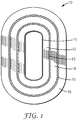
- FIG. 1 shows another aspect of the present invention, a diagram of an insulation system 10 for a liquid filled transformer.
- the transformer comprises an oil filled transformer.
- the insulation system 10 is shown as a winding for a transformer.
- a winding form 11 is provided in the center region of insulation system 10.
- the winding form may be formed as a thick board insulation formed from the electrically insulating paper described above.
- a first low voltage winding 12 surrounds the winding form 11.
- the winding 12 comprises one or more layers of wound conductor separated by layer insulation, e.g., one or more layers of insulating paper (such as the electrically insulating paper described above).
- a first interwinding insulation 13 is provided around the first low voltage winding 12 and can be formed from one or more layers of the electrically insulating paper described above.
- a first high voltage winding 14, comprising one or more layers of wound conductor separated by layer insulation, e.g., one or more layers of insulating paper (such as the electrically insulating paper described above), surrounds the first interwinding insulation 13.
- a second interwinding insulation 15 is provided around the first high voltage winding 14 and can be formed from one or more layers of the electrically insulating paper described above.
- a second low voltage winding 16 (constructed in a similar manner as above) can surround the second interwinding insulation 15.
- Spacers, tubes, tapes, boards and other conventional transformer components may also be included, as would be understood by one of skill in the art.
- One or more of these additional transformer components may also be formed from the electrically insulating paper described herein.
- the entire assembly may be immersed in oil, such as mineral oil, silicone oil, natural or synthetic ester oil, or other conventional transformer fluids.
- transformers can be approved for a higher operating class, and can be designed to meet, e.g., IEEE Std. C57.154-2012.
- the exemplary electrically insulating nonwoven papers were made using methods known in the art, as follows: A mixture of 6 wt% microglass (B-04 from Lauscha Fiber International), 64 wt% delaminated kaolin clay (HYDRAPRINT from KaMin, LLC, USA), 13% poly(vinyl alcohol) fiber (fully hydrolyzed, 1.8 denier x 6 mm, fiber tenacity of 13 g/denier, from Minifibers Inc, USA), and 17 wt% acrylic latex (HYCAR 26362, Lubrizol Corp) was dispersed in water to form a slurry with a solids content of about 2% by weight.
- Lab handsheet samples were made by mixing the furnish in a laboratory blender, dewatering through a papermaking screen and press, and drying in a laboratory handsheet dryer.
- Comparative example CE1 was a commercially available insulating cellulose-based Kraft paper and was used as received. Test Methodologies PROPERTY TEST METHOD TITLE Dielectric Strength ASTM D149-09 Standard Test Method for Dielectric Breakdown Voltage and Dielectric Breakdown Strength of Solid Electrical Insulating Materials at Commercial Power Frequencies Compatibility with Insulating Oil ASTM D3455-11 Standard Test Methods for Compatibility of Construction Material with Electrical Insulating Oil of Petroleum Origin Dielectric Loss ASTM D-150-11 Standard Test Methods for AC Loss Characteristics and Permittivity (Dielectric Constant) of Solid Electrical Insulation Dielectric Constant ASTM D-150-11 Standard Test Methods for AC Loss Characteristics and Permittivity (Dielectric Constant) of Solid Electrical Insulation Thermal Aging Life Curve Testing IEEE C57.100-2011 Standard Test Procedure for Thermal Evaluation of Insulation Systems for Liquid-Immersed Distribution and Power Transformers MD Tensile Strength ASTM D-828-97 (2002) Standard Test Method for Tensile Properties of Paper and Paperboard Using Cons
- Color of the oils after aging with the sample papers was determined by visual inspection. A relative ranking of between 1 and 7 was assigned each sample. A ranking of 1 indicated a light color and 7 indicated that the oil was dark.
- Thermal conductivity of the samples was measured using a modified ASTM D5470-06 Heat Flow Meter according to the following procedure.
- the hot and cold meter bars 2 in. (5 cm) in diameter and approximately 3 in. (7.6 cm) long, are instrumented with six evenly-spaced thermocouples, the first of which is 5.0 mm away from the interface between the bars.
- the bars are constructed from brass, with a reference thermal conductivity of 130 W/m-K.
- the contacting faces of the meter bars are parallel to within about 5 microns, and the force on the sample during testing is approximately 120N.
- the thickness of the sample is measured during testing by a digital displacement transducer with a nominal accuracy of 2 microns.
- the digital displacement transducer When the meter bars have reached equilibrium, the digital displacement transducer is zeroed.
- the insulation paper samples were submersed into insulation oil within a glass jar and then deaerated under vacuum in a vacuum oven at room temperature.
- the oil saturated insulation paper samples were removed from the oil and placed onto the bottom meter bar.
- the oil served as the interfacial fluid to eliminate thermal contact resistance.
- the meter bars were closed and the normal force applied. Measurements of the heat flow through the meter bars, and the thickness of the sample are made throughout the duration of the test, typically about 30 minutes. Equilibrium is generally reached within about 10 minutes.
- the thermal conductivity of the sample, k is then calculated from the thickness of the sample (L), the thermal conductivity of the meter bars (k m ), the temperature gradient in the meter bars (dT/dx), and the extrapolated temperature difference across the sample (T u - T l ).
- k k m dT / dx T u ⁇ T l / L
- Table 1 shows that the dielectric strengths of Examples 1 and 2 are similar to the dielectric strength of CE1 in mineral oil, in natural ester vegetable oil (ENVIROTEMP FR3 from Cargill Inc., USA), and in air (no oil). TABLE 1. DIELECTRIC STRENGTH, V/MIL EXAMPLE 1 EXAMPLE 2 CE1 Standard Density High Density Kraft Paper Mineral Oil 1343 1683 1450 FR3 Oil 1384 1477 1810 No Oil (in Air) 143 227 232
- the insulating paper should also be compatible with the insulating oils and should not substantially reduce the insulating qualities of the oil.
- Table 2 shows results of dielectric loss measurements and color of the insulating oils after aging with the developmental and comparative papers at 302°F (150°C). Insulating paper samples were conditioned in two ways before placing into the oil: one set was dried in a vacuum oven, and the other set was conditioned for 24 hrs in a controlled 23C, 50% RH environment. The jars of oil containing the insulating paper samples were then placed into a vacuum chamber and held at elevated temperature for a few hours in order to infuse the paper with oil. The results show that the conditioning environment of the developmental paper has little effect on the dielectric loss of the insulating oils.
- insulating oils that were aged with the insulating papers of this invention had lower dielectric loss, indicating better electrical insulation performance, in comparison to insulating oils aged with CE1.
- the color of the insulating oil is another distinguishing characteristic of insulation oil quality.
- the oils aged with Kraft cellulose paper (CE1) were noticeably darker, which indicates that higher levels of degradation products from the paper are present in the oil.
- Table 2 DIELECTRIC LOSS COLOR Ex. 1 Ex. 2 CE1 Ex. 1 Ex. 2 CE1 FR3 Oil 1.7% 3.0% 5.8% 5 4 7 50% RH FR3 Oil 2.7% 2.1% N/A 3 6 N/A Mineral Oil 1.2% 0.50% 1.0% 6 6 7 50% RH Mineral Oil 0.55% 0.37% N/A 5 2 N/A
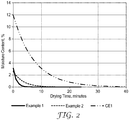
- Tables 3 and 4 show that the dielectric loss and dielectric constant of the papers of the current invention are similar to CE1 after aging in dry conditions, when measured at ambient and elevated temperature. However, test results after aging in conditions of 23°C and 50% relative humidity (RH) show that the dielectric properties of Examples 1 and 2 are much less sensitive to ambient moisture content than CE1. The substantially lower water absorption levels of Examples 1 and 2 compared to CElis also evident from the results shown in Table 5. There was no statistically significant difference between the water absorption levels of the standard density paper (Example 1) and the high density paper (Example 2) and both were considerably lower than the degree of water absorption of CE1. Table 3. AGING CONDITIONS DIELECTRIC LOSS @ 23 °C DIELECTRIC LOSS @ 100 °C Ex.
- Example 1 shows excellent retained tensile strength (97%) after aging at 190°C for 700 hours in mineral oil.
- CE1 after aging in mineral oil at 180°C, has already reached 0% retained tensile strength at 500 hours aging time and 50% retained tensile strength at 235 hours of aging time. (Note that the end of life test value is typically considered to be the time at which 50% retained tensile strength is reached.)
- the much higher retained tensile strength of the exemplary cellulose-free electrically insulating papers in comparison to CE1 indicates the potential for the insulating papers of this invention to function at higher transformer operational temperatures. Table 7.
- the mechanical properties of the illustrative and comparison examples are summarized in Table 8.
- the tear strength of Examples 1 and 2 in both machine direction (MD) and cross direction (CD) appears to be comparable to CE1.
- MD machine direction
- CD cross direction
- the tensile strengths of Examples 1 and 2 are not as high as CE1
- a coil winding trial by a transformer manufacturer indicated that the tensile strength of the inventive papers is sufficient to withstand the transformer manufacturing process.
- the transformer unit made with Example 1 passed standard quality control tests requirements.
- resistance measurements performed before and after drying the transformer unit made with Example 1 indicated that the drying step may be eliminated.
- Thermal conductivity results show that Examples 1 and 2 both demonstrate a higher thermal conductivity than CE1 when saturated in mineral oil.
- Table 8 Ex. 1 Ex. 2 CE1 MD Tensile Strength, lb/in (N/mm) 30 (5.3) 33 (5.8) 80 (14) MD Tear Strength, g 248 172 168 CD Tear Strength, g 358 281 240 MD Stiffness, mg 1032 534 1313 CD Stiffness, mg 652 304 307 Thermal Conductivity in Mineral Oil, W/m-K 0.261 0.333 0.24
Landscapes
- Engineering & Computer Science (AREA)
- Power Engineering (AREA)
- Physics & Mathematics (AREA)
- Spectroscopy & Molecular Physics (AREA)
- Chemical & Material Sciences (AREA)
- Inorganic Chemistry (AREA)
- Chemical Kinetics & Catalysis (AREA)
- Paper (AREA)
- Organic Insulating Materials (AREA)
- Insulating Of Coils (AREA)
- Inorganic Insulating Materials (AREA)
- Compositions Of Macromolecular Compounds (AREA)
Applications Claiming Priority (2)
| Application Number | Priority Date | Filing Date | Title |
|---|---|---|---|
| US201461931792P | 2014-01-27 | 2014-01-27 | |
| PCT/US2015/012982 WO2015113012A1 (en) | 2014-01-27 | 2015-01-27 | Electrical insulation material and transformer |
Publications (3)
| Publication Number | Publication Date |
|---|---|
| EP3100282A1 EP3100282A1 (en) | 2016-12-07 |
| EP3100282A4 EP3100282A4 (en) | 2017-08-09 |
| EP3100282B1 true EP3100282B1 (en) | 2019-09-04 |
Family
ID=53682036
Family Applications (1)
| Application Number | Title | Priority Date | Filing Date |
|---|---|---|---|
| EP15740827.9A Active EP3100282B1 (en) | 2014-01-27 | 2015-01-27 | Electrical insulation material and transformer |
Country Status (6)
| Country | Link |
|---|---|
| US (1) | US20160343465A1 (enExample) |
| EP (1) | EP3100282B1 (enExample) |
| JP (1) | JP6594321B2 (enExample) |
| CN (1) | CN105934801B (enExample) |
| TW (1) | TW201542908A (enExample) |
| WO (1) | WO2015113012A1 (enExample) |
Families Citing this family (8)
| Publication number | Priority date | Publication date | Assignee | Title |
|---|---|---|---|---|
| EP3069868B1 (en) * | 2015-03-17 | 2025-06-04 | Hitachi Energy Ltd | Inorganic electrical insulation material |
| US20180061523A1 (en) * | 2016-08-25 | 2018-03-01 | 3M Innovative Properties Company | Thermally conductive electrical insulation material |
| CN106653342B (zh) * | 2016-12-02 | 2018-03-06 | 国网四川省电力公司电力科学研究院 | 均匀高温绝缘系统油浸式变压器及其结构优化方法 |
| EP3796941A4 (en) | 2018-05-30 | 2022-12-28 | Purdue Research Foundation | Targeting anabolic drugs for accelerated fracture repair |
| US20210280336A1 (en) * | 2018-07-26 | 2021-09-09 | 3M Innovative Properties Company | Flame resistant materials for electric vehicle battery applications |
| JP7191743B2 (ja) * | 2019-03-15 | 2022-12-19 | 株式会社東芝 | 超電導コイル、及び、超電導機器 |
| EP3764378A1 (en) * | 2019-07-12 | 2021-01-13 | Siemens Aktiengesellschaft | Instrument transformer and method to isolate parts |
| WO2021113278A1 (en) * | 2019-12-02 | 2021-06-10 | 3M Innovative Properties Company | Flame resistant materials for electric vehicle battery applications |
Family Cites Families (15)
| Publication number | Priority date | Publication date | Assignee | Title |
|---|---|---|---|---|
| US3903352A (en) * | 1971-04-05 | 1975-09-02 | Kimberly Clark Co | Coated electrical insulating paper and method of making it |
| JPS5519723A (en) * | 1978-07-27 | 1980-02-12 | Mitsubishi Paper Mills Ltd | Electric insulated sheet |
| US4237825A (en) | 1978-11-06 | 1980-12-09 | Combustion Engineering, Inc. | Furnace heat absorption control |
| DE3475085D1 (en) * | 1983-12-12 | 1988-12-15 | Toray Industries | Ultra-high-tenacity polyvinyl alcohol fiber and process for producing same |
| US4671979A (en) * | 1985-09-30 | 1987-06-09 | Pall Corporation | Insulating structure |
| JPH0663322B2 (ja) | 1987-07-09 | 1994-08-22 | 日新工業株式会社 | 防水工事用絶縁シ−ト |
| US5368929A (en) * | 1993-02-09 | 1994-11-29 | Parker; Paul E. | High temperature insulation for liquid-filled transformers |
| JP2003095754A (ja) | 2001-09-25 | 2003-04-03 | Nittetsu Mining Co Ltd | 窯業焼成用剥離紙 |
| WO2003104559A1 (en) * | 2002-06-07 | 2003-12-18 | Fibermark, Inc. | Low water paper |
| CN1732036A (zh) * | 2002-12-24 | 2006-02-08 | 迈可罗泰克医学控股股份有限公司 | 聚乙烯醇过滤器介质 |
| WO2007140008A2 (en) * | 2006-05-26 | 2007-12-06 | Dow Reichhold Specialty Latex, Llc | Insulative composite materials including a coated, water-resistant paper layer |
| CN101781870B (zh) * | 2010-02-04 | 2011-09-28 | 广东省造纸研究所 | 一种高强绝缘钢纸板及其制造工艺 |
| US9437348B2 (en) * | 2010-12-17 | 2016-09-06 | 3M Innovative Properties Company | Electrical insulation material |
| US20150052880A1 (en) * | 2013-08-26 | 2015-02-26 | Unifrax I Llc | Inorganic fiber paper |
| CN203399033U (zh) | 2013-09-09 | 2014-01-15 | 惠州市蓝微电子有限公司 | 一种电动工具的控制电路 |
-
2015
- 2015-01-27 CN CN201580005922.4A patent/CN105934801B/zh not_active Expired - Fee Related
- 2015-01-27 WO PCT/US2015/012982 patent/WO2015113012A1/en not_active Ceased
- 2015-01-27 US US15/113,943 patent/US20160343465A1/en not_active Abandoned
- 2015-01-27 TW TW104102746A patent/TW201542908A/zh unknown
- 2015-01-27 EP EP15740827.9A patent/EP3100282B1/en active Active
- 2015-01-27 JP JP2016548075A patent/JP6594321B2/ja not_active Expired - Fee Related
Non-Patent Citations (1)
| Title |
|---|
| None * |
Also Published As
| Publication number | Publication date |
|---|---|
| EP3100282A4 (en) | 2017-08-09 |
| JP6594321B2 (ja) | 2019-10-23 |
| JP2017506793A (ja) | 2017-03-09 |
| US20160343465A1 (en) | 2016-11-24 |
| EP3100282A1 (en) | 2016-12-07 |
| CN105934801B (zh) | 2019-03-29 |
| TW201542908A (zh) | 2015-11-16 |
| WO2015113012A1 (en) | 2015-07-30 |
| CN105934801A (zh) | 2016-09-07 |
Similar Documents
| Publication | Publication Date | Title |
|---|---|---|
| US20160343465A1 (en) | Electrical insulation material and transformer | |
| US6980076B1 (en) | Electrical apparatus with synthetic fiber and binder reinforced cellulose insulation paper | |
| JP6920421B2 (ja) | 熱伝導性電気絶縁材料 | |
| US20150083353A1 (en) | Electrical Insulating Paper | |
| Abdelmalik | Analysis of thermally aged insulation paper in a natural ester-based dielectric fluid | |
| WO2012093048A1 (en) | Electrical insulating paper | |
| EP3100281B1 (en) | Electrically insulating material and conductor wrap for electrical equipment, such as transformers | |
| Hollertz et al. | Effect of composition and Morphology on the dielectric response of cellulose-based electrical insulation | |
| Oria et al. | Impact of the use of vegetable oil on the mechanical failure of the cellulosic insulation of continuously transposed conductors in power transformers | |
| CN112681002A (zh) | 压板 | |
| Abdelmalik et al. | Assessment of Jatropha oil as insulating fluid for power transformers | |
| CN111279433A (zh) | 导热电绝缘材料 | |
| Sancibrian et al. | Analysis of the impregnation process of cellulosic materials by ester-based insulating liquids | |
| RU65682U1 (ru) | Кабель электрический силовой | |
| Fernández-Diego et al. | Ageing of crepe paper in mineral oil and natural ester | |
| RU2705360C2 (ru) | Изоляционный элемент с низкой электропроводностью, служащий для электрической изоляции в высоковольтном диапазоне | |
| Pamuk | Identification of critical values based on natural ester oils as potential insulating liquid for high voltage power transformers | |
| Chairul et al. | Comparative study of moisture treatment techniques for mineral insulating oil | |
| Deepa et al. | Performance anaylsis of Kraft and nomex solid insulator immersed in blended natural esters | |
| Antolin et al. | Experimental Study of the Effect of Moisture and Temperature on the Dielectric Properties of Kraft Paper Impregnated in Biodegradable Transformer Liquid | |
| Franquet et al. | Dielectric and Mechanical Assessment of Kraft and Diamond Dotted Paper Aged with Commercial Vegetable Oil | |
| Morgan | The effects of temperature, mechanical pressure and air pressure on the dielectric properties of multilayers of dry kraft paper | |
| Oria Alonso et al. | Impact of the use of vegetable oil on the mechanical failure of the cellulosic insulation of continuously transposed conductors in power transformers | |
| Antolín Maestre et al. | Experimental study of the effect of moisture and temperature on the dielectric properties of kraft paper impregnated in biodegradable transformer liquid | |
| Franquet Martínez et al. | Dielectric and mechanical assessment of Kraft and Diamond Dotted paper aged with commercial vegetable oil |
Legal Events
| Date | Code | Title | Description |
|---|---|---|---|
| PUAI | Public reference made under article 153(3) epc to a published international application that has entered the european phase |
Free format text: ORIGINAL CODE: 0009012 |
|
| STAA | Information on the status of an ep patent application or granted ep patent |
Free format text: STATUS: REQUEST FOR EXAMINATION WAS MADE |
|
| 17P | Request for examination filed |
Effective date: 20160707 |
|
| AK | Designated contracting states |
Kind code of ref document: A1 Designated state(s): AL AT BE BG CH CY CZ DE DK EE ES FI FR GB GR HR HU IE IS IT LI LT LU LV MC MK MT NL NO PL PT RO RS SE SI SK SM TR |
|
| AX | Request for extension of the european patent |
Extension state: BA ME |
|
| DAX | Request for extension of the european patent (deleted) | ||
| A4 | Supplementary search report drawn up and despatched |
Effective date: 20170711 |
|
| RIC1 | Information provided on ipc code assigned before grant |
Ipc: H01B 3/47 20060101ALI20170706BHEP Ipc: H01B 3/02 20060101AFI20170706BHEP Ipc: H01B 3/44 20060101ALI20170706BHEP Ipc: H01B 3/28 20060101ALI20170706BHEP |
|
| STAA | Information on the status of an ep patent application or granted ep patent |
Free format text: STATUS: EXAMINATION IS IN PROGRESS |
|
| 17Q | First examination report despatched |
Effective date: 20180214 |
|
| GRAP | Despatch of communication of intention to grant a patent |
Free format text: ORIGINAL CODE: EPIDOSNIGR1 |
|
| STAA | Information on the status of an ep patent application or granted ep patent |
Free format text: STATUS: GRANT OF PATENT IS INTENDED |
|
| INTG | Intention to grant announced |
Effective date: 20190328 |
|
| GRAS | Grant fee paid |
Free format text: ORIGINAL CODE: EPIDOSNIGR3 |
|
| GRAA | (expected) grant |
Free format text: ORIGINAL CODE: 0009210 |
|
| STAA | Information on the status of an ep patent application or granted ep patent |
Free format text: STATUS: THE PATENT HAS BEEN GRANTED |
|
| AK | Designated contracting states |
Kind code of ref document: B1 Designated state(s): AL AT BE BG CH CY CZ DE DK EE ES FI FR GB GR HR HU IE IS IT LI LT LU LV MC MK MT NL NO PL PT RO RS SE SI SK SM TR |
|
| REG | Reference to a national code |
Ref country code: GB Ref legal event code: FG4D |
|
| REG | Reference to a national code |
Ref country code: CH Ref legal event code: EP |
|
| REG | Reference to a national code |
Ref country code: AT Ref legal event code: REF Ref document number: 1176524 Country of ref document: AT Kind code of ref document: T Effective date: 20190915 |
|
| REG | Reference to a national code |
Ref country code: DE Ref legal event code: R096 Ref document number: 602015037175 Country of ref document: DE |
|
| REG | Reference to a national code |
Ref country code: IE Ref legal event code: FG4D |
|
| REG | Reference to a national code |
Ref country code: NL Ref legal event code: MP Effective date: 20190904 |
|
| REG | Reference to a national code |
Ref country code: LT Ref legal event code: MG4D |
|
| PG25 | Lapsed in a contracting state [announced via postgrant information from national office to epo] |
Ref country code: FI Free format text: LAPSE BECAUSE OF FAILURE TO SUBMIT A TRANSLATION OF THE DESCRIPTION OR TO PAY THE FEE WITHIN THE PRESCRIBED TIME-LIMIT Effective date: 20190904 Ref country code: LT Free format text: LAPSE BECAUSE OF FAILURE TO SUBMIT A TRANSLATION OF THE DESCRIPTION OR TO PAY THE FEE WITHIN THE PRESCRIBED TIME-LIMIT Effective date: 20190904 Ref country code: HR Free format text: LAPSE BECAUSE OF FAILURE TO SUBMIT A TRANSLATION OF THE DESCRIPTION OR TO PAY THE FEE WITHIN THE PRESCRIBED TIME-LIMIT Effective date: 20190904 Ref country code: SE Free format text: LAPSE BECAUSE OF FAILURE TO SUBMIT A TRANSLATION OF THE DESCRIPTION OR TO PAY THE FEE WITHIN THE PRESCRIBED TIME-LIMIT Effective date: 20190904 Ref country code: NO Free format text: LAPSE BECAUSE OF FAILURE TO SUBMIT A TRANSLATION OF THE DESCRIPTION OR TO PAY THE FEE WITHIN THE PRESCRIBED TIME-LIMIT Effective date: 20191204 Ref country code: BG Free format text: LAPSE BECAUSE OF FAILURE TO SUBMIT A TRANSLATION OF THE DESCRIPTION OR TO PAY THE FEE WITHIN THE PRESCRIBED TIME-LIMIT Effective date: 20191204 |
|
| PG25 | Lapsed in a contracting state [announced via postgrant information from national office to epo] |
Ref country code: AL Free format text: LAPSE BECAUSE OF FAILURE TO SUBMIT A TRANSLATION OF THE DESCRIPTION OR TO PAY THE FEE WITHIN THE PRESCRIBED TIME-LIMIT Effective date: 20190904 Ref country code: ES Free format text: LAPSE BECAUSE OF FAILURE TO SUBMIT A TRANSLATION OF THE DESCRIPTION OR TO PAY THE FEE WITHIN THE PRESCRIBED TIME-LIMIT Effective date: 20190904 Ref country code: LV Free format text: LAPSE BECAUSE OF FAILURE TO SUBMIT A TRANSLATION OF THE DESCRIPTION OR TO PAY THE FEE WITHIN THE PRESCRIBED TIME-LIMIT Effective date: 20190904 Ref country code: RS Free format text: LAPSE BECAUSE OF FAILURE TO SUBMIT A TRANSLATION OF THE DESCRIPTION OR TO PAY THE FEE WITHIN THE PRESCRIBED TIME-LIMIT Effective date: 20190904 Ref country code: GR Free format text: LAPSE BECAUSE OF FAILURE TO SUBMIT A TRANSLATION OF THE DESCRIPTION OR TO PAY THE FEE WITHIN THE PRESCRIBED TIME-LIMIT Effective date: 20191205 |
|
| REG | Reference to a national code |
Ref country code: AT Ref legal event code: MK05 Ref document number: 1176524 Country of ref document: AT Kind code of ref document: T Effective date: 20190904 |
|
| PG25 | Lapsed in a contracting state [announced via postgrant information from national office to epo] |
Ref country code: EE Free format text: LAPSE BECAUSE OF FAILURE TO SUBMIT A TRANSLATION OF THE DESCRIPTION OR TO PAY THE FEE WITHIN THE PRESCRIBED TIME-LIMIT Effective date: 20190904 Ref country code: PL Free format text: LAPSE BECAUSE OF FAILURE TO SUBMIT A TRANSLATION OF THE DESCRIPTION OR TO PAY THE FEE WITHIN THE PRESCRIBED TIME-LIMIT Effective date: 20190904 Ref country code: AT Free format text: LAPSE BECAUSE OF FAILURE TO SUBMIT A TRANSLATION OF THE DESCRIPTION OR TO PAY THE FEE WITHIN THE PRESCRIBED TIME-LIMIT Effective date: 20190904 Ref country code: RO Free format text: LAPSE BECAUSE OF FAILURE TO SUBMIT A TRANSLATION OF THE DESCRIPTION OR TO PAY THE FEE WITHIN THE PRESCRIBED TIME-LIMIT Effective date: 20190904 Ref country code: NL Free format text: LAPSE BECAUSE OF FAILURE TO SUBMIT A TRANSLATION OF THE DESCRIPTION OR TO PAY THE FEE WITHIN THE PRESCRIBED TIME-LIMIT Effective date: 20190904 Ref country code: PT Free format text: LAPSE BECAUSE OF FAILURE TO SUBMIT A TRANSLATION OF THE DESCRIPTION OR TO PAY THE FEE WITHIN THE PRESCRIBED TIME-LIMIT Effective date: 20200106 |
|
| PG25 | Lapsed in a contracting state [announced via postgrant information from national office to epo] |
Ref country code: SK Free format text: LAPSE BECAUSE OF FAILURE TO SUBMIT A TRANSLATION OF THE DESCRIPTION OR TO PAY THE FEE WITHIN THE PRESCRIBED TIME-LIMIT Effective date: 20190904 Ref country code: SM Free format text: LAPSE BECAUSE OF FAILURE TO SUBMIT A TRANSLATION OF THE DESCRIPTION OR TO PAY THE FEE WITHIN THE PRESCRIBED TIME-LIMIT Effective date: 20190904 Ref country code: IS Free format text: LAPSE BECAUSE OF FAILURE TO SUBMIT A TRANSLATION OF THE DESCRIPTION OR TO PAY THE FEE WITHIN THE PRESCRIBED TIME-LIMIT Effective date: 20200224 Ref country code: CZ Free format text: LAPSE BECAUSE OF FAILURE TO SUBMIT A TRANSLATION OF THE DESCRIPTION OR TO PAY THE FEE WITHIN THE PRESCRIBED TIME-LIMIT Effective date: 20190904 |
|
| REG | Reference to a national code |
Ref country code: DE Ref legal event code: R097 Ref document number: 602015037175 Country of ref document: DE |
|
| PLBE | No opposition filed within time limit |
Free format text: ORIGINAL CODE: 0009261 |
|
| STAA | Information on the status of an ep patent application or granted ep patent |
Free format text: STATUS: NO OPPOSITION FILED WITHIN TIME LIMIT |
|
| PG2D | Information on lapse in contracting state deleted |
Ref country code: IS |
|
| PG25 | Lapsed in a contracting state [announced via postgrant information from national office to epo] |
Ref country code: DK Free format text: LAPSE BECAUSE OF FAILURE TO SUBMIT A TRANSLATION OF THE DESCRIPTION OR TO PAY THE FEE WITHIN THE PRESCRIBED TIME-LIMIT Effective date: 20190904 Ref country code: IS Free format text: LAPSE BECAUSE OF FAILURE TO SUBMIT A TRANSLATION OF THE DESCRIPTION OR TO PAY THE FEE WITHIN THE PRESCRIBED TIME-LIMIT Effective date: 20200105 |
|
| 26N | No opposition filed |
Effective date: 20200605 |
|
| PG25 | Lapsed in a contracting state [announced via postgrant information from national office to epo] |
Ref country code: SI Free format text: LAPSE BECAUSE OF FAILURE TO SUBMIT A TRANSLATION OF THE DESCRIPTION OR TO PAY THE FEE WITHIN THE PRESCRIBED TIME-LIMIT Effective date: 20190904 Ref country code: MC Free format text: LAPSE BECAUSE OF FAILURE TO SUBMIT A TRANSLATION OF THE DESCRIPTION OR TO PAY THE FEE WITHIN THE PRESCRIBED TIME-LIMIT Effective date: 20190904 |
|
| REG | Reference to a national code |
Ref country code: CH Ref legal event code: PL |
|
| GBPC | Gb: european patent ceased through non-payment of renewal fee |
Effective date: 20200127 |
|
| REG | Reference to a national code |
Ref country code: BE Ref legal event code: MM Effective date: 20200131 |
|
| PG25 | Lapsed in a contracting state [announced via postgrant information from national office to epo] |
Ref country code: LU Free format text: LAPSE BECAUSE OF NON-PAYMENT OF DUE FEES Effective date: 20200127 Ref country code: FR Free format text: LAPSE BECAUSE OF NON-PAYMENT OF DUE FEES Effective date: 20200131 Ref country code: GB Free format text: LAPSE BECAUSE OF NON-PAYMENT OF DUE FEES Effective date: 20200127 |
|
| PG25 | Lapsed in a contracting state [announced via postgrant information from national office to epo] |
Ref country code: CH Free format text: LAPSE BECAUSE OF NON-PAYMENT OF DUE FEES Effective date: 20200131 Ref country code: LI Free format text: LAPSE BECAUSE OF NON-PAYMENT OF DUE FEES Effective date: 20200131 Ref country code: BE Free format text: LAPSE BECAUSE OF NON-PAYMENT OF DUE FEES Effective date: 20200131 |
|
| PG25 | Lapsed in a contracting state [announced via postgrant information from national office to epo] |
Ref country code: IE Free format text: LAPSE BECAUSE OF NON-PAYMENT OF DUE FEES Effective date: 20200127 |
|
| PGFP | Annual fee paid to national office [announced via postgrant information from national office to epo] |
Ref country code: DE Payment date: 20211215 Year of fee payment: 8 |
|
| PG25 | Lapsed in a contracting state [announced via postgrant information from national office to epo] |
Ref country code: TR Free format text: LAPSE BECAUSE OF FAILURE TO SUBMIT A TRANSLATION OF THE DESCRIPTION OR TO PAY THE FEE WITHIN THE PRESCRIBED TIME-LIMIT Effective date: 20190904 Ref country code: MT Free format text: LAPSE BECAUSE OF FAILURE TO SUBMIT A TRANSLATION OF THE DESCRIPTION OR TO PAY THE FEE WITHIN THE PRESCRIBED TIME-LIMIT Effective date: 20190904 Ref country code: CY Free format text: LAPSE BECAUSE OF FAILURE TO SUBMIT A TRANSLATION OF THE DESCRIPTION OR TO PAY THE FEE WITHIN THE PRESCRIBED TIME-LIMIT Effective date: 20190904 |
|
| PGFP | Annual fee paid to national office [announced via postgrant information from national office to epo] |
Ref country code: IT Payment date: 20220103 Year of fee payment: 8 |
|
| PG25 | Lapsed in a contracting state [announced via postgrant information from national office to epo] |
Ref country code: MK Free format text: LAPSE BECAUSE OF FAILURE TO SUBMIT A TRANSLATION OF THE DESCRIPTION OR TO PAY THE FEE WITHIN THE PRESCRIBED TIME-LIMIT Effective date: 20190904 |
|
| REG | Reference to a national code |
Ref country code: DE Ref legal event code: R119 Ref document number: 602015037175 Country of ref document: DE |
|
| PG25 | Lapsed in a contracting state [announced via postgrant information from national office to epo] |
Ref country code: DE Free format text: LAPSE BECAUSE OF NON-PAYMENT OF DUE FEES Effective date: 20230801 |
|
| PG25 | Lapsed in a contracting state [announced via postgrant information from national office to epo] |
Ref country code: IT Free format text: LAPSE BECAUSE OF NON-PAYMENT OF DUE FEES Effective date: 20230127 |