EP3096235A1 - Information processing system, information processing server, information processing program, and fatigue evaluation method - Google Patents
Information processing system, information processing server, information processing program, and fatigue evaluation method Download PDFInfo
- Publication number
- EP3096235A1 EP3096235A1 EP14878426.7A EP14878426A EP3096235A1 EP 3096235 A1 EP3096235 A1 EP 3096235A1 EP 14878426 A EP14878426 A EP 14878426A EP 3096235 A1 EP3096235 A1 EP 3096235A1
- Authority
- EP
- European Patent Office
- Prior art keywords
- information
- user
- sensor
- fatigue
- processing system
- Prior art date
- Legal status (The legal status is an assumption and is not a legal conclusion. Google has not performed a legal analysis and makes no representation as to the accuracy of the status listed.)
- Ceased
Links
Images









Classifications
-
- A—HUMAN NECESSITIES
- A61—MEDICAL OR VETERINARY SCIENCE; HYGIENE
- A61B—DIAGNOSIS; SURGERY; IDENTIFICATION
- A61B5/00—Measuring for diagnostic purposes; Identification of persons
- A61B5/16—Devices for psychotechnics; Testing reaction times ; Devices for evaluating the psychological state
-
- A—HUMAN NECESSITIES
- A47—FURNITURE; DOMESTIC ARTICLES OR APPLIANCES; COFFEE MILLS; SPICE MILLS; SUCTION CLEANERS IN GENERAL
- A47C—CHAIRS; SOFAS; BEDS
- A47C31/00—Details or accessories for chairs, beds, or the like, not provided for in other groups of this subclass, e.g. upholstery fasteners, mattress protectors, stretching devices for mattress nets
-
- A—HUMAN NECESSITIES
- A61—MEDICAL OR VETERINARY SCIENCE; HYGIENE
- A61B—DIAGNOSIS; SURGERY; IDENTIFICATION
- A61B5/00—Measuring for diagnostic purposes; Identification of persons
- A61B5/0002—Remote monitoring of patients using telemetry, e.g. transmission of vital signals via a communication network
- A61B5/0015—Remote monitoring of patients using telemetry, e.g. transmission of vital signals via a communication network characterised by features of the telemetry system
- A61B5/0022—Monitoring a patient using a global network, e.g. telephone networks, internet
-
- A—HUMAN NECESSITIES
- A61—MEDICAL OR VETERINARY SCIENCE; HYGIENE
- A61B—DIAGNOSIS; SURGERY; IDENTIFICATION
- A61B5/00—Measuring for diagnostic purposes; Identification of persons
- A61B5/02—Detecting, measuring or recording for evaluating the cardiovascular system, e.g. pulse, heart rate, blood pressure or blood flow
- A61B5/0205—Simultaneously evaluating both cardiovascular conditions and different types of body conditions, e.g. heart and respiratory condition
-
- A—HUMAN NECESSITIES
- A61—MEDICAL OR VETERINARY SCIENCE; HYGIENE
- A61B—DIAGNOSIS; SURGERY; IDENTIFICATION
- A61B5/00—Measuring for diagnostic purposes; Identification of persons
- A61B5/02—Detecting, measuring or recording for evaluating the cardiovascular system, e.g. pulse, heart rate, blood pressure or blood flow
- A61B5/024—Measuring pulse rate or heart rate
-
- A—HUMAN NECESSITIES
- A61—MEDICAL OR VETERINARY SCIENCE; HYGIENE
- A61B—DIAGNOSIS; SURGERY; IDENTIFICATION
- A61B5/00—Measuring for diagnostic purposes; Identification of persons
- A61B5/103—Measuring devices for testing the shape, pattern, colour, size or movement of the body or parts thereof, for diagnostic purposes
- A61B5/11—Measuring movement of the entire body or parts thereof, e.g. head or hand tremor or mobility of a limb
-
- A—HUMAN NECESSITIES
- A61—MEDICAL OR VETERINARY SCIENCE; HYGIENE
- A61B—DIAGNOSIS; SURGERY; IDENTIFICATION
- A61B5/00—Measuring for diagnostic purposes; Identification of persons
- A61B5/103—Measuring devices for testing the shape, pattern, colour, size or movement of the body or parts thereof, for diagnostic purposes
- A61B5/11—Measuring movement of the entire body or parts thereof, e.g. head or hand tremor or mobility of a limb
- A61B5/1118—Determining activity level
-
- A—HUMAN NECESSITIES
- A61—MEDICAL OR VETERINARY SCIENCE; HYGIENE
- A61B—DIAGNOSIS; SURGERY; IDENTIFICATION
- A61B5/00—Measuring for diagnostic purposes; Identification of persons
- A61B5/16—Devices for psychotechnics; Testing reaction times ; Devices for evaluating the psychological state
- A61B5/165—Evaluating the state of mind, e.g. depression, anxiety
-
- A—HUMAN NECESSITIES
- A61—MEDICAL OR VETERINARY SCIENCE; HYGIENE
- A61B—DIAGNOSIS; SURGERY; IDENTIFICATION
- A61B5/00—Measuring for diagnostic purposes; Identification of persons
- A61B5/48—Other medical applications
- A61B5/4806—Sleep evaluation
-
- A—HUMAN NECESSITIES
- A61—MEDICAL OR VETERINARY SCIENCE; HYGIENE
- A61B—DIAGNOSIS; SURGERY; IDENTIFICATION
- A61B5/00—Measuring for diagnostic purposes; Identification of persons
- A61B5/48—Other medical applications
- A61B5/4806—Sleep evaluation
- A61B5/4809—Sleep detection, i.e. determining whether a subject is asleep or not
-
- A—HUMAN NECESSITIES
- A61—MEDICAL OR VETERINARY SCIENCE; HYGIENE
- A61B—DIAGNOSIS; SURGERY; IDENTIFICATION
- A61B5/00—Measuring for diagnostic purposes; Identification of persons
- A61B5/48—Other medical applications
- A61B5/4806—Sleep evaluation
- A61B5/4812—Detecting sleep stages or cycles
-
- A—HUMAN NECESSITIES
- A61—MEDICAL OR VETERINARY SCIENCE; HYGIENE
- A61B—DIAGNOSIS; SURGERY; IDENTIFICATION
- A61B5/00—Measuring for diagnostic purposes; Identification of persons
- A61B5/48—Other medical applications
- A61B5/486—Biofeedback
-
- A—HUMAN NECESSITIES
- A61—MEDICAL OR VETERINARY SCIENCE; HYGIENE
- A61B—DIAGNOSIS; SURGERY; IDENTIFICATION
- A61B5/00—Measuring for diagnostic purposes; Identification of persons
- A61B5/72—Signal processing specially adapted for physiological signals or for diagnostic purposes
- A61B5/7271—Specific aspects of physiological measurement analysis
-
- A—HUMAN NECESSITIES
- A61—MEDICAL OR VETERINARY SCIENCE; HYGIENE
- A61B—DIAGNOSIS; SURGERY; IDENTIFICATION
- A61B5/00—Measuring for diagnostic purposes; Identification of persons
- A61B5/74—Details of notification to user or communication with user or patient; User input means
- A61B5/7405—Details of notification to user or communication with user or patient; User input means using sound
-
- A—HUMAN NECESSITIES
- A61—MEDICAL OR VETERINARY SCIENCE; HYGIENE
- A61B—DIAGNOSIS; SURGERY; IDENTIFICATION
- A61B5/00—Measuring for diagnostic purposes; Identification of persons
- A61B5/74—Details of notification to user or communication with user or patient; User input means
- A61B5/742—Details of notification to user or communication with user or patient; User input means using visual displays
-
- A—HUMAN NECESSITIES
- A63—SPORTS; GAMES; AMUSEMENTS
- A63F—CARD, BOARD, OR ROULETTE GAMES; INDOOR GAMES USING SMALL MOVING PLAYING BODIES; VIDEO GAMES; GAMES NOT OTHERWISE PROVIDED FOR
- A63F13/00—Video games, i.e. games using an electronically generated display having two or more dimensions
- A63F13/20—Input arrangements for video game devices
- A63F13/21—Input arrangements for video game devices characterised by their sensors, purposes or types
- A63F13/212—Input arrangements for video game devices characterised by their sensors, purposes or types using sensors worn by the player, e.g. for measuring heart beat or leg activity
-
- G—PHYSICS
- G06—COMPUTING OR CALCULATING; COUNTING
- G06F—ELECTRIC DIGITAL DATA PROCESSING
- G06F16/00—Information retrieval; Database structures therefor; File system structures therefor
- G06F16/20—Information retrieval; Database structures therefor; File system structures therefor of structured data, e.g. relational data
- G06F16/22—Indexing; Data structures therefor; Storage structures
- G06F16/2228—Indexing structures
-
- G—PHYSICS
- G06—COMPUTING OR CALCULATING; COUNTING
- G06Q—INFORMATION AND COMMUNICATION TECHNOLOGY [ICT] SPECIALLY ADAPTED FOR ADMINISTRATIVE, COMMERCIAL, FINANCIAL, MANAGERIAL OR SUPERVISORY PURPOSES; SYSTEMS OR METHODS SPECIALLY ADAPTED FOR ADMINISTRATIVE, COMMERCIAL, FINANCIAL, MANAGERIAL OR SUPERVISORY PURPOSES, NOT OTHERWISE PROVIDED FOR
- G06Q20/00—Payment architectures, schemes or protocols
- G06Q20/08—Payment architectures
- G06Q20/10—Payment architectures specially adapted for electronic funds transfer [EFT] systems; specially adapted for home banking systems
-
- G—PHYSICS
- G06—COMPUTING OR CALCULATING; COUNTING
- G06Q—INFORMATION AND COMMUNICATION TECHNOLOGY [ICT] SPECIALLY ADAPTED FOR ADMINISTRATIVE, COMMERCIAL, FINANCIAL, MANAGERIAL OR SUPERVISORY PURPOSES; SYSTEMS OR METHODS SPECIALLY ADAPTED FOR ADMINISTRATIVE, COMMERCIAL, FINANCIAL, MANAGERIAL OR SUPERVISORY PURPOSES, NOT OTHERWISE PROVIDED FOR
- G06Q30/00—Commerce
- G06Q30/02—Marketing; Price estimation or determination; Fundraising
-
- G—PHYSICS
- G06—COMPUTING OR CALCULATING; COUNTING
- G06Q—INFORMATION AND COMMUNICATION TECHNOLOGY [ICT] SPECIALLY ADAPTED FOR ADMINISTRATIVE, COMMERCIAL, FINANCIAL, MANAGERIAL OR SUPERVISORY PURPOSES; SYSTEMS OR METHODS SPECIALLY ADAPTED FOR ADMINISTRATIVE, COMMERCIAL, FINANCIAL, MANAGERIAL OR SUPERVISORY PURPOSES, NOT OTHERWISE PROVIDED FOR
- G06Q30/00—Commerce
- G06Q30/06—Buying, selling or leasing transactions
- G06Q30/0601—Electronic shopping [e-shopping]
- G06Q30/0641—Electronic shopping [e-shopping] utilising user interfaces specially adapted for shopping
-
- G—PHYSICS
- G06—COMPUTING OR CALCULATING; COUNTING
- G06Q—INFORMATION AND COMMUNICATION TECHNOLOGY [ICT] SPECIALLY ADAPTED FOR ADMINISTRATIVE, COMMERCIAL, FINANCIAL, MANAGERIAL OR SUPERVISORY PURPOSES; SYSTEMS OR METHODS SPECIALLY ADAPTED FOR ADMINISTRATIVE, COMMERCIAL, FINANCIAL, MANAGERIAL OR SUPERVISORY PURPOSES, NOT OTHERWISE PROVIDED FOR
- G06Q50/00—Information and communication technology [ICT] specially adapted for implementation of business processes of specific business sectors, e.g. utilities or tourism
- G06Q50/10—Services
- G06Q50/22—Social work or social welfare, e.g. community support activities or counselling services
-
- G—PHYSICS
- G16—INFORMATION AND COMMUNICATION TECHNOLOGY [ICT] SPECIALLY ADAPTED FOR SPECIFIC APPLICATION FIELDS
- G16H—HEALTHCARE INFORMATICS, i.e. INFORMATION AND COMMUNICATION TECHNOLOGY [ICT] SPECIALLY ADAPTED FOR THE HANDLING OR PROCESSING OF MEDICAL OR HEALTHCARE DATA
- G16H10/00—ICT specially adapted for the handling or processing of patient-related medical or healthcare data
- G16H10/20—ICT specially adapted for the handling or processing of patient-related medical or healthcare data for electronic clinical trials or questionnaires
-
- G—PHYSICS
- G16—INFORMATION AND COMMUNICATION TECHNOLOGY [ICT] SPECIALLY ADAPTED FOR SPECIFIC APPLICATION FIELDS
- G16H—HEALTHCARE INFORMATICS, i.e. INFORMATION AND COMMUNICATION TECHNOLOGY [ICT] SPECIALLY ADAPTED FOR THE HANDLING OR PROCESSING OF MEDICAL OR HEALTHCARE DATA
- G16H10/00—ICT specially adapted for the handling or processing of patient-related medical or healthcare data
- G16H10/60—ICT specially adapted for the handling or processing of patient-related medical or healthcare data for patient-specific data, e.g. for electronic patient records
-
- G—PHYSICS
- G16—INFORMATION AND COMMUNICATION TECHNOLOGY [ICT] SPECIALLY ADAPTED FOR SPECIFIC APPLICATION FIELDS
- G16H—HEALTHCARE INFORMATICS, i.e. INFORMATION AND COMMUNICATION TECHNOLOGY [ICT] SPECIALLY ADAPTED FOR THE HANDLING OR PROCESSING OF MEDICAL OR HEALTHCARE DATA
- G16H20/00—ICT specially adapted for therapies or health-improving plans, e.g. for handling prescriptions, for steering therapy or for monitoring patient compliance
- G16H20/30—ICT specially adapted for therapies or health-improving plans, e.g. for handling prescriptions, for steering therapy or for monitoring patient compliance relating to physical therapies or activities, e.g. physiotherapy, acupressure or exercising
-
- G—PHYSICS
- G16—INFORMATION AND COMMUNICATION TECHNOLOGY [ICT] SPECIALLY ADAPTED FOR SPECIFIC APPLICATION FIELDS
- G16H—HEALTHCARE INFORMATICS, i.e. INFORMATION AND COMMUNICATION TECHNOLOGY [ICT] SPECIALLY ADAPTED FOR THE HANDLING OR PROCESSING OF MEDICAL OR HEALTHCARE DATA
- G16H40/00—ICT specially adapted for the management or administration of healthcare resources or facilities; ICT specially adapted for the management or operation of medical equipment or devices
- G16H40/60—ICT specially adapted for the management or administration of healthcare resources or facilities; ICT specially adapted for the management or operation of medical equipment or devices for the operation of medical equipment or devices
- G16H40/63—ICT specially adapted for the management or administration of healthcare resources or facilities; ICT specially adapted for the management or operation of medical equipment or devices for the operation of medical equipment or devices for local operation
-
- G—PHYSICS
- G16—INFORMATION AND COMMUNICATION TECHNOLOGY [ICT] SPECIALLY ADAPTED FOR SPECIFIC APPLICATION FIELDS
- G16H—HEALTHCARE INFORMATICS, i.e. INFORMATION AND COMMUNICATION TECHNOLOGY [ICT] SPECIALLY ADAPTED FOR THE HANDLING OR PROCESSING OF MEDICAL OR HEALTHCARE DATA
- G16H40/00—ICT specially adapted for the management or administration of healthcare resources or facilities; ICT specially adapted for the management or operation of medical equipment or devices
- G16H40/60—ICT specially adapted for the management or administration of healthcare resources or facilities; ICT specially adapted for the management or operation of medical equipment or devices for the operation of medical equipment or devices
- G16H40/67—ICT specially adapted for the management or administration of healthcare resources or facilities; ICT specially adapted for the management or operation of medical equipment or devices for the operation of medical equipment or devices for remote operation
-
- G—PHYSICS
- G16—INFORMATION AND COMMUNICATION TECHNOLOGY [ICT] SPECIALLY ADAPTED FOR SPECIFIC APPLICATION FIELDS
- G16H—HEALTHCARE INFORMATICS, i.e. INFORMATION AND COMMUNICATION TECHNOLOGY [ICT] SPECIALLY ADAPTED FOR THE HANDLING OR PROCESSING OF MEDICAL OR HEALTHCARE DATA
- G16H50/00—ICT specially adapted for medical diagnosis, medical simulation or medical data mining; ICT specially adapted for detecting, monitoring or modelling epidemics or pandemics
- G16H50/20—ICT specially adapted for medical diagnosis, medical simulation or medical data mining; ICT specially adapted for detecting, monitoring or modelling epidemics or pandemics for computer-aided diagnosis, e.g. based on medical expert systems
-
- G—PHYSICS
- G16—INFORMATION AND COMMUNICATION TECHNOLOGY [ICT] SPECIALLY ADAPTED FOR SPECIFIC APPLICATION FIELDS
- G16H—HEALTHCARE INFORMATICS, i.e. INFORMATION AND COMMUNICATION TECHNOLOGY [ICT] SPECIALLY ADAPTED FOR THE HANDLING OR PROCESSING OF MEDICAL OR HEALTHCARE DATA
- G16H50/00—ICT specially adapted for medical diagnosis, medical simulation or medical data mining; ICT specially adapted for detecting, monitoring or modelling epidemics or pandemics
- G16H50/30—ICT specially adapted for medical diagnosis, medical simulation or medical data mining; ICT specially adapted for detecting, monitoring or modelling epidemics or pandemics for calculating health indices; for individual health risk assessment
-
- G—PHYSICS
- G16—INFORMATION AND COMMUNICATION TECHNOLOGY [ICT] SPECIALLY ADAPTED FOR SPECIFIC APPLICATION FIELDS
- G16H—HEALTHCARE INFORMATICS, i.e. INFORMATION AND COMMUNICATION TECHNOLOGY [ICT] SPECIALLY ADAPTED FOR THE HANDLING OR PROCESSING OF MEDICAL OR HEALTHCARE DATA
- G16H50/00—ICT specially adapted for medical diagnosis, medical simulation or medical data mining; ICT specially adapted for detecting, monitoring or modelling epidemics or pandemics
- G16H50/70—ICT specially adapted for medical diagnosis, medical simulation or medical data mining; ICT specially adapted for detecting, monitoring or modelling epidemics or pandemics for mining of medical data, e.g. analysing previous cases of other patients
-
- H—ELECTRICITY
- H04—ELECTRIC COMMUNICATION TECHNIQUE
- H04N—PICTORIAL COMMUNICATION, e.g. TELEVISION
- H04N9/00—Details of colour television systems
- H04N9/12—Picture reproducers
- H04N9/31—Projection devices for colour picture display, e.g. using electronic spatial light modulators [ESLM]
- H04N9/3179—Video signal processing therefor
-
- H—ELECTRICITY
- H04—ELECTRIC COMMUNICATION TECHNIQUE
- H04N—PICTORIAL COMMUNICATION, e.g. TELEVISION
- H04N9/00—Details of colour television systems
- H04N9/12—Picture reproducers
- H04N9/31—Projection devices for colour picture display, e.g. using electronic spatial light modulators [ESLM]
- H04N9/3179—Video signal processing therefor
- H04N9/3182—Colour adjustment, e.g. white balance, shading or gamut
-
- H—ELECTRICITY
- H04—ELECTRIC COMMUNICATION TECHNIQUE
- H04N—PICTORIAL COMMUNICATION, e.g. TELEVISION
- H04N9/00—Details of colour television systems
- H04N9/12—Picture reproducers
- H04N9/31—Projection devices for colour picture display, e.g. using electronic spatial light modulators [ESLM]
- H04N9/3191—Testing thereof
- H04N9/3194—Testing thereof including sensor feedback
-
- A—HUMAN NECESSITIES
- A61—MEDICAL OR VETERINARY SCIENCE; HYGIENE
- A61B—DIAGNOSIS; SURGERY; IDENTIFICATION
- A61B2560/00—Constructional details of operational features of apparatus; Accessories for medical measuring apparatus
- A61B2560/02—Operational features
- A61B2560/0242—Operational features adapted to measure environmental factors, e.g. temperature, pollution
-
- A—HUMAN NECESSITIES
- A61—MEDICAL OR VETERINARY SCIENCE; HYGIENE
- A61B—DIAGNOSIS; SURGERY; IDENTIFICATION
- A61B5/00—Measuring for diagnostic purposes; Identification of persons
- A61B5/08—Measuring devices for evaluating the respiratory organs
Definitions
- the present invention relates to an information processing system, an information processing server, an information processing program, and a fatigue evaluation method for calculating fatigue of a user.
- an object of the present invention is to provide an information processing system, an information processing server, an information processing program, and a fatigue evaluation method capable of easily performing measurement for evaluating fatigue.
- the present invention employs the following configurations (1) to (69).
- an information processing apparatus having the entirety or a part of the function of the information processing system of the above (1) to (69) is disclosed. Further, in the description herein, an information processing program that causers a computer (processor) to execute a process of the information processing apparatus, is disclosed. Furthermore, in the description herein, a fatigue evaluation (calculation) method executed by the information processing system or the information processing apparatus of the above (1) to (69), is disclosed.
- FIG. 1 is a block diagram illustrating an example of the configuration of the information processing system according to the present embodiment.
- the information processing system includes a terminal system 1, a data server 2, and a service server 3.
- the system and servers 1 to 3 can communicate with each other through a network 4 such as the Internet and a mobile communication network.
- the terminal system 1 is disposed near a user (for example, in a user's home).
- the number of the terminal systems 1 is one.
- the information processing system includes a plurality of the terminal systems provided for users, respectively.
- the terminal system 1 obtains biological information of each user, and uploads the health information obtained from the biological information to the data server 2 (see FIG. 1 ).
- the biological information represents information sensed from a user's body.
- respiration, pulse, and body motion are obtained as the biological information.
- the health information represents information related to user's health and/or body.
- the health information includes a sleep index representing an index related to user's sleep, and a fatigue index representing an index related to user's fatigue.
- the terminal system 1 senses the biological information of a user, calculates the sleep index and the fatigue index based on the result of sensing, and uploads the indexes to the data server 2.
- the terminal system 1 senses a health state of a user, and can be also called a QOL (Quality of Life) sensor.
- the data server 2 stores (accumulates) the health information, of the user, which is transmitted from the terminal system 1. Further, the data server 2 calculates statistics (for example, an average value in a predetermined period) as secondary information obtained from the health information.
- the health information received from the terminal system 1 and the secondary information (statistics) obtained from the health information may be generically referred to as health information.
- the service server 3 uses the health information stored in the data server 2 to provide various information to the user of the terminal system 1.
- provision information is information for improving an index indicated by the health information of a user.
- the provision information is, for example, information for introducing a commodity or a service (for example, goods for improving sleep, a supplement for recovery from fatigue, or the like) for improving the index, and the details thereof will be described below. That is, in the present embodiment, the provision information may be also called recommendation information for a user.
- the service server 3 performs a service for providing the provision information by using the health information obtained from the data server 2. Further, in the present embodiment, the service server 3 also provides a service for selling, to a user, a commodity and/or a service (hereinafter, referred to as "commodity service”) which is introduced by the provision information.
- the data server 2 and the service server 3 each include one or more information processing devices (server devices).
- server devices not only means one information processing device (server device), but also means the entirety of a server device group (server system) when the server includes a plurality of server devices.
- FIG. 2 illustrates an example of the configuration of the terminal system 1.
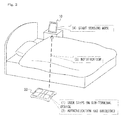
- FIG. 3 illustrates an exemplary case where devices included in the terminal system 1 are disposed.
- the terminal system 1 includes a main terminal device 10 and a sub-terminal device 20.
- the main terminal device 10 and the sub-terminal device 20 are disposed in, for example, a use's bedroom (see FIG. 3 ).
- the terminal system 1 mainly obtains the biological information while the user is in bed (sleeping), and calculates the sleep index and the fatigue index, and the details thereof will be described below.
- the main terminal device 10 functions as a sensor for sensing the biological information.
- the main terminal device 10 is disposed near a user such as at a user's bedside, and senses the biological information from the user who is in bed.
- the main terminal device 10 includes a Doppler sensor 11 which is an example of a sensor for sensing the biological information.
- the Doppler sensor 11 emits microwave and receives reflected wave of the emitted microwave, thereby sensing a moving body on the basis of a difference between a frequency of the emitted microwave and a frequency of the received microwave.
- An output waveform, from the Doppler sensor 11, which represents the biological information having been sensed, is analyzed (subjected to frequency analysis or the like), whereby the biological information such as respiration, pulse, or body motion can be further calculated. The detail thereof will be described below.
- a non-worn type sensor capable of sensing the biological information in a state where the user does not wear the sensor is used, whereby the biological information can be sensed without hindering the user (without preventing the user from sleeping).
- the main terminal device 10 includes a camera 12.
- the camera 12 is used to take an image of the user.
- the main terminal device 10 includes a microphone 13.
- the microphone 13 is used to sense, for example, sound (snore or the like) from the user and/or ambient noise.
- the main terminal device 10 includes a processing section 15 for executing various information processing to be executed by the main terminal device 10.
- the processing section 15 is connected to components 11 to 14 and 16 to 19 of the main terminal device 10.
- the processing section 15 has a CPU (Central Processing Unit) and a memory, and the CPU uses the memory to execute an information processing program stored in the main terminal device 10, whereby the various information processing described above is executed.
- the processing section 15 executes, as the information processing, a process of calculating the health information on the basis of the biological information sensed by the sensor, and the like.
- the processing section 15 executes various information processing for the function.
- the main terminal device 10 includes an input/output interface, and functions as an information processing device (input/output terminal) for inputting and viewing of information.
- the main terminal device 10 includes an operation input section 14 and a display 16.
- the operation input section 14 is any input device that receives operation input from a user.
- the main terminal device 10 has, as the operation input section 14, a button, and a touch panel provided on the display 16.
- the display 16 is capable of displaying the biological information and/or the health information of a user, and displaying the provision information described above. Further, the display 16 may function as a mirror.
- the main terminal device 10 includes an illumination section 17 having a light source such as a LED. Light emission from the illumination section 17 is controlled by the processing section 15. For example, the illumination section 17 may be controlled so as to appropriately emit light according to a sleep state while the user is sleeping, or emit light so as to act as an alarm clock for causing the user to wake up.
- a light source such as a LED.
- the illumination section 17 may be controlled so as to appropriately emit light according to a sleep state while the user is sleeping, or emit light so as to act as an alarm clock for causing the user to wake up.
- the main terminal device 10 and the sub-terminal device 20 can communicate with each other.
- the main terminal device 10 has a short-range wireless communication section 18 as communication means for communicating with the sub-terminal device 20.
- the short-range wireless communication section 18 is a communication module having a function of performing communication using a wireless LAN.
- the short-range wireless communication section 18 is a communication module certified by Wi-Fi.
- the main terminal device 10 is connected to the network 4, and has a function of communicating with the servers 2 and 3.
- the main terminal device 10 includes a mobile communication section 19.
- the mobile communication section 19 is a communication module that has a function of connecting to a mobile communication network and performing communication.
- the mobile communication section 19 performs communication in a communication mode that complies with the 3G communication standard or the 4G (including LTE (Long Term Evolution)) communication standard.
- the method in which the main terminal device 10 communicates with the servers 2 and 3 may be a method in which communication is performed via a wireless LAN by a communication module certified by Wi-Fi.
- the main terminal device 10 may have both a function of communicating with the servers 2 and 3 via a mobile communication network, and a function of communicating with the servers 2 and 3 via a wireless LAN.
- the sub-terminal device 20 functions as a sensor for obtaining biological information different from that obtained by the main terminal device 10. As shown in FIG. 3 , the sub-terminal device 20 is disposed near the main terminal device 10. The sub-terminal device 20 is capable of sensing the biological information (body weight or the like) of a user who has stepped thereon.
- the sub-terminal device 20 includes a load sensor 21.
- the load sensor 21 senses a load applied to the top surface of the sub-terminal device 20.
- the sub-terminal device 20 may have a sensor for sensing the biological information, other than a body weight, for measuring body fat or the like.
- the sub-terminal device 20 includes a touch panel 22.
- the touch panel 22 is disposed on the top surface of the sub-terminal device 20.
- the touch panel 22 is capable of sensing the shape of a foot of a user who has stepped on the top surface of the sub-terminal device 20.
- the sub-terminal device 20 includes a processing section 23 that executes various information processing to be executed by the sub-terminal device 20.
- the processing section 23 has a CPU (Central Processing Unit) and a memory, and the CPU uses the memory to execute an information processing program stored in the sub-terminal device 20, thereby executing various information processing.
- CPU Central Processing Unit
- the sub-terminal device 20 includes a short-range wireless communication section 24 as communication means for communicating with the main terminal device 10.
- the short-range wireless communication section 24 is a communication module that has a function of performing communication using a wireless LAN, and is, for example, a communication module certified by Wi-Fi.
- the short-range wireless communication section 24 transmits a predetermined notification signal and the biological information sensed by the load sensor 21, from the sub-terminal device 20, to the main terminal device 10.
- the main terminal device 10 operates in three kinds of modes, that is, in a normal mode, a sensing mode, and a sleep mode.
- the main terminal device 10 is used as an input/output terminal, and receives an operation input from a user, executes processing according to the operation input, and displays an image of a result of the processing on the display 16.
- the sensing mode the biological information of a user who is in bed is sensed, and the health information is calculated.
- the sleep mode the above-described processes to be executed in the normal mode and the sensing mode are not executed, and power consumption is reduced.
- the main terminal device 10 is allowed to receive a signal from the sub-terminal device 20.
- the sub-terminal device 20 is capable of constantly performing sensing as to whether or not a user has stepped on the sub-terminal device 20. That is, in the sub-terminal device 20, at least one of the load sensor 21 and the touch panel 22 is constantly actuated, to sense that a user has stepped on the sub-terminal device 20.
- the sub-terminal device 20 may be operable in a sleep mode and an ON mode (in which at least the processing section 23 operates). In the sleep mode, the processing section 23 does not operate, and at least one of the load sensor 21 and the touch panel 22 operates. In the ON mode, at least the processing section 23 operates. In this case, when the load sensor 21 and/or the touch panel 22 senses that a user has stepped on the sub-terminal device 20 in a state where the sub-terminal device 20 is in the sleep mode, the mode may be shifted to the ON mode.
- the processing section 23 of the sub-terminal device 20 senses that the user has stepped on the sub-terminal device 20, and measures the body weight on the basis of a result of sensing from the load sensor 21. Further, the processing section 23 calculates the shape of a foot of the user on the basis of a result of sensing from the touch panel 22.
- the sub-terminal device 20 may include a camera, and the processing section 23 may calculate the shape of the foot on the basis of an image taken by the camera.
- the processing section 23 performs authentication of the user by using the calculated shape of the foot (see (2) shown in FIG. 3 ). That is, data indicating the shape of the foot of an authenticated user is previously registered (stored) in the sub-terminal device 20, and the processing section 23 determines whether or not the calculated shape of the foot and the registered shape of the foot coincide with each other, thereby performing authentication. When it is determined that the two shapes of the feet coincide with each other, the processing section 23 determines that the authentication has succeeded. In this case, the processing section 23 transmits a predetermined authentication notification to the main terminal device 10 (see (3) shown in FIG. 3 ).
- the processing section 23 may transmit, to the main terminal device 10, both the authentication notification and the biological information (information on a body weight or the like) sensed by the sub-terminal device 20. Meanwhile, when it is determined that the two shapes of the feet do not coincide with each other, the processing section 23 determines that authentication has failed. In this case, the processing section 23 does not transmit the authentication notification to the main terminal device 10.
- the main terminal device 10 When the main terminal device 10 receives the authentication notification, the main terminal device 10 shifts from the sleep mode or the normal mode to the sensing mode (see (4) shown in FIG. 3 ). Thereafter, the biological information of the user is obtained by the main terminal device 10.
- the processing section 15 of the main terminal device 10 firstly actuates a sensor (Doppler sensor 11 in the present embodiment) for sensing the biological information, and starts obtaining a result of sensing from the sensor.
- a sensor Doppler sensor 11 in the present embodiment
- the processing section 15 may actuate the camera 12 and/or the microphone 13.
- the Doppler sensor 11 continuously performs the sensing, and continuously outputs an output waveform as the result of sensing.
- the processing section 15 calculates the health information (sleep index and fatigue index) based on the result of sensing (output waveform) from the Doppler sensor 11.
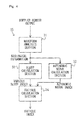
- FIG. 4 is a functional block diagram illustrating an example of a functional configuration for calculating the health information by the processing section 15.
- the processing section 15 includes a waveform analysis section 31, a sleep calculation section 32, an autonomic nerve calculation section 33, and a fatigue calculation section 34.
- the waveform analysis section 31 calculates respiration, pulse, and body motion as further biological information on the basis of the biological information (output waveform) sensed by the Doppler sensor 11. To date, it has been known that the output waveform from the Doppler sensor 11 is separated according to frequencies, whereby waveforms representing respiration, pulse, and body motion can be obtained.
- the waveform analysis section 31 separates the output waveform into a frequency band corresponding to the respiration, a frequency band corresponding to the pulse, and a frequency band corresponding to the body motion, by performing frequency analysis and the like, and outputs the data of each waveform obtained by the separation. As shown in FIG. 4 , the output from the waveform analysis section 31 is inputted to each of the sleep calculation section 32 and autonomic nerve calculation section 33.
- the sleep calculation section 32 calculates various sleep indexes on the basis of the biological information (respiration, pulse, and body motion). To date, a method for calculating sleep indexes on the basis of respiration, pulse, and body motion has been known. In the present embodiment, the sleep calculation section 32 calculates sleep indexes indicating the following information.
- the autonomic nerve calculation section 33 calculates an index (autonomic nerve index) indicating an action level of autonomic nerves (sympathetic nerves and parasympathetic nerves) on the basis of the biological information. Specifically, a waveform of a pulse (RR-interval) included in the biological information is subjected to frequency analysis by using the maximum entropy method and Fourier transformation, and a high-frequency component (about 0.15 to 0.40 [Hz]) HF and a low-frequency component (about 0.04 to 0.15 [Hz]) LF of the waveform are calculated. It has been known that the high-frequency component HF represents an action level of parasympathetic nerves, and the low-frequency component LF represents an action level of sympathetic nerves.
- the autonomic nerve calculation section 33 calculates, as the autonomic nerve index, a ratio (LF/HF) of the low-frequency component LF to the high-frequency component HF. As shown in FIG. 4 , the output from the autonomic nerve calculation section 33 is used as an input to the fatigue calculation section 34.
- the fatigue calculation section 34 calculates a fatigue index on the basis of the sleep index and the autonomic nerve index.
- the degrees of fatigue represented as five stages from fatigue degree (level) 1 to fatigue degree 5 are calculated.
- the method for calculating the fatigue index may be any method. For example, the following method can be used.
- a first method is a method in which a fatigue index is calculated according to a sleep index.
- the sleep index is considered to have a correlation with a degree of fatigue.
- an exemplary case in which the degree of fatigue is assumed to be high is as follows.
- the fatigue calculation section 34 calculates the degree of fatigue so as to increase the degree of fatigue when the sleep index represents the above-described case, and reduce the degree of fatigue when the sleep index does not represent the above-described case. For example, the fatigue calculation section 34 may determine whether or not the above-described items are satisfied, calculate a point based on the number of satisfied items, and calculate the degree of fatigue on the basis of the total point. At this time, the fatigue calculation section 34 may perform weighting for each item to calculate the point. Alternatively, a reference value (for example, "six hours" for the total sleep hours) may be set for each item, and the point may be calculated such that the greater a difference between the calculated value of the sleep index and the reference value is, the greater the point is.
- a reference value for example, "six hours" for the total sleep hours
- the sleep index for user's sleep is calculated on the basis of the biological information
- the fatigue index is calculated on the basis of the sleep index.
- the fatigue index is calculated on the basis of the sleep index, whereby the fatigue index can be obtained with an enhanced accuracy.
- a second method is a method in which a degree of fatigue is calculated on the basis of a sleep hours in a predetermined time period (for example, one week).
- a predetermined time period for example, one week.
- FRMS Fatigue Risk Management System
- a third method is a method for calculating a degree of fatigue on the basis of the autonomic nerve index.
- a degree of fatigue can be evaluated by using a balance between an action level of sympathetic nerves and an action level of parasympathetic nerves, that is, by using the autonomic nerve index described above. Therefore, the fatigue calculation section 34 calculates a degree of fatigue such that, for example, the greater a difference between the reference value and a value of the autonomic nerve index is, the higher the degree of fatigue is.
- the fatigue calculation section 34 calculates a degree of fatigue by using the above three methods. Specifically, the fatigue calculation section 34 calculates the degrees of fatigue in the above three methods, and calculates a final degree of fatigue on the basis of the calculated degrees of fatigue. For example, the fatigue calculation section 34 may use an average of the three values of the degree of fatigue as the final degree of fatigue, or may calculate the final degree of fatigue by performing weighting of any one of the three values of the degree of fatigue.
- the method for calculating the fatigue index may be any method, and the content of the fatigue index may be also optionally set.
- a value indicating a fatigue degree for each fatigue type may be calculated as the fatigue index.
- the fatigue index may represent three kinds of values that are a value representing an acute-fatigue degree, a value representing a cumulative-fatigue degree, and a value representing mental-fatigue degree.
- the health information may be calculated by using a result of sensing from the camera 12 and/or the microphone 13.
- the biological information such as pulse and/or body motion may be calculated on the basis of an image of a user which is taken by the camera 12. Therefore, the processing section 15 may calculate the sleep index (and the degree of fatigue) by using the biological information obtained from an image taken by the camera 12 in addition to (or instead of) the biological information obtained from a result of sensing from the Doppler sensor 11. Further, the processing section 15 may calculate the sleep index in consideration of snore sensed by the microphone 13.
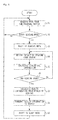
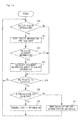
- FIG. 5 is a flow chart showing an example of a flow of a process executed by the processing section 15 of the main terminal device 10.
- FIG 5 mainly shows the process in the sensing mode, and the processes in the normal mode and the sleep mode are not shown.
- the processes of steps in the flow charts shown in the drawings are merely examples, and the order in which the steps are performed in the process may be changed or another process in addition to (or instead of) the process of the steps may be executed when the same result is obtained.
- the CPU of the processing section executes the process of the steps in the flow chart.
- a processer or a dedicated circuit other than the CPU may execute the process of a part of the steps in the flow chart.
- step S1 shown in FIG. 5 the processing section 15 confirms reception of data from the sub-terminal device 20.
- the main terminal device 10 is in the sleep mode or the normal mode.
- the processing section 15 In the sleep mode or the normal mode, the processing section 15 repeatedly executes the process steps of step S1 (and S2) once in every predetermined time period.
- step S2 the processing section 15 determines whether or not the mode is to be shifted to the sensing mode. That is, the processing section 15 determines that mode is to be shifted to the sensing mode when the above-described authentication notification is received from the sub-terminal device 20 in step S1, and determines that the mode is not shifted to the sensing mode when the authentication notification is not received.
- the process step of step S3 is executed. Meanwhile, when the result of determination in step S2 is negative, the process step of step S1 is executed again.
- step S3 the processing section 15 shifts the operation mode of the main terminal device 10 to the sensing mode. That is, the processing section 15 actuates the Doppler sensor 11.
- step S4 the processing section 15 obtains a result of sensing from the Doppler sensor 11.
- step 5 the processing section 15 calculates, as the further biological information, respiration, pulse, and body motion on the basis of the result of sensing.
- a series of process steps from step S4 to S6 is repeatedly executed once in every predetermined time period. Therefore, in the sensing mode, the biological information is repeatedly obtained (calculated) and is successively stored in a memory of the processing section 15.
- step S6 the processing section 15 determines whether or not the sensing mode is to be ended. In the present embodiment, whether or not the sensing mode is to be ended is determined according to whether or not a user is in bed. Specifically, the processing section 15 determines whether or not the user is outside the range for sensing by the Doppler sensor 11, on the basis of the result of sensing from the Doppler sensor 11. When the user is outside the range, the processing section 15 determines that the user is not in bed, and the sensing mode is to be ended. Meanwhile, when the user is in the range for the sensing by the Doppler sensor 11, the processing section 15 determines that the user is in bed, and the sensing mode is not to be ended. When a result of the determination in step S6 is affirmative, the process step of step S7 is executed. Meanwhile, when a result of the determination in step S6 is negative, the process step of step S4 is executed again.
- step S7 the processing section 15 calculates the health information on the basis of the result of sensing from the Doppler sensor 11. That is, as described above in "(Calculation of health information)", the sleep index and the fatigue index are calculated on the basis of the biological information.
- step S8 the processing section 15 transmits, to the data server 2, the health information calculated in step S7.
- the health information is automatically (does not request user's operation) generated and transmitted to the data server 2.
- information to be transmitted from the terminal system 1 to the data server 2 may be transmitted according to a user performing an operation for transmission.
- the processing section 15 may transmit, to the data server 2, both the health information, and the information (biological information such as a body weight) received together with the authentication notification from the sub-terminal device 20.
- step S9 the processing section 15 shifts the operation mode of the main terminal device 10 to the sleep mode. That is, the processing section 15 halts the operation of the Doppler sensor 11. After the operation mode has been shifted to the sleep mode in step S9, the process step of step S1 described above is executed again.
- the process of calculating the health information on the basis of the biological information that is a result of sensing from the sensor (the Doppler sensor 11) is executed on the terminal (terminal system 1) side.
- this process may be shared by the terminal side and the server side in any manner.
- the terminal system 1 may transmit the biological information to the data server 2, and the data server 2 may calculate the health information on the basis of the biological information.
- some health information for example, sleep hours or sleep efficiency
- the terminal system 1 can provide the health information to the user without obtaining data from the data server 2.
- the health information calculated by the data server 2 may be transmitted to the terminal system 1 and displayed by the terminal system 1.
- the health information is transmitted from the terminal system 1 to the data server 2 when the sensing mode ends.
- the transmission information (the biological information and/or the health information) to be transmitted from the terminal system 1 to the data server 2 may be successively transmitted during the sensing mode.
- the main terminal device 10 shifts to the normal mode according to a user performing a predetermined operation (for example, an operation of pressing a predetermined power button) in the sleep mode.
- the main terminal device 10 accesses the service server 3 and displays the health information of the user on the display 16 or displays, on the display 16, the provision information provided by the service server 3 in the normal mode, and the detail thereof will be described below.
- the main terminal device 10 shifts to the sleep mode according to a user performing a predetermined operation (for example, an operation of pressing the predetermined power button) in the normal mode.
- the terminal system includes: a first device (main terminal device 10) having a first sensor (Doppler sensor 11) for sensing first biological information for a user: and a second device (sub-terminal device 20) having a second sensor (load sensor 21) for sensing second biological information that is the biological information for the user and is different from the first biological information. Further, the terminal system is capable of communicating with a server (data server 2) for performing analysis based on the first biological information and the second biological information.
- a server data server 2
- the terminal system transmits, to the server (data server 2), transmission information that includes at least one of: the first biological information and the second biological information; and the health information obtained from the biological information.
- the first biological information (and the health information based thereon) and the second biological information (the health information based thereon) may be transmitted individually from different devices, respectively.
- the server performs analysis based on the transmission information transmitted from the terminal system.
- the terminal system is capable of obtaining a lot of the biological information from two devices, thereby improving the quality of analysis by the server. That is, the server is allowed to perform increased kinds of analyses or perform analysis with enhanced accuracy.
- the first sensor (Doppler sensor 11) senses the biological information of a user who is in bed
- the second sensor (the load sensor 21) senses the biological information of a user who stays awake (for example, before going to bed and after wake-up).
- the biological information can be obtained both while the user is in bed and during the other period, thereby improving the quality of analysis by the server.
- the first sensor is a non-contact type sensor capable of sensing the biological information in a state where a user is not in contact with the sensor
- the second sensor is a contact-type sensor capable of sensing the biological information in a state where a user is in contact with the sensor.
- the first device has the following means.
- the biological information sensed by the two devices can be efficiently transmitted to the server.
- the second device may not have a function of communicating with the server, thereby simplifying the configuration of the device.
- the server (the service server 3) transmits, to the terminal system, the information (provision information described below) based on a result of analysis, and the detail thereof will be described below.
- the first device includes: reception means for receiving information transmitted from the server; and display means for displaying the received information.
- reception means for receiving information transmitted from the server
- display means for displaying the received information.
- the terminal system 1 may have a device (information terminal) for receiving and displaying the provision information, separately from the main terminal device 10.
- the information terminal may be any information processing device, such as a mobile terminal, a personal computer, and a game apparatus, used by a user.
- the information terminal of the user may access the service server 3, and receive and display the provision information. Further, purchasing of the commodity ⁇ service described below may be performed by using the information terminal.
- the second device transmits a predetermined notification (authentication notification) to the first device according to the second biological information being sensed.
- the first device starts sensing the first biological information according to the predetermined notification being received.
- the first device can efficiently execute the operation of sensing the biological information, and information processing can be efficiently performed by the first device. Further, power consumption in the first device can be reduced.
- the second device executes, according to the second biological information being sensed, the authentication process for the user by using the biological information (the shape of the foot sensed by the touch panel 22) of the user.
- the second device transmits the predetermined notification to the first device.
- the first device starts sensing the biological information, whereby the sensing process can be efficiently executed.
- the biological information used in the authentication process may be the second biological information or other biological information.
- the first device that is a single device includes first communication means (mobile communication section 19) for communicating with the server via a mobile telephone communication network, and the second communication means (short-range wireless communication section 18) for performing short-range wireless communication with the second device.
- the first device is capable of easily communicating with the server and the second device.
- the terminal system 1 uses a non-contact type sensor (Doppler sensor), whereby a user need not wear a sensor. Since the biological information is automatically measured while the user is in bed, the user need not wait for measurement of the biological information, and need not perform a bothersome operation for measurement. Further, when the sensor is disposed near the user who is in bed, a bothersome setting operation need not be performed for each measurement. Thus, the terminal system 1 can measure the biological information without causing the user to spend time and putting a burden on the user, whereby continuous obtaining of the biological information is facilitated.
- Doppler sensor non-contact type sensor
- FIG. 6 is a timing chart showing an example of a flow of an operation performed by the information processing system.
- a process operation performed when the information processing system generally performs the following operation will be described as an exemplary process operation.
- the service server 3 includes a portal server 41 and a service providing server 42.
- the portal server 41 is a server that manages a portal site for providing, to the user, the health information accumulated in the data server 2, or the provision information described above.
- the portal server 41 has a function of accessing the data server 2, generating the provision information by using the health information accumulated in the data server 2, and providing the provision information to the user (the terminal system 1).
- the service providing server 42 is a server that executes a process for providing the commodity ⁇ service to a user.
- purchasing of the commodity ⁇ service provided by the service providing server 42 is managed by the portal server 41. That is, the portal site functions as shopping site for selling the commodity service provided by the service providing server 42.
- a user accesses the portal site by using the terminal system 1 and purchases the commodity service on the portal site.
- the service providing server 42 is typically managed by a service provider that provides individual commodity ⁇ service, and the portal server 41 is managed by a management company that manages the data server 2.
- the service providing server 42 may include a plurality of servers for, for example, respective service providers.
- the terminal system 1 transmits (uploads) the health information to the data server 2 (step S11 shown in FIG. 6 ).
- the terminal system 1 transmits both the health information and user identification information that is preset for each user.
- the terminal system 1 continuously transmits the health information periodically to the data server 2 (in the present embodiment, once a day), which is not shown in FIG 6 .
- the data server 2 stores, for each user, the health information received from the terminal system 1.
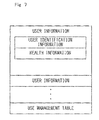
- FIG. 7 illustrates an example of data stored in the data server 2.
- the data server 2 stores, for each user, user information including the user identification information and the health information. That is, when the health information is received from the terminal system 1 of a certain user, the data server 2 additionally stores the received health information in the health information in the user information for the certain user. Thus, the health information is accumulated in the data server 2.
- the data server 2 calculates secondary information at an appropriate time on the basis of the received health information (step S 12). That is, the data server 2 analyzes the health information to obtain the secondary information.
- the secondary information is information of a statistic calculated from the received health information. For example, when average sleep hours in one week are calculated as the secondary information, the data server 2 calculates the average sleep hours each time data of sleep hours in one week is accumulated. In the present embodiment, the secondary information is also accumulated as the health information in the data server 2.
- a use management table is stored in the data server 2.
- the use management table will be described below.
- the terminal system 1 accesses the portal site that is managed by the portal server 41 of the service server 3 according to an instruction from a user (step S 13). That is, the user performs an operation of setting the main terminal device 10 so as to be in the normal mode and accessing the portal site.
- a method for logging in the portal site may be any method, and may be similar to a conventional method.
- a login screen is displayed on the display 16, and the user inputs the user identification information and a password.
- the portal server 41 performs authentication by using the user identification information and the password. When the authentication has succeeded, (the user of) the terminal system 1 is allowed to log in the portal site.
- logging in the portal site may be performed by using personal authentication performed by the terminal system 1. For example, when the authentication has succeeded in the sub-terminal device 20, the main terminal device 10 is allowed to access and log in the portal site. At this time, the main terminal device 10 may not request a user to input the user identification information and the password.
- the portal server 41 transmits a main page of the portal site to the terminal system 1, and the main page is displayed on the display 16.
- the main page includes the provision information to be provided to the user, and the detail thereof will be described below. Therefore, when the user authentication has succeeded, the portal server 41 executes a process of generating the provision information to be provided to the user (steps S 14 to S18).
- the content of the provision information is determined on the basis of the health information, of the user, stored in the data server 2. Therefore, the portal server 41 firstly makes a request (use request), to the data server 2, for use of the health information needed for determining the provision information (step S14).
- the health information requested in the use request is determined by using a provision condition table stored in the portal server 41.
- FIG. 8 illustrates an example of data stored in the portal server 41.
- the portal server 41 stores, for each user, user information, a provision condition table, and an additional provision condition table. Firstly, the user information and the provision condition table associated with the process step of step S 14 will be described, and the additional provision condition table will be described below in detail.
- the user information stored in the portal server 41 includes the user identification information described above, personal information, and user provision history information.
- the personal information is, for example, information related to an individual user, such as the name of the user, the date of the user's birth, age, and gender (except for the biological information).
- the user provision history information represents the history of the provision information (having been provided) that has been already provided to the user. The user provision history information will be described below in detail.
- the provision condition table is used to determine the health information needed for generating the provision information in step S 14.
- the provision condition table is preset and stored in the portal server 41, and the content of the provision condition table may be updated at an appropriate time.
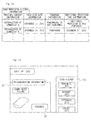
- FIG. 9 illustrates an example of the provision condition table.
- the provision condition table is a table in which provision conditions and provision contents are associated with each other.
- the provision condition represents a condition for providing the provision information.
- the provision content represents the content of the provision information to be provided when the provision condition associated therewith is satisfied.
- information indicating the content itself of the provision information such as "introduction of commodity A" is set as the provision content.
- information indicating the identification number may be set as the provision content.
- the provision condition includes a user condition and a health condition.
- the user condition is a condition related to a user to whom the provision information is provided.
- a condition related to the personal information, such as "man in his 40s" and “men and women in their 30s", included in the user information is set as the user condition.
- the health condition is a condition related to health (health information) of a user to whom the provision information is provided.
- the health condition includes use information indicating the health information used for determining the health condition.
- the use information may indicate the secondary information, such as "the average degree of fatigue (in the latest one week)" shown in FIG. 9 , obtained by processing the health information stored in the data server 2.
- the use information may be information indicating (a kind of) the health information itself such as "the degree of fatigue (in the latest one week)". That is, the use request may be a request for the secondary information obtained by processing the health information, or a request for the health information itself.
- a condition related to the fatigue index or the sleep index such as "(the average degree of fatigue in the latest one week) is higher than or equal to 4" or "(the average sleep hours in the latest one week) is less than or equal to five hours", is set as the health condition.
- the health condition may be a condition related to the health information itself (for example, the degree of fatigue), or a condition related to information (for example, the average degree of fatigue) obtained from the health information.
- the health condition is not limited to one condition related to one kind of the health information.
- the health condition may include a plurality of conditions related to two or more kinds of the health information.
- the health condition may include a condition related to the fatigue index, and a condition related to the sleep index.
- the portal server 41 determines the health information to be requested from the data server 2, by using the provision condition table. That is, the portal server 41 specifies the health information used to determine the provision condition in the provision condition table, and requests the specified health information from the data server 2. Specifically, the portal server 41 specifies the provision condition that satisfies the user condition among the provision conditions included in the provision condition table, and specifies the use information included in the provision condition. For example, in a case where the provision condition table shown in FIG. 9 is used, when a user that logs in the portal site is a man in his 40s, the use information indicating "the average degree of fatigue in the latest one week" is specified.
- the portal server 41 transmits, to the data server 2, the use request that requests "the average degree of fatigue in the latest one week".
- the portal server 41 specifies a plurality of pieces of the use information associated with the plurality of the provision conditions, respectively, and transmits the use request which requests the health information indicated by the specified use information.
- sets each including the provision condition and the provision content in the provision condition table may be classified into a plurality of groups.
- the sets may be classified into the plurality of groups according to, for example, a content of the provision information (introduced commodity ⁇ service), a genre of the commodity ⁇ service introduced by the provision information, a company that provides the commodity ⁇ service introduced by the provision information, and/or a price of the commodity service introduced by the provision information.
- the portal server 41 may cause a user to previously select a group, and may execute a process of specifying the use information merely for the provision condition included in the sets of the selected group.
- a genre for goods (pillow, eye mask, and the like) for improving sleep and a genre of supplements for recovery from fatigue
- the portal server 41 may execute a process of specifying the use information by using the provision conditions included in the genre as subjects to be processed, in the provision condition table.
- the provision information that belongs to the genre selected by the user is merely provided to the user, whereby the provision information in the genre in which the user is interested can be effectively provided.
- a process load, on the portal server 41, in the process of specifying the use information can be reduced.
- the provision condition table indicates what commodity service is to be introduced according to what health state the user is in. Therefore, the content of the provision condition table may be changed on the service providing side (the service providing server 42). That is, the portal server 41 may change the content of the provision condition table according to a request from the service providing server 42,
- the use request transmitted from the portal server 41 to the data server 2 includes information indicating requested health information.
- FIG. 10 illustrates an example of the use request.
- the use request includes requested information, the user identification information, and service identification information.
- the requested information is information indicating the health information that is requested to be obtained, and is determined on the basis of the specified use information.
- the requested information includes a kind of the health information that is requested to be obtained, and a time (period) when the health information has been obtained by the terminal system 1.
- the user identification information indicates a user corresponding to the health information to be obtained. That is, the user identification information included in the use request indicates for what user the health information is to be obtained according to the use request.
- the service identification information is identification information assigned to the commodity service provided by the service providing server.
- the service identification information may be set for each service provider that provides the commodity ⁇ service, or may be set for each kind of the commodity ⁇ service.
- the service identification information included in the use request is determined on the basis of the provision information (the provision content associated with the use information indicating the health information in the provision condition table) corresponding to the health information requested by the use request. That is, it can be said that the service identification information corresponds to the provision information.
- the service identification information included in the use request is the service identification information assigned to the commodity ⁇ service introduced by the provision information corresponding to the health information requested in the use request, or the service identification information assigned to a service provider that provides the commodity service.
- the portal server 41 previously stores a table in which the provision content (service provider or the commodity service specified by the provision content) included in the provision condition table is associated with the service identification information.
- the portal server 41 specifies the service identification information to be included in the use request with reference to the table.
- the data server 2 When the use request is received, the data server 2 performs the authentication process for the use request (step S 15).
- the authentication process is a process of determining whether or not the health information indicated by the requested information included in the use request can be used for a service indicated by the service identification information included in the use request (in other words, can be used for generating the provision information).
- the authentication process is performed by using the use management table (see FIG. 7 ) stored in the data server 2.
- FIG. 11 illustrates an example of the use management table.
- the use management table is a table in which the service identification information and use-allowed information are associated with each other.
- the use-allowed information indicates information, among the health information and the secondary information stored in the data server 2, which can be used (is allowed to be used) for the commodity ⁇ service indicated by the service identification information associated with the use-allowed information.
- the use-allowed information may indicate, for example, a kind of the health information such as "the sleep index ⁇ the fatigue index", "all the information", or "sleep index".
- the use-allowed information may indicate a period (in other words, a period in which the health information has been obtained) for the health information, such as "sleep index in the latest one month", which can be used among the health information chronologically stored.
- the use-allowed information may indicate, for example, a period in which the service server 3 can use the health information, such as "can be used from December 1, 2013 to December 1, 2014", which is not shown in FIG. 11 . That is, the use-allowed information in the use management table may indicate a condition related to a kind of the health information, a condition related to a time when the health information is obtained, or a condition related to a period in which the health information is used (use-allowed period). In the example shown in FIG.
- a group in which the service identification information corresponding to commodity A is associated with the use-allowed information indicating that the sleep index and the fatigue index can be used is included.
- this group it is indicated that the sleep index and the fatigue index can be used for the provision information for introducing commodity A.
- the data server 2 determines whether or not the health information indicated by the requested information included in the received use request coincides with the health information indicated by the use-allowed information associated (in the use management table) with the service identification information included in the use request.
- the data server 2 determines that the authentication has succeeded, and executes process steps of steps S16 and S17 described below (see FIG. 6 ).
- the data server 2 determines that authentication has failed, and does not execute the process steps of steps S16 and S 17, which is not shown.
- the data server 2 transmits, to the portal server 41, a notification that authentication has failed.
- the portal server 41 does not generate the provision information, and the provision information is not provided to a user in S 19 described below (the main page which does not include the provision information is provided).
- data server 2 executes an analysis process corresponding to the use request (step S16).
- the health information requested in the use request is information, such as "the average degree of fatigue in the latest one week", obtained by analyzing (processing) the health information stored in the data server 2.
- data server 2 calculates the health information requested in the use request in a process of analyzing the health information. For example, when the average degree of fatigue in the latest one week is requested, an average value is calculated by using the degrees of fatigue in the latest one week among the health information, of the user, which is indicated by the user identification information included in the use request.
- the analysis process may not be executed in step S16.
- the data server 2 transmits, to the portal server 41, the health information requested in the use request (step S 17).
- the portal server 41 can obtain the health information.
- the service server 3 when the service server 3 generates the provision information, the service server 3 makes a request (use request), to the data server 2, for information used for generating the provision information.
- the data server 2 transmits, to the service server, stored information (the biological information and/or the health information) in response to the request from the service server 3.
- stored information the biological information and/or the health information
- the use request includes the requested information indicating information used for generating the provision information, and identification information (service identification information) related to use of the information stored in the data server 2.
- the data server 2 determines, on the basis of the identification information included in the use request from the service server 3, whether or not the information indicated by the requested information included in the request is allowed to be used for generating the provision information. When it is determined that the use is allowed, the information indicated by the requested information is transmitted to the service server.
- the data server 2 can manage and control the use, by the service server 3, of the accumulated information, and can perform management and control such that the kinds of the information that can be used, can be made different according to the service identification information.
- the portal server 41 When the health information is received from the data server 2, the portal server 41 generates the provision information on the basis of the received health information (step S18). That is, the portal server 41 specifies the provision information that satisfies the provision condition (user condition and health condition) in the provision condition table by using the received health information. For example, when the provision condition table shown in FIG. 9 is used, the received value of the average degree of fatigue in the latest one week for a user who is a man in his 40s is higher than or equal to 4, the provision information for introducing commodity A is specified. When no provision content satisfies the provision condition, the provision information is not generated, and the provision information is not transmitted.
- the number of pieces of the provision information specified in the process step of step S18 may be plural.
- the portal server 41 stores a history of the provision information having been specified. That is, the portal server 41 updates the content of the user provision history information (see FIG. 8 ) included in the user information for the user who has performed log-in.
- FIG. 12 illustrates an example of the user provision history information.
- the user provision history information includes information in which provided-content information, provision date information, purchase information, and additional provision time information are grouped.
- the provided-content information included in the user provision history information indicates the content of the provision information provided to a user, similarly to the provision content in the provision condition table described above.
- the provision date information indicates a time (in the description herein, year, month, and day) when the provision information associated therewith is provided.
- the provision date information indicating year, month, and day is stored. However, information indicating a time in addition to year, month, and day may be stored.
- the purchase information indicates whether or not the commodity ⁇ service introduced by the provision information associated therewith has been purchased.
- the additional provision time information indicates whether or not the provision information is additionally provided after the provision information associated therewith is provided, and indicates a time when the additional provision is performed in the case of the additional provision being performed. The additional provision time information will be described below.
- the portal server 41 adds the information in the above-described group to the user provision history information for the specified provision information. Specifically, the portal server 41 adds, to the user provision history information, the provided-content information which indicates the provision information specified in the process step of step S18, the provision date information indicating year, month, and day when the provision information is provided, the purchase information indicating that purchasing is not performed, and additional provision time information indicating that additional provision is not performed.
- the purchase information is stored so as to indicate that "purchasing is not performed” and the additional provision time information is stored so as to indicate that "additional providing is not performed”.
- the purchase information and the additional provision time information are updated when a commodity or the like is purchased, as described below.
- the portal server 41 generates a web page including the specified provision information, and transmits the web page to the terminal system 1 (step S 19).
- the web page is a main page (also referred to as a top page or a home page) which is firstly displayed when the terminal system 1 accesses (logs in) the portal site.
- the page including the provision information may not be the main page.
- the main page is received by the terminal system 1, the main page is displayed by the display 16 in the main terminal device 10.
- the provision information is provided to the user.
- FIG. 13 illustrates an example of the main page displayed by the terminal system.
- the main page includes a provision information section 51 and a history viewing section 52.
- the provision information section 51 the provision information (information for introducing a pillow as a commodity in FIG. 13 ) is displayed.
- the content displayed in the provision information section 51 is defined by the provision information.
- the provision information section 51 contains one kind of the provision information.
- the provision information section 51 may contain a plurality of pieces of the provision information.
- the provision information section 51 includes a purchase button 53 by which the commodity related to the provision information is purchased. That is, when a user performs an input for designating the purchase button 53, a commodity purchase page for purchasing of the commodity is newly displayed on the display 16, and the user is allowed to purchase the commodity.
- the commodity purchase page is a page (page in the portal site) provided by the portal server 41.
- the commodity purchase page may be a page (page outside the portal site) provided by the service providing server. That is, the purchase button 53 may indicate a link to the commodity purchase page provided by the service providing server.
- the history viewing section 52 is provided so as to allow the history of the health information stored in the data server 2 to be referred to.
- the history viewing section 52 includes a button indicating year and month, and, when a user performs an input for designating the button, a page on which the health information for the designated year and month is displayed, is displayed on the display 16.
- the service server 3 generates the provision information including information related to a commodity or a service for improving an index indicated by the health information of the user.
- useful information related to the commodity service can be provided to the user.
- the service server 3 generates the provision information including information of the web page for allowing a user to purchase the commodity service, or link information for link to the web page.
- the provision information for introducing the commodity service is provided, the user can purchase the commodity ⁇ service provided therein, in a simple operation, thereby improving usability for the user.
- the terminal system 1 transmits, to the portal server 41, a notification of instruction for purchase (step S20).
- the notification of instruction for purchase includes the user identification information and information for identifying a commodity to be purchased.
- the portal server 41 transmits the notification of purchase to the service providing server 42 that provides the commodity to be purchased (step S21).
- the notification of purchase includes the user identification information and the information for identifying the commodity to be purchased, both of which are included in the notification of instruction for purchase.
- the service providing server 42 executes a providing process related to providing of the commodity ⁇ service (step S22).
- the providing process is, for example, a process of transmitting data related to the commodity or service.
- the "data related to the commodity or service” is, for example, music data, data of recipes for meals, application data, or the like.
- the "data related to the commodity or service” may be, for example, data (application) for illumination, by the illumination section 17 of the main terminal device 10, for inducing sleep onset or wake-up of the user.
- the "data related to the commodity or service” may be data (application) for outputting, from the loudspeaker, music for inducing sleep onset or wake-up of the user.
- the providing process is, for example, a process of transmitting, to the terminal system 1 of the user, a notification that purchase of a commodity has been received, or a process of transmitting, to the terminal system 1 of the user, a notification that the commodity is delivered.
- the providing process is a process of transmitting, to the terminal system 1 of the user, a notification that purchase of the service has been received, or a process of transmitting, to the terminal system 1 of the user, a notification of a date and time when the service is provided.
- the service server 3 may introduce a massage service by the provision information (for example, introduce a massage shop located near the user), and perform booking (purchase of a massage service) of a massage on the portal site.
- the service server 3 may transmit, to the terminal system 1, the data related to the commodity or service, according to an instruction, from a user, for purchasing the commodity or service being received from the terminal system 1.
- the portal server 41 updates the user provision history information ( FIG. 12 ) related to the user who has issued an instruction for purchase such that purchase of the commodity is reflected (step S23). Specifically, the portal server 41 updates the purchase information associated with the provision information for introducing the commodity for which the instruction for purchase has been issued such that the content of the purchase information indicates that "purchasing has been performed”. The portal server 41 updates the additional provision time information associated with the provision information such that the content of the additional provision time information indicates a time when the additional provision information is to be provided.
- provision information when the commodity service introduced by the provision information has been purchased, new provision information is provided after the purchase.
- provision information that is additionally provided anew is referred to as "additional provision information”.
- the content of the additional provision information and the content of the provision information having been firstly provided may be different from each other, or may be the same.
- the content of the additional provision information is determined on the basis of the health information, of the user, which has been uploaded after the commodity ⁇ service has been purchased. The detail thereof will be described below.
- step S23 a time when the additional provision information is provided is determined, and the additional provision time information in the user provision history information is updated such that the content of the additional provision time information indicate the determined time.
- the portal server 41 determines a time when the additional provision information is provided, according to the provision information having been provided. In the present embodiment, the time at which the additional provision information is provided is determined by using the additional provision condition table (see FIG. 8 ) stored in the portal server 41.
- FIG. 14 illustrates an example of the additional provision condition table.
- the additional provision condition table is a table for determining the content of the additional provision information and a timing for the additional provision information.
- the additional provision condition table is a table in which an immediately preceding provided-content, an additional provision time, an additional provision condition, and an additional provision content are associated with each other.
- the additional provision condition table is preset and stored in the portal server 41, and the content of the additional provision condition table may be updated at an appropriate time.
- the content of the additional provision condition table may be changed on the service providing side (the service providing server 42).
- the immediately preceding provided-content represents content of the provision information which has been provided immediately preceding time.
- the immediately preceding provided-content represents the content of the provision information that causes providing of the additional provision information.
- the additional provision time represents a time when additional providing is performed, that is, a time when the additional provision information associated with the additional provision time is provided.
- the additional provision time represents, for example, a time that has elapsed from purchase of the commodity ⁇ service, such as "two weeks after purchase" or "one month after purchase”.
- the additional provision time may represent: a time that has elapsed from the time when the provision information has been provided immediately preceding time; or a time that has elapsed from the time when the commodity has been actually used or a time that has elapsed from the time when the service has been actually performed, in the case of the time when the commodity has been actually used or the time when the service has been actually performed being obtained by the portal server 41.
- the portal server 41 specifies the provision information for introducing a purchased commodity, and specifies the additional provision time associated (in the additional provision condition table) with the immediately preceding provided-content indicating the specified provision information.
- the portal server 41 calculates a time (in the description herein, year, month, and day) when additional providing is performed, on the basis of the specified additional provision time.
- the additional provision time information in the user provision history information is updated so as to represent the information of the calculated year, month, and day. For example, when the current time (time when purchase is performed) is December 6, 2013, and the specified additional provision time is "two weeks after the purchase", information indicating December 20, 2013 is stored as the additional provision time information.
- a time when the additional provision information is provided is determined on the basis of the provision information for introducing the purchased commodity service.
- the portal server 41 periodically determines whether or not the additional provision time has come, by periodically referring to the user provision history information for each user.
- the portal server 41 executes a process (S24 to S29 shown in FIG. 6 ) of providing the user with the additional provision information for which the additional provision time has come. That is, when a predetermined time (period specified by the additional provision time in the additional provision condition table) has elapsed from purchasing of the commodity, the above-described process is executed (see FIG. 6 ).
- the portal server 41 transmits, to the data server 2, the use request for requesting use of the health information needed for determining the additional provision information (step S24).
- the health information needed for determining the additional provision information is the health information used for determining the additional provision condition (see FIG. 14 ) for the additional provision information.
- the health information needed for determining the additional provision information is determined by using the additional provision condition table stored in the portal server 41.
- the additional provision condition table As shown in FIG. 14 , in the additional provision condition table, the immediately preceding provided-content, (the additional provision time), the additional provision condition, and the additional provision content are associated with each other.
- the additional provision condition indicates a condition (additional provision condition) for providing the additional provision information, for the provision information indicated by the immediately preceding provided-content associated therewith.
- the additional provision condition includes use information indicating the health information used for determining the additional provision condition.
- the use information is similar to the use information included in the provision condition.
- the use information included in the additional provision condition maybe set, for example, so as to designate both the health information before purchase of the commodity ⁇ service and the health information after purchase of the commodity ⁇ service, such as "the average degree of fatigue in the latest one week and the average degree of fatigue in one week immediately before the purchase".
- the additional provision condition represents a condition related to the health information of a user.
- the additional provision condition may represent a condition related to change (change of a user's state indicated by the health information) of the health information such as "the degree of fatigue has improved” or "the degree of fatigue has not improved”.
- the additional provision condition may be similar to the health condition (see FIG. 9 ) described above, and, for example, the condition related to a user's state indicated by the health information, such as "the average sleep hours in the latest one week are less than or equal to five hours", may be set as the additional provision condition.
- the additional provision content represents the content of the additional provision information provided when the additional provision condition associated therewith is satisfied.
- additional provision content included in the additional provision condition table information indicating the content itself of the provision information may be set, or information indicating the identification number assigned to the provision information may be set.
- the portal server 41 firstly specifies the provision information corresponding to the additional provision information for which the provision time has come, with reference to the user provision history information. That is, the portal server 41 specifies the provision information indicated by the provided-content information associated with the additional provision time information for which the provision time has come, in the user provision history information.
- the portal server 41 specifies the additional provision condition for the additional provision information corresponding to the provision information having been specified as described above. That is, the portal server 41 specifies the additional provision condition associated with the immediately preceding provided-content indicating the provision information having been specified, with reference to the additional provision condition table.
- the portal server 41 specifies the use information included in the additional provision condition having been specified, and transmits, to the data server 2, the use request for obtaining the health information indicated by the use information having been specified. That is, the use request including the requested information indicating the health information is transmitted to the data server 2.
- the provision information indicating "introduction of commodity A" will be described.
- the use information indicating "the average degree of fatigue in the latest one week, the average degree of fatigue in one week immediately before purchase” is specified and the use request for obtaining the health information indicated by the use information is transmitted to the data server 2.
- the use request which is transmitted in step S24 includes the requested information, the user identification information, and the service identification information, similarly to the use request which is transmitted in step S14.
- the contents of the three kinds of information are determined in a method similar to the method in the process step of step S 14. For example, as in a case where the use information indicating "the average degree of fatigue in the latest one week, the average degree of fatigue in one week immediately before purchase" is specified, the requested information sometimes indicates the health information in a predetermined period based on the time of purchase.
- the portal server 41 may use, as the purchase date, a date indicated by the provision date information of the user provision history information, or may use, when a date on which the commodity has been purchased is previously stored, the stored date as the purchase date, in order to calculate the predetermined period.
- the data server 2 executes the process similar to the process steps of step S 15 to S 17 according to the use request from the portal server 41. That is, the data server 2 performs the authentication process for the use request (S25). When the authentication has succeeded, an analysis process according to the use request is executed as appropriate (step S26). The health information requested in the use request is transmitted to the portal server 41 (step S27).
- the portal server 41 When the health information is received from the data server 2, the portal server 41 generates the additional provision information on the basis of the received health information (step S28). That is, the portal server 41 determines, by using the received health information, whether or not the additional provision condition specified in step S24 described above is satisfied. The portal server 41 generates the additional provision information having additional provision content that satisfies the additional provision condition. When no additional provision content satisfies the additional provision condition, the additional provision information is not generated.
- the number of pieces of the additional provision information specified in the process step of step S28 may be plural.
- FIG. 15 illustrates an example of a method for determining the additional provision condition.
- the health information (the degree of fatigue in the drawings) obtained every day is stored in the data server 2.
- whether or not the additional provision condition is satisfied is determined, in some cases, by comparison between the health information before purchase of the commodity ⁇ service and the health information after purchase of the commodity ⁇ service.
- the health information in a predetermined period from the current time to a previous time is firstly analyzed as the health information of the user after the purchase, and the health information in a predetermined period from the time of the purchase to a previous time is analyzed as the health information of the user before the purchase. For example, as shown in FIG.
- the data server 2 calculates an average degree of fatigue in the latest one week and an average degree of fatigue in one week immediately before the purchase, as analysis results, according to the use request from the portal server 41.
- the portal server 41 performs comparison between the result of the analysis (the average degree of fatigue in one week immediately before the purchase) of the health information before the purchase, and the result of the analysis (the average degree of fatigue in the latest one week) of the health information after the purchase, whereby whether or not the health state of the user has improved is determined.
- the portal server 41 determines that the health state (the degree of fatigue) of the user has improved, whereas when the average degree of fatigue is not reduced by the predetermined value or more, the portal server 41 determines that the health state (the degree of fatigue) of the user has not improved.
- the portal server 41 generates the additional provision information such that the content thereof is different according to the determination results. For example, in the example of the additional provision condition table shown in FIG. 14 , when it is determined that the degree of fatigue has improved, on the basis of: the average degree of fatigue in one week immediately before the purchase; and the average degree of fatigue in the latest one week, the additional provision information for introducing commodity D is generated. Meanwhile, when it is determined that the degree of fatigue has not improved, the additional provision information for introducing commodity E is generated.
- the analysis (time-series analysis in consideration of time at which the health information is obtained) is performed on the basis of a plurality of pieces of the health information that are time-series data accumulated for a user for which the health state is analyzed.
- change of the health state of the user can be known. Therefore, the provision information based on such an analysis is provided, thereby providing useful information.
- the additional provision information according to an effect of improvement (of the health state) by the commodity or service is generated on the basis of the health information obtained by the terminal system after the commodity or service indicated in the provision information has been purchased.
- the effect of the commodity service can be determined, and appropriate provision information can be provided according to the determination result.
- the data server 2 performs analysis by comparison between: the health state based on the information obtained by the terminal system 1 before a predetermined reference time (time of purchase); and the health state based on the information obtained by the terminal system 1 after the reference time.
- a predetermined reference time time of purchase
- the provision information or the commodity service provided by the provision information
- the provision information based on the analysis is generated, whereby the provision content can be made useful.
- the predetermined reference time represents, for example, a time when the commodity ⁇ service introduced by the provision information is purchased.
- the predetermined reference time may be any time based on the provision information having been provided to a user.
- the reference time may be a time when the provision information is provided. For example, when a time when a user starts using the commodity, and/or a time when a user receives the provided service can be obtained on the server side, such a time may be used as the reference time.
- the portal server 41 transmits the additional provision information to the terminal system 1 (step S29).
- a method for transmitting the additional provision information may be any method.
- a message indicating that there is the additional provision information is transmitted by push notification to the terminal system 1. That is, when the additional provision information has been generated, the portal server 41 transmits the message in a method in which notification of the message is made even when a user does not perform an operation (does not access the portal site). That is, the terminal system 1 that receives the message, performs display of the message on the display 16 independently of the operation by the user. The user accesses the portal site by using the terminal system 1 according to the message. When the user logs in the portal site, the portal server 41 generates the main page that includes the additional provision information, and transmits the main page to the terminal system 1. Thus, the additional provision information is provided to the user.
- the service server 3 transmits, to the terminal (terminal device (the main terminal device 10) in the terminal system 1) of the user, the notification (the above-described message) of the additional provision information, at a time independent of a time when the user performs the operation on the terminal device, according to the additional provision information having been generated.
- the additional provision information itself may be transmitted to the terminal system 1 by push notification. That is, the additional provision information may be transmitted from the portal server 41 to the terminal system 1, independently of the operation performed by the user. In other words, the additional provision information may be displayed by the terminal system 1 without access to the portal site.
- the notification that the additional provision information has been generated can be made to the user, at an appropriate time, by notification of the additional provision information, or by the additional provision information being transmitted to the terminal system 1 by push notification.
- the above-described message may not be transmitted.
- the user is not notified thereof, and, when the user accesses the portal site the subsequent time, the additional provision information is provided.
- the push notification may be used for the provision information (which is not the additional provision information). That is, the service server 3 may transmit notification of the provision information (which is not the additional provision information) or the provision information itself, at a time independent of a time when the user performs the operation on the terminal device. More specifically, the portal server 3 may execute the process steps of steps S 14 and S18, according to a predetermined condition having been satisfied (according to, for example, a predetermined time having come).
- the additional provision information is provided.
- the process of analyzing the information (the health information) from the terminal system 1, and the process of generating the additional provision information based on the result of the analysis may be repeatedly executed.
- the portal server 41 may set a time (for example, after purchase of the commodity, every two weeks) that repeatedly comes, as the additional provision time in the additional provision condition table (see FIG. 14 ).
- the analysis process and the generation process are repeatedly executed each time the time comes.
- the portal server 41 may set a group (group including the immediately preceding provided-content, the additional provision time, the additional provision condition, and additional provision content) in which the provision information indicated by additional provision content is included as the immediately preceding provided-content in the additional provision condition table.
- a group in which the provision information for introducing commodity D is set as the immediately preceding provided-content in the additional provision condition table shown in FIG. 14 may be set.
- FIG. 16 is a flow chart showing an example of a flow of a process executed by the data server 2.
- the data server 2 repeatedly executes a series of process from step S30 to step S37 shown in FIG. 16 .
- the series of process is performed by the CPU that is a processing section of the data server 2 executing a predetermined information processing program stored in a program storage section of the data server 2.
- the CPUs of the respective information processing devices may share the execution of the series of process.
- step S30 the processing section of the data server 2 determines whether or not the health information is received from the terminal system 1 (see S11 shown in FIG 6 ).
- the process step of step S31 is executed.
- the process step of step S34 describe below is executed.
- step S31 the processing section stores the health information received from the terminal system 1, in a storage section of the data server 2, for each user (see FIG. 7 ).
- step S32 the processing section determines whether or not the secondary information is to be calculated, on the basis of the received health information. This determination is performed according to, for example, whether or not a time when the secondary information is to be calculated has come, or whether or not the health information for calculating the secondary information has been accumulated.
- the process step of step S33 is performed.
- the process step of step S34 described below is executed.
- step S33 the processing section calculates the secondary information on the basis of the received health information, and stores the calculated secondary information in the storage section of the data server 2 (see S12 shown in FIG. 6 ).
- the data server 2 stores the health information (step S31) each time the health information is received from any one of the plurality of users, and calculates and stores the secondary information as appropriate.
- step S34 the processing section determines whether or not the use request is received from the portal server 41 (see S 14, S24 shown in FIG. 6 ). When the result of the determination in step S34 is affirmative, the process step of step S35 is executed. When the result of the determination in step S34 is negative, the process step of step S30 is executed again.
- step S35 the processing section executes the authentication process for the use request having been received in step S34 (see S 15, S25 shown in FIG. 6 ), and determines whether or not the authentication has succeeded.
- the process step of step S36 is executed.
- the process step of step S37 is executed.
- step S36 the processing section transmits, to the portal server 41, the health information requested in the use request. That is, the processing section analyzes, as appropriate, the health information stored in the storage section, and transmits, to the portal server 41, the health information, and/or the health information that is the result of the analysis (see S16, S 17, S26, S27 shown in FIG. 6 ).
- step S37 the processing section transmits, to the portal server 41, notification that the authentication has failed.
- step S36 or S37 the process step of step S30 is executed again.
- the operation performed by the data server 2 as shown in FIG. 6 is implemented.
- FIG. 17 is a flow chart showing an example of a flow of a process executed by the portal server 41.
- the portal server 41 repeatedly executes a series of process from step S41 to step S49 shown in FIG. 17 .
- the series of process is performed by the CPU that is a processing section of the portal server 41 executing a predetermined information processing program stored in a program storage section of the portal server 41.
- the CPUs of the respective information processing devices may share the execution of the series of process.
- step S41 the processing section of the portal server 41 determines whether or not access from the terminal system 1 is performed and log-in is performed by a user of the terminal system 1 (S13 shown in FIG. 6 ).
- step S41 the processing section of the portal server 41 determines whether or not access from the terminal system 1 is performed and log-in is performed by a user of the terminal system 1 (S13 shown in FIG. 6 ).
- step S42 the process step of step S42 is executed.
- step S44 described below is executed.
- step S42 the processing section generates the provision information (see S 14, S18 shown in FIG. 6 ).
- step S43 the processing section generates the main page that includes the provision information and transmits the main page to the terminal system 1 (see S 19 shown in FIG. 6 ).
- the processing section generates the main page including the additional provision information, in addition to the provision information.
- the provision information and the additional provision information are provided so as to be distinguished from each other (for example, such that display positions on the page and/or display manners are different).
- the process of displaying, on the terminal system 1 the web page (for example, page indicated by the history of the health information) is executed as appropriate according to an input from the user, which is not shown.
- step S44 the processing section determines whether or not a commodity introduced by the provision information in the portal site is purchased. This determination is performed according to whether or not the notification of instruction for purchase has been received from the terminal system 1.
- the process step of step S45 is executed.
- the process step of step S47 described below is executed.
- step S45 the processing section transmits the notification of purchase to the service providing server 42 (see S21 shown in FIG. 6 ).
- the processing section updates the user provision history information so as to reflect the purchasing of the commodity (see S23 shown in FIG. 6 ). As described above, at this time, a time when the additional provision information is to be provided is determined.
- step S47 the processing section determines whether or not the time when the additional provision information is to be provided has come (see S24 shown in FIG. 6 ).
- the process step of step S48 is executed.
- the process step of step S41 is executed again.
- step S48 the processing section generates the additional provision information for which the provision time has come (see S28 shown in FIG. 6 ).
- step S49 the processing section transmits, to the terminal system 1, the message that notifies the user of presence of the additional provision information (see S29 shown in FIG. 6 ).
- the main page including the additional provision information is transmitted from the portal server 41 to the terminal system 1 by the process step of step S43, and the main page is displayed on the terminal system 1.
- the process step of step S41 is executed again. In the process from S41 to S49 described above, the operation performed by the portal server 41 as shown in FIG. 6 is implemented.
- the terminal system 1 transmits the health information to the server system (system on the server side. the data server 2 and the service server 3 in the above embodiment).
- the server system receives transmission information (health information) from the terminal system 1, and stores the received transmission information such that the transmission information is associated with a user.
- the server system generates the provision information to be provided to the user for improving an index obtained from the transmission information or an index included in the transmission information (index indicated by the health information related to the user, specifically, the sleep index, the fatigue index), on the basis of the result of the analysis of the transmission information, and transmits the provision information to the terminal system 1 (S 18, S 19).
- the server system generates additional provision information that is different from the provision information having been provided, on the basis of the result of the analysis of the transmission information that is obtained by the terminal system 1 after the provision information has been provided to the user, and transmits the additional provision information to the terminal system 1 (S28, S29).
- the first provision information is provided, and a user state is analyzed on the basis of the health information having been thereafter obtained, and new provision information is generated on the basis of the result of the analysis.
- the second provision information can be provided in consideration of an effect (including a result of determination as to whether or not the effect is found) exerted by the first provision information, whereby useful information can be provided to the user. For example, when the commodity ⁇ service introduced by the first provision information has been purchased, the effect of the commodity ⁇ service is determined on the basis of the health information obtained after the purchase, and the second provision information can be provided according to the effect, whereby useful information can be provided to the user.
- the server system stores (accumulates in the present embodiment), as the storage information, the transmission information received from the terminal system and information (health information) obtained from the transmission information such that the transmission information and the information obtained from the transmission information are associated with the user.
- the data server 2 receives, from the service server 3 that provides the provision information to the user of the terminal system by using the storage information, the use request that includes: the requested information indicating the information used for generating the provision information; and the service identification information for identifying a service related to the provision information, as a request (use request) for use of the storage information for generating the provision information (S 14, S24, FIG. 10 ).
- the data server 2 determines whether or not the information indicated by the use information included in the use request is allowed to be used for generating the provision information, on the basis of the service identification information included in the use request which is received from the service server 3 (S 15, S25). When the use is determined to be allowed, the information that is based on the storage information and indicated by the requested information is transmitted to the service server 3.
- the server system can manage and control use of the storage information by the service server.
- the server system can also manage and control use of the storage information for each kind of use-allowed information according to the service identification information.
- the server system can provide a service for allowing the service server to use the storage information by charging the fee according to the use.
- a managing company that manages the data server 2 and the portal server 41 can provide a service that allows a service provider that manages the service providing server 42 to use the storage information.
- the server system stores association information (use management table) in which the service identification information, and use-allowance information (use-allowed information) that indicates the information which is based on the storage information, and which is allowed to be used for the service indicated by the service identification information, are associated with each other.
- association information use management table
- use-allowance information use-allowed information
- the server system determines whether or not information that is indicated by the requested information included in the use request which is received from the service server can be used, on the basis of a condition related to the kind of the storage information, a time when the storage information is obtained, and/or a period in which the storage information is used (S 15).
- use of the storage information can be managed according to the kind of the storage information and/or the time when the storage information is obtained. Further, a period of use can be set for the storage information.
- the managing company can set, for example, a use fee of the storage information according to the storage information that can be used.
- the server system (portal server 41) generates the provision information for introducing the commodity ⁇ service on the basis of the transmission information (S19), and receives, from a user to which the provision information has been provided, a purchase instruction for purchasing of the commodity ⁇ service indicated by the provision information (S20).
- the server system can perform not only a service of providing the provision information related to the commodity ⁇ service, but also a service of providing the commodity service introduced by the provision information.
- a user is allowed to purchase the commodity ⁇ service indicated by the server system by making an instruction to the server system, thereby improving convenience in the purchase.
- the portal server 41 in the service server 3 transmits, to the service providing server 42, a predetermined notification of purchase according to the purchase instruction having been received.
- the service providing server 42 executes a service providing process (S22) according to the notification of purchase having been received.
- the service providing process is performed by the service providing server 42 on the service provider side for providing the commodity ⁇ service, and purchasing of the commodity ⁇ service can be managed by the portal server 41 on the managing company side.
- the information processing system calculates an index indicating fatigue of a user. That is, the information processing system automatically obtains the biological information from a non-worn type sensor (Doppler sensor 11), and stores the obtained biological information (S5). The information processing system calculates a fatigue index of the user on the basis of the stored biological information (S7). Thus, a fatigue degree of the user can be measured without making the user conscious of the measurement.
- the terminal system 1 repeatedly obtains the biological information from the sensor.
- the biological information having been repeatedly obtained is stored and accumulated, and the fatigue index of a user is calculated on the basis of the biological information which is stored and accumulated.
- the fatigue degree of the user can be continuously measured.
- the provision condition may be automatically updated on the basis of the health information obtained from each user.
- the health information obtained after the commodity, service introduced by the provision information has been purchased, the health state after the use of the commodity ⁇ service by the user is reflected. Therefore, an effect obtained by the commodity ⁇ service being used by the user can be inferred from the health information.
- the portal server 41 updates the provision condition on the basis of such an effect.
- the provision information that is more effective for the user can be provided.
- the portal server 41 stores a condition update table for updating of the provision condition.
- FIG. 18 illustrates an example of the condition update table.
- the condition update table is a table in which the provision content, an update condition, and an update content are associated with each other for each provision information.
- the provision content represents a content of the provision information.
- the update condition represents a condition for updating the provision condition (provision condition associated with the provision information in the provision condition table) related to the provision information.
- the update condition includes a number-of-pieces-of-data condition, and a change condition.
- the number-of-pieces-of-data condition represents a condition related to the number of pieces of data for effect information indicating the effect of the commodity ⁇ service introduced by the provision information.
- the effect information represents a result of an analysis of the health information obtained after the commodity service has been purchased, and represents, for example, the health information used for determining the additional provision condition.
- the portal server 41 stores, as the effect information, the health information used for the determination. Therefore, when a plurality of users purchase the commodity ⁇ service, the number of pieces of effect information corresponding to the number of the users that has purchased the commodity ⁇ service are obtained (stored) by the portal server 41.
- the number-of-pieces-of-data condition represents a condition related to the number (the number of pieces of data) of pieces of the effect information stored as described above.
- the number-of-pieces-of-data condition for example, a condition that "the effect information for 100 persons has been obtained" is set.
- the change condition represents a condition related to the effect information for the number-of-pieces-of-data condition.
- a condition that "the number of pieces of the effect information indicating that the effect is found is greater than or equal to a predetermined number" is set.
- the portal server 41 determines, according to the effect information having been stored for a certain piece of provision information, whether or not the provision condition for the certain piece of provision information is to be updated,. Specifically, the portal server 41 specifies the number-of-pieces-of-data condition, which is associated with the provision content of the provision information in the condition update table, and determines whether or not the number of pieces of data of the stored effect information satisfies the specified number-of-pieces-of-data condition. For example, when the condition update table shown in FIG. 18 is used, the portal server 41 determines whether or not the stored number of pieces of data for the effect information reaches 100 (whether or not the effect information for 100 users has been obtained). The result of the above determination indicates that the number-of-pieces-of-data condition is not satisfied, the portal server 41 determines that the provision condition is not updated.
- the portal server 41 determines whether or not the change condition is satisfied, on the basis of the stored effect information. For example, when the condition update table shown in FIG. 18 is used, the portal server 41 determines whether or not the number of pieces of the effect information indicating that an effect is found, among the stored (100 pieces of) effect information, is greater than or equal to a predetermined number (for example, 70).
- the "effect information indicating that an effect is found” is the health information for which, for example, the result of the determination as to the additional provision condition that "the degree of fatigue has improved" shown in FIG. 14 is affirmative. That is, in the present modification, whether or not the effect information indicates that the effect is found can be determined on the basis of the result of the determination of the additional provision condition.
- the portal server 41 updates the provision condition table according to the update content associated with the change condition.
- the update content indicates the content, to be updated, of the provision condition corresponding to the provision information, for example, indicates that "the threshold value is decreased by 0.1".
- the updated provision condition is a condition that "(the average degree of fatigue in the latest one week) is greater than or equal to 3.9".
- the update content may make the provision condition more lax or may make the provision condition more strict.
- the service server 3 may update the additional provision condition table.
- the provision condition table is updated according to the change condition having been satisfied. Therefore, when the change condition is repeatedly satisfied, the updating is repeatedly (in other words, continuously) performed.
- the server system stores, as the storage information, the transmission information received from each terminal system and/or information (health information) obtained from the received transmission information such that the transmission information and the information obtained from the transmission information are associated with a user.
- the server system stores a condition (condition for determining the content of the provision information to be generated, specifically, the provision condition or the additional provision condition) related to generation of the provision information to be provided to the user for improving an index obtained from the storage information or an index included in the storage information.
- the server system generates the provision information on the basis of the storage information and the condition.
- the server system analyzes the transmission information that is related to a plurality of users to which the provision information has been provided and obtained after the provision information has been provided, and (automatically) updates the condition on the basis of the result of the analysis (the effect information).
- the condition is thus updated, whereby more effective provision information can be provided.
- information obtained after the commodity service introduced by the provision information has been purchased is used as "information obtained after the provision information has been provided" which is used for updating the provision condition. That is, information obtained after a time when a predetermined action due to the provision information being provided is performed, may be used as "information obtained after the provision information has been provided".
- the time when the predetermined action is performed may be, for example, "a time when the commodity service (introduced by the provision information has been purchased” or "a time when the commodity ⁇ service (introduced by the provision information has been used", in the above modification.
- the condition includes at least one health condition related to the health information.
- provision condition includes at least one health condition related to the health information.
- the server system updates the health condition on the basis of a result of analysis of information obtained after the provision information has been provided.
- the health state of the user obtained after the provision information has been provided is analyzed, and the health condition can be updated according to the result of the analysis.
- the terminal system 1 repeatedly obtains the biological information of a user, and repeatedly transmits the transmission information to the server system.
- the server system repeatedly receives the transmission information from each of the terminal systems 1 of a plurality of users, stores and accumulates the transmission information, and continuously (repeatedly) updates the provision condition on the basis of the storage information that is stored and accumulated.
- the provision information is generated on the basis of the updated condition.
- FIG. 19 illustrates an effect according to the modification.
- the provision condition is updated as in the present modification, whereby the service server 3 can provide more effective provision information to the user. Effective provision information can be provided, whereby the number of users that use the service for providing the provision information are expected to be increased. Therefore, the data server 2 can obtain the health information for the increased number of users. When the increased number of pieces of the health information can be obtained, the provision condition can be updated so as to be more effective.
- the provision condition is automatically updated, whereby the cycle become advantageous, and more effective provision information can be provided.
- the server system determines whether or not the condition is to be updated, according to calculation of a predetermined number of the analysis results having been enabled (according to the analysis results for a predetermined number of persons having been obtained). Thus, whether or not the condition is to be updated is determined when a predetermined number of the analysis results are obtained, whereby the condition can be accurately improved by the updating.
- each of the provision condition table and the update condition table is not limited to the above-described content.
- the provision condition may include a priority (priority level) assigned to the provision information (provision content).
- provision information provision information having a higher priority (highest priority level) may be provided (generated).
- the update content included in the update condition table may be for changing the priority. For example, when the change condition indicating that an effect of improvement by the provision information is found (the index indicated by the health information is improved) is satisfied, the priority may be changed so as to be enhanced.
- the priority level is set as "5" to "1" in order, respectively, from the highest priority level, and when the priority level for the provision information for introducing commodity A is "3", and the change condition indicating that an effect of improvement by commodity A is found, is satisfied, the priority level may be changed to "4" in the update condition table.
- the provision condition may include a plurality of conditions (items) related to the health information.
- the item may be added or deleted, or weighting of the item may be changed.
- provision condition table for determining the provision information
- additional provision condition table for determining the additional provision information
- the provision condition for determining the provision information may be merely set.
- the content of the provision condition may be automatically updated.
- FIG. 20 illustrates an example of a provision condition table according to the modification of the above embodiment.
- the provision condition table in the present modification, the provision condition, the provision content, and a subsequent provision time are associated with each other.
- the provision condition includes a plurality of conditions containing the user condition and the health condition described above.
- the provision condition includes the user condition related to the user's age, and three kinds of health conditions related to the health information (sleep index in the description herein). That is, the provision condition includes a condition related to an average in the total sleep hours for the latest one week, a condition related to an average in sleep efficiency for the latest one week, and a condition related to an average in the number of times of awakening during sleep for the latest one week.
- all of these conditions need not be set. For example, depending on the provision content, as indicated in the provision condition associated with the provision content indicating "introduction of commodity C" shown in FIG.
- the provision condition may include a plurality of user conditions or may merely include one health condition.
- the provision content indicates the content of the provision information that is generated (provided) when the provision condition associated therewith is satisfied.
- the subsequent provision time represents a time when, in a case where the provision information having the provision content associated therewith is provided, the provision information is thereafter provided (again) (to be precise, a time when whether or not the provision information is to be provided is determined).
- the subsequent provision time represents a time that elapses from purchase of the commodity ⁇ service.
- the subsequent provision time may represent a time from a time when the immediately preceding provision information has been provided. When a time when the commodity has been actually used or a time when the service has been actually performed, is obtained by the portal server 341, the subsequent provision time may represent a time from this time.
- the provision condition table shown in FIG. 20 is used instead of the provision condition table ( FIG. 9 ) described in the above embodiment. Also in the present modification, as in the above embodiment, determination process (steps S14 and S18) related to the provision information is executed. In the determination process, whether or not the provision information to be provided is determined, and the provision information to be provided is determined when the provision information is provided. Also in the present modification, as in the above embodiment, when each condition included in the provision condition is satisfied, the provision information having the provision content associated with the provision condition is provided. For example, the provision condition table shown in FIG.
- the provision information for introducing commodity A is determined as the information to be provided.
- the portal server 41 may determine that the provision condition is satisfied. For example, in the example shown in FIG. 20 , when two conditions among three heath conditions are satisfied (and the user condition is satisfied), it may be determined that the provision condition has been satisfied.
- each condition included in the provision condition is subjected to weighting (provided with a point) by the portal server 41, and when a point of the condition that has been satisfied among the conditions is greater than or equal to a predetermined point, it may be determined that the provision condition has been satisfied.
- a method for determining whether or not the provision condition is satisfied may be any method. That is, as in the above embodiment, the portal server 41 may firstly perform determination as to the user condition and then perform determination as to the health condition associated with the user condition having been satisfied. The portal server 41 may perform determination as to the user condition and determination as to the health condition individually (in parallel).
- the provision information having the content associated therewith is transmitted to the terminal system 1 (step S19).
- the portal server 41 when the commodity ⁇ service introduced by the provision information has been purchased (step S20), the portal server 41 specifies a time when the provision information is thereafter provided, on the basis of the subsequent provision time associated with the provision information.
- the method for specifying the time may be the same as the method for the process step (step S23) for specifying the additional provision time in the above embodiment.
- the specified time is stored as the subsequent provision time information. That is, in the present modification, the portal server 41 stores the subsequent provision time information, instead of the "additional provision time information" in the user provision history information ( FIG. 12 ).
- the portal server 41 periodically determines whether or not the subsequent provision time has come, by periodically referring to the user provision history information of each user.
- the portal server 41 determines whether or not the provision information is to be provided and determines the provision information to be provided, by using the provision condition table. That is, when it is determined that the subsequent provision time has come, the portal server 41 executes the determination process (S 14 and S18) related to the provision information. That is, in the present modification, in addition to when a user performs log-in, also when the subsequent provision time has come, the determination process related to the provision information is executed.
- the provision condition table used when the subsequent provision time has come is the same as the provision condition table used when the user performs log-in, and the additional provision condition table is not used in the present modification.
- the portal server 41 transmits a message that the provision information is present, to the terminal system 1, by push notification.
- the method for the push notification is similar to the method for step S29 in the above embodiment.
- the provision information itself may be transmitted to the terminal system 1 by push notification.
- the information processing system may not use the additional provision condition table. Even if the additional provision time is not set, when the subsequent provision time is set, the service server 3 can provide a user with the provision information at a predetermined time after the commodity service has been purchased.
- the provision condition is updated on the basis of (a result of analysis of) the health information of the user.
- the condition update table ( FIG. 18 ) is used for updating.
- the provision condition includes a plurality of conditions (health conditions). Therefore, the change condition included in the condition update table may represent conditions related to the plurality of conditions.
- the change condition may be as follows.
- the change condition may include a condition related to the health information (information of time period of awakening during sleep in the example of the above (c)) different form the health information included in the provision condition table.
- the update content in the condition update table may be such that some (or all) of the plurality of conditions are updated.
- the change content may be "the threshold value for the sleep efficiency is decreased by 5".
- the change content may be associated with the change condition in the above (a).
- the change content may indicate that a new condition is added in the provision condition table.
- the change content may indicate that a condition related to a new health information is added such as "the health condition that "the time period of awakening during sleep is longer than or equal to one hour", is added".
- the change content may be associated with the change condition in the above (c).
- the change content may indicate that the weighting is changed.
- the change content may be "weighting of a condition related to the number of times of awakening during sleep is reduced".
- the change content may be associated with the change condition in the above (b).
- the change content may indicate that the priority is changed.
- the number-of-pieces-of-data condition which is included in the update condition, may be a condition which is satisfied repeatedly when the number of pieces of data is increased.
- the number-of-pieces-of-data condition may be a condition that is satisfied each time a predetermined number of pieces of the effect information (for 100 persons) is obtained, for example, each time "the number of pieces of the effect information is increased by an amount corresponding to 100 persons".
- the service server 3 may perform determination as to the change condition on the basis of the increased predetermined number of pieces of data (corresponding to 100 persons).
- the service server 3 may repeatedly determine whether or not the condition is to be updated, according to the condition (the number-of-pieces-of-data condition) related to the number of analysis results, having been satisfied.
- the condition the number-of-pieces-of-data condition
- the service server 3 may repeatedly determine whether or not the condition is to be updated, according to the condition (the number-of-pieces-of-data condition) related to the number of analysis results, having been satisfied.
- At least one of the following processes is performed as a process of updating the provision condition.
- the provision condition is updated according to the above (a) to (d), whereby an accuracy of the provision condition can be enhanced.
- the service server 3 may store change information indicating the health information before and after purchase, for the purchased commodity service.
- the change information may be used as a part of the above-described effect information, or may be used for calculating the effect information.
- an exemplary case where the change information is used will be described as the modification of the above embodiment.
- FIG. 21 illustrates an example of the change information.
- the change information is information indicating sets in each of which the purchase information, the user information, the health information before purchase, and the health information after purchase are associated with each other.
- the purchase information represents information indicating the commodity ⁇ service purchased by a user.
- the purchase information is stored additionally each time the commodity ⁇ service is purchased. Therefore, as shown in FIG. 21 , the change information may include a plurality of kinds of the above sets for a single commodity.
- the user information represents information related to a user who has purchased the commodity ⁇ service. In the present modification, information representing an age and gender of a user is stored as the user information.
- the health information before purchase is the health information, of a user (who has purchased commodity), obtained before purchase of the commodity.
- the health information such as the total sleep hours, the sleep efficiency, and the sleep onset latency
- information indicating an average value of the health information in one week immediately before purchase is stored as the health information before purchase.
- the health information stored as the health information before purchase is not limited to the above described information and may be optionally set.
- the health information before purchase (and the health information after purchase) may be stored.
- the health information after purchase represents the health information, of a user, obtained after purchase of the commodity.
- the health information after purchase is the same kind of health information as the health information, before purchase, associated therewith. That is, in the example shown in FIG. 21 , information related to the health information such as the total sleep hours, the sleep efficiency, and the sleep onset latency is stored as the health information after purchase. In the present embodiment, for the health information, information indicating an average value in one week immediately after the purchase is stored as the health information after purchase.
- the content of the health information before purchase and the content of the health information after purchase may represent information related to the health information of which the kind is different for each commodity indicated by the purchase information.
- information (average value) related to three kinds of the health information such as the total sleep hours, the sleep efficiency, and the sleep onset latency is stored as the health information before purchase and the health information after purchase.
- information related to the total sleep hours and the degree of fatigue may be stored as the health information before purchase and the health information after purchase.
- Each of the content of the health information before purchase and the content of the health information after purchase may be different for each commodity indicated by the purchase information.
- the change information may be of any form when the change information indicates change of the health state of a user.
- the change information may include information indicating change in the health information between before purchase and after purchase, instead of the health information before purchase and the health information after purchase.
- the change information may include information indicating that, for example, "the total sleep hours have increased by 0.5 hours" or "the sleep efficiency has improved”.
- the change information may be stored for each provision information (commodity ⁇ service or the like), or may be stored for each user information (age ⁇ gender or the like).
- the portal server 41 stores the purchase information, the user information, and the health information before purchase among the change information.
- the health information before purchase is calculated by information used for the calculation being obtained from the data server 2.
- the portal server 41 may calculate the change information not only when the commodity ⁇ service introduced by the provision information has been purchased but also when the commodity service which is not introduced by the provision information has been purchased via the portal site 41.
- the service server 3 can collect an increased amount of data for determining an effect of the commodity ⁇ service, whereby the effect can be accurately determined.
- the portal server 41 obtains and stores the health information after purchase.
- the predetermined period may be a previously determined period (one week in the example shown in FIG. 21 ). As described above, the predetermined period may be different for each commodity.
- the predetermined period may be set as a period for the additional provision time corresponding to the commodity or a period for the subsequent provision time corresponding to the commodity.
- the portal server 41 can perform the process of calculating the change information and the determination process related to the additional provision information (or the provision information) at the same timing, whereby the process can be efficiently performed. For example, in the above two processes, the process of obtaining the information from the data server 2 and the process of calculating a statistic based on the obtained information can be performed in common, whereby the process can be efficiently performed.
- the portal server 41 obtains the information used for calculation from the data server 2, and calculates the health information after purchase by using the obtained information.
- the portal server 41 calculates the information indicating the change on the basis of the health information before purchase and the health information after purchase.
- the change information having been calculated as described above may be, for example, used as (a part of) the effect information described above, or may be used for calculating the effect information.
- the provision information is generated by using a result of the analysis of the health information related to another user (details thereof will be described below)
- the change information may be used as (a part of) the result of the analysis, or may be used for calculating the result of the analysis.
- the server system stores the change information in which the provision information provided to a user is associated with change, in the health information of the user, obtained before and after a predetermined reference time based on the provision information having been provided to the user.
- the server system updates the provision condition (or the additional provision condition) on the basis of the change information (by using the change information as the result of the analysis or on the basis of the result of the analysis obtained by using the change information).
- the change information is stored, whereby the result of the analysis related to the health information, is easily calculated and updating can be facilitated.
- the server system may generate the provision information on the basis of the result of the analysis related to one or more other users different from a user to whom the provision information is provided. For example, the server system may select, for example, the following user as the other uses.
- the provision information is information (recommendation information) for introducing the commodity ⁇ service.
- the provision information may be any information for improving an index related to user's health and/or body.
- the provision information may be advice information indicating advice for improving the index.
- the provision information may be data (for example, data of music for inducing sleep onset or wake-up of a user as described above) of the commodity service itself for improving the index. That is, the provision information may be information for introducing the information (information for introducing the commodity service, or the advice information) to a user, may be advice itself to be provided to the user, or may be data itself of the commodity ⁇ service.
- the provision information may be information (information for introducing the commodity ⁇ service or information including data of the commodity ⁇ service (itself)) related to the commodity ⁇ service, or may be the advice information (which is not related to the commodity ⁇ service).
- the provision information is for introducing the commodity service, and the information processing system thus uses, as the reference time, a time at which the commodity service is purchased (or a time at which the commodity ⁇ service is used), to perform various processes.
- a period is designated such that a time of purchase is used as the reference time for the use information ( FIG. 9 ) described above, or a time of the purchase is used as the reference time for the additional provision time ( FIG. 14 ) or the subsequent provision time.
- a time of the purchase is used as the reference time for the change information ( FIG. 21 ) (the change information represents change in the health information between before the reference time and after the reference time).
- the provision information itself such as the advice information or data of the commodity service
- a time when the provision information is provided may be used as a reference.
- the health information is information that indicates an index related to user's sleep and/or fatigue. Therefore, in the present embodiment, the provision information according to user's sleep and/or fatigue can be provided.
- the health information may be information indicating, in addition to (or instead of) an index related to sleep and/or fatigue, an index related to fatness (for example, a body weight, a body fat rate, or a basal metabolic rate), or an index related to skin condition (for example, index indicating a moisture content of skin or a state of a spot).
- the service server 3 includes the portal server 41 and the service providing server 42, and the shopping site through which the commodity ⁇ service is purchased, is managed by the portal server 41.
- the service server 3 may have any configuration, and the functions (roles) of the portal server 41 and the service providing server 42 are not limited to the above embodiment.
- one or more service providing servers manage the shopping sites, respectively, and the provision information can be provided and the health information can be viewed on the portal site managed by the portal server.
- the provision information included in a page of the portal site may include link information for access to the shopping sites.
- a notification of the purchase may be transmitted from the service providing server 42 to the portal server 41 in order to manage the purchasing (purchase history) by the portal server 41.
- the function of the portal server 41 and the function of the service providing server 42 may be provided by one server.
- the commodity ⁇ service provided by the service server 3 may be an application to be provided to the terminal system 1.
- the application may use the information (health information or the like) stored in the data server 2.
- the application described above may be, for example, an application for performing a watching service in which the biological information obtained by the terminal system 1 is used to confirm that a user is alive and make a notification thereof to another user.
- the information processing system described above evaluates fatigue of a user and presents the result of the evaluation to the user. That is, in the above embodiment, sensor information including information (biological information) related to pulse (or heart beat) of a user is obtained (step S4 shown in FIG. 5 ), and a degree of fatigue of the user is evaluated on the basis of the sensor information (step S7 shown in FIG. 5 ). For the information processing system for evaluating the fatigue, the following modification can be considered.
- the information processing system calculates an index (autonomic nerve index) indicating an action level of autonomic nerves (sympathetic nerves and parasympathetic nerves) on the basis of pulse of a user, and evaluates fatigue on the basis of the autonomic nerve index.
- index autonomic nerve index
- change of fatigue can be estimated by observing change of a predetermined component contained in a waveform (pulse wave) representing pulse, and it has been known that a health condition can be determined according to fluctuation of the pulse wave. Therefore, in another embodiment, the information processing system may evaluate fatigue on the basis of a waveform (pulse wave) representing pulse of a user.
- the information processing system may evaluate fatigue on the basis of the acceleration pulse wave (more specifically, on the basis of a value of a wave height of the predetermined component contained in the acceleration pulse wave).
- the terminal system 1 may calculate the acceleration pulse wave by using, as a volume pulse wave, a waveform (waveform representing pulse) obtained by analyzing an output waveform from the Doppler sensor 11. Further, the terminal system 1 may calculate a value of a wave height of the predetermined component contained in the acceleration pulse wave, and calculate a fatigue index on the basis of the calculated value of the wave height.
- the information processing system may calculate an index indicating fluctuation of a pulse wave and evaluate fatigue on the basis of the calculated index.
- the information processing system may use, as a volume pulse wave, a waveform obtained by analyzing an output waveform from the Doppler sensor 11, and calculate a Lyapunov exponent (maximum Lyapunov exponent) as an index indicating the fluctuation of the pulse wave.
- the Lyapunov exponent may be calculated from the acceleration pulse wave.
- the information processing system may evaluate fatigue on the basis of the magnitude of the Lyapunov exponent.
- the information processing system may evaluate fatigue on the basis of the degree of the increase. Specifically, the information processing system may calculate an average heart rate in a predetermined period, and calculate a length of a first period in which a heart rate is higher than the average heart rate in the predetermined period and a length of a second period in which a heart rate is less than the average heart rate in the predetermined period. The information processing system may evaluate fatigue by using, as the above-described degree, a ratio between the length of the first period and the length of the second period.
- the degree of fatigue may be calculated such that the greater the length of the first period is than the length of the second period, the higher the degree of fatigue is.
- a ratio between a dispersion value of the heart rate in the first period and a dispersion value of the heart rate in the second period may be used as the above-described degree to evaluate fatigue.
- pulse and heart beat are different.
- the information processing system may use a waveform obtained by analyzing an output waveform from the Doppler sensor 11 as pulse or may use the waveform as heart beat.
- the information processing system calculates an index (the above-described fatigue index) indicating a degree of fatigue, as a result of evaluation of fatigue, and presents the fatigue index to a user.
- the health information such as the fatigue index is displayed on the display 16 in the normal mode.
- the "information related to the fatigue index” may be the fatigue index itself, or may be information (score, image, or the like), such as degree-of-fatigue information described below, representing the magnitude of a value of the fatigue index.
- the information processing system may calculate the fatigue index represented as a numerical value as in the above embodiment.
- the fatigue index represented as a numerical value When the fatigue index represented as a numerical value is used for presenting, the degree of the fatigue can be presented to a user in an easily understandable manner.
- the information processing system may calculate, as the fatigue index, an output value obtained by calculation using a predetermined mathematical expression.
- the fatigue index may be an output value obtained by the mathematical expression of "LF/HF" described above.
- an index represented as a numerical value can be easily calculated.
- the information processing system may receive an input of predetermined information from a user, and calculate the fatigue index on the basis of the sensor information and the information inputted by the user.
- the predetermined information may be personal information (age, gender, or the like) of the user described above.
- the fatigue index may be calculated by using an expression including an age as a variable, or may be calculated by changing a calculation method or an algorithm for the fatigue index according to an age or gender.
- the information processing system may ask a user a question (questionnaire or medical interview) about fatigue, and may use information of an answer to the question, as the predetermined information. That is, the information processing system presents a question about fatigue to a user, and receives an answer to the question from the user.
- the information processing system may present a question that "do you sleep well every day?" or "do you have an appetite?", and cause the user to input an answer such as "yes” or "no".
- the information processing system may present a question that "how tired are you now?", and cause the user to input a user's subjective degree of fatigue (fatigue index) as an answer thereto.
- the information processing system may evaluate the fatigue on the basis of the inputted answer and the sensor information.
- the fatigue index calculated on the basis of the sensor information may be increased or reduced according to the result of the answer (for example, increased or reduced according to the number of times the answer is "yes”/the answer is "no"), to calculate a final fatigue index.
- a predetermined calculation may be performed (for example, an average value is calculated) on the basis of an objective fatigue index calculated based on the sensor information and a subjective fatigue index inputted by a user, to calculate a final fatigue index.
- the information processing system may present, to a user, degree-of-fatigue information representing a magnitude of a numerical value of the fatigue index.
- FIG. 22 illustrates an example of a display screen including the degree-of-fatigue information. The screen shown in FIG. 22 is displayed on the display 16 according to, for example, a predetermined operation on the main terminal device 10.
- a degree-of-fatigue score 61 and a face image 62 are further displayed as the degree-of-fatigue information.
- the degree-of-fatigue score 61 represents a score calculated according to the fatigue index.
- the degree-of-fatigue score 61 is calculated as a value ranging from 0 to 100 such that the less the fatigue index is, the higher the degree-of-fatigue score 61 is.
- the score (numerical value) is displayed as the degree-of-fatigue information, whereby the degree of the fatigue can be presented to a user in an easy understandable manner.
- the score may represent the numerical value itself of the fatigue index.
- the face image 62 is displayed so as to change a display form (specifically, look of the face) according to the fatigue index. For example, when the fatigue index represents an intermediate level, a face image representing a normal look is displayed, and when the fatigue index represents a relatively low level (when the degree of fatigue is low), a face image representing a smile is displayed, and when the fatigue index represents a relatively high level (the degree of fatigue is high), a face image representing a tired look as shown in FIG. 22 is displayed.
- the face image 62 described above is displayed as the degree-of-fatigue information, whereby a user is allowed to intuitively recognize the degree of the fatigue.
- the numerical value itself may be presented to a user, or the degree-of-fatigue information representing the magnitude of the numerical value may be presented to the user.
- the degree-of-fatigue information may represent a level of the degree of fatigue as well as the score or the image described above.
- the degree-of-fatigue information may be presented so as to represent the degree of fatigue at five steps from A to E.
- advice information 63 is displayed on the display 16.
- the advice information 63 represents advice for improving the fatigue.
- the advice information 63 is generated on the basis of the fatigue index.
- the advice information 63 is generated on the basis of sleep index in addition to the fatigue index, and includes a message "get enough sleep".
- recommendation information generated on the basis of fatigue index may be displayed instead of the advice information 63 (or in addition to the advice information 63).
- the information processing system may present previous result of evaluation of a user, or result of evaluation of another user.
- the information processing system repeatedly obtains the sensor information and repeatedly calculates the fatigue index.
- the information processing system accumulates, in a predetermined storage section, the sensor information and/or information (fatigue index or the like) obtained from the sensor information.
- the storage section may be provided on the server side as in the above embodiment or may be provided on the terminal side (for example, the main terminal device 10 described above).
- the information processing system may present, to a user, a previous fatigue index based on the information accumulated in the storage section and/or information obtained from the previous fatigue index. For example, in the above embodiment, when year, month, and day are designated by a user on the history viewing section 52 displayed on the display 16, the fatigue index having been calculated on the designated year, month, and day may be displayed (as the previous fatigue index) on the display 16. In another embodiment, as the information obtained from the previous fatigue index, statistical information (for example, an average value in the fatigue index for each month, an average value in the fatigue index for the latest one month, or the like) based on a plurality of the previous fatigue indexes may be presented to the user.
- statistical information for example, an average value in the fatigue index for each month, an average value in the fatigue index for the latest one month, or the like
- the information processing system may generate the information to be presented to a user on the server side or may generate the information on the terminal side.
- the result of evaluation may be transmitted from the server side to the terminal side and the statistical information may be calculated on the terminal side, or the statistical information may be calculated on the server side and transmitted to the terminal side.
- the information processing system may present, to a user, accumulated information related to another user.
- the information related to another user may be, for example, the result of evaluation (the fatigue index or the degree-of-fatigue information describe above) itself of another user.
- the information processing system may store, for each user, information (in other words, information representing other users who can view the fatigue index of the user) representing other users whose fatigue indexes can be viewed by the user.
- information in other words, information representing other users who can view the fatigue index of the user
- other users whose fatigue evaluation result corresponding to information that involves privacy can be viewed can be limited. For example, when a user registers his/her family as other users who can view the fatigue index of the user, only the family can view the fatigue indexes.
- the information related to another user may be, for example, statistical information obtained from the results of evaluation of other users.
- the information processing system may present an average value of the fatigue indexes of a plurality of other users, or may present information (for example, a deviation value) based on the results of evaluation of the other users and the result of evaluation of the user him/herself.
- the plurality of other users may be all the other users for whom the results of evaluation are stored in the server, or other users selected according to the user information (for example, personal information such as an age or gender). For example, a plurality of other users whose age and/or gender are the same as the user may be selected.
- the server may provide, to the terminal system, a network service according to the accumulated information (the result of evaluation of fatigue in the description herein). That is, the server may generate information related to improvement of (recovery from) fatigue on the basis of the accumulated information, and transmit the generated information to the terminal system.
- the information related to improvement of fatigue may be recommendation information related to a commodity of a supplement for recovery from fatigue, or recommendation information related to a service of massage as described above.
- the information related to improvement of fatigue may be advice information for recovery from fatigue, or a content (for example, a video image representing a lesson of exercise for recovery from fatigue) for recovery from fatigue.
- service information such as recommendation information or advice information may be presented by the terminal, or a content representing a commodity or service may be presented by the terminal.
- the information processing system may present a long-term index and a short-term index as the result of evaluation of fatigue.
- the long-term index represents a fatigue index calculated on the basis of the sensor information obtained in a period longer than or equal to a predetermined period
- the short-term index represents the fatigue index calculated on the basis of the sensor information obtained in a period shorter than the predetermined period.
- the information processing system may present, as the long-term index, the fatigue index for one-time sleep period, and may present, as the short-term index, the sleep index for each one hour sleep in the sleep period.
- the information processing system may present, as the short-term index, the fatigue index for one-time sleep period, and may present, as the long-term index, an average value of the fatigue indexes calculated in one week.
- FIG. 23 illustrates an example of a display screen on which the long-term index and the short-term index are presented.
- an image 65 representing an average value of scores for one week is displayed as the long-term index
- an image 66 representing (a graph formed by) a score for each day is displayed as the short-term index.
- the image 66 indicates a graph (that is, of seven scores) in which each day's score for one week is indicated. However, in another embodiment, a score for one day (for example, today's score) may be merely indicated.
- the long-term index and the short-term indexes corresponding to the long-term index are displayed at the same time.
- the "the short-term indexes corresponding to the long-term index" means that a period for the short-term index is included in a period for the long-term index.
- the information processing system may present the long-term index and the short-term index such that the long-term index and the short-term index are associated with each other.
- a degree of the fatigue in a relatively long period and a degree of the fatigue in a relatively short period can be provided to a user, whereby more useful information can be provided to a user.
- the information processing system obtains the sensor information related to a user who is sleeping, and evaluates the fatigue (in other words, the fatigue of a user for a sleeping period is evaluated). That is, the information processing system evaluates the fatigue on the basis of the sensor information accumulated in a sleeping period in which the user is sleeping.
- the information processing system maybe configured as follows.
- the information processing system when at least a condition that an obtaining period (sleeping period in which a user is sleeping) in which the sensor information is obtained, has ended, is satisfied, the information processing system presents a result of evaluation based on the sensor information obtained in the obtaining period.
- the result of evaluation of the fatigue for the obtaining period can be presented to a user.
- the information processing system presents, to a user, the result of evaluation of the fatigue, according to the user performing a predetermined operation (for example, operation on the history viewing section 52).
- the information processing system may present, to the user, the result of evaluation of fatigue according to the obtaining period having ended (that is, even if a user does not perform an operation).
- the information processing system may present the result of evaluation according to rising of a user who has been sleeping. That is, the information processing system may determine, on the basis of the sensor information, whether or not the user has risen, and may present the result of evaluation when at least a condition that it is determined that the user has risen, is satisfied.
- the information processing system may automatically (even if a user does not perform an operation) present the result of evaluation according to the sensing mode having been ended (according to the result of determination in step S6 becoming affirmative).
- the information processing system may present the result of evaluation according to a user having awakened instead of the user having risen. That is, the information processing system may determine whether or not the user has awakened, on the basis of the sensor information, and present the result of evaluation when at least a condition that it is determined that the user has awakened is satisfied. Whether or not the user has awakened can be determined according to a sleep index calculated by the sleep calculation section 32 described above. The determination may be performed by the terminal system 1 that has the sleep calculation section 32 or may be performed by the server.
- the user can know the result of evaluation of fatigue. In other words, even when a user does not voluntarily perform an operation, the user can be notified of the result of evaluation of fatigue.
- the result of evaluation is presented when the condition that it is determined that the user has awakened is satisfied, before the user has risen and moved to another place, the result of evaluation can be presented. Therefore, the user can be assuredly notified of the result of evaluation.
- the information processing system may notify the user that a result of evaluation to be presented is present, by using sound and/or light.
- the information processing system may not present the result of evaluation during the sleeping period in which the user is sleeping. For example, when it is determined, on the basis of the sleep index, that the user is sleeping, the information processing system may not present the result of evaluation. Thus, the presenting is less likely to be performed in a period in which the presenting is not needed.
- the information processing system may not present the result of evaluation while the user is in bed. For example, when it is determined that the user is in bed, on the basis of an output from the Doppler sensor, the information processing system may not present the result of evaluation.
- the information processing system may stop, during the sleeping period, an output from an output device (the display 16 in the above embodiment) that outputs the result of evaluation by using an image and/or sound (stop an operation thereof). That is, during the sleeping period, supply of power to the output device may be stopped.
- power consumption in the terminal system can be reduced. Further, the user is less likely to be prevented from sleeping due to the output from the information processing system.
- the information processing system evaluates fatigue on the basis of the sensor information and the result of evaluation of sleep.
- fatigue can be evaluated with enhanced accuracy.
- evaluation of fatigue may be performed without using a result of evaluation of sleep, and sleep may not be evaluated.
- FIG. 24 is a block diagram illustrating a configuration of the terminal system 1 according to modification of the above embodiment.
- the terminal system 1 includes a multifunctional terminal 71 and a sensor device 72.
- the configuration of the server side is the same as in the above embodiment.
- the multifunctional terminal 71 may be a hand-held multifunctional device such as a mobile phone, a smartphone, and a tablet terminal. That is, the multifunctional terminal 71 has some of various functions (input function, output (display) function, information processing function, network communication function, telephone call function, camera function, and the like) of a general multifunctional device.
- the multifunctional terminal 71 may be implemented by a predetermined function being installed in a ready-made multifunctional device.
- the sensor device 72 is a device that has a sensor (Doppler sensor 11) that senses the sensor information.
- the sensor device 72 is a portable device.
- the sensor device 72 is connected so as to be able to communicate with the multifunctional terminal 71.
- the sensor device 72 serves as a cradle for the multifunctional terminal 71, and, when the multifunctional terminal 71 is mounted to the sensor device 72, the multifunctional terminal 71 and the sensor device 72 can communicate with each other.
- the sensor device 72 is connected so as to be able to communicate with the multifunctional terminal 71.
- the sensor device 72 starts the sensing according to the multifunctional terminal 71 having been mounted to the sensor device 72.
- the sensor device 72 may start the sensing according to a predetermined operation performed by a user (for example, an operation of pressing a button provided on the sensor device 72, an operation performed on the multifunctional terminal 71 when the multifunctional terminal 71 can communicate with the sensor device 72).
- a predetermined operation performed by a user for example, an operation of pressing a button provided on the sensor device 72, an operation performed on the multifunctional terminal 71 when the multifunctional terminal 71 can communicate with the sensor device 72.
- the sensor device 72 has a charging function of charging the multifunctional terminal 71. That is, the sensor device 72 starts power supply to the multifunctional terminal 71 according to the multifunctional terminal 71 having been mounted to the sensor device 72. The sensor device 72 starts the sensing according to the multifunctional terminal 71 having been mounted. Therefore, the sensor device 72 starts the sensing according to the multifunctional terminal 71 having been mounted (connected) to the sensor device 72 (for charging) when the user goes to bed.
- process steps (steps S4 and S5), of the terminal system 1, for sensing the biological information and calculating the biological information are the same as in the above embodiment. That is, when the sensing is started, the multifunctional terminal 71 obtains the sensor information (biological information) from the sensor device 72. The multifunctional terminal 71 executes the process step of step S5 on the basis of the obtained sensor information. The process steps are repeatedly executed while the sensing by the sensor device 72 is continued.
- the multifunctional terminal 71 ends obtaining of the sensor information according to the user having risen (or awakened), and transmits, to the sensor device 72, an instruction for stopping the sensing.
- the multifunctional terminal 71 executes the process step of step S7 to calculate the health information. Further, the multifunctional terminal 71 evaluates fatigue on the basis of the health information and transmits the result of evaluation to the data server 2.
- the sensor device 72 may end the sensing according to the multifunctional terminal 71 having been dismounted from the sensor device 72. At this time, the multifunctional terminal 71 ends the process steps of steps S4 and S5 according to the multifunctional terminal 71 having been dismounted from the sensor device 72, and executes the process step of step S7.
- a device that evaluates fatigue on the basis of the sensor information is configured separately from the sensor (the device is accommodated in a casing different from a casing in which the sensor is accommodated). Therefore, the sensor device need not have a high information processing function, thereby simplifying the configuration of the sensor device.
- the multifunctional terminal 71 obtains the sensor information and evaluates fatigue.
- the device (multifunctional terminal) that evaluates fatigue can be used for another application, thereby improving usability of the terminal device.
- the terminal system can be easily implemented.
- the multifunctional terminal 71 since the multifunctional terminal 71 is a hand-held terminal, the user can carry the multifunctional terminal 71, whereby usability of the device can be further improved.
- the multifunctional terminal 71 allows the result of evaluation to be viewed therein, whereby the user can view the result of evaluation with enhanced ease.
- the terminal system may automatically execute obtaining of the sensor information, evaluating of fatigue, and transmitting of the result of evaluation to the server.
- the "automatically execute” means that "execute without an operation performed by a user".
- an operation of a user for staring the process of automatically performing the execution for example, an operation of powering on the terminal system, an operation of switching on the automatic processing mode, or the like
- the user need not perform an operation while the sensor information is being obtained (for example, during sleep), whereby evaluation of fatigue can be easily performed.
- the multifunctional terminal 71 may transmit the health information to the data server 2, and fatigue may be evaluated on the server side. That is, the multifunctional terminal 71 that is a hand-held terminal may obtain the sensor information, and transmit, to the server, the obtained sensor information and/or information (the above-described health information or the like) obtained from the sensor information.
- the server performs evaluation on the basis of the information transmitted from the multifunctional terminal 71.
- the sensor device 72 need not have a communication function, thereby simplifying the configuration of the sensor device 72.
- the server may transmit the information (fatigue index or the like) indicating the result of evaluation of fatigue, to the terminal side (the multifunctional terminal 71).
- the multifunctional terminal 71 displays the result of evaluation on the display device on the basis of the information transmitted from the server.
- the user is allowed to view the result of evaluation by using the terminal.
- the network service provided from the server to the terminal may be received by the multifunctional terminal 71. That is, the multifunctional terminal 71 may receive information and/or a content that is related to the network service and transmitted from the server, and present the information or the content to the user.
- the terminal device (the multifunctional terminal 71) that performs evaluation of fatigue and the sensor device 72, perform wired communicate with each other.
- the multifunctional terminal 71 and the sensor device 72 may perform wireless communicate with each other. That is, the terminal device (the multifunctional terminal 71) may have a function of obtaining the sensor information from the sensor device 72 through a wireless communication.
- the sensor device 72 and means (the multifunctional terminal 71) that obtains the sensor information from the sensor device 72 need not be physically connected to each other, thereby facilitating the communication.
- the terminal device (the multifunctional terminal 71) and the sensor device 72 may communicate with each other through a short-range wireless communication using radio wave or light.
- the "short-range wireless communication” does not means, in a narrow sense, communication based on the NFC standard, but means, in a broad sense, wireless communication in which communication-allowed range is about several tens of meters.
- the "short-range wireless communication” includes wireless communication based on Bluetooth (registered trademark) or ZigBee, and infrared communication.
- the terminal system may be a portable information processing apparatus. That is, the portable information processing apparatus may include a sensor (Doppler sensor) for sensing the biological information, obtain the sensor information, and evaluate fatigue on the basis of the sensor information.
- the terminal system is implemented by an integral portable apparatus, whereby an installation place can be easily changed
- the portable information processing apparatus may be a multifunctional device such as a mobile phone, a smartphone, a tablet terminal, and a notebook personal computer.
- the terminal system When the terminal system is implemented as the multifunctional device, the terminal system can be used for another application, thereby improving usability of the device.
- the portable information processing apparatus may include a battery (rechargeable battery), and may operate by the power of the battery.
- the information processing system may evaluate fatigue of a user who stays awake as well as a user who is sleeping.
- the terminal system may evaluate fatigue of a user who is at work.
- the terminal system may be configured as an information processing apparatus having a function of obtaining the sensor information and a function of evaluating fatigue on the basis of the sensor information, and may include a personal computer which is used by a user at work.
- the sensor Doppler sensor
- the sensor that senses the biological information may be incorporated in the personal computer, or may be connected so as to be able to perform wired or wireless communication with the personal computer.
- the sensor sensors the biological information of the user seated in front of the personal computer.
- the information processing system can obtain the biological information (sensor information) for the user who is at work and evaluate fatigue of the user who is at work.
- the information processing system may evaluate fatigue in real time, and present the result of evaluation in real time. That is, the information processing system may successively calculate the result of evaluation (fatigue index) on the basis of the sensor information, and successively present the degree-of-fatigue information according to the fatigue index having been successively calculated.
- the degree-of-fatigue information such as a degree-of-fatigue score as described above may be constantly displayed on a screen of the personal computer.
- the information processing system may promote the user to be careful. For example, when the calculated fatigue index indicates a value less than or equal to a predetermined threshold value, the information processing system may display a message for promoting the user to take a break, on the screen of the personal computer.
- the sensor that obtains the biological information of a user is a non-contact type (and non-worn type) sensor (specifically, Doppler sensor).
- the sensor is disposed near the user for whom sensing is to be performed.
- the user need not be conscious of the sensing operation by the sensor, whereby a load on the user due to the sensing can be reduced.
- the sensor is a non-worn type sensor, for example, a problem may not arise that the user forgets to wear the sensor and sensing is not performed.
- the non-contact type (and non-worn type) sensor is not limited to the Doppler sensor described above. That is, in the above embodiment, radio wave is emitted toward a sensing subject and the reflected wave is received, and the biological information is outputted (by analyzing the motion of the sensing subject) on the basis of the Doppler phenomenon of the received wave.
- the sensor is not limited thereto, and, in another embodiment, for example, the non-contact type sensor may obtain an image of the sensing subject on the basis of a result of the reception (received wave), analyze the motion of the sensing subject according to the image information, and thus output the biological information.
- the non-contact type sensor may be a sensor that uses a predetermined sensing wave such as ultrasonic wave instead of radio wave.
- the non-contact type sensor may be imaging means (camera) disposed near the user. That is, an image of the sensing subject is taken by the camera from a distant place, and the information processing system may analyze the motion of the sensing subject according to the taken image, and output the biological information.
- imaging means camera
- the information processing system may analyze the motion of the sensing subject according to the taken image, and output the biological information.
- a manner in which the processes are shared between the terminal side and the server side, the processes are shared between the server devices, and the processes are shared among the devices in the terminal system as described above, is an exemplary manner, and each process in the information processing system may be shared in any manner.
- the present invention can be used for an information processing system, a terminal system, and the like, in order to, for example, facilitate measurement for fatigue evaluation.
Landscapes
- Health & Medical Sciences (AREA)
- Engineering & Computer Science (AREA)
- Life Sciences & Earth Sciences (AREA)
- Medical Informatics (AREA)
- Public Health (AREA)
- General Health & Medical Sciences (AREA)
- Biomedical Technology (AREA)
- Physics & Mathematics (AREA)
- Business, Economics & Management (AREA)
- Pathology (AREA)
- Biophysics (AREA)
- Heart & Thoracic Surgery (AREA)
- Animal Behavior & Ethology (AREA)
- Surgery (AREA)
- Molecular Biology (AREA)
- Veterinary Medicine (AREA)
- Primary Health Care (AREA)
- Epidemiology (AREA)
- Accounting & Taxation (AREA)
- Theoretical Computer Science (AREA)
- Finance (AREA)
- General Business, Economics & Management (AREA)
- General Physics & Mathematics (AREA)
- Strategic Management (AREA)
- Development Economics (AREA)
- Data Mining & Analysis (AREA)
- Physiology (AREA)
- Multimedia (AREA)
- Economics (AREA)
- Databases & Information Systems (AREA)
- Cardiology (AREA)
- Psychiatry (AREA)
- Marketing (AREA)
- Signal Processing (AREA)
- Child & Adolescent Psychology (AREA)
- Developmental Disabilities (AREA)
- Educational Technology (AREA)
- Hospice & Palliative Care (AREA)
- Psychology (AREA)
- Social Psychology (AREA)
Abstract
Description
- The present invention relates to an information processing system, an information processing server, an information processing program, and a fatigue evaluation method for calculating fatigue of a user.
- To date, there has been a technique for measuring a degree of fatigue of a user. For example, it is considered that a degree of fatigue is calculated on the basis of a result of sensing of heart beat and pulse of a user (see, for example, Patent Literature 1).
- [PTL 1] Japanese Laid-Open Patent Publication No.
2012-147879 - In a conventional art, information such as heart beat and pulse used for calculating a degree of fatigue has been measured by a user wearing sensors such as an electrocardiograph and a pulsimeter. Therefore, the measurement operation is bothersome to a user. Further, since a user needs to wear the sensor in order to evaluate fatigue, the user may forget to perform the measurement in the case where the measurement is needed.
- Therefore, an object of the present invention is to provide an information processing system, an information processing server, an information processing program, and a fatigue evaluation method capable of easily performing measurement for evaluating fatigue.
- In order to solve the above-described problem, the present invention employs the following configurations (1) to (69).
- (1) One example of an information processing system disclosed in the description herein includes obtaining means, index calculation means, and presenting means. The obtaining means obtains sensor information that includes information related to heart beat and/or pulse of a user, from a sensor which senses biological information of the user in a state where the sensor is not in contact with the user. The index calculation means calculates, based on the sensor information, an index indicating a degree of fatigue of the user. The presenting means presents, to the user, information related to the index.
- (2) The index calculation means may calculate the index represented as a numerical value.
- (3) The presenting means may present, to the user, degree-of-fatigue information indicating a magnitude of a numerical value of the index.
- (4) The index calculation means may successively calculate the index, based on the obtained sensor information. The presenting means may successively present the degree-of-fatigue information according to the successively calculated index.
- (5) The information processing system may further include accumulation control means for accumulating, in a predetermined storage section, the obtained sensor information, and/or information obtained from the sensor information. The presenting means may present the degree-of-fatigue information based on the sensor information obtained in an obtaining period in which the sensor information is obtained, when at least a condition that the obtaining period has ended, is satisfied.
- (6) The obtaining means may repeatedly obtain the sensor information. The index calculation means may repeatedly calculate the index.
- (7) The information processing system may further include accumulation control means for accumulating, in a predetermined storage section, the sensor information, and/or information obtained from the sensor information.
- (8) The presenting means may present, to the user, a previous index based on the information accumulated in the storage section and/or information obtained from the previous index.
- (9) The index calculation means may calculate the index, based on previous information accumulated in the storage section.
- (10) The information processing system may include a terminal device and a server. The terminal device has at least the obtaining means. The server is capable of communicating with the terminal device via a network. The server includes the predetermined storage section.
- (11) The server may generate information related to improvement of fatigue, based on the information accumulated in the storage section, and transmit, to the terminal device, the generated information.
- (12) The accumulation control means may accumulate, for each user, the sensor information related to a plurality of users, and/or information obtained from the sensor information related thereto.
- (13) The presenting means may present, to a user, information based on information that is related to another user and accumulated in the storage section.
- (14) The index calculation means may further calculate a long-term index, the long-term index calculated based on the sensor information obtained in a period longer than or equal to a predetermined period. The presenting means may present the long-term index.
- (15) The index calculation means may further calculate a short-term index, the short-term index calculated based on the sensor information obtained in a period shorter than the predetermined period. The presenting means may present the short-term index.
- (16) The presenting means may present the long-term index and the short-term index such that the long-term index and the short-term index are associated with each other.
- (17) The information processing system may further include input reception means for receiving an input of predetermined information from a user. The index calculation means may calculate the index, based on the sensor information and the information inputted by the user.
- (18) The input reception means may receive, from the user, input of information related to fatigue.
- (19) The index calculation means may calculate, as the index, a value obtained by calculation using a predetermined mathematical expression.
- (20) Further, one example of an information processing system disclosed in the description herein includes obtaining means and fatigue evaluation means. The obtaining means obtains sensor information that includes information related to heart beat and/or pulse of a user who is sleeping, from a sensor which senses biological information of the user in a state where the sensor is not in contact with the user. The fatigue evaluation means evaluates fatigue of the user, based on the sensor information.
- (21) The fatigue evaluation means may evaluate fatigue for a sleeping period in which the user is sleeping.
- (22) The information processing system may further include accumulation control means for accumulating the obtained sensor information in a predetermined storage section. The fatigue evaluation means may evaluate fatigue, based on the sensor information accumulated during the sleeping period in which the user is sleeping.
- (23) The information processing system may further include presenting means for presenting a result of evaluation of the fatigue to the user. The presenting means may not present the result of evaluation during the sleeping period in which the user is sleeping. Alternatively, the presenting means may not present the result of evaluation while the user is in bed.
- (24) The presenting means may include an output section which outputs the result of evaluation by using an image and/or sound. An output from the output section may be stopped during the sleeping period. Alternatively, an output from the output section may be stopped while the user is in bed.
- (25) The information processing system may further include presenting means for presenting a result of evaluation of the fatigue to the user. The presenting means may present the result of evaluation according to rising of the user who has been sleeping and/or according to the user having awakened.
- (26) The information processing system may further include awakening determination means for determining, based on the sensor information, whether or not a user has risen, or whether or not a user has awakened. The presenting means may present the result of evaluation when at least a condition that the user is determined to have risen, is satisfied. Alternatively, the presenting means may present the result of evaluation when at least a condition that the user is determined to have awakened, is satisfied.
- (27) The information processing system may further include sleep evaluation means for evaluating sleep of a user, based on the sensor information.
- (28) The fatigue evaluation means may evaluate fatigue, based on the sensor information and a result of evaluation of the sleep.
- (29) Further, an information processing system disclosed in the description herein includes a sensor, obtaining means, and fatigue evaluation means. The sensor senses biological information of a user in a state where the sensor is not in contact with the user. The obtaining means obtains, from the sensor, sensor information that includes information related to heart beat and/or pulse of the user. The fatigue evaluation means is accommodated in a casing different from a casing in which the sensor is accommodated, and evaluates fatigue of the user, based on the sensor information.
- (30) The obtaining means may obtain the sensor information from the sensor by wireless communication.
- (31) The obtaining means may perform short-range wireless communication with the sensor.
- (32) The information processing system may include: a terminal device and a server. In this case, the terminal device has at least the obtaining means. Further, the server is capable of communicating with the terminal device via a network. The server may include the fatigue evaluation means.
- (33) The terminal device may be a hand-held terminal, and may transmit, to the server, the sensor information and/or information obtained from the sensor information. The fatigue evaluation means may perform evaluation based on the information transmitted from the hand-held terminal.
- (34) The server may transmit, to the hand-held terminal, information representing a result of evaluation of the fatigue. The hand-held terminal may include a display device, and display the result of evaluation on the display device, based on the information transmitted from the server.
- (35) The information processing system may include a multifunctional device which includes the obtaining means and the fatigue evaluation means.
- (36) The multifunctional device may be a hand-held terminal.
- (37) Further, a portable information processing apparatus is disclosed in the description herein. The information processing apparatus includes a sensor, obtaining means, and fatigue evaluation means. The sensor senses biological information of a user in a state where the sensor is not in contact with the user. The obtaining means obtains, from the sensor, sensor information that includes information related to heart beat and/or pulse of the user. The fatigue evaluation means evaluates fatigue of the user, based on the sensor information.
- (38) The information processing apparatus may be a multifunctional device.
- (39) The information processing apparatus may have a battery, and may be able to operate by power of the battery.
- (40) Further, an information processing system disclosed in the description herein includes: a terminal device; and a server capable of communicating with the terminal device via a network. The information processing system includes obtaining means, fatigue evaluation means, and accumulation control means. The obtaining means obtains sensor information that includes information related to heart beat and/or pulse of a user, from a sensor which senses biological information of the user in a state where the sensor is not in contact with the user. The obtaining means is provided in the terminal device. The fatigue evaluation means evaluates fatigue of the user, based on the sensor information. The accumulation control means is provided in the server and accumulates a result of evaluation of the fatigue in a predetermined storage section.
- (41) The server may provide, to the terminal device, a network service according to a result of evaluation of the fatigue.
- (42) The service providing means may determine, based on a result of evaluation of the fatigue, service information that is recommendation information and/or advice information for improving the fatigue, and that is to be transmitted to the terminal device. The terminal device may include service presenting means for presenting, to the user, the service information transmitted from the server.
- (43) The service providing means may determine, based on a result of evaluation of the fatigue, a content that allows improvement of the fatigue and is to be transmitted to the terminal device. The terminal device may include content presenting means for presenting, to the user, the content transmitted from the server.
- (44) The terminal device may include result presenting means for presenting a result of evaluation of the fatigue to the user.
- (45) The server may transmit, to the terminal device, previous results of evaluation which are accumulated in the storage section and/or information obtained from the previous results of evaluation. The result presenting means may present, to the user, information transmitted from the server and/or information based on the information transmitted from the server.
- (46) The server may be capable of communicating with a plurality of terminal devices via a network. Each of the terminal devices may transmit, to the server, transmission information that includes: the sensor information and/or information obtained from the sensor information; and user identification information indicating a user corresponding to the sensor information. The accumulation control means may accumulate, for each user, a result of evaluation which is based on the transmission information received from each of the terminal devices.
- (47) The server may transmit, to the terminal device of a certain user, a result of evaluation of another user different from the certain user among the results of evaluation which are accumulated in the storage section, and/or information obtained from the result of evaluation of said another user. The result presenting means may present, to the user, information transmitted from the server and/or information based on the information transmitted from the server.
- (48) The terminal device may include: the obtaining means; the fatigue evaluation means; and transmission means for transmitting a result of evaluation of the fatigue to the server. The obtaining means automatically obtains the sensor information. The fatigue evaluation means automatically evaluates the fatigue. The transmission means automatically transmits the result of evaluation to the server.
- (49) The sensor may be disposed near a user for whom sensing is to be performed.
- (50) The sensor may emit radio waves toward a sensing subject, receive reflected waves, and output the sensor information based on received result.
- (51) The sensor may be a Doppler sensor.
- (52) The information processing system may continuously obtain the sensor information from the sensor, and automatically perform an evaluation based on the obtained sensor information.
- (53) Further, an information processing system disclosed in the description herein calculates an index indicating fatigue of a user. The information processing system includes a non-worn type sensor, obtaining means, biological information storage means, and fatigue calculation means.
The sensor is capable of sensing biological information of a user in a state where the user does not wear the sensor. The obtaining means automatically obtains the biological information from the sensor. The biological information storage means stores the obtained biological information. The fatigue calculation means calculates a fatigue index of the user, based on the biological information stored in the biological information storage means. - (54) The obtaining means may repeatedly obtain the biological information from the sensor. The biological information storage means may store and accumulate the biological information having been repeatedly obtained by the obtaining means. The fatigue calculation means may calculate the fatigue index of the user, based on the biological information that is stored and accumulated in the biological information storage means.
- (55) The information processing system may further include sleep index calculation means for calculating, based on the biological information, a sleep index related to sleep of the user. The fatigue calculation means may calculate the fatigue index based on the sleep index.
- (56) The fatigue calculation system may include: a plurality of terminal systems each of which includes the sensor and the obtaining means; and a server system. Each terminal system may further include information transmission means for repeatedly transmitting, to the server system, transmission information that includes at least one of the biological information, and health information representing at least the fatigue index.
The server system may include: transmission information storage means for storing, as storage information, the transmission information received from each of the terminal systems and/or information obtained from the transmission information, such that the transmission information and/or the information obtained from the transmission information are associated with the user; and providing means for generating, based on the storage information, provision information to be provided to the user in order to improve an index obtained from the storage information or an index included in the storage information, and transmitting the provision information to the terminal systems. - (57) The providing means may generate the provision information that includes information related to a commodity or a service for improving an index representing the health information of the user.
- (58) The providing means may generate the provision information that includes: information of a web page for allowing the user to purchase the commodity and/or the service; or link information for link to the web page.
- (59) The server system may further include data transmission means for transmitting, to the terminal system, data related to the commodity or the service according to the terminal system having made an instruction for purchasing of the commodity or the service by the user.
- (60) The information processing system may further include additional-provision means for: generating additional provision information different from the provision information having been provided, based on a result of analysis of the transmission information obtained by each terminal system, after the provision information has been provided to the user; and transmitting the additional provision information to a terminal of the user.
- (61) The providing means may generate the provision information that includes information related to a commodity or a service for improving an index indicated by the health information of the user. The additional-provision means may generate, according to an effect of improving a state of a user by the commodity or the service, the additional provision information based on the transmission information obtained by each terminal system after purchasing of the commodity or the service included in the provision information.
- (62) The providing means may transmit, to a terminal of the user, the provision information or a notification of the provision information at a time independently of a time when the user performs an operation on the terminal, according to the provision information having been generated.
- (63) The server system may include: a data server that has the transmission information storage means; and a service server that has the providing means. When the provision information is generated, the service server may make a request, to the data server, for information used for generating the provision information. The data server may transmit the storage information stored in the transmission information storage means and/or information obtained from the storage information, to the service server, in response to the request from the service server.
- (64) The service server may transmit, to the data server, the request that includes: requested information indicating information used for generating the provision information; and identification information related to use of information stored in the data server. The data server may determine whether or not the information indicated by the requested information which is included in the request is allowed to be used for generating the provision information, based on the identification information included in the request from the service server, and transmit, when it is determined that the information is allowed to be used, the information indicated by the requested information, to the service server.
- (65) Each terminal system may include a terminal device that includes a display section that receives and displays the provision information transmitted from the server system.
- (66) The sensor may emit radio waves toward a sensing subject, receive reflected waves, and output the sensor information based on received result.
- (67) The information processing system may further include sleep evaluation means for evaluating sleep of a user, based on the sensor information.
- (68) The fatigue calculation means may calculate fatigue, based on the sensor information and a result of evaluation of the sleep.
- (69) The information processing system may include: a terminal device that is a multifunctional device which has the obtaining means; and a server capable of communicating with the terminal device. The terminal device transmits, to the server, the biological information and/or information obtained from the biological information. The server accumulates, in a predetermined storage section, information transmitted from the terminal device and/or information based on the information transmitted from the terminal device.
- In the description herein, an information processing apparatus having the entirety or a part of the function of the information processing system of the above (1) to (69) is disclosed. Further, in the description herein, an information processing program that causers a computer (processor) to execute a process of the information processing apparatus, is disclosed. Furthermore, in the description herein, a fatigue evaluation (calculation) method executed by the information processing system or the information processing apparatus of the above (1) to (69), is disclosed.
- According to the present invention, measurement for fatigue evaluation can be easily performed.
-
- [
FIG. 1] FIG. 1 is a block diagram illustrating an example of a configuration of an information processing system according to an embodiment. - [
FIG. 2] FIG 2 illustrates an example of a configuration of a terminal system. - [
FIG. 3] FIG. 3 illustrates an exemplary case where devices included in the terminal system are disposed. - [
FIG. 4] FIG. 4 is a functional block diagram illustrating an example of a functional configuration for calculating health information by a processing section of a main terminal device. - [
FIG. 5] FIG. 5 is a flow chart showing an example of a flow of a process executed by the processing section of the main terminal device. - [
FIG. 6] FIG. 6 is a timing chart showing an example of a flow of an operation performed by the information processing system. - [
FIG. 7] FIG. 7 illustrates an example of data stored in a data server. - [
FIG. 8] FIG. 8 illustrates an example of data stored in a portal server. - [
FIG. 9] FIG. 9 illustrates an example of a provision condition table. - [
FIG. 10] FIG. 10 illustrates an example of a use request. - [
FIG. 11] FIG. 11 illustrates an example of a use management table. - [
FIG. 12] FIG. 12 illustrates an example of user provision history information. - [
FIG. 13] FIG. 13 illustrates an example a main page displayed by the terminal system. - [
FIG. 14] FIG 14 illustrates an example of an additional provision condition table. - [
FIG. 15] FIG. 15 illustrates an example of a method for determining an additional provision condition. - [
FIG. 16] FIG. 16 is a flow chart showing an example of a flow of a process executed by the data server. - [
FIG 17] FIG. 17 is a flow chart showing an example of a flow of a process executed by a portal server. - [
FIG. 18] FIG. 18 illustrates an example of a condition update table. - [
FIG 19] FIG. 19 illustrates an effect according to modification. - [
FIG 20] FIG. 20 illustrates an example of a provision condition table according to modification. - [
FIG. 21] FIG. 21 illustrates an example of change information. - [
FIG. 22] FIG. 22 illustrates an example of a display screen including degree-of-fatigue information. - [
FIG. 23] FIG. 23 illustrates an example of a display screen on which a long-term index and a short-term index are presented. - [
FIG. 24] FIG. 24 is a block diagram illustrating a configuration of a terminal system according to modification. - Hereinafter, an information processing system, an information processing server, an information processing program, and an information providing method according to the present embodiment will be described with reference to the drawings. Firstly, the overall configuration of the information processing system according to the present embodiment will be described.
FIG. 1 is a block diagram illustrating an example of the configuration of the information processing system according to the present embodiment. As shown inFIG. 1 , the information processing system includes aterminal system 1, adata server 2, and aservice server 3. The system andservers 1 to 3 can communicate with each other through anetwork 4 such as the Internet and a mobile communication network. - The
terminal system 1 is disposed near a user (for example, in a user's home). InFIG 1 , the number of theterminal systems 1 is one. However, the information processing system includes a plurality of the terminal systems provided for users, respectively. In the present embodiment, theterminal system 1 obtains biological information of each user, and uploads the health information obtained from the biological information to the data server 2 (seeFIG. 1 ). The biological information represents information sensed from a user's body. In the present embodiment, respiration, pulse, and body motion are obtained as the biological information. The health information represents information related to user's health and/or body. In the present embodiment, the health information includes a sleep index representing an index related to user's sleep, and a fatigue index representing an index related to user's fatigue. Thus, theterminal system 1 senses the biological information of a user, calculates the sleep index and the fatigue index based on the result of sensing, and uploads the indexes to thedata server 2. Theterminal system 1 senses a health state of a user, and can be also called a QOL (Quality of Life) sensor. - The
data server 2 stores (accumulates) the health information, of the user, which is transmitted from theterminal system 1. Further, thedata server 2 calculates statistics (for example, an average value in a predetermined period) as secondary information obtained from the health information. In the following description, the health information received from theterminal system 1 and the secondary information (statistics) obtained from the health information may be generically referred to as health information. - The
service server 3 uses the health information stored in thedata server 2 to provide various information to the user of theterminal system 1. In the following description, information provided to the user by the service server is referred to as "provision information". The provision information is information for improving an index indicated by the health information of a user. The provision information is, for example, information for introducing a commodity or a service (for example, goods for improving sleep, a supplement for recovery from fatigue, or the like) for improving the index, and the details thereof will be described below. That is, in the present embodiment, the provision information may be also called recommendation information for a user. Theservice server 3 performs a service for providing the provision information by using the health information obtained from thedata server 2. Further, in the present embodiment, theservice server 3 also provides a service for selling, to a user, a commodity and/or a service (hereinafter, referred to as "commodity service") which is introduced by the provision information. - The
data server 2 and theservice server 3 each include one or more information processing devices (server devices). In the description herein, the "server" not only means one information processing device (server device), but also means the entirety of a server device group (server system) when the server includes a plurality of server devices. - Next, a configuration of the
terminal system 1 according to the present embodiment will be described.FIG. 2 illustrates an example of the configuration of theterminal system 1.FIG. 3 illustrates an exemplary case where devices included in theterminal system 1 are disposed. As shown inFIG. 2 andFIG. 3 , theterminal system 1 includes a mainterminal device 10 and asub-terminal device 20. In the present embodiment, the mainterminal device 10 and thesub-terminal device 20 are disposed in, for example, a use's bedroom (seeFIG. 3 ). Theterminal system 1 mainly obtains the biological information while the user is in bed (sleeping), and calculates the sleep index and the fatigue index, and the details thereof will be described below. - The main
terminal device 10 functions as a sensor for sensing the biological information. In the present embodiment, as shown inFIG. 3 , the mainterminal device 10 is disposed near a user such as at a user's bedside, and senses the biological information from the user who is in bed. - As shown in
FIG. 2 , the mainterminal device 10 includes aDoppler sensor 11 which is an example of a sensor for sensing the biological information. TheDoppler sensor 11 emits microwave and receives reflected wave of the emitted microwave, thereby sensing a moving body on the basis of a difference between a frequency of the emitted microwave and a frequency of the received microwave. An output waveform, from theDoppler sensor 11, which represents the biological information having been sensed, is analyzed (subjected to frequency analysis or the like), whereby the biological information such as respiration, pulse, or body motion can be further calculated. The detail thereof will be described below. In the present embodiment, a non-worn type sensor (Doppler sensor 11) capable of sensing the biological information in a state where the user does not wear the sensor is used, whereby the biological information can be sensed without hindering the user (without preventing the user from sleeping). - The main
terminal device 10 includes acamera 12. Thecamera 12 is used to take an image of the user. Further, the mainterminal device 10 includes amicrophone 13. Themicrophone 13 is used to sense, for example, sound (snore or the like) from the user and/or ambient noise. - The main
terminal device 10 includes aprocessing section 15 for executing various information processing to be executed by the mainterminal device 10. Theprocessing section 15 is connected tocomponents 11 to 14 and 16 to 19 of the mainterminal device 10. Theprocessing section 15 has a CPU (Central Processing Unit) and a memory, and the CPU uses the memory to execute an information processing program stored in the mainterminal device 10, whereby the various information processing described above is executed. In the present embodiment, theprocessing section 15 executes, as the information processing, a process of calculating the health information on the basis of the biological information sensed by the sensor, and the like. Further, when the mainterminal device 10 has a function as the information processing device (information processing terminal), theprocessing section 15 executes various information processing for the function. - The main
terminal device 10 includes an input/output interface, and functions as an information processing device (input/output terminal) for inputting and viewing of information. Specifically, the mainterminal device 10 includes anoperation input section 14 and adisplay 16. Theoperation input section 14 is any input device that receives operation input from a user. In the present embodiment, the mainterminal device 10 has, as theoperation input section 14, a button, and a touch panel provided on thedisplay 16. Thedisplay 16 is capable of displaying the biological information and/or the health information of a user, and displaying the provision information described above. Further, thedisplay 16 may function as a mirror. - The main
terminal device 10 includes anillumination section 17 having a light source such as a LED. Light emission from theillumination section 17 is controlled by theprocessing section 15. For example, theillumination section 17 may be controlled so as to appropriately emit light according to a sleep state while the user is sleeping, or emit light so as to act as an alarm clock for causing the user to wake up. - The main
terminal device 10 and thesub-terminal device 20 can communicate with each other. In an exemplary case, the mainterminal device 10 has a short-rangewireless communication section 18 as communication means for communicating with thesub-terminal device 20. In the present embodiment, the short-rangewireless communication section 18 is a communication module having a function of performing communication using a wireless LAN. For example, the short-rangewireless communication section 18 is a communication module certified by Wi-Fi. - Further, the main
terminal device 10 is connected to thenetwork 4, and has a function of communicating with theservers terminal device 10 includes amobile communication section 19. In the present embodiment, themobile communication section 19 is a communication module that has a function of connecting to a mobile communication network and performing communication. For example, themobile communication section 19 performs communication in a communication mode that complies with the 3G communication standard or the 4G (including LTE (Long Term Evolution)) communication standard. The method in which the mainterminal device 10 communicates with theservers terminal device 10 may have both a function of communicating with theservers servers - The
sub-terminal device 20 functions as a sensor for obtaining biological information different from that obtained by the mainterminal device 10. As shown inFIG. 3 , thesub-terminal device 20 is disposed near the mainterminal device 10. Thesub-terminal device 20 is capable of sensing the biological information (body weight or the like) of a user who has stepped thereon. - As shown in
FIG. 2 , thesub-terminal device 20 includes aload sensor 21. Theload sensor 21 senses a load applied to the top surface of thesub-terminal device 20. Thesub-terminal device 20 may have a sensor for sensing the biological information, other than a body weight, for measuring body fat or the like. - Further, the
sub-terminal device 20 includes atouch panel 22. Thetouch panel 22 is disposed on the top surface of thesub-terminal device 20. Thetouch panel 22 is capable of sensing the shape of a foot of a user who has stepped on the top surface of thesub-terminal device 20. - The
sub-terminal device 20 includes aprocessing section 23 that executes various information processing to be executed by thesub-terminal device 20. Theprocessing section 23 has a CPU (Central Processing Unit) and a memory, and the CPU uses the memory to execute an information processing program stored in thesub-terminal device 20, thereby executing various information processing. - The
sub-terminal device 20 includes a short-rangewireless communication section 24 as communication means for communicating with the mainterminal device 10. Similarly to the short-rangewireless communication section 18 of the mainterminal device 10, the short-rangewireless communication section 24 is a communication module that has a function of performing communication using a wireless LAN, and is, for example, a communication module certified by Wi-Fi. In the present embodiment, when it is sensed that a user has stepped on thesub-terminal device 20, the short-rangewireless communication section 24 transmits a predetermined notification signal and the biological information sensed by theload sensor 21, from thesub-terminal device 20, to the mainterminal device 10. - Next, a process operation executed by the
terminal system 1 will be described. In the present embodiment, the mainterminal device 10 operates in three kinds of modes, that is, in a normal mode, a sensing mode, and a sleep mode. In the normal mode, the mainterminal device 10 is used as an input/output terminal, and receives an operation input from a user, executes processing according to the operation input, and displays an image of a result of the processing on thedisplay 16. In the sensing mode, the biological information of a user who is in bed is sensed, and the health information is calculated. In the sleep mode, the above-described processes to be executed in the normal mode and the sensing mode are not executed, and power consumption is reduced. However, also in the sleep mode, the mainterminal device 10 is allowed to receive a signal from thesub-terminal device 20. - The
sub-terminal device 20 is capable of constantly performing sensing as to whether or not a user has stepped on thesub-terminal device 20. That is, in thesub-terminal device 20, at least one of theload sensor 21 and thetouch panel 22 is constantly actuated, to sense that a user has stepped on thesub-terminal device 20. In another embodiment, thesub-terminal device 20 may be operable in a sleep mode and an ON mode (in which at least theprocessing section 23 operates). In the sleep mode, theprocessing section 23 does not operate, and at least one of theload sensor 21 and thetouch panel 22 operates. In the ON mode, at least theprocessing section 23 operates. In this case, when theload sensor 21 and/or thetouch panel 22 senses that a user has stepped on thesub-terminal device 20 in a state where thesub-terminal device 20 is in the sleep mode, the mode may be shifted to the ON mode. - Hereinafter, processing performed when the
terminal system 1 operates in the sensing mode while a user is in bed, will be described. It is assumed that, before the user goes to bed, the mainterminal device 10 is in the sleep mode or the normal mode. At this time, when the user has stepped on the sub-terminal device 20 (see (1) shown inFIG. 3 ), theprocessing section 23 of thesub-terminal device 20 senses that the user has stepped on thesub-terminal device 20, and measures the body weight on the basis of a result of sensing from theload sensor 21. Further, theprocessing section 23 calculates the shape of a foot of the user on the basis of a result of sensing from thetouch panel 22. In another embodiment, thesub-terminal device 20 may include a camera, and theprocessing section 23 may calculate the shape of the foot on the basis of an image taken by the camera. - In the present embodiment, the
processing section 23 performs authentication of the user by using the calculated shape of the foot (see (2) shown inFIG. 3 ). That is, data indicating the shape of the foot of an authenticated user is previously registered (stored) in thesub-terminal device 20, and theprocessing section 23 determines whether or not the calculated shape of the foot and the registered shape of the foot coincide with each other, thereby performing authentication. When it is determined that the two shapes of the feet coincide with each other, theprocessing section 23 determines that the authentication has succeeded. In this case, theprocessing section 23 transmits a predetermined authentication notification to the main terminal device 10 (see (3) shown inFIG. 3 ). Theprocessing section 23 may transmit, to the mainterminal device 10, both the authentication notification and the biological information (information on a body weight or the like) sensed by thesub-terminal device 20. Meanwhile, when it is determined that the two shapes of the feet do not coincide with each other, theprocessing section 23 determines that authentication has failed. In this case, theprocessing section 23 does not transmit the authentication notification to the mainterminal device 10. - When the main
terminal device 10 receives the authentication notification, the mainterminal device 10 shifts from the sleep mode or the normal mode to the sensing mode (see (4) shown inFIG. 3 ). Thereafter, the biological information of the user is obtained by the mainterminal device 10. - When the sensing mode is started, the
processing section 15 of the mainterminal device 10 firstly actuates a sensor (Doppler sensor 11 in the present embodiment) for sensing the biological information, and starts obtaining a result of sensing from the sensor. When thecamera 12 and/ or themicrophone 13 are used as the sensor for sensing, theprocessing section 15 may actuate thecamera 12 and/or themicrophone 13. In the sensing mode, theDoppler sensor 11 continuously performs the sensing, and continuously outputs an output waveform as the result of sensing. Theprocessing section 15 calculates the health information (sleep index and fatigue index) based on the result of sensing (output waveform) from theDoppler sensor 11. - Hereinafter, the process of calculating the health information (sleep index and fatigue index) on the basis of the result of sensing from the
Doppler sensor 11 will be described.FIG. 4 is a functional block diagram illustrating an example of a functional configuration for calculating the health information by theprocessing section 15. As shown inFIG. 4 , theprocessing section 15 includes awaveform analysis section 31, asleep calculation section 32, an autonomicnerve calculation section 33, and a fatigue calculation section 34. - The
waveform analysis section 31 calculates respiration, pulse, and body motion as further biological information on the basis of the biological information (output waveform) sensed by theDoppler sensor 11. To date, it has been known that the output waveform from theDoppler sensor 11 is separated according to frequencies, whereby waveforms representing respiration, pulse, and body motion can be obtained. Thewaveform analysis section 31 separates the output waveform into a frequency band corresponding to the respiration, a frequency band corresponding to the pulse, and a frequency band corresponding to the body motion, by performing frequency analysis and the like, and outputs the data of each waveform obtained by the separation. As shown inFIG. 4 , the output from thewaveform analysis section 31 is inputted to each of thesleep calculation section 32 and autonomicnerve calculation section 33. - The
sleep calculation section 32 calculates various sleep indexes on the basis of the biological information (respiration, pulse, and body motion). To date, a method for calculating sleep indexes on the basis of respiration, pulse, and body motion has been known. In the present embodiment, thesleep calculation section 32 calculates sleep indexes indicating the following information. - Sleep latency (sleep onset latency)
- Mid-sleep awake hours
- Number of times of mid-sleep awakening
- Sleep efficiency
- Total sleep hours
- Activity level during sleep
- Sleep stage
- REM sleep hours
- Non-REM sleep hours
- Sleep quality
- The autonomic
nerve calculation section 33 calculates an index (autonomic nerve index) indicating an action level of autonomic nerves (sympathetic nerves and parasympathetic nerves) on the basis of the biological information. Specifically, a waveform of a pulse (RR-interval) included in the biological information is subjected to frequency analysis by using the maximum entropy method and Fourier transformation, and a high-frequency component (about 0.15 to 0.40 [Hz]) HF and a low-frequency component (about 0.04 to 0.15 [Hz]) LF of the waveform are calculated. It has been known that the high-frequency component HF represents an action level of parasympathetic nerves, and the low-frequency component LF represents an action level of sympathetic nerves. Further, it has been known that a degree of fatigue can be evaluated on the basis of a ratio between an action level of parasympathetic nerves and an action level of sympathetic nerves (see, for example, Japanese Laid-Open Patent Publication No.2010-201113 nerve calculation section 33 calculates, as the autonomic nerve index, a ratio (LF/HF) of the low-frequency component LF to the high-frequency component HF. As shown inFIG. 4 , the output from the autonomicnerve calculation section 33 is used as an input to the fatigue calculation section 34. - The fatigue calculation section 34 calculates a fatigue index on the basis of the sleep index and the autonomic nerve index. In the present embodiment, as the fatigue index, the degrees of fatigue represented as five stages from fatigue degree (level) 1 to
fatigue degree 5 are calculated. The method for calculating the fatigue index may be any method. For example, the following method can be used. - A first method is a method in which a fatigue index is calculated according to a sleep index. The sleep index is considered to have a correlation with a degree of fatigue. For example, an exemplary case in which the degree of fatigue is assumed to be high is as follows.
- Long sleep latency
- Long mid-sleep awake hours.
- The number of times of mid-sleep awakening is great.
- Low sleep efficiency
- The total sleep hours are short.
- A balance between the REM sleep hours and the non-REM sleep hours is bad (a ratio between REM sleep hours and non-REM sleep hours is outside a normal range).
- Therefore, the fatigue calculation section 34 calculates the degree of fatigue so as to increase the degree of fatigue when the sleep index represents the above-described case, and reduce the degree of fatigue when the sleep index does not represent the above-described case. For example, the fatigue calculation section 34 may determine whether or not the above-described items are satisfied, calculate a point based on the number of satisfied items, and calculate the degree of fatigue on the basis of the total point. At this time, the fatigue calculation section 34 may perform weighting for each item to calculate the point. Alternatively, a reference value (for example, "six hours" for the total sleep hours) may be set for each item, and the point may be calculated such that the greater a difference between the calculated value of the sleep index and the reference value is, the greater the point is.
- As described above, in the present embodiment, the sleep index for user's sleep is calculated on the basis of the biological information, and the fatigue index is calculated on the basis of the sleep index. As described above, since it is considered that there is a correlation between the sleep index and the fatigue degree, the fatigue index is calculated on the basis of the sleep index, whereby the fatigue index can be obtained with an enhanced accuracy.
- A second method is a method in which a degree of fatigue is calculated on the basis of a sleep hours in a predetermined time period (for example, one week). To date, there has been a method for calculating a degree of fatigue on the basis of sleep hours and a working time according to Fatigue Risk Management System (FRMS). In this method, for example, if the working time is assumed to be constant for simplicity, the degree of fatigue can be calculated (merely) on the basis of the sleep hours.
- A third method is a method for calculating a degree of fatigue on the basis of the autonomic nerve index. As described above, it has been known that a degree of fatigue can be evaluated by using a balance between an action level of sympathetic nerves and an action level of parasympathetic nerves, that is, by using the autonomic nerve index described above. Therefore, the fatigue calculation section 34 calculates a degree of fatigue such that, for example, the greater a difference between the reference value and a value of the autonomic nerve index is, the higher the degree of fatigue is.
- In the present embodiment, the fatigue calculation section 34 calculates a degree of fatigue by using the above three methods. Specifically, the fatigue calculation section 34 calculates the degrees of fatigue in the above three methods, and calculates a final degree of fatigue on the basis of the calculated degrees of fatigue. For example, the fatigue calculation section 34 may use an average of the three values of the degree of fatigue as the final degree of fatigue, or may calculate the final degree of fatigue by performing weighting of any one of the three values of the degree of fatigue.
- In another embodiment, the method for calculating the fatigue index may be any method, and the content of the fatigue index may be also optionally set. In another embodiment, a value indicating a fatigue degree for each fatigue type may be calculated as the fatigue index. For example, in another embodiment, the fatigue index may represent three kinds of values that are a value representing an acute-fatigue degree, a value representing a cumulative-fatigue degree, and a value representing mental-fatigue degree.
- In another embodiment, the health information may be calculated by using a result of sensing from the
camera 12 and/or themicrophone 13. For example, the biological information such as pulse and/or body motion may be calculated on the basis of an image of a user which is taken by thecamera 12. Therefore, theprocessing section 15 may calculate the sleep index (and the degree of fatigue) by using the biological information obtained from an image taken by thecamera 12 in addition to (or instead of) the biological information obtained from a result of sensing from theDoppler sensor 11. Further, theprocessing section 15 may calculate the sleep index in consideration of snore sensed by themicrophone 13. -
FIG. 5 is a flow chart showing an example of a flow of a process executed by theprocessing section 15 of the mainterminal device 10.FIG 5 mainly shows the process in the sensing mode, and the processes in the normal mode and the sleep mode are not shown. - In the present application, the processes of steps in the flow charts shown in the drawings (
FIG. 5 ,FIG. 16 , andFIG. 17 ) are merely examples, and the order in which the steps are performed in the process may be changed or another process in addition to (or instead of) the process of the steps may be executed when the same result is obtained. In the description herein, the CPU of the processing section executes the process of the steps in the flow chart. A processer or a dedicated circuit other than the CPU may execute the process of a part of the steps in the flow chart. - In step S1 shown in
FIG. 5 , theprocessing section 15 confirms reception of data from thesub-terminal device 20. At a time when step S1 is executed, the mainterminal device 10 is in the sleep mode or the normal mode. In the sleep mode or the normal mode, theprocessing section 15 repeatedly executes the process steps of step S1 (and S2) once in every predetermined time period. - In step S2, the
processing section 15 determines whether or not the mode is to be shifted to the sensing mode. That is, theprocessing section 15 determines that mode is to be shifted to the sensing mode when the above-described authentication notification is received from thesub-terminal device 20 in step S1, and determines that the mode is not shifted to the sensing mode when the authentication notification is not received. When the result of the determination in step S2 is affirmative, the process step of step S3 is executed. Meanwhile, when the result of determination in step S2 is negative, the process step of step S1 is executed again. - In step S3, the
processing section 15 shifts the operation mode of the mainterminal device 10 to the sensing mode. That is, theprocessing section 15 actuates theDoppler sensor 11. In the subsequent step S4, theprocessing section 15 obtains a result of sensing from theDoppler sensor 11. Further, instep 5, theprocessing section 15 calculates, as the further biological information, respiration, pulse, and body motion on the basis of the result of sensing. In the sensing mode, a series of process steps from step S4 to S6 is repeatedly executed once in every predetermined time period. Therefore, in the sensing mode, the biological information is repeatedly obtained (calculated) and is successively stored in a memory of theprocessing section 15. - In step S6, the
processing section 15 determines whether or not the sensing mode is to be ended. In the present embodiment, whether or not the sensing mode is to be ended is determined according to whether or not a user is in bed. Specifically, theprocessing section 15 determines whether or not the user is outside the range for sensing by theDoppler sensor 11, on the basis of the result of sensing from theDoppler sensor 11. When the user is outside the range, theprocessing section 15 determines that the user is not in bed, and the sensing mode is to be ended. Meanwhile, when the user is in the range for the sensing by theDoppler sensor 11, theprocessing section 15 determines that the user is in bed, and the sensing mode is not to be ended. When a result of the determination in step S6 is affirmative, the process step of step S7 is executed. Meanwhile, when a result of the determination in step S6 is negative, the process step of step S4 is executed again. - In step S7, the
processing section 15 calculates the health information on the basis of the result of sensing from theDoppler sensor 11. That is, as described above in "(Calculation of health information)", the sleep index and the fatigue index are calculated on the basis of the biological information. In subsequent step S8, theprocessing section 15 transmits, to thedata server 2, the health information calculated in step S7. Thus, in the present embodiment, the health information is automatically (does not request user's operation) generated and transmitted to thedata server 2. In another embodiment, information to be transmitted from theterminal system 1 to thedata server 2 may be transmitted according to a user performing an operation for transmission. Furthermore, theprocessing section 15 may transmit, to thedata server 2, both the health information, and the information (biological information such as a body weight) received together with the authentication notification from thesub-terminal device 20. - In step S9, the
processing section 15 shifts the operation mode of the mainterminal device 10 to the sleep mode. That is, theprocessing section 15 halts the operation of theDoppler sensor 11. After the operation mode has been shifted to the sleep mode in step S9, the process step of step S1 described above is executed again. - As described above, in the present embodiment, the process of calculating the health information on the basis of the biological information that is a result of sensing from the sensor (the Doppler sensor 11) is executed on the terminal (terminal system 1) side. However, this process may be shared by the terminal side and the server side in any manner. For example, in another embodiment, the
terminal system 1 may transmit the biological information to thedata server 2, and thedata server 2 may calculate the health information on the basis of the biological information. At this time, some health information (for example, sleep hours or sleep efficiency) may be calculated also by theterminal system 1, and may be displayed on thedisplay 16 at an appropriate time. Thus, theterminal system 1 can provide the health information to the user without obtaining data from thedata server 2. Further, the health information calculated by thedata server 2 may be transmitted to theterminal system 1 and displayed by theterminal system 1. - In the present embodiment, the health information is transmitted from the
terminal system 1 to thedata server 2 when the sensing mode ends. In another embodiment, the transmission information (the biological information and/or the health information) to be transmitted from theterminal system 1 to thedata server 2 may be successively transmitted during the sensing mode. - In the present embodiment, the main
terminal device 10 shifts to the normal mode according to a user performing a predetermined operation (for example, an operation of pressing a predetermined power button) in the sleep mode. The mainterminal device 10 accesses theservice server 3 and displays the health information of the user on thedisplay 16 or displays, on thedisplay 16, the provision information provided by theservice server 3 in the normal mode, and the detail thereof will be described below. Further, the mainterminal device 10 shifts to the sleep mode according to a user performing a predetermined operation (for example, an operation of pressing the predetermined power button) in the normal mode. - As described above, in the present embodiment, the terminal system includes: a first device (main terminal device 10) having a first sensor (Doppler sensor 11) for sensing first biological information for a user: and a second device (sub-terminal device 20) having a second sensor (load sensor 21) for sensing second biological information that is the biological information for the user and is different from the first biological information. Further, the terminal system is capable of communicating with a server (data server 2) for performing analysis based on the first biological information and the second biological information.
- The terminal system transmits, to the server (data server 2), transmission information that includes at least one of: the first biological information and the second biological information; and the health information obtained from the biological information. The first biological information (and the health information based thereon) and the second biological information (the health information based thereon) may be transmitted individually from different devices, respectively. The server performs analysis based on the transmission information transmitted from the terminal system.
- Thus, the terminal system is capable of obtaining a lot of the biological information from two devices, thereby improving the quality of analysis by the server. That is, the server is allowed to perform increased kinds of analyses or perform analysis with enhanced accuracy.
- In the present embodiment, the first sensor (Doppler sensor 11) senses the biological information of a user who is in bed, and the second sensor (the load sensor 21) senses the biological information of a user who stays awake (for example, before going to bed and after wake-up). Thus, the biological information can be obtained both while the user is in bed and during the other period, thereby improving the quality of analysis by the server.
- In the present embodiment, the first sensor is a non-contact type sensor capable of sensing the biological information in a state where a user is not in contact with the sensor, and the second sensor is a contact-type sensor capable of sensing the biological information in a state where a user is in contact with the sensor. Thus, the biological information can be sensed without making the user conscious of the sensing while the user is in bed, and the biological information can be assuredly sensed while the user stays awake.
- In the present embodiment, the first device has the following means.
- Reception means for receiving, from the second device, the second biological information sensed by the second sensor
- Transmission means for transmitting, to the server (data server 2), transmission information that includes at least one of: the first biological information sensed by the first sensor and the second biological information received from the second device; and the health information based on the above biological information.
- In the above configuration, the biological information sensed by the two devices (and/or the health information) can be efficiently transmitted to the server. Further, the second device may not have a function of communicating with the server, thereby simplifying the configuration of the device.
- In the present embodiment, the server (the service server 3) transmits, to the terminal system, the information (provision information described below) based on a result of analysis, and the detail thereof will be described below. The first device includes: reception means for receiving information transmitted from the server; and display means for displaying the received information. Thus, the user is allowed to easily view the above information by using the first device. Further, the above information is displayed by the first device that senses the biological information, thereby simplifying the configuration of the terminal system.
- In another embodiment, the
terminal system 1 may have a device (information terminal) for receiving and displaying the provision information, separately from the mainterminal device 10. For example, the information terminal may be any information processing device, such as a mobile terminal, a personal computer, and a game apparatus, used by a user. For example, the information terminal of the user may access theservice server 3, and receive and display the provision information. Further, purchasing of the commodity· service described below may be performed by using the information terminal. - In the present embodiment, the second device transmits a predetermined notification (authentication notification) to the first device according to the second biological information being sensed. The first device starts sensing the first biological information according to the predetermined notification being received. Thus, the first device can efficiently execute the operation of sensing the biological information, and information processing can be efficiently performed by the first device. Further, power consumption in the first device can be reduced.
- In the present embodiment, the second device executes, according to the second biological information being sensed, the authentication process for the user by using the biological information (the shape of the foot sensed by the touch panel 22) of the user. When the authentication has succeeded (that is, one user among one or more users that are previously registered is authenticated in the authentication process), the second device transmits the predetermined notification to the first device. Thus, when the user is authenticated as one of the registered users, the first device starts sensing the biological information, whereby the sensing process can be efficiently executed. When the number of registered users is plural, a user for whom sensing is to be performed can be identified. The biological information used in the authentication process may be the second biological information or other biological information.
- In the present embodiment, the first device that is a single device includes first communication means (mobile communication section 19) for communicating with the server via a mobile telephone communication network, and the second communication means (short-range wireless communication section 18) for performing short-range wireless communication with the second device. The first device is capable of easily communicating with the server and the second device.
- As described above, in the present embodiment, the
terminal system 1 uses a non-contact type sensor (Doppler sensor), whereby a user need not wear a sensor. Since the biological information is automatically measured while the user is in bed, the user need not wait for measurement of the biological information, and need not perform a bothersome operation for measurement. Further, when the sensor is disposed near the user who is in bed, a bothersome setting operation need not be performed for each measurement. Thus, theterminal system 1 can measure the biological information without causing the user to spend time and putting a burden on the user, whereby continuous obtaining of the biological information is facilitated. - Next, the process operation executed by the information processing system will be described.
FIG. 6 is a timing chart showing an example of a flow of an operation performed by the information processing system. Hereinafter, a process operation performed when the information processing system generally performs the following operation will be described as an exemplary process operation. - <1> The health information obtained by the
terminal system 1 is repeatedly transmitted to thedata server 2, and stored and accumulated. - <2> The
service server 3 generates provision information for introducing a commodity service, by using the health information that is accumulated in thedata server 2, and provides the provision information to theterminal system 1. - <3> A user who views the provision information in the
terminal system 1, purchases the commodity· service introduced by the provision information (applies for use (enjoying) of the commodity· service when the commodity· service is available at no charge). - <4> After the commodity·service is purchased, the
service server 3 generates additional provision information by using the health information accumulated in thedata server 2, and provides the additional provision information to theterminal system 1. - In the present embodiment, the
service server 3 includes aportal server 41 and aservice providing server 42. Theportal server 41 is a server that manages a portal site for providing, to the user, the health information accumulated in thedata server 2, or the provision information described above. Theportal server 41 has a function of accessing thedata server 2, generating the provision information by using the health information accumulated in thedata server 2, and providing the provision information to the user (the terminal system 1). - The
service providing server 42 is a server that executes a process for providing the commodity· service to a user. In the present embodiment, purchasing of the commodity· service provided by theservice providing server 42 is managed by theportal server 41. That is, the portal site functions as shopping site for selling the commodity service provided by theservice providing server 42. A user accesses the portal site by using theterminal system 1 and purchases the commodity service on the portal site. Theservice providing server 42 is typically managed by a service provider that provides individual commodity· service, and theportal server 41 is managed by a management company that manages thedata server 2. Theservice providing server 42 may include a plurality of servers for, for example, respective service providers. - As described above in "[3. Process operation by terminal system]", the
terminal system 1 transmits (uploads) the health information to the data server 2 (step S11 shown inFIG. 6 ). In the present embodiment, theterminal system 1 transmits both the health information and user identification information that is preset for each user. Theterminal system 1 continuously transmits the health information periodically to the data server 2 (in the present embodiment, once a day), which is not shown inFIG 6 . - The
data server 2 stores, for each user, the health information received from theterminal system 1.FIG. 7 illustrates an example of data stored in thedata server 2. As shown inFIG. 7 , thedata server 2 stores, for each user, user information including the user identification information and the health information. That is, when the health information is received from theterminal system 1 of a certain user, thedata server 2 additionally stores the received health information in the health information in the user information for the certain user. Thus, the health information is accumulated in thedata server 2. - The
data server 2 calculates secondary information at an appropriate time on the basis of the received health information (step S 12). That is, thedata server 2 analyzes the health information to obtain the secondary information. As described above, in the present embodiment, the secondary information is information of a statistic calculated from the received health information. For example, when average sleep hours in one week are calculated as the secondary information, thedata server 2 calculates the average sleep hours each time data of sleep hours in one week is accumulated. In the present embodiment, the secondary information is also accumulated as the health information in thedata server 2. - As shown in
FIG. 7 , a use management table is stored in thedata server 2. The use management table will be described below. - The
terminal system 1 accesses the portal site that is managed by theportal server 41 of theservice server 3 according to an instruction from a user (step S 13). That is, the user performs an operation of setting the mainterminal device 10 so as to be in the normal mode and accessing the portal site. A method for logging in the portal site may be any method, and may be similar to a conventional method. In the present embodiment, a login screen is displayed on thedisplay 16, and the user inputs the user identification information and a password. Theportal server 41 performs authentication by using the user identification information and the password. When the authentication has succeeded, (the user of) theterminal system 1 is allowed to log in the portal site. - In another embodiment, logging in the portal site may be performed by using personal authentication performed by the
terminal system 1. For example, when the authentication has succeeded in thesub-terminal device 20, the mainterminal device 10 is allowed to access and log in the portal site. At this time, the mainterminal device 10 may not request a user to input the user identification information and the password. - When the user authentication has succeeded, the
portal server 41 transmits a main page of the portal site to theterminal system 1, and the main page is displayed on thedisplay 16. The main page includes the provision information to be provided to the user, and the detail thereof will be described below. Therefore, when the user authentication has succeeded, theportal server 41 executes a process of generating the provision information to be provided to the user (steps S 14 to S18). - The content of the provision information is determined on the basis of the health information, of the user, stored in the
data server 2. Therefore, theportal server 41 firstly makes a request (use request), to thedata server 2, for use of the health information needed for determining the provision information (step S14). The health information requested in the use request is determined by using a provision condition table stored in theportal server 41. - Data stored in the
portal server 41 will be described.FIG. 8 illustrates an example of data stored in theportal server 41. As shown inFIG. 8 , theportal server 41 stores, for each user, user information, a provision condition table, and an additional provision condition table. Firstly, the user information and the provision condition table associated with the process step of step S 14 will be described, and the additional provision condition table will be described below in detail. - The user information stored in the
portal server 41 includes the user identification information described above, personal information, and user provision history information. - The personal information is, for example, information related to an individual user, such as the name of the user, the date of the user's birth, age, and gender (except for the biological information). The user provision history information represents the history of the provision information (having been provided) that has been already provided to the user. The user provision history information will be described below in detail.
- The provision condition table is used to determine the health information needed for generating the provision information in
step S 14. The provision condition table is preset and stored in theportal server 41, and the content of the provision condition table may be updated at an appropriate time. -
FIG. 9 illustrates an example of the provision condition table. As shown inFIG. 9 , the provision condition table is a table in which provision conditions and provision contents are associated with each other. The provision condition represents a condition for providing the provision information. The provision content represents the content of the provision information to be provided when the provision condition associated therewith is satisfied. InFIG. 9 , information indicating the content itself of the provision information such as "introduction of commodity A" is set as the provision content. However, when an identification number is assigned to each piece of the provision information prepared in theportal server 41, information indicating the identification number may be set as the provision content. - As shown in
FIG. 9 , in the present embodiment, the provision condition includes a user condition and a health condition. The user condition is a condition related to a user to whom the provision information is provided. A condition related to the personal information, such as "man in his 40s" and "men and women in their 30s", included in the user information is set as the user condition. - The health condition is a condition related to health (health information) of a user to whom the provision information is provided. As shown in
FIG. 9 , the health condition includes use information indicating the health information used for determining the health condition. The use information may indicate the secondary information, such as "the average degree of fatigue (in the latest one week)" shown inFIG. 9 , obtained by processing the health information stored in thedata server 2. Further, the use information may be information indicating (a kind of) the health information itself such as "the degree of fatigue (in the latest one week)". That is, the use request may be a request for the secondary information obtained by processing the health information, or a request for the health information itself. - For example, a condition related to the fatigue index or the sleep index, such as "(the average degree of fatigue in the latest one week) is higher than or equal to 4" or "(the average sleep hours in the latest one week) is less than or equal to five hours", is set as the health condition. The health condition may be a condition related to the health information itself (for example, the degree of fatigue), or a condition related to information (for example, the average degree of fatigue) obtained from the health information.
- The health condition is not limited to one condition related to one kind of the health information. The health condition may include a plurality of conditions related to two or more kinds of the health information. For example, the health condition may include a condition related to the fatigue index, and a condition related to the sleep index. When the information (the biological information and/or the health information calculated from the biological information) obtained by the
sub-terminal device 20 is transmitted via the mainterminal device 10 to the data server, the health condition may include a condition related to the information. - In step S14 described above, the
portal server 41 determines the health information to be requested from thedata server 2, by using the provision condition table. That is, theportal server 41 specifies the health information used to determine the provision condition in the provision condition table, and requests the specified health information from thedata server 2. Specifically, theportal server 41 specifies the provision condition that satisfies the user condition among the provision conditions included in the provision condition table, and specifies the use information included in the provision condition. For example, in a case where the provision condition table shown inFIG. 9 is used, when a user that logs in the portal site is a man in his 40s, the use information indicating "the average degree of fatigue in the latest one week" is specified. Therefore, theportal server 41 transmits, to thedata server 2, the use request that requests "the average degree of fatigue in the latest one week". When a plurality of kinds of the provision conditions satisfy the user condition, theportal server 41 specifies a plurality of pieces of the use information associated with the plurality of the provision conditions, respectively, and transmits the use request which requests the health information indicated by the specified use information. - In another embodiment, sets each including the provision condition and the provision content in the provision condition table may be classified into a plurality of groups. For example, the sets may be classified into the plurality of groups according to, for example, a content of the provision information (introduced commodity· service), a genre of the commodity· service introduced by the provision information, a company that provides the commodity·service introduced by the provision information, and/or a price of the commodity service introduced by the provision information. At this time, the
portal server 41 may cause a user to previously select a group, and may execute a process of specifying the use information merely for the provision condition included in the sets of the selected group. For example, when the sets are classified into groups according to each genre of the commodity· service, a genre for goods (pillow, eye mask, and the like) for improving sleep and a genre of supplements for recovery from fatigue, may be set. At this time, when a user selects only the genre of supplements, theportal server 41 may execute a process of specifying the use information by using the provision conditions included in the genre as subjects to be processed, in the provision condition table. Thus, the provision information that belongs to the genre selected by the user is merely provided to the user, whereby the provision information in the genre in which the user is interested can be effectively provided. A process load, on theportal server 41, in the process of specifying the use information can be reduced. - The provision condition table indicates what commodity service is to be introduced according to what health state the user is in. Therefore, the content of the provision condition table may be changed on the service providing side (the service providing server 42). That is, the
portal server 41 may change the content of the provision condition table according to a request from theservice providing server 42, - As described above, the use request transmitted from the
portal server 41 to thedata server 2 includes information indicating requested health information.FIG. 10 illustrates an example of the use request. As shown inFIG. 10 , the use request includes requested information, the user identification information, and service identification information. The requested information is information indicating the health information that is requested to be obtained, and is determined on the basis of the specified use information. In the present embodiment, the requested information includes a kind of the health information that is requested to be obtained, and a time (period) when the health information has been obtained by theterminal system 1. - The user identification information indicates a user corresponding to the health information to be obtained. That is, the user identification information included in the use request indicates for what user the health information is to be obtained according to the use request.
- The service identification information is identification information assigned to the commodity service provided by the service providing server. The service identification information may be set for each service provider that provides the commodity· service, or may be set for each kind of the commodity· service. The service identification information included in the use request is determined on the basis of the provision information (the provision content associated with the use information indicating the health information in the provision condition table) corresponding to the health information requested by the use request. That is, it can be said that the service identification information corresponds to the provision information. In the present embodiment, the service identification information included in the use request is the service identification information assigned to the commodity· service introduced by the provision information corresponding to the health information requested in the use request, or the service identification information assigned to a service provider that provides the commodity service.
- The
portal server 41 previously stores a table in which the provision content (service provider or the commodity service specified by the provision content) included in the provision condition table is associated with the service identification information. Theportal server 41 specifies the service identification information to be included in the use request with reference to the table. - When the use request is received, the
data server 2 performs the authentication process for the use request (step S 15). The authentication process is a process of determining whether or not the health information indicated by the requested information included in the use request can be used for a service indicated by the service identification information included in the use request (in other words, can be used for generating the provision information). In the present embodiment, the authentication process is performed by using the use management table (seeFIG. 7 ) stored in thedata server 2. -
FIG. 11 illustrates an example of the use management table. As shown inFIG. 11 , the use management table is a table in which the service identification information and use-allowed information are associated with each other. The use-allowed information indicates information, among the health information and the secondary information stored in thedata server 2, which can be used (is allowed to be used) for the commodity·service indicated by the service identification information associated with the use-allowed information. The use-allowed information may indicate, for example, a kind of the health information such as "the sleep index· the fatigue index", "all the information", or "sleep index". Alternatively, the use-allowed information may indicate a period (in other words, a period in which the health information has been obtained) for the health information, such as "sleep index in the latest one month", which can be used among the health information chronologically stored. The use-allowed information may indicate, for example, a period in which theservice server 3 can use the health information, such as "can be used from December 1, 2013 to December 1, 2014", which is not shown inFIG. 11 . That is, the use-allowed information in the use management table may indicate a condition related to a kind of the health information, a condition related to a time when the health information is obtained, or a condition related to a period in which the health information is used (use-allowed period). In the example shown inFIG. 11 , a group in which the service identification information corresponding to commodity A is associated with the use-allowed information indicating that the sleep index and the fatigue index can be used, is included. By this group, it is indicated that the sleep index and the fatigue index can be used for the provision information for introducing commodity A. - In the authentication process of
step S 15, thedata server 2 determines whether or not the health information indicated by the requested information included in the received use request coincides with the health information indicated by the use-allowed information associated (in the use management table) with the service identification information included in the use request. When both the information coincide with each other, thedata server 2 determines that the authentication has succeeded, and executes process steps of steps S16 and S17 described below (seeFIG. 6 ). Meanwhile, when both the information do not coincide with each other, thedata server 2 determines that authentication has failed, and does not execute the process steps of steps S16 andS 17, which is not shown. In this case, thedata server 2 transmits, to theportal server 41, a notification that authentication has failed. In this case, theportal server 41 does not generate the provision information, and the provision information is not provided to a user inS 19 described below (the main page which does not include the provision information is provided). - When the authentication has succeeded,
data server 2 executes an analysis process corresponding to the use request (step S16). As described above, in some cases, the health information requested in the use request is information, such as "the average degree of fatigue in the latest one week", obtained by analyzing (processing) the health information stored in thedata server 2. In such a case,data server 2 calculates the health information requested in the use request in a process of analyzing the health information. For example, when the average degree of fatigue in the latest one week is requested, an average value is calculated by using the degrees of fatigue in the latest one week among the health information, of the user, which is indicated by the user identification information included in the use request. When the health information requested in the use request is the health information itself obtained by theterminal system 1, or is the secondary information having been already calculated in the analysis process of step S12 described above, the analysis process may not be executed in step S16. - Next, the
data server 2 transmits, to theportal server 41, the health information requested in the use request (step S 17). Thus, theportal server 41 can obtain the health information. - As described above, in the present embodiment, when the
service server 3 generates the provision information, theservice server 3 makes a request (use request), to thedata server 2, for information used for generating the provision information. Thedata server 2 transmits, to the service server, stored information (the biological information and/or the health information) in response to the request from theservice server 3. Thus, the information obtained from the user can be managed by thedata server 2, and the information stored in thedata server 2 can be used by theservice server 3. - In the present embodiment, the use request includes the requested information indicating information used for generating the provision information, and identification information (service identification information) related to use of the information stored in the
data server 2. Thedata server 2 determines, on the basis of the identification information included in the use request from theservice server 3, whether or not the information indicated by the requested information included in the request is allowed to be used for generating the provision information. When it is determined that the use is allowed, the information indicated by the requested information is transmitted to the service server. Thus, thedata server 2 can manage and control the use, by theservice server 3, of the accumulated information, and can perform management and control such that the kinds of the information that can be used, can be made different according to the service identification information. - When the health information is received from the
data server 2, theportal server 41 generates the provision information on the basis of the received health information (step S18). That is, theportal server 41 specifies the provision information that satisfies the provision condition (user condition and health condition) in the provision condition table by using the received health information. For example, when the provision condition table shown inFIG. 9 is used, the received value of the average degree of fatigue in the latest one week for a user who is a man in his 40s is higher than or equal to 4, the provision information for introducing commodity A is specified. When no provision content satisfies the provision condition, the provision information is not generated, and the provision information is not transmitted. The number of pieces of the provision information specified in the process step of step S18 may be plural. - In the process step of step S18, the
portal server 41 stores a history of the provision information having been specified. That is, theportal server 41 updates the content of the user provision history information (seeFIG. 8 ) included in the user information for the user who has performed log-in. -
FIG. 12 illustrates an example of the user provision history information. In the present embodiment, the user provision history information includes information in which provided-content information, provision date information, purchase information, and additional provision time information are grouped. The provided-content information included in the user provision history information indicates the content of the provision information provided to a user, similarly to the provision content in the provision condition table described above. The provision date information indicates a time (in the description herein, year, month, and day) when the provision information associated therewith is provided. In the present embodiment, the provision date information indicating year, month, and day is stored. However, information indicating a time in addition to year, month, and day may be stored. - The purchase information indicates whether or not the commodity· service introduced by the provision information associated therewith has been purchased. The additional provision time information indicates whether or not the provision information is additionally provided after the provision information associated therewith is provided, and indicates a time when the additional provision is performed in the case of the additional provision being performed. The additional provision time information will be described below.
- In the process step of step S18 described above, the
portal server 41 adds the information in the above-described group to the user provision history information for the specified provision information. Specifically, theportal server 41 adds, to the user provision history information, the provided-content information which indicates the provision information specified in the process step of step S18, the provision date information indicating year, month, and day when the provision information is provided, the purchase information indicating that purchasing is not performed, and additional provision time information indicating that additional provision is not performed. In the process step of step S18, the purchase information is stored so as to indicate that "purchasing is not performed" and the additional provision time information is stored so as to indicate that "additional providing is not performed". However, the purchase information and the additional provision time information are updated when a commodity or the like is purchased, as described below. - Next, the
portal server 41 generates a web page including the specified provision information, and transmits the web page to the terminal system 1 (step S 19). In the present embodiment, the web page is a main page (also referred to as a top page or a home page) which is firstly displayed when theterminal system 1 accesses (logs in) the portal site. However, in another embodiment, the page including the provision information may not be the main page. When the main page is received by theterminal system 1, the main page is displayed by thedisplay 16 in the mainterminal device 10. Thus, the provision information is provided to the user. -
FIG. 13 illustrates an example of the main page displayed by the terminal system. As shown inFIG. 13 , the main page includes aprovision information section 51 and ahistory viewing section 52. In theprovision information section 51, the provision information (information for introducing a pillow as a commodity inFIG. 13 ) is displayed. In the present embodiment, the content displayed in theprovision information section 51 is defined by the provision information. InFIG. 13 , theprovision information section 51 contains one kind of the provision information. However, theprovision information section 51 may contain a plurality of pieces of the provision information. - The
provision information section 51 includes apurchase button 53 by which the commodity related to the provision information is purchased. That is, when a user performs an input for designating thepurchase button 53, a commodity purchase page for purchasing of the commodity is newly displayed on thedisplay 16, and the user is allowed to purchase the commodity. In the present embodiment, the commodity purchase page is a page (page in the portal site) provided by theportal server 41. However, in another embodiment, the commodity purchase page may be a page (page outside the portal site) provided by the service providing server. That is, thepurchase button 53 may indicate a link to the commodity purchase page provided by the service providing server. - The
history viewing section 52 is provided so as to allow the history of the health information stored in thedata server 2 to be referred to. In the present embodiment, thehistory viewing section 52 includes a button indicating year and month, and, when a user performs an input for designating the button, a page on which the health information for the designated year and month is displayed, is displayed on thedisplay 16. - As described above, in the present embodiment, the
service server 3 generates the provision information including information related to a commodity or a service for improving an index indicated by the health information of the user. Thus, useful information related to the commodity service can be provided to the user. Theservice server 3 generates the provision information including information of the web page for allowing a user to purchase the commodity service, or link information for link to the web page. Thus, when the provision information for introducing the commodity service is provided, the user can purchase the commodity· service provided therein, in a simple operation, thereby improving usability for the user. - Next, a process performed when a user purchases a commodity indicated by the provision information displayed on the main page, will be described. When a user performs an input of an operation for purchasing a commodity on the commodity purchase page, the
terminal system 1 transmits, to theportal server 41, a notification of instruction for purchase (step S20). The notification of instruction for purchase includes the user identification information and information for identifying a commodity to be purchased. When the notification of instruction for purchase is received, theportal server 41 transmits the notification of purchase to theservice providing server 42 that provides the commodity to be purchased (step S21). The notification of purchase includes the user identification information and the information for identifying the commodity to be purchased, both of which are included in the notification of instruction for purchase. - When the notification of purchase is received from the
portal server 41, theservice providing server 42 executes a providing process related to providing of the commodity· service (step S22). For example, when data is provided as the commodity service via a network, the providing process is, for example, a process of transmitting data related to the commodity or service. The "data related to the commodity or service" is, for example, music data, data of recipes for meals, application data, or the like. The "data related to the commodity or service" may be, for example, data (application) for illumination, by theillumination section 17 of the mainterminal device 10, for inducing sleep onset or wake-up of the user. When theterminal system 1 has a loudspeaker, the "data related to the commodity or service" may be data (application) for outputting, from the loudspeaker, music for inducing sleep onset or wake-up of the user. - When a commodity (for example, sleep improving goods such as a pillow or an eye mask) which is an actual object is provided, the providing process is, for example, a process of transmitting, to the
terminal system 1 of the user, a notification that purchase of a commodity has been received, or a process of transmitting, to theterminal system 1 of the user, a notification that the commodity is delivered. When a service (for example, massage or the like) is actually provided, the providing process is a process of transmitting, to theterminal system 1 of the user, a notification that purchase of the service has been received, or a process of transmitting, to theterminal system 1 of the user, a notification of a date and time when the service is provided. For example, theservice server 3 may introduce a massage service by the provision information (for example, introduce a massage shop located near the user), and perform booking (purchase of a massage service) of a massage on the portal site. - As described above, the
service server 3 may transmit, to theterminal system 1, the data related to the commodity or service, according to an instruction, from a user, for purchasing the commodity or service being received from theterminal system 1. - When the notification of instruction for purchase is received, the
portal server 41 updates the user provision history information (FIG. 12 ) related to the user who has issued an instruction for purchase such that purchase of the commodity is reflected (step S23). Specifically, theportal server 41 updates the purchase information associated with the provision information for introducing the commodity for which the instruction for purchase has been issued such that the content of the purchase information indicates that "purchasing has been performed". Theportal server 41 updates the additional provision time information associated with the provision information such that the content of the additional provision time information indicates a time when the additional provision information is to be provided. - In the present embodiment, when the commodity service introduced by the provision information has been purchased, new provision information is provided after the purchase. Hereinafter, the provision information that is additionally provided anew is referred to as "additional provision information". The content of the additional provision information and the content of the provision information having been firstly provided may be different from each other, or may be the same. The content of the additional provision information is determined on the basis of the health information, of the user, which has been uploaded after the commodity· service has been purchased. The detail thereof will be described below.
- In step S23 described above, a time when the additional provision information is provided is determined, and the additional provision time information in the user provision history information is updated such that the content of the additional provision time information indicate the determined time. The
portal server 41 determines a time when the additional provision information is provided, according to the provision information having been provided. In the present embodiment, the time at which the additional provision information is provided is determined by using the additional provision condition table (seeFIG. 8 ) stored in theportal server 41. -
FIG. 14 illustrates an example of the additional provision condition table. The additional provision condition table is a table for determining the content of the additional provision information and a timing for the additional provision information. As shown inFIG. 14 , the additional provision condition table is a table in which an immediately preceding provided-content, an additional provision time, an additional provision condition, and an additional provision content are associated with each other. Similarly to the provision condition table, the additional provision condition table is preset and stored in theportal server 41, and the content of the additional provision condition table may be updated at an appropriate time. Similarly to the provision condition table, the content of the additional provision condition table may be changed on the service providing side (the service providing server 42). - The immediately preceding provided-content represents content of the provision information which has been provided immediately preceding time. In other words, the immediately preceding provided-content represents the content of the provision information that causes providing of the additional provision information. The additional provision time represents a time when additional providing is performed, that is, a time when the additional provision information associated with the additional provision time is provided. In the present embodiment, the additional provision time represents, for example, a time that has elapsed from purchase of the commodity· service, such as "two weeks after purchase" or "one month after purchase". However, in another embodiment, the additional provision time may represent: a time that has elapsed from the time when the provision information has been provided immediately preceding time; or a time that has elapsed from the time when the commodity has been actually used or a time that has elapsed from the time when the service has been actually performed, in the case of the time when the commodity has been actually used or the time when the service has been actually performed being obtained by the
portal server 41. The additional provision condition and the additional provision content will be described below in detail - In step S23, the
portal server 41 specifies the provision information for introducing a purchased commodity, and specifies the additional provision time associated (in the additional provision condition table) with the immediately preceding provided-content indicating the specified provision information. Theportal server 41 calculates a time (in the description herein, year, month, and day) when additional providing is performed, on the basis of the specified additional provision time. The additional provision time information in the user provision history information is updated so as to represent the information of the calculated year, month, and day. For example, when the current time (time when purchase is performed) is December 6, 2013, and the specified additional provision time is "two weeks after the purchase", information indicating December 20, 2013 is stored as the additional provision time information. - As described above, in the present embodiment, when the commodity· service has been purchased, a time when the additional provision information is provided is determined on the basis of the provision information for introducing the purchased commodity service. The
portal server 41 periodically determines whether or not the additional provision time has come, by periodically referring to the user provision history information for each user. When it is determined that the additional provision time has come, theportal server 41 executes a process (S24 to S29 shown inFIG. 6 ) of providing the user with the additional provision information for which the additional provision time has come. That is, when a predetermined time (period specified by the additional provision time in the additional provision condition table) has elapsed from purchasing of the commodity, the above-described process is executed (seeFIG. 6 ). - Specifically, when there is the additional provision information for which provision time has come, the
portal server 41 transmits, to thedata server 2, the use request for requesting use of the health information needed for determining the additional provision information (step S24). The health information needed for determining the additional provision information is the health information used for determining the additional provision condition (seeFIG. 14 ) for the additional provision information. In the process step of step S24, the health information needed for determining the additional provision information is determined by using the additional provision condition table stored in theportal server 41. - As shown in
FIG. 14 , in the additional provision condition table, the immediately preceding provided-content, (the additional provision time), the additional provision condition, and the additional provision content are associated with each other. The additional provision condition indicates a condition (additional provision condition) for providing the additional provision information, for the provision information indicated by the immediately preceding provided-content associated therewith. - The additional provision condition includes use information indicating the health information used for determining the additional provision condition. The use information is similar to the use information included in the provision condition. However, the use information included in the additional provision condition maybe set, for example, so as to designate both the health information before purchase of the commodity· service and the health information after purchase of the commodity· service, such as "the average degree of fatigue in the latest one week and the average degree of fatigue in one week immediately before the purchase".
- The additional provision condition represents a condition related to the health information of a user. Specifically, the additional provision condition may represent a condition related to change (change of a user's state indicated by the health information) of the health information such as "the degree of fatigue has improved" or "the degree of fatigue has not improved". The additional provision condition may be similar to the health condition (see
FIG. 9 ) described above, and, for example, the condition related to a user's state indicated by the health information, such as "the average sleep hours in the latest one week are less than or equal to five hours", may be set as the additional provision condition. - The additional provision content represents the content of the additional provision information provided when the additional provision condition associated therewith is satisfied. Similarly to the provision content in the provision condition table described above, as additional provision content included in the additional provision condition table, information indicating the content itself of the provision information may be set, or information indicating the identification number assigned to the provision information may be set.
- In step S24 described above, the
portal server 41 firstly specifies the provision information corresponding to the additional provision information for which the provision time has come, with reference to the user provision history information. That is, theportal server 41 specifies the provision information indicated by the provided-content information associated with the additional provision time information for which the provision time has come, in the user provision history information. - Next, the
portal server 41 specifies the additional provision condition for the additional provision information corresponding to the provision information having been specified as described above. That is, theportal server 41 specifies the additional provision condition associated with the immediately preceding provided-content indicating the provision information having been specified, with reference to the additional provision condition table. Theportal server 41 specifies the use information included in the additional provision condition having been specified, and transmits, to thedata server 2, the use request for obtaining the health information indicated by the use information having been specified. That is, the use request including the requested information indicating the health information is transmitted to thedata server 2. For example, a case where, when the additional provision condition table shown inFIG. 14 is used, the provision information indicating "introduction of commodity A" is specified, will be described. In this case, the use information indicating "the average degree of fatigue in the latest one week, the average degree of fatigue in one week immediately before purchase", is specified and the use request for obtaining the health information indicated by the use information is transmitted to thedata server 2. - The use request which is transmitted in step S24 includes the requested information, the user identification information, and the service identification information, similarly to the use request which is transmitted in step S14. The contents of the three kinds of information are determined in a method similar to the method in the process step of
step S 14. For example, as in a case where the use information indicating "the average degree of fatigue in the latest one week, the average degree of fatigue in one week immediately before purchase" is specified, the requested information sometimes indicates the health information in a predetermined period based on the time of purchase. In this case, theportal server 41 may use, as the purchase date, a date indicated by the provision date information of the user provision history information, or may use, when a date on which the commodity has been purchased is previously stored, the stored date as the purchase date, in order to calculate the predetermined period. - The
data server 2 executes the process similar to the process steps of step S 15 toS 17 according to the use request from theportal server 41. That is, thedata server 2 performs the authentication process for the use request (S25). When the authentication has succeeded, an analysis process according to the use request is executed as appropriate (step S26). The health information requested in the use request is transmitted to the portal server 41 (step S27). - When the health information is received from the
data server 2, theportal server 41 generates the additional provision information on the basis of the received health information (step S28). That is, theportal server 41 determines, by using the received health information, whether or not the additional provision condition specified in step S24 described above is satisfied. Theportal server 41 generates the additional provision information having additional provision content that satisfies the additional provision condition. When no additional provision content satisfies the additional provision condition, the additional provision information is not generated. The number of pieces of the additional provision information specified in the process step of step S28 may be plural. -
FIG. 15 illustrates an example of a method for determining the additional provision condition. As shown inFIG. 15 , in the present embodiment, the health information (the degree of fatigue in the drawings) obtained every day is stored in thedata server 2. As described above, in the present embodiment, whether or not the additional provision condition is satisfied is determined, in some cases, by comparison between the health information before purchase of the commodity·service and the health information after purchase of the commodity· service. In these cases, the health information in a predetermined period from the current time to a previous time is firstly analyzed as the health information of the user after the purchase, and the health information in a predetermined period from the time of the purchase to a previous time is analyzed as the health information of the user before the purchase. For example, as shown inFIG. 15 , thedata server 2 calculates an average degree of fatigue in the latest one week and an average degree of fatigue in one week immediately before the purchase, as analysis results, according to the use request from theportal server 41. Theportal server 41 performs comparison between the result of the analysis (the average degree of fatigue in one week immediately before the purchase) of the health information before the purchase, and the result of the analysis (the average degree of fatigue in the latest one week) of the health information after the purchase, whereby whether or not the health state of the user has improved is determined. For example, when the average degree of fatigue is reduced by a predetermined value or more, theportal server 41 determines that the health state (the degree of fatigue) of the user has improved, whereas when the average degree of fatigue is not reduced by the predetermined value or more, theportal server 41 determines that the health state (the degree of fatigue) of the user has not improved. Theportal server 41 generates the additional provision information such that the content thereof is different according to the determination results. For example, in the example of the additional provision condition table shown inFIG. 14 , when it is determined that the degree of fatigue has improved, on the basis of: the average degree of fatigue in one week immediately before the purchase; and the average degree of fatigue in the latest one week, the additional provision information for introducing commodity D is generated. Meanwhile, when it is determined that the degree of fatigue has not improved, the additional provision information for introducing commodity E is generated. - As described above, in the present embodiment, the analysis (time-series analysis in consideration of time at which the health information is obtained) is performed on the basis of a plurality of pieces of the health information that are time-series data accumulated for a user for which the health state is analyzed. Thus, change of the health state of the user can be known. Therefore, the provision information based on such an analysis is provided, thereby providing useful information.
- In the present embodiment, the additional provision information according to an effect of improvement (of the health state) by the commodity or service is generated on the basis of the health information obtained by the terminal system after the commodity or service indicated in the provision information has been purchased. Thus, the effect of the commodity service can be determined, and appropriate provision information can be provided according to the determination result.
- As described above, in the present embodiment, the
data server 2 performs analysis by comparison between: the health state based on the information obtained by theterminal system 1 before a predetermined reference time (time of purchase); and the health state based on the information obtained by theterminal system 1 after the reference time. Thus, change of the health state by the provision information (or the commodity service provided by the provision information) can be accurately analyzed, and the provision information based on the analysis is generated, whereby the provision content can be made useful. - The predetermined reference time represents, for example, a time when the commodity· service introduced by the provision information is purchased. However, the predetermined reference time may be any time based on the provision information having been provided to a user. For example, the reference time may be a time when the provision information is provided. For example, when a time when a user starts using the commodity, and/or a time when a user receives the provided service can be obtained on the server side, such a time may be used as the reference time.
- When the additional provision information has been generated, the
portal server 41 transmits the additional provision information to the terminal system 1 (step S29). A method for transmitting the additional provision information may be any method. In the present embodiment, a message indicating that there is the additional provision information is transmitted by push notification to theterminal system 1. That is, when the additional provision information has been generated, theportal server 41 transmits the message in a method in which notification of the message is made even when a user does not perform an operation (does not access the portal site). That is, theterminal system 1 that receives the message, performs display of the message on thedisplay 16 independently of the operation by the user. The user accesses the portal site by using theterminal system 1 according to the message. When the user logs in the portal site, theportal server 41 generates the main page that includes the additional provision information, and transmits the main page to theterminal system 1. Thus, the additional provision information is provided to the user. - As described above, the
service server 3 transmits, to the terminal (terminal device (the main terminal device 10) in the terminal system 1) of the user, the notification (the above-described message) of the additional provision information, at a time independent of a time when the user performs the operation on the terminal device, according to the additional provision information having been generated. In another embodiment, the additional provision information itself may be transmitted to theterminal system 1 by push notification. That is, the additional provision information may be transmitted from theportal server 41 to theterminal system 1, independently of the operation performed by the user. In other words, the additional provision information may be displayed by theterminal system 1 without access to the portal site. Thus, the notification that the additional provision information has been generated can be made to the user, at an appropriate time, by notification of the additional provision information, or by the additional provision information being transmitted to theterminal system 1 by push notification. - In another embodiment, the above-described message may not be transmitted. In this case, at a time when the
portal server 41 has generated the additional provision information, the user is not notified thereof, and, when the user accesses the portal site the subsequent time, the additional provision information is provided. - In another embodiment, similarly to the additional provision information, the push notification may be used for the provision information (which is not the additional provision information). That is, the
service server 3 may transmit notification of the provision information (which is not the additional provision information) or the provision information itself, at a time independent of a time when the user performs the operation on the terminal device. More specifically, theportal server 3 may execute the process steps of steps S 14 and S18, according to a predetermined condition having been satisfied (according to, for example, a predetermined time having come). - As described above, in the present embodiment, after the provision information is provided, the additional provision information is provided. After the provision information is provided, the process of analyzing the information (the health information) from the
terminal system 1, and the process of generating the additional provision information based on the result of the analysis may be repeatedly executed. For example, theportal server 41 may set a time (for example, after purchase of the commodity, every two weeks) that repeatedly comes, as the additional provision time in the additional provision condition table (seeFIG. 14 ). Thus, the analysis process and the generation process are repeatedly executed each time the time comes. For example, theportal server 41 may set a group (group including the immediately preceding provided-content, the additional provision time, the additional provision condition, and additional provision content) in which the provision information indicated by additional provision content is included as the immediately preceding provided-content in the additional provision condition table. For example, a group in which the provision information for introducing commodity D is set as the immediately preceding provided-content in the additional provision condition table shown inFIG. 14 , may be set. Thus, when a user purchases commodity D according to the additional provision information being provided, the additional provision information is further provided after the purchase. As described above, the analysis process and the generation process are repeated, whereby useful information can be continuously provided to a user. -
FIG. 16 is a flow chart showing an example of a flow of a process executed by thedata server 2. In the present embodiment, thedata server 2 repeatedly executes a series of process from step S30 to step S37 shown inFIG. 16 . The series of process is performed by the CPU that is a processing section of thedata server 2 executing a predetermined information processing program stored in a program storage section of thedata server 2. When thedata server 2 includes a plurality of information processing devices, the CPUs of the respective information processing devices may share the execution of the series of process. - Firstly, in step S30, the processing section of the
data server 2 determines whether or not the health information is received from the terminal system 1 (see S11 shown inFIG 6 ). When the result of the determination in step S30 is affirmative, the process step of step S31 is executed. When the result of the determination in step S30 is negative, the process step of step S34 describe below is executed. - In step S31, the processing section stores the health information received from the
terminal system 1, in a storage section of thedata server 2, for each user (seeFIG. 7 ). In step S32, the processing section determines whether or not the secondary information is to be calculated, on the basis of the received health information. This determination is performed according to, for example, whether or not a time when the secondary information is to be calculated has come, or whether or not the health information for calculating the secondary information has been accumulated. When the result of the determination in step S32 is affirmative, the process step of step S33 is performed. When the result of the determination in step S32 is negative, the process step of step S34 described below is executed. - In step S33, the processing section calculates the secondary information on the basis of the received health information, and stores the calculated secondary information in the storage section of the data server 2 (see S12 shown in
FIG. 6 ). As described above, thedata server 2 stores the health information (step S31) each time the health information is received from any one of the plurality of users, and calculates and stores the secondary information as appropriate. - In step S34, the processing section determines whether or not the use request is received from the portal server 41 (see
S 14, S24 shown inFIG. 6 ). When the result of the determination in step S34 is affirmative, the process step of step S35 is executed. When the result of the determination in step S34 is negative, the process step of step S30 is executed again. - In step S35, the processing section executes the authentication process for the use request having been received in step S34 (see
S 15, S25 shown inFIG. 6 ), and determines whether or not the authentication has succeeded. When the result of the determination in step S35 is affirmative, the process step of step S36 is executed. When the result of the determination in step S35 is negative, the process step of step S37 is executed. - In step S36, the processing section transmits, to the
portal server 41, the health information requested in the use request. That is, the processing section analyzes, as appropriate, the health information stored in the storage section, and transmits, to theportal server 41, the health information, and/or the health information that is the result of the analysis (see S16,S 17, S26, S27 shown inFIG. 6 ). - Meanwhile, in step S37, the processing section transmits, to the
portal server 41, notification that the authentication has failed. When the process step of step S36 or S37 is completed, the process step of step S30 is executed again. In the process steps of S30 to S37 described above, the operation performed by thedata server 2 as shown inFIG. 6 is implemented. -
FIG. 17 is a flow chart showing an example of a flow of a process executed by theportal server 41. Theportal server 41 repeatedly executes a series of process from step S41 to step S49 shown inFIG. 17 . The series of process is performed by the CPU that is a processing section of theportal server 41 executing a predetermined information processing program stored in a program storage section of theportal server 41. When theportal server 41 includes a plurality of information processing devices, the CPUs of the respective information processing devices may share the execution of the series of process. - Firstly, in step S41, the processing section of the
portal server 41 determines whether or not access from theterminal system 1 is performed and log-in is performed by a user of the terminal system 1 (S13 shown inFIG. 6 ). When the result of the determination in step S41 is affirmative, the process step of step S42 is executed. When the result of the determination in step S41 is negative, the process step of step S44 described below is executed. - In step S42, the processing section generates the provision information (see
S 14, S18 shown inFIG. 6 ). In step S43, the processing section generates the main page that includes the provision information and transmits the main page to the terminal system 1 (seeS 19 shown inFIG. 6 ). At this time, when the additional provision information having been already generated has not been provided yet, the processing section generates the main page including the additional provision information, in addition to the provision information. The provision information and the additional provision information are provided so as to be distinguished from each other (for example, such that display positions on the page and/or display manners are different). In theterminal system 1, in a period from display of the main page to the log-out from the portal site by the user, the process of displaying, on theterminal system 1, the web page (for example, page indicated by the history of the health information) is executed as appropriate according to an input from the user, which is not shown. - In step S44, the processing section determines whether or not a commodity introduced by the provision information in the portal site is purchased. This determination is performed according to whether or not the notification of instruction for purchase has been received from the
terminal system 1. When the result of the determination in step S44 is affirmative, the process step of step S45 is executed. When the result of the determination in step S44 is negative, the process step of step S47 described below is executed. - In step S45, the processing section transmits the notification of purchase to the service providing server 42 (see S21 shown in
FIG. 6 ). In step S46, the processing section updates the user provision history information so as to reflect the purchasing of the commodity (see S23 shown inFIG. 6 ). As described above, at this time, a time when the additional provision information is to be provided is determined. - In step S47, the processing section determines whether or not the time when the additional provision information is to be provided has come (see S24 shown in
FIG. 6 ). When the result of the determination in step S47 is affirmative, the process step of step S48 is executed. When the result of the determination in step S47 is negative, the process step of step S41 is executed again. - In step S48, the processing section generates the additional provision information for which the provision time has come (see S28 shown in
FIG. 6 ). In step S49, the processing section transmits, to theterminal system 1, the message that notifies the user of presence of the additional provision information (see S29 shown inFIG. 6 ). When the user logs in the portal site according to the message having been displayed on theterminal system 1, the main page including the additional provision information is transmitted from theportal server 41 to theterminal system 1 by the process step of step S43, and the main page is displayed on theterminal system 1. When the process step of step S49 has been completed, the process step of step S41 is executed again. In the process from S41 to S49 described above, the operation performed by theportal server 41 as shown inFIG. 6 is implemented. - As described above, in the present embodiment, the
terminal system 1 transmits the health information to the server system (system on the server side. thedata server 2 and theservice server 3 in the above embodiment). The server system receives transmission information (health information) from theterminal system 1, and stores the received transmission information such that the transmission information is associated with a user. - The server system generates the provision information to be provided to the user for improving an index obtained from the transmission information or an index included in the transmission information (index indicated by the health information related to the user, specifically, the sleep index, the fatigue index), on the basis of the result of the analysis of the transmission information, and transmits the provision information to the terminal system 1 (
S 18, S 19). The server system generates additional provision information that is different from the provision information having been provided, on the basis of the result of the analysis of the transmission information that is obtained by theterminal system 1 after the provision information has been provided to the user, and transmits the additional provision information to the terminal system 1 (S28, S29). - Thus, the first provision information is provided, and a user state is analyzed on the basis of the health information having been thereafter obtained, and new provision information is generated on the basis of the result of the analysis. Thus, the second provision information can be provided in consideration of an effect (including a result of determination as to whether or not the effect is found) exerted by the first provision information, whereby useful information can be provided to the user. For example, when the commodity· service introduced by the first provision information has been purchased, the effect of the commodity·service is determined on the basis of the health information obtained after the purchase, and the second provision information can be provided according to the effect, whereby useful information can be provided to the user.
- In the present embodiment, the server system (data server 2) stores (accumulates in the present embodiment), as the storage information, the transmission information received from the terminal system and information (health information) obtained from the transmission information such that the transmission information and the information obtained from the transmission information are associated with the user. The
data server 2 receives, from theservice server 3 that provides the provision information to the user of the terminal system by using the storage information, the use request that includes: the requested information indicating the information used for generating the provision information; and the service identification information for identifying a service related to the provision information, as a request (use request) for use of the storage information for generating the provision information (S 14, S24,FIG. 10 ). Thedata server 2 determines whether or not the information indicated by the use information included in the use request is allowed to be used for generating the provision information, on the basis of the service identification information included in the use request which is received from the service server 3 (S 15, S25). When the use is determined to be allowed, the information that is based on the storage information and indicated by the requested information is transmitted to theservice server 3. - Thus, the server system can manage and control use of the storage information by the service server. For example, the server system can also manage and control use of the storage information for each kind of use-allowed information according to the service identification information. Thus, by use of the storage information being managed and controlled, the server system can provide a service for allowing the service server to use the storage information by charging the fee according to the use. For example, in the above embodiment, a managing company that manages the
data server 2 and theportal server 41 can provide a service that allows a service provider that manages theservice providing server 42 to use the storage information. - The server system stores association information (use management table) in which the service identification information, and use-allowance information (use-allowed information) that indicates the information which is based on the storage information, and which is allowed to be used for the service indicated by the service identification information, are associated with each other. The above determination is performed on the basis of the association information. Thus, the determination is facilitated.
- In the present embodiment, the server system determines whether or not information that is indicated by the requested information included in the use request which is received from the service server can be used, on the basis of a condition related to the kind of the storage information, a time when the storage information is obtained, and/or a period in which the storage information is used (S 15). Thus, use of the storage information can be managed according to the kind of the storage information and/or the time when the storage information is obtained. Further, a period of use can be set for the storage information. When the above-described managing company provides a service of allowing a service provider to use the storage information as described above, the managing company can set, for example, a use fee of the storage information according to the storage information that can be used.
- In the present embodiment, the server system (portal server 41) generates the provision information for introducing the commodity·service on the basis of the transmission information (S19), and receives, from a user to which the provision information has been provided, a purchase instruction for purchasing of the commodity· service indicated by the provision information (S20). Thus, the server system can perform not only a service of providing the provision information related to the commodity· service, but also a service of providing the commodity service introduced by the provision information. A user is allowed to purchase the commodity· service indicated by the server system by making an instruction to the server system, thereby improving convenience in the purchase.
- In the present embodiment, the
portal server 41 in theservice server 3 transmits, to theservice providing server 42, a predetermined notification of purchase according to the purchase instruction having been received. Theservice providing server 42 executes a service providing process (S22) according to the notification of purchase having been received. Thus, the service providing process is performed by theservice providing server 42 on the service provider side for providing the commodity· service, and purchasing of the commodity· service can be managed by theportal server 41 on the managing company side. - In the present embodiment, the information processing system calculates an index indicating fatigue of a user. That is, the information processing system automatically obtains the biological information from a non-worn type sensor (Doppler sensor 11), and stores the obtained biological information (S5). The information processing system calculates a fatigue index of the user on the basis of the stored biological information (S7). Thus, a fatigue degree of the user can be measured without making the user conscious of the measurement.
- The
terminal system 1 repeatedly obtains the biological information from the sensor. The biological information having been repeatedly obtained is stored and accumulated, and the fatigue index of a user is calculated on the basis of the biological information which is stored and accumulated. Thus, the fatigue degree of the user can be continuously measured. - In the modification of the above embodiment, the provision condition may be automatically updated on the basis of the health information obtained from each user. In the health information obtained after the commodity, service introduced by the provision information has been purchased, the health state after the use of the commodity· service by the user is reflected. Therefore, an effect obtained by the commodity· service being used by the user can be inferred from the health information. In the present modification, the
portal server 41 updates the provision condition on the basis of such an effect. Thus, the provision information that is more effective for the user can be provided. Hereinafter, the present modification will be described in detail. - In the present modification, the
portal server 41 stores a condition update table for updating of the provision condition.FIG. 18 illustrates an example of the condition update table. As shown inFIG. 18 , the condition update table is a table in which the provision content, an update condition, and an update content are associated with each other for each provision information. Similarly to the provision content in the provision condition table, the provision content represents a content of the provision information. - The update condition represents a condition for updating the provision condition (provision condition associated with the provision information in the provision condition table) related to the provision information. In the present modification, the update condition includes a number-of-pieces-of-data condition, and a change condition. The number-of-pieces-of-data condition represents a condition related to the number of pieces of data for effect information indicating the effect of the commodity· service introduced by the provision information. The effect information represents a result of an analysis of the health information obtained after the commodity service has been purchased, and represents, for example, the health information used for determining the additional provision condition. When the additional provision condition is determined, according to the commodity·service in a certain piece of provision information having been purchased, after the purchase thereof, the
portal server 41 stores, as the effect information, the health information used for the determination. Therefore, when a plurality of users purchase the commodity· service, the number of pieces of effect information corresponding to the number of the users that has purchased the commodity· service are obtained (stored) by theportal server 41. - The number-of-pieces-of-data condition represents a condition related to the number (the number of pieces of data) of pieces of the effect information stored as described above. As the number-of-pieces-of-data condition, for example, a condition that "the effect information for 100 persons has been obtained" is set.
- The change condition represents a condition related to the effect information for the number-of-pieces-of-data condition. As the change condition, for example, a condition that "the number of pieces of the effect information indicating that the effect is found is greater than or equal to a predetermined number", is set.
- In the present modification, the
portal server 41 determines, according to the effect information having been stored for a certain piece of provision information, whether or not the provision condition for the certain piece of provision information is to be updated,. Specifically, theportal server 41 specifies the number-of-pieces-of-data condition, which is associated with the provision content of the provision information in the condition update table, and determines whether or not the number of pieces of data of the stored effect information satisfies the specified number-of-pieces-of-data condition. For example, when the condition update table shown inFIG. 18 is used, theportal server 41 determines whether or not the stored number of pieces of data for the effect information reaches 100 (whether or not the effect information for 100 users has been obtained). The result of the above determination indicates that the number-of-pieces-of-data condition is not satisfied, theportal server 41 determines that the provision condition is not updated. - Meanwhile, when it is determined that the number-of-pieces-of-data condition is satisfied, the
portal server 41 determines whether or not the change condition is satisfied, on the basis of the stored effect information. For example, when the condition update table shown inFIG. 18 is used, theportal server 41 determines whether or not the number of pieces of the effect information indicating that an effect is found, among the stored (100 pieces of) effect information, is greater than or equal to a predetermined number (for example, 70). The "effect information indicating that an effect is found" is the health information for which, for example, the result of the determination as to the additional provision condition that "the degree of fatigue has improved" shown inFIG. 14 is affirmative. That is, in the present modification, whether or not the effect information indicates that the effect is found can be determined on the basis of the result of the determination of the additional provision condition. - When it is determined that the change condition is satisfied, the
portal server 41 updates the provision condition table according to the update content associated with the change condition. The update content indicates the content, to be updated, of the provision condition corresponding to the provision information, for example, indicates that "the threshold value is decreased by 0.1". For example, when the provision condition that "(the average degree of fatigue in the latest one week) is higher than or equal to 4" at the first line from the top in the provision condition table shown inFIG. 9 is updated according to the update content, shown inFIG. 18 , that "the threshold value is decreased by 0.1", the updated provision condition is a condition that "(the average degree of fatigue in the latest one week) is greater than or equal to 3.9". The update content may make the provision condition more lax or may make the provision condition more strict. - In the above modification, an exemplary case where the provision condition table is updated is described. However, the
service server 3 may update the additional provision condition table. - In the above modification, the provision condition table is updated according to the change condition having been satisfied. Therefore, when the change condition is repeatedly satisfied, the updating is repeatedly (in other words, continuously) performed.
- As described above, the server system stores, as the storage information, the transmission information received from each terminal system and/or information (health information) obtained from the received transmission information such that the transmission information and the information obtained from the transmission information are associated with a user. The server system stores a condition (condition for determining the content of the provision information to be generated, specifically, the provision condition or the additional provision condition) related to generation of the provision information to be provided to the user for improving an index obtained from the storage information or an index included in the storage information. The server system generates the provision information on the basis of the storage information and the condition. The server system analyzes the transmission information that is related to a plurality of users to which the provision information has been provided and obtained after the provision information has been provided, and (automatically) updates the condition on the basis of the result of the analysis (the effect information). The condition is thus updated, whereby more effective provision information can be provided.
- In the above modification, information obtained after the commodity service introduced by the provision information has been purchased is used as "information obtained after the provision information has been provided" which is used for updating the provision condition. That is, information obtained after a time when a predetermined action due to the provision information being provided is performed, may be used as "information obtained after the provision information has been provided". The time when the predetermined action is performed may be, for example, "a time when the commodity service (introduced by the provision information has been purchased" or "a time when the commodity·service (introduced by the provision information has been used", in the above modification.
- The condition (provision condition) includes at least one health condition related to the health information. Thus, the provision information according to the health information for a user can be provided. The server system updates the health condition on the basis of a result of analysis of information obtained after the provision information has been provided. Thus, the health state of the user obtained after the provision information has been provided is analyzed, and the health condition can be updated according to the result of the analysis.
- In the above modification, the
terminal system 1 repeatedly obtains the biological information of a user, and repeatedly transmits the transmission information to the server system. The server system repeatedly receives the transmission information from each of theterminal systems 1 of a plurality of users, stores and accumulates the transmission information, and continuously (repeatedly) updates the provision condition on the basis of the storage information that is stored and accumulated. The provision information is generated on the basis of the updated condition.FIG. 19 illustrates an effect according to the modification. The provision condition is updated as in the present modification, whereby theservice server 3 can provide more effective provision information to the user. Effective provision information can be provided, whereby the number of users that use the service for providing the provision information are expected to be increased. Therefore, thedata server 2 can obtain the health information for the increased number of users. When the increased number of pieces of the health information can be obtained, the provision condition can be updated so as to be more effective. Thus, the provision condition is automatically updated, whereby the cycle become advantageous, and more effective provision information can be provided. - The server system determines whether or not the condition is to be updated, according to calculation of a predetermined number of the analysis results having been enabled (according to the analysis results for a predetermined number of persons having been obtained). Thus, whether or not the condition is to be updated is determined when a predetermined number of the analysis results are obtained, whereby the condition can be accurately improved by the updating.
- The content of each of the provision condition table and the update condition table is not limited to the above-described content. For example, the provision condition may include a priority (priority level) assigned to the provision information (provision content). When a plurality of the provision conditions are satisfied at the same time, the provision information having a higher priority (highest priority level) may be provided (generated). At this time, the update content included in the update condition table may be for changing the priority. For example, when the change condition indicating that an effect of improvement by the provision information is found (the index indicated by the health information is improved) is satisfied, the priority may be changed so as to be enhanced. Specifically, the priority level is set as "5" to "1" in order, respectively, from the highest priority level, and when the priority level for the provision information for introducing commodity A is "3", and the change condition indicating that an effect of improvement by commodity A is found, is satisfied, the priority level may be changed to "4" in the update condition table.
- As described above, the provision condition may include a plurality of conditions (items) related to the health information. At this time, by the update content included in the update condition table, the item may be added or deleted, or weighting of the item may be changed.
- In the above embodiment, an exemplary case is described in which, in addition to the provision condition (provision condition table) for determining the provision information, the additional provision condition (additional provision condition table) for determining the additional provision information is set. In another embodiment, the provision condition for determining the provision information may be merely set. At this time, the content of the provision condition may be automatically updated. Hereinafter, an exemplary case where the provision condition table is (merely) set and the provision condition is automatically updated, will be described as modification of the above embodiment.
-
FIG. 20 illustrates an example of a provision condition table according to the modification of the above embodiment. As shown inFIG. 20 , in the present modification, in the provision condition table, the provision condition, the provision content, and a subsequent provision time are associated with each other. - In the present modification, the provision condition includes a plurality of conditions containing the user condition and the health condition described above. Specifically, in
FIG. 20 , the provision condition includes the user condition related to the user's age, and three kinds of health conditions related to the health information (sleep index in the description herein). That is, the provision condition includes a condition related to an average in the total sleep hours for the latest one week, a condition related to an average in sleep efficiency for the latest one week, and a condition related to an average in the number of times of awakening during sleep for the latest one week. Depending on the provision content, all of these conditions need not be set. For example, depending on the provision content, as indicated in the provision condition associated with the provision content indicating "introduction of commodity C" shown inFIG. 20 , some of the plurality of conditions may not be set. The conditions included in the provision condition are not limited to the above-described conditions. Another use condition and/or another health condition may be included, or another condition (for example, condition related to a history of purchasing of the commodity· service) different from the user condition and the health conditions, may be included. Thus, in another embodiment, the provision condition may include a plurality of user conditions or may merely include one health condition. - As in the above embodiment, the provision content indicates the content of the provision information that is generated (provided) when the provision condition associated therewith is satisfied.
- The subsequent provision time represents a time when, in a case where the provision information having the provision content associated therewith is provided, the provision information is thereafter provided (again) (to be precise, a time when whether or not the provision information is to be provided is determined). In the present embodiment, similarly to the additional provision time (
FIG. 14 ) described above, the subsequent provision time represents a time that elapses from purchase of the commodity· service. However, in another embodiment, the subsequent provision time may represent a time from a time when the immediately preceding provision information has been provided. When a time when the commodity has been actually used or a time when the service has been actually performed, is obtained by the portal server 341, the subsequent provision time may represent a time from this time. - In the present modification, instead of the provision condition table (
FIG. 9 ) described in the above embodiment, the provision condition table shown inFIG. 20 is used. Also in the present modification, as in the above embodiment, determination process (steps S14 and S18) related to the provision information is executed. In the determination process, whether or not the provision information to be provided is determined, and the provision information to be provided is determined when the provision information is provided. Also in the present modification, as in the above embodiment, when each condition included in the provision condition is satisfied, the provision information having the provision content associated with the provision condition is provided. For example, the provision condition table shown inFIG. 20 indicates that, when a user is in his/her 40s, an average in the total sleep hours for the latest one week is less than six hours, an average in sleep efficiency for the latest one week is less than 80%, and an average in the number of times of awakening during sleep for the latest one week is greater than or equal to 3, the provision information for introducing commodity A is determined as the information to be provided. - In another embodiment, in a case where the provision condition includes a plurality of conditions, when a predetermined number of conditions among the plurality of conditions are satisfied, the
portal server 41 may determine that the provision condition is satisfied. For example, in the example shown inFIG. 20 , when two conditions among three heath conditions are satisfied (and the user condition is satisfied), it may be determined that the provision condition has been satisfied. In another embodiment, each condition included in the provision condition is subjected to weighting (provided with a point) by theportal server 41, and when a point of the condition that has been satisfied among the conditions is greater than or equal to a predetermined point, it may be determined that the provision condition has been satisfied. - A method for determining whether or not the provision condition is satisfied (each condition included in the provision condition is satisfied) may be any method. That is, as in the above embodiment, the
portal server 41 may firstly perform determination as to the user condition and then perform determination as to the health condition associated with the user condition having been satisfied. Theportal server 41 may perform determination as to the user condition and determination as to the health condition individually (in parallel). - Also in the present modification, as in the above embodiment, when the provision condition having been satisfied is present, the provision information having the content associated therewith is transmitted to the terminal system 1 (step S19).
- In the present modification, when the commodity· service introduced by the provision information has been purchased (step S20), the
portal server 41 specifies a time when the provision information is thereafter provided, on the basis of the subsequent provision time associated with the provision information. The method for specifying the time may be the same as the method for the process step (step S23) for specifying the additional provision time in the above embodiment. The specified time is stored as the subsequent provision time information. That is, in the present modification, theportal server 41 stores the subsequent provision time information, instead of the "additional provision time information" in the user provision history information (FIG. 12 ). - In the present modification, the
portal server 41 periodically determines whether or not the subsequent provision time has come, by periodically referring to the user provision history information of each user. When it is determined that the subsequent provision time has come, theportal server 41 determines whether or not the provision information is to be provided and determines the provision information to be provided, by using the provision condition table. That is, when it is determined that the subsequent provision time has come, theportal server 41 executes the determination process (S 14 and S18) related to the provision information. That is, in the present modification, in addition to when a user performs log-in, also when the subsequent provision time has come, the determination process related to the provision information is executed. The provision condition table used when the subsequent provision time has come, is the same as the provision condition table used when the user performs log-in, and the additional provision condition table is not used in the present modification. - When, as a result of execution of the determination process related to the provision information according to the subsequent provision time having come, the provision information to be provided is generated (determined), the
portal server 41 transmits a message that the provision information is present, to theterminal system 1, by push notification. The method for the push notification is similar to the method for step S29 in the above embodiment. In another embodiment, the provision information itself may be transmitted to theterminal system 1 by push notification. Thus, in the present modification, when the provision information is provided according to the subsequent provision time having come, notification of the provision information (or the provision information itself) is transmitted to theterminal system 1 by push notification. Thus, a notification that the provision information has been generated, can be provided to a user at an appropriate time. - As in the present modification, the information processing system may not use the additional provision condition table. Even if the additional provision time is not set, when the subsequent provision time is set, the
service server 3 can provide a user with the provision information at a predetermined time after the commodity service has been purchased. - Also in the present modification, as in the above embodiment, the provision condition is updated on the basis of (a result of analysis of) the health information of the user. Also in the present modification, as in the above embodiment, the condition update table (
FIG. 18 ) is used for updating. In the present modification, the provision condition includes a plurality of conditions (health conditions). Therefore, the change condition included in the condition update table may represent conditions related to the plurality of conditions. For example, when the provision condition table shown inFIG. 20 is used, the change condition may be as follows. - (a) Among users for whom the total sleep hours or the sleep efficiency have improved after purchase of the commodity, a rate of users for whom the sleep efficiency has been 70% to 80% before purchase of the commodity is less than or equal to 30%, and a rate of users for whom the sleep efficiency has been less than or equal to 70% before purchase of the commodity is greater than or equal to 60%.
- (b) Among users for whom the total sleep hours or the sleep efficiency have been reduced after purchase of the commodity, a rate of users for whom the condition of the number of times of awakening during sleep has been satisfied before purchase of the commodity has been greater than or equal to 80%.
- (c) Among users for whom the total sleep hours or the sleep efficiency have improved after purchase of the commodity, a rate of users for whom the time period of awakening during sleep has been longer than or equal to one hour before purchase of the commodity is greater than or equal to 80%.
- As in the above (c), the change condition may include a condition related to the health information (information of time period of awakening during sleep in the example of the above (c)) different form the health information included in the provision condition table.
- When the provision condition includes a plurality of conditions (health conditions), the update content in the condition update table may be such that some (or all) of the plurality of conditions are updated. For example, when the provision condition table shown in
FIG. 20 is used, the change content may be "the threshold value for the sleep efficiency is decreased by 5". For example, the change content may be associated with the change condition in the above (a). - The change content may indicate that a new condition is added in the provision condition table. For example, when the provision condition table shown in
FIG. 20 is used, the change content may indicate that a condition related to a new health information is added such as "the health condition that "the time period of awakening during sleep is longer than or equal to one hour", is added". For example, the change content may be associated with the change condition in the above (c). - When each condition in the provision condition table is subjected to weighting, the change content may indicate that the weighting is changed. For example, the change content may be "weighting of a condition related to the number of times of awakening during sleep is reduced". For example, the change content may be associated with the change condition in the above (b). As described above, when priority is assigned to the provision information, the change content may indicate that the priority is changed.
- The number-of-pieces-of-data condition, which is included in the update condition, may be a condition which is satisfied repeatedly when the number of pieces of data is increased. The number-of-pieces-of-data condition may be a condition that is satisfied each time a predetermined number of pieces of the effect information (for 100 persons) is obtained, for example, each time "the number of pieces of the effect information is increased by an amount corresponding to 100 persons". In this case, the
service server 3 may perform determination as to the change condition on the basis of the increased predetermined number of pieces of data (corresponding to 100 persons). - As described above, the
service server 3 may repeatedly determine whether or not the condition is to be updated, according to the condition (the number-of-pieces-of-data condition) related to the number of analysis results, having been satisfied. Thus, by repeated update, the content of the provision condition (or the additional provision condition) can be repeatedly improved. As a result, an accuracy of the provision condition can be enhanced. - As described above, in the present modification, at least one of the following processes is performed as a process of updating the provision condition.
- (a) Change of priority set for the provision condition
- (b) Change of a parameter (for example, the threshold value defined for the health condition) defined in the health condition
- (c) Change of a parameter set for the health condition (for example, weighting for the health condition)
- (d) Addition and/or deletion of the health condition included in the provision condition
- The provision condition is updated according to the above (a) to (d), whereby an accuracy of the provision condition can be enhanced.
- The service server 3 (portal server 41) may store change information indicating the health information before and after purchase, for the purchased commodity service. At this time, the change information may be used as a part of the above-described effect information, or may be used for calculating the effect information. Hereinafter, an exemplary case where the change information is used will be described as the modification of the above embodiment.
-
FIG. 21 illustrates an example of the change information. InFIG. 21 , the change information is information indicating sets in each of which the purchase information, the user information, the health information before purchase, and the health information after purchase are associated with each other. The purchase information represents information indicating the commodity· service purchased by a user. The purchase information is stored additionally each time the commodity·service is purchased. Therefore, as shown inFIG. 21 , the change information may include a plurality of kinds of the above sets for a single commodity. The user information represents information related to a user who has purchased the commodity· service. In the present modification, information representing an age and gender of a user is stored as the user information. - The health information before purchase is the health information, of a user (who has purchased commodity), obtained before purchase of the commodity. In the present modification, for the health information such as the total sleep hours, the sleep efficiency, and the sleep onset latency, information indicating an average value of the health information in one week immediately before purchase is stored as the health information before purchase. The health information stored as the health information before purchase is not limited to the above described information and may be optionally set. For example, for various kinds of the health information stored in the
data server 2, the health information before purchase (and the health information after purchase) may be stored. - The health information after purchase represents the health information, of a user, obtained after purchase of the commodity. The health information after purchase is the same kind of health information as the health information, before purchase, associated therewith. That is, in the example shown in
FIG. 21 , information related to the health information such as the total sleep hours, the sleep efficiency, and the sleep onset latency is stored as the health information after purchase. In the present embodiment, for the health information, information indicating an average value in one week immediately after the purchase is stored as the health information after purchase. - The content of the health information before purchase and the content of the health information after purchase may represent information related to the health information of which the kind is different for each commodity indicated by the purchase information. For example, for commodity A and commodity B, information (average value) related to three kinds of the health information such as the total sleep hours, the sleep efficiency, and the sleep onset latency is stored as the health information before purchase and the health information after purchase. Meanwhile, for commodity C, information related to the total sleep hours and the degree of fatigue may be stored as the health information before purchase and the health information after purchase.
- Each of the content of the health information before purchase and the content of the health information after purchase may be different for each commodity indicated by the purchase information. For example, for commodity A and commodity B, an average value in one week immediately before purchase and an average value in one week immediately after purchase are stored as the health information before purchase and the health information after purchase. Meanwhile, for commodity C, an average value in one month immediately before purchase and an average value in one month immediately after purchase may be stored as the health information before purchase and the health information after purchase.
- In another embodiment, the change information may be of any form when the change information indicates change of the health state of a user. For example, the change information may include information indicating change in the health information between before purchase and after purchase, instead of the health information before purchase and the health information after purchase. The change information may include information indicating that, for example, "the total sleep hours have increased by 0.5 hours" or "the sleep efficiency has improved".
- The change information may be stored for each provision information (commodity· service or the like), or may be stored for each user information (age·gender or the like).
- When the commodity has been purchased (S20), the
portal server 41 stores the purchase information, the user information, and the health information before purchase among the change information. The health information before purchase is calculated by information used for the calculation being obtained from thedata server 2. Theportal server 41 may calculate the change information not only when the commodity· service introduced by the provision information has been purchased but also when the commodity service which is not introduced by the provision information has been purchased via theportal site 41. Thus, theservice server 3 can collect an increased amount of data for determining an effect of the commodity· service, whereby the effect can be accurately determined. - When a predetermined period has elapsed after purchase of the commodity, the
portal server 41 obtains and stores the health information after purchase. The predetermined period may be a previously determined period (one week in the example shown inFIG. 21 ). As described above, the predetermined period may be different for each commodity. The predetermined period may be set as a period for the additional provision time corresponding to the commodity or a period for the subsequent provision time corresponding to the commodity. Thus, theportal server 41 can perform the process of calculating the change information and the determination process related to the additional provision information (or the provision information) at the same timing, whereby the process can be efficiently performed. For example, in the above two processes, the process of obtaining the information from thedata server 2 and the process of calculating a statistic based on the obtained information can be performed in common, whereby the process can be efficiently performed. - Similarly to the calculation of the health information before purchase, the
portal server 41 obtains the information used for calculation from thedata server 2, and calculates the health information after purchase by using the obtained information. When information indicating a change in the health information between before purchase and after purchase is calculated, theportal server 41 calculates the information indicating the change on the basis of the health information before purchase and the health information after purchase. - The change information having been calculated as described above may be, for example, used as (a part of) the effect information described above, or may be used for calculating the effect information. When the provision information is generated by using a result of the analysis of the health information related to another user (details thereof will be described below), the change information may be used as (a part of) the result of the analysis, or may be used for calculating the result of the analysis.
- As described above, the server system stores the change information in which the provision information provided to a user is associated with change, in the health information of the user, obtained before and after a predetermined reference time based on the provision information having been provided to the user. The server system updates the provision condition (or the additional provision condition) on the basis of the change information (by using the change information as the result of the analysis or on the basis of the result of the analysis obtained by using the change information). Thus, the change information is stored, whereby the result of the analysis related to the health information, is easily calculated and updating can be facilitated.
- In another embodiment, the server system may generate the provision information on the basis of the result of the analysis related to one or more other users different from a user to whom the provision information is provided. For example, the server system may select, for example, the following user as the other uses.
- Another user who has purchased the same commodity as the user to which the provision information is provided.
- Another user who has the user information (such as age, generation, and/or gender) similar to the user information of a user to whom the provision information is provided.
- Another user who has the health information close to the health information of a user to whom the provision information is provided.
- In the above embodiment, the provision information is information (recommendation information) for introducing the commodity· service. In the above embodiment and modification, the provision information may be any information for improving an index related to user's health and/or body. For example, the provision information may be advice information indicating advice for improving the index. Alternatively, the provision information may be data (for example, data of music for inducing sleep onset or wake-up of a user as described above) of the commodity service itself for improving the index. That is, the provision information may be information for introducing the information (information for introducing the commodity service, or the advice information) to a user, may be advice itself to be provided to the user, or may be data itself of the commodity· service. The provision information may be information (information for introducing the commodity· service or information including data of the commodity·service (itself)) related to the commodity·service, or may be the advice information (which is not related to the commodity· service).
- In the above embodiment and modification, the provision information is for introducing the commodity service, and the information processing system thus uses, as the reference time, a time at which the commodity service is purchased (or a time at which the commodity· service is used), to perform various processes. For example, in the above embodiment, a period is designated such that a time of purchase is used as the reference time for the use information (
FIG. 9 ) described above, or a time of the purchase is used as the reference time for the additional provision time (FIG. 14 ) or the subsequent provision time. In the above modification, a time of the purchase is used as the reference time for the change information (FIG. 21 ) (the change information represents change in the health information between before the reference time and after the reference time). Meanwhile, when the provision information itself, such as the advice information or data of the commodity service, is used, a time when the provision information is provided may be used as a reference. - In the above embodiment, the health information is information that indicates an index related to user's sleep and/or fatigue. Therefore, in the present embodiment, the provision information according to user's sleep and/or fatigue can be provided. In another embodiment, the health information may be information indicating, in addition to (or instead of) an index related to sleep and/or fatigue, an index related to fatness (for example, a body weight, a body fat rate, or a basal metabolic rate), or an index related to skin condition (for example, index indicating a moisture content of skin or a state of a spot).
- In the above embodiment, the
service server 3 includes theportal server 41 and theservice providing server 42, and the shopping site through which the commodity· service is purchased, is managed by theportal server 41. Theservice server 3 may have any configuration, and the functions (roles) of theportal server 41 and theservice providing server 42 are not limited to the above embodiment. For example, in another embodiment, one or more service providing servers manage the shopping sites, respectively, and the provision information can be provided and the health information can be viewed on the portal site managed by the portal server. At this time, the provision information included in a page of the portal site may include link information for access to the shopping sites. When the commodity·service has been purchased on the shopping site, a notification of the purchase may be transmitted from theservice providing server 42 to theportal server 41 in order to manage the purchasing (purchase history) by theportal server 41. In another embodiment, the function of theportal server 41 and the function of theservice providing server 42 may be provided by one server. - In another embodiment, the commodity· service provided by the
service server 3 may be an application to be provided to theterminal system 1. At this time, the application may use the information (health information or the like) stored in thedata server 2. The application described above, may be, for example, an application for performing a watching service in which the biological information obtained by theterminal system 1 is used to confirm that a user is alive and make a notification thereof to another user. - The information processing system described above evaluates fatigue of a user and presents the result of the evaluation to the user. That is, in the above embodiment, sensor information including information (biological information) related to pulse (or heart beat) of a user is obtained (step S4 shown in
FIG. 5 ), and a degree of fatigue of the user is evaluated on the basis of the sensor information (step S7 shown inFIG. 5 ). For the information processing system for evaluating the fatigue, the following modification can be considered. - In the above embodiment, the information processing system calculates an index (autonomic nerve index) indicating an action level of autonomic nerves (sympathetic nerves and parasympathetic nerves) on the basis of pulse of a user, and evaluates fatigue on the basis of the autonomic nerve index. It has been known that change of fatigue can be estimated by observing change of a predetermined component contained in a waveform (pulse wave) representing pulse, and it has been known that a health condition can be determined according to fluctuation of the pulse wave. Therefore, in another embodiment, the information processing system may evaluate fatigue on the basis of a waveform (pulse wave) representing pulse of a user.
- For example, it has been known that a wave height of a predetermined component contained in an acceleration pulse wave obtained by second-order differentiating a volume pulse wave tends to vary according to mental fatigue. Therefore, the information processing system may evaluate fatigue on the basis of the acceleration pulse wave (more specifically, on the basis of a value of a wave height of the predetermined component contained in the acceleration pulse wave). Specifically, the
terminal system 1 may calculate the acceleration pulse wave by using, as a volume pulse wave, a waveform (waveform representing pulse) obtained by analyzing an output waveform from theDoppler sensor 11. Further, theterminal system 1 may calculate a value of a wave height of the predetermined component contained in the acceleration pulse wave, and calculate a fatigue index on the basis of the calculated value of the wave height. - It has been known that the fluctuation (chaos) of a pulse wave of a sick person is less than that of a healthy person. Therefore, the information processing system may calculate an index indicating fluctuation of a pulse wave and evaluate fatigue on the basis of the calculated index. Specifically, the information processing system may use, as a volume pulse wave, a waveform obtained by analyzing an output waveform from the
Doppler sensor 11, and calculate a Lyapunov exponent (maximum Lyapunov exponent) as an index indicating the fluctuation of the pulse wave. For example, the Lyapunov exponent may be calculated from the acceleration pulse wave. The information processing system may evaluate fatigue on the basis of the magnitude of the Lyapunov exponent. - It has been known that the degree of fatigue is determined according to a degree of steep and transient increase of heart beat fluctuation in a predetermined period. Therefore, the information processing system may evaluate fatigue on the basis of the degree of the increase. Specifically, the information processing system may calculate an average heart rate in a predetermined period, and calculate a length of a first period in which a heart rate is higher than the average heart rate in the predetermined period and a length of a second period in which a heart rate is less than the average heart rate in the predetermined period. The information processing system may evaluate fatigue by using, as the above-described degree, a ratio between the length of the first period and the length of the second period. For example, the degree of fatigue may be calculated such that the greater the length of the first period is than the length of the second period, the higher the degree of fatigue is. In the above case, a ratio between a dispersion value of the heart rate in the first period and a dispersion value of the heart rate in the second period may be used as the above-described degree to evaluate fatigue.
- To be strict, pulse and heart beat are different. However, in the above embodiment and modification, in a process of evaluating fatigue, any one of pulse and heart beat may be used. That is, the information processing system may use a waveform obtained by analyzing an output waveform from the
Doppler sensor 11 as pulse or may use the waveform as heart beat. - In the above embodiment and modification, the information processing system calculates an index (the above-described fatigue index) indicating a degree of fatigue, as a result of evaluation of fatigue, and presents the fatigue index to a user. Specifically, in the main
terminal device 10, the health information such as the fatigue index is displayed on thedisplay 16 in the normal mode. Thus, by presenting the information related to the fatigue index, a degree of the fatigue can be presented as the result of evaluation to a user in an easily understandable manner. The "information related to the fatigue index" may be the fatigue index itself, or may be information (score, image, or the like), such as degree-of-fatigue information described below, representing the magnitude of a value of the fatigue index. - The information processing system may calculate the fatigue index represented as a numerical value as in the above embodiment. When the fatigue index represented as a numerical value is used for presenting, the degree of the fatigue can be presented to a user in an easily understandable manner. The information processing system may calculate, as the fatigue index, an output value obtained by calculation using a predetermined mathematical expression. For example, the fatigue index may be an output value obtained by the mathematical expression of "LF/HF" described above. Thus, an index represented as a numerical value can be easily calculated.
- The information processing system may receive an input of predetermined information from a user, and calculate the fatigue index on the basis of the sensor information and the information inputted by the user. The predetermined information may be personal information (age, gender, or the like) of the user described above. When the personal information is used as the predetermined information, the fatigue index may be calculated by using an expression including an age as a variable, or may be calculated by changing a calculation method or an algorithm for the fatigue index according to an age or gender. The information processing system may ask a user a question (questionnaire or medical interview) about fatigue, and may use information of an answer to the question, as the predetermined information. That is, the information processing system presents a question about fatigue to a user, and receives an answer to the question from the user. For example, the information processing system may present a question that "do you sleep well every day?" or "do you have an appetite?", and cause the user to input an answer such as "yes" or "no". The information processing system may present a question that "how tired are you now?", and cause the user to input a user's subjective degree of fatigue (fatigue index) as an answer thereto. The information processing system may evaluate the fatigue on the basis of the inputted answer and the sensor information. For example, the fatigue index calculated on the basis of the sensor information may be increased or reduced according to the result of the answer (for example, increased or reduced according to the number of times the answer is "yes"/the answer is "no"), to calculate a final fatigue index. A predetermined calculation may be performed (for example, an average value is calculated) on the basis of an objective fatigue index calculated based on the sensor information and a subjective fatigue index inputted by a user, to calculate a final fatigue index.
- The information processing system may present, to a user, degree-of-fatigue information representing a magnitude of a numerical value of the fatigue index.
FIG. 22 illustrates an example of a display screen including the degree-of-fatigue information. The screen shown inFIG. 22 is displayed on thedisplay 16 according to, for example, a predetermined operation on the mainterminal device 10. InFIG. 22 , on thedisplay 16, in addition to a name of the user, thehistory viewing section 52 described above, and current year and date, a degree-of-fatigue score 61 and aface image 62 are further displayed as the degree-of-fatigue information. - The degree-of-
fatigue score 61 represents a score calculated according to the fatigue index. For example, the degree-of-fatigue score 61 is calculated as a value ranging from 0 to 100 such that the less the fatigue index is, the higher the degree-of-fatigue score 61 is. The score (numerical value) is displayed as the degree-of-fatigue information, whereby the degree of the fatigue can be presented to a user in an easy understandable manner. The score may represent the numerical value itself of the fatigue index. - The
face image 62 is displayed so as to change a display form (specifically, look of the face) according to the fatigue index. For example, when the fatigue index represents an intermediate level, a face image representing a normal look is displayed, and when the fatigue index represents a relatively low level (when the degree of fatigue is low), a face image representing a smile is displayed, and when the fatigue index represents a relatively high level (the degree of fatigue is high), a face image representing a tired look as shown inFIG. 22 is displayed. Theface image 62 described above is displayed as the degree-of-fatigue information, whereby a user is allowed to intuitively recognize the degree of the fatigue. - As described above, when a numerical value for the fatigue index is calculated, the numerical value itself may be presented to a user, or the degree-of-fatigue information representing the magnitude of the numerical value may be presented to the user. By presenting the degree-of-fatigue information, the degree of the fatigue that is the result of evaluation can be presented to the user in an easily understandable manner. The degree-of-fatigue information may represent a level of the degree of fatigue as well as the score or the image described above. For example, in another embodiment, the degree-of-fatigue information may be presented so as to represent the degree of fatigue at five steps from A to E.
- In
FIG. 22 ,advice information 63 is displayed on thedisplay 16. Theadvice information 63 represents advice for improving the fatigue. Theadvice information 63 is generated on the basis of the fatigue index. InFIG. 22 , theadvice information 63 is generated on the basis of sleep index in addition to the fatigue index, and includes a message "get enough sleep". In another embodiment, recommendation information generated on the basis of fatigue index may be displayed instead of the advice information 63 (or in addition to the advice information 63). - In another embodiment, the information processing system may present previous result of evaluation of a user, or result of evaluation of another user.
- In this case, the information processing system repeatedly obtains the sensor information and repeatedly calculates the fatigue index. The information processing system accumulates, in a predetermined storage section, the sensor information and/or information (fatigue index or the like) obtained from the sensor information. The storage section may be provided on the server side as in the above embodiment or may be provided on the terminal side (for example, the main
terminal device 10 described above). By the information being thus accumulated, for example, previous data can be presented to a user or analysis in which the previous data is also used can be performed to present a result of the analysis. Thus, more useful information can be provided to a user. - When the information is accumulated as described above, the information processing system may present, to a user, a previous fatigue index based on the information accumulated in the storage section and/or information obtained from the previous fatigue index. For example, in the above embodiment, when year, month, and day are designated by a user on the
history viewing section 52 displayed on thedisplay 16, the fatigue index having been calculated on the designated year, month, and day may be displayed (as the previous fatigue index) on thedisplay 16. In another embodiment, as the information obtained from the previous fatigue index, statistical information (for example, an average value in the fatigue index for each month, an average value in the fatigue index for the latest one month, or the like) based on a plurality of the previous fatigue indexes may be presented to the user. Thus, the previous fatigue index and the information based thereon are presented, whereby increased amount of useful information can be provided to a user. The information processing system may generate the information to be presented to a user on the server side or may generate the information on the terminal side. For example, when the statistical information is presented, the result of evaluation (fatigue index) may be transmitted from the server side to the terminal side and the statistical information may be calculated on the terminal side, or the statistical information may be calculated on the server side and transmitted to the terminal side. - In another embodiment, the information processing system may present, to a user, accumulated information related to another user. The information related to another user may be, for example, the result of evaluation (the fatigue index or the degree-of-fatigue information describe above) itself of another user. When the fatigue index itself of another user is presented, the information processing system may store, for each user, information (in other words, information representing other users who can view the fatigue index of the user) representing other users whose fatigue indexes can be viewed by the user. Thus, other users whose fatigue evaluation result corresponding to information that involves privacy can be viewed, can be limited. For example, when a user registers his/her family as other users who can view the fatigue index of the user, only the family can view the fatigue indexes.
- Furthermore, the information related to another user may be, for example, statistical information obtained from the results of evaluation of other users. Specifically, the information processing system may present an average value of the fatigue indexes of a plurality of other users, or may present information (for example, a deviation value) based on the results of evaluation of the other users and the result of evaluation of the user him/herself. The plurality of other users may be all the other users for whom the results of evaluation are stored in the server, or other users selected according to the user information (for example, personal information such as an age or gender). For example, a plurality of other users whose age and/or gender are the same as the user may be selected.
- Also in the above modification, as in the above embodiment, the server may provide, to the terminal system, a network service according to the accumulated information (the result of evaluation of fatigue in the description herein). That is, the server may generate information related to improvement of (recovery from) fatigue on the basis of the accumulated information, and transmit the generated information to the terminal system. Thus, more useful information can be provided to a user. The information related to improvement of fatigue may be recommendation information related to a commodity of a supplement for recovery from fatigue, or recommendation information related to a service of massage as described above. The information related to improvement of fatigue may be advice information for recovery from fatigue, or a content (for example, a video image representing a lesson of exercise for recovery from fatigue) for recovery from fatigue. Thus, in the network service, service information such as recommendation information or advice information may be presented by the terminal, or a content representing a commodity or service may be presented by the terminal.
- In another embodiment, the information processing system may present a long-term index and a short-term index as the result of evaluation of fatigue. The long-term index represents a fatigue index calculated on the basis of the sensor information obtained in a period longer than or equal to a predetermined period, and the short-term index represents the fatigue index calculated on the basis of the sensor information obtained in a period shorter than the predetermined period. For example, the information processing system may present, as the long-term index, the fatigue index for one-time sleep period, and may present, as the short-term index, the sleep index for each one hour sleep in the sleep period. For example, the information processing system may present, as the short-term index, the fatigue index for one-time sleep period, and may present, as the long-term index, an average value of the fatigue indexes calculated in one week.
-
FIG. 23 illustrates an example of a display screen on which the long-term index and the short-term index are presented. InFIG. 23 , on thedisplay 16, animage 65 representing an average value of scores for one week is displayed as the long-term index, and animage 66 representing (a graph formed by) a score for each day is displayed as the short-term index. Theimage 66 indicates a graph (that is, of seven scores) in which each day's score for one week is indicated. However, in another embodiment, a score for one day (for example, today's score) may be merely indicated. InFIG. 23 , the long-term index and the short-term indexes corresponding to the long-term index are displayed at the same time. The "the short-term indexes corresponding to the long-term index" means that a period for the short-term index is included in a period for the long-term index. - Thus, the information processing system may present the long-term index and the short-term index such that the long-term index and the short-term index are associated with each other. Thus, a degree of the fatigue in a relatively long period and a degree of the fatigue in a relatively short period can be provided to a user, whereby more useful information can be provided to a user.
- In the above embodiment, the information processing system obtains the sensor information related to a user who is sleeping, and evaluates the fatigue (in other words, the fatigue of a user for a sleeping period is evaluated). That is, the information processing system evaluates the fatigue on the basis of the sensor information accumulated in a sleeping period in which the user is sleeping. When the fatigue for the sleeping period is evaluated, the information processing system maybe configured as follows.
- Firstly, in the above embodiment, when at least a condition that an obtaining period (sleeping period in which a user is sleeping) in which the sensor information is obtained, has ended, is satisfied, the information processing system presents a result of evaluation based on the sensor information obtained in the obtaining period. Thus, the result of evaluation of the fatigue for the obtaining period can be presented to a user.
- More specifically, in the above embodiment, the information processing system presents, to a user, the result of evaluation of the fatigue, according to the user performing a predetermined operation (for example, operation on the history viewing section 52). In another embodiment, the information processing system may present, to the user, the result of evaluation of fatigue according to the obtaining period having ended (that is, even if a user does not perform an operation). For example, the information processing system may present the result of evaluation according to rising of a user who has been sleeping. That is, the information processing system may determine, on the basis of the sensor information, whether or not the user has risen, and may present the result of evaluation when at least a condition that it is determined that the user has risen, is satisfied. Specifically, in the above embodiment, the information processing system may automatically (even if a user does not perform an operation) present the result of evaluation according to the sensing mode having been ended (according to the result of determination in step S6 becoming affirmative).
- In another embodiment, the information processing system may present the result of evaluation according to a user having awakened instead of the user having risen. That is, the information processing system may determine whether or not the user has awakened, on the basis of the sensor information, and present the result of evaluation when at least a condition that it is determined that the user has awakened is satisfied. Whether or not the user has awakened can be determined according to a sleep index calculated by the
sleep calculation section 32 described above. The determination may be performed by theterminal system 1 that has thesleep calculation section 32 or may be performed by the server. - In the above case, even if a user who has risen (or awakened) does not perform an operation, the user can know the result of evaluation of fatigue. In other words, even when a user does not voluntarily perform an operation, the user can be notified of the result of evaluation of fatigue. In a case where the result of evaluation is presented when the condition that it is determined that the user has awakened is satisfied, before the user has risen and moved to another place, the result of evaluation can be presented. Therefore, the user can be assuredly notified of the result of evaluation. When the result of evaluation is presented, the information processing system may notify the user that a result of evaluation to be presented is present, by using sound and/or light.
- As in the above embodiment, the information processing system may not present the result of evaluation during the sleeping period in which the user is sleeping. For example, when it is determined, on the basis of the sleep index, that the user is sleeping, the information processing system may not present the result of evaluation. Thus, the presenting is less likely to be performed in a period in which the presenting is not needed. In another embodiment, the information processing system may not present the result of evaluation while the user is in bed. For example, when it is determined that the user is in bed, on the basis of an output from the Doppler sensor, the information processing system may not present the result of evaluation.
- Furthermore, in this case, the information processing system may stop, during the sleeping period, an output from an output device (the
display 16 in the above embodiment) that outputs the result of evaluation by using an image and/or sound (stop an operation thereof). That is, during the sleeping period, supply of power to the output device may be stopped. Thus, power consumption in the terminal system can be reduced. Further, the user is less likely to be prevented from sleeping due to the output from the information processing system. - In the above embodiment, the information processing system evaluates fatigue on the basis of the sensor information and the result of evaluation of sleep. Thus, fatigue can be evaluated with enhanced accuracy. In another embodiment, evaluation of fatigue may be performed without using a result of evaluation of sleep, and sleep may not be evaluated.
-
FIG. 24 is a block diagram illustrating a configuration of theterminal system 1 according to modification of the above embodiment. InFIG. 24 , theterminal system 1 includes amultifunctional terminal 71 and asensor device 72. In the present modification, the configuration of the server side is the same as in the above embodiment. - The
multifunctional terminal 71 may be a hand-held multifunctional device such as a mobile phone, a smartphone, and a tablet terminal. That is, themultifunctional terminal 71 has some of various functions (input function, output (display) function, information processing function, network communication function, telephone call function, camera function, and the like) of a general multifunctional device. Themultifunctional terminal 71 may be implemented by a predetermined function being installed in a ready-made multifunctional device. - The
sensor device 72 is a device that has a sensor (Doppler sensor 11) that senses the sensor information. In the present modification, thesensor device 72 is a portable device. Thesensor device 72 is connected so as to be able to communicate with themultifunctional terminal 71. In the present modification, thesensor device 72 serves as a cradle for themultifunctional terminal 71, and, when themultifunctional terminal 71 is mounted to thesensor device 72, themultifunctional terminal 71 and thesensor device 72 can communicate with each other. For sensing the sensor information, thesensor device 72 is connected so as to be able to communicate with themultifunctional terminal 71. Specifically, in the present modification, thesensor device 72 starts the sensing according to themultifunctional terminal 71 having been mounted to thesensor device 72. In another embodiment, thesensor device 72 may start the sensing according to a predetermined operation performed by a user (for example, an operation of pressing a button provided on thesensor device 72, an operation performed on themultifunctional terminal 71 when themultifunctional terminal 71 can communicate with the sensor device 72). - In the present modification, the
sensor device 72 has a charging function of charging themultifunctional terminal 71. That is, thesensor device 72 starts power supply to themultifunctional terminal 71 according to themultifunctional terminal 71 having been mounted to thesensor device 72. Thesensor device 72 starts the sensing according to themultifunctional terminal 71 having been mounted. Therefore, thesensor device 72 starts the sensing according to themultifunctional terminal 71 having been mounted (connected) to the sensor device 72 (for charging) when the user goes to bed. - In the present modification, process steps (steps S4 and S5), of the
terminal system 1, for sensing the biological information and calculating the biological information are the same as in the above embodiment. That is, when the sensing is started, themultifunctional terminal 71 obtains the sensor information (biological information) from thesensor device 72. Themultifunctional terminal 71 executes the process step of step S5 on the basis of the obtained sensor information. The process steps are repeatedly executed while the sensing by thesensor device 72 is continued. - In the present modification, the
multifunctional terminal 71 ends obtaining of the sensor information according to the user having risen (or awakened), and transmits, to thesensor device 72, an instruction for stopping the sensing. Themultifunctional terminal 71 executes the process step of step S7 to calculate the health information. Further, themultifunctional terminal 71 evaluates fatigue on the basis of the health information and transmits the result of evaluation to thedata server 2. - In another embodiment, the
sensor device 72 may end the sensing according to themultifunctional terminal 71 having been dismounted from thesensor device 72. At this time, themultifunctional terminal 71 ends the process steps of steps S4 and S5 according to themultifunctional terminal 71 having been dismounted from thesensor device 72, and executes the process step of step S7. - In the above embodiment and modification, a device that evaluates fatigue on the basis of the sensor information is configured separately from the sensor (the device is accommodated in a casing different from a casing in which the sensor is accommodated). Therefore, the sensor device need not have a high information processing function, thereby simplifying the configuration of the sensor device.
- In the above modification, the
multifunctional terminal 71 obtains the sensor information and evaluates fatigue. Thus, the device (multifunctional terminal) that evaluates fatigue can be used for another application, thereby improving usability of the terminal device. When an existing multifunctional device is used, the terminal system can be easily implemented. In the above modification, since themultifunctional terminal 71 is a hand-held terminal, the user can carry themultifunctional terminal 71, whereby usability of the device can be further improved. For example, themultifunctional terminal 71 allows the result of evaluation to be viewed therein, whereby the user can view the result of evaluation with enhanced ease. - In this case, the terminal system may automatically execute obtaining of the sensor information, evaluating of fatigue, and transmitting of the result of evaluation to the server. The "automatically execute" means that "execute without an operation performed by a user". However, an operation of a user for staring the process of automatically performing the execution (for example, an operation of powering on the terminal system, an operation of switching on the automatic processing mode, or the like) may be performed. Thus, the user need not perform an operation while the sensor information is being obtained (for example, during sleep), whereby evaluation of fatigue can be easily performed.
- In another embodiment, as in the above embodiment, the
multifunctional terminal 71 may transmit the health information to thedata server 2, and fatigue may be evaluated on the server side. That is, themultifunctional terminal 71 that is a hand-held terminal may obtain the sensor information, and transmit, to the server, the obtained sensor information and/or information (the above-described health information or the like) obtained from the sensor information. The server performs evaluation on the basis of the information transmitted from themultifunctional terminal 71. Thus, a process load on themultifunctional terminal 71 can be reduced. Thesensor device 72 need not have a communication function, thereby simplifying the configuration of thesensor device 72. - As in the above embodiment, the server may transmit the information (fatigue index or the like) indicating the result of evaluation of fatigue, to the terminal side (the multifunctional terminal 71). In this case, the
multifunctional terminal 71 displays the result of evaluation on the display device on the basis of the information transmitted from the server. Thus, as in the above embodiment, the user is allowed to view the result of evaluation by using the terminal. In this case, the network service provided from the server to the terminal may be received by themultifunctional terminal 71. That is, themultifunctional terminal 71 may receive information and/or a content that is related to the network service and transmitted from the server, and present the information or the content to the user. - In the above modification, the terminal device (the multifunctional terminal 71) that performs evaluation of fatigue and the
sensor device 72, perform wired communicate with each other. Meanwhile, in another embodiment, themultifunctional terminal 71 and thesensor device 72 may perform wireless communicate with each other. That is, the terminal device (the multifunctional terminal 71) may have a function of obtaining the sensor information from thesensor device 72 through a wireless communication. Thus, thesensor device 72 and means (the multifunctional terminal 71) that obtains the sensor information from thesensor device 72 need not be physically connected to each other, thereby facilitating the communication. - The terminal device (the multifunctional terminal 71) and the
sensor device 72 may communicate with each other through a short-range wireless communication using radio wave or light. In the description herein, the "short-range wireless communication" does not means, in a narrow sense, communication based on the NFC standard, but means, in a broad sense, wireless communication in which communication-allowed range is about several tens of meters. For example, the "short-range wireless communication" includes wireless communication based on Bluetooth (registered trademark) or ZigBee, and infrared communication. - In another embodiment, the terminal system may be a portable information processing apparatus. That is, the portable information processing apparatus may include a sensor (Doppler sensor) for sensing the biological information, obtain the sensor information, and evaluate fatigue on the basis of the sensor information. The terminal system is implemented by an integral portable apparatus, whereby an installation place can be easily changed
- The portable information processing apparatus may be a multifunctional device such as a mobile phone, a smartphone, a tablet terminal, and a notebook personal computer. When the terminal system is implemented as the multifunctional device, the terminal system can be used for another application, thereby improving usability of the device. The portable information processing apparatus may include a battery (rechargeable battery), and may operate by the power of the battery.
- In another embodiment, the information processing system may evaluate fatigue of a user who stays awake as well as a user who is sleeping. For example, the terminal system may evaluate fatigue of a user who is at work. Specifically, the terminal system may be configured as an information processing apparatus having a function of obtaining the sensor information and a function of evaluating fatigue on the basis of the sensor information, and may include a personal computer which is used by a user at work. The sensor (Doppler sensor) that senses the biological information may be incorporated in the personal computer, or may be connected so as to be able to perform wired or wireless communication with the personal computer.
- In the above configuration, the sensor sensors the biological information of the user seated in front of the personal computer. Thus, the information processing system can obtain the biological information (sensor information) for the user who is at work and evaluate fatigue of the user who is at work.
- The information processing system may evaluate fatigue in real time, and present the result of evaluation in real time. That is, the information processing system may successively calculate the result of evaluation (fatigue index) on the basis of the sensor information, and successively present the degree-of-fatigue information according to the fatigue index having been successively calculated. For example, the degree-of-fatigue information such as a degree-of-fatigue score as described above may be constantly displayed on a screen of the personal computer. When it is determined, as a result of the evaluation, that fatigue is great, the information processing system may promote the user to be careful. For example, when the calculated fatigue index indicates a value less than or equal to a predetermined threshold value, the information processing system may display a message for promoting the user to take a break, on the screen of the personal computer.
- In the above embodiment and modification, the sensor that obtains the biological information of a user is a non-contact type (and non-worn type) sensor (specifically, Doppler sensor). In other words, the sensor is disposed near the user for whom sensing is to be performed. Thus, the user need not be conscious of the sensing operation by the sensor, whereby a load on the user due to the sensing can be reduced. When the sensor is a non-worn type sensor, for example, a problem may not arise that the user forgets to wear the sensor and sensing is not performed.
- The non-contact type (and non-worn type) sensor is not limited to the Doppler sensor described above. That is, in the above embodiment, radio wave is emitted toward a sensing subject and the reflected wave is received, and the biological information is outputted (by analyzing the motion of the sensing subject) on the basis of the Doppler phenomenon of the received wave. The sensor is not limited thereto, and, in another embodiment, for example, the non-contact type sensor may obtain an image of the sensing subject on the basis of a result of the reception (received wave), analyze the motion of the sensing subject according to the image information, and thus output the biological information. The non-contact type sensor may be a sensor that uses a predetermined sensing wave such as ultrasonic wave instead of radio wave. The non-contact type sensor may be imaging means (camera) disposed near the user. That is, an image of the sensing subject is taken by the camera from a distant place, and the information processing system may analyze the motion of the sensing subject according to the taken image, and output the biological information.
- A manner in which the processes are shared between the terminal side and the server side, the processes are shared between the server devices, and the processes are shared among the devices in the terminal system as described above, is an exemplary manner, and each process in the information processing system may be shared in any manner.
- As described above, the present invention can be used for an information processing system, a terminal system, and the like, in order to, for example, facilitate measurement for fatigue evaluation.
-
- 1
- terminal system
- 2
- data server
- 3
- service server
- 10
- main terminal device
- 11
- Doppler sensor
- 12
- camera
- 13
- microphone
- 14
- operation input section
- 15
- processing section
- 16
- display
- 17
- illumination section
- 18
- short-range wireless communication section
- 19
- mobile communication section
- 20
- sub-terminal device
- 21
- load sensor
- 22
- touch panel
- 23
- processing section
- 24
- short-range wireless communication section
- 31
- waveform analysis section
- 32
- sleep calculation section
- 33
- autonomic nerve calculation section
- 34
- fatigue calculation section
- 41
- portal server
- 42
- service providing server
- 61
- degree-of-fatigue score
- 62
- face image
- 71
- multifunctional terminal
- 72
- sensor device
Claims (76)
- An information processing system comprising:obtaining means for obtaining sensor information that includes information related to heart beat and/or pulse of a user, from a sensor which senses biological information of the user in a state where the sensor is not in contact with the user;index calculation means for calculating, based on the sensor information, an index indicating a degree of fatigue of the user; andpresenting means for presenting, to the user, information related to the index.
- The information processing system according to claim 1, wherein the index calculation means calculates the index represented as a numerical value.
- The information processing system according to claim 1, wherein the presenting means presents, to the user, degree-of-fatigue information indicating a magnitude of a numerical value of the index.
- The information processing system according to claim 3, wherein
the index calculation means successively calculates the index, based on the obtained sensor information, and
the presenting means successively presents the degree-of-fatigue information according to the successively calculated index. - The information processing system according to claim 3, further comprising accumulation control means for accumulating, in a predetermined storage section, the obtained sensor information, and/or information obtained from the sensor information, wherein
the presenting means presents the degree-of-fatigue information based on the sensor information obtained in an obtaining period in which the sensor information is obtained, when at least a condition that the obtaining period has ended, is satisfied. - The information processing system according to any one of claims 1 to 3, wherein
the obtaining means repeatedly obtains the sensor information, and
the index calculation means repeatedly calculates the index. - The information processing system according to claim 6, further comprising accumulation control means for accumulating, in a predetermined storage section, the sensor information, and/or information obtained from the sensor information.
- The information processing system according to claim 7, wherein the presenting means presents, to the user, a previous index based on the information accumulated in the storage section and/or information obtained from the previous index.
- The information processing system according to claim 7 or 8, wherein the index calculation means calculates the index, based on previous information accumulated in the storage section.
- The information processing system according to claim 7, wherein
the information processing system includes:a terminal device having at least the obtaining means, anda server capable of communicating with the terminal device via a network,and
the server includes the predetermined storage section. - The information processing system according to claim 10, wherein the server generates information related to improvement of fatigue, based on the information accumulated in the storage section, and transmits, to the terminal device, the generated information.
- The information processing system according to claim 7, wherein the accumulation control means accumulates, for each user, the sensor information related to a plurality of users, and/or information obtained from the sensor information related thereto.
- The information processing system according to claim 12, wherein the presenting means presents, to a user, information based on information that is related to another user and accumulated in the storage section.
- The information processing system according to claim 6, wherein
the index calculation means further calculates a long-term index, the long-term index calculated based on the sensor information obtained in a period longer than or equal to a predetermined period, and
the presenting means presents the long-term index. - The information processing system according to claim 14, wherein
the index calculation means further calculates a short-term index, the short-term index calculated based on the sensor information obtained in a period shorter than the predetermined period, and
the presenting means presents the short-term index. - The information processing system according to claim 15, wherein the presenting means presents the long-term index and the short-term index such that the long-term index and the short-term index are associated with each other.
- The information processing system according to any one of claims 1 to 16, further comprising input reception means for receiving an input of predetermined information from a user, wherein
the index calculation means calculates the index, based on the sensor information and the information inputted by the user. - The information processing system according to claim 17, wherein the input reception means receives, from the user, input of information related to fatigue.
- The information processing system according to any one of claims 1 to 16, wherein the index calculation means calculates, as the index, a value obtained by calculation using a predetermined mathematical expression.
- An information processing system comprising:obtaining means for obtaining sensor information that includes information related to heart beat and/or pulse of a user who is sleeping, from a sensor which senses biological information of the user in a state where the sensor is not in contact with the user; andfatigue evaluation means for evaluating fatigue of the user, based on the sensor information.
- The information processing system according to claim 20, wherein the fatigue evaluation means evaluates fatigue for a sleeping period in which the user is sleeping.
- The information processing system according to claim 20 or 21, further comprising accumulation control means for accumulating the obtained sensor information in a predetermined storage section, wherein
the fatigue evaluation means evaluates fatigue, based on the sensor information accumulated during the sleeping period in which the user is sleeping. - The information processing system according to any one of claims 20 to 22, further comprising presenting means for presenting a result of evaluation of the fatigue to the user, wherein
the presenting means does not present the result of evaluation during the sleeping period in which the user is sleeping, and/or while the user is in bed. - The information processing system according to claim 23, wherein
the presenting means includes an output section which outputs the result of evaluation by using an image and/or sound, and
an output from the output section is stopped during the sleeping period and/or while the user is in bed. - The information processing system according to any one of claims 20 to 22, further comprising presenting means for presenting a result of evaluation of the fatigue to the user, wherein
the presenting means presents the result of evaluation according to rising of the user who has been sleeping and/or according to the user having awakened. - The information processing system according to claim 25, further comprising awakening determination means for determining, based on the sensor information, whether or not a user has risen, or whether or not a user has awakened, wherein
the presenting means presents the result of evaluation when at least a condition that the user is determined to have risen or the user is determined to have awakened, is satisfied. - The information processing system according to any one of claims 20 to 26, further comprising sleep evaluation means for evaluating sleep of a user, based on the sensor information.
- The information processing system according to claim 27, wherein the fatigue evaluation means evaluates fatigue, based on the sensor information and a result of evaluation of the sleep.
- An information processing system comprising:a sensor which senses biological information of a user in a state where the sensor is not in contact with the user,obtaining means for obtaining, from the sensor, sensor information that includes information related to heart beat and/or pulse of the user, andfatigue evaluation means, accommodated in a casing different from a casing in which the sensor is accommodated, for evaluating fatigue of the user, based on the sensor information.
- The information processing system according to claim 29, wherein the obtaining means obtains the sensor information from the sensor by wireless communication.
- The information processing system according to claim 30, wherein the obtaining means performs short-range wireless communication with the sensor.
- The information processing system according to claim 29, wherein
the information processing system includes:a terminal device having at least the obtaining means; anda server capable of communicating with the terminal device via a network,and
the server includes the fatigue evaluation means. - The information processing system according to claim 32, wherein
the terminal device is a hand-held terminal, and transmits, to the server, the sensor information and/or information obtained from the sensor information, and
the fatigue evaluation means performs evaluation based on the information transmitted from the hand-held terminal. - The information processing system according to claim 33, wherein
the server transmits, to the hand-held terminal, information representing a result of evaluation of the fatigue, and
the hand-held terminal includes a display device, and displays the result of evaluation on the display device, based on the information transmitted from the server. - The information processing system according to claim 29, comprising a multifunctional device which includes the obtaining means and the fatigue evaluation means.
- The information processing system according to claim 35, wherein the multifunctional device is a hand-held terminal.
- A hand-held information processing apparatus comprising:a sensor which senses biological information of a user in a state where the sensor is not in contact with the user;obtaining means for obtaining, from the sensor, sensor information that includes information related to heart beat and/or pulse of the user; andfatigue evaluation means for evaluating fatigue of the user, based on the sensor information.
- The information processing apparatus according to claim 37, wherein the information processing apparatus is a multifunctional device.
- The information processing apparatus according to claim 37 or 38, wherein the information processing apparatus has a battery, and is able to operate by power of the battery.
- An information processing system comprising: a terminal device; and a server capable of communicating with the terminal device via a network, the information processing system comprising:obtaining means, provided in the terminal device, for obtaining sensor information that includes information related to heart beat and/or pulse of a user, from a sensor which senses biological information of the user in a state where the sensor is not in contact with the user;fatigue evaluation means for evaluating fatigue of the user, based on the sensor information, andaccumulation control means, provided in the server, for accumulating a result of evaluation of the fatigue in a predetermined storage section.
- The information processing system according to claim 40, wherein the server includes service providing means which provides, to the terminal device, a network service according to a result of evaluation of the fatigue.
- The information processing system according to claim 41, wherein
the service providing means determines, based on a result of evaluation of the fatigue, service information that is recommendation information and/or advice information for improving the fatigue, and that is to be transmitted to the terminal device, and
the terminal device includes service presenting means for presenting, to the user, the service information transmitted from the server. - The information processing system according to claim 41, wherein
the service providing means determines, based on a result of evaluation of the fatigue, a content that allows improvement of the fatigue and is to be transmitted to the terminal device, and
the terminal device includes content presenting means for presenting, to the user, the content transmitted from the server. - The information processing system according to any one of claims 40 to 43, wherein the terminal device includes result presenting means for presenting a result of evaluation of the fatigue to the user.
- The information processing system according to claim 44, wherein
the server transmits, to the terminal device, previous results of evaluation which are accumulated in the storage section and/or information obtained from the previous results of evaluation, and
the result presenting means presents, to the user, information transmitted from the server and/or information based on the information transmitted from the server. - The information processing system according to claim 44 or 45, wherein
the server is capable of communicating with a plurality of terminal devices via a network,
each of the terminal devices transmits, to the server, transmission information that includes: the sensor information and/or information obtained from the sensor information; and user identification information indicating a user corresponding to the sensor information, and
the accumulation control means accumulates, for each user, a result of evaluation which is based on the transmission information received from each of the terminal devices. - The information processing system according to claim 46, wherein
the server transmits, to the terminal device of a certain user, a result of evaluation of another user different from the certain user among the results of evaluation which are accumulated in the storage section, and/or information obtained from the result of evaluation of said another user, and
the result presenting means presents, to the user, information transmitted from the server and/or information based on the information transmitted from the server. - The information processing system according to any one of claims 40 to 47, wherein
the terminal device includes: the obtaining means; the fatigue evaluation means; and transmission means for transmitting a result of evaluation of the fatigue to the server,
the obtaining means automatically obtains the sensor information,
the fatigue evaluation means automatically evaluates the fatigue, and
the transmission means automatically transmits the result of evaluation to the server. - The information processing system according to any one of claims 1 to 36 and claims 40 to 48, wherein the sensor is disposed near a user for whom sensing is to be performed.
- The information processing system according to claim 49, wherein the sensor emits radio waves toward a sensing subject, receives reflected waves, and outputs the sensor information based on received result.
- The information processing system according to claim 50, wherein the sensor is a Doppler sensor.
- The information processing system according to any one of claims 1 to 36, wherein the information processing system continuously obtains the sensor information from the sensor, and automatically performs an evaluation based on the obtained sensor information.
- An information processing apparatus comprising:obtaining means for obtaining sensor information that includes information related to heart beat and/or pulse of a user, from a sensor which senses biological information of the user in a state where the sensor is not in contact with the user,index calculation means for calculating, based on the sensor information, an index indicating a degree of fatigue of the user, andpresenting means for presenting, to the user, information related to the index.
- An information processing program for causing a computer of an information processing apparatus to function as:obtaining means for obtaining sensor information that includes information related to heart beat and/or pulse of a user, from a sensor which senses biological information of the user in a state where the sensor is not in contact with the user,index calculation means for calculating, based on the sensor information, an index indicating a degree of fatigue of the user, andpresenting means for presenting, to the user, information related to the index.
- A fatigue evaluation method comprising:an obtaining step of obtaining sensor information that includes information related to heart beat and/or pulse of a user, from a sensor which senses biological information of the user in a state where the sensor is not in contact with the user,an index calculation step of calculating, based on the sensor information, an index indicating a degree of fatigue of the user, anda presenting step of presenting, to the user, information related to the index.
- An information processing apparatus comprising:obtaining means for obtaining sensor information that includes information related to heart beat and/or pulse of a user who is sleeping, from a sensor which senses biological information of the user in a state where the sensor is not in contact with the user, andfatigue evaluation means for evaluating fatigue of the user, based on the sensor information.
- An information processing program for causing a computer of an information processing apparatus to function as:obtaining means for obtaining sensor information that includes information related to heart beat and/or pulse of a user who is sleeping, from a sensor which senses biological information of the user in a state where the sensor is not in contact with the user, andfatigue evaluation means for evaluating fatigue of the user, based on the sensor information.
- A fatigue evaluation method comprising:an obtaining step of obtaining sensor information that includes information related to heart beat and/or pulse of a user who is sleeping, from a sensor which senses biological information of the user in a state where the sensor is not in contact with the user, anda fatigue evaluation step of evaluating fatigue of the user, based on the sensor information.
- A fatigue evaluation method executed by an information processing system that includes: a terminal device; and a server capable of communicating with the terminal device via a network, the fatigue evaluation method comprising:an obtaining step of obtaining, by the terminal device, sensor information that includes information related to heart beat and/or pulse of a user, from a sensor which senses biological information of the user in a state where the sensor is not in contact with the user and not worn by the user.a fatigue evaluation step of evaluating fatigue of the user, based on the sensor information; andan accumulating step of accumulating, by the server, a result of evaluation of the fatigue in a predetermined storage section.
- An information processing system that calculates an index indicating fatigue of a user, the information processing system comprising:a non-worn type sensor capable of sensing biological information of a user in a state where the user does not wear the sensor,obtaining means for automatically obtaining the biological information from the sensor,biological information storage means for storing the obtained biological information; andfatigue calculation means for calculating a fatigue index of the user, based on the biological information stored in the biological information storage means.
- The information processing system according to claim 60, wherein
the obtaining means repeatedly obtains the biological information from the sensor,
the biological information storage means stores and accumulates the biological information having been repeatedly obtained by the obtaining means, and
the fatigue calculation means calculates the fatigue index of the user, based on the biological information that is stored and accumulated in the biological information storage means. - The information processing system according to claim 60 or 61, further comprising sleep index calculation means for calculating, based on the biological information, a sleep index related to sleep of the user, wherein
the fatigue calculation means calculates the fatigue index based on the sleep index. - The information processing system according to any one of claims 60 to 62, wherein
the information processing system includes: a plurality of terminal systems each of which includes the sensor and the obtaining means; and a server system,
each terminal system further includes information transmission means for repeatedly transmitting, to the server system, transmission information that includes at least one of the biological information, and health information representing at least the fatigue index, and
the server system includes:transmission information storage means for storing, as storage information, the transmission information received from each of the terminal systems and/or information obtained from the transmission information, such that the transmission information and/or the information obtained from the transmission information are associated with the user; andproviding means for generating, based on the storage information, provision information to be provided to the user in order to improve an index obtained from the storage information or an index included in the storage information, and transmitting the provision information to the terminal systems - The information processing system according to claim 63, wherein the providing means generates the provision information that includes information related to a commodity or a service for improving an index representing the health information of the user.
- The information processing system according to claim 64, wherein the providing means generates the provision information that includes: information of a web page for allowing the user to purchase the commodity and/or the service; or link information for link to the web page.
- The information processing system according to claim 65, wherein the server system further includes data transmission means for transmitting, to the terminal system, data related to the commodity or the service according to the terminal system having made an instruction for purchasing of the commodity or the service by the user.
- The information processing system according to any one of claims 63 to 66, further comprising additional-provision means for: generating additional provision information different from the provision information having been provided, based on a result of analysis of the transmission information obtained by each terminal system, after the provision information has been provided to the user; and transmitting the additional provision information to a terminal of the user.
- The information processing system according to claim 67, wherein
the providing means generates the provision information that includes information related to a commodity or a service for improving an index indicated by the health information of the user, and
the additional-provision means generates, according to an effect of improving a state of a user by the commodity or the service, the additional provision information based on the transmission information obtained by each terminal system after purchasing of the commodity or the service included in the provision information. - The information processing system according to any one of claims 63 to 66, wherein the providing means transmits, to a terminal of the user, the provision information or a notification of the provision information at a time independently of a time when the user performs an operation on the terminal, according to the provision information having been generated.
- The information processing system according to any one of claims 63 to 69, wherein
the server system includes:a data server which has the transmission information storage means; anda service server which has the providing means,when the provision information is generated, the service server makes a request, to the data server, for information used for generating the provision information, and
the data server transmits the storage information stored in the transmission information storage means and/or information obtained from the storage information, to the service server, in response to the request from the service server. - The information processing system according to claim 70, wherein
the service server transmits, to the data server, the request that includes: requested information indicating information used for generating the provision information; and identification information related to use of information stored in the data server, and
the data server determines whether or not the information indicated by the requested information which is included in the request is allowed to be used for generating the provision information, based on the identification information included in the request from the service server, and transmits, when it is determined that the information is allowed to be used, the information indicated by the requested information, to the service server. - The information processing system according to any one of claims 63 to 71, wherein each terminal system includes a terminal device which includes a display section that receives and displays the provision information transmitted from the server system.
- The information processing system according to any one of claims 60 to 72, wherein the sensor emits radio waves toward a sensing subject, receives reflected waves, and outputs the sensor information based on received result.
- The information processing system according to any one of claims 60 to 73, further comprising sleep evaluation means for evaluating sleep of a user, based on the sensor information.
- The information processing system according to claim 74, wherein the fatigue calculation means calculates fatigue, based on the sensor information and a result of evaluation of the sleep.
- The information processing system according to any one of claims 60 to 62 and claims 73 to 75, wherein
the information processing system includes:a terminal device which is a multifunctional device which has the obtaining means; anda server capable of communicating with the terminal device,the terminal device transmits, to the server, the biological information and/or information obtained from the biological information, and
the server accumulates, in a predetermined storage section, information transmitted from the terminal device and/or information based on the information transmitted from the terminal device.
Applications Claiming Priority (2)
| Application Number | Priority Date | Filing Date | Title |
|---|---|---|---|
| PCT/JP2014/050851 WO2015107681A1 (en) | 2014-01-17 | 2014-01-17 | Information processing system, information processing server, information processing program, and information providing method |
| PCT/JP2014/070931 WO2015107710A1 (en) | 2014-01-17 | 2014-08-07 | Information processing system, information processing server, information processing program, and fatigue evaluation method |
Publications (2)
| Publication Number | Publication Date |
|---|---|
| EP3096235A1 true EP3096235A1 (en) | 2016-11-23 |
| EP3096235A4 EP3096235A4 (en) | 2017-09-06 |
Family
ID=53542599
Family Applications (6)
| Application Number | Title | Priority Date | Filing Date |
|---|---|---|---|
| EP14878426.7A Ceased EP3096235A4 (en) | 2014-01-17 | 2014-08-07 | Information processing system, information processing server, information processing program, and fatigue evaluation method |
| EP19207200.7A Ceased EP3627518A1 (en) | 2014-01-17 | 2014-10-29 | Information processing system, information processing server, information processing program, and information providing method |
| EP14878891.2A Active EP3096236B1 (en) | 2014-01-17 | 2014-10-29 | Information processing system, server system, information processing program, and information processing method |
| EP14879096.7A Active EP3096239B1 (en) | 2014-01-17 | 2014-10-29 | Information processing system, information processing server, information processing program, and information providing method |
| EP14878971.2A Withdrawn EP3096238A4 (en) | 2014-01-17 | 2014-10-29 | Display system and display apparatus |
| EP14878936.5A Active EP3096237B1 (en) | 2014-01-17 | 2014-10-29 | Information processing system, server system, information processing apparatus, and information processing method |
Family Applications After (5)
| Application Number | Title | Priority Date | Filing Date |
|---|---|---|---|
| EP19207200.7A Ceased EP3627518A1 (en) | 2014-01-17 | 2014-10-29 | Information processing system, information processing server, information processing program, and information providing method |
| EP14878891.2A Active EP3096236B1 (en) | 2014-01-17 | 2014-10-29 | Information processing system, server system, information processing program, and information processing method |
| EP14879096.7A Active EP3096239B1 (en) | 2014-01-17 | 2014-10-29 | Information processing system, information processing server, information processing program, and information providing method |
| EP14878971.2A Withdrawn EP3096238A4 (en) | 2014-01-17 | 2014-10-29 | Display system and display apparatus |
| EP14878936.5A Active EP3096237B1 (en) | 2014-01-17 | 2014-10-29 | Information processing system, server system, information processing apparatus, and information processing method |
Country Status (4)
| Country | Link |
|---|---|
| US (12) | US20160328534A1 (en) |
| EP (6) | EP3096235A4 (en) |
| JP (14) | JP6423802B2 (en) |
| WO (8) | WO2015107681A1 (en) |
Cited By (29)
| Publication number | Priority date | Publication date | Assignee | Title |
|---|---|---|---|---|
| EP3296998A1 (en) * | 2016-09-14 | 2018-03-21 | Beijing Xiaomi Mobile Software Co., Ltd. | Method and device for controlling intelligent mattress |
| CN107874750A (en) * | 2017-11-28 | 2018-04-06 | 华南理工大学 | Pulse frequency variability and the psychological pressure monitoring method and device of sleep quality fusion |
| CN109009019A (en) * | 2018-07-18 | 2018-12-18 | 广东威康龙生物科技有限公司 | Multi-parameter physiological detector |
| EP3525161A4 (en) * | 2016-10-06 | 2019-08-14 | Sony Corporation | INFORMATION PROCESSING DEVICE AND INFORMATION PROCESSING METHOD |
| EP3523740A1 (en) * | 2016-10-05 | 2019-08-14 | Koninklijke Philips N.V. | Patient monitoring systems and methods |
| CN111159555A (en) * | 2019-12-30 | 2020-05-15 | 北京每日优鲜电子商务有限公司 | Commodity recommendation method, commodity recommendation device, server and storage medium |
| US10987028B2 (en) | 2018-05-07 | 2021-04-27 | Apple Inc. | Displaying user interfaces associated with physical activities |
| US11039778B2 (en) | 2018-03-12 | 2021-06-22 | Apple Inc. | User interfaces for health monitoring |
| US11107580B1 (en) | 2020-06-02 | 2021-08-31 | Apple Inc. | User interfaces for health applications |
| US11152100B2 (en) | 2019-06-01 | 2021-10-19 | Apple Inc. | Health application user interfaces |
| US11209957B2 (en) | 2019-06-01 | 2021-12-28 | Apple Inc. | User interfaces for cycle tracking |
| US11223899B2 (en) | 2019-06-01 | 2022-01-11 | Apple Inc. | User interfaces for managing audio exposure |
| US11228835B2 (en) | 2019-06-01 | 2022-01-18 | Apple Inc. | User interfaces for managing audio exposure |
| US11266330B2 (en) | 2019-09-09 | 2022-03-08 | Apple Inc. | Research study user interfaces |
| CN114390263A (en) * | 2020-10-20 | 2022-04-22 | 中强光电股份有限公司 | Projection system and projection method |
| US11317833B2 (en) | 2018-05-07 | 2022-05-03 | Apple Inc. | Displaying user interfaces associated with physical activities |
| US11343335B2 (en) | 2014-05-29 | 2022-05-24 | Apple Inc. | Message processing by subscriber app prior to message forwarding |
| US11379071B2 (en) | 2014-09-02 | 2022-07-05 | Apple Inc. | Reduced-size interfaces for managing alerts |
| US11404154B2 (en) | 2019-05-06 | 2022-08-02 | Apple Inc. | Activity trends and workouts |
| US11477609B2 (en) | 2019-06-01 | 2022-10-18 | Apple Inc. | User interfaces for location-related communications |
| US11481094B2 (en) | 2019-06-01 | 2022-10-25 | Apple Inc. | User interfaces for location-related communications |
| US11698710B2 (en) | 2020-08-31 | 2023-07-11 | Apple Inc. | User interfaces for logging user activities |
| US11996190B2 (en) | 2013-12-04 | 2024-05-28 | Apple Inc. | Wellness aggregator |
| US12002588B2 (en) | 2019-07-17 | 2024-06-04 | Apple Inc. | Health event logging and coaching user interfaces |
| US12154450B2 (en) | 2020-06-02 | 2024-11-26 | Apple Inc. | User interfaces for tracking of physical activity events |
| US12298655B2 (en) | 2020-10-20 | 2025-05-13 | Coretronic Corporation | Projection system and projection method |
| CN120077635A (en) * | 2022-10-28 | 2025-05-30 | 深圳迈瑞生物医疗电子股份有限公司 | Monitoring information display method, monitoring system and related equipment |
| US12675206B2 (en) | 2014-09-02 | 2026-07-07 | Apple Inc. | Reduced-size notification interface |
| US12706184B2 (en) | 2018-01-22 | 2026-08-11 | Apple Inc. | Systems and methods for displaying aggregated health records |
Families Citing this family (152)
| Publication number | Priority date | Publication date | Assignee | Title |
|---|---|---|---|---|
| WO2015107681A1 (en) | 2014-01-17 | 2015-07-23 | 任天堂株式会社 | Information processing system, information processing server, information processing program, and information providing method |
| US11974847B2 (en) | 2014-08-07 | 2024-05-07 | Nintendo Co., Ltd. | Information processing system, information processing device, storage medium storing information processing program, and information processing method |
| WO2016052100A1 (en) * | 2014-09-29 | 2016-04-07 | シャープ株式会社 | Information processing device, control method for information processing device, and control program |
| US10334158B2 (en) * | 2014-11-03 | 2019-06-25 | Robert John Gove | Autonomous media capturing |
| WO2016136062A1 (en) * | 2015-02-27 | 2016-09-01 | ソニー株式会社 | Information processing device, information processing method, and program |
| US10681265B2 (en) | 2015-07-31 | 2020-06-09 | Sony Corporation | Control device, control method and electronic device |
| JP6747444B2 (en) | 2015-08-18 | 2020-08-26 | ソニー株式会社 | Information processing system, information processing method, and program |
| KR20170027589A (en) * | 2015-09-02 | 2017-03-10 | 삼성전자주식회사 | Method for controlling function and an electronic device thereof |
| JP6513005B2 (en) * | 2015-09-29 | 2019-05-15 | シチズン時計株式会社 | Fatigue meter |
| JP6579890B2 (en) * | 2015-09-29 | 2019-09-25 | シチズン時計株式会社 | Fatigue meter |
| US9992148B2 (en) | 2015-10-19 | 2018-06-05 | International Business Machines Corporation | Notifying a user about a previous conversation |
| CN105433904A (en) * | 2015-11-24 | 2016-03-30 | 小米科技有限责任公司 | Sleep state detection method, device and system |
| US10347152B2 (en) * | 2015-12-02 | 2019-07-09 | Natan LAVI | Indirect bio-feedback health and fitness management system |
| US10885807B1 (en) | 2015-12-02 | 2021-01-05 | Natan LAVI | Indirect bio-feedback health and fitness management system |
| US11222730B1 (en) | 2015-12-02 | 2022-01-11 | Natan LAVI | Indirect bio-feedback health and fitness management system |
| WO2017094177A1 (en) * | 2015-12-04 | 2017-06-08 | 株式会社FiNC | Information processing server, information processing server control method, and information processing program |
| JP2017117168A (en) * | 2015-12-24 | 2017-06-29 | 株式会社日立システムズ | Watch system |
| WO2017117636A1 (en) * | 2016-01-07 | 2017-07-13 | Global Kinetics Corporation Pty Ltd | System and method for assessing sleep state |
| JP6654904B2 (en) * | 2016-01-13 | 2020-02-26 | エコナビスタ株式会社 | Information processing apparatus, program and information processing method |
| JP2017136142A (en) * | 2016-02-02 | 2017-08-10 | セイコーエプソン株式会社 | Information terminal, motion evaluation system, motion evaluation method, motion evaluation program, and recording medium |
| US11164596B2 (en) * | 2016-02-25 | 2021-11-02 | Samsung Electronics Co., Ltd. | Sensor assisted evaluation of health and rehabilitation |
| JP6790386B2 (en) * | 2016-03-10 | 2020-11-25 | ヤマハ株式会社 | Control and audio equipment |
| WO2017168545A1 (en) * | 2016-03-29 | 2017-10-05 | 富士通株式会社 | Sensor display apparatus, sensor display method, and program |
| US20170309196A1 (en) * | 2016-04-21 | 2017-10-26 | Microsoft Technology Licensing, Llc | User energy-level anomaly detection |
| JP6662698B2 (en) * | 2016-04-26 | 2020-03-11 | 株式会社Nttドコモ | User state estimation device |
| JP6754626B2 (en) * | 2016-06-16 | 2020-09-16 | 株式会社 ミックウェア | Information notification system, vehicle abnormality notification system, information notification device, information notification control method, and computer program |
| CN106175672B (en) * | 2016-07-04 | 2019-02-19 | 中国科学院生物物理研究所 | Behavioral Evaluation System Based on "Large Scope First" Perceptual Organization and Its Application |
| JP6692239B2 (en) * | 2016-07-20 | 2020-05-13 | ヤフー株式会社 | Information processing device, information processing system, terminal device, information processing method, and information processing program |
| US11707216B2 (en) * | 2016-07-21 | 2023-07-25 | Comcast Cable Communications, Llc | Recommendations based on biometric feedback from wearable device |
| JP6820684B2 (en) * | 2016-08-09 | 2021-01-27 | トヨタホーム株式会社 | Time notification device |
| US10963146B2 (en) * | 2016-09-16 | 2021-03-30 | Bose Corporation | User interface for a sleep system |
| WO2018074371A1 (en) * | 2016-10-21 | 2018-04-26 | シチズン時計株式会社 | Detection device |
| CN106407730A (en) * | 2016-11-30 | 2017-02-15 | 广州市万表科技股份有限公司 | Watch evaluation method and device |
| CN110062937B (en) * | 2016-12-28 | 2021-10-22 | 本田技研工业株式会社 | information provision system |
| KR101896161B1 (en) * | 2016-12-28 | 2018-09-07 | 상명대학교산학협력단 | System for identification-issuing for anonymity guarantee of life-logging data and method thereof |
| JP7181205B2 (en) * | 2016-12-29 | 2022-11-30 | コーニンクレッカ フィリップス エヌ ヴェ | Systems and methods for determining personalized anti-snoring solutions |
| JP6855825B2 (en) * | 2017-02-13 | 2021-04-07 | 沖電気工業株式会社 | Information processing equipment, information processing methods and programs |
| KR102492046B1 (en) | 2017-02-20 | 2023-01-26 | 소니그룹주식회사 | Information processing system and information processing method |
| JP6859741B2 (en) * | 2017-02-22 | 2021-04-14 | ダイキン工業株式会社 | Biometric information acquisition unit, stationary unit, and biometric information acquisition device |
| US11013985B2 (en) | 2017-03-08 | 2021-05-25 | Sony Corporation | Information processing device and information processing method |
| KR102037573B1 (en) * | 2017-03-09 | 2019-10-29 | 주식회사 파트너스앤코 | Diagnosis data processing apparatus based on interview data and camera, and system thereof |
| JP6866715B2 (en) * | 2017-03-22 | 2021-04-28 | カシオ計算機株式会社 | Information processing device, emotion recognition method, and program |
| AU2018243312B2 (en) | 2017-03-31 | 2023-02-02 | Bt Bidco, Inc. | Localization systems and methods for an ingestible device |
| WO2018191741A1 (en) * | 2017-04-14 | 2018-10-18 | Emfit Ltd. | Wearable sensor and system thereof |
| JP6348634B1 (en) * | 2017-04-25 | 2018-06-27 | 株式会社リードライフ | Information management system and program |
| WO2018204935A1 (en) * | 2017-05-05 | 2018-11-08 | Canary Speech, LLC | Medical assessment based on voice |
| US10653361B2 (en) * | 2017-05-18 | 2020-05-19 | Motorola Mobility Llc | Breath sensory on a mobile communication device |
| KR102350493B1 (en) * | 2017-05-19 | 2022-01-14 | 삼성전자주식회사 | Electronic device and method for determining information associated with sleep |
| JP7248385B2 (en) * | 2017-06-30 | 2023-03-29 | ポーラ化成工業株式会社 | Information output system, information output program and information output method regarding care for skin condition, physical condition or mental condition |
| WO2019031010A1 (en) * | 2017-08-10 | 2019-02-14 | コニカミノルタ株式会社 | Device and method for detecting sleep state, and system for assisting monitoring of monitored person |
| JP6767322B2 (en) * | 2017-08-18 | 2020-10-14 | ヤフー株式会社 | Output control device, output control method and output control program |
| CN107563798A (en) * | 2017-08-22 | 2018-01-09 | 北京潘达互娱科技有限公司 | Prize-winning data processing method and device |
| JP6675054B2 (en) * | 2017-08-28 | 2020-04-01 | 株式会社コナミデジタルエンタテインメント | Game system and computer program used therefor |
| JP6500188B2 (en) * | 2017-08-30 | 2019-04-17 | メドケア株式会社 | Instruction support system, instruction support method and instruction support program |
| US10410655B2 (en) * | 2017-09-18 | 2019-09-10 | Fujitsu Limited | Estimating experienced emotions |
| JP2019061511A (en) * | 2017-09-27 | 2019-04-18 | 富士ゼロックス株式会社 | Information processing device and program |
| JP2019079389A (en) * | 2017-10-26 | 2019-05-23 | オムロンヘルスケア株式会社 | Target management system, target management server, and target management program |
| DE112018004570T5 (en) | 2017-10-26 | 2020-06-04 | Omron Corporation | Target management system and target management program |
| JP6976812B2 (en) * | 2017-10-26 | 2021-12-08 | オムロンヘルスケア株式会社 | Goal management system, goal management server, and goal management program |
| JP6851958B2 (en) * | 2017-11-29 | 2021-03-31 | ヤフー株式会社 | Estimator, estimation method, and estimation program |
| JP6869167B2 (en) * | 2017-11-30 | 2021-05-12 | パラマウントベッド株式会社 | Abnormality notification device, program and abnormality notification method |
| JP6923426B2 (en) * | 2017-11-30 | 2021-08-18 | パラマウントベッド株式会社 | Abnormality determination device and program used for it |
| KR102050641B1 (en) * | 2017-12-01 | 2019-11-29 | 상명대학교산학협력단 | Apparatus for emotion recognition through behavior analysis based on gps and method thereof |
| KR102533993B1 (en) | 2018-02-02 | 2023-05-19 | 삼성전자주식회사 | Electronic device generating health information based on a plurality of biometric signal and method of operating the same |
| US10922996B2 (en) * | 2018-02-12 | 2021-02-16 | Hypnocore Ltd. | Systems and methods for generating a presentation of an energy level based on sleep and daily activity |
| KR102532412B1 (en) | 2018-02-13 | 2023-05-16 | 삼성전자주식회사 | Electric device for providing health information based on biometric information and controlling method thereof |
| US11457875B2 (en) | 2018-03-08 | 2022-10-04 | Panasonic Intellectual Property Corporation Of America | Event prediction system, sensor signal processing system, event prediction method, and non-transitory storage medium |
| JP7316038B2 (en) * | 2018-03-08 | 2023-07-27 | パナソニック インテレクチュアル プロパティ コーポレーション オブ アメリカ | Event prediction system, sensor signal processing system and program |
| WO2019176846A1 (en) * | 2018-03-13 | 2019-09-19 | 株式会社カネカ | Assessment system and assessment method |
| JP2019209119A (en) * | 2018-05-30 | 2019-12-12 | パナソニックIpマネジメント株式会社 | Sleeping posture determination device, sleeping posture determination method, recording medium, and program |
| WO2019236866A1 (en) | 2018-06-07 | 2019-12-12 | Powdermet, Inc. | Non-linear surfactant |
| JP2020010894A (en) * | 2018-07-19 | 2020-01-23 | 花王株式会社 | Activity classification method and activity classification device |
| JP7030639B2 (en) * | 2018-07-25 | 2022-03-07 | パナソニック インテレクチュアル プロパティ コーポレーション オブ アメリカ | Information processing equipment, information processing methods and information processing programs |
| KR102645453B1 (en) * | 2018-09-06 | 2024-03-12 | 주식회사 아이앤나 | Camera Device with Projector |
| JP7070286B2 (en) * | 2018-09-21 | 2022-05-18 | トヨタ自動車株式会社 | Information processing equipment, information processing methods and programs |
| JP2020052462A (en) | 2018-09-21 | 2020-04-02 | トヨタ自動車株式会社 | Information processing apparatus, information processing method, and program |
| JP6679069B2 (en) * | 2018-09-21 | 2020-04-15 | 株式会社ポケモン | Game server, program, method, game system and information processing terminal |
| JP2020044222A (en) * | 2018-09-21 | 2020-03-26 | 株式会社ポケモン | Game server, program, method, game system, and information processing terminal |
| CN112789635A (en) * | 2018-10-02 | 2021-05-11 | 松下电器(美国)知识产权公司 | Information providing method |
| EP3644135B1 (en) | 2018-10-26 | 2025-04-23 | Tissot S.A. | Method for broadcasting by a watch of an information message relating to an evaluation of the quality of life of a wearer of the watch |
| US12280220B2 (en) | 2018-11-30 | 2025-04-22 | Mari Co., Ltd. | Sleep apnea treatment apparatus and method |
| US11204955B2 (en) * | 2018-11-30 | 2021-12-21 | International Business Machines Corporation | Digital content delivery based on predicted effect |
| JP7278307B2 (en) | 2018-12-18 | 2023-05-19 | グリー株式会社 | Computer program, server device, terminal device and display method |
| EP3903869A4 (en) * | 2018-12-28 | 2022-09-14 | Minami, Noriyuki | INFORMATION PROCESSING DEVICE, INFORMATION PROCESSING METHOD, INFORMATION PROCESSING PROGRAM, AND INFORMATION PROCESSING SYSTEM |
| JP7502195B2 (en) * | 2018-12-28 | 2024-06-18 | 南 紀之 | Information processing device, information processing method, information processing program, and information processing system |
| CN109730658B (en) * | 2018-12-29 | 2021-08-06 | 北京工业大学 | An artificial intelligence mattress system |
| KR102656177B1 (en) | 2019-02-11 | 2024-04-12 | 삼성전자주식회사 | Sensor for accumulating signal |
| JP7143784B2 (en) * | 2019-02-27 | 2022-09-29 | 日本電信電話株式会社 | Care support device, care support method, and care support system |
| JP6611972B1 (en) * | 2019-03-05 | 2019-11-27 | 正通 亀井 | Advice presentation system |
| JP7099772B2 (en) * | 2019-03-12 | 2022-07-12 | Necソリューションイノベータ株式会社 | Lifestyle-related recommended equipment, lifestyle-related recommended methods, programs and recording media |
| JP7233267B2 (en) * | 2019-03-18 | 2023-03-06 | サントリーホールディングス株式会社 | Systems, methods, and programs for predicting future life satisfaction |
| JP7213457B2 (en) * | 2019-03-20 | 2023-01-27 | パナソニックIpマネジメント株式会社 | Information processing system and information processing method |
| JPWO2020195821A1 (en) * | 2019-03-26 | 2020-10-01 | ||
| JP6721228B2 (en) * | 2019-04-02 | 2020-07-08 | 株式会社北電子 | Sleep information display control program, sleep information display device |
| US20220295025A1 (en) * | 2019-04-12 | 2022-09-15 | Daniel Seidel | Projection system with interactive exclusion zones and topological adjustment |
| JP7340797B2 (en) * | 2019-04-24 | 2023-09-08 | 東京瓦斯株式会社 | Health management systems and programs |
| US20220117550A1 (en) * | 2019-05-20 | 2022-04-21 | Nippon Telegraph And Telephone Corporation | Rehabilitation Support System and Rehabilitation Support Method |
| JP6960431B2 (en) * | 2019-05-27 | 2021-11-05 | 株式会社ポケモン | Game programs, methods, information processing equipment |
| JP2021016137A (en) * | 2019-07-16 | 2021-02-12 | 株式会社Lixil | Support system, control device, and control program |
| KR102756882B1 (en) * | 2019-08-06 | 2025-01-21 | 엘지전자 주식회사 | Ai-based apparatus and method for providing wake-up time and bed time information |
| KR102826189B1 (en) * | 2019-09-09 | 2025-06-27 | 엘지전자 주식회사 | Server |
| WO2021049164A1 (en) * | 2019-09-13 | 2021-03-18 | ソニー株式会社 | Information processing device, information processing method, and program |
| JP7484932B2 (en) * | 2019-12-02 | 2024-05-16 | 株式会社島津製作所 | Urine volume measuring device, urination volume management system, urination volume measuring method, and program |
| EP4084012A4 (en) * | 2019-12-24 | 2024-01-17 | E-Solutions, Inc. | HEALTH ADMINISTRATION SYSTEM AND PROCEDURES |
| JP2021117546A (en) * | 2020-01-22 | 2021-08-10 | 株式会社野村総合研究所 | Extended collective intelligence system |
| CN115151184B (en) * | 2020-03-02 | 2026-03-27 | 数眠公司 | Bed with user context awareness |
| US20210275023A1 (en) * | 2020-03-03 | 2021-09-09 | Haik Kalantarian | Health monitoring system for wellness, safety, and remote care using digital sensing technology |
| CN115605133A (en) * | 2020-03-05 | 2023-01-13 | 瑞思迈传感器技术有限公司(Ie) | Systems and methods for increasing sleepiness in individuals |
| WO2021204036A1 (en) * | 2020-04-10 | 2021-10-14 | 华为技术有限公司 | Sleep risk monitoring method, electronic device and storage medium |
| WO2021241431A1 (en) * | 2020-05-29 | 2021-12-02 | ソニーグループ株式会社 | Information processing device, information processing method, and computer-readable recording medium |
| JP7377770B2 (en) * | 2020-06-10 | 2023-11-10 | 株式会社ポケモン | Game program, method, information processing device |
| JP2021197049A (en) * | 2020-06-18 | 2021-12-27 | 株式会社日立製作所 | Solution proposal device, solution proposal system and solution proposal method |
| JP7465502B2 (en) * | 2020-06-19 | 2024-04-11 | 国立大学法人北海道大学 | Parent-child health survey support system, parent-child health survey support device, and data processing method |
| US20230255531A1 (en) * | 2020-06-24 | 2023-08-17 | Nec Corporation | Stress coping management apparatus, stress coping management method, and computer-readable recording medium |
| JP7461243B2 (en) * | 2020-07-28 | 2024-04-03 | マクセル株式会社 | Skin Counseling System |
| JP7454465B2 (en) * | 2020-07-28 | 2024-03-22 | マクセル株式会社 | skin counseling system |
| CN111953951A (en) * | 2020-08-14 | 2020-11-17 | 安徽信息工程学院 | An intelligent remote control bed based on bluetooth 5.0 and wireless communication |
| EP4213155A4 (en) * | 2020-09-08 | 2024-10-09 | Kyocera Corporation | Information processing device, subject terminal, information processing system, and method for controlling information processing system |
| JP7559300B2 (en) * | 2020-09-30 | 2024-10-02 | 株式会社 資生堂 | Skin care product recommendation program, method, device, skin care machine, and system |
| US11769595B2 (en) * | 2020-10-01 | 2023-09-26 | Agama-X Co., Ltd. | Information processing apparatus and non-transitory computer readable medium |
| EP4231904A4 (en) * | 2020-10-26 | 2024-10-02 | Itamar Medical Ltd. | SYSTEM AND METHOD FOR PERFORMING A REMOTE SLEEP APNEA TEST |
| JP7302883B2 (en) * | 2020-11-04 | 2023-07-04 | からだポータル株式会社 | Karada Portal Site System |
| JP7501660B2 (en) * | 2020-11-10 | 2024-06-18 | 日本電気株式会社 | Fatigue level estimation device, fatigue level estimation method, and program |
| JP2022077621A (en) * | 2020-11-12 | 2022-05-24 | パラマウントベッド株式会社 | Point display system |
| JP6913810B1 (en) * | 2020-11-18 | 2021-08-04 | 株式会社オプティム | Programs, methods, information processing equipment, and systems |
| JP7507674B2 (en) * | 2020-12-03 | 2024-06-28 | ポーラ化成工業株式会社 | USER STATE ANALYSIS METHOD AND SYSTEM |
| JP2022103846A (en) * | 2020-12-28 | 2022-07-08 | 株式会社Lixil | Sleep environment control system |
| EP4029439B1 (en) * | 2021-01-11 | 2024-09-04 | Qumea AG | Method for monitoring a recumbent patient to obtain information on a body position of the patient |
| US11478186B2 (en) * | 2021-01-29 | 2022-10-25 | Fitbit, Inc. | Cluster-based sleep analysis |
| JP7600755B2 (en) * | 2021-02-26 | 2024-12-17 | セイコーエプソン株式会社 | Biological information detection system, wearable biological information detection device, and biological information detection method |
| WO2022191315A1 (en) * | 2021-03-12 | 2022-09-15 | 株式会社Nttドコモ | Terminal |
| JP2022170033A (en) * | 2021-04-28 | 2022-11-10 | 公立大学法人 滋賀県立大学 | Non-contact biological monitoring device, non-contact biological monitoring method, and program |
| TW202322140A (en) * | 2021-08-13 | 2023-06-01 | 日商大塚製藥股份有限公司 | Information provision method for predicting health condition of consumer and supporting health maintenance and improvement |
| JP7295932B1 (en) * | 2021-12-20 | 2023-06-21 | 株式会社ポケモン | Game program, information processing device, information processing method and information processing system |
| WO2023119526A1 (en) * | 2021-12-22 | 2023-06-29 | マクセル株式会社 | Wearable device and behavior evaluation system |
| CN118160291A (en) * | 2021-12-27 | 2024-06-07 | 阿尔卑斯阿尔派株式会社 | Publishing system, publishing method and procedure |
| US12558037B2 (en) * | 2021-12-30 | 2026-02-24 | Oura Health Oy | Techniques for using data collected by wearable devices to control other devices |
| US20250159329A1 (en) * | 2022-02-08 | 2025-05-15 | Sony Semiconductor Solutions Corporation | Information processing apparatus |
| JP7863865B2 (en) * | 2022-02-22 | 2026-05-22 | 株式会社ヘルスケアシステムズ | Information processing device, information processing method, and program |
| JP7316740B1 (en) * | 2022-03-01 | 2023-07-28 | 株式会社ポケモン | Game system, game method, and game program |
| JP7871559B2 (en) * | 2022-03-22 | 2026-06-09 | 株式会社リコー | Recommended management devices, recommended management systems, recommended management methods and programs |
| JP2023180367A (en) * | 2022-06-09 | 2023-12-21 | コニカミノルタ株式会社 | Control method, conference system and program |
| US20260182876A1 (en) * | 2022-12-05 | 2026-07-02 | Sony Group Corporation | Signal processing apparatus and signal processing method |
| KR20240097495A (en) | 2022-12-20 | 2024-06-27 | 삼성전자주식회사 | Method for providing health information using the electronic device and the electronic device |
| US20260218931A1 (en) * | 2023-01-30 | 2026-07-30 | Mitsubishi Electric Corporation | Drowsiness level estimation device, apparatus including drowsiness level estimation device, and air-conditioning apparatus |
| WO2024161446A1 (en) * | 2023-01-30 | 2024-08-08 | 三菱電機株式会社 | Concentration degree estimation device, instrument provided with concentration degree estimation device, and air conditioner |
| JP7783216B2 (en) * | 2023-04-13 | 2025-12-09 | 株式会社ポケモン | Program, method, information processing device, and system |
| JP7836869B2 (en) * | 2023-09-19 | 2026-03-27 | ソフトバンクグループ株式会社 | system |
| JP2025082369A (en) * | 2023-11-17 | 2025-05-29 | 西川株式会社 | Service Output System |
| WO2025158796A1 (en) * | 2024-01-26 | 2025-07-31 | ソニーグループ株式会社 | Information processing system and information processing method |
| WO2026004005A1 (en) * | 2024-06-26 | 2026-01-02 | 株式会社Nttドコモ | Information processing device and information processing method |
| WO2026034373A1 (en) * | 2024-08-09 | 2026-02-12 | パナソニックIpマネジメント株式会社 | Output device and sound output method |
Family Cites Families (146)
| Publication number | Priority date | Publication date | Assignee | Title |
|---|---|---|---|---|
| JPH0934424A (en) * | 1995-07-21 | 1997-02-07 | Mitsubishi Electric Corp | Display system |
| JP3094121B2 (en) | 1996-07-30 | 2000-10-03 | 株式会社タイト | Alarm clock with electronic game function |
| JPH1170097A (en) | 1997-08-29 | 1999-03-16 | Omron Corp | Health promotion game machine |
| JP2000024324A (en) | 1998-05-01 | 2000-01-25 | Sega Enterp Ltd | Portable data storage device, game device with image display function, and data communication system |
| JP4469504B2 (en) * | 1998-10-08 | 2010-05-26 | メドトロニック ミニメド インコーポレイテッド | Remote trait monitor system |
| JP2000268093A (en) * | 1999-03-17 | 2000-09-29 | Seiko Epson Corp | Method of issuing a reward coupon to an information provider, a system for issuing a reward coupon to an information provider, and a recording medium storing a program for processing a reward coupon to an information provider |
| JP2003264812A (en) * | 1999-08-03 | 2003-09-19 | Adc Technology Kk | Point aggregation system and receiving terminal device |
| JP2001273376A (en) * | 2000-03-25 | 2001-10-05 | Nippon Telegr & Teleph Corp <Ntt> | Environmental information providing method and system |
| US7155507B2 (en) | 2000-03-25 | 2006-12-26 | Nippon Telegraph And Telephone Corporation | Method and system for providing environmental information on network |
| JP2001344352A (en) * | 2000-05-31 | 2001-12-14 | Toshiba Corp | Life support apparatus, life support method, and advertisement information providing method |
| US6434419B1 (en) | 2000-06-26 | 2002-08-13 | Sam Technology, Inc. | Neurocognitive ability EEG measurement method and system |
| JP2002034955A (en) * | 2000-07-26 | 2002-02-05 | Matsushita Electric Works Ltd | Sleep state / intermediate arousal determination system, sleep state / intermediate awakeness determination method, recording medium recording sleep state / intermediate awakeness determination program |
| JP2002041930A (en) * | 2000-07-26 | 2002-02-08 | Dennow.Com Kk | Point information management method using mobile terminal, mobile terminal, and point information management device |
| JP3497805B2 (en) | 2000-08-29 | 2004-02-16 | オリンパス株式会社 | Image projection display device |
| JP2002149830A (en) * | 2000-11-13 | 2002-05-24 | Matsushita Electric Ind Co Ltd | Health management method, advice device and health management system |
| US20020063855A1 (en) | 2000-11-29 | 2002-05-30 | Williams John W. | Digital projection system for phones and personal digital assistants |
| JP2002222264A (en) * | 2001-01-25 | 2002-08-09 | Seiko Epson Corp | Service providing method, service providing system, and server device |
| JP2002245178A (en) | 2001-02-16 | 2002-08-30 | Matsushita Electric Ind Co Ltd | Health management system |
| US20020143961A1 (en) * | 2001-03-14 | 2002-10-03 | Siegel Eric Victor | Access control protocol for user profile management |
| JP3722009B2 (en) | 2001-04-24 | 2005-11-30 | 松下電工株式会社 | Body motion measurement device |
| EP1401546A4 (en) | 2001-06-15 | 2006-11-02 | Walker Digital Llc | METHOD AND APPARATUS FOR PLANNING AND CUSTOMIZING A GAMING EXPERIENCE |
| JP3994692B2 (en) * | 2001-07-04 | 2007-10-24 | ヤマハ株式会社 | Music information providing system and method |
| US6997944B2 (en) | 2001-08-13 | 2006-02-14 | Advanced Cardiovascular Systems, Inc. | Apparatus and method for decreasing stent gap size |
| JP3789890B2 (en) | 2002-02-26 | 2006-06-28 | 花王株式会社 | Beauty support system |
| JP2003296360A (en) * | 2002-03-29 | 2003-10-17 | Csk Corp | INFORMATION PROVIDING DEVICE, MOBILE DEVICE, INFORMATION PROVIDING DEVICE, CONTROL METHOD OF MOBILE DEVICE, AND PROGRAM |
| JP2003299624A (en) * | 2002-04-09 | 2003-10-21 | Tama Tlo Kk | Remote diagnosis support system |
| US7020508B2 (en) * | 2002-08-22 | 2006-03-28 | Bodymedia, Inc. | Apparatus for detecting human physiological and contextual information |
| JP2004157596A (en) | 2002-11-01 | 2004-06-03 | Junichi Ninomiya | Health management system and health management method |
| US6993380B1 (en) * | 2003-06-04 | 2006-01-31 | Cleveland Medical Devices, Inc. | Quantitative sleep analysis method and system |
| US20050090372A1 (en) | 2003-06-24 | 2005-04-28 | Mark Burrows | Method and system for using a database containing rehabilitation plans indexed across multiple dimensions |
| JP2005050253A (en) * | 2003-07-31 | 2005-02-24 | Integrated Business:Kk | Information collecting system by mobile terminal |
| US7469697B2 (en) * | 2003-09-18 | 2008-12-30 | Cardiac Pacemakers, Inc. | Feedback system and method for sleep disordered breathing therapy |
| JP2005074107A (en) | 2003-09-02 | 2005-03-24 | Fuji Photo Film Co Ltd | Life management system |
| US7041049B1 (en) | 2003-11-21 | 2006-05-09 | First Principles, Inc. | Sleep guidance system and related methods |
| JP2005237569A (en) * | 2004-02-25 | 2005-09-08 | Daikin Ind Ltd | Portable measuring device, health management system and health management method |
| JP2005237719A (en) | 2004-02-27 | 2005-09-08 | Daikin Ind Ltd | Monitoring unit and monitoring system |
| US8725244B2 (en) * | 2004-03-16 | 2014-05-13 | Medtronic, Inc. | Determination of sleep quality for neurological disorders |
| MXPA06011168A (en) * | 2004-04-01 | 2007-04-16 | William C Torch | Biosensors, communicators, and controllers monitoring eye movement and methods for using them. |
| US7355508B2 (en) * | 2004-05-21 | 2008-04-08 | International Electronic Machines Corp. | System and method for monitoring an area |
| JP4627152B2 (en) * | 2004-06-01 | 2011-02-09 | 三星電子株式会社 | Crisis monitoring system |
| JP4192127B2 (en) * | 2004-08-25 | 2008-12-03 | 株式会社東芝 | Sleep state management device and sleep state management method |
| US7652569B2 (en) * | 2004-10-01 | 2010-01-26 | Honeywell International Inc. | Mobile telephonic device and base station |
| KR20070055608A (en) | 2004-10-04 | 2007-05-30 | 다이킨 고교 가부시키가이샤 | Sleeping state improving system, and sleeping state improving method |
| US8075484B2 (en) | 2005-03-02 | 2011-12-13 | Martin Moore-Ede | Systems and methods for assessing equipment operator fatigue and using fatigue-risk-informed safety-performance-based systems and methods to replace or supplement prescriptive work-rest regulations |
| JP4199745B2 (en) | 2005-03-22 | 2008-12-17 | 日本電信電話株式会社 | Exercise guidance system |
| JP2007004000A (en) | 2005-06-27 | 2007-01-11 | Tokyo Electric Power Co Inc:The | Operator support system in call center |
| US20070016443A1 (en) * | 2005-07-13 | 2007-01-18 | Vitality, Inc. | Medication compliance systems, methods and devices with configurable and adaptable escalation engine |
| JP4631666B2 (en) * | 2005-07-26 | 2011-02-16 | パナソニック電工株式会社 | Sleep evaluation system |
| WO2007023818A1 (en) * | 2005-08-22 | 2007-03-01 | National University Corporation Okayama University | Real-time information-gathering user assisting system and server control program used therein |
| JP2007080219A (en) * | 2005-09-16 | 2007-03-29 | Navitime Japan Co Ltd | Mobile terminal and power saving control method in the same |
| US8270933B2 (en) * | 2005-09-26 | 2012-09-18 | Zoomsafer, Inc. | Safety features for portable electronic device |
| JP2007109029A (en) * | 2005-10-14 | 2007-04-26 | Hitachi Ltd | Questionnaire / Hearing Result Factor Analysis Question Item Selection Device |
| JP2007117365A (en) * | 2005-10-27 | 2007-05-17 | Advanced Telecommunication Research Institute International | Information presentation device |
| WO2007053439A2 (en) * | 2005-10-28 | 2007-05-10 | Ace Ideas, Llc | Behavior monitoring and reinforcement system and method |
| US8532737B2 (en) | 2005-12-29 | 2013-09-10 | Miguel Angel Cervantes | Real-time video based automated mobile sleep monitoring using state inference |
| JP4905918B2 (en) * | 2006-02-22 | 2012-03-28 | 株式会社タニタ | Health management device |
| JP4823723B2 (en) * | 2006-03-13 | 2011-11-24 | トヨタホーム株式会社 | Bedroom light awakening system |
| US8684922B2 (en) | 2006-05-12 | 2014-04-01 | Bao Tran | Health monitoring system |
| JP4825586B2 (en) | 2006-05-30 | 2011-11-30 | 東芝コンシューマエレクトロニクス・ホールディングス株式会社 | Sleep monitor device |
| US8412274B2 (en) | 2006-06-08 | 2013-04-02 | Hitachi Kokusai Electric Inc. | Wireless base station device |
| JP2008071211A (en) | 2006-09-15 | 2008-03-27 | Hitachi Ltd | Danger detection notification device by voice |
| US7953613B2 (en) | 2007-01-03 | 2011-05-31 | Gizewski Theodore M | Health maintenance system |
| JP2008176741A (en) * | 2007-01-22 | 2008-07-31 | Matsushita Electric Ind Co Ltd | Client terminal, service providing server, service providing system, control method, and service providing method |
| US8358214B2 (en) | 2007-02-02 | 2013-01-22 | Hartford Fire Insurance Company | Systems and methods for sensor-enhanced health evaluation |
| WO2008096307A1 (en) | 2007-02-07 | 2008-08-14 | Philips Intellectual Property & Standards Gmbh | Sleep management |
| US20090006457A1 (en) * | 2007-02-16 | 2009-01-01 | Stivoric John M | Lifeotypes |
| JP5207641B2 (en) * | 2007-03-05 | 2013-06-12 | いすゞ自動車株式会社 | Stress detection device |
| JP2008276353A (en) * | 2007-04-26 | 2008-11-13 | Nec Corp | Communication system, management apparatus, terminal, method, program and data structure |
| US20080311968A1 (en) * | 2007-06-13 | 2008-12-18 | Hunter Thomas C | Method for improving self-management of a disease |
| US8170609B2 (en) * | 2007-06-20 | 2012-05-01 | Qualcomm Incorporated | Personal virtual assistant providing advice to a user regarding physiological information received about the user |
| JP2009048623A (en) * | 2007-07-20 | 2009-03-05 | Order-Made Souyaku Co Ltd | Health guidance system and health guidance processing method |
| JP4556974B2 (en) * | 2007-09-03 | 2010-10-06 | ヤマハ株式会社 | Benefit grant system |
| JP2009078070A (en) | 2007-09-27 | 2009-04-16 | Nippon Shikizai Inc | Terminal device with skin measurement function |
| US7728735B2 (en) * | 2007-12-04 | 2010-06-01 | At&T Intellectual Property I, L.P. | Methods, apparatus, and computer program products for estimating a mood of a user, using a mood of a user for network/service control, and presenting suggestions for interacting with a user based on the user's mood |
| US7869903B2 (en) * | 2008-01-03 | 2011-01-11 | L & P Property Management Company | Interactive adjustable media bed providing sleep diagnostics |
| JP5060978B2 (en) | 2008-01-25 | 2012-10-31 | オリンパス株式会社 | Information presentation system, program, information storage medium, and information presentation system control method |
| US20090247834A1 (en) | 2008-03-28 | 2009-10-01 | Schechter Alan M | Quality of life management program |
| JP2009251452A (en) * | 2008-04-09 | 2009-10-29 | Toshiba Corp | Mobile terminal |
| WO2010022147A1 (en) | 2008-08-20 | 2010-02-25 | Kateraas Espen D | Physical activity tracking and rewards allocation system |
| JP5305802B2 (en) * | 2008-09-17 | 2013-10-02 | オリンパス株式会社 | Information presentation system, program, and information storage medium |
| CN108231188A (en) * | 2008-09-24 | 2018-06-29 | 瑞思迈传感器技术有限公司 | No-contact and minimal-contact monitoring of quality of life parameters for assessment and intervention |
| US20140372133A1 (en) | 2008-10-01 | 2014-12-18 | RedBrick Health Corporation | System and method for incentive-based health improvement programs and services |
| JP2010099173A (en) | 2008-10-22 | 2010-05-06 | Aisin Seiki Co Ltd | Sleep management system for many people, and sleep management method for many people |
| US9014640B2 (en) * | 2008-10-31 | 2015-04-21 | Qualcomm Incorporated | Wake-up trigger for implementation of target actions |
| JP2010170534A (en) * | 2008-12-25 | 2010-08-05 | Kao Corp | Health support system and health support method |
| JP5491749B2 (en) | 2009-03-06 | 2014-05-14 | 株式会社疲労科学研究所 | Fatigue level judgment processing system |
| US20100268551A1 (en) | 2009-04-20 | 2010-10-21 | Apdm, Inc | System for data management, analysis, and collaboration of movement disorder data |
| GB2471902A (en) | 2009-07-17 | 2011-01-19 | Sharp Kk | Sleep management system which correlates sleep and performance data |
| US20110092780A1 (en) * | 2009-10-16 | 2011-04-21 | Tao Zhang | Biosensor module with automatic power on capability |
| WO2011063294A2 (en) | 2009-11-19 | 2011-05-26 | Abbott Diabetes Care Inc. | Method and system for analyte data transmission and report generation |
| US8346624B2 (en) * | 2009-12-09 | 2013-01-01 | Allconnect, Inc. | Systems and methods for recommending third party products and services |
| JP5363968B2 (en) * | 2009-12-22 | 2013-12-11 | アルプス電気株式会社 | Biological information measuring device with electric field communication function and biological information measuring unit |
| US20110166875A1 (en) | 2010-01-05 | 2011-07-07 | Abbott Diabetes Care Inc. | System and method for managing medical data and facilitating reimbursement for health care |
| JP2011160327A (en) * | 2010-02-03 | 2011-08-18 | Olympus Corp | Portable electronic apparatus |
| US8823544B2 (en) | 2010-03-30 | 2014-09-02 | Indian Institute Of Science | Methods and systems for real-time monitoring of environments |
| US20130041715A1 (en) * | 2010-04-30 | 2013-02-14 | Imaec Inc. | Risk evaluation system using people as sensors |
| US20110267196A1 (en) | 2010-05-03 | 2011-11-03 | Julia Hu | System and method for providing sleep quality feedback |
| JP5545028B2 (en) | 2010-05-19 | 2014-07-09 | ソニー株式会社 | Coupon selection support device, coupon selection support system, coupon selection support method, and program |
| US20130144190A1 (en) * | 2010-05-28 | 2013-06-06 | Mayo Foundation For Medical Education And Research | Sleep apnea detection system |
| WO2011156272A1 (en) | 2010-06-07 | 2011-12-15 | Affectiva,Inc. | Mental state analysis using web services |
| GB2494356B (en) * | 2010-07-09 | 2017-05-31 | Univ California | System comprised of sensors, communications, processing and inference on servers and other devices |
| JP2012089106A (en) * | 2010-09-21 | 2012-05-10 | Self:Kk | Monitoring, security, and communication device for person living alone or the like |
| US9167991B2 (en) * | 2010-09-30 | 2015-10-27 | Fitbit, Inc. | Portable monitoring devices and methods of operating same |
| JP5693942B2 (en) | 2010-12-21 | 2015-04-01 | 任天堂株式会社 | Information processing system and information processing method |
| JP5020373B2 (en) | 2010-12-28 | 2012-09-05 | 任天堂株式会社 | Communication system, information processing program, information processing method, information processing apparatus, information processing system |
| JP5455071B2 (en) | 2011-01-18 | 2014-03-26 | 株式会社疲労科学研究所 | Autonomic nervous function age determination system and determination method |
| US20120215328A1 (en) * | 2011-02-23 | 2012-08-23 | Richard Schmelzer | Physical activity monitoring and recording system and device |
| US8948861B2 (en) * | 2011-03-31 | 2015-02-03 | Toyota Motor Engineering & Manufacturing North America, Inc. | Methods and systems for determining optimum wake time |
| US20120265546A1 (en) | 2011-04-14 | 2012-10-18 | Searete Llc, A Limited Liability Corporation Of The State Of Delaware | Cost-effective resource apportionment technologies suitable for facilitating therapies |
| US20130138450A1 (en) * | 2011-05-27 | 2013-05-30 | Alexandre Vigneux | Digital health care environment for implementing and monitoring patient health care for chronic diseases through configurable and interactive tasks |
| US20130141235A1 (en) * | 2011-06-10 | 2013-06-06 | Aliphcom | General health and wellness management method and apparatus for a wellness application using data associated with data-capable band |
| US20120330555A1 (en) | 2011-06-21 | 2012-12-27 | Gadlight, Inc. | Analyte Testing System with Docking Station for Data Management |
| US9380978B2 (en) | 2011-06-29 | 2016-07-05 | Bruce Reiner | Method and apparatus for real-time measurement and analysis of occupational stress and fatigue and performance outcome predictions |
| US20130012234A1 (en) | 2011-07-06 | 2013-01-10 | Tufty Steven | Systems and Methods for Position Tracking and Reporting of Objects |
| EP2574953A1 (en) * | 2011-09-30 | 2013-04-03 | General Electric Company | Method for providing remote health monitoring data and associated system |
| JP2013117941A (en) | 2011-10-31 | 2013-06-13 | Sony Corp | Diathesis determination apparatus, diathesis determination method, health assistance apparatus, health assistance method, program, terminal apparatus, and health assistance system |
| JP5788293B2 (en) * | 2011-10-31 | 2015-09-30 | オムロンヘルスケア株式会社 | Sleep evaluation apparatus and sleep evaluation program |
| RU2650586C2 (en) * | 2011-11-28 | 2018-04-16 | Конинклейке Филипс Н.В. | Health monitoring system for calculating a total risk score |
| JP5870706B2 (en) | 2012-01-20 | 2016-03-01 | オムロンヘルスケア株式会社 | Sleep display program, sleep display method, and sleep display device |
| JP2013168026A (en) | 2012-02-15 | 2013-08-29 | Omron Healthcare Co Ltd | Program for displaying results of sleep analysis, program for displaying sleep improvement support screen, and program for displaying results of sleep improvement behavior |
| CN104137096A (en) | 2012-03-01 | 2014-11-05 | 株式会社尼康 | Electronic device |
| JP2013182422A (en) * | 2012-03-01 | 2013-09-12 | Nikon Corp | Electronic device |
| JP5949008B2 (en) | 2012-03-16 | 2016-07-06 | 富士通株式会社 | Sleep depth determination device and control method |
| US20130280985A1 (en) | 2012-04-24 | 2013-10-24 | Peter Klein | Bedtime toy |
| US20140121540A1 (en) | 2012-05-09 | 2014-05-01 | Aliphcom | System and method for monitoring the health of a user |
| JP2013257837A (en) * | 2012-06-14 | 2013-12-26 | Sharp Corp | Advertisement delivery system, server, and method |
| JP6060442B2 (en) | 2012-09-06 | 2017-01-18 | 株式会社北電子 | Sleep privilege grant system, sleep privilege grant server device, terminal device and sleep privilege grant program |
| JP5953563B2 (en) * | 2012-09-06 | 2016-07-20 | 株式会社北電子 | Music information processing system, music information processing server device, and music information processing program |
| US20150128353A1 (en) * | 2012-09-10 | 2015-05-14 | Boyd Thomas Kildey | Sleep monitoring system and method |
| JP6152990B2 (en) * | 2012-09-28 | 2017-06-28 | パナソニックIpマネジメント株式会社 | Health management method |
| KR101978743B1 (en) | 2012-10-19 | 2019-08-29 | 삼성전자주식회사 | Display device, remote controlling device for controlling the display device and method for controlling a display device, server and remote controlling device |
| US8887151B2 (en) | 2012-12-14 | 2014-11-11 | Google Inc. | Systems and methods for managing updates to applications installed on electronic devices |
| US8879782B2 (en) | 2013-01-17 | 2014-11-04 | Disney Enterprises, Inc. | Projector light bulb |
| US9345404B2 (en) * | 2013-03-04 | 2016-05-24 | Hello Inc. | Mobile device that monitors an individuals activities, behaviors, habits or health parameters |
| US9478100B2 (en) * | 2013-03-12 | 2016-10-25 | Igt | Localized remote gaming |
| KR102017700B1 (en) | 2013-03-15 | 2019-09-03 | 엘지전자 주식회사 | Terminal and method for controlling the same |
| US9872968B2 (en) | 2013-04-17 | 2018-01-23 | Sri International | Biofeedback virtual reality sleep assistant |
| US9395792B1 (en) * | 2013-06-14 | 2016-07-19 | Dp Technologies, Inc. | System including a sleep detection mechanism |
| US20140379373A1 (en) | 2013-06-19 | 2014-12-25 | Javier Vinals | Management of Medical Information |
| EP4133997B1 (en) * | 2013-07-08 | 2026-04-15 | ResMed Sensor Technologies Limited | A method carried out by a processor and system for sleep management |
| US9277870B2 (en) | 2013-09-12 | 2016-03-08 | Sproutling, Inc. | Infant monitoring system and methods |
| NZ630770A (en) | 2013-10-09 | 2016-03-31 | Resmed Sensor Technologies Ltd | Fatigue monitoring and management system |
| WO2015103442A1 (en) * | 2014-01-02 | 2015-07-09 | Sensoria Inc. | Methods and systems for data collection, analysis, formulation and reporting of user-specific feedback |
| WO2015107681A1 (en) | 2014-01-17 | 2015-07-23 | 任天堂株式会社 | Information processing system, information processing server, information processing program, and information providing method |
| US20150258301A1 (en) | 2014-03-14 | 2015-09-17 | Aliphcom | Sleep state management by selecting and presenting audio content |
| US10610153B2 (en) | 2014-07-21 | 2020-04-07 | Withings | System and method to monitor and assist individual's sleep |
-
2014
- 2014-01-17 WO PCT/JP2014/050851 patent/WO2015107681A1/en not_active Ceased
- 2014-08-07 WO PCT/JP2014/070931 patent/WO2015107710A1/en not_active Ceased
- 2014-08-07 EP EP14878426.7A patent/EP3096235A4/en not_active Ceased
- 2014-08-07 JP JP2015557699A patent/JP6423802B2/en active Active
- 2014-10-29 JP JP2015557712A patent/JP6444893B2/en active Active
- 2014-10-29 WO PCT/JP2014/078826 patent/WO2015107745A1/en not_active Ceased
- 2014-10-29 WO PCT/JP2014/078824 patent/WO2015107743A1/en not_active Ceased
- 2014-10-29 WO PCT/JP2014/078828 patent/WO2015107747A1/en not_active Ceased
- 2014-10-29 EP EP19207200.7A patent/EP3627518A1/en not_active Ceased
- 2014-10-29 JP JP2015557715A patent/JP6471101B2/en active Active
- 2014-10-29 JP JP2015557713A patent/JPWO2015107745A1/en active Pending
- 2014-10-29 JP JP2015557716A patent/JP6444894B2/en active Active
- 2014-10-29 EP EP14878891.2A patent/EP3096236B1/en active Active
- 2014-10-29 JP JP2015557714A patent/JP6595918B2/en active Active
- 2014-10-29 EP EP14879096.7A patent/EP3096239B1/en active Active
- 2014-10-29 WO PCT/JP2014/078827 patent/WO2015107746A1/en not_active Ceased
- 2014-10-29 EP EP14878971.2A patent/EP3096238A4/en not_active Withdrawn
- 2014-10-29 WO PCT/JP2014/078829 patent/WO2015107748A1/en not_active Ceased
- 2014-10-29 JP JP2015557711A patent/JP6420773B2/en active Active
- 2014-10-29 EP EP14878936.5A patent/EP3096237B1/en active Active
- 2014-10-29 WO PCT/JP2014/078825 patent/WO2015107744A1/en not_active Ceased
-
2015
- 2015-07-08 JP JP2016540128A patent/JP6392875B2/en active Active
-
2016
- 2016-07-15 US US15/211,265 patent/US20160328534A1/en not_active Abandoned
- 2016-07-15 US US15/211,146 patent/US20160328524A1/en not_active Abandoned
- 2016-07-15 US US15/211,122 patent/US20160328533A1/en not_active Abandoned
- 2016-07-15 US US15/211,300 patent/US20160335402A1/en not_active Abandoned
- 2016-07-15 US US15/211,387 patent/US20160317074A1/en not_active Abandoned
- 2016-07-15 US US15/211,497 patent/US10504616B2/en active Active
- 2016-07-15 US US15/211,182 patent/US10777305B2/en active Active
-
2017
- 2017-02-01 US US15/421,724 patent/US10847255B2/en active Active
- 2017-02-01 US US15/421,708 patent/US10504617B2/en active Active
-
2018
- 2018-08-28 JP JP2018158911A patent/JP6706293B2/en active Active
- 2018-10-12 JP JP2018193626A patent/JP6654677B2/en active Active
- 2018-10-18 JP JP2018196896A patent/JP6717913B2/en active Active
- 2018-11-28 JP JP2018221951A patent/JP6719535B2/en active Active
-
2019
- 2019-01-21 JP JP2019007669A patent/JP6654715B2/en active Active
- 2019-09-11 US US16/567,811 patent/US10987042B2/en active Active
- 2019-09-13 US US16/570,951 patent/US11026612B2/en active Active
-
2020
- 2020-05-15 JP JP2020085828A patent/JP6935540B2/en active Active
-
2021
- 2021-05-27 US US17/332,746 patent/US11571153B2/en active Active
Cited By (60)
| Publication number | Priority date | Publication date | Assignee | Title |
|---|---|---|---|---|
| US12094604B2 (en) | 2013-12-04 | 2024-09-17 | Apple Inc. | Wellness aggregator |
| US12394523B2 (en) | 2013-12-04 | 2025-08-19 | Apple Inc. | Wellness aggregator |
| US11996190B2 (en) | 2013-12-04 | 2024-05-28 | Apple Inc. | Wellness aggregator |
| US12080421B2 (en) | 2013-12-04 | 2024-09-03 | Apple Inc. | Wellness aggregator |
| US11343335B2 (en) | 2014-05-29 | 2022-05-24 | Apple Inc. | Message processing by subscriber app prior to message forwarding |
| US12675206B2 (en) | 2014-09-02 | 2026-07-07 | Apple Inc. | Reduced-size notification interface |
| US11989364B2 (en) | 2014-09-02 | 2024-05-21 | Apple Inc. | Reduced-size interfaces for managing alerts |
| US12591329B2 (en) | 2014-09-02 | 2026-03-31 | Apple Inc. | Reduced-size interfaces for managing alerts |
| US11379071B2 (en) | 2014-09-02 | 2022-07-05 | Apple Inc. | Reduced-size interfaces for managing alerts |
| EP3296998A1 (en) * | 2016-09-14 | 2018-03-21 | Beijing Xiaomi Mobile Software Co., Ltd. | Method and device for controlling intelligent mattress |
| US10499747B2 (en) | 2016-09-14 | 2019-12-10 | Beijing Xiaomi Mobile Software Co., Ltd. | Method and device for controlling intelligent mattress |
| EP3523740A1 (en) * | 2016-10-05 | 2019-08-14 | Koninklijke Philips N.V. | Patient monitoring systems and methods |
| EP3525161A4 (en) * | 2016-10-06 | 2019-08-14 | Sony Corporation | INFORMATION PROCESSING DEVICE AND INFORMATION PROCESSING METHOD |
| CN107874750A (en) * | 2017-11-28 | 2018-04-06 | 华南理工大学 | Pulse frequency variability and the psychological pressure monitoring method and device of sleep quality fusion |
| US12706184B2 (en) | 2018-01-22 | 2026-08-11 | Apple Inc. | Systems and methods for displaying aggregated health records |
| US11202598B2 (en) | 2018-03-12 | 2021-12-21 | Apple Inc. | User interfaces for health monitoring |
| US12629080B2 (en) | 2018-03-12 | 2026-05-19 | Apple Inc. | User interfaces for health monitoring |
| US11039778B2 (en) | 2018-03-12 | 2021-06-22 | Apple Inc. | User interfaces for health monitoring |
| US11950916B2 (en) | 2018-03-12 | 2024-04-09 | Apple Inc. | User interfaces for health monitoring |
| US11317833B2 (en) | 2018-05-07 | 2022-05-03 | Apple Inc. | Displaying user interfaces associated with physical activities |
| US11103161B2 (en) | 2018-05-07 | 2021-08-31 | Apple Inc. | Displaying user interfaces associated with physical activities |
| US11712179B2 (en) | 2018-05-07 | 2023-08-01 | Apple Inc. | Displaying user interfaces associated with physical activities |
| US10987028B2 (en) | 2018-05-07 | 2021-04-27 | Apple Inc. | Displaying user interfaces associated with physical activities |
| CN109009019A (en) * | 2018-07-18 | 2018-12-18 | 广东威康龙生物科技有限公司 | Multi-parameter physiological detector |
| US11972853B2 (en) | 2019-05-06 | 2024-04-30 | Apple Inc. | Activity trends and workouts |
| US12224051B2 (en) | 2019-05-06 | 2025-02-11 | Apple Inc. | Activity trends and workouts |
| US11404154B2 (en) | 2019-05-06 | 2022-08-02 | Apple Inc. | Activity trends and workouts |
| US11791031B2 (en) | 2019-05-06 | 2023-10-17 | Apple Inc. | Activity trends and workouts |
| US11152100B2 (en) | 2019-06-01 | 2021-10-19 | Apple Inc. | Health application user interfaces |
| US11223899B2 (en) | 2019-06-01 | 2022-01-11 | Apple Inc. | User interfaces for managing audio exposure |
| US11527316B2 (en) | 2019-06-01 | 2022-12-13 | Apple Inc. | Health application user interfaces |
| US11481094B2 (en) | 2019-06-01 | 2022-10-25 | Apple Inc. | User interfaces for location-related communications |
| US11477609B2 (en) | 2019-06-01 | 2022-10-18 | Apple Inc. | User interfaces for location-related communications |
| US11842806B2 (en) | 2019-06-01 | 2023-12-12 | Apple Inc. | Health application user interfaces |
| US12299263B2 (en) | 2019-06-01 | 2025-05-13 | Apple Inc. | User interfaces for location-related communications |
| US11234077B2 (en) | 2019-06-01 | 2022-01-25 | Apple Inc. | User interfaces for managing audio exposure |
| US11228835B2 (en) | 2019-06-01 | 2022-01-18 | Apple Inc. | User interfaces for managing audio exposure |
| US12362056B2 (en) | 2019-06-01 | 2025-07-15 | Apple Inc. | Health application user interfaces |
| US12363505B2 (en) | 2019-06-01 | 2025-07-15 | Apple Inc. | User interfaces for location-related communications |
| US12143784B2 (en) | 2019-06-01 | 2024-11-12 | Apple Inc. | User interfaces for managing audio exposure |
| US11209957B2 (en) | 2019-06-01 | 2021-12-28 | Apple Inc. | User interfaces for cycle tracking |
| US12002588B2 (en) | 2019-07-17 | 2024-06-04 | Apple Inc. | Health event logging and coaching user interfaces |
| US12400765B2 (en) | 2019-07-17 | 2025-08-26 | Apple Inc. | Health event logging and coaching user interfaces |
| US12127829B2 (en) | 2019-09-09 | 2024-10-29 | Apple Inc. | Research study user interfaces |
| US11266330B2 (en) | 2019-09-09 | 2022-03-08 | Apple Inc. | Research study user interfaces |
| CN111159555A (en) * | 2019-12-30 | 2020-05-15 | 北京每日优鲜电子商务有限公司 | Commodity recommendation method, commodity recommendation device, server and storage medium |
| US11710563B2 (en) | 2020-06-02 | 2023-07-25 | Apple Inc. | User interfaces for health applications |
| US12198804B2 (en) | 2020-06-02 | 2025-01-14 | Apple Inc. | User interfaces for health applications |
| US11107580B1 (en) | 2020-06-02 | 2021-08-31 | Apple Inc. | User interfaces for health applications |
| US11194455B1 (en) | 2020-06-02 | 2021-12-07 | Apple Inc. | User interfaces for health applications |
| US11482328B2 (en) | 2020-06-02 | 2022-10-25 | Apple Inc. | User interfaces for health applications |
| US12154450B2 (en) | 2020-06-02 | 2024-11-26 | Apple Inc. | User interfaces for tracking of physical activity events |
| US11594330B2 (en) | 2020-06-02 | 2023-02-28 | Apple Inc. | User interfaces for health applications |
| US11698710B2 (en) | 2020-08-31 | 2023-07-11 | Apple Inc. | User interfaces for logging user activities |
| US12001648B2 (en) | 2020-08-31 | 2024-06-04 | Apple Inc. | User interfaces for logging user activities |
| US12164748B2 (en) | 2020-08-31 | 2024-12-10 | Apple Inc. | User interfaces for logging user activities |
| CN114390263A (en) * | 2020-10-20 | 2022-04-22 | 中强光电股份有限公司 | Projection system and projection method |
| US12298655B2 (en) | 2020-10-20 | 2025-05-13 | Coretronic Corporation | Projection system and projection method |
| EP4598008A4 (en) * | 2022-10-28 | 2026-01-07 | Shenzhen Mindray Biomedical Electronics Co Ltd | Surveillance information display procedure, surveillance system and associated device |
| CN120077635A (en) * | 2022-10-28 | 2025-05-30 | 深圳迈瑞生物医疗电子股份有限公司 | Monitoring information display method, monitoring system and related equipment |
Also Published As
Similar Documents
| Publication | Publication Date | Title |
|---|---|---|
| US20160328533A1 (en) | Information processing system, information processing server, information processing program, and fatigue evaluation method | |
| EP3179381B1 (en) | Information processing system, information processing server, information processing program, and information provision method | |
| US7621871B2 (en) | Systems and methods for monitoring and evaluating individual performance | |
| US20140085077A1 (en) | Sedentary activity management method and apparatus using data from a data-capable band for managing health and wellness | |
| US20240074709A1 (en) | Coaching based on reproductive phases | |
| WO2012170449A1 (en) | Activity attainment method and apparatus for a wellness application using data from a data-capable band | |
| JP7546029B2 (en) | Information processing system, information processing server, information processing program, and information providing method | |
| Angelides et al. | Wearable data analysis, visualisation and recommendations on the go using android middleware | |
| US20210358628A1 (en) | Digital companion for healthcare | |
| US20210308415A1 (en) | Massage apparatus, system and method capable of deriving a parameter of an individual | |
| JP6142266B2 (en) | Health management system and activity meter | |
| JP7802376B2 (en) | Driving aptitude assessment device and driving aptitude assessment method | |
| JP2023028893A (en) | User behavior recommendation system | |
| CN120129494A (en) | Information processing device, information processing method, and program | |
| JP2008022934A (en) | Strain relief device or strain relief system and program thereof | |
| JP2016126528A (en) | Communication support method, communication support system and communication support device |
Legal Events
| Date | Code | Title | Description |
|---|---|---|---|
| PUAI | Public reference made under article 153(3) epc to a published international application that has entered the european phase |
Free format text: ORIGINAL CODE: 0009012 |
|
| 17P | Request for examination filed |
Effective date: 20160802 |
|
| AK | Designated contracting states |
Kind code of ref document: A1 Designated state(s): AL AT BE BG CH CY CZ DE DK EE ES FI FR GB GR HR HU IE IS IT LI LT LU LV MC MK MT NL NO PL PT RO RS SE SI SK SM TR |
|
| AX | Request for extension of the european patent |
Extension state: BA ME |
|
| DAX | Request for extension of the european patent (deleted) | ||
| A4 | Supplementary search report drawn up and despatched |
Effective date: 20170807 |
|
| RIC1 | Information provided on ipc code assigned before grant |
Ipc: G06Q 30/02 20120101ALI20170801BHEP Ipc: A61B 5/16 20060101ALI20170801BHEP Ipc: G06F 17/30 20060101AFI20170801BHEP Ipc: G06Q 50/22 20120101ALI20170801BHEP |
|
| STAA | Information on the status of an ep patent application or granted ep patent |
Free format text: STATUS: EXAMINATION IS IN PROGRESS |
|
| 17Q | First examination report despatched |
Effective date: 20191115 |
|
| REG | Reference to a national code |
Ref country code: DE Ref legal event code: R003 |
|
| STAA | Information on the status of an ep patent application or granted ep patent |
Free format text: STATUS: THE APPLICATION HAS BEEN REFUSED |
|
| 18R | Application refused |
Effective date: 20230416 |