EP3095626A1 - Vehicle door open/close device - Google Patents
Vehicle door open/close device Download PDFInfo
- Publication number
- EP3095626A1 EP3095626A1 EP14873416.3A EP14873416A EP3095626A1 EP 3095626 A1 EP3095626 A1 EP 3095626A1 EP 14873416 A EP14873416 A EP 14873416A EP 3095626 A1 EP3095626 A1 EP 3095626A1
- Authority
- EP
- European Patent Office
- Prior art keywords
- opening
- closing
- sliding door
- door
- vehicle
- Prior art date
- Legal status (The legal status is an assumption and is not a legal conclusion. Google has not performed a legal analysis and makes no representation as to the accuracy of the status listed.)
- Withdrawn
Links
Images


Classifications
-
- E—FIXED CONSTRUCTIONS
- E05—LOCKS; KEYS; WINDOW OR DOOR FITTINGS; SAFES
- E05F—DEVICES FOR MOVING WINGS INTO OPEN OR CLOSED POSITION; CHECKS FOR WINGS; WING FITTINGS NOT OTHERWISE PROVIDED FOR, CONCERNED WITH THE FUNCTIONING OF THE WING
- E05F15/00—Power-operated mechanisms for wings
- E05F15/70—Power-operated mechanisms for wings with automatic actuation
- E05F15/72—Power-operated mechanisms for wings with automatic actuation responsive to emergency conditions, e.g. fire
-
- B—PERFORMING OPERATIONS; TRANSPORTING
- B60—VEHICLES IN GENERAL
- B60R—VEHICLES, VEHICLE FITTINGS, OR VEHICLE PARTS, NOT OTHERWISE PROVIDED FOR
- B60R21/00—Arrangements or fittings on vehicles for protecting or preventing injuries to occupants or pedestrians in case of accidents or other traffic risks
- B60R2021/0027—Post collision measures, e.g. notifying emergency services
-
- E—FIXED CONSTRUCTIONS
- E05—LOCKS; KEYS; WINDOW OR DOOR FITTINGS; SAFES
- E05F—DEVICES FOR MOVING WINGS INTO OPEN OR CLOSED POSITION; CHECKS FOR WINGS; WING FITTINGS NOT OTHERWISE PROVIDED FOR, CONCERNED WITH THE FUNCTIONING OF THE WING
- E05F15/00—Power-operated mechanisms for wings
- E05F15/60—Power-operated mechanisms for wings using electrical actuators
- E05F15/603—Power-operated mechanisms for wings using electrical actuators using rotary electromotors
- E05F15/632—Power-operated mechanisms for wings using electrical actuators using rotary electromotors for horizontally-sliding wings
Definitions
- This invention relates to a door opening/closing device of a vehicle, which controls the opening/closing operation of a door member provided in the vehicle, such as an electric sliding door or an electric tail gate.
- an electric sliding door device for opening and closing an entrance to a rear seat for example, has found practical use as a device for automatically opening and closing an opening area formed in a vehicle body.
- the electric sliding door device is configured such that in response to the operation of a start switch composed of a door knob or the like of a sliding door, a built-in electric motor starts to perform the opening or closing operation of the sliding door.
- a start switch composed of a door knob or the like of a sliding door
- a built-in electric motor starts to perform the opening or closing operation of the sliding door.
- Such an electric sliding door device is controlled to keep the sliding door from opening, while the vehicle is travelling, in compliance with the laws and regulations.
- the opening operation of the sliding door during a vehicle travel due to the misoperation of the start switch can be suppressed. Even if the vehicle is moving, with the wheel being locked, for example, the opening operation of the sliding door can be suppressed.
- Patent Document 1 Japanese Patent No. 3726956
- the opening operation of a door member such as a sliding door due to the misoperation of the start switch can be suppressed, as described above.
- a further improvement in safety is desired in connection with the opening/closing operation of the door member.
- a door member such as a sliding door
- an opening or closing operation as a result of its impact. If the door member becomes open when the vehicle collides, an occupant or luggage may fall to the outside. If the door member makes a closing operation from an open state, on the other hand, the occupant may get caught in the door member.
- the present invention has been accomplished in light of the above circumstances. It is an object of this invention to provide a door opening/closing device of a vehicle which can suppress the opening/closing operation of a door member due to impact.
- a first aspect of the present invention for solving the above problems lies in a door opening/closing device of a vehicle including: a door member provided to be capable of opening and closing an opening area formed in a vehicle body; a drive device for driving the door member so as to be opened and closed; and opening/closing control means for driving the drive device in response to an operation of a start switch by an occupant to control an opening/closing operation of the door member, the door opening/closing device comprising: collision detection means which detects a collision of the vehicle; and stopping control means which, upon detection of a collision of the vehicle by the collision detection means, implements stopping control for terminating opening/closing control by the opening/closing control means to stop the opening/closing operation of the door member.
- a second aspect of the present invention lies in the door opening/closing device of a vehicle according to the first aspect, wherein the stopping control means prohibits implementation of the opening/closing control by the opening/closing control means for a certain period after completion of implementation of the stopping control.
- a third aspect of the present invention lies in the door opening/closing device of a vehicle according to the first or second aspect, further comprising operating state detection means for detecting the operating state of the door member, wherein if the door member is detected by the operating state detection means to be moving after completion of implementation of the stopping control, the stopping control means further implements braking control for slowing down the movement of the door member.
- a fourth aspect of the present invention lies in the door opening/closing device of a vehicle according to any one of the first to third aspects, further comprising operating state detection means for detecting the operating state of the door member, wherein if the collision of the vehicle is detected by the collision detection means and the door member is detected by the operating state detection means to be in a closing operation, the stopping control means implements the stopping control at a time when the closing operation of the door member ends.
- a fifth aspect of the present invention lies in the door opening/closing device of a vehicle according to any one of the first to fourth aspects, wherein the stopping control means enables the manual operation of the door member after implementing the stopping control.
- a sixth aspect of the present invention lies in the door opening/closing device of a vehicle according to any one of the first to fifth aspects, wherein the collision detection means is an impact sensor constituting an air bag device loaded on the vehicle.
- the door opening/closing device of a vehicle concerned with the present invention it is possible, for example, to suppress the opening or closing operation of the door member ascribed to impact or the like at the time of a collision of the vehicle.
- the door opening/closing device can inhibit an occupant or luggage from falling from the vehicle, or inhibit the occupant from getting caught in the door member, for example.
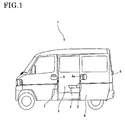
- Fig. 1 is a side view of a vehicle loaded with a door opening/closing device according to Embodiment 1 of the present invention.
- Fig. 2 is a schematic view of sections of a sliding door and a drive device as viewed from above the vehicle.
- a vehicle 1 equipped with a door opening/closing device is, for example, a minivan type automobile.
- An entrance 3 to a rear seat 2 is mounted with a sliding door 4 which is slid in a front-rear direction of the vehicle 1 to open and close the entrance 3.
- a latch mechanism 5 is provided in a front end part of the sliding door 4.
- a striker 7 is provided in a panel member 6 on the front side (left side in the drawing) of the entrance 3 of the vehicle 1. In a state where the entrance 3 is closed with the sliding door 4 (fully closed state), the latch mechanism 5 of the sliding door 4 engages the striker 7 of the panel member 6 to lock the sliding door 4.
- the sliding door 4 is driven by a drive device equipped with a transmission motor as a drive source. Since the drive device for the sliding door 4 is in a well-known configuration, an example thereof will be briefly explained herein.
- a drive device 10 for driving the sliding door 4 is equipped with a drive motor (electric motor) 11.
- a drive pulley 13 is connected via a transmission mechanism 12 such as a speed reducer or an electromagnetic clutch.
- the drive pulley 13 is coupled to an endless wire 16 looped over a front guide pulley 14 and a rear guide pulley 15 arranged at positions spaced by nearly the longitudinal length of the sliding door 4 in the front-rear direction of the vehicle.
- a bracket 17 fixed at one end to an inner panel of the sliding door 4 has the other end coupled to the endless wire 16.
- the sliding door 4 slides between the front and rear guide pulleys 14 and 15 in collaboration with the endless wire 16 while being guided by a guide rail (not shown). As a result, the entrance 3 is opened and closed by the sliding door 4.
- a tail gate 8 for opening and closing an opening area of a luggage room is provided in an upper part of the vehicle body pivotably in an up-down direction.
- the tail gate 8 is also configured to be driven by a drive device (not shown) equipped with an electric motor as a drive source.
- the door opening/closing device of a vehicle controls the opening/closing operation of the sliding door 4 as a door member.
- the door opening/closing device is characterized, for example, by performing "stopping control" for stopping the movement of the sliding door 4 when a collision of the vehicle 1 occurs, namely, by controlling, as appropriate, the drive device 10 to apply the brakes to the sliding door 4, thereby stopping the movement of the sliding door 4.
- Fig. 3 is a block diagram showing the schematic configuration of the door opening/closing device according to the present embodiment.
- a door opening/closing device 20 is equipped with a plurality of impact sensors 21 as a collision detection means, and a control unit 25 for controlling the opening/closing operation of the sliding door 4.
- the impact sensor 21 detects impact made on the vehicle 1.
- the impact sensor 21 concurrently serves as an air bag device (not shown) installed on the vehicle 1.
- an air bag device not shown
- the impact sensors 21 are provided at 4 locations, i.e., the front end, the rear end and the right and left side ends of the vehicle 1. It goes without saying that the number and arrangement of the impact sensors 21 are not limited, and may be decided on, as appropriate, according to needs.
- the control unit 25 has an opening/closing control means 26, an operating state detection means 27, and a stopping control means 28.
- opening/closing control for opening and closing the sliding door 4 by driving the drive device 10 in response to the operation of the door knob 4a is exercised. Concretely, if the sliding door 4 is in a closed state, the sliding door 4 is operated in an opening direction (opening operation); if the sliding door 4 is in an open state, the sliding door 4 is operated in a closing direction (closing operation).
- the “closing operation” includes “a sliding operation” for sliding the sliding door 4 toward the front of the vehicle 1, and “a closing-up operation” for moving the sliding door 4 toward the interior of the vehicle 1 until it becomes fully closed after the latch mechanism 5 of the sliding door 4 is engaged with the striker 7 of the panel member 6.
- the operating state detection means 27 detects the operating state (movement) of the sliding door 4.
- the operating state detection means 27 detects the operating state of the sliding door 4 based on a signal from a pulse sensor 11a provided on the drive motor 11 constituting the drive device 10.
- the operating state detection means 27 detects which of the operating states the sliding door 4 is in, a stop state, an opening operation state, or a closing operation state.
- the stopping control means 28 Upon detection of a collision of the vehicle 1 by the impact sensor 21, the stopping control means 28 implements "stopping control” for terminating the “opening/closing control” of the sliding door 4 by the opening/closing control means 26 to stop the opening operation or closing operation of the sliding door 4. That is, the brakes are applied to the sliding door 4 to stop the sliding door 4.
- the drive motor 11 and the drive pulley 13 of the drive device 10 are connected together via the transmission mechanism (electromagnetic clutch) 12 to apply the brakes. By so doing, the movement of the sliding door 4 is suppressed, and the sliding door 4 can be stopped. Needless to say, the method of stopping the sliding door 4 is not limited.
- the entrance 3 can be inhibited from opening widely in the event of a collision of the vehicle 1. If a collision occurs during the automatic operation (opening operation) of the sliding door 4, for example, the motion of the sliding door 4 is stopped on the spot, so that the wide opening of the entrance 3 can be suppressed. Even if the sliding door 4 performs an opening operation owing to impact at the time of the collision, for example, the brakes are applied to the sliding door 4 to stop the sliding door 4, so that the wide opening of the entrance 3 can be suppressed. Thus, a fall of the occupant or luggage from the vehicle 1 can be suppressed. If the sliding door 4 is making an automatic operation (closing operation) or is performing a closing operation because of impact at the time of the collision, on the other hand, the sliding door 4 is stopped, whereby the occupant can be prevented from getting caught in the sliding door 4.
- the stopping control means 28 prohibits the implementation of the opening/closing control by the opening/closing control means 26 for a certain period after completion of the implementation of the "stopping control". That is, the stopping control means 28 prohibits the automatic operation of the sliding door 4 for a certain period (a period of the order of several seconds) after stopping the sliding door 4, even when the door knob 4a of the sliding door 4 is operated. This procedure can prevent events, such as a fall of the occupant through the entrance 3, in consequence of the opening operation of the sliding door 4 due to the misoperation of the door knob 4a.
- the stopping control means 28 further implements "braking control” for a certain period after completion of the implementation of the "stopping control".
- the brakes are applied to the sliding door 4 so as to make the operating speed slower than under ordinary conditions.
- the sliding door 4 may move under its own weight or the like.
- the brakes are applied to the sliding door 4 to suppress the sudden opening or closing of the sliding door 4.
- the strength of the brakes is adjusted, for example, by the state of connection between the drive motor 11 and the drive pulley 13 by the transmission mechanism (electromagnetic clutch) 12.
- the stopping control means 28 switches the sliding door 4 to a state in which the sliding door 4 can be manually operated, rather than returning the sliding door 4 to a state in which the sliding door 4 can be automatically operated by the drive device 10.
- the stopping control means 28 brings the sliding door 4 to the state enabling its manual operation, when the movement of the sliding door 4 is not detected for a certain period by the operating state detection means 27 after implementation of the "braking control". By this procedure, the sliding door 4 can be opened and closed more safely. Furthermore, it becomes possible to prevent the occurrence of such a problem that the sliding door 4 cannot be opened because of a failure or the like in the drive device 10.
- the above-mentioned opening/closing control of the sliding door 4 by the stopping control means 28 can be released by performing a predetermined operation.
- this opening/closing control can be released by performing an operation for turning off an ignition key (not shown) for the vehicle 1.
- the stopping control means 28 stops the operation of the sliding door 4, if the sliding door 4 is in the aforementioned "sliding operation" during the closing operation. If the sliding door 4 is in the "closing-up operation", however, the stopping control means 28 allows the closing operation of the sliding door 4 to continue. By this procedure, a fall of the occupant from inside the vehicle 1 to the outside can be suppressed. That is, while in the "closing-up operation", the operation of the sliding door 4 is continued, rather than stopped, whereby the movement of the sliding door 4 can be stopped more reliably.
- Step S2 it is determined in Step S2 whether the sliding door 4 is in an automatic operation. That is, it is determined whether "opening/closing control" is implemented by the opening/closing control means 26. If the sliding door 4 is in operation (Step S2: Yes), it is further determined whether the aforementioned "closing-up operation" is being performed (Step S3). If the sliding door 4 is not in the “closing-up operation", namely, if the sliding door 4 is in the aforementioned "sliding operation", or in the "opening operation” (Step S3: No), "stopping control" is exercised.
- Step S4 the operation of the sliding door 4 (closing operation) by the opening/closing control means 26 is terminated (Step S4), and the automatic operation of the sliding door 4 is prohibited (Step S5).
- Step S6 the brakes are applied to the sliding door 4 to stop the motion of the sliding door 4.
- Step S7 "braking control" is implemented to suppress the sudden opening/closing of the sliding door 4 (Step S7).
- Step S8: Yes the prohibition of the automatic operation is released in Step S9 to end a series of processings.
- Step S3 the sliding door 4 is in the "closing-up operation"
- the "opening/closing control” is continued until the sliding door 4 is brought to a fully closed position (Step S10).
- the “stopping control” is exercised. Since, in this case, the sliding door 4 is in a stopped state, a concrete action is to prohibit the automatic operation of the sliding door 4 (Step S11). By this action, the sliding door 4 is reliably held at the fully closed position.
- Step S12 If, in Step S2, the sliding door 4 is not in the automatic operation (Step S2: No), it is determined then in Step S12 whether the sliding door 4 is at the fully closed position. If the sliding door 4 is at the fully closed position (Step S12: Yes), the sliding door 4 is in a stopped state. Thus, the automatic operation of the sliding door 4 is then prohibited (Step S13). If, then, the operation of the sliding door 4 is detected within a certain period (Step S14: Yes), in Step S15, the brakes are applied to the sliding door 4 to stop the operation of the sliding door 4. After this state is held for a certain period, "braking control" is implemented to suppress the sudden opening/closing of the sliding door 4 (Step S16), whereafter the program proceeds to Step S8.
- Step S12 If, in Step S12, the sliding door 4 is not at the fully closed position, for example, if the sliding door 4 is in a half-open state (Step S12: No), "stopping control" is immediately executed to stop the sliding door 4 on the spot (Step S17). Then, in Step S18, the automatic operation of the sliding door 4 is prohibited, and the state of the brakes being applied to the sliding door 4 is held for a certain period (Step S19). After a lapse of the certain period, "braking control" is exercised in Step S20 to suppress the sudden opening/closing of the sliding door 4. Then, the program proceeds to Step S8.
- the door opening/closing device 20 concerned with the present embodiment it is possible, for example, to suppress the opening or closing operation of the sliding door 4 ascribed to impact or the like in a collision of the vehicle 1. Hence, the occupant or luggage can be inhibited from being thrown out of the vehicle, or the occupant can be inhibited from getting caught in the door member.
- Fig. 5 is a flow chart showing an example of door opening/closing control according to Embodiment 2.
- the stopping control means 28 stops the operation of the sliding door 4 on the spot.
- the stopping control means 28 allows the closing operation to continue, without stopping the operation of the sliding door 4.
- Step S3 the sliding door 4 is not in the "closing-up operation"
- Step S21 determines further whether the sliding door 4 is in the closing operation. If the sliding door 4 is not in the closing operation, namely, if the sliding door 4 is in the opening operation (Step S21: No), the program proceeds to Step S4. If the sliding door 4 is in the closing operation (Step S21: Yes), the program proceeds to Step S22 to continue "opening/closing control" until the sliding door 4 comes to the fully closed position.
- Step S8 the program proceeds to Step S8.
- a collision of the vehicle is detected by the impact sensor.
- the method of detecting the collision is not limited.
- the presence of absence of a collision can be determined based on an image from an on-vehicle camera or the results of detection by a millimeter-wave radar.
- the above-mentioned impact sensor may be configured to serve concurrently as an air bag device, whereby the door opening/closing device of a vehicle according to the present invention can be realized relatively inexpensively. Needless to say, however, the impact sensor may be provided separately from the air bag device.
- the configuration in which the sliding door is automatically operated by the drive device is illustrated.
- the sliding door is switched between the automatic operation and the occupant's manual operation by operating a predetermined switch or the like. If such a configuration is adopted, the aforementioned control is exercised upon selection of the automatic operation of the sliding door.
- the present invention is described by taking the electric sliding door as an example of the door member.
- the present invention can be applied, for example, to an electric tail gate as well.
Landscapes
- Business, Economics & Management (AREA)
- Emergency Management (AREA)
- Power-Operated Mechanisms For Wings (AREA)
Abstract
Description
- This invention relates to a door opening/closing device of a vehicle, which controls the opening/closing operation of a door member provided in the vehicle, such as an electric sliding door or an electric tail gate.
- In a vehicle such as an automobile, an electric sliding door device for opening and closing an entrance to a rear seat, for example, has found practical use as a device for automatically opening and closing an opening area formed in a vehicle body. The electric sliding door device is configured such that in response to the operation of a start switch composed of a door knob or the like of a sliding door, a built-in electric motor starts to perform the opening or closing operation of the sliding door. Such an electric sliding door device is controlled to keep the sliding door from opening, while the vehicle is travelling, in compliance with the laws and regulations.
- In recent years, moreover, various technologies for preventing the opening and closing of the sliding door during a vehicle travel due to the erroneous operation of the start switch have been proposed in an attempt to improve the safety of the vehicle. With an example of the technology, when a foot brake or a parking brake is acting at a vehicle speed of 3 km/h or lower, the immediately preceding decelerated state of the vehicle is confirmed, and a power sliding device is started except in a case where the decelerated state corresponds to sudden braking (see Patent Document 1).
- According to the invention concerned with Patent Document 1, the opening operation of the sliding door during a vehicle travel due to the misoperation of the start switch can be suppressed. Even if the vehicle is moving, with the wheel being locked, for example, the opening operation of the sliding door can be suppressed.
- Patent Document 1: Japanese Patent No.
3726956 - According to the invention concerned with Patent Document 1, the opening operation of a door member such as a sliding door due to the misoperation of the start switch can be suppressed, as described above. However, a further improvement in safety is desired in connection with the opening/closing operation of the door member.
- In the event of a vehicle collision, for example, it is conceivable for a door member, such as a sliding door, to make an opening or closing operation as a result of its impact. If the door member becomes open when the vehicle collides, an occupant or luggage may fall to the outside. If the door member makes a closing operation from an open state, on the other hand, the occupant may get caught in the door member.
- With the above-mentioned conventional technology, however, the opening/closing operation of the door member due to such an impact cannot be suppressed.
- The present invention has been accomplished in light of the above circumstances. It is an object of this invention to provide a door opening/closing device of a vehicle which can suppress the opening/closing operation of a door member due to impact.
- A first aspect of the present invention for solving the above problems lies in a door opening/closing device of a vehicle including: a door member provided to be capable of opening and closing an opening area formed in a vehicle body; a drive device for driving the door member so as to be opened and closed; and opening/closing control means for driving the drive device in response to an operation of a start switch by an occupant to control an opening/closing operation of the door member, the door opening/closing device comprising: collision detection means which detects a collision of the vehicle; and stopping control means which, upon detection of a collision of the vehicle by the collision detection means, implements stopping control for terminating opening/closing control by the opening/closing control means to stop the opening/closing operation of the door member.
- A second aspect of the present invention lies in the door opening/closing device of a vehicle according to the first aspect, wherein the stopping control means prohibits implementation of the opening/closing control by the opening/closing control means for a certain period after completion of implementation of the stopping control.
- A third aspect of the present invention lies in the door opening/closing device of a vehicle according to the first or second aspect, further comprising operating state detection means for detecting the operating state of the door member, wherein if the door member is detected by the operating state detection means to be moving after completion of implementation of the stopping control, the stopping control means further implements braking control for slowing down the movement of the door member.
- A fourth aspect of the present invention lies in the door opening/closing device of a vehicle according to any one of the first to third aspects, further comprising operating state detection means for detecting the operating state of the door member, wherein if the collision of the vehicle is detected by the collision detection means and the door member is detected by the operating state detection means to be in a closing operation, the stopping control means implements the stopping control at a time when the closing operation of the door member ends.
- A fifth aspect of the present invention lies in the door opening/closing device of a vehicle according to any one of the first to fourth aspects, wherein the stopping control means enables the manual operation of the door member after implementing the stopping control.
- A sixth aspect of the present invention lies in the door opening/closing device of a vehicle according to any one of the first to fifth aspects, wherein the collision detection means is an impact sensor constituting an air bag device loaded on the vehicle.
- According to the door opening/closing device of a vehicle concerned with the present invention, it is possible, for example, to suppress the opening or closing operation of the door member ascribed to impact or the like at the time of a collision of the vehicle. Hence, the door opening/closing device can inhibit an occupant or luggage from falling from the vehicle, or inhibit the occupant from getting caught in the door member, for example.
-
- [
Fig. 1 ] is a side view showing an example of a vehicle loaded with a door opening/closing device according to the present invention. - [
Fig. 2 ] is a view schematically showing an example of a drive device. - [
Fig. 3 ] is a block diagram showing the schematic configuration of the door opening/closing device according to the present invention. - [
Fig. 4 ] is a flow chart showing an example of door opening/closing control according to Embodiment 1 of the present invention. - [
Fig. 5 ] is a flow chart showing an example of door opening/closing control according toEmbodiment 2 of the present invention. - Embodiments of the present invention will now be described in detail with reference to the accompanying drawings.
-
Fig. 1 is a side view of a vehicle loaded with a door opening/closing device according to Embodiment 1 of the present invention.Fig. 2 is a schematic view of sections of a sliding door and a drive device as viewed from above the vehicle. - First of all, the configuration of the vehicle equipped with the door opening/closing device according to the present embodiment will be described.
- As shown in
Fig. 1 , a vehicle 1 equipped with a door opening/closing device according to the present embodiment is, for example, a minivan type automobile. Anentrance 3 to arear seat 2 is mounted with a slidingdoor 4 which is slid in a front-rear direction of the vehicle 1 to open and close theentrance 3. Alatch mechanism 5 is provided in a front end part of the slidingdoor 4. Astriker 7 is provided in apanel member 6 on the front side (left side in the drawing) of theentrance 3 of the vehicle 1. In a state where theentrance 3 is closed with the sliding door 4 (fully closed state), thelatch mechanism 5 of the slidingdoor 4 engages thestriker 7 of thepanel member 6 to lock the slidingdoor 4. - The sliding
door 4 is driven by a drive device equipped with a transmission motor as a drive source. Since the drive device for the slidingdoor 4 is in a well-known configuration, an example thereof will be briefly explained herein. - As shown in
Fig. 2 , for example, adrive device 10 for driving the slidingdoor 4 is equipped with a drive motor (electric motor) 11. To thedrive motor 11, adrive pulley 13 is connected via atransmission mechanism 12 such as a speed reducer or an electromagnetic clutch. Thedrive pulley 13 is coupled to anendless wire 16 looped over afront guide pulley 14 and arear guide pulley 15 arranged at positions spaced by nearly the longitudinal length of the slidingdoor 4 in the front-rear direction of the vehicle. Abracket 17 fixed at one end to an inner panel of the slidingdoor 4 has the other end coupled to theendless wire 16. - Upon driving of the
drive motor 11 of thedrive device 10 configured as above, the slidingdoor 4 slides between the front andrear guide pulleys endless wire 16 while being guided by a guide rail (not shown). As a result, theentrance 3 is opened and closed by the slidingdoor 4. - On the rear surface of the vehicle 1, a
tail gate 8 for opening and closing an opening area of a luggage room is provided in an upper part of the vehicle body pivotably in an up-down direction. Like the slidingdoor 4, thetail gate 8 is also configured to be driven by a drive device (not shown) equipped with an electric motor as a drive source. - The door opening/closing device of a vehicle according to the present embodiment controls the opening/closing operation of the sliding
door 4 as a door member. The door opening/closing device is characterized, for example, by performing "stopping control" for stopping the movement of the slidingdoor 4 when a collision of the vehicle 1 occurs, namely, by controlling, as appropriate, thedrive device 10 to apply the brakes to the slidingdoor 4, thereby stopping the movement of the slidingdoor 4. - The configuration of the door opening/closing device according to the present embodiment will be described below.
Fig. 3 is a block diagram showing the schematic configuration of the door opening/closing device according to the present embodiment. - A door opening/
closing device 20 according to the present embodiment is equipped with a plurality ofimpact sensors 21 as a collision detection means, and acontrol unit 25 for controlling the opening/closing operation of the slidingdoor 4. - The
impact sensor 21 detects impact made on the vehicle 1. In the present embodiment, theimpact sensor 21 concurrently serves as an air bag device (not shown) installed on the vehicle 1. When impact greater than a predetermined value is detected by theimpact sensor 21, it is determined that a collision of the vehicle 1 has occurred. Theimpact sensors 21 are provided at 4 locations, i.e., the front end, the rear end and the right and left side ends of the vehicle 1. It goes without saying that the number and arrangement of theimpact sensors 21 are not limited, and may be decided on, as appropriate, according to needs. - The
control unit 25 has an opening/closing control means 26, an operating state detection means 27, and a stopping control means 28. - When a
door knob 4a (seeFig. 1 ) of the slidingdoor 4, as a start switch, is operated by an occupant, opening/closing control for opening and closing the slidingdoor 4 by driving thedrive device 10 in response to the operation of thedoor knob 4a is exercised. Concretely, if the slidingdoor 4 is in a closed state, the slidingdoor 4 is operated in an opening direction (opening operation); if the slidingdoor 4 is in an open state, the slidingdoor 4 is operated in a closing direction (closing operation). - The "closing operation" includes "a sliding operation" for sliding the sliding
door 4 toward the front of the vehicle 1, and "a closing-up operation" for moving the slidingdoor 4 toward the interior of the vehicle 1 until it becomes fully closed after thelatch mechanism 5 of the slidingdoor 4 is engaged with thestriker 7 of thepanel member 6. - The operating state detection means 27 detects the operating state (movement) of the sliding
door 4. In the present embodiment, the operating state detection means 27 detects the operating state of the slidingdoor 4 based on a signal from apulse sensor 11a provided on thedrive motor 11 constituting thedrive device 10. For example, the operating state detection means 27 detects which of the operating states the slidingdoor 4 is in, a stop state, an opening operation state, or a closing operation state. - Upon detection of a collision of the vehicle 1 by the
impact sensor 21, the stopping control means 28 implements "stopping control" for terminating the "opening/closing control" of the slidingdoor 4 by the opening/closing control means 26 to stop the opening operation or closing operation of the slidingdoor 4. That is, the brakes are applied to the slidingdoor 4 to stop the slidingdoor 4. Concretely, thedrive motor 11 and thedrive pulley 13 of thedrive device 10 are connected together via the transmission mechanism (electromagnetic clutch) 12 to apply the brakes. By so doing, the movement of the slidingdoor 4 is suppressed, and the slidingdoor 4 can be stopped. Needless to say, the method of stopping the slidingdoor 4 is not limited. - By so applying the brakes to the sliding
door 4 to stop the slidingdoor 4, theentrance 3 can be inhibited from opening widely in the event of a collision of the vehicle 1. If a collision occurs during the automatic operation (opening operation) of the slidingdoor 4, for example, the motion of the slidingdoor 4 is stopped on the spot, so that the wide opening of theentrance 3 can be suppressed. Even if the slidingdoor 4 performs an opening operation owing to impact at the time of the collision, for example, the brakes are applied to the slidingdoor 4 to stop the slidingdoor 4, so that the wide opening of theentrance 3 can be suppressed. Thus, a fall of the occupant or luggage from the vehicle 1 can be suppressed. If the slidingdoor 4 is making an automatic operation (closing operation) or is performing a closing operation because of impact at the time of the collision, on the other hand, the slidingdoor 4 is stopped, whereby the occupant can be prevented from getting caught in the slidingdoor 4. - In the present embodiment, moreover, the stopping control means 28 prohibits the implementation of the opening/closing control by the opening/closing control means 26 for a certain period after completion of the implementation of the "stopping control". That is, the stopping control means 28 prohibits the automatic operation of the sliding
door 4 for a certain period (a period of the order of several seconds) after stopping the slidingdoor 4, even when thedoor knob 4a of the slidingdoor 4 is operated. This procedure can prevent events, such as a fall of the occupant through theentrance 3, in consequence of the opening operation of the slidingdoor 4 due to the misoperation of thedoor knob 4a. - The stopping control means 28 further implements "braking control" for a certain period after completion of the implementation of the "stopping control". With the "braking control", when the sliding
door 4 is detected by the operating state detection means 27 to be moving, the brakes are applied to the slidingdoor 4 so as to make the operating speed slower than under ordinary conditions. For example, the slidingdoor 4 may move under its own weight or the like. In such a case, the brakes are applied to the slidingdoor 4 to suppress the sudden opening or closing of the slidingdoor 4. The strength of the brakes is adjusted, for example, by the state of connection between thedrive motor 11 and thedrive pulley 13 by the transmission mechanism (electromagnetic clutch) 12. - After implementing the "stopping control", the stopping control means 28 switches the sliding
door 4 to a state in which the slidingdoor 4 can be manually operated, rather than returning the slidingdoor 4 to a state in which the slidingdoor 4 can be automatically operated by thedrive device 10. In the present embodiment, the stopping control means 28 brings the slidingdoor 4 to the state enabling its manual operation, when the movement of the slidingdoor 4 is not detected for a certain period by the operating state detection means 27 after implementation of the "braking control". By this procedure, the slidingdoor 4 can be opened and closed more safely. Furthermore, it becomes possible to prevent the occurrence of such a problem that the slidingdoor 4 cannot be opened because of a failure or the like in thedrive device 10. - The above-mentioned opening/closing control of the sliding
door 4 by the stopping control means 28 can be released by performing a predetermined operation. For example, this opening/closing control can be released by performing an operation for turning off an ignition key (not shown) for the vehicle 1. - In the present embodiment, moreover, the stopping control means 28 stops the operation of the sliding
door 4, if the slidingdoor 4 is in the aforementioned "sliding operation" during the closing operation. If the slidingdoor 4 is in the "closing-up operation", however, the stopping control means 28 allows the closing operation of the slidingdoor 4 to continue. By this procedure, a fall of the occupant from inside the vehicle 1 to the outside can be suppressed. That is, while in the "closing-up operation", the operation of the slidingdoor 4 is continued, rather than stopped, whereby the movement of the slidingdoor 4 can be stopped more reliably. - Next, an example of the door opening/closing control by the door opening/closing device will be described by reference to a flow chart as
Fig. 4 . - If, in Step S1, a collision of the vehicle 1 is detected, it is determined in Step S2 whether the sliding
door 4 is in an automatic operation. That is, it is determined whether "opening/closing control" is implemented by the opening/closing control means 26. If the slidingdoor 4 is in operation (Step S2: Yes), it is further determined whether the aforementioned "closing-up operation" is being performed (Step S3). If the slidingdoor 4 is not in the "closing-up operation", namely, if the slidingdoor 4 is in the aforementioned "sliding operation", or in the "opening operation" (Step S3: No), "stopping control" is exercised. That is, the operation of the sliding door 4 (closing operation) by the opening/closing control means 26 is terminated (Step S4), and the automatic operation of the slidingdoor 4 is prohibited (Step S5). Then, in Step S6, the brakes are applied to the slidingdoor 4 to stop the motion of the slidingdoor 4. After this state is held for a certain period, "braking control" is implemented to suppress the sudden opening/closing of the sliding door 4 (Step S7). Then, it is determined whether an operation for turning off the ignition key has been performed. If the key turning-off operation has been performed (Step S8: Yes), the prohibition of the automatic operation is released in Step S9 to end a series of processings. - If, in Step S3, the sliding
door 4 is in the "closing-up operation", the "opening/closing control" is continued until the slidingdoor 4 is brought to a fully closed position (Step S10). At a time when the slidingdoor 4 reaches the fully closed position, the "stopping control" is exercised. Since, in this case, the slidingdoor 4 is in a stopped state, a concrete action is to prohibit the automatic operation of the sliding door 4 (Step S11). By this action, the slidingdoor 4 is reliably held at the fully closed position. - If, in Step S2, the sliding
door 4 is not in the automatic operation (Step S2: No), it is determined then in Step S12 whether the slidingdoor 4 is at the fully closed position. If the slidingdoor 4 is at the fully closed position (Step S12: Yes), the slidingdoor 4 is in a stopped state. Thus, the automatic operation of the slidingdoor 4 is then prohibited (Step S13). If, then, the operation of the slidingdoor 4 is detected within a certain period (Step S14: Yes), in Step S15, the brakes are applied to the slidingdoor 4 to stop the operation of the slidingdoor 4. After this state is held for a certain period, "braking control" is implemented to suppress the sudden opening/closing of the sliding door 4 (Step S16), whereafter the program proceeds to Step S8. - If, in Step S12, the sliding
door 4 is not at the fully closed position, for example, if the slidingdoor 4 is in a half-open state (Step S12: No), "stopping control" is immediately executed to stop the slidingdoor 4 on the spot (Step S17). Then, in Step S18, the automatic operation of the slidingdoor 4 is prohibited, and the state of the brakes being applied to the slidingdoor 4 is held for a certain period (Step S19). After a lapse of the certain period, "braking control" is exercised in Step S20 to suppress the sudden opening/closing of the slidingdoor 4. Then, the program proceeds to Step S8. - According to the door opening/
closing device 20 concerned with the present embodiment, as described above, it is possible, for example, to suppress the opening or closing operation of the slidingdoor 4 ascribed to impact or the like in a collision of the vehicle 1. Hence, the occupant or luggage can be inhibited from being thrown out of the vehicle, or the occupant can be inhibited from getting caught in the door member. -
Fig. 5 is a flow chart showing an example of door opening/closing control according toEmbodiment 2. - In the foregoing embodiment, if the sliding
door 4 is in the opening operation or closing operation when a collision of the vehicle 1 is detected, the stopping control means 28 stops the operation of the slidingdoor 4 on the spot. In the present embodiment, on the other hand, if the slidingdoor 4 is in the closing operation when a collision of the vehicle 1 is detected, the stopping control means 28 allows the closing operation to continue, without stopping the operation of the slidingdoor 4. - Concretely, as shown in
Fig. 5 , the present embodiment is different from Embodiment 1 in that Steps S21 to S23 are added after Step S3. In detail, if, in Step S3, the slidingdoor 4 is not in the "closing-up operation" (Step S3: No), the program proceeds to Step S21 to determine further whether the slidingdoor 4 is in the closing operation. If the slidingdoor 4 is not in the closing operation, namely, if the slidingdoor 4 is in the opening operation (Step S21: No), the program proceeds to Step S4. If the slidingdoor 4 is in the closing operation (Step S21: Yes), the program proceeds to Step S22 to continue "opening/closing control" until the slidingdoor 4 comes to the fully closed position. At a time when the slidingdoor 4 reaches the fully closed position, the "stopping control" is exercised. In this case, the slidingdoor 4 is in a stopped state. Thus, concrete processing is to prohibit the automatic operation of the sliding door 4 (Step S23). Then, the program proceeds to Step S8. - As described above, if the sliding
door 4 is in the closing operation, the operation of the slidingdoor 4 is continued. By this procedure, when a collision of the vehicle 1 occurs, a fall of the occupant or luggage from the vehicle 1 can be suppressed more reliably. - The embodiments of the present invention have been described as above. However, the present invention is not limited to the above embodiments. The present invention can be modified or changed, as appropriate, without departing from the scope and spirit of the invention.
- In the above embodiments, for example, a collision of the vehicle is detected by the impact sensor. However, the method of detecting the collision is not limited. For example, the presence of absence of a collision can be determined based on an image from an on-vehicle camera or the results of detection by a millimeter-wave radar. Moreover, the above-mentioned impact sensor may be configured to serve concurrently as an air bag device, whereby the door opening/closing device of a vehicle according to the present invention can be realized relatively inexpensively. Needless to say, however, the impact sensor may be provided separately from the air bag device.
- In the above embodiments, the configuration in which the sliding door is automatically operated by the drive device is illustrated. However, there may be a configuration in which the sliding door is switched between the automatic operation and the occupant's manual operation by operating a predetermined switch or the like. If such a configuration is adopted, the aforementioned control is exercised upon selection of the automatic operation of the sliding door.
- In the above embodiments, moreover, the present invention is described by taking the electric sliding door as an example of the door member. However, the present invention can be applied, for example, to an electric tail gate as well.
-
- 1
- Vehicle
- 2
- Rear seat
- 3
- Entrance
- 4
- Sliding door
- 4a
- Door knob
- 5
- Latch mechanism
- 6
- Panel member
- 7
- Striker
- 8
- Tail gate
- 10
- Drive device
- 11
- Drive motor
- 11a
- Pulse sensor
- 12
- Transmission mechanism
- 13
- Drive pulley
- 14
- Front guide pulley
- 15
- Rear guide pulley
- 16
- Endless wire
- 17
- Bracket
- 20
- Door opening/closing device
- 21
- Impact sensor
- 25
- Control unit
- 26
- Opening/closing control means
- 27
- Operating state detection means
- 28
- Stopping control means
Claims (6)
- A door opening/closing device of a vehicle including:a door member provided to be capable of opening and closing an opening area formed in a vehicle body;a drive device for driving the door member so as to be opened and closed; andopening/closing control means for driving the drive device in response to an operation of a start switch by an occupant to control an opening/closing operation of the door member,the door opening/closing device, comprising:collision detection means which detects a collision of the vehicle; andstopping control means which, upon detection of a collision of the vehicle by the collision detection means, implements stopping control for terminating opening/closing control by the opening/closing control means to stop the opening/closing operation of the door member.
- The door opening/closing device of a vehicle according to claim 1, wherein
the stopping control means prohibits implementation of the opening/closing control by the opening/closing control means for a certain period after completion of implementation of the stopping control. - The door opening/closing device of a vehicle according to claim 1 or 2, further comprising
operating state detection means for detecting an operating state of the door member,
wherein if the door member is detected by the operating state detection means to be moving after completion of implementation of the stopping control, the stopping control means further implements braking control for slowing down a movement of the door member. - The door opening/closing device of a vehicle according to any one of claims 1 to 3, further comprising
operating state detection means for detecting an operating state of the door member,
wherein if the collision of the vehicle is detected by the collision detection means and the door member is detected by the operating state detection means to be in a closing operation, the stopping control means implements the stopping control at a time when the closing operation of the door member ends. - The door opening/closing device of a vehicle according to any one of claims 1 to 4, wherein
the stopping control means enables a manual operation of the door member after implementing the stopping control. - The door opening/closing device of a vehicle according to any one of claims 1 to 5, wherein
the collision detection means is an impact sensor constituting an air bag device loaded on the vehicle.
Applications Claiming Priority (2)
| Application Number | Priority Date | Filing Date | Title |
|---|---|---|---|
| JP2013268106A JP6414383B2 (en) | 2013-12-25 | 2013-12-25 | Vehicle door opening and closing device |
| PCT/JP2014/080385 WO2015098354A1 (en) | 2013-12-25 | 2014-11-17 | Vehicle door open/close device |
Publications (2)
| Publication Number | Publication Date |
|---|---|
| EP3095626A1 true EP3095626A1 (en) | 2016-11-23 |
| EP3095626A4 EP3095626A4 (en) | 2017-10-18 |
Family
ID=53478229
Family Applications (1)
| Application Number | Title | Priority Date | Filing Date |
|---|---|---|---|
| EP14873416.3A Withdrawn EP3095626A4 (en) | 2013-12-25 | 2014-11-17 | Vehicle door open/close device |
Country Status (3)
| Country | Link |
|---|---|
| EP (1) | EP3095626A4 (en) |
| JP (1) | JP6414383B2 (en) |
| WO (1) | WO2015098354A1 (en) |
Families Citing this family (2)
| Publication number | Priority date | Publication date | Assignee | Title |
|---|---|---|---|---|
| JP6984434B2 (en) * | 2018-01-23 | 2021-12-22 | 株式会社アイシン | Vehicle opening / closing body control device and vehicle opening / closing body control method |
| CN114715069B (en) * | 2021-01-05 | 2023-07-25 | 广州汽车集团股份有限公司 | Vehicle collision processing system and method |
Family Cites Families (11)
| Publication number | Priority date | Publication date | Assignee | Title |
|---|---|---|---|---|
| JPS58131283A (en) * | 1982-01-28 | 1983-08-05 | 日産自動車株式会社 | Automatic door apparatus for vehicle |
| JPH0665838B2 (en) * | 1985-12-28 | 1994-08-24 | 吉田工業株式会社 | Automatic door power-on control method |
| US5574315A (en) * | 1995-01-17 | 1996-11-12 | Weber; Harold J. | Method and apparatus enabling emergency activated control of electrically operated door lock and window regulator systems in a motor vehicle |
| JP3730773B2 (en) * | 1998-01-08 | 2006-01-05 | アスモ株式会社 | SLIDE DOOR OPENING / CLOSING DEVICE FOR AUTOMOBILE AND CLOSE ACTION CONTROL METHOD FOR SLIDING DOOR OPENING / CLOSING DEVICE FOR AUTOMOBILE |
| JP2000345768A (en) * | 1999-06-04 | 2000-12-12 | Toyo Denso Co Ltd | Power window device |
| JP3726956B2 (en) | 2001-10-31 | 2005-12-14 | 三井金属鉱業株式会社 | Control method of power sliding device for vehicle sliding door |
| JP4167958B2 (en) * | 2003-09-18 | 2008-10-22 | アイシン精機株式会社 | Vehicle door control device |
| JP2005212506A (en) * | 2004-01-27 | 2005-08-11 | Toyota Motor Corp | Vehicle door control device |
| JP4415710B2 (en) * | 2004-03-11 | 2010-02-17 | トヨタ自動車株式会社 | Open / close control device |
| JP2009127301A (en) * | 2007-11-23 | 2009-06-11 | Hi-Lex Corporation | Opening / closing member opening prevention method and opening / closing member opening prevention device for vehicle |
| JP2013174077A (en) * | 2012-02-24 | 2013-09-05 | Hi-Lex Corporation | Opening/closing body control device |
-
2013
- 2013-12-25 JP JP2013268106A patent/JP6414383B2/en active Active
-
2014
- 2014-11-17 EP EP14873416.3A patent/EP3095626A4/en not_active Withdrawn
- 2014-11-17 WO PCT/JP2014/080385 patent/WO2015098354A1/en not_active Ceased
Also Published As
| Publication number | Publication date |
|---|---|
| EP3095626A4 (en) | 2017-10-18 |
| JP6414383B2 (en) | 2018-10-31 |
| WO2015098354A1 (en) | 2015-07-02 |
| JP2015123808A (en) | 2015-07-06 |
Similar Documents
| Publication | Publication Date | Title |
|---|---|---|
| JP4834384B2 (en) | Vehicle door control method and vehicle door control system | |
| US9617777B2 (en) | Vehicle window opening device | |
| US8661735B2 (en) | Actuation method for an electric window winder | |
| JP3857605B2 (en) | Automatic switchgear for vehicles | |
| JP2009127301A (en) | Opening / closing member opening prevention method and opening / closing member opening prevention device for vehicle | |
| EP3095626A1 (en) | Vehicle door open/close device | |
| JP2007315069A (en) | Vehicular automatic opening-closing device | |
| US7646158B2 (en) | Device for controlling opening/closing body for vehicle | |
| KR20150022030A (en) | Apparatus and method for controlling power trunk or power tailgate using hall sensor | |
| JP2007009466A (en) | Automatic opening-closing device for vehicle and its control method | |
| JP3799909B2 (en) | Automatic sliding door control device | |
| US20010045775A1 (en) | Emergency locking system and method | |
| JP4220399B2 (en) | Automatic switchgear for vehicles | |
| CN113863791A (en) | A control method, device, equipment and storage medium for an electric sliding door | |
| JP3960328B2 (en) | Automatic opening / closing device for vehicle opening / closing member | |
| JP4272630B2 (en) | Open / close control device for sliding door for vehicle | |
| JP3749964B2 (en) | Automatic sliding door control device | |
| JP4262641B2 (en) | Automatic switchgear for vehicles | |
| JP2007023587A (en) | Automatic opening and closing device for vehicle | |
| JP4376820B2 (en) | Intermediate stopping device for vehicle sliding door | |
| JP2005213832A (en) | Automatic opening/closing apparatus for vehicle | |
| KR20040016736A (en) | Safety locking apparatus for power sliding door of vehicle | |
| JP5625789B2 (en) | Keyless entry system | |
| CN120211582A (en) | Electric door opening and closing control method | |
| JP2007277900A (en) | Automatic sliding door control device for vehicle |
Legal Events
| Date | Code | Title | Description |
|---|---|---|---|
| PUAI | Public reference made under article 153(3) epc to a published international application that has entered the european phase |
Free format text: ORIGINAL CODE: 0009012 |
|
| 17P | Request for examination filed |
Effective date: 20160725 |
|
| AK | Designated contracting states |
Kind code of ref document: A1 Designated state(s): AL AT BE BG CH CY CZ DE DK EE ES FI FR GB GR HR HU IE IS IT LI LT LU LV MC MK MT NL NO PL PT RO RS SE SI SK SM TR |
|
| AX | Request for extension of the european patent |
Extension state: BA ME |
|
| DAX | Request for extension of the european patent (deleted) | ||
| A4 | Supplementary search report drawn up and despatched |
Effective date: 20170915 |
|
| RIC1 | Information provided on ipc code assigned before grant |
Ipc: B60J 5/00 20060101AFI20170911BHEP Ipc: B60J 5/04 20060101ALI20170911BHEP Ipc: B60J 5/06 20060101ALI20170911BHEP Ipc: B60R 21/0136 20060101ALI20170911BHEP Ipc: B60J 5/10 20060101ALI20170911BHEP Ipc: E05F 15/632 20150101ALI20170911BHEP Ipc: E05F 15/72 20150101ALI20170911BHEP |
|
| RAP1 | Party data changed (applicant data changed or rights of an application transferred) |
Owner name: MITSUBISHI JIDOSHA KOGYO KABUSHIKI KAISHA |
|
| GRAP | Despatch of communication of intention to grant a patent |
Free format text: ORIGINAL CODE: EPIDOSNIGR1 |
|
| RIC1 | Information provided on ipc code assigned before grant |
Ipc: B60J 5/10 20060101ALI20190731BHEP Ipc: B60J 5/04 20060101ALI20190731BHEP Ipc: E05F 15/632 20150101ALI20190731BHEP Ipc: B60R 21/0136 20060101ALI20190731BHEP Ipc: B60J 5/06 20060101ALI20190731BHEP Ipc: E05F 15/72 20150101ALI20190731BHEP Ipc: B60J 5/00 20060101AFI20190731BHEP |
|
| INTG | Intention to grant announced |
Effective date: 20190822 |
|
| STAA | Information on the status of an ep patent application or granted ep patent |
Free format text: STATUS: THE APPLICATION IS DEEMED TO BE WITHDRAWN |
|
| 18D | Application deemed to be withdrawn |
Effective date: 20200103 |