EP3094631B2 - Pyrimidinyloxy benzene derivatives as herbicides - Google Patents
Pyrimidinyloxy benzene derivatives as herbicides Download PDFInfo
- Publication number
- EP3094631B2 EP3094631B2 EP15703143.6A EP15703143A EP3094631B2 EP 3094631 B2 EP3094631 B2 EP 3094631B2 EP 15703143 A EP15703143 A EP 15703143A EP 3094631 B2 EP3094631 B2 EP 3094631B2
- Authority
- EP
- European Patent Office
- Prior art keywords
- isoxazolyl
- compound
- pyrimidine
- chloro
- compounds
- Prior art date
- Legal status (The legal status is an assumption and is not a legal conclusion. Google has not performed a legal analysis and makes no representation as to the accuracy of the status listed.)
- Active
Links
Classifications
-
- A—HUMAN NECESSITIES
- A01—AGRICULTURE; FORESTRY; ANIMAL HUSBANDRY; HUNTING; TRAPPING; FISHING
- A01N—PRESERVATION OF BODIES OF HUMANS OR ANIMALS OR PLANTS OR PARTS THEREOF; BIOCIDES, e.g. AS DISINFECTANTS, AS PESTICIDES OR AS HERBICIDES; PEST REPELLANTS OR ATTRACTANTS; PLANT GROWTH REGULATORS
- A01N25/00—Biocides, pest repellants or attractants, or plant growth regulators, characterised by their forms, or by their non-active ingredients or by their methods of application, e.g. seed treatment or sequential application; Substances for reducing the noxious effect of the active ingredients to organisms other than pests
- A01N25/02—Biocides, pest repellants or attractants, or plant growth regulators, characterised by their forms, or by their non-active ingredients or by their methods of application, e.g. seed treatment or sequential application; Substances for reducing the noxious effect of the active ingredients to organisms other than pests containing liquids as carriers, diluents or solvents
-
- A—HUMAN NECESSITIES
- A01—AGRICULTURE; FORESTRY; ANIMAL HUSBANDRY; HUNTING; TRAPPING; FISHING
- A01N—PRESERVATION OF BODIES OF HUMANS OR ANIMALS OR PLANTS OR PARTS THEREOF; BIOCIDES, e.g. AS DISINFECTANTS, AS PESTICIDES OR AS HERBICIDES; PEST REPELLANTS OR ATTRACTANTS; PLANT GROWTH REGULATORS
- A01N25/00—Biocides, pest repellants or attractants, or plant growth regulators, characterised by their forms, or by their non-active ingredients or by their methods of application, e.g. seed treatment or sequential application; Substances for reducing the noxious effect of the active ingredients to organisms other than pests
- A01N25/08—Biocides, pest repellants or attractants, or plant growth regulators, characterised by their forms, or by their non-active ingredients or by their methods of application, e.g. seed treatment or sequential application; Substances for reducing the noxious effect of the active ingredients to organisms other than pests containing solids as carriers or diluents
-
- A—HUMAN NECESSITIES
- A01—AGRICULTURE; FORESTRY; ANIMAL HUSBANDRY; HUNTING; TRAPPING; FISHING
- A01N—PRESERVATION OF BODIES OF HUMANS OR ANIMALS OR PLANTS OR PARTS THEREOF; BIOCIDES, e.g. AS DISINFECTANTS, AS PESTICIDES OR AS HERBICIDES; PEST REPELLANTS OR ATTRACTANTS; PLANT GROWTH REGULATORS
- A01N25/00—Biocides, pest repellants or attractants, or plant growth regulators, characterised by their forms, or by their non-active ingredients or by their methods of application, e.g. seed treatment or sequential application; Substances for reducing the noxious effect of the active ingredients to organisms other than pests
- A01N25/30—Biocides, pest repellants or attractants, or plant growth regulators, characterised by their forms, or by their non-active ingredients or by their methods of application, e.g. seed treatment or sequential application; Substances for reducing the noxious effect of the active ingredients to organisms other than pests characterised by the surfactants
-
- A—HUMAN NECESSITIES
- A01—AGRICULTURE; FORESTRY; ANIMAL HUSBANDRY; HUNTING; TRAPPING; FISHING
- A01N—PRESERVATION OF BODIES OF HUMANS OR ANIMALS OR PLANTS OR PARTS THEREOF; BIOCIDES, e.g. AS DISINFECTANTS, AS PESTICIDES OR AS HERBICIDES; PEST REPELLANTS OR ATTRACTANTS; PLANT GROWTH REGULATORS
- A01N25/00—Biocides, pest repellants or attractants, or plant growth regulators, characterised by their forms, or by their non-active ingredients or by their methods of application, e.g. seed treatment or sequential application; Substances for reducing the noxious effect of the active ingredients to organisms other than pests
- A01N25/32—Ingredients for reducing the noxious effect of the active substances to organisms other than pests, e.g. toxicity reducing compositions, self-destructing compositions
-
- A—HUMAN NECESSITIES
- A01—AGRICULTURE; FORESTRY; ANIMAL HUSBANDRY; HUNTING; TRAPPING; FISHING
- A01N—PRESERVATION OF BODIES OF HUMANS OR ANIMALS OR PLANTS OR PARTS THEREOF; BIOCIDES, e.g. AS DISINFECTANTS, AS PESTICIDES OR AS HERBICIDES; PEST REPELLANTS OR ATTRACTANTS; PLANT GROWTH REGULATORS
- A01N43/00—Biocides, pest repellants or attractants, or plant growth regulators containing heterocyclic compounds
- A01N43/48—Biocides, pest repellants or attractants, or plant growth regulators containing heterocyclic compounds having rings with two nitrogen atoms as the only ring hetero atoms
- A01N43/50—1,3-Diazoles; Hydrogenated 1,3-diazoles
-
- A—HUMAN NECESSITIES
- A01—AGRICULTURE; FORESTRY; ANIMAL HUSBANDRY; HUNTING; TRAPPING; FISHING
- A01N—PRESERVATION OF BODIES OF HUMANS OR ANIMALS OR PLANTS OR PARTS THEREOF; BIOCIDES, e.g. AS DISINFECTANTS, AS PESTICIDES OR AS HERBICIDES; PEST REPELLANTS OR ATTRACTANTS; PLANT GROWTH REGULATORS
- A01N43/00—Biocides, pest repellants or attractants, or plant growth regulators containing heterocyclic compounds
- A01N43/48—Biocides, pest repellants or attractants, or plant growth regulators containing heterocyclic compounds having rings with two nitrogen atoms as the only ring hetero atoms
- A01N43/54—1,3-Diazines; Hydrogenated 1,3-diazines
-
- A—HUMAN NECESSITIES
- A01—AGRICULTURE; FORESTRY; ANIMAL HUSBANDRY; HUNTING; TRAPPING; FISHING
- A01N—PRESERVATION OF BODIES OF HUMANS OR ANIMALS OR PLANTS OR PARTS THEREOF; BIOCIDES, e.g. AS DISINFECTANTS, AS PESTICIDES OR AS HERBICIDES; PEST REPELLANTS OR ATTRACTANTS; PLANT GROWTH REGULATORS
- A01N43/00—Biocides, pest repellants or attractants, or plant growth regulators containing heterocyclic compounds
- A01N43/48—Biocides, pest repellants or attractants, or plant growth regulators containing heterocyclic compounds having rings with two nitrogen atoms as the only ring hetero atoms
- A01N43/56—1,2-Diazoles; Hydrogenated 1,2-diazoles
-
- A—HUMAN NECESSITIES
- A01—AGRICULTURE; FORESTRY; ANIMAL HUSBANDRY; HUNTING; TRAPPING; FISHING
- A01N—PRESERVATION OF BODIES OF HUMANS OR ANIMALS OR PLANTS OR PARTS THEREOF; BIOCIDES, e.g. AS DISINFECTANTS, AS PESTICIDES OR AS HERBICIDES; PEST REPELLANTS OR ATTRACTANTS; PLANT GROWTH REGULATORS
- A01N43/00—Biocides, pest repellants or attractants, or plant growth regulators containing heterocyclic compounds
- A01N43/64—Biocides, pest repellants or attractants, or plant growth regulators containing heterocyclic compounds having rings with three nitrogen atoms as the only ring hetero atoms
- A01N43/647—Triazoles; Hydrogenated triazoles
-
- A—HUMAN NECESSITIES
- A01—AGRICULTURE; FORESTRY; ANIMAL HUSBANDRY; HUNTING; TRAPPING; FISHING
- A01N—PRESERVATION OF BODIES OF HUMANS OR ANIMALS OR PLANTS OR PARTS THEREOF; BIOCIDES, e.g. AS DISINFECTANTS, AS PESTICIDES OR AS HERBICIDES; PEST REPELLANTS OR ATTRACTANTS; PLANT GROWTH REGULATORS
- A01N43/00—Biocides, pest repellants or attractants, or plant growth regulators containing heterocyclic compounds
- A01N43/72—Biocides, pest repellants or attractants, or plant growth regulators containing heterocyclic compounds having rings with nitrogen atoms and oxygen or sulfur atoms as ring hetero atoms
- A01N43/80—Biocides, pest repellants or attractants, or plant growth regulators containing heterocyclic compounds having rings with nitrogen atoms and oxygen or sulfur atoms as ring hetero atoms five-membered rings with one nitrogen atom and either one oxygen atom or one sulfur atom in positions 1,2
-
- A—HUMAN NECESSITIES
- A01—AGRICULTURE; FORESTRY; ANIMAL HUSBANDRY; HUNTING; TRAPPING; FISHING
- A01N—PRESERVATION OF BODIES OF HUMANS OR ANIMALS OR PLANTS OR PARTS THEREOF; BIOCIDES, e.g. AS DISINFECTANTS, AS PESTICIDES OR AS HERBICIDES; PEST REPELLANTS OR ATTRACTANTS; PLANT GROWTH REGULATORS
- A01N43/00—Biocides, pest repellants or attractants, or plant growth regulators containing heterocyclic compounds
- A01N43/72—Biocides, pest repellants or attractants, or plant growth regulators containing heterocyclic compounds having rings with nitrogen atoms and oxygen or sulfur atoms as ring hetero atoms
- A01N43/82—Biocides, pest repellants or attractants, or plant growth regulators containing heterocyclic compounds having rings with nitrogen atoms and oxygen or sulfur atoms as ring hetero atoms five-membered rings with three ring hetero atoms
-
- A—HUMAN NECESSITIES
- A01—AGRICULTURE; FORESTRY; ANIMAL HUSBANDRY; HUNTING; TRAPPING; FISHING
- A01N—PRESERVATION OF BODIES OF HUMANS OR ANIMALS OR PLANTS OR PARTS THEREOF; BIOCIDES, e.g. AS DISINFECTANTS, AS PESTICIDES OR AS HERBICIDES; PEST REPELLANTS OR ATTRACTANTS; PLANT GROWTH REGULATORS
- A01N43/00—Biocides, pest repellants or attractants, or plant growth regulators containing heterocyclic compounds
- A01N43/72—Biocides, pest repellants or attractants, or plant growth regulators containing heterocyclic compounds having rings with nitrogen atoms and oxygen or sulfur atoms as ring hetero atoms
- A01N43/88—Biocides, pest repellants or attractants, or plant growth regulators containing heterocyclic compounds having rings with nitrogen atoms and oxygen or sulfur atoms as ring hetero atoms six-membered rings with three ring hetero atoms
-
- C—CHEMISTRY; METALLURGY
- C07—ORGANIC CHEMISTRY
- C07D—HETEROCYCLIC COMPOUNDS
- C07D239/00—Heterocyclic compounds containing 1,3-diazine or hydrogenated 1,3-diazine rings
- C07D239/02—Heterocyclic compounds containing 1,3-diazine or hydrogenated 1,3-diazine rings not condensed with other rings
- C07D239/24—Heterocyclic compounds containing 1,3-diazine or hydrogenated 1,3-diazine rings not condensed with other rings having three or more double bonds between ring members or between ring members and non-ring members
- C07D239/28—Heterocyclic compounds containing 1,3-diazine or hydrogenated 1,3-diazine rings not condensed with other rings having three or more double bonds between ring members or between ring members and non-ring members with hetero atoms or with carbon atoms having three bonds to hetero atoms with at the most one bond to halogen, directly attached to ring carbon atoms
- C07D239/32—One oxygen, sulfur or nitrogen atom
- C07D239/34—One oxygen atom
-
- C—CHEMISTRY; METALLURGY
- C07—ORGANIC CHEMISTRY
- C07D—HETEROCYCLIC COMPOUNDS
- C07D401/00—Heterocyclic compounds containing two or more hetero rings, having nitrogen atoms as the only ring hetero atoms, at least one ring being a six-membered ring with only one nitrogen atom
- C07D401/02—Heterocyclic compounds containing two or more hetero rings, having nitrogen atoms as the only ring hetero atoms, at least one ring being a six-membered ring with only one nitrogen atom containing two hetero rings
- C07D401/12—Heterocyclic compounds containing two or more hetero rings, having nitrogen atoms as the only ring hetero atoms, at least one ring being a six-membered ring with only one nitrogen atom containing two hetero rings linked by a chain containing hetero atoms as chain links
-
- C—CHEMISTRY; METALLURGY
- C07—ORGANIC CHEMISTRY
- C07D—HETEROCYCLIC COMPOUNDS
- C07D403/00—Heterocyclic compounds containing two or more hetero rings, having nitrogen atoms as the only ring hetero atoms, not provided for by group C07D401/00
- C07D403/02—Heterocyclic compounds containing two or more hetero rings, having nitrogen atoms as the only ring hetero atoms, not provided for by group C07D401/00 containing two hetero rings
- C07D403/12—Heterocyclic compounds containing two or more hetero rings, having nitrogen atoms as the only ring hetero atoms, not provided for by group C07D401/00 containing two hetero rings linked by a chain containing hetero atoms as chain links
-
- C—CHEMISTRY; METALLURGY
- C07—ORGANIC CHEMISTRY
- C07D—HETEROCYCLIC COMPOUNDS
- C07D405/00—Heterocyclic compounds containing both one or more hetero rings having oxygen atoms as the only ring hetero atoms, and one or more rings having nitrogen as the only ring hetero atom
- C07D405/02—Heterocyclic compounds containing both one or more hetero rings having oxygen atoms as the only ring hetero atoms, and one or more rings having nitrogen as the only ring hetero atom containing two hetero rings
- C07D405/12—Heterocyclic compounds containing both one or more hetero rings having oxygen atoms as the only ring hetero atoms, and one or more rings having nitrogen as the only ring hetero atom containing two hetero rings linked by a chain containing hetero atoms as chain links
-
- C—CHEMISTRY; METALLURGY
- C07—ORGANIC CHEMISTRY
- C07D—HETEROCYCLIC COMPOUNDS
- C07D409/00—Heterocyclic compounds containing two or more hetero rings, at least one ring having sulfur atoms as the only ring hetero atoms
- C07D409/02—Heterocyclic compounds containing two or more hetero rings, at least one ring having sulfur atoms as the only ring hetero atoms containing two hetero rings
- C07D409/12—Heterocyclic compounds containing two or more hetero rings, at least one ring having sulfur atoms as the only ring hetero atoms containing two hetero rings linked by a chain containing hetero atoms as chain links
-
- C—CHEMISTRY; METALLURGY
- C07—ORGANIC CHEMISTRY
- C07D—HETEROCYCLIC COMPOUNDS
- C07D413/00—Heterocyclic compounds containing two or more hetero rings, at least one ring having nitrogen and oxygen atoms as the only ring hetero atoms
- C07D413/02—Heterocyclic compounds containing two or more hetero rings, at least one ring having nitrogen and oxygen atoms as the only ring hetero atoms containing two hetero rings
- C07D413/12—Heterocyclic compounds containing two or more hetero rings, at least one ring having nitrogen and oxygen atoms as the only ring hetero atoms containing two hetero rings linked by a chain containing hetero atoms as chain links
-
- C—CHEMISTRY; METALLURGY
- C07—ORGANIC CHEMISTRY
- C07D—HETEROCYCLIC COMPOUNDS
- C07D417/00—Heterocyclic compounds containing two or more hetero rings, at least one ring having nitrogen and sulfur atoms as the only ring hetero atoms, not provided for by group C07D415/00
- C07D417/02—Heterocyclic compounds containing two or more hetero rings, at least one ring having nitrogen and sulfur atoms as the only ring hetero atoms, not provided for by group C07D415/00 containing two hetero rings
- C07D417/12—Heterocyclic compounds containing two or more hetero rings, at least one ring having nitrogen and sulfur atoms as the only ring hetero atoms, not provided for by group C07D415/00 containing two hetero rings linked by a chain containing hetero atoms as chain links
Definitions
- This invention relates to certain pyrimidinyloxy benzene derivatives, their N -oxides, salts and compositions, and methods of their use for controlling undesirable vegetation.
- the control of undesired vegetation is extremely important in achieving high crop efficiency. Achievement of selective control of the growth of weeds especially in such useful crops as rice, soybean, sugar beet, maize, potato, wheat, barley, tomato and plantation crops, among others, is very desirable. Unchecked weed growth in such useful crops can cause significant reduction in productivity and thereby result in increased costs to the consumer. The control of undesired vegetation in noncrop areas is also important. Many products are commercially available for these purposes, but the need continues for new compounds that are more effective, less costly, less toxic, environmentally safer or have different sites of action.
- JP 61236766 A discloses certain carbon-linked pyrimidinyloxy benzene derivitaves as herbicides.
- WO 94/17059 discloses certain carbon linked pyrimidinyloxy benzene derivative as herbicides.
- This invention is directed to compounds of Formula 1 as defined in claim 1 (including all stereoisomers), ( N -oxides, and salts thereof), agricultural compositions containing them and their use as herbicides.
- this invention pertains to a compound of Formula 1 as defined in claim 1 (including all stereoisomers), an N -oxide or a salt thereof.
- This invention also relates to a herbicidal composition comprising a compound of the invention (i.e. in a herbicidally effective amount) and at least one component selected from the group consisting of surfactants, solid diluents and liquid diluents.
- This invention further relates to a method for controlling the growth of undesired vegetation comprising contacting the vegetation or its environment with a herbicidally effective amount of a compound of the invention (e.g., as a composition described herein).
- This invention also includes a herbicidal mixture comprising (a) a compound selected from Formula 1 , N -oxides, and salts thereof, and (b) at least one additional active ingredient selected from (b1) through (b16); and salts of compounds of (b1) through (b16).
- compositions comprising, “comprising,” “includes,” “including,” “has,” “having,” “contains”, “containing,” “characterized by” or any other variation thereof, are intended to cover a non-exclusive inclusion, subject to any limitation explicitly indicated.
- a composition, mixture, process or method that comprises a list of elements is not necessarily limited to only those elements but may include other elements not expressly listed or inherent to such composition, mixture, process or method.
- transitional phrase "consisting essentially of” is used to define a composition, process or method that includes materials, steps, features, components, or elements, in addition to those literally disclosed, provided that these additional materials, steps, features, components, or elements do not materially affect the basic and novel characteristic(s) of the claimed invention.
- the term “consisting essentially of” occupies a middle ground between “comprising” and “consisting of'.
- seedling used either alone or in a combination of words means a young plant developing from the embryo of a seed.
- the term “broadleaf” used either alone or in words such as “broadleaf weed” means dicot or dicotyledon, a term used to describe a group of angiosperms characterized by embryos having two cotyledons.
- the term “alkylating agent” refers to a chemical compound in which a carbon-containing radical is bound through a carbon atom to a leaving group such as halide or sulfonate, which is displaceable by bonding of a nucleophile to said carbon atom. Unless otherwise indicated, the term “alkylating” does not limit the carbon-containing radical to alkyl; the carbon-containing radicals in alkylating agents include the variety of carbon-bound substituent radicals specified for Q, R 1 and R 3 .
- alkyl used either alone or in compound words such as “alkylthio” or “haloalkyl” includes straight-chain or branched alkyl, such as, methyl, ethyl, n- propyl, i -propyl, or the different butyl, pentyl or hexyl isomers.
- Alkenyl includes straight-chain or branched alkenes such as ethenyl, 1-propenyl, 2-propenyl, and the different butenyl, pentenyl and hexenyl isomers.
- Alkenyl also includes polyenes such as 1,2-propadienyl and 2,4-hexadienyl.
- Alkynyl includes straight-chain or branched alkynes such as ethynyl, 1-propynyl, 2-propynyl and the different butynyl, pentynyl and hexynyl isomers.
- Alkoxy includes, for example, methoxy, ethoxy, n-propyloxy, isopropyloxy and the different butoxy, pentoxy and hexyloxy isomers.
- Alkoxyalkyl denotes alkoxy substitution on alkyl. Examples of “alkoxyalkyl” include CH 3 OCH 2 , CH 3 OCH 2 CH 2 , CH 3 CH 2 OCH 2 , CH 3 CH 2 CH 2 CH 2 OCH 2 and CH 3 CH 2 OCH 2 CH 2 .
- Alkenyloxy includes straight-chain or branched alkenyloxy moieties.
- alkynyloxy includes straight-chain or branched alkynyloxy moieties. Examples of “alkynyloxy” include HC ⁇ CCH 2 O, CH 3 C ⁇ CCH 2 O and CH 3 C ⁇ CCH 2 CH 2 O.
- Alkylthio includes branched or straight-chain alkylthio moieties such as methylthio, ethylthio, and the different propylthio, butylthio, pentylthio and hexylthio isomers.
- Alkylthioalkyl denotes alkylthio substitution on alkyl. Examples of “alkylthioalkyl” include CH 3 SCH 2 , CH 3 SCH 2 CH 2 , CH 3 CH 2 SCH 2 , CH 3 CH 2 CH 2 CH 2 SCH 2 and CH 3 CH 2 SCH 2 CH 2 .
- Alkylthioalkoxy denotes alkylthio substitution on alkoxy.
- Cycloalkyl includes, for example, cyclopropyl, cyclobutyl, cyclopentyl and cyclohexyl.
- halogen either alone or in compound words such as “haloalkyl”, or when used in descriptions such as “alkyl substituted with halogen” includes fluorine, chlorine, bromine or iodine. Further, when used in compound words such as “haloalkyl”, or when used in descriptions such as “alkyl substituted with halogen” said alkyl may be partially or fully substituted with halogen atoms which may be the same or different.
- haloalkyl or “alkyl substituted with halogen” include F 3 C, ClCH 2 , CF 3 CH 2 and CF 3 CCl 2 .
- haloalkoxy is defined analogously to the term “haloalkyl”.
- haloalkoxy include CF 3 O-, CCl 3 CH 2 O-, HCF 2 CH 2 CH 2 O- and CF 3 CH 2 O-.
- C i -C j The total number of carbon atoms in a substituent group is indicated by the "C i -C j " prefix where i and j are numbers from 1 to 6.
- C 1 -C 4 alkylsulfonyl designates methylsulfonyl through butylsulfonyl
- C 2 alkoxyalkyl designates CH 3 OCH 2 -
- C 3 alkoxyalkyl designates, for example, CH 3 CH(OCH 3 )-, CH 3 OCH 2 CH 2 - or CH 3 CH 2 OCH 2 -
- C 4 alkoxyalkyl designates the various isomers of an alkyl group substituted with an alkoxy group containing a total of four carbon atoms, examples including CH 3 CH 2 CH 2 OCH 2 - and CH 3 CH 2 OCH 2 CH 2 -.
- substituents When a compound is substituted with a substituent bearing a subscript that indicates the number of said substituents can exceed 1, said substituents (when they exceed 1) are independently selected from the group of defined substituents, (e.g., (R 3 ) n , n is 0, 1, 2 or 3). Further, when the subscript indicates a range, e.g. (R) i-j , then the number of substituents may be selected from the integers between i and j inclusive.
- variable group When a variable group is shown to be optionally attached to a position, (for example (R 1 ) n attached to Q wherein n may be 0, then hydrogen may be at the position even if not recited in the variable group definition.
- hydrogen atoms When one or more positions on a group are said to be "not substituted” or “unsubstituted”, then hydrogen atoms are attached to take up any free valency.
- a "ring” as a component of Formula 1 is carbocyclic or heterocyclic.
- the term “ring member” refers to an atom or heteroatom forming the backbone of a ring. When a fully unsaturated carbocyclic ring satisfies Hückel's rule, then said ring is also called an "aromatic ring". "Saturated carbocyclic” refers to a ring having a backbone consisting of carbon atoms linked to one another by single bonds; unless otherwise specified, the remaining carbon valences are occupied by hydrogen atoms.
- heterocyclic ring denote a ring in which at least one atom forming the ring backbone is not carbon, e.g., nitrogen, oxygen or sulfur. Typically a heterocyclic ring contains no more than 4 nitrogens, no more than 2 oxygens and no more than 2 sulfurs. Unless otherwise indicated, a heterocyclic ring can be a saturated, partially unsaturated, or fully unsaturated ring. When a fully unsaturated heterocyclic ring satisfies Hückel's rule, then said ring is also called a “heteroaromatic ring” or “aromatic heterocyclic ring”. Unless otherwise indicated, heterocyclic rings can be attached through any available carbon or nitrogen by replacement of a hydrogen on said carbon or nitrogen.
- optionally substituted in connection with the heterocyclic rings refers to groups which are unsubstituted or have at least one non-hydrogen substituent that does not extinguish the biological activity possessed by the unsubstituted analog. As used herein, the following definitions shall apply unless otherwise indicated.
- optionally substituted is used interchangeably with the phrase “substituted or unsubstituted” or with the term “(un)substituted.” Unless otherwise indicated, an optionally substituted group may have a substituent at each substitutable position of the group, and each substitution is independent of the other.
- Stereoisomers are isomers of identical constitution but differing in the arrangement of their atoms in space and include enantiomers, diastereomers, cis-trans isomers (also known as geometric isomers) and atropisomers. Atropisomers result from restricted rotation about single bonds where the rotational barrier is high enough to permit isolation of the isomeric species.
- one stereoisomer may be more active and/or may exhibit beneficial effects when enriched relative to the other stereoisomer(s) or when separated from the other stereoisomer(s). Additionally, the skilled artisan knows how to separate, enrich, and/or to selectively prepare said stereoisomers.
- the compounds of the invention may be present as a mixture of stereoisomers, individual stereoisomers or as an optically active form.
- Non-crystalline forms include embodiments which are solids such as waxes and gums as well as embodiments which are liquids such as solutions and melts.
- Crystalline forms include embodiments which represent essentially a single crystal type and embodiments which represent a mixture of polymorphs (i.e. different crystalline types).
- polymorph refers to a particular crystalline form of a chemical compound that can crystallize in different crystalline forms, these forms having different arrangements and/or conformations of the molecules in the crystal lattice.
- polymorphs can have the same chemical composition, they can also differ in composition due the presence or absence of co-crystallized water or other molecules, which can be weakly or strongly bound in the lattice. Polymorphs can differ in such chemical, physical and biological properties as crystal shape, density, hardness, color, chemical stability, melting point, hygroscopicity, suspensibility, dissolution rate and biological availability.
- beneficial effects e.g., suitability for preparation of useful formulations, improved biological performance
- Preparation and isolation of a particular polymorph of a compound of Formula 1 can be achieved by methods known to those skilled in the art including, for example, crystallization using selected solvents and temperatures.
- crystallization using selected solvents and temperatures.
- polymorphism see R. Hilfiker, Ed., Polymorphism in the Pharmaceutical Industry, Wiley-VCH, Weinheim, 2006 .
- nitrogen-containing heterocycles can form N -oxides since the nitrogen requires an available lone pair for oxidation to the oxide; one skilled in the art will recognize those nitrogen-containing heterocycles which can form N- oxides.
- nitrogen-containing heterocycles which can form N- oxides.
- tertiary amines can form N -oxides.
- N -oxides of heterocycles and tertiary amines are very well known by one skilled in the art including the oxidation of heterocycles and tertiary amines with peroxy acids such as peracetic and m -chloroperbenzoic acid (MCPBA), hydrogen peroxide, alkyl hydroperoxides such as t -butyl hydroperoxide, sodium perborate, and dioxiranes such as dimethyldioxirane.
- MCPBA peroxy acids
- alkyl hydroperoxides such as t -butyl hydroperoxide
- sodium perborate sodium perborate
- dioxiranes such as dimethyldioxirane
- salts of chemical compounds are in equilibrium with their corresponding nonsalt forms, salts share the biological utility of the nonsalt forms.
- the salts of a compound of Formula 1 include acid-addition salts with inorganic or organic acids such as hydrobromic, hydrochloric, nitric, phosphoric, sulfuric, acetic, butyric, fumaric, lactic, maleic, malonic, oxalic, propionic, salicylic, tartaric, 4-toluenesulfonic or valeric acids.
- salts also include those formed with organic or inorganic bases such as pyridine, triethylamine or ammonia, or amides, hydrides, hydroxides or carbonates of sodium, potassium, lithium, calcium, magnesium or barium. Accordingly, the present invention comprises compounds selected from Formula 1 , N -oxides and agriculturally suitable salts thereof.
- Embodiments of the present invention as described in the Summary of the Invention include (where Formula 1 as used in the following Embodiments includes N -oxides and salts thereof):
- Embodiments of this invention can be combined in any manner, and the descriptions of variables in the embodiments pertain not only to the a compound of Formula 1 but also to the starting compounds and intermediate compounds useful for preparing the compounds of Formula 1 .
- embodiments of this invention including Embodiments 4-47 and 1P-55P above as well as any other embodiments described herein, and any combination thereof, pertain to the compositions and methods of the present invention.
- Specific embodiments include compounds of Formula 1 selected from the group consisting of:
- Specific embodiments include a compound of Formula 1 selected from the group consisting of:
- This invention also relates to a method for controlling undesired vegetation comprising applying to the locus of the vegetation herbicidally effective amounts of the compounds of the invention (e.g., as a composition described herein).
- the compounds of the invention e.g., as a composition described herein.
- embodiments relating to methods of use are those involving the compounds of embodiments described above.
- Compounds of the invention are particularly useful for selective control of weeds in crops such as wheat, barley, maize, soybean, sunflower, cotton, oilseed rape and rice, and specialty crops such as sugarcane, citrus, fruit and nut crops.
- herbicidal compositions of the present invention comprising the compounds of embodiments described above.
- This invention also includes a herbicidal mixture comprising (a) a compound selected from Formula 1, N -oxides, and salts thereof, and (b) at least one additional active ingredient selected from (b1) photosystem II inhibitors, (b2) acetohydroxy acid synthase (AHAS) inhibitors, (b3) acetyl-CoA carboxylase (ACCase) inhibitors, (b4) auxin mimics and (b5) 5-enol-pyruvylshikimate-3-phosphate (EPSP) synthase inhibitors, (b6) photosystem I electron diverters, (b7) protoporphyrinogen oxidase (PPO) inhibitors, (b8) glutamine synthetase (GS) inhibitors, (b9) very long chain fatty acid (VLCFA) elongase inhibitors, (b10) auxin transport inhibitors, (b11) phytoene desaturase (PDS) inhibitors, (b12) 4-hydroxyphenyl-pyruvate dioxygena
- Photosystem II inhibitors are chemical compounds that bind to the D-1 protein at the Q B -binding niche and thus block electron transport from Q A to Q B in the chloroplast thylakoid membranes. The electrons blocked from passing through photosystem II are transferred through a series of reactions to form toxic compounds that disrupt cell membranes and cause chloroplast swelling, membrane leakage, and ultimately cellular destruction.
- the Q B -binding niche has three different binding sites: binding site A binds the triazines such as atrazine, triazinones such as hexazinone, and uracils such as bromacil, binding site B binds the phenylureas such as diuron, and binding site C binds benzothiadiazoles such as bentazon, nitriles such as bromoxynil and phenyl-pyridazines such as pyridate.
- triazines such as atrazine
- triazinones such as hexazinone
- uracils such as bromacil
- binding site B binds the phenylureas such as diuron
- binding site C binds benzothiadiazoles such as bentazon, nitriles such as bromoxynil and phenyl-pyridazines such as pyridate.
- photosystem II inhibitors include ametryn, amicarbazone, atrazine, bentazon, bromacil, bromofenoxim, bromoxynil, chlorbromuron, chloridazon, chlorotoluron, chloroxuron, cumyluron, cyanazine, daimuron, desmedipham, desmetryn, dimefuron, dimethametryn, diuron, ethidimuron, fenuron, fluometuron, hexazinone, ioxynil, isoproturon, isouron, lenacil, linuron, metamitron, methabenzthiazuron, metobromuron, metoxuron, metribuzin, monolinuron, neburon, pentanochlor, phenmedipham, prometon, prometryn, propanil, propazine, pyridafol, pyridate, siduron, simazine, simetryn,
- AHAS inhibitors are chemical compounds that inhibit acetohydroxy acid synthase (AHAS), also known as acetolactate synthase (ALS), and thus kill plants by inhibiting the production of the branched-chain aliphatic amino acids such as valine, leucine and isoleucine, which are required for protein synthesis and cell growth.
- AHAS acetohydroxy acid synthase
- ALS acetolactate synthase
- AHAS inhibitors include amidosulfuron, azimsulfuron, bensulfuron-methyl, bispyribac-sodium, cloransulam-methyl, chlorimuron-ethyl, chlorsulfuron, cinosulfuron, cyclosulfamuron, diclosulam, ethametsulfuron-methyl, ethoxysulfuron, flazasulfuron, florasulam, flucarbazone-sodium, flumetsulam, flupyrsulfuron-methyl, flupyrsulfuron-sodium, foramsulfuron, halosulfuron-methyl, imazamethabenz-methyl, imazamox, imazapic, imazapyr, imazaquin, imazethapyr, imazosulfuron, iodosulfuron-methyl (including sodium salt), iofensulfuron (2-iodo- N -[[(4-methy
- ACCase inhibitors are chemical compounds that inhibit the acetyl-CoA carboxylase enzyme, which is responsible for catalyzing an early step in lipid and fatty acid synthesis in plants. Lipids are essential components of cell membranes, and without them, new cells cannot be produced. The inhibition of acetyl CoA carboxylase and the subsequent lack of lipid production leads to losses in cell membrane integrity, especially in regions of active growth such as meristems. Eventually shoot and rhizome growth ceases, and shoot meristems and rhizome buds begin to die back.
- ACCase inhibitors include alloxydim, butroxydim, clethodim, clodinafop, cycloxydim, cyhalofop, diclofop, fenoxaprop, fluazifop, haloxyfop, pinoxaden, profoxydim, propaquizafop, quizalofop, sethoxydim, tepraloxydim and tralkoxydim, including resolved forms such as fenoxaprop-P, fluazifop-P, haloxyfop-P and quizalofop-P and ester forms such as clodinafop-propargyl, cyhalofop-butyl, diclofop-methyl and fenoxaprop-P-ethyl.
- auxin is a plant hormone that regulates growth in many plant tissues.
- auxin mimics are chemical compounds mimicking the plant growth hormone auxin, thus causing uncontrolled and disorganized growth leading to plant death in susceptible species.
- auxin mimics include aminocyclopyrachlor (6-amino-5-chloro-2-cyclopropyl-4-pyrimidinecarboxylic acid) and its methyl and ethyl esters and its sodium and potassium salts, aminopyralid, benazolin-ethyl, chloramben, clacyfos, clomeprop, clopyralid, dicamba, 2,4-D, 2,4-DB, dichlorprop, fluroxypyr, halauxifen (4-amino-3-chloro-6-(4-chloro-2-fluoro-3-methoxyphenyl)-2-pyridinecarboxylic acid), halauxifen-methyl (methyl 4-amino-3-chloro-6-(4-chloro-2-
- EEPSP (5-enol-pyruvylshikimate-3-phosphate) synthase inhibitors) are chemical compounds that inhibit the enzyme, 5-enol-pyruvylshikimate-3-phosphate synthase, which is involved in the synthesis of aromatic amino acids such as tyrosine, tryptophan and phenylalanine.
- EPSP inhibitor herbicides are readily absorbed through plant foliage and translocated in the phloem to the growing points.
- Glyphosate is a relatively nonselective postemergence herbicide that belongs to this group.
- Glyphosate includes esters and salts such as ammonium, isopropylammonium, potassium, sodium (including sesquisodium) and trimesium (alternatively named sulfosate).
- Photosystem I electron diverters are chemical compounds that accept electrons from Photosystem I, and after several cycles, generate hydroxyl radicals. These radicals are extremely reactive and readily destroy unsaturated lipids, including membrane fatty acids and chlorophyll. This destroys cell membrane integrity, so that cells and organelles "leak", leading to rapid leaf wilting and desiccation, and eventually to plant death. Examples of this second type of photosynthesis inhibitor include diquat and paraquat.
- PPO inhibitors are chemical compounds that inhibit the enzyme protoporphyrinogen oxidase, quickly resulting in formation of highly reactive compounds in plants that rupture cell membranes, causing cell fluids to leak out.
- PPO inhibitors include acifluorfen-sodium, azafenidin, benzfendizone, bifenox, butafenacil, carfentrazone, carfentrazone-ethyl, chlomethoxyfen, cinidon-ethyl, fluazolate, flufenpyr-ethyl, flumiclorac-pentyl, flumioxazin, fluoroglycofen-ethyl, fluthiacet-methyl, fomesafen, halosafen, lactofen, oxadiargyl, oxadiazon, oxyfluorfen, pentoxazone, profluazol, pyraclonil, pyraflufen-ethyl
- GS (glutamine synthase) inhibitors are chemical compounds that inhibit the activity of the glutamine synthetase enzyme, which plants use to convert ammonia into glutamine. Consequently, ammonia accumulates and glutamine levels decrease. Plant damage probably occurs due to the combined effects of ammonia toxicity and deficiency of amino acids required for other metabolic processes.
- the GS inhibitors include glufosinate and its esters and salts such as glufosinate-ammonium and other phosphinothricin derivatives, glufosinate-P ((2S)-2-amino-4-(hydroxymethylphosphinyl)butanoic acid) and bilanaphos.
- VLCFA very long chain fatty acid
- elongase inhibitors are herbicides having a wide variety of chemical structures, which inhibit the elongase.
- Elongase is one of the enzymes located in or near chloroplasts which are involved in biosynthesis of VLCFAs.
- very-long-chain fatty acids are the main constituents of hydrophobic polymers that prevent desiccation at the leaf surface and provide stability to pollen grains.
- Such herbicides include acetochlor, alachlor, anilofos, butachlor, cafenstrole, dimethachlor, dimethenamid, diphenamid, fenoxasulfone (3-[[(2,5-dichloro-4-ethoxyphenyl)methyl]sulfonyl]-4,5-dihydro-5,5-dimethylisoxazole), fentrazamide, flufenacet, indanofan, mefenacet, metazachlor, metolachlor, naproanilide, napropamide, napropamide-M ((2R)- N,N -diethyl-2-(1-naphthalenyloxy)propanamide), pethoxamid, piperophos, pretilachlor, propachlor, propisochlor, pyroxasulfone, and thenylchlor, including resolved forms such as S-metolachlor and chloroacetamides and oxy
- auxin transport inhibitors are chemical substances that inhibit auxin transport in plants, such as by binding with an auxin-carrier protein.
- auxin transport inhibitors include diflufenzopyr, naptalam (also known as N -(1-naphthyl)phthalamic acid and 2-[(1-naphthalenylamino)carbonyl]benzoic acid).
- PDS phytoene desaturase inhibitors
- PDS inhibitors include beflubutamid, diflufenican, fluridone, flurochloridone, flurtamone norflurzon and picolinafen.
- HPPD (4-hydroxyphenyl-pyruvate dioxygenase) inhibitors are chemical substances that inhibit the biosynthesis of synthesis of 4-hydroxyphenyl-pyruvate dioxygenase.
- HPPD inhibitors include benzobicyclon, benzofenap, bicyclopyrone (4-hydroxy-3-[[2-[(2-methoxyethoxy)methyl]-6-(trifluoromethyl)-3-pyridinyl]carbonyl]bicyclo[3.2.1]oct-3-en-2-one), fenquinotrione (2-[[8-chloro-3,4-dihydro-4-(4-methoxyphenyl)-3-oxo-2-quinoxalinyl]carbonyl]-1,3-cyclohexanedione), isoxachlortole, isoxaflutole, mesotrione, pyrasulfotole, pyrazolynate, pyrazoxyfen, sul
- HST homogentisate solenesyltransererase inhibitors
- HST inhibitors include haloxydine, pyriclor, 3-(2-chloro-3,6-difluorophenyl)-4-hydroxy-1-methyl-1,5-naphthyridin-2(1 H )-one, 7-(3,5-dichloro-4-pyridinyl)-5-(2,2-difluoroethyl)-8-hydroxypyrido[2,3- b ]pyrazin-6(5 H )-one and 4-(2,6-diethyl-4-methylphenyl)-5-hydroxy-2,6-dimethyl-3(2 H )-pyridazinone.
- HST inhibitors also include compounds of Formulae A and B .
- R d1 is H, Cl or CF 3 ;
- R d2 is H, Cl or Br;
- R d3 is H or Cl;
- R d4 is H, Cl or CF 3 ;
- R d5 is CH 3 , CH 2 CH 3 or CH 2 CHF 2 ;
- R e1 is H, F, Cl, CH 3 or CH 2 CH 3 ;
- R e2 is H or CF 3 ;
- R e3 is H, CH 3 or CH 2 CH 3 ;
- R e4 is H, F or Br;
- R e5 is Cl, CH 3 , CF 3 , OCF 3 or CH 2 CH 3 ;
- R e6 is H, CH 3 , CH 2 CHF 2 or C ⁇ CH;
- Cellulose biosynthesis inhibitors inhibit the biosynthesis of cellulose in certain plants. They are most effective when using a pre-aplication or early post-application on young or rapidly growing plants.
- cellulose biosynthesis inhibitors include chlorthiamid, dichlobenil, flupoxam, indaziflam ( N 2 -[(1 R ,2 S )-2,3-dihydro-2,6-dimethyl-1 H -inden-1-yl]-6-(1-fluoroethyl)-1,3,5-triazine-2,4-diamine), isoxaben and triaziflam.
- herbicides (b15) include herbicides that act through a variety of different modes of action such as mitotic disruptors (e.g., flamprop-M-methyl and flamprop-M-isopropyl) organic arsenicals (e.g., DSMA, and MSMA), 7,8-dihydropteroate synthase inhibitors, chloroplast isoprenoid synthesis inhibitors and cell-wall biosynthesis inhibitors.
- mitotic disruptors e.g., flamprop-M-methyl and flamprop-M-isopropyl
- organic arsenicals e.g., DSMA, and MSMA
- 7,8-dihydropteroate synthase inhibitors e.g., chloroplast isoprenoid synthesis inhibitors and cell-wall biosynthesis inhibitors.
- Other herbicides include those herbicides having unknown modes of action or do not fall into a specific category listed in (b1) through (b14) or act through a combination of modes of action
- herbicides examples include aclonifen, asulam, amitrole, bromobutide, cinmethylin, clomazone, cumyluron, cyclopyrimorate (6-chloro-3-(2-cyclopropyl-6-methylphenoxy)-4-pyridazinyl 4-morpholinecarboxylate), daimuron, difenzoquat, etobenzanid, fluometuron, flurenol, fosamine, fosamine-ammonium, dazomet, dymron, ipfencarbazone (1-(2,4-dichlorophenyl)- N -(2,4-difluorophenyl)-1,5-dihydro- N -(1-methylethyl)-5-oxo-4H-1,2,4-triazole-4-carboxamide), metam, methyldymron, oleic acid, oxaziclomefone, pelargonic
- herbicide safeners are substances added to a herbicide formulation to eliminate or reduce phytotoxic effects of the herbicide to certain crops. These compounds protect crops from injury by herbicides but typically do not prevent the herbicide from controlling undesired vegetation.
- herbicide safeners include but are not limited to benoxacor, cloquintocet-mexyl, cumyluron, cyometrinil, cyprosulfamide, daimuron, dichlormid, dicyclonon, dimepiperate, fenchlorazole-ethyl, fenclorim, flurazole, fluxofenim, furilazole, isoxadifen-ethyl, mefenpyr-diethyl, mephenate, methoxyphenone, naphthalic anhydride, oxabetrinil, N -(aminocarbonyl)-2-methylbenzenesulfonamide and N -(aminocarbonyl)-2-
- the compounds of Formula 1 can be prepared by general methods known in the art of synthetic organic chemistry. One or more of the following methods and variations as described in Schemes 1-7 can be used to prepare the compounds of Formula 1.
- the definitions of Q, R 1 , R 2 and R 3 in the compounds of Formulae 1-11 below are as defined above in the Summary of the Invention unless otherwise noted.
- Compounds of Formulae 1A-1B, 2A-2D, and 4A are various subsets of the compounds of Formula 1, 2 and 4 and all substituents for Formulae 1A-1B, 2A-2D, and 4A are as defined above for Formula 1 unless otherwise noted.
- a compound of Formula 1 can be prepared by nucleophilic substitution by heating a compound of Formula 2 in a suitable solvent, such as acetonitrile, tetrahydrofuran or N,N -dimethylformamide in the presence of a base such as potassium or cesium carbonate, at temperatures ranging from 50 to 110 °C, with a compound of Formula 3 (where LG is halogen or SO 2 Me).
- a suitable solvent such as acetonitrile, tetrahydrofuran or N,N -dimethylformamide
- a base such as potassium or cesium carbonate
- boron compounds of Formula 5 or tin compounds of Formula 6 can be coupled with intermediates of Formula 4 under Suzuki or Stille conditions to give compounds of Formula 1.
- Suzuki couplings typically are conducted in the presence of Pd(0) or Pd(II) salts, a suitable ligand, and a base.
- Suitable bases for this transformation include potassium carbonate or cesium carbonate, while Pd(II) salts such as Pd(OAc) 2 or PdCl 2 can be used in conjunction with ligands such as triphenylphosphine or 1,1'-bis(diphenylphosphino)ferrocene (dppf).
- Stille couplings typically can be conducted in the presence of Pd(0) or a Pd(II) salt, a ligand and a Cu(I) salt such as copper(I) iodide.
- the reaction can be run in a solvent such as dioxane, 1,2-dimethoxyethane or toluene at a temperature ranging from ambient to reflux.
- a solvent such as dioxane, 1,2-dimethoxyethane or toluene
- Suitable methoxy i.e. when R A is CH 3
- deprotecting reagents such as BBr 3 , AlCl 3 and HBr in acetic acid can be used in the presence of solvents such as toluene, dichloromethane and dichloroethane at a temperature of from -80 to 120 °C.
- solvents such as toluene, dichloromethane and dichloroethane at a temperature of from -80 to 120 °C.
- Suitable acetoxy i.e.
- deprotecting agents include potassium carbonate in methanol or ammonium acetate in aqueous methanol at room temperature can be used as discussed in Das, et al., Tetrahedron 2003, 59, 1049-1054 and methods cited therein.
- a compound of Formula 2B can be combined with Amberlyst 15 ⁇ in methanol (as discussed in Das, et al. Tet. Lett. 2003, 44, 5465-5468 ) or combined with sodium acetate in ethanol (as discussed in Narender, T., et al. Synthetic Communications 2009, 39(11), 1949-1956 ) to obtain a compound of Formula 2C.
- An intermediate of Formula 2B can be prepared as shown in Scheme 4 from an intermediate of Formula 7 by a variety of methods known to one skilled in the art.
- Compounds of Formula 2B can be accessed by coupling precursors of Formula 7 wherein J is Br, Cl, I or trifluoromethanesulfonate with boronate or trialkyltin group-containing heterocycles (i.e compounds of Formula 5 or Formula 6 using the Suzuki conditions or the Stille conditions of Scheme 2).
- compounds of Formula 7 wherein J is a boronate or trialkyltin group may be coupled with halogen-substituted heterocycles Q-X using the methods shown in Scheme 2 to afford compounds of Formula 2B.
- J in Formula 7 is an alkene, alkyne, oxime, nitrile or ketone
- various heterocycles can be prepared using methods described in Katritsky, Advances in Heterocyclic Chemistry, Vol. 1-104, Elsevier .
- the desired product can be isolated using routing separation techniques known in the art.
- a compound of Formula 4A can be prepared by coupling of phenols of Formula 9 with a compound of Formula 3 under the nucleophilic substitution conditions described in Scheme 1.
- a compound of Formula 1B (i.e. a compound of Formula 1 where m is 1 at the 3-position) can be prepared by "C-H activation" of a compound of Formula 1A (a compound of Formula 1 wherein m is 0).
- paladium(II) acetate along with either an N -halosuccinimide, PhI(OAc) 2 , N -fluoropyridinium tetrafluoroborate, or a lower alkyl boronic acid can be used to introduce the R 3 variable as I, Br, Cl, -OAc, F, and lower alkyl substituents respectively.
- Step A Synthesis of 3-[2-[(5-chloro-2-pyrimidinyl)oxylphenyl]-5-isoxazolecarboxaldehyde
- Step A Synthesis of 3-bromo-5-(2-methoxvphenyl)isoxazole
- Step C 2-[2-(3-bromo-5-isoxazolyl)phenoxyl-5-chloropyrimidine
- Step B Synthesis of 5-chloro-2-[2-[3-(difluoromethyl)-5-isoxazolyl]phenoxyl-pyrimidine
- Step A Synthesis of 4,4-difluoro-1-(2-fluoro-6-methoxyphenyl)butane-1,3-dione
- Step B Synthesis of 3-difluoromethyl-5-(2-fluoro-6-methoxyphenyl)isoxazole
- Step D Synthesis of 5-chloro-2-[2-[3-(difluoromethyl)-5-isoxazolyl]-3-fluorophenoxy]pyrimidine
- Step A Synthesis of 4,4-difluoro-1-(2-fluoro-6-methoxyphenyl)butane-1,3-dione
- Step B Synthesis of 5-(difluoromethyl)-3-(2-fluoro-6-methoxyphenyl)-4 H- isoxazol-5-ol
- Step C Synthesis of 5-(difluoromethyl)-3-(2-fluoro-6-methoxyphenyl)isoxazole
- Step D Synthesis of 2-[5-(difluoromethyl)-3-isoxazolyl]-3-fluorophenol
- Step E Synthesis of 5-chloro-2-[2-[5-(difluoromethyl)-3-isoxazolyl]-3-fluorophenoxy]pyrimidine
- Step A Synthesis of 5-(difluoromethyl)-3-(2-methoxyphenyl)-4 H -isoxazol-5-ol
- Step B Synthesis of 5-chloro-2-[2-[5-(trifluoromethyl)-3-isoxazolyl]-3-fluorophenoxy]pyrimidine
- Step C Synthesis of 5-chloro-2-[2-[3-(trifluoromethyl)-5-isoxazolyl)phenoxyl-pyrimidine
- Step A Synthesis of 4,4-difluoro-1-(2-fluoro-6-methoxyphenyl)butane-1,3-dione
- Step B Synthesis of 3-(difluoromethyl)-5-(2-fluoro-6-methoxyphenyl)isoxazole
- Step D Synthesis of 5-bromo-2-[2-[3-(difluoromethyl)-5-isoxazolyl]-3-fluorophenoxy]pyrimidine
- the remainder of Table 2 is constructed in the same way, and hence the remainder of Tables 3 through 1584 is constructed the same way.
- a compound of this invention will generally be used as a herbicidal active ingredient in a composition, i.e. formulation, with at least one additional component selected from the group consisting of surfactants, solid diluents and liquid diluents, which serves as a carrier.
- a composition i.e. formulation
- additional component selected from the group consisting of surfactants, solid diluents and liquid diluents, which serves as a carrier.
- the formulation or composition ingredients are selected to be consistent with the physical properties of the active ingredient, mode of application and environmental factors such as soil type, moisture and temperature.
- Liquid compositions include solutions (including emulsifiable concentrates), suspensions, emulsions (including microemulsions, oil-in -water emulsions, flowable concentrates and/or suspoemulsions) and the like, which optionally can be thickened into gels.
- aqueous liquid compositions are soluble concentrate, suspension concentrate, capsule suspension, concentrated emulsion, microemulsion, oil-in-water emulsion, flowable concentrate and suspo-emulsion.
- nonaqueous liquid compositions are emulsifiable concentrate, microemulsifiable concentrate, dispersible concentrate and oil dispersion.
- compositions are dusts, powders, granules, pellets, prills, pastilles, tablets, filled films (including seed coatings) and the like, which can be water-dispersible ("wettable") or water-soluble. Films and coatings formed from film-forming solutions or flowable suspensions are particularly useful for seed treatment.
- Active ingredient can be (micro)encapsulated and further formed into a suspension or solid formulation; alternatively the entire formulation of active ingredient can be encapsulated (or "overcoated”). Encapsulation can control or delay release of the active ingredient.
- An emulsifiable granule combines the advantages of both an emulsifiable concentrate formulation and a dry granular formulation. High-strength compositions are primarily used as intermediates for further formulation.
- Sprayable formulations are typically extended in a suitable medium before spraying. Such liquid and solid formulations are formulated to be readily diluted in the spray medium, usually water, but occasionally another suitable medium like an aromatic or paraffinic hydrocarbon or vegetable oil. Spray volumes can range from about from about one to several thousand liters per hectare, but more typically are in the range from about ten to several hundred liters per hectare. Sprayable formulations can be tank mixed with water or another suitable medium for foliar treatment by aerial or ground application, or for application to the growing medium of the plant. Liquid and dry formulations can be metered directly into drip irrigation systems or metered into the furrow during planting.
- the formulations will typically contain effective amounts of active ingredient, diluent and surfactant within the following approximate ranges which add up to 100 percent by weight.
- Weight Percent Active Ingredient Diluent Surfactant Water-Dispersible and Water-soluble Granules, Tablets and Powders 0.001-90 0-99.999 0-15 Oil Dispersions, Suspensions, Emulsions, Solutions (including Emulsifiable Concentrates) 1-50 40-99 0-50 Dusts 1-25 70-99 0-5 Granules and Pellets 0.001-99 5-99.999 0-15 High Strength Compositions 90-99 0-10 0-2
- Solid diluents include, for example, clays such as bentonite, montmorillonite, attapulgite and kaolin, gypsum, cellulose, titanium dioxide, zinc oxide, starch, dextrin, sugars (e.g., lactose, sucrose), silica, talc, mica, diatomaceous earth, urea, calcium carbonate, sodium carbonate and bicarbonate, and sodium sulfate.
- Typical solid diluents are described in Watkins et al., Handbook of Insecticide Dust Diluents and Carriers, 2nd Ed., Dorland Books, Caldwell, New Jersey .
- Liquid diluents include, for example, water, N , N -dimethylalkanamides (e.g., N , N- dimethylformamide), limonene, dimethyl sulfoxide, N -alkylpyrrolidones (e.g., N- methylpyrrolidinone), alkyl phosphates (e.g., triethyl phosphate), ethylene glycol, triethylene glycol, propylene glycol, dipropylene glycol, polypropylene glycol, propylene carbonate, butylene carbonate, paraffins (e.g., white mineral oils, normal paraffins, isoparaffins), alkylbenzenes, alkylnaphthalenes, glycerine, glycerol triacetate, sorbitol, aromatic hydrocarbons, dearomatized aliphatics, alkylbenzenes, alkylnaphthalenes, ketones such as cyclo
- Liquid diluents also include alkylated fatty acids (e.g., methylated, ethylated, butylated) wherein the fatty acids may be obtained by hydrolysis of glycerol esters from plant and animal sources, and can be purified by distillation.
- alkylated fatty acids e.g., methylated, ethylated, butylated
- Typical liquid diluents are described in Marsden, Solvents Guide, 2nd Ed., Interscience, New York, 1950 .
- the solid and liquid compositions of the present invention often include one or more surfactants.
- surfactants also known as “surface-active agents”
- surface-active agents generally modify, most often reduce, the surface tension of the liquid.
- surfactants can be useful as wetting agents, dispersants, emulsifiers or defoaming agents.
- Useful anionic surfactants include, but are not limited to: alkylaryl sulfonic acids and their salts; carboxylated alcohol or alkylphenol ethoxylates; diphenyl sulfonate derivatives; lignin and lignin derivatives such as lignosulfonates; maleic or succinic acids or their anhydrides; olefin sulfonates; phosphate esters such as phosphate esters of alcohol alkoxylates, phosphate esters of alkylphenol alkoxylates and phosphate esters of styryl phenol ethoxylates; protein-based surfactants; sarcosine derivatives; styryl phenol ether sulfate; sulfates and sulfonates of oils and fatty acids; sulfates and sulfonates of ethoxylated alkylphenols; sulfates of alcohols; sulfates of e
- Useful cationic surfactants include, but are not limited to: amides and ethoxylated amides; amines such as N -alkyl propanediamines, tripropylenetriamines and dipropylenetetramines, and ethoxylated amines, ethoxylated diamines and propoxylated amines (prepared from the amines and ethylene oxide, propylene oxide, butylene oxide or mixtures thereof); amine salts such as amine acetates and diamine salts; quaternary ammonium salts such as quaternary salts, ethoxylated quaternary salts and diquaternary salts; and amine oxides such as alkyldimethylamine oxides and bis-(2-hydroxyethyl)-alkylamine oxides.
- amines such as N -alkyl propanediamines, tripropylenetriamines and dipropylenetetramines, and ethoxylated
- Nonionic, anionic and cationic surfactants and their recommended uses are disclosed in a variety of published references including McCutcheon's Emulsifiers and Detergents, annual American and International Editions published by McCutcheon's Division, The Manufacturing Confectioner Publishing Co. ; Sisely and Wood, Encyclopedia of Surface Active Agents, Chemical Publ. Co., Inc., New York, 1964 ; and A. S. Davidson and B. Milwidsky, Synthetic Detergents, Seventh Edition, John Wiley and Sons, New York, 1987 .
- compositions of this invention may also contain formulation auxiliaries and additives, known to those skilled in the art as formulation aids (some of which may be considered to also function as solid diluents, liquid diluents or surfactants).
- formulation auxiliaries and additives may control: pH (buffers), foaming during processing (antifoams such polyorganosiloxanes), sedimentation of active ingredients (suspending agents), viscosity (thixotropic thickeners), in-container microbial growth (antimicrobials), product freezing (antifreezes), color (dyes/pigment dispersions), wash-off (film formers or stickers), evaporation (evaporation retardants), and other formulation attributes.
- Film formers include, for example, polyvinyl acetates, polyvinyl acetate copolymers, polyvinylpyrrolidone-vinyl acetate copolymer, polyvinyl alcohols, polyvinyl alcohol copolymers and waxes.
- formulation auxiliaries and additives include those listed in McCutcheon's Volume 2: Functional Materials, annual International and North American editions published by McCutcheon's Division, The Manufacturing Confectioner Publishing Co. ; and PCT Publication WO 03/024222 .
- the compound of Formula 1 and any other active ingredients are typically incorporated into the present compositions by dissolving the active ingredient in a solvent or by grinding in a liquid or dry diluent.
- Solutions, including emulsifiable concentrates can be prepared by simply mixing the ingredients. If the solvent of a liquid composition intended for use as an emulsifiable concentrate is water-immiscible, an emulsifier is typically added to emulsify the active-containing solvent upon dilution with water.
- Active ingredient slurries, with particle diameters of up to 2,000 ⁇ m can be wet milled using media mills to obtain particles with average diameters below 3 ⁇ m.
- Pellets can be prepared as described in U.S. 4,172,714 .
- Water-dispersible and water-soluble granules can be prepared as taught in U.S. 4,144,050 , U.S. 3,920,442 and DE 3,246,493 .
- Tablets can be prepared as taught in U.S. 5,180,587 , U.S. 5,232,701 and U.S. 5,208,030 .
- Films can be prepared as taught in GB 2,095,558 and U.S. 3,299,566 .
- Compound 12 65.0% dodecylphenol polyethylene glycol ether 2.0% sodium ligninsulfonate 4.0% sodium silicoaluminate 6.0% montmorillonite (calcined) 23.0%
- Compound 15 (Reference) 10.0% attapulgite granules (low volatile matter, 0.71/0.30 mm; U.S.S. No. 25-50 sieves) 90.0%
- Compound 21 (Reference) 25.0% anhydrous sodium sulfate 10.0% crude calcium ligninsulfonate 5.0% sodium alkylnaphthalenesulfonate 1.0% calcium/magnesium bentonite 59.0%
- Compound 23 (Reference) 10.0% polyoxyethylene sorbitol hexoleate 20.0% C 6 -C 10 fatty acid methyl ester 70.0%
- Compound 27 (Reference) 35% butyl polyoxyethylene/polypropylene block copolymer 4.0% stearic acid/polyethylene glycol copolymer 1.0% styrene acrylic polymer 1.0% xanthan gum 0.1% propylene glycol 5.0% silicone based defoamer 0.1% 1,2-benzisothiazolin-3-one 0.1% water 53.7%
- Compound 32 10.0% butyl polyoxyethylene/polypropylene block copolymer 4.0% stearic acid/polyethylene glycol copolymer 1.0% styrene acrylic polymer 1.0% xanthan gum 0.1% propylene glycol 5.0% silicone based defoamer 0.1% 1,2-benzisothiazolin-3-one 0.1% aromatic petroleum based hydrocarbon 20.0 water 58.7%
- Compound 1 (Reference) 10.0% imidacloprid 5.0% butyl polyoxyethylene/polypropylene block copolymer 4.0% stearic acid/polyethylene glycol copolymer 1.0% styrene acrylic polymer 1.0% xanthan gum 0.1% propylene glycol 5.0% silicone based defoamer 0.1% 1,2-benzisothiazolin-3-one 0.1% aromatic petroleum based hydrocarbon 20.0% water 53.7%
- the compounds of the inention generally show highest activity for postemergence weed control (i.e. applied after weed seedlings emerge from the soil) and preemergence weed control (i.e. applied before weed seedlings emerge from the soil).
- postemergence weed control i.e. applied after weed seedlings emerge from the soil
- preemergence weed control i.e. applied before weed seedlings emerge from the soil.
- Many of them have utility for broad-spectrum pre- and/or postemergence weed control in areas where complete control of all vegetation is desired such as around fuel storage tanks, industrial storage areas, parking lots, drive-in theaters, air fields, river banks, irrigation and other waterways, around billboards and highway and railroad structures.
- Compounds of this invention may show tolerance to important agronomic crops including, but is not limited to, alfalfa, barley, cotton, wheat, rape, sugar beets, corn (maize), sorghum, soybeans, rice, oats, peanuts, vegetables, tomato, potato, perennial plantation crops including coffee, cocoa, oil palm, rubber, sugarcane, citrus, grapes, fruit trees, nut trees, banana, plantain, pineapple, hops, tea and forests such as eucalyptus and conifers (e.g., loblolly pine), and turf species (e.g., Kentucky bluegrass, St. Augustine grass, Kentucky fescue and Bermuda grass).
- important agronomic crops including, but is not limited to, alfalfa, barley, cotton, wheat, rape, sugar beets, corn (maize), sorghum, soybeans, rice, oats, peanuts, vegetables, tomato, potato, perennial plantation crops including coffee, cocoa
- Compounds of this invention can be used in crops genetically transformed or bred to incorporate resistance to herbicides, express proteins toxic to invertebrate pests (such as Bacillus thuringiensis toxin), and/or express other useful traits. Those skilled in the art will appreciate that not all compounds are equally effective against all weeds. Alternatively, the subject compounds are useful to modify plant growth.
- the compounds of the invention have both preemergent and postemergent herbicidal activity, to control undesired vegetation by killing or injuring the vegetation or reducing its growth
- the compounds can be usefully applied by a variety of methods involving contacting a herbicidally effective amount of a compound of the invention, or a composition comprising said compound and at least one of a surfactant, a solid diluent or a liquid diluent, to the foliage or other part of the undesired vegetation or to the environment of the undesired vegetation such as the soil or water in which the undesired vegetation is growing or which surrounds the seed or other propagule of the undesired vegetation.
- a herbicidally effective amount of the compounds of this invention is determined by a number of factors. These factors include: formulation selected, method of application, amount and type of vegetation present, growing conditions, etc. In general, a herbicidally effective amount of compounds of this invention is about 0.001 to 20 kg/ha with a preferred range of about 0.004 to 1 kg/ha. One skilled in the art can easily determine the herbicidally effective amount necessary for the desired level of weed control.
- Plant varieties and cultivars can be obtained by conventional propagation and breeding methods or by genetic engineering methods.
- Genetically modified plants are those in which a heterologous gene (transgene) has been stably integrated into the plant's genome.
- a transgene that is defined by its particular location in the plant genome is called a transformation or transgenic event.
- Genetically modified plant cultivars which can be treated according to the invention include those that are resistant against one or more biotic stresses (pests such as nematodes, insects, mites, fungi, etc.) or abiotic stresses (drought, cold temperature, soil salinity, etc.), or that contain other desirable characteristics. Plants can be genetically modified to exhibit traits of, for example, herbicide tolerance, insect-resistance, modified oil profiles or drought tolerance. Useful genetically modified plants containing single gene transformation events or combinations of transformation events are listed in Exhibit C. Additional information for the genetic modifications listed in Exhibit C can be obtained from publicly available databases maintained, for example, by the U.S. Department of Agriculture.
- Treatment of genetically modified plants with compounds of the invention may result in super-additive or synergistic effects. For example, reduction in application rates, broadening of the activity spectrum, increased tolerance to biotic/abiotic stresses or enhanced storage stability may be greater than expected from just simple additive effects of the application of compounds of the invention on genetically modified plants.
- Compounds of this invention can also be mixed with one or more other biologically active compounds or agents including herbicides, herbicide safeners, fungicides, insecticides, nematocides, bactericides, acaricides, growth regulators such as insect molting inhibitors and rooting stimulants, chemosterilants, semiochemicals, repellents, attractants, pheromones, feeding stimulants, plant nutrients, other biologically active compounds or entomopathogenic bacteria, virus or fungi to form a multi-component pesticide giving an even broader spectrum of agricultural protection.
- Mixtures of the compounds of the invention with other herbicides can broaden the spectrum of activity against additional weed species, and suppress the proliferation of any resistant biotypes.
- a mixture of one or more of the following herbicides with a compound of this invention may be particularly useful for weed control: acetochlor, acifluorfen and its sodium salt, aclonifen, acrolein (2-propenal), alachlor, alloxydim, ametryn, amicarbazone, amidosulfuron, aminocyclopyrachlor and its esters (e.g., methyl, ethyl) and salts (e.g., sodium, potassium), aminopyralid, amitrole, ammonium sulfamate, anilofos, asulam, atrazine, azimsulfuron, beflubutamid, benazolin, benazolin-ethyl, bencarbazone, benfluralin, benfuresate, bensulfuron-methyl, bensulide, bentazone, benzobicyclon, benzofenap, bicyclopyrone, bifenox, bilana
- the weight ratio of these various mixing partners (in total) to the compound of Formula 1 is typically between about 1:3000 and about 3000:1. Of note are weight ratios between about 1:300 and about 300:1 (for example ratios between about 1:30 and about 30:1).
- weight ratios between about 1:300 and about 300:1 for example ratios between about 1:30 and about 30:1.
- One skilled in the art can easily determine through simple experimentation the biologically effective amounts of active ingredients necessary for the desired spectrum of biological activity. It will be evident that including these additional components may expand the spectrum of weeds controlled beyond the spectrum controlled by the compound of Formula 1 alone.
- combinations of a compound of this invention with other biologically active (particularly herbicidal) compounds or agents (i.e. active ingredients) can result in a greater-than-additive (i.e. synergistic) effect on weeds and/or a less-than-additive effect (i.e. safening) on crops or other desirable plants. Reducing the quantity of active ingredients released in the environment while ensuring effective pest control is always desirable. Ability to use greater amounts of active ingredients to provide more effective weed control without excessive crop injury is also desirable.
- synergism of herbicidal active ingredients occurs on weeds at application rates giving agronomically satisfactory levels of weed control, such combinations can be advantageous for reducing crop production cost and decreasing environmental load.
- safening of herbicidal active ingredients occurs on crops, such combinations can be advantageous for increasing crop protection by reducing weed competition.
- a composition of the present invention can further comprise (in a herbicidally effective amount) at least one additional herbicidal active ingredient having a similar spectrum of control but a different site of action.
- herbicide safeners such as allidochlor, benoxacor, cloquintocet-mexyl, cumyluron, cyometrinil, cyprosulfonamide, daimuron, dichlormid, dicyclonon, dietholate, dimepiperate, fenchlorazole-ethyl, fenclorim, flurazole, fluxofenim, furilazole, isoxadifen-ethyl, mefenpyr-diethyl, mephenate, methoxyphenone naphthalic anhydride (1,8-naphthalic anhydride), oxabetrinil, N- (aminocarbonyl)-2-methylbenzenesulfonamide, N -(aminocarbonyl)-2-fluorobenzenesulfonamide, 1-bromo-4-[(chloromethyl)sulfonyl]benzene (
- Antidotally effective amounts of the herbicide safeners can be applied at the same time as the compounds of this invention, or applied as seed treatments. Therefore an aspect of the present invention relates to a herbicidal mixture comprising a compound of this invention and an antidotally effective amount of a herbicide safener. Seed treatment is particularly useful for selective weed control, because it physically restricts antidoting to the crop plants. Therefore a particularly useful embodiment of the present invention is a method for selectively controlling the growth of undesired vegetation in a crop comprising contacting the locus of the crop with a herbicidally effective amount of a compound of this invention wherein seed from which the crop is grown is treated with an antidotally effective amount of safener. Antidotally effective amounts of safeners can be easily determined by one skilled in the art through simple experimentation.
- composition comprising a compound of the invention (in a herbicidally effective amount), at least one additional active ingredient selected from the group consisting of other herbicides and herbicide safeners (in an effective amount), and at least one component selected from the group consisting of surfactants, solid diluents and liquid diluents.
- Table A1 lists specific combinations of a Component (a) with Component (b) illustrative of the mixtures, compositions and methods of the present invention.
- Compound 1 in the Component (a) column is identified in Index Table A and is a reference compound.
- the second column of Table A1 lists the specific Component (b) compound (e.g., "2,4-D" in the first line).
- the third, fourth and fifth columns of Table A1 lists ranges of weight ratios for rates at which the Component (a) compound is typically applied to a field-grown crop relative to Component (b) (i.e. (a):(b)).
- the first line of Table A1 specifically discloses the combination of Component (a) (i.e.
- Compound 1 in Index Table A) with 2,4-D is typically applied in a weight ratio between 1:168 - 6:1.
- the remaining lines of Table A1 are to be construed similarly.
- TABLE A1 (Reference) Component (a) (Compound #) Component (b) Typical Weight Ratio More Typical Weight Ratio Most Typical Weight Ratio 1 2,4-D 1:168 to 6:1 1:56 to 2:1 1:16 to 1:2 1 Acetochlor 1:672 to 2:1 1:224 to 1:3 1:67 to 1:8 1 Acifluorfen 1:84 to 11:1 1:28 to 4:1 1:8 to 2:1 1 Aclonifen 1:750 to 2:1 1:250 to 1:3 1:75 to 1:9 1 Alachlor 1:672 to 2:1 1:224 to 1:3 1:67 to 1:8 1 Ametryn 1:336 to 3:1 1:112 to 1:2 1:33 to 1:4 1 Amicarbazone 1:168 to 6:1 1:56 to 2:1 1:16 to 1:2 1 Amidosulfuron
- Table A2 is constructed the same as Table A1 above except that entries below the "Component (a)” column heading are replaced with the respective Component (a) Column Entry shown below.
- Compound 1 in the Component (a) column is identified in Index Table A.
- Table A2 the entries below the "Component (a)” column heading all recite “Compound 12" (i.e. Compound 12 identified in Index Table A), and the first line below the column headings in Table A2 specifically discloses a mixture of Compound 12 with 2,4-D.
- Tables A3 through A9 are constructed similarly.
- Preferred for better control of undesired vegetation e.g., lower use rate such as from synergism, broader spectrum of weeds controlled, or enhanced crop safety
- a herbicide selected from the group consisting of chlorimuron-ethyl, nicosulfuron, diuron, hexazinoe, thifensulfuron-methyl and S-metolachlor.
- the compounds of the present invention are useful for the control of weed species that are resistant to herbicides with the AHAS-inhibitor or (b2) [chemical compound that inhibits acetohydroxy acid synthase (AHAS), also known as acetolactate synthase (ALS)] mode of action.
- AHAS acetohydroxy acid synthase
- ALS acetolactate synthase
- plants selected from these crop and weed species and also blackgrass ( Alopecurus myosuroides ), and galium (catchweed bedstraw, Galium aparine ) were planted in pots containing the same blend of loam soil and sand and treated with postemergence applications of test chemicals formulated in the same manner. Plants ranged in height from 2 to 10 cm and were in the one- to two-leaf stage for the postemergence treatment. Treated plants and untreated controls were maintained in a greenhouse for approximately 10 days, after which time all treated plants were compared to untreated controls and visually evaluated for injury. Plant response ratings, summarized in Table B, are based on a 0 to 100 scale where 0 is no effect and 100 is complete control.
- a dash (-) response means no test result.
- Table B Compounds 1000 g ai/ha Postemergence 12 34 Barnyardgrass 40 0 Blackgrass - - Corn 0 0 Crabgrass, Large 30 10 Foxtail, Giant 40 0 Galium - - Kochia - - Morningglory 30 0 Pigweed 100 40 Ragweed - - Ryegrass, Italian - - Velvetleaf 90 20 Wheat 10 0
- Table B Compounds 1000 g ai/ha Postemergence 35 55 57 191 Barnyardgrass 100 100 100 100 Blackgrass - 100 90 100 Corn 90 100 90 60 Crabgrass, Large 100 - - - Foxtail, Giant 90 100 100 100 Galium - 100 90 100 Kochia - 100 90 100 Morningglory 100 - - - Pigweed 100 100 100 100 Ragweed - 100 100 100 90 Ryegrass, Italian - 100 80 100 Velvetleaf 100 - - - Wheat 80 100 90 30
- Table B Compounds 500 g
- Plant species in the flooded paddy test selected from rice ( Oryza sativa ), small-flower umbrella sedge ( Cyperus difformis ), ducksalad ( Heteranthera limosa ), and barnyardgrass ( Echinochloa crus-galli ) were grown to the 2-leaf stage for testing.
- test pots were flooded to 3 cm above the soil surface, treated by application of test compounds directly to the paddy water, and then maintained at that water depth for the duration of the test.
- Plant response ratings are based on a scale of 0 to 100 where 0 is no effect and 100 is complete control. A dash (-) response means no test result.
- plants selected from these crop and weed species and also kochia Kochia scoparia
- wild oat Avena fatua
- chickweed common chickweed, Stellaria media
- Redi-Earth ® planting medium Scotts Company, 14111 Scottslawn Road, Marysville, Ohio 43041
- Plants ranged in height from 2 to 18 cm (1-to 4-leaf stage) for postemergence treatments.
- Plant species in the flooded paddy test consisted of rice ( Oryza sativa ), small-flower umbrella sedge ( Cyperus difformis ), ducksalad ( Heteranthera limosa ), and barnyardgrass ( Echinochloa crus-galli ) grown to the 2-leaf stage for testing.
- test pots were flooded to 3 cm above the soil surface, treated by application of test compounds directly to the paddy water, and then maintained at that water depth for the duration of the test.
- Treated plants and controls were maintained in a greenhouse for 13 to 15 days, after which time all species were compared to controls and visually evaluated.
- Plant response ratings are based on a scale of 0 to 100 where 0 is no effect and 100 is complete control. A dash (-) response means no test result.
- Table D Compound 250 g ai/ha 62 Postemergence Barnyardgrass 95 Blackgrass 60 Chickweed 100 Corn 10 Crabgrass, Large 65 Foxtail, Giant 55 Galium 100 Johnsongrass 85 Kochia 100 Lambsquarters 100 Morningglory 98
- Table D Compound 250 g ai/ha 62 Postemergence Nutsedge, Yellow 10 Oat, Wild 60 Oilseed Rape 100 Pigweed 100 Ragweed 85 Ryegrass, Italian 40 Soybean 98 Velvetleaf 85 Waterhemp 100 Wheat 40
- Table D Compounds 125 g ai/ha 53 55 57 58 60 62 63 116 118 120 Postemergence Barnyardgrass 35 15 10 5 10 30 10 30 30 40 Blackgrass 30 50 15 5 20 40 25 35 35 55 Chickweed 90 100 75 30 75 98 100 90 98 100 Corn 0 20 10 5 5 15 10 10 15
- Plant response ratings summarized in Table E, are based on a scale of 0 to 100 where 0 is no effect and 100 is complete control. A dash (-) response means no test result.
- Plant response ratings are based on a scale of 0 to 100 where 0 is no effect and 100 is complete control. A dash (-) response means no test result.
- Three plastic pots (ca. 16-cm diameter) per rate were partially filled with sterilized Tama silt loam soil comprising a 35:50:15 ratio of sand, silt and clay and 2.6% organic matter.
- Separate plantings for each of the three pots were as follows. Seeds from the U.S. of monochoria ( Monochoria vaginalis ) , small-flower umbrella sedge ( Cyperus difformis ) , hardstem bulrush (Scirpus juncoides), and redstem (purple redstem, Ammannia coccinea ) , were planted into one 16-cm pot for each rate. Seeds from the U.S.
- Potted plants were grown in a greenhouse with day/night temperature settings of 30/27 °C, and supplemental balanced lighting was provided to maintain a 16-hour photoperiod. Test pots were maintained in the greenhouse until test completion.
- test pots were flooded to 3 cm above the soil surface, treated by application of test compounds directly to the paddy water, and then maintained at that water depth for the duration of the test. Effects of treatments on rice and weeds were visually evaluated by comparison to untreated controls after 21 days. Plant response ratings, summarized in Table G, are based on a scale of 0 to 100 where 0 is no effect and 100 is complete control. A dash (-) response means no test result.
- Table G Compounds Table G Compounds 250 g ai/ha 35 55 125 g ai/ha 35 55 Flood Flood Barnyardgrass 100 100 barnyardgrass 100 100 Bulrush, Hardstem 100 100 Bulrush, Hardstem 100 100 Flatsedge, Rice 100 100 Flatsedge, Rice 100 100 Monochoria 100 100 Monochoria 100 100 Redstem 100 100 Redstem 90 100 Rice, Transplanted 100 100 Rice, Transplanted 45 80 Rice, Water Seeded 100 100 Rice, Water Seeded 100 Sedge, Umbrella 100 100 Sedge, Umbrella 100 100 Sprangletop, Brdd. 100 100 Sprangletop, Brdd.
Landscapes
- Chemical & Material Sciences (AREA)
- Organic Chemistry (AREA)
- Life Sciences & Earth Sciences (AREA)
- General Health & Medical Sciences (AREA)
- Health & Medical Sciences (AREA)
- Pest Control & Pesticides (AREA)
- Engineering & Computer Science (AREA)
- Dentistry (AREA)
- Wood Science & Technology (AREA)
- Zoology (AREA)
- Environmental Sciences (AREA)
- Plant Pathology (AREA)
- Agronomy & Crop Science (AREA)
- Toxicology (AREA)
- Agricultural Chemicals And Associated Chemicals (AREA)
- Plural Heterocyclic Compounds (AREA)
- Nitrogen Condensed Heterocyclic Rings (AREA)
Description
- This invention relates to certain pyrimidinyloxy benzene derivatives, their N-oxides, salts and compositions, and methods of their use for controlling undesirable vegetation.
- The control of undesired vegetation is extremely important in achieving high crop efficiency. Achievement of selective control of the growth of weeds especially in such useful crops as rice, soybean, sugar beet, maize, potato, wheat, barley, tomato and plantation crops, among others, is very desirable. Unchecked weed growth in such useful crops can cause significant reduction in productivity and thereby result in increased costs to the consumer. The control of undesired vegetation in noncrop areas is also important. Many products are commercially available for these purposes, but the need continues for new compounds that are more effective, less costly, less toxic, environmentally safer or have different sites of action.
-
JP 61236766 A (Sumitomo, 1986 WO 94/17059 (Nippon Soda, 1994 - This invention is directed to compounds of Formula 1 as defined in claim 1 (including all stereoisomers), (N-oxides, and salts thereof), agricultural compositions containing them and their use as herbicides.
- More particularly, this invention pertains to a compound of Formula 1 as defined in claim 1 (including all stereoisomers), an N-oxide or a salt thereof. This invention also relates to a herbicidal composition comprising a compound of the invention (i.e. in a herbicidally effective amount) and at least one component selected from the group consisting of surfactants, solid diluents and liquid diluents. This invention further relates to a method for controlling the growth of undesired vegetation comprising contacting the vegetation or its environment with a herbicidally effective amount of a compound of the invention (e.g., as a composition described herein).
- This invention also includes a herbicidal mixture comprising (a) a compound selected from Formula 1, N-oxides, and salts thereof, and (b) at least one additional active ingredient selected from (b1) through (b16); and salts of compounds of (b1) through (b16).
- As used herein, the terms "comprises," "comprising," "includes," "including," "has," "having," "contains", "containing," "characterized by" or any other variation thereof, are intended to cover a non-exclusive inclusion, subject to any limitation explicitly indicated. For example, a composition, mixture, process or method that comprises a list of elements is not necessarily limited to only those elements but may include other elements not expressly listed or inherent to such composition, mixture, process or method.
- The transitional phrase "consisting of" excludes any element, step, or ingredient not specified. If in the claim, such would close the claim to the inclusion of materials other than those recited except for impurities ordinarily associated therewith. When the phrase "consisting of" appears in a clause of the body of a claim, rather than immediately following the preamble, it limits only the element set forth in that clause; other elements are not excluded from the claim as a whole.
- The transitional phrase "consisting essentially of" is used to define a composition, process or method that includes materials, steps, features, components, or elements, in addition to those literally disclosed, provided that these additional materials, steps, features, components, or elements do not materially affect the basic and novel characteristic(s) of the claimed invention. The term "consisting essentially of" occupies a middle ground between "comprising" and "consisting of'.
- Where applicants have defined an invention or a portion thereof with an open-ended term such as "comprising," it should be readily understood that (unless otherwise stated) the description should be interpreted to also describe such an invention using the terms "consisting essentially of" or "consisting of."
- Further, unless expressly stated to the contrary, "or" refers to an inclusive or and not to an exclusive or. For example, a condition A or B is satisfied by any one of the following: A is true (or present) and B is false (or not present), A is false (or not present) and B is true (or present), and both A and B are true (or present).
- Also, the indefinite articles "a" and "an" preceding an element or component of the invention are intended to be nonrestrictive regarding the number of instances (i.e. occurrences) of the element or component. Therefore "a" or "an" should be read to include one or at least one, and the singular word form of the element or component also includes the plural unless the number is obviously meant to be singular.
- As referred to herein, the term "seedling", used either alone or in a combination of words means a young plant developing from the embryo of a seed.
- As referred to herein, the term "broadleaf" used either alone or in words such as "broadleaf weed" means dicot or dicotyledon, a term used to describe a group of angiosperms characterized by embryos having two cotyledons. As used herein, the term "alkylating agent" refers to a chemical compound in which a carbon-containing radical is bound through a carbon atom to a leaving group such as halide or sulfonate, which is displaceable by bonding of a nucleophile to said carbon atom. Unless otherwise indicated, the term "alkylating" does not limit the carbon-containing radical to alkyl; the carbon-containing radicals in alkylating agents include the variety of carbon-bound substituent radicals specified for Q, R1 and R3.
- In the above recitations, the term "alkyl", used either alone or in compound words such as "alkylthio" or "haloalkyl" includes straight-chain or branched alkyl, such as, methyl, ethyl, n-propyl, i-propyl, or the different butyl, pentyl or hexyl isomers. "Alkenyl" includes straight-chain or branched alkenes such as ethenyl, 1-propenyl, 2-propenyl, and the different butenyl, pentenyl and hexenyl isomers. "Alkenyl" also includes polyenes such as 1,2-propadienyl and 2,4-hexadienyl. "Alkynyl" includes straight-chain or branched alkynes such as ethynyl, 1-propynyl, 2-propynyl and the different butynyl, pentynyl and hexynyl isomers.
- "Alkoxy" includes, for example, methoxy, ethoxy, n-propyloxy, isopropyloxy and the different butoxy, pentoxy and hexyloxy isomers. "Alkoxyalkyl" denotes alkoxy substitution on alkyl. Examples of "alkoxyalkyl" include CH3OCH2, CH3OCH2CH2, CH3CH2OCH2, CH3CH2CH2CH2OCH2 and CH3CH2OCH2CH2. "Alkenyloxy" includes straight-chain or branched alkenyloxy moieties. Examples of "alkenyloxy" include H2C=CHCH2O, (CH3)2C=CHCH2O, (CH3)CH=CHCH2O, (CH3)CH=C(CH3)CH2O and CH2=CHCH2CH2O. "Alkynyloxy" includes straight-chain or branched alkynyloxy moieties. Examples of "alkynyloxy" include HC≡CCH2O, CH3C≡CCH2O and CH3C≡CCH2CH2O. "Alkylthio" includes branched or straight-chain alkylthio moieties such as methylthio, ethylthio, and the different propylthio, butylthio, pentylthio and hexylthio isomers. "Alkylthioalkyl" denotes alkylthio substitution on alkyl. Examples of "alkylthioalkyl" include CH3SCH2, CH3SCH2CH2, CH3CH2SCH2, CH3CH2CH2CH2SCH2 and CH3CH2SCH2CH2. "Alkylthioalkoxy" denotes alkylthio substitution on alkoxy. "Cyanoalkyl" denotes an alkyl group substituted with one cyano group. Examples of "cyanoalkyl" include NCCH2, NCCH2CH2 and CH3CH(CN)CH2. "Alkylamino", "dialkylamino", and the like, are defined analogously to the above examples.
- "Cycloalkyl" includes, for example, cyclopropyl, cyclobutyl, cyclopentyl and cyclohexyl. The term "halogen", either alone or in compound words such as "haloalkyl", or when used in descriptions such as "alkyl substituted with halogen" includes fluorine, chlorine, bromine or iodine. Further, when used in compound words such as "haloalkyl", or when used in descriptions such as "alkyl substituted with halogen" said alkyl may be partially or fully substituted with halogen atoms which may be the same or different. Examples of "haloalkyl" or "alkyl substituted with halogen" include F3C, ClCH2, CF3CH2 and CF3CCl2. The terms "haloalkoxy", and the like, is defined analogously to the term "haloalkyl". Examples of "haloalkoxy" include CF3O-, CCl3CH2O-, HCF2CH2CH2O- and CF3CH2O-. "Alkylcarbonyl" denotes a straight-chain or branched alkyl moieties bonded to a C(=O) moiety. Examples of "alkylcarbonyl" include CH3C(=O)-, CH3CH2CH2C(=O)- and (CH3)2CHC(=O)-. Examples of "alkoxycarbonyl" include CH3OC(=O)-, CH3CH2OC(=O)-, CH3CH2CH2OC(=O)-, (CH3)2CHOC(=O)- and the different butoxy- or pentoxycarbonyl isomers.
- The total number of carbon atoms in a substituent group is indicated by the "Ci-Cj" prefix where i and j are numbers from 1 to 6. For example, C1-C4 alkylsulfonyl designates methylsulfonyl through butylsulfonyl; C2 alkoxyalkyl designates CH3OCH2-; C3 alkoxyalkyl designates, for example, CH3CH(OCH3)-, CH3OCH2CH2- or CH3CH2OCH2-; and C4 alkoxyalkyl designates the various isomers of an alkyl group substituted with an alkoxy group containing a total of four carbon atoms, examples including CH3CH2CH2OCH2- and CH3CH2OCH2CH2-.
- When a compound is substituted with a substituent bearing a subscript that indicates the number of said substituents can exceed 1, said substituents (when they exceed 1) are independently selected from the group of defined substituents, (e.g., (R3)n, n is 0, 1, 2 or 3). Further, when the subscript indicates a range, e.g. (R)i-j, then the number of substituents may be selected from the integers between i and j inclusive. When a group contains a substituent which can be hydrogen, for example (when m = 0), then when this substituent is taken as hydrogen, it is recognized that this is equivalent to said group being unsubstituted. When a variable group is shown to be optionally attached to a position, (for example (R1)n attached to Q wherein n may be 0, then hydrogen may be at the position even if not recited in the variable group definition. When one or more positions on a group are said to be "not substituted" or "unsubstituted", then hydrogen atoms are attached to take up any free valency.
- Unless otherwise indicated, a "ring" as a component of Formula 1 (e.g., substituent Q) is carbocyclic or heterocyclic. The term "ring member" refers to an atom or heteroatom forming the backbone of a ring. When a fully unsaturated carbocyclic ring satisfies Hückel's rule, then said ring is also called an "aromatic ring". "Saturated carbocyclic" refers to a ring having a backbone consisting of carbon atoms linked to one another by single bonds; unless otherwise specified, the remaining carbon valences are occupied by hydrogen atoms.
- The terms "heterocyclic ring", "heterocycle" denote a ring in which at least one atom forming the ring backbone is not carbon, e.g., nitrogen, oxygen or sulfur. Typically a heterocyclic ring contains no more than 4 nitrogens, no more than 2 oxygens and no more than 2 sulfurs. Unless otherwise indicated, a heterocyclic ring can be a saturated, partially unsaturated, or fully unsaturated ring. When a fully unsaturated heterocyclic ring satisfies Hückel's rule, then said ring is also called a "heteroaromatic ring" or "aromatic heterocyclic ring". Unless otherwise indicated, heterocyclic rings can be attached through any available carbon or nitrogen by replacement of a hydrogen on said carbon or nitrogen.
- "Aromatic" indicates that each of the ring atoms is essentially in the same plane and has a p-orbital perpendicular to the ring plane, and that (4n + 2) π electrons, where n is a positive integer, are associated with the ring to comply with Hückel's rule.
- The term "optionally substituted" in connection with the heterocyclic rings refers to groups which are unsubstituted or have at least one non-hydrogen substituent that does not extinguish the biological activity possessed by the unsubstituted analog. As used herein, the following definitions shall apply unless otherwise indicated. The term "optionally substituted" is used interchangeably with the phrase "substituted or unsubstituted" or with the term "(un)substituted." Unless otherwise indicated, an optionally substituted group may have a substituent at each substitutable position of the group, and each substitution is independent of the other.
- A wide variety of synthetic methods are known in the art to enable preparation of aromatic and nonaromatic heterocyclic rings and ring systems; for extensive reviews see the eight volume set of Comprehensive Heterocyclic Chemistry, A. R. Katritzky and C. W. Rees editors-in-chief, Pergamon Press, Oxford, 1984 and the twelve volume set of Comprehensive Heterocyclic Chemistry II, A. R. Katritzky, C. W. Rees and E. F. V. Scriven editors-in-chief, Pergamon Press, Oxford, 1996.
- Compounds of this invention can exist as one or more stereoisomers. The various stereoisomers include enantiomers, diastereomers, atropisomers and geometric isomers. Stereoisomers are isomers of identical constitution but differing in the arrangement of their atoms in space and include enantiomers, diastereomers, cis-trans isomers (also known as geometric isomers) and atropisomers. Atropisomers result from restricted rotation about single bonds where the rotational barrier is high enough to permit isolation of the isomeric species. One skilled in the art will appreciate that one stereoisomer may be more active and/or may exhibit beneficial effects when enriched relative to the other stereoisomer(s) or when separated from the other stereoisomer(s). Additionally, the skilled artisan knows how to separate, enrich, and/or to selectively prepare said stereoisomers. The compounds of the invention may be present as a mixture of stereoisomers, individual stereoisomers or as an optically active form.
- Compounds of Formula 1 typically exist in more than one form, and Formula 1 thus include all crystalline and non-crystalline forms of the compounds they represent. Non-crystalline forms include embodiments which are solids such as waxes and gums as well as embodiments which are liquids such as solutions and melts. Crystalline forms include embodiments which represent essentially a single crystal type and embodiments which represent a mixture of polymorphs (i.e. different crystalline types). The term "polymorph" refers to a particular crystalline form of a chemical compound that can crystallize in different crystalline forms, these forms having different arrangements and/or conformations of the molecules in the crystal lattice. Although polymorphs can have the same chemical composition, they can also differ in composition due the presence or absence of co-crystallized water or other molecules, which can be weakly or strongly bound in the lattice. Polymorphs can differ in such chemical, physical and biological properties as crystal shape, density, hardness, color, chemical stability, melting point, hygroscopicity, suspensibility, dissolution rate and biological availability. One skilled in the art will appreciate that a polymorph of a compound of Formula 1 can exhibit beneficial effects (e.g., suitability for preparation of useful formulations, improved biological performance) relative to another polymorph or a mixture of polymorphs of the same compound of Formula 1. Preparation and isolation of a particular polymorph of a compound of Formula 1 can be achieved by methods known to those skilled in the art including, for example, crystallization using selected solvents and temperatures. For a comprehensive discussion of polymorphism see R. Hilfiker, Ed., Polymorphism in the Pharmaceutical Industry, Wiley-VCH, Weinheim, 2006.
- One skilled in the art will appreciate that not all nitrogen-containing heterocycles can form N-oxides since the nitrogen requires an available lone pair for oxidation to the oxide; one skilled in the art will recognize those nitrogen-containing heterocycles which can form N-oxides. One skilled in the art will also recognize that tertiary amines can form N-oxides. Synthetic methods for the preparation of N-oxides of heterocycles and tertiary amines are very well known by one skilled in the art including the oxidation of heterocycles and tertiary amines with peroxy acids such as peracetic and m-chloroperbenzoic acid (MCPBA), hydrogen peroxide, alkyl hydroperoxides such as t-butyl hydroperoxide, sodium perborate, and dioxiranes such as dimethyldioxirane. These methods for the preparation of N-oxides have been extensively described and reviewed in the literature, see for example: T. L. Gilchrist in Comprehensive Organic Synthesis, vol. 7, pp 748-750, S. V. Ley, Ed., Pergamon Press; M. Tisler and B. Stanovnik in Comprehensive Heterocyclic Chemistry, vol. 3, pp 18-20, A. J. Boulton and A. McKillop, Eds., Pergamon Press; M. R. Grimmett and B. R. T. Keene in Advances in Heterocyclic Chemistry, vol. 43, pp 149-161, A. R. Katritzky, Ed., Academic Press; M. Tisler and B. Stanovnik in Advances in Heterocyclic Chemistry, vol. 9, pp 285-291, A. R. Katritzky and A. J. Boulton, Eds., Academic Press; and G. W. H. Cheeseman and E. S. G. Werstiuk in Advances in Heterocyclic Chemistry, vol. 22, pp 390-392, A. R. Katritzky and A. J. Boulton, Eds., Academic Press.
- One skilled in the art recognizes that because in the environment and under physiological conditions salts of chemical compounds are in equilibrium with their corresponding nonsalt forms, salts share the biological utility of the nonsalt forms. Thus a wide variety of salts of a compound of Formula 1 are useful for control of undesired vegetation (i.e. are agriculturally suitable). The salts of a compound of Formula 1 include acid-addition salts with inorganic or organic acids such as hydrobromic, hydrochloric, nitric, phosphoric, sulfuric, acetic, butyric, fumaric, lactic, maleic, malonic, oxalic, propionic, salicylic, tartaric, 4-toluenesulfonic or valeric acids. When a compound of Formula 1 contains an acidic moiety such as a carboxylic acid or phenol, salts also include those formed with organic or inorganic bases such as pyridine, triethylamine or ammonia, or amides, hydrides, hydroxides or carbonates of sodium, potassium, lithium, calcium, magnesium or barium. Accordingly, the present invention comprises compounds selected from Formula 1, N-oxides and agriculturally suitable salts thereof.
- Embodiments of the present invention as described in the Summary of the Invention include (where Formula 1 as used in the following Embodiments includes N-oxides and salts thereof):
- Embodiment 4. A compound of Formula 1 wherein Q is selected from Q-16 and Q-18.
- Embodiment 5. A compound of Embodiment 4 wherein Q is Q-16.
- Embodiment 6. A compound of Embodiment 4 wherein Q is Q-18.
- Embodiment 16. A compound of Formula 1 or any preceding Embodiment, wherein each R1 is independently halogen, C1-C4 alkyl, C1-C4 haloalkyl or C1-C4 haloalkoxy.
- Embodiment 17. A compound of Embodiment 16 wherein each R1 is independently halogen, C1-C4 haloalkyl or C1-C4 haloalkoxy.
- Embodiment 18. A compound of Embodiment 17 wherein each R1 is independently halogen or C1-C4 haloalkyl.
- Embodiment 19. A compound of Embodiment 18 wherein each R1 is independently F, Cl, Br, CF3, CHF2 or CH2F.
- Embodiment 20. A compound of Formula 1 or any one of Embodiments 1 through 19 either alone or in combination, wherein r is 0, 1 or 2.
- Embodiment 20a. A compound of Embodiment 20 wherein r is 1.
- Embodiment 21a. A compound of Formula 1 or any one of Embodiments 1 through 20a either alone or in combination, wherein when Q is Q-16 and r is 1 then R1 is attached at the 5 position of the Q-16 ring.
- Embodiment 21b. A compound of Formula 1 or any one of Embodiments 1 through 20a either alone or in combination, wherein when Q is Q-18 and r is 1 then R1 is attached at the 3 position of the Q-18 ring.
- Embodiment 24. A compound of Formula 1 or any preceding Embodiment, wherein R2 is halogen or CH3.
- Embodiment 25. A compound of Embodiment 24 wherein R2 is halogen.
- Embodiment 26. A compound of Embodiment 25 wherein R2 is F, Cl or Br.
- Embodiment 29. A compound of Formula 1 or any preceding Embodiment, wherein m is 1.
- Embodiment 30. A compound of Formula 1 or any of Embodiments 4-26 wherein m is 0 (i.e. the 3-, 4-, 5- and 6-positions are unsubtituted by R3).
- Embodiment 34. A compound of Formula 1 or any preceding Embodiment, wherein each R3 is independently halogen, cyano, C1-C4 alkyl or C1-C4 haloalkyl.
- Embodiment 35. A compound of Embodiment 34 wherein each R3 is independently halogen or cyano.
- Embodiment 36. A compound of Embodiment 35 wherein each R3 is independently halogen.
- Embodiment 37. A compound of Formula 1 or any one of Embodiments 1 through 36 either alone or in combination, wherein R3 is attached to the remainder of Formula 1 at the 3-position.
- Embodiment 39. A compound of Formula 1 or any preceding Embodiment, wherein each R1A is independently C1-C4 haloalkyl.
- Embodiment 45. A compound of Formula 1 or any one of Embodiments 1 through 39 either alone or in combination, wherein each n is independently 0 or 2.
- Embodiment 46. A compound of Embodiment 45 wherein n is 2.
- Embodiment 47. A compound of Embodiment 45 wherein n is 0.
- Embodiments of the present invention as described in the Summary of the Invention and Embodiment AAA also include the following:
- Embodiment 1P. A compound of Formula 1 (including all stereoisomers), N-oxides, and salts thereof, agricultural compositions containing them and their use as herbicides as described in the Summary of the Invention.
- Embodiment 23P. A compound of Embodiment 1 wherein R1 is halogen, cyano, C1-C4 alkyl, C1-C4 alkoxy, C1-C4 haloalkyl, C1-C4 haloalkoxy, or SCF3.
- Embodiment 24P. A compound of Embodiment 23 wherein R1 is halogen, C1-C4 alkyl or C1-C4 haloalkyl or C1-C4 haloalkoxy.
- Embodiment 25P. A compound of Embodiment 24 wherein R1 is halogen C1-C4 haloalkyl or C1-C4 haloalkoxy.
- Embodiment 26P. A compound of Embodiment 25 wherein R1 is Cl, Br, CF3 or OCF3.
- Embodiment 28P. A compound of any one of Embodiments 1 through 26 wherein each n is independently 0.
- Embodiment 29P. A compound of Embodiment 28 wherein each n is independently 2.
- Embodiment 32P. A compound of any one of Embodiments 1 through 29 wherein R2 is halogen or CH3.
- Embodiment 33P. A compound of Embodiment 32 wherein R2 is halogen.
- Embodiment 34P. A compound of Embodiment 33 wherein R2 is F, Cl or Br.
- Embodiment 37P. A compound of any preceding Embodiment wherein m is 1.
- Embodiment 38P. A compound of Embodiment 37 wherein m is 0 (i.e. the 3-, 4-, 5- and 6-positions of the benzene ring are unsubtituted by R3).
- Embodiment 42P. A compound of any one of Embodiments 1 through 37 wherein each R3 is independently cyano.
- Embodiment 43P. A compound of any one of Embodiments 1 through 37 or 42 wherein each R3 is attached to the remainder of Formula 1 at the 3-, 4- or 6-position.
- Embodiment 44P. A compound of Embodiments 43 wherein each R3 is attached to the remainder of Formula 1 at the 3- or 4-position.
- Embodiment 45P. A compound of Embodiment 44 wherein R3 is attached to the remainder of Formula 1 at the 3-position.
- Embodiment 47P. A compound of any one of Embodiments 1 or 29 through 45 wherein R1A is C1-C4 haloalkyl.
- Embodiment 54P. A compound of any one of Embodiments 1 through 47 wherein when m is 1, R3 is positioned at the 3-, 5- or 6-positions (i.e. the 3-, 5- and 6-positions of the benzene ring).
- Embodiment 55P. A compound of any one of Embodiments 1 through 47 wherein when m is 1, R3 is other than Cl at the 4-position.
- Embodiments of this invention, including Embodiments 4-47 and 1P-55P above as well as any other embodiments described herein, can be combined in any manner, and the descriptions of variables in the embodiments pertain not only to the a compound of Formula 1 but also to the starting compounds and intermediate compounds useful for preparing the compounds of Formula 1. In addition, embodiments of this invention, including Embodiments 4-47 and 1P-55P above as well as any other embodiments described herein, and any combination thereof, pertain to the compositions and methods of the present invention.
- Embodiment D 1. A compound of Formula 1 wherein
- Q is selected from Q-16 and Q-18;
- each R1 is independently halogen, C1-C4 alkyl, C1-C4 haloalkyl or C1-C4 haloalkoxy;
- R2 is halogen or CH3; and
- each R3 is independently halogen, cyano, C1-C4 alkyl or C1-C4 haloalkyl.
- Specific embodiments include compounds of Formula 1 selected from the group consisting of:
- 5-chloro-2-[2-[5-(fluoromethyl)-3-isoxazolyl]phenoxy]pyrimidine (Compound 32),
- 2-[2-(3-bromo-5-isoxazolyl)phenoxy]-5-chloropyrimidine (Compound 12),
- 5-chloro-2-[2-[5-(difluoromethyl)-3-isoxazolyl]phenoxy]pyrimidine (Compound 35),
- 5-chloro-2-[2-[3-(difluoromethyl)-5-isoxazolyl]phenoxy]pyrimidine (Compound 53),
- 5-chloro-2-[2-[5-(difluoromethyl)-3-isoxazolyl]-3-fluorophenoxy]pyrimidine (Compound 55),
- 5-bromo-2-[2-[5-(difluoromethyl)-3-isoxazolyl]phenoxy]pyrimidine (Compound 62),
- 5-chloro-2-[2-[3-(trifluoromethyl)-5-isoxazolyl]phenoxy]pyrimidine (Compound 63),
- 5-chloro-2-[2-[3-(difluoromethyl)-5-isoxazolyl]-3-fluorophenoxy]pyrimidine (Compound 144),
- 5-bromo-2-[2-[3-(difluoromethyl)-5-isoxazolyl]-3-fluorophenoxy]pyrimidine (Compound 145),
- 5-chloro-2-[2-[5-(trifluoromethyl)-3-isoxazolyl]-3-fluorophenoxy]pyrimidine (Compound 168) and
- 5-chloro-2-[2-[5-(trifluoromethyl)-3-isoxazolyl]phenoxy]pyrimidine (Compound 200).
- Specific embodiments include a compound of Formula 1 selected from the group consisting of:
- 5-chloro-2-[2-[5-(fluoromethyl)-3-isoxazolyl]phenoxy]pyrimidine (Compound 32); and
- 2-[2-(3-bromo-5-isoxazolyl)phenoxy]-5-chloropyrimidine (Compound 12);
- This invention also relates to a method for controlling undesired vegetation comprising applying to the locus of the vegetation herbicidally effective amounts of the compounds of the invention (e.g., as a composition described herein). Of note as embodiments relating to methods of use are those involving the compounds of embodiments described above. Compounds of the invention are particularly useful for selective control of weeds in crops such as wheat, barley, maize, soybean, sunflower, cotton, oilseed rape and rice, and specialty crops such as sugarcane, citrus, fruit and nut crops.
- Also noteworthy as embodiments are herbicidal compositions of the present invention comprising the compounds of embodiments described above.
- This invention also includes a herbicidal mixture comprising (a) a compound selected from Formula 1, N-oxides, and salts thereof, and (b) at least one additional active ingredient selected from (b1) photosystem II inhibitors, (b2) acetohydroxy acid synthase (AHAS) inhibitors, (b3) acetyl-CoA carboxylase (ACCase) inhibitors, (b4) auxin mimics and (b5) 5-enol-pyruvylshikimate-3-phosphate (EPSP) synthase inhibitors, (b6) photosystem I electron diverters, (b7) protoporphyrinogen oxidase (PPO) inhibitors, (b8) glutamine synthetase (GS) inhibitors, (b9) very long chain fatty acid (VLCFA) elongase inhibitors, (b10) auxin transport inhibitors, (b11) phytoene desaturase (PDS) inhibitors, (b12) 4-hydroxyphenyl-pyruvate dioxygenase (HPPD) inhibitors, (b13) homogentisate solenesyltransererase (HST) inhibitors, (b14) cellulose biosynthesis inhibitors, (b15) other herbicides including mitotic disruptors, organic arsenicals, asulam, bromobutide, cinmethylin, cumyluron, dazomet, difenzoquat, dymron, etobenzanid, flurenol, fosamine, fosamine-ammonium, metam, methyldymron, oleic acid, oxaziclomefone, pelargonic acid and pyributicarb, and (b16) herbicide safeners; and salts of compounds of (b1) through (b16).
- "Photosystem II inhibitors" (b1) are chemical compounds that bind to the D-1 protein at the QB-binding niche and thus block electron transport from QA to QB in the chloroplast thylakoid membranes. The electrons blocked from passing through photosystem II are transferred through a series of reactions to form toxic compounds that disrupt cell membranes and cause chloroplast swelling, membrane leakage, and ultimately cellular destruction. The QB-binding niche has three different binding sites: binding site A binds the triazines such as atrazine, triazinones such as hexazinone, and uracils such as bromacil, binding site B binds the phenylureas such as diuron, and binding site C binds benzothiadiazoles such as bentazon, nitriles such as bromoxynil and phenyl-pyridazines such as pyridate. Examples of photosystem II inhibitors include ametryn, amicarbazone, atrazine, bentazon, bromacil, bromofenoxim, bromoxynil, chlorbromuron, chloridazon, chlorotoluron, chloroxuron, cumyluron, cyanazine, daimuron, desmedipham, desmetryn, dimefuron, dimethametryn, diuron, ethidimuron, fenuron, fluometuron, hexazinone, ioxynil, isoproturon, isouron, lenacil, linuron, metamitron, methabenzthiazuron, metobromuron, metoxuron, metribuzin, monolinuron, neburon, pentanochlor, phenmedipham, prometon, prometryn, propanil, propazine, pyridafol, pyridate, siduron, simazine, simetryn, tebuthiuron, terbacil, terbumeton, terbuthylazine, terbutryn and trietazine.
- "AHAS inhibitors" (b2) are chemical compounds that inhibit acetohydroxy acid synthase (AHAS), also known as acetolactate synthase (ALS), and thus kill plants by inhibiting the production of the branched-chain aliphatic amino acids such as valine, leucine and isoleucine, which are required for protein synthesis and cell growth. Examples of AHAS inhibitors include amidosulfuron, azimsulfuron, bensulfuron-methyl, bispyribac-sodium, cloransulam-methyl, chlorimuron-ethyl, chlorsulfuron, cinosulfuron, cyclosulfamuron, diclosulam, ethametsulfuron-methyl, ethoxysulfuron, flazasulfuron, florasulam, flucarbazone-sodium, flumetsulam, flupyrsulfuron-methyl, flupyrsulfuron-sodium, foramsulfuron, halosulfuron-methyl, imazamethabenz-methyl, imazamox, imazapic, imazapyr, imazaquin, imazethapyr, imazosulfuron, iodosulfuron-methyl (including sodium salt), iofensulfuron (2-iodo-N-[[(4-methoxy-6-methyl-1,3,5-triazin-2-yl)amino]carbonyl]benzenesulfonamide), mesosulfuron-methyl, metazosulfuron (3-chloro-4-(5,6-dihydro-5-methyl-1,4,2-dioxazin-3-yl)-N-[[(4,6-dimethoxy-2-pyrimidinyl)amino]carbonyl]-1-methyl-H-pyrazole-5-sulfonamide), metosulam, metsulfuron-methyl, nicosulfuron, oxasulfuron, penoxsulam, primisulfuron-methyl, propoxycarbazone-sodium, propyrisulfuron (2-chloro-N-[[(4,6-dimethoxy-2-pyrimidinyl)amino]carbonyl]-6-propylimidazo[1,2-b]pyridazine-3-sulfonamide), prosulfuron, pyrazosulfuron-ethyl, pyribenzoxim, pyriftalid, pyriminobac-methyl, pyrithiobac-sodium, rimsulfuron, sulfometuron-methyl, sulfosulfuron, thiencarbazone, thifensulfuron-methyl, triafamone (N-[2-[(4,6-dimethoxy-1,3,5-triazin-2-yl)carbonyl]-6-fluorophenyl]-1,1-difluoro-N-methylmethanesulfonamide), triasulfuron, tribenuron-methyl, trifloxysulfuron (including sodium salt), triflusulfuron-methyl and tritosulfuron.
- "ACCase inhibitors" (b3) are chemical compounds that inhibit the acetyl-CoA carboxylase enzyme, which is responsible for catalyzing an early step in lipid and fatty acid synthesis in plants. Lipids are essential components of cell membranes, and without them, new cells cannot be produced. The inhibition of acetyl CoA carboxylase and the subsequent lack of lipid production leads to losses in cell membrane integrity, especially in regions of active growth such as meristems. Eventually shoot and rhizome growth ceases, and shoot meristems and rhizome buds begin to die back. Examples of ACCase inhibitors include alloxydim, butroxydim, clethodim, clodinafop, cycloxydim, cyhalofop, diclofop, fenoxaprop, fluazifop, haloxyfop, pinoxaden, profoxydim, propaquizafop, quizalofop, sethoxydim, tepraloxydim and tralkoxydim, including resolved forms such as fenoxaprop-P, fluazifop-P, haloxyfop-P and quizalofop-P and ester forms such as clodinafop-propargyl, cyhalofop-butyl, diclofop-methyl and fenoxaprop-P-ethyl.
- Auxin is a plant hormone that regulates growth in many plant tissues. "Auxin mimics" (b4) are chemical compounds mimicking the plant growth hormone auxin, thus causing uncontrolled and disorganized growth leading to plant death in susceptible species. Examples of auxin mimics include aminocyclopyrachlor (6-amino-5-chloro-2-cyclopropyl-4-pyrimidinecarboxylic acid) and its methyl and ethyl esters and its sodium and potassium salts, aminopyralid, benazolin-ethyl, chloramben, clacyfos, clomeprop, clopyralid, dicamba, 2,4-D, 2,4-DB, dichlorprop, fluroxypyr, halauxifen (4-amino-3-chloro-6-(4-chloro-2-fluoro-3-methoxyphenyl)-2-pyridinecarboxylic acid), halauxifen-methyl (methyl 4-amino-3-chloro-6-(4-chloro-2-fluoro-3-methoxyphenyl)-2-pyridinecarboxylate), MCPA, MCPB, mecoprop, picloram, quinclorac, quinmerac, 2,3,6-TBA, triclopyr, and methyl 4-amino-3-chloro-6-(4-chloro-2-fluoro-3-methoxyphenyl)-5-fluoro-2-pyridinecarboxylate.
- "EPSP (5-enol-pyruvylshikimate-3-phosphate) synthase inhibitors" (b5) are chemical compounds that inhibit the enzyme, 5-enol-pyruvylshikimate-3-phosphate synthase, which is involved in the synthesis of aromatic amino acids such as tyrosine, tryptophan and phenylalanine. EPSP inhibitor herbicides are readily absorbed through plant foliage and translocated in the phloem to the growing points. Glyphosate is a relatively nonselective postemergence herbicide that belongs to this group. Glyphosate includes esters and salts such as ammonium, isopropylammonium, potassium, sodium (including sesquisodium) and trimesium (alternatively named sulfosate).
- "Photosystem I electron diverters" (b6) are chemical compounds that accept electrons from Photosystem I, and after several cycles, generate hydroxyl radicals. These radicals are extremely reactive and readily destroy unsaturated lipids, including membrane fatty acids and chlorophyll. This destroys cell membrane integrity, so that cells and organelles "leak", leading to rapid leaf wilting and desiccation, and eventually to plant death. Examples of this second type of photosynthesis inhibitor include diquat and paraquat.
- "PPO inhibitors" (b7) are chemical compounds that inhibit the enzyme protoporphyrinogen oxidase, quickly resulting in formation of highly reactive compounds in plants that rupture cell membranes, causing cell fluids to leak out. Examples of PPO inhibitors include acifluorfen-sodium, azafenidin, benzfendizone, bifenox, butafenacil, carfentrazone, carfentrazone-ethyl, chlomethoxyfen, cinidon-ethyl, fluazolate, flufenpyr-ethyl, flumiclorac-pentyl, flumioxazin, fluoroglycofen-ethyl, fluthiacet-methyl, fomesafen, halosafen, lactofen, oxadiargyl, oxadiazon, oxyfluorfen, pentoxazone, profluazol, pyraclonil, pyraflufen-ethyl, saflufenacil, sulfentrazone, thidiazimin, tiafenacil (methyl N-[2-[[2-chloro-5-[3,6-dihydro-3-methyl-2,6-dioxo-4-(trifluoromethyl)-1(2H)-pyrimidinyl]-4-fluorophenyl]thio]-1-oxopropyl]-β-alaninate) and 3-[7-fluoro-3,4-dihydro-3-oxo-4-(2-propyn-1-yl)-2H-1,4-benzoxazin-6-yl]dihydro-1,5-dimethyl-6-thioxo-1,3,5-triazine-2,4(1H,3H)-dione.
- "GS (glutamine synthase) inhibitors" (b8) are chemical compounds that inhibit the activity of the glutamine synthetase enzyme, which plants use to convert ammonia into glutamine. Consequently, ammonia accumulates and glutamine levels decrease. Plant damage probably occurs due to the combined effects of ammonia toxicity and deficiency of amino acids required for other metabolic processes. The GS inhibitors include glufosinate and its esters and salts such as glufosinate-ammonium and other phosphinothricin derivatives, glufosinate-P ((2S)-2-amino-4-(hydroxymethylphosphinyl)butanoic acid) and bilanaphos.
- "VLCFA (very long chain fatty acid) elongase inhibitors" (b9) are herbicides having a wide variety of chemical structures, which inhibit the elongase. Elongase is one of the enzymes located in or near chloroplasts which are involved in biosynthesis of VLCFAs. In plants, very-long-chain fatty acids are the main constituents of hydrophobic polymers that prevent desiccation at the leaf surface and provide stability to pollen grains. Such herbicides include acetochlor, alachlor, anilofos, butachlor, cafenstrole, dimethachlor, dimethenamid, diphenamid, fenoxasulfone (3-[[(2,5-dichloro-4-ethoxyphenyl)methyl]sulfonyl]-4,5-dihydro-5,5-dimethylisoxazole), fentrazamide, flufenacet, indanofan, mefenacet, metazachlor, metolachlor, naproanilide, napropamide, napropamide-M ((2R)-N,N-diethyl-2-(1-naphthalenyloxy)propanamide), pethoxamid, piperophos, pretilachlor, propachlor, propisochlor, pyroxasulfone, and thenylchlor, including resolved forms such as S-metolachlor and chloroacetamides and oxyacetamides.
- "Auxin transport inhibitors" (b10) are chemical substances that inhibit auxin transport in plants, such as by binding with an auxin-carrier protein. Examples of auxin transport inhibitors include diflufenzopyr, naptalam (also known as N-(1-naphthyl)phthalamic acid and 2-[(1-naphthalenylamino)carbonyl]benzoic acid).
- "PDS (phytoene desaturase inhibitors) (b11) are chemical compounds that inhibit carotenoid biosynthesis pathway at the phytoene desaturase step. Examples of PDS inhibitors include beflubutamid, diflufenican, fluridone, flurochloridone, flurtamone norflurzon and picolinafen.
- "HPPD (4-hydroxyphenyl-pyruvate dioxygenase) inhibitors" (b12) are chemical substances that inhibit the biosynthesis of synthesis of 4-hydroxyphenyl-pyruvate dioxygenase. Examples of HPPD inhibitors include benzobicyclon, benzofenap, bicyclopyrone (4-hydroxy-3-[[2-[(2-methoxyethoxy)methyl]-6-(trifluoromethyl)-3-pyridinyl]carbonyl]bicyclo[3.2.1]oct-3-en-2-one), fenquinotrione (2-[[8-chloro-3,4-dihydro-4-(4-methoxyphenyl)-3-oxo-2-quinoxalinyl]carbonyl]-1,3-cyclohexanedione), isoxachlortole, isoxaflutole, mesotrione, pyrasulfotole, pyrazolynate, pyrazoxyfen, sulcotrione, tefuryltrione, tembotrione, topramezone, 5-chloro-3-[(2-hydroxy-6-oxo-1-cyclohexen-1-yl)carbonyl]-1-(4-methoxyphenyl)-2(1H)-quinoxalinone, 4-(2,6-diethyl-4-methylphenyl)-5-hydroxy-2,6-dimethyl-3(2H)-pyridazinone, 4-(4-fluorophenyl)-6-[(2-hydroxy-6-oxo-1-cyclohexen-1-yl)carbonyl]-2-methyl-1,2,4-triazine-3,5(2H,4H)-dione, 5-[(2-hydroxy-6-oxo-1-cyclohexen-1-yl)carbonyl]-2-(3-methoxyphenyl)-3-(3-methoxypropyl)-4(3H)-pyrimidinone, 2-methyl-N-(4-methyl-1,2,5-oxadiazol-3-yl)-3-(methylsulfinyl)-4-(trifluoromethyl)benzamide and 2-methyl-3-(methylsulfonyl)-N-(1-methyl-1H-tetrazol-5-yl)-4-(trifluoromethyl)benzamide.
- HST (homogentisate solenesyltransererase) inhibitors (b13) disrupt a plant's ability to convert homogentisate to 2-methyl-6-solanyl-1,4-benzoquinone, thereby disrupting carotenoid biosynthesis. Examples of HST inhibitors include haloxydine, pyriclor, 3-(2-chloro-3,6-difluorophenyl)-4-hydroxy-1-methyl-1,5-naphthyridin-2(1H)-one, 7-(3,5-dichloro-4-pyridinyl)-5-(2,2-difluoroethyl)-8-hydroxypyrido[2,3-b]pyrazin-6(5H)-one and 4-(2,6-diethyl-4-methylphenyl)-5-hydroxy-2,6-dimethyl-3(2H)-pyridazinone.
- HST inhibitors also include compounds of Formulae A and B.
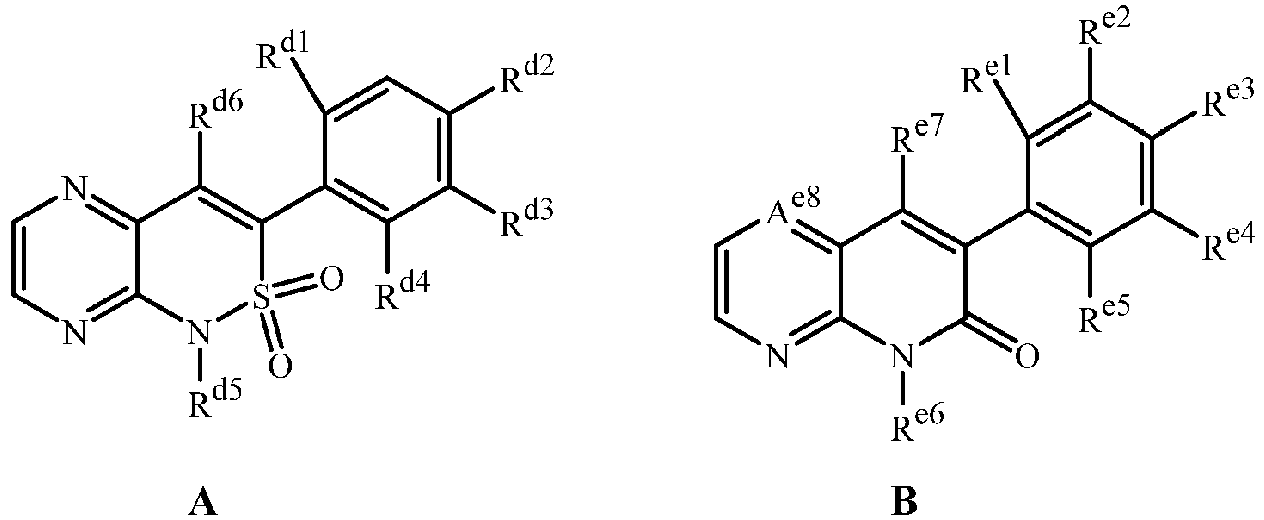
- Cellulose biosynthesis inhibitors (b14) inhibit the biosynthesis of cellulose in certain plants. They are most effective when using a pre-aplication or early post-application on young or rapidly growing plants. Examples of cellulose biosynthesis inhibitors include chlorthiamid, dichlobenil, flupoxam, indaziflam (N 2-[(1R,2S)-2,3-dihydro-2,6-dimethyl-1H-inden-1-yl]-6-(1-fluoroethyl)-1,3,5-triazine-2,4-diamine), isoxaben and triaziflam.
- Other herbicides (b15) include herbicides that act through a variety of different modes of action such as mitotic disruptors (e.g., flamprop-M-methyl and flamprop-M-isopropyl) organic arsenicals (e.g., DSMA, and MSMA), 7,8-dihydropteroate synthase inhibitors, chloroplast isoprenoid synthesis inhibitors and cell-wall biosynthesis inhibitors. Other herbicides include those herbicides having unknown modes of action or do not fall into a specific category listed in (b1) through (b14) or act through a combination of modes of action listed above. Examples of other herbicides include aclonifen, asulam, amitrole, bromobutide, cinmethylin, clomazone, cumyluron, cyclopyrimorate (6-chloro-3-(2-cyclopropyl-6-methylphenoxy)-4-pyridazinyl 4-morpholinecarboxylate), daimuron, difenzoquat, etobenzanid, fluometuron, flurenol, fosamine, fosamine-ammonium, dazomet, dymron, ipfencarbazone (1-(2,4-dichlorophenyl)-N-(2,4-difluorophenyl)-1,5-dihydro-N-(1-methylethyl)-5-oxo-4H-1,2,4-triazole-4-carboxamide), metam, methyldymron, oleic acid, oxaziclomefone, pelargonic acid, pyributicarb and 5-[[(2,6-difluorophenyl)methoxy]methyl]-4,5-dihydro-5-methyl-3-(3-methyl-2-thienyl)isoxazole.
- "Herbicide safeners" (b16) are substances added to a herbicide formulation to eliminate or reduce phytotoxic effects of the herbicide to certain crops. These compounds protect crops from injury by herbicides but typically do not prevent the herbicide from controlling undesired vegetation. Examples of herbicide safeners include but are not limited to benoxacor, cloquintocet-mexyl, cumyluron, cyometrinil, cyprosulfamide, daimuron, dichlormid, dicyclonon, dimepiperate, fenchlorazole-ethyl, fenclorim, flurazole, fluxofenim, furilazole, isoxadifen-ethyl, mefenpyr-diethyl, mephenate, methoxyphenone, naphthalic anhydride, oxabetrinil, N-(aminocarbonyl)-2-methylbenzenesulfonamide and N-(aminocarbonyl)-2-fluorobenzenesulfonamide, 1-bromo-4-[(chloromethyl)sulfonyl]benzene, 2-(dichloromethyl)-2-methyl-1,3-dioxolane (MG 191), 4-(dichloroacetyl)-1-oxa-4-azospiro[4.5]decane (MON 4660).
- The compounds of Formula 1 can be prepared by general methods known in the art of synthetic organic chemistry. One or more of the following methods and variations as described in Schemes 1-7 can be used to prepare the compounds of Formula 1. The definitions of Q, R1, R2 and R3 in the compounds of Formulae 1-11 below are as defined above in the Summary of the Invention unless otherwise noted. Compounds of Formulae 1A-1B, 2A-2D, and 4A are various subsets of the compounds of Formula 1, 2 and 4 and all substituents for Formulae 1A-1B, 2A-2D, and 4A are as defined above for Formula 1 unless otherwise noted.
- One or more of the following methods and variations as described in Schemes 1-7 can be used to prepare the compounds of Formula 1. The definitions of Q, R1, R2 and R3 in the compounds of Formulae 1-9 below are as defined above in the Summary of the Invention unless otherwise noted.
- As shown in Scheme 1 a compound of Formula 1 can be prepared by nucleophilic substitution by heating a compound of Formula 2 in a suitable solvent, such as acetonitrile, tetrahydrofuran or N,N-dimethylformamide in the presence of a base such as potassium or cesium carbonate, at temperatures ranging from 50 to 110 °C, with a compound of Formula 3 (where LG is halogen or SO2Me). The reaction is typically conducted at temperatures ranging from 50 to 110 °C.
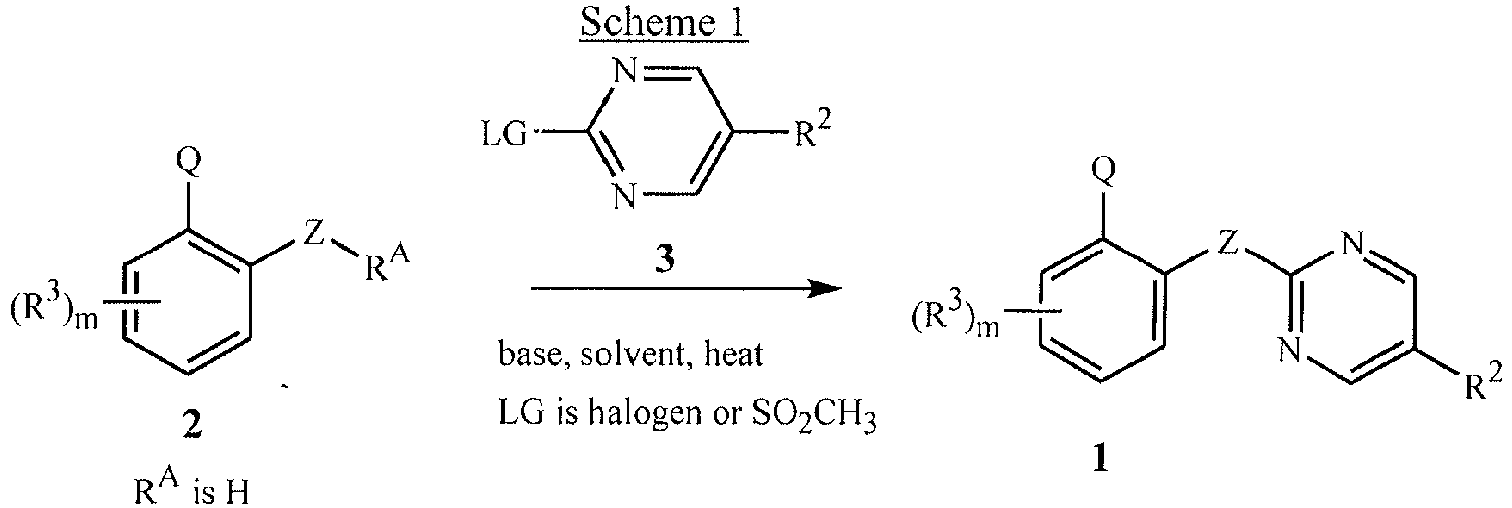
- Alternatively, as shown in Scheme 2, boron compounds of Formula 5 or tin compounds of Formula 6 can be coupled with intermediates of Formula 4 under Suzuki or Stille conditions to give compounds of Formula 1. Suzuki couplings typically are conducted in the presence of Pd(0) or Pd(II) salts, a suitable ligand, and a base. Suitable bases for this transformation include potassium carbonate or cesium carbonate, while Pd(II) salts such as Pd(OAc)2 or PdCl2 can be used in conjunction with ligands such as triphenylphosphine or 1,1'-bis(diphenylphosphino)ferrocene (dppf). Conditions for Suzuki couplings are well documented in the literature (see for example Angewandte Chemie International Edition 2006, 45, 3484 and Tetrahedron Letters 2002, 58(14), 2885). Boron intermediates of Formula 5 are commercially available or can be prepared from the corresponding halides or trifluoromethanesulfonates by methods known in the literature (see for example
PCT Patent Publication WO 2007/043278 ,US Pat. No. 8,080,566 , Organic Letters 2011, 13(6), 1366 and Organic Letters 2012, 14(2), 600). Stille couplings typically can be conducted in the presence of Pd(0) or a Pd(II) salt, a ligand and a Cu(I) salt such as copper(I) iodide. The reaction can be run in a solvent such as dioxane, 1,2-dimethoxyethane or toluene at a temperature ranging from ambient to reflux. For conditions and reagents employed in Stille couplings see Chemical Reviews 2007, 107(1), 133-173.
- As shown in Scheme 3, a compound of Formula 2C (i.e. a compound of Formula 2) can be prepared by deprotection of a compound of Formula 2B (i.e. a compound of Formula 2A wherein RA is CH3 or -C(=O)CH3) with a suitable deprotecting agent. Suitable methoxy (i.e. when RA is CH3) deprotecting reagents such as BBr3, AlCl3 and HBr in acetic acid can be used in the presence of solvents such as toluene, dichloromethane and dichloroethane at a temperature of from -80 to 120 °C. Suitable acetoxy (i.e. when RA is - C(=O)CH3) deprotecting agents include potassium carbonate in methanol or ammonium acetate in aqueous methanol at room temperature can be used as discussed in Das, et al., Tetrahedron 2003, 59, 1049-1054 and methods cited therein. Alternatively, a compound of Formula 2B can be combined with Amberlyst 15© in methanol (as discussed in Das, et al. Tet. Lett. 2003, 44, 5465-5468) or combined with sodium acetate in ethanol (as discussed in Narender, T., et al. Synthetic Communications 2009, 39(11), 1949-1956) to obtain a compound of Formula 2C. Other useful phenolic protecting groups suitable for use in preparing a compound of Formula 2C can be found in Greene, T. W.; Wuts, P. G. M. Protective Groups in Organic Synthesis, 4th ed.; Wiley: Hoboken, New Jersey, 1991.
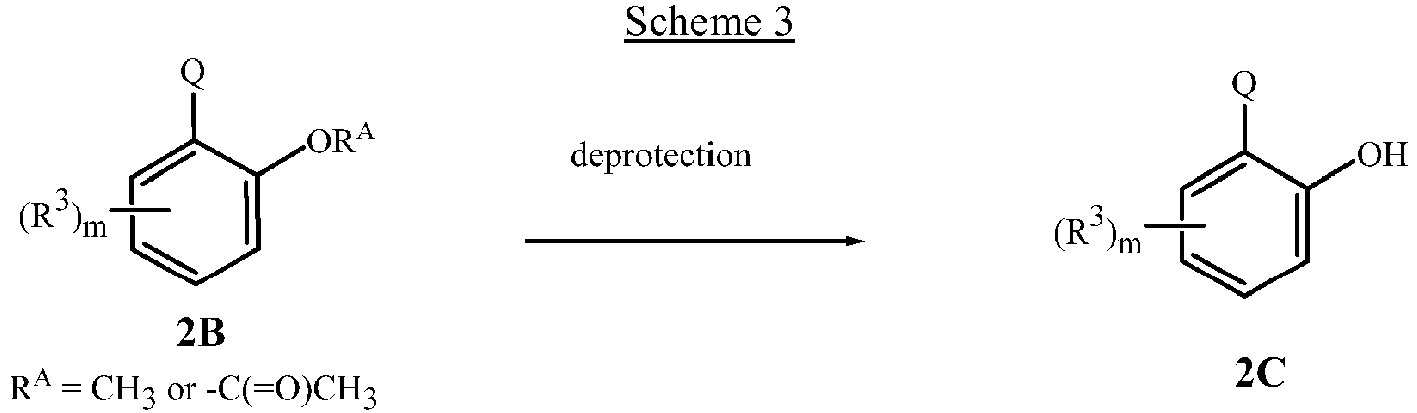
- An intermediate of Formula 2B can be prepared as shown in Scheme 4 from an intermediate of Formula 7 by a variety of methods known to one skilled in the art. Compounds of Formula 2B can be accessed by coupling precursors of Formula 7 wherein J is Br, Cl, I or trifluoromethanesulfonate with boronate or trialkyltin group-containing heterocycles (i.e compounds of Formula 5 or Formula 6 using the Suzuki conditions or the Stille conditions of Scheme 2). Alternatively, compounds of Formula 7 wherein J is a boronate or trialkyltin group may be coupled with halogen-substituted heterocycles Q-X using the methods shown in Scheme 2 to afford compounds of Formula 2B. The skilled chemist will realize that with the prudent choice of groups X and J in reactions involving compounds of Formula 7 and Q-X can synthesize the intermediate 2B utilizing various cross coupling procedures such as Kumada coupling, Hiyama coupling or Negishi coupling described in "Metal-Catalyzed Cross-Coupling Reactions", Eds. A. de Meijere and F. Diederich, Wiley-VCH, Weinheim, 2004, vols 1 and 2.
- When J in Formula 7 is an alkene, alkyne, oxime, nitrile or ketone, various heterocycles can be prepared using methods described in Katritsky, Advances in Heterocyclic Chemistry, Vol. 1-104, Elsevier. In cases where regioisomeric mixtures are produced, the desired product can be isolated using routing separation techniques known in the art.

- As shown in Scheme 5, a compound of Formula 4A can be prepared by coupling of phenols of Formula 9 with a compound of Formula 3 under the nucleophilic substitution conditions described in Scheme 1.

- As shown in Scheme 6, a compound of Formula 1B, (i.e. a compound of Formula 1 where m is 1 at the 3-position) can be prepared by "C-H activation" of a compound of Formula 1A (a compound of Formula 1 wherein m is 0). For example, paladium(II) acetate along with either an N-halosuccinimide, PhI(OAc)2, N-fluoropyridinium tetrafluoroborate, or a lower alkyl boronic acid can be used to introduce the R3 variable as I, Br, Cl, -OAc, F, and lower alkyl substituents respectively. These methods are detailed in reviews of selective activation of C-H bonds in Chemical Reviews 2010, 110, 575-1211 and references cited therein. Methods for "C-H activation" can also be found in Wencel-Delord et al., Nature Chemistry 2013, 5, 369-375 and a series of reviews of "C-H activation" in Accounts of Chemical Research 2012, 45, 777-958 and references cited therein. Iodides and bromides of Formula 1B can then be further functionalized by various cross coupling procedures described in "Metal-Catalyzed Cross-Coupling Reactions", Eds A. de Meijere and F. Diederich, Wiley-VCH, Weinheim, 2004, vols 1 and 2.

- Chemistry based on "C-H activation" can also be used to prepare a compound of Formula 2D (i.e. a compound of Formula 2 wherein RA is -C(O)CH3; and m is 1 at the 3-position) as shown in Scheme 7 utilizing palladium(II) acetate and (diacetoxyiodo)benzene as described above for Scheme 6. A compound of Formula 2D can subsequently be converted via methods disclosed in Schemes 1 and 6 to provide a compound of Formula 1.

- It is recognized by one skilled in the art that various functional groups can be converted into others to provide different a compound of Formula 1. For a valuable resource that illustrates the interconversion of functional groups in a simple and straightforward fashion, see Larock, R. C., Comprehensive Organic Transformations: A Guide to Functional Group Preparations, 2nd Ed., Wiley-VCH, New York, 1999. For example, intermediates for the preparation of a compound of Formula 1 may contain aromatic nitro groups, which can be reduced to amino groups, and then be converted via reactions well known in the art such as the Sandmeyer reaction, to various halides, providing a compound of Formula 1. The above reactions can also in many cases be performed in alternate order
- It is recognized that some reagents and reaction conditions described above for preparing a compound of Formula 1 may not be compatible with certain functionalities present in the intermediates. In these instances, the incorporation of protection/deprotection sequences or functional group interconversions into the synthesis will aid in obtaining the desired products. The use and choice of the protecting groups will be apparent to one skilled in chemical synthesis (see, for example, Greene, T. W.; Wuts, P. G. M. Protective Groups in Organic Synthesis, 4th ed.; Wiley: Hoboken, New Jersey, 1991). One skilled in the art will recognize that, in some cases, after the introduction of a given reagent as it is depicted in any individual scheme, it may be necessary to perform additional routine synthetic steps not described in detail to complete the synthesis of a compound of Formula 1. One skilled in the art will also recognize that it may be necessary to perform a combination of the steps illustrated in the above schemes in an order other than that implied by the particular presented to prepare a compound of Formula 1.
- One skilled in the art will also recognize that a compound of Formula 1 and the intermediates described herein can be subjected to various electrophilic, nucleophilic, radical, organometallic, oxidation, and reduction reactions to add substituents or modify existing substituents.
- Without further elaboration, it is believed that one skilled in the art using the preceding description can utilize the present invention to its fullest extent. The following Examples are, therefore, to be construed as merely illustrative, and not limiting of the disclosure in any way whatsoever. Steps in the following Examples illustrate a procedure for each step in an overall synthetic transformation, and the starting material for each step may not have necessarily been prepared by a particular preparative run whose procedure is described in other Examples or Steps. Percentages are by weight except for chromatographic solvent mixtures or where otherwise indicated. Parts and percentages for chromatographic solvent mixtures are by volume unless otherwise indicated. 1H NMR spectra are reported in ppm downfield from tetramethylsilane in CDCl3; "s" means singlet, "d" means doublet, "t" means triplet, "q" means quartet, "m" means multiplet, "dd" means doublet of doublets, "dt" means doublet of triplets, and "bs" means broad singlet.
- It is recognized by one skilled in the art that various functional groups can be converted into others to provide different compounds of Formula 1. For a valuable resource that illustrates the interconversion of functional groups in a simple and straightforward fashion, see Larock, R. C., Comprehensive Organic Transformations: A Guide to Functional Group Preparations, 2nd Ed., Wiley-VCH, New York, 1999. For example, intermediates for the preparation of compounds of Formula 1 may contain aromatic nitro groups, which can be reduced to amino groups, and then be converted via reactions well known in the art such as the Sandmeyer reaction, to various halides, providing compounds of Formula 1. The above reactions can also in many cases be performed in alternate order
- It is recognized that some reagents and reaction conditions described above for preparing compounds of Formula 1 may not be compatible with certain functionalities present in the intermediates. In these instances, the incorporation of protection/deprotection sequences or functional group interconversions into the synthesis will aid in obtaining the desired products. The use and choice of the protecting groups will be apparent to one skilled in chemical synthesis (see, for example, Greene, T. W.; Wuts, P. G. M. Protective Groups in Organic Synthesis, 2nd ed.; Wiley: New York, 1991). One skilled in the art will recognize that, in some cases, after the introduction of a given reagent as it is depicted in any individual scheme, it may be necessary to perform additional routine synthetic steps not described in detail to complete the synthesis of compounds of Formula 1. One skilled in the art will also recognize that it may be necessary to perform a combination of the steps illustrated in the above schemes in an order other than that implied by the particular presented to prepare the compounds of Formula 1.
- One skilled in the art will also recognize that compounds of Formula 1 and the intermediates described herein can be subjected to various electrophilic, nucleophilic, radical, organometallic, oxidation, and reduction reactions to add substituents or modify existing substituents.
- Without further elaboration, it is believed that one skilled in the art using the preceding description can utilize the present invention to its fullest extent. The following Examples are, therefore, to be construed as merely illustrative, and not limiting of the disclosure in any way whatsoever. Steps in the following Examples illustrate a procedure for each step in an overall synthetic transformation, and the starting material for each step may not have necessarily been prepared by a particular preparative run whose procedure is described in other Examples or Steps. Percentages are by weight except for chromatographic solvent mixtures or where otherwise indicated. Parts and percentages for chromatographic solvent mixtures are by volume unless otherwise indicated. 1H NMR spectra are reported in ppm downfield from tetramethylsilane at 500 MHz in CDCl3 unless otherwise indicated; "s" means singlet, "d" means doublet, "t" means triplet, "q" means quartet, "m" means multiplet, "dd" means doublet of doublets and "dt" means doublet of triplets.
- Pyridinium chlorochromate (263 mg, 1.22 mmol) and silica gel (200 mg) were combined and mixed as solids. This mixture was then added to a stirring solution of 3-[2-[(5-chloro-2-pyrimidinyl)oxy]phenyl]-5-isoxazolemethanol (i.e. the product obtained in Step A of Example 1) (309 mg, 1.02 mmol) in dichloromethane (5.0 mL) and the reaction was allowed to stir for 18 h. The solution was filtered to remove the silica gel and the organic phase was washed with a 1 M hydrochloric acid solution. The organic phase was dried with MgSO4 and concentrated under vacuum. Purification by chromatography on silica gel eluting with 0 to 100% ethyl acetate in hexanes to afforded the title product (0.307 g). 1H NMR δ 9.95 (s, 1H), 8.46 (s, 2H), 8.06-8.01 (m, 1H), 7.61-7.56 (m, 1H), 7.47-7.41 (m, 1H), 7.38 (s, 1H), 7.32-7.29 (m, 1H). MS (AP+) = 302.
- To a stirred solution of 3-[2-[(5-chloro-2-pyrimidinyl)oxy]phenyl]-5-isoxazolecarboxaldehyde (i.e. the product from Step A of Example 2) (100 mg, 0.332 mmol) in dichloromethane (3.0 mL) at -78 °C was added Deoxo-Fluor® (161 mg, 0.729 mmol) and the reaction was allowed to return to ambient temperature. Upon consumption of the starting material as evidenced by thin-layer chromatography, the solvent was removed under vacuum. Purification by chromatography on silica gel eluting with 0 to 100% ethyl acetate in hexanes to afforded the title product, a compound of the present invention (36.3 mg). 1H NMR δ 8.46 (s, 2H), 8.01-7.96 (m, 1H), 7.59-7.54 (m, 1H), 7.44-7.38 (m, 1H), 7.31-7.27 (m, 1H), 6.98-6.96 (s, 1H), 6.83-6.60 (m, 1H). MS (ESI+) = 324.
- To a solution of 1-ethynyl-2-methoxybenzene (0.78 g, 5.92 mmol) in dichloromethane (10 mL) was added dibromoformaldoxime (1.00 g, 4.93 mmol). The mixture was cooled to 0 °C and potassium bicarbonate (1.48 g, 14.8 mmol) was added, followed by heating to 40 °C for 18 h. Water was added to the reaction mixture, the phases separated, and the aqueous layer was again washed with dichloromethane. The combined organic phases were dried over MgSO4, concentrated under vacuum, and purified by chromatography on silica gel eluting with 0 to 100% ethyl acetate in hexanes to afford the title product, a compound of the present invention (1.04 g). 1H NMR δ 7.94 (dd, 1H), 7.47-7.42 (m, 1H), 7.09 (dd, 1H), 7.02 (dd, 1H), 6.85 (s, 1H), 3.97 (s, 3H). MS (AP+) = 254.
- To a solution of 3-bromo-5-(2-methoxyphenyl)isoxazole (i.e. the product from Step A) (0.50 g, 1.97 mmol) in dichloromethane (20mL) was added a 1 M solution of boron tribromide in dichloromethane (9.86 mmol) at -78 °C and the solution was allowed to warm to room temperature and stir for 18 h. Dichloroethane (20 mL) was added, and reaction mixture was concentrated to remove the excess dichloromethane. Boron tribromide in dichloromethane (9.86 mmol) was again added and the reaction was heated to 80 °C until completion as evidenced by thin-layer chromatography. The reaction mixture was allowed to cool to ambient temperature and quenched with a saturated solution of sodium bicarbonate. The phases were separated and the aqueous layer was again washed with dichloromethane. The combined organic phases were dried with MgSO4, concentrated under vacuum, and purified by chromatography on silica gel eluting with 0 to 100% ethyl acetate in hexanes to afford the title product (0.395 g). 1H NMR δ 7.76 (dd, 1H), 7.39-7.33 (m, 1H), 7.09-7.02 (m, 1H), 6.96-6.93 (m, 1H), 6.02 (s, 1H). MS (AP-) = 238.
- To a solution of 2-(3-bromo-5-isoxazolyl)phenol (i.e. the product from Step B) (100 mg, 0.417 mmol) in acetonitrile (5 mL) was added 2,5-dichloropyrimidine (75.0 mg, 0.503 mmol) and potassium carbonate (288 mg, 2.08mmol) then the solution was stirred at ambient temperature for 18 h. The reaction was then heated at 40 °C for 2 h followed by 80 °C for two hours. The solution was then cooled to ambient temperature, water was added, the phases were separated and the aqueous layer was again washed with dichloromethane. The combined organic phases were dried over MgSO4, concentrated under vacuum, and purified by chromatography on silica gel eluting with 0 to 100% ethyl acetate in hexanes to afford the title product, a compound of the present invention (122 mg). 1H NMR δ 8.49 (s, 2H), 8.03 (dd, 1H), 7.58-7.53 (m, 1H), 7.43 (dt, 1H), 7.29 (dd, 1H), 6.74 (s, 1H). MS (AP+) = 352.
- To a solution of 25% sodium methoxide in methanol (5 mL) and tetrahydrofuran (10 mL), acetophenone (1 g, 7.3 mmol) and difluoroacetate (1 g, 8.1 mmol) in tetrahydrofuran (2 mL) was added and heated at 60 °C for 5 h. The reaction was cooled to room temperature and treated with 36% aq hydrochloric acid (4 mL) and stirred at 60 °C for 2 h. The reaction was quenched by adding water (15 mL) and the organic solvent was removed under vacuum. The precipitated product 2-difluoromethyl-4-chromenone (1.4 g) was filtered and dissolved in ethanol (5 mL). To this solution, hydroxylamine acetate (22 mmol) in water (5 mL) was added and the mixture was heated at 60 °C for 3 h. After cooling the reaction to ambient temperature 4,4-difluoro-1-(2-hydroxyphenyl)-butane-1,3-dione 3-oxime was precipitated with the addition of water (20 mL). This product was collected by filtration and suspended in acetic acid (5 mL) and 36% aqueous hydrochloric acid (1.8 mL) at room temperature and stirred at 80 °C for 15 min to obtain the titile compound as a beige solid (800 mg). 1H NMR δ 7.82 (m,1 H), 7.36 (s, 1 H), 7.07 (m, 1 H), 6.95 (m, 2H), 6.82 (t, 1H), 6.05 (s, 1H). MS (ESI+) = 212
- To a solution of 2-(3-difluoromethyl-5-isoxazolyl)phenol (i.e. the product from Step A) (2.1 g, 9.71 mmol) in anhydrous N,N-dimethylformamide (8 mL) was added 2,5-dichloropyrimidine (1.5 g, 10.2 mmol) and potassium carbonate (2.9 g, 21.3 mmol). The reaction was heated at 90 °C for 1 h. The solution was cooled to ambient temperature and diluted with water. The phases were separated and the aqueous phase was washed with additional ethyl acetate. The organic phases were combined, dried with magnesium sulfate and concentrated under vacuum. Purification by chromatography on silica gel eluting with 0 to 10% ethyl acetate in hexanes afforded the title compound, a compound of the present invention, as a solid (2.2 g). 1H NMR δ 8.49 (s, 2H), 8.06 (m, 1H), 7.57 (m, 1H), 7.44 (m, 1H), 7.31 (m, 1H), 6.88 (s, 1H), 6.74 (t, 1H). MS (ESI+) = 324
- To a solution of 1-(2-fluoro-6-methoxyphenyl)ethanone (2.6 g, 15.5 mmol) and difluoroacetic acid ethyl ester (3.9 mL, 31.0 mmol) in anhydrous N,N-dimethylformamide at 0 °C was added sodium hydride (1.2 g, 31.0 mmol). The reaction mixture was heated at 80 °C for 1 h. The reaction was then cooled to 0 °C, diluted with ethyl acetate and acidified with 1 N aqueous hydrochloric acid. The phases were separated and the aqueous phase was washed with additional ethyl acetate. The organic phases were combined and dried with magnesium sulfate and concentrated under vacuum. Purification by chromatography on silica gel eluting with 0 to 15% ethyl acetate in hexanes afforded the title compound (2.5 g). 1H NMR δ 7.39 (m, 1H), 6.77 (m, 2H), 6.24 (s, 1H), 6.01 (t, 1 H), 3.87 (s, 3 H). MS (ESI+) = 247
- A solution of 4,4-difluoro-1-(2-fluoro-6-methoxyphenyl)butane-1,3-dione (i.e. the product from Step A) (2.5 g, 10 mmol) and hydroxylamine hydrochloride (2.1 g, 30 mmol) in ethanol (25 mL) was stirred at 80 °C. After 1 h the solvent was removed under vacuum. The resulting residue was diluted with water and extracted with dichloromethane. The organic phase was dried with magnesium sulfate and concentrated under vacuum. Purification by chromatography on silica gel eluting with 0 to 15% ethyl acetate in hexanes afforded the title compound (1.5 g).
1H NMR δ 7.41 (m, 1 H), 6.69 - 6.98 (m, 4H), 3.93 (s, 3 H). MS (ESI+) = 244 - To a solution of 3-difluoromethyl-5-(2-fluoro-6-methoxyphenyl)isoxazole (i.e. the product from Step B) (1.5 g, 6.2 mmol.) in dichloromethane (10 mL) at 0 °C was added a 1.0 M solution of boron tribromide in dichloromethane (31 mL, 31 mmol). The reaction mixture was warmed to ambient temperature and stirred for 6 h. The reaction was cooled to 0 °C and slowly quenched with a saturated aqueous solution of sodium bicarbonate. The biphasic mixture was stirred at room temperature for 1 h. The phases were separated and the aqueous phase was extracted with dichloromethane. The combined organic phases were dried and concentrated under vacuum. The crude residue was purified by chromatography on silica gel, eluting with 0 to 10% ethyl acetate in hexanes, to afford the title compound (980 mg). 1H NMR δ 7.33 (m, 1 H), 6.66 - 6.99 (m, 4 H). MS (ESI+) = 230
- To a solution of 2-(3-difluoromethyl-5-isoxazolyl)-3-fluorophenol (i.e. the product from Step C) (120 mg, 0.5 mmol) in anhydrous N,N-dimethylformamide (2 mL) was added 2,5-dichloropyrimidine (85 mg, 0.57 mmol) and potassium carbonate (244 mg, 1.04 mmol). The reaction was heated at 80 °C for 4 h. The mixture was cooled to ambient temperature and diluted with water. The phases were separated and the aqueous phase was washed with additional ethyl acetate. The organic phases were combined, dried with magnesium sulfate and concentrated under vacuum. Purification by chromatography on silica gel eluting with 0 to 15% ethyl acetate in hexanes afforded the title compound, a compound of the present invention, as a solid (110 mg). 1H NMR δ 8.46 (s, 2H), 7.56 (m, 1H), 7.21 (m, 1H), 7.13 (m, 1H), 6.87 (m, 1 H), 6.74 (t, 1 H). MS (ESI+) = 342
- A solution of 2-fluoro-6-methoxyacetophenone (6.83 g, 40.6 mmol) and ethyl difluoroacetate (7.45g, 60 mmol) in tetrahydrofuran (35 mL) was added dropwise to a solution of tetrahydrofuran (20 mL) and 25% sodium methoxide (10.2g, 47.2 mmol) over 15 minutes. The reaction was complete in 3h as determined by high pressure liquid chromatography. The reaction was partially concentrated under vacuum to remove most of the tetrahydrofuran and methanol, and then diluted with toluene and water. The aqueous phase was acidified with 37% hydrochloric acid (5g), followed by extraction with toluene. The combined organic phases were concentrated under vacuum to provide title compound (7.98 g). 1H NMR δ 7.39 (td, 1 H) 6.72 - 6.81 (m, 2 H) 6.25 (d, 1 H) 5.87 - 6.14 (m, 1 H) 3.88 (s, 3 H).
- To a solution of 4,4-difluoro-1-(2-fluoro-6-methoxyphenyl)butane-1,3-dione (i.e. the product from Step A) (7.98 g, 32.4 mmol) in 35 mL methanol at room temperature was added a 50% hydroxylamine solution (2.78g, 42.1 mmol) and IN sodium hydroxide solution (1.50 mL, 1.50 mmol) followed by heating to 65 °C for 2h. The reaction was cooled to room temperature and diluted with water and toluene. The phases were separated and the organic phase was concentrated under vacuum to provide the title compound (7.99 g). 1H NMR δ 7.36 (td, 1 H) 6.73 - 6.82 (m, 2 H) 5.79 - 6.05 (m, 1 H) 3.88 (s, 3 H) 3.67 - 3.73 (m, 1 H) 3.47 - 3.51 (m, 1 H) 3.34 - 3.42 (m, 1 H).
- To toluene (80 mL) was added 5-(difluoromethyl)-3-(2-fluoro-6-methoxyphenyl)-4H-isoxazol-5-ol (i.e. the product from Step B) (7.99 g, 30.6 mmol) followed by p-toluenesulfonic acid monohydrate (0.700 g, 3.68 mmol). The mixture was heated to a vigorous reflux (107 - 111 °C) for two hours at which point high pressure liquid chromatography determined the reaction was complete. The cooled reaction mixture was washed with a saturated sodium bicarbonate solution, followed by water. The organic phase was concentrated under vacuum to provide the title compound (7.44 g).
1H NMR δ 7.40 (td, 1 H) 6.69 - 6.94 (m, 4 H) 3.88 (s, 3 H). - To a solution of 5-(difluoromethyl)-3-(2-fluoro-6-methoxyphenyl)isoxazole (i.e. the product from Step C) (3.72 g, 15.3 mmol) in dichloromethane (15 mL) at 3 °C was added a 1M solution of boron tribromide in dichloromethane (18.0 mL, 18 mmol) over 5 min. The reaction was then allowed to warm to room temperature. After 90 minutes it was determined the reaction was complete using high pressure liquid chromatography and the reaction was treated with a 10% aqueous solution of potassium bicarbonate (10 mL). The phases were separated and the organic phase was concentrated under vacuum. The resulting brown solid was triturated with a water/methanol solution (∼2/1) providing the title compound (3.34 g). 1H NMR δ 9.63 - 9.75 (m, 1 H) 7.33 (td, 1 H) 7.21 (ddd, 1 H) 6.71 - 6.96 (m, 3 H).
- To a solution of 2-[5-(difluoromethyl)-3-isoxazolyl]-3-fluorophenol (i.e. the product from Step D) (1.61 g, 7.02 mmol) and 5-methyl-2-methylsulfonylpyrimidine (1.49 g, 7.72 mmol) in N,N-dimethylformamide (9 mL) was added potassium carbonate (4.24 g, 17.5 mmol) and the reaction was allowed to stir at room temperature for 24 h. The reaction was diluted with water and toluene, the phases were separated and the organic solvent was removed under vacuum. To the resulting oil was added 8 mL of methanol and a tan slurry formed, after further dilution with a methanol/water solution (20 mL), the precipitate was filtered providing the title compound, a compound of the present invention (2.24g).
1H NMR δ 8.45 (s, 2 H) 7.54 (td, 1 H) 7.19 (ddd, 1 H) 7.14 (dt, 1 H) 6.88 (dt, 1 H) 6.61 - 6.85 (m, 1 H). - To a solution of acetophenone (3.0 g, 20 mmol) in methanol (15 mL) was added a 30% sodium methoxide in methanol solution (5.0 mL) and the reaction stirred for five minutes. Next ethyl difluoroacetate (2.97 g, 24 mmol) was added and the reaction was heated to reflux for 18 h. The reaction was allowed to cool to room temperature and the solvent was removed under vacuum. To the residue was added 1M hydrochloric acid and ethyl acetate, the phases were separated, the organic phase was dried using magnesium sulfate and the solvent was removed under vacuum. Purification by chromatography on silica gel eluting with 0 to 100% ethyl acetate in hexanes afforded the desired product which was taken on directly. A solution of 4,4-difluoro-1-(2-methoxyphenyl)butane-1,3-dione from the previous step in ethanol (30 mL) was added dropwise to a solution of hydroxylamine hydrochloride (1.4 g, 20 mmol) in 1M sodium hydroxide (21 mL). The reaction was then heated to reflux for 2 h, followed by cooling to room temperature. The product was precipitated from solution by the addition of water and collected via vacuum filtration to afford the desired product which was taken on directly (AP+ 244, 1H NMR δ ppm 7.79 (d, 1 H) 7.38 - 7.46 (m, 1 H) 6.93 - 7.04 (m, 2 H) 5.76 - 6.04 (m, 1 H) 3.88 (s, 3 H) 3.67 - 3.80 (m, 1 H) 3.49 - 3.55 (m, 1 H)). Next, a solution of 5-(difluoromethyl)-3-(2-methoxyphenyl)-4H-isoxazol-5-ol from the previous step was taken up in trifluoroacetic acid (20 mL) and heated to 70 °C for 18 h. The reaction was cooled to room temperature and the solvent was removed under vacuum. The resulting residue was dissolved in dichloromethane and washed with a saturated solution of sodium bicarbonate. The phases were separated, the organic phase was dried using magnesium sulfate and the solvent was removed under vacuum. Purification by chromatography on silica gel eluting with 0 to 100% ethyl acetate in hexanes afforded the title compound (2.0 g, AP+ = 226).
1H NMR δ 7.91 (dd, 1 H) 7.42 - 7.50 (m, 1 H) 6.98 - 7.12 (m, 3 H) 6.66 - 6.93 (m, 1 H) 3.92 (s, 3 H). - To a solution of 5-(difluoromethyl)-3-(2-methoxyphenyl)isoxazole (i.e. the product of step A) (2.01 g, 8.92 mmol) in dichloromethane (50 mL) at 0 °C was added a 1M solution of boron tribromide in dichloromethane (13.3 mL, 13.3 mmol) and the reaction was allowed to warm to room temperature over three hours. The solvent was removed under vacuum and purified by chromatography on silica gel, eluting with 0 to 100% ethyl acetate in hexanes to afford the title compound (1.66g, AP- = 210). 1H NMR δ 9.14 (s, 1 H) 7.51 (dd, 1 H) 7.39 (ddd, 1 H) 7.11 (dd, 1 H) 6.97 - 7.04 (m, 2 H) 6.70 - 6.95 (m, 1 H).
- To a solution of 2-[5-(difluoromethyl)-3-isoxazolyl]phenol (i.e. the product of step B) (427 mg, 2.01 mmol) and 5-bromo-2-chloro-pyrimidine (468 mg, 2.42 mmol) in acetonitrile (10 mL) was added potassium carbonate (695 mg, 5.03 mmol) and the reaction was heated to 80 °C for 18 h. The solvent was removed under vacuum and purified by chromatography on silica gel, eluting with 0 to 100% ethyl acetate in hexanes to afford the title compound, a compound of the present invention, as a solid (555 mg, mp = 88.9-92.8 °C).
1H NMR δ 8.53 (s, 2 H) 7.98 (dd, 1 H) 7.53 - 7.60 (m, 1 H) 7.41 (td, 1 H) 7.28 (dd, 1 H) 6.97 (t, 1 H) 6.59 - 6.84 (m, 1 H). - To a solution of 2-fluoro-6-methoxyacetophenone (1.0 g, 5.9 mmol) in tetrahydrofuran (2 mL) was added a 30% sodium methoxide in methanol solution (1.4 mL). To this mixture was added dropwise a solution of ethyl trifluoroacetate (0.805 g, 6.49 mmol) in tetrahydrofuran (1 mL) and the reaction stirred at room temperature for 2 h. To the reaction was added 1M hydrochloric acid solution and ethyl acetate, the phases were separated and the aqueous phase was again washed with ethyl acetate. The combined organic phases were dried with magnesium sulfate and concentrated under vacuum to provide the desired product (AP- = 263) which was taken onto the next step directly. Next, to a solution of 4,4,4-trifluoro-1-(2-fluoro-6-methoxyphenyl)butane-1,3-dione (from the previous step) in ethanol (14 mL) was added 1M sodium hydroxide solution (7 mL) followed by hydroxylamine hydrochloride (410 mg, 5.9 mmol) and the reaction stirred overnight at room temperature. The solvent was removed under vacuum and the residue was purified by chromatography on silica gel, eluting with 0 to 100% ethyl acetate in hexanes and 0 to 20% methanol in dichlromethane to afford the product (AP+ = 280, 1H NMR δ ppm 7.37 (td, 1 H) 6.74 - 6.83 (m, 2 H) 3.89 (s, 3 H) 3.79 (d, 1 H) 3.50 (dd, 1 H)) which was taken onto the next step directly To a solution of 3-(2-fluoro-6-methoxy-phenyl)-5-(trifluoromethyl)-4H-isoxazol-5-ol (from the previous step) in dichloromethane (20 mL) at 0 °C was added a 1M solution of boron tribromide in dichloromethane (11.8 mL, 11.8 mmol) and the reaction was allowed to warm to room temperature over 2 h. The solvent was removed under vacuum. The residue was dissolved in dichloromethane and washed with a saturated solution of sodium bicarbonate, the aqueous phase was washed with dichloromethane. The combined organic phases were dried with magnesium sulfate, concentrated under vacuum and purified by chromatography on silica gel, eluting with 0 to 100% ethyl acetate in hexanes, providing the title compound (606 mg, AP- = 264).
1H NMR δ 9.86 (s, 1 H) 7.32 (td, 1 H) 6.84 - 6.90 (m, 1 H) 6.68 (ddd, 1 H) 3.86 - 3.94 (m, 1 H) 3.75 (dd, 1 H) 3.56 (s, 1 H). - To a solution of 3-(2-fluoro-6-hydroxyphenyl)-5-(trifluoromethyl)-4H-isoxazol-5-ol (i.e. the product of step A) (606 mg, 2.29 mmol) in dimethylsulfoxide (15 mL) was added 5-chloro-2-methylsulfonyl-pyrimidine (527mg, 2.74mmol) followed by cesium carbonate (1.1g, 3.43mmol) and the reaction stirred for 18 h. The reaction was partitioned between water and ethyl acetate, the phases were separated and the aqueous layer was again washed with ethyl acetate. The combined organic phases were dried with magnesium sulfate and concentrated under vacuum. The residue was purified by chromatography on silica gel, eluting with 0 to 100% ethyl acetate, to afford the title compound, a compound of the present invention, (198mg, AP+ = 360).
1H NMR δ 8.46 (s, 2 H) 7.56 (td, 1 H) 7.21 (ddd, 1 H) 7.15 (dt, 1 H) 7.02 (dd, 1 H). - 2-Hydroxyacetophenone (10 g, 66.7 mmol) was dissolved in trifluoroacetic anhydride (19 ml, 133.3 mmol) and pyridine (10.8 mL, 133.3 mmol). The reaction mixture was heated at 70 °C and stirred for 12 h. After cooling the reaction mixture was diluted with 1 M hydrochloric acid and methylene chloride and washed with water. The organic phase was dried with magnesium sulfate and concentrated under vacuum. Purification by chromatography on silica gel eluting with 0 to 5% ethyl acetate in hexanes afforded the title compound (10.5 g) as a pale yellow solid.
1H NMR δ 8.21 (m, 1 H), 7.76 (m, 1H), 7.77 (d, 1H), 7.46 (m, 1H), 6.73 (s, 1H). MS (ESI+) = 215 - To a solution of 2-(trifluoromethyl)-4H-1-benzopyran-4-one (i.e. the product of step A) (10.5 g, 48.8 mmol) in ethanol (50 mL), hydroxylamine acetate (146 mmol) in water (50 mL) was added. The mixture was heated at 60 °C for 4 h. After cooling the reaction to ambient temperature 4,4,4-trifluoro-1-(2-hydroxyphenyl)-butane-1,3-dione 3-oxime was precipitated with the addition of water (200 mL).
1H NMR δ 9.30 (s, 1H), 7.37 (m, 1H), 7.19 (m, 1H), 7.06 (m, 1H), 6.94 (m, 1H), 3.87 (d, 1H), 3.69 (d, 1H). - This product was collected by filtration and suspended in acetic acid (30 mL) and 36 % aqueous hydrochloric acid (10.8 mL) at room temperature. The mixture was stirred at 80 °C for 30 min to afford the title compound as a white solid (4.6 g).
1H NMR δ 7.88 (m, 1H), 7.37 (m, 1H), 7.08 (m, 1H), 7.01 (s, 1H), 6.95 (m, 1H). MS (ESI+) = 230 - To a solution of 2-[3-(trifluoromethyl)-5-isoxazolyl]phenol (i.e. the product of step B) (2.2 g, 9.4 mmol) in anhydrous N,N-dimethylformamide (10 mL) was added 2,5-dichloropyrimidine (1.5 g, 10.3 mmol) and potassium carbonate (2.9 g, 20.6 mmol). The reaction was heated at 80 °C for 2 h. The solution was cooled to ambient temperature and diluted with water. The phases were separated and the aqueous phase was washed with additional ethyl acetate. The organic phases were combined, dried with magnesium sulfate and concentrated under vacuum. Purification by chromatography on silica gel eluting with 0 to 5% ethyl acetate in hexanes afforded the title compound, a compound of the present invention, as a solid (2.1 g).
1H NMR δ 8.49 (s, 2H), 8.08 (m, 1H), 7.58 (m, 1H), 7.45 (m, 1H), 7.32 (m, 1H), 6.91 (s, 1H). MS (ESI+) = 342. Melting Point: 114-115 °C - To a solution of 1-(2-fluoro-6-methoxyphenyl)ethanone (2.6 g, 15.5 mmol) and difluoroacetic acid ethyl ester (3.9 mL, 31.0 mmol) in anhydrous N,N-dimethylformamide at 0 °C was added sodium hydride (1.2 g, 31.0 mmol). The reaction mixture was heated at 80 °C for 1 h. The reaction was then cooled down to 0 °C, diluted with ethyl acetate and acidified with 1 N aqueous hydrochloric acid. The phases were separated and the aqueous phase was washed with additional ethyl acetate. The organic phases were combined and dried with magnesium sulfate and concentrated under vacuum. Purification by chromatography on silica gel eluting with 0 to 15% ethyl acetate in hexanes afforded the title compound (2.5 g).
1H NMR δ 7.39 (m, 1H), 6.77 (m, 2H), 6.24 (s, 1H), 6.01 (t, 1 H), 3.87 (s, 3 H). MS (ESI+) = 247 - A solution of 4,4-difluoro-1-(2-fluoro-6-methoxyphenyl)butane-1,3-dione (i.e. the product of step A) (2.5 g, 10 mmol) and hydroxylamine hydrochloride (2.1 g, 30 mmol) in ethanol (25 mL) was stirred at 80 °C. After 1 h the solvent was removed under vacuum. The resulting residue was diluted with water and extracted with dichloromethane. The organic phase was dried with magnesium sulfate and concentrated under vacuum. Purification by chromatography on silica gel eluting with 0 to 15% ethyl acetate in hexanes afforded the title compound (1.5 g).
1H NMR δ 7.41 (m, 1 H), 6.69 - 6.98 (m, 4H), 3.93 (s, 3 H). MS (ESI+) = 244 - To a solution of 3-(difluoromethyl)-5-(2-fluoro-6-methoxyphenyl)isoxazole (i.e. the product of step B) (1.5 g, 6.2 mmol.) in dichloromethane (10 mL) at 0 °C was added a 1.0 M solution of boron tribromide in dichloromethane (31 mL, 31 mmol). The reaction mixture was warmed to ambient temperature and stirred for 6 h. The reaction was cooled to 0 °C and slowly treated with a saturated aqueous solution of sodium bicarbonate. The biphasic mixture was stirred at room temperature for 1 h. The phases were separated and the aqueous phase was extracted with dichloromethane. The combined organic phases were dried and concentrated under vacuum. The crude residue was purified by chromatography on silica gel, eluting with 0 to 10% ethyl acetate in hexanes, to afford the title compound (980 mg).
1H NMR δ 7.33 (m, 1 H), 6.66 - 6.99 (m, 4 H). MS (ESI+) = 230 - To a solution of 2-[3-(difluoromethyl)-5-isoxazolyl]-3-fluorophenol (i.e. the product of step C) (229 mg, 1 mmol) in anhydrous N,N-dimethylformamide (2.5 mL) was added 5-bromo-2-chloropyrimidine (212 mg, 1.1 mmol) and potassium carbonate (304 mg, 2.2 mmol). The reaction was heated at 80 °C for 1 h. The solution was cooled to ambient temperature and diluted with water. The phases were separated and the aqueous layer was washed with additional ethyl acetate. The organic phases were combined, dried with magnesium sulfate and concentrated under vacuum. Purification by chromatography on silica gel eluting with 0 to 15% ethyl acetate in hexanes afforded the title compound, a compound of the present invention, as a solid (320 mg).
1H NMR δ 8.54 (s, 2H), 7.54 (m, 1H), 7.20 (m, 1H), 7.13 (m, 1H), 6.86 (m, 1 H), 6.75 (t, 1 H). MS (ESI+) = 387 - By the procedures described herein together with methods known in the art, the following compounds of Tables 1 to 672 can be prepared. The following abbreviations are used in the Tables which follow: t means tertiary, s means secondary, n means normal, i means iso, c means cyclo, Me means methyl, Et means ethyl, Pr means propyl, Bu means butyl, i-Pr means isopropyl, Bu means butyl, c-Pr cyclopropyl, c-Bu means cyclobutyl, Ph means phenyl, OMe means methoxy, OEt means ethoxy, SMe means methylthio, SEt means ethylthio, NHMe methylamino, -CN means cyano, Py means pyridinyl, -NO2 means nitro, tzl meand triazol, pzl means pyrazol, izl means imidazole, odzl means oxadiazol, tdzl means thiadiazol and SO2Me means methylsulfonyl.
Table 1 
R2 = Cl; Z = O; and R3 = H (m = 0); and Q is: Isoxazol-5-yl 3-F-isoxazol-5-yl 5-CN-isoxazol-3-yl 3-Cl-isoxazol-5-yl 3-Br-isoxazol-5-yl 5-OMe-isoxazol-3-yl 3-I-isoxazol-5-yl 5-OCF3-isoxazol-3-yl 3-Me-isoxazol-5-yl 3-Et-isoxazol-5-yl 4-F-isoxazol-3-yl 3-CF3-isoxazol-5-yl 4-Cl-isoxazol-3-yl 3-CHF2-isoxazol-5-yl 4-Br-isoxazol-3-yl 4-I-isoxazol-3-yl 3-CN-isoxazol-5-yl 4-Me-isoxazol-3-yl 3-OMe-isoxazol-5-yl 4-Et-isoxazol-3-yl 3-OCF3-isoxazol-5-yl 4-CF3-isoxazol-3-yl 4-CHF2-isoxazol-3-yl 4-F-isoxazol-5-yl 4-Cl-isoxazol-5-yl 4-CN-isoxazol-3-yl 4-Br-isoxazol-5-yl 4-OMe-isoxazol-3-yl 4-I-isoxazol-5-yl 4-OCF3-isoxazol-3-yl 4-Me-isoxazol-5-yl 4-Et-isoxazol-5-yl 4-CF3-isoxazol-5-yl 4-CHF2-isoxazol-5-yl 4-CN-isoxazol-5-yl 4-OMe-isoxazol-5-yl 4-OCF3-isoxazol-5-yl isoxazol-3-yl 5-F-isoxazol-3-yl 5-Cl-isoxazol-3-yl 5-Br-isoxazol-3-yl 5-I-isoxazol-3-yl 5-Me-isoxazol-3-yl 5-Et-isoxazol-3-yl 5-CF3-isoxazol-3-yl 5-CHF2- isoxazol-3-yl Isoxazol-4-yl 3-F-isoxazol-4-yl 3-Cl-isoxazol-4-yl 3-Br-isoxazol-4-yl 3-I-isoxazol-4-yl 3-Me-isoxazol-4-yl 3-Et-isoxazol-4-yl 3-CF3-isoxazol-4-yl 3-CHF2-isoxazol-4-yl 3-CN-isoxazol-4-yl 3-OMe-isoxazol-4-yl 3-OCF3-isoxazol-4-yl 5-F-isoxazol-4-yl 5-Cl-isoxazol-4-yl 5-Br-isoxazol-4-yl 5-I-isoxazol-4-yl 5-Me-isoxazol-4-yl 5-Et-isoxazol-4-yl 5-CF3-isoxazol-4-yl 5-CHF2-isoxazol-4-yl 5-CN-isoxazol-4-yl 5-OMe-isoxazol-4-yl 5-OCF3-isoxazol-4-yl Table Header Row Table Header Row 2 R2 = F, Z = O, R3 = H (m = 0) 3 R2 = F, Z = O, R3 = 3-F 4 R2 = F, Z = O, R3 = 3-Cl 5 R2 = F, Z = O, R3 = 3-Br 6 R2 = F, Z = O, R3 = 3-I 7 R2 = F, Z = O, R3 = 3-CN 9 R2 = F, Z = O, R3 = 3-OMe 10 R2 = F, Z = O, R3 = 3-OCF3 11 R2 = F, Z = O, R3 = 3-CF3 12 R2 = F, Z = O, R3 = 3-CHF2 13 R2 = F, Z = O, R3 = 3-CH2F 15 R2 = F, Z = O, R3 = 3-Me 16 R2 = F, Z = O, R3 = 3-Et 17 R2 = F, Z = O, R3 = 3-Ethynyl 18 R2 = F, Z = O, R3 = 3-Ethenyl 22 R2 = F, Z = O, R3 = 3-i-Pr 81 R2 = F, Z = O, R3 = 5-Ethenyl 45 R2 = F, Z = O, R3 = 4-F 46 R2 = F, Z = O, R3 = 4-Cl 47 R2 = F, Z = O, R3 = 4-Br 48 R2 = F, Z = O, R3 = 4-I 85 R2 = F, Z = O, R3 = 5-i-Pr 49 R2 = F, Z = O, R3 = 4-CN 87 R2 = F, Z = O, R3 = 6-F 51 R2 = F, Z = O, R3 = 4-OMe 88 R2 = F, Z = O, R3 = 6-Cl 52 R2 = F, Z = O, R3 = 4-OCF3 89 R2 = F, Z = O, R3 = 6-Br 53 R2 = F, Z = O, R3 = 4-CF3 90 R2 = F, Z = O, R3 = 6-I 54 R2 = F, Z = O, R3 = 4-CHF2 91 R2 = F, Z = O, R3 = 6-CN 55 R2 = F, Z = O, R3 = 4-CH2F 93 R2 = F, Z = O, R3 = 6-OMe 57 R2 = F, Z = O, R3 = 4-Me 94 R2 = F, Z = O, R3 = 6-OCF3 58 R2 = F, Z = O, R3 = 4-Et 95 R2 = F, Z = O, R3 = 6-CF3 59 R2 = F, Z = O, R3 = 4-Ethynyl 96 R2 = F, Z = O, R3 = 6-CHF2 60 R2 = F, Z = O, R3 = 4-Ethenyl 97 R2 = F, Z = O, R3 = 6-CH2F 99 R2 = F, Z = O, R3 = 6-Me 100 R2 = F, Z = O, R3 = 6-Et 64 R2 = F, Z = O, R3 = 4-i-Pr 101 R2 = F, Z = O, R3 = 6-Ethynyl 102 R2 = F, Z = O, R3 = 6-Ethenyl 66 R2 = F, Z = O, R3 = 5-F 67 R2 = F, Z = O, R3 = 5-Cl 68 R2 = F, Z = O, R3 = 5-Br 69 R2 = F, Z = O, R3 = 5-I 106 R2 = F, Z = O, R3 = 6-i-Pr 70 R2 = F, Z = O, R3 = 5-CN 72 R2 = F, Z = O, R3 = 5-OMe 73 R2 = F, Z = O, R3 = 5-OCF3 74 R2 = F, Z = O, R3 = 5-CF3 75 R2 = F, Z = O, R3 = 5-CHF2 76 R2 = F, Z = O, R3 = 5-CH2F 78 R2 = F, Z = O, R3 = 5-Me 79 R2 = F, Z = O, R3 = 5-Et 80 R2 = F, Z = O, R3 = 5-Ethynyl 155 R2 = Br, Z = O, R3 = 3-CF3 156 R2 = Br, Z = O, R3 = 3-CHF2 157 R2 = Br, Z = O, R3 = 3-CH2F 159 R2 = Br, Z = O, R3 = 3-Me 160 R2 = Br, Z = O, R3 = 3-Et 161 R2 = Br, Z = O, R3 = 3-Ethynyl 162 R2 = Br, Z = O, R3 = 3-Ethenyl 166 R2 = Br, Z = O, R3 = 3-i-Pr 146 R2 = Br, Z = O, R3 = H (m = 0) 147 R2 = Br, Z = O, R3 = 3-F 148 R2 = Br, Z = O, R3 = 3-Cl 149 R2 = Br, Z = O, R3 = 3-Br 150 R2 = Br, Z = O, R3 = 3-I 151 R2 = Br, Z = O, R3 = 3-CN 189 R2 = Br, Z = O, R3 = 4-F 153 R2 = Br, Z= O, R3 = 3-OMe 190 R2 = Br, Z = O, R3 = 4-Cl 154 R2 = Br, Z = O, R3 = 3-OCF3 191 R2 = Br, Z = O, R3 = 4-Br 192 R2 = Br, Z = O, R3 = 4-I 229 R2 = Br, Z = O, R3 = 5-i-Pr 193 R2 = Br, Z = O, R3 = 4-CN 231 R2 = Br, Z = O, R3 = 6-F 195 R2 = Br, Z= O, R3 = 4-OMe 232 R2 = Br, Z = O, R3 = 6-Cl 196 R2 = Br, Z = O, R3 = 4-OCF3 233 R2 = Br, Z = O, R3 = 6-Br 197 R2 = Br, Z = O, R3 = 4-CF3 234 R2 = Br, Z = O, R3 = 6-I 198 R2 = Br, Z = O, R3 = 4-CHF2 235 R2 = Br, Z = O, R3 = 6-CN 199 R2 = Br, Z = O, R3 = 4-CH2F 237 R2 = Br, Z= O, R3 = 6-OMe 201 R2 = Br, Z = O, R3 = 4-Me 238 R2 = Br, Z = O, R3 = 6-OCF3 202 R2 = Br, Z = O, R3 = 4-Et 239 R2 = Br, Z = O, R3 = 6-CF3 203 R2 = Br, Z = O, R3 = 4-Ethynyl 240 R2 = Br, Z = O, R3 = 6-CHF2 204 R2 = Br, Z = O, R3 = 4-Ethenyl 241 R2 = Br, Z = O, R3 = 6-CH2F 243 R2 = Br, Z = O, R3 = 6-Me 244 R2 = Br, Z = O, R3 = 6-Et 208 R2 = Br, Z = O, R3 = 4-i-Pr 245 R2 = Br, Z = O, R3 = 6-Ethynyl 246 R2 = Br, Z = O, R3 = 6-Ethenyl 210 R2 = Br, Z = O, R3 = 5-F 211 R2 = Br, Z = O, R3 = 5-Cl 212 R2 = Br, Z = O, R3 = 5-Br 213 R2 = Br, Z = O, R3 = 5-I 250 R2 = Br, Z = O, R3 = 6-i-Pr 214 R2 = Br, Z = O, R3 = 5-CN 216 R2 = Br, Z= O, R3 = 5-OMe 217 R2 = Br, Z = O, R3 = 5-OCF3 218 R2 = Br, Z = O, R3 = 5-CF3 219 R2 = Br, Z = O, R3 = 5-CHF2 220 R2 = Br, Z = O, R3 = 5-CH2F 222 R2 = Br, Z = O, R3 =5-Me 223 R2 = Br, Z = O, R3 = 5-Et 224 R2 = Br, Z = O, R3 = 5-Ethynyl 225 R2 = Br, Z = O, R3 = 5-Ethenyl 303 R2 = Cl, Z = O, R3 = 3-Me 304 R2 = Cl, Z = O, R3 = 3-Et 305 R2 = Cl, Z = O, R3 = 3-Ethynyl 306 R2 = Cl, Z = O, R3 = 3-Ethenyl 310 R2 = Cl, Z = O, R3 = 3-i-Pr 290 R2 = Cl, Z = O, R3 = H (m = 0) 291 R2 = Cl, Z = O, R3 = 3-F 292 R2 = Cl, Z = O, R3 = 3-Cl 293 R2 = Cl, Z = O, R3 = 3-Br 294 R2 = Cl, Z = O, R3 = 3-I 295 R2 = Cl, Z = O, R3 = 3-CN 333 R2 = Cl, Z = O, R3 = 4-F 297 R2 = Cl, Z = O, R3 = 3-OMe 334 R2 = Cl, Z = O, R3 = 4-Cl 298 R2 = Cl, Z = O, R3 = 3-OCF3 335 R2 = Cl, Z = O, R3 = 4-Br 299 R2 = Cl, Z = O, R3 = 3-CF3 336 R2 = Cl, Z = O, R3 = 4-I 300 R2 = Cl, Z = O, R3 = 3-CHF2 337 R2 = Cl, Z = O, R3 = 4-CN 301 R2 = Cl, Z = O, R3 = 3-CH2F 339 R2 = Cl, Z = O, R3 = 4-OMe 340 R2 = Cl, Z = O, R3 = 4-OCF3 377 R2 = Cl, Z = O, R3 = 6-Br 341 R2 = Cl, Z = O, R3 = 4-CF3 378 R2 = Cl, Z = O, R3 = 6-I 342 R2 = Cl, Z = O, R3 = 4-CHF2 379 R2 = Cl, Z = O, R3 = 6-CN 343 R2 = Cl, Z = O, R3 = 4-CH2F 381 R2 = Cl, Z = O, R3 = 6-OMe 345 R2 = Cl, Z = O, R3 = 4-Me 382 R2 = Cl, Z = O, R3 = 6-OCF3 346 R2 = Cl, Z = O, R3 = 4-Et 383 R2 = Cl, Z = O, R3 = 6-CF3 347 R2 = Cl, Z = O, R3 = 4-Ethynyl 384 R2 = Cl, Z = O, R3 = 6-CHF2 348 R2 = Cl, Z = O, R3 = 4-Ethenyl 385 R2 = Cl, Z = O, R3 = 6-CH2F 387 R2 = Cl, Z = O, R3 = 6-Me 388 R2 = Cl, Z = O, R3 = 6-Et 352 R2 = Cl, Z = O, R3 = 4-i-Pr 389 R2 = Cl, Z = O, R3 = 6-Ethynyl 390 R2 = Cl, Z = O, R3 = 6-Ethenyl 354 R2 = Cl, Z = O, R3 = 5-F 355 R2 = Cl, Z = O, R3 = 5-Cl 356 R2 = Cl, Z = O, R3 = 5-Br 357 R2 = Cl, Z = O, R3 = 5-I 394 R2 = Cl, Z = O, R3 = 6-i-Pr 358 R2 = Cl, Z = O, R3 = 5-CN 360 R2 = Cl, Z = O, R3 = 5-OMe 361 R2 = Cl, Z = O, R3 = 5-OCF3 362 R2 = Cl, Z = O, R3 = 5-CF3 363 R2 = Cl, Z = O, R3 = 5-CHF2 364 R2 = Cl, Z = O, R3 = 5-CH2F 366 R2 = Cl, Z = O, R3 =5-Me 367 R2 = Cl, Z = O, R3 = 5-Et 368 R2 = Cl, Z = O, R3 = 5-Ethynyl 369 R2 = Cl, Z = O, R3 = 5-Ethenyl 373 R2 = Cl, Z = O, R3 = 5-i-Pr 375 R2 = Cl, Z = O, R3 = 6-F 376 R2 = Cl, Z = O, R3 = 6-Cl 454 R2 = I, Z = O, R3 = 3-i-Pr 434 R2 = I, Z = O, R3 = H (m = 0) 435 R2 = I, Z = O, R3 = 3-F 436 R2 = I, Z = O, R3 = 3-Cl 437 R2 = I, Z = O, R3 = 3-Br 438 R2 = I, Z = O, R3 = 3-I 439 R2 = I, Z = O, R3 = 3-CN 477 R2 = I, Z = O, R3 = 4-F 441 R2 = I, Z = O, R3 = 3-OMe 478 R2 = I, Z = O, R3 = 4-Cl 442 R2 = I, Z = O, R3 = 3-OCF3 479 R2 = I, Z = O, R3 = 4-Br 443 R2 = I, Z = O, R3 = 3-CF3 480 R2 = I, Z = O, R3 = 4-I 444 R2 = I, Z = O, R3 = 3-CHF2 481 R2 = I, Z = O, R3 = 4-CN 445 R2 = I, Z = O, R3 = 3-CH2F 483 R2 = I, Z = O, R3 = 4-OMe 447 R2 = I, Z = O, R3 = 3-Me 484 R2 = I, Z = O, R3 = 4-OCF3 448 R2 = I, Z = O, R3 = 3-Et 485 R2 = I, Z = O, R3 = 4-CF3 449 R2 = I, Z = O, R3 = 3-Ethynyl 486 R2 = I, Z = O, R3 = 4-CHF2 450 R2 = I, Z = O, R3 = 3-Ethenyl 487 R2 = I, Z = O, R3 = 4-CH2F 525 R2 = I, Z = O, R3 = 6-OMe 489 R2 = I, Z = O, R3 = 4-Me 526 R2 = I, Z = O, R3 = 6-OCF3 490 R2 = I, Z = O, R3 = 4-Et 527 R2 = I, Z = O, R3 = 6-CF3 491 R2 = I, Z = O, R3 = 4-Ethynyl 528 R2 = I, Z = O, R3 = 6-CHF2 492 R2 = I, Z = O, R3 = 4-Ethenyl 529 R2 = I, Z = O, R3 = 6-CH2F 531 R2 = I, Z = O, R3 = 6-Me 532 R2 = I, Z = O, R3 = 6-Et 496 R2 = I, Z = O, R3 = 4-i-Pr 533 R2 = I, Z = O, R3 = 6-Ethynyl 497 R2 = I, Z = O, R3 = 4-Ph 534 R2 = I, Z = O, R3 = 6-Ethenyl 498 R2 = I, Z = O, R3 = 5-F 499 R2 = I, Z = O, R3 = 5-Cl 500 R2 = I, Z = O, R3 = 5-Br 501 R2 = I, Z = O, R3 = 5-I 538 R2 = I, Z = O, R3 = 6-i-Pr 502 R2 = I, Z = O, R3 = 5-CN 504 R2 = I, Z = O, R3 = 5-OMe 505 R2 = I, Z = O, R3 = 5-OCF3 506 R2 = I, Z = O, R3 = 5-CF3 507 R2 = I, Z = O, R3 = 5-CHF2 508 R2 = I, Z = O, R3 = 5-CH2F 510 R2 = I, Z = O, R3 = 5-Me 511 R2 = I, Z = O, R3 = 5-Et 512 R2 = I, Z = O, R3 = 5-Ethynyl 513 R2 = I, Z = O, R3 = 5-Ethenyl 517 R2 = I, Z = O, R3 = 5-i-Pr 519 R2 = I, Z = O, R3 = 6-F 520 R2 = I, Z = O, R3 = 6-Cl 521 R2 = I, Z = O, R3 = 6-Br 522 R2 = I, Z = O, R3 = 6-I 523 R2 = I, Z = O, R3 = 6-CN 578 R2 = Me, Z = O, R3 = H (m = 0) 579 R2 = Me, Z = O, R3 = 3-F 580 R2 = Me, Z = O, R3 = 3-Cl 581 R2 = Me, Z = O, R3 = 3-Br 582 R2 = Me, Z = O, R3 = 3-I 583 R2 = Me, Z = O, R3 = 3-CN 621 R2 = Me, Z = O, R3 = 4-F 585 R2 = Me, Z = O, R3 = 3-OMe 622 R2 = Me, Z = O, R3 = 4-Cl 586 R2 = Me, Z = O, R3 = 3-OCF3 623 R2 = Me, Z = O, R3 = 4-Br 587 R2 = Me, Z = O, R3 = 3-CF3 624 R2 = Me, Z = O, R3 = 4-I 588 R2 = Me, Z = O, R3 = 3-CHF2 625 R2 = Me, Z = O, R3 = 4-CN 589 R2 = Me, Z = O, R3 = 3-CH2F 627 R2 = Me, Z = O, R3 = 4-OMe 591 R2 = Me, Z = O, R3 = 3-Me 628 R2 = Me, Z = O, R3 = 4-OCF3 592 R2 = Me, Z = O, R3 = 3-Et 629 R2 = Me, Z = O, R3 = 4-CF3 593 R2 = Me, Z = O, R3 = 3-Ethynyl 630 R2 = Me, Z = O, R3 = 4-CHF2 594 R2 = Me, Z = O, R3 = 3-Ethenyl 631 R2 = Me, Z = O, R3 = 4-CH2F 633 R2 = Me, Z = O, R3 = 4-Me 634 R2 = Me, Z = O, R3 = 4-Et 598 R2 = Me, Z = O, R3 = 3-i-Pr 635 R2 = Me, Z = O, R3 = 4-Ethynyl 636 R2 = Me, Z = O, R3 = 4-Ethenyl 673 R2 = Me, Z = O, R3 = 6-CH2F 675 R2 = Me, Z = O, R3 = 6-Me 676 R2 = Me, Z = O, R3 = 6-Et 640 R2 = Me, Z = O, R3 = 4-i-Pr 677 R2 = Me, Z = O, R3 = 6-Ethynyl 678 R2 = Me, Z = O, R3 = 6-Ethenyl 642 R2 = Me, Z = O, R3 = 5-F 643 R2 = Me, Z = O, R3 = 5-Cl 644 R2 = Me, Z = O, R3 = 5-Br 645 R2 = Me, Z = O, R3 = 5-I 682 R2 = Me, Z = O, R3 = 6-i-Pr 646 R2 = Me, Z = O, R3 = 5-CN 648 R2 = Me, Z = O, R3 = 5-OMe 649 R2 = Me, Z = O, R3 = 5-OCF3 650 R2 = Me, Z = O, R3 = 5-CF3 651 R2 = Me, Z = O, R3 = 5-CHF2 652 R2 = Me, Z = O, R3 = 5-CH2F 654 R2 = Me, Z = O, R3 =5-Me 655 R2 = Me, Z = O, R3 = 5-Et 656 R2 = Me, Z = O, R3 = 5-Ethynyl 657 R2 = Me, Z = O, R3 = 5-Ethenyl 661 R2 = Me, Z = O, R3 = 5-i-Pr 663 R2 = Me, Z = O, R3 = 6-F 664 R2 = Me, Z = O, R3 = 6-Cl 665 R2 = Me, Z = O, R3 = 6-Br 666 R2 = Me, Z = O, R3 = 6-I 667 R2 = Me, Z = O, R3 = 6-CN 669 R2 = Me, Z = O, R3=6-OMe 670 R2 = Me, Z = O, R3 = 6-OCF3 671 R2 = Me, Z = O, R3 = 6-CF3 672 R2 = Me, Z = O, R3 = 6-CHF2 - A compound of this invention will generally be used as a herbicidal active ingredient in a composition, i.e. formulation, with at least one additional component selected from the group consisting of surfactants, solid diluents and liquid diluents, which serves as a carrier. The formulation or composition ingredients are selected to be consistent with the physical properties of the active ingredient, mode of application and environmental factors such as soil type, moisture and temperature.
- Useful formulations include both liquid and solid compositions. Liquid compositions include solutions (including emulsifiable concentrates), suspensions, emulsions (including microemulsions, oil-in -water emulsions, flowable concentrates and/or suspoemulsions) and the like, which optionally can be thickened into gels. The general types of aqueous liquid compositions are soluble concentrate, suspension concentrate, capsule suspension, concentrated emulsion, microemulsion, oil-in-water emulsion, flowable concentrate and suspo-emulsion. The general types of nonaqueous liquid compositions are emulsifiable concentrate, microemulsifiable concentrate, dispersible concentrate and oil dispersion.
- The general types of solid compositions are dusts, powders, granules, pellets, prills, pastilles, tablets, filled films (including seed coatings) and the like, which can be water-dispersible ("wettable") or water-soluble. Films and coatings formed from film-forming solutions or flowable suspensions are particularly useful for seed treatment. Active ingredient can be (micro)encapsulated and further formed into a suspension or solid formulation; alternatively the entire formulation of active ingredient can be encapsulated (or "overcoated"). Encapsulation can control or delay release of the active ingredient. An emulsifiable granule combines the advantages of both an emulsifiable concentrate formulation and a dry granular formulation. High-strength compositions are primarily used as intermediates for further formulation.
- Sprayable formulations are typically extended in a suitable medium before spraying. Such liquid and solid formulations are formulated to be readily diluted in the spray medium, usually water, but occasionally another suitable medium like an aromatic or paraffinic hydrocarbon or vegetable oil. Spray volumes can range from about from about one to several thousand liters per hectare, but more typically are in the range from about ten to several hundred liters per hectare. Sprayable formulations can be tank mixed with water or another suitable medium for foliar treatment by aerial or ground application, or for application to the growing medium of the plant. Liquid and dry formulations can be metered directly into drip irrigation systems or metered into the furrow during planting.
- The formulations will typically contain effective amounts of active ingredient, diluent and surfactant within the following approximate ranges which add up to 100 percent by weight.
Weight Percent Active Ingredient Diluent Surfactant Water-Dispersible and Water-soluble Granules, Tablets and Powders 0.001-90 0-99.999 0-15 Oil Dispersions, Suspensions, Emulsions, Solutions (including Emulsifiable Concentrates) 1-50 40-99 0-50 Dusts 1-25 70-99 0-5 Granules and Pellets 0.001-99 5-99.999 0-15 High Strength Compositions 90-99 0-10 0-2 - Solid diluents include, for example, clays such as bentonite, montmorillonite, attapulgite and kaolin, gypsum, cellulose, titanium dioxide, zinc oxide, starch, dextrin, sugars (e.g., lactose, sucrose), silica, talc, mica, diatomaceous earth, urea, calcium carbonate, sodium carbonate and bicarbonate, and sodium sulfate. Typical solid diluents are described in Watkins et al., Handbook of Insecticide Dust Diluents and Carriers, 2nd Ed., Dorland Books, Caldwell, New Jersey.
- Liquid diluents include, for example, water, N,N-dimethylalkanamides (e.g., N,N-dimethylformamide), limonene, dimethyl sulfoxide, N-alkylpyrrolidones (e.g., N-methylpyrrolidinone), alkyl phosphates (e.g., triethyl phosphate), ethylene glycol, triethylene glycol, propylene glycol, dipropylene glycol, polypropylene glycol, propylene carbonate, butylene carbonate, paraffins (e.g., white mineral oils, normal paraffins, isoparaffins), alkylbenzenes, alkylnaphthalenes, glycerine, glycerol triacetate, sorbitol, aromatic hydrocarbons, dearomatized aliphatics, alkylbenzenes, alkylnaphthalenes, ketones such as cyclohexanone, 2-heptanone, isophorone and 4-hydroxy-4-methyl-2-pentanone, acetates such as isoamyl acetate, hexyl acetate, heptyl acetate, octyl acetate, nonyl acetate, tridecyl acetate and isobornyl acetate, other esters such as alkylated lactate esters, dibasic esters, alkyl and aryl benzoates and γ-butyrolactone, and alcohols, which can be linear, branched, saturated or unsaturated, such as methanol, ethanol, n-propanol, isopropyl alcohol, n-butanol, isobutyl alcohol, n-hexanol, 2-ethylhexanol, n-octanol, decanol, isodecyl alcohol, isooctadecanol, cetyl alcohol, lauryl alcohol, tridecyl alcohol, oleyl alcohol, cyclohexanol, tetrahydrofurfuryl alcohol, diacetone alcohol, cresol and benzyl alcohol. Liquid diluents also include glycerol esters of saturated and unsaturated fatty acids (typically C6-C22), such as plant seed and fruit oils (e.g., oils of olive, castor, linseed, sesame, corn (maize), peanut, sunflower, grapeseed, safflower, cottonseed, soybean, rapeseed, coconut and palm kernel), animal-sourced fats (e.g., beef tallow, pork tallow, lard, cod liver oil, fish oil), and mixtures thereof. Liquid diluents also include alkylated fatty acids (e.g., methylated, ethylated, butylated) wherein the fatty acids may be obtained by hydrolysis of glycerol esters from plant and animal sources, and can be purified by distillation. Typical liquid diluents are described in Marsden, Solvents Guide, 2nd Ed., Interscience, New York, 1950.
- The solid and liquid compositions of the present invention often include one or more surfactants. When added to a liquid, surfactants (also known as "surface-active agents") generally modify, most often reduce, the surface tension of the liquid. Depending on the nature of the hydrophilic and lipophilic groups in a surfactant molecule, surfactants can be useful as wetting agents, dispersants, emulsifiers or defoaming agents.
- Surfactants can be classified as nonionic, anionic or cationic. Nonionic surfactants useful for the present compositions include, but are not limited to: alcohol alkoxylates such as alcohol alkoxylates based on natural and synthetic alcohols (which may be branched or linear) and prepared from the alcohols and ethylene oxide, propylene oxide, butylene oxide or mixtures thereof; amine ethoxylates, alkanolamides and ethoxylated alkanolamides; alkoxylated triglycerides such as ethoxylated soybean, castor and rapeseed oils; alkylphenol alkoxylates such as octylphenol ethoxylates, nonylphenol ethoxylates, dinonyl phenol ethoxylates and dodecyl phenol ethoxylates (prepared from the phenols and ethylene oxide, propylene oxide, butylene oxide or mixtures thereof); block polymers prepared from ethylene oxide or propylene oxide and reverse block polymers where the terminal blocks are prepared from propylene oxide; ethoxylated fatty acids; ethoxylated fatty esters and oils; ethoxylated methyl esters; ethoxylated tristyrylphenol (including those prepared from ethylene oxide, propylene oxide, butylene oxide or mixtures thereof); fatty acid esters, glycerol esters, lanolin-based derivatives, polyethoxylate esters such as polyethoxylated sorbitan fatty acid esters, polyethoxylated sorbitol fatty acid esters and polyethoxylated glycerol fatty acid esters; other sorbitan derivatives such as sorbitan esters; polymeric surfactants such as random copolymers, block copolymers, alkyd peg (polyethylene glycol) resins, graft or comb polymers and star polymers; polyethylene glycols (pegs); polyethylene glycol fatty acid esters; silicone-based surfactants; and sugar-derivatives such as sucrose esters, alkyl polyglycosides and alkyl polysaccharides.
- Useful anionic surfactants include, but are not limited to: alkylaryl sulfonic acids and their salts; carboxylated alcohol or alkylphenol ethoxylates; diphenyl sulfonate derivatives; lignin and lignin derivatives such as lignosulfonates; maleic or succinic acids or their anhydrides; olefin sulfonates; phosphate esters such as phosphate esters of alcohol alkoxylates, phosphate esters of alkylphenol alkoxylates and phosphate esters of styryl phenol ethoxylates; protein-based surfactants; sarcosine derivatives; styryl phenol ether sulfate; sulfates and sulfonates of oils and fatty acids; sulfates and sulfonates of ethoxylated alkylphenols; sulfates of alcohols; sulfates of ethoxylated alcohols; sulfonates of amines and amides such as N,N-alkyltaurates; sulfonates of benzene, cumene, toluene, xylene, and dodecyl and tridecylbenzenes; sulfonates of condensed naphthalenes; sulfonates of naphthalene and alkyl naphthalene; sulfonates of fractionated petroleum; sulfosuccinamates; and sulfosuccinates and their derivatives such as dialkyl sulfosuccinate salts.
- Useful cationic surfactants include, but are not limited to: amides and ethoxylated amides; amines such as N-alkyl propanediamines, tripropylenetriamines and dipropylenetetramines, and ethoxylated amines, ethoxylated diamines and propoxylated amines (prepared from the amines and ethylene oxide, propylene oxide, butylene oxide or mixtures thereof); amine salts such as amine acetates and diamine salts; quaternary ammonium salts such as quaternary salts, ethoxylated quaternary salts and diquaternary salts; and amine oxides such as alkyldimethylamine oxides and bis-(2-hydroxyethyl)-alkylamine oxides.
- Also useful for the present compositions are mixtures of nonionic and anionic surfactants or mixtures of nonionic and cationic surfactants. Nonionic, anionic and cationic surfactants and their recommended uses are disclosed in a variety of published references including McCutcheon's Emulsifiers and Detergents, annual American and International Editions published by McCutcheon's Division, The Manufacturing Confectioner Publishing Co.; Sisely and Wood, Encyclopedia of Surface Active Agents, Chemical Publ. Co., Inc., New York, 1964; and A. S. Davidson and B. Milwidsky, Synthetic Detergents, Seventh Edition, John Wiley and Sons, New York, 1987.
- Compositions of this invention may also contain formulation auxiliaries and additives, known to those skilled in the art as formulation aids (some of which may be considered to also function as solid diluents, liquid diluents or surfactants). Such formulation auxiliaries and additives may control: pH (buffers), foaming during processing (antifoams such polyorganosiloxanes), sedimentation of active ingredients (suspending agents), viscosity (thixotropic thickeners), in-container microbial growth (antimicrobials), product freezing (antifreezes), color (dyes/pigment dispersions), wash-off (film formers or stickers), evaporation (evaporation retardants), and other formulation attributes. Film formers include, for example, polyvinyl acetates, polyvinyl acetate copolymers, polyvinylpyrrolidone-vinyl acetate copolymer, polyvinyl alcohols, polyvinyl alcohol copolymers and waxes. Examples of formulation auxiliaries and additives include those listed in McCutcheon's Volume 2: Functional Materials, annual International and North American editions published by McCutcheon's Division, The Manufacturing Confectioner Publishing Co.; and
PCT Publication WO 03/024222 - The compound of Formula 1 and any other active ingredients are typically incorporated into the present compositions by dissolving the active ingredient in a solvent or by grinding in a liquid or dry diluent. Solutions, including emulsifiable concentrates, can be prepared by simply mixing the ingredients. If the solvent of a liquid composition intended for use as an emulsifiable concentrate is water-immiscible, an emulsifier is typically added to emulsify the active-containing solvent upon dilution with water. Active ingredient slurries, with particle diameters of up to 2,000 µm can be wet milled using media mills to obtain particles with average diameters below 3 µm. Aqueous slurries can be made into finished suspension concentrates (see, for example,
U.S. 3,060,084 ) or further processed by spray drying to form water-dispersible granules. Dry formulations usually require dry milling processes, which produce average particle diameters in the 2 to 10 µm range. Dusts and powders can be prepared by blending and usually grinding (such as with a hammer mill or fluid-energy mill). Granules and pellets can be prepared by spraying the active material upon preformed granular carriers or by agglomeration techniques. See Browning, "Agglomeration", Chemical Engineering, December 4, 1967, pp 147-48, Perry's Chemical Engineer's Handbook, 4th Ed., McGraw-Hill, New York, 1963, pages 8-57 and following, andWO 91/13546 U.S. 4,172,714 . Water-dispersible and water-soluble granules can be prepared as taught inU.S. 4,144,050 ,U.S. 3,920,442 andDE 3,246,493 . Tablets can be prepared as taught inU.S. 5,180,587 ,U.S. 5,232,701 andU.S. 5,208,030 . Films can be prepared as taught inGB 2,095,558 U.S. 3,299,566 . - For further information regarding the art of formulation, see T. S. Woods, "The Formulator's Toolbox - Product Forms for Modern Agriculture" in Pesticide Chemistry and Bioscience, The Food-Environment Challenge, T. Brooks and T. R. Roberts, Eds., Proceedings of the 9th International Congress on Pesticide Chemistry, The Royal Society of Chemistry, Cambridge, 1999, pp. 120-133. See also
U.S. 3,235,361 , Col. 6, line 16 through Col. 7, line 19 and Examples 10-41;U.S. 3,309,192 , Col. 5, line 43 through Col. 7, line 62 and Examples 8, 12, 15, 39, 41, 52, 53, 58, 132, 138-140, 162-164, 166, 167 and 169-182;U.S. 2,891,855 , Col. 3, line 66 through Col. 5, line 17 and Examples 1-4; Klingman, Weed Control as a Science, John Wiley and Sons, Inc., New York, 1961, pp 81-96; Hance et al., Weed Control Handbook, 8th Ed., Blackwell Scientific Publications, Oxford, 1989; and Developments in formulation technology, PJB Publications, Richmond, UK, 2000. - In the following Examples, all percentages are by weight and all formulations are prepared in conventional ways. Compound numbers refer to compounds in Index Table A. Without further elaboration, it is believed that one skilled in the art using the preceding description can utilize the present invention to its fullest extent. The following Examples are, therefore, to be construed as merely illustrative, and not limiting of the disclosure in any way whatsoever. Percentages are by weight except where otherwise indicated.
-
Compound 1 (Reference) 98.5% silica aerogel 0.5% synthetic amorphous fine silica 1.0% -
Compound 12 65.0% dodecylphenol polyethylene glycol ether 2.0% sodium ligninsulfonate 4.0% sodium silicoaluminate 6.0% montmorillonite (calcined) 23.0% -
Compound 15 (Reference) 10.0% attapulgite granules (low volatile matter, 0.71/0.30 mm; U.S.S. No. 25-50 sieves) 90.0% -
Compound 21 (Reference) 25.0% anhydrous sodium sulfate 10.0% crude calcium ligninsulfonate 5.0% sodium alkylnaphthalenesulfonate 1.0% calcium/magnesium bentonite 59.0% -
Compound 23 (Reference) 10.0% polyoxyethylene sorbitol hexoleate 20.0% C6-C10 fatty acid methyl ester 70.0% -
Compound 24 (Reference) 5.0% polyvinylpyrrolidone-vinyl acetate copolymer 30.0% alkylpolyglycoside 30.0% glyceryl monooleate 15.0% water 20.0% -
Compound 27 (Reference) 35% butyl polyoxyethylene/polypropylene block copolymer 4.0% stearic acid/polyethylene glycol copolymer 1.0% styrene acrylic polymer 1.0% xanthan gum 0.1% propylene glycol 5.0% silicone based defoamer 0.1% 1,2-benzisothiazolin-3-one 0.1% water 53.7% -
Compound 32 10.0% butyl polyoxyethylene/polypropylene block copolymer 4.0% stearic acid/polyethylene glycol copolymer 1.0% styrene acrylic polymer 1.0% xanthan gum 0.1% propylene glycol 5.0% silicone based defoamer 0.1% 1,2-benzisothiazolin-3-one 0.1% aromatic petroleum based hydrocarbon 20.0 water 58.7% -
Compound 42 (Reference) 25% polyoxyethylene sorbitol hexaoleate 15% organically modified bentonite clay 2.5% fatty acid methyl ester 57.5% -
Compound 1 (Reference) 10.0% imidacloprid 5.0% butyl polyoxyethylene/polypropylene block copolymer 4.0% stearic acid/polyethylene glycol copolymer 1.0% styrene acrylic polymer 1.0% xanthan gum 0.1% propylene glycol 5.0% silicone based defoamer 0.1% 1,2-benzisothiazolin-3-one 0.1% aromatic petroleum based hydrocarbon 20.0% water 53.7% - Test results indicate that the compounds of the present invention are highly active preemergent and/or postemergent herbicides and/or plant growth regulants. The compounds of the inention generally show highest activity for postemergence weed control (i.e. applied after weed seedlings emerge from the soil) and preemergence weed control (i.e. applied before weed seedlings emerge from the soil). Many of them have utility for broad-spectrum pre- and/or postemergence weed control in areas where complete control of all vegetation is desired such as around fuel storage tanks, industrial storage areas, parking lots, drive-in theaters, air fields, river banks, irrigation and other waterways, around billboards and highway and railroad structures. Many of the compounds of this invention, by virtue of selective metabolism in crops versus weeds, or by selective activity at the locus of physiological inhibition in crops and weeds, or by selective placement on or within the environment of a mixture of crops and weeds, are useful for the selective control of grass and broadleaf weeds within a crop/weed mixture. One skilled in the art will recognize that the preferred combination of these selectivity factors within a compound or group of compounds can readily be determined by performing routine biological and/or biochemical assays. Compounds of this invention may show tolerance to important agronomic crops including, but is not limited to, alfalfa, barley, cotton, wheat, rape, sugar beets, corn (maize), sorghum, soybeans, rice, oats, peanuts, vegetables, tomato, potato, perennial plantation crops including coffee, cocoa, oil palm, rubber, sugarcane, citrus, grapes, fruit trees, nut trees, banana, plantain, pineapple, hops, tea and forests such as eucalyptus and conifers (e.g., loblolly pine), and turf species (e.g., Kentucky bluegrass, St. Augustine grass, Kentucky fescue and Bermuda grass). Compounds of this invention can be used in crops genetically transformed or bred to incorporate resistance to herbicides, express proteins toxic to invertebrate pests (such as Bacillus thuringiensis toxin), and/or express other useful traits. Those skilled in the art will appreciate that not all compounds are equally effective against all weeds. Alternatively, the subject compounds are useful to modify plant growth.
- As the compounds of the invention have both preemergent and postemergent herbicidal activity, to control undesired vegetation by killing or injuring the vegetation or reducing its growth, the compounds can be usefully applied by a variety of methods involving contacting a herbicidally effective amount of a compound of the invention, or a composition comprising said compound and at least one of a surfactant, a solid diluent or a liquid diluent, to the foliage or other part of the undesired vegetation or to the environment of the undesired vegetation such as the soil or water in which the undesired vegetation is growing or which surrounds the seed or other propagule of the undesired vegetation.
- A herbicidally effective amount of the compounds of this invention is determined by a number of factors. These factors include: formulation selected, method of application, amount and type of vegetation present, growing conditions, etc. In general, a herbicidally effective amount of compounds of this invention is about 0.001 to 20 kg/ha with a preferred range of about 0.004 to 1 kg/ha. One skilled in the art can easily determine the herbicidally effective amount necessary for the desired level of weed control.
- Compounds of the invention are useful in treating all plants and plant parts. Plant varieties and cultivars can be obtained by conventional propagation and breeding methods or by genetic engineering methods. Genetically modified plants (transgenic plants) are those in which a heterologous gene (transgene) has been stably integrated into the plant's genome. A transgene that is defined by its particular location in the plant genome is called a transformation or transgenic event.
- Genetically modified plant cultivars which can be treated according to the invention include those that are resistant against one or more biotic stresses (pests such as nematodes, insects, mites, fungi, etc.) or abiotic stresses (drought, cold temperature, soil salinity, etc.), or that contain other desirable characteristics. Plants can be genetically modified to exhibit traits of, for example, herbicide tolerance, insect-resistance, modified oil profiles or drought tolerance. Useful genetically modified plants containing single gene transformation events or combinations of transformation events are listed in Exhibit C. Additional information for the genetic modifications listed in Exhibit C can be obtained from publicly available databases maintained, for example, by the U.S. Department of Agriculture.
- The following abbreviations, 1 through 37, are used in Exhibit C for traits. A "-" means the entry is not available.
Trait Description Trait Description Trait Description 1 Glyphosate tolerance 15 Cold tolerance 27 High tryptophan 2 High lauric acid oil 16 Imidazolinone herb. tol. 28 Erect leaves semidwarf 3 Glufosinate tolerance 17 Modified alpha-amylase 29 Semidwarf 4 Phytate breakdown 18 Pollination control 30 Low iron tolerance 5 Oxynil tolerance 19 2,4-D tolerance 31 Modified oil/fatty acid 6 Disease resistance 20 Increased lysine 32 HPPD tolerance 7 Insect resistance 21 Drought tolerance 33 High oil 9 Modified flower color 22 Delayed ripening/senescence 34 Aryloxyalkanoate tol. 11 ALS Herbicide Tol. 23 Modified product quality 35 Mesotrione tolerance 12 Dicamba Tolerance 24 High cellulose 36 Reduced nicotine 13 Anti-allergy 25 Modified starch/carbohydrate 37 Modified product 14 Salt tolerance 26 Insect & disease resist. -
Crop Event Name Event Code Trait(s) Gene(s) Alfalfa J101 MON-00101-8 1 cp4 epsps (aroA:CP4) Alfalfa J163 MON-ØØ163-7 1 cp4 epsps (aroA:CP4) Canola* 23-18-17 (Event 18) CGN-89465-2 2 te Canola* 23-198 (Event 23) CGN-89465-2 2 te Canola* 61061 DP-061061-7 1 gat4621 Canola* 73496 DP-Ø73496-4 1 gat4621 Canola* GT200 (RT200) MON-89249-2 1 cp4 epsps (aroA:CP4); goxv247 Canola* GT73 (RT73) MON-ØØØ73-7 1 cp4 epsps (aroA:CP4); goxv247 Canola* HCN10 (Topas 19/2) 3 bar Canola* HCN28 (T45) ACS-BNØØ8-2 3 pat (syn) Canola* HCN92 (Topas 19/2) ACS-BNØØ7-1 3 bar Canola* MON88302 MON-883Ø2-9 1 cp4 epsps (aroA:CP4) Canola* MPS961 - 4 phyA Canola* MPS962 - 4 phyA Canola* MPS963 - 4 phyA Canola* MPS964 - 4 phyA Canola* MPS965 - 4 phyA Canola* MS1 (B91-4) ACS-BNØØ4-7 3 bar Canola* MS8 ACS-BNØØ5-8 3 bar Canola* OXY-235 ACS-BNØ11-5 5 bxn Canola* PHY14 - 3 bar Canola* PHY23 - 3 bar Canola* PHY35 - 3 bar Canola* PHY36 - 3 bar Canola* RF1 (B93-101) ACS-BNØØ1-4 3 bar Canola* RF2 (B94-2) ACS-BNØØ2-5 3 bar Canola* RF3 ACS-BNØØ3-6 3 bar Bean EMBRAPA 5.1 EMB-PV051-1 6 ac1 (sense and antisense) Brinjal# EE-1 - 7 cry1Ac Cotton 19-51a DD-Ø1951A-7 11 S4-HrA Cotton 281-24-236 DAS-24236-5 3,7 pat (syn); cryIF Cotton 3006-210-23 DAS-21023-5 3,7 pat (syn); cry1Ac Cotton 31707 - 5,7 bxn; cry1Ac Cotton 31803 - 5,7 bxn; cry1Ac Cotton 31807 - 5,7 bxn; cry1Ac Cotton 31808 - 5,7 bxn; cry1Ac Cotton 42317 - 5,7 bxn; cry1Ac Cotton BNLA-601 - 7 cry1Ac Cotton BXN10211 BXN10211-9 5 bxn; cry1Ac Cotton BXN10215 BXN10215-4 5 bxn; cry1Ac Cotton BXN10222 BXN10222-2 5 bxn; cry1Ac Cotton BXN10224 BXN10224-4 5 bxn; cry1Ac Cotton COT102 SYN-IR102-7 7 vip3A(a) Cotton COT67B SYN-IR67B-1 7 cry1Ab Cotton COT202 - 7 vip3A Cotton Event 1 - 7 cry1Ac Cotton GMF CrylA GTL-GMF311-7 7 cry1Ab-Ac Cotton GHB119 BCS-GH005-8 7 cry2Ae Cotton GHB614 BCS-GH002-5 1 2mepsps Cotton GK12 - 7 cry1Ab-Ac Cotton LLCotton25 ACS-GH001-3 3 bar Cotton MLS 9124 - 7 crylC Cotton MON1076 MON-89924-2 7 cry1Ac Cotton MON1445 MON-01445-2 1 cp4 epsps (aroA:CP4) Cotton MON15985 MON-15985-7 7 cry1Ac; cry2Ab2 Cotton MON1698 MON-89383-1 7 cp4 epsps (aroA:CP4) Cotton MON531 MON-00531-6 7 cry1Ac Cotton MON757 MON-00757-7 7 cry1Ac Cotton MON88913 MON-88913-8 1 cp4 epsps (aroA:CP4) Cotton Nqwe Chi 6 Bt - 7 - Cotton SKG321 - 7 cry1A; CpTI Cotton T303-3 BCS-GH003-6 3,7 cry1Ab; bar Cotton T304-40 BCS-GH004-7 3,7 cry1Ab; bar Cotton CE43-67B - 7 cry1Ab Cotton CE46-02A - 7 cry1Ab Cotton CE44-69D - 7 cry1Ab Cotton 1143-14A - 7 cry1Ab Cotton 1143-51B - 7 cry1Ab Cotton T342-142 - 7 cry1Ab Cotton PV-GHGT07 (1445) - 1 cp4 epsps (aroA:CP4) Cotton EE-GH3 - 1 mepsps Cotton EE-GH5 - 7 crylAb Cotton MON88701 MON-88701-3 3,12 Modified dmo; bar Cotton OsCr11 - 13 Modified Cry j Flax FP967 CDC-FL001-2 11 als Lentil RH44 - 16 als Maize 3272 SYN-E3272-5 17 amy797E Maize 5307 SYN-05307-1 7 ecry3.1Ab Maize 59122 DAS-59122-7 3,7 cry34Ab1; cry35Ab1; pat Maize 676 PH-000676-7 3,18 pat; dam Maize 678 PH-000678-9 3,18 pat; dam Maize 680 PH-000680-2 3,18 pat; dam Maize 98140 DP-098140-6 1,11 gat4621; zm-hra Maize Bt10 - 3,7 cry1Ab; pat Maize Bt176 (176) SYN-EV176-9 3,7 cry1Ab; bar Maize BVLA430101 - 4 phyA2 Maize CBH-351 ACS-ZM004-3 3,7 cry9C; bar Maize DAS40278-9 DAS40278-9 19 aad-1 Maize DBT418 DKB-89614-9 3,7 cry1Ac; pinII; bar Maize DLL25 (B16) DKB-89790-5 3 bar Maize GA21 MON-00021-9 1 mepsps Maize GG25 - 1 mepsps aize GJ11 - 1 mepsps Maize FI117 - 1 mepsps Maize GAT-ZM1 - 3 pat Maize LY038 REN-00038-3 20 cordapA Maize MIR162 SYN-IR162-4 7 vip3Aa20 Maize MIR604 SYN-IR604-5 7 mcry3A Maize MON801 (MON80100) MON801 1,7 cry1Ab; cp4 epsps (aroA:CP4); goxv247 Maize MON802 MON-80200-7 1,7 cry1Ab; cp4 epsps (aroA:CP4); goxv247 Maize MON809 PH-MON-809-2 1,7 cry1Ab; cp4 epsps (aroA:CP4); goxv247 Maize MON810 MON-00810-6 1,7 cry1Ab; cp4 epsps (aroA:CP4); goxv247 Maize MON832 - 1 cp4 epsps (aroA:CP4); goxv247 Maize MON863 MON-00863-5 7 cry3Bb1 Maize MON87427 MON-87427-7 1 cp4 epsps (aroA:CP4) Maize MON87460 MON-87460-4 21 cspB Maize MON88017 MON-88017-3 1,7 cry3Bb1; cp4 epsps (aroA:CP4) Maize MON89034 MON-89034-3 7 cry2Ab2; cry1A.105 Maize MS3 ACS-ZM001-9 3,18 bar; barnase Maize MS6 ACS-ZM005-4 3,18 bar; barnase Maize NK603 MON-00603-6 1 cp4 epsps (aroA:CP4) Maize T14 ACS-ZM002-1 3 pat (syn) Maize T25 ACS-ZM003-2 3 pat (syn) Maize TC1507 DAS-01507-1 3,7 cry1Fa2; pat Maize TC6275 DAS-06275-8 3,7 mocry1F; bar Maize VIP1034 - 3,7 vip3A; pat Maize 43A47 DP-043A47-3 3,7 cry1F; cry34Ab1; cry35Ab1; pat Maize 40416 DP-040416-8 3,7 cry1F; cry34Ab1; cry35Ab1; pat Maize 32316 DP-032316-8 3,7 cry1F; cry34Ab1; cry35Ab1; pat Maize 4114 DP-004114-3 3,7 cry1F; cry34Ab1; cry35Ab1; pat Melon Melon A - 22 sam-k Melon Melon B - 22 sam-k Papaya 55-1 CUH-CP551-8 6 prsv cp Papaya 63-1 CUH-CP631-7 6 prsv cp Papaya Huanong No. 1 - 6 prsv rep Papaya X17-2 UFL-X17CP-6 6 prsv cp Plum C-5 ARS-PLMCS-6 6 ppv cp Canola** ZSR500 - 1 cp4 epsps (aroA:CP4); goxv247 Canola** ZSRS02 - 1 cp4 epsps (aroA:CP4); goxv247 Canola** ZSR503 - 1 cp4 epsps (aroA:CP4); goxv247 Rice 7Crp#242-95-7 - 13 7crp Rice 7Crp#10 - 13 7crp Rice GM Shanyou 63 - 7 cry1Ab; cry1Ac Rice Huahui-1/TT51-1 - 7 cry1Ab; cry1Ac Rice LLRICE06 ACS-OS001-4 3 bar Rice LLRICE601 BCS-OS003-7 3 bar Rice LLRICE62 ACS-OS002-5 3 bar Rice Tarom molaii + cry1Ab - 7 cry1Ab (truncated) Rice GAT-OS2 - 3 bar Rice GAT-OS3 - 3 bar Rice PE-7 - 7 Cry1Ac Rice 7Crp#10 - 13 7crp Rice KPD627-8 - 27 OASA1D Rice KPD722-4 - 27 OASA1D Rice KA317 - 27 OASA1D Rice HW5 - 27 OASA1D Rice HW1 - 27 OASA1D Rice B-4-1-18 - 28 Δ OsBRI1 Rice G-3-3-22 - 29 OSGA2ox1 Rice AD77 - 6 DEF Rice AD51 - 6 DEF Rice AD48 - 6 DEF Rice AD41 - 6 DEF Rice 13pNasNa80072SatAprt1 - 30 HvNAS1; HvNAAT-A; APRT Rice 13pAprt1 - 30 APRT Rice gHvNAS1-gHvNAAT-1 - 30 HvNAS1; HvNAAT-A; HvNAAT-B Rice gHvIDS3-1 - 30 HvIDS3 Rice gHvNAAT1 - 30 HvNAAT-A; HvNAAT-B Rice gHvNAS1-1 - 30 HvNAS1 Rice NIA-OS006-4 - 6 WRKY45 Rice NIA-OS005-3 - 6 WRKY45 Rice NIA-OS004-2 - 6 WRKY45 Rice NIA-OS003-1 - 6 WRKY45 Rice NIA-OS002-9 - 6 WRKY45 Rice NIA-OS001-8 - 6 WRKY45 Rice OsCr11 - 13 Modified Cry j Rice 17053 - 1 cp4 epsps (aroA:CP4) Rice 17314 - 1 cp4 epsps (aroA:CP4) Rose WKS82/130-4-1 IFD-52401-4 9 5AT; bp40 (f3'5'h) Rose WKS92 / 130-9-1 IFD-52901-9 9 5AT; bp40 (f3'5'h) Soybean 260-05 (G94-1, G94-19, G168) - 9 gm-fad2-1 (silencing locus) Soybean A2704-12 ACS-GM005-3 3 pat Soybean A2704-21 ACS-GM004-2 3 pat Soybean A5547-127 ACS-GM006-4 3 pat Soybean A5547-35 ACS-GM008-6 3 pat Soybean CV127 BPS-CV127-9 16 csrl-2 Soybean DAS68416-4 DAS68416-4 3 pat Soybean DP305423 DP-305423-1 11,31 gm-fad2-1 (silencing locus); gm-hra Soybean DP356043 DP-356043-5 1,31 gm-fad2-1 (silencing locus); gat4601 Soybean FG72 MST-FG072-3 32,1 2mepsps; hppdPF W336 Soybean GTS 40-3-2 (40-3-2) MON-04032-6 1 cp4 epsps (aroA:CP4) Soybean GU262 ACS-GM003-1 3 pat Soybean MON87701 MON-87701-2 7 cry1Ac Soybean MON87705 MON-87705-6 1,31 fatb1-A (sense antisense); fad2-1A (sense & antisense); cp4 epsps (aroA:CP4) & Soybean MON87708 MON-87708-9 1,12 dmo; cp4 epsps (aroA:CP4) Soybean MON87769 MON-87769-7 1,31 Pj.D6D; Nc.Fad3; cp4 epsps (aroA:CP4) Soybean MON89788 MON-89788-1 1 cp4 epsps (aroA:CP4) Soybean W62 ACS-GM002-9 3 bar Soybean W98 ACS-GM001-8 3 bar Soybean MON87754 MON-87754-1 33 dgat2A Soybean DAS21606 DAS-21606 34,3 Modified aad-12; pat Soybean DAS44406 DAS-44406-6 1,3,34 Modified aad-12; 2mepsps; pat Soybean SYHT04R SYN-0004R-8 35 Modified avhppd Soybean 9582.814.19.1 - 3,7 cry1Ac; cry1F; pat Squash CZW3 SEM-ØCZW3-2 6 cmv cp; zymv cp; wmv cp Squash ZW20 SEM-0ZW20-7 6 zymv cp; wmv cp Sugar Beet GTSB77 (T9100152) SY-GTSB77-8 1 cp4 epsps (aroA:CP4); goxv247 Sugar Beet H7-1 KM-000H71-4 1 cp4 epsps (aroA:CP4) Sugar Beet T120-7 ACS-BV001-3 3 pat Crop Event Name Event Code Trait(s) 1 Gene(s) Sugar Beet T227-1 - 1 cp4 epsps (aroA:CP4) Sugarcane NXI-1T - 21 EcbetA Sunflower X81359 - 16 als Pepper PK-SP01 - 6 cmv cp Tobacco C/F/93/08-02 - 5 bxn Tobacco Vector 21-41 - 36 NtQPT1 (antisense) Wheat MON71800 MON-718ØØ-3 1 cp4 epsps (aroA:CP4) * Argentine (Brassica napus), ** Polish (B. rapa), # Eggplant - Treatment of genetically modified plants with compounds of the invention may result in super-additive or synergistic effects. For example, reduction in application rates, broadening of the activity spectrum, increased tolerance to biotic/abiotic stresses or enhanced storage stability may be greater than expected from just simple additive effects of the application of compounds of the invention on genetically modified plants.
- Compounds of this invention can also be mixed with one or more other biologically active compounds or agents including herbicides, herbicide safeners, fungicides, insecticides, nematocides, bactericides, acaricides, growth regulators such as insect molting inhibitors and rooting stimulants, chemosterilants, semiochemicals, repellents, attractants, pheromones, feeding stimulants, plant nutrients, other biologically active compounds or entomopathogenic bacteria, virus or fungi to form a multi-component pesticide giving an even broader spectrum of agricultural protection. Mixtures of the compounds of the invention with other herbicides can broaden the spectrum of activity against additional weed species, and suppress the proliferation of any resistant biotypes. Thus the present invention also pertains to a composition comprising a compound of Formula 1 (in a herbicidally effective amount) and at least one additional biologically active compound or agent (in a biologically effective amount) and can further comprise at least one of a surfactant, a solid diluent or a liquid diluent. The other biologically active compounds or agents can be formulated in compositions comprising at least one of a surfactant, solid or liquid diluent. For mixtures of the present invention, one or more other biologically active compounds or agents can be formulated together with a compound of Formula 1, to form a premix, or one or more other biologically active compounds or agents can be formulated separately from the compound of Formula 1, and the formulations combined together before application (e.g., in a spray tank) or, alternatively, applied in succession.
- A mixture of one or more of the following herbicides with a compound of this invention may be particularly useful for weed control: acetochlor, acifluorfen and its sodium salt, aclonifen, acrolein (2-propenal), alachlor, alloxydim, ametryn, amicarbazone, amidosulfuron, aminocyclopyrachlor and its esters (e.g., methyl, ethyl) and salts (e.g., sodium, potassium), aminopyralid, amitrole, ammonium sulfamate, anilofos, asulam, atrazine, azimsulfuron, beflubutamid, benazolin, benazolin-ethyl, bencarbazone, benfluralin, benfuresate, bensulfuron-methyl, bensulide, bentazone, benzobicyclon, benzofenap, bicyclopyrone, bifenox, bilanafos, bispyribac and its sodium salt, bromacil, bromobutide, bromofenoxim, bromoxynil, bromoxynil octanoate, butachlor, butafenacil, butamifos, butralin, butroxydim, butylate, cafenstrole, carbetamide, carfentrazone-ethyl, catechin, chlomethoxyfen, chloramben, chlorbromuron, chlorflurenol-methyl, chloridazon, chlorimuron-ethyl, chlorotoluron, chlorpropham, chlorsulfuron, chlorthal-dimethyl, chlorthiamid, cinidon-ethyl, cinmethylin, cinosulfuron, clacyfos, clefoxydim, clethodim, clodinafop-propargyl, clomazone, clomeprop, clopyralid, clopyralid-olamine, cloransulam-methyl, cumyluron, cyanazine, cycloate, cyclopyrimorate, cyclosulfamuron, cycloxydim, cyhalofop-butyl, 2,4-D and its butotyl, butyl, isoctyl and isopropyl esters and its dimethylammonium, diolamine and trolamine salts, daimuron, dalapon, dalapon-sodium, dazomet, 2,4-DB and its dimethylammonium, potassium and sodium salts, desmedipham, desmetryn, dicamba and its diglycolammonium, dimethylammonium, potassium and sodium salts, dichlobenil, dichlorprop, diclofop-methyl, diclosulam, difenzoquat metilsulfate, diflufenican, diflufenzopyr, dimefuron, dimepiperate, dimethachlor, dimethametryn, dimethenamid, dimethenamid-P, dimethipin, dimethylarsinic acid and its sodium salt, dinitramine, dinoterb, diphenamid, diquat dibromide, dithiopyr, diuron, DNOC, endothal, EPTC, esprocarb, ethalfluralin, ethametsulfuron-methyl, ethiozin, ethofumesate, ethoxyfen, ethoxysulfuron, etobenzanid, fenoxaprop-ethyl, fenoxaprop-P-ethyl, fenoxasulfone, fenquinotrione, fentrazamide, fenuron, fenuron-TCA, flamprop-methyl, flamprop-M-isopropyl, flamprop-M-methyl, flazasulfuron, florasulam, fluazifop-butyl, fluazifop-P-butyl, fluazolate, flucarbazone, flucetosulfuron, fluchloralin, flufenacet, flufenpyr, flufenpyr-ethyl, flumetsulam, flumiclorac-pentyl, flumioxazin, fluometuron, fluoroglycofen-ethyl, flupoxam, flupyrsulfuron-methyl and its sodium salt, flurenol, flurenol-butyl, fluridone, flurochloridone, fluroxypyr, flurtamone, fluthiacet-methyl, fomesafen, foramsulfuron, fosamine-ammonium, glufosinate, glufosinate-ammonium, glufosinate-P, glyphosate and its salts such as ammonium, isopropylammonium, potassium, sodium (including sesquisodium) and trimesium (alternatively named sulfosate), halauxifen, halauxifen-methyl, halosulfuron-methyl, haloxyfop-etotyl, haloxyfop-methyl, hexazinone, imazamethabenz-methyl, imazamox, imazapic, imazapyr, imazaquin, imazaquin-ammonium, imazethapyr, imazethapyr-ammonium, imazosulfuron, indanofan, indaziflam, iofensulfuron, iodosulfuron-methyl, ioxynil, ioxynil octanoate, ioxynil-sodium, ipfencarbazone, isoproturon, isouron, isoxaben, isoxaflutole, isoxachlortole, lactofen, lenacil, linuron, maleic hydrazide, MCPA and its salts (e.g., MCPA-dimethylammonium, MCPA-potassium and MCPA-sodium, esters (e.g., MCPA-2-ethylhexyl, MCPA-butotyl) and thioesters (e.g., MCPA-thioethyl), MCPB and its salts (e.g., MCPB-sodium) and esters (e.g., MCPB-ethyl), mecoprop, mecoprop-P, mefenacet, mefluidide, mesosulfuron-methyl, mesotrione, metam-sodium, metamifop, metamitron, metazachlor, metazosulfuron, methabenzthiazuron, methylarsonic acid and its calcium, monoammonium, monosodium and disodium salts, methyldymron, metobenzuron, metobromuron, metolachlor, S-metolachlor, metosulam, metoxuron, metribuzin, metsulfuron-methyl, molinate, monolinuron, naproanilide, napropamide, napropamide-M, naptalam, neburon, nicosulfuron, norflurazon, orbencarb, orthosulfamuron, oryzalin, oxadiargyl, oxadiazon, oxasulfuron, oxaziclomefone, oxyfluorfen, paraquat dichloride, pebulate, pelargonic acid, pendimethalin, penoxsulam, pentanochlor, pentoxazone, perfluidone, pethoxamid, pethoxyamid, phenmedipham, picloram, picloram-potassium, picolinafen, pinoxaden, piperophos, pretilachlor, primisulfuron-methyl, prodiamine, profoxydim, prometon, prometryn, propachlor, propanil, propaquizafop, propazine, propham, propisochlor, propoxycarbazone, propyrisulfuron, propyzamide, prosulfocarb, prosulfuron, pyraclonil, pyraflufen-ethyl, pyrasulfotole, pyrazogyl, pyrazolynate, pyrazoxyfen, pyrazosulfuron-ethyl, pyribenzoxim, pyributicarb, pyridate, pyriftalid, pyriminobac-methyl, pyrimisulfan, pyrithiobac, pyrithiobac-sodium, pyroxasulfone, pyroxsulam, quinclorac, quinmerac, quinoclamine, quizalofop-ethyl, quizalofop-P-ethyl, quizalofop-P-tefuryl, rimsulfuron, saflufenacil, sethoxydim, siduron, simazine, simetryn, sulcotrione, sulfentrazone, sulfometuron-methyl, sulfosulfuron, 2,3,6-TBA, TCA, TCA-sodium, tebutam, tebuthiuron, tefuryltrione, tembotrione, tepraloxydim, terbacil, terbumeton, terbuthylazine, terbutryn, thenylchlor, thiazopyr, thiencarbazone, thifensulfuron-methyl, thiobencarb, tiafenacil, tiocarbazil, topramezone, tralkoxydim, tri-allate, triafamone, triasulfuron, triaziflam, tribenuron-methyl, triclopyr, triclopyr-butotyl, triclopyr-triethylammonium, tridiphane, trietazine, trifloxysulfuron, trifluralin, triflusulfuron-methyl, tritosulfuron, vernolate, 3-(2-chloro-3,6-difluorophenyl)-4-hydroxy-1-methyl-1,5-naphthyridin-2(1H)-one, 5-chloro-3-[(2-hydroxy-6-oxo-1-cyclohexen-1-yl)carbonyl]-1-(4-methoxyphenyl)-2(1H)-quinoxalinone, 2-chloro-N-(1-methyl-1H-tetrazol-5-yl)-6-(trifluoromethyl)-3-pyridinecarboxamide, 7-(3,5-dichloro-4-pyridinyl)-5-(2,2-difluoroethyl)-8-hydroxypyrido[2,3-b]pyrazin-6(5H)-one), 4-(2,6-diethyl-4-methylphenyl)-5-hydroxy-2,6-dimethyl-3(2H)-pyridazinone), 5-[[(2,6-difluorophenyl)methoxy]methyl]-4,5-dihydro-5-methyl-3-(3-methyl-2-thienyl)isoxazole (previously methioxolin), 3-[7-fluoro-3,4-dihydro-3-oxo-4-(2-propyn-1-yl)-2H-1,4-benzoxazin-6-yl]dihydro-1,5-dimethyl-6-thioxo-1,3,5-triazine-2,4(1H,3H)-dione, 4-(4-fluorophenyl)-6-[(2-hydroxy-6-oxo-1-cyclohexen-1-yl)carbonyl]-2-methyl-1,2,4-triazine-3,5(2H,4H)-dione, methyl 4-amino-3-chloro-6-(4-chloro-2-fluoro-3-methoxyphenyl)-5-fluoro-2-pyridinecarboxylate, 2-methyl-3-(methylsulfonyl)-N-(1-methyl-1H-tetrazol-5-yl)-4-(trifluoromethyl)benzamide and 2-methyl-N-(4-methyl-1,2,5-oxadiazol-3-yl)-3-(methylsulfinyl)-4-(trifluoromethyl)benzamide. Other herbicides also include bioherbicides such as Alternaria destruens Simmons, Colletotrichum gloeosporiodes (Penz.) Penz. & Sacc., Drechsiera monoceras (MTB-951), Myrothecium verrucaria (Albertini & Schweinitz) Ditmar: Fries, Phytophthora palmivora (Butl.) Butl. and Puccinia thlaspeos Schub.
- Compounds of this invention can also be used in combination with plant growth regulators such as aviglycine, N-(phenylmethyl)-1H-purin-6-amine, epocholeone, gibberellic acid, gibberellin A4 and A7, harpin protein, mepiquat chloride, prohexadione calcium, prohydrojasmon, sodium nitrophenolate and trinexapac-methyl, and plant growth modifying organisms such as Bacillus cereus strain BP01.
- General references for agricultural protectants (i.e. herbicides, herbicide safeners, insecticides, fungicides, nematocides, acaricides and biological agents) include The Pesticide Manual, 13th Edition, C. D. S. Tomlin, Ed., British Crop Protection Council, Farnham, Surrey, U.K., 2003 and The BioPesticide Manual, 2nd Edition, L. G. Copping, Ed., British Crop Protection Council, Farnham, Surrey, U.K., 2001.
- For embodiments where one or more of these various mixing partners are used, the weight ratio of these various mixing partners (in total) to the compound of Formula 1 is typically between about 1:3000 and about 3000:1. Of note are weight ratios between about 1:300 and about 300:1 (for example ratios between about 1:30 and about 30:1). One skilled in the art can easily determine through simple experimentation the biologically effective amounts of active ingredients necessary for the desired spectrum of biological activity. It will be evident that including these additional components may expand the spectrum of weeds controlled beyond the spectrum controlled by the compound of Formula 1 alone.
- In certain instances, combinations of a compound of this invention with other biologically active (particularly herbicidal) compounds or agents (i.e. active ingredients) can result in a greater-than-additive (i.e. synergistic) effect on weeds and/or a less-than-additive effect (i.e. safening) on crops or other desirable plants. Reducing the quantity of active ingredients released in the environment while ensuring effective pest control is always desirable. Ability to use greater amounts of active ingredients to provide more effective weed control without excessive crop injury is also desirable. When synergism of herbicidal active ingredients occurs on weeds at application rates giving agronomically satisfactory levels of weed control, such combinations can be advantageous for reducing crop production cost and decreasing environmental load. When safening of herbicidal active ingredients occurs on crops, such combinations can be advantageous for increasing crop protection by reducing weed competition.
- Of note is a combination of a compound of the invention with at least one other herbicidal active ingredient. Of particular note is such a combination where the other herbicidal active ingredient has different site of action from the compound of the invention. In certain instances, a combination with at least one other herbicidal active ingredient having a similar spectrum of control but a different site of action will be particularly advantageous for resistance management. Thus, a composition of the present invention can further comprise (in a herbicidally effective amount) at least one additional herbicidal active ingredient having a similar spectrum of control but a different site of action.
- Compounds of this invention can also be used in combination with herbicide safeners such as allidochlor, benoxacor, cloquintocet-mexyl, cumyluron, cyometrinil, cyprosulfonamide, daimuron, dichlormid, dicyclonon, dietholate, dimepiperate, fenchlorazole-ethyl, fenclorim, flurazole, fluxofenim, furilazole, isoxadifen-ethyl, mefenpyr-diethyl, mephenate, methoxyphenone naphthalic anhydride (1,8-naphthalic anhydride), oxabetrinil, N-(aminocarbonyl)-2-methylbenzenesulfonamide, N-(aminocarbonyl)-2-fluorobenzenesulfonamide, 1-bromo-4-[(chloromethyl)sulfonyl]benzene (BCS), 4-(dichloroacetyl)-1-oxa-4-azospiro[4.5]decane (MON 4660), 2-(dichloromethyl)-2-methyl-1,3-dioxolane (MG 191), ethyl 1,6-dihydro-1-(2-methoxyphenyl)-6-oxo-2-phenyl-5-pyrimidinecarboxylate, 2-hydroxy-N,N-dimethyl-6-(trifluoromethyl)pyridine-3-carboxamide, and 3-oxo-1-cyclohexen-1-yl 1-(3,4-dimethylphenyl)-1,6-dihydro-6-oxo-2-phenyl-5-pyrimidinecarboxylate to increase safety to certain crops. Antidotally effective amounts of the herbicide safeners can be applied at the same time as the compounds of this invention, or applied as seed treatments. Therefore an aspect of the present invention relates to a herbicidal mixture comprising a compound of this invention and an antidotally effective amount of a herbicide safener. Seed treatment is particularly useful for selective weed control, because it physically restricts antidoting to the crop plants. Therefore a particularly useful embodiment of the present invention is a method for selectively controlling the growth of undesired vegetation in a crop comprising contacting the locus of the crop with a herbicidally effective amount of a compound of this invention wherein seed from which the crop is grown is treated with an antidotally effective amount of safener. Antidotally effective amounts of safeners can be easily determined by one skilled in the art through simple experimentation.
- Of note is a composition comprising a compound of the invention (in a herbicidally effective amount), at least one additional active ingredient selected from the group consisting of other herbicides and herbicide safeners (in an effective amount), and at least one component selected from the group consisting of surfactants, solid diluents and liquid diluents.
- Table A1 lists specific combinations of a Component (a) with Component (b) illustrative of the mixtures, compositions and methods of the present invention. Compound 1 in the Component (a) column is identified in Index Table A and is a reference compound. The second column of Table A1 lists the specific Component (b) compound (e.g., "2,4-D" in the first line). The third, fourth and fifth columns of Table A1 lists ranges of weight ratios for rates at which the Component (a) compound is typically applied to a field-grown crop relative to Component (b) (i.e. (a):(b)). Thus, for example, the first line of Table A1 specifically discloses the combination of Component (a) (i.e. Compound 1 in Index Table A) with 2,4-D is typically applied in a weight ratio between 1:168 - 6:1. The remaining lines of Table A1 are to be construed similarly.
TABLE A1 (Reference) Component (a) (Compound #) Component (b) Typical Weight Ratio More Typical Weight Ratio Most Typical Weight Ratio 1 2,4-D 1:168 to 6:1 1:56 to 2:1 1:16 to 1:2 1 Acetochlor 1:672 to 2:1 1:224 to 1:3 1:67 to 1:8 1 Acifluorfen 1:84 to 11:1 1:28 to 4:1 1:8 to 2:1 1 Aclonifen 1:750 to 2:1 1:250 to 1:3 1:75 to 1:9 1 Alachlor 1:672 to 2:1 1:224 to 1:3 1:67 to 1:8 1 Ametryn 1:336 to 3:1 1:112 to 1:2 1:33 to 1:4 1 Amicarbazone 1:168 to 6:1 1:56 to 2:1 1:16 to 1:2 1 Amidosulfuron 1:6 to 150:1 1:2 to 50:1 1:1 to 15:1 1 Aminocyclopyrachlor 1:42 to 22:1 1:14 to 8:1 1:4 to 3:1 1 Aminopyralid 1:18 to 50:1 1:6 to 17:1 1:1 to 5:1 1 Amitrole 1:672 to 2:1 1:224 to 1:3 1:67 to 1:8 1 Anilofos 1:84 to 11:1 1:28 to 4:1 1:8 to 2:1 1 Asulam 1:840 to 2:1 1:280 to 1:3 1:84 to 1:10 1 Atrazine 1:168 to 6:1 1:56 to 2:1 1:16 to 1:2 1 Azimsulfuron 1:6 to 150:1 1:2 to 50:1 1:1 to 15:1 1 Beflubutamid 1:300 to 3:1 1:100 to 1:1 1:30 to 1:4 1 Benfuresate 1:540 to 2:1 1:180 to 1:2 1:54 to 1:6 1 Bensulfuron-methyl 1:22 to 40:1 1:7 to 14:1 1:2 to 4:1 1 Bentazon 1:168 to 6:1 1:56 to 2:1 1:16 to 1:2 1 Benzobicyclon 1:75 to 12:1 1:25 to 4:1 1:7 to 2:1 1 Benzofenap 1:225 to 4:1 1:75 to 2:1 1:22 to 1:3 1 Bicyclopyrone 1:37 to 24:1 1:12 to 8:1 1:3 to 3:1 1 Bifenox 1:225 to 4:1 1:75 to 2:1 1:22 to 1:3 1 Bispyribac-sodium 1:9 to 100:1 1:3 to 34:1 1:1 to 10:1 1 Bromacil 1:336 to 3:1 1:112 to 1:2 1:33 to 1:4 1 Bromobutide 1:336 to 3:1 1:112 to 1:2 1:33 to 1:4 1 Bromoxynil 1:84 to 11:1 1:28 to 4:1 1:8 to 2:1 1 Butachlor 1:672 to 2:1 1:224 to 1:3 1:67 to 1:8 1 Butafenacil 1:37 to 24:1 1:12 to 8:1 1:3 to 3:1 1 Butylate 1:1350 to 1:2 1:450 to 1:5 1:135 to 1:15 1 Carfenstrole 1:168 to 6:1 1:56 to 2:1 1:16 to 1:2 1 Carfentrazone-ethyl 1:112 to 8:1 1:37 to 3:1 1:11 to 1:2 1 Chlorimuron-ethyl 1:7 to 120:1 1:2 to 40:1 1:1 to 12:1 1 Chlorotoluron 1:672 to 2:1 1:224 to 1:3 1:67 to 1:8 1 Chlorsulfuron 1:6 to 150:1 1:2 to 50:1 1:1 to 15:1 1 Cincosulfuron 1:15 to 60:1 1:5 to 20:1 1:1 to 6:1 1 Cinidon-ethyl 1:336 to 3:1 1:112 to 1:2 1:33 to 1:4 1 Cinmethylin 1:30 to 30:1 1:10 to 10:1 1:3 to 3:1 1 Clacyfos 1:84 to 6:1 1:28 to 2:1 1:16 to 1:2 1 Clethodim 1:42 to 22:1 1:14 to 8:1 1:4 to 3:1 1 Clodinafop-propargyl 1:18 to 50:1 1:6 to 17:1 1:1 to 5:1 1 Clomazone 1:336 to 3:1 1:112 to 1:2 1:33 to 1:4 1 Clomeprop 1:150 to 6:1 1:50 to 2:1 1:15 to 1:2 1 Clopyralid 1:168 to 6:1 1:56 to 2:1 1:16 to 1:2 1 Cloransulam-methyl 1:10 to 86:1 1:3 to 29:1 1:1 to 9:1 1 Cumyluron 1:336 to 3:1 1:112 to 1:2 1:33 to 1:4 1 Cyanazine 1:336 to 3:1 1:112 to 1:2 1:33 to 1:4 1 Cyclopyrimorate 1:15 to 60:1 1:5 to 20:1 1:1 to 6:1 1 Cyclosulfamuron 1:15 to 60:1 1:5 to 20:1 1:1 to 6:1 1 Cycloxydim 1:84 to 11:1 1:28 to 4:1 1:8 to 2:1 1 Cyhalofop 1:22 to 40:1 1:7 to 14:1 1:2 to 4:1 1 Daimuron 1:168 to 6:1 1:56 to 2:1 1:16 to 1:2 1 Desmedipham 1:282 to 4:1 1:94 to 2:1 1:28 to 1:4 1 Dicamba 1:168 to 6:1 1:56 to 2:1 1:16 to 1:2 1 Dichlobenil 1:1200 to 1:2 1:400 to 1:4 1:120 to 1:14 1 Dichlorprop 1:810 to 2:1 1:270 to 1:3 1:81 to 1:9 1 Diclofop-methyl 1:336 to 3:1 1:112 to 1:2 1:33 to 1:4 1 Diclosulam 1:9 to 100:1 1:3 to 34:1 1:1 to 10:1 1 Difenzoquat 1:252 to 4:1 1:84 to 2:1 1:25 to 1:3 1 Diflufenican 1:750 to 2:1 1:250 to 1:3 1:75 to 1:9 1 Diflufenzopyr 1:10 to 86:1 1:3 to 29:1 1:1 to 9:1 1 Dimethachlor 1:672 to 2:1 1:224 to 1:3 1:67 to 1:8 1 Dimethametryn 1:168 to 6:1 1:56 to 2:1 1:16 to 1:2 1 Dimethenamid-p 1:336 to 3:1 1:112 to 1:2 1:33 to 1:4 1 Dithiopyr 1:168 to 6:1 1:56 to 2:1 1:16 to 1:2 1 Diuron 1:336 to 3:1 1:112 to 1:2 1:33 to 1:4 1 EPTC 1:672 to 2:1 1:224 to 1:3 1:67 to 1:8 1 Esproc arb 1:1200 to 1:2 1:400 to 1:4 1:120 to 1:14 1 Ethalfluralin 1:336 to 3:1 1:112 to 1:2 1:33 to 1:4 1 Ethametsulfuron-methyl 1:15 to 60:1 1:5 to 20:1 1:1 to 6:1 1 Ethoxyfen 1:7 to 120:1 1:2 to 40:1 1:1 to 12:1 1 Ethoxysulfuron 1:18 to 50:1 1:6 to 17:1 1:1 to 5:1 1 Etobenzanid 1:225 to 4:1 1:75 to 2:1 1:22 to 1:3 1 Fenoxaprop-ethyl 1:105 to 9:1 1:35 to 3:1 1:10 to 1:2 1 Fenoxasulfone 1:75 to 12:1 1:25 to 4:1 1:7 to 2:1 1 Fenquinotrione 1:15 to 60:1 1:5 to 20:1 1:1 to 6:1 1 Fentrazamide 1:15 to 60:1 1:5 to 20:1 1:1 to 6:1 1 Flazasulfuron 1:15 to 60:1 1:5 to 20:1 1:1 to 6:1 1 Florasulam 1:2 to 375:1 1:1 to 125:1 4:1 to 38:1 1 Fluazifop-butyl 1:168 to 6:1 1:56 to 2:1 1:16 to 1:2 1 Flucarbazone 1:7 to 120:1 1:2 to 40:1 1:1 to 12:1 1 Flucetosulfuron 1:7 to 120:1 1:2 to 40:1 1:1 to 12:1 1 Flufenacet 1:225 to 4:1 1:75 to 2:1 1:22 to 1:3 1 Flumetsulam 1:21 to 43:1 1:7 to 15:1 1:2 to 5:1 1 Flumiclorac-pentyl 1:9 to 100:1 1:3 to 34:1 1:1 to 10:1 1 Flumioxazin 1:22 to 40:1 1:7 to 14:1 1:2 to 4:1 1 Fluometuron 1:336 to 3:1 1:112 to 1:2 1:33 to 1:4 1 Flupyrsulfuron-methyl 1:3 to 300:1 1:1 to 100:1 3:1 to 30:1 1 Fluridone 1:336 to 3:1 1:112 to 1:2 1:33 to 1:4 1 Fluroxypyr-meptyl 1:84 to 11:1 1:28 to 4:1 1:8 to 2:1 1 Flurtamone 1:750 to 2:1 1:250 to 1:3 1:75 to 1:9 1 Fluthiacet-methyl 1:42 to 38:1 1:14 to 13:1 1:2 to 5:1 1 Fomesafen 1:84 to 11:1 1:28 to 4:1 1:8 to 2:1 1 Foramsulfuron 1:12 to 75:1 1:4 to 25:1 1:1 to 8:1 1 Glufosinate 1:252 to 4:1 1:84 to 2:1 1:25 to 1:3 1 Glyphosate 1:252 to 4:1 1:84 to 2:1 1:25 to 1:3 1 Halauxifen 1:18 to 50:1 1:6 to 17:1 1:1 to 5:1 1 Halauxifen-methyl 1:18 to 50:1 1:6 to 17:1 1:1 to 5:1 1 Halosulfuron-methyl 1:15 to 60:1 1:5 to 20:1 1:1 to 6:1 1 Haloxyfop- methyl 1:30 to 30:1 1:10 to 10:1 1:3 to 3:1 1 Hexazinone 1:168 to 6:1 1:56 to 2:1 1:16 to 1:2 1 Imazamox 1:12 to 75:1 1:4 to 25:1 1:1 to 8:1 1 Imazapic 1:18 to 50:1 1:6 to 17:1 1:1 to 5:1 1 Imazapyr 1:75 to 12:1 1:25 to 4:1 1:7 to 2:1 1 Imazaquin 1:30 to 30:1 1:10 to 10:1 1:3 to 3:1 1 Imazethabenz-methyl 1:150 to 6:1 1:50 to 2:1 1:15 to 1:2 1 Imazethapyr 1:21 to 43:1 1:7 to 15:1 1:2 to 5:1 1 Imazosulfuron 1:24 to 38:1 1:8 to 13:1 1:2 to 4:1 1 Indanofan 1:300 to 3:1 1:100 to 1:1 1:30 to 1:4 1 Indaziflam 1:22 to 40:1 1:7 to 14:1 1:2 to 4:1 1 Iodosulfuron-methyl 1:3 to 300:1 1:1 to 100:1 3:1 to 30:1 1 Ioxynil 1:168 to 6:1 1:56 to 2:1 1:16 to 1:2 1 Ipfencarbazone 1:75 to 12:1 1:25 to 4:1 1:7 to 2:1 1 Isoproturon 1:336 to 3:1 1:112 to 1:2 1:33 to 1:4 1 Isoxaben 1:252 to 4:1 1:84 to 2:1 1:25 to 1:3 1 Isoxaflutole 1:52 to 18:1 1:17 to 6:1 1:5 to 2:1 1 Lactofen 1:37 to 24:1 1:12 to 8:1 1:3 to 3:1 1 Lenacil 1:336 to 3:1 1:112 to 1:2 1:33 to 1:4 1 Linuron 1:336 to 3:1 1:112 to 1:2 1:33 to 1:4 1 MCPA 1:168 to 6:1 1:56 to 2:1 1:16 to 1:2 1 MCPB 1:252 to 4:1 1:84 to 2:1 1:25 to 1:3 1 Mecoprop 1:672 to 2:1 1:224 to 1:3 1:67 to 1:8 1 Mefenacet 1:336 to 3:1 1:112 to 1:2 1:33 to 1:4 1 Mefluidide 1:168 to 6:1 1:56 to 2:1 1:16 to 1:2 1 Mesosulfuron-methyl 1:4 to 200:1 1:1 to 67:1 2:1 to 20:1 1 Mesotrione 1:37 to 24:1 1:12 to 8:1 1:3 to 3:1 1 Metamifop 1:37 to 24:1 1:12 to 8:1 1:3 to 3:1 1 Metazachlor 1:336 to 3:1 1:112 to 1:2 1:33 to 1:4 1 Metazosulfuron 1:22 to 40:1 1:7 to 14:1 1:2 to 4:1 1 Methabenzthiazuron 1:672 to 2:1 1:224 to 1:3 1:67 to 1:8 1 Metolachlor 1:672 to 2:1 1:224 to 1:3 1:67 to 1:8 1 Metosulam 1:7 to 120:1 1:2 to 40:1 1:1 to 12:1 1 Metribuzin 1:168 to 6:1 1:56 to 2:1 1:16 to 1:2 1 Metsulfuron-methyl 1:1 to 500:1 1:1 to 167:1 5:1 to 50:1 1 Molinate 1:900 to 1:1 1:300 to 1:3 1:90 to 1:10 1 Napropamide 1:336 to 3:1 1:112 to 1:2 1:33 to 1:4 1 Napropamide-M 1:168 to 6:1 1:56 to 2:1 1:16 to 1:2 1 Naptalam 1:168 to 6:1 1:56 to 2:1 1:16 to 1:2 1 Nicosulfuron 1:10 to 86:1 1:3 to 29:1 1:1 to 9:1 1 Norflurazon 1:1008 to 1:2 1:336 to 1:4 1:100 to 1:12 1 Orbencarb 1:1200 to 1:2 1:400 to 1:4 1:120 to 1:14 1 Orthosulfamuron 1:18 to 50:1 1:6 to 17:1 1:1 to 5:1 1 Oryzalin 1:450 to 2:1 1:150 to 1:2 1:45 to 1:5 1 Oxadiargyl 1:336 to 3:1 1:112 to 1:2 1:33 to 1:4 1 Oxadiazon 1:480 to 2:1 1:160 to 1:2 1:48 to 1:6 1 Oxasulfuron 1:24 to 38:1 1:8 to 13:1 1:2 to 4:1 1 Oxaziclomefone 1:37 to 24:1 1:12 to 8:1 1:3 to 3:1 1 Oxyfluorfen 1:336 to 3:1 1:112 to 1:2 1:33 to 1:4 1 Paraquat 1:168 to 6:1 1:56 to 2:1 1:16 to 1:2 1 Pendimethalin 1:336 to 3:1 1:112 to 1:2 1:33 to 1:4 1 Penoxsulam 1:9 to 100:1 1:3 to 34:1 1:1 to 10:1 1 Penthoxamid 1:336 to 3:1 1:112 to 1:2 1:33 to 1:4 1 Pentoxazone 1:90 to 10:1 1:30 to 4:1 1:9 to 1:1 1 Phenmedipham 1:90 to 10:1 1:30 to 4:1 1:9 to 1:1 1 Picloram 1:84 to 11:1 1:28 to 4:1 1:8 to 2:1 1 Picolinafen 1:30 to 30:1 1:10 to 10:1 1:3 to 3:1 1 Pinoxaden 1:22 to 40:1 1:7 to 14:1 1:2 to 4:1 1 Pretilachlor 1:168 to 6:1 1:56 to 2:1 1:16 to 1:2 1 Primisulfuron-methyl 1:7 to 120:1 1:2 to 40:1 1:1 to 12:1 1 Prodiamine 1:336 to 3:1 1:112 to 1:2 1:33 to 1:4 1 Profoxydim 1:37 to 24:1 1:12 to 8:1 1:3 to 3:1 1 Prometryn 1:336 to 3:1 1:112 to 1:2 1:33 to 1:4 1 Propachlor 1:1008 to 1:2 1:336 to 1:4 1:100 to 1:12 1 Propanil 1:336 to 3:1 1:112 to 1:2 1:33 to 1:4 1 Propaquizafop 1:42 to 22:1 1:14 to 8:1 1:4 to 3:1 1 Propoxycarbazone 1:15 to 60:1 1:5 to 20:1 1:1 to 6:1 1 Propyrisulfuron 1:15 to 60:1 1:5 to 20:1 1:1 to 6:1 1 Propyzamide 1:336 to 3:1 1:112 to 1:2 1:33 to 1:4 1 Prosulfocarb 1:1050 to 1:2 1:350 to 1:4 1:105 to 1:12 1 Prosulfuron 1:6 to 150:1 1:2 to 50:1 1:1 to 15:1 1 Pyraclonil 1:37 to 24:1 1:12 to 8:1 1:3 to 3:1 1 Pyraflufen-ethyl 1:4 to 200:1 1:1 to 67:1 2:1 to 20:1 1 Pyrasulfotole 1:12 to 75:1 1:4 to 25:1 1:1 to 8:1 1 Pyrazolynate 1:750 to 2:1 1:250 to 1:3 1:75 to 1:9 1 Pyrazosulfuron-ethyl 1:9 to 100:1 1:3 to 34:1 1:1 to 10:1 1 Pyrazoxyfen 1:4 to 200:1 1:1 to 67:1 2:1 to 20:1 1 Pyribenzoxim 1:9 to 100:1 1:3 to 34:1 1:1 to 10:1 1 Pyributicarb 1:336 to 3:1 1:112 to 1:2 1:33 to 1:4 1 Pyridate 1:252 to 4:1 1:84 to 2:1 1:25 to 1:3 1 Pyriftalid 1:9 to 100:1 1:3 to 34:1 1:1 to 10:1 1 Pyriminobac-methyl 1:18 to 50:1 1:6 to 17:1 1:1 to 5:1 1 Pyrimisulfan 1:15 to 60:1 1:5 to 20:1 1:1 to 6:1 1 Pyrithiobac 1:21 to 43:1 1:7 to 15:1 1:2 to 5:1 1 Pyroxasulfone 1:75 to 12:1 1:25 to 4:1 1:7 to 2:1 1 Pyroxsulam 1:4 to 200:1 1:1 to 67:1 2:1 to 20:1 1 Quinclorac 1:168 to 6:1 1:56 to 2:1 1:16 to 1:2 1 Quizalofop-ethyl 1:37 to 24:1 1:12 to 8:1 1:3 to 3:1 1 Rimsulfuron 1:12 to 75:1 1:4 to 25:1 1:1 to 8:1 1 Saflufenacil 1:22 to 40:1 1:7 to 14:1 1:2 to 4:1 1 Sethoxydim 1:84 to 11:1 1:28 to 4:1 1:8 to 2:1 1 Simazine 1:336 to 3:1 1:112 to 1:2 1:33 to 1:4 1 Sulcotrione 1:105 to 9:1 1:35 to 3:1 1:10 to 1:2 1 Sulfentrazone 1:129 to 7:1 1:43 to 3:1 1:12 to 1:2 1 Sulfometuron-methyl 1:30 to 30:1 1:10 to 10:1 1:3 to 3:1 1 Sulfosulfuron 1:7 to 120:1 1:2 to 40:1 1:1 to 12:1 1 Tebuthiuron 1:336 to 3:1 1:112 to 1:2 1:33 to 1:4 1 Tefuryltrione 1:37 to 24:1 1:12 to 8:1 1:3 to 3:1 1 Tembotrione 1:27 to 33:1 1:9 to 11:1 1:2 to 4:1 1 Tepraloxydim 1:22 to 40:1 1:7 to 14:1 1:2 to 4:1 1 Terbacil 1:252 to 4:1 1:84 to 2:1 1:25 to 1:3 1 Terbuthylatrazine 1:750 to 2:1 1:250 to 1:3 1:75 to 1:9 1 Terbutryn 1:168 to 6:1 1:56 to 2:1 1:16 to 1:2 1 Thenylchlor 1:75 to 12:1 1:25 to 4:1 1:7 to 2:1 1 Thiazopyr 1:336 to 3:1 1:112 to 1:2 1:33 to 1:4 1 Thiencarbazone 1:3 to 300:1 1:1 to 100:1 3:1 to 30:1 1 Thifensulfuron-methyl 1:4 to 200:1 1:1 to 67:1 2:1 to 20:1 1 Thiobencarb 1:672 to 2:1 1:224 to 1:3 1:67 to 1:8 1 Topramazone 1:6 to 150:1 1:2 to 50:1 1:1 to 15:1 1 Tralkoxydim 1:60 to 15:1 1:20 to 5:1 1:6 to 2:1 1 Triafamone 1:3 to 38:1 1:1 to 13:1 1:1 to 8:1 1 Triallate 1:672 to 2:1 1:224 to 1:3 1:67 to 1:8 1 Triasulfuron 1:4 to 200:1 1:1 to 67:1 2:1 to 20:1 1 Triaziflam 1:150 to 6:1 1:50 to 2:1 1:15 to 1:2 1 Tribenuron-methyl 1:3 to 300:1 1:1 to 100:1 3:1 to 30:1 1 Triclopyr 1:168 to 6:1 1:56 to 2:1 1:16 to 1:2 1 Trifloxysulfuron 1:2 to 375:1 1:1 to 125:1 4:1 to 38:1 1 Trifluralin 1:252 to 4:1 1:84 to 2:1 1:25 to 1:3 1 Triflusulfuron-methyl 1:15 to 60:1 1:5 to 20:1 1:1 to 6:1 1 Tritosulfuron 1:12 to 75:1 1:4 to 25:1 1:1 to 8:1 - Table A2 is constructed the same as Table A1 above except that entries below the "Component (a)" column heading are replaced with the respective Component (a) Column Entry shown below. Compound 1 in the Component (a) column is identified in Index Table A. Thus, for example, in Table A2 the entries below the "Component (a)" column heading all recite "Compound 12" (i.e. Compound 12 identified in Index Table A), and the first line below the column headings in Table A2 specifically discloses a mixture of Compound 12 with 2,4-D. Tables A3 through A9 are constructed similarly.
Table Number Component (a) Column Entries Table Number Component (a) Column Entries A2 Compound 12 A11 Compound 53 A12 Compound 55 A13 Compound 62 A14 Compound 63 A15 Compound 144 A16 Compound 145 A8 Compound 32 A17 Compound 168 A18 Compound 200 A10 Compound 35 - Preferred for better control of undesired vegetation (e.g., lower use rate such as from synergism, broader spectrum of weeds controlled, or enhanced crop safety) or for preventing the development of resistant weeds are mixtures of a compound of this invention with a herbicide selected from the group consisting of chlorimuron-ethyl, nicosulfuron, diuron, hexazinoe, thifensulfuron-methyl and S-metolachlor.
- The compounds of the present invention are useful for the control of weed species that are resistant to herbicides with the AHAS-inhibitor or (b2) [chemical compound that inhibits acetohydroxy acid synthase (AHAS), also known as acetolactate synthase (ALS)] mode of action.
- The following Tests demonstrate the control efficacy of the compounds of this invention against specific weeds. The weed control afforded by the compounds is not limited, however, to these species. See Index Table A for compound descriptions. Mass spectra are reported as the molecular weight of the highest isotopic abundance parent ion (M+1) formed by addition of H+ (molecular weight of 1) to the molecule, observed by mass spectrometry using atmospheric pressure chemical ionization (AP+) or electrospray ionization (ESI). The following abbreviations are used in the Index Table A which follow: Ph is phenyl, pyridyl is pyridinyl, OEt is ethoxy, CN is cyano, , CHO is formyl, t-Bu is tertiary-butyl, i-Pr is iso-propyl, c-Pr is cyclopropyl, Me is methyl, Et is ethyl and C(=O)CH3 is acyl. The abbreviation "Ex." stands for "Example" and is followed by a number indicating in which example the compound is prepared.
INDEX TABLE A (COMPOUNDS MARKED * ARE REFERENCE COMPOUNDS) 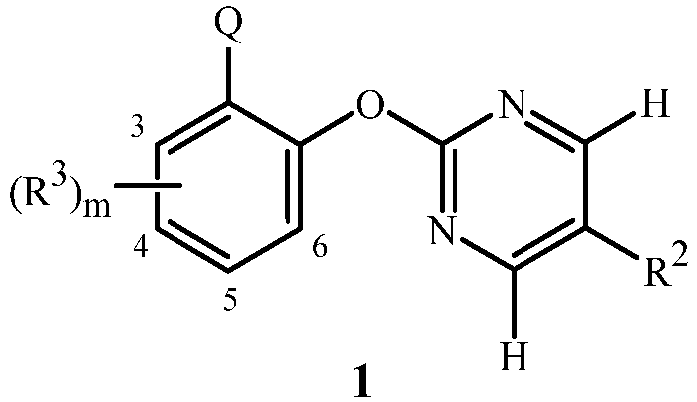
No. Q R2 (R3)m M.S.(AP+) or m.p. 1* 5-Cl-2-pyridyl Cl m = 0 * 12 3-Br-5-isoxazolyl Cl m = 0 352 15* 2-Br-5-thiazolyl CF3 m = 0 402 21* 2-CF3-4-pyrmidinyl Br m = 0 398a * 23* 5-Cl-2-pyidyl Cl 3-Cl * 24* 2-CF3-4-pyridyl Cl 4-CH3 366 27* 5-CF3-2-pyridyl Cl m = 0 352 32 5-CH2F-3-isoxazolyl Cl m = 0 306 34 5-CH2Cl-3-isoxazolyl Cl m = 0 322 35 5-CF2H-3-isoxazolyl Cl m = 0 324 38 5-CN-3-isoxazolyl Cl m = 0 299a 53 3-CHF2-5-isoxazolyl Cl m = 0 324 55 5-CHF2-3-isoxazolyl Cl 3-F 96-98 57 5-CH2F-3-isoxazolyl Cl 3-F 324 58 3-CH3-5-isoxazolyl Cl m = 0 288 59 5-(t-Bu)-3-isoxazolyl Cl m = 0 330 60 5-CH3-3-isoxazolyl Cl m = 0 288 62 5-CHF2-3-isoxazolyl Br m = 0 89-93 63 3-CF3-5-isoxazolyl Cl m = 0 342 64 3-CF3-5-isoxazolyl Br m = 0 388 65 3-CHF2-5-isoxazolyl Cl 5-F 342 No. Q R2 (R3)m M.S.(AP+) or m.p. 66 3-CHF2-5-isoxazolyl Br 5-F 387 67 3-CClF2-5-isoxazolyl Cl m=0 359 68 3-CHF2-5-isoxazolyl Cl 6-F 342 69 3-CHF2-5-isoxazolyl Br 6-F 387 75 3-CHF2-5-isoxazolyl Cl 4-F 342 76 3-CHF2-5-isoxazolyl Br 4-F 387 77 3,5-di-Me-4-isoxazolyl Cl 3-F 320 78 3,5-di-Me-4-isoxazolyl Cl m=0 302 84 3-CF3-5-isoxazolyl Cl 4-F 360 85 3-CF3-5-isoxazolyl Br 4-F 405 88 5-(OCH2CF2H)-3-isoxazolyl Cl m=0 352 94 5-(OCH2CF3)-3-isoxazolyl Cl m=0 85-89 97 5-CHCl2-3-isoxazolyl Cl m=0 88-91 101 3-CHF2-5-isoxazolyl Cl 3-CH3 338 102 3-CHF2-5-isoxazolyl Br 3-CH3 383 103 3-CHF2-5-isoxazolyl Cl 3-OMe 354 104 3-CF3-5-isoxazolyl Cl 3-OMe 372 105 5-CF3-3 -isoxazolyl Cl 3-OMe 372 109 5-CHF2-3-isoxazolyl Cl 3-OMe 354 110 3-CH3-5-isoxazolyl Cl 3-OMe 318 111 3-CH3-5-isoxazolyl F 3-OMe 302 116 5-CHClF-3-isoxazolyl Cl m=0 108-112 118 5-CHF2-3-isoxazolyl Br 3-F 386 119 3-Br-5-isoxazolyl Br m=0 398 120 3-CHF2-5-isoxazolyl Cl 3-Cl 359 121 3-CHF2-5-isoxazolyl Br 3-Cl 403 124 3 -CF3-5-isoxazolyl Cl 5-F 360 125 3 -CF3-5-isoxazolyl Br 5-F 405 126 3 -CF3-5-isoxazolyl Cl 3-Cl 377 127 3 -CF3-5-isoxazolyl Br 3-Cl 421 131 5-CHF2-3-isoxazolyl Cl 3-OCHF2 390 132 3-CHF2-5-isoxazolyl Cl 3-OCHF2 390 133 5-CHFCF3-3-isoxazolyl Cl m=0 374 134 3,5-di-Me-4-isoxazolyl Cl 3-CN * 142 5-CF2CF3-3-isoxazolyl Cl m=0 392 143 5-CF2Cl-3-isoxazolyl Cl m = 0 358 144 3-CHF2-5-isoxazolyl Cl 3-F 342 145 3-CHF2-5-isoxazolyl Br 3-F 387 149 5-CF2CH3-3-isoxazolyl Br m = 0 * 153 5-CH3-3-isoxazolyl Cl m = 0 288 154 5-isoxazolyl Cl m = 0 274 155 5-isoxazolyl Br m = 0 319 156 5-CF3-3-isoxazolyl Cl 3-1 * 157 5-CF3-3-isoxazolyl Cl 3-CN 367 162 5-CBrF2-3-isoxazolyl Cl m = 0 402 167 4-Me-5-CF3-3-isoxazolyl Cl m = 0 356 168 5-CF3-3-isoxazolyl Cl 3-F 360 169 5-CF3-3-isoxazolyl Cl 3-Cl 376 170 5-CF3-3-isoxazolyl Cl 3-Br 420 173 5-CF2CH3-3-isoxazolyl CH3 m = 0 * 176 3-(OCH2CF3)-5-isoxazolyl Cl m = 0 372 177 3-Et-5-isoxazolyl Cl m = 0 318 178 3-CF2CH3-5-isoxazolyl Cl m = 0 338 179 5-CHF2-3-isoxazolyl Cl 3-Cl 358 180 5-CHF2-3-isoxazolyl Cl 3-CN 349 185 3-isoxazolyl Cl m = 0 274 191 5-CH2F-3-isoxazolyl Cl 3-Br 384 198 5-CFCl2-3-isoxazolyl Cl m = 0 374 200 5-CF3-3 -isoxazolyl Cl m = 0 342 206 5-CF3-3 -isoxazolyl F m = 0 326 210 3-CHF2-5-isoxazolyl F m = 0 308 211 3-CHF2-5-isoxazolyl CH3 m = 0 304 212 3-CHF2-5-isoxazolyl Br m = 0 369 220 5-CF2CH3-3-isoxazolyl Cl m = 0 338 221 5-CFCl2-3-isoxazolyl Cl 4-F 129-132 222 5-CN-3-isoxazolyl Cl 3-F 317 223 3-CN-5-isoxazolyl Cl m = 0 297 224 3-CH2F-5-isoxazolyl Cl m = 0 306 226 5-CFH2-3-isoxazolyl Cl m = 0 320 228 3 -CF3-5-isoxazolyl Cl 3-F 360 229 3-CH3-5-isoxazolyl Cl 3-F 306 230 3-CH3-5-isoxazolyl Br 3-F 351 236 5-CF(CH3)2-3-isoxazolyl Cl m = 0 334 a ES+, b AP-, cM+Na.
* See Index Table B for 1H NMR data.
& 4-Br-1H-pyrazol-1-ylINDEX TABLE B Cmpd 1H NMR (CDCl3 solution unless indicated otherwise)Z 134 8.36 (s, 2 H), 7.74 (m, 1 H), 7.62 (m, 1 H), 7.48 - 7.56 (m, 1 H), 2.33 (s, 3 H), 2.22 (s, 3 H) 149 8.54 (2, 2H), 7.96 (dd, 1H), 7.49-7.63 (m, 1H), 7.42 (t, 1H), 7.26-7.29 (m, 1H), 6.86 (t, 1H), 2.00 (t, 3H) 156 7.06 - 7.08 (m, 1 H) 7.18 (s, 1 H) 7.93 (s, 1 H) 8.01 - 8.06 (m, 1 H) 8.46 (s, 2 H) 173 8.34 (s, 2H), 7.99 (dd, 1H), 7.51-7.59 (m, 1H), 7.38 (dt, 1H), 7.26-7.31 (m, 1H), 6.90 (t, 1H), 2.25 (s, 3H), 1.99 (t, 3H) z 1H NMR data are in ppm downfield from tetramethylsilane at 500 MHz unless otherwise indicated. Couplings are designated by (s)-singlet, (d)-doublet and (m)-multiplet. - Seeds of plant species selected from barnyardgrass (Echinochloa crus-galli), kochia (Kochia scoparia), ragweed (common ragweed, Ambrosia elatior), Italian ryegrass (Lolium multiflorum), large (Lg) crabgrass (Digitaria sanguinalis), giant foxtail (Setaria faberii), morningglory (Ipomoea spp.), pigweed (Amaranthus retroflexus), velvetleaf (Abutilon theophrasti), wheat (Triticum aestivum), and corn (Zea mays) were planted into a blend of loam soil and sand and treated preemergence with a directed soil spray using test chemicals formulated in a non-phytotoxic solvent mixture which included a surfactant.
- At the same time, plants selected from these crop and weed species and also blackgrass (Alopecurus myosuroides), and galium (catchweed bedstraw, Galium aparine) were planted in pots containing the same blend of loam soil and sand and treated with postemergence applications of test chemicals formulated in the same manner. Plants ranged in height from 2 to 10 cm and were in the one- to two-leaf stage for the postemergence treatment. Treated plants and untreated controls were maintained in a greenhouse for approximately 10 days, after which time all treated plants were compared to untreated controls and visually evaluated for injury. Plant response ratings, summarized in Table B, are based on a 0 to 100 scale where 0 is no effect and 100 is complete control. A dash (-) response means no test result.
Table B Compounds 1000 g ai/ha Postemergence 12 34 Barnyardgrass 40 0 Blackgrass - - Corn 0 0 Crabgrass, Large 30 10 Foxtail, Giant 40 0 Galium - - Kochia - - Morningglory 30 0 Pigweed 100 40 Ragweed - - Ryegrass, Italian - - Velvetleaf 90 20 Wheat 10 0 Table B Compounds 1000 g ai/ha Postemergence 35 55 57 191 Barnyardgrass 100 100 100 100 Blackgrass - 100 90 100 Corn 90 100 90 60 Crabgrass, Large 100 - - - Foxtail, Giant 90 100 100 100 Galium - 100 90 100 Kochia - 100 90 100 Morningglory 100 - - - Pigweed 100 100 100 100 Ragweed - 100 100 90 Ryegrass, Italian - 100 80 100 Velvetleaf 100 - - - Wheat 80 100 90 30 Table B Compounds 500 g ai/ha Postemergence 32 Barnyardgrass 90 Blackgrass - Corn 50 Crabgrass, Large 90 Foxtail, Giant 90 Galium - Kochia - Morningglory 90 Pigweed 100 Ragweed - Ryegrass, Italian - Velvetleaf 100 Wheat 60 Table B Compounds 500 g ai/ha 53 58 59 60 62 63 64 Postemergence Barnyardgrass 100 90 10 100 100 100 100 Blackgrass 100 90 40 100 - - - Corn 70 50 10 90 50 20 30 Crabgrass, Large - - - - 90 90 90 Foxtail, Giant 100 90 50 100 90 80 80 Galium 100 100 90 100 - - - Kochia 100 100 20 100 - - - Morningglory - - - - 100 100 100 Pigweed 100 100 50 100 100 100 100 Ragweed 90 100 0 90 - - - Ryegrass, Italian 100 80 0 80 - - - Velvetleaf - - - - 100 100 100 Wheat 80 50 10 90 30 50 10 Table B Compounds 500 g ai/ha 134 153 156 157 Postemergence Barnyardgrass 90 70 20 60 Blackgrass - 90 40 90 Corn 80 40 40 40 Crabgrass, Large 100 - - - Foxtail, Giant 90 90 90 80 Galium - 100 100 100 Kochia - 90 90 100 Morningglory 90 - - - Pigweed 100 100 100 100 Ragweed - 100 40 50 Ryegrass, Italian - 60 70 100 Velvetleaf 90 - - - Wheat 30 50 30 70 Table B Compounds 500 g ai/ha 167 168 169 170 179 180 185 Postemergence Barnyardgrass 10 100 30 20 80 90 40 Blackgrass 10 90 90 60 100 90 50 Corn 20 100 20 20 40 70 10 Crabgrass, Large - - - - - - - Foxtail, Giant 10 100 60 50 80 100 70 Galium 60 100 100 100 100 100 70 Kochia 60 90 90 100 100 100 100 Morningglory - - - - - - - Pigweed 70 100 100 100 100 100 100 Ragweed 0 90 30 50 30 70 100 Ryegrass, Italian 0 90 50 20 100 100 0 Velvetleaf - - - - - - - Wheat 20 100 0 30 90 90 0 Table B Compounds 500 g ai/ha 200 206 Postemergence Barnyardgrass 100 10 Blackgrass - - Corn 90 0 Crabgrass, Large 100 20 Foxtail, Giant 100 20 Galium - - Kochia - - Morningglory 100 30 Pigweed 100 70 Ragweed - - Ryegrass, Italian - - Velvetleaf 100 60 Wheat 100 0 Table B Compounds 125 g ai/ha 32 38 Postemergence Barnyardgrass 70 0 Blackgrass - 0 Corn 10 0 Crabgrass, Large 60 - Foxtail, Giant 70 0 Galium - 30 Kochia - 30 Morningglory 70 - Pigweed 100 20 Ragweed - 0 Ryegrass, Italian - 0 Velvetleaf 90 - Wheat 30 0 Table B Compounds 125 g ai/ha 53 58 59 60 62 63 64 Postemergence Barnyardgrass 100 70 10 50 90 80 90 Blackgrass 100 70 0 50 - - - Corn 10 0 0 30 10 20 20 Crabgrass, Large - - - - 70 80 60 Foxtail, Giant 100 70 10 50 80 70 60 Galium 100 100 40 100 - - - Kochia 100 100 0 90 - - - Morningglory - - - - 90 100 70 Pigweed 100 100 40 100 100 100 100 Ragweed 60 100 0 60 - - - Ryegrass, Italian 80 20 0 0 - - - Velvetleaf - - - - 100 100 100 Wheat 40 0 0 30 0 0 0 Table B Compounds 125 g ai/ha 97 103 104 105 109 Postemergence Barnyardgrass 20 40 60 70 90 Blackgrass 0 90 100 100 90 Corn 20 30 30 20 60 Crabgrass, Large - - - - - Foxtail, Giant 30 70 80 80 90 Galium 50 100 100 100 100 Kochia 90 30 80 70 30 Morningglory - - - - - Pigweed 90 80 90 100 100 Ragweed 50 60 10 30 90 Ryegrass, Italian 0 10 30 10 50 Velvetleaf - - - - - Wheat 0 0 10 10 10 Table B Compounds 125 g ai/ha 110 111 116 118 119 120 121 Postemergence Barnyardgrass 50 10 30 100 0 90 90 Blackgrass 40 40 30 100 0 90 80 Corn 10 10 40 100 0 40 40 Crabgrass, Large - - - - - - - Foxtail, Giant 70 60 90 100 10 90 90 Galium 70 20 70 100 60 100 100 Kochia 50 30 90 100 30 90 90 Morningglory - - - - - - - Pigweed 30 20 100 100 80 100 100 Ragweed 40 20 40 50 10 70 60 Ryegrass, Italian 0 0 30 80 0 90 70 Velvetleaf - - - - - - - Wheat 0 0 20 60 0 40 30 Table B Compounds 125 g ai/ha 124 125 126 127 131 132 133 134 Postemergence Barnyardgrass 20 30 100 100 90 50 60 20 Blackgrass 30 30 90 90 80 50 70 - Corn 10 10 70 50 40 30 30 10 Crabgrass, Large - - - - - - - 10 Foxtail, Giant 20 20 90 90 90 70 50 10 Galium 100 100 100 100 90 90 100 - Kochia 80 80 90 90 70 60 90 - Morningglory - - - - - - - 10 Pigweed 90 90 100 100 100 100 100 60 Ragweed 20 20 40 50 70 30 30 - Ryegrass, Italian 0 10 100 90 70 40 30 - Velvetleaf - - - - - - - 40 Wheat 0 0 40 20 30 10 10 10 Table B Compounds 125 g ai/ha 142 143 144 145 149 153 Postemergence Barnyardgrass 0 90 100 100 40 0 Blackgrass 0 60 90 90 60 40 Corn 20 30 90 70 20 30 Crabgrass, Large - - - - - - Foxtail, Giant 0 80 100 90 60 20 Galium 10 100 100 100 90 90 Kochia 20 100 100 100 100 90 Morningglory - - - - - - Pigweed 20 100 100 100 100 100 Ragweed 0 20 60 50 20 20 Ryegrass, Italian 0 50 100 80 20 30 Velvetleaf - - - - - - Wheat 0 30 90 70 10 30 Table B Compounds 125 g ai/ha 154 155 156 157 162 167 Postemergence Barnyardgrass 0 0 0 20 90 0 Blackgrass 0 0 20 70 30 0 Corn 0 0 20 0 40 0 Crabgrass, Large - - - - - - Foxtail, Giant 0 0 20 70 90 0 Galium 0 0 90 100 90 10 Kochia 0 0 90 90 100 10 Morningglory - - - - - - Pigweed 0 0 90 100 100 10 Ragweed 0 0 20 10 40 0 Ryegrass, Italian 0 0 30 90 50 0 Velvetleaf - - - - - - Wheat 0 0 20 50 30 10 Table B Compounds 125 g ai/ha 168 169 170 173 176 177 178 179 180 Postemergence Barnyardgrass 100 10 0 70 30 30 40 10 50 Blackgrass 90 50 50 70 30 30 40 80 90 Corn 100 10 20 40 30 10 20 10 20 Crabgrass, Large - - - - - - - - - Foxtail, Giant 100 30 30 90 50 40 60 40 80 Galium 100 100 80 90 90 100 100 100 100 Kochia 90 90 70 100 100 70 100 90 100 Morningglory - - - - - - - - - Pigweed 100 100 100 80 100 100 100 100 100 Ragweed 90 20 10 60 20 20 10 10 50 Ryegrass, Italian 90 20 0 20 10 0 30 90 100 Velvetleaf - - - - - - - - - Wheat 100 0 0 0 0 0 10 40 60 Table B Compounds 125 g ai/ha 185 198 200 Postemergence Barnyardgrass 10 50 90 Blackgrass 0 40 - Corn 0 20 50 Crabgrass, Large - - 100 Foxtail, Giant 10 90 100 Galium 40 100 - Kochia 90 80 - Morningglory - - 90 Pigweed 90 100 100 Ragweed 70 20 - Ryegrass, Italian 0 50 - Velvetleaf - - 100 Wheat 0 10 60 Table B Compounds 125 g ai/ha 206 210 211 212 Postemergence Barnyardgrass 0 0 10 30 Blackgrass - 30 50 50 Corn 0 10 10 20 Crabgrass, Large 10 - - - Foxtail, Giant 0 40 50 70 Galium - 90 100 100 Kochia - 80 90 100 Morningglory 20 - - - Pigweed 40 80 50 100 Ragweed - 30 30 60 Ryegrass, Italian - 0 0 20 Velvetleaf 30 - - - Wheat 0 20 0 10 Table B Compounds 125 g ai/ha 220 221 222 223 224 226 228 229 230 Postemergence Barnyardgrass 40 90 0 10 50 70 70 70 60 Blackgrass 90 60 10 0 70 70 100 80 70 Corn 20 50 30 0 20 30 30 30 10 Crabgrass, Large - - - - - - - - - Foxtail, Giant 80 90 0 10 50 70 90 80 70 Galium 100 100 90 50 100 100 100 100 100 Kochia 100 100 30 10 100 100 100 100 100 Morningglory - - - - - - - - - Pigweed 100 90 100 60 100 100 100 100 90 Ragweed 10 50 20 10 100 40 40 100 100 Ryegrass, Italian 40 40 0 0 0 50 90 20 0 Velvetleaf - - - - - - - - - Wheat 50 30 20 0 0 50 50 40 10 Table B Compounds 125 g ai/ha 236 Postemergence Barnyardgrass 30 Blackgrass 40 Corn 30 Crabgrass, Large - Foxtail, Giant 30 Galium 100 Kochia 90 Morningglory - Pigweed 70 Ragweed 20 Ryegrass, Italian 20 Velvetleaf - Wheat 20 Table B Compounds 31 g ai/ha 38 97 103 104 105 Postemergence Barnyardgrass 0 0 0 10 10 Blackgrass 0 0 30 70 70 Corn 0 0 0 10 10 Crabgrass, Large - - - - - Foxtail, Giant 0 0 40 20 40 Galium 20 10 90 90 70 Kochia 0 60 0 50 30 Morningglory - - - - - Pigweed 0 60 30 90 90 Ragweed 0 20 20 10 10 Ryegrass, Italian 0 0 0 0 0 Velvetleaf - - - - - Wheat 0 0 0 0 0 Table B Compounds 31 g ai/ha 109 110 111 116 118 119 120 121 Postemergence Barnyardgrass 60 0 0 10 70 0 50 50 Blackgrass 50 0 0 20 60 0 70 50 Corn 10 0 0 20 50 0 30 20 Crabgrass, Large - - - - - - - - Foxtail, Giant 60 0 0 20 90 0 40 70 Galium 50 20 10 60 100 30 100 100 Kochia 0 10 20 90 100 0 90 90 Morningglory - - - - - - - - Pigweed 80 10 0 100 100 40 100 100 Ragweed 60 30 10 20 30 10 40 50 Ryegrass, Italian 10 0 0 0 20 0 30 50 Velvetleaf - - - - - - - - Wheat 0 0 0 10 20 0 0 0 Table B Compounds 31 g ai/ha 124 125 126 127 131 132 133 142 Postemergence Barnyardgrass 0 10 80 30 50 20 20 0 Blackgrass 0 10 60 30 50 20 30 0 Corn 0 0 20 20 20 10 10 0 Crabgrass, Large - - - - - - - - Foxtail, Giant 0 0 60 50 50 30 20 0 Galium 60 50 90 80 80 80 70 0 Kochia 40 60 90 90 60 30 90 0 Morningglory - - - - - - - - Pigweed 70 70 100 100 100 70 90 10 Ragweed 10 0 30 20 40 20 20 0 Ryegrass, Italian 0 0 40 30 40 10 10 0 Velvetleaf - - - - - - - - Wheat 0 0 10 10 0 0 0 0 Table B Compounds 31 g ai/ha 143 144 145 149 154 155 162 Postemergence Barnyardgrass 10 30 40 10 0 0 10 Blackgrass 30 80 70 10 0 0 30 Corn 40 30 30 10 0 0 20 Crabgrass, Large - - - - - - - Foxtail, Giant 10 80 70 10 0 0 10 Galium 50 100 100 90 0 0 90 Kochia 100 100 100 90 0 0 90 Morningglory - - - - - - - Pigweed 90 100 100 90 0 0 100 Ragweed 0 20 20 10 0 0 0 Ryegrass, Italian 0 20 20 0 0 0 0 Velvetleaf - - - - - - - Wheat 20 30 20 0 0 0 20 Table B Compounds 31 g ai/ha 173 176 177 178 198 210 211 Postemergence Barnyardgrass 30 10 10 0 10 0 0 Blackgrass 30 0 0 10 10 10 10 Corn 10 10 0 0 10 0 0 Crabgrass, Large - - - - - - - Foxtail, Giant 30 20 10 10 30 0 10 Galium 50 30 50 80 100 50 60 Kochia 70 30 30 80 80 50 40 Morningglory - - - - - - - Pigweed 60 90 50 100 100 50 20 Ragweed 40 10 10 10 10 10 0 Ryegrass, Italian 0 0 0 0 10 0 0 Velvetleaf - - - - - - - Wheat 0 0 0 0 0 0 0 Table B Compounds 31 g ai/ha 212 220 221 222 223 224 226 Postemergence Barnyardgrass 0 10 10 0 0 30 10 Blackgrass 10 60 30 0 0 40 10 Corn 10 10 20 0 0 0 20 Crabgrass, Large - - - - - - - Foxtail, Giant 10 30 10 0 0 20 10 Galium 60 90 90 30 30 80 60 Kochia 90 90 80 20 0 70 100 Morningglory - - - - - - - Pigweed 90 100 90 30 20 70 50 Ragweed 20 0 10 0 0 50 10 Ryegrass, Italian 0 0 0 0 0 0 10 Velvetleaf - - - - - - - Wheat 0 10 20 0 0 0 0 Table B Compounds 31 g ai/ha 228 229 230 236 Postemergence Barnyardgrass 30 20 0 0 Blackgrass 60 30 20 20 Corn 20 0 0 0 Crabgrass, Large - - - - Foxtail, Giant 40 50 0 0 Galium 100 80 80 30 Kochia 100 90 80 20 Morningglory - - - - Pigweed 100 70 60 30 Ragweed 30 100 70 0 Ryegrass, Italian 20 0 0 0 Velvetleaf - - - - Wheat 0 0 0 0 Table B Compounds 1000 g ai/ha 12 34 Preemergence Barnyardgrass 20 0 Corn 0 0 Crabgrass, Large 80 10 Foxtail, Giant 90 10 Kochia - - Morningglory 0 0 Pigweed 90 100 Ragweed - - Ryegrass, Italian - - Velvetleaf 70 10 Wheat 0 0 Table B Compounds 1000 g ai/ha 35 55 57 191 Preemergence Barnyardgrass 100 100 100 100 Corn 30 - - - Crabgrass, Large 100 - - - Foxtail, Giant 100 100 100 100 Kochia - 100 100 100 Morningglory 90 - - - Pigweed 10 100 90 100 Ragweed - 100 90 90 Ryegrass, Italian - 100 80 90 Velvetleaf 100 - - - Wheat 60 - - - Table B Compounds 500 g ai/ha 32 Preemergence Barnyardgrass 90 Corn 0 Crabgrass, Large 100 Foxtail, Giant 100 Kochia - Morningglory 30 Pigweed 100 Ragweed - Ryegrass, Italian - Velvetleaf 100 Wheat 10 Table B Compounds 500 g ai/ha 53 58 59 60 62 63 64 Preemergence Barnyardgrass 100 100 10 100 100 100 100 Corn - - - - 20 30 20 Crabgrass, Large - - - - 100 100 100 Foxtail, Giant 100 100 60 100 100 100 100 Kochia 100 100 0 100 - - - Morningglory - - - - 90 60 60 Pigweed 100 100 30 100 100 100 100 Ragweed 50 80 0 50 - - - Ryegrass, Italian 40 20 0 30 - - - Velvetleaf - - - - 100 90 90 Wheat - - - - 30 40 30 Table B Compounds 500 g ai/ha 134 153 156 157 Preemergence Barnyardgrass 90 100 20 80 Corn 60 - - - Crabgrass, Large 100 - - - Foxtail, Giant 100 100 80 100 Kochia - 100 40 100 Morningglory 80 - - - Pigweed 100 100 100 100 Ragweed - 40 0 70 Ryegrass, Italian - 20 0 90 Velvetleaf 100 - - - Wheat 20 - - - Table B Compounds 500 g ai/ha Preemergence 167 168 169 170 179 180 185 Barnyardgrass 10 100 30 20 90 80 70 Corn - - - - - - - Crabgrass, Large - - - - - - - Foxtail, Giant 30 100 90 90 100 100 90 Kochia 30 100 90 80 100 100 100 Morningglory - - - - - - - Pigweed 20 100 100 100 100 100 100 Ragweed 10 80 20 60 40 70 90 Ryegrass, Italian 0 100 20 20 40 70 0 Velvetleaf - - - - - - - Wheat - - - - - - - Table B Compounds 500 g ai/ha Preemergence 200 206 Barnyardgrass 100 30 Corn 100 0 Crabgrass, Large 100 60 Foxtail, Giant 100 60 Kochia - - Morningglory 100 0 Pigweed 100 80 Ragweed - - Ryegrass, Italian - - Velvetleaf 90 40 Wheat 90 0 Table B Compounds 125 g ai/ha Preemergence 32 38 Barnyardgrass 90 0 Corn 0 - Crabgrass, Large 100 - Foxtail, Giant 90 0 Kochia - 0 Morningglory 0 - Pigweed 100 40 Ragweed - 0 Ryegrass, Italian - 0 Velvetleaf 90 - Wheat 0 - Table B Compounds 125 g ai/ha Preemergence 53 58 59 60 62 63 64 Barnyardgrass 90 60 0 80 80 90 60 Corn - - - - 0 10 0 Crabgrass, Large - - - - 100 100 100 Foxtail, Giant 90 90 10 80 100 100 90 Kochia 100 80 0 90 - - - Morningglory - - - - 60 30 0 Pigweed 100 100 0 100 100 100 100 Ragweed 10 70 0 20 - - - Ryegrass, Italian 10 0 0 0 - - - Velvetleaf - - - - 90 70 80 Wheat - - - - 20 20 0 Table B Compounds 125 g ai/ha Preemergence 97 103 104 105 109 Barnyardgrass 0 50 80 90 100 Corn - - - - - Crabgrass, Large - - - - - Foxtail, Giant 30 90 100 100 100 Kochia 30 10 10 10 30 Morningglory - - - - - Pigweed 50 100 100 100 100 Ragweed 0 10 0 0 70 Ryegrass, Italian 0 0 10 20 10 Velvetleaf - - - - - Wheat - - - - - Table B Compounds 125 g ai/ha Preemergence 110 111 116 118 119 120 121 Barnyardgrass 40 20 30 100 0 100 90 Corn - - - - - - - Crabgrass, Large - - - - - - - Foxtail, Giant 70 50 90 100 50 100 100 Kochia 0 10 60 100 10 90 100 Morningglory - - - - - - - Pigweed 70 80 100 100 50 100 100 Ragweed 0 10 20 30 0 30 20 Ryegrass, Italian 0 0 20 80 0 90 80 Velvetleaf - - - - - - - Wheat - - - - - - - Table B Compounds 125 g ai/ha Preemergence 124 125 126 127 131 132 133 134 Barnyardgrass 30 50 100 90 100 60 70 70 Corn - - - - - - - 20 Crabgrass, Large - - - - - - - 100 Foxtail, Giant 100 90 100 100 100 90 90 90 Kochia 60 40 90 90 10 0 90 - Morningglory - - - - - - - 10 Pigweed 100 80 100 100 100 100 100 100 Ragweed 10 0 10 30 60 40 10 - Ryegrass, Italian 10 10 100 90 90 30 50 - Velvetleaf - - - - - - - 40 Wheat - - - - - - - 20 Table B Compounds 125 g ai/ha Preemergence 142 143 144 145 149 153 Barnyardgrass 0 90 100 100 70 0 Corn - - - - - - Crabgrass, Large - - - - - - Foxtail, Giant 20 100 100 100 100 30 Kochia 0 90 100 100 80 20 Morningglory - - - - - - Pigweed 0 100 100 100 100 100 Ragweed 0 30 50 20 0 0 Ryegrass, Italian 0 60 90 40 10 0 Velvetleaf - - - - - - Wheat - - - - - Table B Compounds 125 g ai/ha Preemergence 154 155 156 157 162 167 Barnyardgrass 0 0 0 20 100 0 Corn - - - - - - Crabgrass, Large - - - - - - Foxtail, Giant 0 0 20 80 100 0 Kochia 0 0 20 100 70 0 Morningglory - - - - - - Pigweed 0 0 80 100 100 0 Ragweed 0 0 0 20 20 0 Ryegrass, Italian 0 0 0 20 40 0 Velvetleaf - - - - - - Wheat - - - - - - Table B Compounds 125 g ai/ha Preemergence 168 169 170 173 176 177 178 179 180 Barnyardgrass 100 20 0 90 50 50 70 10 20 Corn - - - - - - - - - Crabgrass, Large - - - - - - - - - Foxtail, Giant 100 50 60 100 90 70 90 80 90 Kochia 100 70 30 100 20 20 20 100 100 Morningglory - - - - - - - - - Pigweed 100 100 100 100 90 90 100 100 100 Ragweed 70 10 20 70 0 0 0 10 50 Ryegrass, Italian 80 0 0 20 10 0 10 20 20 Velvetleaf - - - - - - - - - Wheat - - - - - - - - - Table B Compounds 125 g ai/ha Preemergence 185 198 200 Barnyardgrass 20 40 100 Corn - - 20 Crabgrass, Large - - 100 Foxtail, Giant 30 90 100 Kochia 40 30 - Morningglory - - 20 Pigweed 90 100 100 Ragweed 10 10 - Ryegrass, Italian 0 20 - Velvetleaf - - 80 Wheat - - 20 Table B Compounds 125 g ai/ha Preemergence 206 210 211 212 Barnyardgrass 0 80 50 60 Corn 0 - - - Crabgrass, Large 10 - - - Foxtail, Giant 10 90 100 100 Kochia - 90 80 90 Morningglory 0 - - - Pigweed 50 100 100 100 Ragweed - 20 30 40 Ryegrass, Italian - 10 0 40 Velvetleaf 30 - - - Wheat 0 - - - Table B Compounds 125 g ai/ha Preemergence 220 221 222 223 224 226 228 229 230 Barnyardgrass 100 90 0 0 50 100 100 90 70 Corn - - - - - - - - - Crabgrass, Large - - - - - - - - - Foxtail, Giant 100 90 0 0 90 100 100 90 90 Kochia 90 70 0 0 90 90 100 100 100 Morningglory - - - - - - - - - Pigweed 100 100 90 10 100 100 100 100 100 Ragweed 10 0 0 0 - 20 30 90 80 Ryegrass, Italian 30 40 0 0 0 20 70 30 0 Velvetleaf - - - - - - - - - Wheat - - - - - - - - Table B Compounds 125 g ai/ha Preemergence 236 Barnyardgrass 80 Corn - Crabgrass, Large - Foxtail, Giant 90 Kochia 100 Morningglory - Pigweed 100 Ragweed 0 Ryegrass, Italian 30 Velvetleaf - Wheat - Table B Compounds 31 g ai/ha 38 97 103 104 105 Preemergence Barnyardgrass 0 0 0 20 20 Corn - - - - - Crabgrass, Large - - - - - Foxtail, Giant 0 10 50 40 70 Kochia 0 0 0 0 0 Morningglory - - - - - Pigweed 0 20 100 80 100 Ragweed 0 0 0 0 0 Ryegrass, Italian 0 0 0 0 0 Velvetleaf - - - - - Wheat Table B Compounds 31 g ai/ha 109 110 111 116 118 119 120 121 Preemergence Barnyardgrass 40 0 0 0 70 0 90 70 Corn - - - - - - - - Crabgrass, Large - - - - - - - - Foxtail, Giant 80 0 0 40 100 0 100 100 Kochia 0 0 0 60 80 0 80 60 Morningglory - - - - - - - - Pigweed 90 10 10 70 100 0 100 100 Ragweed 20 0 0 0 20 0 10 10 Ryegrass, Italian 0 0 0 0 20 0 40 30 Velvetleaf - - - - - - - - Wheat - - - - - - - - Table B Compounds 31 g ai/ha 124 125 126 127 131 132 133 142 Preemergence Barnyardgrass 0 0 90 70 80 20 30 0 Corn - - - - - - - - Crabgrass, Large - - - - - - - - Foxtail, Giant 20 10 100 100 100 60 70 0 Kochia 10 0 80 80 0 0 50 0 Morningglory - - - - - - - - Pigweed 40 0 100 100 100 90 90 0 Ragweed 0 0 10 10 20 0 0 0 Ryegrass, Italian 0 0 40 30 20 0 0 0 Velvetleaf - - - - - - - - Wheat - - - - - - - - Table B Compounds 31 g ai/ha 143 144 145 149 154 155 162 Preemergence Barnyardgrass 20 80 70 10 0 0 20 Corn - - - - - - - Crabgrass, Large - - - - - - - Foxtail, Giant 70 100 90 70 0 0 90 Kochia 30 90 90 20 0 0 70 Morningglory - - - - - - - Pigweed 90 100 100 80 0 0 80 Ragweed 0 0 0 0 0 0 0 Ryegrass, Italian 0 0 0 0 0 0 0 Velvetleaf - - - - - - - Wheat - - - - - - - Table B Compounds 31 g ai/ha 173 176 177 178 198 210 211 Preemergence Barnyardgrass 60 10 0 20 10 10 10 Corn - - - - - - - Crabgrass, Large - - - - - - - Foxtail, Giant 50 60 10 60 70 40 10 Kochia 70 0 0 10 0 50 20 Morningglory - - - - - - - Pigweed 80 30 50 90 30 100 100 Ragweed 10 0 0 0 0 0 0 Ryegrass, Italian 0 0 0 0 0 0 0 Velvetleaf - - - - - - - Wheat - - - - - - - Table B Compounds 31 g ai/ha 212 220 221 222 223 224 226 Preemergence Barnyardgrass 10 10 20 0 0 10 30 Corn - - - - - - - Crabgrass, Large - - - - - - - Foxtail, Giant 60 70 50 0 0 40 60 Kochia 40 50 50 0 0 60 70 Morningglory - - - - - - - Pigweed 100 100 100 20 0 90 100 Ragweed 0 0 0 0 0 - 0 Ryegrass, Italian 0 0 20 0 0 0 0 Velvetleaf - - - - - - - Wheat - - - - - - - Table B Compounds 31 g ai/ha 228 229 230 236 Preemergence Barnyardgrass 50 50 10 10 Corn - - - - Crabgrass, Large - - - - Foxtail, Giant 90 90 60 10 Kochia 70 80 60 30 Morningglory - - - - Pigweed 100 100 90 60 Ragweed 0 70 20 0 Ryegrass, Italian 30 0 0 0 Velvetleaf - - - - Wheat - - - - - Plant species in the flooded paddy test selected from rice (Oryza sativa), small-flower umbrella sedge (Cyperus difformis), ducksalad (Heteranthera limosa), and barnyardgrass (Echinochloa crus-galli) were grown to the 2-leaf stage for testing. At time of treatment, test pots were flooded to 3 cm above the soil surface, treated by application of test compounds directly to the paddy water, and then maintained at that water depth for the duration of the test.
- Treated plants and controls were maintained in a greenhouse for 13 to 15 days, after which time all species were compared to controls and visually evaluated. Plant response ratings, summarized in Table C, are based on a scale of 0 to 100 where 0 is no effect and 100 is complete control. A dash (-) response means no test result.
Table C Compounds 250 g ai/ha 12 Flood Barnyardgrass 10 Ducksalad 40 Rice 0 Sedge, Umbrella 0 Table C Compounds 250 g ai/ha 32 35 38 Flood Barnyardgrass 0 65 0 Ducksalad 90 100 60 Rice 20 80 0 Sedge, Umbrella 85 100 30 Table C Compounds 250 g ai/ha 53 55 57 58 59 Flood Barnyardgrass 20 25 0 0 0 Ducksalad 80 100 90 80 0 Rice 20 25 0 0 0 Sedge, Umbrella 75 90 75 40 0 Table C Compounds 250 g ai/ha 60 62 63 64 97 103 104 105 Flood Barnyardgrass 20 35 60 35 0 60 20 45 Ducksalad 80 100 100 95 0 40 75 40 Rice 30 40 25 0 0 30 0 35 Sedge, Umbrella 50 90 85 80 50 80 80 70 Table C Compounds 250 g ai/ha 109 110 111 116 118 119 120 Flood Barnyardgrass 30 0 0 0 50 0 90 Ducksalad 85 30 0 95 100 40 100 Rice 35 0 0 30 45 0 90 Sedge, Umbrella 80 60 0 90 100 40 95 Table C Compounds 250 g ai/ha 121 124 125 126 127 131 132 133 134 Flood Barnyardgrass 60 0 0 95 50 75 30 40 0 Ducksalad 90 80 80 100 100 95 40 80 40 Rice 45 0 0 75 60 60 20 40 0 Sedge, Umbrella 90 85 90 100 100 95 75 80 75 Table C Compounds 250 g ai/ha 142 143 144 145 149 Flood Barnyardgrass 0 30 98 45 0 Ducksalad 0 85 90 90 80 Rice 0 35 40 35 0 Sedge, Umbrella 0 100 85 95 65 Table C Compounds 250 g ai/ha 153 154 155 156 157 162 Flood Barnyardgrass 0 0 0 0 0 0 Ducksalad 0 0 0 0 40 0 Rice 0 0 0 0 0 0 Sedge, Umbrella 0 0 0 0 40 0 Table C Compounds 250 g ai/ha 167 168 169 170 173 176 177 178 Flood Barnyardgrass 0 90 0 0 0 0 0 40 Ducksalad 0 90 0 0 80 75 60 90 Rice 0 40 0 0 0 0 20 0 Sedge, Umbrella 0 90 0 0 60 30 40 85 Table C Compounds 250 g ai/ha 179 180 185 191 Flood Barnyardgrass 0 0 0 20 Ducksalad 80 90 0 80 Rice 40 0 0 0 Sedge, Umbrella 80 80 0 85 Table C Compounds 250 g ai/ha 198 200 206 Flood Barnyardgrass 40 90 0 Ducksalad 85 100 70 Rice 25 35 0 Sedge, Umbrella 100 100 70 Table C Compounds 250 g ai/ha 210 211 212 220 221 Flood Barnyardgrass 0 0 0 20 0 Ducksalad 85 70 75 80 100 Rice 0 0 20 0 0 Sedge, Umbrella 40 20 75 75 95 Table C Compounds 250 g ai/ha 222 223 224 226 228 229 230 236 Flood Barnyardgrass 0 0 0 20 40 55 40 0 Ducksalad 30 65 70 85 85 90 85 75 Rice 0 0 0 20 0 15 20 0 Sedge, Umbrella 0 70 65 65 90 90 85 40 - Seeds of plant species selected from blackgrass (Alopecurus myosuroides), Italian ryegrass (Lolium multiflorum), winter wheat (Triticum aestivum), galium (catchweed bedstraw, Galium aparine), corn (Zea mays), large (Lg) crabgrass (Digitaria sanguinalis), giant foxtail (Setaria faberii), johnsongrass (Sorghum halepense), lambsquarters (Chenopodium album), morningglory (Ipomoea coccinea), yellow nutsedge (Cyperus esculentus), pigweed (Amaranthus retroflexus), ragweed (common ragweed, Ambrosia elatior), soybean (Glycine max), barnyardgrass (Echinochloa crus-galli), oilseed rape (Brassica napus), waterhemp (common waterhemp, Amaranthus rudis), and velvetleaf (Abutilon theophrasti) were planted into a blend of loam soil and sand and treated preemergence with test chemicals formulated in a non-phytotoxic solvent mixture which included a surfactant.
- At the same time, plants selected from these crop and weed species and also kochia (Kochia scoparia), wild oat (Avena fatua), and chickweed (common chickweed, Stellaria media) were planted in pots containing Redi-Earth® planting medium (Scotts Company, 14111 Scottslawn Road, Marysville, Ohio 43041) comprising spaghnum peat moss, vermiculite, wetting agent and starter nutrients and treated with postemergence applications of test chemicals formulated in the same manner. Plants ranged in height from 2 to 18 cm (1-to 4-leaf stage) for postemergence treatments.
- Plant species in the flooded paddy test consisted of rice (Oryza sativa), small-flower umbrella sedge (Cyperus difformis), ducksalad (Heteranthera limosa), and barnyardgrass (Echinochloa crus-galli) grown to the 2-leaf stage for testing. At time of treatment, test pots were flooded to 3 cm above the soil surface, treated by application of test compounds directly to the paddy water, and then maintained at that water depth for the duration of the test. Treated plants and controls were maintained in a greenhouse for 13 to 15 days, after which time all species were compared to controls and visually evaluated. Plant response ratings, summarized in Table D, are based on a scale of 0 to 100 where 0 is no effect and 100 is complete control. A dash (-) response means no test result.
Table D Compound 250 g ai/ha 62 Postemergence Barnyardgrass 95 Blackgrass 60 Chickweed 100 Corn 10 Crabgrass, Large 65 Foxtail, Giant 55 Galium 100 Johnsongrass 85 Kochia 100 Lambsquarters 100 Morningglory 98 Table D Compound 250 g ai/ha 62 Postemergence Nutsedge, Yellow 10 Oat, Wild 60 Oilseed Rape 100 Pigweed 100 Ragweed 85 Ryegrass, Italian 40 Soybean 98 Velvetleaf 85 Waterhemp 100 Wheat 40 Table D Compounds 125 g ai/ha 53 55 57 58 60 62 63 116 118 120 Postemergence Barnyardgrass 35 15 10 5 10 30 10 30 30 40 Blackgrass 30 50 15 5 20 40 25 35 35 55 Chickweed 90 100 75 30 75 98 100 90 98 100 Corn 0 20 10 5 5 15 10 10 15 15 Crabgrass, Large 30 15 10 5 5 50 35 40 20 65 Foxtail, Giant 30 75 20 30 10 20 20 60 20 25 Galium 90 90 95 55 65 100 70 90 98 100 Johnsongrass 5 15 5 5 5 75 45 - 45 85 Kochia 100 100 100 80 90 100 100 100 100 100 Lambsquarters 100 98 80 90 75 100 90 100 95 100 Morningglory 55 85 65 65 40 95 70 30 80 100 Nutsedge, Yellow - 5 5 0 5 5 5 25 10 15 Oat, Wild 20 40 15 0 5 50 35 15 50 60 Oilseed Rape 85 100 90 75 90 98 100 70 95 95 Pigweed 100 100 75 75 70 100 95 90 98 100 Ragweed 55 90 98 60 70 65 55 75 85 85 Ryegrass, Italian 5 15 0 0 0 30 30 10 5 50 Soybean 98 95 90 75 95 98 98 95 90 95 Velvetleaf 100 85 80 85 80 75 40 75 85 100 Waterhemp 100 100 98 75 70 98 98 100 98 100 Wheat 0 35 20 10 20 10 5 5 5 0 Table D Compounds 125 g ai/ha 121 131 143 144 145 149 153 162 168 169 170 178 179 Postemergence Barnyardgrass 45 20 65 15 30 10 5 15 75 5 5 20 5 Blackgrass 50 30 30 75 80 30 0 45 20 25 5 15 20 Chickweed 100 100 80 95 100 60 25 85 100 80 100 80 95 Corn 25 25 10 5 10 5 5 5 20 10 5 10 15 Crabgrass, Large 55 20 35 20 20 15 10 20 40 10 10 15 5 Foxtail, Giant 40 15 50 25 20 30 5 20 60 55 40 25 30 Galium 95 95 100 95 90 95 80 80 100 75 80 85 75 Johnsongrass 60 45 30 50 40 10 10 20 20 5 5 10 5 Kochia 100 100 100 100 100 100 60 100 100 95 100 100 100 Lambsquarters 100 100 100 95 95 85 50 95 90 80 80 90 100 Morningglory 98 95 100 - 80 80 25 75 85 65 98 90 90 Nutsedge, Yellow 20 10 5 5 10 5 5 10 15 5 10 5 5 Oat, Wild 70 35 5 10 15 5 0 10 30 10 10 5 20 Oilseed Rape 95 85 65 - - 85 85 - 100 60 25 95 100 Pigweed 100 100 100 100 98 90 70 100 98 98 98 90 98 Ragweed 98 75 30 75 65 45 55 50 55 35 10 35 60 Ryegrass, Italian 55 25 15 10 10 0 0 5 15 15 5 5 20 Soybean 95 65 60 - 75 65 90 50 90 25 35 45 70 Velvetleaf 85 85 65 98 80 65 50 - 90 30 25 75 70 Waterhemp 100 98 100 100 100 100 65 100 98 90 85 90 98 Wheat 0 0 5 10 10 10 10 5 35 10 15 10 35 Table D Compounds 125 g ai/ha 180 185 191 198 200 212 221 224 228 229 230 Postemergence Barnyardgrass 5 5 10 35 15 25 10 15 35 10 5 Blackgrass 5 0 5 15 90 10 40 0 35 10 10 Chickweed 95 5 90 95 100 80 100 80 100 85 80 Corn 15 5 10 15 15 15 10 5 10 5 15 Crabgrass, Large 5 10 20 30 35 15 30 10 45 5 10 Foxtail, Giant 45 5 5 25 15 10 35 40 40 15 10 Galium 100 5 85 98 100 80 100 60 100 80 95 Johnsongrass 5 5 5 35 40 20 15 5 60 25 5 Kochia 100 30 90 100 100 100 100 100 100 98 100 Lambsquarters 98 20 85 75 98 98 98 85 95 85 70 Morningglory 90 65 85 85 98 98 85 80 75 35 70 Nutsedge, Yellow 15 30 10 10 15 5 10 5 10 10 5 Oat, Wild 30 5 5 10 55 10 35 0 55 10 10 Oilseed Rape 90 0 90 90 100 35 90 98 98 80 75 Pigweed 98 50 60 100 98 100 100 90 98 80 85 Ragweed 65 25 65 60 40 60 75 70 60 60 55 Ryegrass, Italian 20 0 5 10 35 5 10 0 25 5 5 Soybean 85 45 95 60 98 90 90 75 80 70 85 Velvetleaf 55 25 50 55 75 90 100 60 80 70 65 Waterhemp 98 30 65 98 100 100 100 85 100 85 80 Wheat 30 0 0 5 20 15 0 15 10 10 15 Table D Compounds 62 g ai/ha 35 53 55 57 58 60 62 63 116 118 Postemergence Barnyardgrass 20 25 15 5 0 10 35 10 20 20 Blackgrass 60 20 30 0 0 5 25 20 5 15 Chickweed 100 80 98 55 15 60 95 98 30 90 Corn 20 0 10 5 5 5 10 5 5 15 Crabgrass, Large 10 15 10 10 5 5 35 10 25 15 Foxtail, Giant 15 25 40 20 15 5 25 10 10 10 Galium 85 95 90 65 60 50 85 70 70 90 Johnsongrass 35 5 10 5 0 0 25 25 20 10 Kochia 100 100 100 95 60 55 100 98 100 95 Lambsquarters 95 100 98 70 60 55 98 85 80 90 Morningglory 98 85 80 45 45 25 95 98 10 85 Nutsedge, Yellow 5 - 5 5 0 0 5 5 10 10 Oat, Wild 45 30 40 5 0 0 40 25 10 15 Oilseed Rape 98 95 100 75 60 65 90 98 55 60 Pigweed 95 90 98 55 40 55 100 90 90 95 Ragweed 75 55 65 60 65 40 60 55 60 55 Ryegrass, Italian 20 5 10 0 0 0 5 5 5 5 Soybean 95 95 90 85 60 95 95 55 30 60 Velvetleaf 65 70 75 70 60 65 70 40 70 70 Waterhemp 98 90 98 75 55 50 98 98 90 95 Wheat 10 0 30 15 10 5 20 5 5 0 Table D Compounds 62 g ai/ha 120 121 131 143 144 145 149 153 156 162 168 169 170 Postemergence Barnyardgrass 25 25 10 10 10 10 5 5 5 15 10 5 5 Blackgrass 60 30 5 20 15 25 0 0 5 30 15 0 5 Chickweed 100 100 98 60 95 95 30 20 70 60 100 70 90 Corn 10 20 10 5 10 5 5 5 5 5 10 10 5 Crabgrass, Large 35 40 10 15 15 10 10 5 10 10 15 10 5 Foxtail, Giant 15 15 15 10 25 20 10 5 35 10 40 25 40 Galium 100 100 95 70 90 80 70 70 70 60 95 70 65 Johnsongrass 40 60 25 30 10 5 15 5 10 10 5 0 0 Kochia 100 100 95 100 100 100 100 40 45 100 100 90 85 Lambsquarters 100 100 98 98 90 85 80 30 40 75 85 35 40 Morningglory 80 90 75 90 85 85 70 15 65 75 85 55 70 Nutsedge, Yellow 10 5 5 5 5 5 5 5 5 5 10 0 5 Oat, Wild 55 70 20 5 5 15 0 0 0 5 20 5 5 Oilseed Rape 90 95 80 60 95 - 60 60 45 40 100 10 40 Pigweed 100 100 98 100 100 98 95 40 75 100 95 80 98 Ragweed 70 75 65 10 70 50 30 25 15 40 55 25 10 Ryegrass, Italian 10 40 5 0 10 10 0 0 0 5 5 5 5 Soybean 70 90 75 60 95 75 65 70 30 40 40 15 10 Velvetleaf 100 80 80 50 75 75 40 60 25 75 45 20 25 Waterhemp 100 100 90 100 100 100 95 35 90 100 98 90 100 Wheat 0 0 0 5 10 5 0 5 10 5 30 10 10 Table D Compounds 62 g ai/ha 178 179 180 185 191 198 200 212 221 224 228 229 Postemergence Barnyardgrass 10 5 5 0 5 20 10 15 5 10 20 5 Blackgrass 10 15 5 0 0 10 40 0 5 5 25 15 Chickweed 60 95 85 5 70 60 100 30 80 40 98 80 Corn 5 10 10 5 10 15 10 10 5 5 10 5 Crabgrass, Large 20 5 5 10 10 20 25 10 25 10 35 5 Foxtail, Giant 5 40 30 5 5 15 10 15 5 5 20 5 Galium 98 70 100 5 85 98 100 65 100 60 98 65 Johnsongrass 15 5 5 5 5 35 45 20 15 5 25 0 Kochia 100 100 100 5 85 100 100 100 100 95 100 98 Lambsquarters 75 75 98 15 70 70 85 98 95 80 90 70 Morningglory 100 85 90 10 60 80 85 75 80 35 80 25 Nutsedge, Yellow 10 5 10 0 5 15 5 10 5 5 5 10 Oat, Wild 5 15 5 0 5 10 30 5 10 0 40 10 Oilseed Rape 80 85 80 0 60 60 100 20 90 50 80 60 Pigweed 85 98 75 35 30 90 85 100 98 85 95 70 Ragweed 20 50 35 15 60 55 60 55 45 55 60 70 Ryegrass, Italian 5 5 5 0 0 10 35 0 20 0 15 0 Soybean 35 70 70 35 75 30 90 85 85 65 80 45 Velvetleaf 60 30 35 10 30 55 70 60 80 30 65 45 Waterhemp 85 95 90 25 70 95 98 100 100 85 95 80 Wheat 5 30 15 0 0 5 25 5 5 0 10 5 Table D Compound Table D Compound 62 g ai/ha 230 62 g ai/ha 230 Postemergence Postemergence Barnyardgrass 10 Nutsedge, Yellow 5 Blackgrass 10 Oat, Wild 5 Chickweed 75 Oilseed Rape 75 Corn 0 Pigweed 70 Crabgrass, Large 5 Ragweed 55 Foxtail, Giant 10 Ryegrass, Italian 5 Galium 85 Soybean 65 Johnsongrass 5 Velvetleaf 55 Kochia 100 Waterhemp 75 Lambsquarters 80 Wheat 5 Morningglory 5 Table D Compounds 31 g ai/ha Postemergence 35 53 55 57 58 60 62 63 116 118 Barnyardgrass 20 10 10 5 0 0 50 10 5 20 Blackgrass 40 40 10 0 0 0 20 10 5 10 Chickweed 85 80 75 50 10 50 70 65 15 70 Corn 10 0 10 5 0 0 10 5 10 10 Crabgrass, Large 10 20 10 5 5 5 55 5 5 10 Foxtail, Giant 10 20 50 10 0 5 25 5 5 15 Galium 75 85 90 50 45 40 85 70 60 90 Johnsongrass 5 0 5 0 0 0 25 5 20 5 Kochia 100 100 100 90 50 50 98 95 100 95 Lambsquarters 85 80 85 40 75 20 98 70 60 85 Morningglory 85 80 70 45 45 40 85 50 10 85 Nutsedge, Yellow 5 - 5 5 0 0 5 0 5 5 Oat, Wild 40 10 15 0 0 0 30 20 5 10 Oilseed Rape 80 80 95 55 10 50 80 90 10 30 Pigweed 90 90 85 55 25 35 98 85 75 95 Ragweed 85 50 40 50 45 30 65 40 35 45 Ryegrass, Italian 5 5 5 0 0 0 5 0 0 0 Soybean 80 90 75 70 40 65 80 45 55 60 Velvetleaf 55 60 50 50 35 50 60 25 65 75 Waterhemp 95 90 90 55 40 30 98 85 90 90 Wheat 5 0 25 5 5 5 30 0 0 0 Table D Compounds 31 g ai/ha Postemergence 120 121 131 143 144 145 149 153 156 157 162 168 169 Barnyardgrass 15 25 10 5 5 5 5 5 0 5 10 5 5 Blackgrass 35 25 5 10 15 20 0 0 5 5 30 15 0 Chickweed 100 100 80 50 80 80 30 20 45 75 60 98 40 Corn 15 20 5 5 5 5 5 0 5 5 5 5 5 Crabgrass, Large 25 10 5 10 10 10 5 5 5 5 5 5 5 Foxtail, Giant 10 10 10 10 10 10 10 0 10 20 10 35 5 Galium 98 90 85 70 85 80 60 70 60 70 60 95 70 Johnsongrass 30 35 5 5 10 5 10 0 5 0 5 5 0 Kochia 100 100 90 100 100 100 90 50 30 90 100 100 60 Lambsquarters 100 100 98 80 80 85 70 35 35 55 65 85 40 Morningglory 98 75 75 - 85 85 60 5 15 35 65 85 15 Nutsedge, Yellow 10 10 0 5 5 5 0 0 5 10 0 5 0 Oat, Wild 40 45 15 0 0 10 0 0 0 10 5 10 5 Oilseed Rape 85 80 45 50 80 70 30 40 40 25 5 100 5 Pigweed 100 98 98 90 98 95 85 20 60 65 90 85 80 Ragweed 55 65 45 5 60 50 30 10 10 25 30 50 5 Ryegrass, Italian 5 10 5 0 5 0 0 0 0 5 0 5 0 Soybean 70 60 15 30 80 60 40 40 25 35 10 75 5 Velvetleaf 85 80 65 30 55 70 30 20 15 40 40 40 10 Waterhemp 100 95 90 100 85 90 80 10 70 75 98 90 90 Wheat 0 0 0 5 10 5 0 0 5 0 0 10 5 Table D Compounds 31 g ai/ha Postemergence 170 178 179 180 185 191 198 200 212 221 224 228 Barnyardgrass 0 15 0 0 0 5 10 10 5 5 5 20 Blackgrass 0 5 5 0 0 0 5 30 0 10 0 15 Chickweed 65 50 80 60 0 55 60 95 30 85 15 85 Corn 5 5 10 5 0 5 10 5 5 0 5 10 Crabgrass, Large 5 10 5 5 0 10 15 10 10 10 5 20 Foxtail, Giant 30 5 5 50 5 5 15 20 10 5 5 10 Galium 50 80 80 75 0 70 75 100 60 80 50 98 Johnsongrass 0 10 5 0 0 5 20 20 5 5 5 10 Kochia 60 95 100 90 0 80 95 100 100 100 70 100 Lambsquarters 40 70 75 80 10 70 55 80 80 95 75 85 Morningglory 30 100 65 55 25 65 55 50 98 65 35 65 Nutsedge, Yellow 5 5 5 0 0 5 5 5 5 5 0 5 Oat, Wild 5 0 5 5 0 0 5 30 0 10 0 20 Oilseed Rape 5 80 75 60 0 40 50 85 - 70 10 85 Pigweed 90 85 90 75 35 30 98 85 100 95 85 95 Ragweed 5 5 25 40 20 40 55 55 40 50 55 35 Ryegrass, Italian 0 0 5 0 0 0 0 25 0 5 0 5 Soybean 10 35 45 60 30 65 25 85 70 25 40 55 Velvetleaf 5 40 20 40 10 30 45 60 50 65 25 40 Waterhemp 80 80 90 75 25 60 85 90 98 85 75 95 Wheat 20 5 10 5 0 0 0 10 5 0 0 5 Table D Compounds Table D Compounds 31 g ai/ha 229 230 31 g ai/ha 229 230 Postemergence Postemergence Barnyardgrass 5 5 Nutsedge, Yellow 0 0 Blackgrass 10 10 Oat, Wild 10 0 Chickweed 60 65 Oilseed Rape 70 60 Corn 20 0 Pigweed 60 65 Crabgrass, Large 0 5 Ragweed 50 40 Foxtail, Giant 5 5 Ryegrass, Italian 0 0 Galium 70 85 Soybean 40 55 Johnsongrass 0 0 Velvetleaf 60 40 Kochia 90 85 Waterhemp 70 70 Lambsquarters 70 70 Wheat 10 5 Morningglory 25 5 Table D Compounds 16 g ai/ha Postemergence 35 53 55 57 58 60 63 116 118 120 Barnyardgrass 15 5 5 0 0 0 5 5 10 10 Blackgrass 35 5 5 0 0 0 5 0 5 20 Chickweed 85 50 70 30 5 45 60 5 75 95 Corn 5 0 10 0 0 0 5 5 5 15 Crabgrass, Large 10 10 5 5 5 5 5 5 10 30 Foxtail, Giant 5 40 40 0 0 0 0 5 5 10 Galium 70 60 80 40 40 30 60 60 85 98 Johnsongrass 10 0 5 0 0 0 5 10 5 5 Kochia 100 90 98 75 35 50 90 100 95 98 Lambsquarters 80 70 75 60 10 20 10 40 75 100 Morningglory 60 50 70 5 20 0 50 15 85 85 Nutsedge, Yellow 5 - 0 0 0 0 0 5 5 5 Oat, Wild 10 5 5 0 0 5 0 5 5 35 Oilseed Rape 45 70 95 30 5 60 60 50 5 80 Pigweed 80 85 85 30 20 20 85 75 80 98 Ragweed 45 50 25 20 20 15 10 40 80 40 Ryegrass, Italian 0 0 0 0 0 0 0 0 0 5 Soybean 65 60 65 40 55 65 35 40 75 90 Velvetleaf 50 55 35 10 60 40 10 55 65 70 Waterhemp 75 80 85 60 35 15 85 70 85 90 Wheat 0 0 5 0 0 0 0 70 0 0 Table D Compounds 16 g ai/ha Postemergence 121 131 143 144 145 149 153 156 157 162 168 169 170 Barnyardgrass 20 10 5 5 5 5 5 0 5 5 5 5 0 Blackgrass 5 5 10 5 15 0 0 0 5 0 10 0 0 Chickweed 95 65 45 70 70 5 20 5 50 50 65 5 30 Corn 10 5 5 5 5 0 0 5 5 5 5 0 5 Crabgrass, Large 15 5 10 5 5 5 0 5 5 5 5 5 5 Foxtail, Giant 10 10 5 5 5 5 0 5 40 10 35 0 5 Galium 80 80 50 80 80 60 70 20 60 60 70 55 50 Johnsongrass 35 5 0 5 5 5 0 0 0 5 5 0 0 Kochia 98 85 100 100 100 90 50 10 80 100 100 40 5 Lambsquarters 98 95 80 85 70 55 15 25 25 50 55 5 10 Morningglory 65 70 95 85 85 25 5 5 20 45 40 15 30 Nutsedge, Yellow 5 0 0 5 5 0 0 0 5 0 5 0 0 Oat, Wild 25 10 0 0 5 0 0 0 0 5 10 0 0 Oilseed Rape 70 60 50 25 60 20 50 5 5 5 85 0 5 Pigweed 98 85 75 85 90 85 20 65 65 75 60 75 60 Ragweed 20 30 0 25 10 5 10 5 20 20 20 5 5 Ryegrass, Italian 0 0 0 0 0 0 0 0 0 0 5 0 0 Soybean 55 30 30 60 50 30 35 15 10 25 45 5 10 Velvetleaf 75 45 30 35 60 10 5 10 10 20 40 10 5 Waterhemp 95 85 85 85 85 80 5 35 75 95 80 55 65 Wheat 0 0 0 5 5 0 0 0 0 0 10 0 0 Table D Compounds 16 g ai/ha 178 179 180 185 191 198 200 212 220 221 224 228 Postemergence Barnyardgrass 10 0 0 0 5 10 5 5 10 0 5 15 Blackgrass 0 5 0 0 0 5 30 0 5 5 0 15 Chickweed 50 70 60 0 50 5 60 10 40 75 10 85 Corn 0 5 5 0 5 5 5 5 5 0 0 5 Crabgrass, Large 5 5 5 0 5 10 10 5 15 10 5 15 Foxtail, Giant 0 5 60 35 5 10 5 10 5 35 0 10 Galium 75 70 65 0 40 70 75 60 60 80 40 85 Johnsongrass 10 0 0 0 5 5 15 5 5 0 5 10 Kochia 90 90 85 0 50 60 95 90 100 98 35 100 Lambsquarters 25 70 70 10 50 10 70 40 70 85 55 85 Morningglory 70 30 40 0 65 55 55 75 75 65 15 65 Nutsedge, Yellow 5 5 0 0 0 5 5 10 5 5 0 5 Oat, Wild 0 0 0 0 0 5 20 0 5 5 0 10 Oilseed Rape 35 40 5 0 0 30 70 10 10 70 0 65 Pigweed 80 80 70 10 35 85 90 100 85 95 85 85 Ragweed 5 30 30 10 30 30 30 35 25 35 30 20 Ryegrass, Italian 0 0 0 0 0 0 20 0 0 5 0 0 Soybean 15 25 45 15 45 10 60 60 10 35 35 60 Velvetleaf 60 15 45 5 15 50 30 20 25 70 10 35 Waterhemp 70 60 40 5 25 85 80 80 80 70 70 90 Wheat 0 5 5 0 0 0 5 0 0 0 0 0 Table D Compounds Table D Compounds 16 g ai/ha 229 230 8 g ai/ha 35 156 157 220 Postemergence Postemergence Barnyardgrass 5 5 Barnyardgrass 10 0 0 10 Blackgrass 0 0 Blackgrass 30 0 0 0 Chickweed 60 65 Chickweed 50 5 10 40 Corn 5 0 Corn 5 0 0 5 Crabgrass, Large 0 0 Crabgrass, Large 5 0 5 5 Foxtail, Giant 0 5 Foxtail, Giant 5 0 20 5 Galium 70 80 Galium 80 20 50 55 Johnsongrass 0 0 Johnsongrass 0 0 0 0 Kochia 85 65 Kochia 95 0 20 100 Lambsquarters 60 55 Lambsquarters 75 10 25 35 Morningglory 40 5 Morningglory 25 5 5 25 Nutsedge, Yellow 0 0 Nutsedge, Yellow 5 0 5 0 Oat, Wild 0 0 Oat, Wild 5 0 0 0 Oilseed Rape 45 50 Oilseed Rape 5 5 5 5 Pigweed 55 60 Pigweed 80 15 70 80 Ragweed 35 30 Ragweed 40 0 15 15 Ryegrass, Italian 0 0 Ryegrass, Italian 0 0 0 0 Soybean 20 50 Soybean 40 5 10 10 Velvetleaf 15 25 Velvetleaf 30 0 5 10 Waterhemp 60 65 Waterhemp 75 5 55 70 Wheat 0 5 Wheat 0 0 0 0 Table D Compounds Table D Compound 4 g ai/ha 157 220 2 g ai/ha 220 Postemergence Postemergence Barnyardgrass 0 5 Barnyardgrass 5 Blackgrass 0 0 Blackgrass 0 Chickweed 5 10 Chickweed 5 Corn 0 5 Corn 0 Crabgrass, Large 0 5 Crabgrass, Large 5 Foxtail, Giant 0 5 Foxtail, Giant 0 Galium 10 50 Galium 50 Johnsongrass 0 0 Johnsongrass 0 Kochia 0 50 Kochia 20 Lambsquarters 20 45 Lambsquarters 55 Morningglory 0 15 Morningglory 35 Nutsedge, Yellow 0 0 Nutsedge, Yellow 0 Oat, Wild 0 0 Oat, Wild 0 Oilseed Rape 0 5 Oilseed Rape 0 Pigweed 35 75 Pigweed 70 Ragweed 50 15 Ragweed 5 Ryegrass, Italian 0 0 Ryegrass, Italian 0 Soybean 5 10 Soybean 15 Velvetleaf 5 15 Velvetleaf 5 Waterhemp 20 60 Waterhemp 15 Wheat 0 0 Wheat 0 Table D Compound Table D Compound 250 g ai/ha 62 250 g ai/ha 62 Preemergence Preemergence Barnyardgrass 100 Nutsedge, Yellow 60 Blackgrass 90 Oilseed Rape 100 Corn 70 Pigweed 100 Crabgrass, Large 100 Ragweed 85 Foxtail, Giant 100 Ryegrass, Italian 95 Galium 100 Soybean 95 Johnsongrass 98 Velvetleaf 100 Lambsquarters 100 Waterhemp 100 Morningglory 100 Wheat 50 Table D Compounds 125 g ai/ha 53 55 57 58 60 62 63 104 118 120 131 144 Preemergence Barnyardgrass 95 100 85 80 75 100 100 70 100 100 100 100 Blackgrass 95 90 60 95 70 90 90 30 90 90 95 95 Corn 5 80 30 20 5 60 15 0 30 75 65 65 Crabgrass, Large 100 100 100 100 100 100 100 100 100 100 100 100 Foxtail, Giant 100 100 100 98 95 100 100 100 100 100 100 100 Galium 98 100 90 100 98 100 98 70 95 90 90 98 Johnsongrass 55 100 80 50 45 90 85 65 100 98 85 100 Lambsquarters 100 98 100 100 100 98 95 90 98 100 98 100 Morningglory 40 100 45 45 20 98 60 25 90 75 85 100 Nutsedge, Yellow 5 70 20 15 5 10 5 0 65 45 70 85 Oilseed Rape 100 100 100 100 100 100 98 50 100 100 95 100 Pigweed 100 100 100 100 100 100 100 100 100 100 100 100 Ragweed 85 95 100 100 90 75 70 60 85 100 25 100 Ryegrass, Italian 60 95 50 5 30 90 90 5 60 90 90 98 Soybean 80 98 95 85 95 85 60 25 95 50 85 95 Velvetleaf 100 100 100 100 100 100 100 65 100 100 98 100 Waterhemp 100 100 100 100 100 100 100 100 100 100 100 100 Wheat 5 60 5 0 0 40 45 5 5 5 5 25 Table D Compounds 125 g ai/ha 145 168 179 180 200 229 Preemergence Barnyardgrass 100 100 35 80 100 100 Blackgrass 95 90 80 70 90 85 Corn 45 55 5 30 20 40 Crabgrass, Large 100 100 100 100 100 100 Foxtail, Giant 100 100 85 100 100 98 Galium 100 100 98 98 95 98 Johnsongrass 95 100 65 90 100 70 Lambsquarters 100 98 100 90 100 95 Morningglory 100 100 15 100 90 45 Nutsedge, Yellow 45 45 25 30 15 45 Oilseed Rape 100 100 100 100 100 100 Pigweed 100 100 100 100 100 100 Ragweed 100 100 60 55 80 95 Ryegrass, Italian 85 95 80 65 90 60 Soybean 90 85 45 80 85 95 Velvetleaf 100 100 100 100 100 100 Waterhemp 100 100 100 100 100 98 Wheat 10 85 35 30 40 15 Table D Compounds 62 g ai/ha 32 35 53 55 57 58 60 62 63 104 118 120 Preemergence Barnyardgrass 98 100 40 100 75 65 30 98 98 25 100 90 Blackgrass 35 90 90 90 50 80 10 90 90 0 60 90 Corn 0 15 100 35 5 10 0 30 15 0 30 25 Crabgrass, Large 100 100 98 100 100 100 100 100 98 98 100 100 Foxtail, Giant 95 100 98 100 100 85 40 100 98 90 100 98 Galium 75 100 100 100 90 100 100 100 98 75 95 90 Johnsongrass 85 98 35 85 40 20 15 75 70 15 85 95 Lambsquarters 100 100 100 100 100 100 85 95 90 90 95 90 Morningglory 0 90 45 100 35 0 10 55 25 25 85 60 Nutsedge, Yellow 25 5 0 55 20 0 0 5 0 0 15 35 Oilseed Rape 100 100 100 100 100 100 90 98 98 30 100 95 Pigweed 100 100 100 100 100 100 100 100 100 100 100 100 Ragweed 70 80 55 90 100 75 65 65 55 55 70 25 Ryegrass, Italian 10 80 15 85 5 0 0 60 80 0 65 90 Soybean 65 85 55 95 95 80 65 70 45 25 80 60 Velvetleaf 85 100 100 100 100 100 100 100 100 70 100 100 Waterhemp 98 100 100 100 100 100 100 100 100 100 100 100 Wheat 5 15 0 25 0 0 0 10 10 5 0 5 Table D Compounds 62 g ai/ha 131 143 144 145 168 179 180 200 229 Preemergence Barnyardgrass 85 98 100 85 100 15 35 100 65 Blackgrass 90 90 95 95 90 45 60 90 70 Corn 60 100 15 10 25 0 5 10 5 Crabgrass, Large 100 100 100 100 100 75 100 100 100 Foxtail, Giant 100 100 100 100 100 85 85 100 90 Galium 90 80 98 100 100 90 98 100 98 Johnsongrass 80 80 100 90 85 20 60 85 45 Lambsquarters 85 85 100 100 100 100 100 95 80 Morningglory 35 55 100 90 80 0 5 70 35 Nutsedge, Yellow 5 5 50 30 15 0 0 0 10 Oilseed Rape 85 95 100 100 100 - 100 100 100 Pigweed 100 100 100 100 100 100 100 100 100 Ragweed 0 40 100 75 100 40 15 70 55 Ryegrass, Italian 35 70 80 70 95 15 50 85 20 Soybean 50 25 90 75 55 30 60 40 60 Velvetleaf 80 85 100 100 100 85 90 100 100 Waterhemp 100 100 100 100 100 90 95 100 98 Wheat 0 0 25 5 45 0 0 20 0 Table D Compounds 31 g ai/ha 32 35 53 55 57 58 60 62 63 104 118 120 Preemergence Barnyardgrass 55 75 5 85 20 5 5 50 65 10 60 75 Blackgrass 30 90 25 90 5 5 5 5 85 0 10 60 Corn 0 0 10 20 0 20 0 35 5 0 5 35 Crabgrass, Large 98 100 95 100 85 90 55 95 98 85 100 100 Foxtail, Giant 85 98 85 100 90 15 5 95 80 80 100 98 Galium 65 100 95 100 70 98 85 100 98 80 98 98 Johnsongrass 75 60 0 75 10 10 0 30 35 20 70 55 Lambsquarters 98 98 100 100 100 100 80 100 90 80 90 95 Morningglory 5 55 0 50 20 25 0 25 0 5 5 30 Nutsedge, Yellow 0 5 0 10 10 0 0 0 0 0 0 5 Oilseed Rape 100 100 100 100 100 98 98 100 98 0 98 90 Pigweed 98 100 100 100 85 100 100 100 100 100 100 100 Ragweed 75 75 40 75 35 35 55 0 20 25 20 0 Ryegrass, Italian 0 30 10 35 0 0 0 40 40 0 5 35 Soybean 25 60 25 35 65 35 55 60 15 20 75 10 Velvetleaf 55 85 100 100 100 100 100 90 100 50 70 75 Waterhemp 100 100 100 100 90 100 100 100 100 100 100 100 Wheat 0 5 0 0 0 0 0 0 0 0 0 0 Table D Compounds 31 g ai/ha 131 143 144 145 157 168 179 180 200 229 Preemergence Barnyardgrass 75 70 80 85 5 75 5 0 95 55 Blackgrass 80 15 95 90 5 90 30 0 90 15 Corn 10 5 5 5 0 15 0 0 0 5 Crabgrass, Large 100 100 98 100 40 100 65 75 100 85 Foxtail, Giant 100 100 100 100 20 100 30 60 100 70 Galium 30 80 98 98 85 100 90 80 98 80 Johnsongrass 30 60 75 75 5 95 0 10 60 10 Lambsquarters 80 85 100 100 100 100 100 100 98 80 Morningglory 40 35 75 55 10 70 0 0 45 0 Nutsedge, Yellow 5 0 30 0 0 5 0 0 0 0 Oilseed Rape 50 85 100 100 100 100 95 95 100 100 Pigweed 100 100 100 100 100 100 100 98 100 100 Ragweed 0 30 85 60 0 45 30 5 5 50 Ryegrass, Italian 20 5 60 35 5 95 5 0 80 20 Soybean 10 10 75 60 50 30 0 25 10 35 Velvetleaf 65 75 100 100 75 100 65 85 100 90 Waterhemp 100 98 100 100 100 100 90 95 100 100 Wheat 0 0 5 0 5 5 0 0 5 0 Table D Compounds 16 g ai/ha 32 35 53 55 57 58 60 63 104 118 120 131 Preemergence Barnyardgrass 5 65 0 25 5 5 0 30 0 10 25 30 Blackgrass 0 70 5 15 5 0 0 30 0 0 70 5 Corn 0 0 5 5 0 5 0 0 0 0 0 0 Crabgrass, Large 90 100 65 100 75 25 5 65 65 100 98 98 Foxtail, Giant 35 90 10 100 50 0 0 30 30 98 95 80 Galium 25 100 85 100 80 0 98 75 90 60 90 95 Johnsongrass 45 10 0 30 0 10 0 5 5 10 50 0 Lambsquarters 95 100 100 100 80 25 10 95 65 90 70 75 Morningglory 0 0 0 10 10 10 0 0 5 30 0 0 Nutsedge, Yellow 65 0 20 0 0 0 0 0 0 0 0 0 Oilseed Rape 80 98 80 100 100 60 80 70 0 85 50 10 Pigweed 100 100 95 100 75 50 75 95 100 100 100 100 Ragweed 60 40 0 70 25 100 15 75 40 85 0 0 Ryegrass, Italian 0 0 0 15 0 0 0 0 0 0 5 0 Soybean 15 30 0 25 - 30 35 5 10 80 75 5 Velvetleaf 40 85 100 90 100 85 60 40 25 80 50 20 Waterhemp 100 100 100 100 100 100 80 90 100 100 100 100 Wheat 0 0 0 0 0 0 0 0 0 0 0 0 Table D Compounds 16 g ai/ha 143 144 145 157 168 179 180 200 229 Preemergence Barnyardgrass 20 70 65 0 35 0 0 35 15 Blackgrass 10 55 15 0 85 0 0 85 15 Corn 0 0 0 5 0 0 0 0 0 Crabgrass, Large 98 90 85 5 100 10 30 98 75 Foxtail, Giant 85 100 85 0 100 5 5 95 5 Galium 10 95 90 80 100 90 75 85 40 Johnsongrass 15 20 10 0 35 0 0 25 10 Lambsquarters 70 100 100 100 90 75 95 75 35 Morningglory 10 20 15 0 5 0 0 5 0 Nutsedge, Yellow 0 15 0 0 5 0 0 0 0 Oilseed Rape 0 98 40 40 95 30 70 85 90 Pigweed 100 100 100 100 85 30 80 100 100 Ragweed 0 75 25 0 35 25 0 0 35 Ryegrass, Italian 5 5 0 0 70 0 0 30 0 Soybean 5 35 10 0 5 0 5 100 5 Velvetleaf 30 100 90 45 85 15 75 100 70 Waterhemp 100 100 100 100 100 75 40 98 95 Wheat 0 0 0 0 0 0 0 0 0 Table D Compounds 8 g ai/ha 32 35 143 157 Preemergence Barnyardgrass 0 5 5 0 Blackgrass 0 70 0 0 Corn 0 0 0 0 Crabgrass, Large 100 80 60 0 Foxtail, Giant 0 70 40 0 Galium 0 85 10 80 Johnsongrass 0 0 35 0 Lambsquarters 95 100 25 25 Morningglory 0 0 0 0 Nutsedge, Yellow 60 0 0 0 Oilseed Rape 50 85 0 0 Pigweed 100 100 90 100 Ragweed 75 55 0 0 Ryegrass, Italian 0 0 0 0 Soybean 10 10 0 0 Velvetleaf 5 65 35 5 Waterhemp 100 100 95 70 Wheat 0 0 0 0 Table D Compound 4 g ai/ha 157 Preemergence Barnyardgrass 0 Blackgrass 0 Corn 0 Crabgrass, Large 0 Foxtail, Giant 0 Galium 70 Johnsongrass 0 Lambsquarters 0 Morningglory 0 Nutsedge, Yellow 0 Oilseed Rape 0 Pigweed 20 Ragweed 0 Ryegrass, Italian 0 Soybean 0 Velvetleaf 0 Waterhemp 0 Wheat 0 Table D Compounds 250 g ai/ha 32 53 55 144 145 178 180 221 Flood Barnyardgrass 20 0 30 35 35 0 10 60 Ducksalad 95 80 90 100 95 70 75 90 Rice 15 0 0 40 35 0 0 40 Sedge, Umbrella 90 75 100 95 90 75 80 95 Table D Compounds 125 g ai/ha 32 53 55 144 145 178 180 Flood Barnyardgrass 10 0 10 15 0 0 10 Ducksalad 65 80 85 90 95 70 75 Rice 0 0 0 25 15 0 0 Sedge, Umbrella 65 70 85 95 90 60 75 Table D Compounds 62 g ai/ha 32 53 55 144 145 178 180 221 Flood Barnyardgrass 0 0 0 0 0 0 0 40 Ducksalad 60 50 80 85 85 65 0 80 Rice 0 0 0 15 15 0 0 15 Sedge, Umbrella 40 0 75 80 75 60 50 80 Table D Compounds 31 g ai/ha 32 53 55 144 145 178 180 Flood Barnyardgrass 0 0 0 0 0 0 0 Ducksalad 0 40 75 75 80 40 0 Rice 0 0 0 0 0 0 0 Sedge, Umbrella 0 0 75 65 60 30 0 - Seeds of plant species selected from bluegrass (annual bluegrass, Poa annua), blackgrass (Alopecurus myosuroides), canarygrass (Phalaris minor), chickweed (common chickweed, Stellaria media), galium (catchweed bedstraw, Galium aparine), downy bromegrass (Bromus tectorum), field poppy (Papaver rhoeas), field violet (Viola arvensis), green foxtail (Setaria viridis), deadnettle (henbit deadnettle, Lamium amplexicaule), Italian ryegrass (Lolium multiflorum), kochia (Kochia scoparia), lambsquarters (Chenopodium album), oilseed rape (Brassica napus), pigweed (Amaranthus retroflexus), Russian thistle (Salsola iberica), chamomile (scentless chamomile, Matricaria inodora), speedwell (bird's-eye speedwell, Veronica persica), spring barley (Hordeum vulgare), spring wheat (Triticum aestivum), wild buckwheat (Polygonum convolvulus), wild mustard (Sinapis arvensis), wild oat (Avena fatua), wild radish (Raphanus raphanistrum), windgrass (Apera spica-venti), winter barley (Hordeum vulgare), and winter wheat (Triticum aestivum) were planted into a silt loam soil and treated preemergence with test chemicals formulated in a non-phytotoxic solvent mixture which included a surfactant. At the same time, these species were planted in pots containing Redi-Earth® planting medium (Scotts Company, 14111 Scottslawn Road, Marysville, Ohio 43041) comprising spaghnum peat moss, vermiculite, wetting agent and starter nutrients and treated with postemergence applications of the test chemicals formulated in the same manner. Plants ranged in height from 2 to 18 cm (1- to 4-leaf stage).
- Treated plants and controls were maintained in a controlled growth environment for 7 to 21 days after which time all species were compared to controls and visually evaluated. Plant response ratings, summarized in Table E, are based on a scale of 0 to 100 where 0 is no effect and 100 is complete control. A dash (-) response means no test result.
Table E Compounds 125 g ai/ha 35 53 55 62 144 145 168 200 Postemergence Barley, Spring 25 10 20 25 45 30 25 35 Barley, Winter 30 10 10 35 45 40 15 25 Blackgrass 60 25 40 75 85 80 60 75 Bluegrass 60 5 25 60 65 70 15 70 Bromegrass, Downy 30 5 10 40 75 55 35 35 Buckwheat, Wild 95 95 95 100 100 100 100 100 Canarygrass 60 40 30 55 85 65 55 60 Chamomile 10 0 5 10 95 30 10 15 Chickweed 100 65 70 90 100 95 90 100 Deadnettle 80 65 80 70 - 100 80 90 Field Poppy 100 80 95 75 100 100 100 100 Field Violet 75 70 90 85 100 100 95 95 Foxtail, Green 55 25 60 65 100 98 75 55 Galium 85 75 85 90 100 100 85 90 Kochia 90 80 85 95 100 100 85 90 Lambsquarters 90 75 90 95 100 95 95 95 Mustard, Wild 100 95 95 100 100 100 95 100 Oat, Wild 60 25 50 60 90 80 65 35 Oilseed Rape 100 80 95 100 100 100 100 100 Pigweed 90 90 95 95 100 100 95 90 Radish, Wild 95 90 80 100 100 100 85 95 Russian Thistle - - - - 98 100 - - Ryegrass, Italian 60 5 20 35 65 40 25 40 Speedwell 100 100 100 100 100 100 100 100 Wheat, Spring 40 35 45 40 75 55 40 35 Wheat, Winter 40 35 40 35 70 55 35 25 Windgrass 40 20 40 65 55 60 40 45 Table E Compounds 62 g ai/ha 35 53 55 62 144 145 168 200 Postemergence Barley, Spring 10 10 15 20 35 20 15 25 Barley, Winter 5 5 5 20 35 30 10 20 Blackgrass 55 10 20 40 60 65 35 55 Bluegrass 40 5 15 55 55 65 10 55 Bromegrass, Downy 15 5 10 20 40 55 25 25 Buckwheat, Wild 90 90 95 95 100 100 95 95 Canarygrass 55 25 30 45 65 40 25 45 Chamomile 5 5 5 5 80 30 10 10 Chickweed 75 60 70 80 100 100 70 100 Deadnettle 70 60 70 65 - 100 75 80 Field Poppy 80 80 100 70 100 100 100 100 Field Violet 75 70 85 70 100 90 90 75 Foxtail, Green 55 10 50 25 80 40 60 45 Galium 75 75 80 75 100 98 80 75 Kochia 80 70 85 90 100 100 85 85 Lambsquarters 85 65 85 95 98 95 90 90 Mustard, Wild 85 95 95 100 100 100 95 100 Oat, Wild 35 10 40 35 65 40 40 30 Oilseed Rape 95 80 90 80 100 100 95 100 Pigweed 90 90 95 95 100 100 95 90 Radish, Wild 85 90 80 90 100 100 80 85 Russian Thistle - - - - 95 90 - - Ryegrass, Italian 25 5 15 30 40 25 20 25 Speedwell 100 95 100 100 100 100 90 100 Wheat, Spring 25 20 25 25 45 45 25 20 Wheat, Winter 25 15 30 30 35 35 25 15 Windgrass 30 10 25 30 25 20 25 35 Table E Compounds 31 g ai/ha 35 53 55 62 144 145 168 200 Postemergence Barley, Spring 5 5 10 15 25 15 15 15 Barley, Winter 0 5 0 10 20 15 10 10 Blackgrass 35 5 10 30 50 35 25 35 Bluegrass 20 0 0 35 45 60 5 35 Bromegrass, Downy 5 0 0 15 35 35 15 10 Buckwheat, Wild 85 65 95 80 95 100 95 70 Canarygrass 25 10 20 35 60 25 15 35 Chamomile 5 5 5 5 75 30 5 10 Chickweed 75 50 55 70 100 85 45 75 Deadnettle 60 30 50 35 - 100 55 60 Field Poppy 75 65 90 55 100 100 85 80 Field Violet 65 50 70 65 90 100 75 80 Foxtail, Green 35 10 45 20 50 30 60 35 Galium 80 75 85 70 95 95 75 75 Kochia 75 55 70 75 100 100 80 85 Lambsquarters 80 70 80 95 95 90 85 85 Mustard, Wild 85 75 85 100 100 100 95 95 Oat, Wild 15 5 15 25 25 30 10 20 Oilseed Rape 80 75 75 80 100 100 85 85 Pigweed 90 85 90 90 100 100 80 90 Radish, Wild 75 60 70 70 100 100 75 80 Russian Thistle - - - - 90 85 - - Ryegrass, Italian 5 0 20 20 15 10 10 10 Speedwell 100 60 80 95 100 100 75 100 Wheat, Spring 10 10 15 20 35 35 20 10 Wheat, Winter 15 5 15 20 30 20 10 5 Windgrass 25 5 10 20 20 10 15 20 Table E Compounds 16 g ai/ha 35 53 55 62 144 145 168 200 Postemergence Barley, Spring 5 5 10 10 15 15 10 10 Barley, Winter 0 5 0 5 30 15 5 5 Blackgrass 20 0 5 15 25 25 15 15 Bluegrass 15 0 0 10 25 15 10 20 Bromegrass, Downy 5 0 5 10 25 25 5 5 Buckwheat, Wild 75 70 65 75 100 100 65 65 Canarygrass 10 5 10 25 35 15 15 10 Chamomile 5 5 5 0 80 20 5 5 Chickweed 65 30 55 65 85 80 50 65 Deadnettle 40 20 20 35 - 100 20 50 Field Poppy 70 60 85 40 100 100 55 75 Field Violet 60 25 65 60 95 65 75 70 Foxtail, Green 20 10 30 15 40 15 20 25 Galium 70 75 70 70 80 95 75 70 Kochia 75 50 65 65 100 98 80 70 Lambsquarters 80 65 75 75 80 90 75 75 Mustard, Wild 90 65 70 75 100 100 75 75 Oat, Wild 10 5 10 15 20 15 5 10 Oilseed Rape 70 70 75 65 100 70 70 75 Pigweed 85 85 85 90 98 100 90 85 Radish, Wild 65 60 75 65 100 95 70 65 Russian Thistle - - - - 85 80 - - Ryegrass, Italian 0 0 20 10 5 5 5 5 Speedwell 75 60 75 70 100 100 80 70 Wheat, Spring 0 10 5 5 25 30 10 5 Wheat, Winter 5 5 0 10 20 15 5 0 Windgrass 10 5 5 10 10 5 10 10 Table E Compounds 125 g ai/ha 35 53 55 62 144 145 168 200 Preemergence Barley, Spring - 35 50 0 65 80 35 - Barley, Winter - 25 35 5 55 85 40 - Blackgrass 95 30 100 65 100 75 100 100 Bluegrass 70 25 100 75 85 90 100 100 Bromegrass, Downy 25 15 55 20 55 60 40 80 Buckwheat, Wild 100 100 100 100 100 100 100 100 Canarygrass 100 95 100 90 100 100 100 100 Chamomile 70 - - 65 100 100 - 75 Chickweed 100 100 100 100 100 100 100 100 Deadnettle 95 65 0 100 100 100 100 100 Field Poppy 90 100 100 100 100 100 100 95 Field Violet 100 100 100 100 100 100 100 100 Foxtail, Green 100 55 100 85 100 100 100 100 Galium 100 100 100 100 100 100 100 100 Kochia 100 100 100 100 100 100 100 100 Lambsquarters 100 100 100 100 100 100 100 100 Mustard, Wild 95 100 100 100 100 100 100 100 Oat, Wild 35 25 45 20 75 85 50 75 Oilseed Rape 100 100 100 100 100 100 100 100 Pigweed 100 100 100 100 100 100 100 100 Radish, Wild 100 90 100 100 100 100 100 95 Russian Thistle - - - - 100 100 - - Ryegrass, Italian 75 25 50 25 100 70 75 85 Speedwell 100 100 100 100 100 100 100 100 Wheat, Spring - 10 35 10 55 70 30 - Wheat, Winter - 30 20 5 35 75 30 - Windgrass 100 50 100 50 100 98 100 100 Table E Compounds 62 g ai/ha 35 53 55 62 144 145 168 200 Preemergence Barley, Spring - 35 45 0 45 45 30 - Barley, Winter - 30 10 5 55 30 25 - Blackgrass 65 25 60 15 98 60 100 90 Bluegrass 35 20 10 10 40 10 80 95 Bromegrass, Downy 35 15 55 10 35 35 10 45 Buckwheat, Wild 90 100 100 80 100 85 100 100 Canarygrass 95 65 100 50 100 100 100 100 Chamomile 70 - - 60 100 100 - 60 Chickweed 95 100 100 100 100 100 100 100 Deadnettle 95 50 0 40 100 100 80 100 Field Poppy 90 100 100 100 100 100 100 95 Field Violet 90 60 100 35 100 100 100 - Foxtail, Green 90 20 100 65 95 55 100 100 Galium 100 60 70 65 100 100 100 55 Kochia 100 55 100 85 100 100 100 100 Lambsquarters 90 100 100 95 100 100 100 100 Mustard, Wild 95 100 100 95 100 100 95 85 Oat, Wild 45 10 35 15 65 30 35 30 Oilseed Rape 100 100 100 65 100 100 65 100 Pigweed 100 100 100 100 100 100 100 100 Radish, Wild 100 100 100 95 100 85 100 95 Russian Thistle - - - - 100 60 - - Ryegrass, Italian 35 25 50 15 70 50 30 30 Speedwell 100 100 100 95 100 100 100 100 Wheat, Spring - 10 15 0 40 20 20 - Wheat, Winter - 25 10 0 25 25 10 - Windgrass 85 35 100 50 100 75 100 100 Table E Compounds 31 g ai/ha 35 53 55 62 144 145 168 200 Preemergence Barley, Spring - 35 10 0 25 25 15 - Barley, Winter - 10 10 0 35 15 5 - Blackgrass 60 10 15 15 75 50 35 75 Bluegrass 35 10 10 5 15 0 10 70 Bromegrass, Downy 35 15 20 0 10 20 10 35 Buckwheat, Wild 75 100 100 35 100 100 65 75 Canarygrass 55 20 20 0 80 75 15 55 Chamomile 10 - - 65 20 100 - 25 Chickweed 100 100 100 75 100 100 80 90 Deadnettle 80 10 0 20 100 100 50 90 Field Poppy 80 100 100 75 100 100 100 90 Field Violet 70 25 80 10 100 100 100 50 Foxtail, Green 90 10 25 40 35 45 100 25 Galium 55 30 100 60 70 100 60 25 Kochia 65 15 100 5 100 100 100 100 Lambsquarters 85 75 100 85 100 100 100 85 Mustard, Wild 60 100 100 80 100 100 80 95 Oat, Wild 0 0 15 10 30 30 10 0 Oilseed Rape 95 75 100 25 80 100 40 100 Pigweed 95 20 100 100 100 100 100 100 Radish, Wild 95 70 100 40 80 15 45 70 Russian Thistle - - - - 65 10 - - Ryegrass, Italian 25 10 0 0 25 20 0 25 Speedwell 100 70 100 95 100 100 100 100 Wheat, Spring - 5 15 0 15 15 15 - Wheat, Winter - 15 10 0 15 20 10 - Windgrass 80 15 25 15 75 25 15 55 Table E Compounds 16 g ai/ha 35 53 55 62 144 145 168 200 Preemergence Barley, Spring - 35 10 0 10 15 0 - Barley, Winter - 15 5 0 30 10 0 - Blackgrass 30 10 0 5 15 10 10 25 Bluegrass 0 10 0 0 10 0 0 20 Bromegrass, Downy 0 0 20 0 10 10 0 10 Buckwheat, Wild 60 65 65 25 85 100 0 65 Canarygrass 40 10 10 0 35 40 15 10 Chamomile 5 - - 0 15 5 - 25 Chickweed 55 100 65 65 100 100 100 70 Deadnettle 35 10 0 15 90 0 10 60 Field Poppy 75 100 100 65 100 100 80 80 Field Violet 15 50 70 0 95 100 85 - Foxtail, Green 5 10 10 20 20 0 10 - Galium 25 25 10 5 20 25 60 15 Kochia 25 10 55 0 98 60 35 70 Lambsquarters 65 60 95 35 100 100 45 10 Mustard, Wild 20 90 80 25 90 95 80 85 Oat, Wild 0 0 0 0 35 25 10 0 Oilseed Rape 60 50 20 10 35 50 10 60 Pigweed 90 30 75 95 100 100 55 100 Radish, Wild 100 50 70 25 80 15 0 80 Russian Thistle - - - - 15 0 - - Ryegrass, Italian 0 10 0 0 10 10 0 0 Speedwell 100 100 100 95 100 95 100 100 Wheat, Spring - 5 15 0 5 15 15 - Wheat, Winter - 15 5 0 0 0 5 - Windgrass 35 0 5 0 10 10 0 15 - Seeds of plant species selected from corn (Zea mays), soybean (Glycine max), velvetleaf (Abutilon theophrasti), lambsquarters (Chenopodium album), wild poinsettia (Euphorbia heterophylla), palmer pigweed (Amaranthus palmeri), waterhemp (common waterhemp, Amaranthus rudis), surinam grass (Brachiaria decumbens), large (Lg) crabgrass (Digitaria sanguinalis), Brazilian crabgrass (Digitaria horizontalis), fall panicum (Panicum dichotomiflorum), giant foxtail (Setaria faberii), green foxtail (Setaria viridis), goosegrass (Eleusine indica), johnsongrass (Sorghum halepense), ragweed (common ragweed, Ambrosia elatior), barnyardgrass (Echinochloa crus-galli), sandbur (southern sandbur, Concerns echinatus), arrowleaf sida (Sida rhombifolia), Italian ryegrass (Lolium multiflorum), dayflower (Virginia (VA) dayflower, Commelina virginica), field bindweed (Convolvulus arvensis), cocklebur (common cocklebur, Xanthium strumarium), morningglory (Ipomoea coccinea), nightshade (eastern black nightshade, Solanum ptycanthum), kochia (Kochia scoparia), yellow nutsedge (Cyperus esculentus), and hairy beggarticks (Bidens pilosa), were planted into a silt loam soil and treated preemergence with test chemicals formulated in a non-phytotoxic solvent mixture which included a surfactant.
- At the same time, plants from these crop and weed species and also waterhemp_RES1, (ALS & Triazine resistant common waterhemp, Amaranthus rudis), and waterhemp_RES2, (ALS & HPPD resistant common waterhemp, Amaranthus rudis) were treated with postemergence applications of test chemicals formulated in the same manner. Plants ranged in height from 2 to 18 cm for postemergence treatments (1- to 4-leaf stage).
- Treated plants and controls were maintained in a greenhouse for 14 to 21 days, after which time all species were compared to controls and visually evaluated. Plant response ratings, summarized in Table F, are based on a scale of 0 to 100 where 0 is no effect and 100 is complete control. A dash (-) response means no test result.
Table F Compounds 125 g ai/ha 35 53 58 62 144 145 149 179 200 212 221 Postemergence Arrowleaf Sida 98 98 90 98 100 95 98 100 95 100 98 Barnyardgrass 20 10 5 20 75 70 10 0 25 10 70 Beggarticks 70 60 65 80 75 70 50 50 10 40 70 Corn 20 10 5 10 10 20 15 15 25 0 20 Crabgrass, Brazil 40 20 10 10 55 50 25 30 20 35 75 Dayflower, VA 80 60 10 65 85 85 50 - 35 50 80 Field Bindweed 70 60 50 75 90 90 75 50 35 70 80 Horseweed - - - - 25 40 20 10 - 10 30 Kochia - 98 75 - 95 100 95 95 - 100 100 Panicum, Fall 50 60 15 60 60 80 40 10 15 10 60 Pigweed, Palmer 100 100 60 100 100 100 100 85 100 98 100 Poinsettia, Wild 80 70 60 50 65 80 70 35 80 60 80 Ragweed - - - - 90 70 35 50 - 50 80 Ryegrass, Italian 0 0 0 10 40 15 5 0 20 0 5 Sandbur 0 10 10 0 20 15 10 10 5 10 0 Soybean 98 95 95 85 95 95 90 90 90 95 95 Waterhemp 100 100 90 100 100 100 98 100 100 100 100 Waterhemp_RES1 100 100 75 100 100 100 100 100 98 98 98 Waterhemp_RES2 100 100 80 100 100 100 100 100 98 100 100 Table F Compounds 62 g ai/ha 35 53 55 58 62 144 145 149 179 200 212 221 Postemergence Arrowleaf Sida 98 100 100 75 98 100 98 95 85 95 85 98 Barnyardgrass 10 0 35 0 20 50 50 10 0 15 0 30 Beggarticks 65 50 70 50 50 70 65 40 40 10 40 70 Corn 15 0 20 5 5 10 20 10 10 20 0 10 Crabgrass, Brazil 35 20 30 10 15 40 40 20 20 20 30 45 Dayflower, VA 50 50 - 20 25 60 75 40 - 15 40 80 Field Bindweed 50 50 70 30 50 80 80 50 35 35 60 - Horseweed - - 20 - - 10 20 10 10 - 15 10 Kochia - 95 98 60 - 95 95 90 90 - 100 100 Panicum, Fall 50 15 30 10 10 35 50 20 15 5 10 40 Pigweed, Palmer 100 100 98 70 100 100 100 98 85 100 100 100 Poinsettia, Wild 50 70 45 50 50 70 80 60 20 60 50 70 Ragweed - - 55 - - 85 60 30 40 - 30 70 Ryegrass, Italian 0 5 10 0 10 20 10 10 0 15 0 0 Sandbur 0 5 15 0 0 20 5 15 5 0 0 0 Soybean 95 95 95 90 65 98 95 90 75 65 75 98 Waterhemp 100 100 100 80 100 100 100 95 95 98 95 95 Waterhemp_RES1 100 95 100 70 100 100 100 90 100 95 95 100 Waterhemp_RES2 100 100 100 75 100 100 100 100 100 98 98 95 Table F Compounds 31 g ai/ha 35 53 55 58 62 144 145 149 179 200 212 221 Postemergence Arrowleaf Sida 95 98 95 60 95 100 95 85 80 85 70 90 Barnyardgrass 0 0 50 0 20 30 25 5 0 0 0 25 Beggarticks 60 40 55 50 10 60 50 30 50 5 40 60 Corn 15 0 15 0 0 5 10 10 0 10 0 10 Crabgrass, Brazil 30 15 40 5 10 50 20 20 20 15 30 25 Dayflower, VA 40 30 70 10 5 50 60 20 - 25 20 70 Field Bindweed 35 50 25 20 35 75 75 50 25 35 40 75 Horseweed - - 15 - - 0 20 20 0 - 0 5 Kochia - 80 95 30 - 95 100 80 75 - 90 98 Panicum, Fall 40 20 40 0 5 30 10 20 10 5 0 15 Pigweed, Palmer 95 90 98 50 95 100 100 95 90 98 75 90 Poinsettia, Wild 50 60 35 60 40 50 75 40 15 40 40 75 Ragweed - - 55 - - 50 50 40 40 - 20 60 Ryegrass, Italian 0 0 0 0 0 20 5 10 0 0 0 0 Sandbur 0 0 25 0 0 15 5 5 0 0 0 0 Soybean 85 95 70 70 40 95 95 85 50 40 50 95 Waterhemp 90 98 90 65 100 100 98 95 95 95 90 98 Waterhemp_RES1 90 90 100 65 100 95 98 85 90 90 80 95 Waterhemp_RES2 95 90 100 70 100 100 90 95 100 95 95 98 Table F Compounds 16 g ai/ha 35 53 58 62 144 145 149 179 200 212 221 Postemergence Arrowleaf Sida 80 90 70 80 100 95 75 70 75 75 80 Barnyardgrass 0 0 0 15 10 10 0 0 0 0 15 Beggarticks 50 30 40 5 70 55 5 20 0 25 50 Corn 10 0 0 0 10 5 0 5 0 0 5 Crabgrass, Brazil 20 10 5 0 40 20 20 10 10 20 20 Dayflower, VA 40 40 5 0 50 50 10 - 0 30 60 Field Bindweed 30 55 10 40 70 70 60 15 20 30 70 Horseweed - - - - 0 0 0 0 - 0 0 Kochia - 60 40 - 95 98 60 65 - 50 95 Panicum, Fall 40 5 0 0 25 10 10 15 5 0 10 Pigweed, Palmer 75 65 50 70 90 95 65 70 95 30 85 Poinsettia, Wild 40 50 30 35 50 70 50 15 50 35 65 Ragweed - - - - 50 30 10 45 - 20 50 Ryegrass, Italian 0 0 0 0 10 10 0 0 0 0 0 Sandbur 0 0 0 0 10 5 0 0 0 0 0 Soybean 80 80 50 20 65 95 50 60 20 50 60 Waterhemp 85 95 60 90 100 95 85 70 80 90 90 Waterhemp_RES1 80 85 20 85 90 95 80 90 75 70 85 Waterhemp_RES2 90 80 60 80 98 95 95 95 95 70 90 Table F Compounds 8 g ai/ha 35 53 58 62 200 Postemergence Arrowleaf Sida 60 70 50 65 65 Barnyardgrass 0 0 0 10 0 Beggarticks 50 15 40 5 0 Corn 10 0 0 0 0 Crabgrass, Brazil 10 0 5 0 10 Dayflower, VA 10 30 5 0 0 Field Bindweed 20 30 10 40 20 Kochia - 50 30 - - Panicum, Fall 30 0 15 0 5 Pigweed, Palmer 60 70 50 90 85 Poinsettia, Wild 30 50 30 25 35 Ryegrass, Italian 0 0 0 0 0 Sandbur 0 0 0 0 0 Soybean 70 40 50 10 15 Waterhemp 70 80 65 80 75 Waterhemp_RES1 90 70 10 80 70 Waterhemp_RES2 90 70 65 80 75 Table F Compounds 125 g ai/ha 35 53 58 62 144 145 149 168 179 200 Preemergence Arrowleaf Sida 100 100 98 100 100 98 100 100 90 100 Barnyardgrass 65 50 15 25 100 75 35 100 5 60 Beggarticks 50 20 20 0 0 25 0 0 0 0 Cocklebur 0 - - - - - - - - - Corn 20 15 0 0 35 60 0 35 40 0 Crabgrass, Brazil 100 90 75 100 100 100 85 100 25 100 Crabgrass, Large 100 98 80 98 100 100 85 100 60 100 Dayflower, VA 95 95 80 80 95 70 40 90 85 90 Field Bindweed 50 0 0 0 70 95 25 70 0 30 Foxtail, Giant 100 95 40 75 100 100 85 100 20 100 Foxtail, Green 98 90 25 90 100 100 50 100 15 100 Goosegrass 95 60 75 75 100 95 60 100 0 98 Johnsongrass 65 5 20 40 70 85 15 100 10 90 Kochia 100 100 30 95 100 100 90 100 98 100 Lambsquarters 100 98 100 100 100 100 100 100 100 100 Morningglory 65 0 10 50 95 35 10 75 25 15 Nightshade 100 98 98 100 100 98 100 98 100 98 Nutsedge, Yellow 35 20 0 0 0 0 15 20 0 35 Panicum, Fall 100 98 100 100 100 100 100 100 75 100 Pigweed, Palmer 100 35 100 100 100 100 100 65 100 Poinsettia, Wild 40 0 20 35 35 65 35 90 0 70 Ragweed 70 40 75 35 85 80 20 98 0 40 Ryegrass, Italian 70 0 0 40 100 90 40 70 10 40 Sandbur 65 0 0 35 95 95 10 90 0 75 Soybean 90 35 75 40 75 40 30 40 35 50 Surinam Grass 35 0 0 10 80 25 15 100 0 35 Velvetleaf 100 100 100 100 100 100 100 100 100 100 Waterhemp 100 100 100 100 100 100 100 100 100 100 Table F Compounds 62 g ai/ha 35 53 55 58 62 144 145 149 168 179 200 Preemergence Arrowleaf Sida 100 100 100 75 95 100 98 65 100 80 100 Barnyardgrass 10 20 85 0 0 70 30 15 80 0 30 Beggarticks 20 30 0 10 0 0 30 0 0 0 0 Corn 0 0 40 0 0 40 40 0 40 0 0 Crabgrass, Brazil 100 85 100 35 100 98 95 35 100 15 100 Crabgrass, Large 75 80 100 65 70 100 98 70 98 35 95 Dayflower, VA 90 50 40 - 30 85 35 5 70 35 70 Field Bindweed 50 0 10 0 0 65 65 35 50 0 30 Foxtail, Giant 70 70 98 0 65 95 85 40 100 30 100 Foxtail, Green 75 20 70 0 40 98 100 50 100 0 100 Goosegrass 75 10 50 5 5 95 80 40 98 0 95 Johnsongrass 35 0 90 0 35 30 100 0 35 10 35 Kochia 100 50 100 0 35 100 100 75 100 70 80 Lambsquarters 100 95 100 90 95 100 100 100 100 100 98 Morningglory 30 0 98 10 0 65 15 0 15 35 0 Nightshade 98 98 98 90 98 100 98 98 98 100 98 Nutsedge, Yellow 10 0 0 0 0 0 0 0 0 0 10 Panicum, Fall 100 95 100 90 95 100 95 98 100 50 98 Pigweed, Palmer - 100 100 35 100 100 100 100 100 35 100 Poinsettia, Wild 70 0 30 20 25 20 65 0 50 0 60 Ragweed 40 30 50 25 40 95 65 35 65 0 35 Ryegrass, Italian 65 0 30 0 0 40 40 20 65 0 20 Sandbur 40 0 0 0 0 50 25 0 65 0 40 Soybean 70 0 50 35 10 40 15 0 20 0 30 Surinam Grass 20 0 10 0 15 75 0 15 70 0 10 Velvetleaf 100 100 100 100 100 100 100 85 100 90 100 Waterhemp 100 100 100 90 100 100 100 100 100 100 100 Table F Compounds 31 g ai/ha 35 53 55 58 62 144 145 149 168 179 200 Preemergence Arrowleaf Sida 100 65 98 35 70 100 90 35 100 80 100 Barnyardgrass 20 0 10 0 0 20 5 0 25 0 0 Beggarticks 20 0 0 0 0 0 35 0 0 0 0 Cocklebur 0 - - - - - - - - - - Corn 30 0 0 0 0 0 0 0 0 0 0 Crabgrass, Brazil 98 5 75 0 75 95 80 15 100 0 98 Crabgrass, Large 75 15 98 50 25 100 95 0 95 0 85 Dayflower, VA 65 0 60 0 0 30 0 0 10 0 50 Field Bindweed 50 0 0 0 0 60 50 50 60 0 30 Foxtail, Giant 70 20 90 0 35 90 65 20 98 0 65 Foxtail, Green 30 0 20 0 10 95 40 0 100 0 98 Goosegrass 60 0 5 5 0 60 70 0 95 0 80 Johnsongrass 0 0 20 0 20 0 20 0 30 0 5 Kochia 85 20 100 0 20 100 98 0 100 0 50 Lambsquarters 100 95 100 65 95 100 100 0 100 100 98 Morningglory 0 0 30 10 0 0 10 0 0 0 0 Nightshade 98 90 98 80 70 98 80 80 98 65 60 Nutsedge, Yellow 0 0 0 0 0 0 0 0 0 0 0 Panicum, Fall 100 0 90 65 0 100 80 80 95 0 35 Pigweed, Palmer - 90 75 0 75 100 100 90 100 0 100 Poinsettia, Wild 35 0 0 20 30 0 0 0 0 0 20 Ragweed 0 0 40 0 25 0 70 25 35 0 10 Ryegrass, Italian 15 0 0 0 0 0 20 0 30 0 0 Sandbur 10 0 0 0 0 10 35 0 30 0 5 Soybean 40 0 40 20 0 10 0 0 0 0 20 Surinam Grass 0 0 0 0 15 75 0 0 65 0 0 Velvetleaf 70 90 100 100 75 100 98 70 75 65 80 Waterhemp 100 95 100 75 98 100 100 100 100 95 100 Table F Compounds 16 g ai/ha 35 53 58 62 144 145 149 168 179 200 Preemergence Arrowleaf Sida 80 20 0 20 95 65 0 95 0 65 Barnyardgrass 0 0 0 0 0 0 0 0 0 0 Beggarticks 0 0 0 0 0 0 0 0 0 0 Corn 0 0 0 0 0 0 0 0 0 0 Crabgrass, Brazil 95 0 0 0 75 5 0 65 0 90 Crabgrass, Large 60 0 20 0 80 10 0 65 0 50 Dayflower, VA 25 0 0 0 0 0 0 5 0 15 Field Bindweed 35 0 0 0 40 0 0 40 0 0 Foxtail, Giant 10 0 0 15 15 0 0 65 0 35 Foxtail, Green 0 0 0 0 25 5 0 70 0 10 Goosegrass 0 0 0 0 75 0 0 80 0 70 Johnsongrass 0 0 0 0 0 0 0 0 0 0 Kochia 40 0 0 - 98 75 0 95 0 25 Lambsquarters 98 65 0 90 100 100 - 100 98 0 Morningglory 0 0 0 0 0 0 0 0 0 0 Nightshade 95 35 65 0 98 90 0 5 - 35 Nutsedge, Yellow 0 0 0 0 0 0 0 0 0 0 Panicum, Fall 35 0 35 0 95 65 0 35 0 70 Pigweed, Palmer - 0 0 80 100 100 25 98 0 85 Poinsettia, Wild 30 0 0 0 0 0 0 0 0 0 Ragweed 0 0 0 20 0 0 20 10 0 0 Ryegrass, Italian 0 0 0 0 0 25 0 15 0 0 Sandbur 10 0 0 0 0 0 0 10 0 5 Soybean 35 0 10 0 - 0 0 0 0 0 Surinam Grass 0 0 0 0 0 0 0 50 0 0 Velvetleaf 70 65 70 35 80 35 10 35 15 25 Waterhemp 100 0 75 85 98 100 35 100 95 98 Table F Compounds 8 g ai/ha 35 53 58 62 200 Preemergence Arrowleaf Sida 50 0 20 0 0 Barnyardgrass 0 0 0 0 0 Beggarticks 0 0 0 0 0 Corn 0 0 0 0 0 Crabgrass, Brazil 0 0 0 0 0 Crabgrass, Large 0 0 0 0 0 Dayflower, VA 0 0 0 0 0 Field Bindweed 0 0 0 0 0 Foxtail, Giant 0 0 0 0 0 Foxtail, Green 0 0 0 0 0 Goosegrass 0 0 0 0 10 Johnsongrass 0 0 0 0 0 Kochia 0 0 0 10 20 Lambsquarters 90 65 - 70 0 Morningglory 0 0 0 0 0 Nightshade 75 - 0 0 0 Nutsedge, Yellow 0 0 0 0 0 Panicum, Fall 0 0 0 0 0 Pigweed, Palmer - 0 0 10 0 Poinsettia, Wild 20 0 0 0 0 Ragweed 0 0 0 0 0 Ryegrass, Italian 0 0 0 0 0 Sandbur 0 0 0 0 0 Soybean 0 0 0 0 0 Surinam Grass 0 0 0 0 0 Velvetleaf 40 0 20 0 0 Waterhemp 100 0 20 80 70 - Three plastic pots (ca. 16-cm diameter) per rate were partially filled with sterilized Tama silt loam soil comprising a 35:50:15 ratio of sand, silt and clay and 2.6% organic matter. Separate plantings for each of the three pots were as follows. Seeds from the U.S. of monochoria (Monochoria vaginalis), small-flower umbrella sedge (Cyperus difformis), hardstem bulrush (Scirpus juncoides), and redstem (purple redstem, Ammannia coccinea), were planted into one 16-cm pot for each rate. Seeds from the U.S. of rice flatsedge (Cyperus iria), bearded sprangletop (Leptochloa fascicularis), one stand of 9 or 10 water seeded rice seedlings (Indica rice, Oryza sativa), and two stands of 3 or 4 transplanted rice seedlings (Oryza sativa cv. 'Japonica - M202') were planted into one 16-cm pot for each rate. Seeds from the U.S. of barnyardgrass (Echinochloa crus-galli), and late watergrass (Echinochloa oryzicola) were planted into one 16-cm pot for each rate. Plantings were sequential so that crop and weed species were at the 2.0 to 2.5-leaf stage at time of treatment.
- Potted plants were grown in a greenhouse with day/night temperature settings of 30/27 °C, and supplemental balanced lighting was provided to maintain a 16-hour photoperiod. Test pots were maintained in the greenhouse until test completion.
- At time of treatment, test pots were flooded to 3 cm above the soil surface, treated by application of test compounds directly to the paddy water, and then maintained at that water depth for the duration of the test. Effects of treatments on rice and weeds were visually evaluated by comparison to untreated controls after 21 days. Plant response ratings, summarized in Table G, are based on a scale of 0 to 100 where 0 is no effect and 100 is complete control. A dash (-) response means no test result.
Table G Compounds Table G Compounds 250 g ai/ha 35 55 125 g ai/ha 35 55 Flood Flood Barnyardgrass 100 100 Barnyardgrass 100 100 Bulrush, Hardstem 100 100 Bulrush, Hardstem 100 100 Flatsedge, Rice 100 100 Flatsedge, Rice 100 100 Monochoria 100 100 Monochoria 100 100 Redstem 100 100 Redstem 90 100 Rice, Transplanted 100 100 Rice, Transplanted 45 80 Rice, Water Seeded 100 100 Rice, Water Seeded 100 100 Sedge, Umbrella 100 100 Sedge, Umbrella 100 100 Sprangletop, Brdd. 100 100 Sprangletop, Brdd. 100 100 Watergrass, Late 100 100 Watergrass, Late 40 75 Table G Compounds Table G Compounds 64 g ai/ha 35 55 32 g ai/ha 35 55 Flood Flood Barnyardgrass 45 75 Barnyardgrass 30 0 Bulrush, Hardstem 95 100 Bulrush, Hardstem 0 80 Flatsedge, Rice 100 100 Flatsedge, Rice 100 85 Monochoria 100 100 Monochoria 98 100 Redstem 85 95 Redstem 0 85 Rice, Transplanted 30 60 Rice, Transplanted 15 20 Rice, Water Seeded 70 100 Rice, Water Seeded 60 45 Sedge, Umbrella 98 100 Sedge, Umbrella 0 98 Sprangletop, Brdd. 100 80 Sprangletop, Brdd. 60 45 Watergrass, Late 30 0 Watergrass, Late 0 0
Claims (7)
- A compound selected from Formula 1, A-oxides and salts thereof,
 Q is selected from
 wherein r is 0, 1 or 2;each R1 is independently halogen, cyano, C1-C4 alkyl, C1-C4 haloalkyl, C1-C4 alkoxy, C1-C4 haloalkoxy or SOnR1A;R2 is halogen or C1-C4 alkyl;each R3 is independently halogen, cyano, C1-C4 alkyl, C2-C4 alkenyl, C2-C4 alkynyl, C1-C4 haloalkyl, C2-C6 alkylcarbonyl, C2-C6 haloalkylcarbonyl, C2-C6 alkoxycarbonyl, C1-C4 alkoxy, C1-C4 haloalkoxy, C2-C6 alkoxyalkyl or C2-C6 haloalkoxyalkyl;Z is O;m is 0 or 1;each n is independently 0, 1 or 2; andeach R1A is independently C1-C4 alkyl or C1-C4 haloalkyl.
 - A compound of Claim 1 whereinQ is selected from Q-16 and Q-18;each R1 is independently halogen, C1-C4 alkyl, C1-C4 haloalkyl or C1-C4 haloalkoxy;R2 is halogen or CH3; andeach R3 is independently halogen, cyano, C1-C4 alkyl or C1-C4 haloalkyl.
- A compound of Claim 1 selected from the group consisting of 5-chloro-2-[2-[5-(fluoromethyl)-3-isoxazolyl]phenoxy]pyrimidine, 2-[2-(3-bromo-5-isoxazolyl)phenoxy]-5-chloropyrimidine, 5-chloro-2-[2-[5-(difluoromethyl)-3-isoxazolyl]phenoxy]pyrimidine, 5-chloro-2-[2-[3-(difluoromethyl)-5-isoxazolyl]phenoxy]pyrimidine, 5-chloro-2-[2-[5-(difluoromethyl)-3-isoxazolyl]-3-fluorophenoxy]pyrimidine, 5-bromo-2-[2-[5-(difluoromethyl)-3-isoxazolyl]phenoxy]pyrimidine, 5-chloro-2-[2-[3-(trifluoromethyl)-5-isoxazolyl]phenoxy]pyrimidine, 5-chloro-2-[2-[3-(difluoromethyl)-5-isoxazolyl]-3-fluorophenoxy]pyrimidine, 5-bromo-2-[2-[3-(difluoromethyl)-5-isoxazolyl]-3-fluorophenoxy]pyrimidine, 5-chloro-2-[2-[5-(trifluoromethyl)-3-isoxazolyl]-3-fluorophenoxy]pyrimidine, 5-chloro-2-[2-[5-(trifluoromethyl)-3-isoxazolyl]phenoxy]pyrimidine, 5-chloro-2-[2-[5-(difluoromethyl)-3-isoxazolyl]-3-difluoromethoxyphenoxy]pyrimidine, 5-chloro-2-[2-[5-(trifluoromethyl)-3-isoxazolyl]-3-chlorophenoxy]pyrimidine, 5-chloro-2-[2-[5-(difluoromethyl)-3-isoxazolyl]-3-chlorophenoxy]pyrimidine, 5-chloro-2-[2-[3-(trifluoromethyl)-5-isoxazolyl]-3-chlorophenoxy]pyrimidine, 5-chloro-2-[2-[3-(trifluoromethyl)-5-isoxazolyl]-3-fluorophenoxy]pyrimidine, 5-chloro-2-[2-[5-(trifluoromethyl)-3-isoxazolyl]-3-bromophenoxy]pyrimidine, 5-chloro-2-[2-[3-(difluoromethyl)-5-isoxazolyl]-3-chlorophenoxy]pyrimidine, 5-bromo-2-[2-[3-(difluoromethyl)-5-isoxazolyl]-3-chlorophenoxy]pyrimidine, 5-bromo-2-[2-[3-(trifluoromethyl)-5-isoxazolyl]-3-chlorophenoxy]pyrimidine, 5-chloro-2-[2-[3-(difluoromethyl)-5-isoxazolyl]-3-bromophenoxy]pyrimidine and 5-chloro-2-[2-[5-(difluoromethyl)-3-isoxazolyl]-3-bromophenoxy]pyrimidine.
- A herbicidal composition comprising a compound of any of Claims 1-3 and at least one component selected from the group consisting of surfactants, solid diluents and liquid diluents.
- A herbicidal composition comprising a compound of any of Claims 1-3, at least one additional active ingredient selected from the group consisting of other herbicides and herbicide safeners, and at least one component selected from the group consisting of surfactants, solid diluents and liquid diluents.
- A herbicidal mixture comprising (a) a compound of any of Claims 1-3, and (b) at least one additional active ingredient selected from (b1) photosystem II inhibitors, (b2) acetohydroxy acid synthase (AHAS) inhibitors, (b3) acetyl-CoA carboxylase (ACCase) inhibitors, (b4) auxin mimics and (b5) 5-enol-pyruvylshikimate-3-phosphate (EPSP) synthase inhibitors, (b6) photosystem I electron diverters, (b7) protoporphyrinogen oxidase (PPO) inhibitors, (b8) glutamine synthetase (GS) inhibitors, (b9) very long chain fatty acid (VLCFA) elongase inhibitors, (b10) auxin transport inhibitors, (b 1 1) phytoene desaturase (PDS) inhibitors, (b12) 4-hydroxyphenyl-pyruvate dioxygenase (HPPD) inhibitors, (b13) homogentisate solenesyltransererase (HST) inhibitors, (b14) cellulose biosynthesis inhibitors, (b15) other herbicides selected from mitotic disruptors, organic arsenicals, asulam, bromobutide, cinmethylin, cumyluron, dazomet, difenzoquat, dymron, etobenzanid, flurenol, fosamine, fosamine-ammonium, metam, methyldymron, oleic acid, oxaziclomefone, pelargonic acid and pyributicarb, and (b16) herbicide safeners and salts of compounds of (b1) through (b16).
- A method for controlling the growth of undesired vegetation comprising contacting the vegetation or its environment with a herbicidally effective amount of a compound of any of Claims 1-3.
Priority Applications (2)
| Application Number | Priority Date | Filing Date | Title |
|---|---|---|---|
| SI201530679T SI3094631T2 (en) | 2014-01-16 | 2015-01-09 | Pyrimidinyloxy benzene derivatives as herbicides |
| PL15703143.6T PL3094631T5 (en) | 2014-01-16 | 2015-01-09 | Pyrimidinyloxy benzene derivatives as herbicides |
Applications Claiming Priority (2)
| Application Number | Priority Date | Filing Date | Title |
|---|---|---|---|
| US201461928129P | 2014-01-16 | 2014-01-16 | |
| PCT/US2015/010823 WO2015108779A1 (en) | 2014-01-16 | 2015-01-09 | Pyrimidinyloxy benzene derivatives as herbicides |
Publications (3)
| Publication Number | Publication Date |
|---|---|
| EP3094631A1 EP3094631A1 (en) | 2016-11-23 |
| EP3094631B1 EP3094631B1 (en) | 2019-01-09 |
| EP3094631B2 true EP3094631B2 (en) | 2024-12-25 |
Family
ID=52462412
Family Applications (1)
| Application Number | Title | Priority Date | Filing Date |
|---|---|---|---|
| EP15703143.6A Active EP3094631B2 (en) | 2014-01-16 | 2015-01-09 | Pyrimidinyloxy benzene derivatives as herbicides |
Country Status (27)
| Country | Link |
|---|---|
| US (3) | US10131652B2 (en) |
| EP (1) | EP3094631B2 (en) |
| JP (1) | JP6541667B2 (en) |
| KR (2) | KR102381584B1 (en) |
| CN (2) | CN111574510B (en) |
| AR (1) | AR099122A1 (en) |
| AU (3) | AU2015206757A1 (en) |
| BR (1) | BR112016016443B8 (en) |
| CA (1) | CA2934891C (en) |
| CL (1) | CL2016001789A1 (en) |
| DK (1) | DK3094631T4 (en) |
| EA (1) | EA030009B1 (en) |
| ES (1) | ES2719410T5 (en) |
| HU (1) | HUE044404T2 (en) |
| IL (1) | IL246373B (en) |
| MD (1) | MD4807C1 (en) |
| MX (2) | MX386082B (en) |
| MY (2) | MY184202A (en) |
| PE (2) | PE20161143A1 (en) |
| PL (1) | PL3094631T5 (en) |
| SG (1) | SG11201604813YA (en) |
| SI (1) | SI3094631T2 (en) |
| TR (1) | TR201904712T4 (en) |
| TW (1) | TWI669295B (en) |
| UA (1) | UA124329C2 (en) |
| UY (1) | UY35953A (en) |
| WO (1) | WO2015108779A1 (en) |
Families Citing this family (31)
| Publication number | Priority date | Publication date | Assignee | Title |
|---|---|---|---|---|
| MX395250B (en) * | 2015-03-18 | 2025-03-25 | Fmc Corp Star | SUBSTITUTED PYRIMIDINYLOXYPYRIDINE DERIVATIVES AS HERBICIDES. |
| TWI713530B (en) * | 2015-06-05 | 2020-12-21 | 美商艾佛艾姆希公司 | Pyrimidinyloxy benzene derivatives as herbicides |
| CN108024537A (en) | 2015-07-13 | 2018-05-11 | 纳幕尔杜邦公司 | Aryloxy group pyrimidine radicals ether as herbicide |
| BR112018008467A2 (en) * | 2015-10-28 | 2018-11-06 | Syngenta Participations Ag | microbiocidal oxadiazole derivatives |
| BR112019022493B1 (en) | 2017-05-02 | 2024-01-16 | Fmc Corporation | COMPOUND, HERBICIDAL COMPOSITIONS, HERBICIDAL MIXTURES AND METHODS FOR CONTROLING THE GROWTH OF UNWANTED VEGETATION |
| UY38031A (en) * | 2017-12-22 | 2019-07-31 | Bayer Ag | HYDROXIISOXAZOLINAS AND DERIVATIVES OF THESE |
| US20210002232A1 (en) * | 2018-03-09 | 2021-01-07 | Pi Industries Ltd. | Heterocyclic compounds as fungicides |
| CN112469712B (en) | 2018-06-25 | 2024-08-13 | 拜耳公司 | Substituted 2-heteroaryloxypyridines and their salts, and their use as herbicides |
| CN108997325B (en) * | 2018-07-06 | 2020-08-04 | 浙江工业大学 | A kind of aryl bithiazole compound and application |
| GB201818013D0 (en) * | 2018-11-05 | 2018-12-19 | Syngenta Participations Ag | Improvements in or relating to organic compunds |
| CN111217762B (en) * | 2018-11-23 | 2021-08-20 | 华中师范大学 | Polyhalogenated 5-(2-hydroxyphenyl)isoxazole compounds, preparation method and application thereof |
| EP3670505A1 (en) * | 2018-12-18 | 2020-06-24 | Bayer AG | Substituted pyridinyloxybenzenes, their salts and use of said compounds as herbicidal agents |
| CA3125948A1 (en) * | 2019-01-09 | 2020-07-16 | Upl Ltd | Herbicidal combination |
| AR118951A1 (en) | 2019-05-20 | 2021-11-10 | Syngenta Crop Protection Ag | COMPOSITIONS AND METHODS FOR WEED CONTROL |
| WO2021028421A1 (en) | 2019-08-13 | 2021-02-18 | Bayer Aktiengesellschaft | Substituted (2-heteroaryloxyphenyl)isoxazolines and salts thereof and their use as herbicidal active substances |
| WO2021028419A1 (en) | 2019-08-13 | 2021-02-18 | Bayer Aktiengesellschaft | Substituted 3-(2-heteroaryloxyphenyl)isoxazolines and salts thereof and their use as herbicidal active substances |
| GB201915043D0 (en) * | 2019-10-17 | 2019-12-04 | Syngenta Crop Protection Ag | Improvements in or relating to organic compounds |
| GB201916676D0 (en) * | 2019-11-15 | 2020-01-01 | Syngenta Crop Protection Ag | Improvements in or relating to organic compounds |
| AR120598A1 (en) | 2019-12-02 | 2022-02-23 | Fmc Corp | PROCESS FOR THE SYNTHESIS OF A 2-(5-ISOXAZOLIL)-PHENOL |
| TW202130623A (en) | 2019-12-02 | 2021-08-16 | 美商富曼西公司 | Process for synthesis of a 2-thioalkyl pyrimidine |
| GB202005175D0 (en) * | 2020-04-08 | 2020-05-20 | Syngenta Crop Protection Ag | Improvements in or relating to organic compounds |
| US20230303549A1 (en) * | 2020-06-30 | 2023-09-28 | Bayer Aktiengesellschaft | Substituted heteroaryloxypyridines, the salts thereof and their use as herbicidal agents |
| GB202016569D0 (en) * | 2020-10-19 | 2020-12-02 | Syngenta Crop Protection Ag | Herbicidal compositions |
| GB202114863D0 (en) * | 2021-10-18 | 2021-12-01 | Syngenta Crop Protection Ag | Improvements in or relating to organic compounds |
| WO2023208866A1 (en) | 2022-04-25 | 2023-11-02 | Syngenta Crop Protection Ag | Herbicidal compositions |
| WO2023222834A1 (en) | 2022-05-20 | 2023-11-23 | Syngenta Crop Protection Ag | Herbicidal compositions |
| AU2024331359A1 (en) * | 2023-09-01 | 2026-02-26 | Syngenta Crop Protection Ag | Herbicidal compositions |
| WO2025184010A1 (en) * | 2024-03-01 | 2025-09-04 | Merck Sharp & Dohme Llc | N-biaryl sulfonamides as modulators of the hippo pathway |
| WO2025212359A1 (en) | 2024-03-30 | 2025-10-09 | Fmc Corporation | Bixlozone mixture, composition and herbicidal method |
| WO2025209889A1 (en) | 2024-04-04 | 2025-10-09 | Bayer Aktiengesellschaft | Herbicidal compositions |
| KR20250150370A (en) * | 2024-04-11 | 2025-10-20 | (주)목우연구소 | Phenoxy compound comprising tetrazole substituted with fluoroalkyl group and their use as herbicides |
Citations (6)
| Publication number | Priority date | Publication date | Assignee | Title |
|---|---|---|---|---|
| US4423047A (en) † | 1980-01-10 | 1983-12-27 | Nyegaard & Co. A/S | Pyrimidine-2-sulphides and their S-oxides for use in medicine and methods of use therefor, pharmaceutical compositions containing them, processes for their preparation and per se novel sulphides and S-oxides |
| WO1994017059A1 (en) † | 1993-01-29 | 1994-08-04 | Nippon Soda Co., Ltd. | Heterocyclic derivative |
| WO1996033994A1 (en) † | 1995-04-28 | 1996-10-31 | Nippon Soda Co., Ltd. | Amino-substituted derivatives, process for the preparation thereof, and herbicide |
| US5962685A (en) † | 1994-08-02 | 1999-10-05 | Nippon Soda Co., Ltd. | Oxazole derivatives, process for producing the same, and herbicide |
| US6268310B1 (en) † | 1997-01-28 | 2001-07-31 | Nippon Soda Co., Ltd. | Oxazole derivative, process for producing the same, and herbicide |
| US20120252818A1 (en) † | 2009-08-17 | 2012-10-04 | Memorial Sloan-Kettering Cancer Center | Heat shock protein binding compounds, compositions, and methods for making and using same |
Family Cites Families (62)
| Publication number | Priority date | Publication date | Assignee | Title |
|---|---|---|---|---|
| US962685A (en) | 1907-05-29 | 1910-06-28 | Krell Auto Grand Piano Co Of America | Music-spool. |
| US2891855A (en) | 1954-08-16 | 1959-06-23 | Geigy Ag J R | Compositions and methods for influencing the growth of plants |
| US3013054A (en) | 1958-08-04 | 1961-12-12 | Velsicol Chemical Corp | 2-methoxy-3, 6-dichlorobenzoates |
| US3235361A (en) | 1962-10-29 | 1966-02-15 | Du Pont | Method for the control of undesirable vegetation |
| US3060084A (en) | 1961-06-09 | 1962-10-23 | Du Pont | Improved homogeneous, readily dispersed, pesticidal concentrate |
| US3299566A (en) | 1964-06-01 | 1967-01-24 | Olin Mathieson | Water soluble film containing agricultural chemicals |
| US3309192A (en) | 1964-12-02 | 1967-03-14 | Du Pont | Method of controlling seedling weed grasses |
| US4144050A (en) | 1969-02-05 | 1979-03-13 | Hoechst Aktiengesellschaft | Micro granules for pesticides and process for their manufacture |
| US3920442A (en) | 1972-09-18 | 1975-11-18 | Du Pont | Water-dispersible pesticide aggregates |
| US4172714A (en) | 1976-12-20 | 1979-10-30 | E. I. Du Pont De Nemours And Company | Dry compactible, swellable herbicidal compositions and pellets produced therefrom |
| US4248618A (en) * | 1977-05-06 | 1981-02-03 | Ici Australia Limited | Derivatives of (pyrimidyloxy)phenoxy-alkanecarboxylic acid and herbicidal compositions thereof |
| NZ188244A (en) * | 1977-09-13 | 1981-04-24 | Ici Australia Ltd | 2-substituted pyrimidines compositions growth regulating processes |
| AU535637B2 (en) | 1977-09-13 | 1984-03-29 | Ici Australia Limited | 2-phenoxypyrimidines and their. use as herbicides |
| JPS54117486A (en) * | 1978-03-03 | 1979-09-12 | Sankyo Co Ltd | 2-phenoxypyrimidine derivative |
| JPS5524195A (en) * | 1978-08-08 | 1980-02-21 | Ici Australia Ltd | Herbicide compound and composition*their manufacture and their use |
| NZ191078A (en) | 1978-08-08 | 1982-05-31 | Ici Australia Ltd | Bis(pyrimidyloxy) benzenes bis(pyrimidylthio)benzenes and prymidyloxy-pyrimidyl thiobenzens and herbicidal compositions |
| NZ192708A (en) | 1979-02-16 | 1984-12-14 | Ici Australia Ltd | Substituted pyrimidines and compositions |
| NL178063C (en) | 1979-03-27 | 1986-01-16 | Wavin Bv | EXTRUSION HEAD WITH RING-SHAPED EXTRUSION CHANNEL AND A PLASTIC TUBE WITH LONG-WINDING HOLLOW CHANNELS OBTAINED IN THE WALL USING SUCH EXTRUSION HEAD. |
| US4634649A (en) | 1980-12-24 | 1987-01-06 | Xerox Corporation | Developer compositions |
| US4371736A (en) | 1981-03-27 | 1983-02-01 | E. I. Du Pont De Nemours And Company | Herbicidal pyridinyloxy(pyrimidinyloxy)benzenes |
| GB2095558B (en) | 1981-03-30 | 1984-10-24 | Avon Packers Ltd | Formulation of agricultural chemicals |
| US4432979A (en) | 1981-10-26 | 1984-02-21 | William H. Rorer, Inc. | Pyridone compounds |
| DE3246493A1 (en) | 1982-12-16 | 1984-06-20 | Bayer Ag, 5090 Leverkusen | METHOD FOR PRODUCING WATER-DISPERSIBLE GRANULES |
| JPS61236766A (en) | 1985-04-15 | 1986-10-22 | Sumitomo Chem Co Ltd | O-substituted phenoxy heterocyclic compound, production thereof and herbicide containing said compound as active constituent |
| DE3602016A1 (en) | 1985-12-05 | 1987-06-11 | Bayer Ag | PYRI (MI) DYL-OXY AND THIO-BENZOESIC ACID DERIVATIVES |
| AU594098B2 (en) | 1985-12-11 | 1990-03-01 | Ishihara Sangyo Kaisha Ltd. | N-benzoyl urea compounds, antitumorous compositions containing them, and process for their preparation |
| EP0287079B1 (en) | 1987-04-14 | 1994-10-12 | Kumiai Chemical Industry Co., Ltd. | 2-Phenoxypyrimidine derivatives and herbicidal compositions |
| US5180587A (en) | 1988-06-28 | 1993-01-19 | E. I. Du Pont De Nemours And Company | Tablet formulations of pesticides |
| GB8917222D0 (en) | 1989-07-27 | 1989-09-13 | Schering Agrochemicals Ltd | Herbicides |
| DK0415688T3 (en) | 1989-08-30 | 1999-08-23 | Aeci Ltd | Method of producing a dosing system and method of treating an object or locus |
| GB8924465D0 (en) | 1989-10-31 | 1989-12-20 | Ici Plc | Herbicides |
| CA2083185A1 (en) | 1990-03-12 | 1991-09-13 | William Lawrence Geigle | Water-dispersible or water-soluble pesticide granules from heat-activated binders |
| JPH04108777A (en) | 1990-08-30 | 1992-04-09 | Kumiai Chem Ind Co Ltd | Pyrimidine derivative and herbicide |
| DE69122201T2 (en) | 1990-10-11 | 1997-02-06 | Sumitomo Chemical Co | Pesticides composition |
| WO1994008975A1 (en) | 1992-10-16 | 1994-04-28 | Nippon Soda Co., Ltd. | Pyrimidine derivative |
| DE4438824A1 (en) | 1993-10-16 | 1995-04-20 | Schering Ag | Triazole derivatives, process for their preparation and their use in medicaments |
| SI9420064A (en) * | 1993-11-19 | 1997-02-28 | Du Pont | Fungicidal cyclic amides |
| AU725548B2 (en) | 1997-03-11 | 2000-10-12 | E.I. Du Pont De Nemours And Company | Heteroaryl azole herbicides |
| JPH10251255A (en) | 1997-03-14 | 1998-09-22 | Nissan Chem Ind Ltd | Azine derivative |
| DE19721031A1 (en) | 1997-05-20 | 1998-11-26 | Bayer Ag | Substituted pyridylpyrazoles |
| TWI283164B (en) | 2001-09-21 | 2007-07-01 | Du Pont | Anthranilamide arthropodicide treatment |
| JP2009506046A (en) | 2005-08-23 | 2009-02-12 | アイアールエム・リミテッド・ライアビリティ・カンパニー | Immunosuppressant compounds and compositions |
| EP1935490B1 (en) | 2005-10-14 | 2014-02-26 | Asahi Glass Company, Limited | Method of regenerating basic anion-exchange resin |
| CN103554095A (en) | 2006-02-15 | 2014-02-05 | Abbvie公司 | Novel acetyl-coa carboxylase (acc) inhibitors and their use in diabetes, obesity and metabolic syndrome |
| JP5249919B2 (en) | 2006-03-29 | 2013-07-31 | エフ.ホフマン−ラ ロシュ アーゲー | Pyridine and pyrimidine derivatives as mGluR2 antagonists |
| GB0614579D0 (en) | 2006-07-21 | 2006-08-30 | Black James Foundation | Pyrimidine derivatives |
| TW200831080A (en) | 2006-12-15 | 2008-08-01 | Irm Llc | Compounds and compositions as inhibitors of cannabinoid receptor 1 activity |
| PL2327694T3 (en) | 2007-10-02 | 2013-12-31 | Dow Agrosciences Llc | Substituted 4-amino-picolinic acids and their use as herbicides |
| WO2009058937A2 (en) | 2007-11-01 | 2009-05-07 | Wyeth | Heteroaryl ethers and processes for their preparation |
| ES2549379T3 (en) | 2008-01-22 | 2015-10-27 | Dow Agrosciences Llc | 4-amino5-fluoropyrimidine derivatives as fungicides |
| US8080566B1 (en) | 2008-06-11 | 2011-12-20 | Kalypsys, Inc | Carbazole inhibitors of histamine receptors for the treatment of disease |
| JP2012012299A (en) | 2010-06-29 | 2012-01-19 | Nissan Chem Ind Ltd | Solid agrochemical preparation capable of controlling release of agrochemical active ingredient |
| JP5753178B2 (en) | 2010-09-24 | 2015-07-22 | クミアイ化学工業株式会社 | 6-Acylpyridin-2-one derivatives and herbicides |
| ES2560304T3 (en) | 2010-12-06 | 2016-02-18 | Autifony Therapeutics Limited | Hydantoin derivatives useful as Kv3 inhibitors |
| WO2012131539A1 (en) * | 2011-03-31 | 2012-10-04 | Pfizer Inc. | Novel bicyclic pyridinones |
| TW201609710A (en) | 2013-12-10 | 2016-03-16 | 杜邦股份有限公司 | Substituted pyrimidinyloxybenzene compound for weeding |
| TW201625554A (en) | 2014-07-14 | 2016-07-16 | 杜邦股份有限公司 | Bis(aryl)catechol derivatives as herbicides |
| AR101264A1 (en) | 2014-07-25 | 2016-12-07 | Du Pont | PIRIDONAS AS HERBICIDES |
| MX395250B (en) | 2015-03-18 | 2025-03-25 | Fmc Corp Star | SUBSTITUTED PYRIMIDINYLOXYPYRIDINE DERIVATIVES AS HERBICIDES. |
| TWI713530B (en) | 2015-06-05 | 2020-12-21 | 美商艾佛艾姆希公司 | Pyrimidinyloxy benzene derivatives as herbicides |
| CN108024537A (en) | 2015-07-13 | 2018-05-11 | 纳幕尔杜邦公司 | Aryloxy group pyrimidine radicals ether as herbicide |
| BR112019022493B1 (en) | 2017-05-02 | 2024-01-16 | Fmc Corporation | COMPOUND, HERBICIDAL COMPOSITIONS, HERBICIDAL MIXTURES AND METHODS FOR CONTROLING THE GROWTH OF UNWANTED VEGETATION |
-
2015
- 2015-01-09 AU AU2015206757A patent/AU2015206757A1/en not_active Abandoned
- 2015-01-09 EA EA201691439A patent/EA030009B1/en unknown
- 2015-01-09 EP EP15703143.6A patent/EP3094631B2/en active Active
- 2015-01-09 CN CN202010526060.2A patent/CN111574510B/en active Active
- 2015-01-09 DK DK15703143.6T patent/DK3094631T4/en active
- 2015-01-09 HU HUE15703143 patent/HUE044404T2/en unknown
- 2015-01-09 PE PE2016001229A patent/PE20161143A1/en unknown
- 2015-01-09 KR KR1020217030673A patent/KR102381584B1/en active Active
- 2015-01-09 BR BR112016016443A patent/BR112016016443B8/en active IP Right Grant
- 2015-01-09 TR TR2019/04712T patent/TR201904712T4/en unknown
- 2015-01-09 TW TW104100687A patent/TWI669295B/en active
- 2015-01-09 MY MYPI2016702111A patent/MY184202A/en unknown
- 2015-01-09 PE PE2021000675A patent/PE20211544A1/en unknown
- 2015-01-09 WO PCT/US2015/010823 patent/WO2015108779A1/en not_active Ceased
- 2015-01-09 ES ES15703143T patent/ES2719410T5/en active Active
- 2015-01-09 CA CA2934891A patent/CA2934891C/en active Active
- 2015-01-09 UA UAA201608862A patent/UA124329C2/en unknown
- 2015-01-09 PL PL15703143.6T patent/PL3094631T5/en unknown
- 2015-01-09 US US15/111,047 patent/US10131652B2/en active Active
- 2015-01-09 CN CN201580004764.0A patent/CN105916849B/en active Active
- 2015-01-09 SI SI201530679T patent/SI3094631T2/en unknown
- 2015-01-09 JP JP2016546934A patent/JP6541667B2/en active Active
- 2015-01-09 SG SG11201604813YA patent/SG11201604813YA/en unknown
- 2015-01-09 MD MDA20160095A patent/MD4807C1/en active IP Right Grant
- 2015-01-09 KR KR1020167021834A patent/KR102381581B1/en active Active
- 2015-01-09 MY MYPI2021001690A patent/MY198276A/en unknown
- 2015-01-09 MX MX2016009163A patent/MX386082B/en unknown
- 2015-01-15 UY UY0001035953A patent/UY35953A/en active IP Right Grant
- 2015-01-16 AR ARP150100128A patent/AR099122A1/en active IP Right Grant
-
2016
- 2016-06-21 IL IL246373A patent/IL246373B/en active IP Right Grant
- 2016-07-13 MX MX2021010885A patent/MX2021010885A/en unknown
- 2016-07-13 CL CL2016001789A patent/CL2016001789A1/en unknown
-
2018
- 2018-11-15 US US16/191,905 patent/US10654840B2/en active Active
-
2019
- 2019-09-09 AU AU2019226283A patent/AU2019226283B2/en active Active
-
2020
- 2020-05-13 US US15/931,090 patent/US11447476B2/en active Active
-
2021
- 2021-09-16 AU AU2021232774A patent/AU2021232774B2/en active Active
Patent Citations (6)
| Publication number | Priority date | Publication date | Assignee | Title |
|---|---|---|---|---|
| US4423047A (en) † | 1980-01-10 | 1983-12-27 | Nyegaard & Co. A/S | Pyrimidine-2-sulphides and their S-oxides for use in medicine and methods of use therefor, pharmaceutical compositions containing them, processes for their preparation and per se novel sulphides and S-oxides |
| WO1994017059A1 (en) † | 1993-01-29 | 1994-08-04 | Nippon Soda Co., Ltd. | Heterocyclic derivative |
| US5962685A (en) † | 1994-08-02 | 1999-10-05 | Nippon Soda Co., Ltd. | Oxazole derivatives, process for producing the same, and herbicide |
| WO1996033994A1 (en) † | 1995-04-28 | 1996-10-31 | Nippon Soda Co., Ltd. | Amino-substituted derivatives, process for the preparation thereof, and herbicide |
| US6268310B1 (en) † | 1997-01-28 | 2001-07-31 | Nippon Soda Co., Ltd. | Oxazole derivative, process for producing the same, and herbicide |
| US20120252818A1 (en) † | 2009-08-17 | 2012-10-04 | Memorial Sloan-Kettering Cancer Center | Heat shock protein binding compounds, compositions, and methods for making and using same |
Non-Patent Citations (2)
| Title |
|---|
| WO1994017059 Machine Translation † |
| WO1996033994 machine translation † |
Also Published As
Similar Documents
| Publication | Publication Date | Title |
|---|---|---|
| US11447476B2 (en) | Pyrimidinyloxy benzene derivatives as herbicides | |
| EP3271350B1 (en) | Substituted pyrimidinyloxy pyridine derivatives as herbicides | |
| EP3080102B1 (en) | Herbicidal substituted pyrimidinyloxy benzene compounds | |
| EP3137456B1 (en) | Pyridazinone herbicides | |
| EP3303305B9 (en) | 2-(phenyloxy or phenylthio)pyrimidine derivatives as herbicides | |
| EP3601263B1 (en) | Novel pyridazinone herbicides | |
| US10750743B2 (en) | Pyridazinone herbicides | |
| EP3645515B1 (en) | 4-(3,4-dihydronaphth-1-yl or 2h-chromen-4-yl)-5-hydroxy-2h-pyradizin-3-ones as herbicides | |
| EP3169676A1 (en) | Bis(aryl)catechol derivatives as herbicides | |
| WO2020242946A1 (en) | Pyrazole-substituted pyrrolidinones as herbicides | |
| US9963442B2 (en) | Pyridones as herbicides | |
| EP2912022B1 (en) | Substituted triazoles as herbicides | |
| US10202361B2 (en) | Pyridazinones as herbicides | |
| US20150105252A1 (en) | Substituted pyrazoles as herbicides |
Legal Events
| Date | Code | Title | Description |
|---|---|---|---|
| PUAI | Public reference made under article 153(3) epc to a published international application that has entered the european phase |
Free format text: ORIGINAL CODE: 0009012 |
|
| 17P | Request for examination filed |
Effective date: 20160711 |
|
| AK | Designated contracting states |
Kind code of ref document: A1 Designated state(s): AL AT BE BG CH CY CZ DE DK EE ES FI FR GB GR HR HU IE IS IT LI LT LU LV MC MK MT NL NO PL PT RO RS SE SI SK SM TR |
|
| AX | Request for extension of the european patent |
Extension state: BA ME |
|
| RIN1 | Information on inventor provided before grant (corrected) |
Inventor name: STEVENSON, THOMAS MARTIN Inventor name: SHARPE, PAULA LOUISE Inventor name: REDDY, RAVISEKHARA P. Inventor name: DEPREZ, NICHOLAS RYAN |
|
| DAX | Request for extension of the european patent (deleted) | ||
| GRAP | Despatch of communication of intention to grant a patent |
Free format text: ORIGINAL CODE: EPIDOSNIGR1 |
|
| STAA | Information on the status of an ep patent application or granted ep patent |
Free format text: STATUS: GRANT OF PATENT IS INTENDED |
|
| INTG | Intention to grant announced |
Effective date: 20171006 |
|
| GRAJ | Information related to disapproval of communication of intention to grant by the applicant or resumption of examination proceedings by the epo deleted |
Free format text: ORIGINAL CODE: EPIDOSDIGR1 |
|
| STAA | Information on the status of an ep patent application or granted ep patent |
Free format text: STATUS: REQUEST FOR EXAMINATION WAS MADE |
|
| GRAP | Despatch of communication of intention to grant a patent |
Free format text: ORIGINAL CODE: EPIDOSNIGR1 |
|
| STAA | Information on the status of an ep patent application or granted ep patent |
Free format text: STATUS: GRANT OF PATENT IS INTENDED |
|
| INTC | Intention to grant announced (deleted) | ||
| INTG | Intention to grant announced |
Effective date: 20180308 |
|
| GRAJ | Information related to disapproval of communication of intention to grant by the applicant or resumption of examination proceedings by the epo deleted |
Free format text: ORIGINAL CODE: EPIDOSDIGR1 |
|
| GRAP | Despatch of communication of intention to grant a patent |
Free format text: ORIGINAL CODE: EPIDOSNIGR1 |
|
| GRAJ | Information related to disapproval of communication of intention to grant by the applicant or resumption of examination proceedings by the epo deleted |
Free format text: ORIGINAL CODE: EPIDOSDIGR1 |
|
| GRAP | Despatch of communication of intention to grant a patent |
Free format text: ORIGINAL CODE: EPIDOSNIGR1 |
|
| INTG | Intention to grant announced |
Effective date: 20180419 |
|
| INTG | Intention to grant announced |
Effective date: 20180511 |
|
| RAP1 | Party data changed (applicant data changed or rights of an application transferred) |
Owner name: FMC CORPORATION |
|
| RAP1 | Party data changed (applicant data changed or rights of an application transferred) |
Owner name: FMC CORPORATION |
|
| GRAS | Grant fee paid |
Free format text: ORIGINAL CODE: EPIDOSNIGR3 |
|
| GRAJ | Information related to disapproval of communication of intention to grant by the applicant or resumption of examination proceedings by the epo deleted |
Free format text: ORIGINAL CODE: EPIDOSDIGR1 |
|
| GRAL | Information related to payment of fee for publishing/printing deleted |
Free format text: ORIGINAL CODE: EPIDOSDIGR3 |
|
| STAA | Information on the status of an ep patent application or granted ep patent |
Free format text: STATUS: REQUEST FOR EXAMINATION WAS MADE |
|
| RIN1 | Information on inventor provided before grant (corrected) |
Inventor name: REDDY, RAVISEKHARA P. Inventor name: STEVENSON, THOMAS MARTIN Inventor name: SHARPE, PAULA LOUISE Inventor name: DEPREZ, NICHOLAS RYAN |
|
| GRAP | Despatch of communication of intention to grant a patent |
Free format text: ORIGINAL CODE: EPIDOSNIGR1 |
|
| INTC | Intention to grant announced (deleted) | ||
| STAA | Information on the status of an ep patent application or granted ep patent |
Free format text: STATUS: GRANT OF PATENT IS INTENDED |
|
| INTG | Intention to grant announced |
Effective date: 20181108 |
|
| GRAA | (expected) grant |
Free format text: ORIGINAL CODE: 0009210 |
|
| STAA | Information on the status of an ep patent application or granted ep patent |
Free format text: STATUS: THE PATENT HAS BEEN GRANTED |
|
| AK | Designated contracting states |
Kind code of ref document: B1 Designated state(s): AL AT BE BG CH CY CZ DE DK EE ES FI FR GB GR HR HU IE IS IT LI LT LU LV MC MK MT NL NO PL PT RO RS SE SI SK SM TR |
|
| REG | Reference to a national code |
Ref country code: GB Ref legal event code: FG4D |
|
| REG | Reference to a national code |
Ref country code: CH Ref legal event code: EP Ref country code: AT Ref legal event code: REF Ref document number: 1087134 Country of ref document: AT Kind code of ref document: T Effective date: 20190115 |
|
| REG | Reference to a national code |
Ref country code: IE Ref legal event code: FG4D |
|
| REG | Reference to a national code |
Ref country code: DE Ref legal event code: R096 Ref document number: 602015023147 Country of ref document: DE |
|
| REG | Reference to a national code |
Ref country code: CH Ref legal event code: NV Representative=s name: SERVOPATENT GMBH, CH |
|
| REG | Reference to a national code |
Ref country code: RO Ref legal event code: EPE |
|
| REG | Reference to a national code |
Ref country code: SE Ref legal event code: TRGR |
|
| REG | Reference to a national code |
Ref country code: DK Ref legal event code: T3 Effective date: 20190429 |
|
| REG | Reference to a national code |
Ref country code: NL Ref legal event code: MP Effective date: 20190109 |
|
| REG | Reference to a national code |
Ref country code: LT Ref legal event code: MG4D |
|
| PG25 | Lapsed in a contracting state [announced via postgrant information from national office to epo] |
Ref country code: NL Free format text: LAPSE BECAUSE OF FAILURE TO SUBMIT A TRANSLATION OF THE DESCRIPTION OR TO PAY THE FEE WITHIN THE PRESCRIBED TIME-LIMIT Effective date: 20190109 |
|
| REG | Reference to a national code |
Ref country code: ES Ref legal event code: FG2A Ref document number: 2719410 Country of ref document: ES Kind code of ref document: T3 Effective date: 20190710 |
|
| PG25 | Lapsed in a contracting state [announced via postgrant information from national office to epo] |
Ref country code: PT Free format text: LAPSE BECAUSE OF FAILURE TO SUBMIT A TRANSLATION OF THE DESCRIPTION OR TO PAY THE FEE WITHIN THE PRESCRIBED TIME-LIMIT Effective date: 20190509 Ref country code: NO Free format text: LAPSE BECAUSE OF FAILURE TO SUBMIT A TRANSLATION OF THE DESCRIPTION OR TO PAY THE FEE WITHIN THE PRESCRIBED TIME-LIMIT Effective date: 20190409 Ref country code: LT Free format text: LAPSE BECAUSE OF FAILURE TO SUBMIT A TRANSLATION OF THE DESCRIPTION OR TO PAY THE FEE WITHIN THE PRESCRIBED TIME-LIMIT Effective date: 20190109 Ref country code: FI Free format text: LAPSE BECAUSE OF FAILURE TO SUBMIT A TRANSLATION OF THE DESCRIPTION OR TO PAY THE FEE WITHIN THE PRESCRIBED TIME-LIMIT Effective date: 20190109 |
|
| PG25 | Lapsed in a contracting state [announced via postgrant information from national office to epo] |
Ref country code: RS Free format text: LAPSE BECAUSE OF FAILURE TO SUBMIT A TRANSLATION OF THE DESCRIPTION OR TO PAY THE FEE WITHIN THE PRESCRIBED TIME-LIMIT Effective date: 20190109 Ref country code: GR Free format text: LAPSE BECAUSE OF FAILURE TO SUBMIT A TRANSLATION OF THE DESCRIPTION OR TO PAY THE FEE WITHIN THE PRESCRIBED TIME-LIMIT Effective date: 20190410 Ref country code: HR Free format text: LAPSE BECAUSE OF FAILURE TO SUBMIT A TRANSLATION OF THE DESCRIPTION OR TO PAY THE FEE WITHIN THE PRESCRIBED TIME-LIMIT Effective date: 20190109 Ref country code: IS Free format text: LAPSE BECAUSE OF FAILURE TO SUBMIT A TRANSLATION OF THE DESCRIPTION OR TO PAY THE FEE WITHIN THE PRESCRIBED TIME-LIMIT Effective date: 20190509 Ref country code: LV Free format text: LAPSE BECAUSE OF FAILURE TO SUBMIT A TRANSLATION OF THE DESCRIPTION OR TO PAY THE FEE WITHIN THE PRESCRIBED TIME-LIMIT Effective date: 20190109 |
|
| PG25 | Lapsed in a contracting state [announced via postgrant information from national office to epo] |
Ref country code: LU Free format text: LAPSE BECAUSE OF NON-PAYMENT OF DUE FEES Effective date: 20190109 |
|
| REG | Reference to a national code |
Ref country code: DE Ref legal event code: R026 Ref document number: 602015023147 Country of ref document: DE |
|
| REG | Reference to a national code |
Ref country code: BE Ref legal event code: MM Effective date: 20190131 |
|
| PLBI | Opposition filed |
Free format text: ORIGINAL CODE: 0009260 |
|
| PLAX | Notice of opposition and request to file observation + time limit sent |
Free format text: ORIGINAL CODE: EPIDOSNOBS2 |
|
| REG | Reference to a national code |
Ref country code: HU Ref legal event code: AG4A Ref document number: E044404 Country of ref document: HU |
|
| PG25 | Lapsed in a contracting state [announced via postgrant information from national office to epo] |
Ref country code: EE Free format text: LAPSE BECAUSE OF FAILURE TO SUBMIT A TRANSLATION OF THE DESCRIPTION OR TO PAY THE FEE WITHIN THE PRESCRIBED TIME-LIMIT Effective date: 20190109 Ref country code: AL Free format text: LAPSE BECAUSE OF FAILURE TO SUBMIT A TRANSLATION OF THE DESCRIPTION OR TO PAY THE FEE WITHIN THE PRESCRIBED TIME-LIMIT Effective date: 20190109 Ref country code: MC Free format text: LAPSE BECAUSE OF FAILURE TO SUBMIT A TRANSLATION OF THE DESCRIPTION OR TO PAY THE FEE WITHIN THE PRESCRIBED TIME-LIMIT Effective date: 20190109 |
|
| 26 | Opposition filed |
Opponent name: MAINSTAY IP B.V. Effective date: 20191009 |
|
| PG25 | Lapsed in a contracting state [announced via postgrant information from national office to epo] |
Ref country code: BE Free format text: LAPSE BECAUSE OF NON-PAYMENT OF DUE FEES Effective date: 20190131 Ref country code: SM Free format text: LAPSE BECAUSE OF FAILURE TO SUBMIT A TRANSLATION OF THE DESCRIPTION OR TO PAY THE FEE WITHIN THE PRESCRIBED TIME-LIMIT Effective date: 20190109 |
|
| PLBB | Reply of patent proprietor to notice(s) of opposition received |
Free format text: ORIGINAL CODE: EPIDOSNOBS3 |
|
| REG | Reference to a national code |
Ref country code: CH Ref legal event code: PCAR Free format text: NEW ADDRESS: WANNERSTRASSE 9/1, 8045 ZUERICH (CH) |
|
| PG25 | Lapsed in a contracting state [announced via postgrant information from national office to epo] |
Ref country code: MT Free format text: LAPSE BECAUSE OF NON-PAYMENT OF DUE FEES Effective date: 20190109 |
|
| PG25 | Lapsed in a contracting state [announced via postgrant information from national office to epo] |
Ref country code: CY Free format text: LAPSE BECAUSE OF FAILURE TO SUBMIT A TRANSLATION OF THE DESCRIPTION OR TO PAY THE FEE WITHIN THE PRESCRIBED TIME-LIMIT Effective date: 20190109 |
|
| APBM | Appeal reference recorded |
Free format text: ORIGINAL CODE: EPIDOSNREFNO |
|
| APBP | Date of receipt of notice of appeal recorded |
Free format text: ORIGINAL CODE: EPIDOSNNOA2O |
|
| APAH | Appeal reference modified |
Free format text: ORIGINAL CODE: EPIDOSCREFNO |
|
| APBQ | Date of receipt of statement of grounds of appeal recorded |
Free format text: ORIGINAL CODE: EPIDOSNNOA3O |
|
| PG25 | Lapsed in a contracting state [announced via postgrant information from national office to epo] |
Ref country code: MK Free format text: LAPSE BECAUSE OF FAILURE TO SUBMIT A TRANSLATION OF THE DESCRIPTION OR TO PAY THE FEE WITHIN THE PRESCRIBED TIME-LIMIT Effective date: 20190109 |
|
| P01 | Opt-out of the competence of the unified patent court (upc) registered |
Effective date: 20230507 |
|
| APBU | Appeal procedure closed |
Free format text: ORIGINAL CODE: EPIDOSNNOA9O |
|
| PUAH | Patent maintained in amended form |
Free format text: ORIGINAL CODE: 0009272 |
|
| STAA | Information on the status of an ep patent application or granted ep patent |
Free format text: STATUS: PATENT MAINTAINED AS AMENDED |
|
| 27A | Patent maintained in amended form |
Effective date: 20241225 |
|
| AK | Designated contracting states |
Kind code of ref document: B2 Designated state(s): AL AT BE BG CH CY CZ DE DK EE ES FI FR GB GR HR HU IE IS IT LI LT LU LV MC MK MT NL NO PL PT RO RS SE SI SK SM TR |
|
| REG | Reference to a national code |
Ref country code: DE Ref legal event code: R102 Ref document number: 602015023147 Country of ref document: DE |
|
| REG | Reference to a national code |
Ref country code: SK Ref legal event code: T5 Ref document number: E 30606 Country of ref document: SK |
|
| REG | Reference to a national code |
Ref country code: DK Ref legal event code: T4 Effective date: 20250226 |
|
| REG | Reference to a national code |
Ref country code: SE Ref legal event code: RPEO |
|
| REG | Reference to a national code |
Ref country code: HU Ref legal event code: HC9C Owner name: FMC CORPORATION, US |
|
| PGFP | Annual fee paid to national office [announced via postgrant information from national office to epo] |
Ref country code: CZ Payment date: 20251219 Year of fee payment: 12 |
|
| PGFP | Annual fee paid to national office [announced via postgrant information from national office to epo] |
Ref country code: PL Payment date: 20251222 Year of fee payment: 12 |
|
| PGFP | Annual fee paid to national office [announced via postgrant information from national office to epo] |
Ref country code: SK Payment date: 20251219 Year of fee payment: 12 |
|
| PGFP | Annual fee paid to national office [announced via postgrant information from national office to epo] |
Ref country code: SI Payment date: 20251217 Year of fee payment: 12 |
|
| REG | Reference to a national code |
Ref country code: CH Ref legal event code: U11 Free format text: ST27 STATUS EVENT CODE: U-0-0-U10-U11 (AS PROVIDED BY THE NATIONAL OFFICE) Effective date: 20260201 |
|
| PGFP | Annual fee paid to national office [announced via postgrant information from national office to epo] |
Ref country code: HU Payment date: 20251223 Year of fee payment: 12 |
|
| REG | Reference to a national code |
Ref country code: AT Ref legal event code: UEP Ref document number: 1087134 Country of ref document: AT Kind code of ref document: T Effective date: 20241225 |
|
| PGFP | Annual fee paid to national office [announced via postgrant information from national office to epo] |
Ref country code: SE Payment date: 20260127 Year of fee payment: 12 |
|
| PGFP | Annual fee paid to national office [announced via postgrant information from national office to epo] |
Ref country code: GB Payment date: 20260127 Year of fee payment: 12 |
|
| PGFP | Annual fee paid to national office [announced via postgrant information from national office to epo] |
Ref country code: ES Payment date: 20260202 Year of fee payment: 12 |
|
| PGFP | Annual fee paid to national office [announced via postgrant information from national office to epo] |
Ref country code: DK Payment date: 20260126 Year of fee payment: 12 Ref country code: IE Payment date: 20260127 Year of fee payment: 12 Ref country code: DE Payment date: 20260128 Year of fee payment: 12 |
|
| PGFP | Annual fee paid to national office [announced via postgrant information from national office to epo] |
Ref country code: AT Payment date: 20260128 Year of fee payment: 12 |
|
| PGFP | Annual fee paid to national office [announced via postgrant information from national office to epo] |
Ref country code: RO Payment date: 20260105 Year of fee payment: 12 Ref country code: IT Payment date: 20260121 Year of fee payment: 12 |
|
| PGFP | Annual fee paid to national office [announced via postgrant information from national office to epo] |
Ref country code: FR Payment date: 20260126 Year of fee payment: 12 |
|
| PGFP | Annual fee paid to national office [announced via postgrant information from national office to epo] |
Ref country code: TR Payment date: 20260108 Year of fee payment: 12 |
|
| PGFP | Annual fee paid to national office [announced via postgrant information from national office to epo] |
Ref country code: CH Payment date: 20260201 Year of fee payment: 12 |
|
| PGFP | Annual fee paid to national office [announced via postgrant information from national office to epo] |
Ref country code: BG Payment date: 20260108 Year of fee payment: 12 |