EP3077495B1 - Aufrüstset für bioreaktoren zur durchführung der mikrobiellen bioelektrosynthese - Google Patents
Aufrüstset für bioreaktoren zur durchführung der mikrobiellen bioelektrosynthese Download PDFInfo
- Publication number
- EP3077495B1 EP3077495B1 EP14806616.0A EP14806616A EP3077495B1 EP 3077495 B1 EP3077495 B1 EP 3077495B1 EP 14806616 A EP14806616 A EP 14806616A EP 3077495 B1 EP3077495 B1 EP 3077495B1
- Authority
- EP
- European Patent Office
- Prior art keywords
- bioreactor
- expansion kit
- membrane
- reaction chamber
- microbial
- Prior art date
- Legal status (The legal status is an assumption and is not a legal conclusion. Google has not performed a legal analysis and makes no representation as to the accuracy of the status listed.)
- Active
Links
Images

Classifications
-
- C—CHEMISTRY; METALLURGY
- C12—BIOCHEMISTRY; BEER; SPIRITS; WINE; VINEGAR; MICROBIOLOGY; ENZYMOLOGY; MUTATION OR GENETIC ENGINEERING
- C12M—APPARATUS FOR ENZYMOLOGY OR MICROBIOLOGY; APPARATUS FOR CULTURING MICROORGANISMS FOR PRODUCING BIOMASS, FOR GROWING CELLS OR FOR OBTAINING FERMENTATION OR METABOLIC PRODUCTS, i.e. BIOREACTORS OR FERMENTERS
- C12M23/00—Constructional details, e.g. recesses, hinges
- C12M23/42—Integrated assemblies, e.g. cassettes or cartridges
-
- C—CHEMISTRY; METALLURGY
- C12—BIOCHEMISTRY; BEER; SPIRITS; WINE; VINEGAR; MICROBIOLOGY; ENZYMOLOGY; MUTATION OR GENETIC ENGINEERING
- C12M—APPARATUS FOR ENZYMOLOGY OR MICROBIOLOGY; APPARATUS FOR CULTURING MICROORGANISMS FOR PRODUCING BIOMASS, FOR GROWING CELLS OR FOR OBTAINING FERMENTATION OR METABOLIC PRODUCTS, i.e. BIOREACTORS OR FERMENTERS
- C12M23/00—Constructional details, e.g. recesses, hinges
- C12M23/02—Form or structure of the vessel
-
- C—CHEMISTRY; METALLURGY
- C12—BIOCHEMISTRY; BEER; SPIRITS; WINE; VINEGAR; MICROBIOLOGY; ENZYMOLOGY; MUTATION OR GENETIC ENGINEERING
- C12M—APPARATUS FOR ENZYMOLOGY OR MICROBIOLOGY; APPARATUS FOR CULTURING MICROORGANISMS FOR PRODUCING BIOMASS, FOR GROWING CELLS OR FOR OBTAINING FERMENTATION OR METABOLIC PRODUCTS, i.e. BIOREACTORS OR FERMENTERS
- C12M23/00—Constructional details, e.g. recesses, hinges
- C12M23/02—Form or structure of the vessel
- C12M23/08—Flask, bottle or test tube
-
- C—CHEMISTRY; METALLURGY
- C12—BIOCHEMISTRY; BEER; SPIRITS; WINE; VINEGAR; MICROBIOLOGY; ENZYMOLOGY; MUTATION OR GENETIC ENGINEERING
- C12M—APPARATUS FOR ENZYMOLOGY OR MICROBIOLOGY; APPARATUS FOR CULTURING MICROORGANISMS FOR PRODUCING BIOMASS, FOR GROWING CELLS OR FOR OBTAINING FERMENTATION OR METABOLIC PRODUCTS, i.e. BIOREACTORS OR FERMENTERS
- C12M23/00—Constructional details, e.g. recesses, hinges
- C12M23/20—Material Coatings
-
- C—CHEMISTRY; METALLURGY
- C12—BIOCHEMISTRY; BEER; SPIRITS; WINE; VINEGAR; MICROBIOLOGY; ENZYMOLOGY; MUTATION OR GENETIC ENGINEERING
- C12M—APPARATUS FOR ENZYMOLOGY OR MICROBIOLOGY; APPARATUS FOR CULTURING MICROORGANISMS FOR PRODUCING BIOMASS, FOR GROWING CELLS OR FOR OBTAINING FERMENTATION OR METABOLIC PRODUCTS, i.e. BIOREACTORS OR FERMENTERS
- C12M23/00—Constructional details, e.g. recesses, hinges
- C12M23/28—Constructional details, e.g. recesses, hinges disposable or single use
-
- C—CHEMISTRY; METALLURGY
- C12—BIOCHEMISTRY; BEER; SPIRITS; WINE; VINEGAR; MICROBIOLOGY; ENZYMOLOGY; MUTATION OR GENETIC ENGINEERING
- C12M—APPARATUS FOR ENZYMOLOGY OR MICROBIOLOGY; APPARATUS FOR CULTURING MICROORGANISMS FOR PRODUCING BIOMASS, FOR GROWING CELLS OR FOR OBTAINING FERMENTATION OR METABOLIC PRODUCTS, i.e. BIOREACTORS OR FERMENTERS
- C12M23/00—Constructional details, e.g. recesses, hinges
- C12M23/34—Internal compartments or partitions
-
- C—CHEMISTRY; METALLURGY
- C12—BIOCHEMISTRY; BEER; SPIRITS; WINE; VINEGAR; MICROBIOLOGY; ENZYMOLOGY; MUTATION OR GENETIC ENGINEERING
- C12M—APPARATUS FOR ENZYMOLOGY OR MICROBIOLOGY; APPARATUS FOR CULTURING MICROORGANISMS FOR PRODUCING BIOMASS, FOR GROWING CELLS OR FOR OBTAINING FERMENTATION OR METABOLIC PRODUCTS, i.e. BIOREACTORS OR FERMENTERS
- C12M23/00—Constructional details, e.g. recesses, hinges
- C12M23/44—Multiple separable units; Modules
-
- C—CHEMISTRY; METALLURGY
- C12—BIOCHEMISTRY; BEER; SPIRITS; WINE; VINEGAR; MICROBIOLOGY; ENZYMOLOGY; MUTATION OR GENETIC ENGINEERING
- C12M—APPARATUS FOR ENZYMOLOGY OR MICROBIOLOGY; APPARATUS FOR CULTURING MICROORGANISMS FOR PRODUCING BIOMASS, FOR GROWING CELLS OR FOR OBTAINING FERMENTATION OR METABOLIC PRODUCTS, i.e. BIOREACTORS OR FERMENTERS
- C12M25/00—Means for supporting, enclosing or fixing the microorganisms, e.g. immunocoatings
- C12M25/02—Membranes; Filters
-
- C—CHEMISTRY; METALLURGY
- C12—BIOCHEMISTRY; BEER; SPIRITS; WINE; VINEGAR; MICROBIOLOGY; ENZYMOLOGY; MUTATION OR GENETIC ENGINEERING
- C12M—APPARATUS FOR ENZYMOLOGY OR MICROBIOLOGY; APPARATUS FOR CULTURING MICROORGANISMS FOR PRODUCING BIOMASS, FOR GROWING CELLS OR FOR OBTAINING FERMENTATION OR METABOLIC PRODUCTS, i.e. BIOREACTORS OR FERMENTERS
- C12M33/00—Means for introduction, transport, positioning, extraction, harvesting, peeling or sampling of biological material in or from the apparatus
- C12M33/14—Means for introduction, transport, positioning, extraction, harvesting, peeling or sampling of biological material in or from the apparatus with filters, sieves or membranes
Definitions
- the present invention relates to an upgrade set for bioreactors for carrying out a microbial bioelectrosynthesis, a bioreactor and its use.
- Microbial bioelectrosynthesis or microbial electrochemical technology is currently experiencing a significant upswing worldwide.
- the aim of microbial bioelectrosynthesis is to link the microbial synthesis output, preferably via extracellular electron transfer, with the flow of electrical current. Electric current can be converted both during oxidation processes at the anodes and during reductions at the cathode. In both cases, the microbial metabolism is linked to the flow of electrical current.
- microbial bioelectrosynthesis Compared to classical electrochemical synthesis, microbial bioelectrosynthesis has numerous advantages such as potentially higher selectivities, yields, etc., but there are also advantages over enzymatic bioelectrosynthesis, since here mostly only max. 2 electrons can be transferred per reaction step and the catalyst is not self-regenerating.
- the product range is potentially very diverse.
- membrane reactor is very broad in technical parlance. This includes, for example, reactors with ceramic membrane tubes in order to allow various substances to react chemically with one another, as well as the large number of reactors with membranes to retain microorganisms in wastewater treatment. These are not suitable for carrying out microbial bioelectrosynthesis
- WO2013120853 discloses a culture vessel for microorganisms which is equipped with at least one separating element which divides the culture vessel into at least two separate bioreactor chambers which have an opening at the top. An element with a filter and sieve function is arranged in the separating element, which retains dissolved particles in the subdivided areas
- DE102011054364 discloses a bioreactor for cell cultivation.
- the pamphlets DE2018289 and EP0170098 each disclose a cup-shaped or conical insert for insertion into a bioreactor, the insert container being open on one side and having a window that is provided with a membrane.
- Reactors which are suitable for carrying out the microbial bioelectrosynthesis are for example in the publications US 2013/0256149 A1 , WO 2011/062485 A2 , WO 2010/117864 A1 and WO 00/03447 disclosed, which are "stand-alone" systems that are not suitable for integration into existing / existing bioreactor systems, so that they are not connected directly to the analytics available in existing infrastructures and use the expertise or scaling available there can.
- an upgrade set according to claim 1 for bioreactors for carrying out a microbial bioelectrosynthesis which has a reaction chamber which is open on one side, preferably the top, and which has a preferably rectangular window or a corresponding passage opening in a side wall, which is provided with a preferably reversibly fixed membrane.
- the membrane is an ion-selective membrane, for example a Nafion membrane or a ceramic membrane. Suitable membranes are known in principle to the person skilled in the art.
- the reaction chamber has a circular segment-shaped cross section, the window being formed in the region of the circular chord.
- the side surface which results from the circular chord, can also have a different structure, for example a rounded or angular indentation with a window at the lowest point can also be located in the wall of the reaction chamber. It is crucial that the design of the reaction chamber creates a second reaction chamber in the bioreactor to be retrofitted, which usually has a round cross section. The formation of a flat side wall for receiving the window or the through opening is preferred.
- Reactors are usually designed to be essentially cylindrical, so that the upgrade set or the reaction chamber lies tightly against the wall of the reactor. Therefore, temperature control of the two reaction chambers is possible without any problems. Otherwise, the introduced reaction chamber of the upgrade set sits on the floor of the retrofitted bioreactor.
- the volume of the two reaction chambers is particularly preferably in a ratio of 1: 1, but ratios up to 1: 4 are also preferably used in order to carry out a microbial bioelectrosynthesis.
- the membrane For the reversible fixing of the membrane, it is preferably arranged between a seal and a frame, the frame and the membrane the seal is fixed to the reaction chamber in such a way that the window is covered.
- the person skilled in the art is basically familiar with the manner in which the membrane is fixed by means of the frame. This can be screwed or glued, for example, or held by means of a clamping connection.
- the size of the window and thus the membrane is chosen so that the internal resistance is as low as possible.
- the ratio of the size of the electrodes, which are each arranged in the two reaction chambers of the bioreactor, to the size of the window or the membrane is therefore expediently in the range from 1: 100 to 100: 1.
- the upgrade set according to the invention is introduced into a reaction chamber of a conventional bioreactor according to the prior art and thus divides this bioreactor into two reaction chambers separated by the membrane, so that the retrofitted bioreactor in a microbial electrosynthesis, for example a cathodic hydrogenation, preferably using microbial Extracellular electron transfer, is useful.
- a microbial electrosynthesis for example a cathodic hydrogenation, preferably using microbial Extracellular electron transfer
- a reactor cover is also provided in the upgrade set, which closes the reactor chamber of the upgrade set and the original bioreactor, a seal preferably being provided between the reactor chamber of the upgrade set and the cover.
- the reactor cover also has at least two passage openings for stirrers, electrodes, measuring probes, gassing or degassing and the like.
- the reactor cover has the usual fastening means, for example to enable screwing to the retrofitted bioreactor.
- the reaction chamber is preferably made of an electrochemically inert material. This is preferably glass, ceramic or a sterilizable plastic such as PTFE or PEEK.
- the upgrade set is advantageously suitable for bioreactors from numerous manufacturers, since it is preferably designed for a size of 2L bioreactors to be upgraded, which is widespread.
- the upgrade set according to the invention is also suitable for other reactor sizes, such as in the range from 0.3 to 5L, and can be designed accordingly.
- bioreactors from different manufacturers can be expanded in such a way that they can advantageously be used to carry out comparable studies on microbial bioelectrosynthesis on a laboratory scale. This enables research and development work on microbial bioelectrosynthesis to be carried out systematically under controlled and comparable conditions.
- Another advantage is that existing bio-reactors, associated control technology and peripherals can be used, and standard bio-reactors can be converted into bio-electrosynthesis bio-reactors if required.
- planktonic processes and biofilm processes can advantageously be carried out in bioreactors provided with the upgrade set.
- the invention also relates to a bioreactor for carrying out the microbial bioelectrosynthesis, having an upgrade set.
- This bioreactor has the features described for the bioreactors to be retrofitted.
- a bioreactor is understood to mean a bioreactor on an industrial scale, which is distinguished by at least minimal technical equipment and which enables microbial bioelectrosynthesis to be carried out.
- the minimal technical equipment preferably includes process control, preferably of the parameters temperature control, stirrer speed, type and amount of aeration as well as pH and the installation of anode and cathode to control the bioelectrosynthesis via a potentiostat or a direct voltage or direct current source.
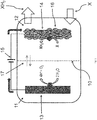
- a microbial electrosynthesis according to the prior art is shown as an example. It is a cathodic hydrogenation using microbial extracellular electron transfer.
- an anode 13 and a cathode 14 are arranged, respectively, which are connected to a voltage source 15, the cathode 14 being provided with a biofilm 16 of a bioelectrocatalytically active microorganism.
- a substrate X is selectively reduced to the product XH 2 , while on the anode 13 H 2 O is oxidized to provide H + and electrons.
- the corresponding ion transfer 17 takes place through the membrane 10.
- the product XH 2 obtained is discharged from the reaction chamber 12, while the substrate X is supplied.
- the chemo-, regio- and stereospecificity of bioelectrosynthesis is of great value.
- the reaction substrate or the biofilm is not used as a growth substrate for the biofilm, but a separate growth substrate ensures stable, stationary properties of the biofilm.
- FIG. 2 an upgrade set 100 according to the invention for bioreactors 20 for carrying out the microbial bioelectrosynthesis is shown.
- the upgrade set 100 has a reactor chamber 21 which has a cross-section in the shape of a segment of a circle.
- a rectangular window 23, which can be closed with a membrane 24, is arranged on the flat side wall 22 of the reactor chamber 21 which is thereby provided.
- the membrane 24 is fixed to the reactor chamber 21 with a frame 25, a seal 26 also being arranged between the membrane 24 and the reactor chamber 21.
- the reaction chamber 21 is introduced into a reactor 20 to be upgraded and then the reactor 20 is closed by means of a cover 27 belonging to the upgrade set 100, a seal 28 being arranged between the reactor chamber 20 and the cover 27.
- Various passage openings 29 are provided in the cover 27, which are intended for electrodes, stirrers, measuring probes, gassing, degassing and the like.
Landscapes
- Health & Medical Sciences (AREA)
- Life Sciences & Earth Sciences (AREA)
- Wood Science & Technology (AREA)
- Organic Chemistry (AREA)
- Engineering & Computer Science (AREA)
- Bioinformatics & Cheminformatics (AREA)
- Chemical & Material Sciences (AREA)
- Zoology (AREA)
- Biomedical Technology (AREA)
- Sustainable Development (AREA)
- Microbiology (AREA)
- Biotechnology (AREA)
- Biochemistry (AREA)
- General Engineering & Computer Science (AREA)
- General Health & Medical Sciences (AREA)
- Genetics & Genomics (AREA)
- Clinical Laboratory Science (AREA)
- Immunology (AREA)
- Molecular Biology (AREA)
- Apparatus Associated With Microorganisms And Enzymes (AREA)
Description
- Die vorliegende Erfindung betrifft ein Aufrüstset für Bioreaktoren zur Durchführung einer mikrobiellen Bioelektrosynthese, einen Bioreaktor und dessen Verwendung.
- Die mikrobielle Bioelektrosynthese oder mikrobielle elektrochemische Technologie erfährt derzeit weltweit einen erheblichen Aufschwung. Ziel der mikrobiellen Bioelektrosynthese ist die Verknüpfung der mikrobiellen Syntheseleistung vorzugsweise über extrazellulären Elektronentransfer mit dem Fluss von elektrischem Strom. Dabei kann sowohl elektrischer Strom bei Oxidationsprozessen an Anoden als auch bei Reduktionen an der Kathode umgesetzt werden. In beiden Fällen ist die mikrobielle Stoffumwandlung mit dem Fluss elektrischen Stroms verbunden.
- Dabei hat die mikrobielle Bioelektrosynthese im Vergleich zur klassischen elektrochemischen Synthese zahlreiche Vorteile wie potentiell höhere Selektivitäten, Ausbeuten etc., aber auch gegenüber enzymatischen Bioelektrosynthesen bestehen Vorteile, da hier zumeist nur max. 2 Elektronen pro Reaktionsschritt übertragen werden können und der Katalysator nicht selbstregenerierend ist.
- Der Begriff der mikrobiellen Bioelektrosynthese kann hier drei wesentliche Klassen von Prozessen einschließen, dazu zählen:
- i) die Synthese aus CO2,
- ii) die "Veredlung" von Vorstufen, und
- iii) die elektrochemische Fermentationssteuerung.
- Das Produktspektrum ist dabei potentiell sehr vielfältig.
- Forschungen auf diesem Gebiet, insbesondere in verfahrenstechnischer Hinsicht, befinden sich bezüglich der verwendeten Technik im Anfangsstadium und werden vorwiegend in Laborversuchen von geringer Größe von beispielsweise 100 mL sowie in "Selbstbaureaktoren" mit einer Größe von zumeist < 1 L durchgeführt, wobei keine oder nur eine geringe Prozessüberwachung und -steuerung realisiert wird.
- Da jedoch gleichzeitig das weltweite Interesse an der mikrobiellen Biöelektrosynthese steigt, ist von einem steigenden Bedarf an geeigneter Bioreaktortechnik auszugehen, die vergleichbare Ergebnisse zulässt. Aus diesem Grund wird auch der Bedarf an vergleichbaren Laborreaktorsystemen zur Durchführung von Versuchen der mikrobiellen Elektrosynthese steigen.
- Die Bezeichnung Membranreaktor ist im technischen Sprachgebrauch sehr weit gefasst. So werden darunter zum Beispiel Reaktoren mit Keramikmembranrohren, um verschiedene Stoffe chemisch miteinander reagieren zu lassen, ebenso verstanden wie die Vielzahl von Reaktoren mit Membranen zur Rückhaltung von Mikroorganismen in der Abwasserbehandlung. Diese sind nicht zur Durchführung der mikrobiellen Bioelektrosynthese geeignet
WO2013120853 offenbart ein Kulturgefäß für Mikroorganismen, welches ausgerüstet ist mit mindestens einem Trennelement, das das Kulturgefäß in mindestens zwei separate Bioreaktorkammern, die nach oben eine Öffnung aufweisen, unterteilt. Im Trennelement ist eine Element mit Filter- und Siebfunktion angeordnet, der gelöste Partikel in den unterteilten Bereichen zurückhältDE102011054364 offenbart einen Bioreaktor zur Zellkultivierung. Im Deckel, mit dem der Reaktorbehälter verschlossen ist, sind mehrere Durchführungen gebildet, um die für den Prozess der Kultivierung notwendigen Stoffe bereitzustellen und/oder Stoffe aus dem Reaktorbehälter abzuführen, zum Beispiel beim Kultivieren auftretende Gas. Die DruckschriftenDE2018289 undEP0170098 offenbaren jeweils einen becher- oder kegelförmigen Einsatz zum Einsetzen in einen Bioreaktor, wobei der Einsatzbehälter auf einer Seite offen ist und ein Fenster besitzt, dass mit einer Membrane versehen ist. - Reaktoren, die zur Durchführung der mikrobiellen Bioelektrosynthese geeignet sind, werden beispielsweise in den Druckschriften
US 2013/0256149 A1 ,WO 2011/062485 A2 ,WO 2010/117864 A1 undWO 00/03447 - Es ist daher Aufgabe der Erfindung, ein Aufrüstset für Bioreaktoren zu schaffen, das eine Erweiterung von Bioreaktoren nach dem Stand der Technik als Elektrobioreaktoren erlaubt, so dass deren Nutzung für die mikrobielle Bioelektrosynthese ermöglicht wird. Diese Aufgabe wird durch ein Aufrüstset für Bioreaktoren mit den Merkmalen des Anspruchs 1 gelöst.
- Dazu ist es erfindungsgemäß vorgesehen, ein Aufrüstset gemäß Anspruch 1 für Bioreaktoren zur Durchführung einer mikrobiellen Bioelektrosynthese zu schaffen, das eine an einer Seite, vorzugsweise der Oberseite, offene Reaktionskammer aufweist, die in einer Seitenwand ein vorzugsweise rechtwinkliges Fenster bzw. eine entsprechende Durchgangsöffnung besitzt, das mit einer vorzugsweise reversibel festgelegten Membran versehen ist.
- Bei der Membran handelt es sich um eine ionenselektive Membran, beispielsweise eine Nafion-Membran oder eine keramische Membran. Geeignete Membranen sind dem Fachmann grundsätzlich bekannt.
- Nach einer bevorzugten Ausführungsform weist die Reaktionskammer einen kreissegmentförmigen Querschnitt auf, wobei im Bereich der Kreissehne das Fenster ausgebildet ist.
- Die Seitenfläche, die sich durch die Kreissehne ergibt, kann auch anders beschaffen sein, so kann sich in der Wandung der Reaktionskammer auch eine gerundete oder eckige Einbuchtung mit einem Fenster an der tiefsten Stelle befinden. Entscheidend ist, dass durch die Ausgestaltung der Reaktionskammer eine zweite Reaktionskammer im nachzurüstenden Bioreaktor geschaffen wird, der üblicherweise einen runden Querschnitt besitzen. Bevorzugt ist dabei die Ausbildung einer planen Seitenwand zur Aufnahme des Fensters bzw. der Durchgangsöffnung.
- Reaktoren sind üblicherweise im Wesentlichen zylindrisch ausgestaltet, so dass das Aufrüstset bzw. die Reaktionskammer dicht an der Wandung des Reaktors anliegt. Daher ist eine Temperierung der beiden Reaktionskammern problemlos möglich. Ansonsten sitzt die eingebrachte Reaktionskammer des Aufrüstsets auf dem Boden des nachgerüsteten Bioreaktors auf.
- Das Volumen der beiden Reaktionskammern steht besonders bevorzugt im Verhältnis 1:1, aber auch Verhältnisse bis 1: 4 werden vorzugsweise eingesetzt, um eine mikrobielle Bioelektrosynthese durchzuführen.
- Zur reversiblen Festlegung der Membran ist diese vorzugsweise zwischen einer Dichtung und einem Rahmen angeordnet, wobei der Rahmen die Membran und die Dichtung an der Reaktionskammer derart fixiert, dass das Fenster überdeckt ist.
- In welcher Weise die Membran mittels des Rahmens fixiert wird, ist dem Fachmann grundsätzlich bekannt. So kann dieser beispielsweise verschraubt oder geklebt sein oder auch mittels einer klemmenden Verbindung gehalten werden.
- Die Größe des Fensters und damit der Membran wird derart gewählt, dass der Innenwiderstand möglichst gering ist. Zweckmäßigerweise liegt daher das Verhältnis der Größe der Elektroden, die jeweils in den beiden Reaktionskammern des Bioreaktors angeordnet sind, zur Größe des Fensters bzw. der Membran im Bereich von 1:100 bis 100:1.
- Das erfindungsgemäße Aufrüstset wird in eine Reaktionskammer eines üblichen, Bioreaktors nach dem Stand der Technik eingebracht und unterteilt damit diesen Bioreaktor in zwei durch die Membran getrennte Reaktionskammern, so dass der nachgerüstete Bioreaktor bei einer mikrobiellen Elektrosynthese, beispielsweise einer kathodischen Hydrierung, vorzugsweise unter Nutzung von mikrobiellem Extrazellulären Elektronentransfers, verwendbar ist.
- Erfindungsgemäß ist bei dem Aufrüstset auch ein Reaktordeckel vorgesehen, der die Reaktorkammer des Ausrüstsets sowie den ursprünglichen Bioreaktor verschließt, wobei vorzugsweise eine Dichtung zwischen der Reaktorkammer des Nachrüstsets und dem Deckel vorgesehen ist.
- Der Reaktordeckel weist zudem zumindest zwei Durchgangsöffnungen für Rührer, Elektroden, Messsonden, Begasung oder Entgasung und dergleichen auf.
- Der Reaktordeckel weist übliche Befestigungsmittel auf, um beispielsweise ein Verschrauben mit dem nachgerüsteten Bioreaktor zu ermöglichen.
- Die Reaktionskammer besteht vorzugsweise aus einem elektrochemisch inerten Material. Dies ist vorzugsweise Glas, Keramik oder ein sterilisierbarer Kunststoff, wie PTFE oder PEEK.
- Vorteilhafterweise ist das Aufrüstset für Bioreaktoren zahlreicher Hersteller geeignet, da dieses vorzugsweise auf eine Größe von nachzurüstenden Bioreaktoren von 2L ausgelegt ist, die weit verbreitet ist. Das erfindungsgemäße Aufrüstset ist jedoch auch für andere Reaktorgrößen geeignet, wie beispielsweise im Bereich von 0,3 bis 5L und kann entsprechend ausgelegt werden.
- Mit Hilfe dieses erfindungsgemäßen Aufrüstsets lassen sich Bioreaktoren verschiedener Hersteller so erweitern, dass in diesen vorteilhafterweise vergleichbare Untersuchungen zur mikrobiellen Bioelektrosynthese im Labormaßstab durchgeführt werden können. Damit können Forschungs- und Entwicklungsarbeiten zur mikrobiellen Bioelektrosynthese systematisch unter kontrollierten und vergleichbaren Bedingungen durchgeführt werden.
- Von Vorteil ist zudem, dass auf bereits vorhandene Biorektoren, dazugehörige Regelungstechnik und Peripherie zurückgegriffen werden kann und Standardbioreaktoren bei Bedarf in Bioreaktoren für die Bioelektrosynthese umgerüstet werden können.
- Besonders vorteilhaft ist, dass diese Umrüstung reversibel ist, wodurch sich teure Doppelanschaffungen vermeiden lassen.
- Besonders vorteilhaft ist zudem, dass diese Integration in existierende Bioreaktorensysteme auch dem Nicht-Fachmann, insbesondere dem Nicht-Elektrochemiker eine Durchführung solcher Arbeiten ermöglicht wird.
- Weiterhin ist es sehr vorteilhaft - und durch bisherige Bioreaktorsysteme nach dem Stand der Technik in keiner Weise gegeben -, dass eine weitgehend problemlose Anschlussfähigkeit des erfindungsgemäß nachgerüsteten Reaktors im 2L-Maßstab an den industriellen Maßstab, beispielsweise im 400L Maßstab, sowie dessen Skalierbarkeit gegeben ist.
- Vorteilhafterweise lassen sich mittels des erfindungsgemäßen Nachrüstsets alle Arten von mikrobiellen Bioelektrosynthesen durchführen. Dazu zählen alle Redoxreaktionen, d.h. Biotransformationen mit Veränderung des Redoxstatus des Zielmoleküls, sowohl oxidative (anodische) als auch reduktive (kathodische) Prozesse. Diese schließen, beispielsweise folgende Reaktionen, welche einen besonderen Mehrwert darstellen können mit ein:
- 1. Mehrstufige (bio)elektrochemische Oxidationen und Reduktionen sowie die Knüpfung von C-C-Bindungen (welche nicht von konventionellen chemischen und enzymatischen Katalysatoren realisiert werden können),
- 2. Selektive Oxidationen (Vermeidung von Überoxidation wie beim Einsatz anderer Oxidationsmittel wie Luftsauerstoff),
- 3. Hydrierungen beim "milden" Reaktionsbedingungen (Temperaturen von max. 100°C, keine H2-Atmosphären),
- 4. elektrochemische Fermentationen (Erhöhung der Ausbeute durch substöchiometrischen Einsatz elektrischer Energie),
- 5. Reduktion/ Fixierung von CO2 in C1 und C1+n-Körpern.
- 6. Einsatz von "elektroaktiven" Mikroorganismen als Katalysatoren mit einer vorzugsweisen Chemo-, Regio-, und Stereospezifität.
- Vorteilhafterweise lassen sich in mit dem Aufrüstset versehenen Bioreaktoren zudem sowohl planktonische Prozesse als auch Biofilmprozesse durchführen.
- Gegenstand der Erfindung ist zudem ein Bioreaktor zur Durchführung der mikrobiellen Bioelektrosynthese ein Aufrüstset aufweisend. Dieser Bioreaktor weist die bei den nachzurüstenden Bioreaktoren beschriebenen Merkmale auf.
- Unter einem Bioreaktor im Rahmen der Erfindung wird ein Bioreaktor im technischen Maßstab verstanden, der sich mindestens durch eine minimale technische Ausstattung auszeichnet und die Durchführung einer mikrobiellen Bioelektrosynthese ermöglicht.
- Die minimale technische Ausstattung umfasst vorzugsweise eine Prozesssteuerung vorzugsweise der Parameter Temperierung, Rührerdrehzahl, Art und Menge der Begasung sowie pH und den Einbau von Anode und Kathode zur Steuerung der Bioelektrosynthese über einen Potentiostaten bzw. eine Gleichspannungs- oder Gleichstromquelle.
- So kann eine gute Durchmischung in den beiden durch dass Aufrüstset gegebenen Kammern stattfinden, um die sonst zwangsläufig auftretenden Gradienten im Reaktionsraum (Temperatur-, Konzentrationsgradienten etc.) zu vermeiden. Diese würden unweigerlich zu Produktivitätsverlusten führen.
- Die beiden durch eine Membran getrennten Kammern erfüllen, bei Verwendung des Aufrüstsets, beide die Kriterien eines Bioreaktors im technischen Maßstab. Dies gilt dementsprechend auch für das Aufrüstset allein.
- Zudem muss vorzugsweise eine Sterilisierbarkeit bei mindestens 121°C gegeben sein.
- Vorteilhafte Weiterbildungen der Erfindung sind in den Unteransprüchen angegeben und in der Beschreibung beschrieben.
- Nachstehend wird die Erfindung anhand von Zeichnungen und der nachfolgenden Beschreibung näher erläutert. Es zeigen
- Fig. 1
- in einer schematischen Darstellung eine mikrobielle Elektrosynthese am Beispiel einer kathodischen Hydrierung unter Nutzung von mikrobiellem extrazellulären Elektronentransfers nach dem Stand der Technik, und
- Fig. 2
- in einer Explosivdarstellung ein Aufrüstset für Bioreaktoren zur Durchführung der Bioelektrosynthese.
- Mittels
Fig. 1 wird beispielhaft eine mikrobielle Elektrosynthese nach dem Stand der Technik dargestellt. Es handelt sich um eine kathodische Hydrierung unter Nutzung eines mikrobiellen extrazellulären Elektronentransfers. In zwei voneinander durch eine Membran 10 getrennten Reaktionskammern 11, 12 ist jeweils eine Anode 13 bzw. eine Kathode 14 angeordnet, die mit einer Spannungsquelle 15 verbunden sind, wobei die Kathode 14 mit einem Biofilm 16 eines bioelektrokatalytisch aktiven Mikroorganismus versehen ist. An der Kathode 14 wird ein Substrat X selektiv zum Produkt XH2 reduziert, während an der Anode 13 H2O zur Bereitstellung von H+ und Elektronen oxidiert wird. Durch die Membran 10 erfolgt der entsprechende lonentransfer 17. Das erhaltene Produkt XH2 wird aus der Reaktionskammer 12 abgeführt, während Substrat X zugeführt wird. - Für biotechnologisch interessante Konzepte ist vor allem die Chemo-, Regio-, und Stereospezifität der Bioelektrosynthese von großem Wert. Dabei wird das Reaktionssubstrat bzw. der Biofilm nicht als Wachstumssubstrat für den Biofilm verwendet, sondern ein separates Wachstumssubstrat sorgt für stabile stationäre Eigenschaften des Biofilms. Analog können auch anodische Konzepte, d.h. zur mikrobiellen Elektrooxidation, entwickelt werden.
- In
Fig. 2 ist ein erfindungsgemäßes Aufrüstset 100 für Bioreaktoren 20 für die Durchführung der mikrobiellen Bioelektrosynthese dargestellt. Das Aufrüstset 100 weist eine Reaktorkammer 21 auf, die einen Kreissegmentförmigen Querschnitt besitzt. An der dadurch gegebenen flachen Seitenwand 22 der Reaktorkammer 21 ist ein rechteckiges Fenster 23 angeordnet, das mit einer Membran 24 verschließbar ist. Dazu wird die Membran 24 mit einem Rahmen 25 an der Reaktorkammer 21 fixiert, wobei zudem zwischen der Membran 24 und der Reaktorkammer 21 eine Dichtung 26 angeordnet ist. Die Reaktionskammer 21 wird in einen aufzurüstenden Reaktor 20 eingebracht und anschließend wird der Reaktor 20 mittels eines zum Aufrüstset 100 gehörenden Deckels 27 verschlossen, wobei zwischen der Reaktorkammer 20 und dem Deckel 27 eine Dichtung 28 angeordnet wird. Im Deckel 27 sind verschiedene Durchgangsöffnungen 29 vorgesehen, die für Elektroden, Rührer, Messsonden, Begasung, Entgasung und dergleichen bestimmt sind.Bezugszeichenliste Membran 10 Reaktionskammer 11, 12 Anode 13 Kathode 14 Spannungsquelle 15 Biofilm 16 Ionentransfer 17 Substrat X Produkt XH2 Aufrüstset 100 Bioreaktor 20 Reaktorkammer 21 flache Seitenwand 22 rechteckiges Fenster 23 Membran 24 Rahmen 25 Dichtung 26 Deckel 27 Dichtung 28 Durchgangsöffnung 29
Claims (12)
- Aufrüstset zum reversiblen Einbringen in einen Bioreaktor zur Unterteilung eines Bioreaktors in zwei getrennte Reaktionskammern und zur Durchführung einer mikrobiellen Bioelektrosynthese, wobei das Aufrüstset (100) eine an der Oberseite offene Reaktionskammer (21) aufweist, die in einer Seitenwand (22) ein Fenster (23) besitzt, das mit einer Membran (24) versehen ist, wobei das Aufrüstset ausgebildet ist, dass mittels der Membran (24) die Reaktionskammer (21) des Aufrüstsets im in den Bioreaktor eingebrachten Zustand mit einer Reaktionskammer des Bioreaktors verbunden ist, wobei das Aufrüstset (100) einen Reaktordeckel (27) aufweist, der zumindest zwei Durchgangsöffnungen (29) aufweist, in die Elektroden derart einbringbar sind, dass diese jeweils in eine der durch die Membran getrennten Reaktionskammern ragen und jeweils als Anode oder Kathode fungieren
- Aufrüstset nach Anspruch 1, dadurch gekennzeichnet, dass die Membran (24) ionenselektiv ist.
- Aufrüstset nach Anspruch 1 oder 2, dadurch gekennzeichnet, dass die Membran (24) mittels eines Rahmens (25) an der Reaktionskammer (21) fixiert ist.
- Aufrüstset nach einem der Ansprüche 1 bis 3, dadurch gekennzeichnet, dass die Reaktionskammer (21) einen kreissegmentförmigen Querschnitt aufweist, wobei im Bereich der Kreissehne des Kreissegments das Fenster (23) ausgebildet ist.
- Aufrüstset nach einem der Ansprüche 1 bis 3, dadurch gekennzeichnet, dass die Reaktionskammer (21) eine gerundete oder eckige Einbuchtung aufweist, die mit einem Fenster (23), vorzugsweise an der tiefsten Stelle der Einbuchtung versehen ist.
- Aufrüstset nach einem der Ansprüche 1 bis 5, dadurch gekennzeichnet, dass die Reaktionskammer (21) aus einem elektrochemisch inerten Material besteht.
- Bioreaktor ein Aufrüstset (100) nach einem der Ansprüche 1 bis 6 aufweisend.
- Bioreaktor nach Anspruch 7, dadurch gekennzeichnet, dass der Bioreaktor (20) durch das Aufrüstset (100) zwei Reaktionskammern (20; 21) aufweist, wobei die zwei Reaktionskammern (20; 21) jeweils die Kriterien eines separaten Bioreaktors im technischen Maßstab aufweisen.
- Bioreaktor nach Anspruch 8, dadurch gekennzeichnet, dass in beiden Reaktionskammern (21) mindestens eine Elektrode angeordnet ist.
- Bioreaktor nach Anspruch 9, dadurch gekennzeichnet, dass das Verhältnis der Größe der Elektroden zur Größe der Membran (24) im Bereich von 1:100 bis 100:1 liegt.
- Verwendung eines Bioreaktors nach einem der Ansprüche 7 bis 10 zur Durchführung von mikrobiellen Bioelektrosynthesen.
- Verwendung eines Bioreaktors nach einem der Ansprüche 7 bis 10 zur Durchführung von bioelektrochemischen planktonischen Prozessen oder bioelektrochemischen Biofilmprozessen.
Applications Claiming Priority (2)
| Application Number | Priority Date | Filing Date | Title |
|---|---|---|---|
| DE102013224673.0A DE102013224673A1 (de) | 2013-12-02 | 2013-12-02 | Aufrüstset für Bioreaktoren zur Durchführung der mikrobiellen Bioelektrosynthese |
| PCT/EP2014/076293 WO2015082490A1 (de) | 2013-12-02 | 2014-12-02 | Aufrüstset für bioreaktoren zur durchführung der mikrobiellen bioelektrosynthese |
Publications (2)
| Publication Number | Publication Date |
|---|---|
| EP3077495A1 EP3077495A1 (de) | 2016-10-12 |
| EP3077495B1 true EP3077495B1 (de) | 2020-11-11 |
Family
ID=52007015
Family Applications (1)
| Application Number | Title | Priority Date | Filing Date |
|---|---|---|---|
| EP14806616.0A Active EP3077495B1 (de) | 2013-12-02 | 2014-12-02 | Aufrüstset für bioreaktoren zur durchführung der mikrobiellen bioelektrosynthese |
Country Status (4)
| Country | Link |
|---|---|
| US (1) | US10767150B2 (de) |
| EP (1) | EP3077495B1 (de) |
| DE (1) | DE102013224673A1 (de) |
| WO (1) | WO2015082490A1 (de) |
Families Citing this family (3)
| Publication number | Priority date | Publication date | Assignee | Title |
|---|---|---|---|---|
| US10494596B2 (en) | 2015-12-09 | 2019-12-03 | The Board Of Trustees Of The Leland Stanford Junior University | Enhanced microbial electrosynthesis by using co-cultures |
| EP3740557A1 (de) | 2018-01-18 | 2020-11-25 | Helmholtz-Zentrum für Umweltforschung GmbH-UFZ | Elektrobioreaktor und dessen teile für sterile mikrobielle elektrosynthesen zur mehrweg- und einmal-verwendung |
| CN110106062A (zh) * | 2019-05-05 | 2019-08-09 | 上海交通大学 | 一种模块化控制orp反应器的装置 |
Citations (2)
| Publication number | Priority date | Publication date | Assignee | Title |
|---|---|---|---|---|
| DE2018289A1 (de) * | 1969-04-16 | 1972-03-02 | Hough, William T, Basking Ridge, NJ (VStA) | Verfahren zur Extraktion eines Losungs mittels aus einer Losung und Vorrichtung zur Ausübung des Verfahrens |
| EP0170098A2 (de) * | 1984-07-05 | 1986-02-05 | Nichols Institute Diagnostics | Dialysierzelle |
Family Cites Families (23)
| Publication number | Priority date | Publication date | Assignee | Title |
|---|---|---|---|---|
| US4296205A (en) | 1980-02-22 | 1981-10-20 | Verma Dharmvir S | Cell culture and continuous dialysis flask and method |
| DE3703608A1 (de) * | 1986-02-08 | 1987-08-13 | Sartorius Gmbh | Depot mit selektiv permeablen scheidewaenden in form von poroesen filtermembranen oder poroesen filterkoerpern zur herstellung gashaltiger getraenke in behaeltern und verfahren zur herstellung solcher getraenke mittels depot |
| US4772558A (en) | 1987-06-01 | 1988-09-20 | Ranier Hammann | Blood culture system |
| US4871352A (en) * | 1987-12-07 | 1989-10-03 | Controlled Release Technologies, Inc. | Self-regulated therapeutic agent delivery system and method |
| JPH072007Y2 (ja) * | 1991-07-08 | 1995-01-25 | 日本ベクトン・ディッキンソン株式会社 | セルストレーナー |
| JP2949322B2 (ja) * | 1994-07-19 | 1999-09-13 | 株式会社アロンワールド | イオン水、その製造方法および製造装置 |
| GB9503109D0 (en) * | 1995-02-17 | 1995-04-05 | Hampshire Advisory Tech Serv | Diagnostic test tube and kits |
| CA2340178A1 (en) | 1998-07-09 | 2000-01-20 | Michigan Biotechnology Institute | Electrochemical methods for generation of a biological proton motive force and pyridine nucleotide cofactor regeneration |
| DE10329996A1 (de) | 2003-07-02 | 2005-01-27 | Universität Tübingen | Verbund-Kulturgefäß |
| DE10350972A1 (de) | 2003-10-30 | 2005-08-18 | delta T Gesellschaft für Medizintechnik mbH | Kultivierungssystem zur Herstellung von biotechnologischen Produkten |
| WO2007037407A1 (ja) | 2005-09-30 | 2007-04-05 | 3-D Matrix Japan, Ltd. | 細胞の培養方法および細胞培養物 |
| PT103906A (pt) | 2007-12-20 | 2009-08-31 | Ass For The Advancement Of Tis | Sistemas dinâmicos de cultura de células em suportes tridimensionais |
| PT104155B (pt) * | 2008-08-06 | 2017-04-05 | Ass For The Advancement Of Tissue Eng And Cell Based Tech & Therapies (A4Tec) | Bioreactor multi-câmara com perfusão bidireccional integrado num sistema de cultura para aplicação em estratégias de engenharia de tecidos |
| FR2940325B1 (fr) * | 2008-12-23 | 2011-03-04 | Toulouse Inst Nat Polytech | Nouveau procede electrochimique pour la production d'hydrogene et dispositif pour sa mise en oeuvre |
| WO2010117864A1 (en) | 2009-04-07 | 2010-10-14 | Arizona Board Of Regents, A Body Corporate Of The State Of Arizona Acting For An On Behalf Of Arizona State University | Microbial electrolytic cell |
| NL2003812C2 (en) | 2009-11-17 | 2011-05-18 | Stichting Wetsus Ct Excellence Sustainable Water Technology | Bio-electrochemical device and method for upgrading a fluid. |
| JP2011188830A (ja) * | 2010-03-16 | 2011-09-29 | Hioki Ee Corp | 培養容器 |
| KR101020925B1 (ko) * | 2010-05-17 | 2011-03-09 | 주식회사 이온팜스 | 이온수 제조장치 |
| JP5734618B2 (ja) * | 2010-10-21 | 2015-06-17 | 一般財団法人電力中央研究所 | 電気培養装置 |
| DE102011054364C5 (de) | 2011-10-10 | 2022-05-19 | DASGIP Information and Process Technology GmbH | Biotechnologische Vorrichtung mit einem Bioreaktor, Abgastemperiereinrichtung für einen Bioreaktor und Verwendung |
| AT512416B1 (de) | 2012-02-13 | 2013-10-15 | Greiner Bio One Gmbh | Anordnung und verfahren zum nachweis von mikroorganismen in einem kulturgefäss |
| US9216919B2 (en) | 2012-03-28 | 2015-12-22 | Arizona Science And Technology Enterprises Llc | Microbial electrolysis cells and methods for the production of chemical products |
| EP2653531A1 (de) * | 2012-04-18 | 2013-10-23 | Oxyphen AG | Kulturanordnung |
-
2013
- 2013-12-02 DE DE102013224673.0A patent/DE102013224673A1/de not_active Ceased
-
2014
- 2014-12-02 US US15/100,961 patent/US10767150B2/en active Active
- 2014-12-02 WO PCT/EP2014/076293 patent/WO2015082490A1/de not_active Ceased
- 2014-12-02 EP EP14806616.0A patent/EP3077495B1/de active Active
Patent Citations (2)
| Publication number | Priority date | Publication date | Assignee | Title |
|---|---|---|---|---|
| DE2018289A1 (de) * | 1969-04-16 | 1972-03-02 | Hough, William T, Basking Ridge, NJ (VStA) | Verfahren zur Extraktion eines Losungs mittels aus einer Losung und Vorrichtung zur Ausübung des Verfahrens |
| EP0170098A2 (de) * | 1984-07-05 | 1986-02-05 | Nichols Institute Diagnostics | Dialysierzelle |
Also Published As
| Publication number | Publication date |
|---|---|
| DE102013224673A1 (de) | 2015-06-03 |
| EP3077495A1 (de) | 2016-10-12 |
| WO2015082490A1 (de) | 2015-06-11 |
| US10767150B2 (en) | 2020-09-08 |
| US20160312167A1 (en) | 2016-10-27 |
Similar Documents
| Publication | Publication Date | Title |
|---|---|---|
| DE69931479T2 (de) | Verfahren zur herstellung von polypeptiden in einem zellfreien system und vorrichtung zu deren ausführung | |
| DE602005004736T2 (de) | Mikrofluidvorrichtung mit Elektrolysevorrichtung zur Zelllyse sowie ein Verfahren zur elektrochemischen Lyse von Zellen | |
| EP3028333B1 (de) | Filtrationsaktive brennstoffzelle | |
| DE112013000327T5 (de) | Galvanisches Bad zur Herstellung von saurem Wasser und Verwendung von saurem Wasser | |
| WO2003014419A2 (de) | Elektrolysezelle, insbesondere zur elektrochemischen herstellung von chlor | |
| EP1144587B1 (de) | Vorrichtung zum zellfreie synthese von proteine | |
| EP2847366A1 (de) | Elektrolysezelle, insbesondere zur verwendung in einer anlage zur erzeugung einer elektrochemisch aktivierten kochsalzlösung, sowie anlage mit einer anzahl derartiger elektrolysezellen | |
| DE102011017264A1 (de) | Alternativer Einbau einer Gas-Diffussions-Elektrode in eine elektrochemische Zelle | |
| DE102017203900A1 (de) | Elektroden umfassend in Festkörperelektrolyten eingebrachtes Metall | |
| WO2015082490A1 (de) | Aufrüstset für bioreaktoren zur durchführung der mikrobiellen bioelektrosynthese | |
| DE102008010581A1 (de) | Verfahren und Vorrichtung zur Bestimmung des gesamten organisch gebundenen Kohlenstoffs in einer wässrigen Probe | |
| EP2374762B1 (de) | Anlage und Verfahren zur Erzeugung einer elektrochemisch aktivierten Lösung | |
| EP0332951B1 (de) | Verfahren und Vorrichtung zur elektrochemischen Entkeimung von Wässern | |
| EP3249729B1 (de) | Verfahren und vorrichtungen zur bioelektrischen stromgewinnung aus organischen inhaltsstoffen eines abwassers | |
| DE19815669C2 (de) | Verfahren zur reduktiven elektrochemisch katalytischen Eliminierung von Nitrat aus konzentrierten Lösungen | |
| DE102017106704B4 (de) | Elektrodenanordnung zur elektrochemisch unterstützten Biosynthese | |
| EP3816322B1 (de) | Elektrochemische zelle | |
| DE102005049152A1 (de) | Verfahren und Vorrichtung zur Bereitstellung einer Substanz für die Analyse von Isotopenverhältnissen | |
| WO2002068721A2 (de) | Elektrolyseeinrichtung | |
| EP3740557A1 (de) | Elektrobioreaktor und dessen teile für sterile mikrobielle elektrosynthesen zur mehrweg- und einmal-verwendung | |
| DE102013007659A1 (de) | Vorrichtung und Verfahren zur bioelektrochemischen Stoffumwandlung (Herbeiführung einer Reduktion / Oxidation / Redox-Reaktion) | |
| DE102019133963A1 (de) | Elektrodenanordnung und Verfahren zur elektrochemischen Wasserstoffperoxidproduktion und Biotransformation | |
| DE102016013413A1 (de) | Mehrphasige Kathode zur hydrogenotrophen Elektrosynthese | |
| EP0727390A2 (de) | Verfahren zum elektrochemischen Erzeugen von Ammoniumpolysulfid | |
| DE202024103321U1 (de) | System zur Charakterisierung der Produktion von Azelainsäure (AZA) |
Legal Events
| Date | Code | Title | Description |
|---|---|---|---|
| PUAI | Public reference made under article 153(3) epc to a published international application that has entered the european phase |
Free format text: ORIGINAL CODE: 0009012 |
|
| 17P | Request for examination filed |
Effective date: 20160616 |
|
| AK | Designated contracting states |
Kind code of ref document: A1 Designated state(s): AL AT BE BG CH CY CZ DE DK EE ES FI FR GB GR HR HU IE IS IT LI LT LU LV MC MK MT NL NO PL PT RO RS SE SI SK SM TR |
|
| AX | Request for extension of the european patent |
Extension state: BA ME |
|
| RIN1 | Information on inventor provided before grant (corrected) |
Inventor name: BEYER, DANIEL Inventor name: ZEHNSDORF, ANDREAS Inventor name: HUNGER, STEFFI Inventor name: FELIPE MORGADO ROSA, LUIS Inventor name: HARNISCH, FALK |
|
| DAX | Request for extension of the european patent (deleted) | ||
| STAA | Information on the status of an ep patent application or granted ep patent |
Free format text: STATUS: EXAMINATION IS IN PROGRESS |
|
| 17Q | First examination report despatched |
Effective date: 20180223 |
|
| GRAP | Despatch of communication of intention to grant a patent |
Free format text: ORIGINAL CODE: EPIDOSNIGR1 |
|
| STAA | Information on the status of an ep patent application or granted ep patent |
Free format text: STATUS: GRANT OF PATENT IS INTENDED |
|
| INTG | Intention to grant announced |
Effective date: 20200714 |
|
| GRAS | Grant fee paid |
Free format text: ORIGINAL CODE: EPIDOSNIGR3 |
|
| GRAA | (expected) grant |
Free format text: ORIGINAL CODE: 0009210 |
|
| STAA | Information on the status of an ep patent application or granted ep patent |
Free format text: STATUS: THE PATENT HAS BEEN GRANTED |
|
| AK | Designated contracting states |
Kind code of ref document: B1 Designated state(s): AL AT BE BG CH CY CZ DE DK EE ES FI FR GB GR HR HU IE IS IT LI LT LU LV MC MK MT NL NO PL PT RO RS SE SI SK SM TR |
|
| REG | Reference to a national code |
Ref country code: GB Ref legal event code: FG4D Free format text: NOT ENGLISH |
|
| RIN1 | Information on inventor provided before grant (corrected) |
Inventor name: HUNGER, STEFFI Inventor name: FILIPE MORGADO ROSA, LUIS Inventor name: BEYER, DANIEL Inventor name: HARNISCH, FALK Inventor name: ZEHNSDORF, ANDREAS |
|
| REG | Reference to a national code |
Ref country code: CH Ref legal event code: EP |
|
| REG | Reference to a national code |
Ref country code: AT Ref legal event code: REF Ref document number: 1333493 Country of ref document: AT Kind code of ref document: T Effective date: 20201115 |
|
| REG | Reference to a national code |
Ref country code: DE Ref legal event code: R096 Ref document number: 502014015007 Country of ref document: DE |
|
| REG | Reference to a national code |
Ref country code: IE Ref legal event code: FG4D Free format text: LANGUAGE OF EP DOCUMENT: GERMAN |
|
| REG | Reference to a national code |
Ref country code: CH Ref legal event code: NV Representative=s name: PATENTANWAELTE SCHAAD, BALASS, MENZL AND PARTN, CH |
|
| REG | Reference to a national code |
Ref country code: NL Ref legal event code: FP |
|
| REG | Reference to a national code |
Ref country code: CH Ref legal event code: PCAR Free format text: NEW ADDRESS: DUFOURSTRASSE 101, 8034 ZUERICH (CH) |
|
| PG25 | Lapsed in a contracting state [announced via postgrant information from national office to epo] |
Ref country code: FI Free format text: LAPSE BECAUSE OF FAILURE TO SUBMIT A TRANSLATION OF THE DESCRIPTION OR TO PAY THE FEE WITHIN THE PRESCRIBED TIME-LIMIT Effective date: 20201111 Ref country code: RS Free format text: LAPSE BECAUSE OF FAILURE TO SUBMIT A TRANSLATION OF THE DESCRIPTION OR TO PAY THE FEE WITHIN THE PRESCRIBED TIME-LIMIT Effective date: 20201111 Ref country code: NO Free format text: LAPSE BECAUSE OF FAILURE TO SUBMIT A TRANSLATION OF THE DESCRIPTION OR TO PAY THE FEE WITHIN THE PRESCRIBED TIME-LIMIT Effective date: 20210211 Ref country code: PT Free format text: LAPSE BECAUSE OF FAILURE TO SUBMIT A TRANSLATION OF THE DESCRIPTION OR TO PAY THE FEE WITHIN THE PRESCRIBED TIME-LIMIT Effective date: 20210311 Ref country code: GR Free format text: LAPSE BECAUSE OF FAILURE TO SUBMIT A TRANSLATION OF THE DESCRIPTION OR TO PAY THE FEE WITHIN THE PRESCRIBED TIME-LIMIT Effective date: 20210212 |
|
| PG25 | Lapsed in a contracting state [announced via postgrant information from national office to epo] |
Ref country code: PL Free format text: LAPSE BECAUSE OF FAILURE TO SUBMIT A TRANSLATION OF THE DESCRIPTION OR TO PAY THE FEE WITHIN THE PRESCRIBED TIME-LIMIT Effective date: 20201111 Ref country code: SE Free format text: LAPSE BECAUSE OF FAILURE TO SUBMIT A TRANSLATION OF THE DESCRIPTION OR TO PAY THE FEE WITHIN THE PRESCRIBED TIME-LIMIT Effective date: 20201111 Ref country code: IS Free format text: LAPSE BECAUSE OF FAILURE TO SUBMIT A TRANSLATION OF THE DESCRIPTION OR TO PAY THE FEE WITHIN THE PRESCRIBED TIME-LIMIT Effective date: 20210311 Ref country code: LV Free format text: LAPSE BECAUSE OF FAILURE TO SUBMIT A TRANSLATION OF THE DESCRIPTION OR TO PAY THE FEE WITHIN THE PRESCRIBED TIME-LIMIT Effective date: 20201111 Ref country code: BG Free format text: LAPSE BECAUSE OF FAILURE TO SUBMIT A TRANSLATION OF THE DESCRIPTION OR TO PAY THE FEE WITHIN THE PRESCRIBED TIME-LIMIT Effective date: 20210211 |
|
| REG | Reference to a national code |
Ref country code: LT Ref legal event code: MG9D |
|
| PG25 | Lapsed in a contracting state [announced via postgrant information from national office to epo] |
Ref country code: HR Free format text: LAPSE BECAUSE OF FAILURE TO SUBMIT A TRANSLATION OF THE DESCRIPTION OR TO PAY THE FEE WITHIN THE PRESCRIBED TIME-LIMIT Effective date: 20201111 |
|
| PG25 | Lapsed in a contracting state [announced via postgrant information from national office to epo] |
Ref country code: RO Free format text: LAPSE BECAUSE OF FAILURE TO SUBMIT A TRANSLATION OF THE DESCRIPTION OR TO PAY THE FEE WITHIN THE PRESCRIBED TIME-LIMIT Effective date: 20201111 Ref country code: SK Free format text: LAPSE BECAUSE OF FAILURE TO SUBMIT A TRANSLATION OF THE DESCRIPTION OR TO PAY THE FEE WITHIN THE PRESCRIBED TIME-LIMIT Effective date: 20201111 Ref country code: LT Free format text: LAPSE BECAUSE OF FAILURE TO SUBMIT A TRANSLATION OF THE DESCRIPTION OR TO PAY THE FEE WITHIN THE PRESCRIBED TIME-LIMIT Effective date: 20201111 Ref country code: SM Free format text: LAPSE BECAUSE OF FAILURE TO SUBMIT A TRANSLATION OF THE DESCRIPTION OR TO PAY THE FEE WITHIN THE PRESCRIBED TIME-LIMIT Effective date: 20201111 Ref country code: CZ Free format text: LAPSE BECAUSE OF FAILURE TO SUBMIT A TRANSLATION OF THE DESCRIPTION OR TO PAY THE FEE WITHIN THE PRESCRIBED TIME-LIMIT Effective date: 20201111 Ref country code: EE Free format text: LAPSE BECAUSE OF FAILURE TO SUBMIT A TRANSLATION OF THE DESCRIPTION OR TO PAY THE FEE WITHIN THE PRESCRIBED TIME-LIMIT Effective date: 20201111 |
|
| REG | Reference to a national code |
Ref country code: DE Ref legal event code: R097 Ref document number: 502014015007 Country of ref document: DE |
|
| PG25 | Lapsed in a contracting state [announced via postgrant information from national office to epo] |
Ref country code: MC Free format text: LAPSE BECAUSE OF FAILURE TO SUBMIT A TRANSLATION OF THE DESCRIPTION OR TO PAY THE FEE WITHIN THE PRESCRIBED TIME-LIMIT Effective date: 20201111 Ref country code: DK Free format text: LAPSE BECAUSE OF FAILURE TO SUBMIT A TRANSLATION OF THE DESCRIPTION OR TO PAY THE FEE WITHIN THE PRESCRIBED TIME-LIMIT Effective date: 20201111 |
|
| PLBE | No opposition filed within time limit |
Free format text: ORIGINAL CODE: 0009261 |
|
| STAA | Information on the status of an ep patent application or granted ep patent |
Free format text: STATUS: NO OPPOSITION FILED WITHIN TIME LIMIT |
|
| 26N | No opposition filed |
Effective date: 20210812 |
|
| GBPC | Gb: european patent ceased through non-payment of renewal fee |
Effective date: 20210211 |
|
| PG25 | Lapsed in a contracting state [announced via postgrant information from national office to epo] |
Ref country code: IE Free format text: LAPSE BECAUSE OF NON-PAYMENT OF DUE FEES Effective date: 20201202 Ref country code: IT Free format text: LAPSE BECAUSE OF FAILURE TO SUBMIT A TRANSLATION OF THE DESCRIPTION OR TO PAY THE FEE WITHIN THE PRESCRIBED TIME-LIMIT Effective date: 20201111 Ref country code: AL Free format text: LAPSE BECAUSE OF FAILURE TO SUBMIT A TRANSLATION OF THE DESCRIPTION OR TO PAY THE FEE WITHIN THE PRESCRIBED TIME-LIMIT Effective date: 20201111 Ref country code: LU Free format text: LAPSE BECAUSE OF NON-PAYMENT OF DUE FEES Effective date: 20201202 Ref country code: FR Free format text: LAPSE BECAUSE OF NON-PAYMENT OF DUE FEES Effective date: 20210111 |
|
| PG25 | Lapsed in a contracting state [announced via postgrant information from national office to epo] |
Ref country code: ES Free format text: LAPSE BECAUSE OF FAILURE TO SUBMIT A TRANSLATION OF THE DESCRIPTION OR TO PAY THE FEE WITHIN THE PRESCRIBED TIME-LIMIT Effective date: 20201111 Ref country code: SI Free format text: LAPSE BECAUSE OF FAILURE TO SUBMIT A TRANSLATION OF THE DESCRIPTION OR TO PAY THE FEE WITHIN THE PRESCRIBED TIME-LIMIT Effective date: 20201111 |
|
| PG25 | Lapsed in a contracting state [announced via postgrant information from national office to epo] |
Ref country code: GB Free format text: LAPSE BECAUSE OF NON-PAYMENT OF DUE FEES Effective date: 20210211 |
|
| REG | Reference to a national code |
Ref country code: AT Ref legal event code: MM01 Ref document number: 1333493 Country of ref document: AT Kind code of ref document: T Effective date: 20201202 |
|
| PG25 | Lapsed in a contracting state [announced via postgrant information from national office to epo] |
Ref country code: AT Free format text: LAPSE BECAUSE OF NON-PAYMENT OF DUE FEES Effective date: 20201202 |
|
| PG25 | Lapsed in a contracting state [announced via postgrant information from national office to epo] |
Ref country code: IS Free format text: LAPSE BECAUSE OF FAILURE TO SUBMIT A TRANSLATION OF THE DESCRIPTION OR TO PAY THE FEE WITHIN THE PRESCRIBED TIME-LIMIT Effective date: 20210311 Ref country code: TR Free format text: LAPSE BECAUSE OF FAILURE TO SUBMIT A TRANSLATION OF THE DESCRIPTION OR TO PAY THE FEE WITHIN THE PRESCRIBED TIME-LIMIT Effective date: 20201111 Ref country code: MT Free format text: LAPSE BECAUSE OF FAILURE TO SUBMIT A TRANSLATION OF THE DESCRIPTION OR TO PAY THE FEE WITHIN THE PRESCRIBED TIME-LIMIT Effective date: 20201111 Ref country code: CY Free format text: LAPSE BECAUSE OF FAILURE TO SUBMIT A TRANSLATION OF THE DESCRIPTION OR TO PAY THE FEE WITHIN THE PRESCRIBED TIME-LIMIT Effective date: 20201111 |
|
| PG25 | Lapsed in a contracting state [announced via postgrant information from national office to epo] |
Ref country code: MK Free format text: LAPSE BECAUSE OF FAILURE TO SUBMIT A TRANSLATION OF THE DESCRIPTION OR TO PAY THE FEE WITHIN THE PRESCRIBED TIME-LIMIT Effective date: 20201111 |
|
| REG | Reference to a national code |
Ref country code: CH Ref legal event code: U11 Free format text: ST27 STATUS EVENT CODE: U-0-0-U10-U11 (AS PROVIDED BY THE NATIONAL OFFICE) Effective date: 20260101 |
|
| PGFP | Annual fee paid to national office [announced via postgrant information from national office to epo] |
Ref country code: NL Payment date: 20251217 Year of fee payment: 12 |
|
| PGFP | Annual fee paid to national office [announced via postgrant information from national office to epo] |
Ref country code: BE Payment date: 20251223 Year of fee payment: 12 |
|
| PGFP | Annual fee paid to national office [announced via postgrant information from national office to epo] |
Ref country code: DE Payment date: 20251218 Year of fee payment: 12 |
|
| PGFP | Annual fee paid to national office [announced via postgrant information from national office to epo] |
Ref country code: CH Payment date: 20260101 Year of fee payment: 12 |