EP3076554B1 - Verfahren zur erzeugung einer gewichteten komprimierten datensatz-darstellung - Google Patents
Verfahren zur erzeugung einer gewichteten komprimierten datensatz-darstellung Download PDFInfo
- Publication number
- EP3076554B1 EP3076554B1 EP16169777.6A EP16169777A EP3076554B1 EP 3076554 B1 EP3076554 B1 EP 3076554B1 EP 16169777 A EP16169777 A EP 16169777A EP 3076554 B1 EP3076554 B1 EP 3076554B1
- Authority
- EP
- European Patent Office
- Prior art keywords
- audio
- bitmap
- binary
- fingerprint
- acoustic
- Prior art date
- Legal status (The legal status is an assumption and is not a legal conclusion. Google has not performed a legal analysis and makes no representation as to the accuracy of the status listed.)
- Active
Links
Images





Classifications
-
- G—PHYSICS
- G06—COMPUTING OR CALCULATING; COUNTING
- G06F—ELECTRIC DIGITAL DATA PROCESSING
- G06F16/00—Information retrieval; Database structures therefor; File system structures therefor
- G06F16/20—Information retrieval; Database structures therefor; File system structures therefor of structured data, e.g. relational data
- G06F16/28—Databases characterised by their database models, e.g. relational or object models
- G06F16/284—Relational databases
-
- G—PHYSICS
- G06—COMPUTING OR CALCULATING; COUNTING
- G06F—ELECTRIC DIGITAL DATA PROCESSING
- G06F16/00—Information retrieval; Database structures therefor; File system structures therefor
- G06F16/60—Information retrieval; Database structures therefor; File system structures therefor of audio data
- G06F16/68—Retrieval characterised by using metadata, e.g. metadata not derived from the content or metadata generated manually
- G06F16/683—Retrieval characterised by using metadata, e.g. metadata not derived from the content or metadata generated manually using metadata automatically derived from the content
-
- G—PHYSICS
- G10—MUSICAL INSTRUMENTS; ACOUSTICS
- G10L—SPEECH ANALYSIS TECHNIQUES OR SPEECH SYNTHESIS; SPEECH RECOGNITION; SPEECH OR VOICE PROCESSING TECHNIQUES; SPEECH OR AUDIO CODING OR DECODING
- G10L19/00—Speech or audio signals analysis-synthesis techniques for redundancy reduction, e.g. in vocoders; Coding or decoding of speech or audio signals, using source filter models or psychoacoustic analysis
- G10L19/018—Audio watermarking, i.e. embedding inaudible data in the audio signal
-
- G—PHYSICS
- G10—MUSICAL INSTRUMENTS; ACOUSTICS
- G10L—SPEECH ANALYSIS TECHNIQUES OR SPEECH SYNTHESIS; SPEECH RECOGNITION; SPEECH OR VOICE PROCESSING TECHNIQUES; SPEECH OR AUDIO CODING OR DECODING
- G10L25/00—Speech or voice analysis techniques not restricted to a single one of groups G10L15/00 - G10L21/00
- G10L25/48—Speech or voice analysis techniques not restricted to a single one of groups G10L15/00 - G10L21/00 specially adapted for particular use
- G10L25/51—Speech or voice analysis techniques not restricted to a single one of groups G10L15/00 - G10L21/00 specially adapted for particular use for comparison or discrimination
- G10L25/54—Speech or voice analysis techniques not restricted to a single one of groups G10L15/00 - G10L21/00 specially adapted for particular use for comparison or discrimination for retrieval
-
- H—ELECTRICITY
- H03—ELECTRONIC CIRCUITRY
- H03M—CODING; DECODING; CODE CONVERSION IN GENERAL
- H03M7/00—Conversion of a code where information is represented by a given sequence or number of digits to a code where the same, similar or subset of information is represented by a different sequence or number of digits
- H03M7/30—Compression; Expansion; Suppression of unnecessary data, e.g. redundancy reduction
- H03M7/3059—Digital compression and data reduction techniques where the original information is represented by a subset or similar information, e.g. lossy compression
-
- H—ELECTRICITY
- H03—ELECTRONIC CIRCUITRY
- H03M—CODING; DECODING; CODE CONVERSION IN GENERAL
- H03M7/00—Conversion of a code where information is represented by a given sequence or number of digits to a code where the same, similar or subset of information is represented by a different sequence or number of digits
- H03M7/30—Compression; Expansion; Suppression of unnecessary data, e.g. redundancy reduction
- H03M7/3066—Compression; Expansion; Suppression of unnecessary data, e.g. redundancy reduction by means of a mask or a bit-map
-
- H—ELECTRICITY
- H03—ELECTRONIC CIRCUITRY
- H03M—CODING; DECODING; CODE CONVERSION IN GENERAL
- H03M7/00—Conversion of a code where information is represented by a given sequence or number of digits to a code where the same, similar or subset of information is represented by a different sequence or number of digits
- H03M7/30—Compression; Expansion; Suppression of unnecessary data, e.g. redundancy reduction
- H03M7/3082—Vector coding
-
- H—ELECTRICITY
- H04—ELECTRIC COMMUNICATION TECHNIQUE
- H04M—TELEPHONIC COMMUNICATION
- H04M2203/00—Aspects of automatic or semi-automatic exchanges
- H04M2203/20—Aspects of automatic or semi-automatic exchanges related to features of supplementary services
- H04M2203/2027—Live party detection
-
- H—ELECTRICITY
- H04—ELECTRIC COMMUNICATION TECHNIQUE
- H04M—TELEPHONIC COMMUNICATION
- H04M3/00—Automatic or semi-automatic exchanges
- H04M3/42—Systems providing special services or facilities to subscribers
- H04M3/50—Centralised arrangements for answering calls; Centralised arrangements for recording messages for absent or busy subscribers ; Centralised arrangements for recording messages
- H04M3/51—Centralised call answering arrangements requiring operator intervention, e.g. call or contact centers for telemarketing
- H04M3/5158—Centralised call answering arrangements requiring operator intervention, e.g. call or contact centers for telemarketing in combination with automated outdialling systems
Definitions
- the present invention generally relates to identifying known datasets, such as audio signals and, more particularly, to systems and methods for fingerprinting datasets.
- the present invention has applicability to the identification of any segment of audio or an image (as used herein, the term “image” is intended to encompass both still and moving images), regardless of the type or source of the audio or image, and regardless of in what circumstances the audio or image is encountered.
- the present invention also has applicability to the identification of any segment of data such as, for example, data obtained from any type of sensor. Therefore, as used herein, the term “dataset” shall encompass a collection of any type of data, whether comprising audio, image, or other type of data.
- CPA call progress analysis
- CPA determines the nature of the caller, or the outcome of call setup to an external network (traditional public switched telephone network or Voice over Internet Protocol (V IP)). Specifically, when a call or session is being established, the caller or initiator must determine whether it was answered by a live speaker, if the line is busy, etc.
- the caller is an automated application, such as an automated dialer or message broadcasting system
- CPA algorithms are used to perform the classification automatically.
- CPA is used to interpret so-called call-progress tones, such as ring back and busy, that are delivered by the telephone network to the calling entity.
- Traditional CPA is performed using low- and highpass frequency discriminators together with energy measurements over time to qualify in-band signaling tones.
- VAD Voice Activity Detection
- a class of audio processing algorithms that identify where speech is present in an audio stream.
- the detected speech may originate from any source, including a live speaker or a prerecorded message.
- Modern VAD algorithms use spectral analysis to distinguish the utterance of a primary speaker from background noise.
- AMD Answering Machine Detection
- false positives from. AMD lead to silent or abandoned calls, causing revenue loss for the contact center, and negative impressions amongst the public.
- the quality of an AMD algorithm is a function of the accuracy and response time, and some regions of the world (notably the U.S. and U.K.) impose strict legal requirements on both.
- AMD is not an exact science, and the optimal approach is an open problem.
- AMD algorithms use a combination of heuristics and statistical models such as neural networks to classify an utterance as live or pre-recorded.
- high accuracy rates in the marketing literature e.g., 95% or more
- there is no independent auditor for these figures e.g., 80% or less
- the actual accuracy rate is typically much lower in practice (e.g., 80% or less), as reflected by continued widespread complaints.
- a general ban has been proposed by some consumer advocacy groups, and some contact centers simply cannot use AMD because of its limitations.
- a relatively new science of audio identification is known as Acoustic Fingerprinting, in which a system generates a "fingerprint” of a candidate audio stream, and compares it against a database of known fingerprints, analogous to human fingerprinting used in forensics.
- a "fingerprint” is a condensed digest of an audio stream that can quickly establish perceptual equality with other audio streams.
- a database of known fingerprints may associate known fingerprints with meta-data such as "title”, "artist”, etc.
- Applications include identifying songs and advertisements, media library management, and copyright compliance.
- Landmark-based algorithms extract discrete features from an audio stream called “landmarks”, such as spectral peaks, sudden changes in tone, pitch, loudness, etc.
- the optimal choice of landmark is an open question guided mostly by heuristics.
- the acoustic fingerprint is stored as a sequence of data structures that describe each landmark. At runtime, landmarks extracted from a candidate audio stream are compared to a database of fingerprints based on a distance metric.
- Bitmap-based algorithms analyze an audio stream as a sequence of frames, and use a filter bank to quantize each frame into a bit vector of size N, where N is typically chosen for convenience as the number of bits in a C-style integer, e.g., N ⁇ ⁇ 8, 16, 32, or 64).
- N is typically chosen for convenience as the number of bits in a C-style integer, e.g., N ⁇ ⁇ 8, 16, 32, or 64).
- a popular and well-studied example is known as the "Haitsma-Kalker algorithm", which computes a binary bitmap using a filter that compares short-term differences in both time and frequency.
- Haitsma-Kalker Algorithm has been well-studied in the literature.
- Haitsma and Ton Kalker have published a report of use of the Haitsma-Kalker Algorithm and the comparison of binary acoustic fingerprint bitmaps to identify three (3) second recordings of songs from a database of millions of songs ( Haitsma and Kalker, "A Highly Robust Audio Fingerprinting System," Journal of New Music Research, Vol. 32, No. 2 (2003), pp. 211-221 ).
- the complete acoustic fingerprint is stored as a sequence of bit vectors, or a bitmap.
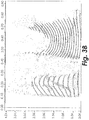
- FIG. 1A-C there are shown three images of an audio stream containing a message from a telephone network saying "This number has been disconnected".
- FIG 1A shows the original audio wave signal, with 1.5 seconds of audio sampled at 8000 KHz.
- FIG 1B shows a spectrogram of the original audio input signal, with dark regions indicating high energy at a particular frequency.
- the bitmap computed from a candidate audio stream. is compared to a database of bitmaps based on the number of non-matching bits, also known as the Hamming distance.
- bitmap matching and the process of acoustic fingerprinting is a powerful emerging tool in the science of audio recognition; however, it is computationally intense and requires several seconds of sampled audio to make a match in many cases. This delay makes it not well suited for use in call progress analysis. Accordingly, there remains a need for faster and more accurate systems and methods for identifying audio, both in the general case and during an outbound call attempt.
- the invention provides a method according to claim 1 for creating a weighted compressed representation of an audio or image dataset.
- Systems and methods for the matching of datasets, such as input audio segments, with known datasets in a database are disclosed.
- the use of the presently disclosed systems and methods is described in conjunction with recognizing known network message recordings encountered during an outbound telephone call.
- the methodologies include creation of a ternary fingerprint bitmap to make the comparison process more efficient.
- automated methodologies for creating the database of known datasets from a larger collection of datasets are also disclosed.
- a method for identifying a candidate audio segment from an outbound telephone call comprising the steps of: a) creating a spectrogram of the candidate audio segment; b) creating a candidate binary acoustic fingerprint bitmap of the spectrogram.; c) comparing the candidate binary acoustic fingerprint bitmap to at least one known binary acoustic fingerprint bitmap of a known network message; d) if the candidate binary acoustic fingerprint bitmap matches one of said at least one known binary acoustic fingerprint bitmaps within a predetermined threshold, declaring the match; and e) if the candidate binary acoustic fingerprint bitmap does not match one of said at least one known. binary acoustic fingerprint bitmaps within the predetermined threshold, using an answering machine detection algorithm to analyze the candidate audio segment.
- a method for identifying a candidate audio segment from an outbound telephone call comprising the steps of: a) creating a spectrogram of the candidate audio segment; b) creating a candidate binary fingerprint bitmap of the spectrogram; c) comparing the candidate binary fingerprint bitmap to at least one known binary fingerprint bitmap of a known recording; d) if the candidate binary fingerprint bitmap matches one of said at least one known binary fingerprint bitmaps within a predetermined threshold, declaring the match; and e) if the candidate binary fingerprint bitmap does not match one of said at least one known binary fingerprint bitmaps within the predetermined threshold, using an alternate process to analyze the candidate audio segment.
- a method for creating a ternary bitmap of a dataset comprising the steps of: a) computing a binary fingerprint bitmap of the dataset; b) deleting a first number of samples from the dataset; c) after step (b), computing another binary fingerprint bitmap of the dataset; d) repeating steps (b) and (c) a plurality of times to create a plurality of binary fingerprint bitmaps; and e) combining the plurality of binary fingerprint bitmaps into a ternary bitmap, where each bit in the ternary bitmap is determined as follows: e.
- bit in the ternary bitmap If a bit is 0 (zero) in a first predetermined number of the plurality of binary bitmaps, set the bit in the ternary bitmap to 0 (zero); e.2) If a bit is 1 (one) in a second predetermined number of the plurality of binary bitmaps, set the bit in the ternary bitmap to 1 (one);and e.3) Otherwise, set the bit of the ternary bitmap to * ("Don't Care").
- a method for identifying a candidate dataset comprising the steps of: a) computing a binary fingerprint bitmap of a known dataset in a known dataset database; b) deleting a first number of samples from the known dataset; c) after step (b), computing another binary fingerprint bitmap of the known dataset; d) repeating steps (b) and (c) a plurality of times to create a plurality of binary fingerprint bitmaps; and e) combining the plurality of binary fingerprint bitmaps into a ternary bitmap, where each bit in the ternary bitmap is determined as follows: e.1) If a bit is 0 in a first predetermined number of the plurality of binary bitmaps, set the bit in the ternary bitmap to 0; e.2) If a bit is 1 in a second predetermined number of the plurality of binary bitmaps, set the bit in the ternary bitmap to 1; and e.3) Otherwise, set the bit of the ternary bitmap
- a method for creating a ternary bitmap of an audio segment comprising the steps of: a) computing a binary acoustic fingerprint bitmap of the audio segment; b) deleting a first number of samples from the audio segment; c) after step (b), computing another binary acoustic fingerprint bitmap of the audio segment; d) repeating steps (b) and (c) a plurality of times to create a plurality of binary acoustic fingerprint bitmaps; and e) combining the plurality of binary acoustic fingerprint bitmaps into a ternary bitmap, where each bit in the ternary bitmap is determined as follows: e.1) If a bit is 0 in a first predetermined number of the plurality of binary bitmaps, set the bit in the ternary bitmap to 0;e2) If a bit is 1 in a second predetermined number of the plurality of binary bitmaps, set the bit in the ternary bitmap to 1
- a method for identifying a candidate audio segment comprising the steps of: a) computing a binary acoustic fingerprint bitmap of a known audio segment in a known audio segment database; b) deleting a first number of samples from the known audio segment; c) after step (b), computing another binary acoustic fingerprint bitmap of the known audio segment; d) repeating steps (b) and (c) a plurality of times to create a plurality of binary acoustic fingerprint bitmaps; and e) combining the plurality of binary acoustic fingerprint bitmaps into a ternary bitmap, where each bit in the ternary bitmap is determined as follows: e.1) If a bit is 0 in a first predetermined number of the plurality of binary bitmaps, set the bit in the ternary bitmap to 0; e.2) If a bit is I in a second predetermined number of the plurality of binary bitmaps, set the bit in the
- the present invention has applicability to the identification of any segment of audio, image, or other type of data, regardless of the type or source of the audio, image, or other type of data, and regardless of in what circumstances the audio, image, or other type of data is encountered. Additionally, the present invention has applicability to the recognition of any type of dataset having two or more dimensions. The predominant reliance on the recognition of audio recordings herein is simply for convenience of description.
- Call Progress Analysis may be improved by using a system that augments conventional AMD with an acoustic fingerprinting system to identify specific call progress events of interest including, but not limited to:
- network messages These are collectively referred to herein as "network messages.” All such network messages share the common trait that the same audio is used by the network in certain situations for calls placed to multiple called parties. Therefore, a dialing program should expect to encounter these network messages in the future, and identifying them as such will help the call progress analysis software determine that a live speaker has not been reached. It is desired that the call progress analysis software exhibit the following characteristics:
- the CPA. system processes the audio stream using both a conventional AMD algorithm and an acoustic fingerprinting system.
- the acoustic fingerprinting system identifies whether there is a likely match in the database of acoustic fingerprints of known network messages. If so, any output from the AMD algorithm is preempted: instead, the CPA system reports specific call progress events based on the matched acoustic fingerprint.
- the conventional AMD algorithm is used to detect a greeting, and report the event of either a live speaker or an answering machine.
- All events are interpreted by the user of the CPA system to choose an appropriate response, such as whether to proceed or terminate the call, dispatch to an agent, adjust the dialer plan, etc.
- the acoustic fingerprinting system is used without an additional CPA mechanism.
- FIG. 2 schematically illustrates one example of a method for building an acoustic fingerprint.
- a time varying spectral representation of the signal (referred to herein as a "spectrogram") is created (as indicated at step 100) using any desired transform, such as Discrete Fourier Transform (DFT), Discrete Cosine Transform (DCT), wavelet transform, or even just a set of filter banks, to name just four non-limiting examples.
- DFT Discrete Fourier Transform
- DCT Discrete Cosine Transform
- wavelet transform or even just a set of filter banks, to name just four non-limiting examples.
- FIG. 3A illustrates amplitude vs. time for the sliding windows used in a Fast Fourier Transform (FFT, a particularly efficient algorithm to implement Discrete Fourier Transform) of an audio sample using the following parameters:
- FFT Fast Fourier Transform
- FIG. 3B A sample spectrogram of an audio sample using this technique is illustrated in FIG. 3B .
- the next step is to create a binary acoustic fingerprint bitmap, as indicated at step 102.
- the power spectrogram may be used as is, or it may be optionally transformed in order to condense the data. Any transformation technique that will condense the data may be used.
- the Haitsma-Kalker Algorithm may be used, where a sequence of frames are created and are combined to build the acoustic fingerprint bitmap.
- a filter bank can be used to quantize each frame into a bit vector of size N, where N may be chosen for convenience as the number of bits in a C-style integer (8, 16, 32, or 64).
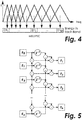
- a Mel-scale filter bank is used to transform the power spectrum data into Mel space with (N+1) bands, as indicated at step 104.
- the Mel scale is a perceptual scale of pitches judged by listeners to be equal in distance from one another, as illustrated in FIG. 4 .
- a sequence of N-bit binary fingerprint frame values based on band energy differences over successive frames is computed at step 106. In one embodiment, this is done using the Haitsma-Kalker Algorithm as follows:
- F n m ⁇ 1 if E n m ⁇ E n , m + 1 ⁇ E n ⁇ 1 , m ⁇ E n ⁇ 1 , m + 1 > 0 0 if E n m ⁇ E n , m + 1 ⁇ E n ⁇ 1 , m ⁇ E n ⁇ 1 , m + 1 ⁇ 0 .
- E(n,m) is the energy of frequency band m of frame n
- F(n, m) is the mth bit of fingerprint frame n
- the acoustic fingerprint is built up as a vector of N-bit integers, one integer per frame.
- FIG. 1C illustrates an exemplary 16-bit binary acoustic fingerprint bitmap.
- a database is maintained that contains binary acoustic fingerprint bitmaps for known network messages.
- the CPA system processes the audio stream using both a conventional AMD algorithm and an acoustic fingerprinting system. As the audio proceeds, the acoustic fingerprinting system creates binary acoustic fingerprint bitmaps of the incoming audio and compares those bitmaps to known network message bitmaps stored in a database (step 108). The CPA system identifies whether there is a match in the database of binary bitmaps (step 110), indicating that the outbound call has resulted in receipt of a known network message instead of a live speaker (step 112).
- any output from the AMD algorithm is preempted: instead, the CPA system reports specific call progress events based on the matched acoustic fingerprint.
- the conventional AMD algorithm is used to detect a greeting, and report the event of either a live speaker or an answering machine (step 114). All events are interpreted by the user of the CPA system to choose an appropriate response, such as whether to proceed or terminate the call, dispatch to an agent, adjust the dialer plan, etc.
- the binary acoustic fingerprinting bitmap matching system is used without an additional CPA mechanism.
- Haitsma-Kalker Algorithm has been well-studied in the literature. In Haitsma and. Kalker's published report of use of the Haitsma-Kalker Algorithm and the comparison of binary acoustic fingerprint bitmaps to identify three (3) second recordings of songs from a database of millions of songs ( Haitsma and Kalker, "A Highly Robust Audio Fingerprinting System," Journal of New Music Research, Vol. 32, No. 2 (2003), pp. 211-221 ). Their system required a large frame size, large overlap/small step size, and large fingerprints in order to achieve good results. The parameters they used were:
- Haitsma-Kalker algorithm computes a binary acoustic fingerprint bitmap with a relatively low Signal-to-Noise ratio, with bits highly sensitive to noise and windowing artifacts.
- To achieve an acoustic fingerprinting system with acceptably high accuracy and low false positive rate typically requires a relatively long segment of audio ( ⁇ 3 seconds) with large frame size (370 ms) and large overlap between frames (31/32, or about 97%).
- Such a system is computationally intensive and requires a relatively large audio sample to make reliable comparisons, both of which are undesirable in many audio matching scenarios.
- the present inventors have observed that many bits in a binary acoustic fingerprint bitmap are sensitive to noise and artifacts resulting from the transform into the spectral representation (windowing), especially where the energy of the signal is relatively small.
- a proposed solution is to mask out bits of little value due to their sensitivity to noise and windowing artifacts, and compute the error rate of the bitmap comparisons using only the bits that are in the mask (i.e., the bits that are not masked out).
- one example makes the following modification to any acoustic fingerprinting algorithm that generates a binary bitmap.
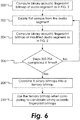
- the methodology of FIG. 6 may be implemented.
- the binary acoustic fingerprint bitmap is created for the audio segment using the same process described hereinabove with respect to FIG. 2 .
- the first sample is deleted from the audio segment (although other segment modification schemes may be employed, as discussed below), and at step 204 another binary acoustic fingerprint bitmap is created for the modified audio segment using the same process described hereinabove with respect to FIG. 2 .
- Steps 202-204 are repeated X times (Step 206), where X is the number of samples in each frame used by the acoustic fingerprinting process of FIG. 2 . This process will generate X binary acoustic fingerprint bitmaps of the audio segment.
- the X binary acoustic fingerprint bitmaps are combined into a ternary bitmap at step 208 as follows:
- the "Don't Care" bits change in the successive binary acoustic fingerprint bitmaps because they are sensitive to framing, noise, compression, and other effects that introduce signal distortion. It will be appreciated from the above description that the "Don't Care” bits may be defined in other ways, such as a predetermined percentage of bit values changing across the bitmaps, etc. If the ternary bitmap is used for bitmap comparison (step 210) and the “Don't Care” bits are ignored during the comparison process, the "Don't Care” bits mask out these regions in frequency and time of the original binary acoustic fingerprint bitmap that introduce signal distortion.
- FIG. 7 illustrates an example comparison between a binary bitmap and its associated ternary bitmap. It will also be appreciated from the above description that the input signal can be artificially degraded before computing the acoustic fingerprint by adding noise or other artifacts commonly introduced by the communication channel in order to make the acoustic fingerprint and mask more sensitive.
- these "Don't Care” bits are excluded from the evaluated "masked Hamming distance" between the candidate audio stream and the database of known fingerprints.
- Use of the ternary bitmap mask eliminates false negatives due to framing misalignment between the input candidate audio stream and the recordings in the database. By excluding the bits most sensitive to windowing and noise, the ternary fingerprint system is more robust than its binary counterpart, and achieves comparable accuracy and false positive rate with much fewer bits. It will be appreciated that the above steps create many fingerprints of the same signal, with the analysis window shifted by a fraction of the frame size, and those fingerprints are then used to identify which parts of the fingerprint change.
- the analysis window may be shifted by any fraction of the frame size, rather than the illustrated single-sample shift.
- the acoustic fingerprint and ternary bitmap may be represented in ways other than as vectors of vectors where each element is a bit with a value of zero or one, but instead more generally as vectors of vectors where each element comprises numeric scores and weights and quantized into multi-bit representations).
- a method for creating a weighted compressed representation of a dataset may comprise the steps of a) computing a compressed representation of the dataset; b) deleting a first number of elements from the dataset to create a modified dataset; c) computing another compressed representation of the modified dataset; d) repeating steps (b) and (c) a plurality of times to create a plurality of compressed representations; and e) combining the plurality of compressed representations into a weighted compressed representation, where each weight in the weighted compressed representation is computed as a function of the elements in the plurality of compressed representations.
- the compressed representation is a two-dimensional vector of first numbers.
- the first numbers are each represented with a first number of bits, where in the first number of bits may be one bit in some embodiments, and greater than one bit in other embodiments.
- the weighted compressed representation is a two-dimensional vector of second numbers.
- the second numbers are each represented with a second number of bits.
- the function computes each said weight as correlation coefficient of the elements in the plurality of compressed. representations.
- the correlation coefficient is computed as follows:
- the first value is +1
- the second value is -1
- the third value is 0 (zero).
- the correlation coefficient can be any value between -1 and +1 (or any other desired number range).
- the values correspond to the ternary bitmap discussed herein, where a set bit is +1, a cleared bit is -1 and a Don't Care bit is 0.
- the thresholds can be set to any desired level.
- FIG. 6 The methodology of FIG. 6 can be compared to the Haitsma-Kalker algorithm binary acoustic fingerprint bitmap comparison approach of FIG. 2 , which computes a binary acoustic fingerprint bitmap with a relatively low Signal-to-Noise ratio, with bits highly sensitive to noise and windowing artifacts.
- acoustic fingerprinting systems are not well adapted for real-time applications because they require a large segment of a source audio stream to achieve a valid match. The requirement imposes a time delay of several seconds from the beginning of the matched segment before a matching fingerprint can be confirmed.
- the fingerprinting system must identify whether a match is likely within a fraction of a second. To achieve minimal delay, the present inventors propose an approach using an optimized exhaustive search to match an audio stream in real-time against a database on the order of thousands of fingerprints.
- a collection of ternary acoustic fingerprint bitmaps one for each audio object to detect, with N ternary values per frame, is generated (step 300).
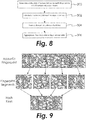
- the ternary bitmap is subdivided into a plurality of equal segments (step 302).
- the ternary bitmap is subdivided into four equal segments as shown in FIG. 9 .
- a hash key is obtained (step 304) by extracting the ternary values from 128 / N frames of the subdivided fingerprint, for a total of 128 ternary values in each hash key (i.e., a 128-bit ternary hash key).
- the hash key may have fewer or a greater number of values. All of the hash keys thus obtained from the ternary acoustic fingerprint bitmaps are then aggregated into a single lookup table (step 306).
- the selection of hash keys from various segments of the acoustic fingerprint allows a match to be made even if the candidate audio stream is an interrupted recording and the beginning of the recording is not received. For example, if using this methodology for identifying samples of music, the person wishing to identify a song may not have (and most likely did not) start recording a sample of the song to be identified until sometime after the song started playing.
- Use of hash keys from different segments of the acoustic fingerprint allows the system to still make a match between the candidate audio stream and the acoustic fingerprints in the database.
- FIG. 10 illustrates one example, of a matching procedure that may be used at runtime after the lookup table of hash keys has been assembled.
- a binary bitmap acoustic fingerprinting algorithm is used to generate a new bit vector of length N (step 400).
- the bit vectors from the previous 128/N frames of the input audio stream. are combined into a 128-bit binary hash key for lookup (step 402).
- the current 128-bit binary hash key of the input audio stream is compared against all of the ternary hash keys in the lookup table by computing the masked Hamming distance (step 404). On.
- the audio fingerprint corresponding to the hash key is identified as a "candidate” (step 408).
- the threshold bit error rate (BER) for establishing a candidate may be based on a relatively low value of ⁇ candidate (e.g., 3 standard deviations, although other thresholds may be used).
- step 410) this candidate is determined to be a match (step 412). If no match has been determined, the process returns to step 400 where the next frame is used to generate a new bit vector of length N. By continuing to analyze subsequent frames, the process is able to resolve all candidates as a match or non-match, based upon where the masked Hamming distance falls with respect to the thresholds.
- ⁇ notify e.g. 9 standard deviations, although other thresholds may be used
- systems and methods are provided for matching an audio sample to a database of known audio recordings.
- the systems and methods described above are computationally efficient and are able to identify a match with an acoustic fingerprint in a database, but a problem remains in how to efficiently identify the audio recordings that will be represented by acoustic fingerprints in the database.
- the methodology described hereinbelow for doing so is discussed in the context of a telephonic contact center; however, those skilled in the art will recognize from the present disclosure that the methodology may be applied to compiling fingerprint databases relating to any type of source audio, images, or other types of data.
- a sizeable campaign from a contact center may generate thousands of digital recordings of outbound calls each day. From this recording collection, the objective is to extract all audio segments containing call progress events of interest, in order to assist CPA in future call campaigns. For example, many calls in a campaign are dialed to numbers on the same network or sub-network, which plays an identical recorded greeting for each subscriber. In the absence of an automated data driven technique, the large volumes of data must be listened to by a human subject, to identify candidate segments from. which acoustic fingerprints may be extracted. The present inventors propose an offline process to automatically identify common acoustic recordings in a large collection of recordings, so they may be detected in future call campaigns to improve the accuracy of CPA. The process used for automated identification of fingerprints is illustrated schematically in FIG. 11 .
- the CPA system combined with AMD and acoustic fingerprinting (if the database already contains acoustic fingerprints for some known recordings), is used to classify all audio recordings in the collection based on events detected therein.
- the endpoints of the audio segments that do not comprise silence, background noise, or simple tones are identified at step 502.
- audio segments containing speaking patterns, music, non-speech signals, etc. are identified at step 502.
- a ternary acoustic fingerprint bitmap is generated for all identified segments using the methodology described hereinabove (it will be appreciated that a binary acoustic fingerprint bitmap can be used instead of the ternary bitmap).
- acoustic fingerprint database identifies the augmented fingerprints that are not unique and were detected multiple times (i.e., a recording in the collection being processed matched multiple ones of the augmented acoustic fingerprints, indicating that these are acoustic fingerprints of recordings that were encountered multiple times in the collection).
- any acoustic fingerprints discovered multiple times are likely candidates for a call progress event of interest, and are therefore left in the acoustic fingerprint database at step 512 for use in future CPA tasks.
- All of the other augmented fingerprints i.e., those new acoustic fingerprints that were not detected multiple times
- an automated system may be used to look through a large collection of recordings (or images or other data) and extract therefrom. fingerprints of recordings that were encountered multiple times.
- This methodology allows the acoustic fingerprint database to be built automatically and continuously updated to account for new network messages that may be brought on line by the various telephone companies.
- the various embodiments allow for the matching of input audio segments with known audio segments in a database.
- the audio segments may originate from any source and contain any type of audio, such as speech, tones, music, or any other audio that is desired to be recognized.
- the use of the presently disclosed systems and methods was described in conjunction with recognizing known network message recordings encountered during an outbound telephone call.
- the disclosed systems and methods will find application in recognition of any type of two- or more-dimensional dataset, such as any form of audio, image, or other type of data.
Landscapes
- Engineering & Computer Science (AREA)
- Theoretical Computer Science (AREA)
- Physics & Mathematics (AREA)
- Multimedia (AREA)
- Signal Processing (AREA)
- Databases & Information Systems (AREA)
- Computational Linguistics (AREA)
- Health & Medical Sciences (AREA)
- Audiology, Speech & Language Pathology (AREA)
- Human Computer Interaction (AREA)
- Acoustics & Sound (AREA)
- Library & Information Science (AREA)
- Data Mining & Analysis (AREA)
- General Engineering & Computer Science (AREA)
- General Physics & Mathematics (AREA)
- Business, Economics & Management (AREA)
- Marketing (AREA)
- Telephonic Communication Services (AREA)
- Telephone Function (AREA)
- User Interface Of Digital Computer (AREA)
- Information Retrieval, Db Structures And Fs Structures Therefor (AREA)
- Measurement Of Mechanical Vibrations Or Ultrasonic Waves (AREA)
- Compression, Expansion, Code Conversion, And Decoders (AREA)
Claims (9)
- Verfahren zur Erzeugung einer gewichteten komprimierten Darstellung eines Audio- oder Bilddatensatzes, wobei das Verfahren die folgenden Schritte umfasst:a) Berechnen einer komprimierten Darstellung des Datensatzes;wobei das Verfahren ferner durch Folgendes gekennzeichnet ist:b) Löschen einer ersten Anzahl von Elementen aus dem Datensatz zum Erzeugen eines modifizierten Datensatzes;c) nach Schritt (b), Berechnen einer weiteren komprimierten Darstellung des Datensatzes;d) Wiederholen der Schritte (b) und (c) eine Vielzahl von Malen zum Erzeugen einer Vielzahl von komprimierten Darstellungen; unde) Kombinieren der Vielzahl von komprimierten Darstellungen zu einer gewichteten komprimierten Darstellung, wobei jede Gewichtung in der gewichteten komprimierten Darstellung als eine Funktion von Elementen in der Vielzahl von komprimierten Darstellungen berechnet wird, wobei die Funktion jede Gewichtung als einen Korrelationskoeffizienten der Elemente in der Vielzahl von komprimierten Darstellungen berechnet, wobei der Korrelationskoeffizient folgendermaßen berechnet wird:1) falls ein Element in einer ersten vorbestimmten Anzahl der Vielzahl von komprimierten Darstellungen unter einem ersten vorbestimmten Schwellenwert liegt, Setzen des Korrelationskoeffizienten auf einen ersten Wert;2) falls ein Element in einer zweiten vorbestimmten Anzahl der Vielzahl von komprimierten Darstellungen über einem zweiten vorbestimmten Schwellenwert liegt, Setzen des Korrelationskoeffizienten auf einen zweiten Wert;3) ansonsten Setzen des Korrelationskoeffizienten auf einen dritten Wert.
- Verfahren nach Anspruch 1, wobei die komprimierte Darstellung ein zweidimensionaler Vektor von ersten Zahlen ist.
- Verfahren nach Anspruch 2, wobei die ersten Zahlen jeweils mit einer ersten Anzahl von Bits dargestellt sind.
- Verfahren nach Anspruch 3, wobei die erste Anzahl von Bits eins ist.
- Verfahren nach Anspruch 1, wobei die gewichtete komprimierte Darstellung ein zweidimensionaler Vektor von zweiten Zahlen ist.
- Verfahren nach Anspruch 5, wobei die zweiten Zahlen jeweils mit einer zweiten Anzahl von Bits dargestellt sind.
- Verfahren nach Anspruch 1, wobei der erste Wert +1 ist, der zweite Wert -1 ist und der dritte Wert null ist.
- Verfahren nach Anspruch 1, wobei die erste vorbestimmte Anzahl alle der Vielzahl von komprimierten Darstellungen umfasst und die zweite vorbestimmte Anzahl alle der Vielzahl von komprimierten Darstellungen umfasst.
- Verfahren nach Anspruch 1, wobei die erste Zahl in Schritt b) eins ist.
Applications Claiming Priority (2)
| Application Number | Priority Date | Filing Date | Title |
|---|---|---|---|
| US13/432,838 US8681950B2 (en) | 2012-03-28 | 2012-03-28 | System and method for fingerprinting datasets |
| EP13768137.5A EP2832080B1 (de) | 2012-03-28 | 2013-03-04 | Verfahren zur Identifizierung eines Audiosegmentkandidaten aus einem abgehenden Telefonanruf |
Related Parent Applications (2)
| Application Number | Title | Priority Date | Filing Date |
|---|---|---|---|
| EP13768137.5A Division EP2832080B1 (de) | 2012-03-28 | 2013-03-04 | Verfahren zur Identifizierung eines Audiosegmentkandidaten aus einem abgehenden Telefonanruf |
| EP13768137.5A Division-Into EP2832080B1 (de) | 2012-03-28 | 2013-03-04 | Verfahren zur Identifizierung eines Audiosegmentkandidaten aus einem abgehenden Telefonanruf |
Publications (2)
| Publication Number | Publication Date |
|---|---|
| EP3076554A1 EP3076554A1 (de) | 2016-10-05 |
| EP3076554B1 true EP3076554B1 (de) | 2017-11-22 |
Family
ID=49235038
Family Applications (3)
| Application Number | Title | Priority Date | Filing Date |
|---|---|---|---|
| EP13768137.5A Active EP2832080B1 (de) | 2012-03-28 | 2013-03-04 | Verfahren zur Identifizierung eines Audiosegmentkandidaten aus einem abgehenden Telefonanruf |
| EP16169776.8A Active EP3076391B1 (de) | 2012-03-28 | 2013-03-04 | Erzeugung eines ternären bitmaps von einer datenmenge |
| EP16169777.6A Active EP3076554B1 (de) | 2012-03-28 | 2013-03-04 | Verfahren zur erzeugung einer gewichteten komprimierten datensatz-darstellung |
Family Applications Before (2)
| Application Number | Title | Priority Date | Filing Date |
|---|---|---|---|
| EP13768137.5A Active EP2832080B1 (de) | 2012-03-28 | 2013-03-04 | Verfahren zur Identifizierung eines Audiosegmentkandidaten aus einem abgehenden Telefonanruf |
| EP16169776.8A Active EP3076391B1 (de) | 2012-03-28 | 2013-03-04 | Erzeugung eines ternären bitmaps von einer datenmenge |
Country Status (11)
| Country | Link |
|---|---|
| US (4) | US8681950B2 (de) |
| EP (3) | EP2832080B1 (de) |
| JP (2) | JP6178840B2 (de) |
| AU (3) | AU2013240453B2 (de) |
| BR (1) | BR112014023865B1 (de) |
| CA (1) | CA2866347C (de) |
| CL (3) | CL2014002551A1 (de) |
| HK (1) | HK1202734A1 (de) |
| NZ (2) | NZ629522A (de) |
| WO (1) | WO2013148069A1 (de) |
| ZA (1) | ZA201406474B (de) |
Families Citing this family (211)
| Publication number | Priority date | Publication date | Assignee | Title |
|---|---|---|---|---|
| US7516074B2 (en) * | 2005-09-01 | 2009-04-07 | Auditude, Inc. | Extraction and matching of characteristic fingerprints from audio signals |
| US8677377B2 (en) | 2005-09-08 | 2014-03-18 | Apple Inc. | Method and apparatus for building an intelligent automated assistant |
| US9318108B2 (en) | 2010-01-18 | 2016-04-19 | Apple Inc. | Intelligent automated assistant |
| US8977255B2 (en) | 2007-04-03 | 2015-03-10 | Apple Inc. | Method and system for operating a multi-function portable electronic device using voice-activation |
| US10002189B2 (en) | 2007-12-20 | 2018-06-19 | Apple Inc. | Method and apparatus for searching using an active ontology |
| US9330720B2 (en) | 2008-01-03 | 2016-05-03 | Apple Inc. | Methods and apparatus for altering audio output signals |
| US8996376B2 (en) | 2008-04-05 | 2015-03-31 | Apple Inc. | Intelligent text-to-speech conversion |
| US20100030549A1 (en) | 2008-07-31 | 2010-02-04 | Lee Michael M | Mobile device having human language translation capability with positional feedback |
| US8676904B2 (en) | 2008-10-02 | 2014-03-18 | Apple Inc. | Electronic devices with voice command and contextual data processing capabilities |
| US10241752B2 (en) | 2011-09-30 | 2019-03-26 | Apple Inc. | Interface for a virtual digital assistant |
| US10241644B2 (en) | 2011-06-03 | 2019-03-26 | Apple Inc. | Actionable reminder entries |
| US10706373B2 (en) | 2011-06-03 | 2020-07-07 | Apple Inc. | Performing actions associated with task items that represent tasks to perform |
| US9431006B2 (en) | 2009-07-02 | 2016-08-30 | Apple Inc. | Methods and apparatuses for automatic speech recognition |
| US10276170B2 (en) | 2010-01-18 | 2019-04-30 | Apple Inc. | Intelligent automated assistant |
| US8682667B2 (en) | 2010-02-25 | 2014-03-25 | Apple Inc. | User profiling for selecting user specific voice input processing information |
| US20120136701A1 (en) * | 2010-11-26 | 2012-05-31 | Rohan Relan | Method and system for faciliating interactive commercials in real time |
| US9262612B2 (en) | 2011-03-21 | 2016-02-16 | Apple Inc. | Device access using voice authentication |
| US10057736B2 (en) | 2011-06-03 | 2018-08-21 | Apple Inc. | Active transport based notifications |
| US10134385B2 (en) | 2012-03-02 | 2018-11-20 | Apple Inc. | Systems and methods for name pronunciation |
| US10417037B2 (en) | 2012-05-15 | 2019-09-17 | Apple Inc. | Systems and methods for integrating third party services with a digital assistant |
| US8886635B2 (en) * | 2012-05-23 | 2014-11-11 | Enswers Co., Ltd. | Apparatus and method for recognizing content using audio signal |
| US9235867B2 (en) * | 2012-06-04 | 2016-01-12 | Microsoft Technology Licensing, Llc | Concurrent media delivery |
| WO2013184520A1 (en) * | 2012-06-04 | 2013-12-12 | Stone Troy Christopher | Methods and systems for identifying content types |
| US9721563B2 (en) | 2012-06-08 | 2017-08-01 | Apple Inc. | Name recognition system |
| US20140064107A1 (en) * | 2012-08-28 | 2014-03-06 | Palo Alto Research Center Incorporated | Method and system for feature-based addressing |
| CA3094876C (en) | 2012-08-30 | 2023-07-25 | Interactive Intelligence, Inc. | Method for call learning in a communication system |
| US9547647B2 (en) | 2012-09-19 | 2017-01-17 | Apple Inc. | Voice-based media searching |
| US9263059B2 (en) * | 2012-09-28 | 2016-02-16 | International Business Machines Corporation | Deep tagging background noises |
| CN103856600B (zh) * | 2012-12-04 | 2016-09-28 | 中兴通讯股份有限公司 | 一种内置搜索语音短信功能的移动终端及其搜索方法 |
| US10971191B2 (en) * | 2012-12-12 | 2021-04-06 | Smule, Inc. | Coordinated audiovisual montage from selected crowd-sourced content with alignment to audio baseline |
| KR102579086B1 (ko) | 2013-02-07 | 2023-09-15 | 애플 인크. | 디지털 어시스턴트를 위한 음성 트리거 |
| US10652394B2 (en) | 2013-03-14 | 2020-05-12 | Apple Inc. | System and method for processing voicemail |
| US10748529B1 (en) | 2013-03-15 | 2020-08-18 | Apple Inc. | Voice activated device for use with a voice-based digital assistant |
| WO2014197334A2 (en) | 2013-06-07 | 2014-12-11 | Apple Inc. | System and method for user-specified pronunciation of words for speech synthesis and recognition |
| WO2014197335A1 (en) | 2013-06-08 | 2014-12-11 | Apple Inc. | Interpreting and acting upon commands that involve sharing information with remote devices |
| US10176167B2 (en) | 2013-06-09 | 2019-01-08 | Apple Inc. | System and method for inferring user intent from speech inputs |
| JP6259911B2 (ja) | 2013-06-09 | 2018-01-10 | アップル インコーポレイテッド | デジタルアシスタントの2つ以上のインスタンスにわたる会話持続を可能にするための機器、方法、及びグラフィカルユーザインタフェース |
| CN105453026A (zh) | 2013-08-06 | 2016-03-30 | 苹果公司 | 基于来自远程设备的活动自动激活智能响应 |
| US10296160B2 (en) | 2013-12-06 | 2019-05-21 | Apple Inc. | Method for extracting salient dialog usage from live data |
| US9571994B2 (en) * | 2013-12-17 | 2017-02-14 | Matthew Stephen Yagey | Alert systems and methodologies |
| US9767266B2 (en) * | 2013-12-20 | 2017-09-19 | The Mitre Corporation | Methods and systems for biometric-based user authentication by voice |
| JP6587625B2 (ja) | 2014-03-04 | 2019-10-09 | インタラクティブ・インテリジェンス・グループ・インコーポレイテッド | オーディオ指紋探索の最適化のためのシステムおよび方法 |
| US10074374B2 (en) | 2014-04-07 | 2018-09-11 | Barco N.V. | Ad hoc one-time pairing of remote devices using online audio fingerprinting |
| US10348724B2 (en) * | 2014-04-07 | 2019-07-09 | Barco N.V. | Ad hoc one-time pairing of remote devices using online audio fingerprinting |
| US20150316666A1 (en) * | 2014-05-05 | 2015-11-05 | The Board Of Trustees Of The Leland Stanford Junior University | Efficient Similarity Search of Seismic Waveforms |
| US9620105B2 (en) * | 2014-05-15 | 2017-04-11 | Apple Inc. | Analyzing audio input for efficient speech and music recognition |
| US9715875B2 (en) | 2014-05-30 | 2017-07-25 | Apple Inc. | Reducing the need for manual start/end-pointing and trigger phrases |
| US10170123B2 (en) | 2014-05-30 | 2019-01-01 | Apple Inc. | Intelligent assistant for home automation |
| US9633004B2 (en) | 2014-05-30 | 2017-04-25 | Apple Inc. | Better resolution when referencing to concepts |
| US9430463B2 (en) | 2014-05-30 | 2016-08-30 | Apple Inc. | Exemplar-based natural language processing |
| EP3480811A1 (de) | 2014-05-30 | 2019-05-08 | Apple Inc. | Verfahren zur eingabe von mehreren befehlen mit einer einzigen äusserung |
| US9338493B2 (en) | 2014-06-30 | 2016-05-10 | Apple Inc. | Intelligent automated assistant for TV user interactions |
| WO2016024171A1 (en) | 2014-08-14 | 2016-02-18 | Yandex Europe Ag | Method of and a system for indexing audio tracks using chromaprints |
| WO2016024172A1 (en) * | 2014-08-14 | 2016-02-18 | Yandex Europe Ag | Method of and a system for matching audio tracks using chromaprints with a fast candidate selection routine |
| US10447848B2 (en) * | 2014-09-09 | 2019-10-15 | Cyara Solutions Pty Ltd | System and method for reliable call recording testing and proprietary customer information retrieval |
| US9818400B2 (en) | 2014-09-11 | 2017-11-14 | Apple Inc. | Method and apparatus for discovering trending terms in speech requests |
| US10074360B2 (en) | 2014-09-30 | 2018-09-11 | Apple Inc. | Providing an indication of the suitability of speech recognition |
| US9668121B2 (en) | 2014-09-30 | 2017-05-30 | Apple Inc. | Social reminders |
| US10127911B2 (en) | 2014-09-30 | 2018-11-13 | Apple Inc. | Speaker identification and unsupervised speaker adaptation techniques |
| US9704507B2 (en) * | 2014-10-31 | 2017-07-11 | Ensequence, Inc. | Methods and systems for decreasing latency of content recognition |
| WO2016089749A1 (en) * | 2014-12-01 | 2016-06-09 | Hoarty W Leo | System and method for continuous media segment identification |
| KR20160102815A (ko) * | 2015-02-23 | 2016-08-31 | 한국전자통신연구원 | 잡음에 강인한 오디오 신호 처리 장치 및 방법 |
| US10142471B2 (en) | 2015-03-02 | 2018-11-27 | Genesys Telecommunications Laboratories, Inc. | System and method for call progress detection |
| US10152299B2 (en) | 2015-03-06 | 2018-12-11 | Apple Inc. | Reducing response latency of intelligent automated assistants |
| US10567477B2 (en) | 2015-03-08 | 2020-02-18 | Apple Inc. | Virtual assistant continuity |
| US9886953B2 (en) | 2015-03-08 | 2018-02-06 | Apple Inc. | Virtual assistant activation |
| US9721566B2 (en) | 2015-03-08 | 2017-08-01 | Apple Inc. | Competing devices responding to voice triggers |
| WO2016172363A1 (en) | 2015-04-24 | 2016-10-27 | Cyber Resonance Corporation | Methods and systems for performing signal analysis to identify content types |
| CN106294331B (zh) * | 2015-05-11 | 2020-01-21 | 阿里巴巴集团控股有限公司 | 音频信息检索方法及装置 |
| US10460227B2 (en) | 2015-05-15 | 2019-10-29 | Apple Inc. | Virtual assistant in a communication session |
| US10083688B2 (en) | 2015-05-27 | 2018-09-25 | Apple Inc. | Device voice control for selecting a displayed affordance |
| US10200824B2 (en) | 2015-05-27 | 2019-02-05 | Apple Inc. | Systems and methods for proactively identifying and surfacing relevant content on a touch-sensitive device |
| US9818414B2 (en) * | 2015-06-04 | 2017-11-14 | Intel Corporation | Dialogue system with audio watermark |
| US9578173B2 (en) | 2015-06-05 | 2017-02-21 | Apple Inc. | Virtual assistant aided communication with 3rd party service in a communication session |
| US11025565B2 (en) | 2015-06-07 | 2021-06-01 | Apple Inc. | Personalized prediction of responses for instant messaging |
| US20160378747A1 (en) | 2015-06-29 | 2016-12-29 | Apple Inc. | Virtual assistant for media playback |
| US10747498B2 (en) | 2015-09-08 | 2020-08-18 | Apple Inc. | Zero latency digital assistant |
| US10740384B2 (en) | 2015-09-08 | 2020-08-11 | Apple Inc. | Intelligent automated assistant for media search and playback |
| US10671428B2 (en) | 2015-09-08 | 2020-06-02 | Apple Inc. | Distributed personal assistant |
| US10331312B2 (en) | 2015-09-08 | 2019-06-25 | Apple Inc. | Intelligent automated assistant in a media environment |
| US10366158B2 (en) | 2015-09-29 | 2019-07-30 | Apple Inc. | Efficient word encoding for recurrent neural network language models |
| US11010550B2 (en) | 2015-09-29 | 2021-05-18 | Apple Inc. | Unified language modeling framework for word prediction, auto-completion and auto-correction |
| US11587559B2 (en) | 2015-09-30 | 2023-02-21 | Apple Inc. | Intelligent device identification |
| US10691473B2 (en) | 2015-11-06 | 2020-06-23 | Apple Inc. | Intelligent automated assistant in a messaging environment |
| US10956666B2 (en) | 2015-11-09 | 2021-03-23 | Apple Inc. | Unconventional virtual assistant interactions |
| US10049668B2 (en) | 2015-12-02 | 2018-08-14 | Apple Inc. | Applying neural network language models to weighted finite state transducers for automatic speech recognition |
| US10223066B2 (en) | 2015-12-23 | 2019-03-05 | Apple Inc. | Proactive assistance based on dialog communication between devices |
| KR20170101500A (ko) * | 2016-02-29 | 2017-09-06 | 한국전자통신연구원 | 노이즈 제거를 통한 오디오 신호 식별 방법 및 장치 |
| US10446143B2 (en) | 2016-03-14 | 2019-10-15 | Apple Inc. | Identification of voice inputs providing credentials |
| US10397663B2 (en) | 2016-04-08 | 2019-08-27 | Source Digital, Inc. | Synchronizing ancillary data to content including audio |
| US9786298B1 (en) * | 2016-04-08 | 2017-10-10 | Source Digital, Inc. | Audio fingerprinting based on audio energy characteristics |
| US9934775B2 (en) | 2016-05-26 | 2018-04-03 | Apple Inc. | Unit-selection text-to-speech synthesis based on predicted concatenation parameters |
| US9972304B2 (en) | 2016-06-03 | 2018-05-15 | Apple Inc. | Privacy preserving distributed evaluation framework for embedded personalized systems |
| US10249300B2 (en) | 2016-06-06 | 2019-04-02 | Apple Inc. | Intelligent list reading |
| US11227589B2 (en) | 2016-06-06 | 2022-01-18 | Apple Inc. | Intelligent list reading |
| US10049663B2 (en) | 2016-06-08 | 2018-08-14 | Apple, Inc. | Intelligent automated assistant for media exploration |
| DK179309B1 (en) | 2016-06-09 | 2018-04-23 | Apple Inc | Intelligent automated assistant in a home environment |
| US12223282B2 (en) | 2016-06-09 | 2025-02-11 | Apple Inc. | Intelligent automated assistant in a home environment |
| US10509862B2 (en) | 2016-06-10 | 2019-12-17 | Apple Inc. | Dynamic phrase expansion of language input |
| US10490187B2 (en) | 2016-06-10 | 2019-11-26 | Apple Inc. | Digital assistant providing automated status report |
| US10586535B2 (en) | 2016-06-10 | 2020-03-10 | Apple Inc. | Intelligent digital assistant in a multi-tasking environment |
| US10192552B2 (en) | 2016-06-10 | 2019-01-29 | Apple Inc. | Digital assistant providing whispered speech |
| US10067938B2 (en) | 2016-06-10 | 2018-09-04 | Apple Inc. | Multilingual word prediction |
| US12197817B2 (en) | 2016-06-11 | 2025-01-14 | Apple Inc. | Intelligent device arbitration and control |
| DK179415B1 (en) | 2016-06-11 | 2018-06-14 | Apple Inc | Intelligent device arbitration and control |
| DK179049B1 (en) | 2016-06-11 | 2017-09-18 | Apple Inc | Data driven natural language event detection and classification |
| DK201670540A1 (en) | 2016-06-11 | 2018-01-08 | Apple Inc | Application integration with a digital assistant |
| DK179343B1 (en) | 2016-06-11 | 2018-05-14 | Apple Inc | Intelligent task discovery |
| GB2556023B (en) | 2016-08-15 | 2022-02-09 | Intrasonics Sarl | Audio matching |
| RU2633159C1 (ru) * | 2016-08-26 | 2017-10-11 | Общество с ограниченной ответственностью "Лаборатория ИнфоВотч" | Способ автоматизированного анализа растровых изображений |
| US10474753B2 (en) | 2016-09-07 | 2019-11-12 | Apple Inc. | Language identification using recurrent neural networks |
| US10043516B2 (en) | 2016-09-23 | 2018-08-07 | Apple Inc. | Intelligent automated assistant |
| US11281993B2 (en) | 2016-12-05 | 2022-03-22 | Apple Inc. | Model and ensemble compression for metric learning |
| US10593346B2 (en) | 2016-12-22 | 2020-03-17 | Apple Inc. | Rank-reduced token representation for automatic speech recognition |
| US11204787B2 (en) | 2017-01-09 | 2021-12-21 | Apple Inc. | Application integration with a digital assistant |
| DK201770383A1 (en) | 2017-05-09 | 2018-12-14 | Apple Inc. | USER INTERFACE FOR CORRECTING RECOGNITION ERRORS |
| US10417266B2 (en) | 2017-05-09 | 2019-09-17 | Apple Inc. | Context-aware ranking of intelligent response suggestions |
| DK201770439A1 (en) | 2017-05-11 | 2018-12-13 | Apple Inc. | Offline personal assistant |
| US10395654B2 (en) | 2017-05-11 | 2019-08-27 | Apple Inc. | Text normalization based on a data-driven learning network |
| DK180048B1 (en) | 2017-05-11 | 2020-02-04 | Apple Inc. | MAINTAINING THE DATA PROTECTION OF PERSONAL INFORMATION |
| US10726832B2 (en) | 2017-05-11 | 2020-07-28 | Apple Inc. | Maintaining privacy of personal information |
| DK201770427A1 (en) | 2017-05-12 | 2018-12-20 | Apple Inc. | LOW-LATENCY INTELLIGENT AUTOMATED ASSISTANT |
| US11301477B2 (en) | 2017-05-12 | 2022-04-12 | Apple Inc. | Feedback analysis of a digital assistant |
| DK179745B1 (en) | 2017-05-12 | 2019-05-01 | Apple Inc. | SYNCHRONIZATION AND TASK DELEGATION OF A DIGITAL ASSISTANT |
| DK179496B1 (en) | 2017-05-12 | 2019-01-15 | Apple Inc. | USER-SPECIFIC Acoustic Models |
| DK201770411A1 (en) | 2017-05-15 | 2018-12-20 | Apple Inc. | Multi-modal interfaces |
| DK201770432A1 (en) | 2017-05-15 | 2018-12-21 | Apple Inc. | Hierarchical belief states for digital assistants |
| DK201770431A1 (en) | 2017-05-15 | 2018-12-20 | Apple Inc. | Optimizing dialogue policy decisions for digital assistants using implicit feedback |
| US20180336892A1 (en) | 2017-05-16 | 2018-11-22 | Apple Inc. | Detecting a trigger of a digital assistant |
| US10303715B2 (en) | 2017-05-16 | 2019-05-28 | Apple Inc. | Intelligent automated assistant for media exploration |
| DK179549B1 (en) | 2017-05-16 | 2019-02-12 | Apple Inc. | FAR-FIELD EXTENSION FOR DIGITAL ASSISTANT SERVICES |
| US10403278B2 (en) | 2017-05-16 | 2019-09-03 | Apple Inc. | Methods and systems for phonetic matching in digital assistant services |
| US10311144B2 (en) | 2017-05-16 | 2019-06-04 | Apple Inc. | Emoji word sense disambiguation |
| US10657328B2 (en) | 2017-06-02 | 2020-05-19 | Apple Inc. | Multi-task recurrent neural network architecture for efficient morphology handling in neural language modeling |
| US10445429B2 (en) | 2017-09-21 | 2019-10-15 | Apple Inc. | Natural language understanding using vocabularies with compressed serialized tries |
| US10755051B2 (en) | 2017-09-29 | 2020-08-25 | Apple Inc. | Rule-based natural language processing |
| CN110622155A (zh) | 2017-10-03 | 2019-12-27 | 谷歌有限责任公司 | 将音乐识别为特定歌曲 |
| EP3477643B1 (de) * | 2017-10-31 | 2019-10-16 | Spotify AB | Audiofingerabdruckextraktion und audioerkennung unter verwendung der besagten fingerabdrücke |
| US10636424B2 (en) | 2017-11-30 | 2020-04-28 | Apple Inc. | Multi-turn canned dialog |
| US10733982B2 (en) | 2018-01-08 | 2020-08-04 | Apple Inc. | Multi-directional dialog |
| WO2019140106A1 (en) * | 2018-01-10 | 2019-07-18 | Qrs Music Technologies, Inc. | Musical activity system |
| US10733375B2 (en) | 2018-01-31 | 2020-08-04 | Apple Inc. | Knowledge-based framework for improving natural language understanding |
| US10339974B1 (en) * | 2018-03-01 | 2019-07-02 | Motorola Solutions, Inc. | Audio controller device and method of operation thereof |
| US10789959B2 (en) | 2018-03-02 | 2020-09-29 | Apple Inc. | Training speaker recognition models for digital assistants |
| US10592604B2 (en) | 2018-03-12 | 2020-03-17 | Apple Inc. | Inverse text normalization for automatic speech recognition |
| US10818288B2 (en) | 2018-03-26 | 2020-10-27 | Apple Inc. | Natural assistant interaction |
| CN110322886A (zh) * | 2018-03-29 | 2019-10-11 | 北京字节跳动网络技术有限公司 | 一种音频指纹提取方法及装置 |
| CN110322897B (zh) | 2018-03-29 | 2021-09-03 | 北京字节跳动网络技术有限公司 | 一种音频检索识别方法及装置 |
| US10909331B2 (en) | 2018-03-30 | 2021-02-02 | Apple Inc. | Implicit identification of translation payload with neural machine translation |
| US11145294B2 (en) | 2018-05-07 | 2021-10-12 | Apple Inc. | Intelligent automated assistant for delivering content from user experiences |
| US10928918B2 (en) | 2018-05-07 | 2021-02-23 | Apple Inc. | Raise to speak |
| US10984780B2 (en) | 2018-05-21 | 2021-04-20 | Apple Inc. | Global semantic word embeddings using bi-directional recurrent neural networks |
| US11386266B2 (en) | 2018-06-01 | 2022-07-12 | Apple Inc. | Text correction |
| US10892996B2 (en) | 2018-06-01 | 2021-01-12 | Apple Inc. | Variable latency device coordination |
| DK179822B1 (da) | 2018-06-01 | 2019-07-12 | Apple Inc. | Voice interaction at a primary device to access call functionality of a companion device |
| DK180639B1 (en) | 2018-06-01 | 2021-11-04 | Apple Inc | DISABILITY OF ATTENTION-ATTENTIVE VIRTUAL ASSISTANT |
| DK201870355A1 (en) | 2018-06-01 | 2019-12-16 | Apple Inc. | VIRTUAL ASSISTANT OPERATION IN MULTI-DEVICE ENVIRONMENTS |
| US11076039B2 (en) | 2018-06-03 | 2021-07-27 | Apple Inc. | Accelerated task performance |
| GB201810202D0 (en) | 2018-06-21 | 2018-08-08 | Magus Communications Ltd | Answer machine detection method & apparatus |
| US10713544B2 (en) | 2018-09-14 | 2020-07-14 | International Business Machines Corporation | Identification and/or verification by a consensus network using sparse parametric representations of biometric images |
| US11010561B2 (en) | 2018-09-27 | 2021-05-18 | Apple Inc. | Sentiment prediction from textual data |
| US10839159B2 (en) | 2018-09-28 | 2020-11-17 | Apple Inc. | Named entity normalization in a spoken dialog system |
| US11462215B2 (en) | 2018-09-28 | 2022-10-04 | Apple Inc. | Multi-modal inputs for voice commands |
| US11170166B2 (en) | 2018-09-28 | 2021-11-09 | Apple Inc. | Neural typographical error modeling via generative adversarial networks |
| US10761841B2 (en) | 2018-10-17 | 2020-09-01 | Denso International America, Inc. | Systems and methods for identifying source code from binaries using machine learning |
| US11475898B2 (en) | 2018-10-26 | 2022-10-18 | Apple Inc. | Low-latency multi-speaker speech recognition |
| US11120820B2 (en) | 2018-12-05 | 2021-09-14 | International Business Machines Corporation | Detection of signal tone in audio signal |
| US11638059B2 (en) | 2019-01-04 | 2023-04-25 | Apple Inc. | Content playback on multiple devices |
| CN113366465B (zh) * | 2019-01-31 | 2025-07-15 | 奥普塔姆软件股份有限公司 | 近似匹配 |
| US11348573B2 (en) | 2019-03-18 | 2022-05-31 | Apple Inc. | Multimodality in digital assistant systems |
| CN110047515B (zh) * | 2019-04-04 | 2021-04-20 | 腾讯音乐娱乐科技(深圳)有限公司 | 一种音频识别方法、装置、设备及存储介质 |
| US11423908B2 (en) | 2019-05-06 | 2022-08-23 | Apple Inc. | Interpreting spoken requests |
| US11475884B2 (en) | 2019-05-06 | 2022-10-18 | Apple Inc. | Reducing digital assistant latency when a language is incorrectly determined |
| DK201970509A1 (en) | 2019-05-06 | 2021-01-15 | Apple Inc | Spoken notifications |
| US11307752B2 (en) | 2019-05-06 | 2022-04-19 | Apple Inc. | User configurable task triggers |
| US11140099B2 (en) | 2019-05-21 | 2021-10-05 | Apple Inc. | Providing message response suggestions |
| US11289073B2 (en) | 2019-05-31 | 2022-03-29 | Apple Inc. | Device text to speech |
| US11496600B2 (en) | 2019-05-31 | 2022-11-08 | Apple Inc. | Remote execution of machine-learned models |
| DK180129B1 (en) | 2019-05-31 | 2020-06-02 | Apple Inc. | User activity shortcut suggestions |
| DK201970510A1 (en) | 2019-05-31 | 2021-02-11 | Apple Inc | Voice identification in digital assistant systems |
| US11468890B2 (en) | 2019-06-01 | 2022-10-11 | Apple Inc. | Methods and user interfaces for voice-based control of electronic devices |
| US11360641B2 (en) | 2019-06-01 | 2022-06-14 | Apple Inc. | Increasing the relevance of new available information |
| KR20200142787A (ko) | 2019-06-13 | 2020-12-23 | 네이버 주식회사 | 멀티미디어 신호 인식을 위한 전자 장치 및 그의 동작 방법 |
| US11245959B2 (en) | 2019-06-20 | 2022-02-08 | Source Digital, Inc. | Continuous dual authentication to access media content |
| US11990239B2 (en) | 2019-07-12 | 2024-05-21 | GE Precision Healthcare LLC | System and method for analyzing noise in electrophysiology studies |
| US11276418B2 (en) | 2019-09-12 | 2022-03-15 | International Business Machines Corporation | Acoustic signature generation by embedding user sentiments |
| US10897534B1 (en) * | 2019-09-13 | 2021-01-19 | International Business Machines Corporation | Optimization for a call that waits in queue |
| US11488406B2 (en) | 2019-09-25 | 2022-11-01 | Apple Inc. | Text detection using global geometry estimators |
| CN112738634B (zh) * | 2019-10-14 | 2022-08-02 | 北京字节跳动网络技术有限公司 | 视频文件的生成方法、装置、终端及存储介质 |
| CN111444376A (zh) * | 2020-04-15 | 2020-07-24 | 厦门快商通科技股份有限公司 | 一种音频指纹的识别方法和装置以及设备 |
| US12301635B2 (en) | 2020-05-11 | 2025-05-13 | Apple Inc. | Digital assistant hardware abstraction |
| US11061543B1 (en) | 2020-05-11 | 2021-07-13 | Apple Inc. | Providing relevant data items based on context |
| US11810578B2 (en) | 2020-05-11 | 2023-11-07 | Apple Inc. | Device arbitration for digital assistant-based intercom systems |
| US11038934B1 (en) | 2020-05-11 | 2021-06-15 | Apple Inc. | Digital assistant hardware abstraction |
| US11755276B2 (en) | 2020-05-12 | 2023-09-12 | Apple Inc. | Reducing description length based on confidence |
| US11146686B1 (en) | 2020-06-09 | 2021-10-12 | Capital One Services, Llc | Systems for identifying the answering party of an automated voice call |
| US11290594B2 (en) * | 2020-06-30 | 2022-03-29 | Genesys Telecommunications Laboratories, Inc. | Cumulative average spectral entropy analysis for tone and speech classification |
| US11490204B2 (en) | 2020-07-20 | 2022-11-01 | Apple Inc. | Multi-device audio adjustment coordination |
| US11438683B2 (en) | 2020-07-21 | 2022-09-06 | Apple Inc. | User identification using headphones |
| CN111597379B (zh) * | 2020-07-22 | 2020-11-03 | 深圳市声扬科技有限公司 | 音频搜索方法、装置、计算机设备和计算机可读存储介质 |
| US12198711B2 (en) | 2020-11-23 | 2025-01-14 | Cyber Resonance Corporation | Methods and systems for processing recorded audio content to enhance speech |
| CN112511698B (zh) * | 2020-12-03 | 2022-04-01 | 普强时代(珠海横琴)信息技术有限公司 | 一种基于通用边界检测的实时通话分析方法 |
| CN112420072B (zh) * | 2021-01-25 | 2021-04-27 | 北京远鉴信息技术有限公司 | 一种语谱图的生成方法、装置、电子设备及存储介质 |
| US12546304B2 (en) * | 2021-05-24 | 2026-02-10 | ExxonMobil Technology and Engineering Company | Methods of increasing efficiency of plunger lift operations |
| EP4120099A1 (de) * | 2021-07-14 | 2023-01-18 | Utopia Music AG | Vorrichtung zur verarbeitung von fingerabdruck-hashs eines audiostroms |
| US11825025B2 (en) * | 2021-12-06 | 2023-11-21 | Intrado Corporation | Prompt detection by dividing waveform snippets into smaller snipplet portions |
| US11778094B2 (en) | 2021-12-06 | 2023-10-03 | Intrado Corporation | Time tolerant prompt detection |
| US12586592B2 (en) * | 2022-05-30 | 2026-03-24 | Ribbon Communications Operating Company, Inc. | Methods and apparatus for generating audio fingerprints for calls using power spectral density values |
| US12015737B2 (en) | 2022-05-30 | 2024-06-18 | Ribbon Communications Operating Company, Inc. | Methods, systems and apparatus for generating and/or using communications training data |
| WO2025093293A1 (en) * | 2023-11-03 | 2025-05-08 | Infobip Ltd. | Systems and methods for media analysis for call state detection |
| WO2026012918A1 (en) | 2024-07-09 | 2026-01-15 | Bts Technology Services, S.A. | A system and method for enhancing a call characterization of voice calls |
Family Cites Families (57)
| Publication number | Priority date | Publication date | Assignee | Title |
|---|---|---|---|---|
| US4697209A (en) * | 1984-04-26 | 1987-09-29 | A. C. Nielsen Company | Methods and apparatus for automatically identifying programs viewed or recorded |
| US4941168A (en) | 1988-09-21 | 1990-07-10 | U.S. Telecom International Inc. | System for the recognition of automated telephone answering devices and delivery of prerecorded messages to such devices |
| US5007000A (en) | 1989-06-28 | 1991-04-09 | International Telesystems Corp. | Classification of audio signals on a telephone line |
| US5581602A (en) | 1992-06-19 | 1996-12-03 | Inventions, Inc. | Non-offensive termination of a call detection of an answering machine |
| US5404400A (en) | 1993-03-01 | 1995-04-04 | Dialogic Corporation | Outcalling apparatus |
| US5621852A (en) * | 1993-12-14 | 1997-04-15 | Interdigital Technology Corporation | Efficient codebook structure for code excited linear prediction coding |
| GB2293723B (en) | 1994-09-28 | 1999-04-14 | Rockwell International Corp | Automatic call distributor with answer machine detection apparatus and method |
| US5832115A (en) * | 1997-01-02 | 1998-11-03 | Lucent Technologies Inc. | Ternary image templates for improved semantic compression |
| US7949104B1 (en) | 1998-03-26 | 2011-05-24 | The Broadcast Team, Inc. | Message delivery system with echo-cancellation |
| US6208970B1 (en) | 1998-12-21 | 2001-03-27 | Nortel Networks Limited | Method and system for estimation of a source of a voice signal |
| US6963975B1 (en) | 2000-08-11 | 2005-11-08 | Microsoft Corporation | System and method for audio fingerprinting |
| US6990453B2 (en) | 2000-07-31 | 2006-01-24 | Landmark Digital Services Llc | System and methods for recognizing sound and music signals in high noise and distortion |
| US7359889B2 (en) | 2001-03-02 | 2008-04-15 | Landmark Digital Services Llc | Method and apparatus for automatically creating database for use in automated media recognition system |
| US20050234727A1 (en) | 2001-07-03 | 2005-10-20 | Leo Chiu | Method and apparatus for adapting a voice extensible markup language-enabled voice system for natural speech recognition and system response |
| US7406418B2 (en) | 2001-07-03 | 2008-07-29 | Apptera, Inc. | Method and apparatus for reducing data traffic in a voice XML application distribution system through cache optimization |
| US20090144131A1 (en) | 2001-07-03 | 2009-06-04 | Leo Chiu | Advertising method and apparatus |
| US7711570B2 (en) | 2001-10-21 | 2010-05-04 | Microsoft Corporation | Application abstraction with dialog purpose |
| US7127058B2 (en) | 2002-03-27 | 2006-10-24 | Nortel Networks Limited | Managing communications in a call center |
| US7117158B2 (en) | 2002-04-25 | 2006-10-03 | Bilcare, Inc. | Systems, methods and computer program products for designing, deploying and managing interactive voice response (IVR) systems |
| US7190768B2 (en) | 2002-08-20 | 2007-03-13 | Avaya Technology Corp. | Method and apparatus for human-assisted adaptive outbound telephone call classification based on pattern recognition |
| CN1708758A (zh) | 2002-11-01 | 2005-12-14 | 皇家飞利浦电子股份有限公司 | 改进的音频数据指纹搜索 |
| US7386101B2 (en) | 2003-04-08 | 2008-06-10 | Intervoice Limited Partnership | System and method for call answer determination for automated calling systems |
| EP1704454A2 (de) | 2003-08-25 | 2006-09-27 | Relatable LLC | Verfahren und system zur erzeugung akustischer fingerabdrücke |
| US7457396B2 (en) | 2003-09-05 | 2008-11-25 | Emc Corporation | Automated call management |
| US7734032B1 (en) | 2004-03-31 | 2010-06-08 | Avaya Inc. | Contact center and method for tracking and acting on one and done customer contacts |
| US7184521B2 (en) | 2004-06-10 | 2007-02-27 | Par3 Communications, Inc. | Method and system for identifying a party answering a telephone call based on simultaneous activity |
| US7555114B1 (en) | 2004-09-16 | 2009-06-30 | Prairie Systems, Inc. | System and method for analyzing outbound calling campaigns |
| US20060104433A1 (en) * | 2004-11-18 | 2006-05-18 | Simpson Jason D | Call center campaign system |
| US7567899B2 (en) * | 2004-12-30 | 2009-07-28 | All Media Guide, Llc | Methods and apparatus for audio recognition |
| US8090579B2 (en) | 2005-02-08 | 2012-01-03 | Landmark Digital Services | Automatic identification of repeated material in audio signals |
| US8036374B2 (en) | 2005-05-16 | 2011-10-11 | Noble Systems Corporation | Systems and methods for detecting call blocking devices or services |
| JP2006345181A (ja) * | 2005-06-08 | 2006-12-21 | Ntt Comware Corp | アウトバンドキャンペーンシステム |
| JP2007004709A (ja) * | 2005-06-27 | 2007-01-11 | Toshiba Corp | 対象パターン検出方法及びその装置 |
| US7516074B2 (en) * | 2005-09-01 | 2009-04-07 | Auditude, Inc. | Extraction and matching of characteristic fingerprints from audio signals |
| JP2007206603A (ja) | 2006-02-06 | 2007-08-16 | Nissan Motor Co Ltd | 音響モデルの作成方法 |
| US8145656B2 (en) | 2006-02-07 | 2012-03-27 | Mobixell Networks Ltd. | Matching of modified visual and audio media |
| KR100774585B1 (ko) | 2006-02-10 | 2007-11-09 | 삼성전자주식회사 | 변조 스펙트럼을 이용한 음악 정보 검색 방법 및 그 장치 |
| US20080086311A1 (en) | 2006-04-11 | 2008-04-10 | Conwell William Y | Speech Recognition, and Related Systems |
| US20080066098A1 (en) | 2006-08-25 | 2008-03-13 | Skyclix, Inc. | Phone-based targeted advertisement delivery |
| US8023654B2 (en) * | 2006-12-18 | 2011-09-20 | Palo Alto Research Center Incorporated | Securing multimedia network communication |
| EP2168061A1 (de) | 2007-06-06 | 2010-03-31 | Dolby Laboratories Licensing Corporation | Erhöhung der genauigkeit von audio/video-fingerabdrucksuchen durch kombination mehrerer suchvorgänge |
| US8243889B2 (en) * | 2007-08-23 | 2012-08-14 | Voxeo Corporation | System and method for dynamic call-progress analysis and call processing |
| JP4596066B2 (ja) * | 2007-12-06 | 2010-12-08 | 三菱電機株式会社 | 画像処理装置、画像処理方法および画像表示装置 |
| JP4477678B2 (ja) * | 2008-01-21 | 2010-06-09 | 富士通株式会社 | 電子署名方式、電子署名プログラムおよび電子署名装置 |
| GB2457694B (en) * | 2008-02-21 | 2012-09-26 | Snell Ltd | Method of Deriving an Audio-Visual Signature |
| US20100023328A1 (en) * | 2008-07-28 | 2010-01-28 | Griffin Jr Paul P | Audio Recognition System |
| WO2010022303A1 (en) * | 2008-08-22 | 2010-02-25 | Dolby Laboratories Licensing Corporation | Content identification and quality monitoring |
| JP5271669B2 (ja) * | 2008-10-31 | 2013-08-21 | 株式会社日立製作所 | 生体認証方法およびシステム |
| US8300783B2 (en) | 2009-02-09 | 2012-10-30 | Applied Minds, Llc | Method and apparatus for establishing data link based on audio connection |
| JP5710604B2 (ja) | 2009-05-21 | 2015-04-30 | ディジマーク コーポレイション | ウォーターマーキングとフィンガープリンティングとの組合せ |
| US8484439B1 (en) * | 2009-10-27 | 2013-07-09 | Juniper Networks, Inc. | Scalable hash tables |
| US20110173185A1 (en) * | 2010-01-13 | 2011-07-14 | Rovi Technologies Corporation | Multi-stage lookup for rolling audio recognition |
| US8599836B2 (en) | 2010-01-27 | 2013-12-03 | Neobitspeak LLC | Web-based, hosted, self-service outbound contact center utilizing speaker-independent interactive voice response and including enhanced IP telephony |
| WO2011140269A1 (en) * | 2010-05-04 | 2011-11-10 | Shazam Entertainment Ltd. | Methods and systems for processing a sample of a media stream |
| US9047371B2 (en) * | 2010-07-29 | 2015-06-02 | Soundhound, Inc. | System and method for matching a query against a broadcast stream |
| GB2487734B (en) * | 2011-02-01 | 2017-02-08 | Dxi Ltd | Answer machine detection system |
| US9165124B1 (en) * | 2012-02-01 | 2015-10-20 | Convertro, Inc. | Systems and methods for identifying a returning web client |
-
2012
- 2012-03-28 US US13/432,838 patent/US8681950B2/en active Active
-
2013
- 2013-03-04 WO PCT/US2013/028788 patent/WO2013148069A1/en not_active Ceased
- 2013-03-04 JP JP2015503224A patent/JP6178840B2/ja active Active
- 2013-03-04 AU AU2013240453A patent/AU2013240453B2/en active Active
- 2013-03-04 EP EP13768137.5A patent/EP2832080B1/de active Active
- 2013-03-04 HK HK15103192.3A patent/HK1202734A1/xx unknown
- 2013-03-04 CA CA2866347A patent/CA2866347C/en active Active
- 2013-03-04 EP EP16169776.8A patent/EP3076391B1/de active Active
- 2013-03-04 NZ NZ629522A patent/NZ629522A/en unknown
- 2013-03-04 NZ NZ713997A patent/NZ713997A/en unknown
- 2013-03-04 BR BR112014023865-0A patent/BR112014023865B1/pt active IP Right Grant
- 2013-03-04 EP EP16169777.6A patent/EP3076554B1/de active Active
-
2014
- 2014-01-31 US US14/169,218 patent/US9679042B2/en active Active
- 2014-01-31 US US14/169,211 patent/US9934305B2/en active Active
- 2014-09-03 ZA ZA2014/06474A patent/ZA201406474B/en unknown
- 2014-09-25 CL CL2014002551A patent/CL2014002551A1/es unknown
-
2016
- 2016-04-13 AU AU2016202320A patent/AU2016202320B2/en active Active
- 2016-04-14 AU AU2016202340A patent/AU2016202340B2/en active Active
- 2016-05-12 CL CL2016001146A patent/CL2016001146A1/es unknown
- 2016-05-12 CL CL2016001145A patent/CL2016001145A1/es unknown
-
2017
- 2017-07-14 JP JP2017138010A patent/JP6535706B2/ja active Active
-
2018
- 2018-01-19 US US15/876,050 patent/US10552457B2/en active Active
Non-Patent Citations (1)
| Title |
|---|
| None * |
Also Published As
Similar Documents
| Publication | Publication Date | Title |
|---|---|---|
| US10552457B2 (en) | System and method for fingerprinting datasets | |
| TWI643184B (zh) | 語音分割的方法及裝置 | |
| CN117238311B (zh) | 一种多声源及噪声环境中的语音分离增强方法及系统 | |
| JP2023511104A (ja) | ディープ残差ニューラルネットワークを用いたロバストなスプーフィング検出システム | |
| CN113744742B (zh) | 对话场景下的角色识别方法、装置和系统 | |
| Ideli et al. | Visually assisted time-domain speech enhancement | |
| Nogales et al. | A deep learning framework for audio restoration using Convolutional/Deconvolutional Deep Autoencoders | |
| Yadav et al. | Compression robust synthetic speech detection using patched spectrogram transformer | |
| Jahanirad et al. | Blind source mobile device identification based on recorded call | |
| Palivela et al. | Voice authentication system | |
| Aliouat et al. | A new deep learning forward BSS (D-FBSS) algorithm for acoustic noise reduction and speech enhancement | |
| Pedersen et al. | Data-driven non-intrusive speech intelligibility prediction using speech presence probability | |
| US20250095662A1 (en) | Robust spread-spectrum speech watermarking using linear prediction and deep spectral shaping | |
| KR102928173B1 (ko) | 화자분할 기술이 적용된 앱을 이용한 단말기 음성 대화 방법 | |
| CN110782901B (zh) | 一种识别网络电话语音的方法、存储介质及装置 | |
| Jahanirad et al. | Blind source computer device identification from recorded VoIP calls for forensic investigation | |
| CN116129901B (zh) | 语音识别方法、装置、电子设备及可读存储介质 | |
| Dat et al. | Generalized Gaussian distribution Kullback-Leibler kernel for robust sound event recognition | |
| Houghton et al. | A Novel Dataset for Testing Anti-spoofing Models in a Telephony Environment |
Legal Events
| Date | Code | Title | Description |
|---|---|---|---|
| PUAI | Public reference made under article 153(3) epc to a published international application that has entered the european phase |
Free format text: ORIGINAL CODE: 0009012 |
|
| AC | Divisional application: reference to earlier application |
Ref document number: 2832080 Country of ref document: EP Kind code of ref document: P |
|
| AK | Designated contracting states |
Kind code of ref document: A1 Designated state(s): AL AT BE BG CH CY CZ DE DK EE ES FI FR GB GR HR HU IE IS IT LI LT LU LV MC MK MT NL NO PL PT RO RS SE SI SK SM TR |
|
| RIN1 | Information on inventor provided before grant (corrected) |
Inventor name: VLACK, KEVIN Inventor name: WYSS, FELIX IMMANUEL |
|
| STAA | Information on the status of an ep patent application or granted ep patent |
Free format text: STATUS: REQUEST FOR EXAMINATION WAS MADE |
|
| 17P | Request for examination filed |
Effective date: 20170404 |
|
| RIC1 | Information provided on ipc code assigned before grant |
Ipc: G06F 17/30 20060101ALI20170509BHEP Ipc: H03M 7/30 20060101AFI20170509BHEP Ipc: H04M 3/51 20060101ALN20170509BHEP Ipc: G10L 25/54 20130101ALN20170509BHEP |
|
| GRAP | Despatch of communication of intention to grant a patent |
Free format text: ORIGINAL CODE: EPIDOSNIGR1 |
|
| STAA | Information on the status of an ep patent application or granted ep patent |
Free format text: STATUS: GRANT OF PATENT IS INTENDED |
|
| INTG | Intention to grant announced |
Effective date: 20170613 |
|
| GRAS | Grant fee paid |
Free format text: ORIGINAL CODE: EPIDOSNIGR3 |
|
| GRAA | (expected) grant |
Free format text: ORIGINAL CODE: 0009210 |
|
| STAA | Information on the status of an ep patent application or granted ep patent |
Free format text: STATUS: THE PATENT HAS BEEN GRANTED |
|
| AC | Divisional application: reference to earlier application |
Ref document number: 2832080 Country of ref document: EP Kind code of ref document: P |
|
| AK | Designated contracting states |
Kind code of ref document: B1 Designated state(s): AL AT BE BG CH CY CZ DE DK EE ES FI FR GB GR HR HU IE IS IT LI LT LU LV MC MK MT NL NO PL PT RO RS SE SI SK SM TR |
|
| REG | Reference to a national code |
Ref country code: GB Ref legal event code: FG4D |
|
| REG | Reference to a national code |
Ref country code: CH Ref legal event code: EP |
|
| REG | Reference to a national code |
Ref country code: IE Ref legal event code: FG4D |
|
| REG | Reference to a national code |
Ref country code: AT Ref legal event code: REF Ref document number: 949280 Country of ref document: AT Kind code of ref document: T Effective date: 20171215 |
|
| REG | Reference to a national code |
Ref country code: DE Ref legal event code: R096 Ref document number: 602013029997 Country of ref document: DE |
|
| REG | Reference to a national code |
Ref country code: NL Ref legal event code: MP Effective date: 20171122 Ref country code: FR Ref legal event code: PLFP Year of fee payment: 6 |
|
| REG | Reference to a national code |
Ref country code: LT Ref legal event code: MG4D |
|
| REG | Reference to a national code |
Ref country code: AT Ref legal event code: MK05 Ref document number: 949280 Country of ref document: AT Kind code of ref document: T Effective date: 20171122 |
|
| PG25 | Lapsed in a contracting state [announced via postgrant information from national office to epo] |
Ref country code: NO Free format text: LAPSE BECAUSE OF FAILURE TO SUBMIT A TRANSLATION OF THE DESCRIPTION OR TO PAY THE FEE WITHIN THE PRESCRIBED TIME-LIMIT Effective date: 20180222 Ref country code: ES Free format text: LAPSE BECAUSE OF FAILURE TO SUBMIT A TRANSLATION OF THE DESCRIPTION OR TO PAY THE FEE WITHIN THE PRESCRIBED TIME-LIMIT Effective date: 20171122 Ref country code: SE Free format text: LAPSE BECAUSE OF FAILURE TO SUBMIT A TRANSLATION OF THE DESCRIPTION OR TO PAY THE FEE WITHIN THE PRESCRIBED TIME-LIMIT Effective date: 20171122 Ref country code: NL Free format text: LAPSE BECAUSE OF FAILURE TO SUBMIT A TRANSLATION OF THE DESCRIPTION OR TO PAY THE FEE WITHIN THE PRESCRIBED TIME-LIMIT Effective date: 20171122 Ref country code: FI Free format text: LAPSE BECAUSE OF FAILURE TO SUBMIT A TRANSLATION OF THE DESCRIPTION OR TO PAY THE FEE WITHIN THE PRESCRIBED TIME-LIMIT Effective date: 20171122 Ref country code: LT Free format text: LAPSE BECAUSE OF FAILURE TO SUBMIT A TRANSLATION OF THE DESCRIPTION OR TO PAY THE FEE WITHIN THE PRESCRIBED TIME-LIMIT Effective date: 20171122 |
|
| PG25 | Lapsed in a contracting state [announced via postgrant information from national office to epo] |
Ref country code: RS Free format text: LAPSE BECAUSE OF FAILURE TO SUBMIT A TRANSLATION OF THE DESCRIPTION OR TO PAY THE FEE WITHIN THE PRESCRIBED TIME-LIMIT Effective date: 20171122 Ref country code: HR Free format text: LAPSE BECAUSE OF FAILURE TO SUBMIT A TRANSLATION OF THE DESCRIPTION OR TO PAY THE FEE WITHIN THE PRESCRIBED TIME-LIMIT Effective date: 20171122 Ref country code: BG Free format text: LAPSE BECAUSE OF FAILURE TO SUBMIT A TRANSLATION OF THE DESCRIPTION OR TO PAY THE FEE WITHIN THE PRESCRIBED TIME-LIMIT Effective date: 20180222 Ref country code: AT Free format text: LAPSE BECAUSE OF FAILURE TO SUBMIT A TRANSLATION OF THE DESCRIPTION OR TO PAY THE FEE WITHIN THE PRESCRIBED TIME-LIMIT Effective date: 20171122 Ref country code: LV Free format text: LAPSE BECAUSE OF FAILURE TO SUBMIT A TRANSLATION OF THE DESCRIPTION OR TO PAY THE FEE WITHIN THE PRESCRIBED TIME-LIMIT Effective date: 20171122 Ref country code: GR Free format text: LAPSE BECAUSE OF FAILURE TO SUBMIT A TRANSLATION OF THE DESCRIPTION OR TO PAY THE FEE WITHIN THE PRESCRIBED TIME-LIMIT Effective date: 20180223 |
|
| PG25 | Lapsed in a contracting state [announced via postgrant information from national office to epo] |
Ref country code: DK Free format text: LAPSE BECAUSE OF FAILURE TO SUBMIT A TRANSLATION OF THE DESCRIPTION OR TO PAY THE FEE WITHIN THE PRESCRIBED TIME-LIMIT Effective date: 20171122 Ref country code: CY Free format text: LAPSE BECAUSE OF FAILURE TO SUBMIT A TRANSLATION OF THE DESCRIPTION OR TO PAY THE FEE WITHIN THE PRESCRIBED TIME-LIMIT Effective date: 20171122 Ref country code: CZ Free format text: LAPSE BECAUSE OF FAILURE TO SUBMIT A TRANSLATION OF THE DESCRIPTION OR TO PAY THE FEE WITHIN THE PRESCRIBED TIME-LIMIT Effective date: 20171122 Ref country code: SK Free format text: LAPSE BECAUSE OF FAILURE TO SUBMIT A TRANSLATION OF THE DESCRIPTION OR TO PAY THE FEE WITHIN THE PRESCRIBED TIME-LIMIT Effective date: 20171122 Ref country code: EE Free format text: LAPSE BECAUSE OF FAILURE TO SUBMIT A TRANSLATION OF THE DESCRIPTION OR TO PAY THE FEE WITHIN THE PRESCRIBED TIME-LIMIT Effective date: 20171122 |
|
| REG | Reference to a national code |
Ref country code: DE Ref legal event code: R097 Ref document number: 602013029997 Country of ref document: DE |
|
| PG25 | Lapsed in a contracting state [announced via postgrant information from national office to epo] |
Ref country code: PL Free format text: LAPSE BECAUSE OF FAILURE TO SUBMIT A TRANSLATION OF THE DESCRIPTION OR TO PAY THE FEE WITHIN THE PRESCRIBED TIME-LIMIT Effective date: 20171122 Ref country code: RO Free format text: LAPSE BECAUSE OF FAILURE TO SUBMIT A TRANSLATION OF THE DESCRIPTION OR TO PAY THE FEE WITHIN THE PRESCRIBED TIME-LIMIT Effective date: 20171122 Ref country code: IT Free format text: LAPSE BECAUSE OF FAILURE TO SUBMIT A TRANSLATION OF THE DESCRIPTION OR TO PAY THE FEE WITHIN THE PRESCRIBED TIME-LIMIT Effective date: 20171122 Ref country code: SM Free format text: LAPSE BECAUSE OF FAILURE TO SUBMIT A TRANSLATION OF THE DESCRIPTION OR TO PAY THE FEE WITHIN THE PRESCRIBED TIME-LIMIT Effective date: 20171122 |
|
| PLBE | No opposition filed within time limit |
Free format text: ORIGINAL CODE: 0009261 |
|
| STAA | Information on the status of an ep patent application or granted ep patent |
Free format text: STATUS: NO OPPOSITION FILED WITHIN TIME LIMIT |
|
| 26N | No opposition filed |
Effective date: 20180823 |
|
| REG | Reference to a national code |
Ref country code: CH Ref legal event code: PL |
|
| PG25 | Lapsed in a contracting state [announced via postgrant information from national office to epo] |
Ref country code: SI Free format text: LAPSE BECAUSE OF FAILURE TO SUBMIT A TRANSLATION OF THE DESCRIPTION OR TO PAY THE FEE WITHIN THE PRESCRIBED TIME-LIMIT Effective date: 20171122 Ref country code: MC Free format text: LAPSE BECAUSE OF FAILURE TO SUBMIT A TRANSLATION OF THE DESCRIPTION OR TO PAY THE FEE WITHIN THE PRESCRIBED TIME-LIMIT Effective date: 20171122 |
|
| REG | Reference to a national code |
Ref country code: BE Ref legal event code: MM Effective date: 20180331 |
|
| REG | Reference to a national code |
Ref country code: IE Ref legal event code: MM4A |
|
| PG25 | Lapsed in a contracting state [announced via postgrant information from national office to epo] |
Ref country code: LU Free format text: LAPSE BECAUSE OF NON-PAYMENT OF DUE FEES Effective date: 20180304 |
|
| PG25 | Lapsed in a contracting state [announced via postgrant information from national office to epo] |
Ref country code: IE Free format text: LAPSE BECAUSE OF NON-PAYMENT OF DUE FEES Effective date: 20180304 |
|
| PG25 | Lapsed in a contracting state [announced via postgrant information from national office to epo] |
Ref country code: LI Free format text: LAPSE BECAUSE OF NON-PAYMENT OF DUE FEES Effective date: 20180331 Ref country code: CH Free format text: LAPSE BECAUSE OF NON-PAYMENT OF DUE FEES Effective date: 20180331 Ref country code: BE Free format text: LAPSE BECAUSE OF NON-PAYMENT OF DUE FEES Effective date: 20180331 |
|
| PG25 | Lapsed in a contracting state [announced via postgrant information from national office to epo] |
Ref country code: MT Free format text: LAPSE BECAUSE OF NON-PAYMENT OF DUE FEES Effective date: 20180304 |
|
| PG25 | Lapsed in a contracting state [announced via postgrant information from national office to epo] |
Ref country code: TR Free format text: LAPSE BECAUSE OF FAILURE TO SUBMIT A TRANSLATION OF THE DESCRIPTION OR TO PAY THE FEE WITHIN THE PRESCRIBED TIME-LIMIT Effective date: 20171122 |
|
| PG25 | Lapsed in a contracting state [announced via postgrant information from national office to epo] |
Ref country code: PT Free format text: LAPSE BECAUSE OF FAILURE TO SUBMIT A TRANSLATION OF THE DESCRIPTION OR TO PAY THE FEE WITHIN THE PRESCRIBED TIME-LIMIT Effective date: 20171122 |
|
| PG25 | Lapsed in a contracting state [announced via postgrant information from national office to epo] |
Ref country code: HU Free format text: LAPSE BECAUSE OF FAILURE TO SUBMIT A TRANSLATION OF THE DESCRIPTION OR TO PAY THE FEE WITHIN THE PRESCRIBED TIME-LIMIT; INVALID AB INITIO Effective date: 20130304 Ref country code: MK Free format text: LAPSE BECAUSE OF NON-PAYMENT OF DUE FEES Effective date: 20171122 |
|
| PG25 | Lapsed in a contracting state [announced via postgrant information from national office to epo] |
Ref country code: AL Free format text: LAPSE BECAUSE OF FAILURE TO SUBMIT A TRANSLATION OF THE DESCRIPTION OR TO PAY THE FEE WITHIN THE PRESCRIBED TIME-LIMIT Effective date: 20171122 Ref country code: IS Free format text: LAPSE BECAUSE OF FAILURE TO SUBMIT A TRANSLATION OF THE DESCRIPTION OR TO PAY THE FEE WITHIN THE PRESCRIBED TIME-LIMIT Effective date: 20180322 |
|
| P01 | Opt-out of the competence of the unified patent court (upc) registered |
Effective date: 20230510 |
|
| REG | Reference to a national code |
Ref country code: GB Ref legal event code: 732E Free format text: REGISTERED BETWEEN 20240926 AND 20241002 |
|
| REG | Reference to a national code |
Ref country code: DE Ref legal event code: R081 Ref document number: 602013029997 Country of ref document: DE Owner name: GENESYS CLOUD SERVICES, INC., MENLO PARK, US Free format text: FORMER OWNER: INTERACTIVE INTELLIGENCE GROUP, INC., INDIANAPOLIS, IN, US Ref country code: DE Ref legal event code: R081 Ref document number: 602013029997 Country of ref document: DE Owner name: GENESYS CLOUD SERVICES, INC., MENLO PARK, US Free format text: FORMER OWNER: GENESYS TELECOMMUNICATIONS LABORATORIES, INC., MENLO PARK, CA, US Ref country code: DE Ref legal event code: R081 Ref document number: 602013029997 Country of ref document: DE Owner name: GENESYS CLOUD SERVICES, INC., MENLO PARK, US Free format text: FORMER OWNER: INTERACTIVE INTELLIGENCE, INC., INDIANAPOLIS, IND., US |
|
| PGFP | Annual fee paid to national office [announced via postgrant information from national office to epo] |
Ref country code: DE Payment date: 20250319 Year of fee payment: 13 |
|
| PGFP | Annual fee paid to national office [announced via postgrant information from national office to epo] |
Ref country code: FR Payment date: 20250324 Year of fee payment: 13 |
|
| PGFP | Annual fee paid to national office [announced via postgrant information from national office to epo] |
Ref country code: GB Payment date: 20250306 Year of fee payment: 13 |