EP3075073B1 - Kapazitiv gekoppelter gyrator auf basis des hall-effekts - Google Patents
Kapazitiv gekoppelter gyrator auf basis des hall-effekts Download PDFInfo
- Publication number
- EP3075073B1 EP3075073B1 EP14812707.9A EP14812707A EP3075073B1 EP 3075073 B1 EP3075073 B1 EP 3075073B1 EP 14812707 A EP14812707 A EP 14812707A EP 3075073 B1 EP3075073 B1 EP 3075073B1
- Authority
- EP
- European Patent Office
- Prior art keywords
- hall effect
- effect material
- connection electrode
- gyrator
- capacitor
- Prior art date
- Legal status (The legal status is an assumption and is not a legal conclusion. Google has not performed a legal analysis and makes no representation as to the accuracy of the status listed.)
- Active
Links
Images


Classifications
-
- H—ELECTRICITY
- H03—ELECTRONIC CIRCUITRY
- H03H—IMPEDANCE NETWORKS, e.g. RESONANT CIRCUITS; RESONATORS
- H03H7/00—Multiple-port networks comprising only passive electrical elements as network components
- H03H7/002—Gyrators
Definitions
- the invention relates to a gyrator for alternating current signals.
- a gyrator is an electrical two-port component in which the voltage at the output is proportional to the current at the input, whereby the sign of the voltage changes if the input and output are swapped. If the current is an alternating current, it is converted into either an in-phase or an antiphase alternating voltage, depending on which gate of the gyrator this current is presented to.
- the fifth linear element in addition to resistance, capacitance, inductance and ideal transformers, it is necessary to convert two-port components that allow alternating voltage only in one direction (insulators), or three-port or multi-port components that apply alternating voltage at one port to only one fixed port Direction of rotation allow the next gate to pass through (circulators).
- the Faraday rotation in ferrites under the influence of an external magnetic field is used in the microwave range.
- the ferrite must therefore have dimensions of the order of magnitude of the wavelength and therefore becomes impractically large for frequencies in the radio or audio frequency range. It also no longer works efficiently at frequencies below the microwave range.
- every gyrator is limited to a more or less narrow frequency band due to its physical dimensions.
- a gyrator can also be implemented as an active circuit made up of transistors and feedback operational amplifiers.
- a circuit requires a power supply and produces both noise and heat.
- the font DE 11 44 355 B discloses a gyrator for alternating current signals with a Hall effect material, means for enforcing this Hall effect material with a magnetic field perpendicular to its plane or surface, at least one input port and at least one output port for coupling out an output voltage which is a measure for the through the coupled alternating current is generated Hall voltage, each port having at least two connections that are connected to the outside world.
- the font U.S. 3,214,682 A1 discloses an AC signal gyrator comprising a Hall effect material.
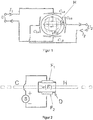
- a gyrator for alternating current signals comprises a Hall effect material, means for enforcing this Hall effect material with a magnetic field perpendicular to its plane or surface, at least one input port for coupling an alternating current (I 1 ; I 2 ) into the Hall effect material as well at least one output gate for coupling out an output voltage (U 2 ; U 1 ) which is a measure of the Hall voltage generated by the coupled-in alternating current.
- Each of these gates has at least two connections that are connected to the outside world.
- the Hall effect material can, for example, be a gallium arsenide heterostructure, an electrically conductive monolayer / monolayer such as graphene or a another material that is electrically conductive in two dimensions. Its shape in the two dimensions in which it is conductive can in particular be round or almost round. In principle, however, it is not subject to any restrictions. Ideally, it should be a topological body in the sense that a defined current direction for the input current exists on it in one spatial dimension and a charge separation caused by the Hall effect can take place in another, ideally perpendicular, spatial dimension.
- connection electrode which is electrically isolated from the Hall effect material and forms a capacitor with the Hall effect material.
- the alternating current is thus capacitively coupled into the Hall effect material, and the output voltage is capacitively coupled out of the Hall effect material.
- the capacitor advantageously has a capacitance of at least 300 aF, preferably a capacitance of at least 1 fF.
- connection electrode If only one connection of a gate is connected to a connection electrode, the other connection can be connected to a defined potential to establish a reference point for the input current or for the output voltage, for example outside the Hall effect material. If only one connection of two or more ports is connected to a connection electrode, in particular all connections that are not connected to a connection electrode can be connected to the same defined potential outside of the Hall effect material. They can then optionally also be connected to one another.
- connection electrodes and the Hall effect material can be, for example, a vacuum, an air gap or an insulating layer applied to the Hall effect material or applied around the Hall effect material.
- the Hall effect material can also be completely encapsulated in an insulating material.
- connection electrodes can consist of metal, doped semiconductors or other conductive materials without a large Hall effect.
- the connections between the connections and the connection electrodes and between the connections and the outside world can be realized by conventional wires.
- connection electrodes In the galvanic coupling of the Hall effect material with the input and output ports according to the state of the art, the direct contact of connection electrodes with the Hall effect material dictated boundary conditions that would result in a local potential distribution within the which would be disadvantageous for efficiency Hall effect material.
- An electrically conductive connection electrode forced the local potential to a common value in the entire area in which it was directly applied to the Hall effect material. This compulsion ended abruptly at the edge of the connection electrode. The potential in the Hall effect material made discontinuous jumps in these edge areas. Even if the Hall effect material was perfect as such and had a Hall angle of approximately 90 degrees, energy was locally dissipated in the area of these cracks.
- connection electrode and the Hall effect material function as plates of a capacitor, a charge present on one of these two plates influences a corresponding polarization charge on the other plate. This is done according to the general rules of electrostatics, according to which the influence of a charge present on one plate on the other depends on the distance to this charge via continuous functions. Therefore, the boundary conditions that the connection electrode specifies for the potential distribution in the Hall effect material are not discontinuous from the start. The occurrence of "hot spots" at which energy is dissipated in the area of potential jumps can thus advantageously be reduced or even completely prevented.
- the capacitor specifies boundary conditions for the spatial distribution of the potential in the Hall effect material, which allow a constant potential profile in the area of the Hall effect material, the edge of the connection electrode directly opposite.
- connection electrode input electrode
- an alternating current applied to the input gate can already be converted into the Hall, which is at an undefined ("floating") potential -Effect material can be coupled.
- This alternating current charges and discharges periodically the from the input electrode and the Hall effect material formed capacitor.
- the current creates an electromotive force in the Hall effect material, which leads to charge separation and thus to the formation of a Hall voltage perpendicular to the direction of the current and to the magnetic field.
- This charge shift also has an effect on the area opposite the connection electrode (output electrode) belonging to the output gate. A corresponding polarization charge is influenced on this output electrode, so that its potential is changed.
- One output electrode is sufficient for this if the other connection of the output gate is connected to a suitable reference point outside of the Hall effect material. If the input gate and output gate are interchanged, the sign of the output voltage is reversed so that it is out of phase with the input current.
- Both connections of the input gate are each connected to a connection electrode (input electrode), both input electrodes being electrically isolated from the Hall effect material and each forming a capacitor with the Hall effect material. Then the alternating current between the two input electrodes can be driven through the Hall effect material. This gives the current a defined direction through the Hall effect material, which in turn determines the direction in which the charge separation takes place.
- Both connections of the output gate are each advantageously connected to a connection electrode (output electrode), both output electrodes being electrically isolated from the Hall effect material and each forming a capacitor with the Hall effect material. Then the output voltage between the two connections of the output gate corresponds to the voltage in the Hall-effect material which drops between the two output electrodes. This output voltage has no external reference point and is therefore more meaningful.
- connection electrodes then each form a capacitor with the Hall effect material. Two of the connection electrodes are then input electrodes, two are output electrodes.
- a gyrator with three gates can be produced, for example, from the aforementioned exemplary embodiment with four connection electrodes, in that an input connection and an output connection are conductively connected to one another and interpreted as a connection of the third gate . This can optionally also be earthed.
- the gyrator according to the invention can have this ideal characteristic when the Hall angle ⁇ of the Hall effect material is approximately 90 °.
- a gyrator with 3, 5 or 6 ports can also be used as a circulator, for example.
- the gates can then be arranged in a cyclical sequence in such a way that an input current applied to one gate can be tapped at the next gate in the series as an in-phase output voltage, while at the previous gate in the series it can be tapped as an anti-phase output voltage.
- the Hall effect material has such an extension in at least two spatial dimensions that it contains at least one million mobile electrons in both spatial dimensions along each of these spatial dimensions. If this critical limit is reached, the Hall effect and thus the effect of the gyrator are almost at full strength. If the dimensions of the material are increased further, only a comparatively small increase can be achieved. Small structures are technically more difficult to manufacture than massive bodies, such as disks, made of the Hall effect material. Instead, less of the valuable Hall-effect material is required to manufacture them.
- the Hall effect material can advantageously have an extension of at least 100 nm, preferably at least 500 nm and very particularly preferably at least 1 ⁇ m in at least two spatial dimensions. Structures with a size of at least 1 ⁇ m offer a particularly good compromise between material savings and manufacturing complexity, since they can be manufactured with technically less demanding diffraction-limited lithography.
- the local capacitance per unit length measured along an outer circumference of the Hall effect material, which leads from a connection electrode (input electrode) connected to the input port to a connection electrode (output electrode) connected to the output port, is measured in the Edge areas of the connection electrodes less than in the other areas of the connection electrodes.
- the range of frequencies ⁇ for which this boundary condition can be fulfilled therefore depends on the course of c (s).
- the c (s) that best fits a range of desired operating frequencies ⁇ of the gyrator can be determined, for example, by means of parameter optimization or variation calculation.
- the solutions of the differential equation are very benign in the sense that no discontinuities and therefore no energy dissipating "hot spots" in the Hall Effect material occur.
- the Hall effect material is a quantum Hall effect material with a Hall angle ⁇ of 90 °
- the calculation results in the total dissipated Joule heat as a scalar product j ( r ) ⁇ ⁇ V ( r ) anywhere r in the Hall effect material zero, since both vectors are always perpendicular to each other.
- the angle between the two vectors corresponds to the Hall angle ⁇ .
- the local capacitance per unit length of the capacitor formed by each connection electrode with the Hall effect material is advantageously limited along an outer circumference of the Hall effect material, which leads from a connection electrode connected to the input port to a connection electrode connected to the output port .
- the capacitance per length c (s) can be varied, for example, by varying the overlap of the connection electrode with the Hall effect material and / or the thickness and / or the dielectric constant of the insulation between the connection electrode and Hall effect material. However, in a further particularly advantageous embodiment of the invention, it can also be varied during the running time of the gyrator.
- means are provided for applying an electrical bias field to the insulating area between at least one connection electrode and the Hall effect material, which changes the spatial distribution of the capacitance over the area of the connection electrode.
- the capacitor then advantageously contains a ferroelectric or a nonlinear dielectric as insulation between the connection electrode and the Hall effect material.
- connection electrodes are arranged along an outer circumference of the Hall effect material in such a way that in opposite directions along this circumference from one connection electrode to the adjacent connection electrode Paths are to be covered whose lengths do not differ by more than 10%.
- the connection electrodes are then evenly distributed along the outer circumference of the Hall effect material. If the Hall effect material is, for example, in the form of a circular ring or circular disk, in a gyrator with two input electrodes belonging to an input gate and two output electrodes belonging to an output gate, i.e. a total of four connection electrodes, the connection electrodes are offset by 90 ° to one another along the circumference of the circle .
- these structures can have holes in order to save weight and material.
- the total area of the holes can be up to nine times the area covered with the Hall effect material.
- the outer circumference of the Hall effect material has a self-similar, in particular fractal, structure at least in a partial area in which one of the connection electrodes forms a capacitor with it.
- a self-similar, in particular fractal, structure is one of the structures with the greatest length L with minimal material consumption at the same time, which topologically can still be viewed as a body, so that there is a defined current direction and a direction for the charge separation through the Hall effect .
- connection electrode can partially overlap a flat area of the Hall effect material, either on one side or on both sides, in each case spaced apart by suitable insulation.
- another strongly wound structure can also be used, for example an interdigitating structure such as is used for metal electrodes of thin-film capacitors.
- ⁇ is the conductivity of the Hall material.
- a necessary prerequisite for this symmetrical shape of the matrix Y 2 ( ⁇ ) is that the capacitors formed by all connection electrodes with the Hall effect material have the same capacitance. Therefore, in a particularly advantageous embodiment of the invention, the capacitors formed by all connection electrodes with the Hall effect material each have capacitances that differ from one another by at most 10%.
- connection electrodes with the Hall effect material each form a capacitor whose capacitance is constant at least in sections
- the impedance of the gyrator is set by the value of ⁇ and, in particular, adapted to the devices or components of the outside world which are connected to the gates. As a rule, efforts are made to increase ⁇ in order to bring the impedance close to the standard impedance for high frequency applications of 50 ⁇ .
- connection electrodes that, in total, form the same capacitances with the Hall effect material. This can be achieved, for example, in that one connection of each of the three ports is connected to a connection electrode and all three connection electrodes form the same capacitances with the Hall effect material.
- connection electrodes two of which each form half the capacitance with the Hall effect material as the other two. The two Connection electrodes with half the capacity are then connected to one another and assigned to the same port.
- the Hall effect material therefore forms a capacitor with at least one connection electrode along at least one outer circumference over at least 2%, preferably between 50% and 70%, of the length of this outer circumference.
- connection electrode with several layers of the Hall effect material that are electrically insulated from one another forms a capacitor.
- the Hall effect material is a stack of several such layers, for example in the form of disks, the gyratory effect, i.e. the amount of the proportionality constant between output voltage and input current, is advantageously increased and edge effects of the capacitor are reduced.
- the Hall effect material is a quantum Hall effect material.
- the Hall angle ⁇ by which the charge separation is tilted from the current direction through the material is then approximately 90 °.
- some Hall effect materials without the quantum Hall effect such as arsenic, antimony, bismuth, ⁇ -tin (gray tin), graphite and thin layers of doped semiconductors. For many other materials there are temperature ranges in which they also have this property.
- a constant potential profile inside the Hall effect material means that no more energy is dissipated at "hot spots".
- a lossless gyrator which is also passive and therefore does not produce any additional noise, can be used particularly advantageously in low-temperature experiments in which dissipation would lead to undesired heating.
- the freedom from noise is particularly advantageous in experiments with qubits. In principle, however, all applications in the radio and audio frequency range below 100 MHz benefit from the availability of the gyrator according to the invention.
- the Hall effect material has a Hall angle ⁇ which is as close as possible to 90 °, and for this requires the smallest possible magnetic field.
- the Hall properties should not suffer as a result of the further processing steps for producing the finished component gyrator. It is advantageous if the Hall effect material can be easily structured and mechanically processed and if several layers of this material can easily be connected in parallel in order to increase the capacitance of the capacitor.
- Is in here r the two-dimensional position vector in the plane of the Hall effect material.
- ⁇ is the conductivity, which in two dimensions has the unit amperes per volt.
- R ⁇ is an operator that rotates a vector by the angle ⁇ around an axis that is parallel to the magnetic field with which the Hall effect material is permeated and is perpendicular to the plane in which the two-dimensional electron gas is movable .
- û is any unit vector in this plane.
- connection electrodes lead a local capacitance along the outer circumference of the Hall effect material c ( s ) per unit of length as a function of location s on this outer circumference. In the area of the connection electrodes is c ( s ) at last; falls into the gaps between the connection electrodes c ( s ) down to zero.
- C capacitance of a capacitor
Landscapes
- Hall/Mr Elements (AREA)
- Filters And Equalizers (AREA)
- Measuring Magnetic Variables (AREA)
Applications Claiming Priority (2)
| Application Number | Priority Date | Filing Date | Title |
|---|---|---|---|
| DE102013018011.2A DE102013018011B4 (de) | 2013-11-29 | 2013-11-29 | Kapazitiv gekoppelter Gyrator auf Basis des Hall-Effekts |
| PCT/DE2014/000558 WO2015078426A1 (de) | 2013-11-29 | 2014-10-31 | Kapazitiv gekoppelter gyrator auf basis des hall-effekts |
Publications (2)
| Publication Number | Publication Date |
|---|---|
| EP3075073A1 EP3075073A1 (de) | 2016-10-05 |
| EP3075073B1 true EP3075073B1 (de) | 2020-08-19 |
Family
ID=52103022
Family Applications (1)
| Application Number | Title | Priority Date | Filing Date |
|---|---|---|---|
| EP14812707.9A Active EP3075073B1 (de) | 2013-11-29 | 2014-10-31 | Kapazitiv gekoppelter gyrator auf basis des hall-effekts |
Country Status (6)
| Country | Link |
|---|---|
| US (1) | US9712129B2 (enExample) |
| EP (1) | EP3075073B1 (enExample) |
| JP (1) | JP6556131B2 (enExample) |
| CN (1) | CN106416065B (enExample) |
| DE (1) | DE102013018011B4 (enExample) |
| WO (1) | WO2015078426A1 (enExample) |
Families Citing this family (4)
| Publication number | Priority date | Publication date | Assignee | Title |
|---|---|---|---|---|
| US10480288B2 (en) * | 2014-10-15 | 2019-11-19 | Baker Hughes, A Ge Company, Llc | Articles containing carbon composites and methods of manufacture |
| US10069065B2 (en) * | 2015-04-01 | 2018-09-04 | Texas Instruments Incorporated | Low noise graphene hall sensors, systems and methods of making and using same |
| CN112798867B (zh) * | 2020-12-28 | 2023-03-14 | 北京东方计量测试研究所 | 一种实现组合式量子霍尔电阻样品的基座 |
| CN114611704B (zh) * | 2022-05-11 | 2022-10-25 | 苏州浪潮智能科技有限公司 | 一种量子比特耦合方法和结构 |
Citations (2)
| Publication number | Priority date | Publication date | Assignee | Title |
|---|---|---|---|---|
| US3214682A (en) * | 1961-09-26 | 1965-10-26 | Bell Telephone Labor Inc | Low-loss hall-effect devices |
| US6100773A (en) * | 1997-10-07 | 2000-08-08 | Sharp Kabushiki Kaisha | Impedance matching device |
Family Cites Families (11)
| Publication number | Priority date | Publication date | Assignee | Title |
|---|---|---|---|---|
| US2944220A (en) | 1947-04-29 | 1960-07-05 | Philips Corp | Circuit arrangement comprising a passive electrical quadripole |
| US2649574A (en) | 1951-04-05 | 1953-08-18 | Bell Telephone Labor Inc | Hall-effect wave translating device |
| CA651754A (en) * | 1959-04-09 | 1962-11-06 | N.V. Philips Gloeilampenfabrieken | Electrical transmission device containing a body made of semi-conductor material |
| GB959018A (enExample) * | 1959-06-24 | |||
| US3047821A (en) * | 1960-12-27 | 1962-07-31 | Aircraft Armaments Inc | Isolator using hall effect gyrator |
| JPH07162055A (ja) * | 1993-12-01 | 1995-06-23 | Showa Denko Kk | ホール素子 |
| CN105185780B (zh) * | 2007-11-02 | 2019-04-05 | 村田整合被动式解决方案公司 | 多层结构及其制造方法 |
| WO2009070201A1 (en) * | 2007-11-27 | 2009-06-04 | Micromem Technologies Inc. | Sensor for a magnetic memory device and method of manufacturing the same |
| US7956438B2 (en) * | 2008-11-21 | 2011-06-07 | Xilinx, Inc. | Integrated capacitor with interlinked lateral fins |
| DE102013006377B3 (de) | 2013-04-13 | 2014-05-22 | Forschungszentrum Jülich GmbH | Effizienter passiver breitbandiger Gyrator |
| US9276197B2 (en) * | 2013-11-21 | 2016-03-01 | The United States Of America As Represented By The Secretary Of The Navy | Hybrid domain wall-hall cross device |
-
2013
- 2013-11-29 DE DE102013018011.2A patent/DE102013018011B4/de not_active Expired - Fee Related
-
2014
- 2014-10-31 JP JP2016534909A patent/JP6556131B2/ja not_active Expired - Fee Related
- 2014-10-31 EP EP14812707.9A patent/EP3075073B1/de active Active
- 2014-10-31 CN CN201480065070.3A patent/CN106416065B/zh not_active Expired - Fee Related
- 2014-10-31 WO PCT/DE2014/000558 patent/WO2015078426A1/de not_active Ceased
- 2014-10-31 US US15/037,201 patent/US9712129B2/en not_active Expired - Fee Related
Patent Citations (2)
| Publication number | Priority date | Publication date | Assignee | Title |
|---|---|---|---|---|
| US3214682A (en) * | 1961-09-26 | 1965-10-26 | Bell Telephone Labor Inc | Low-loss hall-effect devices |
| US6100773A (en) * | 1997-10-07 | 2000-08-08 | Sharp Kabushiki Kaisha | Impedance matching device |
Non-Patent Citations (3)
| Title |
|---|
| LIYUAN ZHANG ET AL: "The experimental observation of quantum Hall effect of l = 3 chiral charge carriers in trilayer graphene", ARXIV.ORG, CORNELL UNIVERSITY LIBRARY, 201 OLIN LIBRARY CORNELL UNIVERSITY ITHACA, NY 14853, 30 March 2011 (2011-03-30), XP080546966, DOI: 10.1038/NPHYS2104 * |
| MACIEJ J OGORZALEK: "APPLICATIONS OF FRACTALS IN ELECTRONICS", 20 July 2007 (2007-07-20), XP055672053, Retrieved from the Internet <URL:http://cktse.eie.polyu.edu.hk/csn2007/Presentation%20Slides_files/MaciejOgorzalek.pdf> [retrieved on 20200227] * |
| MICHAEL LEVIN ET AL: "Gapless layered three-dimensional fractional quantum Hall states", ARXIV.ORG, CORNELL UNIVERSITY LIBRARY, 201 OLIN LIBRARY CORNELL UNIVERSITY ITHACA, NY 14853, 5 February 2009 (2009-02-05), XP080309392, DOI: 10.1103/PHYSREVB.79.235315 * |
Also Published As
| Publication number | Publication date |
|---|---|
| CN106416065B (zh) | 2020-05-08 |
| JP6556131B2 (ja) | 2019-08-07 |
| DE102013018011B4 (de) | 2022-06-09 |
| DE102013018011A1 (de) | 2015-06-03 |
| EP3075073A1 (de) | 2016-10-05 |
| WO2015078426A1 (de) | 2015-06-04 |
| US20160294345A1 (en) | 2016-10-06 |
| JP2017512387A (ja) | 2017-05-18 |
| CN106416065A (zh) | 2017-02-15 |
| US9712129B2 (en) | 2017-07-18 |
Similar Documents
| Publication | Publication Date | Title |
|---|---|---|
| DE69523940T2 (de) | Plasmakontrollgerät für grosse werkstücke | |
| EP3075073B1 (de) | Kapazitiv gekoppelter gyrator auf basis des hall-effekts | |
| DE1964670B2 (de) | Wellenleiter mit einem dielektrischen traeger sowie richtungskoppler, richtleiter und resonanz-bandpassfilter unter verwendung eines solchen wellenleiters | |
| EP2593987A1 (de) | Koaxialleiterstruktur | |
| DE102010009024A1 (de) | HF-Resonatorkavität und Beschleuniger | |
| DE1032415B (de) | Rueckwaertswellen-Oszillatorroehre | |
| EP1941311B1 (de) | Metamaterial mit der fähigkeit zur breitbandigen linkshändigen leitung elektromagnetischer wellen | |
| DE102015009221A1 (de) | Verbesserter abstimmbarer Dual-Band-Bandpassfilter | |
| DE112004001793B3 (de) | Verfahren zum Auffangen und Erregen von Ionen in einer Messzelle eines FT Massenspektrometers sowie eine solche Messzelle und ein damit ausgestattetes Fourier-Transformations-Massenspektrometer | |
| EP2187501A1 (de) | Drahtlose elektrische stromübertragungseinrichtung | |
| WO2002007172A1 (de) | I-induktor als hochfrequenz-mikroinduktor | |
| DE102017211936A1 (de) | Flacher einstellbarer Kondensator für Magnetresonanztomograph | |
| WO2013045236A1 (de) | Hf-resonator und teilchenbeschleuniger mit hf-resonator | |
| EP2984755B1 (de) | Effizienter passiver breitbandiger gyrator | |
| DE2811750C2 (de) | Nichtreziproker Phasenschieber für elektromagnetische Höchstfrequenz-Oberflächenwellen | |
| DE2063242A1 (de) | Mikrowellen Bauelement | |
| DE1293334B (de) | Eisenkernlose Hoechstspannungs-Nebenschlussdrossel | |
| DE2928238A1 (de) | Hoechstfrequenzgeraet vom magnetrontyp | |
| DE1591565C3 (de) | Nichtreziproker Vierpol | |
| DE2243493A1 (de) | Richtantenne aus mehreren einzelstrahlern | |
| WO2020015962A1 (de) | Kernanordnung mit magnetischen eigenschaften für eine elektrische vorrichtung und drossel mit einer derartigen kernanordnung | |
| DE2362368C3 (de) | Übertragungsleitung fur elektromagnetische Energie | |
| EP1866940B1 (de) | Ferro- oder ferrimagnetische schicht, verfahren zu ihrer herstellung und ihre verwendung | |
| DE1077802B (de) | Teilchenbeschleuniger vom Synchrotrontyp mit wenigstens zwei Beschleunigungs-hohlraeumen | |
| WO2012045520A1 (de) | Koaxialer wellenleiter mit hf-sender |
Legal Events
| Date | Code | Title | Description |
|---|---|---|---|
| PUAI | Public reference made under article 153(3) epc to a published international application that has entered the european phase |
Free format text: ORIGINAL CODE: 0009012 |
|
| 17P | Request for examination filed |
Effective date: 20160422 |
|
| AK | Designated contracting states |
Kind code of ref document: A1 Designated state(s): AL AT BE BG CH CY CZ DE DK EE ES FI FR GB GR HR HU IE IS IT LI LT LU LV MC MK MT NL NO PL PT RO RS SE SI SK SM TR |
|
| AX | Request for extension of the european patent |
Extension state: BA ME |
|
| RIN1 | Information on inventor provided before grant (corrected) |
Inventor name: DIVINCENZO, DAVID Inventor name: VIOLA, GIOVANNI |
|
| DAX | Request for extension of the european patent (deleted) | ||
| STAA | Information on the status of an ep patent application or granted ep patent |
Free format text: STATUS: EXAMINATION IS IN PROGRESS |
|
| 17Q | First examination report despatched |
Effective date: 20191021 |
|
| GRAP | Despatch of communication of intention to grant a patent |
Free format text: ORIGINAL CODE: EPIDOSNIGR1 |
|
| STAA | Information on the status of an ep patent application or granted ep patent |
Free format text: STATUS: GRANT OF PATENT IS INTENDED |
|
| INTG | Intention to grant announced |
Effective date: 20200324 |
|
| GRAS | Grant fee paid |
Free format text: ORIGINAL CODE: EPIDOSNIGR3 |
|
| GRAA | (expected) grant |
Free format text: ORIGINAL CODE: 0009210 |
|
| STAA | Information on the status of an ep patent application or granted ep patent |
Free format text: STATUS: THE PATENT HAS BEEN GRANTED |
|
| RAP1 | Party data changed (applicant data changed or rights of an application transferred) |
Owner name: FORSCHUNGSZENTRUM JUELICH GMBH |
|
| AK | Designated contracting states |
Kind code of ref document: B1 Designated state(s): AL AT BE BG CH CY CZ DE DK EE ES FI FR GB GR HR HU IE IS IT LI LT LU LV MC MK MT NL NO PL PT RO RS SE SI SK SM TR |
|
| REG | Reference to a national code |
Ref country code: CH Ref legal event code: EP |
|
| REG | Reference to a national code |
Ref country code: DE Ref legal event code: R096 Ref document number: 502014014656 Country of ref document: DE |
|
| REG | Reference to a national code |
Ref country code: AT Ref legal event code: REF Ref document number: 1305114 Country of ref document: AT Kind code of ref document: T Effective date: 20200915 |
|
| REG | Reference to a national code |
Ref country code: IE Ref legal event code: FG4D Free format text: LANGUAGE OF EP DOCUMENT: GERMAN |
|
| REG | Reference to a national code |
Ref country code: FI Ref legal event code: FGE |
|
| REG | Reference to a national code |
Ref country code: LT Ref legal event code: MG4D |
|
| REG | Reference to a national code |
Ref country code: NL Ref legal event code: MP Effective date: 20200819 |
|
| PG25 | Lapsed in a contracting state [announced via postgrant information from national office to epo] |
Ref country code: NO Free format text: LAPSE BECAUSE OF FAILURE TO SUBMIT A TRANSLATION OF THE DESCRIPTION OR TO PAY THE FEE WITHIN THE PRESCRIBED TIME-LIMIT Effective date: 20201119 Ref country code: PT Free format text: LAPSE BECAUSE OF FAILURE TO SUBMIT A TRANSLATION OF THE DESCRIPTION OR TO PAY THE FEE WITHIN THE PRESCRIBED TIME-LIMIT Effective date: 20201221 Ref country code: BG Free format text: LAPSE BECAUSE OF FAILURE TO SUBMIT A TRANSLATION OF THE DESCRIPTION OR TO PAY THE FEE WITHIN THE PRESCRIBED TIME-LIMIT Effective date: 20201119 Ref country code: SE Free format text: LAPSE BECAUSE OF FAILURE TO SUBMIT A TRANSLATION OF THE DESCRIPTION OR TO PAY THE FEE WITHIN THE PRESCRIBED TIME-LIMIT Effective date: 20200819 Ref country code: LT Free format text: LAPSE BECAUSE OF FAILURE TO SUBMIT A TRANSLATION OF THE DESCRIPTION OR TO PAY THE FEE WITHIN THE PRESCRIBED TIME-LIMIT Effective date: 20200819 Ref country code: GR Free format text: LAPSE BECAUSE OF FAILURE TO SUBMIT A TRANSLATION OF THE DESCRIPTION OR TO PAY THE FEE WITHIN THE PRESCRIBED TIME-LIMIT Effective date: 20201120 Ref country code: HR Free format text: LAPSE BECAUSE OF FAILURE TO SUBMIT A TRANSLATION OF THE DESCRIPTION OR TO PAY THE FEE WITHIN THE PRESCRIBED TIME-LIMIT Effective date: 20200819 |
|
| PG25 | Lapsed in a contracting state [announced via postgrant information from national office to epo] |
Ref country code: PL Free format text: LAPSE BECAUSE OF FAILURE TO SUBMIT A TRANSLATION OF THE DESCRIPTION OR TO PAY THE FEE WITHIN THE PRESCRIBED TIME-LIMIT Effective date: 20200819 Ref country code: LV Free format text: LAPSE BECAUSE OF FAILURE TO SUBMIT A TRANSLATION OF THE DESCRIPTION OR TO PAY THE FEE WITHIN THE PRESCRIBED TIME-LIMIT Effective date: 20200819 Ref country code: NL Free format text: LAPSE BECAUSE OF FAILURE TO SUBMIT A TRANSLATION OF THE DESCRIPTION OR TO PAY THE FEE WITHIN THE PRESCRIBED TIME-LIMIT Effective date: 20200819 Ref country code: RS Free format text: LAPSE BECAUSE OF FAILURE TO SUBMIT A TRANSLATION OF THE DESCRIPTION OR TO PAY THE FEE WITHIN THE PRESCRIBED TIME-LIMIT Effective date: 20200819 Ref country code: IS Free format text: LAPSE BECAUSE OF FAILURE TO SUBMIT A TRANSLATION OF THE DESCRIPTION OR TO PAY THE FEE WITHIN THE PRESCRIBED TIME-LIMIT Effective date: 20201219 |
|
| RAP4 | Party data changed (patent owner data changed or rights of a patent transferred) |
Owner name: FORSCHUNGSZENTRUM JUELICH GMBH |
|
| PG25 | Lapsed in a contracting state [announced via postgrant information from national office to epo] |
Ref country code: EE Free format text: LAPSE BECAUSE OF FAILURE TO SUBMIT A TRANSLATION OF THE DESCRIPTION OR TO PAY THE FEE WITHIN THE PRESCRIBED TIME-LIMIT Effective date: 20200819 Ref country code: SM Free format text: LAPSE BECAUSE OF FAILURE TO SUBMIT A TRANSLATION OF THE DESCRIPTION OR TO PAY THE FEE WITHIN THE PRESCRIBED TIME-LIMIT Effective date: 20200819 Ref country code: RO Free format text: LAPSE BECAUSE OF FAILURE TO SUBMIT A TRANSLATION OF THE DESCRIPTION OR TO PAY THE FEE WITHIN THE PRESCRIBED TIME-LIMIT Effective date: 20200819 Ref country code: DK Free format text: LAPSE BECAUSE OF FAILURE TO SUBMIT A TRANSLATION OF THE DESCRIPTION OR TO PAY THE FEE WITHIN THE PRESCRIBED TIME-LIMIT Effective date: 20200819 Ref country code: CZ Free format text: LAPSE BECAUSE OF FAILURE TO SUBMIT A TRANSLATION OF THE DESCRIPTION OR TO PAY THE FEE WITHIN THE PRESCRIBED TIME-LIMIT Effective date: 20200819 |
|
| REG | Reference to a national code |
Ref country code: DE Ref legal event code: R097 Ref document number: 502014014656 Country of ref document: DE |
|
| PG25 | Lapsed in a contracting state [announced via postgrant information from national office to epo] |
Ref country code: ES Free format text: LAPSE BECAUSE OF FAILURE TO SUBMIT A TRANSLATION OF THE DESCRIPTION OR TO PAY THE FEE WITHIN THE PRESCRIBED TIME-LIMIT Effective date: 20200819 Ref country code: AL Free format text: LAPSE BECAUSE OF FAILURE TO SUBMIT A TRANSLATION OF THE DESCRIPTION OR TO PAY THE FEE WITHIN THE PRESCRIBED TIME-LIMIT Effective date: 20200819 |
|
| PLBE | No opposition filed within time limit |
Free format text: ORIGINAL CODE: 0009261 |
|
| STAA | Information on the status of an ep patent application or granted ep patent |
Free format text: STATUS: NO OPPOSITION FILED WITHIN TIME LIMIT |
|
| PG25 | Lapsed in a contracting state [announced via postgrant information from national office to epo] |
Ref country code: MC Free format text: LAPSE BECAUSE OF FAILURE TO SUBMIT A TRANSLATION OF THE DESCRIPTION OR TO PAY THE FEE WITHIN THE PRESCRIBED TIME-LIMIT Effective date: 20200819 Ref country code: SK Free format text: LAPSE BECAUSE OF FAILURE TO SUBMIT A TRANSLATION OF THE DESCRIPTION OR TO PAY THE FEE WITHIN THE PRESCRIBED TIME-LIMIT Effective date: 20200819 Ref country code: LU Free format text: LAPSE BECAUSE OF NON-PAYMENT OF DUE FEES Effective date: 20201031 |
|
| REG | Reference to a national code |
Ref country code: BE Ref legal event code: MM Effective date: 20201031 |
|
| 26N | No opposition filed |
Effective date: 20210520 |
|
| PG25 | Lapsed in a contracting state [announced via postgrant information from national office to epo] |
Ref country code: IT Free format text: LAPSE BECAUSE OF FAILURE TO SUBMIT A TRANSLATION OF THE DESCRIPTION OR TO PAY THE FEE WITHIN THE PRESCRIBED TIME-LIMIT Effective date: 20200819 Ref country code: FR Free format text: LAPSE BECAUSE OF NON-PAYMENT OF DUE FEES Effective date: 20201031 |
|
| PG25 | Lapsed in a contracting state [announced via postgrant information from national office to epo] |
Ref country code: SI Free format text: LAPSE BECAUSE OF FAILURE TO SUBMIT A TRANSLATION OF THE DESCRIPTION OR TO PAY THE FEE WITHIN THE PRESCRIBED TIME-LIMIT Effective date: 20200819 Ref country code: BE Free format text: LAPSE BECAUSE OF NON-PAYMENT OF DUE FEES Effective date: 20201031 |
|
| PGFP | Annual fee paid to national office [announced via postgrant information from national office to epo] |
Ref country code: AT Payment date: 20211019 Year of fee payment: 8 Ref country code: FI Payment date: 20211019 Year of fee payment: 8 Ref country code: GB Payment date: 20211022 Year of fee payment: 8 Ref country code: IE Payment date: 20211021 Year of fee payment: 8 Ref country code: DE Payment date: 20210826 Year of fee payment: 8 |
|
| PGFP | Annual fee paid to national office [announced via postgrant information from national office to epo] |
Ref country code: CH Payment date: 20211022 Year of fee payment: 8 |
|
| PG25 | Lapsed in a contracting state [announced via postgrant information from national office to epo] |
Ref country code: TR Free format text: LAPSE BECAUSE OF FAILURE TO SUBMIT A TRANSLATION OF THE DESCRIPTION OR TO PAY THE FEE WITHIN THE PRESCRIBED TIME-LIMIT Effective date: 20200819 Ref country code: MT Free format text: LAPSE BECAUSE OF FAILURE TO SUBMIT A TRANSLATION OF THE DESCRIPTION OR TO PAY THE FEE WITHIN THE PRESCRIBED TIME-LIMIT Effective date: 20200819 Ref country code: CY Free format text: LAPSE BECAUSE OF FAILURE TO SUBMIT A TRANSLATION OF THE DESCRIPTION OR TO PAY THE FEE WITHIN THE PRESCRIBED TIME-LIMIT Effective date: 20200819 |
|
| PG25 | Lapsed in a contracting state [announced via postgrant information from national office to epo] |
Ref country code: MK Free format text: LAPSE BECAUSE OF FAILURE TO SUBMIT A TRANSLATION OF THE DESCRIPTION OR TO PAY THE FEE WITHIN THE PRESCRIBED TIME-LIMIT Effective date: 20200819 |
|
| REG | Reference to a national code |
Ref country code: DE Ref legal event code: R119 Ref document number: 502014014656 Country of ref document: DE |
|
| REG | Reference to a national code |
Ref country code: CH Ref legal event code: PL |
|
| REG | Reference to a national code |
Ref country code: AT Ref legal event code: MM01 Ref document number: 1305114 Country of ref document: AT Kind code of ref document: T Effective date: 20221031 |
|
| GBPC | Gb: european patent ceased through non-payment of renewal fee |
Effective date: 20221031 |
|
| PG25 | Lapsed in a contracting state [announced via postgrant information from national office to epo] |
Ref country code: LI Free format text: LAPSE BECAUSE OF NON-PAYMENT OF DUE FEES Effective date: 20221031 Ref country code: DE Free format text: LAPSE BECAUSE OF NON-PAYMENT OF DUE FEES Effective date: 20230503 Ref country code: CH Free format text: LAPSE BECAUSE OF NON-PAYMENT OF DUE FEES Effective date: 20221031 Ref country code: AT Free format text: LAPSE BECAUSE OF NON-PAYMENT OF DUE FEES Effective date: 20221031 |
|
| PG25 | Lapsed in a contracting state [announced via postgrant information from national office to epo] |
Ref country code: IE Free format text: LAPSE BECAUSE OF NON-PAYMENT OF DUE FEES Effective date: 20221031 Ref country code: GB Free format text: LAPSE BECAUSE OF NON-PAYMENT OF DUE FEES Effective date: 20221031 |
|
| PG25 | Lapsed in a contracting state [announced via postgrant information from national office to epo] |
Ref country code: FI Free format text: LAPSE BECAUSE OF NON-PAYMENT OF DUE FEES Effective date: 20221031 |