EP3057667B1 - Steroid-carbonsäureester, zusammensetzungen, enthaltend steroid-carbonsäureester und verwendung dieser bei lokal topischer applikation für kosmetische oder dermatologische zwecke - Google Patents
Steroid-carbonsäureester, zusammensetzungen, enthaltend steroid-carbonsäureester und verwendung dieser bei lokal topischer applikation für kosmetische oder dermatologische zwecke Download PDFInfo
- Publication number
- EP3057667B1 EP3057667B1 EP14796679.0A EP14796679A EP3057667B1 EP 3057667 B1 EP3057667 B1 EP 3057667B1 EP 14796679 A EP14796679 A EP 14796679A EP 3057667 B1 EP3057667 B1 EP 3057667B1
- Authority
- EP
- European Patent Office
- Prior art keywords
- carboxylic acid
- acid ester
- steroid
- composition
- accordance
- Prior art date
- Legal status (The legal status is an assumption and is not a legal conclusion. Google has not performed a legal analysis and makes no representation as to the accuracy of the status listed.)
- Active
Links
Classifications
-
- A—HUMAN NECESSITIES
- A61—MEDICAL OR VETERINARY SCIENCE; HYGIENE
- A61K—PREPARATIONS FOR MEDICAL, DENTAL OR TOILETRY PURPOSES
- A61K8/00—Cosmetics or similar toiletry preparations
- A61K8/18—Cosmetics or similar toiletry preparations characterised by the composition
- A61K8/30—Cosmetics or similar toiletry preparations characterised by the composition containing organic compounds
- A61K8/63—Steroids; Derivatives thereof
-
- A—HUMAN NECESSITIES
- A61—MEDICAL OR VETERINARY SCIENCE; HYGIENE
- A61K—PREPARATIONS FOR MEDICAL, DENTAL OR TOILETRY PURPOSES
- A61K31/00—Medicinal preparations containing organic active ingredients
- A61K31/56—Compounds containing cyclopenta[a]hydrophenanthrene ring systems; Derivatives thereof, e.g. steroids
- A61K31/565—Compounds containing cyclopenta[a]hydrophenanthrene ring systems; Derivatives thereof, e.g. steroids not substituted in position 17 beta by a carbon atom, e.g. estrane, estradiol
- A61K31/566—Compounds containing cyclopenta[a]hydrophenanthrene ring systems; Derivatives thereof, e.g. steroids not substituted in position 17 beta by a carbon atom, e.g. estrane, estradiol having an oxo group in position 17, e.g. estrone
-
- A—HUMAN NECESSITIES
- A61—MEDICAL OR VETERINARY SCIENCE; HYGIENE
- A61K—PREPARATIONS FOR MEDICAL, DENTAL OR TOILETRY PURPOSES
- A61K47/00—Medicinal preparations characterised by the non-active ingredients used, e.g. carriers or inert additives; Targeting or modifying agents chemically bound to the active ingredient
- A61K47/06—Organic compounds, e.g. natural or synthetic hydrocarbons, polyolefins, mineral oil, petrolatum or ozokerite
- A61K47/16—Organic compounds, e.g. natural or synthetic hydrocarbons, polyolefins, mineral oil, petrolatum or ozokerite containing nitrogen, e.g. nitro-, nitroso-, azo-compounds, nitriles, cyanates
- A61K47/18—Amines; Amides; Ureas; Quaternary ammonium compounds; Amino acids; Oligopeptides having up to five amino acids
- A61K47/183—Amino acids, e.g. glycine, EDTA or aspartame
-
- A—HUMAN NECESSITIES
- A61—MEDICAL OR VETERINARY SCIENCE; HYGIENE
- A61K—PREPARATIONS FOR MEDICAL, DENTAL OR TOILETRY PURPOSES
- A61K8/00—Cosmetics or similar toiletry preparations
- A61K8/02—Cosmetics or similar toiletry preparations characterised by special physical form
- A61K8/04—Dispersions; Emulsions
- A61K8/042—Gels
-
- A—HUMAN NECESSITIES
- A61—MEDICAL OR VETERINARY SCIENCE; HYGIENE
- A61K—PREPARATIONS FOR MEDICAL, DENTAL OR TOILETRY PURPOSES
- A61K8/00—Cosmetics or similar toiletry preparations
- A61K8/02—Cosmetics or similar toiletry preparations characterised by special physical form
- A61K8/04—Dispersions; Emulsions
- A61K8/06—Emulsions
-
- A—HUMAN NECESSITIES
- A61—MEDICAL OR VETERINARY SCIENCE; HYGIENE
- A61K—PREPARATIONS FOR MEDICAL, DENTAL OR TOILETRY PURPOSES
- A61K9/00—Medicinal preparations characterised by special physical form
- A61K9/0012—Galenical forms characterised by the site of application
- A61K9/0014—Skin, i.e. galenical aspects of topical compositions
-
- A—HUMAN NECESSITIES
- A61—MEDICAL OR VETERINARY SCIENCE; HYGIENE
- A61K—PREPARATIONS FOR MEDICAL, DENTAL OR TOILETRY PURPOSES
- A61K9/00—Medicinal preparations characterised by special physical form
- A61K9/06—Ointments; Bases therefor; Other semi-solid forms, e.g. creams, sticks, gels
-
- A—HUMAN NECESSITIES
- A61—MEDICAL OR VETERINARY SCIENCE; HYGIENE
- A61P—SPECIFIC THERAPEUTIC ACTIVITY OF CHEMICAL COMPOUNDS OR MEDICINAL PREPARATIONS
- A61P17/00—Drugs for dermatological disorders
-
- A—HUMAN NECESSITIES
- A61—MEDICAL OR VETERINARY SCIENCE; HYGIENE
- A61Q—SPECIFIC USE OF COSMETICS OR SIMILAR TOILETRY PREPARATIONS
- A61Q19/00—Preparations for care of the skin
-
- A—HUMAN NECESSITIES
- A61—MEDICAL OR VETERINARY SCIENCE; HYGIENE
- A61Q—SPECIFIC USE OF COSMETICS OR SIMILAR TOILETRY PREPARATIONS
- A61Q19/00—Preparations for care of the skin
- A61Q19/06—Preparations for care of the skin for countering cellulitis
-
- A—HUMAN NECESSITIES
- A61—MEDICAL OR VETERINARY SCIENCE; HYGIENE
- A61K—PREPARATIONS FOR MEDICAL, DENTAL OR TOILETRY PURPOSES
- A61K2800/00—Properties of cosmetic compositions or active ingredients thereof or formulation aids used therein and process related aspects
- A61K2800/74—Biological properties of particular ingredients
- A61K2800/75—Anti-irritant
Definitions
- the present invention relates to the use of a steroid carboxylic acid ester or a composition containing this carboxylic acid ester with topical local application for cosmetic or dermatological purposes.
- the invention also relates to the use of a steroid carboxylic acid ester or a composition containing this carboxylic acid ester in topical application for cosmetic or dermatological purposes for reducing cellulite, general skin tightening, softening stretch marks, reducing the size of scars both before and after their emergence, softening of skin irritation allergic basis or due to insect bites or UV or X-rays and general itching of the skin.
- the present invention also relates to steroid carboxylic acid esters and compositions containing them for topical application locally.
- estrogens given both systemically and topically, increase the thickness and elasticity of the skin in postmenopausal women. The increase in thickness is due to better hydration and an increase in the collagen concentration in the skin.
- the main skin estrogen receptor is ERbeta.
- topical application of formulations containing estrogen to positively influence the appearance of the skin and its properties leads to systemic and undesirable effects because of the high sensitivity of the receptor to estradiol.
- WO 97/10255 A1 relates to certain steroid carboxylic acid esters and their use for regulating skin atrophy and other skin conditions, and corresponding cosmetic and pharmaceutical preparations.
- US 4,235,893 A discloses a method for inhibiting the biosynthesis of estrogen and using certain 4-on-alkanoyl-androsten-3,17-diones, among others the corresponding acetate, the n-heptanoate and the n-dodecanoate.
- US 6,586,417 B1 describes the use of certain carboxylic acid esters of 4-hydroxy-androsten-3,17-dione to regulate athletic function in humans.
- US 2003/199487 A1 describes a method for the administration of ester derivatives of 4-hydroxytestosterone for the regulation of athletic function, the ester derivatives including acetate, heptanoate, decanoate, hemisuccinate, benzoate and propionate.
- US 4,177,267 A describes a method for improving the tissue penetration of physiologically active steroidal agents.
- the improved penetration is achieved by administering the agents together with dimethyl sulfoxide.
- Lotions, ointments and creams containing testosterone propionate derivatives are disclosed for application to the tissue.
- US 5,807,849A relates to a therapeutic method for the treatment of patients with reduced production of sex steroid precursors using dehydroepiandrosterone and dehydroepiandrosterone sulfate and their derivatives.
- Lotions, gel, ointment or cream formulations are mentioned for administration.
- a series of 3 ⁇ -carboxylic acid esters are listed which are expected to be converted to dehydroepiandrosterone in vivo. The production of dehydroepiandrosterone-3 ⁇ -undecanoate is also described.
- US 6 465 446 B1 relates to the treatment of dermatitis by the topical application of ⁇ 5-androsten-3 ⁇ -ol-7.17 diones and metabolizable precursors thereof.
- ⁇ 5-androstene-3 ⁇ -acetyl-7.17 dione is mentioned as such a precursor.
- US 2006/178352 A1 deals with the use of androgens in the treatment of cellulite.
- the androgens can be administered both by oral administration and by topical application to the skin.
- a preferred steroid derivative is testosterone undecanoate.
- cellulite and skin irritation based on allergies or due to insect bites or UV or X-rays and general itching of the skin should be able to be influenced positively.
- the present invention is based on the observation that when using certain steroid carboxylic acid esters or a composition containing them when applied locally to the skin, the steroid carboxylic acid esters, in contrast to the steroids with free hydroxyl groups, only develop their effect in certain skin cells, in others However, skin cells do not.
- the steroid carboxylic acid esters When applied topically, the steroid carboxylic acid esters quickly penetrate the stratum corneum (corneal layer) of the epidermis. From this layer, the steroid carboxylic acid esters get into the deeper keratinocyte layers of the epidermis and into the fibroblasts of the dermis. It has been found that steroid-4-carboxylic acid ester of androst-4-en-dione, with an acyl group of the carboxylic acid ester where R is selected from alkyl with at least two carbon atoms or cycloalkyl in human skin have no biological effect. A biological effect only develops after the hydrolysis of the steroid carboxylic acid ester into the free, hydroxylated steroid and the carboxylic acid.
- the hydrolysis of the steroid carboxylic acid ester takes place in the keratinocytes.
- the enzyme that catalyzes the hydrolysis of the steroid carboxylic acid ester is human carboxylesterase 2 (hCES2).
- hCES2 human carboxylesterase 2
- the proportion of steroid carboxylic acid ester that is not hydrolyzed in the keratinocyte layer and reaches the dermis remains ineffective, since the esterase is almost exclusively located in the epidermis.
- the proportion of steroid carboxylic acid ester that is not hydrolyzed in the keratinocyte layer and gets into the dermis and thus into the fibroblasts remains ineffective. This enables a very specific effect of steroids to be released in a targeted manner in the keratinocytes, while on the other hand undesirable effects in other cells, such as, for example, the fibroblasts, are avoided.
- steroid carboxylic acid esters Another advantage of steroid carboxylic acid esters is that they penetrate the stratum corneum and the underlying stratum lucidum faster than the corresponding unesterified steroids.
- the esterification of the hydroxyl groups of steroids with carboxylic acids reduces their water solubility. If the steroid carboxylic acid esters are applied to the skin, they dissolve better in the lipids of the stratum corneum and stratum lucidum than the unesterified steroid.
- the stratum corneum and stratum lucidum border the stratum granulosum, which, like the underlying layers, stratum spinosum and stratum basale of the epidermis, consists predominantly of keratinocytes. The intercellular fluid flows around these cells.
- the steroid carboxylic acid esters are more hydrophobic, they then penetrate more slowly into the keratinocyte layer, which can be regarded as an aqueous medium.
- the largely water-insoluble steroid carboxylic acid esters pass from the stratum corneum into the stratum basale only with a very delay, so that the combination of relatively easy penetration into the lipids located between the horny cells and the slower exit into the intercellular fluid leads to an enrichment of the steroid carboxylic acid esters leads in the stratum corneum (stratum corneum reservoir). This reservoir releases the stored steroid carboxylic acid esters steadily but slowly.
- the collagen synthesis of the dermis takes place in the fibroblasts.
- the enzyme aromatase is located in these cells. This enzyme is instrumental in the estrogen synthesis of the skin.
- the estrogens bind to the Estrogen receptor beta (ERbeta). This leads to an increased collagen synthesis in the fibroblasts.
- Estrogen receptor beta ERbeta
- steroids from the group of androstanones, the androst-4-en-dione, the androst-5-en-dione, the dehydroepiandrosterone, the androstentrione or the testosterone are aromatase inhibitors. When used for topical application on the skin, these steroids adversely affect estrogen synthesis.
- the aromatase inhibitors produce a large amount of metabolites which, in contrast to their precursors, no longer inhibit aromatase and which furthermore promote collagen synthesis in the fibroblasts because, like the estrogens, they also bind to the estrogen receptor beta ( ERbeta) of the fibroblasts. Accordingly, ligands for estrogen receptor beta are formed in the kerationocytes from the aromatase inhibitors at high concentrations. These metabolites of the keratinocytes have a paracrine effect on the collagen synthesis of the fibroblasts.
- the unesterified steroids from the group of androstanones, the androst-4-en-dione, the androst-5-en-dione, the dehydroepiandrosterone, the androstentrione or the testosterone therefore have both positive and negative effects.
- steroid carboxylic acid esters makes it possible to avoid the undesirable effect which reduces the positive effect of the steroids.
- This will have the positive effect of steroids on the Estrogen receptor beta and thus the effects associated with the activation of this receptor with regard to the reduction of cellulite, a general skin tightening, a reduction of stretch marks, a reduction in the size of scars both before and after their emergence, a reduction of skin irritations on an allergic basis or due to from insect bites or UV or X-ray radiation and general itching of the skin.
- the steroid carboxylic acid ester is a derivative of 4-hydroxyandrostenedione.
- the steroid-4-carboxylic acid ester of androstenedione is cleaved in the keratinocytes.
- 4-hydroxyandrostenedione a major metabolite, also forms a compound that no longer has the keto group of androstenedione at C3, but has a hydroxyl group.
- 70% of the hydroxyl groups at C3 are in the beta position. So the molecule is 3beta, 4beta-dihydroxy-5alpha-androstan-17-one.
- keto group at C-17 is reduced in the keratinocytes, and a triol is formed. This binds very well to the estrogen receptor beta (ERbeta). Steroid carboxylic acid esters of 4-hydroxyandrostenedione cause a very efficient reduction of cellulite.
- the acyl group of the carboxylic acid ester is free from polar substituents.
- the radical R which is selected from alkyl having at least two carbon atoms or cycloalkyl, has no polar substituents.
- Hydroxyl groups or other polar substituents on the acyl group have a negative effect on the formation of the reservoir effect, since the radical R would be given a more hydrophilic character by the polar substituents.
- the influences of a polar and thus hydrophilic substituent would have to be if necessary, be balanced again by further hydrophobic units. Hydroxyl groups and other polar substituents of the acyl group of the carboxylic acid ester, such as amino groups or carboxyl groups, are therefore not desirable.
- the alkyl radical of the acyl group is unbranched or branched. If the alkyl radical is selected from ethyl, propyl, isopropyl, butyl, sec-butyl (1-methylpropyl), isobutyl (2-methylpropyl), tert-butyl (1,1-dimethylethyl), pentyl, hexyl and structural isomers of pentyl or hexyl , a very good rate of hydrolysis of the steroid carboxylic acid esters by the hCES2 of the Kerationozyten can be observed.
- the cycloalkyl radical is selected from cyclopropane, cyclopentane or cyclohexane. These cycloalkyls are split off from the corresponding steroid carboxylic acid esters by the hCES2 of the Kerationozyten with a very good hydrolysis rate.
- the steroid carboxylic acid ester 4-O-propionyl-androstene-3,17-dione, 4-O-butyryl-androstene-3,17-dione, 4-O-valeryl-androstene-3, 17-dione, 4-O-caproyl-androsten-3,17-dione or 4-O-enantyl-androsten-3,17-dione.
- the steroid carboxylic acid esters have both an excellent rate of hydrolysis by the hCES2 of the generation cells and a pronounced activation of the estrogen receptor beta (ERbeta) by their metabolites formed in the generation cells.
- the steroid carboxylic acid ester is contained in a composition in an amount of 0.001 to 10% by weight, based on the total amount of the composition.
- the content of the active substance is adapted to the respective application. Active substance contents of the steroid carboxylic acid esters in the total composition of 0.001 to 5% by weight and in particular 0.3 to 2% by weight are preferably suitable.
- the steroid carboxylic acid ester is contained in a composition which is formulated as an ointment, cream, gel, oil or emulsion or lotion. This makes topical application easier.
- the composition includes additives that are customary for the corresponding formulation as an ointment, cream, gel, oil or emulsion or lotion. The other additives which may be present can be used in the amounts customary for the respective formulations.
- Another object of the invention is a composition for use in topical local application for cosmetic or dermatological purposes, the at least one steroid-4-carboxylic acid ester of androst-4-en-dione, with an acyl group of the carboxylic acid ester where R is selected from alkyl having at least two carbon atoms or cycloalkyl, in a formulation as an ointment, cream, gel, oil, emulsion or lotion.
- the composition is particularly suitable for topical local application for cosmetic and dermatological purposes for reducing cellulite, for general skin tightening, alleviating stretch marks, reducing the size of scars both before and after their emergence, alleviating skin irritation on an allergic basis or due to insect bites or UV or X-rays and general itching of the skin. It has been shown that when the composition is applied topically to the skin an improvement in the reduction of cellulite, an improved general skin tightening, an improved alleviation of stretch marks, an improvement in the reduction in the size of scars both before and after their emergence, an improved alleviation of skin irritation on an allergic basis or due to insect bites or UV or X-ray radiation and general itching of the skin.
- the steroid carboxylic acid ester is a derivative of 4-hydroxyandrostenedione.
- the radical R of the acyl group of the carboxylic acid ester is preferably an alkyl radical with at least two carbon atoms and unbranched or branched.
- the alkyl radical is advantageously selected from ethyl, propyl, isopropyl, butyl, sec-butyl (1-methylpropyl), isobutyl (2-methylpropyl), tert-butyl (1,1-dimethylethyl), pentyl, hexyl and structural isomers of pentyl or hexyl .
- Another preferred embodiment provides that the radical R of the acyl group is a cycloalkyl radical and the cycloalkyl radical is selected from cyclopropane, cyclopentane or cyclohexane.
- the acyl group of the carboxylic acid ester is free from polar substituents.
- the steroid carboxylic acid ester 4-O-propionyl-androstene-3,17-dione, 4-O-butyryl-androstene-3,17-dione, 4-O-valeryl-androstene-3, 17-dione, 4-O-caproyl-androsten-3,17-dione or 4-O-enantyl-androsten-3,17-dione.
- the steroid carboxylic acid esters have both an excellent rate of hydrolysis by the hCES2 of the generation cells and a pronounced activation of the estrogen receptor beta (ERbeta) by their metabolites formed in the generation cells.
- the steroid carboxylic acid ester is in the composition in an amount of 0.001 up to 10% by weight based on the total amount of the composition.
- the steroid carboxylic acid ester is contained in the composition in an amount of 0.001 to 5% by weight, based on the total amount of the composition.
- composition according to the invention can include cosmetic additives which are customary for the corresponding formulation as an ointment, cream, gel, oil or emulsion or lotion, such as fats, oils, waxes, alcohols, polyols, polymers, defoamers, dyes, pigments, thickeners, Surface-active substances, emulsifiers, softening substances, preservatives, antioxidants, buffer substances, fragrances and / or perfume in the amounts customary for the respective formulations.
- cosmetic additives which are customary for the corresponding formulation as an ointment, cream, gel, oil or emulsion or lotion, such as fats, oils, waxes, alcohols, polyols, polymers, defoamers, dyes, pigments, thickeners, Surface-active substances, emulsifiers, softening substances, preservatives, antioxidants, buffer substances, fragrances and / or perfume in the amounts customary for the respective formulations.
- phase InCI designation % By weight A Aqua / water 77.9968 Disodium EDTA 0.1000 Panthenol 0.1000 Sorbitol 0.4000 Xanthan 0.5000 Glycerin 5.0000 Butylene glycol 1.6000 Ethylhexylglycerol 0.4000 B Cetyl alcohol 2.0000 Dimethicone 1.1000 Potassium cetyl phosphate 0.7000 C20-22 alkyl phosphate 1.8000 C20-22 alkyl alcohols 1.5000 Capryl / Caprin triglyceride 3.0000 C Propylene glycol 1.0000 Chlorphenesin 0.2000 Phenoxyethanol 0.7000 D Jojoba oil 0.5000 Tocopheryl acetate 0.0500 Lecithin 0.0210 Tocopherol 0.0045 Ascorbyl palmitate 0.0030 Citric acid 0.0015 Ascorbyl tetraisopalmitate 0.1000 e Phytic acid 0.0800 Lactic acid 0.4500 Sodium hydroxide 0.2400 F 4-O-propionyl-androst-4-en
- phase A The ingredients of phase A are mixed and heated to 70 to 75 ° C with stirring.
- the ingredients of phase B are mixed, heated to 70 to 75 ° C and added to phase A with stirring.
- the mixture of A and B is cooled to 50 ° C. with stirring.
- Phase C is added with further stirring.
- the ingredients of phase D are mixed and added to the A + B + C phase while stirring.
- the ingredients of phase E are mixed and added to the A + B + C + D phase while stirring.
- Phase F is mixed into the phase from A + B + C + D + E with stirring at a maximum temperature of 30 to 35 ° C.
- Phase G is mixed into the phase from A + B + C + D + E + F with stirring at a maximum temperature of 25 ° C.
- Phase H is mixed into the phase from A + B + C + D + E + F + G with stirring at a maximum temperature of 25 ° C. All steps of the approach can be carried out in a vacuum mixer to achieve particularly uniform, bubble-free compositions.
- phase InCI designation % By weight A Aqua / water 78.9830 Disodium EDTA 0.1500 Sorbitol 0.4000 Glycerin 2.0000 Ethylhexylglycerol 0.4000 Xanthan 0.3000 B Cetearyl alcohol 1.9000 Capryl / Caprin triglyceride 1.7000 Cetearyglucoside 0.7900 Glyceryl stearate 0.9000 Ethylhexyl palmitate 1.6000 Cetyl palmitate 1.6000 Dicaprylyl carbonate 2.0000 shea butter 0.5000 Beeswax white - Cera alba 0.3000 Sodium polyacrylate 1.0000 PEG-100 stearate 0.9000 hydrogenated polydecene 0.8000 Trideceth-6 0.1600 C Chlorphenesin 0.2000 Phenoxyethanol 0.7000 D Jojoba oil 0.5000 Tocopheryl acetate 0.1000 Lecithin 0.0350 Tocopherol 0.0075 Ascorbyl palmitate 0.0050 Citric acid 0.0025 e Lactic acid
- phase A The ingredients of phase A are mixed and heated to 70 to 75 ° C with stirring.
- the ingredients of phase B are mixed, heated to 70 to 75 ° C and added to phase A with stirring.
- the mixture of A and B is cooled to 50 ° C. with stirring.
- Phase C is added with further stirring.
- the ingredients of phase D are mixed and added to the A + B + C phase while stirring.
- the ingredients of phase E are mixed and added to the A + B + C + D phase while stirring.
- Phase F is mixed into the phase from A + B + C + D + E with stirring at a maximum temperature of 35 to 40 ° C.
- Phase G is mixed into the phase from A + B + C + D + E + F with stirring at a maximum temperature of 35 to 40 ° C.
- Phase H is mixed into the phase from A + B + C + D + E + F + G with stirring at a maximum temperature of 30 to 35 ° C.
- Phase I is mixed into the phase from A + B + C + D + E + F + G + H with stirring at a maximum temperature of 25 ° C. All steps of the approach can be carried out in a vacuum mixer to achieve particularly uniform, bubble-free compositions.
- the cream was applied once a day for 12 weeks.
- the effectiveness and tolerance skin elasticity, thigh circumference, width and height of the protruding lobules were checked after 4, 8 and 12 weeks.
- Skin elasticity was determined using a cutometer. The skin elasticity increased in 100% of the test persons. After 4 weeks by an average of 14%, after 12 weeks by an average of 22.42%. 95% of the subjects subjectively experienced an improvement in skin elasticity.
- the area of the fat globules decreased in 100% of the test persons. After 4 weeks the area of the fat lobules decreased by an average of 23.24%, after 8 weeks the area reduction was on average 34.51% and after 12 weeks the average decrease of the fat lobuli area was 44.06%. According to the independent research institute, such an effect has so far not been observed in any competing product.
- the thigh circumference decreased in 100% of the test persons. After 4 weeks, the thigh circumference of the test subjects decreased by an average of 0.6 cm or 1.04%, after 12 weeks the average decrease in the thigh circumference was 1.87 cm or 3.25%.
Landscapes
- Health & Medical Sciences (AREA)
- Life Sciences & Earth Sciences (AREA)
- Public Health (AREA)
- Veterinary Medicine (AREA)
- Animal Behavior & Ethology (AREA)
- General Health & Medical Sciences (AREA)
- Chemical & Material Sciences (AREA)
- Epidemiology (AREA)
- Medicinal Chemistry (AREA)
- Pharmacology & Pharmacy (AREA)
- Dermatology (AREA)
- Birds (AREA)
- Engineering & Computer Science (AREA)
- Chemical Kinetics & Catalysis (AREA)
- General Chemical & Material Sciences (AREA)
- Dispersion Chemistry (AREA)
- Proteomics, Peptides & Aminoacids (AREA)
- Oil, Petroleum & Natural Gas (AREA)
- Bioinformatics & Cheminformatics (AREA)
- Nuclear Medicine, Radiotherapy & Molecular Imaging (AREA)
- Organic Chemistry (AREA)
- Cosmetics (AREA)
- Pharmaceuticals Containing Other Organic And Inorganic Compounds (AREA)
Description
- Die vorliegende Erfindung betrifft die Verwendung eines Steroid-Carbonsäureesters oder einer diesen Carbonsäureester enthaltenden Zusammensetzung bei lokal topischer Applikation für kosmetische oder dermatologische Zwecke. Die Erfindung betrifft auch die Verwendung eines Steroid-Carbonsäureesters oder einer diesen Carbonsäureester enthaltenden Zusammensetzung bei lokal topischer Applikation für kosmetische oder dermatologische Zwecke zur Reduktion von Cellulite, allgemeiner Hautstraffung, Abmilderung von Dehnungsstreifen, Reduktion der Größe von Narben sowohl vor und nach deren Entstehung, Abmilderung von Hautirritationen auf allergischer Basis oder aufgrund von Insektenstichen oder UV- oder Röntgeneinstrahlung und allgemeinem Juckreiz der Haut. Darüber hinaus betrifft die vorliegende Erfindung auch Steroid-Carbonsäureester und Zusammensetzungen, enthaltend diese, zur lokal topischen Applikation.
- Es ist bekannt, dass bestimmte Steroidhormone und ihre Metaboliten aufgrund ihrer positiven Einflüsse auf den Körper für kosmetische Zwecke eingesetzt werden können. Beispielsweise steigern Östrogene, sowohl systemisch als auch topisch gegeben, bei postmenopausalen Frauen Dicke und Elastizität der Haut. Die Zunahme der Dicke beruht auf besserer Hydratisierung und auf einer Zunahme der Kollagenkonzentration in der Haut. Der wesentliche Östrogenrezeptor der Haut ist ERbeta. Die topische Applikation östrogenhaltiger Formulierungen zur positiven Beeinflussung der Erscheinungsbildes der Haut und ihrer Eigenschaften führt wegen der hohen Empfindlichkeit des Rezeptors gegenüber Östradiol jedoch zu systemischen und unerwünschten Wirkungen.
-
WO 97/10255 A1 -
US 4,235,893 A offenbart ein Verfahren zur Inhibierung der Biosynthese des Östrogens und Verwendung bestimmter 4-O-n-Alkanoyl-Androsten-3,17-dione, wobei unter anderem das entsprechende Acetat, das n-Heptanoat und das n-Dodecanoat genannt sind. -
US 6,586,417 B1 beschreibt die Verwendung bestimmter Carbonsäureester des 4-Hydroxy-Androsten-3,17-dions zur Regulierung der athletischen Funktion beim Menschen.US 2003/199487 A1 beschreibt für die Regulierung der athletischen Funktion ein Verfahren zur Verabreichung von Ester-Derivaten des 4-Hydroxytestosteron, wobei die Ester-Derivate Acetat, Heptanoat, Decanoat, Hemisuccinat, Benzoat und Propionat einschließen. -
US 4 177 267 A beschreibt ein Verfahren zur Verbesserung der Gewebepenetration physiologisch aktiver steroidaler Mittel. Die verbesserte Penetration wird erzielt, indem die Mittel zusammen mit Dimethylsulfoxid verabreicht werden. Zum Auftrag auf das Gewebe werden Lotionen, Salben und Cremes offenbart, die Testosteron-propionat-Derivate enthalten. -
US 5 807 849 A betrifft eine therapeutische Methode zur Behandlung von Patienten mit verminderter Produktion an Sexualsteroid-Vorstufen unter Einsatz von Dehydroepiandrosteron und Dehydroepiandrosteronsulfat und deren Derivate. Zur Verabreichung werden Lotionen-, Gel-, Salben- oder Cremeformulierungen genannt. Es wird eine Reihe 3β-Carbonsäureester aufgelistet, von denen erwartet wird, dass sie in vivo in Dehydroepiandrosteron umgesetzt werden. Zudem wird die Herstellung von Dehydroepiandrosteron-3β-undecanoat beschrieben. -
US 6 465 446 B1 betrifft die Behandlung von Dermatitis durch die topische Applikation von Δ5-Androsten-3β-ol-7,17 dionen und metabolisierbaren Vorstufen hiervon. Δ5-Androsten-3β-acetyl-7,17 dion wird als solche Vorstufe genannt. -
US 2006/178352 A1 befasst sich mit der Verwendung von Androgenen bei der Behandlung von Cellulite. Die Verabreichung der Androgene kann gleichermaßen durch orale Verabreichung wie durch topische Applikation auf die Haut erfolgen. Ein bevorzugtes Steroidderivat ist Testosteron-undecanoat. - Es ist daher Aufgabe der Erfindung unerwünschte Steroidwirkungen bei lokal topischer Applikation für kosmetische oder dermatologischer Zwecke zu reduzieren und dabei die Wirkungsspezifität auf bestimmte Zellen der Haut zu erhöhen. Zudem sollen sowohl Cellulite als auch Hautirritationen auf allergischer Basis oder aufgrund von Insektenstichen oder UV- oder Röntgenstrahlung und allgemeinem Juckreiz der Haut positiv beeinflusst werden können.
- Die Aufgabe wird gelöst durch die Verwendung eines Steroid-4-Carbonsäureesters der Androst-4-en-dione,
mit einer Acylgruppe des Carbonsäureesters
- wobei R ausgewählt ist aus Alkyl mit mindestens zwei Kohlenstoffatomen oder Cycloalkyl,
- oder Verwendung einer diese Steroid-Carbonsäureester enthaltenden Zusammensetzung bei lokal topischer Applikation für kosmetische oder dermatologische Zwecke.
- Die vorliegende Erfindung beruht auf der Beobachtung, dass bei der Verwendung bestimmter Steroid-Carbonsäureester oder einer diese enthaltende Zusammensetzung bei lokal topischer Applikation auf die Haut die Steroid-Carbonsäureester im Gegensatz zu den Steroiden mit freien Hydroxylgruppen lediglich in bestimmten Hautzellen ihre Wirkung entfalten, in anderen Zellen der Haut jedoch nicht.
- Bei topischer Applikation dringen die Steroid-Carbonsäureester zunächst schnell in das Stratum Corneum (Hornhautschicht) der Epidermis ein. Von dieser Schicht gelangen die Steroid-Carbonsäureester in die tieferliegenden Keratinozytenschichten der Epidermis und in die Fibroblasten der Dermis. Es wurde gefunden, dass Steroid-4-Carbonsäureester der Androst-4-en-dione, mit einer Acylgruppe des Carbonsäureesters

- Die Hydrolyse des Steroid-Carbonsäureesters findet in den Keratinozyten statt. Das Enzym, welches die Hydrolyse des Steroid-Carbonsäureesters katalysiert, ist die humane Carboxylesterase 2 (hCES2). Der Anteil an Steroid-Carbonsäureester, der nicht in der Keratinozytenschicht hydrolysiert wird und in die Dermis gelangt, bleibt unwirksam, da die Esterase nahezu ausschließlich in der Epidermis angesiedelt ist. Der Anteil an Steroid-Carbonsäureester, die nicht in der Keratinozytenschicht hydrolysiert wird und in die Dermis und damit in die Fibroblasten gelangt, bleibt unwirksam. Hierdurch kann eine sehr spezifische Wirkung von Steroiden gezielt in den Keratinozyten freigesetzt werden, während andererseits unerwünschte Wirkungen in anderen Zellen, wie beispielsweise den Fibroblasten vermieden werden.
- Ein weiterer Vorteil der Steroid-Carbonsäureester liegt darin, dass diese schneller in das Stratum Corneum und das darunter liegende Stratum Lucidum eindringen als die entsprechend unveresterten Steroide. Die Veresterung der Hydroxylgruppen von Steroiden mit Carbonsäuren verringert deren Wasserlöslichkeit. Werden die Steroid-Carbonsäureester auf die Haut aufgetragen, lösen sie sich besser in den Lipiden des Stratum Corneum und Stratum Lucidum als das unveresterte Steroid. Stratum Corneum und Stratum Lucidum grenzen an das Stratum Granulosum, das ebenfalls wie die darunter liegenden Schichten, Stratum spinosum und Stratum Basale der Epidermis, überwiegend aus Keratinozyten besteht. Diese Zellen werden von der Interzellulärflüssigkeit umspült. Da die Steroid-Carbonsäureester hydrophober sind, dringen sie anschließend langsamer in die Keratinozytenschicht, die als wässriges Milieu angesehen werden kann, ein. Die weitgehend wasserunlöslichen Steroid-Carbonsäureester treten nur sehr verzögert aus dem Stratum Corneum in das Stratum Basale über, so daß die Kombination von relativ leichtem Eindringen in die sich zwischen den Hornzellen befindlichen Lipide und dem verlangsamten Austritt in die Interzellulärflüssigkeit zu einer Anreicherung der Steroid-Carbonsäureester im Stratum Corneum führt (Stratum-Corneum-Reservoir). Dieses Reservoir gibt die gespeicherten Steroid-Carbonsäureester stetig aber langsam ab. Es kommt also zu einem weniger raschen Anfluten von Steroiden zu den Keratinozyten nach topischer Applikation auf die Haut, wenn es sich dabei um Steroid-Carbonsäureester statt um Steroide mit freien Hydroxylgruppen wie Östradiol oder Testosteron handelt. Diese haben eine längere Verweildauer in der Haut als die freien Hydroxyl-Steroide. Damit entsteht ein Reservoireffekt, der beinhaltet, daß die Steroid-Carbonsäureester kontinuierlich an die Epidermis abgegeben werden. Damit ist auch der Konzentrationsgipfel der Substanzen in der Keratinozytenschicht geringer und zeitlich später als bei den hydroxylierten, unveresterten Steroiden.
- Ein weiterer Gegenstand der Erfindung ist die Verwendung eines Steroid-4-Carbonsäureesters der Androst-4-en-dione,
mit einer Acylgruppe des Carbonsäureesters
- wobei R ausgewählt ist aus Alkyl mit mindestens zwei Kohlenstoffatomen oder Cycloalkyl,
- oder Verwendung einer diese Steroid-Carbonsäureester enthaltenden Zusammensetzung bei lokal topischer Applikation für kosmetische und dermatologische Zwecke zur Reduktion von Cellulite, zur allgemeinen Hautstraffung, Abmilderung von Dehnungsstreifen, Reduktion der Größe von Narben sowohl vor und nach deren Entstehung, Abmilderung von Hautirritationen auf allergischer Basis oder aufgrund von Insektenstichen oder UV- oder Roentgeneinstrahlung und allgemeinem Juckreiz der Haut.
- Bei der Verwendung eines Steroid-Carbonsäureesters für die topische Applikation auf die Haut wurde beobachtet, dass eine Verbesserung der Reduktion von Cellulite, eine verbesserte allgemeine Hautstraffung, eine verbesserte Abmilderung von Dehnungsstreifen, eine Verbesserung der Reduktion der Größe von Narben sowohl vor und nach deren Entstehung, eine verbesserte Abmilderung von Hautirritationen auf allergischer Basis oder aufgrund von Insektenstichen oder UV- oder Roentgeneinstrahlung und allgemeinem Juckreiz der Haut im Vergleich mit den unveresterten Steroiden auftrat.
- In den Fibroblasten findet die Kollagensynthese der Dermis statt. In diesen Zellen befindet sich das Enzym Aromatase. Dieses Enzym ist maßgeblich an der Östrogensynthese der Haut beteiligt. Die Östrogene binden an den Östrogenrezeptor-beta (ERbeta). Dies führt zu einer vermehrten Kollagensynthese in den Fibroblasten. Es ist bekannt, dass zwischen der Aromataseaktivität in den Fibroblasten und der Reduktion von Cellulite, einer allgemeinen Hautstraffung, einer Abmilderung von Dehnungsstreifen und einer Reduktion der Größe von Narben sowohl vor und nach deren Entstehung, eine positive Korrelation besteht. Es hat sich überraschend gezeigt, dass Hautirritationen auf allergischer Basis oder aufgrund von Insektenstichen oder UV- oder Roentgeneinstrahlung und allgemeinem Juckreiz der Haut durch die topische Applikation sehr günstig beeinflusst werden können.
- Bei vielen Steroiden aus der Gruppe der Androstanone, der Androst-4-en-dione, der Androst-5-en-dione, der Dehydroepiandrosterone, der Androstentrione oder der Testosterone handelt es sich um Aromatase-Inhibitoren. Bei Verwendung dieser zur topischen Applikation auf der Haut wirken sich diese Steroide nachteilig auf die Östrogensynthese aus.
- In den Kerationozyten werden jedoch aus den Aromatase-Inhibitoren in hohem Maß Stoffwechselprodukte erzeugt, die die Aromatase im Gegensatz zu ihren Vorstufen nicht mehr hemmen und die darüber hinaus die Kollagensynthese in den Fibroblasten fördern, da sie wie die Östrogene auch an den Östrogenrezeptor-beta (ERbeta) der Fibroblasten binden. In den Kerationozyten entstehen demnach aus den Aromatase-Inhibitoren in hohen Kozentrationen Liganden für den Östrogenrezeptor-beta. Diese Stoffwechelprodukte der Keratinozyten wirken parakrin auf die Kollagensynthese der Fibroblasten. Die unveresterten Steroide aus der Gruppe der Androstanone, der Androst-4-en-dione, der Androst-5-en-dione, der Dehydroepiandrosterone, der Androstentrione oder der Testosterone besitzen daher sowohl positive als auch negative Auswirkungen.
- Durch die Verwendung von Steroid-Carbonsäureester ist es im Gegensatz dazu möglich, die unerwünschte, den positiven Effekt der Steroide verringernde Wirkung, zu vermeiden. Hierdurch wird der positive Effekt der Steroide auf den Östrogenrezeptor-beta und damit die mit der Aktivierung dieses Rezeptors verbundenen Wirkungen hinsichtlich der Reduktion von Cellulite, einer allgemeinen Hautstraffung, einer Abmilderung von Dehnungsstreifen, einer Reduktion der Größe von Narben sowohl vor und nach deren Entstehung, einer Abmilderung von Hautirritationen auf allergischer Basis oder aufgrund von Insektenstichen oder UV- oder Roentgeneinstrahlung und allgemeinem Juckreiz der Haut verbessert.
- Der Steroid-Carbonsäureester ist ein Derivat des 4-Hydroxyandrostendions. Der Steroid-4-Carbonsäureester des Androstendions wird in den Keratinozyten gespalten. In den Keratinozyten entsteht im Weiteren aus 4-Hydroxyandrostendion als wesentlicher Metabolit eine Verbindung, die an C3 nicht mehr die Keto-gruppe des Androstendions, sondern eine Hydroxylgruppe aufweist. Diese Verbindung besitzt darüber hinaus keine C4=C5 Doppelbindung mehr. 70 % der Hydroxylgruppen an C3 befinden sich in beta-Position. Das Molekül ist also 3beta,4beta-Dihydroxy-5alpha-Androstan-17-on. In den Keratinozyten wird zudem noch die Keto-Gruppe an C-17 reduziert, und es entsteht ein Triol. Dieses bindet sich sehr gut an den Östrogenrezeptor-beta (ERbeta). Steroid-Carbonsäureester des 4-Hydroxyandrostendions bewirken eine sehr effiziente Reduktion von Cellulite.
- Nach einer vorteilhaften Ausgestaltung der Erfindung ist die Acylgruppe des Carbonsäureesters frei von polaren Substituenten. Der Rest R, der ausgewählt ist aus Alkyl mit mindestens zwei Kohlenstoffatomen oder Cycloalkyl, weist keine polaren Substituenten auf. Für die Ausbildung eines Stratum-Corneum-Reservoirs ist die geringere Wasserlöslichkeit des Steroid-Carbonsäureesters im Vergleich zu den unveresterten Steroiden bedeutend. Hydroxylgruppen oder andere polare Substituenten an der Acylgruppe wirken sich negativ auf die Bildung des Reservoir-Effekts aus, da der Rest R durch die polaren Substituenten einen hydrophileren Charakter erhalten würde. Die Einflüsse eines polaren und damit hydrophilen Substituenten müssten gegebenenfalls wieder durch weitere hydrophobe Einheiten ausgeglichen werden. Hydroxylgruppen und andere polare Substituenten der Acylgruppe des Carbonsäureesters wie beispielsweise Aminogruppen oder Carboxylgruppen, sind daher nicht erwünscht.
- Nach einer weiteren vorteilhaften Ausgestaltung der Erfindung ist der Alkylrest der Acylgruppe unverzweigt oder verzweigt. Wird der Alkylrest hierbei aus Ethyl, Propyl, Isopropyl, Butyl, sec-Butyl (1-Methylpropyl), Isobutyl (2-Methylpropyl), tert-Butyl (1,1-Dimethylethyl), Pentyl, Hexyl sowie Strukturisomeren des Pentyl oder Hexyl ausgewählt, ist eine sehr gute Hydrolyserate der Steroid-Carbonsäureester durch die hCES2 der Kerationozyten zu beobachten.
- Nach einer weiteren vorteilhaften Ausgestaltung der Erfindung ist der Cycloalkylrest ausgewählt aus Cyclopropan, Cyclopentan oder Cyclohexan. Diese Cycloalkyle werden durch die hCES2 der Kerationozyten mit einer sehr guten Hydrolyserate von den entsprechenden Steroid-Carbonsäureestern abgespalten.
- Nach einer weiteren vorteilhaften Ausgestaltung der Erfindung ist der Steroid-Carbonsäureester 4-O-Propionyl-Androsten-3,17-Dion, 4-O-Butyryl-Androsten-3,17-Dion, 4-O-Valeryl-Androsten-3,17-Dion, 4-O-Caproyl-Androsten-3,17-Dion oder 4-O-Enantyl-Androsten-3,17-Dion. Die Steroid-Carbonsäureester weisen sowohl eine ausgezeichnete Hydrolyserate durch die hCES2 der Kerationozyten auf als auch eine ausgeprägte Aktivierung des Östrogenrezeptors-beta (ERbeta) durch ihre in den Kerationozyten gebildeten Metabolite. Insbesondere bei einer Verwendung von 4-O-Propionyl-Androst-4-en-3,17-Dion wurden besonders gute Ergebnisse hinsichtlich der Reduktion von Cellulite, einer allgemeinen Hautstraffung, einer Abmilderung von Dehnungsstreifen, einer Reduktion der Größe von Narben sowohl vor und nach deren Entstehung, einer Abmilderung von Hautirritationen auf allergischer Basis oder aufgrund von Insektenstichen oder UV- oder Roentgeneinstrahlung und allgemeinem Juckreiz der Haut erzielt.
- Nach einer weiteren vorteilhaften Ausgestaltung der Erfindung ist der Steroid-Carbonsäureester in einer Zusammensetzung in einer Menge von 0,001 bis 10 Gew.% bezogen auf die Gesamtmenge der Zusammensetzung enthalten. Der Gehalt der Wirksubstanz wird hierbei auf den jeweiligen Anwendungsfall angepasst. Geeignet sind vorzugsweise Wirkstoffgehalte der Steroid-Carbonsäureester in der gesamten Zusammensetzung von 0,001 bis 5 Gew.% und insbesondere 0,3 bis 2 Gew.%
Nach einer weiteren vorteilhaften Ausgestaltung der Erfindung ist der Steroid-Carbonsäureester in einer Zusammensetzung enthalten, die als Salbe, Creme, Gel, Öl oder Emulsion bzw. Lotion formuliert ist. Hierdurch wird die topische Anwendung erleichtert. Zu diesem Zweck erfasst die Zusammensetzung Zusatzstoffe, die für die entsprechende Formulierung als Salbe, Creme, Gel, Öl oder Emulsion bzw. Lotion üblich sind. Die weiteren, gegebenenfalls vorhandenen Zusatzstoffe können in den für die jeweilige Formulierungen üblichen Mengen eingesetzt werden. - Weiterhin beschrieben ist ist 4-O-Propionyl-Androst-4-en-3,17-Dion mit der Formel
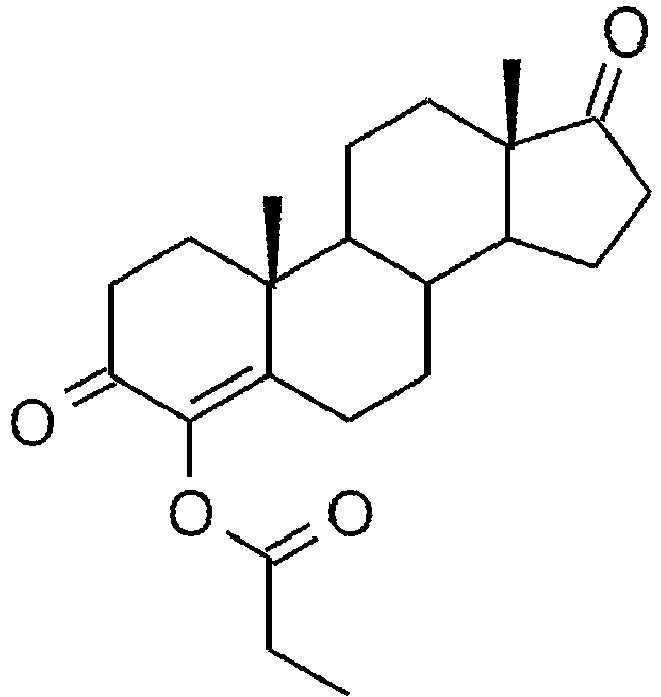
- Es hat sich gezeigt, dass bei topischer Applikation des 4-O-Propionyl-Androst-4-en-3,17-Dion auf die Haut eine Verbesserung der Reduktion von Cellulite, eine verbesserte allgemeine Hautstraffung, eine verbesserte Abmilderung von Dehnungsstreifen, eine Verbesserung der Reduktion der Größe von Narben sowohl vor und nach deren Entstehung, eine verbesserte Abmilderung von Hautirritationen auf allergischer Basis oder aufgrund von Insektenstichen oder UV- oder Roentgeneinstrahlung und allgemeinem Juckreiz der Haut auftrat.
- Ein weiterer Erfindungsgegenstand ist eine Zusammensetzung zur Verwendung bei lokal topischer Applikation für kosmetische oder dermatologische Zwecke, die mindestens einen Steroid-4-Carbonsäureester der Androst-4-en-dione, mit einer Acylgruppe des Carbonsäureesters

- Die Zusammensetzung ist besonders geeignet bei lokal topischer Applikation für kosmetische und dermatologische Zwecke zur Reduktion von Cellulite, zur allgemeinen Hautstraffung, Abmilderung von Dehnungsstreifen, Reduktion der Größe von Narben sowohl vor und nach deren Entstehung, Abmilderung von Hautirritationen auf allergischer Basis oder aufgrund von Insektenstichen oder UV- oder Roentgeneinstrahlung und allgemeinem Juckreiz der Haut. Es hat sich gezeigt, dass bei topischer Applikation der Zusammensetzung auf die Haut eine Verbesserung der Reduktion von Cellulite, eine verbesserte allgemeine Hautstraffung, eine verbesserte Abmilderung von Dehnungsstreifen, eine Verbesserung der Reduktion der Größe von Narben sowohl vor und nach deren Entstehung, eine verbesserte Abmilderung von Hautirritationen auf allergischer Basis oder aufgrund von Insektenstichen oder UV- oder Roentgeneinstrahlung und allgemeinem Juckreiz der Haut auftrat.
- Der Steroid-Carbonsäureester ist ein Derivat des 4-Hydroxyandrostendions. Bevorzugt ist der Rest R der Acylgruppe des Carbonsäureesters ein Alkylrest mit mindestens zwei Kohlenstoffatomen und unverzweigt oder verzweigt. Vorteilhafterweise ist der Alkylrest aus Ethyl, Propyl, Isopropyl, Butyl, sec-Butyl (1-Methylpropyl), Isobutyl (2-Methylpropyl), tert-Butyl (1,1-Dimethylethyl), Pentyl, Hexyl sowie Strukturisomeren des Pentyl oder Hexyl ausgewählt. Eine andere bevorzugte Ausführungsform sieht vor, dass der Rest R der Acylgruppe ein Cycloalkylrest ist und der Cycloalkylrest ausgewählt ist aus Cyclopropan, Cyclopentan oder Cyclohexan.
- Nach einer vorteilhaften Ausgestaltung der Zusammensetzung ist die Acylgruppe des Carbonsäureesters frei von polaren Substituenten.
- Nach einer weiteren vorteilhaften Ausgestaltung der Zusammensetzung ist der Steroid-Carbonsäureester 4-O-Propionyl-Androsten-3,17-Dion, 4-O-Butyryl-Androsten-3,17-Dion, 4-O-Valeryl-Androsten-3,17-Dion, 4-O-Caproyl-Androsten-3,17-Dion oder 4-O-Enantyl-Androsten-3,17-Dion. Die Steroid-Carbonsäureester weisen sowohl eine ausgezeichnete Hydrolyserate durch die hCES2 der Kerationozyten auf als auch eine ausgeprägte Aktivierung des Östrogenrezeptors-beta (ERbeta) durch ihre in den Kerationozyten gebildeten Metabolite.
- Nach einer weiteren vorteilhaften Ausgestaltung der Zusammensetzung ist der Steroid-Carbonsäureester in der Zusammensetzung in einer Menge von 0,001 bis 10 Gew.% bezogen auf die Gesamtmenge der Zusammensetzung enthalten.
- Nach einer weiteren vorteilhaften Ausgestaltung der Zusammensetzung ist der Steroid-Carbonsäureester in der Zusammensetzung in einer Menge von 0,001 bis 5 Gew.% bezogen auf die Gesamtmenge der Zusammensetzung enthalten.
- Die erfindungsgemäße Zusammensetzung kann kosmetische Zusatzstoffe, die für die entsprechende Formulierung als Salbe, Creme, Gel, Öl oder Emulsion bzw. Lotion üblich sind, wie beispielsweise Fette, Öle, Wachse, Alkohole, Polyole, Polymere, Entschäumer, Farbstoffe, Pigmente, Verdickungsmittel, oberflächenaktive Substanzen, Emulgatoren, weichmachende Substanzen, Konservierungsmittel, Antioxidantien, Puffersubstanzen, Duftstoffe und/oder Parfüm in den für die jeweilige Formulierungen üblichen Mengen enthalten.
- Die folgenden Beispiele sollen die Erfindung erläutern, aber nicht einschränken. Sofern nichts Anderes angegeben ist, beziehen sich die Zahlenangaben auf Gew.-%.
-
Phase InCI-Bezeichnung Gew.-% A Aqua/Wasser 77,9968 Dinatrium-EDTA 0,1000 Panthenol 0,1000 Sorbit 0,4000 Xanthan 0,5000 Glycerin 5,0000 Butylenglykol 1,6000 Ethylhexylglycerin 0,4000 B Cetylalkohol 2,0000 Dimethicon 1,1000 Kaliumcetylphosphat 0,7000 C20-22 Alkylphosphat 1,8000 C20-22 Alkylalkohole 1,5000 Capryl/Caprintriglycerid 3,0000 C Propylenglykol 1,0000 Chlorphenesin 0,2000 Phenoxyethanol 0,7000 D Jojobaöl 0,5000 Tocopherylacetat 0,0500 Lecithin 0,0210 Tocopherol 0,0045 Ascorbylpalmitat 0,0030 Citronensäure 0,0015 Ascorbyltetraisopalmitat 0,1000 E Phytinsäure 0,0800 Milchsäure 0,4500 Natriumhydroxid 0,2400 F 4-O-Propionyl-androst-4-en-3,17-dion 0,2000 G Duftstoffe/Parfüm 0,2500 H Karamell 0,0032 - Die Inhaltsstoffe der Phase A werden gemischt und unter Rühren auf 70 bis 75°C erhitzt. Die Inhaltsstoffe der Phase B werden gemischt, auf 70 bis 75°C erhitzt und unter Rühren zu der Phase A zugefügt. Die Mischung aus A und B wird unter Rühren auf 50°C abgekühlt. Phase C wird unter weiterem Rühren zugefügt. Die Inhaltsstoffe der Phase D werden gemischt und unter Rühren der Phase aus A+B+C zugefügt. Die Inhaltsstoffe der Phase E werden gemischt und unter Rühren der Phase aus A+B+C+D zugefügt. Phase F wird der Phase aus A+B+C+D+E unter Rühren bei einer maximalen Temperatur von 30 bis 35°C zugemischt. Phase G wird der Phase aus A+B+C+D+E+F unter Rühren bei einer maximalen Temperatur von 25°C zugemischt. Phase H wird der Phase aus A+B+C+D+E+F+G unter Rühren bei einer maximalen Temperatur von 25°C zugemischt. Alle Schritte des Ansatzes können zur Erzielung besonders gleichmäßiger, luftblasenfreier Zusammensetzungen in einem Vakuum-Mischer durchgeführt werden.
-
Phase InCI-Bezeichnung Gew.-% A Aqua/Wasser 78,9830 Dinatrium-EDTA 0,1500 Sorbit 0,4000 Glycerin 2,0000 Ethylhexylglycerin 0,4000 Xanthan 0,3000 B Cetearylalkohol 1,9000 Capryl/Caprintriglycerid 1,7000 Cetearyglukosid 0,7900 Glycerylstearat 0,9000 Ethylhexylpalmitat 1,6000 Cetylpalmitat 1,6000 Dicaprylylcarbonat 2,0000 Sheabutter 0,5000 Bienenwachs weiß - Cera alba 0,3000 Natriumpolyacrylat 1,0000 PEG-100-Stearat 0,9000 hydriertes Polydecen 0,8000 Trideceth-6 0,1600 C Chlorphenesin 0,2000 Phenoxyethanol 0,7000 D Jojobaöl 0,5000 Tocopherylacetat 0,1000 Lecithin 0,0350 Tocopherol 0,0075 Ascorbylpalmitat 0,0050 Citronensäure 0,0025 E Milchsäure 0,9000 Natriumhydroxid 0,6000 F Phytinsäure 0,2000 G Ascorbyltetraisopalmitat 0,1000 H 4-O-Propionyl-androst-4-en-3,17-dion 0,1000 I Duftstoffe/Parfüm 0,1670 - Die Inhaltsstoffe der Phase A werden gemischt und unter Rühren auf 70 bis 75°C erhitzt. Die Inhaltsstoffe der Phase B werden gemischt, auf 70 bis 75°C erhitzt und unter Rühren zu der Phase A zugefügt. Die Mischung aus A und B wird unter Rühren auf 50°C abgekühlt. Phase C wird unter weiterem Rühren zugefügt. Die Inhaltsstoffe der Phase D werden gemischt und unter Rühren der Phase aus A+B+C zugefügt. Die Inhaltsstoffe der Phase E werden gemischt und unter Rühren der Phase aus A+B+C+D zugefügt. Phase F wird der Phase aus A+B+C+D+E unter Rühren bei einer maximalen Temperatur von 35 bis 40°C zugemischt. Phase G wird der Phase aus A+B+C+D+E+F unter Rühren bei einer maximalen Temperatur von 35 bis 40°C zugemischt. Phase H wird der Phase aus A+B+C+D+E+F+G unter Rühren bei einer maximalen Temperatur von 30 bis 35°C zugemischt. Phase I wird der Phase aus A+B+C+D+E+F+G+H unter Rühren bei einer maximalen Temperatur von 25°C zugemischt. Alle Schritte des Ansatzes können zur Erzielung besonders gleichmäßiger, luftblasenfreier Zusammensetzungen in einem Vakuum-Mischer durchgeführt werden.
-
Bezeichnung Gew.-% Aqua/Wasser 56,8 Propylenglykol 25,0 Isopropylmyristat 6,0 Cetylstearylalkohol 6,0 Stearylalkohol 2,0 Polysorbat 80 (Polyoxyethylen(20)-sorbitan-monooleat) 2,0 Sorbitanmonostearat 1,0 Glycerolmonostearat 1,0 4-O-Propionyl-androst-4-en-3,17-dion 0,1 Hyaluronsäure 0,1 -
InCI-Bezeichnung Gew.-% Aqua/Wasser 62,85 Jojobaöl 6,05 Cocoglyceride 5,95 Dimethylisosorbid 5,00 Glycerin 4,20 Sorbit 4,00 Sheabutter 3,00 Polyglyceryl-3-methylglucosedistearat 3,00 Cetearylalkohol 2,20 Bienenwachs gelb - Cera flava 1,00 Tocopherylacetat 1,00 Polysol AC: 0,70 Phenoxyethanol Dehydroacetsäure Sorbinsäure Benzoesäure Milchsäure 4-O-Propionyl-androst-4-en-dion 0,09 Xanthan 0,25 Duftstoffe/Parfüm 0,20 Tetranatriumimminodisuccinat 0,10 Ethylhexylglycerin 0,10 Milchsäure, 80%ig 0,10 Ascorbyltetraisopalmitat 0,10 Phytinsäure 0,05 Controx VP: 0,04 Lecithin Ascorbylpalmitat hydriertes Palmglyceride Citrat Tocopherol Natriumhydroxid 0,02 -
Bezeichnung Gew.-% Oliven-Fruchtöl 45,37 Capryl/Caprintriglyceride 31,40 Glycerin 15,00 Polyglyceryl-5-Oleat 6,00 Aqua/Wasser 1,88 4-O-Propionyl-androst-4-en-3,17-dion 0,15 Tocopherol, Sonnenblumenöl 0,20 - In einer von einem unabhängigen Dermatologischen Institut (Dermatest, Münster) durchgeführten Studie wurde eine Creme, die 0,10% 4-O-Propionyl-androst-4-en-3,17-dion enthält bei Probandinnen auf Wirksamkeit und Verträglichkeit getestet.
- An der Studie nahmen 20 Probandinnen (Alter zwischen 32 und 58 Jahren mittleres Alter 45,1) teil. Eine Probandin beendete die Studie aufgrund einer Schwangerschaft nach 8 Wochen vorzeitig; eine Probandin (21. Probandin) wurde zu Beginn der neunten Woche aufgenommen.
- Die Creme wurde über einen Zeitraum von 12 Wochen einmal täglich angewendet. Die Überprüfung der Wirksamkeit und der Verträglichkeit (Hautelastizität, Oberschenkelumfang, Breite und Höhe der protrudierenden Lobuli) erfolgte nach 4, 8 und 12 Wochen.
- Die Hautelastizität wurde mit einem Cutometer bestimmt. Die Hautelastizität nahm bei 100% der Probandinnen zu. Nach 4 Wochen durchschnittlich um 14%, nach 12 Wochen um durchschnittlich 22,42%. 95% der Probandinnen empfanden subjektiv eine Verbesserung der Hautelastizität.
- Eine erstaunliche Wirkung wurde hinsichtlich der Größe der protrudierenden Fettlobuli, die für das charakteristische Erscheinungsbild der Cellulite verantwortlich sind, beobachtet. Die der Größe entsprechende Fläche wurde mit Hilfe der Ultraschalluntersuchung vermessen.
- Die Fläche der Fettlobuli nahm bei 100% der Probandinnen ab. Nach 4 Wochen nahm die Fläche der Fettlobuli um durchschnittlich 23,24% ab, nach 8 Wochen betrug die Flächenreduktion durchschnittlich 34,51% und nach 12 Wochen betrug die durchschnittliche Abnahme der Fettlobulifläche 44,06%.
Nach Aussagen des unabhängigen Untersuchungsinstitutes wurde bisher eine solche Wirkung noch bei keinem Konkurrenzprodukt beobachtet. - Der Oberschenkelumfang nahm bei 100% der Probandinnen ab. Nach 4 Wochen nahm der Oberschenkelumfang der Probandinnen um durchschnittlich 0,6 cm bzw. 1,04% ab, nach 12 Wochen betrug die durschnittliche Abnahme des Oberschenkelumfanges 1,87 cm bzw. 3,25%.
-
- a) Dehnungsstreifen/Schwangerschaftsstreifen
- b) Falten (Anti-Aging)
- c) Hautpflege nach Strahlentherapie (onkologische Pflege)
- Die Produktideen Behandlung von Dehnungsstreifen/Schwangerschaftstreifen und Narbenpflege sind jeweils das Resultat von wiederholten positiven Beobachtung bei dem Einsatz der 4-O-Propionyl-Androst-4-en-3,17-Dion enthaltenden Creme; bei allen drei Anwendungen erzielte die 4-O-Propionyl-Androst-4-en-3,17-Dion enthaltende Creme deutlich bessere Ergebnisse, als sie mit auf dem Markt befindlichen Produkten erreicht werden konnten.
- Sämtliche Merkmale der Erfindung können sowohl einzeln als auch in beliebiger Kombination miteinander erfindungswesentlich sein. Weitere Vorteile und vorteilhafte Ausgestaltungen der Erfindung sind den Ansprüchen zu entnehmen.
Claims (17)
- Verwendung eines Steroid-4-Carbonsäureesters der Androst-4-en-dione, mit einer Acylgruppe des Carbonsäureesters
 wobei R ausgewählt ist aus Alkyl mit mindestens zwei Kohlenstoffatomen oder Cycloalkyl,oder Verwendung einer diese Steroid-Carbonsäureester enthaltenden Zusammensetzung bei lokal topischer Applikation für kosmetische Zwecke, dadurch gekennzeichnet, dass der Steroid-Carbonsäureester ein Derivat des 4-Hydroxyandrostendions ist.
 - Verwendung nach Anspruch 1, dadurch gekennzeichnet, dass die Acylgruppe des Carbonsäureesters frei von polaren Substituenten ist.
- Verwendung nach einem der vorhergehenden Ansprüche, dadurch gekennzeichnet, dass der Rest R der Acylgruppe ein Alkylrest mit mindestens zwei Kohlenstoffatomen ist und der Alkylrest unverzweigt oder verzweigt ist.
- Verwendung nach einem der vorhergehenden Ansprüche, dadurch gekennzeichnet, dass der Rest R der Acylgruppe ein Alkylrest mit mindestens zwei Kohlenstoffatomen ist und der Alkylrest ausgewählt ist aus Ethyl, Propyl, Isopropyl, Butyl, sec-Butyl (1-Methylpropyl), Isobutyl (2-Methylpropyl), tert-Butyl (1,1-Dimethylethyl), Pentyl, Hexyl sowie Strukturisomeren des Pentyl oder Hexyl.
- Verwendung nach einem der vorhergehenden Ansprüche, dadurch gekennzeichnet, dass der Rest R der Acylgruppe ein Cycloalkylrest ist und der Cycloalkylrest ausgewählt ist aus Cyclopropan, Cyclopentan oder Cyclohexan.
- Verwendung nach einem der vorhergehenden Ansprüche, dadurch gekennzeichnet, dass der Steroid-Carbonsäureester 4-O-Propionyl-Androsten-3,17-Dion, 4-O-Butyryl-Androsten-3,17-Dion, 4-O-Valeryl-Androsten-3,17-Dion, 4-O-Caproyl-Androsten-3,17-Dion oder 4-O-Enantyl-Androsten-3,17-Dion ist.
- Verwendung nach einem der vorhergehenden Ansprüche, dadurch gekennzeichnet, dass der Steroid-Carbonsäureester in einer Zusammensetzung in einer Menge von 0,001 bis 10 Gew.% bezogen auf die Gesamtmenge der Zusammensetzung enthalten ist.
- Verwendung nach einem der vorhergehenden Ansprüche, dadurch gekennzeichnet, dass die Substanz in einer Zusammensetzung enthalten ist, die als Salbe, Creme, Gel, Öl oder Emulsion bzw. Lotion formuliert ist.
- Verwendung eines Steroid-4-Carbonsäureesters der Androst-4-en-dione, mit einer Acylgruppe des Carbonsäureesters
 wobei R ausgewählt ist aus Alkyl mit mindestens zwei Kohlenstoffatomen oder Cycloalkyl,oder Verwendung einer diese Steroid-Carbonsäureester enthaltenden Zusammensetzung bei lokal topischer Applikation für kosmetische Zwecke zur Reduktion von Cellulite, allgemeinen Hautstraffung, Abmilderung von Dehnungsstreifen, Reduktion der Größe von Narben sowohl vor und nach deren Entstehung, dadurch gekennzeichnet, dass ein Steroid-Carbonsäureester bzw. eine Zusammensetzung verwendet wird, wie in einem der Ansprüche 1 bis 8 definiert.
 - Zusammensetzung zur Verwendung bei lokal topischer Applikation für kosmetische Zwecke, dadurch gekennzeichnet, dass sie mindestens einen Steroid-Carbonsäureester, wie in einem der Ansprüche 1 bis 6 definiert, in einer Formulierung als Salbe, Creme, Gel, Öl, Emulsion oder Lotion enthält.
- Zusammensetzung nach Anspruch 10, dadurch gekennzeichnet, dass der Steroid-Carbonsäureester in der Zusammensetzung in einer Menge von 0,001 bis 10 Gew.% bezogen auf die Gesamtmenge der Zusammensetzung enthalten ist.
- Zusammensetzung nach Anspruch 10 , dadurch gekennzeichnet, dass der Steroid-Carbonsäureester in der Zusammensetzung in einer Menge von 0,001 bis 5 Gew.% bezogen auf die Gesamtmenge der Zusammensetzung enthalten ist.
- Steroid-4-Carbonsäureester der Androst-4-en-dione, mit einer Acylgruppe des Carbonsäureesters
 wobei R ausgewählt ist aus Alkyl mit mindestens zwei Kohlenstoffatomen oder Cycloalkyl,oder eine diese Steroid-Carbonsäureester enthaltende Zusammensetzung zur Verwendung bei lokal topischer Applikation für dermatologische Zwecke, dadurch gekennzeichnet, dass der Steroid-Carbonsäureester ein Derivat des 4-Hydroxyandrostendions gemäß einem der Ansprüche 1 bis 6 ist.
 - Steroid-4-Carbonsäureester der Androst-4-en-dione zur Verwendung nach Anspruch 13 dadurch gekennzeichnet, dass der Steroid-Carbonsäureester 4-O-Propionyl-Androst-4-en-3,17-Dion mit der Formel

- Zusammensetzung zur Verwendung nach Anspruch 13 dadurch gekennzeichnet, dass der Steroid-Carbonsäureester in der Zusammensetzung in einer Menge von 0,001 bis 10 Gew.% bezogen auf die Gesamtmenge der Zusammensetzung enthalten ist.
- Zusammensetzung zur Verwendung nach Anspruch 13 oder 15 dadurch gekennzeichnet, dass der Steroid-Carbonsäureester in einer Zusammensetzung enthalten ist, die als Salbe, Creme, Gel, Öl oder Emulsion bzw. Lotion formuliert ist.
- Steroid-4-Carbonsäureester der Androst-4-en-dione, mit einer Acylgruppe des Carbonsäureesters
 wobei R ausgewählt ist aus Alkyl mit mindestens zwei Kohlenstoffatomen oder Cycloalkyl,oder eine diese Steroid-Carbonsäureester enthaltende Zusammensetzung zur Verwendung bei lokal topischer Applikation für dermatologische Zwecke zur Abmilderung von Hautirritationen auf allergischer Basis oder aufgrund von Insektenstichen oder UV- oder Roentgeneinstrahlung und allgemeinem Juckreiz der Haut, dadurch gekennzeichnet, dass ein Steroid-Carbonsäureester bzw. eine Zusammensetzung verwendet wird, wie in einem der Ansprüche 1 bis 8 definiert.
Applications Claiming Priority (2)
| Application Number | Priority Date | Filing Date | Title |
|---|---|---|---|
| DE102013111391 | 2013-10-15 | ||
| PCT/DE2014/100366 WO2015055179A1 (de) | 2013-10-15 | 2014-10-15 | Steroid-carbonsäureester, zusammensetzungen, enthaltend steroid-carbonsäureester und verwendung dieser bei lokal topischer applikation für kosmetische oder dermatologische zwecke |
Publications (2)
| Publication Number | Publication Date |
|---|---|
| EP3057667A1 EP3057667A1 (de) | 2016-08-24 |
| EP3057667B1 true EP3057667B1 (de) | 2020-03-04 |
Family
ID=51897026
Family Applications (1)
| Application Number | Title | Priority Date | Filing Date |
|---|---|---|---|
| EP14796679.0A Active EP3057667B1 (de) | 2013-10-15 | 2014-10-15 | Steroid-carbonsäureester, zusammensetzungen, enthaltend steroid-carbonsäureester und verwendung dieser bei lokal topischer applikation für kosmetische oder dermatologische zwecke |
Country Status (4)
| Country | Link |
|---|---|
| US (1) | US10076483B2 (de) |
| EP (1) | EP3057667B1 (de) |
| DE (1) | DE112014004733A5 (de) |
| WO (1) | WO2015055179A1 (de) |
Families Citing this family (1)
| Publication number | Priority date | Publication date | Assignee | Title |
|---|---|---|---|---|
| DE102015206690A1 (de) * | 2015-04-14 | 2016-10-20 | Chelac Holding Gmbh | Neue Steroid-Carbonsäureester mit verbesserten Eigenschaften |
Family Cites Families (9)
| Publication number | Priority date | Publication date | Assignee | Title |
|---|---|---|---|---|
| US4177267A (en) * | 1963-12-09 | 1979-12-04 | Crown Zellerbach | Enhancing tissue penetration of physiologically active steroidal agents with DMSC |
| US4235893A (en) | 1978-05-08 | 1980-11-25 | Brodie Angela M | Ester derivatives of 4-hydroxy-4-androstene-3,17-dione and a method for inhibiting estrogen biosynthesis |
| EP0680327B1 (de) * | 1993-01-19 | 2004-09-15 | Endorecherche Inc. | Therapeutische verwendungen und verabreichungsysteme von dehydroepiandrosteron |
| US5736537A (en) | 1995-09-12 | 1998-04-07 | Estee Lauder, Inc. | Dehydroep:androsterone sailcylate useful against skin atrophy |
| US6465446B1 (en) * | 2001-03-12 | 2002-10-15 | John C. Dykstra | Treatment of dermatitis by the topical application of Δ5-androstene-3β-ol-7,17 dione and metabolizable precursors thereof |
| US20030199487A1 (en) | 2002-04-22 | 2003-10-23 | Mr. Vince Paternoster | Ester and ether derivatives of 4-hydroxytestosterone and a method for the regulation of athletic function in humans |
| US6586417B1 (en) * | 2002-04-22 | 2003-07-01 | Nutrisport Pharmacal, Inc. | Ester and ether derivatives of 4-hydroxy 4-androstene-3,17-dione and a method for the regulation of athletic function in humans |
| MX2007005098A (es) * | 2004-11-01 | 2008-01-16 | Endorech Inc | Uso de androgenos para reducir la probabilidad de adquirir o tratar el envejecimiento de la piel. |
| EP1854465A1 (de) * | 2006-05-12 | 2007-11-14 | Alexander Tobias Teichmann | Verwendung von 4,17 beta-dihydroxyandrost-4-ene-3-one zur Behandlung von Krebs |
-
2014
- 2014-10-15 WO PCT/DE2014/100366 patent/WO2015055179A1/de not_active Ceased
- 2014-10-15 DE DE112014004733.3T patent/DE112014004733A5/de not_active Withdrawn
- 2014-10-15 EP EP14796679.0A patent/EP3057667B1/de active Active
- 2014-10-15 US US15/028,768 patent/US10076483B2/en active Active
Non-Patent Citations (1)
| Title |
|---|
| None * |
Also Published As
| Publication number | Publication date |
|---|---|
| US10076483B2 (en) | 2018-09-18 |
| DE112014004733A5 (de) | 2016-07-14 |
| EP3057667A1 (de) | 2016-08-24 |
| US20160235644A1 (en) | 2016-08-18 |
| WO2015055179A1 (de) | 2015-04-23 |
Similar Documents
| Publication | Publication Date | Title |
|---|---|---|
| EP1562531B1 (de) | Topische hautpflegezusammensetzung | |
| DE68905816T2 (de) | Ecdysteroid enthaltende lipidische lamellare phasen oder liposomen. | |
| DE69434697T2 (de) | Therapeutische Verwendungen von Dehydroepiandrosteron zur Behandlung von verminderter Libido und Osteoporose | |
| DE602005002844T3 (de) | Umkehremulsionszusammensetzung mit calcitriol und clobetasol-17-propionat und ihre kosmetische und dermatologische verwendung | |
| DE69912760T2 (de) | Verwendung von topischen formulierungen des öl-in-wasser typs, enthaltend galaktolipid material als emulsionsmittel, um eine länger anhaltende wirkung eines darin enthaltenen aktiven wirkstoffs zu vermitteln | |
| DE602004012440T2 (de) | Sprühbare zusammensetzung zur verabreichung von vitamin d derivaten | |
| DE69724629T2 (de) | Zusammensetzungen und deren verwendungen | |
| DE69231287T2 (de) | Verwendung von Dibutyl-Adipat und Isopropyl-Myristat in topischen und transdermalen Produkten | |
| WO1997007821A1 (de) | Juckreizlindernde, kosmetische und/oder pharmazeutische zusammensetzungen bestehend aus einem oder mehreren leichten lokal anästhetika und einer oder mehreren adstringentien | |
| EP3344270B1 (de) | Zusammensetzung enthaltend einen extrakt aus echinacea und linolsäurederivate | |
| KR20210008327A (ko) | 노화 방지 및 피부 톤 미백 조성물 및 이를 위한 방법 | |
| EP3492089B1 (de) | Dermatologische zusammensetzung enthaltend escherichia coli und enterococcus faecalis | |
| US8821904B2 (en) | Topical composition and use thereof for the prophylaxis and the treatment of defects connected to inflammatory dermopathies | |
| WO2013023641A2 (de) | Verfahren zur herstellung einer zusammensetzung zum auftragen auf die haut | |
| EP3283055A1 (de) | Naturstoffkombination enthaltend mindestens eine glycyrrhetinsäure und mindestens ein guggulsteron sowie verwendung derselben für kosmetische anwendungen | |
| DE602005003138T2 (de) | Zusammensetzung in sprayform mit einer kombination aus clobetasolpropionat und calcitriol, einer alkoholphase und ölphase | |
| EP3057667A1 (de) | Steroid-carbonsäureester, zusammensetzungen, enthaltend steroid-carbonsäureester und verwendung dieser bei lokal topischer applikation für kosmetische oder dermatologische zwecke | |
| DE102015004672A1 (de) | In Vesikeln formulierte Naturstoffkombination | |
| DE102005008299B4 (de) | Kosmetische und/oder dermatologische Formulierung, Verfahren zu deren Herstellung und Verwendung der Formulierung | |
| EP2192956B1 (de) | Kosmetische oder dermatologische zusammensetzung zur topischen verwendung | |
| Ali et al. | Cream containing acacia bark extract significantly reduces skin sebum content in healthy volunteers | |
| DE102020133932A1 (de) | Zuckerbasierte Enthaarungspaste | |
| WO2019086195A1 (de) | Verfahren zur herstellung von topischen formulierungen mittels ultraschall und hergestellte formulierungen | |
| DE3586949T2 (de) | Topische mittel zur verhuetung oder behandlung trockener haut. | |
| DE202020005998U1 (de) | Zuckerbasierte Enthaarungspaste |
Legal Events
| Date | Code | Title | Description |
|---|---|---|---|
| PUAI | Public reference made under article 153(3) epc to a published international application that has entered the european phase |
Free format text: ORIGINAL CODE: 0009012 |
|
| 17P | Request for examination filed |
Effective date: 20160418 |
|
| AK | Designated contracting states |
Kind code of ref document: A1 Designated state(s): AL AT BE BG CH CY CZ DE DK EE ES FI FR GB GR HR HU IE IS IT LI LT LU LV MC MK MT NL NO PL PT RO RS SE SI SK SM TR |
|
| AX | Request for extension of the european patent |
Extension state: BA ME |
|
| DAX | Request for extension of the european patent (deleted) | ||
| STAA | Information on the status of an ep patent application or granted ep patent |
Free format text: STATUS: EXAMINATION IS IN PROGRESS |
|
| 17Q | First examination report despatched |
Effective date: 20170904 |
|
| REG | Reference to a national code |
Ref country code: DE Ref legal event code: R079 Ref document number: 502014013768 Country of ref document: DE Free format text: PREVIOUS MAIN CLASS: A61Q0019000000 Ipc: A61K0047180000 |
|
| RIC1 | Information provided on ipc code assigned before grant |
Ipc: A61K 9/00 20060101ALI20190911BHEP Ipc: A61K 47/18 20170101AFI20190911BHEP Ipc: A61Q 19/06 20060101ALI20190911BHEP Ipc: A61K 9/06 20060101ALI20190911BHEP Ipc: A61Q 19/00 20060101ALI20190911BHEP Ipc: A61K 8/63 20060101ALI20190911BHEP Ipc: A61K 31/566 20060101ALI20190911BHEP Ipc: A61K 31/575 20060101ALI20190911BHEP |
|
| RIC1 | Information provided on ipc code assigned before grant |
Ipc: A61Q 19/00 20060101ALI20190926BHEP Ipc: A61K 8/63 20060101ALI20190926BHEP Ipc: A61P 17/00 20060101ALI20190926BHEP Ipc: A61Q 19/06 20060101ALI20190926BHEP Ipc: A61K 47/18 20170101AFI20190926BHEP Ipc: A61K 9/06 20060101ALI20190926BHEP Ipc: A61K 31/575 20060101ALI20190926BHEP Ipc: A61K 9/00 20060101ALI20190926BHEP Ipc: A61K 31/566 20060101ALI20190926BHEP |
|
| GRAP | Despatch of communication of intention to grant a patent |
Free format text: ORIGINAL CODE: EPIDOSNIGR1 |
|
| STAA | Information on the status of an ep patent application or granted ep patent |
Free format text: STATUS: GRANT OF PATENT IS INTENDED |
|
| INTG | Intention to grant announced |
Effective date: 20191111 |
|
| GRAS | Grant fee paid |
Free format text: ORIGINAL CODE: EPIDOSNIGR3 |
|
| GRAA | (expected) grant |
Free format text: ORIGINAL CODE: 0009210 |
|
| STAA | Information on the status of an ep patent application or granted ep patent |
Free format text: STATUS: THE PATENT HAS BEEN GRANTED |
|
| AK | Designated contracting states |
Kind code of ref document: B1 Designated state(s): AL AT BE BG CH CY CZ DE DK EE ES FI FR GB GR HR HU IE IS IT LI LT LU LV MC MK MT NL NO PL PT RO RS SE SI SK SM TR |
|
| REG | Reference to a national code |
Ref country code: GB Ref legal event code: FG4D Free format text: NOT ENGLISH |
|
| REG | Reference to a national code |
Ref country code: CH Ref legal event code: EP |
|
| REG | Reference to a national code |
Ref country code: AT Ref legal event code: REF Ref document number: 1239623 Country of ref document: AT Kind code of ref document: T Effective date: 20200315 |
|
| REG | Reference to a national code |
Ref country code: DE Ref legal event code: R096 Ref document number: 502014013768 Country of ref document: DE |
|
| REG | Reference to a national code |
Ref country code: IE Ref legal event code: FG4D Free format text: LANGUAGE OF EP DOCUMENT: GERMAN |
|
| REG | Reference to a national code |
Ref country code: CH Ref legal event code: NV Representative=s name: OFFICE ERNEST T. FREYLINGER S.A., CH |
|
| PG25 | Lapsed in a contracting state [announced via postgrant information from national office to epo] |
Ref country code: NO Free format text: LAPSE BECAUSE OF FAILURE TO SUBMIT A TRANSLATION OF THE DESCRIPTION OR TO PAY THE FEE WITHIN THE PRESCRIBED TIME-LIMIT Effective date: 20200604 Ref country code: RS Free format text: LAPSE BECAUSE OF FAILURE TO SUBMIT A TRANSLATION OF THE DESCRIPTION OR TO PAY THE FEE WITHIN THE PRESCRIBED TIME-LIMIT Effective date: 20200304 Ref country code: FI Free format text: LAPSE BECAUSE OF FAILURE TO SUBMIT A TRANSLATION OF THE DESCRIPTION OR TO PAY THE FEE WITHIN THE PRESCRIBED TIME-LIMIT Effective date: 20200304 |
|
| REG | Reference to a national code |
Ref country code: NL Ref legal event code: MP Effective date: 20200304 |
|
| PG25 | Lapsed in a contracting state [announced via postgrant information from national office to epo] |
Ref country code: BG Free format text: LAPSE BECAUSE OF FAILURE TO SUBMIT A TRANSLATION OF THE DESCRIPTION OR TO PAY THE FEE WITHIN THE PRESCRIBED TIME-LIMIT Effective date: 20200604 Ref country code: HR Free format text: LAPSE BECAUSE OF FAILURE TO SUBMIT A TRANSLATION OF THE DESCRIPTION OR TO PAY THE FEE WITHIN THE PRESCRIBED TIME-LIMIT Effective date: 20200304 Ref country code: GR Free format text: LAPSE BECAUSE OF FAILURE TO SUBMIT A TRANSLATION OF THE DESCRIPTION OR TO PAY THE FEE WITHIN THE PRESCRIBED TIME-LIMIT Effective date: 20200605 Ref country code: LV Free format text: LAPSE BECAUSE OF FAILURE TO SUBMIT A TRANSLATION OF THE DESCRIPTION OR TO PAY THE FEE WITHIN THE PRESCRIBED TIME-LIMIT Effective date: 20200304 Ref country code: SE Free format text: LAPSE BECAUSE OF FAILURE TO SUBMIT A TRANSLATION OF THE DESCRIPTION OR TO PAY THE FEE WITHIN THE PRESCRIBED TIME-LIMIT Effective date: 20200304 |
|
| REG | Reference to a national code |
Ref country code: LT Ref legal event code: MG4D |
|
| PG25 | Lapsed in a contracting state [announced via postgrant information from national office to epo] |
Ref country code: NL Free format text: LAPSE BECAUSE OF FAILURE TO SUBMIT A TRANSLATION OF THE DESCRIPTION OR TO PAY THE FEE WITHIN THE PRESCRIBED TIME-LIMIT Effective date: 20200304 |
|
| PG25 | Lapsed in a contracting state [announced via postgrant information from national office to epo] |
Ref country code: PT Free format text: LAPSE BECAUSE OF FAILURE TO SUBMIT A TRANSLATION OF THE DESCRIPTION OR TO PAY THE FEE WITHIN THE PRESCRIBED TIME-LIMIT Effective date: 20200729 Ref country code: LT Free format text: LAPSE BECAUSE OF FAILURE TO SUBMIT A TRANSLATION OF THE DESCRIPTION OR TO PAY THE FEE WITHIN THE PRESCRIBED TIME-LIMIT Effective date: 20200304 Ref country code: ES Free format text: LAPSE BECAUSE OF FAILURE TO SUBMIT A TRANSLATION OF THE DESCRIPTION OR TO PAY THE FEE WITHIN THE PRESCRIBED TIME-LIMIT Effective date: 20200304 Ref country code: CZ Free format text: LAPSE BECAUSE OF FAILURE TO SUBMIT A TRANSLATION OF THE DESCRIPTION OR TO PAY THE FEE WITHIN THE PRESCRIBED TIME-LIMIT Effective date: 20200304 Ref country code: SK Free format text: LAPSE BECAUSE OF FAILURE TO SUBMIT A TRANSLATION OF THE DESCRIPTION OR TO PAY THE FEE WITHIN THE PRESCRIBED TIME-LIMIT Effective date: 20200304 Ref country code: RO Free format text: LAPSE BECAUSE OF FAILURE TO SUBMIT A TRANSLATION OF THE DESCRIPTION OR TO PAY THE FEE WITHIN THE PRESCRIBED TIME-LIMIT Effective date: 20200304 Ref country code: SM Free format text: LAPSE BECAUSE OF FAILURE TO SUBMIT A TRANSLATION OF THE DESCRIPTION OR TO PAY THE FEE WITHIN THE PRESCRIBED TIME-LIMIT Effective date: 20200304 Ref country code: EE Free format text: LAPSE BECAUSE OF FAILURE TO SUBMIT A TRANSLATION OF THE DESCRIPTION OR TO PAY THE FEE WITHIN THE PRESCRIBED TIME-LIMIT Effective date: 20200304 Ref country code: IS Free format text: LAPSE BECAUSE OF FAILURE TO SUBMIT A TRANSLATION OF THE DESCRIPTION OR TO PAY THE FEE WITHIN THE PRESCRIBED TIME-LIMIT Effective date: 20200704 |
|
| REG | Reference to a national code |
Ref country code: DE Ref legal event code: R097 Ref document number: 502014013768 Country of ref document: DE |
|
| PLBE | No opposition filed within time limit |
Free format text: ORIGINAL CODE: 0009261 |
|
| STAA | Information on the status of an ep patent application or granted ep patent |
Free format text: STATUS: NO OPPOSITION FILED WITHIN TIME LIMIT |
|
| PG25 | Lapsed in a contracting state [announced via postgrant information from national office to epo] |
Ref country code: DK Free format text: LAPSE BECAUSE OF FAILURE TO SUBMIT A TRANSLATION OF THE DESCRIPTION OR TO PAY THE FEE WITHIN THE PRESCRIBED TIME-LIMIT Effective date: 20200304 |
|
| 26N | No opposition filed |
Effective date: 20201207 |
|
| PG25 | Lapsed in a contracting state [announced via postgrant information from national office to epo] |
Ref country code: SI Free format text: LAPSE BECAUSE OF FAILURE TO SUBMIT A TRANSLATION OF THE DESCRIPTION OR TO PAY THE FEE WITHIN THE PRESCRIBED TIME-LIMIT Effective date: 20200304 Ref country code: PL Free format text: LAPSE BECAUSE OF FAILURE TO SUBMIT A TRANSLATION OF THE DESCRIPTION OR TO PAY THE FEE WITHIN THE PRESCRIBED TIME-LIMIT Effective date: 20200304 |
|
| PG25 | Lapsed in a contracting state [announced via postgrant information from national office to epo] |
Ref country code: LU Free format text: LAPSE BECAUSE OF NON-PAYMENT OF DUE FEES Effective date: 20201015 Ref country code: MC Free format text: LAPSE BECAUSE OF FAILURE TO SUBMIT A TRANSLATION OF THE DESCRIPTION OR TO PAY THE FEE WITHIN THE PRESCRIBED TIME-LIMIT Effective date: 20200304 |
|
| REG | Reference to a national code |
Ref country code: BE Ref legal event code: MM Effective date: 20201031 |
|
| PG25 | Lapsed in a contracting state [announced via postgrant information from national office to epo] |
Ref country code: BE Free format text: LAPSE BECAUSE OF NON-PAYMENT OF DUE FEES Effective date: 20201031 |
|
| PG25 | Lapsed in a contracting state [announced via postgrant information from national office to epo] |
Ref country code: IE Free format text: LAPSE BECAUSE OF NON-PAYMENT OF DUE FEES Effective date: 20201015 |
|
| REG | Reference to a national code |
Ref country code: AT Ref legal event code: MM01 Ref document number: 1239623 Country of ref document: AT Kind code of ref document: T Effective date: 20201015 |
|
| PG25 | Lapsed in a contracting state [announced via postgrant information from national office to epo] |
Ref country code: AT Free format text: LAPSE BECAUSE OF NON-PAYMENT OF DUE FEES Effective date: 20201015 |
|
| PG25 | Lapsed in a contracting state [announced via postgrant information from national office to epo] |
Ref country code: TR Free format text: LAPSE BECAUSE OF FAILURE TO SUBMIT A TRANSLATION OF THE DESCRIPTION OR TO PAY THE FEE WITHIN THE PRESCRIBED TIME-LIMIT Effective date: 20200304 Ref country code: MT Free format text: LAPSE BECAUSE OF FAILURE TO SUBMIT A TRANSLATION OF THE DESCRIPTION OR TO PAY THE FEE WITHIN THE PRESCRIBED TIME-LIMIT Effective date: 20200304 Ref country code: CY Free format text: LAPSE BECAUSE OF FAILURE TO SUBMIT A TRANSLATION OF THE DESCRIPTION OR TO PAY THE FEE WITHIN THE PRESCRIBED TIME-LIMIT Effective date: 20200304 |
|
| PG25 | Lapsed in a contracting state [announced via postgrant information from national office to epo] |
Ref country code: MK Free format text: LAPSE BECAUSE OF FAILURE TO SUBMIT A TRANSLATION OF THE DESCRIPTION OR TO PAY THE FEE WITHIN THE PRESCRIBED TIME-LIMIT Effective date: 20200304 Ref country code: AL Free format text: LAPSE BECAUSE OF FAILURE TO SUBMIT A TRANSLATION OF THE DESCRIPTION OR TO PAY THE FEE WITHIN THE PRESCRIBED TIME-LIMIT Effective date: 20200304 |
|
| P01 | Opt-out of the competence of the unified patent court (upc) registered |
Effective date: 20230513 |
|
| REG | Reference to a national code |
Ref country code: DE Ref legal event code: R082 Ref document number: 502014013768 Country of ref document: DE Representative=s name: ASMUSSEN, ARNOLD, DIPL.-ING. (FH), DE |
|
| REG | Reference to a national code |
Ref country code: CH Ref legal event code: U11 Free format text: ST27 STATUS EVENT CODE: U-0-0-U10-U11 (AS PROVIDED BY THE NATIONAL OFFICE) Effective date: 20251101 |
|
| PGFP | Annual fee paid to national office [announced via postgrant information from national office to epo] |
Ref country code: DE Payment date: 20251031 Year of fee payment: 12 |
|
| PGFP | Annual fee paid to national office [announced via postgrant information from national office to epo] |
Ref country code: GB Payment date: 20251029 Year of fee payment: 12 |
|
| PGFP | Annual fee paid to national office [announced via postgrant information from national office to epo] |
Ref country code: IT Payment date: 20251024 Year of fee payment: 12 |
|
| PGFP | Annual fee paid to national office [announced via postgrant information from national office to epo] |
Ref country code: FR Payment date: 20251027 Year of fee payment: 12 |
|
| PGFP | Annual fee paid to national office [announced via postgrant information from national office to epo] |
Ref country code: CH Payment date: 20251101 Year of fee payment: 12 |