EP3044010B1 - Release layer treatment formulations - Google Patents
Release layer treatment formulations Download PDFInfo
- Publication number
- EP3044010B1 EP3044010B1 EP14783907.0A EP14783907A EP3044010B1 EP 3044010 B1 EP3044010 B1 EP 3044010B1 EP 14783907 A EP14783907 A EP 14783907A EP 3044010 B1 EP3044010 B1 EP 3044010B1
- Authority
- EP
- European Patent Office
- Prior art keywords
- meq
- formulation
- agent
- resolubilizing
- chemical agent
- Prior art date
- Legal status (The legal status is an assumption and is not a legal conclusion. Google has not performed a legal analysis and makes no representation as to the accuracy of the status listed.)
- Active
Links
Images
Classifications
-
- B—PERFORMING OPERATIONS; TRANSPORTING
- B41—PRINTING; LINING MACHINES; TYPEWRITERS; STAMPS
- B41M—PRINTING, DUPLICATING, MARKING, OR COPYING PROCESSES; COLOUR PRINTING
- B41M5/00—Duplicating or marking methods; Sheet materials for use therein
- B41M5/50—Recording sheets characterised by the coating used to improve ink, dye or pigment receptivity, e.g. for ink-jet or thermal dye transfer recording
- B41M5/52—Macromolecular coatings
-
- B—PERFORMING OPERATIONS; TRANSPORTING
- B41—PRINTING; LINING MACHINES; TYPEWRITERS; STAMPS
- B41M—PRINTING, DUPLICATING, MARKING, OR COPYING PROCESSES; COLOUR PRINTING
- B41M5/00—Duplicating or marking methods; Sheet materials for use therein
- B41M5/025—Duplicating or marking methods; Sheet materials for use therein by transferring ink from the master sheet
- B41M5/0256—Duplicating or marking methods; Sheet materials for use therein by transferring ink from the master sheet the transferable ink pattern being obtained by means of a computer driven printer, e.g. an ink jet or laser printer, or by electrographic means
-
- B—PERFORMING OPERATIONS; TRANSPORTING
- B41—PRINTING; LINING MACHINES; TYPEWRITERS; STAMPS
- B41M—PRINTING, DUPLICATING, MARKING, OR COPYING PROCESSES; COLOUR PRINTING
- B41M5/00—Duplicating or marking methods; Sheet materials for use therein
- B41M5/025—Duplicating or marking methods; Sheet materials for use therein by transferring ink from the master sheet
- B41M5/03—Duplicating or marking methods; Sheet materials for use therein by transferring ink from the master sheet by pressure
-
- B—PERFORMING OPERATIONS; TRANSPORTING
- B41—PRINTING; LINING MACHINES; TYPEWRITERS; STAMPS
- B41M—PRINTING, DUPLICATING, MARKING, OR COPYING PROCESSES; COLOUR PRINTING
- B41M5/00—Duplicating or marking methods; Sheet materials for use therein
- B41M5/50—Recording sheets characterised by the coating used to improve ink, dye or pigment receptivity, e.g. for ink-jet or thermal dye transfer recording
- B41M5/52—Macromolecular coatings
- B41M5/5227—Macromolecular coatings characterised by organic non-macromolecular additives, e.g. UV-absorbers, plasticisers, surfactants
-
- B—PERFORMING OPERATIONS; TRANSPORTING
- B41—PRINTING; LINING MACHINES; TYPEWRITERS; STAMPS
- B41M—PRINTING, DUPLICATING, MARKING, OR COPYING PROCESSES; COLOUR PRINTING
- B41M5/00—Duplicating or marking methods; Sheet materials for use therein
- B41M5/50—Recording sheets characterised by the coating used to improve ink, dye or pigment receptivity, e.g. for ink-jet or thermal dye transfer recording
- B41M5/52—Macromolecular coatings
- B41M5/5245—Macromolecular coatings characterised by the use of polymers containing cationic or anionic groups, e.g. mordants
-
- B—PERFORMING OPERATIONS; TRANSPORTING
- B41—PRINTING; LINING MACHINES; TYPEWRITERS; STAMPS
- B41M—PRINTING, DUPLICATING, MARKING, OR COPYING PROCESSES; COLOUR PRINTING
- B41M5/00—Duplicating or marking methods; Sheet materials for use therein
- B41M5/50—Recording sheets characterised by the coating used to improve ink, dye or pigment receptivity, e.g. for ink-jet or thermal dye transfer recording
- B41M5/52—Macromolecular coatings
- B41M5/5254—Macromolecular coatings characterised by the use of polymers obtained by reactions only involving carbon-to-carbon unsaturated bonds, e.g. vinyl polymers
-
- B—PERFORMING OPERATIONS; TRANSPORTING
- B41—PRINTING; LINING MACHINES; TYPEWRITERS; STAMPS
- B41M—PRINTING, DUPLICATING, MARKING, OR COPYING PROCESSES; COLOUR PRINTING
- B41M5/00—Duplicating or marking methods; Sheet materials for use therein
- B41M5/50—Recording sheets characterised by the coating used to improve ink, dye or pigment receptivity, e.g. for ink-jet or thermal dye transfer recording
- B41M5/52—Macromolecular coatings
- B41M5/5263—Macromolecular coatings characterised by the use of polymers obtained otherwise than by reactions only involving carbon-to-carbon unsaturated bonds
-
- B—PERFORMING OPERATIONS; TRANSPORTING
- B41—PRINTING; LINING MACHINES; TYPEWRITERS; STAMPS
- B41N—PRINTING PLATES OR FOILS; MATERIALS FOR SURFACES USED IN PRINTING MACHINES FOR PRINTING, INKING, DAMPING, OR THE LIKE; PREPARING SUCH SURFACES FOR USE AND CONSERVING THEM
- B41N10/00—Blankets or like coverings; Coverings for wipers for intaglio printing
Definitions
- the present invention relates to indirect printing systems and more particularly to compositions suitable for the treatment of intermediate transfer members.
- Digital printing techniques have been developed that allow a printer to receive instructions directly from a computer without the need to prepare printing plates.
- Such printing devices are printers with color laser technology or the xerographic process, which use dry toners, and the widely used inkjet printers, which use liquid inks and rely on inkjet or bubble jet processes.
- Such printing devices typically directly apply the desired image to the final printing substrate (e.g ., paper, cardboard or plastic).
- the resolution of such processes is limited.
- liquid inks may wick into fibrous substrates requiring the use of substrates specially coated to absorb the liquid ink in a controlled fashion or to prevent its penetration below the surface of the substrate.
- Such coated substrates may not address all issues associated with direct printing and may even create their own problems.
- an intermediate image of the final desired pattern (e.g., a mirror image) is typically formed on an image transfer member (e.g., a blanket or a drum) and transferred therefrom to the final printing substrate.
- the intermediate image can be, as in HP-Indigo printers, an electrostatic image produced on an electrically charged image bearing cylinder by exposure of compatible oil-based inks to laser light, the ink image being then transferred by way of a blanket cylinder onto paper or any other substrate.
- HP-Indigo printers an electrostatic image produced on an electrically charged image bearing cylinder by exposure of compatible oil-based inks to laser light, the ink image being then transferred by way of a blanket cylinder onto paper or any other substrate.
- the present Applicant has recently disclosed a printing process wherein inks having an aqueous carrier are jetted onto an intermediate transfer member (ITM) at an image forming station and dried thereupon before being transferred to the desired substrate at an impression station.
- ITM intermediate transfer member
- Few systems implementing such process were disclosed, differing among other things in the number of image forming stations, the configurations of the intermediate transfer members, the number of impression stations and the system architecture allowing duplex printing. More details on such systems are disclosed in PCT Publication Nos. WO 2013/132418 , WO 2013/132419 and WO 2013/132420 .
- such indirect printing systems allow the distance between the outer surface of the intermediate image transfer member (also called the release layer) and the inkjet print head to be maintained constant and reduces wetting of the substrate, as the ink can be dried on the intermediate image transfer member before being applied to the printing substrate. Consequently, the final image quality is less affected by the physical properties of the substrate and benefits from various other advantages as disclosed in PCT Publication Nos. WO 2013/132345 , WO 2013/132343 and WO 2013/132340 by the present Applicant.
- the printing process including the materials or formulations employed therewith, should allow transiently fixing the aqueous based ink droplets onto the release layer at the image forming station.
- the same should allow the dried ink film to be fully transferred to the printing substrate at the impression station.
- silicone coated transfer members are preferred, since they facilitate transfer of the dried image to the final substrate.
- silicone is hydrophobic, which causes water based ink droplets to bead on the transfer member. This results in a small contact area between the droplets and the blanket that renders the ink image unstable during rapid movement and makes it more difficult to remove the water from the ink, for instance by heating the transfer member.
- the Applicant disclosed conditioning methods and formulations facilitating the desired interaction between ink formulations and materials composing the release layer suitable for the novel process, by pre-treatment of the transfer member ahead of ink jetting. More details on such methods can be found in PCT Publication No. WO 2013/132339 .
- US Patent Publication No. 2012/0140009 discloses an aggregation liquid for use with an intermediate transfer member of a printing system, containing a carrier liquid, and a positively chargeable polymeric chemical agent, such as a guar gum derivative having an amino group.
- the polymeric chemical agent may have an average molecular weight of at least 10,000.
- EP Patent Publication No. 0499857 discloses compositions useful as binders in paper or textile color formulations or printing inks, containing one or more polyalkylene imines (preferably a polyethylenimine); one or more alkanolamines (preferably ethanolamine); and one or more polyols (preferably a glycol); optionally in the presence of water.
- the two exemplified binders contain, respectively, by weight: 17% of a polyethylenimine, 12% glycerin, 30% ethanolamine, and 41% water; and 15.5% of the polyethylenimine, 25.5% glycerin, 32% ethanolamine, 27% propylene glycol, and no added water.
- a formulation for use with an intermediate transfer member of a printing system comprising: (a) a carrier liquid; (b) a positively chargeable polymeric chemical agent selected from the group consisting of polyethylene imine (PEI), a cationic guar or guar-based polymer and a cationic methacrylamide or methacrylamide-based polymer; and (c) a resolubilizing agent selected to improve resolubilization of the chemical agent; the polymeric chemical agent and the resolubilizing agent being disposed within the carrier liquid; the polymeric chemical agent having an average molecular weight of at least 10,000 and a positive charge density of at least 0.1 meq/g of the chemical agent; the resolubilizing agent having, in a pure state and at 90°C, a vapor pressure of less than 0.5kPa; and the weight ratio of the resolubilizing agent to the polymeric chemical agent, within the formulation, being at least 1:10.
- PEI polyethylene imine
- the resolubilizing agent of the formulation herein disclosed has a hydrogen-bonding functional group.
- a functional group density of the hydrogen-bonding functional group within the resolubilizing agent is at least 0.25 meq/g, at least 0.35 meq/g, at least 0.45 meq/g, at least 0.6 meq/g, at least 0.8 meq/g, at least 1 meq/g, at least 2 meq/g, at least 3 meq/g, at least 5 meq/g, at least 7meq/g, at least 10 meq/g, at least 15 meq/g, at least 20 meq/g, at least 22 meq/g, at least 24 meq/g, at least 26 meq/g, at least 28 meq/g, or at least 30 meq/g.
- the resolubilizing agent has at least one functional group selected from a hydroxyl group, an amine group, an ether group, a sulfonate group, and combinations thereof.
- the resolubilizing agent is selected from the group including diols, triols, polyols, alcohols, sugars and modified sugars, ethers, polyethers, amino alcohol, amino silicones, styrene sulfonates, and combinations thereof.
- the resolubilizing agent is selected from the group consisting of cocoamide diethanol amine, ethoxylated methyl glucose ether, GlucamTM E-10, GlucamTM E-20, glycerol, pentaerythritol, PEG 400, PEG 600, poly(sodium-4-styrenesulfonate), SilSense® Q-Plus Silicone, SilSense® A21 Silicone, sucrose, triethanol amine, and triethylene glycol monomethyl ether.
- the resolubilizing agent has a molecular weight below 5,000, below 2,500, below 1,000, below 750, below 600, below 500, below 400, below 350, or below 300.
- the resolubilizing agent of the formulation herein disclosed has a solubility, in the formulation, of at least 1%, at least 3%, at least 5%, at least 10%, at least 20%, at least 30%, at least 40%, or at least 50% at 25°C.
- the chemical agent, the resolubilizing agent, and the carrier liquid make up at least 80%, at least 90%, at least 95%, at least 97%, or at least 99% of the formulation, by weight.
- the water content of the formulation is at least 5%, at least 10%, at least 20%, at least 40%, at least 60%, at least 70%, at least 80%, at least 90%, at least 95%, or at least 97%, by weight.
- the weight ratio of the resolubilizing agent to the polymeric chemical agent is at least 1:7, at least 1:5, at least 1:4, at least 1:3, at least 1:2, at least 1:1, at least 2:3, at least 2:1, at least 3:1, at least 4:1, at least 6:1, at least 8:1, at least 10:1, at least 12:1, at least 15:1, or at least 20:1.
- the weight ratio of the resolubilizing agent to the polymeric chemical agent is less than 20:1, less than 15:1, less than 12:1, less than 10:1, less than 8:1, less than 6:1, less than 5:1, less than 4:1, less than 3:1, less than 2:1, less than 3:2, or less than 5:4.
- the weight ratio of the resolubilizing agent to the polymeric chemical agent being within a range of 1:10 to 20:1, within a range of 1:7 to 20:1, within a range of 1:5 to 15:1, within a range of 1:2 to 15:1, within a range of 1:2 to 10:1, within a range of 1:2 to 7:1, within a range of 1:2 to 5:1, within a range of 1:2 to 4:1, within a range of 1:1 to 10:1, within a range of 1:1 to 7:1, within a range of 1:1 to 5:1, or within a range of 1:2 to 3:1.
- the formulation has a viscosity of at most 1,500 mPa*s, at most 1000 mPa*s at most 700 mPa*s, at most 400 mPa*s, at most 200 mPa*s, at most 100 mPa*s, at most 50 mPa*s, at most 30 mPa*s, at most 20 mPa*s, at most 10 mPa*s, or at most 1 cmPa*s.
- the formulation has a pH within a range of 7 to 14, 8 to 13, or 9 to 12.
- the vapor pressure of the resolubilizing agent is less than 0.45kPa, less than 0.40kPa, less than 0.35kPa, less than 0.30kPa, less than 0.20kPa, less than 0.10kPa, or less than 0.05kPa.
- the resolubilizing agent is stable at a temperature of up to at least 125°C, at least 150°C, at least 175°C, at least 200°C, or at least 225°C. In some embodiments, the formulation is stable at a temperature of up to at least 125°C, at least 150°C, at least 175°C, at least 200°C, or at least 225°C.
- the concentration of the polymeric chemical agent within the formulation is not more than 5 wt.%, not more than 4 wt.%, not more than 3 wt.%, not more than 2 wt.%, not more than 1 wt.%, not more than 0.5 wt.%, not more than 0.4 wt.%, not more than 0.3 wt.%, not more than 0.2 wt.%, not more than 0.1 wt.%, not more than 0.05 wt.%, or not more than 0.01 wt.%.
- the concentration of the resolubilizing agent within the formulation is not more than 5 wt.%, not more than 4 wt.%, not more than 3 wt.%, not more than 2 wt.%, not more than 1 wt.%, not more than 0.5 wt.%, not more than 0.4 wt.%, not more than 0.3 wt.%, not more than 0.2 wt.%, not more than 0.1 wt.%, not more than 0.05 wt.%, or not more than 0.01 wt.%.
- the polymeric chemical agent has a nitrogen content of at least 1 wt.%.
- the polymeric chemical agent includes, largely includes, or consists essentially of linear polyethylene imine (PEI), branched PEI, modified PEI and combinations thereof.
- the average molecular weight (MW) of the PEI is at least 25,000, at least 50,000, at least 100,000, at least 150,000, at least 200,000, at least 250,000, at least 500,000, at least 750,000, at least 1,000,000, or at least 2,000,000.
- the charge density of the PEI is at least 10 meq/g, at least 11 meq/g, at least 12 meq/g, at least 13 meq/g, at least 14 meq/g, at least 15 meq/g, at least 16 meq/g, at least 17 meq/g, at least 18 meq/g, at least 19 meq/g, or at least 20 meq/g.
- the polymeric chemical agent has an average molecular weight of at least 10,000, at least 15,000, at least 20,000, at least 25,000, at least 50,000, at least 100,000, at least 150,000, at least 200,000, at least 250,000, at least 500,000, at least 750,000, at least 1,000,000, or at least 2,000,000.
- the polymeric chemical agent is selected from the group consisting of a vinyl pyrrolidone-dimethylaminopropyl methacrylamide co-polymer (ViviPrintTM 131), a vinyl caprolactam-dimethylaminopropyl methacrylamide hydroxyethyl methacrylate terpolymer (ViviPrintTM 200), a quaternized copolymer of vinyl pyrrolidone and dimethylaminoethyl methacrylate with diethyl sulfate (ViviPrintTM 650), a guar hydroxypropyltrimonium chloride, a hydroxypropyl guar hydroxypropyltrimonium chloride, and combinations thereof.
- a vinyl pyrrolidone-dimethylaminopropyl methacrylamide co-polymer ViviPrintTM 131
- the positively chargeable polymeric chemical agent includes at least one of a cationic [guar-based] polymer and of a cationic [methacrylamide-based] polymer, and the functional group density within said polymeric chemical agent is at least 0.25 meq/g, at least 0.35 meq/g, at least 0.45 meq/g, at least 0.6 meq/g, at least 0.8 meq/g, at least 1 meq/g, at least 2 meq/g, at least 3 meq/g, or at least 5 meq/g.
- a formulation for use with an intermediate transfer member of a printing system comprising: (a) a carrier liquid; (b) a positively chargeable polymeric chemical agent; and (c) a resolubilizing agent selected to improve resolubilization of said chemical agent; the polymeric chemical agent and the resolubilizing agent disposed within the carrier liquid; wherein the polymeric chemical agent has (i) at least one functional group selected from a primary amine, a secondary amine, a tertiary amine and a quaternary amine, (ii) an average molecular weight of at least 50,000 and (iii) a positive charge density of at least 0.1 meq/g of the chemical agent; the resolubilizing agent having, in a pure state and at 90°C, a vapor pressure of less than 0.5kPa; and wherein a weight ratio of the resolubilizing agent to the polymeric chemical agent, within the formulation, is at least 1:10.
- the chemical agent is selected from the group consisting of linear PEI, branched PEI, modified PEI, and combinations thereof, and the weight ratio of the resolubilizing agent to the PEI, within the formulation, is at most 20:1.
- the method further comprises the following steps: (b) optionally drying the ink image deposited on the ITM, (c) transferring the dried ink image to a printing substrate.
- the shape of the ink droplet is "frozen" such that at least some and preferably a major part of the flattening and horizontal extension of the droplet present on impact is preserved. It should be understood that since the recovery of the droplet shape after impact is very fast, the methods of the prior art would not effect phase change by agglomeration and/or coagulation and /or migration.
- the positive charges which have been placed on the surface of the transfer member attract the negatively charged or chargeable polymer resin particles of the ink droplet that are immediately adjacent to the surface of the member. It is believed that, as the droplet spreads, this effect takes place along a sufficient area of the interface between the spread droplet and the transfer member to retard or prevent the beading of the droplet, at least on the time scale of the printing process, which is generally on the order of seconds.
- the concentration and distribution of the charged resin particles in the drop is not substantially changed as a result of contact with the chemical agent on the release layer. Furthermore, since the ink is aqueous, the effects of the positive charge are very local, especially in the very short time span needed for freezing the shape of the droplets.
- At least one type of positively-charged functional group of the conditioning agent is adsorbed onto, or otherwise attached to, the surface of the release layer.
- at least one type of positively-charged functional group of the conditioning agent is available and positioned to interact with the negatively charged molecules in the ink ( e.g., in the resin).
- the polymeric resin typically comprised in ink formulations due to interact with such transfer members comprises primarily or exclusively one or more negatively chargeable polymers, such as polyanionic polymers.
- a negatively chargeable polymer or “negatively chargeable polymer resin” is meant a polymer or polymeric resin which has at least one proton which can easily be removed to yield a negative charge; as used herein, the term refers to an inherent property of the polymer, and thus may encompass polymers which are in an environment in which such protons are removed, as well as polymers in an environment in which such protons are not removed.
- a negatively charged polymer resin refers to a resin in an environment in which one or more such protons have been removed.
- Such groups can be covalently bound to polymeric backbones; for example styrene-acrylic copolymer resins have carboxylic acid functional groups which readily lose protons to yield negatively-charged moieties.
- polymers suitable for use in inks that may benefit from conditioning solutions according to embodiments of the invention, will be negatively charged when dissolved in water; others may require the presence of a pH raising compound to be negatively charged. Commonly, polymers will have many such negatively chargeable groups on a single polymer molecule, and thus are referred to as polyanionic polymers.
- polyanionic polymers include, for instance, polysulfonates such as polyvinylsulfonates, poly(styrenesulfonates) such as poly(sodium styrenesulfonate) (PSS), sulfonated poly(tetrafluoroethylene), polysulfates such as polyvinylsulfates, polycarboxylates such as acrylic acid polymers and salts thereof ( e.g ., ammonium, potassium, sodium, etc.), for instance, those available from BASF and DSM Resins, methacrylic acid polymers and salts thereof ( e .
- polysulfonates such as polyvinylsulfonates, poly(styrenesulfonates) such as poly(sodium styrenesulfonate) (PSS), sulfonated poly(tetrafluoroethylene), polysulfates such as polyvinylsulfates, polycarboxylates such as
- EUDRAGIT® a methacrylic acid and ethyl acrylate copolymer
- carboxymethylcellulose carboxymethylamylose and carboxylic acid derivatives of various other polymers
- polyanionic peptides and proteins such as homopolymers and copolymers of acidic amino acids such as glutamic acid, aspartic acid or combinations thereof, homopolymers and copolymers of uronic acids such as mannuronic acid, galacturonic acid and guluronic acid, and their salts, alginic acid and its salts, hyaluronic acid and its salts, gelatin, carrageenan, polyphosphates such as phosphoric acid derivatives of various polymers, polyphosphonates such as polyvinylphosphonates, as well as copolymers, salts, derivatives, and combinations of the preceding, among various others.
- the polymeric resin comprises an acrylic-based polymer, viz. a polymer or copolymer made from acrylic acid or an acrylic acid derivative (e.g ., methacrylic acid or an acrylic acid ester), such as polyacrylic acid or an acrylic acid-styrene copolymer.
- the polymeric resin may be, or include, an acrylic styrene co-polymer.
- conditioning solutions according to the invention satisfactorily treat release layer upon which inks comprising primarily or exclusively an acrylic-based polymer selected from an acrylic polymer and an acrylic-styrene copolymer are deposited.
- the polymeric resin is at least partly water soluble; in some instances, the polymeric resin is water dispersible, and may be provided as an emulsion or a colloid.
- Intermediate transfer members amenable to such treatment may include in their release layer, by way of example, silanol-, sylyl- or silane- modified or terminated polydialkyl-siloxane silicones, or combinations thereof. Transfer members having such non-limiting exemplary release layers have been disclosed in PCT Publication No. WO 2013/132432 .
- Chemical agents suitable for the preparation of such conditioning solutions have relatively high charge density and can be polymers containing amine nitrogen atoms in a plurality of functional groups, which need not be the same, and can be combined (e.g ., primary, secondary, tertiary amines or quaternary ammonium salts). Though macromolecules having a molecular weight from several hundred to several thousand may be suitable conditioning agents, the inventors believe that polymers having a high molecular weight of 10,000 g/mole or more are preferable.
- Suitable conditioning agents may include guar hydroxylpropyltrimonium chloride, hydroxypropyl guar hydroxypropyl-trimonium chloride, linear or branched polyethylene imine, modified polyethylene imine, vinyl pyrrolidone dimethylaminopropyl methacrylamide copolymer, vinyl caprolactam dimethylaminopropyl methacrylamide hydroxyethyl methacrylate, quaternized vinyl pyrrolidone dimethylaminoethyl methacrylate copolymer, poly(diallyldimethyl-ammonium chloride), poly(4-vinylpyridine) and polyallylamine.
- conditioning solutions The efficacy of this method and of the water-based treating solutions associated therewith, also termed “conditioning solutions”, was established in laboratory experimental setups and in preliminary pilot printing experiments. As disclosed in the above-mentioned application, the use of such solutions was highly beneficial, as assessed by the print quality of the image following its transfer from the intermediate transfer member to the printing substrate.
- the optical density of the printed matter was considered of particular relevance and the use of such method of blanket treatment prior to ink jetting clearly improved the measured outcome on the printing substrate. For example, when the substrate was Condat Gloss® 135 gsm coated paper, the optical density of the printed image on the substrate was at least 50% greater than the optical density of the same image when printed under identical conditions but without application of the chemical agent to the release layer.
- the optical density (as measured using a Spectrodensitometer (500 Series from X-rite)) is at least 60% greater, at least 70% greater, at least 80% greater, or at least 90% greater. In some embodiments, the optical density is at least 100% greater, at least 150% greater, at least 200% greater, at least 250% greater, at least 300% greater, at least 350% greater, at least 400% greater, at least 450% greater, at least 500% greater, at least 600% greater.
- a very thin coating of conditioning solution was applied to the transfer member, immediately removed and evaporated, leaving no more than few layers of the suitable chemical agent.
- Ink droplets were jetted on such pre-treated blanket, dried and transferred to the printing substrate.
- the ink film image so printed could be identified by the presence on their outer surface of the conditioning agent.
- the dried ink droplet upon transfer ripped the underlayer of conditioning agent and was impressed on the final substrate in inversed orientation.
- the inventors have found that low-temperature operation of the image forming station may appreciably complicate or increase the difficulty of the conditioning duty. Without wishing to be limited by theory, the inventors believe that at higher temperatures, the evaporation of the carrier of the ink formulation proceeds at a relatively high rate, which reduces the requisite duty of the conditioning agents with respect to the retardation of droplet beading. However, at lower operating temperatures, the evaporation kinetics may be significantly slower, as are the kinetics for the attraction process between the positively-charged conditioning agents and the negatively-charged functional groups in the ink (typically in the resin).
- the practical lifetime of the ITM e.g., the blanket
- the practical lifetime of the ITM was shortened, in order to ensure that the surface of the release layer was fresh, or at least sufficiently devoid of such deleterious accumulations to enable satisfactory transfer and print quality.
- Such accumulations were generally observed on areas of low to null ink coverage (e.g ., ink barren areas of a printed image).
- the inventors have surprisingly discovered aqueous formulations that act as a conditioning solution, and that facilitate resolubilization of chemical agents (also referred to as "residual conditioning agents").
- the aqueous conditioning formulation may be sufficiently active, at low temperatures (Image Forming Station temperatures within a range of 40°C to 95°C, 60°C to 95°C, 75°C to 95°C, 60°C to 90°C, or 60°C to 85°C) to efficaciously interact with various negatively charged molecules in the ink, within the requisite time frame (at most a few seconds), such that beading of the droplet is sufficiently retarded.
- the aqueous conditioning formulation may include: a positively chargeable polymeric conditioning agent, typically having an amine functional group, such as a polyethylene imine (PEI), and a resolubilizing agent selected to improve resolubilization of the conditioning agent, both disposed within an aqueous carrier liquid.
- a positively chargeable polymeric conditioning agent typically having an amine functional group, such as a polyethylene imine (PEI)
- PEI polyethylene imine
- a resolubilizing agent selected to improve resolubilization of the conditioning agent both disposed within an aqueous carrier liquid.
- the PEI has an average molecular weight of at least 5,000 and a positive charge density of at least 10 meq/g.
- Other conditioning agents are amenable to improved resolubilization according to the teaching of the invention, as detailed hereinbelow, and though the invention is described with reference to PEI, the invention need not be limited to such particular embodiments.
- the resolubilizing agent may advantageously have, in a pure state, a vapor pressure of less than 0.025, less than 0.020, less than 0.015, less than 0.012, less than 0.010, or less than 0.008 bar at 90°C.
- the resolubilizing agent as a pure substance, may advantageously be a liquid at 20°C or more, at 30°C or more, at 40°C or more, at 50°C or more, or at 60°C or more.
- suitable resolubilizing agents may interact with the conditioning agent by way of steric hindrance, increasing the accessibility of the conditioning molecule to resolubilizing vehicles (e.g ., water).
- the two agents are preferably chemically inert with one another.
- the weight ratio of the resolubilizing agent to the conditioning agent (e.g., PEI), within the conditioning formulation, is typically within a range of 1:10 to 20:1, within a range of 1:5 to 20:1, within a range of 1:5 to 15:1, and more typically, within a range of 1:3 to 10:1, within a range of 1:3 to 7:1, within a range of 1:3 to 5:1, within a range of 1:2 to 5:1, or within a range of 1:1 to 5:1.
- the concentration of the resolubilizing agent within the formulation may be not more than 10 wt.%, not more than 5 wt.%, not more than 4 wt.%, not more than 3 wt.%, not more than 2 wt.%, not more than 1 wt.%, not more than 0.5 wt.%, not more than 0.4 wt.%, not more than 0.3 wt.%, not more than 0.2 wt.%, or not more than 0.1 wt.%.
- the resolubilizing agent may have a solubility in water, in the carrier liquid, or in the formulation, of at least 1%, at least 3%, at least 5%, at least 10%, at least 20%, at least 30%, at least 40%, at least 50% at 25°C and a pH of 7.
- the conditioning agent e.g ., PEI
- resolubilizing agent, and carrier liquid may make up at least 50%, at least 60%, at least 70%, at least 80%, at least 90%, at least 95%, at least 97%, or at least 99% of the formulation, by weight.
- the PEI may be a linear polyethylene imine, a branched polyethylene imine, a modified polyethylene imine, or combinations thereof.
- the average molecular weight of the PEI may be at least 25,000, at least 50,000, at least 100,000, at least 150,000, at least 200,000, at least 250,000, at least 500,000, at least 750,000, at least 1,000,000, or at least 2,000,000.
- the charge density of the PEI may be at least 10 meq/g, at least 11 meq/g, at least 12 meq/g, at least 13 meq/g, at least 14 meq/g, at least 15 meq/g, at least 16 meq/g, at least 17 meq/g, at least 18 meq/g, at least 19 meq/g, or at least 20 meq/g.
- the concentration of PEI within the formulation may be not more than 5 wt.%, not more than 4 wt.%, not more than 3 wt.%, not more than 2 wt.%, not more than 1 wt.%, not more than 0.5 wt.%, not more than 0.4 wt.%, not more than 0.3 wt.%, not more than 0.2 wt.%, not more than 0.1 wt.%, not more than 0.05 wt.%, or not more than 0.01 wt.%.
- the conditioning and resolubilizing agents may each individually be stable at a temperature of up to at least 100°C, at least 125°C, at least 150°C, at least 175°C, at least 200°C, or at least 225°C.
- the resolubilizing agent may include, mainly include, or consist essentially of at least one sugar, at least one alcohol (e.g ., diol, triol, polyol), at least one ether or polyether, at least one amine, at least one polymeric anion salt, at least one amino silicone, or combinations thereof (e.g ., agents comprising combined sugar and ether, alcohol and amine functionalities or polyether and amine functionalities).
- at least one alcohol e.g ., diol, triol, polyol
- at least one ether or polyether at least one amine, at least one polymeric anion salt, at least one amino silicone, or combinations thereof (e.g ., agents comprising combined sugar and ether, alcohol and amine functionalities or polyether and amine functionalities).
- the resolubilizing agent is selected from the group comprising cocoamide diethanol amine, ethoxylated methyl glucose ether (e.g ., GlucamTM E-10 and GlucamTM E-20), glycerol, pentaerythritol, PEG 400, PEG 600, poly(sodium 4-styrenesulfonate), silicone having amine pendant groups (e . g ., SilSense® Q-Plus Silicone having quaternary nitrogen and SilSense® A21 Silicone having secondary and tertiary amine groups), sucrose, triethanolamine, triethylene glycol mono methyl ether, and combinations thereof.
- cocoamide diethanol amine e.g ., GlucamTM E-10 and GlucamTM E-20
- glycerol pentaerythritol
- silicone having amine pendant groups e . g ., SilSense® Q
- Conditioning compositions comprising conditioning agents and resolubilizing agents according to present teachings may further comprise one or more additive including pH modifiers, viscosity modifiers, stabilizers, preservatives, anti-oxidants, and chelating agents.
- conditioning solutions that can be used to treat an ITM upon which aqueous ink formulations can be deposited are provided hereinbelow, wherein the amount of the respective ingredients is provided in weight percent (wt.%) of the complete conditioning formulation, the water being deionized: Conditioning Solution A PEI Lupasol® PS (BASF) 1 (MW 750,000, ⁇ 33% solid) Sucrose 4 Water 95 Conditioning Solution B PEI Lupasol® P (BASF) 0.7 (MW 750,000, ⁇ 50% solid) Glycerol 1 Water 98.3 Conditioning Solution C PEI Lupasol® HF (BASF) 5 (MW 25,000, ⁇ 56% solid) Triethanolamine 10 Water 85 Conditioning Solution D PEI Lupasol® WF (BASF) 2 (MW 25,000, ⁇ 99% solid) Pentaerythritol 1 Water 97 Conditioning Solution E PEI branched, MW 25,000 (Aldrich) 3 Polyethylene glycol 400 6 Water 91 Conditioning Solution F PEI, 80 % ethoxylated MW 111,000
- Such conditioning solutions were typically prepared by mixing the conditioning agent with most of the water, adding then the resolubilizing agent and further stirring the mixture. Water was then added to complete the conditioning formulation up to 100 weight parts and the resulting formulation was optionally filtered through a 0.5 micrometer ( ⁇ m) filter.
- conditioning solutions can be prepared as concentrated stock to be diluted to the final concentration desired in operation of a relevant printing system.
- Exemplary concentrated stock of conditioning solutions that can be diluted and then used to treat an ITM upon which the ink formulations can be deposited are provided hereinbelow, wherein the amount of the respective ingredients are provided in weight percent (wt.%) of the stock: Conditioning Stock Solution G PEI Lupasol® P (BASF) 41.5 (MW 750,000, ⁇ 50% solid) Glycerol 39 Water 19.5 Conditioning Stock Solution H PEI, Lupasol® PN-50 30.5 (MW 1,000,000, ⁇ 49% solid) Triethanolamine 20.8 Water 48.7
- the dried conditioning agent may therefore accumulate on the blanket, especially on areas on which no ink was jetted. Such areas may be appreciably more susceptible to the accumulation of the dried conditioning agent, with respect to printed-on areas, in which much or all of the dried conditioning agent may be transferred to the printing substrate, along with the ink image, upon impression thereof.
- the inventive formulations improve resolubilization, or the kinetics of resolubilization, following drying.
- resolubilization agents RA
- CA conditioning agent
- PEI resolubilization agent
- the candidate Resolubilization Agents were selected have any of the following functional groups: -OH, -NR2, -N + R3, -SO 3- .
- the conditioning agent tested was PEI Lupasol® PS at 1:100 dilution (i.e., ⁇ 0.3% wt. concentration of PEI in the final conditioning composition).
- the conditioning solutions were prepared in distilled water using a constant amount of CA (0.3% PEI Lupasol® PS) and increasing amounts of candidate RA at the weight ratio indicated below.
- the RA was typically at least 99% pure or used as provided by the commercial supplier. Chemicals were purchased from Ashland, Chemrez Technologies, Lubrizol and Sigma-Aldrich.
- Conditioning solutions containing about 6 g of solid material were dried for 3 days at 100°C.
- the dried residue was resuspended with 50 ml of hot water (with heating to 60°C to accelerate the experiment and to approximate the temperature of the ITM).
- Resolubilization was visually assessed and classified either as positive, if visibly achieved, negative if not visibly achieved, or partial. A resuspended sample was classified as partly resoluble if found to contain a fractional quantity of undissolved dried residues. To the extent available, information concerning the estimated average molecular weight of the candidate Resolubilizing Agent, and the number of H-bonding group (meq/g) is also provided. The results are provided below in Table 1. TABLE 1 Resolubilizing Agent (RA) RA: CA Ratio Resol.
- Vapor pressure or equilibrium vapor pressure is the pressure exerted by a vapor in thermodynamic equilibrium with its condensed phases (solid or liquid) at a given temperature in a closed system.
- the equilibrium vapor pressure is an indication of a liquid's evaporation rate and relates to the tendency of particles to escape from the liquid or solid they are part of.
- a substance with a low vapor pressure at a temperature of interest is considered non-volatile. If the vapor pressure of a material at a temperature of interest is not provided by the supplier of such compound, this characteristic can be assessed as follows.
- Vapor pressure can be measured using a conventional thermogravimetric equipment according to a method described by Duncan M. Price in Thermochimica Acta 367-368 (2001) 253-262 .
- the equipment is calibrated and the coefficient ⁇ is found using a pure reference material (n-decane) of known vapor pressure.
- Measurements are carried out using thermobalances. Samples are placed in aluminum sample cups of the type used for DSC measurements. For solid samples, the cup is filled completely with material, which is then melted so that a known sample surface area is obtained. Liquid samples are measured directly.
- Vapor pressure (kPa) of selected materials at 70, 90 and 110°C are reported below in Table 2, together with literature values when available.
- a conditioning composition comprising 1.65% polyethylenimine (PEI) in distilled water (1:20 dilution of BASF Lupasol® PS having a solid content of 33 wt.%) served as control (CC0).
- the following resolubilizing agents were tested, each added to the control solution at a final concentration of 10 wt.%, and the resulting conditioning compositions (CC) were referred to as CCN, N being the number below assigned to each resolubilizing agent.
- CC0 was prepared by adding 5 g of PEI to 95 g of water
- CC1 was prepared by mixing 10 g of Glycerol (no. 1) and 5 g of PEI in 85 g of water.
- Resolubilization was visually assessed and classified either as positive, if visibly achieved, negative if not visibly achieved, or partial. A resuspended sample was classified as partly resoluble if found to contain a fractional quantity of undissolved dried residues.
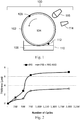
- an elongate strip of printing blanket 102 was mounted and attached to a rotatable cylinder 104, and the ends of the blanket strip were secured one to the other, forming a seam 106.
- the cylinder was positioned so that its lower section was in contact (for about 0.5 to 1.0 second) with the conditioning compositions 108 being tested, placed in a receiving vessel 110.
- the temperature of composition 108 can be monitored and/or maintained as desired.
- the blanket was sequentially coated with the test solution, wiped of excess liquid by a polyurethane rubber wiper 112, dried with an air blower (>200°C) 114 positioned about 12 cm from the blanket surface, further dried with an infrared (IR) lamp ( ⁇ 150°C) 116 positioned about 9 cm away, before reentering the test solution for another cycle.
- the temperature on the outer surface of the blanket was monitored with an IR gun thermometer and depending on the position relative to the dipping or drying stages, varied between about 100°C and about 140°C.
- the temperature of the condition composition tested was about 50°C.
- the blanket coated with the tested conditioning solution was dried for a desired duration.
- the number of cycles was monitored and the cylinder stopped when the desired number of cycles was completed, at which time the rotation was stopped.
- the blanket was then removed and the accumulation of the conditioning composition under study was assessed. This was done by measuring the thickness of the dried agents above the surface of the blanket using a confocal microscope (LEXT at X20 magnification and laser scan). The results illustrate the accumulation of conditioning agent in the presence, or absence, of the resolubilizing agent being tested.
- a conditioning composition comprising about 0.33 wt.% polyethylenimine (PEI) in distilled water (1:100 dilution of BASF Lupasol® PS having a solid content of 33 wt.%) served as reference. Unless otherwise stated, the resolubilizing agents were added to the reference composition at a final concentration of 1 wt.%.
- the blanket comprised a body for support and a release layer formed thereupon by condensation curing of silanol-terminated polydimethyl siloxane silicone (PDMS), as described in PCT Publication No. WO 2013/132438 .
- the blanket was exposed to the conditioning compositions and subjected to drying for a duration of time that may be more extensive than in typical commercial printing conditions. For instance, the conditioned blankets were submitted to similar drying periods of 1.5-2 seconds per cycle. Moreover, as no ink images were applied and transferred to paper, steps which would have peeled at least part of the conditioning residues, if not all, it is believed that the above-described laboratory setup can simulate unfavorable conditions. It is to be noted that the pattern of the dried splotches of conditioning compositions in this setup was found to be similar to the accumulations that could be observed in larger scale commercial printing setup in which ink images were jetted upon the conditioned blankets.
- the term "intimately mixed", with regard to a formulation component disposed in a carrier liquid of the formulation, is meant to include dissolution of the component and/or dispersion of the component within the carrier liquid.
- ratio refers to a weight ratio, unless specifically indicated otherwise.
- the term "largely includes”, with respect to a component within a formulation, refers to a weight content of at least 45%.
- each of the verbs, "comprise” “include” and “have”, and conjugates thereof, are used to indicate that the object or objects of the verb are not necessarily a complete listing of members, components, elements or parts of the subject or subjects of the verb.
- the singular form “a”, “an” and “the” include plural references unless the context clearly dictates otherwise.
- the term “an impression station” or “at least one impression station” may include a plurality of impression stations.
Landscapes
- Engineering & Computer Science (AREA)
- General Engineering & Computer Science (AREA)
- Ink Jet Recording Methods And Recording Media Thereof (AREA)
- Ink Jet (AREA)
- Inks, Pencil-Leads, Or Crayons (AREA)
Description
- The present invention relates to indirect printing systems and more particularly to compositions suitable for the treatment of intermediate transfer members.
- Digital printing techniques have been developed that allow a printer to receive instructions directly from a computer without the need to prepare printing plates. Amongst such printing devices are printers with color laser technology or the xerographic process, which use dry toners, and the widely used inkjet printers, which use liquid inks and rely on inkjet or bubble jet processes. Such printing devices typically directly apply the desired image to the final printing substrate (e.g., paper, cardboard or plastic). In general, the resolution of such processes is limited. For instance, liquid inks may wick into fibrous substrates requiring the use of substrates specially coated to absorb the liquid ink in a controlled fashion or to prevent its penetration below the surface of the substrate. Such coated substrates may not address all issues associated with direct printing and may even create their own problems. For instance, if the surface of the substrate remains wet following the application of the ink, additional costly and time consuming steps may be needed to dry the ink, so that it is not later smeared as the substrate is being handled, for example, stacked or wound into a roll. Furthermore, excessive wetting of the substrate causes cockling and makes printing on both sides of the substrate (also termed perfecting or duplex printing) difficult, if not impossible.
- In commercial settings, there exist additional printing systems, some relying on indirect or offset printing techniques. In such processes, an intermediate image of the final desired pattern (e.g., a mirror image) is typically formed on an image transfer member (e.g., a blanket or a drum) and transferred therefrom to the final printing substrate. The intermediate image can be, as in HP-Indigo printers, an electrostatic image produced on an electrically charged image bearing cylinder by exposure of compatible oil-based inks to laser light, the ink image being then transferred by way of a blanket cylinder onto paper or any other substrate. Though such systems are better suited for high quality digital printing the use of oil-based inks has raised environmental concerns.
- The present Applicant has recently disclosed a printing process wherein inks having an aqueous carrier are jetted onto an intermediate transfer member (ITM) at an image forming station and dried thereupon before being transferred to the desired substrate at an impression station. Few systems implementing such process were disclosed, differing among other things in the number of image forming stations, the configurations of the intermediate transfer members, the number of impression stations and the system architecture allowing duplex printing. More details on such systems are disclosed in PCT Publication Nos.
WO 2013/132418 WO 2013/132419 WO 2013/132420 - Advantageously, such indirect printing systems allow the distance between the outer surface of the intermediate image transfer member (also called the release layer) and the inkjet print head to be maintained constant and reduces wetting of the substrate, as the ink can be dried on the intermediate image transfer member before being applied to the printing substrate. Consequently, the final image quality is less affected by the physical properties of the substrate and benefits from various other advantages as disclosed in PCT Publication Nos.
WO 2013/132345 WO 2013/132343 WO 2013/132340 - Among the problems surmounted by such systems was the need to find a balance between opposite requirements. On the one hand, the printing process, including the materials or formulations employed therewith, should allow transiently fixing the aqueous based ink droplets onto the release layer at the image forming station. On the other hand, the same should allow the dried ink film to be fully transferred to the printing substrate at the impression station.
- Generally, silicone coated transfer members are preferred, since they facilitate transfer of the dried image to the final substrate. However, silicone is hydrophobic, which causes water based ink droplets to bead on the transfer member. This results in a small contact area between the droplets and the blanket that renders the ink image unstable during rapid movement and makes it more difficult to remove the water from the ink, for instance by heating the transfer member.
- One solution proposed in the above-referenced publications of the Applicant to alleviate this problem was to "freeze" the shape of the impinging jetted droplet in the pancake-like form it adopted upon contact, for instance by rapidly evaporating a substantial proportion of the liquid ink carrier at the stage of the image formation onto the transfer member. The rate of such evaporation depending upon temperature, it was generally preferred for that particular purpose to operate the system at elevated temperatures (e.g., above water boiling point and typically up to 160°C). However, as the vapors of the ink carrier might over time affect the print head nozzles, lower temperatures (e.g., above 40°C) were also considered for the image forming station.
- Alternatively, or additionally, the Applicant disclosed conditioning methods and formulations facilitating the desired interaction between ink formulations and materials composing the release layer suitable for the novel process, by pre-treatment of the transfer member ahead of ink jetting. More details on such methods can be found in
PCT Publication No. WO 2013/132339 . -
US Patent Publication No. 2012/0140009 discloses an aggregation liquid for use with an intermediate transfer member of a printing system, containing a carrier liquid, and a positively chargeable polymeric chemical agent, such as a guar gum derivative having an amino group. The polymeric chemical agent may have an average molecular weight of at least 10,000. -
EP Patent Publication No. 0499857 discloses compositions useful as binders in paper or textile color formulations or printing inks, containing one or more polyalkylene imines (preferably a polyethylenimine); one or more alkanolamines (preferably ethanolamine); and one or more polyols (preferably a glycol); optionally in the presence of water. The two exemplified binders contain, respectively, by weight: 17% of a polyethylenimine, 12% glycerin, 30% ethanolamine, and 41% water; and 15.5% of the polyethylenimine, 25.5% glycerin, 32% ethanolamine, 27% propylene glycol, and no added water. - Without detracting from the importance of these advances, the present inventors have discovered that under some conditions, surprisingly, some of the aforementioned conditioning solutions may deleteriously accumulate on the transfer member on selected areas. Hence, the present inventors have recognized the need for further improvements in release layer conditioning compositions and technologies.
- There is disclosed a formulation for use with an intermediate transfer member of a printing system, the formulation comprising: (a) a carrier liquid; (b) a positively chargeable polymeric chemical agent selected from the group consisting of polyethylene imine (PEI), a cationic guar or guar-based polymer and a cationic methacrylamide or methacrylamide-based polymer; and (c) a resolubilizing agent selected to improve resolubilization of the chemical agent; the polymeric chemical agent and the resolubilizing agent being disposed within the carrier liquid; the polymeric chemical agent having an average molecular weight of at least 10,000 and a positive charge density of at least 0.1 meq/g of the chemical agent; the resolubilizing agent having, in a pure state and at 90°C, a vapor pressure of less than 0.5kPa; and the weight ratio of the resolubilizing agent to the polymeric chemical agent, within the formulation, being at least 1:10.
- The resolubilizing agent of the formulation herein disclosed has a hydrogen-bonding functional group. In some embodiments, a functional group density of the hydrogen-bonding functional group within the resolubilizing agent is at least 0.25 meq/g, at least 0.35 meq/g, at least 0.45 meq/g, at least 0.6 meq/g, at least 0.8 meq/g, at least 1 meq/g, at least 2 meq/g, at least 3 meq/g, at least 5 meq/g, at least 7meq/g, at least 10 meq/g, at least 15 meq/g, at least 20 meq/g, at least 22 meq/g, at least 24 meq/g, at least 26 meq/g, at least 28 meq/g, or at least 30 meq/g.
- In some embodiments, the resolubilizing agent has at least one functional group selected from a hydroxyl group, an amine group, an ether group, a sulfonate group, and combinations thereof.
- In some embodiments, the resolubilizing agent is selected from the group including diols, triols, polyols, alcohols, sugars and modified sugars, ethers, polyethers, amino alcohol, amino silicones, styrene sulfonates, and combinations thereof.
- In some embodiments, the resolubilizing agent is selected from the group consisting of cocoamide diethanol amine, ethoxylated methyl glucose ether, Glucam™ E-10, Glucam™ E-20, glycerol, pentaerythritol, PEG 400, PEG 600, poly(sodium-4-styrenesulfonate), SilSense® Q-Plus Silicone, SilSense® A21 Silicone, sucrose, triethanol amine, and triethylene glycol monomethyl ether.
- In some embodiments, the resolubilizing agent has a molecular weight below 5,000, below 2,500, below 1,000, below 750, below 600, below 500, below 400, below 350, or below 300.
- In some embodiments, the resolubilizing agent of the formulation herein disclosed has a solubility, in the formulation, of at least 1%, at least 3%, at least 5%, at least 10%, at least 20%, at least 30%, at least 40%, or at least 50% at 25°C.
- In some embodiments, the chemical agent, the resolubilizing agent, and the carrier liquid make up at least 80%, at least 90%, at least 95%, at least 97%, or at least 99% of the formulation, by weight.
- In some embodiments, the water content of the formulation is at least 5%, at least 10%, at least 20%, at least 40%, at least 60%, at least 70%, at least 80%, at least 90%, at least 95%, or at least 97%, by weight.
- In some embodiments, the weight ratio of the resolubilizing agent to the polymeric chemical agent is at least 1:7, at least 1:5, at least 1:4, at least 1:3, at least 1:2, at least 1:1, at least 2:3, at least 2:1, at least 3:1, at least 4:1, at least 6:1, at least 8:1, at least 10:1, at least 12:1, at least 15:1, or at least 20:1.
- In some embodiments, the weight ratio of the resolubilizing agent to the polymeric chemical agent is less than 20:1, less than 15:1, less than 12:1, less than 10:1, less than 8:1, less than 6:1, less than 5:1, less than 4:1, less than 3:1, less than 2:1, less than 3:2, or less than 5:4.
- In some embodiments, the weight ratio of the resolubilizing agent to the polymeric chemical agent being within a range of 1:10 to 20:1, within a range of 1:7 to 20:1, within a range of 1:5 to 15:1, within a range of 1:2 to 15:1, within a range of 1:2 to 10:1, within a range of 1:2 to 7:1, within a range of 1:2 to 5:1, within a range of 1:2 to 4:1, within a range of 1:1 to 10:1, within a range of 1:1 to 7:1, within a range of 1:1 to 5:1, or within a range of 1:2 to 3:1.
- In some embodiments, the formulation has a viscosity of at most 1,500 mPa*s, at most 1000 mPa*s at most 700 mPa*s, at most 400 mPa*s, at most 200 mPa*s, at most 100 mPa*s, at most 50 mPa*s, at most 30 mPa*s, at most 20 mPa*s, at most 10 mPa*s, or at most 1 cmPa*s.
- In some embodiments, the formulation has a pH within a range of 7 to 14, 8 to 13, or 9 to 12.
- In some embodiments, the vapor pressure of the resolubilizing agent is less than 0.45kPa, less than 0.40kPa, less than 0.35kPa, less than 0.30kPa, less than 0.20kPa, less than 0.10kPa, or less than 0.05kPa.
- In some embodiments, the resolubilizing agent is stable at a temperature of up to at least 125°C, at least 150°C, at least 175°C, at least 200°C, or at least 225°C. In some embodiments, the formulation is stable at a temperature of up to at least 125°C, at least 150°C, at least 175°C, at least 200°C, or at least 225°C.
- In some embodiments, the concentration of the polymeric chemical agent within the formulation is not more than 5 wt.%, not more than 4 wt.%, not more than 3 wt.%, not more than 2 wt.%, not more than 1 wt.%, not more than 0.5 wt.%, not more than 0.4 wt.%, not more than 0.3 wt.%, not more than 0.2 wt.%, not more than 0.1 wt.%, not more than 0.05 wt.%, or not more than 0.01 wt.%.
- In some embodiments, the concentration of the resolubilizing agent within the formulation is not more than 5 wt.%, not more than 4 wt.%, not more than 3 wt.%, not more than 2 wt.%, not more than 1 wt.%, not more than 0.5 wt.%, not more than 0.4 wt.%, not more than 0.3 wt.%, not more than 0.2 wt.%, not more than 0.1 wt.%, not more than 0.05 wt.%, or not more than 0.01 wt.%.
- In some embodiments, the polymeric chemical agent has a nitrogen content of at least 1 wt.%.
- In some embodiments, the polymeric chemical agent includes, largely includes, or consists essentially of linear polyethylene imine (PEI), branched PEI, modified PEI and combinations thereof. In some embodiments, the average molecular weight (MW) of the PEI is at least 25,000, at least 50,000, at least 100,000, at least 150,000, at least 200,000, at least 250,000, at least 500,000, at least 750,000, at least 1,000,000, or at least 2,000,000.
- In some embodiments, the charge density of the PEI is at least 10 meq/g, at least 11 meq/g, at least 12 meq/g, at least 13 meq/g, at least 14 meq/g, at least 15 meq/g, at least 16 meq/g, at least 17 meq/g, at least 18 meq/g, at least 19 meq/g, or at least 20 meq/g.
- The polymeric chemical agent has an average molecular weight of at least 10,000, at least 15,000, at least 20,000, at least 25,000, at least 50,000, at least 100,000, at least 150,000, at least 200,000, at least 250,000, at least 500,000, at least 750,000, at least 1,000,000, or at least 2,000,000.
- In some embodiments, the polymeric chemical agent is selected from the group consisting of a vinyl pyrrolidone-dimethylaminopropyl methacrylamide co-polymer (ViviPrint™ 131), a vinyl caprolactam-dimethylaminopropyl methacrylamide hydroxyethyl methacrylate terpolymer (ViviPrint™ 200), a quaternized copolymer of vinyl pyrrolidone and dimethylaminoethyl methacrylate with diethyl sulfate (ViviPrint™ 650), a guar hydroxypropyltrimonium chloride, a hydroxypropyl guar hydroxypropyltrimonium chloride, and combinations thereof.
- In some embodiments, the positively chargeable polymeric chemical agent includes at least one of a cationic [guar-based] polymer and of a cationic [methacrylamide-based] polymer, and the functional group density within said polymeric chemical agent is at least 0.25 meq/g, at least 0.35 meq/g, at least 0.45 meq/g, at least 0.6 meq/g, at least 0.8 meq/g, at least 1 meq/g, at least 2 meq/g, at least 3 meq/g, or at least 5 meq/g.
- There is also provided a formulation for use with an intermediate transfer member of a printing system, the formulation comprising: (a) a carrier liquid; (b) a positively chargeable polymeric chemical agent; and (c) a resolubilizing agent selected to improve resolubilization of said chemical agent; the polymeric chemical agent and the resolubilizing agent disposed within the carrier liquid; wherein the polymeric chemical agent has (i) at least one functional group selected from a primary amine, a secondary amine, a tertiary amine and a quaternary amine, (ii) an average molecular weight of at least 50,000 and (iii) a positive charge density of at least 0.1 meq/g of the chemical agent; the resolubilizing agent having, in a pure state and at 90°C, a vapor pressure of less than 0.5kPa; and wherein a weight ratio of the resolubilizing agent to the polymeric chemical agent, within the formulation, is at least 1:10.
- According to some embodiments, the chemical agent is selected from the group consisting of linear PEI, branched PEI, modified PEI, and combinations thereof, and the weight ratio of the resolubilizing agent to the PEI, within the formulation, is at most 20:1.
- Also provided is a method of use of the above described formulations, the method comprising (a) treating an intermediate transfer member (ITM) of a printing system by application of the formulation upon a release surface, the treatment preceding the deposition of an ink image upon the transfer member. The method further comprises the following steps: (b) optionally drying the ink image deposited on the ITM, (c) transferring the dried ink image to a printing substrate.
- The present technology is herein described, by way of example only, with reference to the accompanying drawings, in which the dimensions of components and features are chosen for convenience and clarity of presentation and are not necessarily to scale, and wherein:
-
Figure 1 is a schematic illustration of an experimental setup allowing assessing accumulation of conditioning agents on printing blankets and its reduction in accordance with an embodiment herein disclosed; -
Figure 2 is a plot showing the measured thickness of dried conditioning compositions as a function of the number of cycles of rotation of a printing blanket in an apparatus as illustrated inFigure 1 . - As noted, when the ink droplet impinges on the transfer member, the momentum in the droplet causes it to spread into a relatively flat volume. In the prior art, this flattening of the droplet is almost immediately counteracted by the combination of surface tension of the droplet and the hydrophobic nature of the surface of the transfer member, which causes the droplet to bead up regaining spherical shape.
- In some instances, the shape of the ink droplet is "frozen" such that at least some and preferably a major part of the flattening and horizontal extension of the droplet present on impact is preserved. It should be understood that since the recovery of the droplet shape after impact is very fast, the methods of the prior art would not effect phase change by agglomeration and/or coagulation and /or migration.
- Without wishing to be bound by theory, it is believed that, on impact, the positive charges which have been placed on the surface of the transfer member attract the negatively charged or chargeable polymer resin particles of the ink droplet that are immediately adjacent to the surface of the member. It is believed that, as the droplet spreads, this effect takes place along a sufficient area of the interface between the spread droplet and the transfer member to retard or prevent the beading of the droplet, at least on the time scale of the printing process, which is generally on the order of seconds.
- As the amount of charge is too small to attract more than a small number of charged resin particles in the ink, it is believed that the concentration and distribution of the charged resin particles in the drop is not substantially changed as a result of contact with the chemical agent on the release layer. Furthermore, since the ink is aqueous, the effects of the positive charge are very local, especially in the very short time span needed for freezing the shape of the droplets.
- Without wishing to be bound by theory, it is believed that in applying a conditioning agent or solution to the surface of the intermediate transfer member, at least one type of positively-charged functional group of the conditioning agent is adsorbed onto, or otherwise attached to, the surface of the release layer. On the opposite side of the release layer, facing the jetted ink drops, at least one type of positively-charged functional group of the conditioning agent is available and positioned to interact with the negatively charged molecules in the ink (e.g., in the resin).
- The polymeric resin typically comprised in ink formulations due to interact with such transfer members comprises primarily or exclusively one or more negatively chargeable polymers, such as polyanionic polymers. By a "negatively chargeable polymer" or "negatively chargeable polymer resin" is meant a polymer or polymeric resin which has at least one proton which can easily be removed to yield a negative charge; as used herein, the term refers to an inherent property of the polymer, and thus may encompass polymers which are in an environment in which such protons are removed, as well as polymers in an environment in which such protons are not removed.
- In contrast, the term "a negatively charged polymer resin" refers to a resin in an environment in which one or more such protons have been removed. Examples of negatively chargeable groups are carboxylic acid groups (-COOH), including acrylic acid groups (-CH2=CH-COOH) and methacrylic acid groups (-CH2=C(CH3)-COOH), and sulfonic acid groups (-SO3H). Such groups can be covalently bound to polymeric backbones; for example styrene-acrylic copolymer resins have carboxylic acid functional groups which readily lose protons to yield negatively-charged moieties. Many polymers suitable for use in inks that may benefit from conditioning solutions according to embodiments of the invention, will be negatively charged when dissolved in water; others may require the presence of a pH raising compound to be negatively charged. Commonly, polymers will have many such negatively chargeable groups on a single polymer molecule, and thus are referred to as polyanionic polymers.
- Examples of polyanionic polymers include, for instance, polysulfonates such as polyvinylsulfonates, poly(styrenesulfonates) such as poly(sodium styrenesulfonate) (PSS), sulfonated poly(tetrafluoroethylene), polysulfates such as polyvinylsulfates, polycarboxylates such as acrylic acid polymers and salts thereof (e.g., ammonium, potassium, sodium, etc.), for instance, those available from BASF and DSM Resins, methacrylic acid polymers and salts thereof (e.g., EUDRAGIT®, a methacrylic acid and ethyl acrylate copolymer), carboxymethylcellulose, carboxymethylamylose and carboxylic acid derivatives of various other polymers, polyanionic peptides and proteins such as homopolymers and copolymers of acidic amino acids such as glutamic acid, aspartic acid or combinations thereof, homopolymers and copolymers of uronic acids such as mannuronic acid, galacturonic acid and guluronic acid, and their salts, alginic acid and its salts, hyaluronic acid and its salts, gelatin, carrageenan, polyphosphates such as phosphoric acid derivatives of various polymers, polyphosphonates such as polyvinylphosphonates, as well as copolymers, salts, derivatives, and combinations of the preceding, among various others. In some embodiments, the polymeric resin comprises an acrylic-based polymer, viz. a polymer or copolymer made from acrylic acid or an acrylic acid derivative (e.g., methacrylic acid or an acrylic acid ester), such as polyacrylic acid or an acrylic acid-styrene copolymer. Nominally, the polymeric resin may be, or include, an acrylic styrene co-polymer. In some illustrated embodiments, conditioning solutions according to the invention satisfactorily treat release layer upon which inks comprising primarily or exclusively an acrylic-based polymer selected from an acrylic polymer and an acrylic-styrene copolymer are deposited. In some instances, the polymeric resin is at least partly water soluble; in some instances, the polymeric resin is water dispersible, and may be provided as an emulsion or a colloid.
- Intermediate transfer members amenable to such treatment may include in their release layer, by way of example, silanol-, sylyl- or silane- modified or terminated polydialkyl-siloxane silicones, or combinations thereof. Transfer members having such non-limiting exemplary release layers have been disclosed in PCT Publication No.
WO 2013/132432 - Chemical agents suitable for the preparation of such conditioning solutions, if required, have relatively high charge density and can be polymers containing amine nitrogen atoms in a plurality of functional groups, which need not be the same, and can be combined (e.g., primary, secondary, tertiary amines or quaternary ammonium salts). Though macromolecules having a molecular weight from several hundred to several thousand may be suitable conditioning agents, the inventors believe that polymers having a high molecular weight of 10,000 g/mole or more are preferable. Suitable conditioning agents may include guar hydroxylpropyltrimonium chloride, hydroxypropyl guar hydroxypropyl-trimonium chloride, linear or branched polyethylene imine, modified polyethylene imine, vinyl pyrrolidone dimethylaminopropyl methacrylamide copolymer, vinyl caprolactam dimethylaminopropyl methacrylamide hydroxyethyl methacrylate, quaternized vinyl pyrrolidone dimethylaminoethyl methacrylate copolymer, poly(diallyldimethyl-ammonium chloride), poly(4-vinylpyridine) and polyallylamine.
- Further details on conditioning solutions suitable for printing processes wherein water-based inks are jetted onto hydrophobic surface of transfer members and which may be used in printing systems for which the present invention can be suitable are disclosed in PCT Publication No.
WO 2013/132339 - The efficacy of this method and of the water-based treating solutions associated therewith, also termed "conditioning solutions", was established in laboratory experimental setups and in preliminary pilot printing experiments. As disclosed in the above-mentioned application, the use of such solutions was highly beneficial, as assessed by the print quality of the image following its transfer from the intermediate transfer member to the printing substrate. The optical density of the printed matter was considered of particular relevance and the use of such method of blanket treatment prior to ink jetting clearly improved the measured outcome on the printing substrate. For example, when the substrate was Condat Gloss® 135 gsm coated paper, the optical density of the printed image on the substrate was at least 50% greater than the optical density of the same image when printed under identical conditions but without application of the chemical agent to the release layer. In some embodiments of the method, the optical density (as measured using a Spectrodensitometer (500 Series from X-rite)) is at least 60% greater, at least 70% greater, at least 80% greater, or at least 90% greater. In some embodiments, the optical density is at least 100% greater, at least 150% greater, at least 200% greater, at least 250% greater, at least 300% greater, at least 350% greater, at least 400% greater, at least 450% greater, at least 500% greater, at least 600% greater.
- According to the method originally developed by the Applicant, a very thin coating of conditioning solution was applied to the transfer member, immediately removed and evaporated, leaving no more than few layers of the suitable chemical agent. Ink droplets were jetted on such pre-treated blanket, dried and transferred to the printing substrate. Typically, the ink film image so printed could be identified by the presence on their outer surface of the conditioning agent. In other words, the dried ink droplet upon transfer ripped the underlayer of conditioning agent and was impressed on the final substrate in inversed orientation.
- It was expected that untransferred residues of conditioning agents (e.g., in areas where no ink was jetted), would readily redissolve in the next cycle, upon the application of a fresh coating of conditioning solution. The operating temperature of the process, which may vary at the different stations along the path the jetted image would follow, but would typically be above 50°C, was expected to facilitate such resolubilization of the residual conditioning agents, if any, in the freshly applied solution. In addition, any such residue was expected to be readily eliminated during cleaning of the transfer member that could take place, if desired, to remove dirt or traces of ink residues that may gather on such member following repeated printing cycles.
- In the field, numerous operative parameters were tested, such that the number of runs being performed under a given set of variables was relatively limited, i.e., up to 1,500-3,000 impression repeats. However, upon repeated use of this method in pilot experiments of longer runs (e.g., at least 5,000-10,000 impressions), various undesirable phenomena were found to occur. Perhaps most significantly, the inventors discovered that various above-provided conditioning agents, though based on water-soluble polymers, did not -- once dried on the ITM -- resolubilize satisfactorily when subjected to a subsequent application of the conditioning solution.
- In addition, the inventors have found that low-temperature operation of the image forming station may appreciably complicate or increase the difficulty of the conditioning duty. Without wishing to be limited by theory, the inventors believe that at higher temperatures, the evaporation of the carrier of the ink formulation proceeds at a relatively high rate, which reduces the requisite duty of the conditioning agents with respect to the retardation of droplet beading. However, at lower operating temperatures, the evaporation kinetics may be significantly slower, as are the kinetics for the attraction process between the positively-charged conditioning agents and the negatively-charged functional groups in the ink (typically in the resin).
- Moreover, the inventors believe that the kinetics of resolubilization may also be appreciably reduced at lower temperatures, which as elaborated hereinabove, may detract from print image quality.
- As the previously disclosed conditioning solutions could lead to undesired build up of chemical agents having unexpectedly low resolubilization properties, the practical lifetime of the ITM (e.g., the blanket) was shortened, in order to ensure that the surface of the release layer was fresh, or at least sufficiently devoid of such deleterious accumulations to enable satisfactory transfer and print quality. Such accumulations were generally observed on areas of low to null ink coverage (e.g., ink barren areas of a printed image).
- The inventors have surprisingly discovered aqueous formulations that act as a conditioning solution, and that facilitate resolubilization of chemical agents (also referred to as "residual conditioning agents"). In some embodiments, the aqueous conditioning formulation may be sufficiently active, at low temperatures (Image Forming Station temperatures within a range of 40°C to 95°C, 60°C to 95°C, 75°C to 95°C, 60°C to 90°C, or 60°C to 85°C) to efficaciously interact with various negatively charged molecules in the ink, within the requisite time frame (at most a few seconds), such that beading of the droplet is sufficiently retarded.
- The aqueous conditioning formulation may include: a positively chargeable polymeric conditioning agent, typically having an amine functional group, such as a polyethylene imine (PEI), and a resolubilizing agent selected to improve resolubilization of the conditioning agent, both disposed within an aqueous carrier liquid. Typically, the PEI has an average molecular weight of at least 5,000 and a positive charge density of at least 10 meq/g. Other conditioning agents are amenable to improved resolubilization according to the teaching of the invention, as detailed hereinbelow, and though the invention is described with reference to PEI, the invention need not be limited to such particular embodiments. The resolubilizing agent may advantageously have, in a pure state, a vapor pressure of less than 0.025, less than 0.020, less than 0.015, less than 0.012, less than 0.010, or less than 0.008 bar at 90°C.
- The resolubilizing agent, as a pure substance, may advantageously be a liquid at 20°C or more, at 30°C or more, at 40°C or more, at 50°C or more, or at 60°C or more. Without wishing to be bound by a particular theory, it is believed that suitable resolubilizing agents may interact with the conditioning agent by way of steric hindrance, increasing the accessibility of the conditioning molecule to resolubilizing vehicles (e.g., water). The two agents are preferably chemically inert with one another.
- The weight ratio of the resolubilizing agent to the conditioning agent (e.g., PEI), within the conditioning formulation, is typically within a range of 1:10 to 20:1, within a range of 1:5 to 20:1, within a range of 1:5 to 15:1, and more typically, within a range of 1:3 to 10:1, within a range of 1:3 to 7:1, within a range of 1:3 to 5:1, within a range of 1:2 to 5:1, or within a range of 1:1 to 5:1.
- In some embodiments, the concentration of the resolubilizing agent within the formulation may be not more than 10 wt.%, not more than 5 wt.%, not more than 4 wt.%, not more than 3 wt.%, not more than 2 wt.%, not more than 1 wt.%, not more than 0.5 wt.%, not more than 0.4 wt.%, not more than 0.3 wt.%, not more than 0.2 wt.%, or not more than 0.1 wt.%.
- The resolubilizing agent may have a solubility in water, in the carrier liquid, or in the formulation, of at least 1%, at least 3%, at least 5%, at least 10%, at least 20%, at least 30%, at least 40%, at least 50% at 25°C and a pH of 7. The conditioning agent (e.g., PEI), resolubilizing agent, and carrier liquid may make up at least 50%, at least 60%, at least 70%, at least 80%, at least 90%, at least 95%, at least 97%, or at least 99% of the formulation, by weight.
- The PEI may be a linear polyethylene imine, a branched polyethylene imine, a modified polyethylene imine, or combinations thereof. The average molecular weight of the PEI may be at least 25,000, at least 50,000, at least 100,000, at least 150,000, at least 200,000, at least 250,000, at least 500,000, at least 750,000, at least 1,000,000, or at least 2,000,000.
- The charge density of the PEI may be at least 10 meq/g, at least 11 meq/g, at least 12 meq/g, at least 13 meq/g, at least 14 meq/g, at least 15 meq/g, at least 16 meq/g, at least 17 meq/g, at least 18 meq/g, at least 19 meq/g, or at least 20 meq/g.
- The concentration of PEI within the formulation may be not more than 5 wt.%, not more than 4 wt.%, not more than 3 wt.%, not more than 2 wt.%, not more than 1 wt.%, not more than 0.5 wt.%, not more than 0.4 wt.%, not more than 0.3 wt.%, not more than 0.2 wt.%, not more than 0.1 wt.%, not more than 0.05 wt.%, or not more than 0.01 wt.%.
- The conditioning and resolubilizing agents may each individually be stable at a temperature of up to at least 100°C, at least 125°C, at least 150°C, at least 175°C, at least 200°C, or at least 225°C.
- The resolubilizing agent may include, mainly include, or consist essentially of at least one sugar, at least one alcohol (e.g., diol, triol, polyol), at least one ether or polyether, at least one amine, at least one polymeric anion salt, at least one amino silicone, or combinations thereof (e.g., agents comprising combined sugar and ether, alcohol and amine functionalities or polyether and amine functionalities).
- In some embodiments, the resolubilizing agent is selected from the group comprising cocoamide diethanol amine, ethoxylated methyl glucose ether (e.g., Glucam™ E-10 and Glucam™ E-20), glycerol, pentaerythritol, PEG 400,
PEG 600, poly(sodium 4-styrenesulfonate), silicone having amine pendant groups (e.g., SilSense® Q-Plus Silicone having quaternary nitrogen and SilSense® A21 Silicone having secondary and tertiary amine groups), sucrose, triethanolamine, triethylene glycol mono methyl ether, and combinations thereof. - Conditioning compositions comprising conditioning agents and resolubilizing agents according to present teachings may further comprise one or more additive including pH modifiers, viscosity modifiers, stabilizers, preservatives, anti-oxidants, and chelating agents.
- Exemplary conditioning solutions that can be used to treat an ITM upon which aqueous ink formulations can be deposited are provided hereinbelow, wherein the amount of the respective ingredients is provided in weight percent (wt.%) of the complete conditioning formulation, the water being deionized:
Conditioning Solution A PEI Lupasol® PS (BASF) 1 (MW 750,000, ∼33% solid) Sucrose 4 Water 95 Conditioning Solution B PEI Lupasol® P (BASF) 0.7 (MW 750,000, ∼50% solid) Glycerol 1 Water 98.3 Conditioning Solution C PEI Lupasol® HF (BASF) 5 (MW 25,000, ∼56% solid) Triethanolamine 10 Water 85 Conditioning Solution D PEI Lupasol® WF (BASF) 2 (MW 25,000, ∼99% solid) Pentaerythritol 1 Water 97 Conditioning Solution E PEI branched, MW 25,000 (Aldrich) 3 Polyethylene glycol 400 6 Water 91 Conditioning Solution F PEI, 80 % ethoxylated MW 111,000, 37% water solution (Aldrich) 4 Glycerol 4 Water 92 Conditioning Solution I ViviPrint™ 131 2 (MW 1,500,000-2,000,000, ∼11% solid) Glycerol 2 Water 96 Conditioning Solution J ViviPrint™ 131 2 (MW 1,500,000-2,000,000, ∼11% solid) Water 98 - Such conditioning solutions were typically prepared by mixing the conditioning agent with most of the water, adding then the resolubilizing agent and further stirring the mixture. Water was then added to complete the conditioning formulation up to 100 weight parts and the resulting formulation was optionally filtered through a 0.5 micrometer (µm) filter.
- Such conditioning solutions can be prepared as concentrated stock to be diluted to the final concentration desired in operation of a relevant printing system. Exemplary concentrated stock of conditioning solutions that can be diluted and then used to treat an ITM upon which the ink formulations can be deposited are provided hereinbelow, wherein the amount of the respective ingredients are provided in weight percent (wt.%) of the stock:
Conditioning Stock Solution G PEI Lupasol® P (BASF) 41.5 (MW 750,000, ∼50% solid) Glycerol 39 Water 19.5 Conditioning Stock Solution H PEI, Lupasol® PN-50 30.5 (MW 1,000,000, ∼49% solid) Triethanolamine 20.8 Water 48.7 - The re-solubility of Solution I and Solution J was tested according to the following procedure: each sample (50 ml) was dried for 3 days at 100°C. The dried residue was resuspended with 50 ml of hot water (with heating to 60°C to accelerate the experiment and to approximate the temperature of the ITM).
- Results: the residue of Solution I dissolved almost immediately (in less than 1 second). By contrast, dissolution of Solution J, which was devoid of a resolubilization agent, required 1 minute of intensive shaking.
- Once dried, various PEIs found to be generally suitable as conditioning agents do not easily resolubilize in water, even though such PEIs were water soluble or even highly water soluble, ab initio. Some guar-based and Viviprint conditioning agents may suffer from similar phenomena, albeit on a lesser scale.
- The dried conditioning agent may therefore accumulate on the blanket, especially on areas on which no ink was jetted. Such areas may be appreciably more susceptible to the accumulation of the dried conditioning agent, with respect to printed-on areas, in which much or all of the dried conditioning agent may be transferred to the printing substrate, along with the ink image, upon impression thereof.
- The inventive formulations improve resolubilization, or the kinetics of resolubilization, following drying.
- In the experimental program provided below, the inventors assessed whether resolubilization agents (RA) could be added to a conditioning solution comprising, as a conditioning agent (CA), 0.3% wt. PEI to facilitate its resolubilization in water, following extensive drying.
- The candidate Resolubilization Agents were selected have any of the following functional groups: -OH, -NR2, -N+R3, -SO3-.
- The conditioning agent tested was PEI Lupasol® PS at 1:100 dilution (i.e., ∼0.3% wt. concentration of PEI in the final conditioning composition).
- The conditioning solutions were prepared in distilled water using a constant amount of CA (0.3% PEI Lupasol® PS) and increasing amounts of candidate RA at the weight ratio indicated below. The RA was typically at least 99% pure or used as provided by the commercial supplier. Chemicals were purchased from Ashland, Chemrez Technologies, Lubrizol and Sigma-Aldrich.
- Conditioning solutions containing about 6 g of solid material were dried for 3 days at 100°C. The dried residue was resuspended with 50 ml of hot water (with heating to 60°C to accelerate the experiment and to approximate the temperature of the ITM).
- Resolubilization was visually assessed and classified either as positive, if visibly achieved, negative if not visibly achieved, or partial. A resuspended sample was classified as partly resoluble if found to contain a fractional quantity of undissolved dried residues. To the extent available, information concerning the estimated average molecular weight of the candidate Resolubilizing Agent, and the number of H-bonding group (meq/g) is also provided. The results are provided below in Table 1.
TABLE 1 Resolubilizing Agent (RA) RA: CA Ratio Resol. in water MW # of H-bonding Groups (meq/g) Chemical Family Chemical Formula Reference (PEI Alone) 0:1 No Ethylene Glycol 1:5 No 62.07 32 Diol 1:1 No C2H6O2 5:1 No Propylene glycol 1:5 No 76.09 26 Diol 1:1 No C3H8O2 5:1 No Diethylene Glycol 1:5 No 106.12 18 Diol 1:1 No C4H10O3 5:1 No 2-Amino-2-methyl-1-propanol 1:5 No 89.1 22 Amine and Alcohol 1:1 No C4H11NO 5:1 No PEG 8000 1:5 No ∼ 8,000 0.25 Polyether 1:1 No C2nH4n+2On+1 5:1 No PEG 20000 1:5 No ∼20,000 0.1 Polyether 1:1 No C2nH4n+2On+1 5:1 No PEG 400 1:5 No ∼400 5 Polyether 1:1 Partly C2nH4n+2On+1 5:1 Yes Glycerol 1:5 No 92.09 32 Triol 1:1 Yes C3H8O3 5:1 Yes Triethanolamine 1:5 Partly 149.19 27 Amine AND Triol 1:1 Yes C6H15NO3 5:1 Yes Pentaerythritol 1:5 Partly 136.15 29 Polyol 1:1 Yes C5H12O4 5:1 Yes PVA - Polyvinyl alcohol 1:5 No ∼100,000 Polyol 1:1 No (C2H4O)x 5:1 No Poly(sodium 4-styrenesulfonate) 1:5 Part ∼70,000 4 Polymeric Anion Salt 1:1 Yes 206* (C8H7NaO3S)n 5:1 Yes Poly(diallyldimethylammoniumchloride) 1:5 No ∼500,000 6 Polymeric Cation Salt 1:1 No 161 * (C8H16NCl)n 5:1 No Sodium Chloride 1:5 No 58 0 Inorganic Salt 1:1 No NaCl 5:1 No Sucrose 1:5 Yes 342 23 Sugar 1:1 Yes C12H22O11 5:1 Yes ViviPrint™ 131 1:5 No ∼2,000,000 10 ViviPrint™ Vinyl based polymers 1:1 No 296 * Vinylpyrrolidone/ Dimethylaminopropylmethacrylamide Copolymer 5:1 No ViviPrint™ 200 1:5 No ∼1,500,000 8 ViviPrint™ Vinyl based polymers 1:1 No 443 * Vinylcaprolactam/ Dimethylaminopropylmethacrylamide/ Hydroxyethylmethacrylate Terpolymer 5:1 No ViviPrint™ 650 1:5 No NA 7 ViviPrint™ Vinyl based polymers 1:1 No 407 * Quaternized Vinylpyrrolidone Dimethylaminoethyl Methacrylate Copolymer 5:1 No Nhance™ 3000 1:5 No NA NA Cationic Guar 1:1 No 5:1 No Nhance™ 3196 1:5 No NA NA Cationic Guar 1:1 No 5:1 No * molecular weight of one single unit - Vapor pressure or equilibrium vapor pressure is the pressure exerted by a vapor in thermodynamic equilibrium with its condensed phases (solid or liquid) at a given temperature in a closed system. The equilibrium vapor pressure is an indication of a liquid's evaporation rate and relates to the tendency of particles to escape from the liquid or solid they are part of. A substance with a low vapor pressure at a temperature of interest is considered non-volatile. If the vapor pressure of a material at a temperature of interest is not provided by the supplier of such compound, this characteristic can be assessed as follows.
- Vapor pressure can be measured using a conventional thermogravimetric equipment according to a method described by Duncan M. Price in Thermochimica Acta 367-368 (2001) 253-262.
- The relationship between volatilization rate and vapor pressure may be described by the Langmuir equation for free evaporation:

- The equipment is calibrated and the coefficient α is found using a pure reference material (n-decane) of known vapor pressure.
- Measurements are carried out using thermobalances. Samples are placed in aluminum sample cups of the type used for DSC measurements. For solid samples, the cup is filled completely with material, which is then melted so that a known sample surface area is obtained. Liquid samples are measured directly.
- Measurements are carried out in an inert atmosphere, under isothermal conditions at increasing temperatures, using continuous heating for 180 minutes. The rate of mass loss at a constant temperature is found for each tested material and serves for calculation of the vapor pressure. Vapor pressure (kPa) of selected materials at 70, 90 and 110°C are reported below in Table 2, together with literature values when available.
TABLE 2 Resolubilizing Agent (RA) Boiling Point (°C) Vapor pressure at 70°C (kPa) Vapor pressure at 90°C (kPa) Vapor pressure at 110°C (kPa) Chemical Family Chemical Formula Reference (PEI Alone) Ethylene Glycol 197.3 Diol C2H6O2 Propylene glycol 188.2 0.625 1.375 5.375 Diol C3H8O2 Diethylene Glycol 245 0.0125 0.0125 0.0625 Diol C4H10O3 2-Amino-2-methyl-1-propanol 165 0.075 0.2 0.75 Amine and Alcohol C4H11NO PEG 8,000 >300 <0.01 <0.01 <0.01 Polyether C2nH4n+2On+1 PEG 20,000 >300 <0.01 <0.01 <0.01 Polyether C2nH4n+2On+1 PEG 400 >250 <0.01 <0.01 <0.01 Polyether C2nH4n+2On+1 Glycerol 290 0.004 0.019 0.05 Triol C3H8O3 Triethanolamine 335 <0.01 <0.01 <0.01 Amine And Triol C6H15NO3 Pentaerythritol 276 at 30 mm Hg <0.01 <0.01 <0.01 Polyol C5H12O4 PVA - Polyvinyl alcohol >300 <0.01 <0.01 <0.01 Polyol (C2H4O)x Poly(sodium 4-styrenesulfonate) >300 <0.01 <0.01 <0.01 Polymeric Anion Salt (C8H7NaO3S)n Poly(diallyldimethylammoniumchloride) >300 <0.01 <0.01 <0.01 Polymeric Cation Salt (C8H)16NCl)n Sodium Chloride >300 <0.01 <0.01 <0.01 Inorganic Salt NaCl Sucrose >300 <0.01 <0.01 <0.01 Sugar C12H22O11 ViviPrint™ 131 >300 <0.01 <0.01 <0.01 ViviPrint™ Vinyl based polymers Vinylpyrrolidone/ Dimethylaminopropylmethacrylamide Copolymer ViviPrint™ 200 >300 <0.01 <0.01 <0.01 ViviPrint™ Vinyl based polymers Vinylcaprolactam/ Dimethylaminopropylmethacrylamide/ Hydroxyethylmethacrylate Terpolymer ViviPrint™ 650 >300 <0.01 <0.01 <0.01 ViviPrint™ Vinyl based polymers Quaternized Vinylpyrrolidone Dimethylaminoethyl Methacrylate Copolymer Nhance® 3000 >300 <0.01 <0.01 <0.01 Cationic Guar Nhance® 3196 >300 <0.01 <0.01 <0.01 Cationic Guar * molecular weight of one single unit - Whereas in previous experiments, conditioning solutions containing about 6 g of solid material were dried for 3 days at 100°C and the dried residues resuspended with 50 ml of 60 °C hot water, in the present study a smaller sample was exposed to higher temperatures for a shorter period of time.
- A conditioning composition comprising 1.65% polyethylenimine (PEI) in distilled water (1:20 dilution of BASF Lupasol® PS having a solid content of 33 wt.%) served as control (CC0). The following resolubilizing agents were tested, each added to the control solution at a final concentration of 10 wt.%, and the resulting conditioning compositions (CC) were referred to as CCN, N being the number below assigned to each resolubilizing agent. For example, CC0 was prepared by adding 5 g of PEI to 95 g of water, whereas CC1 was prepared by mixing 10 g of Glycerol (no. 1) and 5 g of PEI in 85 g of water.
1 Glycerol (Sigma-Aldrich, >99% pure) 2 Triethanolamine (TEA) (Sigma-Aldrich, >99% pure) 3 Polyethylene glycol (PEG) 400 (Sigma-Aldrich, MW 380-420) 4 Polyethylene glycol 600 (Sigma-Aldrich, MW 570-630) - The mixtures were stirred to homogeneity and the samples so prepared were tested as follows: 1 ml of each sample was placed on a circular watch glass and placed into an oven heated to 200°C. The samples were left to dry either 30 minutes or 3 hours. The dried residues of the conditioning compositions were then cooled to 60 °C and resuspended in 5 ml of hot water (heated to 60 °C to accelerate the experiment).
- Resolubilization was visually assessed and classified either as positive, if visibly achieved, negative if not visibly achieved, or partial. A resuspended sample was classified as partly resoluble if found to contain a fractional quantity of undissolved dried residues.
- The experiment was repeated three times for each test samples and the results were summarized in the Table 3.
TABLE 3 Sample RA Resolubilization of CC dried at 200°C for 30 minutes 3 hours Control CC0 None No No CC1 Glycerol No No CC2 TEA No No CC3 PEG 400 Yes Partly CC4 PEG 600 Yes Yes - In order to assess the effect of the resolubilizing agent under conditions more relevant to printing systems, the following
experimental setup 100 was devised: an elongate strip ofprinting blanket 102 was mounted and attached to arotatable cylinder 104, and the ends of the blanket strip were secured one to the other, forming aseam 106. The cylinder was positioned so that its lower section was in contact (for about 0.5 to 1.0 second) with theconditioning compositions 108 being tested, placed in a receivingvessel 110. The temperature ofcomposition 108 can be monitored and/or maintained as desired. During each cycle, the blanket was sequentially coated with the test solution, wiped of excess liquid by apolyurethane rubber wiper 112, dried with an air blower (>200°C) 114 positioned about 12 cm from the blanket surface, further dried with an infrared (IR) lamp (∼150°C) 116 positioned about 9 cm away, before reentering the test solution for another cycle. The temperature on the outer surface of the blanket was monitored with an IR gun thermometer and depending on the position relative to the dipping or drying stages, varied between about 100°C and about 140°C. The temperature of the condition composition tested was about 50°C. Depending on the speed of rotation and size of cylinder, the blanket coated with the tested conditioning solution was dried for a desired duration. The number of cycles was monitored and the cylinder stopped when the desired number of cycles was completed, at which time the rotation was stopped. The blanket was then removed and the accumulation of the conditioning composition under study was assessed. This was done by measuring the thickness of the dried agents above the surface of the blanket using a confocal microscope (LEXT at X20 magnification and laser scan). The results illustrate the accumulation of conditioning agent in the presence, or absence, of the resolubilizing agent being tested. - In this example, a conditioning composition comprising about 0.33 wt.% polyethylenimine (PEI) in distilled water (1:100 dilution of BASF Lupasol® PS having a solid content of 33 wt.%) served as reference. Unless otherwise stated, the resolubilizing agents were added to the reference composition at a final concentration of 1 wt.%. In the following experiments, the blanket comprised a body for support and a release layer formed thereupon by condensation curing of silanol-terminated polydimethyl siloxane silicone (PDMS), as described in PCT Publication No.
WO 2013/132438 - Measurements were performed on at least three representative splotches, and the average thickness (in micrometers) is reported in the Table 4, in which the effect of 1 wt.% of
PEG 600 on the PEI reference is assessed. The relative effect of the tested RA was calculated as a percent of decreased thickness as compared to the maximal thickness of CA in the absence of RA. The results are displayed inFigure 2 .TABLE 4 No. of Cycles Reference: PEI PEI + PEG 600Thickness Reduction 250 1.3 µm 0.8 µm 38.5% 500 2.8 µm 1.1 µm 60.7% 750 6.3 µm 2.8 µm 55.5% 2000 7.0 µm 3.3 µm 52.8% - The positive effect of
PEG 600 in reducing accumulation of PEI on the tested printing blanket was further corroborated by measuring the gloss of the printing blanket, using a BYK micro-gloss 75° gloss meter at the beginning and end of the experiment. The gloss was found to be at first 88 Gloss Units (GU), when the blanket strip was new at cycle zero. After 2000 cycles, a blanket exposed to the reference conditioning composition of only PEI displayed a gloss of 75 GU, corresponding to a decrease of about 15%. After the same number of cycles, the blanket exposed to PEI +PEG 600 displayed substantially the same gloss as the baseline, namely 88 GU. These results further support the "protective" effect of this RA under the tested conditions. - Similar blanket coating experiments were performed with additional RAs including amino silicones (SilSense® Q-Plus Silicone and SilSense® A21 Silicone; Lubrizol) cocoamide diethanolamine (Fil Amide 182 of Chemrez Technologies), ethoxylated methyl glucose ethers (Glucam™ E-10 and Glucam™ E-20; Lubrizol), PEG 400 and triethylene glycol monomethyl ether (TGME; Sigma-Aldrich). All displayed satisfactory outcomes, reducing the accumulation of reference PEI over time. Average thicknesses as measured after 250 cycles in
apparatus 100 are provided in Table 5.TABLE 5 Conditioning Composition Average Thickness Thickness Reduction Reference: PEI 1.3 µm 00.0% PEI + cocoamide DEA 1.0 µm 23.1% PEI + Glucam™ E-10 0.9 µm 30.8% PEI + Glucam™ E-20 0.7 µm 46.1% PEI + PEG 400 1.2 µm 07.7% PEI + PEG 6000.8 µm 38.5% PEI + SilSense® Q-Plus 0.4 µm 69.2% PEI + SilSense® A21 0.7 µm 46.1% PEI + TGME 1.1 µm 15.4% PEI + Sorbitol 1.3 µm 00.0% - As used herein in the specification and in the claims section that follows, the term "hydrogen-bonding functional group" is used as the term would normally be understood by those of skill in the art.
- As used herein in the specification and in the claims section that follows, the term "intimately mixed", with regard to a formulation component disposed in a carrier liquid of the formulation, is meant to include dissolution of the component and/or dispersion of the component within the carrier liquid.
- As used herein in the specification and in the claims section that follows, the term "ratio", as used herein in the specification and in the claims section that follows, refers to a weight ratio, unless specifically indicated otherwise.
- As used herein in the specification and in the claims section that follows, the term "largely includes", with respect to a component within a formulation, refers to a weight content of at least 45%.
- In the description and claims of the present disclosure, each of the verbs, "comprise" "include" and "have", and conjugates thereof, are used to indicate that the object or objects of the verb are not necessarily a complete listing of members, components, elements or parts of the subject or subjects of the verb. As used herein, the singular form "a", "an" and "the" include plural references unless the context clearly dictates otherwise. For example, the term "an impression station" or "at least one impression station" may include a plurality of impression stations.
Claims (15)
- A formulation for use with an intermediate transfer member of a printing system, the formulation comprising:(a) a carrier liquid;(b) a positively chargeable polymeric chemical agent selected from the group consisting of polyethylene imine (PEI), a cationic guar or guar-based polymer and a cationic methacrylamide or methacrylamide-based polymer; and(c) a resolubilizing agent selected to improve resolubilization of said chemical agent;said polymeric chemical agent and said resolubilizing agent disposed within said carrier liquid;
said polymeric chemical agent having an average molecular weight of at least 10,000 and a positive charge density of at least 0.1 meq/g of said chemical agent;
said resolubilizing agent having a hydrogen-bonding functional group;
said resolubilizing agent having, in a pure state and at 90°C, a vapor pressure of less than 0.5kPa;
a concentration of the polymeric chemical agent within the formulation being not more than 1 wt.%;
and wherein a weight ratio of said resolubilizing agent to said polymeric chemical agent, within the formulation, is at least 1:10. - The formulation of claim 1, a functional group density of said hydrogen-bonding functional group within said resolubilizing agent is at least 0.25 meq/g, at least 0.35 meq/g, at least 0.45 meq/g, at least 0.6 meq/g, at least 0.8 meq/g, at least 1 meq/g, at least 2 meq/g, at least 3 meq/g, at least 5 meq/g, at least 7meq/g, at least 10 meq/g, at least 15 meq/g, at least 20 meq/g, at least 22 meq/g, at least 24 meq/g, at least 26 meq/g, at least 28 meq/g, or at least 30 meq/g.
- The formulation of claim 1 or claim 2, said concentration of the polymeric chemical agent within the formulation being not more than 0.5 wt.%.
- The formulation of claim 1 or claim 2, said concentration of the polymeric chemical agent within the formulation being not more than 0.3 wt.%, not more than 0.2 wt.%, or not more than 0.1 wt.%.
- The formulation of any one of claims 1 to 4, said resolubilizing agent having at least one functional group selected from an amine group, a sulfonate group, and combinations thereof.
- The formulation of any one of claims 1 to 4, said resolubilizing agent being selected from the group consisting of sugars, amino silicones, styrene sulfonates, and combinations thereof.
- The formulation of any one of claims 1 to 6, said resolubilizing agent having a molecular weight below 5,000, below 2,500, below 1,000, below 750, below 600, below 500, below 400, below 350, or below 300, and optionally having a solubility, in the formulation, of at least 1%, at least 3%, at least 5%, at least 10%, at least 20%, at least 30%, at least 40%, or at least 50% at 25°C.
- The formulation of any one of claims 1 to 7, said chemical agent, said resolubilizing agent, and said carrier liquid making up at least 80%, at least 90%, at least 95%, at least 97%, or at least 99% of the formulation, by weight.
- The formulation of any one of claims 1 to 8, a water content of the formulation being at least 60%, at least 70%, at least 80%, at least 90%, at least 95%, or at least 97%, by weight.
- The formulation of any one of claims 1 to 9, said weight ratio of said resolubilizing agent to said polymeric chemical agent being at least 2:1, at least 3:1, at least 4:1, at least 6:1, at least 8:1, at least 10:1, at least 12:1, at least 15:1, or at least 20:1.
- The formulation of any one of claims 1 to 10, said weight ratio of said resolubilizing agent to said polymeric chemical agent being at least 3:1, at least 4:1, at least 6:1, at least 8:1, at least 10:1, at least 12:1, at least 15:1, and optionally, less than 20:1.
- The formulation of any one of claims 1 to 11, the formulation having a viscosity of at most 1,500 mPa•s, at most 1000 mPa•s, at most 700 mPa•s, at most 400 mPa•s, at most 200 mPa•s, at most 100 mPa•s, at most 50 mPa•s, at most 30 mPa•s, at most 20 mPa•s, at most 10 mPa•s, or at most 1 mPa•s.
- The formulation of any one of claims 1 to 12, said vapor pressure of said resolubilizing agent being less than 0.20kPa, less than 0.10kPa, or less than 0.05kPa.
- The formulation of any one of claims 1 to 13, said polymeric chemical agent including, largely including, or consisting essentially of linear polyethylene imine (PEI), branched PEI, modified PEI and combinations thereof,
an average molecular weight of said PEI optionally being at least 25,000, at least 50,000, at least 100,000, at least 150,000, at least 200,000, at least 250,000, at least 500,000, at least 750,000, at least 1,000,000, or at least 2,000,000, and a charge density of said PEI optionally being at least 10 meq/g, at least 11 meq/g, at least 12 meq/g, at least 13 meq/g, at least 14 meq/g, at least 15 meq/g, at least 16 meq/g, at least 17 meq/g, at least 18 meq/g, at least 19 meq/g, or at least 20 meq/g. - A method comprising:(a) providing a formulation for use with an intermediate transfer member of a printing system, the formulation comprising:(i) a carrier liquid;(ii) a positively chargeable polymeric chemical agent selected from the group consisting of polyethylene imine (PEI), a cationic guar or guar-based polymer and a cationic methacrylamide or methacrylamide-based polymer; and(iii) a resolubilizing agent selected to improve resolubilization of said chemical agent;
said polymeric chemical agent and said resolubilizing agent disposed within said carrier liquid;
said polymeric chemical agent having an average molecular weight of at least 10,000 and a positive charge density of at least 0.1 meq/g of said chemical agent;
said resolubilizing agent having a hydrogen-bonding functional group;
said resolubilizing agent having, in a pure state and at 90°C, a vapor pressure of less than 0.5kPa;
and wherein a weight ratio of said resolubilizing agent to said polymeric chemical agent, within the formulation, is at least 1:10; and(b) treating said intermediate transfer member by application of said formulation upon a release surface, the treatment preceding the deposition of an ink image upon said intermediate transfer member, the method optionally comprising drying said ink image deposited on said intermediate transfer, and(c) transferring the dried ink image to a printing substrate.
Applications Claiming Priority (2)
| Application Number | Priority Date | Filing Date | Title |
|---|---|---|---|
| US201361876753P | 2013-09-11 | 2013-09-11 | |
| PCT/IB2014/064444 WO2015036960A1 (en) | 2013-09-11 | 2014-09-11 | Release layer treatment formulations |
Publications (2)
| Publication Number | Publication Date |
|---|---|
| EP3044010A1 EP3044010A1 (en) | 2016-07-20 |
| EP3044010B1 true EP3044010B1 (en) | 2019-11-06 |
Family
ID=51691092
Family Applications (1)
| Application Number | Title | Priority Date | Filing Date |
|---|---|---|---|
| EP14783907.0A Active EP3044010B1 (en) | 2013-09-11 | 2014-09-11 | Release layer treatment formulations |
Country Status (3)
| Country | Link |
|---|---|
| US (1) | US9782993B2 (en) |
| EP (1) | EP3044010B1 (en) |
| WO (1) | WO2015036960A1 (en) |
Families Citing this family (37)
| Publication number | Priority date | Publication date | Assignee | Title |
|---|---|---|---|---|
| US10632740B2 (en) | 2010-04-23 | 2020-04-28 | Landa Corporation Ltd. | Digital printing process |
| US10569534B2 (en) | 2012-03-05 | 2020-02-25 | Landa Corporation Ltd. | Digital printing system |
| DE202013012736U1 (en) | 2012-03-05 | 2018-12-20 | Landa Corporation Ltd. | Ink film constructions |
| EP2822778B1 (en) | 2012-03-05 | 2019-05-08 | Landa Corporation Ltd. | Digital printing process |
| US9902147B2 (en) | 2012-03-05 | 2018-02-27 | Landa Corporation Ltd. | Digital printing system |
| US9498946B2 (en) | 2012-03-05 | 2016-11-22 | Landa Corporation Ltd. | Apparatus and method for control or monitoring of a printing system |
| US10642198B2 (en) | 2012-03-05 | 2020-05-05 | Landa Corporation Ltd. | Intermediate transfer members for use with indirect printing systems and protonatable intermediate transfer members for use with indirect printing systems |
| US10190012B2 (en) | 2012-03-05 | 2019-01-29 | Landa Corporation Ltd. | Treatment of release layer and inkjet ink formulations |
| US10434761B2 (en) | 2012-03-05 | 2019-10-08 | Landa Corporation Ltd. | Digital printing process |
| BR112014021786B1 (en) | 2012-03-05 | 2021-06-08 | Landa Corporation Ltd | paint film structures |
| US9643403B2 (en) | 2012-03-05 | 2017-05-09 | Landa Corporation Ltd. | Printing system |
| US9517618B2 (en) | 2012-03-15 | 2016-12-13 | Landa Corporation Ltd. | Endless flexible belt for a printing system |
| GB201401173D0 (en) | 2013-09-11 | 2014-03-12 | Landa Corp Ltd | Ink formulations and film constructions thereof |
| GB2536489B (en) | 2015-03-20 | 2018-08-29 | Landa Corporation Ltd | Indirect printing system |
| GB2537813A (en) | 2015-04-14 | 2016-11-02 | Landa Corp Ltd | Apparatus for threading an intermediate transfer member of a printing system |
| GB201609463D0 (en) | 2016-05-30 | 2016-07-13 | Landa Labs 2012 Ltd | Method of manufacturing a multi-layer article |
| EP3875270B1 (en) | 2016-05-30 | 2025-11-12 | Landa Corporation Ltd. | Digital printing system and method |
| DE112017002714T5 (en) | 2016-05-30 | 2019-02-28 | Landa Corporation Ltd. | Digital printing process |
| CN114148099B (en) * | 2016-05-30 | 2025-03-14 | 兰达公司 | Digital printing methods |
| JP6980704B2 (en) * | 2016-05-30 | 2021-12-15 | ランダ コーポレイション リミテッド | Digital printing process |
| CA3075092C (en) | 2017-09-19 | 2022-08-23 | Ball Corporation | Container decoration apparatus and method |
| CN111212736B (en) | 2017-10-19 | 2021-11-23 | 兰达公司 | Endless flexible belt for a printing system |
| WO2019097464A1 (en) | 2017-11-19 | 2019-05-23 | Landa Corporation Ltd. | Digital printing system |
| US11511536B2 (en) | 2017-11-27 | 2022-11-29 | Landa Corporation Ltd. | Calibration of runout error in a digital printing system |
| US11707943B2 (en) | 2017-12-06 | 2023-07-25 | Landa Corporation Ltd. | Method and apparatus for digital printing |
| US11679615B2 (en) | 2017-12-07 | 2023-06-20 | Landa Corporation Ltd. | Digital printing process and method |
| IL279556B2 (en) | 2018-06-26 | 2024-06-01 | Landa Corp Ltd | An intermediate transfer member for a digital printing system |
| US10994528B1 (en) | 2018-08-02 | 2021-05-04 | Landa Corporation Ltd. | Digital printing system with flexible intermediate transfer member |
| US12001902B2 (en) | 2018-08-13 | 2024-06-04 | Landa Corporation Ltd. | Correcting distortions in digital printing by implanting dummy pixels in a digital image |
| GB2577086B (en) | 2018-09-13 | 2022-02-23 | Landa Labs 2012 Ltd | Printing on cylindrical objects |
| US11318734B2 (en) | 2018-10-08 | 2022-05-03 | Landa Corporation Ltd. | Friction reduction means for printing systems and method |
| CN113272144B (en) | 2018-12-24 | 2023-04-04 | 兰达公司 | Digital printing system and method |
| WO2020202145A1 (en) | 2019-03-31 | 2020-10-08 | Landa Corporation Ltd | Systems and methods for preventing or minimizing printing defects in printing processes |
| WO2021105806A1 (en) | 2019-11-25 | 2021-06-03 | Landa Corporation Ltd. | Drying ink in digital printing using infrared radiation absorbed by particles embedded inside itm |
| US11321028B2 (en) | 2019-12-11 | 2022-05-03 | Landa Corporation Ltd. | Correcting registration errors in digital printing |
| CN114868087A (en) | 2019-12-29 | 2022-08-05 | 兰达公司 | Printing method and system |
| JP2024506561A (en) | 2021-02-02 | 2024-02-14 | ランダ コーポレイション リミテッド | Reduce distortion in printed images |
Family Cites Families (208)
| Publication number | Priority date | Publication date | Assignee | Title |
|---|---|---|---|---|
| US3697551A (en) | 1968-12-31 | 1972-10-10 | Hercules Inc | Silane sulfonyl azides |
| JPS5581163A (en) | 1978-12-13 | 1980-06-18 | Ricoh Co Ltd | Recorder |
| JPS57159865A (en) | 1981-03-27 | 1982-10-02 | Toray Silicone Co Ltd | Primer composition for bonding |
| EP0183795A1 (en) | 1984-06-18 | 1986-06-11 | The Gillette Company | Pigmented aqueous ink compositions and method |
| US4853737A (en) | 1988-05-31 | 1989-08-01 | Eastman Kodak Company | Roll useful in electrostatography |
| US5039339A (en) | 1988-07-28 | 1991-08-13 | Eastman Kodak Company | Ink composition containing a blend of a polyester and an acrylic polymer |
| DE59009466D1 (en) | 1989-10-26 | 1995-09-07 | Ciba Geigy Ag | Aqueous printing inks for inkjet printing. |
| US5190582A (en) | 1989-11-21 | 1993-03-02 | Seiko Epson Corporation | Ink for ink-jet printing |
| US5099256A (en) | 1990-11-23 | 1992-03-24 | Xerox Corporation | Ink jet printer with intermediate drum |
| CA2059867A1 (en) * | 1991-02-13 | 1992-08-14 | Miles Inc. | Binder and vehicle for inks and other color formulations |
| US5352507A (en) | 1991-04-08 | 1994-10-04 | W. R. Grace & Co.-Conn. | Seamless multilayer printing blanket |
| US5623296A (en) | 1992-07-02 | 1997-04-22 | Seiko Epson Corporation | Intermediate transfer ink jet recording method |
| DE69321789T2 (en) | 1992-08-12 | 1999-06-10 | Seiko Epson Corp., Tokio/Tokyo | Ink jet recording method and apparatus |
| US5902841A (en) | 1992-11-25 | 1999-05-11 | Tektronix, Inc. | Use of hydroxy-functional fatty amides in hot melt ink jet inks |
| JP3314971B2 (en) | 1993-01-28 | 2002-08-19 | 理想科学工業株式会社 | Emulsion ink for stencil printing |
| JPH07278490A (en) | 1994-04-06 | 1995-10-24 | Dainippon Toryo Co Ltd | Aqueous coating composition |
| JPH0862999A (en) | 1994-08-26 | 1996-03-08 | Toray Ind Inc | Intermediate transfer member and image forming method using the same |
| US5929129A (en) | 1994-09-19 | 1999-07-27 | Sentinel Products Corp. | Crosslinked foamable compositions of silane-grafted, essentially linear polyolefins blended with polypropylene |
| US5883144A (en) | 1994-09-19 | 1999-03-16 | Sentinel Products Corp. | Silane-grafted materials for solid and foam applications |
| US5932659A (en) | 1994-09-19 | 1999-08-03 | Sentinel Products Corp. | Polymer blend |
| KR960010734A (en) | 1994-09-19 | 1996-04-20 | 존 디. 밤바라 | Cross-linked foamed structure of essential linear polyolefins and process for preparing same |
| IL111845A (en) | 1994-12-01 | 2004-06-01 | Hewlett Packard Indigo Bv | Imaging apparatus and method and liquid toner therefor |
| JPH08333531A (en) | 1995-06-07 | 1996-12-17 | Xerox Corp | Water-base ink-jet ink composition |
| US5679463A (en) | 1995-07-31 | 1997-10-21 | Eastman Kodak Company | Condensation-cured PDMS filled with zinc oxide and tin oxide mixed fillers for improved fusing member materials |
| EP0890138A1 (en) | 1996-03-28 | 1999-01-13 | Minnesota Mining And Manufacturing Company | Perfluoroether release coatings for organic photoreceptors |
| JPH09268266A (en) | 1996-04-01 | 1997-10-14 | Toyo Ink Mfg Co Ltd | Ink jet recording liquid |
| JP3225889B2 (en) | 1996-06-27 | 2001-11-05 | 富士ゼロックス株式会社 | Toner for electrostatic latent image developer, method for producing the same, electrostatic latent image developer, and image forming method |
| EP0876914B1 (en) | 1996-08-01 | 2001-01-17 | Seiko Epson Corporation | Ink jet recording method using two liquids |
| US5736250A (en) | 1996-08-08 | 1998-04-07 | Xerox Corporation | Crosslinked latex polymer surfaces and methods thereof |
| JP3802616B2 (en) | 1996-08-19 | 2006-07-26 | シャープ株式会社 | Inkjet recording method |
| US5733698A (en) | 1996-09-30 | 1998-03-31 | Minnesota Mining And Manufacturing Company | Release layer for photoreceptors |
| JP3216799B2 (en) | 1996-11-13 | 2001-10-09 | 松下電工株式会社 | Heat fixing roll |
| US6221928B1 (en) | 1996-11-15 | 2001-04-24 | Sentinel Products Corp. | Polymer articles including maleic anhydride |
| JP2938403B2 (en) | 1996-12-13 | 1999-08-23 | 住友ゴム工業株式会社 | Printing blanket |
| US6071368A (en) | 1997-01-24 | 2000-06-06 | Hewlett-Packard Co. | Method and apparatus for applying a stable printed image onto a fabric substrate |
| US5891934A (en) | 1997-03-24 | 1999-04-06 | Hewlett-Packard Company | Waterfast macromolecular chromophores using amphiphiles |
| US6720367B2 (en) | 1997-03-25 | 2004-04-13 | Seiko Epson Corporation | Ink composition comprising cationic, water-soluble resin |
| EP0875544B1 (en) | 1997-04-28 | 2002-12-11 | Seiko Epson Corporation | Ink composition capable of realizing light fast image |
| US6551716B1 (en) | 1997-06-03 | 2003-04-22 | Indigo N.V. | Intermediate transfer blanket and method of producing the same |
| EP0993493B1 (en) | 1997-06-30 | 2002-09-25 | Basf Aktiengesellschaft | Pigment preparations for the ink-jet printing |
| US6397034B1 (en) | 1997-08-29 | 2002-05-28 | Xerox Corporation | Fluorinated carbon filled polyimide intermediate transfer components |
| US6045817A (en) * | 1997-09-26 | 2000-04-04 | Diversey Lever, Inc. | Ultramild antibacterial cleaning composition for frequent use |
| US6024786A (en) | 1997-10-30 | 2000-02-15 | Hewlett-Packard Company | Stable compositions of nano-particulate unmodified pigments and insoluble colorants in aqueous microemulsions, and principle of stability and methods of formation thereof |
| JP3634952B2 (en) | 1997-11-18 | 2005-03-30 | 株式会社金陽社 | Manufacturing method of transfer belt for electronic equipment |
| DE69818411T2 (en) | 1997-12-26 | 2004-06-24 | Ricoh Co., Ltd. | Inkjet printing using a viscosity-improving layer |
| EP0985715B1 (en) | 1998-09-01 | 2011-10-12 | Mitsubishi Chemical Corporation | Recording liquid, printed product and ink jet recording method |
| US6166105A (en) | 1998-10-13 | 2000-12-26 | Eastman Kodak Company | Process for making an ink jet ink |
| US6053438A (en) | 1998-10-13 | 2000-04-25 | Eastman Kodak Company | Process for making an ink jet ink |
| JP2000169772A (en) | 1998-12-07 | 2000-06-20 | Toyo Ink Mfg Co Ltd | Ink jet recording liquid and ink jet recording method using the same |
| US6586100B1 (en) | 1998-12-16 | 2003-07-01 | Nexpress Solutions Llc | Fluorocarbon-silicone interpenetrating network useful as fuser member coating |
| US6262207B1 (en) | 1998-12-18 | 2001-07-17 | 3M Innovative Properties Company | ABN dispersants for hydrophobic particles in water-based systems |
| EP1013466A3 (en) | 1998-12-22 | 2001-05-02 | E.I. Du Pont De Nemours And Company | Intermediate ink-receiver sheet for transfer printing |
| JP3943742B2 (en) | 1999-01-11 | 2007-07-11 | キヤノン株式会社 | Image forming apparatus and intermediate transfer belt |
| US6455132B1 (en) | 1999-02-04 | 2002-09-24 | Kodak Polychrome Graphics Llc | Lithographic printing printable media and process for the production thereof |
| US6358660B1 (en) | 1999-04-23 | 2002-03-19 | Foto-Wear, Inc. | Coated transfer sheet comprising a thermosetting or UV curable material |
| DE19934282A1 (en) | 1999-07-21 | 2001-01-25 | Degussa | Aqueous dispersions of soot |
| JP4118563B2 (en) | 1999-08-13 | 2008-07-16 | ビーエーエスエフ ソシエタス・ヨーロピア | Colorant preparation |
| US6461422B1 (en) | 2000-01-27 | 2002-10-08 | Chartpak, Inc. | Pressure sensitive ink jet media for digital printing |
| CN1205054C (en) | 2000-03-21 | 2005-06-08 | 白昼国际有限公司 | Flexible image transfer-like leather cloth with non-extensible liner |
| JP2002020673A (en) | 2000-04-10 | 2002-01-23 | Seiko Epson Corp | Method for producing pigment dispersion, pigment dispersion obtained by the method, ink for inkjet recording using the pigment dispersion, recording method and recorded matter using the ink |
| EP1158029A1 (en) | 2000-05-22 | 2001-11-28 | Illinois Tool Works Inc. | Novel ink jet inks and method of printing |
| US6755519B2 (en) | 2000-08-30 | 2004-06-29 | Creo Inc. | Method for imaging with UV curable inks |
| US6357870B1 (en) | 2000-10-10 | 2002-03-19 | Lexmark International, Inc. | Intermediate transfer medium coating solution and method of ink jet printing using coating solution |
| US6841206B2 (en) * | 2000-11-30 | 2005-01-11 | Agfa-Gevaert | Ink jet recording element |
| US6680095B2 (en) | 2001-01-30 | 2004-01-20 | Xerox Corporation | Crosslinking of fluoropolymers with polyfunctional siloxanes for release enhancement |
| JP2002234243A (en) | 2001-02-09 | 2002-08-20 | Hitachi Koki Co Ltd | Inkjet recording method |
| US6623817B1 (en) | 2001-02-22 | 2003-09-23 | Ghartpak, Inc. | Inkjet printable waterslide transferable media |
| US20030018119A1 (en) | 2001-03-28 | 2003-01-23 | Moshe Frenkel | Method and compositions for preventing the agglomeration of aqueous pigment dispersions |
| US6994745B2 (en) | 2001-04-05 | 2006-02-07 | Kansai Paint Co., Ltd. | Pigment dispersing resin |
| US6753087B2 (en) | 2001-05-21 | 2004-06-22 | 3M Innovative Properties Company | Fluoropolymer bonding |
| US6630047B2 (en) | 2001-05-21 | 2003-10-07 | 3M Innovative Properties Company | Fluoropolymer bonding composition and method |
| JP2002371208A (en) | 2001-06-14 | 2002-12-26 | Canon Inc | Ink jet ink for intermediate transfer recording and ink jet recording method |
| JP3496830B2 (en) | 2001-06-28 | 2004-02-16 | バンドー化学株式会社 | V belt for high load transmission |
| US6806013B2 (en) | 2001-08-10 | 2004-10-19 | Samsung Electronics Co. Ltd. | Liquid inks comprising stabilizing plastisols |
| US20030055129A1 (en) | 2001-09-17 | 2003-03-20 | Westvaco Corporation | In Jet Inks |
| US6682189B2 (en) | 2001-10-09 | 2004-01-27 | Nexpress Solutions Llc | Ink jet imaging via coagulation on an intermediate member |
| US6606476B2 (en) | 2001-12-19 | 2003-08-12 | Xerox Corporation | Transfix component having haloelastomer and silicone hybrid material |
| US6789887B2 (en) | 2002-02-20 | 2004-09-14 | Eastman Kodak Company | Inkjet printing method |
| JP2003246135A (en) | 2002-02-26 | 2003-09-02 | Ricoh Co Ltd | Image forming processing liquid and image forming method using the processing liquid |
| US6743560B2 (en) | 2002-03-28 | 2004-06-01 | Heidelberger Druckmaschinen Ag | Treating composition and process for toner fusing in electrostatographic reproduction |
| US7084202B2 (en) | 2002-06-05 | 2006-08-01 | Eastman Kodak Company | Molecular complexes and release agents |
| US6843559B2 (en) | 2002-06-20 | 2005-01-18 | Xerox Corporation | Phase change ink imaging component with MICA-type silicate layer |
| DE10235027A1 (en) | 2002-07-31 | 2004-02-12 | Degussa Ag | Aqueous colloidal frozen gas black suspension of mean particle size less than 200 nm useful for inks, ink jet inks, paints and printing colorants |
| US7494213B2 (en) | 2002-09-04 | 2009-02-24 | Canon Kabushiki Kaisha | Image forming process and image forming apparatus |
| JP4006374B2 (en) | 2002-09-04 | 2007-11-14 | キヤノン株式会社 | Image forming method, image forming apparatus, and recorded product manufacturing method |
| US6898403B2 (en) | 2002-09-13 | 2005-05-24 | Samsung Electronics Co. Ltd. | Apparatus and method for removing carrier liquid from an intermediate transfer member surface or from a toned imaged on an intermediate transfer member |
| JP2004114377A (en) | 2002-09-24 | 2004-04-15 | Konica Minolta Holdings Inc | Ink jet recording apparatus and ink used in this apparatus |
| US6709096B1 (en) | 2002-11-15 | 2004-03-23 | Lexmark International, Inc. | Method of printing and layered intermediate used in inkjet printing |
| DE10253447A1 (en) | 2002-11-16 | 2004-06-03 | Degussa Ag | Aqueous, colloidal gas black suspension |
| JP4264969B2 (en) | 2003-01-29 | 2009-05-20 | セイコーエプソン株式会社 | Aqueous pigment ink composition, and recording method, recording system and recorded matter using the same |
| EP1619199B1 (en) | 2003-02-14 | 2013-12-18 | Japan as represented by President of National Center of Neurology and Psychiatry Ministry of Health | Glycolipid derivatives, process for production of the same, intermediates for synthesis thereof, and process for production of the intermediates |
| JP4239152B2 (en) | 2003-02-17 | 2009-03-18 | セイコーエプソン株式会社 | Liquid composition |
| EP1454968B1 (en) | 2003-03-04 | 2010-04-28 | Seiko Epson Corporation | Pigment-dispersed aqueous recording liquid and printed material |
| JP4809060B2 (en) | 2003-06-20 | 2011-11-02 | 株式会社カネカ | Curable composition |
| JP4054721B2 (en) | 2003-06-23 | 2008-03-05 | キヤノン株式会社 | Image forming method and image forming apparatus |
| JP4054722B2 (en) | 2003-06-23 | 2008-03-05 | キヤノン株式会社 | Image forming method, image forming apparatus, and recorded product manufacturing method |
| US7128412B2 (en) | 2003-10-03 | 2006-10-31 | Xerox Corporation | Printing processes employing intermediate transfer with molten intermediate transfer materials |
| DE10347034B4 (en) | 2003-10-09 | 2006-11-09 | J. S. Staedtler Gmbh & Co. Kg | Using an ink |
| JP4006386B2 (en) | 2003-11-20 | 2007-11-14 | キヤノン株式会社 | Image forming method and image forming apparatus |
| US7442244B2 (en) | 2004-03-22 | 2008-10-28 | Seiko Epson Corporation | Water-base ink composition |
| US20050266332A1 (en) | 2004-05-28 | 2005-12-01 | Pavlisko Joseph A | Oil-free process for full color digital printing |
| JP2006102975A (en) | 2004-09-30 | 2006-04-20 | Fuji Photo Film Co Ltd | Discharge device and image recording device |
| US8556400B2 (en) | 2004-10-22 | 2013-10-15 | Seiko Epson Corporation | Inkjet recording ink |
| US8536268B2 (en) | 2004-12-21 | 2013-09-17 | Dow Global Technologies Llc | Polypropylene-based adhesive compositions |
| EP1833864B1 (en) | 2005-01-04 | 2013-06-12 | Dow Corning Corporation | Siloxanes and silanes cured by organoborane amine complexes |
| WO2006083000A1 (en) | 2005-02-04 | 2006-08-10 | Ricoh Company, Ltd. | Recording ink, ink set, ink cartridge, ink record, inkjet recording apparatus and inkjet recording method |
| EP1759868B1 (en) | 2005-02-18 | 2009-06-10 | Taiyo Yuden Co., Ltd. | Optical information recording material and method of manufacturing the same |
| US7322689B2 (en) | 2005-04-25 | 2008-01-29 | Xerox Corporation | Phase change ink transfix pressure component with dual-layer configuration |
| JP2006347081A (en) | 2005-06-17 | 2006-12-28 | Fuji Xerox Co Ltd | Method and equipment for forming pattern |
| JP4803356B2 (en) | 2005-08-15 | 2011-10-26 | セイコーエプソン株式会社 | Ink set, recording method using the same, and recorded matter |
| US7655708B2 (en) | 2005-08-18 | 2010-02-02 | Eastman Kodak Company | Polymeric black pigment dispersions and ink jet ink compositions |
| EP1956060B1 (en) | 2005-10-31 | 2012-01-11 | DIC Corporation | Aqueous pigment dispersion and ink for inkjet recording |
| US7655707B2 (en) | 2005-12-02 | 2010-02-02 | Hewlett-Packard Development Company, L.P. | Pigmented ink-jet inks with improved image quality on glossy media |
| KR100980746B1 (en) | 2005-12-22 | 2010-09-07 | 가부시키가이샤 리코 | Pigment dispersion, recording ink, ink cartridge, inkjet recording method and inkjet recording apparatus |
| US7926933B2 (en) | 2005-12-27 | 2011-04-19 | Canon Kabushiki Kaisha | Ink jet printing method and ink jet printing apparatus |
| US8025388B2 (en) | 2006-02-01 | 2011-09-27 | Fujifilm Corporation | Image forming apparatus and image forming method with decreased image transfer disturbance |
| US7712890B2 (en) | 2006-06-02 | 2010-05-11 | Fujifilm Corporation | Image forming apparatus and image forming method |
| JP2008006816A (en) | 2006-06-02 | 2008-01-17 | Fujifilm Corp | Image forming apparatus and image forming method |
| US20070285486A1 (en) | 2006-06-08 | 2007-12-13 | Xerox Corporation | Low viscosity intermediate transfer coating |
| US7699922B2 (en) | 2006-06-13 | 2010-04-20 | Xerox Corporation | Organic phase change carriers containing nanoparticles, phase change inks including same and methods for making same |
| JP4829843B2 (en) | 2006-06-15 | 2011-12-07 | キヤノン株式会社 | Method for manufacturing recorded matter (printed matter) and image forming apparatus |
| US8011781B2 (en) | 2006-06-15 | 2011-09-06 | Canon Kabushiki Kaisha | Method of producing recorded product (printed product) and image forming apparatus |
| WO2007145378A1 (en) | 2006-06-16 | 2007-12-21 | Canon Kabushiki Kaisha | Method for producing record product, and intermediate transfer body and image recording apparatus used therefor |
| JP4668853B2 (en) | 2006-06-16 | 2011-04-13 | 株式会社リコー | Electrophotographic photosensitive member, and image forming apparatus and process cartridge using the same |
| JP5085893B2 (en) | 2006-07-10 | 2012-11-28 | 富士フイルム株式会社 | Image forming apparatus and ink set |
| JP2008044235A (en) | 2006-08-16 | 2008-02-28 | Fujifilm Corp | Inkjet recording method and apparatus |
| US7887177B2 (en) | 2006-09-01 | 2011-02-15 | Fuji Xerox Co., Ltd. | Ink-recipient particle, material for recording, recording apparatus and storage member for ink-recipient particle |
| JP4908117B2 (en) | 2006-09-04 | 2012-04-04 | 富士フイルム株式会社 | Ink set, image forming apparatus and method thereof |
| US8460450B2 (en) | 2006-11-20 | 2013-06-11 | Hewlett-Packard Development Company, L.P. | Rapid drying, water-based ink-jet ink |
| JP2008142962A (en) | 2006-12-07 | 2008-06-26 | Fuji Xerox Co Ltd | Ink acceptive particle, material for recording, recording equipment and ink acceptive particle storing cartridge |
| US7754298B2 (en) | 2006-12-11 | 2010-07-13 | Hewlett-Packard Development Company, L.P. | Intermediate transfer member and method for making same |
| GB0625530D0 (en) | 2006-12-21 | 2007-01-31 | Eastman Kodak Co | Aqueous inkjet fluid |
| EP2097270B1 (en) | 2006-12-27 | 2015-04-22 | Ricoh Company, Ltd. | Ink-media set, ink composition, ink cartridge, inkjet recording method, inkjet recording apparatus, and ink recorded matter |
| JP5144243B2 (en) | 2006-12-28 | 2013-02-13 | 富士フイルム株式会社 | Image forming method and image forming apparatus |
| JP2008200899A (en) | 2007-02-16 | 2008-09-04 | Fuji Xerox Co Ltd | Ink acceptive particle, recording material, recording device and ink acceptive particle storage cartridge |
| JP5170508B2 (en) | 2007-03-16 | 2013-03-27 | 株式会社リコー | Ink media set, ink jet recording method, recorded matter, and recording apparatus |
| JP2008255135A (en) | 2007-03-30 | 2008-10-23 | Fujifilm Corp | Ink and image forming method and apparatus |
| JP5386796B2 (en) | 2007-05-24 | 2014-01-15 | セイコーエプソン株式会社 | Ink set for inkjet recording and inkjet recording method |
| JP5213382B2 (en) | 2007-08-09 | 2013-06-19 | 富士フイルム株式会社 | Aqueous ink composition, ink set, and image recording method |
| JP2009045794A (en) | 2007-08-17 | 2009-03-05 | Fujifilm Corp | Image forming method and image forming apparatus |
| KR101597703B1 (en) | 2007-08-20 | 2016-02-26 | 알.알.도넬리앤드선즈컴퍼니 | Apparatus and methods for controlling application of a substance to a substrate |
| JP4931751B2 (en) | 2007-09-25 | 2012-05-16 | 富士フイルム株式会社 | Image forming apparatus and image forming method |
| US8042906B2 (en) | 2007-09-25 | 2011-10-25 | Fujifilm Corporation | Image forming method and apparatus |
| JP5247102B2 (en) | 2007-09-26 | 2013-07-24 | 富士フイルム株式会社 | Ink jet ink, method for producing the same, and ink set |
| JP2009083317A (en) | 2007-09-28 | 2009-04-23 | Fujifilm Corp | Image forming method and image forming apparatus |
| JP2009083324A (en) | 2007-09-28 | 2009-04-23 | Fujifilm Corp | Inkjet recording method |
| JP2009154330A (en) | 2007-12-25 | 2009-07-16 | Seiko Epson Corp | Inkjet recording method and inkjet recording apparatus |
| JP4971126B2 (en) | 2007-12-26 | 2012-07-11 | 富士フイルム株式会社 | Liquid applicator |
| WO2009087789A1 (en) | 2008-01-04 | 2009-07-16 | Sakura Color Products Corporation | Fabric sheet changing in color with water |
| JP2009190375A (en) | 2008-02-18 | 2009-08-27 | Fuji Xerox Co Ltd | Ink acceptable particle and recording device |
| US8029123B2 (en) | 2008-02-25 | 2011-10-04 | Fuji Xerox Co., Ltd. | Material set for recording and recording apparatus |
| JP5018547B2 (en) | 2008-02-26 | 2012-09-05 | 富士ゼロックス株式会社 | Recording device |
| JP2009208349A (en) | 2008-03-04 | 2009-09-17 | Fujifilm Corp | Method for manufacturing protruding portion of nozzle plate, nozzle plate, inkjet head, and image forming device |
| JP2009214318A (en) | 2008-03-07 | 2009-09-24 | Fuji Xerox Co Ltd | Recording device and recording material |
| JP5106199B2 (en) | 2008-03-25 | 2012-12-26 | 富士フイルム株式会社 | Image forming method and image forming apparatus |
| JP2009226852A (en) | 2008-03-25 | 2009-10-08 | Fujifilm Corp | Ink-jet recording device and recording method |
| JP2009233977A (en) | 2008-03-26 | 2009-10-15 | Fuji Xerox Co Ltd | Material for recording and recording device |
| JP2009234219A (en) | 2008-03-28 | 2009-10-15 | Fujifilm Corp | Image forming method and image forming apparatus |
| JP5353059B2 (en) | 2008-05-26 | 2013-11-27 | 株式会社リコー | Image forming method |
| WO2009148102A1 (en) | 2008-06-03 | 2009-12-10 | キヤノン株式会社 | Image forming method and image forming apparatus |
| JP2010000712A (en) | 2008-06-20 | 2010-01-07 | Fuji Xerox Co Ltd | Image recording composition, image recording ink set, and recorder |
| JP5203065B2 (en) | 2008-06-24 | 2013-06-05 | 富士フイルム株式会社 | Liquid coating method and image forming apparatus |
| JP5253013B2 (en) | 2008-06-24 | 2013-07-31 | 富士フイルム株式会社 | Image forming method and apparatus |
| US7810922B2 (en) | 2008-07-23 | 2010-10-12 | Xerox Corporation | Phase change ink imaging component having conductive coating |
| JP2010076215A (en) | 2008-09-25 | 2010-04-08 | Fuji Xerox Co Ltd | Ink receptive particle, recording material and recording device |
| JP4803233B2 (en) | 2008-09-26 | 2011-10-26 | 富士ゼロックス株式会社 | Recording device |
| JP5435194B2 (en) | 2008-10-08 | 2014-03-05 | セイコーエプソン株式会社 | INK JET RECORDING PRINTING METHOD AND WATER-BASED INK COMPOSITION |
| US9422409B2 (en) | 2008-10-10 | 2016-08-23 | Massachusetts Institute Of Technology | Method of hydrolytically stable bonding of elastomers to substrates |
| JP2010105365A (en) | 2008-10-31 | 2010-05-13 | Fuji Xerox Co Ltd | Ink receptive particle, ink recording material, recording method, recording device and cartridge for storing ink receptive particle |
| JP5370815B2 (en) | 2009-01-30 | 2013-12-18 | 株式会社リコー | Image forming apparatus |
| JP5089629B2 (en) | 2009-02-19 | 2012-12-05 | 株式会社リコー | Image forming apparatus and image forming method |
| JP5391772B2 (en) | 2009-03-26 | 2014-01-15 | 富士ゼロックス株式会社 | Recording device |
| US7910183B2 (en) | 2009-03-30 | 2011-03-22 | Xerox Corporation | Layered intermediate transfer members |
| JP5679637B2 (en) | 2009-04-09 | 2015-03-04 | キヤノン株式会社 | Intermediate transfer body for transfer type ink jet recording, and transfer type ink jet recording method using the intermediate transfer body |
| JP2010260956A (en) | 2009-05-07 | 2010-11-18 | Seiko Epson Corp | Ink composition for inkjet recording |
| JP2011025431A (en) | 2009-07-22 | 2011-02-10 | Fuji Xerox Co Ltd | Image recorder |
| US8714731B2 (en) | 2009-07-31 | 2014-05-06 | Hewlett-Packard Development Company, L.P. | Inkjet ink and intermediate transfer medium for inkjet printing |
| JP5743398B2 (en) | 2009-12-16 | 2015-07-01 | キヤノン株式会社 | Image forming method and image forming apparatus |
| JP2011173325A (en) | 2010-02-24 | 2011-09-08 | Canon Inc | Intermediate transfer member for transfer-type inkjet printing |
| JP5552856B2 (en) | 2010-03-24 | 2014-07-16 | セイコーエプソン株式会社 | Inkjet recording method and recorded matter |
| JP5581764B2 (en) | 2010-03-24 | 2014-09-03 | 信越化学工業株式会社 | Silicone rubber composition and method for improving compression set resistance of cured antistatic silicone rubber |
| JP5579475B2 (en) | 2010-03-26 | 2014-08-27 | 富士フイルム株式会社 | Inkjet ink set and image forming method |
| US8362108B2 (en) | 2010-04-28 | 2013-01-29 | Canon Kabushiki Kaisha | Transfer ink jet recording aqueous ink |
| JP5488190B2 (en) | 2010-05-12 | 2014-05-14 | 株式会社リコー | Image forming apparatus and recording liquid |
| US9434201B2 (en) | 2010-05-17 | 2016-09-06 | Eastman Kodak Company | Inkjet recording medium and methods therefor |
| US8382270B2 (en) | 2010-06-14 | 2013-02-26 | Xerox Corporation | Contact leveling using low surface tension aqueous solutions |
| JP2012020441A (en) | 2010-07-13 | 2012-02-02 | Canon Inc | Transfer ink jet recording apparatus |
| US8496324B2 (en) | 2010-07-30 | 2013-07-30 | Hewlett-Packard Development Company, L.P. | Ink composition, digital printing system and methods |
| JP5959805B2 (en) | 2010-07-30 | 2016-08-02 | キヤノン株式会社 | Intermediate transfer body and transfer type ink jet recording method |
| JP5822450B2 (en) | 2010-10-21 | 2015-11-24 | キヤノン株式会社 | Inkjet recording method and inkjet recording apparatus |
| JP2012091454A (en) | 2010-10-28 | 2012-05-17 | Canon Inc | Transfer inkjet recording method |
| JP5725808B2 (en) | 2010-11-18 | 2015-05-27 | キヤノン株式会社 | Transfer type inkjet recording method |
| JP5800663B2 (en) | 2010-11-24 | 2015-10-28 | キヤノン株式会社 | Transfer type inkjet recording method |
| JP5669545B2 (en) | 2010-12-03 | 2015-02-12 | キヤノン株式会社 | Transfer type inkjet recording method |
| US20120156375A1 (en) | 2010-12-20 | 2012-06-21 | Brust Thomas B | Inkjet ink composition with jetting aid |
| JP5717134B2 (en) | 2011-03-15 | 2015-05-13 | 大日精化工業株式会社 | Emulsion binder, ink-jet aqueous pigment ink containing the same, and method for producing emulsion binder |
| EP2702110B1 (en) | 2011-04-29 | 2020-02-19 | Hewlett-Packard Development Company, L.P. | Thermal inkjet latex inks |
| EP2823362B1 (en) | 2012-03-05 | 2020-07-01 | Landa Corporation Ltd. | Printing system |
| EP2822780B1 (en) | 2012-03-05 | 2021-02-17 | Landa Corporation Ltd. | Intermediate transfer members for use with indirect printing systems |
| WO2013132438A2 (en) | 2012-03-05 | 2013-09-12 | Landa Corporation Ltd. | Protonatable intermediate transfer members for use with indirect printing systems |
| KR20140132755A (en) | 2012-03-05 | 2014-11-18 | 란다 코퍼레이션 리미티드 | Inkjet ink formulations |
| BR112014021786B1 (en) | 2012-03-05 | 2021-06-08 | Landa Corporation Ltd | paint film structures |
| EP2822776B1 (en) | 2012-03-05 | 2018-08-01 | Landa Corporation Ltd. | Transfer printing method |
| WO2013132419A1 (en) | 2012-03-05 | 2013-09-12 | Landa Corporation Limited | Digital printing system |
| DE202013012736U1 (en) | 2012-03-05 | 2018-12-20 | Landa Corporation Ltd. | Ink film constructions |
| AU2013229137A1 (en) | 2012-03-05 | 2014-09-11 | Landa Corporation Ltd. | Ink film constructions |
| EP2822778B1 (en) | 2012-03-05 | 2019-05-08 | Landa Corporation Ltd. | Digital printing process |
| CN102925002B (en) | 2012-11-27 | 2014-07-16 | 江南大学 | Preparation method of white paint ink used for textile inkjet printing |
-
2014
- 2014-09-11 WO PCT/IB2014/064444 patent/WO2015036960A1/en not_active Ceased
- 2014-09-11 US US14/917,527 patent/US9782993B2/en active Active
- 2014-09-11 EP EP14783907.0A patent/EP3044010B1/en active Active
Non-Patent Citations (1)
| Title |
|---|
| None * |
Also Published As
| Publication number | Publication date |
|---|---|
| US9782993B2 (en) | 2017-10-10 |
| US20160207341A1 (en) | 2016-07-21 |
| WO2015036960A1 (en) | 2015-03-19 |
| EP3044010A1 (en) | 2016-07-20 |
Similar Documents
| Publication | Publication Date | Title |
|---|---|---|
| US9782993B2 (en) | Release layer treatment formulations | |
| US10576734B2 (en) | Digital printing process | |
| CN104470726B (en) | Formation method, imaging device and record thing | |
| JP6708694B2 (en) | Release layer treatment | |
| KR20140132755A (en) | Inkjet ink formulations | |
| CN103370204B (en) | Inkjet treatment liquid and image forming method using treatment liquid | |
| US20190218411A1 (en) | Treatment of release layer and inkjet ink formulations | |
| EP3044011B1 (en) | Treatment of release layer | |
| US6114411A (en) | Ink composition for ink jet recording and ink jet recording process | |
| US20110304674A1 (en) | Contact leveling using low surface tension aqueous solutions | |
| JP7000672B2 (en) | Image forming method, inkjet image forming apparatus and inkjet image forming system | |
| WO2018181527A1 (en) | Receiving solution, ink set containing this receiving solution, and method for producing printed material with use of ink set | |
| US20220274411A1 (en) | Systems and methods for preventing or minimizing printing defects in printing processes | |
| WO2015036812A1 (en) | Ink formulations and film constructions thereof | |
| JP5600425B2 (en) | Method for producing aqueous dispersion for ink jet recording | |
| US5972085A (en) | Printed article and method | |
| US11459475B2 (en) | Retardation of primer and ink absorption to postpone cockling by temperature switchable pre-treatment liquid | |
| JP2025507296A (en) | Treatment formulations for use with intermediate transfer members - Patents.com | |
| JP2017170651A (en) | Inkjet recording method | |
| US20250084268A1 (en) | Ink Jet Ink Composition And Recording Method | |
| JP2024094998A (en) | Inkjet recording treatment liquid | |
| WO2025159044A1 (en) | Inkjet recording treatment liquid | |
| JP2023085763A (en) | Water-based inkjet ink flocculating solution, ink sets, and method for manufacturing printed article | |
| JP2014168888A (en) | Pretreatment liquid for inkjet, image-forming method, recorded article |
Legal Events
| Date | Code | Title | Description |
|---|---|---|---|
| PUAI | Public reference made under article 153(3) epc to a published international application that has entered the european phase |
Free format text: ORIGINAL CODE: 0009012 |
|
| 17P | Request for examination filed |
Effective date: 20160317 |
|
| AK | Designated contracting states |
Kind code of ref document: A1 Designated state(s): AL AT BE BG CH CY CZ DE DK EE ES FI FR GB GR HR HU IE IS IT LI LT LU LV MC MK MT NL NO PL PT RO RS SE SI SK SM TR |
|
| AX | Request for extension of the european patent |
Extension state: BA ME |
|
| DAX | Request for extension of the european patent (deleted) | ||
| RIC1 | Information provided on ipc code assigned before grant |
Ipc: B41N 10/00 20060101ALN20190220BHEP Ipc: B41M 5/03 20060101ALI20190220BHEP Ipc: B41M 5/025 20060101AFI20190220BHEP |
|
| GRAP | Despatch of communication of intention to grant a patent |
Free format text: ORIGINAL CODE: EPIDOSNIGR1 |
|
| STAA | Information on the status of an ep patent application or granted ep patent |
Free format text: STATUS: GRANT OF PATENT IS INTENDED |
|
| INTG | Intention to grant announced |
Effective date: 20190408 |
|
| GRAS | Grant fee paid |
Free format text: ORIGINAL CODE: EPIDOSNIGR3 |
|
| GRAA | (expected) grant |
Free format text: ORIGINAL CODE: 0009210 |
|
| STAA | Information on the status of an ep patent application or granted ep patent |
Free format text: STATUS: THE PATENT HAS BEEN GRANTED |
|
| AK | Designated contracting states |
Kind code of ref document: B1 Designated state(s): AL AT BE BG CH CY CZ DE DK EE ES FI FR GB GR HR HU IE IS IT LI LT LU LV MC MK MT NL NO PL PT RO RS SE SI SK SM TR |
|
| REG | Reference to a national code |
Ref country code: GB Ref legal event code: FG4D |
|
| REG | Reference to a national code |
Ref country code: CH Ref legal event code: EP Ref country code: AT Ref legal event code: REF Ref document number: 1198223 Country of ref document: AT Kind code of ref document: T Effective date: 20191115 |
|
| REG | Reference to a national code |
Ref country code: IE Ref legal event code: FG4D |
|
| REG | Reference to a national code |
Ref country code: DE Ref legal event code: R096 Ref document number: 602014056374 Country of ref document: DE |
|
| REG | Reference to a national code |
Ref country code: NL Ref legal event code: MP Effective date: 20191106 |
|
| REG | Reference to a national code |
Ref country code: LT Ref legal event code: MG4D |
|
| PG25 | Lapsed in a contracting state [announced via postgrant information from national office to epo] |
Ref country code: BG Free format text: LAPSE BECAUSE OF FAILURE TO SUBMIT A TRANSLATION OF THE DESCRIPTION OR TO PAY THE FEE WITHIN THE PRESCRIBED TIME-LIMIT Effective date: 20200206 Ref country code: NO Free format text: LAPSE BECAUSE OF FAILURE TO SUBMIT A TRANSLATION OF THE DESCRIPTION OR TO PAY THE FEE WITHIN THE PRESCRIBED TIME-LIMIT Effective date: 20200206 Ref country code: FI Free format text: LAPSE BECAUSE OF FAILURE TO SUBMIT A TRANSLATION OF THE DESCRIPTION OR TO PAY THE FEE WITHIN THE PRESCRIBED TIME-LIMIT Effective date: 20191106 Ref country code: NL Free format text: LAPSE BECAUSE OF FAILURE TO SUBMIT A TRANSLATION OF THE DESCRIPTION OR TO PAY THE FEE WITHIN THE PRESCRIBED TIME-LIMIT Effective date: 20191106 Ref country code: LT Free format text: LAPSE BECAUSE OF FAILURE TO SUBMIT A TRANSLATION OF THE DESCRIPTION OR TO PAY THE FEE WITHIN THE PRESCRIBED TIME-LIMIT Effective date: 20191106 Ref country code: GR Free format text: LAPSE BECAUSE OF FAILURE TO SUBMIT A TRANSLATION OF THE DESCRIPTION OR TO PAY THE FEE WITHIN THE PRESCRIBED TIME-LIMIT Effective date: 20200207 Ref country code: PL Free format text: LAPSE BECAUSE OF FAILURE TO SUBMIT A TRANSLATION OF THE DESCRIPTION OR TO PAY THE FEE WITHIN THE PRESCRIBED TIME-LIMIT Effective date: 20191106 Ref country code: PT Free format text: LAPSE BECAUSE OF FAILURE TO SUBMIT A TRANSLATION OF THE DESCRIPTION OR TO PAY THE FEE WITHIN THE PRESCRIBED TIME-LIMIT Effective date: 20200306 Ref country code: LV Free format text: LAPSE BECAUSE OF FAILURE TO SUBMIT A TRANSLATION OF THE DESCRIPTION OR TO PAY THE FEE WITHIN THE PRESCRIBED TIME-LIMIT Effective date: 20191106 Ref country code: SE Free format text: LAPSE BECAUSE OF FAILURE TO SUBMIT A TRANSLATION OF THE DESCRIPTION OR TO PAY THE FEE WITHIN THE PRESCRIBED TIME-LIMIT Effective date: 20191106 |
|
| PG25 | Lapsed in a contracting state [announced via postgrant information from national office to epo] |
Ref country code: RS Free format text: LAPSE BECAUSE OF FAILURE TO SUBMIT A TRANSLATION OF THE DESCRIPTION OR TO PAY THE FEE WITHIN THE PRESCRIBED TIME-LIMIT Effective date: 20191106 Ref country code: HR Free format text: LAPSE BECAUSE OF FAILURE TO SUBMIT A TRANSLATION OF THE DESCRIPTION OR TO PAY THE FEE WITHIN THE PRESCRIBED TIME-LIMIT Effective date: 20191106 Ref country code: IS Free format text: LAPSE BECAUSE OF FAILURE TO SUBMIT A TRANSLATION OF THE DESCRIPTION OR TO PAY THE FEE WITHIN THE PRESCRIBED TIME-LIMIT Effective date: 20200306 |
|
| PG25 | Lapsed in a contracting state [announced via postgrant information from national office to epo] |
Ref country code: AL Free format text: LAPSE BECAUSE OF FAILURE TO SUBMIT A TRANSLATION OF THE DESCRIPTION OR TO PAY THE FEE WITHIN THE PRESCRIBED TIME-LIMIT Effective date: 20191106 |
|
| PG25 | Lapsed in a contracting state [announced via postgrant information from national office to epo] |
Ref country code: EE Free format text: LAPSE BECAUSE OF FAILURE TO SUBMIT A TRANSLATION OF THE DESCRIPTION OR TO PAY THE FEE WITHIN THE PRESCRIBED TIME-LIMIT Effective date: 20191106 Ref country code: DK Free format text: LAPSE BECAUSE OF FAILURE TO SUBMIT A TRANSLATION OF THE DESCRIPTION OR TO PAY THE FEE WITHIN THE PRESCRIBED TIME-LIMIT Effective date: 20191106 Ref country code: RO Free format text: LAPSE BECAUSE OF FAILURE TO SUBMIT A TRANSLATION OF THE DESCRIPTION OR TO PAY THE FEE WITHIN THE PRESCRIBED TIME-LIMIT Effective date: 20191106 Ref country code: CZ Free format text: LAPSE BECAUSE OF FAILURE TO SUBMIT A TRANSLATION OF THE DESCRIPTION OR TO PAY THE FEE WITHIN THE PRESCRIBED TIME-LIMIT Effective date: 20191106 Ref country code: ES Free format text: LAPSE BECAUSE OF FAILURE TO SUBMIT A TRANSLATION OF THE DESCRIPTION OR TO PAY THE FEE WITHIN THE PRESCRIBED TIME-LIMIT Effective date: 20191106 |
|
| REG | Reference to a national code |
Ref country code: DE Ref legal event code: R097 Ref document number: 602014056374 Country of ref document: DE |
|
| REG | Reference to a national code |
Ref country code: AT Ref legal event code: MK05 Ref document number: 1198223 Country of ref document: AT Kind code of ref document: T Effective date: 20191106 |
|
| PG25 | Lapsed in a contracting state [announced via postgrant information from national office to epo] |
Ref country code: SM Free format text: LAPSE BECAUSE OF FAILURE TO SUBMIT A TRANSLATION OF THE DESCRIPTION OR TO PAY THE FEE WITHIN THE PRESCRIBED TIME-LIMIT Effective date: 20191106 Ref country code: SK Free format text: LAPSE BECAUSE OF FAILURE TO SUBMIT A TRANSLATION OF THE DESCRIPTION OR TO PAY THE FEE WITHIN THE PRESCRIBED TIME-LIMIT Effective date: 20191106 |
|
| PLBE | No opposition filed within time limit |
Free format text: ORIGINAL CODE: 0009261 |
|
| STAA | Information on the status of an ep patent application or granted ep patent |
Free format text: STATUS: NO OPPOSITION FILED WITHIN TIME LIMIT |
|
| 26N | No opposition filed |
Effective date: 20200807 |
|
| PG25 | Lapsed in a contracting state [announced via postgrant information from national office to epo] |
Ref country code: SI Free format text: LAPSE BECAUSE OF FAILURE TO SUBMIT A TRANSLATION OF THE DESCRIPTION OR TO PAY THE FEE WITHIN THE PRESCRIBED TIME-LIMIT Effective date: 20191106 Ref country code: AT Free format text: LAPSE BECAUSE OF FAILURE TO SUBMIT A TRANSLATION OF THE DESCRIPTION OR TO PAY THE FEE WITHIN THE PRESCRIBED TIME-LIMIT Effective date: 20191106 |
|
| PG25 | Lapsed in a contracting state [announced via postgrant information from national office to epo] |
Ref country code: IT Free format text: LAPSE BECAUSE OF FAILURE TO SUBMIT A TRANSLATION OF THE DESCRIPTION OR TO PAY THE FEE WITHIN THE PRESCRIBED TIME-LIMIT Effective date: 20191106 |
|
| PG25 | Lapsed in a contracting state [announced via postgrant information from national office to epo] |
Ref country code: MC Free format text: LAPSE BECAUSE OF FAILURE TO SUBMIT A TRANSLATION OF THE DESCRIPTION OR TO PAY THE FEE WITHIN THE PRESCRIBED TIME-LIMIT Effective date: 20191106 |
|
| REG | Reference to a national code |
Ref country code: CH Ref legal event code: PL |
|
| REG | Reference to a national code |
Ref country code: BE Ref legal event code: MM Effective date: 20200930 |
|
| PG25 | Lapsed in a contracting state [announced via postgrant information from national office to epo] |
Ref country code: LU Free format text: LAPSE BECAUSE OF NON-PAYMENT OF DUE FEES Effective date: 20200911 |
|
| PG25 | Lapsed in a contracting state [announced via postgrant information from national office to epo] |
Ref country code: CH Free format text: LAPSE BECAUSE OF NON-PAYMENT OF DUE FEES Effective date: 20200930 Ref country code: BE Free format text: LAPSE BECAUSE OF NON-PAYMENT OF DUE FEES Effective date: 20200930 Ref country code: IE Free format text: LAPSE BECAUSE OF NON-PAYMENT OF DUE FEES Effective date: 20200911 Ref country code: LI Free format text: LAPSE BECAUSE OF NON-PAYMENT OF DUE FEES Effective date: 20200930 |
|
| PG25 | Lapsed in a contracting state [announced via postgrant information from national office to epo] |
Ref country code: TR Free format text: LAPSE BECAUSE OF FAILURE TO SUBMIT A TRANSLATION OF THE DESCRIPTION OR TO PAY THE FEE WITHIN THE PRESCRIBED TIME-LIMIT Effective date: 20191106 Ref country code: MT Free format text: LAPSE BECAUSE OF FAILURE TO SUBMIT A TRANSLATION OF THE DESCRIPTION OR TO PAY THE FEE WITHIN THE PRESCRIBED TIME-LIMIT Effective date: 20191106 Ref country code: CY Free format text: LAPSE BECAUSE OF FAILURE TO SUBMIT A TRANSLATION OF THE DESCRIPTION OR TO PAY THE FEE WITHIN THE PRESCRIBED TIME-LIMIT Effective date: 20191106 |
|
| PG25 | Lapsed in a contracting state [announced via postgrant information from national office to epo] |
Ref country code: MK Free format text: LAPSE BECAUSE OF FAILURE TO SUBMIT A TRANSLATION OF THE DESCRIPTION OR TO PAY THE FEE WITHIN THE PRESCRIBED TIME-LIMIT Effective date: 20191106 |
|
| P01 | Opt-out of the competence of the unified patent court (upc) registered |
Effective date: 20230328 |
|
| PGFP | Annual fee paid to national office [announced via postgrant information from national office to epo] |
Ref country code: DE Payment date: 20250919 Year of fee payment: 12 |
|
| PGFP | Annual fee paid to national office [announced via postgrant information from national office to epo] |
Ref country code: GB Payment date: 20250919 Year of fee payment: 12 |
|
| PGFP | Annual fee paid to national office [announced via postgrant information from national office to epo] |
Ref country code: FR Payment date: 20250922 Year of fee payment: 12 |