EP3043791B1 - Mittel gegen krebs mit aminoacetonitrilverbindung als wirkstoff - Google Patents
Mittel gegen krebs mit aminoacetonitrilverbindung als wirkstoff Download PDFInfo
- Publication number
- EP3043791B1 EP3043791B1 EP14781682.1A EP14781682A EP3043791B1 EP 3043791 B1 EP3043791 B1 EP 3043791B1 EP 14781682 A EP14781682 A EP 14781682A EP 3043791 B1 EP3043791 B1 EP 3043791B1
- Authority
- EP
- European Patent Office
- Prior art keywords
- group
- halo
- cyano
- alkyl
- alkyl group
- Prior art date
- Legal status (The legal status is an assumption and is not a legal conclusion. Google has not performed a legal analysis and makes no representation as to the accuracy of the status listed.)
- Active
Links
- 0 C/C(/S[N+]C)=C(/*)\N Chemical compound C/C(/S[N+]C)=C(/*)\N 0.000 description 11
- WWYQUVRQRXJULJ-UHFFFAOYSA-N Cc1cc(OCCN2C)c2nc1 Chemical compound Cc1cc(OCCN2C)c2nc1 WWYQUVRQRXJULJ-UHFFFAOYSA-N 0.000 description 1
- JKJSZGJVBAWEFB-UHFFFAOYSA-N Cc1n[o]nc1C Chemical compound Cc1n[o]nc1C JKJSZGJVBAWEFB-UHFFFAOYSA-N 0.000 description 1
Classifications
-
- A—HUMAN NECESSITIES
- A61—MEDICAL OR VETERINARY SCIENCE; HYGIENE
- A61K—PREPARATIONS FOR MEDICAL, DENTAL OR TOILETRY PURPOSES
- A61K31/00—Medicinal preparations containing organic active ingredients
- A61K31/275—Nitriles; Isonitriles
- A61K31/277—Nitriles; Isonitriles having a ring, e.g. verapamil
-
- A—HUMAN NECESSITIES
- A61—MEDICAL OR VETERINARY SCIENCE; HYGIENE
- A61K—PREPARATIONS FOR MEDICAL, DENTAL OR TOILETRY PURPOSES
- A61K31/00—Medicinal preparations containing organic active ingredients
- A61K31/33—Heterocyclic compounds
- A61K31/335—Heterocyclic compounds having oxygen as the only ring hetero atom, e.g. fungichromin
- A61K31/34—Heterocyclic compounds having oxygen as the only ring hetero atom, e.g. fungichromin having five-membered rings with one oxygen as the only ring hetero atom, e.g. isosorbide
- A61K31/341—Heterocyclic compounds having oxygen as the only ring hetero atom, e.g. fungichromin having five-membered rings with one oxygen as the only ring hetero atom, e.g. isosorbide not condensed with another ring, e.g. ranitidine, furosemide, bufetolol, muscarine
-
- A—HUMAN NECESSITIES
- A61—MEDICAL OR VETERINARY SCIENCE; HYGIENE
- A61K—PREPARATIONS FOR MEDICAL, DENTAL OR TOILETRY PURPOSES
- A61K31/00—Medicinal preparations containing organic active ingredients
- A61K31/33—Heterocyclic compounds
- A61K31/38—Heterocyclic compounds having sulfur as a ring hetero atom
- A61K31/381—Heterocyclic compounds having sulfur as a ring hetero atom having five-membered rings
-
- A—HUMAN NECESSITIES
- A61—MEDICAL OR VETERINARY SCIENCE; HYGIENE
- A61K—PREPARATIONS FOR MEDICAL, DENTAL OR TOILETRY PURPOSES
- A61K31/00—Medicinal preparations containing organic active ingredients
- A61K31/33—Heterocyclic compounds
- A61K31/395—Heterocyclic compounds having nitrogen as a ring hetero atom, e.g. guanethidine or rifamycins
- A61K31/41—Heterocyclic compounds having nitrogen as a ring hetero atom, e.g. guanethidine or rifamycins having five-membered rings with two or more ring hetero atoms, at least one of which being nitrogen, e.g. tetrazole
- A61K31/415—1,2-Diazoles
-
- A—HUMAN NECESSITIES
- A61—MEDICAL OR VETERINARY SCIENCE; HYGIENE
- A61K—PREPARATIONS FOR MEDICAL, DENTAL OR TOILETRY PURPOSES
- A61K31/00—Medicinal preparations containing organic active ingredients
- A61K31/33—Heterocyclic compounds
- A61K31/395—Heterocyclic compounds having nitrogen as a ring hetero atom, e.g. guanethidine or rifamycins
- A61K31/41—Heterocyclic compounds having nitrogen as a ring hetero atom, e.g. guanethidine or rifamycins having five-membered rings with two or more ring hetero atoms, at least one of which being nitrogen, e.g. tetrazole
- A61K31/4196—1,2,4-Triazoles
-
- A—HUMAN NECESSITIES
- A61—MEDICAL OR VETERINARY SCIENCE; HYGIENE
- A61K—PREPARATIONS FOR MEDICAL, DENTAL OR TOILETRY PURPOSES
- A61K31/00—Medicinal preparations containing organic active ingredients
- A61K31/33—Heterocyclic compounds
- A61K31/395—Heterocyclic compounds having nitrogen as a ring hetero atom, e.g. guanethidine or rifamycins
- A61K31/41—Heterocyclic compounds having nitrogen as a ring hetero atom, e.g. guanethidine or rifamycins having five-membered rings with two or more ring hetero atoms, at least one of which being nitrogen, e.g. tetrazole
- A61K31/42—Oxazoles
-
- A—HUMAN NECESSITIES
- A61—MEDICAL OR VETERINARY SCIENCE; HYGIENE
- A61K—PREPARATIONS FOR MEDICAL, DENTAL OR TOILETRY PURPOSES
- A61K31/00—Medicinal preparations containing organic active ingredients
- A61K31/33—Heterocyclic compounds
- A61K31/395—Heterocyclic compounds having nitrogen as a ring hetero atom, e.g. guanethidine or rifamycins
- A61K31/41—Heterocyclic compounds having nitrogen as a ring hetero atom, e.g. guanethidine or rifamycins having five-membered rings with two or more ring hetero atoms, at least one of which being nitrogen, e.g. tetrazole
- A61K31/42—Oxazoles
- A61K31/421—1,3-Oxazoles, e.g. pemoline, trimethadione
-
- A—HUMAN NECESSITIES
- A61—MEDICAL OR VETERINARY SCIENCE; HYGIENE
- A61K—PREPARATIONS FOR MEDICAL, DENTAL OR TOILETRY PURPOSES
- A61K31/00—Medicinal preparations containing organic active ingredients
- A61K31/33—Heterocyclic compounds
- A61K31/395—Heterocyclic compounds having nitrogen as a ring hetero atom, e.g. guanethidine or rifamycins
- A61K31/41—Heterocyclic compounds having nitrogen as a ring hetero atom, e.g. guanethidine or rifamycins having five-membered rings with two or more ring hetero atoms, at least one of which being nitrogen, e.g. tetrazole
- A61K31/4245—Oxadiazoles
-
- A—HUMAN NECESSITIES
- A61—MEDICAL OR VETERINARY SCIENCE; HYGIENE
- A61K—PREPARATIONS FOR MEDICAL, DENTAL OR TOILETRY PURPOSES
- A61K31/00—Medicinal preparations containing organic active ingredients
- A61K31/33—Heterocyclic compounds
- A61K31/395—Heterocyclic compounds having nitrogen as a ring hetero atom, e.g. guanethidine or rifamycins
- A61K31/41—Heterocyclic compounds having nitrogen as a ring hetero atom, e.g. guanethidine or rifamycins having five-membered rings with two or more ring hetero atoms, at least one of which being nitrogen, e.g. tetrazole
- A61K31/425—Thiazoles
- A61K31/426—1,3-Thiazoles
-
- A—HUMAN NECESSITIES
- A61—MEDICAL OR VETERINARY SCIENCE; HYGIENE
- A61K—PREPARATIONS FOR MEDICAL, DENTAL OR TOILETRY PURPOSES
- A61K31/00—Medicinal preparations containing organic active ingredients
- A61K31/33—Heterocyclic compounds
- A61K31/395—Heterocyclic compounds having nitrogen as a ring hetero atom, e.g. guanethidine or rifamycins
- A61K31/41—Heterocyclic compounds having nitrogen as a ring hetero atom, e.g. guanethidine or rifamycins having five-membered rings with two or more ring hetero atoms, at least one of which being nitrogen, e.g. tetrazole
- A61K31/433—Thidiazoles
-
- A—HUMAN NECESSITIES
- A61—MEDICAL OR VETERINARY SCIENCE; HYGIENE
- A61K—PREPARATIONS FOR MEDICAL, DENTAL OR TOILETRY PURPOSES
- A61K31/00—Medicinal preparations containing organic active ingredients
- A61K31/33—Heterocyclic compounds
- A61K31/395—Heterocyclic compounds having nitrogen as a ring hetero atom, e.g. guanethidine or rifamycins
- A61K31/435—Heterocyclic compounds having nitrogen as a ring hetero atom, e.g. guanethidine or rifamycins having six-membered rings with one nitrogen as the only ring hetero atom
- A61K31/4353—Heterocyclic compounds having nitrogen as a ring hetero atom, e.g. guanethidine or rifamycins having six-membered rings with one nitrogen as the only ring hetero atom ortho- or peri-condensed with heterocyclic ring systems
- A61K31/437—Heterocyclic compounds having nitrogen as a ring hetero atom, e.g. guanethidine or rifamycins having six-membered rings with one nitrogen as the only ring hetero atom ortho- or peri-condensed with heterocyclic ring systems the heterocyclic ring system containing a five-membered ring having nitrogen as a ring hetero atom, e.g. indolizine, beta-carboline
-
- A—HUMAN NECESSITIES
- A61—MEDICAL OR VETERINARY SCIENCE; HYGIENE
- A61K—PREPARATIONS FOR MEDICAL, DENTAL OR TOILETRY PURPOSES
- A61K31/00—Medicinal preparations containing organic active ingredients
- A61K31/33—Heterocyclic compounds
- A61K31/395—Heterocyclic compounds having nitrogen as a ring hetero atom, e.g. guanethidine or rifamycins
- A61K31/435—Heterocyclic compounds having nitrogen as a ring hetero atom, e.g. guanethidine or rifamycins having six-membered rings with one nitrogen as the only ring hetero atom
- A61K31/44—Non condensed pyridines; Hydrogenated derivatives thereof
-
- A—HUMAN NECESSITIES
- A61—MEDICAL OR VETERINARY SCIENCE; HYGIENE
- A61K—PREPARATIONS FOR MEDICAL, DENTAL OR TOILETRY PURPOSES
- A61K31/00—Medicinal preparations containing organic active ingredients
- A61K31/33—Heterocyclic compounds
- A61K31/395—Heterocyclic compounds having nitrogen as a ring hetero atom, e.g. guanethidine or rifamycins
- A61K31/495—Heterocyclic compounds having nitrogen as a ring hetero atom, e.g. guanethidine or rifamycins having six-membered rings with two or more nitrogen atoms as the only ring heteroatoms, e.g. piperazine or tetrazines
- A61K31/4965—Non-condensed pyrazines
-
- A—HUMAN NECESSITIES
- A61—MEDICAL OR VETERINARY SCIENCE; HYGIENE
- A61K—PREPARATIONS FOR MEDICAL, DENTAL OR TOILETRY PURPOSES
- A61K31/00—Medicinal preparations containing organic active ingredients
- A61K31/33—Heterocyclic compounds
- A61K31/395—Heterocyclic compounds having nitrogen as a ring hetero atom, e.g. guanethidine or rifamycins
- A61K31/495—Heterocyclic compounds having nitrogen as a ring hetero atom, e.g. guanethidine or rifamycins having six-membered rings with two or more nitrogen atoms as the only ring heteroatoms, e.g. piperazine or tetrazines
- A61K31/505—Pyrimidines; Hydrogenated pyrimidines, e.g. trimethoprim
-
- A—HUMAN NECESSITIES
- A61—MEDICAL OR VETERINARY SCIENCE; HYGIENE
- A61K—PREPARATIONS FOR MEDICAL, DENTAL OR TOILETRY PURPOSES
- A61K31/00—Medicinal preparations containing organic active ingredients
- A61K31/33—Heterocyclic compounds
- A61K31/395—Heterocyclic compounds having nitrogen as a ring hetero atom, e.g. guanethidine or rifamycins
- A61K31/535—Heterocyclic compounds having nitrogen as a ring hetero atom, e.g. guanethidine or rifamycins having six-membered rings with at least one nitrogen and one oxygen as the ring hetero atoms, e.g. 1,2-oxazines
- A61K31/5375—1,4-Oxazines, e.g. morpholine
- A61K31/5377—1,4-Oxazines, e.g. morpholine not condensed and containing further heterocyclic rings, e.g. timolol
-
- A—HUMAN NECESSITIES
- A61—MEDICAL OR VETERINARY SCIENCE; HYGIENE
- A61K—PREPARATIONS FOR MEDICAL, DENTAL OR TOILETRY PURPOSES
- A61K31/00—Medicinal preparations containing organic active ingredients
- A61K31/33—Heterocyclic compounds
- A61K31/395—Heterocyclic compounds having nitrogen as a ring hetero atom, e.g. guanethidine or rifamycins
- A61K31/535—Heterocyclic compounds having nitrogen as a ring hetero atom, e.g. guanethidine or rifamycins having six-membered rings with at least one nitrogen and one oxygen as the ring hetero atoms, e.g. 1,2-oxazines
- A61K31/5375—1,4-Oxazines, e.g. morpholine
- A61K31/5383—1,4-Oxazines, e.g. morpholine ortho- or peri-condensed with heterocyclic ring systems
-
- A—HUMAN NECESSITIES
- A61—MEDICAL OR VETERINARY SCIENCE; HYGIENE
- A61P—SPECIFIC THERAPEUTIC ACTIVITY OF CHEMICAL COMPOUNDS OR MEDICINAL PREPARATIONS
- A61P1/00—Drugs for disorders of the alimentary tract or the digestive system
- A61P1/04—Drugs for disorders of the alimentary tract or the digestive system for ulcers, gastritis or reflux esophagitis, e.g. antacids, inhibitors of acid secretion, mucosal protectants
-
- A—HUMAN NECESSITIES
- A61—MEDICAL OR VETERINARY SCIENCE; HYGIENE
- A61P—SPECIFIC THERAPEUTIC ACTIVITY OF CHEMICAL COMPOUNDS OR MEDICINAL PREPARATIONS
- A61P1/00—Drugs for disorders of the alimentary tract or the digestive system
- A61P1/16—Drugs for disorders of the alimentary tract or the digestive system for liver or gallbladder disorders, e.g. hepatoprotective agents, cholagogues, litholytics
-
- A—HUMAN NECESSITIES
- A61—MEDICAL OR VETERINARY SCIENCE; HYGIENE
- A61P—SPECIFIC THERAPEUTIC ACTIVITY OF CHEMICAL COMPOUNDS OR MEDICINAL PREPARATIONS
- A61P1/00—Drugs for disorders of the alimentary tract or the digestive system
- A61P1/18—Drugs for disorders of the alimentary tract or the digestive system for pancreatic disorders, e.g. pancreatic enzymes
-
- A—HUMAN NECESSITIES
- A61—MEDICAL OR VETERINARY SCIENCE; HYGIENE
- A61P—SPECIFIC THERAPEUTIC ACTIVITY OF CHEMICAL COMPOUNDS OR MEDICINAL PREPARATIONS
- A61P11/00—Drugs for disorders of the respiratory system
-
- A—HUMAN NECESSITIES
- A61—MEDICAL OR VETERINARY SCIENCE; HYGIENE
- A61P—SPECIFIC THERAPEUTIC ACTIVITY OF CHEMICAL COMPOUNDS OR MEDICINAL PREPARATIONS
- A61P13/00—Drugs for disorders of the urinary system
- A61P13/08—Drugs for disorders of the urinary system of the prostate
-
- A—HUMAN NECESSITIES
- A61—MEDICAL OR VETERINARY SCIENCE; HYGIENE
- A61P—SPECIFIC THERAPEUTIC ACTIVITY OF CHEMICAL COMPOUNDS OR MEDICINAL PREPARATIONS
- A61P13/00—Drugs for disorders of the urinary system
- A61P13/10—Drugs for disorders of the urinary system of the bladder
-
- A—HUMAN NECESSITIES
- A61—MEDICAL OR VETERINARY SCIENCE; HYGIENE
- A61P—SPECIFIC THERAPEUTIC ACTIVITY OF CHEMICAL COMPOUNDS OR MEDICINAL PREPARATIONS
- A61P13/00—Drugs for disorders of the urinary system
- A61P13/12—Drugs for disorders of the urinary system of the kidneys
-
- A—HUMAN NECESSITIES
- A61—MEDICAL OR VETERINARY SCIENCE; HYGIENE
- A61P—SPECIFIC THERAPEUTIC ACTIVITY OF CHEMICAL COMPOUNDS OR MEDICINAL PREPARATIONS
- A61P15/00—Drugs for genital or sexual disorders; Contraceptives
-
- A—HUMAN NECESSITIES
- A61—MEDICAL OR VETERINARY SCIENCE; HYGIENE
- A61P—SPECIFIC THERAPEUTIC ACTIVITY OF CHEMICAL COMPOUNDS OR MEDICINAL PREPARATIONS
- A61P17/00—Drugs for dermatological disorders
-
- A—HUMAN NECESSITIES
- A61—MEDICAL OR VETERINARY SCIENCE; HYGIENE
- A61P—SPECIFIC THERAPEUTIC ACTIVITY OF CHEMICAL COMPOUNDS OR MEDICINAL PREPARATIONS
- A61P21/00—Drugs for disorders of the muscular or neuromuscular system
-
- A—HUMAN NECESSITIES
- A61—MEDICAL OR VETERINARY SCIENCE; HYGIENE
- A61P—SPECIFIC THERAPEUTIC ACTIVITY OF CHEMICAL COMPOUNDS OR MEDICINAL PREPARATIONS
- A61P25/00—Drugs for disorders of the nervous system
-
- A—HUMAN NECESSITIES
- A61—MEDICAL OR VETERINARY SCIENCE; HYGIENE
- A61P—SPECIFIC THERAPEUTIC ACTIVITY OF CHEMICAL COMPOUNDS OR MEDICINAL PREPARATIONS
- A61P25/00—Drugs for disorders of the nervous system
- A61P25/02—Drugs for disorders of the nervous system for peripheral neuropathies
-
- A—HUMAN NECESSITIES
- A61—MEDICAL OR VETERINARY SCIENCE; HYGIENE
- A61P—SPECIFIC THERAPEUTIC ACTIVITY OF CHEMICAL COMPOUNDS OR MEDICINAL PREPARATIONS
- A61P35/00—Antineoplastic agents
-
- A—HUMAN NECESSITIES
- A61—MEDICAL OR VETERINARY SCIENCE; HYGIENE
- A61P—SPECIFIC THERAPEUTIC ACTIVITY OF CHEMICAL COMPOUNDS OR MEDICINAL PREPARATIONS
- A61P35/00—Antineoplastic agents
- A61P35/02—Antineoplastic agents specific for leukemia
-
- A—HUMAN NECESSITIES
- A61—MEDICAL OR VETERINARY SCIENCE; HYGIENE
- A61P—SPECIFIC THERAPEUTIC ACTIVITY OF CHEMICAL COMPOUNDS OR MEDICINAL PREPARATIONS
- A61P5/00—Drugs for disorders of the endocrine system
Definitions
- the present invention relates to a composition containing an aminoacetonitrile compound or a pharmacologically acceptable salt thereof as an active ingredient, for use in the treatment of cancer.
- Patent documents 1 and 2 describe that a certain kind of aminoacetonitrile compound is useful as an agri-horticultural insecticide and an ectoparasiticide, respectively, but no prior art documents suggest or disclose anything relating to an anticancer action thereof.
- Patent document 3 discloses aminoacetonitrile compounds for use in the treatment of inter alia tumors (especially tumor invasion and tumor metastasis).
- Cancer is a cell group that deviates from the normal biological mechanism and continues to grow in a living body to lead the host to the demise.
- the treatment method of cancer generally includes surgical operation, radiation therapy, hormone therapy, chemical therapy, and combined use thereof.
- the chemical therapy using a medicament is not the main treatment method, because a medicament having a clinically effective anticancer activity but free of severe side effects does not exist. Therefore, creation of an anticancer agent having a high safety and a superior anticancer activity has been demanded.
- the present inventors have screened pharmacological actions of various compounds and found that a certain kind of aminoacetonitrile compound has a cell growth inhibitory action and an anticancer activity, and completed the present invention.
- the present invention relates to
- such aminoacetonitrile compound or a pharmacologically acceptable salt thereof can provide a composition for use as a cell growth inhibitor or an anticancer agent, wherein the composition contains said compound or salt thereof as an active ingredient.
- halo means a "halogen atom", and shows a fluorine atom, a chlorine atom, a bromine atom, or an iodine atom.
- the "(C 1 -C 6 )alkyl group” is, for example, a straight or branched chain alkyl group having a carbon number of 1 to 6, such as a methyl group, an ethyl group, a normal propyl group, an isopropyl group, a normal butyl group, an isobutyl group, a secondary butyl group, a tertiary butyl group, a normal pentyl group, an isopentyl group, a normal hexyl group and the like
- the "(C 2 -C 6 )alkyl group” is, for example, a straight or branched chain alkyl group having a carbon number of 2 to 6, such as an ethyl group, a normal propyl group, an isopropyl group, a normal butyl group, an isobutyl group, a secondary butyl group, a tertiary butyl group, a normal pentyl group,
- the "(C 3 -C 6 )cycloalkyl group” is, for example, a cyclic alkyl group having a carbon number of 3 to 6, such as a cyclopropyl group, a cyclobutyl group, a cyclopentyl group, a cyclohexyl group and the like
- the "(C 1 -C 6 )alkoxy group” is, for example, a straight or branched chain alkoxy group having a carbon number of 1 to 6, such as a methoxy group, an ethoxy group, a normal propoxy group, an isopropoxy group, a normal butoxy group, a secondary butoxy group, a tertiary butoxy group, a normal pentyloxy group, a isopentyloxy group, a tertiary pentyloxy group, a neopentyloxy group, a 2,3-dimethylpropyloxy group, a 1-ethylpropy
- the "(C 1 -C 6 )alkylthio group” is, for example, a straight or branched chain alkylthio group having a carbon number of 1 to 6, such as a methylthio group, an ethylthio group, a normal propylthio group, an isopropylthio group, a normal butylthio group, a secondary butylthio group, a tertiary butylthio group, a normal pentylthio group, an isopentylthio group, a normal hexylthio group and the like
- the "(C 2 -C 6 )alkylthio group” is, for example, a straight or branched chain alkylthio group having a carbon number of 2 to 6, such as an ethylthio group, a normal propylthio group, an isopropylthio group, a normal butylthio group, a secondary butylthio group
- the "(C 2 -C 6 )alkenylthio group” is, for example, a straight or branched chain alkenylthio group having a carbon number of 2 to 6, such as a propenylthio group, a butenylthio group, a pentenylthio group, a hexenylthio group and the like
- the "(C 2 -C 6 )alkynylthio group” is, for example, a straight or branched chain alkynylthio group having a carbon number of 2 to 6, such as a propynylthio group, a butynylthio group, a pentynylthio group, a hexynylthio group and the like.
- the "(C 2 -C 6 )alkenylsulfinyl group” is, for example, a straight or branched chain alkenylsulfinyl group having a carbon number of 2 to 6, such as a propenylsulfinyl group, a butenylsulfinyl group, a pentenylsulfinyl group, a hexenylsulfinyl group and the like, and the "(C 2 -C 6 )alkynylsulfinyl group” is, for example, a straight or branched chain alkynylsulfinyl group having a carbon number of 2 to 6, such as a propynylsulfinyl group, a butynylsulfinyl group, a pentynylsulfinyl group, a hexynylsulfinyl group and the like.
- the "(C 2 -C 6 )alkenylsulfonyl group” is, for example, a straight or branched chain alkenylsulfonyl group having a carbon number of 2 to 6, such as a propenylsulfonyl group, a butenylsulfonyl group, a pentenylsulfonyl group, a hexenylsulfonyl group and the like, and the "(C 2 -C 6 )alkynylsulfonyl group” is, for example, a straight or branched chain alkynylsulfonyl group having a carbon number of 2 to 6, such as a propynylsulfonyl group, a butynylsulfonyl group, a pentynylsulfonyl group, a hexynylsulfonyl group and the like.
- a phenyl(C 2 -C 6 )alkynyl group is a group wherein a phenyl group is bound to any position of a (C 2 -C 6 )alkynyl group.
- the "(C 1 -C 6 )alkylene group” is a group formed by two adjacent substituents in conjunction and, for example, a methylene group, an ethylene group, a propylene group, a butylene group, a pentylene group, a hexylene group and the like can be mentioned.
- heterocyclic group examples include a monocyclic aromatic heterocyclic group such as furyl, thienyl, pyridyl, pyrimidinyl, pyrazinyl, pyrazolyl, thiazolyl, oxazolyl, isoxazolyl, oxadiazolyl, thiadiazolyl, triazolyl and the like; a fused heterocyclic group such as 3,4-dihydropyrido[3,2-b] [1,4]oxazine, pyrazolo[3,4-b]pyridine, pyrazolo[1,5-a]pyridine, 4,5,6,7-tetrahydrobenzo[b]thiophene and the like, and the like.
- the aminoacetonitrile compound represented by the formula (I), which is the active ingredient of the composition for use according to the present invention, does not include the following compounds.
- aminoacetonitrile compound represented by the formula (I), which is the active ingredient of the composition for use according to the present invention is a compound wherein R 1 is
- aminoacetonitrile compound represented by the formula (I), which is the active ingredient of the composition for use according to the present invention is a compound wherein m is 1.
- aminoacetonitrile compound represented by the formula (I), which is the active ingredient of the composition for use according to the present invention is a compound wherein when m is 0, then Ar 1 is
- aminoacetonitrile compound represented by the formula (I), which is the active ingredient of the composition for use according to the present invention is a compound wherein when m is 0, then R is
- aminoacetonitrile compound represented by the formula (I), which is the active ingredient of the composition for use according to the present invention is a compound wherein when m is 0, then R 1 is
- aminoacetonitrile compound represented by the formula (I), which is the active ingredient of the composition for use according to the present invention is a compound wherein when m is 0, then R 3 is
- a further preferable embodiment of the aminoacetonitrile compound represented by the formula (I), which is the active ingredient of the composition for use according to the present invention, is a compound wherein R 1 is
- the aminoacetonitrile compound represented by the formula (I) for use according to the present invention can be produced according to the method described in patent document 1 ( JP-A-2000-026392 ), and an example thereof is shown below.
- R, R 1 , R 2 , R 3 , R 4 , R 5 , R 6 , Ar 1 , W and m are as defined above, M is an alkali metal atom, and Hal is a halogen atom.
- the aminoacetonitrile compound represented by the formula (I) can be produced by reacting the aminoacetonitriles represented by the formula (IV) with the acid halides represented by the formula (III) in the presence of a base (for example, triethylamine, pyridine, etc.).
- a base for example, triethylamine, pyridine, etc.
- the compound can also be produced by condensing the aminoacetonitriles represented by the formula (IV) with the carboxylic acids represented by the formula (II) using a condensing agent (e.g., dicyclohexylcarbodiimide, 2-chloro-1-methylpyridinium iodide etc.).
- the aminoacetonitriles represented by the formula (IV) can be produced according to a method known as the Strecker reaction (e.g., Formation of C-C Bonds Vol. 1 Georg Thieme Publishers 1973 , Organic Synthesis Coll. Vol. 3.88 , etc.). For example, they can be produced by reacting the carbonyl compounds represented by the formula (VII) with the metal cyanide represented by the formula (VI) (e.g., sodium cyanide, potassium cyanide, etc.), and the amines represented by the formula (V).
- a cyanogen source organic cyanides such as trimethylsilyl nitrile, acetone cyanohydrin and the like can also be used.
- the intermediates and object compounds in each of the above-mentioned production methods can be isolated and purified by subjecting them to purification methods conventionally used in the organic synthetic chemistry, for example, neutralization, filtration, extraction, washing, drying, concentration, recrystallization, various chromatographies and the like.
- the intermediates can also be subjected to the next reaction without particular purification.
- the carboxylic acids represented by the formula (II), the acid halides represented by the formula (III), the amines represented by the formula (V) and the carbonyl compounds represented by the formula (VII), which are used as starting materials in the above-mentioned production methods, can be produced by a method known per se, and commercially available products can also be used.
- the aminoacetonitrile compound represented by the formula (I) for use according to the present invention has at least one asymmetric carbon, and can be present as a stereoisomer (optical isomer, diastereomer). When a double bond and the like are present, it can be present as a geometric isomer.
- the aminoacetonitrile compound represented by the formula (I) for use according to the present invention can use all these possible isomers and a mixture thereof (racemate, diastereomer mixture etc.) as an active ingredient of an anticancer agent.
- a salt of the aminoacetonitrile compound represented by the formula (I) for use according to the present invention is to be obtained and compound (I) is obtained in the form of a salt, it can be directly purified.
- a salt can be formed by dissolving or suspending the free form in a suitable organic solvent, and adding an acid or a base according to a general method.
- aminoacetonitrile compound represented by the formula (I) for use according to the present invention and a pharmacologically acceptable salt thereof are sometimes present in the form of a hydrate or a solvate with various solvents, these hydrates and solvates can also be used as the active ingredient of the composition for use according to the present invention.
- aminoacetonitrile compound represented by the formula (I) of the present invention are exemplified in Table 1, Table 2, Table 4, Table 5 and Table 6 below; however, the present invention is not limited thereto.
- Ar 1 R R 1 R 2 R 3 W C(R 5 )R 6 property 4-1
- aminoacetonitrile compound represented by the formula (I) for use according to the present invention or a pharmacologically acceptable salt thereof can be directly administered singly, generally, it is desirably formulated into various pharmaceutical preparations.
- the pharmaceutical preparations can be produced by a conventional method for pharmaceutical drug formulation by mixing the active ingredient with one or more kinds of pharmacologically acceptable carriers.
- a pharmacologically acceptable salt of the aminoacetonitrile compound represented by the formula (I) for use according to the present invention includes an acid addition salt, a metal salt, an ammonium salt, an organic amine addition salt, an amino acid addition salt and the like, each of which is pharmacologically acceptable.
- the pharmacologically acceptable acid addition salt includes respective inorganic acid salts with hydrochloric acid, hydrobromic acid, sulfuric acid, nitric acid, phosphoric acid, boric acid and the like, and organic acid salts with carboxylic acids including formic acid, acetic acid, propionic acid, fumaric acid, malonic acid, succinic acid, maleic acid, tartaric acid, citric acid, benzoic acid and the like, sulfonic acids including methanesulfonic acid, p-toluenesulfonic acid and the like, or amino acids including glutamic acid, aspartic acid and the like.
- the pharmacologically acceptable metal salt includes respective alkali metal salts with lithium, sodium, potassium and the like, respective alkaline earth metal salts with magnesium, calcium and the like, and respective metal salts with aluminum, zinc and the like.
- the pharmacologically acceptable ammonium salt includes respective salts with ammonium, tetramethylammonium and the like.
- the pharmacologically acceptable organic amine salt includes respective salts with triethylamine, piperidine, morpholine, toluidine and the like.
- the pharmacologically acceptable amino acid addition salt includes addition salts with lysine, glycine, phenylalanine and the like.
- the aminoacetonitrile compound represented by the formula (I) for use according to the present invention may be used as a prodrug.
- a prodrug of the compound (I) means a compound which is converted to the compound (I) with a reaction due to an enzyme, a gastric acid, etc. under the physiological condition in the living body, that is, a compound which is converted to the compound (I) with oxidation, reduction, hydrolysis, etc. according to an enzyme; a compound which is converted to the compound (I) by hydrolysis etc. due to gastric acid, etc.
- Examples of the prodrug of compound (I) include
- a prodrug of compound (I) may be a compound which is converted to compound (I) under physiological conditions as described in Development of Pharmaceutical Products, vol. 7, Molecule Design, 163-198, Hirokawa Shoten (1990 ).
- the aminoacetonitrile compound represented by the formula (I) for use according to the present invention is considered to show a cell growth inhibitory activity by acting on a cyclin-dependent kinase, specifically, cyclin-dependent kinase 2 (Cdk 2 ), cyclin-dependent kinase 4 (Cdk 4 ) and the like to discontinue cell cycle, and is effective as a cell growth inhibitor.
- a cyclin-dependent kinase specifically, cyclin-dependent kinase 2 (Cdk 2 ), cyclin-dependent kinase 4 (Cdk 4 ) and the like to discontinue cell cycle, and is effective as a cell growth inhibitor.
- a composition for use as an anticancer agent containing the aminoacetonitrile compound represented by the formula (I) or a pharmacologically acceptable salt thereof as an active ingredient can be used as a therapeutic agent for various carcinomas, for example, colon cancer (e.g., familial colorectal cancer, hereditary nonpolyposis colorectal cancer, gastrointestinal stromal tumor), lung cancer (e.g., non-small cell lung cancer, small cell lung cancer, malignant mesothelioma), mesothelioma, pancreatic cancer (e.g., pancreatic duct cancer), stomach cancer (e.g., papillary adenocarcinoma, mucinous adenocarcinoma, adenosquamous carcinoma), breast cancer (e.g., infiltrating duct carcinoma, ductal carcinoma in situ, inflammatory breast carcinoma), ovarian cancer (e.g., ovarian epithelial carcinoma, extragonadal germ cell tumor, ovarian germ
- sarcoma such as malignant melanoma, malignant neurinoma and the like in addition to carcinoma such as prostate cancer, metastatic lung cancer, breast adenocarcinoma and the like.
- the aminoacetonitrile compound represented by the formula (I) for use according to the present invention or a pharmacologically acceptable salt thereof is usually used in the form of a common pharmaceutical preparation (such as a method as defined in the Japanese Pharmacopoeia Twelfth Editi on).
- the pharmaceutical preparation is prepared by using a commonly used diluent or excipient such as a bulking agent, an extender, a binding agent, a moisture-imparting agent, a disintegrator, a surfactant or a lubricant.
- various forms may be selected depending upon the purpose of treatment, and a tablet, a pill, a powder, a dust, a granule, a capsule, a suppository, a solution, a suspension, an emulsion, an injection (such as a solution or a suspension), a spray, an aerosol, a cream, an ointment, a lotion or a transdermal agent (a patch, a matrix or a tape) may be mentioned as examples.
- carriers which have conventionally been known in this field can be used widely, and they may, for example, be excipients such as lactose, sucrose, sodium chloride, glucose, urea, starch, calcium carbonate, kaolin, crystalline cellulose and silicic acid; binding agents such as water, ethanol, propanol, simple syrup, a glucose solution, a starch solution, a gelatin solution, carboxymethyl cellulose, Shellac, methyl cellulose, potassium phosphate and polyvinyl pyrrolidone; disintegrators such as dried starch, sodium alginate, an agar powder, a laminaran powder, sodium hydrogen carbonate, calcium carbonate, polyoxyethylene sorbitan fatty acid esters, sodium lauryl sulfate, monoglyceryl stearate, starch and lactose; disintegration inhibitors such as sucrose, stearin, cacao butter and hydrogenated oil; absorption enhancers such as a quaternary
- a tablet may be a tablet having a common coating applied thereto as the case requires, such as a sugar-coated tablet, a gelatin-coated tablet, an enteric-coated tablet or a film-coated tablet, or a double tablet or a multilayer tablet.
- carriers which have conventionally been known in this field can be used widely, and they may, for example, be excipients such as glucose, lactose, starch, cacao butter, hydrogenated vegetable oil, kaolin and talc; binding agents such as powdered acacia, powdered tragacanth, gelatin and ethanol and disintegrators such as laminaran agar.
- conventionally known carriers can be used widely, and they may, for example, be polyethylene glycol, cacao butter, higher alcohols, higher alcohol esters, gelatin and semi-synthetic glyceride.
- a solution, an emulsion or a suspension is sterilized, and is preferably isotonic with the blood, and to form the medicine into a solution, an emulsion or a suspension
- all the diluents which are commonly used in this field can be used, and they may, for example, be water, a lactic acid aqueous solution, ethyl alcohol, propylene glycol, ethoxylated isostearyl alcohol, polyoxylated isostearyl alcohol and polyoxyethylene sorbitan fatty acid esters.
- sodium chloride salt, glucose or glycerin in an amount adequate to prepare an isotonic solution may be incorporated in the pharmaceutical preparation, and a common solubilizing agent, buffer, soothing agent or the like may be added thereto.
- a colorant, a preservative, a fragrant material, a flavoring agent, a sweetening agent or another pharmaceutical agent may be incorporated in the pharmaceutical preparation.
- the administration method of the aminoacetonitrile compound represented by the formula (I) for use according to the present invention or a pharmacologically acceptable salt thereof is not particularly limited, and they are orally or parenterally administered by a method depending upon the form of the preparation, the age, the sex or other conditions of the patient and the degree of the disease.
- a tablet, a pill, a solution, a suspension, an emulsion, a granule or a capsule may, for example, be mentioned as a preferred form.
- the medicine may be administered in the form of e.g. a topical agent, an injection, a transdermal agent, nasal drops, an inhalant or a suppository.
- the medicine is intravenously administered by itself or as mixed with a conventional fluid replacement such as glucose or amino acids, or as the case requires, it is intramuscularly, intracutaneously, subcutaneously or intraperitoneally administered by itself. Further, in the case of a suppository, it is preferred that the medicine is administered in rectum.
- the dose of the aminoacetonitrile compound represented by the formula (I) for use according to the present invention or a pharmacologically acceptable salt thereof is appropriately selected depending upon e.g. the direction for use, the age, the sex or other conditions of the patient and the degree of disease, etc.
- the effective amount and administration frequency of the aminoacetonitrile compound represented by the formula (I) for use according to the present invention or a pharmacologically acceptable salt thereof vary depending on the administration form, and age, body weight, symptom and the like of the patient, 0.001 mg to 5 g, preferably 0.1 mg to 1 g, more preferably 1 to 500 mg, is generally administered to an adult per day in one to several portions.
- the compound as described for use in the present invention (10 mg) is added to powder glucose (5 g), and the mixture is aseptically dispensed to a vial.
- the vial is tightly sealed, an inert gas such as nitrogen, helium and the like is inserted and the vial is preserved in a dark and cold place.
- an inert gas such as nitrogen, helium and the like is inserted and the vial is preserved in a dark and cold place.
- 0.85% physiological brine 100 mL
- 10 to 100 mL/day is administered by intravenous injection or drip according to the symptoms.
- the compound as described for use in the present invention (1 g), lactose (98 g) and hydroxypropylcellulose (1 g) are mixed well, and formed into particles according to a conventional method.
- the particles are sufficiently dried and sieved, and granules suitable for a bottle, heat sealing packing and the like are produced. 100 to 1000 mg/day is orally administered according to the symptoms.
- Production Example 1 production of Compound No. 2-36
- Example 1 A test was performed in the same manner as in Example 1 except that the cell number of human neuroepithelioma cell line (SK-N-MC) at the start of preculture was changed to 5 ⁇ 10 3 /well.
- SK-N-MC human neuroepithelioma cell line
- Example 2 A test was performed in the same manner as in Example 1 except that the cell number of human brain glioblastoma cell line (U-87) at the start of preculture was changed to 1.5 ⁇ 10 3 /well.
- Example 4 test for cell growth inhibitory activity against A2780 (epithelial ovarian cancer)
- a cell suspension of oophoroma cell line (A2780) prepared to 2 to 3 ⁇ 10 3 /well was added to a well microplate, a given amount of a test substance (0, 1.25, 2.5, 5, 10, 12.5, 20, 25, 50, 100 ⁇ M) was added to the culture medium, and the mixture was cultured for 72 hr. Thereafter, 0.4% sulforhodamine B was added to each well, and the absorbance at 570 nm was measured by a microplate reader. The cell growth inhibition ratio was calculated from the above-mentioned formula, and IC 50 value was determined from the data. The same test was performed using HOSE cell (normal ovary cell line) as a comparison target instead of A2780 cell, and IC 50 value was determined. The results are shown in Table 7.
- the aminoacetonitrile compound of the present invention shows a superior anticancer activity, and mild toxicity for normal cells.
- aminoacetonitrile compound for use according to the present invention or a pharmacologically acceptable salt thereof is useful as a cell growth inhibitor or anticancer agent.
Landscapes
- Health & Medical Sciences (AREA)
- Medicinal Chemistry (AREA)
- Pharmacology & Pharmacy (AREA)
- Public Health (AREA)
- General Health & Medical Sciences (AREA)
- Chemical & Material Sciences (AREA)
- Animal Behavior & Ethology (AREA)
- Life Sciences & Earth Sciences (AREA)
- Veterinary Medicine (AREA)
- Epidemiology (AREA)
- General Chemical & Material Sciences (AREA)
- Organic Chemistry (AREA)
- Nuclear Medicine, Radiotherapy & Molecular Imaging (AREA)
- Chemical Kinetics & Catalysis (AREA)
- Bioinformatics & Cheminformatics (AREA)
- Engineering & Computer Science (AREA)
- Neurology (AREA)
- Urology & Nephrology (AREA)
- Neurosurgery (AREA)
- Biomedical Technology (AREA)
- Endocrinology (AREA)
- Diabetes (AREA)
- Gastroenterology & Hepatology (AREA)
- Oncology (AREA)
- Reproductive Health (AREA)
- Pulmonology (AREA)
- Dermatology (AREA)
- Orthopedic Medicine & Surgery (AREA)
- Physical Education & Sports Medicine (AREA)
- Hematology (AREA)
- Pharmaceuticals Containing Other Organic And Inorganic Compounds (AREA)
- Acyclic And Carbocyclic Compounds In Medicinal Compositions (AREA)
- Pyridine Compounds (AREA)
- Thiazole And Isothizaole Compounds (AREA)
- Furan Compounds (AREA)
- Nitrogen And Oxygen Or Sulfur-Condensed Heterocyclic Ring Systems (AREA)
- Heterocyclic Compounds Containing Sulfur Atoms (AREA)
- Nitrogen- Or Sulfur-Containing Heterocyclic Ring Compounds With Rings Of Six Or More Members (AREA)
- Heterocyclic Carbon Compounds Containing A Hetero Ring Having Nitrogen And Oxygen As The Only Ring Hetero Atoms (AREA)
- Nitrogen Condensed Heterocyclic Rings (AREA)
Claims (12)
- Zusammensetzung zur Verwendung bei der Behandlung von Krebs, die als Wirkstoff eine durch Formel (I) dargestellte Aminoacetonitrilverbindung umfasst:
 wobei R1 ist:(a1) ein Wasserstoffatom,(a2) eine (C1-C6)-Alkylgruppe,(a3) eine (C2-C6)-Alkenylgruppe,(a4) eine (C2-C6)-Alkynylgruppe, oder(a5) eine (C3-C6)-Cycloalkylgruppe;R2, R3 und R4 gleich oder unterschiedlich sind und jeweils sind:(b1) ein Wasserstoffatom,(b2) eine (C1-C6)-Alkylgruppe, oder(b3) eine (C3-C6)-Cycloalkylgruppe, oder(b4) R2 und R3 optional verbunden sind, um eine (C1-C6)-Alkylengruppe zu bilden, wobei die (C1-C6)-Alkylengruppe optional die gleichen oder unterschiedliche eine oder mehrere Substituenten, die aus einem Halogenatom, einer (C1-C6)-Alkylgruppe und einer (C1-C6)-Alkoxygruppe ausgewählt sind, auf der Kette aufweist;R5 und R6 gleich oder unterschiedlich sind und jeweils sind:(c1) ein Wasserstoffatom,(c2) ein Halogenatom,(c3) eine (C1-C6)-Alkylgruppe,(c4) eine (C3-C6)-Cycloalkylgruppe, oder(c5) eine (C1-C6)-Alkoxygruppe, oder(c6) R5 und R6 optional verbunden sind, um eine (C1-C6)-Alkylengruppe bilden;m 0 oder 1 ist;Rist:(d1) eine Phenylgruppe,(d2) eine Phenylgruppe, die auf dem Ring die gleichen oder unterschiedliche 1 bis 5 Substituenten aufweist, die ausgewählt sind aus:(a) einem Halogenatom,(b) einer Cyanogruppe,(c) einer Nitrogruppe,(d) einer (C1-C6)-Alkylgruppe,(e) einer Halo-(C1-C6)-alkylgruppe,(f) einer (C2-C6)-Alkenylgruppe,(g) einer (C2-C6)-Alkynylgruppe,(h) einer (C1-C6)-Alkoxygruppe,(i) einer Halo-(C1-C6)-alkoxygruppe,(j) einer Halo-(C2-C6)-alkenyloxygruppe,(k) einer Halo-(C2-C6)-alkynyloxygruppe,(l) einer (C1-C6)-Alkylthiogruppe,
(l1) einer (C1-C6)-Alkylsulfinylgruppe,(m) einer (C1-C6)-Alkylsulfonylgruppe,(n) einer Halo-(C1-C6)-alkylthiogruppe,(n1) einer Halo-(C1-C6)-alkylsulfinylgruppe,
(n2) einer Halo-(C1-C6)-alkylsulfonylgruppe,(o) einer Phenyl-(C2-C6)-alkynylgruppe,(o1) einer Phenylgruppe,(o2) einer Phenylgruppe, die auf dem Ring die gleichen oder unterschiedliche 1 bis 5 Substituenten aufweist, die ausgewählt sind aus:(i) einem Halogenatom,(ii) einer Cyanogruppe,(iii) einer Nitrogruppe,(iv) eine (C1-C6)-Alkylgruppe, und(v) einer Halo-(C1-C6)-alkylgruppe;(p) einer Phenoxygruppe,(q) einer Pyridyloxygruppe, die auf dem Ring die gleichen oder unterschiedliche 1 bis 4 Substituenten aufweist, die ausgewählt sind aus:(i) einem Halogenatom, und(ii) einer Halo-(C1-C6)-alkylgruppe;(r) einer Pyridyl-(C2-C6)-alkynylgruppe,(s) einer (C1-C6)-Alkylcarbonylgruppe,(t) einer (C1-C6)-Alkoxycarbonylgruppe,(u) einer Aminocarbonylgruppe,(v) einer (C1-C6)-Alkylcarbonylaminogruppe,(w) einer (C1-C6)-Alkoxycarbonylaminogruppe,(x) einer Di-(C1-C6)-alkylaminogruppe (die Alkylgruppen sind die gleichen oder unterschiedlich), und(y) einer (C1-C6)-Alkylaminocarbonylaminogruppe,(d3) eine Naphthylgruppe,(d4) eine Naphthylgruppe, die auf dem Ring die gleichen oder unterschiedliche 1 bis 7 Substituenten aufweist, die ausgewählt sind aus:(a) einem Halogenatom,(b) einer Cyanogruppe,(c) einer Nitrogruppe,(d) einer (C1-C6)-Alkylgruppe, und(e) einer Halo-(C1-C6)-alkylgruppe,(d5) eine (C1-C12)-Alkylgruppe,(d6) eine Pyridylgruppe,(d7) eine Pyridylgruppe, die auf dem Ring die gleichen oder unterschiedliche 1 bis 4 Substituenten aufweist, die ausgewählt sind aus:(a) einem Halogenatom,(b) einer Cyanogruppe,(c) einer Nitrogruppe,(d) einer (C1-C6)-Alkylgruppe, und(e) einer Halo-(C1-C6)-alkylgruppe,(d8) eine Pyrazinylgruppe,(d9) eine Pyrazinylgruppe, die auf dem Ring die gleichen oder unterschiedliche 1 bis 3 Substituenten aufweist, die ausgewählt sind aus:(a) einem Halogenatom,(b) einer Cyanogruppe,(c) einer Nitrogruppe,(d) einer (C1-C6)-Alkylgruppe, und(e) einer Halo-(C1-C6)-alkylgruppe,(d10) eine Thiazolylgruppe,(d11) eine Thiazolylgruppe, die auf dem Ring die gleichen oder unterschiedliche 1 bis 2 Substituenten aufweist, die ausgewählt sind aus:(a) einem Halogenatom,(b) einer Cyanogruppe,(c) einer Nitrogruppe,(d) einer (C1-C6)-Alkylgruppe, und(e) einer Halo-(C1-C6)-alkylgruppe,(d12) eine Pyrazolylgruppe,(d13) eine Pyrazolylgruppe, die auf dem Ring die gleichen oder unterschiedliche 1 bis 3 Substituenten aufweist, die ausgewählt sind aus:(a) einem Halogenatom,(b) einer Cyanogruppe,(c) einer Nitrogruppe,(d) einer (C1-C6)-Alkylgruppe, und(e) einer Halo-(C1-C6)-alkylgruppe;Ar1 ist:(e1) eine Phenylgruppe,(e2) eine Phenylgruppe, die auf dem Ring die gleichen oder unterschiedliche 1 bis 5 Substituenten aufweist, die ausgewählt sind aus:(a) einem Halogenatom,(b) einer Cyanogruppe,(c) einer Nitrogruppe,(d) einer (C1-C6)-Alkylgruppe,(e) einer Halo-(C1-C6)-alkylgruppe,(f) einer (C2-C6)-Alkenylgruppe,(g) einer (C2-C6)-Alkynylgruppe,(h) einer (C1-C6)-Alkoxygruppe,(i) einer Halo-(C1-C6)-alkoxygruppe,(j) einer Halo-(C2-C6)-alkenyloxygruppe,(k) einer Halo-(C2-C6)-alkynyloxygruppe,(l) einer (C1-C6)-Alkylthiogruppe,(m) einer (C1-C6)-Alkylsulfonylgruppe,(n) einer Halo-(C1-C6)-alkylthiogruppe,(o) einer Phenyl-(C2-C6)-alkynylgruppe,(p) einer Phenoxygruppe,(q) einer Pyridyloxygruppe, die auf dem Ring die gleichen oder unterschiedliche 1 bis 4 Substituenten aufweist, die ausgewählt sind aus:(i) einem Halogenatom, und(ii) einer Halo-(C1-C6)-alkylgruppe,(r) einer Hydroxylgruppe,(s) einer Phenylgruppe, und(t) einer Halo-(C1-C6)-alkylsulfonylaminogruppe,(e3) eine Naphthylgruppe,(e4) eine Naphthylgruppe, die auf dem Ring die gleichen oder unterschiedliche 1 bis 7 Substituenten aufweist, die ausgewählt sind aus:(a) einem Halogenatom,(b) einer Cyanogruppe,(c) einer Nitrogruppe,(d) einer (C1-C6)-Alkylgruppe, und(e) einer Halo-(C1-C6)-alkylgruppe,(e5) eine Pyridylgruppe,(e6) eine Pyridylgruppe, die auf dem Ring die gleichen oder unterschiedliche 1 bis 4 Substituenten aufweist, die ausgewählt sind aus:(a) einem Halogenatom,(b) einer (C1-C6)-Alkylgruppe,(c) einer Halo-(C1-C6)-alkylgruppe,(d) einer (C1-C6)-Alkylthiogruppe,(e) einer (C1-C6)-Alkylsulfonylgruppe,(f) einer Halo-(C1-C6)-alkylthiogruppe, und(g) einer (C1-C6)-Alkoxygruppe,(e7) eine Pyrazolylgruppe,(e8) eine Pyrazolylgruppe, die auf dem Ring die gleichen oder unterschiedliche 1 bis 3 Substituenten aufweist, die ausgewählt sind aus:(a) einem Halogenatom,(b) einer (C1-C6)-Alkylgruppe,(c) einer Halo-(C1-C6)-alkylgruppe,(d) einer (C1-C6)-Alkylthiogruppe,(e) einer (C1-C6)-Alkylsulfonylgruppe,(f) einer (C1-C6)-Alkoxycarbonylgruppe,(g) einer (C1-C6)-Alkoxygruppe,(h) einer Halo-(C1-C6)-alkoxygruppe,(i) einer (C1-C6)-Alkoxy-(C1-C6)-alkoxygruppe,(j) einer Cyclo-(C3-C6)-alkylgruppe,(k) einer Phenoxygruppe, und(l) einer Phenylgruppe, oder(e9) eine heterocyclische Gruppe, die aus den folgenden Q-1 bis Q-17 ausgewählt ist,

 (a) ein Halogenatom,(b) eine Cyanogruppe,(c) eine Nitrogruppe,(d) eine (C1-C6)-Alkylgruppe,(e) eine Cyclo-(C3-C6)-alkylgruppe,(f) eine Halo-(C1-C6)-alkylgruppe,(g) eine (C1-C6)-Alkoxygruppe,(h) eine Halo-(C1-C6)-alkoxygruppe,(i) eine (C1-C6)-Alkylthiogruppe,(j) eine Phenylgruppe,(n) eine Phenylgruppe, die auf dem Ring die gleichen oder unterschiedliche 1 bis 4 Substituenten aufweist, die ausgewählt sind aus:(i) einem Halogenatom,(ii) einer (C1-C6)-Alkylgruppe,(iii) einer Halo-(C1-C6)-alkylgruppe, und(iv) einer (C1-C6)-Alkoxygruppe,(m) eine Pyridylgruppe,(o) eine (C1-C6)-Alkylcarbonylgruppe,(p) eine (C1-C6)-Alkoxycarbonylgruppe,(q) eine Mono-(C1-C6)-alkylaminogruppe,(r) eine (C1-C6)-Alkoxy-(C1-C6)-alkylaminogruppe,(s) eine Di-(C1-C6)-alkylaminogruppe (die Alkylgruppen sind die gleichen oder unterschiedlich),(t) eine (C1-C6)-Alkoxycarbonylaminogruppe,(u) eine Monophenylaminogruppe,(v) eine Morpholinogruppe, oder(w) eine Piperidinogruppe,• eine Bindungsposition ist,n eine ganze Zahl von 0 bis 3 ist; undW -O-, -S-, -SO2- oder -N(R7)- ist, wobei R7 ein Wasserstoffatom, eine (C1-C6)-Alkylgruppe oder eine (C3-C6)-Cycloalkylgruppe ist;oder ein pharmazeutisch unbedenkliches Salz davon.
(unter Ausschluss von:N-[(1S)-1-Cyano-2-(5-cyano-2-trifluormethylphenoxy)-1-methyl-ethyl]-4-trifluormethylsulfanylbenzamid,N-[(1R)-1-Cyano-2-(5-cyano-2-trifluormethylphenoxy)-1-methyl-ethyl]-4-trifluormethylsulfanylbenzamid,N-[1-Cyano-2-(5-cyano-2-trifluormethylphenoxy)-1-methyl-ethyl]-4-trifluormethylsulfanylbenzamid,N-[2-(2-Chlorphenoxy)-1-cyano-1-methyl-ethyl]-4-trifluormethylbenzamid,N-[1-Cyano-2-(2-trifluormethylphenoxy)-1-methyl-ethyl]-4-trifluormethylbenzamid,N-[1-Cyano-2-(2-trifluormethylphenoxy)-1-methyl-ethyl]-4-trifluormethoxybenzamid,N-[1-Cyano-2-(2,5-dichlorphenoxy)-1-methyl-ethyl]-4-trifluormethoxybenzamid,N-[2-(2-Chlor-5-fluorphenoxy)-1-cyano-1-methyl-ethyl]-4-trifluormethoxybenzamid,N-[2-(2-Chlor-4-fluorphenoxy)-1-cyano-1-methyl-ethyl]-4-trifluormethoxybenzamid,N-[2-(2-Brom-4,5-difluorphenoxy)-1-cyano-1-methyl-ethyl]-4-trifluormethoxybenzamid, undN-[1-Cyano-2-(4,5-difluor-2-trifluormethylphenoxy)-1-methyl-ethyl]-4-trifluormethoxybenzamid), - Zusammensetzung zur Verwendung bei der Behandlung von Krebs, die als Wirkstoff eine durch Formel (I) dargestellte Aminoacetonitrilverbindung umfasst:
 R1 ist:(a1) ein Wasserstoffatom,(a2) eine (C1-C6)-Alkylgruppe,(a3) eine (C2-C6)-Alkenylgruppe,(a4) eine (C2-C6)-Alkynylgruppe, oder(a5) eine (C3-C6)-Cycloalkylgruppe;R2, R3 und R4 gleich oder unterschiedlich sind und jeweils sind:(b1) ein Wasserstoffatom,(b2) eine (C1-C6)-Alkylgruppe, oder(b3) eine (C3-C6)-Cycloalkylgruppe, oder(b4) R2 und R3 optional verbunden sind, um eine (C1-C6)-Alkylengruppe zu bilden, wobei die (C1-C6)-Alkylengruppe optional die gleichen oder unterschiedliche eine oder mehrere Substituenten, die aus einem Halogenatom, einer (C1-C6)-Alkylgruppe und einer (C1-C6)-Alkoxygruppe ausgewählt sind, auf der Kette aufweist;R5 und R6 gleich oder unterschiedlich sind und jeweils sind:(c1) ein Wasserstoffatom,(c2) ein Halogenatom,(c3) eine (C1-C6)-Alkylgruppe, oder(c4) eine (C3-C6)-Cycloalkylgruppe, oder(c6) R5 und R6 optional verbunden sind, um eine (C1-C6)-Alkylengruppe bilden;m 0 oder 1 ist;Rist:(d1) eine Phenylgruppe,(d2) eine Phenylgruppe, die auf dem Ring die gleichen oder unterschiedliche 1 bis 5 Substituenten aufweist, die ausgewählt sind aus:(a) einem Halogenatom,(b) einer Cyanogruppe,(c) einer Nitrogruppe,(d) einer (C1-C6)-Alkylgruppe,(e) einer Halo-(C1-C6)-alkylgruppe,(f) einer (C2-C6)-Alkenylgruppe,(g) einer (C2-C6)-Alkynylgruppe,(h) einer (C1-C6)-Alkoxygruppe,(i) einer Halo-(C1-C6)-alkoxygruppe,(j) einer Halo-(C2-C6)-alkenyloxygruppe,(k) einer Halo-(C2-C6)-alkynyloxygruppe,(l) einer (C1-C6)-Alkylthiogruppe,(m) einer (C1-C6)-Alkylsulfonylgruppe,(n) einer Halo-(C1-C6)-alkylthiogruppe,(o) einer Phenyl-(C2-C6)-alkynylgruppe,(p) einer Phenoxygruppe, und(q) einer Pyridyloxygruppe, die auf dem Ring die gleichen oder unterschiedliche 1 bis 4 Substituenten aufweist, die ausgewählt sind aus:(i) einem Halogenatom, und(ii) einer Halo-(C1-C6)-alkylgruppe;(d3) eine Naphthylgruppe,(d4) eine Naphthylgruppe, die auf dem Ring die gleichen oder unterschiedliche 1 bis 7 Substituenten aufweist, die ausgewählt sind aus:(a) einem Halogenatom,(b) einer Cyanogruppe,(c) einer Nitrogruppe,(d) einer (C1-C6)-Alkylgruppe, und(e) einer Halo-(C1-C6)-alkylgruppe, oder(d5) eine (C1-C12)-Alkylgruppe;Ar1 ist:(e1) eine Phenylgruppe,(e2) eine Phenylgruppe, die auf dem Ring die gleichen oder unterschiedliche 1 bis 5 Substituenten aufweist, die ausgewählt sind aus:(a) einem Halogenatom,(b) einer Cyanogruppe,(c) einer Nitrogruppe,(d) einer (C1-C6)-Alkylgruppe,(e) einer Halo-(C1-C6)-alkylgruppe,(f) einer (C2-C6)-Alkenylgruppe,(g) einer (C2-C6)-Alkynylgruppe,(h) einer (C1-C6)-Alkoxygruppe,(i) einer Halo-(C1-C6)-alkoxygruppe,(j) einer Halo-(C2-C6)-alkenyloxygruppe,(k) einer Halo-(C2-C6)-alkynyloxygruppe,(l) einer (C1-C6)-Alkylthiogruppe,(m) einer (C1-C6)-Alkylsulfonylgruppe,(n) einer Halo-(C1-C6)-alkylthiogruppe,(o) einer Phenyl-(C2-C6)-alkynylgruppe,(p) einer Phenoxygruppe,(q) einer Pyridyloxygruppe, die auf dem Ring die gleichen oder unterschiedliche 1 bis 4 Substituenten aufweist, die ausgewählt sind aus:(i) einem Halogenatom, und(ii) einer Halo-(C1-C6)-alkylgruppe,(r) einer Hydroxylgruppe,(s) einer Phenylgruppe, und(t) einer Halo-(C1-C6)-alkylsulfonylaminogruppe,(e3) eine Naphthylgruppe,(e4) eine Naphthylgruppe, die auf dem Ring die gleichen oder unterschiedliche 1 bis 7 Substituenten aufweist, die ausgewählt sind aus:(a) einem Halogenatom,(b) einer Cyanogruppe,(c) einer Nitrogruppe,(d) einer (C1-C6)-Alkylgruppe, und(e) einer Halo-(C1-C6)-alkylgruppe,(e5) eine Pyridylgruppe,(e6) eine Pyridylgruppe, die auf dem Ring die gleichen oder unterschiedliche 1 bis 4 Substituenten aufweist, die ausgewählt sind aus:(a) einem Halogenatom,(b) einer (C1-C6)-Alkylgruppe,(c) einer Halo-(C1-C6)-alkylgruppe,(d) einer (C1-C6)-Alkylthiogruppe,(e) einer (C1-C6)-Alkylsulfonylgruppe, und(f) einer Halo-(C1-C6)-alkylthiogruppe,(e7) eine Pyrazolylgruppe,(e8) eine Pyrazolylgruppe, die auf dem Ring die gleichen oder unterschiedliche 1 bis 3 Substituenten aufweist, die ausgewählt sind aus:(a) einem Halogenatom,(b) einer (C1-C6)-Alkylgruppe,(c) einer Halo-(C1-C6)-alkylgruppe,(d) einer (C1-C6)-Alkylthiogruppe,(e) einer (C1-C6)-Alkylsulfonylgruppe, und(f) einer (C1-C6)-Alkoxycarbonylgruppe; undW -O-, -S-, -SO2- oder -N(R7)- ist, wobei R7 ein Wasserstoffatom, eine (C1-C6)-Alkylgruppe oder eine (C3-C6)-Cycloalkylgruppe ist;
(unter Ausschluss von:N-[(1S)-1-Cyano-2-(5-cyano-2-trifluormethylphenoxy)-1-methyl-ethyl]-4-trifluormethylsulfanylbenzamid,N-[(1R)-1-Cyano-2-(5-cyano-2-trifluormethylphenoxy)-1-methyl-ethyl]-4-trifluormethylsulfanylbenzamid,N-[1-Cyano-2-(5-cyano-2-trifluormethylphenoxy)-1-methyl-ethyl]-4-trifluormethylsulfanylbenzamid,N-[2-(2-Chlorphenoxy)-1-cyano-1-methyl-ethyl]-4-trifluormethylbenzamid,N-[1-Cyano-2-(2-trifluormethylphenoxy)-1-methyl-ethyl]-4-trifluormethylbenzamid,N-[1-Cyano-2-(2-trifluormethylphenoxy)-1-methyl-ethyl]-4-trifluormethoxybenzamid,N-[1-Cyano-2-(2,5-dichlorphenoxy)-1-methyl-ethyl]-4-trifluormethoxybenzamid,N-[2-(2-Chlor-5-fluorphenoxy)-1-cyano-1-methyl-ethyl]-4-trifluormethoxybenzamid,N-[2-(2-Chlor-4-fluorphenoxy)-1-cyano-1-methyl-ethyl]-4-trifluormethoxybenzamid,N-[2-(2-Brom-4,5-difluorphenoxy)-1-cyano-1-methyl-ethyl]-4-trifluormethoxybenzamid, undN-[1-Cyano-2-(4,5-difluor-2-trifluormethylphenoxy)-1-methyl-ethyl]-4-trifluormethoxybenzamid),oder ein pharmazeutisch unbedenkliches Salz davon. - Zusammensetzung zur Verwendung nach Anspruch 1, wobei:R1 ist:(a1) ein Wasserstoffatom,(a2) eine (C1-C6)-Alkylgruppe, oder(a4) eine (C2-C6)-Alkynylgruppe;R2, R3 und R4 gleich oder unterschiedlich sind und jeweils sind:(b1) ein Wasserstoffatom;(b2) eine (C1-C6)-Alkylgruppe, oder(b3) eine (C3-C6)-Cycloalkylgruppe, oder(b4) R2 und R3 optional verbunden sind, um eine (C1-C6)-Alkylengruppe zu bilden, wobei die (C1-C6)-Alkylengruppe optional die gleichen oder unterschiedliche eine oder mehrere Substituenten, die aus einem Halogenatom, einer (C1-C6)-Alkylgruppe und einer (C1-C6)-Alkoxygruppe ausgewählt sind, auf der Kette aufweist;R5 und R6 gleich oder unterschiedlich sind und jeweils sind:(c1) ein Wasserstoffatom,(c2) ein Halogenatom, oder(c5) eine (C1-C6)-Alkoxygruppe, oder(c6) R5 und R6 optional verbunden sind, um eine (C1-C6)-Alkylengruppe bilden;m 0 oder 1 ist;Rist:(d1) eine Phenylgruppe,(d2) eine Phenylgruppe, die auf dem Ring die gleichen oder unterschiedliche 1 bis 5 Substituenten aufweist, die ausgewählt sind aus:(a) einem Halogenatom,(b) einer Cyanogruppe,(c) einer Nitrogruppe,(d) einer (C1-C6)-Alkylgruppe,(e) einer Halo-(C1-C6)-alkylgruppe,(g) einer (C2-C6)-Alkynylgruppe,(h) einer (C1-C6)-Alkoxygruppe,(i) einer Halo-(C1-C6)-alkoxygruppe,(j) einer Halo-(C2-C6)-alkenyloxygruppe,(l) einer (C1-C6)-Alkylthiogruppe,
(l1) einer (C1-C6)-Alkylsulfinylgruppe,(m) einer (C1-C6)-Alkylsulfonylgruppe,(n) einer Halo-(C1-C6)-alkylthiogruppe,(n1) einer Halo-(C1-C6)-alkylsulfinylgruppe,(n2) einer Halo-(C1-C6)-alkylsulfonlygruppe,(o) einer Phenyl-(C2-C6)-alkynylgruppe,(o1) einer Phenylgruppe,(o2) einer Phenylgruppe, die auf dem Ring die gleichen oder unterschiedliche 1 bis 5 Substituenten aufweist, die ausgewählt sind aus:(i) einem Halogenatom,(ii) einer Cyanogruppe,(iii) einer Nitrogruppe,(iv) einer (C1-C6)-Alkylgruppe, und(v) einer Halo-(C1-C6)-alkylgruppe;(p) einer Phenoxygruppe,(q) einer Pyridyloxygruppe, die auf dem Ring die gleichen oder unterschiedliche 1 bis 4 Substituenten aufweist, die ausgewählt sind aus:(i) einem Halogenatom, und(ii) einer Halo-(C1-C6)-alkylgruppe,(r) einer Pyridyl-(C2-C6)-alkynylgruppe,(s) einer (C1-C6)-Alkylcarbonylgruppe,(t) einer (C1-C6)-Alkoxycarbonylgruppe,(u) einer Aminocarbonylgruppe,(v) einer (C1-C6)-Alkylcarbonylaminogruppe,(w) einer (C1-C6)-Alkoxycarbonylaminogruppe,(x) einer Di-(C1-C6)-alkylaminogruppe (die Alkylgruppen sind die gleichen oder unterschiedlich), und(y) einer (C1-C6)-Alkylaminocarbonylaminogruppe,(d3) eine Naphthylgruppe,(d6) eine Pyridylgruppe,(d7) eine Pyridylgruppe, die auf dem Ring die gleichen oder unterschiedliche 1 bis 4 Substituenten aufweist, die ausgewählt sind aus:(a) einem Halogenatom,(b) einer Cyanogruppe,(c) einer Nitrogruppe,(d) einer (C1-C6)-Alkylgruppe, und(e) einer Halo-(C1-C6)-alkylgruppe;(d9) eine Pyrazinylgruppe, die auf dem Ring die gleichen oder unterschiedliche 1 bis 3 Substituenten aufweist, die ausgewählt sind aus:(a) einem Halogenatom,(b) einer Cyanogruppe,(c) einer Nitrogruppe,(d) einer (C1-C6)-Alkylgruppe, und(e) einer Halo-(C1-C6)-alkylgruppe,(d11) eine Thiazolylgruppe, die auf dem Ring die gleichen oder unterschiedliche 1 bis 2 Substituenten aufweist, die ausgewählt sind aus:(a) einem Halogenatom,(b) einer Cyanogruppe,(c) einer Nitrogruppe,(d) einer (C1-C6)-Alkylgruppe, und(e) einer Halo-(C1-C6)-alkylgruppe, oder(d13) eine Pyrazolylgruppe, die auf dem Ring die gleichen oder unterschiedliche 1 bis 3 Substituenten aufweist, die ausgewählt sind aus:(a) einem Halogenatom,(b) einer Cyanogruppe,(c) einer Nitrogruppe,(d) einer (C1-C6)-Alkylgruppe, und(e) einer Halo-(C1-C6)-alkylgruppe;Ar1 ist:(e1) eine Phenylgruppe,(e2) eine Phenylgruppe, die auf dem Ring die gleichen oder unterschiedliche 1 bis 5 Substituenten aufweist, die ausgewählt sind aus:(a) einem Halogenatom,(b) einer Cyanogruppe,(c) einer Nitrogruppe,(d) einer (C1-C6)-Alkylgruppe,(e) einer Halo-(C1-C6)-alkylgruppe,(f) einer (C2-C6)-Alkenylgruppe,(g) einer (C2-C6)-Alkynylgruppe,(h) einer (C1-C6)-Alkoxygruppe,(i) einer Halo-(C1-C6)-alkoxygruppe,(j) einer Halo-(C2-C6)-alkenyloxygruppe,(k) einer Halo-(C2-C6)-alkynyloxygruppe,(l) einer (C1-C6)-Alkylthiogruppe,(m) einer (C1-C6)-Alkylsulfonylgruppe,(n) einer Halo-(C1-C6)-alkylthiogruppe,(o) einer Phenyl-(C2-C6)-alkynylgruppe,(p) einer Phenoxygruppe,(q) einer Pyridyloxygruppe, die auf dem Ring die gleichen oder unterschiedliche 1 bis 4 Substituenten aufweist, die ausgewählt sind aus:(i) einem Halogenatom, und(ii) einer Halo-(C1-C6)-alkylgruppe,(r) einer Hydroxylgruppe,(s) einer Phenylgruppe, und(t) einer Halo-(C1-C6)-alkylsulfonylaminogruppe,(e3) eine Naphthylgruppe,(e5) eine Pyridylgruppe,(e6) eine Pyridylgruppe, die auf dem Ring die gleichen oder unterschiedliche 1 bis 4 Substituenten aufweist, die ausgewählt sind aus:(a) einem Halogenatom,(b) einer (C1-C6)-Alkylgruppe,(c) einer Halo-(C1-C6)-alkylgruppe,(d) einer (C1-C6)-Alkylthiogruppe,(e) einer (C1-C6)-Alkylsulfonylgruppe,(f) einer Halo-(C1-C6)-alkylthiogruppe, und(g) einer (C1-C6)-Alkoxygruppe,(e8) eine Pyrazolylgruppe, die auf dem Ring die gleichen oder unterschiedliche 1 bis 3 Substituenten aufweist, die ausgewählt sind aus:(a) einem Halogenatom,(b) einer (C1-C6)-Alkylgruppe,(c) einer Halo-(C1-C6)-alkylgruppe,(d) einer (C1-C6)-Alkylthiogruppe,(e) einer (C1-C6)-Alkylsulfonylgruppe,(f) einer (C1-C6)-Alkoxycarbonylgruppe(g) einer (C1-C6)-Alkoxygruppe,(h) einer Halo-(C1-C6)-alkoxygruppe,(i) einer (C1-C6)-Allkoxy (C1-C6)-alkoxygruppe,(j) einer Cyclo-(C3-C6)-alkylgruppe,(k) einer Phenoxygruppe, und(l) einer Phenylgruppe, oder(e9) eine heterocyclische Gruppe, die aus den folgenden Q-1 bis Q-17 ausgewählt ist,

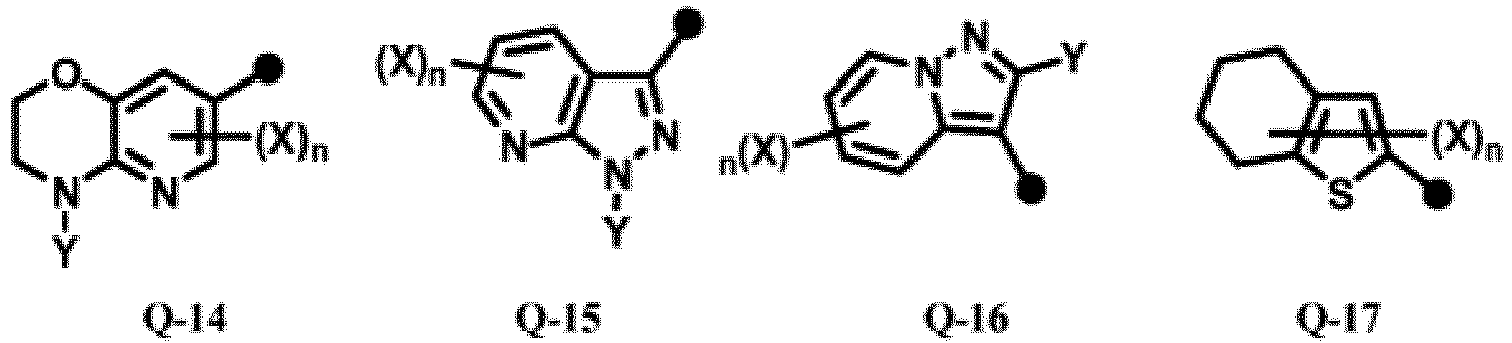 (a) ein Halogenatom,(b) ein Cyanogruppe,(c) ein Nitrogruppe,(d) eine (C1-C6)-Alkylgruppe,(e) eine Cyclo-(C3-C6)-alkylgruppe,(f) eine Halo-(C1-C6)-alkylgruppe;(g) eine (C1-C6)-Alkoxygruppe,(h) eine Halo-(C1-C6)-alkoxygruppe,(i) eine (C1-C6)-Alkylthiogruppe,(j) eine Phenylgruppe,(n) eine Phenylgruppe, die auf dem Ring die gleichen oder unterschiedliche 1 bis 4 Substituenten aufweist, die ausgewählt sind aus:(i) einem Halogenatom,(ii) einer (C1-C6)-Alkylgruppe,(iii) einer Halo-(C1-C6)-alkylgruppe, und(iv) einer (C1-C6)-Alkoxygruppe,(m) eine Pyridylgruppe,(o) eine (C1-C6)-Alkylcarbonylgruppe,(p) eine (C1-C6)-Alkoxycarbonylgruppe,(q) eine Mono-(C1-C6)-alkylaminogruppe,(r) eine (C1-C6)-Alkoxy-(C1-C6)-alkylaminogruppe,(s) eine Di-(C1-C6)-alkylaminogruppe (die Alkylgruppen sind die gleichen oder unterschiedlich),(t) eine (C1-C6)-Alkoxycarbonylaminogruppe,(u) eine Monophenylaminogruppe,(v) eine Morpholinogruppe, oder(w) eine Piperidinogruppe,• eine Bindungsposition ist,n eine ganze Zahl von 0 bis 3 ist; undW -O-, -S-, -SO2- oder -N(R7)- ist, wobei R7 eine (C1-C6)-Alkylgruppe ist.
 - Zusammensetzung zur Verwendung nach Anspruch 1 oder 2, wobei m 1 ist.
- Zusammensetzung zur Verwendung nach Anspruch 1 oder 2, wobei, wenn m 0 ist und Ar1 ist:(e2) eine Phenylgruppe, die auf dem Ring die gleichen oder unterschiedliche 1 bis 5 Substituenten aufweist, die ausgewählt sind aus:(c) einer Nitrogruppe,(e') einer Halo-(C2-C6)-alkylgruppe,(f) einer (C2-C6)-Alkenylgruppe,(g) einer (C2-C6)-Alkynylgruppe,(i') einer Halo-(C2-C6)-alkoxygruppe,(j) einer Halo-(C2-C6)-alkenyloxygruppe,(k) einer Halo-(C2-C6)-alkynyloxygruppe,(l) einer (C1-C6)-Alkylthiogruppe,(m) einer (C1-C6)-Alkylsulfonylgruppe,(n') einer Halo-(C2-C6)-alkylthiogruppe,(o) einer Phenyl-(C2-C6)-alkynylgruppe,(p) einer Phenoxygruppe,(q) einer Pyridyloxygruppe, die auf dem Ring die gleichen oder unterschiedliche 1 bis 4 Substituenten aufweist, die ausgewählt sind aus:(i) einem Halogenatom, und(ii) einer Halo-(C1-C6)-alkylgruppe,(r) einer Hydroxylgruppe,(s) einer Phenylgruppe, und(t) einer Halo-(C1-C6)-alkylsulfonylaminogruppe,(e3) eine Naphthylgruppe,(e4) eine Naphthylgruppe, die auf dem Ring die gleichen oder unterschiedliche 1 bis 7 Substituenten aufweist, die ausgewählt sind aus:(a) einem Halogenatom,(b) einer Cyanogruppe,(c) einer Nitrogruppe,(d) einer (C1-C6)-Alkylgruppe, und(e) einer Halo-(C1-C6)-alkylgruppe,(e5) eine Pyridylgruppe,(e6) eine Pyridylgruppe, die auf dem Ring die gleichen oder unterschiedliche 1 bis 4 Substituenten aufweist, die ausgewählt sind aus:(a) einem Halogenatom,(b) einer (C1-C6)-Alkylgruppe,(c) einer Halo-(C1-C6)-alkylgruppe,(d) einer (C1-C6)-Alkylthiogruppe,(e) einer (C1-C6)-Alkylsulfonylgruppe, und(f) einer Halo-(C1-C6)-alkylthiogruppe,(e7) eine Pyrazolylgruppe,(e8) eine Pyrazolylgruppe, die auf dem Ring die gleichen oder unterschiedliche 1 bis 3 Substituenten aufweist, die ausgewählt sind aus:(a) einem Halogenatom,(b) einer (C1-C6)-Alkylgruppe,(c) einer Halo-(C1-C6)-alkylgruppe,(d) einer (C1-C6)-Alkylthiogruppe,(e) einer (C1-C6)-Alkylsulfonylgruppe, und(f) einer (C1-C6)-Alkoxycarbonylgruppe.
- Zusammensetzung zur Verwendung nach Anspruch 1 oder 2, wobei m 0 ist und
Rist:(d2) eine Phenylgruppe, die auf dem Ring die gleichen oder unterschiedliche 1 bis 5 Substituenten aufweist, die ausgewählt sind aus:(c) einer Nitrogruppe,(e') einer Halo-(C2-C6)-alkylgruppe,(f) einer (C2-C6)-Alkenylgruppe,(g) einer (C2-C6)-Alkynylgruppe,(h) einer (C1-C6)-Alkoxygruppe,(i) einer Halo-(C1-C6)-alkoxygruppe,(j) einer Halo-(C2-C6)-alkenyloxygruppe,(k) einer Halo-(C2-C6)-alkynyloxygruppe,(l) einer (C1-C6)-Alkylthiogruppe,(m) einer (C1-C6)-Alkylsulfonylgruppe,(n) einer Halo-(C1-C6)-alkylthiogruppe,(o) einer Phenyl-(C2-C6)-alkynylgruppe,(p) einer Phenoxygruppe, und(q) einer Pyridyloxygruppe, die aufweist oder die gleichen oder unterschiedliche 1 bis 4 Substituenten, die ausgewählt sind aus:(i) einem Halogenatom, und(ii) einer Halo-(C1-C6)-alkylgruppe,(d3) eine Naphthylgruppe,(d4) eine Naphthylgruppe, die auf dem Ring die gleichen oder unterschiedliche 1 bis 7 Substituenten aufweist, die ausgewählt sind aus:(a) einem Halogenatom,(b) einer Cyanogruppe,(c) einer Nitrogruppe,(d) einer (C1-C6)-Alkylgruppe, und(e) einer Halo-(C1-C6)-alkylgruppe, oder(d5) eine (C1-C12)-Alkylgruppe. - Zusammensetzung zur Verwendung nach Anspruch 1 oder 2, wobei m 0 ist und R1 ist:(a2) eine (C1-C6)-Alkylgruppe,(a3) eine (C2-C6)-Alkenylgruppe,(a4) eine (C2-C6)-Alkynylgruppe, oder(a5) eine (C3-C6)-Cycloalkylgruppe.
- Zusammensetzung zur Verwendung nach Anspruch 1 oder 2, wobei m 0 ist und R3 ist:(b2) eine (C1-C6)-Alkylgruppe, oder(b3) eine (C3-C6)-Cycloalkylgruppe, oder(b4) R2 und R3 verbunden sind, um eine (C1-C6)-Alkylengruppe bilden.
- Zusammensetzung zur Verwendung nach Anspruch 1 oder 2, wobei:R1 ist:(a1) ein Wasserstoffatom, oder(a4) eine (C2-C6)-Alkynylgruppe;R2, R3 und R4 gleich oder unterschiedlich sind und jeweils sind:(b1) ein Wasserstoffatom, oder(b2) eine (C1-C6)-Alkylgruppe, oder(b4) R2 und R3 optional verbunden sind, um eine (C1-C6)-Alkylengruppe bilden;R5 und R6 gleich oder unterschiedlich sind und jeweils sind:(c1) ein Wasserstoffatom, oder(c6) R5 und R6 optional verbunden sind, um eine (C1-C6)-Alkylengruppe bilden;m 0 oder 1 ist;Rist:(d1) eine Phenylgruppe,(d2) eine Phenylgruppe, die auf dem Ring die gleichen oder unterschiedliche 1 bis 5 Substituenten aufweist, die ausgewählt sind aus:(a) einem Halogenatom,(b) einer Cyanogruppe,(c) einer Nitrogruppe,(d) einer (C1-C6)-Alkylgruppe,(e) einer Halo-(C1-C6)-alkylgruppe,(g) einer (C2-C6)-Alkynylgruppe,(i) einer Halo-(C1-C6)-alkoxygruppe,(j) einer Halo-(C2-C6)-alkenyloxygruppe,(l) einer (C1-C6)-Alkylthiogruppe,(m) einer (C1-C6)-Alkylsulfonylgruppe,(n) einer Halo-(C1-C6)-alkylthiogruppe,(o) einer Phenyl-(C2-C6)-alkynylgruppe,(p) einer Phenoxygruppe, und(q) einer Pyridyloxygruppe, die aufweist oder die gleichen oder unterschiedliche 1 bis 4 Substituenten, die ausgewählt sind aus:(i) einem Halogenatom, und(ii) einer Halo-(C1-C6)-alkylgruppe,(d3) eine Naphthylgruppe, oder(d5) eine (C1-C12)-Alkylgruppe;Ar1 ist:(e1) eine Phenylgruppe,(e2) eine Phenylgruppe, die auf dem Ring die gleichen oder unterschiedliche 1 bis 5 Substituenten aufweist, die ausgewählt sind aus:(a) einem Halogenatom,(b) einer Cyanogruppe,(c) einer Nitrogruppe,(d) einer (C1-C6)-Alkylgruppe,(e) einer Halo-(C1-C6)-alkylgruppe,(h) einer (C1-C6)-Alkoxygruppe,(i) einer Halo-(C1-C6)-alkoxygruppe,(n) einer Halo-(C1-C6)-alkylthiogruppe,(q) einer Pyridyloxygruppe, die aufweist oder die gleichen oder unterschiedliche 1 bis 4 Substituenten, die ausgewählt sind aus:(i) einem Halogenatom, und(ii) einer Halo-(C1-C6)-alkylgruppe,(r) einer Hydroxylgruppe,(s) einer Phenylgruppe, und(t) einer Halo-(C1-C6)-alkylsulfonylaminogruppe,(e3) eine Naphthylgruppe,(e5) eine Pyridylgruppe,(e6) eine Pyridylgruppe, die auf dem Ring die gleichen oder unterschiedliche 1 bis 4 Substituenten aufweist, die ausgewählt sind aus:(a) einem Halogenatom,(b) einer (C1-C6)-Alkylgruppe,(c) einer Halo-(C1-C6)-alkylgruppe,(d) einer (C1-C6)-Alkylthiogruppe,(e) einer (C1-C6)-Alkylsulfonylgruppe, und(f) einer Halo-(C1-C6)-alkylthiogruppe, oder(e8) eine Pyrazolylgruppe, die auf dem Ring die gleichen oder unterschiedliche 1 bis 3 Substituenten aufweist, die ausgewählt sind aus:(a) einem Halogenatom,(b) einer (C1-C6)-Alkylgruppe,(c) einer Halo-(C1-C6)-alkylgruppe,(d) einer (C1-C6)-Alkylthiogruppe,(e) einer (C1-C6)-Alkylsulfonylgruppe, und(f) einer (C1-C6)-Alkoxycarbonylgruppe; undW -O- ist.
- Zusammensetzung zur Verwendung nach einem der Ansprüche 1 bis 9, wobei der Krebs aus Kolonkrebs, Lungenkrebs, Mesotheliom, Bauchspeicheldrüsenkrebs, Magenkrebs, Brustkrebs, Eierstockkrebs, Prostatakrebs, Leberkrebs, Schilddrüsenkrebs, Nierenkrebs, Gebärmutterkrebs, Hirntumor, Melanom, Sarkom, Harnblasenkrebs, Blutkrebs, Kopf-Hals-Krebs, Gebärmutterhalskrebs, Speiseröhrenkrebs, Gallenblasenkrebs, Milzkrebs, Hodenkrebs, Krebs peripherer Nerven und Hautkrebs ausgewählt ist.
- Zusammensetzung zur Verwendung nach einem der Ansprüche 1 bis 9, wobei der Krebs aus Hirntumor, Krebs peripherer Nerven und Eierstockkrebs ausgewählt ist.
- Aminoacetonitrilverbindung, die durch Formel (I) nach einem der Ansprüche 1 bis 9 dargestellt ist, unter Ausschluss von:N-[(1S)-1-Cyano-2-(5-cyano-2-trifluormethylphenoxy)-1-methyl-ethyl]-4-trifluormethylsulfanylbenzamid,N-[(1R)-1-Cyano-2-(5-cyano-2-trifluormethylphenoxy)-1-methyl-ethyl]-4-trifluormethylsulfanylbenzamid,N-[1-Cyano-2-(5-cyano-2-trifluormethylphenoxy)-1-methyl-ethyl]-4-trifluormethylsulfanylbenzamid,N-[2-(2-Chlorphenoxy)-1-cyano-1-methyl-ethyl]-4-trifluormethylbenzamid,N-[1-Cyano-2-(2-trifluormethylphenoxy)-1-methyl-ethyl]-4-trifluormethylbenzamid,N-[1-Cyano-2-(2-trifluormethylphenoxy)-1-methyl-ethyl]-4-trifluormethoxybenzamid,N-[1-Cyano-2-(2,5-dichlorphenoxy)-1 -methyl-ethyl]-4-trifluormethoxybenzamid,N-[2-(2-Chlor-5-fluorphenoxy)-1-cyano-1-methyl-ethyl]-4-trifluormethoxybenzamid,N-[2-(2-Chlor-4-fluorphenoxy)-1-cyano-1-methyl-ethyl]-4-trifluormethoxybenzamid,N-[2-(2-Brom-4,5-difluorphenoxy)-1-cyano-1-methyl-ethyl]-4-trifluormethoxybenzamid, undN-[1-Cyano-2-(4,5-difluor-2-trifluormethylphenoxy)-1-methyl-ethyl]-4-trifluormethoxybenzamid,oder ein pharmazeutisch unbedenkliches Salz davon zur Verwendung bei der Behandlung von Krebs.
Priority Applications (1)
| Application Number | Priority Date | Filing Date | Title |
|---|---|---|---|
| PL14781682T PL3043791T3 (pl) | 2013-09-13 | 2014-09-12 | Środek przeciwnowotworowy zawierający związek aminoacetonitrylowy jako substancję czynną |
Applications Claiming Priority (2)
| Application Number | Priority Date | Filing Date | Title |
|---|---|---|---|
| JP2013190509 | 2013-09-13 | ||
| PCT/JP2014/074764 WO2015037747A1 (en) | 2013-09-13 | 2014-09-12 | Anticancer agent comprising aminoacetonitrile compound as active ingredient |
Publications (2)
| Publication Number | Publication Date |
|---|---|
| EP3043791A1 EP3043791A1 (de) | 2016-07-20 |
| EP3043791B1 true EP3043791B1 (de) | 2019-04-24 |
Family
ID=51663412
Family Applications (1)
| Application Number | Title | Priority Date | Filing Date |
|---|---|---|---|
| EP14781682.1A Active EP3043791B1 (de) | 2013-09-13 | 2014-09-12 | Mittel gegen krebs mit aminoacetonitrilverbindung als wirkstoff |
Country Status (7)
| Country | Link |
|---|---|
| US (2) | US9907778B2 (de) |
| EP (1) | EP3043791B1 (de) |
| JP (1) | JP6556700B2 (de) |
| AU (1) | AU2014319290B2 (de) |
| ES (1) | ES2727531T3 (de) |
| PL (1) | PL3043791T3 (de) |
| WO (1) | WO2015037747A1 (de) |
Families Citing this family (2)
| Publication number | Priority date | Publication date | Assignee | Title |
|---|---|---|---|---|
| EP3043791B1 (de) * | 2013-09-13 | 2019-04-24 | Pitney Pharmaceuticals Pty Limited | Mittel gegen krebs mit aminoacetonitrilverbindung als wirkstoff |
| WO2016137010A1 (en) * | 2015-02-24 | 2016-09-01 | Nihon Nohyaku Co., Ltd. | Anti cancer agent comprising aminoacetonitrile compound as active ingredient |
Family Cites Families (9)
| Publication number | Priority date | Publication date | Assignee | Title |
|---|---|---|---|---|
| US6239077B1 (en) | 1998-05-01 | 2001-05-29 | Nihon Nohyaku Co., Ltd. | Aminoacetonitrile derivative agricultural and horticultural insecticide containing the same and use thereof |
| JP2002537293A (ja) | 1999-02-20 | 2002-11-05 | アストラゼネカ アクチボラグ | カテプシンlおよび/またはカテプシンsの阻害剤としてのアセタミドアセトニトリル誘導体 |
| US6812237B2 (en) * | 2000-05-15 | 2004-11-02 | Novartis Ag | N-substituted peptidyl nitriles as cysteine cathepsin inhibitors |
| AR035523A1 (es) * | 2000-12-20 | 2004-06-02 | Novartis Ag | Uso de compuestos de aminoacetonitrilo para combatir animales daninos endoparasitarios en animales utiles y domesticos de sangre caliente |
| AR035531A1 (es) | 2001-01-22 | 2004-06-02 | Novartis Ag | Composicion para el control de plagas endoparasiticas en ganados y animales domesticos, un metodo para su control y el uso de dicha composicion para la preparacion de medicamentos |
| WO2003004474A1 (en) * | 2001-07-06 | 2003-01-16 | Syngenta Participations Ag | Pesticidally active aminoacetonitriles |
| GB0402677D0 (en) | 2003-11-06 | 2004-03-10 | Novartis Ag | Organic compounds |
| WO2006043654A1 (ja) * | 2004-10-22 | 2006-04-27 | Nihon Nohyaku Co., Ltd. | アセトニトリル誘導体及び有害生物防除剤並びにその使用方法 |
| EP3043791B1 (de) * | 2013-09-13 | 2019-04-24 | Pitney Pharmaceuticals Pty Limited | Mittel gegen krebs mit aminoacetonitrilverbindung als wirkstoff |
-
2014
- 2014-09-12 EP EP14781682.1A patent/EP3043791B1/de active Active
- 2014-09-12 US US14/917,724 patent/US9907778B2/en active Active
- 2014-09-12 PL PL14781682T patent/PL3043791T3/pl unknown
- 2014-09-12 ES ES14781682T patent/ES2727531T3/es active Active
- 2014-09-12 AU AU2014319290A patent/AU2014319290B2/en active Active
- 2014-09-12 WO PCT/JP2014/074764 patent/WO2015037747A1/en not_active Ceased
- 2014-09-12 JP JP2016513935A patent/JP6556700B2/ja active Active
-
2018
- 2018-01-23 US US15/878,057 patent/US10292960B2/en active Active
Non-Patent Citations (1)
| Title |
|---|
| None * |
Also Published As
| Publication number | Publication date |
|---|---|
| AU2014319290A1 (en) | 2016-04-14 |
| WO2015037747A1 (en) | 2015-03-19 |
| ES2727531T3 (es) | 2019-10-16 |
| JP6556700B2 (ja) | 2019-08-07 |
| US10292960B2 (en) | 2019-05-21 |
| US9907778B2 (en) | 2018-03-06 |
| AU2014319290B2 (en) | 2019-07-18 |
| EP3043791A1 (de) | 2016-07-20 |
| US20180207124A1 (en) | 2018-07-26 |
| PL3043791T3 (pl) | 2019-08-30 |
| US20160213640A1 (en) | 2016-07-28 |
| JP2016531841A (ja) | 2016-10-13 |
Similar Documents
| Publication | Publication Date | Title |
|---|---|---|
| US20040087627A1 (en) | Methods for the treatment of diseases using malonyl-coa decarbox ylase inhibitors | |
| KR19990082330A (ko) | 신규 화합물 및 이의 의약 용도 | |
| JP7857285B2 (ja) | αプロテインキナーゼ1阻害剤及び使用の方法 | |
| US10391076B2 (en) | Anti-cancer agent comprising aminoacetonitrile compound as active ingredient | |
| US6562849B1 (en) | Amine derivative compounds | |
| RU2692789C2 (ru) | Соединение триазина и его применение в медицинских целях | |
| US11040034B2 (en) | Metalloenzyme inhibitor compounds | |
| ES2624791T3 (es) | Inhibidores de PDE10 y composiciones y métodos relacionados | |
| JP2010505802A (ja) | Hdac阻害剤 | |
| CN101600712A (zh) | 具有血管新生抑制活性的新型噁二唑衍生物及噻二唑衍生物 | |
| US20100056522A1 (en) | Intraocular pressure-lowering agent comprising compound having histone deacetylase inhibitor effect as active ingredient | |
| JPWO2008078725A1 (ja) | チアゼピン誘導体 | |
| EP2133339A1 (de) | Neues (2-aminophenyl)pyridincarboxamidderivat mit harnstoffstruktur | |
| CA3126224A1 (en) | Metalloenzyme inhibitor compounds | |
| US10292960B2 (en) | Anticancer agent comprising aminoacetonitrile compound as active ingredient | |
| CN102603553B (zh) | 具有协同抗真菌作用的化合物及其在药学中的用途 | |
| CA3214936A1 (en) | Arylacetyl inhibitors of tg2 and uses thereof | |
| US12410137B2 (en) | Fatty acid amide hydrolase modulators, compositions comprising the same and uses thereof | |
| HK1228389B (en) | Triazine compound and use thereof for medical purposes | |
| HK1228389A1 (en) | Triazine compound and use thereof for medical purposes | |
| CZ20003626A3 (cs) | Sulfonamidové deriváty |
Legal Events
| Date | Code | Title | Description |
|---|---|---|---|
| PUAI | Public reference made under article 153(3) epc to a published international application that has entered the european phase |
Free format text: ORIGINAL CODE: 0009012 |
|
| 17P | Request for examination filed |
Effective date: 20160411 |
|
| AK | Designated contracting states |
Kind code of ref document: A1 Designated state(s): AL AT BE BG CH CY CZ DE DK EE ES FI FR GB GR HR HU IE IS IT LI LT LU LV MC MK MT NL NO PL PT RO RS SE SI SK SM TR |
|
| AX | Request for extension of the european patent |
Extension state: BA ME |
|
| DAX | Request for extension of the european patent (deleted) | ||
| RAP1 | Party data changed (applicant data changed or rights of an application transferred) |
Owner name: PITNEY PHARMACEUTICALS PTY LIMITED |
|
| RIC1 | Information provided on ipc code assigned before grant |
Ipc: A61K 31/421 20060101ALI20180813BHEP Ipc: A61K 31/4196 20060101ALI20180813BHEP Ipc: A61K 31/44 20060101ALI20180813BHEP Ipc: A61K 31/4245 20060101ALI20180813BHEP Ipc: A61K 31/4965 20060101ALI20180813BHEP Ipc: A61K 31/437 20060101ALI20180813BHEP Ipc: A61K 31/426 20060101ALI20180813BHEP Ipc: A61K 31/433 20060101ALI20180813BHEP Ipc: A61K 31/505 20060101ALI20180813BHEP Ipc: A61K 31/42 20060101ALI20180813BHEP Ipc: A61K 31/381 20060101ALI20180813BHEP Ipc: A61P 35/00 20060101ALI20180813BHEP Ipc: A61K 31/5383 20060101ALI20180813BHEP Ipc: A61K 31/277 20060101AFI20180813BHEP Ipc: A61K 31/5377 20060101ALI20180813BHEP Ipc: A61K 31/341 20060101ALI20180813BHEP Ipc: A61K 31/415 20060101ALI20180813BHEP |
|
| GRAP | Despatch of communication of intention to grant a patent |
Free format text: ORIGINAL CODE: EPIDOSNIGR1 |
|
| STAA | Information on the status of an ep patent application or granted ep patent |
Free format text: STATUS: GRANT OF PATENT IS INTENDED |
|
| RIN1 | Information on inventor provided before grant (corrected) |
Inventor name: TANAKA, KOJI Inventor name: ASTON, ROGER Inventor name: MORRIS, DAVID LAWSON Inventor name: HINO, TOMOKAZU Inventor name: SANPEI, OSAMU Inventor name: TOGA, TETSUO Inventor name: ANDOH, NOBUHARU |
|
| INTG | Intention to grant announced |
Effective date: 20180926 |
|
| RIN1 | Information on inventor provided before grant (corrected) |
Inventor name: TOGA, TETSUO Inventor name: HINO, TOMOKAZU Inventor name: ANDOH, NOBUHARU Inventor name: ASTON, ROGER Inventor name: SANPEI, OSAMU Inventor name: TANAKA, KOJI Inventor name: MORRIS, DAVID LAWSON |
|
| GRAJ | Information related to disapproval of communication of intention to grant by the applicant or resumption of examination proceedings by the epo deleted |
Free format text: ORIGINAL CODE: EPIDOSDIGR1 |
|
| STAA | Information on the status of an ep patent application or granted ep patent |
Free format text: STATUS: REQUEST FOR EXAMINATION WAS MADE |
|
| GRAP | Despatch of communication of intention to grant a patent |
Free format text: ORIGINAL CODE: EPIDOSNIGR1 |
|
| STAA | Information on the status of an ep patent application or granted ep patent |
Free format text: STATUS: GRANT OF PATENT IS INTENDED |
|
| INTG | Intention to grant announced |
Effective date: 20181214 |
|
| GRAS | Grant fee paid |
Free format text: ORIGINAL CODE: EPIDOSNIGR3 |
|
| GRAA | (expected) grant |
Free format text: ORIGINAL CODE: 0009210 |
|
| STAA | Information on the status of an ep patent application or granted ep patent |
Free format text: STATUS: THE PATENT HAS BEEN GRANTED |
|
| AK | Designated contracting states |
Kind code of ref document: B1 Designated state(s): AL AT BE BG CH CY CZ DE DK EE ES FI FR GB GR HR HU IE IS IT LI LT LU LV MC MK MT NL NO PL PT RO RS SE SI SK SM TR |
|
| REG | Reference to a national code |
Ref country code: GB Ref legal event code: FG4D |
|
| REG | Reference to a national code |
Ref country code: CH Ref legal event code: EP Ref country code: CH Ref legal event code: NV Representative=s name: NOVAGRAAF INTERNATIONAL SA, CH |
|
| REG | Reference to a national code |
Ref country code: AT Ref legal event code: REF Ref document number: 1123306 Country of ref document: AT Kind code of ref document: T Effective date: 20190515 Ref country code: IE Ref legal event code: FG4D |
|
| REG | Reference to a national code |
Ref country code: DE Ref legal event code: R096 Ref document number: 602014045410 Country of ref document: DE |
|
| REG | Reference to a national code |
Ref country code: NL Ref legal event code: FP |
|
| REG | Reference to a national code |
Ref country code: SE Ref legal event code: TRGR |
|
| REG | Reference to a national code |
Ref country code: LT Ref legal event code: MG4D |
|
| REG | Reference to a national code |
Ref country code: ES Ref legal event code: FG2A Ref document number: 2727531 Country of ref document: ES Kind code of ref document: T3 Effective date: 20191016 |
|
| PG25 | Lapsed in a contracting state [announced via postgrant information from national office to epo] |
Ref country code: FI Free format text: LAPSE BECAUSE OF FAILURE TO SUBMIT A TRANSLATION OF THE DESCRIPTION OR TO PAY THE FEE WITHIN THE PRESCRIBED TIME-LIMIT Effective date: 20190424 Ref country code: LT Free format text: LAPSE BECAUSE OF FAILURE TO SUBMIT A TRANSLATION OF THE DESCRIPTION OR TO PAY THE FEE WITHIN THE PRESCRIBED TIME-LIMIT Effective date: 20190424 Ref country code: HR Free format text: LAPSE BECAUSE OF FAILURE TO SUBMIT A TRANSLATION OF THE DESCRIPTION OR TO PAY THE FEE WITHIN THE PRESCRIBED TIME-LIMIT Effective date: 20190424 Ref country code: PT Free format text: LAPSE BECAUSE OF FAILURE TO SUBMIT A TRANSLATION OF THE DESCRIPTION OR TO PAY THE FEE WITHIN THE PRESCRIBED TIME-LIMIT Effective date: 20190824 Ref country code: AL Free format text: LAPSE BECAUSE OF FAILURE TO SUBMIT A TRANSLATION OF THE DESCRIPTION OR TO PAY THE FEE WITHIN THE PRESCRIBED TIME-LIMIT Effective date: 20190424 Ref country code: NO Free format text: LAPSE BECAUSE OF FAILURE TO SUBMIT A TRANSLATION OF THE DESCRIPTION OR TO PAY THE FEE WITHIN THE PRESCRIBED TIME-LIMIT Effective date: 20190724 |
|
| PGFP | Annual fee paid to national office [announced via postgrant information from national office to epo] |
Ref country code: NL Payment date: 20190912 Year of fee payment: 6 Ref country code: SE Payment date: 20190910 Year of fee payment: 6 |
|
| PG25 | Lapsed in a contracting state [announced via postgrant information from national office to epo] |
Ref country code: LV Free format text: LAPSE BECAUSE OF FAILURE TO SUBMIT A TRANSLATION OF THE DESCRIPTION OR TO PAY THE FEE WITHIN THE PRESCRIBED TIME-LIMIT Effective date: 20190424 Ref country code: GR Free format text: LAPSE BECAUSE OF FAILURE TO SUBMIT A TRANSLATION OF THE DESCRIPTION OR TO PAY THE FEE WITHIN THE PRESCRIBED TIME-LIMIT Effective date: 20190725 Ref country code: BG Free format text: LAPSE BECAUSE OF FAILURE TO SUBMIT A TRANSLATION OF THE DESCRIPTION OR TO PAY THE FEE WITHIN THE PRESCRIBED TIME-LIMIT Effective date: 20190724 Ref country code: RS Free format text: LAPSE BECAUSE OF FAILURE TO SUBMIT A TRANSLATION OF THE DESCRIPTION OR TO PAY THE FEE WITHIN THE PRESCRIBED TIME-LIMIT Effective date: 20190424 |
|
| PGFP | Annual fee paid to national office [announced via postgrant information from national office to epo] |
Ref country code: PL Payment date: 20190701 Year of fee payment: 6 Ref country code: BE Payment date: 20190917 Year of fee payment: 6 |
|
| PG25 | Lapsed in a contracting state [announced via postgrant information from national office to epo] |
Ref country code: IS Free format text: LAPSE BECAUSE OF FAILURE TO SUBMIT A TRANSLATION OF THE DESCRIPTION OR TO PAY THE FEE WITHIN THE PRESCRIBED TIME-LIMIT Effective date: 20190824 |
|
| PGFP | Annual fee paid to national office [announced via postgrant information from national office to epo] |
Ref country code: AT Payment date: 20190827 Year of fee payment: 6 |
|
| REG | Reference to a national code |
Ref country code: DE Ref legal event code: R097 Ref document number: 602014045410 Country of ref document: DE |
|
| PG25 | Lapsed in a contracting state [announced via postgrant information from national office to epo] |
Ref country code: CZ Free format text: LAPSE BECAUSE OF FAILURE TO SUBMIT A TRANSLATION OF THE DESCRIPTION OR TO PAY THE FEE WITHIN THE PRESCRIBED TIME-LIMIT Effective date: 20190424 Ref country code: RO Free format text: LAPSE BECAUSE OF FAILURE TO SUBMIT A TRANSLATION OF THE DESCRIPTION OR TO PAY THE FEE WITHIN THE PRESCRIBED TIME-LIMIT Effective date: 20190424 Ref country code: SK Free format text: LAPSE BECAUSE OF FAILURE TO SUBMIT A TRANSLATION OF THE DESCRIPTION OR TO PAY THE FEE WITHIN THE PRESCRIBED TIME-LIMIT Effective date: 20190424 Ref country code: DK Free format text: LAPSE BECAUSE OF FAILURE TO SUBMIT A TRANSLATION OF THE DESCRIPTION OR TO PAY THE FEE WITHIN THE PRESCRIBED TIME-LIMIT Effective date: 20190424 Ref country code: EE Free format text: LAPSE BECAUSE OF FAILURE TO SUBMIT A TRANSLATION OF THE DESCRIPTION OR TO PAY THE FEE WITHIN THE PRESCRIBED TIME-LIMIT Effective date: 20190424 |
|
| PG25 | Lapsed in a contracting state [announced via postgrant information from national office to epo] |
Ref country code: SM Free format text: LAPSE BECAUSE OF FAILURE TO SUBMIT A TRANSLATION OF THE DESCRIPTION OR TO PAY THE FEE WITHIN THE PRESCRIBED TIME-LIMIT Effective date: 20190424 |
|
| PLBE | No opposition filed within time limit |
Free format text: ORIGINAL CODE: 0009261 |
|
| STAA | Information on the status of an ep patent application or granted ep patent |
Free format text: STATUS: NO OPPOSITION FILED WITHIN TIME LIMIT |
|
| PG25 | Lapsed in a contracting state [announced via postgrant information from national office to epo] |
Ref country code: TR Free format text: LAPSE BECAUSE OF FAILURE TO SUBMIT A TRANSLATION OF THE DESCRIPTION OR TO PAY THE FEE WITHIN THE PRESCRIBED TIME-LIMIT Effective date: 20190424 |
|
| 26N | No opposition filed |
Effective date: 20200127 |
|
| PG25 | Lapsed in a contracting state [announced via postgrant information from national office to epo] |
Ref country code: SI Free format text: LAPSE BECAUSE OF FAILURE TO SUBMIT A TRANSLATION OF THE DESCRIPTION OR TO PAY THE FEE WITHIN THE PRESCRIBED TIME-LIMIT Effective date: 20190424 Ref country code: MC Free format text: LAPSE BECAUSE OF FAILURE TO SUBMIT A TRANSLATION OF THE DESCRIPTION OR TO PAY THE FEE WITHIN THE PRESCRIBED TIME-LIMIT Effective date: 20190424 |
|
| PG25 | Lapsed in a contracting state [announced via postgrant information from national office to epo] |
Ref country code: IE Free format text: LAPSE BECAUSE OF NON-PAYMENT OF DUE FEES Effective date: 20190912 Ref country code: LU Free format text: LAPSE BECAUSE OF NON-PAYMENT OF DUE FEES Effective date: 20190912 |
|
| REG | Reference to a national code |
Ref country code: AT Ref legal event code: UEP Ref document number: 1123306 Country of ref document: AT Kind code of ref document: T Effective date: 20190424 |
|
| REG | Reference to a national code |
Ref country code: NL Ref legal event code: MM Effective date: 20201001 |
|
| REG | Reference to a national code |
Ref country code: AT Ref legal event code: MM01 Ref document number: 1123306 Country of ref document: AT Kind code of ref document: T Effective date: 20200912 |
|
| PG25 | Lapsed in a contracting state [announced via postgrant information from national office to epo] |
Ref country code: CY Free format text: LAPSE BECAUSE OF FAILURE TO SUBMIT A TRANSLATION OF THE DESCRIPTION OR TO PAY THE FEE WITHIN THE PRESCRIBED TIME-LIMIT Effective date: 20190424 |
|
| REG | Reference to a national code |
Ref country code: BE Ref legal event code: MM Effective date: 20200930 |
|
| PG25 | Lapsed in a contracting state [announced via postgrant information from national office to epo] |
Ref country code: NL Free format text: LAPSE BECAUSE OF NON-PAYMENT OF DUE FEES Effective date: 20201001 |
|
| PG25 | Lapsed in a contracting state [announced via postgrant information from national office to epo] |
Ref country code: MT Free format text: LAPSE BECAUSE OF FAILURE TO SUBMIT A TRANSLATION OF THE DESCRIPTION OR TO PAY THE FEE WITHIN THE PRESCRIBED TIME-LIMIT Effective date: 20190424 Ref country code: HU Free format text: LAPSE BECAUSE OF FAILURE TO SUBMIT A TRANSLATION OF THE DESCRIPTION OR TO PAY THE FEE WITHIN THE PRESCRIBED TIME-LIMIT; INVALID AB INITIO Effective date: 20140912 |
|
| PG25 | Lapsed in a contracting state [announced via postgrant information from national office to epo] |
Ref country code: SE Free format text: LAPSE BECAUSE OF NON-PAYMENT OF DUE FEES Effective date: 20200913 Ref country code: AT Free format text: LAPSE BECAUSE OF NON-PAYMENT OF DUE FEES Effective date: 20200912 Ref country code: BE Free format text: LAPSE BECAUSE OF NON-PAYMENT OF DUE FEES Effective date: 20200930 |
|
| REG | Reference to a national code |
Ref country code: SE Ref legal event code: EUG |
|
| PG25 | Lapsed in a contracting state [announced via postgrant information from national office to epo] |
Ref country code: MK Free format text: LAPSE BECAUSE OF FAILURE TO SUBMIT A TRANSLATION OF THE DESCRIPTION OR TO PAY THE FEE WITHIN THE PRESCRIBED TIME-LIMIT Effective date: 20190424 |
|
| PG25 | Lapsed in a contracting state [announced via postgrant information from national office to epo] |
Ref country code: PL Free format text: LAPSE BECAUSE OF NON-PAYMENT OF DUE FEES Effective date: 20200912 |
|
| P01 | Opt-out of the competence of the unified patent court (upc) registered |
Effective date: 20230517 |
|
| REG | Reference to a national code |
Ref country code: CH Ref legal event code: U11 Free format text: ST27 STATUS EVENT CODE: U-0-0-U10-U11 (AS PROVIDED BY THE NATIONAL OFFICE) Effective date: 20251017 |
|
| PGFP | Annual fee paid to national office [announced via postgrant information from national office to epo] |
Ref country code: FR Payment date: 20250930 Year of fee payment: 12 |
|
| PGFP | Annual fee paid to national office [announced via postgrant information from national office to epo] |
Ref country code: DE Payment date: 20251007 Year of fee payment: 12 |
|
| PGFP | Annual fee paid to national office [announced via postgrant information from national office to epo] |
Ref country code: GB Payment date: 20251016 Year of fee payment: 12 |
|
| PGFP | Annual fee paid to national office [announced via postgrant information from national office to epo] |
Ref country code: IT Payment date: 20250930 Year of fee payment: 12 |
|
| PGFP | Annual fee paid to national office [announced via postgrant information from national office to epo] |
Ref country code: CH Payment date: 20251017 Year of fee payment: 12 |
|
| PGFP | Annual fee paid to national office [announced via postgrant information from national office to epo] |
Ref country code: ES Payment date: 20251029 Year of fee payment: 12 |