EP3042884A1 - Flexible komposite auf basis von aerogelen - Google Patents
Flexible komposite auf basis von aerogelen Download PDFInfo
- Publication number
- EP3042884A1 EP3042884A1 EP15202066.5A EP15202066A EP3042884A1 EP 3042884 A1 EP3042884 A1 EP 3042884A1 EP 15202066 A EP15202066 A EP 15202066A EP 3042884 A1 EP3042884 A1 EP 3042884A1
- Authority
- EP
- European Patent Office
- Prior art keywords
- silane
- composite
- airgel
- aerogels
- flexible
- Prior art date
- Legal status (The legal status is an assumption and is not a legal conclusion. Google has not performed a legal analysis and makes no representation as to the accuracy of the status listed.)
- Granted
Links
Images




Classifications
-
- C—CHEMISTRY; METALLURGY
- C04—CEMENTS; CONCRETE; ARTIFICIAL STONE; CERAMICS; REFRACTORIES
- C04B—LIME, MAGNESIA; SLAG; CEMENTS; COMPOSITIONS THEREOF, e.g. MORTARS, CONCRETE OR LIKE BUILDING MATERIALS; ARTIFICIAL STONE; CERAMICS; REFRACTORIES; TREATMENT OF NATURAL STONE
- C04B30/00—Compositions for artificial stone, not containing binders
- C04B30/02—Compositions for artificial stone, not containing binders containing fibrous materials
-
- B—PERFORMING OPERATIONS; TRANSPORTING
- B01—PHYSICAL OR CHEMICAL PROCESSES OR APPARATUS IN GENERAL
- B01J—CHEMICAL OR PHYSICAL PROCESSES, e.g. CATALYSIS OR COLLOID CHEMISTRY; THEIR RELEVANT APPARATUS
- B01J13/00—Colloid chemistry, e.g. the production of colloidal materials or their solutions, not otherwise provided for; Making microcapsules or microballoons
- B01J13/0091—Preparation of aerogels, e.g. xerogels
-
- C—CHEMISTRY; METALLURGY
- C01—INORGANIC CHEMISTRY
- C01B—NON-METALLIC ELEMENTS; COMPOUNDS THEREOF; METALLOIDS OR COMPOUNDS THEREOF NOT COVERED BY SUBCLASS C01C
- C01B33/00—Silicon; Compounds thereof
- C01B33/113—Silicon oxides; Hydrates thereof
- C01B33/12—Silica; Hydrates thereof, e.g. lepidoic silicic acid
- C01B33/16—Preparation of silica xerogels
-
- C—CHEMISTRY; METALLURGY
- C01—INORGANIC CHEMISTRY
- C01B—NON-METALLIC ELEMENTS; COMPOUNDS THEREOF; METALLOIDS OR COMPOUNDS THEREOF NOT COVERED BY SUBCLASS C01C
- C01B33/00—Silicon; Compounds thereof
- C01B33/113—Silicon oxides; Hydrates thereof
- C01B33/12—Silica; Hydrates thereof, e.g. lepidoic silicic acid
- C01B33/16—Preparation of silica xerogels
- C01B33/163—Preparation of silica xerogels by hydrolysis of organosilicon compounds, e.g. ethyl orthosilicate
-
- C—CHEMISTRY; METALLURGY
- C04—CEMENTS; CONCRETE; ARTIFICIAL STONE; CERAMICS; REFRACTORIES
- C04B—LIME, MAGNESIA; SLAG; CEMENTS; COMPOSITIONS THEREOF, e.g. MORTARS, CONCRETE OR LIKE BUILDING MATERIALS; ARTIFICIAL STONE; CERAMICS; REFRACTORIES; TREATMENT OF NATURAL STONE
- C04B14/00—Use of inorganic materials as fillers, e.g. pigments, for mortars, concrete or artificial stone; Treatment of inorganic materials specially adapted to enhance their filling properties in mortars, concrete or artificial stone
- C04B14/02—Granular materials, e.g. microballoons
- C04B14/04—Silica-rich materials; Silicates
- C04B14/06—Quartz; Sand
- C04B14/064—Silica aerogel
-
- D—TEXTILES; PAPER
- D04—BRAIDING; LACE-MAKING; KNITTING; TRIMMINGS; NON-WOVEN FABRICS
- D04H—MAKING TEXTILE FABRICS, e.g. FROM FIBRES OR FILAMENTARY MATERIAL; FABRICS MADE BY SUCH PROCESSES OR APPARATUS, e.g. FELTS, NON-WOVEN FABRICS; COTTON-WOOL; WADDING ; NON-WOVEN FABRICS FROM STAPLE FIBRES, FILAMENTS OR YARNS, BONDED WITH AT LEAST ONE WEB-LIKE MATERIAL DURING THEIR CONSOLIDATION
- D04H1/00—Non-woven fabrics formed wholly or mainly of staple fibres or like relatively short fibres
- D04H1/40—Non-woven fabrics formed wholly or mainly of staple fibres or like relatively short fibres from fleeces or layers composed of fibres without existing or potential cohesive properties
- D04H1/413—Non-woven fabrics formed wholly or mainly of staple fibres or like relatively short fibres from fleeces or layers composed of fibres without existing or potential cohesive properties containing granules other than absorbent substances
-
- C—CHEMISTRY; METALLURGY
- C04—CEMENTS; CONCRETE; ARTIFICIAL STONE; CERAMICS; REFRACTORIES
- C04B—LIME, MAGNESIA; SLAG; CEMENTS; COMPOSITIONS THEREOF, e.g. MORTARS, CONCRETE OR LIKE BUILDING MATERIALS; ARTIFICIAL STONE; CERAMICS; REFRACTORIES; TREATMENT OF NATURAL STONE
- C04B2111/00—Mortars, concrete or artificial stone or mixtures to prepare them, characterised by specific function, property or use
- C04B2111/20—Resistance against chemical, physical or biological attack
- C04B2111/28—Fire resistance, i.e. materials resistant to accidental fires or high temperatures
-
- C—CHEMISTRY; METALLURGY
- C04—CEMENTS; CONCRETE; ARTIFICIAL STONE; CERAMICS; REFRACTORIES
- C04B—LIME, MAGNESIA; SLAG; CEMENTS; COMPOSITIONS THEREOF, e.g. MORTARS, CONCRETE OR LIKE BUILDING MATERIALS; ARTIFICIAL STONE; CERAMICS; REFRACTORIES; TREATMENT OF NATURAL STONE
- C04B2111/00—Mortars, concrete or artificial stone or mixtures to prepare them, characterised by specific function, property or use
- C04B2111/50—Flexible or elastic materials
Definitions
- the present invention relates to a flexible airgel composite, wherein the airgel is a silica airgel, and a process for its preparation.
- Aerogels are highly porous solids, the bulk of which consists of pores. As a material, they have long been known. They are characterized by a very low density, a high specific surface, low thermal conductivity and a high acoustic impedance.
- Aerogels are known from a variety of materials. Frequently used silicate-based aerogels. However, aerogels made of metal oxides or organic aerogels are also described, for example based on resorcinol formaldehyde. Other organic aerogels based on melamine-formaldehyde, cellulose or alginate have also been described.
- the synthesis of aerogels is typically done by a sol-gel process. After gelation and, if appropriate, aging of the gel, the solvent still present in the gel is frequently exchanged under supercritical conditions. On the one hand, this is necessary to allow the subsequent drying. On the other hand, unreacted starting materials and unwanted by-products are removed here in the sol-gel process. Especially this solvent exchange is often the limiting factor in the production of aerogels.
- the prior art discloses flexible silica aerogels using trifunctional silicon alkoxides as the starting material (AV Rau et al .: Superhydrophobic and Flexible Airgel, in: MA Aegerter et al (EDS), Aerogels Handbook, Advances in Sol Gel Derived Materials and technologies, Springer Science and Business Media, LLC 2011).
- the correspondingly prepared aerogels are elastically deformable. In the production, however, it is also necessary here that a solvent exchange takes place by means of diffusion. Neither the wet gels nor the dry aerogels are subject to tension or shear.
- the object underlying the present invention is therefore achieved by a flexible airgel composite which comprises a silica airgel formed from at least one difunctional silane and at least one trifunctional silane, and a 3-dimensional macroporous fiber network in which the fibers at the points of contact are positively connected to each other includes.
- the flexible composite according to the invention is stable against stress due to tensile forces and / or shear.
- a difunctional silane for the purposes of the present invention is a siloxane which comprises two alkoxy groups (OR ') and two alkyl groups (R) and is shown schematically in the following formula I:
- R and R ' are alkyl groups, which may be the same or different from each other.
- the alkyl groups are short chain and more preferably have 1 to 3 carbon atoms.
- Difunctional silanes in the context of the present invention are, for example, dimethoxydimethylsilane, dimethoxydiethylsilane, diethoxydimethylsilane or diethoxydiethylsilane.
- trifunctional silanes in the sense of the present invention are those silanes which have three functional groups which short-chain hydrocarbon radicals are bonded to silicon via an oxygen atom and correspond to the following general formula II, in which R and R 'are selected as described for formula I:
- V a 4 t w 2 t c + 8th t w 2 t c - 2 t w
- Equation 12 Equation 12
- the combination of a silica airgel, which is formed from at least one difunctional silane and at least one trifunctional silane, and a three-dimensional macroporous fiber network leads to a flexible composite.
- the composite according to the invention is tensile and shear resistant both in the wet and in the dry state. Due to the increased mechanical load capacity in the wet as well as in the dry state, the representation of complex geometries is possible. Thus, the composite according to the invention represents an interpenetrating network of at least two components.
- the silica airgel can consist of a difunctional silane.
- the silica airgel is made of a difunctional silane and a trifunctional Silane formed.
- the difunctional silane are dimethyldimethoxysilane and the trifunctional silane is methyltrimethoxysilane.
- the airgel is further formed from a tetrafunctional silane.
- a tetrafunctional silane Surprisingly, it has been shown that improved temperature stability can be achieved by the use of difunctional, trifunctional and tetrafunctional silanes to form a silica airgel.
- Tetrafunctional silanes according to the present invention correspond to the general formula III in which R 'has the same meaning as for the difunctional silanes.
- the proportion of tetrafunctional silane is at least 5 mol% based on 100 mol% of difunctional, trifunctional and tetrafunctional silane.
- a proportion of more than 10 mol% tetrafunctional silane leads to the fact that the mechanical properties of the composite according to the invention are adversely affected and a brittle behavior occurs, which becomes the predominant behavior with increasing proportion of tetrafunctional silane. Flexible properties then fade into the background.
- the molar ratio of trifunctional silane to difunctional silane is preferably in the range of 2: 1 to 1: 1. If the mole fraction of the difunctional silane is further increased, complete gelation does not occur.
- the weight ratio of trifunctional silane to difunctional silane is preferably 1: 0.59.
- the composite of the invention further comprises a three-dimensional macroporous fiber network.
- the fibers are connected to each other at the points of contact in a force-locking manner.
- the fiber network preferably has a pore size of 0.5 mm or more. In particular, such a large pore size allows the preferred properties of the composite according to the invention.
- the pore size should not exceed 5 mm, so that a stable composite is obtained.
- the void volume of the three-dimensional fiber network is preferably 95% by volume or more, more preferably 97% by volume or more, particularly preferably 99% by volume.
- the fiber network is, for example, selected from the group comprising fabrics, knitted fabrics, nonwovens, felts and tuftings. These may for example consist of polymer fibers, such as polyester or polyamide fibers. It is also possible to use so-called BiCo fibers, which consist of a core of a material and a shell of a different material. For example, these may be polymer-coated glass fibers. It is also possible to use BiCo fibers, which consist of different polymeric materials. Preferably, here the polymer forming the shell has a lower melting point than the polymer of the core. This can be made possible by a light Heating the outer shell changes in their properties and stick together at the points of intersection of individual fibers, so that a non-positive connection is given at the points of contact.
- a frictional connection is thus to be regarded as opposed to purely form-fitting connections, in which fibers of a fiber network are only mechanically interconnected at the points of contact.
- the airgel preferably has a particle size in the range from 1 to 10 .mu.m, in particular from 2 to 8 .mu.m, especially from 4 to 5.5 .mu.m.
- the size of the particles is determined by means of electron micrographs, such as scanning electron microscopy (SEM) or transmission electron microscopy (TEM).
- SEM scanning electron microscopy
- TEM transmission electron microscopy
- the pore diameter is preferably 15 ⁇ m or less, more preferably 12 ⁇ m or less and / or 2 ⁇ m or more, preferably 5 ⁇ m or more. More preferably, the pore diameter is about 10 microns.
- the bulk density with air is preferably 0.1 g / cm 3 .
- the skeletal density is below that of solid quartz and is preferably 1.8 g / cm 3 .
- the trifunctional silane is first hydrolyzed, which in this respect has a slower reaction kinetics than the difunctional silane.
- the method according to the invention enables a cost-effective and rapid production of corresponding composite.
- step e In the solvent exchange in step e) unreacted starting materials and resulting impurities (by-products) are removed.
- the replacement can be carried out, for example, by placing the gel obtained in step c) in fresh solvent. By applying pressure, ie by compression, old solvent is forced out of the gel. Subsequently, in this case, the structure recovers elastically and sucks up completely with fresh solvent, as would be observed, for example, with a nanoporous sponge.
- a composite according to the invention is stable even when wet. On the one hand, this enables a flexible handle, irrespective of the size and geometry of the composite, but also rapid solvent exchange, which now no longer takes place diffusion-based. This leads to a significant time savings in the production. Due to the tensile and shear strength of the composite according to the invention, even in the wet state, it is possible to exert the pressure so that also tensile and / or shear forces act to allow rapid solvent exchange.
- the gel can also be washed successively in different solvents. Due to the short time required for the solvent exchange according to the invention, improved aerogels can be obtained, as this targeted more unreacted starting materials or resulting impurities from the nanoporous structure can be removed.
- water can be used first as solvent, that is, the gel is placed in water and expressed here several times.
- the gel may be, for example, in an organic solvent, for example, ethanol, methanol, isopropanol or acetone, washed to remove organic impurities.
- the time required for solvent exchange can be reduced to minutes or a few hours, depending on the size of the composite. Since the organic solvents lead to the same result, it is preferable to use ethanol as the organic solvent because it is inexpensive and easy to handle.
- the silica airgel is formed not only from a difunctional silane and a trifunctional silane, but also from a tetrafunctional silane
- the tetrafunctional silane is first hydrolyzed and then first the trifunctional silane and then the difunctional silane are added to the reaction mixture. This order also results from the reaction kinetics.
- the silane is first brought to hydrolysis, which has the slowest reaction kinetics in terms of hydrolysis, and finally the silane with the fastest reaction kinetics.
- urea is also added in step a).
- the reaction rate of the condensation reaction taking place can be adjusted.
- it also affects the mechanical behavior of the flexible composite or first of the airgel.
- urea is added in a proportion of from 20 to 50% by weight, in particular from 30 to 45% by weight, 100% by weight being the total weight of the wet gel.
- the flexibility of the composite according to the invention increases with increasing urea content, since this influences the microstructure of the airgel so that homogeneous particle necks, a planar shape and improved stability are obtained.
- a surfactant improves the miscibility of the silanes with the water. This enables a uniform network or the design of a uniform network in the solution.
- a surfactant is added in an amount of about 5% by weight. If you add less than 5 wt .-%, so no influence on the solubility of the silanes is observed. More surfactant does not improve, but increases the cost of the manufacturing process.
- the surfactant is CTAC, which is used in particular as a dilute solution.
- the gelation of the sol takes place at a temperature which is higher than room temperature.
- the gelation can be done, for example, in an oven at a temperature in the range of 70 ° C to 100 ° C. This can accelerate the gelation. At too high temperatures, a homogeneous airgel structure is not always achieved. At low temperatures, the time required for complete gelation is very long. At a temperature of 70 ° C to 100 ° C, the duration is about 2 to 28 hours.
- the gel may be aged for a period of 2 to 48 hours at a temperature in the range of 20 to 100 ° C, usually about 80 ° C.
- the final drying can be carried out both supercritically (solvent extraction with supercritical fluid) as well as subcritical.
- the composite according to the invention is also temperature-stable as aerogels.
- Limiting factor here is the choice of material for the fiber network. Due to the suitable material selection, it is thus possible to adapt the material properties to the given conditions.
- the composite of the invention has a high dimensional stability, which is not lost even at high temperatures.
- the flexible properties are maintained even at high temperatures, which allows the use as insulation material. Due to the flexibility, for example, even in the bent state, the insulating effect is maintained evenly over a long period of time.
- a thermal insulation of pipes by means of the composite according to the invention is possible.
- the acoustic insulation properties of the composite according to the invention also correspond to those of aerogels.
- the composites can be used for acoustic insulation, for example in rail vehicles, motor vehicles, aircraft or the like.
- Example 1 Preparation of a composite according to the invention
- the urea was dissolved in distilled water with stirring. Subsequently, the solution was brought to the desired pH of ⁇ 3.5 with glacial acetic acid. Now the solution received the first silane precursor (MTMS) for hydrolysis followed by the surfactant (CTAC). This process lasted 15 min. Thereafter, the second silane precursor (DMDMS) was added. This too was hydrolyzed in the solution. The duration was 45 minutes.
- MTMS first silane precursor
- CAC surfactant
- DDMS second silane precursor
- the fiber matrix and the sol were brought into contact with each other (the fiber matrix was impregnated with finished sol);
- the fibrous matrix used was fiber fleece made of polyester. These had an average pore size of 1.25mm.
- the previously obtained structure was stored in an oven at temperatures of 70 to 100 ° C.
- the gelation of the sol occurred within 24 hours.
- the gel obtained was aged for 2 to 48 hours at room temperature elevated temperature (in this case 80 ° C).
- the gel was placed in fresh solvent. Compression forced old solvent out of the gel. Subsequently, the structure recovered elastically and soaked up with fresh solvent (similar to a nanoporous sponge). For improved wash results, the gel was first washed several times in water and then in organic solvent (ethanol).
- the gel was subcritically dried in an oven at atmospheric pressure and at temperatures between 20 and 160 ° C.
- Fig. 3 a scanning electron micrograph (SEM) of a composite according to the invention is shown.
- SEM scanning electron micrograph
- Example 2 Thermal stability of flexible aerogels with different proportions of tetrafunctional silanes
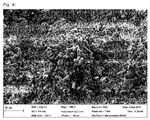
- Fig. 4 is a scanning electron micrograph (SEM) of a flexible airgel consisting of difunctional and trifunctional silanes.
- thermogravimetric analysis the influence of tetrafunctional silanes, which are used in the production of the airgel, was examined for thermal stability.
- Thermogravimetric analysis is used to determine the decomposition of materials as a function of time and temperature.
- the device used type TG 209 F1 from Netzsch contains an oven in which there is a microbalance.
- the samples were placed in a crucible made of Al 2 O 3 and placed on the microbalance. Under inert atmosphere, the samples were pyrolyzed from 25 ° C to 1000 ° C at a heating rate of 10K / min. Due to the pyrolysis, the sample loses weight, which measures the microbalance.
- the dashed line in Fig. 5 shows the results for a flexible airgel made from 60 mol% MTMS and 40 mol% DMDMS.
- the data in mol% here and below refer to the total molar amount of silane.
- the dotted curve in Fig. 5 shows the result for a flexible airgel which was prepared from 54 mol% MTMS, 36 mol% DMDMS and 10 mol% TEOS (tetrafunctional silane).
- This material has less organic carbon compounds, but more tetra-functional silane. This increases the thermal stability.
- the residual mass in this sample was about 60%.
- no pronounced shock-like mass loss at 400 ° C was observed here, as could be seen in the sample without tetrafunctional silane.
- the measurement results for a flexible airgel which was prepared from 30 mol% TEOS (tetrafunctional silane), 44 mol% MTMS and 26 mol% DMDMS, are indicated by the solid curve in FIG Fig. 5 shown.
- the residual mass was around 70%.
- the abrupt loss of mass was at a higher temperature (550 ° C) than the other samples and was less pronounced than the sample with 10 mol% TEOS.
- the tetrafunctional silane TEOS (tetraethoxysilane) allows the production of flexible aerogels with a especially high thermal stability. It has been found that flexible aerogels in which 30 mol% or more of TEOS is used in the production, although a high thermal stability, but their flexibility is significantly limited, as well as the shear and tensile strength.
- Example 3 Thermal stability of the composite as described in Example 1.
- the composite consisted, as explained in Example 1, of polyester fiber fleece with flexible silica aerogels, which consists of di- and trifunctional but without proportions of tetrafunctional silanes. The measurements were used to investigate the thermal stability of the composite.
- a sample was subjected to a linear temperature increase.
- the measurement started at 25 ° C.
- a temperature increase of 10 ° C / min was a heating up to a maximum temperature of 1000 ° C.
- the result of the measurement is in Fig. 6 shown.
- the composite Up to the temperature of 350 ° C, the composite has a mass loss of only 2.6%. From 400 ° C there is a sudden loss of mass. This temperature is consistent with the fibrous matrix used, the airgel itself being more stable even at significantly higher temperatures. The present composite is thus considered to be thermally stable up to a temperature of 350 ° C.
- Example 7 A sample of the composite prepared in Example 1 was again subjected to TGA. This time the influence of temperature was studied over a longer period of time. For this, the temperature was held for about one hour each. The result is in Fig. 7 shown.
- the composite was first heated to 100 ° C and held this temperature for one hour. During this period, there was a mass loss of 0.55%. Subsequently, with a temperature increase of 10 ° C / min, the temperature was raised to 200 ° C and held again for one hour. In total, a mass loss of 0.93% occurred here.
- a sample prepared according to Example 1 was pyrolyzed at 350 ° C for 2 hours.
- the sample had a height of 1.5 cm, a width of 4.8 cm, a length of 19.6 cm, a weight of 12.5 grams, a volume of 141.12 cm 3 and a density of 0.09 g / cm 3 .
- the sample after pyrolysis had a height of 1.5 cm, a width of 4.5 cm, a length of 19.5 cm, a weight of 11.48 Grams, a volume of 131.63 cm 3 and a density of 0.09 g / cm 3.
- the surface was slightly brown while it was white before pyrolysis.
- the flexibility remained. Only the tensile strength was negatively influenced and was no longer present. This is probably due to the fact that the fiber network used at 350 ° C was no longer thermally stable. However, if one uses here such fiber networks that do not pyrolyze even at these temperatures, a tensile strength is still given.
Landscapes
- Chemical & Material Sciences (AREA)
- Organic Chemistry (AREA)
- Engineering & Computer Science (AREA)
- Dispersion Chemistry (AREA)
- Ceramic Engineering (AREA)
- Structural Engineering (AREA)
- Inorganic Chemistry (AREA)
- Materials Engineering (AREA)
- Chemical Kinetics & Catalysis (AREA)
- Civil Engineering (AREA)
- Textile Engineering (AREA)
- Silicon Compounds (AREA)
- Compositions Of Macromolecular Compounds (AREA)
Abstract
Description
- Die vorliegende Erfindung betrifft ein flexibles Aerogel-Komposit, wobei das Aerogel ein Silica-Aerogel ist, sowie ein Verfahren zur dessen Herstellung.
- Aerogele sind hochporöse Festkörper, deren Volumen zum größten Teil aus Poren besteht. Als Werkstoff sind sie seit langem bekannt. Sie zeichnen sich durch eine sehr geringe Dichte, eine hohe spezifische Oberfläche, niedrige Wärmeleitfähigkeit sowie eine hohe akustische Impedanz aus.
- Aerogele sind aus unterschiedlichsten Materialien bekannt. Häufig verbreitet sind Aerogele auf Silikatbasis. Beschrieben sind jedoch auch Aerogele aus Metalloxiden oder organische Aerogele, wie beispielsweise auf der Basis von Resorcinformaldehyd. Weitere organische Aerogele auf der Basis von Melamin-Formaldehyd, Cellulose oder Alginat wurden ebenfalls beschrieben.
- Praktisch alle bekannten Aerogele sind spröde Werkstoffe, das heißt bei inhomogener mechanischer Belastung brechen sie ohne vorherige bleibende Verformung. Bei homogener mechanischer Belastung sind sie praktisch nicht elastisch verformbar. Vielmehr brechen die Aerogele auseinander.
- Die Synthese von Aerogelen erfolgt typischerweise mittels eines Sol-Gel-Prozesses. Nach der Gelation und gegebenenfalls einer Alterung des Gels wird das noch im Gel enthaltene Lösungsmittel häufig unter überkritischen Bedingungen ausgetauscht. Dies ist einerseits notwendig, um die anschließende Trocknung zu ermöglichen. Zum anderen werden hier beim Sol-Gel-Verfahren nicht abreagierte Edukte und unerwünschte Nebenprodukte entfernt. Gerade dieser Lösungsmittelaustausch stellt häufig den limitierenden Faktor bei der Herstellung von Aerogelen dar.
- Im Stand der Technik beschrieben ist ein Lösungsmittelaustausch, der durch Diffusion erreicht wird. Mit zunehmender Größe eines aus Aerogel bestehenden Gegenstandes nimmt diese Diffusion beziehungsweise die hierfür benötigte Zeit quadratisch mit dem kleinsten Probendurchmesser zu. Meist müssen 5 bis 20 Waschzyklen durchgeführt werden, die jeweils mehrere Stunden benötigen, so dass der gesamte Lösungsmittelaustausch oft einige Tage benötigt. Die Herstellungskosten von Aerogelen werden daher maßgeblich durch diese Waschzeit mitbestimmt, da auch ein hoher Raumbedarf erforderlich ist, in welchem die Proben während des Lösungsmittelaustausches lagern können. Da das Sol beziehungsweise die erhaltenen Gele jedoch vor dem eigentlichen Trocknen nicht formstabil sind, ist es nicht möglich die Gele aus der Herstellungsform herauszunehmen und beispielsweise wie einen Schwamm auszudrücken, um das darin enthaltene Lösungsmittel zu entfernen. Hierbei würden die Gele zerstört werden.
- Im Stand der Technik beschrieben sind flexible Silica-Aerogele, bei denen als Ausgangsmaterial trifunktionale Siliziumalkoxide verwendet werden (A. V. Rau et al.: Superhydrophobic and Flexible Aerogels, in: M.A. Aegerter et al (EDS), Aerogels Handbook, Advances in Sol Gel derived materials and technologies, Springer Science and Business Media, LLC 2011). Die entsprechend hergestellten Aerogele sind elastisch verformbar. Bei der Herstellung ist es jedoch auch hier notwendig, dass ein Lösungsmittelaustausch mittels Diffusion erfolgt. Auch sind weder die nassen Gele noch die trockenen Aerogele auf Zug oder Scherung beanspruchbar. Durch die mikro- und mesoporöse Struktur von Gelen und Aerogelen ist die maximale Zugfestigkeit und Scherfestigkeit durch intrinsische Kerbwirkung und dadurch, dass die Netzwerk-bildenden Teilchen oft nur durch Brücken von wenigen Nanometern beziehungsweise wenigen 10 nm verbunden sind, stark limitiert.
- Es besteht daher Bedarf an Aerogel-haltigen Materialen, die auf Zug und/oder Scherung beanspruchbar sind und im Wesentlichen die Eigenschaften von Aerogelen aufweisen. Zudem sollten die Materialien in einem Herstellungsverfahren bereitgestellt werden können, in welchem der Lösungsmittelaustausch gegenüber dem Stand der Technik beschleunigt werden kann.
- Überraschenderweise hat sich gezeigt, dass ein Komposit, welches ein Silica-Aerogel sowie ein dreidimensionales makroporöses Fasernetzwerk umfasst, die aus dem Stand der Technik beschriebenen Nachteile vermeidet.
- In einer ersten Ausführungsform wird die der vorliegenden Erfindung zugrundeliegende Aufgabe daher gelöst durch ein flexibles Aerogel-Komposit, welches ein Silica-Aerogel, gebildet aus wenigstens einem difunktionellen Silan und wenigstens einem trifunktionellen Silan, und ein 3-dimensionales makroporöses Fasernetzwerk, in dem die Fasern an den Berührungspunkten kraftschlüssig miteinander verbunden sind, umfasst. Überraschenderweise ist das erfindungsgemäße flexible Komposit stabil gegenüber Beanspruchung durch Zugkräfte und/oder Scherung.
- Ein difunktionelles Silan im Sinne der vorliegenden Erfindung ist ein Siloxan, welches zwei Alkoxy-Gruppen (OR') sowie zwei Alkyl-Gruppen (R) umfasst und in der folgenden Formel I schematisch gezeigt sind:

- Dabei sind R und R' Alkylgruppen, die jeweils gleich oder voneinander verschieden sein können. Vorzugsweise sind die Alkylgruppen kurzkettig und weisen insbesondere bevorzugt 1 bis 3 Kohlenstoffatome auf. Besonders bevorzugt sind R und/oder R' ausgewählt aus Methyl und Ethyl. Besonders bevorzugt sind R und R' gleich. Difunktionelle Silane im Sinne der vorliegenden Erfindung sind beispielsweise Dimethoxydimethylsilan, Dimethoxydiethylsilan, Diethoxydimethylsilan oder Diethoxydiethylsilan.
- Entsprechend sind trifunktionelle Silane im Sinne der vorliegenden Erfindung solche Silane, welche drei funktionelle Gruppen aufweisen, in welchen kurzkettige Kohlenwasserstoffreste über ein Sauerstoffatom an Silicium angebunden sind und der folgenden allgemeinen Formel II entsprechen, in welcher R und R' wie zu Formel I beschrieben ausgewählt werden:

- Auch hier ist ebenso wie bei den difunktionellen Silanen aufgrund der sterischen Freiheit keine Ausbildung eines starren Netzwerkes möglich, so dass sich hieraus eine Flexibilität des gebildeten Aerogels ergibt.
- Dabei ist die Flexibilität einerseits eine intrinsische Eigenschaft des Materials. Zu berücksichtigen ist hier jedoch auch die 3-dimensionale Ausgestaltung des fraglichen Gegenstandes und das sich hieraus ergebende Flächenträgheitsmoment. Um die Flexibilität von Aerogelen zu beschreiben, muss man sich zunächst die Struktur der Aerogele in einem erfindungsgemäßen Komposit ansehen. Die Aerogele liegen als kleine Partikel vor, welche über kleinste Brücken miteinander verbunden sind. Diese Aerogele umschließen dann einen Hohlraum.
Fig. 1 zeigt schematisch den entsprechenden Aufbau. Die Zellwände, welche vom Aerogel gebildet werden, weisen eine Schichtdicke tw und eine Zellgröße tc auf. Zur Vereinfachung wird zunächst davon ausgegangen, dass die Zellwände in Form von Balken mit einer Schichtdicke tw vorliegen. Ausgehend von annähernd quadratischen Zellen ergibt sich eine Porengröße von tp = tc - tw. - Um den Volumenanteil an festem Material innerhalb der Zelle zu bestimmen, wird zunächst das Volumen aller Balken nach der folgenden Formel (1) berechnet:

- Das Zellenvolumen entspricht:


- Geht man nun davon aus, dass 4tw(3tc) <<1, kann diese Formel vereinfacht werden zu:

- Mit Hilfe dieser Formel kann nun die Wanddicke tw in Abhängigkeit der Porosität φ p = 1 - φ a unter der Annahme von φ a = ρ e /ρ s , ( mit ρ s : skeletal density und ρ e : envelope density) angegeben werden:

- Um nun auf die Flexibilität zurück zu kommen, geht man davon aus, dass eine Kraft an der in
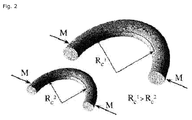
Fig. 1 gezeigten Zelle wirkt. Diese Kraft würde zu einer Deformation der Zelle und damit zu einer Deformation der Wände, also der Balken, führen. Diese Deformation beginnt parallel zu der Krafteinwirkung. Die Balken biegen sich, wie inFig. 2 schematisch dargestellt. Wie in dieser Darstellung bereits erkennbar ist, ist der Biegeradius von der Dicke des gebogenen Gegenstandes abhängig. Der Biegeradius Rc kann mit bekannten Theorien berechnet werden:
Fig. 1 schematisch gezeigten Zelle, für die weitere Berechnung. - Die Flexibilität des Balkens ergibt sich somit nach

- Diese Formel (7) zeigt, dass die Flexibilität nicht eine einfache Materialeigenschaft ist (wie beispielsweise der E-Modul), sondern auf Grund der Abhängigkeit von I von der Form des Gegenstandes abhängt. Für ein Quadrat berechnet sich Iw nach:

- Das Moment der Zelle ohne Poren ergibt sich aus:

- Somit kann die Flexibilität der Zelle bestimmt werden:

- Hieraus ergibt sich die Flexibilität des porösen Materials unter Berücksichtigung einer quadratischen Form:

Fig. 1 links schematisch gezeigt ist. Dieser ist üblicherweise kleiner als der eines festen, kompakten Materials Ec . Unter der Annahme, dass ρ w ≤ ρ s , ergibt sich nach L.J. Gibson und M.F. Ashby (Cellular Solids, 2nd Edition, Cambridge University Press, Cambridge UK (1997)) ein Young Modul von:
- Setzt man nun die Gleichungen 12, 5 und 9 in Gleichung 11 ein, so erhält man den folgenden Ausdruck für die Flexibilität:

- Dieser in Gleichung (13) gezeigte Ausdruck zeigt, dass eine geringere Aerogeldichte zu einer größeren Flexibilität führt und dass auch eine geringere Porengröße eine größere Flexibilität ermöglicht. Ebenfalls ergibt sich hieraus, dass ein kompakter Körper eine geringere Flexibilität aufweist als eine Kette von aneinandergereihten, kleinen sekundären Partikeln, die miteinander über ausgebildete Partikelhälse in Kontakt stehen.
- Ebenso besteht ein Zusammenhang zwischen der Flexibilität und der Porengröße des Materials. Das Verhältnis der Flexibilität eine Materials ohne Poren und eines porösen Materials bestimmt sich nach

- Führt man dies mit den bisherigen Berechnungen zusammen, so ergibt sich:

- Aus der Berechnung des Volumenanteils ergibt sich ein Verhältnis zwischen tw und tc, so dass sich hieraus


- Aus Gleichung (17) ergibt sich somit ein Zusammenhang zwischen der Porosität und der Flexibilität.
- Dies zeigt, dass Flexibilität eine eigenständige Eigenschaft eines Materials ist, welche nicht mit dem E-Modul gleich gesetzt werden kann. Dabei ist überraschenderweise keine Abhängigkeit von der Größe der Aerogelpartikel gegeben.
- Überraschenderweise hat sich gezeigt, dass die Kombination aus einem Silica-Aerogel, welches aus wenigstens einem difunktionellen Silan und wenigstens einem trifunktionellen Silan gebildet ist, und einem dreidimensionalen makroporösen Fasernetzwerk zu einem flexiblen Komposit führt. Das erfindungsgemäße Komposit ist sowohl im nassen als auch im trockenen Zustand zug- und scherfest. Durch die erhöhte mechanische Belastbarkeit im nassen sowie im trockenen Zustand ist die Darstellung von komplexen Geometrien möglich. Somit stellt das erfindungsgemäße Komposit ein interpenetrierendes Netzwerk wenigstens zweier Komponenten dar.
- Erfindungsgemäß kann das Silica-Aerogel aus einem difunktionellen Silan bestehen. Es ist jedoch auch möglich unterschiedliche difunktionelle Silane einzusetzen. Ebenso ist es möglich, zur Ausbildung des Silica-Aerogels ein trifunktionelles Silan oder mehrere unterschiedliche trifunktionelle Silane einzusetzen. Bevorzugt wird das Silica-Aerogel aus einem difunktionellen Silan und einem trifunktionellen Silan gebildet. Besonders bevorzugt auf Grund der Reaktionskinetik zur Hydrolyse sind das difunktionelle Silan Dimethyldimethoxysilan und das trifunktionelle Silan Methyltrimethoxysilan. Bei längeren Alkylketten R beziehungsweise R' sinkt die Geschwindigkeit der Hydrolyse.
- In einer bevorzugten Ausführungsform ist das Aerogel weiterhin aus einem tetrafunktionellen Silan gebildet. Überraschenderweise hat sich gezeigt, dass durch den Einsatz von difunktionellen, trifunktionellen und tetrafunktionellen Silanen zur Ausbildung eines Silica-Aerogels eine verbesserte Temperaturstabilität erreicht werden kann.
- Tetrafunktionelle Silane im Sinne der vorliegenden Erfindung entsprechen der allgemeinen Formel III

- Vorzugsweise beträgt der Anteil an tetrafunktionellem Silan wenigstens 5 Mol% bezogen auf 100 Mol% an difunktionellem, trifunktionellem und tetrafunktionellem Silan. Ein Anteil von mehr als 10 Mol% tetrafunktionellem Silan führt dazu, dass die mechanischen Eigenschaften des erfindungsgemäßen Komposits nachteilig beeinflusst werden und ein sprödes Verhalten auftritt, welches mit zunehmendem Anteil an tetrafunktionellem Silan zum vorherrschenden Verhalten wird. Flexible Eigenschaften treten dann in den Hintergrund.
- Das Stoffmengenverhältnis von trifunktionellem Silan zu difunktionellem Silan liegt vorzugsweise im Bereich von 2:1 bis 1:1. Wird der Stoffmengenanteil des difunktionellen Silans weiter gesteigert, erfolgt keine vollständige Gelation. Das Gewichtsverhältnis von trifunktionellem Silan zu difunktionellem Silan beträgt vorzugsweise 1:0,59.
- Das erfindungsgemäße Komposit umfasst weiterhin ein dreidimensionales makroporöses Fasernetzwerk. Die Fasern sind hier an den Berührungspunkten kraftschlüssig miteinander verbunden. Das Fasernetzwerk weist vorzugsweise eine Porengröße von 0,5 mm oder mehr auf. Insbesondere eine solch große Porengröße ermöglicht die bevorzugten Eigenschaften des erfindungsgemäßen Komposits. Dabei sollte die Porengröße 5 mm nicht überschreiten, damit ein stabiles Komposit erhalten wird. Das Leervolumen des dreidimensionalen Fasernetzwerkes beträgt vorzugsweise 95 Vol.-% oder mehr, insbesondere 97 Vol.-% oder mehr, besonders bevorzugt 99 Vol.-%.
- Das Fasernetzwerk ist beispielsweise ausgewählt aus der Gruppe, die Gewebe, Gewirke, Vliese, Filze und Tuftings umfasst. Diese können beispielsweise aus Polymerfasern bestehen, wie beispielsweise Polyester oder Polyamidfasern. Es ist auch möglich sogenannte BiCo-Fasern einzusetzen, welche aus einem Kern aus einem Material und einer Hülle aus einem davon verschiedenem Material bestehen. Beispielsweise kann es sich hierbei um mit einem Polymer beschichtete Glasfasern handeln. Es ist auch möglich BiCo-Fasern einzusetzen, die aus unterschiedlichen polymeren Materialen bestehen. Vorzugsweise hat hier das Polymer, welche die Hülle bildet, einen geringeren Schmelzpunkt als das Polymer des Kerns. Hierdurch kann ermöglicht werden, dass durch ein leichtes Erwärmen die äußere Hülle sich in ihren Eigenschaften ändert und an den Überschneidungspunkten einzelner Fasern diese miteinander verkleben, so dass eine kraftschlüssige Verbindung an den Berührungspunkten gegeben ist.
- Eine kraftschlüssige Verbindung ist somit im Gegensatz zu rein formschlüssigen Verbindungen anzusehen, in welchen Fasern eines Fasernetzwerks an den Berührungspunkten lediglich mechanisch miteinander verbunden sind.
- Das Aerogel weist bevorzugt eine Teilchengröße im Bereich von 1 bis 10 µm, insbesondere von 2 bis 8 µm, besonders von 4 bis 5,5 µm auf. Die Größe der Teilchen wird mittels elektronenmikroskopischer Aufnahmen, wie Rasterelektronenmikroskopie (REM) oder Transmissionselektronenmikroskopie (TEM), bestimmt. Der Porendurchmesser beträgt vorzugsweise 15 µm oder weniger, insbesondere 12 µm oder weniger und/oder 2 µm oder mehr, bevorzugt 5 µm oder mehr. Besonders bevorzugt beträgt der Porendurchmesser etwa 10 µm.
- Die Rohdichte mit Luft beträgt bevorzugt 0,1 g/cm3. Die skeletale Dichte liegt unterhalb der von solidem Quarz und beträgt bevorzugt 1,8 g/cm3. Überraschenderweise hat sich gezeigt, dass ein Komposit mit besonders guten Eigenschaften erhalten wird, wenn das Aerogel die genannten Teilchengröße, Porendurchmesser und bevorzugt auch Dichte aufweist.
- In einer weiteren Ausführungsform wird die der vorliegenden Erfindung zugrundeliegende Aufgabe gelöst durch ein Verfahren zur Herstellung eines flexiblen Aerogel-Komposits, welche die folgenden Schritte umfasst:
- a) Hydrolyse wenigstens eines trifunktionellen Silans in destilliertem Wasser,
- b) Zugabe wenigstens eines difunktionellen Silans und Hydrolyse der beiden Silane, wodurch ein Sol erhalten wird,
- c) In-Kontakt bringen des Sols mit einem 3-dimensionales makroporöses Fasernetzwerk,
- d) Gelation des in Schritt c) erhaltenen Sols unter Ausbildung eines Gels bei einer gegenüber Raumtemperatur erhöhten Temperatur,
- e) Austausch von im Gel enthaltenem Lösungsmittel unter Einwirkung von Druck und
- f) Trocknung zum Erhalt des flexiblen Komposits.
- Dabei wird erfindungsgemäß zunächst das trifunktionelle Silan hydrolysiert, welches diesbezüglich eine langsamere Reaktionskinetik als das difunktionelle Silan aufweist. Das erfindungsgemäße Verfahren ermöglicht eine kostengünstige und rasche Herstellung entsprechender Komposit.
- Beim Lösungsmittelaustausch in Schritt e) werden nicht reagierte Edukte und entstandene Verunreinigungen (Nebenprodukte) entfernt. Der Austausch kann beispielsweise dadurch erfolgen, dass das in Schritt c) erhaltene Gel in frisches Lösungsmittel gelegt wird. Durch Ausübung von Druck, also durch Kompression wird altes Lösungsmittel aus dem Gel gedrückt. Anschließend erholt sich in diesem Fall die Struktur elastisch und saugt sich mit frischem Lösungsmittel voll, wie dies beispielsweise auch bei einem nanoporösen Schwamm zu beobachten wäre.
- Überraschenderweise hat sich gezeigt, dass ein erfindungsgemäßes Komposit auch im nassen Zustand stabil ist. Dies ermöglicht einerseits eine flexible Handhabe, unabhängig von Größe und Geometrie des Komposits aber auch einen raschen Lösungsmittelaustausch, der nun nicht mehr diffusionsbasiert abläuft. Dies führt zu einer deutlichen Zeitersparnis bei der Herstellung. Auf Grund der Zug- und Scherfestigkeit des erfindungsgemäßen Komposits auch im nassen Zustand ist es möglich den Druck so auszuüben, dass auch Zug- und/oder Scherkräfte einwirken, um einen raschen Lösungsmittelaustausch zu ermöglichen.
- Für ein verbessertes Waschergebnis kann das Gel auch nacheinander in unterschiedlichen Lösungsmitteln gewaschen werden. Aufgrund der kurzen Zeitdauer, die der Lösungsmittelaustausch erfindungsgemäß benötigt, können verbesserte Aerogele erhalten werden, da hierdurch gezielter nicht reagierte Edukte oder entstandene Verunreinigungen aus der nanoporösen Struktur entfernt werden können. So kann beispielsweise zunächst Wasser als Lösungsmittel eingesetzt werden, das heißt das Gel wird in Wasser gelegt und hier mehrmals ausgedrückt. Anschließend kann das Gel beispielsweise in einem organischen Lösungsmittel, beispielsweise Ethanol, Methanol, Isopropanol oder Aceton, gewaschen werden, um organische Verunreinigungen zu entfernen. Insgesamt kann die für den Lösungsmittelaustausch benötigte Zeit auf Minuten oder wenige Stunden, je nach Größe des Komposits, reduziert werden. Da die organischen Lösungsmittel zum gleichen Ergebnis führen, wird bevorzugt Ethanol als organisches Lösungsmittel eingesetzt, da diese kostengünstig und einfach in der Handhabung ist.
- Ist das Silica-Aerogel nicht nur aus einem difunktionellen Silan und einem trifunktionellen Silan, sondern auch aus einem tetrafunktionellen Silan gebildet, wird zunächst das tetrafunktionelle Silan hydrolysiert und anschließend zunächst das trifunktionelle Silan und erst dann das difunktionelle Silan in die Reaktionsmischung gegeben. Auch diese Reihenfolge ergibt sich auf Grund der Reaktionskinetik. So wird zunächst das Silan zur Hydrolyse gebracht, welches die langsamste Reaktionskinetik im Hinblick auf die Hydrolyse aufweist, und zuletzt das Silan mit der schnellsten Reaktionskinetik.
- Vorzugsweise gibt man in Schritt a) weiterhin Harnstoff hinzu. Durch die Zugabe von Harnstoff kann die Reaktionsgeschwindigkeit der stattfindenden Kondensationsreaktion eingestellt werden. Es wird jedoch auch das mechanische Verhalten des flexiblen Komposits beziehungsweise zunächst des Aerogels beeinflusst. Vorzugsweise gibt man Harnstoff in einem Anteil von 20 bis 50 Gew.-%, insbesondere von 30 bis 45 Gew.-% hinzu, wobei 100 Gew.-% das Gesamtgewicht des nassen Gels darstellen. Die Flexibilität des erfindungsgemäßen Komposits nimmt mit steigendem Harnstoffgehalt zu, da hierdurch die Mikrostruktur des Aerogels dahingehend beeinflusst wird, dass homogene Partikelhälse, eine ebene Gestalt und eine verbesserte Stabilität erhalten werden.
- Gibt man mehr als 50 Gew.-% an Harnstoff in die Lösung, so erfolgt die Reaktion zwar sehr schnell, die Flexibilität wird jedoch nachteilig beeinflusst. Verwendet man weniger als 20 Gew.-% an Harnstoff, so kann ein inhomogenes Sol und damit ein inhomogenes Gel und ein inhomogenes Aerogel erhalten werden.
- Bevorzugt wird in dem erfindungsgemäßen Verfahren zwischen den Schritten a) und b) weiterhin ein Tensid zugegeben. Das Tensid verbessert die Mischbarkeit der Silane mit dem Wasser. Somit wird ein gleichmäßiges Netzwerk beziehungsweise die Ausgestaltung eines gleichmäßigen Netzwerks in der Lösung ermöglicht. Vorzugsweise wird ein Tensid in einem Anteil von etwa 5 Gew.-% hinzugegeben. Gibt man weniger als 5 Gew.-% hinzu, so ist kein Einfluss auf die Löslichkeit der Silane festzustellen. Ein Mehr an Tensid führt zu keiner Verbesserung, erhöht jedoch die Kosten des Herstellungsverfahrens. Vorzugsweise handelt es sich bei dem Tensid um CTAC, welches insbesondere als verdünnte Lösung eingesetzt wird.
- Die Gelation des Sols (Schritt d des erfindungsgemäßen Verfahrens) erfolgt bei gegenüber Raumtemperatur erhöhter Temperatur. Die Gelation kann beispielsweise in einem Ofen bei einer Temperatur im Bereich von 70 °C bis 100 °C erfolgen. Hierdurch kann die Gelation beschleunigt werden. Bei zu hohen Temperaturen wird eine homogene Aerogel-Struktur nicht immer erreicht. Bei geringen Temperaturen ist der Zeitbedarf für eine vollständige Gelation sehr lang. Bei einer Temperatur von 70 °C bis 100 °C beträgt die Dauer etwa 2 bis 28 Stunden.
- Nach der Gelation und vor dem Austausch der Lösungsmittel kann das Gel über einen Zeitraum von 2 bis 48 Stunden bei einer Temperatur im Bereich von 20 bis 100 °C, üblicherweise bei etwa 80 °C, gealtert werden.
- Die abschließende Trocknung kann sowohl überkritisch (Lösungsmittelextraktion mit überkritischem Fluid) als auch unterkritisch erfolgen.
- Überraschenderweise hat sich gezeigt, dass das erfindungsgemäße Komposit ebenso temperaturstabil ist wie Aerogele. Limitierender Faktor ist hier die Wahl des Materials für das Fasernetzwerk. Durch die geeignete Materialauswahl besteht somit die Möglichkeit die Materialeigenschaften den gegebenen Bedingungen anzupassen.
- Es hat sich jedoch gezeigt, dass auch bei solchen Temperaturen, bei denen das Fasernetzwerk pyrolysiert, die flexiblen Eigenschaften des Komposits erhalten bleiben. Lediglich die Zugfestigkeit geht in Abhängigkeit des Grads der Pyrolyse verloren. Zudem weist das erfindungsgemäße Komposit eine hohe Formstabilität auf, die auch bei hohen Temperaturen nicht verloren geht.
- Die flexiblen Eigenschaften bleiben auch bei hohen Temperaturen erhalten, wodurch die Verwendung als Dämmmaterial ermöglicht wird. Auf Grund der Flexibilität bleibt beispielsweise auch in gebogenem Zustand die Dämmwirkung gleichmäßig über einen langen Zeitraum erhalten. So ist beispielsweise eine Wärmedämmung von Rohren mit Hilfe des erfindungsgemäßen Komposits möglich. Auch die akustischen Dämmeigenschaften des erfindungsgemäßen Komposits entsprechen denen von Aerogelen. Entsprechen können die Komposits zur akustischen Dämmung beispielsweise in Schienenfahrzeugen, Kraftfahrzeugen, Flugzeugen oder ähnlichen eingesetzt werden.
- In den nachfolgenden Ausführungsbeispielen wird die vorliegende Erfindung exemplarisch erläutert.
- Für die Herstellung des Sols wurden die aufgeführten Edukte [MTMS]:[DMDMS]:[C2H4O2]:[H2O]:[UREA]:[CTAC] im folgenden Molverhältnis [1]:[0,67]:[4x10⁻³]: [39,65]: [3,97]: [0,15] eingesetzt.
- MTMS: Methyltrimethoxysilan
- DMDMS: Dimethyldimethoxysilan
- UREA: Harnstoff
- CTAC: Tensid (Cetyltrimethylammoniumchlorid)
- In einem verschließbaren Becher wurde das Urea in destilliertem Wasser unter Rühren aufgelöst. Anschließend wurde mit Eisessig die Lösung auf den gewünschten pH von ≤3,5 gebracht. Nun erhielt die Lösung den ersten Silanprekursor (MTMS) zur Hydrolyse und im Anschluss das Tensid (CTAC). Dieser Prozess dauerte 15 min. Danach wurde der zweite Silanprekursor (DMDMS) hinzugegeben. Auch dieser wurde in der Lösung hydrolysiert. Die Dauer betrug hier 45 min.
- Die Fasermatrix und das Sol wurden miteinander in Kontakt gebracht (die Fasermatrix wurde mit fertigem Sol imprägniert); als Fasermatrix wurden Faservliese aus Polyester eingesetzt. Diese wiesen eine durchschnittliche Porengröße von 1,25mm auf.
- Die zuvor erhaltene Struktur wurde in einem Ofen bei Temperaturen von 70 bis 100°C gelagert. Die Gelation des Sols trat innerhalb von 24 Stunden ein.
- Das erhaltene Gel wurde zwischen 2 und 48 Stunden bei gegenüber Raumtemperatur erhöhter Temperatur (vorliegend 80 °C) gealtert.
- Das Gel wurde in frisches Lösungsmittel gelegt. Durch Kompression wurde altes Lösungsmittel aus dem Gel gedrückt. Anschließend erholte sich die Struktur elastisch und saugte sich mit frischem Lösungsmittel voll (ähnlich einem nanoporösen Schwamm). Für verbessertes Waschergebnis wurde das Gel zuerst einige Male in Wasser und anschließend in organischem Lösungsmittel (Ethanol) gewaschen.
- Das Gel wurde unterkritisch in einem Ofen bei Atmosphärendruck und bei Temperaturen zwischen 20 bis 160°C getrocknet.
- In
Fig. 3 ist eine Rasterelektronenmikroskopische Aufnahme (REM) eines erfindungsgemäßen Komposits gezeigt. Hier lässt sich erkennen, dass eine Verbindung zwischen Aerogel und den Fasern des Vlieses besteht. Die Bindung des Aerogels an das Faservlies führt bei mechanischer Belastung zu einer guten Kraftübertragung von Aerogel auf die Faser und somit zur Stärkung des Verbundes. - In
Fig. 4 ist eine Rasterelektronenmikroskopische Aufnahme (REM) eines flexiblen Aerogels, welches aus di- und trifunktionellem Silanen besteht, gezeigt. - Mittels thermogravimetrischer Analyse wurde der Einfluss von tetrafunktionellen Silanen, welche bei der Herstellung des Aerogels eingesetzt werden, auf die thermische Stabilität hin untersucht.
- Hierfür wurden zunächst Messungen an verschiedenen MTMS/DMDMS - Systemen (di- und trifunktionellen Silanen) mit unterschiedlichen Anteilen an tetrafunktionellem Silanen durchgeführt, um die thermische Stabilität ohne die Auswirkung von Faservlies zu untersuchen.
- Die thermogravimetrische Analyse, kurz TGA, dient zur Bestimmung der Zersetzung von Materialien in Abhängigkeit von Zeit und Temperatur. Das verwendete Gerät Typ TG 209 F1 aus dem Hause Netzsch enthält einen Ofen, in dem sich eine Mikrowaage befindet. Die Proben wurden in einem Tiegel aus Al2O3 gelegt und auf die Mikrowaage platziert. Unter inerter Atmosphäre wurden die Proben bei einer Heizrate von 10K/min von 25°C auf 1000°C pyrolysiert. Aufgrund der Pyrolyse verliert die Probe an Gewicht, welches die Mikrowaage misst.
- In
Fig.5 sind die jeweiligen thermogravimetrische Analysen von Proben mit unterschiedlichen Anteilen an tetrafunktionellen Silanen festgehalten. Die x-Achse gibt die Temperatur an und die y-Achse das relative Gewicht in % wieder (TG% das Gewicht ist zu Anfang 100%). - Die gestrichelte Linie in
Fig. 5 zeigt die Ergebnisse für ein flexibles Aerogel, welches aus 60 mol% MTMS und 40 mol% DMDMS hergestellt wurde. Die Angaben in mol% beziehen sich hier und im Folgenden auf die gesamte Stoffmenge an Silan. Der schlagartige Masseverlust erfolgte hier bei etwa 400°C, wobei sich CO2 und andere niedermolekulare organische Verbindungen abspalten. Die Restmasse betrug hier 13%. - Die gepunktete Kurve in
Fig. 5 zeigt das Ergebnis für ein flexibles Aerogel, welches aus 54 mol% MTMS, 36 mol% DMDMS und 10 mol% TEOS (tetrafunktionelles Silan) hergestellt wurde. Dieses Material besitzt weniger organische Kohlenstoffverbindungen, dafür aber mehr Anteil an tetrafunktionellem Silan. Dies erhöht die thermische Stabilität. Die Restmasse betrug bei dieser Probe etwa 60%. Darüber hinaus war hier kein ausgeprägter schlagartiger Masseverlust bei 400°C zu beobachten, wie bei der Probe ohne tetrafunktionelles Silan zu erkennen war. - Die Messergebnisse für ein flexibles Aerogel, welches aus 30 mol% TEOS (tetrafunktionelles Silan), 44 mol% MTMS und 26 mol% DMDMS hergestellt wurde, sind mittels der durchgezogenen Kurve in
Fig. 5 dargestellt. Hier betrug die Restmasse rund 70%. Der schlagartige Masseverlust lag bei einer gegenüber den anderen Proben höheren Temperatur (550°C) und war weniger ausgeprägt als bei der Probe mit 10 mol% TEOS. - Wie aus
Fig. 5 erkennbar, ermöglicht das tetrafunktionelle Silan TEOS (Tetraethoxysilan) die Herstellung von flexiblen Aerogelen mit einer besonders hohen thermischen Stabilität. Dabei hat sich gezeigt, dass flexible Aerogele, bei welchen in der Herstellung 30mol% oder mehr an TEOS eingesetzt wird, zwar eine hohe thermische Stabilität aufweisen, deren Flexibilität jedoch deutlich eingeschränkt ist, ebenso wie die Scher- und Zugfestigkeit. - Es lässt sich feststellen, dass je höher der Anteil an tetrafunktionellen Silanen ist, die thermische Stabilität erhöht wird. Dies kann man erstens an den verbleibenden Restmassen ableiten (13%, 59%, 70%) und zweitens an den Temperaturen an dem der schlagartige Masseverlust auftaucht, feststellen.
- Das Komposit bestand, wie in Beispiel 1 erläutert, aus Polyesterfaservlies mit flexiblen Silica-Aerogelen, welches aus di- und trifunktionellem aber ohne Anteilen an tetrafunktionellen Silanen besteht. Mit Hilfe der Messungen wurde die thermische Stabilität des Komposits untersucht.
- Hierfür wurde eine Probe einer linearen Temperaturerhöhung unterworfen. Die Messung startete bei 25 °C. Bei einem Temperaturanstieg von 10 °C/min erfolgte eine Erwärmung bis auf eine Maximaltemperatur von 1000 °C. Das Ergebnis der Messung ist in
Fig. 6 gezeigt. - Bei einem Temperaturbereich zwischen 100 °C und 200 °C erfolgt ein erster Masseverlust. Dieser ist auf die Desorption von physikalisch gebundenem Wasser zurück zu führen.
- Ein deutlicher Masseverlust tritt bei einer Temperatur ab 350 °C ein. Dieser deutet auf eine abspaltende Umsetzung der Methylgruppen in Form von CO2 hin.
- Bis zu der Temperatur von 350 °C weist das Komposit einen Masseverlust von lediglich 2,6 % auf. Ab 400 °C gibt es einen schlagartigen Masseverlust. Diese Temperatur ist in Einklang mit der verwendeten Fasermatrix, wobei das Aerogel selbst auch bei deutlich höheren Temperaturen stabiler ist. Das vorliegende Komposit ist somit bis zu einer Temperatur von 350 °C als thermisch stabil anzusehen.
- Durch die Wahl von geeignetem und temperaturstabilerem Faservlies und bei der Verwendung eines Aerogels, welches aus bis zu 10 mol% tetrafunktionellem Silan hergestellt wurde, kann die Temperaturstabilität des gesamten Komposits an die Bedürfnisse der jeweiligen Verwendung eingestellt und gegenüber dem hier verwendeten Komposit erhöht werden.
- Eine Probe des in Beispiel 1 hergestellten Komposits wurde erneut einer TGA unterzogen. Diesmal wurde der Einfluss von Temperatur über einen längeren Zeitraum untersucht. Hierfür wurde die Temperatur jeweils etwa eine Stunde gehalten. Das Ergebnis ist in
Fig. 7 gezeigt. - Wie hier erkennbar ist, wurde das Komposit zunächst auf 100 °C erwärmt und diese Temperatur für eine Stunde gehalten. In diesem Zeitraum erfolgte ein Masseverlust von 0,55 %. Anschließend wurde mit einem Temperaturanstieg von 10 °C/min die Temperatur auf 200 °C erhöht und erneut eine Stunde gehalten. In Summe trat hier ein Masseverlust von 0,93 % auf.
- Anschließend wurde erneut mit einem Temperaturanstieg von 10 °C/min die Temperatur erhöht. Die dann erreichten 300 °C wurden erneut für eine Stunde gehalten, bevor mit demselben Anstieg eine Temperatur von 400 °C eingestellt wurde. Nach der Temperaturbelastung bei 300 °C betrug der Masseverlust 1,71 %, nach insgesamt 3,5 Stunden und einer Temperaturerhöhung auf 400 °C wurde ein Masseverlust von 4,6 % beobachtet.
- Auch hier konnte somit eine zeitabhängige thermische Stabilität beobachtet werden.
- Eine Probe, welche gemäß Beispiel 1 hergestellt wurde, wurde bei 350 °C für 2 Stunden pyrolysiert.
- Die Probe wies vor der Pyrolyse eine Höhe von 1,5 cm, eine Breite von 4,8 cm, eine Länge von 19,6 cm, eine Gewicht von 12,5 Gramm, ein Volumen von 141,12 cm3 und eine Dichte von 0,09 g/cm3 auf.
- Nach der Pyrolyse wurde die Probe langsam über mehrere Stunden abgekühlt. Die Probe wies nach der Pyrolyse eine Höhe von 1,5 cm, eine Breite von 4,5 cm, eine Länge von 19,5 cm, eine Gewicht von 11,48 Gramm, ein Volumen von 131,63 cm3 und eine Dichte von 0,09 g/cm3 auf. Optisch war die Oberfläche leicht braun, während sie vor der Pyrolyse weiß war. Die Flexibilität blieb erhalten. Lediglich die Zugfestigkeit wurde negativ beeinflusst und war nicht mehr präsent. Dies ist vermutlich darauf zurückzuführen, dass das eingesetzte Fasernetzwerk bei 350 °C nicht mehr thermisch stabil war. Setzt man hier jedoch solche Fasernetzwerke ein, die auch bei diesen Temperaturen nicht pyrolisieren, ist eine Zugfestigkeit auch weiterhin gegeben.
Claims (9)
- Flexibles Aerogel-Komposit, umfassend
ein Silica-Aerogel, gebildet aus wenigstens einem difunktionellen Silan und wenigstens einem trifunktionelles Silan, und
ein 3-dimensionales makroporöses Fasernetzwerk, in dem die Fasern an den Berührungspunkten kraftschlüssig miteinander verbunden sind. - Komposit nach Anspruch 1, dadurch gekennzeichnet, dass das Aerogel weiterhin aus einem tetrafunktionellen Silan gebildet ist.
- Komposit nach Anspruch 1 oder 2, dadurch gekennzeichnet, dass das Stoffmengenverhältnis von trifunktionellem Silan zu difunktionellem Silan im Bereich von 2:1 bis 1:1 liegt.
- Komposit nach einem der Ansprüche 1 bis 3, dadurch gekennzeichnet, dass das Fasernetzwerk eine Porengröße von 0,5 mm oder mehr aufweist.
- Komposit nach einem der Ansprüche 1 bis 4, dadurch gekennzeichnet, dass das Fasernetzwerk ausgewählt ist aus der Gruppe, die Gewebe, Gewirke, Vliese, Filze und Tuftings umfasst.
- Verfahren zur Herstellung eines flexiblen Aerogel-Komposits umfassend die folgenden Schritte:a) Hydrolyse wenigstens eines trifunktionellen Silans in destilliertem Wasser,b) Zugabe wenigstens eines difunktionellen Silans und Hydrolyse der beiden Silane, wodurch ein Sol erhalten wird,c) In-Kontakt bringen des Sols mit einem 3-dimensionales makroporöses Fasernetzwerk,d) Gelation des in Schritt c) erhaltenen Sols unter Ausbildung eines Gels bei einer gegenüber Raumtemperatur erhöhten Temperatur,e) Austausch von im Gel enthaltenem Lösungsmittel unter Einwirkung von Druck undf) Trocknung zum Erhalt des flexiblen Komposits.
- Verfahren nach Anspruch 6, dadurch gekennzeichnet, dass Schritt a) die folgenden Schritte umfasst:a1) Hydrolyse wenigstens eines tetrafunktionellen Silans in destilliertem Wasser und anschließendea2) Zugabe wenigstens eines trifunktionellen Silans und Hydrolyse der beiden Silane.
- Verfahren nach Anspruch 6 oder 7, dadurch gekennzeichnet, dass man zur Hydrolyse in Schritt a) weiterhin Harnstoff zugibt.
- Verfahren nach einem der Ansprüche 6 bis 8, dadurch gekennzeichnet, dass zwischen den Schritten a) und b) weiterhin ein Tensid zugegeben wird.
Applications Claiming Priority (1)
| Application Number | Priority Date | Filing Date | Title |
|---|---|---|---|
| DE102015200191.1A DE102015200191A1 (de) | 2015-01-09 | 2015-01-09 | Flexible Komposite auf Basis von Aerogelen |
Publications (2)
| Publication Number | Publication Date |
|---|---|
| EP3042884A1 true EP3042884A1 (de) | 2016-07-13 |
| EP3042884B1 EP3042884B1 (de) | 2023-01-18 |
Family
ID=55352981
Family Applications (1)
| Application Number | Title | Priority Date | Filing Date |
|---|---|---|---|
| EP15202066.5A Active EP3042884B1 (de) | 2015-01-09 | 2015-12-22 | Flexible komposite auf basis von aerogelen |
Country Status (4)
| Country | Link |
|---|---|
| EP (1) | EP3042884B1 (de) |
| DE (1) | DE102015200191A1 (de) |
| ES (1) | ES2939367T3 (de) |
| PT (1) | PT3042884T (de) |
Cited By (6)
| Publication number | Priority date | Publication date | Assignee | Title |
|---|---|---|---|---|
| CN108658576A (zh) * | 2018-06-28 | 2018-10-16 | 盱眙博图凹土股份有限公司 | 一种复合二氧化硅气凝胶毡的制备方法 |
| CN112745099A (zh) * | 2021-01-04 | 2021-05-04 | 大连工业大学 | 一种互穿网络型棉纤维/柔性SiO2气凝胶复合材料的制备方法 |
| EP3922602A4 (de) * | 2019-02-14 | 2022-04-06 | Tiem Factory Inc. | Aerogel und herstellungsverfahren dafür |
| WO2023040966A1 (zh) * | 2021-09-17 | 2023-03-23 | 中科润资(重庆)节能科技有限公司 | 一种保温隔热材料及其制备方法和应用 |
| US11724955B2 (en) | 2020-07-29 | 2023-08-15 | Waymo Llc | Superomniphobic bulk optical glass |
| EP4450274A1 (de) | 2023-04-20 | 2024-10-23 | Deutsches Zentrum für Luft- und Raumfahrt e.V. | Isolationsmaterial zur akustischen und thermischen isolation aus flexiblem faserverbund und hydrophobem granulat |
Families Citing this family (3)
| Publication number | Priority date | Publication date | Assignee | Title |
|---|---|---|---|---|
| CN112830761B (zh) * | 2021-01-20 | 2022-05-13 | 湖南荣岚智能科技有限公司 | 耐高温、高强度Al2O3气凝胶复合材料及其制备方法 |
| CN115124319B (zh) * | 2022-07-04 | 2023-03-24 | 巩义市泛锐熠辉复合材料有限公司 | 一种高压缩二氧化硅气凝胶、气凝胶毡及其制备方法 |
| DE102023002126A1 (de) | 2023-05-25 | 2024-11-28 | Mercedes-Benz Group AG | Sitzheizungsmatte |
Citations (1)
| Publication number | Priority date | Publication date | Assignee | Title |
|---|---|---|---|---|
| US5789075A (en) * | 1994-08-29 | 1998-08-04 | Hoechst Aktiengesellschaft | Aerogel composites, process for producing the same and their use |
Family Cites Families (3)
| Publication number | Priority date | Publication date | Assignee | Title |
|---|---|---|---|---|
| US5306555A (en) * | 1991-09-18 | 1994-04-26 | Battelle Memorial Institute | Aerogel matrix composites |
| AT412208B (de) * | 2003-03-11 | 2004-11-25 | Arc Seibersdorf Res Gmbh | Verbundwerkstoff und verfahren zu dessen herstellung |
| KR101193987B1 (ko) * | 2010-01-11 | 2012-10-24 | 한국과학기술연구원 | 고단열 에어로젤 함침 섬유의 제조 방법 |
-
2015
- 2015-01-09 DE DE102015200191.1A patent/DE102015200191A1/de active Pending
- 2015-12-22 EP EP15202066.5A patent/EP3042884B1/de active Active
- 2015-12-22 ES ES15202066T patent/ES2939367T3/es active Active
- 2015-12-22 PT PT152020665T patent/PT3042884T/pt unknown
Patent Citations (1)
| Publication number | Priority date | Publication date | Assignee | Title |
|---|---|---|---|---|
| US5789075A (en) * | 1994-08-29 | 1998-08-04 | Hoechst Aktiengesellschaft | Aerogel composites, process for producing the same and their use |
Non-Patent Citations (3)
| Title |
|---|
| A. V. RAU ET AL.: "Aerogels Handbook, Advances in Sol Gel derived materials and technologies", 2011, SPRINGER SCIENCE AND BUSINESS MEDIA, article "Superhydrophobic and Flexible Aerogels" |
| GEN HAYASE ET AL: "Facile Synthesis of Marshmallow-like Macroporous Gels Usable under Harsh Conditions for the Separation of Oil and Water", ANGEWANDTE CHEMIE INTERNATIONAL EDITION, vol. 52, no. 7, 10 January 2013 (2013-01-10), DE, pages 1986 - 1989, XP055263753, ISSN: 1433-7851, DOI: 10.1002/anie.201207969 * |
| L.J. GIBSON; M.F. ASHBY: "Cellular Solids", 1997, CAMBRIDGE UNIVERSITY PRESS |
Cited By (8)
| Publication number | Priority date | Publication date | Assignee | Title |
|---|---|---|---|---|
| CN108658576A (zh) * | 2018-06-28 | 2018-10-16 | 盱眙博图凹土股份有限公司 | 一种复合二氧化硅气凝胶毡的制备方法 |
| CN108658576B (zh) * | 2018-06-28 | 2021-01-12 | 盱眙博图凹土股份有限公司 | 一种复合二氧化硅气凝胶毡的制备方法 |
| EP3922602A4 (de) * | 2019-02-14 | 2022-04-06 | Tiem Factory Inc. | Aerogel und herstellungsverfahren dafür |
| US11724955B2 (en) | 2020-07-29 | 2023-08-15 | Waymo Llc | Superomniphobic bulk optical glass |
| CN112745099A (zh) * | 2021-01-04 | 2021-05-04 | 大连工业大学 | 一种互穿网络型棉纤维/柔性SiO2气凝胶复合材料的制备方法 |
| WO2023040966A1 (zh) * | 2021-09-17 | 2023-03-23 | 中科润资(重庆)节能科技有限公司 | 一种保温隔热材料及其制备方法和应用 |
| EP4450274A1 (de) | 2023-04-20 | 2024-10-23 | Deutsches Zentrum für Luft- und Raumfahrt e.V. | Isolationsmaterial zur akustischen und thermischen isolation aus flexiblem faserverbund und hydrophobem granulat |
| DE102023110097A1 (de) | 2023-04-20 | 2024-10-24 | Deutsches Zentrum für Luft- und Raumfahrt e.V. | Isolationsmaterial zur akustischen und thermischen Isolation aus flexiblem Faserverbund und hydrophobem Granulat |
Also Published As
| Publication number | Publication date |
|---|---|
| DE102015200191A1 (de) | 2016-07-14 |
| ES2939367T3 (es) | 2023-04-21 |
| PT3042884T (pt) | 2023-04-24 |
| EP3042884B1 (de) | 2023-01-18 |
Similar Documents
| Publication | Publication Date | Title |
|---|---|---|
| EP3042884B1 (de) | Flexible komposite auf basis von aerogelen | |
| DE112021000020B4 (de) | Wärmeisolierendes Material und Verfahren zu seiner Herstellung | |
| DE112017001567T5 (de) | Ein Schnellherstellungsverfahren für ein Aerogel mit einer Mikroemulsion als Prekursor | |
| EP0778814B1 (de) | Aerogelverbundstoffe, verfahren zu ihrer herstellung sowie ihre verwendung | |
| DE19648798C2 (de) | Verfahren zur Herstellung von organisch modifizierten Aerogelen durch Oberflächenmodifikation des wäßrigen Gels (ohne vorherigen Lösungsmitteltausch) und anschließender Trocknung | |
| KR102278958B1 (ko) | 나노셀룰로오스 제조방법 및 나노셀룰로오스 함유 실리카 에어로겔 복합소재 | |
| DE69809718T2 (de) | Verfahren zur herstellung eines aktivierten gewebes aus kohlenstoffasern | |
| DE102012218548B4 (de) | Verfahren zur Herstellung flexibler Aerogele auf Basis von Resorcin-Formaldehyd sowie mit diesem Verfahren erhältliche Aerogele | |
| EP2488576B1 (de) | Verfahren zur herstellung einer nanoporösen beschichtung auf polyurethanbasis | |
| DE112007001286T5 (de) | Kohlenstoff und Kohlenstoffverbundstoffe mit hochgeordneten Poren mit Mesogrösse | |
| WO2011131722A1 (de) | Verfahren zur herstellung von zweidimensionalen sandwich-nanomaterialien auf basis von graphen | |
| WO2016120076A1 (de) | Verfahren und vorrichtung zur herstellung anorganischer aerogel-fasern | |
| DE102015207945A1 (de) | Hydrophobe Aerogele mit einer geringen Belegung an monofunktionellen Einheiten | |
| DE3628659A1 (de) | Flexibles kohlenstoffmaterial und verfahren zu dessen herstellung | |
| DE102009028762A1 (de) | Verfahren zum Ätzen von Siliziumoberflächen | |
| DE3510753A1 (de) | Hochtemperaturbestaendiges siliciumdioxidfasermaterial | |
| DE102014218931B4 (de) | Sandwichstruktur mit einem Aerogel enthaltenden Kernwerkstoff | |
| DE102013200722A1 (de) | Separator enthaltend eine organisch-anorganische Haftvermittlerkomponente | |
| EP2352708A2 (de) | Verbundwerkstoff, verfahren zur herstellung eines formkörpers und verwendung des verbundwerkstoffs | |
| DE102008059801B4 (de) | Verfahren zur Herstellung eines Kohlenstoffnanoröhrendrahts, entsprechender Kohlenstoffnanoröhrendraht und Speichermedium | |
| DE102014115940A1 (de) | Verfahren zur Herstellung eines Isolationsformteils, Isolationsformteil, hergestellt durch dieses Verfahren und Gusswerkzeug zur Herstellung eines Isolationsformteils unter Anwendung des Verfahrens | |
| DE102015121397A1 (de) | Verfahren zum Herstellen eines formstabilen Faserbauteiles sowie eine ein Bindemittel enthaltende Suspension hierfür | |
| DE112020006250T5 (de) | Luftfilter und Verfahren zur Herstellung desselben | |
| DE102013216965B4 (de) | Verfahren zur Herstellung eines nanostrukturierten organischen Aerogels und das so erhaltene Aerogel | |
| DE202022101351U1 (de) | Hochgefüllte prekeramische Fasern als Basismaterial für die Herstellung von Knochenersatzkörpern |
Legal Events
| Date | Code | Title | Description |
|---|---|---|---|
| PUAI | Public reference made under article 153(3) epc to a published international application that has entered the european phase |
Free format text: ORIGINAL CODE: 0009012 |
|
| AK | Designated contracting states |
Kind code of ref document: A1 Designated state(s): AL AT BE BG CH CY CZ DE DK EE ES FI FR GB GR HR HU IE IS IT LI LT LU LV MC MK MT NL NO PL PT RO RS SE SI SK SM TR |
|
| AX | Request for extension of the european patent |
Extension state: BA ME |
|
| STAA | Information on the status of an ep patent application or granted ep patent |
Free format text: STATUS: REQUEST FOR EXAMINATION WAS MADE |
|
| 17P | Request for examination filed |
Effective date: 20170112 |
|
| RBV | Designated contracting states (corrected) |
Designated state(s): AL AT BE BG CH CY CZ DE DK EE ES FI FR GB GR HR HU IE IS IT LI LT LU LV MC MK MT NL NO PL PT RO RS SE SI SK SM TR |
|
| STAA | Information on the status of an ep patent application or granted ep patent |
Free format text: STATUS: EXAMINATION IS IN PROGRESS |
|
| 17Q | First examination report despatched |
Effective date: 20190617 |
|
| RIC1 | Information provided on ipc code assigned before grant |
Ipc: D04H 1/413 20120101ALI20220513BHEP Ipc: F16L 59/00 20060101ALI20220513BHEP Ipc: D04H 13/00 20060101ALI20220513BHEP Ipc: D04H 1/00 20060101ALI20220513BHEP Ipc: C01B 33/16 20060101ALI20220513BHEP Ipc: B01J 13/00 20060101ALI20220513BHEP Ipc: C04B 111/50 20060101ALI20220513BHEP Ipc: C04B 111/28 20060101ALI20220513BHEP Ipc: C04B 14/06 20060101ALI20220513BHEP Ipc: C04B 30/02 20060101AFI20220513BHEP |
|
| GRAP | Despatch of communication of intention to grant a patent |
Free format text: ORIGINAL CODE: EPIDOSNIGR1 |
|
| STAA | Information on the status of an ep patent application or granted ep patent |
Free format text: STATUS: GRANT OF PATENT IS INTENDED |
|
| INTG | Intention to grant announced |
Effective date: 20220721 |
|
| GRAS | Grant fee paid |
Free format text: ORIGINAL CODE: EPIDOSNIGR3 |
|
| GRAA | (expected) grant |
Free format text: ORIGINAL CODE: 0009210 |
|
| STAA | Information on the status of an ep patent application or granted ep patent |
Free format text: STATUS: THE PATENT HAS BEEN GRANTED |
|
| AK | Designated contracting states |
Kind code of ref document: B1 Designated state(s): AL AT BE BG CH CY CZ DE DK EE ES FI FR GB GR HR HU IE IS IT LI LT LU LV MC MK MT NL NO PL PT RO RS SE SI SK SM TR |
|
| REG | Reference to a national code |
Ref country code: GB Ref legal event code: FG4D Free format text: NOT ENGLISH |
|
| REG | Reference to a national code |
Ref country code: CH Ref legal event code: EP |
|
| REG | Reference to a national code |
Ref country code: AT Ref legal event code: REF Ref document number: 1544612 Country of ref document: AT Kind code of ref document: T Effective date: 20230215 Ref country code: IE Ref legal event code: FG4D Free format text: LANGUAGE OF EP DOCUMENT: GERMAN |
|
| REG | Reference to a national code |
Ref country code: DE Ref legal event code: R096 Ref document number: 502015016245 Country of ref document: DE |
|
| REG | Reference to a national code |
Ref country code: ES Ref legal event code: FG2A Ref document number: 2939367 Country of ref document: ES Kind code of ref document: T3 Effective date: 20230421 |
|
| REG | Reference to a national code |
Ref country code: PT Ref legal event code: SC4A Ref document number: 3042884 Country of ref document: PT Date of ref document: 20230424 Kind code of ref document: T Free format text: AVAILABILITY OF NATIONAL TRANSLATION Effective date: 20230417 |
|
| REG | Reference to a national code |
Ref country code: LT Ref legal event code: MG9D |
|
| REG | Reference to a national code |
Ref country code: NL Ref legal event code: MP Effective date: 20230118 |
|
| PG25 | Lapsed in a contracting state [announced via postgrant information from national office to epo] |
Ref country code: NL Free format text: LAPSE BECAUSE OF FAILURE TO SUBMIT A TRANSLATION OF THE DESCRIPTION OR TO PAY THE FEE WITHIN THE PRESCRIBED TIME-LIMIT Effective date: 20230118 |
|
| PG25 | Lapsed in a contracting state [announced via postgrant information from national office to epo] |
Ref country code: RS Free format text: LAPSE BECAUSE OF FAILURE TO SUBMIT A TRANSLATION OF THE DESCRIPTION OR TO PAY THE FEE WITHIN THE PRESCRIBED TIME-LIMIT Effective date: 20230118 Ref country code: NO Free format text: LAPSE BECAUSE OF FAILURE TO SUBMIT A TRANSLATION OF THE DESCRIPTION OR TO PAY THE FEE WITHIN THE PRESCRIBED TIME-LIMIT Effective date: 20230418 Ref country code: LV Free format text: LAPSE BECAUSE OF FAILURE TO SUBMIT A TRANSLATION OF THE DESCRIPTION OR TO PAY THE FEE WITHIN THE PRESCRIBED TIME-LIMIT Effective date: 20230118 Ref country code: LT Free format text: LAPSE BECAUSE OF FAILURE TO SUBMIT A TRANSLATION OF THE DESCRIPTION OR TO PAY THE FEE WITHIN THE PRESCRIBED TIME-LIMIT Effective date: 20230118 Ref country code: HR Free format text: LAPSE BECAUSE OF FAILURE TO SUBMIT A TRANSLATION OF THE DESCRIPTION OR TO PAY THE FEE WITHIN THE PRESCRIBED TIME-LIMIT Effective date: 20230118 |
|
| PG25 | Lapsed in a contracting state [announced via postgrant information from national office to epo] |
Ref country code: SE Free format text: LAPSE BECAUSE OF FAILURE TO SUBMIT A TRANSLATION OF THE DESCRIPTION OR TO PAY THE FEE WITHIN THE PRESCRIBED TIME-LIMIT Effective date: 20230118 Ref country code: PL Free format text: LAPSE BECAUSE OF FAILURE TO SUBMIT A TRANSLATION OF THE DESCRIPTION OR TO PAY THE FEE WITHIN THE PRESCRIBED TIME-LIMIT Effective date: 20230118 Ref country code: IS Free format text: LAPSE BECAUSE OF FAILURE TO SUBMIT A TRANSLATION OF THE DESCRIPTION OR TO PAY THE FEE WITHIN THE PRESCRIBED TIME-LIMIT Effective date: 20230518 Ref country code: GR Free format text: LAPSE BECAUSE OF FAILURE TO SUBMIT A TRANSLATION OF THE DESCRIPTION OR TO PAY THE FEE WITHIN THE PRESCRIBED TIME-LIMIT Effective date: 20230419 Ref country code: FI Free format text: LAPSE BECAUSE OF FAILURE TO SUBMIT A TRANSLATION OF THE DESCRIPTION OR TO PAY THE FEE WITHIN THE PRESCRIBED TIME-LIMIT Effective date: 20230118 |
|
| REG | Reference to a national code |
Ref country code: DE Ref legal event code: R097 Ref document number: 502015016245 Country of ref document: DE |
|
| PG25 | Lapsed in a contracting state [announced via postgrant information from national office to epo] |
Ref country code: SM Free format text: LAPSE BECAUSE OF FAILURE TO SUBMIT A TRANSLATION OF THE DESCRIPTION OR TO PAY THE FEE WITHIN THE PRESCRIBED TIME-LIMIT Effective date: 20230118 Ref country code: RO Free format text: LAPSE BECAUSE OF FAILURE TO SUBMIT A TRANSLATION OF THE DESCRIPTION OR TO PAY THE FEE WITHIN THE PRESCRIBED TIME-LIMIT Effective date: 20230118 Ref country code: EE Free format text: LAPSE BECAUSE OF FAILURE TO SUBMIT A TRANSLATION OF THE DESCRIPTION OR TO PAY THE FEE WITHIN THE PRESCRIBED TIME-LIMIT Effective date: 20230118 Ref country code: DK Free format text: LAPSE BECAUSE OF FAILURE TO SUBMIT A TRANSLATION OF THE DESCRIPTION OR TO PAY THE FEE WITHIN THE PRESCRIBED TIME-LIMIT Effective date: 20230118 Ref country code: CZ Free format text: LAPSE BECAUSE OF FAILURE TO SUBMIT A TRANSLATION OF THE DESCRIPTION OR TO PAY THE FEE WITHIN THE PRESCRIBED TIME-LIMIT Effective date: 20230118 |
|
| PLBE | No opposition filed within time limit |
Free format text: ORIGINAL CODE: 0009261 |
|
| STAA | Information on the status of an ep patent application or granted ep patent |
Free format text: STATUS: NO OPPOSITION FILED WITHIN TIME LIMIT |
|
| PG25 | Lapsed in a contracting state [announced via postgrant information from national office to epo] |
Ref country code: SK Free format text: LAPSE BECAUSE OF FAILURE TO SUBMIT A TRANSLATION OF THE DESCRIPTION OR TO PAY THE FEE WITHIN THE PRESCRIBED TIME-LIMIT Effective date: 20230118 |
|
| 26N | No opposition filed |
Effective date: 20231019 |
|
| PG25 | Lapsed in a contracting state [announced via postgrant information from national office to epo] |
Ref country code: SI Free format text: LAPSE BECAUSE OF FAILURE TO SUBMIT A TRANSLATION OF THE DESCRIPTION OR TO PAY THE FEE WITHIN THE PRESCRIBED TIME-LIMIT Effective date: 20230118 |
|
| PG25 | Lapsed in a contracting state [announced via postgrant information from national office to epo] |
Ref country code: IT Free format text: LAPSE BECAUSE OF FAILURE TO SUBMIT A TRANSLATION OF THE DESCRIPTION OR TO PAY THE FEE WITHIN THE PRESCRIBED TIME-LIMIT Effective date: 20230118 |
|
| PG25 | Lapsed in a contracting state [announced via postgrant information from national office to epo] |
Ref country code: LU Free format text: LAPSE BECAUSE OF NON-PAYMENT OF DUE FEES Effective date: 20231222 |
|
| PG25 | Lapsed in a contracting state [announced via postgrant information from national office to epo] |
Ref country code: MC Free format text: LAPSE BECAUSE OF FAILURE TO SUBMIT A TRANSLATION OF THE DESCRIPTION OR TO PAY THE FEE WITHIN THE PRESCRIBED TIME-LIMIT Effective date: 20230118 |
|
| GBPC | Gb: european patent ceased through non-payment of renewal fee |
Effective date: 20231222 |
|
| REG | Reference to a national code |
Ref country code: BE Ref legal event code: MM Effective date: 20231231 |
|
| PG25 | Lapsed in a contracting state [announced via postgrant information from national office to epo] |
Ref country code: MC Free format text: LAPSE BECAUSE OF FAILURE TO SUBMIT A TRANSLATION OF THE DESCRIPTION OR TO PAY THE FEE WITHIN THE PRESCRIBED TIME-LIMIT Effective date: 20230118 Ref country code: LU Free format text: LAPSE BECAUSE OF NON-PAYMENT OF DUE FEES Effective date: 20231222 |
|
| REG | Reference to a national code |
Ref country code: IE Ref legal event code: MM4A |
|
| PG25 | Lapsed in a contracting state [announced via postgrant information from national office to epo] |
Ref country code: IE Free format text: LAPSE BECAUSE OF NON-PAYMENT OF DUE FEES Effective date: 20231222 |
|
| PG25 | Lapsed in a contracting state [announced via postgrant information from national office to epo] |
Ref country code: GB Free format text: LAPSE BECAUSE OF NON-PAYMENT OF DUE FEES Effective date: 20231222 |
|
| PG25 | Lapsed in a contracting state [announced via postgrant information from national office to epo] |
Ref country code: BE Free format text: LAPSE BECAUSE OF NON-PAYMENT OF DUE FEES Effective date: 20231231 |
|
| PG25 | Lapsed in a contracting state [announced via postgrant information from national office to epo] |
Ref country code: IE Free format text: LAPSE BECAUSE OF NON-PAYMENT OF DUE FEES Effective date: 20231222 Ref country code: GB Free format text: LAPSE BECAUSE OF NON-PAYMENT OF DUE FEES Effective date: 20231222 Ref country code: BE Free format text: LAPSE BECAUSE OF NON-PAYMENT OF DUE FEES Effective date: 20231231 |
|
| PG25 | Lapsed in a contracting state [announced via postgrant information from national office to epo] |
Ref country code: BG Free format text: LAPSE BECAUSE OF FAILURE TO SUBMIT A TRANSLATION OF THE DESCRIPTION OR TO PAY THE FEE WITHIN THE PRESCRIBED TIME-LIMIT Effective date: 20230118 |
|
| PG25 | Lapsed in a contracting state [announced via postgrant information from national office to epo] |
Ref country code: BG Free format text: LAPSE BECAUSE OF FAILURE TO SUBMIT A TRANSLATION OF THE DESCRIPTION OR TO PAY THE FEE WITHIN THE PRESCRIBED TIME-LIMIT Effective date: 20230118 |
|
| REG | Reference to a national code |
Ref country code: AT Ref legal event code: MM01 Ref document number: 1544612 Country of ref document: AT Kind code of ref document: T Effective date: 20231222 |
|
| PG25 | Lapsed in a contracting state [announced via postgrant information from national office to epo] |
Ref country code: AT Free format text: LAPSE BECAUSE OF NON-PAYMENT OF DUE FEES Effective date: 20231222 |
|
| PG25 | Lapsed in a contracting state [announced via postgrant information from national office to epo] |
Ref country code: CY Free format text: LAPSE BECAUSE OF FAILURE TO SUBMIT A TRANSLATION OF THE DESCRIPTION OR TO PAY THE FEE WITHIN THE PRESCRIBED TIME-LIMIT; INVALID AB INITIO Effective date: 20151222 |
|
| PG25 | Lapsed in a contracting state [announced via postgrant information from national office to epo] |
Ref country code: HU Free format text: LAPSE BECAUSE OF FAILURE TO SUBMIT A TRANSLATION OF THE DESCRIPTION OR TO PAY THE FEE WITHIN THE PRESCRIBED TIME-LIMIT; INVALID AB INITIO Effective date: 20151222 |
|
| PGFP | Annual fee paid to national office [announced via postgrant information from national office to epo] |
Ref country code: PT Payment date: 20251125 Year of fee payment: 11 |
|
| PG25 | Lapsed in a contracting state [announced via postgrant information from national office to epo] |
Ref country code: TR Free format text: LAPSE BECAUSE OF FAILURE TO SUBMIT A TRANSLATION OF THE DESCRIPTION OR TO PAY THE FEE WITHIN THE PRESCRIBED TIME-LIMIT Effective date: 20230118 |
|
| REG | Reference to a national code |
Ref country code: CH Ref legal event code: U11 Free format text: ST27 STATUS EVENT CODE: U-0-0-U10-U11 (AS PROVIDED BY THE NATIONAL OFFICE) Effective date: 20260101 |
|
| PGFP | Annual fee paid to national office [announced via postgrant information from national office to epo] |
Ref country code: DE Payment date: 20251118 Year of fee payment: 11 |
|
| PGFP | Annual fee paid to national office [announced via postgrant information from national office to epo] |
Ref country code: FR Payment date: 20251111 Year of fee payment: 11 |
|
| PGFP | Annual fee paid to national office [announced via postgrant information from national office to epo] |
Ref country code: ES Payment date: 20260120 Year of fee payment: 11 |
|
| PGFP | Annual fee paid to national office [announced via postgrant information from national office to epo] |
Ref country code: CH Payment date: 20260101 Year of fee payment: 11 |