EP3034486A1 - 1,3-Butadien-Synthese - Google Patents
1,3-Butadien-Synthese Download PDFInfo
- Publication number
- EP3034486A1 EP3034486A1 EP14198129.0A EP14198129A EP3034486A1 EP 3034486 A1 EP3034486 A1 EP 3034486A1 EP 14198129 A EP14198129 A EP 14198129A EP 3034486 A1 EP3034486 A1 EP 3034486A1
- Authority
- EP
- European Patent Office
- Prior art keywords
- ruthenium
- bis
- phenyl
- ylidenes
- trimethylphenyl
- Prior art date
- Legal status (The legal status is an assumption and is not a legal conclusion. Google has not performed a legal analysis and makes no representation as to the accuracy of the status listed.)
- Withdrawn
Links
- KAKZBPTYRLMSJV-UHFFFAOYSA-N Butadiene Chemical compound C=CC=C KAKZBPTYRLMSJV-UHFFFAOYSA-N 0.000 title claims abstract description 63
- 230000015572 biosynthetic process Effects 0.000 title description 10
- 238000003786 synthesis reaction Methods 0.000 title description 10
- 239000003054 catalyst Substances 0.000 claims abstract description 54
- 238000000034 method Methods 0.000 claims abstract description 28
- KJTLSVCANCCWHF-UHFFFAOYSA-N Ruthenium Chemical compound [Ru] KJTLSVCANCCWHF-UHFFFAOYSA-N 0.000 claims abstract description 25
- 229910052707 ruthenium Inorganic materials 0.000 claims abstract description 22
- 229910052723 transition metal Inorganic materials 0.000 claims abstract description 20
- 150000003624 transition metals Chemical class 0.000 claims abstract description 19
- 238000002360 preparation method Methods 0.000 claims abstract description 8
- HSFWRNGVRCDJHI-UHFFFAOYSA-N Acetylene Chemical compound C#C HSFWRNGVRCDJHI-UHFFFAOYSA-N 0.000 claims description 52
- -1 methyleneruthenium (II) dichloride Chemical compound 0.000 claims description 51
- 239000003446 ligand Substances 0.000 claims description 32
- 125000003118 aryl group Chemical group 0.000 claims description 31
- YMWUJEATGCHHMB-UHFFFAOYSA-N Dichloromethane Chemical compound ClCCl YMWUJEATGCHHMB-UHFFFAOYSA-N 0.000 claims description 30
- VGGSQFUCUMXWEO-UHFFFAOYSA-N Ethene Chemical compound C=C VGGSQFUCUMXWEO-UHFFFAOYSA-N 0.000 claims description 28
- 125000000217 alkyl group Chemical group 0.000 claims description 23
- 125000000753 cycloalkyl group Chemical group 0.000 claims description 17
- 125000001997 phenyl group Chemical group [H]C1=C([H])C([H])=C(*)C([H])=C1[H] 0.000 claims description 13
- 239000002904 solvent Substances 0.000 claims description 13
- 125000004432 carbon atom Chemical group C* 0.000 claims description 12
- WLPUWLXVBWGYMZ-UHFFFAOYSA-N tricyclohexylphosphine Chemical compound C1CCCCC1P(C1CCCCC1)C1CCCCC1 WLPUWLXVBWGYMZ-UHFFFAOYSA-N 0.000 claims description 11
- 125000003545 alkoxy group Chemical group 0.000 claims description 10
- 229910052739 hydrogen Inorganic materials 0.000 claims description 10
- 229910052736 halogen Inorganic materials 0.000 claims description 9
- 150000002367 halogens Chemical class 0.000 claims description 9
- 239000001257 hydrogen Substances 0.000 claims description 9
- 239000007788 liquid Substances 0.000 claims description 9
- 239000007791 liquid phase Substances 0.000 claims description 9
- 125000003342 alkenyl group Chemical group 0.000 claims description 7
- 125000003963 dichloro group Chemical group Cl* 0.000 claims description 7
- 125000004122 cyclic group Chemical group 0.000 claims description 6
- DHCWLIOIJZJFJE-UHFFFAOYSA-L dichlororuthenium Chemical class Cl[Ru]Cl DHCWLIOIJZJFJE-UHFFFAOYSA-L 0.000 claims description 6
- 229910052757 nitrogen Inorganic materials 0.000 claims description 6
- 125000003302 alkenyloxy group Chemical group 0.000 claims description 5
- 125000004453 alkoxycarbonyl group Chemical group 0.000 claims description 5
- 125000003282 alkyl amino group Chemical group 0.000 claims description 5
- 125000004414 alkyl thio group Chemical group 0.000 claims description 5
- 125000005110 aryl thio group Chemical group 0.000 claims description 5
- 125000004104 aryloxy group Chemical group 0.000 claims description 5
- UDWHYAPPVOEOMP-UHFFFAOYSA-L dichloro(phenylsulfanylmethylidene)ruthenium;tricyclohexylphosphane Chemical compound Cl[Ru](Cl)=CSC1=CC=CC=C1.C1CCCCC1P(C1CCCCC1)C1CCCCC1.C1CCCCC1P(C1CCCCC1)C1CCCCC1 UDWHYAPPVOEOMP-UHFFFAOYSA-L 0.000 claims description 5
- KMKCJXPECJFQPQ-UHFFFAOYSA-L dichloro-[(2-propan-2-yloxyphenyl)methylidene]ruthenium;tricyclohexylphosphane Chemical compound CC(C)OC1=CC=CC=C1C=[Ru](Cl)Cl.C1CCCCC1P(C1CCCCC1)C1CCCCC1 KMKCJXPECJFQPQ-UHFFFAOYSA-L 0.000 claims description 5
- 125000001931 aliphatic group Chemical group 0.000 claims description 4
- 125000004644 alkyl sulfinyl group Chemical group 0.000 claims description 4
- 125000004390 alkyl sulfonyl group Chemical group 0.000 claims description 4
- 125000000304 alkynyl group Chemical group 0.000 claims description 4
- 125000005842 heteroatom Chemical group 0.000 claims description 4
- 125000003261 o-tolyl group Chemical group [H]C1=C([H])C(*)=C(C([H])=C1[H])C([H])([H])[H] 0.000 claims description 4
- LSMWOQFDLBIYPM-UHFFFAOYSA-N 1,3-bis(2,4,6-trimethylphenyl)-4,5-dihydro-2h-imidazol-1-ium-2-ide Chemical group CC1=CC(C)=CC(C)=C1N1[C-]=[N+](C=2C(=CC(C)=CC=2C)C)CC1 LSMWOQFDLBIYPM-UHFFFAOYSA-N 0.000 claims description 3
- 125000003860 C1-C20 alkoxy group Chemical group 0.000 claims description 3
- 125000003358 C2-C20 alkenyl group Chemical group 0.000 claims description 3
- 125000005133 alkynyloxy group Chemical group 0.000 claims description 3
- 125000000649 benzylidene group Chemical group [H]C(=[*])C1=C([H])C([H])=C([H])C([H])=C1[H] 0.000 claims description 3
- 229910052799 carbon Inorganic materials 0.000 claims description 3
- ZYMYJEXLEDJTAF-UHFFFAOYSA-N CC(C)Oc1ccccc1C=[Ru] Chemical compound CC(C)Oc1ccccc1C=[Ru] ZYMYJEXLEDJTAF-UHFFFAOYSA-N 0.000 claims description 2
- 150000001350 alkyl halides Chemical class 0.000 claims description 2
- PNPBGYBHLCEVMK-UHFFFAOYSA-L benzylidene(dichloro)ruthenium;tricyclohexylphosphane Chemical compound Cl[Ru](Cl)=CC1=CC=CC=C1.C1CCCCC1P(C1CCCCC1)C1CCCCC1.C1CCCCC1P(C1CCCCC1)C1CCCCC1 PNPBGYBHLCEVMK-UHFFFAOYSA-L 0.000 claims description 2
- FCDPQMAOJARMTG-UHFFFAOYSA-M benzylidene-[1,3-bis(2,4,6-trimethylphenyl)imidazolidin-2-ylidene]-dichlororuthenium;tricyclohexylphosphanium Chemical compound C1CCCCC1[PH+](C1CCCCC1)C1CCCCC1.CC1=CC(C)=CC(C)=C1N(CCN1C=2C(=CC(C)=CC=2C)C)C1=[Ru](Cl)(Cl)=CC1=CC=CC=C1 FCDPQMAOJARMTG-UHFFFAOYSA-M 0.000 claims description 2
- 150000007942 carboxylates Chemical class 0.000 claims description 2
- HVJJUDAMOHYMRL-UHFFFAOYSA-L dichloro-[(2-propan-2-yloxyphenyl)methylidene]ruthenium Chemical compound CC(C)OC1=CC=CC=C1C=[Ru](Cl)Cl HVJJUDAMOHYMRL-UHFFFAOYSA-L 0.000 claims description 2
- 230000007935 neutral effect Effects 0.000 claims description 2
- 239000011541 reaction mixture Substances 0.000 claims description 2
- QOPBTFMUVTXWFF-UHFFFAOYSA-N tripropyl phosphite Chemical class CCCOP(OCCC)OCCC QOPBTFMUVTXWFF-UHFFFAOYSA-N 0.000 claims description 2
- 125000004435 hydrogen atom Chemical class [H]* 0.000 claims 2
- GHPHCACQRYSXSS-UHFFFAOYSA-N ruthenium;tricyclohexylphosphane Chemical compound [Ru].C1CCCCC1P(C1CCCCC1)C1CCCCC1 GHPHCACQRYSXSS-UHFFFAOYSA-N 0.000 claims 1
- 238000005649 metathesis reaction Methods 0.000 abstract description 3
- GBXQPDCOMJJCMJ-UHFFFAOYSA-M trimethyl-[6-(trimethylazaniumyl)hexyl]azanium;bromide Chemical compound [Br-].C[N+](C)(C)CCCCCC[N+](C)(C)C GBXQPDCOMJJCMJ-UHFFFAOYSA-M 0.000 description 27
- 239000007789 gas Substances 0.000 description 22
- 239000000203 mixture Substances 0.000 description 20
- 238000006243 chemical reaction Methods 0.000 description 18
- 150000003254 radicals Chemical class 0.000 description 13
- HEMHJVSKTPXQMS-UHFFFAOYSA-M Sodium hydroxide Chemical compound [OH-].[Na+] HEMHJVSKTPXQMS-UHFFFAOYSA-M 0.000 description 12
- 230000035484 reaction time Effects 0.000 description 11
- 239000000126 substance Substances 0.000 description 10
- XDTMQSROBMDMFD-UHFFFAOYSA-N Cyclohexane Chemical compound C1CCCCC1 XDTMQSROBMDMFD-UHFFFAOYSA-N 0.000 description 9
- IJGRMHOSHXDMSA-UHFFFAOYSA-N Atomic nitrogen Chemical compound N#N IJGRMHOSHXDMSA-UHFFFAOYSA-N 0.000 description 8
- JUJWROOIHBZHMG-UHFFFAOYSA-N Pyridine Chemical compound C1=CC=NC=C1 JUJWROOIHBZHMG-UHFFFAOYSA-N 0.000 description 8
- ZRPFJAPZDXQHSM-UHFFFAOYSA-L 1,3-bis(2,4,6-trimethylphenyl)-4,5-dihydroimidazole;dichloro-[(2-propan-2-yloxyphenyl)methylidene]ruthenium Chemical compound CC(C)OC1=CC=CC=C1C=[Ru](Cl)(Cl)=C1N(C=2C(=CC(C)=CC=2C)C)CCN1C1=C(C)C=C(C)C=C1C ZRPFJAPZDXQHSM-UHFFFAOYSA-L 0.000 description 7
- XYFCBTPGUUZFHI-UHFFFAOYSA-N Phosphine Chemical compound P XYFCBTPGUUZFHI-UHFFFAOYSA-N 0.000 description 7
- 239000002826 coolant Substances 0.000 description 7
- YAYGSLOSTXKUBW-UHFFFAOYSA-N ruthenium(2+) Chemical compound [Ru+2] YAYGSLOSTXKUBW-UHFFFAOYSA-N 0.000 description 7
- 238000003756 stirring Methods 0.000 description 7
- RTZKZFJDLAIYFH-UHFFFAOYSA-N Diethyl ether Chemical compound CCOCC RTZKZFJDLAIYFH-UHFFFAOYSA-N 0.000 description 6
- 239000011521 glass Substances 0.000 description 6
- 239000011261 inert gas Substances 0.000 description 6
- 125000001449 isopropyl group Chemical group [H]C([H])([H])C([H])(*)C([H])([H])[H] 0.000 description 6
- 125000001971 neopentyl group Chemical group [H]C([*])([H])C(C([H])([H])[H])(C([H])([H])[H])C([H])([H])[H] 0.000 description 6
- UFHFLCQGNIYNRP-UHFFFAOYSA-N Hydrogen Chemical compound [H][H] UFHFLCQGNIYNRP-UHFFFAOYSA-N 0.000 description 5
- 125000000113 cyclohexyl group Chemical group [H]C1([H])C([H])([H])C([H])([H])C([H])(*)C([H])([H])C1([H])[H] 0.000 description 5
- 238000004817 gas chromatography Methods 0.000 description 5
- 150000002431 hydrogen Chemical class 0.000 description 5
- 229910052760 oxygen Inorganic materials 0.000 description 5
- 239000001301 oxygen Substances 0.000 description 5
- 229910000073 phosphorus hydride Inorganic materials 0.000 description 5
- 230000001681 protective effect Effects 0.000 description 5
- 125000001424 substituent group Chemical group 0.000 description 5
- 239000003570 air Substances 0.000 description 4
- 125000003710 aryl alkyl group Chemical group 0.000 description 4
- 230000000052 comparative effect Effects 0.000 description 4
- 238000005336 cracking Methods 0.000 description 4
- 125000001511 cyclopentyl group Chemical group [H]C1([H])C([H])([H])C([H])([H])C([H])(*)C1([H])[H] 0.000 description 4
- UZAFZWUWHHFWOK-UHFFFAOYSA-L dichloro-(3-phenylinden-1-ylidene)ruthenium;tricyclohexylphosphane Chemical compound C12=CC=CC=C2C(=[Ru](Cl)Cl)C=C1C1=CC=CC=C1.C1CCCCC1P(C1CCCCC1)C1CCCCC1.C1CCCCC1P(C1CCCCC1)C1CCCCC1 UZAFZWUWHHFWOK-UHFFFAOYSA-L 0.000 description 4
- 239000000047 product Substances 0.000 description 4
- UMJSCPRVCHMLSP-UHFFFAOYSA-N pyridine Natural products COC1=CC=CN=C1 UMJSCPRVCHMLSP-UHFFFAOYSA-N 0.000 description 4
- 150000003568 thioethers Chemical class 0.000 description 4
- UHOVQNZJYSORNB-UHFFFAOYSA-N Benzene Chemical compound C1=CC=CC=C1 UHOVQNZJYSORNB-UHFFFAOYSA-N 0.000 description 3
- YXFVVABEGXRONW-UHFFFAOYSA-N Toluene Chemical compound CC1=CC=CC=C1 YXFVVABEGXRONW-UHFFFAOYSA-N 0.000 description 3
- 125000005073 adamantyl group Chemical group C12(CC3CC(CC(C1)C3)C2)* 0.000 description 3
- 150000001408 amides Chemical class 0.000 description 3
- 150000001412 amines Chemical class 0.000 description 3
- QVGXLLKOCUKJST-UHFFFAOYSA-N atomic oxygen Chemical compound [O] QVGXLLKOCUKJST-UHFFFAOYSA-N 0.000 description 3
- 239000007795 chemical reaction product Substances 0.000 description 3
- 239000002274 desiccant Substances 0.000 description 3
- NMUNQTSQYLEOMN-UHFFFAOYSA-L dichloro-[4,5-dimethyl-1,3-bis(2,4,6-trimethylphenyl)imidazol-2-ylidene]-(thiophen-2-ylmethylidene)ruthenium;tricyclohexylphosphane Chemical compound C1CCCCC1P(C1CCCCC1)C1CCCCC1.C=1C=CSC=1C=[Ru](Cl)(Cl)=C1N(C=2C(=CC(C)=CC=2C)C)C(C)=C(C)N1C1=C(C)C=C(C)C=C1C NMUNQTSQYLEOMN-UHFFFAOYSA-L 0.000 description 3
- RAXXELZNTBOGNW-UHFFFAOYSA-N imidazole Natural products C1=CNC=N1 RAXXELZNTBOGNW-UHFFFAOYSA-N 0.000 description 3
- 125000000959 isobutyl group Chemical group [H]C([H])([H])C([H])(C([H])([H])[H])C([H])([H])* 0.000 description 3
- 239000002808 molecular sieve Substances 0.000 description 3
- 125000001436 propyl group Chemical group [H]C([*])([H])C([H])([H])C([H])([H])[H] 0.000 description 3
- 125000002914 sec-butyl group Chemical group [H]C([H])([H])C([H])([H])C([H])(*)C([H])([H])[H] 0.000 description 3
- URGAHOPLAPQHLN-UHFFFAOYSA-N sodium aluminosilicate Chemical compound [Na+].[Al+3].[O-][Si]([O-])=O.[O-][Si]([O-])=O URGAHOPLAPQHLN-UHFFFAOYSA-N 0.000 description 3
- 125000000027 (C1-C10) alkoxy group Chemical group 0.000 description 2
- BWZVCCNYKMEVEX-UHFFFAOYSA-N 2,4,6-Trimethylpyridine Chemical compound CC1=CC(C)=NC(C)=C1 BWZVCCNYKMEVEX-UHFFFAOYSA-N 0.000 description 2
- VQGHOUODWALEFC-UHFFFAOYSA-N 2-phenylpyridine Chemical compound C1=CC=CC=C1C1=CC=CC=N1 VQGHOUODWALEFC-UHFFFAOYSA-N 0.000 description 2
- HWWYDZCSSYKIAD-UHFFFAOYSA-N 3,5-dimethylpyridine Chemical compound CC1=CN=CC(C)=C1 HWWYDZCSSYKIAD-UHFFFAOYSA-N 0.000 description 2
- FKNQCJSGGFJEIZ-UHFFFAOYSA-N 4-methylpyridine Chemical compound CC1=CC=NC=C1 FKNQCJSGGFJEIZ-UHFFFAOYSA-N 0.000 description 2
- 241001136792 Alle Species 0.000 description 2
- KXDHJXZQYSOELW-UHFFFAOYSA-M Carbamate Chemical compound NC([O-])=O KXDHJXZQYSOELW-UHFFFAOYSA-M 0.000 description 2
- BVKZGUZCCUSVTD-UHFFFAOYSA-L Carbonate Chemical compound [O-]C([O-])=O BVKZGUZCCUSVTD-UHFFFAOYSA-L 0.000 description 2
- BWGNESOTFCXPMA-UHFFFAOYSA-N Dihydrogen disulfide Chemical compound SS BWGNESOTFCXPMA-UHFFFAOYSA-N 0.000 description 2
- MYMOFIZGZYHOMD-UHFFFAOYSA-N Dioxygen Chemical compound O=O MYMOFIZGZYHOMD-UHFFFAOYSA-N 0.000 description 2
- OTMSDBZUPAUEDD-UHFFFAOYSA-N Ethane Chemical compound CC OTMSDBZUPAUEDD-UHFFFAOYSA-N 0.000 description 2
- WRYCSMQKUKOKBP-UHFFFAOYSA-N Imidazolidine Chemical compound C1CNCN1 WRYCSMQKUKOKBP-UHFFFAOYSA-N 0.000 description 2
- AFVFQIVMOAPDHO-UHFFFAOYSA-N Methanesulfonic acid Chemical compound CS(O)(=O)=O AFVFQIVMOAPDHO-UHFFFAOYSA-N 0.000 description 2
- KAESVJOAVNADME-UHFFFAOYSA-N Pyrrole Chemical compound C=1C=CNC=1 KAESVJOAVNADME-UHFFFAOYSA-N 0.000 description 2
- SMWDFEZZVXVKRB-UHFFFAOYSA-N Quinoline Chemical compound N1=CC=CC2=CC=CC=C21 SMWDFEZZVXVKRB-UHFFFAOYSA-N 0.000 description 2
- PPBRXRYQALVLMV-UHFFFAOYSA-N Styrene Chemical compound C=CC1=CC=CC=C1 PPBRXRYQALVLMV-UHFFFAOYSA-N 0.000 description 2
- NINIDFKCEFEMDL-UHFFFAOYSA-N Sulfur Chemical compound [S] NINIDFKCEFEMDL-UHFFFAOYSA-N 0.000 description 2
- XLOMVQKBTHCTTD-UHFFFAOYSA-N Zinc monoxide Chemical compound [Zn]=O XLOMVQKBTHCTTD-UHFFFAOYSA-N 0.000 description 2
- OXLURKCRXVAJQS-UHFFFAOYSA-L [1,3-bis(2,4,6-trimethylphenyl)imidazolidin-2-ylidene]-dichloro-[[5-(dimethylsulfamoyl)-2-propan-2-yloxyphenyl]methylidene]ruthenium Chemical compound CC(C)OC1=CC=C(S(=O)(=O)N(C)C)C=C1C=[Ru](Cl)(Cl)=C1N(C=2C(=CC(C)=CC=2C)C)CCN1C1=C(C)C=C(C)C=C1C OXLURKCRXVAJQS-UHFFFAOYSA-L 0.000 description 2
- ZDJCARGGZRTYFH-UHFFFAOYSA-L [1,3-bis(2-methylphenyl)imidazolidin-2-ylidene]-dichloro-[(2-propan-2-yloxyphenyl)methylidene]ruthenium Chemical compound CC(C)OC1=CC=CC=C1C=[Ru](Cl)Cl.CC1=CC=CC=C1N1CCN(C=2C(=CC=CC=2)C)[C]1 ZDJCARGGZRTYFH-UHFFFAOYSA-L 0.000 description 2
- 150000001299 aldehydes Chemical class 0.000 description 2
- 125000006193 alkinyl group Chemical group 0.000 description 2
- 238000013459 approach Methods 0.000 description 2
- 150000004945 aromatic hydrocarbons Chemical group 0.000 description 2
- ODCVQJURXOWOJD-UHFFFAOYSA-L benzylidene(dichloro)ruthenium;1,3-bis(2-methylphenyl)imidazolidin-2-ide;tricyclohexylphosphane Chemical compound Cl[Ru](Cl)=CC1=CC=CC=C1.CC1=CC=CC=C1N1[CH-]N(C=2C(=CC=CC=2)C)CC1.C1CCCCC1P(C1CCCCC1)C1CCCCC1 ODCVQJURXOWOJD-UHFFFAOYSA-L 0.000 description 2
- FCDPQMAOJARMTG-UHFFFAOYSA-L benzylidene-[1,3-bis(2,4,6-trimethylphenyl)imidazolidin-2-ylidene]-dichlororuthenium;tricyclohexylphosphane Chemical compound C1CCCCC1P(C1CCCCC1)C1CCCCC1.CC1=CC(C)=CC(C)=C1N(CCN1C=2C(=CC(C)=CC=2C)C)C1=[Ru](Cl)(Cl)=CC1=CC=CC=C1 FCDPQMAOJARMTG-UHFFFAOYSA-L 0.000 description 2
- 125000002619 bicyclic group Chemical group 0.000 description 2
- KDKYADYSIPSCCQ-UHFFFAOYSA-N but-1-yne Chemical compound CCC#C KDKYADYSIPSCCQ-UHFFFAOYSA-N 0.000 description 2
- 125000000484 butyl group Chemical group [H]C([*])([H])C([H])([H])C([H])([H])C([H])([H])[H] 0.000 description 2
- 150000001718 carbodiimides Chemical class 0.000 description 2
- 238000005352 clarification Methods 0.000 description 2
- 238000010276 construction Methods 0.000 description 2
- 238000000354 decomposition reaction Methods 0.000 description 2
- 150000002148 esters Chemical class 0.000 description 2
- 238000002474 experimental method Methods 0.000 description 2
- 125000000524 functional group Chemical group 0.000 description 2
- 125000005843 halogen group Chemical group 0.000 description 2
- 238000010438 heat treatment Methods 0.000 description 2
- 238000007172 homogeneous catalysis Methods 0.000 description 2
- 239000002815 homogeneous catalyst Substances 0.000 description 2
- 150000002430 hydrocarbons Chemical class 0.000 description 2
- 125000004356 hydroxy functional group Chemical group O* 0.000 description 2
- JCYWCSGERIELPG-UHFFFAOYSA-N imes Chemical group CC1=CC(C)=CC(C)=C1N1C=CN(C=2C(=CC(C)=CC=2C)C)[C]1 JCYWCSGERIELPG-UHFFFAOYSA-N 0.000 description 2
- 125000002632 imidazolidinyl group Chemical group 0.000 description 2
- 150000002466 imines Chemical class 0.000 description 2
- 239000012948 isocyanate Substances 0.000 description 2
- 150000002513 isocyanates Chemical class 0.000 description 2
- 150000002576 ketones Chemical class 0.000 description 2
- 230000014759 maintenance of location Effects 0.000 description 2
- VNWKTOKETHGBQD-UHFFFAOYSA-N methane Chemical compound C VNWKTOKETHGBQD-UHFFFAOYSA-N 0.000 description 2
- 125000002496 methyl group Chemical group [H]C([H])([H])* 0.000 description 2
- 125000002950 monocyclic group Chemical group 0.000 description 2
- 125000004108 n-butyl group Chemical group [H]C([H])([H])C([H])([H])C([H])([H])C([H])([H])* 0.000 description 2
- LJDZFAPLPVPTBD-UHFFFAOYSA-N nitroformic acid Chemical compound OC(=O)[N+]([O-])=O LJDZFAPLPVPTBD-UHFFFAOYSA-N 0.000 description 2
- 125000004430 oxygen atom Chemical group O* 0.000 description 2
- 125000001147 pentyl group Chemical group C(CCCC)* 0.000 description 2
- 239000012071 phase Substances 0.000 description 2
- 125000005538 phosphinite group Chemical group 0.000 description 2
- 125000003367 polycyclic group Chemical group 0.000 description 2
- 238000000197 pyrolysis Methods 0.000 description 2
- 239000002994 raw material Substances 0.000 description 2
- 239000000376 reactant Substances 0.000 description 2
- 229930195734 saturated hydrocarbon Natural products 0.000 description 2
- 239000011734 sodium Substances 0.000 description 2
- 150000003462 sulfoxides Chemical class 0.000 description 2
- QAOWNCQODCNURD-UHFFFAOYSA-N sulfuric acid Substances OS(O)(=O)=O QAOWNCQODCNURD-UHFFFAOYSA-N 0.000 description 2
- 150000003573 thiols Chemical class 0.000 description 2
- JOXIMZWYDAKGHI-UHFFFAOYSA-N toluene-4-sulfonic acid Chemical compound CC1=CC=C(S(O)(=O)=O)C=C1 JOXIMZWYDAKGHI-UHFFFAOYSA-N 0.000 description 2
- HVLLSGMXQDNUAL-UHFFFAOYSA-N triphenyl phosphite Chemical compound C=1C=CC=CC=1OP(OC=1C=CC=CC=1)OC1=CC=CC=C1 HVLLSGMXQDNUAL-UHFFFAOYSA-N 0.000 description 2
- APPOKADJQUIAHP-GGWOSOGESA-N (2e,4e)-hexa-2,4-diene Chemical class C\C=C\C=C\C APPOKADJQUIAHP-GGWOSOGESA-N 0.000 description 1
- VXQUABLSXKFKLO-KQQUZDAGSA-N (3e,5e)-octa-1,3,5,7-tetraene Chemical compound C=C\C=C\C=C\C=C VXQUABLSXKFKLO-KQQUZDAGSA-N 0.000 description 1
- PMJHHCWVYXUKFD-PLNGDYQASA-N (3z)-penta-1,3-diene Chemical compound C\C=C/C=C PMJHHCWVYXUKFD-PLNGDYQASA-N 0.000 description 1
- 125000006552 (C3-C8) cycloalkyl group Chemical group 0.000 description 1
- PMJHHCWVYXUKFD-SNAWJCMRSA-N (E)-1,3-pentadiene Chemical compound C\C=C\C=C PMJHHCWVYXUKFD-SNAWJCMRSA-N 0.000 description 1
- WPWHSFAFEBZWBB-UHFFFAOYSA-N 1-butyl radical Chemical compound [CH2]CCC WPWHSFAFEBZWBB-UHFFFAOYSA-N 0.000 description 1
- 125000001637 1-naphthyl group Chemical group [H]C1=C([H])C([H])=C2C(*)=C([H])C([H])=C([H])C2=C1[H] 0.000 description 1
- SEULWJSKCVACTH-UHFFFAOYSA-N 1-phenylimidazole Chemical compound C1=NC=CN1C1=CC=CC=C1 SEULWJSKCVACTH-UHFFFAOYSA-N 0.000 description 1
- OISVCGZHLKNMSJ-UHFFFAOYSA-N 2,6-dimethylpyridine Chemical class CC1=CC=CC(C)=N1 OISVCGZHLKNMSJ-UHFFFAOYSA-N 0.000 description 1
- GVNVAWHJIKLAGL-UHFFFAOYSA-N 2-(cyclohexen-1-yl)cyclohexan-1-one Chemical compound O=C1CCCCC1C1=CCCCC1 GVNVAWHJIKLAGL-UHFFFAOYSA-N 0.000 description 1
- ATRQECRSCHYSNP-UHFFFAOYSA-N 2-(trifluoromethyl)pyridine Chemical compound FC(F)(F)C1=CC=CC=N1 ATRQECRSCHYSNP-UHFFFAOYSA-N 0.000 description 1
- BSKHPKMHTQYZBB-UHFFFAOYSA-N 2-methylpyridine Chemical class CC1=CC=CC=N1 BSKHPKMHTQYZBB-UHFFFAOYSA-N 0.000 description 1
- 125000001622 2-naphthyl group Chemical group [H]C1=C([H])C([H])=C2C([H])=C(*)C([H])=C([H])C2=C1[H] 0.000 description 1
- HLTDBMHJSBSAOM-UHFFFAOYSA-N 2-nitropyridine Chemical class [O-][N+](=O)C1=CC=CC=N1 HLTDBMHJSBSAOM-UHFFFAOYSA-N 0.000 description 1
- ITQTTZVARXURQS-UHFFFAOYSA-N 3-methylpyridine Chemical compound CC1=CC=CN=C1 ITQTTZVARXURQS-UHFFFAOYSA-N 0.000 description 1
- VHYFNPMBLIVWCW-UHFFFAOYSA-N 4-Dimethylaminopyridine Chemical compound CN(C)C1=CC=NC=C1 VHYFNPMBLIVWCW-UHFFFAOYSA-N 0.000 description 1
- UQRONKZLYKUEMO-UHFFFAOYSA-N 4-methyl-1-(2,4,6-trimethylphenyl)pent-4-en-2-one Chemical group CC(=C)CC(=O)Cc1c(C)cc(C)cc1C UQRONKZLYKUEMO-UHFFFAOYSA-N 0.000 description 1
- 241000251468 Actinopterygii Species 0.000 description 1
- WKBOTKDWSSQWDR-UHFFFAOYSA-N Bromine atom Chemical compound [Br] WKBOTKDWSSQWDR-UHFFFAOYSA-N 0.000 description 1
- OKTJSMMVPCPJKN-UHFFFAOYSA-N Carbon Chemical compound [C] OKTJSMMVPCPJKN-UHFFFAOYSA-N 0.000 description 1
- ZAMOUSCENKQFHK-UHFFFAOYSA-N Chlorine atom Chemical compound [Cl] ZAMOUSCENKQFHK-UHFFFAOYSA-N 0.000 description 1
- 101150065749 Churc1 gene Proteins 0.000 description 1
- MWUXSHHQAYIFBG-UHFFFAOYSA-N Nitric oxide Chemical group O=[N] MWUXSHHQAYIFBG-UHFFFAOYSA-N 0.000 description 1
- ZHMPSCKUURQRRY-UHFFFAOYSA-N OP(C1CCCCC1)(C1CCCCC1)C1CCCCC1 Chemical compound OP(C1CCCCC1)(C1CCCCC1)C1CCCCC1 ZHMPSCKUURQRRY-UHFFFAOYSA-N 0.000 description 1
- 229910019142 PO4 Inorganic materials 0.000 description 1
- 102100038239 Protein Churchill Human genes 0.000 description 1
- CZPWVGJYEJSRLH-UHFFFAOYSA-N Pyrimidine Chemical compound C1=CN=CN=C1 CZPWVGJYEJSRLH-UHFFFAOYSA-N 0.000 description 1
- 229910000831 Steel Inorganic materials 0.000 description 1
- CIUQDSCDWFSTQR-UHFFFAOYSA-N [C]1=CC=CC=C1 Chemical compound [C]1=CC=CC=C1 CIUQDSCDWFSTQR-UHFFFAOYSA-N 0.000 description 1
- MQRWBMAEBQOWAF-UHFFFAOYSA-N acetic acid;nickel Chemical compound [Ni].CC(O)=O.CC(O)=O MQRWBMAEBQOWAF-UHFFFAOYSA-N 0.000 description 1
- ZOIORXHNWRGPMV-UHFFFAOYSA-N acetic acid;zinc Chemical compound [Zn].CC(O)=O.CC(O)=O ZOIORXHNWRGPMV-UHFFFAOYSA-N 0.000 description 1
- 230000002378 acidificating effect Effects 0.000 description 1
- 125000002877 alkyl aryl group Chemical group 0.000 description 1
- 239000012080 ambient air Substances 0.000 description 1
- HOPRXXXSABQWAV-UHFFFAOYSA-N anhydrous collidine Natural products CC1=CC=NC(C)=C1C HOPRXXXSABQWAV-UHFFFAOYSA-N 0.000 description 1
- 125000002178 anthracenyl group Chemical group C1(=CC=CC2=CC3=CC=CC=C3C=C12)* 0.000 description 1
- 150000005840 aryl radicals Chemical class 0.000 description 1
- 125000000732 arylene group Chemical group 0.000 description 1
- 125000004429 atom Chemical group 0.000 description 1
- 125000002047 benzodioxolyl group Chemical group O1OC(C2=C1C=CC=C2)* 0.000 description 1
- 125000001797 benzyl group Chemical group [H]C1=C([H])C([H])=C(C([H])=C1[H])C([H])([H])* 0.000 description 1
- 238000009835 boiling Methods 0.000 description 1
- GDTBXPJZTBHREO-UHFFFAOYSA-N bromine Substances BrBr GDTBXPJZTBHREO-UHFFFAOYSA-N 0.000 description 1
- 229910052794 bromium Inorganic materials 0.000 description 1
- 150000005752 bromopyridines Chemical class 0.000 description 1
- QNRMTGGDHLBXQZ-UHFFFAOYSA-N buta-1,2-diene Chemical compound CC=C=C QNRMTGGDHLBXQZ-UHFFFAOYSA-N 0.000 description 1
- 239000006227 byproduct Substances 0.000 description 1
- LHQLJMJLROMYRN-UHFFFAOYSA-L cadmium acetate Chemical compound [Cd+2].CC([O-])=O.CC([O-])=O LHQLJMJLROMYRN-UHFFFAOYSA-L 0.000 description 1
- CXKCTMHTOKXKQT-UHFFFAOYSA-N cadmium oxide Inorganic materials [Cd]=O CXKCTMHTOKXKQT-UHFFFAOYSA-N 0.000 description 1
- CFEAAQFZALKQPA-UHFFFAOYSA-N cadmium(2+);oxygen(2-) Chemical compound [O-2].[Cd+2] CFEAAQFZALKQPA-UHFFFAOYSA-N 0.000 description 1
- 125000002837 carbocyclic group Chemical group 0.000 description 1
- 125000003178 carboxy group Chemical group [H]OC(*)=O 0.000 description 1
- 230000003197 catalytic effect Effects 0.000 description 1
- 238000006555 catalytic reaction Methods 0.000 description 1
- 239000000460 chlorine Substances 0.000 description 1
- 229910052801 chlorine Inorganic materials 0.000 description 1
- 150000005753 chloropyridines Chemical class 0.000 description 1
- 125000003016 chromanyl group Chemical group O1C(CCC2=CC=CC=C12)* 0.000 description 1
- 229940011182 cobalt acetate Drugs 0.000 description 1
- 229910000428 cobalt oxide Inorganic materials 0.000 description 1
- QAHREYKOYSIQPH-UHFFFAOYSA-L cobalt(II) acetate Chemical compound [Co+2].CC([O-])=O.CC([O-])=O QAHREYKOYSIQPH-UHFFFAOYSA-L 0.000 description 1
- IVMYJDGYRUAWML-UHFFFAOYSA-N cobalt(ii) oxide Chemical compound [Co]=O IVMYJDGYRUAWML-UHFFFAOYSA-N 0.000 description 1
- UTBIMNXEDGNJFE-UHFFFAOYSA-N collidine Natural products CC1=CC=C(C)C(C)=N1 UTBIMNXEDGNJFE-UHFFFAOYSA-N 0.000 description 1
- 150000001875 compounds Chemical class 0.000 description 1
- 238000001816 cooling Methods 0.000 description 1
- 238000007334 copolymerization reaction Methods 0.000 description 1
- 125000001995 cyclobutyl group Chemical group [H]C1([H])C([H])([H])C([H])(*)C1([H])[H] 0.000 description 1
- 125000002188 cycloheptatrienyl group Chemical group C1(=CC=CC=CC1)* 0.000 description 1
- 125000000582 cycloheptyl group Chemical group [H]C1([H])C([H])([H])C([H])([H])C([H])([H])C([H])(*)C([H])([H])C1([H])[H] 0.000 description 1
- 125000003678 cyclohexadienyl group Chemical group C1(=CC=CCC1)* 0.000 description 1
- 125000000596 cyclohexenyl group Chemical group C1(=CCCCC1)* 0.000 description 1
- 125000002433 cyclopentenyl group Chemical group C1(=CCCC1)* 0.000 description 1
- 125000001559 cyclopropyl group Chemical group [H]C1([H])C([H])([H])C1([H])* 0.000 description 1
- 230000001419 dependent effect Effects 0.000 description 1
- 238000011161 development Methods 0.000 description 1
- 238000004821 distillation Methods 0.000 description 1
- 238000001035 drying Methods 0.000 description 1
- 230000000694 effects Effects 0.000 description 1
- 125000001495 ethyl group Chemical group [H]C([H])([H])C([H])([H])* 0.000 description 1
- 125000002534 ethynyl group Chemical group [H]C#C* 0.000 description 1
- 238000011156 evaluation Methods 0.000 description 1
- 239000002360 explosive Substances 0.000 description 1
- 239000012530 fluid Substances 0.000 description 1
- JVZRCNQLWOELDU-UHFFFAOYSA-N gamma-Phenylpyridine Natural products C1=CC=CC=C1C1=CC=NC=C1 JVZRCNQLWOELDU-UHFFFAOYSA-N 0.000 description 1
- 238000002290 gas chromatography-mass spectrometry Methods 0.000 description 1
- 125000004051 hexyl group Chemical group [H]C([H])([H])C([H])([H])C([H])([H])C([H])([H])C([H])([H])C([H])([H])* 0.000 description 1
- 229930195733 hydrocarbon Natural products 0.000 description 1
- 230000007062 hydrolysis Effects 0.000 description 1
- 238000006460 hydrolysis reaction Methods 0.000 description 1
- JCRTYCUNXFKTAZ-UHFFFAOYSA-N hydroxy(triphenyl)-$l^{5}-phosphane Chemical compound C=1C=CC=CC=1P(C=1C=CC=CC=1)(O)C1=CC=CC=C1 JCRTYCUNXFKTAZ-UHFFFAOYSA-N 0.000 description 1
- 150000002461 imidazolidines Chemical class 0.000 description 1
- 238000010348 incorporation Methods 0.000 description 1
- 125000003387 indolinyl group Chemical group N1(CCC2=CC=CC=C12)* 0.000 description 1
- 150000002500 ions Chemical class 0.000 description 1
- 125000001972 isopentyl group Chemical group [H]C([H])([H])C([H])(C([H])([H])[H])C([H])([H])C([H])([H])* 0.000 description 1
- 239000003041 laboratory chemical Substances 0.000 description 1
- 238000011031 large-scale manufacturing process Methods 0.000 description 1
- 238000004949 mass spectrometry Methods 0.000 description 1
- 229910052751 metal Inorganic materials 0.000 description 1
- 239000002184 metal Substances 0.000 description 1
- HZVOZRGWRWCICA-UHFFFAOYSA-N methanediyl Chemical compound [CH2] HZVOZRGWRWCICA-UHFFFAOYSA-N 0.000 description 1
- OAADXJFIBNEPLY-UHFFFAOYSA-N methoxy(diphenyl)phosphane Chemical compound C=1C=CC=CC=1P(OC)C1=CC=CC=C1 OAADXJFIBNEPLY-UHFFFAOYSA-N 0.000 description 1
- NYCZNDFWFCCTPA-UHFFFAOYSA-N methyl diphenyl phosphite Chemical compound C=1C=CC=CC=1OP(OC)OC1=CC=CC=C1 NYCZNDFWFCCTPA-UHFFFAOYSA-N 0.000 description 1
- 150000005673 monoalkenes Chemical class 0.000 description 1
- IJDNQMDRQITEOD-UHFFFAOYSA-N n-butane Chemical compound CCCC IJDNQMDRQITEOD-UHFFFAOYSA-N 0.000 description 1
- 125000004123 n-propyl group Chemical group [H]C([H])([H])C([H])([H])C([H])([H])* 0.000 description 1
- 239000003345 natural gas Substances 0.000 description 1
- 229940078494 nickel acetate Drugs 0.000 description 1
- 229910000480 nickel oxide Inorganic materials 0.000 description 1
- QJGQUHMNIGDVPM-UHFFFAOYSA-N nitrogen group Chemical group [N] QJGQUHMNIGDVPM-UHFFFAOYSA-N 0.000 description 1
- 229910052756 noble gas Inorganic materials 0.000 description 1
- 150000002835 noble gases Chemical class 0.000 description 1
- 125000002868 norbornyl group Chemical group C12(CCC(CC1)C2)* 0.000 description 1
- 125000005482 norpinyl group Chemical group 0.000 description 1
- 238000005457 optimization Methods 0.000 description 1
- 239000013110 organic ligand Substances 0.000 description 1
- 150000002902 organometallic compounds Chemical class 0.000 description 1
- 125000002524 organometallic group Chemical group 0.000 description 1
- 230000003647 oxidation Effects 0.000 description 1
- 238000007254 oxidation reaction Methods 0.000 description 1
- GNRSAWUEBMWBQH-UHFFFAOYSA-N oxonickel Chemical compound [Ni]=O GNRSAWUEBMWBQH-UHFFFAOYSA-N 0.000 description 1
- 125000003933 pentacenyl group Chemical group C1(=CC=CC2=CC3=CC4=CC5=CC=CC=C5C=C4C=C3C=C12)* 0.000 description 1
- 239000003208 petroleum Substances 0.000 description 1
- 230000005502 phase rule Effects 0.000 description 1
- 125000001792 phenanthrenyl group Chemical group C1(=CC=CC=2C3=CC=CC=C3C=CC12)* 0.000 description 1
- NBIIXXVUZAFLBC-UHFFFAOYSA-K phosphate Chemical compound [O-]P([O-])([O-])=O NBIIXXVUZAFLBC-UHFFFAOYSA-K 0.000 description 1
- 239000010452 phosphate Substances 0.000 description 1
- 150000003003 phosphines Chemical class 0.000 description 1
- XRBCRPZXSCBRTK-UHFFFAOYSA-N phosphonous acid Chemical compound OPO XRBCRPZXSCBRTK-UHFFFAOYSA-N 0.000 description 1
- OJMIONKXNSYLSR-UHFFFAOYSA-N phosphorous acid Chemical compound OP(O)O OJMIONKXNSYLSR-UHFFFAOYSA-N 0.000 description 1
- PMJHHCWVYXUKFD-UHFFFAOYSA-N piperylene Natural products CC=CC=C PMJHHCWVYXUKFD-UHFFFAOYSA-N 0.000 description 1
- MWWATHDPGQKSAR-UHFFFAOYSA-N propyne Chemical compound CC#C MWWATHDPGQKSAR-UHFFFAOYSA-N 0.000 description 1
- 238000000746 purification Methods 0.000 description 1
- 238000011084 recovery Methods 0.000 description 1
- 239000013558 reference substance Substances 0.000 description 1
- RWUZSCCQJHYWDK-UHFFFAOYSA-N ruthenium(2+);tricyclohexylphosphane Chemical compound [Ru+2].C1CCCCC1P(C1CCCCC1)C1CCCCC1 RWUZSCCQJHYWDK-UHFFFAOYSA-N 0.000 description 1
- 238000005070 sampling Methods 0.000 description 1
- 238000000926 separation method Methods 0.000 description 1
- SNOOUWRIMMFWNE-UHFFFAOYSA-M sodium;6-[(3,4,5-trimethoxybenzoyl)amino]hexanoate Chemical compound [Na+].COC1=CC(C(=O)NCCCCCC([O-])=O)=CC(OC)=C1OC SNOOUWRIMMFWNE-UHFFFAOYSA-M 0.000 description 1
- 239000007858 starting material Substances 0.000 description 1
- 238000004230 steam cracking Methods 0.000 description 1
- 239000010959 steel Substances 0.000 description 1
- BDHFUVZGWQCTTF-UHFFFAOYSA-M sulfonate Chemical compound [O-]S(=O)=O BDHFUVZGWQCTTF-UHFFFAOYSA-M 0.000 description 1
- 229910052717 sulfur Inorganic materials 0.000 description 1
- 239000011593 sulfur Substances 0.000 description 1
- GFYHSKONPJXCDE-UHFFFAOYSA-N sym-collidine Natural products CC1=CN=C(C)C(C)=C1 GFYHSKONPJXCDE-UHFFFAOYSA-N 0.000 description 1
- 230000008685 targeting Effects 0.000 description 1
- 125000000999 tert-butyl group Chemical group [H]C([H])([H])C(*)(C([H])([H])[H])C([H])([H])[H] 0.000 description 1
- RAOIDOHSFRTOEL-UHFFFAOYSA-N tetrahydrothiophene Chemical compound C1CCSC1 RAOIDOHSFRTOEL-UHFFFAOYSA-N 0.000 description 1
- 125000000383 tetramethylene group Chemical group [H]C([H])([*:1])C([H])([H])C([H])([H])C([H])([H])[*:2] 0.000 description 1
- 238000004227 thermal cracking Methods 0.000 description 1
- 150000003623 transition metal compounds Chemical class 0.000 description 1
- FICPQAZLPKLOLH-UHFFFAOYSA-N tricyclohexyl phosphite Chemical compound C1CCCCC1OP(OC1CCCCC1)OC1CCCCC1 FICPQAZLPKLOLH-UHFFFAOYSA-N 0.000 description 1
- ITMCEJHCFYSIIV-UHFFFAOYSA-M triflate Chemical compound [O-]S(=O)(=O)C(F)(F)F ITMCEJHCFYSIIV-UHFFFAOYSA-M 0.000 description 1
- SJHCUXCOGGKFAI-UHFFFAOYSA-N tripropan-2-yl phosphite Chemical compound CC(C)OP(OC(C)C)OC(C)C SJHCUXCOGGKFAI-UHFFFAOYSA-N 0.000 description 1
- NZIQBDROTUFRHZ-UHFFFAOYSA-N tritert-butyl phosphite Chemical compound CC(C)(C)OP(OC(C)(C)C)OC(C)(C)C NZIQBDROTUFRHZ-UHFFFAOYSA-N 0.000 description 1
- 239000004246 zinc acetate Substances 0.000 description 1
- 239000011787 zinc oxide Substances 0.000 description 1
Images

Classifications
-
- B—PERFORMING OPERATIONS; TRANSPORTING
- B01—PHYSICAL OR CHEMICAL PROCESSES OR APPARATUS IN GENERAL
- B01J—CHEMICAL OR PHYSICAL PROCESSES, e.g. CATALYSIS OR COLLOID CHEMISTRY; THEIR RELEVANT APPARATUS
- B01J23/00—Catalysts comprising metals or metal oxides or hydroxides, not provided for in group B01J21/00
- B01J23/38—Catalysts comprising metals or metal oxides or hydroxides, not provided for in group B01J21/00 of noble metals
- B01J23/40—Catalysts comprising metals or metal oxides or hydroxides, not provided for in group B01J21/00 of noble metals of the platinum group metals
- B01J23/46—Ruthenium, rhodium, osmium or iridium
-
- B—PERFORMING OPERATIONS; TRANSPORTING
- B01—PHYSICAL OR CHEMICAL PROCESSES OR APPARATUS IN GENERAL
- B01J—CHEMICAL OR PHYSICAL PROCESSES, e.g. CATALYSIS OR COLLOID CHEMISTRY; THEIR RELEVANT APPARATUS
- B01J31/00—Catalysts comprising hydrides, coordination complexes or organic compounds
- B01J31/16—Catalysts comprising hydrides, coordination complexes or organic compounds containing coordination complexes
- B01J31/22—Organic complexes
-
- C—CHEMISTRY; METALLURGY
- C07—ORGANIC CHEMISTRY
- C07C—ACYCLIC OR CARBOCYCLIC COMPOUNDS
- C07C2/00—Preparation of hydrocarbons from hydrocarbons containing a smaller number of carbon atoms
- C07C2/02—Preparation of hydrocarbons from hydrocarbons containing a smaller number of carbon atoms by addition between unsaturated hydrocarbons
-
- B—PERFORMING OPERATIONS; TRANSPORTING
- B01—PHYSICAL OR CHEMICAL PROCESSES OR APPARATUS IN GENERAL
- B01J—CHEMICAL OR PHYSICAL PROCESSES, e.g. CATALYSIS OR COLLOID CHEMISTRY; THEIR RELEVANT APPARATUS
- B01J2231/00—Catalytic reactions performed with catalysts classified in B01J31/00
- B01J2231/50—Redistribution or isomerisation reactions of C-C, C=C or C-C triple bonds
- B01J2231/54—Metathesis reactions, e.g. olefin metathesis
- B01J2231/546—Metathesis reactions, e.g. olefin metathesis alkyne metathesis
-
- B—PERFORMING OPERATIONS; TRANSPORTING
- B01—PHYSICAL OR CHEMICAL PROCESSES OR APPARATUS IN GENERAL
- B01J—CHEMICAL OR PHYSICAL PROCESSES, e.g. CATALYSIS OR COLLOID CHEMISTRY; THEIR RELEVANT APPARATUS
- B01J2531/00—Additional information regarding catalytic systems classified in B01J31/00
- B01J2531/80—Complexes comprising metals of Group VIII as the central metal
- B01J2531/82—Metals of the platinum group
- B01J2531/821—Ruthenium
-
- B—PERFORMING OPERATIONS; TRANSPORTING
- B01—PHYSICAL OR CHEMICAL PROCESSES OR APPARATUS IN GENERAL
- B01J—CHEMICAL OR PHYSICAL PROCESSES, e.g. CATALYSIS OR COLLOID CHEMISTRY; THEIR RELEVANT APPARATUS
- B01J31/00—Catalysts comprising hydrides, coordination complexes or organic compounds
- B01J31/16—Catalysts comprising hydrides, coordination complexes or organic compounds containing coordination complexes
- B01J31/22—Organic complexes
- B01J31/2265—Carbenes or carbynes, i.e.(image)
-
- B—PERFORMING OPERATIONS; TRANSPORTING
- B01—PHYSICAL OR CHEMICAL PROCESSES OR APPARATUS IN GENERAL
- B01J—CHEMICAL OR PHYSICAL PROCESSES, e.g. CATALYSIS OR COLLOID CHEMISTRY; THEIR RELEVANT APPARATUS
- B01J31/00—Catalysts comprising hydrides, coordination complexes or organic compounds
- B01J31/16—Catalysts comprising hydrides, coordination complexes or organic compounds containing coordination complexes
- B01J31/24—Phosphines, i.e. phosphorus bonded to only carbon atoms, or to both carbon and hydrogen atoms, including e.g. sp2-hybridised phosphorus compounds such as phosphabenzene, phosphole or anionic phospholide ligands
-
- B—PERFORMING OPERATIONS; TRANSPORTING
- B01—PHYSICAL OR CHEMICAL PROCESSES OR APPARATUS IN GENERAL
- B01J—CHEMICAL OR PHYSICAL PROCESSES, e.g. CATALYSIS OR COLLOID CHEMISTRY; THEIR RELEVANT APPARATUS
- B01J31/00—Catalysts comprising hydrides, coordination complexes or organic compounds
- B01J31/16—Catalysts comprising hydrides, coordination complexes or organic compounds containing coordination complexes
- B01J31/24—Phosphines, i.e. phosphorus bonded to only carbon atoms, or to both carbon and hydrogen atoms, including e.g. sp2-hybridised phosphorus compounds such as phosphabenzene, phosphole or anionic phospholide ligands
- B01J31/2404—Cyclic ligands, including e.g. non-condensed polycyclic ligands, the phosphine-P atom being a ring member or a substituent on the ring
- B01J31/2409—Cyclic ligands, including e.g. non-condensed polycyclic ligands, the phosphine-P atom being a ring member or a substituent on the ring with more than one complexing phosphine-P atom
- B01J31/2414—Cyclic ligands, including e.g. non-condensed polycyclic ligands, the phosphine-P atom being a ring member or a substituent on the ring with more than one complexing phosphine-P atom comprising aliphatic or saturated rings
-
- C—CHEMISTRY; METALLURGY
- C07—ORGANIC CHEMISTRY
- C07C—ACYCLIC OR CARBOCYCLIC COMPOUNDS
- C07C2523/00—Catalysts comprising metals or metal oxides or hydroxides, not provided for in group C07C2521/00
- C07C2523/38—Catalysts comprising metals or metal oxides or hydroxides, not provided for in group C07C2521/00 of noble metals
- C07C2523/40—Catalysts comprising metals or metal oxides or hydroxides, not provided for in group C07C2521/00 of noble metals of the platinum group metals
- C07C2523/46—Ruthenium, rhodium, osmium or iridium
-
- C—CHEMISTRY; METALLURGY
- C07—ORGANIC CHEMISTRY
- C07C—ACYCLIC OR CARBOCYCLIC COMPOUNDS
- C07C2531/00—Catalysts comprising hydrides, coordination complexes or organic compounds
- C07C2531/16—Catalysts comprising hydrides, coordination complexes or organic compounds containing coordination complexes
- C07C2531/22—Organic complexes
-
- C—CHEMISTRY; METALLURGY
- C07—ORGANIC CHEMISTRY
- C07C—ACYCLIC OR CARBOCYCLIC COMPOUNDS
- C07C2531/00—Catalysts comprising hydrides, coordination complexes or organic compounds
- C07C2531/16—Catalysts comprising hydrides, coordination complexes or organic compounds containing coordination complexes
- C07C2531/24—Phosphines
Definitions
- the invention relates to a process for the preparation of 1,3-butadiene by means of ene-in-metathesis on at least one transition metal catalyst of the element ruthenium.
- 1,3-butadiene (CAS No. 106-99-0) is usually produced by thermal cracking (steam cracking) of saturated hydrocarbons, usually starting from naphtha or hydrocarbons in the range from C2 to C4 as the raw material.
- thermal cracking steam cracking
- saturated hydrocarbons usually starting from naphtha or hydrocarbons in the range from C2 to C4 as the raw material.
- C4 cut is obtained which, besides 1,3-butadiene, also contains 1,2-butadiene, n-butane, butenes, 1-butyne, butenine and propyne.
- a disadvantage of the recovery of 1,3-butadiene from crackers is that more and more ethane is used as cracking raw material at the expense of naphtha.
- the cracking of ethane provides only minimal amounts of 1,3-butadiene, making it steadily scarcer and more expensive.
- a major product of cracking processes is also ethene.
- acetylene also referred to as ethyne
- ethyne is produced industrially by high-temperature pyrolysis of light or medium petroleum fractions or natural gas at 2,000 ° C. After pyrolysis, the resulting gas mixture is quenched ( quenched ) below 200 ° C to avoid decomposition of the product to elemental carbon and hydrogen.
- US-A 3,671,604 is the catalytic copolymerization of ethyne with monoolefins, acidic catalysts from the group zinc acetate, zinc oxide, cadmium oxide, cadmium acetate, nickel oxide, nickel acetate, cobalt oxide and cobalt acetate are used.
- the in the process of US-A 3,671,604 The reaction temperatures tested ranged from 150 ° C to 325 ° C, with only temperatures in the range of 250 ° C to 300 ° C resulting in measurable product yields.
- the reaction product was a mixture of thirty to forty components.
- the object of the present invention was to provide a process for the preparation of targeted 1,3-butadiene from the commercially available in large quantities educts ethyne and ethene, which also at much lower temperatures than the State of the art expires.
- the object is achieved by a process for the preparation of 1,3-butadiene by reacting ethene and ethyne in the presence of at least one transition metal catalyst of the element ruthenium with each other. This is an en-in metathesis.
- the invention further relates to the use of transition metal catalysts of the element ruthenium for the preparation of 1,3-butadiene from ethyne and ethene.
- the synthesis according to the invention of 1,3-butadiene from ethyne and ethene is preferably carried out on a homogeneous transition metal catalyst of the element ruthenium.
- a feature of a homogeneous catalysis is that the reactants or reactants, the products and the catalyst under reaction conditions in a single phase in the sense of Gibbsian phase rule.
- This phase may be a gas, a liquid or a supercritical fluid.
- organometallic compounds molecularly dissolved in a liquid phase.
- the 1,3-butadiene synthesis according to the invention is preferably carried out by reacting ethene and ethyne in the liquid phase in the presence of at least one homogeneous transition metal catalyst of the element ruthenium.
- the at least one transition metal catalyst of the element ruthenium is used in solution.
- Suitable solvents for the process dissolve the homogeneous catalyst but do not decompose it.
- the solvent used is at least one selected from the group of haloalkanes which are liquid at room temperature, room temperature being 23 +/- 2 ° C. Particularly preferred is dichloromethane.
- the reaction temperature of the process according to the invention is dependent on the decomposition temperature of the catalyst to be used. It can be selected by the skilled person by conventional considerations.
- the 1,3-butadiene synthesis according to the invention therefore takes place at temperatures in the range from -70 to 50 ° C., particularly preferably in the range from -64 to 45 ° C., very particularly preferably in the range of - 50 to 40 ° C, particularly preferably in the range of 15 to 40 ° C. Because of these low temperatures compared to the above cited prior art, the inventive method is significantly more economical.
- the 1,3-butadiene synthesis according to the invention is preferably carried out without overpressure. That is, in a preferred embodiment, the process according to the invention is carried out at atmospheric pressure of 1013.25 hPa +/- 5%.
- the synthesis of 1,3-butadiene according to the invention can be carried out either batchwise or batchwise.
- the 1,3-butadiene synthesis according to the invention is preferably carried out batchwise.
- the preferred reaction times are in the range of 0.5 to 4 hours, the reaction time being defined as the total time during which the reaction gases are introduced.
- homogeneous catalysts are markedly sensitive to oxidation and / or hydrolysis, so that in a preferred embodiment of the process according to the invention, this is carried out under anaerobic conditions, preferably under protective gas.
- organometallic complex catalysts are transition metal compounds of defined structure and stoichiometry.
- the reaction process can be (almost) completely understood on a molecular basis, which is the basis for the targeted development of customized catalysts.
- the reaction center is a metal atom (ion) to which ligands are also coordinated that are not directly involved in catalysis (spectator ligands, control ligands). Variations of these ligands from the point of view of targeting the electronic and / or steric conditions at the reaction center (ligand tuning) are the basis for catalyst optimization in terms of activity, selectivity and stability.
- Homogeneous transition metal catalysts of the element ruthenium with at least one organic ligand are therefore preferred according to the invention.
- R in the general formula (A) preferably each independently of one another is hydrogen, C 1 -C 30 -alkyl, C 3 -C 20 -cycloalkyl, C 2 -C 20 -alkenyl, C 2 -C 20 -alkynyl, C 6 -C 24 -aryl, C 1 -C 20 -carboxylate, C 1 -C 20 -alkoxy, C 2 -C 20 -alkenyloxy, C 2 -C 20 -alkynyloxy, C 6 -C 24 -aryloxy, C 2 -C 20 -alkoxycarbonyl, C 1 -C 30 -alkylamino, C 1 -C 30 -alkylthio, C 6 -C 24 -arylthio, C 1 -C 20 -alkylsulfonyl or C 1 -C 20 -alkylsulfinyl, where these radicals are each in each case optional may be substituted
- the two ligands L can independently of one another a phosphine, sulfonated phosphine, phosphate, phosphinite, phosphonite, ether, amine, amide, sulfoxide, carboxyl, nitrosyl, pyridine, thioether or an imidazolidine (“Im”) ligand.
- the two ligands L independently of one another preferably denote a C 6 -C 24 -aryl, C 1 -C 10 -alkyl or C 3 -C 20 -cycloalkyl-phosphine ligand, a sulfonated C 6 -C 24 -aryl or sulfonated C 1 -C 10 alkyl phosphine ligands, a C 6 -C 24 aryl or C 1 -C 10 alkyl phosphinite ligand, a C 6 -C 24 aryl or C 1 -C 10 Alkyl phosphonite ligands, a C 6 -C 24 aryl or C 1 -C 10 alkyl phosphite ligand, a C 6 -C 24 aryl or C 1 -C 10 alkylarsine ligand, a C 6 -C 24 -aryl or C 1 -C 10 -alkylamine ligands,
- phosphine includes, in particular, PPh 3, P (p-Tol) 3, P (o-Tol) 3, PPh (CH 3) 2, P (CF 3) 3, P (p-FC 6 H 4) 3 , P (p-CF 3 C 6 H 4 ) 3 , P (C 6 H 4 -SO 3 Na) 3 , P (CH 2 C 6 H 4 -SO 3 Na) 3 , P (iso-propyl) 3 , P (CHCH 3 (CH 2 CH 3 )) 3 , P (cyclopentyl) 3 , P (cyclohexyl) 3 , P (neopentyl) 3 and P (neophenyl) 3 .
- Alkyl in the context of the present invention denotes a straight-chain or branched saturated hydrocarbon group.
- an alkyl group of 1 to 6 carbon atoms is employed and may be referred to as a "lower alkyl group”.
- Preferred alkyl groups are methyl (Me), ethyl (Et), propyl, in particular n-propyl and isopropyl, butyl, in particular n-butyl, isobutyl, sec-butyl, tert-butyl, pentyl groups, in particular n-butyl. Pentyl, iso-pentyl, neo-pentyl, hexyl groups and the like.
- Aryl in the context of the present invention denotes a monocyclic aromatic hydrocarbon ring system or a polycyclic ring system in which two or more aromatic hydrocarbon rings are condensed, or at least one aromatic monocyclic hydrocarbon ring having one or more cycloalkyl and / or cycloheteroalkyl rings is merged.
- An aryl group may have from 6 to 24 carbon atoms in its ring system, for example, a C 6-20 aryl group, thereby containing a plurality of fused rings.
- aryl or arylene may be a polycyclic aryl group of 8 to 24 carbon atoms.
- Preferred aryl groups having an aromatic carbocyclic ring system are phenyl, 1-naphthyl (bicyclic), 2-naphthyl (bicyclic), anthracenyl (tricyclic), phenanthrenyl (tricyclic) pentacenyl (penta), and the like.
- Other preferred aryl groups are benzodioxanyl, benzodioxolyl, chromanyl, Indolinyl groups and the like.
- aryl groups, especially phenyl groups, as described herein may be substituted, especially by an i-propoxy group.
- an aryl group may have one or more substituents. Most preferably, aryl is phenyl.
- Cycloalkyl in the context of the present invention denotes a non-aromatic carbocyclic group containing cyclized alkyl, alkenyl or alkynyl groups.
- a cycloalkyl group contains from 3 to 24 carbon atoms, preferably from 3 to 20 carbon atoms, eg a C 3-14 cycloalkyl group.
- a cycloalkyl group may be monocyclic, such as cyclohexyl, or may also be polycyclic, such as in bridged and / or spiro ring systems, where the carbon atoms may be internal or external to the ring system.
- any suitable ring position of the cycloalkyl group may be covalently bonded to the defined chemical structure.
- Preferred cycloalkyl groups are cyclopropyl, cyclobutyl, cyclopentyl, cyclohexyl, cycloheptyl, cyclopentenyl, cyclohexenyl, cyclohexadienyl, cycloheptatrienyl, norbornyl, norpinyl, norcaryl, adamantyl and spiro [4.5] decanyl groups and their homologues, isomers and the like.
- the cycloalkyl groups may be substituted. Unsubstituted cycloalkyl groups are preferred according to the invention.
- Arylalkyl in the context of the present invention means an alkyl-aryl group, wherein the arylalkyl group is covalently bonded to the defined chemical structure by the alkyl group.
- An inventively preferred arylalkyl group is the benzyl group (-CH 2 -C 6 H 5 ).
- Arylalkyl groups according to the present invention may be optionally substituted, that is, either the aryl group and / or the alkyl group may be substituted.
- phosphinite includes, for example, triphenylphosphinite, tricyclohexylphosphinite, triisopropylphosphinite and methyldiphenylphosphinite.
- phosphite includes, in particular, triphenyl phosphite, tricyclohexyl phosphite, tri-tert-butyl phosphite, triisopropyl phosphite and methyl diphenyl phosphite.
- sulfonate includes, in particular, trifluoromethanesulfonate, tosylate and mesylate.
- thioether includes in particular CH 3 SCH 3 , C 6 H 5 SCH 3 , CH 3 OCH 2 CH 2 SCH 3 and tetrahydrothiophene.
- pyridine is intended to include in the context of this application as a generic term all nitrogen-containing ligands such as those of Grubbs in the WO-A-03/011455 to be named. Examples of these are: pyridine, picolines ( ⁇ -, ⁇ - and ⁇ -picoline), lutidines (2,3-, 2,4-, 2,5-, 2,6-, 3,4- and 3,5 -Lutidine), collidine (2,4,6-trimethylpyridine), trifluoromethylpyridine, phenylpyridine, 4- (dimethylamino) pyridine, chloropyridines, bromopyridines, nitropyridines, quinoline, pyrimidine, pyrrole, imidazole and phenylimidazole.
- R 1 R 2 , R 3 , R 4 are identical or different and are hydrogen, straight-chain or branched C 1 -C 30 -alkyl, C 3 -C 20 -cycloalkyl, C 2 -C 20 -alkenyl, C 2 -C 20 - Alkynyl, C 6 -C 24 -aryl, C 1 -C 20 -carboxylate, C 1 -C 20 -alkoxy, C 2 -C 20 -alkenyloxy, C 2 -C 20 -alkynyloxy, C 6 -C 20 -aryloxy, C 2 -C 20 -alkoxycarbonyl, C 1 -C 20 -alkylthio, C 6 -C 20 -arylthio, C 1 -
- R 1 R 2 , R 3 , R 4 may independently be substituted by one or more substituents, preferably straight or branched C 1 -C 10 alkyl, C 3 -C 8 cycloalkyl, C 1 -C 10 Alkoxy or C 6 -C 24 -aryl substituted, these aforementioned substituents in turn by one or more radicals, preferably selected from the group halogen, in particular chlorine or bromine, C 1 -C 5 alkyl, C 1 -C 5 - Alkoxy and phenyl may be substituted.
- substituents preferably straight or branched C 1 -C 10 alkyl, C 3 -C 8 cycloalkyl, C 1 -C 10 Alkoxy or C 6 -C 24 -aryl substituted, these aforementioned substituents in turn by one or more radicals, preferably selected from the group halogen, in particular chlorine or bromine, C 1 -C 5 alkyl, C 1 -C 5 - Alkoxy
- R 1 and R 2 independently of one another are hydrogen, C 6 -C 24 -aryl, particularly preferably phenyl, straight-chain or branched C 1 - C 10 alkyl, particularly preferably propyl or butyl, or together form, including the carbon atoms to which they are attached, a cycloalkyl or aryl radical, wherein all of the abovementioned radicals may be in turn optionally substituted by one or more further radicals selected from the group comprising straight-chain or branched C 1 -C 10 -alkyl, C 1 -C 10 -alkoxy, C 6 -C 24 -aryl and a functional group selected from the group of hydroxy, thiol, thioether, ketone, aldehyde, ester , Ether, amine, imine, amide, nitro, carboxylic acid
- the radicals R 3 and R 4 are the same or different and are straight-chain or branched C 1 -C 10 -alkyl, particularly preferably i Propyl or neopentyl, C 3 -C 10 -cycloalkyl, preferably adamantyl, C 6 -C 24 -aryl, more preferably phenyl, C 1 -C 10 -alkylsulfonate, more preferably methanesulfonate, C 6 -C 10 -arylsulfonate, more preferably p-toluene sulfonate.
- radicals are substituted as meanings of R 3 and R 4 by one or more further radicals selected from the group comprising straight-chain or branched C 1 -C 5 -alkyl, in particular methyl, C 1 -C 5 -alkoxy, aryl and a functional group selected from the group of hydroxy, thiol, thioether, ketone, aldehyde, ester, ether, amine, imine, amide, nitro, carboxylic acid, disulfide, carbonate, isocyanate, carbodiimide, carboalkoxy, carbamate and halogen.
- further radicals selected from the group comprising straight-chain or branched C 1 -C 5 -alkyl, in particular methyl, C 1 -C 5 -alkoxy, aryl and a functional group selected from the group of hydroxy, thiol, thioether, ketone, aldehyde, ester, ether, amine, imine, amide,
- radicals R 3 and R 4 can be identical or different and are i-propyl, neopentyl, adamantyl, mesityl or 2,6-diisopropylphenyl.
- Particularly preferred imidazolidine radicals (Im) in ligand L have the following structures (IIIa) to (IIIf), where Ph is in each case a phenyl radical, Bu is a butyl radical and Mes is each 2,4,6-trimethylphenyl radical or alternatively Mes is 2,6-diisopropylphenyl in all cases.
- one or both ligands L in the general formula (A) preferably also represents identical or different trialkylphosphine ligands, in which at least one of the alkyl groups represents a secondary alkyl group or a cycloalkyl group, preferably isopropyl, iso- Butyl, sec-butyl, neopentyl, cyclopentyl or cyclohexyl.
- Particularly preferred in the general formula (A) is one or both ligands L for a trialkylphosphine ligand, wherein at least one of the alkyl groups represents a secondary alkyl group or a cycloalkyl group, preferably iso-propyl, iso-butyl, sec-butyl, neo-pentyl, cyclopentyl or cyclohexyl.
- the catalysts of the formula (B) are known in principle. Representatives of this class of compounds are the catalysts of Hoveyda et al. in US 2002/0107138 A1 and Angew. Chem. Int. Ed. 2003, 42, 4592 described and the catalysts used by Grela in WO-A-2004/035596 . Eur. J. Org. Chem 2003, 963-966 and Angew. Chem. Int. Ed. 2002, 41, 4038 as in J. Org. Chem. 2004, 69, 6894-96 and Chem. Eur. J 2004, 10, 777-784 to be discribed.
- the catalysts of the formula (B) are commercially available or can be prepared according to the cited references.
- the preparation of the catalysts to be used according to the invention is known to the person skilled in the art. Examples can be found in P. Schwab, RH Grubbs, JW Ziller, J. Am. Chem. Soc., 1996, 118 (1), pp. 100-110 ,
- the catalysts M1 to M15 are also available for sale purchased from Sigma-Aldrich Labora- chemikalien GmbH, Seelze, Germany or Strem Chemicals Inc. Kehl, Germany.
- the amount of the transition metal catalysts of the element ruthenium to be used in the reaction mixture is usually in the range from 0.01 to 10000 mol .-%, preferably 0.1 to 100 mol .-%, particularly preferably 0.2 to 10 mol .-% calculated as Sum of all catalysts to be used and based on the amount of ethene used.
- the total gas flow is in a range from 200 to 500 l / h, more preferably in the range from 200 to 400 l / h, very particularly preferably in the range from 200 to 300 l / h at a solvent volume of 1 I.
- the person skilled in the art can calculate the corresponding parameters for the approach of smaller or larger beginnings.
- the educts ethene and ethyne are preferably present in the ratio in the range of 6: 4 to 4: 6, more preferably in the ratio in the range of 1: 1.
- the gas stream containing the mixture of ethene and ethyne is dried prior to entering the reactor.
- suitable drying agents Preferably, at least one desiccant from the group of concentrated sulfuric acid, sodium hydroxide solution and molecular sieve is used for drying the gas mixture to be used according to the invention. Particularly preferably, all three drying agents are used successively.
- reaction vessel for the 1,3-butadiene synthesis according to the invention, any type of reaction vessel or apparatus which is usually used by a person skilled in the art for the reaction of gases is suitable.
- Stirred tank reactors, flow tubes or bubble column reactors are preferred.
- these are made of steel.
- glass-based reactors can also be used.
- reaction vessel, apparatus and reactor are used synonymously in the present application.
- the reaction procedure is carried out in such a way that the at least one transition metal catalyst of the element ruthenium, if appropriate premixed in the case of a catalyst mixture, is dissolved as such or preferably in at least one of the abovementioned solvents, if appropriate with cooling but under protective gas, in particular nitrogen, in at least one cooled reaction vessel is added.
- the at least one reaction vessel to temperatures in the range of - 70 to 50 ° C, more preferably tempered to temperatures in the range of 15 to 40 ° C.
- a mixture of purified ethyne and ethene is introduced, preferably in the case of the use of solvent below the liquid level.
- Unreacted portion of the gas mixture can either be recycled to the reaction vessel or, in an alternative embodiment, transferred to at least a second reaction vessel which also contains at least one transition metal catalyst of the element ruthenium to be used according to the invention.
- the introduction of the educt mixture of ethene and ethyin in the case of the use of solvent takes place below the liquid level.
- Any unreacted gas mixture escaping therefrom can either in turn be supplied to the first reaction vessel, or be fed again to the at least one second reaction vessel, or be discharged to the ambient air / exhaust air.
- the 1,3-butadiene With a boiling point of - 4.5 ° C, the 1,3-butadiene accumulates in the solvent and can be separated by distillation and this by-products.
- the termination of the synthesis of 1,3-butadiene according to the invention from ethene and ethyne and the purification of the reaction products can be carried out by methods generally known to the person skilled in the art.
- the solvent can also be used to make the at least one catalyst of the reaction available again after separation of the reaction products.
- the experimental apparatus consisted of two reactors (250 ml three-necked glass flask) with stirring fish, two intensive coolers (coolant heated to -20 ° C.), two septiles for sampling and two oil baths as heating bath. About a glass capillary with a diameter between 1.5 and 7 mm, the gas mixture of previously purified ethyne (first 95 - 98% H 2 SO 4 then 2 N NaOH and finally molecular sieve) and ethene first in a first reactor below the Liquid level introduced. The portion of this gas mixture which was not consumed by reaction or condensed in the intensive cooler of the reactor 1, was in turn passed via a further capillary below the liquid level in a second reactor. After passage through the second intensive cooler the unreacted or not in the intensive cooler of the reactor 2 condensed fractions of the gas mixture reached the exhaust air.
- catalyst MX 50 mg of catalyst MX, where MX is in each case one of the abovementioned catalysts M1 to M15 , dissolved in 50 ml of dichloromethane, under inert gas (N 2 ) in a previously inertized with N 2 vessel with intensive cooler (temperature of the cooling medium -20 ° C. ) at 30 ° C tempered.
- N 2 inert gas
- 1.0 ml of cyclohexane was added as a reference.
- a mixture of ethene and ethyne in the ratio 1: 1 below the liquid level was introduced into the solvent with stirring during the entire reaction time.
- samples were taken from the liquid phase at regular intervals. By gas chromatography butadiene was detected in these samples.
- Comparative Examples 1 to 3 show that two components are essential for carrying out the process according to the invention: Ethin must first be contacted with catalyst and secondly with ethene.
Landscapes
- Chemical & Material Sciences (AREA)
- Organic Chemistry (AREA)
- Engineering & Computer Science (AREA)
- Materials Engineering (AREA)
- Chemical Kinetics & Catalysis (AREA)
- Inorganic Chemistry (AREA)
- Catalysts (AREA)
- Organic Low-Molecular-Weight Compounds And Preparation Thereof (AREA)
- Low-Molecular Organic Synthesis Reactions Using Catalysts (AREA)
Abstract
Die Erfindung betrifft ein Verfahren zur Herstellung von 1,3-Butadien mittels En-In-Metathese an wenigstens einem Übergangsmetallkatalysator des Elementes Ruthenium.
Description
- Die Erfindung betrifft ein Verfahren zur Herstellung von 1,3-Butadien mittels En-In-Metathese an wenigstens einem Übergangsmetallkatalysator des Elementes Ruthenium.
- 1,3-Butadien (CAS Nr. 106-99-0) wird zumeist durch thermische Spaltung (Steam-Cracken) gesättigter Kohlenwasserstoffe hergestellt, wobei üblicherweise von Naphtha oder Kohlenwasserstoffen im Bereich C2 bis C4 als Rohstoff ausgegangen wird. Beim Aufarbeiten des beim Cracken gebildeten Stoffgemisches fällt ein sogenannter C4-Schnitt an, der neben 1,3-Butadien auch 1,2-Butadien, n-Butan, Butene, 1-Butin, Butenin und Propin enthält.
- Nachteilig an der Gewinnung von 1,3-Butadien aus Crackerprodukten ist, dass als Crackerrohstoff zu Lasten des Naphtha immer mehr Ethan eingesetzt wird. Das Cracken von Ethan liefert aber nur minimale Mengen an 1,3-Butadien, so dass dieses stetig knapper und teurer wird. Ein Hauptprodukt aus Crackprozessen ist zudem aber auch Ethen.
- Ein weiteres wichtiges Edukt in der großtechnischen Herstellung wichtiger Grundchemikalien ist Acetylen, auch als Ethin bezeichnet, das großtechnisch mittels Hochtemperaturpyrolyse von leichten oder mittleren Erdölfraktionen oder Erdgas bei 2.000 °C hergestellt wird. Nach der Pyrolyse wird das entstandene Gasgemisch schnell unter 200 °C abgekühlt (gequencht), um die Zersetzung des Produkts zu elementarem Kohlenstoff und Wasserstoff zu vermeiden.
- Aus
US-A 3,671,604 ist die katalytische Copolymerisation von Ethin mit Monoolefinen bekannt, wobei saure Katalysatoren aus der Gruppe Zinkacetat, Zinkoxid, Cadmiumoxid, Cadmiumacetat, Nickeloxid, Nickelacetat, Cobaltoxid und Cobaltacetat eingesetzt werden. Die im Verfahren derUS-A 3,671,604 getesteten Reaktionstemperaturen lagen im Bereich von 150 °C bis 325 °C, wobei nur Temperaturen im Bereich von 250 °C bis 300 °C zu messbaren Produktausbeuten führten. Das Reaktionsprodukt war ein Gemisch aus dreißig bis vierzig Komponenten. - Ausgehend von diesem Stand der Technik bestand die Aufgabe der vorliegenden Erfindung darin, ein Verfahren zur Herstellung gezielt von 1,3-Butadien aus den technisch in großen Mengen zur Verfügung stehenden Edukten Ethin und Ethen bereit zu stellen, das zudem bei deutlich niedrigeren Temperaturen als der Stand der Technik abläuft. Gelöst wird die Aufgabe durch ein Verfahren zur Herstellung von 1,3-Butadien indem man Ethen und Ethin in Gegenwart mindestens eines Übergangsmetallkatalysators des Elementes Ruthenium miteinander umsetzt. Hierbei handelt es sich um eine En-In-Metathese.
- Zur Klarstellung sei angemerkt, dass vom Rahmen dieser Erfindung alle nachfolgend aufgeführten allgemeinen oder in Vorzugsbereichen genannten Definitionen und Parameter in beliebigen Kombinationen umfasst sind.
- Die Erfindung betrifft ferner die Verwendung von Übergangsmetallkatalysatoren des Elementes Ruthenium zur Herstellung von 1,3-Butadien aus Ethin und Ethen.
- Die erfindungsgemäße Synthese von 1,3-Butadien aus Ethin und Ethen wird bevorzugt an einem homogenen Übergangsmetallkatalysator des Elementes Ruthenium durchgeführt.
- Merkmal einer homogenen Katalyse ist, dass die Reaktanden bzw. Edukte, die Produkte und der Katalysator unter Reaktionsbedingungen in einer einzigen Phase im Sinne der Gibbsschen Phasenregel vorliegen. Bei dieser Phase kann es sich um ein Gas, eine Flüssigkeit oder ein überkritisches Fluid handeln. Die mit Abstand bedeutendsten Katalysatoren in der homogenen Katalyse und deshalb erfindungsgemäß bevorzugt sind metallorganische Verbindungen molekular gelöst in einer flüssigen Phase.
- Bevorzugt wird deshalb die erfindungsgemäße 1,3-Butadien Synthese durch Umsetzung von Ethen und Ethin in flüssiger Phase in Anwesenheit wenigstens eines homogenen Übergangsmetallkatalysators des Elementes Ruthenium durchgeführt. Hierbei wird der wenigstens eine Übergangsmetallkatalysator des Elementes Ruthenium in Lösung eingesetzt. Für das Verfahren geeignete Lösungsmittel lösen den homogenen Katalysator, aber zersetzen diesen nicht. Bevorzugt wird als Lösungsmittel wenigstens eines aus der Gruppe der bei Raumtemperatur flüssigen Halogenalkane eingesetzt, wobei Raumtemperatur 23 +/- 2 °C bedeutet. Insbesondere bevorzugt ist Dichlormethan.
- Die Reaktionstemperatur des erfindungsgemäßen Verfahrens ist abhängig von der Zersetzungstemperatur des einzusetzenden Katalysators. Sie kann vom Fachmann durch übliche Überlegungen gewählt werden. In bevorzugter Ausführungsform erfolgt die erfindungsgemäße 1,3-Butadien Synthese deshalb bei Temperaturen im Bereich von - 70 bis 50 °C, besonders bevorzugt im Bereich von - 64 bis 45 °C, ganz besonders bevorzugt im Bereich von - 50 bis 40 °C, insbesondere bevorzugt im Bereich von 15 bis 40 °C. Aufgrund dieser niedrigen Temperaturen im Vergleich zum oben zitierten Stand der Technik ist das erfindungsgemäße Verfahren deutlich wirtschaftlicher.
- Die erfindungsgemäße 1,3-Butadien Synthese wird vorzugsweise ohne Überdruck durchgeführt. Das heißt, dass in bevorzugter Ausführungsform das erfindungsgemäße Verfahren bei Normaldruck von 1013,25 hPa +/- 5 % durchgeführt wird.
- Die erfindungsgemäße Synthese von 1,3-Butadien kann sowohl absatzweise (batch-Verfahren) als auch kontinuierlich durchgeführt werden. Vorzugsweise wird die erfindungsgemäße 1,3-Butadien Synthese batchweise durchgeführt. Bei der batchweisen Durchführung liegen die bevorzugten Reaktionszeiten im Bereich von 0,5 bis 4 Stunden, wobei die Reaktionszeit definiert wird als die Gesamtzeit, während der die Reaktionsgase eingeleitet werden.
- Oftmals sind homogene Katalysatoren ausgesprochen oxidations- und/oder hydrolyseempfindlich, so dass in bevorzugter Ausführungsform des erfindungsgemäßen Verfahrens dieses unter anaeroben Bedingungen durchgeführt wird, bevorzugt unter Schutzgas. Bevorzugt werden als Schutzgas Stickstoff oder Edelgase eingesetzt, insbesondere Stickstoff.
- Die meisten metallorganischen Komplexkatalysatoren sind Übergangsmetallverbindungen mit definierter Struktur und Stöchiometrie. Bei gut untersuchten Prozessen lässt sich der Reaktionsablauf auf molekularer Basis (nahezu) vollständig verstehen, was Grundlage für eine gezielte Entwicklung von Katalysatoren nach Maß ist. Typischerweise ist das Reaktionszentrum ein Metallatom (-ion), an dem auch Liganden koordiniert sind, die nicht direkt an der Katalyse beteiligt sind (spectator ligands, control ligands). Variationen dieser Liganden unter dem Gesichtspunkt, gezielt die elektronischen und/oder sterischen Verhältnisse am Reaktionszentrum zu beeinflussen (ligand tuning), sind Grundlage für Katalysatoroptimierungen hinsichtlich Aktivität, Selektivität und Stabilität.
- Erfindungsgemäß bevorzugt sind deshalb homogene Übergangsmetallkatalysatoren des Elementes Ruthenium mit wenigstens einem organischen Ligand.
- Als erfindungsgemäß einzusetzende Übergangsmetallkatalysatoren werden bevorzugt solche der allgemeinen Formel (A) eingesetzt,

- L
- gleiche oder verschiedene Liganden, bevorzugt neutrale Elektronen-Donoren darstellen, oder L ist ein Sauerstoffatom eines Substituenten R ist, das koordinativ am Ruthenium gebunden ist, und
- R
- gleich oder verschieden sind und Wasserstoff, Alkyl, Cycloalkyl, Alkenyl, Alkinyl, Aryl, Carboxylat, Alkoxy, Alkenyloxy, Alkinyloxy, Aryloxy, Alkoxycarbonyl, Alkylamino, Alkylthio, Arylthio, Alkylsulfonyl oder Alkylsulfinyl, bedeuten wobei diese Reste alle jeweils optional durch ein oder mehrere Alkyl-, Halogen-, Alkoxy-, Aryl- oder Heteroaryl-Reste substituiert sein können, oder alternativ beide Reste R unter Einbindung des gemeinsamen C-Atoms, an das sie gebunden sind, zu einer cyclischen Gruppe verbrückt sind, die aliphatischer oder aromatischer Natur sein kann, gegebenenfalls substituiert ist und ein oder mehrere Heteroatome enthalten kann.
- Bevorzugt steht R in der allgemeinen Formel (A) jeweils unabhängig voneinander für Wasserstoff, C1-C30-Alkyl, C3-C20-Cycloalkyl, C2-C20-Alkenyl, C2-C20-Alkinyl, C6-C24-Aryl, C1-C20-Carboxylat, C1-C20-Alkoxy, C2-C20-Alkenyloxy, C2-C20-Alkinyloxy, C6-C24-Aryloxy, C2-C20-Alkoxycarbonyl, C1-C30-Alkylamino, C1-C30-Alkylthio, C6-C24-Arylthio, C1-C20-Alkylsulfonyl oder C1-C20-Alkylsulfinyl, wobei diese Reste alle jeweils optional durch ein oder mehrere C1-C6-Alkyl-, Halogen-, C1-C6-Alkoxy-, bevorzugt i-Propoxy-, Aryl-, oder Heteroaryl-Reste substituiert sein können, oder alternativ beide Reste R unter Einbindung des gemeinsamen C-Atoms, an das sie gebunden sind, zu einer cyclischen Gruppe verbrückt sind, die aliphatischer oder aromatischer Natur sein kann, gegebenenfalls substituiert ist und ein oder mehrere Heteroatome enthalten kann.
- In bevorzugter Ausführungsform können die beiden Liganden L unabhängig voneinander einen Phosphin-, sulfonierten Phosphin-, Phosphat-, Phosphinit-, Phosphonit-, Ether-, Amin-, Amid-, Sulfoxid-, Carboxyl-, Nitrosyl-, Pyridin-, Thioether- oder einen Imidazolidin ("Im")-Liganden darstellen.
- Bevorzugt bedeuten die beiden Liganden L unabhängig voneinander einen C6-C24-Aryl-, C1-C10-Alkyl- oder C3-C20-Cycloalkyl-Phosphin-Liganden, einen sulfonierten C6-C24-Aryl-oder sulfonierten C1-C10-Alkyl-Phosphin-Liganden, einen C6-C24-Aryl- oder C1-C10-Alkyl-Phosphinit-Liganden, einen C6-C24-Aryl- oder C1-C10-Alkylphosphonit-Liganden, einen C6-C24-Aryl- oder C1-C10-Alkylphosphit-Liganden, einen C6-C24-Aryl- oder C1-C10-Alkylarsin-Liganden, einen C6-C24-Aryl- oder C1-C10-Alkylamin-Liganden, einen Pyridin-Liganden, einen C6-C24-Aryl- oder C1-C10-Alkyl-Sulfoxid-Liganden, einen C6-C24-Aryl- oder C1-C10-Alkyl-Ether-Liganden oder einen C6-C24-Aryl- oder C1-C10-Alkylamid-Liganden, die alle jeweils durch eine Phenylgruppe substituiert sein können, die wiederum gegebenenfalls durch einen Halogen-, C1-C5-Alkyl- oder C1-C5-Alkoxy-Rest substituiert ist, oder L ist ein Sauerstoffatom eines Substituenten R, das koordinativ am Ruthenium gebunden ist.
- Die Bezeichnung "Phosphin" schließt insbesondere PPh3, P(p-Tol)3, P(o-Tol)3, PPh(CH3)2, P(CF3)3, P(p-FC6H4)3, P(p-CF3C6H4)3, P(C6H4-SO3Na)3, P(CH2C6H4-SO3Na)3, P(iso-Propyl)3, P(CHCH3(CH2CH3))3, P(Cyclopentyl)3, P(Cyclohexyl)3, P(Neopentyl)3 und P(Neophenyl)3 ein.
- "Alkyl" bezeichnet im Rahmen der vorliegenden Erfindung eine geradkettige oder verzweigte gesättigte Kohlenwasserstoffgruppe. In einigen Ausführungsformen wird eine Alkylgruppe mit 1 bis 6 Kohlenstoffatomen eingesetzt und kann als eine "Niederalkylgruppe" bezeichnet werden. Bevorzugte Alkylgruppen sind Methyl (Me), Ethyl (Et), Propyl, insbesondere n-Propyl und iso-Propyl, Butyl, insbesondere n-Butyl, iso-Butyl, sec-Butyl, tert-Butyl, Pentyl-Gruppen, insbesondere n-Pentyl, iso-Pentyl, neo-Pentyl, Hexylgruppen und dergleichen.
- "Aryl" bezeichnet im Rahmen der vorliegenden Erfindung ein monocyclisches aromatisches Kohlenwasserstoff-Ringsystem oder ein polycyclisches Ringsystem, in dem zwei oder mehrere aromatische Kohlenwasserstoff-Ringe kondensiert sind, oder wenigstens einen aromatischen monocyclischen Kohlenwasserstoffring, der mit einem oder mehreren Cycloalkyl- und / oder Cycloheteroalkylringen fusioniert ist. Eine Arylgruppe kann 6 bis 24 Kohlenstoffatome in seinem Ringsystem aufweisen, beispielsweise eine C6-20 Arylgruppe, und dabei mehrere kondensierte Ringe enthalten. In einigen Ausführungsformen kann Aryl oder Arylen eine polycyclische Arylgruppe mit 8 bis 24 Kohlenstoffatomen bedeuten. Bevorzugte Arylgruppen mit einem aromatischen carbocyclischen Ringsystem sind Phenyl, 1-Naphthyl (bicyclisch), 2-Naphthyl (bicyclisch), Anthracenyl (tricyclisch), Phenanthrenyl (tricyclisch) Pentacenyl (penta) und ähnliche Gruppen. Andere bevorzugte Arylgruppen sind Benzodioxanyl, Benzodioxolyl, Chromanyl, Indolinyl-Gruppen und dergleichen. In einigen Ausführungsformen können Arylgruppen, insbesondere Phenylgruppen, wie hierin beschrieben, substituiert sein, insbesondere durch einen i-Propoxyrest. In einigen Ausführungsformen kann eine Arylgruppe einen oder mehrere Substituenten aufweisen. Insbesondere bevorzugt steht Aryl für Phenyl.
- "Cycloalkyl" im Sinne der vorliegenden Erfindung bezeichnet eine nicht-aromatische carbocyclische Gruppe, die cyclisierte Alkyl, Alkenyl oder Alkinyl-Gruppen enthält. In verschiedenen Ausführungsformen enthält eine Cycloalkylgruppe 3 bis 24 Kohlenstoffatome, bevorzugt 3 bis 20 Kohlenstoffatome, z.B eine C3-14 Cycloalkylgruppe. Eine Cycloalkylgruppe kann monocyclisch, wie beispielsweise Cyclohexyl, oder aber auch polycyclisch sein, wie beispielsweise in überbrückten und / oder Spiro-Ringsystemen, wobei die Kohlenstoffatome innerhalb oder außerhalb des Ringsystems sich befinden können. Jede geeignete Ringposition der Cycloalkylgruppe kann kovalent an die definierte chemische Struktur gebunden sein. Bevorzugte Cycloalkylgruppen sind Cyclopropyl, Cyclobutyl, Cyclopentyl, Cyclohexyl, Cycloheptyl, Cyclopentenyl, Cyclohexenyl, Cyclohexadienyl, Cycloheptatrienyl, Norbornyl, Norpinyl, Norcaryl, Adamantyl und Spiro [4.5] decanyl-Gruppen sowie deren Homologe, Isomere und dergleichen. In einigen Ausführungsformen können die Cycloalkylgruppen substituiert sein. Erfindungsgemäß bevorzugt sind unsubstituierte Cycloalkylgruppen.
- "Arylalkyl" im Sinne der vorliegenden Erfindung bedeutet eine Alkyl-Aryl-Gruppe, wobei die Arylalkyl-Gruppe kovalent an die definierte chemische Struktur durch die Alkylgruppe gebunden ist. Eine erfindungsgemäß bevorzugte Arylalkylgruppe ist die Benzyl-Gruppe (-CH2-C6H5). Arylalkylgruppen gemäß der vorliegenden Erfindung können wahlweise substituiert sein, das heißt, entweder die Arylgruppe und / oder die Alkyl-Gruppe kann substituiert sein.
- Die Bezeichnung "Phosphinit" schließt beispielsweise Triphenylphosphinit, Tricyclohexylphosphinit, Triisopropylphosphinit und Methyldiphenylphosphinit ein.
- Die Bezeichnung "Phosphit" schließt insbesondere Triphenylphosphit, Tricyclohexylphosphit, Tri-tert.-Butylphosphit, Triisopropylphosphit und Methyldiphenylphosphit ein.
- Die Bezeichnung "Sulfonat" schließt insbesondere Trifluoromethansulfonat, Tosylat und Mesylat ein.
- Die Bezeichnung "Sulfoxid" schließt insbesondere (CH3)2S(=O) und (C6H5)2S=O ein.
- Die Bezeichnung "Thioether" schließt insbesondere CH3SCH3, C6H5SCH3, CH3OCH2CH2SCH3 und Tetrahydrothiophen ein.
- Die Bezeichnung "Pyridin" soll im Rahmen dieser Anmeldung als Oberbegriff sämtliche stickstoffhaltigen Liganden einschließen wie sie z.B. von Grubbs in der
WO-A-03/011455 - Handelt es sich bei einem oder beiden der Liganden L in Formel (A) um einen Imidazolidinrest (Im), so weist dieser üblicherweise eine Struktur der allgemeinen Formeln (IIa) oder (IIb) auf,
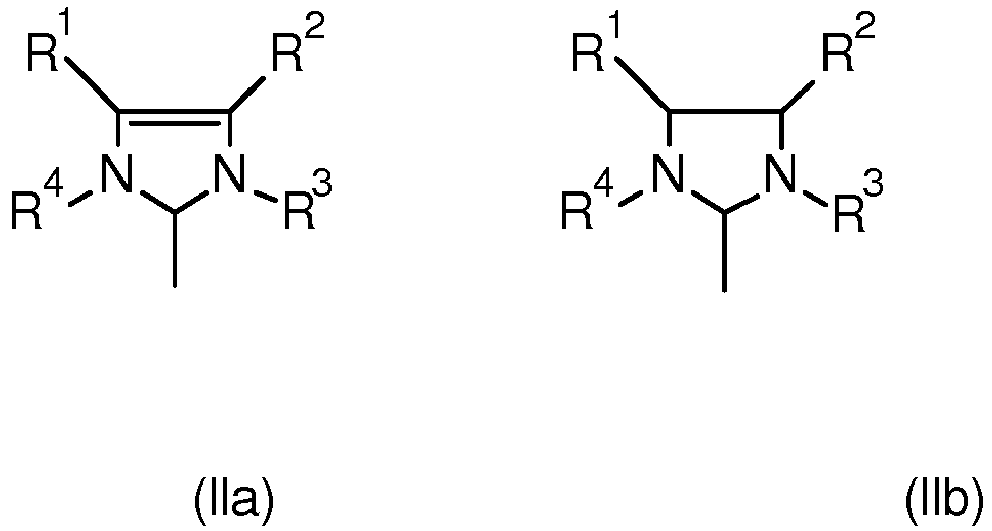
R1 R2, R3, R4 gleich oder verschieden sind und Wasserstoff, geradkettiges oder verzweigtes C1-C30-Alkyl, C3-C20-Cycloalkyl, C2-C20-Alkenyl, C2-C20-Alkinyl, C6-C24-Aryl, C1-C20-Carboxylat, C1-C20-Alkoxy, C2-C20-Alkenyloxy, C2-C20-Alkinyloxy, C6-C20-Aryloxy, C2-C20-Alkoxycarbonyl, C1-C20-Alkylthio, C6-C20-Arylthio, C1-C20-Alkylsulfonyl, C1-C20-Alkylsulfonat, C6-C20-Arylsulfonat oder C1-C20-Alkylsulfinyl bedeuten. - Gegebenenfalls kann einer oder mehrere der Reste R1 R2, R3, R4 unabhängig voneinander durch einen oder mehrere Substituenten, vorzugsweise geradkettiges oder verzweigtes C1-C10-Alkyl, C3-C8-Cycloalkyl, C1-C10-Alkoxy oder C6-C24-Aryl substituiert sein, wobei diese vorgenannten Substituenten wiederum durch ein oder mehrere Reste, vorzugsweise ausgewählt aus der Gruppe Halogen, insbesondere Chlor oder Brom, C1-C5-Alkyl, C1-C5-Alkoxy und Phenyl substituiert sein können.
- Nur zur Klarstellung sei hinzugefügt, dass die in den allgemeinen Formeln (IIa) und (IIb) dargestellten Strukturen des Imidazolidinrests mit den in der Literatur für diesen Imidazolidinrest (Im) dargestellten Strukturen gleichbedeutend sind, die den Carben-Charakter des Imidazolidinrests hervorheben. Dies gilt entsprechend auch für die zugehörigen bevorzugten, nachfolgend noch dargestellten Strukturen (IIIa)-(IIIf).
- In einer bevorzugten Ausführungsform der Katalysatoren der allgemeinen Formel (A) mit wenigstens einem Imidazolidinrest (Im) als Liganden L bedeuten R1 und R2 unabhängig voneinander Wasserstoff, C6-C24-Aryl, besonders bevorzugt Phenyl, geradkettiges oder verzweigtes C1-C10-Alkyl, besonders bevorzugt Propyl oder Butyl, oder bilden zusammen unter Einschluss der Kohlenstoffatome, an die sie gebunden sind, einen Cycloalkyl- oder Aryl-Rest, wobei alle vorgenannten Reste gegebenenfalls wiederum durch ein oder mehrere weitere Reste substituiert sein können, ausgewählt aus der Gruppe umfassend geradkettiges oder verzweigtes C1-C10-Alkyl, C1-C10-Alkoxy, C6-C24-Aryl und eine funktionelle Gruppe ausgewählt aus der Gruppe von Hydroxy, Thiol, Thioether, Keton, Aldehyd, Ester, Ether, Amin, Imin, Amid, Nitro, Carbonsäure, Disulfid, Carbonat, Isocyanat, Carbodiimid, Carboalkoxy, Carbamat und Halogen.
- In einer bevorzugten Ausführungsform der Katalysatoren der allgemeinen Formel (A) mit wenigstens einem Imidazolidinrest (Im) als Liganden L sind ferner die Reste R3 und R4 gleich oder verschieden und bedeuten geradkettiges oder verzweigtes C1-C10-Alkyl, besonders bevorzugt i-Propyl oder Neopentyl, C3-C10-Cycloalkyl, bevorzugt Adamantyl, C6-C24-Aryl, besonders bevorzugt Phenyl, C1-C10-Alkylsulfonat, besonders bevorzugt Methansulfonat, C6-C10-Arylsulfonat, besonders bevorzugt p-Toluolsulfonat.
- Gegebenenfalls sind die vorgenannten Reste als Bedeutungen von R3 und R4 substituiert durch einen oder mehrere weitere Reste ausgewählt aus der Gruppe umfassend geradkettiges oder verzweigtes C1-C5-Alkyl, insbesondere Methyl, C1-C5-Alkoxy, Aryl und eine funktionelle Gruppe ausgewählt aus der Gruppe von Hydroxy, Thiol, Thioether, Keton, Aldehyd, Ester, Ether, Amin, Imin, Amid, Nitro, Carbonsäure, Disulfid, Carbonat, Isocyanat, Carbodiimid, Carboalkoxy, Carbamat und Halogen.
- Insbesondere können die Reste R3 und R4 gleich oder verschieden sein und bedeuten i-Propyl, Neopentyl, Adamantyl, Mesityl oder 2,6-Diisopropylphenyl.
- Besonders bevorzugte Imidazolidinreste (Im) im Liganden L haben die nachfolgenden Strukturen (IIIa) bis (IIIf), wobei Ph jeweils für einen Phenyl-Rest, Bu für einen Butyl-Rest und Mes jeweils für 2,4,6-Trimethylphenyl-Rest steht oder Mes alternativ in allen Fällen für 2,6-Diisopropylphenyl steht.


- Verschiedenste Vertreter der Katalysatoren der Formel (A) sind prinzipiell bekannt, so z.B. aus der
WO-A-96/04289 WO-A-97/06185 - Alternativ zu den bevorzugten Im-Resten steht einer oder beide Liganden L in der allgemeinen Formel (A) bevorzugt auch für gleiche oder verschiedene Trialkylphosphin-Liganden, worin mindestens eine der Alkylgruppen eine sekundäre Alkylgruppe oder eine Cycloalkylgruppe darstellt, bevorzugt iso-Propyl, iso-Butyl, sec-Butyl, Neopentyl, Cyclopentyl oder Cyclohexyl.
- Besonders bevorzugt stehen in der allgemeinen Formel (A) einer oder beide Liganden L für einen Trialkylphosphin-Liganden, worin mindestens eine der Alkylgruppen eine sekundäre Alkylgruppe oder eine Cycloalkylgruppe darstellt, bevorzugt iso-Propyl, iso-Butyl, sec-Butyl, Neopentyl, Cyclopentyl oder Cyclohexyl.
- In einer bevorzugten Ausführungsform werden Ruthenium basierte Übergangsmetallkatalysatoren der Formel (B) eingesetzt,

- Y
- Sauerstoff (O) oder Schwefel (S) bedeutet, bevorzugt Sauerstoff,
- R5, R 6 R7 und R8
- gleich oder verschieden sind und Wasserstoff, organische oder anorganische Reste darstellen, bevorzugt Wasserstoff oder -SO2-N(CH3)2, oder-NH-CO-CF3,
- R9
- einen Alkyl-, Cycloalkyl-, Alkenyl-, Alkinyl-, Aryl-, Alkoxy-, Alkenyloxy-, Alkinyloxy-, Aryloxy-, Alkoxycarbonyl-, Alkylamino-, Alkylthio-, Arylthio-, Alkylsulfonyl- oder Alkylsulfinyl-Rest darstellt, bevorzugt i-Propyl, die alle jeweils optional durch ein oder mehrere Alkyl-, Halogen-, Alkoxy-, Aryl- oder Heteroaryl-Reste substituiert sein können, und
- L
- ein Ligand ist, der die gleichen Bedeutungen besitzt wie für die Formel (A) genannt.
- Die Katalysatoren der Formel (B) sind prinzipiell bekannt. Vertreter dieser Verbindungsklasse sind die Katalysatoren, die von
Hoveyda et al. in US 2002/0107138 A1 und Angew. Chem. Int. Ed. 2003, 42, 4592 beschrieben sind, und die Katalysatoren, die vonGrela in WO-A-2004/035596 , Eur. J. Org. Chem 2003, 963-966 und Angew. Chem. Int. Ed. 2002, 41, 4038 sowie in J. Org. Chem. 2004, 69, 6894-96 und Chem. Eur. J 2004, 10, 777-784 beschrieben werden. Die Katalysatoren der Formel (B) sind käuflich erhältlich bzw. gemäß den angegebenen Literaturstellen herstellbar. - Als besonders bevorzugter Ruthenium Übergangsmetallkatalysator wird wenigstens einer aus der Gruppe
- M1
- = Benzyliden[1,3-bis(2,4,6-trimethylphenyl)-2-imidazolidinyliden]dichloro(tricyclohexyl-phosphin)ruthenium (Grubbs II Katalysator, CAS No. 246047-72-3),
- M2
- = Bis(tricyclohexylphosphine)-[(phenylthio)methylene]ruthenium(II)dichloride (CAS No. 219770-99-7),
- M3
- = 1,3-Bis(2,4,6-trimethylphenyl)-4,5-dihydroimidazol-2-ylidene[2-(i-propoxy)-5-(N,N-di-MeNH2SO2)phenyl]methyleneruthenium(II)dichloride (Zhan Kat. 1B, CAS No. 918870-76-5),
- M4
- = Bis(tricyclohexylphosphine)-3-phenyl-1H-inden-1 -ylideneruthenium(II)dichloride (CAS No. 250220-36-1),
- M5
- = Benzylidenbis(tricyclohexylphosphin)dichlororuthenium (Grubbs I Katalysator, CAS No. 172222-30-9),
- M6
- = Dichloro(o-isopropoxyphenylmethylene)(tricyclohexylphosphine)ruthenium(II) (Hoveyda-Grubbs Kat.I, CAS No. 203714-71-0),
- M7
- = (1,3-Bis-(2,4,6-trimethylphenyl)-2-imidazolidinylidene)dichloro(o-isopropoxyphenyl methylene)ruthenium (Hoveyda-Grubbs Kat.II, CAS No.301224-40-8),
- M8
- = Tricyclohexylphosphine[4,5-dimethyl-1,3-bis(2,4,6-trimethylphenyl)imidazol-2-ylidene][2-thienylmethylene]ruthenium(II)dichloride, min. 95% (CAS No. 1190427-50-9),
- M9
- = Tricyclohexylphosphine[1,3-bis(2,4,6-trimethylphenyl)imidazol-2-ylidene][3-phenyl-1H-inden-1-ylidene]ruthenium(II)dichloride, min. 95% (CAS No. 254972-49-1),
- M10
- = [1,3-Bis(2,6-di-i-propylphenyl)-4,5-dihydroimidazol-2-ylidene]-[2-i-propoxy-5-(trifluoroacetamido)phenyl]methyleneruthenium(II)dichloride (CAS No. 1212008-99-5),
- M11
- = Tri(i-propoxy)phosphine(3-phenyl-1H-inden-1-ylidene)[1,3-bis(2,4,6-trimethyl phenyl)-4,5-dihydroimidazol-2-ylidene]ruthenium(II)dichloride, min. 95% (Strem Chemicals Katalog Nummer 44-7783),
- M12
- = Tricyclohexylphosphine[1,3-bis(2,4,6-trimethylphenyl)imidazol-2-ylidene][2-thienyl methylene]ruthenium(II)dichloride, min. 95% (CAS No. 1190427-49-6),
- M13 =
- 3-Phenyl-1H-inden-1-ylidene[bis(i-butylphoban)]ruthenium(II)dichloride (CAS No. 894423-99-5),
- M14
- = Dichloro[1,3-bis(2-methylphenyl)-2-imidazolindinyliden](benzylidene) (tricyclohexyl phosphine)ruthenium(II) (CAS No. 927429-60-5),
- M15
- = Dichloro[1,3-bis(2-methylphenyl)-2-imidazolindinyliden](2-isopropoxy-phenyl methylene)ruthenium(II) (CAS No. 927429-61-6)
- In der erfindungsgemäßen 1,3-Butadien Synthese eingesetzt. Insbesondere bevorzugt wird als Übergangsmetallkatalysator des Elementes Ruthenium M5 eingesetzt.
- Die Herstellung der erfindungsgemäß einzusetzenden Katalysatoren ist dem Fachmann bekannt. Beispiele finden sich in P. Schwab, R. H. Grubbs, J. W. Ziller, J. Am. Chem. Soc., 1996, 118 (1), S. 100-110. Die Katalysatoren M1 bis M15 sind zudem käuflich zu erwerben bei Sigma-Aldrich Laborchemikalien GmbH, Seelze, Deutschland oder Strem Chemicals Inc. Kehl, Deutschland.
- Die Menge der erfindungsgemäß einzusetzenden Übergangsmetallkatalysatoren des Elementes Ruthenium im Reaktionsgemisch liegt üblicherweise im Bereich von 0,01 bis 10000 Mol.-%, bevorzugt 0,1 bis 100 Mol.-%, besonders bevorzugt 0,2 bis 10 Mol.-% gerechnet als Summe aller einzusetzenden Katalysatoren und bezogen auf die eingesetzte Menge Ethen.
- Bevorzugt liegt der Gesamtgasfluss, also das als Edukt der Reaktionsapparatur zuzuführende Gemisch aus Ethen und Ethin, in einem Bereich von 200 bis 500 l/h, besonders bevorzugt im Bereich von 200 bis 400 l/h, ganz besonders bevorzugt im Bereich von 200 bis 300 l/h bei einem Lösungsmittelvolumen von 1 I. Der Fachmann kann auf Basis dieser Angaben die entsprechenden Parameter für den Ansatz kleinerer oder größerer Ansätze errechnen.
- Im Gesamtgasfluss liegen die Edukte Ethen und Ethin bevorzugt im Verhältnis im Bereich von 6:4 bis 4:6 vor, insbesondere bevorzugt im Verhältnis im Bereich von 1:1 vor.
- In bevorzugter Ausführungsform wird der Gasstrom enthaltend das Gemisch aus Ethen und Ethin vor dem Eintritt in den Reaktionsapparat getrocknet. Dem Fachmann sind geeignete Trockenmittel bekannt. Bevorzugt wird wenigstens ein Trockenmittel aus der Gruppe konzentrierte Schwefelsäure, Natronlauge und Molsieb zur Trocknung des erfindungsgemäß einzusetzenden Gasgemisches eingesetzt. Insbesondere bevorzugt werden alle drei Trocknungsmittel nacheinander eingesetzt.
- Für die erfindungsgemäße 1,3-Butadien Synthese eignet sich jede Art von Reaktionsgefäß bzw. Apparatur, das bzw. die üblicherweise von einem Fachmann zum Umsetzen von Gasen eingesetzt wird. Bevorzugt sind Rührkesselreaktoren, Strömungsrohre oder Blasensäulenreaktoren. Vorzugsweise sind diese aus Stahl hergestellt. Für kleinere Ansätze können auch Glas basierte Reaktoren eingesetzt werden. Die Begriffe Reaktionsgefäß, Apparatur und Reaktor werden in der vorliegenden Anmeldung synonym verwendet.
- Im Allgemeinen geht man bei der Reaktionsführung so vor, dass der wenigstens eine Übergangsmetallkatalysator des Elementes Ruthenium, im Falle eines Katalysatorgemisches gegebenenfalls vorgemischt, als solcher oder vorzugsweise gelöst in wenigstens einem der oben genannten Lösungsmittel, gegebenenfalls unter Kühlung aber unter Schutzgas, insbesondere Stickstoff, in wenigstens ein gekühltes Reaktionsgefäß gegeben wird.
- Bevorzugt wird das wenigstens eine Reaktionsgefäß auf Temperaturen im Bereich von - 70 bis 50 °C, besonders bevorzugt auf Temperaturen im Bereich von 15 bis 40 °C temperiert. Durch einen Einlass wird ein Gemisch aus gereinigtem Ethin und Ethen eingeleitet, bevorzugt im Falle des Einsatzes von Lösungsmittel unterhalb des Flüssigkeitsspiegels.
- Nicht umgesetzter Anteil des Gasgemisches kann entweder dem Reaktionsgefäß wieder zugeführt werden, oder in alternativer Ausführungsform, in wenigstens ein zweites Reaktionsgefäß überführt werden, das ebenfalls wenigstens einen erfindungsgemäß einzusetzenden Übergangsmetallkatalysator des Elementes Ruthenium enthält. Auch hier erfolgt die Einleitung des Eduktgemisches aus Ethen und Ethin im Falle des Einsatzes von Lösungsmittel unterhalb des Flüssigkeitsspiegels. Hieraus entweichendes nicht umgesetztes Gasgemisch kann entweder wiederum dem ersten Reaktionsgefäß zugeführt werden, oder dem wenigstens einen zweiten Reaktionsgefäß erneut zugeführt werden, oder an die Umgebungsluft / Abluft abgegeben werden.
- Die Handhabung des Ethins ist insbesondere unter Überdruck sicherheitstechnisch anspruchsvoll, weshalb das die Edukte enthaltende Gasgemisch bevorzugt nur bei schwachem Überdruck von bis zu 100 mbarü durch das katalysatorhaltige Lösungsmittel geleitet wird.
- Mit einem Siedepunkt von - 4,5 °C reichert sich das 1,3-Butadien im Lösungsmittel an und kann von diesem sowie anfallenden Nebenprodukten destillativ getrennt werden. Der Abbruch der erfindungsgemäßen Synthese von 1,3-Butadien aus Ethen und Ethin und die Aufreinigung der Reaktionsprodukte können nach allgemein dem Fachmann bekannten Verfahren vorgenommen werden. Das Lösungsmittel kann auch dazu verwendet werden, nach Abtrennung der Reaktionsprodukte den wenigstens einen Katalysator der Reaktion wieder zur Verfügung zu stellen.
- Ethen, CAS Nr. 74-85-1, Reinheit 99,9 %, bezogen von Linde AG
Ethin, CAS Nr. 74-86-2, Reinheit 99,5 %, bezogen von Linde AG
Katalysatoren: M1 bis M15 gemäß Beschreibung von Sigma-Aldrich Laborchemikalien - GmbH, Seelze, Deutschland oder Strem Chemicals Inc. Kehl, Deutschland Schutzgas: Stickstoff
-
Fig. 1 zeigt beispielhaft einen apparativen Aufbau, wie er für die Versuche im Rahmen der vorliegenden Erfindung verwendet wurde. InFig. 1 bedeuten - 1 Ethin
- 2 H2SO4 (95 % - 98 %)
- 3 2 N NaOH
- 4 Molsieb 4 Å (Sigma Aldrich)
- 5 Ethen
- 6 Schutzgas N2
- 7 Blasenzähler
- 8 Kryostat -20°C
- 9 Heizbad
- 10 Intensivkühler
- 11 Reaktor 1, 250 ml, Glas
- 12 Septum
- 13 Reaktor 2, 250 ml, Glas
- 14 circa 100 mbarü
- 15 Abluft
- Die Versuchsapparatur bestand aus zwei Reaktoren (250-ml-Dreihals-Glaskolben) mit Rührfisch, zwei Intensivkühlern (Kühlflüssigkeit temperiert auf - 20 °C), zwei Septi zur Probenahme und zwei Ölbadern als Heizbad. Über eine Glas-Kapillare mit einem Durchmesser zwischen 1,5 und 7 mm wurde das Gasgemisch aus zuvor gereinigtem Ethin (zuerst 95 - 98%ige H2SO4 danach 2 N NaOH sowie schließlich Molsieb) und Ethen zunächst in einen ersten Reaktor unterhalb des Flüssigkeitsspiegels eingeleitet. Derjenige Anteil dieses Gasgemisches, welcher nicht durch Reaktion verbraucht oder im Intensivkühler des Reaktor 1 kondensierte, wurde wiederum über eine weitere Kapillare unterhalb des Flüssigkeitsspiegels in einen zweiten Reaktor geleitet. Nach Durchgang durch den zweiten Intensivkühler gelangten die nicht umgesetzten oder nicht im Intensivkühler des Reaktor 2 kondensierten Anteile des Gasgemisches in die Abluft.
- Der flüssige Reaktorinhalt aus Reaktor 1 und Reaktor 2 wurde mittels GC (Gaschromatographie) untersucht. Aufgrund der geringen Umsätze erfolgte die Auswertung nur qualitativ. Die Anwesenheit der Referenzsubstanz Cyclohexan erlaubte jedoch, die gebildete Butadienmenge über das Peakflächenverhältnis Butadien zu Cyclohexan für die Versuche im Rahmen der vorliegenden Erfindung zu vergleichen.
- Tabelle 1 zeigt die erfassten Substanzen mit ihren jeweiligen Retentionszeiten. Die Identifikation erfolgte durch Vergleich mit kommerziellen Reinsubstanzen oder mittels GC-MS (MS = Massenspektrometrie).
Tabelle 1 Retentions-zeit /min Substanz 2,08 Ethen, Ethin, Luft 2,26 1,3-Butadien 2,69 trans-1,3-Pentadien 2,75 cis-1,3-Pentadien 2,88 Dichlormethan 3,64 Cyclohexan 4,14; 4,35; 4,37 2,4-Hexadien-Isomere 4,70 Benzol 7,01 Toluol 8,94 Octatetraen 9,25 Styrol - 50 ml Dichlormethan wurden unter Schutzgas in einem zuvor mittels N2 inertisierten 100 ml Glasgefäß mit Intensivkühler (Temperatur des Kühlmediums -20 °C) auf 30 °C temperiert. Die Inertisierung von Räumen bezeichnet den Vorgang, durch Zugabe von inerten Gasen oder Dämpfen den Luftsauerstoff oder reaktions- bzw. explosionsfähige Gase oder Gasgemische aus Räumen zu verdrängen. Zum Dichlormethan wurden außerdem 1,0 ml Cyclohexan als Referenz zugegeben. Anschließend wurde unter Rühren während der gesamten Reaktionszeit ein Gemisch aus Ethen und Ethin im Verhältnis 1:1 ins Lösungsmittel eingeleitet, wobei in regelmäßigen Abständen Proben aus der Flüssigphase entnommen wurden. Es wurde kein Butadien gebildet.
- 50 mg Katalysator M4, gelöst in 50 ml Dichlormethan, wurden unter Schutzgas in einem zuvor mittels N2 inertisierten Gefäß mit Intensivkühler (Temperatur des Kühlmediums -20 °C) auf 30 °C temperiert. Außerdem wurden 1,0 ml Cyclohexan als Referenz zugegeben. Anschließend wurde unter Rühren während der gesamten Reaktionszeit Ethin eingeleitet und in regelmäßigen Abständen Proben aus der Flüssigphase entnommen. Es wurde kein Butadien gebildet.
- 50 mg Katalysator M5, gelöst in 50 ml Dichlormethan, wurden unter Schutzgas in einem zuvor inertisierten Gefäß mit Intensivkühler (Temperatur des Kühlmediums -20 °C) auf 30 °C temperiert. Außerdem wurden 1,0 ml Cyclohexan als Referenz zugegeben. Anschließend wurde unter Rühren während der gesamten Reaktionszeit Ethin eingeleitet und in regelmäßigen Abständen Proben aus der Flüssigphase entnommen. Es wurde kein Butadien gebildet.
- 50 mg Katalysator MX, wobei MX für jeweils einen der oben genannten Katalysatoren M1 bis M15 steht, gelöst in 50 ml Dichlormethan, wurden unter Schutzgas (N2) in einem zuvor mit N2 inertisierten Gefäß mit Intensivkühler (Temperatur des Kühlmediums -20 °C) auf 30 °C temperiert. Außerdem wurden 1,0 ml Cyclohexan als Referenz zugegeben. Anschließend wurde unter Rühren während der gesamten Reaktionszeit ein Gemisch aus Ethen und Ethin im Verhältnis 1:1 unterhalb des Flüssigkeitsspiegels ins Lösungsmittel eingeleitet. Während der Reaktionszeit wurden in regelmäßigen Abständen Proben aus der Flüssigphase entnommen. Per Gaschromatographie wurde in diesen Proben Butadien nachgewiesen.
- 50 mg Katalysator M5, gelöst in 50 ml Dichlormethan, wurden unter Schutzgas in einem zuvor mittels N2 inertisierten Gefäß mit Intensivkühler (Temperatur des Kühlmediums -20 °C) auf -64 °C temperiert. Außerdem wurden 1,0 ml Cyclohexan als Referenz zugegeben. Anschließend wurde unter Rühren während der gesamten Reaktionszeit ein Gemisch aus Ethen und Ethin im Verhältnis 1:1 eingeleitet. Während der Reaktionszeit wurden in regelmäßigen Abständen Proben aus der Flüssigphase entnommen. Per Gaschromatographie wurde in diesen Proben Butadien nachgewiesen.
- 100 mg Katalysator M5, gelöst in 50 ml Dichlormethan, wurden unter Schutzgas (N2) in einem zuvor mittels N2 inertisierten Gefäß mit Intensivkühler (Temperatur des Kühlmediums -20 °C) auf 30 °C temperiert. Außerdem wurden 1,0 ml Cyclohexan als Referenz zugegeben. Anschließend wurde unter Rühren während der gesamten Reaktionszeit ein Gemisch aus Ethen und Ethin im Verhältnis 1:1 eingeleitet. Während der Reaktionszeit wurden in regelmäßigen Abständen Proben aus der Flüssigphase entnommen. Per Gaschromatographie wurde in diesen Proben Butadien nachgewiesen.
- Die Vergleichsbeispiele 1 bis 3 zeigen, dass zwei Komponenten essentiell sind für die Durchführung des erfindungsgemäßen Verfahrens: Ethin muss erstens mit Katalysator und zweitens mit Ethen kontaktiert werden.
Claims (12)
- Verfahren zur Herstellung von 1,3-Butadien, dadurch gekennzeichnet, dass man Ethen und Ethin in Gegenwart mindestens eines Übergangsmetallkatalysators des Elementes Ruthenium miteinander umsetzt.
- Verfahren gemäß Anspruch 1, dadurch gekennzeichnet, dass dieses in flüssiger Phase mit wenigstens einem Lösungsmittel durchgeführt wird.
- Verfahren gemäß Anspruch 2, dadurch gekennzeichnet, dass als Lösungsmittel ein bei Raumtemperatur flüssiges Halogenalkan, bevorzugt Dichlormethan, eingesetzt wird.
- Verfahren gemäß einem der Ansprüche 1 bis 3, dadurch gekennzeichnet, dass dieses bei Temperaturen im Bereich von -70 bis 50 °C durchgeführt wird.
- Verfahren gemäß einem der Ansprüche 1 bis 4, dadurch gekennzeichnet, dass dieses ohne Überdruck durchgeführt wird.
- Verfahren gemäß einem der Ansprüche 1 bis 5, dadurch gekennzeichnet dass mindestens ein Übergangsmetallkatalysator der allgemeinen Formel (A) eingesetzt wird,
 L gleiche oder verschiedene Liganden, bevorzugt neutrale Elektronen-Donoren darstellen, undR gleich oder verschieden sind und Wasserstoff, Alkyl, Cycloalkyl, Alkenyl, Alkenyl, Alkinyl, Aryl, Carboxylat, Alkoxy, Alkenyloxy, Alkinyloxy, Aryloxy, Alkoxycarbonyl, Alkylamino, Alkylthio, Arylthio, Alkylsulfonyl oder Alkylsulfinyl bedeuten, wobei diese Reste alle jeweils optional durch ein oder mehrere Alkyl-, Halogen-, Alkoxy-, Aryl- oder Heteroaryl-Reste substituiert sein können, oder alternativ beide Reste R unter Einbindung des gemeinsamen C-Atoms, an das sie gebunden sind, zu einer cyclischen Gruppe verbrückt sind, die aliphatischer oder aromatischer Natur sein kann, gegebenenfalls substituiert ist und ein oder mehrere Heteroatome enthalten kann.
 - Verfahren gemäß Anspruch 6, dadurch gekennzeichnet dass R in der allgemeinen Formel (A) jeweils unabhängig voneinander für Wasserstoff, C1-C30-Alkyl, C3-C20-Cycloalkyl, C2-C20-Alkenyl, C2-C20-Alkinyl, C6-C24-Aryl, C1-C20-Carboxylat, C1-C20-Alkoxy, C2-C20-Alkenyloxy, C2-C20-Alkinyloxy, C6-C24-Aryloxy, C2-C20-Alkoxycarbonyl, C1-C30-Alkylamino, C1-C30-Alkylthio, C6-C24-Arylthio, C1-C20-Alkylsulfonyl oder C1-C20-Alkylsulfinyl, wobei diese Reste alle jeweils optional durch ein oder mehrere C1-C6-Alkyl-, Halogen-, C1-C6-Alkoxy-, bevorzugt i-Propoxy-, Aryl-, bevorzugt Phenyl, oder Heteroaryl-Reste substituiert sein können, oder alternativ beide Reste R unter Einbindung des gemeinsamen C-Atoms, an das sie gebunden sind, zu einer cyclischen Gruppe verbrückt sind, die aliphatischer oder aromatischer Natur sein kann, gegebenenfalls substituiert ist und ein oder mehrere Heteroatome enthalten kann.
- Verfahren gemäß einem der Ansprüche 1 bis 5, dadurch gekennzeichnet, dass als Übergangsmetallkatalysator des Elementes Ruthenium wenigstens einer aus der GruppeM1 = Benzyliden[1,3-bis(2,4,6-trimethylphenyl)-2-imidazolidinyliden]dichloro (tricyclohexyl-phosphin)ruthenium,M2 = Bis(tricyclohexylphosphine)-[(phenylthio)methylene]ruthenium(II)dichloride,M3 = 1,3-Bis(2,4,6-trimethylphenyl)-4,5-dihydroimidazol-2-ylidene[2-(i-propoxy)-5-(N,N-di-MeNH2SO2)phenyl]methyleneruthenium(II)dichloride,M4 = Bis(tricyclohexylphosphine)-3-phenyl-1H-inden-1-ylideneruthenium(II)di chloride,M5 = Benzylidenbis(tricyclohexylphosphin)dichlororuthenium,M6 = Dichloro(o-isopropoxyphenylmethylene)(tricyclohexylphosphine) ruthenium(II),M7 = (1,3-Bis-(2,4,6-trimethylphenyl)-2-imidazolidinylidene)dichloro(o-isopropoxyphenyl methylene)ruthenium,M8 = Tricyclohexylphosphine[4,5-dimethyl-1,3-bis(2,4,6-trimethylphenyl)imidazol-2-ylidene][2-thienylmethylene]ruthenium(II)dichloride,M9 = Tricyclohexylphosphine[1,3-bis(2,4,6-trimethylphenyl)imidazol-2-ylidene][3- phenyl-1H-inden-1-ylidene]ruthenium(II)dichloride,M10 = [1,3-Bis(2,6-di-i-propylphenyl)-4,5-dihydroimidazol-2-ylidene]-[2-i-propoxy-5-(trifluoroacetamido)phenyl]methyleneruthenium(II)dichloride,M11 = Tri(i-propoxy)phosphine(3-phenyl-1H-inden-1-ylidene)[1,3-bis(2,4,6-trimethyl phenyl)-4,5-dihydroimidazol-2-ylidene]ruthenium(II)dichloride,M12 = Tricyclohexylphosphine[1,3-bis(2,4,6-trimethylphenyl)imidazol-2-ylidene][2-thienyl methylene]ruthenium(II)dichloride,M13 = 3-Phenyl-1H-inden-1-ylidene[bis(i-butylphoban)]ruthenium(II)dichloride,M14 = Dichloro[1,3-bis(2-methylphenyl)-2-imidazolindinyliden](benzylidene) (tricyclohexyl phosphine)ruthenium(II),M15 = Dichloro[1,3-bis(2-methylphenyl)-2-imidazolindinyliden](2-isopropoxy-phenyl methylene)ruthenium(II),eingesetzt wird.
- Verfahren gemäß Anspruch 6, dadurch gekennzeichnet, dass als Übergangsmetallkatalysator des Elementes Ruthenium wenigstens M5 eingesetzt wird.
- Verfahren gemäß einem der Ansprüche 1 bis 7, dadurch gekennzeichnet, dass die Menge des wenigstens einen Katalysators im Reaktionsgemisch im Bereich von 0,01 bis 10000 Mol.-% gerechnet als Summe aller eingesetzten Katalysatoren und bezogen auf die eingesetzte Menge Ethen liegt.
- Verfahren gemäß einem der Ansprüche 1 bis 8, dadurch gekennzeichnet, dass man dieses absatzweise durchführt.
- Verwendung von wenigstens einem Übergangsmetallkatalysator des Elementes Ruthenium zur Herstellung von 1,3-Butadien aus Ethen und Ethin.
Priority Applications (10)
| Application Number | Priority Date | Filing Date | Title |
|---|---|---|---|
| EP14198129.0A EP3034486A1 (de) | 2014-12-16 | 2014-12-16 | 1,3-Butadien-Synthese |
| ES15813771T ES2726922T3 (es) | 2014-12-16 | 2015-12-15 | Síntesis de 1,3-butadieno |
| EP15813771.1A EP3233768B1 (de) | 2014-12-16 | 2015-12-15 | 1,3-butadien-synthese |
| US15/535,554 US10384987B2 (en) | 2014-12-16 | 2015-12-15 | 1,3-butadiene synthesis |
| HUE15813771A HUE043314T2 (hu) | 2014-12-16 | 2015-12-15 | 1,3-butadién szintézis |
| PL15813771T PL3233768T3 (pl) | 2014-12-16 | 2015-12-15 | Synteza 1,3-butadienu |
| CN201580068620.1A CN107108399B (zh) | 2014-12-16 | 2015-12-15 | 1,3-丁二烯合成 |
| PCT/EP2015/079778 WO2016096846A1 (de) | 2014-12-16 | 2015-12-15 | 1,3-butadien-synthese |
| RU2017125146A RU2700413C2 (ru) | 2014-12-16 | 2015-12-15 | Синтез 1,3-бутадиена |
| SA517381729A SA517381729B1 (ar) | 2014-12-16 | 2017-06-15 | تصنيع 1، 3- بيوتادايين |
Applications Claiming Priority (1)
| Application Number | Priority Date | Filing Date | Title |
|---|---|---|---|
| EP14198129.0A EP3034486A1 (de) | 2014-12-16 | 2014-12-16 | 1,3-Butadien-Synthese |
Publications (1)
| Publication Number | Publication Date |
|---|---|
| EP3034486A1 true EP3034486A1 (de) | 2016-06-22 |
Family
ID=52282398
Family Applications (2)
| Application Number | Title | Priority Date | Filing Date |
|---|---|---|---|
| EP14198129.0A Withdrawn EP3034486A1 (de) | 2014-12-16 | 2014-12-16 | 1,3-Butadien-Synthese |
| EP15813771.1A Not-in-force EP3233768B1 (de) | 2014-12-16 | 2015-12-15 | 1,3-butadien-synthese |
Family Applications After (1)
| Application Number | Title | Priority Date | Filing Date |
|---|---|---|---|
| EP15813771.1A Not-in-force EP3233768B1 (de) | 2014-12-16 | 2015-12-15 | 1,3-butadien-synthese |
Country Status (9)
| Country | Link |
|---|---|
| US (1) | US10384987B2 (de) |
| EP (2) | EP3034486A1 (de) |
| CN (1) | CN107108399B (de) |
| ES (1) | ES2726922T3 (de) |
| HU (1) | HUE043314T2 (de) |
| PL (1) | PL3233768T3 (de) |
| RU (1) | RU2700413C2 (de) |
| SA (1) | SA517381729B1 (de) |
| WO (1) | WO2016096846A1 (de) |
Citations (8)
| Publication number | Priority date | Publication date | Assignee | Title |
|---|---|---|---|---|
| US2377025A (en) * | 1942-03-25 | 1945-05-29 | Nat Agrol Company Inc | Conversion of a mixture of acetaldehyde and ethylene to butadiene |
| US2420477A (en) * | 1942-11-12 | 1947-05-13 | Nat Agrol Company Inc | Production of butadiene by method of dehydration |
| US3671604A (en) | 1970-10-21 | 1972-06-20 | Atlas Chem Ind | Catalytic copolymerization of acetylene and monoolefins |
| WO1996004289A1 (en) | 1992-04-03 | 1996-02-15 | California Institute Of Technology | High activity ruthenium or osmium metal carbene complexes for olefin metathesis reactions and synthesis thereof |
| WO1997006185A1 (en) | 1995-08-03 | 1997-02-20 | California Institute Of Technology | High metathesis activity ruthenium and osmium metal carbene complexes |
| US20020107138A1 (en) | 2000-08-10 | 2002-08-08 | Hoveyda Amir H. | Recyclable metathesis catalysts |
| WO2003011455A1 (en) | 2001-08-01 | 2003-02-13 | California Institute Of Technology | Hexacoordinated ruthenium or osmium metal carbene metathesis catalysts |
| WO2004035596A1 (en) | 2002-10-15 | 2004-04-29 | Boehringer Ingelheim International Gmbh | Ruthenium complexes as (pre)catalysts for metathesis reactions |
Family Cites Families (4)
| Publication number | Priority date | Publication date | Assignee | Title |
|---|---|---|---|---|
| US6838489B2 (en) | 2001-03-23 | 2005-01-04 | Cymetech, Llc | High activity metal carbene metathesis catalysts generated using a thermally activated N-heterocyclic carbene precursor |
| DE10361824A1 (de) * | 2003-12-30 | 2005-07-28 | Basf Ag | Verfahren zur Herstellung von Butadien |
| US20120289617A1 (en) * | 2011-05-10 | 2012-11-15 | Saudi Arabian Oil Company | Hybrid Catalyst for Olefin Metathesis |
| US8524930B2 (en) * | 2011-05-31 | 2013-09-03 | Exxonmobil Chemical Patents Inc. | Class of olefin metathesis catalysts, methods of preparation, and processes for the use thereof |
-
2014
- 2014-12-16 EP EP14198129.0A patent/EP3034486A1/de not_active Withdrawn
-
2015
- 2015-12-15 CN CN201580068620.1A patent/CN107108399B/zh not_active Expired - Fee Related
- 2015-12-15 EP EP15813771.1A patent/EP3233768B1/de not_active Not-in-force
- 2015-12-15 US US15/535,554 patent/US10384987B2/en not_active Expired - Fee Related
- 2015-12-15 HU HUE15813771A patent/HUE043314T2/hu unknown
- 2015-12-15 PL PL15813771T patent/PL3233768T3/pl unknown
- 2015-12-15 RU RU2017125146A patent/RU2700413C2/ru active
- 2015-12-15 ES ES15813771T patent/ES2726922T3/es active Active
- 2015-12-15 WO PCT/EP2015/079778 patent/WO2016096846A1/de not_active Ceased
-
2017
- 2017-06-15 SA SA517381729A patent/SA517381729B1/ar unknown
Patent Citations (8)
| Publication number | Priority date | Publication date | Assignee | Title |
|---|---|---|---|---|
| US2377025A (en) * | 1942-03-25 | 1945-05-29 | Nat Agrol Company Inc | Conversion of a mixture of acetaldehyde and ethylene to butadiene |
| US2420477A (en) * | 1942-11-12 | 1947-05-13 | Nat Agrol Company Inc | Production of butadiene by method of dehydration |
| US3671604A (en) | 1970-10-21 | 1972-06-20 | Atlas Chem Ind | Catalytic copolymerization of acetylene and monoolefins |
| WO1996004289A1 (en) | 1992-04-03 | 1996-02-15 | California Institute Of Technology | High activity ruthenium or osmium metal carbene complexes for olefin metathesis reactions and synthesis thereof |
| WO1997006185A1 (en) | 1995-08-03 | 1997-02-20 | California Institute Of Technology | High metathesis activity ruthenium and osmium metal carbene complexes |
| US20020107138A1 (en) | 2000-08-10 | 2002-08-08 | Hoveyda Amir H. | Recyclable metathesis catalysts |
| WO2003011455A1 (en) | 2001-08-01 | 2003-02-13 | California Institute Of Technology | Hexacoordinated ruthenium or osmium metal carbene metathesis catalysts |
| WO2004035596A1 (en) | 2002-10-15 | 2004-04-29 | Boehringer Ingelheim International Gmbh | Ruthenium complexes as (pre)catalysts for metathesis reactions |
Non-Patent Citations (6)
| Title |
|---|
| ANGEW. CHEM. INT. ED., vol. 41, 2002, pages 4038 |
| ANGEW. CHEM. INT. ED., vol. 42, 2003, pages 4592 |
| CHEM. EUR. J, vol. 10, 2004, pages 777 - 784 |
| J. ORG. CHEM, 2003, pages 963 - 966 |
| J. ORG. CHEM., vol. 69, 2004, pages 6894 - 96 |
| P. SCHWAB; R. H. GRUBBS; J. W. ZILLER, J. AM. CHEM. SOC., vol. 118, no. 1, 1996, pages 100 - 110 |
Also Published As
| Publication number | Publication date |
|---|---|
| HUE043314T2 (hu) | 2019-08-28 |
| PL3233768T3 (pl) | 2019-08-30 |
| RU2017125146A (ru) | 2019-01-17 |
| EP3233768A1 (de) | 2017-10-25 |
| CN107108399A (zh) | 2017-08-29 |
| ES2726922T3 (es) | 2019-10-10 |
| US10384987B2 (en) | 2019-08-20 |
| US20170327436A1 (en) | 2017-11-16 |
| CN107108399B (zh) | 2021-06-08 |
| RU2017125146A3 (de) | 2019-04-12 |
| WO2016096846A1 (de) | 2016-06-23 |
| SA517381729B1 (ar) | 2020-11-23 |
| EP3233768B1 (de) | 2019-02-20 |
| RU2700413C2 (ru) | 2019-09-17 |
Similar Documents
| Publication | Publication Date | Title |
|---|---|---|
| EP2027920B1 (de) | Katalysatoren für Metathese-Reaktionen | |
| EP1022282B1 (de) | Homo- und heterobimetallische Alkylidenkomplexe des Rutheniums mit N-heterocyclischen Carbenliganden und deren Anwendung als hochaktive, selektive Katalysatoren für die Olefin-Metathese | |
| DE69806053T2 (de) | Hochwirksame kationische ruthenium und osmiumkomplexe für die metathesereaktionen | |
| WO2012031884A1 (de) | Verfahren zur direkten aminierung sekundärer alkohole mit ammoniak zu primären aminen | |
| EP1053215B1 (de) | Verfahren zur darstellung makrocyclischer produkte durch ringschliessende diin-metathese | |
| DE102007023515A1 (de) | Verfahren zur Herstellung von Dienen durch Hydrodimerisierung | |
| DE10062577B4 (de) | Carben-Dien-Komplexe von Nickel,Palladium und Platin | |
| DE102007039527A1 (de) | Katalysatoren für Metathese-Reaktionen | |
| EP3233768B1 (de) | 1,3-butadien-synthese | |
| EP1035093B1 (de) | Metathese in Gegenwart ionischer Flüssigkeiten | |
| Itoh et al. | Synthesis of novel bis-and oligo-gem-difluorocyclopropanes | |
| EP1371657A1 (de) | Übergangsmetall-Komplexe und deren Einsatz in Übergangsmetallkatalysierten Reaktionen | |
| EP1469005B1 (de) | Verfahren zur asymmetrischen Hydrierung von Ketocarbonsäureestern | |
| DE102004054477A1 (de) | Verfahren zur Herstellung von Trimethylcyclododecatrien | |
| DE10026645A1 (de) | Verfahren zur Formylierung organischer Verbindungen | |
| Brooker et al. | Studies of microwave-enhanced Suzuki–Miyaura vinylation of electron-rich sterically hindered substrates utilizing potassium vinyltrifluoroborate | |
| EP2468703B1 (de) | Verfahren zur Ethenolyse von Polyterpenen | |
| DE2149934B2 (de) | Verfahren zur herstellung von ungesaettigten kohlenwasserstoffverbindungen | |
| WO1999029648A2 (de) | Verfahren zur herstellung von chlorcarbonsäurechloriden | |
| WO2000061526A1 (de) | Verfahren zur übergangsmetallkatalysierten dimerisierung oder codimerisierung von alkenen in komprimiertem kohlendioxid als lösungsmittel | |
| WO2002000577A2 (de) | Verfahren zur kupplung von organischen verbindungen | |
| EP1414569A2 (de) | Einen salenliganden und vanadium(iv) enthaltende optisch aktive katalysatoren, ihre herstellung und ihre verwendung zur herstellung von cyanhydrinen | |
| DE19927912A1 (de) | Metathese in Gegenwart ionischer Flüssigkeiten | |
| EP1561750A1 (de) | Verfahren zur asymmetrischen Epoxidierung von Olefinen | |
| DE1643985B2 (de) | S-IsopropyM-nitro-phenyl-dimethyl-carbinol und 3,5-Diisopropyl-4-nitro-phenyl-dimethylcarbinolund Verfahren zu deren Herstellung |
Legal Events
| Date | Code | Title | Description |
|---|---|---|---|
| PUAI | Public reference made under article 153(3) epc to a published international application that has entered the european phase |
Free format text: ORIGINAL CODE: 0009012 |
|
| AK | Designated contracting states |
Kind code of ref document: A1 Designated state(s): AL AT BE BG CH CY CZ DE DK EE ES FI FR GB GR HR HU IE IS IT LI LT LU LV MC MK MT NL NO PL PT RO RS SE SI SK SM TR |
|
| AX | Request for extension of the european patent |
Extension state: BA ME |
|
| RAP1 | Party data changed (applicant data changed or rights of an application transferred) |
Owner name: ARLANXEO DEUTSCHLAND GMBH |
|
| STAA | Information on the status of an ep patent application or granted ep patent |
Free format text: STATUS: THE APPLICATION IS DEEMED TO BE WITHDRAWN |
|
| 18D | Application deemed to be withdrawn |
Effective date: 20161223 |