EP3031960A1 - Elastic monofilament - Google Patents
Elastic monofilament Download PDFInfo
- Publication number
- EP3031960A1 EP3031960A1 EP14834881.6A EP14834881A EP3031960A1 EP 3031960 A1 EP3031960 A1 EP 3031960A1 EP 14834881 A EP14834881 A EP 14834881A EP 3031960 A1 EP3031960 A1 EP 3031960A1
- Authority
- EP
- European Patent Office
- Prior art keywords
- monofilament
- elastic
- elastic monofilament
- unit
- component
- Prior art date
- Legal status (The legal status is an assumption and is not a legal conclusion. Google has not performed a legal analysis and makes no representation as to the accuracy of the status listed.)
- Granted
Links
Images
Classifications
-
- D—TEXTILES; PAPER
- D01—NATURAL OR MAN-MADE THREADS OR FIBRES; SPINNING
- D01F—CHEMICAL FEATURES IN THE MANUFACTURE OF ARTIFICIAL FILAMENTS, THREADS, FIBRES, BRISTLES OR RIBBONS; APPARATUS SPECIALLY ADAPTED FOR THE MANUFACTURE OF CARBON FILAMENTS
- D01F8/00—Conjugated, i.e. bi- or multicomponent, artificial filaments or the like; Manufacture thereof
- D01F8/04—Conjugated, i.e. bi- or multicomponent, artificial filaments or the like; Manufacture thereof from synthetic polymers
- D01F8/14—Conjugated, i.e. bi- or multicomponent, artificial filaments or the like; Manufacture thereof from synthetic polymers with at least one polyester as constituent
-
- D—TEXTILES; PAPER
- D01—NATURAL OR MAN-MADE THREADS OR FIBRES; SPINNING
- D01D—MECHANICAL METHODS OR APPARATUS IN THE MANUFACTURE OF ARTIFICIAL FILAMENTS, THREADS, FIBRES, BRISTLES OR RIBBONS
- D01D5/00—Formation of filaments, threads, or the like
- D01D5/28—Formation of filaments, threads, or the like while mixing different spinning solutions or melts during the spinning operation; Spinnerette packs therefor
- D01D5/30—Conjugate filaments; Spinnerette packs therefor
- D01D5/34—Core-skin structure; Spinnerette packs therefor
-
- D—TEXTILES; PAPER
- D01—NATURAL OR MAN-MADE THREADS OR FIBRES; SPINNING
- D01F—CHEMICAL FEATURES IN THE MANUFACTURE OF ARTIFICIAL FILAMENTS, THREADS, FIBRES, BRISTLES OR RIBBONS; APPARATUS SPECIALLY ADAPTED FOR THE MANUFACTURE OF CARBON FILAMENTS
- D01F8/00—Conjugated, i.e. bi- or multicomponent, artificial filaments or the like; Manufacture thereof
- D01F8/04—Conjugated, i.e. bi- or multicomponent, artificial filaments or the like; Manufacture thereof from synthetic polymers
- D01F8/16—Conjugated, i.e. bi- or multicomponent, artificial filaments or the like; Manufacture thereof from synthetic polymers with at least one other macromolecular compound obtained otherwise than by reactions only involving carbon-to-carbon unsaturated bonds as constituent
Definitions
- the present invention relates to an elastic monofilament which is excellent in fatigue resistance to repeated deformation in a bending direction, and is suitable for use in various industrial uses such as marine materials, construction materials, safety materials, clothing materials, civil engineering materials, agricultural materials, vehicle materials and sport materials, particularly, suitable for use in woven or knitted structures having elasticity.
- a monofilament made of a thermoplastic elastomer is known to have excellent rubber elasticity. Since a woven or knitted fabric made from such a monofilament made of the thermoplastic elastomer has excellent elasticity, development for use in clothing materials such as stockings, medical materials such as supporters, sport materials such as trampolines, bedding materials such as beds, and sitting materials such as office chairs/car seats is being progressed.
- Patent Documents 1 to 3 propose that a woven or knitted fabric made from the thermoplastic elastomer can be suitably used in application to office chairs and automobile chairs.
- a monofilament made of a thermoplastic elastomer containing, as its main component, a polyester or a polyether is known.
- a woven or knitted fabric made from the conventional monofilament made of the thermoplastic elastomer has a problem of reduction in elastic recovery after repeated deformation, that is, so-called permanent set in fatigue at the time of long-term use.
- an elastic monofilament is proposed (see Patent Documents 2 and 3).
- Patent Document 2 describes that an effect of reducing change in the knitted or woven structure after repeated deformation of a fabric and of excellent long-term durability is obtained by using an elastic composite monofilament in which a two-component polyester-based elastomer is used as a main raw material, the monofilament has a sheath (sheath of core-sheath structure)-core (core of core-sheath structure) shape having an area ratio of a core part in a fiber cross-sectional area of 50% or more, the melting point of a core part component is 150°C or higher and lower than 200°C, and the melting point of a sheath part component is lower than the melting point of the core part component by 20°C or more and less than 50°C, and partially melting or fusing a low melting point component used in a sheath side to form a fusion point at an intersection part of a knitted or woven texture, thereby improving a force of constraint.
- a sheath sheath of core
- Patent Document 3 a single component monofilament made of a polymer of particular components, and having a creep ratio at 80°C for 24 hours under a 15% extension stress at room temperature of 5% or less is proposed as a monofilament having reduced change in property due to repeated deformation.
- the elastic monofilament is required to exhibit high rubber elasticity, and in both of the single component monofilament made of the thermoplastic elastomer (see Patent Document 3) and the core-sheath composite monofilament made of two polymers (see Patent Document 2), the monofilament (both of core and sheath in the case of core-sheath composite monofilament) is, as a premise, made of the thermoplastic elastomer, and exhibits rubber elasticity which is as high as possible.
- an object of the present invention is to provide an elastic monofilament excellent in resistance to permanent set in fatigue at practical use of an elastic seat.
- the present inventors studied a cause for failure to obtain desired resistance to permanent set in fatigue in a woven or knitted fabric obtained from the conventional monofilament. Then, they searched for a configuration for improving fatigue resistance to repeated deformation in a bending direction of a monofilament based on an idea that fatigue resistance to repeated deformation in a tensile direction of the monofilament is improved in the conventional techniques for improving resistance to permanent set in fatigue of the woven or knitted fabric, but this is insufficient, and improvement in fatigue resistance to repeated deformation in a bending direction of the monofilament would be necessary. As a result, they found out that by adopting the following configuration, resistance to permanent set in fatigue of the woven or knitted fabric can be considerably improved as compared to before.
- the elastic monofilament of the present invention is an elastic monofilament having a core-sheath composite structure, wherein a ratio of a core component is 2 to 40% by volume, the core component is a thermoplastic polyester having, in a polymer, 95 to 100% by mass of a thermoplastic polyester unit, and a sheath component is a copolymeric thermoplastic elastomer having a hard segment and a soft segment, and wherein the monofilament has a diameter of 0.1 to 1.0 mm, and a tensile strength of 0.3 to 3.0 cN/dtex.
- the intrinsic viscosity (IV) of the thermoplastic polyester used in the core component is 0.7 or higher.
- the hard segment contains, as a main constituent unit, an aromatic polyester unit
- the soft segment contains, as a main constituent unit, an aliphatic polyether unit and/or an aliphatic polyester unit
- the aromatic polyester unit is a polybutylene terephthalate unit
- the aliphatic polyether unit and/or the aliphatic polyester unit is a poly(tetramethylene oxide)glycol unit.
- a ratio of the hard segment to the soft segment is 35 : 65 to 75 : 25 (ratio by mass).
- the elastic monofilament has a bending stiffness of 2.0 to 10 cN.
- a rate of dimensional change is 0 to 5%.
- the elastic monofilament excellent in fatigue resistance in a bending direction is obtained.
- the elastic monofilament of the present invention has the core component containing a thermoplastic polyester having, in a polymer, 95 to 100% by mass of a thermoplastic polyester unit unlike the conventional elastic monofilament made only of the thermoplastic elastomer, the core component bears part of a stress which is applied to a filament when the monofilament is extended and/or bent. For this reason, in the elastic monofilament of the present invention, extension deformation and plastic deformation of the thermoplastic elastomer component are easily suppressed even when the monofilament is extended and/or bent.
- the elastic monofilament of the present invention is difficult to be permanently set even when the monofilament undergoes extension and/or bending deformation, it also becomes possible to considerably improve resistance to permanent set in fatigue of a woven or knitted fabric typified by trampolines, supporters, beds, car seats, and office chairs, when the monofilament is used in the woven or knitted fabric.
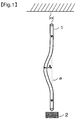
- Fig. 1 is a schematic side view for illustrating a method of measuring an amount of permanent set in fatigue in the present invention.
- the elastic monofilament of the present invention is an elastic monofilament having a core-sheath composite structure, wherein a ratio of a core component is 2 to 40% by volume, the core component is a thermoplastic polyester having, in a polymer, 95 to 100% by mass of a thermoplastic polyester unit, and a sheath component is a copolymeric thermoplastic elastomer having a hard segment and a soft segment, and wherein the monofilament has a diameter of 0.1 to 1.0 mm, and a tensile strength of 0.3 to 3.0 cN/dtex.
- the elastic monofilament of the present invention improves fatigue resistance to repeated deformation in a bending direction by combining a thermoplastic elastomer having rubber elasticity with a thermoplastic polyester resin having no rubber elasticity, such as specified polyethylene terephthalate, in a particular constitution. It was found out that a remarkable effect regarding resistance to permanent set in fatigue is obtained while retaining elasticity in the bending direction by daringly reducing rubber elasticity in the tensile direction of the monofilament, which is not reduced as a premise in the conventional techniques.
- an elastic woven fabric made from an elastic monofilament as a weft, and a polyethylene terephthalate monofilament as a warp is used in office chairs or car seats.
- a load at the time of sitting is imparted to the elastic woven fabric from a substantially vertical direction.
- the elastic monofilament movement of which due to a load on the elastic woven fabric in a vertical direction is suppressed by a warp, is greatly deformed in a bending direction.
- microscopic attention is paid to a bent part of the elastic monofilament, the elastic monofilament is compressed inside the bent part, and the elastic monofilament is greatly extended outside the bent part.
- the core component bears a prescribed stress.
- extension and deformation of a thermoplastic elastomer component and plastic deformation outside a bent part are suppressed, and excellent stretch back property of the thermoplastic elastomer used in the sheath component is hardly deteriorated.
- thermoplastic polyester such as polyethylene terephthalate
- creep elongation when the monofilament is exposed to bending deformation for a long period of time is also suppressed.
- a woven or knitted fabric made from the elastic monofilament of the present invention is hardly set permanently over a long term, and can continuously exhibit excellent elasticity.
- a ratio of the core component is required to be within a range of 2 to 40% by volume.
- the ratio of the core component is less than 2% by volume, excessive extension outside a bent part due to the core component described above cannot be suppressed.
- the ratio of the core component exceeds 40% by volume, since an amount of the thermoplastic elastomer component is too small, objective elasticity is hardly exhibited.
- the ratio of the core component is preferably within a range of 3 to 20% by volume, and more preferably within a range of 3 to 13% by volume.
- the monofilament may have a modified cross-sectional shape such as elliptic, quadrilateral, polygonal and polyphyllous cross sections, in addition to a circular cross section.
- the elastic monofilament of the present invention has a diameter of 1.0 mm or less, preferably 0.7 mm or less.
- a diameter 1.0 mm or less, preferably 0.7 mm or less.
- an absolute amount of extension outside a bent part at the time of bending deformation is increased to easily cause plastic deformation, and when the monofilament is made into a woven or knitted fabric, permanent set in fatigue is easily caused.
- the diameter is 0.1 mm or more since it becomes difficult to maintain the shape of a core-sheath composite form when the diameter is too small.
- Average diameters L1 and L2 of cross sections each represent a diameter of an area equivalent circle.
- the intrinsic viscosity (IV) of the thermoplastic polyester used in the core component is preferably 0.7 or higher, and more preferably 1.0 or higher.
- the intrinsic viscosity (IV) is too low, since a load per molecular chain when the core component bears a stress becomes great, the resulting elastic monofilament tends to be permanently set. From the viewpoint of improvement in creep property of the resulting elastic monofilament, improvement in mechanical properties of the monofilament, and deformation controllability when the monofilament is bent, the intrinsic viscosity originally has no upper limit. However, it is preferable that the intrinsic viscosity (IV) is 1.4 or lower from the viewpoint of melting processability.
- the thermoplastic polyester used in the core component is a polymer in which the thermoplastic polyester unit accounts for 95 to 100% by mass.
- the thermoplastic polyester unit refers to components having a polyester skeleton other than components corresponding to the thermoplastic elastomer described later.
- a copolymer with a component copolymerizable with the thermoplastic polyester or other thermoplastic polymers that can be blended with the thermoplastic polyester can be used, as far as the amount thereof is less than 5% by mass.
- thermoplastic polyester unit when the amount of the thermoplastic polyester unit is less than 95% by mass, since mechanical properties of the thermoplastic polyester are deteriorated due to copolymerization or blending, this consequently leads to an elastic monofilament which easily causes permanent set in fatigue when the monofilament is made into a woven or knitted fabric.
- the copolymerizable component examples include aromatic dicarboxylic acids such as isophthalic acid and naphthalenedicarboxylic acid, aliphatic dicarboxylic acids such as adipic acid, sebacic acid and azelaic acid, diol compounds such as diethylene glycol and 1,4-butanediol, polyfunctional compounds, 5-sulfoisophthalic acid metal salts, and phosphorus-containing compounds.
- the thermoplastic polyester constituting the core component is a so-called homopolymer, which is composed of substantially 100% by mass of the thermoplastic polyester unit.
- the thermoplastic polyester used in the core component can contain additives such as matting agents such as titanium oxide, calcium carbonate, kaolin and clay, pigments, dyes, lubricants, antioxidants, heat-resistant agents, steaming-resistant agents, light-resistant agents, ultraviolet absorbing agents, antistatic agents and flame retardants, as far as the amount thereof is within a range in which the effect of the present invention is not impaired, specifically, the amount is 5% by mass or less.
- the amount of titanium oxide is 0.01 to 1% by mass.
- thermoplastic elastomer constituting the sheath component of the elastic monofilament of the present invention is required to be a copolymeric thermoplastic elastomer having a hard segment and a soft segment, such as styrene-based elastomers, polyester-based elastomers, polyurethane-based elastomers, and polyamide-based elastomers.
- the reason therefor is that in the case of a blend-type thermoplastic elastomer typified by olefin-based elastomers, heat resistance is deficient, and there are concerns about interface peeling of a sea-island component and recycle property.
- the thermoplastic elastomer used in the present invention preferably has a melting point of 150°C or higher, particularly 180°C or higher.
- a preferable aspect of the polyester-based elastomer used in the present invention is that a hard segment has, as a main constituent unit, an aromatic polyester unit mainly formed of an aromatic dicarboxylic acid or an ester forming derivative thereof, and a diol or an ester forming derivative thereof.
- aromatic dicarboxylic acid examples include terephthalic acid, isophthalic acid, phthalic acid, naphthalene-2,6-dicarboxylic acid, naphthalene-2,7-dicarboxylic acid, anthracenedicarboxylic acid, diphenyl-4,4'-dicarboxylic acid, diphenoxyethanedicarboxylic acid, 4,4'-diphenyl ether dicarboxylic acid, 5-sulfoisophthalic acid, and sodium 3-sulfoisophthalate.
- the above aromatic dicarboxylic acid is mainly used. If necessary, part of this aromatic dicarboxylic acid can be replaced with an alicyclic dicarboxylic acid such as 1,4-cyclohexanedicarboxylic acid, cyclopentanedicarboxylic acid and 4,4'-dicyclohexyldicarboxylic acid, or an aliphatic dicarboxylic acid such as adipic acid, succinic acid, oxalic acid, sebacic acid, dodecanedioic acid, and dimer acid. Furthermore, an ester forming derivative of a dicarboxylic acid, for example, lower alkyl esters, aryl esters, carbonic acid esters and acid halides can be of course used equally.
- an ester forming derivative of a dicarboxylic acid for example, lower alkyl esters, aryl esters, carbonic acid esters and acid halides can be of course used equally.
- diols having a molecular weight of 400 or less for example, aliphatic diols such as 1,4-butanediol, ethylene glycol, trimethylene glycol, pentamethylene glycol, hexamethylene glycol, neopentyl glycol, and decamethylene glycol, alicyclic diols such as 1,1-cyclohexanedimethanol, 1,4-dicyclohexanedimethanol, and tricyclodecanedimethanol, and aromatic diols such as xylylene glycol, bis(p-hydroxy)diphenyl, bis(p-hydroxy)diphenylpropane, 2,2'-bis [4-(2-hydroxyethoxy)phenyl]propane, bis[4-(2-hydroxyethoxy)phenyl]sulfone, 1,1-bis[4-(2-hydroxyethoxy)phenyl]cyclohexane, 4,4
- a preferable example of such a hard segment is a polybutylene terephthalate unit derived from terephthalic acid and/or dimethyl terephthalate and 1,4-butanediol.
- a hard segment composed of a polybutylene terephthalate unit derived from terephthalic acid and/or dimethyl terephthalate, and a polybutylene isophthalate unit derived from isophthalic acid and/or dimethyl isophthalate and 1,4-butanediol is also preferably used.
- the soft segment of the polyester-based elastomer used in the present invention has, as a main constituent unit, an aliphatic polyether unit and/or an aliphatic polyester unit.
- the aliphatic polyether include poly(ethylene oxide)glycol, poly(propylene oxide)glycol, poly(tetramethylene oxide)glycol, poly(hexamethylene oxide)glycol, a copolymer of ethylene oxide and propylene oxide, an ethylene oxide addition polymer of poly(propylene oxide)glycol, and a copolymer glycol of ethylene oxide and tetrahydrofuran.
- Examples of the aliphatic polyester include poly( ⁇ -caprolactone), polyenantholactone, polycaprylolactone, polybutylene adipate, and polyethylene adipate.
- poly(tetramethylene oxide)glycol an ethylene oxide adduct of poly(propylene oxide)glycol, a copolymer glycol of ethylene oxide and tetrahydrofuran, poly( ⁇ -caprolactone), polybutylene adipate, and polyethylene adipate.
- poly(tetramethylene oxide)glycol is a preferable constituent unit. It is preferable that the number average molecular weight of these soft segments is around 300 to 6000 in the copolymerized state.
- the ratio of the hard segment to the soft segment is within a range of 35 : 65 to 75 : 25 (ratio by mass).
- a third component can be provided outside the sheath component composed of the thermoplastic elastomer, or further inside the core component composed of the thermoplastic polyester, as far as the effect of the present invention is not impaired.
- the thermoplastic elastomer constituting the sheath component preferably has a Shore D hardness within a range of 30 to 65. By setting the Shore D hardness within the above range, it becomes possible to suppress excessive extension at the time of bending deformation while controlling the amount of the hard segment which is easily deformed plastically.
- the thermoplastic elastomer used in the sheath component can contain matting agents such as titanium oxide, calcium carbonate, kaolin, and clay, pigments, dyes, lubricants, antioxidants, heat-resistant agents, steaming-resistant agents, light-resistant agents, ultraviolet absorbing agents, antistatic agents and flame retardants, as far as the amount thereof is within a range in which the effect of the present invention is not impaired, specifically, the amount is 5% by mass or less.
- matting agents such as titanium oxide, calcium carbonate, kaolin, and clay, pigments, dyes, lubricants, antioxidants, heat-resistant agents, steaming-resistant agents, light-resistant agents, ultraviolet absorbing agents, antistatic agents and flame retardants, as far as the amount thereof is within a range in which the effect of the present invention is not impaired, specifically, the amount is 5% by mass or less.
- the tensile strength is within a range of 0.3 to 3.0 cN/dtex, preferably 0.3 to 2.94 cN/dtex, and further preferably 0.5 to 2.5 cN/dtex.
- a higher-order processing step such as a weaving or knitting step, deterioration of the capability of passing through processes due to yarn breakage is hardly caused, and an elastic monofilament retaining sufficient elasticity is obtained.
- the elastic monofilament of the present invention preferably has a bending stiffness of 2.0 to 10.0 cN.
- a more preferable range of the bending stiffness 2.5 to 8.0 cN can be mentioned.
- the bending stiffness is preferably within the above range in order to obtain a monofilament excellent in durability and excellent also in elasticity.
- the rate of dimensional change when the monofilament is heat-treated for 3 minutes in a temperature condition of 160°C under fixed length, and then retained for 12 hours under a tension of 0.1 cN/dtex is preferably 0 to 5%.
- heat treatment for 3 minutes at a temperature of 160°C assumes that the elastic monofilament is made into a woven or knitted fabric, and the fabric is subjected to heat setting.
- the rate of dimensional change when the monofilament is heat-treated for 3 minutes at a temperature of 160°C under fixed length, and then retained for 12 hours under a tension of 0.1 cN/dtex is within the above range, even after the monofilament is made into an article such as a woven or knitted fabric, and the article is heat-set, it is not excessively extended, and can have excellent creep property.
- a more preferable range of the rate of dimensional change when the monofilament is heat-treated for 3 minutes in a temperature condition of 160°C under fixed length, and then retained for 12 hours under a tension of 0.1 cN/dtex 0 to 3% can be mentioned.
- the elastic monofilament of the present invention preferably has a boiling water shrinkage rate of 3 to 10%.
- the elastic monofilament of the present invention can be of course used alone. Moreover, a plurality of the elastic monofilaments of the present invention can be used, or the elastic monofilament of the present invention and a filament of other materials can be used as a composite yarn.
- the elastic monofilament of the present invention can be manufactured by a core-sheath composite spinning method using a previously known coextrusion facility, it is possible to produce the elastic monofilament at high productivity and low cost.
- thermoplastic polyester polymer constituting a core component and a thermoplastic elastomer constituting a sheath component of a core-sheath composite monofilament are melted in separate extruders, weighed with a gear pump and made to flow into a composite pack, respectively.
- Two kinds of polymers of the core component and the sheath component which have been made to flow into the composite pack are filtered with a metal non-woven fabric filter or a metal mesh in the pack, introduced into a composite spinneret, and spun out in a form where the core component is surrounded with the sheath component.
- a light-resistant agent is added to the thermoplastic elastomer resin for the purpose of reducing deterioration due to ultraviolet rays at the time of practical use.
- a preferable light-resistant agent-added master chip for imparting the light-resistant agent to the elastic monofilament of the present invention include "Hytrel” (registered trademark) 21UV manufactured by Du Pont-Toray Co., Ltd.
- the molten monofilament which has been spun out from a composite spinneret is passed through a heating cylinder and/or a heat-insulating cylinder arranged beneath the composite spinneret.
- the length of the heating cylinder and/or the heat-insulating cylinder is preferably within a range of 10 to 150 mm, from the viewpoint of reduction in unevenness of fineness in a longitudinal direction of the resulting elastic monofilament.
- the molten monofilament which has passed through the heating cylinder and/or the heat-insulating cylinder is cooled in a cooling bath containing water or polyethylene glycol as a solvent, and is taken up with a take-up roll which rotates at a desired surface speed.
- the temperature of the cooling bath the temperature can be changed in consideration of circularity and unevenness of fineness of the resulting elastic monofilament.
- the cooling temperature for obtaining the elastic monofilament of the present invention include a range of 20 to 80°C.
- the take-up speed should be a speed by which cooling solidification of the molten monofilament in a cooling bath is completed.
- a range of 5 to 50 m/min is preferable.
- the unstretched monofilament which has been taken up with a take-up roll is subjected to a stretching step after it is wound up once, or without being wound up.
- a stretching step a multi-stage stretching method of two or more stages is preferably adopted for obtaining the elastic monofilament of the present invention.
- the heating medium at the time of stretching warm water, a PEG bath, steam and a dry heat stretching machine can be used.
- the second stage stretching temperature is set within a range of the melting point of the thermoplastic elastomer used in the sheath component under 50°C of the melting point to under 10°C of the melting point.
- the elastic monofilament after stretching is then subjected to relaxation heat treatment.
- the relaxation ratio is preferably within a range of 0.99 to 0.85.
- the relaxation heat treatment temperature is preferably set within a range of the melting point of the thermoplastic elastomer used in the sheath component under 50°C of the melting point to under 10°C of the melting point, and examples of a more preferable range include the melting point of the thermoplastic elastomer under 40°C of the melting point to under 10°C of the melting point.
- the relaxation heat treatment temperature within the above range, it becomes possible to obtain a monofilament having excellent elasticity even when deformed in a bending direction, by relaxing excessive orientation generated in the sheath component in a stretching step while suppressing heat fusion between elastic monofilaments in a heat treatment step.
- the total stretching ratio obtained by multiplying the stretching ratio by the relaxation ratio is preferably set at less than 4.0-fold.
- Examples of a more preferable range include less than 3.8-fold.
- the elastic monofilament after relaxation treatment is wound up with a winding machine.
- the winding tension is within a range of 0.10 cN/dtex or less.
- the lower limit of the winding tension is preferably 0.02 cN/dtex or more.
- the elastic monofilament of the present invention can be obtained.
- the elastic monofilament of the present invention is particularly excellent in resistance to permanent set in fatigue in a bending direction, elasticity, and creep property after subjected to a high temperature, it can be suitably utilized of course in various industrial uses such as marine materials, construction materials, safety materials, clothing materials, civil engineering materials, agricultural materials, vehicle materials, and sport materials, and particularly, in elastic woven or knitted structure uses such as car seats and office chairs, which easily undergoes deformation in a bending direction at the time of practical use.
- the external diameter of the elastic monofilament was measured at 10 points in a length direction, using a laser external diameter measuring apparatus manufactured by Anritsu Corporation, and the mean value of the resulting external diameters was defined as the diameter.
- the fineness was measured in accordance with JIS L1013:2010 8.3.1 B Method.
- a cross section obtained by cutting the elastic monofilament in a direction vertical to a fiber axis was observed with a digital microscope VHX-100F manufactured by Keyence Corporation.
- the diameter of the core component was measured using a length measuring tool of the digital microscope, and the ratio (% by volume) of the core component was obtained from the cross-sectional area of the elastic monofilament and the cross-sectional area of the core component which had been obtained using an area measuring tool.
- a temperature giving an extreme value of a melting endothermic curve obtained by measuring 10 mg of a sample at a heating rate of 10°C/min using a differential scanning calorimeter model DSC-7 manufactured by Perkin Elmer was defined as the melting point.
- the elastic monofilament which had been cut into a length of about 4 cm was set below two stainless bars having a diameter of 2 mm, which were mounted at an interval of 10 mm in a horizontal direction, and a J-shaped hook made of stainless steel having a diameter of 1 mm was hooked on the elastic monofilament at the central position of two stainless bars.
- the hook made of stainless steel was pulled up at a speed of 50 mm/min using a model TCM-200 universal tensile testing/compression testing machine manufactured by Minebea Co., Ltd., and the maximum stress generated then was defined as the bending stiffness.
- the boiling water shrinkage rate was measured in accordance with JIS L1013:2010 8.18.1 (B Method).
- a raw yarn sample (elastic monofilament) which had been wound around an iron plate having a length of 30 cm ten times so that there was neither raw yarn slack nor a gap between raw yarns was heat-treated for 3 minutes in a dry heat oven at a temperature of 160°C, taken out from the dry heat oven, and naturally cooled. Then, the raw yarn sample after heat treatment was mounted in a Tensilon model UTM-4-100 tensile testing machine manufactured by Orientec Co., Ltd.
- E 12 - E 0 was defined as the rate of dimensional change after heat treatment. Letting the measurement number n to be 5, the mean value of them was adopted.
- the elastic monofilament was put up in a commercially available badminton racket under a load of 0.1 cN/dtex in both of warp and weft directions. After the elastic monofilament was put up, subjects were made to perform a repeated loading-unloading motion five times with a palm from a direction vertical to a ball shooting face, and the elasticity was scored based on the following criteria. The number of subjects was 10, and the mean value of the scores of 10 subjects was used as the result. Score 3 to score 5 were defined as acceptance.
- the elastic monofilament was set in the testing machine in the state where a load of 2.5 kg/mm 2 was imparted to a yarn end opposite to the grasped yarn end of the monofilament, and the friction block was reciprocally contacted with the elastic monofilament 250 times at a reciprocating stroke of 25 mm and a speed of 120 reciprocations/min. This was retained for 24 hours in the state where the load was kept imparted.
- the sample (elastic monofilament) after treatment was removed from the bending abrasion property testing machine, and immediately suspended in a perpendicular direction in the state where a load 2 of 6 g/mm 2 was imparted, as shown in Fig. 1 .
- a distance A (mm) of a perpendicular line which was drawn from a line a connecting between marks towards a deformation maximum point was obtained, and the mean value of five times of measurement was defined as the amount of permanent set in fatigue.
- a reactor equipped with a helical ribbon-type impeller was charged with 51.9 parts by mass of terephthalic acid, 39.7 parts by mass of 1,4-butanediol and 47.6 parts by mass of poly(tetramethylene oxide)glycol having a number average molecular weight of about 1400 together with 0.04 part by mass of titanium tetrabutoxide and 0.02 part by mass of mono-n-butyl-monohydroxytin oxide.
- the mixture was gradually heated from a temperature of 190°C to a temperature of 225°C over 3 hours to perform an esterification reaction while flowing reaction water to the outside of the system.
- a reactor equipped with a helical ribbon-type impeller was charged with 32.9 parts by mass of terephthalic acid, 9.6 parts by mass of isophthalic acid, 40.3 parts by mass of 1,4-butanediol and 46.7 parts by mass of poly(tetramethylene oxide)glycol having a number average molecular weight of about 1400 together with 0.04 part by mass of titanium tetrabutoxide and 0.02 part by mass of mono-n-butyl-monohydroxytin oxide.
- the mixture was gradually heated for 3 hours from a temperature of 190°C to a temperature of 225°C over 3 hours to perform an esterification reaction while flowing reaction water to the outside of the system.
- respective molten polymers were filtered with a 200-mesh wire mesh, and discharged from a core-sheath composite spinneret having a pore diameter of 1.5 mm and a number of pores of 10.
- the discharged filament was passed through a heat-insulating cylinder having a length of 30 mm, which had been mounted beneath the spinneret, passed through a cooling water bath at a temperature of 25°C, which had been mounted so as to have an air gap of 30 mm, and was taken up as an unstretched monofilament with a take-up roll rotating at a surface speed of 20 m/min.
- the resulting unstretched monofilament was subjected to first stage stretching at a stretching ratio described in Table 1, without being wound once, using a warm water bath controlled to a temperature of 90°C, and subjected to second stage stretching at a ratio described in Table 1 using a dry heat stretching bath controlled to a temperature described in Table 1.
- the monofilament after stretching was subsequently subjected to relaxation heat treatment at a ratio described in Table 1 using a dry heat bath controlled to a temperature described in Table 1, and wound at a winding tension described in Table 1 to obtain an elastic monofilament. Properties of the resulting monofilament were as shown in Table 1 and Table 2.
- Comparative Example 2 since the ratio of the core component was small, excessive extension outside a bent part was not suppressed, and the amount of permanent set in fatigue was large. In Comparative Example 4, the tensile strength exceeded 3.05 cN/dtex, and elasticity in the bending direction was deteriorated.
- Example 1 In the same manner as that of Example 1 except that, as the polymer for the sheath component, 97% by mass of the copolymeric thermoplastic elastomer (A-1) and 3% by mass of "Hytrel” (registered trademark) 21UV were used, the procedure was performed. Properties of the resulting monofilament were as shown in Table 1.
- Example 2 In the same manner as that of Example 1 except that, as the polymer for the core component, a polyethylene terephthalate polymer (T-301T manufactured by Toray Industries, Inc.) having a melting point of 257°C and an intrinsic viscosity of 0.71, and containing 0.1% by mass of titanium oxide was used, the procedure was performed. Properties of the resulting monofilament were as shown in Table 1 and Table 2. In Comparative Example 3 and Comparative Example 5, the tensile strength exceeded 3.05 cN/dtex, and elasticity in the bending direction was deteriorated.
- T-301T manufactured by Toray Industries, Inc.
- Example 2 In the same manner as that of Example 1 except that, the copolymeric thermoplastic elastomer (A-1) which had been dried until the moisture content became less than 150 ppm, as the polymer for the core component, and the copolymeric thermoplastic elastomer (A-2) which had been dried until the moisture content became less than 150 ppm, as the polymer for the sheath component, were melted in a ⁇ 30 mm extruder set at a temperature of 250°C, and a ⁇ 40 mm extruder set at a temperature of 215°C, respectably, and thereafter, introduced into a composite spinning pack retained at a temperature of 250°C using gear pumps retained at a temperature of 245°C and 250°C, respectably, the procedure was performed.
- the elastic monofilament of the present invention was excellent in resistance to permanent set in fatigue in the bending direction, elasticity, and creep property after subjected to a high temperature.
Landscapes
- Engineering & Computer Science (AREA)
- Textile Engineering (AREA)
- Chemical & Material Sciences (AREA)
- Chemical Kinetics & Catalysis (AREA)
- General Chemical & Material Sciences (AREA)
- Mechanical Engineering (AREA)
- Multicomponent Fibers (AREA)
- Woven Fabrics (AREA)
Abstract
Description
- The present invention relates to an elastic monofilament which is excellent in fatigue resistance to repeated deformation in a bending direction, and is suitable for use in various industrial uses such as marine materials, construction materials, safety materials, clothing materials, civil engineering materials, agricultural materials, vehicle materials and sport materials, particularly, suitable for use in woven or knitted structures having elasticity.
- A monofilament made of a thermoplastic elastomer is known to have excellent rubber elasticity. Since a woven or knitted fabric made from such a monofilament made of the thermoplastic elastomer has excellent elasticity, development for use in clothing materials such as stockings, medical materials such as supporters, sport materials such as trampolines, bedding materials such as beds, and sitting materials such as office chairs/car seats is being progressed. For example,
Patent Documents 1 to 3 propose that a woven or knitted fabric made from the thermoplastic elastomer can be suitably used in application to office chairs and automobile chairs. - As one example of the monofilament constituting the woven or knitted fabric which is applied to such uses, a monofilament made of a thermoplastic elastomer containing, as its main component, a polyester or a polyether is known. A woven or knitted fabric made from the conventional monofilament made of the thermoplastic elastomer, however, has a problem of reduction in elastic recovery after repeated deformation, that is, so-called permanent set in fatigue at the time of long-term use. Regarding this problem, for the purpose of obtaining a woven or knitted fabric excellent in mechanical properties and elastic recovery after repeated deformation, an elastic monofilament is proposed (see
Patent Documents 2 and 3). - Specifically,
Patent Document 2 describes that an effect of reducing change in the knitted or woven structure after repeated deformation of a fabric and of excellent long-term durability is obtained by using an elastic composite monofilament in which a two-component polyester-based elastomer is used as a main raw material, the monofilament has a sheath (sheath of core-sheath structure)-core (core of core-sheath structure) shape having an area ratio of a core part in a fiber cross-sectional area of 50% or more, the melting point of a core part component is 150°C or higher and lower than 200°C, and the melting point of a sheath part component is lower than the melting point of the core part component by 20°C or more and less than 50°C, and partially melting or fusing a low melting point component used in a sheath side to form a fusion point at an intersection part of a knitted or woven texture, thereby improving a force of constraint. - In Patent Document 3, a single component monofilament made of a polymer of particular components, and having a creep ratio at 80°C for 24 hours under a 15% extension stress at room temperature of 5% or less is proposed as a monofilament having reduced change in property due to repeated deformation.
- In these proposals, it is considered that the elastic monofilament is required to exhibit high rubber elasticity, and in both of the single component monofilament made of the thermoplastic elastomer (see Patent Document 3) and the core-sheath composite monofilament made of two polymers (see Patent Document 2), the monofilament (both of core and sheath in the case of core-sheath composite monofilament) is, as a premise, made of the thermoplastic elastomer, and exhibits rubber elasticity which is as high as possible.
-
- Patent Document 1: Japanese Translation of
PCT International Application Publication JP-T-1997-507782 - Patent Document 2: Japanese Patent Laid-open Publication No.
1999-152625 - Patent Document 3: Japanese Patent Laid-open Publication No.
1999-172532 - However, the proposals concerning improvement in permanent set in fatigue of the elastic seat, which are disclosed in
Patent Documents 2 and 3, provide still insufficient resistance to permanent set in fatigue at the time of practical use. Then, an object of the present invention is to provide an elastic monofilament excellent in resistance to permanent set in fatigue at practical use of an elastic seat. - The present inventors studied a cause for failure to obtain desired resistance to permanent set in fatigue in a woven or knitted fabric obtained from the conventional monofilament. Then, they searched for a configuration for improving fatigue resistance to repeated deformation in a bending direction of a monofilament based on an idea that fatigue resistance to repeated deformation in a tensile direction of the monofilament is improved in the conventional techniques for improving resistance to permanent set in fatigue of the woven or knitted fabric, but this is insufficient, and improvement in fatigue resistance to repeated deformation in a bending direction of the monofilament would be necessary. As a result, they found out that by adopting the following configuration, resistance to permanent set in fatigue of the woven or knitted fabric can be considerably improved as compared to before.
- The elastic monofilament of the present invention is an elastic monofilament having a core-sheath composite structure, wherein a ratio of a core component is 2 to 40% by volume, the core component is a thermoplastic polyester having, in a polymer, 95 to 100% by mass of a thermoplastic polyester unit, and a sheath component is a copolymeric thermoplastic elastomer having a hard segment and a soft segment, and wherein the monofilament has a diameter of 0.1 to 1.0 mm, and a tensile strength of 0.3 to 3.0 cN/dtex.
- According to a preferable aspect of the elastic monofilament of the present invention, the intrinsic viscosity (IV) of the thermoplastic polyester used in the core component is 0.7 or higher.
- According to a preferable aspect of the elastic monofilament of the present invention, the hard segment contains, as a main constituent unit, an aromatic polyester unit, and the soft segment contains, as a main constituent unit, an aliphatic polyether unit and/or an aliphatic polyester unit, the aromatic polyester unit is a polybutylene terephthalate unit, and the aliphatic polyether unit and/or the aliphatic polyester unit is a poly(tetramethylene oxide)glycol unit.
- According to a preferable aspect of the elastic monofilament of the present invention, a ratio of the hard segment to the soft segment is 35 : 65 to 75 : 25 (ratio by mass).
- According to a preferable aspect of the elastic monofilament of the present invention, the elastic monofilament has a bending stiffness of 2.0 to 10 cN. In this aspect, when the monofilament is heat-treated for 3 minutes in a temperature condition of 160°C under fixed length, and then retained for 12 hours under a tension of 0.1 cN/dtex, a rate of dimensional change is 0 to 5%.
- According to the present invention, the elastic monofilament excellent in fatigue resistance in a bending direction is obtained. Thereby, it becomes possible to considerably improve resistance to permanent set in fatigue at the time of practical use of a woven or knitted fabric typified by trampolines, supporters, beds, car seats, and office chairs.
- Since the elastic monofilament of the present invention has the core component containing a thermoplastic polyester having, in a polymer, 95 to 100% by mass of a thermoplastic polyester unit unlike the conventional elastic monofilament made only of the thermoplastic elastomer, the core component bears part of a stress which is applied to a filament when the monofilament is extended and/or bent. For this reason, in the elastic monofilament of the present invention, extension deformation and plastic deformation of the thermoplastic elastomer component are easily suppressed even when the monofilament is extended and/or bent. That is, since the elastic monofilament of the present invention is difficult to be permanently set even when the monofilament undergoes extension and/or bending deformation, it also becomes possible to considerably improve resistance to permanent set in fatigue of a woven or knitted fabric typified by trampolines, supporters, beds, car seats, and office chairs, when the monofilament is used in the woven or knitted fabric.
-
Fig. 1 is a schematic side view for illustrating a method of measuring an amount of permanent set in fatigue in the present invention. - The elastic monofilament of the present invention is an elastic monofilament having a core-sheath composite structure, wherein a ratio of a core component is 2 to 40% by volume, the core component is a thermoplastic polyester having, in a polymer, 95 to 100% by mass of a thermoplastic polyester unit, and a sheath component is a copolymeric thermoplastic elastomer having a hard segment and a soft segment, and wherein the monofilament has a diameter of 0.1 to 1.0 mm, and a tensile strength of 0.3 to 3.0 cN/dtex.
- That is, the elastic monofilament of the present invention improves fatigue resistance to repeated deformation in a bending direction by combining a thermoplastic elastomer having rubber elasticity with a thermoplastic polyester resin having no rubber elasticity, such as specified polyethylene terephthalate, in a particular constitution. It was found out that a remarkable effect regarding resistance to permanent set in fatigue is obtained while retaining elasticity in the bending direction by daringly reducing rubber elasticity in the tensile direction of the monofilament, which is not reduced as a premise in the conventional techniques.
- The reason why such a remarkable effect is obtained is presumed as follows.
- As a typical example of a usage mode of the elastic monofilament of the present invention, a case will be described where an elastic woven fabric made from an elastic monofilament as a weft, and a polyethylene terephthalate monofilament as a warp is used in office chairs or car seats. In such a usage mode, a load at the time of sitting is imparted to the elastic woven fabric from a substantially vertical direction. In this case, when attention is paid to deformation behavior of one elastic monofilament, the elastic monofilament, movement of which due to a load on the elastic woven fabric in a vertical direction is suppressed by a warp, is greatly deformed in a bending direction. Furthermore, when microscopic attention is paid to a bent part of the elastic monofilament, the elastic monofilament is compressed inside the bent part, and the elastic monofilament is greatly extended outside the bent part.
- In such a situation, in the conventional elastic monofilament made only of the thermoplastic elastomer, it is thought that large extension outside a bent part generates deformation more than the elastically deformable elongation originally possessed by the thermoplastic elastomer to cause plastic deformation, and as a result, permanent set in fatigue is generated in the woven or knitted fabric.
- Whereas, in a similar situation, in a core-sheath composite monofilament in which a thermoplastic polyester such as polyethylene terephthalate is used in a core component, and a thermoplastic elastomer is used in a sheath component in a particular constitution as in the present invention, the core component bears a prescribed stress. As a result, extension and deformation of a thermoplastic elastomer component and plastic deformation outside a bent part are suppressed, and excellent stretch back property of the thermoplastic elastomer used in the sheath component is hardly deteriorated. Furthermore, by using the thermoplastic polyester such as polyethylene terephthalate in the core component, creep elongation when the monofilament is exposed to bending deformation for a long period of time is also suppressed. For this reason, it is considered that a woven or knitted fabric made from the elastic monofilament of the present invention is hardly set permanently over a long term, and can continuously exhibit excellent elasticity.
- In the elastic monofilament of the present invention, from the viewpoint of achieving both of improvement in heat-resistant creep property and elasticity in the bending direction, a ratio of the core component is required to be within a range of 2 to 40% by volume. When the ratio of the core component is less than 2% by volume, excessive extension outside a bent part due to the core component described above cannot be suppressed. On the other hand, when the ratio of the core component exceeds 40% by volume, since an amount of the thermoplastic elastomer component is too small, objective elasticity is hardly exhibited. From such a viewpoint, the ratio of the core component is preferably within a range of 3 to 20% by volume, and more preferably within a range of 3 to 13% by volume.
- As a cross-sectional shape of the elastic monofilament of the present invention, the monofilament may have a modified cross-sectional shape such as elliptic, quadrilateral, polygonal and polyphyllous cross sections, in addition to a circular cross section.
- The elastic monofilament of the present invention has a diameter of 1.0 mm or less, preferably 0.7 mm or less. When the diameter is too great, an absolute amount of extension outside a bent part at the time of bending deformation is increased to easily cause plastic deformation, and when the monofilament is made into a woven or knitted fabric, permanent set in fatigue is easily caused. For exhibiting the function of the elastic monofilament, there is originally no lower limit of the diameter. However, the diameter is 0.1 mm or more since it becomes difficult to maintain the shape of a core-sheath composite form when the diameter is too small.
- Herein, letting an average diameter of a cross section of the elastic monofilament to be L1, letting an average diameter of a cross section of the core component to be L2, and letting a thickness of the sheath component along an arbitrary line segment t drawn on an outer circumference of the elastic monofilament from a center of gravity of a cross section of the core component to be Lt, it is preferable that Lt corresponding to the arbitrary line segment t satisfies the following relation over the entire outer circumference of the elastic monofilament:


- Average diameters L1 and L2 of cross sections each represent a diameter of an area equivalent circle. When the above relation is satisfied, since the sheath component retains a prescribed thickness over the whole circumference of the elastic monofilament, a region where an amount of the sheath component is partially small or a part where the amount is extremely large is not generated. Therefore, at the time of bending deformation, a problem is hardly caused that the sheath component is torn by excessive extension, or elastic recovery becomes uneven.
- Examples of the thermoplastic polyester which can be used in the core component include polybutylene terephthalate, polyethylene terephthalate, polypropylene terephthalate, polyethylene naphthalate, and aromatic polyesters. From the viewpoint of versatility, heat resistance and high stiffness, polyethylene terephthalate is preferably used.
- The intrinsic viscosity (IV) of the thermoplastic polyester used in the core component is preferably 0.7 or higher, and more preferably 1.0 or higher. When the intrinsic viscosity (IV) is too low, since a load per molecular chain when the core component bears a stress becomes great, the resulting elastic monofilament tends to be permanently set. From the viewpoint of improvement in creep property of the resulting elastic monofilament, improvement in mechanical properties of the monofilament, and deformation controllability when the monofilament is bent, the intrinsic viscosity originally has no upper limit. However, it is preferable that the intrinsic viscosity (IV) is 1.4 or lower from the viewpoint of melting processability.
- In the present invention, the thermoplastic polyester used in the core component is a polymer in which the thermoplastic polyester unit accounts for 95 to 100% by mass. Herein, the thermoplastic polyester unit refers to components having a polyester skeleton other than components corresponding to the thermoplastic elastomer described later. As the component of a structure other than that of the thermoplastic polyester unit, a copolymer with a component copolymerizable with the thermoplastic polyester or other thermoplastic polymers that can be blended with the thermoplastic polyester can be used, as far as the amount thereof is less than 5% by mass.
- On the other hand, when the amount of the thermoplastic polyester unit is less than 95% by mass, since mechanical properties of the thermoplastic polyester are deteriorated due to copolymerization or blending, this consequently leads to an elastic monofilament which easily causes permanent set in fatigue when the monofilament is made into a woven or knitted fabric. Examples of the copolymerizable component include aromatic dicarboxylic acids such as isophthalic acid and naphthalenedicarboxylic acid, aliphatic dicarboxylic acids such as adipic acid, sebacic acid and azelaic acid, diol compounds such as diethylene glycol and 1,4-butanediol, polyfunctional compounds, 5-sulfoisophthalic acid metal salts, and phosphorus-containing compounds. In the present invention, it is preferable that the thermoplastic polyester constituting the core component is a so-called homopolymer, which is composed of substantially 100% by mass of the thermoplastic polyester unit.
- The thermoplastic polyester used in the core component can contain additives such as matting agents such as titanium oxide, calcium carbonate, kaolin and clay, pigments, dyes, lubricants, antioxidants, heat-resistant agents, steaming-resistant agents, light-resistant agents, ultraviolet absorbing agents, antistatic agents and flame retardants, as far as the amount thereof is within a range in which the effect of the present invention is not impaired, specifically, the amount is 5% by mass or less. Among them, from the viewpoint of suppression of shininess of the resulting elastic monofilament and generation of premium feel, and improvement in durability of the elastic monofilament in spite of the unclear detailed mechanism, it is preferable that the amount of titanium oxide is 0.01 to 1% by mass.
- The thermoplastic elastomer constituting the sheath component of the elastic monofilament of the present invention is required to be a copolymeric thermoplastic elastomer having a hard segment and a soft segment, such as styrene-based elastomers, polyester-based elastomers, polyurethane-based elastomers, and polyamide-based elastomers. The reason therefor is that in the case of a blend-type thermoplastic elastomer typified by olefin-based elastomers, heat resistance is deficient, and there are concerns about interface peeling of a sea-island component and recycle property. From the viewpoint of heat resistance and mechanical properties, the thermoplastic elastomer used in the present invention preferably has a melting point of 150°C or higher, particularly 180°C or higher.
- A preferable aspect of the polyester-based elastomer used in the present invention is that a hard segment has, as a main constituent unit, an aromatic polyester unit mainly formed of an aromatic dicarboxylic acid or an ester forming derivative thereof, and a diol or an ester forming derivative thereof.
- Specific examples of the aromatic dicarboxylic acid include terephthalic acid, isophthalic acid, phthalic acid, naphthalene-2,6-dicarboxylic acid, naphthalene-2,7-dicarboxylic acid, anthracenedicarboxylic acid, diphenyl-4,4'-dicarboxylic acid, diphenoxyethanedicarboxylic acid, 4,4'-diphenyl ether dicarboxylic acid, 5-sulfoisophthalic acid, and sodium 3-sulfoisophthalate.
- In the present invention, the above aromatic dicarboxylic acid is mainly used. If necessary, part of this aromatic dicarboxylic acid can be replaced with an alicyclic dicarboxylic acid such as 1,4-cyclohexanedicarboxylic acid, cyclopentanedicarboxylic acid and 4,4'-dicyclohexyldicarboxylic acid, or an aliphatic dicarboxylic acid such as adipic acid, succinic acid, oxalic acid, sebacic acid, dodecanedioic acid, and dimer acid. Furthermore, an ester forming derivative of a dicarboxylic acid, for example, lower alkyl esters, aryl esters, carbonic acid esters and acid halides can be of course used equally.
- Then, as a specific example of the diol, diols having a molecular weight of 400 or less, for example, aliphatic diols such as 1,4-butanediol, ethylene glycol, trimethylene glycol, pentamethylene glycol, hexamethylene glycol, neopentyl glycol, and decamethylene glycol, alicyclic diols such as 1,1-cyclohexanedimethanol, 1,4-dicyclohexanedimethanol, and tricyclodecanedimethanol, and aromatic diols such as xylylene glycol, bis(p-hydroxy)diphenyl, bis(p-hydroxy)diphenylpropane, 2,2'-bis [4-(2-hydroxyethoxy)phenyl]propane, bis[4-(2-hydroxyethoxy)phenyl]sulfone, 1,1-bis[4-(2-hydroxyethoxy)phenyl]cyclohexane, 4,4'-dihydroxy-p-terphenyl, and 4,4'-dihydroxy-p-quarter phenyl are preferably used. These diols can also be used in a form of an ester forming derivative, for example, an acetyl derivative and an alkali metal salt.
- Two or more kinds of these dicarboxylic acids, derivatives thereof, diol components and derivatives thereof can be used together.
- A preferable example of such a hard segment is a polybutylene terephthalate unit derived from terephthalic acid and/or dimethyl terephthalate and 1,4-butanediol. A hard segment composed of a polybutylene terephthalate unit derived from terephthalic acid and/or dimethyl terephthalate, and a polybutylene isophthalate unit derived from isophthalic acid and/or dimethyl isophthalate and 1,4-butanediol is also preferably used.
- The soft segment of the polyester-based elastomer used in the present invention has, as a main constituent unit, an aliphatic polyether unit and/or an aliphatic polyester unit. Examples of the aliphatic polyether include poly(ethylene oxide)glycol, poly(propylene oxide)glycol, poly(tetramethylene oxide)glycol, poly(hexamethylene oxide)glycol, a copolymer of ethylene oxide and propylene oxide, an ethylene oxide addition polymer of poly(propylene oxide)glycol, and a copolymer glycol of ethylene oxide and tetrahydrofuran.
- Examples of the aliphatic polyester include poly(ε-caprolactone), polyenantholactone, polycaprylolactone, polybutylene adipate, and polyethylene adipate. In view of elastic property of the resulting polyester-based elastomer, it is preferable to use, among these aliphatic polyethers and/or aliphatic polyesters, poly(tetramethylene oxide)glycol, an ethylene oxide adduct of poly(propylene oxide)glycol, a copolymer glycol of ethylene oxide and tetrahydrofuran, poly(ε-caprolactone), polybutylene adipate, and polyethylene adipate. Among them, poly(tetramethylene oxide)glycol is a preferable constituent unit. It is preferable that the number average molecular weight of these soft segments is around 300 to 6000 in the copolymerized state.
- In the elastic monofilament of the present invention, it is preferable that the ratio of the hard segment to the soft segment, that is, the copolymerization ratio is within a range of 35 : 65 to 75 : 25 (ratio by mass). By setting the ratio of the hard segment to the soft segment within the above range, not only a heat characteristic that thermal degradation is hardly caused at the time of composite spinning is obtained, but also the sheath component has moderate elasticity. Therefore, an elastic monofilament excellent in stretch back property can be obtained.
- In the elastic monofilament of the present invention, for the purpose of imparting heat adhesiveness, a third component can be provided outside the sheath component composed of the thermoplastic elastomer, or further inside the core component composed of the thermoplastic polyester, as far as the effect of the present invention is not impaired.
- In the elastic monofilament of the present invention, the thermoplastic elastomer constituting the sheath component preferably has a Shore D hardness within a range of 30 to 65. By setting the Shore D hardness within the above range, it becomes possible to suppress excessive extension at the time of bending deformation while controlling the amount of the hard segment which is easily deformed plastically.
- The thermoplastic elastomer used in the sheath component can contain matting agents such as titanium oxide, calcium carbonate, kaolin, and clay, pigments, dyes, lubricants, antioxidants, heat-resistant agents, steaming-resistant agents, light-resistant agents, ultraviolet absorbing agents, antistatic agents and flame retardants, as far as the amount thereof is within a range in which the effect of the present invention is not impaired, specifically, the amount is 5% by mass or less.
- In the elastic monofilament of the present invention, the tensile strength is within a range of 0.3 to 3.0 cN/dtex, preferably 0.3 to 2.94 cN/dtex, and further preferably 0.5 to 2.5 cN/dtex. When the tensile strength is within the above range, in a higher-order processing step such as a weaving or knitting step, deterioration of the capability of passing through processes due to yarn breakage is hardly caused, and an elastic monofilament retaining sufficient elasticity is obtained. Particularly, when the tensile strength exceeds 3.0 cN/dtex, rubber elasticity when the monofilament is made into a woven or knitted structure is easily deteriorated since stiffness of the core-sheath composite monofilament is too high and the elasticity in the bending direction is deteriorated.
- The elastic monofilament of the present invention preferably has a bending stiffness of 2.0 to 10.0 cN. As a more preferable range of the bending stiffness, 2.5 to 8.0 cN can be mentioned. When the bending stiffness is too low, there are concerns that the elastic monofilament is excessively extended outside a bent part at the time of bending, whereas, when the bending stiffness is too great, there arise concerns that the filament is hardly bent and deformed, and objective elasticity is not exhibited. From such a viewpoint, the bending stiffness is preferably within the above range in order to obtain a monofilament excellent in durability and excellent also in elasticity.
- In the elastic monofilament of the present invention, the rate of dimensional change when the monofilament is heat-treated for 3 minutes in a temperature condition of 160°C under fixed length, and then retained for 12 hours under a tension of 0.1 cN/dtex is preferably 0 to 5%. Herein, heat treatment for 3 minutes at a temperature of 160°C assumes that the elastic monofilament is made into a woven or knitted fabric, and the fabric is subjected to heat setting. In the case where the rate of dimensional change when the monofilament is heat-treated for 3 minutes at a temperature of 160°C under fixed length, and then retained for 12 hours under a tension of 0.1 cN/dtex is within the above range, even after the monofilament is made into an article such as a woven or knitted fabric, and the article is heat-set, it is not excessively extended, and can have excellent creep property. As a more preferable range of the rate of dimensional change when the monofilament is heat-treated for 3 minutes in a temperature condition of 160°C under fixed length, and then retained for 12 hours under a tension of 0.1 cN/dtex, 0 to 3% can be mentioned.
- The elastic monofilament of the present invention preferably has a boiling water shrinkage rate of 3 to 10%. By setting the boiling water shrinkage rate within the above range, it becomes possible to obtain an article which is excellent in dimensional stability at the time of heat impartation, which is more hardly wrinkled when made into a woven or knitted fabric, and which is excellent in quality.
- The elastic monofilament of the present invention can be of course used alone. Moreover, a plurality of the elastic monofilaments of the present invention can be used, or the elastic monofilament of the present invention and a filament of other materials can be used as a composite yarn.
- Then, a process for manufacturing the elastic monofilament of the present invention will be described in more detail, but the process for manufacturing the elastic monofilament is not limited thereto.
- Since the elastic monofilament of the present invention can be manufactured by a core-sheath composite spinning method using a previously known coextrusion facility, it is possible to produce the elastic monofilament at high productivity and low cost.
- That is, after a thermoplastic polyester polymer constituting a core component and a thermoplastic elastomer constituting a sheath component of a core-sheath composite monofilament are melted in separate extruders, weighed with a gear pump and made to flow into a composite pack, respectively. Two kinds of polymers of the core component and the sheath component which have been made to flow into the composite pack are filtered with a metal non-woven fabric filter or a metal mesh in the pack, introduced into a composite spinneret, and spun out in a form where the core component is surrounded with the sheath component.
- In this case, it is a preferable aspect to reduce the moisture content of polymers used in spinning to less than 200 ppm in advance using a vacuum dryer or the like for the purpose of suppressing hydrolysis in a spinning machine for the thermoplastic elastomer and the thermoplastic polyester used in spinning. When the moisture content is within the above range, not only conjugation abnormality is hardly generated, but also it becomes easy to obtain an elastic monofilament excellent in durability.
- When function impartation such as spun-dyeing, light resistance impartation and antibacterial property impartation is performed on the elastic monofilament, it is possible to prepare a master chip containing large amounts of a desired pigment, a light resistant agent and an antibacterial agent in advance, blend a required amount of them into a thermoplastic polyester resin and/or a thermoplastic elastomer resin, and spin the blend.
- Particularly, for the elastic monofilament of the present invention, it is a preferable aspect that a light-resistant agent is added to the thermoplastic elastomer resin for the purpose of reducing deterioration due to ultraviolet rays at the time of practical use. Examples of a preferable light-resistant agent-added master chip for imparting the light-resistant agent to the elastic monofilament of the present invention include "Hytrel" (registered trademark) 21UV manufactured by Du Pont-Toray Co., Ltd.
- It is a preferable aspect, from the viewpoint of removing a strain of a molecular structure generated in a spinneret hole, that the molten monofilament which has been spun out from a composite spinneret is passed through a heating cylinder and/or a heat-insulating cylinder arranged beneath the composite spinneret. The length of the heating cylinder and/or the heat-insulating cylinder is preferably within a range of 10 to 150 mm, from the viewpoint of reduction in unevenness of fineness in a longitudinal direction of the resulting elastic monofilament.
- If necessary, the molten monofilament which has passed through the heating cylinder and/or the heat-insulating cylinder is cooled in a cooling bath containing water or polyethylene glycol as a solvent, and is taken up with a take-up roll which rotates at a desired surface speed. Regarding the temperature of the cooling bath, the temperature can be changed in consideration of circularity and unevenness of fineness of the resulting elastic monofilament. Examples of the cooling temperature for obtaining the elastic monofilament of the present invention include a range of 20 to 80°C. In addition, the take-up speed should be a speed by which cooling solidification of the molten monofilament in a cooling bath is completed. In order to set the fiber structure of an unstretched yarn within a range suitable for obtaining the elastic monofilament of the present invention, a range of 5 to 50 m/min is preferable.
- The unstretched monofilament which has been taken up with a take-up roll is subjected to a stretching step after it is wound up once, or without being wound up. Regarding the number of stretching stages in a stretching step, a multi-stage stretching method of two or more stages is preferably adopted for obtaining the elastic monofilament of the present invention. In addition, regarding the heating medium at the time of stretching, warm water, a PEG bath, steam and a dry heat stretching machine can be used.
- Regarding the stretching temperature, for obtaining the elastic monofilament of the present invention, it is a preferable aspect that the second stage stretching temperature is set within a range of the melting point of the thermoplastic elastomer used in the sheath component under 50°C of the melting point to under 10°C of the melting point. By setting the second stage stretching temperature within the above range where molecular mobility of the thermoplastic elastomer is extremely high, excessive orientation of the thermoplastic elastomer in a stretching step is suppressed, and it becomes possible to obtain an elastic monofilament having excellent elasticity even when deformed in a bending direction.
- The elastic monofilament after stretching is then subjected to relaxation heat treatment. From the viewpoint of suppression of filament sway and securement of elasticity recovery when the monofilament is subjected to repeated bending deformation, the relaxation ratio is preferably within a range of 0.99 to 0.85. The relaxation heat treatment temperature is preferably set within a range of the melting point of the thermoplastic elastomer used in the sheath component under 50°C of the melting point to under 10°C of the melting point, and examples of a more preferable range include the melting point of the thermoplastic elastomer under 40°C of the melting point to under 10°C of the melting point. By setting the relaxation heat treatment temperature within the above range, it becomes possible to obtain a monofilament having excellent elasticity even when deformed in a bending direction, by relaxing excessive orientation generated in the sheath component in a stretching step while suppressing heat fusion between elastic monofilaments in a heat treatment step.
- In the core-sheath resin structure of the present invention, in order to satisfy the above range of the tensile strength in the present invention, the total stretching ratio obtained by multiplying the stretching ratio by the relaxation ratio is preferably set at less than 4.0-fold. Examples of a more preferable range include less than 3.8-fold.
- The elastic monofilament after relaxation treatment is wound up with a winding machine. In this case, it is preferable that the winding tension is within a range of 0.10 cN/dtex or less. By setting the winding tension within the above range, a load which is applied to the elastic monofilament at the time of winding is reduced, and consequently, it becomes possible to obtain an elastic monofilament excellent in durability. In order to obtain a winding package which can be applied to practical use, the lower limit of the winding tension is preferably 0.02 cN/dtex or more.
- Thus, the elastic monofilament of the present invention can be obtained.
- Since the elastic monofilament of the present invention is particularly excellent in resistance to permanent set in fatigue in a bending direction, elasticity, and creep property after subjected to a high temperature, it can be suitably utilized of course in various industrial uses such as marine materials, construction materials, safety materials, clothing materials, civil engineering materials, agricultural materials, vehicle materials, and sport materials, and particularly, in elastic woven or knitted structure uses such as car seats and office chairs, which easily undergoes deformation in a bending direction at the time of practical use.
- Then, the elastic monofilament of the present invention will be described in more detail by way of examples. Definitions and measurement methods of properties used in the examples are as follows. The measurement number n is 1 unless otherwise described.
- The external diameter of the elastic monofilament was measured at 10 points in a length direction, using a laser external diameter measuring apparatus manufactured by Anritsu Corporation, and the mean value of the resulting external diameters was defined as the diameter.
- The fineness was measured in accordance with JIS L1013:2010 8.3.1 B Method.
- Using a Tensilon model UTM-4-100 tensile testing machine manufactured by Orientec Co., Ltd., and in accordance with JIS L1013:2010 8.5.1, the tenacity of the monofilament was measured at 3 points at a length of specimen between grips of 25 cm in a constant rate extension manner, and the mean tenacity and mean elongation of the 3 trials were obtained. The strength was obtained by dividing the mean tenacity by the fineness.
- A cross section obtained by cutting the elastic monofilament in a direction vertical to a fiber axis was observed with a digital microscope VHX-100F manufactured by Keyence Corporation. The diameter of the core component was measured using a length measuring tool of the digital microscope, and the ratio (% by volume) of the core component was obtained from the cross-sectional area of the elastic monofilament and the cross-sectional area of the core component which had been obtained using an area measuring tool.
- A temperature giving an extreme value of a melting endothermic curve obtained by measuring 10 mg of a sample at a heating rate of 10°C/min using a differential scanning calorimeter model DSC-7 manufactured by Perkin Elmer was defined as the melting point.
- The elastic monofilament which had been cut into a length of about 4 cm was set below two stainless bars having a diameter of 2 mm, which were mounted at an interval of 10 mm in a horizontal direction, and a J-shaped hook made of stainless steel having a diameter of 1 mm was hooked on the elastic monofilament at the central position of two stainless bars. The hook made of stainless steel was pulled up at a speed of 50 mm/min using a model TCM-200 universal tensile testing/compression testing machine manufactured by Minebea Co., Ltd., and the maximum stress generated then was defined as the bending stiffness.
- The boiling water shrinkage rate was measured in accordance with JIS L1013:2010 8.18.1 (B Method).
- To 100 mL of orthochlorophenol in a flask, 8 g of a sample which had been ground with a Wiley grinder (filter
hole diameter 1 mm) was added, and the mixture was heat-treated at a temperature of 160°C for 10 minutes. The flask after heat treatment was cooled with flowing water for 15 minutes, and then the relative viscosity η of the resulting solution was measured at a temperature of 25°C using an Ostwald viscometer. The intrinsic viscosity was obtained by an approximate equation of intrinsic viscosity = (K1 × η) + K2. The constant K1 is 0.0242, and the constant K2 is 0.2634. - A raw yarn sample (elastic monofilament) which had been wound around an iron plate having a length of 30 cm ten times so that there was neither raw yarn slack nor a gap between raw yarns was heat-treated for 3 minutes in a dry heat oven at a temperature of 160°C, taken out from the dry heat oven, and naturally cooled. Then, the raw yarn sample after heat treatment was mounted in a Tensilon model UTM-4-100 tensile testing machine manufactured by Orientec Co., Ltd. at a yarn length of 25 cm, and the elongation (E0) (%) when a load of 0.1 cN/dtex was imparted and the elongation (E12) (%) when the sample was allowed to stand for 12 hours in the state where a load of 0.1 cN/dtex was imparted were obtained. E12 - E0 was defined as the rate of dimensional change after heat treatment. Letting the measurement number n to be 5, the mean value of them was adopted.
- The elastic monofilament was put up in a commercially available badminton racket under a load of 0.1 cN/dtex in both of warp and weft directions. After the elastic monofilament was put up, subjects were made to perform a repeated loading-unloading motion five times with a palm from a direction vertical to a ball shooting face, and the elasticity was scored based on the following criteria. The number of subjects was 10, and the mean value of the scores of 10 subjects was used as the result. Score 3 to score 5 were defined as acceptance.
- Score 5: The monofilament has excellent rubber elasticity.
- Score 4: Between score 3 and score 5
- Score 3: The monofilament has rubber elasticity.
- Score 2: Between score 3 and
score 1 - Score 1: The monofilament is stiff.
- Using a bending abrasion property testing machine in accordance with JIS L1095:2008 9.10. (B Method), one end contacted on a fixed friction block (hard steel wire SWP-A) having a diameter of 0.6 mm was grasped, and the elastic monofilament which had been marked at an interval of 200 mm outside a reciprocating stroke width of the friction block in advance was hooked under two free rollers which had been provided so that the elastic monofilament was bent each at an angle of 55° in left and right of the friction block. The elastic monofilament was set in the testing machine in the state where a load of 2.5 kg/mm2 was imparted to a yarn end opposite to the grasped yarn end of the monofilament, and the friction block was reciprocally contacted with the elastic monofilament 250 times at a reciprocating stroke of 25 mm and a speed of 120 reciprocations/min. This was retained for 24 hours in the state where the load was kept imparted.
- The sample (elastic monofilament) after treatment was removed from the bending abrasion property testing machine, and immediately suspended in a perpendicular direction in the state where a
load 2 of 6 g/mm2 was imparted, as shown inFig. 1 . Regarding the suspended sample (elastic monofilament 1), a distance A (mm) of a perpendicular line which was drawn from a line a connecting between marks towards a deformation maximum point was obtained, and the mean value of five times of measurement was defined as the amount of permanent set in fatigue. - A reactor equipped with a helical ribbon-type impeller was charged with 51.9 parts by mass of terephthalic acid, 39.7 parts by mass of 1,4-butanediol and 47.6 parts by mass of poly(tetramethylene oxide)glycol having a number average molecular weight of about 1400 together with 0.04 part by mass of titanium tetrabutoxide and 0.02 part by mass of mono-n-butyl-monohydroxytin oxide. The mixture was gradually heated from a temperature of 190°C to a temperature of 225°C over 3 hours to perform an esterification reaction while flowing reaction water to the outside of the system. To the reaction mixture was additionally added 0.2 part by mass of tetra-n-butyl titanate, and added 0.05 part by mass of "Irganox" (registered trademark) 1098 (hindered phenol-based antioxidant manufactured by Ciba Geigy), and thereafter, the temperature was raised to 245°C. Then, the pressure in the system was reduced to 27 Pa over 50 minutes, and polymerization was performed for 1 hour and 50 minutes under that condition. The resulting polymer was discharged into water in a strand form, and the strand was cut to afford a pellet of a copolymeric thermoplastic elastomer (A-1) having a hard/soft ratio of 48/52 (ratio by mass). The resulting pellet had a melting point of 200°C, and a Shore hardness D of 47.
- A reactor equipped with a helical ribbon-type impeller was charged with 32.9 parts by mass of terephthalic acid, 9.6 parts by mass of isophthalic acid, 40.3 parts by mass of 1,4-butanediol and 46.7 parts by mass of poly(tetramethylene oxide)glycol having a number average molecular weight of about 1400 together with 0.04 part by mass of titanium tetrabutoxide and 0.02 part by mass of mono-n-butyl-monohydroxytin oxide. The mixture was gradually heated for 3 hours from a temperature of 190°C to a temperature of 225°C over 3 hours to perform an esterification reaction while flowing reaction water to the outside of the system. To the reaction mixture was additionally added 0.15 part by mass of tetra-n-butyl titanate, and added 0.05 part by mass of "Irganox" (registered trademark) 1098 (hindered phenol-based antioxidant manufactured by Ciba Geigy), and thereafter, the temperature was raised to 245°C. Then, the pressure in the system was reduced to 27 Pa for 50 minutes, and polymerization was performed for 1 hour and 50 minutes under that condition. The resulting polymer was discharged into water in a strand form, and the strand was cut to afford a pellet of a copolymeric thermoplastic elastomer (A-2) having a hard/soft ratio of 49/51 (ratio by mass). The resulting pellet had a melting point of 160°C, and a Shore hardness D of 40.
- Using a polyethylene terephthalate polymer (T-701T manufactured by Toray Industries, Inc.) having a melting point of 257°C and an intrinsic viscosity of 1.21, and containing 0.1% by mass of titanium oxide, which had been dried until the moisture content became less than 100 ppm as a polymer for a core component, and using the copolymeric thermoplastic elastomer (A-1) which had been dried until the moisture content became less than 100 ppm as a polymer for a sheath component, respective polymers were melted in a ϕ 30 mm extruder set at a temperature of 295°C and a ϕ 40 mm extruder set at a temperature of 245°C, weighed using gear pumps retained at a temperature of 245°C and 295°C, so that the external diameter (diameter) and the ratio of a core component would be as described in Table 1, and introduced into a composite spinning pack retained at a temperature of 290°C. In the composite spinning pack, respective molten polymers were filtered with a 200-mesh wire mesh, and discharged from a core-sheath composite spinneret having a pore diameter of 1.5 mm and a number of pores of 10. The discharged filament was passed through a heat-insulating cylinder having a length of 30 mm, which had been mounted beneath the spinneret, passed through a cooling water bath at a temperature of 25°C, which had been mounted so as to have an air gap of 30 mm, and was taken up as an unstretched monofilament with a take-up roll rotating at a surface speed of 20 m/min. The resulting unstretched monofilament was subjected to first stage stretching at a stretching ratio described in Table 1, without being wound once, using a warm water bath controlled to a temperature of 90°C, and subjected to second stage stretching at a ratio described in Table 1 using a dry heat stretching bath controlled to a temperature described in Table 1. The monofilament after stretching was subsequently subjected to relaxation heat treatment at a ratio described in Table 1 using a dry heat bath controlled to a temperature described in Table 1, and wound at a winding tension described in Table 1 to obtain an elastic monofilament. Properties of the resulting monofilament were as shown in Table 1 and Table 2.
- In Comparative Example 2, since the ratio of the core component was small, excessive extension outside a bent part was not suppressed, and the amount of permanent set in fatigue was large. In Comparative Example 4, the tensile strength exceeded 3.05 cN/dtex, and elasticity in the bending direction was deteriorated.
- In the same manner as that of Example 1 except that, as the polymer for the sheath component, 97% by mass of the copolymeric thermoplastic elastomer (A-1) and 3% by mass of "Hytrel" (registered trademark) 21UV were used, the procedure was performed. Properties of the resulting monofilament were as shown in Table 1.
- In the same manner as that of Example 1 except that, as the polymer for the core component, a polyethylene terephthalate polymer (T-301T manufactured by Toray Industries, Inc.) having a melting point of 257°C and an intrinsic viscosity of 0.71, and containing 0.1% by mass of titanium oxide was used, the procedure was performed. Properties of the resulting monofilament were as shown in Table 1 and Table 2. In Comparative Example 3 and Comparative Example 5, the tensile strength exceeded 3.05 cN/dtex, and elasticity in the bending direction was deteriorated.
- In the same manner as that of Example 1 except that, the copolymeric thermoplastic elastomer (A-1) which had been dried until the moisture content became less than 150 ppm, as the polymer for the core component, and the copolymeric thermoplastic elastomer (A-2) which had been dried until the moisture content became less than 150 ppm, as the polymer for the sheath component, were melted in a ϕ 30 mm extruder set at a temperature of 250°C, and a ϕ 40 mm extruder set at a temperature of 215°C, respectably, and thereafter, introduced into a composite spinning pack retained at a temperature of 250°C using gear pumps retained at a temperature of 245°C and 250°C, respectably, the procedure was performed. Properties of the resulting elastic monofilament were as shown in Table 2.
[Table 1] [Table 1] Example 1 Example 2 Example 3 Example 4 Example 5 Example 6 Example 7 Example 8 Core component resin species - PET PET PET PET PET PET PET PET Manufacturing conditions for elastic monofilament PET intrinsic viscosity - 1.21 1.21 1.21 1.21 1.21 1.21 1.21 0.71 First stage stretching ratio Fold 3.33 3.00 3.33 3.33 3.33 3.33 3.33 3.33 Second stage stretching ratio Fold 1.21 1.33 1.21 1.21 1.21 1.21 1.21 1.21 Second stage stretching temperature °C 180 180 180 180 155 180 180 180 Relaxation ratio Fold 0.90 0.90 0.95 0.95 0.95 0.90 0.90 0.90 Relaxation treatment temperature °C 180 180 180 180 180 180 180 180 Diameter µm 490 490 490 490 490 490 490 490 Core ratio % by volume 9.9 4.3 16.8 35.7 16.8 12.1 9.8 9.9 Fineness dtex 2258 2254 2288 2364 2281 2270 2249 2258 Properties of elastic monofilament Tensile strength cN/dtex 0.93 0.85 1.22 2.94 2.18 1.17 0.95 0.93 Bending stiffness cN 4.56 2.93 7.76 13.46 8.39 7.34 4.39 4.81 Boiling shrinkage % 6.2 5.9 8.3 14.2 9 7.3 6.2 6.2 Rate of dimensional change after heat treatment % 1.3 1. 8 0.7 0.4 0.5 1.1 1.4 3.2 Evaluation of elasticity Score 4.1 4.4 3.9 3.1 3.7 4 4.2 4.1 Amount of permanent set in fatigue mm 0.9 1.1 2 2.7 1.7 1.2 1.1 2.5 [Table 2] [Table 2] Comparative Example 1 Comparative Example 2 Comparative Example 3 Comparative Example 4 Comparative Example 5 Core component resin species - Elastomer PET PET PET PET Manufacturing conditions for elastic monofilament PET intrinsic viscosity - - 1.21 0.71 1.21 0.71 First stage stretching ratio Fold 3.00 3.00 3.33 3.33 3.33 Second stage stretching ratio Fold 1.67 1.33 1.60 1.21 1.76 Second stage stretching temperature °C 130 180 140 140 140 Relaxation ratio Fold 0.85 0.90 1.00 0.90 0.90 Relaxation treatment temperature °C 145 180 180 140 180.00 Diameter µm 486 491 490 490 488 Core ratio % by volume 29.6 1.3 16.8 35.7 16.8 Fineness dtex 2188 2237 2388 2345 2369 Properties of elastic monofilament Tensile strength cN/dtex 1.22 0.76 4.23 3.89 4.18 Bending stiffness cN 1.82 2.24 15.14 15.83 13.95 Boiling shrinkage % 9.4 5.2 15.3 16.6 14.2 Rate of dimensional change after heat treatment % 13.4 5.1 2.4 0.5 2.7 Evaluation of elasticity Score 4.7 4.6 2.3 1.9 2.6 Amount of permanent set in fatigue mm 3.2 3 2.6 2.8 2.6 - As shown in Table 1 and Table 2, the elastic monofilament of the present invention was excellent in resistance to permanent set in fatigue in the bending direction, elasticity, and creep property after subjected to a high temperature.
-
- 1. Elastic monofilament after bending abrasion property test
- 2. Load
a. Line connecting between marks
A. Distance of perpendicular line drawn from line a connecting between marks towards deformation maximum point (Amount of permanent set in fatigue)
Claims (7)
- An elastic monofilament comprising a core-sheath composite structure, wherein a ratio of a core component is 2 to 40% by volume, the core component is a thermoplastic polyester having, in a polymer, 95 to 100% by mass of a thermoplastic polyester unit, and a sheath component is a copolymeric thermoplastic elastomer having a hard segment and a soft segment, and wherein the monofilament has a diameter of 0.1 to 1.0 mm, and a tensile strength of 0.3 to 3.0 cN/dtex.
- The elastic monofilament according to claim 1, wherein the intrinsic viscosity (IV) of the thermoplastic polyester used in the core component is 0.7 or higher.
- The elastic monofilament according to claim 2, wherein the hard segment contains, as a main constituent unit, an aromatic polyester unit, and the soft segment contains, as a main constituent unit, an aliphatic polyether unit and/or an aliphatic polyester unit.
- The elastic monofilament according to claim 3, wherein the aromatic polyester unit is a polybutylene terephthalate unit, and the aliphatic polyether unit and/or the aliphatic polyester unit is a poly(tetramethylene oxide)glycol unit.
- The elastic monofilament according to any one of claims 1 to 4, wherein a ratio of the hard segment to the soft segment is 35 : 65 to 75 : 25 (ratio by mass).
- The elastic monofilament according to any one of claims 1 to 5, having a bending stiffness of 2.0 to 10 cN.
- The elastic monofilament according to any one of claims 1 to 6, wherein a rate of dimensional change when the monofilament is heat-treated for 3 minutes in a temperature condition of 160°C under fixed length, and then retained for 12 hours under a tension of 0.1 cN/dtex is 0 to 5%.
Applications Claiming Priority (2)
| Application Number | Priority Date | Filing Date | Title |
|---|---|---|---|
| JP2013166304 | 2013-08-09 | ||
| PCT/JP2014/070923 WO2015020163A1 (en) | 2013-08-09 | 2014-08-07 | Elastic monofilament |
Publications (3)
| Publication Number | Publication Date |
|---|---|
| EP3031960A1 true EP3031960A1 (en) | 2016-06-15 |
| EP3031960A4 EP3031960A4 (en) | 2017-03-22 |
| EP3031960B1 EP3031960B1 (en) | 2020-06-10 |
Family
ID=52461491
Family Applications (1)
| Application Number | Title | Priority Date | Filing Date |
|---|---|---|---|
| EP14834881.6A Active EP3031960B1 (en) | 2013-08-09 | 2014-08-07 | Elastic monofilament |
Country Status (8)
| Country | Link |
|---|---|
| US (1) | US20160194788A1 (en) |
| EP (1) | EP3031960B1 (en) |
| JP (1) | JP6489773B2 (en) |
| KR (1) | KR102168814B1 (en) |
| CN (1) | CN105765118B (en) |
| CA (1) | CA2920777C (en) |
| MX (1) | MX376255B (en) |
| WO (1) | WO2015020163A1 (en) |
Families Citing this family (6)
| Publication number | Priority date | Publication date | Assignee | Title |
|---|---|---|---|---|
| CN105220254A (en) * | 2015-10-20 | 2016-01-06 | 江苏金麟户外用品有限公司 | A kind of preparation method of modification jumping cloth |
| JP6745211B2 (en) * | 2016-12-28 | 2020-08-26 | 株式会社ジェイエスピー | Sheet core material |
| WO2018181699A1 (en) * | 2017-03-31 | 2018-10-04 | 東レ株式会社 | Elastic monofilament and woven knitted goods |
| KR102431255B1 (en) * | 2017-10-18 | 2022-08-11 | 유니버시티 오브 센트럴 플로리다 리서치 파운데이션, 인코포레이티드 | Fibers with an electrically conductive core and a color-changing coating |
| KR20220112792A (en) * | 2019-12-23 | 2022-08-11 | 도레이 카부시키가이샤 | Separator and its manufacturing method |
| JP2024018079A (en) * | 2022-07-29 | 2024-02-08 | 東レ株式会社 | fabric |
Family Cites Families (19)
| Publication number | Priority date | Publication date | Assignee | Title |
|---|---|---|---|---|
| US4584240A (en) * | 1984-08-06 | 1986-04-22 | E. I. Du Pont De Nemours And Company | Coextruded monofilament fishline |
| JP2595739B2 (en) * | 1990-01-19 | 1997-04-02 | 東レ株式会社 | Composite short fiber |
| JPH05148769A (en) * | 1991-11-25 | 1993-06-15 | Toray Monofilament Co Ltd | Conjugated monofilament for industrial woven or knit fabric |
| JP2553272B2 (en) * | 1991-12-16 | 1996-11-13 | 帝人株式会社 | Cushion structure and manufacturing method thereof |
| US5533789A (en) | 1994-11-10 | 1996-07-09 | Milliken Research Corporation | Seating structure |
| JP3832607B2 (en) | 1997-11-21 | 2006-10-11 | 東洋紡績株式会社 | Composite elastic monofilament |
| JP3832608B2 (en) | 1997-12-09 | 2006-10-11 | 東洋紡績株式会社 | Durable elastic filament and method for producing the same |
| JPH11200157A (en) * | 1998-01-07 | 1999-07-27 | Toyobo Co Ltd | Elastic composite filament excellent in fire retardant property |
| US20020104548A1 (en) * | 2000-12-01 | 2002-08-08 | Vipul Bhupendra Dave | Monofilament tape |
| JP2004024520A (en) * | 2002-06-25 | 2004-01-29 | Toyobo Co Ltd | High-performance brush having excellent cleaning performance |
| JP2004176228A (en) * | 2002-11-28 | 2004-06-24 | Asahi Kasei Fibers Corp | Hot melt conjugate monofilament |
| JP4496002B2 (en) * | 2004-04-26 | 2010-07-07 | 帝人ファイバー株式会社 | Method for producing cup material made of multilayer fiber structure and breast cup |
| US20060216506A1 (en) * | 2005-03-22 | 2006-09-28 | Jian Xiang | Multicomponent fibers having elastomeric components and bonded structures formed therefrom |
| JP5246997B2 (en) * | 2005-09-16 | 2013-07-24 | グンゼ株式会社 | Elastomeric core-sheath conjugate fiber |
| US8053074B2 (en) * | 2006-05-31 | 2011-11-08 | Kao Corporation | Stretch nonwoven fabric |
| DE102007009119A1 (en) | 2007-02-24 | 2008-08-28 | Teijin Monofilament Germany Gmbh | Electrically conductive threads, fabrics produced therefrom and their use |
| US20110175249A1 (en) * | 2008-09-26 | 2011-07-21 | Hirofumi Yamamoto | Polyester monofilament, method for producing same, and method for producing screen gauze using same |
| JP5268709B2 (en) * | 2009-02-27 | 2013-08-21 | 日本無機株式会社 | Thermal bond nonwoven filter medium and air filter using the same |
| CN102378833B (en) * | 2009-03-31 | 2014-07-02 | 郡是株式会社 | core sheath composite fiber |
-
2014
- 2014-08-07 MX MX2016001715A patent/MX376255B/en active IP Right Grant
- 2014-08-07 CA CA2920777A patent/CA2920777C/en active Active
- 2014-08-07 US US14/910,895 patent/US20160194788A1/en not_active Abandoned
- 2014-08-07 KR KR1020167006010A patent/KR102168814B1/en active Active
- 2014-08-07 JP JP2014161608A patent/JP6489773B2/en active Active
- 2014-08-07 CN CN201480055594.4A patent/CN105765118B/en active Active
- 2014-08-07 WO PCT/JP2014/070923 patent/WO2015020163A1/en not_active Ceased
- 2014-08-07 EP EP14834881.6A patent/EP3031960B1/en active Active
Non-Patent Citations (1)
| Title |
|---|
| See references of WO2015020163A1 * |
Also Published As
| Publication number | Publication date |
|---|---|
| CN105765118A (en) | 2016-07-13 |
| EP3031960A4 (en) | 2017-03-22 |
| JP6489773B2 (en) | 2019-03-27 |
| EP3031960B1 (en) | 2020-06-10 |
| US20160194788A1 (en) | 2016-07-07 |
| MX2016001715A (en) | 2016-07-26 |
| KR102168814B1 (en) | 2020-10-22 |
| KR20160040292A (en) | 2016-04-12 |
| MX376255B (en) | 2025-03-07 |
| CN105765118B (en) | 2021-03-26 |
| JP2015057522A (en) | 2015-03-26 |
| CA2920777C (en) | 2021-08-17 |
| CA2920777A1 (en) | 2015-02-12 |
| WO2015020163A1 (en) | 2015-02-12 |
Similar Documents
| Publication | Publication Date | Title |
|---|---|---|
| EP3031960B1 (en) | Elastic monofilament | |
| EP1640488B1 (en) | Woven or knitted fabric containing two different yarns and clothing comprising the same | |
| WO2010113862A1 (en) | Core-sheath conjugate fiber and process for producing same | |
| JP2011047068A (en) | Water-repelling polyester blended yarn | |
| JP2006097178A (en) | Composite fiber | |
| KR101489424B1 (en) | Polyester complex-fiber with highly elasticity and method for manufacturing thereof | |
| JP2011157646A (en) | Polyester microfiber | |
| JP6759661B2 (en) | Kaijima composite fiber | |
| JP5202407B2 (en) | Core-sheath conjugate fiber and knitted fabric using the same | |
| WO2018181699A1 (en) | Elastic monofilament and woven knitted goods | |
| JP2004176228A (en) | Hot melt conjugate monofilament | |
| JP4862378B2 (en) | Polyester core-sheath composite fiber | |
| JP2009299207A (en) | Multi-layered fabric and fiber product | |
| JP3832608B2 (en) | Durable elastic filament and method for producing the same | |
| JP5737833B2 (en) | Elastomeric core-sheath conjugate fiber | |
| JP5275657B2 (en) | Woven knitted fabrics and textile products whose thickness is reduced by moisture absorption | |
| JP2017214685A (en) | Stretch woven fabric | |
| KR100233304B1 (en) | Composite Elastic Yarn | |
| JP2007154343A (en) | Polyester core-sheath composite-type partially oriented fiber and method for producing the same | |
| JP6304750B2 (en) | High strength hollow polyester multifilament | |
| JP2006283224A (en) | Core-sheath composite filament yarn, fabric using the same, irregular cross-section fiber fabric | |
| JP2011047067A (en) | Water-repelling polyester blended yarn | |
| JP2010138508A (en) | Water-repelling polyester conjugated fiber | |
| JP2010196179A (en) | Antistatic polyester blended yarn having excellent wrinkle recovery | |
| JP2008303477A (en) | Anti-static fabric and dust-proof clothing |
Legal Events
| Date | Code | Title | Description |
|---|---|---|---|
| PUAI | Public reference made under article 153(3) epc to a published international application that has entered the european phase |
Free format text: ORIGINAL CODE: 0009012 |
|
| 17P | Request for examination filed |
Effective date: 20160216 |
|
| AK | Designated contracting states |
Kind code of ref document: A1 Designated state(s): AL AT BE BG CH CY CZ DE DK EE ES FI FR GB GR HR HU IE IS IT LI LT LU LV MC MK MT NL NO PL PT RO RS SE SI SK SM TR |
|
| AX | Request for extension of the european patent |
Extension state: BA ME |
|
| DAX | Request for extension of the european patent (deleted) | ||
| RIC1 | Information provided on ipc code assigned before grant |
Ipc: D01F 8/14 20060101AFI20170209BHEP Ipc: D01D 5/34 20060101ALI20170209BHEP |
|
| A4 | Supplementary search report drawn up and despatched |
Effective date: 20170217 |
|
| GRAP | Despatch of communication of intention to grant a patent |
Free format text: ORIGINAL CODE: EPIDOSNIGR1 |
|
| STAA | Information on the status of an ep patent application or granted ep patent |
Free format text: STATUS: GRANT OF PATENT IS INTENDED |
|
| INTG | Intention to grant announced |
Effective date: 20200128 |
|
| GRAS | Grant fee paid |
Free format text: ORIGINAL CODE: EPIDOSNIGR3 |
|
| GRAA | (expected) grant |
Free format text: ORIGINAL CODE: 0009210 |
|
| STAA | Information on the status of an ep patent application or granted ep patent |
Free format text: STATUS: THE PATENT HAS BEEN GRANTED |
|
| RAP1 | Party data changed (applicant data changed or rights of an application transferred) |
Owner name: TORAY INDUSTRIES, INC. |
|
| AK | Designated contracting states |
Kind code of ref document: B1 Designated state(s): AL AT BE BG CH CY CZ DE DK EE ES FI FR GB GR HR HU IE IS IT LI LT LU LV MC MK MT NL NO PL PT RO RS SE SI SK SM TR |
|
| REG | Reference to a national code |
Ref country code: GB Ref legal event code: FG4D |
|
| REG | Reference to a national code |
Ref country code: CH Ref legal event code: EP Ref country code: AT Ref legal event code: REF Ref document number: 1279264 Country of ref document: AT Kind code of ref document: T Effective date: 20200615 |
|
| REG | Reference to a national code |
Ref country code: DE Ref legal event code: R096 Ref document number: 602014066531 Country of ref document: DE |
|
| REG | Reference to a national code |
Ref country code: IE Ref legal event code: FG4D |
|
| REG | Reference to a national code |
Ref country code: LT Ref legal event code: MG4D |
|
| PG25 | Lapsed in a contracting state [announced via postgrant information from national office to epo] |
Ref country code: SE Free format text: LAPSE BECAUSE OF FAILURE TO SUBMIT A TRANSLATION OF THE DESCRIPTION OR TO PAY THE FEE WITHIN THE PRESCRIBED TIME-LIMIT Effective date: 20200610 Ref country code: LT Free format text: LAPSE BECAUSE OF FAILURE TO SUBMIT A TRANSLATION OF THE DESCRIPTION OR TO PAY THE FEE WITHIN THE PRESCRIBED TIME-LIMIT Effective date: 20200610 Ref country code: NO Free format text: LAPSE BECAUSE OF FAILURE TO SUBMIT A TRANSLATION OF THE DESCRIPTION OR TO PAY THE FEE WITHIN THE PRESCRIBED TIME-LIMIT Effective date: 20200910 Ref country code: GR Free format text: LAPSE BECAUSE OF FAILURE TO SUBMIT A TRANSLATION OF THE DESCRIPTION OR TO PAY THE FEE WITHIN THE PRESCRIBED TIME-LIMIT Effective date: 20200911 Ref country code: FI Free format text: LAPSE BECAUSE OF FAILURE TO SUBMIT A TRANSLATION OF THE DESCRIPTION OR TO PAY THE FEE WITHIN THE PRESCRIBED TIME-LIMIT Effective date: 20200610 |
|
| REG | Reference to a national code |
Ref country code: NL Ref legal event code: MP Effective date: 20200610 |
|
| PG25 | Lapsed in a contracting state [announced via postgrant information from national office to epo] |
Ref country code: HR Free format text: LAPSE BECAUSE OF FAILURE TO SUBMIT A TRANSLATION OF THE DESCRIPTION OR TO PAY THE FEE WITHIN THE PRESCRIBED TIME-LIMIT Effective date: 20200610 Ref country code: LV Free format text: LAPSE BECAUSE OF FAILURE TO SUBMIT A TRANSLATION OF THE DESCRIPTION OR TO PAY THE FEE WITHIN THE PRESCRIBED TIME-LIMIT Effective date: 20200610 Ref country code: BG Free format text: LAPSE BECAUSE OF FAILURE TO SUBMIT A TRANSLATION OF THE DESCRIPTION OR TO PAY THE FEE WITHIN THE PRESCRIBED TIME-LIMIT Effective date: 20200910 Ref country code: RS Free format text: LAPSE BECAUSE OF FAILURE TO SUBMIT A TRANSLATION OF THE DESCRIPTION OR TO PAY THE FEE WITHIN THE PRESCRIBED TIME-LIMIT Effective date: 20200610 |
|
| REG | Reference to a national code |
Ref country code: AT Ref legal event code: MK05 Ref document number: 1279264 Country of ref document: AT Kind code of ref document: T Effective date: 20200610 |
|
| PG25 | Lapsed in a contracting state [announced via postgrant information from national office to epo] |
Ref country code: NL Free format text: LAPSE BECAUSE OF FAILURE TO SUBMIT A TRANSLATION OF THE DESCRIPTION OR TO PAY THE FEE WITHIN THE PRESCRIBED TIME-LIMIT Effective date: 20200610 Ref country code: AL Free format text: LAPSE BECAUSE OF FAILURE TO SUBMIT A TRANSLATION OF THE DESCRIPTION OR TO PAY THE FEE WITHIN THE PRESCRIBED TIME-LIMIT Effective date: 20200610 |
|
| PG25 | Lapsed in a contracting state [announced via postgrant information from national office to epo] |
Ref country code: RO Free format text: LAPSE BECAUSE OF FAILURE TO SUBMIT A TRANSLATION OF THE DESCRIPTION OR TO PAY THE FEE WITHIN THE PRESCRIBED TIME-LIMIT Effective date: 20200610 Ref country code: CZ Free format text: LAPSE BECAUSE OF FAILURE TO SUBMIT A TRANSLATION OF THE DESCRIPTION OR TO PAY THE FEE WITHIN THE PRESCRIBED TIME-LIMIT Effective date: 20200610 Ref country code: PT Free format text: LAPSE BECAUSE OF FAILURE TO SUBMIT A TRANSLATION OF THE DESCRIPTION OR TO PAY THE FEE WITHIN THE PRESCRIBED TIME-LIMIT Effective date: 20201012 Ref country code: AT Free format text: LAPSE BECAUSE OF FAILURE TO SUBMIT A TRANSLATION OF THE DESCRIPTION OR TO PAY THE FEE WITHIN THE PRESCRIBED TIME-LIMIT Effective date: 20200610 Ref country code: ES Free format text: LAPSE BECAUSE OF FAILURE TO SUBMIT A TRANSLATION OF THE DESCRIPTION OR TO PAY THE FEE WITHIN THE PRESCRIBED TIME-LIMIT Effective date: 20200610 Ref country code: EE Free format text: LAPSE BECAUSE OF FAILURE TO SUBMIT A TRANSLATION OF THE DESCRIPTION OR TO PAY THE FEE WITHIN THE PRESCRIBED TIME-LIMIT Effective date: 20200610 Ref country code: SM Free format text: LAPSE BECAUSE OF FAILURE TO SUBMIT A TRANSLATION OF THE DESCRIPTION OR TO PAY THE FEE WITHIN THE PRESCRIBED TIME-LIMIT Effective date: 20200610 |
|
| REG | Reference to a national code |
Ref country code: DE Ref legal event code: R026 Ref document number: 602014066531 Country of ref document: DE |
|
| PG25 | Lapsed in a contracting state [announced via postgrant information from national office to epo] |
Ref country code: SK Free format text: LAPSE BECAUSE OF FAILURE TO SUBMIT A TRANSLATION OF THE DESCRIPTION OR TO PAY THE FEE WITHIN THE PRESCRIBED TIME-LIMIT Effective date: 20200610 Ref country code: PL Free format text: LAPSE BECAUSE OF FAILURE TO SUBMIT A TRANSLATION OF THE DESCRIPTION OR TO PAY THE FEE WITHIN THE PRESCRIBED TIME-LIMIT Effective date: 20200610 Ref country code: IS Free format text: LAPSE BECAUSE OF FAILURE TO SUBMIT A TRANSLATION OF THE DESCRIPTION OR TO PAY THE FEE WITHIN THE PRESCRIBED TIME-LIMIT Effective date: 20201010 |
|
| PLBI | Opposition filed |
Free format text: ORIGINAL CODE: 0009260 |
|
| PLAX | Notice of opposition and request to file observation + time limit sent |
Free format text: ORIGINAL CODE: EPIDOSNOBS2 |
|
| PG25 | Lapsed in a contracting state [announced via postgrant information from national office to epo] |
Ref country code: MC Free format text: LAPSE BECAUSE OF FAILURE TO SUBMIT A TRANSLATION OF THE DESCRIPTION OR TO PAY THE FEE WITHIN THE PRESCRIBED TIME-LIMIT Effective date: 20200610 |
|
| 26 | Opposition filed |
Opponent name: PERLON NEXTRUSION MONOFIL GMBH Effective date: 20210223 |
|
| PG25 | Lapsed in a contracting state [announced via postgrant information from national office to epo] |
Ref country code: LU Free format text: LAPSE BECAUSE OF NON-PAYMENT OF DUE FEES Effective date: 20200807 Ref country code: DK Free format text: LAPSE BECAUSE OF FAILURE TO SUBMIT A TRANSLATION OF THE DESCRIPTION OR TO PAY THE FEE WITHIN THE PRESCRIBED TIME-LIMIT Effective date: 20200610 |
|
| REG | Reference to a national code |
Ref country code: BE Ref legal event code: MM Effective date: 20200831 |
|
| PG25 | Lapsed in a contracting state [announced via postgrant information from national office to epo] |
Ref country code: SI Free format text: LAPSE BECAUSE OF FAILURE TO SUBMIT A TRANSLATION OF THE DESCRIPTION OR TO PAY THE FEE WITHIN THE PRESCRIBED TIME-LIMIT Effective date: 20200610 |
|
| PLBB | Reply of patent proprietor to notice(s) of opposition received |
Free format text: ORIGINAL CODE: EPIDOSNOBS3 |
|
| PG25 | Lapsed in a contracting state [announced via postgrant information from national office to epo] |
Ref country code: IE Free format text: LAPSE BECAUSE OF NON-PAYMENT OF DUE FEES Effective date: 20200807 Ref country code: BE Free format text: LAPSE BECAUSE OF NON-PAYMENT OF DUE FEES Effective date: 20200831 |
|
| PG25 | Lapsed in a contracting state [announced via postgrant information from national office to epo] |
Ref country code: TR Free format text: LAPSE BECAUSE OF FAILURE TO SUBMIT A TRANSLATION OF THE DESCRIPTION OR TO PAY THE FEE WITHIN THE PRESCRIBED TIME-LIMIT Effective date: 20200610 Ref country code: MT Free format text: LAPSE BECAUSE OF FAILURE TO SUBMIT A TRANSLATION OF THE DESCRIPTION OR TO PAY THE FEE WITHIN THE PRESCRIBED TIME-LIMIT Effective date: 20200610 Ref country code: CY Free format text: LAPSE BECAUSE OF FAILURE TO SUBMIT A TRANSLATION OF THE DESCRIPTION OR TO PAY THE FEE WITHIN THE PRESCRIBED TIME-LIMIT Effective date: 20200610 |
|
| PG25 | Lapsed in a contracting state [announced via postgrant information from national office to epo] |
Ref country code: MK Free format text: LAPSE BECAUSE OF FAILURE TO SUBMIT A TRANSLATION OF THE DESCRIPTION OR TO PAY THE FEE WITHIN THE PRESCRIBED TIME-LIMIT Effective date: 20200610 |
|
| REG | Reference to a national code |
Ref country code: DE Ref legal event code: R100 Ref document number: 602014066531 Country of ref document: DE |
|
| PLCK | Communication despatched that opposition was rejected |
Free format text: ORIGINAL CODE: EPIDOSNREJ1 |
|
| PLBN | Opposition rejected |
Free format text: ORIGINAL CODE: 0009273 |
|
| STAA | Information on the status of an ep patent application or granted ep patent |
Free format text: STATUS: OPPOSITION REJECTED |
|
| 27O | Opposition rejected |
Effective date: 20221006 |
|
| P01 | Opt-out of the competence of the unified patent court (upc) registered |
Effective date: 20230515 |
|
| PGFP | Annual fee paid to national office [announced via postgrant information from national office to epo] |
Ref country code: CH Payment date: 20230901 Year of fee payment: 10 |
|
| REG | Reference to a national code |
Ref country code: CH Ref legal event code: PL |
|
| PG25 | Lapsed in a contracting state [announced via postgrant information from national office to epo] |
Ref country code: CH Free format text: LAPSE BECAUSE OF NON-PAYMENT OF DUE FEES Effective date: 20240831 |
|
| PGFP | Annual fee paid to national office [announced via postgrant information from national office to epo] |
Ref country code: DE Payment date: 20250702 Year of fee payment: 12 |
|
| PGFP | Annual fee paid to national office [announced via postgrant information from national office to epo] |
Ref country code: IT Payment date: 20250722 Year of fee payment: 12 |
|
| PGFP | Annual fee paid to national office [announced via postgrant information from national office to epo] |
Ref country code: GB Payment date: 20250703 Year of fee payment: 12 |
|
| PGFP | Annual fee paid to national office [announced via postgrant information from national office to epo] |
Ref country code: FR Payment date: 20250703 Year of fee payment: 12 |